You internet speed is slow. Switch to text view mode

Switch
epaper logo
ST

Last Login:
Logout
+
Page 1
HOME PAGE

Government mulls deal with India for mutual recognition of pesticide tests

Faced with massive public criticism, Nepal has finally decided to revisit India’s proposal.
- ANIL GIRI

KATHMANDU,
In response to the ongoing controversy over pesticide residue tests on imports of Indian farm produce, the government is mulling over signing a Mutual Recognition Agreement with India which provides reciprocal recognition for lab tests conducted in the two countries.
When two or more countries enter into a Mutual Recognition Agreement, they agree to recognise each other’s conformity assessments, which are tests conducted to ensure that certain products, services or processes meet predetermined standards, regulations or specifications. Numerous countries and economic blocs practise such Mutual Recognition Agreements, which primarily apply to vegetables, fruits, plants, animals, medicine and even health certificates.
India had proposed such an agreement in 2009, but the Ministry of Agriculture paid little attention to the issue, according to government officials familiar with the matter.
But the public backlash over the Nepal government’s decision to recall pesticide residue tests, along with a Supreme Court interim order on June 16 that asked the government to conduct the tests, has led the government to renew discussions.
A draft agreement is currently being prepared and discussed among the line ministries, led by the Ministries of Agriculture and Industry, and a few rounds of talks have already been held with India, said Kedar Bahadur Adhikari, secretary at the Ministry of Industry, Commerce and Supplies.
“Once we sign an agreement with India, they will validate our lab testing certificates and we will do the same,” said Adhikari. “Both sides will then be subject to random tests that will be conducted on all export and import items where necessary.”
But trade analysts warn that Nepal should ensure it has all the required provisions in place before signing the agreement.
“We still lack legal provisions and infrastructure. India must be convinced that our laboratories are up to their standards,” said Posh Raj Pandey, an international trade analyst. “We also need to build national quality infrastructure so that we can test pesticide on our own products too.”

While the furore over the pesticide tests was continuing, Agriculture Minister Chakrapani Khanal had told the
media that it would take at least a year to build pesticide testing infrastructure at the border.
But India, as per the 1993 trade and transit treaty, had agreed to support the strengthening and capacity building of Nepali laboratories at the border. India had also agreed to harmonise Nepal’s labs with Indian standards, which would allow India to recognise Nepal’s certificate, said Purushottam Ojha, a former commerce secretary.
“We had been urging the Ministry of Agriculture to set up an institutional mechanism with the Indian Agriculture Ministry so that issues like laboratory testing, quarantine, and food testing can be permanently resolved, but that never happened,” said Ojha.
But first, Nepal must ensure that its testing facilities meet international standards as prescribed by the World Trade Organisation. Testing should also be non-discriminatory, which would require Nepal to also test all imported items from China, other countries, and home-grown products too, said Pandey.
“The government initially introduced the provision of pesticide testing as a measure to decrease its trade deficit with India but the entire episode took another turn,” said Pandey. “The government should not be seen as protectionist in the name of decreasing the trade deficit.”
On June 17, the KP Sharma Oli government decided to conduct pesticide residue tests on all imported Indian vegetables and fruits at the Nepal-India border. Hundreds of Indian trucks laden with vegetables and fruits were forced to wait for days at the border due to the absence of testing facilities on the Nepal side. The Indian Embassy in Kathmandu, on June 29, wrote to the Ministry of Foreign Affairs, asking that tests be recalled as the testing requirement amounted to the imposition of a Non-Tariff Barrier.
The government then halted the pesticide test, causing a massive public uproar. The government’s decision was challenged at the Supreme Court and a bench of two Supreme Court judges on Tuesday issued an interim order to the government asking it not to halt pesticide residue tests until a final verdict is given.
But officials warn that several measures should be taken by the government before signing an agreement with India, which includes a six month prior notification to the World Trade Organization. Pesticide testing should be made mandatory for other items imported from China or a third country.
HOME PAGE

Anticipating criticism, government puts Mass Communication Bill on hold

After facing public reproach for Media Council Bill and IT Bill, the Oli administration appears wary of inviting any more criticism.
- BINOD GHIMIRE

KATHMANDU,
Stung by criticism over a number of controversial bills, including the Media Council Bill and Information Technology Bill, the government has decided to hold back its plan to present the Mass Communication Bill at the federal parliament.
The Mass Communication Bill, drafted by the Ministry of Communications and Information Technology, had been sent to the Ministry of Law and Justice for finalisation. Officials at the Law Ministry were told to finalise it by the first week of July so that it could be tabled in Parliament during the ongoing budget session.
But the Communication Ministry has asked for a halt to the process until further notice, which, Law Ministry officials say, arises from an anticipation of possible criticism.
“The government doesn’t want to make any controversial move in the wake of severe criticism it faced over the Media Council and IT bills,” a senior official at the Law Ministry told the Post on condition of anonymity because he was not allowed to discuss the matter with the media.
“There are certainly some concerns that this bill could also drag the government into controversy.” The official, however, refused to discuss the contents of the bill and why they might be controversial.
“The bill is still under discussion,” Rishi Ram Tiwari, spokesperson for the Ministry of Communications, told the Post. Tiwari, however, wasn’t sure if the bill would be tabled during the current session of Parliament. Law Ministry officials told the Post that it was now virtually impossible to table the bill during the current parliamentary session, which will continue for at least a month.
The draft of the Mass Communication Bill, once endorsed by Parliament, will replace the Press and Publication Act and the National Broadcasting Act, which jointly govern the media sector—press, radio and television.
The draft bill envisions forming a mechanism under the Communication Ministry, which has already faced public censure for introducing the Media Council and IT bills, to look after the licensing of the broadcast media and enforce professional ethics in media houses.
However, the Ministry of Communications said there was no decision to hold the bill.
Apart from the Media Council and IT bills, the government, in recent times, had faced massive opposition over the Guthi Bill. Following widespread protests, the government was forced to withdraw the Guthi Bill.

Journalists and civil liberty groups have objected to the Media Council Bill, on the grounds that some of its provisions are aimed at curtailing freedom of expression and press freedom as guaranteed by the constitution.
The Federation of Nepali Journalists, an umbrella organisation of journalists, had even held protests against the Media Council Bill. However, the ruling Nepal Communist Party has assured that it is ready to make amendments to the bill.
As per existing practice, a bill drafted by a concerned ministry needs to get consent from the Ministry of Finance before it is sent to the Law Ministry, which ensures that it does not contradict constitutional provisions.
The Law Ministry also thoroughly checks the language and wording before sending the bill back to the concerned ministry, which then tables it at the Cabinet for approval to present in Parliament.

HOME PAGE

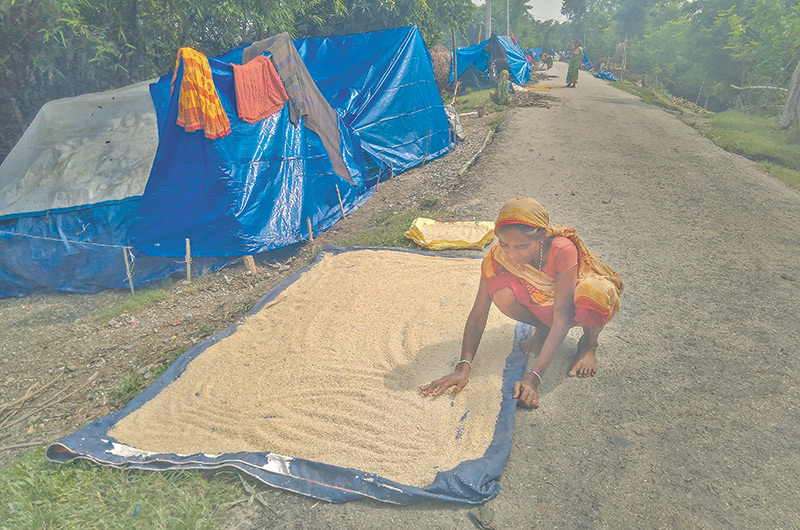
Monsoon brings rain—and sorrow—to villagers near the Saptakoshi

Radha Devi Mukhiya and her family move out of their home and spend months living under tents during the rainy season every year.
- ABDHESH KUMAR JHA
Radha Devi Mukhiya spreads wet rice to dry in her village in Saptari. Asthe Koshi floods inundated her house, she is taking shelter on the river’s western embankment. Post Photo: ABDHESH KUMAR JHA

RAJBIRAJ,
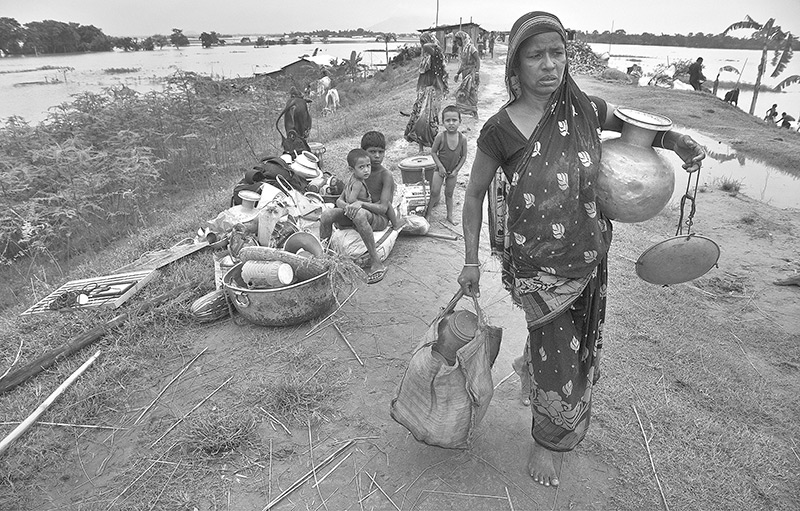
Every year, Radha Devi Mukhiya watches patiently as the monsoon arrives. She knows what is going to happen next, but there is little she can do about it. As the rains come down, the waters in the nearby Saptakoshi rise, breaching the banks and flooding the Hanumannagar Kakalini village in Saptari.
Mukhiya collects her belongings and moves to the nearby embankment, where she lives under a tent for two to three months, waiting for the floodwaters to recede, surviving on relief material handed out by the government and various charities. This has been Mukhiya’s routine for over three decades now.
“My family goes through this every year. I was married into this family when I was 16 and I remember my grandfather-in-law telling us about how the floodwaters would enter the village,” said 50-year-old Mukhiya. “Then, it was my father-in-law’s turn to live like this. Now it’s mine.”
This year, as continuous rainfall led to flooding across the country, Mukhiya has been trapped in her village since Saturday. Knee-deep water had entered the village, drowning her possessions under a foot of the Saptakoshi. In her one-storey thatched roof home, there were few belongings she could salvage.
Mukhiya is helpless against the yearly phenomenon. She is too poor to build a proper elevated home and
she cannot afford to move out of her village. After her husband died, her family, consisting of her son, daughter-in-law and grandson, have been subsisting as daily wage labourers, with few savings.
“We work all year round in the fields and store food grains in our house, but every rainy season, the floodwaters take away everything,” said Mukhiya.
Things have only gotten worse in recent years, said Mukhiya. The village, which is around two kilometres from the river, now floods more than before. Mukhiya blames a pilot channel constructed by India that changed the course of the river. The river now flows towards the west, flooding villages, like Hanumannagar Kankalini, on the western banks.

There are no options but to move the entire settlement, said Shailesh Sah, mayor of Hanuman Nagar Kankalini municipality.
“The only way to save these settlements is to move them to safer locations, but the municipality does not have the money to buy land and build new houses,” he said.
Data from the municipality shows that around 70 percent of flood victims are from impoverished backgrounds, primarily Musahars, Chamars and Malahas, who are unable to afford to migrate to safer areas in the district by themselves.
“We are planning to provide Rs 200,000 each to families so that they can move to safer areas,” said Sah.
But for Mukhiya, the money might bring immediate relief, but it will not guarantee a long-term solution.
“The ward chairperson tells us that the municipality will give us some money. I don’t know if that is true, but even if it is, the amount he has mentioned is not going to be enough for us to be able to move out, buy land and build a house elsewhere,” she said.
Lacking any real options, Mukhiya has grown accustomed to her yearly displacement, where she expects the monsoon to flood her home and push her to living in a temporary settlement for months.
“I’m afraid this sorrow is not going to end with us,” said Mukhiya, turning to her daughter-in-law, sitting nearby with a year-old child in her arms. “My grandchildren have already started living the nightmare now.”

Page 2
MEDLEY

Horoscope

ARIES (March 21-April 19)
**
 Are you a person of action? Maybe you think you are, but don’t be surprised if you feel like mulling things over before jumping into a new situation today. That’s actually a very wise thing to do-taking time to look at a new opportunity from all angles will help you quickly see whether or not this is the gig for you.


TAURUS (April 20-May 20)
**
It’s important to trust your friends and loved ones when they give you advice about your heart and your feelings, but right now you should not listen to any of their financial advice. It’s not wise to mix money with love, and what they are proposing is a lot riskier for you than they may realise.  


GEMINI (May 21-June 21)
*****
When it comes to picking partners or divvying up people into teams today, you are likely to be a very popular choice. This extra level of attention might not last too long, so you had better take advantage of it while you can. You know darn well that you’re an asset to any situation, so do not be bashful.


CANCER (June 22-July 22)
****
The art of loving yourself requires a great deal of prioritization. Self-nurturing should not always be put on the back burner. Every once in a while, you have to put it first and give yourself the attention you need. If any part of you dreads mingling with a roomful of people, do yourself a favor and politely opt out.


LEO (July 23-August 22)
**
An ex is back on the scene, and you might feel your heart singing a familiar tune. Be careful-even if you feel more romantic about them than you ever did before, it could be hope or idealism guiding your feelings. Give yourself time to get used to them being around, don’t try to steer this thing.


VIRGO (August 23-September 22)
***
Your sense of obligation is stronger than ever, which could cause your social life to suffer a bit in the coming weeks. When faced with a choice between having mindless fun and helping someone out, you won’t let yourself out of your responsibility to be there for someone special. This is a wonderful quality.


LIBRA (September 23-October 22)
****
If your life is a see-saw, then you’re sitting in the middle right now! You are the picture of balance, someone who isn’t too much this and isn’t too much that. While there are polarizing issues around you today, you will always be able to see both sides of the story. Enjoy your objectivity, and try to encourage other people.


SCORPIO (October 23-November 21)
*****
You can be forgiven for getting caught up in the moment today if good news sends you into a silly rant of excitement! Let loose when the good news hits your ears, and make your smile the biggest one in town. Spread the joy to the people you encounter by opening doors, or just offering a sweet ‘hello’.


SAGITTARIUS (November 22-December 21)
***
You are coming to realize that friendships come in all shapes, sizes, and power dynamics. Mix it up. Experiment in your relationships today-step up and try to drive the plans in a friendship in which you just usually go along for the ride. Or ease up and let the other person plan the day.


CAPRICORN (December 22-January 19)
**
You need to create more structure in your life. Force yourself to follow through on the tasks you have at hand. Part of your problem right now might be that you have a lot of half-baked ideas cluttering up your mind-you need to pick one of them and complete it today! Take one step; momentum will take care of the rest.


AQUARIUS (January 20-February 18)
***
Friends are the family you have chosen for yourself, which means that you can also un-choose them. If you are having troubles with one of your friendships right now, be honest with yourself about the relationship. Are they making your life more enjoyable or more complicated? Do they encourage you to be the best?


PISCES (February 19-March 20)
***
If you have been waiting for peace and quiet to take over your life for a while, you are all set! Those busybodies who usually annoy the heck out of you are nowhere to be found right now. You’re feeling freer than you have in a long time-who knew that this one person could be responsible for so much stress?

Page 4
NATIONAL

Province 5 districts have no offices dedicated to women

- Amrita Anmol

BUTWAL,
When the country adopted federalism, all women and children offices in Province 5 were dissolved. The idea was to set up a dedicated office that would specifically cater to women issues.  Two years have passed since the country was federated, but the province has still not opened its women’s office.  
Now women’s rights activists are asking what role women have under the new system.
“Women played an important role to establish democracy and federalism in the country. It now seems like their roles have been completely forgotten. The state has ignored their needs; shrugged away the roles women played while the men sat down to prepare the federal structure,” Gyanu Paudel, a women’s rights activist, said.
Women-related plans and policies have been greatly affected in the absence of a dedicated government institution. “Achieving the targets set for women development and gender equality in the province have now become a challenging task,” Paudel said.
After federalism, district-level thematic offices in the province were adjusted with the local level under the Local Government Operation Act 2074 BS.
But the federal and provincial governments did not include the erstwhile district women and children offices in their adjustment plan, arguing that the number of offices adjusted with the local units were not enough to efficiently execute the state works.
Radha Kumari Gyawali, central member of the ruling Nepal Communist Party, said the absence of a separate women’s office at the district and provincial levels is the result of a patriarchal mindset.
“It looks like the decision-making team comprised of only men. They completely left women out,” Gyawali said.
When the country’s leaders were preparing to implement a federal set-up, women leaders and activists had lobbied for a separate  women’s ministry at the provincial level and a women’s office at the district level.
“The leaders had assured us at the time that there would be dedicated women’s ministry and women’s office under the federal model, but they failed to keep the promise,” said Gyawali said.
Province 5 has seven ministries. Women-related issues have been put under the ambit of Social Development Ministry, which also looks after the issues of education, health, youth, sports, senior citizens, and disabled persons. Likewise, there are seven directorates under the federal government, and not a single one of them is for women and children.
In Province 5, there are 145 government offices, and none of them are dedicated to women.
Social Development Minister Sudarshan Baral admitted that the ministry has not been able to penetrate the grassroots level and select plans and policies targeted at women.
“We prepared plans and selected some projects last year in consultation with women leaders, lawmakers and representatives of some social organisations, but we weren’t able to implement the projects at the local level,” Baral said.
There are two directorates—health and education—under the Social Development Ministry, but neither caters to women.
The Social Division Office has been given the responsibility of overseeing the issues related to women, children, senior citizens, and disabled persons.
“It is difficult to work because there are no separate provisions, infrastructure, resources and budget for women-centric offices. We just carry out the daily administration works,” Sharada Belbase, the division office chief, said. “Programmes targeted at women have yet to be implemented effectively.”
Baral said the province government was aware of the difficulties and challenges of working for women’s rights and development without the support of dedicated offices and that his ministry is making efforts to address the issue.

NATIONAL

Overcrowding of inmates inside Taplejung’s district prison

The prison currently holds five times its capacity for inmates.
- Aananda Gautam

TAPLEJUNG,
Inmates of the Taplejung District Prison are facing various problems due to a lack of space. The prison, with the capacity to hold 25 inmates at a time, currently houses 128 inmates, five times more than its holding capacity.  
Dhaniram Singh, a jailer at the prison, said the district prison is compelled to send inmates to other prisons because of the overcrowding.
“We have no other alternative but to send our inmates to other district prisons,” Singh said. “Plans are being made to send women inmates to the neighbouring Ilam and Panchthar district prisons. We have already consulted with the higher authorities on the issue.”
According to the prison administration, overcrowding of inmates has made life difficult for everyone. Dhurba Kumar Deban, Naike—a leader who is a part of internal administration—in the district prison, said that three to four inmates have been forced to sleep in one bed.
“There is no space here. We don’t even have enough space to sleep in,” said Deban.
Chandra Jeet Chongbang, an inmate at the district prison, said they have to queue up for hours to use the toilet.
The prison has only three toilets with no water supply.
Devraj Gurung, a rights activist, said they have suggested the administration to upgrade the prison during a recent inspection.
“The concerned authorities must pay immediate attention to solve this issue,” Gurung said.

NATIONAL

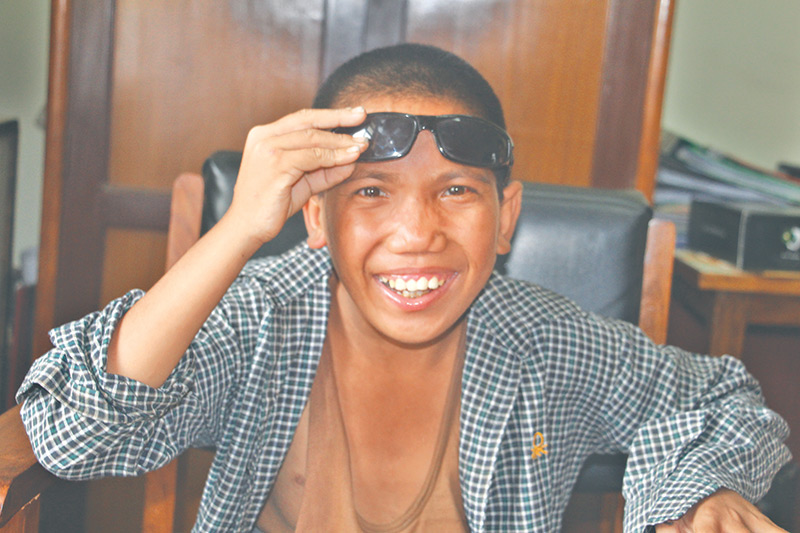
After getting eyesight back, 13-year-old Roshan Theeng goes back to school

Theeng will be enrolled in the second grade of Mahendra Basic School in Uttarpani.
- PRATAP BISTA
Theeng attended school on July 10 and 11, just a week or so after getting his eyesight back. Post Photo: BHAWANI BHATTA

HETAUDA,
Roshan Theeng has always had a passion to learn. But when the cataract that spread over his eyes cost him his eyesight when he was in the second grade in school, he could no longer read or write.
Theeng’s passion to learn has been redeemed now that his eyesight has been restored. Two weeks ago, famed eye surgeon Sanduk Ruit treated him, and his reaction to being able to see again was captured in an emotional video that went viral on social media. The video shows a delighted, ecstatic Theeng running his hands over the surgeon’s head after the successful surgery.
Cataracts had invaded both of Theeng’s pupils three years back. Over the years, he slowly lost his eyesight, eventually going completely blind. After three years of complete blindness, 13-year-old Theeng could finally see again.
Right after his eyes were removed from the bandage, Theeng had shouted out loud: “I can see everything and everybody. Now I can go to school again.”
Just a week or so after getting his eyesight back, on July 10 and 11, Theeng attended the Mahendra Basic School, in Uttarpani, to rejoin school. He will be enrolled in the second grade.
Since the school is currently conducting its terminal exam starting July 12, Theeng has been asked to rejoin from July 18, the day when the exam ends. The school has given him two books and an exercise book, and Theeng says he is excited to study again.
 Maili Maya Theeng, Roshan’s grandmother, said that he is really excited about going back to school. “He has a passion for studies and books. I just hope he does well in school.”
It was Maili Maya who had carried Theeng on her back and brought him to Hetauda Community Eye Hospital in Hetauda Sub-Metropolitan, where the free eye camp was conducted. “I heard a free camp was being organised at the hospital for eye tests and eye surgeries so I brought my grandson here,” said Maya.
Theeng has been under Maili Maya’s care since his mother passed away two years ago from HIV-related complications, while his father, who is also HIV positive, is bedridden.

NATIONAL

Four border pillars collapse in recent floods

- MANOJ PAUDEL

KAPILVASTU,
Four boundary pillars along the Nepal-India border have
collapsed in Kapilvastu district in recent floods.  
Floodwaters from the Chirai stream in Bijayanagar Rural Municipality-5 damaged the pillars that separate Thakurapur of Nepal and Balarampur of India. According to Dinesh Chaudhary, the ward chairman of Bijayanagar-7, four pillars numbered 577/7, 577/9, 578/7 and 578/10 were damaged by the floods.
However, locals said the border pillars collapsed not just because of the flood, but also because they were poorly constructed. The police post in Thakurapur carried out public inquiry deeds about the incident and submitted its report to the District Police Office.
“We have been informed that three border pillars have collapsed in the flood. We will soon repair them,” said Chief District Officer Gajendra Bahadur Shrestha.
According to him, the pillars will be reconstructed after a joint meeting of the officials of both the countries.

NATIONAL

Woman held with 43kg hashish

Briefing

CHITWAN: Police arrested an Indian woman in possession of 43 kg hashish from Ratnanagar in Chitwan on Monday. Nurjaha Khatun, 70, of Motihari from the Indian state of Bihar was held with the hashish, police said.

NATIONAL

Man killed in tusker attack

Briefing

CHITWAN:  Kanchha Darai, 62, died in a wild elephant attack in Bagmara, Chitwan, on Tuesday. Darai, a resident of Badrahani in Ratnanagar, was attacked while she was heading to Sauraha for work.

NATIONAL

Leopard dies during treatment

Briefing

DOLAKHA: An ailing leopard that entered a human settlement in Singati Bazaar died in the course of treatment on Tuesday. Locals captured the leopard on Monday and handed it over to the Division Forest Office in Charikot. 

NATIONAL

Two Chand activists surrender

Briefing

NUWAKOT: Two activists of the Netra Bikram Chand-led Communist Party of Nepal surrendered at the District Administration Office in Nuwakot on Tuesday. Bishnu Bhandari and Saroj Neupane have vowed not to get involved in any activities of the Chand outfit.

NATIONAL

Man held with ‘pen gun’

Briefing

POKHARA: Police arrested Sagar Ranabhat, 24, in possession of a ‘pen gun’ and its seven bullets from Pokhara. Ranabhat was made public in a press meet on Wednesday. Security personnel also seized controlled pharmaceutical drugs from his apartment.

NATIONAL

State 2 ministers to donate month’s salary to flood victims

Briefing

DHANUSHA: A Cabinet meeting of Province 2 on Tuesday took the decision to donate one month’s salary of all ministers to the province’s flood victims. 

NATIONAL

Man held for staging fake abduction

Briefing

RAUTAHAT: Police detained Shreebhagawan Sah for faking his own abduction. Sah’s family members had lodged an abduction case two and a half months ago. Police investigation showed Sah had voluntarily gone out of contact since his business was in loss.

Page 5
NATIONAL

Health Ministry decides to shut government medical colleges’ liaison offices in Kathmandu

Officials say these offices are turning into centresfor corruption and irregularities.
- Arjun Poudel

KATHMANDU,
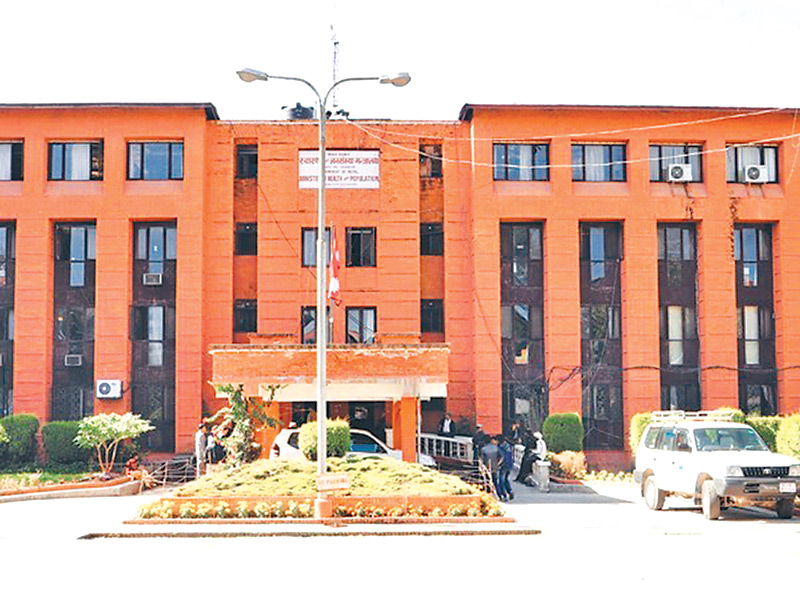
Following complaints that Kathmandu liaison offices of the government medical colleges located outside the Valley were involved in irregularities, the Ministry of Health and Population has decided to shut them.
The Rapti Academy of Health Sciences, the Karnali Academy of Health Sciences, the Pokhara Academy of Health Sciences, the Ram Raja Prasad Singh Academy of Health Sciences and the BP Koirala Institute of Health Sciences have set up liaison offices in Kathmandu. Except for the BP Koirala Institute, other academies set up their liaison offices in Kathmandu after the appointment of their office bearers.
“From a ministerial-level decision, we have decided to shut all the liaison offices of the government medical
colleges,” Mahendra Prasad Shrestha, spokesperson for the Health Ministry, told the Post. “Why do they need
liaison offices in Kathmandu, when the Health Ministry is here to coordinate?”
According to officials at the Health Ministry, the academies have rented office spaces, appointed staff and bought vehicles, just as regular health-related works in the concerned regions have been hampered.
The Rapti Academy of Health Sciences, which is under the scanner for irregularities, was found to have been spending money in Kathmandu under different headings, including seminars and workshops while the budget allocated by the Health Ministry should have been utilised for the Academy.
“We have found that office bearers of these academies are hiring unnecessary staff in Kathmandu offices and not paying attention where it is due,” a member of the probe team told the Post requesting anonymity.
The team formed by the Health Ministry to probe irregularities in the Rapti Academy last month
recommended that the ministry shut all liaison offices of government medical colleges, saying they were turning into centres for corruption and irregularities.
Sangita Bhandari, vice-chancellor of the Rapti Academy, however, defended the move to open the office in Kathmandu.
“Compared to other academies, we have been spending less and using fewer number of vehicles,” Bhandari told the Post over the phone. “Academies operating from outside the Valley need offices in Kathmandu, as they have to be constantly in touch with the federal government rather than their respective provincial governments.”
According to Bhandari, the probe team formed by the Health Ministry was biased.
The Karnali Academy also has objected to the government’s decision to shut its Kathmandu office.
“We will request the Health Ministry to reconsider the decision,” said Rajendra Raj Wagle, vice-chancellor of the Karnali Academy. “However, we will see what other academies do and decide accordingly.”

NATIONAL

Disgraced anti-graft official Pathak under investigation for money laundering

Raj Narayan Pathak resigned as a CIAA commissioner over a bribery scandal in February.
- PRITHVI MAN SHRESTHA

KATHMANDU,
A former commissioner of the Commission for Investigation of Abuse of Authority, who is facing a corruption case, is also being investigated for money laundering.  
A senior official at the Department of Money Laundering Investigation told the Post that Raj Narayan Pathak is being investigated for amassing wealth through illegal means and reinvesting the illegally earned money.
“We are working in collaboration with the Central Investigation Bureau of Nepal Police,” the official told the Post on condition of anonymity, citing the sensitivity of the matter.
Pathak is already facing graft charges at the Special Court after he was found receiving Rs 7.8 million to settle a dispute related to Nepal Engineering College.
Although the Commission for Investigation of Abuse of Authority investigates into property amassed by public officials through illegal means, the  anti-money laundering agency has initiated a parallel probe into Pathak’s possible involvement in money laundering.
Accumulation of wealth through reinvestment of illegally obtained property or cash is tantamount to money laundering.
CIB Chief Deputy Inspector General Niraj Shahi would not confirm the joint investigation into Pathak but said that the CIB has been conducting many investigations jointly with the money laundering department.  
“CIB staff have been deputed at the money laundering department to assist its investigation,” he said.  
On March 26, the anti-graft body had filed a corruption case at the Special Court against Pathak, charging him of committing corruption of Rs7.8 million  after he was embroiled in a bribery scandal regarding the ownership of Changu Narayan-based Nepal Engineering College.
Leaked audio and videos showed Pathak admitting to have received Rs7.8 million from a group headed by Lambodar Neupane to settle a dispute over a land owned by Nepal Engineering College.
The group had attempted to capture the property of the college by registering it as a private company from a public one. When the case reached the CIAA, Neupane and his group had reportedly bribed Pathak to settle the dispute in their favour.  
After the videos were leaked, Pathak resigned as CIAA commissioner on February 15.
A complaint has also been registered at the CIAA demanding investigation into Pathak’s property following his resignation over bribery scandal.  
The anti-money laundering agency has prioritised investigating the individuals charged with corruption.  
“We will focus on investigating into people accused of corruption, tax evasion and human trafficking, the three areas identified as most risky ones,” said Binod Lamichhane, information officer at the department.
Asia Pacific Group on Money Laundering (APG), a regional intergovernmental institution against money laundering and terrorist financing, is conducting a mutual evaluation of Nepal in 2020.
Concerned government officials say that Nepal would have to make significant progress on key risk areas to keep the country out of the blacklist of Financial Action Task Force (FATF), a global-anti money laundering body. The APG is an associate member organisation of the FATF.
The department officials said the probe on Pathak is also a part of demonstrating Nepal’s commitment to anti-money laundering during the mutual evaluation.  
The mutual evaluation is a peer review system where other nations and jurisdictions of APG review Nepal’s compliance to global anti-money laundering standards. Nepal is one of the 41 members of the APG.
“In order to improve our standing before the mutual evaluation, we will have to target some influential people who are accused or suspected of amassing property through illegal means,” an official of the department said.  
The Money Laundering Department has hardly investigated or filed cases against people who are accused of corruption since its establishment in July 2011. According to the department, it has filed only two cases on charges of money laundering against people accused of corruption.
One is against Sanjaya Sah Takla, former state minister, and another against Rabi Raj Shrestha, former senior superintendent of police. Sah is accused of masterminding Janakpur bombing in 2012 that took the lives of five people while Shrestha is accused of smuggling.
As of last fiscal year 2018-19, the department has filed 51 cases related to money laundering at the Special Court. 

NATIONAL

No more squabbles in a village once called Jhagada

- Basanta Pratap Singh
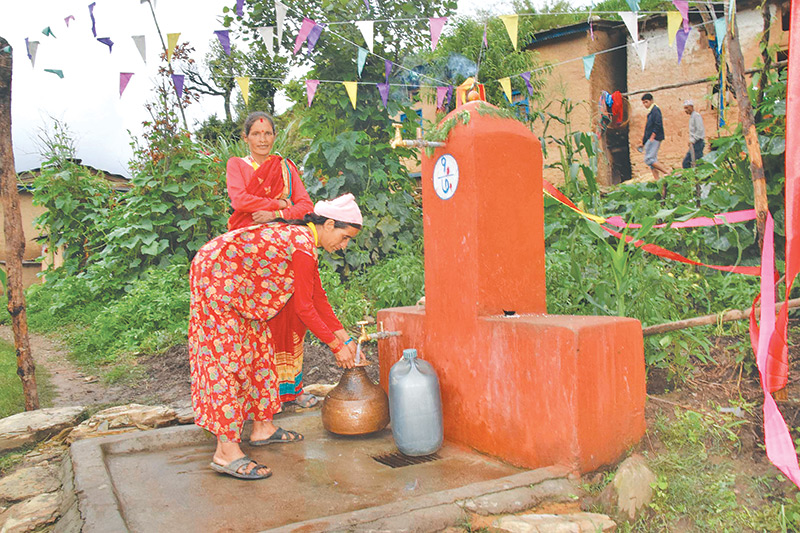
Women of Jhalakpur fill their water pots at a village tap.  Post Photo: BASANTA PRATAP SINGH

BAJHANG,
A two-hour uphill walk from Khauladhar Bazaar in Bungal Municipality-6, Bajhang, lies a hamlet that overlooks green forests and rolling hills.
At first glance, the place, with its neatly arranged homes and majestic vista, looks like a tourist village somewhere in Pokhara. But its sleepy rustic charm is recently earned.
The village has had a riotous history, where for decades its residents fought among themselves for water. Such was the desperation and disorder that even the name of the village was Jhagada—which translates to ‘scuffle’ in English.
Today, the utterance of the name meets raised eyebrows.
The village dispensed with its old name after the municipal office constructed a drinking water supply project last November. Jhalakpur was the name given to the village.  
“The age-old struggle for water ended with the construction of the water project. There were no more scuffles related to water. So the villagers deemed the name Jhagada was no longer apt,” said Dipesh Gurdhami, chair of Jhalakpur Drinking Water Consumers’ Committee.
For decades, Jhalakpur residents were dependent on a single water source, situated some 30-minute walk downhill. As the place used to be crowded all the time, the villagers had devised the rule of first come, first served. But, more often than not, this rule was broken, leading to fights.
“If a person was not present at the water source while her pot was filling,  someone would invariably steal the water,” said Anjana Bohara, a local woman. “So it was only natural for brawls to break out over a pot of water.”
No villager, however, could say when exactly the warring over water began. But everybody offers the same theory about how the name of the village came to be.
“In fact, the real name of the village was Jhaakada—not Jhagada,” said Arjun Gurdhami, a local man. “It was only after the fights over water became frequent that the village became to be known as Jhagada.”
With the water supply project built under the Rural Water Resource Management Project of the municipality, the water crisis has ended and so has the angry confrontations and fisticuffs.
Today, every house in the village has its own water tap.
The women in the village say the water project has brought a big relief to their lives.
“I came to this village 23 years ago as a young bride,” said Dhauli Devi Singh, “and the last nine months have been the best so far.”

NATIONAL

A day with the only female driver of Sajha Yatayat

Many appreciate Harmita Shrestha’s work, calling it a step ahead for women empowerment, but in a ‘man’s world’ days aren’t always that easy, she says.
- ANUP OJHA
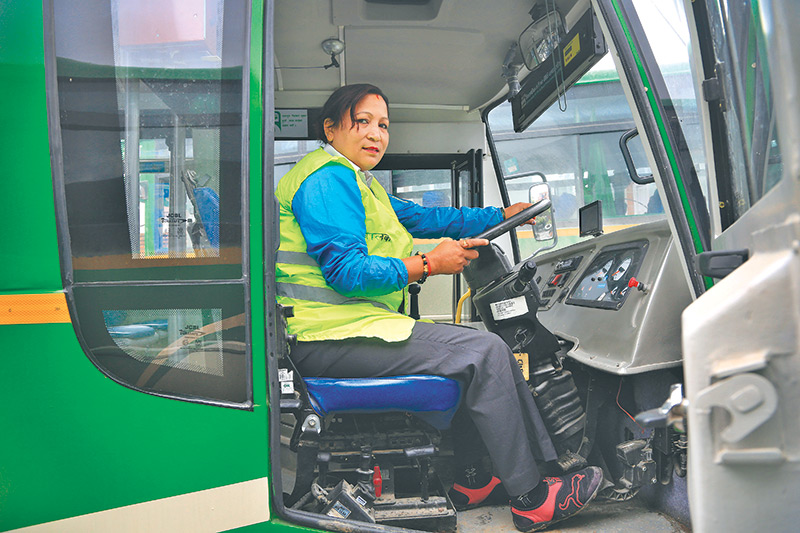
Harmita Shrestha, who started as a tempo driver, says she is delighted to see many young women supporting their families as drivers. POST PHOTO: PRAKASH CHANDRA TIMILSENA

KATHMANDU,
Just like every morning, on a drizzling Tuesday, Harmita Shrestha rolls out her bus at 9:30 am from the Sajha Yatayat garage in Hariharbhawan.
A little down the road, at the Patan Engineering Campus gate, 82-year-old Khamba Kumari Mahat and her daughter get on the bus. She is going to Pashupatinath.
After getting on the bus, the old lady sees Shrestha in the driver’s seat. Eyes wide open in amazement, she stares at Shrestha, who is wearing a crisply ironed white shirt paired with black trousers. Her hair is combed back into a ponytail.
“Meri aamai, lau na, mero chhori le yeti thulo gaadi chalako, kati mahasoor!” said Mahat.
Shrestha is the only female driver for Sajha Yatayat, which operates 71 large-body buses across the Kathmandu Valley. On Tuesday, the 41-year-old driver was assigned to the Lagankhel to New Bus Park route, a total of 14 km, a trip she will have to make three times a day.
She joined Sajha Yatayat only recently, but Shrestha is not new to driving. Born and raised in Bhanu Chowk of Dharan, she says she had been interested in driving since she was in school and has two decades of driving experience. It was in class nine that she learnt how to drive, on the Maruti car which was at her house. “When I was a kid, I used to be amazed by how vehicles operated, how they would run without falling,” said Shrestha. “But driving was always a ‘man’s job’. I wanted to break this notion.”
On the Bagmati bridge, the bus gets stuck in a jam. She looks at the swollen Bagmati river solemnly and talks about how the floods have inundated many parts of the country. “So many people are dead, and so many homeless. It is due to the carelessness of the government,” she says, as she overlooks a city she has called home for decades.
Harmita first came to Kathmandu in 1995 after passing her SLC. Here, she first lived with her uncle’s daughter. She was well taken care of, but she wanted to be financially independent as thus started working as a tailor. “It was a low paying job, and I never liked it,” said Shrestha.
Despite not particularly liking her job, Shrestha worked as a tailor for the next few years. It was only five years later that Harmita decided to do something else with life. She start learning how to drive a tempo.
After getting her licence (from Birgunj), she started driving a tempo—on the Nepal Airlines to Bouddha and Jorpati route—every day, being one of the first women tempo drivers in Kathmandu. The money was quite good, she says. “But there was a lot of discrimination. Men would tease me. The traffic police also made life tough,” recalls Shrestha.
But Shrestha thinks it was all worth it. It taught her many life skills, and it encouraged other women to take up tempo driving too, something she likes to credit herself for.
“It feels good to see many young women taking driving as a profession and supporting their family financially,’ said Shrestha. She says that if one has skills, one is empowered. “If you are financially independent, you can make decisions for yourself,” says the lady driver, her right hand confidently placed on the steering, her left on the gear, her eyes focused on the road.    
Rabindra Nath Bhattarai, associate professor at Patan Campus, boards the bus from Thapathali Campus. “I was riding pillion in my friend’s vehicle, but upon seeing lady driver, I got off and boarded the bus,” said Bhattrai. For Bhattrai, Shrestha’s act is a step forward for social transformation in Nepal. “The notion that women should be limited to household chores is slowly being changed. Shrestha’s act shows that women are as capable as men, and this will send a positive message to the new generation,” said Bhattrai, who lives in Pinglasthan, Gaushala.
After a few minutes of jam in New Baneshwor, Shrestha deftly manoeuvres her bus through the Sinamangal and Airport road section, and takes the road to Gaushala. By this time, all seats are packed. Many are standing.
The 82-year-old lady gets off in Gaushala, blessing Shrestha while she does. The associate professor too gets off, giving a thumbs up to the lady driver as he leaves.
The light drizzle has stopped by this time. The road in Gaushala is now full of dust and potholes. Shrestha takes out a mask from her pocket and puts it on. She complains how unconcerned authorities are towards the rising pollution level in the country, and about the roads that are more potholes than road.
Before working this job, Shrestha too worked for the government. “I was the first woman driver to work in government office,” says Shrestha. She worked as a driver for Durga Pokharel, the then chairperson of National Women Commission, who paid her a monthly salary of Rs 3,930.
While Shrestha talks about her brief stint, the bus reaches Chappal Karkhana. Here, the road is smoother, and a clear view of the sky is seen. As the bus stops at Narayan Gopal Chowk, a drunkard boards the bus with a pair of rabbits in a rectangular cardboard box. He stands on the back door, refusing to move. When the conductor tells him to get in, he curses. Then he starts to sing. “You see all kinds of people every day,” says Shrestha. “Sometimes it’s funny, but sometimes it can get annoying.”
But it’s not the passengers who get on Shrestha’s nerves. It is the cops. She remembers how on the very first day of driving the Sajha bus she was troubled by traffic police. “I was driving a bus en route to Bhaktapur, but in Koteshwor a traffic police questioned my skills. He asked how could a woman have a licence of a heavy vehicle,” says Shrestha. With no fault on her part, the policeman asked all passengers to empty the bus and took her to the Koteshwor traffic police station and kept her and the bus there for five hours. “I felt very humiliated,” said Shrestha. “And it was only because I was a woman.”
Shrestha says she learnt how to be “professional” after she joined the UN, where she worked for the next decade. She got the job while she was working the government job. In the UN, she had a very good starting salary of Rs14,000 per month, with additional facilities.
“Apart from that, I got to travel to many remote places, where people would appreciate my work,” said Shrestha. “It was during the Maoist insurgency that I travelled to all these remote places, sometimes we would pass through Maoist checkpoints, sometimes through Nepal Army barracks, sometimes through places that had recently been bombed,” says Shrestha, who had to leave her son Bishal, now 22, home alone. Shrestha now has another child, Greshma, who is eight, but that is all she has for family. She was once married to a man from Sindhupalchok at the age of 18, but she doesn’t like to talk about him.
The bus finally reaches final destiny, New Bus Park. One by one, her passengers file out of the bus. It’s 12:45 in the afternoon already, and she has not eaten anything all day, except a cup of black tea. Hemraj Shrestha, Shrestha’s conductor for the day, checks the bus to see if passengers have left anything. The two then head to a building in the northern side of New Bus Park, where almost all Sajha Yatayat’s staff eat their lunch and rest for a while—only to go back to doing it all over again.

Page 6
EDITORIAL

Humiliated again

The police should help victims of sexual assault get justice, not shame them further

When a 15-year-old girl went to the police to report the trauma that was rape, she felt further traumatised after being subjected to hostile questioning. Instead of the police officers—who were female themselves—empathising with her, their thoughtless and insensitive questions like, ‘Why didn’t you run? Why didn’t you raise a voice?’ made her feel like she was being assaulted all over again. The girl felt that she was being asked the wrong questions.
Negative responses from the police—supposedly the support providers—have been an enduring problem. A majority of the police force is predominantly male and agonisingly undertrained when it comes to dealing with survivors of sexual violence. Their ‘inability to create a victim-friendly environment’ further serves as a silencing function, where the victims think it’s better to not report an assault, instead of mustering the courage to report. Most of the rape survivors who take their suffering to the police station are regrettably familiar with the distressing experience of having their evidence torn apart and their credibility questioned. As it is, owing to the stigma attached to rape, it is difficult to confront the authorities. And the victims most of the time might not be forthcoming initially. But things get more complicated when victims choose to remain silent as they doubt whether further disclosures would be effective.
According to the Nepal Police, there has been a significant increase in the percentage of reported rapes in the country over the past 10 years. In 2008, there were 309 rape cases reported. Come 2018, the number of cases shot up nearly fivefold to 1,480. Although a majority of these cases are marked as ‘solved’ in police records, only half of them result in convictions at the courts.
The Nepal Police formulated their Gender Policy 2013 where the first few pages of the document lead to the line ‘A well disciplined, secure and women friendly working environment are indispensable attributes of every organisation’. Meaning this is what the Nepal Police subscribe too. But this commitment has not been translated into practice. In reality, the police officers are crass and show little regard for the pleas of the victims, as only a few have received gender-responsive training. Victims of rape and sexual assault have faced the gravest difficulties in receiving reparations; victim-blaming for rape is not going to help in any way.
Simply put, the police should place importance on the victim’s needs and rights. There are specialised centres with trained personnel and expertise that respond to victims of sexual assault. This is something that the Nepal Police are far from being at the moment. The negative response from the police is among the gaps existing in the Nepal Police’s response to sexual assault. The basic motto of the Nepal Police is ‘Truth, service, and security’. If the institution is to remain true to its maxim, it should focus on offering a range of services and referrals to women. If the victims opt for legal redress, the police should guide them through the legal process instead of dismissing them.

OPINION

Community building in foreign lands

Nepalis all over the world attempt to sustain their culture while easing into their new lives.
- PRAMOD MISHRA

Two weeks ago, on June 29, the Nepali American Center of Chicago organised a Nepali mela (fair) at St Paul Woods in Morton Grove, Illinois, a suburb of Chicago. The fair opened at 10 am and closed at 5 pm and all day long Nepali immigrants from near and far streamed in and out. The fair had a few stalls that sold Nepali grocery (I bought a packet of crunchy Taichin chyura), momos, drinks and other eatables. A group of Chicagoland Nepali women have formed a women’s organisation and named it Lali Guras. In the sultry Chicago afternoon, I bought their lychee drink. All the proceeds went to the organisation that had held sports and academic tournaments a week before and a cultural programme all day long during the fair. The person behind all this was an engineer by profession; but by his dress and demeanour, he looks like a village gentleman. His name is Bishnu Phuyal.  
In the past decade, Mr Phuyal has gathered a sizable congregation of devotees and led a Nepali puja on the first Saturday of every month at a local Indian temple. People assemble, perform puja and partake in meals in the temple basement—all of this sponsored by generous Nepalis in the area. Mr Phuyal had organised a mela ten years ago, and this year was its second run. The ten-year-gap shows how challenging it is to organise public events when you have limited resources. But Mr Phuyal and his band of volunteers have made it possible.
In Los Angeles, Washington, DC, and I’m sure in many places all over the world, Nepali expatriates have led such initiatives to assemble their country folks in the diaspora in an attempt to sustain their culture, language and social life, while gradually easing into their adopted countries and locales. This is the story of all immigrants. In the United States, a country of immigrants (if one sets aside the Native Americans for a moment), from the times of Puritans and Jamestown farmers to today, immigrants came from all over Europe first (British, Germans, Scandinavians, East and Southern Europeans) and then from all over the world, including Asia, and made America their home. The Puritans were meticulous in keeping an account of their daily lives, hopes, despair and aspirations. Later, voluntary and involuntary (slaves from Africa) immigrants began to make a new life in the United States by seeking out community through worship, which has been the way in which new immigrants have coped with the changes between their old world and their new life.  Even the African slaves in their abject
situation sought solace in Christian worship and created unforgettable spirituals and gospels.  
In the initial years, Nepalis left their homes with families to seek a better life in Darjeeling, Sikkim, Bhutan, Assam and Northeast India. They went as far out as British-ruled Burma in search of cultivable land and pasture. They settled in various parts of India, including the north-western hills of Kumaon-Garhwal and Himachal—some after retiring from their service in the British Indian Army. But now they go everywhere, depending on their
educational and financial resources. Some go out to East, Southeast or West Asia to somehow make money so that their families’ lives would be better at home. Others migrate to mostly Western (North America, Europe and Australia) countries to make a better life there.  
And, like Mr Phuyal, there are immigrants with social energy and the desire to build a community. When I first came to the Chicago area three decades ago, there were four or five Nepali families settled here. The rest of us were transient students, working hard to be academically successful. There was Shakti Aryal in DeKalb, Illinois, a university town some 60 miles west of Chicago, who had heard that a student from Nepal was coming to the local university. He contacted the International Student Office and sent his teenage daughter to pick me up and put me up in his townhouse for a few days while marshalling other Nepali students to find me an apartment to live in. Mr Aryal had already hosted and helped settle these students when they had first arrived. While I was prepared to face the unfamiliarity of American life, finding a Nepali family willing to help ease the challenges that accompanied new arrival in an alien land was comforting. There was Swarna Pradhan, a medical doctor in Chicago, in whose house 10 to 14 Nepali families (that was the total number in the area that extended all the way to Ohio) gathered every Dashain for celebration and dinner.
While Shakti Aryal is no more, Dr Pradhan was seated at the fair in his straw hat, watching hundreds of his compatriots celebrating their culture. There was a first aid tent at the fair but it was staffed by a number of other physicians, not Dr Pradhan, because the area has about half a dozen medical practitioners of Nepali origin that I personally know.
The population of Nepali immigrants in the United States has become like Nepal itself.  There are those who came in the past—some still do now—as students and, after completing their education, decided to stay. There are also those who have sought asylum from various threats to their lives back in Nepal. A sizable number came
under the United States’ Diversity Visa programme that has sought to bring people to America from countries that are under-represented here. And the fourth category of Nepali-speaking immigrants are the Bhutanese refugees, who are also settled in the Chicago area in a sizable number.  
But it takes the volunteering spirit and energy of some immigrants to make the life of others like them easier and even enjoyable in the absence of the culture and social life of the home country. Nepalis in the area have become so at home by now, through community building, that even the local congresswoman had visited the fair to say a few words. And I’m sure that in a similar fashion elsewhere, Nepali immigrants are loving their culture while building a community among themselves, wherever they find themselves—from West Asia to North America, from Scandinavia to Oceania.     

- Mishra is the department chair of English Studies at Lewis University in the United States.

OPINION

Think first, act later

Myopic decisions have made the people question their faith in this government.
- KUSHAL POKHAREL

The government has backtracked on several policy decisions in the past few months, which has raised doubts over its credibility. Ranging from the Guthi Bill to the latest decision on pesticide residue testing, the government has backed off from its earlier stance amid mounting public pressure. Its decision to not host the International Indian Film Academy Awards in Kathmandu also exhibited a similar trend. The issue of conducting this event had become very controversial to the extent of attracting the attention of the parliamentary Committee on International Relations.
Based on a thorough review of the draft agreement between the government and the event management
company Wizcraft International, the House panel concluded that the proposed event was not in the larger interest of the country and the people. The committee clearly stated that some clauses in the agreement were detrimental to national sovereignty. For instance, the point related to inciting legal offence against the Nepal government in case of failure to maintain quality standards in the award ceremony was deemed to be unacceptable.


Unfriendly response
A majority of Nepali filmmakers publicly expressed their serious reservation, urging the government to review the decision to host the awards in the first place. At a time when the government has not shown any interest in promoting the national film industry, it was only natural that the obsession with the International Indian Film Academy Awards should receive an unfriendly response from the film fraternity in particular.
While the government and its departments involved in the negotiations argued that such a grandiose event would enhance the stature of the nation and be a milestone in making Visit Nepal 2020 a great success, the financial burden that the country would incur in hosting the event has been a matter of grave concern. Even lawmakers belonging to the ruling parties publicly condemned the government, urging it to prioritise its scope of work for the betterment of the nation and the people.
From the government’s point of view, ceremonies like the International Indian Film Academy Awards are instrumental in promoting tourism. However, it needs to think of innovative strategies for making Visit Nepal 2020 a grand success. Instead of inflicting a heavy burden on the state coffers, fostering local community-based enterprises and identifying new tourist attractions—sports and adventure, religion and spirituality, among others—will be pivotal in achieving the ultimate goal of Visit Nepal 2020.
While transforming the lives of the people through a robust socio-economic policy is the need of the
hour, the government seems to be interested in other matters that are incompatible with its own national vision. In light of the above, the slogan ‘Prosperous Nepal Happy Nepali’ is looking good only on paper. The pertinent question is how we ensure that the Nepalis are happy and Nepal is prosperous. What should be our key focus on a sectoral basis to accomplish this goal?
There is an important lesson on offer for the government. It is very important to assess the gravity of the situation before making any policy decision. How feasible is the policy decision? Is it in the general interest of the country and the people? How will the general people respond or react to such a decision? Moreover, engaging in multi-stakeholder consultations on matters related to a particular field will help the government to make rational decisions. The government should make every attempt to align its decision-making with the ground reality.


Realistic approach
A clear-cut focus to translate vision into reality should be figured out. Rather than trying to be populist, the government should adopt a realistic approach in its working style. Abandoning betrayal and deception, it should muster the courage to convey the real message to the public in terms of actually significant accomplishments and inadvertent failures.
If the government can critically review its moves and start afresh, the controversies surrounding it will be gradually reduced. This in turn will restore public faith, and again the public mandate to the present government will hold significance. Otherwise, the country is likely to bear the brunt of such myopic decisions, and the reactions that follow will put national priorities in disarray.

- Pokharel is a member of the Social Science and Research Faculty at NIMS College.

Page 7
OPINION

A Test match with the Taliban

No one believes the Afghans are anywhere near ready to manage their security without any international presence.
- JOHN NAUGHTON
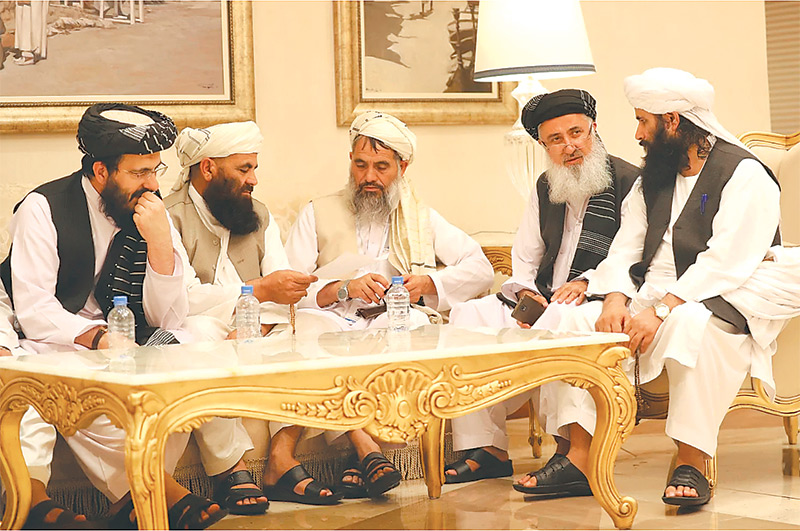
Members of the Afghan and Taliban delegations during the talks in Doha on July 8. Karim Jaafar/AFP/Getty Images

At the recent World Cup cricket tournament in England, a plucky Afghan team composed mainly of former refugees gave a surprisingly good account of themselves, including in matches against their neighbours, India and Pakistan. Unfortunately, the same cannot be said of two other Afghan teams—the Taliban and the government—that met in Doha, Qatar, earlier this month to agree on a ‘road map for peace.’
The Afghan government officials who participated in the Doha talks could not even claim to be what they were, because their interlocutors, a murderous band of fanatics, do not recognize the Afghan government. Instead, the delegation was politely described as a group of representatives from Afghanistan, without saying whom exactly they represented.
After two days of talks, the participants agreed on eight points in a joint resolution, prompting Zalmay Khalilzad, the US Special Representative for Afghanistan Reconciliation, to tweet that the talks had ‘concluded on a very positive note.’ He congratulated the participants ‘for finding common ground.’
Observers in India—Afghanistan’s second-largest aid donor after the United States—could be forgiven for a dose of scepticism. For one thing, the two sides had agreed in Doha to reduce ‘civilian casualties to zero.’ But even while they were meeting, their ‘common ground’—the soil of Afghanistan—was being soaked in blood from relentless attacks by the Taliban, who had rejected a ceasefire for Eid al-Fitr, the traditional Muslim holiday at the end of the holy month of Ramadan.
The violence has not abated since, with a series of Taliban attacks leaving dozens dead and hundreds injured in recent days. On July 1, Taliban fighters killed up to 40 people in an attack on a government compound in Kabul. Six days later, the Taliban carried out a suicide bombing on a national intelligence complex in central Ghazni province, leaving at least a dozen people dead and some 180 wounded. In both attacks, a number of nearby buildings were damaged, including schools in the vicinity, killing and maiming children. According to the New York Times’s weekly Afghan War Casualty Report, the death toll between June 28 and July 4 was the highest so far in 2019, with 264 government personnel and 58 civilians killed.
The conflict shows no signs of ending. Winston Churchill reportedly argued that ‘jaw-jaw is better than war-war,’ but the Taliban have perfected the art of talking while fighting. They have made no secret of their desire to restore their Islamic Emirate, which ruled—and brutalised—Afghanistan from 1996 to 2001, until it collapsed under a hailstorm of US bombs in the wake of the September 11, 2001, terrorist attacks.
With that successful assault on a vicious regime, the US inherited the problems the Russians had tried to solve during their disastrous occupation of Afghanistan from 1979 to 1989. With the Soviet Union’s departure, Afghanistan was plunged into years of civil war and fratricidal killing, culminating in the Taliban’s takeover and establishment of a strict Islamic theocracy, featuring frequent executions, amputations, and stonings. Girls
were barred from school, and women, forbidden to venture out of their homes without an accompanying male guardian, were rendered publicly invisible by the burka. Cinema, television, and music were abolished. Under the tutelage of Pakistan’s military, the Taliban brought peace to Afghanistan, but it was the peace of the graveyard.
A month after 9/11, the US-led NATO mission ‘Operation Enduring Freedom’ destroyed the Taliban government. The hope was that freedom would endure without an enduring American presence in Afghanistan. But, with significant assistance from their Pakistani patrons, the Taliban regrouped and embarked on a well-resourced campaign to take back their country from the occupiers. Eighteen years later, the US is still there, albeit under a new banner—’Operation Freedom’s Sentinel,’ adopted in 2015. The international coalition has incurred some 3,500 casualties, and many of the countries that had been press-ganged by the US into participating have pulled out. The US would dearly like to do the same, rather than incurring more casualties, with no end in sight. But to withdraw under Taliban assault would be an admission of defeat.
Now, however, that calculus has evidently changed. Like his predecessor, Barack Obama, US President Donald Trump campaigned for his job on a promise to withdraw American troops from the country. Unlike Obama,
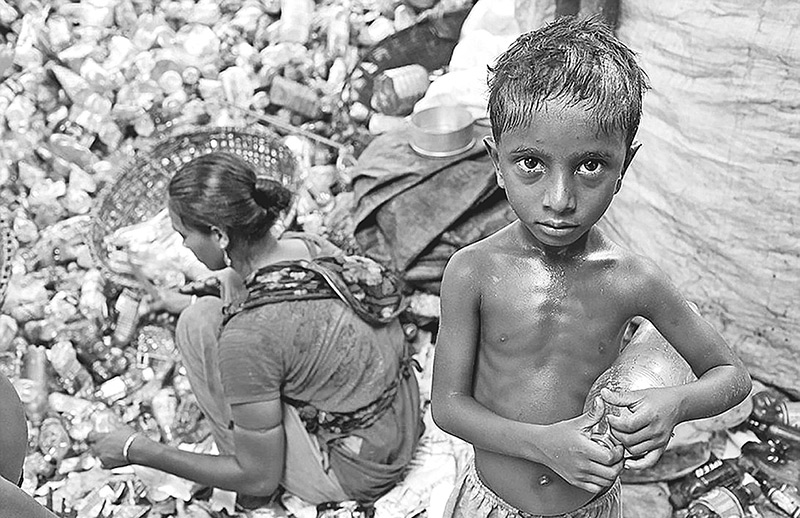
however, Trump is determined to cut his losses, and has fully embraced peace talks with the Taliban, with the principal purpose being to permit the orderly—and complete—withdrawal of US forces from Afghanistan.
India has watched with concern as this process has unfolded. The Taliban’s Islamic Emirate was involved in the hijacking of an Air India plane to Kandahar in 1999, resulting in the loss of Indian lives and even greater loss of prestige, as India’s government acceded to the hijackers’ demand for the release of three Pakistani terrorists. The last thing India wants is the return of an Islamist Taliban regime in its neighbourhood.
India’s alarm is understandable. Encouraged by the security established by the international coalition forces, India has invested more than $2 billion dollars in Afghanistan. It has helped to build the country’s largest hospital
for women and children, erect schools, construct the Afghan-India Friendship Dam (formerly known as the Salma Dam), carve the Delaram-Zaranj Highway across the country’s southwest (to open trade routes to the West), ensure uninterrupted electricity in Kabul, and even build the new Parliament.
But no one in India believes the Afghans are anywhere near ready to manage their security without any international presence. After all, Taliban attacks have killed 1.4 to 2 million Afghans since 2001. The fact that the US is talking to the group, and even pressing the Afghan government to do so, without any credible assurances that the Taliban will lay down its weapons, is deeply dismaying, to say the least.
India’s objective has been to stabilise Afghanistan’s democracy and strengthen its civil society, so that Afghans
are better able to take control of their own destiny. This is also why cricket-obsessed India gave Afghanistan’s national team a home and watched, in admiration, as the players demonstrated their excellence at the World Cup. The last time the Taliban ruled, they banned cricket, too.


—©2019 Project Syndicate

OPINION

Reading troubles in Pakistan

Only a small percentage of the children who remain in school can read fluently at their school level.
- RAFIA ZAKARIA

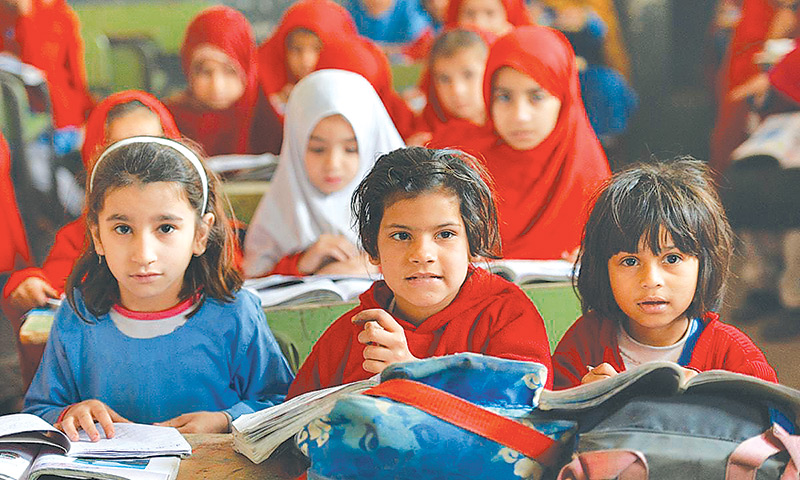
The good news is that a large number of Pakistani children (perhaps almost as many as those of developed countries) are enrolling in kindergarten. The bad news is that only a small percentage of these children remain in school. The terrible news is that of those who do remain in school, very few, only between four to 12 percent of third graders, are actually able to read fluently while understanding most of the content.
Where statistics for listening comprehension are concerned, few were able to answer the three questions asked in Urdu. ‘If they got one question correct, they would score 33.3pc for getting one out of three questions right. Across Pakistan, scores ranged from 19 to 32pc.’
The statistics were published in a recent report, Why Can’t Pakistani Children Read?, released by the American think tank the Wilson Centre and authored by researcher Nadia Naviwala.
This bad news about education is not new to Pakistan. For many decades, little money was devoted to the country’s education budget. Prog­ram­mes were started and abandoned midway; improvements were piecemeal at best. The new report indicates that the situation might have improved on some counts. Pakistan’s budgetary allocations for education have increased over the years, according to the study. Other funds have been pledged by international development organisations.
In sum, what is not being taught and not being learned is not for lack of funds. While there is always room for more resources, it can be said that probably for the first time in Pakistan, money is actually being spent on education.
Sadly, the money that is spent is not producing educated Pakistani children—where ‘educated’ stands for the simple ability of being able to read. The well-researched report presents the contradictions, assumptions and failures of a hodge-podge system that, on the one hand, expects teachers to deliver, and on the other, doesn’t seem to have any real way of attending to the failures (such as children being unable to read a sentence in Urdu or English).
One cause for this is the fact that children rarely learn the language they speak at home in the books they read at school. The consequence (you’ve guessed it) is a tendency to learn by rote or memorisation rather than actually learning to read and comprehend the written language.
Even worse is the situation of English, reading it or understanding it while it is being spoken to them. Messy assumptions and deceptions rule in this case; for it is not just the children who cannot read, let alone understand the language, it is the teachers themselves who are not familiar with it.
The report cites a survey that says ‘…94pc of teachers at English-medium private schools in Punjab did not speak English’. ‘English-medium’, the report finds, dangles the possibility of upward mobility and access even while those supposed to teach it are pretending that they refer to the medium of instruction when all they are really referring to is the medium of textbooks. A pile of English-language textbooks then permits a school to call itself an English-medium school.
The report provides an in-depth and comprehensive (including a host of technical solutions and metrics) analysis of the issues observed in the over 100 classrooms which were surveyed. Reading it, however, one cannot but consider how all of Pakistan’s self-deceptions can be witnessed in the condition of its schoolgoing but uneducated children.
In thousands of Pashto-speaking children’s inability to comprehend Urdu, lie seething issues of language supremacy—which language is a national language and which is a divisive one. In the eagerness (and self-sacrifice) of parents who cut corners and skip meals to send their children to an ‘English-medium’ school is the much-peddled lie that English opens doors, English signifies the possibility of greater things, a life that is less deficient than the one they have endured themselves.
At the centre of reading ability is the issue of language politics. Locally relevant education and the use of local languages as the first language children are taught to read may be the answer to actually ensuring that they can read, but it prods and pokes at other delicate deceptions. The issues of which languages are the country’s ‘official’ languages, which are ‘unifying’ languages, which may be perceived as the means of division, are all open questions in Pakistan even as it gets ready to turn an elderly 72 years old.
Attached to the language issue, is the issue of electoral politics that continues, more or less, to be attached to ethnicity. Should every province be granted complete freedom to decide which language is taught to its children? What will this do to the federal funds for schools?
But for now, the report on reading clearly shows that there is a cost to all these unanswered questions, of the class divisions that keep the poor aspiring without the rich ever delivering, and ethnicity and language attached to varying degrees of belonging in a country.
The result shows itself in the country’s schools. Children go to school, and a lot of them do enrol, full of hope and expectation. In government schools, they are confronted with apathetic teachers (if they even choose to teach) and a curriculum that seems a world away from their own, unfamiliar words, sounds and expectations.
Unsurprisingly, many stop going to school or are pulled out. Many of the lucky ones, those who do stay and stick with it, cannot accomplish one of the most basic functions of education ie to be able to read with comprehension.
Unlike previous laments over the educational system, this one does not require the allocation of many billions more. Instead, it asks that the education bureaucracies that run these networks of state schools to consider the truth that they have almost completely failed to educate the children they hoped to teach.


- This article was previously published in The Dawn, a part of the Asia News Network.

Page 8
HEALTH & LIVING

Are traditional methods foes or friends of modern science?

Some believe herpes zoster is the bite of a serpent. They don’t know that it is a disease caused by a virus, which needs medical attention.
- SRIZU BAJRACHARYA

A few years ago, Surya Mati Bajracharya of Kwabahal, Thamel, had gone to Badri Ratna Bajracharya, a Newar priest, to treat an infection that most Newars believe to be the bite of a serpent: jala naga. It is a common Newar superstition in which the infection is believed to be the manifestation of the serpent’s curse, naga ko dosh.
The disease is medically recognised as ‘herpes zoster’ and is also known locally as ‘janai khatira.’ Its traditional healing practice includes drawing two lions (sometimes dragons) roaring at the two ends of the infection using three colours—black, red and white—for days, and a recitation of a sacred incantation by a priest. Then, a separate puja is also done in a well in front of the Tara-nani shrine at Itumbahal.
“At first, I thought it was an allergy. It came below my left breast and slowly spread below my armpit and touched my left shoulder blade, and it continuously burned; it was excruciating,” she recalls.
Surya Mati had gone to see Badri Ratna Bajracharya after she had reached out for help from her family members about her infection. They had promptly termed the infection as ‘jala naga’ and asked her to immediately see Badri Ratna in Maha Boudha, who at the time used to treat the disease using ancient remedies. However, after the pujas, Surya Mati on the fifth day of the infection, which had not yet subdued, went to see a skin doctor who strictly asked her to take medication for the infection.
Herpes zoster is an infection reactivated by the same virus that causes chickenpox (varicella-zoster), and most who are infected by the virus are likely to have had chickenpox earlier in life. However, most Nepali families, before seeking a doctor for cure resolve to ancient remedies recommended by their families who have experienced the torment of the disease. But dermatologists say the ancient practice is just an idiosyncratic belief and patients should seek medication only from skin doctors before the infection aggravates.
“When the virus grasps a nerve fibre, most people feel an uneasiness for two days before getting a red rash [often accompanied with stripes of blisters] that starts a continuous tingling burn, and it usually happens to people who are middle-aged. The virus can affect anyone if they don’t have a good immune system,” says Hari Narayan Gupta, a dermatologist.
However, despite doctors urging patients to use scientifically proven methods, there are many who swear by the effectiveness of traditional methods.
“Traditionally, we apply a paste made with white sesame seeds, white dubo (Cynodon dactylon) and cow’s milk. We also draw two singhas (lions) roaring at the infection, which suppresses the pain and curbs the spread. When I got the infection, my guru (teacher) said an incantation and also asked to do a small puja at Itumbahal’s well,” says Punya Bajracharya, a Newar priest, who had followed the ancient remedies when he had herpes zoster years back.
Bajracharya says he recovered soon after, and therefore believes that the incantation and the naga puja works and can heal the infection.
At Yatkha, a father-son duo Amir Man Shakya and Phiroj Shakya have been making singhas for patients suffering from herpes zoster for years. “Most Nepalis call it janai khatira because the infection usually comes around the lower abdomen, near the chest and neck area, and it resembles how the janai (sacred thread) is tied across their chest,” says Phiroj Shakya.
He further claims that they have made singhas for thousands of people and that those who have recovered have recommended many others to their place for treatment. However, he too understands that the medical case of herpes zoster contradicts the traditional belief.
“Medically, it is caused by the same virus that causes chickenpox, but we call it the bite of jala naga, and it can happen to anyone. I have had it too,” says Shakya.
Despite knowing about the virus, Shakya and many elders still believe the infection is a result of the wrath of the serpent and planetary movement. “Naga ko dosh bhanincha,” says Amir Man Shakya.
Many locals in Kathmandu too have heard about the serpent’s bite and have seen people recover through ancient remedies. “I have heard about janai khatira through many of my family members and they have said that the puja and the singhas have helped them heal,” says Ram Bhakta Shrestha, a local of Jhochhen. People also believe a person can die if the infection spirals and makes a full circle around the body, and that bearing the singhas can protect their life and stop the infection from spreading throughout the body.
“The infection doesn’t spread. For some, it can come near the chest area and lower abdomen, for others it can come in the hands or near the eyes. But that is the only extent to which the infection will manifest,” says Hari Narayan Gupta. “Also, if it comes back repeatedly, it could imply that you may have other sexual diseases, so you need to be careful,” added Gupta.
Doctors’ course of medication includes acyclovir 800 mg to kill the virus and pregabalin 75 mg as pain killer and acyclovir cream as an ointment. Patients are also asked not to share their belongings, as it can spread the varicella-zoster virus, which can cause chickenpox to those who have never had it before, but the disease in itself is not communicable.
 “Most people come too late for treatment, and by then, the infection becomes severe and takes more time to heal. If not taken care of, it can develop into postherpetic neuralgia, a lasting pain even after the blisters have healed,” says Gupta.
Another skin doctor, Vinaya Shrestha, agrees with Gupta. “I have scolded many patients for accepting traditional methods earnestly. Just today, I treated four people with the same infection. Ancient practices can’t heal herpes zoster; it needs a thorough course of medication,” says Shrestha.
Surya Mati eventually recovered after a month of taking medication prescribed by her dermatologist. “I think it was the medication that helped cure the infection; however, after bearing the lions on my back, I did feel a bit of relief,” says Surya Mati. “Worshipping the naga might have consoled my mind a little and perhaps that’s why I felt better.”
However, Gupta addresses the practice as absurd and a hindrance for medical treatment. “The tradition is silly, but it is seen that most patients become less psychologically stressed after doing the pujas. But people should consult doctors; they can’t rely on this practice because the infection can get very severe and can spread,” says Gupta.

HEALTH & LIVING

New clues on why women’s Alzheimer’s risk differs from men’s

Early stages may go undiagnosed because women tend to do better on verbal tests than men.
- MARILYNN MARCHIONE
A microscope image shows the 46 human chromosomes, blue, with telomeres appearing as white pinpoints. AP/RSS

New research gives some biological clues to why women may be more likely than men to develop Alzheimer’s disease and how this most common form of dementia varies by sex.
At the Alzheimer’s Association International Conference in Los Angeles on Tuesday, scientists offered evidence that the disease may spread differently in the brains of women than in men. Other researchers showed that several newly identified genes seem related to the disease risk by sex.
Two-thirds of Alzheimer’s cases in the US are in women and “it’s not just because we live longer,” said Maria Carrillo, the association’s chief science officer. There’s also “a biological underpinning” for sex differences in the disease, she said.
Some previous studies suggest that women at any age are more likely than men to develop Alzheimer’s. Scientists also know that a gene called APOE-4 seems to raise risk more for women than for men in certain age groups.
At the same time, women with the disease in its early stages may go undiagnosed because they tend to do better on verbal tests than men, which masks Alzheimer’s damage.
The new studies add evidence and potential explanations for suspected variations between how men and women develop the disease.
Vanderbilt University researchers found differences in how tau, a protein that forms tangles that destroy nerve cells, spreads in the brains of women compared to men. Using scans on 301 people with normal thinking skills and 161 others with mild impairment, they mapped where tau was deposited and correlated it with nerve networks—highways that brain signals follow.
They found that tau networks in women with mild impairment were more diffuse and spread out than in men, suggesting that more areas of the brain were affected.
It’s long been known that women do better on tests of verbal memory—skills like recalling words and lists. University of California, San Diego, researchers found that women did better on these skills despite similar signs of early to moderate Alzheimer’s than men.
Using scans on more than 1,000 older adults, they found sex differences in how the brain uses sugar, its main energy source. Women metabolised sugar better, which may give them more ability to compensate for the damage from dementia and make them less likely to be diagnosed with it by tests that involve verbal skills.
“The female advantage might mask early signs of Alzheimer’s and delay diagnosis,” said study leader Erin Sundermann. “Women are able to sustain normal verbal performance,” partly because of better brain metabolism.
At the University of Miami, scientists analysed genes in 30,000 people—half with Alzheimer’s, half without it—and found four that seem related to disease risk by sex.
“One confers risk in females and not males and three confer risk in males but not females,” said one study leader, Eden Martin.
Researchers don’t know yet exactly how these genes affect risk—or by how much.
“Some of these look like they’re tied to the immune system and we know there are differences between males and females” in how that works, said another study leader, Brian Kunkle.
Seven other genes seem to have different effect on risks in men versus women. The researchers have a National Institute on Aging grant to do an international study on nearly 100,000 people to try to validate and extend the results.


—© 2019 Associated Press

Page 9
CULTURE & ARTS

Here comes Hulk ‘cha’

Sunny Shakya explores his inner child with his exhibition ‘Toygraphy’.
- ABANI MALLA

A portrait of Captain America and Hulk figurines riding a bicycle in Kathmandu’s streets welcomes visitors at the entrance of Siddhartha Art Gallery in Baber Mahal Revisited. The beloved action figures have red tika on their forehead, jamara tucked behind one ear, and red and white garlands around their neck—all of which symbolises Dashain celebrations. Hulk is even wearing a dhaka topi and a chain of Nepali flag.
One look at the poster, and any Marvel fan can get drawn to the Nepali look on the blockbusters’ superheroes. But 30-year-old Sunny Shakya’s exhibition, titled ‘Toygraphy,’ offers more than just Nepali versions of some iconic characters of Marvel Cinematic Universe—there are plenty of other toys that are part of the exhibition: from Disney’s Moana, Pirates of the Caribbean to James Cameron’s Terminator followed by a few of DC’s characters as well. Collectively, it’s a toygraphy (a portmanteau of toy and photography) portfolio created and curated by Shakya’s love for the two.
“When I was a child, I couldn’t play with many toys,” says Shakya, who recalls being fond of movies and animations since an early age. “Now that my age is considered suitable for marriage, people joke that I’m playing with toys instead.”

 Hulk ‘cha’ and Barbie’maicha’ in Sunny Shakya’s exhibition titled ‘Toygraphy’. Post Photos: Beeju Maharjan

The exhibition displays a series of pictures that present Shakya’s imagination and humour intertwined with Nepali society—including festivals, instruments, vehicles, popular culture and even social movements. His work exhibit toys as real and vocal as living beings, while also scripting short pictorial scenes. For example, Marvel’s beloved green giant mutant Avenger Hulk is portrayed as an ideal Nepali citizen, aptly named Hulk Bahadur and Hulk cha. He is dressed up in daura surwal, and seen participating in the recent Guthi Bill protests, which shows how Shakya’s toygraphy isn’t limited to imitating and staging action scenes but also addresses serious issues.
“Hulk’s expression depicts the sentiments well during serious issues,” says Shakya.
But Shakya’s photography doesn’t only intend to share a particular scene, they are also displayed as sequential stagnant frames of a movie. In the exhibition, he narrates two series of love triangles: a complicated love story between DC’s Superman, Batman and Wonder Woman, and another of Hulk cha, Thor, and Barbie maicha.
Shakya cleverly weaves a narrative for the two stories by inserting a unifying scene, where Batman is seen enjoying a tea party with Hulk. The pictures tell how Batman is done reciting his story, and asks Hulk to share his. The same unifying scene is recreated in the exhibition as well.
However, none of these scenes would be conceived if it weren’t for a random shot Shakya took in September of 2018, which was of a pair of cheap dolls set against the backdrop of Bhaktapur Durbar Square. It was this picture that inspired him to take up this path into toygraphy.
A sculptor by profession, Shakya hadn’t taken photography seriously until then. When he would not be pursuing his hobby, he carved figures of deities out of beeswax. But Shakya says he had never felt a sense of happiness and recognition from his professional career. And if it weren’t for the art of capturing toy portraits, Shakya says he might not have been satisfied as an artist.
“All these years, I longed for appreciation and it’s unbelievable how pursuing my hobby made it happen,” says Shakya.

Although toygraphy as an artistic genre isn’t buzzing yet with Nepali photographers, Shakya isn’t the only one pursuing it. Contemporary Nepali photographers on Instagram like @Nibhal, @PhotoKhichuwa, and @tenzingsamdup also seem to practice it occasionally.
But Shakya’s use of Nepal’s heritage sites and other popular spots as backdrop for his photos and his way of adorning toys with national costumes sets him apart from other photographers. He uses his phone to capture and edit pictures. His way of highlighting social issues with his toys has also helped viewers establish a connection with his work. But Shakya still has huge room for improvement.
Shakya has a fairly good eye for perspective, but at times, his pictures lack balance, meaning sometimes it appears as if he’s practising miniature photography and sometimes the subjects are depicted as real-life figures—leaving viewers confused.
Although Shakya has beautifully crafted props to add more value to the pictures, at some point, they seem forced, like the Batman figurine who is seen wearing a dhaka topi on top of its mask looks unnecessary—and a bit heavy. In most pictures, Shakya appears to be experimenting with obvious Nepali props and does only little image manipulation to be on the safe side.
A few of Shakya’s concepts are laudable and vividly portray the happy-side of sad stories one experiences in cinemas. Shakya’s cinematic universe has replaced Thor’s hammer with Lord Shiva’s Trishul; Thanos is enjoying carrying a doko full of freshly cut grass—just as he would have loved—and even the infinity gauntlet is depicted as a symbol of hope to bring back Nepal’s lost monuments.
Shakya’s ideas are engaging and interesting. And he is excited for what lies ahead for his passion. He hopes to buy toys from abroad that are more realistic and plans on expanding his collection. “I feel happy as an artist now,” says Shakya. “People once thought I was crazy but I love knowing that now they enjoy my art.”


‘Toygraphy’ is being exhibited at Siddharta Art Gallery, Baber Mahal Revisited, from Sunday to Friday at 11am to 5pm and from 12 noon to 5pm on Saturdays.

CULTURE & ARTS

For Russian director, facing trial, art is ‘resistance’

‘Art is the most free territory of human activity where everything is possible.’
- RANA MOUSSAOUI
Russian stage and screen director Kirill Serebrennikov during his court hearing in Moscow on November 7, 2018.  AFP/RSS

For Russian theatre and film director Kirill Serebrennikov some one-and-a-half years of house arrest and a serious court case have been no obstacle to artistic creation.
Consigned to his Moscow flat as he faced embezzlement charges he strenuously denies, Seberennikov pressed on with staging theatre productions, finishing a film and even operas remotely abroad. His house arrest, which began in August 2017, was finally lifted in April this year to the delight of the supporters of the artistic director of the trendy Gogol Centre in Moscow.
Now, Serebrennikov has drawn inspiration from the trailblazing Chinese photographer Ren Hang, who troubled the Beijing authorities but took his own life in 2017.
The play called “Outside” premiered at France’s prestigious Avignon Theatre Festival on Tuesday without Serebrennikov, who is unable to leave Moscow under terms set by the court.
The performers, who donned white T-shirts with the slogan ‘Free Kirill’ at the curtain call, were given a standing ovation by the audience.
“Theatre, cinema and photography are always an act of resistance,” Serebrennikov told AFP in an interview conducted by email ahead of the premiere of “Outside”.
“Art is always the resistance of lying, slander and obscurantism because this is the most free territory of human activity where everything is possible,” he added.


Became close to me
Serebrennikov said the inspiration for the play came from messages over social media with Hang and a meeting that tragically never happened when the photographer killed himself in February 2017.
“Literally two days before the time when we were supposed to get to know each other personally, he committed suicide,” the director said.
Hang had in his short life built up an international reputation with erotically-infused photographs that broke taboos on sex in China.
“I had the feeling that a person had died who I had already managed to get to know who had already become close to me,” said Serebrennikov, adding he wrote the play during the house arrest.
“Hang said that he does not try to influence or interfere in the politics of China but China tries to interfere in his work,” he said.


Repression makes nothing better
Serebrennikov is accused of creating an organised criminal group with his colleagues and embezzling more than $2 million of state funding for a theatre project called Platforma.
He has insisted the money was used properly and calls the charges “absurd”.
For new productions of Nabucco by Verdi at the Hamburg State Opera and Mozart’s Cosi fan Tutte in Zurich, he sent instructions to singers and set designers on a USB stick through his lawyer.
But Serebrennikov railed against the notion that suffering and persecution was some kind of necessity to produce great artistic work.
“Persecution and repression does not make anything better. Even in Soviet times I heard the phrase that an ‘artist must be hungry’. No! That is rubbish!” said Serebrennikov.
And he denied that his own incarceration had helped his creativity.
“Pressure can be an obstacle in work. When I was working under arrest I tried to imagine there was no fabricated case against me and no false accusations. And I simply worked.”


Force the audience
Serebrennikov made his name in Moscow with bold and visually dramatic productions of classic plays that sometimes contained explicit scenes and nudity to the anger of conservatives.
He also directed a new ballet at the Bolshoi Theatre on the life of the legendary star Rudolf Nureyev that was controversially pulled from the schedules after the rehearsal although it did finally reach the stage.
His latest film Leto (Summer), released in 2018 to warm reviews, was a snapshot of the Leningrad underground rock scene in the 1980s and appeared to be a hymn to making art in adversity.
Serebrennikov said it was his duty as a director to grab the attention of the viewer, especially at a time when people are so easily distracted by their phones.
“For me I think it is possible to use any kind of means that is not illegal and can force the audience to think and to feel.”
And Serebrennikov, who until his arrest was not regarded as a politically active figure in Russia, said that above all theatre needed to be personal.
“I am always happy when the theatre looks not to the crowd but every person in the hall.”
“Theatre needs every person personally but politics needs crowds and ratings.”


—©2019 Agence France-Presse

Page 10
WORLD

Sudan protesters, army rulers reach power-sharing deal

The landmark power sharing deal, which was agreed in principle on July 5, has been brokered by African Union and Ethiopian mediators.
- AGENCE FRANCE-PRESSE
Sudanese celebrate after the inking of an agreement between protest leaders and members of the transitional military council in Khartoum early on Wednesday. AFP/RSS

KHARTOUM,
Sudan’s protesters and ruling generals on Wednesday inked a deal that aims to install a civilian administration, a key demand of demonstrators since president Omar al-Bashir was deposed in a coup three months ago.
The move loosens a deadlock that has gripped the country, following nationwide mass protests that began against Bashir in December but then continued after a military council ousted him on April 11.
The deputy chief of the military council General Mohamed Hamdan Dagalo—who initialled the deal on behalf of the generals on Wednesday—told AFP the agreement was a “historic moment” for Sudan.
It has “opened a new and promising era of partnership between the armed forces, RSF (Rapid Support Forces) and leaders of the glorious Sudanese revolution,” Dagalo said after he had put pen to paper.
Dagalo also heads the RSF, a feared paramilitary organisation that has its origins in the Janjaweed militias unleashed against African rebels during the early 2000’s in Darfur.
Ibrahim al-Amin, a key protest leader, confirmed “today, we completed the political declaration.”
Intense talks took place through the night over details of the political declaration at a luxury hotel on the bank of the Nile river in the capital, an AFP correspondent reported.
As the generals stepped out of the hall after the inking of the deal, a small crowd—including women waving the national flag—chanted “civilian rule, civilian rule.”
The landmark power sharing deal, which was agreed in principle on July 5, has been brokered by African Union and Ethiopian mediators after weeks of stop-start negotiations between the protest umbrella group and ruling generals.
“The Transitional Military Council and the Alliance for Freedom and Change have reached a very important agreement that constitutes a crucial step towards a comprehensive reconciliation,” said African Union mediator Mohamed El Hacen Lebatt.
The accord stipulates that a new transitional civilian-military ruling body be established, in a bid to end the country’s months-long political crisis.
This governing body will be comprised of six civilians and five military representatives, while the civilian representation will include five from the Alliance for Freedom and Change. A general will head the ruling body during the first 21 months of a transition, followed by a civilian for the remaining 18 months, according to the framework agreement.
The governing council is to oversee the formation of a transitional civilian administration that will operate for just over three years, after which elections would be held.
Amin said Wednesday that wider power sharing details would be fleshed out in a “constitutional document” and that talks would “resume... on Friday”. These talks are expected to address whether to grant “absolute immunity” to generals for violence against protesters.
Prior to entering the latest talks on Tuesday evening, protest leaders had rejected any such offer of immunity to the generals.
“We totally reject it,” protest leader Ahmed al-Rabie, who initialled Wednesday’s accord along with Dagalo, told AFP on Tuesday.
But military council spokesman General Shamseddine Kabbashi sought to talk down any friction over proposed immunity.
“There is no dispute about immunity,” he told AFP on Wednesday.
Other issues still to be ironed out include the creation of a transitional parliament and a potential RSF withdrawal from Khartoum.

WORLD

US House condemns Trump over ‘racist comments’ tweeted at congresswomen

- REUTERS
Donald Trump

WASHINGTON, 
The US House of Representatives voted on Tuesday to condemn President Donald Trump for “racist comments” against four minority Democratic congresswomen, a symbolic measure aimed at shaming Trump and his fellow Republicans who stood by him.
The 240-187 vote, which split mainly along party lines, was the culmination of three days of outrage sparked by a Trump tweetstorm that diverted attention from other business in Washington but had little impact on the president’s overall approval rating, according to a new Reuters/Ipsos poll.
Trump had told the group of congresswomen on Sunday to ‘go back and help fix the totally broken and crime infested places from which they came.’ All four lawmakers - Alexandria Ocasio-Cortez of New York, Ilhan Omar of Minnesota, Ayanna Pressley of Massachusetts and Rashida Tlaib of Michigan--are US citizens. Three were born in the United States.
Democrats, who have a majority in the House, passed the resolution on Tuesday evening, which said the House “strongly condemns President Donald Trump’s racist comments that have legitimized and increased fear and hatred of new Americans and people of color.”
Four Republicans and one independent joined the Democrats to support the measure. The White House did not immediately comment.
In a late night Tweet, Trump said: “So great to see how unified the Republican Party was on today’s vote concerning statements I made about four Democrat Congresswomen. If you really want to see statements, look at the horrible things they said about our Country, Israel, and much more.”
Trump’s attacks on the four progressive congresswomen--known as “the squad”--have been viewed as an effort to divide Democrats, who won control of the House in 2018 and have the power to thwart his legislative agenda.
House Speaker Nancy Pelosi, who has struggled at times to work with the progressive newcomers in her caucus, staunchly defended them in the debate. After the vote, Omar held a long, animated conversation with Pelosi on the House floor and put her arm around the speaker, the top elected US Democrat.
“These comments from the White House are disgraceful and disgusting and these comments are racist,” Pelosi said. “Every single member of this institution, Democratic and Republican, should join us in condemning the president’s racist tweets.”
Pelosi’s comments put the House into a two-hour limbo after Republicans argued she went too far in her comments and broke debate rules. House Republican leader Kevin McCarthy criticized Democrats for remarks that upset the “order and decency” of the chamber, saying: “Today is the day that historians will write about.”
Some Republicans defended Trump’s tweets, like Tom McClintock of California, who said the president was commenting on the patriotism of the congresswomen, not their race.

WORLD

No-deal Brexit looms as race for new British prime minister wraps up

- AGENCE FRANCE-PRESSE
Boris Johnson (left) and Jeremy Hunt are both referring to Britain’s departure with no overall deal in place as a realistic prospect.  AfP

LONDON,
The battle to be Britain’s next prime minister enters its final straight on Wednesday with both candidates hardening their positions on Brexit, putting the future government on a collision course with Brussels.
Ex-London Mayor Boris Johnson, the favourite to replace Theresa May, and foreign secretary Jeremy Hunt, are now both referring to Britain’s departure with no overall deal in place as a realistic prospect.
The business community and many lawmakers fear dire economic consequences from a no-deal Brexit which would lead to immediate trade tariffs for certain sectors including the automotive industry.
Johnson and Hunt are taking part in a final question-and-answer session later on Wednesday before the result of the vote by Conservative Party members is announced on July 23 and the new prime minister is installed on July 24.
Britain has twice delayed its scheduled departure from the European Union after 46 years of membership and May’s failure to get parliament to vote for her deal with Brussels ultimately forced her to resign.
The two candidates have vowed to scrap a “backstop” provision in the draft deal that was insisted on by Brussels to keep the Irish border open.
Their latest attacks on the measure during a debate on Monday prompting a plunge in the value of the British pound.
The currency fell again Wednesday to its lowest level against the US dollar in over two years.
“The tougher stance from both Boris Johnson and Jeremy Hunt in terms of their rhetoric on Brexit is clearly weighing on the pound,” said market analyst Neil Wilson.
“Make no mistake, this decline in the pound is down to traders pricing in a higher chance of a no-deal exit.”
The backstop has proved a key stumbling block in the Brexit process.

WORLD

As holidays begin, UK looks out for forced marriages

- AGENCE FRANCE-PRESSE
Many cases involve Britons being married overseas, with the largest number of reported instances in Bangladesh, India and Pakistan. AFP

LONDON,
With summer holidays beginning in Britain this week, officials are redoubling efforts at the border to stop young people being dragged into forced marriages.
At a Heathrow Airport arrivals gate, an AFP reporter watched as officials from a special task force comprising police, immigration agents and charity workers intercepted a family disembarking a flight from Bangalore, India.
A young woman in the group raised red flags because of bruises on her arm, while a 13-year-old girl appeared especially timid—both indicators of potential coercion.
After speaking to family members individually, officials were satisfied that the family was travelling to Britain for a funeral and the bruising was due to a traffic accident.
But the officials also learned that the young woman’s parents had recently found her a fiance in their home state of Kerala, and that he, too, may travel to Britain.
Trained task force officers took the woman aside to brief her on her rights and to press upon her that forced marriage is illegal in Britain.
“She’s (now) aware of consent, and that she can withdraw her consent at any time,” Detective Sergeant Kate Bridger of the Metropolitan Police told her team after they questioned 72 of the 250 people on the Air India flight.
Britain outlawed forced marriage in 2014, with a maximum jail term of seven years for offenders.
Figures from the interior ministry’s forced marriage unit show 1,764 reported cases in 2018—a 47 percent increase from the year before.
The reported cases are thought to be the tip of the iceberg.
Most cases involve Britons being married against their will overseas, mainly in Bangladesh, India and Pakistan.
So the task force targeted passengers on flights to and from the Indian sub-continent as well as Middle East hub airports.
“It’s not just a South Asian problem... it cuts across lots of different cultures and communities too,” task force member detective sergeant Trudy Gittins told AFP.
Men were also affected, she said, as well as members of the LGBT community—with cases of gay men forced to marry members of the opposite sex by their conservative families.
Cases in Britain have ranged from a two-year-old promised in a religious ceremony to marry into another family, to an 80-year-old Alzheimer’s sufferer whose carer forced him into a marriage to inherit his estate.
A third of victims are younger than 18, and three-quarters are girls or women.
West Midlands Police last year secured the first conviction in England for forced marriage, with a woman jailed after her 13-year-old daughter was raped by her “fiance”, a relative in Pakistan.
“There are no winners here—this was her mum,” said Gittins.
Senior officers said the emphasis of this week’s operation was on prevention rather than prosecution.
“Our focus is not to criminalise parents or members of the extended family,” said the Met’s acting chief superintendent Parm Sandhu.
“Our focus is to safeguard young people.”
The task force is targeting Britain’s busiest airports, stations and ports as the school holiday season gets underway—a time when cases typically spike.
As team members gathered in a windowless room in the bowels of Heathrow, Gittins told them that victims have described being forced into marriage as being “buried alive”.
“I want you to feel that statement today,” she urged her colleagues.
Some of those greeted by the task force on arrival at Heathrow welcomed the initiative.
“We were very surprised, it’s not something we’ve come across before,” said Karan Shah, 31, with his wife on a three-week visit to Britain.
The couple had an arranged marriage to which both had agreed, he said, adding that in many parts of rural India forced marriages do still occur.
“It’s very unfortunate so I give this a big thumbs up,” said Shah.

WORLD

Merkel heir apparent joins cabinet in risky bid for power

Briefing

BERLIN: German Chancellor Angela Merkel’s heir apparent joined her cabinet Wednesday as defence minister, a high-profile job often called a poisoned chalice in Berlin’s fraught political landscape. The surprise appointment of Annegret Kramp-Karrenbauer late Tuesday came just hours after the current head of the German military, Ursula von der Leyen, was elected as the first woman to lead the European Commission. The decision by AKK, as she is commonly known, to take charge of a sprawling administration widely seen as unwieldy and scandal-prone was described as a risky gambit to shore up political support. (Agencies)

WORLD

Gun megastore plan in Christchurch sparks backlash

Briefing

WELLINGTON: New Zealand retailer Gun City, which sold weapons to the man accused of shootings at two Christchurch mosques that killed 51 people and injured dozens, has aroused concern with plans for a mega store in the South Island city, media said on Wednesday. Radio New Zealand said some of those living near the proposed site were upset at the prospect of the store, sprawling over 300 sq m (3,229 sq ft), along with warehouse, office and carpark, set to open in August. “I don’t think many people will be very comfortable to have guns around their homes in a residential area,” one of the residents, Harry Singh, told the broadcaster. (Agencies)

WORLD

US judge expected to put ‘El Chapo’ behind bars for life

Briefing

NEW YORK: Joaquin “El Chapo” Guzman, the Mexican drug lord found guilty of running a murderous criminal enterprise that smuggled tons of drugs into the United States, is scheduled to be sentenced by a U.S. judge on Wednesday in what is likely one of the last chapters in a decades-long career. The sentencing hearing in a federal court in Brooklyn is expected to feature a statement from someone who survived a murder plot led by Guzman, prosecutors have said. Guzman, 62, was found guilty by a jury in February of trafficking tons of cocaine, heroin and marijuana and engaging in multiple murder conspiracies as a top leader of the Sinaloa Cartel.  (Agencies)

Page 11
ASIA

No respite as monsoon rains pound South Asia

Hundreds of thousands of people have been displaced across the region.
- AGENCE FRANCE-PRESSE
An Indian flood affected woman carries her belongings on an embankment to take shelter in Pabhokathi village east of Gauhati India. AP/RSS

NEW DELHI,
Heavy monsoon rains across South Asia claimed more lives on Wednesday, with the death toll passing 200 as authorities tried to reach stranded villagers cut off by surging floodwaters.
The annual deluge is crucial to replenishing water supplies in the impoverished region, but the rains from June to September often turn deadly. Across India, Nepal, Bangladesh and Pakistan, millions of residents have been affected and hundreds of thousands displaced, with homes and boats washed away.
In flood-prone Bangladesh, which is criss-crossed by rivers, around one-third of the country is underwater and people were being killed by lightning strikes, officials said.
In India, the death toll rose to at least 120 and entire communities were cut off by rising floodwaters which damaged or submerged roads.
“It’s been 15 days (since) this area has been flooded,” a local resident in Assam, where the death toll reached 22, told AFP. “The damage it has caused is very bad. Cattle have also been affected. Everything has been destroyed.” Video footage shared on social media showed rescuers pulling a rhinoceros calf from swollen floodwaters at the state’s World Heritage-listed Kaziranga National Park, which is home to two-thirds of the world’s remaining one-horned rhinos.
In Bihar, which borders Nepal—and like Assam is one of the worst-affected regions in India—locals told AFP they were unable to reach food supplies.
Some 33 deaths have been reported and 2.5 million residents affected. Locals were erecting makeshift shelters on elevated land with the meagre belongings they had salvaged from the floodwaters. In Mumbai, the number of victims from a building collapse following heavy rains rose to 13.
In the worst-affected Bangladesh district of Kurigram, deputy district administrator Hafizur Rahman told AFP a woman and four children died after their small boat sank in floodwaters. Others were killed by landslides in Cox’s Bazar district—home to nearly one million Rohingya Muslim refugees who have fled a military crackdown in Myanmar.
In Nepal, the aid agency Save the Children said severe flooding and landslides had left tens of thousands of people homeless, with many stranded outdoors or marooned.
At least 78 people have died and 16,000 families have been displaced.
“It’s absolutely essential that we reach these communities to avoid this turning into a health emergency,” Save the Children’s Nepal country director Ned Olney said in a statement.

ASIA

Philippines passes anti-harassment law

Duterte dared to comply with law against sexual harassment.
- JULIE M AURELIO,LEILA B SALAVERRIA,PATRICIA DENISE M CHIU
Rodrigo Duterte

Manila,
President Rodrigo Duterte, whose rape jokes have sparked outrage among women’s rights groups, was dared on Tuesday to comply with a law that he had signed penalizing catcalling, wolf whistling, persistently telling sexual jokes and other forms of sexual harassment in public.
“President Duterte’s signing of the ‘Bawal Bastos Law’ … throws an ironic shade on himself, as he represents the single most brazen violator of the law’s intent with his staple macho-fascist remarks,” the Gabriela women’s party list said in a statement.
The 74-year-old President is the “chief propagator of a culture that degrades and objectifies women, and that which exhorts catcallers, sexual offenders and even uniformed personnel to disrespect women,” Gabriela said.
“Under this context, implementing the law will certainly be a challenge,” it said.
Presidential spokesperson Salvador Panelo assured the public and critics that the President would be “the first one to obey the new law,” which he signed on April 17 but made public only on Monday.

Safe Spaces Act
Signing Republic Act No. 11313, or the Safe Spaces Act, meant that the President “recognizes the need for it,” Panelo said.
The law defines a range of sexually offensive acts such as sexist slurs and mysogynistic acts in public, including in streets, workplaces, vehicles, schools, recreational areas, bars or online.
Other offenses include stalking, exposing “private parts, groping or any advances, whether verbal or physical, that is unwanted and has threatened one’s sense of personal space and physical safety.”
Restaurants, bars, cinemas and other places of recreation are required to install clearly visible warning signs against would-be violators, including a hotline number to allow rapid reporting of offenses, and to designate an officer to receive complaints or apprehend perpetrators.
“It is the policy of the state to value the dignity of every human person and guarantee full respect for human rights,” the law says.
It says that the state “recognizes that both men and women must have equality, security and safety” in private and public spaces.


Hontiveros welcome
Opposition Sen. Risa Hontiveros, the law’s author, welcomed its passage, saying it would plug gaps in previous legislation against sexual harassment but added it was “only as good as how it is implemented.”
Gabriela Rep. Arlene Brosas said the President should not be exempt from the law.
“We look forward to the day when the one who signed it into law will be the biggest offender to be penalized under the act,” she said.
Detained Sen. Leila de Lima said she hoped that the law would be implemented “strictly and properly and will not exempt from compliance our public officials, especially Mr. Duterte, who is infamous for his sexist jokes and misogynist remarks.”
“He should respect his own signature under a presidential seal affixed in that law,” De Lima said in a statement.


Duterte acts
In 2016, the President wolf-whistled a female journalist during a nationally televised news conference. Last year, he kissed a Filipino woman on the lips on stage during a visit to South Korea in a move that prompted accusations of abuse of power.
“President Duterte acted like a feudal king who thinks that being the President is an entitlement to do anything that he pleases,” Hontiveros said then.
Also last year, the President urged soldiers to shoot female guerrillas in the vagina to render them “useless.”
During the presidential campaign in 2016 he provoked fury when he said he had wanted to be the first in line to have sex with a “beautiful” Australian missionary who had been sexually assaulted then murdered in a Davao prison riot. Panelo said the President, despite criticisms of being a misogynist, was respectful of women.
“You’ll be surprised, this President reacts negatively to people who offend women,” he said.


Offhand remarks
The new law, however, does not apply to his offhand remarks about women that has earned him the ire of women’s groups and critics on several occasions, Panelo said, adding that the public should not assume that the President was being rude or obscene then.
“While he cracks jokes, it was intended to make people laugh, never to offend. If you will just listen to the jokes of the President, you will really laugh at it,” he said.
Asked whether the public should expect less sexist remarks or jokes from the President, Panelo said: “Let’s see. He’s a man of surprises. Meaning he can surprise us when he suddenly doesn’t make any jokes.”
He said the President told stories in his speeches to make people laugh or to highlight a certain point or situation.


‘Penal in nature’
Panelo explained that the new law was “penal in nature,” which pertained to a personal offense, which the President had not done to anyone.
“He never offended a particular person, so it does not apply to him,” Panelo said.
He also reminded the public that the President was immune from suit while still in office.
“You can sue him after his presidency. No one is above the law, including this President. He always tells us that,” Panelo said.


- This article was previously published in The Philippine Daily Inquirer, a part of the Asia News Network.

ASIA

Myanmar says military ‘dignity’ harmed by Washington’s ban on army chief

Pompeo says the senior Myanmar military figures were responsible for human rights violations.
- AGENCE FRANCE-PRESSE

YANGON,
A US travel ban on Myanmar army chief Min Aung Hlaing over his role in orchestrating a bloody crackdown against Rohingya Muslims harms the dignity of the military, a spokesman said Wednesday, adding critics failed to properly understand the crisis.
The sanctions against the army chief and three other top military brass was the strongest censure from a western power since the army launched its offensive against the Rohingya in August 2017 following attacks on police posts.
Secretary of State Mike Pompeo said on Tuesday that the senior military figures were responsible for human rights violations including extrajudicial killings during the “ethnic cleansing” of the stateless minority when more than 740,000 were driven into Bangladesh.
But military spokesman and Brigadier General Zaw Min Tun said the campaign was in self-defence,
and they had carried out their own investigations.
“Our actions should be respected,” he said, adding that the sanctions “harmed the dignity of the military”.
He said the US misunderstood the history of the fighting in Rakhine state where the Rohingya crackdown occurred. “The military carried out our duty to protect the lives of ethnic minorities and to protect the region.”
Myanmar does not recognise the Rohingya as one of its many official ethnicities, insisting they are interlopers from Bangladesh.
The US, Canada and the European Union have passed sanctions against members of the powerful military before, but stopped short of reaching the very top of leadership.
But rights groups and UN investigators have called for stronger action against Min Aung Hlaing—including international prosecution for genocide. Pompeo said in his statement that the US remains concerned the Burmese government had taken no action against rights violators.
He cited the “egregious” example of the release of soldiers who massacred 10 Rohingya Muslims.
The soldiers spent only a few months in prison—less time than two Reuters journalists who exposed the massacre and were behind bars for more than 500 days on state secrets charges. The sanctions against Min Aung Hlaing, deputy commander-in-chief Soe Win, brigadier generals Than Oo and Aung Aung also apply to their immediate family members.
Min Aung Hlaing has yet to comment on the moves and has remained defiant as accusations mount.
In a rare interview in February, he said there was “no certain proof that the national army was involved in the persecution” of Rohingya.

ASIA

More than 24 million people undernourished in Bangladesh

The findings come at a time when the country is said to have made commendable improvement in its food security status since 1990.
- Mohammad Al-Masum Molla
More than 820 million people, or nearly 11 percent of the world population, were still undernourished in 2018. Photo: via daily star. PHOTO: VIA DAILY STAR

Dhaka,
One in every six person in Bangladesh is undernourished and does not have access to sufficient food, according to a new UN report.
The findings come at a time when the country is said to have made commendable improvement in its food security status since 1990.
Worryingly, over the last decade the number of undernourished people has risen by almost a million—from 23.85 million between 2004-06 to 24.2 million in 2018—says the report titled “State of Food Security and Nutrition in the World 2019”.
The report was prepared by the UN Food and Agriculture Organization, the International Fund for Agricultural Development, the UN Children’s Fund, the World Food Programme and the World Health Organization.
It said globally more than 820 million people, or nearly 11 percent of the world population, were still undernourished in 2018.
Of this, Asia had 513.9 million and Africa had 256.1 million people.
Experts say food availability does not mean food access for all. At the same time, while the production of food has risen, the multidimensional risks—climate change and urbanisation, among others—have increased at the same time.
“Yes, rice production has increased. But what about our dietary habits and food safety issues? We are talking about rice but what about other diets. So, we have to take a holistic approach and a sustainable food approach to reduce the gap [between availability and production of food],” Hossain Zillur Rahman, an eminent economist and former adviser to a caretaker government, told The Daily Star yesterday.
“Increasing inequality and changing pattern of food habits are the reasons for increasing number of undernourished people in the country,” he said, adding that increased participation of women in labour force and reliance on commercially available diets were not always possible to ensure a balanced diet.
The report said global undernourishment, which declined for decades until 2015, has remained nearly unchanged at about 11% since then.
Climate breakdown is affecting agriculture and the number of farmers has declined, the report says.
“All of this has led to major shifts in the way in which food is produced, distributed and consumed worldwide—and to new food security, nutrition and health challenges.”
Prevalence of severe food insecurity in Southern Asia, which had declined from 13.7 percent in 2014 to 10.6 percent in 2016, has increased in the last two years.
In absolute terms, the number of people living in severe food insecurity in the region grew to 271.7 million in 2018—the highest since 2014. The number was 204.2 million in 2017.
On a positive note, there has also been some progress. Bangladesh has reduced the number of severely food insecure people.
According to the report, the number was 17.8 million in 2014-16, but in 2016-18 it came down to 16.8m. The report said to safeguard food security and nutrition, it was critical to already have in place economic and social policies to counteract the effects of adverse economic cycles when they arrive, while avoiding cuts in essential services, such as healthcare and education, at all costs.
The report said with “real political commitment, bolder actions and the right investments”, zero hunger was still achievable.
The UN said the pace of progress in halving child stunting and reducing the number of low birthweight babies was too slow, which jeopardised the chances of achieving the sustainable development goals related to these two factors.
While hunger remains widespread, obesity, also related to malnutrition, continues to rise in all regions.
Although Bangladesh has made some progress in other indicators of nutrition level—number of severely and moderately food insecure people, and number of children below 5 who are stunted—adult obesities and women affected with anemia is increasing.
A total of 3.6 million adult people in the country had obesity in 2016 though it was 2.5 million in 2012, while 18.2 million women were affected with anemia in 2016 while it was 17.4 million in 2012.


- This article was previously published in The Daily Star, a part of the Asia News Network.

ASIA

Hong Kong’s expat police become focus of protester rage

Briefing

HONG KONG: A peculiar legacy of Hong Kong’s colonial past has emerged as a focal point of rage for anti-government protesters: a dwindling band of expat police officers now vilified for doing the bidding of the city’s pro-Beijing leaders. Hong Kong’s 32,000-strong police force have found themselves fighting unprecedented running battles with protesters for the past five weeks following a huge backlash to a now-suspended plan to allow extraditions to the Chinese mainland. The crisis—which has since morphed into a wider anti-government movement—has placed officers in the firing line of public anger as the city’s leaders appear unable, or unwilling, to offer any political solution. (Agencies)

ASIA

Cambodia to return 1,600 tonnes of waste to US, Canada

Briefing

PHNOM PENH: Cambodia will send back 1,600 tonnes of plastic waste found in shipping containers to the US and Canada, an official said Wednesday, as Southeast Asian countries revolt against an onslaught of rubbish shipments. China’s decision to ban foreign plastic waste imports last year threw global recycling into chaos, leaving developed nations struggling to find countries to send their trash. The rubbish was found Tuesday in scores of shipping containers at the port town of Sihanoukville and will be sent back to its origin, environment ministry spokesman Neth Pheaktra told AFP. “Cambodia is not a bin for out-of-date technology to be dumped in,” he added. (Agencies)

ASIA

Vietnam, China embroiled in South China Sea standoff

Briefing

HANOI: Vietnamese and Chinese ships have been embroiled in a weeks-long standoff near an offshore oil block in disputed waters of the South China Sea, which fall within Vietnam’s exclusive economic zone, two Washington-based think-tanks said on Wednesday. China’s U-shaped “nine-dash line” marks a vast expanse of the South China Sea that it claims, including large swathes of Vietnam’s continental shelf where it has awarded oil concessions. The Haiyang Dizhi 8, a ship operated by the China Geological Survey, on Monday completed a 12-day survey of waters near the disputed Spratly Islands, according to separate reports by the Center for Strategic and International Studies (CSIS) and the Center for Advanced Defense Studies (C4ADS).

(Agencies)

Page 12
MONEY

Cryptocurrencies, digital tax top agenda for G7 meeting

- ASSOCIATED PRESS

PARIS, 
Finance officials from the Group of Seven rich democracies will weigh risks from new digital currencies and debate how to tax tech companies like Google and Amazon when they meet at a chateau north of Paris starting Wednesday.
Those issues, raised by the impact of digitalisation on the world economy, are at the top of the agenda for a two-day gathering hosted by French Finance Minister Bruno Le Maire and including US Treasury Secretary Steven Mnuchin.
The finance ministers are meeting in the town of Chantilly to prepare the ground for a summit of the G7 heads of state and government, scheduled for Aug. 24-26 in the French Basque Country resort of Biarritz.
Hanging over the ministers when they sit down for a working dinner Wednesday: slowing global growth and the America-first trade policies of US President Donald Trump, which have led to a tariff war with China and tensions with Europe.
The G7 countries are Europe’s Germany, France, Britain and Italy, plus Canada, Japan and the United States.
Europe and the US have exchanged a limited number of tariffs but Trump has threatened more damaging ones on European auto imports in an attempt to renegotiate overall trade relations.
The talks have been slow as the two sides differ on whether agricultural as well as industrial products should be included. The US wants to include farm products and the Europeans do not.
Those disagreements could be exacerbated by a newer point of contention: host France’s decision to impose a 3 percent tax on the revenues of giant tech companies, which are mainly American. The tech companies do huge business across Europe but pay taxes only in the European Union nation where their local headquarters are based, often a low-tax haven like Luxembourg or the Netherlands. The result is they pay a far lower rate than traditional businesses.
The US has advocated a broader international approach being developed by the Organisation for Economic Cooperation and Development, a Paris-based organisation representing much of the more developed world.
US officials have said they’re investigating the French move as a possible unfair trade practice that could lead to retaliation. Mnuchin told journalists Monday that “this will definitely be high on the agenda.”
Le Maire, in turn, said the French tax was intended to spur international action: “As soon as there will be an international solution, we will withdraw the national taxation.”
“I will urge my American friends, instead of ... threatening France through sanctions to go the way of dialogue and entering into a fair negotiation to find a compromise at the level of the G7, so that we will give a new impetus to the work that is currently done in the OECD,” he said.
Where the US may find more common ground with its G7 partners will be in its mistrust of cryptocurrencies like Facebook’s recently announced Libra.
Mnuchin said the US Treasury Department has “very serious concerns that Libra could be misused by money launderers and terrorist financers... This is indeed a national security issue.” Le Maire has voiced similar concerns and has commissioned a report by top central bankers.
Libra would be based on distributed technology similar to that which underpins Bitcoin, but with key differences. Bitcoin’s value fluctuates, limiting its use to pay for things.

MONEY

Spain to push ahead with tax on tech firms

- AGENCE FRANCE-PRESSE

MADRID,
Madrid will push ahead with a tax on large internet and technology firms as soon as a new government is sworn in, Spain’s acting economy minister said on Wednesday.
Parliament will vote next week on acting Prime Minister Pedro Sanchez’s bid to form a new government after his Socialist party won an early general election in April but without an absolute majority.
His government in January introduced a draft law which would slap a 3.0 percent tax on revenues generated from some services to Spanish consumers by the largest tech firms such as Google and Facebook, putting Spain among a vanguard of countries seeking to force the companies to pay more in the markets where they operate.

MONEY

Internet a distant dream for many in Equatorial Guinea

Only 26 percent of the population go online in the oil rich country: UN agency
- AGENCE FRANCE-PRESSE
Equatorial Guinea has the most expensive internet in the world after Zimbabwe, according to a list published this year by Ecobank, a pan-African bank. One gigabyte of mobile data costs an eye-watering $35 dollars. AFP/RSS

MALABO (Equatorial Guinea),
Equatorial Guinea is awash in oil, although little of the wealth has trickled down to the poor.
Yet one of the most glaring inequalities here is access to the internet.
Other parts of the world are pushing ahead with plans for fast, free—or at least low-cost—universal online access. Equatorial Guinea, a small reclusive state on the coast of central-western Africa, seems stuck in a timewarp.
With rare exceptions, sluggish speeds and stratospheric bills are the daily lot of people who want to search for information on the web, use social media, email, messaging and the myriad of other internet activities that are routine elsewhere.
“The internet in Equatorial Guinea is still a big-money business, reserved for those who can afford it,” said Mboro Mba, 35, seated on the ground behind a hotel as he tried to hook into a free wi-fi service with his smartphone.
Equatorial Guinea has the most expensive internet in the world after Zimbabwe, according to a list published this year by Ecobank, a pan-African bank.
One gigabyte of mobile data—roughly equivalent to watching an hour of television on Netflix—costs an eye-watering $35 dollars (31 euros).
By comparison, the average monthly pay of a manual worker or restaurant waiter in Equatorial Guinea is between 100,000-150,000 CFA francs ($170-260, 150-230 euros).
“For 2,000 CFA francs (3.40 euros), I can’t even download an 80-second video,” a local journalist told colleagues from central Africa who had come to Malabo to cover a regional meeting and found themselves caught out by internet problems.
“You really have to be patient to work with the internet in this country,” said a visitor from the Republic of Congo, unsuccessfully trying to send files to his editor.
The barriers to internet access here are so high that the International Telecommunication Union (ITU), a UN agency, estimates that just a quarter—26 percent—of Equatorial Guineans go online.
The authorities have set up a “free, public internet network” along the Paseo Maritimo, a seafront six kilometres (3.5 miles) long in Malabo that is also used for sporting activities and leisurely strolls.
“I come here almost every evening to talk on WhatsApp to my mother who is in Spain,” says Filomena, 32, a clothes vendor.
“I don’t have the money to have an internet connection, so I come here often with my friends to use the wi-fi,” schoolboy Jorge Obiang says, leaning against a tree with several young companions, all glued to their screens.
A former Spanish colony, Equatorial Guinea is nominally one of the richest states in Africa thanks to oil income.
By next month, its president, Teodoro Obiang Nguema, will have ruled with an iron fist for 40 years—the longest tenure of any African leader alive today.
He has long been criticised for corruption within the regime and lack of openness to the rest of the world.
The slow service is especially paradoxical since “the country is situated in the Gulf of Guinea and so has access to a number of seabed cables”, said Julie Owono of Internet Sans Frontieres (Internet Without Borders), an NGO.
Equatorial Guinea—consisting of an island where Malabo lies and a forested territory on the African mainland that hosts trading capital Bata—is connected to three undersea fibre optic cables supplying internet service.
In neighbouring Gabon, internet access is five times less expensive on the scale drawn up by Ecobank.
The sky-high price of the internet “is explained by the very strong presence of the state (telecom) company on the market and lack of competition,” Owono said.
“Everything here is centralised, political decisions depend on one person, or a family, and it is difficult to establish a competitive market.”
The state telecoms agency GITGE, which sets tariffs, declined to respond to AFP’s questions.
Another disincentive for competition is internet blackouts ordered by those in power, she said.
In November 2017, on the eve of parliamentary elections, access to WhatsApp was blocked and social media became unavailable for five months.

MONEY

US manufacturing sinks into recession

- AGENCE FRANCE-PRESSE
Workers assemble built-in appliances at the Whirlpool manufacturing plant in Cleveland, US. REUTERS

WASHINGTON,
US manufacturing sunk into recession in June after two consecutive quarters of declines amid President Donald Trump’s bitter trade wars and a slowdown in China and other trading partners.
The decline comes as the United States enters its 11th year of economic recovery and occurs despite Trump’s constant pledges to restore America to manufacturing greatness—even though services now drive three quarters of the US economy.
Despite jumping in June, manufacturing fell by a 2.2 percent annual rate in the April-June period, and total industrial production lost 1.2 percent, in both cases the second consecutive quarterly decline, the Federal Reserve said Tuesday.
“Manufacturing has borne the brunt of tariff uncertainties and slowing in global economic activity,” RDQ Economics said in an analysis.
The retreat comes even as American consumers are sustaining their appetite for spending, pushing retail sales higher for the fourth straight month, as shoppers in June took home more new autos and furniture and dined out more frequently.
Manufacturing jumped 0.4 percent compared to May, while total industrial production showed no change, according to the Federal Reserve report, confounding economists’ expectations for a 0.2 percent gain.
However, economists said that uptick was unlikely to be sustained in coming months.
“Manufacturing is enduring a mild recession, but it probably won’t deepen much further,” Ian Shepherdson of Pantheon Macroeconomics said in an analysis. The downturn in manufacturing is “not news; it’s a consequence of China’s cyclical slowdown and the trade war,” he said.
He predicts Washington and Beijing will find a deal to end their bitter trade dispute—following the resumption of talks by telephone this month—meaning that by the end of the year “China’s economy will be turning up.”

MONEY

How lithium-rich Chile botched a plan to attract battery makers

- REUTERS
Brine pools from a lithium mine, that belongs US-based Albemarle Corp, is seen on the Atacama salt flat in the Atacama desert, Chile. REUTERS

SANTIAGO,
In March 2018, the Chilean government unveiled big news: Corporate investors, including South Korean electronics giant Samsung, would build three factories in Chile to produce battery parts for electric vehicles.
Chile had lured the companies with an enticing offer. In exchange for helping the South American country, the world’s No. 2 miner of lithium, jumpstart its own EV battery industry, the firms would get a guaranteed supply of the coveted metal at attractive prices for nearly three decades amid a global race to lock down supplies.
Now that arrangement is falling apart. Chile’s government has failed to deliver the bountiful, bargain-priced lithium it had promised in a fast-changing market, according to a Reuters review of regulatory filings and internal documents from a state development agency.
Chilean chemical company Molymet, which had planned to build one of the battery parts factories, last week announced it is scrapping that effort; it declined to say why. That follows a similar defection by South Korea’s POSCO.
The steelmaker in June said it was pulling out of a joint venture to build a Chilean plant with Samsung’s battery unit, citing worries about lithium supplies. Samsung told Reuters it is now reviewing the project.
China’s Sichuan Fulin Transportation Group Co, meanwhile, has yet to get its planned Chilean factory off the ground. Fulin did not respond to requests for comment.
The deals hinged on the globe’s top producer of lithium—Albemarle Corp—boosting output from its Chilean operations to supply the planned factories. But Albemarle’s expansion has been hampered by technological and regulatory hurdles. The US-based miner has feuded with Chile’s government over the price battery makers would pay for its lithium. And it does not produce lithium hydroxide in Chile, the type of processed lithium required by POSCO-Samsung.
While Chile possesses the world’s largest reserves of the “white gold”, it has not capitalised fully on those riches. Like Albemarle, the nation’s other big lithium miner, SQM, has struggled to boost output amid strong global demand, which is expected to triple by 2025. The government, meanwhile, has been slow to allow new players to enter the market.
Chile’s latest stumbling effort to woo battery makers shows that uprooting that industry from Asia will not be easy, says Emily Hersh, a managing partner with the Washington, D.C.-based consultancy DCDB group.
“It’s a big reality check,” Hersh said. “Chile is a powerhouse in the production of battery chemicals. If they can’t do this, everybody needs to pay attention and figure out why.”
Then-President Michelle Bachelet in late 2016 struck an unusual deal with Albemarle, the source of nearly half of Chile’s lithium production.
Her centre-left government gave Albemarle the green light to more than double its output through 2043. In return, Bachelet mandated the US-based miner guarantee a quarter of its annual production at favorable prices to battery makers willing to set up shop in the country.

Chilean development agency Corfo opened a tender to prospective investors in April 2017 with the hopes of new factories breaking ground by early 2020. It received 12 bids.
But behind the scenes, Chile worried about its ability to deliver the promised lithium, according to government documents viewed by Reuters describing the decision-making process.
State projections showed Albemarle producing 64,000 tonnes of lithium by 2020, with as much as 16,000 tonnes of that earmarked for the new factories, according to the tender documents.
But the three winning projects combined called for 28,496 tonnes of lithium, according to the documents, nearly twice the amount Albemarle was required to supply.
“It would only be possible to satisfy the requirements of Fulin and Molymet, on the one hand, or Posco-Samsung, on the other,” said an internal Corfo memo dated March 9, 2018.
The documents show the agency pinned its hopes on Albemarle speeding its expansion. The company in March 2018 applied to increase its export quota to as much as 145,000 tonnes of lithium annually.
But Chilean regulators in September rejected that plan, saying the miner had failed to prove it had the technology necessary to produce the extra lithium without straining water resources.
Albemarle now says it is on track to boost production capacity to over 80,000 tonnes of lithium by 2021, still short of what the government needs to make good on its promises to the tender winners.
The state has “mistaken its wishes for reality,” said Jaime Alee, a Santiago-based lithium consultant.
Corfo declined repeated requests for comment. Albemarle and the government also bickered over the price at which the company was obligated to sell its lithium.
Corfo, now under the direction of centre-right President Sebastian Pinera, threatened Albemarle with arbitration in October 2018. In January, the parties struck a deal but have not released details of their agreement.
An Albemarle spokesman told Reuters that Corfo had misrepresented to the battery makers the way the price was to be calculated.
Eduardo Bitran, the former head of Corfo, said the terms were clear.
The dealbreaker for POSCO was product mix. Albemarle produces only lithium carbonate in Chile, used commonly in consumer electronics. The proposed POSCO-Samsung plant required 14,231 tonnes of lithium hydroxide, increasingly preferred for making EV battery cathodes.
Talks between POSCO and Albemarle to produce the material collapsed in June, POSCO said, propelling the company to hit the exits.
Amid the disarray, Chilean officials recently took to the road in Europe, Japan and South Korea to pitch another auction to battery makers, this one slated for early 2020 and offering discounted lithium from SQM for companies willing to build plants in Chile.

Page 13
MONEY

Late monsoon, followed by heavy rains, leads to poor paddy transplantation

Farmers have finished planting paddy on only 40.46 percent of the country’s paddy acreage so far.
- RAJESH KHANAL
Kailee Nagarkoti removes weeds from a paddy field in Chhampi, Lalitpur, on Wednesday. PHOTO: ANISH REGMI

KATHMANDU,
Paddy transplantation had been completed on less than half of the country’s rice fields as of Tuesday due to a late monsoon and recent torrential rains that caused widespread havoc.
Officials said farmers had transplanted paddy on 40.46 percent of the country’s paddy acreage, far below what was achieved in the same period last year.
Halfway through the rainy season, farmers have transplanted paddy on 554,949 hectares out of the 1.37 million hectares suitable for growing the staple crop, according to the Ministry of Agriculture and Livestock Development.
During the same period in 2017-18, transplantation had been carried out on 64 percent of the paddy fields across the country, the ministry said. Transplantation was done on 95.15 percent of the paddy fields during the whole of the monsoon season last year.
According to government officials, the late monsoon followed by heavy rainfall that occurred from Thursday to Saturday affected transplantation of the main food crop. Tej Bahadur Subedi, spokesperson for the ministry, said the monsoon was delayed by around 10 days this year.
“The heavy downpour on the following days hit paddy farmers,” said Subedi, adding that paddy fields in Province 2 in particular had been affected badly.
According to him, large tracts of farmland alongside the Bagmati River and Koshi Barrage were inundated.
The ministry’s record shows that paddy has been transplanted on only 60,805 hectares out of the 365,615 hectares in Province 2 so far. This comes to 16.63 percent of the paddy fields in the province.
Farmers have to wait for the monsoon rains to transplant paddy due to lack of irrigation facilities. According to Subedi, paddy transplantation starts on July 1 and continues for two weeks in the hilly region. In the Tarai plains, farmers start transplanting paddy in mid-July and continue for three weeks.
“We are still hopeful that the transplantation will increase significantly in the next two weeks in the Tarai,” said Subedi.
The paddy cultivation season lasts for four months from May to August. The harvest continues until October. In some cases, farmers carry on transplantation till August-end depending on the rain. “But such transplantation does not yield a good harvest,” said Subedi.
Province-wise, Sudur Paschim had the highest paddy transplantation rate. The farmers there have finished transplanting paddy on 69.60 percent of the fields. Karnali and Gandaki provinces followed with transplantation rates of 67.83 percent and 67.40 percent of the paddy fields respectively.
Nepal’s paddy harvest hit a record high of 5.61 million tonnes last season, up 9 percent, according to the ministry. This was on the back of a good monsoon and sufficient supply of chemical fertiliser.
Denying reports of chemical fertiliser shortages during the transplanting season, Subedi said the ministry had supplied 45,000 tonnes of diammonium phosphate this year, the nutrient which is mainly required during the transplantation season.
According to the ministry, demand for fertiliser last year stood at 60,000 tonnes. “The deficit this year is expected to be fulfilled by the private sector,” said Subedi.
The sharp fall in the paddy transplantation rate is likely to swell the country’s ballooning imports of food items.
Despite adequate and timely rainfall last year which resulted in a bumper harvest, Nepal imported rice worth Rs27.89 billion during the first 10 months of the fiscal year 2018-19, an increase of 15.4 percent year-on-year.

MONEY

Nagdhunga Tunnel project’s launch delayed again

The project envisages boring a tunnel through the western hills and eliminating many switchbacks on the main highway leading out of Kathmandu.
- PRAHLAD RIJAL

KATHMANDU,
The Department of Road’s plan to appoint Japanese developer Hazama Ando JV to build the Nagdhunga Tunnel is held up as the donor Japan International Cooperation Agency (JICA) is still looking over the contract document and has not given its okay.
The department had expected to award the contract by the fiscal year 2018-19, but the tunnel project office has not received confirmation. Officials said the project launch had been pushed back to September from August as a result.
“We should have received approval from JICA by now, but the donor has not responded. We have extended the mobilisation period to September because of the delay,” said project chief Shyam Kharel. “Although the exact contract amount cannot be disclosed yet, it is likely to be Rs14 billion to Rs15 billion.”
The Post’s request for comment from JICA were not immediately successful. A staffer reached over the phone said he was not authorised to speak to the media.
The project envisages boring a tunnel through the western hills and eliminating the many switchbacks on the main highway leading out of Kathmandu. The tunnel linking Nagdhunga and Sisne Khola will cut travel time and avoid traffic jams on the capital’s key supply route.
According to the loan agreement signed between the government of Nepal and JICA, the implementing agency must seek the concurrence of the donor after selecting a contractor. During the concurrence, the donor makes sure the contract conditions are in line with the bidding document.
The project was expected to complete land acquisition by 2018, but it did not happen because of conflict with locals. The Department of Roads initiated the process to acquire land in Kathmandu and Dhading nearly a year ago, but it has not been able to strike a deal with locals at Dhading.
“We have spent around Rs4.5 billion to acquire land in Kathmandu and are trying to settle a deal with locals of Dhading who have posed obstructions,” said Kharel. “The owners of around 44 ropanis out of the 100 ropanis that need to be acquired in Dhading have demanded the same compensation amount paid to the landowners in Kathmandu.”
In 2016, the Japan government had agreed to provide a soft loan of Rs15.28 billion to build the Nagdhunga Tunnel, improve the alignment of the existing entry point to Kathmandu and ease traffic volume by allowing heavy vehicles to move on the alternative route, avoiding at least 19 hairpin bends and sharp curves along an 8 km section of the roadway.
As per a project study conducted by the donor agency, traffic volume on the Nagdhunga section is increasing every year with heavy vehicles accounting for 48 percent of the total traffic.   
“The average travel speed of Kathmandu-bound heavy trucks is less than 16 km per hour. On the uphill sections in the morning, the travel speed is just around 10 km per hour. The average time taken to traverse the 8-km section is 34 minutes,” states the study.
The entire cost of the project is expected to hover around 22.1 billion yen (approximately Rs20.2 billion), of which 75 percent would be covered by the soft loan being extended by the Japanese government. The government has allocated Rs6.27 billion to implement the tunnel project in fiscal year 2019-20.
The loan is being provided at an annual interest rate of 0.01 percent for a period of 40 years. The credit also comes with a grace period of 10 years, meaning the government can begin repaying the loan after 10 years of acquiring the funds.
Earlier, after the project authorities announced that they intended to award the contract to the Japanese developer after disqualifying four Chinese bidders, criticism surfaced that the Japanese contractor was given preferential treatment in the bid evaluation process due to lobbying by the donor.
JICA countered the claim saying it had no part to play in the contractor selection process, apart from giving concurrence after authorities selected the builder. “There is no such a fact that JICA made any influence in the contractor selection process. All the procurement process is performed by the Implementing Agency of the Government of Nepal following the bidding document, and there is no chance for JICA to intervene in the process,” the agency told the Post in an email.
The project, which will be overseen by the Ministry of Physical Infrastructure and Transport, is expected to be completed within three and a half years from the date of implementation.

MONEY

Rs 500 million budget freeze in Kanchanpur

Briefing

KANCHANPUR: More than Rs500 million allocated by the provincial and federal government to execute development works in the district remained unspent in the fiscal year 2018-19 that ended Tuesday. However, authorities say that capital spending has increased by 2 percent compared to 2017-18. “In last fiscal, 88 percent of the budget was spent against a spending record of 86 percent in 2017-18,” said Khemraj Ojha, district treasurer. Budget allocated for various projects in seven municipalities and two rural municipalities has been frozen. According to local level officials, the budget was released late by the government, hindering local levels from initiating bidding processes. “We received the budget for building construction in late April,” said Dharma Raj Joshi, administrative officer at Bedhkot Municipality. “It takes around 20 to 25 days to finish the procurement process alone. We could not start the projects on time and the budget of around Rs60 million was frozen.”  

MONEY

Local levels withdraw Rs 220 million in the last ten days of fiscal year 2018-19

Briefing

TAPLEJUNG: In the final day of the last fiscal year, representatives of local levels flocked to Nepal Bank Limited and withdrew Rs70 million, repeating the annual norm of pulling budget money allocated for development from banks before it freezes. According to Treasurer Dipak Bhattarai, the bank has been releasing Rs30 million a day for the past 10 days and in the last week alone it released Rs220 million. Bank records show direct transactions of Fungling Municipality, Meringden and Mikhwa Khola rural municipalities. In the final three days of last fiscal, officials even set up camp at the headquarters to withdraw the budget.

MONEY

Biratnagar customs Rs 4 billion short of revenue collection target

Briefing

BIRATNAGAR: The customs office in Biratnagar has failed to collect its targeted revenue in the last fiscal year. The office has collected Rs 38.28 billion against a target of Rs42.25 billion. According to spokesperson Mani Ram Poudel of the customs office, a drop in import and frequent obstructions in transit during June and July led to the situation. Biratnagar customs had surpassed its revenue collection target in the last fiscal year. “Customs collection has declined due to a change in the entry route of goods imported from third countries,’’ said Poudel. At present, vehicular movement along the Jogbani custom point has come to a grinding halt after the recent floods damaged a bridge in India near the border.

Page 14
SPORTS

Nepal face tough World Cup Qualifiers

- PRAJWAL OLI

KATHMANDU, 
Nepal are drawn against the Asian powerhouse Australia, Jordan, Taiwan and Kuwait in Group ‘B’ for the second round of Asian Qualifiers for FIFA World Cup and AFC Asian Cup at the AFC House in Kuala Lumpur on Wednesday.
The second round of Qualifiers for the football showpiece is set to take place from September 5 this year to June 9 next year. The fixtures will be revealed later on. Nepal directly made to the second round of the Qualifiers on the basis of their AFC rankings where they were placed in top
34 position.  
The double round-robin Qualifiers will be played on home and away format. Altogether 40 teams of Asia are divided into eight groups of five teams each. The eight group winners and four best runners-up will secure places to the AFC Asian Cup 2023 Finals in China as well as the final round of qualifying for the 2022 FIFA World Cup in Qatar. The remaining 24, except for the four bottom placed teams, who fail to pass the joint Qualifiers hurdle will have another shot at earning tickets to the AFC Asian Cup. The 24 teams will fight it out for another 12 berths for the Asian Cup.
The 2022 World Cup hosts Qatar were drawn in Group ‘E’ alongside Bangladesh, Oman, India and Afghanistan. If Qatar win their group, the seven other group winners and five best second-placed sides will advance to the final round of qualifying for the World Cup.
Australia are among the strongest teams in Group ‘B.’ The Socceroos have made to the World Cup Finals on five occasions: 2006, 2010, 2014, 2018 and 1974. Australia had qualified for the Finals in Russia (2018) after winning their inter-continental playoff match against Honduras.
Group ‘A’ consists of Asian Cup hosts China, Syria, Philippines, Maldives and Guam while Group ‘C’ comprises of Iran, Iraq, Bahrain, Hong Kong and Cambodia. Saudi Arabia, Uzbekistan, Palestine, Yemen and Singapore are placed in Group ‘D’ while South Asian rivals Bangladesh, India, Afghanistan, Oman and Qatar are in Group ‘E’.
Japan, another Asian football powerhouse, are drawn against Kyrgyzstan, Tajikistan, Myanmar and Mongolia in Group ‘F’. Group ‘G’ consists of United Arab Emirates, Vietnam, Thailand, Malaysia and Indonesia.
The draw was conducted by FIFA Director of Competitions Christian Unger and Australian legend Tim Cahill.


Nepal’s record against Group ‘B’ opponents
vs Australia: Never played
vs Jordan: One loss, one draw
vs Taiwan: one draw
vs Kuwait: five losses, one draw


SPORTS

Sterling hits brace as Man City hammer West Ham

- AGENCE FRANCE-PRESSE

NANJING,
Record Manchester City signing Rodri made his debut and Raheem Sterling scored twice as the Premier League champions came from behind to beat West Ham United 4-1 on Wednesday in China.
West Ham took the lead with a Mark Noble penalty before City levelled through David Silva, then Lukas Nmecha scored from the spot to give Pep Guardiola’s side the half-time lead. England international Sterling, who enjoyed his best season last year for club and country, scored a brace in the second half as West Ham’s defence went AWOL in Nanjing.
Guardiola fielded a mixture of first-team regulars and reserves with Silva leading the side and Kevin De Bruyne, who missed most of last season injured, a second-half substitute. He was joined after the break by German winger Leroy Sane, who has been linked with a big-money move to Bayern Munich. Spanish international midfielder Rodri joined City earlier this month on a five-year deal from Atletico Madrid.
The 23-year-old officially became a City player a day after the La Liga club revealed the 70-million-euro ($78.5 million) release clause in his contract had been triggered. City’s arrival in
China for the Premier League Asia Trophy had been delayed by two days because of an “administrative issue”. But if it bothered the English champions it did not show, Sterling sealing a handsome City win with composed finishes on the hour and then again soon after.
In the other match in the exhibition tournament, the scale of the task facing new head coach Steve Bruce
was laid bare as Newcastle United were thrashed 4-0 by Wolverhampton Wanderers.
Bruce, whose appointment was confirmed just hours before kick-off, will jet over to take charge of Newcastle’s next friendly, against West Ham, in Shanghai on Saturday. It was only a low-key friendly, but the heavy defeat to Nuno Espirito Santo’s Wolves in Nanjing was more evidence that Newcastle are likely to be battling relegation this season. City face Wolves in the final.

SPORTS

Relentless Ineos already in pole position for Tour glory

Team Ineos rider Geraint Thomas (front) of Britain competes during the Tour de France. REUTERS

CASTRES, France, 
Team Ineos are already poised for a Tour de France triumph before the race even enters the high mountains after a brutal display of strength on the eve of the first rest day.
It had looked like being a tight battle between defending champion Geraint Thomas, his team mate Egan Bernal and in-form Thibaut Pinot, but the Frenchman was thrown off course by a gust of crosswind in Monday’s 10th stage. Although the hardest part of the race has yet to come, the Ineos duo are second and third overall with yellow jersey holder Julian Alaphilippe of France not considered a threat for the title.
Thomas leads Bernal by for four seconds and Pinot, who was 19 seconds ahead on Monday morning, is spending the rest day reflecting on a positioning error that caught him on the wrong end of a split. He is now 11th, 1:21 behind Thomas, and it was a sobering moment for the French fans hoping for a first home-grown champion since Bernard Hinault in 1985.
It also means that with Pinot and other top contender Jakob Fuglsang now far behind, the race might be less exciting. Ineos team manager Dave Brailsford was not apologising, however. “I live and breathe and think all day about sticking the knife and when you get the chance twisting it,” he said on Tuesday. “To be at this point of the race at the first rest day, second and third overall on GC (general classification) is probably the best it could be for us,” Brailsford, who led the British outfit to six of the last seven Tour titles, added.
Thomas was also in upbeat mood. “It’s been excellent,” he said. “Things are really starting to heat up.” There are still one individual time-trial and two stages in the Pyrenees this week before one of the hardest Alpine blocks of racing in recent Tour history in the final week.
But Thomas and Bernal are ahead of the pack and they only have to do what they excel at—defend their advantage with the best team of the peloton. Ineos have also enjoyed a quieter Tour than in previous years when they were called Team Sky and doping allegations against their riders triggered angry reaction from the fans along the route.
“It’s true that if you think about the crowds… everything has been fine, and not just on the Tour but considering what happened on the Tour last year it was not flattering from our compatriots—some of them – but can’t draw any conclusion,” said Frenchman Nicolas Portal, the team’s sports director.

SPORTS

Arsenal director admits fans’ criticism hurts

- AGENCE FRANCE-PRESSE

LONDON,
Arsenal director Josh Kroenke admits criticism from furious fans has been “hard to take”, but he insists the club’s owners will stick to their guns.
Arsenal supporters’ organisations, fanzines and blogs published a statement hitting out at Stan Kroenke’s “passive ownership” on Monday in response to their team’s latest frustrating campaign. The Gunners are preparing for a third successive season out of the Champions League after finishing fifth in the Premier League and losing the Europa League final to London rivals Chelsea.
Kroenke senior’s company took outright ownership of the club during August 2018 and Josh Kroenke, son of the Arsenal owner, addressed the supporters’ complaints during the current pre-season tour of the United States. “Anyone that knows me knows how passionate I am about Arsenal Football Club,” Josh Kroenke said in an interview published by several British newspapers on Tuesday.
“Is it hard to take? Absolutely. But I’m not in this business to make friends, I’m in it to win. If anyone is ever going to question anything about our ownership—which I view as a custodianship, the supporters trust us to be a custodian of the values—that’s what we’re trying to do...We all want the same thing and we’re all trying aggressively to make it happen.”
Arsenal manager Unai Emery took his team to the United States without captain Laurent Koscielny, who refused to travel after having his request to leave the club rejected. Despite that distraction and Arsenal’s uncertain future on the field, Josh Kroenke is convinced they will eventually restore the Gunners to the club’s former glories.
“It’s no secret that we have a Champions League wage bill on a Europa League budget right now. That’s a fact. And one that we’re figuring out how to face internally at the moment,” Kroenke said.

SPORTS

Newcastle gamble on Steve Bruce as head coach

- AGENCE FRANCE-PRESSE

LONDON,
Newcastle risked stoking the anger of their frustrated fans by hiring former Sunderland boss Steve Bruce as their head coach on Wednesday.
Bruce has agreed a three-year contract with the Premier League club, but his appointment to succeed Rafael Benitez wasn’t met with universal approval by Newcastle supporters.
“Newcastle United can now announce that Steve Bruce has been appointed as the club’s new head coach,” the club said on their official website. Former Manchester United defender Bruce, who resigned from Championship side Sheffield Wednesday prior to joining Newcastle, said: “I’m delighted and incredibly proud to be appointed as head coach of Newcastle United.
“This is my boyhood club and it was my dad’s club, so this is a very special moment for me and my family.” The 58-year-old might be a local boy after growing up on Tyneside, but his two-year spell as coach of Newcastle’s fierce rivals Sunderland and a mediocre record as a Premier League manager are major black marks for an already angry fan base.
Some Newcastle supporters are furious that controversial Newcastle owner Mike Ashley failed to keep the popular Benitez at St James’ Park after more than three years with the club.
Benitez was recently appointed manager of Chinese Super League club Dalian Yifang and said he left at the end of the season because his Newcastle vision was not shared with “those at the top of the club”.
Ashley has been criticised for failing to back his previous managers in the transfer market, while former England boss Sam Allardyce reportedly turned down the chance to return for a second spell as Newcastle manager following Benitez’s exit.
Manchester City assistant Mikel Arteta had also been linked with the job, as were former Manchester United boss David Moyes and Belgium manager Roberto Martinez.
But Lee Charnley, managing director at Newcastle United, said the club was pleased to appoint a coach of Bruce’s “vast experience and connections...”
“The hard work for Steve and his team starts immediately and we will be fully prepared for the challenge of a new Premier League season,” he added.
Bruce is no stranger to bridging the divide between rival clubs, having previous managed Sheffield United and their rivals Wednesday, as well as Birmingham and their hated neighbours Aston Villa.
Bruce, who has won four promotions from the second-tier of English football, has suffered relegation from the Premier League twice, in 2005-06 with Birmingham and 2014-15 with Hull.
His highest finish in the top-flight was 10th, with Birmingham in 2003-04 and Sunderland in 2010-11.
But Bruce has his work cut out at Newcastle, who have already lost their leading forwards from last season—Salomon Rondon and Ayoze Perez—and are the only top-flight club yet to make a signing since the end of last term.
The Premier League transfer window closes in less than a month, adding to the pressure on Bruce as he tries to win over disillusioned fans amid calls for a boycott of St James’ Park until Ashley sells the club.
The Newcastle squad are currently on a pre-season tour in China and Bruce and his staff are scheduled to travel to join them there following Wednesday’s match in Nanjing against Wolves.

SPORTS

South Asian Bodybuilding starts on Friday

Briefing

KATHMANDU: The 12th South Asian Bodybuilding and Physique Championships is set to begin from Friday in Kathmandu. Organised by Nepal Bodybuilding and Fitness Association, the three-day event will be participated in by Afghanistan, Bangladesh, India, Maldives, Pakistan and Sri Lanka along with hosts Nepal. According to NBFA President Rajesh Babu Shrestha, 23 bodybuilders from Nepal including five women will compete in the Championships that will have competitions in 18 categories. The organisers are expecting participation of 130 bodybuilders in the event. Meanwhile, South Asian Bodybuilding Federation president Prashant Apte provided IRs 700,000 as financial support to NBFA to conduct the championships. 

SPORTS

PSG sign defender Diallo from Dortmund

Briefing

PARIS: Paris Saint-Germain have signed France under-21 international defender Abdou Diallo from Borussia Dortmund on a five-year deal, the French champions announced on Tuesday. German magazine Kicker reported PSG had paid 32 million euros plus a further two million euros in bonuses for the 23-year-old centre-back. Diallo has spent the last two seasons in Germany, joining Dortmund after a year at Mainz. He had started his career at Monaco and played five times in the principality club’s run to the Ligue 1 title in 2017. (AFP)

SPORTS

Villa continue spending spree by signing Engels

Briefing

LONDON: Newly promoted Aston Villa continued their close season spending spree by signing defender Bjorn Engels from French side Stade Reims for an undisclosed fee, the Premier League club said. British media said Villa had paid Reims £7 million for the 24-year-old, taking their spending to nearly £100 million following their promotion from the Championship after beating Derby County in the playoff final. Engels follow fellow centre-backs Ezri Konsa, Tyrone Mings and Kortney Hause into the club, with Villa also signing winger Anwar El Ghazi, left back Matt Targett, midfielder Jota and striker Wesley to boost their squad. (REUTERS)

Page 15
SPORTS

British Open’s return offers sporting relief to Northern Ireland

The economic benefit of golf tourism is welcome as the region braces itself from another political cloud.
- AGENCE FRANCE-PRESSE
Northern Ireland’s Rory McIlroy during a practice session for the British Open at the Royal Portrush Golf Club in Northern Ireland on Tuesday.  REUTERS

PORTRUSH,
The British Open’s return to Northern Irish soil for the first time in 68 years this week brings some blessed sporting relief for a region in uncertain political times.
Not since 1951 has golf’s oldest tournament been held outside Scotland or England. But the eyes of the world will be on the small seaside town of Portrush, with a population of just over 7,000, from Thursday as the likes of Tiger Woods and local hero Rory McIlroy battle for the Claret Jug.
A return to Northern Ireland was ruled out for many years by “The Troubles”—a 30-year period of politically and religiously motivated violence. However, The Good Friday agreement, a peace deal reached in 1998, paved the way for a brighter future for the region.
“As a kid, I started playing golf in Dungannon and Dungannon was probably the most bombed clubhouse in Northern Ireland,” 2011 British Open champion Darren Clarke, who will hit the first shot of this year’s championship, told the Daily Mail. “That was growing up in Northern Ireland. I had friends and relatives who were murdered, all sorts of bits and pieces. It just happened.”
As the peace process flourished, the possibility for Portrush to return to the Open Championship rotation was also aided by a golden generation for Irish golf that followed. Padraig Harrington led the way with British Open wins in 2007 and 2008. Portrush native Graeme McDowell won the US Open in 2010. A year later, McIlroy succeeded his countryman as US Open champion with the first of his four major triumphs. The next month, Clarke capped a fine career with his only major.
Portrush’s chance to prove itself as a venue came on the wave of that success, by hosting the Irish Open for the first time since 1947 in 2012. Despite inclement weather, record crowds turned out in numbers normally reserved for the Open Championship itself. That enthusiasm has been surpassed this week as for the first time tickets have been completely sold out before a ball is struck. “It says a lot about the country and a lot about the times that we are able to hold such a big event here,” McIlroy told the BBC.
Work still needed to be done to fully convince tournament organisers the R&A. Two new holes, the sixth and seventh, have been constructed using an adjoining course and opening up the space required for the capacity needed to host spectators, sponsors and the world’s media. Government support was also needed to ensure the necessary infrastructure improvement would be funded.
Royal Portrush’s club secretary Wilma Erskine made her case to Democratic Unionist Leader Arlene Foster. “We managed to get a meeting with her and explain how positive this would be for Northern Ireland in economic terms,” said Erskine. “This is not for the week of the Open it is the legacy it is going to leave. ”
The economic benefit of golf tourism is welcome as the region braces itself from another political cloud. Northern Ireland has been without a devolved government for over two years since talks between the two major parties collapsed in January 2017. There are also fears for the peace process should the United Kingdom leave the European Union without an agreement on how to avoid the return of a hard border between the north and Republic of Ireland.
The next few days offer some respite as Northern Ireland showcases one of its premier courses and its passion for golf to the world.

SPORTS

Ben Stokes plays down redemption talk after World Cup heroics

- AGENCE FRANCE-PRESSE

LONDON,
Ben Stokes admitted memories of the off-field incident that threatened his career triggered his tears after England’s historic World Cup triumph.
Stokes was found not guilty of affray following a street brawl during a night out in Bristol in 2017. The allrounder was banned and fined by the England and Wales Cricket Board after accepting a charge of bringing the game into disrepute. Stokes was also stripped of the Test vice-captaincy and missed the Ashes tour, but he worked his way back from that chastening incident to enjoy a key role in England’s first ever World Cup title.
After some impressive displays on the road to the final, Stokes cemented his place as an English cricket icon by scoring 84 not out and then starring in the Super Over that sealed Sunday’s thrilling final win over New Zealand at Lord’s.  “I won’t look back and say I redeemed myself or anything like that—I’m an athlete and a cricketer and it’s what we are paid to do, to win trophies,” Stokes told ITV’s Good Morning Britain on Wednesday. “It was coming back from all of that, it was tough. Getting back into cricket obviously massively helped straight after that. It was a stressful time for me, my wife, my family back home. I had amazing people around me, my teammates, friends, family. They have to take a lot of credit for helping me to get through that.”
Stokes wept tears of joy on the Lord’s pitch immediately after England won the World Cup and he revealed thoughts of his past had come flooding back. “I got emotional there, at the end, and that was probably a culmination of lots of things, happiness that we won it and subconsciously thinking and remembering back to what I went through,” he said.
Despite the team’s euphoric celebrations following England’s World Cup victory, Stokes insisted the team must start preparing for the Ashes Test series against old rivals Australia in August.

SPORTS

Mane, Mahrez emerge from Salah shadow to steal the show

Although both the players won major club titles this season, they agree that winning the Africa Cup of Nations for their countries would be something special.
- REUTERS

CAIRO,
The Africa Cup of Nations in Egypt was perfectly set up for Mohamed Salah to lead his team to title on home territory and crown his career but Algeria’s Riyad Mahrez and Senegal’s Sadio Mane have stolen the show.
The two players have been instrumental in leading their sides to Friday’s final at the Cairo International stadium where Senegal will attempt to win their maiden title and Algeria the first since 1990. It will be the second time they have met in the current tournament with Algeria outmuscling Senegal to win 1-0 in the group stage.
Salah has been voted Africa’s Player of the Year for the past two years but his interest in the tournament ended in round of 16 as the hosts imploded and were knocked out by South Africa. The 27-year-old almost seemed to be trying too hard, taking on opposing defences single-handedly as his teammates ran out of ideas.
Senegal, beaten in the 2002 final, and Algeria, on the other hand, have been careful to lift the responsibility off the shoulders of their star players. “I do not like highlighting players. We need to put a little less focus on Mahrez if we want to make this a big tournament for us,” said Algeria coach Djamel Belmadi at the start of the finals.
Mahrez has responded with three goals, two of them gems. He produced a delightful touch in controlling a pass before lashing home a left-foot shot in the 3-0 quarter-final win over Guinea and scored the winner in the semi-final against Nigeria with a stunning freekick deep into stoppage time. Mane has netted three goals although he has also missed two penalties, prompting him to abdicate responsibility for spot-kicks, but there has been no denying his importance for Senegal.
Neither player had an especially happy relationship with the tournament before this year. Mahrez scored one goal and played in all four games as Algeria reached the quarter-finals in 2015 where they lost to eventual champions Ivory Coast. Two years later, Algeria were knocked out in the group stage without winning a game although Mahrez scored twice in the 2-2 draw with Zimbabwe.
Mane, also taking part for the third time, played two matches in 2015 when his side went out in the first round. Two years ago in Gabon, he scored two goals but could not prevent a quarter-final elimination by Cameroon, missing the decisive penalty in the shootout.
Although both won major club titles this season—Mahrez the English Premier League with Manchester City and Mane the Champions League with Liverpool—they agreed that winning the AFCON for their countries would be something special.

SPORTS

Atletico set to sign Trippier from Spurs

- REUTERS

MADRID,
England defender Kieran Trippier is on the verge of moving from Tottenham Hotspur to Atletico Madrid, reports in the Spanish and British media said on Tuesday.
English newspaper the Daily Telegraph said Trippier, 28, has travelled to the Spanish capital ahead of a move worth £20 million. Spanish daily Marca said Atletico, who finished runners-up in La Liga last season, have turned to Trippier after failing to sign Portugal right back Nelson Semedo from Barcelona.
A source from Atletico said that negotiations were ongoing with Tottenham. Trippier helped Spurs to the Champions League final for the first time in their history last season, where they were beaten 2-0 by Liverpool in Atletico’s Wanda Metropolitano stadium. Speaking after the final, the right-back admitted his future with Tottenham was unclear, saying: “I want to stay in England, but what can you do? I’ll see what happens and what the club wants, most importantly.”
Trippier was part of the England side that reached the last four of the 2018 World Cup, scoring from a freekick in their 2-1 semi-final defeat against Croatia. Marca also said that Atletico are set to sign Spain defender Mario Hermoso from Espanyol as they look to bolster their back line after a spate of high-profile departures.
Atletico bid farewell to former captain Diego Godin and fellow stalwart defenders Filipe Luis and Juanfran after their contracts expired. In January they agreed to sell France defender Lucas Hernandez to Bayern Munich for 80 million euros. Striker Antoine Griezmann, Atletico’s top scorer in each of the past five seasons, has left for champions Barcelona for 120 million euros, with holding midfielder Rodri also departed after Manchester City paid his 70 million euro release clause.
Atletico have already brought in 30-year-old central defender Felipe from Porto and 21-year-old left back Renan Lodi from Athletico Paranaense.
They have also increased their attacking options by landing Portugal forward Joao Felix from Benfica for a club record 126 million euros as well as signing Serbian forward Ivan Saponjic, Mexico midfielder Hector Herrera and Spanish midfielder Marcos Llorente.

SPORTS

Inzamam to step down as Pakistan’s chief selector

The former Test captain says he wants the next selector to have enough time to prepare for next World Cup.
- ASSOCIATED PRESS

ISLAMABAD,
Pakistan cricket’s chief selector Inzamam-ul-Haq says he will not stay in the job after his contract ends on July 31.
“I want fresh people to come with fresh ideas and take Pakistan cricket forward,” Inzamam said on Wednesday. The Pakistan Cricket Board may not have renewed Inzamam’s contract, anyway, after Pakistan failed to advance to the semi-finals at the World Cup. They finished with the same number of points—11— as fourth-place New Zealand but the Black Caps qualified on superior net run-rate and lost to England in Sunday’s final.
“After more than three years as chairman, I have decided not to seek a renewal of my contract,” Inzamam said. The former Pakistan Test captain said he wanted the next chief selector to have enough time to prepare the team for the next Cricket World Cup in 2023 in India.
Inzamam was appointed chief selector in 2016 and during his tenure Pakistan won the Champions Trophy in England in 2017—beating India by 180 runs—and have been on top of the Twenty20 rankings since January 2018. Inzamam met with Pakistan Cricket Board chairman Ehsan Mani and managing director Wasim Khan on Monday and told them his decision not to extend his contract.
Since the retirement of batsmen Misbah-ul-Haq and Younis Khan in 2017, a number of players have made their international debuts, including opening batsman Fakhar Zaman, leg-spinner Shadab Khan and fast bowlers Hasan Ali and Shaheen Afridi, during Inzamam’s tenure as chief selector. However, Inzamam faced criticism when he selected his nephew—left-handed opening batsman Imam-ul-Haq—in 2017.
But Inzamam defended his selection, saying his nephew deserved respect like any other Pakistan player. “Imam was first picked for Pakistan’s Under-19 team in 2012 when I was not the chief selector,” he said. “He was again picked as the vice-captain of the Under-19 team which played the World Cup in 2014. So he came through the system and nothing else. He should be given respect like we give to any other Pakistan player.”
Imam has scored 1,692 runs in ODIs since making his debut in 2017 at an average of 54.58. However, his Test figures are less impressive: 10 Test matches, 483 runs at an average of 28.41. Inzamam also defended Pakistan’s performance in the recent World Cup despite starting off badly against the West Indies—when Pakistan were all out for 105—and also losing to archrival India and Australia.

SPORTS

Barton charged with actual bodily harm

Briefing

LONDON: Fleetwood manager Joey Barton was charged with actual bodily harm on Wednesday following an alleged incident during a third tier match at Barnsley in April. Former Manchester City and Marseille midfielder has “emphatically denied” accusations that he confronted Barnsley manager Daniel Stendel in the Oakwell tunnel. South Yorkshire Police launched an investigation into the alleged incident in which the controversial Barton is said to have confronted Stendel. Barton was subsequently arrested on suspicion of racially aggravated offences. Barnsley striker Cauley Woodrow claimed in a tweet that the incident had left Stendel with “blood pouring from his face”.

SPORTS

PSG owner sues over illegal transfer payment claim

Briefing

PARIS: Paris Saint-Germain owner Nasser Al-Khelaifi is suing three media outlets over an article suggesting he requested an illegal payment be made to an agent involved in Javier Pastore’s transfer from Palermo in 2011. Al-Khelaifi’s lawyers issued a statement on Tuesday announcing the action against French online site Mediapart, British newspaper The Guardian and German daily Der Spiegel. The outlets are accused of not allowing Al-Khelaifi a chance to reply fully to their questions by refusing to give him a copy of a letter at the source of the article. Al-Khelaifi’s lawyers say they wrote to the three publications casting doubt on the authenticity of this letter.

SPORTS

Seedorf sacked as Cameroon coach

Briefing

PARIS: The Cameroon Football Federation sacked coach Clarence Seedorf and assistant Patrick Kluivert on Tuesday, the pair paying the price for the defending champions’ last 16 exit at the Africa Cup of Nations. Cameroon crashed out 3-2 to Nigeria last Saturday. Former Dutch international Seedorf won just three of nine competitive games after taking over the Indomitable Lions alongside Kluivert last August. The federation are now hunting for a manager to prepare the national side for the 2021 Africa Cup of Nations which they are hosting. (Agencies)

Page 16
EXPLAINED

What you need to know about how climate change could impact Nepal

From droughts in Upper Mustang to floods in the southern plains, Nepal is already dealing with adversities created by climate change.
- CHANDAN KUMAR MANDAL
The Imja glacier is retreating at an average rate of 74 metres per year,and is thought to be the fastest retreating glacier in the Himalayas.
Photo courtesy: Icimod

Scientists have warned that 2019 is likely to be the hottest year in history. Last month was the hottest June ever recorded on earth. Scientists predict the month of July is likely to be the warmest July in history as well. The year 2018 was the fourth warmest year on record. All this is not a sudden happening.
Scientists describe this rise in average temperature of the earth’s climate system as global warming. Others refer to global warming as the rise in temperature of earth’s surface and its associated effects on humans, animals and nature.
In recent years, Nepal has fallen under the list of countries that are facing the brunt of a changing climate and its associated impacts despite doing little in the past or present to amplify global warming. Here is what you need to know about the urgency of climate change and how it could impact Nepal.


What is causing climate change?
Earth’s climate has undergone changes for centuries since the Ice Age. However, since the Industrial Revolution, the climate has seen unprecedented changes, including a greater rise in temperatures. Scientists attribute this rise to an increase of atmospheric carbon dioxide (CO2), a major greenhouse gas. The change in climate is apparent in rising sea levels, excessive melting of polar ice and glaciers, warming oceans, more extreme weather events, as well as a greater risk of flooding, droughts and heatwaves.
According to studies, the earth’s temperatures over land and ocean have gone up by 0.8 degrees Celsius on average, as human activities continue to add more carbon dioxide and other earth-warming gases to the atmosphere. The latest IPCC 2018 report has projected that human activities like the burning of fossil fuels and deforestation are estimated to have caused approximately 1.0 degrees Celsius of global warming above pre-industrial levels. Global warming is likely to reach 1.5 degrees Celsius between 2030 and 2052, if it continues to increase at the current rate.


What are greenhouse gas emissions?
Greenhouse gases are present in the earth’s atmosphere and can trap heat from sunlight. These gases let sunlight pass through the atmosphere and let them reach the earth’s surface, but they block the heat from returning. Major greenhouse gases are water vapour, carbon dioxide, methane, ozone, nitrous oxide and chlorofluorocarbons. Greenhouse gases are not a problem in themselves though. Without these, the earth would be too cold for anything. However, an unprecedented rise in the presence of these gases through human activities has meant that the earth is getting warmer. Greenhouse gases are released into the atmosphere from the burning of fossil fuels for energy generation, chopping down forests which would otherwise absorb carbon dioxide, and agricultural sources such as the release of methane from livestock.


Who are the major contributors to greenhouse gas emissions?
According to global estimates, the five major emitters—the United States, the European Union, China, the Russian Federation and Japan—together contributed two-thirds of the world’s carbon dioxide emissions from 1850 to 2011. Developed countries used to be the largest emitters of carbon dioxide and other greenhouse gases, but emission trends have undergone a major shift as six of the top 10 emitters are now developing countries like China, which alone contributes to approximately 25 percent of global emissions, followed by India, Indonesia, Brazil, Mexico and Iran.

Locals wade through a flooded area in Rampura Malhaniya, Saptari. POST FILE PHOTO:PRAKASH CHANDRA Timilsena


Is Nepal bearing the brunt of something we did not cause?
While major developed and developing countries are responsible for the emission of earth-warming gases, the lowest 100 emitters contribute less than 3 percent of global emissions. According to the UN study, Nepal is ranked the fourth most vulnerable country in terms of the adverse impacts of climate change. The country might be on the receiving end of the global crisis but it is following in the footsteps of early emitters, even though its emissions remain significantly low. Its cities, mainly the Kathmandu valley, have turned into an urban heat island in recent years because of anthropogenic activities.


How is climate change affecting Nepal?
The country is witnessing more disaster incidents. Last year, the number of disasters went up by more than 50 percent. The recent monsoon mayhem, which has killed over five dozen people, was caused by the country experiencing extreme rainfall, believed to be a sign of climate change. Nepal’s average minimum temperature has gone up by 0.056 degrees Celsius in the last four decades. The country is likely to witness a ‘hotter and wetter’ future, says one study. Rural areas in hilly regions are turning into ghost towns because people are migrating to urban areas after sources of water dried up.
Communities in Upper Mustang, like Samjong village in 2016, have been forced to relocate because of extended droughts. In another case, residents of Dhye village in Upper Mustang had to be resettled after crop production decreased and livestock started dying due to unseasonal snowfall.
All these are indications that the country is already dealing with adversities created by changes in the climate. With more districts becoming prone to floods, landslides, droughts, climate change is likely to cut down on food
production, freshwater availability, and other resources.
With little capacity to fight approaching adversities, Nepal is likely to experience a harsh climate future. Global warming has already altered the temperature pattern in the country. The latest landmark study in the Hindu Kush Himalaya region, which covers 3,500 kilometres across Afghanistan, Bangladesh, Bhutan, China, India, Myanmar, Nepal and Pakistan, has projected an alarming future for countries like Nepal. The study concludes that that even the most ambitious Paris Agreement goal—of limiting global warming to 1.5 degrees Celsius—by the end of the century would lead to a spike of 2.1 degrees and the melting of one-third of the region’s glaciers.
Climate change-induced erratic rainfall, increasing temperatures and droughts will result in a decrease in overall agricultural yield. In Nepal, the late arrival of monsoon is directly linked with annual crop production, which is further linked with the country’s overall GDP. One study predicts that although climate change has already had negative effects on rice yields, by 2100, it could decrease the country’s rice output by 4.2 percent.


What will the changing climate cost Nepal?
Nepal is already bearing the brunt of climate change disasters, facing huge losses in agriculture, and is instead pumping money to make vulnerable communities more resilient to climate change. A government report has estimated that major impacts and other economic costs of climate change will be equivalent to an annual cost of 1.5 to 2 percent of the country’s GDP.


How can we make the younger generation aware of the issues?
Madhukar Upadhya, a watershed management practitioner, suggests awareness campaigns around saving water. “Since all our activities and the impacts of climate change are somehow related to the availability of water, be it people migrating from rural to urban areas after drying up of water resources or crop failure due to shortages of water, the younger generation should be taught the science of saving water,” Upadhya said.


What initiatives is Nepal taking to cut emissions?
As a country with the potential for renewable energy, mainly hydropower, Nepal is diversifying its energy needs. The future development of clean energy via hydropower will reduce the country’s dependence on fossil fuels and ultimately cut down on greenhouse gas emissions. According to some estimates, a project like the Bhotekoshi 45MW hydropower project can alone reduce 160,092 tons of carbon dioxide emissions every year. Additionally, Nepal is also slowly introducing electric vehicles to make the transportation sector—one of the leading emitters through fossil fuel combustion—cleaner.