Nepal and India to start a new chapter in bilateral ties
Indian External Affairs Minister conveys Narendra Modi’s readiness to make bilateral relations more dynamic.
- ANIL GIRI
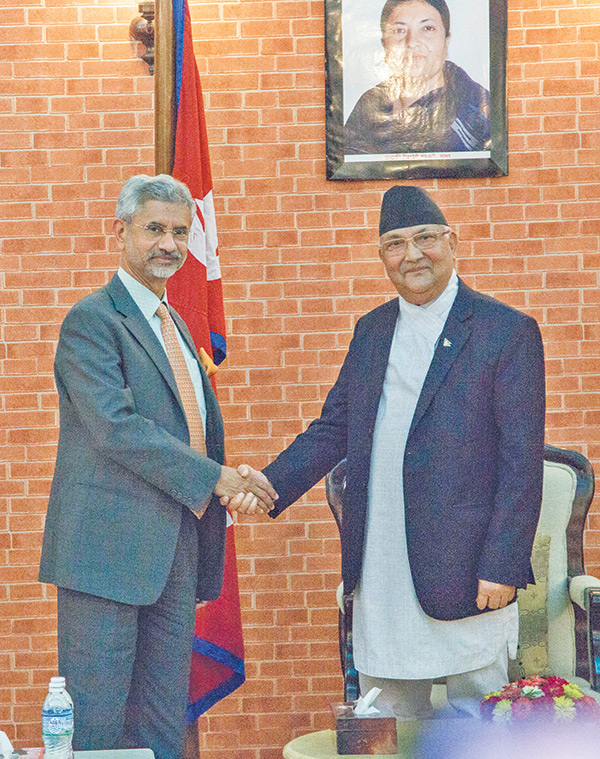
Prime Minister KP Sharma Oli meets Indian Minister for External Affairs Subrahmanyam Jaishankar at Baluwatar on Wednesday. POST PHOTO: PRAKASH CHANDRA TIMILSENA
KATHMANDU, Nepal and India on Wednesday agreed to enter into “a new era of partnership and cooperation” with Narendra Modi’s re-election in India and the formation of a stable government in Nepal. A meeting between Prime Minister KP Sharma Oli and visiting Indian Minister for External Affairs S Jaishankar on Wednesday revolved around increasing bilateral engagements and taking relations between the two countries to new highs, according to leaders familiar with the conversation. Jaishankar arrived in Kathmandu on Wednesday afternoon, leading an Indian delegation to the fifth meeting of the Nepal-India Joint Commission at the foreign minister level. Prior to the Joint Commission meeting, Jaishankar paid a courtesy call on Oli to convey Modi’s message of “seeking a new perspective on bilateral ties since both countries had gained political stability”. During the hour-long meeting, Jaishankar told Oli that a positive environment has been created in both the countries to take policy decisions, said officials. After years of wrangling, Nepal adopted a new constitution in 2015 and elections were held in 2017, which elected Oli as the most powerful prime minister in recent history. In India, after his re-election in May, Modi appointed Jaishankar as external affairs minister. Jaishankar’s is the first high-level visit from India since the Oli government was formed in February last year. In his message, Modi has expressed his readiness to make bilateral ties dynamic and progressive, according to Rajan Bhattarai, Oli’s foreign relations advisor. Nepal-India ties hit a historic low after the promulgation of Nepal’s constitution in September 2015. Days before Nepal adopted the new statute, Jaishankar, then foreign secretary, had flown into Nepal and held a series of meetings with major political leaders asking that Nepal stop its plans to promulgate the constitution, expressing India’s dissatisfaction with several of its provisions. Subsequently, New Delhi imposed a border blockade, which created an acute crisis of daily essentials in Nepal. In response, Oli opposed the blockade and made moves to open up trade and transit ties with China. But last year, then Indian external affairs minister, the late Sushma Swaraj, had met with Oli right before his election as prime minister, signalling that Nepal-India ties were back on track. Oli on Wednesday told Jaishankar that he has “special relations with Modi” and they have spoken about the development and prosperity of both nations, according to Bhattarai. Jaishankar, for his part, said that India was ready to support Nepal in every endeavour. “The central message at the political level was that we are entering into a new chapter in bilateral ties,” said Bhattarai. At the meeting, Oli requested that India receive the long-pending report of the Eminent Persons’ Group on Nepal-India relations. But Jaishankar was noncommittal on the matter, said a participant of the meeting. Members from both sides have been waiting for Modi to formally receive the report, which he hasn’t done so far due to dissatisfaction with some of the report’s recommendations. Oli and Jaishankar also discussed briefly the situation in Jammu and Kashmir after India’s repeal of the state’s special status. A top security official told the Post that Jaishankar asked for a clearer position on Jammu and Kashmir, rather than what Foreign Minister Pradeep Gyawali told the media during a press conference at the Ministry of Foreign Affairs on Monday. Although the government has refrained from issuing an official statement on Kashmir, Gyawali, responding to a question during Monday’s press conference at the Foreign Ministry, said, “The Nepal government is in favour of regional peace and stability. The dispute should be resolved through talks and we firmly believe that the government of India has the acumen to resolve the dispute peacefully.” Jaishnakar went on to inquire after Oli’s health as he will be departing for Singapore for medical treatment on Thursday. “A warm and in-depth conversation with PM Oli. Really appreciate his receiving me amidst his many preoccupations,” Jaishankar tweeted after the meeting. After meeting with Oli, Gyawali and Jaishankar led the fifth meeting of the Nepal-India Joint Commission where both sides reviewed all aspects of bilateral ties ranging from political, security and boundary; economic cooperation and infrastructure; trade and transit; power and water resources; culture and education. In the meeting, the two sides apprised each other of the progress made on various bilateral fronts and projects. After the meeting, a memorandum of understanding was signed between the Food Safety and Standards Authority of India and the Department of Food Technology and Quality Control on developing common food safety and standards. India handed over a cheque for Rs 1.29 billion (INR 80.71 million), which is part of the government of India’s commitment of INR 5 billion towards strengthening road infrastructure in the Tarai region, and another cheque for Rs 2.45 billion towards reimbursing the government of Nepal for housing reconstruction in Nuwakot and Gorkha districts. Jaishankar later described the joint committee meeting as “productive”. “Productive discussions with FM @PradeepgyawaliK at the 5th #IndiaNepal Joint Commission Meeting. Comprehensively reviewed our bilateral relations and identified priority areas for cooperation,” Jaishankar said in a tweet.
HOME PAGE
Former attorney general Raman Shrestha is parties’ pick for truth commission
While Shrestha himself says he won’t take up the position, conflict victims too are against the parties’ decision.
- BINOD GHIMIRE
Post Illustration
KATHMANDU, Ignoring repeated calls for transparency, a non-partisan approach and broader consultation by conflict victims and the international community, the major political parties have decided to pick the leadership of the two transitional justice bodies under their quotas. A meeting of the top leadership of the ruling Nepal Communist Party (NCP) and the primary opposition Nepali Congress on Wednesday agreed to pick former attorney general Raman Shrestha as the chair of the Truth and Reconciliation Commission. Shrestha had served as the attorney general, the government’s legal advisor, during the Pushpa Kamal Dahal-led government, but had continued in his position even during Sher Bahadur Deuba’s term as prime minister. Shrestha, however, said that though he had heard that the parties had decided on his name, he was not ready to take up the responsibility. Transitional justice is not his area of expertise, he said. “I am not interested in taking up the position,” Shrestha told the Post. “I will speak to party leaders once I receive their proposal.” Multiple people familiar with the developments told the Post that the parties have agreed to make efforts to convince Surya Dhungel, advisor to former President Ram Baran Yadav, to lead the Commission of Investigation on Enforced Disappeared Persons. Dhungel, who was the Nepali Congress’ pick for the Truth Commission, has refused to lead the Disappearance Commission, according to a Nepali Congress leader. “If Dhungel refuses, Sher Bahadur KC could be appointed to the Disappearance Commission,” the leader told the Post on condition of anonymity. KC is the former chairman of Nepal Bar Association, the umbrella body of lawyers in the country. The two transitional justice commissions have remained without officials since April 14, after the government relieved them of their duties through an amendment to the applicable law. Bargaining between the ruling and opposition parties to pick their own people for the Truth Commission had delayed the appointment process. Leaders, however, reached an agreement after the Nepali Congress agreed to settle for the leadership of the Disappearance Commission if Shrestha is appointed chairman of the Truth Commission. “Nepali Congress President Deuba was ready to compromise on Shrestha’s name,” said a ruling party leader. The Congress had earlier proposed Dhungel for the Truth Commission. But since the quota for the Truth Commission went to the ruling communist party, Dhungel was asked to lead the Disappearance Commission instead. At least half a dozen leaders and officials the Post spoke to said that Madhabi Bhatta and Shree Krishna Subedi were likely to be reappointed to the Truth Commission as members. The government on March 25 had formed a committee under former chief justice Om Prakash Mishra to recommend a total of 10 names—two chairpersons and four members each—for the two commissions. After the parties agree on the names, the Mishra-led committee will publish a list of candidates and issue a public call for complaints, if any. “It will take some time for the commissions to take full shape. Appointments are possible only after Prime Minister KP Sharma Oli returns from treatment in Singapore,” Subas Nembang, a ruling party member who was part of the negotiation process, told the Post. Nembang, however, said that selecting officials for the commissions is the prerogative of the Mishra-led committee. The two parties, in Wednesday’s meeting, also decided to finalise the amendment to the existing Enforced Disappearances Enquiry, Truth and Reconciliation Commission Act after consultation with the concerned parties in all the provinces and the Capital, said Nembang. “We have heard that the recommendation committee will be finalising the names very soon. Therefore, an amendment to the existing Act is an immediate requirement,” he said. Amid growing concerns from the international community, the government, two weeks ago, had written to the Office of the United Nations High Commissioner for Human Rights, saying that the appointment process would be transparent. “The High Commissioner’s Office has asked us if the government’s claim is true,” Janak Raut, general secretary of the Conflict Victims’ Common Platform, told the Post. “The government has tried to keep the international community in the dark.” Victims of the decade-long Maoist “people’s war” have said they won’t accept any decision that is taken without consulting with them. Bhagi Ram Chaudhari, chairman of the platform, told the Post that they would reject any appointments that are made without their consent. “We have been saying that an amendment to the Act is necessary before any appointment to the commissions. We won’t accept any decision that is imposed,” Chaudhari told the Post. More than a decade after the signing of the Comprehensive Peace Agreement, the transitional justice process remains stalled. The government has yet to amend the Transitional Justice Act in line with a Supreme Court ruling that struck down half a dozen provisions, including one that paved the way for amnesty for those guilty of serious human rights violations. The international community has long been demanding that Nepal amend the Act in line with the Supreme Court’s order and Nepal’s international obligations.
HOME PAGE
For limbless children, this organisation is here to lend a hand
e-Nable Nepal is providing free 3D printed artificial hands to children without one.
- ANUP OJHA
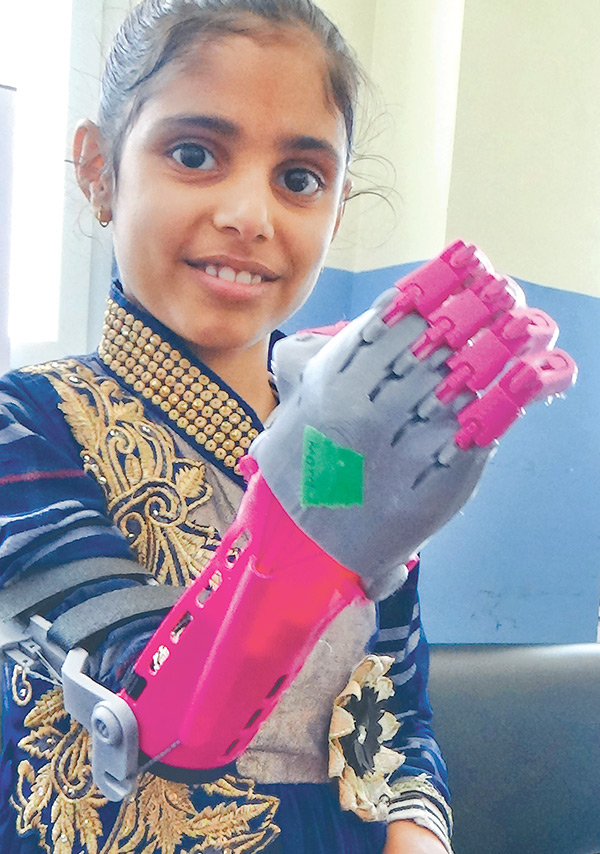
Eleven-year-old Prativa Adhikari of Bhotewodar in Lamjung was born without right hand. Photo: e-nable nepal
KATHMANDU, Seven years ago, nine-year-old Sanjit Kumar Thakur was flying a kite from the roof of his home in Budhanilkantha when all of a sudden it started pouring. The rain soaked his kite, and it landed on a live wire. A high voltage current passed through the soaked rope, electrocuting Thakur and rendering him unconscious. His family immediately rushed him to Kanti Children’s Hospital in Maharajgunj, where Thakur gained consciousness after a month. His right hand had to be amputated. Since the accident, Thakur has struggled to learn to do everything with his left hand, which has not been easy. But three months ago, Thakur, who is now in the tenth grade, received great news: he was going to receive a 3D printed prosthetic hand. This was made possible by e-Nable Nepal, a non-governmental social organisation that consists of educationists, journalists, philanthropists and Non-Resident Nepalis from Canada and America. The organisation is part of a global volunteer organisation initiated by Jon Schull in 2013 that creates free 3D printed hands and arms, with chapters in over 80 countries. The prosthetic hand has enabled Thakur to make use of his right arm again. He can now shake hands with his friends, ride his bicycle, carry lightweight objects and even juggle balls. “Earlier, wearing a full sleeve shirt used to look weird. Now, I can wear my school uniform and I don’t feel weird not having a hand. The prosthetic arm has given me my confidence back,” said Thakur. Prosthetics are devices designed to help those with full or partial limb loss. Thakur, now 16, is currently preparing for the Secondary Education Examination from the Adarsha Higher Secondary School in Thimi. “I have never seen Sanjit this happy before,” said Lal Babu, Thakur’s father, who sells chatpatey for a living. “We only know the real value of things when we lose them. It’s a miracle that my son has received a new chance at life.” Unlike Thakur, 11-year-old Prativa Adhikari, from Bhotewodar in Lamjung, was born without a right hand. Her mother Rita learnt of e-Nable Nepal from relatives who lived in Kathmandu. She came to Kathmandu along with her daughter last month to get a prosthetic hand. “We are grateful that we received it for free. How else would working class people like us obtain such machines?” said Rita. With her new hand, Prativa is now able to do minor tasks, such as carrying light things. But she has not been able to adjust to going to school with an artificial hand, said Rita. In the past year, 60 other children between the age groups of five and 16 have received prosthetic hands from e-Nable Nepal. These children are from across the country—Sarlahi, Birgunj, Pokhara, Baglung, Butwal, Sankhuwasabha, and Chitwan. e-Nable had started providing free prosthetics from July last year, after establishing a 3D printing lab with five machines donated by e-Nable Canada. Rishi Shrestha, a Non-Resident Nepali mechanical engineer, brought in Peter Byron, founder of e-Nable Canada, to train four volunteers on 3D printing. It takes 24 to 48 hours to make a complete artificial hand, depending on the size. Children can also choose the colour of their new hand. The organisation currently carries out its operations from the Sinamangal-based Nobel Hospital. “It feels good to see smiles on both children and their parents after they receive a new hand,” said Shikshya Gautam, manager of e-Nable Nepal, which currently operates out of the Sinamangal-based Nobel Hospital. The nonprofit is currently looking forward to introducing a bionic hand that will work under the direction of the human brain, and also to extend facilities to all seven provinces, said Hemanta Gautam, vice-chairperson of e-Nable. “We have already consulted with the province chiefs and municipality mayors so hundreds of school-going children can have prosthetic hands,” said Gautam. “If we can reach every corner of the country, we can help so many children.”
MEDLEY
Horoscope
ARIES (March 21-April 19) *** A new relationship prospect will pop up early in your day today, but are you ready? The timing is not ideal, but when opportunity knocks, you have to answer. This new relationship might be romance-related, but it could also be a business networking connection. Be ready for just about anything and keep your schedule loose.
TAURUS (April 20-May 20) *** Your family or social group has a lot to teach you right now, so spend more time with them! Even if you are itching to have some alone time, this is not the best period in your life to do so. You should be around as many of your favourite people as possible—their energy will not only invigorate you, it could inspire you.
GEMINI (May 21-June 21) **** You are learning more about how to use your charm to get ahead in your career prospects, and it’s already starting to pay off. Today’s events will teach you many valuable lessons about how to win people over. Your smile will take you far, so don’t be shy about cracking a joke or making a sweet flirtatious comment to someone.
CANCER (June 22-July 22) *** Today, be prepared for your mind to wander as the day progresses —someone new on the scene has a fun story to tell, and you want to hear it! A little social break from the action is fine and healthy, but just make sure that by the time your head hits the pillow tonight you have made enough progress to make yourself proud.
LEO (July 23-August 22) **** Today get creative with how you get stuff done. Stick a smile on your face and the day will be a very pleasant one. Flattery, jokes, and even slapstick comedy are all useful tools for you to employ in your pursuit of having a good time while being productive. Share your excitement with others and invite them along for the fun.
VIRGO (August 23-September 22) ** Today you’re likely to only get confused the deeper you dig about a project. The best thing to do in the situation is to walk away for a while and let your brain get occupied with other ideas. When you come back later in the day, those details will suddenly help you understand. You’ll immediately know what to do.
LIBRA (September 23-October 22) *** Today focus and appreciate the smaller things in life today.There’s magic in those details, so slow down and take them all in. You’ll enjoy pouring over the minutia much more than you would have ever thought. Plus, there is a great deal of pride to be found in noticing something that no one else notices.
SCORPIO (October 23-November 21) ** Disturbing dreams don’t have to ruin your waking days! a dream is just a dream-your subconscious mind is just playing around with different ideas and images. There’s no hidden puzzle for you to solve, so don’t waste time today trying to figure them out. You’ll have different dreams tonight.
SAGITTARIUS (November 22-December 21) *** Trusting other people is the right thing to do. Not only has it enabled you to get closer to people you care about, it has helped you expand your horizons. Today, the tables are turned and you need someone else to trust you—and they might need some convincing. Instead of telling them you are trustworthy, show them.
CAPRICORN (December 22-January 19) **** Your levels of creativity are higher than most people’s, and this enables you see things a fresh way. Toss out any guilt you might feel for being able to come up with better ideas than anyone else—be proud of your ability to contribute fresh, innovative and sometimes downright odd ideas to the discussion.
AQUARIUS (January 20-February 18) *** Today reach out to the areas of your life you have been neglecting and realign your goals. Focus on building relationships. Take a day or two off from heavy-duty thinking and put your family and friends first. Send out emails to people who would love to hear what’s up in your life and Catch up with what’s going on with them.
PISCES (February 19-March 20) ** A person from your past will come back into your life today, and their transformation will be remarkable. Give them the benefit of the doubt and do not jump to conclusions about what has caused the changes that you are seeing. Give them a chance to re-introduce themselves to you and keep an open mind.
NATIONAL
Over 50 dengue cases reported in Kathmandu Valley in a matter of days
- Arjun Poudel
KATHMANDU, At least 55 dengue cases have been reported in 10 big hospitals of the Kathmandu Valley in the last few days, according to the Epidemiology and Disease Control Division. “The number is just the tip of the iceberg,” Dr Bibek Kumar Lal, director at the division, told the Post. “A lot of people might have been infected, as all hospitals do not report to us.” Another reason why the division suspects the number of dengue cases could be higher than reported is that the people with mild symptoms do not visit the hospital. Doctors say though 75 to 90 per cent of dengue cases are asymptomatic, those patients could still infect others. “Only those who have complications go to the hospital,” Lal said. According to the division, most of the dengue cases reported in the Valley are indigenous--that is to say, they contracted the virus locally. If the patients do not have a history of travelling to dengue-affected areas for the last one week and get infected with the deadly virus, doctors call it an indigenous case. The incubation period of the dengue virus is one week, which means when a dengue-causing mosquito bites a healthy person, symptoms surface within one week. Before this, indigenous dengue cases were reported among people from Kapurdhara, Baneshwor, Tinkune, Tahachal, Teku, Sanobharyang, Balaju, Swayambhu, Lagan and Ason areas. Following the rise in the number of indigenous dengue cases, the division had held an emergency meeting with the representatives of Provincial Health Directorate of Province 3 and Provincial Health Offices of all three districts in the Valley—Kathmandu, Lalitpur and Bhaktapur—on Sunday. The meeting had discussed various measures to contain the spread of the disease. Earlier, two health experts from the World Health Organization had warned of possible dengue outbreak in the Valley after they found a large number of larvae and pupae of dengue-causing Aedes aegypti and Aedes albopictus mosquitoes. Dengue-causing mosquitoes breed in clean water and bite people in daylight. Due to an acute drinking water crisis, people in the Valley store water in jars and pots, which could be ideal breeding grounds for these mosquitoes. According to doctors, mild to high fever, severe muscle pain, rashes, severe headache, and pain in eyes are some of the symptoms of dengue. The WHO says there is no specific treatment for severe dengue, but early detection and access to proper medical care can lower the fatality rate.
NATIONAL
Nine minors rescued from a children’s home in Bafal
Police nabbed three persons. The children were living in dismal conditions, surviving only on rice and salt, authorities say.
- BHRIKUTI RAI,SHUVAM DHUNGANA
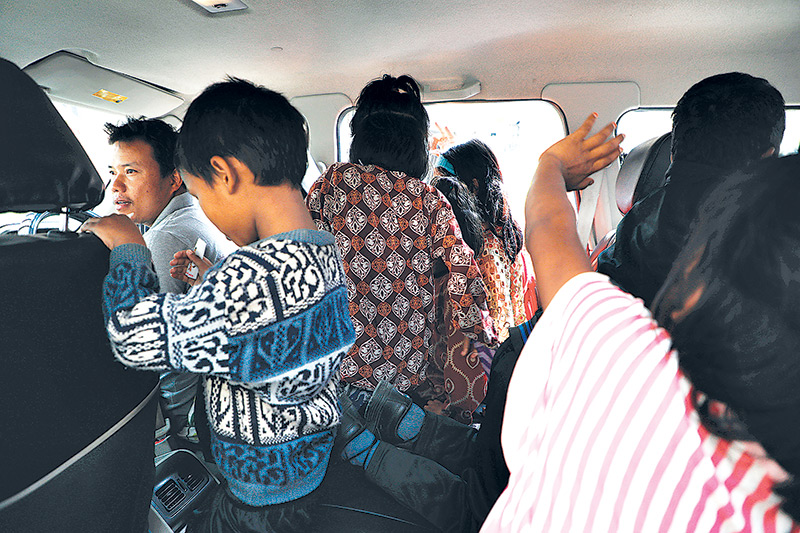
Children are put in a vehicle after being rescued from a Children’s Home in Bafal, Kathmandu, on Wednesday. Post Photo: SANJOG MANANDHAR
KATHMANDU, Authorities on Wednesday rescued nine children from Namuna Pragatisil Mahila Samaj, an unregistered children’s home, in Kalanki, Kathmandu, after receiving complaints that the children there were being treated poorly. Police officials along with team members from the National Child Right Council and Children Search Coordination Centre found the nine children living in squalid conditions in a two-story house during the raid on Wednesday morning. According to Mohan Bikram Dahal, inspector at the Children Search Coordination Centre, most of the children at the shelter home were from Kailali and Kalikot districts. The shelter’s record shows there were 15 children living there, but officials only found nine. The other six children, according to Sujit Rayamajhi, one of the members of the organisation, were sent back to their families. “We are still trying to confirm what happened to the other six children and if they have actually been reunited with their families,” said Inspector Dahal. It is still unclear why the minors were brought here in the first place. According to the staffers, the organisation was regulated by a woman named Kopila Kunwar, of Dhading. However she was not at the site when police officials raided the building. “Our team is still searching for Kunwar and she will be taken into custody soon,” said Dahal. Radhika Pandey, 21, of Jumla, who was working as a help in the organisation told the Post that she had been working at the organisation for the past two months and hadn’t received a penny. “It was a terrible situation. There was nothing to feed the children,” said Pandey. “Although they were sent to the nearby Sirius English Boarding Secondary School, the children didn’t have any books or uniform.” The police also uncovered that although the organisation was run as Namuna Pragatisil Mahila Samaj, all the papers were in the name of Youth Community Service Centre (YCSC), said the police. They have yet to investigate the matter further. Mina Tamang, who lives in the same building, said she had no idea about the legality of the organisation nor about the children. “We are busy doing our own work and had no time to talk with the minors,” said Tamang. “I was shocked to find out that the place was being run illegally.” Sunita Shah, an official at National Child Right Council, who was there to rescue the minors said, “We were here just to inspect, but when we arrived here the situation seemed very critical. They were having only rice with salt.” “The children might have gone through different sorts of abuse or violence as well. Although there is no confirmation of such activities till now, we will investigate it,” said Shah. According to Shah, the children will now be taken to a transit home where they will undergo psychological counselling and a health check-up. After establishing contact with the children’s family, the children will be sent back home, but only if the family is economically stable, says Shah. “If the families cannot support the children, then we will find other organisations that will take on the responsibility for caring for them,” shared Shah. This is not the first time that authorities have raided shelter homes and found children living in dismal conditions. Earlier this year, authorities rescued 125 children, a majority of whom were from Humla and Mugu, from Aishwarya Children’s Home in Sukedhara. But in the absence of proper government structures, insufficient budget allocation and lack of coordination among government bodies, there is a lot of confusion in the aftermath of such raids. And more often than not, authorities fall back on charities and NGOs running shelter home for children. “Despite limited resources and expertise, we have to house the rescued kids on government authorities’ request, and we know how under-resourced these agencies themselves are,” said Bhaskar Karki of Chhora Chhori, which runs a children’s shelter home in Lalitpur and took in 20 of the rescued kids from Aishwarya Children’s Home earlier this year. After staying there for nearly three weeks some of the children were reunited with their families or sent to other children’s home. “The government needs to have a plan and allocate enough budget to monitor children’s homes more strictly and also ensure there is a mechanism to take care of them,” said Karki, “or else these children, who come from extremely poor families, will end up in another poorly managed shelter home.”
NATIONAL
Single public office working for six districts
The popular ‘Gaun Gaun ma Singha Durbar’ slogan has remained just that—a slogan, with its implementation a far cry
- SAMJHANA RASAILI
TANAHUN, Gaun Gaun ma Singha Durbar (Singha Durbar in Every Village) has become a popular slogan in Nepal since the implementation of federalism in the country. The catchline basically means that the powers of Singha Durbar, the country’s major administrative centre, have been decentralised to the local bodies. But people are yet to see this happen. The Soil Conservation and Watershed Management Office in Tanahun is a case in point. The office has been providing services to six districts-Tanahun, Lamjung, Gorkha, Manang, Kaski and Nawalparasi (East). Earlier, every district had its own soil conservation and watershed management office. But with the Cabinet’s decision in August last year, there are now only two offices of soil conservation and watershed management to look after the concerns of 11 districts in Gandaki Province. “We are unable to execute works as expected. Our area of work has expanded but the staff number has reduced from 17 to 12,” said Diwakar Paudel, an officer at the Tanahun office. The authorities concerned should manage more employees at the office, Paudel said. “The office has many challenges as it is, and now our clients, too, are complaining about inconveniences they must put up with while visiting the office,” Paudel said. “The provincial government should set up a field unit or reinstate the district offices to provide timely services to the people.” Durjan Gurung, chairman of Gausahar Durbar Foot Trail Consumers’ Committee in Lamjung, expressed his grievance at the authorities concerned for not providing effective services. “It is said that the power of Singha Durbar would be handed over to villages. But it has not been implemented yet. We have to visit another district to complain about soil erosion, floods and landslides,” said Gurung. The federal and provincial governments had allocated Rs 144.7 million to the Soil Conservation and Watershed Management Office last fiscal year. Umanga Baral, the assistant watershed management officer, said Rs 138 million was spent in different projects last year. Nara Bahadur Mahato, chairman of Gundrahi Dhakaha Buffer Zone Community Forest in Nawalparasi (East), complained of difficulty carrying out projects because the office is not conveniently located. “It takes two to three days to reach the soil conservation office and return. It’s very difficult to get services from the office due to its location,” said Mahato. The community forest had recently undertaken a project of installing barbed wire fence around the forest area. “We completed the project. However, it was difficult to get payment from the office. One has to spend around Rs 5,000 during each visit to the office,” he said.
NATIONAL
No plastic bottles and bags in Everest region from January
Authorities to ban the use of plastics below 30 microns and beverages bottled in plastic.
- CHANDAN KUMAR MANDAL
KATHMANDU, Come January, the Everest region is set to become a no-plastic zone. After scrambling for years to deal with the piles of waste in the Everest region, which has gained notoriety as the ‘world’s highest garbage dump’, the local authority has endorsed a plan to declare the whole area a ‘no plastic’ zone from the next year. The Khumbu Pasang Lhamu Rural Municipality in Solukhumbu district has decided that starting January 1, 2020, it will impose a ban on the use of plastic bags, bottles and other plastic items, citing their adverse effects on human health, especially in the whole Everest region. The rural municipality, passing its policies and programmes for the current fiscal year, decided that the use of plastic bags less than 30 microns will be prohibited in the Everest region, according to Ganesh Ghimire, chief administrative officer at the local authority. With the new rule, even bottled drinks will be barred from the area. Now onwards, all the bottled beverages will have to be taken in cans only. “Over the years, plastic has created havoc in a region that is fragile and home to the world’s tallest peaks,” Ghimire told the Post. “As the number of tourists visiting the area went up, the Everest region was flooded with plastics. The initiative is taken to rid the region of plastics.” Once the rule comes into force, no one—locals or tourists—will be allowed to use and carry plastic bags, and plastic bottles inside the rural municipality, according to Ghimire. “We will only allow canned drinks because cans are not as hazardous for the environment as plastic. Locals can also recycle cans,” Ghimire said. “It was necessary to impose such a strict ban because the region was plastered with plastic and other items made of plastic.” The Everest region has long been struggling to manage solid waste that visitors to the region bring along every year. Hundreds of mountaineers, Sherpas, guides and other high altitude porters en route to Everest leave behind tonnes of both biodegradable and non-biodegradable wastes that include empty oxygen canisters, bottles, ropes, kitchen waste, and faecal matter, polluting the area and the settlements downstream. The government rule for every climber to bring back at least 8 kgs of garbage—the amount of trash estimated to be produced by one climber on average—has remained mostly ineffective. Earlier this year, a 45-day ‘Everest Cleaning Campaign’, led by the rural municipality and supported by various governmental and non-governmental agencies, had brought down nearly 11,000 kg garbage from the world’s tallest peak. Plastic in various forms and sizes was the major item in the collected trash. The campaign, which was one of the most ambitious clean-up projects on Everest, had cost over Rs25million. “Besides disturbing the local environment, we have to spend a huge amount of money clearing this trash every year,” said Ghimire. As a replacement for plastic bags, the local authority will distribute five alternative bags free of cost to each resident in the rural municipality with approximately 2,000 households. The local authority fears that with the opening of a road that connects Kharikhola in ward-1 of the rural municipality with Chaurikharka in ward-3 would exacerbate plastic pollution. According to the rural municipality’s estimate, nearly 150,000 tourists use the route. The number is predicted to go up to 500,000 next year. “More tourists on the route will mean more plastics in the region,” Ghimire said. “Before we face an unprecedented amount of plastic in future, this is the right time to prohibit plastics here.”
NATIONAL
Ring Road Improvement Project to axe over 2,000 trees from Kalanki to Maharajgunj
Officials say the move is part of a drive to widen the road from three lanes to eight lanes.
- ANUP OJHA
KATHMANDU, The Kathmandu Ring Road Improvement Project has announced it will axe 2,057 trees along the 8.2km Kalanki-Balaju-Maharajgung road section from the next week as part of a drive to expand the road from three lanes to eight lanes. Amrit Mani Rimal, project director, said trees that are within a distance of 31 metres on both sides from the middle of the road have been marked. He said all the marked trees would be removed from the road section by September. The project office will then auction those felled trees. “We are just clearing the road section so that the road expansion task can move forward,” said Rimal. The road expansion work is being funded by China. The project office, however, said it does not know when the road expansion work will start. “We don’t know when the Chinese government will start the project; may be they will start the project from 2020,” said Rimal. The Chinese government, which is going to fund the project, was supposed to submit the design of the project last year before October. This is the second phase of the project. Earlier in January, the Chinese government had officially handed over the 10.5km Kalanki-Koteshwor road section to the Road Improvement Project. Rimal said the project office has already removed 100 electric poles coordinating with the Nepal Electricity Authority, and the work is going on. According to Rimal, for the removal of the electric poles, the project office has allocated Rs 107 million, while it has sent a letter to the Ministry of Finance to release Rs 200 million to Kathmandu Upatyaka Khanepani Limited. When the Post asked how the Department of Roads is going to regain the lost greenery along the road section, officials said they are planning to plant saplings along the expanded road after the work is completed. “We will plant trees as we did in the Kalanki-Koteshwor road section,” said Rimal, not addressing that the saplings that have been planted are not being well taken care of and are on the verge of dying.
NATIONAL
Haphazard road constructions raise landslide risk
Many families in three villages of Bajhang have been displaced due to landslides in the last three years.
- Basanta Pratap Singh
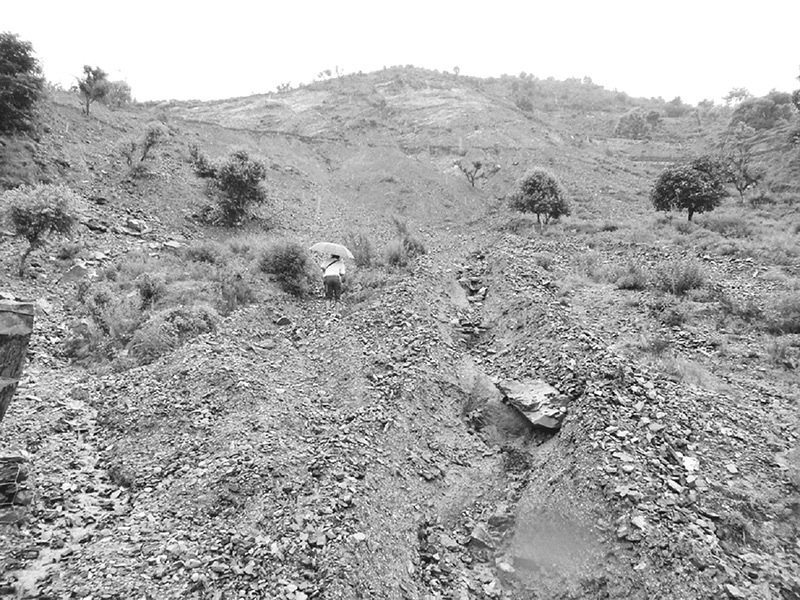
Around 150 ropanis of land belonging to 65 families in Bajhang were swept away by landslides in the past three years. Post Photo: BASANTA PRATAP SINGH
BAJHANG, Happiness knew no bounds for the locals of Toli, Pades and Thing villages in Bajhang district when their villages were connected with road network in 2016. Road connectivity for them meant unprecedented development in the region and the opening of economic prospects for the villagers. The first vehicles to reach the villages were welcomed with much fanfare, recalls Harimal Bohara of Toli, whose front yard opened right into the newly built road. “I was happy at the prospect of running a tea shop. I wanted to build a small stall and set up an eatery eventually. That would help me raise my children, I thought,” said Bohara. Just five months after the road in Toli came into operation, a massive landslide caused by haphazard construction of the road swept away his house and land. Bohara, now displaced from his ancestral home, regrets the day he welcomed road connectivity into the village. “I wasn’t aware of what the road construction would mean for me and my family. We were fortunate to survive. I, my wife and five children were safe. Everything else was lost,” said Bohara. After the disaster, the seven-member family has moved out of Bajhang and is currently taking shelter in Dhangadhi. Bohara’s story is playing out in various households across the district. Eighteen families have been displaced from Toli, Pades and Thing villages of Thalara Rural Municipality in the past three years. Nabaraj Joshi, a resident of Toli, also lost his house and property last year to the same landslide that took Bohara’s house. He moved to Kanchanpur with his eight-member family after the disaster. “I didn’t want to leave my birthplace,” Joshi said. “We never thought that the road network that was supposed to be a blessing for us, would drive us away from our own home.” The construction of the Rayal-Thinkar-Toli-Pades road section has caused four massive landslides in the area in the last three years. “Around 150 ropanis of land belonging to 65 families were swept away by landslides in the past three years. More than 40 houses of three villages are currently at high risk of landslides,” said Bishnu Bista, the ward chairman of Thalara Rural Municipality-4. The rural road was constructed as an initiative of the then Constituent Assembly member Lal Bahadur Rawal. A total of Rs 17 million budget was allocated for the road project. The then Division Road Office in Baitadi had carried out a survey of the road project in 2014; however, the construction work did not adhere to the findings of the survey, said locals. The alignment of the road network proposed by the survey wasn’t taken into consideration when the construction work began. “Contractors started opening tracks without consulting the survey. We urged them to pay heed to the survey and not use heavy machinery but they paid no heed to us,” said Man Bahadur Bohara, a local. The road network is now no longer motorable. Around Rs 13.5 million budget was spent to control the landslides but without any results. In the first week of August, a massive landslide occurred in Toli, leaving 13 houses at high risk. Former CA member Rawal said a large amount of budget was spent to control landslides but in vain. According to him, there is no alternative but to relocate the affected settlements to a safer place. According to the data available at the District Natural Disaster Rescue Committee, 115 villages of 11 local units in the district are at risk of landslides due to the haphazard construction of rural roads.
NATIONAL
Saraswati Basic School taking loans to operate classes
The amount provided by the municipality to run the school is proving to be insufficient.
- Arjun Rajbanshi
BIRTAMOD, Three years ago, there were only 57 students at Saraswati Basic School in Shivasatakshi Municipality, Jhapa. But thanks to the school’s quality education, well-facilitated infrastructure and dedicated teachers, it has since managed to attract around 200 students. The school runs classes from grade one to five. In the current academic year alone, 82 students from private schools joined the Saraswati Basic, according to Headmaster Ganesh Ghimire. “It’s good to see students preferring our school to other schools in the area. But we are having a hard time just running the school for lack of funds.” The school management committee has taken a loan of Rs530,000 at 16 percent interest from Kumudini Saving and Credit Cooperative, a local cooperative, said Ghimire. A part of that loan was spent in purchasing a school bus and on running mid-day meal programme. “We decided to purchase a bus since we had students travelling quite a distance to attend classes here,” said Ghimire. Krishna Prasad Guragain, one of the teachers at the school, said that the school has been providing mid-day meals to all students. “We have students coming from Buluchowk, Janata Bazaar, Haldarchowk, Shivaganj Bazaar and Dhaulechowk, and it is important that we run a bus service and mid-day meal programmes to cater to these students,” Guragain said. According to the school management committee, the school also added teachers after the rise in the number of students. “The school has appointed four more teachers from private sources after the number of students increased,” said Guragain. According to Ghimire, the school is now running low on funds to provide a salary to its four teachers and other non-teaching staff. “Aside from the teachers’ salaries, we have to pay Rs11,000 to the driver, 5,000 to his assistant, and spend around Rs26,000 for fuel and Rs8,000 for bus repair per month,” said Ghimire. Shivasatakshi Municipality has been providing Rs75,000 annually to operate the school. “The amount provided by the municipality is insufficient to meet all the school expenses,” said Guragain, adding that the school lacks proper toilets, drinking water facility and playground. Last year, the ward office had allocated Rs100,000 for the school. For this fiscal year, the office has allocated Rs 150,000 to operate the school, said Ward Chairman Manoj Karki. “As the school has been completely reformed, I have been helping the school as much as possible,” said Karki. However, Karki agrees that the municipality has been unable to extend much help to the school since most of its budget is spent on the town infrastructure development projects.
NATIONAL
Cholera bacteria found among diarrhoea patients
More than 80 people have been taken ill in Dadeldhura district over the past week.
- DR PANT
DADELDHURA, More than 80 cases of diarrhoea have been reported in the past week in Parashuram Municipality-8 of Dadeldhura. Four out of five samples of stool collected from victims in the affected area tested positive for cholera at the Dadeldhura Hospital. The health workers deployed in the affected settlements suspect most of the patients might have been suffering from cholera. Residents of Kosankhola, Dhandali Phant and Gushti have been suffering from diarrhoea since August 14. According to Hikmat Dhami, coordinator of the municipality’s health unit, five seriously ill patients were taken to Jogbudha Hospital while 76 others are receiving treatment at the local Sandani Health Post. “Most of the patients are suspected to be suffering from cholera,” said Dhami. The health workers set up camps in the affected area and provided treatment. “The number of patients is rising gradually. The disease has not come under control,” said Aananda Kumar Yadav, chief at the Sandani Health Post. The health officials said diarrhoea, cholera and typhoid were spreading in the area. “The epidemic broke out due to unsafe drinking water,” said Dhami. Though the disease has been spreading for the past week, only health officials of the municipality have been mobilised to contain it. A health team with specialists has not reached the affected area yet. The affected area is about 80 km from the district headquarters.
NATIONAL
Army opens fire to drive elephants away in Parsa
- SHANKAR ACHARYA
PARSA, The Nepal Army on Tuesday night fired 50 rounds of warning shots to drive away a herd of elephants in the Pathalaiya-Amlekhgunj road stretch. The army from the Siddhibox Battalion opened fire after the herd tried to turn over a truck transporting rice from Hetauda to Pathalaiya. The elephants, which had escaped from the Parsa National Park, tried to steal rice from the truck, said Ashok Ram, information officer at the park. The incident obstructed the highway for a couple of hours. The elephants later returned to their habitat in the park. The herd included 27 pachyderms. One army personnel sustained an injury while driving the elephants away. Meanwhile, two elephants that have been spreading terror in Sarlahi for the last six months have moved to the Halkhoriya area in Parsa National Park. This phenomenon of elephants travelling to the highway, however, is not new. This year, the elephants took longer to show up along the highway, according to Ram. Usually, the elephants travel across the roads to Sarlahi in mid-June. The movement of the elephants this year was interrupted by the ongoing Motihari-Raxaul-Amlekhgunj oil pipeline construction, Ram said. Likewise, the Nijgadh-Kathmandu fast track is also under construction near the elephants’ habitat.
NATIONAL
Locals of Brahmadev in Kanchanpur demand early opening of Tanakpur bridge
- BHAWANI BHATTA
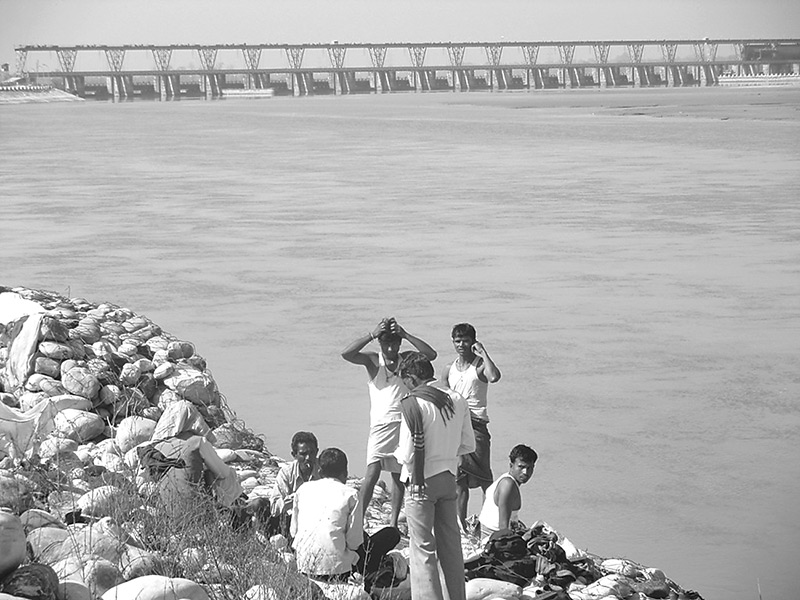
The locals have formed a nine-member coordination committee to pressure authorities of both countries to open the transborder bridge. Post Photo: BHAWANI BHATTA
KANCHANPUR, The local people of Brahmadev in Kanchanpur have urged authorities of Nepal and India to open the already constructed bridge over Tanakpur Barrage. At a greeting exchange programme on Tuesday on the eve of Gaura, a major festival of Sudurpaschim Province, where elected representatives from both Nepal and India were in attendance, the locals demanded opening of the bridge to facilitate transportation across the Brahmadev-Tanakpur border point. In accordance with the Mahakali Treaty signed by Nepal and India in 1996, the Indian side constructed the barrage and bridge across the Mahakali river around two decades ago linking Brahmadev with the Indian town of Tanakpur. However, the bridge has yet to come into operation. India, which is responsible for building the barrage, link road and irrigation canal under the treaty—has not built the link road on the Indian side. “Tanakpur border point is significant from a business and religious point of view. The border point should be opened at the earliest. The link roads of both sides and canal should be constructed immediately,” said Keshav Chand. “It was announced earlier that the Tanakpur barrage would be connected with Asian highway. But unfortunately this vital border point lies unused,” he added. Kailash Chandra Gahatodi, a lawmaker of the Indian state of Uttarakhand, State Minister for Industry, Forest, Environment and Tourism of Sudurpaschim Province Prakash Rawal, representatives of the local level, the business community and the local people were present in the function. The locals of Brahmadev submitted a memorandum to Gahatodi to take initiatives to open the Tanakpur border point soon. After receiving the memorandum, the Indian lawmaker assured that he would take the initiative to build the link road and canal soon. “I heard that the Indian government is preparing to invite tender for canal construction this year. The link road construction will be carried out along with the canal,” he said. The locals have formed a nine-member coordination committee under Madhav Joshi, the former vice-chairman of Kanchanpur Chamber of Commerce and Industry, to pressure authorities of both countries to open the transborder bridge.
EDITORIAL
No regard for merit
It is unfortunate that political sharing in universities persists.
Political sharing in universities is not new. Continuing this trend, the Oli-led administration is set to appoint top officials in various universities on the basis of political sharing despite calls by various sections of society to stop the practice. Universities are a matter of public interest, and it is disheartening to see them being used as pawns in the game of power politics. In May, a government task force had recommended that officials in universities be appointed on the basis of merit after a proper evaluation of different leadership qualities. It was a welcome move as it would have marked a departure from the long-standing practice of political appointments. But showing utter disregard for the recommendations, the ruling Nepal Communist Party is preparing to appoint a majority of officials in the universities including Tribhuvan University, the oldest and largest university of the country, under its quota. So far, the positions of vice-chancellor, rector and registrar have been divided among the parties, and whichever party is in power gets the majority of portfolios. How a university functions depends highly on who the vice-chancellor is and who all comprise his team. It is, first and foremost, a place for learning and knowledge production. As long as individuals who lead these institutions do not have the merit and cannot showcase the highest degree of integrity, universities cannot serve their intended purpose. Therefore, the governance and leadership of our institutions of higher education has been troubled for decades. Political sharing of university positions runs the risk of turning the offices of the vice-chancellors and other officeholders into bureaucracies that are more interested in business than in academic advancement—a reality since a long time in our case. When office bearers become political, the entire university gets politicised, allowing students to forget academia and act as party cadres. What’s more, the government is gearing up to establish more universities in the country. The government in October last year announced Rajarshi Janak University in Dhanusha and Rapti Academy of Health Sciences in Dang. the latest addition is the Madan Bhandari University of Science and Technology. With this, the number of universities will reach 14. But at this stage, a more realistic approach would have been to make the ones that exist functional rather than merely increasing the number of varsities. Universities established years ago are struggling to find students in required numbers. Lumbini Buddhist University, for example, has 196 students while Nepal Sanskrit University, the country’s second-oldest has 1,471 students in total. Mid-Western University and Far Western University formed eight years ago have 2,211 and 3,035 students currently enrolled in them respectively. Appointing vice-chancellors and other office-bearersn universities is a good time for the government to prove that it is doing something different, and actually work for the benefit of the larger citizenry. But it is sad to see it forego that opportunity for mere political mileage.
OPINION
In Nepal, your social and political standing dictates the applicability of laws
The principle of equality before the law was established in 1963. Yet rules are applied differentially.
- DEEPAK THAPA
One evening not very long ago, an elderly relative of mine found himself quite distraught when he saw on TV the news that an old friend of his had been indicted for corruption, stemming from a decision he had made as a high government official years earlier. Feeling sorry for someone who went back almost to their teens, he decided to call him up in commiseration. Since there was no answer, my relative assumed the poor chap must be feeling down and not in a particularly talkative mood. He was in for a surprise though, since the next morning he received a call-back from his friend who sounded in the highest of spirits. After the exchange of pleasantries and upon being told how sad the turn of events had been, the indictee brushed it aside and said there was nothing to worry about; it was just a matter of paying an ‘x’ amount (itself a rather huge sum) as a fine and he would be off the hook.
A tale of two classes I could not help think of that incident when reading about another corruption indictment more recently. His is not a household name, but Hari Prasad Acharya was in the news for some days. A lowly government official, Acharya had committed suicide following a case being filed by the Commission for the Investigation of Abuse of Authority for his alleged role in transferring public land to a developer when he was with the land revenue department. His death came after two other suicides by two other government officials also facing corruption charges and hence made it more newsworthy. What struck a chord with Acharya’s death was his suicide note. Composed in the manner of someone not used to writing but attempting all the same to anticipate what would befall his family after he passed on, through his last missive the late Acharya asked his wife to live in amity with their sons and his mother, and asked his sons to do well by their mom; he calls himself a sinner for not being able to see his youngest son earn his bachelor’s degree; he refers to a small bag in the cupboard with cheques for four different banks (probably less an indication of corruption than his salary accounts being in different banks as a result of his having been moved around); he asked his neighbours to dispose of the buffalo and goats and instructed his wife to move to Kathmandu to be with their son as he completes his studies, and so on. Acharya appears to admit having erred in the instance for which he was charged but is vehement that he is not corrupt. Whether it was an innocent mistake or whether money actually changed hands is something we will perhaps never know. Either the shame of being accused of indulging in what would have at most been petty corruption or the stress derived from not being able to drag in higher-ups involved seems to have driven Acharya to take his own life. Contrast that with the first case referred to above, where, going by media reports, the chances of corruption (actually, grand corruption, in the distinction Transparency International makes) having occurred is almost certain, the man charged was quite unconcerned. That, thus, is the tragedy of our country. It was in 1963 that the old Muluki Ain, which laid out different penalties for the same crime based on one’s position in the caste hierarchy, came to an end, and the principle of equality before the law was established. But, in actual fact, the rules have always been applied differentially to those in power. Not that Nepal is an exception since such examples abound the world over. But it is jarring nevertheless to see it continue in practice after all these changes the country has gone through. Another pertinent example follows.
To Teej or not to Teej The upcoming women-only Hindu festival of Teej has been getting a lot of heat in Nepal. Feminists view the idea of devoting three days in praying for one’s husband’s longevity to be symbolic of patriarchal bondage. There are the traditionalists who believe fervently in the power of feasting, fasting and prayer in doing the trick. Then, there are those who have recently taken to re-defining Teej as a time for women to get together at a socially sanctioned time and space and enjoy themselves to the hilt, away from the disapproving gaze of the men, which, they argue, is equally liberating. It is the latter who have been organising dar khane feasts in the days and sometimes weeks before Teej. It was only to be expected that they would be criticised for ‘subverting tradition’ and the sentiment had been building up over the years. And, this year the government took it to a new height through an attempt at some good old cultural policing. According to a news report, the district administrations of at least six districts have put a halt to any such advance celebrations. The reasons provided are manifold, including in one instance, ‘maintenance of law and order’, but all appealing to tradition. This all sounds suspiciously like control over women, and one of those long accused of distorting tradition, singer Komal Oli, who is now a member of parliament, did not mince words: ‘How is it possible that menfolk indulge in alcohol-soaked parties almost every day but when women meet for a few days during Teej to enjoy and share their joys and sorrows, it is going to lead to social disorder?’ Of course, the Social Practices (Reform) Act of 1976 is still in force with its outdated notion of what kind of spending should be allowed during social events. Wedding guests are limited to no more than 51 people, and for other functions, the guest list cannot exceed 25. I remember it creating somewhat of a buzz when first enacted and one heard instances of the local administration taking action for its breach. Although on occasion it has been used to outlaw Teej parties, as a news portal wrote approvingly, on the whole, that act has remained quite ineffective. Just as it was when Prachanda celebrated his 50th wedding anniversary a few months ago. Even if we were to close our eyes to the impropriety of the bash being hosted by a businessman whose dealings were, and still are, under the government scanner, the fact that the attendees consisted of ‘most of the who’s who in town including Vice President Nanda Bahadur Pun, top ministers and party leaders, lawmakers and other notables’, must have bloated the number truly and well beyond what the law allows. Of course, the Act mentions only nine social practices, and wedding anniversaries do not figure in the list. But neither does Teej. Yet that has not prevented some of the district administrations from flexing their muscles against women—muscles that seem conspicuously missing when it comes to those with the power, whether political or patriarchal.
OPINION
A moral victory
For the people of Kashmir to get the attention they deserve, Pakistan must lead the way.
- RAFIA ZAKARIA
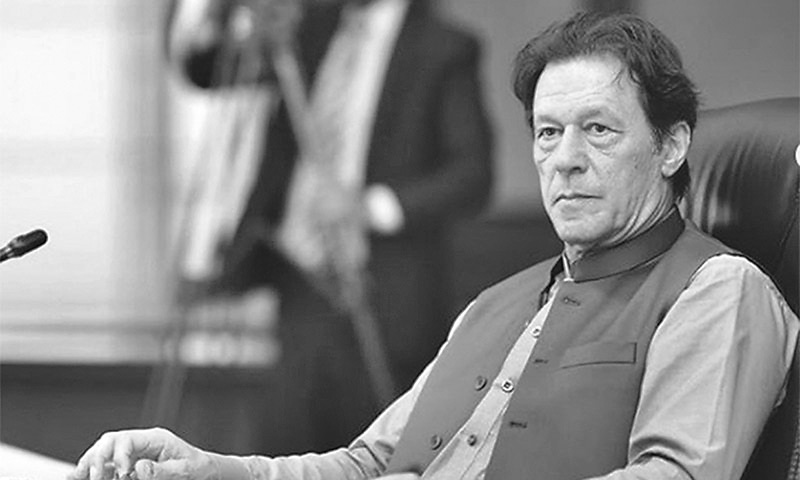
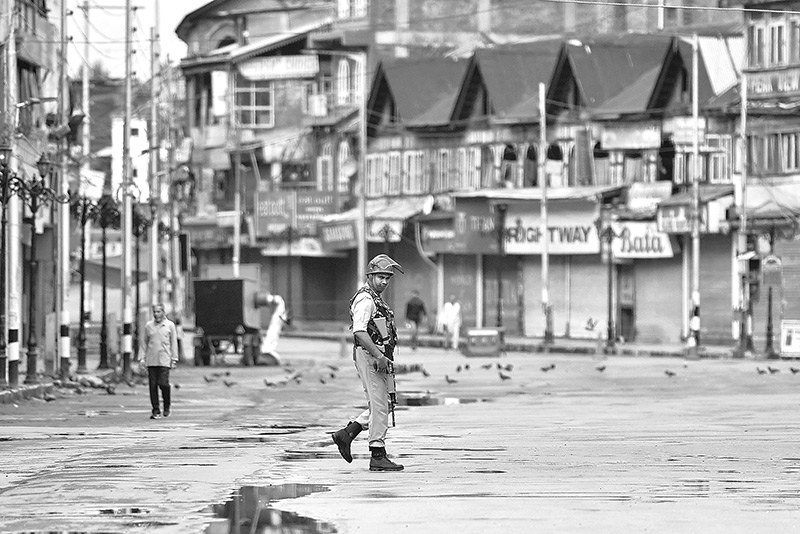
India held Kashmir and its people are not the only ones suffering the brunt of India’s cruel and callous moment. In the Indian state of Assam, hundreds of kilometres away from the besieged territory of occupied Kashmir, another tragedy is unfolding. On Aug 31, the Indian government will conclude a registration and citizenship drive that began some time ago. The drive has imposed new documentary requirements that require even people who lived in the region for generations to ‘prove’ their citizenship. Those who are unable to will not make it to the government list and henceforth be considered illegal migrants. In effect, the drive is being undertaken to deny citizenship to Muslims in the hilly regions near the Bangladesh border. The terror of being rendered stateless is so acute that it has already driven many to suicide. According to the New York Times report published this past weekend, those who cannot prove that they were citizens before the creation of Bangladesh in 1971 risk being imprisoned and rendered stateless. It could even be that by the end of the month, as many as four million Muslims who have trouble producing an old pre-1971 birth certificate or some old property deed from long ago are rendered stateless. In addition to all the people who are already suffering, there could well be as many as 4m added to the numbers of those who cannot call their home their own. After the revocation of Article 370 by the Indian government over two weeks ago, the most devious aspects of Modi’s rabid Hindu nationalism have come to the fore. As one commentator put it, oppressing and subjugating the Muslim population is just one way in which Modi and his followers are enacting a cruel and lurid victory that somehow erases the historical legacy of Muslim rule over the subcontinent. In this sense, harassing and disenfranchising Muslims has become an act tied with religious and historical significance beyond the present. The lynching of innocent Muslims, the pogroms, the annexations and the fake citizenship requirements are all intended to achieve this same historical purpose. The secular India that boasted of its pluralism, its diversity, its 1,600 languages and dialects and its plethora of religions, is gone forever. In the aftermath, there is only the India that is insistent on achieving some version of a Hindu state, with nominally democratic institutions that enshrine the will of the majority. Pakistanis know this, but the world is not yet quite sure. For every evil that Modi’s henchmen are perpetrating on unfortunate Christians and Muslims who call India their home, they cite abuses committed by Pakistan on its own minorities. While in Pakistan there is no equivalent to the thousands killed in Gujarat under the watch of the chief minister who is now the Indian prime minister, or the millions besieged in occupied Kashmir, there has been past mayhem and persecution that makes the international community wonder. As the lack of opposition within India amply illustrates, if there will be any kind of challenge to the Modi plan of ‘de-Muslimising’ India via a form of ethnic cleansing, it will come on the heels of international attention and pressure. Some battles can only be won through moral victories. To win a moral victory over India, and to help the millions of Muslims in India and occupied Kashmir, as well as others who are completely helpless, Pakistan must underscore the moral difference between the two countries. International discourse must change so that the conflict is no longer framed as the long-standing dispute between two hostile powers; it must be reframed as one between an India moving backwards and a Pakistan moving ahead. Moving ahead for Pakistan will mean acknowledging some of the demons of its own past. The issue of stranded Pakistanis—those in the eastern wing who wanted to opt for Pakistan following the 1971 war—is one such issue. Over 200,000 of these people continue to live a hapless existence in more than 60 camps scattered all around Bangladesh. In the past, efforts to repatriate these suffering people were unsuccessful. In 2009, a case was filed in Pakistan that reached the courts by 2015, but it also failed to provide any relief to stranded Pakistanis. There is an acute lack of political will in Pakistan and little recognition of the fact that those who wanted to be a part of the country the moment it broke apart have the right to citizenship. To put it in terms of what the Indians are doing in Assam, it is like asking people who have long had a claim to a homeland to suddenly ‘prove’ their commitment. One route to a moral victory would be to put right what has long been wrong. If the Pakistan of the past committed an injustice and left helpless people without recourse, stateless and bereft, the Pakistan of the present should do the opposite. In contrast to Prime Minister Modi’s atrocious actions, a decree from Prime Minister Imran Khan could suddenly deliver all stranded Pakistanis from their torment, grant them statehood and end their suffering.
This article was previously published in Dawn, a part of the Asia News Network.
OPINION
No more judgements about breastfeeding, please
The challenges mothers face that prevent them from breastfeeding sufficiently should be discussed.
- Neeti Aryal Khanal
A recent opinion article published in Kantipur Daily on August 14 has taken the Nepali Twitter world by storm. The writer, perhaps inspired by World Breastfeeding Week (which incidentally is held every year between August 1 and 7) supposedly wrote her piece based on two mothers that she personally knew. The writer had made swiping generalisations based on these two cases alone. Apparently, she had found that these women, both educated mothers of infants younger than eight months, were not breastfeeding their children either because they perceived the act to affect their beauty or because they prioritise their career goals over childcare. To the author of the opinion piece, the actions of these women represented a larger trend of educated women refusing to breastfeed their children, despite the government’s attempts at raising awareness on its benefits. I cannot claim that such cases do not exist. It is possible that young mothers are uninformed regarding the possible benefits of breastfeeding and the harmful consequences of stopping breastfeeding early. But the way the article is written creates a misleading conclusion that all educated mothers are selfish, and only concerned about body image and their careers. The twitter discussions on the article were not any better than the piece itself. Many men were found to be claiming authoritative knowledge on the matter, agreeing with the writer’s hypothesis of young women’s body image issues. Even if what these men believe is true, don’t we need to ask why women are so conscious about the size and shape of their breast? Isn’t it because the male sexual fantasy has always centred around the firm, round breast, not the leaking ‘lumpy’ and ‘sagging’ breast that sustains the life of infants? These twitter discussions led me to search for peer-reviewed journal articles on the topic online. A search with the term ‘exclusive breastfeeding in Nepal’ yielded 8,660 articles. Among them, 491 articles were published in 2019 alone. When the search was limited to include ‘educated working women’ the number of articles decreased. One of the most interesting research in the area that captured my attention was an article from 2019 titled Practice of Breastfeeding and its Barriers among Women Working in Tertiary Level Hospitals. These women who work at hospitals can be perceived as having relatively better access to knowledge and services on breastfeeding. But the results show the contrary. Only 11 percent of women were able to practice exclusive breastfeeding and more than half of women (51 percent) cited work-related challenges for not being able to breastfeed their children up to six months. Similarly, another research titled Assessing the Level of Knowledge and Practice of Breastfeeding Among Factory Working Mothers in Kathmandu, Nepal (2019) shows that 54 percent of factory-working mothers initiated supplementary milk and solid food earlier than six months due to the lack of sufficient breast milk. Interestingly, my rigorous search on body image and breastfeeding practices in Nepal fetched zero results. There were a few research articles, but mainly based on western contexts reporting conflicting results. Leaving aside any judgements, it’s time the discussions are redirected towards the challenges young mothers face that prevents them from breastfeeding sufficiently. There has been relatively less discussion on enabling young mothers to learn how to breastfeed properly. Breastfeeding is generally conceived as a natural skill that young mothers gain automatically. Talking to any young mother will reveal that breastfeeding can be a very challenging, painful and nerve-wracking experience. The services of lactation experts are needed as part of the health service provided to young mothers. Currently, this support is provided in the hospital after birth, but is not ongoing and regular when women return back home. Despite being a highly-educated working woman, I had very little information about breastfeeding when I had my first son in 2006. Listening to the advice of well-wishers, I introduced solid food fairly early—even before the six-month mark. When I was studying in Australia in 2009, I was fortunate to learn about expressing breastmilk from my friend who became a mother while studying. She used to store her breastmilk ahead of time, and leave it with her partner who would feed their infant daughter when the mother was away studying. So, I was better informed when I had my second child in 2010. I purchased a manual breast pump from a popular departmental store and started to express breastmilk. My family members would feed my infant son when I was away. As a part-time faculty member, I did not have access to paid maternity leave. Express breastfeeding allowed me to breastfeed my son exclusively for six months even when I was actively teaching. We should stop shaming working mothers and labelling them as ‘career-oriented ‘selfish’ and ‘heartless’. Young mothers are overwhelmed with the new responsibility and are likely to experience postpartum depression. They need active support—in all aspects of childcare—from their husbands, parents and in-laws. Besides that, we need to discuss flexible working arrangements. In the digital age, professional work is not tied to the physical space of the office anymore. Young mothers should have the option of working from home, at least for a few days a week. This should be the new benchmark for a gender-friendly workplace. Workplaces also need to have private spaces to breastfeed and to express breastmilk without guilt and embarrassment. Last but not least, all working mothers should pat themselves on the back for trying to juggle the difficult balance between their careers and motherhood.
Khanal recently completed her Doctorate in Sociology from Monash University. She teaches Sociology at Patan Multiple Campus, TU.
OPINION
Is Britain becoming a failed state?
It is no exaggeration to say that Boris Johnson has lied his way to the top, in journalism and in politics.
- CHRIS PATTEN
What is a failed state? Not so long ago, when I was Britain’s Overseas Development Minister, and later European Commissioner for External Affairs, I would probably have tried to answer the question by pointing to specific examples, including several countries in Latin America and Africa. I would have highlighted tribal conflicts, military coups, economic failure, extremes of poverty, and high mortality rates. I might have referred to the failure of more prosperous societies to ensure that globalisation helped everyone and did not leave some communities trapped in deprivation. In addition, I would certainly have mentioned systems of government that had ceased to deliver what they were intended to do, and certainly what outside well-wishers hoped and assumed they would do. By these latter criteria, one no longer needs to travel to Latin America or Africa to discover failure. Indeed, many of us in Britain worry that failure is increasingly evident within our own borders—which are soon to be clogged after Brexit—and particularly in the way the country is governed. Britain’s system of government, much praised in the past, is based on parliamentary democracy and the institutions of pluralism that one would associate with an open society. Voters elect individual members of parliament, who owe their constituents their best judgment about how to negotiate the predicaments of politics. MPs are not required to do what they are told by an alleged popular will—a system much favoured by despots and demagogues. Instead, they are part of a system that owes much to the conservative political philosopher Edmund Burke, not to the French writer Jean-Jacques Rousseau. We have always preferred caution, compromise, and evolution to disruption and appeals to fleeting public passions. The parties to which most MPs belong represent different strands of opinion. Yet by and large, debates have usually assumed a strong relationship between evidence and assertion. Facts might be interpreted in different ways, but they were not simply denied because they contradicted an ideological assertion. Dogmatism is a bad bedfellow to democracy. Experts can be challenged, of course, but until now, expertise was never seen as something the ruling establishment would use to bamboozle and obfuscate in pursuit of its aims. In Britain, historically, the government has been accountable to parliament, whose opinions it must respect and whose conventions it should follow. And a separate and independent judiciary guarantees the rule of law to which all, including ministers, are subject. That is how Britain has run its national affairs: avoiding political extremism, achieving a self-adjusting balance between left and right, managing change over decades in peace and war, and making the transition from imperial power to a middle-sized European country. By doing this without surrendering or diluting our values, we have won approval and praise around the world. Sadly, things look very different today. As a proportion of its electorate, Britain has fewer political activists than most other European countries. Yet these activists and other political partisans have recently acquired growing control over their parties’ policy direction and choice of leader. As a result, the Labour Party is now led by Jeremy Corbyn, an old-fashioned far-left socialist. And 90,000 Conservative members, whose views have become more extreme as their numbers have fallen, recently selected Boris Johnson as their new leader, and thus as the country’s new prime minister. In doing so, they have chosen a mendacious chancer. It is no exaggeration to say that Johnson has lied his way to the top, first in journalism and then in politics. His ascent owes everything to the growing xenophobia and English nationalism that many Conservatives now espouse. Johnson is prime minister because he has promised to deliver Brexit by the end of October, recklessly assuring the world that he will take the United Kingdom out of the European Union with or without a deal, and whatever the consequences. Johnson has chosen a government of like-minded anti-European nationalists. His principal adviser, Dominic Cummings, was described by David Cameron, Britain’s prime minister from 2010 to 2016, as a ‘career psychopath.’ Cummings is, alongside Johnson, the most powerful figure in the new government; he is an unelected wrecker who earlier this year was ruled to be in contempt of parliament. Fittingly, if depressingly, he now is masterminding our departure from the EU with or without parliamentary approval. Moreover, the government is scheming to win an election, yet to be announced, on the basis of a ‘people versus the politicians’ campaign. Those who oppose crashing out of the EU without a deal are to be branded as opponents of popular sovereignty. So much for parliamentary democracy. The Johnson government denies the truth about the consequences of a no-deal Brexit, and denounces any attempt to point these out as ‘Project Fear.’ The EU is blamed for the failure of negotiations, even though this was almost entirely the result of choices made by the previous British government. To cap it all, the public is told that if Britain can convince the EU it is prepared to damage itself with ‘no deal,’ then France, Germany, and others will surrender and give us what we want. Yet any damage that a no-deal Brexit causes to the EU would be dwarfed by the long-term harm it inflicts on Britain. Johnson and Cummings are prepared to use all the methods that were successful in the 2016 Brexit referendum campaign, when the British public was assured that there would be no question of leaving the EU without a deal. Promises of increased public spending now rain down from a Treasury that will soon be stretched thin. The value of the pound is falling, inflation rose in July, and business investment is flat. The supposed benefits of leaving the EU are no longer touted, with the exception of a promised trade deal with US President Donald Trump that would be almost as unacceptable to the US Congress as it would be to British public opinion. What’s more, the government is simply ignoring the fact that lengthy negotiations with the EU would inevitably follow from a ‘no-deal’ departure. Worse still, the future of the Union of England, Scotland, Wales, and Northern Ireland looks increasingly at risk. The government fails to accept that if Britain leaves the EU’s customs union, the resulting border between the Republic of Ireland and Northern Ireland will imperil the 1998 Good Friday Agreement, which has brought more than 20 years of peace to the island of Ireland. Are these the actions of a successful state? Those who raise the question risk being dubbed ‘enemies of the people.’ We are in good company: this is how Brexiters previously described three British high-court judges who asserted the principle of parliamentary sovereignty in the Brexit process. As Brexit looms ever closer, Britain’s institutions, economic prospects, constitution, and future are all at risk. But the reckless plunge into delusion and lies proceeds apace.
— Project Syndicate
HEALTH & LIVING
Could the world see a resurgence of polio? Experts fear a cautionary tale in measles
Health professionals are concerned about what could happen if funding dries up or the political will to persevere erodes.
- HELEN BRANSWELL
A healthcare worker administers polio drops in Kathmandu. Post Photo: KIRAN PANDAY
As measles case counts have exploded around the globe this year, public health officials doggedly trying to rid the world of another disease scourge have watched the numbers rise with some concern. That disease is polio, and for the people who have long worked to eradicate it, the resurgence of measles has become a cautionary tale—both useful and unsettling—of why the polio campaign must push on across the finish line. Failure to do so could have dire consequences. “In my opinion, there’s no doubt if we stopped the extra efforts we do for polio, we’d have a big resurgence,” said Dr Walter Orenstein, associate director of Emory University’s Vaccine Center and a consultant to the Global Polio Eradication Initiative. The effort to eradicate polio is nearly two decades past its original target date for completion, and there are concerns about what could happen if funding dries up or the political will to persevere towards the elusive goal erodes. For now, wild poliovirus is cornered in eastern Afghanistan and western Pakistan, hard-to-access places where vaccination teams are often unwelcome and unsafe. But it is not magically corralled there. Any easing of the pressure on the virus could see a version of what is happening with measles unspool with polioviruses—though on a slower, less visible but still insidious basis. The polio program, which goes by the acronym GPEI, has drawn up a five-year plan to take the effort through to the end of 2023; theoretically, with some lucky breaks, the job could be completed by then, Michel Zaffran, director of polio eradication at the World Health Organization, told STAT. But the polio program is not known for lucky breaks—very much the opposite, in fact. Through massive efforts it has succeeded in battling paralytic polio cases down from about 350,000 cases a year when the effort began in 1988 to very low numbers; in 2017, the best year on record, there were only 22 reported cases of paralytic polio. But the following year, the virus rebounded, with 33 cases reported. So far this year there have been 65 cases reported, with many of them coming during what should have been polio’s low season, when the virus typically doesn’t transmit well. “But the low season was not really low,” Zaffran said. (It’s currently high season for polio.) The program needs to raise $3.27 billion to cover the costs it will incur between now and the end of 2023. Funders—a number of governments, the Bill and Melinda Gates Foundation, and the service organization Rotary International, which has been a partner in the eradication effort from the start and has raised $2 billion for the effort—are weary and worried. Zaffran hears it as he makes the case to funders. “How long is it going to take? How much money is it going to cost? Is it worthwhile?” he said. “And basically their rationale is, ‘Well, can’t we control the disease in Pakistan and Afghanistan and stop investing such mass a massive amount of resources?’” The answer, though, is no. It costs about $1 billion a year to keep polio transmission at the current levels. Relenting on that spending would see polio numbers climb again. Zaffran said though he hears the questions, the funders already know the answer. “They’ve started an effort. They need to bring it to the end, however painful it is for this last mile,” he said. Kimberly Thompson is a mathematical modeler who has been working on polio for years. In 2007, she published an analysis showing that even small decreases in the intensity of the polio eradication efforts would lead to large outbreaks of polio. Thompson argued then for more investment in the polio program, saying the costs of not doing so would be greater in the long run. A dozen years later, Thompson makes the same argument. “From a health economics perspective, the best thing to do is go big and go strong until you’re really done and then be done. You can’t take your foot off the gas and expect that you’re not going to lose ground,” said Thompson, who is president of the nonprofit Kid Risk, which conducts research on infectious diseases including polio. “If we’re not doing that and not willing to put in the resources then it takes longer and costs more. And this is what it looks like.” What’s happening with measles serves as a reminder. Last week the WHO released preliminary data for 2019 that showed huge increases across the world, attributable to declines in vaccination rates. Case numbers for the African region are up 900 percent; in WHO’s western Pacific region, cases are up 230percent. The United States has recorded more measles than the country has seen in a quarter century. Numbers in Europe have already exceeded the tally for all of last year. The measles virus is highly contagious and the illness it causes is generally visible, with its bright red rash. Polio is not as easy to spot, which would create major problems were it to spread globally again. Nearly three-quarters of infections—72 percent—have no symptoms and in another 24percent of cases children have non-specific illness, nothing that would signal polio to a parent or a health care provider. In fact, less than 1percent of children infected will develop paralytic polio. “Polio is a little more stealth in its ability to move around the world,” said Dr William Moss, executive director of the International Vaccine Access Center at Johns Hopkins Bloomberg School of Public Health. “Most infected persons are asymptomatic. And people can shed polioviruses for months. So you have a great opportunity for infected individuals to travel. If they end up in a community where there are a high number of [unvaccinated children], you’re going to get polio cases.” Without consistent efforts to try to finish the eradication job, polio will move, Zaffran said. “If we stop the effort, the virus is not going to ask for permission to cross the border.” There’s recent evidence that underscores his warning. In May, the WHO reported that poliovirus was found in sewage in southern Iran, which has not recorded a case of polio since 1997 and hasn’t seen polioviruses in sewage—a standard way countries do surveillance for polio—since 2001. Polioviruses shouldn’t be floating in sewage in a country that hasn’t had polio cases for more than 20 years. Analysis of the virus showed it came from Pakistan; someone who contracted it there traveled to this part of Iran. People infected with polio emit viruses in their stools during and for several weeks after infection. If polioviruses were to break out of Afghanistan and Pakistan, there is no guarantee the United States—with its clusters of unvaccinated children—wouldn’t again see paralytic polio, Orenstein said. “As long as there are pockets of [susceptible children] we run the risk.” Orenstein said when he talks to funders about polio he makes the case that this isn’t just a humanitarian effort—that there are domestic health security concerns for donor countries too. This far into an eradication effort is a risky time, Moss suggested. “I think the lesson is that … when you make progress in reducing the incidence or transmission of a pathogen like measles virus or poliovirus, and particularly as you move toward eradication, if there are lapses—whether that’s due to fatigue or from resistance in communities—there’s an extremely high risk,” he said. “It’s almost inevitable that you’re going to have outbreaks and move backwards.”
This article was originally published on STAT, a Boston based health news publication. Find more stories on statnews.com.
HEALTH & LIVING
Controversial study links fluoridated water during pregnancy to lower IQ
Several experts expressed concern over the research’s methodology and questioned its conclusions but agree the results are compelling enough to merit further investigation.
- ISSAM AHMED
A study published Monday linked consumption of fluoridated tap water during pregnancy to lower IQ scores in infants, a finding at odds with decades of public health messaging extolling the mineral’s benefits in reducing cavities. Several outside experts expressed concern over the research’s methodology and questioned its conclusions, though some found the results compelling enough to merit further investigation. The US Centers for Disease Control and Prevention (CDC) named community water fluoridation one of ten great public health achievements of the 20th century because of its contribution to the steep decline in tooth cavities in the United States over several decades. But although high levels of fluoride have been found to be toxic to rat brains, the concentrations seen in fluoridated tap water are deemed safe. “We realised that there were major questions about the safety of fluoride, especially for pregnant women and young children,” Christine Till, an associate professor at Canada’s York University and the paper’s senior author told AFP, adding it was important to base decisions on evidence. The study, published in the influential JAMA Pediatrics journal, analysed data from 512 mother-child pairs across six Canadian cities, with about 40 percent living in communities supplied with fluoridated municipal water. After controlling for other toxins in their analysis, they found that an increase in concentration of fluoride in pregnant mother’s urine of one milligram per liter was associated with a 4.5-point lower IQ score in boys—but not girls—at age three or four. When estimating the daily maternal fluoride intake instead of fluoride in urine, they found a one milligram increase in intake was associated with a deficit of 3.7 IQ points for both boys and girls. US and Canadian health authorities recommend capping fluoride concentration at 0.7 milligrams per liter (parts per million) to prevent fluorosis, overexposure to fluoride that leads to mild tooth discolouration. But the actual levels that will be ingested will vary according to how much a person drinks. According to the CDC, fluoridated water is supplied to nearly three in four Americans (more than 211 million people), while Health Canada estimates 39 percent of its population receives water from fluoridated supplies.
Dr Strangelove Anticipating controversy, the journal took the unusual step of issuing an editor’s note that said the decision to publish was “not easy” and that it had been subject to additional scrutiny. Experiments in water fluoridation began in the early 20th century, and over time its opponents came to be seen as quacks: the 1964 satirical film “Dr Stranglove” features an unhinged general who believes fluoridation is a Communist conspiracy against the US. Till said that she herself had not been convinced when a graduate student first approached her with the idea to investigate the effects on IQ, but has since come around. “We’ve had many moments in history where we got new knowledge and changed decisions: look at thalidomide and look at recommendations for hormone replacement therapy,” which was once advised for all menopausal women, she said. But experts in fields ranging from statistics to toxicology to neuroscience expressed reservations. “The key words in the paper are ‘higher levels,’” said Oliver Jones, an environmental chemist at Australia’s RMIT University, who noted that fluoride intake appeared to be below one milligram per liter for most people in the study.
Precautionary principle He nevertheless called the work “interesting” and said it justified future research — a conclusion shared by David Bellinger, an epidemiologist at Harvard University who told AFP the results were “highly credible” but would need to be replicated before policy changes were in order. But Stuart Ritchie, a psychologist at King’s College London, said it was “inconsistent” that the study’s first analysis only found a significant result for boys and not girls, while the second analysis found an overall effect with no sex differences, and deemed the findings “pretty weak.” Critics of water fluoridation argue it is unnecessary because modern dental products like toothpaste contain fluoride, while 97 percent of European residents receive unfluoridated water without a major impact on their dental health. Pamela Den Besten, a professor of orofacial science at UC San Francisco told AFP that while she remained in favor of fluoride for its dental benefits, it acts on teeth topically and concerns over its presence in drinking water should not be dismissed. “My bias, given the findings of this and other studies, is to focus on the delivery of fluoride through strategies that do not require the fluoride to be ingested,” she said.
—Agence France-Presse
CULTURE & ARTS
Reinventing customer experience in restaurants
Good food isn’t always enough for a wholesome dining out experience, and Kathmandu’s eateries are offering more.
- SACHITRA GURUNG
A good customer service isn’t just about taking orders and holding trays, a server needs to look presentable and have a polite outlook, sayrestaurant owners. Post Photo: Sanjog manandhar
Kathmandu, Three men in identical uniforms and neatly combed hair walk on a squeaky clean floor with trays balanced on their hands. It’s lunch hour and Fuchhey Restaurant in Putalisadak is buzzing. But the servers are calm and composed, politely taking orders and delivering food without a hint of impatience or frustration. This is a welcome change of scene, especially if you compare it to just a decade ago, when most servers in restaurants were unfriendly and impolite, say customers. “A few years ago, when we were still college students, small eateries didn’t usually have servers. Some places had servers but I wouldn’t call them hospitable,” said Reena Shahi, a 38-year-old office administrator, who usually visits cafes and restaurants near her office in Tangal. “Nowadays I rarely encounter an ill-mannered staff at restaurants.” With new restaurants mushrooming across the Valley, Kathmandu’s service industry has tried to reinvent itself. Today, when people go out to eat, they don’t just visit a place for food, they also look for customer service that matches the quality of the dishes that are offered. “As a restaurant, customer satisfaction is our main goal,” said Sanu Shrestha, owner of Fuchhey Restaurant. “Providing good food in a good ambience isn’t enough to satisfy customers anymore. The service also needs to be top-notch.” To provide such service, Shrestha and her team go through an elaborate recruitment process to hire employees. After someone gets hired they are put on probation and evaluated for at least a week. “We don’t send them to the floor while they are on probation. They just observe and help out with other tasks that don’t involve interacting with customers,” said Shrestha. High school graduates and hospitality management students are given priority, she said, but good communication skills and a neat appearance are imperative. The team at The Bakery Cafe too goes through a similar elaborate recruitment procedure to hire servers. “We post announcements on job portals while hiring servers so that we get to choose from a bigger pool of people. We spend relatively more time screening through the people so that we find a suitable candidate,” said Prem Shrestha, in-charge of the Bhatbhateni branch of The Bakery Cafe. “We also spend a lot of time training and teaching them. It’s better to take more time while training them rather than hearing complaints later.” Moreover, managers and owners of restaurants are very much involved in the operation of the restaurant and keeping their staffs in check.
Trishna Rai, the owner of Yellow Pomelo in Jhamsikhel, said she firmly believes in the Sanskrit saying ‘Atithi Devo Bhava’. For her, the space of the restaurants doesn’t matter but the customer service should be a top priority. “The servers represent the restaurant; the customers meet with the servers even before they taste the food. So it’s very important to groom them,” said Rai. She conducts monthly meetings with her team to review the things they have learned during the training session. But in the digital age, in order to form an opinion about any restaurant, customers don’t even have to step inside the premises. “Nowadays, customers go through online reviews to decide whether they want to visit a certain place,” said Krishna Khadka, manager at Upstairs Cafe in Basantapur Durbar Square. “This definitely puts us on our toes, which is good to maintain quality in restaurants.” In addition to on-the-job training, restaurant owners and managers say that human resources in the hospitality industry has improved also due to specific courses tailored by private training centres. “In recent years, students who enrol in our training programmes have started to envision their career in Nepal rather than moving abroad, which used to be the trend earlier,” said Niran Shrestha, principal of the Shangri-la Tourism and Hotel Management Training Center. Shrestha said that there has been a marked rise in the number of students in the last five years, attributing this increase to flexible hours and good remuneration. “The wage rate of workers in the service industry has increased up to three times over the years and this is attracting more young people to join the service industry,” said Niran. Training centres like Shangri-la provide ‘industry-oriented training’ to students, beginning with the basics of the service industry—being hospitable and personality grooming classes. The training can range from one to four months, and training centres also provide placement and internship opportunities. “We are living in a time of globalisation, which is why we try to adapt our training techniques to the global standard,” said Shrestha. He further points to cutthroat competition in the service industry—for both restaurants and staff—as a major reason for the improvement in Kathmandu’s service industry. More competition means restaurants are vying to provide service that’s exemplary. “Gone are the days when all you had to do to be a good barista was make good coffee and hold trays properly to be a good server. Now, you have to look good, be polite and attentive, and have proper knowledge of the products on offer,” said Madhav Devkota, training director at Himalayan Java Barista Coffee School.
CULTURE & ARTS
‘Otterly adorable’?: Demand for cute selfies puts animals at risk
Animal protection groups say the selfie trend is posing an existential threat to the silky mammal.
- NINA LARSON
Social media users are fuelling a burgeoning appetite for acquiring wild otters and other endangered animals as pets, conservationists say, warning the trend could push species towards extinction. Popular Instagrammers posting selfies with their pet otter may simply be seeking to warm the hearts of their sometimes hundreds of thousands of followers, but animal protection groups say the trend is posing an existential threat to the silky mammal. “The illegal trade in otters has suddenly increased exponentially,” Nicole Duplaix, who co-chairs the Otter Specialist Group at the International Union for Conservation of Nature, told AFP. All Asian otter species have long been listed as vulnerable or endangered after facing decades of shrinking habitats and illegal trade in their pelts. But conservationists say the recent surge in social media hype around the creatures has sparked such a frenzied demand for baby otters in Asian countries, Japan in particular, that it could drive entire species towards extinction. Parties to the Convention on International Trade in Endangered Species (CITES), currently in Geneva to evaluate and fine-tune the treaty that manages trade in more than 35,000 species of plants and animals, will consider proposals to hike protection of two particularly imperilled otter species.
Dangerous ‘cute factor’ The Asian small-clawed otter and the smooth-coated otter are already listed as threatened under CITES Appendix II, but India, Nepal, Bangladesh and the Philippines are asking that they are moved to Appendix I, which would mean a full international trade ban. Conservationists insist the move is vital, after both species have seen their numbers plunge at least 30 percent over three decades, and with the decline believed to have accelerated significantly in the past few years. “This is especially being fuelled by the desire to have otters as an exotic pet, and social media is really driving that,” Cassandra Koenen, global head of Wildlife Not Pets, told AFP. Paul Todd of the Natural Resource Defense Council (NRDC) agreed. “It is really remarkable to see how the latest trends in social media and social influencing have a direct correlation with the demise of species on the ground,” he told AFP. Popular figures on Instagram and Facebook often rake in thousands of gushing comments about their otter pictures, such as “cuteness overload”, “otterly adorable”, and “want one!”. Duplaix acknowledged that otters are “very charismatic creatures,” saying “it is the cute factor that is causing their demise.” The pictures mask the suffering of the naturally social mammals taken from the wild when they are held in captivity and isolation. Koenen pointed to the numerous “funny videos” posted of pet otters turning in circles, saying that to a trained eye, it is obvious: “The reason the animal is spinning around is that it is in huge distress.” Amid the growing demand for pet otters, hunters and fishermen in Indonesia and Thailand especially are increasingly killing adult otters and snatching the babies, which are caged and shipped off to become exotic pets. The main destination is Japan, where one otter pup can fetch up to $10,000 (about 9,000 euros).
Otter cafes Several “otter cafes” have also popped up in the country, with patrons urged to buy small pieces of food to feed the caged mammals and to snap a selfie with them while drinking a coffee. “It is a very unnatural environment for them,” Koenen said, maintaining that they are often isolated in individual cages, given poor nutrition and little access to water. Pet otters may have it better, but they still suffer from being far from their natural environment and away from the large family groups they lived with in the wild, she said. Koenen also warned that smiling selfies with pet otters provide a “false narrative” about what it is like to live with the wild creatures, which smell and are prone to biting. “They make very unsuitable pets,” she said. Social media platforms have meanwhile made it too easy to purchase exotic pets like otters, she said, sparking impulse buys with little reflection over the implications of bringing a wild animal into one’s home. Otters are not the only species suffering from a booming and often social-media fuelled interest in exotic pets. Among the 56 proposals on the table in Geneva for increased protection listings, 22 involve species -- including lizards, geckos, tortoises and spiders -- which suffer because of the multi-billion-dollar exotic pet trade. Todd said there was mounting evidence that “a species can go from completely fine to utterly gone in the matter of a few years because of this drive in desire for images”. “Baby otters are dying, and for what? A selfie,” he said. “We have to stop this.”
--Agence France-Presse
WORLD
Sudan swears in civilian-majority ruling council
- AGENCE FRANCE-PRESSE
Fattah al-Burhan. AFP/rss
KHARTOUM, Sudan took further steps in its transition towards civilian rule on Wednesday with the swearing in of a new sovereign council, to be followed by the appointment of a prime minister. The body replaces the Transitional Military Council (TMC) that took charge after months of deadly street protests brought down longtime ruler Omar al-Bashir in April. As a result of Wednesday’s move, it was the first time that Sudan was not under full military rule since Bashir’s coup d’etat in 1989. The first steps of the transition after the mass celebrations that marked the August 17 adoption of a transitional constitution proved difficult however. The names of the joint civilian-military sovereign council’s 11 members were eventually announced late Tuesday after differences within the opposition camp held up the process for two days. General Abdel Fattah al-Burhan, who already headed the TMC, was sworn in as the chairman of the new sovereign council in the morning. Wearing his usual green beret and camouflage uniform, Burhan took the oath in a short ceremony, one hand on the Koran and the other holding a military baton under his arm. He will be Sudan’s head of state for the first 21 months of the 39-month transition period, until a civilian takes over for the remainder. The council’s 10 other members were sworn shortly afterwards and Abdalla Hamdok, who was chosen by the opposition last week to be prime minister, was to be formally appointed later Wednesday. The sovereign council includes two women, including a member of Sudan’s Christian minority, and it will oversee the formation of a government and of a legislative body. The inauguration of a civilian-dominated ruling council was welcomed by Khartoum residents but many warned the people would keep their new rulers in check. “If this council does not meet our aspirations and cannot serve our interests, we will never hesitate to have another revolution,” said Ramzi al-Taqi, a fruit pedlar. “We would topple the council just like we did the former regime,” he said. The transition’s key documents were signed on Saturday at a ceremony attended by a host of foreign dignitaries, signalling that Sudan could be on its way to shedding its pariah status. Sudan’s new rulers are expected to push for the lifting of the suspension from the African Union that followed a deadly crackdown on a sit-in in June. The ruling council will also seek to have the country removed from the US list of state sponsors of terrorism. Bashir is wanted by the International Criminal Court in The Hague for his role in massacres in the Darfur region, where a rebellion broke out in 2003. He appeared in court on Monday—but only on charges of corruption for the opening of a trial in which an investigator said the deposed leader admitted to receiving millions in cash from Saudi Arabia. Pictures of the 75-year-old autocrat sitting in a cage during the hearing instantly became a symbol of his Islamist military regime’s downfall. The sight of their former tormentor in the dock was overwhelmingly welcomed by the Sudanese but many warned the graft trial should not distract from the more serious indictments he faces before the ICC.
WORLD
Australia to join US in Gulf maritime mission
- AGENCE FRANCE-PRESSE
SYDNEY, Australia will join the US-led mission to protect shipping through the Strait of Hormuz amid heightened tensions with Iran, Prime Minister Scott Morrison announced on Wednesday. Morrison said Australia would send a “modest” contribution—including a frigate, a P8 maritime surveillance aircraft and support staff—to the mission, which will also involve British and Bahraini forces. “Our contribution will be limited in scope and it will be time-bound,” Morrison said, expressing concern about security incidents in the vital shipping lane in the past few months. “This destabilising behaviour is a threat to Australian interests in the region,” he said in a joint statement with his foreign and defence ministers. US Secretary of State Mike Pompeo and Defense Secretary Mark Esper had pressed for Australia’s help patrolling the strategic waterway during a visit to Sydney earlier this month. The move followed a spate of incidents—including the seizure of ships—involving Iran and Western powers, in particular Britain and the US, centred on the vital Gulf channel. Defence Minister Linda Reynolds said Australian military staff would in coming weeks join the security operation’s headquarters in Bahrain, which announced its involvement in the operation on Tuesday. The P8 Poseidon aircraft will patrol the region for a month, later in the year. The frigate, with a crew of some 170, will not be deployed to the joint operation until January and take part for six months, she said. Morrison stressed that the deployment would be “modest, meaningful and time-limited” while defence experts said it was likely a “re-tasking” of planned deployments to the region to satisfy US requests. The US had been struggling to piece together an international coalition to protect cargo ships travelling through the Gulf, with allies concerned about being dragged into conflict with Iran. Britain eventually agreed to participate two weeks ago, and Morrison’s government has debated the move since Pompeo and Esper made their direct appeal at the beginning of the month. US President Donald Trump has been trying to mount a campaign of “maximum pressure” against Tehran since he withdrew the US from a landmark 2015 deal placing curbs on Iran’s nuclear programme and began reimposing sanctions, urging reluctant Western allies to follow suit.
WORLD
Trump scraps Denmark visit after Danes say Greenland not for sale
- AGENCE FRANCE-PRESSE
Mette Frederiksen / Donald Trump. AFP/rss
WASHINGTON, US President Donald Trump has postponed a planned visit to Denmark after Danish officials insisted its autonomous territory of Greenland was not for sale. Trump’s decision confirms just how interested he was in purchasing Greenland, an idea initially dismissed as a joke by some, but which the White House later insisted had a serious purpose because of its strategic location. “Based on Prime Minister Mette Frederiksen’s comments, that she would have no interest in discussing the purchase of Greenland, I will be postponing our meeting scheduled in two weeks for another time,” Trump tweeted on Tuesday. During a Sunday visit to Greenland—the largest island on Earth—Frederiksen called Trump’s idea “absurd.” “The Prime Minister was able to save a great deal of expense and effort for both the United States and Denmark by being so direct,” Trump tweeted. “I thank her for that and look forward to rescheduling sometime in the future!”. The development was “a surprise”, said Lene Balleby, the head of communications for the Danish Royal House, according to public broadcaster DR. The president’s latest Greenland comments sparked a strong reaction from both sides of the political aisle in Denmark. “Reality transcends imagination... this man is unpredictable,” said Morten Ostergaard of the Social Liberal Party, which is part of the ruling coalition. “For no reason Trump assumes that (an autonomous) part of our country is for sale. Then insultingly cancels visit that everybody was preparing for,” tweeted Rasmus Jarlov, a member of the opposition Conservative Party.
WORLD
Disgraced Australian Cardinal Pell loses child sex abuse appeal
- AGENCE FRANCE-PRESSE
George Pell. AFP/rss
MELBOURNE, Disgraced Cardinal George Pell lost his appeal against child sex abuse convictions Wednesday, prompting relief from victims who fought to bring one of the Catholic Church’s most powerful men to justice. A former Vatican treasurer, Pell had been trying to overturn the verdicts and six-year sentence for sexually assaulting two 13-year-old choirboys at a Melbourne cathedral in the 1990s. The high-profile case pitted 78-year-old—who previously helped elect Popes, was a trusted papal aide and was involved in the church’s response to child sex abuse claims—against a former choirboy now in his thirties. Pell, dressed in a dark suit, occasionally bowed his head as Chief Justice Anne Ferguson dismissed his arguments and described his victim as “very compelling” and someone who “was clearly not a liar, was not a fantasist and was a witness of truth.” The ruling prompted cheers to ripple into the courtroom from a large crowd gathered outside, and produced emotional statements from victims, their families and advocacy groups. The now-adult victim—who cannot be named for legal reasons—said the “stressful” four-year legal fight had taken him “to places that, in my darkest moments, I feared I could not return from.” Dismissing vocal conservative media critics, the man said the death of his friend, the second choirboy, from a drug overdose had prompted him to break his decades-long silence. “After attending the funeral of my childhood friend... I felt a responsibility to come forward,” he said in a statement read by his lawyer. “I am not an advocate. You wouldn’t know my name. I am not a champion for the cause of sexual abuse survivors.” A lawyer for the father of the second victim said he felt “a weight had been lifted.” “He feels that justice has been delivered today. He has a real sense of relief that George Pell is behind bars tonight,” Lisa Flynn told AFP. Following the ruling, Pell—who will be eligible for parole in three years and eight months—maintained his innocence and said he was now considering a second and final appeal. “Cardinal Pell is obviously disappointed with the decision today,” said a statement issued through the church. “His legal team will thoroughly examine the judgement in order to determine a special leave application to the High Court.” The Vatican issued a statement noting Pell has the right to appeal but made no mention of its own investigation into the matter launched earlier this year. “At this time, together with the Church in Australia, the Holy See confirms its closeness to the victims of sexual abuse and its commitment to pursue, through the competent ecclesiastical authorities, those members of the clergy who commit such abuse,” a spokesperson said.
WORLD
More than 2,300 tigers killed and trafficked this century: Report
- AGENCE FRANCE-PRESSE
Two bengal tiger cubs, who were rejected by their mother, are pictured at La Pastora Zoo in the municipality of Guadalupe, Mexico. REUTERS
GENEVA, More than 2,300 endangered tigers have been killed and illegally trafficked since the turn of the century, according to a report published on Tuesday, urging more action to protect the giant cats. With an average of more than 120 illegally trafficked tigers seized each year—which amounts to over two each week—since year 2000, conservation group Traffic warned there was little sign of respite for the species. Report author Kanitha Krishnasamy, who heads Traffic’s Southeast Asia operations, said the numbers were deeply concerning. “It looks like we are losing this fight,” she told AFP. In 1900, more than 100,000 tigers were estimated to roam the planet. But that fell to a record low of 3,200 globally in 2010. Since then, population numbers have inched upwards, but there are still estimated to be fewer than 3,900 tigers left in the wild. “This pernicious trafficking,evidenced by the continuously high number of whole skins, whole animals—both dead and alive—and bones is testament to the ongoing demand for Tiger parts,” Krishnasamy said. “The time for talking is over: words must be turned into action to prevent further Tiger loss,” she said in a statement. Traffic, which campaigns to protect endangered animals and help governments catch those who trade in their parts, published a new analysis looking at 19-years of tiger seizure data from across the globe. It found that an estimated total equivalent to 2,359 individual tigers were seized from 2000 to 2018 across 32 countries and territories. Skins are the single most frequently seized tiger part, with on average 58 whole tiger skins seized each year, the report found, also noting a clear increase in seizures of whole animals, both dead and alive. - ‘Undermine conservation efforts’ - The study also highlighted the growing role breeding centres play in fuelling the illegal tiger trade, especially in Southeast Asia. The tiger farm industry often argues the trade in captive animals helps to relieve the pressure on wild felines, but wildlife groups argue it reduces the stigma around buying the animals or their body parts and could create new markets for them. More than half of tiger seizures in Thailand and a third of those in Vietnam over the past two decades were identified as coming from captive breeding facilities, Traffic said. “Seizures of tigers from captive facilities continue and serve as a stark reminder that such facilities seriously undermine conservation efforts to safeguard this species and provide opportunities for laundering and other illegal activities,” said senior Traffic crime analyst Ramacandra Wong in the statement. Tuesday’s report was released as parties to the Convention on International Trade in Endangered Species (CITES) meet in Geneva to evaluate and fine-tune the treaty that manages trade in more than 35,000 species of plants and animals. Tiger farms are on the agenda, with the report authors calling for CITES to monitor facilities to ensure they are not helping feed the illegal trade chain.
WORLD
Italy’s kingmaker Mattarella holds talks after Conte resigns
Briefing
ROME: President Sergio Mattarella begins talks with key political leaders on Wednesday to see if a new coalition can be formed, a day after Italy’s dysfunctional anti-immigrant government dramatically fell apart with the resignation of Prime Minister Giuseppe Conte. If a stable coalition is not possible, Mattarella will consider a short-term technocratic government or a snap election, just 14 months after Conte took the helm of the doomed alliance between the far-right League and anti-establishment Five Star Movement (M5S). The usually mild-mannered Conte quit after lashing out at Interior Minister Matteo Salvini, who tried to bring down the government to force a snap election amid a surge in popularity for his League party. (Agencies)
WORLD
Toll from Tanzania truck blast reaches 100
Briefing
NAIROBI: The death toll from a fuel truck explosion in Tanzania on August 10 hit 100 on Wednesday after several victims perished from severe burns. Aminiel Aligaesha, a spokesman for the National Hospital in Dar es Salaam, told reporters “two people died on Tuesday during the day, and another on Tuesday night”, bringing the total number of dead to 100. Officials had put the tally at 95 on Sunday, and another two people were announced dead on Monday. At least 30 of the victims died in the days after the accident, in which a fireball engulfed a crowd thronging to collect petrol from an overturned tanker near Morogoro, 200 km west of Dar es Salaam. Officials said the explosion was triggered when a man tried to take the truck’s battery, creating sparks that ignited the fuel. (Agencies)
WORLD
Last charity ship seeks port for 356 rescued migrants
Briefing
ON BOARD THE OCEAN VIKING: The organisation running a charity ship in the Mediterranean voiced hope on Wednesday for a safe port for its 356 rescued migrants after another NGO vessel docked in Italy, ending a week-long standoff. The Ocean Viking operated by French charities SOS Mediterranee and Doctors Without Borders (MSF) has been holding its position for 10 days between Malta and Lampedusa, asking for a safe port. “As maritime law stipulates, we’ve been asking Italian and Maltese search and rescue coordination centres for a safe port since we made our first rescue on August 9,” said Frederic Penard, head of operations for SOS Mediterranee. (Agencies)
ASIA
Two killed in Kashmir as Trump offers to mediate ‘explosive’ situation
The US president says he would raise the situation over the weekend with Indian Prime Minister Narendra Modi.
- AGENCE FRANCE-PRESSE
A security personnel patrols on a deserted road of the Lal Chowk area in Srinagar. AFP/RSS
SRINAGAR (India), A suspected militant and a policeman were killed in the first gun battle since New Delhi stripped Indian Kashmir of its autonomy, police said on Wednesday after US President Donald Trump offered to mediate the “explosive” situation. In a further sign of rising tensions, Pakistan said meanwhile that three of its civilians died in Indian gunfire from across the de-facto border in Kashmir known as the Line of Control (LoC). The Press Trust of India news agency quoted officials as saying one Indian soldier died and four were wounded when Pakistani troops opened fire on forward posts and villages along the LoC in the Poonch district on Tuesday. Both India and Pakistan are nuclear powers and the situation in Kashmir, divided between them since 1947, is further complicated by the fact that China also claims part of the Himalayan region. Trump—who has previously spoken of his willingness to mediate—said he would raise the situation over the weekend with Indian Prime Minister Narendra Modi. Both men are expected in France for a summit of the Group of Seven industrialised nations. “Kashmir is a very complicated place. You have Hindus and you have the Muslims and I wouldn’t say they get along so great,” Trump told reporters at the White House. “I will do the best I can to mediate,” he added. At least 4,000 people have been detained in Indian-controlled Kashmir, according to security and government sources, since early August when authorities imposed a communications blackout and restricted freedom of movement in the region. Highlighting the growing international concern, a senior US official, who has just returned from a visit to the region, called on India Tuesday to quickly release detainees and restore basic liberties. “We continue to be very concerned by reports of detentions, and continued restrictions on the residents of the region,” the State Department official told reporters. “We urge respect for individual rights, compliance with legal procedures and an inclusive dialogue,” said the official, who spoke on condition of anonymity. Officials in France said that President Emmanuel Macron would bring up Kashmir with Modi when the two meet in Paris ahead of the G7 summit. Earlier this year India and Pakistan again came close to all-out conflict over the region after a militant attack in Indian-held Kashmir in February was claimed by a group based in Pakistan, sparking tit-for-tat air strikes. India has bristled at any suggestion of foreign mediation and strenuously denied a claim by Trump last month that Modi had invited him to act a peacebroker. It was also left seething when the UN Security Council held its first formal meeting on Kashmir in nearly half a century last week, saying it would not accept “international busybodies... tell(ing) us how to run our lives.” British Prime Minister Boris Johnson told Modi in a phone call on Tuesday that the Kashmir dispute must be resolved between India and Pakistan alone, Downing Street said. An Indian statement said Modi had raised with Johnson the “violence and vandalism perpetrated by a large mob against the High Commission of India in London” on August 15. Several thousand people had protested in London that day over India’s Kashmir move. Police separated them from a smaller pro-Indian counter-demonstration and made at least one arrest. Clashes are common between Indian security forces and militants opposed to Indian rule, with tens of thousands of people killed in the past 30 years, most of them civilians, adding to public resentment towards New Delhi. But the latest gun battle north Kashmir’s Baramulla district, reported by Kashmir police on Wednesday, since the August 5 move. “One terrorist killed... Arms and ammunition recovered. Our colleague SPO (special police officer) Billal attained martyrdom. SI (subinspector) Amardeep Parihar injured in the incident is being treated at Army Hospital,” Kashmir Zone Police said on Twitter. A later tweet said that the dead militant was identified as a local man “affiliated” with Lashkar-e-Taiba (LeT). LeT is a UN-listed militant organisation based in Pakistan and is accused by India and Washington of masterminding the four-day Mumbai attacks in 2008.
ASIA
Iran tanker breaks down in Red Sea, oil ministry website says
- AGENCE FRANCE-PRESSE
TEHRAN, An Iranian oil tanker has broken down in the Red Sea near Saudi Arabia but its crew are safe and carrying out repairs, the oil ministry’s website said on Wednesday. The HELM suffered a “technical fault” about 120 kilometres (75 miles) north of the Saudi port of Yanbu on Tuesday, the ministry’s website said, citing the National Iranian Tanker Company. “The crew of the tanker are busy fixing the defect and the vessel is in a stable situation from a safety standpoint,” the NITC’s technical director Akbar Jabalameli was quoted as saying. The crew of the tanker was safe and “in full readiness to solve the problem”, he added. TankerTrackers.com, which monitors ship movements, said the HELM was carrying 1.3 million barrels of crude oil and heading towards the Suez Canal from the Iranian island of Kharg. The vessel appears on the US Treasury’s website in a list of entities subject to American sanctions. It is the second such Iranian breakdown in recent months after the tanker Happiness 1 was forced to seek repairs in the Saudi port of Jeddah port that reportedly cost the Islamic republic $10 million. It comes days after another Iranian oil tanker—the Adrian Darya—set sail after being released by the British overseas territory of Gibraltar despite a US bid to detain it. Forces of US ally Britain had helped seize the tanker in the Strait of Gibraltar on July 4 on suspicion it was shipping oil to Syria in breach of European Union sanctions. But a court in the British territory ordered its release last week and the ship began sailing eastward on Sunday night, its final destination unknown. Iran and its arch-foe the United States have been at loggerheads since the President Donald Trump unilaterally withdrew the US from a landmark nuclear deal last year and began reimposing sanctions against the Islamic republic.
ASIA
Welcome wears thin for Rohingya refugees in Bangladesh
- AGENCE FRANCE-PRESSE
COX’S BAZAR (Bangladesh), When hundreds of thousands of Rohingya fled Myanmar into Bangladesh two years ago, local communities were mostly welcoming. Today that welcome has worn thin, and resentment, anger and fear are creeping in. “At first, as a member of the Muslim community, we helped them,” said Riazul Haque, 28, a labourer from Hakimpara, near the border town of Ukhiya. Haque allowed around 60 Rohingya families to settle on a piece of his land, thinking they would remain for two or three months at most. “Now it seems the rest of the Rohingya living in Burma (Myanmar) will arrive soon in Bangladesh,” he complained. Ukhiya was home to around 300,000 people, but the refugee influx of August 2017 has swelled the population to more than three times that many. Most of the refugees are housed in the sprawling Kutupalong camp, but others—particularly those with resources—ventured out in search of opportunity. Locals blame them from everything from increased pollution and a rise in petty crime, to a lack of work. Mohammad Sojol said he lost his job as a rickshaw driver because vehicle owners now prefer to hire refugees for less pay—even though officially they aren’t allowed to work. “They are stealing marginal jobs from us by bribing law enforcers,” he told AFP. Some of the Rohingya who settled outside the official camps are now being forced to return and children enrolled in local schools are being expelled. The largely Muslim Rohingya fled a military crackdown in Myanmar that the UN has likened to ethnic cleansing, joining some 200,000 already in Bangladesh. Only a handful have returned, fearing for their safety in a country where they are denied citizenship and treated as illegal immigrants. Ikbal Hossain, the acting police chief of the Cox’s Bazar district, said the enforced “idle and workless” lifestyle of the refugees made them “unstable”. “They are receiving all sorts of aid, but they have ample idle time as they don’t have any other work,” he told AFP. This is driving many in the hands of drug gangs, he said. Tens of millions of methamphetamine pills enter Bangladesh from Myanmar through Cox’s Bazar and drug kingpins frequently use Rohingya as mules to carry the narcotics to nearby cities. At least 13 Rohingya were shot dead in what police said were gunfights with officers while allegedly carrying thousands of the “yaba” pills. The presence of the narcotics mafia has in turn led to violence inside the camps, prompting police to increase their presence. Crime and murder rates in the camps were higher than national statistics, according to police, which record roughly 3,000 murders annually in a country of 168 million. Police chief Hossain said some 318 criminal complaints had been filed against Rohingya since August 2017—including 31 murder cases. But experts warned the number of murders in the Rohingya camps were far higher than the figures quoted by police. This has added to mistrust by locals. Rabeya Begum, a housewife living in Madhurchhara hamlet near Kutupalong said the refugees were violent at times, and she was scared of their sheer numbers. “We don’t feel secure at night but I cannot simply leave my homestead or else the rest of my land will be occupied by the refugees as well,” she told AFP. But Rohingya community leader Mohib Ullah said the refugees have “very good relations” with the host community. “We thank Bangladesh for sheltering us. We help each other because we are neighbours,” he said. “We’d do the same thing for them.”
ASIA
US ‘prepared to engage’ with North Korea in nuclear talks
- AGENCE FRANCE-PRESSE
SEOUL, The United States is ready to sit down with North Korea to resume long-awaited working-level nuclear talks, a US envoy said on Wednesday. Nuclear discussions between Washington and Pyongyang have stalled since a second summit in Hanoi in February ended without an agreement over differences on the extent of denuclearisation and sanctions relief in return. But anticipation for renewed dialogue has been on the rise after the US and its security ally South Korea wrapped up their two-week joint military drill on Tuesday. “We are prepared to engage as soon as we hear from our counterparts in North Korea,” said Stephen Biegun, the US special representative for North Korea, after his meeting with South Korean counterpart Lee Do-hoon in Seoul. The comments come amid speculation that Americans could meet with North Koreans at the demilitarised zone dividing the North and South to kick start working-level talks during Biegun’s three-day stay in Seoul, which began Tuesday. The US envoy denied media reports he would soon take a diplomatic posting in Russia, saying he remained “focused on making progress” with North Koreans and “fully committed” to the goal of the denuclearisation in the North. Pyongyang considers the joint military exercise by the allies a rehearsal for invasion and has routinely expressed anger at the war games. The drills are a “grave military provocation” and a “challenge to and mockery of our efforts for peace”, the North’s official Rodong Sinmun newspaper said Wednesday in a commentary. The piece also said that the North’s own “measures for bolstering up military capability for self-defence” are consequently “very just ones”, in reference to a slew of missile launches in recent weeks. It added the drills are an “open disregard and wanton violation” of the joint statement adopted in the first US-North summit in Singapore last year, in which US President Donald Trump and North Korean leader Kim Jong-un agreed to pursue new US-North relations for “peace and prosperity”.
ASIA
Spooked by protests, Hong Kong citizens buy Malaysian homes
- REUTERS
KUALA LUMPUR/HONG KONG, Hong Kong citizens have snapped up about 200 apartments in the past two months at a sprawling housing development in Malaysia, two estate agents said, a sign that some Hong Kongers are looking for homes elsewhere due to the political volatility at home. The latest purchases will nearly double the number of apartments held by Hong Kong residents in the $100-billion Forest City developed by China’s Country Garden Holdings Ltd on the southern tip of Malaysia. Real estate agents expect Malaysia and Thailand to benefit the most from some Hong Kong residents’ frustration over the second bout of lengthy anti-government demonstrations in five years in the former British colony, which returned to Chinese rule in 1997. The Forest City sales are among the first clear signs of large-scale purchases of Malaysian real estate by Hong Kong residents since the latest wave of protests started. Forest City opened a sales office two years ago in Hong Kong, making it ideally positioned to benefit from increased interest in Malaysian property, agents said. Bruce Lee, a consultant for VPC Asia Pacific and an agent for Forest City, said the purchases were being made by Hong Kong citizens who wanted to live in Malaysia, not as investments. “These are people who already knew about the project and made inquiries, but this event triggered them to commit to it,” Lee said by phone, referring to the protests. “Every weekend people are coming and confirming buying.” Another agent for Forest City, asking not to be named, confirmed the purchases, citing the protests as the reason for a spike in interest. Country Garden, which plans to build accommodations for up to 700,000 people in Forest City straddling several man-made islands, did not respond to a request for comment. A marketing official at Forest City declined to confirm any new purchase but said that since its launch in early 2016, up to 200 Hong Kong residents had invested in the development. The official did not want to be named. Each of the new units sold in the project neighbouring Singapore is priced above 1 million ringgit ($239,578), agent Lee said. Reuters reported this week that a Malaysian programme to attract foreigners to live in the country had drawn 251 applications from Hong Kong residents this year, compared with 193 approved last year from the Chinese-ruled city.
ASIA
Beijing confirms holding UK’s Hong Kong consulate employee
BEIJING: An employee of Britain’s consulate in Hong Kong who went missing earlier this month is being held in China, Beijing confirmed on Wednesday. The incident comes as relations between Britain and China have become strained over what Beijing calls London’s “interference” in pro-democracy protests that have wracked Hong Kong for three months. Chinese foreign ministry spokesman Geng Shuang told a regular press briefing the detained man had been “placed in administrative detention for 15 days as punishment” by Shenzhen police for breaking a public security law. Geng said the employee was from Hong Kong and therefore the issue was an internal matter. “Let me clarify, this employee is a Hong Kong citizen, he’s not a UK citizen, which is also saying he’s a Chinese person,” Geng said. The man, named by his family as Simon Cheng, travelled to Shenzhen, a megacity on the China-Hong Kong border, for a one-day business meeting on August 8. That night, Cheng returned via high-speed train and sent messages to his girlfriend as he was about to go through customs. “We lost contact with him since then,” the family said in a Facebook post. (AFP)
ASIA
China threatens sanctions on US firms linked to Taiwan warplanes sale
Briefing
BEIJING: China on Wednesday blasted a planned US arms shipment to self-ruled Taiwan and threatened to sanction US firms involved in the sale of F-16 fighter jets. “China will take all necessary measures to safeguard our interests including imposing sanctions on the US companies participating in this arms sale to Taiwan,” foreign ministry spokesman Geng Shuang told a news briefing. The US State Department on Tuesday approved the sale of 66 Lockheed Martin-built fighters, the F-16C/D Block 70, in an $8 billion deal, to Taiwan, which China claims as part of its territory. (Agencies)
ASIA
UAE rejects support claims for separatist seizure of Yemen’s Aden
Briefing
ABU DHABI: The United Arab Emirates on Wednesday rejected accusations it supported Yemeni separatists in their seizure of the government’s de facto capital Aden. “We regret hearing today allegations directed against the UAE regarding developments in Aden, which we categorically reject,” the UAE’s deputy permanent representative to the United Nations, Saud Al-Shamsi, wrote on Twitter. As a key partner in the Saudi-led military coalition backing the government against northern-based Huthi rebels, “the UAE is exerting all efforts to de-escalate the situation in Yemen”, he added. (Agencies)
ASIA
Cambodian PM sues political foe in French courts
Briefing
PHNOM PENH: Cambodia’s leader is suing a longtime political opponent in a French court for defamation, the lawyer who filed the complaint said on Wednesday. Opposition figure Sam Rainsy, a French citizen, accused prime minister Hun Sen of plotting the 2008 death of the police commissioner in a helicopter crash, according to the lawsuit which will be heard in France. The lawsuit is a rare legal challenge outside of Cambodia, where rights groups say the courts are controlled by the ruling party. “Mr Sam Rainsy, on his Facebook account, had written unacceptable things about the prime minister,” lawyer Luc Brossollet told AFP. (Agencies)
MONEY
US ports brace for surge of imports ahead of new tariffs on China
Limited warehouse capacity at US ports nationwide provides another challenge.
- AGENCE FRANCE-PRESSE
Ship and containers are shown at the port of Los Angeles in Los Angeles, California, US. REUTERS
NEW YORK, The latest lurches in President Donald Trump’s trade war with China set the stage for a potential repeat of late 2018 when goods flooded into America’s ports to beat new tariffs. US importers, retailers and shippers are bracing for a new round of punitive duties on Chinese goods set to hit in two steps, September 1 and December 15, likely to drive a rush to get products before the holiday shopping season as they did last year. The surge in late 2018 helped major US ports notch all-time cargo records. But the rush also raised costs as importers raced to get their items in under the wire, only to be forced to let them sit for exceptionally long periods on ships or in warehouses, where tight capacity meant premium rates. “Folks didn’t need the goods that were coming in. It was simply a financial play to avoid the higher taxation,” said Gene Seroka, executive director of the Port of Los Angeles. Now the ports on the frontline of the grinding US-China trade war, are feeling some deja vu, with Trump’s latest tariff announcement tailor-made to produce another year-end holiday rush. But some experts think the import surge could be more modest this time around. Trump announced on August 1 his plan to impose 10 percent tariffs on $300 billion in Chinese goods on September 1—targeting all products not hit by earlier tariff rounds. But after an outcry from retailers over the impact on consumers, Trump last week relented and delayed tariffs on more than half the list, sparing toys, cell phones, laptops and other items until December 15. The new schedule provides a big enough window for shippers to consider frontloading their orders cargo, accelerating their orders to beat the new taxes. Shippers are asking themselves “Can the factories produce quickly enough, can we advance orders?” Seroka told AFP. “It’s a similar conversation to the ones we had last year.” Joe Shamie, owner of Delta Enterprises, a New York retailer specialising in cribs, baby gear and children’s furniture plans to accelerate orders again this year, although he describes the benefits as marginal. “We will frontload,” Shamie told AFP. But, he said, “There’s limits to how much I can finance. There’s limits to what I can store.” The December 15 tariffs include infant walkers, highchairs and bouncers—all items sold by Delta. In 2018, Delta ordered more than 10,000 cribs to beat 25 percent tariffs that were expected to take effect January 1, 2019, but were not imposed until May. Delta increased prices to offset the hit, Shamie said. Los Angeles is among the ports that scored record volumes in 2018 and has continued to report impressive numbers in 2019, offsetting declining trade with China with increased volumes with Vietnam, Thailand and other Asian countries, Seroka said. Situated on the West Coast, Los Angeles and the neighbouring Port of Long Beach comprise the San Pedro Bay Port Complex that have relied on China for the vast majority of its trade by value. Ports in the Northeast, Southeast and Gulf Coast benefited to a lesser extent from frontloading, experts said. Jonathan Gold, a vice president of supply chain and customs policy at the National Retail Federation, said importers are still poring over tariff lists released only last week to decide their next steps. “Retailers are still trying to figure out their strategy,” he said. But they are mostly out of luck when it comes to the goods on the September 1 list because some were already in transit when Trump announced the tariffs. “It’s very difficult to go back and negotiate with your vendors when product is already on the water,” Gold said. Limited warehouse capacity at US ports nationwide provides another challenge, while new international low-sulfur fuel standards going into effect on January 1, likely will take some vessels out of service late in the year for upgrades, said Walter Kemmsies, a managing director at Jones Lang LaSalle, a commercial real estate firm. Still, Kemmsies expects another surge, saying “I think it’s going to be every slot filled.” A strong US consumer ensures strong demand for product, but depressed trade with China due to earlier tariff rounds of 25 percent tariffs could soften the impact on ports. Recession fears in the US also could dampen demand. Daniel Hackett, a partner at Hackett Associates, a trade consultancy, predicted less frontloading this time compared with the 25 percent level last year. “I think we’ll see a slight bump,” he said, adding in an email that “it’s really hard to tell what’s real when policies are announced via Twitter.”
MONEY
Xiaomi growth slows as fewer people buy phones
- REUTERS
Customers inspect smartphones made by Xiaomi at a Mi store in Gurgaon, India. AFP/RSS
SHANGHAI, Chinese smartphone maker Xiaomi Corp posted its slowest revenue growth as a public company, missing analysts’ estimates, as it lost market share to Huawei and customers held on to their phones before a 5G refresh. Xiaomi’s stock, which has nearly halved from its IPO price, was down 6 percent in afternoon trading on Wednesday. China’s smartphone market, the world’s largest, is shrinking but consumers there are rallying in support of Huawei as it battles US trade restrictions. Xiaomi’s market share in China declined by a fifth in the April-June quarter even as Huawei’s share surged by 31 percent, according to research firm Canalys. Globally, the smartphone market shrank 2.3 percent in the same period, according to research firm IDC. Xiaomi, which debuted its shares in July last year, said on Tuesday that it failed to grow smartphone shipments in the second quarter, which stood at 32 million. “Customers are generally holding existing smartphones for longer with manufacturers hoping that 5G will provide compelling reasons for customers to upgrade their phones,” Morningstar analyst Dan Baker said in a research note. The company’s second-quarter revenue rose 15 percent to 51.95 billion yuan ($7.4 billion) from 45.24 billion yuan a year earlier, but fell short of the 53.52 billion yuan expected by analysts, according to I/B/E/S data from Refinitiv. Net income slumped 87 percent to 1.96 billion yuan as the fair value of its investments switched to a loss in the second quarter, from a gain a year earlier. Still, Xiaomi’s adjusted profit of 3.64 billion yuan beat the 2.74 billion yuan expected by analysts. While Xiaomi makes most of its money by selling mobile handsets, like other Chinese tech companies it is seeking new sources of revenue. The company is investing in artificial intelligence and smart-home devices. Revenue in the “internet of things” and lifestyle products business jumped 44 percent and accounted for more than a quarter of the total. The firm has invested in several companies making semiconductors or other key hardware components, trying to emulate the success of Huawei’s HiSilicon semiconductor division. In the second quarter, Xiaomi funded Verisilicon, a Shanghai-based chip design firm. It also invested in Bestechnic, which designs chips for audio devices. Three of the companies Xiaomi invested in listed on China’s newly-opened STAR market, and helped it generate asset-divestment gains of 551.8 million yuan. Xiaomi’s chief financial officer, Chew Shou Zi, said the investments stemmed in part from the company’s hopes to build a “Chinese supply chain”, while improving its internal research and development abilities.
MONEY
In high-tech Japan, cash is still king
Most small shops will only take cash to avoid high transaction costs.
- AGENCE FRANCE-PRESSE
TOKYO, Once a pioneer in cashless transactions, Japan is now lagging behind as the world’s biggest economies increasingly embrace electronic payments—because its ageing population still prefers physical money. Four out of five purchases are still made with cash in Japan, despite its reputation as a futuristic and innovative nation. In South Korea, some 90 percent of transactions are digital, while Sweden aims to be a cashless society as early as 2023. But in Japan, where crime and counterfeiting is virtually non-existent so people feel more comfortable carrying cash, consumer response has been sluggish. At Katsuyuki Hasegawa’s bike repair shop customers are invited to settle their bills using PayPay—a tie-up between Softbank and Yahoo—using a QR code via their smartphones. But only “two or three” people a week are using the service, Hasegawa tells AFP. “In a place like this, everything is very slow. We get lots of old people who like to chat while getting out their money. They don’t need quick transactions,” says the 40-year-old shopkeeper. “Personally, I prefer cash. With PayPay, you don’t keep track of your money,” he adds. With Japan becoming the first “super-aged” society with more than 28 percent of people 65 or over, it is harder to persuade consumers to take up new technology, according to Yuki Fukumoto, an analyst at the NLI Research Institute. “The challenge from now on is how to motivate people” to change their habits, said Fukumoto. This is a serious challenge in a country with more than 200,000 ATMs and where most small shops will only take cash to avoid high transaction costs. Many were also put off when retail giant Seven & I Holdings suffered a hacking attack immediately after launching a new QR-code payment system and was forced to scrap the scheme. Yet it was way back in the 1990s that Japanese firm Denso Wave developed the first QR codes now frequently used in cashless payments, while Sony has offered a chip used on public transport and for payments since the 2000s. Payment cards for transport systems in Tokyo and other cities are also often used for small purchases from vending machines or convenience stores, but cash remains preferred for other transactions. The Japanese government is hoping to seize on a wave of tourists expected to flood in for the 2020 Tokyo Olympics to double the amount of electronic payments to 40 percent by 2025. It also plans to introduce a points system to partially reward customers paying by cashless means as a way to mitigate a controversial hike in consumption tax from eight percent to 10 percent from October. Tokyo perhaps has an eye on the costs of such a dependence on cash, estimated by a Boston Consulting Group survey at two trillion yen ($18 billion) to maintain ATMs and transport money around securely. Companies too are doing their best to promote a cashless society—earlier in the year, mobile company Rakuten started “100-percent cashless” stadia for its baseball and football teams. Rakuten boss Hiroshi Mikitani is convinced that the future is cashless, even in Japan. “One day soon, money as we know it—notes and coins that we carry with us—will be as outdated and collectable as vinyl discs are now,” he said in a recent blog.
MONEY
Alibaba postpones up to $15 billion Hong Kong listing amid protests
- REUTERS
REUTERS
HONG KONG/NEW YORK, China’s biggest e-commerce company Alibaba Group Holding Ltd has delayed its up to $15 billion listing in Hong Kong amid growing political unrest in the Asian financial hub, two people with knowledge of the matter told Reuters. Alibaba’s Hong Kong-listing plans are being closely watched by the financial community for indications on the business environment in the Chinese-controlled territory and provides a window into Beijing’s reading of the situation. While no new timetable has been formally set, Alibaba could potentially launch the deal as early as October, still seeking to raise $10 billion-$15 billion, depending on whether political tensions had eased and market conditions became more favourable, one of the people said. The decision to postpone the deal, initially set to launch in late August, was taken at a board meeting before Alibaba’s earnings release last week, the second person said. The delay was due to the lack of financial and political stability in Hong Kong, the people added, following more than 11 weeks of frequently violent pro-democracy demonstrations which have plunged the city into turmoil. Police have fired over 1,000 rounds of tear gas while more than 700 people have been arrested, followed by an unprecedented airport shutdown last week. Hong Kong’s benchmark Hang Seng index fell to seven-month lows last week. “It would be very unwise to launch the deal now or anytime soon,” the first person said. “It would certainly annoy Beijing by offering Hong Kong such a big gift given what’s going on in the city,” the source added. Preparations for Alibaba’s listing, potentially the world’s biggest equity deal this year and the largest follow-on share sale in seven years, have been underway for some time. Earlier this year, Altaba, the Yahoo offshoot holding the company’s stake in Alibaba, announced plans to sell up to its entire 11 percent stake—an event Alibaba would want to see completed ahead of its Hong Kong float to stabilise its US trading volumes before investors need to adjust to the two prices that would be available following a Hong Kong listing. The Altaba sale has been completed, the second person said. Altaba did not immediately respond to a request for comment outside regular business hours. The second source, however, said Alibaba views the Hong Kong deal as a way to “diversify its access to capital markets”, but not as core to its business. Alibaba “does not see the postponement as a blow”, the person added. Meanwhile, a listing by Alibaba is a big deal for the Hong Kong stock exchange, which is lagging behind its New York rivals in the annual battle to be the leading global listings venue. Just last month, Anheuser-Busch InBev cancelled a planned up to $9.8 billion Hong Kong IPO of its Asia Pacific unit. “It won’t be too bad for investors as long as Alibaba is going to Hong Kong, sooner or later,” said Connie Gu, a tech analyst at BOCOM International. The city loosened its rules last year specifically to lure overseas-listed Chinese tech giants to list closer to home. Alibaba would be the first to test the new system.
MONEY
Sugar shortage looms while government delays decision
The ministry has proposed to import sugar to prevent possible scarcity during festivals.
- RAJESH KHANAL
Dashain, the biggest Hindu festival, starts in October, and any delay inreaching a decision could affect timely supply of sugar. Post file Photo
KATHMANDU, Sugar may be in short supply during the upcoming festival as the government is taking its time making a decision on imports of the household sweetener. The Ministry of Industry, Commerce and Supplies said it had sent a proposal to the Cabinet to import 30,000 tonnes of sugar through Salt Trading Corporation or National Supply Company, a new state-owned enterprise formed by merging Nepal Food Corporation and National Trading Limited. The ministry has proposed to import sugar to forestall any possible shortage during Dashain and Tihar when demand swells tremendously, outstripping domestic production. Kedar Bahadur Adhikari, former secretary of the ministry who has recently been transferred, said the ministry had registered a proposal in the Cabinet but it was yet to reach a decision. Dashain, the biggest Hindu festival, starts in October, and any delay in reaching a decision could affect timely supply of sugar, said government officials. “We have not yet received any official letter to import sugar,” said Kumar Rajbhandari, spokesperson for Salt Trading Corporation. According to Rajbhandari, it takes at least a month to open a letter of credit and call for tenders from interested companies to supply the product. “We are pressed for time, and it does not look like shipments will arrive in time for the upcoming festivals even if we start the procurement process right away,” he said. Salt Trading Corporation says it has only 2,500 tonnes of sugar in stock. The sugar requirement jumps to 25,000-30,000 tonnes during the one-month period when the Dashain and Tihar festivals occur, Rajbhandari said. The usual monthly requirement is 15,000 tonnes. Last year, the corporation suffered a loss due to the late decision of the government. Almost 2,500 tonnes of sugar imported by the corporation was stranded at the dry port in Sirsiya due to import restrictions placed by the government. Salt Trading could not receive customs clearance for the imported sugar after the import quota of 100,000 tonnes went into effect on September 17. As a result, the corporation incurred a loss of Rs60 million on the consignment. “We were able to clear the shipment through customs only a few months ago, and were forced to bear a loss of Rs20 per kg,” Rajbhandari said. The government raised the customs duty on sugar to 40 percent from 30 percent through the budget statement for fiscal 2019-20. “The ministry this year has also requested the government to reduce the duty on imports made by public enterprises, but no decision has been made yet,” said Navaraj Dhakal, spokesperson for the ministry. The government has also been delaying decision on whether or not to remove import restrictions. Bowing to pressure from domestic sugar mills, it had extended the restriction by three months until mid-July. Factory owners have been urging the government to extend the deadline till the end of the festival season. The ministry source said the government was considering the matter and had not made a decision. “Sugar mills have been pressuring the government to allow only limited imports by state-owned corporations for the festivals while continuing the restriction on imports by the private sector,” said an anonymous official of the Department of Commerce, Supply and Consumer Protection Management. “This will allow domestic mills to continue their misconduct during the festivals,” the source said.
MONEY
Lack of innovation puts pashmina exports in downward spiral
Shipments dropped 9pc to Rs168 million in last fiscal year.
- KRISHANA PRASAIN
Nepali producers lack new designs and technologies, pashmina traders say. Post file Photo
KATHMANDU, Once Nepal’s most glamorous export and high-fashion product besides being a major foreign exchange earner, pashmina is slipping down the charts because manufacturers have not been able to keep in sync with market trends. Pashmina exports dropped 9 percent to Rs168 million in the last fiscal year that ended mid-July, continuing a downward spiral that began a few years ago despite being listed in the Nepal Trade Integration Strategy. Shipments of the fine wool product plunged 26 percent to Rs216.99 million in 2016-17 and 15 percent to Rs185.1 million in 2017-18. Pashmina traders say the industry is battling for survival as Nepali producers lack new designs and technologies. The most crucial issue is that Nepali manufacturers are increasingly using imported raw materials and branding them as Chyangra Pashmina. Traditional pashmina is made of the wool of the mountain goat known as Chyangra in Nepal. According to a report entitled Pashmina Enhancement and Trade Support Project prepared by the International Trade Centre, Nepal’s pashmina faces a reputational risk because almost all manufacturers use imported pashmina yarns from overseas having no traceability to Nepal’s Chyangra wool production areas. The report said Nepal needed to do rigorous market research to diversify markets, create new designs and enhance the capacity of enterprises in raw material sourcing. Exports of pashmina and woollen products have been declining each passing year as manufacturers are not able to update their products with new design, said Dharma Raj Shakya, past president of the Federation of Handicraft Associations of Nepal. According to Prachanda Shakya, senior vice-president of the association, there is huge demand for Chyangra pashmina in the global market, but Chyangra populations have been declining which has affected production. Another issue is that Nepali pashmina is not able to compete with lower-priced products from India and China. Pashmina exporter Swayambhu Ratna Tuladhar said the cost of production of Nepali pashmina was significantly higher compared to neighbouring countries. “This is largely due to the higher cost of labour and raw materials.” Tuladhar, who has been in the business for 40 years, said that he had not obtained any cash incentive from the government due to bureaucratic hassles. This fiscal year, the government hiked the cash incentive for exports to 5 percent from 3 percent based on domestic value addition. Export incentives are provided for pashmina, woollen products and felt products. Pashmina manufacturers and traders say paperwork hassles prevent them from getting the cash incentive. Krishna Prasad Pandey, owner of Pashmina in Nepal, said exports had fallen in recent years due to the decreasing quality of pashmina. “Some traders import readymade mixed pashmina from China and re-export it which has created a negative impression of Nepali pashmina in the global market,” he said. “Exporters have failed to attract buyers also because of lack of new designs.” Pandey, who has a pashmina factory in Lubhu, Lalitpur, said he manufactures 4,000 pieces of pashmina products monthly and exports most of them to Europe, Australia and the US. Many pashmina manufacturers are small scale operators, and they are not able to promote their products and brands in the international market, said Puran Chhetri, owner of Shawl Store in Kathmandu. “A lot of money is needed to brand products and market them.”
MONEY
Ministry proposes check on power consumption by businesses
The Energy Ministry’s move is aimed at encouraging usage of energy-efficient technology and equipment to reduce power imports and curb emissions.
- PRAHLAD RIJAL
A provision has been proposed in the bill which states that the government can ban the import, trade and use of less energy-efficient equipment. Post File Photo
KATHMANDU, The Energy Ministry in a draft bill related to energy consumption and saving has proposed to form a Nepal Energy Efficiency and Conservation Board which will monitor the energy consumed by production and service-oriented businesses and enforce measures to make such entities more energy efficient. Energy efficiency has been defined in the bill as ‘process related to ways of controlling or managing the consumption of power such that the available quantity of fossil fuels, biofuels, electricity is put into optimum utilisation or usage of power is minimised without lowering outputs. For instance, if a factory is found to have used a machine which can be replaced by similar equipment which consumes less electricity or fuel to produce the same level of output as the machine, the government can ban the use of such machine and ask the factory to replace it with the energy-efficient equipment. To achieve that, a provision has been proposed in the bill which states that the government can ban the import, trade and use of less energy-efficient equipment. However, the parameters for gauging the energy efficiency of machines have not been set as no government bodies have been formed to implement the act yet. The Energy Ministry’s move is aimed at encouraging usage of energy-efficient technology and equipment to reduce power imports and curb emissions. It is also aimed at using power in line with the Sustainable Development Goals. The Sustainable Development Goal 12 requires Nepal to double the average improvement rate of energy efficiency from 0.84 percent per year in 2015 to 1.68 percent per year in 2030. According to the ministry, to achieve the goal, it is necessary to establish policy, legal and institutional framework that ensures the availability of affordable and reliable energy and its efficient use. “An ever-increasing import of fossil fuels and electricity has made the condition of energy supply and security extremely weak and vulnerable,” said the Ministry. The Ministry added that Nepal currently spends nearly all of its foreign earnings on energy imports and that the bill could help address the over-dependence on energy imports. The rationale of the ministry behind incorporating energy efficiency in law is also backed by facts. Nepal’s gasoline consumption has almost doubled in the last five years, leading to a yawning trade deficit besides causing environmental consequences. In the last fiscal year alone, Nepal imported gasoline worth massive Rs 214.48 billion and 653 MW of electricity which added Rs 22 billion to the country’s trade burden. But it is not the first time that the topic of encouraging efficient use has cropped up. The country already has a legal provision. A provision of Industrial Management Act (2016) has an arrangement on exempting all tax on investment in devices or equipment that help in reducing energy consumption by increasing efficiency. However, the legal instrument remains to be implemented for lack of regulations, directives and work plans on ways to make the country energy efficient and ascertain criteria related to it. The bill proposed by the ministry aims to achieve just that. As per the proposed laws, the responsible government body and energy auditor(s) under the ministry must keep records on monthly energy consumption by commercial entities and factories and commercial complexes. They must also carry out energy inspection of equipment used to consume, produce, transmit and import energy. The entities under scrutiny would be mainly cement plants, service sector businesses, business houses and complexes, dairy industry, transportation sector, tea industry, sugar industry, paper factories and factories related to aluminium and iron processing among others. After the assessment, the energy auditor must forward a technical report to the bureau on eliminating the use of high energy-consuming technologies and equipment. The ministry has also proposed a penalty amounting to half a million rupees if any entity is found to have flouted terms and parameters set by the efficiency board. However, the entities would not be fined for five years from the date when the act would go into effect.
MONEY
GSMA, Ncell organise Start up Collaboration Workshop
Briefing
Kathmandu: The GSMA (GSM Association), together with Ncell organised an ‘MNO Start-up Collaboration Workshop’ seeking to reinforce collaborations between mobile operators and start-up companies in Nepal. The workshop was organised to share insights on how start-up companies can work together with mobile operators, states the press release. More than 50 representatives from over 30 start-ups took part and got to learn about innovation, trends and examples on how start-ups have collaborated with telecom companies, creating value for telcos, start-ups and customers across Africa and Asia Pacific. “In the changing landscape of the tech industry, telecom companies need to be a major enabler for innovation and facilitate partnerships for a sustainable business environment. There are many opportunities for telecom companies and Ncell is very optimistic about partnering with start-ups,” said Irwin M Eusoff, chief strategy officer of Ncell. Emerging start-ups like Karkhana, ICT for Agri Tech, eSewa, SochWare, Sarathi, Foodmario, Avyas, Khalti, Upaya, and industry Hamrobazaar and Supply Box participated in the workshop.
MONEY
Everest Bank signs MoU with National PABSAN
Briefing
KATHMANDU: Everest Bank Ltd signed a Memorandum of Understating (MOU) with National Private & Boarding Schools’ Association Nepal (National PABSAN) to develop and expand relationship between each other and to promote the product and services of EBL within the member schools of National PABSAN. As per the agreement, National PABSAN will promote products and services of Everest Bank Ltd within its member schools while EBL will provide SME Loan at ROI of 10.62% to schools having membership with National PABSAN. The MOU was exchanged by Someshwor Seth, CEO of Everest Bank Ltd. and Ritu Raj Sapkota, President of National PABSAN. The matter of collaboration and products being offered by Everest Bank Ltd were discussed during Annual Convention of National PABSAN.
SPORTS
Australia rule out bouncer battle in the third Ashes Test despite Smith blow
England will look for more heroics from Archer and hope that someone can give their attack enough runs to play with.
- AGENCE FRANCE-PRESSE
England’s Jofra Archer (left) and Jos Buttler (centre) during a training session at the Headingley, Leeds, on Wednesday. Reuters
LEEDS, Australia coach Justin Langer has told his side to avoid being drawn into a bouncer battle after Steve Smith was ruled out of the third Ashes Test against England. Star batsman Smith suffered delayed concussion symptoms after being hit on his neck by a 92-mph bouncer from England fast bowler Jofra Archer during the drawn second Test at Lord’s. His absence from the third Test at Headingley starting on Thursday leaves Australia with a huge hole to fill. Smith marked his return to Test cricket after a 12-month ball-tampering ban with innings of 144 and 142 during Australia’s 251-run win in the first Test at Edgbaston that put his side 1-0 up in the five-match series. He also made 92, having retired hurt after being hit when on 80, at Lord’s where Marnus Labuschagne, Test cricket’s first concussion substitute, made a brave fifty in the second innings after being hit flush on the grille of his helmet by Archer. World Cup-winning fast bowler Archer struck several telling blows on a Test debut that yielded five wickets. Australia also have plenty of fast-bowling firepower at their disposal in Pat Cummins, Josh Hazlewood and Mitchell Starc. But Langer insisted his side would not be sidetracked from their goal of becoming the first Australia side in 18 years to win an Ashes series in England. “We know what our plans are to beat England,” Langer said at Headingley. “It’s not an ego game,” the former Australia opening batsman insisted. “We’re here to win the Test match, not to see how many bruises we can give. That’s not winning Test matches, trust me. You can’t get out with a bruise on your arm. I’m sure the bouncer will still be part of every bowler’s armoury, if it helps us get batsmen out then we’ll use it, otherwise we’ll keep sticking to the plan.” England are still without James Anderson after their all-time leading wicket-taker broke down with a calf injury after bowling just four overs at Edgbaston. “It’s not unlike England losing James Anderson, he’s arguably their best bowler,” said Langer. “If you take your best players out it always has an impact so we have got to make sure that all the other guys, our senior players and our younger players, all step up and fill what are almost unfillable shoes as he is almost the best player in the world.” Smith and England opener Rory Burns apart, both top-orders have struggled in the face of some quality fast bowling. But England have stuck by Jason Roy, even though the World Cup-winning opener averages just 10 in four innings this series. Roy, however, has mainly been a middle-order batsman in first-class cricket with Surrey. England coach Trevor Bayliss hinted at a reshuffle in the batting line-up, if not in personnel. “We think we’ve got the best seven batters available to us at the moment in England... whether we can change it round and make that (order) any better, I’m not sure, but we’ll certainly have a discussion about it,” said Bayliss. “There’s one or two batting spots in the wrong positions but we’re trying to do the right thing by the team,” added the coach. Now the question is can England, who had Australia 122-8 in their first innings at Edgbaston only for Smith to steer his side to 284, take advantage of his absence? England will look for more heroics from Archer and hope that, with Ben Stokes fresh from an unbeaten century at Lord’s, someone can give their attack enough runs to play with.
SPORTS
Paire, Shapovalov advance into third round
- AGENCE FRANCE-PRESSE
WASHINGTON, Top-seeded Benoit Paire reached the third round of the ATP Winston-Salem Open on Tuesday, beating Prajnesh Gunneswaran 6-3, 7-5. France’s Paire, ranked 30th in the world, avenged a loss to India’s Gunneswaran at Indian Wells in March. Paire broke Gunneswaran in the penultimate game, then capped the contest with his 14th ace on match point to book a round of 16 meeting with fellow Frenchman Ugo Humbert, who defeated American Bjorn Fratangelo 3-6, 6-3, 6-2. After enjoying a first-round bye, Paire was glad to get to work in the heat and humidity of North Carolina as part of his build-up to the US Open, which starts on Monday. “Honestly, I like to play before the Slam,” he said. “I did the same in Lyon the week before Roland Garros and I won the tournament and after I made the last 16 at Roland Garros so it was good preparation. I’ll try to do the same—I’ll try to win a lot of matches here. I think it’s important for me to play before the US Open.” Second-seeded Canadian Denis Shapovalov also advanced, beating American Tennys Sandgren 6-2, 6-4. Sandgren, ranked 73rd in the world, was coming off a first-round victory over three-time Grand Slam champion Andy Murray, who was playing just his second singles match since the Australian Open as he bids to return to peak form in the wake of career-threatening hip surgery. Sandgren battled back from 0-3 down in the second set—going up a service break before Shapavolov came through with a break in the final game to seal the victory. “It was definitely a great win,” said Shapovalov, who hadn’t made it past the second round of an ATP event since Lyon in May and, like Paire, said he hoped a strong performance in Winston-Salem would be a springboard into the US Open. Shapovalov next faces Serbian Miomir Kecmanovic, a 7-6 (7/5), 6-3 winner over Australian Alexei Popyrin. South Korean Lee Duck-hee’s ground-breaking tournament came to an end with a 4-6, 6-0, 6-3 loss to third-seeded Hubert Hurkacz of Poland. Lee had become the first deaf player to win an ATP match with his first-round win over Henri Laaksonen.
SPORTS
APOEL hold Ajax to a goalless draw
- AGENCE FRANCE-PRESSE
APOEL midfielder Musa Suliman (left) is marked by Ajax defender LisandroMartinez (right) during the UEFA Champions League playoff match in Nicosia on Tuesday. AFP/rss
PARIS, Ajax finished with 10 men on Tuesday but moved closer to the Champions League group stage with a 0-0 draw away to APOEL in Nicosia in a playoff round first-leg match. The game was goalless but packed with incident. Ajax, a four-time winner and a semi-finalist last season, dominated possession and created a string of promising situations. But the lively home attack, with 22-year-old Jordanian Musa Suleiman showing some eye-catching form, created the most dangerous chances. Ajax conceded a string of freekicks in the second half and Noussair Mazraoui paid the price when a flailing tackle on Uros Matic earned him a second yellow card with 10 minutes to play. Veteran striker Klass Jan Huntelaar, who came on with 12 minutes left, had a clear opportunity to win the game in added time, but the 36-year-old’s tame chip was cleared. “We gave the ball away too easily and we must improve next week,” said Ajax attacker Dusan Tadic. “I expect the same compact defensive zone from APOEL in the second game. But we need to play much better.” While Ajax were disappointed with an away draw, Nicholas Ioannou, APOEL captain, was happy with his team’s chances. “We played really well,” he said. “We defended very well and had some good chances at the other end to score. We were quite unlucky not to. We still believe we can go through.” There was only goal from open play in the night’s three matches, but it was a pretty strike to give Slavia Prague a 1-0 victory in Cluj. Nicolae Stanciu played a 28th-minute corner to Lukas Masopust, lurking outside the penalty area. The midfielder flighted the ball into the far corner of the net with the gentlest of long-range volleys. “We practiced those corner kicks two days ago and I couldn’t hit the ball well,” said Masopust adding that team captain Tomas Soucek “told me today to try it with the side-foot and it worked.” Cluj coach Dan Petrescu was less impressed. “Was it a pass or a shot?” he asked. “It was like table tennis.” Cluj won a penalty in the 79th minute, but Ondrej Kolar saved French striker Billel Omrani left-foot spot kick. “I knew that the penalty-taking player always waits until the very last moment before kicking the ball, so I waited, did not lose my nerve and saved it,” said Kolar. “It was my first saved penalty for Slavia.” In Austria, Linz ASK fell behind to Club Brugge in the eighth minute and despite a late siege of the visitors’ goal, lost 1-0. Centre-back Gernot Trauner was caught in possession by Lois Openda and clumsily ran into the striker. Hans Vanaken slammed home the penalty kick.
SPORTS
Brazilian Elkeson earns landmark China call-up
- AGENCE FRANCE-PRESSE
Elkeson
SHANGHAI, China named Elkeson in their squad on Wednesday for their opening World Cup qualifier with the Brazilian poised to become the first without Chinese ancestry to play for the country. The move has divided Chinese football fans and experts, however, as coach Marcello Lippi attempts to guide the nation to only their second World Cup. Lippi has long complained about a dearth of attacking options and has moved to plug the gap with the 30-year-old striker, who will use the Chinese name Aikesen. The move to naturalise the Brazilian comes after China similarly gave a passport to London-born midfielder Nico Yennaris. The Beijing Guoan player has taken the Chinese name Li Ke and made his debut for Lippi’s side in June this year. The former Arsenal man, however, is half-Chinese, whereas Guangzhou Evergrande striker Elkeson qualifies for China having played in the country since 2013. Elkeson has scored more than 100 goals in about 150 games in the Chinese Super League. Along with Espanyol forward Wu Lei and Yennaris, Elkeson is part of a 35-man squad named by Italian World Cup winner Lippi for China’s game in the Maldives on September 10. Elkeson appears likely to be the start of a growing trend for perennial under-achievers China. Fellow Brazilians Ricardo Goulart and Fernando are both reportedly set to be naturalised, along with English defender Tyias Browning, also of Evergrande. Although many other nations, notably 2022 World Cup hosts Qatar, call up players born in other countries, China had resisted doing so until now. Some fans and pundits, desperate to see China play at a World Cup again, have backed the naturalisation policy. Others brand it short-sighted and question why a country with a population of 1.4 billion cannot find homegrown players that are good enough.
SPORTS
India confident going into first Windies Test
In contrast, the hosts have gone off the boil since dominating England in home series in the Caribbean six months ago and then going toe-to-toe with them in ODI series.
- AGENCE FRANCE-PRESSE
NORTH SOUND, India look set to extend their decade-long dominance over West Indies when the first match of a two-Test series starts at the Sir Vivian Richards Stadium here on Thursday. Having swept the Twenty20 series 3-0 and taken the ODI contest 2-0, Virat Kohli’s India are bursting with confidence going into their first Test match since the historic series triumph in Australia at the start of the year. In contrast, the West Indies have gone off the boil since dominating England in the home series in the Caribbean six months ago and then going toe-to-toe with the same opponents in the subsequent ODI series. A whitewash in the tour-ending T20 skirmish, followed by the removal of controversial head coach Richard Pybus and a disappointing World Cup campaign has left Jason Holder’s men with much lost ground to reclaim. And on the evidence of the limited-over leg of India’s visit, and especially Kohli’s irresistible form with the bat, it will be asking a lot of the West Indies to get the better of the tourists and claim a first Test match victory over India for more than 17 years. However, if the home team can recapture the Holder-inspired dominance of England achieved earlier this year, there is hope that they will be able to match up to an Indian team well prepared for the longer version of the game. For India Chesteshwar Pujara, who reeled off three centuries in the four Tests in Australia, has already picked up from where he left off Down Under in notching up three figures in the lone warm-up fixture against a regional representative team last weekend. It remains to be seen whether selectors will include Rohit Sharma—a fixture at the top of the order in limited-over matches—in the middle-order and whether the exciting young talent of Rishabh Pant will keep experienced wicketkeeper-batsman Wriddhiman Saha in the dressing room. Spinner Ravi Ashwin, man-of-the-series when India dominated the home side in the Caribbean three years ago, could find himself on the sidelines with Ravindra Jadeja and Kuldeep Yadav seen as the prime contenders for the specialist spinner’s role. A change of policy in preparation has seen the pitch in Antigua, and indeed all Test match venues in the Caribbean, being more fast bowler-friendly since the start of last year. That could favour the visitors who have a trio in Jasprit Bumrah, Mohammed Shami and Ishant Sharma very capable of exploiting helpful conditions. Not that the West Indies will be daunted by that prospect, for in Kemar Roach, Shannon Gabriel, Holder and allrounder Keemo Paul, they have the firepower to challenge India’s vaunted batting lineup, as the English found to their cost in February. However, the outcome of the first Test could ultimately hinge on batting, and whether the West Indies can defy a determined, world-class bowling attack to post competitive totals.
SPORTS
Nepal crash out with Maldives defeat
Uzbekistan and Turkmenistan advance to the semi-finals from Group ‘B’.
- Sports Bureau
Nepali players (red jersey) in action against Maldives during their AVC Central Zone Men’s Volleyball Championship match in Lagankhel, Lalitpur,on Wednesday. Post Photo: Hemanta Shrestha
LALITPUR, Nepal crashed out from the group stage of AVC Asian Senior Men’s Central Zone Volleyball Championship with straight sets defeat against Maldives at the Army Physical Training and Sports Centre in Lagankhel on Wednesday. Nepal, who lost to Kyrgyzstan on Monday, again fell 25-22, 25-21, 25-14 to the South Asian rivals in the three-team group. Nepal had lost against Kyrgyzstan 25-8-23, 25-22, 25-22. The match was virtual a quarter-final clash as both teams needed victory to seal a place in the semi-finals having lost their first games. It was the third time that Nepal had lost to Maldives having also won three other times in the same tournament. Nepal had won the last two matches against the opponents. Uzbekistan and Turkmenistan, meanwhile, made it to the semi-final from Group ‘B’. Uzbekistan topped the group with 100 percent winning record after defeating Afghanistan in straight sets on Wednesday. They recorded a 25-23, 29-27, 29-27 win over Afghanistan, who finished third. Uzbekistan had registered straight sets win over all three opponents including Turkmenistan and Bangladesh to wrap up the group stage with nine points. Turkmenistan inflicted four-set defeat on Bangladesh, who finished the group stage without single win. Turkmenistan saw off Bangladesh 25-22, 25-16, 27-29, 25-16 to finish league stage with six points. Afghanistan ended up with two points and Bangladesh one point. Nepal put in some fight in the first two sets but completely lost their footing in the third. In the words of Nepal’s Dutch coach Han Abbing his team was not in the court in the third set. “We played two matches today,” he said. “We played good volleyball in the first and second set and we were leading 8-4 at a point in the second set. Then we lose three points with unforced errors while attempting spikes.” “The third set was a complete different game. Their heads were somewhere else and they lost their focus. There was a lack of mental stability in our players today. They had to focus two hours but were in the game only for one hour,” said the Dutch who has been looking after the team for the last three months. Nepal’s Rajendra Bista and Dhana Bahadur Bhatta were the highest point-earners with seven each. Having opened the scoring in the opening set, Nepal never went ahead. They were level at 11-11 at one point. Thereafter Maldives collected three consecutive points to take control of the set. Nepal showed signs of improvement in the early period of the second set and were 9-5 ahead. But they committed three unforced errors as Maldives caught up the hosts at 9-9. From 12 each, Maldives scored three consecutive points to break free and eventually secured the second set 25-21. Nepal not only looked hopeless from the beginning of third set but also earned a red card, which meant their opponent earned one point extra point. They lost the match after conceding the third set 25-14. Nepal skipper Em Bahadur Magar said that it was not their day. “We tried to give it all having prepared for the tournament for just months,” he said adding that starting with young and inexperienced players might have affected their performance.
SPORTS
New Zealand look to exploit Sri Lanka’s Oval weakness
- AGENCE FRANCE-PRESSE
COLOMBO, New Zealand will be hoping to add to Sri Lanka’s poor record at their own Oval ground and level the series in the second and final Test starting on Thursday. Unlike the spinner’s paradise at Galle and the batting haven that is the SSC, the Oval—the only ground in Asia where Don Bradman played—favours seam bowlers. Sri Lanka have been often exposed here by quality seam bowlers and one up in the two-match series, they will have New Zealand’s Trent Boult and Tim Southee—and possibly Neil Wagner—to contend with. In the last 10 years, Sri Lanka have played seven games at The Oval and lost five, including once to New Zealand. In that game seven years ago, Southee claimed eight wickets while Boult finished with seven. “We have some fond memories from last time, and we managed to win that,” New Zealand wicketkeeper BJ Watling said at a pre-match media briefing on Wednesday. “The boys like to talk about their wickets and there’s a few stunning catches from memory as well. Having good memories is always good, but it is a new game, a new day, and we need to be switched on,” Watling added. Left-arm quick Wagner claimed nine wickets in New Zealand’s last Test match and was unlucky to miss out in Galle as conditions heavily favoured spin. He is expected to make a return possibly at the expense of Mitchell Santner. The opening Test was a lot closer than the six-wicket margin suggests and the New Zealanders know that fielding lapses cost them dearly after setting Sri Lanka a daunting task of 268 runs. “No one’s trying to drop a catch or miss anything. I still look back on those chances and they are pretty tough ones. Sometimes they stick and sometimes they don’t,” Watling said. “We have to give a lot of credit to Sri Lanka’s batsmen—especially that opening partnership. Hopefully in this Test we can look to make some more inroads through that top order and hopefully put that middle order under more pressure.”
SPORTS
Nepal open U-19 Asia Cup with Sri Lanka clash
Briefing
KATHMANDU: Nepal will open their ACC U-19 Asian Cup campaign with a match against hosts Sri Lanka on September 6 in Colombo. Nepal then play another Test-playing nation Bangladesh on September 8 before wrapping up their Group ‘B’ campaign with a match against the United Arab Emirates on September 10. India, Afghanistan, Pakistan and Kuwait are in Group ‘A’. Top two teams each each group will advance to the semi-finals. Nepal made it to the U-19 Asia Cup after winning the ACC U-19 Eastern Region tournament in Kuala Lumpur the last month, where they beat Hong Kong by six wickets in the final. Nepal’s best run in the tournament came in 2017 when they made it to the semi-finals for the first time in their cricket history. (SB)
SPORTS
Eleven Arrows in final of Pathivara Gold Cup
Briefing
TAPLEJUNG: Eleven Arrows of Sunsari advanced to the final of Pathivara Gold Cup football tournament with a 2-0 win over Red Horse Club of Ilam on Wednesday. Camaroonian national Yannick and Shyam Chaudhary scored a goal each to send their team to the final. Yannick opened the scoring in the 45th over before Chaudhary added the second in the second half injury time. It was Yannick’s third individual goal in the tournament having struck twice in their win over UK FC Darjeeling in their previous game. Defending champions Red Horse of Jhapa will take on Dangihat Club of Morang in the second semi-final match on Thursday. (SB)
SPORTS
Monaco sign Slimani on loan from Leicester
Briefing
MONACO: Monaco have signed veteran Algerian international striker Islam Slimani on loan from Leicester City, sources close to the Ligue 1 club said on Tuesday. The 31-year-old reportedly passed a medical on Tuesday. Slimani joined Leicester, at the time the Premier League champions, for a club record fee in 2016, but struggled, scoring eight goals in the 35 appearances. He went out on loan to Newcastle and last season to Fenerbahce in Istanbul where he scored one league goal. Slimani was part of the Algeria squad that won the African Cup of Nations in Egypt last month. (AFP)
EXPLAINED
Why Nepal’s public schools have a poor report card
A majority of public school teachers are affiliated to political parties. This gives them a defence against action if they fail to perform their duties.
- BINOD GHIMIRE
Nepal has made significant improvements in student enrolment at the school level. With around 97 percent of enrolment in grade one, Nepal is among the leading countries in South Asia when it comes to access to education. However, there are numerous challenges, especially when it comes to quality. Every time a new education minister takes charge, they vow to improve public schools. But results of the different national level examinations and various study reports suggest that such commitments never translate into effective action. The Secondary Education Examination results published in June showed a dismal performance of students from public schools. The exam is taken as a cumulative test of the students’ entire school level study. Besides, a recent report by the Education Review Office suggested that investment in the education sector has failed to yield desired results. Here is everything you want to know why the quality of public schools is deteriorating and what possible interventions are needed.
Where do public schools stand in quality? Until 2010, results of the School Leaving Certificate and district level eighth grade examinations were the only parameters for evaluating the quality of teaching-learning activities. Realising that examination results alone were not enough to evaluate the overall performance of students, the Education Review Office was established in 2010 with the sole mandate to assess the learning achievements of school level students. Since 2011, the office has been testing the learning achievements of students of different grades annually. Seven different study reports have been made public so far while the office is set to come up with its eighth and final report later this year. These reports suggest that the average achievements of the students have always remained below 50 percent, which means students achieved less than half of what their curriculum envisions. Worse, students’ learning achievement is falling by the year. A study carried out by the review office among fifth graders showed 72 percent of students cannot grasp the mathematical concepts as intended in their curriculum while 32 percent of them don’t even learn five percent of their course by the time they complete the grade. The report also presented a comparison with the study carried out in 2015 which suggested that the performance of students has gone down in four years. The average performance of grade five students in the subject, which was 500 in 2015, went down to 477 last year. The study was done using a multi-stage sampling technique and Item Response Theory where 500 was taken as the mean value of performance. A similar outcome was seen in the study of eighth graders in the report unveiled by the review office last year. It showed the performance of students in mathematics slipped to 492 in 2017 from 508 in 2013. The outcome is similarly degrading in other subjects too.
What are the reasons for the poor show? A school is as good as its teachers. Therefore, teachers are primarily responsible for the poor performance of students in public schools. A majority of school teachers are affiliated to different parties, which provides them with a defence against any possible action if they fail to perform their duties. So they are reluctant to take their job seriously in classrooms. Irregularity and absenteeism are common among public school teachers. Teachers have a major role in the politicisation of public schools too. If government reports are anything to go by, 96 percent of public school teachers are trained and they are paid on par with other government employees. They also have a pension after retirement. In comparison, very few private school teachers have received training; a majority of them are paid less and are without after-service benefits. However, when the results are out, students from private schools outperform those from public schools. This is because teachers from private schools are sacked if they do not perform well. Lack of subject teachers is another reason for the poor show of the students. Large numbers of public schools lack subject teachers, mainly in technical subjects like Science and Mathematics, and even English. This is why students perform poorly in these subjects. Inadequate funding is a huge challenge. It is proven that countries cannot achieve targeted results unless they allocate 20 percent of their annual budget for the education sector. The Nepal government also has reiterated commitments in different global forums to allocating one-fifth of its national budget to the education sector. However, it has never honoured its commitment. Currently, over 80 percent of the government budget is spent on paying the salaries of teachers and staff while another significant chunk goes to infrastructure and textbooks, leaving less than five percent for quality enhancement. The apathy of the political leadership and the Education Ministry is also to blame for the poor show of students from public schools. A majority of political leaders and officials have enrolled their children in private schools so they are least bothered by the disappointing results in the public schools.
Has there been any policy intervention? The Ministry of Education in 2009 introduced the School Sector Reform Programme, which aimed to improve public schools with due focus on increasing enrolment and improving infrastructure. After the programme ended in 2015, the ministry adopted the School Sector Development Programme the same year with a primary focus on enhancing the quality of education. Four years since the implementation of the programme, there’s no visible impact on students’ performance. The government last year formed a high-level commission led by Minister for Education Giriraj Mani Pokharel to recommend steps that need to be adopted to reform policies in line with the changed political situation. The commission on January 15 submitted a 500-page report to the government with several recommendations for improving school education. The report, which has recommended controlling the monopoly of private schools by changing their registration as non-profit entities, has been kept under wraps at the Prime Minister’s Office. Members of the commission say Prime Minister KP Sharma Oli is hiding the report at the behest of private schools.
What steps need to be taken to effect improvement? Ending politicisation is the primary precondition for improving public school education. Teachers should be kept away from politics and political patronage. Vacancies need to be announced regularly to induct fresh minds into the teaching profession and, if necessary, the incumbent teachers who fail to deliver should be retired to create space for young professionals. Since trained teachers have also not been able to deliver, the existing training modality needs to be revised. The government must be generous when it comes to allocating the budget as per its global commitment. The learning outcome cannot be improved without the funds to acquire proper infrastructure, resource materials, libraries, laboratories and the relevant information and communication technology. There should be a provision of reward and punishment in place both for teachers and officials under the Education Ministry. There is a strong voice that public school teachers and government employees must enrol their children in public educational institutions. This step would compel them to work to improve the quality of the schools where their children study. A partnership between better-performing private schools and the ailing public schools could also be useful for the latter to learn how privately managed institutions are doing better.