You internet speed is slow. Switch to text view mode

Switch
epaper logo
ST

Last Login:
Logout
+
Page 1
HOME PAGE

Nepal’s growing reliance on imported hybrid seeds risks devastating consequences

A majority of the produce and seeds used by farmers across Nepal come from outside the country, and scientists say that’s not good news.
- TSERING NGODUP LAMA

LALITPUR : Chandra Bahadur Yonjan Tamang remembers the taste and smell of jyapu cauliflower. For decades, this local breed was the only cauliflower that farmers in his village of Bardev grew. Farmers would plant seeds in mid-September and by mid-February, the cauliflower would be ready for harvest.
“When people cooked jyapu cauliflower, it smelled delicious,” said Tamang.
That was at least a decade ago. Now, not a single farmer in the village grows jyapu cauliflowers anymore. All the cauliflower in the village is now grown from seeds manufactured by Nozaki Saishujo Ltc, a Japanese company.
“Hybrid cauliflower seeds only take two months to mature whereas jyapu cauli took six months. The yield is better, too,” said Tamang.
It’s not just local varieties of cauliflower that have been replaced by hybrid varieties from other countries. Most vegetables that the villagers grow come from imported hybrid seeds. And this is not limited to Bardev—it is happening across the country.
Just three decades ago, a majority of Nepali farmers relied on local indigenous seeds. Even until the 90s, Nepal was a seed exporting country. Today, according to agriculture scientists, more than 90 percent of vegetable seeds employed in the country are imported. Nearly 30 percent of maize seeds are imported, and around 15 percent of rice seeds are from other countries.
As the number of vegetables and grains grown from imported hybrid seeds increase every year, scientists warn that this reliance on imports for something as sensitive to food security as seeds could have devastating consequences for the country’s agriculture sector—and for the genetic diversity of indigenous plants.
“A country can never be food secure if it isn’t seed secure,” said Madan Rai, seed specialist and agronomist. “Seed security is when farmers in the country have access to quality seeds at the right time and at reasonable prices. It’s important that we as a country are self-sufficient in seeds to truly become food secure.”
Although exact data on when imported hybrid seeds were first used in the country is hard to come by, agriculture experts believe that farmers started using them in the early 80s.
“Our findings show that in the 80s, farmers in the districts of Bara and Parsa were planting hybrid maize seeds,” said Dila Ram Bhandari, former chief of the government’s Seed Quality Control Centre. “These hybrid maize seeds were most likely imported informally from India via the porous border.”
Rice hybrid seeds were first introduced to the country in the late 90s and early 2000s, according to Bhandari, and now, nearly 15 percent of total rice seeds used in the country are imported hybrids. Imported vegetable seeds, he said, were first introduced in the country some 30 years ago.
“Farmers in many countries were already using hybrid seeds decades before Nepali farmers started using them,” said Rai. In neighbouring India, hybrid seeds were introduced as early as the 60s.

What are hybrid seeds?
To understand why farmers in Nepal transitioned to hybrid seeds, understanding why hybrid seeds were created in the first place is crucial.

“After the Second World War, populations in the larger economies of the world started increasing rapidly, but agriculture output in these countries was inadequate to feed the growing population,” said Rai. “To avert food shortages, these countries started focusing on creating high yield, disease-resistant seeds.”
At the forefront of the movement was an American, Norman Borlaug, known as the ‘Father of Green Revolution’ and winner of the 1970 Nobel Peace Prize for his contributions to drastically increasing the world’s food supply. Borlaug’s high-yield dwarf varieties of wheat were introduced to India and Pakistan in the 60s and are credited with helping avert famine in the two countries.
Hybrid varieties are created by selectively cross-breeding two different but related plants. “It is done to develop new varieties with the desired traits, such as uniform shape and colour, higher yield and disease resistance,” said Rai.
The major difference between open-pollinated varieties and hybrid varieties is that seeds from the latter may not produce the same characteristics as the original. “But some hybrid varieties are developed in a way that they cannot technically multiply,” said Tara Bahadur Ghimire, principal scientist and chief of the Seed Science and Technology Division at the Nepal Agriculture Research Centre (NARC). “So farmers have to keep buying hybrid seeds every year, making them dependent on seed companies.”
The population of Nepal in 1980, which was around the same time the first hybrid seeds were used, was 15.01 million. But by 2000, the country’s population had reached 23.9 million. “To feed the growing population, the country had to increase agricultural output. But it was impossible to do so by relying solely on local varieties. The most practical way to increase agricultural production was by using hybrid seeds,” said Rai.
Along with the increasing population, rapid urbanisation and skyrocketing land prices have led land for agriculture to shrink. The total land area used for cultivation in the fiscal year 2015/2016 was 2,579,097 hectares, against 2,548,763 hectares in the 2016/2017 fiscal, a decrease of 30,334 hectares. Agro-economists say that in the last 10 years alone, more than 100,000 hectares of arable land have been lost to urbanisation.
With land shrinking, it makes more commercial sense for farmers like Tamang to rely on hybrid seeds. “Crops from hybrid seeds mature sooner than local varieties. This means we can sell them sooner. The return on investment is not only higher but also quicker,” said Tamang.
Agriculture experts like Rai explain that the problem is not with hybrid seeds per se but with Nepal’s over-dependence on imported seeds. “Farmers’ topmost priority will always be to ensure food security. Their goal will be to have enough food to consume and sell, and hybrid seeds have around 30 percent higher yield than local varieties,” said Bhandari. “So, it’s only natural that farmers would choose hybrid seeds over local varieties.”
According to data provided by the Department of Customs, in the fiscal year 2018/2019, Nepal imported 424,333 kgs of vegetable seeds worth Rs 553.08 million and 4.22 million kgs of maize seed worth Rs 393.16 million.
“Our seed imports have been steadily increasing for many years, which is contributing to Nepal’s already ballooning trade deficit,” said Rai. “Imagine if the countries we import our seeds from refuse to send us seed. What will our farmers grow then? What will the nation eat? These things might sound far-fetched, but we all know what happened when India imposed a trade embargo.”

Manifold risks
The risk of depending on imported seeds goes beyond the realms of the country’s food and economic security. “In the context of our country, this dependence presents multi-fold risks,” said Yamuna Ghale, a food and agriculture policy analyst. “Many of these imported hybrid seed packets lack even the basic planting information, leaving farmers with no knowledge on how to plant them and the ideal conditions to plant them in.”
A few metres from Tamang’s house in Bardev is the village seed shop, where farmers come to procure seeds. The shop sells cucumber, spinach, cauliflower and turnip seeds, but none of the packets has any information on what kind of fertilisers and chemicals should be used; how much water the plant will need, and very crucially, the ideal climatic conditions to grow them in.
“This information is important for farmers to get optimal results from the seeds,” said Ghale. “Even the limited information available is written in languages other than Nepali.”
But in the absence of crucial information, farmers in Bardev said that they have no option but to rely on the same technique they had used to plant local varieties. “We grow imported Japanese hybrid cauliflowers the same way we grew jyapu cauliflowers. Fortunately, they have all grown well. We haven’t had any crop failure so far,” said Tamang.
But there have been several incidents of massive crop failure in the past. In 2013, paddy planted in 16 VDCs in Bhaktapur, amounting to 20,000 tonnes and worth Rs 80 million, was destroyed by “neck blast” and “bacterial leaf blight” diseases. Investigations revealed that the farmers had used DY 69—a Chinese hybrid variety—registered and recommended by the Seed Quality Control Centre under the Ministry of Agriculture Development in 2010. Bhandari was assigned to investigate the case, and his findings revealed the extent to which lack of information could hurt farmers.
“The hybrid seed the farmers had used was recommended for the Tarai and Inner Tarai region, not Bhaktapur,” says Bhandari.
In another incident of crop failure, in 2012, maize crops sown on a total 8,000 hectares of land in five districts of Tarai grew corn with no kernels on one-third of the area. The farmers had used X-92, Sandhya and Rajkumar brands of hybrid maize seeds supplied by an Indian company.

Creating Nepal’s own hybrids
Seed scientist Rai blames the nation’s heavy dependence on imported seeds on the country’s political leadership and its lack of will to address the issue.
“In a meeting with Girija Prasad Koirala in 1990, I informed him of the negative ramifications the country will have to deal with for relying heavily on imported seeds. I urged him to take necessary measures,” said Rai. “In the following years, I approached a lot of ministers and told them the same. The political leadership failed to understand that seeds are the source of our existence, and depending on other countries for something as basic as seeds would leave the country very vulnerable.”
NARC, an autonomous organisation set up to conduct agricultural research in the country, was only set up in 1991. But the government, say experts, deprived the organisation of the resources needed to do any significant work sustainably.
“Out of the country’s total agriculture budget, only seven percent gets allocated for research. The government has to dedicate at least 15 to 20 percent of the agriculture budget,” said Dil Bahadur Gurung, a member of the National Planning Commission and former executive director of NARC. “We need to focus on strengthening the country’s agriculture research system and building the capacity of our scientists and researchers.”
In the nearly 30 years of the organisation’s history, it has only been able to develop one hybrid tomato variety and seven different varieties of hybrid maize. Years of governmental neglect have left the country’s agriculture research sector in a dismal state. Without the resources required to develop hybrid seeds from indigenous local varieties, NARC has had to rely on International Maize and Wheat Improvement Center (also known as CIMMYT) to develop hybrid maize varieties. All the parent lines for the maize hybrid that NARC has developed were acquired from CIMMYT.
“First we get hybrid seeds from CIMMYT and test the seeds here in the country. The organisation then sends us the parent lines of the hybrid seeds that have passed the test. NARC doesn’t get charged for the hybrid seeds or the parent lines. Once we have the parent lines, seed multiplication begins in the country,” said Ghimire. “In an ideal situation, we would be using local parent lines to create hybrid varieties. But doing so will take a lot of resources, which we don’t have. It will also take many years. So we have no option but to reply on imported parent lines.”
To address the issues plaguing the country’s agriculture sector, in 2013, the Ministry of Agriculture came up with ‘National Seed Vision 2013-2025’. The programme’s aim is to increase crop productivity, raise incomes and generate employment opportunities through self-sufficiency, import substitution and export promotion of quality seeds. The programme expects to create 40 hybrids—20 vegetables, 12 maize and eight rice—by 2025. It also envisions that the private sector will create 20 hybrids—10 vegetables, five maize and five rice—by 2025.
“By 2025, the National Seed Vision aims to release 423 open pollinated varieties and 60 hybrid varieties. But currently, the numbers stand at 273 for open pollinated varieties, and eight for hybrid,” said Ghimire.
Agriculture experts, however, say that the numbers are very ambitious, and the targets set are unlikely to be met.
“Hybrid R&D requires a huge amount of money, and NARC doesn’t have the money, The private sector too is very sceptical about investing that much money. It’s easier for private companies to acquire dealership from foreign seed companies and import them into the country than to take on the hassle of setting up R&D in the country,” said Ghale.
But even the few hybrid seeds produced in Nepal face fierce competition from imported seeds manufactured in the highly advanced laboratories of China, Japan and India.
“Seed companies abroad have the infrastructure and human resources to work with seeds at the molecular level, allowing them to create very high-quality hybrid seeds. For us, competing with their quality is difficult,” said Ghimire. “But that said, our hybrid seeds are better than low-quality imported hybrid seeds, which are aplenty in the market.”
Some agro-scientists the Post spoke to said that depending solely on hybrid seeds by itself isn’t good for the soil.
“Hybrid seeds require a lot more nutrients than open-pollinated ones. So farmers have to use a lot of fertilisers, which accelerates the depletion of soil quality,” said Ghimire. “This is one of the long term serious negative impacts of using hybrid seeds.” Increased use of hybrid seeds will thus drive up demand for pesticides and chemical fertilisers, and Nepal, which doesn’t manufacture such fertilisers, will end up relying more on imports.
A balance must be struck between hybrid and open-pollinated local varieties, say experts.
“The government should also focus on promoting local varieties for crops wherever possible,” said Ghimire. “Even farmers in the country tend to care more for crops grown using hybrid seeds. But they do not give the same care for crops grown with open-pollinated seeds. We have some improved local varieties that will give as much yield as hybrid ones if properly cared for. For example, our Khumal-4 variety of rice, an open-pollinated pure line variety, will give the same yield as hybrid if given proper care.”
The government, say seed experts, needs to brand and promote these local open-pollinated varieties to get farmers to use them.
With easy availability of hybrid seeds, farmers today are not only lessening their use of local open pollinated varieties, they are also not saving any seeds. “Genetic diversity within local varieties is disappearing, and this is a matter of concern. Some of the local vegetables that I grew up eating are no longer available in the market,” said Ghale.
After decades of singular focus on hybrid seeds to increase agricultural productivity, there’s a growing demand for crops produced from local varieties. “It’s a fact that crops from hybrid seeds don’t taste or smell as good as local varieties. Hybrid rice will never match the taste
and smell of Pokhreli Jetho Budo, and the demand for local products are seeing an increase,” said Bhandari. “People are willing to pay more for local crops. Once there’s demand, there will be supply.”
In the last few years, the country has seen a small but growing demand for local varieties. “Local fruits and vegetables taste and smell better than hybrid crop,” said Tamang. “The growing demand has made me realise that I should start growing jyapu cauliflower, but no one in the village has the seeds anymore.”
For decades, says Rai, the political leadership lacked the will to do what was necessary to avert the situation the country is in today.
“It is still not too late. With the right policy interventions, we can still turn things around,” said Rai. “But if we continue to refuse to take things seriously, seeds could be used against us as a political weapon, and we will have nothing to defend ourselves with.”

More than 90 percent of vegetable seeds used in the country are imported. Post file Photo

With hybrid seeds easily available, farmers have stopped saving local seeds.Post Photo: prakash Chandra timilsEna

In the last 10 years, more than 100,000 hectares of arable land have been lost to urbanisation.Post file Photo


HOME PAGE

Security printing in limbo after ID cards, passports and notes put up for global tender

A senior Nepal Rastra Bank official says they are in the final stages of calling for global bids to print and supply banknotes for the next three years.
- ANIL GIRI

KATHMANDU : Nepal government’s plan to install a security printing press to print passports, national identity cards and banknotes inside the country has hit a roadblock, after three state agencies awarded contracts and invited global tenders for the printing of the same security documents.
The Home Ministry had awarded the contract for the National Identity Management Information System to Groupe Imprimerie Nationale (IDEMIA), a French company, without calling for competitive bids, contravening existing public procurement laws on July 11.
The Department of Passports has called for a global tender for the printing and supply of five million passports for another five years while the Nepal Rastra Bank is in the process of inviting global bids to print various denominations of currency for another three years.
With most lucrative printing contracts about to be given out to other companies, some officials say the French and the German firms that had vied to build the security printing press in Nepal are unlikely to follow through.
No one comes to Nepal and invests millions of dollars to print postage stamps, stickers and exam question papers, at least two government officials who are in close communication with the two international firms told the Post. Printing passports, national identity cards and banknotes is a profitable business, and among the primary reasons why the two firms, one German and one French, had applied to build the facility, which will cost over Rs32 billion, in Nepal.
“If the government gives an assurance to the interested firms that the printing of passports, national identity cards and banknotes will start immediately after installation of the security printing press then things could look up,” said one of the officials. “Otherwise, there will be difficulties in moving ahead.”
The French and German firms have already submitted their proposals to the Ministry of Finance and the Ministry of Communication and Information Technology to install a security printing press inside the IT Park in Banepa, offering a soft loan to the government.
It has been six months since the government signed a memorandum of understanding with the French government’s undertaking Groupe Imprimerie Nationale to set up a state-of-the-art security printing facility, but no official decision had been taken. A month later, a German government firm had offered a competing proposal.
The French company has offered a soft loan of 190 million euros at two percent annual interest. But the Finance Ministry has said that the interest rate is too high and has not taken a final call. The Nepal-based Advantage Group, which is considered to have close relations with Prime Minister KP Sharma Oli, recently visited France and signed on as a local partner of Groupe Imprimerie Nationale.
Mahendra Man Gurung, secretary at the Ministry of Communication and Information Technology, told the Post that no progress had been made yet and that they were still in talks.
However, senior officials at the Department of Passports and Nepal Rastra Bank told the Post that it was necessary for them to ask for a global tender since the government could not offer an exact timeline on when the security printing press would come online.
“Since there is a delay in the installation of the security printing press, we called for a global tender for five million biometric passports to replace the current machine readable passports,” said Ramkaji Khadka, director-general of the Department of Passports.
Groupe Imprimerie Nationale had even proposed a rate for each biometric passport to be printed to the Department of Passport.
“But their bid for per unit passport was too high so we decided to go for global tenders,” said Khadka. “We cannot offer to stop distribution of passport even for a day.”
A senior Nepal Rastra Bank official also told the Post that they are in the final stages of calling for a global tender to print and supply banknotes for the next three years. The bank’s rationale was the same as that of the Department of Passports.
“Printing notes is not like printing papers,” the official said on condition of anonymity. “The building should be bulletproof and the quality of notes should meet standards so there can be no compromise.”

HOME PAGE

Kuwait maul Nepal, raising more questions than answers for new coach

Nepal lost 7-0 to Kuwait in the first match of the World Cup and Asian Cup Qualifiers.
- Sailendra Adhikari

Nepal’s Bimal Gharti Magar, right, vies for the ball during Thursday’s match in Kuwait.AFP/rss

KATHMANDU : Nepal knew playing Kuwait was going to be a tough one. The national side had played one goalless draw and lost another friendly by 1-0 against the same opponent back in March. Given a victory was going to be a tough ask, head coach Johan Kalin had expected his side to make improved performance in the joint World Cup and Asian Cup Qualifiers.
Fans, too, had expected the national side to put up a good fight. But whatever happened against the host nation at Jaber Al-Ahmad International Stadium on Thursday was not only humiliating, it was also brutal to watch. Nepal’s national side had capitulated.
Kuwait scored the opening in the sixth minute through Yousef Nasser. Bader Al-Mutawa flicked one for Abdullah Mawi who crossed into the box. Nasser ran in between two central defenders Ananta Tamang and Devendra Tamang, both of whom failed to mark his run, and scored past Kiran Chemjong.
The second came in the 13th minute. Fahad Al Hajeri, again unmarked, headed into the net from the corner. Suman Aryal, who was guarding at the upright surprisingly decided not to jump or make any attempts to clear the ball and simply watched.
Kalin opted for a 4-5-1 formation with Bimal Gharti Magar as the sole striker up front. The formation, often used by European clubs, is used when a team wants a safety-first approach to the game. “The players simply could not coordinate in the formation. They were also technically very poor in the game,” said Sanjeev Mishra, a football analyst based in Kathmandu.
“The defence was nowhere when it mattered. They were very poor,” he said.
The heavy loss means Kalin now has more questions than answers from his side. The Swede has been in charge of six matches, including this one, and has yet to taste victory. In fact, Nepal has scored only once and conceded 12 goals under him.
During the entirety of Thursday’s match, Nepal was pegged back against the Kuwaiti side. Nepali forward fluffed their lines. Such was the lackluster performance by the Nepali team, they had to wait until the 43rd minute to register their first shot, although an off-target one, when Bishal Rai skied from inside the box from Ravi Paswan’s head ball.
The second one did not arrive until the added minutes of the second half when substitute Abhishek Rijal attempted from a tight angle but hit his shot wide. The midfield was non-existent at times failing to maintain possession or win the ball back. And the defence was miserable. “Technically, we played a woeful game. We failed to win or maintain possession,” said Mishra.
Mishra believes one reason for the national side to fare so badly against the opponent whom they lost to few months back with a respectable score line might have been the hot and humid condition in Kuwait. Coach Kalin had also stressed on the need of player’s fitness axing captain Biraj Maharjan for a friendly against Malaysian league Champions Johor Darul Ta’zim FC, which Nepal lost 1-0. He said Maharjan’s exclusion was a message to others.
But watching the second half performance, and especially the added minutes of the second half, one can question if the message of the coach ever reached his players or not. In the 93rd minute, Reda Hani took a pass inside the box and, as central defender Devendra simply watched on and not closed Hani down or made an attempt to block the shot, latched into the bottom corner away from the palms of goalkeeper Kiran Chemjong.
It was only after that sixth goal Nepal finally registered their first shot on target. Ravi Paswan fired a powerful shot from inside the box but was palmed away by goalkeeper Sulaiman Abdulghafoor. Minutes later Paswan passed a sweet cross to Bishal Rai as Rai tried with all his might yet failed to connect the ball before it was collected by the Kuwaiti goalkeeper.
Already six down, Nepal would have desperately wanted for the final whistle to be blown but Kuwait were still not done. Substitute Hussain Al-Musawi ran from near the half line and gave Reda Hani’s cross the direction of the net for an emphatic scoreline.
Drawn in the same group as Asian powerhouse Australia and Jordan, there is little hope that Nepal makes it to the third round. Kalin has been expected to pull some surprises and trouble the opponents during the campaign. But until the Nepali side achieves some serious strides in their performance and strategy, the only side troubled appears to be his own.

 Johan Kalin

Kuwait forward Bader al-Mutawaa and Nepal defender Ajit Bhandari (right) battle for the ball during their joint World Cup and Asian Cup
qualifying match at the Kuwait Sports Club Stadium on Thursday. AFP/RSS

Page 2
MEDLEY

Horoscope

ARIES (March 21-April 19)
***
New beginnings are not always marked by commencement ceremonies. All it takes to start out in a new direction or to finally get that side project off the ground is you! Stop waiting for the green light. Move forward even if you don’t have the support or the funding. Everything will soon fall into place. So, get going!


TAURUS (April 20-May 20)
***
Your flair for the dramatic is noticeable and very entertaining for folks but don’t overdo things. Be careful  around people who hold authority positions. If you wait to be asked for input, you will avoid putting your foot into mouth. And if you let others make decisions, you will prevent people from feeling left out.


GEMINI (May 21-June 21)
**
The behind-the-scenes realities of life are intriguing to you right now—and it may occur to you that, like those unseen choppers and slicers, you spend a lot of time making someone else look good. Are you content with working for another person’s glory, or do you think it’s time you got in front of the cameras?


CANCER (June 22-July 22)
**
Right now you’re feeling some tension with a colleague. Problems from the past are resurfacing, and you’re having a hard time forgiving and forgetting. You may need a bit more time. So if you can, postpone this joint task If you can’t, then the two of you need to agree to disagree and work together toward a larger goal.


LEO (July 23-August 22)
***
Get this through your head: You and your partner—or your potential partner—are in charge of creating the rules of your romance. No one else is! Books, advice columns and television shows can provide ideas and broad guidelines. But as long as you feel as though you’re getting what you deserve, that is all that matters!


VIRGO (August 23-September 22)
***
Today you will be talking with someone you’ve never met before. Other people will be very intriguing to you and you’ll have fun asking questions and hearing others’ valuable insight and information. But don’t go for bright-lights inquisition technique instead charm people into revealing themselves.


LIBRA (September 23-October 22)
**
Getting attention from others will be the furthest thing from your mind today. You are not interested in the spotlight. Right now, you are more interested in settling back and watching the people around you do their thing. Get out of the action and fade into the background to avoid getting involved in messy situations.


SCORPIO (October 23-November 21)
***
Right now there’s a lot of powerful stuff swimming in your subconscious. It’s a good time think through your options. It’s okay to avoid committing to any one position. Discussing ideas with friends and exploring your future’s possibilities would be a good idea. Keep digging until things become a bit more obvious.


SAGITTARIUS (November 22-December 21)
**
Your vision of the future is a bit cloudy, but don’t panic. It’s natural to be confused about where you want to go next. So don’t obsess about not knowing what you want to do! Stay focused on the big picture. You’ll find yourself contemplating deep stuff—stay aware of your thoughts, and you will get some ideas.


CAPRICORN (December 22-January 19)
****
If you’re in the midst of a career change or merely contemplating one today is the day. Polish up your resume,  and assess the job market. Talk to your friends to find out whether anyone has any info. There’s no rush and don’t expect a new job to appear right away. But today is a good day for career-related exploration.


AQUARIUS (January 20-February 18)
***
Sometimes, the best conversations are the ones you have with people who disagree with you. Too many people fall into the comfortable trap of hearing only what they believe. Healthy debate with a person you wouldn’t normally connect with can offer a great deal of education. So seek out differing viewpoints today.


PISCES (February 19-March 20)
****
Today you can effortlessly find the perfect balance between opposing forces and attitudes. Two groups want you to join them, but you can’t be in two places at once. Suggest a compromise, and you may be able to have the best of both. No one is thinking from your perspective, so no one can come up with anything better.

Page 4
NATIONAL

Hike in guarantee amount for recruiting agencies unlikely to eliminate malpractices

The state had hoped that by increasing the guarantee amount it would bring down the number of agencies, hence lowering incidences of workers being cheated.
- CHANDAN KUMAR MANDAL

KATHMANDU : The government’s decision to hike the guarantee amount of recruiting agencies that supply workers for foreign employment is not the
ultimate solution to curbing the malpractices prevalent in the foreign employment sector for years, according to experts.
As the deadline for depositing the new guarantee amount ended last Wednesday, the number of recruiting agencies that were actively operating has come down to 848 from 1,323, after some companies failed to produce the amount whereas others went for the merger.
Last February, the government categorised the existing recruiting agencies into three groups based on the number of workers they would supply in a year. With the new groups, the government also set new guarantee amounts which reached a minimum of Rs20 million to Rs60 million maximum—a whopping increase from Rs3 million that was required to run their businesses.
The move, which was introduced by the government with the hope to bring down the number of recruiting agencies, hence ultimately controlling fraudulent conduct, will not yield the expected outcomes, say experts.
According to Swarna Kumar Jha, a labour migration researcher, a smaller number of operating agencies does not ensure massive changes
in the governance of foreign employment.
“The number of recruiting agencies has come down. But they have not quit the business. They have instead become united through merger,” Jha, coordinator of the National Network for Safe Migration, told the Post. “It’s tough to say it will curtail the malpractices in this sector. For
example, the government scrapped working via sub-agents, but they are still operating. Honesty and commitment from those agencies is a must for improving the sector.”
When the government proposed a hike in the guarantee amount, the logic was to limit the number of such agencies and to eliminate the high incidence of dubious agencies cheating migrant workers. Government officials had also argued that the Rs3 million—Rs 700,000 in cash deposit and Rs 2.3 million in bank guarantee—would often be inadequate at the time of rescuing workers who get into problems abroad and paying
compensation.
According to Jeevan Baniya, a labour migration expert at the Centre for the Study of Labour and Mobility (CESLAM), the move to hike the amount was motivated by minimising fraudulent activities by increasing the collateral amount and having enough fund to help migrant workers in need.
“The government must have thought that fewer agencies will make it easier for them to regulate their conduct. It somehow makes recruiting agencies more accountable, as they cannot run away after paying a huge guarantee amount and shut down their business,” Baniya said. “Agencies that submitted the new amount might have seen it as a lucrative sector to invest in because there are new labour destination countries opening up for Nepali workers.”
However, Baniya also doubts that the move will be enough for dealing with fraudulent cases, especially because the agencies continue to charge workers more than the government ceiling of a service charge of Rs10,000.
“Even government studies have shown that these agencies charge as high as Rs70,000 from a worker. It’s suspicious how they deposited the vast amount and would accept the same prescribed service charge,” said Baniya. “These agencies must have thought that this money can be collected anyway from workers. It’s unlikely that they will send workers by accepting Rs10,000.”
The recruiting agencies have long been protesting against the government’s decision to hike the guarantee amount. After the decision was enforced, they had also demanded at least the interest on their cash deposit.According to Rohan Gurung, president of the Nepal Association of Foreign Employment Agencies (NAFEA), the multifold increase in the guarantee amount was the wrong prescription for overhauling the foreign employment sector.
“Increasing the deposit is meaningless because the existing provision says if the guarantee amount is not enough, the government can claim both movable and immovable properties of the company owner,” said Gurung, adding that the government should revise the service charge if it genuinely wants to eliminate fraudulent cases.
“When the guarantee amount was only Rs3 million, the service charge was Rs10,000 per worker. Now, when it has reached a minimum of Rs20 million, it is still the same. How is this justified?” Gurung asked. “Recruiting agencies have already invested huge amounts of money for running their business. With the service charge, they will struggle even to pay the interest on their cash deposits. To recover their investment, they will eventually turn to migrant workers.”According to labour migration experts, the government will not be able to minimise the malpractices plaguing the sector unless it increases monitoring measures to watch over the agencies’ conduct.
“More agencies meant more cases of workers being cheated. With fewer companies in operation, we now hope that such cases will come down,” said Bhola Nath Guragain, spokesperson for the Department of Foreign Employment. “This is one of the components of managing the foreign employment sector. But we surely have to wait for some time to see the improvement.”

NATIONAL

Amendment to Media Council Bill fails to address concerns

Journalists have demanded that the recommendation committee for the proposed media council be accountable to Parliament, not the government.
- TIKA R PRADHAN

KATHMANDU : A proposal registered by 15 ruling party lawmakers to amend the controversial Media Council Bill has failed to follow through on promises made by the party chief whip to the media fraternity.
Chief Whip Khim Lal Bhattarai had promised to amend the bill so that the recommendation committee for the proposed media council would be formed under the chairperson of the National Assembly. However, the amendments registered by the ruling party lawmakers on September 2 fail to include this point.
Media analysts and journalists had expressed concerns over the controversial Media Council Bill, tabled at the National Assembly on August 27, on the grounds that the government could turn the council into its recruitment centre instead of making it accountable to the federal parliament. The government has proposed that the recommendation committee be chaired by the secretary of the Information Ministry.
Tara Nath Dahal, former chairperson of the Federation of Nepali Journalists (FNJ) and founder of Freedom Forum, a civil liberties body, also expressed surprise over the silence of ruling party’s lawmakers despite their written commitment to the FNJ.
“This is a betrayal on the part of the ruling party,” Dahal said. “It’s ridiculous that the minister can appoint members of the media council on the secretary’s recommendation. An independent recommendation committee that includes lawmakers and media representatives is a must.”
Although lawmakers from the primary opposition Nepali Congress and the Rastriya Janata Party have also registered separate amendments demanding that the recommendation committee be formed under the leadership of the National Assembly chairperson with lawmakers as its members, their amendment is unlikely to pass as they are in the minority.
Ruling party lawmaker Ram Narayan Bidari has also registered his own amendment with the changes demanded by the FNJ, but there are doubts whether his amendment too will pass.
“Why would the ruling party back Bidari instead of a joint proposal by 15 lawmakers?” said Bipul Pokhrel, vice-chairperson of the FNJ.
The media fraternity had long protested the controversial Media Council Bill but had withdrawn its protest after commitments from senior leaders of the ruling Nepal Communist Party that the bill would undergo revision. Subas Nembang, deputy parliamentary party leader of the NCP, and Bhattarai had both assured the FNJ that amendments would be made as per the demands.
The government has proposed a three-member recommendation committee led by the secretary from the Ministry of Communication and Information Technology, with one member from the law, information technology or social sector, and one senior journalist. All members would be appointed by the minister for communications.
“We won’t accept the bill if this provision is not changed,” said Bipul Pokhrel, vice-chairperson of the FNJ. “The recommendation committee was one of the four major theoretical issues we had pointed out for amendment. We urge lawmakers to ensure these changes.”
The amendment that they’ve demanded, journalists say, would make the media council accountable to the federal parliament, instead of the government.
Khimlal Bishwokarma, one of the 15 lawmakers who registered the proposal, said they did not discuss the issue before registering the proposal.
“That particular provision did not figure out in our discussions,” said Bishwokarma.
The FNJ has demanded that the recommendation committee also include the minister for communication and information technology, chairperson of the parliamentary committee that looks after communications, chairperson of the National Inclusion Commission, and the head of Tribhuvan University’s journalism department as members.

NATIONAL

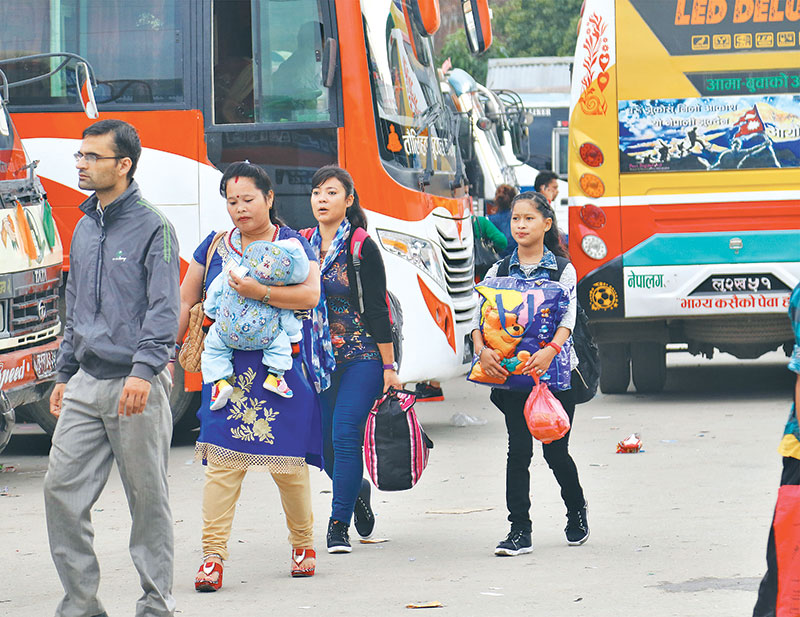
Transport Department says 200 buses will be added for Dashain

Metropolitan Traffic Police Division estimates that this year over three million people are set to leave the Valley, for which 9,000 buses are needed every day to carry passengers.
- ANUP OJHA

Every year before Dashain, 400 to 500 new buses are added to facilitate passengers.Post file Photo

KATHMANDU : In a bid to assist people travelling longer distances for the upcoming Dashain festival, the Department of Transport Management has announced it will add 200 buses by tying up with umbrella organisations of private schools and colleges.
Talking to the Post, Gogan Bahadur Hamal, director general at the department, said additional vehicles are currently being repaired and the department is working to give route permits for the new buses.
“We are also planning to hold meetings with umbrella organisations of private boarding schools to make arrangements for more buses,” said Hamal.
“We are requesting private schools and colleges to close earlier so that we can avail of the vehicles in an easier way,” said Hamal.
However, Private and Boarding School Organisations Nepal and National Private and Boarding School Associations Nepal have not given any feedback to the department’s request.
“I can’t say anything on this regard. We first need to hold the meeting regarding the issue,” said Subash Neupane, General Secretary of N-PABSON.
Apart from that, the division office is also going to hold a meeting with Sajha Yatayat Cooperative to employ their buses.
Even though Dashain is just three weeks away, pre-booking tickets for the festival is uncertain due to lack of adequate homework and better planning from government and transport entrepreneurs. To solve the issue, a meeting was held on September 4 between the department and the Federation of Nepalese National Transport Entrepreneurs, but it ended without a decision. Officials said the pre-booking announcement meeting is scheduled to be held on September 11.
Every year before Dashain, 400-500 new buses are added to routes. But after the government amended the Transport Management Directive 2004 to end the syndicate and cartel in the public transport sector, entrepreneurs stopped buying new buses.
Apart from that, transport entrepreneurs say banks have not shown any interest to invest in the transportation sector. The high down payment amount has further discouraged them from buying new buses. Metropolitan Traffic Police Division estimates that this year over three million people are set to leave the valley, for which every day 9,000 buses are needed to carry passengers during the festive time.
“We have sent letters to all the seven provinces’ transportation coordinates to get the data of public buses that are being operated. This will help us finalise the route for Dashain,” said Yogendra Karmacharya, president of Transport Entrepreneurs. The Department in association with the Metropolitan Traffic Police Division has already announced to operate 14 help desks from September 27 to October 5, in different parts of Kathmandu Valley to assist passengers.

Page 5
NATIONAL

Yet another acid attack badly injures 15-year-old girl in Birgunj

Muskan Khatun, a ninth grader, was attacked with acid by Samsad Miya after she rejected his friend Majid Alam.
- BHUSHAN YADAV,SHANKAR ACHARYA

Muskan Khatun suffered burns to her face, chest and hands when she was attacked with acid on her way to school.Post Photo: kabin adhikari

PARSA : A 15-year old girl was severely injured in an acid attack at Ganeshman Chowk in Birgunj at about 6am on Friday.
Muskan Khatun from Chhapakaiya in Birgunj was attacked with acid by 16-year-old Samsad Miya in order to exact revenge after Khatun rebuffed his friend Majid Alam’s romantic overtures, according to police.
Khatun, a ninth-grader at Tribhuvan Hanuman Secondary School, was assaulted on her way to school.
According to DSP Ananta Ram Sharma, spokesperson for the Parsa Police, Alam was infatuated with Khatun and had expressed his feelings for her, but was turned down. Khatun had then told her father, who met with Alam and asked him not to pursue her. Seventeen-year-old Alam is a relative of Khatun’s and lives in the same ward as her.
“Alam was furious since his proposal was rejected,” said Sharma. “The incident seems to have been an act of revenge.” Miya was acting on Alam’s request, he said.
Khatun, who suffered burns to her face, chest and hands, was admitted to the Narayani Hospital but has since been transferred to Kathmandu for further treatment, according to Sharma.
“The plan to throw acid was made on Thursday night,” said Sharma. Alam and Miya had observed the Ganesh Chaturthi pooja at Chapakaiya till 1am, after which they went to a hair salon in Ganeshman Chowk, where Miya worked part-time. The two spent the night there.During a late-night conversation, Alam had asked Miya to first ask Khatun why she had stopped speaking to him.
“If she doesn’t reply then throw acid on her body,” Alam reportedly told Miya, according to police.
Early the next morning, the two went to a tea shop in Malpot Chowk and waited on Khatun. Miya then did what his friend had asked him to do. He went up to Khatun and asked her why she hadn’t been speaking to Alam. Khatun replied that she was getting late for school and had no reason to speak to Alam. As she tried to make her way to school, Miya threw acid on her body. Other school students then took the injured Khatun to Narayani Hospital on a rickshaw.
Miya was arrested two hours later from Chhapakaiya but police are still looking for Alam, said Sharma. Instances of jilted lovers attacking women with acid have been a worrying feature in the news. In May, 20-year-old Jenny Khadka was attacked similarly by her ex-husband at Kalopul in the Capital. According to the Nepal Police, eight similar acid attack incidents were reported across the country in the past four years—three in the fiscal year 2014-15, two in 2015-16, one in 2016-17, and two in 2017-18. In the last fiscal year alone, four such attacks, including Khadka’s, have been reported from across the country.
Lalbabu Raut, chief minister of Province 2, has announced that the provincial government will provide Rs500,000 for Khatun’s treatment. But the incident has shocked Birgunj locals. Amar Bahadur Gautam, chair of the Association of Guardians, condemned the attack.
“The crime perpetrated upon an innocent teenager has troubled us deeply,” said Gautam. “We are worried about where our society is headed.”

NATIONAL

Makwanpur’s Bote group denied licence renewal for fishing

- PRATAP BISTA

HETAUDA : The people of Bote community in Makwanpur district find themselves in a fix. The traditionally fishing community who live in Manahari Rural Municipality-7 has long been making a living by catching fish in local rivers and rivulets, especially in the Rapti river, which fall inside the Parsa National Park. However, this fiscal year, the park refused to renew their fishing licence, putting their livelihood at risk.
Around 50 Bote families live at Ramauli of the rural municipality. The park had issued fishing licences to 22 Bote people of the settlement last year. However, when the Bote people wrote to the park for licence renewal for the current fiscal year, their request was denied.
“We went to the park office with an application to renew our fishing licence, but the park officials said the licence cannot be renewed,” said Dil Bahadur Bote. The Bote people rely heavily on fishing for their livelihood.
Meanwhile, the park administration said the park’s regulation allows the fishing licence to only the Sona and Badi communities.
“Parsa National Park does not have its own regulation. The government has instructed us to work in accordance with the regulation of Bardiya National Park,” said Amir Maharjan, the park’s warden. “The regulation of Bardiya National Park does not allow a fishing licence to the Bote people as they don’t live in Bardiya.”
The issue of licence renewal for the Bote people in Makwanpur has been raised in the federal parliament as well. Speaking at the parliament on Wednesday, lawmaker Birodh Khati-wada questioned why the Bote community in Makwanpur was discriminated.
“The Chitwan National Park renewed the fishing licence of the Bote community. Why is the same community in Makwanpur denied licence renewal?” he questioned.
“Fishing licence can be issued to the Bote community only by amending the regulation,” said Maharjan.Responding to the query of Khatiwada, Minister for Forests and Environment Shakti Basnet said they are ready to amend the regulation to address the concern of the Bote community.

NATIONAL

Locals start drive to conserve endangered Asian woolly neck

- HARIHAR SINGH RATHOuR

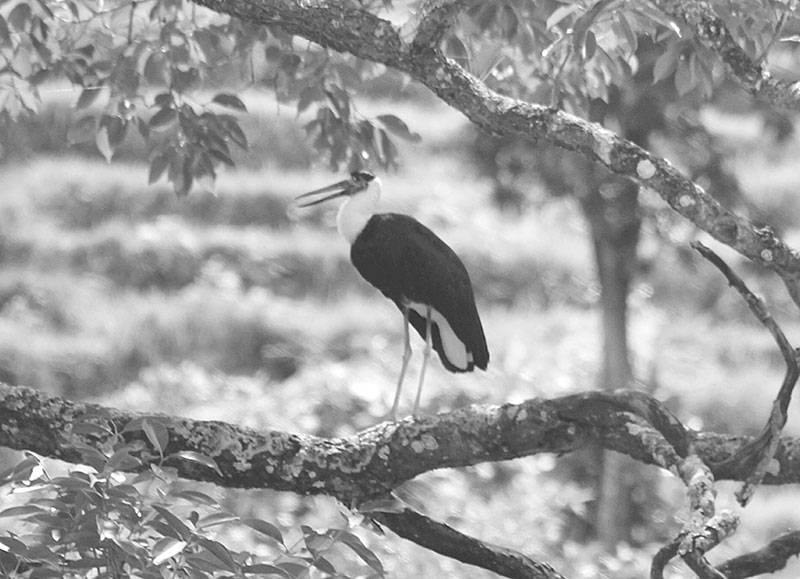
The Asian woolly neck is in the IUCN Red List of Threatened Species 2017.POST PHOTO: HARIHAR SINGH RATHOUR

KIRANCHOK (DHADING) : Residents of Gajuri Rural Municipality in Dhading have come together to protect Asian woolly neck stork, locally called Lovipapi Garud, after it was identified as an endangered bird species.
The rural municipality had called a team of conservationists, including ornithologists, from the Bird Conservation Nepal to identify the bird a few days ago. After the identity of the stork came into light, students of Kiranchok Secondary School in Gajuri Rural Municipality Ward No. 8 have started taking
initiatives to protect the stork and its habitat.
“We know these birds as “Bhudiphor” here. They can be found roaming freely in our paddy fields,” said Bishwo Adhikari, a 12th grader at Kiranchok Secondary School. “Students would usually throw stones at them, not to kill them but to make them fly. But now we want to protect the endangered species. Many locals still don’t know about the stork, so we are working towards raising awareness among them.”
The Asian woolly neck (Ciconia episcopus) is in the IUCN Red List of Threatened Species 2017. The species is a large wetland-dependent bird of the stork group with its population distributed across South and South-East Asia.
The rural municipal office has also taken steps to preserve the bird species in coordination with students of Kiranchok Secondary School and Kiranchok Katunje Secondary School in Ward No. 9.
According to Rajendra Bikram Basnet, chairman of the rural municipality, the office is distributing posters and pamphlets in the communities to inform the locals about the species’ status and urging them to make efforts to conserve them. “We will mobilise students to disseminate information about conserving the stork and install some hoarding boards marking the birds’ habitat,” said Basnet.
Sabina Thapa Magar, a 12th grader at Kiranchok Secondary School, takes the stork’s presence in her village as a matter of pride.
“The endangered storks have made their home in our village, and that’s a good thing. We have committed to preserving this species,” she said.
Currently, only three to four pairs of the woolly neck are found in the rural municipality, but their population was up to 16 pairs until two years ago, said Khem Prasad Adhikari, a farmer in Rungata Bagaicha.
Conservationists said the number of the species has decreased due to wetland degradation, reduction of nesting trees, use of pesticides in farmlands and excessive hunting.
“After the earthquake, the rural municipality saw an influx of construction workers. They would hunt woolly neck for meat, and that’s one of the reasons why the stork’s population has declined,” Adhikari said.Meanwhile, the rural municipal office, in its efforts to preserve the storks, plans to make these birds the identity of Gajuri.
“We have made public a plan to conserve endangered species including woolly neck and pangolin,” said Basnet. Krishna Bhusal, an ornithologist, said the woolly neck is found in Kapilvastu, Rukum, Jajarkot, Rupandehi, Dhading, Pyuthan, Arghakhanchi, Chitwan among other districts of Nepal. The 2015 count found only 68 Asian woolly neck stork in 42 wetlands of the country.

NATIONAL

Loss of water due to tank leakage in Bhojpur

Around 1.5 litres of water is being wasted per second for the last two months.
- ALISHA SHRESTHA

BHOJPUR : A leakage in the water tank of Silichung Drinking Water Consumer’s Committee has resulted in a wastage of water at Kafle Ghengar in Bhojpur Municipality Ward No. 9. Around 1.5 litres of water per second is being wasted every day for the past two months, said Kamala Pokharel, a security guard of the Drinking Water Consumer’s Committee.
“Despite constant efforts to draw the consumer committee’s attention to the problem, none of the members of the committee has taken an initiative to repair the tank,” said Samjhana Karki, a local.
The tank supplies water to around 1,385 households in Bhojpur bazaar, the district headquarters, and its immediate vicinity. Locals said there’s a shortage of water in the settlements of Taksar in Bhojpur Municipality Ward No 12, and the consumer committee has done nothing to prevent the leakage of water. “The amount of water being wasted can easily accommodate around 350 households,” said Pokharel.
According to the locals, representatives of the consumer committee are well aware of the leakage since almost everybody walks by the tank area daily.
“It’s already been two months now since the leakage began. The committee has done nothing to stop the leakage or clean the tank area,” Karki said. Meanwhile, members of the consumer committee said they are unable to fix the leakage problem due to a lack of employees.
“We don’t have employees to repair the tank. We seek help from the Department of Water Supply and Sewerage during emergencies,” said Binam Shrestha, secretary of the committee.After the devastating earthquake of 2015, many water sources have started drying up in the district. Villages like Jhulke, Dadhuwa, Tindhare and Jorsanghu live under constant water shortage.

NATIONAL

KU padlocked for a month

Briefing
- Post Report

KAVRE: The Professor’s Association of Kathmandu University has padlocked the administrative building of the university for the last one month. The association had padlocked the building, demanding the university to amend policies and rules regarding appointments, professional development and incentives to professors and staff among others.


NATIONAL

Unidentified gang robs financier

Briefing
- Post Report

MYAGDI: A financier at the NESDO Nepal Microfinance Company was robbed while returning home from work on Thursday. Sushma Kshetri was on her way home after collecting 120,000 from a neighbouring village when an unidentified gang attacked her and robbed the money. Kshetri has also sustained injuries in the incident.


NATIONAL

Two dengue patients found in Myagdi

Briefing
- Post Report

MYAGDI: Two people have been found infected with dengue at Beni Hospital in the last one week. According to the hospital record, two men of Beni Municipality Ward No. 8 have been infected with dengue virus.

NATIONAL

Sindhupalchok declared Open Defecation Free district

Briefing
- Post Report

SINDHUPALCHOK: Sindhupalchok was declared an open defecation free (ODF) district on Friday. In a programme organised in Chautara, Minister for Water Supply Bina Magar declared Sindhupalchok an ODF district. According to the data of the District Coordination Committee, a total of 88,273 households in the district now have toilets.


NATIONAL

Prohibitory order imposed around Melamchi project site

Briefing
- Post Report

SINDHUPALCHOK: The District Administration Office on Friday imposed a prohibitory order around the Melamchi Water Supply Project Office and site area after five people were injured during a demonstration staged by local subcontractors, vendors and workers on Thursday. The protesters have been staging demonstrations for the past few days demanding payment for their work.

Page 6
MONEY

Promises of Brexit bonanza look fishy for seafood industry

Disputes over fishing rights have flared into violence at sea, and could do so again if deals aren’t struck for UK and EU fleets after Brexit.
- ASSOCIATED PRESS
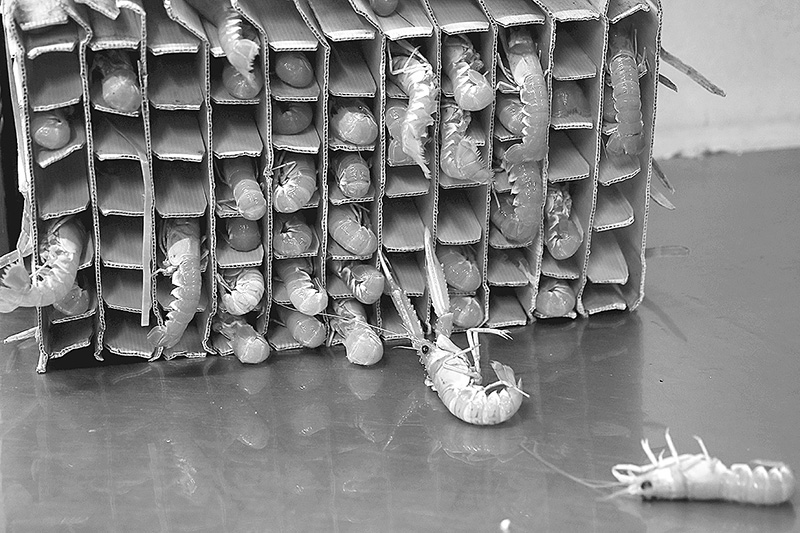
Langoustines are packed by hand into boxes, each upright in its own individual compartment, in Eyemouth, south coast of Edinburgh, Scotland. AP/RSS

EYEMOUTH (Scotland),
Netted in Scottish waters, claws snapping and tails flapping, langoustines as pink and fat as hotdog sausages are delicately packed by hand into boxes, each upright in its own individual compartment. The care and attention testifies to their high market-value for discerning gourmets in Europe, who’ll be snacking on them within hours.
While Scotland and the rest of Britain sleeps, trucks haul them southward overnight, skirting London where politicians are bitterly squabbling over the divided country’s planned exit from the European Union. They then pass without impediment through the Channel Tunnel to France, and quickly onwards to fine restaurants in Paris, Monaco and elsewhere.
James Cook, who watches his workers as they prepare the shipments, has spent 40 years — “a lifetime’s work,” he says — building his seafood export business into a steady livelihood for 220 employees.
Europe’s open, border-free single market that the British government intends to leave on Oct. 31 has allowed him to be sure that the tons of hefty lobsters and wriggling langoustines he buys from fishermen across Scotland will still be alive and ocean-fresh when delivered to European chefs. A holdup on the long, usually obstacle-free journey, even of just half a day, can be fatal for the fragile critters, turning prized seafood into worthless waste.
So Brexit , especially the scenario of Britain crashing out of the EU without a deal to keep trade as frictionless as it has been, is a prospect fraught with worry, possibly even catastrophe, for Cook. His worst case: An abrupt end to smooth market-access that could sink his export-dependent business within months.
“We may have to dismantle it next year, and I’m not overstating that fact. Everything we’ve built,” he says. “It could take a lifetime to get this right again.”
In their drive to uncouple Britain from the EU, its largest trading partner, pro-Brexit campaigners turned fishing into one of their battlegrounds. They blamed EU regulations and fishing quotas that govern the size of EU members’ catches for a decades-long decline in the size of the British haul and its fishing workforce, targeting a sensitive nerve in the island nation where battered deep-fried fish accompanied by vinegar-soused chunky fries is a sacrosanct national dish.
Pro-Brexit forces promised “a sea of opportunities” that will result from Britain “taking back control” of its waters. Steaming up the Thames on a fishing trawler in 2018, pro-Brexit leader Nigel Farage dumped crates of dead fish into the river in front of Parliament to protest EU fishing policies he has decried as “madness.”
Visions of richer harvests and of the once-mighty Royal Navy chasing European vessels out of now-shared waters appeal to some who work the seas from Scottish ports like Eyemouth, where old timers recall how the now largely empty harbor used to be so packed with trawlers they could walk from one side to the other without touching water.
Aboard the “Janreen,” laden with crates of freshly caught langoustines, the anti-EU sentiment was clearly if also crudely expressed: A fist with the middle finger raised had been painted over an EU flag on the trawler’s front bulk-head.
“They don’t do anything for us. You’re better off yourself, get your own waters back, do your own fishing,” crewman Alan Ferguson said as he hosed down the shellfish to clean them of silt. “There’s plenty of fish, just not enough quota.”
Disputes over fishing rights have flared into violence at sea, and could do so again if deals aren’t struck for UK and EU fleets after Brexit. Ferguson said he was involved in a battle in scallop-grounds off the French coast two years ago.
“We got attacked by the French for fishing in the waters. We don’t attack them for fishing in our waters,” he said. “They were throwing missiles and ramming boats, of course it’s dangerous.”
The irony was seemingly lost on Ferguson as he hazarded a guess that his langoustine catch would likely end up on plates in France and Spain. He shrugged off any likelihood of losing market-access after Brexit, saying: “That’s not going to stop, is it? Why would that stop?”

MONEY

China cuts banks’ reserve ratios, frees up $126 billion for loans

Analysts say China’s economic growth has likely cooled further this quarter.
- REUTERS
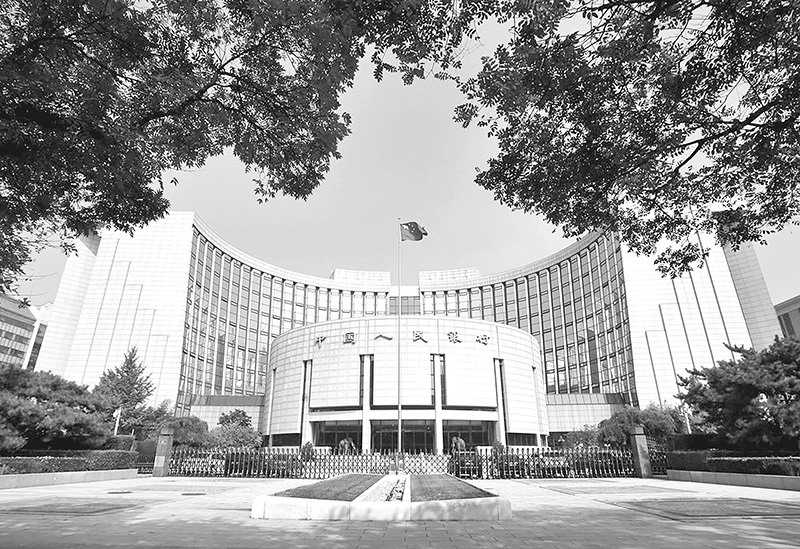
Headquarters of the People’s Bank of China, the central bank, is seen in Beijing, China. Reuters 

BEIJING, 
China’s central bank said on Friday it was cutting the amount of cash that banks must hold as reserves for the third time this year, releasing a total of 900 billion yuan ($126.35 billion) in liquidity to shore up the slowing economy.
Analysts had expected China to announce more policy easing measures soon as the world’s second-largest economy comes under growing pressure from escalating US tariffs and sluggish domestic demand.
The People’s Bank of China (PBOC) said it would cut the reserve requirement ratio (RRR) by 50 basis points (bps) for all banks, with an additional 100 bps cut for some qualified smaller lenders.
The PBOC has now cut RRR seven times since early 2018.
The broad-based cut, which will release 800 billion yuan in liquidity, is effective Sept. 16. The additional targeted cut will release 100 billion yuan in funding, and will be in two phases, effective Oct. 15 and Nov. 15.
“The move shows policymakers are increasingly worried but it’s far from enough to stabilise the economy,” said Larry Hu, head of Greater China economics at Macquarie Group in Hong Kong. “The key constraint is that everything is slowing down – corporates are not willing to invest because of the trade war, a global slowdown, and weak infrastructure and property sector growth.”
The latest move to spur bank lending followed a cabinet meeting on Sept. 4 that pledged to implement both broad and targeted cuts in the RRR “in a timely manner”.
The PBOC said it will maintain a prudent monetary policy and avoid ‘flood-like’ stimulus, while increasing counter-cyclical adjustments and maintaining reasonable and abundant liquidity.
Analysts say China’s economic growth has likely cooled further this quarter from a near 30-year low of 6.2 percent in April-June. Morgan Stanley says it is now tracking the lower end of the government’s full-year target range of around 6-6.5 percent.
With Washington imposing new tariffs from Sept. 1, and threatening more measures from Oct. 1 and Dec. 15, some economists have recently cut their China growth estimates for next year to below 6 percent, which would breach Beijing’s longer-term goal.
The central bank is also widely expected to cut one or more of its key policy interest rates in coming weeks—for the first time in four years—as it works to reduce corporate funding costs.
“I think it’s very likely they will cut the LPR (loan prime rate) by about 5-10 bps later this month. I also expect another RRR cut of 50 bps by the end of this year,” Macquarie’s Hu said.
Despite a slew of support measures and policy easing since last year, China’s economy is still struggling to get back on firm footing. July’s data showed growth stumbled more sharply than expected as the intensifying trade war with the United States took a heavier toll on businesses and consumers.
Analysts say the problem is not a lack of credit—the PBOC has injected generous amounts of liquidity—but weakening business and consumer confidence as the trade war drags on. That has weighed on activity from manufacturing and investment to retail sales.
In the latest escalation in the protracted trade dispute, the United States began imposing 15 percent tariffs on a variety of Chinese goods on Sept. 1—including footwear, smart watches and flat-panel televisions - and China began imposing new duties on US crude.
The next high-level trade talks are slated for early October, but a lasting peace seems more elusive than ever.

MONEY

Huawei shows off ‘most powerful’ chipset

The Chinese tech giant bills the Kirin 990 chipset as the first all-in-one 5G system on a chip.
- REUTERS
Richard Yu, CEO of Huawei’s consumer business group, announces the new Kirin 990 5G chipset at the IFA consumer tech fair in Berlin, Germany, on Friday. Reuters 

BERLIN, 
Huawei Technologies showcased its chipset for a new high-end smartphone on Friday, pressing ahead with plans to launch its Mate 30 range, despite uncertainty about whether the new phones will be able to run Google’s Android operating system and apps.
The Chinese tech giant bills the Kirin 990 chipset as the first all-in-one 5G system on a chip, describing it as superior to alternatives from Qualcomm and Samsung that, it says, graft 5G modems on to 4G chips.
“It’s the world’s most powerful 5G system on a chip. It’s the world’s most powerful 5G modem,” Richard Yu, the head of Huawei’s consumer business group, said in a speech in Berlin.
Huawei’s launch at the IFA consumer electronics fair in Berlin of the Kirin 990, made using the latest 7 nanometre production process, is part of a carefully sequenced buildup to the Sept. 19 international launch of the Mate 30 in Munich.
Yet, say Huawei sources, it is still not known whether the Mate 30 will be able to run services from Alphabet’s Google following the blacklisting of the Chinese company by the US administration in May.
That ban sliced 5 percentage points off Huawei’s market share in Europe.
The world’s No.2 smartphone maker is looking to reclaim ground as the spread of ultra-fast 5G networks prompts an upgrade cycle among consumers who have been holding on to phones for longer. Consumers will need new handsets to take advantage of the ultrafast download speeds promised by 5G.
The services in doubt include pre-installing the Google Play store and a suite of popular apps such as Google Maps that buyers would expect to be available from the moment they turn on their new phone and synch it with their profile.
Huawei’s fallback option would be to run the devices on its home-grown Harmony operating system, although company officials and analysts say it is not yet ready for prime time.
“The elephant in the room is Google,” said Peter Richardson of Counterpoint Research, after attending a technical briefing on the Kirin 990 by Huawei managers that skirted the issue and focused only on the chipset’s specifications.
The Kirin 990 packs more than 10 billion transistors and can support downlink speeds of up to 2.3 gigabits per second.
It has an adaptive receiver that enables it to switch between 4G and 5G where coverage of the faster technology is weak.
And, to save energy, it has a ‘big core’ to handle powerful computing tasks with the support of artificial intelligence, and a ‘tiny core’ for less demanding operation.
Huawei plans only to use the Kirin 990 in its own devices, meaning it lacks the marketing opportunities enjoyed by Qualcomm, whose chips already power the Samsung 5G phones, such as the Galaxy 10, already on the market.
Apple’s recent settlement of a patent dispute with Qualcomm, and Intel’s exit from the smartphone modem business also reflect the US chipmaker’s muscle in a global market that is increasingly fragmenting due to the US-China trade tension.
“Qualcomm has a scale advantage,” said Ben Wood, analyst at CCS Insight. “Huawei’s commitment to continue innovating on silicon is really impressive, especially given the geopolitical headwinds they are facing.
“But at the end of the day, it’s a single-vendor solution. And, even if they had aspirations to sell the chipset, that is getting more difficult all the time.”

MONEY

Cash-strapped Aigle Azur to cancel all flights

- AGENCE FRANCE-PRESSE

PARIS,
France’s second-largest airline Aigle Azur, which went into receivership this week, plans to cancel all flights starting Friday night as it seeks a takeover bid to save the company, according to an internal document seen by AFP on Thursday.
Aigle Azur had warned earlier that some flights would be halted and all ticket sales suspended from September 10, the day following a deadline for submitting bids to acquire the airline.
“The company’s financial situation and the resulting operational difficulties do not allow us to ensure flights after the evening of September 6,” according to a statement addressed to employees.
“If you take a flight after September 6, 2019, whatever the airport of departure this flight is cancelled. You will have to buy another return ticket,” the carrier said.
Aigle Azul, which said it would run 44 flights on Friday, mainly to Algeria, urged affected passengers to check on their existing insurance—notably via their credit card provider—for reimbursement. It also told travellers who had booked through a travel agency to approach them for advice on the redress they were entitled to.
It said the company had been “forced to resort” to an “unfortunate option that puts out clients, our teams and our partners in great difficulty.”
The airline had initially pledged to maintain operations after filing for bankruptcy protection on Monday, following years of losing millions of euros. Destinations in Algeria make up half of Aigle Azur’s operations, and the company posted revenues of 300 million euros ($329 million) last year after transporting some 1.9 million passengers. But it wasn’t enough to stem heavy losses that last month prompted the airline to announce plans to sell its Portugal routes to low-cost rival Vueling.

MONEY

Japan’s Nissan mulls pulling out of South Korea as trade tensions rise

- REUTERS

TOKYO, 
Nissan Motor Co is considering pulling out of South Korea, the Financial Times reported on Friday, as political and trade tensions between Japan and South Korea have caused sales of Japanese products in the neighbouring country to plummet.
Nissan and other Japanese firms have been a casualty of consumer boycotts of products ranging from cars to beer in South Korea, triggered by sudden export curbs by Tokyo earlier this year as trust between the two countries has eroded over wartime issues.
Citing unnamed sources, the FT said that besides stopping sales in South Korea, Nissan is also mulling its involvement in an assembly plant in Busan owned by Renault Samsung Motors Co, a joint venture with Nissan’s French automaking partner Renault SA. The plant makes cars mainly for export markets.
Nissan spokespeople in South Korea and Japan declined to comment on the report.
Japan’s second-biggest automaker has been trying to strengthen governance, slash costs and boost flagging profitability amid persistent allegations of financial misconduct stemming from former chairman Carlos Ghosn’s 20-year reign.
Nissan’s market share in South Korea has long lagged its domestic rivals. Along with its luxury Infiniti brand, the automaker has sold just 3,581 cars in the country in January-August this year, down 27 percent from a year ago and trailing far behind Toyota Motor Corp.
Japanese automakers are small players in the South Korean auto market, which is dominated by Hyundai Motor Co, and German imports including the Mercedes Benz and BMW brands.

Page 7
MONEY

Developers complain tree clearance guidelines could push up their costs

A project similar to the Tanahu hydel scheme which has cleared around 181,000 trees spread over 417 hectares of forest would have to pay Rs688 million for forest clearance.
- PRAHLAD RIJAL
Projects that need to cut sal trees in the forests of the Tarai, Inner Tarai and Chure region have to pay Rs1.5 million to Rs1.65 million per hectare depending on the tree density. POST FILE PHOTO

KATHMANDU,
The developers of high priority projects, undertakings with funding approval from Investment Board Nepal and transmission line expansion projects complained they could experience financial stress due to the stringent environmental regulations issued by the Forest Ministry concerning forest clearance.
The new guidelines recently approved by the Cabinet requires project developers to make a lump sum payment for the trees they intend to fell, plant 10 times the number of trees chopped down, and look after the saplings for a period of five years.
“The forest clearance conundrum which has bogged down many projects has become more complicated with the issuance of the new provisions,” said Sachen Gautam, communications official at Tanahu Hydropower. “Upcoming projects will face a double whammy of paying large sums for clearance and carrying out afforestation programmes for five years at their own expense.”
According to Gautam, the ministry should allow developers to pay the fee for a clearance permit in instalments rather than all at once, and the government itself should manage the afforested areas utilising this money.
If the projects receiving clearance permits cannot provide replacement land for afforestation, they have to pay a large sum of money determined by the ministry in line with the nature of the forest and the tree density, as per the Forest Clearance Guidelines 2019.
The ministry has fixed the payment amount for chopping down trees by classifying forests depending on tree density, species of flora and fauna and location.
As per the guidelines, areas with less than 25 trees per hectare are pasture lands, woodlands with 25 to 100 trees per hectare are classed as low density, areas with 101 to 200 trees are classed as mid-range forests, and areas with a concentration of more than 200 trees on a hectare are classed as high quality forests.
Projects that need to cut Sal trees in the forests of the Tarai, Inner Tarai and Chure region have to pay Rs1.5 million to Rs1.65 million per hectare depending on tree density.
Chopping Rhododendron forests would cost the project up to Rs1.55 million per hectare, cutting down Khayer and Sisau trees would require the project to pay up to Rs1.32 million per hectare.
A hydropower project similar to the Tanahu hydel scheme which has cleared around 181,000 trees spread over 417 hectares in a national forest would have to pay Rs688 million for forest clearance.
The project will have to manage further resources to plant 1.8 million new trees and invest in taking care of the saplings for five years before handing over the afforested area to the respective forest office. If the project is unable to look after the young trees, it must pay a fee fixed by the ministry to the forest office to do so.
The rules require priority project developers to allocate funds, human resources and transportation
charges to clear the forests and haul the logs to the place designated by the forest office.
The ministry has relaxed the afforestation regulations which originally required developers to plant 25 trees for every tree cut down. Also, developers who cannot take care of afforested lands can pass the task to the forest office by making a payment.
Despite that, infrastructure experts say the new guidelines are impractical and not development-friendly.
“The cost of the projects will skyrocket if the guidelines are implemented, and priority projects will have to go out of their scope to plant trees,” said Tulsi Sitaula, a former secretary of the Infrastructure Ministry. “Such provisions issued without proper coordination with all stakeholder agencies will also hit the inflow of foreign direct investment in major projects and should be revised.”
Currently, many high priority projects have been delayed owing to the issue of forest clearance, and in practice, the developers including state bodies mired in clearance issues have time and again pushed the Cabinet to allow them to chop trees.
Recently, the Nepal Electricity Authority had to receive clearance to cut 38,545 trees on the route of the planned Hetauda-Dhalkebar-Duhabi transmission line in Rautahat and Bara districts from the Cabinet amid obstructions.
Forest Ministry officials downplayed the concerns of project developers and experts saying that the guidelines have been placed to discourage rampant deforestation in the name of development, and that some of the provisions have been relaxed too.
“The developers have a habit of socialising their costs and privatising benefits, but when it comes to converting national forest areas which are public property into viable businesses, the ministry has to be restrictive,” said Sindhu Prasad Dhungana, spokesperson for the Ministry of Forest and Environment.
“The provisions are not regressive as said, and we have relaxed the lease terms for government projects and reduced the number of trees required to be planted. The ministry wants to discourage deforestation for even small development projects which can be implemented in treeless areas.”

MONEY

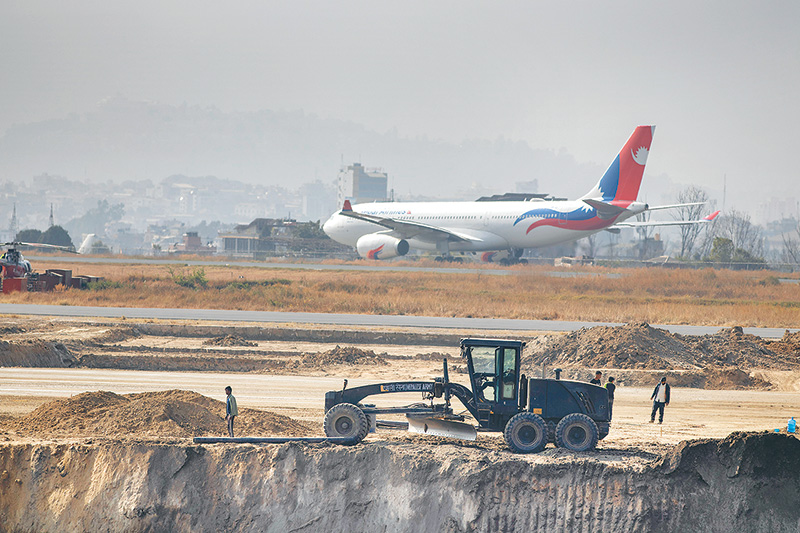
Fresh financing arrangement to be made for airport improvement project

The upgradation of Tribhuvan International Airport has been moving in fits and starts since 2012.
- SANGAM PRASAIN
The $92-million project was approved in November 2009, and work started in 2012 with the completion deadline set for 2015. POST FILE PHOTO

KATHMANDU,
The Asian Development Bank closed its loan and grant account for the Tribhuvan International Airport improvement project to start a fresh financing arrangement as its 10-year term expired without any visible achievement.
The Civil Aviation Authority of Nepal is currently funding the airport improvement project. Its scope includes the extension of the northern part of the parallel taxiway to reduce the usage of the runway for taxing purposes, expansion of the apron to accommodate more aircraft, extension of the runway by 300 metres at its southern end, and construction of a new terminal building.
The $92-million project was approved in November 2009, and work started in 2012 with the completion deadline set for 2015. The Asian Development Bank provided $80 million ($70 million in loans and $10 million in grants) and the government contributed $12 million for the project.
The government requested the Asian Development Bank to finance the development of Tribhuvan International Airport in accordance with the airport’s master plan 2010-28. The project had achieved only 17 percent physical progress even by the revised project completion deadline of March 2016.
An anonymous official of the multilateral funding agency told the Post that the project’s financing period ended in December last year. “We are in discussion to launch a fresh project that may be approved in 2020,” he said. “We cannot start a new project without closing the old one.” The financing modality and amount was not immediately clear.
Babu Ram Poudel, chief of the project, said the Asian Development Bank had closed its books in December to begin a fresh account. Poudel said they did not know which component the bank would support, but it would be an airside component like apron and taxiway.  
The airport improvement project hit a snag at the very start as the soil to be used as filler for the expansion of the airport could not be obtained after a court order forbade it from digging at the Pashupati quarry. The project needs 2.1 million cubic metres of soil to fill the ravine on the northern side of the runway where 13 new parking bays will be constructed.
A series of subsequent problems further delayed the project. The airport had to be closed when a Turkish Airlines jet crash-landed in March 2015. There were more delays due to the 2015 earthquakes and fuel shortages. The project completion deadline was first extended to March 2016; but after even that looked unachievable, the date was pushed back to 2017. Now, officials expect the project to be completed by 2021.
After sending off the Spanish contractor for the project, Constructora Sanjose, for non-performance in December 2016, the project broke up the scheme into four packages. According to Poudel, some components like the construction of a new international terminal building would be completed by December.
The extension of the runway at its southern end, or runway 02, will be completed by June next year, he said.
Poudel said that the fourth package, that includes supplying 2.1 million cubic metres of soil to fill the ravine at the northern end of the runway and building new parking bays and around 450 metres of taxiway on the northern side, would take time to be completed. The fourth package is the most critical part, and it is expected to last at least two years.

MONEY

Himalaya Airlines donates supplies to Matatirtha Bridhashram Samiti

Briefing

KATHMANDU: Himalaya Airlines has joined hands with Airlines Operating Committee –Nepal (AOC-N) to strengthen its corporate social responsibilities (CSR) initiative. A consortium of airlines has come together with AOC-N for their annual welfare activity. Under AOC-N’s banner, this year’s welfare activity was carried out to support Matatirtha Bridhashram Samiti located at Matatirtha, Kathmandu. Himalaya Airlines contributed materials like soaps, detergents, toiletries, towels, brooms and the hair trimmers on the special request for the occupants of the old age home, the airline said in a press statement. Matatirtha Bridhashram Samiti located about 15km west of Kathmandu was established in 1997 and provides shelter to the female citizens of Nepal over 60 years of age.

MONEY

Pringles launches two new flavours in Nepal

Briefing

KATHMANDU: Responding to the evolving tastes and preferences of consumers, potato chips brand Pringles has launched two new variants in Nepal—Pringles Tom Yum and Pringles Sweet Chilly. The exciting new variants that are inspired from flavours of the orient were introduced to consumers in true oriental style on Thai street food carts that are famous for their snacks, the company said in a press statement. The initiative was an instant success with consumers flocking around the traditional food carts to sample the new variants and healthy 40 percent sales at the outlet coming from the street food carts. Jaspinder Singh Vohra, Director Exports, Kellogg South Asia, said, “Nepal is an important market for Pringles, and recent years have witnessed consumers increasingly embracing Oriental cuisines. The confluence of these two dynamics led to the idea of launching Pringles in Tom Yum and Sweet Chilly flavours.” The new variants are available at all leading modern trade outlets and cost Rs275 for 147g.

Page 9
CULTURE & ARTS

‘A new age demands a new revolution’

Rayan on his never-ending musical journey and fight for freedom.
Post Photo: SANJOG MANANDHAR

Narayan Bhakta Shrestha is popularly known as Rayan. He was one of four members of musical group Ralfa during the 60s and 70s. He and his bandmates were known as people’s musicians, who took to the streets to protest many dictatorial regimes in Nepal, from Panchayat to the second Jana-andolan. Now, he is at the helm of a state institution, the Music and Theatre Academy, as chancellor. Recently his 77th birthday was celebrated in the presence of his contemporaries, friends and fans—who remembered his evergreen music, which remains relevant to this day, decades since its composition. In this interview with the Post’s Asmita Manandhar, Rayan discusses his journey from a small village in Okhaldhunga to Kathmandu, and his complicated rise to become one of Nepal’s most celebrated musicians. Excerpts:

How did you get into music?
I grew up in a tight-knit Newar settlement in Okhaldhunga. We celebrated all Newar festivals that were celebrated in Kathmandu Valley. My father was an avid proponent of Newar culture—from festivities to language and music. Due to this, I also played many roles in traditional theatre, showcased in dabalis since my childhood. Additionally, I was also told by my father that my grandfather, Ram Bahadur Shrestha, was a royal court singer. So, I feel it was my family background and the environment I grew up in, which naturally led me to pursue music.


How were you able to start out in the music industry back then? And how was your experience?
When I was 19, I was selected to sing for Radio Nepal after winning the all-Nepal music competition. From Sagarmatha zone, me and Raamesh, who is a year younger than me, were selected. Before our song was to be recorded, we were made to sing in front of a panel of veteran artists. When we finished singing, all the panel members were visibly angry with us. Both Raamesh and I were confused. We sang a folk song that was very popular in our region and couldn’t really understand how we offended them.
Later, we were told to change a sentence from our lyrics, which went like this, ‘Gai charne ma Bhaisi charyo, banko raja Kusunda lai hajur bhannu paryo’ (Buffaloes grazed where cows were supposed to, we now have to greet jungle’s king Kusunda too). It had only been a year since then King Mahendra scrapped democratic rule and established a dictatorial Panchayat system, so the panel members at Radio Nepal interpreted our simple folk song having hidden meaning against the state. We were allowed to go live only when we changed the latter sentence to ‘Mai hu bhanne sannani lai hajur bhannu paryo’ (we now have to greet a proud girl).
We were just teenagers and it was our first stint in pursuing music professionally—but it was also our first experience of how censorship can be prevalent on art.  Radio Nepal, however, was our abode for the next 14 years, where we worked as their in-house artists. We were paid Rs 10 per song, which also popularised us.


You say your initial inspiration was your cultural background, but people remember you for revolutionary songs, which pushed listeners to rebel against the system and oppression. How did you make that transition?
One of the biggest fans of our music was, as we came to know from mutual friends, was Parijat, a contemporary and celebrated writer at the time. Parijat had already been awarded with Madan Puraskar when we met her. For us, trying to find our footing in the foreign city, Parijat became our friend and guardian.
In the meantime, the payment we received from Radio Nepal was suddenly cut off. We later found out that the top-level administrators withdrew our payment in their name. We complained about this corruption to Radio Nepal’s director, but nothing happened. Then, one day, when we were walking out of Singhadurbar, frustrated with the treatment we were receiving, an administrator from Special Police, which was equivalent to present anti-graft body, asked us what was wrong. We told him whatever was going on. He then called us inside this office and listened to our problem in detail.
He made us write a formal application. We obliged without understanding the potential consequences. But, based on our application, the Special Police raided Radio Nepal premises.
After that, we were forced to leave. Many top officials were angry and threatened our lives. But we were musicians and needed a stage. In the absence of our regular stage, Parijat’s home became that place for us. That is when our music started representing suppressed voices—from personal experience and being exposed to such situations and incidents.


Is that when Ralfa was formed?
Yes. After we received threats from the Radio Nepal officials we started to travel in groups. It was then we were able to discuss our music even more. And since we were no longer institutionalised, we were able to go to various programmes and street events and sing our songs. It made us more popular with the people.
We were not aware back then, but coincidently The Beatles was also formed around the same time we named our group Ralfa. We also had four members in the group—Raamesh, Manjul, Arim and I.


All of the members of Ralfa picked very unique stage names. How did you come up with them and did they have any particular significance?
We wanted to come up with a unique name—that’s about it. We are performers and we wanted our group’s identity to be memorable for the public. There is no profound meaning behind any of the pseudonyms. I just slashed ‘na’ at the beginning of my name and called myself Rayan. Similarly, Raameshwor became Raamesh, Meghraj became Manjul and Rishi became Arim.


You still remember your art being censored when you were just starting out. Now, heading a state institution yourself, how do you feel about the current state of freedom of expression for artists?
This country went through many political changes throughout my lifetime. So, I can say that our society has definitely evolved—in terms of accommodating diverse voices. But music and art should always be present to challenge and scrutinise the state.
With every changing society, comes different challenges and social abnormalities. It is the reason why art is immortal. The songs we sang four-five decades ago, like ‘Koi ta bhane jaahaj ma harara, koi ta bhane pasina tarara’ (Some travel in planes, some are drenched in their sweat), ‘Gau-gau bata utha, basti-basti bata utha’ (Rise from every village, rise from every town), ‘Ek jug ma ek din ek patak aaucha’ (One such day will come only once in a century), and many more are still relevant to this day because of this.
A new age demands a new revolution—society and state require constant reminders, regardless of how democratic society is. So, in every era, artists should be on the frontline to push the boundaries and stand against any censorship.


What is the Academy doing to promote and encourage upcoming artists?
For artists to understand their roles in society, beyond entertainment and leisure, they need a platform where they can express their views, and we are ready to give them that space. That said, we are looking to be more inclusive of artists from all districts. There is a lot to be done, but we are positive we will be able to foster communication and cultural exchange among the different communities across the country.

CULTURE & ARTS

Maruni’s heart might be in the right place but the end result is disappointing

A film about the trans community should do its subject justice, but Maruni seems to pity its lead character.
- ABHIMANYU DIXIT
Screengrab via youtube

[Editor’s note: This review contains spoilers. Read on at your own risk.]


Samragyee RL Shah, the lead in the new film Maruni, said in an interview that her mother had advised her to take up the film as it was a once-in-a-lifetime opportunity. Maruni really is like no other Nepali film, in that it is about the trans community. But then again, it is exactly like most other Nepali films, in that it is purely a commercial take on a sensitive topic.
The Nepali word ‘maruni’ literally means ‘a person who dances and sings in the disguise of a woman’. With a subject matter this powerful, you’d expect the film to be a deep character study. Sadly, the film pities, rather than empowers, its LGBTIQ character, saying things like “you will never be enough”.
The film’s plot is your regular love triangle, but with a twist. Raj (Aayush Shrestha) and Yash (Puspa Khadka) are best friends who grew up together. Raj has always been in love with Yash—he’d even dress up and play bride to Yash at school events. Yash, however, falls in love with Madhu (Rebika Gurung), a common friend. Upon realising this, Raj walks out of Yash’s life and undergoes gender reassignment surgery to become Suman (Samragyee RL Shah).
Years later, Suman meets Yash as a business partner. They spend quality time together—which, in Nepali films basically means to get drunk at a party—and kiss. This incident rekindles Suman’s feelings for Yash, only this time she’s not willing to backout. She turns into a possessive lover, sending up obvious red flags. And if you’ve seen the trailer, you know where this is headed. Suman finds out that Yash is married and very faithful to his wife Madhu, but that won’t stop Suman, who is almost psychotic in trying to convince Yash to leave his wife through a series of cliché scenes of stalking, invading privacy and throwing herself on Yash.
Yash eventually finds out who Suman once was, and decides to spend more time with his once best friend. Yash’s affection now makes his wife jealous and she tries her tricks to separate her husband from Suman. And thus continues the seemingly never-ending saga of who gets to be with Yash.
This is the first time a Nepali commercial film has a transgender character as the lead, and that is why a little more detail into the trans community would be desirable. Although we get an elaborate flashback on how Raj became Suman, these scenes do nothing more than paint a sympathetic picture. There is no empathy and no connection, and this is where the director fails the issue at hand. The transgender community faces frightening prejudice on a daily basis. Any filmmaker portraying this community on film needs to be very thoughtful in how they choose to depict characters. Because Suman’s only identity is that she is a transwoman, Samragyee’s millions of young fans will shape their opinions based on this role. Do the filmmakers really believe that trans people should be feared or pitied?
In the epilogue to this film, Yash and Madhu’s son is seen putting on his mother’s makeup (lipstick and red tika) in an ominously shot scene that has the aesthetic of a horror or thriller film. This film seems to tell the audience that being trans is a curse.
Another example is the opening (after the prologue) of the film. Maruni begins with montages of Raj and Yash. In the first montage, a school teacher is lecturing on the topic of ‘diseases’. Do the writer and director not realise what that implies? Things like these can’t be ignored because the opening is called ‘the setup’ for a reason—audiences form their idea of where the film is going based on the opening.
The writers Govinda Phuyal and Nawal Nepal, who is also the director, are both cis-men and they never give Suman, the titular trans character, any agency in her own story, besides that of an obsessive lover. She even attempts suicide after her father (Arjun Shrestha) tells her that she can’t bear a child. Basically, if you can’t give birth to a child, you’re not worthy of love. Her father also goes on to tell Yash that “God gave her [Suman] desire, but no solution”. This breaks Yash’s anger and rekindles his friendship with Suman, more out of pity than anything else. Also, let’s not ignore what this film essentially is—two women fighting for a man’s affection.
Most scenes are clichés, but the film is marred with bad directing choices more than anything. The actors simply stand and talk and every scene has the same flow, right from establishing shots to close-ups. While the cinematography gives us bright and pleasant frames, Sanjay Lama, the director of photography, makes it almost too pretty at times, as if you were watching a high budget advert. It doesn’t do much for the story. The art director, Menuka Rai, has taken care to place visible element of red (or maroon) throughout the film, especially in scenes depicting Suman.
Samragyee’s casting must have seemed like a great idea at the time for the filmmakers because of her accent. Perhaps Maruni is the only film that could justify why she talks the way she does. Raj doesn’t have an accent, but Suman does, so the accent must’ve come after her gender reassignment surgery. But as an actor, badly-made wigs aside, Samragyee is the same girl we saw in Dreams (2016). Her mother was right, this was the role of a lifetime, but the role demanded so much more and she does it no justice. And as impossible as it might seem, the other actors are even worse.
Nepali films on the LGBTIQ community are few and far between. The Nepali media has constantly depicted the community as people to be ridiculed. So, credit should go to this film for going beyond comic relief for LGBTIQ people. But how we represent each other in the media influences how we perceive each other in the society. The LGBTIQ community faces many obstacles in daily life. There are no strong legal guarantees to simple amenities like workplace or marriage equality. While we’ve seen pride parades and marches, demanding an end to discrimination, we still have a long way to go.
Based on the team’s interviews, it seems like Maruni has its heart in the right place but with cinema, no matter how important the issues you raise, poor storytelling will always ruin the impact it could’ve had.


Maruni
Starring: Samragyee RL Shah, Pushpa Khadka, Aayush Shrestha, Rebika Gurung
Producer: Punam Gautam
Director: Nawal Nepal


Dixit is a filmmaker, film educator and film campaigner based in Kathmandu.

Page 10
EXPRESSION

In Kashmir, shopkeepers refuse to open despite India easing some curbs

India has flooded Kashmir with troops—one of the world’s most militarised zones.
- REUTERS
From afar, with aerial view of Dal Lake during restrictions, there is a sense of calm that can’t be felt in the city of Srinagar. Adnan Abidi

A month after India withdrew contested Kashmir’s autonomy, locked it down with thousands of additional troops and made mass arrests, residents are resisting attempts by authorities to show some signs of normalcy returning in the Muslim-majority valley.
Prime Minister Narendra Modi revoked special rights for Jammu and Kashmir state on Aug 5, striking down long-standing constitutional provisions for the Himalayan region, which is also claimed by neighbouring Pakistan.
To dampen the possibility of widespread protests, India flooded Kashmir—already one of the world’s most militarised zones—with troops, imposed severe restrictions on movements, and cut all telephone, mobile phone and internet connections. Thousands of people were arrested.
New Delhi has since eased some of the curbs although no prominent detainees have been freed and mobile and internet connections remain suspended.
Officials in Jammu and Kashmir’s summer capital of Srinagar say that 90 percent of the Kashmir valley is free of restrictions on daytime movement, some landline phone connections have been restored and thousands of schools have re-opened. However, checkpoints remain in place and communication restrictions make reporting from the region difficult.
Despite the partial relaxation, many students are boycotting classes, shopkeepers are not opening up and public and private sector employees are not turning up for work, in informal action aimed at protesting against the government in New Delhi, according to interviews with seven government officials and dozens of residents of the valley.
“For us, our identity at stake and its safeguarding is our priority,” said Shabir Ahmad, a shopkeeper from the old quarter of Srinagar.
“Let them restore it and we will re-start our businesses.”
The civil disobedience has sprung up alongside small but regular protests by stone-throwing crowds that have been quickly quashed by security forces with tear gas and pellet guns.


Kashmiri people walk past burning tyres during a protest after the scrapping of the special constitutional status for Kashmir by the Indian government.


A Kashmiri woman shows her hands with messages of protest in Srinagar. Danish Ismail


Central Reserve Police Force personnel wade through a water-logged street. Danish Ismai


Employees of a local newspaper drink tea during a break at their office. Adnan Abidi


Kashmiri women shout pro-freedom slogans before offering Eid-al-Adha prayers at a mosque. Danish Siddiqui


A Kashmiri woman walks past a security officer standing in front of closed shops. Adnan Abidi


Kashmiri girls walk amidst smoke during clashes between Indian security forces and protestors. Adnan Abidi

Page 11
AS IT IS

What’s in a name?

For the five years during which I lived in Nepal, my name was not mine. It was a reflection of my muddled identity.
- JUNE KARKEE
Jordan Rowland/Unsplash

Until the age of thirteen, I never cared for my name. And I suppose most of us don’t. Our name is given to us at birth and we accept it for what it is, as something that we can’t change and as something that sticks with us for the rest of our lives. But for me,  my name has always been so much more than that. So what I really mean when I say I never cared for my name is that I disliked, even hated it, and therefore never truly accepted it as my own.
Jyoni was a name strategically given to me by my father, who is a diplomat, as a way for me to fit into the different places and cultures that my family and I would have to immerse ourselves in as we periodically moved to different countries. It was an “English sounding” name, having no special meaning or significance.
For the four years that I lived in Belgium, from ages five to nine, my name was accepted by my Belgian friends and teachers because it was easy to pronounce and it didn’t make the person uttering it uncomfortable. It was a name even my sisters used, and to this date, still do. But as convenient, simple and user-friendly as my name was for the “western” speaker, I never prided in having it because even at that age, I knew that there was a disconnect between my given name and who I was.
That sense of disconnect between my name and my identity followed me everywhere and grew stronger when I moved back to Nepal, where almost everyone around me had “Nepali sounding names.” Coupled with the British accent that I had acquired in the four years from studying in a British-English international school back in Belgium, my name began to separate me from the rest of my friends, who saw me as being an outsider and thus treated me differently. I could not understand why my “own” people, with whom I shared the same identity as a Nepali, treated me like the “other” and ironically, I began to feel like a stranger and a foreigner in my own country.
Throughout the five years that I lived in Nepal, my name in school would often become associated with the popular English nursery rhyme “Johny Johny Yes Papa,” which would be chanted by crowds of people whenever I participated in a sports event. My name would intentionally be pronounced with an exaggerated accent, by students and teachers both, in order to make me feel different, as if I didn’t already. My name would be questioned for its meaning and purpose, and inevitably, it would grow to become something that I disliked and wished to get rid of permanently.
For the five years during which I lived in Nepal, my name was not mine. It was a reflection of my muddled identity—one that I had no awareness of, but one that I constantly tried to create. By pretending to not be that great at English, and by intentionally mixing up Nepali words when speaking English because that was how everybody else in school spoke, I tried to seem more relatable and “be more Nepali” although getting the highest score on English exams always told my friends otherwise. My father had probably never foreseen these realities when he first decided to name me, because as every parent does, he was only trying to do what he thought was best for me. However, having listened to many of my frustrations and rants, he had a strong idea of how I despised and constantly disassociated myself from my “English sounding name.” So when he received the news that we would all be moving to the United States for four years yet again as a part of his job, one of the first things my father did was ask me whether I wanted to officially change my name and start fresh in a completely new place. Doing so
meant erasing Jyoni as my name from all of my documents, stripping away its legitimacy and removing the part of my identity that I never learned to love. Jyoni had taught me so much and shaped so many of my experiences and the person I was then, but I was more than ready to create and claim an identity that I could accept and love. In answering my father’s question, without any hesitation, I said yes. Thus, at the age of 13 was when I began caring for my name.
Like my father, I strategically gave myself the name June. Although at first it was a name that had appealed to me because it “sounded pretty,” I soon realised that it was a name that could serve multiple purposes.
While in English, June is the name of a month,
and a name given to many girls, in Nepali, it means moon. It was a name that could be accepted where I was from, as well as wherever else I went to. I soon found out that my fraternal twin sister’s name, Jyotsna, in Nepali means moon’s light. I can still vividly remember the moment I had found out about those special connections, and how I had excitedly jumped around telling my mom that everything was just fated to be.
With so many special meanings and coincidences attached to it, June became the perfect name for me, and although it took some time getting used to, it did not take long for me to fall in love with and accept it. I moved to the States with my new name, and throughout the eight and a half years that I lived there, we both grew together. I began to realise that my identity—largely shaped by socially constructed ideas, meanings and symbols—had essentially become an abstract but consequential aspect of my life, and that my name was directly linked to it. In a perfectly mutual way, my identity had created my name and my name had created an identity for me. While my sisters and friends back in Nepal still called me by my old name, every new person that I made friends with and got to know used my real one— the one that I had chosen for myself, the one that I loved because it actually meant something, and the one that I was proud to utter because it truly felt like mine.
Evidently, people still question me about my name. Most are confused by how someone who looks the way I do has a name that belongs to a culture that I am not a part of. They ask me, “Isn’t June an English name?” I tell them it is both an English and a Nepali name. I tell them it is a combination and a reflection of all of the realities of my life; realities of not really having lived in a single place, but rather multiple places; not really having a fully American or fully Nepali accent, and not really knowing what exactly it is that defines a person. I tell them that names do not always carry special meanings and significances, but people do. Every person grasps and clings onto different things in order to find meaning in their lives. To everyone who asks me about my name, I tell them it is something I cling to as a symbol of the entire process I have been through—and that I go through—in trying to create an identity for myself; an experience and story that is wholly and uniquely mine.


Karkee tweets @juneb0rninjuly.

AS IT IS

The mantri dilemma

Visit Nepal 2020 is coming, but will the tourists? Maybe not.
- Guffadi

With the way things are going, Visit Nepal 2020 might not be a success because we still don’t have adequate infrastructure to handle 2 million tourists, because we seem to be a large step behind when it comes to our airports, hotels and management of tourist sites. Of course 2 million folks are not going to show up on the same day, but the single international airport’s mismanagement—by our civil servants and pickpocket baggage handlers—makes it worse for all of us.  For most of the bideshi tourists, TIA is the gateway to Nepal, and the first impression is not the best we have to offer. Our immigration department officials and their habit of picking their nose with one finger, and using Facebook on their mobile with the other, do not leave a good impression on our tourists.
And when it comes to airport taxis, our taxi wallahs must have learned their tips and tricks from somewhere else. We Nepalis are supposed to be peaceful, hardworking and law-abiding citizens, but our taxi wallahs are lazy bums who will break the law and physically assault you to take their cabs if they get the chance.
Our national carrier is an embarrassment. Why not increase flights to China or Singapore or even India, instead of carrying out flights to Osaka for a loss? Nepal Airlines wants to sell its 757 but so far nobody really wants to pay the more-than $7 million for it. Why not just transport the plane in
pieces to Bhrikuti Mandap and then assemble it again, and then ask the manpower companies to at least pay something so that most of our migrant workers will understand air travel before they leave for their destinations. We can also take our kids for fun, the air hostess can hand out candies for a fee as well.
Our Tourism Minister is a wonderful man. He is young and could one day become our Prime Minister, if the Nepal Communist Party gets to run the show for a decade or two. He wears a tie and suit and wears them well. We see a little bit of Justin Trudeau in Yogesh Dai when it comes to the nose and facial structure. But it’s a different ball game when one is just another politician and one who gets to become our mantri.
When one is a politician, you can rant against the whole world, be it your own political party that runs the show or the rest of the fools out there but once you become a mantri, it’s a whole different ball game. Now, you cannot rant against anybody because you have a ministry to run and then you have to satisfy your cousins and cadres and the mother party as well.
And there are the civil servants who actually run the show. What’s wrong with Nepal? Let us not blame our politicians because most of them really wanted to change the system and fought against the pancheys, monarchy and the ‘corrupt’ system, but once they got to sit in the Kurchi, they themselves became part of the system.


Look at Oli Ba and Prachanda. Oli spent more than 14 years in prison and was a skinny, starving fellow when he first got a taste of power as Home Minister more than 25 years ago. And things have changed quite a bit since then.  Prachanda too wanted to change the system and look where he is today.
It seems if we were to only add up our politicians’ and civil servants’ wealth, then Nepal would be the richest nation on Earth. How can a civil servant in their 30 years of service accumulate enough wealth to own a mansion in Kathmandu, while his or her kids go to universities in foreign lands and settle down there. Our netas have it easier because they don’t need to wait 30 years to be in a position of power to make money. Yes, a mantri can make a  minimum of 100 Karods if he or she gets to stay in the kurchi of a ministry for a year.  We all know that most of our mantris get a cut from transferring and promoting civil servants. Everything has a price in this country. If you want to be the chief of a government agency, then please prepare to pay at least 7 to 10 Karods. We really don’t know where the money comes from but it surely goes to top civil servants and mantris.

Yogesh Dai is different. That’s what many of us say and think so as well. But somebody must be giving him the wrong advice. Nijgadh Airport will take a decade or more and there is no point in trying to tell the world that it will be built at any cost no matter what the tree lovers say. I think Yogesh Dai should take a step back and understand we do not need such a big airport. It would be better if we focused on Pokhara, Bhairahawa and Kathmandu instead.  Who is going to fly into Nijgadh and then take an hour or two hour ride to Kathmandu when the highways are all done? Save the trees, earn brownie points from not only us tree lovers, but from the rest of the world. Then we will do everything to nominate you for the Nobel Prize or any other prize out there. That would be much better than receiving a gold medal from a Korean cult.
And when it comes to Visit Nepal 2020, I think it’s time to fire Suraj Vaidya and maybe ask one of our tourism entrepreneurs to head the committee instead. After all, we all know where the IIFA awards idea came from. Visit Nepal 2020 does not even have an official website yet. Some travel agency owns the domain name instead. Nothing personal against Suraj Dai but we have barely four months to go and our concerned government agencies are not ready for anything. Nepal Tourism Board has more than 150 Karod budget and Visit Nepal 2020 has another hundred and more.  Maybe, we should just invite Rajnikanth, the emperor of Tamil Cinema; Sachin Tendulkar, the god of cricket; Emilia Clarke, the mother of dragons; and Messi, the god of football, in January 2020 to launch the Visit Nepal campaign.
Rajnikanth can help us to at least get a million tourists from South India. They are better educated, have more money to spend and will eat more rice and chicken and non-veg items than the average Indian tourist, who mostly come on chartered buses and bring their own cooking gas and utensils. Tendulkar can play in a charity cricket game with our Nepali cricketers and we could make millions from Indian companies and telecast live to Indian channels to make millions more. We can invite hundreds of thousands of Sachin fans to watch the game as well. If we can do the same with Messi and for mother of dragons, you don’t even need foreign tourists. We can get a million Nepali fans and another million bideshi fans to dress up as dragons  to welcome Emilia Clarke to Nepal.


Guffadi is a grumpy old man who blogs at guffadi.blogspot.com. You may contact him at [email protected].

Page 12
BOOKS

Deciphering the history of migration through literature

Janak Raj Sapkota’s new novel is a solid attempt at understanding Nepali migratory patterns, but much of it relies on probability rather than empirical facts—leaving many issues up for debate.
- Saroj GC
POST PHOTO: KABIN ADHIKARI

Recording history is a task reserved for historians, and there is a concept that history—on any subject—should be a crude representation of objective facts. This assumption, however, has undergone gradual deconstruction over the years. And Janak Raj Sapkota’s book, Nepali Upanyasma Basaisarai: Dukha Dekhi Dukha Samma (Migration in Nepali Novels: From Hardship to Hardship), is an instance of such undertaking.
The book debunks traditionally established notions between history and literature, of one being objective and the other subjective, respectively. Both of them are textual and vulnerable to interpretation and (mis)representation. Could fiction written at different periods of time be helpful in understanding the dynamics of migration in the “history” of migration? This is the basic contention of the book, and it gives an overall view on the issue of migration of Nepalis.
The book delves into the issue of Nepalis’ migration that situate within a time span of 80 years—from 1993 BS to 2073 BS. On the basis of the expressions and the experiences of the novel’s characters, it tries to explore the history and causes of migration, the dislocation of emotions, anxiety and affliction of leaving home (land), and the suffering of the migrated people.
With the book, Sapkota has tried to trace the history of migration through his characters’ experiences. This attempt is applaudable because Sapkota has tried to present this imperative issue from an anthropological and ethnographic perspective. However, readers who are accustomed to empirical knowledge might find the history of migration more authentic with well-researched facts and documents.
All things rest on power, and by the same token, Sapkota also explores that ab(use) of power is the main source of migration. At different historical junctures, the forms and agents that exercised power may have been different, but power has always been a driving force nonetheless. And Sapkota explores this trajectory of power dynamics that has historically compelled Nepalis to migrate. From a vicious circle of oppression from landlords and the feudal Panchayat system to rulers of democratic republic—all are held responsible for migration, external or internal. The character of political structure of contemporary societies is also equally responsible, Sapkota concludes.
Besides those factors, economic depravity, socially disturbed caste-harmony, power struggle and structure, sexual misconduct, and social morality are also perennial causes for the mobility of Nepalis. Broadly, all these factors are associated with power. In the novel, Sapkota also tries to show us how pivotal a role the Maoist insurgency and the Madhes movements played for internal or external migration.
Though migration often takes place with optimism—the pursuit of happiness and comfort; it invites more dismal consequences, the book explores. The affliction of migration ranges from physical suffering and mental anguish to effects on family members and relatives. The book primarily concludes that the journey of Nepalis’ migration starts with hardship and ends also in hardship.
Janak Raj Sapkota should be commended for his venture to explore the hitherto unexplored issue of migration in a different way—through literary texts. However, the author fails to impart a clear sense of methodology. Methodology, while talking about research, holds a crucial place and also influences the conclusions and findings of the research besides giving a succinct roadmap to the researcher as well as to the readers. Much of the information that Sapkota tries to refer to and analyse relies on probability rather than on certainty or empirical endorsement. It is so because the information mentioned in the novel is implicated rather than empirically researched.
Because of this, the readers can encounter a problem in situating this book under a precise category, whether it is just an analysis or a researched analysis. Sapkota should have mentioned the secondary sources too, as that would have helped him clearly prove many of the points he is trying to make in the novel.
There are also a few problems with facts: for one, the Anglo-Nepal war took place between 1814-16, instead of
1914-16; next, Rana Bahadur Shah was not a Rana ruler but a Shah monarch (p 26). Similarly, there are some contradictions in Sapkota’s own analysis. For one, the author, on Dharabashi’s Sharanaarthi, says the characters migrate because of political reasons, but right on the next page he mentions that the major reason behind the characters’ suffering was economic hardship.
This book nonetheless does announce the need of developing an approach or methodology to view socially and culturally important issues such as migration through literary devices;
however, understanding such grave issues only through literary texts pose a critical problem.

Nepali Upanyasma Basaisarai:  Dukha Dekhi Dukha Samma
Author        :    Janak Raj Sapkota
Publisher        :    Himal Books
Price        :    Rs 260


GC tweets @sarosegc.

BOOKS

‘To gain knowledge, it is important you read’

Kishore Pahadi on his love for reading, writing and his favourite books.
Photo Courtesy: Kishore Pahadi
For as long as he can remember, Kishore Pahadi has been writing. He was writing when he was a child in school, even when he was completing his college degree in civil engineering from Pulchowk Engineering Campus. Despite the conflict of interest in two opposite fields—Pahadi continued to write and went on to publish his first short story collection Ghar Khandahar in 1980 while working simultaneously in Nepal Water Supply Corporation. Over the years, he has published numerous books and poem collections—Bishudai, Adhyaya, Lamlamti Dum to name a few. His last book Roja Kathaharu was published in 2018. In this interview with the Post’s Alisha Sijapati, Pahadi talks about the importance of reading and writing and recommends some of the best books he has read till date. Excerpts:


How did you first come to love books?
Ever since I was a child, I was drawn towards the world of literature. I may have been in grade one when I realised my love for books—no matter whether they were textbooks or story books. I grew up reading stories from different genres. Love stories, mythology and detective stories increased my interest in reading and writing stories from an early stage.  


What was the last book you read and did you like it?
I would rather speak about the current book that I am reading. I am currently reading Madhav Kafle’s Khushi ko Piro Dhuwa. I am a big fan of his work.


What are the five books you have read that you would recommend as must-reads?
I have grown up reading novels from literary stalwarts and I would recommend them more. In Nepal, I enjoy fiction work from Daulat Bikram Bista. His book Chhapiyeka Anuhar is a masterpiece. Apart from Bista I would recommend readers invest their time in reading essayist Shankar Lamichhane’s Abstract Chintan: Pyaj, which is a Madan Puraskar winning novel. BP Koirala’s shortest novel, Modiaain—which is written in the perspective of a woman who has lost her husband in Mahabharata—is also a great read. Dhanush Chandra (Dha Cha) Gautam’s Ghaam ka Paila haru and Bal Chandra Sharma’s Nepal ka Etihasik Rooprekha are some of my favourites that I would go back to.


What are the books currently on your wishlist?
There are a lot of books on my wishlist, but ever since I can remember I have always wanted to complete reading Mahabharata. To read Mahabharata, you need to invest a lot of time. It has so many values and interesting stories that you would want to give it your 100 percent. Mahabharata is heavy and it demands a lot of time to read and it’s only better that you understand the nuance of every word. This is something that I would want to invest a lot of time into.


Why do you think reading and writing is important?
In my more than four decades of life, I have spent a lot of my time reading and writing. To gain knowledge and experience—on any issue—it is important you read. If you read, you will expand your horizons and it’ll make you think better, write better and react better.


What book has influenced you the most and why?
I like to read historical books and the only writer and the book that has influenced me is Bal Chandra Sharma. I have read his book Nepal ka Etihasik Rooprekha, which outlines the entire history of Nepal. During those days, not many wrote interesting historical books and Sharma’s book gave me a fresh perspective about our country and its rich historical values.
I enjoyed reading that book so much that I go back to re-reading it—just to jolt up my memories. Sharma’s book will always be evergreen for me and it is an important book for the younger generation to learn about our country and what happened early on in the nation where we live now.  


How do you draw inspiration for writing?
Our society’s various social perspectives and the way people live and perceive life is something that pushes me to write more and be creative. Every single person gives a writer the platform to explore their creativity. A writer always draws inspiration from true life events—this helps the writer grow as a human being and become a better writer.
Unfortunately, I have not been able to manage time. I have been writing less. There are many things that are in my heart that I would like to write but it never translates into the paper. I often question myself is, if this is some sort of challenge that all literary writers go through?

Page 13
WORLD

Robert Mugabe, longtime Zimbabwe leader, dies at 95

His 37-year reign of the country, which ended just two years ago, was as tumultuous as it was globally divisive.
- FARAI MUTSAKA,CHRISTOPHER TORCHIA
Photos: AP/RSS

Robert Mugabe, the former leader of Zimbabwe forced to resign in 2017 after a 37-year rule whose early promise was eroded by economic turmoil, disputed elections and human rights violations, has died. He was 95.
His successor President Emmerson Mnangagwa confirmed Mugabe’s death in a tweet Friday, mourning him as an “icon of liberation.” He did not provide details.
Mugabe, who took power after white minority rule ended in 1980, blamed Zimbabwe’s economic problems on international sanctions and once said he wanted to rule for life. But growing discontent about the southern African country’s fractured leadership and other problems prompted a military intervention, impeachment proceedings by the parliament and large street demonstrations for his removal.
The announcement of Mugabe’s Nov. 21, 2017 resignation after he initially ignored escalating calls to quit triggered wild celebrations in the streets of the capital, Harare. Well into the night, cars honked and people danced and sang in a spectacle of free expression that would have been impossible during his years in power and reflected hopes for a better future.
On Feb. 21, 2018, Mugabe marked his first birthday since his resignation in near solitude, far from the lavish affair of past years. While the government that removed him with military assistance had declared his birthday as a national holiday, his successor and former deputy Mnangagwa did not mention him in a televised speech on the day.
Mugabe’s decline in his last years as president was partly linked to the political ambitions of his wife, Grace, a brash, divisive figure whose ruling party faction eventually lost out in a power struggle with supporters of Mnangagwa, who was close to the military.
Despite Zimbabwe’s decline during his rule, Mugabe remained defiant, railing against the West for what he called its neo-colonialist attitude and urging Africans to take control of their resources, a populist message that was often a hit even as many nations on the continent shed the strongman model and moved toward
democracy.


Mugabe enjoyed acceptance among peers in Africa who chose not to judge him in the same way as Britain, the United States and other Western detractors. Toward the end of his rule, he served as rotating chairman of the 54-nation African Union and the 15-nation Southern African Development Community; his criticism of the International Criminal Court was welcomed by regional leaders who also thought it was being unfairly used to target Africans.
“They are the ones who say they gave Christianity to Africa,” Mugabe said of the West during a visit to South Africa. “We say:
‘We came, we saw and we were conquered.’”
Spry in his impeccably tailored suits, Mugabe as leader maintained a schedule of events and international travel that defied his advancing age, though signs of weariness mounted toward the end. He fell after stepping off a plane in Zimbabwe, read the wrong speech at the opening of parliament and appeared to be dozing during a news conference in Japan. However, his longevity and frequently dashed rumours of ill health delighted supporters and infuriated opponents who had sardonically predicted he would live forever.
“Do you want me to punch you to the floor to realise I am still there?” Mugabe told an interviewer from state television who asked him in early 2016 about retirement plans.
After independence, Mugabe reached out to whites after a long war between black guerrillas and the white rulers of Rhodesia, as Zimbabwe was known. He stressed education and built new schools. Tourism and mining flourished and Zimbabwe was a regional breadbasket.
However, a brutal military campaign waged against an uprising in western Matabeleland province that ended in 1987 augured a bitter turn in Zimbabwe’s fortunes. As the years went by, Mugabe was widely accused of hanging onto power through violence and vote fraud, notably in a 2008 election that led to a troubled coalition government after regional mediators intervened.
“I have many degrees in violence,” Mugabe once boasted on a campaign trail, raising his fist. “You see this fist, it can smash your face.”
Mugabe was re-elected in 2013 in another election marred by alleged irregularities, though he dismissed his critics as sore losers.
Amid the political turmoil, the economy of Zimbabwe, traditionally rich in agriculture and minerals, was deteriorating. Factories were closing, unemployment was rising and the country abandoned its currency for the US dollar in 2009 because of hyperinflation.
The economic problems are often traced to the violent seizures of thousands of white-owned farms that began around 2000. Land reform was supposed to take much of the country’s most fertile land—owned by about 4,500 white descendants of mainly British and South African colonial-era settlers—and redistribute it to poor blacks. Instead, Mugabe gave prime farms to ruling party leaders, party loyalists, security chiefs, relatives and cronies.
Mugabe was born in Zvimba, 60 kilometers (40 miles) west of the capital of Harare. As a child, he tended his grandfather’s cattle and goats, fished for bream in muddy water holes, played football and “boxed a lot,” as he recalled later.
Mugabe lacked the easy charisma of Nelson Mandela, the anti-apartheid leader and contemporary who became South Africa’s first black president in 1994 after reconciling with its former white rulers. But he drew admirers in some quarters for taking a hard line with the West, and he could be disarming despite his sometimes harsh demeanor.
“The gift of politicians is never to stop speaking until the people say, ‘Ah, we are tired,’” he said at a 2015 news conference. “You are now tired. I say thank you.”


—Associated Press

WORLD

Hurricane death toll in Bahamas at 30 as aid begins to land

- MICHAEL WEISSENSTEIN
Extensive damage from Hurricane Dorian can be seen in this aerial photo over the Island of Abaco, in the Bahamas.  AP/rss

Carrying possessions in plastic bags, some weary Bahamians whose homes were smashed by Hurricane Dorian waited Thursday for a flight out of the disaster zone as an international humanitarian effort to help the Caribbean country gained momentum. The death toll rose to 30.
A few hundred people gathered at the partly flooded Leonard M. Thompson airport on Abaco island in hopes of getting a seat on one of the small planes picking up the most vulnerable survivors, including the sick and the elderly. However, the evacuation was slow and there was frustration for some who said they had nowhere to go after the Category 5 hurricane tore through the area, shattering whole neighborhoods.
“They told us that the babies, the pregnant people and the elderly people were supposed to be first preference,” said Lukya Thompson, a 23-year-old bartender. But many were still waiting, she said.
Despite hardship and uncertainty, those at the airport were mostly calm. The Bahamian health ministry said helicopters and boats were on the way to help people in affected areas, though warned of delays because of severe flooding and limited access.
At least 30 people died in the hurricane and the number could be “significantly higher,” Bahamian health minister Duane Sands told The Associated Press in a telephone interview Thursday night. The victims are from Abaco and Grand Bahama islands and include some who had been injured and flown to New Providence island, he said.
The hurricane hit Abaco on Sunday and then hovered over Grand Bahama for a day and a half.
On Thursday, emergency officials fanned out across stricken areas to track down people who were missing or in distress. Crews began clearing streets and setting up aid distribution centers.
The United Nations announced the purchase of eight tons of ready-to-eat meals and said it will provide satellite communications equipment and airlift storage units, generators and prefab offices to set up logistics hubs. U.N. humanitarian chief Mark Lowcock said about 70,000 people “are in immediate need of life-saving assistance” on Grand Bahama and Abaco.
A British Royal Navy ship docked at Abaco and distributed supplies to hurricane survivors. On Grand Bahama, a Royal Caribbean cruise ship dropped off 10,000 meals, 10,000 bottles of water and more than 180 generators, as well as diapers and flashlights.
American Airlines said it flew a Boeing 737 from Miami to Nassau to drop off 14,000 pounds of relief supplies. The airline is also giving frequent-flyer points to customers who donate at least $25 to the Red Cross.
Troops from the Rhode Island National Guard will be heading to the Bahamas to help. The Guard will mobilize three C-130J cargo aircraft that will depart from the Quonset Air National Guard Base on Friday, state officials said.
Some dazed survivors of Hurricane Dorian made their way back to a shantytown where they used to live, hoping to gather up some of their soggy belongings.
The community was known as The Mudd—or “Da Mudd,” as it’s often pronounced—and it was built by thousands of Haitian migrants over decades. It was razed in a matter of hours by Dorian, which reduced it to piles of splintered plywood and two-by-fours 4 and 5 feet deep, spread over an area equal to several football fields.
A helicopter buzzed overhead as people picked through the debris, avoiding a body that lay tangled underneath a tree branch next to twisted sheets of corrugated metal, its hands stretched toward the sky. It was one of at least nine bodies that people said they had seen in the area.
“Ain’t nobody come to get them,” said Cardot Ked, a 43-year-old carpenter from Haiti who has lived 25 years in Abaco. “If we could get to the next island, that’s the best thing we can do.”
Ked was one of thousands of desperate people seeking help in Dorian’s aftermath. With winds of 185 mph (295 kph), the hurricane obliterated houses on the Bahamas’ Abaco and Grand Bahama islands.
Crews in Grand Bahama worked to reopen the airport and used heavy equipment to pick up branches and palm fronds. Lines formed outside gas stations and grocery stores.
“People will be out of jobs for months,” 67-year-old wood carver Gordon Higgs lamented. “They’ll be homeless, no food. Nothing.”
Total property losses, not including infrastructure and autos, could reach $7 billion, the firm Karen Clark & Co. estimated.
On Thursday, medical officials moved hundreds of people left homeless by the storm out of the main hospital in Abaco to shelters in schools and other government buildings. Some were angry at being asked to leave, or at not being allowed to freely enter to visit hurt relatives, and a shouting match erupted at the main door between a small group of hurricane victims and Bahamas marines.
Abaco and Grand Bahama islands are known for their marinas, golf courses and all-inclusive resorts and are home to many fishermen, laborers and hotel workers. At the Leonard M. Thompson airport, Rashad Reckley, a 30-year-old saxophonist, played the Bob Marley song “Three Little Birds” for people who had lost their homes.
“I want to lift up everybody’s spirits after all the tragedy that happened,” said Reckley, who said he had exhausted his repertoire after playing for hours.
“They want me to play more,” Reckley said. “But I can’t think of songs to play.”


—Associated Press

Page 14
SPORTS

Serena to meet teenager Andreescu in US Open final

The 38-year-old American is seeking to match Margaret Court’s all-time record of 24 major titles.
- AGENCE FRANCE-PRESSE

Serena Williams (left)  and Bianca Andreescu of Canada react during their US Open semi-final matches in New York on Thursday.AFP/RSS

NEW YORK : Serena Williams will face Canadian teenager Bianca Andreescu for the US Open title as the American set herself up for another attempt to clinch a record-equaling 24th Grand Slam singles title.
Williams, who turns 38 this month, cruised into a 10th US Open final on Thursday by brushing aside fifth seed Elina Svitolina 6-3, 6-1, earning her 101st win at the tournament to draw level with Chris Evert for the most in history. Williams is seeking to match Margaret Court’s all-time record of 24 major titles and will play 19-year-old Andreescu, who defeated Belinda Bencic 7-6 (7/3), 7-5, on Saturday in her bid for a record seventh US Open triumph.
“To be in yet another final, it seems honestly crazy. But I don’t really expect too much less,” said Williams, who is through to her 33rd major final. “I’ve had so many chances to pass it (Court’s record) and to have a lot more, but it’s cool because I’m playing in an era with so many — five eras with so many amazing players.”
She won her first Grand Slam title at the 1999 US Open—before Andreescu was even born—but has lost her last three major finals since capturing the 2017 Australian Open crown while pregnant. She hasn’t won the US Open since 2014. Williams fought off six break points across her opening three service games before finding her rhythm to dispatch Wimbledon semi-finalist Svitolina in 70 minutes, hitting 34 winners against just 20 unforced errors.
“I know how (Svitolina) can play, she’s such a good player,” Williams said. “Obviously two semis in a row is really hard to do and I just wanted to not get off to a slow start and I wanted to hang on in there.” Williams, who was beaten by Simona Halep in the Wimbledon final in July, returns to the championship match in New York a year on from her infamous meltdown in a loss to Naomi Osaka overshadowed by controversy.
Svitolina, 24, was attempting to become just the second Ukrainian to play in a Grand Slam singles final after Andrei Medvedev, who lost in five sets to Andre Agassi at the 1999 French Open. “On the important moments, she steps up, always steps up, always brings her best game,” Svitolina said. “She knows what she has to do. She has unbelievable strength. She gives lots of power. There’s lots of power behind her shots all the time. That’s what makes her unbelievable, legendary tennis player.”
Andreescu, who fell in US Open qualifying the past two years, continued her meteoric rise on her main draw debut in New York to overcome former Swiss prodigy Bencic. The 15th-seeded Canadian played catch-up for much of the opening set and saved a set point at 4-5 with a forehand winner, but she rattled off the first five points of the tiebreak and sealed it when Bencic swatted a forehand long.
Bencic, the 13th seed, raced 5-2 ahead with a double break in the second set but Andreescu refused to buckle and reeled off the final five games to set up a rematch of last month’s Toronto final against Williams, who retired from that clash with a back injury. “It’s just surreal. I really don’t know what to say. It’s a dream come true playing Serena in the finals of the US Open. It’s crazy, it’s crazy,” Andreescu said. “I think it’s just all the hard work I’ve put in through the years. If someone told me a year ago I would be in the US Open final this year, I’d tell them they were crazy.”
Andreescu is trying to become the first Canadian singles Grand Slam champion, and could be the fourth first-time major champion in five years to win the women’s US Open title. “It was really just about some points that turned everything around. Also in the second set, I think I had so many break chances which I didn’t use. But I think she played the best on them,” Bencic said. “She totally deserves to be in the final.”

SPORTS

Spain close in on Euro qualification

Italy also kept their perfect start with a 3-1 win in Armenia.
- AGENCE FRANCE-PRESSE

Sergio Ramos (centre) of Spain scores from the penalty spot during the Euro Championship qualifying match against Romania on Thursday.AFP/RSS  

PARIS : Spain took a step closer to qualification for Euro 2020 on Thursday after surviving a scare in Romania to win 2-1 and continue their 100 percent record, while Italy also kept their perfect start with a 3-1 win in Armenia.
A Sergio Ramos first half penalty and a beautiful team goal finished off by Paco Alcacer were just about enough for Spain in Bucharest, and made their record five wins from five to maintain their five-point lead at the top of Group ‘F’ in their first match since Luis Enrique stepped down as coach in June to look after his daughter Xana, who died late last month of bone cancer. Spain are followed by Sweden, who are on 10 points after thumping the Faroe Islands 4-0, and Norway a further two points back after their comfortable 2-0 over Malta.
“We had an excellent first half, creating a lot of opportunities that should have allowed us go into the break with a bigger lead,” said Ramos. “We lost a bit of focus after the second goal and they were able to take advantage, they had nothing left to lose. We deserved the win but we have to learn how to manage these kind of matches.”
Ramos got the ball rolling for the away side from the spot after Dani Ceballos was brought down by Ciprian Deac, and the points looked secure two minutes after the break when Alcacer tapped home Jordi Alba’s cross following a sensational pass from Ceballos. However substitute Florin Andone made an almost immediate impact when he nipped in front of Ramos to nod one back just before the hour mark, and the hosts soon had the wind in their sails.
They received a further boost 11 minutes from time when Diego Llorente clumsily took down George Puscas as he raced towards goal in search of a leveller. It proved to not be Puscas’ night as he saw two stoppage time efforts brilliantly saved by Spain stopper Kepa Arrizabalaga, the first a smart snap shot and the second a header from point-blank range, with the rebound then blazed over to leave Romanian heads in hands.
Earlier Italy strengthened their grip on Group ‘J’ after coming from behind to see off Armenia thanks to a Andrea Belotti brace and Lorenzo Pellegrini’s first international goal. Roberto Mancini’s side are three points ahead of second-placed Finland, 1-0 victors over Greece thanks to a Teemu Pukki penalty, and seven ahead of Bosnia and Herzegovina in third after the win in Yerevan, which came despite the Italians trailing after 11 minutes when Aleksandre Karapetyan.
Torino captain Belotti tapped in Emerson Palmieri’s cross to put Italy level on 28 minutes before Karapetyan went from hero to villain by being sent off in first half stoppage time for a second yellow card. Belotti doubled his tally 10 minutes from time after substitute Pellegrini had put the away side in the lead.
“The satisfaction is to have won a game that was not at all easy,” said Mancini, who becomes the first Italy coach to win five consecutive European qualifiers in one group. “Playing the 11 against 10 paradoxically penalised us because Armenia focused even more on defending and reduced the spaces further. But we had the patience to continue to attack even at the risk of exposing ourselves to counter-attack.”
David McGoldrick made sure that the Republic of Ireland stayed top of Group ‘D’ with a late leveller in Dublin that gave the hosts a 1-1 draw with Switzerland. The Irish are three points in front of second-placed Denmark—6-0 winners over Gilbraltar—and six ahead of third placed Switzerland.

SPORTS

Rashid’s allround show puts Afghans in command

- AGENCE FRANCE-PRESSE

Rashid Khan (centre) of Afghanistan celebrates after taking a Bangladeshi wicket during  the second day of their Test match in Chittagong on Friday. Photo courtesy: ICC via facebook

CHITTAGONG : Spin sensation Rashid Khan starred with bat and ball on Friday as Afghanistan took command in the one-off Test against Bangladesh in Chittagong.
Rashid hit 51 off 61 balls to take Afghanistan to 342 in their first innings and then claimed 4-47 to leave Bangladesh struggling at 194-8 at stumps on the second day. Mominul Haque scored the only half-century for Bangladesh, 52 off 71 balls, while Mosaddek Hossain remained unbeaten on 44 to spare some blushes for the home side against the Test minnows.
Bangladesh lost a wicket in the very first over of their innings when Yamin Ahmadzai dismissed opener Shadman Islam for nought but Soumya Sarkar and Liton Das steadied the innings with a 49-run stand. Mohammad Nabi removed Soumya leg-before for 17 before Rashid introduced himself in the attack with immediate impact as he bowled Liton for 33.
Rashid unleashed further destruction in his fifth over, trapping Shakib Al Hasan leg before for 11 and removing Mushfiqur Rahim for a duck two balls later as Bangladesh were reduced to 88-5 at tea. They did no better after play resumed in the final session as Rashid, who made his debut as the youngest ever Test captain in this Test, bowled Mahmudullah Riyad (7) and left others with little clue against his leg-spin.
Mominul launched a counter-attack to bring his fifty off 69 balls but paid the price for his aggression as he gave a catch to Asghar Afghan at mid-off off Mohammad Nabi, who finished the day with 2-53. Mosaddek survived the day with tailender Taijul Islam, 14 not out, but Bangladesh still face a mountain to climb, trailing Afghanistan by 148 runs in the first innings with just two wickets in hand.
Rashid earlier led Afghanistan’s batting charge with his maiden Test fifty after they lost early wickets, having resumed the second day’s play at 271-5. Former skipper Asghar, who was unbeaten on 88 overnight, managed to add just four runs to his score before gifting his wicket to spinner Taijul, just eight runs short of what would have been his first Test century.
Taijul then bowled the other overnight batsman Afsar Zazai for 41 but Rashid, making his debut as the youngest-ever Test captain, launched a counterattack. Shakib struck back to remove tailenders Qais Ahmad (9) and Yamin Ahmadzai (0) but Rashid fought on, bringing up his 50 in as many balls. Off-spinner Mehidy Hasan took a sharp catch off his own bowling to stop Rashid’s onslaught and end Afghanistan’s innings. Taijul finished with 4-116 for Bangladesh while Shakib and off-spinner Nayeem Hasan claimed two wickets each.

SPORTS

Casey splutters to European Open lead

- REUTERS
Paul Casey

HAMBURG : England’s Paul Casey overcame chilly conditions and a sore throat to grab a one-shot lead on day one of the European Open in Germany on Thursday.
World No 17 Casey showcased his powerful driving and precise iron play on the third longest course on the European Tour to card a six-under-par 66, including five birdies on the last eight holes. Austrian Matthias Schwab was Casey’s closest challenger with an opening 67, one shot ahead of Scotland’s Robert MacIntyre, Englishman Ben Stow and home favourite Max Rottluff. Casey, who last won on the European Tour at the KLM Open in 2014, was pleased with his performance at Green Eagle Golf Course in Hamburg.
“It was a really good round of golf,” he said. “Yeah sure, there were a few putts that slid by but that is such a difficult golf course. I can’t explain how difficult that golf course is. I was happy with the patience I was showing and the quality of the ball-striking, and here I stand even happier because the score doesn’t do it justice as that is one of the finest rounds I’ve played this year. I’m happy to be under par, never mind six.”
Casey revealed he has been struggling with a sore throat. I’m not great, but it is what it is. Maybe beware of the sick golfer,” the 42-year-old added.
World No 9 Xander Schauffele finished on one over, with fellow Americans Matt Kuchar and 2018 Masters champion Patrick Reed one shot further back.

Page 15
SPORTS

Nepal lose Asia Cup opening game against Sri Lanka

Coach Binod Das is positive despite the defeat against the mighty opponents.
- Sports Bureau

Nepali cricketers enter the field for their ACC U-19 Asia Cup match against Sri Lanka in Colombo on Friday.Photo courtesy: raman shiwakoti

KATHMANDU : Nepal U-19 side lost their opening match of the ACC U-19 Asia Cup against Sri Lanka by five wickets in Colombo on Friday.
The hosts completed the 160-run target in the 34th over for the loss of five wickets at the R Premadasa Stadium. The defeat means Nepal are still chasing for their victory against Sri Lanka at the U-19 level having lost on four other occasions in the past. Batting first after winning the toss, Nepal’s total was built mainly around a half-century by Rit Gautam and another 47 by skipper Rohit Kumar Paudel. Nepal lost opener Pawan Sarraf when he was caught behind in the fifth over for four before Asif Sheikh was bowled out to leave Nepal at 24-2 in the seventh over.
Gautam put on 91-run partnership with Paudel before the former was caught out on 54 in the 30th over. After Poudel’s wicket fell in the 35th over, it sparked a flurry of wickets as Nepal lost their last six wickets adding just 24 runs. Rashid Khan (15) and Hari Chauhan (12) were the only other two batsmen to reach double figures. Dilshan Madushanka and Navod Paranavithana took three wickets each for the hosts.
Chasing a modest total, Kamil Mishara (55) struck a half-century to lay the foundation for Sri Lankan victory. Nepal put Sri Lanka under some pressure taking their two wickets for 53 runs but opener Mishara’s composed inning and another 30 late on by Ahan Wickramasinghe meant Sri Lanka chased the total with relative ease. Rashid Khan took two wickets for Nepal. Sarraf, Kamal Singh Airee and Sagar Dhakal had one each to their names. The match was reduced to 42 overs due to rain interruptions.
Nepal coach Binod Das said his team threw the match late on having built a good foundation by Gautam and Poudel.
“The rain breaks didn’t allow us to build any rhythm. We were 30-40 runs short at the end,” said Das. Das added Sandeep Jora’s illness at the last minute also hampered team’s composition. Despite the loss, Das said they would take lot of positivity from the game and look forward to their next match.
Nepal will now take on Bangladesh on September 8 and the United Arab Emirates on September 10. The semi-finals will be held on September 12 while the final is slated for September 14.
Nepal qualified for the tournament after winning the ACC U-19 Eastern Region cricket tournament defeating Hong Kong in Malaysia in July, where only the winners were guaranteed a place in the ACC U-19 Asia Cup cricket tournament.


Scorecard

Nepal U-19 innings
R Guatam c Madushanka b Paranavithana 54
P Sarraf c Mishara b Madushanka 4
A Sheikh b Madushanka 7
RK Paudel c&b Daniel 47
HB Chauhan run out 12
B Sharki lbw b Paranavithana 1
K Malla c Sanjaya b Paranavithana 2
Rashid Khan not out 15
K Airee b Sanjaya 2
S Dhakal b Madushanka 1
S Tamang not out 1
 Extras: 13 (b1, lb1, nb3, w8)
 Total: 159-9 (42 overs)
 FoW: 1-16, 2-24, 3-115, 4-135, 5-137, 6-137, 7-142, 8-149, 9-158
 Sri Lanka U-19 bowling: Madushanka 8-1-23-3, De Silva 4-0-28-0, Sanjaya 9-0-27-1, Wijesinghe 4-0-18-0, Daniel 8-0-35-1, Paranavithana 9-0-26-3

Sri Lanka U-19 innings
N Paranavithana c Chauhan b Khan 12
K Mishara c Sharki b Khan 55
R Rasantha b Dhakal 15
A Wickramasinghe c Sharki b Sarraf 30
N Perera c Sheikh b Airee 18
A Tharindu not out 25
C Wijesinghe not out 1
 Extras: 3 (lb2, w1)
 Total: 159-5 (33.4 overs)
 FoW: 1-22, 2-53, 3-113, 4-115, 5-155
 Nepal U-19 bowling: P Sarraf 9-1-28-1, K Airee 5-0-32-1, R Khan 6.4-0-21-2, S Dhakal 8-0-49-1, S Tamang 4-0-20-0, K Malla 1-0-7-0

SPORTS

Argentina-Chile friendly ends in a goalless stalemate

- AGENCE FRANCE-PRESSE

LOS ANGELES : Argentina and Chile ground out a 0-0 draw here on Thursday in a niggly friendly international between the two South American rivals.
Argentina, missing the suspended Lionel Messi and several other European-based stars including Sergio Aguero and Angel Di Maria, enjoyed the better chances but were unable to find a goal in front of a sparsely populated Los Angeles Memorial Coliseum. Chile, with Alexis Sanchez leading their attack, were similarly uninspired.
Thursday’s game was the latest instalment of an increasingly bitter rivalry between the two sides who met in both the 2015 and 2016 Copa America finals, won by Chile on each occasion. The two sides also faced off in this year’s Copa, with Argentina winning a third-place play-off. The intense rivalry was evident throughout, with US referee Jair Marrufo showing no fewer than 10 yellow cards in an often ill-tempered contest.
Chile midfielder Charles Aranguiz was lucky to stay on the pitch after picking up an early booking and then committing a brutal stamp on Tottenham Hotspur’s Giovani Lo Celso in the first half. Marrufo had brandished his yellow card three times within the first 15 minutes, cautioning Paris Saint-Germain midfielder Leandro Paredes in the sixth minute for a rugged tackle on Sanchez.
Aranguiz got Chile’s retaliation in moments later, flattening Rodrigo De Paul to earn a yellow card before later flying in on Lo Celso. Argentina came closest to breaking the deadlock on 23 minutes, Lo Celso releasing Lautaro Martinez on the edge of the area who teed up Paulo Dybala for a shot that was saved by Chile’s Manchester City reserve goalkeeper Claudio Bravo.
Chile’s best chance of the half came five minutes from half-time, with Aranguiz forcing a save from Porto goalkeeper Agustin Marchesin.
River Plate defender Lucas Martinez Quarta almost gave Argentina the lead in the second half, glancing De Paul’s cross just wide.
Chile then missed a golden chance to go in front when Eduardo Vargas cut back to find Cesar Pinares only for the midfielder’s shot to clip the top of the bar.

SPORTS

Australia’s Smith hailed as Bradman incarnate

- REUTERS

Australian batsman Steve Smith walks after losing his wicket in Manchester on Thursday.Reuters

MELBOURNE : The Steve Smith double century at Old Trafford that continued his brilliant Ashes campaign has generated wonder Down Under, with Australia media branding him a modern-day Don Bradman on Friday.
The Depression-era Bradman’s batting average of 99.94 invites no comparison but Smith’s feats in England mark him out as the next most effective tormenter of the nation’s bowlers. Back at the crease after missing the third Test through concussion, his 211 propelled him to 589 runs for the series at an average of 147.25, leaving England’s Headingley saviour Ben Stokes (327 at 81.75) well behind in second place. Smith’s three double centuries against England is second only to Bradman’s record five, while his 11th Ashes ton moved him past Steve Waugh’s 10 into outright third overall. Only Bradman (19) and England’s Jack Hobbs (12) have more Ashes hundreds.
“Books detail Bradman’s greatness, sepia toned newsreels of his deeds fill a museum that bears his name,” Russell Gould wrote glowingly in Melbourne’s Herald Sun newspaper. “There was even a song written about him. Our Steve Smith’ is more likely to be a trending hashtag. But however it’s captured, this era, this display of sheer cricketing dominance will live well beyond this time, and this team.”
Smith has now five centuries from his last six Tests against England and averages 65.37 in the Ashes, also second only to Bradman among Australian cricketers. His day two exploits pushed Australia to a mammoth 497-8 declared, with England 23-1 at the close of the second day on Thursday, and under huge pressure to keep the series alive.
Bradman’s lofty record of 5,028 Ashes runs has remained the benchmark for 70 years and 30-year-old Smith (2,615) may struggle to mow it down, even if his formidable gifts and hunger remain undimmed for years. But the former captain is well on the way to being regarded as one of the all-time greats, according to former Australia players. “He could be anything. We might be seeing history in the making here,” former Test batsman Mike Hussey said on ESPNcricinfo. “We think no-one can beat Bradman. I don’t think he’s going to even beat Bradman. But he maybe is pushing the bar higher and higher.”
Former Australia captain Ricky Ponting described Smith as a “genius” and seemingly impervious to any bowler’s plans.”To think how good Bradman must have been—to be a third again better than what Steve Smith’s doing at the moment—is ridiculous,” Ponting told Cricket Australia’s website. “(Smith’s) got four, five, six years of good cricket ahead of him, which if you add it up, that’s probably another 80, 90 Test matches. Then he’s played 150 games and could have all sorts of numbers and records by then and let’s hope he does, because the way he’s going about it now, the way he’s playing, he deserves to get the rewards from that.”

SPORTS

Maradona appointed coach of Superliga team

Briefing

BUENOS AIRES: Argentine legend Diego Maradona will take over as coach of Superliga side Gimnasia, the club announced on its Twitter account on Thursday. “Welcome Diego! Every corner of the most beautiful club in the world greets you,” the La Plata-based club said. The former Argentina coach quit his job at Mexican second division outfit Dorados in June for health reasons after just nine months in charge. His new club, officially known as Gymnastics and Fencing, is currently bottom of Argentina’s 24-club Superliga, with just one point from five matches. The former Barca and Napoli forward is perhaps best known for guiding his country to win at the 1986 World Cup in Mexico. (AFP)


SPORTS

Bale expects more turbulence at Real Madrid

Briefing

MADRID: Real Madrid forward Gareth Bale expects his rocky relationship with the Spanish club to experience more turbulence despite a strong start to the campaign after almost leaving them in the close season. The 30-year-old Welshman was involved in a tense stand-off with Zinedine Zidane during the off-season, with the coach stating he was keen for Bale to leave, although a reported move to Chinese club Jiangsu Suning in July was scrapped. Bale, who has been backed to remain in Spain after a change of heart by Zidane, said he had taken the turmoil in his stride and has since ended a scoring drought going back to March with a brace in Real’s 2-2 draw at Villarreal last weekend. (REUTERS)


SPORTS

Smalling eyeing long-term spell at Roma

Briefing

MILAN: Chris Smalling said Friday he could see himself long-term at new club Roma after arriving in Italy on a year-long loan deal from Manchester United. “This is an opportunity that came to me that I was very interested in, and I was very eager to come,” the 29-year-old defender said during his official presentation in Rome. Smalling, who has 31 caps for England, made 323 appearances for United during nine years at Old Trafford, winning the Premier League twice. But he has fallen out of favour since the signing of Harry Maguire for £80 million from Leicester City. His move cost the Italian team three million euros as they look to return to Champions League football after finishing sixth last season. (AFP)

Page 16
DESTINATIONS

Janakpur: A melting pot of religions, cultures and vibrant arts

Janaki temple—one of the most revered temples for Hindus—is the jewel in Janakpur’s crown.
- AJIT TIWARI
abhishekdutta .org

JANAKPUR : Janakpur is home to more than 70 Hindu temples, the most important of them being the majestic, towering edifice of Janaki Mandir, a rare model of Koiri architecture.
The city is one of the most revered places for Hindu pilgrimage, perhaps coming second only to Kathmandu which houses Pashupatinath. But Janakpur is not just about temples and monuments. The city in the country’s core Tarai boasts a rich cultural history, noted since ages for its arts, language and literature. Janakpur is the heartland of the Mithila civilisation, a melting pot of diverse cultures, religions and of opportunities.
Janakpur, as mentioned in the famous Hindu epic Ramayana, was the headquarters of King Janak and the birthplace of his daughter, Goddess Sita, who was married to Lord Ramchandra of Ayodhya, India.
The magnificent temple was constructed taking inspiration from the Mughal and Koiri style of architecture by Vrish Bhanu, the queen of Tikamgarh in India, in 1910. The Janaki temple is also called Naulakha Mandir (a temple of nine lakhs), named after the total cost of its construction.
A huge number of Hindu devotees, from Nepal, India and across the world, visit the temple to pay homage to Maryada Purush Ram (The Supreme Male) and Goddess Sita, believed to be the incarnations of Lord Bishnu and Laxmi, respectively. Though the pilgrims visit the temple round the year, it sees a huge number of devotees during major occasions for Hindus such as Ram Nawami, Basanta Panchami and Bibaha Panchami, the festivals devoted to the two deities.
For someone like Kattike Mahabhhadra of Odisha in India, who was recently in Janakpur with his family, a visit to Janakpur is quintessential. “No matter which Hindu temple you visit across the world, your pilgrimage will be incomplete without a trip to the holy Janaki Mandir,” Mahabhhadra said.
“For us, a trip to Janakpur is not just about praying and worshipping gods. It is also a cultural visit of sorts. We come here to reconnect with our family and relatives,” said Mahabhhadra, pointing to the fact that the people in Nepal’s plains share language and culture with those across the border. The tradition of tying the nuptial knot across the border has continued right from the days of Ram and Janaki (another name of goddess Sita), the ideal man and woman.
Ram Roshan Das, the Mahantha (priest) at Janaki Temple, said that Hindus from all over the world should visit the Ram-Janaki temple at least once in their life. Das has seen many pilgrims come and go over the decades, but the past couple of years have been the busiest, he said. “This is because of three primary reasons—political stability, a decline in the occurrence of protests and strikes, and increasing social goodwill,” he said. “Mostly it’s the Indian tourists whose number has spiked, owing perhaps to the high-profile visits in recent years.”
According to data by the Tourism Office in Janakpur, a total of 68,137 people visited Janakpur in the last fiscal year (2018/19). Among them, the office said, 67,171 were Indians.
But the figure might not be accurate, because it takes into account only the number of visitors who registered in hotels and lodges. “We collect data from those tourists who stay in hotels and lodges. A significant number of people visit Janakpur and return the same day,” said Subas Mandal, an official at the Tourism Office in Janakpur. The city boasts a total of 46 hotels and lodges, with a total capacity of 1,380 beds.
The flow of tourists has significantly increased in Janakpur for the past 10 years, with no signs of stopping. A decade ago, the tourists used to visit Janakpur only during major festivals but now Janakpur sees tourists all year round.
In 2005, Janaki Temple invited a wedding procession from Ayodhya, the birthplace of Ram and the setting of Ramayana, for the first time. The wedding procession rolled into Janakpur with much fanfare. It is to this momentous procession that Das owes the recent surge in the number of tourists to. “The wedding procession and various publicity activities that Nepal conducted in India at that time increased the number of Indian
tourists,” said Das.
Aside from visiting the temples, including Ram Janaki Temple, while in Janakpur visitors also make it a point to stop by the many holy ponds. There are around 90 ponds, the popular ones being Ganga Sagar and Dhanush Sagar located in the vicinity of Janakpur. Some of the devotees take holy bath in the ponds before they pay homage in the temples.
Janakpur is in the heartland of Madhes. It is 25 km south from Dhalkebar along the East-West Highway. The nearest Nepal-India border point, Jatahi, is around 14 km south from Janakpur. The historic place is well connected with road network even with India. There are four Kathmandu-Janakpur flights every day.
The construction of 35 kilometres long Jainagar-Janakpur-Kurtha broad-gauge railway is complete but the rail service is yet to resume. The final test operation was conducted successfully a few months ago. Authorities said the rail service will be initiated soon. It is expected that the rail service will enhance the number of tourists, mainly Indians, in Janakpur.
Das argues that the concerned authorities should develop Janakpurdham inside the ring-road as a spiritual city, where liquor and meat are banned. “There should be a spiritual town inside the ring-road and modern Janakpur town outside it,” said Das. “It will certainly help to enhance tourists’ number in many folds.”
Further, if one is interested—to observe, learn and research—in Mithila painting, Janakpur is the right place to visit. The wall painting in Janakpur Railway Station, Rangabhumi Maidan and Ram-Janaki Bibaha Mandap are great pieces of artworks.
Kuwaram-based Women Development Centre commercially produces Mithila painting. Satish Sah, manager at the centre, said paintings of around Rs 1.5 million are exported to the USA yearly. According to Sah, Turkish Airlines ordered Mithila painting to place in its ticket counters across the world.
Sunaina Thakur has opened a gallery of Mithila painting near Janaki Temple. One can visit the gallery, buy and order Mithila paintings.
Food is an integral part of one’s travel, so when in Janakpur, enjoy typical Mithila food that comprises rice, lentil soup, vegetable curry, taruwa, tirauli, phulauri, fish curry and curd. However, such a meal is not readily available in hotels in the town. One has to place prior order for the meal.

Artists making Mithila paintings at Women’s Development Centre, Janakpur post photo: santosh singh

Devotees observe Bibaha Panchami in Ganga Sagar pokhari. post photo: kiran pandey


TOP TIPS

Getting there
A 30-minute flight from Kathmandu will take you to Janakpur. Or, you can catch a bus for a six-hour ride along the BP Highway.
Where to stay
There are many hotels in Janakpur including Hotel Sita Sharan and Hotel Welcome.
What to eat
A hearty meal of rice, lentil soup, vegetable curry, taruwa, tirauli, phulauri, fish curry and curd.
Detours
Jaleshwardham about 15-km south of Janakpur city and Dhanusadham about 18-km from Janakpur city.
Budget
Rs 4,500 per person including food and accommodation for a one-night stay and temple visits during the day.