You internet speed is slow. Switch to text view mode

Switch
epaper logo
ST

Last Login:
Logout
+
Page 1
HOME PAGE

French embassy expresses displeasure at tender call for biometric passports

French Embassy has written two letters to the government over the call for bids despite an agreement with France.
- ANIL GIRI

KATHMANDU : The French Embassy in Kathmandu recently dispatched two letters to the government expressing displeasure over the decision to call for global tenders to supply five million biometric passports.
The embassy’s letters to the Foreign Ministry and the Ministry of Communication and Information Technology, sent about 10 days ago, expressed “diplomatic displeasure,” according to officials at the Communication Ministry who have seen the letters.
The French embassy declined to comment on whether it had dispatched any such letters and if the French government was displeased with the Nepal government’s decisions.
During Communication Minister Gokul Baskota’s visit to Paris in May, Nepal and France had signed a memorandum of understanding to set up a security printing facility in Nepal with French assistance. After signing the memorandum, the French government had entrusted the state-owned IN Group with carrying out the Rs32 billion multi-year project with the Government of Nepal. A month after the MoU, the German government made a similar proposal for the same printing facility.
The government had yet to take a decision on either of the proposals when the Department of Passports, on August 27, invited global tenders for five million biometric passports for five years, beginning 2021.
After the call, IN Group, too, had sent a strongly-worded letter to the Ministry of Communication and Information Technology. IN Group, or Groupe Imprimerie Nationale, represented in Nepal by Yeti Group, protested the tender notice and another decision to separate arrangements for banknotes and national identity cards.
Rishiram Tiwari, spokesperson for the Communication Ministry, confirmed that IN Group had inquired about the delay in finalising the deal, expressing concern over the government’s decision to accept a German proposal when a prior deal with the French government existed, according to officials who have seen the letter. Yeti Group, once led by the late Ang Tshiring Sherpa, is considered close to ruling Nepal Communist Party (NCP) Chairman and Prime Minister KP Sharma Oli.
The letter, and the ensuing diplomatic and political pressure, has sent the Communication Ministry into a panic, with Minister Baskota instructing officials to prepare a draft of the final agreement to be signed with the IN Group. However, a few components of the financial proposal have yet to be settled by the Finance Ministry, a senior official at the Communication Ministry told the Post.
Meanwhile, the Ministry of Home Affairs is all set to invite bids for the printing and supply of national identity cards and the Nepal Rastra Bank is also preparing to call for the printing and supply of banknotes for another three years.
The proposed security printing press would have printed all of the documents for which tenders are being called—passports, national identity cards and banknotes—which comprise a majority of the security printing business, officials said.
“If separate government entities go on their own way like this, it will be difficult to set up a printing press and get business, defeating the purpose of setting up a printing press itself,” one official familiar with the French Embassy’s correspondence told the Post.
Before going for the global tender process, a proposal had been dispatched by the Communication Ministry to the Cabinet and the Ministry of Foreign Affairs urged to take a call on the number of passports to be printed. After the Foreign Ministry gave its consent, the Department of Passports called for the bids to supply five million passports.
“They knew we are going to set up our own security printing press within three years, but they called a tender for five years anyway,” Baskota told officials, according to the ministry insider.
“We called for a global tender after the Cabinet’s decision,” said Ram Kaji Khadka, director general of the Department of Passports. “As per their [IN Group] business plan, the establishment of the security printing press would likely be completed after three years. We decided not to take a risk and called for a tender for five years.”
France has proposed a mixed model of a soft loan of 100 million euros along with technology transfer while Germany has offered a complete soft loan of 260 million euros at two percent interest to build the printing facility at an information and communication park in Kavre.
Nepal loses nearly Rs5 billion on security printing every year, prompting the government to seek the establishment of a domestic printing facility.
HOME PAGE

Revival of road project to Everest region will transform travel, local economy, officials say

Many hope motorable road will put an end to total reliance on flights for travel in one of Nepal’s popular destinations.
- SANGAM PRASAIN

KATHMANDU : At least 10 helicopters returning to Kathmandu from Lukla Airport, the gateway to Mount Everest, were forced to land in various locations near Kathmandu Valley on Tuesday morning when the weather suddenly deteriorated.
Videos and photographs on social media showed most of the choppers carrying foreign trekkers from Lukla had landed in the paddy fields in villages.
This is not the first time choppers returning from Lukla have been
either grounded or have had to make such landings due to inclement weather.
In November 2011, more than 3,000 tourists were stranded in Lukla after adverse weather conditions halted flights from Kathmandu for six consecutive days. It is a recurring problem every year.
But such disruptions may be a thing of the past, as a plan to open an asphalted motorable road up to the Everest region has sprung to life after a brief hiatus.
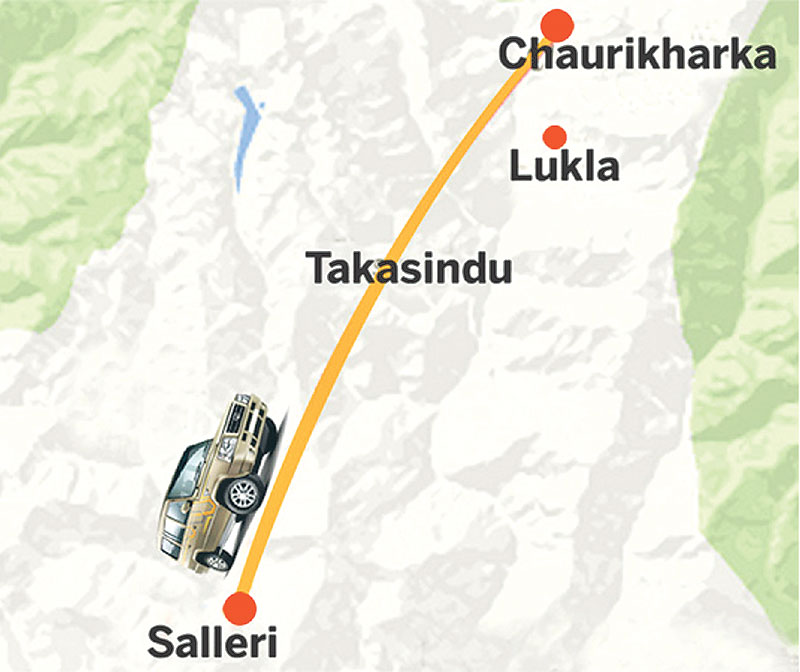
According to Ganesh Ghimire, chief administrative officer of Khumbu Pasang Lhamu Rural Municipality in Solukhumbu, the track opening work from Khari Khola, at 2,100 metres, to Chaurikharka, about three kilometres from Tenzing–Hillary Airport in Lukla, has already begun. Officials expect the track opening work to be completed by July next year.
“The first phase—a track up to Khari Khola from Phaplu—has been completed,” Ghimire told the Post. “We plan to complete blacktopping by 2021.”
Ghimire said contractors have already started work on the track from Khari Khola to Chaurikharka. “Likewise, a separate contractor has been mobilised for the construction of a bridge over Dudhkoshi River,” he said.
The government had first decided to open a track linking the Everest region after the 2011 incident to ensure that nobody gets stranded for days on end due to disruption of flights.
Dubbed the Highway to Everest, the project started in 2014, but it hit a roadblock after the 2015 earthquakes.After the 2017 elections that installed local governments, Khumbu Pasang Lhamu Rural Municipality took the initiative to take the road project forward.Locals from the region had long been calling on the government to move the project ahead, citing high costs of commodities, flight service unpredictability and dangerous flights to Lukla Airport, which is considered one of the most dangerous airports in the world.
The Khumbu or Everest region is the most expensive place in the country because all supplies have to be flown in. A single cooking gas cylinder costs around Rs15,000, as it is ferried by porters and mules. A trekker has to shell out around Rs300 for a cup of tea. A one-way plane ticket for a tourist for the 25-minute flight to Lukla costs around $180, approximately Rs18,000. Airfreight charges from Kathmandu to Lukla stands at around $1.50 or Rs150 per kg.
The region is so costly that the majority of Nepalis hardly go there.But once the road is completed, Ghimire said, the region is likely to receive domestic tourists and trekkers in droves, as the road facility will make commodities and travel cheaper.
“People will be able to drive to the Everest region, crossing highlands and panoramic mountains range within a day from Kathmandu,” said Ghimire.
According to the plan, a bus station will be installed in Khari Khola. But from there, only electric vehicles will be allowed up to Chaurikharka.
“It’s part of the government’s initiative to keep the Everest region emission-free,” Ghimire said.
The rural municipality has already announced a ban on plastics below 30 microns and beverage bottles in the Everest region starting January 1.
Ghimire said that the rural municipality has also planned to construct a ropeway or cable car from Chaurikharka to Namche Bazaar, at 3,440 metres, which is home to most of Sherpas or mountain guides.
Last year, 56,303 foreign trekkers and mountaineers visited the region, and Ghimire believes the road access could take that number close to 500,000, including domestic and international tourists, annually.
Sitaram Sapkota, former president of the Trekking Agencies Association of Nepal, said the motorable road would help ease the transportation of supplies to the mountain region.
Lukla Airport was built in 1964 by the Himalayan Trust, created by Edmund Hillary. The objective of the airport at that time was to ease the transportation of supplies to the region. Before the airport was built, people used to take the Jiri trail to reach Everest Base Camp—a 10-day trek.
“The road will also reduce the problem of trekkers being stranded at the Lukla Airport,” said Sapkota, a chief marketing executive at Altitude Air. “However, the motorable road should not go beyond Chaurikharka because it will destroy the environment as well as the value of trekking in the region.”

HOME PAGE

What does your future hold? Open your palms (and wallet) to find out

Thousands of people come to Pashupatinath to worship Lord Shiva, and then find solace from one of the dozens of palm readers who have set up shop on the temple premises.
- Post Report

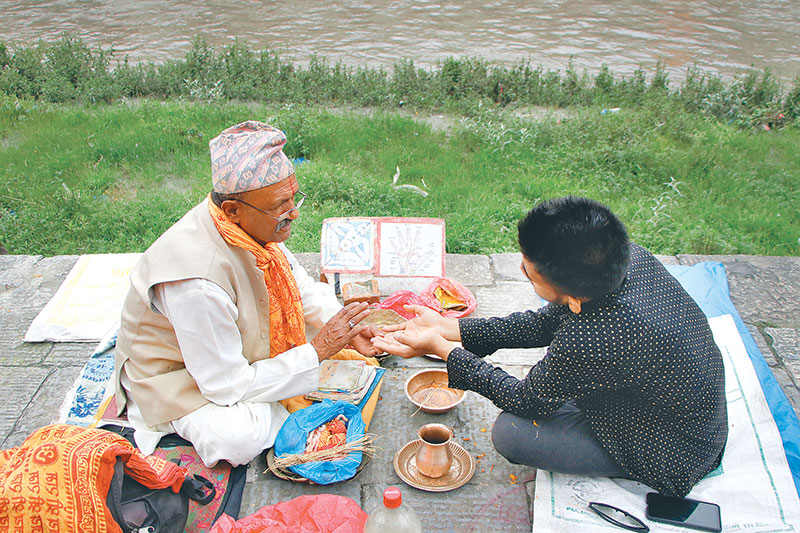
A priest reads palms near the Pashupatinath temple in Kathmandu.Post Photo: Anish Regmi

KATHMANDU : On a recent afternoon at the Ramghat in Pashupati, Tika Prasad Ghimire was examining the hands of Paras Khadka, a 62-year-old man from Banke.
“You have surpassed an upheaval in life. Good days are ahead now,” said 82-year-old Ghimire, carefully reading the lines on Khadka’s right palm. “But it seems you have some health problems, mainly in your stomach.”
Khadka’s wife, son, and daughter-in-law, who were all intently listening to the palm reader, nodded their heads in agreement, as Khadka had just been treated for a kidney stone. The session lasted 15 minutes and Khadka paid Ghimire Rs 2,100, which included charges of performing a ritual in memory of his father who had passed away. Ghimire is one of the two dozen palm readers who await customers at Pashupati every day. A snap survey with the palm readers showed that business is good, and they were mostly happy with what they earned.Pashupati Khanal from Dhading came to Kathmandu after the 2015 earthquake destroyed his house.
“I polished my knowledge in palmistry after arriving here,” the 47-year-old said. “I make between Rs 30,000 and Rs 35,000 a month.”Apart from reading lines on palms, Khanal also performs different Hindu rituals for which he charges separately. “It’s only natural that people are curious about their future and they ask me to examine their hands,” said Khanal, who did not appear very keen to explain just how he had improved his palm reading.
Palm reading has been in practice for centuries, even though the debate over whether it is science or pseudoscience has been around for nearly as long. Some studies suggest the practice is not completely off base. The Atlantic in 2015 cited numerous pieces of research that suggest how human hands can predict physical and mental traits as they contain a wealth of information.
Anthropologists and sociologists say that a belief in palmistry has more to do with people’s cultural and religious beliefs than the actual ability to predict the future.
“People all over the world have held faith in palmistry, astrology and birth chart reading for thousands of years,” said Damber Chemjong, head of the anthropology department at Tribhuvan University. “A majority of people in our society might say they do not believe in such things even if they actually hold deep faith in them.”
According to Chemjong, even if people don’t believe in what they are told by palm readers or astrologers, such visits can help boost people’s confidence.
That’s exactly what happened with Susmita Baral. The 20-year-old woman from Pokhara had come to worship at the Pashupatinath temple when she decided to visit a palm reader.
“I have some relationship issues with my husband,” said Baral, who was happy to pay Rs1,500 to a palm reader. “I am quite relieved. I was told that the lines on my hands show that I will have better days ahead. I think I just have to perform some rituals.”Anthropologists say it’s human nature to search for happiness and people try different ways to seek solace—some go to astrologers and palm readers, others might try to look for things on the internet.
“There is nothing wrong as such as long as people do not get overwhelmed and completely leave their lives up to fate,” said Chemjong. “Ultimately, it’s people’s actions that determine their future. If things work out well, they might link their success with luck and well-aligned planets.”
Forty-five-year-old Dilmaya Pode looked concerned about the future of her son, 21-year-old Kishan. “My son’s second marriage failed. He just roams around the city. He is my only son and I want to find out what is best for him,” said Pode, who was paying Rs2,000 to a man reading her son’s birth chart. “I hope things will work out.” She did not know how exactly but appeared confident.Kedar Man Bhandari, the chairperson of the group that oversees Pashupati, said that there’s no harm in a brief palm reading session if it makes people happy.
“But what is concerning is that the majority of palm and birth chart readers here have very basic knowledge. I don’t know exactly what they tell the people who approach them,” said Bhandari. “I just hope they are not misleading people.”Arjun Lamichhane, the editor and publisher of ‘Gauri’, a magazine that focuses on Hindu heritage and culture, however, is sceptical.
“Most of these priests first instil fear among those who approach them and then act as if they have some magical formula to address all of their problems,” said Lamichhane. “This is illegal. Palm readers and astrologers with half-baked knowledge often rip off people who are in distress. Happy and successful people do not approach them.”Lamichhane, however, does not disapprove of palmistry and astrology. He just stressed that if people need sane advice, they should go to those with expertise.Then why has the number of palm readers and astrologers increased at Pashupati?Because the clients keep coming, said Chemjong.
“People’s aspirations have shot up, but many don’t know how to fulfil them, so they seek help from palm readers and astrologers who they believe can show them the way,” said Chemjong. “Pashupati is one of the major temples in Kathmandu visited by thousands of people. Where there are clients, there are service providers. It’s simple demand and supply.”

Anthropologists say it’s human nature to search for happiness and people try different ways to seek solace—some go to astrologers and palm readers.Post Photo: Anish Regmi

Page 2
MEDLEY

Horoscope

ARIES (March 21-April 19)
***
Giving an unclear explanation of what you are feeling and then getting annoyed when they don’t understand isn’t productive. Be more specific in your communication and then only people will know what you want, and work harder. This is especially true in romantic relationships, but applies everywhere else too.

TAURUS (April 20-May 20)
***
A simple statement will unlock a complicated mystery for you and a friend today. Now that you both know how to move forward, the going could get a lot easier—and you two can accomplish your common goals more quickly. Use your free time today to have fun together and catch up on the latest adventure in their life.


GEMINI (May 21-June 21)
**
You will impress a lot of people today. But there will be one or two misunderstandings. Let it go and be happy, you can’t always have a perfect record. Be careful about how friendly you get with new people—they may assume you want more from them, and this type of misunderstanding is simply not acceptable right now.

CANCER (June 22-July 22)
**
Instead of wasting your energy trying to figure out the reason behind the shift of plans, direct it toward formulating a effective reaction to the new situation. You can’t afford to have a ‘whatever’ attitude about any surprises. If something bothers you or frustrates you, take charge and get rid of it and put things back on track!

LEO (July 23-August 22)
***
Remember that things are essentially subjective in life. Everything is allowable, everything should be respected, and no one should be judging anyone today. Just as you wouldn’t like someone to criticize your aesthetic taste, you cannot deride anyone else’s choices—especially when it comes to artistic choices.

VIRGO (August 23-September 22)
****
Do a little research a bit and your vision about your new schedule will become more vivid. You’ll start seeing everything in a more positive light and you may even start feeling downright cocky about how you will handle things. What you used to think was a problem will turn out to be a new puzzle to solve.

LIBRA (September 23-October 22)
***
There is a lot of comfort in doing same thing over and over again. As boring as it can be, your routine is something that gives you stability throughout the ups and downs of your life. If you feel that you are keeping yourself too stable, stick a toe into the waters of variation, and try something new. You’ll like it!

SCORPIO (October 23-November 21)
***
If you are not feeling as revved up as you usually do, spend time with the people who have good energy. Get to the bottom of what makes them so happy and you will get a charge out of solving the mystery. It’s a great day to go to a church, library, or any place where people are quietly exercising their mind and their soul.

SAGITTARIUS (November 22-December 21)
**
It’s time to get yourself refocused on who you are alone, as an individual. You may be running the risk of losing yourself in the noise of socializing and solving other’s problems. Ask yourself honestly if you are working so hard on friendships and relationships with other people to avoid working hard on yourself.

CAPRICORN (December 22-January 19)
***
There are many ways to connect with others, but the most effective method is the one that makes you the most comfortable. You need to feel relaxed in order to make other people feel that way. So if you don’t like noisy, crowded bars, don’t go to them. Where you go and what you do is an extension of your personality.

AQUARIUS (January 20-February 18)
**
Hang on to your wallet with an iron grip today! At first, you might think that you’ve come across a great bargain or no-fail investment opportunity. But things aren’t as they appear. Ask a few more questions, and soon you’ll get the sneaking suspicion that there are facts hidden from you. And when you get that feeling, run for the hills!

PISCES (February 19-March 20)
****
Set aside some time and treat yourself—whether that means splurging on a fancy dinner, chilling at home watching your favourite movie and take out or going on a trip. Social hound friends will be thrilled by this, and will help you figure out how to lavish good stuff on yourself. Decide what you want, and they’ll help you get it!

Page 3
NATIONAL

Government revokes its earlier plan to conduct grade 11 exams at national level

Experts say the education system cannot run on an ad hoc basis.
- BINOD GHIMIRE

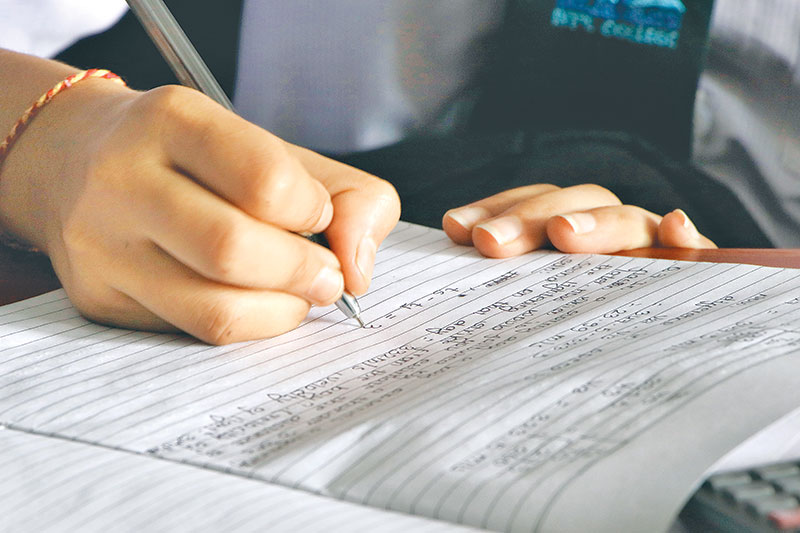
Officials say the decision was made based on the suggestions from school operators.Post Photo: Anish Regmi

KATHMANDU : In what looks like yet another example of policy inconsistency, the Curriculum Development Centre has revised its one-year-old decision regarding grade 11 examinations.
The Centre last year approved a curriculum framework for the school level, which envisioned that the Central Examination Board would conduct grade 10 and 12 examinations at the provincial and central levels, respectively, while the respective schools would hold class 11 tests on their own. The policy was supposed to be implemented from the current academic session.
The new provision was introduced in line with the eighth amendment to the Education Act in 2016 which restructured the school education in two categories—basic (grades one to eight) and secondary (grades 9 to 12).
Lekha Nath Poudel, director general at the Centre, said the policy was revised based on the suggestions from school operators and teachers.
“Schools and teachers wanted the board to conduct the exams. They are worried that students wouldn’t study if the tests are conducted at the school level,” Poudel told the Post. “The concerned parties were also worried about the standard of the tests if every school were to hold them separately.”
Private school operators say they were consulted before the revision in the policy. They stood for the board exam fearing that students give up hard work when schools start conducting examinations on their own, they said. “The students could take the tests for granted if schools start conducting them,” Lok Bahadur Bhandari, general secretary of Higher Institutions and Secondary Schools’ Association Nepal, told the Post.
He said the students stopped working hard after the letter grading system of evaluation was introduced for Secondary Education Examinations because everyone thought no one would fail the test.
Bhandari said they are concerned if a similar trend would repeat in grade 11 as well if the schools were to conduct the exams on their own.
Education experts, however, say the crucial decisions in the education sector should be taken after proper homework and consultation.
“Why was the provision introduced if it had to be revised within a year?” said Binaya Kusiyat, a professor at Tribhuvan University who has conducted many studies on school education. “The education system cannot run on an ad hoc basis.”
Kusiyat said though there is no set standard—whether the national board should conduct the grade 11 examinations—it would have been better if schools were allowed to conduct the tests.
“If the board conducts the tests of grades 10 and 12, it wasn’t essential to increase its burden by adding grade 11. Grade 11 tests are conducted by schools themselves in many countries including India,” he said.
The centre has also decided to reduce the number of compulsory subjects to three from four as envisioned last year. Earlier, Nepali, English, Social Studies and Life Skills Study were compulsory subjects for grades 11 and 12. Now, grade 11 students will have to study Nepali, English and Social Studies as compulsory subjects while those from class 12 will be studying Nepali, English and Life Skills Study. In addition, students will have to choose three other optional subjects.
Private schools had been objecting to the provision of having four subjects as compulsory. Till now only two subjects are compulsory. The centre is currently preparing new curricula under the revised framework. If the government’s plans work, the new framework will be implemented from the next academic year that commences in April 2020.

NATIONAL

Ambiguous regulation puts nearly 1,500 contracts at termination risk

The Public Procurement Regulation has a provision of extending deadlines of expired contracts, but it does not specify which project gets extension, officials say.
- PRITHVI MAN SHRESTHA

Officials at the Department of Roads, which awards the largest number of contracts, say most of the projects cannot be completed even after deadline extension.  Post Photo

KATHMANDU : A majority of the government contracts, whose original deadlines expired before June 6 this year, might not get an extension on their contracts, even though the latest amendment to the Public Procurement Regulation allows deadline extension until June 4 next year.
The eighth amendment to the regulation allowed an extension of contracts until June 4 next year, provided that they were signed before June 6 this year.
The concerned contractors, however, say that the government secretaries are reluctant to extend the deadlines on the grounds that the regulation does not clearly specify the period from the expiry of the original deadline and June 6 this year.Rabi Singh, president of Federation of Contractors’ Association of Nepal, said as many as 1,500 contracts could have their contracts terminated due to ambiguous regulation.
“There are around 1,500 contracts—out of 22,000—whose deadlines expired long before June 6 this year,” Singh told the Post. “The government secretaries are refusing to extend these contracts, citing that the regulation lacks clarity on what to do regarding the period between the expiry of original deadline and June 6 this year.”
According to Singh, the government officials are reluctant to extend the deadlines also raises from the fear that they might be probed by the Commission for Investigation of Abuse of Authority without clarity in the regulation.An official at the Department of Roads, which awards the largest
number of contracts, also admitted that there was a lack of clarity in the regulation, which was amended three times in two and a half months.
The regulation was first amended on May 13, which was further amended on June 6 and August 1 following the pressure from the contractors.
The issue of how to extend the deadlines of expired contracts has become a complicated problem, said Shivahari Sapkota, the spokesperson for the Department of Roads.
“We are, however, positive about extending the deadlines as long as the contractors come up with convincing proposals by increasing their performance guarantee,” Sapkota told the Post. “We have also forwarded the contracts that are facing termination risk to the Ministry of Physical Infrastructure for approval.”
As per the regulation, a government secretary is responsible for extending contract deadlines until June 4 next year if the concerned contractors
can convince through their proposals that they will accomplish the projects within the extended period.Some officials at the Department of Roads, however, say that most of the projects cannot be completed by June 4 next year.
The contractors, meanwhile, say that the progress of their projects will certainly be compromised if the government continue to remain indecisive on the issue of contract extension.
“We have already taken this issue up with the physical infrastructure minister. We are also trying to meet the prime minister to talk about it,” said Singh.

Page 4
NATIONAL

Doctors warn dengue-infected pregnant women against self-medication

While the virus could cause still and premature births, doctors say self-medication could be equally dangerous.
- Arjun Poudel

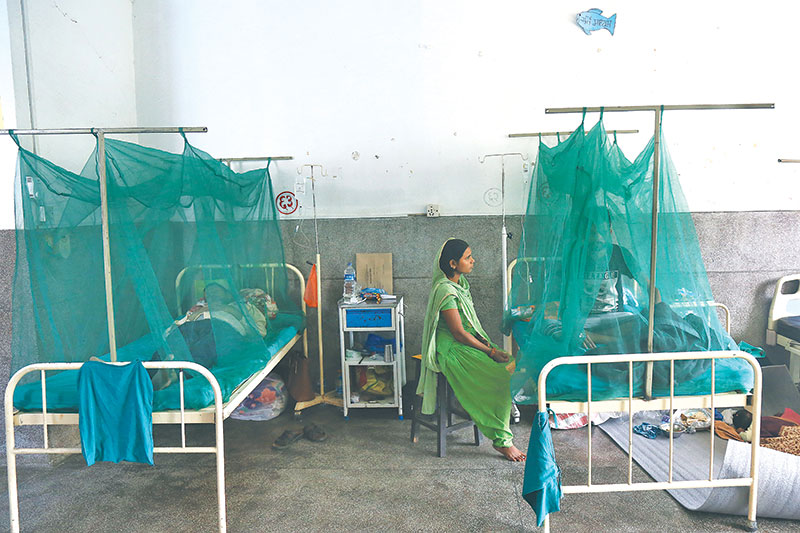
Dengue patients undergo treatment at Sukraraj Tropical and Infectious Disease Hospital in Teku, Kathmandu. Post Photo: KABIN ADHIKARI

KATHMANDU : Gynaecologists, as well as public health experts, have advised dengue-infected pregnant women to avoid self-medication as it has serious medical repercussions on the mother’s health and that of her unborn baby.
Dengue virus could easily transmit to babies which may cause stillbirth, low birth weight or premature birth, and self-medication could make matter worse, doctors have warned.
Medicines taken without expert’s consultation during pregnancy may also affect the health of the foetus and its overall development.
“We have to weigh the risk before prescribing medicines to pregnant women,” Dr Achala Vaidya, chief consultant gynaecologist and head of Obstetrics and Gynecology Department at Norvic International Hospital, told the Post. “We have to save the mother if her health is in danger.”
Dr Vaidya said that the dengue virus could cause severe complications in pregnant women including internal bleeding due to a sharp reduction in blood platelet count.
“It’s important to counsel pregnant woman and her family about the risks before prescribing any medicine,” she added.Studies also show contracting dengue during pregnancy could cause congenital brain defects in babies.Dr Kiran Regmi, a senior gynaecologist, said that no medicines should be given to pregnant women before first trimester (up to 12 weeks). “We do not even prescribe iron tablets in the first trimester,” said Regmi, “Medicines will affect the overall development of the foetus.”
She, however, said that if the mother’s health is at risk, the first priority should be given to saving her life. She said that chances of miscarriage become higher if pregnant women get infected with dengue virus and take medications for the same.Dr Jageshwor Gautam, director at Paropakar Maternity and Women’s Hospital in Thapathali, has advised pregnant women not to take any medicine without consulting the doctor. “Fever can be brought down by cold compress or bathing,” said Gautam. “It is up to the doctors’ discretion to treat a patient and to take further steps if her health deteriorates.”
At least seven people have died, over 10,000 have been hospitalised due to dengue infection, according to Epidemiology and Disease Control Division. Hundreds of pregnant women have been diagnosed with dengue since it was first reported some five months ago.
Dengue is a mosquito-borne viral disease, which is transmitted by the female Aedes aegypti and Aedes albopictus mosquitoes. The vectors that breed in clean water and are active during the day are the same vectors that transmit chikungunya, yellow fever and Zika virus, according to the World Health Organization.
According to doctors, mild to high fever, severe muscle pain, rashes, severe headache, and pain in the eyes are some of the symptoms of dengue.
The UN health agency says there is no specific treatment for severe dengue, but early detection and access to proper medical care can lower the fatality rate.

Page 5
NATIONAL

Religious leaders and locals oppose the diversion project of Kaligandaki-Tinau

The project is expected to affect the lives of around 300,000 people from 10 local units.
- RAMESH KUMAR PAUDEL

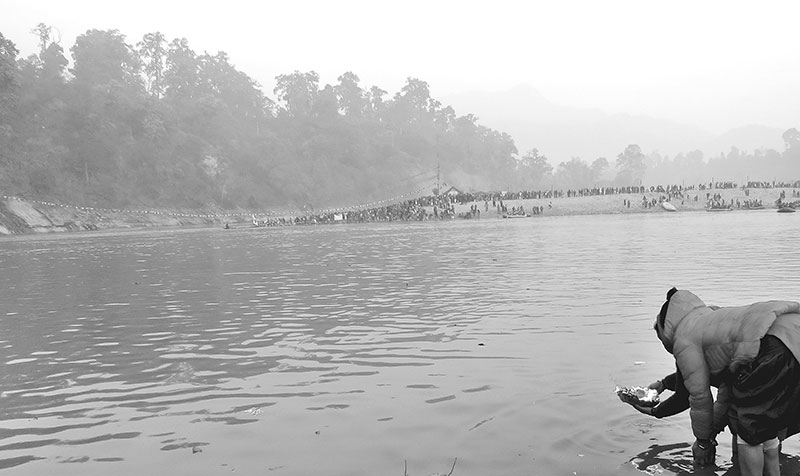
Diverting the Kaligandaki river will affect Devghat, a place of religious importance.Post Photo: Ramesh kumar paudel

CHITWAN : Religious leaders of the Devghat area (in Chitwan) have protested against the government’s plan of diverting the Kaligandaki river into the Tinau river.
The Devghat Area Development Committee, Nepal Santa Samaj and Devghat Rural Municipality of Tanahun jointly organised a programme in Bharatpur, Chitwan, on Monday to discuss the impact of the Kaligandaki-Tinau Diversion Multipurpose Project. Four different papers on the multi-billion project were presented at the programme.
The project envisions to irrigate around 106,000 hectares of land in Rupandehi and Kapilvastu districts and produce 104 MW electricity by diverting the water of the Kaligandaki river to the Tinau through a 30-kilometre long tunnel. The estimated cost of the project is around Rs 45 billion.
But locals claim that the project would greatly affect the ecosystem of the place, its population and even the existence of Devghat—a revered place for Hindu pilgrims.Presenting his paper, Swami Chaitanya Krishna, the chairman of Kaligandaki Gyan Bigyan Pratishthan, said the diversion project stands to ruin the area’s ecosystem. “The Kaligandaki river, which has deep cultural and religious significance, should not be disturbed in the name of irrigating land and generating hydroelectricity,” said Krishna, urging the government to not pursue the project. “It is a civilisation in itself. Any act of disturbing the river greatly affects Devghat and Tribeni.”
The government has even allocated a budget to prepare a detailed project report of the project. The project aims to divert the water of the Kaligandaki river from Ramdighat of Syangja to the Tinau river.According to Shanta Bahadur Shrestha, a former government secretary, after the completion of the project, the water flow of the Kaligandaki river will be decreased by 40 percent, which will affect around 300,000 people from 10 local units of Tanahun, Nawalparasi (East) and Syangja.
“There is comparatively less rainfall in the Mahabharat area below Ramdi. If the project is implemented, there will be a decrease in the water flow in the river which will result in a drier riverbank,” said Shrestha. He added that 80 percent of arable land in Rupandehi and Kapilvastu already have irrigation facilities and providing more water to the areas should not be a point of focus of the government, especially considering the consequences such a hazardous move will bring on the areas in the downstream of Ramdi.
The programme was chaired by Kiran Gurung, Minister of Economic Affairs and Planning of Gandaki Province. Speaking at the programme, Minister Gurung asserted that the Gandaki Province too was against the project. Chiefs of three Ashrams—Galeshwor, Mahesh Sanyas and Harihar—attended the function.
Guru Prasad Subedi, general secretary of Nepal Santa Samaj, said the diversion project would ruin the religious importance of Ramdi, Keladi and Devghat. “Kaligandaki is not only a river, but it is also home to Devghat which goes as far back as the Vedic civilisation,” he added.
Kulraj Chalise, who completed his PhD thesis on the Kaligandaki river, said, “The multipurpose project is not suitable because it has a possible negative impact on the underground water and ecosystem.”
Earlier, Chief Minister of Gandaki Province Prithvi Subba Gurung had said he would not let the federal government carry out the project at any cost, as the Kaligandaki, which is considered a holy river for Hindu people, flows through Gandaki Province, before emptying into the Trishuli river at Devghat.

NATIONAL

More than two dozen assault cases registered with Rupandehi police in last two years

Business community fears the rise in criminal activities is working against the district’s commercial ambition.
- MADHAV DHUNGANA

BHAIRAHAWA : On Sunday, Mahendra Kurmi of Patkhauli in Omsatiya, Rupandehi, was shot dead by unidentified persons while returning home from the bank. According to police, he had withdrawn Rs 500,000 from the Bhairahawa-based Himalayan Bank. Two motorcycles followed Kurmi, shot him and ran away with the money. The incident site is around 5km east from Bhairahawa, the district headquarters of Rupandehi.
On March 27, a 43-year-old Indian national Firoj Khan was shot dead by a sharpshooter at Gadhitol in Butwal. He was returning home from work when the incident occurred. Police claimed that Firoj’s wife carried out the murder.
On July 2, an unidentified person shot Resham Kumari Malla, chairperson of Gaindahawa Lake Repair and Sanitation Consumer’s Committee, and looted Rs 460,000 from her when she was returning home after withdrawing cash from Agricultural Development Bank in Lumbini.
On May 16, Jhinak Dhobi, an Indian national was found with a pistol at Piparaiya in Siddharthanagar. Dhobi was found with the pistol during regular police checking along the Nepal-India border area.
The above cases highlight the increasing instances of locals’ possessing and using small assault weapons to rob, extort and kill in Rupandehi. According to the District Police Office, Rupandehi, in the last two years, more than two dozen cases of assault using small weapons have been registered with the police in the district.
Possession of illegal small assault weapons is mainly due to the porous border and lax security checks at the border point, said Hridaya Thapa, superintendent of police in Rupandehi. “There are security challenges in the district. Firearms can be easily purchased in the bordering Indian villages; smuggling of small firearms in the district is becoming a major security threat in the district.”
Santosh Pandey, a provincial lawmaker from Rupandehi Constituency-3, said that residents of his constituency have started expressing concerns about their safety after instances of daylight robbery began making headlines in the district. “Even those in Bhairawaha feel unsafe amidst these growing instances of assaults and murders,” said Pandey.
The Rupandehi district is gradually transforming from a sleepy border area to a developing trade and tourism hub, but traders and tourism entrepreneurs fear that the increase in criminal activities in the district is working against the district’s ambition to expand commercially.
Kul Prasad Neupane, chairman of Siddhartha Chamber of Commerce and Industry, who was also victim to assault two years ago, said, “An unidentified man shot me while I was at my shop. The perpetrator is still at large. The business community does not feel safe doing business in Rupandehi anymore.”Stressing on the need to have a stringent security system in place at the border checkpoints, Sanjaya Bajimaya, a tourism entrepreneur, said, “Unlawful activities can be controlled only if the concerned officials tighten security at the border area. It’s the responsibility of the nation to protect its citizens.”
According to Bajimaya, the checkpoint at Bhiarahawa-Sunauli border currently does not have strict security checks. Security officials do not even verify the names of individuals or run X-ray machine checks in the border area. Hridaya Thapa, superintendent of police, agrees that there are security challenges in the district. “Both the Nepal Police and Armed Police Force should conduct tighter surveillance in the border area to maintain peace and security in the district. There should be 24-hour security monitoring in the border area,” he said.
Meanwhile, Mahadev Panta, chief district officer, said that smuggling of small firearms and drugs and human trafficking and other unlawful activities have marred the district and its potential to grow into an economic hub in the country. “Butwal is the temporary provincial capital of Province-5. So, the area is also a highly sensitive area,” said Pantha.

NATIONAL

Public vehicles on the Mid-hill Highway charging exorbitant fares

Passengers are forced to pay anywhere between Rs 600 and Rs 700 for one-way tickets, far exceeding the fare ceiling fixed by the Department of Transport for highway buses.

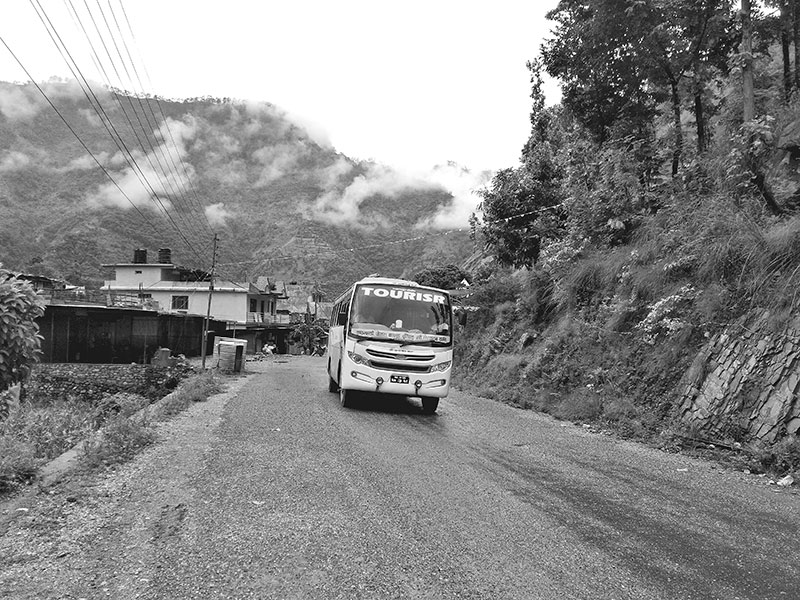
Although the road is blacktopped, buses charge fares as they would on rural roads.Post Photo: prakash baral

BAGLUNG : Passengers travelling between Kharbang in Badigad and Baglung Bazaar, the district headquarters, along the Mid-hill Highway are forced to pay anywhere between Rs600 and Rs700 one way—much higher than the fare ceiling fixed by the government.
Although 65-km stretch out of the 90 km highway has already been blacktopped, locals say the transport entrepreneurs have been charging fares as they would on rural roads.
Harka Bahadur Kumal of Badigad, who frequently commutes between Kharbang and Baglung Bazaar, said that he has been paying Rs700 one way. “We pay what is asked of us because if we don’t, then the conductors become unruly and misbehave with us.”
According to the Department of Transport Management, transport entrepreneurs can only charge a fare of Rs2.5 to 3 per kilometre on the national highways. But passengers have been compelled to pay high transport fares along the Mid-hill Highway, as the authority concerned has not taken initiatives to address the issue.
According to passengers, a bus charges Rs600, whereas a jeep fare is Rs 700 for a one-way commute from Baglung Bazaar to Kharbang. “Earlier, the rate was Rs550, but they nowadays charge Rs600 to 700,” said Kumal.
“A decade ago, the Baglung Bazaar-Kharbang road was in a state of disrepair. But now a larger part of the road has been blacktopped,” said Tulasiram Kandel, an officer at the Transport Management Office in Baglung, vowing to take action against No one has the authority to raise transport fares, not even drivers. We will investigate the matter and bring transport entrepreneurs to book.”
Although the department has fixed a ceiling on public transportation fares that run on national highways, it has yet to send a memo to the District Transportation Fare Adjustment Committee, said Kandel. “That’s why the drivers have fixed the fare arbitrarily.”
Chief District Officer Luk Bahadur Chhetri has assured that he will soon call a meeting of the stakeholders and take stock of the situation.
“A bus should charge Rs8 and jeep Rs9 per kilometre as transport fare as per the decision made last year. But, I have been informed that they have been charging exorbitant transport fares from passengers,” said Chhetri, adding, “I will immediately take action and direct the stakeholders concerned to implement the decision.”.
Meanwhile, Chairman of Dhaulagiri Transportation Company Umesh KC tried to justify the high fare, claiming that they have been providing quality services to the passengers. “We have fixed transport fares as per the facilities provided by the vehicles,” KC said.
According to him, the vehicles have facilities including AC, drinking water and entertainment system for the passengers. Kumal, however, begs to differ.
“We haven’t received such facilities. The AC doesn’t work most of the time,” he said.

NATIONAL

Sarus cranes spotted in Kailali after seven years

The bird started to disappear in the area due to heavy encroachment of wetland areas, its major habitat.
- Ganesh Chaudhary

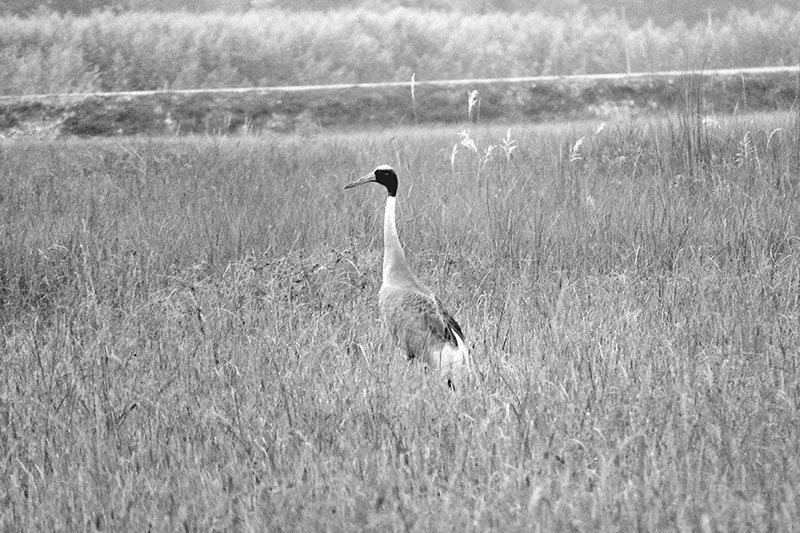
The bird was not sighted in the district since 2012.Post Photo: ganesh chaudhary

TIKAPUR : The Sarus crane (Grus antigone), the world’s tallest flying bird, has been spotted in Bhajani area of Kailali district after seven years.
The Sarus cranes were a common sight in the district in the past; however, according to Hirulal Dagaura, a local, the bird species had not been sighted in the district since 2012.
“Three Sarus cranes were spotted in different areas in the Bhajani area in the past few days,” said Dagaura. The three birds were spotted in Mantri Phanta, Jhapti lake and Chharlaiya lake in Bhajani. Dagaura believes they could be a couple and a baby, as the bird species are always found in pairs.
According to conservationists, Sarus cranes had started to disappear from Kailali due to the encroachment of wetland areas, the major habitat of the bird species.
The Sarus crane is mostly found in the Indian Sub-continent. And in 2000, the large non-migratory bird was enlisted in the IUCN red list of threatened species after its population dwindled. Conservationists said the threatened species are dying at an increasing rate in the country in recent years.It is estimated that there are around 500 to 700 Sarus cranes in Nepal currently. Among them, about 300 are found in Kapilvastu, Rupandehi and Nawalparasi districts.
“The Sarus lives in agricultural fields, forests and wetland areas. To conserve the bird, it is important that local communities participate in, and take ownership of, conservation efforts,” Dagaura said.According to existing legal provisions, one will be fined Rs 500 to Rs 100,000 or jailed three months to two years (or both) for killing a Sarus crane, destroying its eggs or smuggling the threatened bird species.

NATIONAL

Transport resumes along Mailung-Syaphrubesi road

Briefing
- Post Report

RASUWA: Transportation along the Mailung-Syaphrubesi section of the Galchhi-Trishuli-Rasuwagadhi road resumed on Tuesday. The road was obstructed by landslides two months ago. The Mailung-Syaphrubesi is an alternative road to the Ramche-Grang road which has been disrupted for the past seven days due to landslides.


NATIONAL

Five houses at high risk of landslide

Briefing
- Post Report

GORKHA: Five houses at Muchchok in Gorkha district are at high risk of landslide. A massive landslide recently occurred about 80 metres below the settlement, leaving the houses at risk. Efforts are on to relocate the houses to a safer location, said ward chief Manu Gurung.


NATIONAL

1,070 people infected with dengue in Makwanpur

Briefing
- Post Report

HETAUDA: More than 1,000 people in Makwanpur district have been
infected with dengue this year. According to the District Health Office, 1,070 people were diagnosed with the infectious disease as of Tuesday while conducting laboratory test of 3,205 blood samples.


NATIONAL

NC takes out protest rally demanding action

Briefing
- Post Report

BANKE: The Nepali Congress (NC) staged demonstrations in Nepalgunj on Tuesday to protest the alleged attack on its district president. The agitators took out a protest rally at Dhamboji Chowk and demanded immediate action against the guilty involved in attacking NC Banke President Kiran Koirala last Thursday.

Page 6
EDITORIAL

Medical education in peril, again

Nepal’s medical education sector has been failing. Having been mired in one controversy after another for years, it was hoped that the many hunger strikes led by Dr Govinda KC would lead to some concrete change in the system. Parliament has passed legislation incorporating many provisions stemming from the recommendations made by the Kedar Bhakta Mathema-led Medical Education Commission, but these clauses have not been implemented.

No date has been fixed when the provisions in the new act will be implemented, and the newly formed Medical Education Commission, the regulatory body, is still devoid of members. It is no wonder then that students have been agitating over the plan of universities to push through with the entrance examinations. The government has a responsibility to fulfil the regulations set out in the National Medical Education Act. After all, the provisions in the Act are the bare minimum to improve the ailing and corrupt sector. Further, no new intake of students can occur until the Act is implemented fully. Not doing so will just allow the rot in medical education to affect the sector for many more years to come.

The problems in the medical education sector are not new. For years, colleges were opened by businesspersons with the primary objective being profit maximisation. While profit-making is not inherently bad, to have that aim trump more vital ones—like serving patients and producing the best students—in such a crucial sector is obviously wrong. The result was the opening of a string of sub-par colleges, primarily surrounding population centres. The problem here was twofold. On the one hand, students were charged exorbitant fees while receiving a sub-par education. This meant that the quality of the healthcare sector itself would degrade over time. On the other hand, with the institutions being centred mostly around the Kathmandu Valley, the opportunity to make healthcare more equal across the country was lost. It took Dr KC’s risking his life five times for the then-government to even set up an independent committee to look into improvements. It took another 10 hunger strikes by the good doctor, and numerous protests and strikes by doctors and the general public alike, for lawmakers to consider implementing some of the Mathema Commission’s recommendations (submitted in 2015) into the Medical Education Act (passed in 2019).

Now that the Act is finally in place, albeit still lacking some of the recommendations, the medical colleges in tandem with the government are still hell-bent on ignoring its provisions. But what can be expected from a regime where the parliamentary Committee on Education and Health has education business owners as its members? At such a significant time for the sector, the parliamentary sub-committee had the gall to blame parents and students for paying the exorbitant fees in the first place. The current demands of the protesting students, pressurising the government to first implement a standardised entrance test for all universities and to provide scholarship seats as provisioned in the new act, are legitimate and valid.

OPINION

The expired charter

Nepal has had seven constitutions in as many decades; the latest one is entering middle age.
- CK LAL

The contested constitution in Nepal is the seventh one in as many decades. By that reckoning, the average age of statutes in Nepal is 10 years. It implies that the present charter will be entering middle age this week. The government wants to mark the occasion with festivities to ensure its longevity. Every Poush 1 during the Panchayat era, civil servants were asked to compulsorily present themselves in official celebrations duly attired in the labeda-suruwal ensemble complete with Western jackets of the right colour, and black leather shoes. The ones in Kathmandu gathered at what was then called the Royal Army Pavilion.
In a decision reminiscent of diktats of the despicable royal-military regime, the incumbent Oli-garchy has decreed that all government employees must present themselves duly dressed in the appropriate manner. The prescribed attire for everyone else is a designer T-shirt with the national flag emblazoned on the chest. The government wants you to prove your fealty to the new set of rulers. Rightly has it been said that the more things change, the more they stay the same.
In order to drive home the point, spokesperson for the Nepal Communist Party government and Minister of Information and Communications Gokul Prasad Baskota pronounced that the Constitution Day holiday wasn’t meant to be wasted on drinking, dating and making merry. The instruction is intended to make everyone become a nationalist in every sense including the darker connotations of the term.
Minister Baskota keeps putting his foot in his mouth quite often with odious outbursts, but the edict to swear loyalty to the contested charter carries deeper meaning. It implies, among other things, that the party with a two-thirds majority in Parliament isn’t too sure of its ability to politically defend the controversial constitution. The regime also seems to suspect that the opposition parties will not be too willing to come to the government’s rescue if the plank upon which it stands—the controversial constitution—were to be pulled away under any pretext.

Performance anxiety
The sins of the past seem to be catching up with ruling party supremo and Prime Minister Khadga Prasad Sharma Oli as well as Co-Chair Pushpa Kamal Dahal. Premier Sharma Oli is the Maoist of the 1970s while the letter-head chairman Dahal dipped his fingers in the blood-soaked ideology sometime in the 1990s. Those that cause dread are accursed to live in fear forever. Scared of their own shadows, law enforcement agencies took some senior citizens, including former deputy inspector general Bijaya Raj Bhatta and former Nepal Army major Keshav Basnet, into custody on the day of Indra Jatra. They also confiscated some black T-shirts.
By all accounts, Gyanendra Shahi is a small-time agitator with neither the ability nor the organisational resources to challenge what has been touted as the most powerful government in Nepal’s recent history. Television personality Rabi Lamichhane is being investigated for his possible involvement in a criminal case. However, it’s ridiculous to present Shahi and Lamichhane or their raucous supporters as threats to the republican order of democracy, secularism, inclusion and federalism. The current spate of fear-mongering is perhaps born out of guilt. The Khas-Arya solidarity that manifested itself in the 16-Point Conspiracy has been unsuccessful in widening the acceptability base of the contested charter.
Political groups that failed to get the promised amendments have resolved to abstain from Constitution Day revelries. Samajbadi Party Nepal, a coalition partner of the government, has decided to stay away from formal functions. Rastriya Janata Party Nepal is unlikely to give up its position on the contested charter and endorse official celebrations. Several Janajati groups have expressed their reservations, and Dalits have nothing to celebrate. It seems the country’s seventh constitution obtained the acquiescence of voters, but failed to acquire the legitimacy of acceptance.
A cursory overview of possible reasons behind the failure of six previous constitutions can perhaps reveal the reason behind the flailing nature of the existing statute. The first one—the Government of Nepal Act 1948—lacked elite consensus of the Ranas and unravelled due to internal
rivalries. A gradual decay of the Interim Government Act of Nepal 1951 began the moment king Tribhuvan reneged on his promise to institutionalise a republic through Constituent Assembly elections. King Mahendra promulgated the Constitution of the Kingdom of Nepal 1959 under duress, and he wasn’t committed to the concept of constitutional monarchy from day one. It was fated at birth to fail.
The Constitution of Nepal 1962 was, in fact, a royal proclamation meant to legitimise the monarch’s autocratic rule. The Constitution of the Kingdom of Nepal 1990 was a document of tripartite compromise. The statute died a slow, painful and unsung death as a result of the creeping coup that began with the dissolution of Parliament in May 2002 and the subsequent declaration of internal emergency.
The Interim Constitution of Nepal 2007, with amendments made after the first and second Madhes Uprisings, was the most progressive statute in the history of the country. It sought to institutionalise a federal, democratic, inclusive and secular republic through an elected Constituent Assembly. The so-called politics of consensus killed its spirit. The idea of democracy without an opposition is inconceivable. Lack of a functional opposition turns all dissenters into enemies of the system. That’s the innate flaw of the existing statute, the Constitution of Nepal 2015. The fundamental premise of the charter was the division of spoils of office. An ambitious dotard, the then de jure prime minister Sushil Koirala wanted to retire as head of state.
Even though KP Oli was the de facto head of government at that time, he desired to be the supremo of a communist order as the last and just reward of having spent 14 years in jail in the prime of his life. Defeated and lost, Dahal just wanted to protect his human and material assets accumulated during the 12 years of the armed conflict. A quintessential opportunist, Bijay Kumar Gachhadar had no purpose but to bask in the reflected glory of the main players. Except for Koirala, every signatory to the 16-point conspiracy has achieved what they had wanted. Koirala is gone, and the rest no longer have any stake in defending the statute. The political lassitude of the masses is its only protection. On that note, do drink, date and make merry, whoever wants to do so over the extended weekend!

OPINION

Will the hard lessons of the oil attack be learned?

Attacks on Saudi Arabia’s oil facilities have done more than knock out global crude supplies.
- Post Report

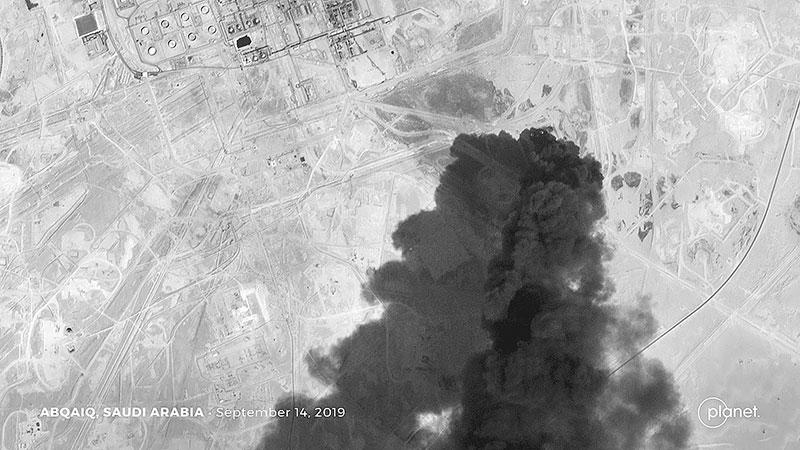
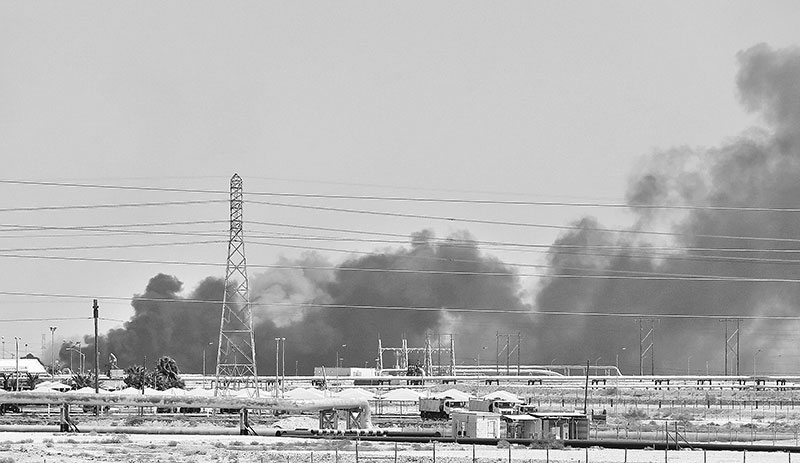
A satellite image shows an apparent drone strike on an Aramco oil facility in Abqaiq, Saudi Arabia September 14, 2019.Reuters 

The attacks on Saudi Arabia’s oil facilities have done more than knock out about 5 percent of global crude supplies, they have provided a myriad of lessons for all involved. There is still a high level of uncertainty as to who, what and how exactly Saturday’s attacks were carried out on Saudi Aramco’s facilities, including the massive crude processing plant at Abqaiq. But what is certain is that 5.7 million barrels per day (bpd) of production has vanished
and geopolitics is back driving the oil market.
This renewed risk was reflected in early price moves on Monday in
global benchmark Brent crude futures, which surged as much as
20 percent in early Asian trade, reaching a peak of $71.95 a barrel before easing back to around 13 percent higher at $68.22. In recent months, the oil market has largely discounted geopolitical risk in the Middle East and chosen to focus on the mounting worries that the US-China trade dispute is tipping the global economy toward recession.
The weekend attacks will have blown that market mindset out of the water, and the discussion will now be just how big should the risk premium be in the oil price. Much will depend on just how long the Saudi facilities are offline, with early speculation of a period lasting at least several weeks. This may well tighten the crude market substantially, especially in Asia, which takes about two-thirds of the cargoes from the world’s biggest crude exporter. Yes, the Saudis can export from storage, the United States and other countries can tap into their strategic reserves, and they can probably meet global requirements this way for several months.US President Donald Trump authorised the release of crude from the Strategic Petroleum Reserve on Sunday, a move that may have tempered some of the rise in oil prices. However, the longer the Saudi facilities remain offline, the more nervous refiners will become and the more likely they will be to pay a premium to ensure supplies. For now, the crude market has been reminded that the whole oil market can be upended very quickly, and that the sector has a series of vulnerabilities that can be relatively easily exploited by those seeking to inflict maximum damage.Another lesson is for Trump and his administration, and that is if you ramp up conflict and tensions with a country such as Iran, you must be prepared for the inevitable counter-punch.
The United States has made it clear that it believes Iran is behind Saturday’s attacks, although it has yet to provide firm evidence of this. But the chances are that this assessment is mostly correct and Iran, if not directly involved, is likely to have supported those who carried out
the attacks. This, of course, escalates the simmering tensions in the Gulf region, but it’s worth remembering this was started by Trump’s unilateral decision to withdraw from the multinational agreement with Iran on its nuclear program, despite evidence that Tehran was in compliance with the terms of the deal. The sanctions on Iranian crude oil may not have taken its exports to zero as Trump wanted, but it certainly has cut them substantially, taking them from around 2.3 million bpd to a figure likely under 1 million bpd.
Would Iran have attacked, or acquiesced to one of its numerous Middle East proxies directly targeting the most vital part of Saudi Arabia’s oil infrastructure if the United States had remained party to the nuclear deal? The weekend attacks dramatically increase the likelihood of an escalation of the conflict, with Trump already warning in a tweet that the United States is ‘locked and loaded’ and ready to hit back at what he termed the ‘culprit.’ The oil market now has to price in the possibility of an expansion of the current tensions in the Gulf into a shooting war in
which the belligerents target each other’s crude infrastructure and exports.
There is also the possibility that once the immediate emotions of the event calm down that a more measured response emerges and tensions are de-escalated. But that will probably require that Trump reverses course, and allows Iran back into international crude markets. Humiliating climbdowns aren’t exactly what Trump is known for, and he’s probably more likely to try and double down and escalate the conflict, without apparently having a plan for how to resolve his issues with Iran.
The weekend attacks should make it absolutely clear that Iran won’t back down and has the ability to wreak havoc on global oil markets. What the market probably wants to see is a return to a period of cooler heads in global geopolitics, but the chances are this doesn’t happen, and if it doesn’t, this risk will now have to factor into crude prices.

This article was previously published in The Japan News, a part of Asia News Network.

Page 7
OPINION

Recalibrating Nepal’s foreign policy

Trends in geopolitics are changing swiftly and Nepal must be up for the challenge.
- DINESH BHATTARAI

In May 1998, India carried out three nuclear weapons tests and wrote to the United States to show ‘understanding of India’s concerns for security’ in ‘an atmosphere of distrust’ that persisted mainly due to the unresolved border problem. Pakistan conducted ‘reactive’ tests during that time. During President Bill Clinton’s visit to China in June 1998, US and China came out with a Sino-US Joint Presidential Statement on South Asia pledging to ‘continue to work closely together to prevent an accelerating nuclear and missile arms race in South Asia.’ It gave China a security role in South Asia.
US geostrategic interests regarding China were reoriented in the following years. The rise of China has been the most important geopolitical development in contemporary international relations. The Asian giant’s economic growth was so rapid and spectacular, to quote ex-Czech president Vaclav Havel, that ‘we have not yet had time to be astonished’. Chinese President Xi Jinping has challenged the United States’ global preeminence more directly than any Chinese leader since Mao Zedong and sought to build a ‘new type of major country relations,’ in its desire to what late Singapore leader Lee Kuan Yew, said, ‘share this century as co-equals with the US’
Ever since US President Barrack Obama announced in 2011 the primacy of the Asia-Pacific region in US foreign policy, labelled as a pivot to Asia or rebalance towards Asia, it was viewed as a strategy to contain the rising influence of China in the region.
South Asia is a vital region of great diversity and major civilisations. Its geopolitics is complex and provides a fertile ground for great power competition. Given the conflicting claims and competing aims of India, China and the US in the region, along with the expanding Sino-Russian partnership, the complexity gets upscaled. The root of the great games of superpowers started with the Soviet invasion of Afghanistan in December 1979. The invasion fueled the divisions in ethnically diverse Afghanistan. Terrorist attacks on America (9/11) planned from hideouts in Afghanistan led the US to launch the Global War on Terror. Washington’s preoccupation with the Global War paved the path for China to increase its diplomatic footprint by promoting connectivity and building economic corridors to encourage regional cooperation for economic growth, including through the Belt and Road Initiative (BRI) in the region. It is also the time the American leadership is turning away from international commitments on climate change, the disarmament process, and is displaying policy unpredictability.
China’s strategic investments in building ports and economic corridors, modernising airports and seaports (for example the Hambantota in Sri Lanka) are testaments of its power projection capabilities in the Indian Ocean-—considered to be an artery for international commerce and energy supplies. The China Pakistan Economic Corridor (CPEC), a flagship project under the BRI, passes through the disputed territory between India and Pakistan to which India says, ‘no country can accept a project that ignores its core concerns on sovereignty and territorial integrity’.
The deep-seated rivalries between nuclear-armed India and Pakistan in South Asia are further complicated by the existence of long-standing border disputes and cross-border terrorism. The 73-days-long standoff between China and India in 2017 over disputed territory between Bhutan and China in Doklam is seen as Beijing’s attempts to make inroads into South Asia-—a challenge to India which considers the region to be within its sphere of influence. Similarly, Japan, India and Sri Lanka are reported to have reached a tripartite arrangement that could lead to operating the Eastern Container Terminal at Colombo airport, in which Sri Lanka will own 51 percent and the rest will remain with Japan and India. This is said to have been born out of China’s ambitious plans for the Indian Ocean and the Indo-Pacific. This makes South Asia an epicentre of new geopolitics.
The region also has the fastest-growing economies and vibrant and emerging democracies. It holds the key to the future of the new world order. Unlike in the 19th and 20th century, the decisions made in South Asian capitals have come to be of strategic importance for global governance. From the Himalayan frontiers to the Indian Ocean the region is fast becoming a testing ground for geopolitical muscle-flexing between Nepal’s close neighbours—India and China—and the United States. The ongoing trade war between the US and China is seen in this larger geopolitical context. India, as an aspiring global power and close neighbour, appears reluctant to antagonise China and risk conflict. It appears to be in a mood to maintain a balanced approach in dealing with the US and China in the light of its broader objectives, as it will need both American and Chinese support for permanent membership in the UN Security Council and Nuclear Suppliers Group (NSG).
Trends in geopolitics are changing swiftly. Nepal sits strategically between India and China. It should carefully, closely, and critically study unfolding developments through a wider lens. It should think of the big picture, assess what implications any developments have for the country, particularly its national interests and security. The central challenge before Nepal is to manage the sensitive and fragile geopolitics skillfully, judge every issue on its merit without fear or favour, take no sides, maintain a healthy balance, and stand out with clarity and consistency in the best interests of the nation.

Bhattarai is a former ambassador and a faculty member at the Institute of Crisis Management Studies, Tribhuvan University.

OPINION

Will Sudan breakthrough to democracy?

Whether the transition to democracy succeeds will depend on what happens next.

On September 8, Sudan’s first civilian cabinet in 30 years was sworn in. Led by Prime Minister Abdalla Hamdok and comprising technocrats, it will oversee a power-sharing arrangement brokered between the country’s military and pro-democracy movement last month. The question now is whether factions within the military, the Islamic opposition, or various rebel groups will end up preventing the transition to democracy under elections planned for 2022.
Aside from Tunisia, Sudan is the only Arab country making genuine progress toward democracy at the moment. The Sudanese Revolution that began in December 2018 will be remembered for its participants’ remarkable perseverance, courage, and organisation. Having learned from the Egyptian fiasco—which ended with a return to even harsher despotism—Sudan’s democracy movement wanted the army to give up power, and sufficient time to organise the transition. Under the power-sharing arrangement, it had to compromise on its first goal, and the military will rule for the first phase of the transition, to be followed by a civilian government.
Since the formation of the new cabinet, the mood in the capital, Khartoum, has been ebullient. Ministers are unveiling new policy proposals, foreign diplomats are arriving, TV coverage of soccer has been replaced by political talk shows, talks with rebels have begun, and the Islamist parties that formed a key pillar of the previous regime have been banned and driven underground. As civil-society groups and the generals vie for popular support, even the infamous Rapid Support Forces (RSF) is trying to improve its image.
There are three major items on the medium-term agenda. First, under the transitional constitution, the government must negotiate regional peace agreements within the next six months. That will lead to a more democratic and liberal national order. But the new leadership also must prepare for the additional political, institutional, and financial commitments that each regional agreement will produce.
Second, the government must reform the security sector. In addition to establishing a professional and inclusive national army and reducing the power of the intelligence service, it needs to rein in the RSF, integrate the rebel forces, and work toward eventual budget cuts.
Finally, the government must revive the economy, which is in urgent need of external support. Because the country’s debt overhang will take a year or two to resolve, funds from the Gulf Cooperation Council will play a central role in the first phase of the transition. Moreover, the government needs to implement structural reforms to improve public services and strengthen the private sector.
Sudan’s economic problems are daunting. The country has reverted to near-autarky. Imports and exports amount to just 10 percent and 6 percent of GDP, respectively. Public and private institutions have withered away as state-backed strongmen have financed militias and other clients through revenues raised from illicit activities (gold mines, contraband, and the like). According to the Ministry of Finance and Economic Planning, credit to the private sector and total investment both stand at a paltry 8 percent of GDP. By 2018, public expenditures had fallen to 9 percent GDP, tax revenues to 8 percent of GDP, and civil-service wages to just 3 percent of GDP.
To achieve economic growth, the government must reconstruct monopolised domestic markets and shift public spending away from patronage. In setting priorities, the new cabinet will have to be mindful of its scarce political capital. The most urgently needed reforms will also be the most contentious because they will run counter to the military’s interests.
Political constraints will inevitably impede economic growth. But as long as the overall pie is expanding, Sudan will make progress. In the early phase, improved security and reduced political uncertainty will encourage economic activity by lowering transaction costs. That should result in some catch-up growth, given pent-up demand and capital stock in need of replenishment.
In fact, many new opportunities are already opening up. Sudanese entrepreneurs have access to a prosperous diaspora, and now that budget priorities are poised to shift, social movements can organise to demand new public services. Similarly, international donors are being encouraged to shift their focus from humanitarian aid to social and economic development.
Reprising Egypt’s 2016 economic programme, one early policy package under consideration would include an exchange-rate devaluation to attract remittances, and parallel measures to reduce contraband and increase tax revenues. At that point, a social insurance programme could be introduced to replace the inefficient, unequal subsidies regime.
Should these policies succeed in stabilising the economy, deeper problems will become easier to solve. Increased revenues will make it possible to fund both the civil service and the military. And a more open, interconnected, and competitive national market will work against local monopolies.
The stakes are high for both Sudan and the wider region, which is why the United Nations and other parts of the international community are mobilising. Outside political pressure has pushed the United Arab Emirates, Saudi Arabia, and Egypt to support a democratic resolution. And a reinvigorated Friends of Sudan Group is committed to facilitating political and financial cooperation, and preventing proxy warfare like that which has ravaged Libya, Syria, and Yemen. The next priority is to convince the United States to remove Sudan from its list of state sponsors of terrorism so that the country can access international banking channels and accelerate its debt-reduction process.
Sudan has a unique opportunity to adopt a representative democracy. The transitional government now hopes to create a virtuous cycle of progress and reform, but there will inevitably be bumps in the road. The country needs all the help it can get, but success ultimately will hinge on the perseverance of the democracy movement. In light of its recent history, that means there is cause for hope.

-Ishac Diwan
—Project Syndicate

Page 8
LIFE & STYLE

Lahathis—a gift from Muslims to Hindu women

Lac bangles are more than just ornaments. In Janakpur, they connect people and give them a sense of belonging.
- Sweksha Karna

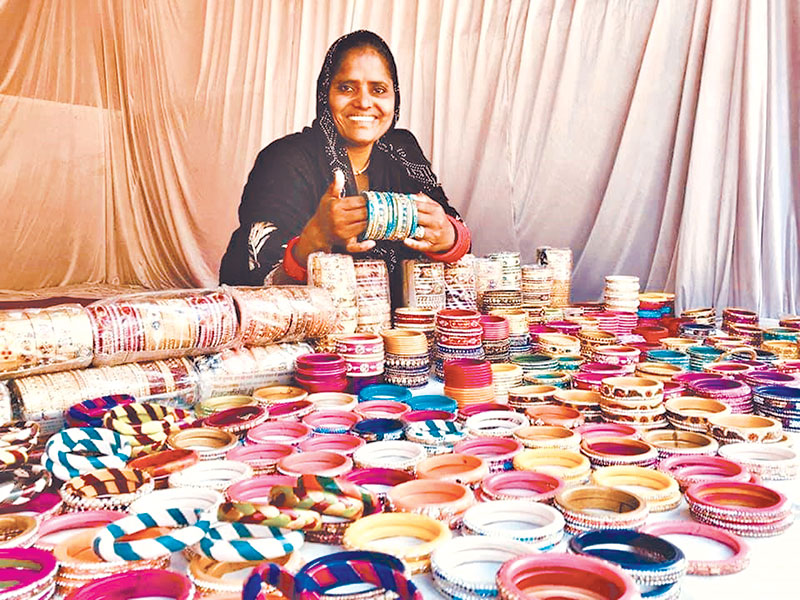
Janakpur : Lalita Agrawal loves adorning her wrists with bangles, especially the ones made out of lac. These bangles are not just associated with beauty but also hold a strong cultural and religious significance in her Hindu community.
The lac bangles, made out of a resinous secretion of the tiny lac insect, moulded around a metal circle, are said to bring good luck, and are mostly preferred by married and pregnant women in the southern part of the country. Known as lahathi in the native tongue, the bangles are traditionally made by laharis, a Muslim community.
In Janakpur, Afsana General Store is one store that has been catering to Hindu women like Agrawal, 53, with such lac bangles for generations. Bhaiji Ali, the owner of the shop, has a variety of such bangles—from ones in monochrome colours to ones adorned with shiny metals.
“On most days, we sell about three to four sets; however, around the time of festivals, sales can go up to 50 sets or more,” says Bhaiji. Bhaiji lives in Lahariya tole where most laharis in Janakpur live and trade. Many households in this community make their own bangles in their backyards, although the number of families that still follow the tradition has significantly decreased over the years. In a city where the majority of the population is Hindu, the lac bangles are something that has bonded the Hindu and Muslim community together. Due to the conservative outlook on caste, religion and gender in both the communities, there isn’t much intersectional communication in Janakpur. But the cultural significance of lac bangles for Hindu women and its economic importance for Muslims have brought together these two communities.
“I’ve come across people who wouldn’t rent me a room because of my religion, but then they buy bangles from me for pujas and weddings,” says Mansur Ali, a street vendor who usually parks his cart of lahathis in front of Janaki Mandir. “Nevertheless, it’s nice to hear people appreciate the bangles. I look at it as a matter of respect. No matter what, in the end, they need us and we need them.”
“Lahari is more of an occupation than an ethnicity, and we take pride in the craft that has been handed over to us from generations,” he says. “We have accepted lahari as our title and identity.”
The bangle-making process takes at least four people, and three to six hours per set. First, lac is coloured with dye and then heated over coal using a wooden rod. Usually, shades of red, green and yellow are used, as they are considered auspicious. The base of the bangle is then prepared, either with brass or steel. Then the brass and lac are coiled together, to achieve the desired shape. To complete the process, pearls, stones, mirrors and beads are heated over a tin plate, and placed over the bangle, giving them different patterns. All the bangles are moulded, shaped and embellished manually. But in recent years, due to lack of raw materials and rigorous labour that goes into making these bangles, sellers like Bhaiji are also importing these bangles from Rajasthan and Bihar.


These bangle sellers earn anywhere from Rs200-2,000 a day, depending upon the type of bangles and the number of customers. However, in recent times, the sales of bangles have dropped drastically. Bhaiji recalls how he used to sell lahathis in Saptari, Sarlahi, Siraha, Mahottari, Jhapa and Kathmandu. But in the last decade, the demand for lac bangles in districts outside of Dhanusha has been constantly decreasing, which is why there are almost no lahathi suppliers in the rest of the country. Even in Dhanusa and the rest of Tarai, lac bangles have now become occasional accessories, only used during weddings and pujas, when in the past, they were worn throughout the year as a must-have ornament.
“Women now prefer bracelets and watches as they are less of a hassle. But lahathis hold cultural value. I even go door-to-door to sell bangles,” said Ali.Shubha Sharma, 73, a native of Kuwa in Janakpur, agrees with Ali that even through their differences, laharis from the Muslim community have been helping them uphold their cultural needs through their bangle-making.
“Since ancient times, Muslims are said to have exceptional talent when it came to designing and making ornaments. That’s why they were the ideal bangle makers,” she says. The laharis say that they feel good to be part of Hindu women’s celebration. “Because of our job, we get to make sisters throughout the city prettier and happier,” Ali says.

LIFE & STYLE

Pursuing a lost cause?

Agony aunt

Dear Aunt,
We are both students and live in the same building. When I first saw him, he was reserved and mostly kept to himself. At first, I never thought that we will even have a casual conversation. But something about him attracted me and we eventually started talking, just informal greetings whenever we ran into each other. Then, we connected on social media and things just escalated from there.
We started texting and talking on the phone regularly but whenever we met in front of our friends, we acted as if we didn’t know each other at all. In a few months, we became really close and started dating. Sometimes, I would think of our future together even though I knew for a fact that we would not end up together and that used to make me sad. We were completely different and had very different priorities in life.
While he went away during the holidays, I met this new guy, who soon became one of my best friends. We enjoyed each other’s company and talked about almost everything, even my relationship. But for some reason, I felt that he was constantly trying to ruin my relationship. I always thought of him as a brother and a friend, nothing else, yet, he tried to sabotage my relationship with my boyfriend. After my boyfriend got back from his holidays, he started suspecting that I was cheating on him with my friend. And eventually, my boyfriend broke up with me.
Honestly, I neither blame my ex-boyfriend and nor my friend for what happened. I let my immaturity ruin our relationship and that’s something I’ll always regret. I tried my best to clear up the misunderstandings, but I couldn’t succeed. He had lost the trust he had on me, and there was nothing I could do to earn it back. It was really frustrating to see him ignore me. I would see him every day but we never talked and that hurt me deeply.
After a few sleepless nights, I decided to go back to my hometown to get away from all of this. However, it didn’t help much. Being away from him only made my feelings for him stronger, but I somehow managed to tuck it away for some time. When I returned to the city a couple of months later, everything started to fall into place.
By this time, we had started talking to each other again. He would ask me how I had been and that was about it. Sometimes, it did upset me that we couldn’t go back to how things were, but I had already started to move on. His absence didn’t hurt me anymore, and I realised how I was being childish before.
It’s been a year now, and we’ve got closer as friends. Recently, he dropped a hint saying he’s still interested in me. I too think that I feel the same for him as I did a year ago. But because he has hurt me once, I’m sceptical of starting a relationship with him again. On one hand, I want to be together with him, but on another hand, I don’t want to be hurt again. I don’t know what to do, Aunt. I want to have a long term relationship. Would we rather be good as friends or a couple?
—Anisha


Dear Anisha,
It looks like you were both very young when you started dating each other. But don’t blame yourself entirely for the relationship not working out. From what you have mentioned, it also seems like the guy you were dating didn’t trust you at the time. For any relationship to last it’s important that both partners trust each other. But you were both dating in secret and this shows that the two of you were not confident and really comfortable with each other.
However, you also have said that you have moved on from the relationship since then and are now in good terms with your ex. I don’t think it’s necessary to rush into a relationship just because he confronted his feelings for you. You can take your time to decide what you want to do.
We shouldn’t get into a relationship with the idea that it should be for the long term. Because that is never for certain as relationships work when both partners are willing to work on it—not because we want it to be long or short term.
Anisha, you also mentioned that it was difficult for you to come in terms with the relationship ending. And while you were having a hard time, your partner made no initiatives to understand you, although you had your tried best to tell him that you were not cheating on him, I say it’s okay for you to be sceptical even if he says he has feelings for you.
Rather, I suggest you to really understand where he is at in life; has he really changed as a person. Because it also looks like he was quite possessive then. As friends, most people are always good to each other, even understanding but relationships are bit different from friendships. Relationships demand attention, care, patience and assurance. It asks for responsibility moreover. It makes us vulnerable as we share more than just the ordinary of life, we share our deepest emotions and insecurities. In relationships, you can see a person’s best and sometimes the worst.
So, the only way to be sure if you want to be in a relationship with this person again is if you can imagine sharing your daily life with him again. Will he spend time with you when demand it, and will he be understanding of your expanding networks with people?
Relationships should let you grow; it should allow you to change—it shouldn’t conform you to be the same person as you are today. It should be more giving. Do you see him giving you enough space for you to grow? Do you trust him? Maybe these are some questions you should think about before reciprocating your feelings to him. But remember there is no rush to get into any relationship. You are young, so enjoy your friendship and explore the things that you want to do in life.

Page 9
CULTURE & ARTS

Hey men, women don’t want to be told to be like a woman

Nepali women still grapple with sexist language and expressions that most men easily dismiss.
- SRIZU BAJRACHARYA

Kathmandu : Throughout her time as a Deputy Inspector General of Nepal Police, Bimala Thapa was referred to as “Sir” by her subordinates. She tried several times, during her initial days in the role, to explain to officers that she would prefer to be referred to as “madam”— not sir. But she eventually gave up and stopped correcting people.
“It seemed futile to discuss the issue because even those who should have understood why it matters treated it lightly,” says Thapa, whose superiors would also acknowledge her as sir. “Many probably don’t see why this is demeaning, but it used to feel like they thought that those in power were always supposed to be men.”
It’s no surprise that Nepali society still harbours stereotypes when it comes to gender. With time, progress towards gender equality has been made. But with deep-rooted patriarchy, even in the most liberal environment, there are certain terms or phrases that are used only to describe women—especially when they are breaking or attempting to break out of the mould. But that kind of sexism in language has also become so normalised that people don’t bother to understand why it may sound wrong to women—and even to some men.
“It will probably take another generation to get rid of patriarchy,” says Thapa. “It’s so ingrained in us and in the language we use that we don’t even see we are being discriminated.”In the courtrooms, the word that is still officially used to address court magistrates is ‘Shrimaan’—it’s also a word colloquially used to refer to ‘husband.’ After discussions were held over the honorific, which also suggests—perhaps unintentionally—that a judiciary body can only be men, many have begun using the alternative address: mananiya nyaidhis jiu (honourable judge), which is gender non-conforming.
However, Geeta Pathak Sangraula, a senior advocate, believes it could just be the patriarchal lens that is making it look derogatory.
“Shri is an honorific title used for both women and men. But I think maan comes from the word ‘mananiya’—meaning honorable,” says Pathak, who does agree that the extensive use of the word for husband makes it inappropriate for women.
Apart from these titles, there are certain phrases in Nepali language that undermine women in terms of social position and capability.
One of the most sexist phrases that women have often been complimented with is Chori bhayera pani chhora jasto kaam garyo (you are as responsible as a son), says Paavan Mathema, a journalist at Agence France-Presse. “It’s difficult to denounce such compliments because it usually comes from the elders,” she says.
Eighteen-year-old Swastika Chaudhary, a national player of sport climbing, says she is often complimented by her friends for having arm strength when they are arm-wrestling for fun. “Your hands are like that of a man,” they tell her to praise her strength, she says.
Often proactive and courageous women in Nepali families are complemented with phrases like “You are brave like a man” or “You behave like a man.” But that just shows how patriarchy has characterised women and men, says Mathema. “Women are just being themselves. Comparing them to men isn’t a compliment at all.”
Not all stereotypical comments passed to women are compliments. Instead, they are a reinforcement of how society wants to box them in certain gender roles. Phrases like ‘Keti bhayera pani kasto thulo swor le boleko,’ (How can you speak loudly when you are a woman?) are an indication of how women should act like women, says Bunu Dhungana, a visual artist.
Others say the term many men may consider endearing to use while addressing women is also equally problematic.
“Many male workers try to impose an informal relationship by calling female workers bahini, or a sister. It’s their way of playing power games,” says Radha Wagle, one of the members of Female Foresters Network, a communal women group under the Ministry of Forests and Environment. “Even at office spaces where people are supposed to be professional, they try to associate us with the role of a caretaker, as though we are not supposed to be in the workplace.”
Female Foresters Network has organised various advocacy campaigns to raise awareness among local women about the sexism in the Nepali language.
“We try to make them understand why some phrases that may sound like compliments are derogatory,” says Wagle.
Some women say talking about how such language affects people can help change the concept of women that patriarchy has created.
“Yes, many people say, women’s issues are discussed enough, but the fact is we need to talk about women’s issues because men are everywhere and women are still largely oppressed,” says Dhungana. She compares the attitude to the old discriminatory proverb: pothi basdaina, meaning hens don’t crow, essentially asking women to shut up.
“By talking about it, we are asking to be treated as equal,” she says, “so that we can get rid of the concept of competing with men because we are not competing with them.”

CULTURE & ARTS

Russian celebrities line up behind jailed actor

Pavel Ustinov’s sentencing sparked particular outrage because the court refused to consider video footage that showed police in an apparently unprovoked attack on the actor.

Tens of thousands took to the streets of Moscow after authorities refused to allow prominent opposition candidates to stand for the city parliament in September 8 elections. AFP/RSS

Russian celebrities have launched a major solidarity campaign in support of a young actor who they say was wrongfully jailed for a crime amid a crackdown on the opposition.
On Monday, a Moscow court sentenced 23-year-old actor Pavel Ustinov to three and a half years in prison for violence against police at an opposition protest even though he claimed he was simply a bystander.
His conviction brought to six the number of people sentenced to jail time ranging from two to four years for taking part in a recent wave of anti-government demonstrations.
But Ustinov’s sentencing sparked particular outrage because the court refused to consider video footage that showed police in an apparently unprovoked attack on the actor.
The celebrities, most of whom usually steer clear of politics and have millions of followers on social media, said the case tarnished the reputation of authorities.
“I think that this is a completely trumped-up case,” film actor Alexander Pal said in a video posted on Instagram.Pal, who helped kickstart the campaign, said the video proved his innocence.
Footage from the scene showed police in full riot gear lunging at Ustinov—who was standing with a phone in his hand near a metro station —and beating him with batons. Danila Kozlovsky, a Russian star who appeared in the British TV series McMafia, said the “monstrous injustice and cynicism with which it’s being done can happen to everyone.”
The celebrities compared Ustinov’s case with that of journalist Ivan Golunov detained in June on trumped-up drug charges.He was freed after an unprecedented campaign of solidarity, which saw three major newspapers publish the same front page with the headline “I am/we are Ivan Golunov”.
In a similar vein, dozens of celebrities and lesser known figures posted “I am/we are Pavel Ustinov” on their Instagram accounts.
Supporters included actor Alexander Petrov, who has 2.1 million followers on Instagram, singer Andrei Makarevich and star blogger Yury Dud.

‘Awful injustice’
In a video, Maxim Galkin, a Kremlin-friendly impersonator and comedian, called the case against Ustinov a “colossal overkill” that deals a major blow to the reputation of courts, law enforcement agencies and authorities.In comments posted alongside the video, Galkin, who is the husband of Soviet-era pop diva Alla Pugachyova and has 6.4 million followers on Instagram, added he was not interested in politics but supported freedom.
His post racked up more than 780,000 views as of Tuesday afternoon.Actors at several theatres also backed Ustinov during curtain calls on Monday night.
“We believe this to be an awful injustice,” director Alexander Molochnikov said on stage after a performance at the Chekhov Moscow Art Theatre.
Kremlin spokesman Dmitry Peskov said Vladimir Putin was aware of the case but could not interfere, and that Ustinov had a right to appeal.
Investigators said Ustinov violated public order during an unauthorised rally on August 3 and put up resistance during his arrest. As a result, a policeman sprained his shoulder.Ustinov has insisted on his innocence.
Tens of thousands of people rallied in Moscow this summer after authorities refused to allow opposition candidates to stand for the city parliament in September 8 elections.
While some of those jailed were activists, others like Ustinov or entrepreneur Danila Beglets were merely bystanders who got caught up in the authorities’ crackdown, observers say.Many welcomed the campaign, but some said solidarity between actors was not enough.
“Until actors begin to take to the streets in support for teachers and teachers in support of economists, nothing will change,” opposition politician Dmitry Gudkov said. Earlier this month, a Russian judge halted the embezzlement trial of acclaimed theatre director Kirill Serebrennikov, whose detention had attracted international attention and calls for his release everywhere from Hollywood to Cannes.

-Anna SMOLCHENKO
—Agence France-Presse

Page 10
WORLD

Britain’s Supreme Court to rule on PM Johnson’s suspension of parliament

In a damning judgement last Wednesday, Scotland’s highest court said the suspension was an ‘egregious’ attempt to stymie parliament.
- REUTERS

People protest outside the Supreme Court of the United Kingdom against Prime Minister Boris Johnson’s decision to prorogue parliament, in London, Britain, on Tuesday.  REUTERS

LONDON : Britain’s top court met on Tuesday to consider whether a decision by Prime Minister Boris Johnson to suspend parliament until shortly before the date for Brexit was illegal.
Scottish judges ruled last week the suspension was unlawful and supporters of the legal challenge in the Supreme Court want parliament recalled immediately if it rules against Johnson’s decision. Critics say he should quit if judges rule against him.
Johnson announced on Aug 28 that he had asked Queen Elizabeth to prorogue, or suspend, parliament for five weeks from last week until Oct 14. He said the shutdown was necessary to allow him to introduce a new legislative agenda.
Opponents said the real reason was to prevent scrutiny and challenges by parliament—where he now has no majority—to his Brexit plans, especially his promise to leave the European Union by Oct 31 even if no divorce deal has been agreed.
In a damning judgement last Wednesday, Scotland’s highest court said the suspension was an “egregious” attempt to stymie parliament.
A week earlier the High Court of England and Wales rejected a similar case, saying the matter was political and not one for judicial interference.
Both cases are now before the Supreme Court, the highest judicial body in the United Kingdom. Its 11 judges will decide how far Britain’s unwritten constitution limits the power of the prime minister and whether Johnson’s advice to the queen was therefore illegal.
“That this is a serious and difficult question of law is amply demonstrated by the fact that three senior judges in Scotland have reached a different conclusion from three senior judges in England and Wales,” said Brenda Hale, president of the Supreme Court.
“The Supreme Court exists to decide such difficult questions of law and we shall do so in accordance with our judicial oaths.”
Launching the legal challenge to Johnson’s decision—by a mixture of anti-Brexit campaigners and opposition lawmakers—David Pannick said there was strong evidence the prime minister had wanted to silence parliament because he saw it as an obstacle.
“The prime minister advised Her Majesty to prorogue parliament for a period as long as five weeks because he, the prime minister, wished to
avoid what he saw as the risk that parliament would take action to frustrate or damage the policies of his government,” Pannick said.Johnson has said the current session of parliament was longer than any since the English Civil war in the 17th century, and that lawmakers would have plenty of time to discuss Brexit again after an EU summit on Oct. 17-18.
When asked on Friday if he had misled the queen, Johnson said: “Absolutely not.”In a television interview broadcast on Tuesday, Johnson said he had
“the greatest respect for the judiciary” but declined to say whether he would recall parliament if the ruling goes against the government.
“I think the best thing that I can do is wait and see what the judges say,” he told the BBC.Justice Secretary Robert Buckland said the government would abide by the ruling of the courts.
The Conservative government says opponents of Brexit are using the courts to try to frustrate Britain’s departure from the bloc which
was backed by Britons in a 2016 referendum.
The Supreme Court ruled against the government in a similar constitutional case in 2017 when it said ministers could not begin the formal two-year exit process without the approval of parliament. Its hearings will run until Thursday, with the verdict not expected until Friday at the earliest.
“It is important to emphasise that we are not concerned with the wider political issues which form the context for this legal issue,” Hale said. “The determination of this legal issue will not determine when and how the United Kingdom leaves the European Union.”

WORLD

Macron signals tougher line on immigration

- AGENCE FRANCE-PRESSE
Emmanuel Macron

PARIS : With an eye on re-election, France’s Emmanuel Macron has signalled a tougher line on immigration, arguing that the government must end its “lax” approach to prevent voters from drifting to the far right.
Setting out his priorities for the second half of his mandate on Monday, Macron said that his centrist Republic on the Move (LREM) party risked being seen as “bourgeois” unless it tackled the issue of immigration.
“By claiming to be humanist we are sometimes too lax,” he told a meeting of his ministers and ruling party representatives, claiming that France’s asylum laws were being “misused” by people-smuggling networks and “people who manipulate” the system.The question for his three-year-old party, which has struggled to establish a presence in small-town and rural France, was “whether we want to be a bourgeois party or not,” Macron was quoted by party members as telling the meeting.
“The bourgeois have no problem with this (immigration). They don’t come up against it. The working classes live with it. For decades the left didn’t want to deal with this problem so the working class migrated to the far right.”
“We’re like the three little monkeys, we don’t want to see,” he said, referring to the “see no evil, hear no evil, speak no evil” dictum represented by three monkeys with their hands over their eyes, ears and mouth.
An Ispos/Sopra Steria poll on divisions in French society published Tuesday showed that 63 percent of respondents felt there were “too many foreigners in France.”Anti-foreigner sentiment was strongest among working-class respondents, with 88 percent saying they were too many immigrants.Sixty-six percent also said they felt that immigrants did not try hard enough to integrate.
During the 2017 presidential campaign, Macron was fulsome in his praise of the welcome extended by German Chancellor Angela Merkel to over a million Syrian refugees, crediting her and the German people with having “saved our collective dignity.”
But since coming to office, he has taken a tough line on so-called economic migrants who leave home in search of better opportunities abroad, drawing a firm distinction between them and refugees fleeing war or persecution.France last year received a record 122,743 asylum requests, up 22 percent compared to 2017.
“The entry flows into Europe have never been so low and the asylum requests have never been so high,” Macron complained on Monday, arguing that France needed a system that was both “more efficient and more humane.”His remarks saw him compared with former right-wing president Nicolas Sarkozy, who also tried to court far-right voters while in office by talking tough on immigration but without significantly changing French laws.

WORLD

Ex-Trump campaign chief to testify at impeachment hearing

- REUTERS

WASHINGTON : Corey Lewandowski, President Donald Trump’s former campaign manager and close confidant, is due to testify in Congress on Tuesday despite a White House effort to prevent him from talking about Trump’s alleged efforts to impede the federal probe into Russian meddling in the 2016 presidential election.
Late on Monday, the White House instructed Lewandowski not to discuss conversations he had with Trump after he became president, including an exchange at the White House that Democrats view as evidence that Trump obstructed justice and may need to be impeached.
Lewandowski, who is mulling a run for the US Senate, is the first impeachment witness to appear before the House of Representatives Judiciary Committee since former Special Counsel Robert Mueller testified in July about his probe of Russian election interference and Trump’s alleged efforts to impede the investigation.
Democrats, who hope to decide whether to recommend Trump’s impeachment to the full House by year end, had intended to grill Lewandowski about an effort by the president to persuade then-Attorney General Jeff Sessions to redirect the Mueller probe away from the 2016 Trump campaign.
The episode is among a number of incidents contained in Mueller’s 448-page Russia investigation report that Democrats view as evidence Trump obstructed justice.Mueller made no determination about whether Trump obstructed justice but did not exonerate him of possible wrongdoing.
White House Counsel Pat Cipollone told the committee in a letter on Monday that Lewandowski could not testify about conversations with Trump after he became president or with his senior advisers.
The White House also ordered two other witnesses, former Trump White House aides Rob Porter and Rick Dearborn, not to testify. Cipollone’s letter said they were “absolutely immune from compelled congressional testimony with respect to matters related to their service as senior advisers to the President.”
The Judiciary Committee’s chairman Jerrold Nadler, denounced the White House move as a “shocking and dangerous assertion of executive privilege and absolute immunity.”

WORLD

China must give Hong Kong leaders room to compromise: Former governor

- AGENCE FRANCE-PRESSE
Former Hong Kong governor Chris Patten. 

LONDON : China must give Hong Kong leaders leeway to reach a compromise with protesters or face continued unrest in the city, former governor Chris Patten said on Tuesday.
“In order to have a resolution the Chinese government needs to make it clear that they still believe in the treaty which was signed by Britain,” he told AFP, referring to the 1985 agreement that led to Hong Kong’s return to Chinese rule in 1997.Under the deal, Hong Kong was allowed to keep its unique freedoms for 50 years.
“(It) is supposed to guarantee Hong Kong’s local autonomy and their rule of law and way of life,” Patten said in an interview on the sidelines of an event at the Japanese embassy in London.
“The Chinese government, the Communist regime in Beijing, has also to give the authorities in Hong Kong enough room to reach a sensible accommodation and compromise with the demonstrators,” he added.Clashes erupted again in the city at the weekend, ending a relative lull in the intensity of skirmishes between police and pro-democracy protesters.Riot police fired tear gas and water cannons at hardcore protesters hurling rocks and petrol bombs on Sunday, the latest expression of a popular revolt that has raged for over 100 days.
The protests, the biggest challenge to Beijing’s rule since the 1997 handover, began in opposition to a proposed law that could have led to extraditions to mainland China.It has since spiralled into a broader pro-democracy movement.Patten, Britain’s last governor of the city, said that violence was “never acceptable”, but added it had “sometimes been provoked by the way the demonstrations have been policed”.
Local gangsters, known as triads, had also “been manipulated in order to beat up demonstrators”, he said.Patten urged the British government to be “outspoken in stating the importance of China living up to its guarantees, up to its word.
“If you can’t trust communist China in Hong Kong, where will you trust it?” he added.Patten was at the Japanese embassy announcing the prestigious Praemium Imperiale awards, with political disorder a common theme among the winning artists.“I fear that social instability is more resonant now than it has been for some time,” he said.
“We can see what’s happening in Hong Kong and we can see even in a society like ours growing divisiveness and I think that’s profoundly worrying.”

WORLD

Earth to warm more quickly, new climate models show

- AGENCE FRANCE-PRESSE

PARIS : Greenhouse gases thrust into the atmosphere by burning fossil fuels are warming Earth’s surface more quickly than previously understood, according to new climate models set to replace those used in current UN projections, scientists said on Tuesday.
By 2100, average temperatures could rise 6.5 to 7.0 degrees Celsius above pre-industrial levels if carbon emissions continue unabated, separate models from two leading research centres in France showed.
That is up to two degrees higher than the equivalent scenario in the Intergovernmental Panel for Climate Change’s (IPCC) 2014 benchmark 5th Assessment Report.
The new calculations also suggest the Paris Agreement goals of capping global warming at “well below” two degrees, and 1.5C if possible, will be harder to reach, the scientists said.
“With our two models, we see that the scenario known as SSP1 2.6—which normally allows us to stay under 2C—doesn’t quite get us there,” Olivier Boucher, head of the Institute Pierre Simon Laplace Climate Modelling Centre in Paris, told AFP.
With barely one degree Celsius of warming so far, the world is already coping with increasingly deadly heat waves, droughts, floods and tropical cyclones made more destructive by rising seas.
A new generation of 30-odd climate models known collectively as CMIP6—including the two unveiled Tuesday—will underpin the IPCC’s next major report in 2021.
“CMIP6 clearly includes the latest modelling improvements,” even as important uncertainties remain, Joeri Rogelj, an associate professor at Imperial College London and an IPCC lead author, told AFP.These include increased supercomputing power and sharper representations of weather systems, natural and man-made particles, and how clouds evolve in a warming world.
“We have better models now,” said Boucher. “They have better resolution, and they represent current climate trends more accurately.”
A core finding of the new models is that increased levels of CO2 in the atmosphere will warm Earth’s surface more easily than earlier calculations had suggested.
If confirmed, this higher “equilibrium climate sensitivity”, or ECS, means humanity’s carbon budget— our total emissions allowance—is likely to shrink. The French models are among the first to be released, but others developed independently have come to the same unsettling conclusion, Boucher confirmed.
“The most respected ones—from the United States, and Britain’s Met Office—also show a higher ECS” than the previous generation of models,
he said.This is bad news for fight against global warming, which continues to face strong political headwinds and institutional inertia despite a rapid crescendo of public awareness and concern.
“A higher ECS means a greater likelihood of reaching higher levels of global warming, even with deeper emissions cuts,” Boucher and two British scientists — Stephen Belcher from the UK Met Office and Rowan Sutton from the UK National Centre for Atmospheric Science — wrote in a blog earlier this year, tiptoeing around the implications of the new models.
“Higher warming would allow less time to adapt and mean a greater likelihood of passing climate ‘tipping points’ such as thawing of permafrost, which would further accelerate warming.”A third to 99 percent of top-layer permafrost could melt by 2100 if carbon pollution is not abated, releasing billions of tonnes of greenhouse gases into the air, according to a draft IPCC special report on oceans and Earth’s frozen zones obtained by AFP.
“Unfortunately, our global failure to implement meaningful action on climate change over recent decades has put us in a situation where what we need to do to keep warming to safe levels is extremely simple,” said Rogelj.
“Global greenhouse gas emissions need to decline today rather than tomorrow, and global CO2 emissions should be brought to net zero.”
The 2014 basket of climate models show Earth warming on current trends an additional 3C by 2100, and at least 2C even if national carbon cutting pledges are all met.The two French climate models, including one from France’s National Centre for Meteorological Research (CNRM), were to be unveiled at a press conference in Paris.

WORLD

DR Congo ex-minister to be quizzed over Ebola funds

Briefing

KINSHASA: Former DR Congo health minister Oly Ilunga was transferred to the public prosecutor’s office on Tuesday, three days after being arrested over accusations he embezzled $4.3 million in Ebola funds, his lawyers said. Ilunga, who resigned as health minister in July after being removed as head owf the country’s Ebola response team, was arrested in Kinshasa on Saturday. e is due to be questioned by an investigating magistrate, lawyer Guy Kabeya told AFP. Ilunga’s lawyers have rejected the embezzlement claim, saying accounts prove that public funds were used “exclusively” in the fight against the Ebola virus, which has claimed more than 2,000 lives since August 2018.


WORLD

Dutch court urged to hear case over 2014 Israel Gaza strike

Briefing

THE HAGUE: A Dutch court heard preliminary arguments Tuesday in a case about a deadly 2014 Israeli airstrike, in which Israeli prime ministerial candidate Benny Gantz is one of two named defendants. A Dutch-Palestinian seeking justice for his relatives killed in the air strike, urged the court to go ahead with a trial for war crimes. This preliminary hearing, to determine whether or not it should try the case, started as Israelis go to the polls to elect a new government—with Gantz a leading candidate for the prime minister’s post.


WORLD

Australian government sued over ‘illegal’ debt recovery

Briefing

SYDNEY: Unemployed Australians who say they were wrongly targeted by an automated debt recovery scheme will launch a class action against the government, their lawyer announced Tuesday, as Canberra ramps up pressure on welfare recipients. The case—which claims the controversial system unlawfully took money from job seekers as well as pensioners, students and carers—will demand the government pay restitution and damages. The so-called “robodebt” scheme uses an algorithm to compare tax returns with welfare payments, with the onus placed on income support recipients to prove they do not owe the amount demanded. Advocates and welfare recipients say many have been relentlessly hounded by debt collectors to pay thousands of dollars they did not owe. (Agencies)

Page 11
ASIA

Khamenei rules out Iran-US talks as tensions rise over Saudi attacks

Tensions between Iran and the US and its allies have threatened to boil over since May last year when President Donald Trump abandoned a 2015 nuclear deal and began reimposing sanctions in its campaign of ‘maximum pressure’.
- AGENCE FRANCE-PRESSE
Ayatollah Ali Khamenei 

TEHRAN : Iran’s supreme leader on Tuesday ruled out negotiations with the US “at any level”, as tensions mounted between the arch-foes after Washington blamed Tehran for attacks on Saudi oil installations.
Ayatollah Ali Khamenei said the US adopted a policy of “maximum pressure” on Iran because it believes it cannot bring the Islamic republic to its knees through other means.
The leader was speaking after devastating drone attacks at the weekend that halved oil output of Iran’s regional arch-rival Saudi Arabia — the world’s top crude exporter.
“The policy of ‘maximum pressure’ against the Iranian nation is worthless and all Islamic Republic of Iran officials unanimously believe there will be no negotiations with the US at any level,” he said in a televised address.
Tensions between Iran and the US and its allies have threatened to boil over since May last year when President Donald Trump abandoned a 2015 nuclear deal and began reimposing sanctions in its campaign of “maximum pressure”.
Iran responded by scaling back its commitments under the landmark accord, which gave it the promise of sanctions relief in return for limiting the scope of its nuclear programme.
Trump said the US was ready to help Saudi Arabia after the attacks that halted about six percent of the world’s oil supply and triggered a record leap in crude prices.
“I’m not looking to get into new conflict, but sometimes you have to,” he said. “That was a very large attack, and it could be met by an attack many, many times larger.
“Certainly, it would look to most like it was Iran,” Trump added.US Secretary of Defence Mark Esper also singled out Iran as a regional destabilising force, while stopping short of directly accusing Tehran over the strikes.
The US military, he said, was working with its partners to “address this unprecedented attack and defend the international rules-based order that is being undermined by Iran”.
A day after the attacks, the White House had said Trump could meet his Iranian counterpart Hassan Rouhani on the sidelines of the UN General Assembly in New York next week.Rouhani has already rejected the possibility of direct negotiations with the US unless it lifts all sanctions.
The Iranian president has said even if the sanctions are lifted, any talks must be held in the framework of the nuclear accord.
Khamenei reiterated this on Tuesday, saying that if the US “repents” and returns to the Joint Comprehensive Plan of Action, then it can talk with Iran along with other parties to the deal.
“If the US takes back its words and repents after pulling out of the JCPOA... then it can join the other countries party to the JCPOA and talk to Iran along with the other countries,” he said, using the deal’s formal title.
“Without this, no negotiations will happen at any level between the Islamic Republic of Iran’s officials and the Americans, not during the visit to New York or any other visit.”
Yemen’s Iran-aligned Huthi rebels claimed responsibility for Saturday’s attacks on Abqaiq — the world’s largest oil processing facility — and the Khurais oil field in eastern Saudi Arabia.The Huthis said 10 drones struck the sites, but Saudi Arabia pointed the finger of blame at Iran.
“All indications are that weapons used in both attacks came from Iran” rather than Yemen, said Turki al-Maliki, spokesman for a Saudi-led military coalition.
Rouhani said the attacks were an act of self-defence by the Huthis against the coalition that has been bombing them since 2015 in support of Yemen’s internationally recognised government.
As the aftershocks of the attacks continued to ripple across financial markets on Tuesday, energy specialists S&P Platt said around three million barrels per day of Saudi crude would remain offline for at least a month.
China condemned the attacks and appealed to all sides to “refrain from taking actions that lead to an escalation of tensions in the region”.

ASIA

Blast outside president rally in central Afghanistan kills at least 26

- AGENCE FRANCE-PRESSE

KABUL : A Taliban suicide bomber killed at least 26 people and wounded dozens near a campaign rally for Afghan President Ashraf Ghani on Tuesday, with the insurgents warning of more violence ahead of elections.
About an hour after the attack, another blast also claimed by the Taliban rocked central Kabul near the US embassy.
It was not immediately clear if the second blast claimed any lives, but an AFP journalist at nearby Wazir Akbar Khan hospital saw around a dozen wounded victims, and a witness told AFP he had seen bodies in the street.
The explosions came after US President Donald Trump abruptly ended talks with the Taliban on September 10 over a deal that would have allowed the US to begin withdrawing troops from its longest war.
In a statement sent to media claiming responsibility for both blasts, Taliban spokesman Zabihullah Mujahid said the attack near Ghani’s rally was deliberately aimed at disrupting the September 28 elections.
“We already warned people not to attend election rallies, if they suffer any losses that is their own responsibility,” the statement said.
The bomber near Ghani’s rally -- in Parwan province, about an hour’s drive north of Kabul -- had been on a motorbike and had detonated his device at a checkpoint leading to the event, according to interior ministry spokesman Nasrat Rahimi.
An AFP image from the scene showed the remains of a burnt motorcycle, with a body on top covered by a blanket, next to a badly damaged police car.
Women and children were among the causalities, Parwan hospital director Abdul Qasim Sangin told AFP, adding 42 people were injured as well as the 26 dead.
The president, who was speaking to his supporters at the time of the blast, was unhurt but later condemned the attack, saying the incident proved the Taliban had no real interest in reconciliation.
“As the Taliban continue their crimes, they once again prove that they are not interested in peace and stability in Afghanistan,” said Ghani in a statement.
The UN offices in Afghanistan also slammed the Taliban, accusing the insurgents of showing “despicable disregard for civilian life & fundamental human right to participate in democratic process”.Sixty kilometres (40 miles) away in Kabul, a shopkeeper, Rahimullah, said he had been sitting inside his shop when the second blast came.
“The wave broke all the windows,” he told AFP.“I rushed outside and saw several bodies just across the street. This is the second time in less than a month that a blast has broken our windows. I just fixed them a week ago.”
The elections will see Ghani face off against his own Chief Executive, Abdullah Abdullah, and more than a dozen other candidates, including former warlords, ex-spies, and onetime members of the country’s former communist regime.

ASIA

India arrests former Kashmir chief minister

- AGENCE FRANCE-PRESSE

NEW DELHI : A former Jammu and Kashmir chief minister, seen as being pro-India, has been formally arrested under a law allowing him to be held for up to two years without charge, authorities said Tuesday.
Farooq Abdullah, 81, has been under house arrest since early August when India stripped Kashmir of its autonomy, imposed a security lockdown and detained dozens of local politicians including those who back the region being part of India.
But on Monday he was formally arrested under the Public Safety Act (PSA) and his home turned into a “judicial lockup”, Muneer Khan, a senior police official in Kashmir, told AFP. It is the first confirmed case of a Kashmiri politician being arrested under the PSA since India’s August 5 move when it sent tens of thousands of troops to Kashmir and imposed a communications blackout.
India’s national security adviser said earlier this month that a “majority” of Kashmiris supported its move except for a “vocal minority”
backed by Pakistan, which India accuses of backing a decades-old insurgency that has killed tens of thousands of people.
But in the wake of the lockdown, even pro-India politicians have spoken out about New Delhi’s intervention.
A day after the Indian government revoked the special status, Abdullah climbed a wall of his house to address the media and condemned the move. That was the last time he was seen in public. “We will fight, we will go to the courts. We’re not gun-runners, grenade-throwers, stone-throwers, we believe in a peaceful resolution of things,” Abdullah said.
The PSA was introduced in the 1970s—under Abdullah’s father Sheikh Abdullah—to prevent timber smuggling but since an uprising against Indian rule erupted in 1989 it has been used to detain thousands of people, activists say.
The UN human rights office said in 2018 that special laws in Kashmir including the PSA “have created structures that obstruct the normal course of law, impede accountability and jeopardize the right to remedy for victims of human rights violations”.

ASIA

Sri Lanka PM Wickremesinghe faces party challenge in presidential battle

- AGENCE FRANCE-PRESSE

Ranil Wickremesinghe faces two challengers to be the ruling party’s candidate in the upcoming presidential election. AFP

COLOMBO : Sri Lanka’s ruling coalition became embroiled in a power struggle on Tuesday as two challengers came forward to oppose Prime Minister Ranil Wickremesinghe to be candidate for a looming presidential election.
Wickremesinghe had been the clear frontrunner to be the United National Party candidate until parliament speaker Karu Jayasuriya and deputy party leader Sajith Premadasa threw their hats into the ring.
The UNP dominates the ruling coalition and is expected to nominate its candidate for the election to be held between November 7 and December 7.
Voting already risks controversy with Gotabaya Rajapakse, younger brother of Sri Lanka’s former strongman president Mahinda Rajapakse, leading the opposition bid despite outstanding court cases and criminal inquiries.
Jayasuriya, 78, who played a key role in ending a political crisis last year, said he wants the top office so he can scrap the presidential system which he accused of centralising power. “I will enter the contest with the intention of abolishing the executive presidency and not to enjoy that office,” Jayasuriya said in a statement.
“Since 1995, we have wanted to scrap the presidency, but failed.”Jayasuriya led a campaign by members of parliament in October to oppose incumbent President Maithripala Sirisena’s bid to sack Wickremesinghe and install a puppet prime minister.
Hours before his announcement however, Premadasa, 52, told a hurriedly summoned press conference that he should be the UNP’s presidential hopeful. The son of president Ranasinghe Premadasa who was assassinated by suspected Tamil Tiger rebels in 1993, Premadasa called for a secret ballot of the UNP executive to decide the candidate.It was not clear when the party would decide, but the election is expected to be formally declared later this month.Premadasa said he would beat Rajapakse who is considered a strong contender even though he faces corruption cases in Sri Lanka and two civil actions in the United States.
The US cases are over the murder of a newspaper editor and torture of Tamil rebel suspects when he was a top defence ministry official during his brother’s rule.Sirisena broke away from Mahinda Rajapakse’s Sri Lanka Freedom Party to win the last election in 2015 with the help of the UNP. However he later formed a new alliance with Rajapakse.Squabbles between Sirisena and Wickremesinghe came to a head when Sirisena sacked Wickremesinghe in October last year and tried to put former president Mahinda Rajapakse in his place. The Supreme Court eventually ruled that Sirisena’s actions were illegal.Sirisena’s alliance with Rajapakse was also short lived as Rajapakse has since formed a new party. Sirisena has not yet announced whether he will seek a new term.

ASIA

UN experts urge probe of Rohingya killings in Bangladesh

- AGENCE FRANCE-PRESSE

DHAKA : UN human rights experts have raised new concerns about the treatment of Rohingya refugees in Bangladesh following a deadly backlash over the killing of a ruling party official.
The experts called for an “impartial” investigation into the deaths of at least six Rohingya men in gunfights with police after they were named as suspects in the killing of Omar Faruk, a youth wing official of the ruling Awami League.
Following the murder, local people vandalised refugee shops and staged protests in one of multiple camps now home to a total of more than 900,000 Muslim Rohingya who have fled oppression in neighbouring Myanmar.
In a statement released late Monday in Geneva, the six specially appointed UN experts on rights issues backed Bangladesh’s probe into the murder of Faruk.
But they added, “it is equally necessary to ensure that the presumption of innocence is upheld and that reactionary, summary and ad hoc justice is not doled out solely to placate the legitimate concerns of the host community.”
“We urge the Bangladeshi government to carry out an independent, impartial and effective investigation into all deaths that have occurred with regards to this case,” they said.Police inspector Ali Arshad told AFP at least 40 Rohingya have been killed in Bangladesh since July last year. Of those, at least 33 were killed by Bangladeshi security forces in gunfights and another seven were killed in shootouts among Rohingya groups, he said.
Rights groups have accused Bangladesh police of staging many of these gunfights as a cover for the extrajudicial killings of Rohingya, mainly suspects in drug smuggling.
The UN experts also expressed “serious concerns” over “tight new restrictions” and a communication clampdown in the refugee camps, where there is an effective internet blackout.The clampdown follows the failure of a new attempt to repatriate some of the refugees and an August 25 rally in which some 200,000 Rohingya marked two years since the exodus.
The UN experts said that since the rally, a number of organisers have been questioned and subjected to “intimidation”.
“We are alarmed by the sudden crackdown of the rights to freedom of expression, peaceful assembly and association,” they said.
“These restrictions have been applied in a discriminatory manner against members of the Rohingya minority,” said the experts who added that the “curfews and communications shutdowns could facilitate further serious human rights abuses against them.”

ASIA

20 killed as truck plunges down ravine in Philippines

Briefing

MANILA: Twenty people, including children, were killed Tuesday in the southern Philippines when the flatbed truck they were riding in plummeted into a ravine, police said. The vehicle was bringing a group of people home from a trip to the beach when the driver lost control near the town of T’boli in the latest deadly crash on the nation’s dangerous roads. “Based on eyewitness accounts, the truck lost its brakes. We will conduct further investigations on the actual cause,” T’boli town police investigator George Tabayan told AFP Police initially put the death toll at 15, but doctors said five of the 19 people taken to hospital for treatment later died, Tabayan said, updating an earlier tally.


ASIA

Thailand’s sex-shy giant panda dies aged 19

Briefing

BANGKOK: A beloved male giant panda on loan to Thailand from China has died aged 19 in Chiang Mai, leaving Thais on Tuesday to mourn the death of a mammal whose sex life captivated the kingdom. Chuang Chuang, a resident of the northern city’s zoo since October 2003, arrived with female Lin Hui, where the pair lived in an air-conditioned enclosure. The pair’s mating habits — or lack of — became a source of relentless public intrigue, with Chuang Chuang put on a low-carb diet and shown video clips of panda’s coupling in an attempt to spice up their sex drive. After struggles to conceive, Lin Hui finally gave birth thanks to artificial insemination to Linping in 2009, spurring a widely-watched live 24-hour “Panda Channel”.


ASIA

South Korea confirms first swine fever outbreak

Briefing

SEOUL: South Korea on Tuesday reported its first cases of African swine fever, becoming the latest country hit by the disease that has killed pigs from China to North Korea, pushing up pork prices worldwide. Five pigs found dead at a farm in Paju, a city near the inter-Korean border, were confirmed to have been infected with the virus, an official with Seoul’s agriculture ministry told AFP. “At this point, it’s too early to confirm if the case stemmed from the North,” the official added. Seoul’s agriculture minister Kim Hyun-soo said 3,950 pigs from three farms in Paju were to be culled. The country has raised its animal disease alert to the highest level and a nationwide 48-hour ban on the movement of pigs was issued, he added. (Agencies)

Page 12
MONEY

Apple says $14b EU tax order ‘defies reality and common sense’

The case is key to European Competition Commissioner Margrethe Vestager’s crackdown on sweetheart deals for multinationals.
- REUTERS

CEO Tim Cook speaks at an Apple event at their headquarters in Cupertino, California, US. REUTERS

LUXEMBOURG : The European Union’s order for Apple to pay 13 billion euros ($14 billion) in back taxes to Ireland “defies reality and common sense,” the US company said on Tuesday, as it launched a legal challenge against the 2016 ruling.
The iPhone maker also accused the executive European Commission of using its powers to combat state aid “to retrofit changes to national law,” in effect trying to change the international tax system and in the process creating legal uncertainty for businesses.
Apple’s arguments at the General Court, Europe’s second-highest, came after the EU executive in 2016 said the tech giant benefited from illegal state aid due to two Irish tax rulings which artificially reduced its tax burden for over two decades.
The case is key to European Competition Commissioner Margrethe Vestager’s crackdown on sweetheart deals for multinationals, a campaign which has also led to action against Starbucks, Fiat, Engie, Amazon and others.
Apple’s Chief Financial Officer Luca Maestri led a six-strong delegation to the court where a panel of five judges will hear arguments from both sides, as well as Ireland, Luxembourg, Poland and the EFTA Surveillance Authority, over two days.
“The Commission contends that essentially all of Apple’s profits from all of its sales outside the Americas must be attributed to two branches in Ireland,” Apple’s lawyer Daniel Beard told the court.
He said the fact the iPhone, the iPad, the App Store, other Apple products and services and key intellectual property rights were developed in the United States, and not in Ireland, showed the flaws in the Commission’s case.
“The branches’ activities did not involve creating, developing or managing those rights. Based on the facts of this case, the primary line defies reality and common sense,” Beard said. “The activities of these two branches in Ireland simply could not be responsible for generating almost all of Apple’s profits outside the Americas.”
Beard dismissed criticism of the 0.005 percent tax rate paid by Apple’s main Irish unit in 2014, which was cited by the Commission in its decision, saying the regulator was just seeking “headlines by quoting tiny numbers”.
Paying an average global tax rate of 26 percent, Apple has said it is the largest taxpayer worldwide and is now paying around 20 billion euros in US taxes on the same profits that the Commission said should have been taxed in Ireland.
In its current financial quarter, Apple expects revenue of $61-64 billion and a gross margin of 37.5-38.5 percent.
Ireland, whose economy has benefited from investment by multinational companies attracted by low tax rates, is also challenging the Commission’s decision.
“As Ireland has already emphasised, it undermines legal certainty if state aid measures are used to retrofit changes to national law ... and legal certainty is a key principle of EU law; one upon which businesses depend,” Beard said.
“Some may want to change the international tax system; but that is a tax law issue – not state aid,” he said.
Ireland said it had been the subject of entirely unjustified criticism and that the Apple tax case was due to a mismatch between the Irish and US tax systems.
“The Commission’s decision is fundamentally flawed,” Paul Gallagher, lawyer for Ireland, told the court.Lawyers for the Commission will also make their case on Tuesday. The court is expected to rule in the coming months, with the losing party likely to appeal to the EU Court of Justice and a final judgment could take several years.
The joint Apple cases are T-778/16 Ireland v Commission and T-892/16 Apple Sales International and Apple Operations Europe v Commission.

MONEY

AB Inbev launches second Asia IPO attempt, targets up to $6.6 billion

- REUTERS

HONG KONG : Anheuser-Busch InBev NV will kick off a second attempt to spin off its Asian business in Hong Kong with the launch on Wednesday of an IPO worth up to $6.6 billion that could be the world’s second largest flotation this year.
The brewing giant, which in July tried to raise up to $9.8 billion through an initial public offering (IPO) of Budweiser Brewing Company APAC Ltd, said on Tuesday it would offer 1.3 billion shares at between HK$27 and HK$30 ($3.45-$3.83) apiece.
The new offering includes a rare “upsize” option that will enable the company to sell up to 36.8 percent more shares. Assuming it exercises the option in full at the top end of the price range, the sale could raise up to $6.6 billion before any regular overallotment option is included.
The Belgium-based company would raise up to $4.8 billion without the upsize option.
Proceeds will help AB InBev, the world’s largest brewer, reduce debts of more than $100 billion, accumulated following the purchase of rival SABMiller in late 2016.
Even at the low end of the price range, the IPO would be the second biggest globally this year, trailing the $8.1 billion flotation of Uber Technologies Inc in May, data from Refinitiv shows.
The IPO would also provide a boost for Hong Kong after China’s Alibaba Group Holding Ltd last month delayed a listing worth up to $15 billion amid political unrest in the city.
“You could say that the conditions are more challenging, but when we listen to potential investors we believe that there is solid excitement about this business and its IPO,” said Jan Craps, CEO of Budweiser APAC, referring to the protests in Hong Kong.
So far this year, companies have raised $10.8 billion in IPOs in Hong Kong—well short of the $41 billion raised in New York, according to Refinitiv data.
AB InBev’s revived deal excludes the brewer’s Australian operations, which it agreed to sell to Japan’s Asahi Group for $11 billion shortly after the IPO was shelved.
Without Australia, a large but mature market, AB InBev’s Asia-Pacific operations would be more focused on faster growth markets such as China, India and Vietnam, which could make it easier to achieve a higher valuation, sources have said.

MONEY

With Trump trade war a threat, the Federal Reserve is set to cut rates again

- ASSOCIATED PRESS

A cyclist passes the US Federal Reserve in Washington. REUTERS

WASHINGTON : For a second straight time, the Federal Reserve is set to cut interest rates this week to try to protect the economy from the consequences of a global slowdown and President Donald Trump’s trade war with China.
After that, no one—not even the Fed itself—seems sure what it will do. The economic landscape looks too hazy and vulnerable to unexpected events, like oil price spikes resulting from the weekend attack on Saudi Arabia’s oil production facilities.
Among the key questions:
Will Trump achieve at least a truce in his conflict with China and
diminish a threat overhanging the US economy?Will Britain avoid a disruptive exit from the European Union that would destabilize the global economy?
Is US inflation, dormant for years, finally starting to reach the level the Fed has long targeted? Could a surge in oil prices even send inflation to heights that would make the Fed uncomfortable about cutting rates? Or would higher energy prices make the officials more fearful of a global downturn and so more inclined to cut rates?
The answers to those uncertainties will influence the Fed’s decisions in the coming months on whether it needs to keep reducing borrowing rates to try to help sustain the US economic expansion now in its 11th year.
It might not matter much in any case. With rates already ultra-low, few economists think a further modest drop in borrowing costs would provide much economic stimulus. Still, the financial markets are anticipating not only a quarter-point rate cut on Wednesday when the Fed ends its latest policy meeting but one or more additional cuts later this year.
Since the Fed’s last meeting ended July 31, the markets have endured a tumultuous ride. On that day, it announced its first rate cut in more than a decade—since the eruption of the financial crisis in 2008. In explaining its move to cut its key short-term rate to a range of 2 percent to 2.25 percent, the Fed cited the weakening international economy, uncertainties heightened by Trump’s trade fights and chronically low inflation. It cast its action as a pre-emptive move to sustain the expansion.
Yet the very next day, Trump sent markets plunging when he announced a new round of penalty tariffs against China. Around the same time, he also stepped up his public attacks on the Fed and on Chairman Jerome Powell personally. By the time Powell addressed an annual Fed conference in Jackson Hole, Wyoming, in late August, Trump was tweeting that the man he had chosen to lead America’s central bank was an “enemy” of the United States to rival China’s President Xi Jinping.
Trump’s sniping at the Powell Fed hasn’t let up. He has demanded larger and larger rate cuts. Last week, he insisted that the Fed should cut its benchmark rate to zero—or below, as the European Central Bank has done.
Nearly all economists outside the administration view that idea as unwise if not reckless. Negative rates tend to reflect severe economic weakness—something not characteristic of the US economy, with its slow but steady growth, solid consumer spending and an unemployment rate near a half-century low.
The most serious threat to the expansion is widely seen as Trump’s own trade war. The increased import taxes he has imposed on goods from China and Europe—and the counter-tariffs other nations have imposed on US exports—have hurt American companies and paralysed plans for investment and expansion.
And despite Trump’s insistence that the Fed aggressively slash what are already historically low interest rates, few businesses feel that borrowing rates are too high or that they can’t obtain loans.
“When we talk to our businesses—and it doesn’t matter the sector, it doesn’t matter the size, it doesn’t matter their geographic location—what’s driving their concern is uncertainty in the policymaking process, especially with respect to tariffs,” said Neil Bradley, executive vice president of the US Chamber of Commerce.
In recent days, the Trump administration and Beijing have acted to de-escalate tensions before a new round of trade talks planned for October in Washington. Yet most analysts foresee no significant agreement emerging this fall in the conflict, which is fundamentally over Beijing’s aggressive drive to supplant America’s technological dominance.
Balanced against a possible truce in the trade war are events that could undercut the economy, from a strike at General Motors to the attack that has temporarily reduced Saudi Arabia’s oil production. The Trump administration says Iran is behind the attack, raising already high US-Iran tensions.So far, most economists say the temporary loss of Saudi production won’t end up hurting the US economy, primarily because there remains plenty of global supply.
“Higher oil prices are not the big economic deal that they have been in decades past,” said Mark Zandi, chief economist at Moody’s Analytics. “I suspect the Fed will look through the Saudi attack and will stick to their script of delivering a rate cut this week.”On Wednesday, in addition to announcing its decision on rates, the Fed’s policymakers will update their forecasts for economic growth, unemployment, inflation and interest rates over the next three years.

MONEY

Half of lost Saudi oil to remain offline for a month: S&P

- AGENCE FRANCE-PRESSE

Smoke is seen following a fire at Aramco facility in the eastern city of Abqaiq, Saudi Arabia. REUTERS

DUBAI : Around three million barrels per day of Saudi oil will remain offline for a month, about half the production halted by the weekend’s devastating attacks on key crude facilities, S&P Platts said on Tuesday.
The report came as oil prices dipped slightly following record gains Monday as uncertainty prevailed on global markets over when the OPEC kingpin will be able to restore lost production.
Strikes on Abqaiq—the world’s largest processing plant—and the Khurais oilfield that the US has blamed on Iran have knocked out 5.7 million barrels per day (bpd), or six percent of global production.
“At this point, it looks likely that around 3.0 million bpd of Saudi Arabian crude supply will be offline for at least a month,” S&P Global Platts said in a report.
Saudi Energy Minister Prince Abdulaziz bin Salman is scheduled late Tuesday to hold his first press conference since the attacks, with the expectation that he will
give an update on efforts to restore lost production.
Riyadh pumps some 9.9 million bpd of which around 7.0 million bpd are exported, mostly to Asian markets.
“Saudi Arabia will likely say that they can fully supply their customers, although as time goes on this may be challenging. Any indication of delays or supply tightness will lead to further price increases in the weeks/months ahead,” S&P said.
The threat of a prolonged supply outage from Saudi Arabia highlights the lack of spare production capacity in the market, estimated at 2.3 million bpd, most of it held by Riyadh, the energy news provider said.
Reports said Monday the kingdom was likely to restore up to 40 percent of the lost production immediately, but experts had conflicting views on how long it will take to bring production back to pre-strike levels.
The crisis revived fears of a conflict in the tinderbox Gulf region and raised questions about the security of crude fields in the world’s top exporter as well as for other producers.
London-based Capital Economics said global crude stocks, estimated at around 6.1 billion barrels, should be able to compensate for the lost output.
It said that if Saudi Arabia manages to restore full production by next week, oil prices would quickly come down to around $60 a barrel.
But if it takes months and tensions persist, Brent crude prices could hit $85 a barrel, it said.
Brent was trading above $68 per barrel on Tuesday, easing slightly after surging by 20 percent at its peak on Monday—the biggest gain since the 1991 Gulf War.Yemen’s Iran-aligned Huthi rebels claimed responsibility for the weekend attacks but the United States put the blame on Tehran.

Page 13
MONEY

Draft bill to amend Electricity Act provokes complaints

Stakeholders say the proposed legislation will restrain private power producers and the state-owned power utility.
- PRAHLAD RIJAL

KATHMANDU : A draft bill to amend the Electricity Act has upset stakeholders who say some of its provisions, if passed as they are, will restrain private power producers and the state-owned power utility besides curtailing the rights of the recently formed Electricity Regulatory Commission.
They have demanded changes in the draft which was published last week by the Energy Ministry for public review and feedback.
According to officials of the Independent Power Producers’ Association of Nepal, the validity of generation licences and the conditions attached to share trading, among others, will put off private enterprises in the power sector.
As per the draft law, authorities can issue permits for electricity generation to private entities for a maximum of 35 years, and permits for transmission, distribution and trade for 25 years. Also, the promoters of under-construction hydel plants can sell or float up to 25 percent of their stock in the private entity.Currently, generation licences are valid for a maximum of 50 years.
“The provisions relating to the time frame of generation licences and share trading are regressive as reducing the time frame will dissuade investors, and limiting the number of shares that can be traded will decrease funding,” said Kumar Pandey, vice-president of the association. “It seems the ministry intends to choke investments in independent power projects.’
According to Pandey, the ministry should incorporate provisions promoting private investment in the power sector by increasing benefits, not decreasing them, and ensure that the rule of open competition in issuing generation licences can be implemented without preferential treatment and discrimination.
Also, the proposed legislation contains provisions which curtail around a dozen rights given to the recently formed Electricity Regulatory Commission.As per the Electricity Regulatory Commission Act 2017, it can formulate and implement a minimum cost extension work plan to meet internal demand and supply of electricity. Also, the regulator can prescribe conditions for electricity trade and monitor adherence to them. The Electricity Regulatory Commission can look into issues related to access for private producers to the national grid. These provisions included in the Electricity Regulatory Commission Act 2017 are missing in the draft bill.

“The commission has not held consultations with ministry officials on the conflicting provisions in the bill,” said Ram Prasad Dhital, a member of the commission. “We are preparing our remarks concerning the issue of curtailment of the commission’s rights by the proposed bill, and will send them to the ministry soon.”
Apart from fueling discontent among regulatory officials and private producers, the provisions related to unbundling the Nepal Electricity Authority have also troubled power utility officials who say the state-owned power utility must not be unbundled at a time when it is recovering from a decade of operational inefficiency.
“At a time when the power utility is extricating itself from a decade of organisational inefficiency, financial strain and administrative malpractices, the idea of unbundling, if implemented, will reverse the situation,” said an anonymous official at the power utility. “The utility should be allowed to build its capacity for the next four to five years and develop robust transmission and distribution infrastructure before it is asked to hand over its role to new entities.”
Also, the proposed provisions have given rise to uncertainty as the draft bill to amend the Electricity Act has come at a time when the power utility is gearing up to form seven different entities, one in each province, in line with the federal setup.
Ministry officials say they are aware of the issues raised by stakeholders, and are collecting feedback to make changes in the bill to the extent possible before tabling it in Parliament. “We have given 15 days’ time to the stakeholders to submit their comments on the proposed provisions; and at this point, nothing can be said about possible changes in the bill,” said Gokarna Raj Panta, deputy spokesperson for the Ministry of Energy, Water Resources and Irrigation.
“Some changes can be made after holding discussions and receiving feedback from stakeholders.”

MONEY

Board demands report on the implementation of directives

The Nepal Stock Exchange and CDS and Clearing have been asked to submit a report by today.
- RAJESH KHANAL

KATHMANDU : The Securities Board of Nepal has asked the Nepal Stock Exchange and CDS and Clearing to submit a report on the progress achieved in implementing its past directives.
“As some of the key policies recommended by the government still remain unfulfilled, we have asked the authorities concerned to provide a status report,” said Niraj Giri, spokesperson for the board.
Last December, a task force formed by the Ministry of Finance had urged the Securities Board to enforce a 58-point recommendation to boost transactions in the secondary market.
The board has written to the Nepal Stock Exchange and asked for the reason behind the slow progress in issuing brokering licences at the provincial level. It had also told the Nepal Stock Exchange to draw up laws to establish an investors’ protection fund and allow entities such as the Employee Provident Fund, Citizen Investment Trust, Social Security Fund and brokerage companies to act as stock dealers.
The Securities Board has also expressed concern over the development of the over-the-counter market where parties can trade directly without supervision. This provision facilitates trading of stocks of companies that are not listed on the Nepal Stock Exchange.
Integrating the Nepal Stock Exchange’s online trading system (NOTS) with banks and CDS and Clearing to permit its full-fledged operation, implementing standards for a system audit, achieving complete demat of paper-based shares, and enforcing working guidelines related to the supervision of stockbrokers are among the tasks that the board has urged the Nepal Stock Exchange to accomplish.
Writing a separate letter to CDS and Clearing, the board has asked it to reduce the transaction settlement time to the day after the transaction date (T+1). Currently, settlement is being done in three days (T+3) after the transaction date.
Effectively implementing the settlement guarantee fund, setting standards for system audits, implementing a supervision manual and simplifying the calculation of capital gains are the measures that the board had asked CDS and Clearing to implement. For the last few months, investors have been facing hassles in assessing capital gains due to the indecision of the authorities.
Giri said the board had also issued directives to the two entities to boost investor confidence. Board officials said one reason share prices fluctuated wildly is that there are few institutional investors and a large number of small investors.
“Small investors do not consider the fundamentals of the market before buying or selling shares, and they panic easily at the slightest change in government policy. In such a market, panic buying and selling can be triggered by a mere statement from a minister or government agency as has been seen in the past few days,” said an anonymous board official.

MONEY

‘Samsung Aayo Khusi Chaayo’ scheme goes live

Briefing

KATHMANDU: Samsung Electronics introduced ‘Samsung Aayo Khusi Chaayo’ scheme which includes irresistible price drop along with warranty programmes. Under the scheme, customers can get attractive discounts on Samsung TV, washing machine and refrigerator, Samsung has made the festivities even more exciting, states the release. Along with attractive festive prices, Samsung also gives 2 years warranty on TV (1 year full product warranty and additional 1 year on the panels), 10 years warranty on digital inverter technology, easy EMIs from selected outlets and free installation on selected home appliances. This festive scheme is valid from September 18 to November 15 all over Nepal.


MONEY

Sastodeal.com launches festive campaign

Briefing
- Post Report

KATHMANDU: Sastodeal.com has launched ‘Dashain Bela Sastodeal Mela’. During the festive campaign, consumers will get to choose from a huge range of offers on electronics, fashion, home and living, travel packages and kids products from September 13- October 2. According to the press statement, with the existing discounts, customers will get a chance to win gifts worth Rs50,000 through mini campaigns. Customers making payment through Khalti digital wallet will get extra 20 percent off up to Rs2,000. Sastodeal has joined hands with Khalti to bring the best offers possible to the consumers during the festive season. “We strive to bring customer centric offers on our range of products.” said Amitesh Roy, chief commercial officer at Sastodeal.com. Similarly, AmunThapa, CEO of Sastodeal.com said, “We are very excited to have Khalti as our partner in this campaign. This synergy between a leading local ecommerce company and a leader in digital payment will add great value to millions of customers across Nepal. And we look forward to continue our efforts in boosting the digital industry together.”

Page 14
SPORTS

Juventus throw everything at high-risk Sarri strategy

Tough Group ‘D’ awaits with Leverkusen and Lokomotiv Moscow also lying in wait as Juventus attempt to lift trophy for third time after 1985 and 1996.
- AGENCE FRANCE-PRESSE

Juventus’ Portuguese forward Cristiano Ronaldo (second right) during a training session with his teammates at their Turin training ground on Tuesday on the eve of their UEFA Champions League match against Atletico Madrid. AFP/rss

MILAN : Maurizio Sarri’s first game on the Juventus bench was an unremarkable affair—a goalless draw against Fiorentina at the weekend failing to set the tone before the Italian giants launch their do-or-die Champions League campaign in Spain.
The 60-year-old Sarri arrived this season as part of a major overhaul of the 35-time Italian champions who are looking for another style of football which will deliver a first European title in nearly a quarter of a century. The stakes are high for Juventus who have spent big to bolster their supporting cast around five-time Ballon d’Or winner Cristiano Ronaldo.
Ronaldo was poached last season from Real Madrid, while former Ajax captain Matthijs de Ligt signed this summer—starts from the two teams that knocked the Italians out of Europe the past two seasons. Sarri’s first weeks have been blighted by his bout of pneumonia and his side still need to click into gear with their European opener against Atletico Madrid looming on Wednesday. “It has taken time to get them into the rhythm of the game,” conceded Sarri after the match against Fiorentina. “We’re not at the top physically yet.”
A tough Group ‘D’ awaits with Bayer Leverkusen and Lokomotiv Moscow also lying in wait as Juventus attempt to lift the trophy for a third time after 1985 and 1996. Sarri’s appointment in place of Massimiliano Allegri, who delivered Juventus’s last five Serie A titles, had been a surprising choice. The former Napoli coaches’ first trophy in a 30-year managerial career was with Chelsea in last season’s Europa League.
Allegri paid for failure in Europe leading the seven-time Champions League finalists to runners-up places in 2015 and 2017. But club bosses want a more attractive fast-paced eye-catching style of football in an attempt to increase their fan base outside of Italy. As they chase their European dream the gamble could backfire at home. Antonio Conte’s Inter Milan have served notice of their intentions to end Juventus’s eight-year reign in Italy. Inter Milan are top of Serie A after three games with Juventus two points behind.
As at Chelsea, Sarri will need time for his methods to take hold among the new squad of players. “We are at a stage where rotating is difficult, because we are finding our identity and our structure,” said Sarri. Apart from Gianluigi Buffon’s return after a season at Paris Saint-Germain, most of Juventus’s signings are young.
Dutch defender de Ligt, 19, arrived for 75 million euros, along with fellow defenders Danilo and Merih Demiral. The midfield has been strengthened with PSG’s Adrien Rabiot and former Arsenal star Aaron Ramsey. Last season had appeared to be Juve’s best chance at ending their long wait for European success.
Ronaldo was hailed as the final piece in the jigsaw as he arrived on a 100-million-euro deal, plus 30 million euros a year. The Portuguese star has won five Champions League trophies, and single-handedly lifted Juventus into the quarter-finals with a hat-trick against Atletico Madrid. But Juventus crashed out to De Ligt’s daring Dutch side Ajax in the last eight. Juventus ended the season with less than the previous year after losing the Italian Cup.
Sarri also has to juggle with injuries with captain Giorgio Chiellini facing six-months out with cruciate ligament damage. Winger Douglas Costa and midfielder Miralem Pjanic were injured in Florence to join Mattia De Sciglio and Marko Pjaca on the sidelines. The coach also has to appease key players like striker Mario Mandzukic and midfielder Emre Can who are furious at being left out of the Champions League squad.

SPORTS

Hammers hold on for point at Villa

West Ham move up to eighth place with the draw.
- REUTERS

BIRMINGHAM : West Ham United, reduced to 10 men for the final 23 minutes, held on for a goalless draw at Aston Villa in the Premier League on Monday.
The Hammers move up to eighth place with the point, while promoted Villa are now one spot above the relegation zone on four points from their opening five games. Arthur Masuaku was sent off in the 67th minute after picking up a yellow card for a late challenge on Ahmed El Mohamady.
Villa’s best chance came two minutes from the end but Jack Grealish could not find the finish to a fine ball into the box from substitute Douglas Luiz, failing to make contact at the back post. The home side had created slightly more, in a disappointing game, with lively John McGinn twice forcing Lukasz Fabianski into saves.
In a strange first half incident, Villa’s Anwar El Ghazi clashed heads with team mate Tyrone Mings as the pair remonstrated with each other
but no action was taken by the referee. Grealish played down that incident as “handbags” but conceded he should have done better with his opportunity.
“It was a mixed performance. In the first half, we were the better team and had the better chances. Maybe at the start of the second half too,” he said. “I feel like as they went down to 10 men, we tried to rush things and force things and give the ball away. We got worse when they went down to 10 men,” he said.
West Ham’s England midfielder Declan Rice said the Londoners were content to have avoided defeat after going down a man away from home. “We’re very happy with the point. We were a bit slow in the first half and in the second half when we went down to 10 it was always going to be tough. We dug in and we were still creating chances, which was positive. When Arthur went off we really dug in. If this was the West Ham of last season we’d have lost this game,” he said.

SPORTS

New cars, tattoos: The lifestyles of India’s kabbadi millionaires

New cars, tattoos: The lifestyles of India’s kabbadi millionaires
- AGENCE FRANCE-PRESSE
Siddharth Desai

NEW DELHI : Siddharth Desai grew up in humble surroundings but now he’s living the life of a millionaire sportsman, driving a souped-up jeep and taking selfies with fans—and it’s all thanks to kabaddi.
The ancient game has undergone a glitzy makeover through the Pro Kabaddi League (PKL), creating a new group of sports stars in a country traditionally obsessed with cricket. Kabaddi—which roughly translates to “holding hands”—is a tag-meets-rugby contact sport widely believed to have originated in the South Asian nation thousands of years ago.
Siddharth and his elder brother Suraj Desai went from playing kabaddi in the dust in their village in the state of Maharashtra, to wrestling on indoor mats in front of a TV audience of millions. “Even if you work for 50 years of your life, you will never get a financial benefit like you do while playing one year of PKL,” the 27-year-old raider, the proud owner of an orange-and-black 4x4 off-roader, said. “Nobody knew me before season six but now people want to touch me, media wants to interview me. ”
The franchise-based professional league was launched by Star Sports in 2014. Players were auctioned, like in the hugely successful Indian Premier League Twenty20 cricket tournament, with businesses and Bollywood stars paying big money players for their city or state-based teams. Siddharth, who was paid $50,000 last season with U Mumba, was snapped up by Telugu Titans for a record $201,444 this year. Together with endorsements, kabaddi has made him a wealthy man.
The previously shy village boy now dreams of buying a new house where his parents and his married brother can enjoy the finer things in life. “After the start of Pro Kabaddi everyone is looking at kabaddi at a career option,” said Siddharth. “Now I like to go indulge in my hobbies which include playing the guitar and music. I will probably get a tattoo done.”
Kabaddi is a highly physical sport that requires teams to collect points by sending a raider to the rival side to tag an opponent before returning to safety. Traditionally, raiders chant “kabaddi, kabaddi” to prove they are only using one breath, although in the modern game they usually breathe freely. Defending teams can also collect points by preventing the raider from escaping their half of the court.
It’s an entertaining sport for TV and promoters have completed the look with slick, Bollywood-style presentation of the competition and players off the court. Keen to follow the glamorous IPL, PKL’s organisers set about re-vamping images of players, who mostly hail from Indian villages. “We groomed them, got them new haircuts and trained them on how to be on TV,” PKL commissioner Anupam Goswami said. “We also made sure that field of play looks slightly aspirational.”
The success of the first few seasons led Chinese smartphone-maker to VIVO sign up as PKL’s title sponsor in a reported $42 million deal. The tie-up made PKL the second-largest league in India in terms of sponsorship money after the IPL, which also has VIVO as their lead sponsor. One of the PKL’s foreign stars, U Mumba’s former Iran captain Fazel Atrachali, says the league has given players the chance to have a lucrative career. “When you have money in your sport then your mind is not busy on other things,” Atrachali said.
Goswami said that, putting aside the massive salaries of top players in sports like basketball or football, annual wages of $100,000 for a kabaddi player are “very respectable”. “The bottom salary is seven lakh ($9,860 per season) which is a salary of a mid-level occupation in our country,” he added. While the PKL has prospered, it has been a different story for India’s men’s and women’s international teams who have suddenly hit hard times. At last year’s Asian Games, India’s men suffered the second and third international defeats in their history—the previous one being to South Korea at the 2016 World Cup—as the seven-time champions missed out on gold for the first time.
Iran, which also claims to be the birthplace of kabaddi, went on to clinch their maiden gold. India’s women also lost to Iran in the final. It sparked soul-searching among India’s kabaddi hierarchy. But PKL technical director E Prasad Rao said he was confident the problems will be resolved and that India would soon return to the top.

SPORTS

Pharsatikar beat Waling to enter Lisnu Cup final

Briefing

BHAIRAHAWA: Pharsatikar Football Club entered the 19th Lisnu Cup football tournament final defeating Waling Municipality team 2-1 on Tuesday. Janak Karki gave Pharsatikar the 10th minute lead, scoring from the penalty spot. Waling levelled the scores through Nigerian national Yannik Kowana with 10 minutes left. Five minutes later, Karki restored Pharsatikar’s lead scoring from a freekick. Waling thought they had leveled for the second time in the final few minutes but referee disallowed the goal calling it an offside. Pharsatikar will play against Fulbari Guys Butwal in final on Friday. (SB)


SPORTS

Scotland record third highest Twenty20 stand

Briefing

LONDON: Scotland recorded the third-highest stand in international T20 history as George Munsey and Kyle Coetzer put on 200 in their side’s 58-run win over the Netherlands on Monday. The pair ran riot in Dublin with their double-century partnership before Coetzer was caught out for 89. Munsey went on to score an unbeaten 127, while Richie Berrington hit 22 as Scotland finished on 252-3. Munsey scored at a pace that put him in rarified company. He hit his maiden century off 41 balls. Three men have scored faster T20I centuries, all off 35 balls. The Netherlands could only manage 194-7 in response, with Alasdair Evans and Adrian Neill both taking two wickets as Scotland moved to the top of the table in the triangular tournament. (AFP)


SPORTS

Felix in US squad for World Championships

Briefing

LOS ANGELES: United States track and field star Allyson Felix was named to her ninth consecutive World Championships team on Monday as the United States unveiled a powerful squad for this month’s athletics showpiece in Doha. Felix, 33, was selected as part of the US team’s relay pool after failing to qualify for an individual 400m berth at the US trials in Des Moines, Iowa, in July. It means Felix has the chance to add to her astonishing collection of 11 World Championship gold medals, won in individual and relay events between 2005 and 2017. Felix hit the comeback trail this season after the birth of her daughter in November last year. After sixth place finish in the 400m final at the trials, which also served as the US championships, Felix said she would only travel to Qatar on merit. (AFP)

Page 15
SPORTS

Nepali booters set sights on third straight SAFF U-18 title

Nepal are drawn in Group ‘A’ along with Bhutan and Maldives while Group ‘B’ consists of India, Bangladesh and Sri Lanka.
- PRAJWAL OLI

A file photo shows Nepali players during a training session in Lalitpur.Photo courtesy: ANFA

KATHMANDU : Two-time champions Nepal embark on the SAFF U-18 Championship title defence with a match against Maldives at the Nepal APF Club grounds in Halchowk, Kathmandu, on Friday.
After winning the first two editions since the event was organised in 2015, Nepal coach Chet Narayan Shrestha is looking nothing less than the securing the title yet again. “We are raring to go for the tournament,” said Shrestha, who finalised his 23-member squad on Tuesday. Although the team captain is yet be announced, Jay Gurung appears front-runner to assume the role. Goalkeeper Rohit Karki and midfielder Dipesh Gurung have been axed out of the squad that were under closed camp training.
Nepal are drawn in Group ‘A’ along with Bhutan and Maldives while Group ‘B’ consists of India, Bangladesh and Sri Lanka. After playing Maldives, the hosts will take on Bhutan two days later. Although the tournament is taken as a preparation for AFC U-19 Championship Qualifiers set for October-November, coach Shrestha believes the outcome here will be a big morale booster. “The results here will definitely have an impact on AFC U-19 Qualifiers,” said Shrestha who has been overseeing a closed camp training of his team for the last one and a half month.
“As the champions of the last two editions, we definitely will have pressure to win the tournament,” he said adding that majority of the players in the current squad had experience of playing at the international tournaments. Most of the players had already participated in the U-14 and U-16 SAFF tournaments as well as AFC events.
Shrestha believes midfield and forward were the strength of his team. “We are a bit weaker in defence in comparison to the out-midfield and forward lineup. We are focusing more on defence in our training,” said Shrestha whose team is studded with a majority of ANFA Academy graduates. “Besides Academy products, some of the players even have the experience of playing the top-tier football league. Such an experience counts a lot.”
Shrestha rated India as the toughest opponent in the group but was cautious not to underrate any other opponents. “India would be the tough team but Bangladesh were also strong contender in the last edition played two year ago in Bhutan. I also expect our group stage opponents Maldives and Bhutan to have come up with a good preparation. So we are not going to under-estimate any of them,” said the coach who has Sanoj Shrestha as his deputy and Chhanu Ram Chaudhary as the goalkeeping coach.
Meanwhile, All Nepal Football Association (ANFA) on Tuesday said all the preparations for the sub-continental tournament were over. Maldives have already arrived in Kathmandu while other four teams and match officials will arrive by Wednesday. A main organising committee has been formed under the ANFA Vice President Bir Bahadur Khadka to run the tournament smoothly. The expected cost of the event is Rs 19 million out of which South Asian Football Federation will provide Rs 1.6 million and ANFA will manage remaining amount through its coffers.

SPORTS

Sixteen boxers selected for South Asian Games

Nepal is hosting the multi-event sports meet from December 1 to 10.
- Sports Bureau

KATHMANDU : Nepal Boxing Association picked up sixteen boxers for the upcoming 13th South Asian Games slated for December 1-10 in Kathmandu and Pokhara.
Ten men and six women made the cut during the selection event held at the Army Physical Training and Sports Centre in Lagankhel. Five men and three women were selected on Monday while the same number of men and women were picked up on Tuesday.
Sushil Thapa Magar of Nepal Army was selected in the 49kg category. Puran Rai in 56kg and Bikash Lama in 69kg also secured their berths. Magar defeated Armed Police Force’s Pradip Maharjan 5-0 while Puran got the better of Puran Sunar of Nepal by the same point difference. Lama beat Manish Dangol of Province Three 4-1.
Armyman Dipak Shrestha in 75kg and Manohar Basnet of Karnali Province in 81kg were the other two males boxers selected on Tuesday. Shrestha beat Bhumi Lal Diwas of Province 3 while Basnet defeated Army’s Ganesh Pradhan.Minu Gurung in 54kg category, Chandra Kala Thapa in 57 g and Punam Rawal in 64kg also made the final cut for the regional games on Tuesday. Gurung defeated Nisha Tamang of Nepal Police Club, Thapa got past APF’s Maya Chaudhary and Rawal overcame Binita Thapa Magar of APF. Tej Bahadur Deuba in 52kg, Sunil Shahi in 60kg, Bhupendra Thapa in 64kg, Armun Sigu in 91kg, Ashish Dawadi in over 91kg, Lalita Maharjan 48kg, Mala Rai in 51kg and Sangita Sunuwar in 60kg had already secured their berths on Monday.

SPORTS

Everest Premier League expands its outreach

The T20 cricket organiser inks a three-year contract with sports channel DSports.
- Sports Bureau
Aamir Akhtar

KATHMANDU : Everest Premier League on Tuesday signed a three-year broadcasting deal with India-centric sports channel DSports. The tie-up with the international broadcaster is first of its kind in the domestic cricket.
EPL Managing Director Aamir Akhtar and DSports chief operating officer Dilip Sharan signed a memorandum of understanding on Tuesday. As per the agreement, DSports will have the full rights of broadcasting all the matches, analysis, presentation ceremonies, auction and other EPL promotion or press events in the future. The financial terms of the agreement has not been disclosed.
Speaking at the event, EPL MD Akhtar said they hope to promote EPL and Nepali cricketers globally by roping in the DSports as their global broadcasting partner. Akhtar said the rights to broadcast matches within the country remains with EPL and they can also hand it over to the Nepali channels if required. Akhtar said the agreement with DSports has to be renewed every year. DSports COO Sharan said cricket was rapidly developing in Nepal and the deal would be an opportunity to showcase Nepali cricketing talent across the world.
EPL is a professional Twenty20 cricket league contested annually by franchise teams. Its inaugural edition was organised in 2016 with Panchakanya Tej winning the title. The first edition was held without international players with domestic players auctioned in an event. Biratnagar Warriors won the second edition and Lalitpur Patriots the third edition. Kantipur Television had broadcasted matches from the first edition while the second and third edition matches were shown live by AP1 channel. The fourth Everest Premier League has been scheduled for February 29 to March 14 next year. For the fourth edition of EPL, the organisers have made it mandatory for teams to have at least one player from test-playing nation as their iconic player.

Page 16
WHEELS

A capable electric city slicker, but are Kathmandu’s roads built for it?

While the NIU N1S is easy to ride in traffic, it does not offer a comfortable riding experience.
- AJEEJA LIMBU

It is a strange feeling, riding an electric scooter. There’s no sound other than the soft hum of the electric motor spinning the rear wheel.
And the electric motor on the NIU N1S is one of the most powerful in the market. A quick flick of the wrist and you are off to the races. A few seconds later, you will hit the top speed of 45km/h.
This makes the N1S a perfect scooter for the city. Whether or not it is made for Kathmandu’s roads, we’ll get to that later.
The scooter has ample performance thanks to its state of the art BOSCH electromotor which produces 120 Nm of maximum torque. Riding with a pillion is not a problem and even hill climbs are a breeze.
But you have to plan ahead before taking the N1S out for a ride. You have to calculate the distance to where you are going and ensure that the battery has enough juice. Before leaving the house, I had a 100 percent charge and covered just over 35km from Budhanilkantha to Kirtipur and back. I checked the remaining battery and it showed 49 percent. This means that, realistically, the N1S should be able to cover 60km before range anxiety sets in. That is the point where a person driving an electric vehicle will start worrying that the battery will run out of power before the destination or a suitable charging point is reached.
Charging the scooter is easy enough. You can either plug in the charger to the port underneath the rear seat or take out the battery entirely to charge it. The NIU N1S utilizes a battery pack that contains 170 Panasonic lithium-ion battery cells and weighs about 10kg. If you forget to fully charge it at home, you can always charge it at work or wherever a power outlet is. You just have to add the battery pack to the list of gadgets that require charging every other day.


And with the N1S being electric, I was able to save on petrol during the review period. This is one of the major benefits of owning an electric scooter. I did the math and calculated that I would be able to save over Rs50,000 annually on petrol alone. And compared to gas-guzzling two-wheelers, the N1S does not require as much maintenance, further cutting down expenses.
The NIU N1S has a very industrial design, making it look smart and simple. The circular unibody headlamp is very striking and provides great illumination while riding at night. Even the traffic cop admired the scooter during a traffic stop. The first thing he asked: “Electric?”
I nodded. We chatted a bit about the N1S and the benefits of owning an electric scooter before I said goodnight and continued my journey home.
It is also one of the most feature-rich scooters in the market. The large LCD dash displays information in a clear and concise manner. The under-seat storage is cavernous and the 740mm seat height is accommodating for shorter riders as well. You also get three riding modes for different conditions. Mode 1 offers the maximum driving range but speed is capped at 25km/h while Mode 3 allows riders to hit the top speed of 45km/h. Right in the middle is Mode 2, which is optimized for speed and driving range with the speed capped at 30km/h.
Another feature that I did not notice initially is the self-cancelling indicators. Indicate right and after you turn right, the blinkers will automatically stop. You also get a remote key fob with locating, unlock and lock buttons. If you forget where you parked or if the scooter was moved by a third party, you can press the locating button and the turn signal indicators will flash. You can also turn on the security alarm on the N1S by holding the lock button in the vicinity of the scooter. If someone tries to sit on the scooter or move it, the scooter will shriek and also inform you that the alarm was triggered via the smartphone app.
The scooter’s on-board computer constantly communicates with the cloud so you can receive real-time data such as anti-theft alerts, daily riding habits, diagnostics and power supply, straight to your smartphone.
Now let’s get to the sad part, though it’s not entirely the scooter’s fault. While the N1S is easy to ride in traffic, it does not offer a comfortable riding experience on Kathmandu’s roads. On a good tarmac, it handles capably. But such roads are becoming rarer by the day in Kathmandu, and you only have shoddy construction companies to thank for it. The front and rear dual hydraulic suspension on the NIU N1S is pretty much useless and your back will suffer as a result. The seat cushioning is on the thinner side as well.
One of the other weak spots on the scooter is its braking system. Even though the N1S gets disk brakes on both the front and back wheels, they lack the bite.The NIU N1S is priced at Rs254,000.