You internet speed is slow. Switch to text view mode

Switch
epaper logo
ST

Last Login:
Logout
+
Page 1
HOME PAGE

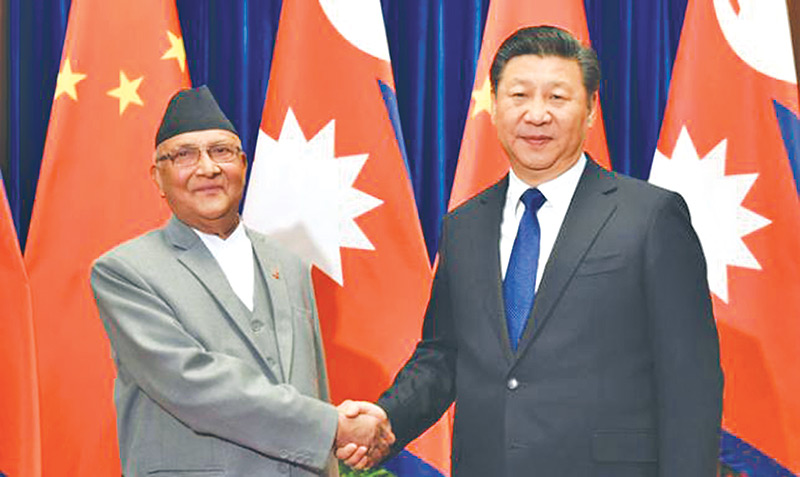
Kathmandu readies itself for Chinese president’s visit

Deals related to infrastructure, connectivity, trade and energy are expected to be signed during Xi Jinping’s visit.
- ANIL GIRI

KATHMANDU,
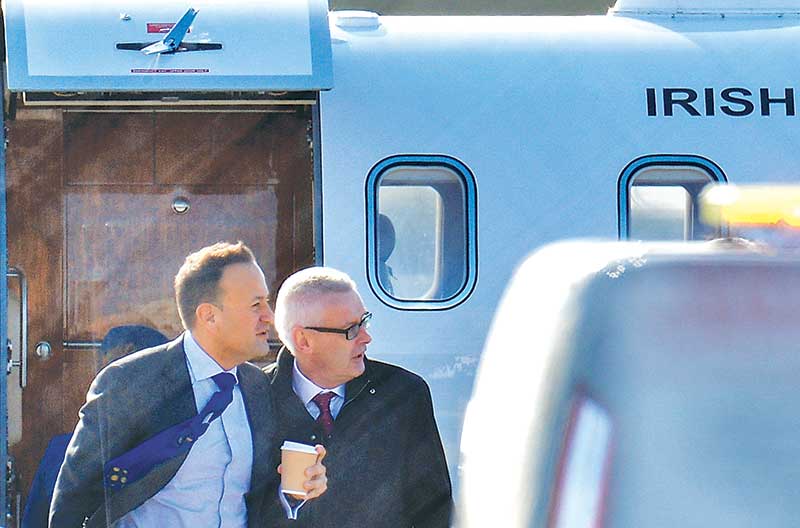
Chinese President Xi Jinping will be arriving in Kathmandu on Saturday, officials from both Nepal and China confirmed on Wednesday. It will be the first visit by a Chinese president in 23 years, since Jiang Zemin landed in Kathmandu in 1996.
Xi, president of the People’s Republic of China, will be paying a two-day state visit to Nepal—on October 12 and 13—at the invitation of President Bidya Devi Bhandari, the Ministry of Foreign Affairs said in a statement. About an hour later, Chinese Ambassador to Nepal Hou Yanqi quoted Xinhua news agency, confirming Xi’s visit to Nepal.
Though preparations for Xi’s visit have been going in full swing in Kathmandu for about a week, official confirmation came only three days in advance, just as the Chinese president’s visit to India was confirmed.
Xi will be flying to Kathmandu from Mamallapuram near Chennai in India where the Chinese president and Indian Prime Minister Narendra Modi will be meeting on October 11 and 12 for a second ‘informal summit’ after the Wuhan Summit in April last year. Xi, considered the most powerful Chinese leader since Mao Zedong and Deng Xiaoping, will be in Kathmandu for two days and is expected to sign some agreements.
Xi’s visit follows a symposium in Kathmandu on ‘Xi Jinping Thought’ for leaders from the ruling Nepal Communist Party (NCP).
Nepal signed up to Xi’s flagship Belt and Road Initiative (BRI) in May 2017 and the KP Sharma Oli administration is expecting massive support for various development projects under the initiative. Nonetheless, there has not been much progress in that regard, which analysts attribute largely to Nepal’s failure to do its homework and a lack of commitment from Beijing.
While some big-ticket projects are expected, foreign policy experts say that the Chinese president’s visit to Kathmandu is largely a part of his exercise to expand his influence in South Asia.
Though Nepal and China share over six decades of diplomatic relations, Nepal’s tilt towards the north became visible in the wake of the 2o15 Indian border blockade in response to the promulgation of the constitution.
Oli, who was the prime minister then, during his visit to Beijing had signed a slew of agreements, including one on transit and transport. A related protocol was signed in April this year, which allows Nepal access to seven Chinese sea and land ports for third-country trade.
As that agreement has yet to be implemented, it could be high on the agenda, an official who requested anonymity told the Post. Discussions are also expected on projects under the BRI, including the Kathmandu-Kerung railway, said the official.

During the visit, Xi will meet with President Bhandari, who will host a banquet in honour of the Chinese president and his delegation.
“President Xi will hold delegation-level official talks with Prime Minister KP Sharma Oli,” the Foreign Ministry said in its statement. “Following the talks, both leaders will witness the signing of bilateral agreements and memoranda of understanding.”
Agreements related to infrastructure, connectivity, trade, commerce and energy are expected to be signed.
Oli himself is directly overseeing preparations for Xi’s visit in terms of logistics and agenda, said two officials familiar with the developments.
Several advance Chinese teams have arrived in Kathmandu to inspect the airport, hotel, roads and the areas Xi will visit. They are taking stock of security, mostly around Tibetan settlements in and around Kathmandu, according to the official.
“There will be no compromise on security,” Ram Krishna Subedi, spokesperson for the Ministry of Home Affairs, told the Post.
“The government has approved VIP security guidelines for visiting foreign dignitaries.”
Under the command of the Nepal Army, personnel from various security agencies will be deployed in and around Kathmandu while dozens of intelligence agents have been dispatched to maintain a vigil on the activities of Tibetan refugees and others, according to security officials.
Nepal is home to 11,000 Tibetans, and the Chinese side has constantly expressed its concerns over their activities.
Government officials say that since Nepal adheres to the ‘One China’ policy, no activity on Nepali soil against any friendly nation will be tolerated.
Multiple sources in the government told the Post that both sides are now exchanging lists of projects to be signed during the visit but there is no confirmation on how many agreements and pacts will be signed.
On the agenda is the expediting of various projects identified by Nepal under the Belt and Road Initiative, including a feasibility study of the Kathmandu-Kerung railway, a tunnel and road construction on the Tokha-Chhahare section of the Tokha-Bidur road, Betrawati-Syafrubeshi section of the Rasuwagadhi-Galchhi-Thori road, and the Madan Bhandari University.
Additionally, 1,060 MW Upper Arun Hydropower Project, 750 MW Tamor Hydropower Project, Budhi Gandaki power project, upgradation and operationalisation of the Korala border point, construction of the Kimathanka-Khadbari road, and execution of the Transit and Transportation Agreement are on the agenda for the Nepali side to take up with the visiting Chinese delegation.

HOME PAGE

Nepal, China to discuss extradition treaty

An agreement on the treaty, however, is unlikely, during Xi Jinping’s visit, officials say.
- BINOD GHIMIRE
The treaty will be discussed as per the spirit of the joint statement issued in June last year. File Photo: AFP

KATHMANDU,
An extradition treaty with China is a key agenda for discussion during Chinese President Xi Jinping’s upcoming two-day visit to Nepal. Officials, however, said an agreement is unlikely.
The draft of the treaty, finalised by officials from Nepal and China, will be discussed as per the spirit of the statement issued jointly by the two countries during Prime Minister KP Sharma Oli’s China visit in June last year, officials said.
Point 10 of the statement says that the Nepali and Chinese sides agreed to negotiate the Treaty on Mutual Legal Assistance in Criminal Matters and Treaty on Extradition in order to strengthen cooperation on the administration of border areas and combat illegal border crossings and transnational crimes.
Based on the understanding reached in Beijing, taskforces from both sides had worked on the treaty’s draft.
Ram Krishna Subedi, joint-secretary at the Ministry of Home Affairs, led the Nepali taskforce, which also included representatives from the Ministry of Law and Justice. Officials familiar with the matter said that the Nepali side had held several rounds of negotiations with a Chinese team that had come to Nepal for the purpose.
“The treaty is a priority for both the Nepali and Chinese sides,” said an official at the Law Ministry on condition of anonymity as he was not allowed to speak on the matter.
A leader from the ruling Nepal Communist Party (NCP) confirmed that discussions on the treaty are on Xi’s visit agenda.
“There will indeed be a discussion on the matter, but the rumours about an agreement are baseless. Nepal is discussing a similar treaty with India, so discussions will be held with China as well,” Narayan Kaji Shrestha, the ruling party spokesperson, told the Post.
Shrestha said that the Cabinet had not endorsed the treaty yet and that it had only been enlisted for discussion.
During an all-party meeting called by the government on Thursday to discuss Xi’s visit, Minister for Foreign Affairs Pradeep Gyawali said there were no preparations to sign an extradition treaty with China.
Former prime minister Baburam Bhattarai urged the government not to sign the treaty for now as discussions for a similar agreement with India were ongoing.
Nepal signed an extradition treaty with India on October 2, 1953, when Matrika Prasad Koirala was the prime minister. The Indian side, however, has been demanding a revision to the treaty.
In 2006, Nepal and India were close to signing an Extradition Treaty and the Treaty on Mutual Legal Assistance. Negotiations however failed due to disagreements among the parties in Nepal. Similar attempts collapsed
in 2008 and 2010.
The treaty would allow the two countries to hand over criminals from third countries to each other.
Even in the lack of an agreement, police forces from both Nepal and India have been handing over criminals on an informal basis to each other.
Nepal Police arrested Mohammed Ahmed Sidibapa aka Yasin Bhatkal, co-founder of the Indian Mujahideen, and most-wanted criminal Bablu Dubey in 2013 and handed them over to India. Similarly, Dr Ameet Kumar, who was operating an illegal kidney racket, was handed over to India after an arrest in Nepal.
China forwarded the planned text of the extradition treaty to Nepal for consideration in 2009.
After his visit to China in 2014, then home minister Bamdev Gautam had told reporters that Beijing had called
for an early signing of the extradition treaty.
A senior government official who did not wish to be named described media reports that Nepal and China are set to sign the extradition treaty as baseless.
“The Home Ministry has forwarded the draft, but no further discussion has taken place,” the official told the Post.
Multiple officials that the Post spoke with said that an extradition treaty with China at this time could boomerang on the government, as a similar treaty with India has been pending for years.
“The signing of the treaty alone is not adequate,” said the senior government official. “It needs to be ratified by a two-thirds majority in Parliament.”


(Anil Giri contributed reporting)

HOME PAGE

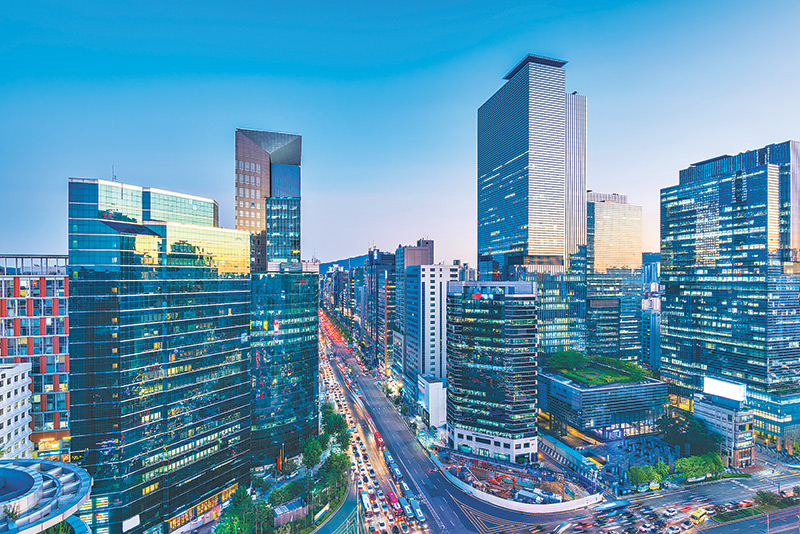
Work stress, loneliness and culture shock lead Nepalis to commit suicide in South Korea

More than thirty percent of deaths reported from 2009 to 2018 were ruled suicide.
- CHANDAN KUMAR MANDAL
shutterstock

KATHMANDU,
In August, Kedar Timilsina, a migrant worker from Bethanchowk, Kavre, was found dead in his apartment in Busan, South Korea. The 27-year-old had hung himself. A news site run from South Korea by the Nepali community reported that Timilsina, who had gone to South Korea to work for the second time, was struggling with depression.
Timilsina’s death is part of the growing suicide statistics of Nepali migrant workers in South Korea, where jobs for Nepali men and women opened in 2008. As of June 15, a total of 62,227 Nepalis had entered South Korea for work.
Even as Nepali migrant workers continue to die in staggering numbers in various labour destinations across the world due to “natural causes”, in South Korea, the leading cause of death is suicide.
 The Seoul Shinmun, South Korea’s oldest daily newspaper, in a special report—‘The 2019 Migrant Report: Betrayed Korean Dreams’—covering the plight of migrant workers recently reported that Nepali workers are committing suicide after failing to achieve their ‘Korean Dreams’.
The newspaper reported that over 30 percent of deaths of Nepali workers are due to suicide, but “the South Korean government does not have a clue why so many migrant workers make such an extreme choice.”
For thousands of Nepalis, South Korea may be a lucrative labour destination, but there are also many pitfalls—such as harsh working conditions, culture shock, loneliness and depression—that could take a severe mental and emotional toll on them.  
According to the Nepal Embassy in Seoul, 43 out of 143 deaths of Nepali workers reported in South Korea between 2009 and 2018 were due to suicide.
Gokul Dhorje Tamang, a Nepali worker based in Hwaseong city, said loneliness, workload and language barriers were the leading factors driving workers to depression and in some cases, suicide.
“After landing in South Korea, Nepali workers suddenly find themselves in harsh working conditions which they had never experienced before,” Tamang, who is from Shailung Rural Municipality in Dolakha, told the Post over the phone. “The situation is even worse for those who are in Korea for the first time. Unable to communicate clearly with their employers, they often experience yelling from their employers, and they end up feeling bad and depressed.”
Bal Bahadur Gurung has had bitter experiences working in South Korea.
“Nepali workers are not treated with respect in South Korea. Migrant workers, especially from South Asia, are treated as inferior,” said Gurung, who worked in South Korea from
2008 to 2018. “They talk in harsh language and belittle Nepali workers. Employers are not always big companies and they do not treat Nepali workers nicely.”
Culture shock is another big challenge that Nepali workers go through after reaching South Korea. Adjusting and assimilating is not easy for everyone.
“Nepali workers should learn and adapt to South Korean culture and their ways,” said Gurung.
The Seoul Shinmun reported that suicides among migrant workers from other countries are significantly lower when compared to Nepali workers. Only four deaths among a total of 51 from Myanmar, between 2011 to August 2019, involved suicide, according to the newspaper. There were no suicides out of the 14 deaths of Vietnamese workers from 2017 to 2019.
Tamang, the Nepali worker in Hwaseong, believes that the modality of selecting workers through language test is also to be blamed for the high suicide rate among Nepalis in South Korea.
Passing the Test of Proficiency in Korean is the only qualification that one needs to work in South Korea. This qualification, Tamang says, is not enough.
“Nepali workers only have a theoretical understanding of working in South Korea. They have no idea what the work looks like in a workplace where one has to work for 12 hours,” said Tamang. “Anyone who has never worked in their life but is good at studies can pass the language test. But once they get to their jobs, which is physically straining, they find themselves unable to cope, fall sick and depressed, and finally commit suicide.”
The Nepal government, however, has not looked into the reasons behind the high number of suicides among Nepali workers in South Korea.
“There will be a study regarding the suicide of Nepali workers in major labour destination countries. Based on the recommendations of the study, there will be a policy-level intervention,” Rajan Prasad Shrestha, executive director at the Foreign Employment Board, told the Post.
Following the rise in suicide cases among Nepali workers in South Korea, the Nepali Embassy in Seoul and the local Nepali community have been mobilising teams to provide
psycho-social counselling to workers, according to Shrestha.
“Nepali workers need training and counselling on stress management and workplace safety. We began sending out teams through the embassy from this year,” he said. But these counselling sessions are not taking place as regularly as they should.
“Doctors’ visits are irregular and the Nepali embassy is woefully understaffed. There are four or five staff catering to thousands of workers,” said Tamang. “Imagine the remittance sent by Nepali workers back to the country. The government seems to hardly care for them.”
Recently, a 30-year Nepali woman from Ramechhap was sent back to Nepal after she began to display depressive behaviour. She was the only Nepali at her workplace in Kwando and had completely stopped talking to her colleagues and the employer. The woman was lucky that she came in contact with the Nepali community and was sent home. Not everyone is that fortunate.

Page 2
MEDLEY

Horoscope

ARIES (March 21-April 19)
***
Do not be afraid of embracing all of your opportunistic tendencies—sometimes, they are your best defence against falling into a lousy routine or succumbing to a rather boring life. You shouldn’t limit your own ambitions with a misplaced urge not to hurt anyone else’s feelings. Looking out for number one is not a crime.


TAURUS (April 20-May 20)
****
You have a deep understanding of a friend or coworker’s current issue because you have been in the same boat yourself in the past. So utilize your empathy to help them feel better, give them a few words of encouragement, or send them a supportive email. Let them know that they will get through this.


GEMINI (May 21-June 21)
***
Today, selecting the best partner is extremely important if you want any kind of real success. You’ll need to make sure you choose the best person for the task, not just someone you like a whole lot. The good news is that you have got an even better ability to assess someone’s character than ever before.


CANCER (June 22-July 22)
***
It might feel like you’re being told ‘no’ an awful lot lately, but what makes you think that you should be hearing ‘yes,’ anyway? You may need to deal with something that you don’t want to deal with. Cut back on the vices in your life. Accept the fact that you can’t do whatever you want to.


LEO (July 23-August 22)
***
If you are trying to help a friend who has been going through a rough time, the only thing you need to do is listen. Right now, they just need to get it all out. They aren’t looking for an answer or even suggestions—they just need to know that someone is there for them. Doing this will go a long way toward cheering them up.


VIRGO (August 23-September 22)
**
Having a healthy ambitious streak is a good thing. But, as we all know, there is such thing as too much of a good thing. Right now, you are running the risk of biting off far more than you can chew. Your schedule is bursting at the seams, and you need to create some breathing room.


LIBRA (September 23-October 22)
***
Sure, it might make you feel a little weird to bare your soul to someone in authority today, but full disclosure is warranted right now. They need to understand what makes you tick if they are going to entrust you with bigger responsibilities. Don’t be afraid of people who have power over you.


SCORPIO (October 23-November 21)
****
Your friends are flexible enough to accommodate whatever it is you need, but you will have ask them to. Accept the challenges ahead of you, everything will be simplified and the pace of your day will be exactly what you need. It’s important to prepare yourself early in the day for what is going to come, later on.


SAGITTARIUS (November 22-December 21)
****
Someone’s honest words might sting a little bit when you hear them today, but you should be flattered and grateful for this person’s directness. They respect you enough to tell you the truth, and they know that you are emotionally mature enough to handle it! Take any criticism you get today and learn from it.


CAPRICORN (December 22-January 19)
*****
Your plans are definitely working! Incontrovertible signs of success will be coming your way before the end of the day, so you had better have some sort of celebration in the wings! Take yourself out for a nice meal, buy that gadget you’ve had your eye on, or just plan on sleeping in tomorrow!


AQUARIUS (January 20-February 18)
*****
The restrictions you have put on yourself recently might have been too stringent, and it might be time for you to loosen up a little bit. You don’t have to be so hard on yourself to achieve your goals. Sometimes, you need to start encouraging yourself instead of pushing yourself! Go out and have some fun today.


PISCES (February 19-March 20)
****
When a powerful person asks for volunteers today, raise your hand! Take on as pivotal a leadership role as possible. Everyone is going to see your exceptional abilities in action! If you always let others step into leadership positions and resign yourself to sitting in the back seat, you will miss out on all the action!

Page 3
NATIONAL

Mahara, who was arrested earlier this week over rape allegations, admitted to hospital

A hearing on the case will start most probably on October 15 when the courts open after Dashain holidays.
- SHUVAM DHUNGANA

KATHMANDU,
Krishna Bahadur Mahara, who was arrested on Sunday over rape allegations, has been admitted to Norvic Hospital.
“We had taken him for a regular check-up after he complained of chest pain. His blood pressure and sugar level were found to be on the higher side. So doctors suggested that Mahara be admitted,” Senior Superintendent of Police Uttam Raj Subedi, chief of Kathmandu Metropolitan Police Range, told the Post.
Officials at the hospital confirmed that Mahara has been admitted.  
“No one is allowed to meet Mahara, as he is in custody,” said Subedi.
After his arrest, police had kept Mahara in Singha Durbar police station.
Police arrested Mahara on Sunday evening from his residence in Baluwatar following a court order to investigate into rape allegations filed by a female staff member at the Parliament Secretariat on Friday, almost a week after reports surfaced that the former House Speaker had raped her in her Tinkune apartment.
Mahara stepped down as the House Speaker October 1 but he has not resigned as a Member of Parliament.
Mahara’s is the first high profile arrest in the country over rape allegations.
In the aftermath of the accusations and Mahara’s subsequent resignation as Speaker of the House of Representatives, there were many fears regarding the woman’s safety, the politicisation of the case, and if an impartial investigation into Mahara was even possible, given his political standing in the ruling Nepal Communist Party (NCP).  
Conflicting statements from the accuser had further led to confusion.
The woman first made the allegations against Mahara on September 30 via a media portal. She then recanted her accusations in a video interview for another online platform. Many had believed that her recantation was made under duress.
Police had failed to make any progress on the case, citing the lack of a formal complaint and the woman’s disavowal of her initial allegations.
The investigation moved forward after rights groups and the international community expressed concerns over police and the state’s lackadaisical approach to gender-based violence.
Taking cognizance of the case, the National Human Rights Commission last week formed a three-member committee to monitor and study the investigation process. The United Nations’ office and six foreign missions based in Kathmandu in a statement on Friday reminded the government of Nepal of its obligations under international laws to ensure access to justice for victims, stand for victims’ rights and send a zero-tolerance message to combat gender-based violence. They, however, stopped short of referring to Mahara by name in their statement. Their concern about the high prevalence of violence against women in Nepal came just as there was public scrutiny of all developments in relation to the case.
As courts are currently closed for Dashain holidays, a hearing on Mahara case is unlikely before October 15.
“We are preparing to record his statement,” said Deputy Superintendent of Police Hobindra Bogati, spokesperson for the Kathmandu Metropolitan Police Range. “Once the courts open on October 15, we will produce Mahara before the court.”

NATIONAL

Distributive nature of Constituency Development Fund in provinces set to continue

Authorities in Gandaki Province defend the provision, saying that the allocation would help complete small projects.
- PRITHVI MAN SHRESTHA

KATHMANDU,
Gandaki Province which received funds under the Constituency Development Programme for the first time this fiscal year has followed a familiar path—to use the allocated funds piecemeal in projects preferred by the lawmakers.
The programme, which was first introduced by the late finance minister Bharat Mohan Adhikari, in 1994, to please central-level lawmakers, has continued to date because of its distributive nature and due to potential of gross misuse of such funds for the projects aligned to political parties and leaders. The provincial governments also followed the same model after their establishment in 2017.
A regulation introduced by the provincial government has allowed allocating as low as Rs100,000 for a project. The regulation says if a small project needs to be selected, a maximum of three projects having the cost of  Rs100,000 and a maximum of five projects having the cost of Rs200,000 can be selected. The regulation says maximum 25 projects can be selected in a constituency but two of them must have the cost of Rs2.5 million.
But, Ram Sharan Basnet, minister for Physical Infrastructure Development and spokesperson for the Gandaki government, defended the provision of the regulation allowing Rs100,000 in a project, saying that some small unfinished projects could be completed with this allocation.
“For example, some unfinished infrastructure can be completed with a small amount,” said Basnet. “We have had some buildings constructed from the funds. Similarly, some unfinished community buildings and some under-construction toilets can be completed with a small amount of money. The funds under this programme can be used in such projects.” The budget for the current fiscal year to June 2020 has allocated Rs12 million for each provincial lawmaker in Gandaki Province under the Constituency Development Programme.
The regulation has also allowed lawmakers to implement the projects through the consumer committees without competition.
The regulation says the implementation can be done as per the existing laws and it does not bar the implementation of projects through the consumer committees. As per Public Procurement Law, projects having cost up to Rs10 million can be implemented through the consumer committees without a competitive tendering process.
Gandaki Province had not introduced the programme last fiscal year, but the provincial government was forced to introduce it due to pressure from the provincial lawmakers. When it introduced the regulation, it followed the federal government and other provinces that allow the fragmentation of limited resources.
Province 3 was another government which had not introduced the programme in the last fiscal year but heeded to provincial lawmakers this fiscal year. Other five provinces have continued the programme for this fiscal year as well, while increasing their budget under the programme. While many provinces are working towards revising the regulation, they have suggested that the distributive nature of the programme should continue.
Sudurpaschim Province is preparing to revise the regulation but is likely to continue its distributive provision, according to a provincial minister. The province, which had an allocated budget of Rs20 million for each of the lawmakers in the last fiscal year, increased the amount to Rs30 million for each lawmaker for the current year. There are 53 provincial lawmakers.
In the last fiscal year, the regulation had made provision that a maximum of 16 projects could be selected with at least one project having the cost of more than Rs3.5 million.
But, as the provincial government is working to revise the regulation, it wants to give a greater role to lawmakers elected through proportional representation instead of stopping the programme from being distributive.
Jhapat Bohora, minister of Economic Affairs and Planning, said that lawmakers do not want to invest the amount in a few large projects. “Their focus remains on smaller projects having the cost of Rs1.5 million to Rs2 million which have not been incorporated in the budget,” said Bohora. “They want to contribute to the construction of toilet and small drinking water projects.”
In Province 2, each lawmaker has been allocated Rs30 million under the Constituency Development Programme. The programme was distributed as the regulation allowed to select projects having cost of more than Rs500,000.
“We are now preparing to increase the threshold as we are revising the regulation,” said Bijaya Kumar Yadav, minister for Economic Affairs and Planning. “My opinion is that the threshold should be Rs2.5 million for each project.”
According to Yadav, the provincial assembly has also formed a committee to study and evaluate the outcome of the programme.
Karnali Province, meanwhile, has introduced a different type of programme focused on constituency development—one that goes under the headings of Infrastructure Special Programme and Janata Sadak Programme.
According to Prakash Jwala, minister for Economic Affairs and Planning,  they are still working on a regulation on the implementation of Infrastructure Special Programme.
“We want to ensure that the budget is invested in large projects, as far as possible,” he said.
For the Janata Sadak Programme, the provincial government has allocated Rs50 million for each constituency for building its roads infrastructure.

NATIONAL

Dengue found in all 32 wards of Birgunj

- SHANKAR ACHARYA

PARSA,
At least 146 people in Birgunj, Parsa, have been diagnosed with dengue until Tuesday.
The mosquito-borne infectious disease which was first reported in Sunsari in May has spread in many parts of the country over the months.
In Birgunj, dengue patients have been found in all 32 wards, said Arun Kumar Mahato, the health division chief at city office.
Since the weather is turning cooler, Mahato said the threat of dengue may be on the decline.
“The disease will not spread further after mid-November,” said Mahato.
According to the division, the disease had turned into an epidemic in the district five years ago.
The city office has been providing free dengue testing kits and holding awareness campaigns to stop a fresh dengue outbreak.

Page 4
Page 5
NATIONAL

Measles-rubella campaign to be launched next year

The nationwide immunisation drive is supposed to cover over three million children.
- Arjun Poudel

KATHMANDU,
The Ministry of Health and Population has decided to run a nationwide vaccination campaign against measles and rubella virus for two months.
The first phase of the campaign will start on February 13, 2020, and will continue until March 13 in provinces 1, 2 and 5. The second phase will be conducted from March 14 to April 14 in provinces 3, 4, 6 and 7.
“We have planned a campaign to ensure that no child would miss the vaccine,” Dr Jhalak Sharma, the immunisation section chief at the Family Welfare Division of the Department of Health Services, told the Post. “During the campaign, we will immunise the children aged between 9 months to 59 months old.”
Measles and rubella are viral diseases, which are transmitted through droplets from the nose, mouth or throat of infected persons. Early symptoms, which usually appear 10-12 days after infection include high fever, runny nose, bloodshot eyes and white tiny spots inside the mouth. Several days later, a rash develops on the face, upper neck and other body parts. of the body.
Doctors say people of all age groups are vulnerable to the disease and underage children, pregnant women, elderly people and those with compromised immune systems—HIV infected people—are highly vulnerable.
Some people may suffer from severe complications, such as pneumonia and encephalitis, and the infection could also lead to death.
The immunisation drive is supposed to cover over three million children. Sharma informed that the Global Alliance for Vaccine and Immunisation would provide the vaccines through UNICEF.
The Department of Health Services has already sent shipment plan to the alliance for the vaccines.
The alliance has committed to provide 3,31,000 vials of vaccines (each vial containing 10 doses), three million syringes and other necessary materials to the government.
Earlier, the health ministry had planned to launch the campaign within December this year. But the vaccination campaign got postponed due to delays in completing the capacity assessment by the aid agency.
With the implementation of the federal system, the responsibility of running the immunisation drive has been transferred to the provincial and local level governments.
Dr Bhim Singh Tinkary, the director of Family Welfare Division, said that mass campaigns against the two viruses should be carried out every four years as the coverage of the vaccines during routine immunisation was low.
Out of over 650,000 children in need of measles-rubella vaccines every year, 120,000 (about 20 percent) miss their inoculation schedule.
Doctors say the chances of the deadly viral disease spreading are higher even if one child misses his/her immunisation.
Meanwhile, the Department of Health Services has been working to extend the deadline to eliminate the deadly viruses from the country. “We will extend the deadline, as the World Health Organization’s South-East Asia Regions office has also extended the deadline to 2023,” Sharma added.
Earlier, the government had committed to eliminating measles and rubella from the country by 2019.
Low vaccination coverage, floating population, lack of public awareness about the importance of vaccines and apathy on the part of government agencies concerned are considered to be some of the reasons behind the failure of eliminating the disease from the country

NATIONAL

Galkot leaves pride project incomplete

Baglung had listed the Malma-Righa road as its pride project last fiscal year.
- PRAKASH BARAL

BAGLUNG,
Galkot Municipality of Baglung had enlisted Malma-Righa link road as its pride project in its annual budget last fiscal year. The provincial government and the municipality had allocated Rs 5 million each to upgrade the 21km-long road that links Righa with Malma.
The road’s upgradation work was divided into three parts, with one part completing upgradation last year.
But this year, the municipality has not allocated any budget to complete the upgradation work, although there were plans to extend the upgradation work of the road from Righa to Pandavkhani and Ranasinkiteni.
Locals have expressed their dissatisfaction on the municipality’s failure to prioritise its pride project, which stands to benefit the locals.
Thousands of people in Righa, Sisakhani and Pandavkhani of Galkot and Ranasinkiteni and Jalaal of Badigada Rural Municipality are depending on the road upgradation to ease transportation.
“I don’t think that the road section is a pride project for the municipality anymore,” said Mitralal Kharel, a local. “The road upgradation work was carried out well last year. But the road project did not receive budget from the federal, provincial and the local governments this fiscal. The municipality should continue allocating budget to complete the upgradation work.”
With last year’s budget, the project had widened the track, placed drainage pipes and built retaining wall. “We planned to complete the work this year, but the municipal council did not issue budget this year,” said Lal Prasad Gharti, the chairman of the road consumers’ committee. He urged the authorities to correct its decision and allocate budget. “Budget should be allocated to the pride project at least for three consecutive years,” he added.
The municipality also has plans to develop Righa as a tourist destination. However, given the poor condition of the roads in the area, tourism hasn’t been able to pick up. “The road is narrow and rough, and cuts through cliffs. So people are afraid to travel on this road,” said Gharti.
In the last fiscal year, Galkot Municipality had selected a pride project each in all its 11 wards and allocated a budget of Rs 5 to 6.5 million each. Nothing of the sort has been carried out this year.

NATIONAL

In Rukum (West), there are few who are taking up technical education

Although most schools in remote areas have received permission to run courses in technical education, classes are not being conducted for lack of students.
- HARI GAUTAM
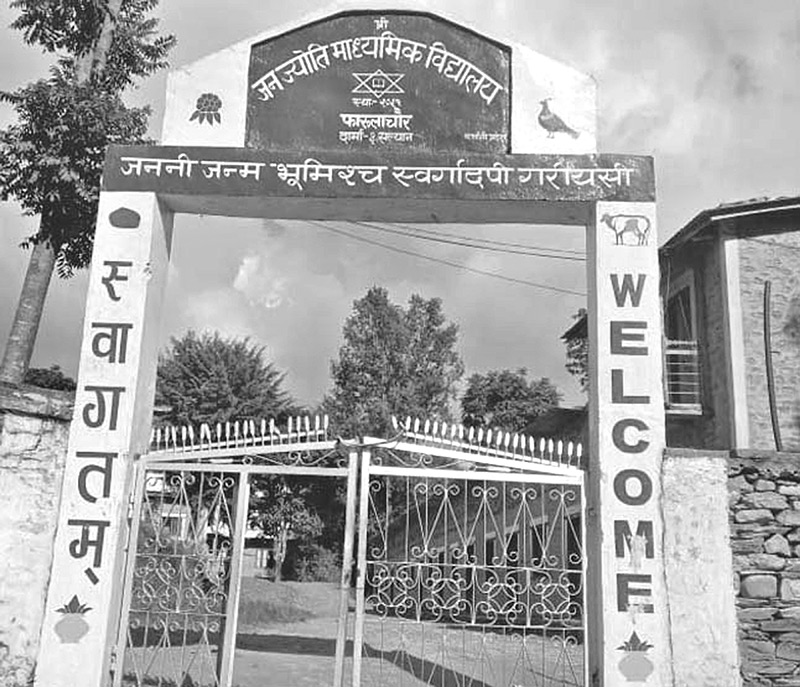
Janajyoti Secondary School is one of the schools that does not have adequate number of students to run technical education classes. Post Photo: Biplav Maharjan

RUKUM (WEST),
Tribeni Secondary School in Tribeni, Rukum (West) is eligible to conduct classes of Junior Technical Assistant (JTA), an 18 month-long course, in the field of agriculture, but not a single student has enrolled for the classes.
Janakalyan Secondary School in Banfikot has also introduced a three-year course on agronomy and crops production but hasn’t been able to run classes due to lack of students.
Although most schools in remote areas have sought and received permission from the Education Development and Coordination Unit to run various courses in technical education, the majority of them are struggling to find students interested to take up the courses.
Mahendra Secondary School in Musikot, the district headquarters of Rukum (West) also conducts classes under technical education. Laxman Shahi, the technical coordinator of the school, said that only four students have enrolled for the JTA course.
Stakeholders believe that the majority of these schools introduced technical courses without conducting a survey on interested students. “The schools are running their classes, but they are not on par with the ones in cities. These schools lack the infrastructure and the necessary skill-set to run such classes,” said a student.
One of the schools that have successfully started Technical courses is Rapti Gyanodaya Secondary School in Sanibheri. It runs animal science, and agronomy and crops production courses but the enrollment is dismal, with only 15 and 14 students enrolled in these courses respectively for this academic year.
There is also a limited number of students in Tribhuvan Janata Secondary School in Musikot and Shahid Yagyashowr Smriti Technical Institution in Chaurjahari which are the oldest schools in the district. Mohan Kishor Oli, chairman at the Tribeni Secondary School Management Committee, admitted that majority of the schools in the district have started to teach technical education without preparations. Oli said, “We don’t have students interested in these courses. It could be because of a genuine lack of interest or shortcomings on the schools’ part.”
Tara Prakash Pun, chief at the Education Development and Coordination Unit, said that schools are facing a crisis in enrollment because most schools started running classes altogether. Pun said, “Many schools took permission of technical education since every other school was doing it. It was fashionable to do so. However, there are no proper manpower and the required infrastructures to conduct these technical classes. That’s why students prefer not to enrol in these courses.”  

NATIONAL

Motorcycles torched

Briefing

DHANUSHA: The Area Police Office in Khajuri said that nine motorcycles were torched in Janaknandini Rural Municipality-3, Dhanusha, on Wednesday night. Police said that the motorcycles, which were parked in a public place, were completely destroyed in the arson.

NATIONAL

Boy dies in leopard attack

Briefing

DAMAULI: A four-year-old boy was killed in a leopard attack in Bhanu Municipality Ward No. 1 in Tanahun on Tuesday. According to police, Aashish Baniya died while undergoing treatment at Laxmi Hospital in Dumre.

NATIONAL

Dhanusha police fired tear gas shells in Devdiha

Briefing

DHANUSHA: Security personnel from the District Police Office in Dhanusha lobbed 17 rounds of teargas canisters for the safety of the police post in Devdiha on Wednesday. The clash ensued between police personnel of Devdiha and locals after police tried to settle a motorcycle accident case.

NATIONAL

Water project benefits 74 households in Tanahun

Briefing

DAMAULI: Locals of Michhurlung in Bhimad Municipality have benefited after the installation of 74 taps in their village. The Michhurlung Dharadi Drinking Water Project has started to supply water to 74 households from September 6.

NATIONAL

Locals busy harvesting cardamom during Dashain

Briefing

LAMUJUNG: Farmers in Besisahar Municipality are busy picking large cardamom these days, as Dashain is the best time to harvest the spice. Farmers in the area have been
cardamom farming for the last four decades.

Page 6
EDITORIAL

Pedalling good health

Birendranagar is all geared up to turn into a cycling city by 2025—and that's good news.

As Kathmandu is hell-bent on cutting down trees to make roads wider for motor vehicles, the capital of Karnali province, Birendranagar, is all geared up to turn into a cycling city by 2025. In a welcome move, Birendranagar has already started working on the Detailed Project Report to construct bicycle-and pedestrian-friendly roads in the city. Our narrative of progress and change is heavily dominated by infrastructural development paid limited attention to pedestrians and cyclists. Given that, it is refreshing to see the authorities and residents of Birendranagar change its focus pursue and the idea of development that will allow people, and not vehicles, to reclaim the urban environment.
According to a report published in this paper, in the current fiscal year, the Ministry of Physical Development has allocated Rs20 million to prepare the Detailed Project Report and construct a cycle track from Subba Kuna to Bange Simal. In the first phase, 250 places will be identified to construct cycle stands. The idea took seed after a report prepared by the Karnali Riders Club—a group of campaigners—in Surkhet concluded that 1910 kilolitres of petroleum products were used in the fiscal year 2017-18. The study further found out that if locals opted for bicycles as a mode of transport, fuel expenses would decrease by Rs500,000 per day.
Almost in many parts of the country cyclists are under severe threat of being expelled from cities by the growing number of cars. And the growing traffic is already taking its toll—be it in the sheer number of road accidents per year, or in terms of making our cities more and more unliveable. In fact, Nepal’s terrain is ideal for cycling, but policies and plans actively discourage bicycles at a time when cities around the world are returning to this mode of transport. There is a ministry dedicated to urban planning but seldom does it take its responsibilities seriously. Haphazard urban sprawl has, in essence, done more harm than good.
The Karnali Riders Club seem to be resourceful and resolute, but there also needs to be other forces helping to create fertile soil for their ideas. The government at the centre, provincial and local levels must support this decision and do the needful to bring this plan to fruition. What’s more, the plan needs to be supplemented with an elaborate network of cycle-paths and lanes, along with bike stands so safe and comfortable that even toddlers and older people can use bikes as the easiest mode of transport.
It’s about time we revisit our idea of development and subscribe to a vision that is more encompassing and not fixated on widening roads to accommodate more motors. The onus, therefore, squarely lies on the government, both local and federal, to make our streets safer and cities more liveable. Birendranagar’s vision of turning into a city by 2025 is laudable. It should sustain this drive and other cities in the country must follow suit.

OPINION

Greta Thunberg’s moment

To avert an environmental catastrophe, we need many more like Greta Thurnberg.
- PETER SINGER
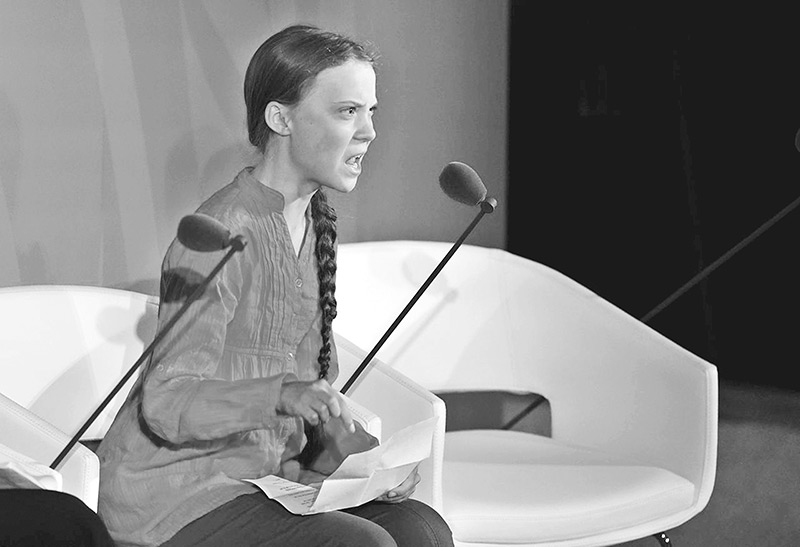
1 6-year-old Swedish Climate activist Greta Thunberg speaks at the 2019 United Nations Climate Action Summit at U.N. headquarters in New York City, New York, U.S., September 23, 2019. Reuters

‘This is all wrong!’ These words begin the most powerful four-minute speech I have ever heard. They were spoken by Greta Thunberg, the Swedish teenage climate activist, at the United Nations Climate Action Summit last month, and followed a week of climate strikes and marches attended by an estimated six million people.
The marchers were predominantly the young people who will have to cope with more of the costs of climate change than the world leaders Thunberg was addressing. Her tone of moral outrage was therefore apt, as was the leitmotif of her speech: ‘How dare you?’ She accused the world’s leaders of stealing the dreams of the young with empty words. How dare they say that they are doing enough? How dare they pretend that ‘business as usual’, coupled with yet-to-be-discovered technological solutions, will solve the problem?
Thunberg justified her outrage by pointing out that the science of climate change has been known for 30 years. World leaders have looked away while the opportunities for a timely transition to a net-zero greenhouse-gas economy slipped by. Now even the heroic effort of halving emissions over the next ten years would, Thunberg pointed out, give us only a 50 percent chance of keeping global warming below 1.5º Celsius.
Passing that limit risks setting off uncontrollable feedback loops leading to further warming, more feedback loops, and yet more warming. Thunberg referred to the Intergovernmental Panel on Climate Change’s report indicating that to reduce the risk of exceeding 1.5º Celsius to one in three, we will need to limit global carbon dioxide emissions from now until 2050 to 350 gigatons. At the current rate, we will exceed this limit in 2028.
According to the Climate Change Performance Index, no government in the world has yet achieved a ‘very good’ performance in protecting the world’s climate. Sweden, Morocco, and Lithuania are currently doing the best, with Latvia and the United Kingdom not far behind. The United States is in the bottom five, along with Saudi Arabia, Iran, South Korea, and Taiwan.
The ethical issue is not difficult to adjudicate. For affluent countries, which are responsible for most of the CO2 that is now in the atmosphere, there can be no ethical justification for continuing to emit greenhouse gases at far higher per capita levels than the people in low-income countries who will suffer most from climate change. To impose on them a one in three chance of warming beyond 1.5º Celsius is playing a kind of Russian roulette, as if we had put a revolver against the heads of tens or perhaps hundreds of millions of people in low-income countries—except that we have loaded our six-chambered revolver with two bullets rather than one. For affluent countries, on the other hand, the required transition to a clean economy would bring some transitional costs, but in the long run would save lives and benefit everyone.
How will we get there? Thunberg ended on a positive note: ‘We will not let you get away with this. Right here, right now is where we draw the line. The world is waking up. And change is coming, whether you like it or not’. Can young people really wake the world to the urgency of changing direction? Can they convince their parents? School strikes will trouble parents, especially parents who then need to arrange child care, but will they influence political leaders? What can be done to keep climate on the agenda until governments get serious about reducing the risk of catastrophe?
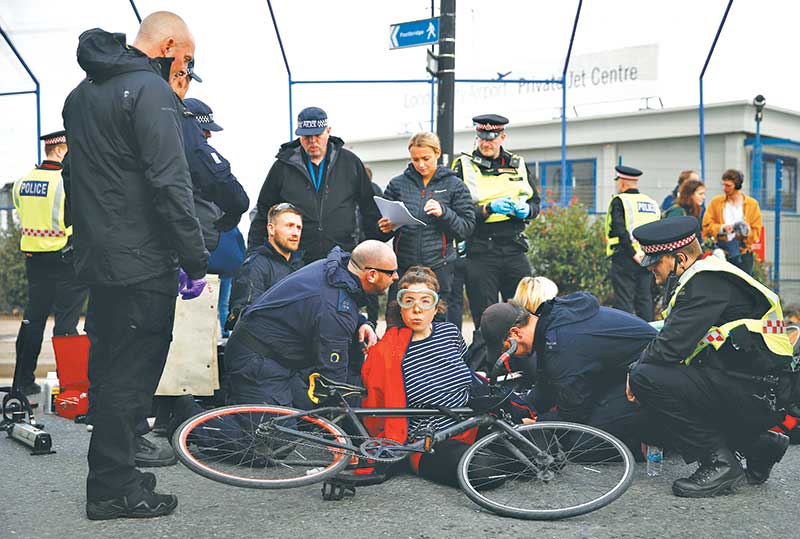
‘Extinction Rebellion’, an international movement that began last year with a Declaration of Rebellion in London, advocates civil disobedience. Extinction Rebellion calls for thousands of activists to block roads and shut down transport systems in major cities around the world, not just for one day, but for long enough to impose real economic costs on governments and business elites, all the while maintaining strictly nonviolent discipline even in the face of government repression.
Civil disobedience was first used as part of a mass movement by Mahatma Gandhi in South Africa and subsequently in India. In the United States, its most famous proponent was Martin Luther King, Jr., in the struggle against racial segregation. Civil disobedience played a role, along with other forms of protest, in ending the Vietnam War. In each of these examples, resorting to civil disobedience is now widely regarded as courageous and right. There are statues to Gandhi around the world, and in the US, King’s birthday is a national holiday.
The failure of governments to reduce greenhouse-gas emissions is no less wrong than British rule in India, the denial of equal rights to African-Americans, or the war in Vietnam—and it is likely to cause harm on a far larger scale. So, civil disobedience also would be right if it can persuade governments to follow the science and do what is necessary to avert catastrophic climate change.
There may be other effective forms of nonviolent protest that no one has yet tried. Thunberg first became known for standing alone outside Sweden’s parliament holding a sign saying, in Swedish, ‘School Strike for Climate’. No one could have predicted that this then-15-year-old girl would start a movement supported by millions of young people and gain a platform from which to address the world’s leaders. We need more innovative ideas about how best to convey the urgency of the situation and the need for a sharp change of course.


— Project Syndicate

OPINION

Dealing with young offenders

Diversion is a new concept in the juvenile justice system focusing on reform instead of punishment.
- KRISHNA SHOVA SUWAL
Shutterstock

Whenever we hear the term diversion, we simply understand it to mean to divert from the regular direction. From this general understanding, diversion is the concept of redirecting or diverting any person from the task he or she is involved it. The concept of diversion is a common strategy that is used in the criminal justice system to reform or rehabilitate criminal offenders. This strategy involves cooperating with offenders to help them rejoin society and adapt socially compatible behaviour.
The concept of diversion is mostly applied to offenders who have been involved in petty offences or offenders who belong to special groups like children and elderly people. Diversion focuses more on offenders where the problem can be solved by rehabilitating them into society and unburdening the courts of such cases. Juveniles can be rehabilitated if they promise not to repeat the offence in the future. This concept evolved with the objective of reforming groups involved in criminal activities, the primary concept of a reformative justice system.
Nepal, as a step towards ensuring the rights of children as enshrined among the fundamental rights in the constitution, promulgated the Children’s Act 2018. The law defines diversion as an instance of diverting or practising procedures other than the formal judicial process in the case of children involved in criminal offences. Where the United Nations Convention on the Rights of the Child has adopted the Child’s Best Interest as the major principle for the protection of children, the Children’s Act 2018 has enshrined the implementation of the principle for the purpose of diversion.
The act has made the investigation officer an institution for diversion for children who have committed offences that involve property worth up to Rs5,000, or offences punishable with a fine of up to Rs2,000 or imprisonment up to one month. The government attorney will be the investigation officer for offences that involve property worth up to Rs10,000, or offences punishable with a fine of up to Rs5,000 or imprisonment up to three months. The Juvenile Court will handle cases involving graver offences.
The court always pays attention to the analysis of the fact that the juvenile confesses the crime, agrees to act for their rehabilitation and reintegration and the nature of the offence with the degree of pain infliction on the victim. Here, the children’s agreement is equally prominent as the consent of the parent or the guardians of the juveniles. The Act has highlighted that the Act together is in action for not only the protection of the interest or best interest of children, but also is demonstrating the practice of rehabilitation, reformation and reunion of the juveniles with the family. Diversion can be conducted by following different procedures like negotiating with the victim, making them understand the wrong they have done, counselling the family, engaging them in community service, reforming them through different reform centres, setting them free under the supervision of a child
welfare officer, parents or guardians, and engaging them in academic activities.
Juveniles can be diverted by adopting one of these processes, with or without allocating a definite time frame. As Nepal is a party to the Convention on the Rights of the Child and the convention is greatly concerned about the protection of all children, even child offenders whom we call juveniles, it has adopted the provision of diversion. Nepal has initiated the concept of diversion for juveniles even though implementation is challenging.
This is really an exemplary initiation for it focuses on rehabilitation and reintegration of juveniles with the hope of bringing positive change and improving the mindset of children, which is a more comprehensive and sustainable result than punishing them. Defining the categories for diversion is also assistive for the institutions concerned, but it should be done in a scientific manner. The objective set by the Children’s Act 2018 can be achieved with the realisation of positive behaviour, a positive attitude resulting in transformation and elimination of negative deeds.


Suwal is an officer at High Court Patan.

Page 7
OPINION

Fruits of ‘wisdom’

- MAHIR ALI
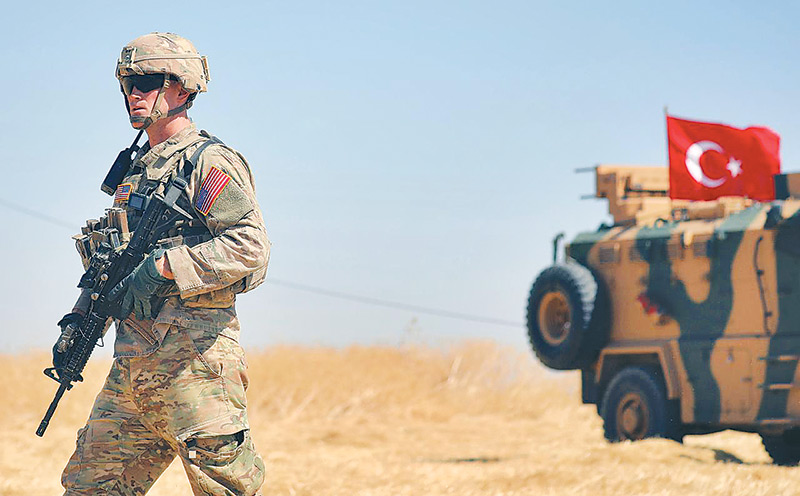
An American soldier walks near a Turkish military vehicle during a jointU.S.-Turkey patrol, near Tel Abyad, Syria September 8, 2019. The history of US intervention is a saga of mass destruction and no one really knows what happens next. Reuters

It is telling that no one batted an eyelid when, in a tweet threatening to ‘obliterate’ Turkey’s economy if it did anything ‘off limits’, the commander-in-chief of the United States referred in passing to his own ‘great and unmatched wisdom’. After all, this is the same person who routinely describes himself as ‘a very stable genius’, ignoring the fact that anyone with an average IQ who has even a tentative grasp over reality would recognise that such boasts are, at best, entirely superfluous.
The ‘genius’ and the ‘unmatched wisdom’ both came under question on Sunday night when Donald Trump, following a telephone conversation with Turkish president Recep Tayyip Erdogan, decreed that Ameri­can troops would get out of the way of any military operations by Turkey in northern Syria.
That was inevitably interpreted as giving Ankara the go-ahead for what Erdogan has long been itching to do: to establish a Turkish-controlled enclave on the border with Syria—an approximately 30-kilometre ‘buffer zone’—that would serve a dual purpose. It would provide a dumping ground for a million or so Syrian refugees who have fled their homeland in recent years, while distancing the Kurds from the frontier.
Syrian Kurds have spearheaded the US-backed Syrian Democratic Forces, an entity that was instrumental in combating the militant Islamic State group and its associates in Syria’s north. Erdogan, whose nation was indubitably the conduit for most of the foreign fighters attracted to IS and its ilk, and whose regime is hardly innocent of the charge of providing succour and support to a range of jihadists, sees the SDF as an extension of the Kurdistan Workers Party (PKK), which has long fought for Kurdish rights in Turkey, and been dubbed a terrorist force in the bargain.
It would be strange if there weren’t links between the unfairly derided PKK and the freshly beleaguered SDF. Divided across Middle Eastern borders from Iran to Turkey and Syria, the Kurds are the largest ethnic group anywhere without a nation-state to their name. And in forging alliances in their quest for regional autonomy, they are accustomed to routinely being betrayed by a range of regimes, so while the latest move by the US is inevitably dismaying, it could hardly have come as a surprise.
What Trump may not have foreseen, notwithstanding long-standing Pentagon resistance to his urge for a pullout, was that some of his closest congressional Republican allies—including Mitch McConnell and Lindsey Graham, not to mention former UN ambassador Nikki Haley—would interpret the sudden abandonment of Kurds as reprehensible evidence of American unreliability.
Most of the critics tend to ignore the fact that historically America’s reputation as an unreliable ally is well established. In this sphere, as in so many others, Trump is hardly an innovator. The accidental president probably realises, however, that he can ill afford to antagonise his allies in Congress amid the looming threat of impeachment. Hence the tweeted threat to Turkey, which fails to clarify what he might perceive as ‘limits’.
His ‘wisdom’ may indeed be ‘unmatched’ in recognising that American participation in what he describes as the Middle East’s ‘Endless Wars’ ultimately causes far more harm than good. But that instinct ought to be supplemented by the recognition that at least some of these wars may not have occurred at all had the US butted out. Furthermore, there’s a considerable difference between not intervening in the first place and pulling out when the going gets tough.
Across most of the 20th century and bey­ond, the history of US military interventions is a sordid saga of mass destruction without reasonable cause—and, often enough, the ultimate betrayal. The generally destru­ctive US role is not restricted to boots on the ground, however. Throughout modern history, it has unhesitatingly propped up the most odious regi­mes in living memory—from Pino­chet to Ziaul Haq—and continues to do so today, not least in the Middle East, where Saudi Arabia and Israel remain its primary clients.
And let’s not overlook the extent to which it bolstered and helped to breed jihadist tendencies in Afghanistan, where today the only way out seems to be some sort of deal with the Taliban, the illegitimate offspring of Uncle Sam’s extended dalliance with the regime in Riyadh and its subsidiaries in Islamabad.
The Syrian Kurds may now seek an alliance with Bashar al-Assad’s regime in order to resist the expected Turkish assault. Assad is broadly beholden to Russia and Iran for his continued rule, and both those countries have dealings with Erdogan, while neither particularly gives a damn for the Kurds. The Syrian leader couldn’t have forgotten, though, that his Turkish counterpart was particularly vociferous once in demanding Assad’s departure.
As in so many other parts of the world, no one really knows what happens next. As Trump likes to say, we shall see.


This article was previously published in Dawn, a part of the Asia News Network.

OPINION

Dispelling the myths about sexuality education

Opposition to sexuality education is widespread. Yet, critics lack an understanding of what it entails.
- Helen Clark
Shutterstock

Sexuality education empowers people to make informed choices about their own bodies and sexuality—and to stay safe in the process. It is, therefore, an essential element of quality education. Yet, far from promoting comprehensive sexuality education, many are fighting to limit it. The consequences—especially for young people—are serious, lasting, and sometimes deadly.
As Facing the Facts, a new policy paper by UNESCO’s Global Education Monitoring Report, reminds us, each year some 16 million girls aged 15-19 (and two million under 15) give birth—a development that often marks the end of their formal education. Another three million girls aged 15-19 undergo unsafe abortions each year.
These numbers are linked to a lack of education about sex, sexuality, and the human body. For example, in the Islamic Republic of Iran, according to WaterAid, around one-half of girls think that menstruation is a disease. In Afghanistan, 51 percent of girls know nothing about menstruation before experiencing it themselves. In Malawi, that figure jumps to 82 percent. If girls—let alone boys—do not know what menstruation is, how can they possibly be expected to protect themselves against unwanted pregnancy?
The same goes for sexually transmitted infections like HIV. Young people aged 15-24 account for one-third of new HIV infections among adults. This is partly because only one-third of young women in most low- and middle-income countries know how to prevent the transmission of the virus.
But, contrary to popular belief, sexuality education is not just about sex. As Facing the Facts highlights, it also includes lessons about families and social relationships. These can benefit children as young as five, not least by enabling them to differentiate between appropriate physical contact and abuse.
Moreover, sexuality education offers important lessons about gender dynamics, including issues such as consent, coercion, and violence. Some 120 million girls worldwide—slightly more than one in ten—have experienced forced intercourse, forced sexual acts, or other forms of intimate partner violence at some point in their lives. This helps to explain why violence is the second leading cause of death among adolescent girls globally.
Comprehensive sexuality education can go some way toward countering the warped messages about masculinity that encourage male sexual dominance and so often lead to exploitation and violence. It can also assist in breaking the silence on such experiences among victims, potentially inspiring them to seek help.
All girls and boys—and all women and men, for that matter—can benefit from comprehensive knowledge about safe sexual behaviour. Yet opposition to sexuality education is loud, persistent, and widespread. Some call for it to be banned outright. Others insist that schools should teach only abstinence, despite evidence showing that such programmes often provide medically inaccurate information.
Like critics of LGBTQI+ education, opponents of comprehensive sexuality education seek to justify their stance on cultural, religious, social, or even political grounds. But, whatever the apparent motivation, their opposition often reflects a lack of knowledge about what such education entails. Improving the public’s understanding of sexuality education could, therefore, help to neutralise the negative hype and open the way for more young people to benefit.
Leaders worldwide must stand up for comprehensive sexuality education, by touting its clear, evidence-based benefits and dispelling harmful myths. An informed news media and advocacy by civil-society groups must also contribute to this process. With accurate information, the public is far more likely to accept sexuality education.
But for such education to be meaningful, it must be of high quality.
Teachers must, therefore, be given the knowledge, resources, and, thus, the confidence they need to teach these lessons effectively. Scripted lessons, like those introduced in Namibia and Chile, or online resources for teachers, as Tanzania provides, can go a long way toward fulfilling that need.
Furthermore, sexuality education should ideally be provided as a standalone programme, rather than integrated into other subjects (a common practice that diminishes its impact). And it must be complemented by widely accessible, youth-friendly sexual and reproductive health services.
It is time to face the facts: humans have sex, often long before they reach adulthood. And it is immoral—perverse, even—to withhold potentially life-saving information from young people. After all, knowledge is power. By giving today’s youth, and girls in particular, a better understanding of their bodies, we can give them the power to protect their health—and their futures.


— Project Syndicate

Page 8
CULTURE & ARTS

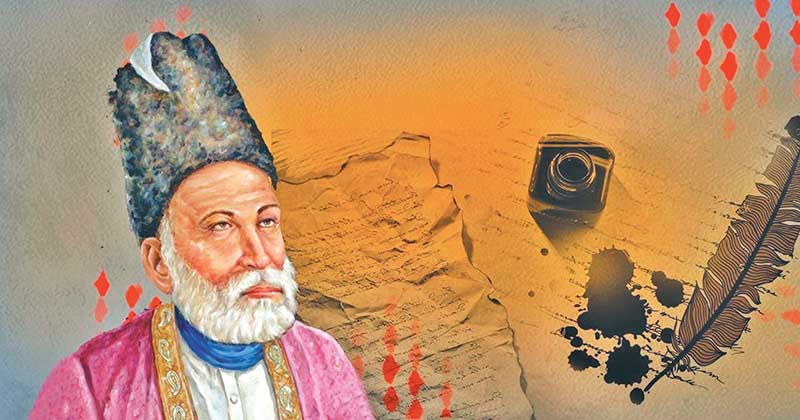
How Ghalib’s genius took ghazal to new heights and depths

Though he was ridiculed for writing incomprehensible poetry, Ghalib was experimenting and innovating.
- Shikoh Mohsin Mirza
Dawn

“These ideas visit the imagination from the beyond: in the scratchings of the reed pen (I hear) the angel’s song.”
In this couplet, Ghalib expresses the age-old belief that the provenance of poetry is divine and mystical. The sound of the reed pen, substituted metonymically for poetry, is likened to the voice of an angel to emphasise the role of inspiration in a poet’s vocation.
The grating sound of a reed pen scratching on paper suggest the exacting efforts of creativity—‘I was sentenced to the hard labour of writing prose and poetry,’ laments Ghalib in a letter. Through all this, Ghalib references the artist’s perennial struggle to mirror and embody in the earthly world the sacred essence of the beyond.
The couplet is vintage Ghalib—lyrical, dense, polysemous, metaphysical, and endowed with universal content. Ghalib wrote countless Urdu couplets of this kind, in which the sheer microcosmic intensity of his ashar captivates the readers’ mind and heart. He owed this accomplishment as much to his unique imagination and mastery of Urdu language as to his access to two traditions of ghazal form.
Comprising a series of closed couplets, similar to heroic couplets in English, the ghazal form’s natural tendency is to craft either an epigram or an aphorism—a fact that was exploited by Ghalib in all its varied possibilities. The ghazal’s sher, being syntactically and thematically an independent entity, compels the poet to cultivate a style that is allusive, symbolic, and, most importantly, resonant with images and metaphors found in the tradition of ghazal poetry reaching as far back as the seventh century CE in Arabic, and to the eleventh century in Persian. The form poses a creative challenge to poets, spurring the more ingenious to extend the boundaries and possibilities of the ghazal, both thematically and structurally—and Ghalib did exactly that.
Mirza Asadullah Khan Ghalib was born in 1797 at Agra at a time when the British were strengthening their hold in north India, particularly in Delhi and Agra. In such turbulent times, life was chaotic and uncertainties prevailed. The Mughal Emperor Shah Alam II was already reduced to a titular head: in 1803 General Lake captured Delhi and pensioned him off.
These conditions were hastening the decline of the feudal nobility to which Ghalib belonged. His ancestors had always held important positions in army or court, and Ghalib could do no better. As a member of the gentry, Ghalib could either choose to follow his ancestors into the army—now under the British an impossibility—or be a man of letters.
For centuries, in Delhi, a rich literary culture prevailed at court and at large—particularly symbolised by the popular custom of mushaira (poetry readings). Literature served not only as a cultivated pastime and entertainment, but also a means to earning esteem and prestige in society. When a poet’s artistic accomplishments caught the eye of a rich and powerful nobleman, he earned rewards as well as patronage, ensuring economic security.
But now literary culture was beginning to serve another purpose. It provided a refuge from the loss and humiliations of real-life disempowerment, and, as a consequence of nostalgia for the past, hyperbole, contrived language, and an obsession with rhetorical devices became paramount—all signs of escapism and decadence.
Around 1812, Ghalib had shifted to Delhi, a city supposed to provide better avenues in life. Ghalib had already started writing poetry in Urdu, but as Persian was the literary language of the cultivated elites, he taught himself the language. Soon, he was writing poetry in Persian and winning praise. He followed as his model the poetry of Mirza Abdul-Qadir Bedil (1642–1720), an accomplished Indian poet of sabk-e hindi (the characteristic Indian style of Persian poetry).
Ghalib’s first collection of Persian poetry was published in 1845 as maykana-ye arzu. He maintained that he chose Persian as it provided better opportunities for self-expression, and always considered his Persian poetry to be superior to Urdu. Whatever his opinion of his Persian poetry, he had published the first version of his Urdu divan in 1841, which established him as the foremost Urdu poet of his era, only matched by Sheikh Muhammad Ibrahim Zauq (1789–1854), the poet laureate at the Mughal court.
By 1850, Urdu was the language of court, where Ghalib regularly participated in mushairas. Eventually, emperor Bahadur Shah Zafar, an accomplished poet himself, acknowledging his talent and achievements, appointed him as his poetry mentor at the death of Ibrahim Zauq.
Though he was ridiculed and condemned by contemporary rival poets for writing incomprehensible poetry, Ghalib was experimenting and innovating—in both style and content—in his ghazals. His letters, collected and published during his life time, provide evidence that he was a conscious innovator, compulsively refining his expression and drawing out new meanings from the restricted thematic world, thereby continuously expanding poetic possibilities.
He enriched Urdu poetry with images and symbols with wider philosophical appeal, and his best ashar throb with sincere and profound sentiments that succeed in raising ghazal to a higher level than the frivolous and superficial depiction of love.
It is impossible to appreciate Ghalib’s genius and uniqueness till we read his ashar closely, by entering the world of their associations and allusions. The following brief analyses of four of his couplets illustrate Ghalib’s characteristic style and technique:
“However intelligence casts its net of reason: the meaning of my poetic world will ever elusive be.”
The couplet was written in defiance of the rival poets who ridiculed Ghalib’s recondite poetry as meaningless and beyond comprehension. Ghalib uses original metaphors and conceits to transcend a simple rebuttal of his detractors. It requires some explaining.
The mind may spread its net of reason striving to understand the meaning of the poet’s words, but as the mythical bird anqa can’t be caught, the sense of his words would never be grasped. Ghalib invariably described abstract ideas and thought in concrete images and symbols for greater impact—here, the net of reason and the allusion to the anqa, the mythical bird, serving that purpose.
The word anqa is used in Urdu idioms to suggest rarity, and a sense of elusiveness. However, there are other nuances of meaning that must be unravelled. Since anqa is an imagined bird, it represents imagination and contrasts with the reason of the first line, thereby implying the traditional conflict between reason and imagination. The poet’s ‘alame taqreer’—literally, ‘world of speech’, and figuratively, poetry—requires imagination to understand, and not the rigid and abstract reasoning which seems helpless before it.
   “The essence of what is seen, (the one) who sees, and all seen is one and the same,  at a loss I am, (not knowing) how to account for the act of seeing.”
Indeed, the couplet is about the mystical philosophy of wahdatul wajud (unity of existence), but Ghalib nuances and twists the conventional theme to pose a question that is simultaneously sceptical and profound. Despite the idea in wahdatul wajud that the essence is fundamental, it’s the act of perception that creates all discrete entities that we see around. While essence exists in a timeless domain, the perception of things exists in the temporal realm.
Ghalib destabilises this understanding by asking a subtle question: in which of these realms does the act of seeing exist? For if the act of seeing did not occur, neither would there be discrete differences, nor the need for speaking about discovering their essence.
By asking this question, Ghalib seems to indicate that essence and its diverse manifestations are inextricably tied to each other. This highlights the paradoxical nature of existence, where we are bound to perpetually strain to appropriate the many as the one.
“We persist in writing blood-soaked chronicles of passion (obsession), even though our hands are repeatedly cut off.”
The key word junun (passion) stands for revolution, the sense made obvious from the words—blood-soaked chronicles and the cutting off of hands. Writing the history of revolutionary acts is essential, despite the attendant perils, to keep their memory intact for future generations. Qalam here has two meanings. The first refers to a reed pen, which requires a constant sharpening of the writing end with a knife to make them it write again.
The other, linked meaning is decapitation. By implication, the more the hands of poets—by synecdochic application, suggestive of the heads of revolutionaries—are cut off, the more they redeem their real purpose—turning into reed pens that write about and usher in revolution for posterity to emulate.
“What we take as manifest (just) points to the (inscrutable) mystery of the beyond; those who wake up in a dream are still in a dream.”
This couplet is a genuine forebear of the Borgesian logic that describes the relationship between metaphysical reality and the illusion that this world is. We take shuhud (signs) as the manifestations of essence, as perceptible signs of God’s realm and being, yet the terrifying fact is that we see them existing in an unreal, illusionary world. By living in this world, where we make do with arbitrary signs, how can we know the essence and the transcendent reality we yearn for? We are condemned to live within an illusion (majaz) from which it is impossible to know the transcendent reality (haq).
As these ashar reveal, Ghalib revelled naturally in delving into the complexities of ideas, reinvigorating thought with original images and symbols that strain towards new horizons.
Generally, it is less known that Ghalib contributed to the development of Urdu prose also with the publication, just before his death in 1869, of two collections of his letters, Ud-i-Hindi (The Indian Lute) and Urdu-ye moalla (The Urdu Sublime).
Published at the behest of his friend-publisher Munshi Shiv Narayan, these letters are written in a conversational tone and the colloquial idiom of Urdu, thus supplanting the ornateness of the prevalent style. The spontaneity and warmth of prose and the range of subjects, from the gossipy to the philosophical and the aesthetic, single-handedly helped transform the idiom of Urdu from the stilted style of his compatriots into a versatile instrument of expression.


—Dawn

CULTURE & ARTS

Five things to know about the Nobel Literature Prize

A total of 114 people have won the most coveted literary award on 110 occasions.
- AGENCE FRANCE-PRESSE
A decoration with scientist Alfred Nobel is pictured ahead of the Nobel Prize Award Ceremony at the Stockholm Concert Hall on December 10, 2017 in Stockholm. AFP/rss

The Swedish Academy will on Thursday crown two Nobel literature laureates after postponing the 2018 prize for a year to deal with the fallout of a sexual harassment scandal that rocked the venerable institution.
Here are five things to know about the Nobel Literature Prize.


Prestigious award
Each year, the Swedish Academy awards 16 prizes, the most famous and prestigious being the Nobel Literature Prize. The other Nobels —including the coveted Peace Prize— are awarded by other institutions.
In his 1895 last will and testament, Swedish scientist and philanthropist Alfred Nobel tasked the institution with awarding the Nobel Literature Prize each year.
Since 1901, four or five of the Academy’s 18 members have been elected to serve on its Nobel Committee for a three-year term, designated to sort through the nominations and provide the rest of the Academy with a shortlist of possible winners.
The nominees’ bodies of work are then studied and discussed by the entire Academy. The members hold a vote in October to choose the winner—the laureate must obtain more than half of the votes cast.
Following last year’s scandal, the Nobel Foundation that funds the Nobel Prizes insisted that five external people also join the Nobel Committee for at least 2019 and 2020.


350 nominees a year
The Academy’s archives are bursting with letters from the world’s most renowned literary figures nominating candidates.
Each year, the institution receives around 350 nominations submitted by those eligible to do so: former Nobel literature laureates, members of other countries’ equivalent academies, literature professors, and the heads of national writers’ associations.
Each one vaunts the talents of their candidate, some going so far as to slip in a little gift for Academy members — a gesture they typically frown upon.
To be valid, nominations must be presented or renewed each year and must be received by the Academy by January 31 at the latest.
To qualify, nominees must still be alive, and, according to the strict rules laid out by Alfred Nobel, must have published a piece of work within the past year, though the Academy has occasionally strayed from that requirement.
 

Reserved and refused awards
A total of 114 people have won the Nobel Literature Prize. It has been awarded on 110 occasions, with two people sharing the prize on four occasions.
It has also been declined twice: In 1958 Russian author Boris Pasternak accepted the prize but was later forced by Soviet authorities to decline it, and in 1964, French philosopher Jean-Paul Sartre turned it down.
The institution, founded in 1786, chose to reserve the prize eight times: in 1915, 1919, 1925, 1926, 1927, 1936, 1949 and 2018.
On six of those occasions, the prize was delayed then awarded at the same time as the following year’s prize, as will be the case on Thursday.

France tops list
France takes the gold medal for the most Nobel Literature Prizes with 15 laureates, including the first one ever awarded, to Sully Prudhomme in 1901.
Tied in second place are the United States and Britain with 12 laureates each, including last year’s winner, Japanese-born British writer Kazuo Ishiguro, author of Remains of the Day and Never Let Me Go.
In terms of languages, however, laureates writing in Moliere’s tongue find themselves outnumbered by those writing in Shakespeare’s, with 29 Anglophone authors honoured since 1901.

Scandals
The Academy has been rocked by several affairs in modern times.
In the name of the “independence of literature”, the Swedish Academy refused to condemn a 1989 fatwa against British author Salman Rushdie following the publication of his novel, The Satanic Verses.
Academy members were divided about whether to stand as neutral guarantors of the arts or as supporters of their fellow author.
Three members angered by the Academy’s chosen path of silence left their seats, though technically they were appointed for life and could not resign.
It was not until 27 years later, in 2016, that the Academy finally condemned the fatwa against Rushdie.
Then, in late 2017 and early 2018, it disagreed publicly about how to manage its close ties to Frenchman Jean-Claude Arnault, accused and later convicted of rape.
Arnault is married to Katarina Frostenson, a member of the Academy who later resigned over the scandal.
The rift exposed scheming, conflicts of interest, harassment and a culture of silence among members, leaving the Academy in disarray and forcing it to postpone the 2018 prize.
The Academy’s statutes have since been revised to increase transparency and allow members to resign.
Seven members quit the Academy in 2018 and have since been replaced.

CULTURE & ARTS

Manoj KC and Rohit Shakya roped for Tuborg Open Sessions Season 2

It will break barriers of genres, say organisers.
- Post Report

Kathmandu: Rohit Shakya and Manoj Kumar KC will be featured on Tuborg Open Sessions Season 2, a YouTube series featuring live studio-recorded performances. Both artists will be collaborating with various other popular artists in the industry.
Shakya’s band Jindabad, along with Trishala Gurung and Shiva Pariyar has been roped in to perform together while KC will be working with Moktan Family and Sanjay Shrestha, according to organisers.
“Tuborg Open Sessions Season 1 was intense, fun and definitely quite overwhelming,” said KC, in the event’s press release.
“This season I have more time to work on individual songs, so I hope it will come out much better.”
Shakya said he was excited and anxious at the same time before the shoot.
The organisers say Tuborg Open Sessions Season 2 will be about exploring, experimenting and breaking the barriers of genres by stepping into the new grounds of unique collaborations among these brilliant music producers.

Page 9
Food & Travel

Gorkha’s hills are full of history but unlike its past, it is a place for peace

The quaint town is less frequented by tourists, but that’s what makes it a must-visit for nature lovers.
- Thomas Heaton
As one scales the stairs to Gorkha Durbar, the view expands gloriously. (Below) The ruins of the old durbar under construction. Post Photos: Thomas heaton

Gorkha,
Clicking and praying a decent picture might appear in my camera, shots were being fired at everything. But, sometime during the camera spree, it seems I angered one of the priests at Gorkha Durbar. While my general understanding of body language hinted at some things, my Nepali language inadequacies didn’t help much either. I could understand I had upset the man. Perhaps I took a photo of something I shouldn’t have, or perhaps I shouldn’t have been taking photos at all.  
Standing sheepishly, prostrated by the blazing sun, and the priest blaring at this sweaty sheepish foreigner, it was only after another godman’s quiet placating that eased his mind. “He wanted to educate you on Nepal,” the spectacled man told me. “He said your head was cracked.”
Perhaps my head was cracked, taking photos in a place so sacred to Nepal. After all, this is the birthplace of Nepal’s first unifying force, King Prithvi Narayan Shah, and has inextricable links to the dauntless Gurkha soldiers. That considered, the area seems less valued or visited by tourists, and there doesn’t seem to be the sheer amount of signage—and charges—one might encounter elsewhere. The road is relatively well-paved, and the drive doesn’t take much longer than it does from Prithvi Highway to Bandipur. While it may not have fancier hotels or many restaurants, it’s peaceful and the views sprawl further than the eye can see.
From below, however, at Gorkha Bazaar, the durbar is completely hidden by the forest. There isn’t so much of a hint that on the precipice of the hill sits the birthplace of King Prithvi. All that can be seen is house-studded farmland and the forest behind—the landscape fades from urban to natural. Perhaps past the 1,000-step mark, the trees start to provide a canopy and it’s evident you’re close, as the greenery shelters the final few hundred steps of the journey up to Gorkha Durbar. Monkeys swing from branch to branch, while below locals sell various things for prasad, and random trinkets for tourists.


But from the top, sitting on the tactical throne of the hill, Gorkha Durbar has a full 360- degree view—worthy of a king’s. In the winter, one might get a view of Manaslu, Ganesh and Annapurna, and in the warmer months, a view of the city and the Trisuli Valley is what you have to settle for, but that doesn’t mean it’s bad in any way. The palace and its temples sit some 300 metres above the old city, and is connected by a house-lined 1,500 cobbled steps.
With the sun blaring down, the small temple on the other side of the complex has a sarangi as its soundtrack. A friendly older fellow expertly rocks his bow to and fro, sitting under the shade of the ramparts, smiling as people dribble in and out of the area and drop odd notes into his hat. When people pop in, they make their offerings and head out, with relative efficiency. The puja is performed, coconuts cracked, and the monkeys pilfer their fill before tossing them on the ground below—one worker cops a half-shell to the head. Occasionally the sarangi player jumps up to swat away monkeys goading visitors with his bow. The man’s music is shrouded however, under the consistent tinker of hammers on bricks and saws through wood. Gorkha Durbar is still being reconstructed, with the original home in ruins. And while the area is stunning, and the views amazing, the brunt of information and education is housed below, in Gorkha Museum, a hollow terracotta square dwarfing the rest of the area’s buildings.  Built in 1835 on order of King Rajendra Bikram Shah, the typical Newar palace sits in the midst of 3.5 hectares of cow-preened gardens above the city’s bus park. The museum, once known as Tallo Durbar (lower palace), was opened in its current form in 1974, and plays host to a nominal but interesting collection of artefacts and plenty of information on Shah dynasty—it’s visited by thousands each year, many of whom are students.
Compared to the sites above, the building is grandiose and pristine. Two antique cannons sit at either side of the entrance, and the courtyard is largely sparse except for the photos in the small grottos that lead inside. Inside, visitors take one full lap of the building, there are several galleries that touch on various facets of the country’s past. It seems each king of Gorkha had a very specific token of their reign that was remembered—King Ram Shah settled disputes under a tree, called Panche Chautara, and standardised weight measurements; King Rudra Shah built the deathly stairwell to Hanuman Bhanjyang; and, of course, King Prithvi was the man who united Nepal.
While the museum is somewhat enlightening, the gardens outside play host to several chautaras and a dilapidated children’s playground. The grounds are clean, relatively, and peaceful and it would be easy to let the day go by while reading a book or just relaxing. The bazaar on the hill is quiet, and plays host to sleepy locals eating at a small handful of local eateries or slurping sweet and milky tea.
But back at the top of the hill, uncomfortably stuck in place as I get told off by the priest, he starts to mutter and walks away. The other man, who assuaged his compatriot’s frustrations, gives me a bemused look as I thank him. Walking back down the stairs, to make the journey back to the town centre, I look up at a small and faded sign. It’s a camera, with a bold red stripe struck through it. It might have been the heat, it might have been my legs, but something must have cracked my head because I swear I never saw it before.

Food & Travel

Doing street food right in Janakpur

When it comes to great eatings most people don’t think of Janakpur, but they should.

Janakpur
Janakpur’s street-based fare rarely comes up when food around the country is discussed. Though the city had been fairly famous for now-defunct cigarette factory Churot Karkhana and its creamy-sweet peda, there’s so much more Janakpur has to offer. The street food in the city, influenced by Maithili, Marwari, Mughal and Tharu cuisines, is unique and has a blend of flavours from all these cuisines. Here’s a list of must-try things in Janakpur.


Bhaja
Kathmandu has it’s chatpate and Butwal has it’s fulki, but Janakpur has bhaja. Bhaja is very similar to chatpate, except no additional sauces are used. Puffed rice is tossed with salt, chilli and mustard oil, then eaten with a pulse-based curry with green chillies. Unlike chatpate, Bhaja mostly emphasises the salty and spicy facets of flavour, rather than any sour elements. Bhajas are eaten as a morning, afternoon or evening snacks in Janakpur.  This street food is a reminder of the city’s love for spicy food. Bhaja stalls can be found on each and every chowk of Janakpur. However, Murli Chowk and Janak Chowk are the most popular bhaja hubs, with two or three stalls standing at all times selling them for between Rs30 and Rs 50 per portion.


Lassi
After a plate of hot, spicy bhaja on a hot summer’s afternoon, there is nothing more refreshing and soothing than a glass of lassi. Five minutes away from the Ganga-Sagar Pond, Hum Yahi Peete Hai Lassi shop stands. Famous not just in the city, but in close-by districts too, this lassi from Janakpur is everyone’s favourite. At least 200 glasses are sold here every day, starting from Rs80.
Lassis are a blend of yoghurt, water and flavours. But what makes the lassis in Janakpur stand above the rest is that the shop owners barely use water, giving it a thicker, viscous consistency. So, the lassi is far from runny and the curd’s natural sweetness isn’t watered down—another plus is that not a lot of sugar is added in the mix either. Instead of sugar, lassis in Janakpur are topped with thickened milk, khuwa, and dry fruits, lending them an added element of textural luxury.


Ghevar
Ghevar is a disc-shaped cake made up of flour-based dough and then soaked in sugar syrup. The dessert is said to have originated in Rajasthan and is famous in Indian states of Maharashtra and Bihar.
A batter is prepared by mixing plain flour, water and creamy ghiu. Then, it is poured into moulds which are placed in a large kadhai of hot ghiu. This batter soon spreads like a fan, spreading to the edges of the vessel. Frying in the oil, the mixture becomes porous because of the froth-inducing heat. This is what gives it lace-like appearance. The batter turns a pale golden colour and the next layer is poured. The process is repeated until the needed thickness is acquired and it almost looks like a beehive. The ghevar is then taken out of the ghiu and sugar syrup is poured on top, which it quickly soaks up. Khuwa, chocolate, dry fruit and cream can also be added as toppings. A bite into ghevar will satisfy your sweet tooth and before you know it, you will be craving more.  The dessert is essential for Teej and Raksha Bandhan in the region, so is mostly available in the months of Shrawan and Bhadra in the stalls and sweet shops. It is believed that eating ghevar in these months creates a calming effect on the body and mind. Besides the months of Shrawan and Bhadra, ghevar is pretty difficult to find anywhere except the banks of Aragaja Pond where multiple stalls freshly make ghevar and sell them at Rs60.


Litti
Litti is something one can find almost in every street in the city. But, it’s the street next to the northern gate of the Janaki Mandir where Littis sell like hotcakes. While the left side of the road banks the Aragaja pond, the other side of the road is lined with shops that sell samosas, littis and others. Raghupati Misthaan Bhandaar and Banarasi Litti Pasal are the two most popular litti shops, which sell an average of 150 littis a day, for Rs40 a plate or Rs25 apiece.
Litti are already a very popular street food in Bihar, Jharkhand and Rajasthan, where they are mostly known as Baati. Litti are doughballs filled with saattu—roasted chickpea flour mixed with herbs and spices. These spices include onion, garlic, ginger, coriander leaves, lime juice, carom seeds, nigella seeds and salt.  Traditionally littis are roasted over wood, with lots of ghiu. However, here they are deep-fried in mustard oil, giving the balls a much stronger flavour. Unlike other places where littis are eaten with chokha, Bihari cuisine’s spicy mashed potato, and yoghurt, in Janakpur, littis are eaten with a sour and spicy chutney made of raw mangoes.


Text & Photos: Sweksha Karna

Page 10
WORLD

Turkey rebuffs Arab, EU criticism as forces advance on northeast Syria targets

Turkish military hits 181 targets with air strikes, artillery; Kurdish militia says five civilians, three fighters killed.
- REUTERS
Turkish President Recep Tayyip Erdogan speaks during the extended meeting with provincial heads of ruling Justice and Development (AK) Party in Ankara, Turkey on Thursday. AFP/RSS

ISTANBUL,
Turkey angrily rejected on Thursday international criticism of its attack on a Kurdish militia in Syria, reporting progress by its forces on the second day of an operation that world powers fear could further destabilise a region in turmoil.
Taking aim at the European Union and Arab powers Saudi Arabia and Egypt, which have voiced opposition to the operation, Turkish President Tayip Erdogan said those objecting to Turkey’s actions were “not honest”.
He threatened to permit Syrian refugees in Turkey to move to Europe if EU countries described his forces’ move as an occupation.
“They are not honest, they just make up words,” Erdogan said, singling out Saudi Arabia and Egypt. “We, however, take action and that is the difference between us,” he told officials from his ruling AK Party in Ankara.
NATO-ally Turkey has said it intends to create a “safe zone” for the return of millions of refugees to Syria. But world powers fear Turkey’s action could intensify the conflict, and runs the risk of Islamic State prisoners escaping from camps amid the chaos.
Turkey’s operation began days after a pullback by U.S. forces from the border, and senior members of U.S. President Donald Trump’s own Republican Party condemned him for making way for the incursion and abandoning Syrian Kurds, loyal allies of Washington in the fight against Islamic State in Syria.
“Our heroic commandos taking part in Operation Peace Spring are continuing to advance east of the Euphrates (river),” the Defence Ministry wrote on Twitter. “The designated targets were seized,” it said in a later statement.
The Kurdish-led authority in northern Syria said a prison struck by Turkish shelling holds “the most dangerous criminals from more than 60 nationalities” and Turkey’s attacks on its prisons risked “a catastrophe”.
The Kurdish-led Syrian Democratic Forces (SDF) holds thousands of Islamic State fighters and tens of thousands of their relatives in detention.
There was no immediate comment on the situation in the prisons from Turkey.
CNN Turk broadcast video showing a crane overnight removing a concrete block from the border wall and commandos moving in single-file alongside the barrier.
In the Turkish border town of Akcakale, around 30 vehicles carrying Syrian rebels, many pick-up trucks mounted with anti-aircraft guns drove along the main road on the Turkish side of the border from Syria’s Tel Abyad, a Reuters journalist said.
President Trump called the Turkish assault a “bad idea” and said he did not endorse it. He said he expected Turkey to protect civilians and religious minorities and prevent a humanitarian crisis - as Turkey has said it would.
The United Nations Security Council will meet on Thursday to discuss Syria at the request of the five European members, Britain, France, Germany, Belgium and Poland.
In a letter to the 15-member Council seen by Reuters, Turkey said its military operation would be “proportionate, measured and responsible”.
The 22-member Arab League said it would hold an emergency meeting on Saturday.

WORLD

Russia will push for Turkey-Syria ‘dialogue’ on Kurds, says Lavrov

MOSCOW: Russian Foreign Minister Sergei Lavrov said ib Thursday that Ankara and Damascus should discuss the issue of Kurdish forces in northeastern Syria directly, calling Turkey’s cross-border assault a product of US policies.
“We will strive for the necessity of dialogue between Turkey and Syria,” he said.
Turkey has “legitimate concerns about the safety of its borders” but had not been able to properly raise them with Damascus as this was “made difficult by the actions of the Americans and the coalition” east of the Euphrates river, he said.
“We have warned for many years about the extreme danger of the experiment that the Americans were staging there in an effort to pit the Kurds against Arab tribes,” Lavrov told journalists in Turkmenistan.
“We warned against playing the Kurdish card because it can end badly,” he said.
Kurdish forces controlling parts of northern Syria said they repulsed Turkish ground attacks on Wednesday and Thursday, but the Turkish defence ministry insisted its “Operation Peace Spring” would go ahead to curb the power of Kurdish insurgents.
Moscow will “see what can be done” in using its “good relations with all parties” to prevent another crisis in Syria, Lavrov said.
“We will also push to get contacts going between Damascus and Kurdish organisations,” he said. (AFP)

WORLD

British, Irish PMs meet over Brexit stalemate

- AGENCE FRANCE-PRESSE
Ireland’s Prime Minister Leo Varadkar (left) arrives at Liverpool Airport in Liverpool, Britain, on Thursday. REUETRS

LIVERPOOL,
British Prime Minister Boris Johnson and his Irish counterpart Leo Varadkar met for last-ditch Brexit talks on Thursday, with just days left to strike an EU divorce deal as
both sides blame each other for the deadlock.
Time is running out to sign off on any agreement at an October 17-18 European Union summit, ahead of Britain’s scheduled departure from the bloc at the end of the month after nearly five decades of membership.
Johnson has vowed Britain will leave on October 31 with or without a deal—despite MPs passing a law last month that requires him to seek another Brexit delay if he fails to secure a pact at the summit.
Johnson and Varadkar arrived in Liverpool, northwest England, according to an AFP photographer in the city, after days of recriminations over the failure to find an acceptable compromise on the key stumbling block over the Irish border.
They were later seen arriving at the exclusive Thornton Manor estate across the River Mersey on The Wirral peninsular for what Downing Street said was “a private meeting to allow both leaders and their teams to have detailed discussions”.
Varadkar told Ireland’s parliament on Wednesday that he would work “until the last moment” to get a deal, but added: “Certainly not at any cost.”
After days of trading increasingly bitter accusations of inflexibility, the diplomacy appears to be intensifying in a late bid to find a breakthrough.
“The reason the prime minister is meeting Leo Varadkar is not simply just to have a social conversation,” Business Minister Kwasi Kwarteng told BBC radio.
“They are seriously focused on trying to resolve this issue and trying to get a deal on which basis we can leave the EU.”
“We’re coming to a situation where I think a deal is possible”.
Brexit Secretary Steve Barclay will meet his EU counterpart Michel Barnier in Brussels on Friday.
“We’ve put forward serious proposals and have been willing to be flexible. Now it’s time for the EU to do the same,” Barclay said.
But Barnier struck a downbeat tone Wednesday, telling the European Parliament that “we’re not on the point of envisioning and finding a deal”.
And Guy Verhofstadt, the European Parliament’s Brexit coordinator, weighed in, saying Britain’s proposals were “not serious” and were aimed at starting a “blame game”.
“The real traitor is he or she who risks bringing disaster upon his country and it’s citizens, pushing the UK out of the EU,” the former Belgian premier tweeted.

WORLD

Climate protesters try to ‘occupy’ London city airport

- AGENCE FRANCE-PRESSE
Police officers cut the locks of Extinction Rebellion protesters during ademonstration, near London City Airport, in London, on Thursday. REUTERS

LONDON,
London police dragged away several chanting and singing climate protesters on Thursday who tried to “occupy” an international airport serving the British capital’s global financial hub.
Uniformed officers were seen dragging several Extinction Rebellion group demonstrators from outside London City Airport, although there was no immediate official tally of arrests.
Campaigners, some of them in business suits, also staged a sit-in on the platform of the nearby overground train station.
Others unfurled the group’s trademark pink banner showing an hour glass—a symbol of time running out to save the planet from a “climate emergency”.
The year-old group backed by Swedish teen activist Greta Thunberg is spearheading a two-week global action that kicked off Monday with partial shutdowns of traffic in cities stretching from Sydney to New York.
In Berlin, protesters blocked a bridge overlooking the Reichstag building.
In London, airport officials said it has managed to remain “fully open and operational” by limiting entrance to the main terminal to ticketed passengers.
“We continue to work closely with the Metropolitan Police to ensure the safe operation of the airport,” it said in a statement.
London police reported making 800 arrests in the first three days of protests that included campaigners glueing themselves to the pavement and chaining themselves to cars.
Extinction Rebellion had announced it was planning a “Hong Kong-style” occupation of London City Airport because of the small hub’s ongoing expansion plans.
It lies some three miles (five kilometres) east of the Canary Wharf business district—one of Britain’s main financial centres—and the nearby bustling City of London.
“We are in the streets to make our governments #ActNow and end their complicity in the extermination of life,” Extinction Rebellion tweeted as its members were hauled away.
The group’s colourful but peaceful protests have managed to attract a mass following since its creation by a group of UK academics studying the effects of harmful carbon emissions on Earth.
Its past big event in London in April managed to shut down central parts of city for 11 days and led to more than 1,000 arrests.

WORLD

Possibility of ordaining married men raises fears of Church split

- AGENCE FRANCE-PRESSE
Pope Francis greets faithfu as he arrives for the general audience at the Vatican, on Wednesday. REUTERS

VATICAN CITY,
An idea to fill empty pulpits in remote locations by allowing married men to become priests is bitterly dividing a Vatican assembly, with critics warning the emotive issue could fracture the Catholic Church.
The hot-button topic of whether an exception can be made to the centuries-old custom of celibacy in places where there is a shortage of priests has dominated the start of the three-week “synod” on the Pan-Amazonian region.
Austro-Brazilian bishop Erwin Krautler said Wednesday he estimated some two-thirds of the bishops in the region support the idea of “viri probati” (married “men of proven virtue”) as candidates for priesthood.
“There is no other option, indigenous peoples are clearly asking for it,” the former bishop of Xingu in Brazil told journalists.
Pope Francis has suggested those at the assembly consider the possibility of ordaining married men for remote locations, such as the Amazon or the Pacific Islands, where communities seldom have Mass due to a lack of priests.
Only priests can consecrate the Eucharist, which is a key part of Catholic Mass.
Krautler and other supporters of the idea say the Eucharist is more important than celibacy, which is not a Church law and only dates back to the 11th century.
“Just as the magnificent jaguar faces exile from its habitat, the ecclesiastical ecosystem no longer manages to arouse and support enough priestly and religious vocations,” a person who attended the synod debates cited an unnamed Spanish-language bishop as saying.
“We are witnessing a sort of deforestation of Catholic culture,” he added.
The synod’s chair, Brazilian Cardinal Claudio Hummes, said Monday the Church needed to “define new paths for the future” in response to the calls not only for married priests but also for suitable ministries for women in the region.
The Roman Catholic institution is concerned about the sharp increase in the Amazon region of evangelical Pentecostal churches, which do allow married men to serve as pastors.
The Church has been flexible on the issue before, allowing married Anglican priests to convert to Catholicism.
But the issue deeply upsets some traditionalists, who argue that making an exception for the Amazon would open the door to the end of celibacy for priests in general.
They say priests are supposed to be married to God.
One of the pope’s fiercest critics, US Cardinal Raymond Burke, called last month for a 40-day “crusade of prayer and fasting” over “serious theological errors and heresies” contained in the working document for the synod.
He made a public appeal to Francis not to allow any exceptions to priestly celibacy. German conservative cardinal Gerhard Mueller said in an interview with the Repubblica newspaper Thursday that “Church tradition is not a game that can be styled to one’s liking”.
The bishops at the synod will draw up suggestions for the Argentine pope, who is expected to then write his own document.
The hard-conservative wing of the Church frequently takes aim at Francis’s papacy, saying he is not outspoken enough on abortion, too compassionate towards homosexuals and divorcees, and too accommodating towards Muslims.
But Francis has brushed off fears of a rupture within the centuries-old institution, saying in September he was “not afraid” of a schism.

WORLD

Brussels takes Poland to EU court over new regime

Briefing

BRUSSELS: The European Union on Thursday took Poland’s right-wing government to the EU’s top court over a new disciplinary regime for judges that allegedly threatens their independence. The latest salvo from Brussels lands as Poland’s anti-EU Law and Justice party is poised to win elections on Sunday, promising more years of political stand-offs with the EU. In the EU’s third case against Warsaw over judicial matters, the European Commission said in a statement that a new law “does not ensure the necessary guarantees to protect judges from political control”. The EU said that the law “allows ordinary court judges to be subjected to disciplinary investigations, procedures and sanctions on the basis of the content of their judicial decisions,” the statement said. (Agencies)

WORLD

Spanish court probes alleged spying of Assange

Briefing

MADRID: Spain’s National Court is investigating a Spanish private security firm on suspicion it spied on Julian Assange on behalf of the US while he was inside the Ecuadorian embassy in London, according to a ruling made public on Wednesday. The court said in the document dated August 7 that it was investigating whether Undercover Global Ltd, which was responsible for security at the embassy where the WikiLeaks founder had taken refuge, and its owner David Morales invaded Assange’s privacy by installing hidden microphones and other devices at the embassy. (Agencies)

WORLD

Pope accepts resignation of New York bishop

Briefing

VATICAN CITY: Pope Francis officially accepted on Thursday the resignation of New York’s Bishop John Jenik, who has been accused of sexually abusing a teenager. Jenik was suspended in 2018 pending a Church investigation into the alleged assault, which reportedly took place in the 1980s while the American was pastor of a Bronx parish. “Although the alleged incidents occurred decades ago, the Lay Review Board has concluded that the evidence is sufficient to find the allegation credible and substantiated,” US Cardinal Timothy Dolan said. (Agencies)

Page 11
ASIA

Japan student uses invisible ink to ace ninja report

- AGENCE FRANCE-PRESSE
afp

TOKYO,
A Japanese student aced an assignment on ninja culture by making her own invisible ink from soybeans in a stealthy move that impressed her professor.
Eimi Haga, a member of Mie University’s ninja club, turned in an essay on a visit to a museum about the nimble assassins with an attached message to heat it before reading.
“I knew that I needed to take it home and put it above a stove,” said Yuji Yamada, who teaches Japanese history, including ninja culture.
“She replicated what is written in records of ninja art. She strived to prove what was written actually works and went through a trial-and-error process. I was impressed,” he said.
When the characters of Haga’s essay revealed themselves in the heat, Yamada—who had promised his students extra marks for creativity—decided to award her an A.
Haga, 19, made the ink by soaking soybeans overnight and then squeezing them into a paste.
She told AFP she had tested three different kinds of paper for the optimum effect.
“If the paper is too thin, it burns when heated. If it’s too thick, it doesn’t absorb the ink very well,” she said.
“I usually use pens and PC to write things. It’s been a while since I took a brush to write with an invisible ink,” she said.
Yamada said reports filed as scrolls or folded into throwing stars were the most creative his students had been up until now. “We discussed the use of invisible ink, but I was amazed that someone actually used it,” he said, adding that he didn’t read the entire paper because he wanted to keep some of Haga’s work invisible.
“By learning about ninja... we can apply their knowledge and ways to modern society.”

ASIA

India’s Modi to host China’s Xi at summit with ties strained by Kashmir

Chinese president says he is watching Kashmir situation closely; informal summit is meant to stabilise ties.
- REUTERS
The meeting in Chennai on Oct 11-12 is aimed at enhancing the rapport the leaders built when they met in the Chinese city of Wuhan last year. PTI

NEW DELHI,
India’s Prime Minister Narendra Modi will welcome Chinese President Xi Jinping at an informal summit this week, the Indian foreign ministry said, their talks coming at a time of strained ties over the disputed region of Kashmir.
The meeting in the southern Indian city of Chennai on Oct 11-12 is aimed at enhancing the rapport the leaders built when they met in the Chinese city of Wuhan last year to help stabilise ties after a standoff in another contested section of their long border, far removed from Kashmir.
But India’s decision in August to withdraw special status for Kashmir drew sharp condemnation from Pakistan and its old ally, China, which took the matter to the UN Security Council.
During a meeting with Pakistan Prime Minister Imran Khan in Beijing on Wednesday, Xi said that he was watching the situation in Kashmir closely, the official Xinhua News Agency reported.
Xi said that the right and wrong of the situation was clear and India and Pakistan should resolve the dispute via peaceful dialogue, according to Xinhua.
India says its revocation of the special status of Muslim-majority Kashmir, which was accompanied by a crackdown on dissent by the security forces, is an internal matter aimed at developing the Himalayan territory, which is also claimed by Pakistan, more quickly.
India will make clear that any change to its Jammu and Kashmir state is an internal affair if the Chinese side were to raise the matter in the forthcoming talks, a government source said.
China’s close security ties with Pakistan have long been a matter of concern in New Delhi and in recent years India has drawn closer to the United States to help balance China’s rising weight across the region.
“The forthcoming Chennai Informal Summit will provide an opportunity for the two leaders to continue their discussions on overarching issues of bilateral, regional and global importance and to exchange views on deepening India-China Closer Development Partnership,” the Indian ministry said in a statement.
China, which has been criticised by the United States for its treatment of members of Muslim ethnic minorities, said it believed India and Pakistan must refrain from taking unilateral action in Kashmir and has expressed concern over human rights violations there. India has dismissed those concerns.
Srikanth Kondapalli, professor of Chinese studies at New Delhi’s Jawaharlal Nehru University, said it was important for the nuclear-armed neighbours to stabilise relations as both dealt with domestic and regional issues.
“The second informal meeting as such is significant given these ominous signals at bilateral, regional and global levels,” he said.
Xi will also make a state visit to Nepal at the end of his India visit, the first by a Chinese president in 22 years, the Nepali foreign ministry said.
China has deepened ties with India’s neighbours, building ports and power stations in an arc stretching from Bangladesh to Sri Lanka and Pakistan as part of its grand Belt and Road energy and infrastructure plan.
Ahead of Xi’s trip to India, China invited Pakistan’s Prime Khan for talks and said it supports Pakistan in safeguarding its independent sovereignty and territorial integrity.
The Himalayan region of Kashmir is divided between India, Pakistan and China. India rules the populous Kashmir Valley and the Hindu-dominated region around Jammu city, while Pakistan controls a wedge of territory in the west, and China holds a thinly populated high-altitude area in the north.
During Xi’s visit, Modi is expected to raise economic issues, including India’s $53 billion trade deficit with China in 2018/19, and the smaller presence of Indian companies in China compared with that of other major economies.

ASIA

North Korea slams Europeans over criticism of missile test

- AGENCE FRANCE-PRESSE

SEOUL,
North Korea on Thursday slammed a statement by European UN Security Council members urging strict enforcement of sanctions against Pyongyang for its latest missile test, calling the move a “serious provocation”.
Pyongyang fired a sea-launched missile on October 2 in the latest—and most provocative—of a series of weapons tests, just days before long-stalled US-North Korean nuclear talks were to resume in Sweden.
The North then walked away from the Stockholm talks on Saturday saying it was disappointed at the lack of “new and creative” solutions offered by Washington, although the US said it was willing to meet again in two weeks.
In their statement at the UN Tuesday, the Europeans—France, Belgium, Germany, Poland, Britain and Estonia—condemned Pyongyang’s tests and urged it to engage in “good faith in meaningful negotiations with the United States.”
The North on Thursday accused the Europeans of double standards.
“The UNSC which champions fairness and equity picks fault with the just measure belonging to our right to self-defence, while keeping mum about the test-fire of Minuteman 3 intercontinental ballistic missile recently conducted by the US. This is a serious provocation against the DPRK,” a foreign ministry spokesperson said.
DPRK are the initials for North Korea’s official name.
Washington has spent decades and billions of dollars developing technologies to try to stop an incoming ballistic missile, and said last week that it had tested an unarmed Minuteman III ICBM.
“But there is a limit to the patience of the DPRK and there is no guarantee that all our patience would continue indefinitely,” the North Korean spokesperson added in a statement carried by the official Korean Central News Agency.
Pyongyang declared a moratorium on intercontinental ballistic missile launches and nuclear tests at the end of 2017, saying it had completed the development of the deterrent, which it says it needs to defend against a possible US invasion.
The nuclear-armed North is under multiple sets of sanctions imposed by the UN, US, EU and others in an attempt to dissuade it from pursuing its weapons programmes.
Under leader Kim Jong Un it has carried out more than 100 missile launches, including ICBMs capable of reaching the entire United States, and in 2017 detonated its sixth nuclear blast.
Last week, it tested a device it said was a submarine-launched ballistic missile that marked a “new phase” in its capabilities, although the US said it seemed to have been fired from a “sea-based platform”.
In their statement, the European Security Council members said the North’s missile tests “undermine regional security and stability and they are in clear violation of UN Security Council resolutions.
“International sanctions must remain in place and be fully and strictly enforced,” they added.

ASIA

Burning love: Afghan Elvis’s legacy endures, decades after death

- AGENCE FRANCE-PRESSE
Poet Safiullah Sobat looks on as he hangs a picture of Ahmad Zahir, known as Afghanistan’s Elvis Presley, at the Ahmad Zahir Cultural Centrein Kabul. AFP/RSS
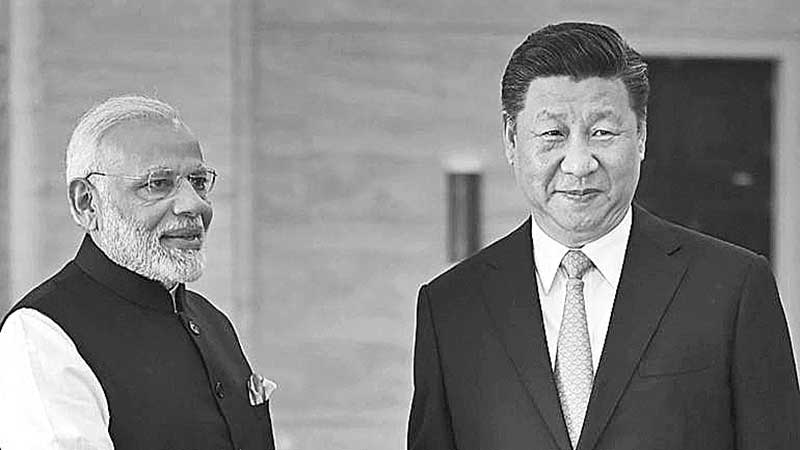
KABUL,
Sporting a black quiff and sideburns, Ahmad Zahir sang of love and heartbreak in liberal 1970s Kabul—a city now plagued by war and suffering, but where the popularity of Afghanistan’s “Elvis” remains undimmed 40 years after his death.
Zahir—the son of a former prime minister with a penchant for brandy and his red Mercedes—rose to fame in an era when the capital hummed with Western tourists and women strolled through the streets in high heels.
“Everybody loved him,” 73-year-old Safiullah Sobat, a long-time friend of Zahir, told AFP.
“At nighttime girls would come outside his house and honk the horn of their cars.”
But on the day of his 33rd birthday in 1979, Zahir was found dead in his car in mysterious circumstances. His death—much like his life—has become part of folklore.
In Afghanistan today, where space for music and dance has shrunk under the shadow of war, music channels still play his songs daily and fans—even those born decades after his death—continue to snap up his albums and join Facebook groups created in his honour.
“His songs will touch your heart no matter what mood you are in, happy or sad,” says Hashmat, who goes by one name and is the manager of “Ahmad Zahir’s Cottage”, a colourful restaurant in downtown Kabul.
The 26-year-old welcomes his customers—mostly young couples—with tea, a hookah pipe and most importantly, their hero’s songs.
Zahir—an ethnic Pashtun—played concerts in various locations across the country and had fans among all ethnic groups in Afghanistan, which is far more polarised now than at the height of his fame.
“Today we see ethnic rivalries have sadly increased but Ahmad Zahir’s music is still connecting people,” explains Basir Burhan, a 30-year-old amateur musician.
Wherever you go in Afghanistan, he said, “if there is music, there’ll definitely be one Ahmad Zahir song
playing”.
Former DJ Zubair Rezaee, 27, described Zahir as “evergreen”.
He endures because when “you listen to his songs ... you think they are for you, at any time, at any place.
“The wars, the changes in society and a different generation, nothing has affected the quality of his songs,” he said.
The 1960s and 70s are remembered as a golden age of music for Afghanistan, when young musicians were mostly influenced by Indian classics and would flock to “Radio Kabul”—the only radio broadcaster
at the time—to record hits at their studio.
Zahir’s best-known works were inspired by Persian poets like Rumi and Hafiz, and he sang mostly in Dari or Afghan Persian.
But he did not shy away from covering Western greats such as France’s Enrico Macias and, of course, Elvis Presley.
“At a time when singers shaking their bodies or dancing on stage was seen as awkward, he appeared on stage and screen doing exactly that,” said Zahir’s friend Sobat, who also runs “Ahmad Zahir’s Art and Culture Centre” in Kabul.
“He was talking about Elvis a lot and when you look at his hairstyle, his clothes, the way he moved his body in concerts, you realise he was inspired by Elvis.”
Over the decades since his death, conflicting accounts have surfaced about whether Zahir—who recorded more than 20 albums in his short life—was killed or died in a car accident.
The official line was that he was killed in a crash near the Salang Pass, north of Kabul.
But many maintain the communist regime assassinated him after his songs became increasingly critical, or because of rumours he had a secret affair with the daughter of the then prime minister.
Sobat believes he was murdered.
“When I saw his body in the coffin, there was hole in his forehead with signs of burns. He was shot at close range,” he said.
Years of war have followed and under the Taliban, who banned music, his grave in Kabul was desecrated.
But it has been rebuilt and since then, every June 14, his birthday, pilgrims have flocked to Shohada-E-Salehin Cemetery on the southern edge of Kabul to lay flowers on his grave and play one of his last memorable songs.
“My death shall arrive one day/ In a spring bright with waves of light/ Oh, perhaps my lovers at midnight /lay wreaths on my sorrow(ful) grave,” the lyrics read.

ASIA

Yemen to become world’s poorest country if war continues: UN

Briefing

DUBAI: War-ravaged Yemen is on course to become the world’s poorest country if the conflict persists, the United Nations said in a report. “If fighting continues through 2022, Yemen will rank the poorest country in the world, with 79 percent of the population living under the poverty line and 65 percent classified as extremely poor,” according to the United Nations Development Programme report, published on Wednesday. Because of the war, poverty in Yemen has jumped from 47 percent of the population in 2014 to a projected 75 percent by the end of 2019. Yemen, long the poorest country in the Arabian Peninsula, plunged into war after Huthi rebels seized the capital Sanaa in late 2014. A Saudi-led military coalition launched a blistering offensive months later to prop up the internationally-recognised government of Abedrabbo Mansour Hadi against the Iran-aligned insurgents. The fighting has since killed tens of thousands of people, most of them civilians, and pushed Yemen to the brink of famine. (Agencies)

ASIA

Singapore to become first country to ban ads for very sugary drinks

Briefing

SINGAPORE: Singapore will become the first country in the world to ban ads for the most unhealthy sugary drinks in its latest move to combat rising diabetes rates, the health ministry said on Thursday. Products deemed “less healthy” must now display labels grading their nutritional and sugar content, with those considered to be most unhealthy banned from appearing in ads across all media platforms, including broadcast, print and online channels. “This aims to reduce the influence of such advertisements on consumer preferences,” the ministry said, calling the ban a world-first. It added that the measures were only a start and it will continue to explore the possibility of a sugar tax or ban. “We urge SSB (sugar-sweetened beverages) manufacturers to consider reformulating their drinks to contain less sugar even as we further study these measures,” it said. The ministry said it will obtain industry feedback in the coming months on how to implement the measures and announce more details next year. (Agencies)

Page 12
MONEY

Ahead of Libra, XRP cryptocurrency gains toehold in commerce

Yet the price of XRP, often referred to as Ripple, has dropped by a quarter so far this year.
- REUTERS

LONDON,
Facebook’s Libra may be grabbing all the headlines at the moment, yet a major cryptocurrency already exists that’s gained a toehold in mainstream commerce.
XRP, the third-biggest cryptocurrency by market value, seeks to succeed where bitcoin and other digital currencies have largely failed: in powering fast and low-cost transactions.
In a rare example of a cryptocurrency finding a practical use beyond speculative trading, it has gained a certain amount of traction, with some large financial firms using XRP for international payments.
Yet the price of XRP, often referred to as Ripple, has dropped by a quarter so far this year, even as bitcoin has more than doubled and other smaller coins such as ethereum have made slim gains.
XRP’s price performance goes against assumptions of a positive correlation between real-world usage and the price of cryptocurrencies. The fact that bitcoin, the largest digital currency by far, has grabbed an even bigger share of the market this year is a sign that traders looking to capitalise on volatile price moves remain the industry’s main driver.
To track the emergence of hundreds of smaller rivals to bitcoin, collectively known as “altcoins”, Reuters is looking at the leading players as they grab the attention of investors, companies and regulators.
The third in the Reuters series on altcoins looks at the prospects, and challenges, for XRP.
Seven-year-old XRP is one of the most successful examples, thus far, of attempts to build cryptocurrencies capable of entering mainstream finance and commerce.
It has been developed by California-based tech company Ripple, which offers a blockchain-based payments platform. XRP is intended to act as a kind of bridge for cross-border payments for firms that use Ripple, and can also be used for e-commerce and peer-to-peer transfers.
The currency was designed to help these companies—from payment providers to remittance firms—settle transactions instantly, pay lower fees and free up capital typically tied up in payments using traditional money.
With traditional transfers, firms often use working capital to maintain balances in their settlement accounts, ensuring liquidity as one currency is converted to another. That helps customers receive funds more quickly.
Ripple says customers can use XRP instead of traditional money for liquidity, allowing firms to free up working capital.
It says payments using XRP settle in four seconds, compared with over an hour for bitcoin and three to five days for traditional systems used for fiat money.
“That’s actually much less exposure and risk,” said Monica Long, senior vice president of marketing and communications at Ripple.
XRP, like Facebook’s proposed Libra, veers away from the ethos of bitcoin, the original cryptocurrency, which aimed to sidestep the financial establishment by dispensing with a central authority.
A team of developers at Ripple maintain the XRP ledger’s software, stewarding the technology. That, potentially, means that companies are more comfortable dealing with XRP than bitcoin, which is largely unsupervised and unregulated.
The way XRP is produced also differs.
While bitcoin “miners” compete against each other using powerful computers to solve algorithms and earn new coins, XRP’s entire supply of 100 billion was created at its birth.
Ripple now holds large reserves of XRP in escrow accounts, selling the tokens to large investors to boost liquidity and widen the spread of the technology. That means the company has centralised control over the supply of XRP.
While there are some similarities between Libra and XRP, notable differences also exist.
Both coins aim to address problems in the payments sector, from high intermediary fees to lengthy transfer times. Yet Libra’s target audience differs, with Facebook saying it will offer people who lack bank accounts access to easier money transfers. XRP, in contrast, is targeted at traditional financial firms.
And while XRP’s value fluctuates, Libra’s doesn’t: it is a “stablecoin” whose backing by traditional assets such as bank deposits and short-term government securities is designed to dampen volatility.
Nevertheless Libra, which has faced fierce opposition from politicians and regulators, could affect XRP’s prospects, not least because Facebook’s vast 2.4 billion users offer the currency an existing user base.
Ripple says around a dozen firms use XRP for liquidity.
One of the most well-known is US remittances firm MoneyGram International, in which Ripple invested $30 million in June.
London-based Mercury FX, which counts small businesses and wealthy individuals as clients, uses XRP to facilitate payments into and out of countries such as Mexico and the Philippines.
“The top three reasons one would use it would be speed, costs, security,” said Alastair Constance, its founder. “Your speed to settle a payment is higher, and your cost comes down dramatically.”
XRP has slumped around 25 percent this year, versus a near-115 percent gain for bitcoin. To be sure, other altcoins have also failed to match bitcoin’s advance. Yet other major players such as ethereum, the second-biggest by market value - the price of a coin multiplied by the number of coins in the market - have stayed above water this year.
The slide has come despite XRP gaining some traction in the global payments business, which covers anything from card payments to wiring money overseas and, according to consultancy Accenture, is worth about $1.5 trillion this year.
Crypto market players say that Ripple’s sales of XRP have ratcheted up pressure on prices and tempered any boost from XRP’s payments progress. Ripple holds XRP in escrow accounts and sells directly to the market to boost liquidity. It said in a July report that XRP markets should resemble traditional foreign exchange markets, which are typically highly liquid and efficient.
“Ripple needs to provide the token, to encourage the spending, the use of that in their system,” said Denis Vinokourov, head of research at BeQuant, a crypto exchange in London.

MONEY

UK economy on track to dodge pre-Brexit recession but outlook weak

- REUTERS
A pedestrian stands in front of a shop displaying a sale sign, in central London.reuters

LONDON,
Britain’s sluggish economy looks to have dodged recession in the run-up to its deadline for leaving the European Union this month, official data showed on Thursday.
Gross domestic product in the three months to August was 0.3 percent higher than in the previous three months, beating all forecasts in a Reuters poll of economists and accelerating from an upwardly revised 0.1 percent in the three months to July.
However, the stronger performance largely reflected data revisions to earlier months and the most recent figures were weak.
Output in August alone dropped by 0.1 percent on the month versus economists’ average forecast for it to hold steady, while growth in July was revised up to 0.4 percent, the Office for National Statistics said.
Sterling edged up against the US dollar following the stronger-than-expected data.
“The economy has regained some momentum but the underlying trend is towards softer growth. The headwinds from a major global slowdown and uncertainty at home point to weaker growth ahead,” said Ian Stewart, chief economist at accountants Deloitte.
Britain’s economy shrank in the second quarter of the year, driven by a sharp decline in April when businesses found themselves holding unnecessary stockpiles of raw materials after Brexit was delayed from the original date of March 29.
Prime Minister Boris Johnson has promised to take Britain out of the EU by Oct. 31, without a transition period if necessary - despite parliament telling him to delay Brexit again if he cannot negotiate a fresh deal. Businesses say a no-deal Brexit risks causing major disruption to imports.      Two consecutive quarters of contraction would mean Britain’s economy met a commonly used definition of recession, but the ONS said the economy would need to shrink by an almost unprecedented 1.5 percent in September alone for this to happen.
As well as Brexit, manufacturers across Europe have been hit by a rise in trade tensions between the United States and China which has weighed on growth globally.
The new managing director of the International Monetary Fund, Kristalina Georgieva, warned earlier this week that the world economy was suffering a “synchronised slowdown”.
The Bank of England predicted last month that Britain’s economy would manage growth of 0.2 percent in the third quarter, bolstered in part by higher public spending.  
But September IHS Markit purchasing managers’ index data released last week for the private sector pointed to a 0.1 percent contraction in the third quarter, with businesses reporting that foreign customers were staying away before Brexit.             
The ONS said it had not received any good anecdotal evidence of the effect of Brexit preparations on the economy in August, when the annual rate of growth slowed to 1.1 percent from 1.3 percent, matching a seven-year low set in June.
“Growth increased in the last three months, despite a weak performance across manufacturing, with TV and film production helping to boost the services sector,” ONS statistician Rob Kent-Smith said.
Soft global demand was hurting demand for manufactured exports, the ONS added, and growth in the dominant services industry slowed to zero in the month of August alone.
August trade data also released on Thursday showed Britain’s goods trade deficit widened slightly to 9.8 billion pounds ($12.0 billion) from 9.6 billion pounds in July, versus Reuters poll forecasts of 10.0 billion pounds.     
Britain’s total trade deficit for goods and services narrowed slightly to 1.5 billion pounds from 1.7 billion.

MONEY

Zimbabwe struggles with hyperinflation

- ASSOCIATED PRESS
A woman does a quick calculation on her phone before buying groceries at a shop in Harare, Zimbabwe on Wednesday. ap/rss

HARARE (Zimbabwe),
When going shopping, the only thing Isaiah Macheku can budget for is shock.
Hyperinflation is changing prices so quickly in Zimbabwe that what you see displayed on a supermarket shelf might change by the time you reach the checkout.
“It is a nightmare,” Macheku said. “I can’t plan.”
Before a coup unseated the late president Robert Mugabe in late 2017, Macheku could afford all his family’s basics on his salary, which equals about $24. Now the same amount can hardly buy 4 kilograms (8.8 pounds) of beef.
He ended up buying chicken skin for his family’s supper. “I cannot afford the actual chicken,” he said. It is the closest his family gets to eating meat.
Zimbabwe now has the world’s second highest inflation after Venezuela, according to International Monetary Fund figures. The southern African nation went through this a decade ago but says there is no getting used to it, and coping has become both creative and desperate.
This time Zimbabwe’s economy has been on a downward spiral for more than a year as hopes fade that Mugabe’s successor and former deputy, President Emmerson Mnangagwa, will deliver on his promises of prosperity.
“Anyone who thinks a solution is in sight must be very brave,” said economist John Robertson in the capital, Harare. “Government officials don’t want to admit the real causes and don’t want to fix the real problems. People should brace for worse.” He said the real causes include the government spending beyond its means.
To shop, money alone is no longer enough. Calculators, mobile phones and notebooks have become necessary tools. In one sparsely attended groceries wholesaler, there were more people taking pictures of price stickers than those picking items from shelves.
“I sent the pictures to my husband. We have to decide fast before the prices go up again,” said one shopper, Marianne Hove. “He is in another supermarket sending me pictures of the prices there. We compare and decide which items to buy and from where.”
Others did quick calculations and called home to confirm items to buy.
In other shops, prices are only available at the checkout - and even then the cashier might stop a customer mid-payment to change prices.
Retailers said they would go out of business if they don’t adjust prices frequently.
“It is becoming increasingly impossible to appropriately price goods. The replacement value has been our Achilles heel,” said Denford Muntashu, president of the Confederation of Zimbabwe Retailers.
The situation is “synonymous with hyperinflation” even though the government statistics office has stopped publishing annual inflation data, Muntashu said.
Some businesses are closing while others are limiting their product range to reduce risk, he said.
Prices in Zimbabwe are changing faster than at any point in a decade. In 2009, the country’s currency collapsed under the weight of hyperinflation. The government then adopted a multi-currency system dominated by the dollar.
This year the government outlawed the use of foreign currencies, part of frequent and sometimes confusing changes to the country’s complicated monetary framework.
The local currency has been rapidly devaluing, “fostering high inflation, which reached almost 300 percent in August,” the IMF said after a review mission last month.
Weakening confidence, policy uncertainty and a continuation of foreign currency market distortions are exerting pressure on the exchange rate, the IMF added, while a severe drought and foreign debt hampering Zimbabwe’s access to external funding have impacted the economy hard.
Most businesses import products from abroad due to the collapse of local industry. Foreign currency shortages and rapid devaluation of the local currency are hard on both businesses and customers.
Zimbabwe’s president, Mnangagwa, continues to appeal for more time.
“Getting the economy working again from being dead will require time, patience, unity of purpose and perseverance,” he said in a state of the nation address on Oct. 1.
Like Mugabe, the president largely blames US sanctions for the crisis, while the US points out that the sanctions don’t target the government but selected officials, including Mnangagwa himself, over past alleged human rights abuses.
The patience of many Zimbabweans is wearing thin, considering the lengths they are going to cope.
“We cannot continue to live like this. Why did they remove Mugabe if they had no solutions?” said Harare resident Praise Sibanda.

Page 13
MONEY

Nepal is the worst performer in economic competitiveness in South Asia: Report

The economy performed poorly in terms of innovation capability, information, communication and technology adoption, product market development, judicial independence and government’s long-term vision.
- PRAHLAD RIJAL

KATHMANDU,
Despite recording three successive years of high economic growth, macro-economic stability and average annual Gross Domestic Product growth of 4 percent in the past decade, Nepal ranks 108th out of 141 economies and is the worst performer in South Asian region in terms of competitiveness, the latest report by the World Economic forum shows.   
The yearly assessment report, Global Competitive Report 2019 published on Wednesday measures national competitiveness based on the state of institutions, policies and factors that determine an economy’s productivity.
Out of the total competitiveness score of 100 or the ‘frontier’ where productivity constraints cease to exist, Nepal has gained 51.6 points—far below India (68th) with 61.4 points and Srilanka (84th) with 57.1 points—and the global average of 60 points.
The economy performed poorly in terms of innovation capability, information, communication and technology adoption, product market development, judicial independence and government’s long-term vision.
Despite its low rank, Nepal has performed better in indicators such as macro-economic stability, road connectivity, electricity access and supply.
The 2019 index that offers insight into economic prospects ranks 141 economies accounting for 99 percent of the world’s GDP based on 103 factors of productivity related to 12 pillars of infrastructure, institutions, ICT adoption, macroeconomic stability, health, skills, product market, labour market, financial system, market size, business dynamism, innovation and capability.
According to the World Economic Forum, the report demonstrates that despite central banks injecting nearly 10 trillion dollars into the global economy 10 years on from the financial crisis, productivity-enhancing investments such as new infrastructure, research and development and skills development in the current and future workforce have been suboptimal.
“The global economy is ill-prepared for a downturn after a lost decade for productivity-enhancing measures,” states the report. “Monetary policy may have run out of steam and some countries are facing a liquidity trap. Furthermore, the geopolitical context is more challenging than in 2007, with gridlock in the international governance system, and an escalating trade and geopolitical tensions fuelling uncertainty, which holds back investments, and increases the risk of supply shocks.”
As per the report, Asia-Pacific is the most competitive region in the world with Singapore as the most competitive economy, followed closely by economies in Europe and North America and Nordic countries are among the world’s most technologically advanced, innovative and dynamic while also providing better living conditions and social protection.
“The report demonstrates that there are no inherent trade-offs between economic growth and social and environmental factors if we adopt a holistic and longer-term approach,” writes Klaus Schwab, founder and executive chairman of World Economic Forum.
“While few economies are currently pursuing such an approach, it has become imperative for all economies to develop new inclusive and sustainable pathways to economic growth if we are to meet the Sustainable Development Goals.”
The report appears amid fears of slowing economic growth in Nepal owing to a drop in manufacturing and foreign direct investment, despite government claims that it has improved the investment climate by reforming over a dozen laws in a year.
Figures show that the country’s investment outlook has remained bleak despite political and macroeconomic stability.
As per Nepal Rastra Bank, the inflow of foreign investment plummeted 25 percent to Rs13.07 billion in the last fiscal year from Rs17.5 billion in 2017-18.
According to the Department of Industry, industry registrations fell to 436 in the last fiscal year from 498 in the previous year, the total committed investment dropped to Rs282 billion from Rs350 billion in the previous year, and foreign direct investment pledges also nosedived to Rs24 billion from Rs56 billion.
Economists say Nepal has high barriers of productivity impeding the economy to gain comparative advantage in terms of production of goods and services while the policy level measures intended to stimulate industrial growth are inconsistent and implemented on an ad hoc basis.
“Nepal needs to audit the status of factors affecting productivity—land, labour, capital and technology—and eliminate barriers to fair use of land, cronyism in sectors of development, poor capital formation and eliminate such barriers impeding productivity,” said Gyanendra Adhikari, an economist.
“The financial institutions have also imposed a high amount of  interest rates demotivating industrialists, land reform policies are not in favour of redistribution of wealth, an increasing flight of human capital is leading to slack expansion of productive sectors and unlike Bangladesh or India, Nepal does not have comparative advantage in producing marketable goods like garments and such. That has led to the economy faring worst in terms of competitiveness.”

MONEY

Insurance coverage of farm sectors surge 58 percent

The government currently offers subsidy equivalent to 75 percent of the premium amount.
- RAJESH KHANAL
Farmers pick paddy saplings for transplantation in Dhangadhi. Post file Photo

KATHMANDU,
Insurance coverage in agricultural products surged 58 percent in the last fiscal year, with farmers taking advantage of the government subsidy. The government currently offers subsidy equivalent to 75 percent of the premium amount.
According to the Insurance Board, Nepali insurance companies sold insurance policies worth Rs18.72 billion in agricultural products in 2018-19, compared to the insurance policies of Rs11.85 billion in the fiscal year 2017-18. The board’s record shows that the insured amount increased fourfold in the past five years.
Last year, non-life insurance companies collected Rs631.44 million in premiums, up from Rs510.93 million in the previous year. Over the period, the insurers issued 101,152 policies, 73 percent more compared to the previous year.
“The insurance coverage of the farm sectors has increased by a notable amount as the government has been providing a subsidy on the premium to encourage farmers to insure their farm products. Farmers are now more aware of the benefits of farm insurance,” said Chiranjibi Chapagain, chairman of the board.
The government through the budget for 2014-15 had announced providing 75 percent subsidy in the premium of agriculture insurance to farmers. However, only a handful had been receiving benefits due to a lack of awareness about the insurance policies among the small farmers, mainly from remote areas.
According to the board, the government provided premium subsidies totalling Rs631.44 million to farmers in the fiscal year 2018-19. The subsidy was 65 percent more than the amount in the previous year.   
Citing the low coverage, the board made it mandatory for non-life insurers to provide agriculture insurance services, assigning them certain districts to carry out the business. “This policy has made insurers expand their outlets in the concerned districts and to promote insurance literacy to the farmers there to sell their policies,”
he said.
The board has enforced over two dozens of distinct insurance policies to cover major livestock and crops produced in the country such as ginger, coffee, paddy, mushroom, potato, sugarcane, seed, vegetable, turmeric, cardamom, banana, cattle, fish, poultry and goat.
Farmers can claim insurance if their crop or livestock is damaged from fire, lightning, earthquake, flood, inundation, drought, landslide, tornado, hailstorm and snowfall. They can also claim insurance for losses due to pest and disease.
The board’s record shows that the share of crop insurance is still negligible compared to insuring livestock. In the last fiscal year, farmers purchased policies in crop insurance amounting to Rs834.58 million, which stood at only 4.7 percent of the total insured amount in farm products. In the crop insurance, farmers purchased policies worth Rs547.39 million to cover risks in fruit production.

MONEY

Goat sales plunge 40 percent in Kathmandu during Dashain

- KRISHANA PRASAIN
Post file Photo

KATHMANDU,
The sale of goat has decreased by 40 percent in Kathmandu this Dashain compared to last year, said goat traders. Consumption slowed as the price of goat meat surged by nearly Rs300 per kg after a fall in imports from India.
According to Bhanu Bhakta Parajuli, president of Livestock Traders Service Association, the association sold only 27,000 goats during Dashain this year, down from 40,000 goats last year.
Live goat which was priced at Rs540 per kg last year reached Rs690 per kg this year. Mutton prices soared to Rs1,200-1,300 per kg in the same period from Rs990 per kg last year.
“The price hike is the major reason for a fall in consumption during festival time,” he said. “At a time when goat meat is in demand, the price soared beyond most people’s reach.”   
The price of mutton had skyrocketed due to a heavy fall in imports of livestock from India after the government made it mandatory for traders to produce a quarantine certificate while bringing live goats from the southern neighbour.
According to the Department of Customs, 100,155 live goats worth Rs771 million were imported from India for Dashain during the two months from mid-August to mid-September last fiscal year while the import figure during the same period this fiscal year was negligible.
Parajuli said they had targeted to sell 30,000 goats during the festival. According to him, the sales of mountain goat also declined during the period.  
Anil Khadgi, former president at Nepal Fish and Meat Sellers Association said that goat sales dropped beyond their expectations.
Similarly, Food Management and Trading Company, which supplied 1,100 goats and 1,900 mountain goats said that it still has unsold livestock. The company has reduced the price to Rs700 from Rs750 a kg for live mountain goat to attract customers.  

Page 14
SPORTS

Agarwal ton gives strong start to India

The 28-year-old, who made a double century in India’s opening Test win, scored 108 after the hosts elected to bat.
- AGENCE FRANCE-PRESSE
India’s Mayank Agarwal plays a stroke on the first day of their second Test match against South Africa in Pune, India, on Thursday. AP/RSS

Pune,
Mayank Agarwal hit his second century in successive matches on the opening day of the second Test against South Africa Thursday and said his side should aim for a 500-run first innings.
The opener, who made a double century in India’s opening Test win, scored 108 after the hosts elected to bat. India were 273-3 when bad light forced an early end to play, with skipper Virat Kohli unbeaten on 63 and vice-captain Ajinkya Rahane on 18. Kohli and Rahane put on 75 runs for the fourth wicket to thwart South Africa’s bowlers who kept them under pressure as the gloom crept in.
Agarwal, 28, said he was thrilled with his performance. “The team is in a good position, winning the toss, batting first and with one batsman short, it’s a good thing to make runs... 450-500 would be nice,” Agarwal said. “Try and get big runs in the first innings... (that) could help us in case we don’t want to bat again. It could really put pressure on the South Africans.”
Kohli, leading the Test side for the 50th time, reached his half-century with a boundary off fast bowler Vernon Philander. But Agarwal took the lead role despite being hit on the helmet from a bouncer by debutant paceman Anrich Nortje. He went on to hit Nortje for three glorious off drives in one over before lunch. The right-handed batsman put on 138 runs for the second wicket with Cheteshwar Pujara, who made 58, to steady the innings after the fall of Rohit Sharma early in the day. He was eventually caught in the slips by South African captain Faf du Plessis — one of fast bowler Kagiso Rabada’s three wickets for the day.
“There were periods where I was getting boundaries very easily, there were periods where they bowled very good line and lengths and were testing the bouncer as well,” said Agarwal, who is playing his sixth Test since making his debut last year. Rabada also claimed Sharma, who edged the ball into the gloves of wicketkeeper Quinton de Kock for 14 in the 10th over. That was a disappointment for Sharma, who hit twin centuries in his first run as Test opener in Visakhapatnam where India took a 1-0 lead in the three-match series.
Rabada struck again to get Pujara, caught again by du Plessis, just before tea. Pujara, who was dropped by Temba Bavuma before he scored, hit a six and nine fours. Rabada returned figures of 3-48 in 18.1 overs. Victory for India in the series will see them beat the record of 10 straight home series wins they share with Australia.

SPORTS

Osaka giving up US citizenship to play for Japan in Olympics

- AGENCE FRANCE-PRESSE
Naomi Osaka. REUTERS

TOKYO,
Tennis star Naomi Osaka has decided to choose Japanese over American nationality with an eye on the Tokyo 2020 Olympics, public broadcaster NHK reported Thursday.
Osaka, who has a Japanese mother and a Haitian father, told NHK she has completed an administrative step to obtain Japanese citizenship ahead of her 22nd birthday next week. Japanese law stipulates that a Japanese with more than one nationality must chose one before turning 22 years old. “It gives me a special feeling to try to go to the Olympics to represent Japan,” the two-time Grand Slam champion told the broadcaster in an interview in Tokyo. “I think I will be able to put more of my emotion into it by playing for the pride of the country,” she said, according to the article published in Japanese on the NHK
website.
Osaka added she wants to aim for the gold although she is also worried as expectations will be high. The young tennis sensation is a household name in Japan, where her every move is followed feverishly by local media, particularly when she is in the country of her mother’s birth.
Mixed-race children can often face prejudice in Japan, although attitudes among younger generations are changing. Osaka became the first Japanese player to win a Grand Slam last year after beating Serena Williams at the US Open.

SPORTS

England’s flourishing forwards leave Southgate spoiled for choice

- AGENCE FRANCE-PRESSE
England’s Fikayo Tomori (left) and Jadon Sancho during a training session at the St George’s Park in Britain on Thursday. Reuters

PRAGUE,
Halfway through qualifying for Euro 2020, England’s place at next year’s finals already appears assured thanks to a prolific forward line that has plundered 19 goals in just four qualifiers.
The Three Lions will be confident of maintaining their 100 percent record in qualifying when they visit the Czech Republic on Friday and can even mathematically secure qualification by the time they travel to Bulgaria four days later. At 26 and 24, Harry Kane and Raheem Sterling are the older heads of a thrilling forward line that threatens to be the envy of Europe next summer. Kane and Sterling have each scored six times in four qualifiers so far.
But unlike many major tournaments that ended in disappointment over the past two decades when England relied on one source of goals from the likes of Wayne Rooney and Michael Owen, Gareth Southgate has a wealth of options to choose from. Jadon Sancho, 19, scored his first two international goals in the 5-3 victory over Kosovo last month and has edged ahead of Marcus Rashford as the prime candidate to join Sterling and Kane in a front three.
Rashford has struggled for fitness and form in a Manchester United side devoid of creativity, but is still just 21 and has plenty of time to make his case to start at the Euros. Between them Kane, Sterling and Rashford have 19 goals in the first two months of the Premier League season, but none of them are even the top-scoring Englishman in the Premier League. Tammy Abraham’s electric start to life back at Chelsea after a series of loan spells has earned him an England recall with eight goals in as many league games.
However, Abraham faces the thankless task of trying to usurp Kane to be England’s number nine. “For me, he’s the greatest striker in the world,” Abraham, 22, told the Evening Standard. “When you look at Harry Kane, if he gets a chance in the box, nine times out of 10, it’s a goal. So I’ll go there learn off him and hopefully be like him.” The competition just to make Southgate’s squad next summer is just as fierce in the areas out wide and just behind the striker.
Callum Hudson-Odoi is not involved for the trips to Prague and Sofia having only recently returned from a long-term Achilles injury, but the 18-year-old has impressed on his comeback for Chelsea. In midfield, another promising product of the Chelsea academy, Mason Mount has overtaken his international teammate Ross Barkley at club level to break into the England senior squad.
James Maddison’s wait for a first cap has been prolonged by an illness that forced him to withdraw from the squad on Thursday morning. However, his time will come as one of the stars of Leicester’s early rise to challengers for a Champions League place in the Premier League this season. Four more qualifiers over the next two months with little on the line just as the Premier League season is getting up to speed may signal a lull for
supporters.
But for Southgate there are precious few opportunities left to mould the right 23-man squad that despite their tender age will have great expectations placed on their shoulders next summer. England have fallen short at the semi-finals of the World Cup and Nations League over the past year. Now blessed with such firepower and home advantage for the majority of Euro 2020 should they go all the way, the demands are higher.

SPORTS

Fans inspiration key for Federer’s quarter-final run in Shanghai

- AGENCE FRANCE-PRESSE

SHANGHAI,
Roger Federer said that his devoted band of Chinese supporters helped pull him through a tough first set and into the Shanghai Masters quarter-finals on Thursday.
The Swiss defeated David Goffin 7-6 (9/7), 6-4 after the 13th seed from Belgium squandered five set points in the first set. The 38-year-old Federer plays either Germany’s Alexander Zverev or Andrey Rublev of Russia in the last eight. “I never really felt like I had the upper hand against David today,” said the 20-time Grand Slam winner, who looked unusually flustered at times.
Federer was left shaking his head in the first set and he suffered a rare inelegant moment in the 12th game, slipping on his own sweat — “a bit embarrassing”, he said. The Swiss fell awkwardly and was then broken by Goffin, 14th in the world. But the Belgian lost his nerve despite going 3-1 up in the first-tie break, and Federer roared back to turn the momentum in his favour. Federer was regularly serenaded by chants of “Roger, Roger, go go go” by local supporters all sitting together in one part of the arena. All were decked out in red.
Federer, who failed to win a Grand Slam this year, said their backing had been key to his revival. “I know that if I am in trouble, they will be there to cheer me on,” he said. “If I look to them, or pump myself up, I know they will react to that. It’s definitely very special here because they all sit in one block, sort of like in football to some extent, which is highly unusual for tennis and a tennis tournament.”
World number one Novak Djokovic made light work of American John Isner and plays promising 21-year-old Stefanos Tsitsipas of Greece in the last eight. The defending champion from Serbia dismissed the 16th seed Isner 7-5, 6-3 in 74 minutes after taming Isner’s booming serve. “It’s always a big challenge returning the serve of Isner,” said Djokovic, who is over the shoulder problem that curtailed his US Open defence. “He’s got one of the biggest serves of all time, he’s one of the tallest guys ever to play tennis.”
The 32-year-old Djokovic is looking imperious, having not dropped a set in claiming the title in Tokyo last week and continuing that perfect record in Shanghai. Also in the last eight on Friday, colourful Italian Fabio Fognini faces red-hot Russian Daniil Medvedev. The fourth-ranked Medvedev was forced to sweat — and not just because of the Shanghai heat — after being 5-2 down in the first set to Canadian qualifier Vasek Pospisil.
The 23-year-old Medvedev eventually squeezed through 7-6 (9/7), 7-5. “I was down five set points and 5-2 also,” said the US Open finalist, fast making a big name for himself as the man most likely to challenge Federer, Djokovic and Rafael Nadal. “Usually the set is finished when it’s like this, so just try to win every point I had to face, and finally it worked out.” Medvedev, who has been in eight finals this year, winning three of them, smashed his racquet as the frustration built and he threatened to boil over in the Shanghai sun. “I usually don’t like to break racquets because it’s never beautiful,” he said. The Spaniard Nadal is not in Shanghai because of a wrist injury.

Page 15
SPORTS

Nepal suffer a 5-0 thrashing down under against mighty hosts

Contrasting physical attributes and lapse in coordination are to blame as Maclaren hat-trick sinks the visitors in the qualifiers.
- Ritesh Rijal
Jamie Maclaren puts away the ball into the Nepal post. Post Photo: Hemanta Shrestha

Canberra,
The outcome of the match between Nepal and hosts Australia was there for everyone to take from the moment the draw was fixed. Considering the gulf between the team who aspire to make it to the FIFA World Cup Finals and the ones who struggle even in the South Asian region, it was always a matter of damage control for Nepal.
As it turned out, Nepal lost their joint 2020 World Cup and 2023 Asian Cup Qualifiers Group ‘B’ match 5-0 against the home team at the GIO Stadium here on Thursday. It was the second defeat for Nepal in three second-round qualifying matches having suffered a demoralising 7-0 defeat against Kuwait and a morale-boosting 2-0 win over Taiwan.
Jamie Maclaren scored a hat-trick and Harry Souttar converted a brace to complete a dominating victory over the visitors. Nervous Nepal got a huge reprieve when goalkeeper Kiran Chemjong made a mess of a simple Rajit Dhimal’s back pass in the very first minute. The Nepal skipper’s attempted clearance almost rebound into the goal but for timely intervention at the goalmouth. The Socceroos, however, didn’t have to wait longer as the hosts took the lead five minutes later. Aaron Mooy’s shot from the edge of the box rebounded off Chemjong for Jamie Maclaren to tap in from close.

Bimal Gharti Magar takes the ball past Awer Mabi. Post Photo: Hemanta Shrestha


Australian dominance paid off once again in the 19th minute when a perfectly weighed in left-wing cross from Aziz Behich at the far side was headed across the goal by Rhyan Bert Grant for a simple finish from Jamie Maclaren. The Socceroos made their superior physical advantage count, scoring on a set-piece. Harry Souttar headed in on a corner from Craig Goodwin in the 23rd minute to make it 3-0. Nepal custodian Chemjong made a string of saves to keep the scoreline much lower by the half-hour mark.
Chemjong yet again denied Australia another goal as the Nepali custodian blocked a free header from Craig Goodwin following a Mooy’s right-wing cross at far side in the 55th minute. The home team extended their lead to 4-0 when Mooy delivered a ball into the area for Souttar to head into the goal but the ball hit defender Dinesh Rajbanshi and entered the nets.
Maclaren scored from close following a well-crafted game from 30 yards out to make it 5-0 for the Socceroos.
Nepal head coach Johan Kalin preferred Abhishek Rijal in the starting lineup while Bimal Gharti Magar was benched until the 66th minute. Nepal Army marksman Nawayug warmed up the bench the entire game attended by 18,563 spectators. Most of the Socceroos’ players that hammered Kuwait 3-0 in Kuwait City had been retained for the clash against Nepal.

Sujal Shrestha moves past Rhyan Gran. Post Photo: Hemanta Shrestha


Defender Trent Sainsbury missed out due to a minor injury but the experienced Bristol City defender Bailey Wright returned to Graham Arnold’s squad. Of the entire roster, only three footballers play in domestic league while the rest ply their trades abroad. Skipper Mark Milligan, who was left out for team’s September fixture due to leg injury, also returned to bolster their squad.
Speaking after the match, Nepal head coach Johan Kalin said, “The first 25 minutes were very tough for us. The first goal was very unfortunate for us. However, we made some progress in the second half. Australia are way better than us and are a physically strong side in comparison to Nepal. We played our level best and will improve in days ahead.” Australia coach Graham Arnold expressed his happiness at his side’s biggest home win in three years and said, “We created a lot of chances, but we got a bit more ruthless when it counts.”
Nepal now board to Jordan for the next match scheduled for October 15. The Qualifier is played on home and away format. In all, 40 Asian teams are divided into eight groups of five. The eight group winners and four best runners-up will make it to the AFC Asian Cup 2023 Finals in China as well as the final round of qualifying for the 2022 FIFA World Cup in Qatar. The remaining 24, except for the four bottom-placed teams, who fail to pass the joint Qualifiers hurdle will have another shot at earning tickets to the AFC Asian Cup. The 24 teams will fight it out for another 12 berths for the Asian Cup.

Nepali spectators at GIO Stadium in Canberra on Thursday. Post Photo: Hemanta Shrestha

SPORTS

Sri Lanka whitewash T20 series against sloppy Pakistan

- AGENCE FRANCE-PRESSE
Sri Lankan cricketers pose for a photograph with the winning trophy after defeating Pakistan by 13 runs to win the third and final Twenty 20international in Lahore on Wednesday. AFP/RSS

LAHORE, 
Inexperienced Sri Lanka completed a 3-0 clean-sweep in their Twenty20 series against world number one Pakistan on Wednesday with a 13-run victory in Lahore.
Chasing a modest 148-run target, Pakistan were on course for victory with Haris Sohail’s 50-ball 52 with four boundaries and a six but leg-spinner Wanindu Hasaranga turned the tables with 3-21 to restrict the hosts to 134-6 in 20 overs. Hasaranga had Sohail stumped in the 16th over and then dismissed Pakistan skipper Sarfaraz Ahmed in the 18th to give Sri Lanka victory on a match day designated as Pink Day for breast cancer awareness.
Oshada Fernando struck a 48-ball 78 with three sixes and eight boundaries — the highest by a Sri Lankan player on T20I debut — to lift Sri Lanka to 147-7 in their 20 overs. Jehan Mubarak and Danushka Gunathilaka — who both scored 46 each — had held the previous record for most runs on a Twenty20 debut for Sri Lanka.
Sri Lanka’s victory was their first-ever Twenty20 series whitewash and was achieved despite missing 10 of their top players who refused to tour Pakistan over security fears after their team was struck by terror attacks in Lahore in March 2009. However their absences did not hurt Sri Lanka as they staged a remarkable comeback after losing the one-day series 2-0 by winning the first two matches of the T20 series by 64 and 35 runs respectively.  Before this, Pakistan’s only Twenty20 whitewash defeat was at the hands of England in United Arab Emirates in 2015.
Pakistan’s start was once again disastrous as they lost aggressive opener Fakhar Zaman off the first ball of their innings, bowled by Kasun Rajitha for nought. Babar Azam (32-ball 27) and Sohail added 76 for the second wicket but Sri Lanka applied the brakes as boundaries dried up. Iftikhar Ahmed hit a six and a boundary in his 17 but targets of 37 off the last two overs and 28 in the last were beyond Pakistan.
Earlier, Sri Lanka rode on a brilliant maiden half century by Fernando, who held the innings together after Sri Lanka lost two wickets for 28 runs in four overs. They then slumped to 58-4 with Bhanuka Rajapaksa, the star of the second match, falling for just three. Fernando repaired the damage with a fighting 76-run stand for the fifth wicket with Shanaka, who made 12. Pakistan were once again sloppy in the field, dropping four catches.

SPORTS

Nepal finish third after losing to Oman

Oman win the series finishing atop the standings as Ireland come second.
- Sailendra Adhikari
Nepal’s Abinash Bohara (left) and Sushan Bhari walk off the pitch after Nepal were bowled out for 64 runs by hosts Oman in the Five-Nation series in Muscat on Thursday.  Photo courtesy: Raman Shiwakoti

Kathmandu,
Nepal finished third in the five-nation series in Oman after a six-wicket defeat against the hosts in the last match on Thursday. Nepali side were bowled out for a paltry 64 runs before Oman completed the chase for the loss of four wickets with 49 balls to spare.
At the Al Amerat cricket ground in Oman, Nepal were asked to bat first after losing the toss but struggled dearly against Omani bowlers. Nepal lost openers Ishan Pandey and Paras Khadka for cheap. Pandey made two runs and Khadka five as wickets began to tumble in regular intervals.
Aarif Sheikh and Dipendra Singh Airee were the only batsmen to score in double digits for Nepal. While Sheikh scored 20 runs, Airee added 11. Aamir Kaleem was the pick of the bowlers for Oman as he picked five wickets and Bilal Khan grabbed two.
Defending the meagre score, Oman made a nervy start losing four wickets when they had managed just 27 runs on the board as Karan KC picked two and Sompal Kami and Sandeep Lamichhane shared a wicket each.
However, a 30-ball 42 blitz by Suran Kumar ensured Oman the victory with much ease. Wins in all four matches meant Oman finished at the top of the table to claim the series. Ireland finished second with three wins and a loss bagging six points, two points ahead of Nepal.
Earlier, Nepal had won their opening match of the five-nation series against Hong Kong after a half-century by Binod Bhandari ensured them the four-wicket victory on Sunday. Bhandari’s 58 runs from 48 balls helped Nepal reach the 126 runs target in the penultimate over.
Bowlers Karan KC and Sandeep Lamichhane shone in Nepal’s second match against the Netherlands as they registered the second victory on Monday. Chasing 134 runs for a win, KC scored 31 late in the innings while Bhandari and Khadka contributed 26 and 33 each as Nepal won by four wickets. KC and Lamichhane claimed four wickets each in the match.
In their third match against Ireland on Wednesday, Paul Stirling scored 59 runs as Ireland posted a 146-run target for Nepal. Despite a good start, the middle-order collapse saw Nepal suffer a 13-run defeat. Aarif Sheikh was the top scorer with 26 runs followed by skipper Khadka with 25.
The five-nation series was planned as a warm-up for Global Qualifiers slated for October-November in the United Arab Emirates. Nepal failed to secure a berth for the ICC World Twenty20 Asia Regional Qualifying tournament in Singapore as they failed to live up to expectations and win the Qualifier. Only the winner were guaranteed for a place in the Global Qualifier and instead, favourites Nepal finished third in the tournament. They lost to Qatar and hosts Singapore. Singapore won the tournament and secured their berth at the UAE leg of the Qualifier. The defeat in the tournament also put to bed Nepal’s aspirations of playing in next year’s Twenty20 World Cup.

SPORTS

Lack of playing time at Bayern frustrates Mueller

Briefing

MUNICH: Thomas Mueller confirmed Wednesday that he is unhappy being left on the bench at Bayern Munich amid reports he wants to leave in the January transfer window. Mueller, who turned 30 last month, hasn’t started Bayern’s last five games, “a trend that doesn’t make me happy,” he told magazine Kicker. “I’ve just turned 30, I’m in great shape and I’m hungry for success, both with the club and personally. If the coaching team only sees me as a substitute in the future, I have to think things over. I’m just too ambitious for that.” Bayern head coach Niko Kovac has prefered Philippe Coutinho as an attacking midfielder behind Robert Lewandowski, presenting Mueller with few chances so far this season. (Agencies)

SPORTS

Former goalkeeper Peter Cech signs for ice hockey club

Briefing

LONDON: Former Chelsea and Arsenal goalkeeper Petr Cech on Wednesday said he was swapping football for ice hockey after signing to play for a British league team as a goaltender. The 37-year-old Czech, who retired from playing in the summer, said he was reigniting his passion for a sport he first played as a youngster by penning a deal with the Guildford Phoenix. “I am delighted to have the opportunity to play with the Phoenix to get the match experience,” Cech told the club’s website. Guildford, who were founded in 2017 and based just south of London, are in the fourth tier of Britain’s ice hockey system. (Agencies)

SPORTS

Pique attempted to buy Notts County last summer

Briefing

MADRID: Barcelona defender Gerard Pique attempted to buy Notts County last summer, according to reports in the English press. Pique’s Kosmos Global Holding Group, he co-founded in 2017, reportedly held talks with County, who are the world’s oldest professional football club. Pique has also made a significant impact in tennis, after Kosmos took over the Davis Cup last year. (Agencies)

Page 16