Oli plans rejig in his secretariat as he prepares for a Cabinet reshuffle
There had been some indications that the prime minister wanted to change his team of advisers for quite some time, a secretariat member says.
- TIKA R PRADHAN
KATHMANDU : Prime Minister KP Sharma Oli has asked the advisers and aides in his secretariat to resign to what officials say facilitate a Cabinet reshuffle. One of the advisers to Oli confirmed to the Post that the prime minister, during a meeting on Friday, asked his secretariat members to step down. A leader from the Oli camp in the ruling Nepal Communist Party (NCP) said the prime minister, however, could appoint some of them again. “All the advisers and aides of the prime minister will tender their resignation, and the prime minister will have new members in his secretariat, most probably from the start of the next Nepali month [November 17],” the leader told the Post on condition of anonymity. Oli’s press adviser Kundan Aryal parried questions regarding the resignation, terming it a minor issue. Bishnu Rimal and Rajan Bhattarai, Oli’s chief adviser and foreign affairs adviser, respectively, refused to comment, saying “we have no idea”. Asgar Ali, an IT expert in the prime minister’s secretariat, however, said there had been some indications to a rejig for quite some time. “I was not present in the meeting called by the prime minister on Friday morning. But as far as I know, the prime minister wants to change his secretariat team,” Ali told the Post. Party leaders close to Oli said the prime minister was preparing grounds for a Cabinet reshuffle and the resignation of his secretariat members could be a part of that. Apart from Aryal, Rimal and Bhattarai, Oli has Achyut Mainali as his public relations adviser, Indra Bhandari as his personal secretary and Ali as an IT expert in his secretariat. A leader who served as Oli’s adviser during his first stint in 2015-2016 told the Post that he was particularly not happy with Rimal’s performance for barring important leaders and experts from meeting the prime minister. The Oli administration, despite having a strong political mandate, has faced censure for poor performance as well as for decisions and attempts to introduce some controversial bills. Oli himself has been criticised within the party for his unilateral ways of running the party and the government. Party insiders told the Post in September that Oli had insulated himself from reality, largely due to a close circle of advisers, leaders and ministers. A leader said Oli now must have realised the drawbacks of being surrounded by a small coterie of people and a Cabinet reshuffle provides a good premise for changing the members in the secretariat. The Cabinet reshuffle plan, which has been on the cards for quite some time, follows the government’s unexpected decision of relieving governors of the seven provinces of their duties a few days ago. The Cabinet had sacked all the governors days after Oli returned from hospital after two rounds of dialysis. Oli underwent a kidney transplant 12 years ago. On October 30, Oli was admitted to Grande International Hospital after some health complications. Doctors are yet to decide the future medical course for Oli—regular dialysis or a fresh kidney transplant. If Oli has to be on regular dialysis, he will need it three times a week, with each round taking three to four hours, according to physicians familiar with the PM’s health condition. Due to Oli’s frail health, there are concerns within the communist party over the time he can invest in governance. Though formal discussions regarding a leadership change have not taken place yet, informal talks are ongoing, according to leaders.
HOME PAGE
Campaigners launch ‘Occupy Tundikhel’, an initiative to reclaim open spaces from encroachers
A campaign of local residents and conservationists sees the presence of people from various walks of life.
- ANUP OJHA
KATHMANDU : On Saturday morning, when people from different walks of life started to fill Tundikhel as part of a citizen-led movement against continued encroachment of the once vast open space, a septuagenarian quietly joined in. Birendra Bhakta Shrestha, 75, was overwhelmed to be a part of the initiative. “This is a much-needed campaign. It’s sad to see such a vast swathe of land in the heart of the city encroached upon by people with vested interests,” Shrestha told the Post. “Once, it spanned from Ratnapark to Dashrath Stadium. We used to play here.” Today, Tundikhel hardly has any open space left; it’s less than half its original size. The Nepal Army has taken a huge chunk of its part, while the remaining open area has been converted into a bus park. Saturday’s campaign, dubbed ‘Occupy Tundikhel’, is an initiative by a coalition of locals, environmentalists and heritage activists, and it also saw the presence of some prominent figures from politics to academics and civil society. The part of Tundikhel from where the campaigners launched their ‘Occupy’ campaign once used to be the most favoured place for Nepali politicians, which is fondly called Khula Manch, or open theatre. It served as a platform for people to gather and politicians to deliver speeches. For the past three decades, it has been a silent witness to political changes sweeping the country. But it is no more ‘khula’, or open. Successive governments, which have been led by various political parties since 1990, have consistently chipped away at this prime land, dividing it for parks, roads and the sole use of the Nepal Army. On Saturday, prominent personalities such as Kedar Bhakta Mathema, former vice-chancellor of Tribhuvan University; Baburam Bhattrai, former prime minister and chairman of Samajbadi Party Nepal; Gagan Thapa, former health minister and Nepali Congress leader; and singers Yageshwor Amaya and Prem Dhoj Pradhan were among those present to express their solidarity with the campaign. Kathmandu Metropolitan City Deputy Mayor Hari Prabha Khadgi was also present, but Mayor Bidya Sundar Shakaya was conspicuous by his absence. Shakya seems to have a completely different take on the entire movement, as he said on Friday at a public function that he saw some “political colours” in the ‘Occupy Tundikhel’ campaign. While Tundikhel has over the years lost its parts to various encroachers, in recent years, Shakya has faced censure for failing to take the initiative to protect the area. The responsibility for the upkeep of Tundikhel has been with Kathmandu Metropolitan City since 2016. Shakya won the local elections in 2017 and as Kathmandu mayor, he is the guardian of open spaces like Tundikhel as well. Concerns started to mount when the city authority awarded a contract to Jaleshwor Swachhanda Bkoi Builders to construct a view tower at the old bus park, which resulted in the shifting of the bus park to Tundikhel “for three months”. But the bus park has remained in Tundikhel, occupying a majority of the space, while the remaining area is being used for parking vehicles and dumping and storing construction materials. Campaigners complain that Shakya has failed to take an initiative to protect the public ground. In late April, after mounting public outrage and protests against encroachments, as many as 52 illegally constructed structures were demolished. The demolition orders came from the Prime Minister’s Office which instructed the Kathmandu Metropolitan City and the District Administration Office to clear the illegal structures. “Hundreds of open spaces in Kathmandu have been encroached upon. Tundikhel is one of them and it’s one of the most important open spaces Kathmandu has,” said Thapa, the former health minister. “There’s no political interest in this campaign. Tundikhel has been public space, and it should remain so. Let’s revive the Tundikhel regardless of our different political ideologies because it belongs to every one of us.” The organisers said ‘Occupy Tundikhel’ is purely a non-profit, non-political campaign and that it will continue for three months to build pressure on the authorities to leave Tundikhel as an open area. “The campaign is for building pressure to reclaim the 300-year-old Tundikhel from Ranipokhari to Dashrath Stadium,” said Alok Siddhi Tuladhar, a heritage conservationist and one of the organisers of ‘Occupy Tundikhel.’ Tundikhel also served as a temporary shelter for thousands of people in the aftermath of the 1934 and 2015 earthquakes. With Kathmandu’s most prominent open space shrinking by the day, there are also concerns over where Kathmandu residents will go if such disaster strikes again. Shrestha, who attended political gatherings at Khula Manch, said he was encouraged by the initiative to reclaim public spaces. “This campaign has given me hope now,” said Shrestha. The septuagenarian, who was active in politics until his 50s, disagreed that the campaign had any political colours, but said that the open space certainly has some political value. “I will fight to reclaim this open space as long as I can walk because we need to hand over this precious open space to the new generations. Not only to ensure that the new generations get to breathe in clean air, but also to hand it over to them as a legacy of political changes the country has seen.”Open public spaces not only draw people from various walks of life, they also enable them to participate in sporting activities. “They provide a platform for social interaction and political discourse,” said Shrestha. “That’s why open spaces are also vital for participatory democracy.”
HOME PAGE
India’s top court gives disputed religious site to Hindus in landmark ruling
Narendra Modi appeals for peace and harmony as court awards plot of land to Muslims elsewhere in city.
- REUTERS
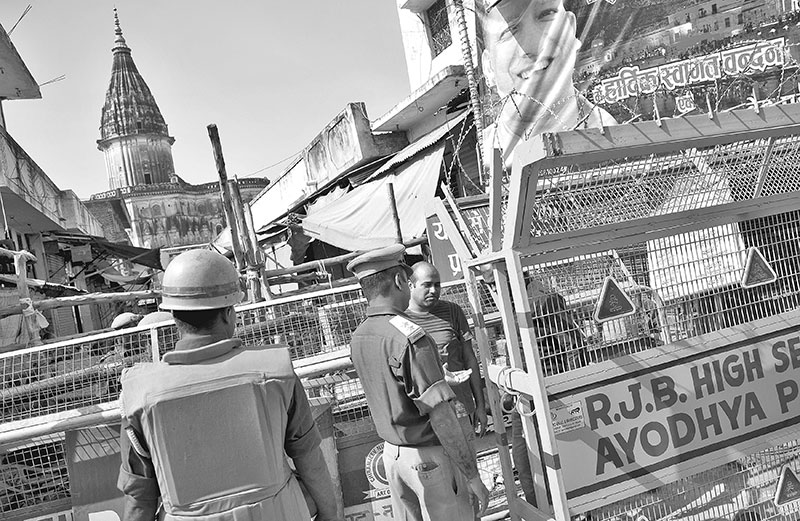
A police officer checks identity papers at a security barricade in a street after Supreme Court’s verdict on a disputed religious site in Ayodhya, India, on Saturday. REUTERS
NEW DELHI/AYODHYA (India) : India’s Supreme Court on Saturday awarded a bitterly disputed religious site to Hindus, dealing a defeat to Muslims who also claim the land that has sparked some of the bloodiest riots in the history of independent India. The ruling in the dispute between Hindu and Muslim groups paves the way for the construction of a Hindu temple on the site in the northern town of Ayodhya, a proposal long supported by Prime Minister Narendra Modi’s ruling Hindu-nationalist party. Representatives of the Muslim group involved in the case criticised the judgment as unfair and said it was likely to seek a review of the verdict. In 1992 a Hindu mob destroyed the 16th-century Babri Mosque on the site, triggering riots in which about 2,000 people, most of them Muslims, were killed across the country. Court battles over the ownership of the site followed. Jubilant Hindus, who have long campaigned for a temple to be built on the ruins of the mosque, set off fire crackers in celebration in Ayodhya after the court decision was announced. Thousands of paramilitary force members and police were deployed in Ayodhya and other sensitive areas across India. There were no immediate reports of unrest. “This verdict shouldn’t be seen as a win or loss for anybody,” Modi said on Twitter. “May peace and harmony prevail!” Still, the verdict is likely to be viewed as win for Modi’s ruling Bharatiya Janata Party (BJP) and its backers.It comes months after Modi’s government stripped the Muslim-majority Jammu and Kashmir region of its special status as a state, delivering on yet another election promise to its largely Hindu support base. Neelanjan Sircar, an assistant professor at Ashoka University near New Delhi, said the court ruling would benefit the BJP, which won re-election in May, but a slowing economy would ultimately take centre stage for voters. “In the short term, there will be a boost for the BJP,” said Sircar. “These things don’t work forever ... Ram Temple isn’t going to put food on the table.” Hindus believe the site is the birthplace of Lord Ram, a physical incarnation of the Hindu god Vishnu, and say the site was holy for Hindus long before the Muslim Mughals, India’s most prominent Islamic rulers, built the Babri mosque there in 1528. The five-judge bench, headed by the Chief Justice Ranjan Gogoi, reached a unanimous judgment to hand over the plot of just 2.77 acres (1.1 hectares), or about the size of a soccer field, to the Hindu group. The court also directed that another plot of 5 acres (2 hectare) in Ayodhya be provided to the Muslim group that contested the case but that was not enough to mollify some. “The country is now moving towards becoming a Hindu nation,” Asaduddin Owaisi, an influential Muslim opposition politician, told reporters. Modi’s party hailed the ruling as a “milestone”. “I welcome the court decision and appeal to all religious groups to accept the decision,” Home Minister Amit Shah, who is also president of the BJP, said on Twitter. The Sunni Muslim group involved in the case said it would likely file a review petition, which could trigger another protracted legal battle. “This is not a justice,” said the group’s lawyer, Zafaryab Jilani.Muslim organisations appealed for calm. The Hindu group Rashtriya Swayamsevak Sangh—the parent organisation of Modi’s party—had already decided against any celebrations to avoid provoking sectarian violence between India’s majority Hindus and Muslims, who constitute 14% of its 1.3 billion people. Restrictions were placed on gatherings in some places and internet services were suspended. Elsewhere, police monitored social media to curb rumours. Streets in Ayodhya were largely deserted and security personnel patrolled the main road to Lucknow, the capital of the northern state of Uttar Pradesh. Ayodhya residents were glued to their televisions and mobile phones for news of the ruling, which delighted Hindus when it came. “Everyone should come together to ensure that the construction work begins at the site without any delay,” roadside vendor Jitan Singh said over the chants of “Jai Shri Ram” (hail Lord Ram) from fellow shop-keepers.
MEDLEY
Horoscope
ARIES (March 21-April 19) *** You will be shown some visions of what could be today—and you might not like them. But is it a problem of a bad reality or bad perception? Just because it doesn’t look like things are going to turn out the way you want them to doesn’t mean that you still can’t be happy. Apply a positive spin to the news you receive today.
TAURUS (April 20-May 20) *** Your attitude towards other people is positive, and it will help you win in any power struggle you encounter today, from who gets to hold the remote control at home to who gets promoted to that plum position at work. By thinking the best of your opponents, you will be able to convince them to give you what you want.
GEMINI (May 21-June 21) **** Try to get away from the crowds today. Get off on your own and take a long walk outside. Let your thoughts wander, and you will come to some important realizations about yourself. This is a good time for deep thoughts on deep issues. Something in your life needs to be addressed, and you’ve been putting it off for way too long.
CANCER (June 22-July 22) *** You might feel like you’re banging your head against a wall today—someone you’re trying to break the ice with keeps on giving you the cold shoulder. While you are all charm and sunshine, they are aloof and standoffish. Well, don’t take it personally. They might just not have the time to deal with you right now.
LEO (July 23-August 22) **** Take a break from pushing yourself right now—you deserve it! Challenging yourself with more responsibilities at work might seem like a great way to get ahead, but it will really only increase your stress level right now. Let the dust settle on any recent drama, and use today to regroup and recharge for the days ahead.
VIRGO (August 23-September 22) *** Give yourself a modest challenge that offers huge rewards today—starting with your environment. Clean around your home and find a new way to reorganise. Getting clutter out of the way is satisfying, and it’s a task you can turn your mind off to do. Give your grey matter a rest while you give your home a facelift.
LIBRA (September 23-October 22) **** You should know by now that only an intellectual connection can create a solid foundation for a real relationship, whether it’s a romance, a friendship, or a business partnership. Sharing ideas and talking about controversial issues in order to understand someone better are not only interesting, they are healthy.
SCORPIO (October 23-November 21) *** Balancing your family with your career is not as difficult as some people say. As long as you understand which is most important (hint: It’s not your career), then you are golden. Sure, there may be conflicts from time to time but if you keep communication open, you can stay on top of such things.
SAGITTARIUS (November 22-December 21) *** Good news is that you are at the beginning stages of remarkable self-transformation. The bad news is, consequently, you might be confused about what you want to do today. It may seem odd to start transformation with ambivalence, but hang in there. Once you start sorting through options, real transformation begins.
CAPRICORN (December 22-January 19) *** If you think that you need to start making some lifestyle changes, then you do. When you feel the urge to mix things up, you cannot continue with your normal. But you can relax—these changes you make don’t have to be huge adjustments. They just have to be significant enough to make a difference.
AQUARIUS (January 20-February 18) **** Someone is going to find you quite attractive today—unfortunately, they might not be someone who you find very attractive. There is no need to chat someone up if you have no interest. In fact, it’s not very nice. Leading someone on—even if you’re just trying not to hurt their feelings—is not the right way to handle things.
PISCES (February 19-March 20) *** Without trying, you will be daydreaming about the future today—one word could send you off on a mental tangent. These revelations might feel like subconcisous directives, but they are merely your imagination trying to work things out. What you might want today might sound silly tomorrow, so don’t commit to anything.
NATIONAL
Government offers loans to lure workers to its Social Security Scheme
After a lukewarm response, the government has come forward with up to Rs10 million in loans to contributing workers.
- CHANDAN KUMAR MANDAL
KATHMANDU, Following a lukewarm response in enrolments to the contribution-based Social Security Scheme, the government has now revised the scheme and offered to provide loans to registered contributors. With changes in the scheme, workers can get a loan of up to Rs10 million after registration and regular contribution into the scheme. According to Ram Prasad Ghimire, joint-secretary at the Ministry of Labour, Employment and Social Security, the government has drafted a working procedure for deciding how the loans can be given to workers who are contributing to the welfare scheme. “Most of the stakeholders we have discussed with have suggested that workers get loans after making contributions. Following their suggestions, we are proposing that the workers should get loans,” said Ghimire, who is also the chief of Labour Relations and Social Security Division under the Labour Ministry. As per the latest provisions of the scheme, a worker can get up to Rs10 million as housing loan and a maximum of Rs3.5 million as educational loan. The working procedures, which will further clarify the mechanism of distributing loans, will be finalised within a week, said Ghimire. “Before issuing loans to workers, there should be sufficient funds collected. Also, we need to finalise when a registered worker becomes eligible for such loans and how much they can get,” said Ghimire. “We will be finalising the draft soon.” Since the scheme was rolled out to provide comprehensive welfare coverage to formal private-sector workers, the government has struggled in getting employers and workers to sign up to the scheme. When the deadline for registration under the scheme, which provides old-age pension, medical treatment, health protection, maternity coverage, accidents, and disability compensation, expired last month, just over 6,000 organisations from the formal private sector had registered with the Social Security Fund (SSF)—the government body ensuring rights of social security protection. Following the lukewarm response, which has been witnessed since the beginning of the scheme, the government had given a month-long extension to the remaining employers and workers to enrol themselves. Now the government hopes the proposal of offering loans would yield a positive response to the scheme. “The provision of loans can be one of the attractions for employers and workers for registering under the scheme,” said Ghimire. To avail of the contribution-based scheme, both employers and employees should register and make monthly contributions to the fund. An amount equivalent to 31 percent of the workers’ basic salary—11 percent deducted from their monthly salary and 20 percent as employer’s contribution—will go to the Social Security Fund. Labour rights organisations have also welcomed the government proposal of offering loans to registered workers. “We have long been suggesting that the government provide loans to workers who have deposited their money with the fund. This is a good move,” said Janak Chaudhary, general secretary of the General Federation of Nepalese Trade Unions. “This will further help in clearing the confusion among workers if they will get loans after depositing money for years. Employers’ and workers’ interest in joining the scheme is likely to go up now,” he added.
NATIONAL
Medical students urge home minister to act against private colleges not refunding extra fees
Home Minister Ram Bahadur Thapa has asked for 15 days to set things right, a student leader says.
- BINOD GHIMIRE
KATHMANDU, Medical college students on Saturday met with Minister for Home Affairs Ram Bahadur Thapa and urged him to immediately act against private medical colleges that have defied successive government directives to refund the additional fees they charged the students earlier. Though the education and home ministries have been instructing the private medical colleges to refund the money, they have not abided by the directives. The government too has not taken any action against the defiant institutions. On September 23, following a protest from students, the government agreed to authorise the local administration to start action against medical colleges that didn’t refund their money within a month. However, nearly two weeks after the deadline elapsed, the government didn’t initiate any action against the errant medical colleges, prompting the students to start fresh protests from November 4. The government in October last year set the fees for MBBS courses at Rs3.8 million for private colleges in Kathmandu Valley and Rs 4.24 million for those outside the Valley. However, colleges had been charging up to Rs 6 million. “We urged Thapa to walk the talk. Issuing directives alone is not enough,” Anit Sinha, secretary of Medical Student Struggle Committee, told the Post. “We also asked him to ensure the students can attend their classes in a free and fearless environment.” The students from National Medical College, Birgunj and Universal Medical College, Bhairahawa were manhandled by their college administrations. No actions have been taken against the people involved in manhandling the students who were staging a peaceful protest. During the meeting with the students, Thapa assured action, if the medical colleges didn’t comply with the government’s directives within 15 days. “I am serious about your [students’] concerns and have talked to the prime minister on the matter. I assure you that the ministry will not wait more than 15 days,” Sinha quoted Thapa as saying. Following Thapa’s assurance, the students have suspended their capital-centric protest, for now. The Education Ministry on Tuesday requested the Home Ministry to work as per its commitment made in September. The medical college owners, however, say fee isn’t such a big issue, but it had been politicised by some people. “We have never said we won’t follow the government’s directive. We will take necessary steps after receiving a letter from the Home Ministry,” Basruddin Ansari, chairman of the Association of Medical and Dental Colleges of Nepal, told the Post. The medical students have been holding protests for the past several months demanding that their colleges comply with the fee ceiling determined by the government. Different government committees, including a parliamentary committee, found that the medical colleges have cheated the students, but no action was taken against them. It is alleged that the government is hesitant in taking action as the owners of the colleges enjoy political patronage. For instance, Ansari is a leader of the ruling Nepal Communist Party (NCP) while Khuma Aryal, the owner of Gandaki Medical College, is a leader of the Nepali Congress.
NATIONAL
New education policy ignores nearly all recommendations made by high-level education commission
The policy serves the interests of the private sector, which had lobbied against the commission’s recommendations, commission members say.
- BINOD GHIMIRE
Besides regulating private schools, the commission had recommended that the government increase its allocation to the education sector to 20 percent of the annual national budget. post file photo
KATHMANDU, The government formed a High-Level National Education Commission last year to recommend steps to better the country’s education system, all the way from pre-primary to the university level. After five months, the commission, on January 15 this year, presented a 500-page report to Prime Minister KP Sharma Oli. But on Thursday, the Education Ministry made public portions of the new education policy and according to analysts and commission members, it is clear that the new policy has disregarded almost all of the commission’s recommendations. “I am shocked to see the policy. What is the essence of the commission if its recommendations don’t find a place in the government’s policies?” asked Shyam Shrestha, a member of the commission. Private educators had objected to several of the provisions in the report, which had envisioned turning education into a service sector. The commission had concluded that private education had become a profit-making sector and had recommended that private schools be transformed from the ‘for-profit’ to ‘not-for-profit’ model. The schools would be given a decade to change their registration from a company to a trust. The commission, according to its members, made its recommendations based on Article 31(2) of the constitution, which makes the state responsible for ensuring compulsory basic education and free secondary education for all. The commission said that leaving private educators to “generate profit”, as they are doing at present, would be tantamount to a breach of the constitution. However, the new policy has completely ignored the commission’s recommendation on turning private education into a service sector and increasing the government’s investment in ensuring free and compulsory education for all children, said Shrestha. “The policy only serves the interest of private educators,” Shrestha told the Post. Private educators say that many recommendations in the commission’s report were impractical. Therefore, it is only natural they were not incorporated into the policy. “The government’s focus should be on improving public institutions, rather than controlling private ones,” Lok Bahadur Bhandari, general secretary of the Higher Institutions and Secondary Schools’ Association Nepal, told the Post. The commission’s report, which is currently with the Prime Minister’s Office, hasn’t been made public because of pressure from private educators, say commission members. Private school operators admitted that they had lobbied Oli to not give “much importance” to the report. “We had informed the prime minister that the commission had failed to internalise the reality of the country in its report. We are glad that policy has largely addressed our concerns,” the owner of an established private school in the Capital told the Post on condition of anonymity. The Education Ministry didn’t hold consultations with education experts and concerned parties before drafting the policy either. Even senior officials at the ministry were kept in the dark. “More than the Education Ministry, it was prime minister’s office that had a say in the policy,” a senior official at the ministry told the Post on condition of anonymity because he was not allowed to talk to the media. Presenting excerpts of the policy before the media, Minister for Education Giriraj Mani Pokhrel said that the policy will shape the future of the Nepali education sector. “It is not mandatory to take every recommendation of the commission,” Pokhrel said in response to queries as to why the policy did not incorporate the commission’s recommendations. Along with regulating private schools, the commission had also recommended that the government increase its education allocation to 20 percent of the total budget. Despite its global commitment, the government’s investment in the education sector is decreasing as a share of the national budget, which once reached 17 percent but accounts for just 10 percent of the country’s total spending now.
NATIONAL
Bankers say government agencies do not cooperate while gathering databases on high-profile persons
A centralised database of high-profile persons could plug loopholes in the system.
- PRITHVI MAN SHRESTHA
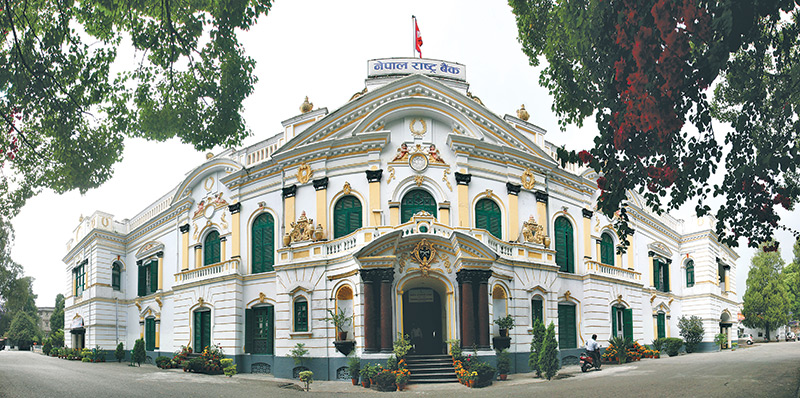
Nepal Rastra Bank has instructed all banks to maintain a database of high-profile persons. Post file Photo
KATHMANDU, Although the central bank has instructed all banks to maintain a database of high-profile persons and persons with “questionable backgrounds” in an attempt to control money laundering, bankers say that they are not getting enough support from government agencies. Various government agencies and state bodies maintain separate lists of high-profile persons, also known as “politically exposed” persons, but bankers say they are struggling to gather data from all of them. “There’s a lack of cooperation from government agencies in accessing these databases,” said Gyanendra Dhungana, president of the Nepal Bankers’ Association, an organisation of chief executive officers from the country’s 28 commercial banks. According to the anti-money laundering law, the president, vice-president, prime minister, chief justice, speaker and deputy speaker of both the federal parliament and provincial assemblies, provincial governors, chief ministers, ministers from both federal and provincial governments, federal Parliament and provincial assembly members, officials of constitutional bodies, bureaucrats, judges of the High Courts, national leaders of political parties, chief and deputy chiefs of District Coordination Committees, chiefs and deputy chiefs of local governments, and senior officials of state-owned enterprises are considered high-profile persons. High-profile persons are considered risky because they command power, could potentially engage in corruption, and have the capability of launder the assets amassed through corruption or other illegal activities. The Financial Action Task Force (FATF), the global anti-money laundering body, has thus set a standard under which additional vigilance should be maintained over the activities of high-profile persons. “The question is who provides data on high-profile people because no single government agency has records of them all, including when they get appointed or recruited and when they resign or retire,” said Dhungana, who is also the chief executive officer of Nepal Bangladesh Bank. “Banks maintain their own databases, but these are incomplete. Some banks may miss out on some persons.” Many banks procure their database from private companies who maintain such databases. Bankers say they have to rely on private firms for data as government agencies have not been cooperative. “Such firms assure the accuracy of their data, but questions remain about their authenticity as they are not government entities,” said Anil Shah, chief executive officer of Nabil Bank. Banks are also required to maintain a database of international high-profile persons, including those who work in international agencies, both Nepalis and foreigners. People with criminal backgrounds, those who the banks consider prone to corruption, those involved in the sale and purchase of commodities such as gold, and those dealing in large cash transactions are some of the other categories of persons who face enhanced scrutiny from the banks. According to Dhungana, there has been a discussion at the Nepal Bankers’ Association about them accessing data from the Credit Information Bureau of Nepal, which maintains a database of loan borrowers. “But formal talks with the bureau are yet to be held,” Dhungana told the Post. According to bankers, a common platform could help reduce the risk of missing out on some high-risk persons because all banks will have access to the same list. It will also help them reduce the cost of purchasing data from different vendors. “We can pay a certain fee to get access to a database of high-profile people, just like we get the credit history of certain borrowers from the bureau,” said Shah. Obtaining the credit history of borrowers enables the banks to decide whether they qualify for certain loans.
NATIONAL
Truck drivers get 15 days to implement new rules
- ANUP OJHA
KATHMANDU, The Metropolitan Traffic Police has provided trucks and tippers with 15 days during which to make necessary changes to their structure so that they are less accident-prone. This is an attempt by the traffic police to control the increasing number of fatalities caused by tippers and truck-related accidents. According to the traffic police, in the past three months, starting from July 17 this year, seven people have already lost their lives inside the Kathmandu Valley to truck and tipper accidents while 146 have sustained injuries. Drivers need to change their mirrors so their backsides are more visible and remove all decorative items that block their view. Drivers are not supposed to have any speakers or woofers inside the cab and should place their number plates on both sides of the vehicles to make them more visible from a distance, according to the traffic police. “The number of tipper-related accidents have gone up. From our survey, we found the vehicle’s rear-view and side mirrors are smaller and do not show the back. Most of the number plates were covered with mud and were placed inside. The front decorative part of the truck was blocking the view and the drivers are often seen playing loud music,” said Senior Superintendent Bhim Prasad Dhakal, division chief of the traffic police. “These were the reasons for these trucks being more prone to killing people.” A meeting between the traffic police and the Truck and Tipper Association on November 4 agreed to make these changes to vehicles so that there are better precautions to reduce fatalities. The association operates 2,200 trucks and tippers inside the Kathmandu Valley for construction works and to carry loads. Rohit Shrestha, association chairperson, said that the association has already directed all truck owners and drivers to make the necessary changes to their vehicles. “We are very hopeful that this will help decrease fatalities. We will follow the division’s orders,” said Shrestha. The Ministry of Home Affairs in July last year had banned the daytime operation of tippers and trucks inside all three districts of the Kathmandu Valley to reduce pollution and the number of accidents.
NATIONAL
Health Ministry to follow revised deadline
WHO South-East Asia Region revised measles elimination deadline in the region to 2023.
- Arjun Poudel
The Health Ministry had decided earlier to eliminate the viruses by 2019. Post file Photo
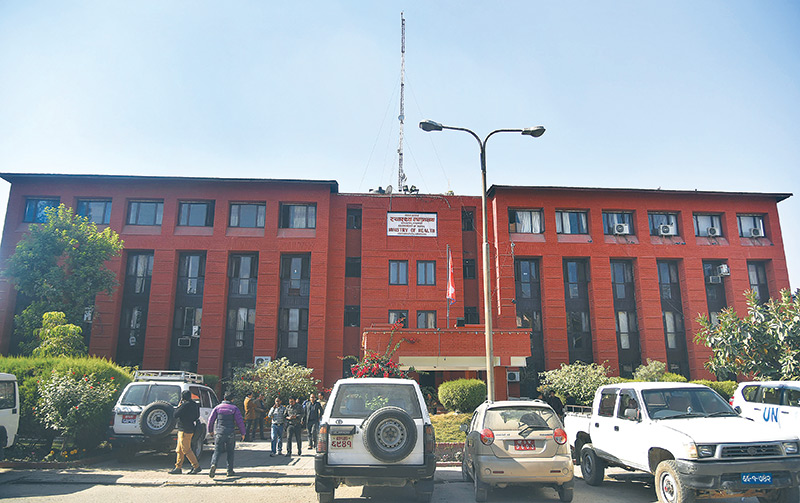
KATHMANDU, With all its efforts failing to eliminate local infections from measles and rubella viruses, the Ministry of Health and Population has decided to follow the World Health Organization South-East Asia Region’s revised deadline. The UN’s health agency has extended its deadline to 2023, after its member states failed to prevent death and disabilities caused by the highly infectious killer viruses, which afflicts mostly children in their early childhood. “We have not declared our own deadline. We will follow WHO’s revised deadline of 2023 to eliminate the deadly diseases,” said Dr Jhalak Sharma, chief of immunisation section at the Family Welfare Division under the Department of Health Services. “We will make additional efforts to meet the targets.” Earlier, the Health Ministry had decided to eliminate the viruses by 2019, a year before the WHO South-East Asia Region’s deadline of 2020. Measles is a contagious viral disease that can be prevented with a two-dose vaccine, which has to be first administered at nine months of age and then at 15 months. The government provides measles’ vaccines for free at health facilities across the country. Measles’ elimination and rubella control is a regional flagship priority of the WHO since 2014. According to the WHO, Bhutan, Democratic People’s Republic of Korea, Maldives, Sri Lanka and Timor-Leste have already eliminated the measles virus. Six countries—Bangladesh, Bhutan, Maldives, Nepal, Sri Lanka and Timor-Leste—have controlled the infection from rubella virus. To achieve measles eliminated status, the number of cases should be less than five in every 1,000,000 population or no cases throughout the year. Sharma said that his office would work to increase the coverage of the second dose of measles vaccines, which is very low, compared to the first dose. “We will also continue the nationwide anti-measles, rubella drive to lessen the risk of the frequent outbreak of the deadly viruses,” said Sharma. “We will also improve our preparedness level to respond to outbreaks and also coordinate with all concerned stakeholders, including provincial and local level governments, political parties, and international partners including the UN bodies—WHO and UNICEF—to achieve the desired result.” The immunisation section has planned to launch nation-wide campaigns against measles and rubella virus from February to April in two phases next year. The first phase of the campaign will start on February 13, 2020, and will continue until March 13 in provinces 1, 2 and 5. The second phase will be conducted from March 14 to April 14 in provinces 3, 4, 6 and 7. During the campaign, all children aged between 9 months to 59 months old will be immunised with vaccines against measles and rubella virus. Measles and rubella are contagious viral diseases, which are transmitted through droplets from the nose, mouth or throat of infected persons. Early symptoms, which usually appear 10-12 days after infection include high fever, runny nose, bloodshot eyes and white tiny spots inside the mouth. Several days later, a rash develops on the face, upper neck and other parts of the body. Doctors say people of all age groups are vulnerable to the disease and underage children, pregnant women, elderly people and those with compromised immune systems such as HIV-infected people, are highly vulnerable. Some people may suffer from severe complications, such as pneumonia and encephalitis, and these diseases may also lead to death. Measles was endemic in Nepal and an average of 90,000 cases were recorded every year from 1994 to 2004. Routine measles vaccination began in the country in 1979, starting with three districts. The campaign was extended nationwide after 10 years.
NATIONAL
Priests to check birth certificates of marrying couples
The priests in Rukum (West) to work with local units, police, women’s groups and students to end child marriage.
- HARI GAUTAM
RUKUM (WEST), With an aim to uproot the practice of child marriage, some Hindu priests in Rukum (West) have taken an unusual step. The priests have started asking brides and grooms-to-be to produce their birth registration and citizenship certificates before solemnising their weddings. “Child marriage is still a major social problem in the district. Our decision to ask for certificates before performing wedding ceremonies may sound absurd to many, but we have undertaken this as our social responsibility to curb the practice,” said Ram Prasad Gautam, a priest from Musikot, the district headquarters. “We will not officiate the weddings of underage brides and grooms.” Gautam said that the priests will work alongside the local government, police, women’s groups, child clubs and students to end child marriage in the district. The District Police Office held an interaction programme with the priests in Musikot on Wednesday. Around 20 priests attended the event, where they expressed their commitment to check the age of brides and grooms before performing wedding ceremonies. “We will talk with other priests across the district and ask them to join us in this campaign,” said Jhakku Prasad Upadhyay, a priest attending the function. According to Deputy Superintendent of Police Sumit Khadka, the priests present in the interaction vowed to help check child marriage in the district. “We will launch such interaction programmes in the local units as well and ask other priests to help us in our drive,” he added. Child marriage has been illegal in Nepal since 1963. Two years ago, the government increased the legal age for marriage from 18 to 20. As per the existing legal provisions, the priest performing the wedding ceremony of underage couples and their parents can be sentenced to prison for up to three years and fined up to Rs 33,000.
NATIONAL
Communication barrier a major hurdle for the deaf
Unless the Nepali sign language becomes more widely used, deaf people will keep having a difficult time.
- PRAKASH BARAL
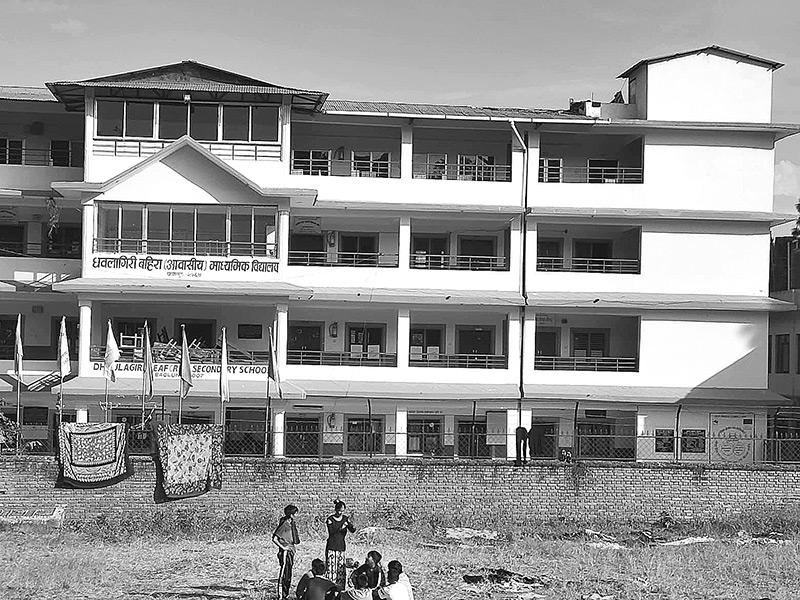
Currently, there are around 300 deaf students enrolled in the Dhaulagiri Deaf Residential Secondary School. Post Photo: prakash baral
BAGLUNG, Santosh Paudel, president of Baglung Deaf Association, teaches sign language at the Dhaulagiri Deaf Residential Secondary School in Baglung district headquarters. Inside the school’s premises, Paudel, who is deaf, is comfortable with his communication skills. However, every time Paudel steps outside of the school premises, and into the world, he is worried. He becomes especially worried when he has to go to government offices. “Government officials, like most people, do not understand the Nepali sign language. That is why I always have to take an interpreter with me for communication,” he said. Sunita Sharma, a high school graduate in computer engineering from the Dhaulagiri Deaf Residential Secondary School, also feels the same anxiousness as Paudel when she’s out of her school premises. “I have to take an interpreter with me everywhere I go, which means I have to manage his/ her expenses, in addition to my own,” said Paudel. For deaf people like Paudel and Sharma, living a “normal” life is difficult. It becomes more difficult when they have to depend on others for communication. “And as you can imagine, for those like us, jobs don’t come easy. I am a teacher at the deaf school but outside that, it’s difficult for me to get a job,” said Sharma, who is yet to pass a job interview despite being qualified. “I have passed the written test several times but I always fail in the interview round. The interviewers, whether in a government office or a private one, don’t understand me. And since I can’t communicate any other way, I don’t get selected,” she said. The National Federation of Deaf Nepal estimates that the country has a deaf population of more than 300,000. Despite the huge number, the Nepali sign language is still in its nascent phase of development, and as it is not widespread yet, deaf people have a tough time pursuing their ambitions--or living a normal life. Deaf people believe that if the government encourages its staff to learn the sign language, the private sector will follow suit. “Our students, though they possess skillsets as good as or even better than the next person, fail in the real world. The failure to understand them has pushed them in the periphery of the job market in Nepal,” according to Resham Bahadur Shreesh, the headmaster of Dhaulagiri Deaf Residential Secondary School. And understanding the Nepali sign language is not a tough job, he says. “Anyone can become adept in using the Nepali sign language after a seven to a 10-week training session and can easily communicate with the deaf and dumb,” he adds. To make the language more widespread, the Baglung Deaf Association and the Dhaulagiri Deaf Residential Secondary School jointly run training sessions on the Nepali sign language every year, inviting government representatives and other officials, but only a small percent of the invitees attend the training, if at all. “We organise the training so that the people sitting in the offices will be able to understand us better, but hardly anybody shows up,” said Shreesh. Currently, there are around 300 deaf students enrolled in the Dhaulagiri Deaf Residential Secondary School. The school runs a three-year computer engineering course for students who pass the Secondary Education Examination, which is opted by many. There are others who opt for the Council for Technical Education and Vocational Training (CTEVT) courses. CTEVT is a national autonomous apex body of technical and vocational education and training sector committed for the production of technical and skilful human resources required to the nation. The courses include employment-generating skill training, like beautician, cutting and tailoring, haircutting, plumbing et cetera. But those who take the CTEVT courses too find themselves scraping the bottom of the barrel for job opportunities. “I have received a six-month training in plumbing from the Council for Technical Education and Vocational Training, but nobody hires me. It’s like they don’t trust us to do a good job,” said Shishir Gurung, another deaf person. Saraswoti Devi Regmi, chief at women development unit of Baglung Municipality, admits that the hardships deaf people face--whether they be in receiving an education, seeking services, or looking for employment--are more severe: “It’s difficult for them. Since we don’t understand their language, communication is not easy.” “We once ran a help desk with the help of the representatives of the deaf association to distribute ID cards to the disabled. We haven’t been able to do that again but we plan to coordinate with the association and work together to make the deaf people’s lives a little less difficult,” she said.
NATIONAL
14-year-old girl found dead in suspicious circumstances
- KAMAL PANTHI
BARDIYA, Relatives of 14-year-old Trishila Chaudhary, who was found dead under suspicious circumstances in Rajapur-6 on Thursday, have demanded an investigation be led into the case. They claimed the victim was abducted, raped and consequently murdered. The victim’s family members vented their ire as the police refused to register a rape and murder case against a local boy. Trishila’s uncle Narendra believes that a 15-year-old boy took her to his house three days before she was found dead. “The incident is suspicious; it should be investigated in an independent way,” he demanded. According to Narendra, both the victim and the accused are classmates of a local community school. Postmortem of Chaudhary was conducted on Friday. But the postmortem and viscera reports are yet to come, said police. The bereaved family have refused to receive the body stating that the police are reluctant to investigate the case. They claim that the police’s efforts are on to dismiss the case, stating it as a suicide. Mitra Bahadur Acharya, inspector at the Area Police Office in Rajapur, said the accused was called at the police office for interrogation. “We will register the case after the postmortem and viscera reports,” he added.
NATIONAL
Suicide rate on the rise in Chitwan district
As many as 20 people have killed themselves during Dashain-Tihar in Chitwan, say police.
- RAMESH KUMAR PAUDEL
Post file Photo
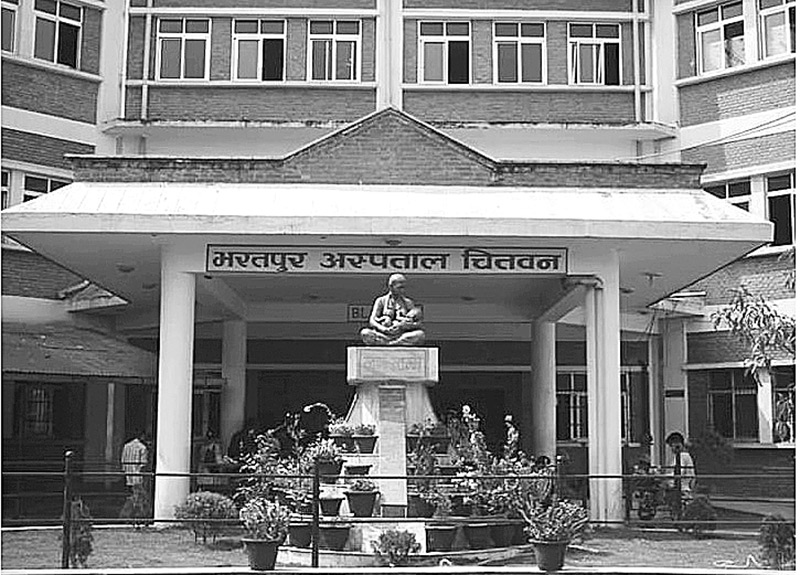
CHITWAN, An attendant of a patient admitted at Bharatpur Hospital committed suicide in the hospital building on Friday. Bishnu Bahadur Sunar, a permanent resident of Lamjung who was working in Chitwan, was found hanging from the railing of a staircase near the ward where his wife was being treated, said police. Bishnu used his shawl to hang himself. Sujita, who gave birth to a baby three months ago, was admitted to the hospital for pleural effusion, an excessive buildup of fluid in the space between the lungs and chest cavity, a week ago. “Sujita’s health was improving. We were planning to discharge her within a couple of days,” said Lila Paudel, the information officer at the hospital. He said the treatment was not expensive. Bishnu’s relatives said Bishnu looked normal and they were shocked by his suicide. “He was working in a poultry farm. We were also helping him financially with the treatment. We don’t know why he took such a decision,” said Anil Sunar, Bishnu’s brother-in-law. Bishnu’s case is not an individual one. According to the District Police Office data, a total of 48 people died in various incidents during Dashain and Tihar, among them 20 people committed suicide. Deputy Superintendent of Police Eknarayan Koirala said suicide was the leading cause of death in Chitwan for the past few years. According to him, around 70 to 90 people commit suicide in the district annually and the figure is gradually on the rise. Psychiatrists underscore the need of public health awareness to check the alarming number of suicide in the district. “Around 80 percent people who commit suicide are the patients of depression. It can be easily cured. But most of the people suffering from depression do not have access to doctors,” said Dr CP Sedhain, a psychiatrist. “The local units should make a plan to solve the problem. The focus should be on how well depression patients get access to health workers for counselling,” he added.
NATIONAL
Survey of Ramgram Stupa begins in Nawalparasi (West)
The geophysics survey is being carried out to discover ancient structures below the ground, archaeologists say.
- NABIN PAUDEL
The initiation is being carried out by the Durham University of the UK, the Department of Archaeology and the Lumbini Development Trust. Post Photo: nabin paudel
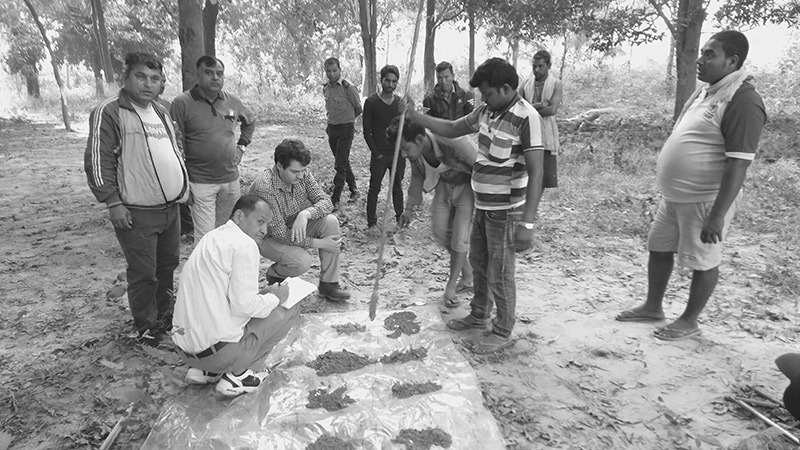
PARASI, Archaeologists started conducting geophysics survey to find out ancient structures at Ramgram Stupa in Ramgram Municipality, Nawalparasi (West), on Friday. The stupa houses the astadhatu (relics) of Lord Gautam Buddha. Out of eight such remains of the Buddha, this is the only complete astadhatu. The survey was initiated by a team of experts and archaeologists from the Durham University of the UK, the Department of Archaeology and the Lumbini Development Trust. Ram Bahadur Kunwar, a senior archaeologist, said the team will carry out survey works for 10 to 12 days. “The survey aims to discover ancient structures below the ground,” said Kunwar. According to him, excavation works along the area will be carried out based on this survey. Three years ago, the remnants of an ancient pond were found some distance from the north-west corner of the stupa during a survey. Government authorities are working to include Ramgram Stupa on the list of UNESCO World Heritage Sites. Professor Robin Coningham of Durham University said that it will be easy to trace ancient structures, including the pond, vihara and roads of the Budhha era, after conducting a geophysics survey in the area. “It will be helpful to collect archaeological evidence from the Ramgram Stupa area,” he said. In the past, survey works were carried out in the Ramgram Stupa area in 1997, 1999 and 2018.
NATIONAL
Three held with leopard pelt in Dhanusha district
Briefing
DHANUSHA: An Armed Police Force team nabbed three persons in possession of leopard pelt from Dhanusha district on Friday evening. The suspects were arrested while they were trying to make their way to India with the hide. The detained have been handed over to the Division Forest Office in Dhanusha for further investigation.
NATIONAL
Local unit to build its own hospital in Makwanpur
Briefing
HETAUDA: Makwanpurgadhi Rural Municipality in Makwanpur district is preparing to construct a 15-bed hospital in the local unit. “The rural municipality has allocated Rs 5 million budget in the current fiscal year for the project. We will soon begin the construction of the hospital with an aim to run it within one and a half years,” said Chairman of the rural municipality Bidur Humagain.
NATIONAL
Rs 20.5 million collected as offerings in Pathibhara
Briefing
TAPLEJUNG: Pathibhara, a famous Hindu temple in Taplejung district, has collected Rs 20.5 million as offerings from devotees in the past 16 months. The temple management committee said that the amount will be spent for the preservation and promotion of the temple.
NATIONAL
244 received free treatment at an eye camp in Galkot
Briefing
BAGLUNG: Two hundred and forty-four people received treatment at an eye camp organised at Galkot Municipality Ward No. 7 in Baglung district. The ward office had conducted the eye camp to provide free treatment to the needy people. The Galkot Optical Eye Treatment Centre had provided technical assistance at the camp.
NATIONAL
Construction work of Galchhi-Rasuwagadhi road halted
Briefing
NUWAKOT: The construction work of the Galchhi-Trishuli-Rasuwagadhi road project has come to a halt after the Supreme Court issued an interim order regarding compensation during the land acquisition process. Narayan Prasad Pyakurel, a resident of Bidur Municipality, had filed a writ in the Supreme Court informing of injustice regarding the land acquisition process.
OPINION
Power, knowledge and the Non-resident Nepali
As the Nepali diaspora grows, NRNA should continue to address the issues of non-residents and their families.
- ABHI SUBEDI
Shutterstock
I entered a big waiting room of passengers waiting for their flights at Dubai airport on October 4, 2019. Exhausted by the long flight from Toronto, I was sitting at one corner when suddenly I heard somebody intimately addressing me. A middle-aged man approached me. I didn’t remember meeting him earlier. I feel overwhelmed when people show familiarity with me. A familiar writer and government officer joined the crowd, making me feel more comfortable. After talking with at least half a dozen men and their wives, I decided to go on shifting in the crowd and asking the mostly middle-aged people about the purposes of their travels. To my surprise, about 80 percent of the couples were returning after visiting their children in America. Their story is the same—they occasionally go abroad to spend a few months with their children. Except for a few, all were proud of their children and their jobs. I was surprised to see how that has become a rhythm of many families. One could feel how Nepali society has begun to bear the impact of such migration, and how a new pattern of non-resident identity has been growing. I remember meeting and talking to some of my erstwhile students in Toronto a few days earlier when they organised a programme to listen to my discourses about Nepali culture and literature. These non-residents are confident, educated, and are working in various jobs there. Some of them are prominent leaders of the Non-Resident Nepali Association (NRNA). One among them, who was a well-known leftist politician in Nepal, has continued to work with the same spirit and, as he claims, with the same degree of success. So much so, he had come to Nepal at the NRN election and played a very important role in that. Our conversation revealed to me a few things about the identity of the Non-resident Nepali’s (NRN) and their future. I began to wonder where the NRNA stands as the movement of non-resident Nepalis becomes wider, without cutting links with their families in Nepal as indicated by the parents’ pride, passion and hope. The acronym NRN has become more than a familiar term in Nepal and among the Nepalis who live outside the country. According to the Non-resident Nepali Act 2007, the term has these meanings: ‘a person who currently holds citizenship of Nepal, a former Nepalese citizen, foreign citizen of Nepalese origin, Nepali citizen residing abroad, person of Nepali origin’. Opening a business in Nepal and making investments in banking, tourism, hydropower, and other sectors is considered to be the objective of the NRNA. In this short essay, however, I do not want to discuss the structure and responsibilities of the NRNA, but to address a few developments especially related to the question of knowledge and its political implications. The NRNA from its very inception has touched on the issues of identity and the variety of Nepali engagements around the world, making Nepal the locus of investments in various sectors as listed above. However, the underlying implication of the definition of Nepali identities and the goals of the organisation warrant more serious attention than understood on the surface. Nepal as the locus of origin, ancestry and action appears to shape the definition of non-resident Nepali organisations worldwide. The relationship with Nepal is clearly defined through the location of economic investments. But it is clear from the very nature of the NRNA that it cannot be understood in linear terms as an organisation of Nepalis of the above types. Instead, it is synonymous with a grand quest for identity. The NRN pioneers, incumbents and current office seekers all have run into some kind of politics of definition of this organisation’s action modality. The NRN jamboree in Kathmandu in October this year, when the association held elections for its leadership, earned many commentaries and criticisms in the press who saw this organisation seeking to accept the Nepali political partisan model hook line and sinker. The political structure, at this moment, is harping on the rather unclear definition of the politics of knowledge. Without evoking the semantics of this term as used by theorists and philosophers, I want to indicate that the Nepali political parties intend to link their knowledge to power. The knowledge is couched in the familiar reiterative languages of socialism, loktantra and partisan culture, none of which is defined properly as yet. Power contests within parties and among ambitious political leaders are valorised as a mantra. Such formations create opportunities to create power centres, divide the flocks accordingly, and spread that system as knowledge. The NRNA, in search of a model, appears eager to adopt this very same system. But that will only complicate the already complex structure of this organisation. My student leader in Toronto believes that the NRNA should continue to make Nepal the focal point of its activities and should return to hold elections there. He believes that any other attempt to keep it away from that position will eradicate its very purpose. Personally, I am an admirer of the NRNA, both as an organisation and a marker of identity. But I want to point out that this organisation should not be lured by the confusing knowledge and definition of power as practised in Nepal. They should address the issues of the non-resident Nepalis and their families. They can also champion the cause of familial links, as these could grow more distant as time passes. And as my student believes, they should maintain their link with Nepal by overcoming the practice of using knowledge and power together—something that has quite not changed through multiple regimes.
OPINION
The problems Nepal faces in implementing federalism
To successfully complete the transition, the country has to focus on economic policy and border security.
- SAURAV RAJ PANT
Shutterstock
Nepal’s decision to switch from a unitary government to a federal structure was nothing less short of a drama. It’s geographical and ideological framework was designed overnight. Leaders of all hues touted federalism as the best alternative to ensure Nepal’s prosperity. But it has been three years since the local governments took office and almost two years since the provincial and federal governments have been put in place. Yet, the governments in all three tiers have been facing deep challenges to implementing federalism. They can be fundamentally based on two broad areas—the financial capacity and border security. These two factors, when looked at in connection with India, China and the US, hold the capacity to pose significant problems to the implementation of federalism in the country.
The financial burden of federalism A federal structure has a large setup of government institutions and staffs. Naturally then, the availability of finance plays a key role in sustaining federalism. The provincial and the local governments are assigned with primary responsibility for the delivery of basic public services. But they are not equipped with adequate resources, as the bulk of the revenue is retained by the federal government. This will act as a major impediment for fiscal federalism. Nepal needs $8-$11 billion in the next three to five years for implementing federalism, which is a huge sum of money. The first federal budget of Nepal (2018-19) allocated Rs845 billion under recurrent expenditure and Rs314.28 billion for capital expenditure. In the second federal budget (2019-20) the recurrent expenditure was Rs957 billion and capital expenditure is Rs408 billion. The gap between administrative expenses and the money fueled into development projects reflects our financial vulnerability. Cleary, the administrative costs, which are often non-productive in nature, have increased, at the expense of investing in development projects—something that provides a return in the long-run.
Border security Post state restructuring, Nepal is now divided into seven provinces. These provinces touch the border of either India or China—or both in most cases. Both the Indian and Chinese establishment is quite concerned about Nepal’s land and aerial security management given the illicit activities and substances that have historically permeated out of Nepal and into the two countries. This concern has been prevalent since the days when Nepal had a unitary system of governance. But with Nepal turning to federalism, they have been even more pronounced. For example, India is trying to increase its 25 District Soldier Board (DSB) office and 2 Pension Paying Office (PPOs) in the Tarai. China, on its part, has moved its people from Tibetan dominated Zhangmu town to a larger town, Shigatse following the 2015 Gorkha earthquake. In fact, China is planning to repopulate the area with Han settlers. The US, too, has been concerned. Although Nepal and the US don’t share a land border, Nepal’s fragile airport immigration could be problematic for the world’s superpower. According to the US, Nepal’s fragile immigration security is helping to ‘breed’ Nepal as ‘safe haven’ for international terrorists. That is why the US is pressuring the Government of Nepal to establish its Personal Identification Secure Comparison and Evaluation System (PISCES) software at Tribhuwan International Airport to monitor and interrogate terrorists. Based on several reports, Nepal’s weak security apparatus poses a risk to its allies in Asia, especially India. So much so that the CIA confirms of a loose network of the Indian Mujahideen working from Nepal. The above-mentioned border security challenges are bound to have geopolitical implications, which ultimately could hinder the implementation of federalism in Nepal.
Way forward Nepal should set its priorities straight in terms of challenges related to the implementation of federalism, and this must be with regard to the country’s border security and economic policy. For starters, to address the issue of border security, it is imperative to set up a Nepal-India joint Intelligence Commission to timely share information as to be aware of the trans-border crimes along the 1,751-km porous frontier the two countries share. Most visitors also have unfettered access to Nepal owing to the country providing visas on arrival to most tourists. To enhance security, they need to be subjected to tighter laws when it comes to providing visas. What’s more, research divisions inside various ministries must be strengthened so that they are encouraged to conduct in-depth research and study the changing dynamics to help recommend policies for the government. Also, to maintain financial stability, the government should strongly analyse the impact of ‘supply oriented’ economy. The politically motivated supply oriented economic policies put an extra burden on the economy despite the fact that Nepal’s productivity is negligible with regard to its imports. Obviously, there are no silver bullets to these problems plaguing the country. But formulating well-thought-out, effective policies will be key. If carried out successfully, it will definitely troubleshoot the complications of federalism in Nepal.
Pant is a researcher.
OPINION
The end of neoliberalism and the rebirth of history
- Joseph E Stiglitz
Shutterstock
At the end of the Cold War, political scientist Francis Fukuyama wrote a celebrated essay called ‘The End of History?’ Communism’s collapse, he argued, would clear the last obstacle separating the entire world from its destiny of liberal democracy and market economies. Many people agreed. Today, as we face a retreat from the rules-based, liberal global order, with autocratic rulers and demagogues leading countries that contain well over half the world’s population, Fukuyama’s idea seems quaint and naive. But it reinforced the neoliberal economic doctrine that has prevailed for the last 40 years. The credibility of neoliberalism’s faith in unfettered markets as the surest road to shared prosperity is on life support these days. And well it should be. The simultaneous waning of confidence in neoliberalism and in a democracy is no coincidence or mere correlation. Neoliberalism has undermined democracy for 40 years. The form of globalisation prescribed by neoliberalism left individuals and entire societies unable to control an important part of their own destiny, as Dani Rodrik of Harvard University has explained so clearly, and as I argue in my recent books Globalization and Its Discontents Revisited and People, Power and Profits. The effects of capital market liberalisation were particularly odious: If a leading presidential candidate in an emerging market lost favour with Wall Street, the banks would pull their money out of the country. Voters then faced a stark choice: Give in to Wall Street or face a severe financial crisis. It was as if Wall Street had more political power than the country’s citizens. Even in rich countries, ordinary citizens were told, ‘You can’t pursue the policies you want’—whether adequate social protection, decent wages, progressive taxation or a well-regulated financial system—‘because the country will lose competitiveness, jobs will disappear and you will suffer.’ In rich and poor countries alike, elites promised that neoliberal policies would lead to faster economic growth, and that the benefits would trickle down so that everyone, including the poorest, would be better off. To get there, though, workers would have to accept lower wages, and all citizens would have to accept cutbacks in important government programs. The elites claimed that their promises were based on scientific economic models and ‘evidence-based research.’ Well, after 40 years, the numbers are in: Growth has slowed, and the fruits of that growth went overwhelmingly to a very few at the top. As wages stagnated and the stock market soared, income and wealth flowed up, rather than trickling down. How can wage restraint—to attain or maintain competitiveness—and reduced government programs possibly add up to higher standards of living? Ordinary citizens felt like they had been sold a bill of goods. They were right to feel conned. We are now experiencing the political consequences of this grand deception: distrust of the elites, of the economic ‘science’ on which neoliberalism was based, and of the money-corrupted political system that made it all possible. The reality is that, despite its name, the era of neoliberalism was far from liberal. It imposed an intellectual orthodoxy whose guardians were utterly intolerant of dissent. Economists with heterodox views were treated as heretics to be shunned, or at best shunted off to a few isolated institutions. Neoliberalism bore little resemblance to the ‘open society’ that Karl Popper had advocated. As George Soros has emphasised, Popper recognised that our society is a complex, ever-evolving system in which the more we learn, the more our knowledge changes the behaviour of the system. Nowhere was this intolerance greater than in macroeconomics, where the prevailing models ruled out the possibility of a crisis like the one we experienced in 2008. When the impossible happened, it was treated as if it were a 500-year flood—a freak occurrence that no model could have predicted. Even today, advocates of these theories refuse to accept that their belief in self-regulating markets and their dismissal of externalities as either nonexistent or unimportant led to the deregulation that was pivotal in fueling the crisis. The theory continues to survive, with Ptolemaic attempts to make it fit the facts, which attests to the reality that bad ideas, once established, often have a slow death. If the 2008 financial crisis failed to make us realise that unfettered markets don’t work, the climate crisis certainly should: Neoliberalism will literally bring an end to our civilisation. But it is also clear that demagogues who would have us turn our back on science and tolerance will only make matters worse. The only way forward, the only way to save our planet and our civilisation, is a rebirth of history. We must revitalise the Enlightenment and recommit to honouring its values of freedom, respect for knowledge and democracy.
This article previously appeared in The Korea Herald, a member of the Asian News Network.
OPINION
#MeToo and Don Giovanni
Sexual harassment allegations have rekindled the debate on ethical standards across generations.
- ROBERT SKIDELSKY
Shutterstock
In September, New York’s Metropolitan Opera announced that Plácido Domingo had withdrawn from all future engagements there, following allegations of sexual harassment made by several women, including a soprano who said he grabbed her bare breast. Domingo’s burnished tenor and acting ability have thrilled generations of opera lovers. At the age of 78, and after 51 consecutive years of performing at the Met, it was probably time for him to hang up his boots anyway. But what are we to make of his compulsory retirement? Following the Met’s announcement, I received messages from two friends (a man and a woman) who share my love of opera. The man wrote that, ‘the primary dilemma is between a deontological understanding of ethics, the standards of which are valid across time and space, and a more context-bounded one.’ Even if we stop short of embracing radical ethical relativism, he argued, we should not ignore completely the context in which the alleged behaviour took place. Moreover, we should acknowledge that ethical consciousness—what people consider to be ethical standards—changes over time, even if some core principles do not. And, he concluded, even if we have a non-contextual understanding of ethics, ‘I wonder whether the accused persons have no rights at all. Anonymous accusations can destroy lives.’ My female friend, meanwhile, pointed out that Domingo has several problems. For starters, there are a lot of complainants, and he was in a position of real power in a business notorious for power abuses. Worst of all, she said, ‘the present atmosphere, especially in the United States, is not far off a lynch mob.’ For her, differences of opinion on such matters are generational and geographical. ‘Our generation—you and I ... have an open mind and are wary of mass judgments,’ she wrote. But ‘our daughters’ generation can’t get enough of it.’ And whereas she believes that Domingo’s career prospects are dim ‘in the US, Australia, and, I suspect, the United Kingdom, where #MeToo has serious traction,’ she ‘expect[s] Milan and Berlin to carry on as usual.’ Moreover, she added, such behaviour was accepted until relatively recently, and Domingo himself was no doubt actively pursued by women working in the same business. Ultimately, as with other flawed stars, such as the conductor Herbert von Karajan, ‘we keep watching genius at work and separate what may now be classified as “no go.”’ My friends’ comments raise a number of interesting moral issues. In particular, should we judge individuals’ past behaviour by current standards? My 24-year-old male research assistant, for one, is in no doubt. ‘What Domingo did was as morally wrong then as it is now, and he knew it,’ he says. ‘The fact that it was socially acceptable then for men to grope women is no defense. Our generation is just not as hypocritical as yours.’ The key question here, however, is whether Domingo indeed ‘knew it.’ If an individual knew that what they were doing was wrong, then they should be held to account, even if belatedly. But if their actions were customary in their place and time, we should not judge them too harshly. For example, students in the UK have demanded the removal of statues of, or rooms named after, famous nineteenth-century figures such as Cecil Rhodes (for being an imperialist), Francis Galton (a eugenicist), and Marie Stopes (who wanted to limit the fertility of the poor). Should we now press the delete button on all of them, like communist regimes did when erasing mentions of purged leaders or airbrushing them from photographs? Some will argue that we are not deleting such people from history, but merely refusing to honour them. Yet, it is essential to elevate them, if only so that students can ask, ‘Why did we honour them for holding views of this kind?’ That question is the start of historical understanding. Unless we are prompted to enter into the frame of mind of Rhodes, Stopes, and others, we will learn no history, only moral lessons. The question of power is very complicated. Powerful people (usually men) abuse their positions; but power also is attractive, especially if allied to charm and good looks, as in Domingo’s case, and others may see it as useful for their own career. Although those with power should be held accountable for how they use it, we also should recognise elements of a tradeoff: both parties may be seeking different things from a relationship whose rules are not clear. Short of abolishing power, these tradeoffs are a part of life. My second correspondent raises the important question of whether one can separate works of genius from the opinions or behaviour of their creator. Is one’s appreciation of Wagner’s music lessened because he was anti-Semitic? Or is our enjoyment of Alice in Wonderland spoiled by the thought that Lewis Carroll’s friendship with Alice Liddell might have been pedophilic? Sensible people have little difficulty in separating the work from the person. But that goes against the grain of much contemporary thinking, which insists that a work of art must be judged with regard to the moral behaviour of its creator. This method of assessment belittles any art whose creator offends contemporary sensibilities, however valuable the art may be. A hugely important issue, and one directly relevant to the Domingo case, is that of harm. How far can we legitimately extend the harm criterion? To inflict violence on someone is to harm them: rape is beyond the pale. But harm goes beyond physical violence. I have never believed in the old adage, ‘Sticks and stones may break my bones, but words will never hurt me.’ Words can wound. The most hurtful memories of my childhood (and much of my adult life) are words that cut to the quick. That’s why I am in favour of holding proponents of hate speech to account. On the other hand, I have only a fuzzy memory of being ‘groped’ as a teenager in a cinema. The experience certainly did not traumatise me. In dealing with minor episodes of unwanted attention, therefore, more resilience and less blame seems to me to be the right attitude. But such a view is increasingly at odds with the spirit of the times.
— Project Syndicate
THE BLACKBOARD
How to win in love
- Subash Chapagain
unsplash
Never try to impress anyone. Yeah, it’s the first step. Then you wouldn’t have to worry about the beard getting longer, about being judged in a symposium for your ragged trousers. The mirror won’t bother you, you need not look good. The acne doesn’t matter, this is just a container. The coat doesn’t need a polish. Live just by yourself, bare minimum. You will be expected to collect things, wealth and reverence. Do not give in to these expectations. Visit places, trek, meet strangers, feel happy for their content lives, grieve for your own inadequacy at living in contentment. Walk across forests and mountains, sprain your legs. Collect experiences that don’t ever substantiate. Also, please no one. And don’t pretend. You are a rude and harsh person, but you are harmless. Give genuine comments and burst people’s ego. Hurt them a little, accept bitter resentment. And when it is your turn, make clever complaints. Curse the system, society, the roads and the officers and the policemen. Rant and cuss, make a fuss; don’t let things slip by without making a mini-show of it. ‘Can you please not be so whiny and sad and overreacting?’ They will ask of you every time. They will scratch the outer layer of your bubble. Do not pay attention to them. Love animals and plants, and detest people in general. Get anxious about the conventional scheme of the world and its order. Raise your temper for the dying seas, for the woes of the working class, for the rich getting richer and the destitute losing their minds. Take it all, internalise it all, and lose sleep over nothing. Lose appetite, lose more weight. Live like a pig. Wait for the end of the month to dust the carpet. Curtains have long turned greasy and grey, yet they could do for the next few months. Cockroaches will clutter the sink, but they don’t bring a plague, so it’s alright. You had read in school that cockroaches are not so filthy insects, they have a clean conscience. Believe in coexistence, ecology 101 done right.Work, but don’t save. Save, but spend it in a go. Spend on booze. And books. And grass. Remember the limit—nothing synthetic shall get into you . Don’t cross the line and be proud of yourself that you never crossed the line. Lose weight, get skinny, and be happy about it. Who in today’s world wants to be obese? People will suggest you to eat more and hit the gym, but for what? Ask them for a good reason, and laugh when they fail at it. Remember, you weren’t born to impress. Don’t call home. Miss your father and mother, but don’t call them. Ever. They birthed you, they should be the ones ringing the bell. “How are you, babu?” Mother will ask. Lie to her. Tell her that everything is fine and jolly. Don’t let her know the sadness that has crippled you. Hold your breath, don’t cough or sneeze. It is just the city cold. Nothing serious, no one’s dying. And amidst all of this, read a lot. Read yourself out of reality. If possible, read through years and lose the sense of space around you. Poetry. Fiction. Chekov, Neruda, Dickinson and Marquez; Dostoyovsky and Bukowski. Develop your recipe. And then make attempts at writing. Write prose, write poems. Sad, bleak, unfathomable poems. Write whenever you feel like crying out of loneliness. Write in the memory of the friend that you lost for your ego. Map her out, word by word into the blank page. Write without hope, without anticipation, without expectations. When you are done, post it on your wall. People won’t get it; still they will say that they like it. Understand this, and write some more. And if you are lucky, someone will find you. The one who understands your poems and then loves you through them. Let her knock for a while, then invite her in. Open up a small crack in your bubble. Let her slide in. Reply to her texts. Talk to her in metaphors. Let her call you at midnight and lose weeks worth of sleep over the correspondence. Let her melt the hardened core of yours. Let her find you losing yourself away. Meet her in some cafe afterwards. Then in parks, and libraries. Watch some sunsets together, celebrate the rain and the forests. Give each other pet names on messenger. Confess how much you love each other. Recite poetry to each other, read out prose and sleep together. You might even at times invite her for a sleepover, but that is not the point anyway. Sex doesn’t excite you. Sex is for the feeble mortals, the ones who cannot live above the immediate anima. Sob over the phone for your collective problems. Cry some more for the helplessness. Again, tell each other that there has never been a love like this. “This is cosmic.” Say it. Repeatedly. “Indeed it is. I love you to the edge of the universe.” Listen to her saying it. Repeatedly. Exchange kisses until kisses become cliché. Back to your life, to your routine, away from her city, thank the mobile phone and telecommunication for its help. Call her daily. Receive her calls daily, at least for some time. Miss her terribly when it rains, miss her when you watch the bloody sun drop from the horizon. Tell her how much you miss her. Lose sleep again. And fall victim to the pragmatics of the universe. Try and go about with your own lives. Fall in an out of love all the while. Make conscious efforts to keep it alive. Go on like this for a few months. Tik tok, tik tok, tik. Time was cruel since its birth. Get insecure and then re-assured, fear the distance, fear the gaps in the space between you and her. Revolt in proses, resist through metaphors. Shed tears, but only when no one’s really watching. Wait eagerly to meet her again, yet forget to buy her flowers when you finally do meet her after months. Stay silent, and don’t let her know how much you had missed her. Listen to her side of the story, remain spellbound. Get confused as to whether you shall hold her hand. The coffee turns cold. Gulp it down in a go, gaze at her continuously. Get lost for words. Struggle to unearth the love that got buried by distance in time and space. Let her remind you how love is queer. How it might die without anything really killing it. How apathy can ride the Trojan horse and render love futile. “Love yourself a bit more.” She will say. Pay sheer attention to the tone and the way she says it. “There’s a world that functions, that has got wheels of its own and that has got to get somewhere, dear. This world is disconnected from all the poems and metaphors.” Feel helpless, curse yourself for the poet in you. Poets deserve no love. Sign a treaty as such. “And if you wait too long for someone else to dust you off, you might have to live forever with the dirt. You have to let people in, you have to clean your room. You have to love yourself a bit more. Then perhaps you could be loved.” She will casually say. “I don’t want to lose you.” Beg. Cry and whine and beg. “You are not losing me. You are finding yourself, dear.” She will say. Fail to wrap your head around the sun spinning away like this. Shed some more tears. Salt and water, but pure and saintly. When the teardrops reach your lips, taste it. Compare it with the taste of her lips. With comparison comes realisation. Indeed. She is right. You can expect to be loved only when you love yourself. Take a U-turn. Go back to square zero. Unlock your room. Stare inside, take a deep look from the door. It seriously needs cleaning. Dust the carpet, wash the curtains, let some light in. Bring some bonsai bamboo and water them regularly. Feed the neighbour’s cat the next time she comes meowing around.After all of it is done, resort to your keyboard, write a graceful story about it. Remember her. Hope you will see her again and smile. Even giggle a bit if you please. After all, hope is a funny thing. And it’s not a sin to laugh at things that are funny.
Chapagain is a student at South Asian University, New Delhi.
THE BLACKBOARD
R for red
- Anupa Khanal
unsplash
The hands that had always protected me and secured me from all odds are now telling me to go away. I am not what I was the day before. I was different than yesterday, somebody whispered in my ear. “Congratulations, you have grown up now,” the wishes were showered over me, but little did I know that those were just fake words. And I ponder what drastic change had come over me, that meant I wasn’t even allowed to enter holy temples? I remember a few days ago being called in for a pooja and being called Kanya. Nevertheless, how much we boast about the rampant development in each and every sector, you can still see the hesitant and distorted face of society when we talk about menstruation. Why is it even taboo when without this whole process, the world wouldn’t exist? I can still remember the day when I experienced my first period. Little did I know what the red colour symbolised, and even today I do not know why this holy thing or process is considered so impure. I was always given the freedom to dream big, but why am I confined in a room over these five days? Why am I not allowed to touch my father who is my greatest friend? The different kind of orthodoxy is confining us girls to dream big. I was really shy to tell my mother about it so I told it to my friend and she helped me buy a sanitary napkin. Don’t be surprised but I didn’t know how to use it. Frankly speaking, I was never told about it by my parents. My friend helped me with that too. Later, I told my mother about it in the evening. This is all because of ignorance and superstitious beliefs. Be it the developed towns of Nepal or the rural parts, there still lies this stigma. I want to ask you all: Can you speak about menstruation freely? Please think for a while cautiously because we girls ourselves are ashamed to talk about it. What is there to be ashamed of? Yes, I understand it takes time to adapt and fight against all the odds. Let’s be the change we want to see. Yet again, I proudly say red matters.
Khanal is a SEE student at Learning Realm International School.
THE BLACKBOARD
A happy loser
- Lunibha Twayana
Oh, it’s a silent but smiley day When her heart raced in algebra It wasn’t something intentional The light feeling ever When secretly gawking At the face she hearts
The person in the lyrics Was him for her In short, he tickled her fancy
Thrilling in waiting For the last bell Her mind being planted with something But her feelings remained silent before him That never grew up beyond her heart Cause she feared to move up She felt she was a sunflower She husked and blushed
She was overreacting The worst part is He doesn’t see her this way Even though, she is glad and happy To meet him So she is a happy loser.
Twayana is a law student at Kathmandhu University.
CULTURE & ARTS
Bale and Damon go into overdrive for ‘Ford v Ferrari’
This nearly $100 million film is their first together, even though the critically acclaimed actors are roughly contemporaries.
- JAKE COYLE
AP/rss
France’s legendary Le Mans race, the central contest depicted in James Mangold’s Ford v Ferrari, runs more than 3,000 miles over the course of 24 hours. But that’s nothing compared to the distance Christian Bale had to cover coming off playing Dick Cheney in Vice. “When I first signed up for it, Jim said, ‘This is great, we’ve got six months until we start. Christian weighs 240 pounds,’” recalls Matt Damon. “I was like, ‘He weighs what?’” Bale, sitting next to his co-star, lights up. “He’s rolling down the track!” Bale says, laughing. “Without a car!” “I would just get these periodic updates. But he did it,” says Damon, shaking his head. “When I saw him on set, I said, ‘How did you lose 70 pounds?’ And he just said, ‘Didn’t eat.’” In Ford v Ferrari, Damon plays visionary automotive designer Carroll Shelby and Bale plays maverick British racer Ken Miles. Shelby and Miles were brought together by the Ford Motor Co. to defeat perennial Le Mans champions Ferrari in 1966. They are both dedicated, driven personalities who chafe at the dictates of the overlords at Ford. Ford v Ferrari, a rare big-budget original film, is about high-speed mavericks shrugging off corporate control to accomplish something singular. For its two movie stars, it’s a story not so unlike the battles of getting movies—movies like Ford v Ferrari—made in today’s Hollywood. “The parallels to the movie business, they were pretty easy for all of us to see,” says Damon. “Shelby and Ken needed Ford. They weren’t going to get anywhere without Ford, and they knew it. And Ford needed them. That’s the movie business. There’s always that tension.” “There should be,” adds Bale. “There has to be that tension in order to create something wonderful. There’s got to be love for something and there’s got to be a certain amount of hate for it as well. I think both sides understand, ‘Hey, we can’t do it without them. And they can’t do that without us.’” “But if you get too pally, the films won’t be any good,” quips Bale, letting out a roar. Bale and Damon were meeting for an interview earlier this fall at the Toronto International Film Festival shortly before Ford v Ferrari premiered there, quickly finding glowing reviews as a fine-tuned throwback thrill ride predicated on the swaggering, charismatic performances and easy chemistry of its two stars. Damon, having flown in from France where he was in the middle of shooting Tom McCarthy’s Stillwater, had his own role-to-role transformation to make. Before posing for a photograph, a make-up artist worked to remove a shoulder tattoo Damon had acquired for the film. “Be gentle,” said Damon. “I’m an actor.” Ford v Ferrari is their first film together even though Damon, 49, and Bale, 45, are roughly contemporaries. “I think I’ve taken a lot of roles that Matt passed on,” says Bale. “I’ve worked thanks to Matt, just not with Matt.” A significant part of the fun of Ford v Ferrari, which will open in theatres Nov. 15 (Nov. 22 in Kathmandu), is seeing their dynamic together. Shelby, a sunny, hat-wearing Texan and already a Le Mans champion, was the more famous of the two. He’s more adept at balancing their racing needs with those of their corporate overlords. Miles, with his chin upturned, is a proud, pugnacious perfectionist who can’t, for a second, suffer fools. Mangold, the maker of muscular genre films like Cop Land and the Oscar-nominated Logan, had worked with Bale before on the 2007 western 3:10 to Yuma, and he was convinced Bale was intended to be Miles. “Jim had taken the script to Christian and I guess he was taking his time with it,” remembers Damon. “Jim finally called and he goes, ‘This is you! What is taking you so long?!’ And Christian’s like, ‘Do you think I’m a (expletive)?’ He goes, ‘No, not that part. The part about him being a perfectionist and a pure racer.’” “Yes, he was a real purist and would happily, knowingly win the battle and lose the war at the same time,” says Bale, an actor renowned for the intensive immersion of his performances. “They’re both absolutely insane. “They just exhibit it in different ways.” Bale and Damon are playing extensions of themselves, Mangold says. “Matt’s been a movie star forever. Shelby was a star in racing forever,” said Mangold, speaking by phone from Los Angeles. “And Christian, one of the things I’ve always felt about him is he’s such a lovely, charming, loving person. So many of the characters he’s chosen to play along the way are incredible portrayals but are very, very dark. But there’s something extremely effervescent and playful and inspired about this character and it’s so much closer, to me, about who Christian really is.” Ford v Ferrari cost nearly $100 million to make for 20th Century Fox. Following the studio’s acquisition, the movie will be released by the Walt Disney Co., and it will likely be the company’s top awards contender. While films sometimes split leads into separate categories, both Bale and Damon will be campaigned as best-actor candidates. The actors, though, say they always thought Ford v Ferrari was, first and foremost, a crowd-pleaser, a “movie-movie.” Both already have an Oscar (best-supporting actor in The Fighter for Bale, best original screenplay for Good Will Hunting for Damon). But they identify with their characters in that they care more about results than trophies. “I do think it’s different in that in what we do, any awards are a matter of opinion,” says Bale. “This is, straight up, who crossed the line first.” Much of the dialogue around Ford v Ferrari—a limited model, indeed, in a movie landscape crowded by franchise films—is about what a rarity it is. Bale and Damon have heard that, too, but they had—like their characters would—different responses. “I was trying to put together an RFK movie and running into a brick wall. It seemed like it should be an easier pitch,” says Damon. “It’s really hard to find a way to put these things together because the business is so different.” “People kept saying that to me at the beginning, that they don’t make films like this anymore,” says Bale. “I was like, ‘I don’t give a (expletive) about that. I want to know if it’s a good story and do I want to make it. I’m a little bit myopic with it. I don’t honestly see a hell of a lot of films. I just don’t have a great perspective on the state of the film industry. I don’t really know. I just know what’s right in front of me. And I feel very happy because they might not be giving us the money, but I’m still getting the bloody work.”
—Associated Press
CULTURE & ARTS
Time for fungus? Watchmaker turns to mushroom leather
Mycelium leather, as the material is known, is fibrous and tough yet pliable and waterproof, and has been touted as an environmentally-friendly alternative.
- REUTERS
Watch company Pala Nusantara is one outfit employing the fungus leather to make straps for its products. PHOTO: REUTERS
A watchmaker in Indonesia’s Bandung city thinks the next step in sustainability is a wristwatch with a strap made out of the complex root structure of a mushroom. Mycelium leather, as the material is known, is fibrous and tough yet pliable and waterproof, and has been touted as an environmentally-friendly alternative to synthetic products or natural leather made from animal hide. Erlambang Ajidarma, head of research at Mycotech, the start-up supplying the mycelium leather to make the wrist straps, said his team was inspired by tempeh, a traditional Indonesian savoury dish made by fermenting soybeans with fungus. “Finally we found one mushroom with a mycelium that can be made into binding material,” said Ajidarma, after testing several different types of mushrooms since 2016. Now, the company grows the fungus on sawdust and then harvests the leather. After scraping off the sawdust, it is dried and then cut to various sizes, depending on the use. The process is tedious, taking around three weeks to make 10 square metres of material. But Ajidarma thinks it’s worth it.
It costs less to make mycelium leather than to make petroleum-based synthetic leathers, he says, and the mycelium manufacturing process produces a fraction of the carbon dioxide emitted by the cows killed to make real leather. Ajidarma’s team also uses dyes extracted from leaves, roots and food waste to colour the mycelium leather, which they say absorbs dye faster than leather made from animal hide. Watchmaking company Pala Nusantara cuts and sews the leather into the straps for its watches, which are made with a wooden bezel. The watches, priced between 900,000 and 1.3 million rupiah ($64 and $93), are mostly sold online, said Andang Maulana Syamsuri, managing director of Pala Nusantara. And at least one potential customer is interested. “I would be very interested in a watch made of natural material and plants because I’ve been allergic to a few that I bought in the past,” said Nurcholis Irvan, a customer at a watch shop in Jakarta.
CULTURE & ARTS
Generation Z taunts old-timers with ‘OK boomer’ jibe
The pithy phrase took off as a comeback to older social media users.
- PETER HUTCHISON
Call it an eye-roll from the “snowflakes” to the old-timers they blame for climate change and student debt. “OK boomer” is the new rallying cry for Generation Z, and the meme-friendly putdown is suddenly everywhere. “The reason it’s resonating so well with Gen Z kids right now is that it’s such a simple, short response, and it’s not aggressive,” explains 18-year-old Nina Kasman, who sells “OK boomer” goods on Redbubble.com. “It’s passive. It means I’m not going to give you a full response because we know boomers haven’t been listening to full explanations anyway,” the student tells AFP. “OK boomer” has become the retort of choice for Gen Z kids exasperated with the views of their elders—and a potent pushback at those who dismiss today’s youth as easily offended “snowflakes.” It is fueling countless memes on video app TikTok, emblazoning hoodies and t-shirts, and was even used by a member of New Zealand’s parliament this week, forcing the older establishment to take notice. “Boomer” is shorthand for baby boomers, a term used to describe people born during the uptick in birthrates that followed World War II. It generally means anyone born between 1946 and the mid-1960s when the United States enjoyed considerable prosperity. But “OK boomer” refers to “a certain mindset,” not specifically the age group, says Kasman, who attends Northern Illinois University. “People who are older who are fighting for the environment—those people are not necessarily boomers in this context,” she adds.
Climate protests The pithy phrase took off early this year as a comeback to older social media users, mostly white males, who attack the “safe spaces” and “trigger warnings” promoted by many young people in the name of inclusiveness and respect. “We’re just kind of tired of being put down for the things that the younger generation enjoys or believes in,” says 19-year-old Everett Solares, who blames boomers for some of the ills affecting her generation. “We’re trying our best to bounce back from it,” adds the University of Alabama student. Generation Z roughly refers to those born after 1997. Millennials, also known as Generation Y, describes the group that came before—those roughly born between 1981 and 1996. Both groups are regularly said to be paying the price for the excesses of their parents’ and grandparents’ generations, when education was cheap, car ownership soared, and it was easier to find a job and buy a house. “It was possible to put yourself through college on a minimum wage job when the boomers were going to college, but that’s incredibly impossible now,” says Kasman. “We’re pretty upset about it.” Generation Z—to which climate activist Greta Thunberg belongs—has been driving massive environmental protests around the world calling on adults to act to save the planet for future generations. Thunberg regularly accuses older people of choosing to ignore scientists who largely agree that manmade warming is leading to a climate emergency. Twenty-five-year-old New Zealand MP Chloe Swarbrick used “OK boomer” this week when she hit back at another politician who heckled her during a speech about climate change. The catchphrase gained mainstream traction last month when it was featured in The New York Times—and has triggered plenty of heated online debate with some older people retaliating.
Death knell? Star Trek actor William Shatner, who at 88 is not a boomer, called the jibe a “childish insult” after a Twitter user directed it at him. American radio host Bob Lonsberry was heavily criticised after he compared “boomer” to a racial slur. The 60-year-old said it was “the n-word of ageism” in a since-deleted tweet. “It’s natural for generations to have conflicts as they vacate positions of power and move into positions of power,” Cornell University sociologist and baby boomer Thomas Hirschl tells AFP. “But we have more serious issues of contestation in our society today: increasing economic inequality and climate change—these two things are existential threats,” he adds. In the meantime, both Solares and Kasman are keen to cash in, selling “OK boomer” merchandise on online marketplace Redbubble that ranges from t-shirts and hoodies to water bottles, stickers and socks. Solares has made around $50 since launching her products two weeks ago but hopes to make more to help pay her student loan. For Kasman, it’s more about being part of a movement and “taking back power” for her generation. But will the phrase hang around for long? “Very often when major media organisations get a hold of some new bit of youth slang, that marks the term’s death knell!” linguist and lexicographer Ben Zimmer tells AFP.
—Agence France-Presse
WORLD
Pompeo says NATO must change, or risk becoming obsolete
Sensing threat from China and Russia, the US secretary of state urges free countries to unite, spend on defence.
- REUTERS
Mike Pompeo . Reuters
BERLIN : US Secretary of State Mike Pompeo said on Friday NATO must grow and change or risk becoming obsolete, a day after French President Emmanuel Macron said the alliance was dying. German Chancellor Angela Merkel has rejected Macron’s comments, in an interview with British weekly The Economist, as “drastic” and Pompeo said on Thursday the alliance was perhaps one of the most important “in all recorded history”. But he acknowledged the need for NATO to evolve in a question-and-answer session after delivering a speech in Berlin on Friday, one day before the 30th anniversary of the fall of the Berlin Wall. “Seventy years on ... it [NATO] needs to grow and change,” he replied. “It needs to confront the realities of today and the challenges of today.” “If nations believe that they can get the security benefit without providing NATO the resources that it needs, if they don’t live up to their commitments, there is a risk that NATO could become ineffective or obsolete,” he said. NATO was founded in 1949 to provide collective security against the Soviet Union and is preparing for a summit in London on Dec. 4. NATO Secretary-General Jens Stoltenberg wants to project an image of unity when Chinese military might is growing and Russia is accused of trying to undermine Western democracies through cyber attacks, disinformation campaigns and covert operations. In his speech, Pompeo criticised Russia’s treatment of political foes and said China used methods against its people that would be “horrifyingly familiar to former East Germans.” Reflecting on the lessons learnt from the Wall coming down, he said “the West - all of us - lost our way in the afterglow of that proud moment.” “We thought we could divert our resources away from alliances, and our militaries. We were wrong,” he said. “Today, Russia—led by a former KGB officer once stationed in Dresden invades its neighbours and slays political opponents.” Europe’s energy supplies should not depend on Russian President Vladimir Putin, he said. Pompeo said it would be irrational to consider Russia a “worthy partner” in the Middle East though Washington wanted other countries’ help put pressure on Iran to resume negotiations over its nuclear programme and to “cut off its ability to fund terrorist proxies”. Pompeo said the Chinese Communist Party was “shaping a new vision of authoritarianism” and warned Germany about using Chinese telecom equipment vendor Huawei Technologies to build its fifth-generation data network (5G). In Beijing, China’s Foreign Ministry criticised Pompeo over earlier comments about the Chinese Communist Party, saying those remarks had been “extremely dangerous” and exposed his “sinister intentions”.
WORLD
Former New York mayor Bloomberg preparing to enter presidential run
- AGENCE FRANCE-PRESSE
Michael Bloomberg . AFP/RSS
NEW YORK : Former New York mayor Michael Bloomberg is preparing to enter the crowded race to become the Democratic nominee for the 2020 presidential election, US media reported on Thursday. The 77-year-old is expected to file paperwork in at least one state this week declaring himself a candidate, according to multiple outlets including The New York Times. Bloomberg had said back in March he wouldn’t run, but has been toying for weeks with the idea of seeking the White House after all, according to an advisor, who was quoted as saying he had yet to make a final decision. The billionaire has, though, sent members of staff to Alabama to gather the necessary signatures required to register for that state’s primary ahead of the deadline Friday in anticipation of a bid, the reports said. Alabama is not one of the earlier primaries but it has one of the earliest deadlines. The move is the first clear sign that Bloomberg, long touted as a possible US presidential candidate, is getting ready to battle it out to take on President Donald Trump. “We now need to finish the job and ensure that Trump is defeated—but Mike is increasingly concerned that the current field of candidates is not well positioned to do that,” Bloomberg advisor Howard Wolfson said in a statement. “Based on his record of accomplishment, leadership and his ability to bring people together to drive change, Mike would be able to take the fight to Trump and win,” Wolfson added, according to Bloomberg News.
WORLD
Ukraine foes begin troop pullback in war-torn east
- AGENCE FRANCE-PRESSE
BOGDANIVKA (Ukraine) : The Ukrainian army and Moscow-backed separatists on Saturday launched the last phase of a troop pullback ahead of a high-stakes summit with Russia, the warring sides said. The long-awaited withdrawal of troops in the conflict-riven Donetsk and Lugansk regions is a precondition for the first face-to-face talks between Russian President Vladimir Putin and his Ukrainian counterpart Volodymyr Zelensky. The Paris summit, whose date has yet to be confirmed, will be mediated by the leaders of France and Germany. “The disengagement of troops and weaponry has begun” between the villages of Petrivske in the separatist-controlled zone and Bogdanivka in Kiev-controlled territory in the Donetsk region, said a senior Ukrainian army representative, Bogdan Bondar. Donetsk separatists also confirmed the start of the withdrawal of forces. The warring sides signalled their intention to withdraw by firing flares, an AFP correspondent said from the scene.OSCE monitors were observing the disengagement which could be spread over several days. The warring sides held a similar pullback in the Lugansk region in October.Since coming to power in May, comedian-turned-president Zelensky has sought to establish dialogue with Russian leader Putin and revive a peace process to end a five-year-old separatist conflict. The war in eastern Ukraine broke out a month after Moscow annexed the Crimean peninsula from Ukraine in 2014 and has claimed some 13,000 lives.Ukraine and its Western allies accuse Moscow of giving financial and military backing to separatists, which Russia denies. “The Normandy format aims to renew dialogue, which can bring us closer to the complete end of the war,” Zelensky said this week, referring to the four-way talks. The summit has been repeatedly postponed for a number of reasons including the failure of earlier attempts to disengage forces.
WORLD
US health officials identify likely culprit of vaping illness outbreak
- AGENCE FRANCE-PRESSE
A man exhales smoke from an electronic cigarette. AFP/RSS
WASHINGTON : US health officials said Friday they had identified vitamin E acetate as the likely culprit behind a vaping-linked lung injury epidemic that has killed 39 people and sickened thousands. Investigators have previously pointed to the oil, which is sometimes used as a thickening agent for vaping products that contain a psychoactive substance called THC, as a possible cause of the outbreak. But they are more certain now after it was detected in all 29 patients selected for a lung fluid study carried out by the Centers for Disease Control and Prevention (CDC). “These findings provide direct evidence of vitamin E acetate as the primary site of injury within the lungs,” said Anne Schuchat, the CDC’s principal deputy director, calling it a “very strong culprit of concern” and describing the new work as a breakthrough. “No other potential toxins were detected in the testing conducted so far,” she added. Vitamin E acetate is found in many foods and is also used in cosmetics products like skin cream, but interferes with lung function when inhaled. A CDC release added that more investigation was required to definitively confirm a causal link and that it remained possible more than one toxin was responsible for the current outbreak, which officials have called “e-cigarette or vaping product use associated lung injury” or “EVALI.” The announcement came as President Donald Trump said he supported raising the minimum age for the purchase of e-cigarettes from 18 to 21 as part of a plan to curtail a surge in youth vaping. But he also indicated that he was concerned about over-regulation of business, a sign the administration is considering stepping back from a previously announced ban on flavored e-juices popular among adolescents. “We’re going to be coming out with a very important position on vaping,” Trump told reporters. “We have to take care of our kids, most importantly, so we’re going to have an age limit of 21 or so.” He added that a policy paper would be issued next week. The administration announced in September it would soon ban flavored products, but it appeared lobbying efforts by the vaping industry may have changed that position. “We have a lot of people to look at, including jobs, frankly,” said Trump. “It has become a big industry. We’re going to take care of it.” The federal minimum age for purchasing tobacco products is 18, but 18 states and the District of Columbia have set their minimum age at 21.
WORLD
Divisions rife as Germany marks 30 years since Berlin Wall fell
- AGENCE FRANCE-PRESSE
A view of the flowers placed at the Wall Memorial during the central commemoration ceremony for the 30th anniversary of the fall of the Berlin Wall, at the Berlin Wall Memorial at Bernauer Strasse in Berlin, on Saturday. AFP/RSS
BERLIN : Germany on Saturday marks 30 years since the fall of the Berlin Wall that ushered in the end of communism and national reunification, as the Western alliance that helped secure those achievements is riddled with divisions. Two days before the date that brought epochal change, France’s President Emmanuel Macron dropped a bombshell, declaring that transatlantic partnership NATO was suffering from “brain death” and that Europe itself was “on the brink”. Chancellor Angela Merkel responded with uncharacteristic sharpness, saying Thursday “I don’t think that such sweeping judgements are necessary”, and the ensuing storm over NATO laid bare the growing differences among traditional allies. The bad tempered prelude to the festivities stood in sharp contrast to celebrations five years ago, when former Soviet leader Mikhail Gorbachev and ex-Polish president and freedom icon Lech Walesa were present. This time, leaders of former Cold War powers will be absent, as Donald Trump’s America First policy, Britain’s Brexit struggles and Russia’s resurgence put a strain on ties. US Secretary of State Mike Pompeo’s visit ended Friday while Macron is only planning a flying visit on Sunday, leaving the actual anniversary on November 9 without globally prominent figures. Pompeo also left behind a stark warning: “As we celebrate, we must also recognise that freedom is never guaranteed. “Today, authoritarianism is once again rising,” he said, namechecking China and Russia. Carrying a similar message, the EU’s incoming chief Ursula von der Leyen noted that the euphoric optimism over liberal democracy and freedom that characterised November 9, 1989 has dissipated. “Today, we have to admit that our complacency was naive,” said von der Leyen.Russia is “using violence to shift established borders in Europe, and is trying to fill every vacuum that the US has left behind.”And hopes that China would develop closer to the Western liberal democracy model has not been fulfilled, she said. Mikhail Gorbachev, whose decision not to send the Soviet army to prop up the East German regime was seen as crucial to preserving peace during the Cold War, told Spiegel magazine in an interview that there is “no nostalgia” for that period of division. But “we have to admit that after the end of the Cold War new leaders failed to create a modern security architecture, especially in Europe.” “As a result, new lines of divisions have emerged, and NATO’s eastward expansion ... shifted these lines to the Russian border.” Beyond the cracks surfacing in the global arena, a new chasm is opening up within Germany itself with the far-right gaining a strong foothold in the former communist states. Underlining the problem herself, Merkel said those who earlier thought the differences between the former communist east and the capitalist west could be ironed out now see “that it would take half a century or more.” Debate has also opened up more intensively over the differences between the east and west as “nationalist and protectionist trends have gained ground worldwide, thereby fuelling more discussion too from a national perspective,” Merkel told Sueddeutsche Zeitung.Amid the sombre mood, a serious political programme is planned for Saturday, with central European presidents to headline the official ceremonies. They will join Merkel and President Frank-Walter Steinmeier to mark their countries’ “contribution ... to the peaceful revolution” that led to the collapse of the communist regime.
WORLD
Brexit shock has strengthened bloc’s unity, EU’s new chief says
Briefing
- Post Report
BERLIN: The “shock” of Brexit has brought the rest of the bloc closer together, incoming European Commission chief Ursula von der Leyen said on Friday. The turbulent Brexit process has reminded many “who have their doubts about the EU” of the benefits of being in the club, she said in Berlin. In a wide-ranging speech on the eve of the 30th anniversary of the fall of the Berlin Wall, the former German defence minister said the bloc had shown it could grow stronger in times of crisis. “As paradoxical as it sounds, the shock of Brexit has strengthened our unity,” she said.
WORLD
Brazil’s leftist icon Lula walks free from jail
Briefing
- Post Report
CURITIBA (Brazil): Brazil’s leftist icon Luiz Inacio Lula da Silva walked free from jail Friday after a year and a half behind bars for corruption following a court ruling that could release thousands of convicts. The former president, wearing a black T-shirt and suit jacket, pumped his fist as he exited the federal police headquarters in the southern city of Curitiba and was quickly mobbed by hundreds of supporters and journalists. In an impassioned address in a sometimes hoarse voice, Lula vowed to keep fighting for poor people and denounced the economic policies of the current right-wing president, Jair Bolsonaro.
WORLD
Stranded tigers recovering in Polish zoos
Briefing
WARSAW: Nine stranded tigers whose plight sparked a wave of public sympathy after they were found emaciated and dehydrated during an odyssey from Italy are slowly recovering after their rescue by two Polish zoos. The tigers endured a gruelling journey through Europe last month during which a tenth feline died. But seven are now eating and have received vitamins and mineral salts at one of the zoos in Poznan, western Poland, an AFP photographer reported after a Friday visit. Poznan zoo workers said the three males and four females are still stressed and aggressive and currently eating only half their customary five to six kilos daily diet of beef and horsemeat. (Agencies)
ASIA
Hundreds of thousands flee homes in India, Bangladesh as Cyclone Bulbul approaches
- AGENCE FRANCE-PRESSE
Villagers holding umbrellas carry their belongings on their way to enter a relief centre as Cyclone Bulbul is approaching, in Bakkhali near Namkhana in Indian state of West Bengal on Saturday. AFP/RSS
MOUSOUNI ISLAND (India) : Bangladeshi and Indian authorities on Saturday ordered more than 450,000 people to flee coastal villages and islands as Cyclone Bulbul headed for the Bay of Bengal coast. The eye of the storm, packing winds of up to 120 kilometres (75 miles) per hour, was expected to hit land around the Bangladesh-India frontier late Saturday. A storm surge up to two metres (seven feet) high was predicted along the coast, Bangladesh’s Meteorological Department said. Bangladesh troops were sent to villages to help with the evacuation. About 55,000 volunteers were also going door-to-door to warn residents. Minister for disaster management Enamur Rahman told AFP the evacuation of 400,000 people would be completed by Saturday evening. “We’ve already evacuated some 391,000 people,” he said. About 1,500 tourists were stranded on the southern island of Saint Martin after boat services were suspended due to bad weather. Bangladesh’s two biggest ports, Mongla and Chittagong, were closed because of the storm and flights into Chittagong airport have also been halted. India also ordered an alert on its side of the border and the West Bengal government evacuated nearly 60,000 people in the state, officials said. On the island of Mousouni, which lies in the path of the storm, scared residents took shelter in schools and government buildings because they had not been able to escape. All flights at in and out of Kolkata airport were suspended for 12 hours and military planes and ships have been put on standby, Indian authorities said. Winds of up to 110kph and heavy rainfall from the fringe of Bulbul have already lashed Odisha state, uprooting trees that blocked many roads. Bulbul was expected to hit the coast at the Sundarbans, the world’s largest mangrove forest, which straddles Bangladesh and part of eastern India and is home to endangered species including the Bengal tiger.Bangladesh’s low-lying coast, home to 30 million people, is regularly battered by cyclones that leave a trail of destruction.Hundreds of thousands of people have been killed in cyclones in recent decades. While the frequency and intensity have increased, partly due to climate change, the death tolls have come down because of faster evacuations and the building of 4,000 cyclone shelters along the coast.In November 2007, Cyclone Sidr killed more than 3,000 people.
ASIA
India, Pakistan contacts at ‘zero’ despite border cooperation
- REUTERS
KARTARPUR (Pakistan) : Contacts between India and Pakistan are “zero”, Pakistan’s foreign minister said, even as the old rivals prepared to open a border crossing for Indian pilgrims to visit a Sikh temple, one of their most significant acts of cooperation in decades. The border crossing pact between the nuclear-armed neighbours allows visa-free access from India to the Pakistani town of Kartarpur, home to a temple that marks the site where the founder of Sikhism, Guru Nanak, died. Hundreds of Indian delegates including members of the opposition Congress Party are expected to cross the border for the Saturday ceremony, though Pakistani officials familiar with the guest list said there was no representation from India’s ruling Hindu-nationalist Bharatiya Janata Party. Despite the good news on the border crossing, Pakistan’s Foreign Minister Shah Mahmood Qureshi said relations had not been as strained as they are now since the two sides battled on their border for months in the northern area of Kargil in 1999. “There is no back-channel. We’ve had wars, things have been worse than this, but things are bad,” Qureshi told Reuters in an interview in the Pakistani city of Lahore late on Friday. “For any sane mind, it is concerning.” A spokesman for India’s foreign ministry did not respond to a request for comment. India and Pakistan have fought three wars since independence from Britain in 1947. They came close to a fourth in February after a suicide bomb attack by a Pakistan-based militant group killed scores of Indian paramilitary police in the Indian part of the disputed Kashmir region, which both countries claim. Relations have been especially tense since August, when India stripped autonomy and statehood from its portion of Kashmir. Pakistan reacted by cutting trade and transport ties and expelling India’s ambassador. The Punjab region, the ancestral home of the Sikh faith, was split between India and Pakistan at independence.Many Sikhs then migrated to India. Sikhs in India have sought easier access to holy sites in Pakistan ever since.
ASIA
Votes for women? Not without facial recognition technology in Afghanistan
- REUTERS
A file photo shows Afghan women standing in line while waiting for their turn to vote at a polling station in Mazar-i-sharif. REUTERS
KABUL : The first female founder of an Afghan political party has urged the country to rethink the use of facial recognition technology in elections amid concerns it stopped large numbers of women from voting this year. Authorities photographed all voters in September’s presidential election and used facial recognition software, a measure designed to combat fraud that women’s rights activists say deterred female voters from participating. “Women should be able to vote—it is their right. So anything that impedes that right is a problem,” the politician and women’s rights campaigner Fawzia Koofi told the Thomson Reuters Foundation in Kabul. “Security and fraud are serious issues, but perhaps there are alternatives like iris scans that are more acceptable to women,” said Koofi, leader of the Movement of Change for Afghanistan party and a former deputy speaker of parliament. “We have to find a way that is sensitive to their needs.”A spokesman for Afghanistan’s Independent Election Commission (IEC) said biometric images of women were taken by female staff where possible and the pictures were stored securely in a digital database. “This was part of the election reforms we have undertaken to curb fraud and for greater transparency. In the past, men were voting in the name of women without any checks,” said IEC spokesman Abdul Aziz Ibrahimi. “Some women agreed to have their pictures taken, others did not. Perhaps our awareness campaign on the technology did not reach everyone, but that can be addressed in future.” Only a quarter of eligible voters cast their ballots in September’s election after threats of violence by the Taliban who considered it to be illegitimate and warned people not to take part. The photo requirement is particularly difficult for women, especially in conservative areas, where most adult women and older girls cover their faces outside the home and do not show themselves to men who are not their relatives. No official data for female voter turnout in the September elections is available, but Sheila Qayumi at the non-profit Equality for Peace and Democracy in Kabul said women made up only a fraction of voters. “They were not comfortable showing their faces in public, or were not sure how their pictures would be used,” she said. “These cultural sensitivities must be taken into account, and women informed properly. Or we risk losing their say in the affairs of the country,” said Qayumi, whose organisation works on raising women’s participation in politics. The roll-out of facial recognition technology in airports, metro stations and other public places around the world poses a challenge to women who veil their face anywhere, said Areeq Chowdhury, founder of London-based think tank Future Advocacy. He said governments must ensure this is done in a respectful and culturally sensitive manner so the rights and freedoms of minority groups are not impacted. “If there is no suitable opt-out, and women are forced to show their face in public in order to exercise their democratic right, then this is hugely problematic,” he said. “I would seriously question the need to have such stringent voter ID requirements for any election in any country.” Women were already underrepresented in Afghanistan’s election process, accounting for a third of more than 9.6 million registered voters, according to the IEC. During their strict Islamist rule from 1996-2001, the Afghan Taliban banned women from education, voting and most work. Women were not allowed to leave their homes without permission and a male escort.
ASIA
Tens of thousands celebrate Japan emperor’s enthronement
Briefing
TOKYO: Tens of thousands of people gathered on Saturday at a national festival to celebrate the enthronement of Japan’s Emperor Naruhito with dancers and pop stars offering jubilant performances. Some 10,000 citizens who won hard-to-get tickets and 20,000 invited guests attended the evening festival at Tokyo’s Imperial Palace Plaza, which was broadcast live across the nation. The festival came after Naruhito completed his ascension to the Chrysanthemum throne on October 22 in a ceremony steeped in the traditions and grandeur of a monarchy that claims 2,000 years of history. “I am grateful to you gathering here today for your congratulations,” Naruhito told a flag-waving crowd, standing on a stone bridge at the palace with Empress Masako following congratulatory speeches by Prime Minister Shinzo Abe and other notable figures.
ASIA
Iraq forces retake key bridges from protesters
Briefing
BAGHDAD: Iraqi security forces wrested back control on Saturday of three bridges in the heart of Baghdad that had been partially occupied by anti-government protesters in recent days, AFP correspondents said. They retook the Al-Sinek, Al-Shuhada and Al-Ahrar bridges over the River Tigris that link the east bank, where the main protest camps are located, with neighbourhoods on the west bank that are home to government offices and foreign embassies. Amid volleys of tear gas, security forces chased demonstrators back onto Al-Rasheed Street, one of Baghdad’s oldest and most celebrated thoroughfares. Protesters still occupy part of Al-Jumhuriyah (Republic) Bridge, the southernmost of the capital’s bridges and the closest to the main protest camp in Tahrir (Liberation) Square.
ASIA
Iran says enriching uranium to five percent
Briefing
TEHRAN: Iran said on Saturday it is now enriching uranium to five percent, after a series of steps back from its commitments under a troubled 2015 accord with major powers. The deal set a 3.67 percent limit for uranium enrichment but Iran announced it would no longer respect it after Washington unilaterally abandoned the agreement last year and reimposed crippling sanctions. “Based on our needs and what we have been ordered, we are currently producing five percent,” said Atomic Energy Organisation of Iran spokesman Behrouz Kamalvandi. (Agencies)
MONEY
Germany’s economic pain is here to stay
Its vast industry is in recession, a victim of shifting consumer trends and a global trade war.
- REUTERS
The skyline with its banking district and the European Central Bank is photographed in Frankfurt, Germany. REUTERS
FRANKFURT : It was meant to be a fleeting slowdown for Europe’s economic powerhouse, followed by a rapid rebound. Instead, Germany has been stuck in neutral for a year with hopes fading for a turnaround, a situation that threatens to spread lasting economic gloom across Europe. Its vast industry is in recession, a victim of shifting consumer trends, China’s economic rebalancing, and a global trade war. Investment spending is shrinking, sentiment is souring, job creation has stalled and productivity growth looks to have turned negative. Compounding the pain, what was thought to be an unfortunate coincidence of one-off factors has turned out to denote deeper structural problems that will keep Germany, and by extension, the 19-member euro zone, weak well into the next decade. Exhibit A will be Thursday’s release of third-quarter growth data, which is expected to confirm fears that Germany is in recession. Whether the actual figure is minus 0.1 percent, as a Reuters poll indicates, or merely shows a flat outcome, does not change the bigger picture. “Germany is likely to remain in a zone between modest positive growth and slight GDP declines,” Commerzbank economist Jörg Krämer said. “Once the downturn is over, however, there is unlikely to be a strong economic recovery ... the German export industry will suffer for a long time to come.” Germany’s independent Council of Economic Experts delivered a similarly grim message just days ago: the good old days are over and it’s time to reform. Germany is slow to adopt new technology, investment is weak and barriers to starting new businesses are too high, said the five-person Council, whose members include Isabel Schnabel, soon to be a member of the European Central Bank’s Executive Board. Its rapidly ageing population helps keep productivity growth weak: because the labour market is shrinking and skilled workers are hard to come by, firms hoard labour even during downturns for fear they will struggle to hire during the rebound. Banks are of little help to the economy either. They operate with the highest costs in the euro zone and their combined return on equity in the second quarter was zero. This is a problem because banks restrict lending when the economy slows to save capital, exacerbating any recession. And with earnings already weak, they are unlikely to support the economy. “Banks’ low profitability poses risks to financial stability, because it hampers the build-up of equity and provides incentives to take excessive risks,” the Council said. Stimulus would appear timely given this environment but little more is likely to come. The ECB has already done almost all it could to lower borrowing costs. Indeed, the Bundesbank estimates the German state saved 368 billion euros in borrowing costs in the 10 years to the start of this year. The government could use those savings to boost spending as it has one of the lowest debt levels in Europe. But in a country obsessed with running a balanced budget, meaningful fiscal stimulus is politically unacceptable. Berlin has long resisted calls for a big spending boost, arguing that an ageing population requires savings and that firepower must be preserved for a real crisis. A surge in infrastructure investment would be problematic, anyway, as the construction sector is running at capacity, so it would struggle to absorb the extra cash. Such a grim outlook does not automatically translate into economic gloom for others, and data on Friday showing German exports posted their biggest rise in almost two years in September offers a glimmer of light. But Germany is the top trading partner for most EU countries with value chains reaching well beyond borders. Indeed, when the European Commission slashed its 2020 growth forecasts for Germany earlier this week, it also cut its projections for most EU countries. As the Commission put it, the bloc is at a crossroads: it could enter a recession, muddle through with a protracted period of low growth or find a way to rebound, seen now as the least likely outcome. The eventual direction depends very much on Germany. Besides German GDP data, US President Donald Trump’s decision on car import tariffs will also be in focus. Having already reached a deal with several major importers, the decision is essentially about whether to impose additional duties on cars from the EU, analysts say. Any increase in car tariffs is likely to trigger immediate retaliation by Brussels, leading to a further escalation of a global trade war. US Federal Reserve Chair Jerome Powell is also likely to make headlines when he testifies to Congress on the US economy on Wednesday. Having cut rates for the third time this year just days ago, Powell is unlikely to deviate from his recent message, which suggested a pause in any further easing. Powell said the Fed would stay put as long as incoming information about the economy was consistent with its outlook, a signal taken by markets to mean that the Fed, much like the ECB, would be on hold for some time to come.
MONEY
Americans have more debt, need family help to buy homes: Report
- AGENCE FRANCE-PRESSE
WASHINGTON : Americans are waiting longer to buy their first homes, have more debt and more often need family help to make the purchase amid a supply crunch that is pushing up prices, according to a new data released Friday. But African Americans and Hispanics continue to make up a very small share of homebuyers in the United States, far below their share of the population, according to National Association of Realtors report. While low interest rates have made mortgages more accessible, and historically low unemployment means more Americans have a steady paycheck, the influx of buyers combined with a shortage of workers means homebuilders have not been able to keep up with demand. The report shows the median sales price in September was up to $272,100 compared to $259,300 for all of 2018 and $197,100 five years earlier. NAR has long highlighted the shortage of homes on the market but the report puts the implications of that problem in stark relief.African Americans comprise just four percent of homebuyers, despite making up 13 percent of the US population, the report said.Hispanics make up seven percent, while they are 18 percent of the population. “There’s no way to sugarcoat how low the Hispanic and African American homebuyers (rate) has been and... how far it’s fallen from before the recession to today,” said Jessica Lautz, NAR’s vice president of demographics and behavioural insights. With homeownership for blacks in particular at historic lows, this has “very large implications for their ability... to build wealth and to be able to build a nest egg,” Lautz told AFP. She notes research showing minorities are less likely to apply for a loan, more likely to be denied for mortgages and less likely to have family help, “which is a key down payment source for first time homebuyers today.” One third of first-time homebuyers have family help for their down payment, either through a gift or a loan, she said. At the same time, African American first-time homeowners “have significantly more student loan debt than white homebuyers do... which is in a significant hurdle, holding back many potential buyers.” The report showed 39 percent of first-time buyers had student loan debt, a median amount of $30,000. NAR Chief Economist Lawrence Yun stressed that the housing shortage is a key factor driving the problems with affordability. Since many first time buyers need family help “what does that mean for American families that don’t have deep pockets,” he told reporters. Yun said he expects home building to accelerate modestly in 2020, which will “open up a chain reaction in existing home sales.” He predicted a four percent uptick in home sales next year. The report also showed that more buyers are waiting longer before buying their first home—the median age hit 33 for the first time—and an increasing number are joining forces with friends rather than partners or spouses in order to be able to afford a place in their desired location, the report showed. There is “a growing share of people who are embracing homeownership through unique means, purchasing with a non-romantic partner,” Lautz said. About one in 10 home buyers purchased a multigenerational home, to take care of aging parents, because of adult children returned home, and for cost-savings, the report showed. First-time homebuyers held steady at 33 percent of all buyers, a measure that for the past eight years has been below the historic norm of 40 percent.
MONEY
Trump pushes back on reports US will remove China tariffs
In the US, businesses are dealing with the tariffs’ higher costs and are uncertain about their international supply chains.
- ASSOCIATED PRESS
A container ship sails by the business district in Qingdao in east China’s Shandong province. AP/RSS
WASHINGTON : President Donald Trump on Friday dismissed a Chinese official’s assertion that his administration has agreed to roll back some of the higher tariffs it’s imposed on Chinese goods. The Chinese official said Thursday that the two sides had agreed to a phased cancellation of their tariff hikes as part of an emerging agreement. Trump’s pushback suggested that negotiations haven’t progressed as far as hoped as the world’s two biggest economies struggle to negotiate an end to their trade war, which has hurt both economies. “They’d like to have a rollback,” Trump told reporters at the White House, referring to the Chinese. “I haven’t agreed to anything.” The two sides have been working on an initial “Phase 1” deal that was announced Oct. 12 but that still isn’t final. Financial markets in the US and globally rallied Thursday at the prospect of an agreement to wind down the US-China trade fight, but then stumbled Friday on Trump’s comments before eking out small gains. The Dow Jones Industrial Average finished up 6.44 points, or less than 0.1 percent, after shedding as many as 96 points earlier in the day. Trump repeated his claims that China wants a deal more than the United States and that the United States benefits from extra tariff revenue. The president says the tariffs are paid by China, but studies conducted since the duties were imposed find that Americans businesses and consumers are paying them. “Frankly, they want to make a deal a lot more than I do,” Trump said. “I’m very happy right now. We’re taking in billions of dollars.” A private sector source with knowledge of the talks said Thursday that the United States had agreed to suspend the duties Trump threatened to impose December 15th on about $160 billion of Chinese imports as part of the agreement. But there is dissension in the White House about whether and by how much to roll back 15 percent duties on another $112 billion of goods imposed Sept. 1. White House economic adviser Larry Kudlow also told Bloomberg News Thursday that if a deal were reached, it would include reduced tariffs. “The White House never speaks with one voice,” Mary Lovely, a trade economist at the Peterson Institute for International Economics, said Thursday. Despite Trump’s cavalier comments, analysts say the administration has plenty of incentives to reach a deal soon. Trump said last month that the “Phase 1” pact would include the purchase of tens of billions of dollars of US farm products by China, which would benefit farm states, many of which supported Trump in 2016. The tariffs imposed in September covered clothes, toys, and shoes, raising prices for many widely used consumer goods. And the Dec. 15 tariffs would mostly hit popular consumer products such as smart phones and laptops. Not only would that also raise consumer costs, but those tariffs would affect many products designed by US companies, for which China gets relatively little of the economic benefit. “The December tariff round would largely hit products designed and marketed by multinational firms, mostly with components from the United States and its allies, and assembled in non-Chinese-owned factories,” Lovely wrote on the Peterson Institute’s website . The trade war stems from the Trump administration’s complaints that China is seeking to unfairly boost its high-tech industries by stealing US technology or forcing American companies to share it as a condition of doing business there. Most business groups and China trade experts agree that China has violated trade rules and have largely supported the administration’s tougher line. Still, the tariffs have hurt both countries’ economies. China’s growth slowed to an annual rate of 6 percent last month, a healthy pace for more advanced economies but China’s slowest in three decades. In the United States, businesses are dealing with the tariffs’ higher costs and are uncertain about their international supply chains. They have responded by cutting their investment spending in new plants and equipment for two straight quarters. That’s lowered US economic growth to 1.9 percent at an annual rate in the July-September quarter from 3.1 percent in the first three months of this year. A report released Wednesday by a trade group opposed to the duties found that Americans paid $7.1 billion in tariffs in September, a record high for a single month. Once a “Phase 1” deal is reached, the two sides will still need to decide where the two leaders—Trump and China’s Xi Jinping—will sign the pact. Trump said Friday that they could hold a summit in Iowa or elsewhere in US “farm country.”
MONEY
IMF to release first tranche of $6 billion Pakistan loan package
- REUTERS
ISLAMABAD : Pakistan’s fiscal deficits are narrowing, the IMF said on Friday as it announced it would release the first tranche of its $6 billion financial assistance programme to the country. The International Monetary Fund agreed the three-year rescue package for Pakistan in April—its 13th bailout programme for the South Asian nation since the late 1980s—as the economic outlook for the country of 208 million people worsened. “Completion of the review will enable disbursement of SDR 328 million (or around $450 million) and will help unlock significant funding from bilateral and multilateral partners,” Ramirez Rigo, head of an IMF mission to Islamabad, said in a statement after the mission completed its first review of its programme. “The government policies have started to bear fruit, helping to reserve the buildup of vulnerabilities and restore economic stability. The external and fiscal deficits are narrowing, inflation is expected to decline and growth although slow, remains positive,” the IMF statement said. The mission was in Islamabad from Oct. 28 to Nov. 8. The IMF said Pakistan’s near-term economic outlook was broadly unchanged from the time of the programme approval in April, with gradually strengthening activity and average inflation expected to decelerate in the 2020 fiscal year. However, domestic and international risks remain, and structural economic challenges persist, it said. “Positive for Pakistan! IMF Mission concludes successfully. IMF confirms that Pakistan met all First Quarter Performance Criteria by good margins and economy continuing to get better. Thank you PM and entire team!,” Dr Abdul Hafeez Shaikh, finance adviser to the prime minister said in a tweet on Friday night. Pakistan has lifted interest rates over the past year to tame high inflation, which eased to 11.04 percent in October from 11.37 percent in September. The government of Prime Minister Imran Khan, who took power in August, obtained temporary relief from close allies such as China and Saudi Arabia with short-term loans worth more than $10 billion to buffer foreign currency reserves and ease pressures on the country’s current account. But analysts had called an IMF bailout inevitable, as Pakistan faced an increasing fiscal crunch.
MONEY
Power utility tables tariff proposal on charging stations in haste before building them
The rates are higher than the electricity tariff proposed for the public transportation sector.
- PRAHLAD RIJAL
Post file photo
KATHMANDU, The Nepal Electricity Authority has opted to propose tariffs for electric vehicle charging stations even before constructing the stations and finalising rules needed to operate and regulate the crucial infrastructure touted to boost electric mobility in the country. A recent board meeting of the power utility has forwarded a proposal on tariff revision under the heading ‘other transportation sector including rates for charging stations’ to the Electricity Regulatory Commission for review and final decision. As per the proposal, any charging station operator including the power utility which has plans to operate 50 such stations independently across the country will be liable to pay Rs 200 as demand charge per kVA each month and Rs8.75 in energy charges per unit of power to operate low voltage charging stations. The state-owned power utility has proposed to levy a demand charge of Rs 255 per month and Rs9.35 per unit during peak hours and Rs 3.70 per unit during the night and Rs 8.40 in odd hours in the wet season for charging station operators using medium voltages. In the dry season, the utility has aimed to collect Rs9.35 per unit during peak hours and Rs8.40 in odd hours. The rates for power usage in charging stations are higher than the electricity tariff proposed to be levied on the public transportation sector. The move from the power utility has come two months after the energy ministry outlined a business model paving the way for private investments in building charging stations for commercial operation. In its outline, the energy ministry had asked the power utility to come up with concrete technical and financial standards which will govern commercialisation of the infrastructure. As per the outline, all charging service providers are required to follow the parameters set by the electricity authority while designing, installing and commissioning the facility. “Service providers will be allowed to set up charging points at public spheres, government offices, public entities and businesses, and commercial and residential buildings,” states the outline. “The developers must test and commission the facility in the presence of a technical officer of the electricity authority and obtain a test certificate before beginning commercial operation.” Two months on, the power utility is yet to formulate work procedures, which will mandate the criteria for private investments in the infrastructure, while the country has been witnessing a gradual increase in the number of EVs plying on the roads. According to Electric Vehicle Association of Nepal (EVAN), the number of EVs in the country, including private two-and four-wheelers, has crossed 45000 in 2018 and around 10 percent of vehicles sold in the country are EVs. “There were some procedural hassles that hindered us from developing the procedures and there is also a need to hold discussions with experts and stakeholders on fixing the terms and standards for charging infrastructure,” said Sagar Gyawali, a member of the task force formed to draft the procedures and assistant manager of Energy Efficiency and Loss Reduction Department of Nepal Electricity Authority. “We are aware that without work procedures along with specific criteria and technical standards, operating charging stations would be difficult and are working to forward a draft on the same for approval within a month.” Also, the power utility which announced an ambitious plan six months ago to invest in 50 charging stations across the country within a year and a half has yet to invite bids for the construction of the infrastructure. According to Gyawali, the department has finished preparing technical documents needed before opening a global tender for construction of proposed charging stations and will forward the document to power utility board for approval within 15 days. The power utility has laid plans to build charging stations with have a Combined Charging System equipped with Mode 3 DC charging ports in sync with the interface of the new range of electric vehicles in the market. Amid the uncertainty over the construction of charging stations, formulation of the work procedures and standard tariffs, some transport entrepreneurs have already invested in charging stations and are awaiting the authorities to make things easier. Sundar Yatayat, which runs four electric buses in Kathmandu has been operating a station installed with 30 kW, 60 kW and 120 kW charging ports at a cost of Rs5.4 million excluding taxes. Company officials recently told the Post that they were ready to invest in more stations only if the authorities fix a standard rate and other norms for operating charging stations. However, the private sector’s plan to invest in EV charging stations is likely to be deferred as the Electricity Regulatory Commission is yet to issue the final directives on tariff fixation. “The power utility will be able to impose new rates for general and commercial users of energy, only after the directive which the commission has published for stakeholder review is endorsed,” said Ram Prasad Dhital, member of the commission who oversees legal and external affairs. “Once the directives are implemented, the power utility would also have to propose a tariff revision by submitting additional documents as mentioned in the new rules.” As per the draft directive, the Nepal Electricity Authority must submit its projected annual revenue requirement to obtain permission to revise its tariff. The regulator in the proposed rules has said that it will base its decision on the tariff after evaluating the power utility’s audited financial report of the past two years and its financial projections for the current and next fiscal years.
MONEY
WeWork officials, Softbank sued over botched IPO, plummeting value
- REUTERS
Co-founder and former Chief Executive Adam Neumann. REUTERS
NEW YORK, WeWork officials, including co-founder and former Chief Executive Adam Neumann, are being sued by minority shareholders to recoup losses as the shared workspace provider pulled its initial public offering and saw its value plunge more than 87 percent. In a proposed class action filed this week in San Francisco Superior Court, former WeWork employee Natalie Sojka accused the company’s board of directors of breaching its fiduciary duties to minority shareholders like her. The San Francisco resident faulted the board for letting Japan’s SoftBank Group rescue WeWork by boosting its stake to a potential 80 percent from 29 percent at a “fire-sale” price, and granting Neumann a $1.7 billion exit package. Softbank and its chairman, Masayoshi Son, are among the 10 named defendants in the Nov. 4 complaint, which also accuses them and Neumann of self-dealing. “WeWork believes this lawsuit is meritless,” a spokeswoman said on Friday. Softbank, its outside representatives, and Sojka’s lawyer did not respond to requests for comment. The lawsuit is a new hurdle for WeWork, whose New York-based parent, the We Company, shelved its IPO on Sept. 30 after investors grew wary of its losses, its business model and its corporate governance. Neumann had resigned the previous week. Estimates of WeWork’s valuation have sunk to as little as $5.9 billion, based on the value of Softbank’s proposed $9.5 billion rescue, from $47 billion in August. WeWork on Friday revealed plans to divest all non-core businesses and cut jobs, and Neumann’s former chief of staff sued him last week for pregnancy discrimination. Though shareholder lawsuits are often associated with publicly traded companies, WeWork’s private status “has no bearing” on the merits of a case, said Michael Klausner, a corporate law and governance professor at Stanford Law School. He also said a self-dealing claim “is something a court will look at very carefully, and can be difficult for defendants to dismiss.” Sojka said she was a WeWork shareholder while employed there for 1-1/2 years. She said that following her voluntary departure, she exercised stock options after being told WeWork intended to go public soon and the value of its stock would rise significantly. Instead, Sojka said the defendants caused a big drop in the stock’s value, and threatened “irreparable harm” from the Softbank rescue and other transactions.
MONEY
Chinese inflation hits highest rate since 2012
- AGENCE FRANCE-PRESSE
BEIJING, China’s consumer prices grew at their fastest rate in almost eight years in October driven by a spike in pork prices caused by an outbreak of African swine fever, according to official figures released Saturday. The consumer price index (CPI)—a key gauge of retail inflation—hit 3.8 percent last month, the National Bureau of Statistics (NBS) said, up from 3.0 percent in September and the highest annual rate since January 2012. Analysts in a Bloomberg News poll had forecast a rate of 3.4 percent. Prices of pork, the staple meat in China, have more than doubled in the past year, according to the NBS. More than a million pigs have been culled due to the widespread outbreaks since African swine fever appeared in August 2018, according to official statistics, but that is widely considered to be an underestimate. This, in turn, has also pushed up prices of other meats including beef, chicken, duck and eggs as consumers switch to other protein sources. The spike has led the government to intervene to stabilise prices and guarantee supplies, according to the official Xinhua news agency. “Chinese leaders are terrified of inflation,” Beijing-based research firm Trivium China said in a note, describing price rises as “one of the big drivers behind the 1989 Tiananmen protests”. The inflation rate that year stood at 18.25 percent. Producer prices, meanwhile, saw their steepest decline in more than three years, sliding for a sixth straight month, hit by the trade war with the United States. The producer price index (PPI)—an important barometer of the industrial sector that measures the cost of goods at the factory gate—contracted 1.6 percent in October from the previous year, the NBS said.
MONEY
With discounts and Taylor Swift, Alibaba eyes another record Singles’ Day
- REUTERS
Reuters
SHANGHAI, Alibaba Group will kick off its annual 24-hour shopping extravaganza on Monday with deals and deep discounts galore, and a performance by American popstar Taylor Swift to top it all, as it pushes to rake in another record Singles’ Day sales. This year’s Nov. 11 bash comes as the $486 billion Chinese retail juggernaut navigates through a major turning point, the resignation in September of its flamboyant co-founder Jack Ma as chairman, and looks to raise up to $15 billion via a share sale in Hong Kong as early as this month. Akin to Black Friday and Cyber Monday in the United States, Singles’ Day, a shopping fest originally promoted by Alibaba Chairman and CEO Daniel Zhang in 2009, has since grown rapidly to become the world’s biggest online sales event. Alibaba saw sales worth $30 billion on its platforms on Singles’ Day last year, dwarfing $7.9 billion U.S. online sales for Cyber Monday. Yet, the 27 percent sales growth was the lowest in the event’s 10-year history, spurring a search for fresh ideas. “This year will be the 11th 11.11 festival, with more than 200,000 brands participating, one million new products on offer and over 500 million users are expected to participate – about 100 million more than last year,” Alibaba said in a statement. Taylor Swift, whose latest album “Lover” has broken records in China, will headline this year’s opening gala alongside local celebrities like Jackson Yee. Swift also performed at Prime Day concert for rival Amazon.com earlier this year. Alibaba’s Singles’ Day celebrations have featured U.S. singer Mariah Carey and musician Pharrell Williams in the past. Livestreamers are also set to play a prominent role in product promotions this year, as Alibaba increasingly turns to online video influencers to increase engagement on its app. It has partnered with Kuaishou and Douyin, two popular Chinese video apps, to help it broadcast product promotions, and in the run-up to the show even roped in U.S. celebrity entrepreneur Kim Kardashian, who launched a Tmall stream to promote her KKW line of beauty products. Its heavy marketing campaign underscores intensifying competition with smaller rivals such as Pinduoduo which have outsmarted Alibaba in second- and third-tier cities with deep discounts and group-buying deals. Alibaba has been trying to expand its customer base beyond its core first- and second-tier city shoppers to less developed areas to combat slowing retail sales growth, describing it as a key strategy for the firm this year. Pinduoduo will be also holding its own “Singles’ Day” events on the same day. The e-commerce upstart has signalled its intentions to break Alibaba and rival JD.com’s stronghold on wealthy Chinese shoppers, saying that half of the app’s users now hail from first- and second-tier cities.
SPORTS
Six-match winning streak lifts Chelsea to second spot
- AGENCE FRANCE-PRESSE
Chelsea’s Christian Pulisic scores their second goal against Crystal Palace during their Premier League match at the Stamford Bridge in London on Saturday.Reuters
LONDON : Chelsea secured a sixth straight Premier League win to move up to second as the in-form Tammy Abraham and Christian Pulisic struck to beat Crystal Palace 2-0. Abraham ended Palace’s dogged defensive resistence with a simple finish from Willian’s deft through ball seven minutes into the second half before Pulisic headed home a loose ball 11 minutes from time to seal all three points. Chelsea edge a point clear of Manchester City and to within five of leaders Liverpool, who host City in a highly-anticipated clash on Sunday. A 4-4 draw with Ajax on Tuesday took the tally of goals Chelsea’s prior 18 games this season to 70 at an average of nearly four per game. However, the Blues free flowing football under Frank Lampard was met with a brick wall of a Palace defence for the first 45 minutes. Pulisic had scored four goals in his last two Premier League games as the American begins to deliver on his £58 million price tag and only a fine save from Vicente Guaita denied the USA captain another strike early on. Thereafter, Chelsea were largely restricted to efforts from free-kicks on the edge of the box before the break as Willian curled inches wide. Gary Cahill was making his return to Stamford Bridge after his seven years as a Chelsea player came to an end in the summer. And Cahill reminded his former employers of why he won eight trophies for the club with a brilliant block to repel Willian’s goalbound effort in first half stoppage time. The Palace resistence was finally broken by one moment of genius from Willian as Chelsea’s captain for the day flicked the ball perfectly into Abraham’s path to slot home his 11th goal of the season. Pulisic tested Guaita again with a rising drive shortly after that the Spaniard did brilliantly to tip over. Palace’s problem this season has been scoring goals, but they missed a huge chance to snatch a point 20 minutes from time when James Tomkins headed wide from Luka Milivojevic’s free-kick. Instead at the other end, Pulisic finally got the goal his performance deserved by following up after Michy Batshuayi’s shot had been blocked to nod past a helpless Guaita.
SPORTS
Liverpool could extend lead at top of the table
Sunday’s title bout provides defending champions City an opportunity to reduce Liverpool’s six-point cushion.
- AGENCE FRANCE-PRESSE
Pep Guardiola
LIVERPOOL : Liverpool have lived through many false dawns in the 29 years since last lifting a league title, but the class of 2019/20 have the chance to prove they are the real deal when reigning champions Manchester City visit Anfield on Sunday. City’s relentless hunger to push the bar to new heights under Pep Guardiola has kept Liverpool waiting. Despite posting the third highest points tally in English top flight history last season with 97, Liverpool lost out by a solitary point as City backed up their 100-point campaign with 98 to retain the title. Beset by defensive injuries, those standards have slipped slightly at the start of this season, allowing Jurgen Klopp’s men to open up a six-point lead ahead of Sunday’s battle between the top two. “Last season we won the Premier League (against) the best contender I ever faced in my career,” said Guardiola on Friday. “Right now Liverpool are the strongest team in the world. Playing at Anfield, we know what it means for them and for all their rivals.” Revitalised since Klopp took charge four years ago, Liverpool have not lost a home game in the Premier League since April 2017. Their solitary defeat in the last 50 league games on any ground came away to City in January in a titanic tussle that ultimately decided the title race. The consistency of both sides has seen this fixture become English football’s biggest game in recent seasons. In 2017/18 it was Liverpool who ended City’s quest for an unbeaten league season and thrashed Guardiola’s men 5-1 on aggregate in an ill-tempered Champions League quarter-final. “It’s getting bigger and bigger,” said Klopp. “Man City is a pretty good football team. Thank God there is a rivalry because that means we are not in bad place as well.” While City have suffered shock defeats to Norwich and Wolves in the first 11 games of the season, Liverpool have had the air of champions in recent weeks with their ability to fight to the end for their rewards. Late goals against Leicester, Tottenham, Manchester United and Aston Villa have earned Klopp’s men an extra eight points in the past month alone. Now they have the perfect opportunity to press home their advantage against a City side further weakened at the back by an injury to goalkeeper Ederson. The erratic Claudio Bravo, who was sent-off for a characteristic charge from his goal against Atalanta in the Champions League in midweek, will start a Premier League game for the first time since May 2018. A longer term injury to Aymeric Laporte has already destabilised City’s title defence with midfielder Fernandinho forced to deputise at centre-back, while left-back Benjamin Mendy is still to find his best form after two injury plagued seasons. “It’s a big game, two really good teams face each other. The best news is it’s at Anfield,” added Klopp. Guardiola insisted all will not be lost in the case of his fourth defeat in five visits to Anfield as City boss, but knows how much of a mountain it would leave his side to climb. “It never ends in November,” said the Catalan. “It will be more difficult when you see a team like Liverpool, who lost once last season and is unbeaten this season. So you can imagine that they are not going to lose many games but the season is long, and a lot of situations can happen.”
SPORTS
Schwab opens one shot lead at Turkish Open
- AGENCE FRANCE-PRESSE
A file photo of Matthias Schwab of Austria taking a bunker shot in Shanghai.AP/RSS
ANTALYA : Austria’s Matthias Schwab birdied the final hole to claim a one-shot lead at the halfway stage of the Turkish Open on Friday, with Justin Rose only two strokes behind in his chase for a third straight title. World number 104 Schwab is still waiting for a maiden European Tour title despite posting nine top-10 finishes this season. He started his second round with an eagle and added four birdies on the back nine to round out a five-under-par 67 and reach 12-under for the tournament. “I think I scored well today, I wasn’t hitting it that well early on but I kept it together,” Schwab said. “I’ll try and go through the same routines tomorrow morning, and then obviously still a long way to go.” Schwab leads by one from a group of four players — Ross Fisher, former Masters champion Danny Willett, Belgian Thomas Detry and Ryder Cup winner Alex Noren. Sweden’s Noren appeared set to take the lead when he reached the par-five 18th on 12-under, but he hit a wayward second shot before three-putting to make an ugly closing bogey. “If somebody said you get 11-under after two days, I’d take it,” said Noren. “I just have to refocus and not think of what it could have been today, but that’s how it is.” Rose is one further back after a second successive 67 as the Olympic champion bids to become only the fourth player after Nick Faldo, Ian Woosnam and Colin Montgomerie to win a regular European Tour event three years in a row. “I put myself in position. The dream is alive, no doubt,” said the 39-year-old Rose. “To win a tournament I’ve probably been in worse positions than this. Last year I was in way worse shape after two rounds and just got it going on the weekend... If I can build from here, obviously that would be a great place to be.” The former world number one is among a five-strong group on 10-under, including Scotland’s Robert MacIntyre, who fired a stunning 63 which featured nine birdies. American Patrick Reed also moved into contention with five birdies and an eagle in his 65, and he was matched by Lee Westwood as the veteran Englishman joined him on eight-under. “It’s definitely something to build on,” said Reed, who was named as a captain’s pick for the Presidents Cup by Tiger Woods, who also selected himself, earlier on Friday. “To be able to go out and get a pick, especially from captain Woods, was amazing. To have Tiger as your captain, it’s going to be special. It’s going to be fun.”
SPORTS
Wenger contradicts Bayern’s claim they turned him down
- AGENCE FRANCE-PRESSE
Arsene Wenger
MUNICH : Arsene Wenger has contradicted a claim by Bayern Munich that they turned him down for the vacant head coach’s job and accused the defending German champions of a lack of discretion. Bayern need a new coach after Niko Kovac was sacked last Sunday with former Germany assistant Hansi Flick appointed interim boss for Wednesday’s win over Olympiakos and Saturday’s home league game against Dortmund. On Thursday, Bayern put out a statement claiming Wenger had called club chairman Karl-Heinz Rummenigge to express interest in replacing Kovac, but said the former Arsenal boss had been turned down. However, Wenger, 70, rejected those version of events and criticised Bayern for leaking rumours. “My name came out of nowhere,” said Wenger in an interview on Friday. “On Wednesday, Rummenigge called me, I called back out of courtesy. We talked for four or five minutes, maximum, and he reported that they signed Flick for the next two games. He asked me if I would be interested, because they are looking for a coach.” Wenger says he told Rummenigge that he would think about it and “we decided together” to talk again “next week because I am in Doha until Sunday night. This is the true story.” After a decade as Bayern’s president, Uli Hoeness will step down on Friday and Wenger said Bayern are at a “turning point” with Rummenigge also set to quit as chairman soon. Between them, Hoeness and Rummenigge have helped grow Bayern into one of the most successful clubs. “It seems that the future is uncertain” at Bayern, said Wenger who added that the German club had always been “very discreet and direct” in the past, “but today exposed with rumours coming from everywhere”.
SPORTS
US team certified as class in lawsuit
All players of the women’s football team had raised the same issues regarding inferior pay and other compensations compared to their less successful male counterparts.
- AGENCE FRANCE-PRESSE
LOS ANGELES : The US Women’s national team won a key court ruling on Friday in its equal pay lawsuit against the US Soccer Federation when a California court granted class certification to players. The US District Court decision by judge Gary Klausner allows the group to sue together rather than each player having to file her own lawsuit and any victory for one would be granted to all. The ruling said it was proper to consider the suit a class action since all sought the same relief and raised the same issues regarding inferior pay and other compensation compared to their less successful male counterparts. The US women won their second consecutive Women’s World Cup title earlier this year in France. The American men failed to qualify for last year’s World Cup in Russia. The ruling also dismissed USSF arguments that players were not injured because some made more money than male counterparts, the court finding it was the rate of compensation rather than total compensation that mattered. “The failure to provide the WNT with equal working conditions is a real (not abstract) injury which affects each plaintiff in a personal and individual way,” the ruling said. “Plaintiffs have also offered sufficient proof of this injury. Indeed, plaintiffs have submitted declarations establishing that WNT players were subject to discriminatory working conditions.” The court also found the players had cited sufficient proof of such other unequal working condition issues as fewer charter flights, lower ticket prices, fewer promotional resources and inferior playing surfaces compared to the US men’s national team. Molly Levinson, a spokeswoman for the players, called the finding “a historic step forward in the struggle to achieve equal pay.” “We’re so pleased that the court has recognized USSF’s ongoing discrimination against women players — rejecting USSF’s tired arguments that women must work twice as hard and accept lesser working conditions to get paid the same as men.” Levinson renewed the players’ call to USSF president Carlos Cordeiro, a 63-year-old India-born American, to provide a new groundbreaking deal for the American women’s team. “We are calling on Carlos Cordeiro to lead USSF and demand an end to the unlawful discrimination against women now.” The US women’s efforts led to a chant of “Equal Pay” in the stadium in France after their victory in the final in July.
SPORTS
Masterful Marylebone maul Nepal XI by 113 runs
Nepal’s batsmen find visiting bowlers to hot to handle as they suffer a dramatic collapse from 74-5 to 76 all out in 13.1 overs.
- Prarambha Dahal
Marylebone Cricket Club wicket-keeper Callum Jackson attempts to run outNepal’s batsman Bhim Sarki during their T20 match at the TU cricket ground in Kirtipur on Saturday. Post Photo: Hemanta Shrestha
Kathmandu, Marylebone Cricket Club thrashed Nepal XI by 113 runs in the Twenty20 match at TU Ground in Kirtipur on Saturday. Chasing a mammoth target of 190 runs, the home team comprising Under-19 and senior players were bowled out for a paltry 76 runs in 13.1 overs. Nepal’s trouble began as early as in the second over when Aasif Sheikh (4) failed to clear the rope and was caught by Tom Westley off Oliver Hannon-Dalby. Dalby had picked five wickets in Nepal’s second innings in the three-day match which MCC won by a wide 208-run margin. Kushal Bhurtel showed some signs of a fightback, hitting three fours but he fell after scoring 14. Another middle order collapse—Amit Shrestha (1), Sandeep Jhora (16) and skipper Rohit Kumar Poudel (6)—left Nepal team in a precarious position at 44-5. Rashid Khan, who top-scored for Nepal with 18 runs, and Bhim Sarki (13) then added 30 runs for the sixth wicket before Ed Young breached Sarki’s defence in the 11th over. If losing half the side with only 74 runs on the board was not worse enough, Nepal suffered a dramatic collapse as the MCC bowlers cleaned up the remaining wickets in the space of just two runs in 13.1 overs. Ed Young was the pick of the MCC bowlers with three wickets, while Hannon-Dalby and Alex Thompson claimed two wickets each. Chris Wright, Will Rhodes and Will Vanderspar a wicket apiece to their name. Earlier, MCC, after being put in to bat, scored 189 for the loss of seven wickets in their 20 overs. The Lord’s side appeared in no mood to show mercy on Nepali bowlers. Making a blistering start, the visitors put on 41 runs by the time they lost opener Miles Hammond in the second over. Hammond’s quickfire 33 came off 13 balls with the help of two sixes and four fours. When Westley (13) made the long walk back to the pavilion in the fourth over, MCC appeared comfortable at 59-2. However, the visitors then lost three quick wickets while adding 30 runs. Billy Godleman, the top scorer for the visitors, hit four sixes and four fours on his way to 54 runs in 30 balls. Godleman found Sarki at long-on while trying to hit Khan for a maximum, MCC were comfortably placed at 123-5 in 11.3 overs. Young, who had scored 42 runs, would showcase his all-round prowess as he returned to pick three wickets. Young and Thompson (20) added 51 runs for the seventh wicket. Thompson remained unbeaten alongside Callum Jackson who was yet to score as the visitors finished their innings at 189-7. Khan was the most impressive bowler for Nepal with three wickets, while Airee, Jitendra Mukhiya, Avinash Bohara and Sushan Bhari claimed a wicket each.
SPORTS
Klopp rules out Mbappe’s move at Liverpool
Agence France-Presse
LONDON, French star Kylian Mbappe is out of Liverpool’s price range, the Premier League leaders manager and long-time admirer Jurgen Klopp says. The 20-year-old Paris Saint Germain striker—who was instrumental in France’s lifting of the 2018 World Cup—has been linked with Real Madrid. This gathered momentum earlier in the week when Real’s coach Zinedine Zidane remarked that Mbappe had always said it was his dream to play for the Spanish side. Klopp, speaking ahead of Sunday’s clash with second-placed Manchester City, had been keen to sign Mbappe in 2017 and met with the player and his entourage. However, he opted to join PSG for $202 million. PSG are seeking to extend his present contract and if they were reluctantly to allow him to leave are believed to want more than the record fee of £198 million they paid Barcelona for Neymar in 2017. “Buying this calibre of player is difficult,” Klopp was cited in Saturday’s The Times as saying. “I don’t see any club at the moment who can buy Kylian Mbappé from PSG. I don’t see any club. That is how it is. And we are involved in these clubs who cannot do it. Easy as that. OK, from a sporting point of view, there are not a lot of reasons to not sign him. What a player he is. It is about the money of course. No chance. Absolutely, no chance. Sorry for killing that story.” Klopp, whose side have a six point lead over champions City heading into their match at Anfield, said the minimalist level of activity from him in the transfer market in the close season was down to the money being asked for their targets. The Champions League holders signed teenagers Harvey Elliott and Sepp van den Berg whilst bringing in goalkeeper Adrian on a free transfer. “The players we thought about to make this team better were really expensive and we could not spend the money,” said the 52-year-old German. “That is how it is. To see a player better than him, or with potential to be better or play exactly the same as him is really difficult. That is what it was. That was the situation. It was not that we were not ready, but we did not want to make five or six changes. Not at all. This team is at a wonderful age, there is still space for improvement, completely fine.” Klopp, though, said it is easier than when he first arrived in 2015 to attract top level players to Liverpool. Last year they secured Brazil goalkeeper Alisson and Dutch centre-back Virgil van Dijk for £65 million and £75 million respectively from AS Roma and Southampton. “I don’t think we have to compare with Man City,” said Klopp. “I have no idea which kind of player wants to go to Man City, but good players obviously did it in the last couple of years, there is no doubt about that. There are reasons, good reasons why players want to join us, that is clear. I don’t think we struggle with convincing players.”
SPORTS
Barty brings Australia back to level terms with France in Fed Cup final
- AGENCE FRANCE-PRESSE
Australia’s Ashleigh Barty returns to France’s Caroline Garcia during their Fed Cup tennis final in Perth, Australia, on Saturday. AP/RSS
PERTH, Ashleigh Barty played the “best match of her life” to crush Caroline Garcia 6-0, 6-0 and haul Australia back into contention at the Fed Cup final Saturday after France’s Kristina Mladenovic whipped Ajla Tomljanovic. The world number one, fresh from winning the WTA Finals in China, came on court in Perth under pressure after the nervous Tomljanovic was thrashed 6-1, 6-1. But in searing 38 Celsius (100 Fahrenheit) heat she kept her cool to embarrass a stunned Garcia in a rare double bagel, with the Frenchwoman having no answers to the Barty armoury in front of 13,000 fans. It left the tie evenly poised at 1-1 ahead of Sunday’s reverse singles and a doubles clash if needed, with Australia targeting an eighth title and first in 45 years, while France are seeking a third, their first since 2003. “This is remarkable, I couldn’t have asked for a more perfect match. I think that’s the best tennis match I’ve ever played in my life,” said Barty. “I felt like I served really well, made a lot of returns. Most importantly I played the big points well. I really wanted to assert myself and I was able to do that really well today.” The French Open champion, capping a breakthrough season, was imperious, firing down pinpoint first serves and effortlessly pushing Garcia around the court, forcing errors. She set the tone by breaking Garcia’s first service game and there was no way back for a player who was once ranked fourth in the world but has slipped to 45. Barty wrapped up the first set in 29 minutes and there was no let up as she sent down 11 forehand and four backhand winners. “I was a little bit stressed today, but not too stressed, and I don’t think that was why I didn’t play well,” said Garcia. “Today she just played a very good match from the first point to the last one.” The ease of Barty’s 56-minute win was a huge relief for Australian captain Alicia Molik, whose gamble to play Tomljanovic in singles ahead of veteran Samantha Stosur spectacularly backfired. Tomljanovic is scheduled to play again on Sunday, against Garcia, but given her performance Molik may change her mind and revert to Stosur—Australia’s most successful ever singles player, spanning 16 years of Fed Cup action. France captain Julien Benneteau faces a similar dilemma with Garcia. His other options are Alize Cornet, Fiona Ferro or Pauline Parmentier. Currently Barty and Stosur are down to play Mladenovic and Garcia in what could be a doubles decider. World number 40 Mladenovic gave her country a 1-0 lead by destroying Tomljanovic in 71 minutes. “I think she played good but I just came out there and basically wanted to win,” said Mladenovic after clinching her 22nd career Fed Cup win. “I really did almost the perfect match, I was really in the zone. I love these sort of matches, the bigger the pressure, the more special the event.” Tomljanovic failed to hit a single winner in the opening set. She was broken in the first game and Mladenovic quickly turned the screws, racing to a 3-0 lead before a double-fault on break-point in game four allowed Tomljanovic a rare glimmer of hope. But it didn’t last long with Mladenovic’s powerful forehand. She kept the momentum going in the second set as Tomljanovic wilted under the pressure, galloping to a 5-0 lead before the Australian finally won a game only for Mladenovic to comfortably serve out the match. “I gave my all and it didn’t really go as planned,” said Tomljanovic, admitting the occasion overwhelmed her.
SPORTS
Valverde calm about Barcelona future
Briefing
Ernesto Valverde has said he is not worried about his future as Barcelona coach and feels fully supported by the club. Valverde’s position has again come under scrutiny after Barca were beaten 3-1 by Levante in La Liga last weekend before behind held to a goalless draw at home to Slavia Prague on Tuesday. Asked if he feels concerned about his future, Valverde said: “No”. He added: “The club has supported me and respected me. I have no problem with that.” Barcelona have lost three times in the league already this season. (Agencies)
SPORTS
Record crowd attend Sam Kerr-led Matildas beat Chile
Briefing
A record crowd for a women’s football international in Australia turned up to watch superstar Sam Kerr score two goals as the Matildas edged past Chile in a friendly on Saturday. Playing their first match since the World Cup in June, skipper Kerr netted in each half to steer her team to a 2-1 win in Sydney. “Thank you to the 20,029 fans who have come to see us and have made this match the highest-attended women’s football international in Australian history,” the team tweeted later. The popularity of women’s football has been steadily rising in Australia, with players like Kerr, who is set to play next season in Europe, leading the way. (Agencies)
SPORTS
Locadia’s late penalty sends Hoffenheim second
Briefing
BERLIN: Hoffenheim moved to second place in the Bundesliga on Friday as they beat Cologne 2-1 for a club record sixth straight victory in all competitions thanks to Juergen Locadia’s injury time penalty. Jhon Cordoba opened the scoring for the hosts Cologne before Sargis Adamyan and Locadia’s second half efforts lifted Alfred Schreuder two points below leaders Borussia Moenchengladbach. Hoffenheim’s winner came after seven minutes of additional time as Dutch youth international Locadia scored his third goal of the season with a penalty after referee Robert Kampa had checked the decision with VAR. League leaders Moenchegladbach welcome Werder Bremen on Sunday with French forward Marcus Thuram looking to score for a fifth straight match after netting an injury-tme winner in the Europa League against Roma midweek. (Agencies)
BRUNCH WITH THE POST
Manjushree Thapa: The content of democracy is social, psychological, emotional
The Nepali-Canadian writer talks about citizenship, her writing and the Nepali political class’s Panchayati hangover.
- PRANAYA SJB RANA
Post illustration: RABINDRA manandhar
Growing up as a young boy who wanted to write fiction in English, there were two ‘senior’ writers that we were supposed to read: Samrat Upadhyay and Manjushree Thapa. I read Upadhyay’s Arresting God in Kathmandu and marvelled at its craft, but it was really Thapa’s Forget Kathmandu that left me wondering how it was possible to write with such insight and introspection, and in beautiful prose, about messy and confusing times. So when I ran into her last Saturday at an event by BojuBajai, I knew I would have to sit down with her. So I asked, and she chose Bhumi in Lazimpat, because, she said, she’s been trying to eat everything that she can’t get back home in Canada. Thapa famously—or infamously—became a Canadian citizen after the new Nepali constitution came out in 2015. Along with a host of women, Madhesis and Janajatis disillusioned with what the government of the day had called “the best constitution in the world”, Thapa burned the statute and renounced her Nepali citizenship. “For me, it was the straw that broke the camel’s back,” she says as we sit down at the earthy Bhumi restaurant. “I had had the option of applying for Canadian citizenship for many years but I hadn’t done it because we Nepalis have this sentimental connection to the country. But my relationship to the state broke. I felt that if the state is not going to be loyal to me, I don’t need to be loyal to it.” Thapa, like many others, took issue with the constitution’s citizenship clause, which does not allow Nepali women the same privileges as Nepali men to pass on citizenship to their children. Many women have argued that this essentially turns women into “second-class” citizens. And four years later, despite much activism and public pressure, the clause has remained. “The resistance to making the law equal is so deep,” says Thapa. “There is so little shame in saying, ‘no it’s not sexism, it’s about racism.’ I don’t know how we’ll break through that.” The argument against granting women the equal right to pass on citizenship comes from many who say that this will allow Indians from across the border to easily acquire citizenship and then flood Nepal. “The closer you are to the state, the more you buy into this racist logic that Nepal needs to be protected from Indians through the wombs of Nepali women,” says Thapa. It is this issue that forms the theme of Thapa’s next novel. “Broadly, it’s about the citizenship issue. That’s the theme but it’s a story of people,” she says. “In Hindu aesthetics, when you make a stone sculpture, at some point you have to bring breath or life into it. That’s what I need to do now. The story is all there but it’s not breathing yet.” I ask her why she chose to write a fictional novel about the issue when it could easily have been a non-fiction take, much like her essays in The Lives We Have Lost. Her most celebrated book is Forget Kathmandu, a nonfiction account of the 2001 royal massacre and the Maoist insurgency years. “I could definitely write non-fiction about this,” she says, as a Newar feast of bara, chatamari, fried fokso and aloo tama arrives. “But for this book, the voice that came to me was a fictional voice.” Thapa admits that she misses fiction. She last translated Indra Bahadur Rai’s Aaja Ramita Chha as ‘There is a Carnival Today’ and her last book was All of Us in Our Own Lives, a novel that skewers the development and aid industry in Nepal. “I miss non-fiction because it is a lot less tortured,” she says. “Non-fiction doesn’t have that inner imaginative work that you have to do for fiction. So it’s not always full of self-doubt, unlike fiction where there are always questions about why this character, why this sentence, why this word choice. It ends up being really fraught as an emotional process. Non-fiction is more straightforward.” Non-fiction, especially when it is personal, also runs the risk of being too self-involved, she says. “It becomes a question of asking if my voice is the best way to tell this story. When it comes to citizenship, I am not the primary victim so it is more important to tell it from the point of view of someone who is,” says Thapa. “Citizenship affects Madhesi women, and other women and their children.” Thapa has been working on the book for some time, but she had to put it on hold when her sister Tejshree Thapa, the human rights lawyer, died. “It was such a profound loss. The person I was before and the person I am now feels different,” says Thapa. That’s one of the reasons Thapa is in Nepal at the moment. She is focusing on family and on taking care of things emotionally, she says. Writing can wait. Since she arrived, Kathmandu has been in a furore. First, it was the arrest of the rapper VTEN for promoting “anti-social values” and then it was Kalapani, a territory that Nepal claims but India refuses to give up. What does she make of these developments, especially the KP Sharma Oli government’s increasing stifling of artistic expression and freedom of speech? “Our political class was educated during the Panchayat era,” says Thapa. “So even though they brought us democracy, some of the national myths have been inculcated into them. They broke the political form but the intellectual content of the Panchayat still has a hold on their imagination.” This, according to Thapa, explains the political class’s fascination with China, which has essentially managed to do what Mahendra set out to with the Panchayat—a homegrown model of development, with less of a focus on human rights and freedoms. So perhaps it is the older generation’s discomfort with the manner in which the younger generation is taking up issues and speaking its mind. For a political class that grew up idolising Maxim Gorky’s polemical novel Mother, it is not unnatural that ‘Hami yestai ta ho ni bro’ makes them uncomfortable. The communist belief is that art should serve the revolutionary cause but for many young people of today, art is for art’s sake. “The public discourse has really opened up in the last few years, with the kinds of subjects that people are willing to talk about, like body issues and sexuality,” says Thapa. “This is the effect of young people finding a voice and not being silenced by the onerous old generation.” Thapa says the literary and journalism world has become very young, and there’s a fatigue around politics. “The content of democracy is social, psychological, emotional,” she says, “and the younger generation is paying more attention to these more subtle layers of a democracy.” But is it the same with writers? Nepal’s literary tradition has long been socially conscious, with social realism as the leading literary school for the Nepali novel. Thapa says she hasn’t managed to read much new Nepali writing but she is building a list that she will get through. Her favourite Nepali writers still include an older generation—Bimal Nibha, Shrawan Mukarung, Narayan Dhakal, Khagendra Sangraula. I ask her if she feels like there is a divide between Nepalis who write in Nepali and Nepalis who write in English. As someone who writes in English, I am often told that this divide exists, not just in fiction and non-fiction but also in journalism, theatre, music and other art forms. But Thapa disagrees. “I don’t think there is a divide here. In Delhi, there’s very little crossover,” she says. “Here, there’s so few English writers to begin with and most of them are quite in touch with what is happening in Nepali literature.” As we talk more about writers and writing, I ask her if it’s true that in order to write about Kathmandu, you need to leave Kathmandu. “In Milan Kundera’s The Unbearable Lightness of Being, there are two characters, one who ends up leaving the country and has this lightness, and another who is so tied to history,” Thapa says. “Right now, I’m more on the lightness side. The emotional and imaginative benefits and overall life benefits of being untethered are great. But in the past, and in terms of how I’ve formed as a writer, it has always been the other one, where I’ve always been involved in the historical processes that I’m living in the middle of. It has always been a balance of the two.”
Bhumi, Lazimpat
ON THE MENU Aloo tama: Rs 120 Vegetable and egg chatamari: Rs 150 Chicken and egg bara: Rs 150 Fried fokso: Rs 200 Hot lemon with honey: Rs 110 Americano: Rs 120