You internet speed is slow. Switch to text view mode

Switch
epaper logo
ST

Last Login:
Logout
+
Page 1
HOME PAGE

Digital wallets are everywhere, but Nepalis still prefer cash

Established patterns of behaviour and a lack of trust are behind the consumers’ reluctance to go fully digital, entrepreneurs and vendors say.
- PRAHLAD RIJAL

KATHMANDU,
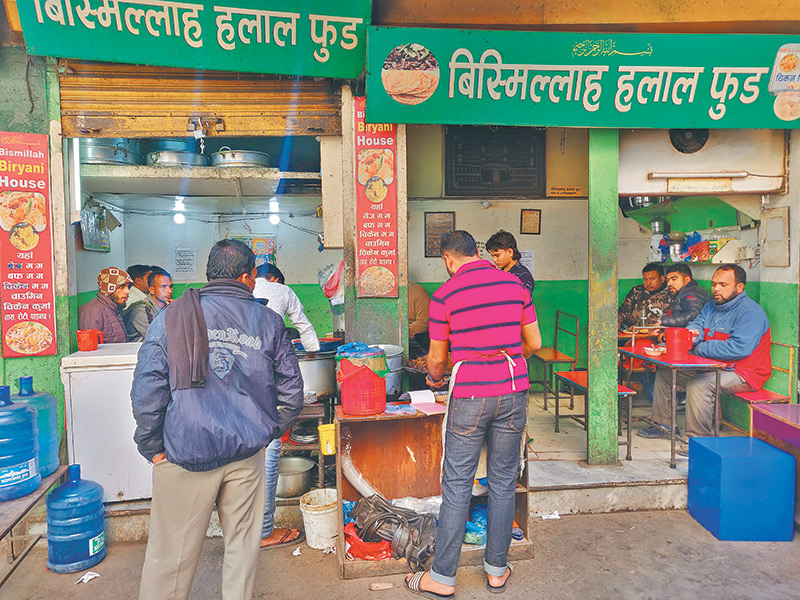
From petrol depots to butcher shops, a growing number of businesses display a small placard with a QR code on it, notifying customers that the outlet accepts cashless payments.
Digitals wallets like Fonepay, IMEPay, Khalti and PrabhuPay have proliferated particularly this year, making aggressive marketing pushes into retail. But despite the number of cashless apps available to users, most consumers still prefer cash, according to service providers and vendors.
The growing user base of mobile banking in Nepal has led corporate houses like IME Group and Prabhu Bank to develop digital wallets, alongside existing tech companies such as Janaki Technologies’ Khalti and F1Soft’s Fonepay.
According to Nepal Rastra Bank, the number of mobile banking users soared five-fold—from 1.75 million in 2016 to 8.34 million in 2019. That translates to around 29 percent of the total population. Data also shows that more than 52 percent of internet users in Nepal avail mobile broadband services.
But according to service providers, it could take some time for consumers to adapt to cashless transactions.
“The majority of our customers are either teenagers or young professionals and while teenagers are more tech-savvy, they do not hold bank accounts,” said Dipesh Bhattarai, a cashier at the Cityscape restaurant in New Baneshwor. “Young professionals sometimes opt to pay through digital wallets but not that often. Even customers who work at financial institutions and are fully aware of digital wallets prefer cash or debit cards.”
At Three Brothers Oil Store in New Baneshwor, proprietor Lileshwar Pradhan recently revamped the fuel depot’s look with billboards from IMEPay, even announcing Rs2 cashback on every litre of petrol.
“Despite the offer, transactions taking place through digital wallets are minimal,” said Pradhan. “The station sees an average daily transaction of around Rs5,000 through digital mediums and that is nominal, compared to the daily cash turnover.”
According to Pradhan, going fully cashless would rid the station of the hassle of counting cash and depositing it in the bank but due to queues at petrol pumps, digital wallets have not proved to be a convenient payment solution, despite loyalty bonuses and cashback.
Digital wallet users say they are perplexed by the range of options available and the utility of every
digital wallet, as most vendors tend to accept a single digital payment platform.
“I pay for electricity bills, airline tickets and movie tickets through eSewa’s platforms as it saves me from the hassle of standing in long queues,” said Shreyanka Dwa, who runs a hardware distributor shop in Pokhara. “But different vendors have tied up with different service providers, making things confusing. I am unable to pay with a single mobile application at multiple places.”
According to Dwa, paying electricity bills through mobile applications is also not convenient as consumers have to wait for the meter reader to hand out paper bills and then update the amount accordingly on the electricity authority’s system before a digital payment can be made.
Ten years since Nepal saw eSewa, the country’s first digital payment platform, make its foray into the country, rigid consumer behaviour, trust issues and the failure to develop a large payment ecosystem mean there is still a long way to go, according to mobile wallet entrepreneurs.
“Only three percent of total transactions throughout the country are cashless and although the user base is expanding, it will take a lot more time to reach the cashless frontier,” said Amit Agrawal, co-founder of Khalti. “To boost digital payments, the government should gradually demonetise its revenue source points and service providers should invest prominently in the safety and security of payment systems before consumers begin to trust and use such mediums.”
According to vendors and service providers, announcing VAT refunds for digital wallet users will not boost the user base unless the offers are more lucrative, merchants operate under a transparent VAT mechanism, and the process to claim refunds is made easier. The central bank, through its monetary policy for the current fiscal year, had announced a 10 percent VAT refund for digital transactions.
“When you do the math, the amount you get back is minimal because the refund is not for the full bill but
only the VAT amount, which translates to just 1.3 percent of the total purchase,” said Bhattarai. “Even the process of claiming such a refund is cumbersome.”
Service providers also point to patterns of behaviour that are hindering the transition to a cashless society, despite central bank officials, including the governor, calling for the robust adoption of financial technologies and underscoring the need to go cashless.
“Our merchant base is expanding as we are focused on previously unspecialised sources, such as gas stations and grocery stores, but it will take time for the user base to grow,” said Suman Pokhrel, CEO of International Money Express. “We are in the infancy stage in terms of being a cashless society because consumers have yet to develop trust in digital wallets.”
According to Pokhrel, the government needs to promote the use of digital wallets at a source of revenue collection. The private sector too should invest heavily in building top-notch payment platforms and persuading users to choose digital wallets over banknotes.
But according to central bank officials, the growth of digital wallets has been hindered mainly because of the level of penetration of such services and awareness among vendors, consumers and the government.
“The user base of both vendors accepting payments through cashless channels and consumers willing to use such mediums is too low,” said Laxmi Prapanna Niroula, spokesperson at Nepal Rastra Bank. “In some instances, there are consumers ready to make a payment through digital wallets but the vendor has no system to accept it.”
According to Niroula, four forces—the government, consumer, service providers and vendors—should work in tandem if the goal is to move towards a cashless future.
“The economy would face fewer burdens, be more instant, transparent and productive,” he said, “while billions of rupees that go into printing or storing banknotes every year would be saved.”
HOME PAGE

Former CIAA chief abruptly suspended dozens of probes, records show

Deep Basnyat himself is under investigation.
- PRITHVI MAN SHRESTHA
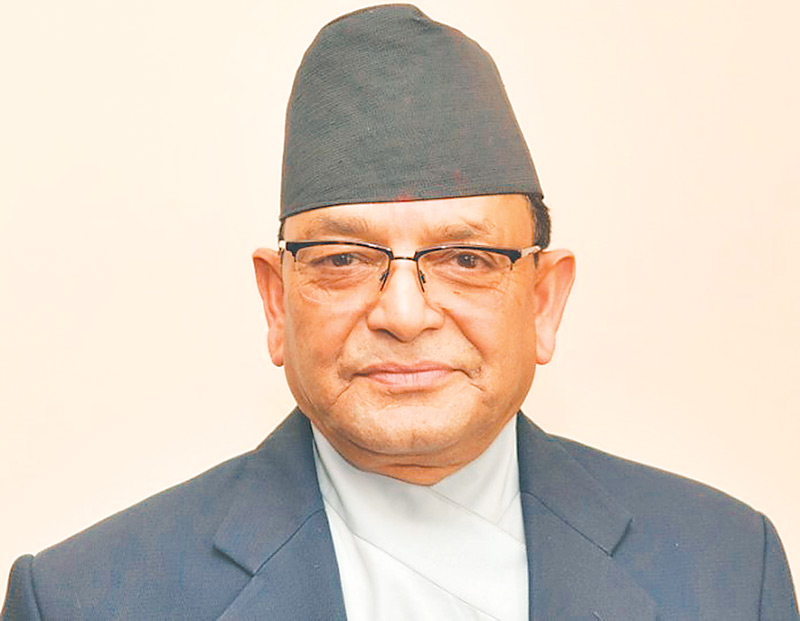
Deep Basnyat. post file photo

KATHMANDU,
Two years ago, in the middle of an investigation into Nepali Congress lawmaker Mohamad Aftab Alam, the Commission for Investigation of Abuse of Authority abruptly suspended the probe, saying there wasn’t enough evidence against him.
The man in charge of the investigation was Deep Basnyat, then chief of the anti-corruption body. Basnyat himself is now under investigation—and has his assets frozen—by the Department of Money Laundering Investigation for allegedly transferring money to foreign countries. The CIAA is also investigating into the property Basnyat earned during his government service, and his involvement in transferring the land at Lalita Niwas to fake tenants.
In recent weeks, questions have been raised over Basnyat’s motivations, during his tenure as acting chief and chief of the anti-graft body between October 2016 and May 2018, in suspending nearly a dozen investigations into lawmakers and government officials suspected of corruption. In addition to Alam, some notable names of officials who were under investigation—but later suspended under Basnyat’s orders—include former minister Chhabiraj Pant, lawmakers Ichchharaj Tamang, Umesh Shrestha, Janardan Dhakal, and Baburam Pokhrel.
According to documents received by the Post, Basnyat also dropped investigations into the property owned by former water supply ministry secretary Gajendra Thakur, former government secretary Shanta Bahadur Shrestha, former Nepal Police chief Upendra Kanta Aryal, former Armed Police Force chief Jeevan Kumar Thapa, and former vice-chancellor of Tribhuvan University Hira Bahadur Maharjan.
In interviews with the Post, officials at the commission said the investigations were suspended in the lack of adequate evidence against them. Investigations into some of the government officials were dropped, according to CIAA officials, because the probes were motivated by personal vendetta of former anti-graft body chief Lokman Singh Karki.  
“Suspending investigation, by and large, means closing the case,” a senior official at the commission told the Post. “Only if substantial new evidence is available, the suspended cases can be reopened.” The official requested anonymity because he wanted to speak openly about the issue.
Besides investigations into the property of several lawmakers and officials, Basnyat had also halted a probe into the decision by the central bank to allow Ncell, a private telecom operator, to repatriate its dividend.
Between August and September 2016, Nepal Rastra Bank allowed Ncell to repatriate dividend worth Rs8.36 billion, going against the decision of then parliamentary Finance Committee.
The commission, in November 2017, decided not to pursue a probe into the case, arguing that the central bank’s decision had followed due legal procedure while the Large Taxpayers’ Office also determined the revised tax amount to be paid from the Ncell buyout deal.
One official involved in the probe against Basnyat who also agreed to speak only on condition of anonymity said the anti-graft body has been receiving several complaints against Basnyat ever since the anti-money laundering body initiated a probe into his assets.
“We have received complaints of Basnyat taking bribes from some people by asking his own men to register a fake complaint during his tenure at the commission,” the official said.
As an ongoing investigation has concluded that Basnyat amassed huge property and tried to hide his gains, the department official said that the case against him would be filed right after the commission files the case on Lalita Niwas scandal, where Basnyat is likely to be one of the defendants.
The Post made multiple attempts to seek comments from Basnyat for two days, but was unable to reach him.
Among those whose cases were closed, Congress lawmaker Alam is currently is in the limelight after a 12-year-old murder case was reopened last month.
Police have registered a case against Alam at Rautahat District Court on charges of attempted murder and holding and transporting explosive materials. He is also facing charges
of burning injured people alive in brick kilns to destroy evidence after an alleged blast in Fardahawa, Rajpur, in 2008.
Citing his gangster-like working style, the Department of Money Laundering Investigation has now launched a new investigation into Alam.
“We are in the process of collecting evidence against him,” said Roop Narayan Bhattarai, director general at the department.
Among the ex-lawmakers, Tamang and Umesh Shrestha, who represented the erstwhile CPN-UML and the Nepali Congress respectively in the previous parliament, were accused of influencing fellow lawmakers to draft bills to benefit themselves while introducing the Banks and Financial Institution Act and Education Act, as both had personal interests.
Tamang is the chairman of Civil Bank and Shrestha is the owner of Little Angels School and ex-board chairman of Prime Bank.
Tamang, who is also a real estate developer and promoter of Civil Cooperative, is accused of plunging the Civil Cooperative into a crisis by providing most of the loans to his own firms and not taking repayment, according to the Department of Cooperatives which regulates the cooperatives. Thakur was recently embroiled in a controversy after the Italy-based Cooperativa Muratori e Cementisti di Ravenna (CMC), ex-contractor of Melamchi Water Supply Project, in March, alleged him along with the immediate executive director of Melamchi Water Supply Board Surya Raj Kadel, of seeking cuts to allow it to continue working in the project. Both officials have denied the accusation.

HOME PAGE

By-elections unlikely to affect national politics, analysts say

Given the organisational structure of the traditional parties, observers say there is little chance for newcomers to enter the system.
- TIKA R PRADHAN

KATHMANDU,
As election campaigns officially come to a halt, all eyes are now on the possible results of the by-elections, as the polls are a significant mid-term litmus test for the political parties.
On Saturday, by-elections will be held for 52 positions, including a vacant seat in the House of Representatives. This poll will determine the election of three provincial assembly members, one mayor, three rural municipality chairpersons, one rural municipality vice-chair, and 43 ward chairs.
Top ruling party leaders, including Co-chair Pushpa Kamal Dahal, have admitted that the Nepal Communist Party (NCP) will face a tough time maintaining the seats they got in the previous polls. However, the Nepali Congress, which has the opportunity to grab the seats it lost last election, does not have any better prospects, given its lethargic performance as an opposition as well as controversies of its own, say analysts.
While the by-elections won’t change the existing dynamics of the government, they do help cement existing values and rebuild trust among voters, and provide a gauge of votes before the next major elections.
“Money and muscle continue to be prime factors in winning elections and that needs to change,” said Rajendra Maharjan, a political commentator. “None of the candidates has new or unique commitments and they continue to chant the same old slogans.”
And given the set structure of the constituencies and the local level, there is little chance for newcomers to get into the system, said Maharjan.
According to Jhalak Subedi, a political analyst, the results of Saturday’s by-polls will indicate to some extent the popularity of the parties.
“If the Nepal Communist Party loses its grip on the constituencies and local-level seats it won earlier, people will assume that its popularity is waning,” said Subedi. “So the results of this poll will be an indicator of the parties’ popularity.”
Garnering even a single seat in the federal parliament or the provincial assembly would be a great victory for the opposition Nepali Congress, said Subedi. The primary opposition party does not have much to lose on Saturday, as only 12 wards among the total 43 vacant seats belonged to the Congress.
Though the elections may affect the parties, it will not have much impact on national politics, according to political commentator Bishwa Bhakta Dulal.
“This is just a regular process of the parliamentary system,” said Dulal. “I don’t think there will be much difference in the results of Saturday’s polls.”
Since the traditional parties have strong organisational structures, politics alone won’t be the crucial factor in winning the polls, he said. The traditional parties like the Nepal Communist Party, Nepali Congress and Samajbadi Party Nepal all have more than 100 different affiliated organisations, all mobilised at the ground level to influence voters.
“There exists a small number of independent voters, but they will not be enough to swing the polls,” said Subedi.

HOME PAGE

For long-haul drivers, long hours on the road and no help in case of accidents

Though stipulated by law, injured drivers and the kin of the deceased rarely receive any financial assistance from their employers or the government.
- PARBAT PORTEL,SAMUEL CHHETRI

KAKARVITTA,
Last month, a bus heading east from Dharan crashed at Belbari in Morang district. The driver of the bus, 49-year-old Janga Bahadur Rajbanshi, sustained serious head injuries. He was brought to the B&C Hospital in Birtamod, where he received treatment in the intensive care unit. He died nine days later.
Rajbanshi’s family owed the hospital over Rs525,000 but was unable to pay, leading the hospital to hold Rajbanshi’s body for five days. The hospital released the body only after the bus owner agreed to pay Rs60,000 as partial payment for the amount owed. The vehicle operator also provided Rs50,000 for the final rites of Rajbanshi and assured the family that Rs500,000 would be provided as a payout from the insurance.
However, a month since the agreement, the family is yet to receive the promised funds.
Like Rajbanshi, many long distance highway drivers operate without fixed salaries, relying on payments per trip. This can lead them to work long hours, making multiple trips in order to make decent pay, which in turn can lead to accidents. And when something untoward does happen, there is often a delay or denial in insurance payouts and compensation by their employers.
“A driver gets Rs2,000-Rs 2,500 as allowance per trip. The more trips we make, the more we earn,” said Basudev Adhikari, who drives on the Kakarvitta-Pokhara route. “I have never heard of a driver getting a fixed salary. We have to earn more by putting in extra trips, which leads to mental fatigue and health issues.”
According to the Labour Act-2017 and Motor Vehicles and Transport Management Act-1993, transport workers are mandated a maximum of eight hours of work time. But both laws don’t mention any rest time for long haul drivers.
And despite the law stipulating that transport companies hire two drivers for long haul routes, numerous companies have not complied with the rules, owing to lax monitoring on the part of the authorities.
According to Raju Lama, a bus driver who operates on the Kakarvitta-Kathmandu route, transport entrepreneurs and government authorities need to be more vigilant and monitor ongoing practices so as to minimise the risk of accidents.
“Human error is behind the majority of accidents but the authorities must also take into account factors like bad road conditions and mechanical failure. Drivers do not deliberately cause accidents, as we also have families and love our lives,” said Lama. “Rather than blaming the drivers for accidents, the authorities should monitor and regulate the profession by fixing salaries, work and rest hours, and accident benefits.”
Although the Labour Act requires the employer to pay a premium to ensure every worker Rs700,000 as accident coverage along with at least Rs100,000 as medical insurance. The medical coverage is bought through equal annual contributions from the employer and the worker. But in reality, the victims and their families rarely get benefits from their employers.
The Labour Act also stipulates that in the event of an injury, compensation is to be provided to the victim from the insurance amount while the closest successor is entitled to the accident insurance if the worker dies on the job. But these clauses are rarely implemented.
Forty-two-year-old Kishor Shrestha suffered a severe heart attack on September 19 while resting at a Hetauda hotel after exchanging shifts with another driver. Shrestha’s colleagues found him unconscious and took him to the Churiya Hospital where he received preliminary treatment. The heart attack left Shrestha paralyzed on his right side. After two months of rigorous treatment, his health is improving gradually but his hospital bills are piling up.
Shrestha, who was supporting a family of five, has already spent over Rs300,000 for the treatment. Shrestha’s wife Bimala said that they had taken a loan against their house as collateral. With no other means of income, the family may lose their home.
“We are spending Rs10,000-Rs15,000 on each hospital visit,” said Bimala. “I was doing small jobs here and there to support my family prior to the accident, but I now have to stay back and look after him. At this rate, we might not have a roof above our heads.”
According to Hari Timsina, former vice-president of the then Mechi Bus Entrepreneurs Association, the transport company should have borne the costs of Shrestha’s medical treatment and passed on the insurance amount to the victims of accident.
“It is the company’s duty to pay compensation to the victims, but I have come across cases where victims have not received the insurance amount from their employers,” said Timsina.
“The onus lies on the company and the vehicle owner to look after their employees. The state too could increase the amount of insurance coverage so that victims of such tragedies could at least have some relief.”
Shrestha, however, has not lost hope and says that once he regains his health, he will continue to work and pay off the debt.
“I have three children to look after and I am hopeful that I will be able to work after the treatment is over,” he said.

Page 2
MEDLEY

Horoscope

ARIES (March 21-April 19)
****
Let’s get it started in here! Today you will be very focused on beginnings—which is perfect, because the stars say that this is a superb time for new projects. Entertainments and social festivities are favored over business or educational endeavors; however, you will be able to get a lot of planning and preparation done.


TAURUS (April 20-May 20)
***
There is a very big difference between being lazy and being relaxed, and you are definitely not lazy! There is nothing wrong with taking it easy today and saving the heavy lifting for another day. As long as you avoid the temptation of procrastination, you can trust that what needs to get done will get done when it needs to.


GEMINI (May 21-June 21)
***
Put your observation skills to use today—there should be many finance-related clues around you, and they shouldn’t take you too long to decipher. If your afinances are getting tricky, you are about to find a few ideas. Or if you’re merely looking for good ways to spend your money, an interesting investment opportunity will appear.


CANCER (June 22-July 22)
**
Just because a person is hard to read doesn’t mean that he or she doesn’t want your understanding. Your ability to connect with other people can serve as a bulldozer, breaking down the walls of fear and aloofness in order to reveal the truth. So if you want to know what has been bothering someone, don’t stop!


LEO (July 23-August 22)
****
The sudden generosity you’re being shown is nothing to be alarmed about! The friendly and magnanimous behaviour of the people you’ll be encountering today is a direct result of the compassion and generosity that you’ve shown so often in the past. What you’ve sent out into the world will come flooding back at you.


VIRGO (August 23-September 22)
***
Talking about your feelings will give you an immense feeling of release today. The stars say that there are a lot of value-oriented issues that you need to figure out for yourself. Too much outside influence is coming your way right now—creating a loud din that’s making it hard for you to think.


LIBRA (September 23-October 22)
****
 
What do you want in your life more than anything else right now? If you said romance, then the stars have some very exciting opportunities in store for you! But if you’re expecting a parade of attractive potential new sweeties to come knocking on your door, think again. You need to spend some time romancing yourself!


SCORPIO (October 23-November 21)
**
You’re eager to resolve an issue you’ve been having with a close friend. So it’s time to stop the phone tag or the sporadic emails—all this back and forth is not getting you anywhere. The rigaht solution might be to just let your friend win this one, and chalk this episode up to experience.


SAGITTARIUS (November 22-December 21)
**
 
You are definitely happy when the people you love are happy, but that generous joy will be tested a bit today when someone who recently had a windfall is a little bit insensitive to your situation. If this person’s boastfulness is driving you crazy, just get some distance today. This will help you stay happy for him or her.


CAPRICORN (December 22-January 19)
**
Your emotions might be very fragile today, in part because of the negative behavior of someone you trusted too willingly. Once bitten, you are twice shy—and that’s okay. You should give yourself the time you need to nurse your wounds. Take time to appreciate your true friends, who are always there for you.


AQUARIUS (January 20-February 18)
****
Your social energy is skyrocketing today—without even trying very hard, you will manage to make some interesting new connections. When it doubt, talk! Unleash your charms and see what happens. In a group meeting or outing, your attitude will be the perfect antidote to the behaviour of someone who is acting way too standoffish.


PISCES (February 19-March 20)
***
It’s time to make things equitable in your life—review what you owe to others, and what others owe to you. This isn’t just about financial matters, either. Time is just as valuable as money (if not more so), so make some time for the people who have given you a lot of theirs

Page 3
NATIONAL

Deuba criticised by his own party leaders for his remarks on Kalapani

Congress leaders label Deuba’s comments ‘aggressive and ultra-nationalist’.
- ANIL GIRI

KATHMANDU,
Even as the uproar over India’s new political map appears to die down, two recent statements by Nepali Congress President Sher Bahadur Deuba on India’s inclusion of the Nepali territory of Kalapani within Indian borders have drawn criticism from inside his own party.
Leaders from Deuba’s own Nepali Congress have said that such “aggressive and ultra-nationalist” statements will not help resolve the boundary dispute with India and could be damaging for the party itself.
On November 23, while addressing a mass meeting in Kaski, Deuba said that New Delhi must have issued the new map after consultation with Prime Minister KP Sharma Oli. Three days later, while speaking with reporters at Biratnagar airport, Deuba reiterated the statement, going so far as to say that India is treating Nepal as it would Pakistan. “Considering Kalapani and Susta are disputed lands, how come India issued a map placing those areas inside its territory? Is the role of KP Oli here not clear? India considers Nepal similar to Pakistan,” Deuba had said.
But party leaders and analysts say that Deuba’s statement is unbecoming of a former prime minister.
“It appears to be a slip in his statement due to his style, which is very straightforward. But it will definitely not help us build and maintain good relations with India,” said Nepali Congress leader Narayan Khadka.
Ram Sharan Mahat, a senior Congress leader, also said that Deuba should not have made such an unfounded statement on Kalapani.
“If there is proof that Oli and India had consulted before publishing the map, Deuba should provide it. Otherwise, it will just harm us.”
Party leaders are afraid that Deuba’s statements could affect their chances at the by-elections. Deuba could be taking up an anti-India stance as a bargaining chip with New Delhi for the upcoming general convention of the party, said leaders. But such unfounded statements could lead to a negative result in the upcoming by-polls, said Congress leader Amresh Kumar Singh, who has often said that he is a “good friend of India”.
“My perception is that New Delhi is not happy with Deuba’s statement. It was immature and the party could lose its moral ground ahead of the by-polls,” said Singh.
According to Dinesh Bhattarai, a former diplomat who regularly advises Deuba on foreign policy matters, the ongoing boundary dispute should be handled through the right channels and not via aggressive posturing.
“We want good relations with India and when we talk about our foreign engagements, there is no alternative to India,” said Bhattarai. “We have to conduct our external relations with great sensitivity, especially when it comes to relations with our neighbours India and China.”

NATIONAL

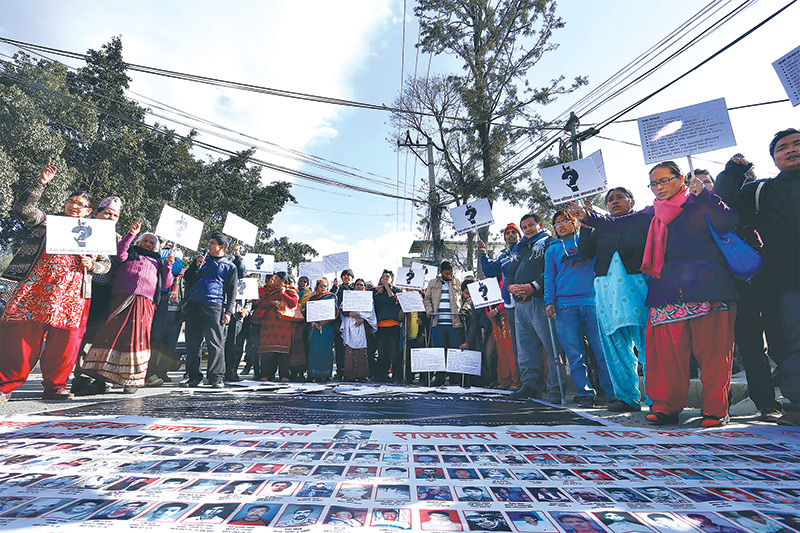
Conflict victims want fresh selection process for transitional justice bodies

The major political parties are accused of meddling in the appointment of office-bearers.
- BINOD GHIMIRE
In this photo taken in 2014, conflict victims stage a demonstration in Kathmandu, demanding the whereabouts of their loved ones who were disappeared during the insurgency.  POST FILE PHOTO

KATHMANDU,
The victims of the decade-long insurgency on Thursday demanded an immediate dissolution of the committee formed to recommend office-bearers in the two transitional bodies.
Their demand comes amid an open interference from the government and major political parties in the selection of the chairpersons and members in the Truth and Reconciliation Commission, and the Commission of Investigation on Enforced Disappeared Persons.
The conflict victims say they have no trust in the present selection process of office-bearers for the two commissions and will not accept the candidates picked by the current recommendation committee.
Organising a press meet in the Capital on Thursday, they asked the government to amend the Enforced Disappearances Enquiry, Truth and Reconciliation Commission Act 2014 first before starting a new selection process based on the revised Act.
The latest demand from the conflict victims comes days after four prominent international human rights organisations urged the Nepal government to maintain transparency in the appointment process. A joint statement issued by International Commission of Jurists, Amnesty International, Human Rights Watch, and TRIAL International on Tuesday, said that reformation in the law was necessary before the appointment and called for amendment to the Act without further delay.
In February 2015, the Supreme Court had directed the Nepal government to revise the Act to make it consistent with the international human rights standards. The court had struck down almost a dozen provisions in the Act and directed the government to ensure that no amnesty is awarded in cases of serious human rights violations committed during the decade-long insurgency. However, four years after the ruling, the government is yet to start the amendment process.
“It is evident that no competent people will get appointed in the transitional justice commissions unless the government and the political parties stop their interference,” said Suman Adhikari, founding chairperson of the Conflict Victims Common Platform. “The current selection process should be immediately stalled.”
Adhikari also alleged that the government was treating the commissions as its subordinate units and trying to deploy the confidants of major political parties.
Three days after an agreement among the parties on the names to lead the two transitional justice commissions, the recommendation committee on November 18 published a list of 61 probable candidates, including those who were relieved of their duties in April.
The leaders of the Nepal Communist Party and the Nepali Congress on November 15 had agreed to pick Ganesh Datta Bhatta, an associate professor at Nepal Law Campus, for the post of chairman in the truth commission and repeat the same old faces, including the chair, in the disappearance commission.
“The two commissions have also received complaints against top leaders including Nepal Communist Party Co-chairman Pushpa Kamal Dahal and Nepali Congress President Sher Bahadur Deuba. How could the commissions investigate these complaints when the persons in charge of investigating were appointed by these same leaders?” questioned Adhikari
The conflict victims said the government and political parties were inviting an international intervention by taking the transitional justice process towards failure.
“No one can stop the conflict era cases from getting internationalised if the government and the parties don’t correct themselves,” said Bhagi Ram Chaudhari, chairperson of the platform.
He reminded the parties that around 9,000 cases related to severe human rights violations had been filed at the United Nations which could be tried in the international courts if Nepal fails to conclude the transitional justice process.
Under the principle of universal jurisdiction, states may make it possible for their domestic criminal justice system to investigate and prosecute crimes such as torture, committed by any person, anywhere in the world. The four human rights organisations also had said that whitewashing egregious crimes will not help the perpetrators dodge universal jurisdiction.

Page 4
NATIONAL

Ministry to provide hormonal tablets for new mothers to prevent deaths from haemorrhage

Nepal reduced the maternal mortality rate from 539 in 1996 to 239 in 2016.
- Arjun Poudel
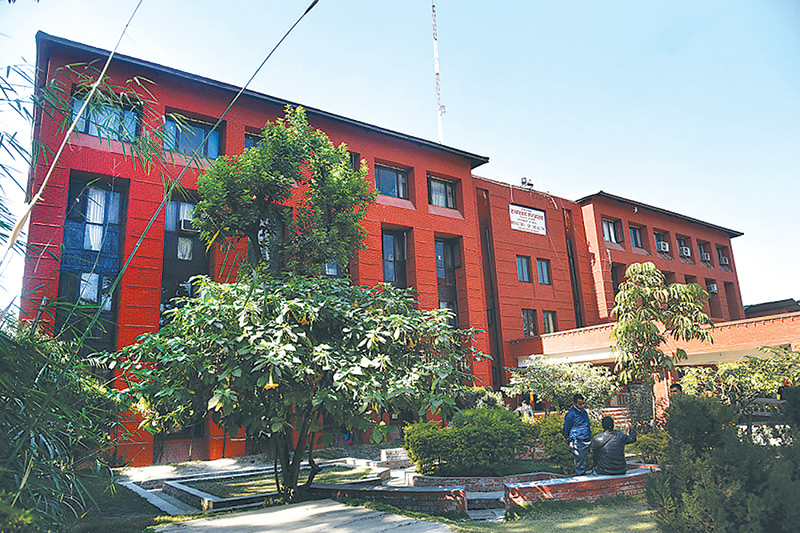
Ministry of Health and Population. post file photo

KATHMANDU,
When her labour started, Kalpana Gurung was at her parent’s home at Panchkhuwa Deurali in Gorkha. It was midnight and raining incessantly since it happened to be the monsoon season.
As the nearest health post was about five hours away on foot, Kalpana’s family members decided to deliver the baby at home. The 24-year-old, who was married to a man from Barpak Sulikot Rural Municipality, gave birth to a baby boy but started to bleed due to retained placenta after some time.
Her family members waited until the next day in the hope that her bleeding would stop and for the placenta to come out.
“Gurung’s neighbours sought professional help after her condition started deteriorating,” Sharan Khanal, the focal person of safe motherhood programme at the District Public Health Office, told the Post over the phone. “But it was too late for the health workers to reach the remote village to save the new mother.”
Gurung succumbed to uterine atony, a condition where the uterus fails to contract after childbirth, leading to postpartum haemorrhage.
Nepal reduced the maternal mortality rate from 539 in 1996 to 239 in 2016 for which the country received the Millennium Development Goal award. However, ever since the country was rewarded for its successful endeavour, its attempts to further reduce maternal deaths and postpartum haemorrhage have not been as successful.
Health professionals say adverse topography, lack of trained human resources at health facilities and lack of awareness about the benefits of seeking institutional delivery services have hindered their efforts to further reduce the maternal mortality rate, mainly due to postpartum haemorrhage.  
The country’s latest institutional delivery rate is at 57 percent and in some districts, including Gorkha, it is below 40 percent.
One way of combating postpartum haemorrhage effectively, doctors say is improving the accessibility of misoprostol, a hormonal tablet that helps to stop bleeding in the aftermath of child delivery. Earlier, the Ministry of Health and Population in its bid to promote institutional delivery rate had stopped distributing the medicine to female community health volunteers.
Officials at the Family Welfare Division of the Department of Health Services say they are already working towards improving the distribution of misoprostol tablets through health volunteers across the country.
“To prevent maternal deaths from postpartum haemorrhage, we have been working to distribute misoprostol through female community health volunteers,” Dr Punya Poudel, the focal person of safe motherhood unit at the Family Welfare Division, told the Post. “We will start distributing the life-saving medicines to female community health volunteers from Solukhumbu,  Dolakha, Gorkha, Parsa and other districts soon.”

Khanal, the focal person of safe motherhood programme in Gorkha, believes that distributing misoprostol through health volunteers could save the lives of many women living in far-flung areas where safe delivery service is hard to come by.  
“Providing misoprostol is the only way to save new mothers in remote places where pregnant women have to walk for hours even days to reach the nearest birthing centre,” said Khanal.
Bidhya Tamang, the chief at the District Public Health Office, also agrees that misoprostol distribution could be a good option to save the lives of women in remote corners of Gorkha. She also stressed the need for improving the overall health care system in the district that lacks well-equipped health facilities and trained workers.  
“Pregnant women who need to deliver by caesarean section still have to travel to Kathmandu or Chitwan due to lack of trained doctors at the District Hospital,” Tamang said.
Nepal aims to reduce the maternal mortality rate to 70 per 100,000 live births by 2030, to meet the Sustainable Development Goals target set by the United Nations.

NATIONAL

Revision in policy makes it easier for returnee migrant workers to access soft loan

- CHANDAN KUMAR MANDAL

KATHMANDU,
Some major changes in policy, introduced to provide interest-subsidised loans for promoting enterprises inside the country, will allow returnee migrant workers to access financial support.
The latest changes in the ‘Integrated Guidelines on Interest Exemption of Subsidised Loan,  2075’ remove some provisions that had been adding hassles for migrant workers to claim the loans offered by the government.
For accessing the soft loan, migrant workers were required to have not crossed three years of returning from a foreign job and to produce a skill certificate to prove their experience in the sector they would be starting their new business.
According to Uttam Adhikari, chairperson of the Returnee Migrants’ Network, an organisation established by migrant workers who once worked in various labour destination countries, such requirements had been restricting candidates right from the start of the application process.
Now the government has revised these clauses and removed the cap of three years after returning from foreign employment and the need to produce a skill certificate.
“Such provisions had been adding complications to returnee migrant workers who wanted to start their own enterprise in the country. A majority of them could not even apply, let alone get the loan,” Adhikari told the Post. “With the revisions in the working procedure, there will be some ease for migrant workers.”
Last year, the government rolled out a soft loan scheme to utilise the skills, experience and occupational training of migrant workers within the country.
The scheme, under which workers get soft loans of up to Rs1 million, was also aimed at retaining migrant workers inside the country and putting an end to the cycle of migration.
The new changes in policy make all the returnee migrants eligible to apply for the fund irrespective of the duration of their return.
Also, they can start any business, unlike the earlier provision which required them to start a business in the sector they were experienced during foreign employment.
Each member of a joint business venture can get up to Rs1 million now. Earlier, a group business plan got only Rs1 million.  
“Producing skill certificates is a difficult task for migrant workers. Since construction workers, workers employed by supply companies where the job changes every few months and domestic workers cannot prove their skills, they remain away from such support,” said Adhikari.
A beneficiary had to submit a clear business plan along with necessary documents to qualify for the fund, available at low-interest rates. After the scheme was rolled out, thousands of returnee workers had lined up to submit their business plan and receive the state funding.
Nearly 18,000 applicants had applied for a soft loan. Most of the startup plans were about starting hotels, restaurants, beauty parlours, agriculture-based business and buying vehicles for public transportation services, according to Adhikari.
The Foreign Employment Board, the government body which sought applications from returnee migrant workers, had forwarded the business proposal to concerned ministries and commercial banks for providing loans. However, only a handful of them had access to the fund.
“Progress was not satisfactory because of poor coordination between the board and banks,” said Adhikari. “The foreign employment board had recommended loans, but banks did not approve the plan.”

Page 5
NATIONAL

Province 3 stops issuing grants to 17 local units for failing to deposit revenue fund

According to the provincial treasury comptroller office, only 74 local units had deposited the sum in the last fiscal year.
- SUBASH BIDARI

MAKWANPUR,
The government of Province 3 has taken stringent action against 17 local units in the province for failing to deposit the revenue collection of the last fiscal year 2018/19 to the provincial government’s reserve fund. There are a total of 119 local units in the province.
Hari Prasad Upadhyay, chief at provincial treasury comptroller office, said that the office stopped issuance of around Rs 2.97 billion meant for 17 local bodies of Province 3 in the current fiscal year. According to him, the frozen amount is the first installment of the grants issued by the provincial executive to the local bodies.
“We repeatedly urged them (the local units) to deposit last year’s revenue collection and submit a report about their income and expenditure. But they did not pay any heed to us. So we were compelled to freeze the grant,” said Upadhyay. He added that those 17 local bodies did not even return the frozen amount provided to them under the conditional grant in the last fiscal year.
“We will not release any budget unless those local bodies submit their financial report, deposit the revenue in the fund and return the conditional grant that they could not spend last year,” said Upadhyay. He added that a budget of more than Rs 10 billion has been issued to 102 local bodies so far.
According to the information available at the provincial treasury comptroller office, only 74 local units had deposited the revenue at the provincial fund by the end of the last fiscal year. Twenty-eight other local bodies submitted their financial reports and deposited the revenue in the first quarter of the current fiscal year after the provincial treasury comptroller office had instructed them accordingly.
“Some local units are unaware of the legal provisions about the tax system. We have been educating them about it,” said Upadhyay, adding that few local bodies were reluctant to abide by the legal provisions.
As per the existing legal provisions, the local units can collect tax on various sectors including advertisements, entertainment, revenue imposed on the sale of forest products, et cetera.
Labsher Bista, mayor of Thaha Municipality, which is yet to deposit the revenue in the reserve fund, said that the municipality could not deposit the revenue due to the lack of coordination between the account’s office of the local body and officials at the provincial treasury comptroller office.

NATIONAL

Lumbini hosts sarus crane festival to raise awareness on the endangered bird

- MANOJ PAUDEL

LUMBINI,
With an objective of preserving sarus cranes (Grus antigone), the world’s tallest flying bird, the Lumbini Development Trust organised a sarus cranes festival.
The sarus cranes festival was organised on the premises of World Peace Pagoda in Lumbini. It was the first festival of its kind dedicated to the species.
“Sarus cranes’ conservation has become quite challenging now due to the increasing use of insecticides and pesticides in the fields, human encroachment and shrinking cultivable land,”said Abdhesh Kumar Tripathi, vice-chairman of the trust. “The festival thus was organised to raise awareness among people about the importance of its conservation,” he added. Aside from garnering visibility for the bird species, the festival has also worked as a platform to attract tourists to the Lumbini area.
 The sarus crane is mostly found in the Indian Sub-continents and in Nepal, where Lumbini is its major habitat. The large non-migratory bird was enlisted in the IUCN red list of threatened species in 2000 after its population dwindled.
According to conservationists, the number of the threatened species has been decreasing in the country in recent years. They said live electricity wires and stray dogs are major threats for sarus cranes. The birds are at risk of being electrocuted when they come in contact with live electricity wires and become prey to stray dogs while on the fields foraging for food.
Talking to the Post, ornithologist Hemsagar Baral said that there could be around 500 sarus cranes in Nepal at present. Among them, about 300 are found in Kapilvastu, Rupandehi and Nawalparasi districts.
During the festival, a photo exhibition of the bird species was also organised. The festival also organised a drawing and essay writing competition among the students of various secondary schools in the area on the theme of bird conservation.
The Lumbini Development Trust had signed an agreement with International Crane Foundation of the USA in 1994 and involved in sarus crane conservation in the area.

NATIONAL

Fake doctors are conning villagers in Banke district

People with basic medical training are running clinics in rural areas and putting people’s lives in danger.
- RUPA GAHATRAJ
A family mourns a loved one who allegedly died at the hands of a quack doctor in Narainapur Rural Municipality, Banke. Post Photo

BANKE,
Not long after they returned home from an evening walk, Gayaraj Dhobi and Malikraj Dhobi, aged 26 and 28, suffered a persistent stomach ache. Malikraj, who by relation is Gayaraj’s brother-in-law, was at the latter’s house, in Narainapur, for a family ritual. Once the ceremony
was over, the two had gone out for some fresh air.
When the two complained of the ache, Kushma Dhobi, Gayaraj’s wife, called Rajesh Singh, whom everyone in the village knew as a doctor. Singh provided a variety of medicines to the patients, but it didn’t work, Kushma recalls. There were given saline and often injections. Gayaraj passed away in the wee hours of Monday morning. Malikraj was scurried to Nepalgunj but died on the way.
Narainapur, a rural municipality in Banke, is a sprawling settlement across the Rapti River,  35 km south-east from Nepalgunj. The settlement is surrounded by Chure hills on one side and the river on the other. It is a quiet, deserted village on the margins that hardly sees any outsiders. The locals have been keeping up with the barebones, waiting for hospitals, road networks, school, electricity. The village health post perennially runs out of resources. For decades, villagers like Kushma have been resorting for treatment to people like Singh should the body face any complication.
Ramsaroj, Gayaraj’s father, blames Singh for his son and son-in-law’s death. Ramsaroj believes Singh is a quack, masquerading as a doctor while he has little medical expertise. “Singh ran away killing my son,” he says. “He gave way too many medicines, none of which worked.”
Chitra Bahadur KC, a local, said the villagers have no option than see people like Singh. “The health post has nothing besides paracetamol tabs,” KC said. “We are compelled to take help from those like Singh. Something is better than nothing.”
Ram Ferhan Godiya, who had seen Singh for a stomach ailment two years ago, said Singh’s medication did nothing for him. “He promised all would be okay,” said Godiya. “But it didn’t. I had to go to Nepalgunj and discover that I had a wound inside my stomach. It turned out that Singh had given me medicines without knowing what the disease was.”
After the recent incident, Singh is on the run. So is another “doctor” Mahesh Gupta who has a clinic in the same village.
The area police are currently searching for both, according to Man Bahadur BC, in-charge of the Bhagwanpur-based area police office. “We are trying to arrest all the quacks masquerading as doctors,” BC said. “No medical mafia is allowed in this area.”
The rural municipality’s deputy chair, Jayanti Devi Shrivastav, however, said she is not aware of such quacks—who the locals call “jhole doctors”. “I don’t know about such medical clinics set up by medical professionals of little expertise,” said Shirvastav. Narainapur is a local unit of six wards and 45,000 people. There are six health posts and 35 medical clinics operating illicitly. Many cases of the deaths caused by the quacks don’t generate much discussion.
The quacks, locals say, go to India after grade 10, where they receive training for a year or two in little-known clinics and return to the village. Then they set up clinics and start treating the villagers. They are popular because the health posts lack resources. The rural municipality’s health coordinator, Moin Khan, however, said the health posts do not ask for medicine supply.
“In some cases, we have found those doctors providing banned medicines,” said Binay Dixit, a local. “But people go to them because there’s no option for immediate treatment.”
After news about the two youth’s death spread, a joint team from the medicine management department and district administration office reached Narainapur on Wednesday. The team raided three clinics, according to Ninu Shrestha, chief of the department’s Nepalgunj branch. The team padlocked and confiscated medicines from the clinic owned by Singh.
“We have done a public inquiry deed at the clinics,” Shrestha said. “We will punish them if found guilty.”
Deputy Chief District Officer Krishna Kanta Upadhyay said they have detected clinics operating
illegally in the area and that the legal process will move forward after the visiting team files a report of their findings.

NATIONAL

Blast at ruling party candidate’s office in Mahottari

- SANTOSH SINGH

DHANUSA,
An improvised explosive device was detonated at the contact office of Nepal Communist Party candidate Bikram Chaudhary in Mahottari on Thursday evening.
According to Superintendent of Police Shyam Krishna Adhikari, a pressure cooker bomb was detonated on the premises of the contact office of NCP candidate Chaudhary, who is vying for the post of Pipara Rural Municipality chief in the upcoming by-elections. “Although there was a loud explosion, the office has only sustained minor damages. There were no human casualties,” Adhikari said. “Investigation is underway into the incident.”
The incident took place at a time when police claimed to have tightened security as the silent hour is
being observed for the November 30 elections.
Meanwhile, security has been stepped up along the Nepal-India border point in view of the elections. However, security agencies are having a hard time managing the security in the region as thousands of devotees from across the border are entering Janakpur through Pipara to observe Bibaha Panchami festival, said police.

NATIONAL

Quake survivors not happy with reconstruction works

Only 30 percent of the post-quake reconstruction work has been completed in Parbat till date.
- AGANDHAR TIWARI
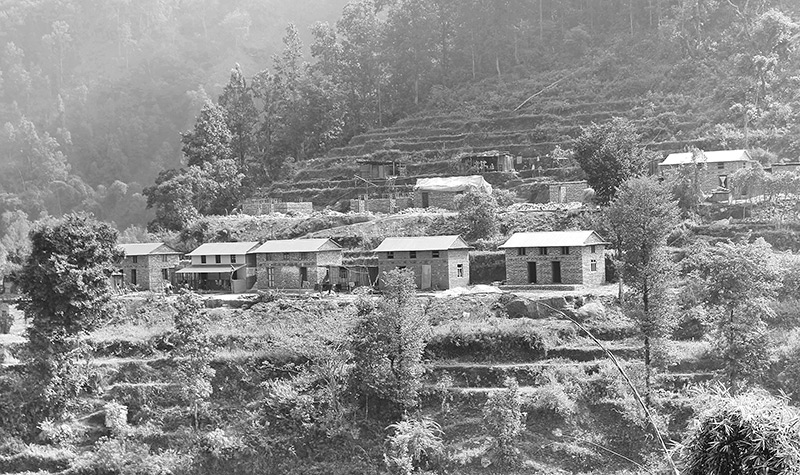
Houses built with government aid in Falewas, Parbat. Post Photo: AGANDHAR TIWARI

PARBAT,
Like elsewhere in the country, the pace of reconstruction work hasn’t been satisfactory in Parbat.
The quakes saw a total of 5,269 houses destroyed, leaving thousands of people homeless. But nearly five years since the quakes, only 1,763 houses have been rebuilt in their entirety, making for just about 33
percent of total work completed, according to data of the National Reconstruction Authority’s District Project Office.
The technical examination process of the houses that have been built have also not gone as expected, representatives from the office told the Post. In the district, the government is providing a total of Rs300,000 to the victims in three tranches, according to Balakrishna Sharma, an official with the District Project Office. A total of 4,919 have received the first tranche of the total compensation, but only 3,044 have received the second tranche. According to the rule, the third tranche is handed over only after the building is complete.
“Despite receiving two tranches, many people have been reluctant to build their houses, which is the reason behind the sluggish overall progress,” said the DPO’s acting chief, Poshnath Sharma. “It’s not because of our shortcomings.”
According to the DPO, Kushma Municipality has built the highest number of houses, completing construction of a total of 431 houses out of the 944 destroyed. Jaljala Rural Municipality has completed construction of the lowest number of houses; only 70 houses have been built out of the 187 destroyed.
Meanwhile, according to the DPO, 417 completed houses are in need of a modification, owing to technical flaws in the building process. Of them, only 150 have been modified. Recently, however, the Office met another screw to unbolt when a total of 4,318 people filed reports saying that their damaged houses were overlooked during the initial survey by the technical team. “We’ve forwarded the grievances to high-ranking officials,” Sharma said. “We are waiting for their decision and will act accordingly.”
But not everyone who has seen their buildings complete is happy. Tika Ram Tiwari, for instance, recently re-built his home with a total cost of Rs1.1 million. But the office asked him to modify the house citing technical flaws. “The modification costs Rs300,000 more, which we can’t afford now,” said Tiwari, who lives in Falewas Ward No. 3. “We have spent so much already.” The government provides only Rs100,000 for modification.
There are others who complain of not getting the promised final tranche even after their houses have been completely rebuilt. “We completed the house as instructed by the technical team, and have already moved to the new house,” said Jhalak Nepali, a local of Falewas Ward No. 4. “But now they say the pillar is faulty, and they are refusing to give us the promised final tranche. We have taken loans to build our homes, and now we don’t know how to pay back the loans incurred.”

NATIONAL

Man held with pistol

Briefing

UDAYAPUR: The security personnel detained a man in possession of a pistol, on Wednesday night. Manoj Khatri, 19, of Belaka was arrested while he was intercepting a tractor brandishing the weapon. Investigation is underway into the matter, said police.

NATIONAL

Two policemen suspended

Briefing

DOTI: The District Police Office in Doti suspended two police constables in connection with the death of a detainee in police custody. Shankar Khadka and Dipak Samanta, posted at the Gaira Police Post, have been suspended and taken into custody, police said. The district police took action after Ganesh Pali, a jeep driver, died in custody on Sunday.

NATIONAL

Two held on drug smuggling charges in Damak

Briefing

DAMAK: Police arrested two drug peddlers, including an Indian national, in possession of 569 grams of brown sugar. Rint Sheikh of India and Sunil Baral of Gauradaha, Jhapa were detained on the charge of smuggling the contraband. Police made them public at Area Police Office in Damak on Thursday.

NATIONAL

Medical college assures to honour past agreement

Briefing

CHITWAN: The Bharatpur-based Chitwan Medical College
reiterated its commitment to implement the past agreement signed with the agitating MBBS students. Issuing a statement on Thursday, the college also urged the students to join classes. The MBBS students have been protesting for the past few weeks demanding that the college refund them the additional tuition fees.

NATIONAL

Four injured in Arghakhanchi bus crash in critical condition

Breifing

BHAIRAHAWA: Four of the injured in the Arghakhanchi bus accident are in critical condition. Nine seriously injured victims have been receiving treatment at Bhairahawa-based Universal College of Medical Sciences and Teaching Hospital. Nineteen people died and 12 others were injured when the passenger bus fell around 500 metres off the road in Narapani on Wednesday.

Page 6
EDITORIAL

Butwal takes action

The city has moved to make schools friendlier and safer for children.

In Nepal, the prevailing culture of silence and the unquestioning attitude that adults, especially teachers, instil in young children often limits survivors from speaking out. Last year, it came to light that a Maths teacher at Lalitpur Madhyamik Vidyalaya in Lagankhel sexually abused young girls for decades, but there are many cases in schools all over Nepal that still go unreported. In Butwal too, some students have filed complaints against their teachers and even principals, on account of sexual abuse. Given this, Butwal Sub-Metropolitan City’s plan to launch a programme to raise awareness of bullying and sexual abuse is a welcome move.
According to Guma Devi Acharya, the deputy mayor of Butwal, the programme is intended to make ‘schools friendlier and safer for children’. Children spend most of their time in school. That is where their formative experiences are shaped. Therefore, it is a fundamental right of children to study in an environment where one feels safe and is free from any kind of physical or emotional abuse, since it is bound to have a significant impact on their ability to attend school and learn.
Under the programme initiated by Butwal Sub-Metropolitan City, every school is supposed to assign a focal person, a counsellor of sorts. The focal person’s job is to promptly take initiatives to resolve any complaints that are filed by students. The sub-metropolis has also urged schools to install at least one complaint box and manage separate toilets. But what the sub-metropolitan city is doing is merely implementing the guidelines set by the federal government two years ago.
Incidents of sexual exploitation in schools hamper the cause of reducing the gender gap in literacy. Students have often been found to quit school due to the negative attitude of their teachers. Incidents of sexual abuse in schools often have a lasting trauma on girls. When teachers and principals, who are entrusted with shaping children, turn predators, it’s an appalling violation of the parents’ trust and a breach of the commitment they make to themselves when taking up the job.
Nepal’s new constitution promulgated in September 2015, guarantees school as a violence-free site for
education. Taking a cue from Butwal Sub-Metropolitan City, schools in other parts of the country too need to start exercises in laying down rules and provisions aimed at curbing instances of sexual assault in schools. Schools need to constitute separate committees for redressal of grievances of the public, staff, parents and students. What’s more, safety audits of schools need to be done by their respective local police stations.
On the legal front, the system in place has its limitations in dealing with child sexual abuse. But they should be addressed with urgency. The number of courts and judges should be increased, cases should be heard on a fast-track basis, and victims should be counseled daily at the time of the trial.

OPINION

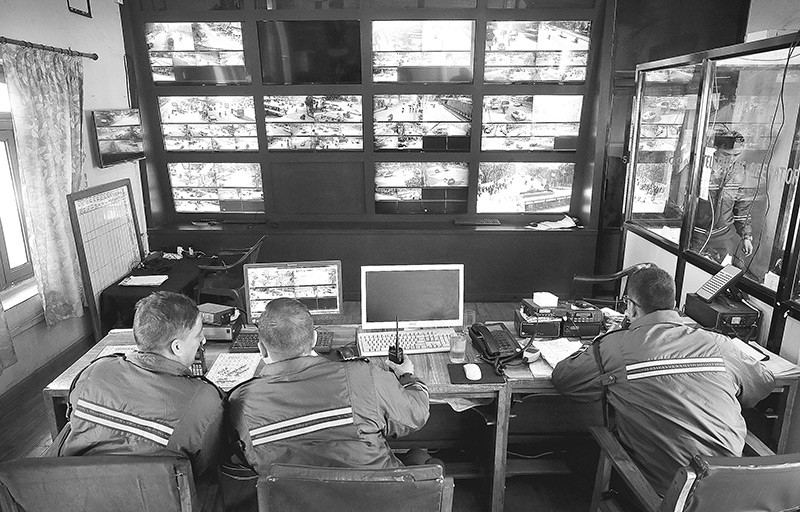
Smile! You’re on camera

Nepal Police operates 1,200 CCTV cameras in Kathmandu. They want to raise it to 21,000.
- Amish Raj Mulmi
Traffic Police Control Room at the Metropolitan Traffic Police Division in Baggikhana Road, Kathmandu. Post Photo: Anish Regmi

This past week, a tidbit from a story on The Record caught my attention: although it was long suspected that China had been partly assisting Nepal Police with surveillance equipment, the news article confirmed it. When its reporters visited the control room at Metropolitan Police headquarters at Ratna Park, ‘the entire space [was] dominated by an enormous screen which...beamed text in Chinese that we could not read, headed by the phrase “China-Nepal” in English.’
While human rights activists have long accused Nepal Police of installing CCTV cameras in Bouddha for surveilling on Tibetan refugees, Nepal Police spokespeople and senior officials have refuted this allegation. Instead, the Police has been saying that CCTVs assist them in catching criminals and gathering evidence—a variation of the ‘smart policing’ theme. ‘The installation of CCTV cameras in as many areas as possible will allow us to monitor criminal activities,’ Deputy Inspector General Shailesh Thapa Kshetri told this newspaper, while the Inspector General said at a recent interaction, ‘The use of CCTV aids not only
in controlling crimes but also carrying out evidence-based crime investigation.’
There are 1,249 CCTV cameras currently being operated by Nepal Police across the valley. An internal study, however, has determined Nepal Police requires more than 21,000 CCTVs to be installed for proper monitoring purposes. ‘A total of 9,117 points in Kathmandu, 5,985 in Bhaktapur and 6,339 in Lalitpur require the fixation of advanced cameras for security purposes,’ a Rising Nepal story reads. These cameras will supposedly be installed within the next five years. This is just the valley. Nepal Police records suggest
more than 3,000 CCTVs are installed across the country, a number that will surely increase.
It is not surprising that Nepali security agencies have been increasingly pushing for the use of digital surveillance. While the transition of Kathmandu from a lazy capital city to a fast-growing metropolis caught everyone unawares, increasing bilateral cooperation with China has also hastened this move. The joint communique issued after the Chinese President’s visit also emphasises on continued efforts to ‘strengthen cooperation between the law enforcement agencies on information exchanges, capacity building and training’. While other aspects of this security cooperation remain opaque at best, it is most likely that digital surveillance will increase in the days to come, possibly with China’s assistance.
We have to turn our lenses to other parts of the world to understand what this could mean for a country like Nepal. In Ecuador, a New York Times investigation found that police officials used Chinese surveillance equipment to install 4,300 cameras across the country. But the feed was also used by domestic intelligence agencies which used it to spy on opponents of the government. Similarly, the National Investigation Department in Nepal will soon get sweeping powers if an amendment bill is passed in the Parliament, including powers to spy on foreign nationals and institutions or groups ‘detrimental to national security’. That could be anybody. For example, in Uganda and Zambia, Chinese telecommunications company Huawei’s technicians helped government forces spy on their political opponents’ encrypted social media and used ‘their cell data to track their whereabouts’.
China is, quite simply, the world leader in public surveillance. Eight of the 10 most surveilled cities in the world are in China. Chongqing is at the top, with 2.5 million cameras for its 15.3 million people, or 168 cameras per 1000 people (in contrast, even if the Valley gets 21,000 more cameras, it will amount to about 5 cameras per 1000 people). Shenzhen, Shanghai, Guangzhou and Beijing are all on the list; the only non-Chinese cities in the top 10 are London and Atlanta. While surveillance by itself begets fears of breach of privacy, the more worrying concern is how the technology is evolving. A human rights organisation has alleged Chinese authorities ‘are using a mobile app to carry out illegal mass surveillance and arbitrary detention’ in Xinjiang. A more recent iteration is an AI camera that distinguishes between the facial features of various ethnicities, or ‘minority analytics’.
But if you thought it was just China, you are wrong. Most countries across the world today prefer digital surveillance systems. A Carnegie report on surveillance says that 75  countries today use AI-driven surveillance techniques, with smart city platforms, facial recognition systems and smart policing systems. Huawei ‘alone is responsible for providing AI surveillance technology to at least 50 countries worldwide.’ This is the same Huawei that is at the centre of the US-China trade war, and has also been awarded a contract to build the Nepali Prime Minister’s ‘action room’ to directly monitor projects. American systems are found in 32 countries, with IBM, Palantir and Cisco supplying the technologies. Most surprisingly, ‘liberal democracies are major users of AI surveillance’, although autocratic and semi-autocratic countries are ‘more prone to abuse’ the system. Apart from China being a major supplier, there was also ‘considerable overlap’ between the Belt and Road Initiative and AI surveillance; 36 out of 86 BRI countries used such technology. ‘The most important factor determining whether governments will exploit this technology for repressive purposes is the quality of their governance—is there an existing pattern of human rights violations? Are there strong rule of law traditions and independent institutions of accountability?’
This brings us back to the Nepal Police’s smart policing ambitions. Is the institution independent enough that any surveillance practices will not be misused against political opponents and dissidents? Also, it is not just autocracies who abuse the system; the recent WhatsApp breaches in India, or Snowden’s revelations, tell us even the largest or the most advanced democracies in the world will use surveillance techniques on its citizens, especially if such citizens hold views contrary to the government’s expectations. The key question is, who decides where to draw the line?

OPINION

Why Nepal won’t see two million tourists in 2020

Revenue growth remains sluggish, but authorities are obsessed with the arrivals figure.
- CHANDRA P BHATTARAI
Shutterstock

Visit Nepal Year 2020 is approaching, and the government is preparing to celebrate it as a big event. It is fully focused on welcoming 2 million international tourists next year.
The newly inducted Minister of Culture, Tourism and Civil Aviation, Yogesh Bhattarai, has expressed his wholehearted commitment to the success of the campaign. Apart from the ministry’s 2019-20 annual development programme that has focused on realising the objectives of Visit Nepal Year 2020, the new minister has published a new list of things to do with this special year at its core. The ministry’s entire team has a single goal in mind—bringing 2 million international tourists in 2020 at any cost. A Visit Nepal Year 2020 Secretariat has been established to give momentum to the campaign. The ministry itself and all its executing wings—Department of Tourism, Nepal Tourism Board and Visit Nepal Year 2020 Secretariat—are equipped with colourful action plans to achieve something great in the 365 days of the campaign.
The figure ‘2 million’ was first stated in 2009 in Tourism Vision 2020, a strategy document prepared and owned by the government to guide the development of the sector up to the year 2020. It provides a vision, overarching goals and a set of objectives, and strategies to achieve them. It aims to achieve 2 million international tourist arrivals annually by 2020 against the half-million mark in 2009. Nepal’s subsequent Three-Year Interim Plan (2010-11 to 2012-13) endorsed the vision and its ambitious target to achieve a fourfold jump in arrivals in a decade.
The progress in international tourist arrivals since then gives a mixed picture. There was satisfactory growth during the period 2010-12. Unfortunately, not only did the growth rate not last long, but the absolute number of tourists also fell for three consecutive years from 2013 to 2015. The growth in the previous period can be attributed to increased government spending in 2011 and 2012 that were observed as Nepal Tourism Year and Visit Lumbini Year respectively. Although the next three-year period from 2016 to 2018 showed encouraging growth, sustainability is still a question in the absence of any concrete strategy. In 2018, tourist arrivals reached 1.17 million.
Since the government hierarchy is running after the number 2 million, it’s time we explore the logic behind this particular number. It is hard to find any scientific reasoning or basis or study or estimation that supports this numerical target. The only thing apparent is the love of the 2009 decision-makers for the number 20—the target of 20 lakh arrivals in 2020. On the other hand, the National Tourism Strategic Plan—a comprehensive 10-year plan lasting from 2016-25 prepared by national and international experts and owned by the government—has projected that only 1,339,000 tourists will arrive in Nepal in 2020. The annual projection made by the Strategic Plan shows that the 2 million mark will be met only in 2024. The Strategic Plan clearly states that given the low investment capacity, the growth rate required to achieve the ambitious target of 2 million is unrealistic in the prevailing scenario. The projections made by the Strategic Plan seem closer to reality.
Let us suppose for a while that even if the target is met, it does not necessarily mean that we will earn more? The average expense per visitor per day is the most common indicator of the income from the tourism industry. Their per day spending was already $27 as early as the Seventh Plan period (1985-90). It rose to $38 in 2011 and $44 in 2018. This minimal progress in over a quarter of a century cannot be taken as satisfactory. It clearly shows Nepal’s low level of earning from tourism in recent years and suggests hosting high spending guests.
Nepal, until a few decades ago, was a favourite destination of high spending tourists. They obviously expect uniqueness, comfort, personal attention and superior service quality in return. The accommodation, food, transportation and safety standards should meet a certain standard when it comes to serving this category of guests. The product, service or destination should be appealing to them. The hosts are required to have a special approach in dealing with such customers and the culture of seeing things through the guest’s eyes.
Interestingly, some specific pocket areas in Nepal already used to host not only high-end but ultra-high-end guests in the past. The jungle lodges inside Chitwan National Park have been the preferred destination of such tourists since the 1970s. The service providers in Chitwan feel that with the closure of the lodges inside the jungle in 2012, such clientele has almost vanished. The construction in the late 1960s of the Hotel Everest View in Syangboche at an altitude of 3,880 metres above sea level within Sagarmatha National Park was another initiative to attract high-end tourists in those days. Thanks to the visionary team of Takashi Miyahara and his Nepali colleagues for the operation of this world-class hotel that gives guests a 360-degree view of the Himalaya.
To conclude, instead of merely counting the heads of guests, Nepal should target increased income from the tourism industry. There are 101 reasons how Nepal’s nature, culture, and adventure can appeal to high-end tourists. A lot can be learnt from the experience of Bhutan in the neighbourhood. The only thing required is a clear understanding of this ground reality in the country’s political leadership and policymakers who are currently in the 2020 marathon.


Bhattarai is a development economist.

Page 7
OPINION

Global turmoil: Ethics offer a way out of the crisis

Ethics are important to achieve social and economic justice as well as live-and-let live environment.
- JAMES M DORSEY
Demonstrators carry national flags and light candles during an anti-government protest near al-Amin mosque in Beirut, Lebanon. PHOTO: REUTERS/MOHAMED AZAKIR

Rarely is out-of-the-box thinking needed more than in this era of geopolitical, political and economic turmoil. The stakes couldn’t be higher in a world in which civilisationalist leaders risk shepherding in an era of even greater political violence, disenfranchisement and marginalisation, and mass migration.
The risks are magnified by the fact that players that traditionally stood up for at least a modicum of basic economic, social, political and minority rights have either joined the civilisationalists or are too tied up in their own knots.
The United States, long a proponent of human rights, even if it was selective in determining when to adhere to its principles and when to conveniently look the other way, has abandoned all pretence under President Donald J Trump. Europe is too weak and fighting its own battles, whether finding its place in a world in which the future of the trans-Atlantic alliance is in doubt, Brexit or the rise of civilisationalist leaders within its own ranks.
The long and short of this is that civil society’s reliance on traditional strategies and tactics to exert political pressure serves to fly the rights flag but is unlikely to produce results. The same is true for traditional, often heavy-handed and violent government attempts to quell protests.
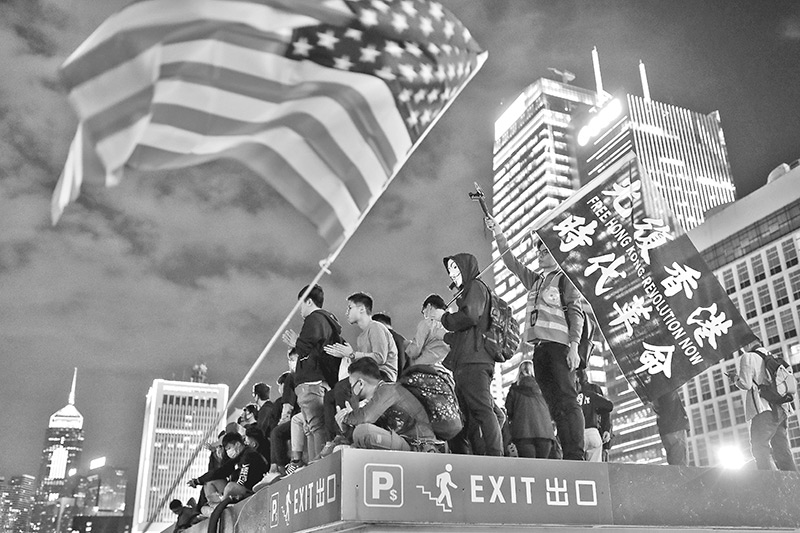
In some ways, this weekend’s landslide vote for pro-democracy forces in Hong Kong lays down a gauntlet for the governments of the city and China.
The key lies in the fact that protesters across the globe in Santiago de Chile, La Paz, Bogota, Port-au-Prince, Quito, Paris, Barcelona, Moscow, Tbilisi, Algiers, Cairo, Khartoum, Beirut, Amman, Tehran, Jakarta, and Hong Kong as well as movements like the Extinction Rebellion essentially want the same thing: a more transparent, accountable and more economically equitable world.
The Middle East and North Africa, the one part of the world that exasperates the most, also represent the worst and the best of responses to the global clamour for change. While Egypt under general-turned-president Abdel Fattah Al Sisi is almost a textbook example of what drives global protest, Tunisia and Kuwait offer lessons to be learnt. So do some of the world’s longer-standing success stories such as Singapore.
Tunisia has emerged as the one country that experienced a successful revolt in 2011 and was able to safeguard its achievements because its leaders, much like Singapore’s Lee Kwan Yew, saw power as a tool to secure national rather than personal interests and at a time of crisis worked with civil society to engineer a national dialogue that crafted a way forward.
Similarly, Kuwait, a constitutional semi-democratic anomaly in a region governed by secretive autocrats, recently opted for a more transparent competitive approach towards politics.
As a result, Kuwait saw this month its ruling family take its internal differences and disputes public. The differences forced the government to resign as members of the ruling family accused each other of embezzlement in advance of parliamentary elections scheduled for next year and a possible succession in which the assembly would have a say.
Achieving the protesters’ goal of more equitable and accountable political and economic systems involves not only adherence to the rule of law, including the implementation of international law, and application of the principle of equality before the law of not only individuals and organisations but also states. It further involves the need to make principles of right and wrong, and of respect of human dignity, the moral and ethical underpinnings of the architecture of a new world order by which all ranging from an individual to a state are judged.
That is the fundamental message of protests across the globe that denounce a world in which financial or economic benefit justifies violations of rights and civilisationalists have abandoned any pretence of adherence to international law.
Heeding the protesters’ message means ensuring that at least international law provides an effective mechanism to hold accountable security forces that use lethal force against largely peaceful protesters as well as politically responsible officials that authorise unjustified brutality in what often amounts to mass killings.
This year’s numbers speak for themselves, including some 100 on a single day in Sudan, more than 350 in a matter of weeks in Iraq, more than 100 in Iran and scores in Chile. The need for morals and ethics is gaining momentum with hardline realist proponents of the projection of power as well as some leaders raising the alarm bell. The rise of artificial intelligence persuaded former US Secretary of State and national security advisor Henry A Kissinger, a symbol of realpolitik and the wielding of power, to recognise the importance of morals and ethics.
Writing in The Atlantic, Mr Kissinger warned that the consequence of artificial intelligence ‘may be a world relying on machines powered by data and algorithms and ungoverned by ethical or philosophical norms.’ Threats resulting from the abandonment of international law and the lack of moral and ethical yardsticks were evident in this month’s unilateral recognition by the Trump administration of the legality of Israeli settlements in occupied Palestinian territory, long viewed by jurists and the international community as illegal.
The move highlighted the link between protecting individual rights and freedoms and national security.
Malaysian Prime Minister Mahathir Mohamad warned that the administration’s move meant that “we are no longer safe. If a country wants to enter our country and build their settlements, that is legal. We cannot do anything.”
Mr Mahathir was projecting onto states a sentiment of vulnerability felt among protesters and minorities across the globe that results from the random, unrestricted employment of power by those in positions of authority.
Similarly, Singapore’s Chief Justice Sundaresh Menon warned last month that “countries increasingly adopt a zero-sum mentality in eschewing multilateral agreements as shackles on sovereignty and a burden on economic growth.”
To achieve the kind of social and economic justice as well as live-and-let live environment that leaders, governments and civil society will have to rediscover and readopt the moral and ethical values that are embedded in the world’s multiple cultures and common to much of mankind.


This article was previously published in The Daily Star, a part of the Asia News Network.

OPINION

Catalysing change for gender equality

Women’s political representation must be increased in Asia and the Pacific.
- Armida Salsiah Alisjahbana,Phumzile Mlambo-Ngcuka
Shutterstock

Great strides have been taken to empower women and girls in the Asia-Pacific region in the 25 years since the Fourth World Conference on Women in Beijing adopted an ambitious global agenda to achieve gender equality. Gender parity has been achieved in primary education; maternal mortality has been halved.
Today, the region’s governments are committed to overcoming the persistent challenges of discrimination, gender-based violence and women’s unequal access to resources and decision-making.
The Asia-Pacific Ministerial Conference on the Beijing+25 Review will meet in Bangkok this week to explore how more commitments of the Beijing Declaration can be met to improve the lives of women and girls in the region. Asia-Pacific governments have reviewed their progress and identified three priority areas where action is imperative to accelerate progress in the coming five years.
First, we must end violence against women, a severe human rights violation which continues to hinder women’s empowerment. As many as one in two women in the region has experienced physical or sexual violence from an intimate partner in the last 12 months.
Countries in the region have adopted laws and policies to prevent and respond to violence against women. This is progress on which we must build. In 2015, ASEAN adopted the Convention Against Trafficking in Persons, Especially Women and Children, and in 2018, the Regional Plan of Action on the Elimination of Violence Against Women. Free legal services, hotlines and digital applications to report violence, emergency shelters and safe spaces for survivors are increasingly common.
New partnerships are underway that challenge stigma and stereotypes, working directly with boys and men. However, more investment is needed to prevent violence and to ensure that all women and girls who experienced violence will have access to justice and essential services.
Second, women’s political representation must be increased in Asia and the Pacific. Our region’s representation rates are behind the global average: Only one in five parliamentarians are women in the Asia-Pacific.
Despite governments committing to gender parity in decision-making 25 years ago in Beijing, the region has seen the share of women in parliament grow at just 2.2 percentage points per year over the past two decades. We must, therefore, look to where faster progress has been made.
In several countries, quotas have helped increase the number of women in parliament. These need to be further expanded and complemented with targeted quality training and mentoring for women leaders and removing the barriers of negative norms, stigma and stereotypes of women in politics and as leaders.
Third, economic empowerment remains key. Only half the women in our region are in paid work, compared with 80 percent of men. Ours is the only region in the world where women’s labor force participation has been decreasing in the past 10 years.
Two out of three working women are in the informal sector, often with no social protection and in hazardous conditions. Legislative measures to deliver equal pay and policies to ensure the recruitment, retention and promotion of women must be part of the solution, as must supporting the transition of women from informal to formal work sectors. Digital and financial inclusion measures can empower women to unleash their entrepreneurial potential and support economic growth, jobs and poverty reduction. Action has been taken in all these areas by individual countries; they can be given scale by countries working at the regional level.
Next year marks the convergence of the 25 years of implementation of the 1995 Beijing Platform for Action and the five-year milestone of the 2030 Agenda for Sustainable Development. Investments and financing for gender equality need to be fully committed and resourced to realize these ambitious targets and commitments.
Our hope is that the Asia-Pacific Ministerial Conference on the Beijing+25 Review will help provide the necessary momentum. Now is the time to craft priority actions for change and accelerate the realization of human rights and opportunities for all women and men, girls and boys.
Let us remain ambitious in our vision and steadfast in our determination to achieve gender equality and women empowerment in Asia and the Pacific.


This article was previously published in Jakarta Post, a part of the Asia News Network.

Page 8
CULTURE & ARTS

How New York-based Chai Spot is empowering women in Pakistan

How Khalida Brohi and her husband transformed their love of chai into a social enterprise, one cafe at a time.
- HAFSAH SARFRAZ
Khalida Brohi (right) and her husband Dawood are the owners ofChai Spot,which works in collaboration with Sughar Foundation to empower women inrural Pakistan. Photos; dawn

As an immigrant in a foreign land, there are days when you want nothing more than a hot cup of authentic chai at a place that reminds you of home.
Whether you immigrated years ago, moved abroad for college and decided to stay or got married and started a new life miles away, there can never be an end to those chai cravings.
Luckily, most metropolitan cities in the world—New York, London, Toronto and the like—have cafes and restaurants that remind you of home and curb your cravings. Yet there are days when finding a cup of authentic chai becomes difficult even in the middle of a metropolitan city.
Khalida Brohi, a Pakistani activist, and her husband Dawood, realised this and decided to change that for the diaspora in New York City. The result of this decision is Chai Spot: a chai café and social enterprise in Manhattan.
Fast forward a few years, it has two branches in the United States and Khalida and Dawood hope to take that number to 50.


A home away from home
Chai Spot is more than a chai spot or a café in a foreign country. It’s a home away from home for Pakistanis and a comfortable spot for foreigners to come and learn about Pakistan’s traditions and culture.
On the menu, there is an array of traditional and seasonal teas, accompanied by delicious baked goods and South Asian snacks and treats. Chai Spot’s traditional cardamom chai and coconut rose chai (vegan) are the signature beverages.
The menu has something for everyone: the chai enthusiasts, the vegans and even the keto-ers (the chai comes with an option of Stevia instead of sugar).
Chai Spot provides its guests with an extraordinary experience for all the senses: the scent of fresh spices, comforting flavours, plush seating, exotic colours and patterns and upbeat Bollywood songs.
Khalida believes it is a place for guests to relax, make new friends, and see the world through chai-coloured glasses, where everything is colourful, beautiful and happy.


The love story behind Chai Spot
Chai Spot is special for more reasons than one; it’s a home away from home for Pakistani New Yorkers, a social enterprise ensuring every cup of chai educates children back home and also because it is the result of a beautiful love story that brought two people together in the most unique circumstances.
Khalida, a tribal girl from Pakistan, had been facing challenges with her development efforts, with opponents in her village trying to bring her down and making things extremely difficult for her family. After a bombing at her office and facing a stroke, her otherwise supportive father told her to stop working. To get a much-needed break and perspective, Khalida went to the US in 2013 and met Dawood while she was staying at a friend’s place.
Despite coming from completely different worlds, Khalida and Dawood connected over their deep faith in God and their desire to make a difference in the world. At the time, Khalida fought her feelings because she worried she had already brought so much trouble to her family, but fate had other plans in store for her.
Ten months later, she ended up in the US again for a six-month fellowship at the Massachusetts Institute of Technology. “It was then Dawood and I met again and realised we are both in love and will fight with our families to make our marriage possible. Dawood immediately wrote to my father and also told his mother. What followed was a shocking realisation for both of us. Our families acted in such fear and surprise,” she told Images.
Their reactions were predictable. Dawood is an Italian-American who grew up in a progressive family in Los Angeles; Khalida grew up in a tribal village in Balochistan. Their families were poles apart. Dawood’s family had only seen Pakistan on television and her family was not ready to form a relationship with someone from a completely different world.
But as they say, where there is a will there’s a way. Both Khalida and Dawood stayed determined and it was chai that brought the families together and they ended up getting married in a 10-day long celebration in Pakistan, where Dawood and has family experienced Pakistan’s rich culture and heritage.
It was then that they decided to bring a taste of Pakistan to the US. “This could be done with something that represents our culture so much—chai,” Khalida added.
Khalida and Dawood decided to use the funds for their wedding chapter in the US to open the first branch of Chai Spot in Sedona, Arizona.


No easy feat
A beautiful reflection of the culture and heritage of Pakistan, Chai Spot not only serves authentic and fusion chai in various flavours but also displays handmade products and offers a complete experience of Khalida’s country, as she puts it. Today, the two branches are one of the most visited places in Sedona and New York City.

 
But it wasn’t an easy feat.
The biggest challenge in opening Chai Spot was navigating the systems in a new country. Khalida and Dawood worked extremely hard to learn the basics and started from scratch. “The budget, of course, was not enough, and we ended up finding innovative ways to make the place work in the earlier months. Every day was a great adventure, every month was a learning process and every failure showed us what not to do,” recalls Khalida.
At the same time, she remembers these struggling days as some of the best.
“Now as we plan to open our third location, both Dawood and I have come to a beautiful balance of finding our skills and distributing tasks based on our skills and interests and also have an incredible team to help us,” she adds.


How a cup of chai in New York empowers women in Pakistan
For many, Chai Spot may be a reminder of home, but Khalida has her priorities set. For her, it’s a social enterprise dedicated to building bridges between the East and the West while empowering women and children in Pakistan.
Guests come to enjoy a cup of authentic chai, but they know that every cup is empowering the most vulnerable members of the society we celebrate: the women and the children. Chai Spot is committed to spending 50 percent of its profits on projects benefiting them.
Khalida’s nonprofit organisation in Pakistan—the Sughar Foundation—promotes beautiful traditions and provides socio-economic empowerment to women in tribal communities. Their aim is to end the consequences of exchanged marriage, child marriages and honour killings.
Chai Spot helps Sughar Foundation reach its goals by building schools and educating children in communities where funding and opportunities are scarce. While educating girl children is a great way to empower Pakistani women, empowerment cannot come without financial independence.
Therefore, Chai Spot’s proceeds help in giving micro grants to women entrepreneurs to help them start their own businesses, support their families and lead happier and independent lives.
As a woman, Khalida knows the strength financial independence brings to women’s lives and she wants more Pakistani women to experience it.


Two schools, 500 children and counting
Just a few years in, Chai Spot has already built two schools for girls and boys in the rural communities of Pakistan and they are working on a third one.
These schools educate 500 children seeking primary education and while Khalida hopes to extend the efforts to higher education too, the Chai Spot gives grants and scholarships as well until a permanent and sustainable solution can be formed.
On a smaller scale, Chai Spot is grateful to be able to distribute toys among hundreds of children, thanks to Tlaq toy town, because the social enterprise believes in spreading happiness and joy around the world and where else to begin than spreading it amid children?
When Dawood and Khalida got married, they got a small apartment in Karachi to spend more time in Pakistan with their loved ones and to work here. Khalida has been visiting Pakistan every two months and Dawood four or five, but she is now looking to spend more time in the country.
Sughar Foundation has recently signed a contract with the National Rural Support Programme as its second implementing partner in Pakistan, which Khalida mentions as one of the biggest successes of her life. “I received a letter from the Prime Minister’s office including me as a member of the National Youth Council and both of us decided to move to Pakistan for at least a year or two to give our complete attention to the growing projects here,” she mentioned.
Clearly, this is just the beginning of many great things to come!


Envisioning Pakistan and Chai Spot’s future together
As Khalida and Dawood hope to open 50 cafes across 50 states, we can envision a brighter future for the tribal and rural areas of Pakistan too. Khalida told Images that she truly believes Chai Spot has already started changing the story of Pakistan in the mindsets of hundreds and thousands of people in the US and will continue reflecting her beautiful country.
“Whenever people walk into any one of our locations, they see the true colours of Pakistan, hear the true stories and touch the fine handiwork of hardworking artisans in Pakistan as well as taste the delicious tea of our country. Chai Spot is already on its way to creating lasting friendships among the West and will become one of the doorways to peace for this country Insha’Allah,” she added.


—Dawn

CULTURE & ARTS

What fictional superheroes can tell us about devotion and why we believe in gods

Research has shown that when we want to believe in something, such as personally possessing a positive trait, it helps if the trait is ambiguous.
- Thomas Swan,Jamin Halberstadt
marvel studios

The relentless supply of movies about superheroes and supervillains is difficult to ignore. Some people can’t get enough. Others hope to avoid them. But psychological researchers see a cultural phenomenon worthy of study.
Fictional characters with supernatural powers are often based on mythical gods and goddesses, fighting an ancient battle between good and evil with abilities that violate our intuitive expectations about the world.
In our recently published research, we asked 300 study participants to describe features of fictional supernatural beings and we compared them with features of the gods people worship. We found some striking differences that provide clues as to why some beings attract religious devotion, while others do not.


What makes religious beings special
The question of why religious beings are special is more puzzling than it first appears. Initially, it seems obvious that an ancestral spirit that, for example, reads minds and walks through walls, could be an object of worship. We expect minds to be private, living things to die, and solid objects to be impermeable. Entities that defy such expectations—which researchers call “folk theories”—are remarkable and memorable.
The problem is, many other entities violate our folk theories in the same way. Some superheroes can read minds and walk through walls as well, and yet these characters rarely elicit belief. Still other entities with superhuman powers, such as Bigfoot, vampires or werewolves, are occasionally believed in, but not prayed to.
Why don’t people worship such entities, which defy our expectations just as well as Jesus, Allah and Zeus do?
Our work points to an answer that has been proposed by philosophers and psychologists for centuries, from David Hume to Sigmund Freud. We believe in gods because it is comforting.
When we asked participants about the traits they ascribe to supernatural religious figures, we found that, on average, they rated them as more beneficent than fictional beings that people do not worship. In other words, religious beings are better equipped to improve people’s lives in significant ways than fictional characters with superhuman abilities.


The comfort theory
Religious beings were also found to routinely defy folk theories about psychology in particular—possessing abilities such as omniscience, mind-control, telepathy and precognition—rather than defying folk theories about biology (such as regeneration) or physics (flight).
In our current research, we found people believe that beings with such psychological abilities are better equipped to help us. This may be because threats to our species have become increasingly social over evolutionary time. Detecting deception, maintaining one’s reputation and avoiding social exclusion have become more significant concerns than avoiding predators and finding shelter. Religious beings with the ability to mitigate these social threats should be particularly appealing.
Other features pointed to the comfort theory in less obvious ways. We found that abilities attributed to religious beings were more ambiguous than those attributed to fictional characters. For example, omnipotence and weather control certainly defy expectations, but which ones, and how many? Is god manipulating a storm with his mind, or physically pulling it into position? This ambiguity may best be described with the phrase “God works in mysterious ways.”
Research has shown that when we want to believe in something, such as personally possessing a positive trait, it helps if the trait is ambiguous (sophisticated) rather than precise (punctual). This gives us latitude to interpret a variety of evidence in its favour.
The same argument can apply to gods we want to believe in. One person may prefer the god that pulls storms into position. Another may prefer the telekinetic god. If both interpretations are allowed, the god can be made to fit what each person finds plausible. Ambiguous features therefore make it easier to believe in comforting gods.


Gods are neither heroes nor villains
The final feature of religious beings we discovered is that they do not easily fit into the superhero or supervillain categories that often distinguish fictional beings. Gods are more beneficent, but they are also more ambivalent, than fictional characters.
They have the ability to reward, but also to threaten and punish. While a mix of carrots and sticks undoubtedly helps gods enforce religious and moral rules, we suggest that ambivalence is also crucial for eliciting religious rituals and prayers, which in turn reinforce belief.
Indeed, there is little point in beseeching a purely benevolent or malevolent god: the former will always grant your request, and the latter never will. Only an ambivalent god can be swayed by an act of faith or a faithfully performed ritual. A similar account might help explain why polytheistic religions typically contain a mix of positive and negative gods, the latter of which provide little comfort on their own.
In summary, gods are more beneficent, ambivalent, ambiguous and psychologically astonishing than fictional characters and, notably, these are precisely the traits that encourage belief. So even if you shudder at the thought of yet another Marvel movie, the fictional universe has taught us quite a bit about what makes gods special and what motivates some of us to believe in them.


—Associated Press

Page 9
Food & Travel

Nut butters are spreading all over the market

Peanut butter is not necessarily new, but the way businesses are doing things differently is.
- Thomas Heaton
photo courtesy: shake & bake

Kathmandu,
Peanut butter is not a new concept to anyone in the world. It’s a much-loved food some eat by the spoonful, some slather on toast, and others love when treated as a sweet and paired with chocolate. Some even like different nuts in their spreads.
It’s not new to Nepal either, nor is it particularly ground-breaking. It’s spread on bread, and it’s made of nuts. But, that hasn’t stopped a few businesses from capitalising on the fact it’s finding cultish fame as a health food, as people are becoming a little more discerning in their food choices.
The Nepali market seems to be joining the craze, witnessing an increasingly diverse range of nut butters popping onto shelves. Ranging from the standard peanut butter to pumpkin seed butter and variations like hazelnut and almond, there’s plenty of choice compared to the mass-produced and additive-laden butters of yesteryear. Now, there seem to be more and more businesses blitzing the nut butter market.
Perhaps the first to make small-batch peanut butter in Nepal was Pratibha Shrestha, who runs Shake and Bake. Shrestha was more recently followed by a couple of other brands, such as Sanchai, Rays and Nuts, and Vegan Dairy, among others.  
Shrestha believes she was probably the first to provide an alternative to the mass-produced products on the market. Shrestha started selling her peanut butter following encouragement from family and friends. She never really intended on selling it to people, and admits she was hesitant to get into it.
“I never imagined or thought that I would make it for others. My husband came up with the idea of selling it,” said Shrestha.
She first started selling her peanut butters in European Bakery in Baluwatar and Jhamsikhel’s Nina and Hager. Since then, she has started selling her products at Le Sherpa Farmer’s Market too. While the motivation for making the product was simply because she enjoyed it, it struck a chord with people.
“It was a big hit,” said Shrestha. “People loved my product—especially knowing that it was homemade, and it was made from scratch.”  
Shrestha started the business only two years ago but the flavour combinations she made—which now total at 15—have set the course for others. Over the past six months or so, however, she has been unable to sell her product because she’s been busy with other things, she hopes to get back onto the grind soon.
Shrestha’s current flavours include a swathe of different added ingredients, such as espresso, honey, blackcurrant, various forms of chocolate, and other nuts. Following a similar formula, Rays and Nuts is also coming out with its own novel varieties.
Started and run by Shristi Rana, it has a battery of nut butters in its collection. Like Shrestha, it has an espresso infused peanut butter, a chocolaty variation, and a vanilla-cinnamon almond butter too. More recently, the company released two cashew butters—one flavoured with coconut and the other with moringa—and a ginger almond butter.
Having started her business in August 2019, Rana believed there was a demand for the product, especially considering there was not much in the way of choice. Plus, what was on the market was not particularly to her taste.
“I used to make it for myself, about one or two years ago,” said Rana. “But my friends were telling me that the ones I was making were better than those available in the market.”
Rana has found the brunt of her customers are health-conscious “clean eaters” or gym frequenters, such as herself. “There are plenty of people like us, who want to get healthy butters, but there’s never been much available,” said Rana. Likewise, the butters have proven popular among vegan crowds.
Vegan Dairy is another that has its own butters, although it doesn’t make peanut butter. Instead, the company has pumpkin seed butter, a chocolate-hazelnut Nutella alternative and a butter made of almonds.
Co-founder Kajol Jain believed the growing prevalence of products like hers was partly thanks to outside exposure to food trends.
“I think now, because of the faster speed of life, everyone needs easy breakfasts and snacks. That’s one of the main reasons,” said Jain. “And previously, it wasn’t really introduced to us.”
While Jain’s products are predominantly focused on dairy replacements for vegans, she does see plenty of scope for those in the business, especially given the health benefits and apparent lack of environmentally detrimental ingredients, such as palm oil.


Providing a simpler product, sustainably
Rana’s Rays and Nuts brand is attempting to keep its product as local as possible, but has to supplement its sporadic Nepal-grown supply with imported nuts. Likewise, Vegan Dairy uses local importers for its products.
But when it comes to peanuts, many seem to source their peanuts locally to sustain local business and reduce carbon footprint. Sanchai is one brand that exclusively makes its product with peanuts farmed in Khotang, while Shake and Bake’s Shrestha has come to believe in the importance of supporting local businesses and farmers. Shrestha exclusively uses Nepali peanuts for her butters, but started using lots of imported products—some of which came with friends or family returning from overseas.
“It was because I’m very particular about my stuff. But later, I realised it was very important to support the local market. That’s when I started buying my stuff here,” said Shrestha.
Rays and Nuts’ Rana follows a similar ethos, but can only source her raw ingredients when it’s the right time of year.
“I’m trying to source it as locally as possible, as much as I can,” said Rana. “As soon as the nut season starts here, I will, but local farmers are not able to provide it at all times. I really want it to be local.”

Food & Travel

Nepal’s hospitality haven: A connoisseur’s top picks

A perfect sum of experience and service a hotel provides is how they make it to the list.
- Rachana Thapa

As the Director of Academics at Silver Mountain School of Hotel Management, Kathmandu, I have the opportunity to travel frequently, within Nepal and abroad. I believe that the backbone of great hotels is good service and the quality of the set-up. Merely having giant buildings, LED lights, and sprawling floors don’t make great hotels. It doesn’t have to be an exhibition, it has to be effective—subtle or not. Here, I list some of my favourite hotels in the country, and attempt to explain what makes them rise above the rest.


The Dwarika’s Hotel, Kathmandu
When it comes to must-visit places in Kathmandu, I shouldn’t miss out on mentioning Dwarika’s. It’s an experience of its own. For me, Dwarika’s is about resilience, vision, and consistency. One must experience Krishnarpan when in Kathmandu. I love their grandeur and style. This hotel served as an inspiration for many hoteliers, to restore old properties and convert them into hotels—big and small. Dwarika’s started small and continued to grow organically and this shows when one enters the property. The hotel has also made effective use of Nepali handicrafts and arts, which has given a significant boost to what was dying craftsmanship.

Rates start from $280 (during high season), $265 (during midseason) and $220 (during monsoon season).


Club De Novo, Butwal
De Novo is one of the modern properties in the city of Butwal. Not just their rooms—which are spacious, clean, and fitted with modern amenities—but even their hall and restaurants are very well done. I’ve enjoyed some fantastic delicacies at the hotel’s restaurant. The hotel also has a pool, which is a great thing, given that summers in the city get quite hot. This relatively new hotel has definitely become my go-to place for whenever I am in Butwal.

Rates start from Rs3,800.


Dalai-La Boutique Hotel, Kathmandu
Dalai-La is a boutique hotel located in the midst of the ever-so-busy Thamel. When you enter the hotel, you forget that you’re on the busiest street of Kathmandu. Each room has unique décor and ambience. The hotel is also my go-to place for Italian food and home-baked desserts. The fact that the owners stay there ensures perfection in the service and hospitality delivered to customers. Their small art gallery is an additional attraction and has become a platform for budding artists. The hotel is also doing their bit to reduce their carbon footprint—this, in my opinion, is noteworthy.

Rates start from $80.


Tiger Tops Karnali Lodge, Bardia
Located on the fringes of Bardia National Park, Tiger Tops Karnali Lodge is my cocoon and go-to place when city life becomes too chaotic. The lodge has an old-world charm and a low key understated beauty to it. There are plenty of reasons why I make sure I stay there at least once a year—from its décor, which blends perfectly with the surroundings, its very practical room setup, and amazing organic homegrown food to its serene ambience. But their non-overbearing and most hospitable service is what tops the list. From tucking your mosquito nets with perfection to putting hot water bottles under your blankets, they don’t forget the slightest of details. When you sit around its magnificent fireplace, you can listen to the stories of shikaar and polos and imagine the glorious rendezvous, perhaps even weave your own story.  

Rates start from $95 (during high season) and $75 (during shoulder season) per person.


Shivapuri Heights Cottage
Nestled in the mountainous crevice of Shivapuri hills, lies a quaint little getaway by the name of Shivapuri Heights Cottage. Located less than half an hour from the city’s centre, the hotel is a gem of a place, quietly overlooking the hustle and bustle of Kathmandu Valley. They do have a small number of rooms, but each looks over the Valley. The place is perfect for a weekend getaway.
I love this place for its homely ambience, casual atmosphere and home-cooked meals. Sitting under the warm winter sun and devouring their breakfast spread is one of my favourite things to do, when I’m there. When I’m done with all the reading and gazing, I can take a walk in the nearby woods and disappear into the green. This sounds surreal, but is absolutely true.

Special local resident rate starts from Rs5,000.

Page 10
WORLD

New Zealand PM apologises over 1979 air disaster

- AGENCE FRANCE-PRESSE

WELLINGTON,
Prime Minister Jacinda Ardern offered an official apology on Thursday on the 40th anniversary of New Zealand’s worst peacetime disaster, the Mount Erebus air crash in which 257 people died.
An Air New Zealand DC-10 on a sightseeing flight over Antarctica slammed into remote Mount Erebus during “whiteout” conditions on the frozen continent on November 28, 1979, killing all on board.
“That loss, in and of itself, was huge. It sent ripples across the country... but that loss and grief was compounded. It was undeniably worsened by the events that followed,” Ardern told a commemoration service in Auckland.
An initial inquiry blamed pilot error but a royal commission, the most powerful judicial inquiry under New Zealand law, subsequently cleared the crew.
It found the airline reset the plane’s navigation systems without telling the pilots, inadvertently setting the aircraft on a collision course with the side of the mountain.
The report’s author, judge Peter Mahon, also accused Air New Zealand officials of telling “an orchestrated litany of lies” to cover up the mistake and keep the blame on the pilots.
The then prime minister Robert Muldoon attacked Mahon’s report, viewing the findings against the state-owned carrier as a blow to national prestige, and it was not formally tabled until 1999, 18 years after its completion.
Ardern said the government’s handling of the disaster’s aftermath was wrong.
“It caused trauma on top of grief. And persecution on top of pain,” said the prime minister, who at 38 was not born when the crash occurred.

WORLD

US to cut spending on NATO budget, Germany to pay more

- AGENCE FRANCE-PRESSE
French President Emmanuel Macron (right) and NATO Secretary General JensStoltenberg after a press conference and holding a meeting at the Elusee palave in Paris on Thursday.  AFP/RSS

BRUSSELS,
The United States is to cut its contribution to NATO’s operating budget, officials said Thursday, with Germany increasing payments as the alliance tries to appease President Donald Trump ahead of a summit next week.
Trump has repeatedly criticised European members for freeloading on the US, singling out Germany—the continent’s economic powerhouse—for lagging behind on an alliance commitment to spend at least two percent of GDP on defence.
While most of Trump’s anger has been focused on European national defence budgets, there has also been American grumbling about how much Washington contributes to NATO’s own running costs, and the 29-member alliance has now agreed to a change.
“All allies have agreed a new cost-sharing formula. Under the new formula, cost shares attributed to most European allies and Canada will go up, while the US share will come down,” a NATO official said.
“This is an important demonstration of allies’ commitment to the alliance and to fairer burden-sharing.”
The US currently pays 22.1 percent of the NATO budget—which totalled $2.5 billion (2.37 billion euros) in 2019—and Germany 14.8 percent, under a formula based on each country’s gross national income.
Under the new agreement, the US will cut its contribution to 16.35 percent of the total, Germany’s will rise to the same level and other allies will pay more.
Though the sums involved are small in military terms—the 29 alliance members spent a total of nearly a trillion dollars on defence in 2018—not all allies are happy with the move.
Diplomats say France has refused to go along with the new arrangement and will keep its contribution the same at 10.5 percent, arguing that the deal to change the figures was cooked up between Trump and German Chancellor Angela Merkel without properly consulting other allies.
NATO chief Jens Stoltenberg is expected to announce new figures on Friday showing how much more allies have spent since Trump came to power in 2016 in a bid to improve the mood going into Wednesday’s leaders’ meeting in London.
There are fears Trump will repeat his performance at the 2016 summit in Brussels, where he launched into an extraordinary public tirade during a breakfast meeting with Merkel, berating her for weak defence spending and accusing her of cosying up to Russia.
Adding to the clouds over the London gathering are French President Emmanuel Macron’s attack on NATO as “brain dead” and ongoing tensions with fellow NATO ally Turkey over its purchase of Russian missiles and its military operation in northern Syria.


Macron urges ‘greater involvement’ by NATO allies in Sahel anti-jihadist fight
PARIS: President Emmanuel Macron called on Thursday for France’s allies to get more involved in the French-led fight against jihadist groups in the Sahel region of West Africa.
At a press conference in Paris with NATO chief Jens Stoltenberg, Macron said “greater involvement” by NATO allies would be “wholly beneficial” and said the subject should be on the table at the NATO summit near London next week.
“I want a discussion between allies on a concrete commitment to the fight against terrorism in the Sahel and the Middle East,” he said.

WORLD

British election poll predicts Conservative majority

If the centre-right Conservatives are returned to power in third general election in four years, Johnson is promising to bring back Brexit deal to parliament before Christmas.
- AGENCE FRANCE-PRESSE
Boris Johnson. AFP/RSS

LONDON,
Boris Johnson’s Conservative Party would win a comfortable majority in Britain’s parliament if the upcoming election were held this week, according to a poll by respected research firm YouGov.
Britain votes on December 12, with Prime Minister Johnson hoping to secure a majority to be able to push through his Brexit deal to take the country out of the European Union.
YouGov’s poll, published Wednesday, said if the elections were held on Thursday the Conservatives would grab 44 seats from the main opposition Labour party to win a 68-seat majority.
The data showed larger swings from Labour to the Conservatives in areas that are more pro-Brexit, especially in England’s northern and central regions.
“As expected, the key thing deciding the extent to which each of these seats is moving against Labour (is) how that seat voted in the European Union referendum” in 2016, said Chris Curtis, YouGov’s political research manager.
The poll—the first in this campaign to predict election results seat-by-seat—uses a model that correctly forecast 93 percent of seats in the last general election in 2017, according to YouGov.
It said the Conservatives’ total seat count would climb to 359, compared to 211 for Labour—predicting that the left-wing party would lose 51 seats overall.
“In terms of seats won, this would be the Conservatives’ best performance since 1987,” said the pollster, who analysed data including interviews with around 100,000 people about their voting intentions.
Johnson, who took over a minority administration in July and been unable to speed his EU divorce
deal through parliament, has pledged to take Britain out of the bloc by January 31.
If the centre-right Conservatives are returned to power in the third general election in four years,
he is promising to bring back his Brexit deal to parliament before Christmas.
Among the smaller parties in the House of Commons, the poll said the Scottish National Party (SNP) would gain eight seats to a total of 43, while the Liberal Democrats were predicted a total of 13 seats, Welsh party Plaid Cymru four and the Green Party one.
It came as Labour leader Jeremy Corbyn accused Johnson of plotting a “toxic” deal with Donald Trump
to allow US pharmaceutical companies access to Britain’s state health service.
Labour is currently being investigated by the Equality and Human Rights Commission (EHRC) following a number of complaints about alleged anti-Semitism in the party.

WORLD

Scientists spot black hole so huge it ‘shouldn’t even exist’ in our galaxy

- AGENCE FRANCE-PRESSE
The Milky Way is estimated to contain 100 million stellar black holes, but LB-1 is twice as massive as anything scientists thought possible. AFP

BEIJING,
Astronomers have discovered a black hole in the Milky Way so huge that it challenges existing models of how stars evolve, researchers said Thursday.
LB-1 is 15,000 light years from Earth and has a mass 70 times greater than the Sun, according to the journal Nature.
The Milky Way is estimated to contain 100 million stellar black holes but LB-1 is twice as massive as anything scientists thought possible, said Liu Jifeng, a National Astronomical Observatory of China professor who led the research.
“Black holes of such mass should not even exist in our galaxy, according to most of the current models of stellar evolution,” he added.
Scientists generally believe that there are two types of black holes.
The more common stellar black holes—up to 20 times more massive than the Sun—form when the centre of a very big star collapses in on itself.
Supermassive black holes are at least a million times bigger than the Sun and their origins are uncertain.
But researchers believed that typical stars in the Milky Way shed most of their gas through stellar winds, preventing the emergence of a black hole the size of LB-1, Liu said.
“Now theorists will have to take up the challenge of explaining its formation,” he said in a statement.
Astronomers are still only beginning to grasp “the abundance of black holes and the mechanisms by which they form,” David Reitze, a physicist at the California Institute of Technology (Caltech) who was not involved in the discovery, told AFP.
The Laser Interferometer Gravitational-Wave Observatory at Caltech, overseen by Reitze, had previously detected ripples in spacetime that suggested the possibility of black holes in distant galaxies that were much bigger than what was thought possible.
Stellar black holes are usually formed in the aftermath of supernova explosions, a phenomenon that occurs when extremely large stars burn out at the end of their lives.
LB-1’s large mass falls into a range “known as the ‘pair instability gap’ where supernovae should not have produced it”, Reitze said.
“That means that this is a new kind a black hole, formed by another physical mechanism!”
LB-1 was discovered by an international team of scientists using China’s sophisticated LAMOST telescope.
Additional images from two of the world’s largest optical telescopes—Spain’s Gran Telescopio Canarias and the Keck I telescope in the United States—confirmed the size of LB-1, which the National Astronomical Observatory of China said was “nothing short of fantastic”.
Scientists have tended to find black holes by detecting the X-rays they emit.
But this method has limited usefulness because only a small number of black hole systems where the companion star orbits very close to the black hole would emit detectable X-rays, Liu said at a press conference.
Instead, the team that discovered LB-1 tracked the movements of “huge numbers of stars over a long period of time”, before identifying LB-1 based on the motion of its companion star, Liu said.
This method has been used for decades without much success due to the limitations of the available equipment, Liu added.
But LAMOST, constructed between 2001 and 2008 in north China’s Hebei province, allows researchers to detect up to 4,000 stars simultaneously with each exposure, making it one of the world’s most powerful ground-based telescopes. Liu told AFP the method used to discover LB-1 could help scientists identify many more black holes in the future.
Out of the 100 million black holes believed to exist in our galaxy, Liu said, only 4,000 “can give you X-rays that can be detected by us”.

WORLD

Painting by French ‘master of black’ sets new world record

Briefing

PARIS: A canvas by the French artist Pierre Soulages has sold for $10.5 million, a new world record for the “painter of black” who is about to celebrate his 100th birthday. The work from 1960 of thick black stripes went for 9.6 million euros at an auction in Paris just days before the Louvre opens a huge retrospective celebrating Soulages’ long career. The prolific veteran, who turns 100 on Christmas Eve, and who is still painting, took the radical decision to paint almost entirely in black in the late 1970s. Called “the world’s greatest living artist” by former French president Francois Hollande, Soulages told AFP earlier this year that if he was not 100 percent happy with a painting “I burn the canvas outside. If it is mediocre, it goes,” he added. (Agencies)

WORLD

Three Ebola workers killed in eastern DR Congo: UN

Briefing

GOMA (DR Congo): Three Ebola workers in eastern DR Congo have been killed, adding to the toll of people who have died fighting the nearly 16-month-old epidemic, a local UN source said on Thursday. A person working for the Congolese health ministry and two drivers were killed overnight Wednesday when an armed group attacked a complex in Biakato, Ituri province, where Ebola workers lived, the source said. One person is reported missing and five others wounded, the source said. Another attack, in Mangina, which is also in Ituri province, was repelled. “Attacks by armed groups in Biakato Mines and Mangina in #DRC have resulted in deaths and injuries amongst #Ebola responders,” World Health Organization chief Tedros Adhanom Ghebreyesus said in a tweet. (Agencies)

WORLD

Italian police bust armed neo-Nazi group

Briefing

ROME: Italian police cracked open an armed neo-Nazi group Thursday which they said had been forging contacts with extremists elsewhere in Europe. Officers searching the homes of 19 suspects throughout the country, from Milan to Sicily, seized automatic weapons, rifles, crossbows, swords, knives, Nazi flags and books on dictators Adolph Hitler and Benito Mussolini, police said. Those targeted belonged to the fledgling National Italian Socialist Workers’ Party, which has an openly anti-Semitic and xenophobic programme and was in contact with Britain’s Neo-Nazi Combat 18 and Portugal’s far-right New Social Order. (Agencies)

Page 11
ASIA

China warns US of consequences over Hong Kong law, mum on steps planned

Beijing summoned US ambassador to lodge stern representations; police enter university at the end of two-week siege.
- REUTERS
Protestors stand next to a US flag as they attend a gathering at the Edinburgh place in Hong Kong, China, on Thursday. REUTERS

HONG KONG/BEIJING,
China warned the United States on Thursday that it would take “firm counter measures” in response to US legislation backing anti-government protesters in Hong Kong, and said attempts to interfere in the Chinese-ruled city were doomed to fail.
US President Donald Trump on Wednesday signed into law congressional legislation which supported the protesters, despite angry objections from Beijing, with which he is seeking a deal to end a damaging trade war.
The law requires the State Department to certify, at least annually, that Hong Kong is autonomous enough to justify favourable US trading terms that have helped it become a world financial centre.
It also threatens sanctions for human rights violations.
Beijing warned that the United States would shoulder the consequences of China’s countermeasures if it continued to “act arbitrarily” in regards to Hong Kong, the foreign ministry said in a statement.
Chinese Vice Foreign Minister Le Yucheng also summoned US Ambassador Terry Branstad on Thursday and demanded that Washington immediately stop interfering in China’s domestic affairs and halt further damage to ties.
Hong Kong’s Beijing-backed government said the legislation sent the wrong signal to demonstrators and “clearly interfered” with the city’s internal affairs.
Anti-government protests have roiled the former British colony for six months, at times forcing businesses, government, schools and even the international airport to close.
Hong Kong has enjoyed a rare lull in violence over the past week, with local elections on Sunday delivering a
landslide victory to pro-democracy candidates.
Hong Kong police entered the Polytechnic University on Thursday at the end of a nearly two-week siege that saw some of the worst clashes between protesters and security forces. It was unclear whether any protesters remained at the sprawling campus as a team of about 100 plainclothes police moved in to collect evidence and remove dangerous items such as petrol bombs. Police said any protesters found would receive medical treatment and arrests were not a priority.
The university became a battleground in mid-November, when protesters barricaded themselves in and clashed with riot police in a hail of petrol bombs, water cannon and tear gas. About 1,100 people were arrested last week, some while trying to escape.
Reuters witnesses at the university said garbage and abandoned gear, including sleeping bags, helmets and gas masks were strewn everywhere, but no protesters could be seen.
More than 5,800 people have been arrested since the unrest broke out in June over a proposal to allow extraditions to mainland China, the numbers increasing exponentially in October and November as violence escalated.
Demonstrators are angry at police violence and what they see as Chinese meddling in the freedoms promised to the former British colony when it returned to Chinese rule in 1997, such as an independent judiciary.
China says it is committed to the “one country, two systems” formula put in place at the handover, and has blamed foreign forces for fomenting the unrest, an allegation repeated on Thursday in response to the US law.
“This so-called legislation will only strengthen the resolve of the Chinese people, including the Hong Kong people, and raise awareness of the sinister intentions and hegemonic nature of the US,” the foreign ministry said in its statement.
“The US plot is doomed.”
Foreign ministry spokesman Geng Shuang, pressed on specifics of countermeasures planned by Beijing , declined to comment on a timeline or any measures. “You better stay tuned, and follow up on this,” he told reporters during a daily briefing on Thursday. “What will come will come.”
Gao Feng, a spokesman for China’s commerce ministry, did not comment directly on whether the Hong Kong law would affect two-way trade talks. He told a weekly news briefing there were no new details of their progress to disclose.
Some analysts say any move to end Hong Kong’s special treatment could prove self-defeating for the United States, which has benefited from the business-friendly conditions in the territory of 7.4 million.
Trade between Hong Kong and the United States was estimated to be worth $67.3 billion in 2018, with the United States running a $33.8 billion surplus, its biggest with any country or territory, the Office of the US Trade Representative says.

ASIA

Former Maldives leader jailed for money laundering

- AGENCE FRANCE-PRESSE
Abdulla Yameen. REUTERS

MALÉ (Maldives),
Disgraced Maldives ex-president Abdulla Yameen was sentenced to five years in prison for money laundering on Thursday after a corruption probe into the former strongman’s rule of the luxury tourist destination.
Yameen, who ran the Indian Ocean archipelago with an iron fist before his shock election loss in 2018, was accused of illegally transferring one million dollars from one of his bank accounts during an ongoing graft investigation.
The 60-year-old was arrested in February on charges of bribing witnesses in the ensuing money laundering trial.
Authorities also froze bank accounts belonging to Yameen that held around $6.5 million at the end of last year following accusations he had taken illicit payments.
Investigators believe Yameen could have millions more stashed abroad and are working to repatriate the cash.
Yameen’s government regularly jailed opponents or forced them into exile during its five years in power, and the former president relied heavily on China for political and financial support as his human rights record faced criticism.
Current leader Ibrahim Mohamed Solih’s won an unexpected landslide victory last year on a pledge to end corruption, and dissidents have since returned to the country.

ASIA

Iraq crackdown kills 13 protesters after Iran mission torched

- AGENCE FRANCE-PRESSE

NASIRIYAH (Iraq),
Iraqi security forces cracked down on anti-government protesters in the strife-torn south Thursday, leaving 13 people dead in a bloody escalation hours after the torching of an Iranian consulate.
Prime Minister Adel Abdel Mahdi, as commander in chief of the armed forces, dispatched military chiefs to several restive provinces to “restore order” there, the military said in a statement.
Iraq’s capital and its south have been torn by the worst street unrest since the 2003 US-led invasion that toppled Saddam Hussein, as a youth-dominated protest movement has vented their fury at their government and its backers in neighbouring Iran.
Late Wednesday protesters burnt down the Iranian consulate in the city of Najaf, yelling “Victory to Iraq!” and “Iran out!”, in an attack condemned by Tehran which voiced its “disgust”.
Iraq’s death toll in the street clashes since early October has risen above 360 with over 15,000 wounded according to an AFP tally, as authorities are not releasing updated or precise figures. Protesters burning tyres and throwing rocks and petrol bombs have clashed with security forces unleashing tear gas, rubber coated bullets and live rounds. The latest clashes erupted on Thursday in the protest hotspot of Nasiriyah, where security forces cleared protesters off two main bridges they had been occupying for days.
At least 13 protesters were shot dead and 100 wounded with several in critical condition, medical and security sources said.
Hours later, local authorities declared a curfew and military reinforcements were seen deployed around the edges of the city, searching all cars and people seeking to enter, AFP’s correspondent said.
The order echoed a similar one enforced overnight in the holy Shiite city of Najaf in response to protesters storming the Iranian consulate there.
Demonstrators across the country have blamed Iran, Iraq’s powerful eastern neighbour, for propping up the very government they seek to topple.
On Thursday morning, streets in Najaf were largely deserted due to the curfew, with public servants told to stay home.
Iran meanwhile demanded Iraq take decisive action against the protesters, with foreign ministry spokesman Abbas Mousavi condemning the attack.

ASIA

Court grants Pakistan’s top general more time in power

- AGENCE FRANCE-PRESSE
Mohammad Farogh Naseem. AFP/RSS

ISLAMABAD,
Pakistan’s Supreme Court gave the country’s army chief a reprieve Thursday, allowing him to hold on to power for at least six more months after a days-long legal battle posed unprecedented questions about the nuclear-armed nation’s most powerful institution.
General Qamar Javed Bajwa has served three years in his role, arguably the highest authority in the country, and in August Prime Minister Imran Khan asked him to extend his tenure and serve another three.
The request is not unusual. The Pakistani military has long played an outsized role in national life, ruling the country for roughly half its 72-year history, while many army chiefs have gone well beyond their mandated term.
This time, however, the Supreme Court has raised questions about the legality of the decision, in an unexpected move that has shocked the South Asian nation long accustomed to seeing the military get its way.
Oh Thursday, hours ahead of the midnight deadline for Bajwa’s term to expire, the court said it was granting him a conditional extension of six months, giving parliament time to clarify the consitutional guidelines under which an army chief’s tenure could be prolonged.
“Considering that the (army chief) is responsible for the command, discipline, training, administration, organisation and preparedness for war of the army ... we, while exercising restraint, find it appropriate to leave the matter to the parliament,” Chief Justice Asif Saeed Khosa told the court.
Khan celebrated the court’s decision.
“Today must be a great disappointment to those who expected the country to be destabilised by a clash of institutions,” the prime minister tweeted moments after the ruling.
But the episode has damaged Khan’s administration, which is seen as close to Bajwa.
“This is a landmark case: unprecedented questions are being raised, threatening to upend the accepted status quo, and holding a mirror to society’s psyche,” Pakistan’s leading English daily Dawn wrote in an editorial earlier Thursday.
Bajwa was appointed to lead the military in 2016, taking over from the massively popular General Raheel Sharif, who won the hearts of millions with his blistering fight against Islamist militants.
Since taking power, Bajwa and the military have been criticised for continuing a crackdown on civil society while also being accused of helping engineer Khan’s victory in the 2018 elections.
The government itself is facing growing anger as it struggles to prop up Pakistan’s economy after decades of corruption and mismanagement.
The debate over the army chief’s tenure -- accompanied by swelling calls from the public on social media for the general to step aside -- has raised fresh questions over Khan’s ability to stay in office in a country where not a single prime minister has ever completed their term.

ASIA

Nun-Chucks: Kung fu sisters battle stereotypes

- AGENCE FRANCE-PRESSE
Members of the kung fu nuns group demonstrate their skills in New Delhi. AFP/RSS

NEW DELHI,
.They train with swords and fighting fans after their prayers and morning chants.
Meet the Himalayan kung fu nuns using their martial arts skills to challenge stereotypes about women’s roles in the region’s patriarchal societies.
“In the Himalayas, girls are never treated equally and girls are not given equal chances—that’s why we want to push the girls up,” practitioner Jigme Konchok Lhamo, 25, told AFP.
“Kung fu has helped us in taking a stand on gender equality as we feel more confident, we feel strong physically and mentally.
“We are doing kung fu as an example for other girls.”
The nuns are from the 800-strong Druk Amitabha Mountain Nunnery in Nepal and belong to the centuries-old Drukpa school of Tibetan Buddhism.
In 2008 as part of his mission to bring about gender equality in Buddhism, spiritual leader His Holiness Gyalwang Drukpa encouraged them to learn kung fu and take on traditional norms that forbid women and girls from leaving the confines of the nunneries, leading prayers or being fully ordained.
Emboldened by their fighting prowess, the nuns travel across South Asia to teach self-defence classes and promote awareness about human trafficking in a region where violence against women is rarely reported.
They also embark on gruelling mountain walks and cycling campaigns to reach out to remote communities. Most recently, they completed a three-month, 5,200-mile (8,370-kilometre) “bicycle yatra (journey) for peace” from Nepal to the mountains of Ladakh in northern India, where they passed through villages and spread their messages of gender equality and empowerment.
Lhamo—who was in New Delhi in early November after picking up an international award in New York for the nunnery’s efforts to inspire young girls—became a nun at just 12 despite strong disapproval from her family.
“There was a lot of criticism in the beginning. People didn’t really like it because we were breaking rules,” Lhamo said, after she and her fellow nuns put on a demonstration of their prowess.
They weilded tasselled swords and open, Chinese-style fighting fans—which are used for signalling commands during combat—emblazoned with dragons and phoenixes.
“But now when we go back to the same places we get a lot of good response.
“They call us to schools. They put the girls in front and the boys at the back. They give girls equal chances to ask questions and talk to us.”

ASIA

North Korea fires two ‘unidentified projectiles’ on Thanksgiving

- AGENCE FRANCE-PRESSE

SEOUL,
North Korea fired two “unidentified projectiles” on Thursday—the Thanksgiving holiday in the US—Seoul said, as nuclear talks between Pyongyang and Washington remain deadlocked.
The projectiles were fired eastwards from South Hamgyong province and came down in the Sea of Japan, also known as the East Sea, South Korea’s Joint Chiefs of Staff (JCS) said.
They added that the launch, the latest in a series by Pyongyang, was carried out at 16:59 pm local time (0859 GMT)—or the early hours on the east coast of the United States, during one of the country’s biggest annual holidays.
It was also one day short of the two-year anniversary of the North’s first test of its Hwasong-15 intercontinental ballistic missile, which analysts say is capable of reaching the entire US mainland.
Pyongyang is banned from firing ballistic missiles under UN Security Council resolutions, and Prime Minister Shinzo Abe said that Thursday’s launch was the latest in a series of violations.
“North Korea’s repeated launches of ballistic missiles are a serious defiance to not only our country but also the international community,” he told reporters in Tokyo.
Thursday’s launch came after Pyongyang fired what it called a “super-large multiple rocket launcher” system last month, and the JCS said the latest devices were presumed to be of a similar type.
They flew 380 kilometres (236 miles) and reached a maximum altitude of 97 kilometres, the JCS added.
Nuclear negotiations between the US and the North have been at a standstill since the Hanoi summit between President Donald Trump and leader Kim Jong Un broke up in February, and Pyongyang has since demanded Washington change its approach by the end of the year.
“North Korea is growing anxious as its deadline approaches,” said Shin Beom-chul of the Asan Institute for Policy Studies.
“That’s why it’s carrying out these provocations, which is the typical North Korean playbook to get more concessions from the US.”
Last month Pyongyang also claimed to have tested a “new type” of submarine-launched ballistic missile—a potential strategic game-changer.

ASIA

Red Cross to repatriate 128 Yemen rebels from Saudi

Briefing

SANAA: The Red Cross in Sanaa said on Thursday it would repatriate from Saudi Arabia 128 Yemeni rebels, two days after a Saudi-led military coalition announced it would release 200 prisoners. Saudi Arabia and its allies intervened in the Yemen war in March 2015 to back the internationally recognised government, shortly after the Iran-aligned Huthi rebels seized the capital Sanaa. On Tuesday, the coalition said it had decided “to release 200 prisoners of the Huthi militia” and would also allow patients needing medical care to be flown out of Sanaa airport, which has been closed to commercial flights since 2016.  (Agenceis)

ASIA

China defends Xinjiang crackdown after criticism

Briefing

BEIJING: China on Thursday defended its security crackdown in Xinjiang after French and German leaders condemned its mass detention of religious minorities in the region. The French foreign ministry on Wednesday called on China to “put an end to mass arbitrary detentions” in Xinjiang. German chancellor Angela Merkel on the same day told lawmakers she backed the EU’s condemnation of human rights abuses in the region, and echoed calls for United Nations representatives to be allowed access to Xinjiang as soon as possible to report on the situation. (Agenceis)

ASIA

Afghan officials release men who exposed allegedpaedophile ring

Briefing

KABUL: Afghan security officials have released two rights activists detained by the country’s powerful intelligence agency for exposing an alleged paedophile ring operating in the country’s schools. Musa Mahmudi—a youth social worker—told Britain’s Guardian newspaper earlier this month that teachers and local officials were involved in the ring based in Logar province, sparking outrage across the country.  Mahmudi and activist Ehsanullah Hamidi were later detained by the National Directorate of Security (NDS) on their way to meet with the European Union ambassador in Kabul last week. “They are in Kabul now and reunited with members of their families. (Agenceis)

Page 12
MONEY

Facing US sanctions, Venezuela offers suppliers payment in Chinese yuan

Venezuela’s central bank has at least $700 million in yuan in an account at China’s central bank.
- REUTERS
A bank clerk counts Chinese yuan banknotes at a bank in Huaibei, China.  reuters

CARACAS, 
Venezuela’s government and its oil company PDVSA have offered to pay suppliers and contractors into accounts in China using the yuan currency, five people familiar with the matter said.
The move made in recent months is the latest example of how Caracas has sought new ways of making international payments since sweeping sanctions by Washington, intended to force out socialist President Nicolas Maduro, cut off the country’s access to the US financial system.
Officials have made the proposal verbally to at least four companies that provide services to the public sector, said the people, including two government officials and three sources from private companies in the financial or oil sectors. The individuals declined to disclose which companies have been approached.
The companies are evaluating the proposal, the sources said. Reuters could not determine whether any such payments in yuan have been made.
China’s central bank, the Peoples’ Bank of China, did not respond to a faxed request for comment. PDVSA, Venezuela’s central bank, and Venezuela’s information ministry did not respond to requests for comment.
Venezuelan public entities have traditionally paid private sector partners in the local bolivar currency or US dollars. But hyperinflation and US sanctions, which prohibit American companies from doing business with Venezuela’s public sector, are complicating those methods.
The offer comes after Venezuela’s government and PDVSA have paid some suppliers and contractors with euros in cash, which they have received from some oil and gold sales, in response to the loss of access to the US financial system due to the sanctions. Paying suppliers in yuan would allow Venezuela to take advantage of funds it has available in China, without touching the US financial system. However, two of the sources said the process of opening accounts at Chinese banks was proving complicated.
PDVSA and Venezuela’s central bank have long maintained accounts in China, in part thanks to a financing deal inked more than a decade ago that saw China lend some $50 billion to the OPEC nation in exchange for crude shipments.
Venezuela’s central bank has at least $700 million in yuan in an account at China’s central bank, which it received earlier this year as compensation for an oil shipment, according to two people with knowledge of the Venezuelan central bank’s operations. Reuters could not independently confirm this.
Receiving payments in foreign currency, or overseas banks, are “the kind of setup that some contractors now have to engage in to get paid,” said Raul Gallegos, consultancy Control Risks’ director for the Andean region. “This will become standard operating procedure as long as Maduro and US sanctions remain in place.”
Venezuela’s offer to pay in yuan comes even as some Chinese entities have taken steps to try to distance themselves from the sanctioned country.
China National Petroleum Corp, one of the largest foreign investors in Venezuela’s oil sector, in August stopped lifting crude from Venezuelan ports due to worries about sanctions.
Analysts said they expect China’s imports of Venezuelan crude to have fallen to zero last month. But China is importing more and more crude blends from Malaysia, which include some Venezuelan oil.

MONEY

ECB lending pace picks up in October

- AGENCE FRANCE-PRESSE

FRANKFURT AM MAIN,
Growth in lending to eurozone businesses and households accelerated in October, ECB data showed Thursday, in welcome news for the central bank after it unleashed fresh stimulus to boost the economy.
Credit to non-financial firms grew 3.8 percent year-on-year compared to 3.6 percent in September, the European Central Bank said in figures adjusted for some purely financial transactions.
Lending to households increased at a steady clip of 3.5 percent, 0.1 percentage point more than in September.
Overall, private sector credit growth ticked up from 3.6 to 3.7 percent.
The monthly data is closely watched to gauge the effectiveness of the ECB’s efforts to encourage lending and investment in the single currency bloc in a bid to drive up economic growth and stubbornly low inflation.
The ECB’s new president Christine Lagarde took over from Mario Draghi at the start of November, vowing to stick closely to her predecessor’s easy-money policies.
In one of his final acts as ECB chief, Draghi in September announced a new stimulus package to confront a darkening eurozone outlook.
That included cutting a key interest rate deeper into negative territory and loosening conditions on a new round of cheap credit to lenders.

MONEY

Boeing 777X fuselage split during September test

- REUTERS
Several Boeing 777X aircraft at the Boeing production facility in Everett, Washington. reuters

SEATTLE, 
The fuselage of Boeing Co’s upcoming 777X aircraft was split by a high-pressure rupture just as it approached its target stress level during a test in early September, Boeing said on Wednesday.
The world’s largest planemaker suspended load testing of the new widebody in September when media reports said a cargo door failed a ground stress test. There have also been issues with General Electric Co’s new GE9X turbine engine that will power the jet.
The Seattle Times, which first reported new details on the testing issue, said photos it had obtained of the test on the 777X showed that the extent of the damage was greater than previously disclosed and earlier reports were wrong about crucial details. During the final load testing of a 777X test airplane, engineers ran a test that involved flexing the aircraft’s wings beyond what is expected during normal commercial service, Boeing said.
“A testing issue occurred during the final minutes of the test, at approximately 99 percent of the final test loads, and involved a depressurization of the aft fuselage,” Boeing said.
The company did not see any significant impact on the jetliner’s design or preparations for first flight, and it did not see any impact from the test on the overall programme schedule, Boeing said. The 777X is due to fly for the first time in early 2020, with the first jet on track to be delivered to an airline in 2021, Boeing has said.
Boeing shares were down 0.6 percent at $371.09.
Boeing said it is still assessing the root cause of the testing issue.
The US planemaker would almost certainly not have to do a retest and regulators would likely allow Boeing to prove by analysis that it would be enough to reinforce the fuselage in the area where it failed, the Seattle Times said. A spokesman for the Federal Aviation Administration, Lynn Lunsford, said the agency was “continuing our conversations with Boeing about the situation.
“The FAA requires manufacturers to meet design and certification standards. How they choose to do that is up to them,” Lunsford said.
Tim Clark, president of Emirates—the largest customer for the 777X jet—has questioned the testing of the aircraft, telling reporters at last week’s Dubai Airshow that he did not know when the Gulf airline would receive the first jet.

MONEY

After $13 billion levy ruling, future of India’s telecos hinges on government aid

- REUTERS
A rickshaw puller speaks on his mobile phone as he waits for customers in front of advertisement billboards belonging to telecom companies in Kolkata, India. reuters

NEW DELHI, 
The Indian government’s win of a long-contested dispute over telecom fees could end up a Pyrrhic victory, as the billions of dollars in levies now owed are seen as burdens too big to bear for two of the country’s three main carriers.
Vodafone Idea Ltd, India’s biggest carrier by user numbers, is widely regarded as most on the ropes, with parent Vodafone Group calling the situation “critical” after the unit was saddled with about $3.9 billion in fresh payments due.
That is the biggest portion of the $13 billion incurred by the sector after India’s Supreme Court last month sided with the government in how spectrum usage and license fees are calculated.
Bharti Airtel, the No. 3 provider which must pay roughly $3 billion under the ruling, has also flagged distress, saying the decision casts much doubt on “its ability to continue as a going concern.”
To industry executives and analysts alike, there’s only one solution for the sector which was even before the current crisis debt-ridden and battered by a brutal price war: significant government financial support.
Hopes have been raised after the government deferred upcoming spectrum payments for the next two financial years until March 2022. Finance Minister Nirmala Sitharaman also said this month that relief is under consideration although no final call had been made.
“If the government does provide some measures, there is still some chance for (Vodafone Idea) to continue as a going concern. It all depends on what kind of relief measures the company will get,” said Umesh Mehta, head of research at Samco Securities.
He said he expects the company to survive as it is in the government’s interest to have three main players
to ensure sufficient competition in the sector.
Vodafone Idea and Bharti Airtel did not respond to requests for comment. Vodafone Group declined to comment.
Vodafone Idea this month booked a $7 billion quarterly loss, the biggest in Indian corporate history, in large part due to provisions for payments owed. Parent Vodafone has also laid its case on the line: writing down the value of its 44 percent stake in the unit to zero and vowing it will not commit more equity to India.
In addition to the two-year moratorium, Vodafone Idea and Bharti Airtel are asking the government for cuts to license fees and taxes, as well as waivers for interest and penalties.
Mobile carriers have also petitioned the Supreme Court to review its ruling, although lawyers say chances of that happening are slim.
But even if the government obliges with generous financial waivers, analysts note Vodafone Idea would still be deeply troubled.
Hurt by the price war that began with the 2016 entry into the market of Jio, a unit of deep-pocketed Reliance Industries Ltd, Vodafone Idea has net debt of $14.2 billion, six times its market capitalization and four times its cash holdings.
While the price war appears to have ended with all three main carriers—who serve 90 percent of the market—planning to lift user fees next month, Vodafone Idea has not yet stopped losing subscribers. The latest data, for September, showed a net loss of 2.6 million customers.
“If Vodafone Idea doesn’t have enough customers left, it is going to be very difficult for it to remain solvent,” said Vivekanand Subbaraman, an analyst at Ambit Capital.
Bharti Airtel has more debt, with net levels at around $16 billion. But unlike Vodafone Idea, analysts say if push came to shove, the company could consider selling assets to meet its obligations as it controls telecom tower firm Bharti Infratel.
If in a worst case scenario Vodafone Idea were to fail, customer options would dramatically shrink and the networks of the two remaining major carriers would be further overloaded, exacerbating patchy coverage and call drops common in India.
“There’s bound to be more congestion, there is going to be further deterioration in quality,” said T V Ramachandran, president of Broadband India Forum.
It would also represent a huge setback to India’s push to make government services accessible to hundreds of millions of Indians via the internet. The current turmoil in the sector is also likely to further dampen interest in an auction of 5G airwaves expected before end-March. All three firms have warned the base price set by the government is too high given that India’s user fees are among the cheapest in the world.
“Even otherwise, the 5G auction did not look very bright,” said Broadband India Forum’s Ramachandran.

Page 13
MONEY

Bhairahawa airport is nearing completion, but no foreign airline has applied to serve it

Officials say test flights can be conducted by April after the navigation and surveillance equipment is installed.
- SANGAM PRASAIN
A view of the control tower and administrative building of Gautam Buddha International Airport. Photo courtesy: Asian Development Bank

BHAIRAHAWA,
On a recent afternoon in Bhairahawa, hundreds of workers poured into the construction site of Gautam Buddha International Airport. A section of the workers are working on interior finishing of the arrivals and departures halls while others are completing ground work on the vehicle parking site in front of the terminal.
The good news is that most of the civil works at Nepal’s second international airport have been completed. But there’s bad news: The airport won’t be completed by its March deadline, and officials are reluctant to announce the exact date the airport will come into operation.
The new facility, once completed and in operation, is expected to give respite to the country where there is no alternative international airport in case of an emergency. International airlines have to divert to Dhaka, Bangladesh or Kolkata, India if Nepal’s sole international airport in Kathmandu has to be closed by foggy conditions or a disaster.
The key objective of the airport that is spread over 533 hectares is to serve as the gateway to the pilgrimage destination of Lumbini in south central Nepal where Buddha was born. The airport will have a 3,000-metre-long and 45-metre-wide runway.
“We are trying to make things happen. Our target is to complete all tasks by mid-March,” said Prabesh Adhikari, chief of the airport project during a media preview on Wednesday. “Obviously, we are near success. But we can’t announce the exact deadline for its operation.”
Adhikari said that the contractor hired to install communications, navigation and surveillance equipment including the metrological gear has pledged to finish fitting the machines by March-end.
“If the contractor Aeronautical Radio of Thailand completes installing the navigation and surveillance equipment on schedule, test flights can be conducted by early April.”
Travel trade entrepreneurs and the Lumbini Development Trust are optimistic that the airport will be a game changer for Bhairahawa and Nepal’s overall tourism industry.
“Yes, we want to establish Lumbini as a world pilgrimage destination. And it was not possible without having connectivity. The international airport is here finally,” Hari Rai, chief of information and public relations officer at the Lumbini Development Trust, told the Post.
At least 1.5 million tourists, two-thirds of them Nepalis, visit the holy place annually. The average length of stay of foreign visitors in Nepal is 12 days, but they spend only 1.88 days on average in Lumbini, according to Rai.  
Delays in the airport’s construction worry travel trade entrepreneurs. According to project chief Adhikari, they achieved break-neck progress in one and a half years after the project was bogged down by a series of controversies, and completed 54 percent of the work. The project achieved only 30 percent progress from 2015 to 2017.   
Recently, the Asian Development Bank Country Director for Nepal Mukhtor Khamudkhanov had said that the project was a good example of how leadership and improved implementation arrangement could positively impact the progress of a project.
The Civil Aviation Authority of Nepal awarded the Rs6.22-billion Gautam Buddha Airport upgradation contract to China’s Northwest Civil Aviation Airport Construction Group in November 2013.
Of the total project cost, the Asian Development Bank has provided $58.50 million ($42.75 in loans and $15.75 million in grants), the OPEC Fund for International Development has provided a $15 million loan and Nepal government will bear the rest of the cost as counterpart funding.
Naresh Pradhan, project officer-transport at the Asian Development Bank, said that Kathmandu airport was becoming severely congested. The Asian Development Bank has forecast that international passenger movement will swell to 7.29 million in 2028. By 2035, international passenger movement is expected to reach 9.92 million.
The airport in Bhairahawa is nearing completion, but the government has not received any applications from airlines wishing to fly here.
In a recent interview with the Post, senior travel trade entrepreneur Yogendra Sakya said that infrastructure would not ensure that planes will come filled with tourists and land in Bhairahawa. “It needs massive promotion and the government should announce big incentive packages to attract foreign carriers.”
Development activities are booming in Bhairahawa. The once sleepy market town in the Tarai plains was thrust onto the international stage after becoming the gateway to the pilgrimage destination of Lumbini. Proliferating factories and a rapidly spreading transportation network have turned Bhairahawa into an economic powerhouse.
Lumbini, which attracts international pilgrims as the birthplace of the Buddha, has observed the construction of large-scale infrastructure including a bevy of luxury hotels after talks on construction of the international airport began in 2010.

MONEY

US economy looking durable despite risks from trade conflict

- ASSOCIATED PRESS

WASHINGTON, 
A series of government reports Wednesday cast a picture of a steadily growing US economy, fueled by solid consumer spending and defying threats—at least for now—from a US-China trade war and a global
slowdown.
The Commerce Department estimated that the economy grew at a moderate 2.1 percent annual rate over the summer, slightly better than it had previously estimated. Other reports showed stronger consumer spending and a rebound in orders for big-ticket manufactured goods.
For the July-September quarter, the rise in the gross domestic product, the economy’s total output of goods and services, exceeded the government’s initial estimate a month ago of a 1.9 percent annual rate. A key reason is that businesses didn’t cut back on investment spending as much as first estimated.
The economy had begun the year with a sizzling 3.1 percent GDP rate, fuelled largely by the now-faded effects of tax cuts and increased government spending.
Many analysts worry that GDP growth is slipping in the current October-December quarter to a 1.4 percent annual rate or less as business investment weakens further. But most say the slowdown won’t likely be as severe as it might have been because consumers, who drive about 70 percent of the economy, are signalling that they will likely keep spending through the holiday shopping
season and into next year. That spending is being supported by rising incomes and an unemployment rate that is near the lowest levels in a
half century.
Consumer spending gained some momentum entering the final three months of the year, with spending rising by a 0.3 percent annual rate in October, the fastest monthly pace in three months.
And in the US manufacturing sector, which has been struggling with global economic weakness and damage from the Trump administration’s trade conflicts, orders for high-cost items rebounded in October by a 0.6 percent annual rate after having declined in September.
Economists said the flurry of reports depict an economy that is regaining its footing after absorbing threats this year, from the global slowdown to the intensifying trade war with China, which has perpetuated uncertainties for businesses. Many companies have suspended plans to expand and invest.
Still, the stock market has set record highs on optimism that at least a preliminary US-China trade agreement can be reached soon.
“We still expect GDP growth to slow a little further over the coming months, but the latest data suggest that the slowdown in the fourth quarter won’t be quite as bad as we had previously feared,” analysts at Capital Economics said in a note Wednesday.
The GDP report showed that business investment fell at a 2.7 percent annual rate in the July-September period, the second consecutive decline. Yet that drop was offset by a solid 2.9 percent gain in consumer spending.
Residential investment did rebound to an annual growth rate of 5.1 percent after six consecutive quarters of falling home investment.

MONEY

Korean firm proposes to build Chainpur-Seti and Upper Modi plants

- PRAHLAD RIJAL

KATHMANDU,
Korea Hydro and Nuclear Power has proposed to build two hydroelectric schemes with a combined capacity of 270 megawatts in Nepal.
The state-owned energy giant produces 23 percent of the energy consumed in South Korea and 79 percent of its hydroelectricity.
Korea Hydro executives made the offer during a recent meeting between Nepali and Korean energy officials in Seoul on the sidelines of the International Renewable Energy Conference.
The Koreans proposed to develop the Chainpur-Seti plant at Dhamena in Bajhang district and the Upper Modi scheme and its cascade in Parbat district. The 210-megawatt Chainpur-Seti is located on the Seti River and the 60-megawatt Upper Modi will be built on the Modi River.
Korea Hydro, which supplies more than 30 percent of the power consumed in Korea through its mix of energy sources including nuclear plants, hydel schemes and pumped storage electricity plants, implemented the hydro mechanical and electro mechanical works for the Chameliya hydroelectricity project in Darchula in 2017.  
“We have gained experience working in Nepal as the contractor for the Chameliya hydroelectricity project, and now wish to play a part in developing the Chainpur-Seti and Upper Modi schemes,” said Kim Sang-don, executive vice-president of the company’s Global Business Division and Project Division.
According to Kim, the company has received positive feedback on the project proposal from stakeholders including potential financer Export-Import Bank of Korea. Korea Hydro has sent a proposal to Nepali energy officials to execute Chainpur-Seti as a peaking run-of-the-river scheme by setting up a special purpose vehicle with 30 percent equity investment.
This project is in the government’s basket under the ambitious People’s Hydroelectricity Programme, and the equity sponsors in the special purpose vehicle would be the Nepal Electricity Authority, Korea Hydro and Nuclear Power, a consortium of private Korean developers and ordinary Nepalis buying shares in the project. According to officials present at the meeting, the Korean company has also proposed to secure up to 70 percent in debt financing with lending facilities from Korea Exim Bank, Asian Development Bank and International Finance Corporation, among others.
If the plan materialises, Chainpur-Seti and Upper Modi will be the second investment by South Korean developers in Nepal’s hydroelectricity after Upper Trishuli 1 which is being built by Nepal Water and Energy Development Company. A $453 million financial closure of the 216-megawatt scheme was performed recently with nine international lenders.
The total cost of Chainpur-Seti, with a projected annual output of 1120 gigawatt hours, is expected to reach $438.65 million including interest during the construction phase. The Korean developer surveyed the scheme in 2017, and it is likely to be built under a public-private-partnership model. According to the Korean company, the Upper Modi scheme can be developed as per the procedures laid out under Economic Development Cooperation Funding by the Export-Import Bank of Korea.
As per the company’s proposal, the Nepal Electricity Authority and the government after concluding the feasibility study for proposed 42 megawatt Upper Modi A  and 18 megawatt Upper Modi plants can forward a loan request under the aforementioned procedure.
Following an appraisal decision by the South Korean government and the bank, the company has plans to enter an agreement with the power utility and develop the project under engineering, procurement and construction model at a cost of $150 million.   
“Investments from the Korean side is expected and it will be easier to land the project through state-backed funding mechanisms through Export-Import Bank of Korea,” said Kulman Ghising, managing director of the Nepal Electricity Authority. “We are positive about forwarding the financing requests after holding consultations with the Finance Ministry.”
According to Ghising, more deliberations will be required to sort out issues pertaining to equity participation and financing parties since the Chainpur-Seti scheme has been put in the government’s basket under the People’s Hydroelectricity Programme.

Page 14
SPORTS

Lionel Messi inspires Barcelona into knockout round

The Argentine scored one and set up two others as the Catalan giants edged Dortmund 3-1 to secure a last 16 berth in the Champions League.
- AGENCE FRANCE-PRESSE
Barcelona’s Lionel Messi (right) in action with Borussia Dortmund’s MatsHummels during their Champions League match at the Nou Camp in Barcelona, Spain, on Wednesday. REUTERS

PARIS, 
A Lionel Messi-inspired Barcelona booked their place in the Champions League knockout stages on Wednesday by crushing a desperate Borussia Dortmund 3-1, while RB Leipzig made the last 16 for the first time with an incredible stoppage time comeback.
Lucien Favre’s position as Dortmund coach looks increasingly in peril following the thumping at the Camp Nou, orchestrated by a sensational Messi, that ensured Barca’s progress to the last 16 as Group ‘F’ winners and leaves the Germans in danger of not qualifying.
The Argentine scored one and set up the other two for Luis Suarez and Antoine Griezmann to inflict a punishing defeat on Dortmund and move up to 11 points, four ahead of the Germans and Inter Milan, who won 3-1 at Slavia Prague. “He (Messi) was incredible,” said Barcelona coach Ernesto Valverde. “It’s all about what he does and when he does it. It was a performance to put us through.”
Messi got the ball rolling with a neat pass which allowed Suarez to open the scoring in the 29th minute, before the Uruguayan returned the favour four minutes later to lay on Messi for his 613th Barca goal on his 700th appearance. Messi, who has scored 10 times in his last nine games, was also at the heart of the goal which extinguished Dortmund’s hopes of a result in the 67th minute, slipping a wonderful through ball for Griezmann that the Frenchman could happily stroke first time past Roman Burki.
Dortmund slip down to third behind Antonio Conte’s Inter side, who roared to a fine win which keeps alive their hopes of a place in the next round. Romelu Lukaku’s first Champions League goal for Inter and a Lautaro Martinez double saw off a spirited Slavia side that had levelled in the 37th minute through a VAR-awarded Tomas Soucek penalty after Lukaku thought he had doubled his side’s lead. Lukaku had another strike ruled out for offside by VAR in the dying moments, but it made no difference to the result and now a win over Barca at the San Siro next month will guarantee them a place in the last 16.
“We’ve given meaning to the match with Barca by winning tonight,” said Conte. “We are expecting a tough, great match, but we know that we can count on 80,000 people who will come to the stadium to push us on.”
Leipzig made the knockout stages in dramatic style after Emil Forsberg fired them back from two goals down in the final minute to draw 2-2 with Benfica. The Germans needed a point to qualify but looked down and out as the match dragged towards added time, but Forsberg pulled a goal back from the penalty spot in the 90th minute before hitting the leveller six minutes later, sparking wild celebrations. “Reaching the knockout stages for the first time in the club’s history means that we’re doing the right things and moving in the right direction. I’m just so proud,” said Forsberg.
The draw gave Lyon a big let-off after they failed to snatch a knockout spot when they fell to 2-0 defeat at Zenit Saint Petersburg. Rudi Garcia’s team looked in peril of not qualifying at all from Group ‘G’ after the loss but Leipzig’s last gasp efforts mean they will go through with a win over the Bundesliga side on December 10.
Liverpool and Napoli were made to wait for their spots with a tense 1-1 draw at Anfield. Dries Mertens opened the scoring midway through the first half, before Dejan Lovren’s header salvaged a point to keep the Reds top of Group ‘E’. However the European champions still need to get at least a point away to Salzburg next month to secure their passage into the last 16, while Napoli need a draw with bottom side Genk to claim their spot.
Ajax also need a point to go through thanks to a 2-0 win at Lille that featured the fastest goal of this year’s competition to open a two-point lead at the top of Group ‘H’. Hakim Ziyech netted after 94 seconds at eliminated Lille with Quincy Promes hitting his fourth of the tournament on the hour mark. Four-time European champions Ajax have 10 points from five games, two more than Valencia and Chelsea who fought out a hugely entertaining 2-2 draw in Spain earlier in the day.
Ajax host Valencia in their concluding fixture next month, while Chelsea welcome Lille to Stamford Bridge knowing a win would be enough to ensure their place in the draw.

SPORTS

Mumbai FC added to Manchester City empire

Analysts say, 65 percent stake in Mumbai is a proof that the group wants to build a global football conglomerate.
- AGENCE FRANCE-PRESSE
Ferran Soriano . AFP/RSS

MUMBAI,
The owners of English Premier League champions Manchester City on Thursday made Mumbai City FC of India the eighth club in their global football empire.
Abu Dhabi-controlled City Football Group announced the takeover of the Indian side the day after a US equity fund pumped $500 million in new cash into CFG, taking its value to $4.8 billion. On top of the English champions, CFG also own New York City FC, Melbourne City in Australia, Yokohama F Marinos in Japan, Sichuan Jiuniu in China, Spanish second division side Girona and Club Atletico Torque in Uruguay.
Analysts say the 65 percent stake taken in Mumbai is new proof that CFG wants to build a global football-based entertainment conglomerate. Mumbai’s former owners, Bollywood actor Ranbir Kapoor and Bimal Parekh, a fund manager for Bollywood stars, “will hold the remaining 35 percent of shares,” said a CFG statement. “We believe that this investment will deliver transformative benefits to Mumbai City FC, to City Football Group and to Indian football as a whole,” said CFG chairman Khaldoon Al Mubarak.
Kapoor and Parekh founded Mumbai when the Indian Super League was created in 2014. At the start they hired foreign stars including Nicolas Anelka, Freddie Ljungberg and Diego Forlan with English manager Peter Reid but could not buy success. Mumbai City has twice reached the ISL end-of-season playoffs but never won a title. While Manchester City pack out their 50,000-plus stadium, Mumbai’s 8,000 capacity stands are usually only half full to see the team now managed by former Sporting Lisbon captain Jorge Costa.
Nita Ambani, head of the ISL and wife of India’s richest man Mukesh Ambani, said the deal marked a “new era for football in India.” And CFG chief executive Ferran Soriano said in Mumbai that the group “has been looking at football in India for years. We are now convinced of the bright future for the ISL,” he added. Soriano said the new owners were sure that in 10 years “there will be Indian players who are going to be stars on the world stage.” He promised investment in coaching and facilities at Mumbai.
Simon Chadwick, a sports business professor at Salford University in England, said that Soriano has long expressed a vision that “football clubs should operate like Walt Disney”. This would see clubs produce entertainment products that can be franchised in many countries using the latest television technology, and accompanied by merchandising and retailing strategies, he added.
Chadwick said India was an increasingly important sports market with its strengthening economy and growing middle class. He said the Mumbai deal uses CFG’s operations in “football, entertainment, technology, business. By franchising in this way, CFG can serve multiple markets at the same time, thereby appropriately targeting local consumers and generating associated revenues.”
CFG now employs more than 1,500 footballers across the globe and Chadwick said the group would make cost-savings by having so many franchise clubs to slash the cost of “talent spotting and acquisition.” “CFG is ahead of its rivals and has established a competitive advantage both off and on the field that its rivals will struggle to match,” he said.
Manchester City have won the English Premier League title four times since Abu Dhabi United Group, the investment vehicle owned by Sheikh Mansour bin Zayed Al Nahyan, took over the club. They have had 11 successive years of financial growth and earlier this month reported record revenue of £535.2 million last season.

SPORTS

Brooks, spinners put Windies on top against Afghans

- AGENCE FRANCE-PRESSE

LUCKNOW,
A maiden Test century by Shamarh Brooks and wily spin bowling put the West Indies in firm command of their one-off Test against Afghanistan on Thursday.
Brooks made 111 as West Indies managed a lead of 90 after they were 277 all out in the second session of day two in the northern Indian city of Lucknow, which has been hit by heavy air pollution over the past month. Spinners Rakheem Cornwall and Roston Chase then took three wickets each to leave Afghanistan tottering at 109-7 at stumps on day two. The Afghans lead by just 19 runs in their second innings.
Opener Javed Ahmadi made 62 before falling to Chase’s off spin on the final delivery of the day dominated by West Indies, who resumed on 68 for two in response to Afghanistan’s 187. Afghanistan slipped from none for 53 to stare down the barrel, losing seven wickets for 56 runs in a dramatic collapse. “Once they were 50 for no loss, we thought we had to hang in there and get one wicket,” Brooks said at the end of day.
Cornwall, the heaviest man in Test cricket — weighing 140 kilogrammes  and six feet five inches tall — rattled the Afghanistan top-order and improved his match haul to 10 so far. The 26-year-old Cornwall, who returned figures of 7-75 with his off spin on day one, struck in three successive overs. He trapped Ibrahim Zadran for 23 after a brisk start by the Afghan openers and then got Rahmat Shah and Asghar Afghan back in the pavilion for scores of zero. Chase also took three wickets in his three overs.
Air quality in Lucknow was poor, with the local measure for PM 2.5 particles — the fine particles of dust that can penetrate lungs and pass into the bloodstream — at 11 times the World Health Organization safe limit. But Brooks, who started the day on his overnight score of 19, seemed undaunted as he piled on the runs without getting much support from his fellow batsmen. He was finally bowled by debutant spinner Amir Hamza who took five wickets.
Brooks was involved in two crucial partnerships including an 82-run third-wicket stand with overnight partner John Campbell, who made 55. Playing just his third Test after making his debut against India in August, he also put together 74 runs with Shane Dowrich, who made 42. “Always a good thing to get a Test century in my career. I just raised my hand for the team today. I thought today was much harder than yesterday,” said Brooks. “The idea was to keep Rashid out as much as possible, and keep picking it off.”
Amir combined with skipper Rashid Khan to mop up the tail as the umpires called for early tea. Rashid Khan claimed three wickets with his leg spin while left-arm wrist spinner Zahir Khan took two.

Page 15
SPORTS

Pokhara stadium gets football association’s nod to hold women’s matches

- DEEPAK PARIYAR
A view of under-construction Pokhara Stadium that is set to host women’sfootball in the South Asian Games. Pokhara will play host to nine games. POST PHOTO: DIPAK PARIYAR

Pokhara,
Officials of the All Nepal Football Association have declared the Pokhara stadium is ‘fit and prepared’ to host the women’s football tournaments for the 13th South Asian Games. The matches are scheduled to be held between December 3 to 10 in the city.
Krishna Thapa, ANFA vice-president and coordinator of the women’s football competition for the Games,  said: “The grass is now ready for the tournament.”
But the construction of the parapet, toilets and changing rooms are yet to be completed.
Project manager for Great Sports Infra and MA Constructions JV, organisations tasked with the responsibility of construction works of the stadium, Dipak Baral said, “The remaining infrastructure, including the changing rooms, will be built after the completion of the Games.”
Changing rooms of a multi-purpose hall near the stadium are to be used for the women’s football tournament during the Games.
The ground took a longer time to get ready because the Bermuda grass that was being imported from India was delayed by eight days at the border due to Indian quarantine. The football pitch was prepared by curators from Kolkata, India.
Football ground expert Dilip Rajak said the technical team of ANFA was currently marking the football pitch following international standards. Rajak, however, refrained from speaking about the preparedness and quality of the ground.
Nepal women’s football team are currently in Pokhara. They will play practice matches in Pokhara Stadium on Saturday and Sunday. Nepal, India, the Maldives and Sri Lanka are contesting at the women’s football tournament.
According to Baral, the construction company aims to install a seating arrangement to accommodate 10,000 spectators before the tournament commences.

SPORTS

Nepal Police chief promises fool-proof security for Games

A total of 18,000 security personnel to be deployed in three host cities; Games’ ticket bookings to be available online through e-Sewa.
- PRAJWAL OLI
Nepal Police Inspector General Sarbendra Khanal (left) and National Sports Council Member-Secretary Ramesh Kumar Silwal during a press conference in Kathmandu on Thursday. Photo Courtesy: NSC

KATHMANDU,
The chief of Nepal Police has promised fool-proof security for the 13th South Asian Games, with a massive mobilisation of security personnel in three host cities—Kathmandu, Pokhara and Janakpur.
Around 6,000 athletes and officials from seven countries of the region are participating in the 10-day multi-disciplinary event which begins on Sunday.
An integrated security ring, involving 18,000 personnel from all four security agencies—Nepal Army, Armed Police Force, Central Investigation Bureau and Nepal Police—will be deployed for the Games, Inspector General of Nepal Police Sarbendra Khanal told a conference organised by the Games’ Press and Publicity Committee on Thursday.   
Of the total personnel, 16,000 will be stationed in Kathmandu, added Khanal, who is also the coordinator of the Games’ Security Committee.
Transporting players to competition venues on time, making foolproof security arrangements for the VIPs and players at hotels across the Valley are major challenges, Khanal explained. “We have made the security arrangements upon evaluating those factors,” he said, without elaborating.
Nepal Police has also set up a security coordination desk at the Tribhuvan International Airport for the swift security clearance of participating athletes and officials, it was announced at the conference. Also in place will be a special task force, rescue and disaster management team and medical team.
On the occasion, Khanal also appealed to the public for implementing the odd and even number system on vehicles for the opening and closing ceremonies of the Games to avoid traffic gridlock.
“Keeping in view the movements of VVIPs, VIPs, players and visiting guests, we urge everyone to use the minimum number of vehicles on the opening and closing days of the Games as per Nepali calendar,” Khanal said. He also revealed a plan to declare the Tripureshwor-Shahid Gate road one-way on the opening and closing days of the event.
According to the plan, vehicles will only be allowed to move from Tripureshwor towards Shahid Gate. The traffic coming from Shahid Gate will have to take a detour through the  Maitighar-Thapathali section to get to Tripureshwor.
“Tundikhel has been designated a parking venue for the spectators coming to the Dashrath Stadium,” Khanal said, also calling on the public not to blow horns as Kathmandu has already set an example in South Asia as a ‘horn-free zone’.  
During the conference, the National Sports Council announced that e-Sewa, the digital payment gateway, has been named as the ticket booking partner of the Games.
As per the deal between the two, e-Sewa will sell tickets for volleyball, football, basketball and cricket matches through its online payment system. Tickets can be purchased through e-Sewa’s website and mobile app.
Council’s Member-Secretary Ramesh Kumar Silwal also announced that for the first time in the country each ticket for a football match at Dashrath Stadium will carry a seat number. Spectators will have to present their identity cards with a ticket to enter the stadium.
“Spectators will be liable for any damage to seats or other facilities as a result of their unsporting behaviour,” Silwal said.  
The capacity of the Dashrath Stadium has been reduced from 18,000 to 15,900 following renovation after the 2015 earthquakes. But only 14,000 tickets will put on sale owing to security reasons.

SPORTS

Nepali spikers go down against India

Squandering two set points in the first set, Nepali women lose the match 24-26, 12-25, 16-25.
- Prarambha Dahal
Nepal’s volleyball team captain Aruna Shahi (second right) celebrates with teammate Saraswati Chaudhary after scoring a point against India during their group stage match of the South Asian Games at Dashrath Stadium covered hall in Tripureshwor.  Post Photo: Elite Joshi

Kathmandu,
Nepali women volleyball team failed to capitalise on a promising start as they lost to India in straight sets in their second league match under the 13th South Asian Games at the Dashrath Stadium covered hall in Tripureshwor on Thursday.
Nepal, who got the better of Bangladesh in straight sets in their opening match of the tournament on Wednesday, went down 24-26, 12-25, 16-25 against their southern neighbours.
Egged on by the vociferous home crowd, Nepal found themselves in the driving seat in the first. But they wasted a couple of set points as India rallied from 22-24 down to win 26-24.
A see-saw battle saw the visitors nose ahead after a 14-14 tie. Nepal crawled back to level the scores at 15-15 and went on to open up a two-point lead at 24-22. But failed to close the game.
“Nepal were playing in front of their home crowd, we knew it was always going to take us time to settle down,” said India’s head coach Bal Chandaran. “Winning the first set by saving two set points boosted our morale and put Nepal under pressure.”
India captain Nirmal Tanwar said, “The first set was difficult for us because Nepal put on an impressive display. To be honest, we did not expect to win it.”
Speaking about the new-look Nepal side, 23-year-old Tanwar who plays for India Railways on the domestic volleyball circuit, added: “This is an improved Nepal team. They are playing better than they used to.”
Nepal head coach Jagadish Bhatta was disappointed to see his wards fail to drive home the advantage. “We had a proper plan with the best players in specific positions to seal the first set. But our strategy did not work out,”
he said.


Nepal captain Aruna Shahi conceded that they paid the price for getting ahead of themselves. “We did not feel any pressure in the initial stage as we were certain of a semifinal berth. However, having two set points against India certainly got to us and it reflected in our performance as well,” Shahi said. “The composure that India displayed when they were in such a stage shows how strong they are.”
Nepal could not perform at the same level in the second and third sets as India started building a gap. The host team’s poor blocking only made life difficult as they lost the second set 25-12 and the third 25-16.
That ended Nepal’s six-match winning streak. Their last defeat was against Iran at the World Championship’s Central Zone Qualifier tournament in the Maldives on January 28, 2017.
Nepali women spikers had to wait for more than two years for their next international outing.  However, the wait was worth it as they made history by winning the AVC Central Zone Senior Women’s Volleyball Tournament in Mirpur, Bangladesh earlier this month.
Despite the defeat, the Nepal head coach put on a brave face. “We will try and improve for the semifinal clash. We want to play against India in the final and avenge the defeat,” Bhatta said.
India play Bangladesh in their second Group ‘A’ match on Friday. An Indian win will see Nepal finish as the runners-up in the group and pit them against the Group ‘B’ winners in the semi-finals on Saturday. Group ‘B’ includes Sri Lanka and the Maldives after Pakistan withdrew from the tournament.

Page 16
TIME OUT

Serving a humble purpose

It’s not clean, it’s not refined, there’s nothing to amaze, but it fills you up—for a modest price.
- HANTAKALI
post photos

The first thing you will encounter is bus conductors yelling as they whack the smoke-belching backsides of buses ready to groan their way to Bhaktapur. There’s a ripe stench of vegetal decay and a school of dormant motorcycles. But tucked into the foundations of a footbridge sit a few shoebox eateries providing brief respite from people’s daily trials.
Here, surely by virtue of proximity to a Jame Masjid, the restaurants are halal. They serve buff and chicken in a few forms, with a choice of less than half a dozen items. The shops are almost always busy and would leave sanitary sods with palpitations. In all seriousness, some stomachs may need steeling before eating here.
When I said shoebox, I wasn’t kidding. This place literally spews onto the footpath, to give room for its customers to sit briefly in a space small enough to make sardines question the limits of their personal space. There’s nothing that speaks luxury here.
The seats are functionally uncomfortable enough to keep people from staying too long, and the food arrives faster than Ronald McDonald could utter “I’m lovin’ it”. The first thing you’ll find isn’t a chair—it’s the kind-looking honcho at a hot plate, stirring meat at various stages of dead and done.  
The man quietly runs the restaurant while playing with the meat, cooking it to order, sliding generous piles of flesh onto customers plates. Occasionally, he’ll bring out a batch of fresher meat and a large repurposed gum container filled with masala, and toss ladlefuls of it on top and mix. The result is a hot mess of tarry flesh—it could be offal, but it’s all in black masala uniform, so it’s hard to tell. It’s called taas and it’s an exceptionally enticing sight. The taste can only be described as bitumen-black masala.
The meat doesn’t particularly play any flavour roles, rather providing texture. And while at first sight, it looks like meat, it’s pretty much every imaginable piece of the animal, from muzzle to liver to unknown chewy bits—everything is painted with the same brush. It’s spicy, it’s smokey, it’s slightly bitter. It’s damn cheap, and is optionally served with a short stack of paratha—it’s Rs90 per plate, with the option of half meat, half bread, or full meat. The paratha is denser than cardboard, and relatively tasteless, but acts as a nice edible plate for singular pieces of meat.
Around said honcho are a group of younger lads, divvying out shiny paper plates of other comestibles; the customers ritualistically scoffing their fuel. Some stare into space, others converse, but everyone’s mouth is full. One of the more popular dishes at this spot is the biryani.


The rice is cooked well, soaked in various shades of fat—yellow, orange, red. That fat carries the flavour, which comes in the form of relatively normal masala, with flourishing cardamom and cinnamon notes—no real clovey flavour here. The first form of the biryani I try is the buff, which uses the same meat from the honcho’s hot plate. One of the servers grabs a plate to scoop the rice, shapes it, and dumps a rather generous portion on top. While the fat does its job in transmitting flavour, it’s an overbearing emissary. Every grain is lacquered by the stuff, and it coats the lips. A slight overdose in salt adds to the fatty wound, but people scarf it down with glee. The best way to eat it is with the emerald coriander and chili sauce which is served in a large yoghurt tub. The spice and herbaceousness cuts the fat, but could be overbearing for aromaphobes.
Next comes the plate of chicken biryani. While one plate of biryani is always enough, I’m doing this for you—I’m eating the entire menu. The chicken is actually rather refreshing, with fluffier rice and meat that has been cooked in the rice itself. It seems this is the most popular form too, given that by 2pm they’re all but sold out. The rice is shades of terracotta and the meat is tandoor-red. It sports the same masala uniform as it’s buff counterpart. But because they sold out, they cooked up a fresh chicken curry to add to the biryani mix.
Sometime during the menu-eating escapade, one of the younger servers arrives with a few leaning towers of par-cooked paratha. There’s a team on the upper level of the footbridge who make paratha all day, to cater to the hordes below. He peels parathas from each other, one by one, before dropping them into simmering oil and letting them puff like puri. Sandwiching them back together and draining excess air and fat, he continues until it’s done.
With the menu is just about completed, there are just two more things available—if you were wondering about a secret menu, it doesn’t exist; I asked. Buff curry is occasionally being sold too, in generous portions for the meager price tag. With a few wedges of paratha, it is hardly refined. Its gravy is akin to the paya’s, at the other Bismillah in Thamel, but unfortunately it is over-salted and I need water to digest it all. Overseasoning overpowers the flavours, and it is difficult to taste anything else. But the buff is melty and succulent, so I’m even saltier about the fact it lost its own flavour.
Finally, and perhaps with a flourish, the final piece of the menu is placed on the table. Wrapped up and stuffed, the server presents some momos. The buff-filled crimped crescents are doused in a muddy, black-flecked jhol. Their constitution, while perfectly done, is relatively plain. But lapsi adds a certain raw astringency to the jhol, with a little zing of chili and tomato playing the foundational notes. It’s an entirely new experience for me, having such momos, given there’s a flavour I cannot pinpoint. It’s almost Tibetan in its constitution, but definitely Bismillah in its execution.
While this eatery is grimy, sooty and unclean and the food is often salty, oleaginous and hit-or-miss, one needs to step back and look at who is frequenting the place. It’s not glamorous, and should not be compared to the bourgeois places around town. It’s rough, raw and real. People don’t savour the food—they ingest it, fueling their corporeal vehicles before taking on the second part of the day. The prices are rock-bottom, but the food is hearty and quick. Many would glance and walk past, but many don’t—that’s why it’s been around for almost 10 years. It’s exactly that for the people that go there—it’s a pit stop.


What we ate
Chicken biryani: Rs 130
Buff biryani: Rs 90
Taas paratha (set): Rs 90
Buff momo: Rs 70
Buff bhuna: Rs 75


Bismillah Halal Food
Food        * *
Ambience    * *
Value        * * * * *
Price Range: Rs 70-130 per person

Every week, the Post carries a review of a restaurant, rated out of five stars.