Constitutional Council ordinance stalled as prime minister looks indecisive
Ordinance sent last month seeks to allow constitutional appointments through majority, as opposed to consensus.
- TIKA R PRADHAN
According to the President’s secretary, the ordinance is not stalled but Bidya Devi Bhandari is consulting with legal experts. Post file Photo
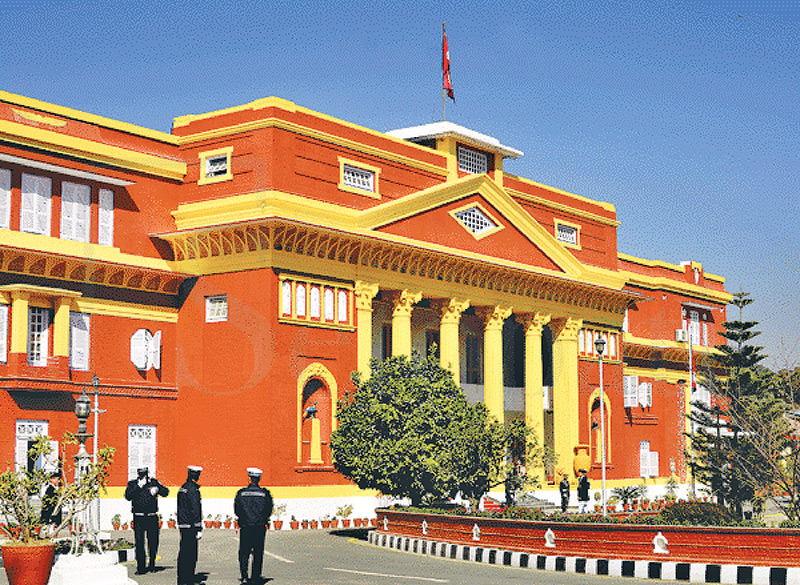
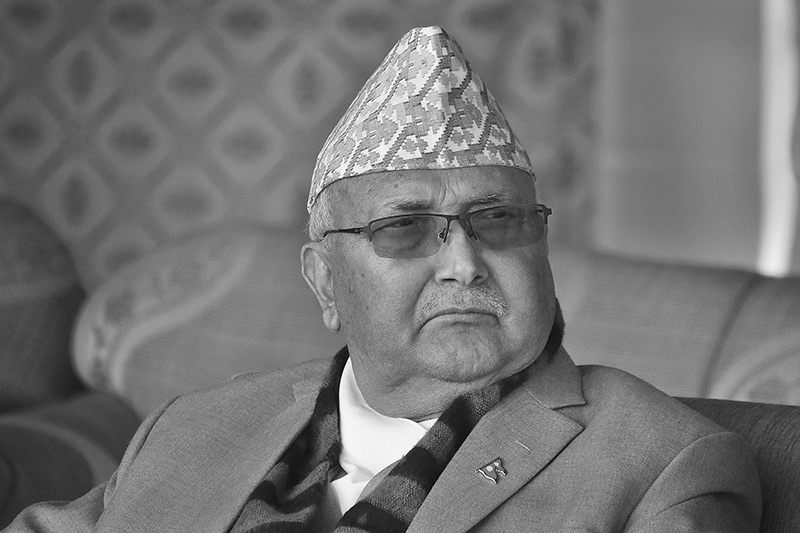
KATHMANDU, An ordinance proposed by the government to change provisions in the Constitutional Council (Functions, Duties, Powers and Procedures) Act-2010 is stuck at the President’s Office as Prime Minister KP Sharma Oli, following criticism, has reservations. The ordinance is aimed at modifying provisions in the Constitutional Council so that decisions can be made on the basis of a simple majority, as opposed to consensus. Officials familiar with matters, however, say that Oli is no longer keen on following through with the ordinance after criticism from constitutional experts and the opposition. In an interview with Kantipur TV on November 25, Oli had said that there was nothing to worry about as the ordinance had yet to be issued. According to officials at the Prime Minister’s Office, Oli has changed his mind on the ordinance owing to criticism. “The Cabinet sent the ordinance long ago citing its necessity but it won’t move ahead if the prime minister’s mind has changed,” said Health Minister Bhanubhakta Dhakal, who is a close confidante of Oli’s. As Oli is currently in hospital, a decision will be taken once he returns, said Surya Thapa, Oli’s press adviser. “The government has yet to decide on the fate of the ordinance,” said Thapa. Oli, who has undergone an appendectomy and eight rounds of dialysis since October 31, is currently recuperating at the Manmohan Cardiothoracic Vascular and Transplant Centre. According to Sheetal Niwas, the President is “studying” the ordinance. Bhesh Raj Adhikary, chief personal secretary of President Bidya Devi Bhandari, said that the ordinance is not stalled and that the President is consulting with legal experts. When the ordinance was forwarded last month, it immediately met with criticism, with legal and constitutional experts decrying it as an attempt to undermine the parliamentary system and bypass the House of Representatives when it is in recess. Clause 6 (5) of the Constitutional Council (Functions, Duties, Powers and Procedures) Act-2010 states that “each matter submitted at the meeting shall be decided unanimously”. Sub-clause 6 says in case there is no unanimity among the Council chair and members, no decision shall be made. “The chairperson shall call the next meeting to make a decision on the matter which was not decided pursuant to Sub-clause (6) and the decision shall be taken on that matter on the basis of the consent of the meeting. Provided that, even the said meeting fails to make a decision on the basis of the consent, the decision shall be taken by majority votes of the total members of the council,” states Sub-clause 7. The Constitutional Council, headed by the prime minister, consists of the chief justice, Speaker and deputy Speaker of the House of Representatives, chairman of the National Assembly, and leader of the main opposition as members. The minister for law and justice also takes a seat when the appointment is related to the judiciary while the chief secretary functions as the secretary of the council. The Council is mandated to recommend the chief justice, along with ambassadors and chairpersons and officials for various constitutional bodies. A November 19 Cabinet meeting had decided to issue the ordinance, citing non-cooperation from Sher Bahadur Deuba, the leader of the primary opposition Nepali Congress. The Congress party has long griped about the way appointments to the constitutional bodies have been made. It even boycotted the parliamentary hearing for five commission chairpersons, saying that the decisions were taken in the absence of the opposition leader. The ruling party, however, had argued that it decided on the basis of consensus of all members present in the meeting after the leader of the opposition refused to participate. The wrangling between the ruling and opposition parties has stalled appointments at various constitutional bodies, four years after the promulgation of the constitution. The Council has not been able to hold regular meetings due to Deuba’s absence. Critics have also taken issue with the fact that the government is attempting to push through the changes through an ordinance. The constitution allows the issuance for an ordinance, which enables the government to pass laws when Parliament is not in session. Article 114 (1) of the constitution, under ‘Provisions relating to Ordinance’, says: “If, at any time, except when both houses of the federal Parliament are in session, circumstances exist which render it necessary to take immediate action, the President may, on the recommendation of the Council of Ministers, promulgate an ordinance.” Parliamentary experts, however, say that the executive should refrain from issuing such ordinances, unless it is extremely necessary, and that frequent issuance of ordinances without waiting for the House does not bode well for democracy and rule of law. “Ordinance should be issued only in urgent cases,” said Chandra Kanta Gyawali, a constitutional expert. “Questions could be raised over why the vacant positions at the constitutional bodies were not fulfilled when the Parliament was in session and why the government is trying to issue ordinance when the House is just about to commence.” The winter session of Parliament will commence in about two weeks.
HOME PAGE
Shrestha becomes first Nepali woman to win gold in athletics
In a photo finish, Santoshi Shrestha, who led from the first lap, won by a millisecond.
- PRAJWAL OLI
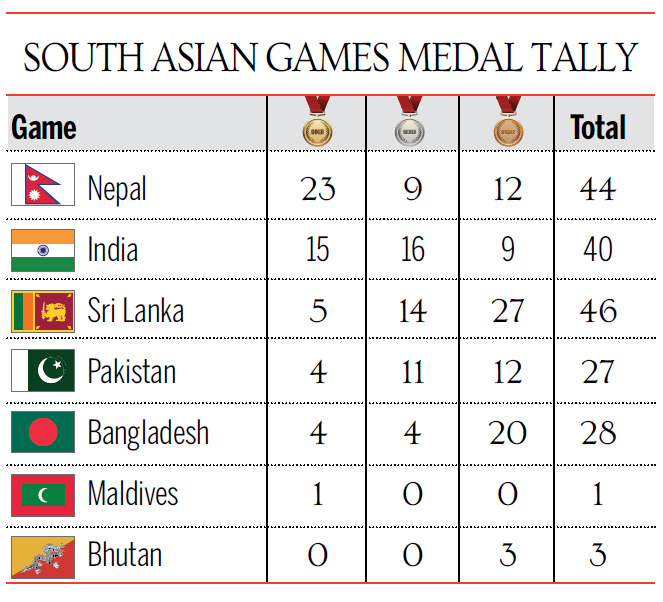
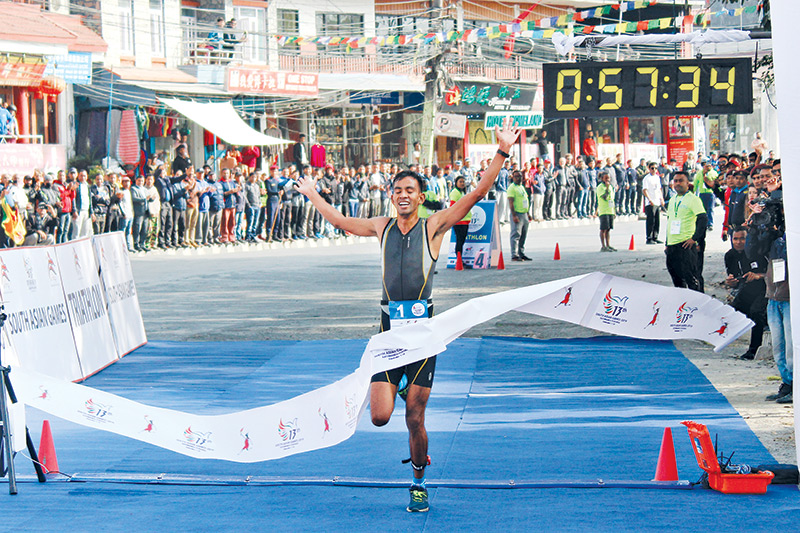
KATHMANDU, Santoshi Shrestha’s dramatic win in the 10,000-metre race at the South Asian Games was quite literally a photo finish. Shrestha, who set a new record in Nepali athletics by securing a middle distance gold for the first time, won by a millisecond, edging out India’ Kavita Yadav. “I wasn’t thinking of the medal. I was focused on running my best,” said Shrestha, a public health researcher who only started pursuing athletics professionally two years ago. The 10,000-metre race on Tuesday was her international debut. “I was frightened because other runners were experienced while I was making my debut. I thought they’d kick in at the last moment.” On Tuesday, Shrestha clocked 35 minutes 7.94 seconds to Yadav’s 35 minutes 7.95 seconds. Nilanthi Lanka of Sri Lanka came in at a distant third at 35 minutes 59.02 seconds. “I wanted to prove that even non-departmental [Nepal Army, Nepal Police and Armed Police Force] players can excel in sports,” Shrestha, who still has the 5,000 metre race on Thursday, told the Post. Besides legendary marathoner Baikuntha Manandhar, who took three consecutive golds and retains the South Asian record he set in the 1987 edition of the Games, Shrestha is the only non-departmental Nepali athlete to win gold in a middle-distance race. From the very first lap, Shrestha led the race, chased closely by Yadav. In the final 25th lap, a nail-biting drama unfolded with the two athletes just 2o metres away from the finish line. Yadav suddenly overtook Shrestha and blocked her path but with a burst of speed and a swift curve, Shrestha took the lead, before both athletes crossed the finishing line within a millisecond of each other. A machine installed at the finishing line confirmed Shrestha as the winner. “I tried to pick up pace in the final 200 metres but later, I just decided to go all-in and quickly moved to the right,” Shrestha, who hails from Jwalamukhi in Dhading, told the Post. Shrestha first started running at the age of 13 and had participated in a few road races without any formal training. “I used to jog every day and trained myself on the weekends and holidays,” she said. Her formal training started two years ago after former Olympian and coach Raghu Raj Onta spotted her during a race at Durbar Marg and convinced the self-taught runner to join the athletics team. “She finished third, ahead of ultramarathoner Mira Rai, behind champions Kanchhi Maya Koju and Bishwarupa Budha,” said Onta. “She has all the qualities of an athlete. She is mentally strong and has the ability to make quick decisions.” Coach Onta believes that Nepali athletes like Shrestha could make a dent at the Asian Games, given proper planning and a long term vision. “Nepali players have the ability to win medals at the Asian level,” he said. “In the next few years, we will see new faces in track and field.” Veteran marathoner Koju agrees with Onta. “We are capable of making a strong presence at the Asian level, but there must be regular training and good facilities for players,” she said. “If we really want to compete in the Asian Games, we must start systematic and well-planned training right now. It’s not just the best athletes who need training but also emerging ones so that we are on the right track to groom future stars.” Koju still holds the national record of 35 minutes 3.43 seconds, set during the 2006 Colombo South Asian Games. Koju had won silver then. Shrestha on Tuesday bettered her personal best of 37:50.53 set at the Eighth National Games in April finishing third.
HOME PAGE
Tourists are flocking in but hardly spending
The government has failed to take appropriate measures to increase vacation lengths and create avenues for tourists to spend money, entrepreneurs say.
- HIMENDRA MOHAN KUMAR
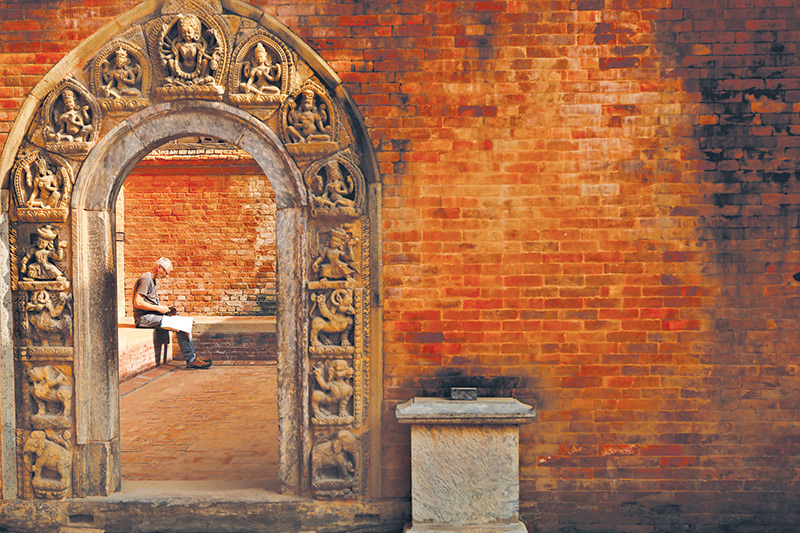
A tourist browses a map of Nepal at Patan Museum in Lalitpur. Post Photo: Elite Joshi
KATHMANDU, It’s a balmy Friday afternoon, but Kabindra Shrestha, a cashier at North Face Money Exchange in Thamel is glum. Five hours into the opening, he says he’s been able to exchange foreign currency worth only $1,360. “The business is down by almost 50 percent since last year,” said Shrestha. Shrestha’s experience has two possible causes—tourist arrivals are down or a majority are not carrying enough cash. Since data shows a steady rise in tourists visiting the country, travel and tourism operators say a major concern for them is whether tourists are spending enough. According to the Nepal Tourism Board, a total of 975,557 visitors arrived in Nepal in the first 10 months of this year. Tourist arrivals crossed the coveted one-million mark for the first time in 2018, with 1.17 million foreign visitors streaming into the country. With the government’s flagship Visit Nepal 2020 just around the corner, Nepal is aiming to bring in two million tourists. But tourism experts say numbers won’t matter unless visitors loosen their purse strings. According to statistics from the Tourism Ministry, last year, the average spending of tourists plummeted to a seven-year low of $44 per day. The average spending was $54 per day in 2017. The longer the tourists stay, the more they will spend, but the government has failed to take appropriate measures to increase their vacation lengths and create avenues for them to spend money, say entrepreneurs. According to Ashok Pokharel, president of the Nepal Association of Tour Operators, vacation lengths of visitors are getting shorter and Nepal hasn’t been able to learn from global tourist destinations like Dubai and Singapore, both of which have created spending avenues like duty-free shopping, theme parks, a thriving nightlife and discounted high-end shopping festivals for foreign travellers. On the contrary, Tribhuvan International Airport, the country’s sole international airport, doesn’t even have a duty-free shop. “Home-bound tourists tend to splurge their leftover cash on liquor, perfumes, chocolates, gadgets and toys at duty-free outlets,” said Pokharel. “But this option is simply not available for them in Nepal. So they take back much of the foreign currency they had brought to spend.” Though the government is targeting a daily average tourist spending of $75 per day next year to increase the share of the tourism industry in the country’s gross domestic product (GDP), it has largely failed to create spending avenues. Tourist spending is the largest earner of foreign currency for Nepal with the tourism sector contributing 2.2 percent to the GDP in the fiscal year 2017-18.
A lack of places for tourists to spend money, coupled with changes in their spending patterns, could make meeting Visit Nepal 2020’s target of Rs200 billion in tourist earnings difficult. The Finance Ministry has allocated Rs600 million to carry out promotional activities in key source markets to Visit Nepal Secretariat. As the budget was only approved a month before the start of the campaign, travel trade entrepreneurs doubt that the money will get fully spent on international promotions. Separately, Nepal Tourism Board, the country’s tourism promotion body, has earmarked a Rs1 billion budget to promote Nepal. “We are less than 30 days away from the start of the event and it is not yet clear how this budget is going to be spent. The budget amount has to be spent by June 15, or else it will lapse,” said Pokharel. Nepal had announced the event in 2018, but was behind in allocating funds. Officials from the Tourism Board, however, said that they were doing enough with the funds they had. “We have done promotions in Europe, India, China and the US and the response has been quite encouraging,” said Deepak Raj Joshi, chief executive officer of Nepal Tourism Board. Nepal’s promotional campaigns, however, are largely focussed on showcasing mountains, trekking routes and religious sites, a tendency many experts describe as too traditional. Not all the tourists go on a trek nor does everyone want to climb mountains.
In order to not just bring in more tourists but also get them to spend more, Nepal needs to create more avenues for visitors to spend their money, said Abdullah Kececi, general manager for Turkish Airlines in Nepal. Turkish is the only European airline that conducts direct flights to Kathmandu. “Nepal needs to invest more in building solid, sustainable infrastructure to improve connectivity among its cities, so that tourism revenues can spread beyond Kathmandu and Pokhara,” said Kececi. Joshi agrees that lack of quality infrastructure is one of the biggest concerns, as this may lead to a large number of leisure tourists exploring travel options other than Nepal. “The poor quality of most roads in the country and heavy, slow-moving vehicular traffic, which are time killers for many tourists who come for a stay here for a limited time and on a budget,” said Joshi. According to Joshi, Nepal hopes to surpass Rs150 billion in revenue by reaching the target of two million tourists next year. But going by occupancy rates at Kathmandu’s high-end hotels, this too appears unlikely. The first-quarter financial reports from Taragaon Regency Hotels, Soaltee Hotel and Oriental Hotels showed that profits nosedived from numbers made last fiscal year. The three hotel groups, which cater to high-end tourists, said that price undercutting, a demand-and-supply gap and a growing number of backpackers are behind the sharp fall in their earnings. But even former officials believe that the government’s revenue target for next year is too optimistic, given the current state of the country’s infrastructure. “The target will, however, certainly prepare the ground for future tourist arrivals as the right kind of momentum would get built,” said Krishna Bahadur Manandhar, a former deputy governor of the central bank. With the kick-off of Visit Nepal 2020 less than a month away, there is not much the government and other concerned agencies can do in terms of infrastructure and spending avenues. But Kececi of Turkish Airlines has a tip to share. “It is widely believed in the travel industry that five-day tourists are high spenders,” said Kececi. “Nepal should target this class and provide easy connectivity to travellers interested in visiting Chitwan, Lumbini and Pokhara. In time, that will certainly lead to an upsurge in tourism revenues.”
MEDLEY
Horoscope
ARIES (March 21-April 19) *** If you’ve been seeking success and finding frustration, today is the day to consider a few new tactics. Look at all the possible ways you could handle this situation. Then choose the option that you find the most intimidating. You may have been preventing yourself from taking a challenge.
TAURUS (April 20-May 20) ** Sometimes the road you’re traveling gets shrouded in fog. If that happens today, don’t pull over and wait for the weather to clear. Time is not to be wasted, so keep going, slowly but surely, on the same path. If you let little things stop you from going where you want to go, your confidence will take a beating.
GEMINI (May 21-June 21) ** Usually the deeper you delve into preliminary research, the more confident you feel in your eventual decisions. But sometimes, if you look too deeply, you will find out things that just confuse you further. Weigh the choices you have to make today—does every single one of them require hours and hours of due diligence?
CANCER (June 22-July 22) *** The good news is that your career is about to take a very exciting turn—the bad news is that it might also take up a lot more of your personal time. Your past problems at work are all water under the bridge, and you have learned some very valuable lessons. Things are much more under your control than ever before.
LEO (July 23-August 22) *** Whatever problems there are around your home can wait a few more days to be resolved—focusing on them too hard will only put more pressure on the situation. Step outside of yourself and go somewhere where you can explore what is going on in other people’s lives, because that is where you can really affect some changes.
VIRGO (August 23-September 22) *** Keep a friendly, approachable smile on your face today—you need to encourage some withdrawn folks to bring you the idea or solution you’ve been waiting for! If you’ve been feeling limited or held back in any way, this person could be your ticket out of that dead-end street. Social invitations will start piling up today.
LIBRA (September 23-October 22) **** Your engine is all revved up, but there’s really no place for you to go today—all projects are moving forward nicely, and the people in your life are doing well. There will be no frantic phone calls or calls for your sage advice. So what to do with all this energy and time? Spend it on yourself!
SCORPIO (October 23-November 21) *** It’s all about the finishing touches today. Pay careful attention to grooming in the morning, and make sure you’re stepping out the door dressed in the perfect look. Completion should be on your mind, including everything from major work projects to small personal tasks. Today make sure to plan for your travels.
SAGITTARIUS (November 22-December 21) ***** The very first step to getting what (or who) you has been wanting is to express it. Saying it out loud makes it real and lets the universe know that you’ve got some expectations it can help fill. Now may be the right time to get rewarded for all those karma points you’ve earned, so feel positive about asking.
CAPRICORN (December 22-January 19) *** Exercise a little bit of your power today, and you might start to enjoy the autonomy you have! If you say what you mean and ask for you what want, your willful behavior won’t ruffle any feathers. In fact, it will be cheered. Too many people hold back their true feelings because they are afraid, intimidated or confused.
AQUARIUS (January 20-February 18) *** Right now, moving through your life without thinking too hard about what you are doing might not be such a bad idea. You are used to thinking things through—and that is certainly wise. But moving forward on a project does not always required a detailed road map. It’s time to start winging it again.
PISCES (February 19-March 20) ** It is all well and good for someone to say that they are all about big ideas and helping mankind, but at a certain point they have to stop talking and start acting. Beware of people who talk the talk but cannot walk the walk today. Aligning yourself too closely with them could mar your reputation.
National
Anti-graft body wants local governments to make policy to prevent illegal leasing of public school land
- BINOD GHIMIRE
KATHMANDU, The Commission for the Investigation of Abuse of Authority has suggested local governments to make necessary policies to protect the lands of public schools, citing an increasing trend to lease such land parcels for commercial use through irregularities. The national anti-graft body said there is a trend of renting or leasing playgrounds of the students to construct commercial buildings without fulfilling the due legal processes. The suggestions were issued to every authority that manages school education. As per schedule 8 of the Constitution of Nepal, it lies with the local governments. From hiring and firing teachers, protection of school property, curriculum development to the conduct of examinations comes under the ambit of the local governments, at present. There is the encroachment of land and property of the public schools while there are also cases of leasing the land for years, destroying the playgrounds to erect commercial complexes, according to the commission. “The local governments, therefore, need to prepare a clear policy for the protection of such land,” read one of the suggestions. Pradeep Koirala, spokesperson for the commission, said the suggestions were made based on the complaints of irregularities filed to the anti-graft body. “We cannot say there is corruption, but there is room to suspect,” said Koirala. “We have received different complaints to this effect.” Different reports show encroachment and commercial use of the school land are increasing across the country, including in the Capital. The decision of the school management committee of Madan Smarak School in Patan to lease the playground of the school land to erect a commercial complex has courted controversy. In July 2014, the management committee of the school decided to lease its 13 ropanis and one aana land to Valley Construction, a construction company, for Rs460,000 per annum. The company will erect a building and use it for 40 years before handing it back to the school as per the agreement. A case was filed against the decision at the commission and in the Supreme Court demanding the construction to stop and protect the public land. The matter is sub judice. The field of the school, which is the place for emergency evacuation for people from ward 3 and 20 of Lalitpur Metropolitan City, is one among eighty-four areas identified by the government as public open space. Similarly, Mahendra Adarsh Bidhyashram, Satdobato, leased its 12 ropanis of land to Jyapu Construction Company for 30 years, which pays Rs600,000 every year in return. A department store is running at the building constructed on this land. Local government representatives say they are aware of the encroachment and are committed to stopping such practices in the future. “The leasing of the school’s property was done before our election,” Lalitpur Mayor Chiribabu Maharjan told the Post. “I would like to ensure that no such act gets repeated in the future.”
National
Police arrest two persons for alleged online fraud
- SHUVAM DHUNGANA
KATHMANDU, The Metropolitan Police Crime Division, Teku, on Monday arrested two persons in the Capital for allegedly duping customers through social media. Amir Thapa, 22, of Sindhupalchok, currently residing in Bhaktapur, and Aman Awal, 24, of Bhaktapur, were arrested after they allegedly conned several customers through Facebook and Whatsapp. Acting on the complaint filed by a victim, the police started their investigation and discovered that the accused duo used to display several electronic devices like mobile phones, laptops and cameras of different brands for sale via Whatsapp and Facebook. Interested buyers were then directed to a phone number. As soon as customers contacted the duo on the displayed number, they were asked to deposit the amount in their bank account. The duo gave customers assurances that the items would be delivered. “However, even after receiving the amount, they were found not providing the devices to the customers. They used to ask for more money from customers citing the goods are at the border and in order to get them cleared at the border they have to pay tax,” said Superintendent of Police, Sushil Singh Rathore, information officer at Metropolitan Police Crime Division. Police have urged people to check the reliability of online shopping sites before depositing any amount, as online frauds have become more common in the country. Police, meanwhile, have recovered more than Rs 800,000 from a bank account of accused fraudsters who were recently taken into custody. “Further investigation into the case is underway,” said Rathore. According to data maintained by the Nepal Police Headquarters, police recorded 368 cases related to fraud across the country in the fiscal year 2016/17. The number of cases rose to 542 in the fiscal year 2017/18. In the fiscal year 2018/19, police registered 627 cases related to fraud. “Customers get easily lured by fraudsters after watching attractive advertisements online. Without properly investigating their veracity, they follow whatever the fraudsters say and deposit the amount. However, after receiving the money, the fraudsters become unreachable,” Rathore added.
National
Poverty Alleviation Fund is now seeking money to run climate change programmes
Despite the decision to scrap the agency after federalism was adopted, it continues to exist and is seeking new role.
- PRITHVI MAN SHRESTHA
KATHMANDU, The Poverty Alleviation Fund, which the government had earlier decided to scrap, is seeking a new role in the environment sector by applying for funds under “Green Climate Fund” from the Finance Ministry. After the community organisations promoted by the Fund were handed over to local governments in 2017, the agency formed to reduce extreme poverty through targeted programmes has been rendered jobless. There are around 32,000 such organisations mobilising over Rs 19 billion. As per a Cabinet decision taken on November 11, 2018, the PAF Act should have been scrapped by mid-December that year, which would have meant dissolution of the Fund. But according to officials, the law was not scrapped and the institutions existed as wanted by Prime Minister KP Sharma Oli, who feared criticism from the opposition parties. In order to make the institution’s presence felt, the Poverty Alleviation Fund has applied at the Finance Ministry for financial resources under the Green Climate Fund to run programmes for mitigating climate change. “We have applied for funds as per the suggestion from Finance Minister Yubaraj Khatiwada after the ministry sought proposal on November 1,” Nirmal Kumar Bhattarai, vice-chairman at the Fund, told the Post. Nepal had received funds by virtue of being the party to the United Nations Framework Convention on Climate Change which provisions Green Climate Fund. A party to the convention can access the funds to run programmes for mitigating the climate change risks. The anti-poverty organisation is one of the applicants seeking funds to run climate-related programmes. According to Bhattarai, they have proposed promoting nature conservation in rural areas by mobilising community organisations the Fund had promoted in the past. “We have also proposed running advocacy programmes for the use of low emission vehicles in urban areas,” he said. When asked how the Fund would relate to its past programmes and climate change, Bhattarai said people often exploit and damage natural resources—for example they fell trees—due to poverty. “We want to discourage this trend by improving their livelihoods,” said Bhattarai. Despite an earlier decision of bringing community organisations under the local governments, Bhattarai said community organisations are still legally under the Fund as its law is yet to be scrapped. After the World Bank decided to discontinue grants for the Fund’s activities, the government, which is short of financial resources, had decided to bring the community organisations under local governments and scrap the organisation. But since the anti-poverty Fund continues to exist, it is now seeking new ways to operate. In recent years, PAF has come under public scrutiny after the Commission for Investigation of Abuse of Authority filed two corruption cases at the Special Court against 50 senior officials and staff of the PAF in March 2015 and April 2016.
National
Free education limited to slogans for Bajhang students
Although the constitution guarantees free basic education, most community schools struggle to run the service.
- Basanta Pratap Singh
BAJHANG, Patki Dhami, a resident of Bamaur, a remote village in Bangul Municipality in Bajhang, struggles to pay her son’s school fees. Her son attends Bhumeshwori Basic School, and his annual school fee is Rs 3,500. “The school management committee asks for timely payments. But I’m a daily wage worker and can hardly make ends meet for my family. Sometimes I have to take a loan to pay for my son’s education,” she said. All one hundred and eight families in Bamaur Village struggle to send their children to school. Shelling out Rs 3,500 per year is an additional expense to their already strained financial condition, says Patki. Article 31 (2) of the constitution states that every citizen has the right to compulsory and free education up to the basic level (Grade 8) and free education up to the secondary level (Grade 12). However, despite this provision, community schools in Bajhang take fees from students in order to pay salary to their teachers, according to Gopal Dhami, headmaster of Bhumeshwori Basic School. The school has 188 students, but there are only four posts of government teacher. Since four teachers are not sufficient to cater to almost 200 students, four more teachers have been appointed on a contract basis. “We haven’t received any help from the government. We have to pay a total of Rs 43,000 monthly to the four teachers whom we have hired privately,” said Gopal. “The only way we can raise that amount is by charging tuition fees to the students.” The school, which was established 30 years ago, was upgraded to a lower secondary school 14 years ago. This meant that the school needed more teachers, but the government has not provided any. “Although we took this issue to the then District Education Office and also to the municipal office, no solutions were forthcoming,” he said. Jaimal Dhami, one of the ward chairmen of the municipality, said that he has been raising the issue in every executive meeting of the municipality. “The constitution has guaranteed free education to all children. But this issue always gets sidelined,” Jaimal said. Dhan Bahadur Bista, mayor of the municipality, said that there are more than 60 schools in the municipality that take tuition fees from students to pay their teachers. “We keep these issues on the table in our regular meetings. We have managed to extend grants to some of the schools,” said Bista. But the grant hasn’t reached Bhumeshwori Basic School in Bamaur and parents like Patki are not sure how long they can afford to send their children to school without support from the authorities.
National
Schools in Parsa lack infrastructure and manpower
- SHANKAR ACHARYA
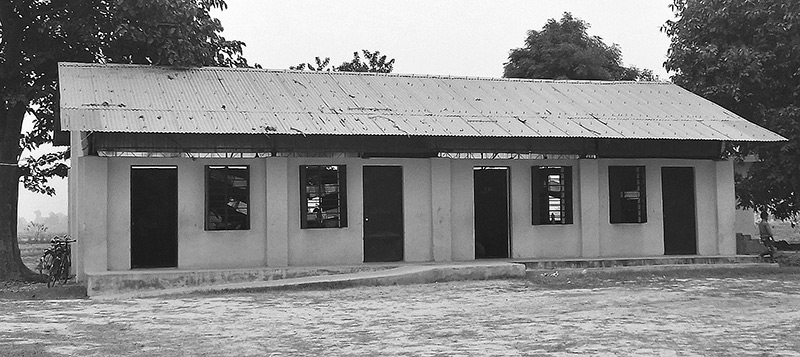
Due to a lack of rooms, Bandevi Basic School in Parsa has been conducting classes for grade two and three in the same classroom. Post Photo: SHANKAR ACHARYA
PATERWASUGAULI (PARSA), Bandevi Basic School in Bhatuda, Paterwasugauli Rural Municipality, runs classes up to grade five but has only four classrooms. The school runs classes for grade two and three in the same room. There are 150 students in the school but only five teachers. Subash Prasad Das, the school’s headmaster, said the school administration is facing difficulties to run classes due to a lack of proper infrastructure and insufficient teachers. There are 23 schools in the rural municipality plagued with similar problems. Mamata Tharu, the vice-chairperson of the rural municipality, said, “There are schools in almost every settlement, but most of them lack infrastructure. The government went on a spree of opening schools, but there are no proper provisions to run and maintain them.” Officials at the rural municipal office said there’s a lack of teachers and infrastructure in almost all schools in the municipality. Education experts say schools with a low number of students have to be merged to ensure quality education. Brija Kishor Sah, an officer at the District Education Development and Coordination Unit in Parsa, said almost all schools in Parsa are lacking in terms of infrastructure and education quality. “There’s no need for 23 schools in Paterwasugauli. The rural municipal office has to merge schools and fulfil the necessary quotas of government teachers to strengthen the education system,” Sah said. According to the latest data of the Education Development Directorate, 724 community schools have been merged across the country. The practice of merging schools is intended to enhance the quality of education by centralising scattered resources. Paterwasugauli Rural Municipality, to ensure quality education, also plans to merge its community schools. “Most of the community schools in Paterwasugauli have fewer students and lack the necessary physical infrastructure. Because of this, they are on the verge of closure,” said Tharu. “The only measure that can ensure the survival of the schools is to merge them.” The government had introduced the School Merging Implementation Directives 2014 to address the decreasing number of students in public schools. According to the directives, schools located within 30 minutes of walking distance and serve a small population and are unable to meet the minimum criteria of a full-fledged foundation (basic or secondary school) can be merged and run as a full-fledged school.
National
14 killed in Baglung jeep accident
- PRAKASH BARAL
BAGLUNG, Fourteen people were killed and three others sustained critical injuries in a jeep accident in Baglung district on Tuesday. One passenger has gone missing. There were 18 people on board the jeep, police said. According to DSP Jhabindra Prasad Bhattarai, the jeep (Ga 1 Kha 5219), heading towards Baglung from Ishma of Gulmi district, skidded off the road near Bhimgithe and plunged 200 metres into the Badigadh stream. Among the 14 dead, nine were female, said Bhattarai, informing that most of the passengers were travelling to Devisthan to offer prayers to their family deity. Police suspect that loading the vehicle beyond its capacity might be the cause of the accident. “The critically injured people were airlifted to Kathmandu in a helicopter for treatment,” said Superintendent of Police Nawaraj Bhatta. Dinesh Sharma, an eyewitness, said that most of the passengers died on the spot. “It was difficult to retrieve bodies from the incident site due to the difficult terrain. Most of the bodies were found mutilated,” Sharma said. The incident site is 80km from Baglung Bazaar, the district headquarters.
National
No licence renewal for hospitals that don’t reserve beds for poor
Most of the private hospitals and nursing homes have been flouting rules with regard to free service to poor and needy patients.
- Arjun Poudel
KATHMANDU, The Curative Service Division under the Department of Health Services has warned private hospitals and nursing homes that their licences won’t be renewed if they continued ignoring the rules to provide 10 percent beds and other services for free to the poor and needy patients. Rural municipalities, municipalities, sub-metropolitan cities, metropolitan cities, local health facilities and district public health offices are authorised to define poor people and issue them recommendation letters for free medical treatment. The warning of the division comes after documents furnished by most of the private hospitals and nursing homes for renewing their licences showed they had been flouting the government rules. “We also conducted surprise inspections at private hospitals and found that most hospitals had been violating the provision,” Dr Taranath Pokhrel, director at the division told the Post. “We will take action against those hospitals if they are found ignoring rules despite our warnings.” As per the government rules, all health facilities-- state-run and private-- have to reserve 10 percent of their beds for the poor, disabled, elderly people, and single women and provide free treatment. The guidelines relating to the establishment, operation and improvement of health institutes had incorporated the provision. Dr Prakash Budhathoky, chief of ENT and Oral Health Unit at the division, said that most of the private hospitals including renowned nursing homes have ignored government rules. “Some hospitals have provided treatment to their own relatives or relatives of their staffers in the free beds and claimed that they have been abiding by the government rules,”said Budhathoky.”Some hospitals have offered free beds to political leaders and their relatives.” Similarly, some hospitals claimed they provided 10 percent beds by offering free check-ups at the health camps they have been running at various places. According to the division, most of the private hospitals and nursing homes, who applied for licence renewal, could not furnish details--contact numbers, photocopy of citizenship certificate and other details to the division. The division has asked them for evidence such as photographs of free beds and other details to prove that they have been abiding by the government rules before renewing their licences. “We could not verify the claims made by the hospitals that they provided free beds and services to poor and needy,” Budhathoky said. “We can find out and suspend the licences of such hospitals if they do not abide by the rules.” The division regulates and renews licence of hospitals which have 200 or more beds. Kumar Thapa, senior vice-chairman of the Association of Private Health Institution of Nepal, however, claimed that an understanding has been forged with the officials at the Health Ministry that they would not compel the private health facilities to provide free services. “As the government has not yet properly defined who is poor, how can we know who is poor and who is not?” Thapa said.”Health ministry officials have directed the officials concerned in our presence not to compel private hospitals to provide free services unless the government distributes identity cards.” The existing 10 percent free bed facility covers medical counselling, lab fees, nursing fees, diagnostic services as well as the oxygen facilities to patients.
National
Bhutanese refugees protest demanding repatriation
Briefing
DAMAK: A group of Bhutanese refugees on Tuesday protested in front of the office of UNHCR in Damak, demanding repatriation to Bhutan. The protesters claimed that despite staging demonstrations for a long time, the concerned agency has not addressed their demands.
National
Smuggled cattle held at border
Briefing
SIMARA: The Area Police Office in Prasauni impounded 15 cattle which were being transported to and from the Nepal-India border point in Belhiya. According to police, the cattle were being transported illegally. The smugglers, along with the cattle, were sent to the customs office in Birgunj for investigation.
National
Two shops burnt down
Briefing
NAWALPARASI: Two shops were destroyed in a fire that broke out at Devchuli along the Mahendra Highway on Tuesday. Police said the fire, which was caused by a short circuit, was doused with the help of fire engines from Chitwan and Kawasoti.
National
Local units demand Siddhartha Highway be upgraded
Briefing
PALPA: The local units that lie along the Siddhartha Highway have demanded the upgradation of the highway at the earliest. The gathering of 16 local bodies of Kaski, Syangja, Palpa and Rupandehi districts held in Palpa issued a 10-point declaration on Tuesday. They also demanded the government to develop the highway as an economic corridor.
National
Suklagandaki Municipality to close illegal crusher plants
Briefing
TANAHUN: Suklagandaki Municipality is preparing to close crusher plants that are operating against standards. The municipality has taken initiatives to control crusher industries due to haphazard excavation of riverbed materials. There are 13 crusher industries operating in the municipality.
EDITORIAL
Too many are dying
Road safety must be a priority to end needless deaths.
Reports of road accidents continue to make headlines at an alarming rate. With 1.35 million people dying in traffic mishaps every year worldwide, they have become one of the gravest risks to public safety. In Nepal too, death on the highways happen all too often. In fact, according to a government report entitled Nepal Road Safety Action Plan (2013-20), the country has one of the highest road fatality rates. The country sees 17 accidents per 10,000 vehicles, which is higher than, for instance, for China and most of Southeast Asia. Our roads are inefficiently designed, streets are poorly lit, traffic lights don’t seem to work in many places, vehicle safety standards are inadequate, and law enforcement is weak. With a population explosion, coupled with lack of public transport, the number of vehicles has risen, and traffic congestion is increasingly becoming a never-ending problem issue facing residents. As accidents continue to claim lives on a regular basis, making the streets safer for pedestrians and drivers should be a major policy priority. And that needs to be done by adopting a holistic approach involving engineering, education, and enforcement. Road etiquette and infrastructure both are to be blamed for the lack of order on the roads. Infrastructure such as zebra crossings, overhead bridges, sidewalks and so on are few and far between. Therefore, pedestrians are often forced to cross the road wherever they can. As it is, with 60 percent of the zebra crossings in the Kathmandu Valley lying discoloured for years, pedestrians crossing the road are putting their lives on the line. Even in places where there are zebra crossings, motorists and bikers tend to speed up when they see a pedestrian, simply showing disregard for them as a valid road user. Pedestrians too, on their part, need to stop jaywalking in an almost rule-free environment in order to avoid accidents. Vision Zero—a public programme introduced in 1997 in Sweden to eliminate road accidents and injuries completely—is a good reference. With proper planning and implementation of traffic rules, low urban speed limits, separate designated lanes, additional pedestrian bridges and zebra stripes bordered with flashing lights, the Nordic country was able to drastically reduce its road accidents. Since 2000, the country has slashed traffic fatalities by half. The lives lost during road accidents are often preventable deaths. With few walking lanes and long distances to cross, the roads in Katmandu are anything but pedestrian-friendly. This situation needs to be reversed. To guarantee our roads are safer, beefing up the infrastructure from the bare-bones currently in place is definitely a must. Along with this, the government must also make efforts to inculcate road manners among the greater population. It has been taking measures, but they need to be sustained. Only when the authorities take concrete measures to establish intra-departmental coordination, say between the Traffic Police, the Roads Department and the Department of Transport Management, can there come a lasting solution to this recurring and fatal problem.
OPINION
COP25 in Spain needs to encourage increased climate action
It must generate implementation guidelines for climate issues to meet the commitments made.
- SNEHA PANDEY
Thinking Green
The 25th Conference of Parties (COP25) to the United Nations Framework Convention on Climate Change (UNFCCC) has started in Spain this Monday and negotiations are set to continue for the next two weeks. Countries from all over the world have gathered again to fulfill the mandate of the UNFCCC to bring the global community together to ‘prevent dangerous anthropogenic interference with the climate system’. This year’s COP, like the three before it, builds on the progress of the 2015 Paris Agreement.
What is COP and what happened during COP21 in Paris? COP is the ‘supreme decision-making body of the UNFCCC, where decisions are made by forging consensus among all member nations. Among the more famous COPs over the year is COP21, where the historic Paris Agreement was signed. 187 of the 197 parties of the UNFCCC have committed to abide by the contents of this Agreement, which builds on the efforts of the Convention by bringing nations together to pursue common urgent climate agendas. The Paris Agreement famously calls for countries to hold ‘global temperature rise this century well below 2 degrees Celsius above pre-industrial levels and pursue efforts to limit the temperature increase even further to 1.5 degrees Celsius’. In addition to such mitigation commitment, the Paris Agreement also calls for countries to adapt to the adverse impacts of climate change and make sure that finance- and capacity building-support is consistently available for countries with constrained capacities—like Least Developed Countries (LDC) and Small Island Developing States (SIDS). To ensure effective compliance and implementation, countries were allowed to set their own climate targets in the Paris Agreement, which are communicated in documents known as Nationally Determined Contributions (NDC). These NDCs are revised every five years and the Agreement mandates that each revision must entail an increase in the climate fighting ambitions of the country. The next NDC to be submitted to the international community is in 2020.
What happened post-Paris? After 2015, in the last three years, nations worked together to create the Paris Rulebook—a document that outlines how countries can plan, implement and review their NDC commitments. This was done with an understanding that without such consistent global guidelines, there would be no way to take stock of the collective progress made. The Paris Rulebook was finalised in Poland last year with implementation guidelines agreed upon for most issues including regular communication, review and stock-take of mitigation, adaptation progress; growth and alignment of investments; and loss and damage (L&D). However, despite finalising this rulebook, COP24 in Poland was deemed only somewhat successful: It was unable to produce guidelines for all issues and even where these guidelines were produced, they were not all satisfactory. It was also unable to get all nations to adopt the 2018 IPCC Special Report on Global Warming of 1.5 Degrees Celsius—a report that emphasises the importance of keeping temperature rise below 1.5 degrees Celsius above pre-industrial levels to avoid catastrophic impacts. This endorsement was blocked, unsurprisingly, by a couple of major oil producing countries, including the USA. All in all, these led to the COP24 conference to be perceived as only moderately successful.
What needs to be achieved in Spain this year? Some outstanding and critical issues will need more deliberation in Spain this December. For some of these issues no implementation guidelines have been produced, for others, the current commitments made or actions taken have been deemed inadequate.
Transparency: To ensure that nations are enacting the commitments made in their NDCs, it is iessential to establish a transparent system to monitor, report and verify mitigation- and financial support-actions promised by countries. It is believed that the fear of public naming and shaming through this mechanism forces countries to meet their commitments. It was decided that nations had to submit their transparency reports every two years, starting 2024. However, it was also recognised that not all countries—especially LDC and SIDS—may have the capacity to meet such stringent criteria and deadlines. There was a general disagreement regarding how much flexibility should be given to such countries, which has stalled progress in producing an implementation guideline.
Carbon markets: Since greenhouse gases have such potent climate altering ability, they are currently tracked, traded and regulated in the carbon market. By establishing such markets, regulators ensure that emissions can be driven down in places where it is cheapest to do so. More than half of the NDCs submitted mention using these markets to help meet their mitigation targets. In COP24, the international community could not reach an agreement regarding the implementation guidelines of this market, i.e. what crediting mechanism is appropriate for such schemes; how to prevent double counting (where both buyer and seller would claim emissions reductions for the same project); how much of the revenue from carbon trading should go the Adaptation Fund for developing countries and so on.
Loss and Damage: No degree of adaptation will completely avert all the impacts of climate change and some form of loss and damage to lives, livelihoods, property and culture is bound to occur. Most cases of such L&D happen to poor communities that live in close proximity to the natural environment. However, to this day, no separate funds have been allocated to address such climate impacts on vulnerable countries, communities and ecosystems. Developed countries are adamant that adaptation and L&D are similar enough that they do not warrant different finance. This year, the 2013 Warsaw International Mechanism on L&D (WIM) has undergone a review of its mandate. In particular, this analysis judged WIM’s ability to provide resources and support that vulnerable communities need to address such L&D.
Mitigation: The 2019 Emissions Gap Report warns that we are on the ‘brink’ of failing to keep warming limited to 1.5 degrees Celsius. It also states that the current NDC commitments are nowhere adequate enough to save our socio-environmental systems. In September’s UN Climate Action Summit in New York, many nations pledged to increase mitigation commitments in their 2020 NDCs—however none of these were the world’s biggest polluters. In this year’s COP, it is crucial that these nations step up their ambition.
Financial support: Without financial support, it is clear that developing countries will not be able to mitigate, adapt or build resilience to climate change. Despite advanced economies commitment to jointly mobilise USD $100 billion per year by 2020 to meet these needs, funds have not even reached the $10 billion mark. Countries like the USA, Australia and Saudi Arabia, that have most benefited from historical emissions, have shown no interest in contributing to the fund. In Spain this year, increased ambition is needed from these countries to meet the commitments made.
OPINION
Will he or won’t he?
A bold decision by Oli to exit gracefully from active politics should win him accolades.
- KUSHAL POKHAREL
post photo: anish regmi
The mainstream media, including online portals, have been flooded with news about Prime Minister Oli’s health for the last two weeks. While the media has carried stories based on their own information sources creating some confusion among the public regarding the actual status of the chief executive’s wellbeing, what has become evident is that his health condition is undoubtedly a matter of grave concern at present and will be so in the near future. The matter has further aggravated by the unwillingness of the prime minister’s press advisor to provide exact information about his medical state. Instead of being accountable to the general public in this regard, the advisor has come down heavily against doctors and the media accusing them of disseminating misleading information. It is unfortunate for the prime minister’s close aide to neglect the public’s right to information about issues of wide public importance as provisioned in the constitution itself.
Another transplant Currently recuperating after undergoing surgery for appendicitis and recently dialysis, the prime minister’s health is improving, according to a press note issued by the hospital management. With a long medical history of kidney ailments, the prime minister has been struggling with his health issues for more than a decade, and his doctors have highly appreciated his will power. It is also learnt that preparations are underway for further treatment of his kidney in the US, which might take a few months. What is noticeable here is that after experiencing problems in his transplanted kidney, the prime minister underwent plasmapheresis, a process that filters the blood and eliminates harmful antibodies in Singapore two months ago. Another kidney transplant is being considered, the effectiveness of which has become a subject of heated discussion among the country’s leading nephrologists. In light of the above, the issue of the prime minister’s ailing medical condition has raised some pertinent questions that have severe implications for the overall state system: How long can the prime minister continue like this? Are there any alternatives that need to be contemplated for running the nation? Is the prime minister thinking of a graceful exit amid repeated suggestions from his doctors to take more rest and become physically less active? It is looking extremely difficult for the prime minister to continue his role as the nation’s chief executive in this fashion. With doctors already cautioning the possibility of the prime minister being susceptible to various infections in the future, it is a case of Hobson’s choice for him to find a successor sooner or later. Moreover, the message that the prime minister wishes to impart to the larger public of his intentions on how to move ahead in this context has significant ramifications across the entire spectrum of society. But at the moment, the prime minister has not given any hint in this regard. At a time when the nation is at a crossroads in terms of delivery of effective public services through an improved governance system, the need for a proactive chief executive is of paramount importance. The present communist government with a two-thirds majority has publicly stated the necessity to direct all its efforts towards institutionalising the federal system through the promulgation of various laws, rules and regulations. Against this backdrop, the need for a prime minister who is physically and mentally fit and can work round the clock is high. While this is not to undermine the prime minister’s bubbling confidence, some unavoidable circumstances pose severe constraints to executing his official duties.
Graceful exit Easier said than done, finding a new premier with the desired competencies won’t be simple. The search for a chief executive might also reignite seemingly subdued political instability if not handled with care. Nevertheless, the scenario of a nation getting a new prime minister also looms large. In this regard, a bold decision by the prime minister to exit gracefully from active politics should win him accolades. But the question remains whether he is bracing himself up for this. This is the right time for the prime minister to start some critical discussions within his own party regarding the same, and explore some possible ways to fill up the governance vacuum. At this stage, the prime minister can invite some fresh ideas from his party to end the impasse. Instead of finding temporary measures to tackle the situation, a pragmatic solution for the remaining three years of the administration’s tenure that is in the broader welfare of the nation should be figured out. A rational decision this time will definitely help the prime minister to restore his waning public image, particularly in the past two years after the unprecedented election victory.
Pokharel is a member of the Social Science and Research Faculty at NIMS College.
OPINION
From the rubble of Ayodhya
The Babri Masjid verdict should have brought succour to the government’s cheerleaders, but it hasn’t.
- JAWED NAQVI
Shutterstock
‘Mat ranja kar kasu ko ki apney to etiqaad/ Dil dhaae ke jo kaaba banaaya to kya hua’ (‘A house of worship on the ruins of a broken heart?/ My faith and yours are so far apart’). The heart-tugging advice against inflicting one’s religion on another’s came from 18th-century Muslim poet Mir Taqi Mir. He lived roughly halfway in time between emperor Babar’s brief rule and the demolition 27 years ago of a mosque that one of his generals built in Ayodhya in 1528. Had Mir Baqi, the general, constructed the mosque by destroying a Hindu temple, as some Hindus claim? Mir the poet would admonish him though India’s supreme court found no such evidence in its verdict last month. Were the zealots who razed the mosque on Dec 6, 1992, right in delivering what they claimed to be historical retribution? Mir would frown, though he was prone to departing from his faith to crave seclusion in Hindu temples, their bells and fragrances. The five-member bench of the supreme court missed the delicate point last month when it gave away the land, where the mosque once stood, to the side that destroyed the monument to subvert the court’s orders. Mir was not alone in sinking his spirit in India’s multicultural milieu. Nazir Akbarabadi and Ghalib, among others, followed him faithfully, though the habit possibly precedes the earlier Urdu poet Wali Dakhani approximating to Aurangzeb’s period. They both died in 1707 after leading entirely opposite lives. Wali wooed and applauded the diverse people of India. Aurangzeb alienated them, a departure from his forbears, led by the eclectic Akbar. ‘Koocha-i-yaar ain Kaasi hai/ Jogiya dil wahin ka baasi hai.’ The Mughal era poet who wrote the lines was also known as Wali of Gujarat, which is where Narendra Modi’s hooligans destroyed his grave in 2002 and built a metal road over it. Some admirers still leave flowers at the spot to register their love and pain. What was the verse about? ‘My beloved lives in the sacred town of Varanasi/ And my ascetic heart belongs there.’ As this Friday marks the anniversary of the Ayodhya sacrilege, from the rubble of the mosque is emerging a tiny but discernible strain of unsettling remorse. Aggrieved Indians should rejoice that those who had supported the destruction of the mosque, or were followers of dubious historiography that justified the violent assault are seeing their folly. For this reason and more, the widely-held fear of a majoritarian state emerging in India seems misplaced. A transient supremacist polity, yes, but a Hindu majoritarian state seems farfetched today. And this is the quandary for the Hindu right after the events in Maharashtra. Let’s go with Amartya Sen’s headcount of 200 million Muslims, about an equal number of Dalits with a large number for Adivasis. Add Hindus who have been shot or jailed to the mix of a billion-plus, Lalu Yadav, P Chidambaram, Govind Pansare, Dhabolkar and Gauri Lankesh among them. Where’s the majority, leave alone majoritarianism? An early encouragement to a strong hunch in this regard came in the 1960s when shabbily painted Ayodhya-related slogans in saffron appeared on all along the road from Lucknow to Ayodhya. ‘Garv se kaho hum Hindu hain’ (‘Say with pride we are Hindus’). The words went on monotonously. One hadn’t noticed any neighbour looking worried about their Hinduness, however, not one. So who was being cajoled? The perplexing quest goes slightly back in time, actually, around the 1920s. Adopt the Hindu way of life or become a second-class citizen in future India, thundered MS Golwalkar to India’s Muslims and Christians. Would Ghalib or Mir pass the test? Well, see the treatment Wali got in Gujarat under Modi’s watch. What about Iqbal who described Lord Ram as ‘Imam-i-Hind’ in a long ode to the mythical hero? A clear stance is emerging against an alien narrow-mindedness being pushed by the Hindutva coterie. Resentment connects Bengal to Maharashtra, Kashmir to Kerala. It is significant that the most dogged critics of Modi belong to the evolving Hindu right. They are matched only by a nondescript response from the left and centrist ideologues who will be tested again in the Delhi polls in February. It was their poor judgement that brought India to its current pass in May this year. Among the leading voices slamming Modi are those of former BJP minister and journalist Arun Shourie and his colleague Yashwant Sinha. Shourie pronounced the Modi government as ‘Congress plus cow’. You would have expected the left at the barricades against the wilful subversion in Kashmir. However, it is Yashwant Sinha, formerly from the Hindutva stable who is leading the charge for Kashmiri rights. Industrialists who had supported the prime minister are publicly slamming his damaging sectarian policies. Journalists who never tired of cheering Modi are admitting their mistake. And now the Maharashtra bombshell. The Babri Masjid verdict should have brought succour to the government’s cheerleaders, but it hasn’t, while opposition to un-Indian ideas being injected into the nation’s cultural veins in the name of spurious nationhood is gathering steam. Horse-trading of elected deputies cannot be seen as a win for Hindutva as was dubiously claimed in Haryana and earlier in Karnataka and Goa. It is bizarre that the world’s largest democracy should be shored up by elected representatives hidden away in safe houses for fear of being poached by the ruling party. The once silenced rubble in Ayodhya is conversing with Mir Taqi Mir, and more and more Indians are beginning to listen.
This article was previously published in Dawn, a part of Asia News Network.
OPINION
The European Union’s university in exile
Central European University’s ouster from Hungary highlights how European politicians lack the will to stop autocrats.
- László Bruszt
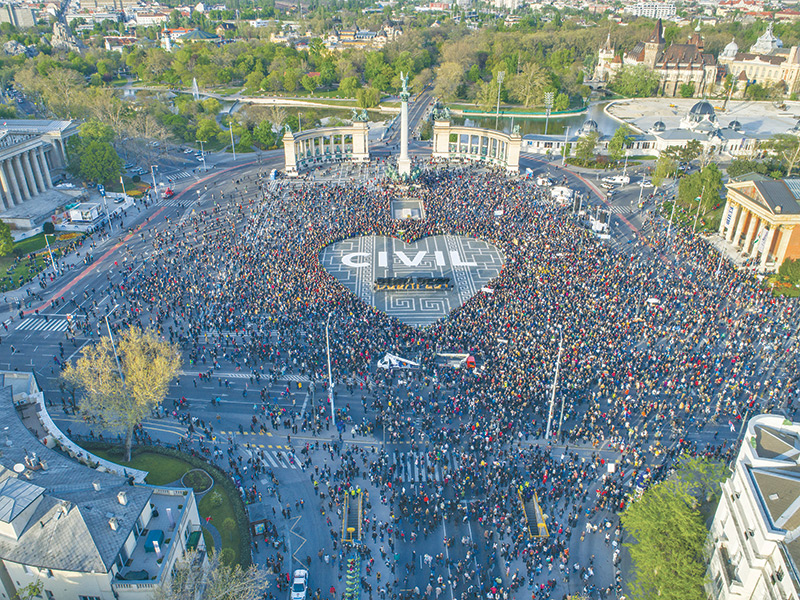
Thousands had demonstrated in central Budapest in Hungary on April 12, 2017, against legislation seen as targeting the Central European University. Shutterstock
On November 15, Central European University (CEU) officially inaugurated its new campus in Vienna, Austria, having been arbitrarily ousted from Hungary. On the same day, Hungarian Prime Minister Viktor Orban’s government opened another large sports stadium in Budapest. Predictably, the government-controlled Hungarian media focused on the latter event and ignored the departure of CEU, the country’s leading university in European and global rankings. But European Union leaders also were largely silent—deafeningly and dishearteningly so—on the day that the EU’s first ‘university in exile’ opened in the capital of a neighbouring member state. By contrast, the mayor of Vienna, Michael Ludwig, emphasised the importance of the occasion. ‘Two years ago, we all witnessed something that I believed to be unthinkable, and should, in fact, have no place in a united Europe,’ he said. ‘An academic institution was told that it was no longer welcome in a nation’s capital city.’ Ludwig’s sentiments, however, found few echoes elsewhere in the EU. To be sure, nearly all of the EU’s key political actors have expressed their solidarity with CEU at one point or another. Speaking at the European Parliament in Brussels in April 2017, CEU President and Rector Michael Ignatieff could say, ‘I have support in Washington. I have support in Berlin, I have support in Budapest, […] I have got support in Munich. It is now time to get some support in Brussels.’ And Ignatieff did get some backing, at least initially. In December 2017, the European Commission took Hungary to the European Court of Justice (ECJ) over the government’s so-called ‘CEU law,’ which the university said was intended to force it out of the country. As The Guardian reported at the time, ‘Brussels steps up its fight to protect democratic values in central Europe.’ Then, in March 2019, the European People’s Party (EPP), the largest political group in the European Parliament, suspended Orban’s Fidesz party. True, the decision was prompted primarily by Fidesz’s fake news campaign against Commission President Jean-Claude Juncker, rather than by its attacks on academic freedom. But the EPP also demanded that Orban’s government clarify ‘the pending legal issues regarding the Central European University.’ In the end, however, the Hungarian government did not ‘clarify’ the position of CEU in the country’s legal system. Worse, by pushing the university out, Orban has established a precedent for other like-minded EU leaders to follow. It is telling that, five days after CEU inaugurated its new Vienna campus, Hungary and Poland vetoed an EU resolution proposing that the Commission produce an annual report on the state of the rule of law in each EU country. The ouster of CEU from Hungary highlights two realities about the EU. First, despite the British Conservative Party’s catastrophic attempt to reclaim ‘sovereignty’ from the EU through Brexit, and the defeat of softer ‘sovereigntist’ parties in the European Parliament election in May, the governments in Poland and Hungary are still flying the populist-sovereigntist flag. What matters for them are not the economic freedoms anxiously defended by the Commission and the ECJ, but rather the freedom of EU member-state governments to violate the bloc’s rules at will. In fact, the Orban government’s harassment of CEU is just one of its many attacks on Hungarian citizens’ political rights and freedoms. The inability of EU institutions to stop Orbán’s assault on judicial independence, as well as on academic and media freedom, thus reveals a fundamental institutional imbalance within the bloc. The EU can sanction member states for curtailing economic liberties, and also has greater powers to impose financial and economic policies on national governments than the United States federal government does vis-à-vis the 50 states. For example, the EU can limit member states’ scope to make democratic decisions on national budgetary matters, and can restrict the right to strike. But the EU has far less power to defend the non-economic rights of the bloc’s citizens. The legal scholar Dimitry Kochenov argues that the EU’s ‘democracy,’ although praised in legal texts, ‘emerges as a rather flimsy facade for something else, protecting the market from the citizens, rather than the other way round.’ Second, the fate of CEU, together with the Hungarian government’s other violations of citizens’ rights, underlines the lack of will among leading European politicians to stop Orban-type autocrats. The EPP’s members may despise Orban and his revitalisation of the Soviet-era understanding of sovereignty. But as R Daniel Kelemen of Rutgers has argued, their gains from the votes that Orban delivers to their coalition far exceed the reputational costs they may incur by supporting him. Moreover, Orban’s staunch defense of backroom bargaining among national governments as the dominant mode of EU decision-making serves the interests of the bloc’s more conservative forces. Orban fears that moving toward a federal European polity, including by strengthening the legitimacy and powers of the European Parliament, could prompt calls for the bloc to protect a broader range of EU citizens’ rights, thereby depriving his regime of its EU-level defences. For European conservatives, most of whom are clustered within the EPP, any move toward political federalism represents a slippery slope to a ‘transfer union.’ They fear that EU member states, which already share sovereignty in economic matters, may also be asked to share the risks of maintaining a European market of 500 million people. Orban’s attacks on ‘Brussels’ might be a nuisance, but his hostility to a ‘United States of Europe’ helps to revitalise the sovereigntist cause and fortify European conservatives’ dominant position. The forced departure of CEU from Hungary is a sad and dangerous episode. Unless the EU starts standing up to autocrats like Orban and protecting citizens’ rights better, it won’t be the last.
—Project Syndicate
CULTURE & ARTS
Celebrating indigenous women narratives
The third iteration of WOW festival, set to kick off this Friday, will focus on the Madhes belt of Nepal to discuss gender equality.
- SRIZU BAJRACHARYA
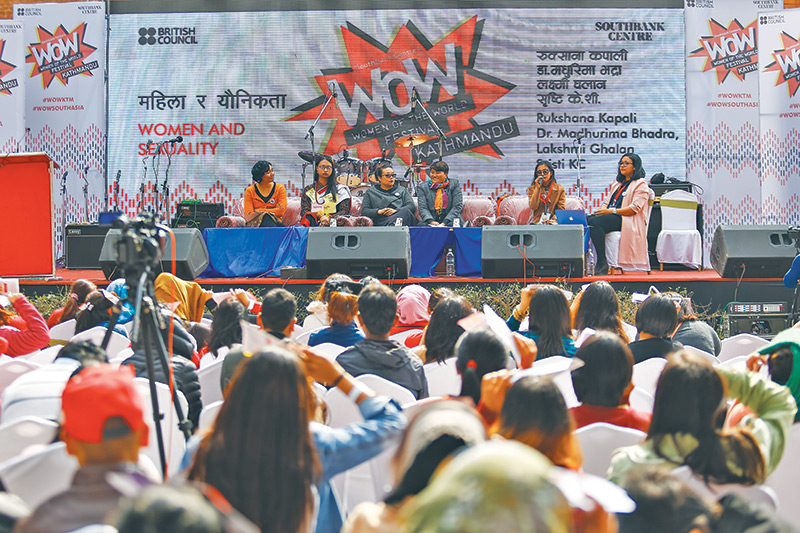
A panel on ‘Women and Sexuality’ during last year’s WOW event organised in Kathmandu. Photos courtesy: British council
Kathmandu, In a black-white photo series by Nabin Baral, a photograph shows a middle-aged woman in a dull sari violently shaking her hair; her hands are held high in the air as though she is pleading to someone. But her frantic moves tell the spectators that she is in a trance. In the picture, a child behind her is seen peering at her, while the other women in the frame have their heads down. The description reads, “Women are often made to believe ghosts and witches are the cause for their family’s bad economic conditions, illnesses or deaths.” It is a horrific rendition, and perhaps a picture that never really surfaces as much as frames of people smiling in our social media feeds. But as British Council gears for its third iteration of the Women of the World (WOW) festival, of which Baral’s photo series is also a part, it promises to discuss all kinds of women stories to understand the struggles, and celebrate the achievements, of women. The festival, which was originally founded in London by British theatre director and producer Jude Kelly, aims to celebrate the long journey of women across the world who have fought patriarchy and over the years, defined the strength of women in different settings. In an interview with ‘Showcase’, an arts and culture programme that airs on TRT World, a Turkish television channel, Kelly explained, to push the achievements of women forward and to break the patriarchal narrative of the society, it is important for women to know stories of women from different parts of the world. “The festival is not a conference or an academic gathering. It is also not for someone who fancies having a great time. It’s actually an opportunity for people to hear other people’s stories and learn from them,” she had said. “And that does require stories of women who have been single parent, have medical health problems, have dealt with the trauma of sexual harassment and sexual assault.
Following the very essence of Kelly’s vision, the British Council is taking this festival to Janakpur in Province 2 this year, with the hopes that the celebration will discuss important issues of gender diversity, social acceptance and the need of gender-sensitive policies and planning. In national statistics, Province 2 is also reported as one of the regions with the highest number of cases on violence against women, says Nhooja Tuladhar, arts officer at British Council. “We thought it would be good to focus on the Madhes belt, as it is generally overlooked and also because Janakpur, although culturally rich, is underrated,” he says. The WOW festival emulates a consistent format across all countries. It hosts workshops, panel discussions, exhibitions, speed mentoring, marketplace and bites on various issues concerning women. #WOWMadhesh will also bring forward indigenous women narratives and discussions on gender equality-related issues and development works. This year, the festival also anticipates a diverse audience, as the organisers say they have personally reached out to individuals with diverse backgrounds, instead of focusing their promotion only through social media platforms. While most art and literature festivals when hosted outside the Valley have a tendency to transport experts and content to the location, the festival has collaborated with local personalities. The festival aims to empower the cultural setting of Janakpur and has many speakers and artistes from Janakpur performing and hosting programmes at the two-day event. The second day of the event will also see a performance of Jhijhiya dance from women of the Musahar community and a staged performance retelling the journey of Goddess Sita, a highly revered deity in Hinduism. “The event is organised by a diverse group of women to close down the gender disparity that is so pervasive in our society,” says Tuladhar. “It is not just for feminists, but for everyone to understand the changing women narratives.”
The two-day festival will be held on December 6-7, at various temples in Janakpur.
CULTURE & ARTS
Commercial sharenting: Raising the digital child
A study says, 23 percent of children have their digital footprint documented in detail by their fifth birthday.
- Zofishan Umair
Dawn
Baby K made his debut when he was roughly the size of a large eggplant. At 28 weeks—two months before he’d take his first breath in the real world, a flat lay of his sonogram was posted on his mom’s instablog: a black and white visual placed alongside a letter board revealing his gender and due date. Some 17K followers were regularly updated on his journey through carefully curated photos, starting with an image of the two pink lines signalling an hCG spike. The ‘fans’ advised, pitched ideas for the birth plan and led to an exponential growth in engagement rate. Brands and small businesses began to notice and sent ‘freebies,’ baby merchandise, collaborations and reviews for the unborn star. Baby K, albeit unborn, was already insta-famous. According to an AVG study, 23 percent children such as Baby K have online births before their actual birth date. By their fifth birthday, the internet has their digital footprint documented in detail, archived in the servers of social media and cloud storage. Their preferences in food and toys cached by Google and Amazon, coupled with apps and smart devices monitoring their growth, health and mental development create a ‘digital dossier’, a term Leah Plunkett defines as the database in her book Sharenthood: Why we should think before we talk about our kids online. ‘Sharenting’, a noun added to the Collins Dictionary in 2016, is “the habitual use of social media to share news or images of one’s child”, including information parents unknowingly give away. Commercial sharenting, now a multibillion-dollar industry has resulted in advertisers like Walmart, Crayola and Disney flocking to ‘kidfluencers’ with large followings and verified profiles to endorse products. Six-year-old Ryan’s YouTube channel ‘Ryan’s Toys Reviews’ has simple videos of him unboxing and playing with toys, content that managed to rake in $11m in revenue last year according to Forbes. Taytum and Oakley Fisher, three-year-old twins with a 3.1m following, have struck insta-gold earning up to 10,000 to 20,000 dollars on a single post. While critics may disapprove of parents acting as directors, stylists and curators, and “pimping out kids”, not all parents are commercially driven. Many began with a parent just looking to share their experience on parenthood—hoping to connect, seek and support, create awareness and even find humour in toddler meltdowns. Anum, a Pakistani mom based in Canada, started her blog, ‘The Spice of Adulting’, to talk about adulting as a millennial and enjoying life after becoming a parent. “My objective was to encourage parents to enjoy life as parents,” she says. Aleyan has been my perfect partner in crime. His monthly growth progress, milestones, anecdotes and endearing versions of Aleyan can be found on the grid and my stories show that parenting can be fun.” Smarter technology makes it easier to capture and share intimate content in real time. From milestones to mundane moments, a parent’s need to share may be driven by the need for social validation, a means of reinforcing social norms and may even be a way to normalise one’s parenting experience, reaffirm identity as a parent or to keep far-off friends and family updated. A Children’s Commissioner Report published in 2018 found that parents share around 71 photos and 29 videos of their child every year on social media. A 2016 study by Nominet UK found a child would have 1,500 photos shared by their parents by their fifth birthday. Facebook seems to be the most popular application for sharing (54 percent) followed by Instagram (16 percent) and Twitter. However, 24 percent of the parents lacked information on finding and amending their privacy settings online. Over a third admitted that 50 percent of their Facebook friends are online friends they wouldn’t call a true friend or say hello to in the street. Content creators like Anam in contrast are more cautious. “A lot of my content is carefully screened and doesn’t make it to my public page.” Zara opted to share on closed Facebook groups, which are online communities that new moms flock to for advice on motherhood.After Hussain’s birth, she found herself returning to her virtual tribe for support. “I shared my birth story, sought advice on latching, circumcision and even his preschool.” Bit by bit, Zara had given away quite a bit of information on Hussain—his place of birth, favourite book, school—to a bunch of strangers, content that could allow a malicious stranger who had managed to slip past the profile screenings and was willing to dig far enough, to gain access to Hussain and earn his trust. While group admins actively moderate members and discussions, in today’s world even the most private of information can travel far and beyond the approved intended audience. But these spaces have also been crucial in starting conversations on postpartum depression, sudden infant death syndrome (SIDS), child abuse, Down Syndrome, attention deficit hyperactivity disorder (ADHD), mental health—and a parent’s personal narrative is crucial for such discussions. Hiba Masood, founder of Drama Mama, often writes about parenting but has refrained from posting their faces and names online. “It’s always been instinctive rather than deliberate. Also, it’s not relevant to the conversation I’m trying to have,” she elaborates. “Respecting their privacy and protecting their sense of agency as they grow older definitely counts but, for me personally, it’s always been a simple fact: I am not interested in putting my regular life up for display or public consumption.” Hiba opened up about her son’s autism diagnosis as she struggled with a confused, overwhelmed four-year-old trying to make sense of an uncertain world. “I was confused and unsure about what he would think of it if he came across it later,” she says. “Now I’ve made the decision to tell him when he’s older that he has something called autism. I couldn’t be prouder and happier with the person he’s become and I hope what I wrote helped other moms who were struggling with their early days. I’m okay with what I write. Everything boils down to conversation, doesn’t it? Perhaps that’s why I am okay with writing about the kids but not sharing pictures about them. One breeds conversation, the other cultivates ‘likes’,” Hiba explains. Parents also have to be cautious about other caretakers violating a child’s privacy. The Parentzone study found 33 percent parents expect others to seek permission, while 36 percent did not adopt this approach. Even schools, daycare centres and summer camps violate and share student information online. Zara informed her daughter’s school not to share images of her daughter online, and was asked to submit her request in written. “I was confused,” she says. “Why was it assumed that, by default, they had a right to share my child’s image?” Zara questions. In Pakistan, safety includes avoiding nazar (evil eye)—a key factor holding parents back from hitting ‘Publish’ along with a fear of flak and judgment on their parenting style. The real danger, however, comes from geo-tagging locations, live streaming and sharing intimate details that put a child in harm’s way. An innocent picture or a seemingly insignificant detail may be abused by hackers, paedophiles and predators lurking in the dark realms of cyberspace and result in digital kidnapping, sexual harassment, child pornography and even identity theft. Barclays recently ran a forecast that predicted that by 2030, ‘sharenting’ will account for two-thirds of identity fraud facing young people over 18 and will cost 667 million pounds per year. The psychological impact of sharenting may influence the child’s self-esteem, causing them to seek approval or validation in the form of ‘likes’ and following to define their self-worth. It exposes them to unwanted attention and may make them feel self-conscious, susceptible to cyberbullying, distort their sense of public and private and may give a sense of being monitored while taking away their right to create their own digital identity. Cloud hackers, screen captures and Google caches weaken our control on our content as well as failing to understand permissions and rights of apps. An image uploaded to Facebook or Instagram for example, legally becomes Facebook property. The crumbs of data we leave around for bots, create a digital trail or an extensive database collected over a child’s lifetime that may one day be available to his prospective partners, potential employers and insurance companies. It may impact future discrimination in health insurance, student loans and even job prospects. This data, coupled with crafty algorithms, may be used to impact not just outcomes regarding them but, in a haunting scenario, influence and control even the decisions and choices they make. China’s recent introduction of the social credit system and Cambridge Analytica’s use of data mining, data brokerage and data analysis to influence the outcome of the 2016 US presidential election, turn what sounds like a plot of the TV show Black Mirror in to a looming possibility. Parents and policymakers are still trying to navigate these unchartered waters where rules of privacy and rights are still being defined. They still debate the conflict of interest existing between parents wanting to share their narrative and children wanting to protect their privacy. Children who grew up immersed in social media are now discovering their digital identities. In a world where old tweets can resurface to cause new battles, one wrong move could harm a child’s future. And if Baby K resents any disclosures, his mother might just be the one getting served.
—Dawn
CULTURE & ARTS
Bhuwa Naach: The war dance from the Farwest
The locals in Doti district are working towards preserving the dance and rituals observed during Bhuwo Parwa, a festival they believe is centuries old.
- Mohan Shahi
Men wearing traditional costumes perform Bhuwa Naach during Bhuwo festival in Lekthanta village, Doti. Post Photos: Mohan shahi
Doti, The atmosphere of Lekthanta village in Dipayal Silgadhi Municipality in Doti district is filled with excitement. Men adorned in traditional white costumes, called ‘jhakulo’ in the native tongue, approach Kaladunga Bhagwati temple. Behind them are groups of women clad in red and young boys and girls, all dressed up for the festivities. In the temple premises, the white costumed men with swords and shields on their hands, start the procession of Bhuwa Naach, a traditional dance form. Facing the deity inside the temple, the men take choreographed steps as they wave their swords in the air. For the next few hours, the group perform various steps in order to appease the goddess. The crowd gathered around them watch in awe. “Bhuwo Parwa is native to the hilly areas of far-western in Nepal,” says Deepak Bhandari, a local of Lekthanta. “But the festivities and rituals differ from one village to another.” Tikha, Gholtada, Bagthanta, Lekthanta, Daud, Sanagaun, Kalena, Khirsain areas of Doti district celebrate Bhuwa Naach. Ward chair of Silgadhi Municipality Madan Bhandari shares that there is a general belief that if the dance does not take place, the locals will have to face negative consequences. Although the festival’s provenance is unknown, it takes place after the harvest season, the time when the villagers are free from their agricultural chores. The preparations for the processions begin a month ahead. “Bhuwa Naach is believed to be associated with war,” says historian Badri Sharma Binadi. “It is believed to be some sort of a war dance.”
Many also believe that the dance form replicates the military exercise from the time of the Baise-Chaubisey Rajya, when Nepal was divided into many princely states. Bhuwa Naach is also taken as a celebration to spread goodwill among different ethnic groups residing in the region. People from Aauji community play instruments, to which, the members of the Chettri community, clad in traditional wear, dance to the procession. “Originally 16 instruments were played for Bhuwa Naach but now we have only been using five,” says Tike Aauji, who has been part of the instrumental group for a decade. The locals, who once feared that the dance would be extinct in a few years, have now found hope, as even young boys and girls have started to take part and enjoy the festival. “Earlier, only the older people were aware of the history and culture of Doti,” says Narendra Khadka, a local from Purwa Chauki Rural Municipality. “Now, the younger generation is also interested to learn about their culture and heritage.” Apart from Bhuwa Naach, there are other rituals observed during the festival. The festivities, which can last from a week to a month, depending on different villages, ends after the wood, chopped on the first day of the festival, is burnt. During the time of the festivities, men and women play Deuda, another popular traditional dance native to the far-western region. “Some villagers have also started hiring professional Deuda dancers for the Bhuwo Parwa,” says Ramesh Bhandari, another local of Lekthanta. Lekthanta villagers have been paying up to Rs40,000 to Deuda performers from Achham. “They add a lot of colour to the festival,” says Bhandari. To ensure that the festival survives for long, the villagers of Lekthanta have also started inviting locals from nearby villages to take part in the festivities.
WORLD
Trump launches attack on ‘nasty’ France
The US president lashes out at French criticism of the alliance and on ‘delinquent’ members that don’t pay their way.
- AGENCE FRANCE-PRESSE
US President Donald Trump speaks during his meeting with Nato Secretary General Jens Stoltenberg at Winfield House, London on Tuesday. AFP/RSS
WATFORD (UK), US President Donald Trump launched a two-day NATO meeting on Tuesday with a blistering attack on France’s criticism of the alliance and on “delinquent” members that don’t pay their way. At a news conference held to celebrate NATO’s success in cajoling European allies to boost their defence spending, Trump could not resist lashing out at President Emmanuel Macron. Macron had tried to shake up the agenda for the London summit by branding the 70-year-old Western alliance “brain dead”, but Trump slapped him down and warned that he could see Paris “breaking away” from NATO. “NATO serves a great purpose,” Trump said, at a joint press appearance with alliance Secretary General Jens Stoltenberg. “I think that’s very insulting,” he said of Macron’s comment, branding it a “very, very nasty statement essentially to 28 countries. “Nobody needs NATO more than France,” he said. “It’s a very dangerous statement for them to make. Asked whether the US alliance with NATO was shaky, Trump denied it, but said: “I do see France breaking off ... I see him breaking off.” Trump defended Stoltenberg, boasting that NATO members have massively increased their defence spending thanks to his pressure -- but then reiterated his complaints about European spending. “When I came in, I was angry at NATO, and now I’ve raised 130 billion dollars,” Trump said, referring to the sum Stoltenberg says Canada and European members will have added to defence budgets by next year. “And yet you still have many delinquent -- you know I call them delinquent when they’re not paid up in full,” he said. Only nine of NATO’s 29 members spend two percent of their GDP on defence. Trump cited in particular Germany as falling short, spending only one to 1.3 percent. Leaders of the 29 allies are descending on London to lock horns over spending and how to deal with Russia in a major test of unity as NATO seeks to assert its relevance. If the Macron comments set an angry tone for the meeting, there are also expected to be clashes with Turkey’s President Recep Tayyip Erdogan, who was also furious with the French leader. “First of all, have your own brain death checked. These statements are suitable only to people like you who are in a state of brain death,” he said last week. French officials summoned the Turkish envoy in Paris to complain while a US administration official predicted that many members would tackle Turkey over its purchase of a Russian S-400 air defence system. Turkey, in turn, has warned it will block a NATO plan to defend Baltic countries unless the alliance recognises a Kurdish militant group as terrorists, Erdogan said before the summit. It was reported last week that Ankara was blocking NATO’s new Baltic defence plan, demanding greater support in its fight against the Syrian Kurdish People’s Protection Units (YPG). NATO has mooted a plan to bolster the defences of Poland, Estonia, Lithuania and Latvia against a potential attack from Russia, though details remain unclear. Macron and Erdogan will come face to face on Tuesday in a four-way meeting with Merkel and British Prime Minister Boris Johnson, whose spokesman said he would be emphasising the need for NATO unity. “We can see this as likely the tale of three egos,” said Amanda Sloat, a former senior diplomat and a fellow of the Brookings Institution, warning that Trump, Macron and Erdogan were the figures to watch.
WORLD
Spain MPs sworn in with far-right Vox as third largest party
- AGENCE FRANCE-PRESSE
Madrid, Spain’s new parliament met for its opening session Tuesday, with the far-right Vox as the third-largest party following a divisive election that failed to resolve years of political deadlock. Just over three weeks after the vote, lawmakers were on Tuesday taking the oath of office, although there was little indication of when a government would be formed. The legislature has been gridlocked since an inconclusive April election which the Socialists won but without a majority -- in an outcome repeated on November 10, leaving Pedro Sanchez a winner but weakened. And this time, Vox more than doubled its showing, snaring 52 of the parliament’s 350 seats. Just days after the election, Sanchez and the radical leftwing Podemos agreed in principle to form a coalition government in what would be the first such power-sharing deal in the country’s modern history. Such a government would only have 155 seats, leaving it dependent on support from other factions to pass an investiture vote for which it would need a minimum of 176. Sanchez’s negotiating team began talks with the Republican Left of Catalonia (ERC), a Catalan separatist party which won 13 seats in November’s election but has so far refused to offer its backing.
WORLD
2010s hottest decade in history, UN says as emissions rise again
- AGENCE FRANCE-PRESSE
Madrid, This decade is set to be the hottest in history, the United Nations said Tuesday in an annual assessment outlining the ways in which climate change is outpacing humanity’s ability to adapt to it. The World Meterological Organization said global temperatures so far this year were 1.1 degrees Celsius (two degrees Farenheit) above the pre-industrial average, putting 2019 on course to be in the top three warmest years ever recorded. Manmade emissions from burning fossil fuels, building infrastructure, growing crops and transporting goods mean 2019 is set to break the record for atmospheric carbon concentrations, locking in further warming, the WMO said. Oceans, which absorb 90 percent of the excess heat produced by greenhouse gases, are now at their highest recorded temperatures. The world’s seas are now a quarter more acidic than 150 years ago, threatening vital marine ecosystems upon which billions of people rely for food and jobs. In October, the global mean sea level reached its highest on record, fuelled by the 329 billion tonnes of ice lost from the Greenland ice sheet in 12 months. Each of the last four decades has been hotter than the last. And far from climate change being a phenomenon for future generations to confront, the effects of humanity’s insatiable, growth-at-any cost consumption means millions are already counting the damage. The report said more than 10 million people were internally displaced in the first half of 2019 -- seven million directly due to extreme weather events such as storms, flooding and drought. By the end of the year, the WMO said new displacements due to weather extremes could reach 22 million. “Once again in 2019 weather and climate related risks hit hard,” said WMO Secretary-General Petteri Taalas. “Heatwaves and floods which used to be ‘once in a century’ events are becoming more regular occurences.” At just 1C hotter than pre-industrial times, 2019 has already seen deadly heatwaves in Europe, Australia and Japan, superstorms devastate southeast Africa, and wildfires rage out of control in Australia and California. Nations are currently in crucial talks in Madrid aimed at finalising rules for the 2015 Paris climate accord, which enjoins countries to work to limit global temperature rises to “well below” 2C. The Intergovernmental Panel on Climate Change (IPCC) last year outlined how vital it was for mankind to aim for a safer cap of 1.5C -- ideally by slashing greenhouse gas emissions and retooling the global economy towards renewable energy. The UN said last week in its annual “emissions gap” assessment that the world needed to cut carbon emissions by 7.6 percent each year, every year, until 2030 to hit 1.5C.
WORLD
German spy prosecutors to take over Russian killer probe
Briefing
BERLIN: German prosecutors in charge of intelligence cases are due to take over an investigation into the killing of a former Chechen rebel commander by a Russian national in Berlin, German media reported on Tuesday. Despite Russian denials, some German politicians and media have blamed Moscow for the assassination of 40-year-old Georgian national Zelimkhan Khangoshvili in Berlin’s Kleiner Tiergarten park on August 23. Khangoshvili was shot twice in the head at close range in an execution-style killing by a man who was reportedly seen by witnesses throwing a stone-laden bag with his gun into the river. (Agencies)
WORLD
Mugabe left $10 mln, a farm and two houses
Briefing
HARARE: Zimbabwe’s late former president Robert Mugabe left US$10 million, 10 cars, a farm and two houses, details of his estate released on Tuesday revealed. The state-owned Herald newspaper said his daughter, Bona Nyepudzai Mutsahuni-Chikore, disclosed these assets to the High Court after the family had been unable to locate his will. The $10 million (nine million euros) was in a foreign currency account with a local bank, the Commercial Bank of Zimbabwe (CBZ), the report said. It did not identify the make or model of the 10 cars. During his presidency, Mugabe, who styled himself as a leftwing radical, was reported to own several farms that were seized during his controversial land reforms. (Agencies)
WORLD
Finland PM resigns
Briefing
HELSINKI: Finnish Prime Minister Antti Rinne resigned on Tuesday after losing the support of a coalition partner, casting doubt on the future of the governing alliance. The Centre Party is now considering whether to pull its support for the five-party coalition, a move that could lead to a snap election. The party was angered after the prime minister was accused of lying by the head of Finland Post -- the culmination of a long-running dispute over reforms to the pay and conditions for some postal workers. Rinne, a Social Democrat who has headed the centre-left government since June, handed his resignation to President Sauli Niinisto, the presidency said. (Agencies)
ASIA
In protest-hit Lebanon, debate tents draw in the street
- AGENCE FRANCE-PRESSE
TRIPOLI (Lebanon), A secular state, early elections, solving poverty. Every evening, Sarah al-Ghur joins other residents of Lebanon’s second city Tripoli to debate how to fix her protest-gripped country. “I’d rather take part in the discussions than applaud or shout out slogans,” says the 32-year-old in the city’s Al-Nour square. After years of disillusionment and apathy, a freefalling economy and anti-government protests have spurred Lebanese back into political debate. Across the Mediterranean country, squares where protesters have denounced mismanagement and corruption have also become centres of spontaneous discussion. In Tripoli, Ghur walks between debate tents, stopping outside one where dozens of people are discussing a “roadmap for the revolution”. Men and women of all ages sit on the floor, huddle on benches, or stand arms crossed, listening to the latest speaker. Nearby, protesters revel to the sound of patriotic tunes and techno beats. “I’ve discovered laws I knew nothing about,” says Ghur, her hair trimmed short and wearing a dress. “Now I’m more aware of my rights and my duties,” she says, in an impoverished city that has emerged at the forefront of the protests. A young protester takes the microphone to say he thinks the “popular revolution” must evolve towards “political dialogue”. He calls for “early parliamentary elections”, as a first step towards an overhaul of the political system. Every evening from 5 pm to 9 pm, Tripoli residents gather under the tents to rebuild their country one idea at a time. University professors, activists or even economists are often in attendance. They talk of secularism and sectarianism, in a country whose legacy from a devastating 1975-91 civil war is a political system that seeks to maintain a fragile balance of power between the myriad of religious communities.
ASIA
Iraq debates new PM as violence hits shrine cities
Demonstrators demanding root and branch reform have flooded the capital and the Shiite-majority south since October.
- AGENCE FRANCE-PRESSE
BAGHDAD, Iraqi politicians and their regional allies gathered in Baghdad on Tuesday to discuss a way out of two months of protests that brought down the government, as violence hit shrine cities. Demonstrators demanding root and branch reform have flooded the capital and the Shiite-majority south since October in the largest grassroots movement the country has witnessed in years. Seen as a threat to the ruling elite, the rallies were met with a heavy-handed response from security forces and armed groups that has left more than 420 people dead and nearly 20,000 wounded—the vast majority demonstrators. After a fresh uptick of violence last week, prime minister Adel Abdel Mahdi formally resigned and talks to find a replacement have intensified this week in Baghdad. Among those attending the negotiations are two key allies of Iraq’s main Shiite parties: Iranian Revolutionary Guards commander Major General Qasem Soleimani and Lebanese power broker Mohammad Kawtharany, a high-ranking political source told AFP on Tuesday. “Soleimani is in Baghdad to push for a particular candidate to succeed Abdel Mahdi,” the source said, without providing details. Kawtharany, who is Lebanese militant group Hezbollah’s pointman on Iraq, “is also playing a large role in persuading Shiite and Sunni political forces on this,” the source added. Political powers in Shiite-majority Iraq have long had close ties with counterparts in Iran and Lebanon further west, both of which have also been rocked by protests in recent weeks. The United States said Soleimani’s presence showed its arch-foe Iran was again “interfering” in Iraq, accusing Tehran of having “exploited” the neighbouring country. Protests in Iraq erupted two months ago over rampant corruption, lack of jobs and poor public services. Despite the oil wealth of OPEC’s second-biggest producer, one in five Iraqis lives in poverty and youth unemployment stands at one quarter, the World Bank says. Demonstrators say such problems require more deep-rooted solutions than the resignation of Abdel Mahdi, the first premier to step down since Iraq installed a parliamentary system after Saddam Hussein’s overthrow in 2003. The 77-year-old said it would be a “waste of time” to keep a caretaker cabinet in place, in a hint that a political deal to name a new PM was in the offing. But finding a successor appears to have stumped leading political forces, as any candidate would need the approval of divided Shiite factions, Kurdish authorities in the north and Iraq’s key allies, the US and Iran. The Kurdish regional government (KRG) was a main backer of Abdel Mahdi and is likely worried by his resignation, observers say, although it has not formally commented. Amid talks in Baghdad, the KRG would prioritise keeping a sizeable share of federal government posts and making sure any constitutional amendments do not threaten its “gains” in recent years, said analyst Adel Bakawan. It would also seek the formalisation of a deal agreed “in principle” just days before the premier’s resignation that would grant it a share of the federal budget in exchange for exporting its crude oil through the national seller. Other parties were also seeking guarantees as part of the talks on a new premier, a government source told AFP. “Political blocs want to maintain their positions,” the source said, describing discussions as “very difficult.” Government and political sources have told AFP parties are considering a six-month “transitional” cabinet to oversee electoral reform before an early parliamentary vote. A new electoral law has been a key demand of protesters and is now a centrepiece of the government’s proposed reforms, with key parliamentary blocs set to discuss it on Tuesday.
ASIA
Malaysian ex-leader Najib takes stand in 1MDB trial
- AGENCE FRANCE-PRESSE
KUALA LUMPUR, Former Malaysian prime minister Najib Razak was a “victim” of the multi-million dollar 1MDB scandal that saw state coffers drained on his watch, his lawyer said on Tuesday, as the ex-premier gave evidence in his own fraud trial. Huge sums were stolen from sovereign wealth fund 1Malaysia Development Berhad, allegedly by the ex-prime minister and his cronies, and spent on everything from high-end real estate to artwork. Najib’s coalition was ousted at the polls last year after six decades in power, largely due to public anger over the scandal. He has since been arrested and hit with dozens of charges linked to the looting of the investment vehicle. “Najib is not part of the conspiracy. He is a victim as much as others in the 1MDB scandal,” his lawyer Muhammad Shafee Adbullah told reporters. “The leader of the pack is Jho Low,” he said, referring to fugitive Malaysian financier Low Taek Jho, a member of Najib’s inner circle who allegedly masterminded the elaborate fraud that spanned from the United States to Switzerland, Dubai and Singapore. “The crux of my defence is the entire scheme is designed by Jho Low,” Shafee added. Low “portrayed himself as someone influential in the Middle East countries” Najib told the packed courtroom, speaking calmly during five hours of testimony. “I thought his influence and connections will help 1MDB achieve its goals and attract investments.” Najib, 66, went on trial in April over the controversy, in a case centred on the transfer of 42 million ringgit ($10.1 million) from former 1MDB unit SRC International into his bank accounts. The former leader arrived at the court wearing a blue suit and held a brief Muslim prayer with supporters at the building’s steps. Defence proceedings began with Najib giving testimony under oath. He will be cross-examined by prosecutors and is expected to be on the witness stand for around four days. He began his testimony reading from a 243-page statement, recalling his long career in politics and ministerial posts he held since 1978, including the post of finance minister, and giving lengthy background on the setting up of 1MDB and SRC. Defence lawyers had earlier said it would take two days for him to read the entire statement, but as his testimony went on, it appeared to take longer. He was able to read only 70 pages in his statement by the end of the day.
ASIA
China outclasses West in key education survey
- AGENCE FRANCE-PRESSE
Students from Beijing, Shanghai, Jiangsu and Zhejiang topped in reading, mathematics and science. Shutterstock
PARIS, Teenagers from four big Chinese regions outshone Western contemporaries nations in a keenly watched survey of education capabilities published Tuesday, which also showed no improvement trend in developed countries over two decades. The PISA survey is carried out every three years by the Paris-based Organisation for Economic Cooperation and Development (OECD), this time among its 37 member states and 42 partner countries and economies. The latest study, which was conducted last year among 600,000 15-year-old students who all took two-hour tests, showed that students in four Chinese regions of Beijing, Shanghai, Jiangsu and Zhejiang—as well as Singapore—topped the rankings, ahead of their Western counterparts in reading, mathematics and science. In reading, which the OECD considers its headline indicator of education potential, the best performing OECD state was the tiny Baltic nation of Estonia, followed by Canada, Finland and Ireland. Angel Gurria, the OECD’s secretary-general, said the students from the four Chinese provinces had “outperformed by a large margin their peers from all of the other 78 participating education systems”. Moreover, the 10 percent most socio-economically disadvantaged students in these four areas “also showed better reading skills than those of the average student in OECD countries, as well as skills similar to the 10 percent most advantaged students in some of these countries.” He cautioned that these four provinces and municipalities in eastern China “are far from representing China as a whole.” Yet their combined populations amount to over 180 million people, and the size of each region is equivalent to a typical OECD country. “What makes their achievement even more remarkable is that the level of income of these four Chinese regions is well below the OECD average,” Gurria said in a preface to the study. “The quality of their schools today will feed into the strength of their economies tomorrow.” But Gurria also sounded a word of caution over the Chinese system, indicating that more care needed to be taken with regards to students’ well-being. “When it comes to those social and emotional outcomes, the top-performing Chinese provinces/municipalities are among the education systems with most room for improvement,” he said. Looking at the results of the developed OECD countries, he said it was “disappointing” that most member states had seen “virtually no improvement in the performance of their students” since the first PISA survey of 2000. This outcome came despite expenditure per primary and secondary student rising by more than 15 percent across OECD countries over the past decade. The survey said among OECD countries, the mean performances in reading, mathematics and science remained stable from the previous survey, in 2015, though some countries outside the group had shown large differences in performance. Albania, Estonia, the Chinese region of Macao, Peru and Poland saw improvements in two subjects over the last two decades. The OECD praised Brazil, Indonesia, Mexico, Turkey and Uruguay for enrolling many more 15-year-olds in secondary education “without sacrificing the quality of the education provided”. Gurria also sounded a warning over how ready students were to deal with the challenges of modern world, where it is important not just to read but to sort good information from bad. “Fewer than 1 in 10 students in OECD countries was able to distinguish between fact and opinion, based on implicit cues pertaining to the content or source of the information,” he said. Gurria said that while some countries had shown that socio-economic status should not be an indicator of educational performance, “it remains necessary for many countries to promote equity with much greater urgency.” “Against this background, it is disappointing that in many countries a student’s or school’s post code remains the strongest predictor of their achievement,” he said.
ASIA
Taiwan charges ex-officer, father with spying for China
Briefing
TAIPEI: Taiwanese prosecutors on Tuesday charged a former lieutenant colonel and his father with spying for China in the latest allegations of espionage on the island. The men are accused of threatening national security by sharing information and recruiting others in exchange for gifts, the Tainan district prosecutor’s office said. The younger man, identified by local media as Cheng Chih-wen, helped recruit Taiwanese soldiers “to develop networks to seriously affect national security and damage military discipline”, prosecutors said in a statement. His father Cheng Chao-ming, who heads a small party, introduced his son to Chinese agents in Japan in 2009 while he was still in service, prosecutors said. (Agencies)
ASIA
North Korea’s Kim opens huge mountain development
Briefing
SEOUL: North Korean leader Kim Jong Un has opened a flagship construction project close to Mount Paektu, a symbol of the Korean nation and officially the birthplace of his father and predecessor, state media reported on Tuesday. The ceremony was held in snowy scenes before thousands of soldiers and civilians, and portrayed as a demonstration of the resilience of the North, which is subject to international sanctions imposed over its nuclear weapons and ballistic missile programmes. It comes with time running out on Pyongyang’s demand for the US to offer it fresh concessions by the end of the year, and ahead of Kim’s New Year speech on January 1, a key political set-piece in the isolated country. (Agencies)
ASIA
Swiss summon Sri Lankan envoy over staffer’s abduction
Briefing
GENEVA: Switzerland has summoned Sri Lanka’s ambassador and asked to see the “purported evidence” that Colombo says casts doubt on claims by a Swiss embassy staff member that she was abducted. Karunasena Hettiarachchi, who is based in Berlin, met with Switzerland’s State Secretary Pascale Baeriswyl in Bern on Monday. The diplomat flap began after a top Sri Lanka police officer sought asylum in Switzerland. The next day a local staffer at the Swiss embassy in Colombo claimed she was abducted and forced to hand over sensitive information. According to the Swiss foreign ministry, the woman was “threatened by unidentified men” and forced “to disclose embassy-related information”. (Agencies)
MONEY
India weighs tougher rules for Boeing 737 MAX on return to flying
The 737 MAX, the fastest-selling plane in the history of Boeing, has been grounded worldwide since March.
- REUTERS
Grounded Boeing 737 MAX aircraft are seen parked in an aerial photo at Boeing Field in Seattle, Washington, US. reuters
MUMBAI, India is considering setting an experience threshold for pilots who fly Boeing’s 737 MAX planes, as it moves to ensure safety once the aircraft returns to service, a senior official of the air safety regulator told Reuters. The 737 MAX, the fastest-selling plane in the history of Boeing, has been grounded worldwide since March, after 346 people were killed in two crashes in five months. Boeing is making software changes, readying a new pilot training plan and must run a key certification test flight to get approval from the US regulator, the Federal Aviation Administration (FAA), before the planes can resume flying. India’s Directorate General of Civil Aviation (DGCA) may consider mandating a minimum number of flying hours for pilots of the 737 MAX, the source said, adding a decision would be made once it is clear when the planes are fit to return to the air. “Pilot training is a serious matter for the DGCA and the airlines will also need to work on building pilot confidence,” said the source, who sought anonymity, as the discussions were private. The regulator will also make it mandatory for Boeing to set up simulators in India and for airlines to carry out comprehensive pilot training before it allows the planes to start flying, the source added. Reuters could not immediately reach the DGCA to seek comment. In a statement, Boeing said it was working closely with global regulators on a training programme to help enhance pilots’ understanding of the updated 737 MAX flight control systems. “Boeing will continue its commitment to developing training that supports safe, efficient operations and meets regulatory requirements,” it said in the emailed statement. India’s DGCA is one of several regulators that have indicated they will perform independent inspections of the grounded planes once the US FAA clears them to fly. Indian carrier SpiceJet has about a dozen Boeing 737 MAX planes in its fleet and 155 on order - among the largest single orders for the narrow-body plane. Boeing had delivered close to 400 of the 737 MAX globally before the March grounding, and it has nearly 5,000 orders for the aircraft, a more fuel-efficient version of its best-selling single-aisle 737 series.
MONEY
Chile unveils $5.5 billion stimulus plan
- AGENCE FRANCE-PRESSE
SANTIAGO, Chile launched a massive $5.5 billion stimulus package after data showed its economy contracted 3.4 percent in October—the largest year-on-year drop in a decade—as widespread social unrest continues. The package unveiled by Finance Minister Ignacio Briones on Monday includes boosting 2020 public spending by $3.03 billion, to support small, medium and large businesses. Another $525 million are earmarked for other initiatives like the renovation of the metro system in Santiago, which has sustained serious damage since protests erupted on October 18. “Estimates show that this agenda will generate 100,000 new jobs next year,” Briones said. But the measures will mean a real increase in public spending next year of 9.8 percent as compared to 2019, pushing the fiscal deficit up to 4.4 percent of gross domestic product. “Like any Chilean household that faces unforeseen trouble, we will turn to our savings and our borrowing capacity, while remaining aware that both have limits that cannot be exceeded,” Briones said. The government announced the stimulus measures after the central bank reported the worrisome GDP figures for October. The 3.4 percent drop was far greater than the one percent decrease anticipated in official estimates, and represented the economy’s worst performance since 2009 at the height of the global economic crisis. “Economic activity during the month was affected by the drop in services, commerce and manufacturing,” the central bank said. Mining activity—Chile accounts for nearly a third of the world’s copper production—grew by two percent, but non-mining sectors contracted by four percent, the bank said. The government’s plan “loses meaning if we do not manage to isolate the vandals, looters, narcos and all those who threaten our democracy,” said interior minister Gonzalo Blumel. Protests broke out across the country Monday night, the 46th consecutive day of demonstrations. In Santiago, protesters gathered in the Plaza Italia, a main hub for the city’s rallies, and dozens of young people broke into different metro stations. A 12-year-old boy was arrested during a demonstration in the southern city of Concepcion for stealing glasses from an optician, police told local media. He was placed in the custody of an adult since he was too young to be charged, they said. Protests initially erupted in mid-October over metro fare hikes but quickly escalated into the most severe outbreak of social unrest since the end of the dictatorship of Augusto Pinochet in 1990. Furious Chileans have taken to the streets to protest social and economic inequality. Businesses have remained closed during the period of unrest, public transport came to a halt, and many people worked shorter days. At least 23 people have been killed, including five at the hands of security forces, and more than 2,000 were wounded.
MONEY
Kenya forcing importers to use costly new Chinese railway, businessmen say
- REUTERS
A cargo train transferring containers leaves the port of Mombasa, Kenya. reuters
MOMBASA (Kenya), Kenya’s new Chinese-built railway should have been a boon for business. The $3.3 billion line sliced hours off the journey from the port city of Mombasa to the capital, Nairobi. But some importers said their transport costs shot up by nearly 50 percent when they used the rail due to extra fees, more time spent clearing goods at the congested Nairobi train depot and the need to send a truck to collect the goods from there. These importers used to truck their goods in from the coast. But port authorities now say businesses based in Nairobi and upcountry must use the new line because the Mombasa port is contracted to supply it with a minimum amount of cargo. “KPA has an obligation to feed the railway ... we were the guarantors of the rail,” said Daniel Manduku, head of the state-run Kenya Ports Authority. The railway’s problems are a cautionary tale, both for developing nations loading themselves with Chinese debt, and for China as it seeks to expand global trade links and project soft power through its massive Belt and Road initiative. “The vast majority of its (China’s) overseas spending has no detectable effect on economic growth,” said Bradley Sparks, executive director of AidData, a research facility that tracks development finance at William and Mary University in Virginia. China has sought to allay fears that its infrastructure projects overload some countries with debt. Last year, it agreed to restructure more than $12 billion in repayments owed by Ethiopia, whose Chinese-funded railway is also struggling. Now some Kenyan politicians are asking whether their railway was worth the cost. Hundreds of people—residents, business owners and local leaders—hold weekly demonstrations in Mombasa against the mandatory movement of cargo by rail. “This is a revolution,” lawmaker Mohammed Ali said earlier this month as demonstrators carried a mock coffin branded “RIP China Colonisation” in blood-red letters. The contract between China’s Exim Bank, the Kenya Ports Authority (KPA) and Kenya Railways requires KPA to provide 1 million tonnes of cargo to the railway per year, rising to 6 million by 2024. KPA says rail cargo is expected to hit 5 million tonnes this year, after more than 4 million last year. Mombasa is projected to handle 34 million tonnes of cargo this year; most does not go by rail. Cargo destined for Mombasa, or countries other than Kenya, can still go by road. But Kenyan importers in and around Nairobi say they have been forced to use the line since October last year. The port confirmed the policy in August, but rescinded the order in October after protests. Businesses say little has changed and they are still required to use the more expensive railway. Port authorities are diverting shipments to the new railway, said a Nairobi-based customs clearance agent. “You are made to pay for it whether you like it or not.” Moving a 40-foot container to Nairobi by rail costs 80,000 shillings ($800)—roughly the same as a truck, said Mercy Ireri, chief operations officer for the Kenya Transporters Association. But importers must also pay at least 25,000 shillings for a truck to collect the goods from the Nairobi depot and 15,000 shillings in depot fees, said three businessmen who asked not to be named. Manduku, also a board member of Kenya Railways, said the higher charges are necessary to meet loan repayments. Kenya owes Exim Bank of China 660 billion shillings for the railway and other projects, about a tenth of its total national debt. The bank did not immediately respond to a request for comment.
MONEY
Nepal Airlines eyes Tokyo after Osaka debacle
The state-owned carrier plans to operate three weekly flights to the Japanese capital from January.
- SANGAM PRASAIN
The national flag carrier hopes to start flying to the Japanese capital at the beginning of next year. rss
KATHMANDU, Nepal Airlines will be switching to Narita International Airport in Tokyo in a bid to keep its Japan service alive after a disastrous launch to Osaka’s Kansai International Airport. The national flag carrier hopes to start flying to the Japanese capital at the beginning of next year. But this time too it has no proper marketing plan which resulted in rows of empty seats on its Osaka flights. Nepal Airlines began its Kathmandu-Osaka service on August 29 with an upbeat outlook, but disappointment set in with passenger occupancy remaining below 30 percent on all its flights in September. Sulekh Mishra, deputy spokesperson for the state-owned airline, told the Post that they had signed a ground handling agreement for Narita, allowing them to launch flights to Tokyo which has a large Nepali community. The carrier plans to operate at least three weekly flights. “We are preparing to operate flights to Narita by mid-January,” he said, adding that refueling and slot agreements at the airport had already been signed. Mishra said that the airline management had not reached any decision on the fate of its Osaka service. At least three airline officials with whom the Post talked said that the Osaka flight would be discontinued from February for lack of aircraft. The national flag carrier is also preparing to launch flights to Guangzhou’s Baiyun International Airport in China by February. One official said foreign tourists would have a hard time after the Osaka service is stopped in February because they plan their trips and book flights five to six months in advance. “Tourists from Japan are confused because the Osaka flight was opened for a temporary period from August till February; and even if a service to Tokyo has been planned, advance booking is not available yet. The airline has not learnt from its mistakes. Its marketing and promotional activities are still bad,” the official said. Nepal Airlines offered one-way flights to Osaka at a throwaway price of Rs36,000, which was 25-30 percent cheaper than the going rate. But even that failed to attract passengers. Officials at that time had admitted that Nepal Airlines’ reputation for inefficiency, a decades-long hallmark of the flag carrier, was behind the lacklustre sales. The start of the festive season in October had brought cheer to the airline with Nepalis rushing home for the holidays. The flights in October and November were booked over 80 percent, and some flights were even sold out. But demand slackened from the third week of November. The official said that high occupancy from October to November did not offset the corporation’s losses, and that it had not even reached the break-even point due to low pricing during the peak season. One high-ranking official at the airline said its Osaka flights were currently 50 percent filled, and that it may come down gradually during the December off season. “Beginning January, Japanese travellers will leave for the New Year holidays. Besides, many Japanese travel overseas between March and August, and they have booked their trips in advance. Nepal Airlines will not be able to cash in on the travel demand from Japan.” The 2020 Summer Olympics are being held in Tokyo from July 24 to August 9, and the games could create travel demand from Nepal too. Nepal Airlines made its Japan debut in 1994, flying to Osaka via Shanghai, China. In 2007, it was forced to suspend the route as it did not have enough planes. The carrier expects the resumption of its Japan service to help improve its financial health. Nepal Airlines has found itself in the midst of a financial crunch as it has not been able to fly its newly acquired Airbus A330 jets on profitable long routes like Japan and Europe.
MONEY
China to target quarter of vehicle sales to be electric by 2025
- AGENCE FRANCE-PRESSE
BEIJING, China should adopt a plan that will see electric vehicles make up a quarter of all autos sold in the country in six years’ time, the industry ministry said Tuesday, as the sector struggles with falling sales. A draft blueprint for the development of the “new energy vehicle” sector—which includes hybrids and fully-electric vehicles—comes after the government withdrew subsidies for carmakers earlier this year. China is the world’s largest new energy vehicle market, but sales of electric motors plummeted 34 percent on-year in September, according to the China Association of Automobile Manufacturers (CAAM). The Ministry of Industry and Information Technology’s draft proposal said China should seek to ensure one in four of all vehicles sold in 2025 were either hybrids or fully-electric vehicles. The measures are partly to ensure the country meets its air pollution targets, and to reduce Beijing’s dependence on imported oil. China would also continue to develop electric vehicle battery technologies, improve infrastructure for hydrogen fuel cell vehicles and driverless cars, it said. The draft proposal, which includes guidelines for the development of the new energy vehicle sector from 2021 to 2035, is open for public feedback until December 9. A previous state target set in 2017 had called for 20 percent of cars sold to be electric vehicles by 2020, but the draft released Tuesday gave no indication whether China was on track to meet that goal. Fuelled by rising incomes and government sales incentives, China is the golden goose upon which the global automotive industry has staked its future.
MONEY
Quality of mobile video experience in Nepal still way down
Nepal ranks 86th among 100 countries for mobile video quality in Opensignal report.
- KRISHANA PRASAIN
KATHMANDU, The quality of mobile video experience in Nepal is still somewhere at the bottom, according to the latest report by Opensignal which gave a rank of 86 among 100 countries. Mobile service providers have been expanding 4G services across Nepal, but the quality of video received on cell phones has not improved much in the past year, said Opensignal, an independent global standard for analysing consumer mobile experience. According to the report, Nepal’s quality of mobile video experience received a score of 43.3 percent this year, remaining unchanged compared to last year. Experts said lack of infrastructure was the major reason for the country’s not being able to provide better quality mobile video. The Nepal Telecommunications Authority said in its latest management information system report (July 17-August 17) that 52 percent of Nepalis had access to mobile broadband. The number of 3G and 4G users has also increased within a year. There were 11 million 3G users in Nepal, up from 9 million. The number of 4G users has also increased to 4 million from 1 million. This implies that the number of video engagements has also been swelling with many people using TikTok, YouTube and Facebook video streaming sites. Ananda Raj Khanal, senior director of the Nepal Telecommunications Authority, said that bandwidth and network coverage problems were the major reasons why network operators were not able to provide good quality video as expected. Lack of bandwidth impacts video quality, and to increase bandwidth, infrastructure needs to be built, he said. Equipment, network planning and technology are necessary to provide quality service to users. Krishna Prasad Bhandari, deputy manager and spokesperson for state-owned Nepal Telecom, said that the company had used advanced Long-Term Evolution (LTE) system in its recent 4G expansion programme in order to provide quality video experience. “We have been adopting updated technology which will provide better services,” he said. It will help to provide improved quality video experience. India made a significant growth in the quality of mobile video experience, jumping from 13.3 percent to 51.2 percent this year, the Opensignal report said. It predicted that if the country continued this rate of change, users across India would move into the good category in 2020. Bikram Shrestha, past president of the Nepal Internet Society, said that the quality of 3G and 4G in the country was just at the acceptable level. A fast increasing number of users and limited infrastructure is the reason for Nepal’s not being able to improve quality video service. Private operator Ncell said it would need more spectrum to deliver higher quality video at a lower cost. “As market leader, we have less than a fraction of the spectrum that is required by any market leader in the world to achieve this,” the company said. “We have not made significant progress in providing high quality video experience, and more importantly, at a lower price due to spectrum limitations.” According to the Opensignal report, Norway, Czech Republic, Austria, Denmark, Hungary and the Netherlands are excellent countries in terms of providing quality video experience. The company prepared the report by measuring real-world video streams and using an ITU-based approach for determining video quality. The metric calculation took picture quality, video loading time and stall rate into account. Opensignal used 37,671,772 devices during the survey conducted from August 1 to October 30. Viewing smartphone video has become extremely important to consumers in 2019, the report said. New video apps continue to launch on mobile first—most recently TikTok—while video has become a part of the fabric of social networks that started out distributing just text and photos, it stated. Full-screen mobile video ads have been creating vital revenues that support many free apps, the Opensignal report said. The Internet Advertising Bureau has quantified the scale of mobile video advertising saying 62 percent of total video ad starts were happening on mobile, it said. Opensignal has categorised 0-40 points as poor, 40-55 points as fair, 55-65 points as good, 65-75 points as very good, and 75-100 points as excellent. It measures the average video experience of Opensignal users on 3G and 4G networks.
MONEY
Hyatt Regency recognised as Nepal’s leading hotel
Briefing
Hyatt Regency Kathmandu has been recognised as Nepal’s leading hotel during the 26th World Travel Award event held in Vietnam. This is the fourth consecutive win after having won it in 2016, 2017, 2018. It also won in 2008, 2009, 2011 and 2013, states the press release. The hotel is strategically situated near the airport and in walking distance to the UNESCO World Heritage site, Boudhanath Stupa. Rajesh Ramdas, general manager said “An accolade such as this is reflective of the commitment of our associates who work relentlessly to meet our guests’ expectation to deliver the Hyatt service standard. Having served guests since for nearly 20 years, this recognition continues to validate the commitment of our company by prioritising guest satisfaction.”
MONEY
Skal Nepal, Nepal Tourism Board organising car rally
Briefing
KATHMANDU: Skal Nepal and Nepal Tourism Board is jointly organising a car rally from 6 to 8 December. The rally will cover three most loved destinations: Kathmandu, Chitwan and Pokhara, also known as ‘Golden Triangles domestic tourism’, states the press statement. En-route, Skal Nepal members will also meet with local tourism entrepreneurs for an interaction and experience sharing. The event is part of Skal International featuring Nepal as ‘Destination of the year 2020’. In its official website, Nepal is marked as the most sought-after destination and highlights the best travel experience we offer to our global visitors. The association has over 15,000 global tourism professionals as members.
SPORTS
Nepali women spikers bow out with their heads held high
The home team fought back from a set down to a 2-1 lead, but had to settle for silver as India defended the title by winning the next two sets.
- Prarambha Dahal
Nepal women’s volleyball team with their silver medals at the Dashrath Stadium covered hall in Tripureshwor, Kathmandu, on Tuesday. Post Photo: Keshav thapa
Kathmandu, Nepali women’s volleyball team gave a scare to the defending champions India at the South Asian Games but had to be content with a silver medal. In the final held at the Dashrath Stadium covered hall on Tuesday, the home team showed a lot of promise, bouncing back from a set down to a 2-1 lead before losing 25-17, 23-25, 21-25, 25-20, 15-6 in a painful manner. “We are disappointed to have lost the match from a strong position,” Nepal head coach Jagadish Bhatta said after the match. “But based on the preparations and the support we have received from everyone, we have to be content with the way we have performed throughout the tournament.” It was the by far the best showing by Nepali women’s volleyball team at the South Asian Games. Having defeated Sri Lanka in straight sets in the semifinals, Nepal won a set against India for the first time. They followed that up by winning two more sets against the South Asian powerhouse in the final. It was Nepali women’s first appearance in the South Asian Games volleyball final and a well-deserved silver medal for their efforts at the regional sporting spectacle. They had earlier won bronze medals in 1999, 2006 and 2016. “This is an unforgettable moment for us. We were so close to the gold medal,” said Bhatta while blaming Nepal’s luck which deserted them in the match. Shouldering the responsibility for the defeat, he offered his apologies to the crowd who turned out in big numbers in the final. “I’m sorry for the loss. We made mistakes. But as always, we move ahead by making amends, that is how a team grows,” he said. “These are good signs for Nepali women’s volleyball. If the state increases its investment in volleyball and other sports, the quality will certainly improve.” Having lost the first set 25-17, Nepal made a strong comeback in the next set as they won 25-23. Like in the first set against India in the league stage match, Nepal were 24-22 ahead. However, unlike in the league match where they had wasted two set points, Nepali women spikers held their nerves to avoid a similar sour fate. Giving continuity to their momentum, Nepal did not look back from 17-17 to win the third set 25-21. In the fourth set, Nepal were only two points behind at 17-19 but a few errors saw India open up a four-point lead. The home team, which looked physically and psychologically drained, and India won the set 20-25 to get back in the game. “After India made a comeback, the girls got a bit nervous. But this experience has taught them a lesson that will help them improve in the future,” said Bhatta, putting a brave face. The decisive set began poorly for Nepal as they fell 3-0 down. Service errors further their misery for the home team as they trail 10-5. India, who looked calm and composed, silenced the home crowd to take the set 15-6 and the gold. A teary-eyed Nepal captain Aruna Shahi said, “Minor errors cost us a gold medal. But, we’ve got to be happy for the way we played, especially today. “There is room for improvement,” said Shahi, who took the team’s reins just before the Games. “Our team is very good, but we have to have regular training. There shouldn’t be long gaps between tournaments.” India’s head coach Bal Chandaran was relieved to have overcome a spirited Nepali side rooted to the hilt by partisan home crowd. “With such an involved and intense crowd support, Nepal were outstanding,” he said. “Despite making some unforced errors in the second and third sets, we got back together and reduced mistakes. It boosted our confidence in the fourth and fifth sets.” India captain Nirmal Tanwar, who braved dengue infection to play in the final, acknowledged Nepal’s improvement, “It was a very good performance from Nepali girls. They gave us a tough time in both the meetings during these Games. I’m sure they will get better when we face each other in the future.”
SPORTS
Nepal kick off women’s football with a win
- DEEPAK PARIYAR
Saru Limbu. photo courtesy: Anfa
POKHARA, Saru Limbu, who entered the field as a substitute, scored the only goal of the match as Nepal brushed aside Sri Lanka in their opening match of the women’s football tournament under the Games at the Pokhara Stadium on Tuesday. Limbu found the back of the net in the 88th minute to ensure a win for the hosts. Nepal had secured a 4-0 win against Sri Lanka at the 12th edition of the Games. The hosts will now play against the Maldives on Thursday before they clash against India on Saturday. In another match played on Tuesday, India humbled the Maldives 5-0. Bangladesh beat Sri Lanka by seven wickets Bangladesh beat Sri Lanka by seven wickets in the women’s Twenty20 cricket tournament under the 13th South Asian Games in Pokhara Stadium on Tuesday. Put to bat first, Sri Lanka scored 122-6 on the back of Umasha Thimeshani, who contributed 56 runs off 49 balls. She hit four sixes and five fours. Skipper Harshitha Madavi remained unbeaten on 33 runs. Bangladesh’s Nahida Akhtar pocketed four wickets and Jahanara Alam pocketed one. In reply, Bangladesh chased the target in 18.2 overs losing three wickets. Sanjida Islam was unbeaten on 51 runs while Ayasha Rahman contributed 29 runs. Bangladesh player Sanjida was declared player-of-the-match. Sri Lanka’s Nisan Sala Shachini and Shehani Tharuka claimed a wicket each. Nepal will play against Bangladesh while Sri Lanka take on the Maldives on Wednesday.
SPORTS
Manchester United manager Solskjaer does not fear losing his job
- AGENCE FRANCE-PRESSE
Ole Gunnar Solskjaer. REUTERS
MANCHESTER, Ole Gunnar Solskjaer says he does not fear for his future as Manchester United manager despite a spate of Premier League sackings as he prepares to face his predecessor Jose Mourinho. Spurs turned to Mourinho after dismissing Mauricio Pochettino last month, while Arsenal and Watford have subsequently sacked Unai Emery and Quique Sanchez Flores. Solskjaer is under increasing pressure, with United ninth in the Premier League, 22 points behind leaders Liverpool and eight off a top-four spot as they prepare for Wednesday’s match against Tottenham. “No, it doesn’t make me more concerned,” Solskjaer said at his pre-match press conference on Tuesday. “I’m just focusing on my job and that’s just doing as well as I can, and look forward to the next game, and look long-term, plan things with board. It’s that time of year. It’s never nice to see your colleagues lose your jobs — three in a very short space of time. It’s a game of margins,” he added. “Sometimes you have luck, sometimes you don’t, but it doesn’t make me any more concerned that it’s December. “I’m good, absolutely no problem. Sometimes you laugh when you read stories about what I’ve said and stuff, at least I know the sources are just made up, blatant lies.” The United boss bemoaned his team’s failure to turn draws into wins, saying they were not getting the results their football deserved. The club are winless in three games and Solskjaer’s job will not get any easier with a derby against Manchester City on Saturday to follow the game against Mourinho’s Spurs side. The Norwegian, though, dismissed any need for crisis talks with the United board. “Three days or four days are not going to change a whole lot, but these two games are great chances for us to prove things and prove to ourselves that we can continue in the vein we have had against some of the better sides,” he said. Solskjaer expects Mourinho to receive a warm welcome when he returns to Old Trafford a year after being sacked, having won the League Cup and Europa League during his time in charge. “We know we have to improve, we are working hard to do that right and when you change a manager halfway through the season isn’t where it is supposed to be,” said the Norwegian. “I don’t think whoever the manager of the opposition team is will change their motivation,” he said. “They are motivated to do well for Man Utd, because they know it’s about improving every day in training and every time you step on that pitch it’s a chance to prove you can be part of this long term. That has always been the case at Man Utd.” United will still be without the injured Paul Pogba but Scott McTominay and Nemanja Matic will be assessed as Solskjaer looks at his midfield options.
SPORTS
Messi wins sixth Ballon d’Or as Rapinoe takes women’s prize
The record six-time winner Argentine star hopes to carry on unaffected by age.
- AGENCE FRANCE-PRESSE
Barcelona’s Lionel Messi with his six Ballon d’Or trophies at the Theatre du Chatelet in Paris on Monday. reuters
PARIS, Lionel Messi said he hoped to carry on undimmed by age after claiming a record sixth men’s Ballon d’Or award at the age of 32 in Paris on Monday, while USA World Cup superstar Megan Rapinoe took the women’s prize. Rapinoe was not at the Chatelet Theatre in the French capital, unable to make the trip back to the country where she led the USA to victory in July. However, Messi was there with his wife, Antonella Roccuzzo, and two of their children. It is Messi’s first Ballon d’Or since 2015 and his sixth overall as he moves one ahead of old rival Cristiano Ronaldo. “It is 10 years since I won my first Ballon d’Or here in Paris and I remember coming here with my three brothers, I was 22 and it was all unthinkable for me what I was going through,” Messi said on stage after receiving the award from last year’s winner Luka Modric. “I hope I have several years left to keep enjoying my football. I am aware of the age I have and these moments are all the more enjoyable because the moment when I have to retire is getting closer and that is difficult. All going well I’ll have several years left but at the moment time seems to be flying and everything is happening very quickly. I hope to keep enjoying my football, my family, facing my rivals and all of this life that I have.” The Barcelona number 10 won this year’s prize — organised by France Football magazine and voted for by a panel of journalists from around the world — ahead of Liverpool defender Virgil van Dijk, with Ronaldo third. It is the first time since 2010 that Ronaldo has failed to rank in the top two. Having starred in the Liverpool team that won the Champions League, Van Dijk finished second to Messi just as he did in the voting for FIFA’s equivalent prize, The Best, in September. “Unfortunately there are a couple of players like him who are a bit unnatural. Six times Ballon d’Or — you need to respect greatness as well,” said Van Dijk. Van Dijk was one of four Liverpool players in the top 10, with Sadio Mane fourth, Mohamed Salah fifth and goalkeeper Alisson seventh. The latter won a new prize for the goalkeeper of the year, named after former USSR icon Lev Yashin. Messi has scored 46 goals in 54 matches so far in 2019, and netted 36 times in total in 34 La Liga matches last season as Barcelona won the title. He did not enjoy a successful Copa America with Argentina but was also the top scorer in last season’s Champions League with 12 goals. As if any reminder of his brilliance were required, on Sunday he scored a wonderful late winner for Barcelona against Atletico Madrid. This is just the second year that a women’s Ballon d’Or — voted for by 48 journalists — has been awarded, with Rapinoe succeeding Norway’s Ada Hegerberg. Rapinoe was the star of the Women’s World Cup on, and off, the field, winning the Golden Boot for top scorer, with six goals, and Golden Ball for best player. She scored the opening goal as the USA beat the Netherlands 2-0 in the final. But the 34-year-old feminist icon made headlines with her outspoken criticism of US President Donald Trump during the tournament and has led calls for her team to be paid the same as their male counterparts. “It’s been an incredible year,” said Rapinoe in a recorded video message. “I want to say a huge thank you to my team-mates, the coaches, the US Soccer Federation, for all of the support to allow me to be who I am and do what I do on the field but also be the person who I am off the field.” Rapinoe was one of four members of the US side that lifted the World Cup to be nominated for the prize, along with Tobin Heath, Rose Lavelle and Alex Morgan, who finished third on Monday. England’s Lucy Bronze came second. Dutch defender Matthijs de Ligt, the ex-Ajax star now at Juventus, succeeded Kylian Mbappe as the winner of the Kopa Trophy for the best player aged under 21.
SPORTS
Nepal launch title defence with 4-0 win over Bhutan
Captain Sujal Shrestha leads by example with a brace. The home team take on Sri Lanka today.
- Prarambha Dahal
Nepal’s skipper Sujal Shrestha (centre) celebrates with his teammates after scoring a goal against Bhutan during their South Asian Games football match at the Dashrath Stadium on Tuesday. POST PHOTO: KESHAV THAPA
Kathmandu, Defending champions Nepal began their South Asian Games football campaign with a comfortable 4-0 win over Bhutan in front of the cheering home crowd at the Dashrath Stadium on Tuesday. Captain Sujal Shrestha completed a brace scoring on either side of half time and Nepal added two goals through Abhishek Rijal and Mikchen Tamang in the second half to finish on top of the team standings. Nepal and Bhutan each have three points, but the hosts lead the table on goal difference. The top two sides from the five-team competition will play the final. Bangladesh, the Maldives, and Sri Lanka are other teams in the fray. Nepal, playing at the stadium after more than four years, made it all the more memorable with an impressive win. “Today was a happy day for all the ardent football followers in Nepal, as we got to witness Nepal in action at the Dashrath Stadium after a long gap,” Nepal head coach Bal Gopal Maharjan said after the match. “The efforts of the past four months have started to pay off,” Maharjan said on Nepal’s performance against Bhutan. But he is careful to keep the team’s feet firmly on the ground. “We’ve got a long way to go in the tournament, as all the opponents are strong. We cannot underestimate anyone.” After an impressive interplay, Shrestha ahead put Nepal ahead in the fifth minute, putting away from inside the box. Bhutan, who pulled off a stunning 1-0 win over Bangladesh on Monday, responded to the deficit pressing themselves upon Nepali defence. They were duly awarded a free-kick just outside the area three minutes later. But a cheeky attempt from Dawa Tshering was off target. Nepal maintained better possession and put pressure back on Bhutan. Bikash Khawas went close to scoring in the 27th minute only to see his long cross almost from the halfway line ricocheted off the bar. Nepal won two more free-kicks in the span of two minutes with 13 minutes before half time. But the hosts failed to produce anything out of them. Nepal continued their pressing game when the match resumed. And Shrestha completed a brace in the 50th minute. Ananta Tamang whipped in a cross into the box from the left and the captain chipped the ball past goalkeeper Gyeltshen Zangpo to put Nepal 2-0 up. Nepal’s short one-two passes unlocked Bhutanese defence in the 66th minute as Abhishek Rijal met another superb Ananta cross with a superb header to extend the lead to 3-0. In the 77th minute, Mikchen Tamang virtually secured Nepal’s victory as he whipped a left-footed shot into the back of the net from a freekick 25 yards out. Having led the team by example, Shrestha could hardly contend his delight. “We went for attack right from the first minute, and the result was a good one,” he said. “However, we cannot be complacent as we have four more matches to play [in the league stage]. The team’s objective is to win gold, so we cannot lose our momentum.” Nepal play against Sri Lanka on Wednesday. The match kicks off at 5pm. On their next opponents, Maharjan who was leading Nepal’s Under-23 side for the first time said, “Based on our assessment and having seen them play yesterday, Sri Lanka are relatively stronger side. “We will have to make a strategy based on our analysis of what we have seen of them.” However, Maharjan has some concerns over the tight schedule. “Playing back-to-back matches is a tough ask. This is against the professional norms,” he said, referring to the FIFA regulation that stipulates a minimum of 48-hour rest for players between two competitive matches.
SPORTS
Nepal lose opening T20 match to Sri Lanka
- PRAJWAL OLI
KATHMANDU, Nepal succumbed to a six-wicket defeat against Sri Lanka U-23 in the curtain-raiser of the men’s Twenty20 cricket match at the Tribhuvan University cricket ground in Kirtipur on Tuesday. Put into bat first, the home team set a decent target of 173-5 despite losing opener Paras Khadka for just one run. The young Sri Lankan side reached 175-4 with five balls to spare. Sammu Ashan top scored for the winning team with an unbeaten 72 runs. Having lost Khadka in the second over, Aarif Sheikh (19) and skipper Gyanendra Malla (21) did not last too long at the middle leaving Nepal at 3-51. It was Dipendra Singh Airee who stabilised Nepal’s innings. He scored 72 runs and was associated with two half-century partnerships. He put on 56 runs with Binod Bhandari and added another 62 with Pawan Sarraf to anchor the Nepali innings. Airee hit four boundaries and three sixes in his 44-ball knock. Bhandari contributed 21 runs off 23 before being bowled by Kamindu Mendis while Sarraf smashed a quick-fire 22 off 13 deliveries before being caught by Charith Asalanka. Sri Lanka’s Mendis claimed two wickets while Ashita Fernando, Kavishka Anjula and Duvindu Mendis grabbed a wicket each. In reply, Sri Lankan showed urgency as opener Pathum Nissanka let himself loose, racing to 30 runs off 12 balls with the help of three fours and two sixes. But Sompal Kami got him caught behind in the last ball of the third over. The visitors lost another two wickets for just seven runs to find themselves tottering at 3-49. But opener Fernando held one end and hit five fences and a six shared crucial 91 runs for the fourth wicket with Ashan to steer the Lankans to victory. Ashan hit four boundaries and five sixes in his match-winning 44-ball knock while Ashen Bandara remained not out on 14 runs. Pawan Sarraf of Nepal picked two wickets while Sompal Kami and Sushan Bhari bagged one apiece. The cricket tournament features five teams in the round-robin league. Bangladesh, Bhutan and the Maldives are other teams. The top two sides at the end of the league will compete for gold while the third and fourth teams will vie for bronze. While the Test-playing sides—Bangladesh and Sri Lanka—have fielded U-23 teams, non-Test playing sides have fielded full-strength squad. Bangladesh U-23 will square off against the Maldives, and Sri Lanka U-23 will face Bhutan on Wednesday.
SPORTS
Tamata adds second triathlon gold
- DEEPAK PARIYAR
Himal Tamata of Nepal celebrates as he crosses the finishing line in the duathlon race in Pokhara on Tuesday. Post Photo: PRATAP BISTA
POKHARA, Himal Tamata, who claimed duathlon gold in the South Asian Games for Nepal on Tuesday, had borrowed trisuit from Soni Gurung. Gurung is the same player who had claimed the first gold of the Games for hosts in women’s sprint under triathlon. Gurung had also borrowed the trisuit, the dress an athlete wears in triathlon, from another friend. “National Sports Council should have handed over the trisuit one month prior to the Games. But we got the dress two days prior to the games and it did not fit me,” Tamata said after winning the gold. “The dress should have been imported from Germany but they brought it from India. Even my bicycle is five-year-old,” he complained. Trisuit is used in all three events of triathlon — swimming, running and cycling. Gurung competed wearing a swimsuit during her gold medal haul on Monday. Tamata believes that Nepal triathletes could have done better if they had good quality bicycles and equipment. “The players should have been given the utmost priority.” Tamata was involved in sports since his childhood and represented the far-western region in athletics while he was 15. After joining Nepal Army while he was 23-year-old, he was inspired to join duathlon by Nepal Army coach Rajiv Chand. He had won silver in the mixed team event under the 12th edition of Games in Guwahati in 2016. “Now I want to win a medal at the Asian Games,” he said. Tamata had clocked 57 minutes 33 seconds to secure gold in duathlon that consists of 5km running, 20km cycling and 2.5km running. His national team colleague Laxman Shrestha stood second finishing the overall event in 59:13. Shrestha had defeated Tamang to claim gold in the Eighth National Games held in April. Asith Perera of Sri Lanka stood third clocking 59:32. In the women’s duathlon, Humi Budamagar of Nepal won silver completing the event in 1 hour 8 minutes 54 seconds. She finished behind Sri Lanka’s Eranga Dulakshi who clocked 1:05:58. Her compatriot Udaya Kumari took bronze, clocking 1:09:09. Nepal’s coach Yubaraj Silwal said the result came as expected in the men’s category while there were some weaknesses in the women’s event. “The outcome could have been better and we could have added more gold if we had got the equipment on time,” said Silwal, adding that they hope to win mixed team event gold on Wednesday. Nepal Triathlon Association President Nilendra Raj Shrestha announced a cash prize of Rs 100,000 for gold medalist, Rs 50,000 for silver and Rs 25,000 for bronze medalists. Nepal have collected two gold and as many bronze medals after the second day of the triathlon. Nepal are set to compete in the mixed relay on the last day of the triathlon. The event being held at Lakeside in Pokhara features two players each from Nepal, India and Sri Lanka.
SPORTS
Nepal add eight gold on third day to take their tally to 23, remain on top of table
The hosts win two gold medals each in taekwondo, karate and wushu.
- PRAJWAL OLI
Nepal’s Bir Bahadur Mahara (left) vies with Muhammad Faheem of Pakistan during the taekwondo 68kg final match in Satdobato on Tuesday. Post Photo: Elite Joshi
Lalitpur, Nepal added eight gold medals to their overnight tally of 15 to take their gold medal haul to 23 on the third day of the competition at the South Asian Games. The hosts won two gold and one silver and bronze in taekwondo at the Nepal Taekwondo Academy in Satdobato on Wednesday. Bir Bahadur Mahara and Kajal Shrestha clinched gold medals, while Nima Gurung clinched a silver and Manoj Malla took a bronze medal. Out of 29 medals on offer in taekwondo, contests for 12 gold medals—six each on Wednesday and Thursday. In karate, Nepal claimed two gold, silver and bronze medals to assert their supremacy over the regional rivals in the martial arts, taking their tally to nine gold, four silver and two bronze medals. Nabin Rasaili and Sanita Maharjan were the gold medalists on the second day of the contest, while Gangaram Kusuwar and Anu Gurung bagged silver. Rajiv Pudasaini and Manisha Chaudhary won bronze. Bijay Sinjali and Sushmita Tamang won a gold each in wushu changquan. Athlete Santoshi Shrestha claimed a historic gold in the women’s 10,000-metre race, thus becoming the first Nepali athlete to do so in middle distance race at the Games. Tanka Karki secured a bronze medal in the men’s 1,500-metre race. Himal Tamang secured the second gold for Nepal in triathlon held in Pokhara to add to his victory in duathlon. His national team colleague Laxman Shrestha won silver. Women’s volleyball team came up with a spirited display against top ranked India. But they had to settle for silver after losing the final in five sets. At the end of the third day, Nepal finished on top of the medal tally with 23 gold, nine silver and 12 bronze. India are second with 15 gold, 16 silver and nine bronze medals, followed by Sri Lanka (5 gold), Pakistan (4), Bangladesh (4) Maldives (1). Bhutan with three bronze are seventh in the table. Bir Bahadur Mahara, a taekwondo silver medalist in the 12th Games, edged Muhammad Faheem of Pakistan 41-36 to win the men’s 68kg final. He had defeated India’s Prithivi Raj Chauhan in the semi-finals. “After losing gold medal clash in the last edition in 2016, I was determined to win gold in the following edition,” said Mahara. Kajal Shrestha got the better of Pakistan’s Syed Zadi Sidra Batool 50-14 in the women’s 46kg division. She had overcome India’s Radha Bhati in the semi-finals. After securing the top-of-the-podium finish in her category, emotional Shrestha said: “I am not from a well-off family and my parents had struggled a lot to witness this day,” she said, with tears rolling down her eyes. “My father has been working in Saudi Arabia for the past 11 years and I want to dedicate this medal to him.” However, there were also disappointments in the Nepal camp. Nima Gurung, one of Nepal’s gold medal hopefuls, failed to live up to expectations as she lost the final bout to Kashish Malik of India 8-7 in women’s 57kg category. It was the second occasion she has lost a gold medal clash at the Games after facing similar fate at the 2016 Games.