You internet speed is slow. Switch to text view mode

Switch
epaper logo
ST

Last Login:
Logout
+
Page 1
HOME PAGE

Fearing setbacks ahead of Visit Nepal campaign, tourism board extends CEO Joshi’s term

The selection subcommittee of Nepal Tourism Board has invited applications to hire a new chief executive.
- SANGAM PRASAIN
Post file Photo

KATHMANDU, 
While the hunt for a new chief executive officer of Nepal Tourism Board has begun, the board of directors of the country’s tourism promotional body has extended the incumbent chief’s term by another three months.
The four-year term of Chief Executive Officer Deepak Raj Joshi is due to end on December 24.
At least three officials from the private sector and the government told the Post in separate conversations that the urgent move to extend Joshi’s term by three months was an attempt to prevent setback for the country’s tourism promotional body on the eve of the much-hyped Visit Nepal 2020 campaign.
The government is announcing the launch of the campaign on January 1 that has set the target of almost doubling the foreign visitor numbers to two millions and generate Rs200 billion in revenues.
On Wednesday, the CEO selection subcommittee of Nepal Tourism Board invited applications for the position of chief at the board which has an annual budget of more than Rs1 billion. They have been given three weeks to submit their applications. If things go as planned, the process to appoint the new chief would take at least two months. But industry insiders say they don’t believe the appointment process will complete on time because of the past track records at the Nepal Tourism Board, where political manoeuvring is rampant.
Controversy has already kicked in as the CEO selection subcommittee in its advertisement has said applicants should be above 35 years old and less than 60 years old.
One private sector representative who wished to remain anonymous questioned the rationale behind setting the age bars for the post.
“The issue may reach the court,” he said. “And, if this selection process is dragged to court, it could take months for the board to get a new CEO.”
One of the board members told the Post that they decided to extend Joshi’s term to ensure that the Visit Nepal 2020 plan is not spoiled. “The office could suffer because of possible vacuum, as it has happened several times before,” said the board member, requesting anonymity as he was not allowed to speak to the media.
“The CEO [Joshi], however, needs to give his consent whether he is willing to serve the additional term. We have not heard from him.”
Joshi declined an interview with the Post.
A three-member CEO selection committee led by Biplab Paudel, executive director of Hotel Barahi in Pokhara who is also one of the board of directors at Nepal Tourism Board representing the private sector, has been entrusted with the task of appointing the CEO. Other members are Ghanshyam Upadhyaya, joint-secretary at the Tourism Ministry, and Krishna Bahadur Mahara, who also serves on NTB’s board representing the private sector.
The 11-member board consists of five representatives each from the government and the private sector besides the CEO. The tourism secretary chairs the board.
The prospective CEO should have 10 years’ experience in the tourism sector, at least a Master’s degree and should not possess the permanent resident status of any foreign country.
A high-ranking official at the Tourism Ministry said that if things go as planned, the appointment process could be completed in two months. “But the task is not as easy as it looks,” the official, who agreed to speak only on condition of anonymity, told the Post.
Nepal Tourism Board was established in 1998 under public-private partnership model with the mandate to promote Nepal in domestic and international markets.
But politics started to bite the organisation and there was a flurry of complaints that the board was not functioning as per its mandate and that it was turning into a playground for corruption.
In February last year, the Special Court convicted two officials of the board, including former CEO Subash Nirola, on corruption charges and sentenced them to seven years in jail. The court, however, gave clean chit to 20 others in the corruption case.
The board’s CEO appointment process has run into controversy in the past well. Eight years ago, the board shortlisted 12 applicants in the first week of November. But the CEO was appointed in December 2015, after a four-year hiatus. In that period, more than two dozen writs were filed in courts either to halt or postpone the appointment process.

HOME PAGE

Podium sweep: Nepali mountain bikers dominate downhill race

Six more cycling gold medals are up for grabs in cross country, road race and time trial.
- PRAJWAL OLI
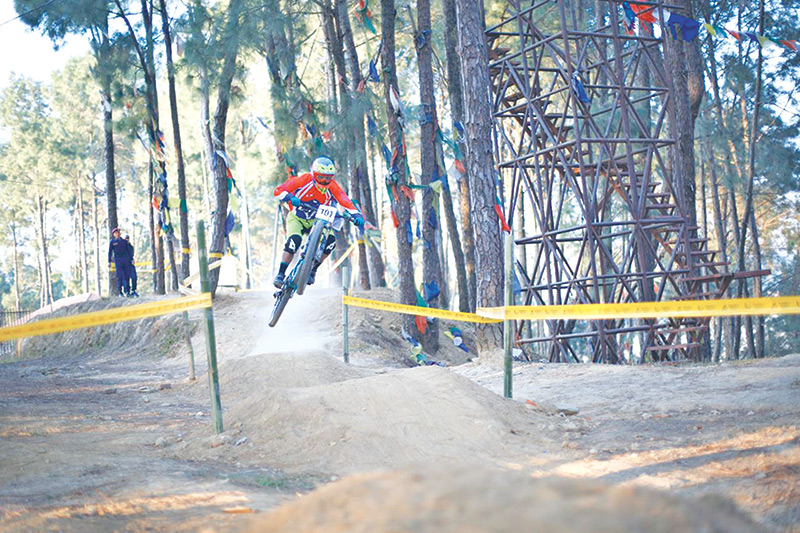
Nepal’s Rajesh Magar in action during downhill race at the South Asian Games on Wednesday. Photo courtesy: Nepal cycling association

KATMANDU,
Nepal’s Rajesh Magar, or RJ Ripper as he is widely known on the world cycling circuit, proved his credentials as one of the Asia’s fastest mountain bikers, as he finished top in the men’s 1km downhill race at the 13th South Asian Games on Wednesday.
In the race held at the Shahid Park Trail in Gokarna, the four-time national champion and 2018 National Geographic Adventurer of the Year clocked 1 minute 49.33 seconds to win the gold medal. This is Nepal’s first gold in the discipline since it was introduced in the 2006 Games in Colombo, Sri Lanka. Nirvan Shrestha (1:50.080) and Prachit Thapa Magar (1:51.661) made a clean sweep of the podium for Nepal.
“Our predecessors were better than us, but they didn’t have the opportunity to  compete,” said 23-year-old Rajesh, who is acclaimed globally for his skills.
Further asserting supremacy in the event, Nepal also claimed the top two spots in women’s downhill race where national champion Nishma Shrestha clocked 2:22.45 for gold while Jamuna Thapa (2:41.551) finished second. Yasodhara Madhukar (3:37.238) of India came in at a distant third.
Their impressive victories, the top mountain bikers say, were possible because of training and ample support from their coaches and the Nepal Cycling Association.
“In the past, we trained on our own. But the association arranged everything, including coaches and equipment this time around,” said Nishma, the 23-year-old new regional champion.

Rajesh Magar and Nishma Shrestha show their gold medals after downhill victories. photo courtesy: Santosh Rai

In addition, the athletes also say the home conditions also played to their advantage, despite last-minute preparations on the trail.
“The trail was prepared two weeks prior to the race. We got a taste of the trail and its sections, which was very helpful,” she said.
But dismissing those suggestions, downhill coach Umang Shrestha attributed the home riders’ success to their confidence and rigorous preparations. “Even the Bangladeshi team have trained on the circuit for a week. Our mountain bikers have trained on many other demanding trails, including those at Hattiban and Nagarkot,” he said. “The results have come as expected.”
A total of 20 mountain bikers from India, Bangladesh and Sri Lanka participated in the race. Six more gold medals are up for grabs in the discipline including cross country, road race and time trial.
“I have many more targets in the future and one of them is to win gold at the Asian Games,” Rajesh told the Post. “We are capable of competing at the world stage if we get enough support from authorities.”

HOME PAGE

State provides free vans to ferry bodies of workers. Families say process lacks dignity.

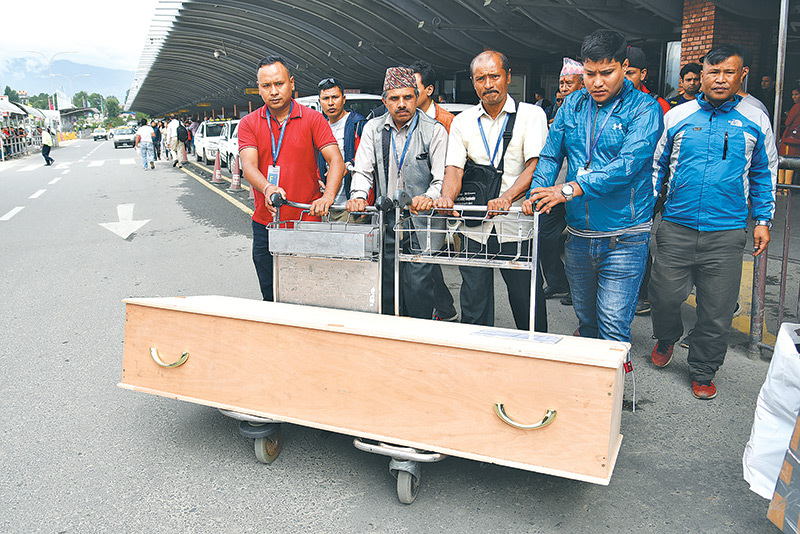
Several bodies of Nepali workers who died in foreign countries in the past have been carried in open vans, which families say adds pain to their grief.
- CHANDAN KUMAR MANDAL
The body of a Nepali who died in an explosion in Libya is brought to Kathmandu. Post file Photo

KATHMANDU,
When Sikandar Raut left his village to work in Dubai this summer, he told his family that he would be back in a few months. He had been working in the United Arab Emirates for over ten years and made several trips in between.
Sikandar had bought a piece of land in Dhanusha and spent some money on the marriages of four of his daughters. He also spent a substantial amount of money on his wife’s treatment. All that meant, he still had loans to pay.
“He said he would cancel his job and return soon to start something on his own,” Arvind Raut, his nephew, told the Post. “He was planning to clear the loans with the bonus he was expecting.”
Sikandar did return—but in a coffin. He died in a road accident in October.
It took weeks to bring his body back to Nepal—but not until his son, Radhe, was forced to travel to Dubai first. But it was what the family members had to go through after getting the body to Nepal that put them in more pain. Sikandar’s body was transported to their village, some 200 kilometres from Kathmandu, in an open vehicle.
“The body was kept on the back of the pick-up van,” said Arvind. “The least they could have done for him was provide a proper hearse.”
The Foreign Employment Board—the government body responsible for migrant workers’ welfare—provides free vehicles for ferrying bodies to the family members to their home addresses. Transporting bodies of migrant workers is one of the major works of the board, which also works on policy intervention for the welfare of migrant workers. Every year, the board helps carry hundreds of bodies to respective family members’ houses and for this, it has outsourced four companies—RD Dhuwani Sewa, Seti Ganesh Suppliers, Buddhchhap Dhuwani Sewa and Setiganesh Dhuwani Sewa.
But Sikandar’s aggrieved family members said the government didn’t show any respect to the dead by failing to provide a proper vehicle.
Last fiscal year, the board transported 753 bodies of Nepali workers who had died in foreign countries to their villages. The year before, it transported 821 bodies.
Most of the vehicles used for transporting the bodies are different models of Mahindra Bolero jeeps, with a cabin on the front and an open carrier on the back. The bodies are kept on the back—mostly uncovered. Representatives of all four companies that transport bodies on behalf of the board told the Post that most of the vehicles are of Bolero model, with an open carrier on the back.
“Following applications from family members of the deceased migrant workers and completing documentation, we provide vehicles free of cost for transporting bodies to their homes or as far as the vehicles can reach,” said Din Bandhu Subedi, spokesperson for the board. “In years of services, we have not received any complaints from family members. The service continues even during festivals and other holiday breaks”
According to Subedi, the board will take immediate action if family members report any sorts of hassles faced by them while accessing the services.
Family members of Santosh Kumar Mandal, who also died in Malaysia in October, described similar ordeal while transporting his mortal remains to his home in Morang.
“At first, the driver and the official told us they would deliver the body only up to Biratnagar,” Jagdish Mandal, Santosh’s uncle, told the Post last month when they were at the board’s office to collect compensation pay.
Only upon request did they agree to transport the body up to the village, which is just six kilometres from Biratnagar, the district headquarters, according to Mandal.
Three members from Santosh’s family had travelled to Kathmandu to receive the body. Two of them sat on the back of the vehicle which was uncovered for an arduous 11-hour journey.
“His father sat on the front. We did not have any warm clothes with us and we travelled without any cover,” said Mandal. “Our culture doesn’t allow the bodies to be left by itself so we had to sit on the back.”
Santosh’s family, though appreciative of the free service, said the government must show some respect for the dead.
“They can hire ambulance vans or any other vehicles that are properly covered,” Mandal said.
“Accompanying family and relatives can at least stay inside the vehicles. Providing a proper vehicle is also about showing some respect for the dead.”
The government does not have any specific standards while hiring vehicles through a public auction every year. The minimum criteria set for selecting vehicles are four-wheelers so that they can traverse the rugged terrain. Subedi said they also ensure that at least two people can sit in the front cabin.
“The vehicle should transport bodies to the destination provided by the family members. We cannot specifically mention a certain model or brand or manufacturers because of free competition,” said Subedi. “But the vehicle should be covered properly irrespective of the type used. This is a minimum standard.”
However, all the companies transporting bodies of migrant workers have their own practice of carrying the bodies. While some cover the vehicles on at least both sides, others say the distance determines whether the vans carrying bodies should be covered or not. Rather than permanent covers, these companies shield the vehicle with tarpaulin sheets.
Owners of the transportation services mostly defend their practices, saying they haven’t heard complaints from families. Hiralal Dhakal, owner of RD Dhuwani Sewa, which has been transporting bodies for 12 years now, says they can’t use ambulances because the coffins don’t fit in.
“We mostly cover the vans from both sides using tarpaulin sheets, but the upper side is left uncovered,” said
Dhakal. “Not covering the van from all sides is also easier because police and other protesters do not stop the van as they can easily see the coffin.”
Mingma Syangtan, owner of Buddhchhap Dhuwani Sewa, told the Post that covered vehicles are used for delivering bodies to districts far from Kathmandu and only during monsoon.
Human rights campaigners say migrant workers and their family members deserve dignified treatment and the government has to manage proper hearse for respectfully delivering their bodies to their family members.
“Such bodies cannot be sent in vans which are not covered,” said Barun Ghimire, programme manager at the Law and Policy Forum for Social Justice, an organisation that works on migrant rights issues. “This is absolutely unacceptable.”
Responding to a writ filed by Ghimire’s firm, the Supreme Court ruled in 2017 that it is the government’s obligation to transport bodies and make all the required arrangements.
Dignity and the rights of both migrant workers and the family members are undermined when the bodies are not handled properly because, Ghimire said, they died while making contributions for the country.
“Just providing free services is not enough,” said Ghimire. “This is not charity work but an obligation of the government.”

Page 2
MEDLEY

Horoscope

ARIES (March 21-April 19)
*
Today, as it should be on most days, your reputation must be your top concern. So don’t take any short cuts, don’t cut any corners, and don’t move forward on any projects with less than total focus. You are being watched right now, and your choices will be scrutinised to a nearly ridiculous degree.


TAURUS (April 20-May 20)
**
Keep a sharp eye out for minor differences that could create major problems today. You may have a tendency to get mixed up a bit here and there, and details really matter! People’s names could be a big problem, so take special note when you meet someone new. Today you have a good opportunity to make some changes.


GEMINI (May 21-June 21)
***
The romance in your life will be greatly amplified today—and whether or not you actually have a partner is irrelevant. People will want to be as close to you as you let them, so try to take advantage of the closeness. Barriers between you and someone you know in an official or professional capacity are coming down.


CANCER (June 22-July 22)
**
Today is not a day to hesitate when you see something wrong. As soon as you walk outside your home today, you should deal with the issues at hand straight on. You can still be kind, but you can’t put things off any longer. Like a bandage that just needs to be ripped right off, the small crises must be nipped.


LEO (July 23-August 22)
**
Right now, the people around you have more power over your life than you may realize. So it’s important to value others and listen to what they say. Outside opinions are not something you need to cherish, but it is important to be aware of the impressions you may be making—especially if any of them are negative.


VIRGO (August 23-September 22)
*
Lately, your healthy ambition has been feeling a little less than robust (to say the least). No matter whether the virus attacking your powers is a person who specializes in helping you doubt yourself, an event where you didn’t shine as brightly as you had hoped you would, or just a case of the blues stopping by for a visit.


LIBRA (September 23-October 22)
**
Your emotional sensitivity could be running high today, and you could fall into a temporary super-self-conscious phase. So if you are convinced someone keeps staring at you, make sure you’re not sitting under a clock! The way other people are thinking and feeling will impact you.


SCORPIO (October 23-November 21)
***
Even though you are loaded full of energy and positive ideas, today is not the ideal time to keep expanding into different areas. So put away your travel brochures and postpone your appointment for that new passport photograph. Right now, it’s time to stick close to home base and focus on just one or two people.


SAGITTARIUS (November 22-December 21)
****
If you have been looking for a sign that you are making romantic progress with a certain someone, you have a choice today. You can try to read their body language and pick up on subtle signals in order to get a sense of what they are thinking right now, or you can walk up to them, smile, and ask them.


CAPRICORN (December 22-January 19)
***
Do you have a bee in your bonnet about something right now? Do not let it buzz you to distraction—instead, stand up to it! Today, organize a plan of attack and you will soon see it’s not such a big challenge after all. Right before your eyes, that bee will quiet down when you confront it with your checklists.


AQUARIUS (January 20-February 18)
**
If you are in charge of overseeing other people today, you could be in for quite a challenge. Keeping everyone in line won’t be so easy. But it’s very important for you to keep things orderly and disciplined—because if you don’t, these people could flail around all day long and not get much done.


PISCES (February 19-March 20)
***
If you feel like you’d like to take it easy today, then you are right in line with what the universe wants you to do! Most of the big attention-sucking things in your life are calming down, so you should take the opportunity to do some more loosely structured things. Instead of taking time at the gym, you should take a walk.

Page 3
Page 4
NATIONAL

No progress on initiating talks with India on Kalapani

Prime Minister Oli wants to send senior leader Madhav Kumar Nepal to Delhi as his emissary, but no formal decision has been made yet.
- ANIL GIRI
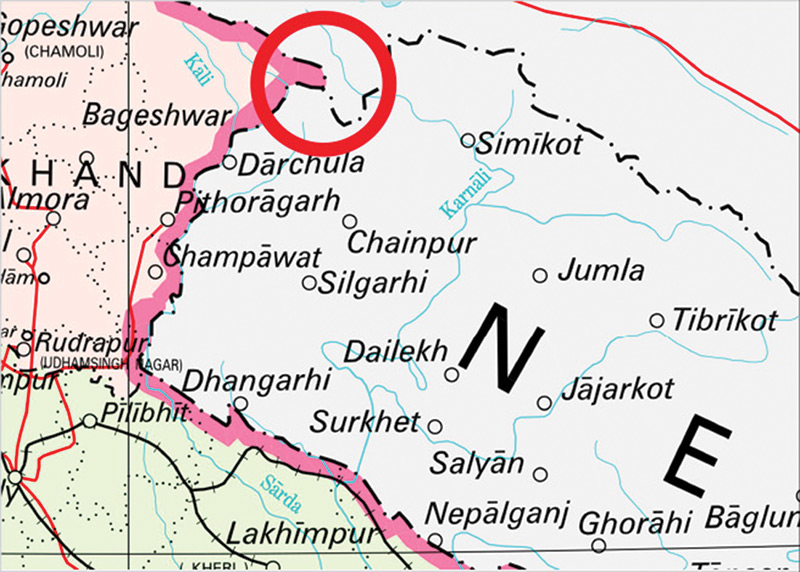
India’s new political map puts Kalapani (encircled) within its borders. Image source: Indian Ministry of Home Affairs

KATHMANDU,
Even a month after a new Indian political map that places the Kalapani area within India’s borders created an uproar in Nepal, there has been no progress from the government side to take up the issue with New Delhi at Track-I or Track-II level.
Kathmandu had earlier made an official request with India to resolve the issue through talks.
On November 8, Nepali Ambassador to India Nilamber Acharya met with Indian Foreign Secretary Vijaya Gokhle and communicated Nepal’s request for talks. But no date has been fixed yet.
Last week, dispatching a diplomatic note to India, Nepal had offered to hold Foreign Secretary-level talks in Kathmandu. A Foreign Secretary-level mechanism has been mandated with the task of resolving all outstanding bilateral boundary disputes, including Susta and Kalapani.
According to two senior ruling party leaders, Prime Minister KP Sharma Oli also held discussions with the party’s senior leader Madhav Kumar Nepal, also a former prime minister, on the possibility of sending him to New Delhi as his emissary to hold talks with Indian Prime Minister Narendra Modi and other senior Indian officials to seek an amicable solution to the issue.
Nepal, during a party secretariat meeting on Wednesday, revealed that he had received an offer from Oli to visit India in order to hold talks on the Kalapani issue with the Indian side at the highest political level. But no
official request has been sent so far, according to a party secretariat member who spoke on condition of anonymity.
In these last four weeks, several leaders of the ruling Nepal Communist Party, including Prime Minister Oli, opened up their respective contacts and communications with various sources in India to understand the mood in New Delhi, including the Indian Prime Minister’s Office, for the talks, said ruling party leaders.
Though the Indian side has not refused talks at any level, it has insisted that dialogue should first be held at the Foreign Secretary-level. Hence, leader Nepal’s visit to New Delhi is unlikely anytime soon, another ruling party leader, who also requested anonymity, told the Post.
India’s Ministry of External Affairs has also communicated with the Nepali Embassy in New Delhi that only diplomatic channels are proper to hold talks on border disputes and that they are working on a date for talks with the Nepali side, at least two officials familiar with the development told the Post. But opinions are divided in Kathmandu. During an interaction on Nepal’s international boundary and its effective management, organised by the Institute of Foreign Affairs on Monday, two former foreign secretaries, Gyan Chandra Acharya and Madhuraman Acharya, said that boundary disputes like Kalapani cannot be resolved through diplomatic channels.
Both diplomats said that if the diplomatic channel could settle the issue, it would have been settled long ago. The duo appeared unanimous in initiating dialogue at the political level, with initiations most preferably by the prime minister himself, which could be followed up by the foreign secretary and foreign minister.
The government now is making up its mind to hold talks at the Foreign Secretary-level first, because if talks at the prime minister’s level—or through a special envoy—fail to yield results, Nepal could run out of options, according to multiple leaders the Post spoke to.
“We have sent a formal request to hold talks at the Foreign Secretary-level and waiting for a response [from Delhi],” Foreign Secretary Shankar Das Bairagi told the Post. “Besides that, we have not sent any other request.”
Diplomatic sources in New Delhi told the Post that former prime minister Nepal, Oli’s foreign relations adviser Rajan Bhattarai and two Deputy Prime Ministers, Ishwar Pokhrel and Upendra Yadav, are invited to participate in Raisina Dialogue on January 13 to 15.
Raisina Dialogue is an annual event held at the initiative of India’s Ministry of External Affairs and Observer Research Foundation, a think tank based in New Delhi.
“We have requested for Foreign Secretary-level talks but besides that, we have not made any other formal request for Track II initiative,” said an official at the Nepali Embassy in New Delhi. Oli’s press adviser Surya Thapa said he has no idea about sending NCP leader Nepal to India as a special envoy of the prime minister.
“But what I am hearing is that official level talks are more preferred this time,” Thapa told the Post
On November 10 had called an all-party meeting to solicit views on resolving the boundary dispute with India. Leaders present at the meeting had called on the prime minister to initiate diplomatic talks with India.
According to leaders, as per the commitment made at the meeting, Oli was considering a two-pronged strategy. Accordingly, Kathmandu sent a request to hold talks at the Foreign Secretary-level. Senior leader Nepal’s possible visit to New Delhi was part of Track II initiative.

NATIONAL

Suspended DSP served arrest warrant over alleged criminal link

- SHUVAM DHUNGANA

KATHMANDU,
Kathmandu District Court on Wednesday issued an arrest warrant against suspended Deputy Superintendent of Police Kumud Dhungel for his alleged involvement in criminal activities.
On May 3, Nepal Police had suspended Dhungel, who was then in charge of Chandranigahapur Area Police Office in Rautahat, after he was linked with Bikram Shrestha, a criminal arrested in a robbery case.
“The investigation into the case is underway, so we cannot disclose any information now,” said Inspector Koshish Joshi, one of the investigators. “Dhungel has not been arrested yet,” Joshi confirmed.
On April 10, a gang of about six men had robbed a house in Ranibari, Kathmandu, after subduing the house owner Lalendra Sherchan, his wife Bhanu Devi, and their maid Mithu Thakali. The robber had made off with jewellery and  Rs 560,000 cash.
The Metropolitan Police Crime Division launched a manhunt in the wake of the incident and arrested Shrestha, Nabaraj Tamang, and Shanta Bahadur Tamang on April 19.
Police investigation later revealed that Shrestha, one of the robbery suspects, had links with DPS Dhungel.
Call details, as well as Shrestha’s confession, helped investigators establish that Dhungel and Shrestha were in regular contact with each other before the robbery.
Dhungel, who was considered by many of his colleagues as a man of integrity and for being professional, was immediately suspended after the revelation.
During his career in the police force, Dhungel had also earned his reputation as an encounter specialist. He was behind the encounter of Manoj Pun and Som Bahadur Ale, the accused behind the murder of Sharad Kumar Gauchan, chairman of the Federation of Contractors’ Association of Nepal on October 9, 2017.

Page 5
NATIONAL

Oli likely to be discharged from hospital on Friday

Doctors involved in the prime minister’s treatment are mulling another kidney transplant, but say it could be done only after two to three months due to his health condition.
- Arjun Poudel
Prime Minister KP Sharma Oli is currently recuperating following an appendectomy at the Manmohan Cardiothoracic Vascular and Transplant Centre. Post Photo

KATHMANDU,
Prime Minister KP Sharma Oli, who has been recuperating following an appendectomy at the Manmohan Cardiothoracic Vascular and Transplant Centre, is likely to be discharged on Friday, a hospital source told the Post on Wednesday.
“The health of the prime minister is improving and he is most likely to be discharged on Friday,” the source, who spoke only on the condition of anonymity, told the Post. “Surgeon Dr Ramesh Singh Bhandari and prime minister’s personal physician, Dr Dibya Sing Shah, will decide when he will be discharged.”
The prime minister was admitted to the centre on November 26 after he complained of severe stomach pain. A team led by Bhandari, which included Shah, successfully removed Oli’s appendix after a series of tests showed complications.
The source said that Oli himself has been requesting doctors involved with his treatment that he be discharged.  The doctors, however, want to keep him under observation at the hospital’s intensive care unit to offset any possibility of infection.
The doctors at the hospital have been allowing the prime minister to meet a limited number of people, but in a restricted manner. The restrictions also apply in his meetings with his own party leaders and Cabinet ministers.
Meanwhile, issuing a medical bulletin on Wednesday, Dr Uttam Krishna Shrestha, executive director at the centre, said the prime minister’s health is “improving significantly” and that he has been “kept under observation”.
Oli also released a video through his Twitter handle on Monday in which he said he is doing well after the surgery of his appendicitis.
However, a doctor familiar with the line of treatment of the prime minister said that his health is “still delicate”, as he suffers from peritonitis, an inflammation of the peritoneum, a silk-like membrane in the inner abdominal wall following the appendix surgery.
He said that Oli has been taking immunosuppressants while he is undergoing dialysis more frequently, at least three times in the last one week alone, which indicates his renal function has either stopped or is functioning very slowly.
Oli has been taking immunosuppressants ever since he got a kidney transplant in 2007 after both his kidneys failed.
Meanwhile, another source, who also requested anonymity, told the Post that Oli’s second kidney transplantation has been postponed by a few months due to peritonitis resulting from appendicitis. Doctors attending to the prime minister, including his personal physician Shah, have been preparing for his second renal transplant.
Oli’s health has been a cause for concern since August when he flew to Singapore for a medical checkup. While information regarding his health was kept under wraps after his return, Oli declared publicly that he was fine. But last month, his health saw a quick deterioration and he was admitted to Grande International Hospital, where he underwent four rounds of dialysis in as many days.
Since then, the doctors have been saying that the prime minister either needs regular dialysis—at least three times a week—or he needs another transplant, but as matters stand, a firm decision is yet to be arrived at.

NATIONAL

Non-communicable diseases major threat to public health: Reports

Pollution and high consumption of toxic food, alcohol and tobacco behind the high number of cases, say experts.
- Arjun Rajbanshi

BIRTAMOD,
Baitasi Rajbanshi died in April this year, at the age of 45. Seven months later, her husband, 52-year old Karma Rajbanshi, too died. The couple, residents of Birtabazaar in Jhapa, passed away due to renal ailments, according to family members.
“They passed away in want of treatment, as we could not afford to provide them with any,” said Karma’s octogenarian mother, Gyaneshwori.
Laxmi Prasad Neupane of Goldhap in Haldibari has been caring for his 63-year-old wife Pabitra ever since she was diagnosed with gallbladder cancer nine months ago.
“We have spent Rs 800,000 in my wife’s treatment so far, but there hasn’t been much change in her health,” said Neupane.
According to Mechinagar Municipal Office, it recommended 73 patients of non-communicable diseases for
the government’s monetary support in the past nine months. Among them, 32 are cancer patients.
The figure for Haldibari Rural Municipality is 44.
Ishwori Paudel, acting chief at the District Health Office in Jhapa, said diseases like cancer, high blood pressure, diabetes, asthma, heart disease and renal ailments top the list of non-communicable diseases found in patients. According to him, cancer patients outnumber patients of other diseases.
Health workers argue that the consumption of highly toxic foods, smoking, alcohol and tobacco consumption and pollution, among others, are behind the increasing number of non-communicable diseases. Dr Rakesh Kumar Mandal, a physician at B&C Hospital in Birtamod, said toxic foods and vegetables, lack of physical exercise and an inactive lifestyle are the major contributing factors behind the rise in the number of cancer cases.
The government provides free treatment of up to Rs 100,000 for patients of 12 diseases, including cancer, heart and kidney-related diseases, Alzheimer’s, Parkinson’s, head injury, spinal injury and sickle cell anaemia, with the
recommendation of local units.
However, patients and their families said that the government’s support is insufficient to treat the diseases.
“I received Rs 100,000 from the government and Rs 25,000 from Haldibari Rural Municipality.
But I had to spend more than Rs 800,000 from my own pocket for my wife’s treatment,” said Neupane.
According to the data available at the District Health Office in Jhapa, 359 people were diagnosed with cancer in the fiscal year 2017/18. In the last fiscal year, 286 cancer patients were found in eight
 of the 15 local units in the district. “We don’t keep the data of patients; the local bodies keep them,” said Paudel.
Different studies showed that non-communicable diseases are a major threat to public health in Nepal. Nepal Burden of Disease-2017, a study report published by Nepal Health Research Council, shows that non-communicable diseases are the leading cause of death—66 percent of all deaths—in the country. Among them, heart disease, chronic obstructive pulmonary disease, lower respiratory infection and stroke are the leading killers.

NATIONAL

One of the oldest bazaars in Jhapa falls into decay

Over 5,000 households living around the Bhagudubba area rely on the market for everyday essentials.
- ARJUN RAJBANSHI
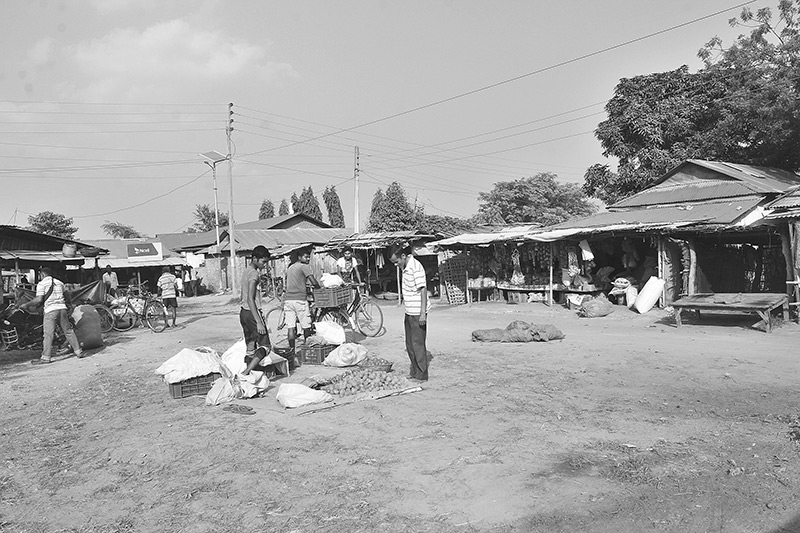
Bhagudubba is the only market in the area. The only other option for thelocals is to travel to Rajgad, which is five kilometres away. Post Photo: arjun rajbanshi

BIRTAMOD,
Bhagudubba is one of the oldest markets of Barhadashi Rural Municipality in Jhapa district. The marketplace, near the border between Nepal and India, is spread over one bigha of land and has more than 50 different shops.
Over 5,000 households living around the Bhagudubba area rely on the market for everyday essentials since this is the only market in the area. The only other option for the locals is to travel to Rajgad, five kilometres away.
However, the bustling market lacks proper drinking water facilities, proper sewage system and toilets. Locals complain about the difficulties they have to face because of the negligence of the authorities and their mismanagement. “People have set up shops in a haphazard manner blocking public accessway,” said Sovitman Tamang, a local. “We have asked the local authority to upgrade the market and introduce some sense of order. But nobody has come forward with a solution.”
Local authorities too believe the market is losing its sheen because of mismanagement, said Shambhu Rajbanshi, the ward chairman of Barhadashi Rural Municipality Ward No.1.
Because of the lack of proper management, the marketplace that used to be open for business twice a week on Friday and Tuesday now opens only for three days a week. “This is an important market for the locals; we had requested the local unit to run the market thrice a week instead of twice. Seeing how the locals depend on this market, the Barhadashi Rural Municipality should develop this place,” said Prabin Rajbanshi, another local.
In view of the complaints and the problems faced by the people, local authorities have begun efforts to manage the market.
“This marketplace has remained unchanged since my childhood,” said Shambhu Rajbanshi, ward chairman of Barhadashi Ward No. 1. “We are making efforts to upgrade and manage the marketplace better.”
Rajbanshi said that a master plan has been prepared to manage and modernise the marketplace. “The Ilam-based Urban Development and Building Construction Division Office has shown interest in upgrading the marketplace,” said Rajbanshi, “The office had conducted a survey, about a month ago, regarding the matter.”
According to Rajbanshi, the masterplan includes the construction of organised stalls, proper sewage system, public toilets, provisions for clean drinking water, solar light, open parking spaces, among others.
Suman Mishra, the chief at the Urban Development and Building Construction Division Office, informed that, following the survey, they have decided to allocate budget as per the masterplan to upgrade the marketplace in the upcoming fiscal year.

NATIONAL

Public vehicles overcharging passengers in Bajhang

- Basanta Pratap Singh

BAJHANG,
The Dungi Bazaar-Kailash dirt road in Bajhang is just 8 kilometres long. But the fare for travelling on this road in a public vehicle is Rs500 per passenger which is eight times higher than the fare ceiling fixed by the District Administration Office.
According to the District Administration Office in Bajhang, public vehicles should charge Rs8 per kilometre on a dirt road as transport fare. “I have been paying Rs500 (one way) while travelling through the Dungi Bazaar-Kailash road. But, according to the rule, the transport fare should be just Rs64,” said Surya Khadka, one of the passengers travelling in a jeep. “We know that the drivers are fleecing passengers but they become unruly and misbehave with us if we refuse to pay the fare fixed by them.”
Despite the ceiling fixed by the authority, public vehicles driving on dirt roads in Bajhang district are known to charge transport fare as they see fit. The locals of Khaptad Chhanna, Durgathali, Surma Rural Bungal, and Jaya Prithvi municipalities say that they have been charged hiked fares on public transport. “There’s no fixed rate. Jeeps that run on these routes charge an arm and a leg as fare. They take advantage of our helplessness,” said Bam Bahadur Snehi, blaming the District Administration Office of inaction against public vehicle operators and drivers.
After consultation with various transport entrepreneurs in Chainpur a year ago, the District Administration Office had fixed the transport fares for public vehicles driving on various types of roads. It had fixed the rate of Rs5 per km on blacktopped roads at and on dirt roads at Rs8 per km.
Dabal Bahadur Singh, ward chairman of Khaptad Chhanna Rural Municipality Ward No. 2, said that the executive meeting of the local unit had also decided to take action against vehicles overcharging passengers some five months ago. “However, the decision has not been implemented yet,” said Singh. “It’s getting increasingly difficult to implement the decision since most of the people’s representatives in our municipality are also vehicle operators.”
The local administration is preparing to take action against public vehicle owners, operators and drivers, says Umesh Pandey, chief district officer. “We have been receiving complaints that most public jeeps are fleecing passengers in the rural road networks. We have also notified the local units concerned to take stock of the situation.”
Out of 12 local units in the district, 11 are connected to road networks. “It has also come to our notice that most of the jeeps are operating without route permit on the newly-opened routes in rural areas,” said Pandey. “It’s the local units responsibility to monitor unlawful activities in their respective areas. The local unit is the authorised government body to issue route permits to drivers.”
The locals of rural areas in Bajhang say that in light of the local unit’s inaction, they turn towards police to keep a check on unruly drivers and their fleecing ways. “We expect the police to intervene but police personnel in the area don’t even bat an eyelid when the drivers charge us extra,” said Balu Giri, a local of Jaya Prithvi Municipality, “This daylight robbery takes place right in front of the police’s eyes but they don’t do anything about it. This is also why the jeep drivers feel emboldened to loot passengers,” he said.
There are more than 200 jeeps operating across Bajhang district.
Amar Dhami, a jeep diver of Dungri-Masta road, said that transport entrepreneurs risk their new vehicles on dirt roads and that it is a high-risk endeavour for them. “Majority of the roads in remote areas are in bad condition. We put our vehicles at risk of mechanical failure on these roads and that is why we think we must charge more than what is fixed by the District Administration Office,” said Dhami. “The price they have fixed is not enough.”

NATIONAL

Shortage of drinking water in Arghakhanchi

Briefing

ARGHAKHANCHI: Majority of villagers living in Chhatradev and Malarani Rural Municipalities in the district have been reeling under water shortage for a long time. Locals complain that they have to spend several hours to fetch a vessel of water from a water source. Ashmita Khanal, a local of Malarani, demanded the people’s representatives and lawmakers to take initiatives to construct drinking water project for them.

NATIONAL

Warm clothes distributed to disabled children in Humla

Briefing

HUMLA: Simkot Rural Municipality has distributed warm clothes to disabled children in the Simkot district headquarters. On the occasion of the 28th International Day of People with Disabilities, the municipality distributed warm clothes to 106 children.

NATIONAL

Takam Kot Temple reconstructed in Myagdi

Briefing

MYAGDI: Takam Kot Temple in Dhaulagiri Rural Municipality, which was ravaged by the earthquake of 2015, has been reconstructed. According to the Temple Reconstruction Committee, Rs 22 million was collected from various donors including locals to construct the temple.

NATIONAL

New mayor assumes office

Briefing

SUNSARI: Newly elected mayor of Dharan Sub-metropolis Tilak Rai assumed office on Wednesday. As mayor, he has already signed a proposal tabled in the sub-metropolitan office to reconsider the existing rate of tax. The residents of Dharan have for long been expressing their dissatisfaction with the various taxes imposed by the local unit.

NATIONAL

Dental students boycott annual examinations

Briefing

RUPANDEHI: Students of the Bachelor of Dental Surgery programme at the Universal College of Medical Sciences boycotted their annual examination after the college did not refund their additional fees.
Seventy-five students had to appear in the annual examinations from Wednesday.

Page 6
EDITORIAL

A national shame

Mensing women continue to die from exposure after being banished from their homes.

The world has progressed by leaps and bounds, and technology has opened a whole new frontier. But in Nepal, as recently as last week, a young woman lost her life maintaining a primitive tradition. Twenty-one-year-old Pabitra from Achham died in her chhaugoth or menstrual hut—a tiny shack made of mud or rock where women are required to stay while having their period—falling victim to the harsh elements.
Although it is a crime to force a menstruating woman into seclusion, punishable by up to three months in jail, the law has yet to make a dent in the tradition. And at this point, young girls and women losing their precious lives to a deadly superstition that believes women to be impure during their period—something that is, scientifically speaking, a biological process during their reproductive life—has become a national shame.
More than 90 percent of the women in the remote western mountain districts of Achham, Bajura, Doti and Bajhang continue to practice Chhaupadi—either due to societal pressure or their own wish. It’s not a surprise that in all the aforementioned districts, the literacy rate for women is less than satisfactory. In Achham, for example, women’s literacy rate stands at 37 percent. Similarly, in Bajura it is 22 percent. Education plays a big part in helping people distinguish right from wrong. It also allows people the agency to speak for themselves. But regrettably, women in Sudurpaschim Province are missing out, and as a corollary, continue to fall prey to a social ill. If numbers and reports are anything to go by, most of the villages in Achham, Bajura, Doti and Bajhang have already been declared ‘Chhaupadi-free’. But beyond statistics, the reality on the ground tells us something else.
Between 2011 and 2015, as many as 31 of the 75 then village development committees in Achham—a hill district in Sudurpaschim Province—were declared Chhaupadi-free. The Chhaupadi-free campaign was launched by various non-governmental organisations and social organisations with the support of the government. In Bajhang, all five Chhaupadi sheds at Jagera in Saipal Rural Municipality were demolished when the local unit was declared Chhaupadi-free in 2018. But by May 2019, women were found rebuilding the Chhaupadi sheds at Jagera in Saipal Rural Municipality. The reason: After the huts were destroyed, menstruating women were sent to live in caves which, according to them, were even worse.
The idea is not to destroy the sheds and put them in caves, but to end the seclusion and discrimination. Sadly, neither law nor awareness drives have been effective in making that happen. What’s more, be it local representatives or rights activists, anyone who seems firm in their drive to get rid of Chhaupadi are often villainised. To the extent, they are even considered a threat to society. And this is what makes the issue more complicated altogether.
Uprooting such a deeply entrenched culture requires changing the mindset of the people. This warrants a holistic approach that requires educating not just the students and teachers, but the parents, the faith healers and community health workers. It will definitely take a long time too, but the key nonetheless, lies in sustaining efforts.

OPINION

The athletes representing Nepal reflect the country’s identity

The Nepali nation is defined by its diversity and tolerance of varied identities. Leaders would do well to remember.
- PRAMOD MISHRA
post photo: Kiran Pandey

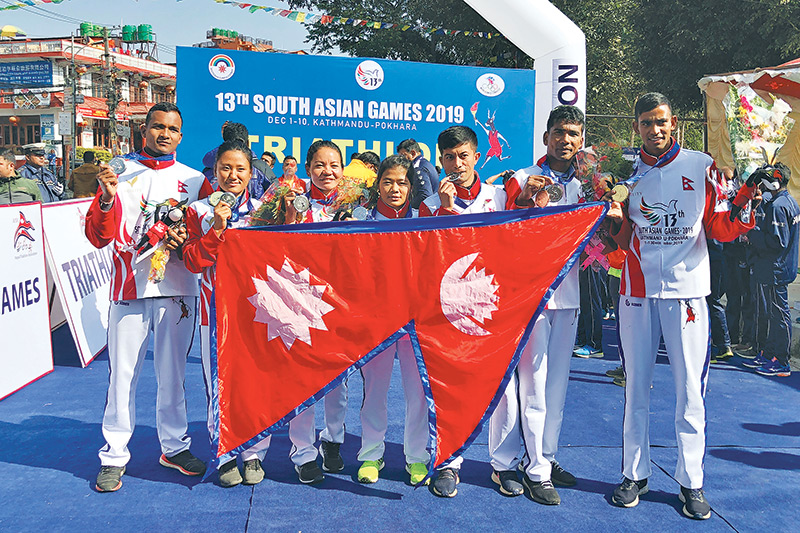
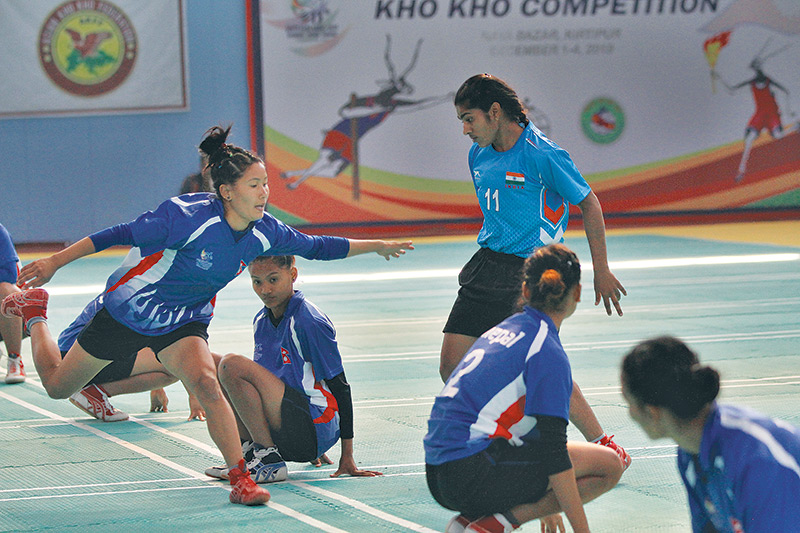
I was going to write about bald thinkers and whiskered statesmen today but the South Asian Games have been a little too exhilarating so far to devote my words to highfalutin personalities and issues. Instead, I write about sports and games, avenging myself on my departed parents who frequently admonished their truant son with the saying, ‘khelega kudega hoga kharab, padhega likhega hoga nawab’ (‘sports and games misfortune bring, books and writing make you king’). But when Nepali sportspersons make their country swell with pride, I, too, derive vicarious pleasure at their victories, even this far across the world.  Yes, there was poverty, among many other things, that made my parents concerned about their son’s future. But without sports and games, I wouldn’t have been able to overcome the challenges that came my way.
Sports and games are not just personal events. Through them, one can get to the soul of a society, its temperament, its culture and politics. Even though the saying, ‘the battle of Waterloo was won on the playing fields of Eton’—attributed to the Duke of Wellington—may be apocryphal, cricket played on the grounds of English private schools first produced gentlemen from all kinds of classes.
And, once an English colony was established, the game of cricket, not bookish learning, gave colonials an opportunity to become honorary Englishmen. Maharaja Ranjit Singh earned respect for his cricket in colonial England but Salman Rushdie, for his lack of interest or capability in sports, was bullied in postcolonial England. As the Trinidadian thinker, CLR James theorises in his most famous work, Beyond a Boundary, cricket is not just a sport but a window to race, class, national culture, politics, colonial power imbalance and the levelling of the playing field. If sports represents something more than just a physical game of victory or loss, then how can we understand the South Asian Games?
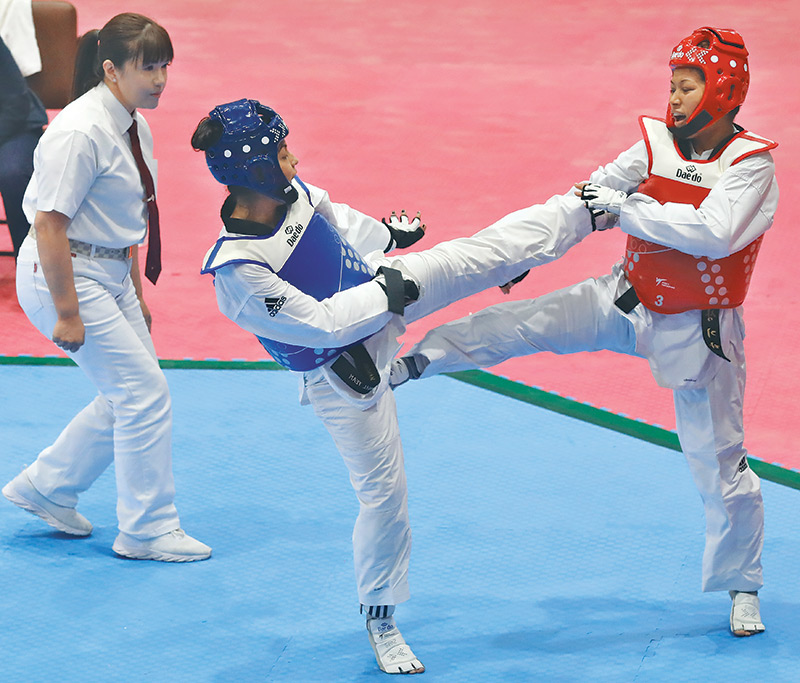
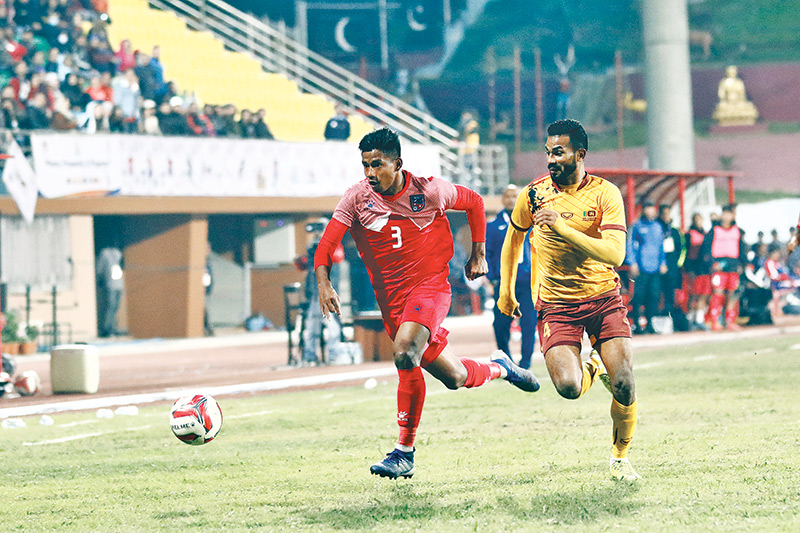
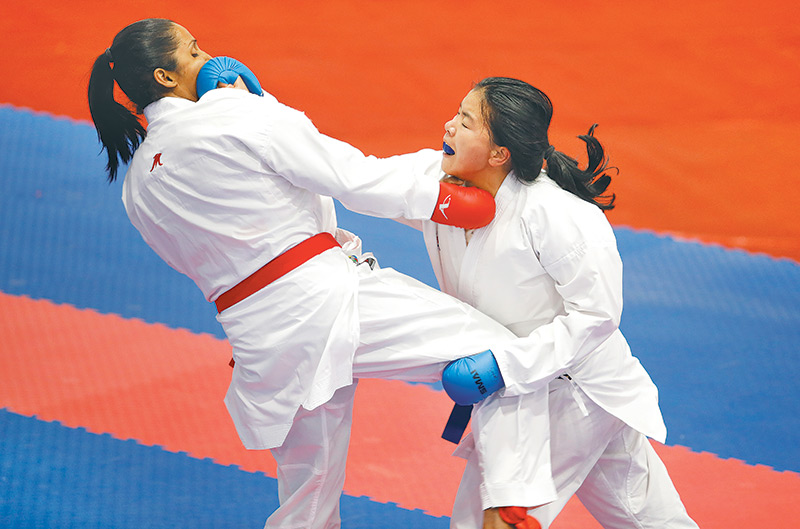
Well, first, let’s savour Nepal’s glorious medal haul until now—as of this writing of 23 gold, 9 silver and 12 bronze; altogether 44 medals. Meanwhile, India, a country of a billion-plus people, only has 15 golds, with a total tally amounting to only 40 medals. What does it say about Nepal’s rising generation? In martial arts, and team sports, such as football and volleyball, both men and women have excelled in recent times. In South Asia, The Maldives has the highest per capita income and India has the highest GDP. But what is there in Nepal that has brought this much early success in the Games?
Most able-bodied young men and thousands of young women work unskilled jobs in South, East and Southeast Asia, the Middle East and wherever they find such jobs. Even many of the gold medal winners in these games have parents who supported their daughters (mind you, not just sons) by tending others’ gardens in Kathmandu or driving vehicles in the Middle East. Not many receive sponsorships from corporations or funding from the government. Even when they see no future in their sporting career, these young men and women make the best use of their youth by displaying tremendous courage, discipline and tenacity to bring medals for themselves and for their country.
This says something about the country and its culture. Despite all the ills of Nepali society brought about by poor management of the country by its corrupt bureaucracy and politics, and by the social ills born of Hindu orthodoxy and caste hierarchy, Nepali society is culturally still a free society, where parents have increasingly come to provide equal opportunity for their male and female children. And this is overwhelmingly the influence of Nepal’s indigenous peoples whose lessons others are increasingly emulating. When one studies the composition of these sporting teams and athletes, it shows the diversity in culture and ethnicity. It says something about the country’s potential, that is if politics goes in the right direction by embracing all identities in the state structure.
One only needs to look at people like Sanduk Ruit, Kulman Ghising, Upendra Mahato, Shesh Ghale and Binod Chaudhary—and these medal winners. For years, Nepalis thought that load-shedding or scant electricity supply was inevitable. Ghising’s tenure as managing director of Nepal Electricity Authority has brought an almost uninterrupted flow of electricity into people’s homes. Many thought the world was a sightless place. Ruit came and gave light to thousands. Nepalis thought dollar billionaires lived only in Europe and America, but they have now a billionaire in their midst. What Chaudhary does with his billions is a different matter, but Nepalis now see opportunities and possibilities.
And now look at India. Their medal count (which I’m sure will go up) in proportion to their population is
suggestive of how demoralised Indians are—their global reputation has been hit hard since the rise of Hindutva (an ideology that abominates differences). To propagate violence in the name of religion is not the best way to build a society’s psychological health. Similarly, not respecting others and their culture or faith is not the best way to build a society’s confidence in itself. With majoritarian authoritarianism rising, India’s economy also is nose-diving. Hindutva power is not going to hold up to India’s traditionally recognised soft power of pluralism, Bollywood, Yoga and Gandhi that its intellectuals had until recently so vociferously bragged about.
So, there is a lesson for Nepal’s powers that be. They will surely watch these games for pleasure and national glory. But they would do well to analyse where this ‘nation’ came from—the open culture, gender
parity, ethnic and linguistic inclusion, and a breakdown of caste hierarchy. The South Asian Games are important for the medals that Nepalis will bring, but they are even more important as a socially, politically, and culturally symbolic act.

OPINION

Myanmar’s legacy of rape as a terror tactic

- Tasneem Tayeb
Shutterstock

While it is a well-documented fact that more than 700,000 Rohingya had to flee Myanmar’s Rakhine state and nearly 9,000 Rohingya had been killed in Rakhine between August 25 and September 24 in 2017—as recorded by Médecins Sans Frontières (MSF)—the number of women and girls who have suffered sexual violence at the hands of the military (also known as the Tatmadaw) remains unclear.
Figures from the United Nations Population Fund (UNFPA) suggest that after arriving in Bangladesh, around 13,500 Rohingya women sought medical assistance and support to address the sexual violence—including gang rapes—that they had to endure at the hands of the Tatmadaw. But the actual number of women and girls facing sexual violence is expected to be much higher, since shame and fear of social stigma deter a lot of women from acknowledging it.
Between August 2017 and February 2018, MFS recorded 160 cases of pregnant rape victims. And there were hundreds and thousands of women who chose to deliver their baby in confinement to hide their pregnancy. Young, unmarried girls, who became victims of unwanted pregnancy due to rape, were especially encouraged by their families to give birth in seclusion so that their prospects of marriage would not be hampered. The result? Unwanted infants dumped in dustbins, left at the makeshift hospitals, given away to other families.
In worse cases, there have been botched abortions resulting in miscarriages and deaths of infants and mothers—mortality we do not even have a concrete count of.
Given the narratives of the Rohingya women and girls, it would not be incorrect to say that the Tatmadaw have adopted rape and sexual violence as a weapon of terrorism. Women narrate tales of being gang-raped by dozens of soldiers in their green and red outfits, often multiple times.
According to the Middle East Institute and a story published by The Guardian, there have been instances where women had been ‘tied by their hair and hands to trees and gang-raped, for no other reason than being Rohingya Muslims.’
Razia Sultana, a prominent lawyer and activist, in an interview with Time recalls how she met a 14-year-old girl who had been raped by more than 30 soldiers. ‘The army is cutting women’s breasts off, gouging out their eyes. This is not just rape. This is a weapon to punish the community,’ Sultana further added.
By sexually violating young girls and women, the Tatmadaw is sending a strong message to the Rohingya community: that there is no place for them in the Rakhine State, and that staying back will be at the cost of their lives and the honour of their women, which to a conservative society like that of the Rohingya is the ultimate humiliation.
And these crimes leave us—the host country and the agencies that are trying to provide humanitarian support to the refugees—with many unanswered but critical questions: how many women living in the Rohingya camps have been infected with sexually transmitted diseases (STD), including HIV, as a result of the mass rape that they had to endure? How many need immediate medical support to battle these diseases?
How many babies with HIV have been delivered in the camps? And how many others, including locals, are at the risk of getting infected by the disease (especially since we don’t know how many living in the Cox’s Bazar camps are carrying these diseases)?
In the midst of all these, the Rohingya women and girls are being preyed upon by human traffickers and forced into sexual slavery, potentially increasing the risk of the spread of these diseases. And while it is easier for the men to open up about their problems and seek help, it is not so easy for the women and girls who live in fear of retribution.
But the Rohingya women and girls cannot be allowed to suffer in silence. The trafficking of vulnerable Rohingya women and girls should be stopped at all costs. The Bangladesh government and the humanitarian agencies should make sure that the women and girls who have been subjected to physical, psychological and emotional trauma and pain by the Tatmadaw are given necessary medical and emotional support.
With such a large population of the Rohingya—especially those infected with deadly diseases—crammed up in the makeshift camps in Cox’s Bazar in not very healthy conditions, the host country and humanitarian agencies must do their best to address their health issues on an urgent basis. The repercussions of the spread of these diseases are going to be devastating.
All the while, we need to provide psychological and emotional counselling to these women and girls. It will not be possible to erase the memories of the horror that they had to endure. But with proper support, they may be able to carry on with their lives.
Human suffering has no nationality and knows no borders. It is important that we constantly remind ourselves of these self-evident facts.


This article was previously published in The Daily Star, a part of the Asia News Network.

Page 7
OPINION

Any time is the right time

Victims of domestic violence must make the decision to take back control of their lives.
- MADHURI RANA SINGH
Shutterstock

We should applaud the courage and bravery of women who act on the decision to be in control of their lives once again, and most importantly, for breaking the myth that domestic violence is a common occurrence only among low-income families and the uneducated. Several cases among the more well-to-do and educated are kept hidden as the victim takes back her statement, suddenly disappears from sight or is silent, and reporting is not done placing ‘family prestige’ centre stage.
In Nepal, the groups targeted by non-governmental organisation programmes are usually from the lower social and economic stratum of society, and they have fewer qualms about maintaining family honour as they have, over time, been empowered to give precedence to their own safety and that of their children. This is the prevalent irony within patriarchy dominated developing countries where information, knowledge and support for women suffering domestic violence are limited to a particular set of women and not all women. We have no quarrel with development resources targeting poor women; but considering the changing socio-economic context, it is timely to think outside the box where domestic violence is concerned.


Lengthy procedures
In general, it can be said that patriarchy condones men’s lack of control over their anger, sometimes abetted by more powerful women of the household; and blames the lone woman, usually the wife for ‘inciting’ or ‘asking for it’. Injuries, severe or otherwise, are commonly described as ‘she slipped or fell’ instead of treating them as physical evidence of assault, which is more often the case than not. An urgent question that needs highlighting is whether the institution of marriage itself is a legal licence for wife battery. Is marriage in new Nepal still about ownership of another individual where women have been and are equal contributors and partners in every aspect of conjugal life?
The endorsement of Domestic Violence (Crime and Punishment) Act 2009 is a worthy recognition by the state that domestic violence is a grave violation of an individual’s human rights and is criminalised. However, reluctance on the part of the woman to lodge a first information report is also due to lengthy legal procedures leading to delays in delivering justice and pressure from higher levels, all indicating acceptability of ‘slapping the wife to show who is in charge’ being justifiable as a traditional and cultural practice, that is maintaining social order. The patriarchal mindset of those in powerful positions to delay expedited justice to all victims further portrays domestic violence as the right of those in power, be it within a household or outside it, thus discouraging victims from seeking legal redress.
The increasing number and trend of domestic violence as reported by the Nepal Police, National Women Commission, National Human Rights Commission and non-governmental organisations are evidence that the incidence of crime is actually on the rise, and what is reported is only the tip of the iceberg. Therefore, it is critical and timely to assess whether the awareness and activities launched by the government and non-governmental organisations, such as one-stop crisis management centres and shelters, alike are reaching all women in need regardless of social caste or economic class. It is important to realise that providing security and services to the fortunate few who come in contact with non-governmental organisations and other institutions must be expanded from a campaign to a crusade for zero tolerance. The national mission to end domestic violence must be taken to every family, school, workplace, courtroom, cabinet and police station. Every media outlet should strongly support it and keep up the call to prosecute any perpetrator.  
In the case of domestic violence, an essential step that must be taken by the abused is to break away from the violent situation. It is understandable that the abused may delay making a personal decision to report due to the lost ability to be resilient and whole again after consistent battery and abuse. But respect for self and the realisation that it is her right not to be restrained by physical, emotional, economic or social limitations will liberate the abused from the fear of further ostracisation and violence. This is the most critical decision the individual can make about her life whether it is ‘sooner or later’. As long as she makes the decision on her own or seeks support to take back control of her life ‘any time is the right time’. Her decision changes her status from victim to survivor and even an advocate against the scourge. It is the rebirth of the individual which should be the critical theme of support systems.
We are neither judge nor jury. We believe that the truth must come out every time, for eventually, it will set both parties free. Not all men are violent and some societies in Nepal are matriarchal, too. Domestic violence is about the abuse of power, and as such, men can be abused too; and this must be counted in the struggle to combat brutal behaviour.


Safety and security
The right to press charges, immediate court proceedings, freezing the assets of the accused and applicant, compensation, security and safety of victims are prescribed by Nepali law, but highly ineffective in practice. Non-governmental organisations and public institutions must urgently advocate and lobby for amendments to current legislation where required for rapid justice and unbiased enforcement of the same.
Some reviews and studies indicate that victims and survivors are more at risk of further abuse after taking legal action and separation. Therefore, their safety and security must be given high priority at the outset.
Its imperative for everyone to be able to live a purposeful life. For this, there is a need to implement a comprehensive programme of information, knowledge and support for all women and men, affluent or otherwise.


Singh is the founding president of SAATHI.

OPINION

Macron alone

He has cultivated the image of being Europe’s champion, but his latest diplomatic efforts risk alienating key EU players.
- SŁAWOMIR SIERAKOWSKI
Alexandros Michailidis-Shutterstock.com

You can be talented, handsome, rhetorically skilled, and politically brave, and yet suffer for it. In the long run, prudence and restraint are crucial ingredients of successful leadership, and it is precisely these two qualities that, up to now, French President Emmanuel Macron appears to lack.
Macron wants to lead the European Union into the 21st century. But he will succeed only if he does not go too far. If he overplays his hand, he will open himself up to a challenge from some other rising political leader. That could happen whenever Germany emerges from its domestic political malaise, if other member states decide to form a coalition against France, or if Macron alienates too many key players within the EU. The greater Macron’s ambitions, the higher the risk to his political future.
Politically, Macron is a contradiction in terms. A vocal anti-populist who employs populist tools, he has dismissed traditional political parties and called for politicians to be replaced by ordinary people. Accordingly, he insists that his La République En Marche! is not, in fact, a political party, and that he is neither of the left nor the right. The main difference is that his program is not nationalist but pro-European, almost cosmopolitan, and that he opposes other populists. But his pro-European stance goes only as far as French economic interests allow, as he demonstrated when selecting nominees for the EU’s top jobs earlier this year.
Moreover, it is worth remembering that Macron led the push for tighter regulations on ‘posted workers’—particularly those from Poland and Hungary—back in 2017, and that his toughest attack on Central and Eastern European populists was delivered from a French Whirlpool factory that was scheduled to move to Poland. Macron may sincerely want deeper European integration, but that did not stop him from nationalising a French shipyard to prevent it from being purchased by an Italian firm.
More recently, Macron has taken another page from the populist playbook by pursuing warmer relations with Russian President Vladimir Putin, and declaring NATO ‘brain dead’—language that was likely met with cheers in the Kremlin. Macron’s warning about NATO was meant as a wake-up call for Europe to secure its own defense autonomy. It was also a reminder that France is a nuclear power, meaning it does not have to hide the doubts that other European leaders won’t voice.
Thanks to Macron’s efforts, Russia returned to the Council of Europe in June, following its suspension in 2014 in response to the annexation of Crimea. Then, at an ambassador’s conference in August, Macron voiced support for Russia’s return to the G8, and warned French diplomats not to stand in the way of his overtures to Putin. And in bilateral talks with Putin at France’s Fort de Brégançon that same month, it was Macron, not his guest, who spoke of a Europe that extends from Lisbon to Vladivostok.
But EU-Russia diplomacy is not the only area where Macron has been flexing his muscles. In October, he issued a surprise veto against EU accession negotiations with Albania and the Republic of North Macedonia, and he has since described Bosnia-Herzegovina as a ‘ticking time bomb.’ Both moves are seemingly at odds with his pro-European stance, and doubtless delighted Putin.
In fact, Macron’s recent manoeuvres are clearly in his own personal interest. His embrace of Putin is probably meant to head off a challenge from the French far-right leader Marine Le Pen, whose past financial backers have included Russian banks with ties to the Kremlin. And by blocking North Macedonia’s and Albania’s accession, he is preventing any further strengthening of the EU’s Central and East European bloc, which could overbalance France’s voice in the European Council.
More broadly, Macron’s France finds itself in a geopolitical vacuum that was created by Brexit in the United Kingdom, the rise of populists and nationalists in Italy, Catalonian secessionism in Spain, and the consolidation of illiberal regimes in Central and Eastern Europe. The only reliable players left on the field are Germany and insular northern countries such as the Netherlands and Denmark. Because a Le Pen victory over Macron would strike a death blow to the EU itself, Germany has tolerated the French president’s ambitious initiatives. But its patience is wearing thin.
At the end of the day, the rules of the game in Europe are still set by Germany—and more specifically by Chancellor Angela Merkel. The problem is that Germany is too small to lead Europe on its own, yet too big not to do so. That is why Macron would push through his choice of candidate for the head of the European Commission only when he found a German. Germany could not force through its own candidate, so it had to accept Macron’s German for the job (now filled by Ursula von der Leyen, a former defense minister).
Nonetheless, Macron’s recent behaviour has made things more difficult for the Germans, who want incremental change rather than revolution. His warnings about NATO imply that Germany will need to expand its defense capabilities, for which there is little support among German voters. If Macron is overly insistent, he could provoke German anger and resistance.
But Macron, like many others in Europe, has had enough of Germany’s own unilateralism on questions such as whether to admit refugees from Syria and Iraq, or whether to ban arms exports to Saudi Arabia. He most likely wants to strike a deal with Merkel’s successor—be it German Minister of Defense Annegret Kramp-Karrenbauer or someone else—on the EU budget, the question of expansion, and the role of French firms in Germany’s defense build-up.
Historically, French diplomacy excels at grand bargains. But under Merkel, Germany has avoided such agreements, preferring the status quo or incremental changes, because it usually wound up paying extra.
For his part, Macron’s hyperactive diplomacy exposes a post-imperial inferiority complex, the symptoms of which—whether Brexit or Putinism—are impeding Europe’s normalisation, and hampering the EU’s mobilisation to counterbalance China and the United States. Macron’s rhetoric suggests that he wants to fight these symptoms. But his recent actions seem to be reproducing them.


—Project Syndicate

Page 8
HEALTH & LIVING

Infecting mosquitoes with bacteria results in dramatic drops in dengue illness, trials show

The bacterium doesn’t harm the mosquitoes, but it blocks viruses in them from replicating, reducing the risk they will transmit dengue.
- HELEN BRANSWELL
An illustration of an adult Aedes aegypti mosquito. stat news

The number of people infected by dengue and at least one related virus has plunged in places where mosquitoes bred to be infected with a bacterium called Wolbachia have been released and have established themselves, scientists reported Thursday.
The results, from Australia, Indonesia, and Brazil, are dramatic, with a 76 percent drop in dengue infections in the part of Indonesia where the mosquitoes were released. In Brazil, treated neighborhoods in Rio de Janeiro saw rates of dengue infections fall by 70 percent. Infections with chikungunya, which is spread by the same mosquitoes, were 75 percent lower there—in a year when the disease was at epidemic levels elsewhere in the area.
The most extraordinary results come from North Queensland, Australia, where Wolbachia-infected mosquitoes were released in 2011. North Queensland, in the northeast of the country, previously had regular dengue outbreaks. It hasn’t had one in five years, and there has been a 96 percent reduction in locally acquired dengue infections.
The few dengue cases that have been recorded were in communities where the Wolbachia-infected mosquitoes have not been released, said Cameron Simmons, director of impact assessment with the World Mosquito Program, which is operating the project.
“What we’re seeing really is the real world public health evidence that was predicted to happen when this technology was deployed,” Simmons told STAT. “It’s obviously really exciting.”
He and colleagues reported their findings Thursday at the annual meeting of the American Society of Tropical Medicine and Hygiene, taking place in National Harbor, Md.
Wolbachia is a ubiquitous bacterium that infects about 60 percent of insect species. It does not naturally infect Aedes aegypti mosquitoes, the species that is largely responsible for the spread of dengue, chikungunya, Zika, yellow fever and Mayaro viruses, which collectively are responsible for an enormous burden of disease in Africa, South and Central America, and Asia.
The bacterium doesn’t harm the mosquitoes, but it blocks viruses in them from replicating, vastly reducing the risk they will transmit dengue or other viruses to people they bite.
Mosquitoes that have been bred to be infected with Wolbachia pass the bacteria to their offspring, so a one-time release—done over a period of about 12 to 20 weeks—establishes swarms of virus-resistant mosquitoes in a treated area, Simmons said.
Simmons said the one-time cost is currently between $2 and $10 per person protected. But the World Mosquito Program, a nonprofit that is funded by the Wellcome Trust, the Bill and Melinda Gates Foundation, and other organizations, is aiming to get the cost down to $1 per protected person over the next three years.
That one-time cost might seem steep for some of the countries where these diseases are entrenched, but the benefits accrued by the costs spread over years. Still, Simmons said the goal is to get the price down as low as possible. “We want it dirt cheap so price is not a barrier to implementation decisions,” he said.


The article was originally published on STAT, a Boston-based health news publication. Find more stories on statnews.com.

HEALTH & LIVING

India asks states to halt online drug sales

Aditya Kalra
- Aditya Kalra,Savio Shetty
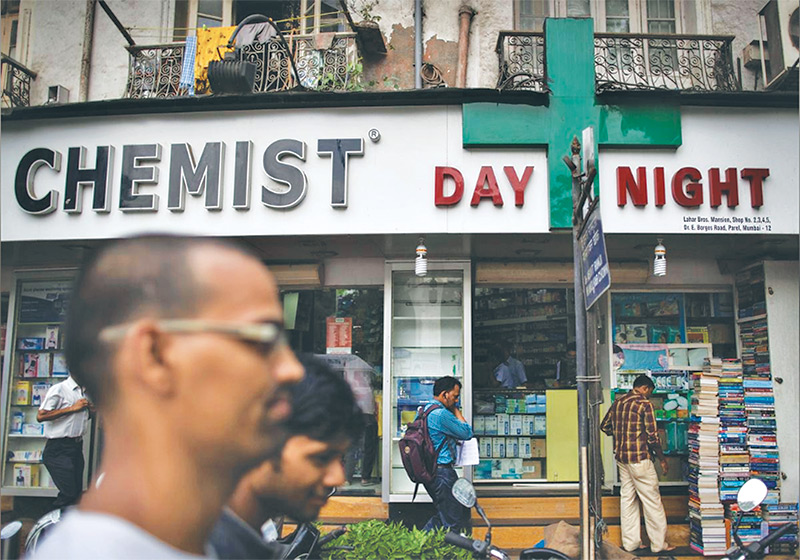
After a petition from a doctor, who alleged unregulated online sales could lead to abuse of medicines, it is prohibited for the time being. reuters

India’s drugs regulator has asked all states to enforce a court directive prohibiting online medicine sales, a senior government official said on Wednesday, raising industry concerns it could disrupt some online businesses.
India is yet to finalise regulations for online drug sales, or e-pharmacies, but the growth of several online sellers such as Medlife, Netmeds, Temasek-backed PharmEasy and Sequoia Capital-backed 1mg has threatened traditional drug-store businesses.
The Delhi High Court in December last year said the government must ensure online sales are prohibited for the time being, as it heard a petition from a doctor who alleged unregulated online sales could lead to abuse of medicines.
K Bangarurajan, a senior official at the Central Drugs Standard Control Organisation (CDSCO), said the federal agency had asked states earlier this year to comply with the court’s order, and a reminder had now been issued to all authorities.
“State drug controllers are the regulating authority, they have to implement this ... and if anyone is dealing (in online sales) they need to take action,” Bangarurajan told Reuters.
The CDSCO’s directive was sent on Nov 28 to all states, according to a copy seen by Reuters. It was not immediately clear what subsequent action states would take.
Sreenidhi Srinivasan, a senior associate at law firm Ikigai Law, said the Delhi court order had raised concerns in the industry and any bans by state drug controllers could hurt online sellers.
Trader groups have protested for years against e-pharmacies, saying they challenge their businesses and could allow medicines to be abused by being sold without proper verification. They also allege e-pharmacies make it easier to use one prescription to buy medicines multiple times.
Steep online discounts have also hit offline businesses, which according to industry estimates recorded $18.4 billion in retail sales in 2018-19. Sales growth has averaged only 8.2 percent a year since 2015-2016, when sales grew by 12.3 percent.
“Online retailers have been offering discounts more than our margins,” said Yash Aggarwal, legal head of South Chemists and Distributors Association in New Delhi.
Some are not worried, however. Pradeep Dadha, CEO and founder of online e-pharmacy Netmeds, said his firm was complying with all Indian laws and regulations and business was continuing as usual.
“All our partner pharmacies also have the required licenses,” Dadha said.


—Reuters

HEALTH & LIVING

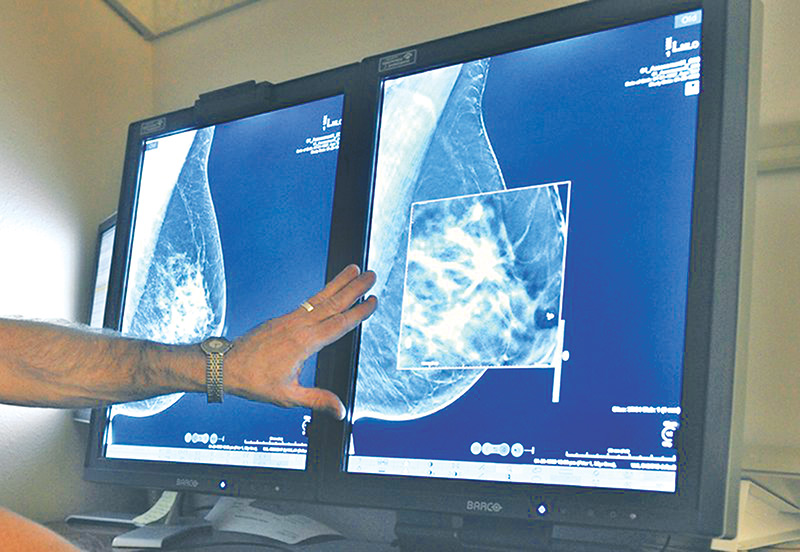
MRIs of dense breasts find more cancer but also false alarms

The study only looked at the first two years of screening with MRIs and it’s too soon to say whether the test will save lives.
- MARILYNN MARCHIONE
A new study suggests that adding MRIs to mammograms to screen women withvery dense breasts may find more cancers but also gives a lot of false alarms. AP/RSS

Giving women with very dense breasts an MRI scan in addition to a mammogram led to fewer missed cancers but also to a lot of false alarms and treatments that might not have been needed, a large study found.
The results give a clearer picture of the tradeoffs involved in such testing, but they can’t answer the biggest question—whether it saves lives. For women with dense breasts trying to decide on screening, “the dilemma remains,” Dr Dan Longo of the New England Journal of Medicine wrote in an editorial published with the study on Wednesday.
About half of women over 40 have dense breasts and about 10 percent have very dense ones. That raises their risk of developing cancer and makes it harder to spot on mammograms if they do. US regulators are making rules to require that women get breast density information when they have mammograms, and many places provide it now. But what to do if you have dense breasts is unclear—it’s not known if more or different types of screening such as MRIs or ultrasounds help.
The study involved more than 40,000 Dutch women ages 50 to 75 with very dense breasts who had normal results from a mammogram, a screening X-ray offered every two years in the Netherlands. About 8,000 of them also were offered an MRI scan, which uses powerful magnets to create detailed images, and 4,783 women agreed.
Researchers then tracked how many breast cancers were detected in each group within two years. Finding more of these “interval cancers” implies that the initial screening may have missed them.
The rate of these cancers after two years was twice as high in the group that was only offered mammograms. This suggests that adding MRIs to initial screening did catch more cancers, but they also gave a lot of false alarms—about 80 per 1,000 scans. Three quarters of women who had a biopsy after a questionable MRI turned out not to have cancer.
MRIs also led to more side effects during the scan or later testing, such as fainting or problems from an IV. And they cost much more than mammograms.
The study only looked at the first two years of screening with MRIs and it’s too soon to say whether the test will save lives.
Without such evidence, it’s tough to say what value there is in finding more cancers, especially many very small, early stage ones, Longo wrote. Doctors already know that some of these will never cause symptoms or become life-threatening.
“Our dilemma is that, for most tumours, we cannot tell the difference between cancers that can kill you and those that cannot,” he wrote.


—Associated Press

Page 9
CULTURE & ARTS

‘Bodhicitta Compassion’ is more than self-expression, it’s self-reflection

In his latest exhibition, artist Tulku Jamyang deploys contemporary cultural motifs to delve into Buddhism and spirituality.
- ANKIT KHADGI
Tulku Jamyang’s (below) exhibition ‘Bodhicitta Compassion’ incorporates contemporary style with its underlying Buddhist philosophy. Post Photos: Beeju Maharjan

KATHMANDU,
They say art reflects the artist. This particularly stands true in the case of Tulku Jamyang’s latest art exhibition, where he uses his paintings as a tool of self-expression.
Jamyang’s paintings may seem ordinary at first glance. But a deeper look into his artworks offer the spectator an invitation to the world of a man who does not adhere to set narratives. He  dresses in monk robes, but sports sneakers and a cap.
And it is not just the attire that juxtaposes with the philosophy of Buddhist monasticism, but his possessions, such as an iPad, an expensive car and a casino slot, is something that does not belong to the institution he represents as well.
But the artist’s aim is not just to create a ‘rebel’ character or create commentary on how social expectations contrast with individual desires. Explaining the marriage between his paintings and the title of his exhibition ‘Bodhicitta Compassion’, he says he wants to urge his audience to look beyond the presumption of what a Buddhist monk should or shouldn’t do or be.
“Buddhism teaches that the intention of a person matters the most. That’s why we must know someone’s intention first rather than judging them on the basis of their physical actions,” says Jamyang. “But that has become the least of our concerns nowadays.”
Bodhicitta, which is defined as a spontaneous wish to attain enlightenment motivated by great compassion for all sentient beings, or ‘awakening mind’ in short, Jamyang says, cannot be just limited to how a person decides to live his life. The ‘awakening’ is internal, and that is what he is trying to portray in his paintings.
Jamyang himself used to be a Buddhist monk, and hence, his paintings and the corresponding themes carry a personal narrative. The artist also says he has taken inspiration of the paintings from one of his friends.
“In my artworks, the character is just doing normal things, like eating a pizza or relaxing by the beach,” he says. “I just want people to change their perspective on how they see monks.”


Rather than judging the outer appearance of a person, even if they belong to a certain institution, it is more important to discuss the knowledge they have. The knowledge he gathered about Buddhism and its philosophy,
during his time as a monk, still seem to be near to his heart, that has trickled down to his artworks too.
Every painting featured in the exhibition, according to him, represents the ten paramitas of Buddhism, perfect virtues that must be practiced by one who undertakes the path to Buddhahood. The practice of these virtues are regarded as the path to enlightenment.
“If you look at the painting of the man using an iPad, I have titled it ‘Meditation’, one of the paramitas,” he says. “As we all have reached a stage, where we use electronic devices so attentively, like how meditation is done, I have named the painting after it.”
Another common noticeable thing in all of his paintings is the use of same five colours—white, yellow, red, blue and green. These five colours, the artist says, have a symbolic meaning in Buddhism. As per Buddhist philosophy, the five colours is associated with a benevolent characteristic that one needs to achieve to attain nirvana (enlightenment).
But this is not the only way through which he has used the teachings of Buddhist philosophy in his art. Pancha Tattva, the five elements of nature (air, water, fire, space and earth), is also weaved into the process of creating his art, which shows how much spirituality has influenced him and his art.
But apart from the theme and underlying philosophy of his paintings, the art itself is very intriguing. The process too, however, is heavily influenced by Buddhism.
“I burn rice paper by using fire, use colour which has water, blow the fire in order to have a distinct texture, and use a dedicated space to exhibit my art,” says Jamyang.
The technique of burning the paper with incense sticks is his personal style. The process makes distinct dot like texture.
Like the philosophy, his artworks can be understood only in layers. One has to unravel the paintings, their colours, the meticulous process of making the artworks and the meanings behind them.
“This is my way of paying homage to the teachings of Buddhism,” he says. “For the younger generation to understand the concept of Buddhism and spirituality, we need to teach them in the language they know. This is why I have mixed contemporary culture with meanings that relate to Buddhism.”


‘Bodhichitta Compassion’ will be on display until December 17 at Dalai-la Art Space, Dalai-la Boutique Hotel, Thamel.

CULTURE & ARTS

Half-North Korean, half-Chinese kids struggle in South Korea

Hundreds of children born to North Korean women and Chinese men have resettled in South Korea, but life is often tough.
- HYUNG-JIN KIM
Choe (right), born to a North Korean refugee mother and a Chinese father, and her North Korean mother Choe HY sit during an interview at the South-North Love School in Seoul, South Korea. AP/rss

Song Hong Ryon looks like any other young woman in South Korea. But three years after her arrival from China, the half-North Korean, half-Chinese 19-year-old has made only two South Korean-born friends and says she’s often been hurt by little things, like when people ask if she’s from China because of her accent.
“I’ve agonised about it a lot by myself,” she said.
Song’s mother fled North Korea in the late 1990s in search of food and work in China, like tens of thousands of other North Korean women did to avoid a famine at home. Many women ended up being sold to poor Chinese farmers as brides, before fleeing again and moving to South Korea, which considers the North part of its territory and therefore embraces North Korean refugees.
Many of the children of these marriages, if they’re able to reunite with their mothers in the South, are alienated and frustrated as they struggle to navigate a strange culture, cut off from friends and many of their relatives.
To tell their little-known stories, The Associated Press talked to three of the children, two of their North Korean mothers and an array of school teachers, experts and government officials.
Many of the North Korean mothers lived in China in constant fear of being captured and repatriated to the North, where they could face torture and lengthy detention. When they made the risky trip to South Korea, they often left their children behind in China.
The lucky ones, after getting jobs and saving money in South Korea, arranged for their children and husbands to travel to the country. But some children were abandoned, or their fathers refused to leave their hometowns and move to a place where they had no relatives or friends.
Family reunions, if they happen at all, often take years, meaning many half-Chinese, half-North Korean children must fend for themselves during their adolescent years.
Song said she was 10 when her mother left their home in the northeastern Chinese city of Yanji in 2010. A year later, her father also went to South Korea, leaving her with her grandparents.
“When my mom left, I didn’t cry. But when my dad left, I cried a lot,” Song said. “I think it was because I felt I was truly alone then.”
She only reunited with her parents in 2016 in South Korea after a six-year separation. Last December, her mother died of lung cancer.
“I came to blame God,” said Song, a devout Christian. “I asked why this had to happen to me.”
In South Korea, children like Song often face crises in identity, a language barrier, public indifference and poor government assistance. Many of them feel like outsiders and get left behind academically and socially. Some return to China, parting again with their North Korean mothers.
They’re often confused about whether they’re Chinese, South Korean or North Korean refugees. Because neither parent is originally from South Korea, they don’t have help assimilating into the country’s brutally competitive and fast-paced society. “Combined with South Korea’s social bias against them and their own distorted views about (the South Koreans around them), they mostly give up on opportunities to develop themselves, and this eats away at them fulfilling their potential,” said Kim Doo Yeon, the principal of the alternative Great Vision School in Uijeongbu, just north of Seoul, where Song was enrolled for two years.
Another half-Chinese, half-North Korean young woman—who wished to be identified only by her family name, Choe, because she worries that media publicity could damage her life in South Korea— came to Seoul from China last year to reunite with her North Korean refugee mother.
The 20-year-old speaks only a little Korean and has no South Korean friends. She has yet to travel alone beyond Seoul and often spends time chatting online with her friends back in China.
Her mother fled their home in Dunhua city in northeastern China in early 2017 after seeing a fellow North Korean woman in their village being arrested and sent back to North Korea.
“I was very saddened,” the daughter said through tears about her separation with her mother.
Her mother, who asked to be identified as Choe H.Y. because of similar privacy issues, said brokers lured her to cross the border into China with the promise of a job before selling her to her husband for 5,000 yuan ($710) in 1998.
Song said her mother was also almost sold to a stranger before she ran away and met her father.
Upon arrival in South Korea, these children are given citizenship because their mothers are now South Korean nationals. But because they don’t have a direct link to North Korea, they cannot legally receive some other special favours that North Korea-born refugees enjoy.
Those missed benefits include the right to bypass the highly competitive national university entrance exam, get a college tuition waiver and, for men, choose whether to perform two years of mandatory military service.
Choe said her brother is still in China because of worries that he’ll have to serve in the military. Choe wants to improve her Korean and go to a South Korean university, which means she must compete with South Korean students in the university entrance exam.
But language is a problem. “If I try to go deeper in our conversation in Korean, she won’t understand, so I become impatient and start speaking Chinese to her,” said Choe H.Y.
The fact that these children’s mothers mostly began slipping into China about 20 years ago suggests their children are now reaching adulthood and that their plight could soon become a bigger social issue in South Korea.
According to the South Korean Education Ministry, about 1,550 such children were enrolled in primary, middle and high schools in South Korea as of April this year, compared with about 980 North Korea-born students. The true number is likely higher.
In recent years, the government has tried to help by providing 4 million won ($3,390) to their families and dispatching more bilingual instructors to schools. In May, an opposition lawmaker proposed providing China-born North Korean children with the same assistance given to North Korea-born refugees.
Shim Yang-sup, principal of the Seoul-based alternative South-North Love School, said the children should be supported because they represent an untapped resource, with the ability to often speak two languages and navigate both Korean and Chinese cultures.
Kim Hyun-seung, 20, from Tianjin, China, arrived in South Korea three years ago to reunite with his mother, who came six years earlier. Kim’s 52-year-old mother, Kim So-yeon, described him as “a great, loyal son,” who tried not to talk much about his suffering and once cooked special foods for her on her birthday.
Tall and slim, Kim said he wouldn’t mind serving in the South Korean military and dreams of being a chef in a French restaurant.
But he doesn’t want a serious girlfriend out of fear they’d “become a couple like my father and mother that gives pain to their child, fails to live together and worries about many things.”
Song’s bilingual ability helped her receive special admission to a university near Seoul. Her first semester starts in March, and she’s excited and nervous about meeting her mostly South Korea-born classmates.
“I’m seeing things positively ... because even if I complain about some difficulties that I have, they aren’t resolved,” she said. “I’ve sometimes gotten sick after brooding alone. As time goes by, I’m missing my mom more than ever.”


—Associated Press

Page 10
WORLD

NATO unity on the line as Turkey row festers

What should’ve been 70th birthday celebration has been overshadowed by bitter rows about money and future strategy.
- AGENCE FRANCE-PRESSE
NATO Secretary General Jens Stoltenberg (left) shakes hands with German Chancellor Angela Merkel upon arrival as Britain’s Prime Minister Boris Johnson looks on at the NATO summit in London on Wednesday. AFP/RSS

WATFORD (UK),
NATO leaders sought to make a show of unity on Wednesday as they met to conclude their annual summit, but the alliance’s chief admitted a festering row with Turkey was still unresolved.
What should have been a celebration of NATO’s 70th birthday has been overshadowed by bitter rows about money and the future strategy of the alliance.
Last year, the Western allies’ get-together was derailed by US President Donald Trump’s demand for greater European defence spending, but 2019’s provocateur was France’s Emmanuel Macron.
The French president has called for a renewed strategic dialogue with Moscow and demanded that Turkey explain itself over its assault--backed by Syrian rebels Paris sees as extremists--on Kurdish forces and its purchase of the Russian S-400 air defence system.
Turkish President Recep Tayyip Erdogan meanwhile has threatened to hold up NATO efforts to bolster the protection of the Baltic republics against Russia unless the allies brand the Kurdish militias who defeated the IS group in Syria as “terrorists”.
Amid fears Erdogan could even veto the summit declaration and with barely two hours to go before the leaders sat down for their sole roundtable, NATO Secretary General Jens Stoltenberg admitted a solution to the row with Turkey had still not been found.
“I’m confident that we will be able to find a solution to the issue related to the updating the revised defence plans,” he said as he arrived for the summit at a luxury golf hotel in Watford, on the outskirts of London.
“I discussed this with President Erdogan last night and we are working on the issue as we speak.”
The summit host, British Prime Minister Boris Johnson, played down the dispute.
“There is far, far more that unites us than divides us, and I think one thing every leader here is absolutely resolved upon is the vital importance of NATO for our collective security,” he said as he arrived.
The leaders met in various groups in London on Tuesday before having dinner with Queen Elizabeth II
in Buckingham Palace, but Macron refused to withdraw his charge that NATO strategy is “brain dead” and Trump continued to insist some capitals were “delinquent” in paying their way.
The row set up a tense last day of what NATO had hoped would be a 70th anniversary show of unity for the “most successful military alliance in history”, and a demonstration that the West can stand up to challenges from Russia and China.
Adding to the disjointed mood, the leaders of Britain, Canada, France and the Netherlands were caught on camera at the palace reception mocking Trump’s lengthy media appearances.
After Macron’s one-on-one pre-summit meeting with Trump had been preceded by a lengthy question and answer session with the media, Johnson was seen asking him: “Is that why you were late?”
Canada’s Prime Minister Justin Trudeau interjects: “He was late because he takes a 40 minute press conference off the top.”
The leaders are to hold just one three-hour working session followed by a statement, and Johnson will make an appeal for unity.
In recent weeks Macron has tried to shake up the agenda by demanding a review of alliance strategy, but Trump--who arrived boasting that he had forced members to boost defence spending--hit back hard.
“I think that’s very insulting,” Trump said of Macron’s assertion last month that NATO is experiencing “brain death”.
“Nobody needs NATO more than France,” he warned. “It’s a very dangerous statement for them to make.”
Trump later softened his tone at a joint appearance with Macron, but the French leader stood by his approach--and his choice of language--and turned his guns on Turkey.
He noted that Turkish forces have attacked the Kurdish militia that backed the allies against the Islamic State in Syria, and he accused Ankara of working with “ISIS proxies”.
Macron and Erdogan later came face to face at four-way talks with Merkel and Britain’s Johnson.
Merkel said she was “relatively optimistic” after the meeting, but Macron warned that “not all clarifications were obtained and not all ambiguities were resolved”.
Trump defended Stoltenberg’s record of pushing allies for increased defence spending, but he reiterated his own long-standing complaints.
“When I came in, I was angry at NATO, and now I’ve raised $130 billion,” Trump said, referring to the sum Stoltenberg says Canada and European members since 2016 will have added to defence budgets by next year.
Only nine of NATO’s 29 members have reached the target agreed at its 2014 summit to spend two percent of their GDP on defence before 2024.
Trump cited in particular Germany as falling short, spending only 1.2 percent of GDP.

WORLD

Privacy concerns pushing people to change online behaviour, poll shows

- REUTERS

TBILISI, 
Privacy concerns are pushing people to change their behaviour online, according to an international poll published on Wednesday that found one in three avoid specific search terms or web pages to elude tracking.
More than seven in 10 respondents to a survey of almost 10,000 people in nine countries said they were worried about how tech firms collected and used their personal data.
About half said they feared their online activity could reveal intimate information about their lives, according to the survey by rights group Amnesty International, which advocates for stronger rules on data protection.
“A clear majority of people are worried about the power Big Tech has over their lives,” said Tanya O’Carroll, director of Amnesty Tech, in a statement.
The Internet Association, a trade group representing tech firms including Facebook and Google, did not immediately respond to a request for comment.
Once seen as engines of growth and innovation, tech giants face accusations on both sides of the Atlantic of misusing their power and failing to protect users.
Social media companies have come under increased scrutiny on data privacy issues, fuelled by last year’s Cambridge Analytica scandal in which tens of millions of Facebook profiles were harvested without their users’ consent..
About half of those interviewed said they have since become more cautious about sharing online personal information such as age, gender and sexual orientation. More than 30 percent said they now used digital tools to limit online tracking.
The survey, conducted online in late October by British pollster YouGov in countries including Brazil, India, and the United States, did not say what terms people avoided.
In March, Google and Facebook said they were making changes to boost user privacy.

WORLD

Australia restricts medical evacuations of refugees

Briefing

SYDNEY: Australia on Wednesday removed the right of doctors to order sick asylum seekers be evacuated from two remote Pacific detention centres for medical treatment, a repeal that opponents said risks the lives of refugees. Under Australia’s controversial immigration policy, asylum seekers intercepted at sea are sent to camps in Papua New Guinea and Nauru. They can never settle in Australia, even if they are found to be refugees. In February, independent lawmakers and the opposition joined forces to give doctors the right to order sick asylum seekers be sent to Australia if they required medical care. After securing re-election in May, Prime Minister Scott Morrison said his government would seek to repeal the legislation, though he needed the support of independent lawmakers as the coalition does not enjoy a majority in Australia’s upper house Senate. (Agencies)

WORLD

Trump lawyer to contest bid to open Afghan war crimes probe

Briefing

THE HAGUE: One of US President Donald Trump’s personal lawyers will speak to the International Criminal Court on Wednesday to block efforts by the chief prosecutor to open a war crimes investigation that would scrutinize the actions of American forces overseas. ICC judges in April rejected the request of prosecutor Fatou Bensouda to examine atrocities alleged to have been committed in the conflict between 2003 and 2004, including by US troops, Afghan forces and the Taliban. Bensouda will reassert her case to open a formal inquiry during three days of hearings before a panel of appeals judges in The Hague. (Agencies)

WORLD

Italy expels two suspected extremists

Briefing

ROME: Italy’s interior ministry says two suspected extremists from Bangladesh and Morocco, including an imam who allegedly beat children studying the Quran, have been expelled from the country. The ministry on Monday identified the imam as a 19-year-old man from Bangladesh who was teaching religion at an Islamic cultural centre in the northern city of Padua. The ministry said the man had a “radical vision of Islam.” (Agencies)

Page 11
ASIA

China’s top diplomat visits South Korea to mend ties

- REUTERS

SEOUL,
China’s top diplomat arrived in Seoul on Wednesday, visiting South Korea for the first time in more than four years as the two countries seek to repair ties that soured over the deployment of US anti-missile systems in South Korea.
During his two-day stay the State Councillor Wang Yi will meet South Korean Foreign Minister Kang Kyung-wha and President Moon Jae-in, officials in Seoul said.
Yi last visited the South Korean capital for a trilateral meeting, also attended by Japan, in 2015.
A year later a row blew up over the planned siting in South Korea of the U.S. Terminal High Altitude Area Defence (THAAD) system, designed to intercept ballistic missiles.
Beijing said it upset the regional security balance as the system’s powerful radar could penetrate into Chinese territory.
South Korea and the United States went ahead regardless, installing the anti-missile system in 2017, saying it was warranted because of North Korea’s provocations.
North Korea has test fired dozens of missiles since Moon Jae-in took office in 2017, most recently on the U.S Thanksgiving holiday last week.
South Korea sees China as instrumental in reviving stalled denuclearisation talks between the United States and North Korea, a longtime ally of Beijing. Denuclearisation negotiations between North Korea and the United States have hit a stalemate after a day-long working-level meeting in October in Stockholm broke down.
North Korean leader Kim Jong Un has set an end-year deadline for Washington to reconsider its approach in denuclearisation negotiations after the last talks ended in disagreement. US officials have downplayed the deadline, calling it artificial.
South Korea is seeking to open additional military hotlines with China to improve communications. The two countries’ defence ministers discussed the issue on the sidelines of an international conference in Bangkok last month, Seoul’s defence ministry said.

ASIA

India cabinet clears contentious nationality bill

Bill would grant citizenship to minorities but not Muslims.
- AGENCE FRANCE-PRESSE

NEW DELHI,
India’s cabinet signed off Wednesday on legislation that stands to give citizenship to certain religious minorities but not Muslims, in what critics say is a fresh attempt to sideline the 200-million-strong Islamic community.
Prime Minister Narendra Modi’s Bharatiya Janata Party (BJP), re-elected in a landslide in May, has long been accused of following a “Hindutva” agenda favouring officially secular India’s majority Hindus.
The amendments to the six-decade-old Indian Citizenship Act, approved by Modi’s cabinet on Wednesday, could go before the lower house of parliament as soon as this week.
The bill would grant nationality to Hindus, Buddhists, Sikhs, Christians, Jains and Parsis fleeing persecution in Muslim-majority Bangladesh, Pakistan and Afghanistan even without any documentation.
Modi’s party has said that Muslims are not included because they are able to take refuge in Islamic nations across the globe.
Senior minister Prakash Javadekar told reporters on Wednesday that the legislation would follow the principles of “natural justice” and is “not against anyone”.
Modi government tried to get similar legislation passed in its first term but failed to garner enough support in the upper house, and it is unclear whether it would succeed there this time.
Apart from stoking unease among Muslims, the proposed changes have also provoked anger in north-east India that for decades has seen major influxes of people of different religions—including Hindus.
Modi’s right-hand-man, Home Minister Amit Shah, held talks with representatives from the region on Tuesday over their concerns.
Shah has been vocal in pushing through the bill that he says is aimed at “saving the lives” of persecuted religious communities in neighbouring Muslim-majority countries.
He has also proposed a “national register of citizens” that he said this week would see “each and every infiltrator identified and expelled” from India by 2024.
Shashi Tharoor from the main opposition Congress party told reporters on Wednesday that the bill “violated” the basic idea of a secular India as pushed by Mahatma Gandhi.
“Those who believe that religion should determine nationhood... that was the idea of Pakistan,” Tharoor said, calling the legislation “fundamentally unconstitutional”.
“It is simple. Citizenship CANNOT be determined by or linked to religion,” tweeted Sitaram Yechury, a senior politician from Communist Party of India.
Under Modi, the Islamic-sounding names of several cities have been changed, while some school textbooks have been altered to downplay Muslims’ contributions to India.
There has been a string of lynchings of Muslims over cows, sacred for many Hindus, and other hate crimes including Muslims forced to perform Hindu chants.
In August Modi’s administration rescinded the partial autonomy of Jammu and Kashmir, India’s only Muslim-majority state, in what his government said was aimed at boosting the local economy and rooting out corruption.

ASIA

Hong Kong police retrieve fresh trove of petrol bombs from university

- REUTERS
A protester throws a Molotov cocktail at an MTR station in Hung Hom after a day of protests in Hong Kong, China on December 1. REUTERS

HONG KONG,
Police in Hong Kong this week re-entered the campus of a university it besieged for more than 10 days last month, gathering newly discovered chemicals and petrol bombs hoarded by anti-government protesters in the Chinese-ruled city.
Following the dramatic saga - where riot police and more than 1,000 demonstrators transformed Hong Kong’s Polytechnic University campus into a battleground - officers were called to retrieve additional dangerous items found among the debris and stowed in locked areas.
Between Nov. 26 and Dec. 2 authorities seized 4,296 petrol bombs, 671 bottles of chemicals and 622 weapons, police said in a statement late on Tuesday.
Officers first entered the Polytechnic campus on Nov. 29, when they collected thousands of petrol bombs, which they dusted for fingerprints, as well as bows and arrows and bottles of chemicals.
The campus conflict began in mid-November when protesters barricaded themselves against riot police in days of violent clashes that marked a significant escalation in the political unrest that has roiled the former British colony for six months.
About 1,100 people were arrested in connection with the campus siege.
Sparked by a controversial and since-withdrawn extradition bill, the protests have swelled into broader calls for greater democratic freedoms.
Those who have joined the pro-democracy demonstrations accuse China of increasingly interfering in freedoms promised to the former British colony when it was returned to Chinese rule in 1997.
Pro-democracy parties won a resounding victory in local district council elections late last month. Hong Kong leader Carrie Lam has appealed for peace in the city but has not offered any concessions.
Sustained demonstrations, scheduled to continue this week and expected to draw thousands to the streets this weekend, show few signs of abating and are taking an economic toll on the global financial hub.
Business activity in Hong Kong contracted at the fastest pace in 21 years in November, dragged down by the protests and softening global demand, an IHS Markit survey showed on Wednesday.
Asia’s largest distributor of luxury brands, the Blubell group, has appealed to Hong Kong landlords to scrap the base rent in shopping malls, saying a slump in tourist spending will push even more retailers out of business.
Sales in some of its stores, two of which are on the verge of closing, have dropped as much as 60 percent during the six months of protests, Bluebell chief executive Ashley Micklewright told the South China Morning Post.
Hong Kong recorded its largest-ever retail collapse in October, with sales dropping 24.3 percent to HK$30.1 billion, the government said Monday.

ASIA

Sri Lankan court blocks Swiss Embassy worker from leaving

Sri Lankan government says its investigations did not support the embassy’s claims.
- ASSOCIATED PRESS

COLOMBO, 
A Sri Lankan court on Tuesday blocked a Swiss Embassy employee from leaving the country until she gives a statement to police about allegations that she was abducted and threatened in order to disclose embassy information.
Colombo’s chief magistrate issued an order at the request of police preventing the woman from leaving until Dec. 9 and requiring that she give a statement before that date.
The Swiss foreign ministry called the Nov. 25 incident a “very serious and unacceptable attack.” The Sri Lankan government said evidence collected by its investigators did not support the sequence of events given by the embassy, and said the employee needs to be interviewed by police.
Swiss State Secretary Pascale Baeriswyl summoned Sri Lankan Ambassador Karunasena Hettiarachchi and asked him to explain the evidence, the Swiss foreign ministry said Monday.
Baeriswyl told the ambassador that the ministry would support all measures to investigate and resolve the matter by due process of law, but that the woman was too ill to be interviewed now.
“She confirmed that the employee concerned still cannot be questioned on health grounds, stressing that
the individual’s health must take priority,” the ministry said in a statement.
“She also indicated that while Switzerland had no interest in delaying investigations by the Sri Lankan authorities, the Federal Department of Foreign Affairs takes its responsibilities to its staff very seriously.”
A Sri Lankan police investigator, Nishantha Silva, fled to Switzerland following the election of Gotabaya Rajapaksa as president on Nov. 16.
Silva had been investigating alleged abductions, torture, killings and enforced disappearances of journalists and activists when Rajapaksa was the defense chief under his brother Mahinda Rajapaksa’s presidency.
As defense chief, Gotabaya Rajapaksa was accused of overseeing what were known as “white van” abduction squads that whisked away critics. Some of them were returned after being tortured, while others were never seen again.
Gotabaya Rajapaksa has denied the allegations.

ASIA

Former Indian minister Chidambaram granted bail

- ASSOCIATED PRESS
Palaniappan Chidambaram. AP/RSS

NEW DELHI,
India’s Supreme Court on Wednesday ordered the release of a key opposition Congress party leader on bail in a case involving alleged bribery and money laundering benefitting his son’s company.
Palaniappan Chidambaram, a former finance minister, has denied the allegations and accuses Prime Minister Narendra Modi’s government of pursuing a political vendetta.
His attorney said the court ordered Chidambaram’s release Wednesday on 200,000 rupees ($2,850) bail. He was expected to leave New Delhi’s Tihar prison later Wednesday after spending 105 days there.
The court ordered Chidambaram not to influence witnesses or tamper with evidence ahead of his trial, the Press Trust of India news agency reported. The judges also ordered Chidambaram not to leave the country without permission or make public statements about the case, PTI said.
The Central Bureau of Investigation accuses him of illegally obtaining 3 billion rupees ($43 million) from a Mauritius-based firm for his son’s company while he was finance minister in 2006. Modi’s Hindu nationalist Bharatiya Janata Party came to power after defeating a Congress party government in 2014.
Several senior Congress party politicians and high-ranking government officials faced bribery charges after New Delhi hosted the 2010 Commonwealth Games.
For years, anti-corruption campaigners have said the party in power in India uses the top investigating agency to cover up wrongdoing and target political opponents.

ASIA

Japanese doctor, five Afghans killed in Afghanistan attack

Briefing

KABUL: A Japanese doctor who spent decades working in Afghanistan was killed Wednesday along with five Afghans in an attack in the east of the country, officials said. Tetsu Nakamura, 73, who headed Peace Japan Medical Services—known as Peshawar Kai in Japanese—was shot by gunmen while in a vehicle in Jalalabad in Nangarhar province. “Sadly, Dr Nakamura has passed away from the wounds he received in the armed attack this morning,” said Attaullah Khogyani, a spokesman for Nangarhar’s governor. The doctor, well-known in Japan, had been shot on the right side of his chest and was in the process of being transferred to a hospital in Bagram near Kabul when he died at Jalalabad airport, officials said. (Agencies)

ASIA

Iran’s Rouhani says innocent protesters should be freed

Briefing

TEHRAN: Iran’s President Hassan Rouhani called Wednesday for the release of innocent people who were arrested during nationwide protests against a fuel price hike last month. Demonstrations erupted in Iran on November 15 against the unexpected decision to raise the price of petrol by as much as 200 percent. Iran has yet to give overall figures for the number of people arrested when security forces moved in to quell the unrest that saw buildings torched and shops looted. “All those people who have been arrested, of course some of them are innocent and should be freed,” Rouhani said in an address broadcast by state television. (Agencies)

ASIA

Angry Islamists besiege Pakistan’s newspaper

Briefing

ISLAMABAD: Dozens of angry Islamists swarmed the building of an independent Pakistani newspaper in the capital, Islamabad, blocking its entrance for several hours, threatening the staff and demanding its editor be hanged. A simultaneous protest also took place Tuesday evening in the southern port city of Karachi, where the Islamists gathered at the Press Club, demanding Dawn’s editor Zaffar Abbas and publisher Hameed Haroon be hanged. The demonstrators were angered that the English-language paper had reported that the London Bridge attacker was of “Pakistani origin”. The protest was condemned by Pakistani rights groups and members of civil society advocating for the rights of journalists. The Committee to Protect Journalists urged Pakistan to investigate the death threats. (Agencies)

Page 12
MONEY

Bids for ‘oversubscribed’ Saudi Aramco IPO to conclude

- AGENCE FRANCE-PRESSE

RIYADH,
Saudi Aramco is set to conclude Wednesday the bidding period for what is expected to be the world’s biggest share sale, with the energy giant pinning its hopes on regional sovereign investors.
The world’s most profitable company is seeking to raise up to $25.6 billion—a fraction of the $100 billion it once sought—from its much-delayed initial public offering that is heavily focused on domestic and Gulf investors. The sale of 1.5 percent of the energy giant has so far been oversubscribed, financial advisers say, with bidding for institutional investors set to close at 1400 GMT on Wednesday.
Retail subscriptions, which concluded last week, reached $12.6 billion with almost five million subscribers, advisers said.
The share sale is on course to beat Chinese retail giant Alibaba’s $25 billion world-record IPO of 2014, but “the proceeds would barely cover the kingdom’s budget deficit for a year”, Capital Economics said.
International investors have baulked at Aramco’s valuation of between $1.6 trillion and $1.7
trillion—a figure still well short of the valuation of $2 trillion targeted by the kingdom’s de facto ruler, Crown Prince Mohammed bin Salman.
Amid tepid demand, Aramco executives have cancelled IPO roadshows in the United States and Europe.
However Gulf ally Abu Dhabi plans to stump up as much as $1.5 billion, while the Kuwait Investment Authority will invest $1 billion, Bloomberg News reported.
Saudi Arabia has pulled out all the stops to ensure the success of the IPO, a crucial part of Prince Mohammed’s plan to wean the economy away from oil by pumping funds into megaprojects and non-energy industries.
Saudi banks have offered citizens easy “IPO loans” and nationalists have called for investment as a patriotic duty.
Aramco also dangled sweeteners for local investors, including promises of higher dividends and the possibility of bonus shares if they hold on to the stock.

MONEY

United Airlines orders 50 Airbus aircraft to replace Boeing 757s

- AGENCE FRANCE-PRESSE

NEW YORK,
United Airlines said Tuesday it had ordered 50 Airbus A321XLR aircraft, worth an estimated $6.5 billion, to replace an existing fleet of aging Boeings.
The new Airbus planes, to be delivered starting 2024, will allow United to retire its Boeing 757-200s, the company said.
The Airbus order is the latest blow to the American manufacturer, already deeply mired in the crisis surrounding its 737 MAX, which has been grounded worldwide after two crashes that resulted in 346 deaths.
Boeing has no new aircraft to compete with the Airbus A321XLR in the mid-market range.
Airbus launched the A321XLR only this year, at the Paris Air Show in June.
The single-aisle aircraft’s range is 15 percent above that of its predecessor, the A321LR, making it a cost-effective alternative to long-haul wide-body planes.
It’s larger fuel tanks allow it to cover up to 5,400 miles (8,700 kilometres) in nine hours—significantly more than the Boeing 737 MAX.
United said it intends to use the new aircraft to serve additional European destinations from US East Coast hubs in Newark/New York and Washington.
The airline turned to Airbus for the purchase because Boeing does not have an aircraft in the mid-market range, a source close to the matter told AFP on condition of anonymity.
“There are no aircraft currently offered by Boeing that can replace the 757,” the source said, adding that negotiations between Airbus and United began several months ago.
Boeing, which is currently focused on returning its MAX aircraft to the sky, has already postponed until next year the possible announcement of a new model aircraft (NMA) intended to replace the 757 and 767.
The manufacturer recently presented the design to various airlines, including United, industrial sources told AFP. Boeing still aims to have the NMA enter service in 2025, the sources said. “We will take a close look at this aircraft,” said Andrew Nocella, United chief commercial officer, during a call with reporters.
He added that United has not ruled out the possibility of buying the NMA should Boeing build it.

MONEY

OPEC gearing up for deeper oil cuts, Russia yet to agree

The organisation has been curbing output since 2017 to counter oversupply.
- REUTERS
Chevron oil exploration drilling site near Midland, Texas, US. reuters

VIENNA, 
OPEC is gearing up to deepen production cuts later this week but still needs to agree with allies such as Russia over details of a deal to support oil prices and head off a looming oil glut next year.
The Organization of the Petroleum Exporting Countries (OPEC) meets on Thursday in Vienna followed by a meeting with Russia and others, a grouping known as OPEC+, on Friday.
OPEC+ has been curbing output since 2017 to counter oversupply as a result of booming output in the United States, which has become the world’s biggest producer and is not taking part in cuts.
Next year, rising production in non-OPEC countries such as Brazil and Norway threaten to add to the glut.
OPEC’s actions in the past have angered US President Donald Trump, who has repeatedly demanded
OPEC’s de facto leader Saudi Arabia bring oil prices down if it wants Washington’s to provide Riyadh with military support against arch-rival Iran.
In the past few months Trump has remained silent on OPEC but he faces re-election in November next year when the issue of gasoline prices is likely to become a hot political topic again.
Washington’s ongoing trade dispute with China has also clouded the economic and therefore oil demand outlook for 2020. OPEC’s second largest oil producer Iraq said on Tuesday key members supported deepening cuts for OPEC+ from the current level of 1.2 million barrels per day, or 1.2 percent of global demand.
“My understanding is that they (Saudis) do (prefer it),” Iraqi Oil Minister Thamer Ghadhban told reporters in Vienna.
The current deal expires in March and two OPEC sources have said it would be extended at least until June. Oman’s oil minister Mohammed al-Rumhi said on Wednesday his delegation would recommend extending cuts until the end of 2020.
Saudi Arabia needs higher oil prices to support its budget revenue and the pending share sale of state-owned oil giant Saudi Aramco with pricing expected on Thursday.
OPEC’s actions have supported oil prices at around $50-$75 per barrel over the past year and on Wednesday they traded at $61 per barrel.
Iraq’s Ghadhban said new cuts could be expanded to 1.6 million bpd while OPEC sources have also said Riyadh was pressing fellow members Iraq and Nigeria to improve their compliance with quotas, which could provide an additional reduction of up to 400,000 bpd.
Not all OPEC members were convinced of the need to cut deeper, however. One OPEC delegate said the move would boost prices and help spur a new phase of US oil output growth.
Non-OPEC Russia has yet to agree to extend or deepen cuts from its current pledge of 228,000 bpd as its companies are arguing they are finding it tough to reduce output during winter months due to very low temperatures.

MONEY

Google co-founders step aside as Pichai takes helm

- REUTERS

SAN FRANCISCO,
Google co-founders Larry Page and Sergey Brin are
stepping aside as leaders of the Internet behemoth they founded 21 years ago, ending an extraordinary run that
saw them build one of the world’s most valuable and
influential companies.
Trusted lieutenant Sundar Pichai, who has run the core Google search business since 2015, will immediately take the reins as CEO of parent Alphabet Inc.
“While it has been a tremendous privilege to be deeply involved in the day-to-day management of the company for so long, we believe it’s time to assume the role of proud parents — offering advice and love, but not daily nagging!” Page and Brin wrote in a blog post on Tuesday.
Page, Brin and Pichai have shared an emphasis on developing artificial intelligence software to make web searching faster and more personalized, while expanding the range of information and services available from a simple text query.
But their vision faces unprecedented scrutiny, with governments on five continents demanding better safeguards, an end to what many view as anticompetitive conduct, and more taxes from the world’s largest online advertising company.
Thousands of employees have protested, and some have even resigned, over ongoing concern that Google’s famous “don’t be evil” mantra—once embraced by Page and Brin—may be cracking.
Streamlining Alphabet’s unorthodox management structure could help the company better respond to the challenges and focus on growing profits, investors said.

Page 13
MONEY

Indian-Nepali joint venture to carry out studies for three power lines

The planned 400 kV transmission lines will boost the capacity of Nepal’s power grid.
- PRAHLAD RIJAL
shutterstock

KATHMANDU, 
The Project Management Directorate under the Nepal Electricity Authority has signed a deal with an Indian-Nepali joint venture to carry out preliminary studies for the
construction of three major 400 kV transmission lines.
Power Grid Corporation of India and Jade Consult of Nepal are joining forces to make a study of substations and power lines stretching from Tingla in eastern Nepal to Dhalkebar substation, from the Budhi Gandaki Corridor to Ratamate, and from Damauli to Baphikot.
The scheme is part of the Asian Development Bank-funded $21 million Preparatory Facility for Energy Project.
“We are gearing up to move forward with the crucial projects as per the transmission master plan issued by the government in 2018,” said Bodh Nath Neupane, project manager. “We initiated the process to hire international consultants in November, and we aim to have the projects ready to go into construction by February 2021.”
According to Neupane, the planned power lines will boost the capacity of Nepal’s power grid to transmit and handle a greater
power load, and allow smooth export of electricity to India. Power Grid Corporation is an Indian state-owned entity which is also constructing a 400 kV transmission line from the export-oriented 900 megawatt Arun 3 hydel scheme to Bathnaha on the Nepal-India border.
The Indian company has executed 13 other consulting assignments funded by multilateral agencies including the Asian Development Bank and the World bank.
The consulting process of the Tingla, Budhi Gandaki and Damauli transmission lines will be carried out with a $3 million grant from the Asian Development Bank. The project’s closing date is slated for June 2020.
“As the projects are crucial to help us expand the grid and increase electricity supply within Nepal and India and were bogged down in processes, we are planning to seek a deadline extension from the donor through the Finance Ministry,” said Neupane.
Six international firms were in the race for the consulting contract. The state-owned power utility has signed an agreement with the joint venture, but it is yet to deposit the performance guarantee and conclude the contract process.
As per the Transmission System Development Plan of Nepal, the Tingla-Dhalkebar line, the current power exchange conduit between Nepal and India, will pass through the Khimti and Sunkoshi corridors which have a high concentration of power schemes.
The Tingla hub holds 19 percent of the total generation capacity of Province 1 with the proposed 590 megawatt Dudh Koshi 2 and 86 megawatt Solu Khola schemes on its periphery.
The plan has envisioned to evacuate 1444.94 megawatts from the Tingla hub and 2226.67 megawatts from the Khimti region by 2040 through the proposed conduit.
The transmission project in the Budhi Gandaki corridor will evacuate 1824.7 megawatts of electricity. Six transmission projects in the Damauli-Baphikot and Butwal regions, including the second high capacity Butwal-Gorakhpur cross-border line, will convey over 2000 megawatts. The power lines have been proposed to be built with an investment of over $500 million.  
According to the donor, the project is intended to prepare a series of hydropower projects and related transmission infrastructure for development in Nepal, emphasising private sector participation and regional integration.
“The Asian Development Bank is helping Nepal lay the groundwork for projects needed to reduce local power shortages and to provide surplus electricity for export to India,” said the donor. “A major obstacle to exploiting Nepal’s hydropower export potential is the shortage of adequate infrastructure to transmit electricity to neighbouring India. Instead of exporting power, in fact, Nepal imports it from India.”
In July, the power utility also initiated the process to carry out preliminary studies for the construction of three transmission lines and seven high capacity substations in eastern Nepal, four years after signing a loan agreement with the International Development Association to build them.
The initiative is intended to support the government’s target to evacuate more than 3,000 megawatts from the region for domestic consumption and export.

MONEY

Asian markets sink as Trump hints at delay to trade deal

- AGENCE FRANCE-PRESSE

HONG KONG,
Asian investors extended a sell-off in global markets on Wednesday after Donald Trump poured cold water on the chances of a trade deal with China by the end of the year.
After weeks of broad optimism—and White House claims—that the economic superpowers were close to a partial agreement, the president said he could be happy to wait until after next year’s elections.
The comments, in London ahead of a tense NATO summit that has also fuelled geopolitical concerns, sent shivers through trading floors across Europe and New York, where dealers ran for the hills.
“I have no deadline,” Trump told reporters upon his arrival. “In some ways, I like the idea of waiting until after the election for the China deal.”
Investors were already on edge after the US reimposed stiff tariffs on Argentina and Brazil citing currency manipulation, then threatened to hammer France with 100 percent levies over the country’s digital tax.
US Commerce Secretary Wilbur Ross had also warned that more tariffs on Chinese goods planned for December 15 would be imposed if the first phase of trade talks was not completed by then.
Observers noted that Trump has in the past made statements on the issue that he has soon rowed back on, but there is a growing concern that the next round of China levies will be imposed.
A US House of Representatives vote to toughen the US position against China over its treatment of minority Uighurs, calling for sanctions against senior officials, will likely further complicate matters. Beijing said Wednesday the bill “wantonly smears” it and that a “price must be paid” by the US.
The vote comes days after China announced retaliatory measures for Trump’s decision to sign a bill supporting Hong Kong democracy protests.
“While the trade mood music can change very quickly, events over the past 48 hours have forced a reassessment in terms of what to expect before the end of the year,” said Rodrigo Catril at National Australia Bank.
“Tariff man is back and he has brought market volatility back to life.”
Markets were down across the board in Asia on Wednesday.

MONEY

Farmers expect orange biz boom this season

The eastern hilly region is seeing a 30 percent increase in production of the sweet fruit.
- PRADIP MYANGBO
Farmers offload oranges hauled to Dharan from Khoku and Maunabudhu region in Dhankuta district. POST PHOTO: Pradip Myangbo

SUNSARI,
The agricultural market of Dharan has set its sights at wholesale transactions of orange to cross the Rs 1 billion mark this season as the eastern hilly region witnessed a 30 percent increase in production of the sweet fruit.
The market started trading oranges a fortnight ago and is witnessing a steady inflow of 35 tonnes of the fruit from orchards in Dhankuta amid growing local demand.
According to Laxman Bhattrai, coordinator of the market management committee, the market has seen transactions of 1128 metric tonne oranges worth around Rs110 million, as of Wednesday.
“The main season of orange production has yet to start and we are already seeing a spike in demand,” said Bhattrai.
“Additional consignments of the fruit from Bhojpur, Khotang, Terathum and Sankhuwasabha are yet to enter the market.”
The oranges are being sold at a wholesale price of Rs 115per kilogram and retail prices stand at Rs 150 per kilogram.
Last year, the market sold 7,519 metric tonnes of citrus fruit at a wholesale price of Rs 90 per kilogram.
Although the orange season starts from mid-November and lasts till mid-march, some farmers opt to harvest the fruit late in the season in view of higher profits.
Oranges produced in the eastern hilly region is mainly supplied to markets in Dharan, Itahari, Biratnagar, Damak, Birtamod, Rajbiraj and Janakpur.
The fruit was also exported to Bangladesh five years ago in line with the preference of Bangladeshi consumers.
“Issues pertaining to branding and packaging along with the long-winded custom clearance process on hauling oranges to Bangladesh via India completely halted the exports,” said Bhattarai.
According to Bhattarai, farmers could see good prices for their produce if the government created an environment allowing smooth export of oranges to Bangladesh and India.
Orange production in the region has increased in line with a surge in the number of farmers and orchards. Officials say that the region holds the capacity to trade oranges worth at least Rs5 billion if the government adopts a policy to incentivize farmers while clearing bottlenecks on export to third world countries.

MONEY

China capex growth hits three-year low as weak economy, trade war drag

- REUTERS
A man walks on the bund in front of the financial district of Pudong in Shanghai, China. REUTERS

BENGALURU/SHANGHAI,
Capital investment by Chinese firms has ground to its slowest pace in three years, as a weakening economy, tight credit and prolonged trade war with the United States dent sales growth and cash reserves, a Reuters analysis showed.
Companies are also spending more days to turn inventory into sales and eking out smaller profit gains, the analysis showed, in an economy growing at its weakest pace in nearly three decades, with many analysts expecting the slowdown to intensify.
The outlook became even more uncertain on Tuesday after US President Donald Trump said a trade deal with China might have to wait until after the US presidential election in November 2020.
“Things will get much worse before getting better,” economists at Macquarie said in a client note on Monday. Even positive economic data from China recently is volatile and vulnerable to one-off factors such as warm weather, they said.
“After all, the so-called phase 1 deal is mainly about preventing things from getting worse, instead of making things significantly better,” they said, referring to negotiations in a 16-month Sino-US trade war punctuated by tit-for-tat import tariffs.
Chinese firms raised capital spending by 1.6 percent in the three months through September versus the same period a year prior, the weakest growth in three years, showed a Reuters analysis of about 2,900 firms with market capitalization above $100 million.
“The weak appetite to invest is a problem in terms of generating a strong recovery in the Chinese economy,” said senior China economist Julian Evans-Pritchard at Capital Economics.
“Overall credit conditions are still quite tight and credit growth is actually slowing ... because, in particular, the non-bank forms of credit access have become much more restrictive in the shadow banking sector.”
Though the government has taken steps to encourage lending, bankers told Reuters they have little appetite to lend to small firms due to the trade war and uncertain economic outlook, as well as a years-long drive to cut risk in the financial system.
Cash reserves at surveyed firms grew 5.6 percent on year in the September quarter, the weakest since the first quarter of 2018. Moreover, the average number of days a company holds inventory before sale was 108 in the first nine months of the year, topping an annual average of 100 or less in the last four years.
Revenue grew 6.7 percent, the weakest in at least three years—the earliest period for which data from a comparable number of firms is available—while net profit rose 7.8 percent versus nearly 22 percent two years earlier.
The consumer discretionary and communications services sectors were among the poorest performers, with revenue shrinking 1.4 percent and growing just 1 percent respectively.
Companies’ financial reports indicate consumers have been cutting back spending on vacations and big-ticket items such as cars and home appliances, while falling smartphone sales have capped growth among telecommunications network providers.
Car maker Zotye Automobile Co Ltd saw revenue in the September quarter drop 88 percent on year, and TV and smartphone maker TCL Corp cut capital expenditure by 72 percent.
Yet while earnings reports indicate a slowdown, growth in factory activity neared a three-year high in November, reinforcing upbeat government data released over the weekend.

Page 14
SPORTS

Karki, Bashyal pocket taekwondo gold for Nepal

The hosts extend their tally in taekwondo to 11 gold, 3 silver and 9 bronze medals. Deepak Hamal adds a third wushu gold.
- PRAJWAL OLI
Sangita Bashyal (right) of Nepal vies with Gangajot Gill of India in herU-62kg final bout of taekwondo under South Asian Games at the Nepal Taekwondo Academy Hall on Wednesday. post Photo: Elite Joshi

KATHMANDU,
Saksham Karki and Sangita Bashyal clinched a gold each in taekwondo on Wednesday, as Nepal extended their medal haul in the martial arts category at the ongoing South Asian Games with eleven gold, three silver and nine bronze medals so far.
Among the 29 golds in taekwondo, the last six will be contested on Thursday.  
Karki secured top finish in the men’s above 87kg weight division in the match held at the Nepal Taekwondo Academy in Satdobato, Lalitpur. He registered a comfortable 27-9 win over Wakar Ali of Pakistan in the final. Balapatiyage Bless of Sri Lanka and Chaitanya Vijay of India settled for bronze.
“I am one of the most experienced players in the team, and I was under pressure to win after some of the medal hopefuls including Manoj Malla and Nima Gurung,” the 23-year old said. Winning the gold medal at home, Karki said, was the best moment for him. He credited training in China and inspiration from legendary taekwondo player Deepak Bista as the major factors for his success.
Meanwhile, Bashyal claimed gold in the women’s U-62 kg category, defeating Gangajot Gill of India in the final. Soya Sabir of Pakistan and Maneesha Samrajeewa of Sri Lanka took bronze. “I failed to play as per the game plan due to pressure, as many home players lost their bouts today. But I had said to myself that I must win and the gold is a big achievement for me.”
Nepal’s Olympian Nisha Rawal failed to live up to the expectations. She lost the women’s over 73kg bout final against India’s Rodali Baruwa 32-9.
Chalinda Sampath of Sri Lanka Gangajot Gill of India defeated Sourav of India in the men’s U-63 kg final after they were tied on 18 points. In the tie-breaker, Sampath earned two points.
Gyanendra Hamal of hosts Nepal and Hemhood Khan of Pakistan were the joint bronze medalists.
The men’s U-74kg division saw Jarnel Singh of India beat Jarban Khan of Pakistan 41-26. Nischal Shrestha of Nepal and Darshana Kumara of Sri Lanka won bronze medals.
In the women’s U-53kg category, Latika Bhandari of India got the better of Aneila Ayesha Afsar of Pakistan with the score tally of 40-10. Nepal’s Ashmita Khadka and Dasuana Nimesha of Sri Lanka finished with bronze.


More glory in Wushu
Deepak Hamal secured third wushu gold for Nepal on Wednesday. He scored 19.32 points in nangun taolu to finish ahead of India’s Sajan Lama who collected 19.12 points. Bangladesh’s Md Amir Hossain took home bronze medal.
Sri Lanka’s Tharidu Namal Anuratha won gold in the men’s taolu taijijian in the game marred by controversial referee decision. Nepal’s coach Ambar Thing and India’s coach protested against the decision, claiming that the judgment was unfair and the Sri Lankan should have finished fourth.  After spectators hurled bottles at the Army’s indoor facility in Lagankhel, the game was briefly interrupted, calling for police intervention.
Anuratha was given 18.9 points while silver medalist Gyanendra Singh got 18.76 points. Nepal’s Hari Prasad Gole garnered 18.49 points to finish with bronze medal.

SPORTS

See you soon in Italy: Ibrahimovic fuels talk of Serie A return

- AGENCE FRANCE-PRESSE

MILAN,
Sweden footballer Zlatan Ibrahimovic has fuelled speculation that he is set to return to Italy, where he has played for AC Milan, Inter Milan and Juventus, by saying in an interview: “see you soon in Italy”. The 38-year-old striker confirmed his departure from Los Angeles Galaxy last month following the club’s elimination from the Major League Soccer playoffs.
“I’ll join a club which must get back to winning, which must renew its history and is in search of a battle against everyone and everything,” Ibrahimovic told GQ Italia. “That is the only way I’ll be able to find the necessary motivation to surprise you again. “It’s not just about choosing a team, as there are other factors that need to line up, including in the interests of my family. I’ll see you in Italy soon.” According to reports in Italy, Ibrahimovic has been offered a six-month deal to come to the aid of struggling former giants AC Milan, who are 11th in the Serie A table. Napoli are also a possible destination as last season’s runners-up sit seventh.
“I love to make the difference,” he added. “I don’t just want to do one or two things well, I want to do all of it.” Ibrahimovic played for two seasons between 2010 and 2012 with AC Milan, helping them to their last Serie A title, and scoring 42 goals in 61 league appearances. He also won three league titles with Inter Milan, and two with Juventus, which were both revoked following the ‘Calciopoli’ match-fixing scandal.

SPORTS

Guests Australia to face Argentina in Copa America

Other guest nation Qatar are pitted against Colombia, Brazil, Venezuela, Ecuador and Peru in Group B.
- AGENCE FRANCE-PRESSE

CARTAGENA,
Australia will face Lionel Messi and Argentina in next year’s Copa America after being drawn alongside the tournament co-hosts on Tuesday. The Socceroos, one of two guest teams invited to South American football championship, will also face Paraguay, Bolivia, Uruguay and Chile in Group A.
In Group B, Asian champions Qatar, the other guest nation, will face Colombia, Brazil, Venezuela, Ecuador and Peru, with all games taking place in Colombia. The first round designations for Australia and Qatar were the only major issue left to be decided at Tuesday’s ceremonial draw. The other teams in the two groups had already been determined based on geographical proximity to co-hosts Argentina and Colombia, separated by some 7,000 kilometers.
Australia coach Graham Arnold said his team was relishing the prospect of facing Argentina in Buenos Aires. “That’s what it’s all about, it’s about testing ourselves at the highest level,” Arnold said following the draw. “The players are so excited to have this great opportunity.” The former international striker speaks from experience: Arnold was a member of the Socceroos team which lost to a Diego Maradona-inspired Argentina in a 1993 playoff for a spot in the 1994 World Cup.
“In the old days in the 1990s we played Argentina and Maradona over there and if you speak to the players involved they’ll tell you what a great experience it was,” Arnold said. “Our boys haven’t really had the experience of playing in South America. So to be able to play in South America in those great stadiums in that environment is going to be a buzz.”
The 2020 Copa America marks the first time in the modern history of the tournament that the event is being co-hosted. Argentina and Colombia were chosen as hosts after South American football’s governing body CONMEBOL turned down an offer from the United States Soccer Federation to hold an expanded 16-team edition of the Copa America.
The 2020 tournament will also see a change in format. At this year’s Copa America, won by host nation Brazil, the 12 teams taking part in the event competed in three first round groups of four teams, with the top two in each group and the two best third placed teams advancing to the quarter-finals. Next year, the tournament will instead see two first round groups of six teams.
Tournament co-hosts Argentina will kick off the tournament against bitter rivals Chile on June 12 in Buenos Aires. Chile scored back-to-back victories over Argentina in the finals of the Copa America in 2015 and 2016. Argentina defeated Chile in the third place play-off at this year’s tournament.
Australia will open their tournament against Uruguay on June 13. The Socceroos have a history with the two-time world champions, losing to the Uruguayans in a two-legged playoff for a place at the 2002 World Cup before eliminating the South Americans on penalties in 2005 to clinch a place at the 2006 tournament in Germany. Qatar, meanwhile, who finished bottom of their group at this year’s Copa America to exit in the first round, will open their tournament against Peru on June 14.
The June 12-July 12 tournament is the 47th edition of the Copa America, the oldest international competition in world football.

SPORTS

Jesus finds goal touch as Man City bounce back to thrash Burnley

Guardiola speaks highly of the Brazilian striker as Aguero too is expected to miss Manchester derby.
- AGENCE FRANCE-PRESSE
Gabriel Jesus. photo courtesy: mancitycore.com

BURNLEY,
Gabriel Jesus scored twice as Manchester City showed no signs of giving up their Premier League title without a fight as a 4-1 victory at Burnley cut the gap on unbeaten leaders Liverpool to eight points. Pep Guardiola’s men have struggled to match the blistering standards they set in back-to-back title-winning seasons, but looked more like their old selves in what could have been a tricky trip to Turf Moor.
Jesus made the most of his chance to shine in the absence of the injured Sergio Aguero with two brilliant finishes either side of half-time to end an eight-game goal drought before long-range strikes from Rodrigo and Riyad Mahrez moved City above Leicester into second place on goal difference. “The strikers are there to score goals and we need him,” said Guardiola of Jesus’s importance with Aguero also expected to miss Saturday’s Manchester derby. “His effort, his commitment is always there but strikers like him and Sergio live for the goal and it’s important.”
Robbie Brady pulled a late goal back for Burnley, who remain in 11th. “City are a top-class side and they showed it tonight,” said Burnley boss Sean Dyche. “We kept it tight first half and made it awkward but they were excellent second half and we never got to grips with it.”
The visitors were dominant from first minute to last and could have been far more convincing winners but for some wayward finishing and Nick Pope’s resistance in the Burnley goal.
“We played a good game, we controlled them and we didn’t concede much apart from the goal in the last minutes,” added Guardiola. “Our level was so good in most of the games. I don’t have the feeling we played bad in certain games. In general, I’m more than satisfied with the level of the team.”
Jesus did not look like a striker searching for confidence as he opened the scoring with a sumptuous curling effort that found the far corner from David Silva’s pass. Pope then stood up well to block with his feet from Raheem Sterling and Bernardo Silva to keep Burnley in the game until the break. Jesus gave City a cushion five minutes into the second half with a thumping finish from Bernardo’s inswinging cross.
Rodrigo continued a night of fantastic finishes when he capped a brilliant individual display by drilling high past Pope 22 minutes from time. The Spanish midfielder insisted City would be ceaseless as they attempt to chase down Liverpool in the title race. “Until the maths say something else, we are not going to give up on anything. We are going to fight until the end,” Rodrigo said.
Mahrez came off the bench to score his 50th Premier League goal with a precise strike on his weaker right foot from outside the box. Brady denied City a first clean sheet in eight games, but that was the only negative for the champions ahead of Manchester United’s visit to the Etihad.
Crystal Palace moved up to fifth with a 1-0 win over Bournemouth despite playing for more than 70 minutes with 10 men at Selhurst Park. Mamadou Sakho was sent off for a wild challenge on Adam Smith, but Palace frustrated the Cherries and then struck 14 minutes from time when Jeffrey Schlupp burst through the Bournemouth defence and fired low and hard past Aaron Ramsdale.

SPORTS

Wasteful Nepal share spoils with Sri Lanka

The visitors stunned the home crowd with a late equaliser as Nepal missed several chances on either half.
- Prarambha Dahal
Nepal’s Bikash Khawas (left) and Sri Lanka’s Duckson Puslas vie for the ball during their South Asian Games football match on Wednesday. POST PHOTO: KESHAV THAPA

Kathmandu,
Hosts Nepal were held to a 1-1 draw by Sri Lanka in the 13th South Asian Games men’s football match at the Dashrath Stadium in Tripureshwor on Wednesday.
Nepal head coach Bal Gopal Maharjan rang one change to the side that beat Bhutan 4-0 on Tuesday, giving winger Rejin Subba a start in place of midfielder Sunil Bal.
Captain Sujal Shrestha put Nepal 1-0 up from the spot in the 36th minute, but Sri Lanka staged a late comeback as Sebamalainayakam Jude Supan equalised in stoppage time.
“Our target was not to drop points against Sri Lanka. We lost composure in the last two minutes which eventually cost us two precious points,” Maharjan said.
“As the top two teams play for the gold, we will press for win in the two remaining matches,” said Maharjan, adding, “Sri Lanka came into this match after a rest day, but this our second game in as many days. We are facing a strong opposition in the Maldives in the next match, but we have a two-day break and will be ready for them.”
“We created several chances in the opening half but failed to capitalise them. We had a poor second half as we struggled to translate chances that we had, especially from set-pieces. It was one of those days when things just don’t go in your favour,” said Maharjan.
Subba had a golden opportunity to put Nepal ahead in the 9th minute, but he fired his shot above an empty post with Lankan ’keeper Sujab Perera out of his position. Seven minutes later, Bikram Lama headed wide off-target on Abhishek Rijal’s cross.
Another promising cross from Bikash Khawas went begging in the 19th minute with no support up front.
The Lankan custodian also came to his team’s rescue, denying captain Shrestha’s long-range effort in the 21st minute. Ten minutes on, the home crowd were on their feet after Tej Tamang had a clear chance just outside the area, but he shot it wide.
With the home crowd, who turned out in larger numbers compared to the Bhutan match on Tuesday, ushering their team to the hilt making Mexican waves with chants of ‘Rato ra Chandra Surya’ Nepal looked for an opening goal.
Their relentless effort eventually paid off in the 36th minute after Tamang was brought down inside the area. Shrestha, who scored a brace against Bhutan, made no mistake from the spot to give Nepal a 1-0 lead.
He had another chance a minute from half time, but his header off a Rijal cross sailed over the bar.
Nepal won several set pieces, but the hosts failed to make them count. Ananta Tamang wasted a chance in the 83rd minute.
The visitors then put an ice-cold dagger through the hearts of the home crowd in the 90th minute when the Sri Lankan earned a free-kick 20 yards from Nepal goal. Sri Lankan captain Mohamed Fazal made a dummy and Supan shot past the diving Nepali custodian Bikesh Kuthu.
Sri Lanka coach MN Packeer Ali was content with his team’s performance. “Our boys performed very well against Nepal who are strong, more at their home,” he said afterwards. “A loss to Nepal would have put us in a difficult situation in the tournament, as everyone is aiming for gold.”
Defending his side’s physical approach in the match, Ali said, “Football is a contact sport and a game of emotions and sentiments. That’s just football.”
Nepal are still on top of the standings with four points. Bhutan, who have three points from a win against Bangladesh are second, while Sri Lanka are tied with the Maldives on two points. Top two teams from the round-robin league will qualify for the final while the third- and fourth-placed teams play for the bronze.
Nepal play their next match against the Maldives on Saturday, while the Lankans take on Bangladesh on Thursday.

Page 15
13th South Asian Games

From guerilla soldier to top karateka

Anupama Magar brushed aside Asiad bronze medalist Nargis of Pakistan 6-3 to clinch her first international gold.
- Prarambha Dahal
Anupama Magar (right) in action during her gold medal match against Pakistan’s Nargis Hameedullah at the Karate Academy Hall in Satdobato, Lalitpur, on Wednesday. post Photo: Hemanta Shrestha

KATHMANDU,
Former guerilla soldier turned karateka Anupama Magar dedicated her victory to her late mother Dewa Kumari Magar and to the nation after notching gold in the women’s above-68kg kumite (karate) in the 13th South Asian Games at the karate hall in Satdobato, Lalitpur, on Wednesday.
With her win, Nepal have won a total of 10 gold medals in karate at the Games.
After securing a gold in her debut at the regional sporting spectacle, an emotional Magar paid tribute to her mother, “This win is for my mother who is no longer with us. I have a lot of people to thank, people who have been there for me through my decade-long struggle… this is for my country.”
Magar who did not have her family members in attendance during her mega fight said, “I would have felt some pressure had there been anyone from my family watching me play.”
Magar first took up karate at the cantonment in Sindhuli, one of the seven cantonment centres setup across the country after the signing of the Comprehensive Peace Agreement on November 21, 2006. This was where she first honed her skills. Magar’s progress thereon has established her as a star karateka in Nepal.
In 2012, Magar first played at the national level in the 6th National Games where she represented the People’s Liberation Army Sports Club and claimed a bronze medal, following which she joined the Balaju Karate-do Nepal and trained under Dhruva Bikram Malla.
At the 7th National Games, she represented Nepal Police Club and settled for silver but earlier in April this year, at the 8th National Games, Magar was an unmatched force as she clenched her first domestic gold.
Wednesday’s gold for this former guerilla soldier-turned-karateka is not only her first international win but also her a big victory, as Magar finished with a top podium place (6-3), after beating Pakistan’s Nargis Hameedullah, a bronze medalist at the 2018 Asian Games.
The 28-year-old, who hails from Udaypur, had stormed past her Sri Lankan opponent 7-4 in the semifinal to secure her berth at the final.

13th South Asian Games

Nepal finish on top in triathlon competitions

The home team wrap up the event with six medals, including 2 gold and 3 silver.
- DEEPAK PARIYAR
Members of Nepali triathlon team with their silver medals in Pokhara on Wednesday. post Photo: DEEPAK PARIYAR

POKHARA,
Nepal claimed a silver medal in the mixed team relay on Wednesday to finish atop the triathlon competition with a rich haul of two gold, three silver and a bronze at the 13th South Asian Games in Pokhara.
India’s Praganya Mohan, MS Adarsh, Sarojini Devi Thaudam and Biswarajit Saikho bagged gold to finish second in the event’s standings. The Indian team won the mixed relay to complete 300m swimming, 7.5km cycling and 2.5km running in 1 hour 35 minute 20 seconds to take their tally to two gold, two silver and one bronze medals.
The Nepali team, comprising Sony Gurung, Deepesh Chaudhary, Keshari Thapa Magar and Basanta Tharu, completed the event in 1:38:28 for silver. The Sri Lankan team, which came home third in the race with a time of 1:41:21, stood third overall with one gold and three silver medals.
A total of 26 players competed for five gold medals in the event over three days.
Nepal’s Gurung had clinched gold in women’s sprint on Monday, while Himal Tamang secured duathlon gold on Tuesday. Laxman Malla had claimed duathlon sprint silver while Humi Budha Magar had won silver in the women’s event. Basanta Tharu had bagged men’s sprint bronze for the home team.
Triathlon was included in the Games for the first time during the last edition in 2016 in India. Nepal had won one silver and bronze each in mixed team relay and women’s event respectively.
Nepal Triathlon Association President Nilendra Raj Shrestha has declared cash prizes to medalists of the game. He has announced rewards of Rs 100,000 to gold medalists, Rs 50,000 to silver medalists and Rs 25,000 to bronze medalists. Gandaki Province Chief Minister Prithvi Subba Gurung, among other dignitaries, distributed medals to the winners.

13th South Asian Games

Nepal go down to India in kho kho final

- Sports Bureau
Action from the kho kho final match between Nepal and India at Kirtipur Covered Hall on Wednesday. India won 17-5. post photo: Beeju Maharjan 

KATHMANDU,
Nepali women’s team settled for silver in kho kho after they were defeated by India in the final. Nepal lost 17-5 in Kirtipur in Saturday. Bangladesh secured bronze after defeating Sri Lanka 10-7. India also secured men’s kho kho gold after defeating Bangladesh 16-9. Nepal edged Sri Lanka 13-7 in the silver medal clash. India are the defending champions in both the men’s and women’s sections. Nepal were the runners up in both men’s and women’s category in the last edition. Kho kho featured four teams in total.


Bangladesh maul Maldives in men’s cricket
KATHMANDU: Bangladesh U-23 thumped Maldives by 109-run in their first match of the men’s Twenty20 cricket at the TU cricket ground in Kirtipur on Wednesday.
Electing to bat first, Bangladesh made a big total of 174-4 and bowled out the Maldives for a paltry total of 65 runs. Opener Mohammad Naim (38), Soumya Sarkar (46) and Najmul Hossain (49) were the major contributors for Bangladesh. The Maldives bowlers Ibrahim Hassan, Azyan Farhath and Mohamed Mahfooz claimed a wicket each.
In the run chase, Ahmed Hassan (10) and Ali Ivan (12) were the only players to score in double digit for the Maldives. Bangladesh’s Tanvir Islam alone bagged five wickets while Minhajul Abedin and Afif Hossain got two wickets each.  


Nepali shuttlers ensure three bronze medals
POKHARA: Nepal has ensured three bronze medals after shuttlers advanced to the semifinal round of men’s singles, men’s doubles and mixed doubles badminton tournament on Wednesday in Pokhara under the 13th South Asian Games.
In the men’s singles, Ratnajit Tamang beat Bangladesh’s Sigbat Ullaha 21-13, 23-21 to enter the semifinals. Similarly, in the men’s doubles, the pair of Prince Dahal and Prafulla Maharjan defeated Bhutan’s Karma Chhendu and Anish Gurung 21-14, 21-12 to advance to the semifinal.
In the other pool, however, Nepali shuttlers Dipesh Dhami and Ratnajit Tamang were defeated in straight sets by Indian pair Krishna Prasad Garga and Dhurba Kapila.
Similarly, in the women’s doubles, Jesicca Gurung and Rashila Maharjan lost to Sri Lanka in straight sets.
In the mixed doubles, the pair of Bikash Shrestha and Anumaya Rai advanced to the semifinal after a smooth walkover over Bhutan’s Anish Gurung and Samjhana Gurung but Bangladeshi shuttlers defeated the Nepali pair of Nabin Shrestha and Nangsal Tamang.


Nepal make a wining start in women’s handball
POKHARA: Nepal defeated Sri Lanka 29-19 in the opening match of women’s handball that kicked off on Wednesday at the Pokhara covered hall. Uma Rai contributed eight goals for Nepal, all from penalty. Kabita Rai contributed six goals, while Nisha Rai and Kalpani Oli accounted for equal four goals apiece. Ruwani Doli was the highest scorer for Sri Lanka with seven goals under her belt.  
In other matches of the day, India thumped Maldives 41-9 on the back of six points each from Nidhi Sharma, Manika and Sonika.
The men’s team of hosts Nepal suffered 37-30 defeat against Sri Lanka. Madan Chunara contributed six goals—the highest—for Nepal followed by five goals of Sandip Karki. Pallawagate Prabhat Madus scored 12 goals for Sri Lanka while Dissanayake Mudiyanselage netted seven goals.


Bangladesh beat Nepal by 10 wickets in women’s cricket
POKHARA: Bangladesh thrashed Nepal by 10 wickets in the women’s Twenty20 cricket tournament under the 13th South Asian Games in Pokhara on Wednesday.
Invited to bat first, Nepal were bowled for a paltry 50 runs in 19.2 overs. Sonu Khadka (12) and Indu Barma (10) were the only Nepali batters to reach the double figures. Rabeya Khan of Bangladesh, who was later adjudged the player of the match, took four crucial wickets.
In reply, Bangladesh chased the target without losing a single wicket in 7.4 overs.
In another match, Sri Lanka outplayed the Maldives by 224 runs. Batting first, Sri Lanka amassed 279 runs for two in their allotted 20 overs. Player-of-the-match Harshita Madhavi made 106 off 47 balls. The Maldives were bundled out for 30 runs in 14.5 overs.


Golfer Tamang moves on top of leaderboard
Kathmandu: Nepal’s Subash Tamang climbed on top of the leaderboard after a card of six-under 66 for a total of seven-under 137 after the second round in golf on Wednesday at the Gokarna Forest Golf Resort.
Niraj Tamang of host Nepal played three-under 69 for a total of three-under 141.
Overnight leader Nepal’s Sukra Bahadur Rai, and Sri Lankan duo MU Chanaka Perera and N Ranga are at one-under 143. Perera scored one-under 71 today, Ranga shot even-par 72 while Rai played three-over 75.
Md Shahabuddin of Bangladesh carded three-under 69 today for a total of one-over 145. Nepal’s Tanka Bahadur Karki (76), Md Farad (73) of Bangladesh and PS. Sisira Kumar (70) are at two-over 146.
On the boys team event Nepal are on top with 14-under 418 while Sri Lanka are in second place with even-par 432 and Bangladesh at two-over 434.

Page 16
EXPLAINED

Why Nepal’s social security scheme has failed to take off

Employers are apprehensive about signing up to the programme, workers are not fully aware of the scheme, and the government has failed to convince contributors.
- CHANDAN KUMAR MANDAL
ssf.gov.np

The contribution-based Social Security Scheme remains one of the most ambitious programmes of the KP Sharma Oli administration. The programme was rolled out in November last year, aiming to protect and secure private sector employees whose safety and welfare has long been a cause for concern.
The government aimed to serve nearly 3.5 million people in a national campaign to ensure the social security of private-sector workers with a comprehensive welfare package. The launch was praised by both labour rights organisations and the private sector as a much-needed step towards dignifying labour. However, this initial euphoria didn’t sustain and the programme hasn’t done what officials hoped it would.
Here’s why, despite its importance, employers and workers haven’t fully embraced the scheme yet.


What are the attractions of the Social Security Scheme?
Workers from the private sector are offered financial security under four categories of support--medical treatment, health protection and maternity plan; accidents and disability plan; dependent family plan; and old-age security plan.
Workers are entitled to accident and disability security plan compensation from the first day of enrolment. In the case of workplace accidents and disabilities, financial support is provided to the workers immediately. A worker also gets financial support if s/he dies or is injured en route to the workplace from home, or vice versa.
The fund bears all the expenses of occupational diseases for workers, after they have contributed for two continuous years. In case of accidents outside the workplace, workers will receive a maximum aid of Rs700,000.
The scheme also ensures similar coverage for family members for their lifetime in case of the worker’s death. The worker’s spouse receives a monthly pension equivalent to 60 percent of their basic salary of the last job for a lifetime. A deceased worker’s children receive 40 percent of their parent’s monthly salary as educational support until the age of 18. If the deceased worker does not have any spouse or children, parents of the worker get 60 percent of their monthly salary as pension.
According to Purna Chandra Bhattarai, a labour expert and former government secretary, the social security scheme is one of the measures for protecting workers’ rights and shielding them from any kind of discrimination.
“A programme like social security is not only a good scheme but it is absolutely necessary for protecting workers’ rights and safety. Implementation of such a scheme ensures that a worker does not face any injustice in the long run,” said Bhattarai.


How does a worker sign up and contribute to the scheme?
Enrolment starts with the employer initiating the registration process. Only after the employer has registered and submitted details of their employees can workers sign up and start contributions.
Once a worker is enrolled, they receive a unique social security number and an identity card. The same number and identity card work even if the employee switches jobs.
As the name suggests, both employers and workers are required to contribute to the Social Security Fund, before registered workers are entitled to the schemes.
As per the working procedure, an amount equivalent to 31 percent of a worker’s basic salary—11 percent deducted from the worker’s monthly salary and 20 percent employer’s contribution— is deposited to the fund.
Of the total monthly contribution, 1 percent goes to medical treatment, health protection, and maternity scheme; 1.40 percent to accidents and disability plan; 0.27 percent to the dependent family plan; and 28.33 percent to pension or old-age security scheme.


What are the conditions for accessing the entitlements?
For accessing the scheme’s treatment services and medicine plan—which covers doctor’s fees, hospital charges, test and medicine costs, and travel expenses--a worker must have contributed to the fund for a minimum of six months. By doing so, the worker is ensured for the next six months as well.
In order to receive maternity coverage for herself or a male worker’s wife, workers should have deposited monthly tranche for at least 12 months (in 18 months). Maternity support covers regular pregnancy tests, hospital admission, surgery, and three months of full treatment for the newborn. It also provides one month of basic salary for the care of the mother, financial support in case of miscarriage of 24-week baby or stillbirth.
If the worker has contributed for 15 years and attained 60 years of age, s/he will be entitled to the pension plan. As per the scheme’s operational directives, if the worker turns 60 but has not contributed for 15 years then s/he will get all the money deposited back with interest. However, workers joining the service from this fiscal year must go for the pension plan.


What’s the progress over the year since the scheme’s launch?
Despite offering promising facilities and services, the scheme has been undersubscribed. Since its launch, a total of 10,477 employers and 115,606 workers have registered with the Social Security Fund Secretariat--the body that ensures the protection of social security rights and manages the fund. The board admits that the progress was below the target when the registration deadline expired in mid-October. The body had aimed to bring in at least 45,000 to 50,000 private sector firms under the scheme but the achievement was abysmally low. According to a preliminary report of the National Economic Census-2018, nearly 900,000 private firms, factories, business establishments, and service providers are operating in the country. The Social Security Fund dismisses the data saying that many of them are merely registered but don’t operate.

Workers lead a campaign calling for all employees and employers to sign up to the scheme. Social Security Scheme remains one of the most ambitious programmes of the KP Sharma Oli administration. POST FILE PHOTO


What’s behind the lukewarm response?
Contrary to the massive promotion from the government and celebration by labour rights organisations and employers, enrolment to the scheme has continued to remain sluggish, forcing the government to extend the registration deadline by a month. The slow registration is largely because employers have not shown much interest in joining the scheme, which adds to their costs. Another reason is that stakeholders remain poorly informed about the scheme, its operation, and the benefits it delivers.
The hitches are said to be normal because of the novelty of the scheme in a country that lacks experience in enforcing a programme of this kind. “Implementation of the scheme will definitely face some hurdles since it has just started. Even European countries required decades for implementing social security schemes,” said Bhattarai, the former secretary. “There might be some complexities in implementing the scheme but in the long-run, this will be much needed and will yield results.”
The confusions and difficulties can be removed in tripartite understanding between the government, workers and employers and through necessary reforms in the schemes, he suggested.
Although government agencies have been conducting orientation programmes in industries and industrial corridors, there is still confusion about the scheme. Labour rights organisations have criticised both the government and employers for failing to effectively implement the scheme to protect private-sector workers. They also accuse employers of running away from prior commitments, as some are laying off workers to avoid the scheme.


What are the employers’ concerns?
All three parties—the government, workers and private sector employers—had called the scheme a landmark and comprehensive programme for workers’ larger welfare and safety. They had expressed their commitment for its implementation from the same stage during its launch. However, their excitement about the scheme seems to have faded of late, evident in the poor registrations.
Private-sector employers nonetheless say that the progress so far is encouraging for a new programme. Some employers want the scheme to be optional and are demanding more time for enrolment citing that workers are still not fully aware of the terms. Concerns about the deposited money being held for long were echoed on the first-anniversary event of the scheme.
Many employers are also pressing for phase-wise implementation of the scheme. Small- and medium-level industries demand more time for enrolment, as they have small workforce and resources. Such firms have also asked the government to chip in the contributions they are expected to make for the workers.


Are workers happy with the provisions?
Workers are in a dilemma over the scheme, which is mostly because of a lack of proper information about the government scheme. Many fear that the money contributed will be stuck for a long time and they will not be able to withdraw it in times of need. This confusion is even bigger among workers whose money is already being deposited in pension and gratuity schemes. Otherwise, workers seem satisfied with the facilities and coverage that the scheme ensures. Many registered workers shared their happiness with the Post on the first anniversary of the scheme.


Will the amendments make the scheme attractive?
Following a sluggish response to the scheme, the government has revised the scheme and is planning to come up with a plan to provide loans to the contributors. With the proposed changes in the scheme, workers can get a loan of up to Rs10 million. The new changes are likely to see a surge in registration, with the scheme attracting both employers and workers. Soon after the loan schemes were out, various private firms and umbrella organisations, which were initially reluctant to join the scheme, have started pledging their support to the scheme. Nepal Federation of Savings and Credit Cooperatives Union Ltd, National Cooperative Bank Ltd and Association of Small Farmers Cooperatives, NGOs and private schools have reaffirmed their commitment to joining the scheme.


Will the scheme improve labour conditions in businesses and industries?
The contribution-based Social Security Scheme has been hailed as a win-win scheme for all the stakeholders--mainly workers and employers. Since the scheme ensures health, safety and security of workers besides taking care of other social security needs of the workers and their family, it is expected to improve labour relations. With workers getting direct support from the fund, employers will not face hassles in case of tragedies.

POST FILE PHOTO