You internet speed is slow. Switch to text view mode

Switch
epaper logo
ST

Last Login:
Logout
+
Page 1
HOME PAGE

Beating odds and opponent tactics, runner restores glory with a gold

The Armed Police Force runner has his eyes set at winning a marathon gold by bettering the record set by the legendary Baikuntha Manandhar in 1987.
- PRAJWAL OLI
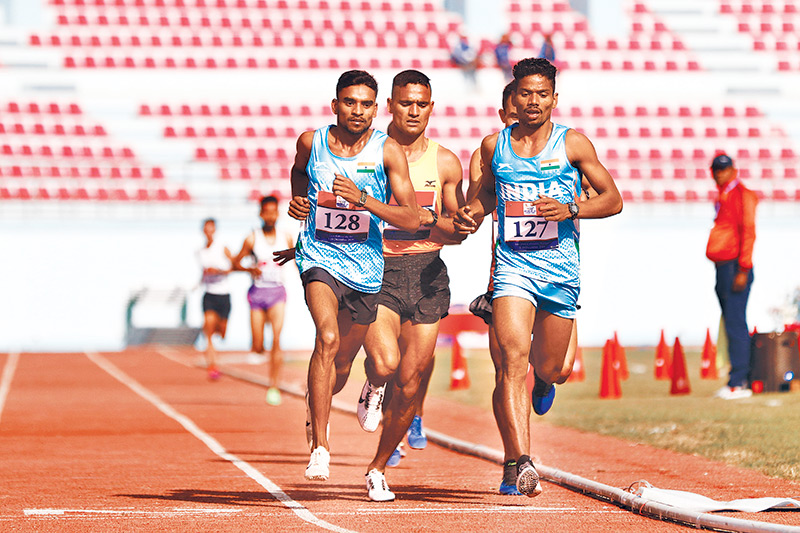
The biggest challenge for Gopi Chandra Parki (centre) during the men’s 5,000-metre race was to overcome tactics used to slow him down and blockhis path. POST PHOTO: KESHAV THAPA 

Kathmandu,
Gopi Chandra Parki restored glory for Nepal in the men’s 5,000-metre race, finishing ahead of charging Indian and Sri Lankan runners at the Dashrath Stadium track on Friday.
The 30-year-old crossed the finish line clocking 14 minutes 54.20 seconds to beat Indian’s Sunar Dawar, who came in second at 14:55.21.
Nepal’s Hari Kumar Rimal came home third at 14:57.05, after breaking away from a group of nine runners from Sri Lanka, Bhutan and Pakistan.
Parki’s winning time in the race, however, was far behind Rajendra Bhandari’s national record of 14:04.89, set at the Athens Olympics in 2004.
Bhandari had clinched two gold medals for Nepal in men’s steeplechase and 5,000-metre race at the 2006 South Asian Games. But he was stripped of medals after testing positive to a banned substance.
“It is a matter of pride that I managed to restore the glory in the 5,000m race,” Parki said.
But Friday’s race wasn’t an easy run for Parki, as Indian and Sri Lankan runners challenged him till the end, using race tactics to slow him down and block his path.
“They knew their chances were slim if they picked pace early on due to the altitude factor here in Kathmandu. In order to slow me down, they had me surrounded, ran in a zigzag pattern, blocked my way and tried to distract me,” Parki told the Post after completing the race.
“I had anticipated that such a situation would arise but I believe I can beat anyone in the region in the last 110 metres,” he said. With that win, Parki also became the first Nepali male athlete to grab a gold in men’s middle-distance race at these Games—a goal he had set his eyes on ten years ago.
“I joined the Armed Police Force departmental team ten years ago with only one ambition: to excel in athletics,” said Parki, who first arrived in Kathmandu to represent the far-western region at a school-level competition.
“Athletes from the departmental teams [Nepal Army, Armed Police Force, Nepal Police] had secured top positions then,” he recalled, “I joined the Armed Police Force Club in 2010 to run.”
And Parki did.
At the Baijanath Battalion of Armed Police Force, Parki proved himself as one of the best runners among the new recruits and trained under then chief instructor Deputy Superintendent Madhav Regmi.
Three months later, Parki would become a top runner, make it to the national team and compete at the national level, where his biggest victories would come in the 5,000- and 10,000-metre races.
Parki’s personal best of 14:44.3 in 5,000 metres was set earlier this year at the 8th National Games.
“I chose to go for 5km because our South Asian Games gold was stripped in 5,000m and I wanted to restore the glory,” Parki said, adding that the success came only after 14 years of hard work.
He said that he would now focus on the marathon.
“Legendary runner Baikuntha Manandhar wants his South Asian record of 2 hours 15 minutes 3 seconds to be broken by a Nepali,” said Parki. “I want to surpass that mark.”

HOME PAGE

Supreme Court asks government to halt plans for Nijgadh airport

The judge has summoned both the petitioners and defendants to discuss the matter.
- TIKA R PRADHAN
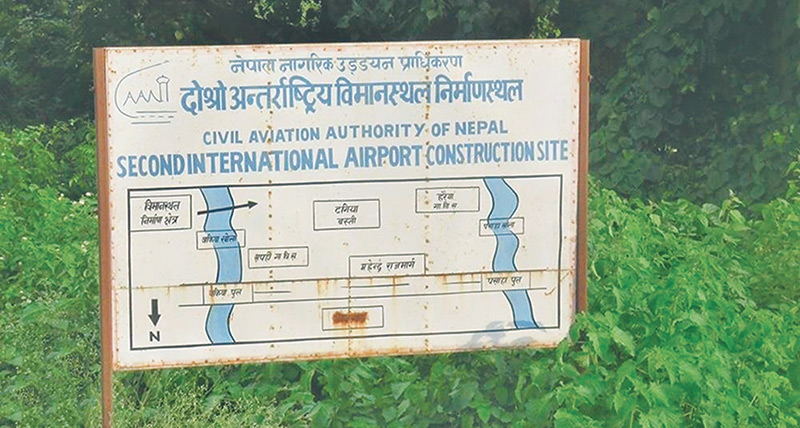
Environmentalists are concerned that a large patch of forest has to be cleared for the project. Post file Photo

KATHMANDU,
The Supreme Court on Friday asked the government to put on hold the construction of the Nijgadh International Airport.
The decision comes amid widespread criticism of the plan to construct the airport, one of the government’s pride projects, by environmentalists, who say the felling of millions of trees would lead to environmental degradation, resulting in the loss of habitats for different wildlife species.
Responding to a writ petition filed by nine individuals, including Ranju Hajur Pande, an environmentalist, and former secretary Dwarika Nath Dhungel, a single bench of justice Tanka Bahadur Moktan issued the stay order on Friday afternoon.
The petitioners have named the Prime Minister’s Office, the Ministry of Tourism, Culture and Civil Aviation, the Ministry of Forest and Environment as well as Office of the Chief Minister and the Ministry of Industry, Culture, Forest and Environment of Province 2 as defendants.
The Supreme Court has summoned both the parties for discussion on December 15 on the issue.
In their writ, the petitioners have said 90 percent of the airport’s area falls within the dense forest and the Environment Impact Assessment report states that as many as 2.4 million trees need to be axed for the project.
Vijay Kumar Singh Danuwar, a forester and one of the petitioners, said they were not against the airport construction. “We are only trying to save the precious forest cover and want the government to change the location a little down south.”
“If the construction site is taken a few kilometres down, the jungle will be safe,” said Danuwar. “Province 2 has the least forest cover compared to other provinces. So the provincial government has also been protesting against the possible environmental degradation.”
The proposed International Airport site is adjacent to Parsa National Park and is home to endangered wildlife and an important biodiversity corridor at the foothills of the Chure range.
Conservationists fear that the construction of the airport will destroy the natural biodiversity corridor used by the wildlife of the national park, especially those used by wild elephants.
The airport project was initially conceptualised in 1994.
It got traction after the late Rabindra Adhikari, during his tenure as the tourism minister, started a strong lobby for taking the project forward. Adhikari and proponents of the airport claimed that Nijgadh Airport could be a game-changer for Nepal as it could serve as a hub for South Asia.
After Adhikari’s death in a helicopter crash, Yogesh Bhattarai became the tourism minister in July-end. Bhattarai has been making a strong pitch for the airport, at times giving the impression that the Nijgadh airport is his sole agenda.
Bhattarai has even said on multiple occasions that the government would construct the airport at any cost at the same location—whatever the consequences.
Bhattarai had even announced to lay the foundation stone of the project by the end of this month.
The government on September 23 shortlisted contractors for the construction of the mega project. A meeting of the Investment Board of Nepal, chaired by Prime Minister KP Sharma Oli, had shortlisted Zurich Airport International AG of Switzerland as a single company to work under the public-private partnership model for the construction of the country’s fourth international airport.
The board had received letters of intent from eight companies from seven countries, including Nepal, for the construction of the $3.45 billion airport project in Bara. The airport, about 175km from the Capital, is expected to serve as an alternative to congestion at Kathmandu’s Tribhuvan International Airport, the country’s sole aerial gateway.
In a recent interview with the Post, Rajan Pokhrel, director-general of the Civil Aviation Authority of Nepal, said that the Investment Board Nepal is currently negotiating the investment modality for the airport.
According to Pokhrel, the prime minister has taken the initiative to build the project and that the government will soon issue orders to clear trees on the site.

HOME PAGE

Six varsities have been without vice-chancellors for months, but government sees no urgency

Committees formed to recommend names are awaiting political consensus, officials say.
- BINOD GHIMIRE
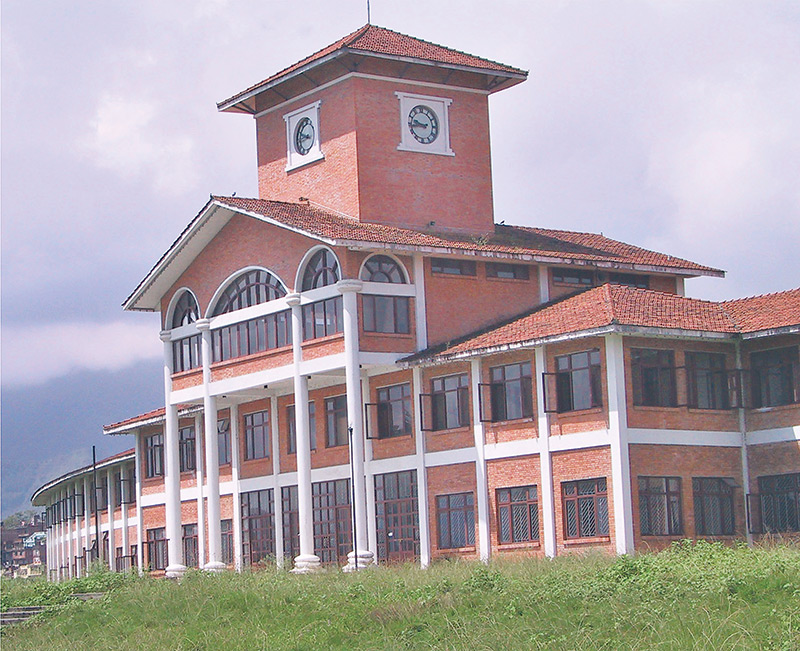
Only the TU has got its vice-chancellor. Post Photo

KATHMANDU,
At least six universities have been without vice-chancellors for the last three months.
Purbanchal University, Nepal Sanskrit University, Agriculture and Forestry University, Mid-Western University, Far-Western University and Pokhara University have been without the executive and administrative heads.
So far, only Tribhuvan University has got the vice-chancellor after the government a month ago appointed Dr Dharma Kant Banskota, a close confidante of Prime Minister KP Sharma Oli. But the government has not made any efforts to appoint officials at other universities, which also became leaderless along with Tribhuvan University. The Ministry of Education had said that unlike in the past appointments in universities would be made on merit basis, in a departure from the long-standing tradition of installing officials on political sharing. Accordingly, a search committee led by Education Minister Giriraj Mani Pokharel had recommended three individuals, including Dr Bhagwan Koirala, a noted cardiac surgeon, as the first choice for Tribhuvan University.
Oli, who holds the authority to appoint vice-chancellors in the capacity of ex-office chancellor of the university, however, picked Banskota.
Six different search committees led by Pokharel and Usha Jha, a member of the National Planning Commission, have been formed to recommend officials for other universities. Responding to the vacancy notice by the search committees, 250 individuals had applied. The search committees have shortlisted 178 people who meet the eligibility criteria.
About two weeks ago, Jha told the Post that the names would be recommended for the universities by December 5.
But Jha left for Vietnam on December 3 to attend an international conference, and recommendations are now pending.
Officials familiar with the development and experts say the government promise to appoint officials to universities is nothing but a farce, as political parties have refused to give up their stakes in the academic institutions.
“The search committees called applications only to show that vice-chancellors would be selected
on merit basis. But appointments will be made on the basis of political sharing,” a senior official at the Education Ministry told the Post on the condition of anonymity because he was not allowed to speak to the media.
According to the official, search committees are actually waiting for parties to reach a consensus.
Deepak Sharma, spokesperson for the ministry, however, said he has no idea why the appointment process has been delayed.
Ever since the second people’s movement in 2006, appointments in the varsities have been made on political sharing, with the party in the government appointing people close to it in top positions. Along with the post of vice-chancellor, the positions of rector and registrar are also shared among political parties.
Four years ago, when Sushil Koirala was leading the government, the highest number of portfolios went to the Nepali Congress. Vice-chancellors of Tribhuvan University, Purbanchal University, Nepal Sanskrit University, Far Western University and Lumbini Buddhist University were appointed from the Congress quota.
The CPN-UML had its appointees at Pokhara University and Mid-Western University, while Agriculture
and Forestry University was allotted to the CPN (Maoist Centre). The Maoists also got the Open University later on.
Professors affiliated to the Democratic Professors’ Association, which is close to the main opposition Nepali Congress, say the whole process of calling applications for the vice-chancellor post is flawed.
“No senior and competent professors will stand in queue demanding vice-chancellor’s position,” Jagat Timilsina, president of the association, told the Post. “The search committees are buying time as there has been no agreement among the factions in the ruling party.”
According to Timilsina, the association is closely following the selection process and will not agree if they are ignored.
“As over 60 percent of the professors are affiliated to our association,” said Timilsina, “appointments without our consent will have consequences.”
Education experts say the way the appointment has been made in Tribhuvan University shows political sharing will continue while appointing officials in other universities.
According to them, politicisation in the appointments will not stop until the university senate is authorised to pick officials, instead of the education minister and the prime minister.
“I am sure a lack of agreement in political sharing is delaying the appointment process,” Binay Kusiyait, a professor at Tribhuvan University, told the Post. “Universities are never going to improve unless the culture of political sharing ends.”

Page 2
MEDLEY

Horoscope

ARIES (March 21-April 19)
**
You have many different visions of what you want the next year of your life to be, and you won’t get anywhere with any of them unless you pick one idea and stick with it! Being indecisive is understandable, for a while. But you can’t carry on too long without knowing where to go next.


TAURUS (April 20-May 20)
****
Someone is stepping into your territory today, but as threatened as you might feel by them, this is no day to engage in any kind of power struggle. You’re better than they are in so many ways, and they are well aware of this. Their tactics are only going to backfire on them, so you don’t have to worry about reprimanding them.


GEMINI (May 21-June 21)
****
When was the last time you felt truly challenged? Get your fix today by embracing unfamiliar things. Step out of your comfort zone and challenge yourself. Engage with unfamiliar philosophies, explore new cultures, music or religions. You will find a whole new way of thinking!


CANCER (June 22-July 22)
**
Sure, any impulse buys you make today might provide temporary relief for your symptoms, but they definitely won’t fix the underlying cause. Save your money for another day and use it for something useful. You’ll get much more value of out it. Retail therapy is not a very effective way of dealing with issues.


LEO (July 23-August 22)
****
Rambling about your accomplishments doesn’t make a good impression on people, but you can’t avoid being proud of yourself just because you think you’re going to bug a few people. Share your accomplishments with the people who care about you, and they’ll be delighted and happy to congratulate you.


VIRGO (August 23-September 22)
*****
Instead of getting embarrassed when someone points out the good things you did, you’ll get a great sense of pride. This is as it should be—and it’s a sure sign that you are growing in the right direction. As your ego grows sturdier, your ability to be open-minded grows stronger. You’ll no longer take things as personally as you used to.


LIBRA (September 23-October 22)
***
A new adventure is beginning today, but you might not invited. This minor inconvenience shouldn’t stop you. Just use your creativity to figure a way to elbow your way in on the fun. Luckily, your mind is a creative fountain, bubbling up with unique ways to get yourself an engraved invitation to the inner circle.


SCORPIO (October 23-November 21)
*
When everyone’s laughing today, you won’t find things so funny. It may feel like you’re missing out on the joke, but don’t let it unnerve you. You’re just a bit out of synch as you’re preoccupied with your own work. It’s going to take you a while to get back into the swing of things, so be patient with yourself.


SAGITTARIUS (November 22-December 21)
***
It’s no secret that having a positive attitude will attract more positive people to you. So why aren’t you grinning from ear to ear? You want more good energy around you, and it’s up to you to get it. Turn your attitude into a positive one, and soon enough you will be surrounded by people who can add to your good mood.


CAPRICORN (December 22-January 19)
**
It’s not news that money gives you power—but it also gives you responsibility. Are you fully aware of the responsibilities that you’ve taken on? It’s impossible to take your finances too seriously right now. There are a few unpaid bills that you haven’t factored into your budget, and today is a good day.


AQUARIUS (January 20-February 18)
****
Have recent events confused you? If you are not understanding why things are happening as they are, then it’s time for you to spend some time sorting through recent events. Today you will have the clarity you need to start seeing some patterns which will help you get your life back on track.


PISCES (February 19-March 20)
***
The friendly competition between you and another intellectual is getting friendlier and friendlier. Maybe there could be a mutual attraction brewing here? Take time today to investigate this possibility. You could be mistaking their respect for your intellect with an attraction, so be very careful.

Page 3
Page 4
NATIONAL

US does not force Nepal to make a choice between capitals and countries, visiting official says

‘Sometimes US competitors want to set a narrative that we force a choice and try to counter somebody else’s strategy.’
- ANIL GIRI
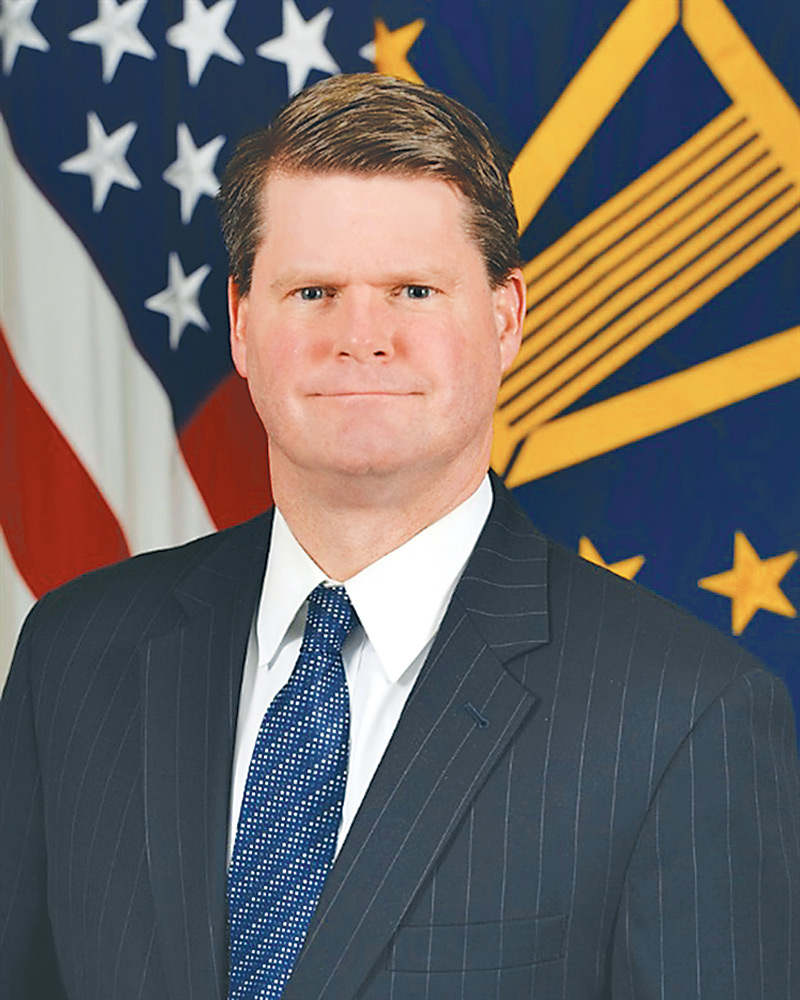
Randall Schriver. defense.gov

KATHMANDU,
Defending the Indo-Pacific Strategy, a visiting US official said on Friday that the United States does not want to force Nepal to take a side between capitals and countries over rivalry strategies.
At a time when the US-led Indo-Pacific Strategy is seen and described as a counterbalance to China’s Belt and Road Initiative, Randall Schriver, the US Assistant Secretary of Defense for Indo-Pacific Security Affairs,
said Washington will never force Nepal to make a choice over somebody else’s strategy.
Talking to reporters before wrapping up his two-day Nepal visit, Schriver said on Friday that sometimes US competitors want to set a narrative that “we force a choice, try to counter somebody else’s strategy”.
“But that’s not the case,” he said. “If there’s a choice for the people of Nepal, the choice is done; you want to protect your sovereignty, you want to protect and promote international law and norms. That is not a choice between capitals or countries;
it’s a choice for standing up to these principles and values.”
Schriver, who arrived in Kathmandu on Thursday and held talks with Deputy Prime Minister and Minister for Defence Ishwar Pokhrel, Foreign Minister Pradeep Gyawali and Chief of the Army Staff Purna Chandra Thapa, maintained the line presented by other visiting US officials when it came to the Indo-Pacific Strategy.
While there still lacks clarity among the leadership in Kathmandu over how Nepal and the Indo-Pacific Strategy are tied, during their visits, US officials, some directly and others obliquely, have brought up the Belt and Road Initiative and even cautioned about the possible debt Nepal could incur in the long run.
Nepal signed up to China’s Belt and Road Initiative in 2017 and is trying to get some big infrastructure projects under it.
Last year, when Gyawali visited the US, the first by a Nepali foreign minister in 17 years, Washington said Nepal was part of the Indo-Pacific Strategy, an assertion Nepali leaders tried to dismiss.
US officials in Kathmandu or Washington, however, maintain that the Indo-Pacific Strategy has more than defence and military components. One example they always push forward is the $500 million grant under the Millennium Challenge Corporation, an agreement signed between the US agency and the Nepal government in 2017.
Asked how the US sees some arguments that the Indo-Pacific Strategy is a counter to China’s BRI and whether external forces are trying to influence Nepal in building opinion against the strategy, the visiting US official said it is hard for him to explain how it is received and reacted in Nepal.
“But we welcome the opportunity for discussion and further articulate what our vision is and what our policies are,” said Schriver. “Our vision is an inclusive one... to include countries that we refer to as competitors in our national security strategy and our national defence strategy. So that includes China, for example; we have robust engagement with China. I was recently in Beijing, our secretary of defence recently met with the minister of defence of China. So our hope is that they too will see the value in supporting international rules.”
The multi-million dollar agreement between the US agency and Nepal is viewed by many in Kathmandu as a counter-initiative under the US Indo-Pacific Strategy against China’s Belt and Road Initiative.
As per the agreement, the US agency will provide $500 million in grants, and the government will spend $130 million on energy and transportation projects of high importance in the Marsyangdi and Kaligandaki corridors and the southern plains.
“Yes, we are bringing new tools through Indo-Pacific vision but it has been the consistent approach of the US government across the administrations to base it on rule-based factors and respect for democracy, human rights and sovereignty and rules based on international order,” said Schriver. “So our vision for IPS is that it remains free and open, and the region is characterised by some fundamental principles and qualities.”
According to him, respect for sovereignty, support for international law and norms, peaceful dispute resolutions, and free, fair and reciprocal trade are what the strategy aims.
“So when it comes to the defence component, it is too obviously helping countries protect their own sovereignty,” said Schriver. “Our goal for Nepal within the overall vision of the region is that Nepal be a strong, independent, sovereign, prosperous--nothing more than that.”
Schriver, who looks after Indo-Pacific Security Affairs, said that he is optimistic about the State Partnership Program under the Indo-Pacific Strategy.
“It is something that we are enthusiastic about because we see how this works in other countries,” said Schriver. “We have many state partnership programmes in the Indo-Pacific region and some of them have been going on for more than a decade.”

NATIONAL

Patan Campus procured goods without tenders for two years, says National Vigilance Centre

Campus chief claims the procurements were made in line with Tribhuvan University’s procurement rules.
- PRITHVI MAN SHRESTHA
pmc.edu.np

KATHMANDU, 
Patan Multiple Campus procured goods for the college for two consecutive years without inviting bids, the National Vigilance Centre has said in its probe findings which suggested an intent for irregularities.
The anti-graft body, which comes under the purview of the Prime Minister’s Office, said that all goods, including materials needed for the laboratory and the college, were procured through the “quotation medium in a fragmented way”.
“This clearly illustrates that the campus chief, chief of the department who oversees the goods and the account chief colluded for the purpose of financial irregularities,” said the report.
The Post has obtained a summarised version of the report, which does not provide details of how much money was spent on purchasing goods without tenders. The centre’s assistant spokesperson, Dalnath Aryal, could not make the details available immediately.
But Patan Campus chief Yogendra Prasad Shah claimed that all the purchases followed the procurement laws and regulations. “We have procured goods through tender, where this process is necessary,” he told the Post in a telephone interview. “We have also purchased through quotations.”
He said that certain procurements took place under his leadership as per the authority given to him as the head of college. The Tribhuvan University’s Financial Management and Procurement Rules govern the procurements made by the university and constituent colleges.
As per clause 51 of the rule, TU agencies should invite tenders for any construction work, goods or services that cost more than Rs2 million. As per clause 57 of the rule, TU agencies can procure goods and services
of up to Rs2 million through sealed quotations.
According to the report, the campus told the probe centre’s team that it failed to issue tenders last fiscal year because an executive committee of the campus had not been formed at the time, and the staff that used to oversee procurement plan had retired.
“As the staff responsible for procurement plans has now been appointed, the procurement, henceforth, will be made by following the procurement plan,” the campus was quoted as saying in the probe report. The Vigilance Centre also said the tendering process by the Campus had been ignored consecutively over the last two years.
The report has also raised questions over a possible misuse of scholarship funds meant for sports quota students. The college has been providing scholarships to 20 percent of its total students, and of that 20 percent, 3 percent is reserved for  sportspersons.
The college said that it has been allocating scholarships for sportspersons based on the recommendations of the Free Students’ Union. But in the absence of the Union, it provided scholarships based on recommendations of different students’ unions active in the college.
However, the probe report said Chidananda Mahatman Yadav, chief of Student Welfare Fund at the college, received funds amounting to Rs7,56,600 meant for the three percent scholarship quota from 2015-2018 and distributed the amount only in 2019.
However, campus chief Shah defended Yadav, saying that everything has been done following due procedures. The report has also blamed the campus administration for failing to take legal action against the alleged encroachment of its land by a local Guthi named Ta:Nani Mankakhala.
Although there had been an agreement between the campus administration and the Guthi to exchange equivalent land, the Guthi constructed the campus gate before the agreement was enforced. The Guthi also erected fences by occupying the campus’s land. Only after the Vigilance Centre started investigations in the matter following a complaint did the Guthi bulldoze fences and level the land.
“We recently got a notification that the land exchange has been done justifiably,” said Aryal of the Vigilance Centre. “The campus possibly wouldn’t have cared about the encroachment of its land without our intervention.”
The campus administration’s failure to take timely legal action against the Guthi shows the carelessness of the campus chief and responsible officials, the report said.
However, the campus chief claimed that the educational institute settled the land exchange issue in line with the instructions of the TU’s Executive Council.

Page 5
NATIONAL

Diktel residents frustrated by their representatives’ service

Locals complain of authorities’ indifference while entrepreneurs lament dip in business.
- DAMBAR SINGH RAI
Locals claim pollution levels have risen and hoarding boards litter the town, particularly in the bazaar area.  Post Photo: dambar singh rai

KHOTANG,
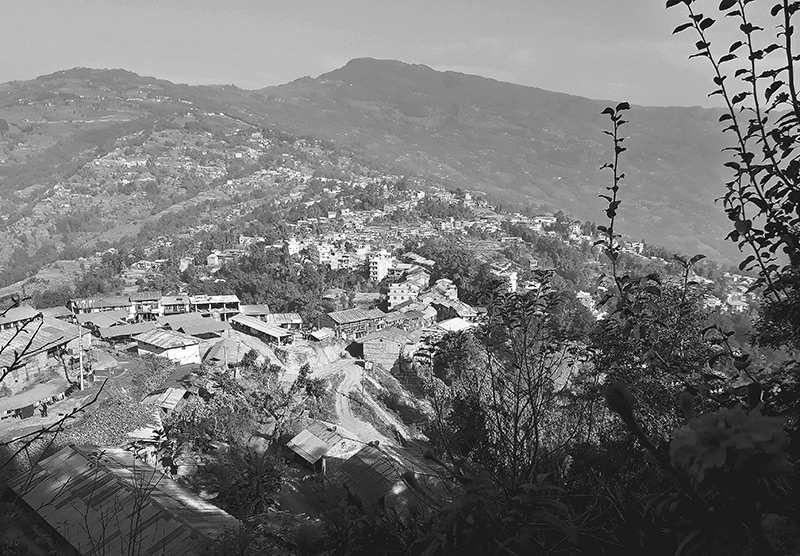
Dusty roads peppered with construction material and hoarding boards and mismanaged parking have become a common sight in Diktel, Khotang’s district headquarters.
Diktel locals complain pollution levels have increased with the appointment of local governments. “Years after the formation of local government, Diktel has become all the more polluted, with mismanaged hoardings, construction material and parking defacing the city,” said Khus Narayan Rijal, chair of Nepal Chamber of Commerce, Khotang. “What’s more worrying is the government doesn’t have any plan to solve it.”
Diktel recently launched a project to supply the city with drinking water, with  financial contribution from the government and consumer’s committee. The project, being constructed with an investment of Rs 225.55 million, aims to provide for a total of 149 households in Diktel, Solma and Bamrang. But still, locals complain of the slow pace of the construction.
Meanwhile, Upin Kumar Rai, chair of Khotang Udhyog Banijya Sangh, said Diktel’s business is on the decline. “Since the election of local units, about 50 percent of business is down,” he said.
Samud Prasad Joshi, coordinator of Hotel Entrepreneur’s Association, Khotang, said the occupancy of hotels is also on the downward slope, by almost 50 percent. “The condition of small-scale hotels is even more critical,” he said. Diktel has about 150 hotels.
Rajan Acharya, coordinator of Retailers’ Association, has similar complaints. “The decentralisation of administration means fewer people are visiting the headquarters which has given way to a sudden decrease in business,” he said. “Many retailers are struggling to make a living.”
Khus Narayan said that remittance transaction has also declined, owing to the establishment of banks in
the villages.
Rai said that even though local levels have focussed on tourism programmes to attract more tourists, the effort has fallen flat. “The roads are polluted and the infrastructure leaves one wanting,” he said.
“Given this condition, attracting more tourists remains a fanciful idea.”
Even though the Diktel Rupakot Majhuwagadhi Municipality has floated a plan to manage the tourist destinations such as Majhuwagadhi, Bhulbule and Rupakot, the plan is yet to materialise.

NATIONAL

Rhino conservation abound with challenges

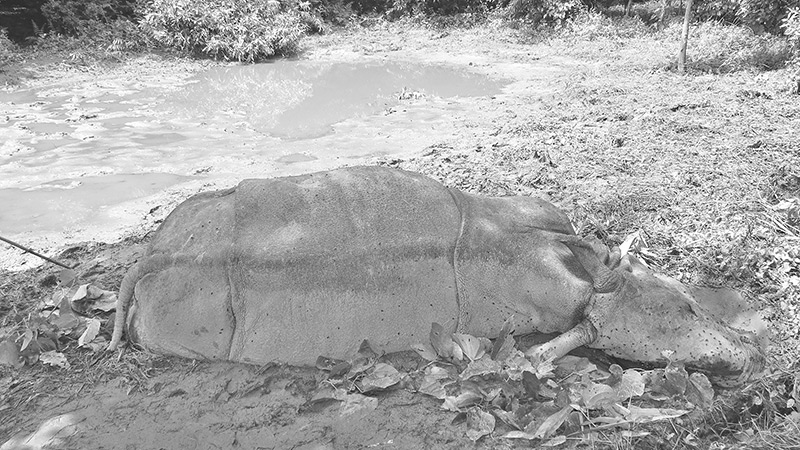
Recently, a male rhino was found dead on the bank of the Narayani river in Chitwan National Park.
- RAMESH KUMAR PAUDEL
According to Chitwan National Park officials, five rhinos have died this fiscal year. Post file Photo

CHITWAN,
On Wednesday, a male rhino was found dead on the banks of the Narayani river in Chitwan National Park. Gopal Bahadur Ghimire, the information officer at Chitwan National Park, said the pachyderm might have died due to food poisoning.
“The number of rhino deaths in the country is alarming. There has been some progress in rhino conservation, but we are still struggling,” said Ghimire. Old age, drowning, disease, territorial battles and electrocution are some of the primary reasons for the increasing number of rhino deaths in protected areas.
As per the data available at Chitwan National Park, 43 rhinos died in the last fiscal year whereas five rhinos have died in the first five months of the current fiscal year at the park.
Last year, a female rhino drowned after falling into a septic tank on the premises of Hotel Tiger Land in Jagatpur. Chitwan National Park filed a case of negligence against the hotel owners and employees—Ajit Bikram Shah, Pradhumna Ghimire, Kanti Thapa, Dil Bahadur Gurung and Bhashkar Bhattarai—nine months ago. Park officials claimed that the female rhino died due to the sheer negligence of the hotel.
However, a single bench of district judge Binod Kumar Gautam on Wednesday acquitted the accused, stating insufficient evidence to convict them of the rhino’s death. According to Prakash Thapa, spokesperson of the District Attorney Office in Chitwan, the case was filed under clause 26 of the National Park and Wildlife Conservation Act 1973.
“The clause says that anyone who is found guilty of killing a  rhino is liable to a fine of Rs 500,000 to Rs 1 million or can face imprisonment for up to 15 years, or both,” says Thapa.
On August 6, 2016, a rhino was electrocuted when an electric wire was left unattended after wielding works were completed for Hotel Meghauli Serai in Chitwan. The district court had fined four persons, including two senior hotel staff, over the mishap.
“There are plenty of challenges in conserving rhinos, and it’s not enough for a small group of people to work towards its conservation. The entire community should be aware of the importance of rhino conservation
and should support the efforts,” said conservationist Ramprit Yadav.
According to the 2015 census, there are 645 rhinos in Nepal—605 in Chitwan, 29 in Bardia National Park, eight in Shuklaphanta National Park, and three in Parsa National Park.

NATIONAL

To keep students in school, local unit launches mid-day meals in Tehrathum

- CHANDRA KARKI
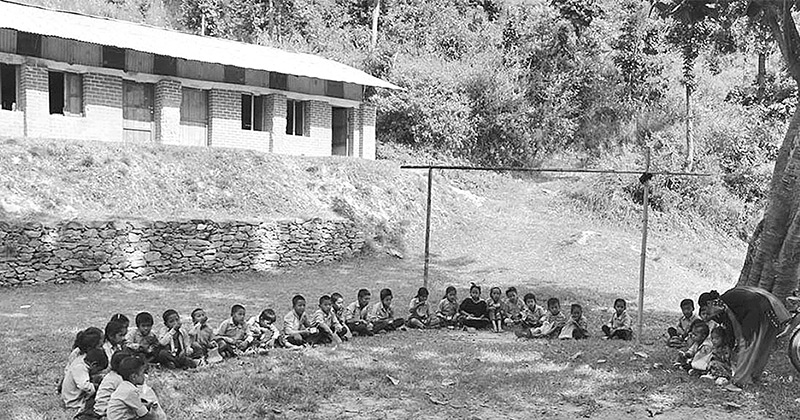
Students are seen having a mid-day meal at Mahendradayo Basic School in Thoklung. Post Photo: krishna chaulagain

TEHRATHUM,
Aathrai, a remote area in Tehrathum district, has initiated the mid-day meal programme to keep a check on the alarming dropout rate and irregularity of the students in
community schools.
The federal government had introduced the programme to encourage students from poverty-stricken families, who could not afford a good meal a day, to attend school. Various local units have continued this programme in the current academic session.
“We introduced the mid-day meal programme as the number of students started decreasing in various community schools in the district,” said Rupa Kandangwa, the deputy chief of the rural municipality.  “Since we started the programme, the attendance of students in remote villages, mainly from poor and Dalit communities, has increased.”
The local unit, which is around 80km north-east from the district headquarters, started the programme from the current academic session that began in mid-April. The programme has been launched for students up to grade five.
The lunch package includes porridge with corn or millet flour bread, rice and other local food items.
Krishna Baraili, a fifth-grader at Mahendradayo Basic School in Thoklung, told the Post over the telephone that he as well as his friends are motivated to go to school because they no longer have to worry about studying on an empty stomach.
“Many students would leave midway because they would get hungry during the course of the day. But now that the school is providing them with lunch, they stay back to complete their lessons,” said Nanda Tamang, the headmaster of Mahendradayo Basic School. The guardians too are happy about this development, says Tamang, since their children get to eat nutritious food during the lunch hour. “We can now send our children to school without having to worry about them going hungry during the day,” said Gopi Dhungana of Khamlung.
The mid-day meal programme has not only helped retain students in the community schools but has also managed to attract more students, says Debendra Kumar Moktan of the headmaster of Naule Basic School in Chhatedhunga.
Chairman of the rural municipality Man Bahadur Limbu said the programme became quite successful in attracting students to community schools. “We have allocated a significant amount of budget to the mid-day meal programme; we had to take out funds from our development budget. So far, this move has been successful. We will extend the programme to higher grades in the next academic year,” said Limbu.
According to him, the local unit allocated Rs10 million budget for the mid-day meal programme. There are 56 community schools in Aathrai Rural Municipality.  
The Education Development and Coordination Unit has hailed the efforts of the local unit to attract students in community schools. “The mid-day meal programme has been very fruitful. Children are now happy to attend classes on a regular basis,” said Lilanath Pokharel, chief at the unit.

NATIONAL

Health insurance a boon for the poor in Rukum (West)

Data shows that more than 9,571 people have received treatment under the programme since its launch in 2018.
- HARI GAUTAM

RUKUM (WEST),
Earlier this year, in mid-April, seven-year-old Yagya Bahadur BK, broke his hand after falling off a tree.  
Kali Bahadur, Yagya’s father, who works as a daily wage worker in India, took him to Nepalgunj for treatment. “I was sent to the Nepalgunj-based teaching hospital for further treatment,” said Kali Bahadur, a resident of Banfikot Rural Municipality Ward No. 5.
For his son’s treatment, Kali Bahadur did not have to spend a single rupee. All costs—a total of Rs 50,000—were covered by his health insurance, shares Kali Bahadur. “Thanks to Banfikot Rural Municipality, my son’s condition improved. The local unit had helped me get my health covered with an insurance policy,” he said.
Kali Bahadur was just a case in point. There is a long list of locals who have benefitted from the health insurance programme in the district. They have been receiving treatment at the District Hospital and various other government hospitals in Nepalgunj and other cities.
The health insurance programme was introduced in the district in 2018. So far, there are 42,684 people who have taken health insurance under the programme. Among them, 22,604 are females. Bharat Bahadur Khadka, the coordinator of the Health Insurance Programme in the district, said that Rs 66.3 million has been invested in medicines and treatment in the district so far. “Patients are undergoing treatment at District Hospital, Chaurjahari Hospital and Aathbiskot City Hospital among other health facilities in the district and they all have
their insurance,” said Khadka.
The data of the District Hospital showed that more than 9,571 people have received treatment under the programme since May 15, 2018. Dr Mahesh Chaulagain, chief at the Health Office in the district, said that the insured people received medicines worth Rs 10 million from the district hospital alone. He said, “We are making efforts to ensure that all the facilities available at the hospital are accessible to every patient.”
Likewise, Chaurjahari Hospital also has so far treated more than 51,000 patients (who received health insurance) from the local unit. Dil Bahadur Giri, one of the administrators of the hospital, said that more than 15,000 insured people received treatment in the first five months of the current fiscal year.
The Aathbiskot City Hospital has also treated around 3,000 people (who received health insurance) till date.
Those seeking insurance for their family members have to pay Rs 3,500 as registration fee. “Within this scheme, five members of a family can receive treatment (free of cost) up to Rs 100, 000,” said Khadka, adding that they have mobilised 73 employees in each of the wards of the district for the insurance programme. In total, there are 73 wards in Rukum (West). Most of the local units have also helped impoverished people to get health cover, said Khadka.
Health officials said that the flow of patients in the health facilities have increased after the start of the
programme. Ishwor Rawal, an auxiliary health worker at the District Hospital, said that since the introduction of the insurance scheme, people have started opting for full body checkup which was a rarity earlier. “Because of the health cover, people now feel more comfortable going for checkups. People would earlier opt for health checkups only when they fell ill,” said Rawal.

NATIONAL

Senior citizens deprived of social security allowances

Briefing

SAPTARI: Senior citizens of Chhinamasta Rural Municipality in Saptari district have not received social security allowances in the last five months. The distribution of social security allowances in the local unit has come to a halt due to a dispute among people’s representatives.

NATIONAL

Construction of a bridge over Bagmati river left unattended

Briefing

RAUTAHAT: The construction of a bridge over the Bagmati river along the border of Rautahat and Sarlahi has come to a halt after the construction company filed a case in the Supreme Court demanding the contract be scrapped. The bridge was being constructed in Badharwa, Durga Bhagawati Rural Municipality Ward No. 5, under the Postal Highway Project. According to locals, they have been facing difficulties due to the delay in bridge construction. 

NATIONAL

Over a million marijuana plants destroyed in Dhankuta

Briefing

DHANKUTA: Over one-and-a-half million marijuana plants have been destroyed in the district over the past five months, according to Dhankuta Police. Police said that six local units have been growing marijuana for business purposes in the district, especially in Shahid Bhumi and Sangurigadhi villages.

NATIONAL

Locals rally for bicycle lane in Chitwan

Briefing

CHITWAN: Locals organised a rally in Narayangadh demanding to construct bicycle lanes on Friday. They
submitted a memorandum in Bharatpur Metropolitan City and demanded the concerned authority build necessary infrastructures for safe cycling in the city areas.

NATIONAL

Fugitive held in Sunsari

Briefing

SUNSARI: A man, who was on the run for the last two years after being convicted of drugs smuggling, has been arrested in Sunsari district. Police said Raj Rai, 36, of Dharan, was caught and presented to the Sunsari District Court on Friday.
The apex court had sentenced him to one year and three months in prison two years ago, police said.

Page 6
MONEY

Saudi Aramco prices shares at top of range in world’s biggest IPO

Saudi Arabia relied on domestic and regional investors to sell a 1.5 percent stake after lukewarm interest from abroad.
- REUTERS
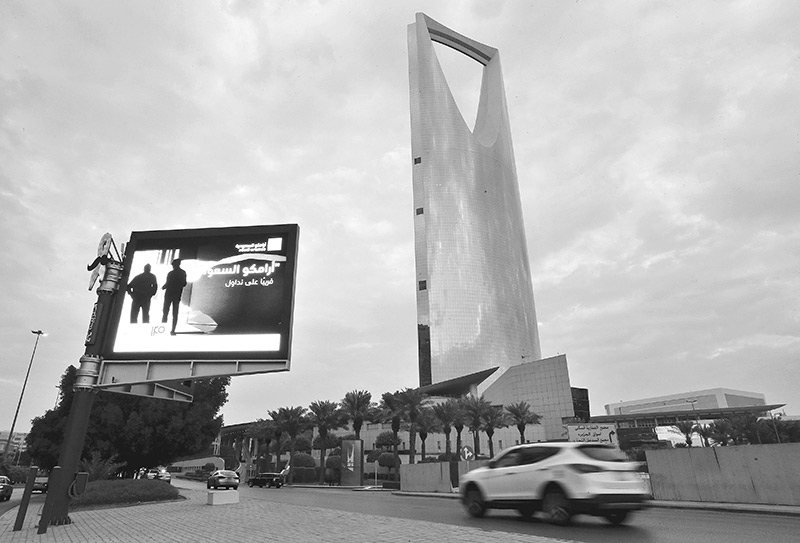
A billboard displays an advert for Saudi Aramco in the streets in Riyadh, Saudi Arabia. reuters

RIYADH/DUBAI, 
State-owned oil giant Saudi Aramco’s initial public offering (IPO) will be the biggest in history, but will fall short of the towering $2 trillion valuation long sought by Crown Prince Mohammed bin Salman.
Aramco priced its IPO at 32 riyals ($8.53) per share, the top of its indicative range, the company said in a statement, raising $25.6 billion and beating Alibaba Group Holding Ltd’s record $25 billion listing in 2014.
At that level, Aramco has a market valuation of $1.7 trillion, comfortably overtaking Apple Inc  as the world’s most valuable listed firm. But the listing, expected later this month on the Riyadh stock exchange, is a far cry from the blockbuster debut originally envisaged by the Crown Prince.
Aramco did not say when shares would start trading on the Saudi stock market but two sources said it was scheduled for Dec. 11.
Saudi Arabia relied on domestic and regional investors to sell a 1.5 percent stake after lukewarm interest from abroad, even at the reduced valuation of $1.7 trillion.
Demand from institutional investors, including Saudi funds and companies, reached $106 billion, while retail investment’s demand hit $12.6 billion. Around 4.9 million Saudi retail investors have bought shares in the oil giant, including 2.3 million aged between 31-45.
Aramco’s advisors said they may partly or fully exercise a 15 percent “greenshoe” option, allowing it to increase the size of the deal to a maximum of $29.4 billion.
The pricing comes as the Organization of the Petroleum Exporting Countries (OPEC) is gearing up to deepen oil supply cuts to support prices, provided it can strike a deal later this week with allies such as Russia.
Climate change concerns, political risk and a lack of corporate transparency put foreign investors off the offering, forcing the kingdom to ditch ambitions to raise as much as $100 billion via an international and domestic listing of a 5 percent stake.
Even at a $1.7 trillion valuation, international institutions baulked, prompting Aramco to scrap roadshows in New York and London and focus instead on marketing a 1.5 percent stake to Saudi investors and wealthy Gulf Arab allies. Saudi banks offered citizens cheap credit to bid for shares.
The IPO is the culmination of a years-long effort to sell a portion of the world’s most profitable company and raise funds to help diversify the kingdom away from oil and create jobs for a growing population.
“The amount raised by the IPO itself is relatively contained given the size of the economy and medium-term funding requirement of the transformation plan,” said Monica Malik, chief economist at Abu Dhabi Commercial Bank.
“Nevertheless, combined with other areas of funding, we believe that there is meaningful capital in place to progress with the investment plans aimed at diversifying the economy.”
The government promoted the investment as a patriotic duty, particularly after Aramco’s oil facilities were attacked in September, temporarily halving the kingdom’s oil output.
Despite the official push and offer of loans to fund share purchases, interest was relatively muted compared with other emerging market IPOs, including the listing of a top Saudi bank in 2014 which was oversubscribed many times over.
Alibaba’s listing in Hong Kong this month had bids for 40 times the number of shares on offer.
Sources have said the Abu Dhabi Investment Authority (ADIA) and Kuwait Investment Authority (KIA), sovereign wealth funds of two of Saudi Arabia’s Gulf allies, planned to invest in the deal. ADIA declined to comment, while KIA did not respond to requests for comment.
Saudi citizens were offered 0.5 percent of the company or about a third of the offering, an unprecedented retail offering compared with previous Saudi IPOs.
Aramco has planned a dividend of $75 billion for 2020, more than five times larger than Apple’s payout, which is already among the biggest of any S&P 500 company.
But investing in Aramco is also a bet on the price of oil and growth in global demand for crude, which is expected to slow from 2025 as steps to cut greenhouse gas emissions are rolled out and the use of electric vehicles increases.
The IPO also carries political risk as the Saudi government, which relies on Aramco for the bulk of revenues, controls the company.
Saudi Arabia has faced international criticism after the murder of Saudi journalist Jamal Khashoggi last year in the Saudi consulate in Istanbul and for its role in a war in Yemen.

MONEY

China unveils plan to boost pork production

- AGENCE FRANCE-PRESSE
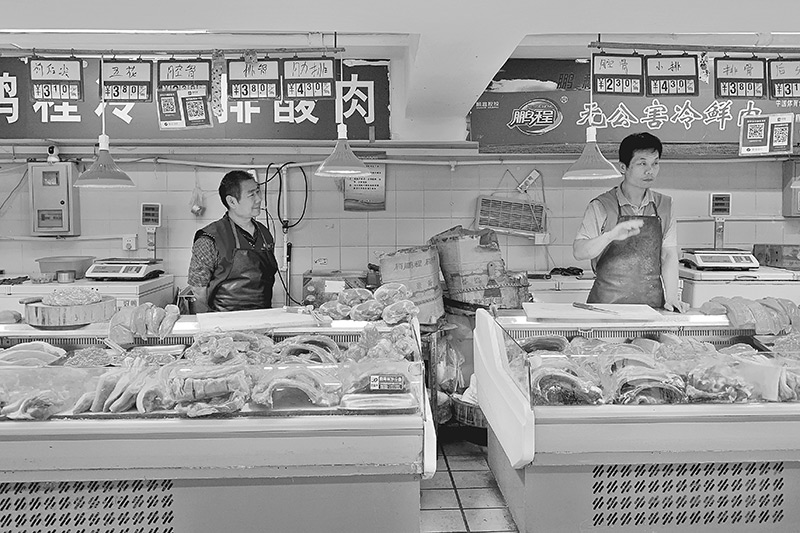
A view ofpork vendors’ stalls at a market in Beijing, China. reuters 

BEIJING,
China will free up as much land as possible to restore pork production to pre-swine fever levels—including areas designated pig-free zones for environmental reasons, the agriculture ministry said Friday.
Authorities outlined a three-year plan to boost its pig-breeding facilities in a bid to restore the country’s hog herds, devasted by African swine fever.
This will involve making the process for acquiring land for pig-breeding easier and working to reduce “forbidden” zones for pig farming by the end of 2020, the ministry said.
Formerly “pig-free” cities and counties—protected for environmental reasons—must be “reformed” to restore hog production to normal by 2021, according to the plan.
An outbreak of African swine fever that began in August last year has devastated China’s pig herds and sent prices of the staple meat soaring in what could become a political and economic liability for the state.
More than a million pigs have been culled due to the disease, according to official statistics, but that is widely considered to be an underestimate.
This, in turn, has also pushed up prices of other meats including beef, chicken, duck, and eggs as consumers switch to other protein sources.
To meet demand, Beijing has increased pork imports, with shipments from the European Union rising 37 percent between January and April, according to European Commission figures.
Earlier this month China also said it would resume beef and pork shipments from Canada after blocking them in June, as Beijing’s relations with Ottawa remain strained over a detained Huawei executive.
National regulations allow local governments to ban the rearing of livestock in certain areas to control pollution, protect nature reserves, and keep water supplies clean.
Authorities have in recent years ordered large-scale cleanups of pig farms, requiring farmers to install waste disposal systems and move foul-smelling piggeries away from drinking water sources and urban areas.
But as Chinese authorities scramble to control prices in the world’s largest pork market, local officials are being pressured to reduce the scope of these protected areas.
The agriculture ministry said on Friday it would set up 120 “model farms” over the next three years using hog rearing techniques that can be widely replicated elsewhere in the country, and increase subsidies for pig farmers.
The ministry also said it would ramp up disease control measures and promote centralized professional disposal of diseased pig carcasses.

MONEY

German industry slump sparks renewed economic growth fears

- REUTERS
Workers assemble sports cars at the Porsche factory in Stuttgart-Zuffenhausen, Germany. reuters 

BERLIN,
Germany’s industrial output unexpectedly dropped in October, reviving worries about its economic growth outlook as its manufacturing backbone takes a blow from global trade conflicts and disruptions in the auto sector.
Industrial output dropped 1.7 percent on the month against expectations for a 0.1 percent rise, Statistics Office figures showed on Friday. Production of capital goods slumped by 4.4 percent on the month, the steepest decline in more than five years.
Europe’s biggest economy is going through a soft patch as its export-oriented manufacturers struggle against a backdrop of trade friction, an ailing car industry and uncertainties over Britain’s planned departure from the European Union.
“Now the trepidation starts again about GDP growth in the final quarter,” said Jens-Oliver Niklasch, economist at Landesbank Baden-Wuerttemberg.
German industry now expects output in the coming months to fall more slowly than was foreseen a month ago, a survey of 2,300 firms in the sector by the Ifo economic institute showed.
In its 10th successive year of growth, Germany’s economy has been relying on strong consumption as exports weaken, which resulted in a second-quarter GDP contraction of 0.2 percent.
The economy grew by just 0.1 percent in the third quarter, narrowly avoiding recession, which economists usually define as two consecutive quarters of negative growth.
“Trade conflicts, global uncertainty and disruption in the automotive industry have put the entire German industry in a headlock, from which it is hard to escape,” said Carsten Brzeski, economist at ING.
The automobile association VDA said on Wednesday that it expected global car sales to fall by 5 percent
this year and that the crisis would force German companies to cut more jobs in 2020.
Many economists have been urging the government to ditch its policy of incurring no new net debt, saying it should instead borrow to finance a stimulus package.
Conservative Chancellor Angela Merkel’s right-left coalition government has rejected calls from industry groups and economists for a stimulus package to put the economy firmly back on a growth trajectory.

MONEY

US trade gap narrows as imports fall amid China conflict

- ASSOCIATED PRESS
A shipping container is lifted off the back of a truck at a terminal on Harbour Island in Seattle. ap/rss 

WASHINGTON, 
The US trade deficit narrowed in October as imports fell faster than exports. The politically sensitive trade gap with China dropped.
The Commerce Department said Thursday that the gap between what America sells and what it buys abroad dropped 7.6 percent to $47.2 billion in October. Imports tumbled 1.7 percent to $254.3 billion on reduced purchases of foreign oil, cars and auto parts and pharmaceuticals. Exports dipped 0.2 percent to $207.1 billion on a drop in sales of soybeans and aircraft engines.
The deficit in the trade of goods with China narrowed by 1.1 percent to $$31.3 billion in October and is down 14.6 percent so far this year. The goods deficit with Mexico dropped 1.4 percent to $8.8 billion but is up 28 percent so far in 2019.
President Donald Trump, declaring persistent trade deficits a sign of US economic weakness, has slapped taxes on imported steel and aluminium and on numerous Chinese goods. He has also sought to replace a North American free trade pact that he says puts US factories at a disadvantage to low-wage plants in Mexico. Congress has yet to ratify the revamped version he negotiated last year with Mexico and Canada.
The trade gap is still 1.3 percent wider so far this year than it was in January-October 2018, despite dropping in September and October.
Mainstream economists say the trade deficit reflects an economic reality that doesn’t yield much to changes in government policy: Americans consume more than they produce, and imports fill the gap.
In October, the United States ran a $68 billion deficit in the trade of goods such as autos and appliances. But it ran a $20.8 billion surplus in services.

Page 7
MONEY

Plans to put Chinese-made planes back in the air jinxed by lack of spare parts

Nepal Airlines had previously been forced to ground them for lack of pilots.
- SANGAM PRASAIN
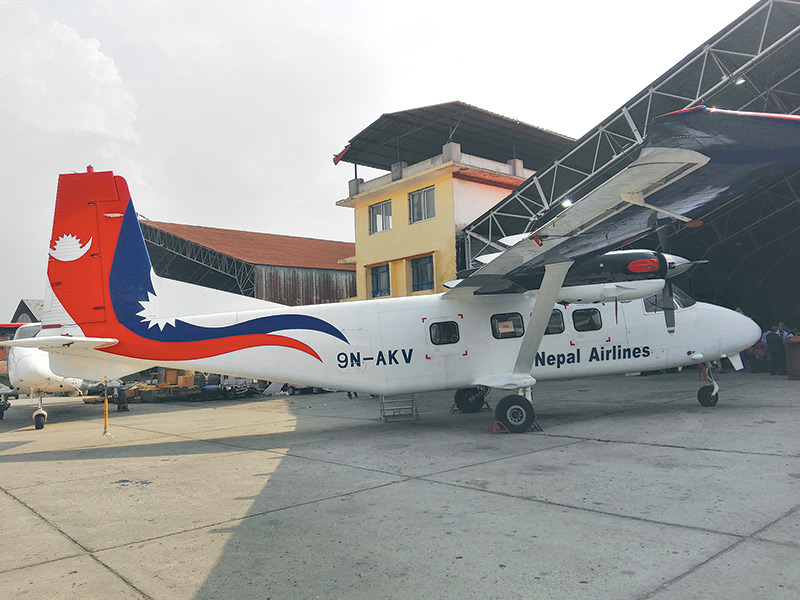
A Chinese Y12e is seen at the Nepal Airlines hangar in Tribhuvan International Airport. Post file Photo

KATHMANDU,
Nepal Airlines has planned to put all four of its Chinese-made planes back in the air by February, but that is unlikely to happen for lack of spare parts. Previously, it had been forced to ground them because there were no pilots to fly them. Now that there are pilots, there are no parts.
The national flag carrier has four 17-seater Y12e planes in its fleet. Three are sitting in the hangar while one flies twice daily on the Dang sector, according to officials familiar with the matter.
Two weeks ago, presenting its first quadrimester report of this fiscal year at the Tourism Ministry, Nepal Airlines had promised to bring one plane into operation by November and two more by February next year.
As the spare parts problem has become critical, the state-owned carrier has asked the Tourism Ministry to table the issue in the Ministerial Development Action Committee, the higher authority at the National Planning Commission that looks at problems and issues directives for necessary intervention.
Three Y12e aircraft bearing registration marks—9N-AKS, 9N-AKU and 9N-AKT—have been grounded due to delays in getting spare parts.
Deepu Jwarchan, director at the operation department of Nepal Airlines, said they currently had four captains, but the planes were not in an airworthy condition. “We have decided to bring one Pakistani captain. Another captain from Simrik Airlines has already been hired to fly the Chinese planes,” he said.
Nepal Airlines has three captains—Phizonath Nepali, KB Limbu and Nependra Bhattarai—to fly the Chinese-made planes. But Bhattarai will soon be transitioning to Airbus and has started training, said Jwarchan. “We are also hiring other captains. We will have no flight crew problem, but the arrangement of spare parts for the planes is becoming difficult,” Jwarchan said.
Ganesh Bahadur Chand, spokesperson for Nepal Airlines, said that it could take months to resolve all the problems seen in the Y12e. “When captains are available, spare parts problems begin, and when spare parts are arranged, a shortage of aircrew appears.”
In 2014, when the first batch of two 17-seater Y12e aircraft arrived in Kathmandu, they remained grounded for more than two months due to lack of pilots. The corporation received another two Y12e aircraft in February last year. The 56th annual audit report of the Office of the Auditor General released in April said that the corporation had been operating its Chinese-made Y12e aircraft ineffectively and incurring heavy losses as a result.
The audit report said the Y12e earned Rs25 million in the last fiscal year. However, their operating and indirect expenditures totalled Rs188.5 million and Rs96.3 million, respectively. In total, losses from the Y12e operation stood at Rs289.7 million.

MONEY

Nepal Airlines gets green light for Guangzhou route

KATHMANDU: Nepal Airlines said it had formally received operating authorisation from the Chinese civil aviation authority to begin services to Guangzhou.
“We received the official letter from Chinese authorities on Friday,” said Ganesh Bahadur Chand, spokesperson for Nepal Airlines.
“Now, necessary preparations will be made to operate flights to Guangzhou Baiyun International Airport.”
Nepal Airlines had applied to Chinese authorities to fly the Kathmandu-Guangzhou route in 2015, but the national flag carrier failed to obtain permission because of a pending safety audit to gain access to Chinese airports. “Chinese authorities have informed us that they will not conduct the safety audit now,” said Chand.
According to Nepal Airlines, Chinese authorities had asked a few questions regarding the operation manual before granting permission.

MONEY

Saudi, Russia win over oil producers to deeper cuts

- REUTERS

AUSTRIA,
Saudi Arabia and Russia won backing for deeper output cuts from OPEC and allied oil producers on Friday as they look to head off global oversupply in 2020 and sustain prices.
The group of more than 20 producers agreed to an extra 500,000 barrels per day (bpd) in cuts for the first quarter of 2020, sources told Reuters, taking the total to 1.7 million bpd, or 1.7 percent of global demand.
OPEC and allied producers, the so-called OPEC+, pump more than 40 percent of the world’s oil. They began a closed-door meeting at around 1130 GMT to thrash out how the additional cuts will be distributed.
OPEC is likely to shoulder approximately 340,000 bpd in fresh cuts and non-OPEC producers an extra 160,000 bpd, one source said on Friday.
Benchmark Brent oil prices were steady on Friday near $63 per barrel.
“Despite the deeper potential cuts, we view most headlines so far as falling short of consensus expectations,” Goldman Sachs said in a note citing factors including the short duration of the deal. OPEC+ will deepen cuts for the first three months of 2020, shorter than the six- or 12-month scenarios some OPEC members wanted.
The cuts offset an expected increase from countries that are not part of OPEC+, including top producer the United States.
OPEC met on Thursday in Vienna, deliberating policy for more than five hours. The length of the meeting prompted the cancellation of a news conference and a gala dinner for delegates aboard a boat on the Danube.
Eleven of OPEC’s 14 member states are participating in the supply curbs. Iran, Libya and Venezuela are exempt.
OPEC+ adds Russia and nine others—Azerbaijan, Bahrain, Brunei, Kazakhstan, Malaysia, Mexico, Oman, South Sudan and Sudan.
One sticking point has been compliance, with Saudi Arabia cutting more than required in order to offset overproduction from Iraq and Nigeria.
“A scenario where the Saudis ‘absorb’ the majority of a 500,000 bpd cut and formalize their target at current output levels would not be impactful to the market—unless Iraq and Nigeria come into compliance with their targets,” said analysts from Jefferies.

Page 8
ON SATURDAY

Beauty pageant costumes keep repeating and they’re starting to become boring

Nepali designers are dressing beauty pageant winners in extraordinary attire, but the same theme in most designs reflects a lack of originality.
- ANKIT KHADGI

Kathmandu,
Last week, fashion designer Manish Rai posted a video on Instagram showing this year’s Miss Nepal donning a costume representing Vajrayogini, a Buddhist deity. Wearing an embellished bikini top and a matching skirt, he introduced Pradeepta Adhikari’s ‘national costume’ for the upcoming international pageant.  
The concept of the costume, which is described in the caption of the video, is however, very similar to the one worn by two former Miss Universe Nepal winners. Nagma Shrestha, who was the first ever contestant from Nepal to participate in the Miss Universe pageant, had donned an elaborate headgear representing the Basundhara mandala, while her white costume embodied the style of a Buddhist deity.
“I believe I did something different. But since then, similar themes have been followed,” says Shrestha, who represented Nepal at the pageant in 2017. “I wish they were taking more risks and making more extravagant designs.”
Before Shrestha and her team decided to experiment with the design, Nepali beauty pageant participants were limited to costumes featuring dhaka fabric, rhododendron flowers or gunyu cholo. This was a trend for a long time, with Nepali contestants wearing almost identical costumes year after year.
In Nepal, beauty pageants have served as a platform even for Nepali designers to highlight their creations. And with the unveiling of Shrestha’s costume, it seemed as though the Nepali fashion industry was opening doors for unique and original design ideas. But the duplication of the same concept for the last two years has dampened the mood for many fashion conscious Nepalis who want to see local designers experiment with creativity and originality.


“We can’t just rely on outdated fabrics and the same old pallets,” says Bina Ghale, who had designed Shrestha’s national costume for Miss Universe pageant.  “As designers, we should be able to anticipate the future trends. It is necessary to come up with unique designs in addition to being flashy.”
Miss Universe Nepal 2018 winner wore a costume inspired from Avalokitesvara, a Bodhisattva, for the international pageant last year. Both Miss International Nepal 2018 and Miss Nepal Supranational 2019 winners wore a costume inspired by Green Tara, a Buddhist bodhisattva for their respective international events.
Rai, who designed Adhikari’s costume, and has been the in-house designer for the Miss Nepal event for the last two years, says these designs are not easy to make and he did detailed research for them.
“It took me three months to make Pradeepta’s costume. We did proper research about how we can work on the costume and justify the theme,” says Rai. “I also studied her personality to match the outfit.”
Rai’s argument, however, stands strong for Miss International Nepal 2016, Barsha Lekhi, who was dressed in an elegant garb inspired by a Tharu dress. Rather than going for the similar themes and designs of goddesses and deities, she decided to showcase her roots.  
“The repetitive designs do not do our cultural diversity justice,” says Shrestha, the 2017 pageant winner. “It is important to break the stereotype.” The lack of diversity in costumes is also the result of pageant winners coming from the same socio-cultural background, according to fashion stylist Rhea Pradhan. The creative decision for any national costume is a teamwork, including the contestants, designers and artists responsible for accessories. So, many of the concepts and designs are repeated as they are unable to think beyond their limited circle and exposure.
“Another main reason why they are incorporating such elements is because they can be easily recognised by everyone,” says Pradhan. “But yes, most of the Miss Nepals seem to be replicating each other’s thought process in many things.”
To put Pradhan’s case in point, Miss Asia-Pacific International Nepal 2018 Aastha Saakha, Miss Grand International 2018 Urussa Joshi and Miss Earth Nepal 2017 Rojina Shrestha, all of them wore costumes inspired by Goddess Kumari.

But Saakha says she had to resort to wearing the costume because of a lack of time and funds to prepare for the international event.
“Apart from the national costume, I had to prepare my evening gown, swimwear and outfits for other side events.” she says. “Another challenge is not having an airline sponsor, which restricts us from carrying heavier dresses or accessories.”
Sakil Kunwar, creative director of popular makeup studio BLISS, who also served as pageant trainer for Shrestha, agrees with Saakha. “There are financial limitations when it comes to Nepali pageant winners participating in international events,” he says.
But he remains hopeful that other aspects of Nepali culture and history will be researched and executed in the future with the way creative processes are taken into consideration in recent years. Although he agrees that there are similarities in designs, he is content with the variation within the similar themes for now.
“They sometimes might have the same concept, but the execution is different,” he says.
In recent years, Nepali beauty pageants have been garnering a larger of fan following, with a number of social media accounts purely dedicated to following the pageant winners into various international events. This has also been beneficial to Nepali designers for showcasing their creations.
“Designers should be willing to take risks and showcase the diversity of Nepali culture in international events,” says George Gurung, admin of Official Nepali Beauty, an Instagram handle dedicated to beauty pageants. “The era of social media is fertile ground for the evolution of Nepali fashion industry and building fashion as an aesthetic art form.”
Rai says he has been continuously exploring Nepal’s history and culture for pageants contestants, and hopes to push his own envelopes in future projects.
“Creativity and art has no boundaries,” he says.

Miss Asia Pacific 2018 Aastha Saakha don similar Kumari-inspired costumes. . Photos: Instagram


Miss Asia International 2018 Urussa Joshi don similar Kumari-inspired costumes. . Photos: Instagram


Miss Earth 2018 Rojina Shrestha don similar Kumari-inspired costumes. Photos: Instagram

Page 9
CULTURE & ARTS

Copying a film is not a crime, but you need to build on the original’s idea

With Hari Humagain’s cinematography background, ‘Sarauto’ is a visually appealing film—but a director’s job is a lot more than putting together pretty clips.
- ABHIMANYU DIXIT

It’s almost 2020 and Nepali filmmakers thought it would be a good idea to rehash a 1970s Bollywood film. It wouldn’t have been a problem—only they’ve done a terrible job.
In Zanjeer (1973), Amitabh Bachchan’s character suffers a traumatic incident, where, as a child, he sees his parents being shot by an anonymous man. The only clue to the murderer’s identity is the hand that wielded the gun wore a charm bracelet with a white horse. In the new Nepali film Saurato, the makers have very conveniently flipped the hero’s gender, replaced the bracelet with a locket carrying the ‘Om’ insignia, and switched the gun with a beetle-nutcracker.
The similarities don’t end there. In Zanjeer, Bachchan’s character, Vijay, suffers from post-traumatic stress disorder (PTSD). He has this recurring dream where a white stallion chases after him. In Sarauto, Vaani (Sumi Moktan) has similar issues. She gets recurring nightmares of the murder; black and white flashbacks of her parents being slashed with a beetle-nutcracker.
But while Vijay could express his anxieties to his peers, and family, Vaani cannot. The villain has cut off Vanni’s tongue. She’s mute throughout the film.
Now, there’s nothing wrong with being inspired by another artist or movie. Even legendary filmmakers, like Tarantino, unapologetically borrow or pay homage to earlier films. However, when he does it, he puts his own creative spin and builds upon the source of inspiration to create something original. This process can go great and give us iconic films, like Inglorious Bastards (2009) and Kill Bill (2003), or it can go wrong and feel wannabe or even comical.
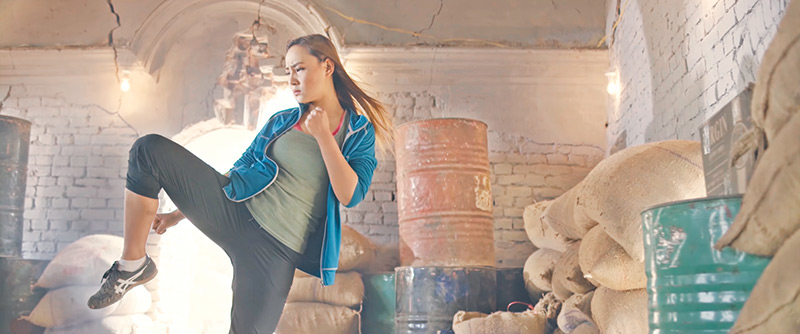
Sarauto isn’t just comical; it’s ludicrous. A fight scene introduces young Vaani in the film. She’s beating up random goons in a park. However, we’re never given clear reasoning as to why these goons are a part of this coordinated fight sequence. Based on Nepali film troupes, we can guess these men are eve teasers but we’re never explained so maybe she just doesn’t like bulkier men in general. We’ll never know.
But what happens next is even more baffling. In the middle of the fight, she tends to a little boy sniffing glue. She looks at the boy, and motions, ‘no’. The boy nods an ‘ok’, and I guess he quits drugs, and lives a better life. We’ll never know. Vaani then resumes fighting those random goons. Next, we’re informed that Vaani is a skilled fighter, through flashbacks. She, along with her adopted brother Jeet Jung (Leo Tank), have trained under her father Kusang (Vijay Lama).
Vaani lives with her Phupu (Aruna Karki), who had been her guardian ever since her parents were murdered, and works at a school for the hearing impaired (in the film: Nepal Deaf School). There, she meets Bishesh (Sunny Singh), a photographer. Bishesh discovers that Vaani is a poet, and no points for guessing the love track begins.
The film quickly changes gear and becomes a love story, and then into a tourism advert, maybe keeping in mind the Visit Nepal 2020, who knows! Anyways, we are served with a plethora of picturesque locations in Illam, Janakpur, Pokhara, Rara, Mustang, and other areas. And for entertainment purposes, the makers insert three songs within 20 minutes and it’s not until after the interval that we’re back into revenge thriller mode.
This is Hari Humagain’s debut film as a director. He has been working as a cinematographer in the Nepali cinema industry. And you can tell that he, along with his cinematographer Uttam Humagain, have travelled extensively and put in real effort in finding locations for the film. What’s also impressive is the way they use elements of nature in the said locations. There are traces of wind, water, and fire in many outdoor shots and that makes the film visually rich. Also noticeable is how the lead actor’s hair is blowing when she’s pictured as angry, or menacing. Technical details of cinematography deserve full marks in the film, but sadly a director’s job is a lot more.
Moktan, the lead actor, is probably the only saving grace of this film and she does it though her physical presence alone. She maintains form and shape through all her kicks and punches. The only complaint is that she doesn’t have enough fight scenes. And her final face-off with the major bad guy feels rather rushed and anti-climatic.   
But the biggest flaw, like with every other Nepali film, is the writing. Raghav Krishna Gautam’s writing is dull and too simplistic. There are no complexities or grey areas; quite frankly, it’s unimaginative.  What begins as a revenge thriller spends too much time with romance, completely losing track. And the film gets worse as it progresses. After the interval, the writing gets forced and random.
Zanjeer, written by the iconic duo Salim-Javed, is considered exemplary for its portrayal of communal friendship between a Hindu and a Muslim. In the film, Pran is a Muslim character who proudly proclaims ‘Yaari hai Iman mera yaar meri jindgadi’ (My friendship is my faith, and my friend is my life). However, in Gautam’s attempt to contemporise the story, he has erased social themes; in fact this film does quite the opposite. All of Gautam’s antagonists are Madhesis, and all of the protagonists are Pahadis.  
Remember the anonymous beetle-nutcracker wielding bad guy? He’s a Madhesi, and actor Amir Gautam does no justice to the already badly written character with a made-up accent. Also, remember Vaani’s adopted brother, Jeet? He is also a major bad guy here, and has an accent. To top it off, he even says ‘Jai Madhesh’ in one of the scenes.
The anonymous bad guy’s evilness is not explained, he is just evil; but the film offers some insight into Jeet’s background. And, I warn you, this is pure bigotry. A young Jeet is an Indian who migrated to Nepal, and begs for a living. Kusang adopts him and names him Jeet. However, Jeet is not accepted by his peers and they bully him with racial slurs. When Jeet retaliates, Kusang punishes him. While doing so, he shouts about nationalism, and the value of Nepali soil. This makes Jeet hate his new family and turn towards a life of crime. He betrays his family, and plots the murder.
Jeet’s only identity in the film is that he is an Indian. And he’s portrayed as an evil person who conspires with a fellow Madhesi to murder the Pahadi-Nepali family that adopts him. The problem here is that Jeet’s identity didn’t have to be mentioned in the film at all.
Like I said before, remaking a film or being inspired is not a crime. Artists all around do it, and that’s probably how art progresses: you watch something, you connect with it and you build on the original idea, with all your knowledge. In films, the right way to do that is to take whatever is objectionable—like clichés, stereotypes, and regressive attitudes, and replace it with something that is more positive, an improved version, that is befitting for the current times. Yes, this film puts forth a female lead instead of a male and it never disrespects the character. Vaani is never sexualised or objectified. However, you can’t ignore all the other characters in your film.
As a filmmaker and as an artist, it’s your duty and responsibility to make sure the art you create does not disregard any socio-cultural and political sentiments. Sadly, the way this film represents certain characters is disappointing and wrong, and when a film makes such grave a mistake, it’s one step forward and two (hundred) steps back.


Sarauto
Starring:     Sumi Moktan, Sunny Singh
Writer:     Raghav Krishna Gautam
Director:     Hari Humagain


Dixit is a filmmaker, film educator and film campaigner based in Kathmandu.

CULTURE & ARTS

Classic Blue is colour of the year

Pantone chose Living Coral for 2019 and Ultra Violet the year before that.
AP/RSS

In these uneasy times, as we move along to a new decade, the Pantone Color Institute has reached back in time to calming, confident Classic Blue as its colour of the year for 2020.
The colour is an anchor offering stability, constancy and connection, said Laurie Pressman, vice president of the global purveyors of colour consulting, trendspotting and analysis.
“It’s a reassuring presence,” she told The Associated Press ahead of Wednesday’s reveal.
Akin to maritime blue—not indigo and brighter than navy— Classic Blue evokes a feeling of vast expanse, Pressman said of the shade also known as Pantone 19-4052.
Pressman and her team scoured the worlds of art, fashion and home decor, along with commercial, graphic and industrial design, to come up with the pick, as they have since Cerulean became the inaugural colour of the year for the milestone 2000.
But Classic Blue isn’t just about nostalgia, she said. Creators around the globe are putting out modern takes for runways, mobile phones, kitchen appliances and the paint of pricey, forward-looking cars and motorcycles.
At Wednesday’s launch event, Pressman insisted the colour was in no way a nod to the hue associated with the Democratic Party, though she knew the question would surface.
“This was not a political move for us. This is global. We do not look at colour through a political lens. We look at our life through a colourful lens,” she told the AP.
Pantone chose Living Coral for 2019 and Ultra Violet the year before that.
Whether as throwback or harbinger of things to come, Classic Blue harkens back to when things “seemed simpler, seemed more comfortable, but at the same time not suggesting that it be done in a way that it was then,” Pressman said. Cerulean, which heralded the new millennium, is the colour of the daytime sky, while Classic Blue is the sky at dusk as the new decade commences.
“It has depth to it, but it’s a colour of anticipation because we’re looking ahead,” Pressman said. “The day is over. We’re looking forward to the evening. What’s going to come?”
Classic Blue is a vibrant yet non-aggressive and easily relatable colour, she said. It’s also among nature’s anthocyanin pigments possessing antioxidant and other health-fostering benefits.


Think blueberries.
“Many of us feel stressed, completely overloaded,” Pressman said. “We live these 24/7 lifestyles. We’re anxious. There’s so much uncertainty and unrest, no matter where you are. With that we’ve seen this whole increased focus on wellness and self-care.”
The timeless colour is also gender neutral and seasonless, mixing well with other shades throughout the spectrum yet making a strong statement on its own. It also works well in a range of textures.
“It’s a colour that can take on different appearances through different applications, finishes and textures,” Pressman said, lending itself to everything from lustrous sheens to sparkly sequins.
The anointed blue also plays into the sustainability movement.
“We have all this focus on buy less, buy good, so people aren’t throwing things into a landfill,” Pressman said. “You read about buying things to last and this is a timeless blue shade. It’s always there and you’re comfortable with it, like blue jeans.”
For offices, it offers an air of security, she said. For kitchens, it’s a top accent colour in appliances and walls. Classic Blue is a mainstay colour in stemware, dishes and other tabletop staples as a trusted expression of elegance, she said.
“Everybody’s comfortable with blue,” Pressman said. “We know it. We like it.”


—Associated Press

Page 10
CULTURE & ARTS

Pictures of the decade

‘As a photojournalist, you need to capture everything in one frame.’
- REUTERS

From Haiti’s devastating earthquake to war in Syria, Reuters photographers have covered the biggest news stories of the decade, capturing images of armed conflict, natural disasters, the plight of migrants and the drama of sport.


Syrian rebels dodge debris after the wall which they were taking cover behind is hit by a shell fired from a government controlled checkpoint during fighting in the Ain Tarma neighbourhood of Damascus.


A migrant family, part of a caravan of thousands travelling from Central America to the United States, run away from tear gas in front of the border wall between the U.S. and Mexico in Tijuana.


An exhausted Rohingya refugee woman touches the shore after crossing the Bangladesh-Myanmar border by boat through the Bay of Bengal.


An injured child receives medical treatment after an earthquake in Port-au-Prince, Haiti.


A Free Syrian Army fighter fires his sniper rifle from a house in Aleppo, Syria.


A protester holds a Venezuelan flag while standing in front of a fire at the entrance of a building housing the magistracy of the Supreme Court of Justice in Caracas.


The pictures saw Reuters jointly win the 2016 Pulitzer Prize for breaking news photography with The New York Times.


Jamaica’s Usain Bolt looks at Andre De Grasse of Canada as they compete during the men’s 100m semi-finals at the 2016 Rio Olympics, Brazil.


Prince William and his wife Catherine kiss on the balcony at Buckingham Palace, watched by bridesmaids after their wedding in London, United Kingdom.

Page 11
AS IT IS

Ode to the streets of Patan

When I moved to Patan three months ago, it took me a while to discover all the graffiti scattered.
But thanks to that art I learnt to see Patan through a different lens.
- GINA BACHMANN
post photo: Gina Bachmann

She has a bright smile on her face but what might she be looking at? Her head turned to the right, she faces Dhalaacha Road, the busy street between Patan Dhoka and Swotha. Motorbikes are rushing by, dust is whirling up, school children are walking past her, giggling, and a fat stray dog is lurking around. A few tourists stand wearing cameras around their necks like medals or necklaces, some of them seemingly lost, some of them visibly enjoying the liveliness of that spot. She might have noticed that one tourist, a woman of around 25 years, approaching her and clicking many pictures. But she didn’t get annoyed. Whatever good or bad happens in that street, whatever she witnesses, she remains silent.
The lady on the yellow circle was one of the first murals I spotted after moving to Patan three months ago. Although I walked past her every day on my way to work, it took me quite a while to fully appreciate this piece of art. During my first few weeks of living in Patan, I was mostly focused on the traffic, navigating my way through the crowd, trying not to get hit by a bike or stumble over a pothole, oftentimes following Google Maps on my phone.
After a while, I became familiar with the place. And then I saw the temples, the beautiful architecture, the stupas, and the nicely coloured doors.
It’s not that I don’t like busy places. Although I grew up in a rural place on the brinks of the Swiss alps, I always felt naturally drawn to cities. I love their capability of surprising us, of challenging us. And I love the chaos and randomness of cities, the mosaic of stories and people that shape them without anybody having control. Also, I’m usually quite good at adjusting to new places. But Patan proved a bit of a challenge in this regard. I remember always feeling very tired when I got home.


But only a few weeks ago, something in the way I perceived Patan changed. It was a sunny Saturday morning and I wanted to walk to Pimbahal Pukhu, the big pond near Patan Dhoka. I left the house and, after a few minutes, I felt like graffiti popped up on every corner I passed. It was as if a big street art festival had taken place overnight. In fact, the murals were flaking and looked old. I took my camera out of my backpack and slowed my pace. One piece of graffiti, of a serious-looking girl with big glasses, was just behind my house. There was another of a couple standing close together on a red facade, a man holding an umbrella in his right hand. Another was of a little boy holding a globe in his hands like a crystal ball. There was a huge mural of at least 12 square-metres just a few minutes from where I stayed. And there was the lady on the big yellow circle whom I had already come to know. For the first time, I realised how happy she looked. I figured she must be looking at somebody she likes.
When I reached the pond after about one and a half hours, I felt a little tired but also very relaxed and happy. I ordered a milk tea in one of the cafés and wondered how it was possible that I haven’t seen all that graffiti and all those murals before, especially being a great street art lover. I once spent three months in Bristol, in the UK, where famous street artist Banksy comes from. And just like in Bristol, street art again invited me to view this city with very different eyes. Once you start searching for graffiti, the main sights become irrelevant. Each one spotted is like a little gift. A free-of-cost art piece. The city becomes a huge open museum and the grey walls, the black pipes, the windows, the sidewalks and peeling facades become the perfect frame. It’s the surroundings that complete a piece of street art. And in the case of Patan, the ancient Newar architecture together with the modern and funky murals produce an exciting contrast.
By marvelling at the street art pieces in Patan, I also became aware of how much of this city’s charm lies in the details: the wood carvings on the balconies, the intense orange of the marigold garlands matching so well with the dark wood of the door frames, the random patterns the black cables scribble onto the blue sky. And as I started to look up to spot more murals I became interested in rooftops as well. It seems that the trees and flowers that once had been cut to make way for roads, sidewalks and houses now grow a few floors above, bringing some green back to the city. The random mix of colours on the washing lines and prayer flags complete the colourfulness of Patan’s rooftops.
So, to put in a cheesy way, I fell in love with Patan that Saturday morning. I didn’t mind its flaws anymore; the dust, the litter, the noise, the broken pavement.
I think, at the beginning of my stay, I saw Patan with the eyes of someone who visits that place for a day or two and then runs off to the next destination. But it always takes time for the mind to adjust to a place and let all the different impressions sink in. Patan is not just ‘pretty’, as I thought in the beginning. Patan is a beauty with its very own pride and charm hidden in its many wonderful details. So, going back to Switzerland and getting used to Swiss cities will again pose yet another challenge. The Swiss obsession with cleanliness and regulation produces a high quality of life but also a lot of boredom, conformity, and predictability. Those are not really what I’m looking for in cities, but who knows, maybe I will spot a few new murals there as well.
I just hope that if one day I get back to Patan and I walk down Dhalaacha Road, the lady in the yellow circle will still be there, a witness of all the change, the good and bad, and still silently smiling.

AS IT IS

Effects of alternative healing

Is shamanism just superstition or a result of the placebo effect?
- BIRANCHI POUDYAL
post file photo

The practice of shamanism is present in various religions and cultures across the globe. Once regarded as a predominant healing method, in which the practitioner claims to have channelled some form of higher spiritual energy, shamanism is a discipline that has been followed closely by many scholars from a wide range of disciplines. And although it is not as prevalent in the modern world, it is claimed to be one of the oldest therapeutic approaches for healing.
In ancient Nepali healing practices, shamans are said to identify the source of the illnesses by feeling the pulse of the patient, chanting divine mantras, identifying natural vibes or through other peculiar means. After identifying the source of the ailment, clients are offered available herbal medicines by the shamans.
While studying the cognitive and evolutionary approach to shamanism, Harvard anthropologist Manvir Singh linked this process of spiritual healing to a cultural evolutionary process describing it as “a psychologically appealing method for controlling uncertainty”.
In other words, it induces a kind of placebo effect on the recipient of the healing process. And it’s because of this psychosomatic phenomenon that the patient witnesses that he observes gradual improvement within their body due to inner belief and expectations, rather than the treatment itself.
The methods and processes during a shamanic healing process is not short of controversies. But regardless of its ties with superstition, some regard it as a process of healing the human body through the mind where the recipients are themselves involved in the healing process. Although many who believe in the shamanic healing methods may not be aware of the placebo effect, its continuity demands more research into it.
But what makes the spiritual healing so influential? Medical science has no precise answer. Medicine has experts
for all odds and ends of the human body except placebo, because it lacks empirical understanding for acclimating placebo effect in the institutional domain.  
Medical study regards all living creatures as sophisticated machines, organs as spare parts, infection as malfunction, which needs either correction or replacement. In the medical world, disease is a biochemical abnormality, which needs to be cured by chemical means. Any other procedure beyond biochemistry realm are regarded as non-scientific.
So, biochemistry always ignores placebo and attributes its effect to superstition, spirit and meta-physical misconception.
According to the placebo discourse, however, there are three bases in which placebo effect functions—culture, meaning and belief. In every culture, no matter how primitive or modern, there exists someone labelled as the ‘healer’. And there remains an assumption that these healers are specialists who have the power or are qualified to heal—which means it’s not only the act of the healer but also the faith of the sick towards a healer’s credibility.
To give credit to this process, some research papers have even started to describe the pre-operative formalities in hospital as a sort of modern shamanic ritual. In many hospitals, doctors have also been using sugar pills as a form of placebo healing.  The study carried out by researchers from the University of Oxford and the University of Southampton found that 97 percent of doctors have prescribed placebo treatments.
In Nepal, owing to the thriving practice of alternative healing, extensive research incorporating some relevant shamanic techniques in the medical field needs to be conducted. Since our country not only possesses ancient knowledge of cosmic healing and natural remedies but also vaults rare herbal medicine, it can open new doors to natural healing remedies.   
 

Poudyal is a freelance writer and researcher.

Page 12
BOOKS

‘Identify yourself and your interests, then practise—a lot.’

Shailendu Prakash Nepal talks about writing, his favourite books and the new wave of Nepali grammar.
post photo: Deepak kc

Litterateur Dr Shailendu Prakash Nepal’s works in Nepali youth literature is loved and respected by many. Over the years, he has published numerous books and poetry collections—Namita Sunita (Khandakavya), Diana (Mahakavya), and Kamana (novel), to name a few. And his recent work, Junlai Chumne Ichha, is another wonderful addition to his body of work, one that stimulates a child’s imagination and provides an important visual experience through poetry.
Besides his fiction writing, Nepal’s books on grammar have also been appreciated by many in academia, due to their clarity and ease of reading. In an interview with the Post’s Dipesh Khatiwada, Nepal talks about his love for literature and shares five books he thinks everyone must read. Excerpts:


When did you start reading religiously?
Books are one of the best sources of knowledge and information.
Over the years I have found  that good books are the best tools to increase one’s awareness. I developed my passion for reading when I was in college, immersing myself in different genres, reading everything I could.
But I must say I have a deep inclination towards reading biographies, as such books have a great impact on one’s mind.


What was the last book you read and did you like it?
The last book I read was Usha Thapaliya’s Nari Timi Hareki Chhainau, which is based on the plight of the Nepali
women in the present context. The book talks about the suffering and hardship of women in Nepali society, their situation and also about the responsibility of the nation to empower its women. This book is a collection of articles and opinions published by the author in various media outlets. The book also depicts the struggle of the author herself, and I am a big fan of her work.


What are the five books you’ve read that you would recommend as must-reads?
I believe that the first and foremost book that everyone should read is Bhanu Bhakta Acharya’s Ramayan. I would read this book over and over again because it restructures the reader’s mind every time they read it. I also enjoyed reading Naso, a collection of short stories, by Guru Prasad Mainali. Laxmi Prasad Devkota’s epic Muna Madan, which is written in Nepali loklaya, is a gem for Nepali literature. I also enjoyed reading Jagadish Ghimire’s Antarmanko Yatra, an autobiography. And Jhamak Ghimire is another writer that I am very fond of. I enjoyed reading Ghimire’s Jeewan Kanda Ki Phul.


Which books are currently on your wishlist?
I am looking forward to reading Yogmaya, a novel written by Neelam Karki Niharika, which received the Madan Puraskar Award last year. This book depicts the struggle of the title character Yogmaya, who received Yog Sadhana (discipline of routine spiritual practice) during the Rana regime. I am going to invest my time to know how the writer incorporated the character in her novel.  Hopefully, I will read this book this year.


As a Nepali grammar textbook writer, how do you view the current new wave that’s shaping the language?
The current wave of Nepali grammar is  following the middle path, which we called Madhya Marga. It is not like our traditional grammar, nor like what scholars had predicted it to be around one and a half to two years ago. As language changes with time, so does its grammar. The language we write and speak  now is not similar to what people used to speak during the time of Bhanu Bhakta Acharya’s and Motiram Bhatta. That’s why we have tried to make it easier by adopting the middle path.


What book has influenced you the most and why?
The most influential book that I have read has to be Anne Frank’s diary, the translated version by Geeta Upadhyaya in Nepali. The diary has been published in more than 150 languages, including Nepali. After reading this book, I also wrote a diary for one year. As a writer, I think this is the book that every youth should read once.


How do you draw inspiration for writing?
My father was a litterateur and he was my source of inspiration for writing. I like to believe his passion was  
passed on to me. When I was in grade 8, I had started to write poems. While I was with my father in Pokhara during secondary school level, I got a chance to grow up with bookworms around me. During those days, Pokhara’s natural beauty also inspired me to write literature.


What is the situation of Nepali literature right now?
These days, literature has grown commercially due to the advancement of technology and media reach. Every year, hundreds of books are being printed on different genres. Publishers and writers organise book launches and publicise their books in a grand way.
But I am not sure if I like this approach. Good literature doesn’t need any publicity. For example, books of Laxmi Prasad Devkota, Bhanu Bhakta Acharya, Lekhnath Poudyal, among others, are popular without any publicity. A book needs to be rich in knowledge and new information to be effective and widely popular in the market.    


What are your suggestions to those who want to write literary books?
In Nepal, very few people have a habit of reading. For those who want to write literature, I have nothing much to say, but this: Read books if you want to be open-minded. Then identify yourself and your interests, then practice—a lot.

BOOKS

In Kosovo, the Serb village with a friend in Handke

The farmers also know the controversial Nobel prize winner personally has visited more than five times.
- ISMET HAJDARI

In the small wine-growing village of Velika Hoca in southern Kosovo, every household has a copy of a Peter Handke book.
The farmers also know the controversial Nobel prize winner personally: Handke has visited more than five times and donated nearly 100,000 euros to the Serb enclave of around 500 people, who live apart from Kosovo’s ethnic-Albanian majority.
“He’s a good man. Only he has remembered to help us,” says local Vesna Manitasevic, explaining how each resident received around 38 euros from the first of his donations.
The tight-knit community is delighted by their Austrian benefactors’ latest and most prestigious award — the Nobel Prize in Literature that he will officially receive on December 10.
But their neighbours are not.
Across much of Kosovo and the Balkans, Handke’s special affection for Velika Hoca is another reminder of the writer’s steadfast support for Serbs, even as their troops committed atrocities during the 1990s wars that shattered Yugoslavia.
A lifelong provocateur, Handke downplayed war crimes and argued that Serbs were unfairly portrayed as the only aggressors by the Western press.
He even spoke at the funeral of late Serbian strongman Slobodan Milosevic, who died in a prison cell in the Hague in 2006 while he was on trial for genocide, war crimes and crimes against humanity.
When the Nobel committee awarded Handke literature’s highest honour, they ignited moral outrage around the globe.
But in the centre of Velika Hoca, a large banner hangs with the image of the bespectacled author reading a book.
Written beneath it are the words “Congratulations to our Nobel!” in Serbian, English and Italian.
Locals say they feel gratitude to a man who understood their plight as a tiny minority in Kosovo, which was a Serbian province until it broke away in the 1998-99 war.
“We are proud he is a friend of Velika Hoca,” said Marko Spasic, the director of the elementary school.
“He saw that we were a surrounded enclave, and I believe he felt compassion for us”.


‘I can be alone here’
Over the course of several visits, Handke developed a romantic fascination with Velika Hoca, which is one of the oldest Serb settlements in Kosovo and boasts more than a dozen stone Orthodox church buildings, some of which date from the Middle Ages.
According to the village chief Miroslav Lukic, the writer gave the town two donations of 50,000 and 48,000 euros each.
“Even if there are big problems, I think life has a good rhythm here”, Handke said during a 2014 visit, explaining that he “came to inform myself what the village needs”.
“I can be alone here. I can hide. I can walk very hidden behind the hills,” he said.
Following an earlier week-long stay in 2008, just after Kosovo declared independence, Handke penned a portrait of the town titled “Die Kuckucke von Velika Hoca” (The Cuckoos of Velika Hoca).
The slim volume, which every family received in Serbian, is “part literature, part journalism”, according to the publisher.
The village, shrunk down from its pre-war population of about 1,700, is one of several small Serb communities scattered around Kosovo, with Serbian flags announcing its loyalties to Belgrade.
The bucolic vineyards edge up against those of their Albanian neighbours in Hoca e Vogel — a place Handke never visited.
While the two communities are no more than three kilometres apart, their lives rarely intersect, with the wooded path between them abandoned and overgrown.
“He should have come here, where there are victims,” says Abdurrahim Berisha, a 60-year-old farmer in Hoca e Vogel, pointing with a trembling hand to the cemetery where his family are among 40 civilians killed during the war.
Three of his children and 10 other close relatives were among those slain by Serb fire while they were trying to find shelter in the mountains, he told AFP.
A minaret rising from the local mosque still bears a large hole blasted open during the war, which claimed more than 13,000 lives, mostly Albanians.
Serbs in Kosovo also suffered, with around 2,000 killed and tens of thousands forced to flee their homes.
In Velika Hoca there was a spate of kidnappings, including two visiting Serb journalists who were never found.

 
Frozen ties
Two decades later, “relations between the two villages are frozen,” said Ramadan Krasniqi, a former fighter with the Kosovo Albania guerilla troops.
“We are concerned by the fact that a supporter of the massacres and a genocide against our nation will be awarded with this prize,” he added.
For Albanians in Kosovo, Handke made his allegiances clear when he returned the money from Germany’s prestigious Buechner prize in 1999 to protest the NATO bombing that forced Serbs to withdraw from the war with Kosovo.
“He is a terrorist as Milosevic,” Abedin Krasniqi, a 72-year-old in the Albanian village, said of the Nobel prize winner.
“If it was down to me I wouldn’t let him set foot in Kosovo”.


—Agence France-Presse

Page 13
WORLD

In rare legal test, Myanmar faces genocide hearings at The Hague

Buddhist majority Myanmar rejects accusations of genocide against the Muslim population, but the government declined to provide details about its defence case.
- Stephanie van den Berg,Anthony Deutsch
Pro-democracy leader Aung San Suu Kyi walks to take an oath in lower house of parliament on May 2, 2012.  Reuters

In a wood-panelled hall of the ornate Peace Palace at The Hague, lawyers pressing a case against Myanmar for alleged genocide against its Muslim Rohingya minority will next week ask judges to order immediate action to protect them from further violence.
Gambia, a tiny, mainly Muslim West African country, filed a lawsuit in November accusing Myanmar of genocide, the most serious international crime.
During three days of hearings starting Dec 10, it will ask the 16-member panel of UN judges at the International Court of Justice (ICJ) to impose “provisional measures” to protect the Rohingya before the case can be heard in full.
More than 730,000 Rohingya Muslims have fled Myanmar to neighbouring Bangladesh since a 2017 military crackdown, which UN investigators found in August to have been carried out with “genocidal intent”. Myanmar vehemently denies allegations of genocide.
The office of Myanmar’s civilian leader Aung San Suu Kyi, a Nobel peace prize laureate, has said she will lead her country’s defence personally. Myanmar’s legal team is expected to argue that genocide did not occur, that the top UN court lacks jurisdiction and that the case fails to meet a requirement that a dispute exists between Myanmar and Gambia.
Gambia’s request for a provisional injunction is the legal equivalent of seeking a restraining order against a country.
“If the court feels there is sufficient threat and it needs to step in, it can ... order Myanmar to cease and desist in terms of military operations and violence so that civilians are protected,” said Priya Pillai, an international lawyer with the Asia Justice Coalition, an NGO.
In an overcrowded refugee camp in Bangladesh, 22-year-old Mohammed Nowkhim said he and fellow Rohingya were “waiting and praying” for a good outcome in The Hague, although most will be unable to watch the hearings due to poor internet access.
Nowkhim said he escaped Buthidaung town, an urban centre of northern Rakhine state, with his neighbours in August 2017. “Our remaining villagers decided that we can’t stay any more. If we stay they will kill us. So we gathered in one place and started our journey to Bangladesh,” he told Reuters.
“Our Rohingya communities are waiting for the resolution of ICJ. We hope that something will change after ICJ,” he said.

High legal bar
A decision on provisional measures is expected within weeks. Hearings dealing with the core allegation of genocide could begin in 2020, but cases at the ICJ, the leading U.N. court for disputes between states, often take years.
The legal threshold for a finding of genocide is high. Just three cases have been recognized under international law since World War Two: Cambodia in the late 1970s; Rwanda in 1994; and Srebrenica, Bosnia, in 1995.
“Proving genocide has been difficult because of the high bar set by its ‘intent requirement’ - that is showing the genocidal acts, say killings, were carried out with the specific intent to eliminate a people on the basis of their ethnicity,” said Richard Dicker, head of the international justice program at New York-based Human Rights Watch.
Buddhist majority Myanmar rejects accusations of genocide against the Muslim population, but the government declined to provide details about its defence case ahead of the hearings.
“Allegations are easy,” Thaung Tun, a senior member of Suu Kyi’s cabinet, said in a tweet on December 1.
“But in law, genocidal intent has to be established beyond a reasonable doubt. It shouldn’t be confused with personal motive prompting actions of a perpetrator. There must be sufficient evidence to prove, beyond a reasonable doubt, a policy to destroy the group.”
Myanmar has previously denied almost all allegations made by refugees against its troops, including of mass rape, killings and arson. It says the army was engaged in a legitimate counterterrorism operation against Rohingya militants.
The U.N. investigators concluded that sexual violence committed by Myanmar troops against Rohingya women and girls in 2017 indicated the military intended to destroy the mainly Muslim ethnic minority.
Myanmar’s government failed to hold anyone accountable and was therefore responsible “under the Genocide Convention for its failure to investigate and punish acts of genocide”, the investigators’ report said.
Those findings, along with other court cases launched against Myanmar in recent weeks, could play an important role in the ICJ proceedings.
“It’s difficult to overstate the importance of what is unfolding at the ICJ,” Dicker, at Human Rights Watch, said. “The global significance lies in that this is the first time the Genocide Convention has been put to use in the way its framers intended.”


—Reuters

WORLD

Democrats say Trump impeachment charges must come swiftly

Drafting articles of impeachment is a milestone moment, only the fourth time in US history Congress has tried to remove a president.
- LISA MASCARO,MARY CLARE JALONICK
Speaker of the House Nancy Pelosi meets with reporters during her weekly news conference at the Capitol in Washington. AP/RSS

House Democrats moved aggressively to draw up formal articles of impeachment against President Donald Trump on Thursday, with Speaker Nancy Pelosi saying he “leaves us no choice” but to act swiftly because he’s likely to corrupt the system again unless removed before next year’s election.
  A strictly partisan effort at this point, derided immediately by Trump and other leading Republicans as a sham and a hoax, it is a politically risky undertaking. Democrats say it is their duty, in the aftermath of the Ukraine probe, while Republicans say it will drive Pelosi’s majority from office.
Congress must act, Pelosi said. “The democracy is what is at stake.”
“The president’s actions have seriously violated the Constitution,” she said in a somber address at the Capitol. “He is trying to corrupt, once again, the election for his own benefit. The president has engaged in abuse of power, undermining our national security and jeopardizing the integrity of our elections.”
Trump has insisted he did nothing wrong. He tweeted that the Democrats “have gone crazy.”
At the core of the impeachment probe is a July phone call with the president of Ukraine, in which Trump pressed the leader to investigate Democrats, including political rival Joe Biden. At the same time the White House was withholding military aid from Ukraine, an ally bordering an aggressive Russia.
Drafting articles of impeachment is a milestone moment, only the fourth time in US history Congress has tried to remove a president, and it intensifies the rigid and polarizing partisanship of the Trump era that is consuming Washington and dividing the nation.
The speaker delivered her historic announcement in solemn tones at the Capitol, drawing on the Constitution and the Founding Fathers in forcefully claiming Congress’ oversight of the president in the nation’s system of checks and balances. Democrats are already beginning to prepare the formal charges, pushing toward House votes, possibly before Christmas.
“Sadly, but with confidence and humility, with allegiance to our founders and a heart full of love for America, today I am asking our chairmen to proceed with articles of impeachment,” Pelosi said.
Seemingly eager to fight, Trump tweeted that if Democrats “are going to impeach me, do it now, fast.” Though he has fought the House investigation, trying to bar current and former officials from testifying, he said he now wants to move on to a “fair trial” in the Senate.
Approval of articles of impeachment is considered likely in the Democratic-majority House. Conviction in a following trial in the Republican-dominated Senate seems very unlikely.
Once reluctant to pursue impeachment, warning it was too divisive for the country and needed to be bipartisan, Pelosi is now leading Congress into politically uncertain terrain for all sides just ahead of the election year.
Republican are standing lockstep with Trump, unswayed by arguments that his actions amount to wrongdoing, let alone impeachable offenses. That is leaving Democrats to go it alone in a campaign to consider removing the 45th president from office.
At a town hall late Thursday on CNN, Pelosi said she would have no regrets if impeachment ended up helping Trump’s re-election effort. “This isn’t about politics at all,” she said. “It’s about honouring our oath of office”—to defend the constitution.
Pelosi has emphasized the Russia connection, from special counsel Robert Mueller’s probe into 2016 election interference to the president’s phone call this summer with Ukrainian President Volodymyr Zelenskiy that set off alarms in Washington.
Russia and President Vladimir Putin benefited most from Trump’s actions toward Ukraine, she said.
“All roads lead to Putin. Understand that,” she declared at a morning news conference at the Capitol. “That was the a-ha moment.”
She spoke solemnly and calmly, but that changed when she was asked as she was leaving if she hates Trump.
Pelosi stiffened, returned to the podium and responded sharply that the president’s views and politics are for the voters to judge at elections but impeachment “is about the Constitution.” She said that as a Catholic, she does not hate the president but rather is praying for him daily.
Trump quickly tweeted back that he didn’t believe her.
Trump’s allies argue that voters, not lawmakers, should decide the president’s future. But Democrats say the nation cannot wait for the 2020 election, alleging Trump’s past efforts to have foreign countries intervene in the presidential campaign are forcing them to act to prevent him from doing it again. Pelosi said the still-anonymous whistleblower’s complaint about Trump’s Ukraine call changed the dynamic, creating the urgency to act.
The number of articles and the allegations they will include will be both a legal and political exercise for the House committee chairmen, who will be meeting privately. They must balance electoral dynamics while striving to hit the Constitution’s bar of “treason, bribery or other high crimes and misdemeanors.”
Pulling from the House’s 300-page investigation of the Ukraine matter, Democrats are focusing on at least three areas—abuse of power, bribery and obstruction—that could result in two to five articles, they say.
They argue that Trump abused the power of his office by putting personal political gain over national security interests; engaging in bribery by holding out $400 million in military aid that Congress had approved for Ukraine; and then obstructing Congress by stonewalling the investigation.
Some liberal Democrats want to reach further into Trump’s actions, particularly regarding the findings from special counsel Mueller’s report on Russian interference in the 2016 election. That could produce an additional article of obstruction not only of Congress, but also of justice.
But more centrist and moderate Democrats, those lawmakers who are most at risk of political fallout from the impeachment proceedings, prefer to stick with the Ukraine matter as a simpler narrative that Americans can more easily understand.
The GOP Leader of the House, Kevin McCarthy, said Pelosi is more concerned about tearing the president down than building the country up. Senate Majority Leader Mitch McConnell, R-Ky., criticized Democrats for focusing on impeachment over other issues, though many House-passed bills are waiting for action in his chamber. “It’s all impeachment, all the time,” he said.
At the White House, press secretary Stephanie Grisham tweeted that Pelosi and the Democrats “should be ashamed.”
House members are preparing to vote on the articles of impeachment in the Judiciary Committee, possibly as soon as next week. The committee set a Monday hearing to receive the Intelligence Committee’s report outlining the findings against the president.
The House is expecting a full vote by Christmas. The would send the issue to the Senate for a trial in the new year.


  — Associated Press

Page 14
SPORTS

Chelsea transfer ban lifted, free to recruit in January

- AGENCE FRANCE-PRESSE

LAUSANNE,
Chelsea are free to sign players in the January after a FIFA-imposed ban was reduced on appeal by the Court of Arbitration for Sport (CAS) on Friday. The ban, imposed after violations in the recruitment of minors, was reduced from two windows to one, which Chelsea already served in the summer.
A fine was also reduced from 600,000 Swiss francs to half that amount by the Lausanne-based court. A CAS statement said that Chelsea were guilty of violating rules related to the international transfer and registration of minors, “but for a significantly smaller number of players”, concluding that they were only guilty of one third of the violations found by FIFA.
In addition, the breaches of other transfer rules “were found to be less serious than those attributed to Chelsea FC by FIFA”. The initial ban was announced by football’s world governing body in February, but Chelsea had always denied wrongdoing. It followed a FIFA probe into Chelsea’s signing of foreign under-18 players, including the club’s former forward Bertrand Traore who now plays for French Ligue 1 club Lyon. Traore signed professional forms for Chelsea in 2013 at the age of 18 but was not registered until January the following year.
At first they appealed to FIFA who partially lifted the ban in April, although only for players under 16 who are not “international transfers and first registrations of foreign minor players”. That left Chelsea still unable to sign players over the age of 16 during the summer transfer window.
Chelsea had been eager to have the ban lifted at the time, or at least suspended pending an appeal, so they could be in a position to sign a replacement for Eden Hazard, who was sold to Real Madrid. Nevertheless, in the absence of new recruits, new manager Frank Lampard has enjoyed success promoting several members of the club’s highly regarded youth academy to the first team.
Centre-back Fikayo Tomori, midfielder Mason Mount and striker Tammy Abraham have all returned from loan spells to become regulars at Stamford Bridge, their form leading to England call-ups.

SPORTS

From ballboy to the new regional champion: Teenager Tamang’s stunning rise to double gold

The 17-year-old finished with 14-under 274 to register an eight-stroke win over Bangladesh’s Md Fahrad.
- PRAJWAL OLI
Subash Tamang won two gold medals—one individual and the other in team events—in men’s golf at the 13th South Asian Games in Gokarna Golf Club on Friday. Post Photo: KIRAN PANDAY

KATHMANDU,
Teenage golfer Subash Tamang became the third player to win two gold medals for Nepal in the 13th South Asian Games on Friday. He finished top in the men’s individual and team event of golf at the par-72 golf course at the Gokarna Golf Club on Friday.
Tamang, a fourth-grade dropout, until five years ago, used to hang around the Royal Nepal Golf Course, watching the golfers play. Whenever the balls were out of bound, he would fetch them.
After a year at the golf course, he started practising shots whenever he got an opportunity.
He was once spotted by Tashi Ghale, president of Nepal Golf Association, while he was trying some shots.
“I think I saw some kind of talent in him and picked him for the junior golf camp,” Ghale recalled. “I even admitted him to a school in Sinamangal.”
According to Ghale, Tamang, however, never showed interest in studies and left the school after two years.
“It looked like he was hooked to golf; he would play throughout the day,” said Ghale who helped the native of Panauti, Kavre, to get a contract as a golf player in the Nepal Army.
He also won a silver medal for the Nepal Army at the Eighth National Games in April.
Tamang on Friday carded three-under 69 at the final round for a total of 14-under 274 under the stroke-play format. He registered an eight-stroke win over Bangladesh’s Md Fahrad who carded four-under 68 for a total of two-under 282. Nepal’s Shukra Bahadur Rai claimed a bronze medal with 4 over par 284.
“I had been preparing for the last one year for the Games. Coach Dhan Bahadur Thapa always encouraged me saying I would have a bright future if I win gold,” said Tamang, who currently lives in Lele, Lalitpur. “I had prepared accordingly. Nepal Golf Association President Tashi Ghale helped me a lot during preparation. I was able to win because I did better in chip and putt.”
In the team event, Rai and Tamang were joined by Tanka Bahadur Karki and Niraj Tamang for a total score of 26-under par 838. Bangladesh got silver with eight-under 856. Sri Lanka got bronze with the score of 14-over 878. Karateka Manday Kaji Shrestha and taekwondo player Ayasha Shakya were the only other athletes before Subash to claim twin gold medals in the Games. Later on the same day, swimmer Gaurika joined the trio after she added 200m backstroke to her 200m freestyle gold.   
Subash who carded 71, 66 and 68 in the first three days, went into the fourth round with a comfortable seven-stroke lead over Niraj, who finished fourth, and equal nine-stroke lead over Fahrad and Md Shahabuddin.
He played even-par 36 at the front nine with birdies on par-five third and par-four ninth holes against boogies at the par-three fifth and par-fourth ninth holes. After taking the turn, he played three-under 33 with birdies in the 10th, 11th, 12th and 18th holes against a lone boggey at 14th.
Bangladesh’s Fahrad played the best round of the day with four-under 68. He played even par 36 in the front nine with boggies at the second and fourth holes while birdied in the seventh and ninth holes. He birdied in the 10th, 11th, 15th and 17th hole for four-under 32.
In the women’s team event, Sri Lanka claimed gold, finishing ahead of Bangladesh. Nepal’s team comprising Kashmira Shah, Rabina Shrestha and Ushma Koirala settled for a bronze. The individual gold also went to Sri Lanka’s Grace Yatawara while Jakia Sultana bagged silver for Bangladesh. Sri Lanka’s Thuhashini Selvaratnam finished third.

Page 15
13th South Asian Games

Another day, another stroke, another gold for Gaurika

With two individual gold medals and a team event silver, Singh has become one of the most decorated Nepali athletes at the regional sports meet.
- Prarambha Dahal
Nepal’s swimming sensation Gaurika Singh in action during her 200m backstroke event at the Satdobato Swimming Pool in Lalitpur on Friday. Post Photo: ELITE JOSHI

Lalitpur,
Gaurika Singh claimed her second gold of the 13th South Asian Games as she clocked 2 minutes 17.73 seconds to win the women’s 200m backstroke at the Satdobato swimming pool in Lalitpur on Friday.
Singh initially trailed India’s Manna Rajiv Patel, but made a strong comeback to clinch another gold at home.
With another top of the podium finish, Singh, who has got a new moniker the ‘Nepali Mermaid’, has become one of the most decorated Nepali athletes at the regional sporting spectacle. She has won two individual gold medals and a team event silver so far.
Patel clocked 2:20.71 for a silver, while Sri Lanka’s Yalindi Minagi Rupesinghe picked a bronze at 2:27.25.
On Thursday, Singh had won a gold at 200m freestyle and anchored Team Nepal to a bronze in the 400m freestyle relay.
Singh had said on Thursday that she would prefer not to speak with the media during her events to focus on the remaining races.
But the 17-year-old let her action do the talking in the pool, drawing praise from Nepal Swimming Association President Ashok Bajracharya.
“Gaurika is an Olympian, we certainly have a lot of hope from her. We believe she will win at least three gold medals for the country at these Games,” Bajracharya continued. “But the way she is, a champion, she might as well surprise us with more than just three.”
Speaking about Singh’s win on Friday, Nepal swimming team’s head coach Shankar Karki said, “Gaurika left the rivals in her wake; it is a big achievement. Her determination and training with her team in England has led to this result. She is focused and has all the attributes of a champion.”
Singh had registered for 12 categories in the swimming competition, three of which are team events. But she later decided not to contest the 400m individual medley—held on Friday. “Gaurika had to withdraw from the 400m individual medley due to a time clash. She will probably leave one more out on Saturday to concentrate on  individual events. However, we haven’t yet decided which one to drop,” added Karki.
“Going for a 100m backstroke shortly after competing in the 800m freestyle would too demanding. Having swum two individual races already, she might compete in five more.”
Singh has registered her name for the 800m freestyle and 100m backstroke scheduled for Saturday.
Watching her go from strength to strength, the swimming officials cannot help nurturing Olympic hopes.
“She is still very young and has a lot of potential. With the way she has been performing, Gaurika certainly can do a lot better at the Olympics. We can only dream,” Bajracharya added. “Her brilliant performances are making us wish and hope for more success.”
Asked to comment on her performance on Friday, where she was initially behind Patel, Bajracharya said: “Like any accomplished players in every other sport, it might have been her strategy.”
Bajracharya was equally pleased to note improved performances from other Nepali swimmers. “Golden days for swimming in Nepal have begun. With the heated pool now in place, the swimmers can train round the year,” he said.

13th South Asian Games

Nepali women’s cricket team crash out of gold race in the Games

- Sports Bureau
Action from the match between Nepal and the Maldives during women’s beach volleyball tournament in Pokhara, Kaski, on Friday. Post Photo

Kathmandu,
Nepal’s women’s cricket team have crashed out from gold medal contention after suffering a 41-run defeat to Sri Lanka at Pokhara grounds on Friday. Chasing a target of 119 runs, Nepal could manage only 77-9 in their 20 overs. Skipper Rubina Chhetri top-scored for Nepal with 19 runs. Kabita Kunwar added 13, Karuna Bhandari managed 12, while Apsari Begam scored 11 runs for Nepal. Sri Lankan bowler Sachini claimed three wickets, supported by Sandipani, who claimed two. Prior to this, Nepal had suffered a 10-wicket defeat to Bangladesh on Wednesday. Bangladesh and Sri Lanka will contest for the gold medal while hosts Nepal play against the Maldives for a bronze medal.


Nepal’s women team march into handball semis
Nepal’s women team entered the semi-finals of the handball tournament under the Games after defeating Bangladesh 26-24 for their second victory in their Group ‘B’ match at the Pokhara Stadium covered hall. Uma Rai contributed eight goals for the home team with seven of them coming from penalties. Nepal had defeated Sri Lanka 29-19 in their first match.
In sharp contrast, the men’s team crashed out from the group stage after suffering their second defeat in succession. Nepal lost 43-19 against Pakistan on Thursday. Mohammed Juber contributed 10 goals for the winning team while skipper Bishal Basnet contributed five goals for Nepal. Earlier Nepal had suffered a 37-30 defeat to Sri Lanka on Wednesday.  


Nepal improve their performance in beach volleyball
Despite a disappointing performance in beach volleyball on Thursday, team Nepal appeared revitalised on Friday as both the men’s and women’s categories earned victories. The pair of Man Bahadur Shrestha and Dil Sunar secured a straight-set win 21-15, 21-18 against Sheikh Mohammad Sane and Haider Mohammad Imran of Bangladesh. The other men’s team of Raju BK and Sanju Shah brushed aside Mohammad Monir Hussain and Mohammad Ali Shahjah, also of Bangladesh 22-20, 21-16. In the women’s category, the pair of Binita Budhathoki and Nebika Chaudhary humbled the Maldives’ Rasida Aminath and Safna Ibrahim 21-5, 21-6, while the pair of Kopila Uprety and Manisha Chaudhary earned a 21-12, 21-12 win against Mosa Fatima and Rudaina Aminath of the Maldives.


Nepali pugilists mark a comfortable start
Nepali pugilists Sushil Thapa Magar, Bhupendra Thapa Magar and Sanil Shahi won their bouts on the first day of boxing event at Satdobato, under the 13th South Asian Games, to secure their semi-finals berth on Friday. Sushil brushed aside Mutunakapa PG of Sri Lanka in the men’s 49kg category. In another match, Shahi got the better of Nima Dorji of Bhutan in the 60kg category while Bhupendra secured a win against Dorgi Wangdi, also of Bhutan, through ‘referee stops the contest’. However, Dipak Shrestha was knocked out in the third round of the 75kg category by Ankit Khatana of India. Ashish Duwadi (91kg) and Punam Rawa (women’s 64kg) enjoyed walkovers from their opponents and have progressed to the finals.


Bangladesh enter basketball semis
Bangladesh entered the men’s basketball semi-finals after a 78-67 victory over Maldives in their Group ‘A’ match of the basketball tournament under the Games at Dashrath Stadium covered hall in Tripureshwor on Friday. Sam Sujman Khan of the winning team contributed 27 points. In another match, India thumped Bhutan 138-63 on the back of 23 points from Paul Singh. In the women’s section, India defeated Maldives 156-33. Harshima Kaur contributed 23 points for India.


India enter kabbadi final
India entered the women’s kabbadi final on Friday as the winners in the round-robin league at the Nepal APF Club’s covered hall in Halchowk. India humbled Nepal 41-19 in the last match of the league stage. Despite the defeat, Nepal have already booked a place in the final as the group runners up. Bangladesh and Sri Lanka jointly finished third. In the men’s round-robin league, Sri Lanka edged Nepal 34-22 and India saw off Pakistan 49-22.

13th South Asian Games

Bikash Thapa brings home a second gold, betters national record

- DEEPAK PARIYAR
Thapa bettered his national record in both the snatch and clean and jerk categories, set during the Qualifiers for the Games. Post Photo: Deepak Pariyar

POKHARA,
Lifter Bikash Thapa clinched gold on Friday as Nepal added a second weightlifting gold in the 13th South Asian Games in Pokhara to take their overall tally to 41 gold medals.  
In the men’s 89kg division, Thapa secured gold with a 123kg in snatch and 146kg in clean and jerk for a total of 269kg. With the lift, the silver medalist of the last edition of Games in 2016 also bettered his national record of 122 in snatch and 142 in clean and jerk set during the Qualifiers for the Games.
Thapa’s gold is a second in the discipline. On Thursday, Sanju Chaudhary had notched a historic gold by winning Nepal’s first woman weightlifting title in history in the 49kg division.
Bangladesh’s Md Sakayat Hussain bagged silver (123kg snatch, clean and jerk 145kg) while Pakistan’s Abur Rahman withdrew after illness.
In the men’s 81kg division, Pakistan’s Haider Ali secured gold with a lift of 142kg in snatch and 176 in clean and jerk. Ajay Singh of India secured silver (140kg snatch, 176 clean and jerk) and Sri Lankan VCG Widange (128kg snatch and 160kg clean and jerk) walked away with the bronze medal.
Similarly, Kamal Bahadur Adhikari (67kg), Prakash KC (73kg), Rajya Laxmi Thapa (71kg) and Devi Chaudhary (64kg) secured four bronze medals for Nepal.

Page 16
DESTINATIONS

Tipta La: Paradise under the shadow

Difficult to reach but worth every step you take towards this hidden destination hidden between valleys.
- ANANDA GAUTAM
Post Photos: ANANDA GAUTAM

TAPLEJUNG,
One day in mid-November, Dawa Sherpa, deputy chair of Taplejung Chamber of Commerce, set out on a trip with his team to Tipta La Pass. The pass is known for its proximity to Tibet but is yet to be known as a getaway destination. Dawa’s team started from the district headquarters of Taplejung and decided to stay the first night in Mauwa Tar. Mauwa Tar rests at about 4,000 metres from the sea level, amid the vast farmland beneath Tipta La. At this small valley-like spot, the group sat down for a dinner of rice with local chicken curry, Dawa recalled. They also drank tongba, a homebrew, to quell the exhaustion.
Mauwa Tar has a relatively warmer climate than Tipta La, which is why many choose to spend a night here on their way to Tipta La Pass. Dawa woke up the next morning to the raucous burble of the Tamor River, which originates in Tipta La. The team then headed to Tipta La, the border point to China. The pass is at an elevation of 5,200m from sea level and feels “heavenly”, Dawa said. “We took photographs with sparkling snow peaks in the background,” he said. “It felt otherworldly.”
Tamor River is a wonder in itself. The burble of the river reverberates throughout the hill as one ascends it. The spring where the river originates is quite a sight to behold; the river flows smoothly down a cliff while one of its tributaries flows underground. The river flows towards the meeting point of Udaypur and Sunsari districts, where it merges with Saptakoshi River.

For its proximity to China, the government has planned to establish a camp for armed police force in Mauwa Tar. “The process has already started,” said Chief District Officer of Taplejung Dorendra Niraula. “This year, a post will be established in Sankhuwasabha. Mauwa Tar will be next.”
Another major attraction of the region is the Sinjema Lake. One has to veer away from the trail to reach the lake, uphill from a resthouse which falls on the way between Olangchung Gola and Mauwa Tar.
It takes about four hours to reach the lake from the resthouse.
“Tipta La pass, which has always remained aloof from the outside world, is slowly gaining popularity,” said Dawa.
A motor road cuts through Mauwa Tar and on to China. About 20 km from Tipta La pass lies Olangchung Gola, a hilly settlement predominantly habituated by Bhotes, Sherpas and Walungs. The settlement is sparsely populated; according to 2011 census, the population of Olangchung Gola is 276 living in a total of 61 houses. Olangchung Gola, also referred to as Gola, is located at 3,200m above the sea levels and is perennially cold. Most of the locals in the area are farmers, with men tending to yaks and mountain cows year-round while women go about household chores and knit woollen carpets, which the area exports and is famous for.
Gola is a small settlement of wooden houses with thatched roofs, none of which are more than two storeys tall. According to Chheten Sherpa Bhote, chair of Faktanglung Rural Municipality ward No 7, the settlement has never had a police case registered for every family lives in mutual harmony. “It’s really a quiet settlement, there are no feuds, no altercations,” Bhote said. “Everybody is busy in their own work.” It takes two days to reach Olangchung Gola from Fungling, the district headquarters also alternatively called Taplejung Bazaar.

Olangchung Gola also has an antique gumba, called Dipi Chholu, which is believed to have been built 465 years ago. The shrine has the words Om Mane Padhme Hum—the classic Buddhist hymn—written on its walls. While mostly calm, the gumba comes alive during the Futuk festival, a week-long festival celebrated every November, and also on Lhoshar and other Buddhist festivals. This draws a significant footfall from the locals and visitors alike.
One has to travel by taxi to Ranipul and make the rest of the journey on foot. The first day, visitors stop by at Ilaldanda for the night; Ilandanda is inhabited by just three Sherpa families. It is compulsory to stay the night here with one of the families because there are no hotels between Ilaldanda and Olangchung Gola.
For this trek, one has to start from Birtamod, which is about 12 hour bus ride from Kathmandu. The bus fare costs Rs1,500. From Birtamod, one has to take a bus to Fungling in Taplejung, a nine-hour ride through Ilam and Phidim. The next route charts from Fungling to Tapethok to Ilaldanda to Olangchung Gola. Generally, one can spend the night with Rs1,000 and a plate of Nepali khana costs Rs 200-300. Olangchung Gola is well-facilitated with internet and even hot running water.
Foods such as mountain cow’s ghee, chhurpi, and honey are the popular takeaways from Olangchung Gola. The region is also popular for woollen carpets.

The local units are currently constructing a motor track from Taplejung to Suketar to Tipta La, which will significantly ease the trip. Only 14 metres of the track is remaining, officials say. Because it’s a bordering area, locals purchase essentials from cities such as Ghumtima and Riu in China. These cities are about 50km away from Tipta La. Even though the border police in Olangchung Gola provide passes easily to the locals with their a
citizenship certificates as proof of identity, it might be hard for outsiders to get access promptly, said Chheten Sherpa Bhote, chair of Olangchun Gola Ward No 7. “Previously, the Nepalis would export crops to China and import other food and clothes,” Bhote said. “Olangchung Gola was once a major hotspot for trade.”
The name Tipta La came from the indigenous word Thhitthala, meaning a place under the shade. True to its name, the place was under the shadow for decades until a road was constructed through it connecting Olangchung Gola to China. While the first road was constructed with locals’ efforts, and with financial contribution from locals residing abroad, recently the local units have also put in some budget for road construction. But despite the road, hardly any vehicle chart through the road, with the concept of “public vehicle” yet to penetrate the area.
But Yogesh Bhattarai, minister of tourism and culture, has claimed that a road will connect Tipta La to the district headquarters of Taplejung, Fungling, within this year. Ram Bahadur Gurung, chair of North-South Lokmarg Project, said that the Tamor Corridor is also under construction currently, which will connect Tipta La to Rani Custom Point in Biratnagar, at 271km. “This will be the shortest road that will connect China, Nepal and India,” Gurung said. “This will prove to be hugely beneficial to the locals around the region.
After he returned from his trip, Dawa said he came out a changed man. “When I first took the trip, I was confused,” he said. “But as we proceeded further, the landscape and hills gradually revealed their beauty and I was bewitched. The herds of yak and mountain cows were quite a sight to behold. Once I reached Tipta La, the initial confusion vanished and I plan to make the trek again and again.”