You internet speed is slow. Switch to text view mode

Switch
epaper logo
ST

Last Login:
Logout
+
Page 1
HOME PAGE

Failure to ratify MCC pact could have dire results, leaders say
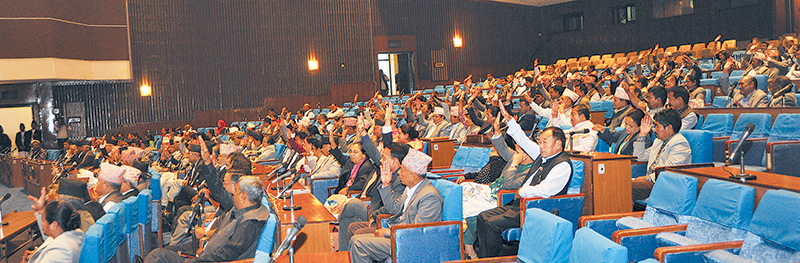
The US insists that the compact has no strings attached and that the Indo-Pacific Strategy is not a military alliance.
- ANIL GIRI
The compact is expected to be ratified by the ongoing session of Parliament. Post file Photo

KATHMANDU,
After a section of the ruling party leaders expressed reservations about the Millennium Challenge Corporation’s Nepal compact, under which the United States will provide $500 million in grants to Nepal, the party’s standing committee on Sunday said that a decision on the matter would be taken by the party secretariat.
Ruling party leaders as well as experts, however, describe the commotion over the US programme as “unnecessary” and warned of multiple consequences if such reservations led to the failure to ratify the compact from the Parliament’s ongoing winter session.
One of the major concerns raised by some Nepal Communist Party (NCP) leaders is whether the Millennium Challenge Corporation (MCC) is part of Washington’s Indo-Pacific Strategy. The standing committee meeting has instructed the government to hold talks with the US government to ascertain whether the MCC falls under the broad umbrella of the US’ strategy, which many believe to be an attempt to counter China in the region.
“The US government should clarify whether the MCC is part of the US strategy,” said Bhim Rawal, a standing committee member who has been a vocal critic of the MCC. “The prime minister and members of the secretariat will hold discussions to decide whether to ratify it or not.”
Under the MCC, Nepal has received $459.5 million as ‘programme funding’ and an additional grant of $40.5 million as a ‘compact development fund’, where the government of Nepal will chip in $13 million.
“If Parliament fails to endorse the MCC, it will have multiple effects,” said Ram Sharan Mahat, a Nepali Congress leader and former finance minister. “Our ties with the US may take a beating. In terms of aid and economic relations, it will invite more implications because the US is Nepal’s largest donor.”
Ruling party leaders’ concerns primarily stem from the suspicion that the MCC comes with strings attached.
US officials, while denying that there are any additional strings, have repeatedly asserted that the MCC is
definitely a part of the Indo-Pacific Strategy, which they’ve described as a broad strategy that the US is pursuing in the region.
A US Embassy spokesperson told the Post that the Indo-Pacific Strategy (IPS) is not something to join.
“The people saying ratifying MCC means ‘joining’ the IPS are not noting that the IPS is not something to join. People saying these things are also referring to IPS as a military alliance or military strategy, which again is not true,” said Andie De Arment, the US embassy spokesperson. “IPS has a security component but it has equally important economic and governance pillars.”
Referring to the statements made by Foreign Minister Pradeep Gyawali, Arment said that ratifying the MCC does not amount to “joining the IPS”.
“Because you cannot join, but also, as you know, IPS talks about our general overall policy; MCC is under that large umbrella,” she said.
Despite reservations, leaders who have close relations with Prime Minister KP Sharma Oli said that they are
confident that the ongoing House session will ratify the MCC compact.
According to them, the decision to hand over the responsibility to take a decision to the secretariat means that the programme is a step closer to being ratified.
“The secretariat will take the required decision after making an assessment of leaders’ views on the MCC,” said Rajan Bhattarai, foreign relations advisor to Oli. “As per my understanding, the party will approve it to get the US programme passed from the House.”
Nepal became eligible for the MCC, announced in 2002 by US President [George W] Bush, in 2011 and signed the compact in 2017. But before implementation, the compact needs to be ratified by Nepal’s Parliament. It did not pass during the previous House session because of—by Oli’s own admission—the reluctance of Krishna Bahadur Mahara, who was House Speaker until early October.
“We completed several steps and negotiations before accepting the US grant so there is no chance to roll back the decision and if the government decided to hold it back, we will oppose it,” said Mahat.
Mahat cautioned that failing to ratify the MCC compact could not just affect US assistance, but also assistance
from institutions like the World Bank and the Asian Development Bank.
“Overall, it will have a negative impact on our relations with the US and erode our international credentials,”
he said.
Mahat’s assertions were echoed by Govinda Nepal, a left-leaning economist and former economic advisor to the Finance Ministry.
“When the MCC was approved, there was no IPS and it was designed by Nepal as per our needs,” said Nepal. “Several prime ministers and finance minister are well aware of our participation in the process.”
Ruling party leaders too fear a loss of credibility.
“We will lose the moral high ground to talk to the US government regarding other matters,” said Bishnu Rijal, deputy head of the ruling party’s foreign affairs department. “This is not just a question of aid or economic assistance. From human rights to transitional justice, the role of the United States is important.”
Rijal, however, was confident that the government would follow through with its commitment, just as it has with many other international obligations.

HOME PAGE

Standing Committee meet shelves issues for Central Committee

Though the ruling party’s meeting was expected to discuss and decide on crucial issues, it deferred them all to the upcoming Central Committee meeting.
- TIKA R PRADHAN
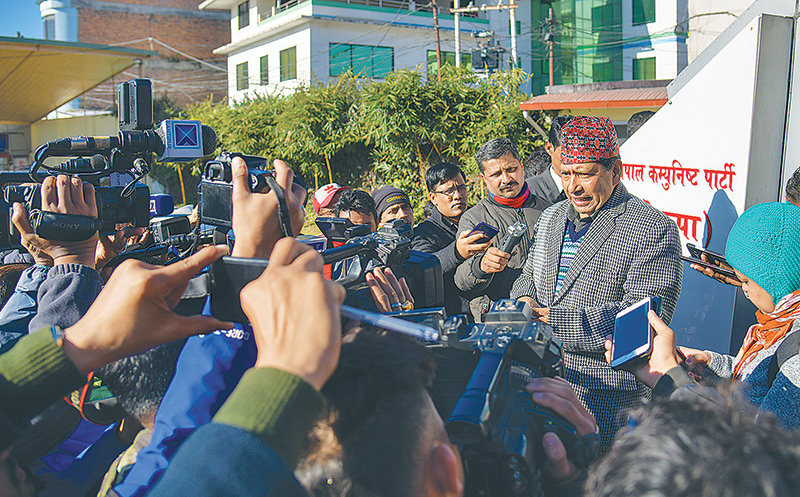
Nepal Communist Party spokesperson Narayan Kaji Shrestha briefs the media on the decisions of the Standing Committee meeting that concluded on Sunday. Post Photo: Deepak KC

KATHMANDU,
The Standing Committee meeting of the ruling Nepal Communist Party concluded on Sunday, without deciding on major contentious issues, which will now be discussed at the upcoming Central Committee meeting. The party has scheduled a meeting of its Central Committee for January 8.
Party insiders, however, said they are not optimistic about the upcoming meeting, as they will likely not have enough time for discussion, a mandatory procedure before decisions are taken, in the 445-strong committee.
Outstanding issues include the party’s political ideology, the formation of its politburo, making the secretariat and other party committees inclusive, controversial issues regarding Yeti Holdings and the Baluwatar land grab.
According to standing committee member Beduram Bhusal, executive co-chair Pushpa Kamal Dahal told the meeting that opening discussions on the party’s political ideology could create problems. So discussions would only be opened before the party’s national convention.
Despite the ongoing controversy over the Millennium Challenge Corporation’s Nepal compact, under which the United States will provide $500 million to Nepal, the Standing Committee meeting also decided to leave it for the party secretariat to decide.
The Standing Committee meeting, held after the gap of one year, was expected to take decisions on most major issues that party leaders have been raising for a long time now.
Leaders said they wanted the meeting to at least narrow down issues and hold ample discussions. Neither happened. According to one leader, a barrage of questions and criticism aimed at the leadership served to put it on the backfoot, leading top leaders to decide to defer contentious issues to the Central Committee.
Mani Thapa, a Standing Committee member, said that the party secretariat was caught unawares when it faced tough questions from Standing Committee members.
In the 45-member Standing Committee, nine are from the secretariat, which so far has been the sole decision-making body in the one-and-a-half-year-old party.
“The other reason is that Co-chair KP Sharma Oli was not present in the meeting,” Thapa told the Post. “That’s because the leadership decided to call the Central Committee meeting earlier than what was proposed in the political document.”
A political document presented by Co-chair Dahal on December 15 had proposed the Central Committee meeting in the third week of January.
More than a-year-and-a-half since the merger, the Nepal Communist Party (NCP) is still struggling to complete its unification process.
The formation of the politburo, a crucial committee in any communist party, is a significant part of party unification. More than 40 Central Committee members had demanded about a year ago that the politburo be formed immediately. But the standing committee failed to properly discuss the agenda, said Thakur Gaire, a Central Committee member.
A decision on politburo formation is unlikely during the Central Committee meeting too, as the party leadership will have a tough time managing leaders from different factions to constitute the 145-member committee.
“The Central Committee meeting should ensure that there is ample discussion on issues,” said Ramdip Acharya, a Central Committee member. “The meeting must not be like a coaching class where a handful of leaders speak and others just listen without getting a chance to question or debate.”
The Standing Committee meeting was unable to take a decision on a proposal presented by Asta Laxmi Shakya and Pampha Bhusal, the two female members in the 45-member committee, to expand the secretariat and make it more inclusive.
The leadership flatly rejected the proposal and decided to send the issue to the Central Committee, said Shakya.
Though most of the members see the holding of the Standing Committee meeting as a positive move, further steps taken by the leadership will help put the party on course, they said.
“Given the sheer size of the Central Committee, all issues may not get addressed during the January meeting,” said Thapa. “Now it’s time to wait and see whether the leadership will implement what they have promised in the Standing Committee.”

HOME PAGE

Confusion reigns over Ncell’s tax liability after international tribunal’s provisional order

International arbitration body’s ruling that Ncell does not need to pay any capital gains tax contradicts a ruling by Nepal’s Supreme Court.
- PRITHVI MAN SHRESTHA
The tax office has asked Ncell to clear the tax dues as per the Supreme Court’s order. Post file Photo

KATHMANDU,
A ruling in favour of Ncell by an international tribunal, which contradicts a ruling by the Supreme Court, has raised questions about whether the authorities would abide by the international or the local ruling. On Sunday, the Large Taxpayers’ Office sent a follow-up letter to Ncell, asking the private telecom company to pay outstanding capital gains tax in line with the Supreme Court order, ending speculation.
Ncell has missed the December 19 deadline to pay Rs22.44 billion in capital gains tax and fines from a three-year-old buyout deal between Teliasonera and Axiata, the current parent firm of the telecom company.
“Ncell has 15 days beginning Sunday to clear its dues,” said Jhalakram Adhikari, chief of the Large Taxpayers’ Office.
The tax office’s letter comes five days after an international tribunal ruled that Ncell does not need to pay capital gains tax as demanded by the Nepal government. The International Centre for Settlement of Investment Disputes, a body under the World Bank, on December 18, a day before the Nepal tax office’s initial deadline ended, issued a provisional order, staying the Nepal government and its agencies’ demand letter served
by the Large Taxpayers’ Office to recover outstanding capital gains tax from Ncell.
According to Adhikari, the tax office followed the due process by sending a follow-up letter asking the company to pay its dues, and it is not concerned with what the international dispute settlement body has said.
“The government’s position is clear. The issue is tax, not investment as claimed by Ncell and its parent company when they moved the international dispute settlement body,” Adhikari told the Post. “We followed up as per existing laws and the Supreme Court verdict.”
On November 21, the Supreme Court gave its final verdict on the case, ruling that Ncell needed to pay Rs 21.10 billion in outstanding capital gains tax, substantially lower than the Rs39.06 billion determined by the tax authorities. Ncell has said that it is only eligible to pay Rs14 billion.
The UK-branch of Axiata had, in April, petitioned the international tribunal, requesting arbitration pursuant to the Agreement between the Government of the United Kingdom of Great Britain and Northern Ireland and the Government of Nepal for the Promotion and Protection of Investments. Nepal is a signatory to the convention that established the International Centre for Settlement of Investment Disputes.
There is, however, confusion among legal experts regarding whether the provisional order from the international tribunal takes precedence over the Supreme Court. If the tax authority complies with the tribunal’s order, it will be ignoring the Supreme Court verdict, but if it follows the Nepal court’s verdict, it will not be adhering to its international obligations.
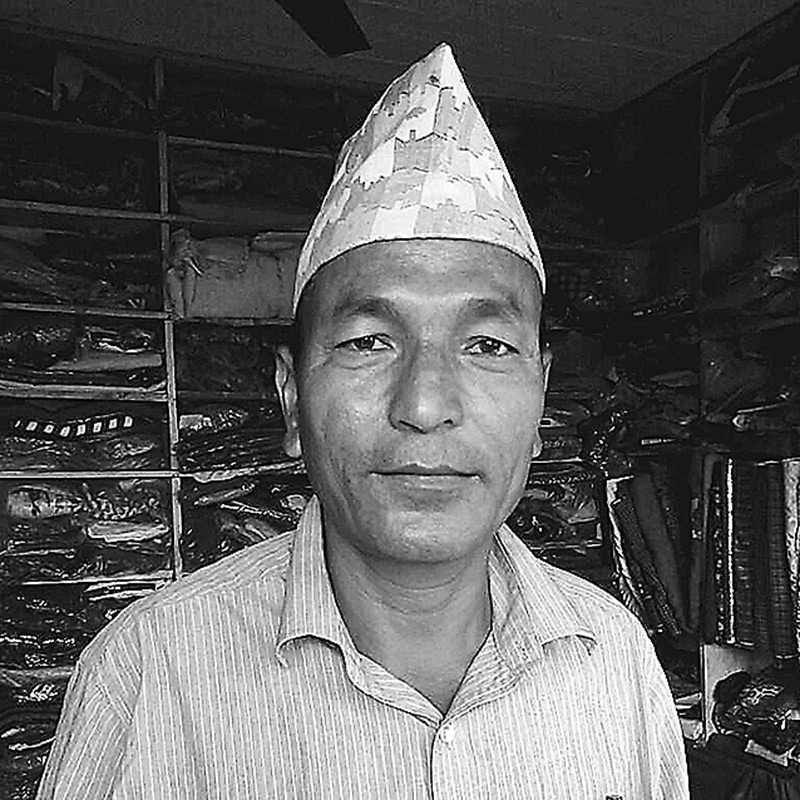
On December 20, Semanta Dahal, a corporate lawyer, wrote on Twitter: “ICSID convention is not itself clear about whether complying such interim order was a compulsion. But, past Tribunals have made it mandatory to implement its order.”
Lawyers say that this confusion perhaps would not have arrived had the government been more proactive in participating in the dispute settlement process at the tribunal. The government neither appointed an arbitrator nor a lawyer for the legal battle.
This, according to lawyers, resulted in a provisional order favourable to Axiata and Ncell.
“I have long been arguing that the government is not weak in this case,” Dahal told the Post. “But the
government acted in such a way that it was playing football without a goalkeeper.”
According to lawyers, when Ncell challenged the tax assessment made by the tax authority at the Supreme Court, the company agreed to the case coming under the jurisdiction of Nepal’s legal system.
According to Gandhi Pandit, also a corporate lawyer, Nepal only needs to comply with such orders if the agreement between the Nepal government and the United Kingdom was endorsed by Parliament.
“In such cases, the provisional order would prevail over domestic laws,” Pandit told the Post. “Otherwise, domestic laws prevail.”
The Agreement between the Government of the United Kingdom of Great Britain and Northern Ireland and the Government of Nepal for the Promotion and Protection of Investments was not endorsed by Parliament, according to lawyer Dahal.
However, Pandit said that the Supreme Court could review its decision in light of the tribunal’s order.
“If Ncell registers an application at the court, citing the provisional order, the Supreme Court may have to speak on the issue once again,” Pandit told the Post. “When investing in Nepal, Axiata had also agreed to honour Nepal’s laws.”
While the tax office has sent a letter to Ncell, it is not clear how the government will respond if the company fails to pay its dues.
“The concerned tax authority has already assessed Ncell’s liability as per the Supreme Court verdict,” said revenue Secretary Sishir Dhungana. “The tax will be recovered. We have not thought otherwise.”
An Ncell source told the Post that they were observing the tax authority’s steps and would respond accordingly. Although the government didn’t participate by appointing an arbitrator and lawyers, it furnished its reply to the tribunal. In its reply, the government stated that the issue comes under the jurisdiction of Nepal’s legal system and the case was sub judice in Nepal’s Supreme Court.
“We argued that since the company itself sought legal remedy from the local court, it is within the jurisdiction of Nepal’s legal system,” said Sanjeev Raj Regmi, joint attorney at the Office of the Attorney General. “The tax authority, however, has not sought any advice from the attorney’s office after the provisional order. We are happy to give advice if approached.”
Kumar Ingnam, a professor at the Kathmandu University School of Law who did his doctorate in commercial international law, said that both domestic and international rulings apply in this case as Nepal is party to the convention establishing the tribunal and the Multilateral Investment Guarantee Agency, both under the World Bank Group, but Ncell too has agreed to local laws.
“Investment in Ncell has an international character so Nepal cannot deny the application of international laws as it is party to relevant conventions,” said Ingnam. “The best option for Nepal is to wait and present a strong case at the tribunal.”

Page 2
MEDLEY

Horoscope

ARIES (March 21-April 19)
***
You might feel a bit under siege today—many people may be demanding your time and energy when you want to focus on your home and your family. Trying to negotiate with these people will likely be disappointing; they are so focused on themselves today that they will have a hard time taking your personal needs seriously.


TAURUS (April 20-May 20)
****
Your charm will meet its match today when you run into someone you know. This person’s flattering words and witty conversation will entertain you—and make you aware of some facets of your personality that you weren’t aware of before. But listening to and laughing with this person could take up your whole day.


GEMINI (May 21-June 21)
*****
If you feel good, then the people who love you will also feel good—so don’t feel guilty if you put your desires above other people’s today. You deserve some indulgences right now, and you should think about something nice you can do for yourself. Whatever you do, do it all the way. This is not the time for cutting corners.


CANCER (June 22-July 22)
****
Your eye for detail will get you into an interesting situation today. You are noticing things about people that they don’t realise yet about themselves. Hold on to these little revelations—they are your secrets, and you should divulge them only if you want to. Enjoy your front-row seat!


LEO (July 23-August 22)
***
Someone who you thought was on your side, and whom you’ve been relying on as a confidant, might be acting as a double agent in a relatively trivial caper. If you’ve been planning an event for a friend, resist the urge to delegate too much to someone who seems just a little bit too eager to help. This person may have an ulterior motive.


VIRGO (August 23-September 22)
**
It’s the small details that will cause the biggest problems today, so get out your magnifying glass and take a closer look at what’s going down today. Little comments a friend whispers to himself or herself will reveal big truths—so don’t pretend you don’t hear them. It’s time to deal with this issue once and for all.


LIBRA (September 23-October 22)
****
After a lot of socialising recently, you are finally getting the chance to spend some quality time on your own. You may think you still want to be out and about and enjoying the wildlife today, but once you get a little taste of solitude, you will settle into it happily. This inward-focused time is a luxury. rest of the world.

SCORPIO (October 23-November 21)
***
If you’re stuck in planning mode make it a group affair. Getting a consensus about dates, and activities will make everyone feel like part of the big picture—and it will set a much more positive tone for your upcoming event. Other people will be able to suggest things that you hadn’t considered before.


SAGITTARIUS (November 22-December 21)
**
With a huge increase in your energy level coming, you run the risk of rushing ahead before you’re totally ready to move forward. Beware of forgetting your keys in the lock! Your mind is busy cooking up big ideas and imagining big outcomes but watch out for absentmindedness today.


CAPRICORN (December 22-January 19)
**
You need to understand that just being yourself makes you much more desirable already. Because by sticking to your own identity, you show people that you are proud of who you are. If you are constantly trying to meet the expectations of others, you show people that you don’t know who you really are, which isn’t true.

AQUARIUS (January 20-February 18)
***
If the daily grind is getting you down right now, seek the comfort of your home, friends, and family. These things will help you feel more grounded and content. So bow out of wild adventures right now—and get back in touch with the truly important things in life. Your people would love a chance to spend some more time with you.


PISCES (February 19-March 20)
***
You’re projecting an aura of calm confidence—so who cares if you aren’t feeling quite as confident as you look? The image can be a powerful thing, and you can use yours to make waves that turn the tide your way! Your bravado is a mask you can wear to make it through the times when you don’t feel completely comfortable.

Page 3
NATIONAL

Narcotics Control Bureau arrests four foreigners for cocaine smuggling

Two Belarusians and two Bolivians arrested with six kilograms of cocaine worth at least Rs150 million.
- SHUVAM DHUNGANA
post file photo

KATHMANDU,
The Narcotics Control Bureau of Nepal Police arrested two Belarus nationals with cocaine worth at least Rs150 million from the Tribhuvan International Airport in Kathmandu on Saturday.
The accused were attempting to smuggle six kilograms of cocaine through a Cathay Pacific flight bound for Hong Kong, according to an official at the bureau.
The arrested men were identified as Pavel Vasilyeu, 21, holding passport number AB2712060 and Alina Aldoshyna, holding passport number KH2464426.
“Upon interrogation, they revealed two other names, Roberto Carlos Merubia Mariace and Raul Zambrana Ordonez, both Bolivian nationals, who were allegedly supplying them with the drug. The police detained them from Lost Garden Hotel located at Lazimpat on the same day,” said the bureau official.
According to their passports, Mariace and Ordonez came from Brazil on December 19 with the cocaine and they passed it on to Vasilyeu and Aldoshyna, who too had arrived in Kathmandu on December 19 to smuggle the drugs to Hong Kong.
“The drug was hidden in a jacket which was kept in their luggage,” Superintendent of Police Birendra Kumar Bashyal, a spokesperson for the bureau, told the Post.
The arrested persons will be charged under the Narcotic Drugs (Control) Act 1976. If convicted, they could face life imprisonment.
Barely a week ago, on Tuesday, a Bolivian national was arrested from the Tribhuvan International Airport with three kilograms of cocaine.
The bureau’s data of the last three years show that drug smuggling cases and arrests are on the rise in the country.
In the fiscal year 2016/17, the police arrested 3,607 persons on drug smuggling charges—of them, 159 were foreigners. In the fiscal year 2017/18, it arrested 4,754 persons, including 149 foreigners. In 2018/19, 5,558 persons were arrested, including 201 foreign nationals.

Page 4
NATIONAL

Seven central hospitals to be made mother-and-baby-friendly

The Baby-friendly Hospital Initiative was launched in 1991 by the World Health Organization and the United Nations Children’s Fund.
- Arjun Poudel
shutterstock

KATHMANDU,
Immunisation section at the Family Welfare Division under the Department of Health Services has been working toward making seven central hospitals mother-and-baby-friendly.
The move, which aims to promote maternal and child health, encourage breastfeeding practices and improve maternity care, will be implemented in the Paropakar Maternity and Women’s Hospital, Patan Hospital, Tribhuvan University Teaching Hospital, Koshi Hospital, Makwanpur Hospital and two others.
“We are training health workers including gynaecologists, paediatricians, nurses and hospital management officials,” Kedar Prasad Parajuli, chief of the section, told the Post. “We will accredit those hospitals once they fulfil the requirements.”
Ensuring evidence-based care for both mother and child before and after birth is among the requirements for the hospitals to be accredited as being mother-and-baby-friendly.
Hospitals need to have a written breastfeeding policy, should train all healthcare staff on the skills required to implement the breastfeeding policy, educate all pregnant women on the importance of exclusive breastfeeding and help the mother start breastfeeding within one hour of the childbirth, as per the World Health Organization’s protocol.
Hospital staffers should teach mothers about the proper techniques of breastfeeding, even if they are not with their babies; not allow them to give their babies any food except their milk unless medically required.
All expecting mothers should get emotional support from those she chooses, implement care that is respectful of the beliefs and values of each woman’s ethnicity and religion, and give a labouring woman the freedom to move around as she desires unless a specific position is required due to a complication, or any other reason. Mothers should also be encouraged to touch, hold and breastfeed their babies, even if they are sick or premature.
Parajuli said his office would provide a form to all hospitals in which they will give them marks as per their self-evaluation. When the hospitals claim they had fulfilled all the requirements, the section will evaluate accreditation.
To achieve mother- and baby-friendly status, hospitals must demonstrate at least 75 percent exclusive breastfeeding rate among mothers at the time of their discharge.
“Aim of the programme is to minimise the risk of maternal and child deaths, promote institutional delivery and promote the importance of breastfeeding,” he added. “The training will also help lessen the complaints about the behaviour of the health workers by mothers.”
Hospital staffers, including nurses working in labour rooms are being told to behave properly with women undergoing labour pain.
According to Parajuli, women, who gave birth to babies at the state-run health facilities, often have a wrong impression about the healthcare providers. Some women also complain about the scoldings by the nurses when they make noises due to intense labour pain.
The Baby-friendly Hospital Initiative (BFHI) was launched in 1991 by the World Health Organization and the United Nations Children’s Fund (UNICEF).

NATIONAL

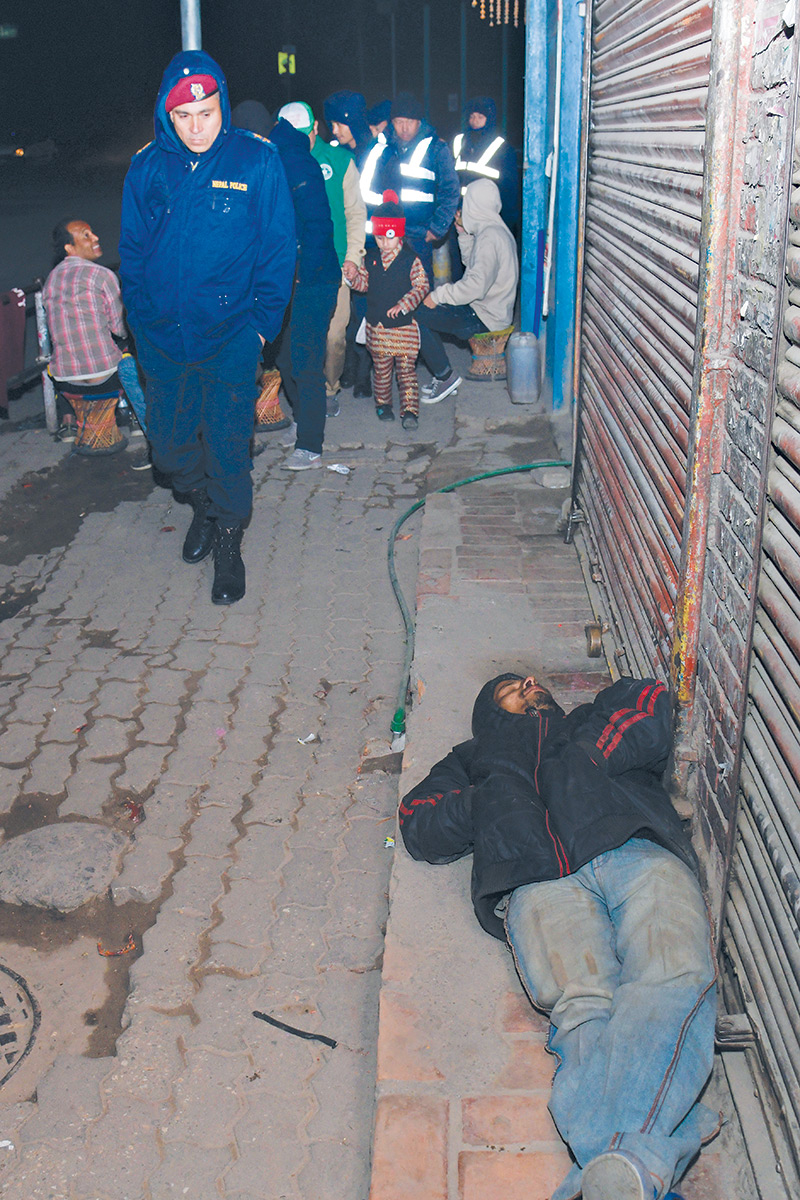
Kathmandu vows to rescue homeless from City’s streets, but without proper homework

Of the 215 homeless persons rescued last week, many have returned to the streets because of unfavourable living environment in shelters.
- ANUP OJHA
The Kathmandu metropolis and Manav Sewa Ashram picked up people sleeping out in the open last week. Post Photo: Deepak KC

KATHMANDU,
Kathmandu Metropolitan City last week claimed to have rescued 215 homeless people from the streets of Kathmandu, but many have termed the move a gimmick, as the City has no long-term, sustainable plan to rehabilitate homeless people.
But when the Post took a round of the streets on Saturday morning, significant temples in the metropolis, such as Bhadrakali, Mahankal, Sankata, Pashupatinath, were filled with beggars and homeless people, with a few even returning from the shelters made by the City office.
Speaking to the Post, City’s spokesperson Ishwor Man Dangol said that the rescued people had been taken to Balaju Industrial District Management Office. “Some of them, who had families, were handed to their parents and relatives. Those who didn’t have relatives were sent to Manav Sewa Ashram,” said Dangol.
He said the City is sheltering nearly 500 homeless persons in coordination with the ashram currently. The city pays a monthly rent of Rs167,000 for houses rented from the Ashram in Budhanilkantha and Samakhushi.
After Prime Minister KP Sharma Oli’s repeated announcements to make the streets of the Capital beggar-free this year, the City announced a drive to rehabilitate the homeless while celebrating its 25th anniversary on December 15. Last week, it began the drive. The videos and pictures that showed the City’s vans, operating in coordination with Nepal Police, driving around the streets to pick up homeless people during the night, also went viral.  
“We were sleeping near an overhead bridge in Ratnapark. I just ran from the place when I saw City officials approaching us. They were forcefully taking people inside a van,” said a beggar who didn’t want to disclose his name. He was begging in the southern part of Mahankal temple.
When the Post approached Mahankal temple on Saturday morning, more than two dozen beggars, many of them homeless, were out on the temple’s premises.
Tilak Maya Karki, 55, came to Kathmandu from Dolakha along with her handicapped husband to Kathmandu five years ago. Since then, she has been begging outside Mahankal every Saturday and cleaning the temple’s premises. Her husband makes bamboo baskets and head straps in Dhalku, where they live in a rented room.
She said that more than half a dozen homeless people, who were taken last week by the City, have already returned. “I don’t think this problem can be solved permanently. They should not be taken forcefully; many of them have returned not liking the place,” said Karki.    
 The City took an initiative to rescue people from the streets after 18 homeless people died due to the cold in Kathmandu in December last year. However, people living on the roads say they don’t like living in a shelter home.
“I have spent nearly one-and-a-half years at Manav Sewa Ashram in Samakhusi. People living on the streets have different kinds of mental problems. We would get beaten and the food never tasted good there,” said Bir Bahadur Tamang, 70, who has been begging outside Bhadrakali temple premises for the past one-and-half years after he left the Ashram. Tamang is half-paralysed.  
“Although they have clean beds, they would not let us get into the bed until it was sleeping time. We never had any substantial thing to do the whole day. They would make us wake up at 5 am; that was not tolerable for an elderly and disabled person like me,” said Tamang, who is originally from Nuwakot.
He added that he had seen people working in the Ashram beating rescued people ruthlessly. “From the outside, the place seems good. But if you have to spend a week there, you will see it is torture,” said Tamang.   
In April last year, Pashupati Area Development Trust had declared the Pashupati area a ‘no-begging’ zone, removing around 180 beggars. However, within a month, the area was filled with beggars who had run away from the Ashrams in Samakhusi and Budhanilkantha.
When the Post contacted Suman Bartaula, secretary of the Ashram, to inquire about the reason people were running away from the Ashram, he said it was a problem of adaptation. “Most of the homeless people are alcoholics. Inside here, we try to keep them in discipline, and they can’t cope with it and run away,” said Bartaula.

Page 5
NATIONAL

Pappu Construction gets permission to repair damaged Jabdighat bridge

- KAMAL PANTHI

BARDIYA,
The government authority has allowed Pappu Construction, notorious for grabbing a large number of projects but not completing them on time, to repair the collapsed bridge over the Babai river at Jabdighat, Bardiya.  
Ram Kumar Dev, chief at the Division Road Office in Nepalgunj, confirmed granting permission to the contractor for the repair work. “The contractor (Pappu Construction) wrote us twice, asking for permission to repair the damaged bridge and embankment,” he said.
The bridge had caved in due to floods triggered by incessant rainfall in August 2017 before it was handed over to the government authorities. Two spans had caved in as the floods damaged two pillars of the 435-metre long
bridge. The public claimed the bridge had suffered damage as the contractor had used substandard materials while building the bridge.
The contractor proposed to repair the bridge at its own cost. “We are planning to repair the bridge considering the hardship faced by the local people. As the division road office has given us a go-ahead, we will complete it by mid-May 2020,” said Hari Narayan Rauniyar, former proprietor of the Pappu Construction.
The Commission for Investigation of Abuse of Authority had filed a corruption case at the Special Court against Rauniyar, his son Sumit Rauniyar and 11 others for building a substandard bridge over the Babai river in Jabdighat. The case is pending at the court.  
The Pappu Construction had constructed the bridge along the Gulariya-Rammapur road linking northern Bardiya with the East-West Highway at an estimated cost of Rs 166.8 million. The bridge collapse has disrupted transportation in the area, causing inconvenience to thousands of people.

NATIONAL

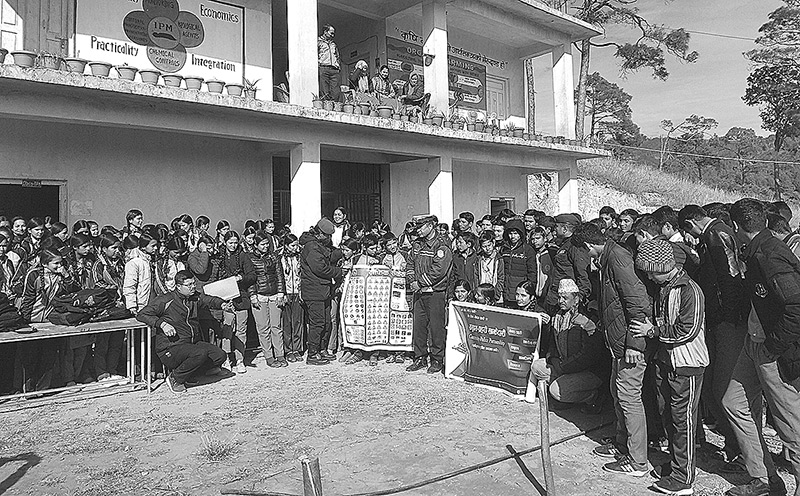
Police launch awareness drive in Dadeldhura community schools

- DR PANT
The District Police Office has conducted social awareness classes in 13 community schools of Dadeldhura so far. Post Photo: Dr Pant

DADELDHURA,
Bal Bahadur Air, an eighth-grader of Balkalyan Secondary School in Ajayameru, Dadeldhura, did not know that one could be jailed for three months or fined Rs 30,000 for
gambling-related offences. He was surprised to learn that police could take action against individuals who create a ruckus and smoke in public places.
“Activities such as smoking, gambling and creating a commotion in public places are very common in our village,” said Air. “We came to know that these activities were unlawful only after police personnel informed us at our school.”
The District Police Office has started an awareness campaign in the district against unlawful activities, including murder, abduction, rape, domestic violence, violence against children and public offences. Police personnel are conducting awareness classes for students of grades 8 to 12 at schools to instil positive thinking in them.
Not only the students but locals of Smaiji also attend the classes. Dhan Bahadur Saud, chairman of the School Management Committee, said, “We hope that our students will be much more responsive to curbing social evils from now onwards.”  
This police campaign started in Dadeldhura around two months ago. There are more than 35 secondary schools in the district.
Laxmi Bhandari, a local of Ajayameru, said that the classes have had a positive impact on students.
“Children who took the awareness classes have become more disciplined now,” Bhandari said.
The District Police Office has conducted the class in 13 community schools of the district so far. Inspector Balaram Pandey said that the rate of social crimes has reduced after the campaign started.
“Villagers have stopped playing cards, consuming alcohol and creating a ruckus in public places these days. Our classes have had a positive impact on society,” Pandey said.
The District Police Office plans to reach all secondary schools in Dadeldhura to educate students.
“We came up with this campaign, as we know that teenagers are more prone to get involved in unlawful activities. This campaign will educate students and also their family members on the prevailing rules, regulations and legal system of the country,” said Dadhiram Neupane, deputy superintendent of police.  Neupane added that students were specifically targeted for the campaign, as they are an excellent medium to spread information in society.
Meanwhile, the District Traffic Office has also started a road safety campaign along with the police programme in the schools. Dil Bahadur Khatri, chief at the Office, said they have launched a district-wide campaign to educate students on traffic rules and regulations.
“The number of road accidents has increased in the district of late. This campaign will help children be safe while on the road,” Khatri said.

NATIONAL

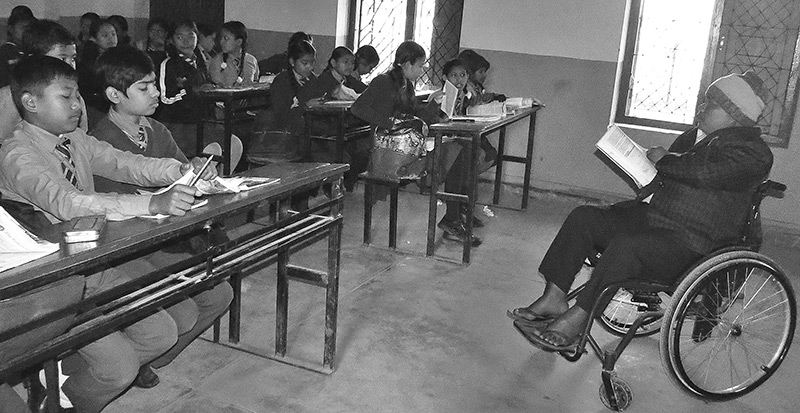
Polio-affected teacher Durga Bomjan starts teaching in Chitwan

The school had prevented him from registering his name in the teachers’ list.
- RAMESH KUMAR POUDEL
Thirty-one-year-old Durga Bomjan teaches a class at the Chitwan Secondary School in Bharatpur. Post Photo: RAMESH KUMAR POUDEL

CHITWAN,
Despite passing all the tests by the Education Service Commission, Durga Bomjan had to face hurdles to teach at the school designated to him. The reason is that the school administration had prevented him from registering his name in the roster of teachers because he is polio-stricken and has to use a wheelchair to get around.
But 24 days since his appointment, Bomjan has made a breakthrough. He has started teaching the students of grades three, four, five and six at the Chitwan Secondary School in Bharatpur.
The breakthrough came due to the efforts of various organisations and the department of education at Bharatpur Metropolitan City.
But the principal of the school, Mukti Lamichhane, said that the school never questioned Bomjan’s ability to teach. “The infrastructure of the school is not disabled-friendly,” he said. “It would be difficult for Bomjan sir to navigate the school; hence the management had to hold his registration for a few days.”
The school’s staff office is at the third storey, but now an arrangement has been made to allow Bomjan to register his attendance at the ground floor. Likewise, other makeshift infrastructures have been arranged so that Bomjan can attend his classes, Lamichhane said.
Despite the school’s reservation, Bomjan has been attending the school since November 17, the day he received his appointment letter.
After he was barred from registering his attendance, Bomjan had filed a complaint with the City Education Department.
Thirty-one-year-old Bomjan was born in Parsa. He was diagnosed with polio when he was nine, after which his parents migrated to Bharatpur for his treatment. His mother works as office help at Narayani Secondary School, where Bomjan completed his secondary education before pursuing intermediate level studies majoring in English literature.
Bomjan said that he is excited about the new prospect, despite the fact that the school doesn’t have disabled-friendly infrastructures.
“I am happy to teach the students, and they seem to enjoy my classes as well,” he said. “I am excited about the opportunity. Hopefully, the school will upgrade its infrastructures soon.”

NATIONAL

Safe motherhood campaigns save lives in Sindhupalchok

- ANISH TIWARI

SINDHUPALCHOK,
Thanks to various campaigns launched across three municipalities and nine rural municipalities, the number of women giving birth at health posts is consistently rising in Sindhupalchok.
The campaigns include free treatment for pregnant women and ‘safe pregnancy’, and allowance for women delivering babies at health posts. Local units such as Melamchi, Helambu and Indrawati have been providing Rs3,000 for pregnant women on top of the regular support of Rs3,000.
Local representatives and health workers say they immediately receive calls whenever a woman gets into labour. The local units then respond by sending an ambulance as soon as possible.
“We are making basic health posts more managed, and are launching various campaigns with a budget of Rs5 million,” said Nimafunjo Sherpa, the mayor of Bahrabise Municipality. Today, there’s a birthing centre in each health post in all wards of Bahrabise, according to Sherpa. “The local representatives are dedicated to ensuring safe motherhood,” he said.
Melamchi Municipality has allocated Rs20 million for health services this year. It is conducting free health camps at various places, said Januka Parajuli, the deputy mayor.
Meanwhile, in Indrawati Rural Municipality, about 70 percent of pregnant women go to health posts to give birth, according to Bansha Lal Tamang, chairperson of the rural municipality.
Infant mortality rate is considerably declining, Tamang said. Safe
deliveries are crucial also for bringing down the maternal mortality rate. For every 100,000 births in Nepal, 229 women die during or after childbirth.
Helambu Municipality has built two well-facilitated rest houses targeting pregnant women. The number of women delivering babies in health posts has risen from five in the fiscal year 2017-18 to 74 in 2018-19, according to Mayor Sherpa.
So far this fiscal year, the number is 58. If the health post is unable to treat pregnant women, the municipality provides free transportation service to Kathmandu, he said.

NATIONAL

Rural municipality chair rescued hours after his abduction

The Netra Bikram Chand-led Communist Party of Nepal has claimed responsibility for the incident.
- JYOTI KATUWAL,Tularam Pandey
Dhir Bahadur Shahi

DAILEKH / KALIKOT ,
Dhir Bahadur Shahi, the chairman of Thantikandh Rural Municipality in Dailekh, was safely rescued from a forest in the neighbouring Kalikot district on Sunday evening, some 18 hours after his abduction.
An armed group of around 15 people had abducted Dhir Bahadur from his house in Sheripata, Dailekh, on Saturday midnight.
The District Police Office in Kalikot had deployed security personnel at various entry points suspecting that the abductors could bring Dhir Bahadur into the district.
“We have mobilised security personnel since early Sunday morning. The abductors left the chairman [Dhir Bahadur] in the forest area in Chhati at around 6pm when the security personnel encircled them,” said Deputy Superintendent of Police in Kalikot Shyam Babu Oliya. He said that the abductors, however, fled into the forest after leaving the victim. There is no human casualty, he added.
Earlier on Sunday, Dhir Bahadur’s younger brother Hasta Bahadur had said the abductors barged into the house at around midnight and took him to an undisclosed location.
“I opened doors when somebody knocked at around midnight. A group of around 15-16 people entered the house,” Hasta Bahadur quoted Ila Shahi, the victim’s wife, as saying. “One of them asked him [Dhir Bahadur] to go with them as they had some queries. I went along with him but they turned me.”
According to Ila, the abductors have weapons. She said the assailants threatened them to remain silent, brandishing a weapon, as she attempted to shout for help soon after the abduction.
After walking for around two hours, she returned home as the assailants threatened of dire consequences if she accompanied her husband, Ila told the family members.
Issuing a statement on Sunday, the Netra Bikram Chand-led Communist Party of Nepal had claimed responsibility for the incident. The party has accused Dhir Bahadur of embezzling budget of the local unit and spying against them.
Purna Chandra Joshi, Deputy Inspector General Police of Karnali Provincial Police Office, said the Chand group was involved in the incident. “The chairman is safe now. Search is on to detain the accused,” he said.
According to Hasta Bahadur, the Chand group has been charging his brother for embezzling budget of the rural municipality. The group had abducted Hasta Bahadur and freed him a few days ago.
In March, the government had labelled the Chand outfit a criminal group and banned its activities as the outfit continued violent activities including explosions and extortions. Five persons were killed in separate blasts carried out by the group in Kathmandu earlier this year.

NATIONAL

Sixteen schools in Palpa declared child-friendly

Briefing

PALPA: Sixteen schools from two local units in Palpa, Bagnaskali and Rambha have been declared child-friendly after the schools met the criteria set by the rural municipalities. The rural municipalities had set up 50 indices taking into measure the schools’ infrastructure and environment. A majority of schools scored over 80 marks in the test, according to officials.

NATIONAL

Cases of human rights violation rise by 50 percent

Briefing

BAGLUNG: The number of cases of human rights violations this year has risen by 50 percent compared to last year, according to a study conducted by the Informal Sector Service Centre. While there were 39 incidents reported in the last year, the number has climbed to 46 so far this year. Of them, eight are cases of sexual abuse. Only ten cases have been lodged in the court.

NATIONAL

Arms and ammunitions retrieved from a poultry farm

Briefing

SUNSARI: Police on Sunday seized a huge cache of weapons, including 9,982 bullets, guns and explosives, from a private poultry farm at Baraha Chhetra Municipality Ward No. 5 in Sunsari. Police said the weapons were buried underneath the farm. Police launched a search operation of the farm following a tip-off, said SP Yagya Binod Pokharel.

NATIONAL

Landslide disrupts Basantapur-Taplejung road

Briefing

TEHRATHUM: Transportation along the Basantapur-Taplejung road has been disrupted after a landslide occurred in Tinjure on Sunday. Around two dozen vehicles have been stranded. According to the Division Road Office, it will take at least two weeks to clear the debris and resume transportation along the road section.

NATIONAL

Ward office robbed

Briefing

BHOJPUR: An unidentified group broke into the ward office of Bhojpur Municipality-4 and stole three CCTV cameras and a computer monitor on Saturday night. Search is on to nab the miscreants, said police.

Page 6
EDITORIAL

Everything is not pine

An unwise decision to plant conifers is parching the land

In the 1980s, the Nepal government started a nationwide tree plantation drive after deforestation in the country became rampant. In fact, by the 1970s, as reported in this paper, Nepal’s forest coverage was decreasing by at least 1.7 percent annually. To address this problem, the government started a countrywide afforestation drive wherein it chose pine as the species to plant in the mid-hills. But little did the government know about its consequences. Now, many years later, the decision taken without much thought has reared its ugly head with many villages that have pine trees in abundance reeling under water shortages. This case serves as a classic example of how bureaucrats take decisions without doing proper homework on their own.
The choice of conifers to make Nepal look green stemmed from many years of joint collaboration between the governments of Nepal and Australia. The Nepal-Australia Forestry Project was an aid project administered by the Department of Forestry at Australian National University concerned with community forestry development in Nepal’s Chautara region. The project did achieve its objective of increasing Nepal’s green cover, but jeopardised the people’s livelihood.
It has been reported that an average pine tree consumes an average of 13.5 litres of water daily. Bigger pines drain up to 80 litres per day. Gosaikunda Community Forest, a pine forest in Dhulikhel that once had two ponds inside it, is now seeing them dry up. The reason: Pine trees were planted there some 30 years ago, and three decades later, water sources are starting to dry up. What happened in Gosaikunda could be a stand-alone event, but it merits bigger attention for it shows how a single wrong step on the policy front could have devastating consequences on the people.
In Nepal, many important government departments are staffed by people who do not have the requisite skills to discharge their increasingly specialised jobs. Bureaucrats even exhibit explicit obedience and unquestioned loyalty to the authority thereby hampering the spirit of teamwork. This lackadaisical approach to the work they are tasked to do, and a passive attitude that takes things presented to them, especially by foreigners, at face value has done the country more harm than good. Trusting development partners is one thing, and doing the homework to see if their plans fit well in the Nepali context or not, another. But regrettably, our bureaucrats have the reputation of taking whatever is given to them without further analysis.
Bureaucrats are the instrumentality of the state. They need to be able to address the challenges the country face and facilitate the changes it needs. This requires, more than anything, a qualified and effective bureaucracy. The Nepali bureaucracy in its current form is seldom equal to the task. Learning from the example of pine trees, the bureaucracy needs to rethink its decisions on various policy fronts and exercise its agency before committing anything with development partners.

OPINION

Democracy under siege

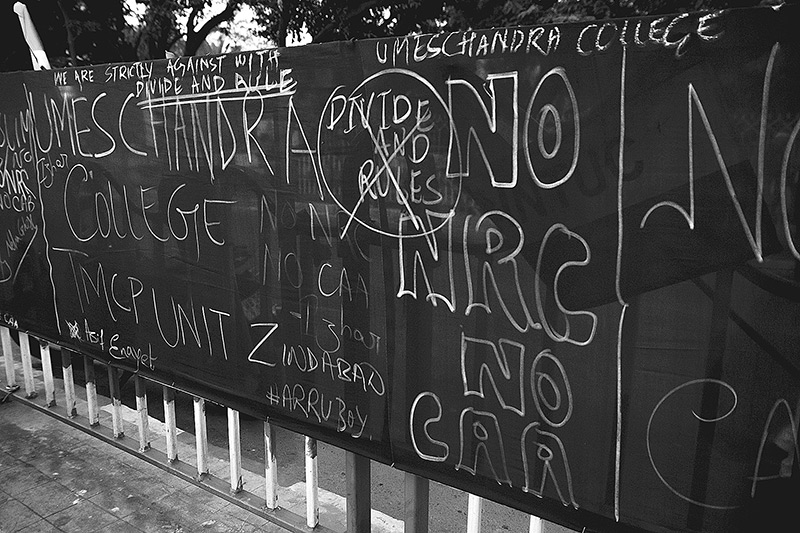
India’s Citizenship Amendment Act reinforces and celebrates the idea of religious persecution.
- SWAGAT RAJ PANDEY
Abhishek Sah Photography/Shutterstock.com

Democracy, if turned into the tyranny of the majority, is just another form of autocracy which negates equality and reinforces the cycle of dehumanisation, subjugation and oppression. The ‘largest democracy’ in the world, India, is definitely becoming larger by the day; but at the cost of eroding democratic ethos, values and principles. The current developments in India is a demonstration of an elected autocracy that is contributing to the quick, sad and perilous decline of democracy.
Following up on its promises made during the 2014 election, the Bharatiya Janata Party-led government amended the Citizenship Act that allows ‘any person belonging to Hindu, Sikh, Buddhist, Jain, Parsi or Christian community from Afghanistan, Bangladesh or Pakistan, who entered into India on or before December 31, 2014 and facing/fearing religious persecution’ to gain Indian citizenship. In doing so, it has systematically omitted the Muslim population and institutionalised a state-sponsored religious divide. This is more concerning given that the oppression of Muslims in India is increasingly becoming systemic in nature.


Institutionalising discrimination
While the Indian government claims that this act will safeguard around 30,000 current illegal immigrants within the country, the passage of the act has seen widespread criticism primarily for being discriminatory against Muslims and institutionalising discrimination on the basis of religious belief. These protests have turned violent with police brutality displaying the state’s position to curb dissenting voices with force. In countries where civic space is more open, the state enables and safeguards the enjoyment of such a space. The role of the police, in such instances, is to protect protestors for full enjoyment of their right to freedom of peaceful assembly. On the contrary, the brutality used to suppress the protests, particularly within educational institutions such as Jamia Millia Islamia University, exhibits and demonstrates the closing of open space in India.
To view this as a one-off amendment in the citizenship act would be missing out on the larger politics of the Bharatiya Janata Party to push forward the Hindutva ideology that impinges on religious tolerance, regional harmony and democracy in South Asia. This Citizenship Amendment Act follows up on the Indian government’s earlier action of shutting down the return of Jammu and Kashmir residents who had migrated to Pakistan using the Jammu and Kashmir Reorganisation Act 2019.
Viewed within the larger scheme of Bharatiya Janata Party politics, it is stepping towards turning India into Hindustan—the land of Hindus. Through the amendment of the Citizenship Act and omission of Muslims, it acknowledges and provides acceptance to the persecution of religious minorities. Rather than embracing and accommodating global citizenship, the act reinforces and celebrates the idea of religious persecution and discrimination. By virtue of omission of Islam purposively from the act, it supports the idea of persecution of minorities on the basis of religion or any other categories of division.
More importantly, it institutionalises the practice of discrimination on the basis of religious belief which is fundamentally against the values of secularism. This gives continuity to the construction of the ‘other’ and increases the mistrust and friction between Muslims and non-Muslims for generations to come. It reignites the fire and resurfaces the pathologies of partition and pushes forward religious fundamentalism. It applauds the Hindutva ideology and audaciously positions the Indian state as anti-Islamic. It aims to turn India into ‘the land of non-Muslims’ which is divisive and detrimental, not only for India but for South Asia as a whole.
Furthermore, the act, on the conceptual level, stands with the actions perpetrated by its neighbours in the region, namely Bhutanese persecution of its Nepali-speaking population, ethnic cleansing of Rohingya Muslims in Buddhist-dominated Myanmar, and oppression of Sri Lankan Tamils by the Sinhalese majority. The Indian Union Home Minister said that the act would not have any direct effect on Nepali nationals. However, given the propensity of the act and the malicious intentions, Nepal should not just look at it from that angle. As a country standing for democracy, secularism and constitutionalism, it should take a stand against the act that undermines and threatens the values of secularism and basic tenets of democracy. By standing with this act of the Indian government, we not only consent to this action of religious discrimination but also stand validating the actions of Bhutanese persecution of the Nepali-speaking population, ethnic cleansing of Rohingya Muslims and Sinhalese oppression of Sri Lankan Tamils.


Parochial tendencies
Increasing anti-immigrant, ultra-nationalist, and ‘anti’-politics is shaping the political balance and electoral politics all over the world. This shift in the world order that is being determined by illiberal values is a threat to liberal democracies everywhere. The immediate effect of the amendment act and the National Register of Citizens may seem trivial against the larger geopolitical interests, however, its repercussion, in the long run, is scary. The Nepali polity is quick to learn from its southern neighbour, and what is petrifying is the emulation of the populist majoritarianism. The two-thirds majority government has already shown signs, in the garb of nationalism, of illiberal and parochial tendencies with its attempts to curtail freedom of expression and constrict the functioning of civil society organisations. One can only hope that ultra-nationalism and intolerant politics does not become the norm of Nepali politics.
There isn’t much to expect from Nepali lawmakers, eclipsed as they are with their own racist and misogynistic values on Nepal’s own Citizenship Amendment Bill, to speak on the specificities of the Indian Citizenship Amendment Act. However, it wouldn’t be much of an ask from the current chair of the South Asian Association for Regional Cooperation (SAARC) to stand up for the basic tenets of human rights. What else could be a better time to reinvigorate the ‘dead’ SAARC? If one stays silent during these times, not only does one justify the actions, but also stands with them. It is without any condition that we should stand against such acts that are against the basic values of democracy and humanity. It would be a shame if it shies away from the moral obligation to stand against injustice. As Martin Luther King Jr used to constantly remind us, ‘Injustice anywhere is a threat to justice everywhere.’


Pandey is a development professional working on issues of democratic practice. He tweets at @swarapan.

OPINION

Improving the process of our urban development

Regular operation and maintenance costs should be arranged to sustain the social benefits.
- Nawshad Ahmed
Shutterstock

In building urban infrastructure and services, we are faced with a huge challenge of meeting the demand created by the increasing rate of urbanisation in Bangladesh. It is a paradoxical situation where central and local government bodies are constantly implementing new infrastructure projects but cannot keep up with the demand due to: i) Need for new roads, drains, water supply, health and educational institutions, public toilets etc. in the ever-growing urban context; and ii) Repeated demand created mainly due to poor operation and maintenance (O&M) of infrastructure facilities. O&M is considered by engineers as an essential and routine task to enhance the life of infrastructure and assets. However, there is a lack of appreciation about the value of O&M in sustainable development efforts.
O&M activities are important for at least three different reasons: (i) It ensures the sustainability of infrastructure and enables service delivery; (ii) It helps to provide the agreed amount of services and benefits to the end-users; and iii) it prevents a service system from collapse, creating environmental and health hazards.
We often see roads, drains and public buildings falling into disrepair and become unusable before their projected lives are reached. Not properly maintaining urban services is considered a loss for the country. The responsibility of O&M falls mainly on the government departments which invest in infrastructure and provide public services. Local government bodies like City Corporations and Paurashavas in urban areas and Union Parishads, Upazila Parishads and Zilla Parishads in rural areas also develop roads, bridges and drainage systems; build offices, houses, community centres, markets, parks and playgrounds; and provide utility services like drinking water, streetlights, solid waste collection and others. The responsibility to operate and maintain them also falls mostly on the respective local bodies.
Those of us living in urban areas regularly experience problems with our piped water in terms of both quantity and quality of supply, to give an example of challenges faced by urban people. This problem is, however, not caused only by technical factors but also due to managerial, financial, institutional and social reasons. These have a relationship with the level of O&M planned and implemented to keep service delivery at a sustainable level. An ongoing and quality O&M is crucial for sustainability and lack of it can cause service failures and frustration for the urban dwellers. Poor O&M planning, limited budgetary allocation, inadequate cost recovery, shortage of staff and centralised agency’s inadequate outreach capacity are responsible for early decay of public infrastructure and poor utility services.
Operation and maintenance have been a neglected area in Bangladesh so far, but they have been getting some attention in recent times. The government is now emphasising the need for routine maintenance especially after the completion of a development project. It has been recognised that not properly maintaining the physical conditions both during and after a project ended is supposed to lower its value and has a serious negative consequence on the social benefits accruing from it. Not maintaining a project well is also reasoned as evidence of poor results derived from it and this often obstructs the policymakers from pursuing the same type of projects in future, although the project, if properly maintained, may have the potential for immense public benefit. A crumbling school building, for example, cannot be a justification for not building more schools. Instead, maintaining it well would save it from falling apart in the first place and save public money from being misused later on.
O&M has gained some importance over the past few years and some project managers are consciously adopting improved O&M practices. One such example is the adoption of improved O&M planning and implementation modalities under a World Bank-funded ‘Municipal Governance and Services Project (MGSP)’ being implemented since 2015 in 89 City Corporations and Paurashavas through an agreement between the WB and Local Government Division of the Ministry of Local Government, Rural Development & Cooperatives. This project is supporting the building of basic urban services that include road construction and rehabilitation, bridges and culverts, drainage, public toilets, streetlights, wholesale/kitchen market, community centres and bus/truck terminals. The urban local bodies are each preparing a 5-year Capital Investment Plan and an annual O&M Plan. They are drawing up these plans in a participatory manner with the active support of the local communities. This has greatly helped maintain the urban infrastructure in good conditions.
Different development departments and service agencies need to increasingly plan for the operation and maintenance of their projects and programmes whether they are funded with revenue or development budgets. They should draw up annual O&M plans, allocate budgets, train their staff, undertake routine maintenance and monitor their performances. Routine check-up and maintenance using a regular schedule will reduce the need for costly repairs and save public money. Bangladesh is implementing over 1,200 projects at this point of time, some of which require massive budgetary investments. We should not let the physical value of project infrastructure to go down. In case of projects using revenue budget, a part of the budget should be earmarked for O&M to sustain the results derived from them. In case of development projects, regular operation and maintenance cost should be arranged or a special allocation should be ensured if a project is not extended, to sustain the social benefits.


This article was previously published in The Daily Star, a part of the Asia News Network.

Page 7
OPINION

Dangerous surveillance

The University of Balochistan case is only the proverbial tip of the iceberg of privacy violations in Pakistan.
- USAMA KHILJI
Shutterstock

Two recent events, one in Pakistan and one global, serve as a grim reminder of how states have fetishised surveillance technology, and the alarming fallout this fascination has on the dignity and privacy of citizens that have been reduced to subjects of the big brother that is always not only watching but also listening.
One is the revelation about officials of University of Balochistan installing secret cameras in private areas, including bathrooms, to film students—and then using these illegally recorded videos to blackmail students into giving sexual favours. Such gross perversion was enabled by men in a position of power having access to surveillance technology, abusing this power to instal CCTV cameras in private areas, and then proceeding to exploit the vulnerability of the innocent students.
The second is the revelation from WhatsApp about the sophisticated attacks using surveillance technology from the Israeli NSO Group called Pegasus being installed through a missed video WhatsApp call on a target’s phone. The NSO Group only sells the surveillance technology to states, and a detailed investigation by WhatsApp and the Toronto-based Citizens Lab revealed that most of the targets were civil society activists and journalists across the world.
The hackers took advantage of vulnerabilities in WhatsApp and the phone’s operating system to install this—testament to the dedicated sophisticated research suspect groups like the NSO do in order to sell these capabilities to governments around the world that have an appetite for such invasion of privacy. The malware would then provide access to all the data of the target’s phone to the attackers.
The advent of the social media accessed through portable smartphones was celebrated as a democratising force that empowered citizens to have a voice and disrupt power structures—but states with access to resources and power have been quick to grab back that power through measures that have now caused paranoia for all users of technology.
Considering all these excesses, it is unsurprising that the UN special rapporteur on the promotion and protection of the right to freedom of opinion and expression, David Kaye, has called for a ‘global moratorium on the sale, transfer, and use of surveillance technology until human rights-compliant regulatory frameworks are in place’. This call is worthy of support from global citizens groups considering the unprecedented increase of surveillance by states.
Pakistan also bought itself a fancy $18.5 million surveillance technology from Sandvine, a Canadian company, for its forebodingly-named Web Monitoring System that required all Pakistan Telecommunication Authority (PTA) licensees—telecom operators and internet service providers—to contribute funds under licensing terms. The PTA has already presented the WMS in the Islamabad High court in a writ petition ‘for monitoring/curbing of grey traffic and to assist blocking of content on unsecured sites’, clearly establishing the link between surveillance and censorship that is emboldened by the draconian Section 34 of the Prevention of Electronic Crimes Act, 2016.
The University of Balochistan case is only the proverbial tip of the iceberg of privacy violations in Pakistan. In the last few years, we have also seen multiple leaks of intimate CCTV footage of people captured by the ‘safe city’ invasive cameras that intrusively flash at every passing vehicle on major roads of Pakistani cities, almost asking for smiles for the big brother. This again raises the issue of critical private footage of citizens being available to officials with a penchant to abuse their power and access to footage that should be subject to the highest privacy standards.
We must applaud the courage of the survivors of the University of Balochistan illegal filming, blackmail, and harassment for speaking up. The officials who abused their authority in the most perverse manner must face consequences, for not only violating the dignity of students when they should be safeguarding them, but also because this incident is bound to impact female higher education enrolment in a province that already has a very low literacy rate.
Ironically, student leaders marching during last month’s student solidarity march demanding an end to surveillance on campuses were identified using the safe city cameras installed on Lahore’s boulevards, and cases were registered against them. There has to be a stop to the state’s undue trampling of fundamental rights.
However, in more than just a few cases where an enforced disappearance, harassment, or mugger required investigation, the safe city cameras were conveniently not functioning. Are these cameras really for the safety of citizens? The answer seems quite obvious.
Unfortunately, these issues are not restricted to just the land of the pure. A group of South Asian activists gathered in Nepal last month declared a ‘democracy emergency’ in the region—and it can be argued it extends the world over. States that otherwise antagonise each other are using increasingly similar tactics to silence dissent, criticism, and demands for rights and human security in the region. Hence a need for solidarity between citizens that are increasingly divided across borders by ruling elites.
State actors who have access to critical information about citizens must be accountable for it, and there must be consequences for abuse of power by private and state actors that misuse surveillance technology such as seen in the University of Balochistan case, as well as the Pegasus virus infection through WhatsApp video calls.
Social media companies need to invest a lot more in ensuring the security of critical infrastructure and user data against hackers that manage to bypass encryption, as well as their own handling of data. Companies selling surveillance technology must be regulated by high standards of human rights to the curb sale of technology that violates rights through rights-friendly licensing terms and export regulations by host governments.
Most importantly, states need to be held accountable against abusing the powerful access to data of citizens on a micro level when officers misuse data, and at a macro level where mass surveillance is carried out to violate basic rights. To begin with, Pakistan’s government must introduce data protection and privacy laws that cover state officials as well—and build on expanding the right to privacy under Article 14 of the Constitution.


This article was previously published in Dawn, a part of Asia News Network.

OPINION

Europe’s age of humiliation

The European Union is ending 2019 seemingly helpless and resigned in the face of its biggest challenges.
- SŁAWOMIR SIERAKOWSKI
Shutterstock

In 2004, the American economist Jeremy Rifkin wrote a bestselling book, The European Dream, in which he proclaimed that the twenty-first century would belong to Europe—and even would depend on it. In Rifkin’s view, a Europe held together by the idea of ‘unity in diversity’ would be the most effective answer to globalisation. Europe was supposed to represent a new ‘global awareness’ and ‘freedom from the slavery of materialism,’ which would be ‘replaced by empathy.’
We all know how that turned out. The materialistic United States, which Rifkin expected to be eclipsed by Europe, was better able to weather the financial crisis. Brexit, the crises in Greece and Catalonia, and the implosion of liberal democracy in Central and Eastern Europe have highlighted the shortcomings of unity in diversity. And European societies’ hostile reaction to the wave of migrants fleeing wars and hunger demonstrated that empathy has failed to overcome materialism.
The error was not Europe’s, but Rifkin’s. Europe was not, and is not, bound to succeed. In fact, as 2019 comes to a close, the European Union is seemingly helpless and resigned in the face of its most important challenges: completing the economic and political integration of the bloc, creating a common defense policy, and even safeguarding basic standards of the rule of law.
Poland’s government, for example, is responding to a European Court of Justice decision regarding violations of judicial independence by introducing legislation that would allow the country’s judges to be removed for criticising violations of the Polish constitution. When leaders of Poland’s ruling Law and Justice (PiS) party proclaim that ‘this caste must be disciplined,’ what can the EU do?
Rifkin’s analysis does not focus much on China, whose emergence as a global leader is displacing not the United States, but Europe. China is now the world’s largest exporter, and, as the biggest producer of electric cars, it may soon overtake Germany to become the global leader in the automobile industry. America’s position as the world’s leading military, financial, and innovation power is not threatened for now. The US withstood previous challenges from Germany and Japan in each of those areas, and very likely will resist China’s competitive threat, too. But Europe very likely will not.
In fact, we are witnessing a great reversal of roles between Europe and China compared to the nineteenth century. For China, the 1800s were the ‘age of humiliation,’ a period when it was infiltrated by the French, British, and German empires, as well as by Russia and the US. These foreign powers imposed humiliating trade treaties, subordinated and exploited China economically, and controlled it politically.
Today, the EU increasingly resembles nineteenth-century China: a still-rich empire that cannot be occupied by others, but is weak enough to be infiltrated and exploited. China, meanwhile, has assumed Europe’s former role, with its companies and investors increasingly penetrating the European economy and extending their influence.
Chinese investors are buying Europe’s best factories (including the pearl of German robotics, KUKA) and its largest ports (including Duisburg in Germany, the world’s largest inland port, and Piraeus in Greece). They are signing unequal economic agreements and gradually conquering the EU, beginning with the weakest links, namely Eastern and Southern Europe—and, in particular, Hungary, Greece, and Portugal.
Worse, there is no reaction from Brussels. There is a rickety plan to build European industrial champions, but it is being blocked by the fear of violating EU competition rules. The EU does not know what to do, including with the 5G infrastructure being built by Chinese companies.
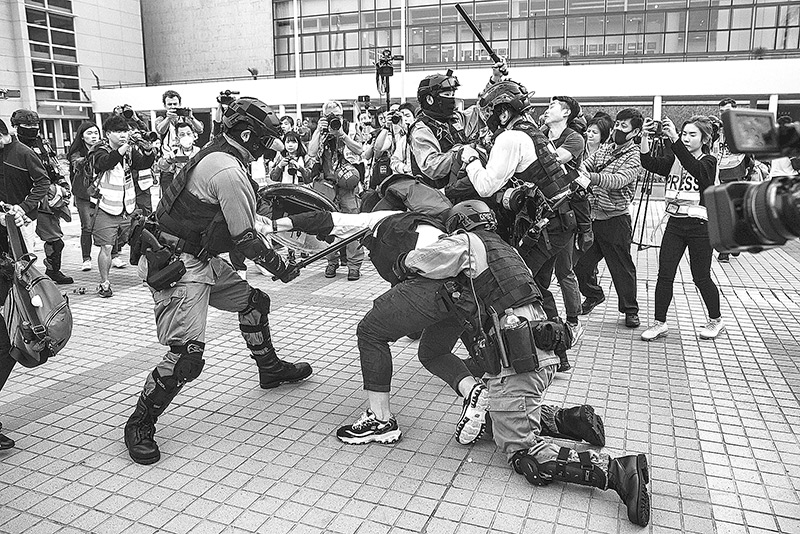
In addition, European leaders’ silence on questions of human rights is deafening. While Hong Kong’s citizens protest, and the US Congress passes legislation threatening possible sanctions on Chinese and Hong Kong officials for human-rights abuses, Europe puffs itself up and ‘calls on both sides to refrain from aggression.’
Europe can only watch from the sidelines, because it has no arguments to make. Transatlantic unity is disappearing, and nothing new is emerging in its place.
Even cooperation among European intelligence services is a sham: journalists knew who murdered a former Chechen rebel commander in Berlin’s Tiergarten park in August before Germany’s politicians did.
If this stagnation continues, the only question is whether Europe will become the satellite of the US or of China. And, ultimately, that will be decided outside the EU. If isolationism wins out in America, Europe will become a Chinese satellite. And if the US maintains a confrontational stance vis-à-vis China, Europe will remain dependent on America.
Until recently, Europe could have hoped to be a partner for the US. But that now appears increasingly unlikely—not only because of US President Donald Trump’s America-first instincts, but also as a result of the EU’s own failings. In the face of a rising China, European passivity is no less problematic than Trump’s unpredictability.


—Project Syndicate

Page 8
ESCALATE

What’s in a title? When it comes to ‘Doctor,’ more than you might think

Informal feedback by online readers reveals that the practice leads to concerns about everything from career advancement to professional respect.
- Patricia Friedrich
shutterstock

If you work in medicine, does it matter if you are called by your title? Is it all right if patients, colleagues, and others call you by your first name?
The answer of course depends on whom you ask. However, for many doctors who are women, that is not necessarily the central concern. It is more worrying that they and their male counterparts receive different forms of address. Women are more often referred to by first name, even when the situation of communication is formal. The same does not happen to doctors who are men.
Women in medicine may wonder whether or not those variations in how they are addressed might have far-reaching consequences for their careers. Do they reflect a systematic difference in attitude?
As a linguist, writer, and professor who teaches mostly sociolinguistics content, I have always been fascinated by the ways in which we use language. Linguistic categories and beliefs can affect different areas of our lives.
When my colleagues and I became curious about the use of titles, we conducted a study. It is part of a number of efforts by researchers interested in the social aspects of gender in medical fields. Our study shows that women are indeed less often called “doctor” than their male equivalent, and by a large margin.
Informal feedback by online readers reveals that the practice leads to concerns about everything from career advancement to professional respect.


Not quite ‘little lady,’ but not quite right
In our study, we looked at forms of address in more than 300 instances of introductions during grand rounds—formal meetings in hospitals during which clinical cases get discussed for educational purposes.
We discovered that women introduced speakers by formal titles 96.2 percent of the time.
When the introducer was a male addressing a female speaker, the use of titles went down to 49.2 percent of the time.
If the male introducer addressed a male speaker, the use of title was up to 72 percent of the time.
Therefore, while men were in general less formal than women in their introductions, the wide gender gap led us to wonder about the role of attitudes and their resulting implications. We suggested that this seemingly trivial, possibly unintentional, double standard ended up undermining female physicians in a context where women already face greater barriers for career advancement and job satisfaction.


How language and society work together
In the case of doctors and forms of address, a person unaware of this connection between language
and social relationships might wonder what the big deal is. Is it really that important that women be called “doctor” while performing the duties of their profession?
My answer is a very certain “yes,” especially if their male counterparts are being treated that way. Although I am not a medical doctor, as someone with a doctorate, I can relate to the experience. I have many times witnessed a male colleague being called “Dr Last Name,” while I am simply called “Patty” in the same breath. When within the same interaction, participants are systematically treated differently, a linguist must ask why.
It is also the job of a linguist to ask what else is happening in those contexts of communication that can signal inequalities, for which the language element might be symbolic. In the case of doctors and different forms of address, the points of intersection are not very difficult to find.
Women in medicine are less often referred to by professional titles. Without claiming causality, we can also observe that women in medicine (mirroring what happens in other areas) are still paid less than men in equivalent positions. Women are also promoted less often, face the biased belief that family responsibilities might keep them from dedication to their careers, and are more likely to be subjected to harassment than men.
A recent position paper in the Annals of Internal Medicine that cites our work argues that the challenges experienced by doctors who are women include “a lack of mentors, discrimination, gender bias, cultural environment of the workplace, impostor syndrome, and the need for better work–life integration.”
Another study which also makes reference to our article, this time on women in pediatrics, shows that even though women doctors are a majority in that area of specialisation, they are not advancing to positions of leadership as often and as much as men.


How to change this
One of the rewards of being a linguist is to see the possible applications of the research in the real world. Work on forms of address, for example, has changed institutional policy.
It is vital that we accept as valid the point of view of women who are concerned about these behaviors and are affected by them. Opportunity exists for those who might not be directed impacted to be allies and to model behavior themselves.
One area that lacks research and inclusion is gender bias beyond the male-female binary. That is, we urgently need to find out how gender bias, in language and elsewhere, affects medical professionals who identify as nonbinary, genderqueer, and transgender. Additionally, intersectionality requires further consideration as it influences advancement and opportunity.
Intersectionality refers to overlapping systems of discrimination that affect a person in complicated ways. For example, being all at once a woman, a member of an ethnic minority and a participant of a given religious practice might mean facing discrimination that is compounded by these multiple memberships. It should not happen, but it does.
There are many ramifications and possible actions linked to this kind of research. We need to do more.


—The Conversation/Associated Press

ESCALATE

What are the skills that employers most value in freelancers?

Upwork’s chief economist, Adam Ozimek talks about how the work needs and approaches are changing, from where freelancers live to how they can earn a premium wage.
- JOSH BOAK
AP/RSS

The employers want workers fluent in the computer programming language TypeScript and the software framework .NET Core. But they also favour softer skills, like good grammar and efficient bookkeeping.
That’s according to a list of the top 100 skills sought in freelance workers, compiled by Upwork, an online staffing
company.
The Associated Press interviewed Adam Ozimek, Upwork’s chief economist, about such priorities and the way they show how work is changing—from where freelancers live to how they can earn a premium wage. The conversation has been edited for clarity and length.


Is a specific industry demanding these skills?
The industries that are hiring remote workers really cut across the spectrum: Consulting, internet software and services, consumer spending, health care publishing, education. Companies are searching for talent outside the expensive cities where they’re headquartered, and this is going to be increasingly the case.
There is also a mix of specialisations that employers are seeking. What’s fascinating is this list includes emerging skills such as Asana, which is a web-based management tool. You don’t just need someone who is a programmer; you need someone with very specific skills.


Your analysis suggests that freelance workers with the top 100 skills earn an average of $43.71 an hour—or nearly $90,000 a year if they’re working 40-hour weeks. Do the earnings reflect the demand for these skills or the shortage of available workers with these skills?
Too often when people talk about freelance, they focus on narrow unskilled work such as Uber or food delivery that is part of the gig economy.
The jobs on this list involve skilled services. These jobs actually make up 45 percent of the freelance market, so freelancing is not synonymous with lower wages.
Our estimate is that roughly a third of workers participate in freelancing at some point during a year. This translates into an impact of 5 percent of GDP, meaning that the sector is roughly as large as the construction industry.


Are these jobs being filled by people waiting for full-time employment with a company?
Many of the people seeking to freelance as a career need flexibility with their time.
They may have disabilities or home responsibilities such as taking care of children or other family members. Working when they want to work is a big advantage.


What did you find surprising in the list?
There is international demand for these skills. Forty-eight percent of the jobs for these skills are being filled by non-US companies in Canada, the UK, Australia, India, China and the UAE. We tend to forget when discussing trade that the US exports services, not just goods.


—Associated Press

Page 9
CULTURE & ARTS

Have a seat at Muda Gaun

The villagers of Kalijhoda and Naya Basti in Jhapa have been weaving the traditional stool for the past 35 years, but it is still just enough to fulfil their basic needs.
- PARBAT PORTEL
Seventy-year-old Swamimaya Rana Magar weaves muda at her home in Kalijhoda, Jhapa. Almost every household is engaged in muda-making in this village. Post Photo: Parbat Portel

Jhapa,
At 4 in the morning, Swamimaya Rana Magar is ready to begin her day. After completing morning chores, she heads straight to a corner of her house, which is a designated spot to make muda, a traditional wicker stool. She sits down and continues weaving the thinly sliced bamboo stems, right from where she had left the night before.
For the past seven years, Magar has been making these traditional stools to make a living. From early morning to late night at 10, she is busy making mudas and stacking them one after another, readying them to be sold to a buyer. But her routine isn’t unique—at least for the residents of her village in Kalijhoda, as well as in neighbouring Naya Basti.
Muda has been a staple piece of furniture in almost every Nepali household. Due to its lightweight and portable nature, it can be used indoors as well as outdoors. Some of the plastic furniture manufacturers have also come up with their own version of the traditional stool. But the aesthetics, durability and sustainability of the traditionally made muda are incomparable to its modern counterparts. With the steady demand, around 300 households spread over two villages in Mechinagar Municipality are involved in making these traditional stools. Now, they have earned a new name—Muda Gaun.
“It is not a lucrative business, just enough to make a living,” says Magar. “At least, weaving mudas make me financially independent.”
For the residents of these two villages, although the income is minimal, anyone who wants to pursue this profession does not have to conduct research or look for potential buyers.
Shani Rajbanshi has been weaving mudas for the past 25 years. He even dabbled on other businesses, he bought a tractor and rented it out. But he decided to sell his tractor and get back to his old profession.
“I thought it wasn’t necessary to toil hard,” he says. “The income we get from weaving muda is enough for me and my wife to fulfil our basic needs.”
For others like Durga Siwakoti, it is something she does on the side while she waits for her customers in her small shop. “I manage to weave at least five mudas a day,’ she says.
In recent years, many interior designers have also attempted to incorporate this traditional furniture into contemporary designs. Tyre treasures, a company based in Kathmandu that turns old, used tyres from cars, trucks and buses into recycled furniture, has also been making mudas.
The villagers of Kalijhoda and Nayabasti, however, credit Khadga Sarki for bringing the skill of weaving muda-making to their village some 35 years ago. When Sarki and his family came to live in Jhapa from Tehrathum during the 70s, he brought with him the skills of weaving muda.
“Whoever learned weaving muda in these two villages, either learned from Khadga himself or from someone who learned it from Khadga,” says Lekhbir Sarki, Khadga’s brother-in-law.


When Khadga came to Jhapa, he settled in a small plot near a forest. For making mudas, he and his family used the skin of oxen and bulls. But after Bansbari leather shoe company filed a case against him for using the skin of oxen and bulls acquired from Jhapa, which at the time the company claimed they contractually owned, Khadga was sent to jail for three months.
But as even the darkest clouds have a silver lining, during his jail time, he learned to weave muda from plastic ropes. And when he was freed, he again transferred that skill and technique to other villagers.
But the person who transferred the skills has himself stopped making muda, says Lekhbir.
Lekhbir has also resorted in selling bamboo rings used in making the base of the stool rather than weaving the whole product.
“It’s more profitable to sell these rings than to put your labour into making a stool,” he says. “The price of other raw materials needed to weave mudas has skyrocketed, while the price of muda is the same.”
For every dozen mudas made up of plastic rope, the villagers sell it for Rs1,700. The mudas made up of velvet cloth, however, costs Rs2,200 per dozen. These mudas are then sold around different cities in Jhapa and some are even exported to Kathmandu and Pokhara. This, according to the villagers, is a nominal price given the cost of plastic ropes has spiked to Rs280 per kilogram while the price of the tyre to Rs20.
But the residents of Kalijhoda and Naya Basti are still continuing to earn their living by weaving mudas. In some households, the entire family is involved in muda-making. One such family is that of Wiskut Rajbanshi’s. The family of five spend their time making mudas from early morning to late evening.
Twelve years ago, when the sole breadwinner of the family Wiskut met with an accident and was left bedridden, the family had started weaving muda as the only resort. Now, in their home, which looks like a warehouse, they make around seven dozen mudas a day and make a decent living, says Gita, Wiskut’s wife.
“When we started making muda, we were desperate,” she says. “Now, we are financially stable.”
These traditional stools made in Muda Gaun have the potential to be marketed all around the country, which can fetch them better prices, say villagers. But even with these disadvantages, they don’t seem to stop weaving mudas anytime soon.

CULTURE & ARTS

Israeli museum explains the emojis of ancient Egypt

In the Egyptian system, hieroglyphs could designate an object or an idea in so-called ideograms, indicatethe sound of the word or serve as classifiers specifying the semantic category of the word.
- Claire Gounon
Curator Shirly Ben-Dor Evian poses for a picture as she presents the exhibition ‘Emoglyphs: Picture-Writing from Hieroglyphs to the Emoji’, at the Israel Museum in Jerusalem on December 19. AFP/RSS

How does an academic explain the importance of ancient hieroglyphics to modern audiences glued to their phones? Through the cunning use of emojis.
The Israel Museum in Jerusalem this week opened the “Emoglyphs” exhibition, comparing the pictograms of antiquity to those of today.
“I usually find it very hard to explain how hieroglyphs are used as a script,” the show’s curator, Shirly Ben-Dor Evian, told AFP.
“Then it occurred to me that some of the things can now be explained more easily because we are all writing with pictures now — it has become very widespread.”
From the heart symbol to little monkeys and foaming glasses of beer, the pictograms of our own time have enlivened discussion on social media and online messaging since the late 1990s.
Some emojis—from the Japanese word for a combination of an image and a written character—have hieroglyphic equivalents, said Ben-Dor Evian, who argues that the images are a language in their own right.
The exhibition, in a small gallery within the Israel Museum, welcomes visitors with a wall bearing similar pictograms from both eras.
The modern purple-suited dancer emoji with his hand raised strikes a similar pose to an Egyptian in a loin cloth from 3,000 years ago.
“There is a similarity in design and shapes, which is very interesting because there are thousands of years and very big cultural gaps between those two systems,” Ben-Dor Evian said.

Images stronger than words
In the Egyptian system, hieroglyphs could designate an object or an idea in so-called ideograms, indicate the sound of the word (phonograms) or serve as classifiers specifying the semantic category of the word.
Emoji, on the other hand, are self-sufficient in designating an idea, a feeling or an object, and are not intended to be accumulated to form a sentence, noted Ben-Dor Evian.
“When you use ideographic writing, the image becomes more powerful than the word,” she said.
She cites the example of the revolver emoji, replaced by Apple in 2016 with a fluorescent green water pistol.
“Why did it change? The reason is, once you start using picture as writing, then it’s much more powerful than writing the word ‘gun’. It’s much scarier.”
She says the modern use of pictograms is not so different from that in antiquity.
One difference is that the writer decides how emojis are used, while the ancient Egyptians had strict rules around the use of hieroglyphics, believing they were sacred.
The exhibition, “Emoglyphs: Picture-Writing from Hieroglyphs to the Emoji,” is open until late 2020 and includes previously undisplayed items from the museum’s own collection and others on loan from abroad.
Among them is a necklace made of linen and papyrus and covered with gold, dating from around 100 BC, which bears the inscription of a scarab beetle, symbol of resurrection.
It is reminiscent of today’s ladybird emoji, said Ben-Dor Evian.
“My goal as an Egyptologist is to show to people that something that is ancient is still relevant to their lives today,” she said.


—Agence France-Presse

Page 10
WORLD

France kills 33 militants in Mali raid: Macron

- REUTERS

ABIDJAN/BAMAKO, 
French forces killed 33 Islamist militants in Mali on Saturday using attack helicopters, ground troops and a drone, near the border with Mauritania where a group linked to al Qaeda operates, French authorities said.
The raid about 150 km (90 miles) northwest of Mopti in Mali targeted the same forest area where France wrongly claimed last year it had killed Amadou Koufa, one of the most senior Islamist militants being hunted by French forces in the Sahel.
A spokesman for the French army’s chief of staff declined to say at this stage whether Koufa was the target this time.
French President Emmanuel Macron announced the operation in a speech to the French community in Ivory Coast’s main city of Abidjan, describing it as a major success.
“This morning ... we were able to neutralise 33 terrorists, take one prisoner and free two Malian gendarmes who had been held hostage,” Macron said, a day after visiting French troops stationed in Ivory Coast.
The operation took place in a different part of Mali to where 13 French soldiers died last month in a helicopter crash while tracking a militant group suspected of being linked to Islamic State.
That was the biggest loss of French troops in a day since an attack in Beirut 36 years ago and raised questions about the human cost to France of its six-year campaign against Islamist insurgents in West Africa.
In Saturday’s raid, soldiers aboard Tiger attack helicopters used a Reaper drone to guide them to the forest area where Koufa’s group Katiba Macina operates, French army command said.
Koufa is one of the top deputies to Iyad Ag Ghali, the leader of Mali’s most prominent jihadi group, Jama’at Nusrat al-Islam wal-Muslimin (JNIM), which has repeatedly attacked soldiers and civilians in Mali and neighbouring Burkina Faso.
The Malian authorities welcomed the success of the raid. “Happy that the fight against terrorism is taking a more offensive turn,” said government spokesman Yaya Sangare in a message to Reuters. “I salute this operation, which must continue.”

WORLD

Under pressure Australia PM Scott Morrison visits beleaguered firefighters

News of his Hawaiian holiday had prompted street protests and widespread criticism on social media.
- AGENCE FRANCE-PRESSE
Australia’s Prime Minister Scott Morrison greets a volunteer during a visit to the Wollondilly Emergency Control Centre in Sydney, Australia, on Sunday. REUTERS

SYDNEY,
Prime Minister Scott Morrison visited firefighters battling Australia’s bushfire crisis on Sunday as he apologised for a Hawaiian holiday that ended early after public outrage.
Morrison toured the headquarters of the New South Wales Rural Fire Service—whose exhausted volunteers have been struggling to contain deadly, out-of-control-blazes for months on end—where he admitted he had erred in travelling overseas.
Morrison had departed for a family holiday amid record bushfires that have destroyed an area the size of Belgium and cloaked major cities from Brisbane to Sydney to Canberra to Melbourne in choking toxic fumes.
“I get it that people would have been upset to know that I was holidaying with my family while their families were under great stress,” he said.
“If you had your time over again and the benefit of hindsight we would have made different decisions.”
News of his holiday prompted street protests and widespread criticism on social media, with Australians deploying the hashtag #WhereTheBloodyHellAreYa?
“I apologise,” he said. “There have been lessons learned this week,” adding that he believed it was time to move on from the controversy.
“I’m sure Australians are fair-minded and understand that when you make a promise to your kids, you try and keep it,” the conservative leader said by way of explanation.
The embattled prime minister again acknowledged some link between climate change and weather patterns that scientists say has fuelled the fire crisis, but he indicated there would be no change in pro-coal policies.
Morrison also praised volunteer firefighters, who in the last 24 hours have faced catastrophic conditions brought by a record heatwave, gale-force winds and prolonged drought.
Australia’s firefighting force is overwhelmingly made up of volunteers who have been strained by the intensity and the length of this year’s fire season.
Conditions eased markedly on Sunday, giving them time to try to contain massive blazes near Sydney that are only likely to be extinguished with heavy rainfall.
Large scale back-burning is planned over the next few days before conditions are expected to worsen again in a week’s time.
Rain is expected in some fire-hit areas of New South Wales on Tuesday and Wednesday, a welcome Christmas gift for many.
But firefighters are still measuring the toll of Saturday’s destruction.
“We’ve seen widespread damage and destruction being reported across a number of these fire grounds,” said New South Wales Rural Fire Services boss Shane Fitzsimmons, who earlier described Saturday as “an awful day”.

WORLD

At least 25,000 people fled Syria’s Idlib for Turkey over two days

- REUTERS
People walk near rubble of damaged buildings in the city of Idlib, Syria.  REUTERS

ANKARA,
At least 25,000 civilians have fled Syria’s northwestern region of Idlib and headed towards Turkey over the past two days, Turkish state media said on Sunday, as Syrian and Russian forces intensified their bombardment of the region.
Turkey currently hosts some 3.7 million Syrian refugees, the largest refugee population in the world, and fears another wave from the Idlib region, where up to 3 million Syrians live in the last significant insurgent-held swathe of territory. Ankara has repeatedly asked its allies to support it in hosting refugees.
Hundreds of people have been killed this year in attacks on residential areas of Idlib, according to U.N. agencies.
While a Syrian and Russian military campaign launched late in April had subsided in August under a fragile ceasefire, rescue teams said air strikes killed six people in Maarat al Numan and 11 more in villages in the area on Friday.
Syrian President Bashar al-Assad has vowed to recapture Idlib, pushing more people towards Turkey. On Thursday, Turkish President Tayyip Erdogan said 50,000 people were fleeing from Idlib towards Syria’s border with Turkey.
Turkey’s state-run Anadolu news agency said on Sunday that since Erdogan gave his figure, another 25,000 had fled Idlib and come to areas near the Turkish border.
Anadolu said around 205,000 people have been displaced from their homes in the Idlib region since early November due to the Russian and Syrian attacks. It said the fleeing civilians had gone towards areas in Syria that Turkey seized in its previous military operations, or to other parts of Idlib.
Turkey has carried out three cross-border offensives into northern Syria against the Kurdish YPG militia, which it views as a terrorist group. Ankara has seized swathes of land across its border with the operations, and aims to resettle the Syrian refugees it hosts in those areas.

WORLD

Europe marks 40th anniversary of first Ariane rocket launch

- AGENCE FRANCE-PRESSE
AFP

PARIS,
The first Ariane space rocket lifted off over the forests of French Guiana 40 years ago, enabling Europe to at last take its place as an independent player in the international race for space.
Following a number of delays and technical setbacks, Ariane 1 finally left the launch pad in Kourou at 2:13 pm local time on December 24, 1979.
Its maiden flight was a so-called qualification flight, meaning it was not carrying any satellite to put into orbit.
But at the launch, and “during the successive ignitions and separations of different parts of the rocket, there were cries of joy from spectators as the Ariane rose in the clear sky above Guiana,” AFP’s special correspondent wrote at the time.
The control room erupted with applause when the then head of France’s CNES National Centre for Space Studies, Yves Sillard, declared the mission a success, “without even waiting for the orbiting diagnosis,” the AFP article stated.
“It was a complete success. It triggered inexpressible joy,” Sillard said in an interview with AFP four decades after.
“There was laughter and tears,” recalled the launch centre’s former head of operations, Guy Dubau, visibly moved even 40 years on.
The teams involved in the project had come a long way: just a few days earlier, on December 15, to everyone’s dismay, the rocket failed to take off after ignition due to an unanticipated problem with setting parameters.
“We had absolute confidence in these engines,” says Dubau. The failure “dealt a body blow to the 150 people working in the launch centre”.
- Europa fiasco -
There were only nine days left to fix the problem.
“We had to work around the clock. We even set up a small dormitory in the centre,” Dubau says.
Then, in a final attempt on Christmas Eve, Ariane lifted off.
“It was a miracle. Two hours more and we would have had to bin the rocket launcher,” Dubau said.
Sillard said that if it had failed, “it could have dramatic consequences, and might have even led to the project being abandoned altogether.”
That was because Europe was still smarting from the fiasco of an earlier project.
The Europa satellite launcher, developed in the 1960s, failed because of a lack of coordination between the participating countries and the absence of a single overall project manager.
The Europa programme was abandoned in 1973, the same year that the European Space Agency (ESA) was set up. From then on, the management was entrusted to CNES, which contributed more than 60 percent to the new project.
The stakes were high: the United States had just launched its space shuttle programme, claiming launch costs would be “five times cheaper than conventional launchers and that these would disappear”, Sillard said.
Ariane would prove the contrary. But the project was still plagued by an overall climate of scepticism.
Under French stewardship, more than 50 companies from 10 different countries worked on developing a new launcher called Ariane, or Ariadne in English, the name of a Greek mythological princess who left a thread to guide Theseus out of the minotaur’s labyrinth.
In the same way, the new launcher project would “lead us out of the maze of European talks,” said Gerard Brachet, a former CNES engineer who went on to head the organisation.
For the first time, Ariane 1 would break the US hold on satellite launches and Europe officially entered the space race.
“This first successful launch lent us commercial credibility,” Brachet said.
For the current president of CNES, Jean-Yves Le Gall, “if this launch hadn’t taken place 40 years ago, we wouldn’t have the European space industry that we have today.”
Overall, the Ariane project has been a success and there have been five generations of rockets to date, despite some setbacks, such as the explosion of the first Ariane 5 rocket in flight.
Between then and now, the load transported by the rockets has increased tenfold, says Stephane Israel, the president of Arianespace, the company responsible for marketing the launcher.
But in recent years, Ariane has come to face much fiercer competition, particularly from American firm Space X with its reusable launcher.
Europe is fighting back with its Ariane 6, due to take off in 2020.
With much more competitive manufacturing costs, the new generation launcher will have a re-ignitable engine enabling several charges to be placed in different orbits during the same mission.
And a potentially reusable motor, Prometheus, is also in the pipeline.

WORLD

6 killed, 13 injured in Las Vegas apartment building fire

Briefing

LAS VEGAS: A fire in a three-story apartment building in downtown Las Vegas where residents were apparently using their stoves for heat killed six people and forced some residents to jump from upper-floor windows to escape the heavy smoke before dawn Saturday, authorities said.Investigators reported that the fire started around a first-floor unit’s stove and that residents had told them that there was no heat in the building, which sits a few blocks from downtown Las Vegas’ touristy Fremont Street District. Residents reported awakening to pounding on doors around 4am. By the time Matthew Sykes got his clothes on to flee, one end of his second-floor hallway was choked with thick black smoke, as was a stairwell, making it impassable for he and his wife. (Agencies)

WORLD

175 children abused by Mexican branch of Catholic Church

Briefing

MEXICO CITY: At least 175 children were sexually assaulted by priests belonging to an ultra-conservative Mexican branch of the Roman Catholic Church, according to an internal report published Saturday.The founder of the Legionaries of Christ, Marcial Maciel, abused as many as 60 children, with a total of 33 priests or deacons acknowledged to have committed sexual assaults against minors since 1941, the document says. The findings of the report spans from the group’s founding in 1941 until December 16, 2019. The report notes that 18 of the 33 individuals who committed abuses are still part of the organization, but says they have been removed from tasks connected to the public or minors. (Agencies)

WORLD

Croatia votes in a three-horse presidential race

Briefing

ZAGREB: Croatia went to the polls for a presidential vote on Sunday that could weaken the ruling conservatives just as the country takes the helm of the European Union’s rotating presidency. The pre-Christmas election, likely to be decided in a January 5 run-off, has evolved into a tight race between conservative incumbent Kolinda Grabar-Kitarovic and front-running rivals on the right and the left. Voters braved heavy rain in the capital Zagreb to reach polling stations that opened at 7:00 am (0600 GMT), with voting set finish 12 hours later. Grabar-Kitarovic has been president since 2015 with backing from HDZ, the centre-right party that has led Croatia for most of its independence since 1991. (Agencies)

Page 11
ASIA

Modi seeks to soothe India’s Muslims as deadly protests swell

25 people have died in 10 days of demonstrations after a new citizenship law was passed.
- AGENCE FRANCE-PRESSE
Indian Prime Minister Narendra Modi addresses a rally of his Hindu nationalist Bharatiya Janata Party in New Delhi, India, on Sunday. AP/RSS

NEW DELHI,
Prime Minister Narendra Modi sought Sunday to reassure India’s Muslims as a wave of deadly protests against a new citizenship law put his Hindu nationalist government under pressure like never before.
At least 25 people have died in 10 days of demonstrations and violence after Modi’s government passed the law criticised as anti-Muslim. More protests took place Sunday.
Addressing party supporters in New Delhi—who cried “Modi! Modi!” at the mention of the law—the 69-year-old said Muslims “don’t need to worry at all”—provided they are genuine Indians.
“Muslims who are sons of the soil and whose ancestors are the children of mother India need not to worry” about the law and his plans to carry out a national register of citizens, Modi told the crowd of thousands.
Accusing the main opposition Congress party of condoning the recent violence by not condemning it, Modi said opponents were “spreading rumours that all Muslims will be sent to detention camps.”
“There are no detention centres. All these stories about detention centres are lies, lies and lies,” he said.
The demonstrations have been largely peaceful but protesters have also hurled rocks and torched vehicles, while heavy-handed police tactics including the storming of a Delhi university a week ago have fuelled anger.
Tens of thousands of protests gathered late Saturday in the southern city of Hyderabad, while other protests were held elsewhere. Yet more took place or were scheduled on Sunday, including in Delhi and Kolkata.
The law gives religious minority members—Hindus, Sikhs, Jains, Parsis, Christians and Buddhists—from three neighbouring Islamic countries an easier path to citizenship, but not if they are Muslim.
Islamic groups, the opposition and others at home and abroad fear this forms part of Modi’s aim to marginalise India’s 200 million Muslims and remould the country as a Hindu nation, something he denies.
Authorities have imposed emergency laws, blocked internet access—a common tactic in India—and shut down shops in sensitive areas across the country in an attempt to contain the unrest.
More than 7,500 people have either been detained under emergency laws or arrested for rioting, according to state officials, with 5,000 in Uttar Pradesh state alone where 17 people have been killed.
Some 500 people have also been injured in Uttar Pradesh including 263 police, while two people were shot dead in the southern state of Karnataka and six died in Assam in the northeast last week.
In Assam, opponents of the legislation fear it will enable large numbers of Bengali-speaking immigrants, many of whom are Hindu, to settle there.
But elsewhere, opponents say the law has made religion a test for citizenship ahead of a nationwide register that Modi wants to carry out by 2024 to remove all “infiltrators”.
The US State Department this week urged New Delhi to “protect the rights of its religious minorities in keeping with India’s constitution and democratic values”.
Modi’s government, re-elected in May, has defended the law saying it is meant to help “persecuted” minorites from Muslim-majority Pakistan, Bangladesh and Afghanistan.

ASIA

Clashes as police try to clear Hong Kong protesters

- REUTERS
Police detain a man during a rally in Hong Kong on Sunday to show support for the Uighur minority in China.  AFP/RSS

HONG KONG,
Hong Kong riot police pepper sprayed protesters to disperse crowds in the heart of the city’s financial district on Sunday after a largely peaceful rally in support of China’s ethnic Uighurs turned chaotic.
Dozens of police marched across a public square overlooking Hong Kong’s harbour to face off with protesters who hurled glass bottles and rocks at them.
Earlier in the afternoon more than 1,000 people had rallied calmly, waving Uighur flags and posters, as they took part in the latest demonstration in over six months of unrest.
A mixed crowd of young and elderly people, dressed in black and wearing masks to shield their identities, held up signs reading “Free Uyghur, Free Hong Kong” and “Fake ‘autonomy’ in China results in genocide”.
The protest comes after midfielder Mesut Ozil of English soccer club Arsenal caused a furore in China after he criticised the country’s policies toward the Muslim ethnic minority in the restive northwestern region of Xinjiang.
Ozil, a German Muslim of Turkish origin, tweeted that Uighurs were “warriors who resist persecution” and criticised both China’s strong hand in Xinjiang and the relative silence of Muslims in response.
“I think basic freedom and independence should exist for all people, not just for Hong Kong,” said a 41-year-old woman surnamed Wong who attended the protest. United Nations experts and activists say at least 1 million Uighurs and members of other largely Muslim minority groups have been detained in camps in Xinjiang since 2017 under a campaign that has been condemned by the United States and other countries.

ASIA

North Korea’s Kim discusses bolstering military as deadline approaches

- AGENCE FRANCE-PRESSE

SEOUL,
North Korean leader Kim Jong Un discussed strengthening his country’s military capability with top military officials, state media reported Sunday, with Pyongyang’s end-of-year deadline for the US to offer concessions approaching.
The North promised an ominous “Christmas gift” earlier this month if Washington does not give ground by the end of December. The denuclearisation process has been largely deadlocked since the collapse of a summit in Hanoi at the start of the year.
Pyongyang has carried out a series of static tests at its Sohae rocket facility this month, after a number of weapons launches in recent weeks—some of them described as ballistic missiles by Japan and others. North Korea is banned from carrying out such tests under UN sanctions.
Kim held an enlarged meeting of the ruling Workers’ Party’s Central Military Commission, for which he serves as chairman.
There, he “gave analysis and briefing on the complicated internal and external situation... to bolster up the overall armed forces of the country,” the North’s official KCNA news agency reported.
“Referring to merits and demerits in the recent work of the People’s Army and matters to be rapidly overcome”, KCNA said, “the Supreme Leader indicated in detail the direction and ways to be maintained” to boost the armed forces.
“Important issues for decisive improvement of the overall national defence and core matters for the sustained and accelerated development of military capability for self-defence,” were also discussed, it added.
The report came a day after the nuclear-armed state warned Washington it would “pay dearly” over criticism of its human rights record by a US state department official.
A North Korean foreign ministry spokesperson said the comments were akin to “pouring oil over burning fire” amid heightened tensions in a statement carried by KCNA.

ASIA

Ghani wins slim majority of Afghan presidential vote in preliminary results

Election commission says Ghani wins 50.6 percent of vote, but result subject to review.
- REUTERS
Ashraf Ghani. REUTERS

KABUL, 
Afghanistan’s incumbent President Ashraf Ghani won a slim majority of votes in a Sept 28 election, delayed preliminary results showed on Sunday, after a poll that plunged the country into political crisis and was marred by allegations of fraud.
The Independent Election Commission (IEC) said the total turnout in the presidential election was over 1.8 million with Ghani securing 50.64%, enough to win the first round of voting, beating his main challenger Abdullah Abdullah, who currently shares power with Ghani in a unity government.
However, the head of IEC, Hawa Alam Nuristani, told a press conference in Kabul that the outcome could change after final results and was still subject to a review by the election complaints’ commission.
If a review showed Ghani’s vote falling below 50% and no other candidate with a majority, a second round of voting would be held, she said.
According to the tally released by the IEC on Sunday, the total turnout was 1,824,401 with Ghani winning 923,868 votes while Abdullah finished second with 39.5% and 720,099 votes.
The United States, Afghanistan’s biggest donor, reacted cautiously to the result.
“It is important for Afghans to remember: these results are preliminary. Many steps remain before final election results are certified, to ensure the Afghan people have confidence in the results,” John Bass U.S. ambassador to Afghanistan said in a post on Twitter.
In a statement on Sunday, Abdullah’s office said he did not accept the preliminary results and that the commission had failed to tackle election fraud.
“The result that stands is based on fraud and without considering our legitimate demands, will never be accepted,” the statement said.
With 9.7 million registered voters, according to IEC, Afghanistan’s 1.9 million voter turnout for the presidential election was low. Last month, IEC began recounting thousands of votes due to what it described as discrepancies in its system. Abdullah’s side objected to the recount and called it an attempt to add more votes in favour of Ghani. IEC dismissed those allegations.
In protest, Abdullah’s supporters blocked IEC offices in seven northern provinces to prevent the recount,
creating delays in the results’ announcement.
Last week, Abdullah allowed the recount but warned that he would not accept a tainted result.
The situation echoes 2014 when both Ghani and Abdullah alleged massive fraud by each other, forcing the United States to broker an awkward power-sharing arrangement that made Ghani president and Abdullah his chief executive.
Aides close to Ghani, a Western-educated former World Bank official, said the incumbent was not ready for another power sharing deal with Abdullah, a former medical doctor.
Without a unifying leader accepted by all sides, Afghanistan could split further along tribal and ethnic lines.
The election result also comes at a critical time for Afghanistan as the United States is showing more interest in negotiating a peace settlement with the Taliban to end the war that has dragged on for more than 18 years.

ASIA

Mock skyscrapers, simulated rain at Singapore self-driving test centre

- AGENCE FRANCE-PRESSE
An autonomous road sweeper operating during a trial test at the Centre of Excellence for Testing & Research of Autonomous Vehicles in Singapore. AFP/RSS

SINGAPORE,
The road sweeper and a golf buggy move around the track with ease, jamming their brakes on when a pedestrian steps out and negotiating sharp turns.
Welcome to Singapore’s self-drive test centre, complete with traffic lights and mock skyscrapers, which is at the heart of the city’s push to become a hub for autonomous
technology.
However, while authorities are keen to tap a global drive by auto giants and startups to develop vehicles, the industry must still prove it is safe and persuade people to use the technology.
The two-hectare (4.9-acre) site has a track with sharp turns, traffic lights, a slope, and a bus stop to simulate real driving conditions. Shipping containers are also stacked up to emulate how high rises could potentially block satellite signals to self-driving machines.
The CETRAN centre, run by Nanyang Technological University (NTU), even has a rain-making machine that can simulate the frequent tropical downpours in the Southeast Asian city-state of 5.7 million people.
“Before you are ready to go to the public roads, we test them here to see if they are actually ready,” said
Niels De Boer, programme director at the centre.
All companies must put their autos through the centre’s testing and certification programmes before they are allowed to hit public roads.
The sweeper is being trialled as part of a government plan that could eventually see them deployed in the city, according to local media, while cars and buses are also being tested, and trials of delivery robots will soon take place.
Orderly Singapore is seeking to lure autonomous tech companies looking to trial their vehicles in Asia, where many other major cities are chaotic and traffic-clogged.
The government has led the drive, as it seeks to attract more foreign firms and because it sees the technology as useful for public transport and delivery services.
The first trials of an autonomous car on public roads took place in 2015.
In 2016, US software firm nuTonomy launched driverless taxi trials in public in Singapore, becoming the first company in the world to do so.
Authorities aim to deploy autonomous public transport in three areas by 2022, and in October announced it was expanding the area where self-driving vehicles can be tested to 1,000 km (620 miles) of public roads.
Self-driving vehicles will mainly be used in the public transport network for tasks such as shuttling people to stations and stops from their homes or workplaces, said Subodh Mhaisalkar, an NTU professor involved in the autonomous vehicle programme.
De Boer from the CETRAN centre said authorities were working on ensuring the correct regulations, such as traffic laws, are in place for self-driving vehicles.
Countries where private companies are taking the lead risk having “wonderful technology” but not being able to launch it in the market because of the absence of rules, he added.
There are still many roadblocks ahead, however.
Safety remains a major concern for the industry worldwide—in 2018, a self-driving Uber car was involved in a crash that killed a woman in Arizona.
All trials in Singapore still require a safety driver and most vehicles are not yet ready to cope with the regular tropical downpours.
And the tiny country remains behind other markets, such as the US, where self-driving ride services are in various stages of deployment.
“It would be very difficult to lead in the whole industry simply because the nation is small,” said Guoli Chen, associate professor of strategy at French business school INSEAD.
The key challenge may be persuading members of the public to hop aboard self-driving vehicles, and experts say the technology will have to be introduced in stages.
“It’s a journey that may take 10 to 20 years, but I think it’s inevitable,” NTU’s Mhaisalkar said.

ASIA

Thousands mourn Bangladeshi charity pioneer

Briefing

DHAKA: Thousands gathered in Bangladesh on Sunday for the funeral of Fazle Hasan Abed, founder of one of the world’s largest NGOs and credited with lifting nearly 150 million people out of poverty. The 83-year-old passed away on Friday in a Dhaka hospital while undergoing treatment for a brain tumour. His body was brought to a stadium in Dhaka where at least 10,000 people attended the funeral, an AFP photographer from the venue said. Nobel laureate Muhammad Yunus, top politicians, diplomats and businessmen paid tribute to Abed, who founded BRAC in 1972. (Agencies)

ASIA

Thousands protest in Iraq as deadline for new PM looms

Briefing

DIWANIYAH (Iraq): Thousands of protesters blocked roads and public buildings in southern Iraq Sunday, as the latest deadline for choosing a new prime minister loomed. Anti-government rallies have rocked Baghdad and the Shiite-majority south since October 1, with demonstrators calling for a complete overhaul of a regime they deem corrupt and inefficient. “The revolution continues!” shouted one demonstrator at a protest encampment in central Diwaniyah. Protesters blocked off public buildings one by one in the southern Iraqi city, and put up banners reading “The country is under construction—please excuse the disruption”. (Agencies)

ASIA

Philippine troops rescue two abducted Indonesians

Briefing

MANILA: Philippine troops rescued two abducted Indonesian sailors in a Sunday pre-dawn raid on an Islamist militant stronghold which left two dead, a military official said. A soldier and a militant of kidnap-for-ransom group Abu Sayyaf—which was behind some of the nation’s worst attacks—were killed during a 30-minute gunfight in the mountainous town of Panamao on the southern island of Jolo. “During the firefights, the two victims managed to scamper away (from the militants) and we were able to rescue them,” military commander Lieutenant General Cirilito Sobejana told AFP. The pair were among three Indonesian sailors abducted by the militants in Septem-ber off Malaysian waters. (Agencies)

Page 12
MONEY

Colombia orders Uber to cease ride-hailing

- REUTERS

BOGOTA, 
Colombia on Friday ordered Uber to cease its ride-hailing operations in the Andean country, effective immediately, after a judge ruled the company violated competition rules.
Following a lawsuit filed against Uber by COTECH SA, the Superintendency of Industry and Commerce (SIC) said the US company had breached market rules.
Uber has more than 2.3 million active users in Colombia and around 88,000 driver partners.
The app, however, has existed in a regulatory no-man’s land in Colombia. The Technology Ministry deems ride-hailing apps legal while transport authorities say they are against the law.
In a statement the SIC said Uber generated “a significant advantage in the market” by rendering transport services for individuals via its application.
The SIC said that following analysis, it ordered Uber’s ride-hailing services “through the use of the Uber application to cease immediately.” The order applies to Uber, Uber X and Uber VAN.
Uber said in a statement that it rejects the ruling and immediately appealed it.
 “This decision reflects an act of censorship and infringes on the Inter American Convention on Human Rights, which has already condemned attempts to block Uber for violating the neutrality of the web, liberty of expression and freedom of internet,” Uber said in a statement.

MONEY

Aramco, Alibaba rescue sluggish 2019 global ECM market

Proceeds from global equity capital markets (ECM) fell 4.7 percent to $659 billion in 2019.
- REUTERS
Participants attend the official ceremony marking the debut of Saudi Aramco’s initial public offering on the Riyadh’s stock market. REUTERS

LONDON, 
Giant listings by Saudi Aramco and Alibaba rescued a sluggish year for equity capital markets (ECM) in 2019 after a string of shelved initial public offerings (IPOs) and share price slumps.
Proceeds from global equity capital markets (ECM) fell 4.7 percent to $659 billion in 2019, according to Refinitiv data, a figure propped up by state-owned oil giant Aramco’s record-breaking $25.6 billion IPO and Chinese e-commerce giant Alibaba’s $13.5 billion secondary Hong Kong listing.
The two deals accounted for 6 percent of the total raised, with Aramco alone accounting for 15 percent of global IPO volumes.
“Aramco fits the category of large and differentiated deals for which there is an audience but equally it is such a unique asset and a unique situation that it is difficult to read across to other situations,” said Gareth McCartney, head of Europe Middle East and Africa (EMEA) ECM syndicate at UBS.
US office-sharing tech firm WeWork was the year’s highest-profile casualty after its valuation tumbled from $47 billion in a private fundraising round in January to as low as $10-$12 billion for its proposed and then cancelled IPO.Other notable cancellations included Reassure — the UK arm of reinsurance group Swiss Re — and Italian luxury yacht maker Ferretti.
Kirstin DeClark, co-head of US equity capital markets at Barclays, said poor share price performance by newly-listed tech firms meant investors were becoming more conservative about valuations for loss-making companies.
“The pendulum has swung much more towards discipline. Companies don’t need to be profitable but there is much greater focus on the unit economics of a business,” she said, referring to the underlying profitably of a company’s core business.
The cancellations also reflected a weakening global economy and political volatility, with Asian deals suffering from the anti-government protests in Hong Kong.
“If uncertainty created by the protests is prolonged, then it may have an impact on the decision to list in the longer term,” said Janney Chong, equity capital market partner at law firm RPC.
Proceeds from Asia Pacific IPOs fell by nearly a fifth to $64.6 billion equivalent, though the Alibaba listing meant regional volumes were up 3.2 percent at $230.8 billion.
In Europe just $23.8 billion was raised, a 43.4 percent slide from 2018 and the lowest volume in seven years, leaving the United States as the only major region to top last year’s IPO volumes. Bumper listings by Uber Technologies and rival Lyft Inc lifted proceeds there by 6.7 percent to $48.4 billion.
However, with their share prices languishing well below listing levels, many bankers believe the global ECM market could remain subdued in 2020 despite a healthy pipeline.
The market also appears to be undergoing a structural change, with many companies, particularly tech ones, raising larger sums of money from venture capital and private equity investors, bankers said.
“Increasingly, issuers and vendors have the opportunity to delay their IPOs...and give them another 1-2 years in the private market,” said James Fleming, co-head of global equity capital markets at Citi.
Private equity companies have raised record amounts of funds in recent years, while sovereign wealth funds have become increasingly active in global equity markets. Japanese investment company Softbank (9984.T) alone has more than $100 billion allocated to its Vision Fund and is in the process of raising another $100 billion for a second fund.
A London-based capital markets lawyer said that while some challenges to the IPO market remain the same as previously, this was creating a new dimension.
“When you brought a company to market ten years ago, you didn’t have a $100 billion dollar fund competing for your attention,” he said.

MONEY

Russia gas export pipeline in jeopardy as Trump signs sanctions bill

- REUTERS

WASHINGTON, 
Swiss-Dutch company Allseas said it had suspended work on building a major Russia-to-Germany natural gas pipeline in order to avoid US sanctions contained in legislation signed by President Donald Trump on Friday.
The move throws into doubt the completion date of the $11 billion project that Moscow had said would be ready in months, jeopardizing plans to quickly expand Russian sales of natural gas to Europe via pipeline.
The participation of privately-held Allseas, a specialist in subsea construction and laying underwater pipeline, is integral to the completion of Nord Stream 2, led by Russia’s state energy company Gazprom.
“In anticipation of the enactment of the National Defense Authorization Act (NDAA), Allseas has suspended its Nord Stream 2 pipelay activities,” the company said in a statement dated Dec. 21, seen by Reuters shortly before Trump signed the bill.
“Allseas will proceed, consistent with the legislation’s wind down provision and expect guidance comprising of the necessary regulatory, technical and environmental clarifications from the relevant US authority.”
The annual national defense policy bill contains legislation, first sponsored by Republican Senator Ted Cruz and Democratic Senator Jeanne Shaheen, imposing sanctions on companies laying pipe for the project that will double the pipeline’s capacity to Germany.
The bill calls on the administration to identify companies working on the project within 60 days to trigger the sanctions. That report will likely be completed faster than that, however, meaning the sanctions could be triggered earlier than expected, two US senior officials told Reuters.
Nord Stream 2 would allow Russia to bypass Ukraine and Poland to deliver gas under the Baltic Sea to Germany.
Gazprom is taking on half of the project’s planned costs and the rest is divided between five European energy companies: Austria’s OMV, Germany’s Uniper and Wintershall, Royal Dutch Shell and France’s Engie.
The Trump administration, like the Obama administration before it, opposes the project on the grounds it would strengthen Russian President Vladimir Putin’s economic and political grip over Europe. Russia has cut deliveries of the fuel to Ukraine and parts of Europe in winter during pricing disputes.
“We have a degree of consistency, over a decade of opposing this issue, across presidential administrations,” one of the US officials said.

MONEY

West African nations rename common currency, sever its links to France

- AGENCE FRANCE-PRESSE
Eight West African countries agreed to change the name of their common currency to Eco. AFP

ABIDJAN,
Eight West African countries Saturday agreed to change the name of their common currency to Eco and severed the CFA franc’s links to former colonial ruler France.
The CFA franc was initially pegged to the French franc and has been linked to the euro for about two decades.
Benin, Burkina Faso, Guinea-Bissau, Ivory Coast, Mali, Niger, Senegal and Togo currently use the currency. All the countries are former French colonies with the exception of Guinea-Bissau.
The announcement was made Saturday during a visit by French President Emmanuel Macron to Ivory Coast, the world’s top cocoa producer and France’s former main colony in West Africa.
Ivory Coast President Alassane Ouattara, speaking in the country’s economic capital Abidjan, announced “three major changes”.
These included “a change of name” of the currency, he said, adding that the others would be “stopping holding 50 percent of the reserves in the French Treasury” and the “withdrawal of French governance” in any aspect related to the currency.
Macron hailed it as a “historic reform”, adding: “The Eco will see the light of day in 2020.”
The deal took six months in the making, a French source said.
The CFA franc’s value was moored to the euro after its introduction two decades ago, at a fixed rate of 655.96 CFA francs to one euro.
The Bank of France holds half of the currency’s total reserves, but France does not make money on its deposits stewardship, annually paying a ceiling interest rate of 0.75 percent to member states.
The arrangement guarantees unlimited convertibility of CFA francs into euros and facilitates inter-zone transfers.
CFA notes and coins are printed and minted at a Bank of France facility in the southern town of Chamalieres.
The CFA franc, created in 1945, was seen by many as a sign of French interference in its former African colonies even after the countries became independent.
The Economic Community of West African States regional bloc, known as ECOWAS, earlier Saturday urged members to push on with efforts to establish a common currency, optimistically slated to launch next year.
The bloc insists it is aiming to have the Eco in place in 2020, but almost none of the 15 countries in the group currently meet criteria to join.
ECOWAS “urges member states to continue efforts to meet the convergence criteria”, commission chief Jean-Claude Kassi Brou said after a summit of regional leaders in the Nigerian capital Abuja.
The key demands for entry are to have a deficit of less than 3 percent of gross domestic product, inflation of 10 percent or under and debts worth less than 70 percent of GDP.
Economists say they understand the thinking behind the currency plan but believe it is unrealistic and could even be dangerous for the region’s economies which are dominated by one single country, Nigeria, which accounts for two-thirds of the region’s economic output.
Nigeria’s Finance Minister Zainab Ahmed told AFP “there’s still more work that we need to do individually to meet the convergence criteria”.
ECOWAS was set up in 1975 and comprises Benin, Burkina Faso, Cape Verde, Gambia, Ghana, Guinea, Guinea-Bissau, Ivory Coast, Liberia, Mali, Niger, Nigeria, Senegal, Sierra Leone and Togo — representing a total population of around 385 million.
Eight of them currently use the CFA franc, moored to the single European currency and gathered in an organisation called the West African Monetary Union, or WAMU.
But the seven other ECOWAS countries have their own currencies, none of them freely convertible.

Page 13
MONEY

Coffee sector underperforming due to archaic ways

Nepali coffee is of the Arabica variety, a mix of bourbon, typica and caturra varietals, and is grown above 1,000 metres and up to 1,600 metres.
- HIMENDRA MOHAN KUMAR
The coffee plants in Nepal are less robust, compared to the Robusta variety grown in other parts of the world. POST FILE PHOTO

KATHMANDU,
Nepal has the potential to become a regional powerhouse for organic specialty coffee, but one harvest a year, primitive farming techniques and inadequate government support are posing impediments in the sector’s growth, experts say.
“Unlike Brazil and Columbia, coffee farming practices in Nepal are not mechanised, which results in lower coffee yields, and also there’s no grading at the farm level, which affects the quality of the final coffee product,” Gaurav Luitel, agriculture development officer at the National Tea
and Coffee Development Board, told the Post.
In Brazil and Indonesia, there are two coffee harvests annually, Luitel said. Inadequate support from the federal government for new plantations and mechanisation has contributed to Nepal not realising its full potential in coffee cultivation, he added.
Although Nepal is endowed with the right topography and climatic conditions for commercial coffee cultivation, experts said the cost of local produce is way too high and yields abysmally low by international standards as a result of cultivation being mostly in the hands of subsistence farmers with small landholdings.
The average size of coffee farms in Nepal is less than one ropani, which is too small to achieve economies of scale.
“Due to traditional subsistence farming techniques, a Nepali coffee farmer, on average, is able to produce only about 300 kg of coffee per ropani as compared to around 1,400-1,500 kg per ropani in India,” said Raj Kumar Banjara, president of the National Coffee Academy.
Nonetheless, a higher profit margin in coffee farming, given the burgeoning local demand and the support price of Rs85 per kg for Grade A fresh cherry fixed by the government, is helping Nepali farmers keep its viability.
“The cost of producing Nepali coffee is quite high, and it may be due to various factors, including difficult geographical terrain, lack of modern farming techniques and a low volume of harvest,” said Banjara.
Banjara, who is a local coffee producer and exporter himself, said the bulk of Nepal’s coffee production is being exported to Europe, the United States and Japan with average green beans export prices ranging anywhere between $10 to $12 per kg. Additionally, there is also a strong local demand for Nepali coffee, which currently stands at about 80 tonnes a year and is growing at an annual rate of almost 25 percent.
Nepal’s total coffee production was 530 tonnes in the last fiscal year, and during the current fiscal year, output may be as high as 600 tonnes according to coffee board estimates, said Luitel.
Raju Dhakal, a small-scale farmer cultivating three ropanis of land in Kabhre district, said that ordinarily, he plants coffee, maize, potato and wheat on his farm every year, but it’s coffee that’s fetching him a higher profit each time.
“My profit last year was Rs10,000 per ropani. But I sold 200 kg of coffee at Rs80 per kg in the local market separately, which helped me make some good money,” said Dhakal.
He said the only government help he ever received was a tractor for hire service at a 50 percent discount some six months ago. At that time, he was planting the seeds.    
Data from the National Tea and Coffee Development Board shows that until 2000, exports of Nepali coffee totalled just 3.6 tonnes with an export value of Rs673,000. Nearly two decades later, coffee exports had surged exponentially to 82.68 tonnes, generating Rs98.86 million in income. For the next year, the board has set an export target of 150 tonnes.
Deepak Khanal, acting executive director at the National Tea and Coffee Development Board said Nepal’s export volume potential is estimated at 8,000 metric tons a year. But to reach its full export potential, he said the country would need to have up to 2 million hectares of land under coffee cultivation. At present, the coffee acreage stands at 973 hectares.
“The board has done a study in 10 districts, and it has been able to identify 62,000 hectares of land at elevations ranging between 800 and 1,800 metres above sea level. The identified tracts of land have been found to be highly suitable for growing Arabica coffee,” said Khanal.
He also said that if the local governments and municipalities encourage coffee growing in their respective jurisdictions, over time, more land parcels could be brought under coffee cultivation.
Khanal said the local coffee industry could also benefit from the government allowing foreign investment into the sector.
But the country doesn’t have a land leasing policy for foreign companies in the farm sector.
“Foreign investors are wary of the difficulties they may face in leasing land for cultivation, and that’s the reason they are not aggressively coming forward to invest in coffee plantations in Nepal. The Ministry of Agriculture and the Ministry of Commerce need to formulate policies to attract foreign direct investment in commercial coffee cultivation. That would not only help our farmers, it would generate other local employment opportunities too.”
Banjara said a coffee plant is vulnerable to pests and diseases during its lifecycle, and Nepali farmers have to bear the full brunt of any crop loss. “Besides, there is not enough research on coffee varietals. The Nepal government should establish a coffee lab where potential farmers can buy certified coffee seeds and saplings.”
The coffee plants in Nepal are less robust, compared to the Robusta variety grown in other parts of the world, said Luitel.
Every year, there are instances of farmers losing a part or all of their produce to pests like coffee berry borer and white stem borer. Besides, coffee plants are prone to leaf rust, a coffee plant disease, which effectively destroys the crop.
“It’s estimated that nearly 20 percent of Nepal’s coffee crop gets destroyed annually by pests and diseases,” said Luitel.
Tilak Chhetri, plantation manager at a 1,200-ropani coffee estate in Nuwakot, said his crop output next year will probably fall to 50 tonnes from 60 tonnes this year as they need to root out diseased plants. Their plantation, called the Plantec Coffee Estate, produces fresh cherry. The green beans are sent to Kathmandu for export.
“We collect fresh cherry, ferment, then do the pulping, drying, and when we get the order, start hauling,” said Chhetri, explaining the various processes involved in coffee production.
Looking ahead, Banjara said there should be a helpdesk manned by a team of experts to help coffee farmers. “As well, there is an urgent need for a disease control mechanism within the government system.”
Commercial coffee plantations are spread across 32 districts in the middle hills of Nepal. Some districts like Gulmi, Palpa, Arghakhanchi, Lalitpur, Tanahu, Kabhre, Sindhupalchok, Lamjung, Kaski, Gorkha, Syangja, Parbat and Baglung are successfully growing and producing coffee beans, and their output is increasing gradually.
At present, all Nepali coffee is of the Arabica variety, a mix of bourbon, typica and caturra varietals, and is grown above 1,000 metres and up to 1,600 metres.

MONEY

Facing industrial decline, Wales dreams of becoming the new Silicon Valley

- AGENCE FRANCE-PRESSE

NEWPORT (United Kingdom),
Wales is better known for its factory closures than high-tech achievements. But in Newport, a former bastion of the coal industry, a handful of semiconductor manufacturers dream of a new Silicon Valley.
“We want to be this technology centre like Silicon Valley, where we can attract whatever the big names of tomorrow are,” said Chris Meadows, corporate systems manager at British firm IQE.
“Hopefully it will be whatever the 2030 version of Google is or a Facebook.”
IQE is one of a small group of local companies, also including SPTS or Newport Wafer Fab, which have formed an alliance with universities to create a compound semiconductor “cluster” in south Wales.
Meadows said his firm and SPTS began working together after they discovered they had the same customer in Taiwan, using them at different points in their supply chain.
“We realised we can offer a better service if we partner,” he said. Silicon semiconductors are used extensively in electronic circuits, but new innovations require new enabling technology. Made from a combination of materials such as silicon and carbon (silicon carbide) or arsenic and gallium (gallium arsenide), compound semiconductors offer superior properties in terms of power, heat and shock resistance.
They are more complex and more expensive than silicon chips, but are more suitable for electric vehicles, laser devices or 5G telephony.
In the sterile offices of IQE, the machines silently cut slices of semiconductors—“wafers”—as a few technicians in overalls and masks come by occasionally to check the screens.
“That’s where the magic happens. It’s like with cooking—everybody can have an oven and a recipe but not everyone is a five-star chef,” said Meadows.
“Our know-how, our edge comes from that particular way of working out and assembling wafers. It’s our secret recipe.”
Working together, firms in the Newport “cluster” can offer custom-made products for chips used in devices by clients such as Philips or Raytheon, and maintain control over the production line.
“America, Europe, we’ve all kind of stepped back from manufacturing almost as if it is a dirty thing,” Meadows said, noting that this has benefited Asia.
But now “it’s more about machinery and intellectual property”—and that brings high-skilled, well-paid jobs to a region that has suffered industrial decline.

MONEY

Greek wine goes back to basics to resist climate change

- AGENCE FRANCE-PRESSE

THESSALONIKI (Greece),
Thirty-eight years after he revived his family’s small vineyard in northern Greece, Vangelis Gerovassiliou proudly gazes on his property that grows one of the country’s most popular wines.
And after 45 years in the business, Gerovassiliou says that with a little local savvy, there are answers even to global warming.
“It’s an opportunity for Greek winemakers to return to the original grape varieties, and to carefully choose the location of the vines on suitable land,” he told AFP, adding that until recently, vineyards were planted “everywhere”.
Growers in northern Greece, one of the country’s top wine-producing areas, have been among the first nationally to be interested in the consequences of rising temperatures.
Consequently, it has been a good year—possibly the best this decade, according to a recent statement from their local association. With the rise in temperatures, grape maturity “has accelerated by two to three weeks,” says Gerovassiliou, whose vineyard is located 25 kilometres (16 miles) south of Thessaloniki, on the northern shores of the Aegean Sea.
“We used to harvest at the beginning of September, now the harvest takes place around August 10 or 15”, he adds, shortly before leading prospective buyers from Germany on a site tour.
For over four decades, this oenologist and wine producer has worked with Malagousia, a long-forgotten Greek grape variety that he strives to bring up to date.
Greek local grape varieties “do not undergo global warming—they adapt,” he notes.
“Local grape varieties, like Xinomavro or Limnio, which have existed for 3,000 years, resist very well,”, argues Gerovassiliou.
The grapes ripen more slowly than “foreign” grape varieties like Merlot, whose early maturity causes an undesirable increase in alcohol content, he says.
“Climate change constitutes a defeat for imported varieties,” he concludes.
It is also the path favoured by Angelos Iatridis.
When this oenologist decided to invest in a vineyard in the mid-1990s, he first set his sights on Amyntaio near the town of Florina, a few kilometres from the border with North Macedonia.
At an altitude of between 620 and 710 metres, his vineyards are surrounded by three mountains and two rivers.
It is a “closed ecosystem” of about 20 hectares (49 acres) with four weather stations, affording daily climate monitoring.
The winegrower has already noticed “a decrease in showers in recent years, but an increase in their intensity”.
“The amount of sunshine has also increased, but this is something positive for us,” notes Iatridis, who has made Xinomavro the main grape variety on his farm. Harvesting earlier and better adapting the choice of grape varieties are similar to effective solutions in the face of global warming.
But this awareness and the implementation of concrete measures remain isolated across Greece, and few winegrowers adapt their work to climate change.
Iatridis says he first organised a conference on climate change in 2004.

Page 14
SPORTS

Man City edge Leicester to keep faint title hopes alive

Mahrez, Gundogan and Jesus scored as Guardiola’s defending champions win 3-1 at home. They are still 10 points behind leaders Liverpool.
- AGENCE FRANCE-PRESSE
Manchester City’s Riyad Mahrez (right) in action with Leicester City’s Ben Chilwell during their Premier League match at the Etihad Stadium in Manchester on Saturday. REUTERS

LONDON,
Manchester City hit back to beat Leicester 3-1 as the champions kept alive their faint hopes of catching Premier League leaders Liverpool on Saturday.
City have been left trailing in Liverpool’s wake this term and a defeat against second-placed Leicester would have been a fatal blow to their bid for a third successive title. But goals from Riyad Mahrez, Ilkay Gundogan and Gabriel Jesus gave Pep Guardiola’s side a win that moved them within 11 points of Liverpool, who don’t play this weekend due to their involvement in the Club World Cup.
“I’m delighted with the way we played. We created a lot. We kept going forward and played balls so simply,” Guardiola said. “Kevin De Bruyne was incredible. He won the game for us. His commitment is incredible. He’s a spectacular player.”
Jamie Vardy had punished City’s defensive weakness against the counter-attack with a breakaway opener in the 22nd minute. But former Leicester winger Mahrez equalised with a deflected 30th minute effort and Gundogan stroked home a 43rd minute penalty after Raheem Sterling was tripped by Ricardo Pereira. Jesus extended third placed City’s lead from Kevin De Bruyne’s cross in the 69th minute to leave Leicester 10 points behind Liverpool.
Liverpool, chasing a first English title since 1990, have a game in hand to bolster their lead and also face Leicester on Boxing Day. “To come here against that level of opponent was a good lesson for us. It shows that there’s a long way to go for this group,” Leicester manager Brendan Rodgers said.
Elsewhere, former Napoli boss Ancelotti was confirmed as Everton’s new manager on Saturday morning, 24 hours after Arteta left his role as Manchester City assistant coach to take charge of Arsenal. Both bosses were in the Goodison Park stands with Duncan Ferguson and Freddie Ljungberg in temporary charge of Everton and Arsenal for the final time as the match finished on goalless draw. A point leaves Arsenal 11th
and the Gunners have now won just once in their last 13 games in all competitions. Everton move up to 15th, but are only four points clear of the relegation zone.
Southampton climbed out of the relegation zone at the expense of Aston Villa, who have now lost their last four league games. Danny Ings struck for Southampton in the 21st minute at Villa Park, the in-form striker pouncing after Shane Long’s shot was saved to net his 12th goal of the season and his sixth in his last seven games. Jack Stephens doubled Southampton’s lead 10 minutes later with a header from James Ward-Prowse’s corner.Ings wrapped up Southampton’s first win in three games when he punished Marvelous Nakamba’s poor defending in the 51st minute. Jack Grealish’s fine 75th minute strike was no consolation for Villa, who sit three points behind Southampton.
Despite having two goals ruled out after VAR reviews, Sheffield United climbed to within one point of the top four as Oli McBurnie’s 23rd minute strike clinched a 1-0 win at Brighton. Wolves moved into sixth place as they fought back for a 2-1 win at second bottom Norwich. Miguel Almiron bagged his first Premier League goal at the 27th attempt to seal Newcastle’s 1-0 win against Crystal Palace.
Jay Rodriguez’s 89th minute goal handed Burnley a 1-0 win with their first shot on target at Bournemouth.

SPORTS

Liverpool cap memorable year with Club World Cup triumph

Firmino scores in the extra-time to edged Brazil’s Flamengo 1-0. It was the third silverware of the year for the English side after Champions League and UEFA Supercup.
- AGENCE FRANCE-PRESSE
Liverpool’s Jordan Henderson and teammates celebrate with the trophy after winning the Club World Cup final against Flamengo at the Khalifa International Stadium in Doha, Qatar, on Saturday. REUTERS

DOHA,
Jurgen Klopp described winning the Club World Cup as “absolutely sensational” after Roberto Firmino’s extra-time goal allowed Liverpool to beat Flamengo 1-0 in the final in Doha on Saturday and lift the trophy for the first time.
Firmino was picked out by Sadio Mane and waited for goalkeeper Diego Alves to commit before slotting low into the net in the 99th minute of an absorbing contest at the Khalifa International Stadium. It was the moment that finally punctured the hopes of the Brazilian side and their vibrant support, after Liverpool had been denied a penalty by VAR right at the end of normal time.
The Qatari referee initially gave a spot-kick for a foul on Mane by Rafinha on the way into the box, but changed his mind following a lengthy review, forcing the contest into an extra 30 minutes. Still the European champions had enough to come out on top, with Firmino repeating his semi-final heroics, when he scored an injury-time winner against Monterrey of Mexico.
“I couldn’t be more happy for him that he could score that goal because before the game we spoke a lot about what this competition means to South American people and especially Brazilian people,” Klopp said.
The victory completes a fabulous year for Liverpool, with a third piece of silverware to go with the Champions League and UEFA Supercup. Having earned the title of world champions, if Klopp’s team see out their huge lead at the top of the Premier League, they will have a case to be remembered as the finest side in the illustrious history of the club.
“I said before the game that I didn’t know how it would feel, but now I can say it’s outstanding, absolutely sensational and I’m so proud of the boys,” Klopp said.
Flamengo had been hoping to repeat their win over Liverpool in the old Intercontinental Cup in 1981 and become the first non-European winners of the Club World Cup since fellow Brazilians Corinthians beat Chelsea in 2012. They fell short, although they gave the Premier League leaders a game in what was their last outing of a long season.
“We lost, but only in terms of the result. Otherwise we were not losers in any respect. We were as good as them,” said their Portuguese coach Jorge Jesus, who took over in June before leading them to the Brazilian title and the Copa Libertadores.
Klopp welcomed back Virgil van Dijk after the Dutchman sat out Wednesday’s semi-final due to illness, while Firmino, Mane and Trent Alexander-Arnold were recalled after starting on the bench against Monterrey. Firmino, Naby Keita and Alexander-Arnold all came close for Liverpool in the first six minutes, but Flamengo gradually settled into the game and matched the European champions for much of the first half. However, they were lucky not to fall behind at the beginning of the second period when Firmino controlled Henderson’s ball forward and sent a shot off the inside of the post.
Liverpool also needed goalkeeper Alisson to produce a fine stop from a Gabriel Barbosa strike, before Alex Oxlade-Chamberlain went off injured as extra time began to loom. Then Alves stretched to tip a net-bound Henderson shot from 25 yards over the bar and, with the match in injury time, the English side thought they had a penalty. However, referee Abdulrahman Al Jassim dramatically cancelled his decision after reviewing the footage on a pitchside monitor.
Liverpool finally found a way through nine minutes into the first half of extra time though thanks to Firmino, and Flamengo could not respond.

SPORTS

Pakistan close in on Test series win

- AGENCE FRANCE-PRESSE
Pakistan’s Shaheen Shah Afridi delivers a ball during the fourth day of the second Test match against Sri Lanka at the National Cricket Stadium in Karachi on Sunday. AFP/RSS

KARACHI,
Sri Lanka opener Oshada Fernando struck a maiden century to delay Pakistan’s victory quest after the home team’s top four all scored hundreds in the second Test in Karachi on Sunday.
Set a daunting 476 runs to win, Sri Lanka were tottering at 97-5 before Oshada and Niroshan Dickwella halted the slide with a resolute 104-run stand for the sixth wicket. But the last three overs of the day saw Dickwella fall for 65 — bowled while attempting a reverse sweep off spinner Haris Sohail — and Dilruwan Perera caught behind off Naseen Shah for five.
The 16-year-old Naseem had the best figures of 3-31. At the close, Sri Lanka were 212-7 with Oshada (102 not out) at the crease and with the visitors needing an unlikely 264 runs for victory. Pakistan need just three wickets on Monday to win the series — their first at home since the 2009 attack on the Sri Lanka side resulted in international cricket being suspended in the country.
Pakistan earlier declared their second innings at lunch on 555-3 after Azhar returned to form with 118 and Babar Azam struck 100 not out. It was a dismal batting show by the Sri Lankans on a National Stadium pitch where the home batsmen flourished. Skipper Dimuth Karunaratne went for 16, Kusal Mendis for a duck and Angelo Matthews for 19 before tea.
Pace spearhead Mohammad Abbas had Karunaratne caught behind in the tenth over of the innings before Naseem had Mendis snapped up in the slips. It became 70-3 when Mathews, Sri Lanka’s most experienced batsman, edged a short delivery from Shaheen Shah Afridi to wicketkeeper Mohammad Rizwan.
After tea, young Naseem accounted for Dinesh Chandimal (two) and leg-spinner Yasir Shah dismissed Dhananjaya de Silva (nought) to leave Sri Lanka struggling at 97-5. Dickwella praised Oshada’s resistance.
“He is a very good batsman and has scored heavily at domestic level,” said Dickwella of the opener, who struck 13 boundaries in his 266-minute knock. “Had we had one more big partnership we could have saved this Test,” he added. Pakistan’s head coach Misbah-ul-Haq praised his team’s fightback. “We were under pressure after conceding an 80-run lead in the first innings,” said Misbah. “To come out and be in a winning position is satisfying and eased the pressure.”
In the morning Pakistan batsmen flayed the Sri Lankan bowling. It was only the second time in a Test innings that the top four all scored centuries after openers Abid Ali (174) and Shan Masood (135) grabbed theirs on Saturday. India against Bangladesh at Dhaka in 2007 was the other occasion.
Azhar, who had a lean 2019, completed his 16th century before he was stumped off spinner Lasith Embuldeniya after 11 boundaries in his 157-ball innings. Azam’s fourth century — and third in the last four Tests — had seven boundaries and a six off 131 balls. Earlier, when Pakistan resumed at 395-2, Azhar smashed three boundaries off pace bowler Vishwa Fernando and then took two runs to complete his first century in 12 months. Azhar added 148 for the third wicket with Azam as Sri Lankan bowlers toiled hard for wickets. Lahiru Kumara finished with two
for 139.

Page 15
SPORTS

APF Club earn their first point after Sherpa draw

Syangtan equalised for Nepal Armed Police Force Club after Himalayan Sherpa took a lead through Gurung in a scrappy match.
- Prarambha Dahal
Prabin Syangtan (left) of Nepal APF Club battles for the ball with Ulrich Siwe of Himalayan Sherpa Club during their Martyrs Memorial ‘A’ Division League match in Tripureshwor on Sunday.  Post Photo: Keshav Thapa

Kathmandu,
The Himalayan Sherpa Club were held to a 1-1 draw by departmental side Armed Police Force in their Martyrs’ Memorial ‘A’ Division League match at the Dashrath Stadium on Sunday.
Both the goals came in the second half, as Tridev Gurung headed Sherpa into a lead on 47 minutes with APF’s Pradip Kumar Syangtan levelling the scores 11 minutes later.  
“It was a must-win game for us,” said APF coach Rajendra Tamang. The departmental side had lost 2-0 to the defending champions Manang Marshyangdi in their opening match on Wednesday.
APF could have led in the match but Aashish Lama’s long-range effort from outside the area in the eighth minute was punched by Sherpa custodian Kishor Giri. Sherpa defenders then cleared the danger before any APF player could get to the loose ball.
In the 11th minute, APF’s Ram Kumar Kumal centred a cross, but Sherpa had a reprieve as the left upright came to their rescue after Sherpa custodian Giri punched away the ball. APF failed to produce anything out of the resulting corner.
Having weathered the initial APF storms, Sherpa began to show their attacking intent. Sherpa threatened the APF goal, but Cameroonian Stephanie Samir Deiubeni forward missed a clear opportunity for a lead, firing his shot over the bar in the 14th minute.
Sherpa dominated the possession for the next 10 minutes, keeping the APF defenders on their toes. Tridev Gurung served a pass inside the area minutes later. But Bishon Gurung’s powerful shot lacked direction as it missed the far post.
Sherpa spurned another chance in the 23rd minute when Deiubeni failed to connect his effort with just the ’keeper to beat.
APF pushed hard towards the close of the opening half and were awarded a freekick a minute before halftime. Sudip Shikhrakar’s shot from 36 yards out appeared to be heading into the post, forcing their cheering fans to their feet cheering. The ball, however, went over the bar much to their chagrin.
Sherpa showed attacking intent early on in the second half. Tridev Gurung ran past his markers to head home on a Bishwash Shrestha corner in the 47th minute.
APF responded to the goal with raids of the Sherpa territory and could have levelled the scores eight minutes later. But Aashish Lama could not keep his header low on a cross from Nabin Lama. It didn’t take long for the departmental side to equalise, though. In the 58th minute, Aashish Lama, after dribbling into the area, released the ball into the path of Prabin Kumar Syangtan who slotted the ball home at the near post.
Amid quick exchanges of attacks, both the sides created many scoring opportunities.
Sherpa nearly sealed the match in the 90th minute, but Shrestha shot straight into the hands of the keeper from just outside the area. Chaudhary fumbled at the first go but secured the ball into his arms on the second attempt.
“Our performance is getting better,” said Sherpa coach Sanjiv Budhathoki after the match. “We should have protected our lead but a minor mistake saw us concede a goal.”
“We still are wasting a lot of the chances, our foreign players are yet to play at their best. But the team is working on understanding each other better,” added Budhathoki.
Despite having to share the points, Tamang too appeared content. “Communication error led to us conceding the goal but then we worked on it,” he said, adding, “Playing against teams with foreign players is difficult at times. But we are trying hard to improve on possession.”
Sherpa had also drawn their precious game with Nepal Police Club.
The Army outfit take on Manang in the first match at noon on Monday, followed by the clash between Three Star and Nepal Police at 3pm. Both the matches will be held at the Dashrath Stadium.

SPORTS

Leipzig fightback to keep top spot in Bundesliga

- AGENCE FRANCE-PRESSE

MUNICH,
Timo Werner warns there is more to come from RB Leipzig, who enter the Bundesliga winter break in first place after coming from behind to claim a 3-1 home win against Augsburg on Saturday.
The German league is put on hold for a month from Sunday onwards and Leipzig’s hard-fought home win left them two points clear in the table. “Many teams do not yet know what we are capable of - we can do much
more,” warned Germany striker Werner, who has scored 18 goals in 17 league games.
Leipzig fell behind after just eight minutes when Augsburg’s top-scoring forward Florian Niederlechner stabbed home a cross. However, Leipzig battered the visitors’ goal and their 16th attempt finally went in when midfielder Konrad Laimer curled his shot inside the top corner on 68 minutes. The hosts took the lead with ten minutes left when Czech forward Patrik Schick headed home his third goal in as many games after he was left unmarked at the far post. Danish striker Yussuf Poulsen grabbed Leipzig’s third goal in the 89th minute when he converted a pass from Werner.
“We are very unlucky to fall behind because for once, we failed to defend aggressively enough in our own half,” said Leipzig coach Julian Nagelsmann. “Nevertheless, we created a lot of chances and deservedly came back.”
Second-placed Borussia Moenchengladbach missed the chance to draw level with Leipzig, who they now trail by two points, after being held to a goalless draw at Hertha Berlin.
Elsewhere, Dutch teenager Joshua Zirkzee continued his dream scoring run for Bayern Munich by giving the defending champions a late lead in their 2-0 win at home to Wolfsburg. Having scored on his Bundesliga debut, also as a sub, in their 3-1 midweek win at Freiburg, Zirkzee fired home a Thomas Mueller pass with his first touch after coming off the bench at the Allianz Arena.
Germany winger Serge Gnabry then added a second goal just before the final whistle to seal the win which leaves Bayern third and four points behind Leipzig.

SPORTS

Lionel Messi sparkles in Barcelona Christmas stroll

Agence France-Presse
- AGENCE FRANCE-PRESSE
Barcelona’s Lionel Messi (left) scores a goal which was later disallowedduring their La Liga match against Deportivo Alaves at the Nou Camp in Barcelona on Saturday. REUTERS

MADRID,  
Barcelona go into the brief Spanish winter break on top of La Liga after a glittering show from Lionel Messi helped the defending champions beat Alaves 4-1 on Saturday.
Real Madrid, who drew 0-0 at Nou Camp in the midweek Clasico, can draw level top on 39 points but behind on goal difference if they win at home to Atletico Bilbao on Sunday. Seville are assured third place over Christmas on 34 points after their 2-0 win at Real Mallorca. France World Cup winner Antoine Griezmann put Barca ahead with a lovely snap-shot from outside the area after a slick exchange with Messi on 14 minutes.
“I needed to score a goal before the holidays, now I can go into them happy with myself,” said Griezmann who has scored just seven goals since his summer move. “We have a great team with some of the best players around and when we don’t click, well, there’s always Messi.”
Messi had already had a better strike ruled out by a harsh VAR decision, while Mohican-haired Chile forward Arturo Vidal had tried a dramatic overhead effort that the Alaves goalkeeper just about stopped with his feet. Vidal bagged a second just before half-time when put into open space on the right as Barcelona overwhelmed the visitors, but they should have gone into the break more than 2-0 ahead.
Pere Pons pulled one back on 56 minute for Alaves with neither Gerard Pique nor the returning Samuel Umtiti on hand as his header flew home from close range. Even with four defenders around him, Messi was unstoppable on 69 minutes as he unleashed a trademark left foot strike from outside the box. The goal illustrated why the diminutive attacker recently won a sixth Ballon d’Or. “It’s an enormous advantage having Leo (Messi), he can score you a goal from anywhere at any time,” said Barcelona coach Ernesto Valverde.
A sweetly-struck Luis Suarez penalty made it 4-1 on 75 minutes. Messi goes into the break as La Liga’s top marksman with 13 goals ahead of Real’s Karim Benzema on 12. Real coach Zinedine Zidane on Saturday promised to fight Barca all the way for la Liga title this season, as they prepare to host a motivated Athletic Bilbao Sunday.
There was a Latin American flavour to Sevilla’s 2-0 win at Mallorca earlier on Saturday as Brazilian defender Diego Carlos scored one and provided the other goal for the Argentine Ever Banega. The victory ensured the Andalusians go into the break firmly in the Champions League qualifying spots. As for Mallorca, who only have 15 points at the half-way stage, they are playing with fire just five points clear of rock-bottom Espanyol.

SPORTS

Chitwan Rhinos inch closer to the final, Butwal Blasters into the playoffs

- Sports Bureau
Chitwan Rhinos’ Bhuwan Karki celebrates after taking a wicket of Biratnagar Titans’ player during the Pokhara Premier League match at Pokhara grounds on Sunday.  Post Photo: Hemanta Shrestha

Kathmandu,
Chitwan Rhinos inched closer to the Pokhara Premier League final with an 18-run win over Biratnagar Titans at the Pokhara grounds on Sunday. The Chitwan outfit remains unbeaten in the tournament with four wins in as many matches.
The Titans won the toss and put Chitwan into bat. Rhinos posted a competitive 146-4 in their stipulated 20 overs.
Chasing 147 runs for a win, the Titans made a poor start to their innings and were reduced to 37-6 in the ninth over. Puneet Mehra and Lokesh Bam then added 77 runs in a seventh-wicket partnership to revive Titans’ hopes.
However, Mehra (24) got out on the third delivery of the 17th over with the Titans still requiring 33 runs from 15 balls. Two balls later, Jitendra Mukhiya was clean bowled by Rohan Mustafa for a duck, which dashed all hopes of a Titans win. Thereafter, Bam, who had scored a 36-ball 62 was caught by Anil Sah off Karan KC and Shahab Alam got out on the last ball of the 19th over and it was curtains for the Titans.
Bhuvan Karki and Karan KC were the most successful of the Rhinos bowlers, bagging three wickets each. Man of the match Karki gave away only 14 runs from his three overs. Mustafa picked up two while Patel had one wicket against his name.
Earlier, Rhinos themselves had a poor start, losing opener Mustafa (7), with just 13 runs on the board. However, a 47 run stand between skipper Paras Khadka (35) and Babar Hayat (25) rescued their innings.
Khadka departed on the 5th ball of the 11th over with the Rhinos score at 60-2. Sah (3) was the next Rhinos batsman to depart, in the 14th over.
The Chitwan outfit were looking at a below-par total when Hayat was caught by Raju Rijal off Kishore Mahato in the 18th over. However, Aarif Sheikh and Sunny Patel both remained unbeaten and their aggressive batting display took the Rhinos to 146-4 in their 20 overs.
Sheikh hit three sixes and three fours as he scored 39 runs off 22 balls, while Patel also hit three sixes and a four in scoring a breezy 27 off just eight balls.
In the other match played on Sunday, Butwal Blasters secured their spot in the play-offs with a seven-wicket win against Expert Dhangadi. The defeat resulted in Dhangadi crashing out from the league stage of the tournament. They will now take on the defending champions, Pokhara Paltan, in the only PPL match slated for Monday.

SPORTS

Flick named Bayern head coach until the end of season

Briefing

BERLIN: Bayern Munich on Sunday confirmed interim boss Hansi Flick will remain head coach “until at least” the end of the season after winning eight of his 10 games in charge. “FC Bayern and Hansi Flick have agreed” that he “will remain head coach... at least until the end of the current season,” the club said in a statement. “A continuation of Hansi Flick as head coach beyond that is a conceivable option for FC Bayern.” The 54-year-old, an assistant with the Germany team that won the 2014 World Cup, took charge after Niko Kovac was sacked in early November. Saturday’s 2-0 home win over Wolfsburg kept Bayern third in the Bundesliga heading into the four-week winter break, four points behind leaders RB Leipzig. Under Flick Bayern reached the last 16 of the Champions League and became the first German club to win all six matches in the group stage. (AGENCIES)

SPORTS

Mbappe double keeps leaders PSG’s cushion over Marseille

Briefing

PARIS: Kylian Mbappe scored twice as Paris Saint-Germain maintained their seven-point lead at the top of Ligue 1 with a 4-1 victory over Amiens on Saturday. World Cup winner Mbappe, who celebrated his 21st birthday on Friday, netted either side of Neymar’s effort before Mauro Icardi added a late fourth at the Parc de Princes. Steven Mendoza claimed a consolation effort for the visitors who dropped into the relegation zone. Second-placed Marseille remain behind their bitter rivals going into the two-week winter break with a 3-1 win over Nimes. (AGENCIES)

SPORTS

Charlo reclaims super welterweight title

Briefing

LOS ANGELES: Jermell Charlo stopped Tony Harrison in the 11th round to reclaim the World Boxing Council super welterweight title on Saturday in a championship rematch in suburban Los Angeles. Charlo knocked down Harrison in the second round and twice more in the 11th before referee Jack Reiss stopped the bout two minutes and 28 seconds into the 11th of 12 scheduled rounds in Ontario, California. Charlo improved to 33-1 with his 17th victory inside the
distance while Harrison fell to 28-3. The showdown of 29-year-old Americans was the first fight for Harrison since he took a unanimous decision over Charlo last December in New York, the only loss of Charlo’s career. (AGENCIES)

Page 16
SPOTLIGHT

Ecoorb makes eco-friendly paper from elephant dung

The Nepali company went into production earlier this year.
- KRISHANA PRASAIN
The production of paper is also helping in managing elephant dung in Sauraha. Ecoorb

KATHMANDU,
When a ten-to-five job does not make one happy, no matter how much the company is paying for your work, people sometimes turn to creative and innovative vocations. Sunny Rajopadhyaya, co-founder of Ecoorb is one such entrepreneur.
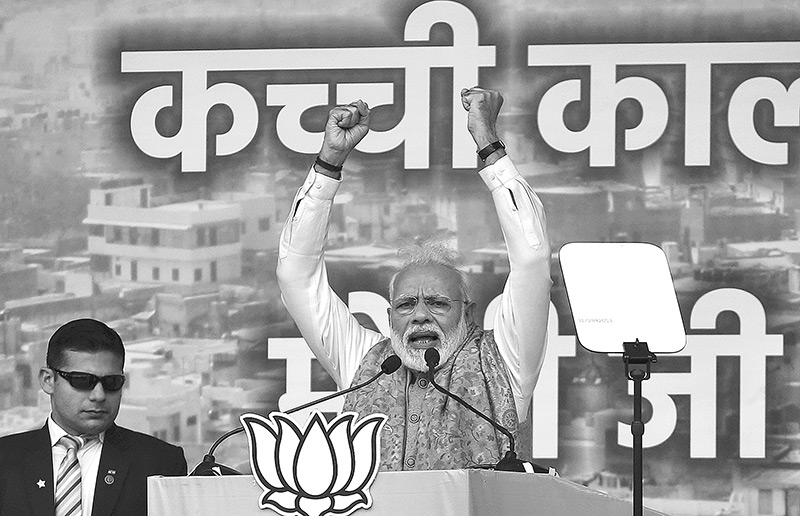
Rajopadhyaya, who was working in digital marketing management in an IT company was getting paid more than Rs30,000 with everything seemingly going well for him, yet he was neither satisfied nor happy.
“If you are not satisfied with the job, no matter how much you get paid, it does not count,” said Rajopadhyaya. “Initially, the only motivation was money. Later, I started feeling that if I do not start off on my own now, it will be too late.”  
That thought changed him to become an entrepreneur.   
Though Rajopadhyaya now has to think five times before spending Rs4,000 outside his business, he is happy with what he is doing. “When you start doing your business, you think twice before spending on any of the miscellaneous things.”    
Lokta paper is the first thing that comes in mind when people talk about an eco-friendly paper. But, Sunny Rajopadhyaya came up with the option of producing eco-friendly paper made from elephant dung and recycled paper.
Bean Voyage, a nonprofit organisation in Costa Rica printed their brochure in the paper produced by Ecoorb, while Rajopadhyaya is in discussion with some Chinese companies to supply notebooks. It shows that the products of Ecoorb are being gradually introduced in the international as well as the national markets.  

The concept of making paper made from elephant dung first came to Rajopadhyaya’s mind during his frequent visits to Sauraha in 2016. Though he had heard about papers made from elephant dung, he never thought he will be making a business out of it. “I was not sure it was possible to execute here,” says Rajopadhyaya.
During his visit to Sauraha, he found that elephant dung has become a major problem there. Curious about how people were managing the problem, the locals told him that a few of them were using the dung as a compost fertilizer, while the remainder was going waste.
With an initial investment of about Rs25,000, he gave a start to his idea by making a prototype in Sauraha. “As I did not have equipment at the time, I used a blender and made it manually,” he said.
Rajopadhyaya was in search of funds for his business. He also planned to take part in the incubation programme of Nepal Communitarian, which later funded him with around Rs50,000.
When Rajopadhyaya first started producing paper by using elephant dung, the paper used to look yellow or green sometimes, depending on what the elephant ate. As the paper needs to look white, he used 5 percent recycled paper.  


“There was no other option other than going for lokta paper, so we grabbed the opportunity and people are now approaching us,” he said. Jonej Shakya, joined Rajopadhyaya’s business about five months back. He is also his college friend and invested Rs50,000 in the venture. “I liked the business idea of Sunny, which is eco-friendly, sustainable and creating impact in the business.”
Rajopadhyaya and Shakya today, are not only partners in the business, but also college friends who had worked together at an IT company.
Rajopadhyaya, who is also pursuing his MBA from Kings College, said it takes 4-5 days to process the paper and dung into the usable fibre, which produces 70kg-100 kg of paper.  The processing takes place in Sauraha and then it’s brought to Kathmandu. The cost of lokta paper and elephant dung paper is similar. For printing papers, 20 percent recycled paper is used along with 80 percent elephant dung. “For high-quality paper, we use Argeli fibre as well.”
Ecoorb has been producing 700-1,000 different products and has been making Rs100,000-150,000 on average, monthly, he said.       
For the commercial production, Ecoorb has coordinated with Green Society Nepal where they have the equipment. “As we do not have that level of investment, we collaborated with Green Nepal,” said Rajopadhyaya. Green Society Nepal was producing lokta paper and was not performing well in the market, he added. Ecoorb took over the whole management and started producing. The organisation has already 5-6 women working for it who now are making different products as well.
“The demand for visiting cards is high,” Rajopadhyaya said. Asia Foundation, Vesper Wine, Saporor Japanese Restaurant Natural Earth and Nuga are some of the companies that have purchased products from Ecoorb. He said that people are ordering visiting cards on a trial basis and may place orders for other products. “After being happy with our product, some of them are reaching to subscribe to our other products.”  
Word of mouth has helped him market his products. Besides, Nepal Communitarian has also been supporting him to build a network, Rajopadhyaya said.
Rajopadhyaya and Shakya don’t want to make their products high-end, which is only used for gift-wrapping luxury stuff. “We want it to be a commercial product,” said Rajopadhyaya.
Currently, their product focuses on making visiting cards, notebooks and packaging paper. Both co-founders plan to expand their product range and market in the future. The start-up plans to produce 500kg or 1,000 kg of paper in the future. “We also plan to make toilet paper out of it but it needs a big manufacturing plant,” Rajopadhyaya said.
The company co-founders feel that competing with lokta paper is a major challenge as both are eco-friendly and selling the products is challenging. “To overcome the challenge, we need to supply to the bigger players,” says Rajopadhyaya.
It has been around seven months since their products started arriving in the market. “Till this time, we have not taken any salary from the company. We are reinvesting the income generated from it,” Rajopadhyaya said.
The production of paper is also helping in managing elephant dung in Sauraha, which is one of their biggest problems, Rajopadhyaya said. As well, their eco-friendly products are helping in cutting down dependence
on plastic.