You internet speed is slow. Switch to text view mode

Switch
epaper logo
ST

Last Login:
Logout
+
Page 1
HOME PAGE

Transit Protocol with China to come into effect from February, but there are obstacles

Challenges to trade via Chinese ports relate infrastructure in Nepal and a lack of knowledge about China’s processes.
- ANIL GIRI

KATHMANDU,
Ten months after signing the Protocol on Implementing the Agreement on Transit and Transportation between Nepal and China, Beijing has officially notified Kathmandu that it has completed all domestic legal procedures. This means that the protocol will come into effect from February 1.
Nepal and China signed the transit protocol in Beijing on April 29, during the visit of President Bidya Devi Bhandari. After completing all domestic procedures, Nepal, on August 9, had notified China and had been waiting for a notification from Beijing.
According to officials familiar with developments, China notified the Nepali Embassy in Beijing on December 25. The embassy then forwarded the notification to Kathmandu and acknowledged the same to the Chinese Foreign Ministry on December 31, said officials.
The transit protocol allows Nepal access to seven Chinese sea and land ports for third-country trade. So far, all of Nepal’s third-country trade takes place via India.
“Now the deck is clear for Nepali businesspersons to conduct third-country trade via China,” said Navaraj Dhakal, joint-secretary at the Ministry of Industry and Commerce. “But there are challenges ahead.”
There are major concerns about infrastructure on the Nepali side, the lack of a trained workforce, and a language barrier.
With the protocol coming into effect, the immediate work will be to hold negotiations with shipping liners and importers, who will sort out issues related to shipments. Shipping liners are akin to agents who take the responsibility of importing and exporting goods from the country of origin to the next destination without any damage or tampering.
Nepali importers could face issues regarding the mode of transportation, cost, timing, non-tariff barriers, administrative hassles, and proper documentation, said former and sitting Nepali officials.
“We do not know how much time it will take for businesses to start importing goods from the nearest Chinese seaports,” said Dhakal. “We also do not know the cost of consignments from Chinese seaports to Nepal.”
The nearest Chinese port is Tianjin, which is 4,000 kilometres from the Nepal border—four times the distance between Birgunj and Kolkata in India.
“We will help freight forwarders initiate the process of importing goods via Chinese seaports. Once we begin the process, then we will know the challenges and how they can be mitigated,” said Dhakal.

The condition of roads on the Nepali side will be a major obstacle, said officials. To ensure an early start to third-country trade via Chinese ports, Nepal must work on a war footing to upgrade roads and highways and install other necessary infrastructures like customs, quarantine, and digitise all facilities at the border, and construct dry ports.
“Roads on the Chinese side are good, but we have poor infrastructure. We are already facing a lot of hassles on our side while importing goods from China,” said Prakash Karki, president of Nepal Freight Forwarders Association. “Unless such bottlenecks are cleared, it is going to take a long time for Nepali businesses to use Chinese ports.”
According to Karki, language can be yet another issue while dealing with the Chinese. “We are habituated to importing goods via India, where the language is not a problem,” Karki told the Post. “But since we have never imported goods from China, we don’t exactly know what the advantages or disadvantages will be.”
Despite being a friendly neighbour to the north with over six decades of diplomatic relations, Nepal only started looking to China for the possibility of third-country trade after the Indian border blockade of 2015.
During his visit to Beijing in 2016, Prime Minister KP Sharma Oli signed the Transit and Transportation Agreement aiming to break Nepal’s complete dependence on India for third-country trade.
But it took almost three years to sign the protocol for the agreement, without which Nepal could not access Chinese sea and land ports.
The signing of the protocol meant Nepal could use four Chinese seaports—in Tianjin, Shenzhen, Lianyungang and Zhanjiang—and three land ports—in Lanzhou, Lhasa and Shigatse—for third-country import. It will also allow Nepal to carry out exports through six dedicated transit points between Nepal and China.
But progress since the protocol signing has also been sluggish, with months between Kathmandu and Beijing’s notifications regarding domestic readiness.
Nepal imports goods from China through the Tatopani and Rasuwa crossings, but the trade volume via Tatopani has sharply reduced due to several bottlenecks, according to an official who oversees cross-border business matters at the Ministry of Industry and Commerce.
“The Rasuwa-Kathmandu road is not in very good shape and it frequently sees landslides,” the official, who spoke on condition of anonymity, told the Post. “There has been no progress in the opening of more routes through Humla, Mugu, Dolpa, Mustang, Dolakha, Sankhuwasabha and Taplejung.” According to the official, until more routes are opened and infrastructure is built on the Nepali side, Nepal won’t be able to make the most of the transit protocol.
Rabi Sainju, a former joint-secretary who initiated the protocol talks with China, said it will be difficult to identify challenges on the ground until Nepali private sector starts importing goods.
“Due to long distances, the costs will certainly be high. However, the time spent on bringing the goods to Nepal will be shorter,” said Sainju.
According to Sainju, it takes around two to three months to import goods from Japan or South Korea to Nepal via Indian sea routes.
“Similar consignments via Chinese ports could arrive in Nepal in about three weeks,” said Sainju. “This can be an advantage.”
But officials said that the Nepali side does not know much about the Chinese railway system.
“That’s why I am saying we need to bring some consignments via China to understand the pros and cons,” said Sainju.
Dhakal, however, said the government is all set to implement the protocol and that private businesses should be prepared to start conducting third-country trade via Chinese ports.
“If problems surface, the government will help,” said Dhakal.
HOME PAGE

As the government pushes ahead with IT Bill, rights watchdog expresses concern

The bill in its current form infringes on the fundamental freedom of expression, says the National Human Rights Commission.
- BINOD GHIMIRE

KATHMANDU,
National Human Rights Commission has expressed concern over the decision of a parliamentary committee to approve the Information Technology Bill on the grounds that the legislation could curtail the freedom of expression and allow state agencies to surveil personal data.
The controversial bill was registered in the federal parliament in February last year but was not moved ahead following widespread criticism. It was pending at the parliamentary Development and Information Committee for over six months as parties were unable to reach an agreement on the bill. However, on Sunday, the committee approved the bill with a majority vote, which now will be presented to the House for endorsement.
In a statement on Wednesday, the constitutional rights commission reminded the government about Article 19 of the Universal Declarations of Human Rights, which says everyone has the right to freedom of opinion and expression through any media.
“It [freedom of expression] is also a fundamental right enshrined in the constitution,” Bed Bhattarai, secretary at the commission, stated. “Placing a barrier to enjoying fundamental rights under any pretext is against the spirit of human rights.”
The commission has asked the government to hold proper consultations with concerned parties before formulating any laws that could have a direct impact on the people.
The Information Technology Bill proposes a hefty fine up to Rs 1.5 million, along with a jail term of a maximum of five years, for digital content that harasses, bullies or defames others. The bill even authorises government entities to block social media platforms if they are not registered in Nepal.

Authorising all three tiers of governments to direct Internet Service Providers to withdraw “improper” online content, without requiring permissions from the court, is against individuals’ freedom of speech, say human rights activists.
“The IT bill shouldn’t be endorsed in its present form. It must be revised before the full House endorses it,” Charan Prasain, a human rights activist, told the Post.
“The government must refrain from presenting laws that are targeted at curtailing the rights of individuals.”
The primary opposition Nepali Congress has also opposed the bill and demanded that the government revise its “regressive” provisions. Issuing a statement on Wednesday, party chief whip Bal Krishna Khand said that various clauses in the bill constrain the fundamental freedom of expression.
“We urge all the concerned parties to stand against the bill as it will have dire long-term consequences,” Khand said in the statement.
The Congress party, along with activists, has pointed to a number of laws drafted by the KP Sharma Oli administration that are targeted at curtailing fundamental rights. Despite criticism from various quarters, the government last year came up with the Media Council Bill, which authorises the eponymous media council to slap hefty fines on the press. The bill gives the government a free hand in hiring and firing council members and also proposes sweeping powers for the self-regulatory body.
The government on Monday registered a Special Service Bill, which authorises the country’s intelligence agencies to intercept telephonic and digital conversations between individuals. This legislation too has been widely decried for invading the right to privacy of citizens.

HOME PAGE

For students with disabilities, there are few places to turn to for an education

Few institutions have complied with the rule for all schools to be disabled-friendly.
- SHUVAM DHUNGANA
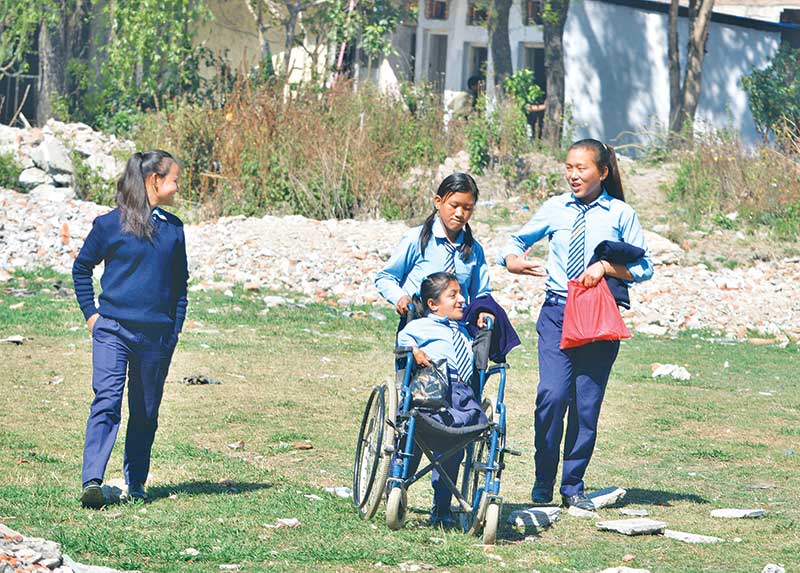
Students at the Khagendra Nawajiwan Special Education Secondary School in Jorpati, Kathmandu help their classmate with her wheelchair. Post file Photo

KATHMANDU,
Prakash Basnet of Solukhumbu was one of the thousands of young people who came to Kathmandu four years ago for their studies. But Basnet, who is now 19, had very different reasons for choosing Kathmandu.
At the age of 15, he lost the use of his legs after falling off a tree and since his school was not disabled-friendly, he came to the capital city, where he was certain there would be schools for people like him.
“But neither the schools nor the roads are disabled-friendly here,” Basnet told the Post earlier this week at his hostel in Jorpati.
For the thousands of young people living with disabilities, finding a school to study in can be a difficult task. While there are dedicated schools for the hearing and visually impaired, most schools around the country don’t have basic infrastructure like ramps to aid the physically disabled.
Although the 2013 Accessible Physical Structure and Communication Service Directive for People with Disabilities, endorsed by the government in 2013, mandates steps to be taken to ensure that people with disabilities have access to equal opportunities and higher education, not many have implemented it. In a 2018 randomised trial of various schools in the Valley, the National Federation of the Disabled found that none of the 22 educational institutions surveyed was disabled-friendly.
“Visually challenged and those with hearing and speech impairments prefer to go to institutions that are exclusively for persons like them,” said Sudarshan Subedi, former president of the National Federation of Disabled Nepal. “However, such schools are only for secondary education and are very few in number. There are no colleges for the disabled.”

The lack of infrastructure that facilitates access for the physically challenged—ramps, railings, and accessible washrooms—is just one of the reasons preventing them from pursuing their studies.
“The majority of persons who are confined to wheelchairs do not want to go to colleges because the infrastructure is not suited to their condition,” said Subedi.
Jharna Ghimire of Gulmi dropped out of college after an accident left her paralysed from the waist down, forcing her into a wheelchair.
“I never went to college as the campus was not disabled-friendly,” Ghimire told the Post. “It’s not just college, even public buses do not stop for us and we cannot use expensive taxis every day to go to college.”
According to the 2011 census, 1.94 percent of the total population is living with some form of disability, with as many as 23,549 people in Kathmandu Valley alone.
The World Health Organization estimates that Nepal has 60,000 to 180,000 children aged 5 to 14 with disabilities. UNICEF, in 2016, found that 30.6 percent of children with disabilities, or approximately 15,000 to 56,000 children, aged 5 to 12, did not attend school.
“Very few mainstream public schools enrol children with disabilities. Out of over 30,000 schools in Nepal, just 380 are said to have resource classes where children with a particular disability are grouped with others with a similar disability,” said Human Rights Watch in its 2011 report.
It is also estimated that after the earthquakes of 2015, the number of persons living with disabilities has increased.
“There was a big opportunity for the government to make infrastructure accessible for the disabled during reconstruction drive after the massive earthquakes of 2015 but the government missed it,” said Subedi.
However, Dipak Sharma, spokesperson for the Ministry of Education, said that all new infrastructures have been built to be disabled-friendly.
“There is a problem as many of the schools were built years ago and it’s almost impossible to destroy them for reconstruction,” said Sharma. “However, newly constructed schools are accessible, according to law. Although we have not been able to meet the expectations of people regarding accessible infrastructure for disabled students in every school, we are working on it.”
Tikaram Puri, president of the Private and Boarding Schools Organisation, agrees that both private and public schools lack disabled-friendly infrastructure.
“There is a law that every school needs to be accessible, but it takes time to make such big changes,” said Puri. “All schools should take the initiative to build disabled-friendly infrastructure. Our organisation is trying its best to create such an environment for students. But it will take time.”

Page 2
MEDLEY

Horoscope

ARIES (March 21-April 19)
**
Someone’s opportunistic tendencies are sometimes helpful for you and sometimes a hindrance. Be careful not to always be standing behind them, ready to grab on to their coattails. If you get too out of practice when it comes to making your own opportunities, you won’t be able to be as independent as you might need to be in the near future.


TAURUS (April 20-May 20)
****
This is it, the chance you’ve been waiting for! Don’t you recognize it? What? You don’t? Okay, then in order to see what you need to see, you have to open your eyes. This means breaking out of your current routine and looking at life through fresh eyes.


GEMINI (May 21-June 21)
***
Finding a balance between what you want to do and what you can afford to do won’t be very hard at all, starting today. You will either be released from an unwanted and expensive commitment, or you are going to discover a new way to adjust your lifestyle. It’s all about taking advantage of opportunity when it arrives.


CANCER (June 22-July 22)
**
The advice you dole out today will have more impact than you intend it to have. Unfortunately, there is a strong tendency for words to be misinterpreted today, so be gentle. People who ask your opinion could get defensive. You can’t be responsible for the way other people react, but you can make an effort to play it safe.


LEO (July 23-August 22)
**
The biggest problem with power struggles isn’t that you might lose your grip. The biggest problem is that while you’re busy fighting for all the control you want, you are losing focus on the most important things around you. Personal relationships should be your top priority, and that may mean forgoing ego battles for harmony.


VIRGO (August 23-September 22)
***
There is one simple rule in life that never, ever changes: Hard work pays off. Sure, it might not always seem like it, especially when you notice some undeserving people getting something for nothing today. But even if you don’t get an immediate payoff, you will get something valuable in the long run.


LIBRA (September 23-October 22)
***
Juxtapositions will grab your attention and start you thinking today. Pay attention to unusual combinations, unexpected directions, and any odd behavior that you run across. Point out these aberrations to the people you’re with. Together, you can appreciate the remarkable situation.


SCORPIO (October 23-November 21)
**
Just like at any busy intersection, many various paths in your life are joining together today. Initially, it might feel like way too many things are coming to a head at once. But don’t worry, and whatever you do, don’t panic! This is nothing major, so don’t let it ruffle your feathers.


SAGITTARIUS (November 22-December 21)
***
As usual today, your ability to roll with the punches is going to save you a lot of grief. While others run around like chickens with their heads cut off, you will be able to stay cool. You know how to let go of worrying about what other people think about you and try to let go of expectations you’ve put upon yourself.


CAPRICORN (December 22-January 19)
***
Interesting and positive energy will be circling all around you today, and these good vibes will put you in a good frame of mind to deal with some surprising news from a friend. If your reaction is negative, resist the urge to sound the alarm right away. Respect the choices they are making, and see how things proceed.


AQUARIUS (January 20-February 18)
***
If you need to say something to someone that you fear might generate a negative reaction, your best bet is to just hurry up and get it over with! Skip the subliminal stuff. Hinting around about your true meaning won’t do you any good, and it could send the message that you are up to something.


PISCES (February 19-March 20)
**
Are you being watched? If you feel like you’re being evaluated by a co-worker, boss, or even a potential love interest today, why not turn the tables? Do your own evaluation on whomever you feel is evaluating you. It’s time to forget what other people think about what you do, and focus more on what you think about them.

Page 3
NATIONAL

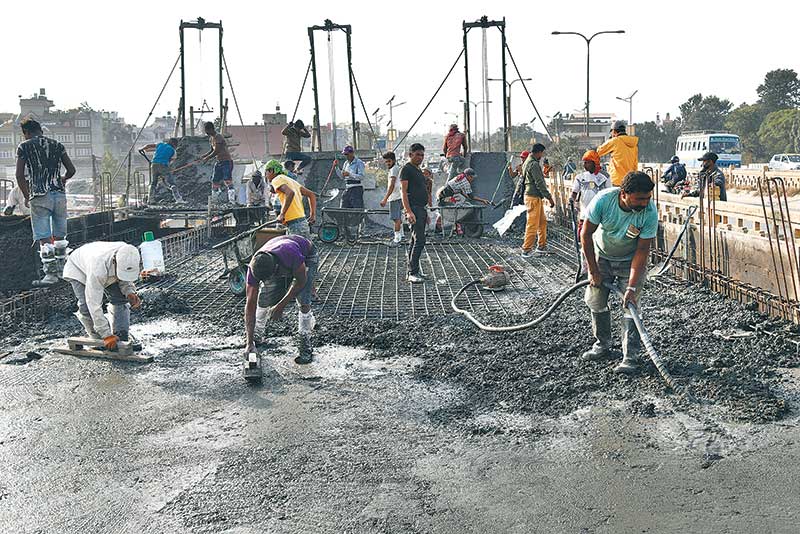
Contractors can get extensions on delayed projects, but they cannot participate in new bids

Newly-amended Public Procurement Regulation has set the new rule for builders.
- PRITHVI MAN SHRESTHA
Works in some projects have remained very slow, contractors say, demanding more time to complete them. Post Photo

KATHMANDU,
The newly-amended Public Procurement Regulation has barred contractors who are responsible for delays in their works from participating in the new government bids until they complete the existing contracts.
“If a contractor or supplier or service provider is responsible for non-completion of projects on time and the contract deadlines need to be extended, they cannot participate in any new government bids until the remaining works are completed within the extended deadline,” says the amended regulation.
The federal government amended the Public Procurement Regulation for the fourth time in seven months through the Cabinet meeting on December 23, opening the door for the extension of sick contracts, irrespective of who is responsible—government agencies or contractors—for their delay. It is the ninth amendment to the regulation after the sixth amendment was made on May 13.
Public contractors are in agreement with the new provision.
“If a contractor does not complete the project at hand, why should it be given additional contracts?”
asked Rabi Singh, president of the Federation of Contractors’ Association of Nepal. “We have taken this provision positively because this provision would encourage unruly contractors to complete the outstanding works at the earliest to get new contracts.”
According to the federation, there are around 2,200 sick projects, most of them as a result of insufficient budget, delay in site clearances by the government authorities and, in some cases, unruly contractors.
“The tradition of minister and lawmakers forcing the government to incorporate certain projects without a proper study and plan and the lack of budget resulted in the delay of some projects,” said Singh.  
The sixth amendment to the regulation has, however, barred the government agencies from calling for tenders without ensuring the budget and site clearance.
The newly amended regulation has also allowed contracts to be extended a second time if the works could not be completed due to reasonable, unavoidable factors without creating any additional financial burden for the government.
Public contractors say the works in some projects have remained very slow and they would need more than a year’s time to complete them.
The newly-amended regulation has also stated that contractors should deploy unemployed youths listed with the Employment Service Centre to complete the projects. In order to implement the Prime Minister Employment Programme, the government has created a service centre to register unemployed people aged between 18 and 59 years.
Singh said that they were ready to abide by the government’s plan. “We mostly use local people for the works,” he said.

NATIONAL

Migrant workers can now seek and apply for foreign jobs online

A new module introduced by the government for the selection of migrant workers now allows them to apply for jobs online without having to approach sub-agents or recruitment agencies.
- CHANDAN KUMAR MANDAL
Officials claim the new selection module will greatly cut down the illegal activities in the foreign employment sector. Post file Photo

KATHMANDU,
In a significant move aimed to protect Nepali migrant workers from possible exploitation, the government has introduced an online application system that will regulate the hiring of workers.
Beginning Wednesday, the attestation of the workers’ demand letters to the issuance of final permit before departure will be conducted online. The government’s move is aimed at providing easy service to workers and making the sector more transparent.
The Department of Foreign Employment started the system which allows aspiring migrant workers to seek job opportunities of their choice in foreign countries and then apply as per their preferences, without reaching out to the recruiting agencies immediately.
According to Bhisma Kumar Bhusal, director general at the department, any job-seeking candidate can look for the job they prefer and also apply for the job online without even having to meet sub-agents or recruiting agencies.
“This is the beginning of a completely new workers’ selection module for foreign employment,” said Bhusal. “Now, workers do not have to necessarily approach any agents or recruiting agencies for overseas jobs as those jobs will be listed on a public domain. Anyone can begin a job search and apply for available jobs. This will greatly cut down the illegal activities in the foreign employment sector. ”
The new module of workers selection will begin with Nepali foreign missions approving the first round of workers’ demand, commonly known as pre-approval of workers’ demand letters.
As per the existing rules, the foreign employers get their demand for Nepali workers approved first by the Nepali missions abroad—a requirement that was made mandatory through a government directive last year.
The online attestation of pre-permission of workers demand takes place via Foreign Employment Information Management System, an integrated online platform where all the major stakeholders are connected.
The department recently made the arrangement which allows attestation of pre-approval demand letters online, for making it hassle-free for both employers and recruiting agencies. After the pre-approval of workers’ demand letters are done, these jobs will be posted online where a worker can search and also apply for the job.
The job vacancies available online will have detailed information on the nature of work, working hours, perks and benefits, besides the information on recruiting agencies hiring the workers.   
“By putting in minimum personal details, the worker can apply for jobs online, which will be available on the department’s website,” said Bhusal. “All the jobs approved for the hiring of Nepali workers will be made available online. Workers can look for their category of jobs, based on their preference and qualification.”
The new system provides workers with the freedom to apply to several jobs at various recruiting agencies, which are hiring workers for foreign companies. As all the jobs will be online, the workers can browse by typing in the labour destination country and the sector for which there are job vacancies.
While the workers can apply for jobs online from anywhere, for the first time, they will not have to give their passports to the recruiting agencies and their sub-agents—a common practice.
There have been frequent incidents where recruiting agencies have been found extorting migrant workers by confiscating their passports and deliberately keeping them out from the job selection process.
After posting the jobs online, recruiting agencies will be given 15 days for workers’  selection process. Once the selected workers’ list is out, the recruiting agencies will call them for an interview.  The list can be seen by all and those recruiting agencies cannot remove chosen workers from the list.
“If one wishes not to go on the earlier applied jobs then, they can take back their name and it’s only the department that can remove their name from the list,” said Bhusal. “Only the department can remove the applicant’s name who has been through the selection process, for valid reasons.”
The recruiting agencies will publish a list of selected candidates and those on the waiting list—which cannot be higher than 25 percent of the total demand. These workers will be called for an interview on a pre-scheduled date, according to Bhusal.
Only after they have been selected after the online application process and interview, will the pre-departure process be carried out by the recruiting agencies.
“When they are selected, they can also apply online for the final labour permit, for departure,” said Bhusal.

NATIONAL

Police arrest six persons for allegedly making fake smart driving licences

Fake licences are mostly used by people who fail the licence test or those who want to go abroad, Metropolitan Traffic Police Division says.
- SHUVAM DHUNGANA
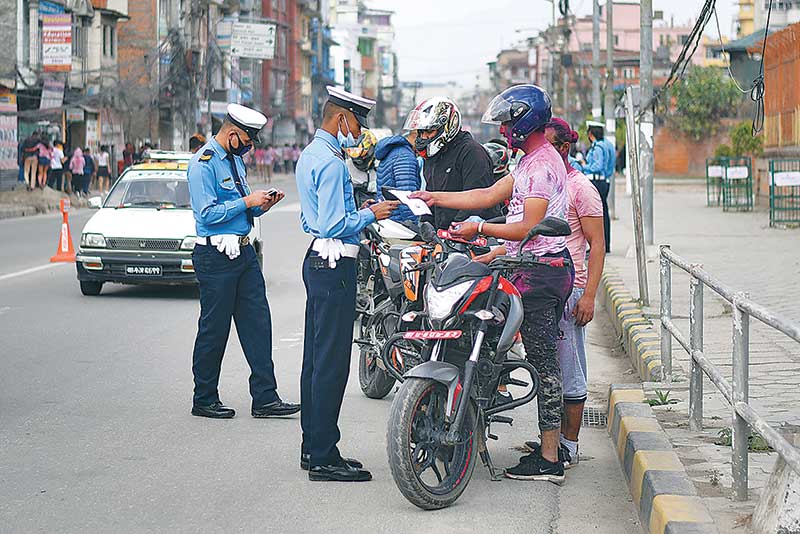
Traffic police check licences of motorcycle riders in Kathmandu. Post file Photo

Kathmandu,
On Tuesday morning, traffic police found a suspicious licence on a person during a routine check in Putalisadak, Kathmandu. To confirm the licence’s validity, it was taken to the nearby traffic police office where it was found that the licence was indeed fake.
Soon, police arrested the fake licence owner, Dipak Blon, who hails from Sarlahi district. He was handed over to the Metropolitan Crime Division, Teku, for investigation.
Based on Blon’s statement, police also arrested five others--Kumar Tandukar of Lazimpat, Kathmandu; Mohan Yadav of Siraha; Ananta Gurung of Chuchepati, Kathmandu; Buddhi Bahadur Rokka of Kuleshwor, Kathmandu; and Ashok Karki of Bara--for forging driver’s licences.
“Upon interrogation, it was revealed that Blon had obtained the licence from Photo Concern, one of the oldest photo studios based in New Road,” said Senior Superintendent of Police Sahakul Thapa, chief at the Metropolitan Crime Division.
“We have arrested four staff members of the studio, one fake driving licence user, and one person from another studio. However, the owner and CEO of Photo Concern are yet to be arrested as they are not in the country at present,” said Thapa.
Police also confiscated cards, printers, and computers from the studio. “They were found charging Rs30,000 from people for making fake licences,” he added.
According to the Metropolitan Traffic Police Division, fake licences are mostly used by people who fail the licence test or those who want to go abroad since obtaining an original driving licence is full of hassles and a person may have to wait for up to a year to get one.
According to the Department of Transport Management, which prints driving licences, there are more than 600,000 applicants waiting for smart driving licences and they are receiving applications from around 7,000 new applicants every day.
Altogether, around 1.6 million people have applied for smart licences. However, the department has only been able to issue around 900,000 licences so far.
“Fake licences are not used much in the Valley, because they are easily detectable. We can easily trace the licence’s originality by seeing it and we can also confirm the licence’s validity by checking the licence number in our database,” said Senior Superintendent of Police, Bhim Dhakal, chief at Metropolitan Traffic Police Division.
“Preliminary investigation has revealed that Blon contacted Budhi Bahadur Rokka, owner of Ashish studio, to make a fake driving licence. Rokka used to design the licence in his own studio and then used to print it in Concern studio,” said Superintendent of Police at Metropolitan Crime Division, Ridhaya Thapa. “We have confiscated four licences, citizenships certificates of different people and Aadhar card of India from Ashish Studio while we seized printers, smart licence, college identity cards and one police identity card from Concern studio.”

Page 4
NATIONAL

Nepal sill has a long way to go to lower infant and maternal deaths

According to the Department of Health Services, 2,036 newborn babies and 208 mothers died in the fiscal year 2018-19.
- Arjun Poudel
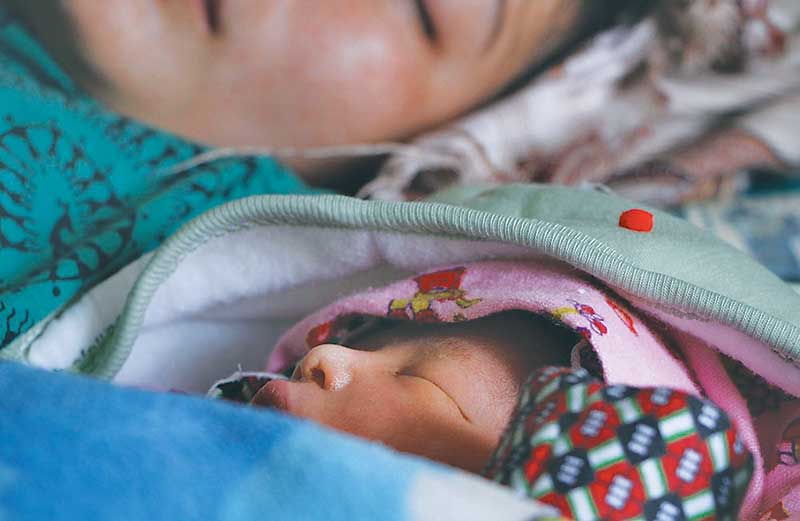
Hypothermia, infection, low birth weight, premature birth, abnormal birth asphyxia are among the leading causes of neonatal deaths. Post file Photo

KATHMANDU,
Two thousand and thirty-six newborn babies and 208 new mothers died due to childbirth-related complications in state-run health facilities across the country in the last fiscal year 2018-19.
Although the government has launched several programmes to reduce infant and maternal deaths
in the country, newborn babies and mothers continue to die in big numbers.
Dr Jhalak Sharma, chief of the immunisation section of Family Welfare Division at the Department of Health Services, said most cases of child mortality in the country are neonatal deaths.
Hypothermia, infection, low birth weight, premature birth, abnormal birth asphyxia are among the leading causes of neonatal deaths.
The section has been running programmes on newborn care, kangaroo care, exclusive breastfeeding, infection prevention, chlorhexidine for umbilical cord care and free neonatal care, among others, to lower child mortality.
“We have launched several programmes to curb neonatal deaths, but to little effect,” Sharma told the Post.
According to the data provided by the Health Management Information System (HMIS) under the Department of Health Services, Province 1 witnessed the highest number of infant deaths in the fiscal year 2018-19. The state-run health facilities in the province recorded 675 newborn deaths, and 301 of them were in Bhojpur district.
Province 5 had the second-highest infant death numbers at 415, followed by Sudurpaschim Province (316), Province 3 (251), Karnali Province (152), Province 2 (117) and Gandaki Province (110).
To bring down the maternal mortality rate, the safe motherhood section of Family Welfare Division at the Department of Health Services has also been running several programmes, including safe delivery services, antenatal care and postnatal care, to curb maternal deaths.
According to the HMIS data, Province 5 witnessed the highest number of maternal deaths at 54. Forty-three new mothers died in various government-run health facilities in Province 3; 42 in Province 1; 29 in Province 2; 17 in Sudurpaschim Province; 13 in Karnali Province; and 10 in Gandaki Province.
What is more alarming is the infant and maternal death numbers could be much higher, as the Health Management Information System has not taken into account the deaths of newborn babies and mothers at homes or outside the health facilities.
“The number of deaths could be much higher because the babies and new mothers who died at their homes are not included in the Health Management Information System,” Dr Shyam Raj Upreti, a child health expert, told the Post.
Dr Sharma supports Dr Upreti’s suspicion. The data provided by female community health volunteers, who work in the villages, show that the infant and maternal death numbers in the country are much higher than the figures offered by HMIS, Dr Sharma said.
Moreover, health experts say, the HMIS data are not comprehensive because many health facilities in remote areas do not update their data due to the shortage of technical human resources and the lack of internet access.
The National Demographic Health Survey 2016 shows that 21 babies in every 1,000 live birth die within one month.
The survey also shows for every 100,000 births, 229 women die during or after childbirth. Nepal had previously reduced the maternal mortality rate from 539 in 1996 to 239 in 2016—for which the country received the Millennium Development Goal award.

NATIONAL

After crackdown against drink driving, MaPaSe cases have decreased in Kathmandu Valley, police records show

Division office says an awareness programme for 47,000 drivers and riders focusing on anti-drink drive, helped reduce MaPaSe cases
- ANUP OJHA
A driver takes breathalyser test. Post file Photo

KATHMANDU,
Following traffic police’s relentless crackdown against drink driving that started nine years ago, the number of drivers booked for driving under the influence of alcohol has been steadily coming down, a report shows.
A report of the Metropolitan Traffic Police Division shows that over the past decade, the number of people caught for drink driving has come down by 50 percent.    
“This is because more people are now aware of our zero-tolerance against drunk driving,” said Senior Superintendent of Police Bhim Prasad Dhakal, also the chief of the division.   
When the division office enforced the anti-drunk-driving campaign on December 2, 2011, in the first year of the campaign, the traffic police had booked 39,667 people—39,480 males and 187 females. The division’s latest data show that in the past seven months, only 16,809 people—16,631 males and 178 females—were booked for drink driving.
“This year, we will not let the number increase to more than 20,000,” said Senior Superintendent of Police Bhim Prasad Dhakal, who is also the chief of the division.
The highest number of MaPaSe case was in the fiscal year 2013-14, when 54,535 people— 54,160 males and 375  females—were booked.
Dhakal said that in the past six months, the division office had conducted traffic awareness programmes for some 47,000 drivers and riders, focusing on its anti-drink-drive.
“If you look at the last year’s data, 259 people were killed in Kathmandu Valley. And 30 percent of them had consumed alcohol. This year, 76 people have lost their lives in road accidents. Our drive has become massively successful,” he added. Traffic police say, driving or riding under the influence of alcohol is one of the main reasons for road accidents.
In mid-December, Leela Devkota, 38, was killed on the spot when Prithvi Malla,21, who was drunk, knocked her down while she was returning from a temple in Budhanilkantha.
“Every night, the division office deploys its officials in 42 spots of the Valley to check drink drivers.
Those given tickets for driving under the influence of alcohol need to pay Rs 1,000 and have to compulsorily attend a one-hour class regarding traffic rules and regulations.
Over the past nine years, the division has issued tickets to 322,023 people for drink driving, the data show.

Page 5
NATIONAL

I/NGOs want clarity concerning temporary staff in government’s social security programme

The council says the enrolment numbers will grow after all outstanding concerns are addressed.
- PRITHVI MAN SHRESTHA
Post file Photo

KATHMANDU,
Women Skill Creation Centre, a Hetauda-based non-governmental organisation, has registered itself at the Social Security Fund to participate in the government’s social security programme.
The centre, however, has not enrolled its employees under the scheme due to confusion regarding how its employees could get a long-term benefit when their jobs are temporary. This centre is running various projects in the areas of women empowerment, human trafficking, strengthening of judicial committees at local levels and climate change, among others.
Nibhas Gajurel, the finance chief of the centre, said the employees have not been enrolled because it is
unclear how they could benefit from the programme since they would be jobless after the project period is over. “Our board will take necessary decisions about enrolling employees,” he said.
Although the government received a lukewarm response to its social security scheme from the private sector enterprises, domestic and international non-governmental organisations have committed to enrolling their staff under the programme.
There are four types of schemes under the programme—treatment, health and maternal security plan; accident and disability security plan; dependent family security plan; and elderly security plan.
Representatives of international and domestic international non-governmental organisations recently submitted a commitment paper to the Social Welfare Council, saying that they will enrol their staff under the scheme.
“After holding a meeting with the Association of International NGOs in Nepal, we have jointly submitted the commitment paper to the council,” said Jitram Tharu, president of the NGO Federation Nepal, a grouping of local NGOs. “We have decided to enrol employees associated with existing projects based on the understanding reached with donors and make the provision of social security for employees in new projects to be rolled out in the future.”
According to the Association of International NGOs, most of its members have registered with the Social Security Fund. “About 80 percent of the association members have enrolled their employees under the government’s programme,”  said Achyut Luitel, president of the association. “But we have not deposited the funds yet due to several confusions regarding the scheme.”
There are a number of issues on which I/NGOs want clarity, including how to ensure facilities for their employees because of the temporary nature of their jobs and how a married couple could benefit if both are employed at the same organisation.
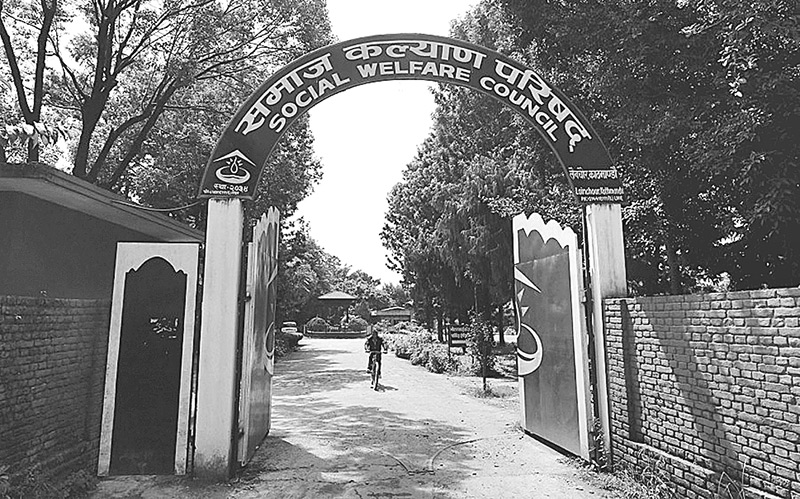
According to the office of Social Security Fund, only 582 NGOs and INGOs have registered as of last week. It is too small compared to the total number of NGOs and INGOs affiliated with Social Welfare Council, a regulatory body of the NGO sector.
As of the last fiscal year 2018-19, there are 50,358 NGOs affiliated with the Council while the number of INGOs affiliated with the council stood at 245. Association of International INGOs has 135 members.
But, Lama said that the number of NGOs enrolling in the programme would grow once the government clarifies on some of the concerns raised by the NGO sector.  “We have already appealed the NGOs and INGOs to enrol in the system,” he said. Lama expects around 2,000 NGOs, who receive foreign funding, will participate in the programme.
The council last week appealed to the local NGOs to participate in the scheme, saying that the Social Security Act, its regulation and working procedure have made provisions for enrolling the employers, employees and self-employed people.
“As per the request of the government, we have appealed to the NGOs,” said Shiva Kumar Basnet, a spokesperson at the council.
The contribution-based Social Security Scheme is one of the most ambitious programmes of the KP Sharma Oli administration. The programme was rolled out in November last year, aiming to protect and secure private-sector employees whose safety and welfare has long been a cause for concern.
The government aims to serve nearly 3.5 million people in the national campaign to ensure the social security of private-sector workers with a comprehensive welfare package. But, the response to the welfare fund so far has not been encouraging.
As of last week, 11,928 enterprises had registered with the Social Security Fund.
There are 922,445 economic establishments (firms related to agriculture, trading and industrial and services, and various other institutions) as of April 14, 2018 that engage more than 3 million people, according to the National Economic Census conducted by the Central Bureau of Statistics.

NATIONAL

Conservationists worry as water scarcity inside Parsa National Park worsens

- SHANKAR ACHARYA
A tanker fills water in an artificial pond built inside Parsa National Park. Post Photo: SHANKAR ACHARYA

PARSA,
Water shortage inside Parsa National Park has conservationists worried about the future of the protected wildlife, including endangered Bengal tigers and one-horned rhinoceroses.
There are about a dozen streams and 15 ponds inside the park. But most of them dry up during the dry season, between September to April.
Ashok Ram, the park’s acting conservation officer, said the park authority built around 60 artificial ponds to address the problem of water shortage in two years, but to little effect.
The park authority does not have the means to fill all the ponds with water throughout the dry season.
“We fill some of these ponds once every week using water tankers, but this solution is not practically viable,” said Ram. “Bringing in tankers every week inside the park disturbs the wildlife as well as degrades their
habitat.”
As an alternative solution, the park authority is planning to supply water to these ponds by building a network of pipelines.
The project has, however, hit a snag. After spending Rs 2.5 million on a deep boring system at Adhabhar, the park authority found to their dismay that the area’s underground water system was also dry.  
“There was no sign of water, even 150 metres deep. This is not a good sign,” said Ram.
The park, which covers an area of 627 sq km, is spread in three districts of Parsa, Bara and Makwanpur. It has only three natural lakes —Halkhoriya, Lauki and Kamini. The most abundant water inside the park is available in the Rambhauribhatha area, where most wildlife are found.
“If the problem of water scarcity is not immediately resolved, there is a high chance of animals straying into human settlements. We fear a rise in human-wildlife incidents and depredation of crops and properties,” said Ram. Parsa National Park is home to 37 species of mammals, 490 bird species, 31 species of butterflies and 13 species of reptiles.

NATIONAL

Child marriages are still rife in Dang villages

- DURGALAL KC
Women and girls take part in a discussion on child marriage prevention at a village in Dang district. Post Photo: DURGALAL KC

DANG,
A year ago, two teenage couples from Tulsipur Secondary School in Shantinagar Rural Municipality got married.
Gobinda Bahadur Gharti, the school’s principal, said he tried various methods to stop them, but to no avail.
“They got married anyway. One of the couples has already had a baby, and the new mother has dropped out of school,” he said.
In another incident, a few months ago, a female student from the same school eloped with a man from Kohalpur. Gharti said he immediately informed the police but they took no action.
“Nobody is dedicated enough to stop the practice of child marriage,” Gharti said. “The parents too do little. Children who are about to get married or have already gotten married need psychological counselling, but no one has paid any attention to such measures.”
Child marriage is widespread in Dang. Chief of the rural municipality, Kaman Singh Dangi, said 33 percent of the marriages in his rural municipality involve underage couples.
“We are launching various campaigns to stop this practice,” Dangi said.
In Shantinagar Rural Municipality, over 20 percent of couples who get married as children give birth before 20 years of age, according to Hari Pun, the health department chief at the rural municipality. “There are incidents where women as young as 14 have given birth,” KC said. “As a result, many of them suffer from uterus-related diseases.”
Khim Bahadur Basnet, chair of the Children’s’ Network in Shantinagar-3, said in a short span of time, he has noted four child marriages in the area. He tried to keep them from happening but couldn’t, he said. “I called a number of students and rallied up to the house where the marriages were taking place, but nobody was there to support us,” he said. “We called the ward chair, but he didn’t come. The police didn’t come either. We haven’t gotten the support from the authorities, leaders and police.”
Pima Dangi, a ninth grader from Madhapur Secondary School, said that many of her friends get married early because of poverty and family pressure. “Even those who are well-educated about the harms of child marriage and  associated with children’s clubs are also getting married,” she said.
Child marriage is continuing unabated in the district because the parents are not keeping track of what their children are up to, according to Neelam KC, a member of the women-centric Nigarani Mahila Samuha. “Some parents are negligent, while others are plain illiterate and aloof about the consequences of child marriage,” KC said.
Increasing incidents of child marriage has resulted in an increasing number of divorce cases, according to Mithila Shah, the coordinator of the judicial committee of the rural municipality. “We frequently receive cases where the couple wants to divorce after a year or two in the marriage,” she said. “We counsel them and try to reconcile them.”
Assistant Sub-inspector Bharat Nath Yogi, chief of the Chiraghat police station, said that the police haven’t been able to control child marriage despite many efforts because the parents themselves don’t put in any effort. “The parents are more concerned about marrying their children than giving them a good education,” he said. “It’s difficult to pursue legal procedure when that becomes the case.”

NATIONAL

Unidentified groups torch Ncell towers

- Post Report

DHADING, 
Unidentified groups set on fire communication towers of Ncell, a private sector telecom company,  at different parts of the country on Tuesday night and Wednesday morning.
The incidents caused disruption of mobile phone service, affecting thousands of Ncell users.
In Dhading, an Ncell tower in Jurethum, Thakre was torched on Wednesday morning.
According to the District Police Office, radio set, generator, and other equipment were destroyed in the arson. Superintendent of Police Rabindra Regmi said a team of five police personnel from the Area Police Office in Khanikhola had been sent to the incident site for investigation.
“Some leaflets, stating that Ncell has swindled Nepali people and evaded billions of tax, were also found in the incident site,” he said.
In Chitwan, an improvised explosive device exploded at a Ncell tower in Shaktikhor on Tuesday.
In Rautahat, an unidentified group torched a Ncell tower at Gajura Municipality Ward No. 8 on Tuesday night, police said.  No group has taken responsibility for the arson yet. Deputy Superintendent of Police Kabit Katwal said that they were investigating into the incident. The Ncell mobile service has been disrupted after the incident.
A few days ago, an unidentified group had also tried to torch an Ncell tower in Baijanathpur.
In Bara, an Ncell tower near the Armed Police Force office in Piluwa, Jitpur Simara Sub-metropolitan City was torched on Tuesday night.
Around 80 percent of the tower was damaged in the fire, Haridev Kharel, a local, said. “We had seen fire in the tower at 10:15pm.”
Superintendent of Police Bikashraj Khanal said they were searching for the arsonists and had launched an investigation into the incident.
(With inputs from our local correspondents.)

NATIONAL

Blacktopping begins on Sindhuwa road

Briefing

TEHRATHUM: The Physical Infrastructure Development Office has started blacktopping 16-km Sindhuwa-Shukrabare-Okhre road stretch which connects Dhankuta with Myanglung Bazaar. According to the District Technical Office, a contract amounting to Rs745.6 million has been awarded for the purpose.

NATIONAL

Bridge collapse in Simkot hinders people’s movement

Briefing

HUMLA: People in Simkot Rural Municipality have been affected after a wooden bridge across Heldum stream collapsed last week. The bridge was built around five years ago. The collapse of the bridge has disconnected several settlements in Thehe, Dojam, Takla, Bamta and Kumling with Simkot.

NATIONAL

Shortage of essential drugs hits Mugu health centre

Briefing

MUGU: Patients are facing difficulties due to the shortage of emergency medicines at Ratapani Primary Health centre in Khatyad Rural Municipality for a long time. As a result, doctors at the centre have been compelled to send patients to private clinics. Ratapani is around two-day walk from the district headquarters.

NATIONAL

CM Raut directs upgradation of Janakpur Provincial Hospital

Briefing

JANAKPUR:  Province 2 Chief Minister Lalbabu Raut has directed the Janakpur Provincial Hospital administration to develop it as a model hospital. During an inspection visit to the hospital on Wednesday, Raut asked the hospital administration to make necessary changes at the health facility and prepare a working guideline to upgrade the hospital.

NATIONAL

District Police Office lacks resources, manpower

Briefing

BAITADI: The District Police Office in Baitadi is struggling to perform its daily services due to lack of resources and manpower. There are 33 police units under the District Police Office. Most of them lack infrastructure, said Deputy Superintendent Dilli Narayan Pandeya. “Although there is a provision for 475 policemen in the district,  there are only 340,” he said.

Page 6
EDITORIAL

Stop the sugar scam

The sugar cartel has been duping everyone, from the poor farmers to the country’s prime minister.

In a case of good governance being compromised due to local-level corruption, sugarcane farmers from Sarlahi, hundreds of them, have been forced to come to Kathmandu to ask the federal government help in relieving them of their plight. That these farmers were forced to take loans and leave their families for weeks to beats their chests in front of federal ministries shows how dire the situation has become.
These farmers have not come for handouts. They have come to demand rightful compensation that sugar mill owners have withheld—payments totalling over Rs1 billion owed to tens of thousands of hard-working farmers that kept their end of the bargain. But the government at all levels cannot claim to be misled (as Prime Minister KP Oli himself claimed once) anymore.
They must arrange for the due amount to be transferred to the farmers—many of whom are in debt. Further, they must investigate whether subsidies and price floors arranged to help such farmers have been reaching the right hands. Finally, the sugar mill owners must be brought to book; it is embarrassing that the government has allowed these unscrupulous businesspersons to dupe everyone, from the poor farmer to the country’s chief executive, year by year. Any complicity between the mill owners and local politicians too must be investigated thoroughly.
The recent case has been the flashpoint that has been coming for years. Raudi Mahato, one of the farmers, has over Rs300,000 in loans, and had to borrow another Rs5,000 just to leave his family of 12 and protest before the federal government. Annapurna Sugar Mill apparently owes Mahato Rs400,000—a sum accumulated over three years. If Mahato is not paid soon, the loan amount is bound to increase as interest racks up. Worse, he is worried that the banks will seize his land (that he put up as collateral), which Mahato relies upon to make a living.
In these past three years, when the sugar mills refused to pay Mahato and thousands like him citing a lack of business and funds, the same mills have lobbied the government multiple times. Many times they have been successful in getting the government to block cheap imports, all the while tightening supply and creating an artificial shortage. These same mills have then sold the hoarded domestic sugar at elevated prices. Consumers suffer at the price hikes of what is an essential commodity, especially during important festivals. Farmers suffer because of heavy loans and withheld payment. The government at the highest levels claim to be duped. Yet, the sugar cartel is allowed to run free and keep the scam going.
Mill owners have said in the past how they continue to lose money on sugar, Rs4 to Rs15 per kilogram, even at artificially raised prices. To these businesspersons, the following questions are put forward again: How can the industry survive for so long if it is genuinely incurring losses of this magnitude on hundreds of thousands of tonnes of sugar every year? Wouldn’t it make better business sense to shut down the mills if such losses were a reality? The farmers could then be encouraged to switch to a more profitable crop. At the same time, the mill owners must clear the past dues of all farmers—even if it has to liquidate its assets to do so.
But what is also worrying here is the failure of governance at the local level. The farmers allege that they are caught between the local officials’ and mill owners’ contradictory statements on where they can claim government-sanctioned subsidies. This needs to be cleared up at the earliest. Further, if local bureaucrats and politicians are found to purposely hoodwink the farmers at the mill owners’ behest, they must also be punished accordingly.

OPINION

Journey through Madhes

Among the changes that are going to have a long term effect on people’s self-esteem is language.
- PRAMOD MISHRA
Shutterstock

When this column comes out on January 2, 2020, our 20-day journey through the villages of Tarai-Madhes, from Jhapa in the east to Kailali-Kanchanpur in the west, will have ended and Tula Narayan Shah of The Nepal Madhesh Foundation, my fellow traveller in this journey, and I will have parted ways—only to meet once again on January 7 for a presentation on this journey before I head back to my work. I don’t yet know the full impact of this journey on my thinking nor the outcome this will bring. But my memories of overnight stays this winter with families from Jhapa to Kailai will remain etched in my mind. Except for a few nights of stay in the towns of Birtamod in Jhapa, Biratnagar in Morang, Janakpur in Dhanusha, and a couple of nights of roadside stay, we found warm hospitality with families in the villages that are facing the cold wave.  Even though I knew a bit about the two eastern-most districts of Morang and Jhapa, because of my upbringing there, this journey would not have been possible without Tula Narayan’s extensive contacts. Nor would this trip be educating without his decade-long research work in the plains.
The journey began with a presentation on the politics and problems of education in Tarai-Madhes jointly organised by The Nepal Madhesh Foundation and Martin Chautari, one of the oldest research centres in Nepal, which has over the past two decades bridged the gap between the academic and the popular. Martin Chautari has been able to do so by building a library of scholarly books and publishing a peer-reviewed academic journal and research works on history, media and society, and inviting academic and non-academic speakers for presentations to a mixed audience.
After an intensive first three days of travel through Jhapa and Morang, I presented my findings on the cultural forms of the indigenous Rajbanshis at the North-South Collectives, a Biratnagar-based research organisation whose motto is ‘localising knowledge.’  About a week in, I made my third presentation to an audience that consisted of Province 2 government officials—including the chief minister, ministers, secretaries, and Policy and Planning Commission members at the invitation of the PPC Deputy Chairman Dr Bhogendra Jha. Used to speaking to fellow academics and students, I found this presentation most fulfilling because theory met practice there. The fact that I represented the humanities and spoke from my interdisciplinary training and interest in society, culture, ideology and people’s lives added to the occasion.
I don’t know if other provinces of Nepal organise such presentations by academics and writers, especially from the humanities, but the Province 2 government’s willingness to listen to people of all kinds shows that decentralised governance has created an immense hunger in the provincial level to learn about their region from multiple perspectives. Of course, politicians, planners and bureaucrats know their provinces by virtue of the political and administrative process of election and orientation. But society and people are complex entities, and any knowledge about them remain incomplete and ongoing.
Since the inaugural government of the provinces came into existence about two years ago, the Province 2 government has initiated a number of programmes and passed laws about women, Dalits and the environment that will have a long-term salutary effect on the lives of people. So, from the work it has done so far in these crucial areas, the government seems willing to do things for its people that will be an example for other provinces. It knows that the country and the world is watching whether the experiment of federalism will work in Nepal. And for any social or political entity to succeed in changing society and improving people’s lives, the flow of ideas in the governing circles is essential.
Province 2 is unlike any other province. The people of the province were the driving force behind federalism. Peoples of the plains, originally called the Madhesis, wanted localised governance because they felt excluded and discriminated by the Nepali state right from its inception in the 18th century. The discrimination was wide-ranging—people felt it in language, culture, and access to state mechanisms. So, they struggled for federalism; after a long and hard struggle, they got it—albeit partially. The western Tarai-Madhes, traditionally the land of the Tharus, remains to be formed as a province in itself like Province 2 where mostly caste Madhesis live. Yet, even in this truncated province, some changes are palpable.
Among the changes that are going to have a long-term effect on people’s self-esteem and opportunities is language. For example, the province has begun to use multiple languages in its everyday proceedings. My presentation itself involved many languages, excluding English. The deputy chairman began the proceedings in Maithili. The chief minister, who comes from a Bhojpuri-speaking region and usually speaks in Hindi, spoke in Nepali. Meanwhile, I said I would speak both in Maithili and Nepali; but in the question and answer session, when an audience member asked a question in Hindi, I answered in Hindi and quoted a couple of verses in Sanskrit.
The use of multiple languages in one government proceeding struck me as the most remarkable development in federalism. Before the implementation of federalism, you wouldn’t dare use any other language than Nepali on such occasions. The dominance of Nepali had become such that non-Nepali speaking people couldn’t compete successfully for government jobs because Nepali was the medium for exams and interviews.
You couldn’t speak other living languages even in mixed gatherings. The adoption of the European model of nationalism by the king in 1960 had created a one-language tyranny and stifled people’s creativity in this vigorously diverse country.
The country became a republic in 2008, but the legacy of monolingualism remained. That is why the culture of multilingualism that Province 2 has adopted is of immense significance. It will enhance people’s self-esteem, open up career opportunities for non-Nepali speakers, broaden the cultural and linguistic horizon of Nepali speakers, and raise the overall level of people’s consciousness and knowledge. After all, an enhanced level of idea flow is a pre-condition of social and national progress. While Province 2 has begun to do that, it is beneficial for the entire country.

OPINION

2020 hindsight

Inevitably, much of the good, the bad and the ugly will carry over into the 2020s.
- MAHIR ALI
Shutterstock

Eighty years ago, at the beginning of World War II, WH Auden famously condemned the 1930s as a ‘low dishonest decade’. In some ways that description fits the 2010s, yet it feels inadequate. While the past 10 years have provided numerous occasions for despair, they were peppered throughout with signs of hope. Inevitably, much of the good, the bad and the ugly will carry over into the 2020s.
Large parts of the world erupted in protests in the early years of the last decade, following the shock of the global financial crisis and the subsequent use of public funds by all too many Western governments to rescue private enterprises. The Occupy Wall Street movement inspired copycat protests in several countries.
The US was also the breeding ground for various other manifestations of rage against the established order, from Black Lives Matter to the pussyhat protests, Me Too and the articulate anger of the Parkland students, who challenged the right to bear arms after a devastating mass shooting at their school. But the US also threw up the Tea Party. And Donald Trump.
Halfway across the world, mass youth unemployment and WikiLeaks revelations about corruption combined with the self-immolation of a desperate Tunisian street vendor sparked an Arab Spring that was largely nipped in the bud. A few tyrants fell, only to be replaced in short order by others—or by anarchy. The occupation of Iraq earlier in the century and then the unrestrained brutality of the Syrian regime led to the terrorist Islamic State’s ‘caliphate’.
More recently, a half-hearted reshuffle on the top deck has failed to placate Lebanese protesters. A desperate, brutal response to protests in Iraq and Iran has sowed the seeds of future rebellions. The war in Yemen drags on, with the Saudi-led coalition facilitated by the US and Britain. Israel, meanwhile, goes into its third election within a year with absolutely no hope of relief from the pattern of occupational hazards reinforced by Benjamin Netanyahu, again bolstered by the West.
The previous decade began with broadly left-wing revolts against the established order in various parts of the world, and a few instances of popularly propelled regime change, but ended with the widest panoply in living memory of far-right or authoritarian (and often both) regimes, from Egypt and Turkey to India, Sri Lanka, China, Russia, the Philippines, Britain, Poland, Hungary, the US, Brazil and Bolivia. If, borrowing last century’s popular nomenclature, the decade ahead is dubbed the Roaring 20s, the reference will probably be to the incessant yelling of demagogues and the terminal gasps of dinosaurs.
The counterpoints are not irrelevant. Ethiopia may yet succeed in establishing a model of reconciliation in strife-torn Africa. New Zealand under Jacinda Ardern puts Australia to shame. Finland lately boasts not only the world’s youngest prime minister in 34-year-old Sanna Marin but her coalition partners are also all women. In Britain, had the vote been restricted to under-40s, Jeremy Corbyn’s Labour Party would have won a landslide. Likewise in the US, Bernie Sanders’ popularity is highest among the youth.
Young women, in particular, have been sparkling repositories of hope in recent years—from Malala Yousafzai and Ahed Tamimi to Emma Gonzalez, Alexandria Ocasio-Cortez, Ilhan Omar and Greta Thunberg, among so many others. Thunberg’s cause is overwhelmingly significant in the decade ahead; unless
man-made climate change is ameliorated in the next 10 years, most other nightmares (and dreams) are pretty much academic.
The 2010s are likely to be remembered as the decade of smartphones and dumb re­­gimes, the proliferation of social media alongside anti-social attitudes, seismic rebellions and ruthless rep­­ression, working-class indignation and ruling-class insouciance, monumental technological advances and their misanthropic misuse, profoundly damaging austerity combined with a disregard for posterity, insidious inequality and erroneous ethnonationalism, a resurgence in religious fanaticism and racist fantasies, rude awakenings and sleepwalking into catastrophe.
Notwithstanding all the warnings about its potential abuse, perhaps artificial intelligence ought to be welcomed, given that the natural variety seems to have been devastatingly depleted in the past 30 years, during what was half-wittedly hailed as ‘the end of history’.
Thunberg recently summed up in five words the times we live: ‘Our house is on fire’. It’s particularly easy to appreciate that sentiment in Sydney, where the sun seldom blazes yellow but instead casts a red glow. That, in turn, serves as a reminder of the choice Rosa Luxemburg pinpointed a century ago between a regression into barbarism and a transition to socialism.
A better world remains implausible but not impossible. There is, as Leonard Cohen put it, a crack in everything—that’s how the light gets in.


This article was previously published in Dawn, a part of the Asia News Network.

Page 7
OPINION

Dystopia is arriving in stages

Science fiction has a warning about developing mind-reading technology without any proper framework for how to control it.
- Alexander Friedman
Shutterstock

It is commonly believed that the future of humanity will one day be threatened by the rise of artificial intelligence (AI), perhaps embodied in malevolent robots. Yet as we enter the third decade of the millennium, it is not the singularity we should fear, but rather a much older enemy: ourselves.
Think less The Terminator, more Minority Report.
We are rapidly developing literal mind-reading technology without any framework for how to control it. Imagine, for a moment, if human beings had evolved to be able to read each other’s minds. How would that have gone for us?
To answer this question, consider your own internal dialogues. It is safe to assume that every one of us has had thoughts that would be shocking even (or especially) to those closest to us. How would those who might not wish us well have reacted to being able to hear what emotional rants go through our heads from time to time? Would they have had the judgment to let them pass, recognising them as just flashes of emotion? Or would some have responded opportunistically, taking advantage of thoughts we would otherwise not wish to betray?
Evolution did not enable us to read minds because that power might have ended our existence as a species. Instead, as our ancient ancestors organised into groups for protection, most of us learned what could be said and what was best left unspoken. Over time, this became a highly evolved human trait that enabled societies to form, cities to rise, and even hundreds of stressed-out people to be jammed into a flying tube, usually without attacking their seat-mates. It forms a core part of what we now call EQ, or emotional intelligence.
And yet technology is now beginning to threaten this necessary evolutionary adaptation in a fundamental way.
The first stage has taken place on social media. Facebook underscored this trajectory, when Russian manipulation of the platform affected the United States’ presidential election in 2016. And Twitter, which empowers a user to dash off a passing thought or emotion that might then be shared with millions, amplifies this trend. Imagine how North Korean leaders struggled to interpret President Donald Trump’s tweet of nuclear ‘fire and fury.’ Was it a real threat from a new and erratic US leader, or just a spur-of-the-moment exhalation, a mental flash without a filter that would best be ignored? Back in the days of the bipolar superpower world, the iconic US-Soviet hotline phone was installed as a way to clarify each side’s intentions, lest through some misunderstanding the world might otherwise disappear beneath a nuclear mushroom cloud.
Today, in our much more complicated multipolar and asymmetric-threat-driven world, social media offers all who are willing a giant, unedited megaphone. Social media has become a tool that can undermine democracy; yet it is mere child’s play compared to what is now barreling our way.
Companies ranging from start-ups to multinational conglomerates have recently announced startling innovations that enable mind reading. Elon Musk’s company Neuralink is seeking approval for human trials of a device implanted in users’ brains to read their minds. Nissan has developed ‘Brain-to-Vehicle’ technology that enables a car to read instructions from a driver’s mind. Facebook has funded scientists that use brainwaves to decode speech. A recent paper in the science journal Nature explains how AI can create speech by analysing brain signals. Researchers at Columbia University have developed technology that can analyse brain activity to determine what a user wants and vocalise those desires via a synthesiser.
Clearly, these kinds of advances can offer real benefits, including helping those suffering from paralysis or neurological disorders. Early examples of neuroprosthetics, such as cochlear implants, which enable a deaf person to hear, or promising devices that could allow the blind to see, are already in use.
But there are also darker potential applications, like enabling advertisers to micro-hone their offerings to individuals’ unspoken desires, or employers to spy on their workers, or police to monitor citizens’ possible criminal intent on a vast scale, akin to the way London residents today are tracked on CCTV. An early warning is ToTok, one of the most downloaded social-media apps, which, it was recently revealed, the United Arab Emirates government had been using to spy on users. And what happens if mind-reading devices are hacked? It is difficult to imagine a more relevant area of data privacy than that which exists in the human brain.
Musk believes that brain interfaces will be necessary for humans to keep up with AI. This brings us back to Philip K Dick’s science fiction horror story The Minority Report (the basis of the 2002 film). Consider the myriad of thorny ethical, legal, and social-order implications of a policeman stopping a crime before it takes place because he or she could ‘assess’ an individual’s likely intent by reading their brainwaves. When is a crime committed? When the thought takes place? When actions begin that manifest the thought in reality? When the gun is pointed? When the trigger finger tightens?
A principal challenge of technological innovation is that it usually takes society a long time to catch up, understand the broader implications of how the new technology can be used and abused, and provide appropriate legal and regulatory frameworks to regulate its conduct.
In the second decade of this millennium, social media moved from a tool to connect to a platform with immense power to spread lies and manipulate elections. Society is now grappling with how to harness the best of this innovation, while mitigating its potential for abuse. Perhaps, before we have even figured that out, the third decade of the millennium will confront us with far more consequential technological challenges.


—Project Syndicate

OPINION

Belling the cat in the Year of the Mouse

South Korea must develop closer ties to its neighbours in the coming year.
- KIM SEONG-KON
Shutterstock

In the Chinese horoscope, 2020 is the Year of the Mouse. According to the fable behind the horoscope, when the Emperor of Heaven invited 12 animals to his party, the Mouse cunningly tricked the Ox into giving him a lift, and then jumped down at the end to cross the finish line first. Since the Mouse begins the zodiac ahead of the other animals, they say that the Year of the Mouse marks a year of new beginnings. We hope that 2020 will be a year of new beginnings for Korea too.
In the horoscope, the Mouse symbolises wealth, fortune, and prosperity. More specifically, the horoscope for 2020 records that the coming year will be The Year of the Metal Mouse that will promote metal industries such as automobiles, smartphones, and IT products. In order to be financially prosperous, we need to encourage, not discourage, big business corporations, all of which have played a crucial role in export and creating jobs. In fact, the reputation of Korea owes much to large corporations among others that have been doing remarkably well overseas. In the Year of the Mouse, we hope Korea will recuperate from the recent economic troubles caused by the government’s ill-advised, amateurish policies.
The zodiac also states that those born in the Year of the Mouse are clever, optimistic, and very good at adapting to new environments. According to the horoscope, the Mouse people are also energetic, creative, and keep things tidy. In 2020, the Korean people, too, should think and act wisely in order to keep the country neat and organised. Currently, Korea’s social milieu is turbulent due to unprecedented political turmoil between the Left and the Right. In 2020, we hope to sort out the disorder and restore tranquillity.
At the same time, those born in in the Year of the Mouse are said to exhibit undesirable characteristics as well. The zodiac says that they lack leadership and communication skills. They also tend to be inflexible and unreasonable, and stubborn with their opinion, even though their personality is quite likeable. Oftentimes, they sound rude and impolite due to lack of social skills. In 2020, Korea should try to be flexible and reasonable, refraining from clashing with her allies and exercising refined diplomatic skills instead.
The zodiac warns ‘The second part of 2020 comes with a grating distrust, for which some reasons may exist, some fictive, some arising from lack of honesty.’ It also admonishes, ‘You will face many struggles throughout the year. You should be on the lookout for challenges in your relationship. Petty arguments, financial battles, or suspicions might plague your love-life.’
In the year 2020, then, there may be challenges in our relationships with other countries. If so, we should try very hard to regain trust in the international community. We should be cautious enough to avoid political conflicts and economic scuffles with our neighbouring countries. Indeed, we should be smart enough to maximise our innate potential to help us push through hard times awaiting us in 2020.
According to the zodiac, ‘The Mouse natives are going to have long-term relationships with the loyal Ox, the adventurous Dragon, and the smart Monkey.’ Indeed, in 2020 we should maintain a good relationship with our neighbouring countries that resemble the Ox, the Dragon, and the Monkey metaphorically. Despite different personalities and idiosyncrasies, the above animals can get along very well without a problem. Why, then, can Korea not get along with other countries?
In the year 2020, we hope to be as smart and shrewd as a mouse. Unlike the mice in a fairy tale that blindly followed the piper whose enchanting tunes inevitably led them to annihilation, we should not follow our instigators thoughtlessly. At the same time, we should not be like a parliament of mice in Aesop’s fable, ‘the Bell and the Cat,’ that make excuses and hide behind, instead of trying to bell the marauding cat.
In every election, we hear that politicians promise us a better society and an end to corruption. In every administration, we also hear politicians chant justice, fairness, and equality. Each time, however, we are dismayed and disillusioned by their lies and hypocrisy. Politicians catch your ear and make all sorts of sweet talk to entice you, but their sole purpose is to secure your vote at the next election. Yet many of us do not care and exhibit indifference. Recently, however, Mike Harmon, a retired US Navy captain, sent me the famous warning of Plato, ‘One of the penalties for refusing to participate in politics is that you end up being governed by your inferiors.’
In 2020, therefore, we should be alert and raise our voice when our unreliable politicians try to lead the nation in harm’s way. We strongly hope that Korea will remain as prosperous as it has been and move toward a bright future.


This article was previously published in The Korea Herald, a part of the Asia News Network.

Page 8
HEALTH & LIVING

Traditional massage is based on ancestral wisdom—and science

The traditional oil care for new mothers and their babies has become more significant with medical professionals backing the practice.
- SRIZU BAJRACHARYA
Various medical studies now recognise the benefits of a traditional oil massage to new mothers and their babies. (Below) Reema Shrestha (right) has been working as a traditional oil massager for the last six years. Photo file photo

Kathmandu,
Reema Shrestha pours warm mustard oil in a steel bowl. She then carries it to the terrace, where a one-month-old baby girl is lying quietly on a cushion atop a hay mat. Under the warm winter sun, Shrestha then takes a dab of oil on her palms and rubs them together before softly stroking her hands over the baby’s belly. Her warm touch has the little one cackling.
Shrestha’s hands move up and down, and with it, her body rocks to and fro, making the child smile every time her head closes in. The 36-year-old has been working as a traditional oil massager for new mothers and their newborn for the last six years.
In Nepali culture, the role of oil massagers is significant during the postpartum and postnatal care of new mothers and their child. Although there have been significant changes in urban lifestyle of Nepalis in the last decade, the importance of oil massage for new mothers and the baby remains the same. In recent years, the benefits of this age-old tradition has also been backed by medical research. This has made the profession even more sought after, even though the skills are mostly handed down through observation and practice.
“It is said that new mothers are frail during the first few months of childbirth, and they need special care, and thus oil massage is necessary,” says Shrestha, who is not formally trained as a health professional but depends on the traditional knowledge passed on through generations.
But Dr Shristi Shakya, a physiotherapist, says the procedure followed by traditional oil massagers are actually scientific. “Oil massage releases sweat glands and helps in removing toxins and eases muscle tensions by improving blood circulation,” she says.
Mustard oil, the primary oil used for massage, contains vitamin E, say doctors, and acts as a natural body cleanser for both mother and her child. “Both mother and baby need to retain heat in the body during this period, and oil massage helps keep the body warm,” says Shrestha.
At the sunny terrace, after rigorous rounds of muscle kneading, Shrestha is set to perform a few exercises on the baby. She holds the little forearms of the baby straight and slowly crosses them, pressing the baby’s chest lightly while she quirkily uses a childlike voice to say, “chipa pama!” to excite the child.
She then brings her knees towards the chest and holds them for a few seconds. The massage session ends with baby’s legs stretched, one after another, to touch the baby’s head. These exercises strengthen the baby’s limbs and build resistance when the baby is ready to stand and walk.

post photo: srizu Bajracharya


According to Shakya, during the first month, the hands of newborns are usually closed and stiff, but baby massage slowly helps strengthen the newborn’s muscles. The regular massage helps in building their stamina by the end of four months. And this is the very objective of oil massagers like Shrestha.
Apart from muscle strengthening, studies have also found that touch is one of the vital sensories of newborns, thus, making baby massage even more significant for their healthy growth. Baby massage is also said to help newborns with their blood circulation and gastrointestinal system.
“Massaging is important for newborns, as it also helps prevent indigestion. When we bend the baby’s knees towards their chest, the process helps ease their flatulence,” says Shakya. “Babies understand touch before anything, and that is why it is good to give them oil massages.”
For new mothers, oil massage is believed to help them regain their lost strength. New mothers are in a vulnerable state after childbirth as they go through hormonal changes. During pregnancy, women gain a lot of fat deposition, while after pregnancy, their fat becomes loose, and various parts of their bodies swell, mostly the legs. The period after childbirth, especially if it’s the first time, is crucial for mothers as they are learning to feed and take care of their newborn.
“Massage to new mothers helps them ease their physical discomfort as well as their mental stress,” says Shakya.
New mothers may also suffer from urinary incontinence, pain, sleep loss and numbness. And many families turn to oil massage to support the new mother in the recovery process. This helps new mothers keep their body warm, consequently rebuilding their stamina and energy.
“Massages are also a form of assurance or support to new mothers; it makes them feel good,” says Dr Shilu Aryal, a senior gynaecologist. “That is one more reason we recommend the practice.”
Many families also fry thyme seeds, garlic and sesame seeds in the mustard oil for the massage. But doctors suggest using olive or almond oil for massage during summer, as the weather itself is balmy.
“During the first few weeks after delivery, I found myself very weak. My body felt heavy and numb. But once I started taking oil massage, I felt better,” says Unnati Bajracharya, a new mother and one of Shrestha’s clients. “At first, I wasn’t sure if this really would help me, but I can feel my body and mind recovering.”
In recent years, the business for oil massage therapists has become even more sought after. While 20 years back, they only used to earn Rs500 a month, today the monthly income on average is Rs15,000 to Rs25,000. They even have built a network in this traditional profession, where women recommend each other to the customers.
The traditional oil massagers, although an integral part of the postpartum and postnatal care, have never received any professional health training. While their work proves to be beneficial, it is just a continuity of experience and ancestral wisdom.

HEALTH & LIVING

Hate exercise? Small increases in physical activity can make a big difference

Research shows that every single system in the body benefits when you are more active.
- Libby Richards
unsplash

A new year typically brings new resolutions. While making resolutions is easy, sticking with them is not. Exercise-related resolutions consistently make the top 10 list, but up to 80 percent of resolutions to be healthier, including promises to exercise more, are tossed aside by February.
You know physical activity is good for you. But, that isn’t always enough to get or keep you moving. You’re not alone. Fewer than half of American adults are as active as they should be. How active should you be? The Centers for Disease Control and Prevention recommend that adults get at least 150 minutes of moderate-intensity physical activity every week.
So, let’s think about physical activity in a different way. As a nurse who researches exercise, I can tell you that it is likely the closest thing to a fountain of youth or a magic pill that you will have in your lifetime.

   
Benefits to all parts of your body
Research shows that every single system in the body benefits when you are more active. You sleep better. You have more energy. You find yourself in a better mood. You think more clearly and remember better. Your bones become stronger. Your body also responds better to insulin, which lowers your risk of diabetes. And you significantly reduce your risk for many cancers. All of that is in addition to the better known weight and heart benefits of physical activity.
Bottom line: If you want to live a long and healthy life, you need to be active.
But “that’s easier said than done,” you might be saying to yourself. In fact, increasing your physical activity is probably easier than you think. You don’t need to buy expensive equipment or join a gym. And you will begin to reap the rewards of physical activity almost as soon as you start. Adding small amounts of movement to your daily routine goes a long way.
Brisk walking, at a pace of at least a 20-minute mile, provides health benefits similar to running, and probably more social benefits. Plus, your risk of injury is much lower. And you can walk – for free with nothing more than comfortable shoes—from almost anywhere: your neighbourhood, your office, or in lieu of waiting behind the wheel of your car in the pickup line at your kid’s school. A 22-minute walk every day, or two 11-minute ones, would put you just over 150 minutes every week.
It isn’t cheating to break your 150 minutes a week into small increments. In fact, even for people who are physically fit and exercise every day, breaking up periods of sitting is critically important. Even if you are getting enough exercise, sitting for the rest of the day can undo the health benefits of your workout. If you aren’t yet ready to aim for 2.5 hours of brisk walking each week, reducing the time you spend sitting would be a great starting goal.
   

Setting other goals
Many experts who work with clients or patients to set goals use the acronym SMART (specific, measurable, attainable, realistic and time-based) to guide goal-setting. This simple method could help you achieve a goal to sit less and move more in the new year:
Be specific. Rather than just “sit less, move more,” include when you will start and how will you do it. Specify what actions you will take to meet your goal. For example, make a list of how you can get more steps in each day by doing specific things, like taking the stairs instead of the elevator.
Make it measurable. Again, “less” and “more” are hard to measure. Instead, try “Walk for 5 minutes after every hour of sitting.” Without a way to measure your goal, it becomes hard to know when you have achieved it.
Make it attainable. If you currently don’t exercise at all, 150 minutes a week may not be realistic. How about three 20-minute walks per week? You can slowly increase after you achieve that first goal. And choose an activity you might enjoy. If you already know you hate running, a goal to do it every day would be less attainable.
Set realistic goals. Your new activity goal should work for you and fit within your lifestyle. It’s great to challenge yourself, but break up challenging goals into smaller, more realistic, goals to help keep on track.
Set a time by which you will meet your goal. For example, will you take a certain number of steps by noon each day? Or, will you build up to 150 minutes a week by mid-April? You’re more likely to achieve short-term goals that lead into a long-term one.
One of the best ways to keep up with your efforts is to track your progress. You can do it with pen and paper, in a journal, or in one of many smartphone apps. As you see yourself making progress, it can be easier to keep up the routine.
   

Expand your view of exercise
Another thing to keep in mind is that you don’t have to go a gym to get moving. There are ways to make exercise part of your lifestyle, without too much inconvenience. Get the family involved. Play tag, go on a scavenger hunt at a local park, or walk to your favourite hangout. Park farther away from your workplace, the store, the library, etc. Walk during your breaks at work and over your lunch period. Instead of having coffee with friends, take a walk with them. Whenever you are on the phone, stand up and walk around.
Try to find ways to make walking more meaningful. For example, try walking your own dog or a shelter dog. Dogs make great exercise companions that will never turn down an opportunity to walk.
As you undertake the big change from being inactive to becoming active, understand that setbacks happen. Don’t let one slip-up derail your whole goal. When possible, have a backup plan to deal with barriers like weather or time constraints. And celebrate the small victories you make toward reaching longer-term goals.


  — The Conversation/Associated Press

Page 9
CULTURE & ARTS

Journeying towards the redolent silence

Sanjeet Maharjan’s ‘Silence is beautiful’ reveals nothing but the ordinary, yet it is alluring and delightful.
- SRIZU BAJRACHARYA
The exhibition showcases 29 artworks, based on the artist’s experience from 2013-2019. The paintings are exhibited in various series, includingpower cuts in Kathmandu, random notes, and on silence. Post Photos; Beeju Maharjan

Lalitpur,
A city filled with light glimmers at night, in the dreams of two people, on an acrylic painting at the Classic Gallery, Chakupat. The art is simple, but renders a poetic nostalgia as this dream portrayed in the painting takes us back to our own memories. We go back in time when blackouts in Kathmandu sent us to bed early, and we often stepped out on our terraces to watch the other side of the town glitter with lights.
For many years, Kathmandu coped with an unforgiving light out. And for many of us, because of that experience, lights are an integral part of our dreams. We hope that light follows us everywhere we go. The painting is a part of artist Sanjeet Maharjan’s solo exhibition, ‘Silence is beautiful.’ And as the title suggests, the silence he reveals in his artworks feels beguiling, in a subtle way.
There is nothing essentially terrific in his paintings and sketch notes, rather they are imperfect and raw. And that is exactly what makes it alluring. Maharjan doesn’t try to feign dexterity in his artworks, but what he fills his canvases with is his unsullied feelings and emotions. He pours out his state of mind in the hopes that someone, if not everyone, will relate to his impulse—the need to draft his thoughts while travelling to various places.
‘Silence is beautiful’ showcases Maharjan’s works from 2013 to 2019—a small detail that shows his persistence as an artist. The exhibition includes paintings he made during the blackout years in Kathmandu, and during and after his travels.


Many artists have often painted the places they have travelled to, it isn’t original of the ideas. Artists usually paint their travelling experiences, the stories they see out in the communities. And while what they show is still ordinary, their observance is what has always brought people closer to art. And that may be true for Maharjan as well.

The series is orphic, even though what he documents in many of his works is just the ordinary. In some paintings, its only trees and misty air. In one of the white walls of the gallery, two rectangle canvases show nothing but splotches of moss; the green texture that is outlined with a hue that exudes a dead feeling makes you feel the dampness of the fence. And again, this is not a spectacular work of the artist.
Apart from the large colourful canvases, the exhibition also hosts ‘Random Notes’ series. These pen and ink notes probably show the reality of what he felt, but the silence he draws is redolent and calming.
His sketches are pictures that we paint in our head when we think of travelling. These sketches are of hills and landscapes that you see on the road; of temples from where you enjoy quiet afternoons away from the bustle of the city; and of a quiet town when everyone is at work or at school studying.
These sketches are raw, as they are swift pen lines that the artist drew, at the very moment, without the need to perfect the balance of his settings. The dabs of paint he uses in the artworks feel urgent as though his actions are tied to his meditative trance of that moment.


In many of his artworks, the artist, himself, is present in the art, expressing his satisfaction of the moment he has captured in the paper. In a random note drawn on a Sea Angel Cruise to Phi Phi island, Phuket, the artist also shows a part of his notebook in which he is sketching this memory. His legs act as a desk, while other travellers enjoy the sea cruise. These sketches also tempt viewers to become an artist themselves during their sojourns: how wonderful it would be to draw so easily what you see and admire.
Many of Maharjan’s work has already been sold, particularly more from the ‘Random Notes’ series, which were priced at Rs5,000. Perhaps, because they feel more intimate to the viewers. But the artwork definitely makes you question, why do we love collecting someone else’s prized memories, and why a stranger’s feelings seem like our own.

‘Silence is beautiful’ undoubtedly is successful in showing Maharjan’s inspiration for painting: his surroundings while he journeys out in the world and inside himself. His works feel personal and therefore, maybe can speak more to the audience.
“I think I paint more for myself,” says the artist. “But over the years, I have come to understand, my artworks can have different meanings to the audience. People who come to observe my art leave with their own memories.”
And this is true. In addition to reflecting on our memories, we leave the gallery with the urge to travel soon.


The exhibition will be on display until 31 January 2020, at Classic Gallery, Chakupat.

CULTURE & ARTS

‘Fansumers’ emerge as social media power brokers

Millennial and Generation Z consumers are particularly likely to engage actively.
BTS, an internationally popular K-pop boy band, and Pengsoo (right), a costumed live-action penguin character.. The Korea Herald

In a KakaoTalk group chat gathering 300 fans of Pengsoo, users vented their anger when the character appeared at a promotional event for a movie on Dec 16.
 Some of them insisted they should send emails of protest to the production team at Educational Broadcasting System and ask them to refrain from commercial uses of Pengsoo—a costumed live-action penguin character that has quickly gained popularity in Korea for its straight-talking wit.
 “We can’t stand Pengsoo’s image being consumed this way, appearing funny and miserable,” one fan said in the group chat. “I am even considering asking for consultation from entertainment agencies regarding this issue.”
 “Fansumers” are consumers who use their influence as fans to affect how those things they support, such as brands and pop stars, market themselves and behave. They have strong affection for the names they follow, and speak up about marketing and how the subjects should be produced.
The notion of a fansumer was first introduced by bestselling book Trend 2020 written by Seoul National University’s Consumer Trend Center. The consumption paradigm is now shifting from ownership to “engagement,” the head of the center, professor Kim Ran-do, says in the book.
Experts say the basis of the fansumer trend lies in the development of technology—particularly, social media.
“Fandom culture is nothing new, but fans’ engagement in producing or marketing characters, idols or products is getting stronger,” said Lee Taek-gwang, a professor at the Department of Global Communication at Kyung Hee University. “This culture has stemmed from the development of one-person media such as YouTube, Facebook and Instagram.”

Millennial and Generation Z consumers—which together comprise those born since the 1980s—are particularly likely to engage actively with names they are fond of.
The role of fansumers especially stands out in the entertainment industry.
Big Hit Entertainment, management agency for K-pop boy band phenomenon BTS, ultimately decided to cancel the release of a new single in collaboration with Japanese producer Yasushi Akimono in September 2018, due to severe backlash from fans concerning the producer’s politics.
“I would like to see my idol stars behave well, so that they have as good an influence on fans as we show affection to them,” said Lee Hyun-jin, a 31-year-old BTS fan.
“I think many K-pop fans are taking many actions on behalf of entertainment companies about what they miss or neglect,” added fellow K-pop fan Park Jun-Seo, 20. “I think the companies should thank those fans.”
Choi Ji-hye, a researcher at Seoul National University’s Consumer Trend Center, said the fansumer trend has been important in consumption culture in Korea. “Young people have witnessed that people who express their opinions on social media and earn consent from others get a lot of power, so they tend to speak up and ask for rights as consumers as well.
“Companies will have to be aware of this culture when producing products, or idols; if their opinions are not reflected, they could face problems.”


—The Korea Herald

Page 10
WORLD

President Trump deploys more troops to Middle East after embassy attack

The 750 soldiers have been sent to the Gulf region in addition to 14,000 US troops stationed there since May.
- ASSOCIATED PRESS
In this photo provided by US Department of Defense, the Army’s AH-64 Apache helicopter from 1st Battalion, 227th Aviation Regiment, 34th Combat Aviation Brigade, prepares to conduct overflights of the US Embassy in Baghdad, Iraq, on Tuesday. AP/RSS

WASHINGTON, 
Charging that Iran was “fully responsible” for an attack on the US Embassy in Iraq, President Donald Trump ordered about 750 US soldiers deployed to the Middle East as about 3,000 more prepared for possible deployment in the next several days.
No US casualties or evacuations were reported after the attack Tuesday by dozens of Iran-supported militiamen. US Marines were sent from Kuwait to reinforce the compound.
Defense Secretary Mark Esper said on Tuesday night that “in response to recent events” in Iraq, and at Trump’s direction, he authorized the immediate deployment of the infantry battalion from the Army’s 82nd Airborne Division at Fort Bragg, North Carolina. He did not specify the soldiers’ destination, but a US official familiar with the decision said they will go to Kuwait.
“This deployment is an appropriate and precautionary action taken in response to increased threat levels against US personnel and facilities, such as we witnessed in Baghdad today,” Esper said in a written statement.
Additional soldiers from the 82nd Airborne’s quick-deployment brigade, known officially as its Immediate Response Force, were prepared to deploy, Esper said. The US official, who provided unreleased details on condition of anonymity, said the full brigade of about 4,000 soldiers may deploy.
The 750 soldiers deploying immediately were in addition to 14,000 US troops who had deployed to the Gulf region since May in response to concerns about Iranian aggression, including its alleged sabotage of commercial shipping in the Persian Gulf. At the time of the attack the US had about 5,200 troops in Iraq, mainly to train Iraqi forces and help them combat Islamic State extremists.
The breach of the US Embassy compound in Baghdad on Tuesday was a stark demonstration that Iran can still strike at American interests despite Trump’s economic pressure campaign. It also revealed growing strains between Washington and Baghdad, raising questions about the future of the US military mission there.
“They will pay a very BIG PRICE! This is not a Warning, it is a Threat. Happy New Year!” Trump tweeted Tuesday afternoon, though it was unclear whether his “threat” meant military retaliation. He thanked top Iraqi government leaders for their “rapid response upon request.”
American airstrikes on Sunday killed 25 fighters of an Iran-backed militia in Iraq, the Kataeb Hezbollah. The US said those strikes were in retaliation for last week’s killing of an American contractor and the wounding of American and Iraqi troops in a rocket attack on an Iraqi military base that the US blamed on the militia. The American strikes angered the Iraqi government, which called them an unjustified violation of its sovereignty.
While blaming Iran for the embassy breach, Trump also called on Iraq to protect the diplomatic mission.
“Iran killed an American contractor, wounding many,” he tweeted from his estate in Florida. “We strongly responded, and always will.
Now Iran is orchestrating an attack on the US Embassy in Iraq. They will be held fully responsible. In addition, we expect Iraq to use its forces to protect the Embassy, and so notified!”
Even as Trump has argued for removing US troops from Mideast conflicts, he also has singled out Iran as a malign influence in the region. After withdrawing the US in 2018 from an international agreement that exchanged an easing of sanctions for curbs on Iran’s nuclear program, Trump ratcheted up sanctions.
Those economic penalties, including a virtual shut-off of Iranian oil exports, are aimed at forcing Iran to negotiate a broader nuclear deal. But critics say that pressure has pushed Iranian leaders into countering with a variety of military attacks in the Gulf.
Until Sunday’s US airstrikes, Trump had been measured in his response to Iranian provocations. In June, he abruptly called off US military strikes on Iranian targets in retaliation for the downing of an American drone.
Robert Ford, a retired US diplomat who served five years in Baghdad and then became ambassador in Syria, said Iran’s allies in the Iraqi parliament may be able to harness any surge in anger among Iraqis toward the United States to force US troops to leave the country. Ford said Trump miscalculated by approving Sunday’s airstrikes on Kataeb Hezbollah positions in Iraq and Syria—strikes that drew a public rebuke from the Iraqi government and seem to have triggered Tuesday’s embassy attack.

WORLD

Twelve dead, several missing as Australia counts the cost of devastating bushfires

Bushfires have destroyed an area larger than Japan
- REUTERS
Property damaged by the East Gippsland fires in Sarsfield, Victoria, Australia on Wednesday. REUTERS

SYDNEY,
A third person was confirmed dead on Wednesday in devastating bushfires that engulfed Australia’s southeast coast this week and a fourth was missing and feared dead, as navy ships rushed to provide supplies and assist with evacuations.
Twelve people have now lost their lives in fire-related deaths across Australia since blazes broke out a few months ago, including three volunteer firefighters, after a three-year drought in large parts of the nation created tinder-dry conditions.
Fanned by soaring temperatures, columns of fire and smoke blackened entire towns on Monday and Tuesday, forcing thousands of residents and holidaymakers to seek shelter on beaches. Many stood in shallow water to escape the flames.
Bushfires have destroyed more than 4 million hectares (10 million acres) and new blazes are sparked almost daily by extremely hot and windy conditions and, most recently, dry lightning strikes created by the fires themselves.
Cooler conditions on Wednesday gave the country a moment to count the cost of the fires, although there were still more than 100 blazes in New South Wales (NSW) state alone and thousands of firefighters on the ground.
The body of a man was found in a burnt car early on Wednesday on the south coast of New South Wales after emergency workers began reaching the most damaged areas, and police said the death toll will rise.
“Sadly, we can report today that police have confirmed a further three deaths as a result of the fires on the South Coast,” NSW Police Deputy Commissioner Gary Worboys told reporters in Sydney.
“Police are also at Lake Conjola now, where a house has been destroyed by fire and the occupant of that home is still unaccounted for.”
NSW police did not identify the missing man but said he was 72 years old and authorities have been unable to reach his home.
Police said early assessments have found nearly 200 homes have been destroyed, though they cautioned it was an early estimate.
Large-scale livestock and animal casualties are also expected across Australia’s east coast, though Mogo Zoo—home to Australia’s largest collection of primates, along with zebras, white rhinos, lions, tigers and giraffes —was saved.
The wildlife park was threatened by an out-of-control bushfire, though zoo keepers and firefighters managed to save all 200 animals.
In Victoria state, four people remain missing, state Premier Daniel Andrews said, after a massive blaze ripped through Gippsland - a rural region about 500 km (310 miles) east of Melbourne.
About 4,000 people in the town of Mallacoota in Victoria headed to the waterfront after the main road was cut off.
Mark Tregellas, a resident of Mallacoota who spent the night on a boat ramp, said only a late shift in the wind direction sparred lives.
“The fire just continued to grow and then the black started to descend. I couldn’t see the hand in front in my face, and it then it started to glow red and we knew the fire was coming,” Tregellas told Reuters.
“Ash started to fall from the air and then the embers started to come down. At that point, people started to bring their kids and families into the water. Thankfully, the wind changed and the fire moved away.”
In Milton, a small town on the on the NSW south coast, locals queued for hours for the few remaining items left of shelves on supermarkets.
Emma Schirmer, who evacuated from her house in Batemans Bay with her three-month child on Tuesday, said the local shop was limiting sales to six items per customer, while a power outage meant shoppers could pay only with cash.
As shops run low and firefighters struggle with exhaustion, Australia’s military, including Black Hawk helicopters, fixed-wing aircraft and naval vessels were being deployed.
“We’ve got choppers taking 90 firefighters out of the Mallacoota area, they can’t be removed any other way - we’re essentially doing a shift change by the air,” Andrews told reporters.
NSW Premier Gladys Berejiklian said authorities were working to restore communications with areas cut off by the fires, and she warned conditions will deteriorate again over the weekend.
“Weather conditions on Saturday will be as bad as they were” on Tuesday, Berejiklian told reporters in Sydney.

WORLD

Judge dismisses impeachment suit from ex-White House aide

- ASSOCIATED PRESS

WASHINGTON, 
A federal judge has dismissed a lawsuit from a former White House official who had challenged a congressional subpoena in the impeachment inquiry involving President Donald Trump.
Charles Kupperman, a former deputy national security adviser, sued in October after being subpoenaed by House Democrats to testify in their impeachment investigation into Trump’s interactions with Ukraine. He had asked a judge to decide whether he had to comply with that subpoena from Congress or with a conflicting directive from the White House that he not testify.
Both the House of Representatives, which withdrew the subpoena, and the Justice Department, which had said it would not prosecute Kupperman for failing to appear before Congress, had asked the court to dismiss the case as moot.
US District Judge Richard Leon agreed on Monday in throwing out the case.
He noted that the House had not only withdrawn the subpoena for Kupperman but had also stated explicitly that it would not reissue one for him. The judge also pointed out that Democrats had not mentioned Kupperman by name in an impeachment article they approved this month that accused Trump of obstructing Congress and its investigation.
“This conduct is of course entirely consistent with the repeated representations that counsel for the House has made to this Court,” Leon wrote. “The House clearly has no intention of pursuing Kupperman, and his claims are thus moot.”
The lawsuit was closely watched since it was a rare challenge of a congressional subpoena in the impeachment inquiry and because of the potential implications it carried for another witness whose testimony had been sought by Democrats: former national security adviser John Bolton.
Kupperman and Bolton have the same lawyer. As a senior adviser to the president on matters of national
security, Bolton would have had similar arguments available to him had he been subpoenaed. Bolton had indicated through his lawyer that he would not testify in the impeachment inquiry without a subpoena, and he did not receive one from the House.
Senate Democrats have identified Bolton as among the current and former Trump administration officials they would like to hear from in a trial.
Charles Cooper, a lawyer for Bolton and Kupperman, did not immediately respond to messages seeking comment.

WORLD

Erdogan, Istanbul rival lock horns over ‘crazy canal’

- AGENCE FRANCE-PRESSE
People wait in line to submit their petitions opposing a massive canal project at Atasehir, in Istanbul, Turkey. AFP/RSS

ISTANBUL,
President Recep Tayyip Erdogan’s dream project of building a canal in Istanbul to rival those at Suez and Panama has turned into a political showdown with the city’s new mayor.
Ekrem Imamoglu, who won a shock victory for the opposition in 2019 to become mayor of Turkey’s largest city, says the 75 billion lira ($12.6 billion) canal is wasteful, environmentally destructive and could even increase the earthquake risk.
“Canal Istanbul is a criminal project,” he tweeted in December as he launched an “Either Canal or Istanbul” campaign and withdrew from a construction protocol signed by the previous mayor. “We will do everything for this project not to be realised,” he told reporters.
This has not gone down well with Erdogan, who has fondly dubbed Canal Istanbul one of his “crazy
projects”.
First announced when he was prime minister in 2011, it is by far the most complex of a string of new ventures for the city following a tunnel under the Bosphorus, a third bridge across the waterway and a massive new airport. It envisages a 45-kilometre (28-mile) canal providing an alternative route from the Mediterranean to the Black Sea through western Istanbul, relieving pressure on one of the busiest waterways in the world.
Critics accuse the president of seeking another debt-fuelled, grandiose statement that will benefit his allies in the construction sector at the expense of the environment.
But the president is unfazed by Imamoglu’s campaign: “We will build Canal Istanbul whether they want it or not,” he said in a speech on Monday. “Turkey has the strength to do it.”
The canal project had actually been on the backburner of late, already struggling to find financing before a sharp economic downturn in 2018 put investments on ice.
Analysts say Erdogan has political reasons for bringing it back to the agenda now. “He is trying to once again dominate the national conversation,” Berk Esen, of Ankara’s Bilkent University, told AFP.
“He wants to directly take on and challenge mayor Imamoglu who has obviously gained significant momentum since his impressive election victory.”
But Esen said this could prove to be a “huge strategic error” by Erdogan.
“At a time of economic downturn I think it is going to be very difficult for Erdogan to sell this project.”
Imamoglu has “very smartly” accepted Erdogan’s challenge.
“The mayor is in the process of trying to politicise this topic in order to gain sufficient popular support both within Istanbul and also in the rest of the country in order to defeat Erdogan’s plans,” he said.
The government argues the canal will create attractive new living
areas and take pressure off the Bosphorus Strait that splits the European and Asian sides of the 15-million city and is one of the world’s busiest shipping lanes.
More than 41,000 ships passed through the Bosphorus in 2018, according to Turkish authorities—more than 100 per day. “Everyone who takes a look at the Bosphorus any time of the day sees it cannot handle such an intense sea traffic,” Erdogan told party members in Ankara last week.
He also said there were 41 ship accidents in the Bosphorus over the last two years.
But Imamoglu says the government cannot simply ignore his concerns about a project on his patch.
“I am mayor of Istanbul. I am not criticising a project in California,” he told reporters. On Tuesday, he presented his objections to the government’s Environmental Impact Assessment of the project, which rejected concerns raised by activists.

WORLD

Pope slap a hit on social media

Briefing

VATICAN CITY: An image of Pope Francis slapping his way free from the clutches of an admirer late on Tuesday had social media abuzz with comments on the pontiff’s prompt riposte. Francis had greeted children before the Nativity scene on Saint Peter’s plaza and was turning away when the woman cried out something, grabbed his hand and almost caused him to fall. The 83-year-old head of the Catholic church grimaced before managing to break free by slapping the woman’s hand twice. He then continued his tour, walking with some difficulty while maintaining a slightly greater distance from visitors, and gradually relaxed again
as he came into contact with other children. (agencies)

WORLD

Socialist Sommaruga takes over Swiss presidency

Briefing

GENEVA: Cabinet member Simonetta Sommaruga of the Socialist Party took over the Swiss presidency on Wednesday, a largely ceremonial role that rotates between leading political parties. The 59-year-old Sommaruga is the minister for environment, transport, energy and communication in Switzerland’s seven member Federal Council, which is the executive branch in the wealthy Alpine nation. She has sat on the council since 2010, previously holding the justice ministry post. Sommaruga took over the presidency from Finance Minister Ueli Maurer of the right-wing Swiss People’s Party (SVP). Under Switzerland’s so-called “magic formula” in place since 1959, cabinet positions are shared between the four largest parties: SVP, Socialists, PLR and centrist Christian Democrats. (agencies)

WORLD

Dozens of monkeys die in German zoo fire

Briefing

BERLIN: Fire ripped through the monkey house at Krefeld zoo in northwestern Germany on New Year’s Eve killing dozens of animals, including orangutans, chimpanzees and marmosets, management said Wednesday. “Our worst fears have been realised,” the zoo, which specialises in primates, announced on its Facebook page. Police said at least 30 of the animals had died. The blaze destroyed the monkey enclosure, which opened in 1975, shortly before midnight. But firefighters prevented the flames from spreading to other buildings at the zoo in North Rhine-Westphalia. It was not clear what started the fire. The zoo would remain closed during Wednesday with employees “in shock” after a “terrible tragedy”, the management said.  (agencies)

Page 11
ASIA

Police, protesters clash during huge Hong Kong pro-democracy rally

- AGENCE FRANCE-PRESSE

HONG KONG,
Tens of thousands of pro-democracy marchers thronged the streets of Hong Kong for a massive rally on New Year’s Day, looking to carry the momentum of their movement into 2020 as police and hardcore demonstrators faced off again.
Hong Kong has been battered by nearly seven months of often-violent unrest, with frequent clashes between the police and hardcore protesters as the city battles its biggest political crisis in decades.
Despite a peaceful start on Wednesday, violence erupted near the march as it snaked through the Wan Chai district on the financial hub’s main island. Riot police used pepper spray and tear gas, while hardcore protesters lobbed Molotov cocktails.
The Civil Human Rights Front, the umbrella group which organised the march, had permission for the march from city authorities, but they were ordered to end it soon after the clashes began.
“The police have... asked us to dismiss the rally,” the organisers told marchers using megaphones. “Please calmly and slowly leave the scene right now.”
In now-familiar scenes, riot police were seen taking positions at several locations, including the Wan Chai subway station.
Black-clad, masked protesters also gathered to set up makeshift barricades, while some businesses were vandalised in the afternoon.
The unrest in Hong Kong was sparked by a proposal to allow extraditions to mainland China, bringing millions out on to the streets in June last year. It has since morphed into a larger revolt against what many fear is Beijing’s tightening control.
Despite the continued unrest, China and the Hong Kong administration have refused to cede to the protesters’ demands, which include fully free elections in the city, an inquiry into alleged police misconduct, and amnesty for the nearly 6,500 people arrested during the movement—nearly a third of them under the age of 20.
“It is sad that our demands from 2019 need to be carried forward to 2020,” the CHRF’s Jimmy Sham said at the start of the rally.
Activists have accused the police of brutality and rights violations, while city authorities—and the central government in Beijing—have accused pro-democracy protesters of rioting.
China has also alleged that the unrest has been fanned by foreign powers, and has bristled at criticism from rights groups and governments of the way the protests have been handled so far.
Hong Kong saw in the new year with an evening of peaceful protests that descended into tear gas-choked clashes between hardcore demonstrators and the police overnight.
Thousands of people linked arms to form human chains that stretched for miles along busy shopping streets and neighbourhoods on New Year’s Eve.
Later, protesters set fire to barricades in some parts of the city as the police launched 2020’s first volleys of tear gas and used water cannon to disperse the crowds.
The protest movement has become quieter since the city’s pro-democracy camp scored a landslide victory in a municipal-level vote in November.

ASIA

North Korea’s leader promises ‘new strategic weapon’, leaves room for talks

US Secretary of State Mike Pompeo says Kim would hopefully ‘choose peace and prosperity over conflict and war’.
- REUTERS
North Korean leader Kim Jong-un attends the 5th Plenary Meeting of the 7th Central Committee of the Workers’ Party of Korea in this undated photo released by North Korean Central News Agency. REUTERS

SEOUL,
North Korea’s leader plans to further develop nuclear programmes and to introduce a “new strategic weapon” in the near future, state media said on Wednesday, although he signalled there was still room for dialogue with the United States.
Kim Jong-un presided over a four-day meeting of top Workers’ Party officials this week amid rising tensions with the United States, which has not responded to his repeated calls for concessions to reopen negotiations. Washington has dismissed the deadline as artificial.
Kim said there were no grounds for North Korea to be bound any longer by a self-declared moratorium on testing nuclear bombs and intercontinental ballistic missiles (ICBM), according to a statement on the results of the policy meeting carried by the official KCNA news agency.
At times smiling or striking the podium with his hand as he made remarks during the meeting, Kim accused the United States of making “gangster-like demands” and maintaining a “hostile policy”, such as by holding continued joint military drills with South Korea, adopting cutting edge weapons and imposing sanctions.
He pledged to continue bolstering his country’s nuclear deterrent but said the “scope and depth” of that deterrent will be “properly co-ordinated depending on” the attitude of the United States.
“The world will witness a new strategic weapon to be possessed by the DPRK in the near future,” Kim said, using the initials for North Korea’s official name - the Democratic People’s Republic of Korea.
“We will reliably put on constant alert the powerful nuclear deterrent capable of containing the nuclear threats from the US and guaranteeing our long-term security.”
US Secretary of State Mike Pompeo said it would be “deeply disappointing” if Kim reneges on denuclearisation commitments and Kim would hopefully “choose peace and prosperity over conflict and war.”
In his latest comments on Tuesday in the United States, President Donald Trump said he had a good relationship with Kim and thought the North Korean leader would keep his word.
“He likes me, I like him. We get along. He’s representing his country, I’m representing my country. We have to do what we have to do.
“But he did sign a contract, he did sign an agreement talking about denuclearisation,” Trump told reporters at his Mar-a-Lago club in Florida.
Seoul’s Unification Ministry in charge of inter-Korean affairs said large-scale joint military drills with the United States had been halted and it would be unhelpful for negotiations if North Korea took action to introduce what it called a new strategic weapon.
There were no official reports as of early afternoon on Wednesday in South Korea that Kim had delivered an annual New Year’s address.
‘STRATEGIC WEAPONS’
Kim had previously said he might have to seek a “new path” if Washington failed to meet his expectations. US military commanders said Pyongyang’s actions could include test firing an ICBM alongside nuclear warhead tests. North Korea last test fired an ICBM in 2017.
Jeffrey Lewis, a non-proliferation expert at the Middlebury Institute of International Studies in California, said it was difficult to predict North Korea’s next move. But it might involve firing a solid-fuel ICBM and an atmospheric nuclear test, he said.
However, Jeong Han-beom, who teaches security policy at Korea National Defense University in Seoul, said North Korea would not immediately stage such a provocative act as an ICBM or nuclear test because it could risk derailing negotiations.
Tension had been rising ahead of the year-end as North Korea conducted a series of weapons tests and waged a war of words with Trump.
The nuclear talks have made little headway despite three meetings between Kim and Trump since 2018. Working-level talks in Stockholm in October broke down, with a North Korean chief negotiator accusing US officials of sticking to their old stance.
Kim said there will “never be denuclearisation on the Korean peninsula” if Washington adheres to what he calls its hostile policy.
We “will steadily develop necessary and prerequisite strategic weapons for the security of the state until the US rolls back its hostile policy towards the DPRK and lasting and durable peace-keeping mechanism is built,” Kim said.
He called for North Koreans to brace for an “arduous and prolonged struggle” and foster a self-reliant economy because of a delay in the anticipated lifting of sanctions.
“The present situation warning of long confrontation with the US urgently requires us to make it a fait accompli that we have to live under the sanctions by the hostile forces in the future, too, and to strengthen the internal power from all aspects.”
Yang Moo-jin, a professor at the University of North Korean Studies in Seoul, said the party assembly results made clear Kim wants US security guarantees before taking substantial action toward denuclearisation.
“And he is suggesting that he will take the bull by the horns to achieve that goal, while promoting self reliance at home and still being open to talks depending on how Trump handles ‘hostile policy,’” Yang said.

ASIA

Burning issue: China’s incense makers toil ahead of Lunar New Year

- AGENCE FRANCE-PRESSE
A man holds incense sticks as he offers a prayer at the Longhua Temple in Shanghai. AFP/RSS

QUANZHOU (China),
Dozens of workers toil through the night coating thin lengths of bamboo in herbs, spices and richly coloured powders to create incense sticks that are spread out under the rising sun to dry.
It is an important time of year for the villagers of Yongchun county, a mountainous area of southeastern Fujian province that supplies much of the world’s incense.
Now, the clock is ticking with the approach of the Lunar New Year holiday later this month, when countless Chinese will pray and burn incense at temples and in traditional ceremonies.
The craft of producing incense runs deep in Dapu town, where Hong Zhongsen operates a family business passed down through the generations.
“Making incense is very important for my family. It’s not just a business. It’s also to preserve an ancestral
craft and a traditional religious culture,” said Hong, 31, standing amid rows of brightly coloured incense sticks.
The area’s fortunes have long been tied to the nearby ancient city of Quanzhou, a key conduit for foreign trade for centuries.
It is believed that Arab traders brought incense to Yongchun, where the aromatic spices that they imported were combined with local bamboo.
Yongchun county is now home to around 300 manufacturers, according to Chinese media, employing more than 30,000 people.
Locals claim that one in every three incense sticks sold in Southeast Asia is made in Yongchun.
A round-the-clock production process involves up to 18 separate stages during which bamboo sticks are coated in fragrant herbs and spices and then dusted with powders of deep purple, red and yellow.
The messy process also leaves workers looking as if they had been dipped in the colours themselves.
The sticks are then dried in the sun, a nerve-wracking step for workers like Li Xiuzhen, 57, due to the area’s changeable weather.
“I’m at the mercy of good weather,” she said.
Through three generations of tweaking, Hong’s family has arrived at a secret recipe for which it is well known.
Demand is growing in China and in Southeast Asian countries like Malaysia and Indonesia that have prominent overseas Chinese communities, as well as in Buddhist Thailand.
Shipments to Europe also are rising, Hong said.
His production has increased fourfold in the past 15 years to millions of incense sticks per day, he said, necessitating the introduction of some automation to meet demand.
But he still insists on several steps such as dying and drying the sticks being done by hand using age-old methods to preserve quality.
“Yongchun incense is unique, with a special scent and texture. It’s an exquisite art, and a slight difference in production may change the overall quality,” Hong said.
Hong, a Buddhist, says there is at least one Buddhist temple in every village in Yongchun and Quanzhou.
“Incense used for paying respects to Buddha is still the main type we produce as it’s a legacy of our forefathers. We’re also diversifying our incense varieties to serve multiple purposes like home air freshening or aromatherapy,” Hong said.

ASIA

India approves third moon mission, months after landing failure

- REUTERS

BENGALURU,
India has approved its third lunar mission months after its last one failed to successfully land on the moon, its space agency said on Wednesday, the latest effort in its ambitions to become a low-cost space power.
The Chandrayaan-3 mission will have a lander and a rover, but not an orbiter, Indian Space Research Organisation (ISRO) Chairman K. Sivan told reporters at its headquarters in Bengaluru, according to an official telecast.
The Chandrayaan-2 mission in September successfully deployed a lunar orbiter that relays scientific data back to earth, but was unable to place a rover on the lunar surface after a “hard” landing.
That mission had aimed to land on the south pole of the moon, where no other lunar mission had gone before. The region is believed to contain water as craters in the region are largely unaffected by the high temperatures of the sun.
ISRO had hoped to confirm the presence of water in the form of ice, first detected on its mission in 2008.
Chandrayaan-3 will have a “similar configuration” as the previous mission, Sivan said.
Only the United States, Russia and China have landed on the moon. Beijing’s Chang’e-4 probe touched down on the far side of the moon last year, while Israel made an unsuccessful attempt to land its Beresheet spacecraft on the moon in April 2019.
India’s third lunar mission will likely launch in 2020 and will cost less than its previous mission, the PTI news agency reported on Tuesday, citing Jitendra Singh, junior minister for the department of space.
Sivan also said ISRO was making “good progress” for its human space-flight mission slated for late 2021, adding that four astronauts had been picked for training, which will be planned later this month. The project, called Gaganyaan, would cost less than 100 billion rupees ($1.4 billion), the government said in 2018.
India has developed a reputation for pioneering affordable satellite launches and space missions. Its unmanned Mars mission in 2014 cost just $74 million, less than the budget of the Hollywood space blockbuster “Gravity”.

ASIA

Japan media blasts ‘cowardly’ Ghosn after escape

Briefing

TOKYO: The usually staid Japanese media lambasted the “cowardly” Carlos Ghosn on Wednesday, after the tycoon jumped bail and fled to Lebanon to avoid trial in Japan. “Running away is a cowardly act that mocks Japan’s justice system,” said the Yomiuri Shimbun, with Ghosn facing multiple charges of financial misconduct. By leaving the country, Ghosn has “lost the opportunity to prove his innocence and vindicate his honour,” the paper added, noting that the court, his defence lawyers and immigration control officials also bore some blame in the affair. (Agencies)

ASIA

Taiwan leader rejects China’s unification offer

Briefing

TAIPEI: Taiwan President Tsai Ing-wen said on Wednesday the island would not accept a “one country, two systems” political formula Beijing has suggested could be used to unify the democratic island, saying such an arrangement had failed in Hong Kong. China claims Taiwan as its territory, to be brought under Beijing’s control by force if necessary. Taiwan says it is an independent country called the Republic of China, its official name. Tsai, who’s seeking re-election in a Jan 11 vote, also vowed in a New Year’s speech to defend Taiwan’s sovereignty, saying her government would build a mechanism to safeguard freedom and democracy as Beijing ramps up pressure. (Agencies)

ASIA

Parties gear up for April general elections in S Korea

Briefing

SEOUL: Rival political parties on Wednesday ushered in 2020 with renewed commitment to win over voters in the general elections this year. During events celebrating the new year, the leaders of the ruling Democratic Party and main opposition Liberty Korea Party shared their visions and plans for the April 15 general elections, which will take place under the newly revised electoral law. Democratic Party chief Lee Hae-chan underscored that the results of the elections will be a turning point. “(The party’s) victory in the election will support the Moon Jae-in government to successfully complete reform schemes and will lay the groundwork for the Democratic Party to rule again. (Agencies)

Page 12
MONEY

China cuts banks’ reserve ratios again, frees up $115 billion to spur economy

Freeing up more liquidity now would also reduce the risks of a credit crunch ahead of the Lunar New Year holidays.
- REUTERS
An electric delivery vehicle drives in the Central Business District in Beijing, China. REUTERS

BEIJING, 
China’s central bank said on Wednesday it was cutting the amount of cash that all banks must hold as reserves, releasing around 800 billion yuan ($114.91 billion) in funds to shore up the slowing economy.
The People’s Bank of China(PBOC) said on its website it will cut banks’ reserve requirement ratio (RRR) by 50 basis points, effective Jan. 6. The move would bring the level for big banks down to 12.5 percent.
The PBOC has now cut RRR eight times since early 2018 to free up more funds for banks to lend as economic growth slows to the weakest pace in nearly 30 years.
Many investors had expected Beijing to announce more support measures soon. While recent data has shown signs of improvement, and Beijing and Washington have agreed to de-escalate their long trade war, analysts are unsure if either will prove sustainable and forecast growth will cool further this year.
“The RRR cut will help boost investor confidence and support the economy, which is gradually steadying,” said Wen Bin, an economist at Minsheng Bank in Beijing, who also expects another cut in China’s new loan prime rate (LPR) this month.
Premier Li Keqiang raised expectations of an imminent RRR cut in a speech in late December, saying authorities were considering more measures to lower financing costs for smaller companies, including broad-based and “targeted” RRR reductions aimed at helping more vulnerable parts of the economy.
Freeing up more liquidity now would also reduce the risks of a credit crunch ahead of the long Lunar New Year holidays later this month, when demand for cash surges. Record debt defaults and problems at some smaller banks have already added to strains on China’s financial system.
The PBOC said it expects total liquidity in the banking system to remain stable ahead of the Lunar New Year.
Of the latest funds released, small and medium banks would receive roughly 120 billion yuan, the central bank said, stressing that it should be used to fund small, local businesses.
The PBOC said lower reserve requirements will reduce banks’ annual funding costs by 15 billion yuan, which could reduce pressure on their profit margins from recent interest rate reforms. Last week, it said existing floating-rate loans will be switched to the new benchmark rate starting from Jan. 1 as part of a broader effort to lower financing costs.
Analysts at Nomura had forecast the PBOC would deliver a system-wide 50 bps cut in the RRR before the holidays, together with an added reduction for some smaller banks.
Analysts say the US-China Phase one trade deal, expected to be signed this month, will relieve only some of the pressure weighing on the Chinese economy, which has also been weighed down by sluggish domestic and global demand, slowing investment and weakening business confidence.
China plans to set a lower economic growth target of around 6 percent in 2020, relying on increased state infrastructure spending to ward off a sharper slowdown, policy sources said. Growth has cooled from 6.8 percent in 2017 to 6 percent in the third quarter of 2019, the slowest since the early 1990s.
Smaller, private firms have been particularly hard hit as regulators clamped down on riskier types of financing and debt.
Despite Beijing’s urging, commercial banks have been reluctant to lend to such firms as they are considered bigger credit risks than state-owned firms.
In recent months, China has also started to make modest cuts in major policy lending rates to lower corporate financing costs, with more expected in the new year.
Tang Jianwei, a senior economist at Bank of Communications in Shanghai, expects two to three RRR cuts this year and a further 25-30 bps reduction in the loan prime rate.
But officials have repeatedly pledged not to resort to “flood-like” stimulus like that in past economic downturns, which left a mountain of debt and stoked fears of property market bubbles.

MONEY

Dollar index records smallest ever annual move in 2019

- REUTERS
US dollars and other world currencies lie in a charity receptacle at an airport in Canada. reuters

NEW YORK, 
The US dollar index recorded its smallest-ever annual move in 2019, up just 0.24 percent for the year after a drop in December reversed early gains as trade hopes and investor confidence diminished demand for the safe-haven asset.
The pound, the euro and a clutch of trade-sensitive currencies rallied as the dollar slid to a six-month low on Tuesday as investor optimism about global growth prospects and the Phase 1 US-China trade deal spurred a risk-on move.
US President Donald Trump said on Tuesday that the first phase of an American trade deal with China would be signed on Jan. 15 at the White House, though considerable confusion remains about the details of the agreement.
The dollar index was last down 0.33 percent to 96.418, its fourth consecutive session in the red and its weakest level since July 1. The Phase 1 trade agreement reached earlier in December has pulled the dollar down 1.89 percent in the last month.
The dollar had recorded a strong 2019 before December, owing to the outperformance of the US economy and a long period of uncertainty in the negotiations between Washington and Beijing.
“Weakness in the US dollar toward the end of this year has coincided with the renewed expansion of the Fed’s balance sheet and the paring back of pessimism over the outlook for global growth,” MUFG analysts said.
On the last trading day of the year, the dollar was up just 0.24 percent for 2019, compared with 4.4 percent in 2018. At the end of November, it was up 2.18 percent for the year.
The shift also reflects investor bets that the dollar will weaken further in 2020.
“Everybody has been wanting to short the dollar. It has been the most frustrating trade of the year. I think for the most part, there’s not a lot of resistance going back into that trade. If we look into the top 2020 calls for FX, it’s going to be short the dollar,” said Marvin Loh, senior global macro strategist at State Street Global Markets.
Investors’ appetite for risk drove the euro to $1.124, a five-month high. It was last trading 0.22 percent higher at $1.122. Sterling hit a two-week high against the dollar, although the possibility of a “no-deal” Brexit at the end of 2020 is still weighing on the pound.
The risk-on move sent the Australian dollar, Chinese yuan and Scandinavian crowns to multi-month or multi-week highs against the greenback.

MONEY

Google to end ‘Double Irish, Dutch sandwich’ tax scheme

- REUTERS
reuters

AMSTERDAM, 
Google parent Alphabet will no longer use an intellectual property licensing scheme, known as the “Double Irish, Dutch sandwich”, which allowed it to delay paying US taxes, 2018 tax filings show.
A Google spokesman on Tuesday confirmed it would scrap the licensing structure, saying this was in line with international rules and followed changes to US tax law in 2017.
Dutch filings, which were seen by Reuters, showed that in 2018 Google moved 21.8 billion euros ($24.5 billion) through its Dutch holding company to Bermuda, up from 19.9 billion in 2017. Google said it would end the practice after 2019.
“A date of termination of the Company’s licensing activities has not yet been confirmed by senior leadership, however management expects that this termination will take place as of 31 December 2019 or during 2020,” the Dutch filing said.
“Consequently, the Company’s turnover and associated expense base generated from licensing activities will discontinue as of this date,” the filing with the Dutch Chamber of Commerce added.
Google, like other multinationals that make use of international tax minimization strategies, has always said it pays all its taxes.
“We’re now simplifying our corporate structure and will license our IP (intellectual property) from the US, not Bermuda,” a spokesman said in a statement.
“Including all annual and one-time income taxes over the past ten years, our global effective tax rate has been over 23 percent, with more than 80 percent of that tax due in the US.”
For more than a decade, Dutch, Irish and US tax law allowed Google to enjoy an effective tax rate in the single digits on its non-US profits, around a quarter the average tax rate in its overseas markets.

MONEY

US holiday returns surge with booming e-commerce

- REUTERS

LOS ANGELES, 
United Parcel Service Inc on Thursday expects to ship 1.9 million gifts and other items back to US retailers as e-commerce fuels an anticipated 26 percent year-over-year volume surge on “National Returns Day.”
Jan. 2 is the busiest day for holiday returns in the United States. US shoppers return more packages than their peers around the globe, spurred by free shipping on orders and returns - costly perks that squeeze retailer profits. About 10 percent of goods sold in the United States go back to retailers every year, resulting in roughly $369 billion in lost sales, according to a 2018 report from Appriss Retail and National Retail Federation.
Apparel is an outsized contributor. Returns in some categories approach 50 percent due to inconsistent sizing across brands, said Greg Buzek, founder and president of IHL Group. “That causes great expense for retailers,” said Buzek, who estimated that annual global losses from retail returns are nearly $1 trillion – up from $600 billion in 2015.

MONEY

After ebullient 2019, Wall Street warns of slower road ahead

- ASSOCIATED PRESS
Trades work on the floor of the New York Stock Exchange. ap/rss

NEW YORK, 
After a year of nirvana, investors may need to get ready for something a little more normal.
Markets are coming off a fabulous 2019, where stocks and bonds around the world climbed in concert. But for the next year — and decade, in fact — Wall Street is telling investors to set their expectations considerably lower.
It’s not calling for another crash like the US stock market suffered just over a decade ago. Or for another run like the last 10 years, where the S&P 500 returned more than 13 percent on an annualized basis. A gain less than half of that may be more likely, both for next year and annually for the coming decade.
“People need to have a more realistic expectation of what returns are going to be,” said Greg Davis, chief investment officer at Vanguard. “That means investors who are saving for retirement or for college education will likely need to set aside more, because returns won’t be as generous as what we’ve seen over the last decade.”
It’s not because Wall Street sees the US economy falling into a recession, at least not in 2020, even though that’s been a recurring fear for much of the last decade. Much of Wall Street expects the economy to chug modestly higher next year.
Instead, it’s a simple matter of math. Stocks and bonds don’t have as much room to rise after their stellar 2019, analysts say. Starting points matter and investments began this year at a low point after recession worries pounded markets in December 2018. US stocks will start 2020, meanwhile, close to their highest levels ever.
Wall Street has been busy trying to rein in expectations.
Vanguard forecasts US stocks will return 3.5 percent to 5.5 percent annually over the coming decade. Even toward the top end of that range, it’s only half what the market has returned historically. Foreign stocks might offer a bit more, at roughly 7.5 percent annually, but US bonds look set to offer only 2 percent or 3 percent annually over the next decade, according to Vanguard.
Of course, any prediction about where investments will end up is only a guess, no matter how educated. Many on Wall Street came into this year expecting only modest returns given all the worries about interest rates and a possible recession. Now, the S&P 500 is about to close out its second-best year of the last two decades.
But for bonds, the reasons for lower expected returns are easy to see. Bonds pay much less in interest than one or 10 years ago. The 10-year Treasury now has a yield of 1.92  percent, versus 2.82 percent a year ago and 3.54  percent a decade ago. For bonds to return more than their yields, rates will need to drop even lower.
Some banks along Wall Street have relatively healthy expectations for stocks in 2020 — but few if any are calling for a repeat of 2019’s surge for the S&P 500, which was at 28.9 percent as of Tuesday’s close. Bank of America Merrill Lynch sees the index ending 2020 at 3,300, which would be a 2.2 percent rise, for example. Goldman Sachs is more bullish, with a target of 3,400, but that would still be less than a fifth of this year’s gain.
Stocks are more expensive than a year ago on a host of different measures. One of the most commonly used is how a stock’s price compares to its profit over the preceding year. By that measure, the S&P 500 is trading at 21.1 times its earnings. That’s more expensive than at the start of the year, when it was at 16.5, or its average over the last two decades of 17.7, according to FactSet.

Page 13
MONEY

Processed edible oils become Nepal’s top export

Soybean and palm oil shipments in the first five months of the fiscal year were worth Rs8.58 billion.
- SHANKHAR ACHARYA
Under the South Asian Free Trade Area (SAFTA) agreement, zero tariffs are levied on goods exported from underdeveloped countries like Nepal. shutterstock

PARSA,
Processed soybean oil and palm oil have knocked juice, jam and footwear off the list of largest exports to India.
According to statistics issued by the Birgunj Customs Office, soybean and palm oil shipments in the first five months of the fiscal year were worth Rs8.58 billion.
Exports of palm oil, which is not produced domestically, have increased exponentially over the past year.
In the previous year, the customs office recorded Rs2.4 billion worth of exports of edible oils in the first five months.
According to Bimal Shah, information officer of the Birgunj Customs Office, traders began exporting processed oils from the last fiscal year after India relaxed its provisions on importing soybean and palm oils.
Nepal does not produce any soybean or palm oil, and traders import crude oils from Brazil, Argentina, Ukraine, Indonesia, Australia and other countries which they process and export to India without paying a penny in tariffs.
Under the South Asian Free Trade Area (SAFTA) agreement, zero tariffs are levied on goods exported from underdeveloped countries like Nepal, and Nepali traders have been importing crude palm oil from third countries by paying minimum customs duty, and then exporting the finished product to India free of customs duty.
“It the oils were imported for domestic consumption, the traders would have to pay 10 percent customs duty and 13 percent value-added tax; but in the case of exports to India, no tariffs are levied,” said Shah.
In the process of importing, refining and exporting palm oil, there is no value addition to the product, resulting in little benefit to the state.
As per officials, the first four digits out of the eight-digit Harmonised System (HS) code should be different to prove that there is high-value addition to the raw material.
Records from the Department of Customs show that crude palm oil has been assigned an HS code of 15111000 while the code for refined palm oil is 15119000.
The country’s total exports in the first five months of the current fiscal year increased by 26 percent year-on-year to Rs47.6 billion from Rs37.5 billion. Palm oil and soybean oil shipments accounted for more than 30 percent of the total exports, shows customs data.
Imports slipped down by 4 percent to Rs581 billion from Rs606 billion in the first five months of the last fiscal year.

MONEY

Department of Roads gears up to initiate Butwal-Palpa tunnel project

The planned 1.3-kilometre tunnel will have double lanes with a width of 8.5 metres and a sidewalk.
- PRAHLAD RIJAL
shutterstock

KATHMANDU,
Three days ago, a 27-year-old engineer was killed in an accident along a narrow stretch of the Butwal-Palpa road.
The section where the mishap occurred is especially perilous due to the hairpin bends and unpredictable year-round rock slides.
The road section has claimed scores of lives over the last few years, said Supuspa Bhattarai, a local of Butwal.
According to Bhattarai, the government should prioritise building a tunnel on the dangerous Siddhababa-Dovan road section on the Siddhartha Highway, which is the main link between the plains and the hill districts of Palpa, Syangja and Pokhara. A dedicated lane must also be built for tippers to minimise accidents.
The Roads Department has geared up to do just that.
After initiating the construction of the much-touted Nagdhunga-Sisnekhola road section in October, department officials have now finalised a detailed project report of the Siddhababa Tunnel Project and are planning to invite bids for its construction.
“We have forwarded the details of the proposed project to survey officials who will initiate a tender process within two months,” said Arjun Jung Thapa, director general of the Department of Roads.
“It will be a rock-shed tunnel which will have structures as a safety measure for motorists and pedestrians, and will divert rock slides from the stretch to the river.”
According to Thapa, the project has been highly prioritised and will be the second major tunnel project after the recently inaugurated Nagdhunga Tunnel Project.
As per the project report prepared with assistance from the Swiss Agency for Development and Cooperation, the 1.3-kilometre tunnel will have double lanes with a width of 8.5 metres and a sidewalk.
Initial estimates suggest that it will cost around Rs8 billion to build the proposed rock-shed tunnel.
The tunnel on Siddhartha Highway is among 12 such projects prioritised by the government in this fiscal’s budget. The Finance Ministry has allocated Rs590 million to execute studies for tunnel projects on the Surya Binayak-Dhulikhel and Thankot-Chitlang roads, among other places.
A detailed project report for the Siddhababa Tunnel Project is ready, and feasibility studies for other proposed tunnel projects are ongoing.
“The Siddhababa Tunnel Project will be domestically funded with a completion target of 36 months from the start of the construction contract,” said Thapa.
“The design and supervision will be carried out by the Swiss agency while Nepal government officials will oversee the construction.”
Records show that the Swiss Agency for Development and Cooperation has planned to inject 26 million Swiss francs into different road and bridge projects in Nepal as part of its bilateral, economic and development cooperation in 2019.
According to the Swiss agency, it has also disbursed 7 million francs for the motorable local road bridges programme which will contribute directly to improving the livelihoods of 1.2 million people by providing technical assistance in bridge building and facilitating improved access.  
“About 22 percent of the rural population still has to walk more than 4 hours in the hills and 2 hours in the Tarai to reach an all-weather road network,” said the agency. “Bridges on local roads are critical for year-round access for the rural poor, creating economic and social development opportunities for them, and reducing the huge economic costs they incur for travel, trade, health and farm inputs.”
Apart from the rock-shed tunnel, technical studies have also begun for proposed passages including a Tokha-Chahare tunnel on the road linking Kathmandu and Rasuwagadhi.
A Chinese technical team has initiated a month-long site survey, two months after Nepal and China signed a memorandum of understanding under which China will help build two stretches of the road section.
The first stretch of the road will be 32-km long—from Tokha in Kathmandu to Chhahare in Nuwakot—with a 4.17-kilometre tunnel. The second 19-kilometre stretch will link Mailung with Syabrubesi in Rasuwa district.

MONEY

US-China ‘Phase One’ trade deal to be signed January 15

- AGENCE FRANCE-PRESSE

WASHINGTON,
A partial new US-China trade agreement will be signed in the middle of next month, US President Donald Trump said Tuesday, announcing that he will also then travel to China for continued talks.
Trump’s tweet, sent moments before Wall Street opened for the year’s final trading day, set a calendar date for an event that had hung in uncertainty in recent weeks as details remained scant.
Washington and Beijing earlier this month announced a “Phase One” trade deal, de-escalating their nearly two-year trade war as Trump reduced or cancelled some tariffs while Beijing promised to adopt trade reforms and buy more US farm exports.
The text has yet to be made public pending what US officials say is a largely technical review.
“I will be signing our very large and comprehensive Phase One Trade Deal with China on January 15,” Trump tweeted.
“The ceremony will take place at the White House. High level representatives of China will be present.”
US and Chinese officials have said the agreement includes protections for intellectual property, food and farm goods, financial services and foreign exchange, and a provision for dispute resolution.
Under the new deal, China has committed to a minimum of $200 billion in increased purchases over the next two years from US manufacturers, farmers, energy producers and service providers, according to US Trade Representative Robert Lighthizer.
Trump said Tuesday he will travel to Beijing to continue negotiations “at a later date”—showing willingness to pursue talks that have acrimoniously broken down more than once and left both sides to salvage a partial deal.
While the detente put a stop to further deterioration in the trade war, it leaves many of the barriers erected so far in place.
Trump cancelled plans to impose tariffs on $160 billion in Chinese merchandise in mid-December—including hot consumer items like mobile phones—but punishing US tariffs remain for about $250 billion in Chinese-made goods, including machinery and many electronic items.
Word of the truce has driven a Wall Street rally this month and US stocks on Tuesday closed out the year with their best annual performances since 2013.
The two economic powers have been locked in a bruising trade war since the first half of 2018 that has roiled the global economy and helped send the manufacturing sector into decline. Observers say that in that time, the trade war may have ushered in a long-term de-coupling of trade relations between the world’s two largest economies.
Americans have cut merchandise purchases from China substantially so far this year, while their appetite for Mexican goods has grown.
The yawning US goods deficit with China fell 14.7 percent in the 10 months through October of 2019 but rose 29 percent with Mexico, according to official US figures.
What the two sides can accomplish in a potentially thornier “phase two” of negotiations—which could touch on Beijing’s sweeping market interventions and industrial subsidies—remains unclear.
Trump has repeatedly claimed the trade war’s burden fell squarely on China, while sparing the American economy. Economists say both sides have suffered.
But the United States appears to have emerged from an earlier recession scare as Beijing has moved to reverse a worrisome slowdown.
Still, some economists and trade experts say Phase One was largely a victory for Beijing.
The truce also offers Chinese President Xi Jinping breathing space as he faces a slowing economy and political trouble in Hong Kong.

MONEY

Thousands lose jobs, casinos shut as Cambodia bans online gambling

- REUTERS

PHNOM PENH,
More than 7,000 Cambodians have lost their jobs and dozens of casinos have been shuttered since a ban on online gambling in August, with more losses expected when the government begins inspections this week, officials said
on Tuesday.
The southern coastal city of Sihanoukville has emerged as a centre for gambling and many of the dozens of Chinese-run casinos that have sprung up there have online gambling operations.
Prime Minister Hun Sen said this week that he would make the online gambling ban permanent after first announcing a halt in August, saying that the industry had been used by foreign criminals to extort money.
Officials will begin inspecting all casinos nationwide beginning Jan. 1 to make sure they have shut down their online operations, Ros Phearun, deputy director-general of the Finance Ministry’s financial industry department, told Reuters.
Ros Phearun said that government revenue would be hard-hit, since online gambling had contributed about a quarter of an estimated $80 million per year in total taxes from casinos.
Since the August announcement, an unspecified number of casinos had already ceased operations, with 136 left nationwide by December, he said.
That number is expected to go down to 94 casinos by the end of January, said Ros Phearun.
“When the online gambling was banned, they went back to their country, then there is a decline of casinos,” Ros Phearun said, adding that Sihanoukville has been hit hard by the ban, with the number of casinos cut by half from more than 70 to 36 remaining.

Page 14
SPORTS

Brilliant bicycle kick from Jahanbakhsh helps Brighton seal 1-1 draw with Chelsea

The result helped Brighton end a run of nine straight league defeats against Chelsea stretching back to 1983.
- REUTERS
Brighton & Hove Albion’s Alireza Jahanbakhsh (left) scores the equalizer from an overhead kick during their Premier League match against Chelsea in Brighton on Wednesday. REUTERS

London,
Brighton & Hove Albion forward Alireza Jahanbakhsh scored with a brilliant bicycle kick in the second half to cancel out Chelsea defender Cesar Azpilicueta’s opener in an entertaining 1-1 draw in the Premier League on Wednesday.
The result at the Amex Stadium helped Brighton end a run of nine straight league defeats by Chelsea stretching back to 1983 while Frank Lampard’s side missed the chance to seal back-to-back league wins for the first time since November.
Left back Azpilicueta celebrated his 100th start as Chelsea captain with the opening goal, guiding the ball home from close range in the 10th minute after Tammy Abraham’s shot was blocked near the goal line by Brighton’s Aaron Mooy following a corner.
Substitute Jahanbakhsh then produced an early contender for goal of the year in the 84th minute, with a superb overhead kick that flew into the bottom left corner giving Chelsea goalkeeper Kepa Arrizabalaga no chance.
“It is an amazing feeling. When I was about to go on, I had a feeling I could have an impact on the game,” Jahanbakhsh, who scored his first Brighton goal in last week’s 2-0 victory over Bournemouth, told the BBC. “When I saw the ball, I just tried to hit it as hard as I could and the bicycle kick was the only option. I’m going to watch it a couple more times. I’m very glad to help the team win points. I couldn’t start the year any better... we did a great job.”
Spaniard Arrizabalaga had earlier kept out substitute Aaron Connolly’s strike from close range and came to Chelsea’s rescue again after the equaliser when he saved Neal Maupay’s first-time shot from Martin Montoya’s cross.
Chelsea also had opportunities to take all three points with their best chance falling to substitute Callum Hudson-Odoi, but his curled effort from distance narrowly missed the target in the 88th minute. Lampard said he was frustrated by Chelsea’s inability to kill off the game in the opening period.
“In the first half, the game was there to be won. We weren’t ruthless enough. We got the goal and we had the possession. But we just didn’t kill the game off,” Lampard said. “We allowed them to stay in the game. In the end it was a wonder goal but we were lucky not to lose. The tactics matched up for both teams but they were better than us. We have to take that on the chin.”

SPORTS

New tennis era set to begin with ATP Cup

Nadal, Djokovic among those looking for a winning start in the sport’s innovative new team championship.
- AGENCE FRANCE-PRESSE

SYDNEY,
Tennis’ innovative new team championship kicks off the men’s 2020 season on Friday, with Rafael Nadal and Novak Djokovic among those looking for a winning start ahead of the first Grand Slam of the year. The ATP Cup will see 24 nations split into six groups across three Australian cities, with eight teams emerging from the round-robin to compete in a knockout phase until one country is left
standing.
It is the sport’s newest tournament and the third men’s team event competing for the hearts and minds—and dollars—of fans, along with a revamped Davis Cup and the annual Laver Cup, which pits Europe against the rest of the world. But it has already suffered setbacks, with major drawcard Roger Federer opting to give it a miss and Andy Murray and Kei Nishikori pulling out injured. Despite this, world number two Djokovic said the move towards more team tennis was good for a sport best known for the individuality of its global superstars.
“More than 90 percent of the time, we’re playing as individuals and we don’t have too many team events,” said the Serbian great, who also heads the ATP player council. “This is going to bring together a lot of nations and, for me personally, it will be a very nice and proud moment to represent my country. An event like this is truly going to make an impact.”
Sydney hosts the finals, along with group games, which are also held in Brisbane and Perth with US$15 million in prize money and up to 750 singles and 250 doubles ATP rankings points at stake. Australian star Nick Kyrgios agrees with Djokovic, believing it will be an awesome event. “I know everyone on the Tour wants to be with their teammates. There’s nothing better than playing for your country against the other best players in the world,” he said. While Federer, Nishikori and Murray are missing, most of the world’s top 30 are playing.
With bushfires raging around Sydney and elsewhere in the country, tournament director Tom Larner said officials were ready in the event of air quality problems. “We have got medical experts on site during the tournament who will be advising in relation to conditions and ensuring that it is safe for players to play and also safe for our fans and our staff.”
The championship, from January 3-12, will feature two ties each day in the three cities during the round robin, comprising two singles matches then a doubles. Belgium kick off the Sydney action against Moldova before Britain face Bulgaria. Kyrgios spearheads local hopes for Australia in Brisbane against the Alexander Zverev-led Germany while Greece take on Canada in the same city. First up in Perth will be the United States against Norway followed by Russia and Italy. Djokovic makes his tournament debut in Brisbane for Serbia on day two, as does Spanish world number one Nadal in Perth.
Under the format, the second-ranked singles players from each country face each other first, then the top-ranked men ahead of a potentially decisive doubles. A country winning two of three matches will claim the tie. As well as the players, some big-name former stars are captaining their countries, including Boris Becker (Germany), Marat Safin (Russia), Tim Henman (Britain), Lleyton Hewitt (Australia), and Thomas Muster (Austria).
Previously the men’s season kicked off with players spread across various smaller-scale tournaments, and outgoing ATP chairman Chris Kermode said it made far more sense to have everyone under one umbrella. “The ATP Cup fits perfectly with our strategy to innovate and look towards the future,” he said. “The first week of the season is when the players want to play and that’s why the tournament has their strong support.”


Group A (Brisbane)—Serbia, France, South Africa, Chile
Group B (Perth)—Spain, Japan, Georgia, Uruguay
Group C (Sydney)—Bulgaria, Belgium, Great Britain, Moldova
Group D (Perth)—Russia, Italy, USA, Norway
Group E (Sydney)—Austria, Croatia, Argentina, Poland
Group F (Brisbane)—Germany, Greece, Canada, Australia

SPORTS

Archer may miss Test against South Africa

- REUTERS
Jofra Archer

CAPE TOWN,
England paceman Jofra Archer may miss out on second test against South Africa after skipping bowling practice at Newlands on Wednesday. Archer, who took six wickets in the first test defeat at Pretoria including 5-102 in the second innings, did bat in the nets and took part in fielding drills
but a sore right elbow kept him from bowling.
A decision on the 24-year-old would have to be made just before the start of the test on Friday. He had been a doubt for the first match after suffering from the virus that swept through the England camp on their arrival in South Africa but recovered in time to play in the 107-run defeat.
For the first time on tour, England’s entire 19-man squad were at practice on Wednesday including spinner Jack Leech, who has suffered the longest from the flu bug. Leech could come into contention as a spin option for England in the Newlands test.
“Fingers crossed we’ve beaten the illness. It was nice to have everyone here and training together today,” said wicketkeeper Jos Buttler on Wednesday. “We start the new year afresh. We’ve had a lot of things thrown at us since the start of the tour but we know it is no excuse for how we performed (in the first test).”

SPORTS

New Zealand aiming to salvage some pride in smoky Sydney

- AGENCE FRANCE-PRESSE

SYDNEY,
Smoke haze could come into play as New Zealand look to salvage some pride from their miserable tour of Australia in the third and final Test in Sydney this week. With bushfires raging across New South Wales state, day two of the match on Saturday shapes up as the biggest challenge with temperatures forecast to soar and smoggy conditions expected.
The issue of smoke is a difficult one for officials, who currently rely on a mix of air quality guidelines from the International Cricket Council, state governments and the Australian Institute of Sport. But there are inconsistencies on what is considered “unsafe”, with Cricket Australia and the players’ association currently working to develop better protocols around visibility and air quality. It follows a Big Bash League match in Canberra being abandoned this month because of toxic bushfire haze. Currently, it is up to the umpires to decide whether conditions are safe, without any formal framework for that decision.
With the first two Tests at Perth and Melbourne ending in heavy defeats inside four days, New Zealand will need all the help they can get. Coach Gary Stead admitted the Black Caps were “beaten up by Australia again” in their 247-run Melbourne thrashing and they have had to go back to the drawing board. “We’ve got to find some areas where we can keep chipping away, make improvements and put Australia under pressure for longer,” he said. “When you get put under pressure for the periods Australia have put us under, then you have to question what we’re doing. Australia have three bowlers at 145 kph and a spinner (Nathan Lyon) that’s taken over 300 Test wickets so you’re always up against it. You don’t get a reprieve and that’s the hard thing for us.”
The bright spot from Melbourne was makeshift opener Tom Blundell’s gritty second innings century and he is set to retain the role alongside Tom Latham in Sydney. But there is doubt over skipper Kane Williamson, who has had a poor tour. The New Zealand Herald reported that he missed training Wednesday with flu-like symptoms, with batsman Henry Nicholls suffering similar problems. Jeet Raval is the only specialist batsman waiting in the wings, but he has been out of form and was dropped for Melbourne.
Australian captain Tim Paine has made clear his team has no intention of easing up now the series has been won, with New Zealand potentially coming under a five-pronged attack in Sydney, starting Friday. Depending on the pitch, they could play two specialist spinners alongside their fast-bowling machine of Pat Cummins, Mitchell Starc and James Pattinson.
Leg-spinner Mitchell Swepson, championed by Shane Warne, has been called up to the squad and is keen to make his debut. “The team’s doing really well at the moment and it’s going to be a tough team to crack into,” he said. “But I’m here and going to be preparing to play. That’s the only thing I can do.”
New Zealand’s task has been that much harder with strike bowler Trent Boult ruled out after a Starc bouncer in Melbourne fractured his non-bowling hand. They have turned to off-spinner Will Somerville, who was raised in Australia, as his replacement.

SPORTS

Four Pakistan cities to host PSL cricket tournament

- ASSOCIATED PRESS

ISLAMABAD,
The Pakistan Cricket Board has taken another step in its bid to convince foreign teams that it’s safe to play in the country. For the first time, all the matches in Pakistan’s premier domestic Twenty20 tournament will be held in the country, across four major cities.
The PCB announced Wednesday that Karachi, Lahore, Rawalpindi and Multan will host the 34 Pakistan Super League (PSL) games, starting Feb. 20. Lahore has 14 matches, including the final on March 22.
The entire first edition of the PSL in 2016 was staged in the United Arab Emirates before the PCB held the 2017 final at Lahore. In 2018, four matches were organized at Lahore and Karachi—with the rest in the UAE—while last year Karachi hosted eight matches.
A total of 36 foreign players will play this year for six local franchises—Quetta Gladiators, Islamabad United, Multan Sultans, Karachi Kings, Lahore Qalandars and Peshawar Zalmi. Those players include batsman Jason Roy of England, South African pacer Dale Steyn and West Indies batsman Lendl Simmons.
Pakistan has long been trying to win back the confidence of foreign countries. The doors of international cricket were shut on Pakistan after an attack on the Sri Lanka cricket team’s bus at Lahore in 2009. The ambush left eight people dead and several Sri Lanka players and team officials injured. Over the years Pakistan has hosted Zimbabwe, West Indies, a World XI and Sri Lanka in limited-overs matches before successfully organizing a two-test series against Sri Lanka at Rawalpindi and Karachi last month.
“After bringing test cricket back to Pakistan, hosting of the entire Pakistan Super League is our other major achievement,” PCB chairman Ehsan Mani said.
Nine matches will be organized in Karachi, including the opener between Quetta Gladiators and Islamabad United. Rawalpindi, which hosted its first test match last month since 2004, has eight games and Multan three.

Page 15
SPORTS

Tribhuvan Army Club break Three Star’s unbeaten run

In the day of the departmental sides, second-half goals help the Army to third place in the table, Lama brace gives Nepal Police a 2-1 win over Sankata.
- Prarambha Dahal
Tribhuvan Army Club’s Santosh Tamang reacts after scoring their second goal against Three Star Club in their Martyrs Memorial ‘A’ Division League match at the ANFA Complex in Satdobato, Lalitpur, on Wednesday. post photo

Kathmandu,
Second-half goals from Nawayug Shrestha and Santosh Tamang helped Tribhuvan Army Club to a 2-0 win over Three Star in their Martyrs Memorial ‘A’ Division League match at the ANFA Complex in Satdobato on Wednesday.
The win puts the departmental side third in the standings, ending Three Star Club’s unbeaten run in the domestic top flight. Four-time league winners Three Star are now in sixth position in the table.
After a goalless first half dominated by the Army, Shrestha put them ahead nine minutes into the second half with an acrobatic volley from six yards on a cross from captain Bharat Khawas. Shrestha, however, earned a yellow card for taking his shirt off while celebrating his goal.
The Army continued to press on and earned a freekick 11 minutes from time after George Prince Karki was brought down by Three Star defender Ashok Khawas. Tamang drilled his shot  into the right corner beating diving Three Star’s Cameroonian custodian Gullaume Yves Priso Njanga. Tamang was making his first appearance in the league this season after serving a 45-day suspension imposed by the national football governing entity, ANFA, for violating the players’ code.
Three Star had a chance for a late consolation in the added time. But Rupesh KC’s effort from 12 yards was denied by a diving Bikesh Kuthu.
The Army ‘keeper comfortably saved Sushil Rai’s shot from the rebound as well to walk away with a clean sheet.
Army coach Nabin Neupane looked content after having won three points against the title contenders, but lamented his team’s wasted chances in the first half. “The return of Santosh obviously makes us a better side now,” Neupane said.
Three Star coach Megh Raj KC rued the absence of his captain Bikram Lama, who was suspended for the match after collecting two yellow cards in the previous three matches. “We lost the team balance, and we just could not play the way we wanted. Our forwards have yet to deliver,” KC said.
Earlier in the day, Nepal Police Club beat Sankata 2-1. Nepal Police’s Suman Lama scored on either side of Amit Tamang’s equaliser from the spot. Police had several chances in the second half as well, but they failed to capitalise them. Sankata, the last season’s runners-up, too had a few efforts of their own but could not produce anything substantial.
The win takes the Nepal Police to fifth place in the standings with seven points, while Sankata have dropped
to tenth with only four points from four matches.
Police coach Ananta Raj Thapa credited the timely goals for the win. “We had fielded in taller players today to counter the physical advantage of the opponent’s foreign players and it worked as we did well with the aerial balls,” he said. “Our strategy of attacking from the wings paid dividends.”
“Today’s win adds vigour to the dressing room, it will boost the team confidence for the upcoming games,” Thapa said, adding that they were taking every match as a knockout clash.
Sankata coach Bijay Maharjan did not mince words, while expressing disappointment over the loss.
“I expect more from the boys. But they failed to make the best of their chances, especially the foreign players,” he said. In Thursday’s only tie, Armed Police Force play Saraswoti Youth Club.

SPORTS

Stokes back to scene of success but in different circumstances

- AGENCE FRANCE-PRESSE
Ben Stokes. ap/rss

CAPE TOWN,
Ben Stokes returns to the scene of one of his most spectacular performances but the circumstances are different going into the second Test between England and South Africa at Newlands on Friday. Four years ago Stokes thrashed 258 off 198 balls in a brutal display of power hitting, collecting 11 sixes and sharing in a world Test record sixth wicket partnership of 399 with Jonny Bairstow, whose 150 not out from 191 balls was scarcely pedestrian. England went into that match 1-0 up in a four-Test series which they went on to win. This time they are the team needing to catch up after losing the opening encounter in Centurion.
South Africa were captained by Hashim Amla, who effectively acknowledged his lack of aptitude for the job by resigning from it after the match despite making a double century of his own to ensure a high-scoring draw. On this occasion it is England’s captain, Joe Root, who is under pressure because of his team’s poor recent record away from home.
Stokes then was on his way to becoming England’s talisman, a status which he cemented during 2019, which ended with him being awarded an OBE in Britain’s New Year honours list. Bairstow, though, has gone backwards. He seems unlikely to play at Newlands this time after failing with one and nine at Centurion, where he only played because of Ollie Pope’s illness.
Newlands in 2016 provided an unusually benign pitch for batsmen, both teams scoring over 600 in a first innings, ending late on the fourth day. It is the only one of the most recent 11 Test matches at Newlands, going back to 2011, to have ended in a draw. South Africa have won nine of the other ten, losing once. Totals over 400 have been rare, with only four instances other than in 2016 .
There is a new groundsman but it seems reasonable to expect a fair contest between bat and ball this time around. After winning the first Test in Centurion by 107 runs, South Africa are likely to make one forced change with opening batsman Pieter Malan expected to win his first cap in place of the injured Aiden Markram.
England opted to go into the first Test without a spinner but Newlands is a ground where spin bowlers are usually needed. It is a dilemma for England, with Jack Leach having been ill virtually since the team’s arrival. Although he is now reportedly recovering and out of quarantine he is unlikely to be considered match fit. Leg-spinner Matt Parkinson was unimpressive in two warm-up matches and off-spinner Dom Bess, flown out on standby because of the illness in the camp, could be selected, possibly ahead of veteran fast bowler James Anderson. England’s most potent fast bowler, Jofra Archer, did not bowl during net practice at Newlands on Wednesday because of a sore right elbow although he was able to bat and take part in fielding drills, according to a team spokesman.


Possible teams

South Africa: Faf du Plessis (captain), Dean Elgar, Pieter Malan, Zubayr Hamza, Rassie van der Dussen, Quinton de Kock (wkt), Dwaine Pretorius, Vernon Philander, Keshav Maharaj, Kagiso Rabada, Anrich Nortje

England: Joe Root (captain), Rory Burns, Dom Sibley, Joe Denly, Ben Stokes, Ollie Pope, Jos Buttler (wkt), Sam Curran, Dom Bess, Jofra Archer, Stuart Broad

SPORTS

Mane set to crowned king of Africa as troubles rumble on

- AGENCE FRANCE-PRESSE
Liverpool’s Sadio Mane celebrates scoring their first goal against Wolverhampton Wanderers at Anfield in Liverpool, Britain, on Sunday. REUTERS

JOHANNESBURG,
Liverpool sharpshooter Sadio Mane is expected to become the first African football headline-maker of 2020 by winning the Player of the Year award in Egypt next week. The January 7 ceremony will set in motion a year sure to be full of drama on and off the field with 2022 World Cup and 2021 Cup of Nations qualifiers in the mix.
We look at some of the issues facing the most popular sport in a continent where good footballers and bad administrators often share the media stage.

Awards
Consistent Liverpool scorer and Senegal talisman Mane is favoured to become the second star from his country after El Hadji Diouf to be named Player of the Year. His rivals are Liverpool teammate Mohamed Salah, the Egyptian who won the last two editions, and Algerian Riyad Mahrez of Manchester City. The Player of the Year, and the winners of seven other male and female categories, will be announced at a ceremony in Egyptian Red Sea resort Hurghada.

World Cup
A couple of weeks after the awards banquet, Egypt will host another eagerly anticipated event, the draw in Cairo for the group stage of World Cup qualifying. The latest FIFA rankings are expected to determine the seedings, meaning Senegal, Tunisia, Nigeria, Algeria, Morocco, Ghana, Egypt, Cameroon, Mali and DR Congo will be in pot one. All those nations except Mali have played at the World Cup, and an Ivory Coast team that can call on the dazzling footwork of Wilfried Zaha could be the most dangerous second seeds.

Cup of Nations
Trouble lies ahead after a change from a January/February to June/July tournament this year to avoid tug of wars between clubs and countries over the services of Europe-based stars. The first revamped Club World Cup, featuring 24 teams, is set for June 17 to July 4 2021 in China, effectively ruling out a mid-year Cup of Nations in Cameroon. Senior CAF officials say off the record that a return to January/February dates is likely, and with it the possibility that an increasing number of players will put clubs first.

Nations Championship
Tunisia have reportedly decided because of fixture congestion to withdraw from the 2020 edition in Cameroon of the tournament for footballers playing in their country of birth. Traditionally a biennial January/February competition, it is slated for April 4 to 25 this year in three southern Cameroon cities, the capital, Yaounde, Douala and Limbe. The 16-nation championship will test the readiness of Cameroon to stage the Cup of Nations next year after construction delays led to them being replaced by Egypt as 2019 hosts.

Champions League
Tunisian club Esperance have been erratic as they seek an unprecedented third straight title, battling to overcome a Chadian club then defying the odds to defeat Raja in Casablanca. They have lost several 2019 title-winning stars, including Algeria winger Youcef Belaili, and the starting line-up for a group match last weekend included only four Tunisians. Record eight-time champions Al Ahly of Egypt, TP Mazembe of the Democratic Republic of Congo, Mamelodi Sundowns of South Africa and Casablanca clubs Raja and Wydad are potential threats.

Confederation Cup
A new name will be engraved on the trophy this year as recent winners Ahly, Etoile Sahel of Tunisia, Mazembe, Raja and Zamalek of Egypt are all competing in the Champions League. Judged by group form up to the halfway mark, Cairo outfit Pyramids could become the third Egyptian winners of a competition modelled on the UEFA Europa League. Emirati Salem al Shamsi has invested millions in a squad dominated by Egyptians but also containing stars from Burkina Faso, Ghana, the Ivory Coast, Tunisia and Uganda.

Super Cup
Zamalek are threatening to boycott the February 14 match against Esperance scheduled for Qatar, a country Egypt accuses of destabilising the Middle East region. Controversial club chairman Mortada Mansour says Zamalek will change their stance only if ordered to do so by the government. “I do not understand why CAF want to stage the match in a country which is an enemy of Egypt. We are African clubs so why should we play in Asia?,” Mansour asked during a press conference.

Confederation of African Football
The six-month secondment of FIFA secretary general Fatma Samoura to crisis-plagued CAF ends on January 31 and there will be huge interest in what progress the Senegalese has made. Her brief was to introduce reforms, notably in governance, competitions and refereeing, to an organisation World Soccer magazine labelled the “biggest basket case in football”. Assisting Samoura is CAF president Ahmad Ahmad, who has not commented on various allegations against him, including corruption, financial misappropriation and sexual harassment.

TV deals
There have been no broadcasts in sub-Saharan Africa of CAF national team and club fixtures since November after a 12-year TV deal with a French company was scrapped. Lagardere Sports paid one million dollars (890,000 euros) in 2017 for the TV and marketing rights, but separate judgments ruled the deal illegal because there was no tender process. Desperate football followers have resorted to streaming, but fixture options are limited and the high cost of internet data is an additional obstacle.

SPORTS

Venus Williams pulls out of Brisbane International

Briefing

BRISBANE: Venus Williams pulled out of the season-opening Brisbane International on Wednesday after a “setback” during practice. The American veteran said she still hoped to play at the Adelaide International later this month ahead of the Australian Open, the first Grand Slam of the year. “Unfortunately I will not be starting my season in Brisbane due to an unexpected setback during my training,” the 39-year-old seven-time major winner said. The tournament, featuring a strong field including world number one Ashleigh Barty and Australian Open champion Naomi Osaka, gets underway on January 6. Organisers will announce a replacement for Williams on Thursday. (AGENCIES)

SPORTS

Celtic’s Christie facing ban for Morelos ‘groin’ incident

Briefing

GLASGOW: Celtic’s Ryan Christie could be suspended after allegedly grabbing the groin area of Rangers’ Alfredo Morelos during Sunday’s Old Firm derby at Parkhead. Christie has now been served with a notice of complaint by the Scottish Football Association for the incident in the 60th minute of the Gers’ 2-1 Scottish Premiership win. The Scotland midfielder could now be banned for two games, with Christie facing a disciplinary hearing on January 6. The 24-year-old had already been booked when he appeared to make contact with Morelos after he had been nutmegged by the Colombia attacker, with only a foul awarded. (AGENCIES)

SPORTS

Benfica sign Dortmund midfielder Weigl

Briefing

BERLIN: Borussia Dortmund and Germany midfielder Julian Weigl will join Portuguese champions Benfica in the January transfer window, the Bundesliga club said on Tuesday. Dortmund confirmed Weigl, 24, had put in a transfer request amid interest from the Lisbon club. “Julian came to us with this request and we granted it, partly because of all he has done for the club,” said sporting director Michael Zorc. The transfer is still subject to a medical check, and the fee remains undisclosed. Benfica could pay around 20 million euros for the former Germany youth international. (AGENCIES)

Page 16
EXPLAINED

Why Nepal’s tourism campaigns have—and haven’t—worked

Given the success of past initiatives, tourism entrepreneurs have high hopes for the campaign that aims to bring in 2 million tourists.
- SANGAM PRASAIN
From the hippie paradise to Shangri-La and Naturally Nepal: Once is not enough, Nepal has attempted to change its brand identity to Lifetime Experiences in a bid to position the country as one of the world’s most unique value destinations. Post file Photos

The government on Wednesday launched Visit Nepal 2020, an ambitious campaign that hopes to draw 2 million foreign tourists over the year. Nepal, a country highly dependant on the import of foreign goods and services, values tourism as a source of foreign currency and the means to sustaining a booming hospitality industry. Beyond the major attractions of mountaineering, trekking and sightseeing, tourism is also benefiting communities, with homestays, mostly in indigenous settlements,  becoming much more popular in recent years.
From the hippie paradise to Shangri-La and Naturally Nepal: Once is not enough, Nepal has attempted to change its brand identity to Lifetime Experiences in a bid to position the country as one of the world’s most unique value destinations.
Considering that past tourism campaigns have by and large been successful in giving a boost to the industry
in difficult times, even if they didn’t exactly achieve the set goals, this new initiative has also given hope to tourism entrepreneurs. But there are challenges are aplenty in making the most out of the national push.
Here’s everything you need to know about Nepal’s major tourism campaigns and the prospects of Visit Nepal 2020.


How was Visit Nepal 2020 announced?
The federal budget presented by Finance Minister Yubaraj Khatiwada in 2018 announced the Visit Nepal 2020 campaign with the goal of attracting 2 million foreign tourists to recoup financial losses incurred during the 2015 earthquakes.
The 2015 earthquakes of April 25 and May 12 affected almost half of Nepal’s districts, including hard-to-reach mountain areas. Nearly 9,000 people lost their lives and more than 22,000 were injured. Nine out of 10 planned foreign arrivals were cancelled in the aftermath of the quakes. The earthquakes also caused massive damage to seven out of 10 World Heritage Sites in the Kathmandu Valley and affected popular trekking destination.
The massive coverage of the Nepal earthquake in the international media was disastrous for the recovery of tourism in Nepal. The global press coverage of the earthquakes was estimated to have a bigger impact, as it discouraged international tourism in the short and medium terms.
The Post-Disaster Needs Assessment report, prepared in June 2015 by the National Planning Commission, had urged the government to announce 2017 and 2018 as Visit Nepal Years to assure visitors that reconstruction and rehabilitation would be completed by then. The objective was to help foreigners feel safe enough to travel to Nepal.
However, the Tourism Ministry postponed the planned campaign until 2020 due to the slow pace of road and airport upgradation and heritage restoration projects. After conducting a proper assessment, the government officially declared the campaign for 2020.

A tourist finds a perfect spot for photograph.


Why are tourism campaigns necessary?
According to Deepak Raj Joshi, former chief executive officer of the Nepal Tourism Board, Nepal has positioned itself as a top country for tourism resilience, as it overcame devastating effects of the 2015 earthquakes within a year.
Foreign tourist arrivals to Nepal plummeted to 539,000 in 2015, a loss of almost a third. In the same year, the industry was also affected by a crippling border blockade imposed by Indian after the promulgation of the constitution. Despite the twin disasters, Nepal’s tourism experienced a dramatic turnaround, recording a jump of 39.71 percent in tourist arrivals to 753,002 in 2016. The country received 940,218 tourists in 2017, up 24.86 percent from 2016.
Arrivals crossed the coveted one-million mark for the first time in 2018 with 1.17 million foreign tourists streaming into the country.
“National tourism campaigns are resilience campaigns that teach skills in adapting well in the face of tragedy and slowed growth,” said Joshi.
Visit Nepal 2020 was launched in line with Nepal’s long-term goal of channeling revenue from tourism towards the country’s social and economic transformation, said Tourism Minister Yogesh Bhattarai at a recent press meet to announce the launch of the campaign. Nepal plans to register $2 billion in tourist receipts by the end of 2020 and generate thousands of new jobs.
According to Joshi, in 2002 and 2003, the country had also launched Destination Nepal campaigns to revive Nepal’s tourism industry from the damage caused by the 2001 royal massacre. But that campaign did not receive much attention. After the royal massacre, tourist arrivals in 2002 had plunged to a 13-year low of 275,468 individuals.

Many tourists find sadhus fascinating.


How did Nepal’s first tourism campaign—Visit Nepal 1998—go?
The first national tourism campaign was launched in 1998 with Nepal hosting 463,684 visitors, representing a growth of 10 percent. Visit Nepal 1998 was initiated after Time, the popular American news magazine, published a story on Nepal headlined “Goodbye Shangri La” when Nepal was branded as Shangri-La—a place regarded as an earthly paradise, said Yogendra Sakya, senior tourism entrepreneur and former president of Hotel Association of Nepal.
“At that time, Kathmandu had stinking piles of garbage everywhere,” he said.  
The 1998 campaign, led by tourism entrepreneur Karna Sakya, attempted to counter that narrative while also spreading the message that there are other tourism destinations beyond Kathmandu, Pokhara and Chitwan.
In 1999, arrivals increased to 491,504 individuals but soon started to fall. It took another eight years for arrivals to return to that level, with Nepal receiving half a million tourists in 2007.


Did Nepal Tourism Year 2011 revitalise the tourism industry?
In 2011, the government launched another campaign--Nepal Tourism Year--with the goal of bringing in 1 million tourists. Actual arrivals fell short of the target, with 736,215 tourists visiting, despite a growth of 22 percent from the previous year.
Sakya said that nothing was right with Nepal’s tourism industry after the comprehensive peace agreement in 2006, which marked the end of the decade-long insurgency launched by the Maoists.
“Nepal had a challenge to recover from the massive beating it took during the decade-long armed conflict [1996-2006], and to revive its image,” said Sakya, who led Nepal Tourism Year as its national coordinator. “The Nepal Tourism Year campaign was a bid to rejuvenate the tourism sector by sending a message to the international community that Nepal is safe to visit.”
But the end of the Maoist conflict brought about a political transition that dragged on for years. During this time, socio-political agendas were at the forefront, with economic agendas resigned to the back. General strikes, blockades and lockouts organised by various political forces, labour unions, professional groups, the business community and civil societies were common phenomena.
In February 2011, the major political parties pledged that they would not call general strikes anymore. Despite their written commitment, the banda culture appeared difficult to get rid of, but it began to decrease gradually.

Trekking is a popular tourist activity in Nepal.


What was the impact of Nepal Tourism Year 2011?
In 2011, many countries removed Nepal from their negative travel advisory lists. The government started to invest
heavily in infrastructure, particularly airports, realising the growth in the tourism industry. Plans to upgrade Gautam Buddha Airport into an international airport were put forth in 2010, along with two more international airports in Pokhara and Nijgadh started getting priority after 2011.
Estimates show that more than Rs150 million has been spent on the construction of two new international airports and capacity enhancement of Tribhuvan International Airport. Private airlines started to buy planes, with at least two dozen aircraft added to their fleets in the past few years. Fuelled by optimism, the private sector too started to aggressively construct hotels.
“Since 2011, an estimated Rs100 billion has been poured into the hospitality industry from the private sector,” said Sakya. “It’s growing due to the announcement of Visit Nepal 2020.”
After the 2011 campaign, commercial banks too started to invest in the tourism industry.
The major change, however, was regarding travel entrepreneurs’ expansion of the tourism market outside of America and Europe. Now, the industry knows the spending capacity of Indian and Chinese tourists, Sakya said.


How does the tourism industry impact the national economy?
According to the Post-Disaster Needs Assessment report, at least 84,000 workers in the tourism sector, 52 percent of them being women, were affected by the earthquakes. As women tend to occupy less skilled jobs such as housekeeping and waitressing, they are often the first to be laid off, while managerial positions primarily held by men are maintained.
The World Travel and Tourism Council’s annual report into the economic impact of the tourism sector shows that the number of employees engaged in the tourism industry increased to 3.4 million in 2017 from 1.5 million in 2005. This number made up 23.2 percent of the country’s total labour force.
According to research, the travel and tourism sector contributed $8.8 trillion to the global economy and grew faster than the global economy for the eighth successive year—3.9 percent for travel and tourism versus 3.2 percent of global GDP. It is the second-fastest growing sector in the world, ahead of healthcare, information technology, and financial services, and behind only manufacturing, the report said.
Nepal’s tourism sector generated Rs240.7 billion in revenue and supported more than 1.05 million jobs directly and indirectly in 2018, according to the research report. The London-based organisation said that travel and tourism’s total contribution to the country’s gross domestic product stood at 7.9 percent last year, up 3.6 percent.

Tourists are a delight for curio traders.


What are the problems that need to be addressed?
Many tourism entrepreneurs are not happy with the planning for this year’s campaign. According to senior tourism entrepreneurs, in the past, the government joined with the private sector and gave them equal ownership. This campaign has not effectively taken the private sector on board, despite being led by Suraj Vaidya, a private sector industrialist.
The government is still not clear on how it will draw in the targeted number of tourists and from which countries, they said. Air connectivity is another issue as it has not improved as it should, if visitors’ numbers are to double this year.
Even though the government had three years to prepare adequately for the campaign, nothing substantial has been visible.
Visit Nepal’s declaration had put pressure on the government to complete two long-running airport upgradation projects: Gautam Buddha Airport in Bhairahawa and Tribhuvan International Airport in Kathmandu. But both projects, after years of delays, remain incomplete.
Travel trade entrepreneurs are also worried that neither the government, the Nepal Tourism Board nor the Visit Nepal 2020 Secretariat has done anything substantial to promote Nepal abroad to attract tourists. A glaring lapse is that the Nepal Tourism Board, the country’s tourism promotional body, is currently without a leader, even as the country inaugurated the ambitious campaign on Wednesday.