British Council owes millions in taxes, a complaint filed in Parliament says
A consumer rights forum complains that British Council Kathmandu has not paid taxes on its income from IELTS.
- BINOD GHIMIRE
britishcouncil.org.np
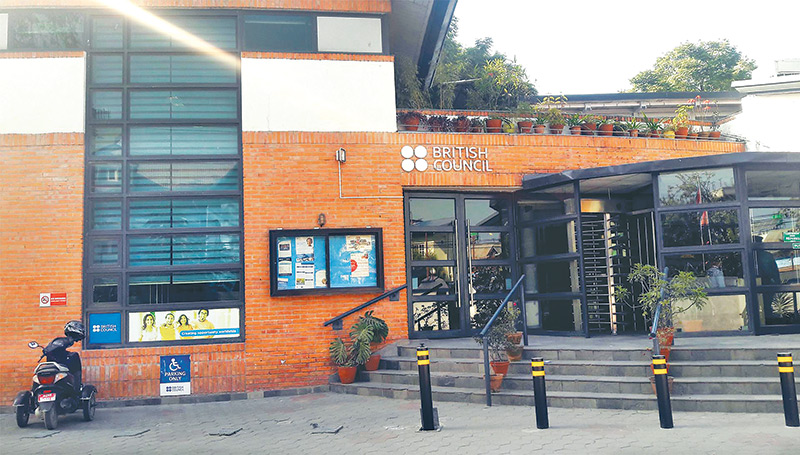
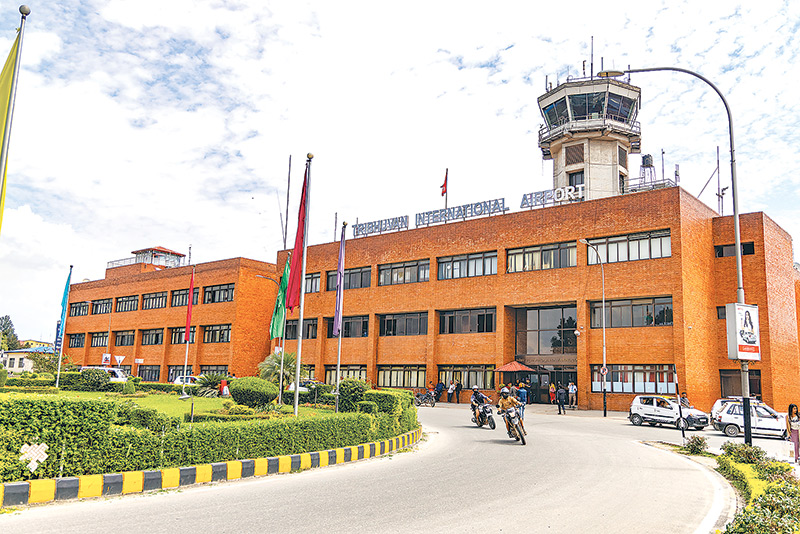
KATHMANDU, At least two government agencies and a parliamentary committee are investigating the British Council’s alleged tax evasion on the money it has been raising from the International English Language Testing System (IELTS), a mandatory test for Nepali students who want to pursue higher education in many English-speaking countries. Following a complaint from the Forum for Protection of Consumers’ Rights Nepal, the Parliamentary Committee on Industry, Commerce and Consumers Rights on Friday asked the Ministry of Finance and Ministry of Education to investigate whether the British Council is liable to pay taxes. The Kathmandu District Administration Office and the Department of Revenue Investigation are also looking into separate complaints they have received. The investigations come a week after the Forum for Protection of Consumers’ Rights Nepal filed a complaint at the parliamentary committee, alleging that the British Council, the UK’s international organisation for cultural relations and educational opportunities, was “doing business” in Nepal but wasn’t paying taxes as per the law of the land. “Going by the complaint, it looks like the council needs to pay a huge amount of money in taxes,” said Shivadatta Baral, an under-secretary at the House committee. “We have asked the finance and education ministries to look into the matter and are waiting for a response. The committee will decide how to proceed after studying the reports.” The British Council was founded in 1934 as a charity organisation and has been operating in Nepal since 1959. It was the only organisation authorised to conduct IELTS exams for years before the entry of the International Development Programme, an international organisation offering placement to students in different countries which also conducts IELTS tests, two years ago. English language proficiency tests like the IELTS are mandatory for students who wish to study in Australia, the United Kingdom, Ireland and New Zealand. A large number of universities and colleges in the United States also accept IELTS scores, along with the Test of English as a Foreign Language (TOEFL). In recent years, there has been a significant rise in the number of Nepali students going abroad for higher studies. Of around 65,000 students who received a No Objection Certificate, required to study abroad, from the Education Ministry in the fiscal year 2018-2019, three-fourths were for English-speaking nations. The British Council had been charging Rs16,950 for the test but has raised the fee to Rs21,500 starting this year. Education consultancy operators estimate that around 40,000 students sat IELTS exams last fiscal year and paid at least Rs650 million in fees. Jyoti Baniya, chairperson of the consumer rights forum that lodged the complaint in Parliament, said the council has been operating for years without registering with the government and without paying any taxes. “The council owes billions of rupees in taxes if we calculate the money it has raised all these years,” Baniya told the Post. “It is bewildering how the organisation has been conducting banking transactions worth millions of rupees every year without registering.” Officials at the Inland Revenue Office confirmed to the Post that they had received complaints about the council not paying tax over the years. “We are investigating the matter,” Lok Prasad Neupane, chief of the Maharajgunj branch of the tax office, told the Post. “We need to do a thorough study before I can share details.” The Kathmandu District Administration Office is also studying a separate complaint it has received about tax evasion by the council. A tax strategy prepared by the head office of The British Council in the UK says that it is “committed under its code of conduct to comply with the law in all the countries and territories where it works”. The British Council was not immediately available for comment. “Our country director and head of exams are on leave, so we will be able to respond to your query by next week,” said Suchita Shrestha, communications manager at the council, in an email response. However, a source at the council, who spoke on condition of anonymity, said that the British Council had already registered with the Company Registrar’s Office and was committed to paying taxes, although there were administrative obstacles. According to advocate Semanta Dahal, taxes can only be exempted if bilateral or multilateral treaties to that effect are signed between the Nepal government and any foreign country or international organisation. However, it is not clear whether any such agreement exists between the British Council and the Nepal government. Officials at the Education Ministry too were unaware of the basis for the council’s functioning. “It has been years since the council was established,” said Ram Sharan Sapkota, joint-secretary at the Education Ministry. “The ministry will come out with a statement after an investigation and a report to the parliamentary committee.”
Kathmandu Metropolitan City has announced a week-long extravaganza to supplement Visit Nepal 2020, but foreign tourists are more concerned about basic amenities.
- ANUP OJHA
KATHMANDU, As the government on Wednesday inaugurated the Visit Nepal 2020, Kathmandu Metropolitan City announced its own efforts to support the national tourism campaign. The city has allocated Rs 2 million for a week-long campaign of cultural shows, concerts and food festivals, according to Ishwor Man Dangol, spokesperson for metropolis. “We are doing the campaign to inform people and bring more tourists to the country,” said Dangol. “This is an awareness programme.” Locals, however, questioned the rationale behind conducting tourism awareness programmes in the city, instead of abroad, while tourists were more concerned about basic urban amenities—public toilets, garbage cans and proper public transport. “Nepal is really beautiful but I have an unpleasant experience every time I visit toilets,” said Namke Letder, a visitor from the Netherlands. “They are not clean and there is no water.” Public toilets are few and far between, even in major tourist destinations like the World Heritage Sites. Kathmandu Durbar Square has two tourist lavatories, there is one in Patan Durbar Square and one in Swayambhu but not a single toilet for tourists in Pashupati. Letder, who came to Kathmandu a week ago with her friends, also pointed out the amount of litter on the streets. “It’s hard to find a dustbin to dispose of garbage,” Letder told the Post in Swayambhu. “People just throw garbage on the roads.”
The lack of toilets and trashcans is a perpetual problem for Kathmandu citizens, and instead of addressing these basic issues, the city is planning to spend millions on tourism promotion, say locals. “They are having a grand celebration to welcome tourists, but look at the traffic here,” said 26-year-old Karan Lama, a chef at a restaurant in Kalanki. “When there are no footpaths to walk on and the traffic is so bad, how will tourists enjoy their stay in the city?” The Kathmandu valley might host seven World Heritage Sites but for tourist guides, it is getting difficult to ignore all of the city’s glaring flaws. According to Padam Shrestha, who has been working as a city guide for the past 18 years, the government’s grand celebration on Wednesday did not make much sense. “We are unofficial tourism ambassadors but it’s getting more difficult to justify just how bad the state of necessary infrastructures is,” said Shrestha. “It’s getting more difficult for us to explain why foreigners should choose [to visit] this city.” Infrastructure problems begin the very minute tourists land in Kathmandu—with the dismal state of the airport. There are numerous issues with Nepal’s only international airport, including overcrowding, a lack of functioning machines, a lack of officials to issue visas and an interior that resembles a bus station more than an international airport. “Nepal is culturally rich and the people are friendly,” said Javier, a visitor from the United States who did not provide his last name. “But if the government could make the international airport hassle-free, that would be great.”
HOME PAGE
Diplomats take to social media to promote Visit Nepal 2020, and beyond
Analysts say diplomats using social media to push diplomacy is fine as long as it doesn’t affect Nepal’s domestic policies.
- BHRIKUTI RAI
Chinese Ambassador to Nepal Hou Yanqi and US Ambassador to Nepal Randy Berry. Photos via twitter
KATHMANDU, A day before the government rang in the new year and inaugurated Visit Nepal 2020 with an ostentatious display of fireworks and marching bands, Twitter was already abuzz with Visit Nepal posts, courtesy of the Chinese Ambassador to Nepal. Ambassador Hou Yanqi’s post, accompanied by her pictures from Patan Durbar Square, led to hundreds of replies, a majority of them thanking her for helping promote Nepal. A small section of Nepali Twitter users even complained about her “model-like photo shoot” which they deemed inappropriate for a diplomat. Irrespective of the responses her tweets elicited, the post proved effective--leading to hundreds of retweets and also a number of articles in the local media praising Hou’s efforts to help promote Nepal. Hou joined Twitter--a platform banned in China--last year and has over 13,000 followers. She provides regular updates on China-assisted projects in Nepal along with ubiquitous festival greetings. The positive feedback that Hou’s tweets often receive is the reason why top diplomats, including the generally media-shy Chinese diplomatic corps, have flocked to social media and use the platforms aggressively to further public diplomacy, say foreign policy analysts. “Social media is an excellent platform to earn goodwill at the public level and foreign ambassadors here are using it effectively to gain popularity,” said Indra Adhikari, former deputy executive director of the Institute of Foreign Affairs, a think tank under the Ministry of Foreign Affairs. “These platforms have in many ways changed the traditional ways of diplomacy.” On Thursday, outgoing Indian Ambassador to Nepal Manjeev Singh Puri wrote a farewell tweet, thanking Nepal for “great memories and wonderful friendships”. And just last November, Nicola Pollitt, the British ambassador to Nepal, announced her stint in Nepal through Twitter. Since then, Politt has been using Twitter to post updates about her meetings with Nepal’s leaders, and speak about issues like climate change and press freedom. Adhikari adds that countries like the US and China, who are both competing for influence on the world stage and more increasingly in Nepal, are using social media to wield soft power. And often, this competition is showcased on platforms like Twitter. Randy Berry, the US Ambassador to Nepal, who, like his predecessor Alaina B Teplitz, uses social media extensively to share his travel pictures from Nepal, and also regularly interacts with the four million-plus followers of the US Embassy’s various social media pages. But on Thursday, days after Hou tweeted pictures of herself in support of Visit Nepal 2020, Berry followed suit, tweeting a similar post with his own travel pictures, announcing “a month-long initiative across all US Embassy Nepal social media platforms to promote tourism in Nepal”. Unlike a lot of ambassadors in town, Berry also uses his social media platform to speak about political issues, especially those concerning United States’ foreign policy, including the much-talked-about Indo-Pacific Strategy. Last week Ambassador Berry shared an article on Twitter, “applauding” the Nepal government’s decision to shut down North Korean businesses in Kathmandu. Analysts, however, say that the Nepal government should remain watchful about the activity of ambassadors on social media, especially the political statements that they make. “Conflicting statements made on social media by powerful countries on issues and policies concerning Nepal could be a headache for the country,” said Vijay Kant Karna, a political scientist who served as Nepali ambassador to Denmark. “Diplomats using social media to further public diplomacy in Nepal isn’t something to worry about as long as it doesn’t influence the country’s domestic politics and policies.”
MEDLEY
Horoscope
ARIES (March 21-April 19) *** Get ready for an unexpected ally to show up when you get into a disagreement with a co-worker. Someone you rarely agree with is actually going to see things your way. In fact, they may even come to your defence and help you win this debate. You two are more compatible than you ever realised.
TAURUS (April 20-May 20) **** Weird is in the eye of the beholder, so don’t get worried if you hear that someone thinks you’re the definition of the word. Own it! Chances are, this person simply doesn’t know how to peg you or figure you out. Your uniqueness intimidate them, as they don’t have the courage do new things.
GEMINI (May 21-June 21) *** Don’t be surprised if you’re in an introspective mood. This is a good time for deep thought and contemplation about where you are and where you should be. A recent social invitation could lead to more than you think, so make sure you have the time before saying yes. Make sure you don’t overload yourself now.
CANCER (June 22-July 22) ** There could be an exciting surprise coming your way, and it’s going to run a few of your carefully laid plans way off track. But no matter what happens to your daily routine, you could be absolutely delighted by the end of the day. This wrench could be just the thing to mix up your day and infuse some new energy into it.
LEO (July 23-August 22) *** Today will go by much more slowly than you’d like. Tonight or tomorrow is where you really want to be. But you’ll have to wait, and there’s no getting around it. Where did all of your patience go? You can bring it back by trying to focus on living in the moment. Try to focus on what you’re doing today.
VIRGO (August 23-September 22) **** Conflict could lead to some very important realisations for you, especially if you offer constructive criticism to your opponent instead of just criticising what they think or do. It’s time for you to fully understand that when someone causes a bit of friction in your life, they’re not trying to make you mad.
LIBRA (September 23-October 22) **** There will be a lot of game playing, today. You are in a great position to win every contest, as long as you keep things light and mellow. Now is not the time to take yourself too seriously. Get all of your competitive energy out of your system early in the day and leave the rest of your time open for unexpected invitations.
SCORPIO (October 23-November 21) *** Despite the fact that you’re feeling great and all of your friends are, too, this is not a good time to indulge in any expensive nights out. Not only will paring down your expenses help flesh out your increasingly-skeletal rainy day fund, it will give you a more accurate idea about what you really need to be happy.
SAGITTARIUS (November 22-December 21) *** Don’t be afraid to ask a few penetrating questions. Whenever you’re looking for real insight into someone, you have to do more than just ask what their favourite colour is. You’ve got the charm and energy that will encourage people to open up and share more of who they really are. This is a wonderful day for a date.
CAPRICORN (December 22-January 19) **** If your career is your main focus, that’s as it should be. You have all the clarity you need to fully understand the opportunities in front of you right now, so take a moment today to make some plans for your future. Just give yourself a general idea of where you want things to go. Where do you want to be living?
AQUARIUS (January 20-February 18) ** Whether you like it or not, you are going to be thrown into the centre of the action today, so get ready for a lot of attention. Polish up your image with a special outfit, and practice a few ice-breakers. You need to get ready to charm a few folks and make some new connections. Lucky for you, you’re looking attractive to everyone around.
PISCES (February 19-March 20) *** Today you will want to help lots of people, but to do that you have to be efficient and fast. But you will need to have focused communication if you want to get anything accomplished. It’s wonderful that you’re in such a giving mood right now, because that friend who always needs your help needs your help in a very big way.
NATIONAL
After failing to establish charges, government prepares to deport all arrested Chinese nationals
Police had arrested 122 Chinese from different parts of Kathmandu for their alleged involvement in suspicious activities.
- ANIL GIRI
Nepal police display the laptops, mobile phones and passports seized from the arrested Chinese nationals. Post File Photo
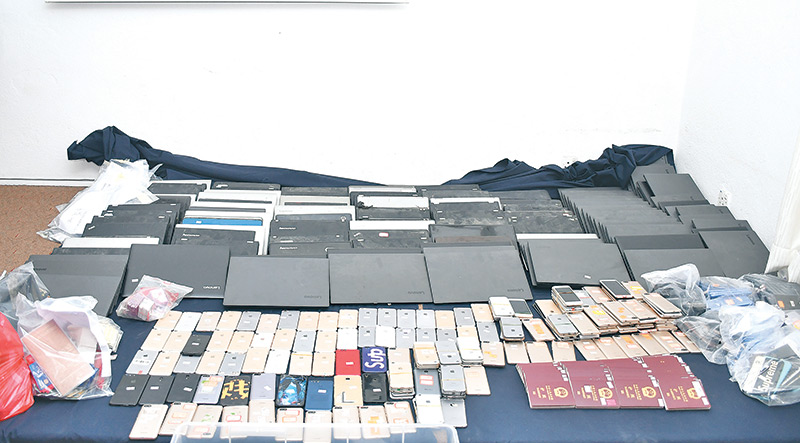
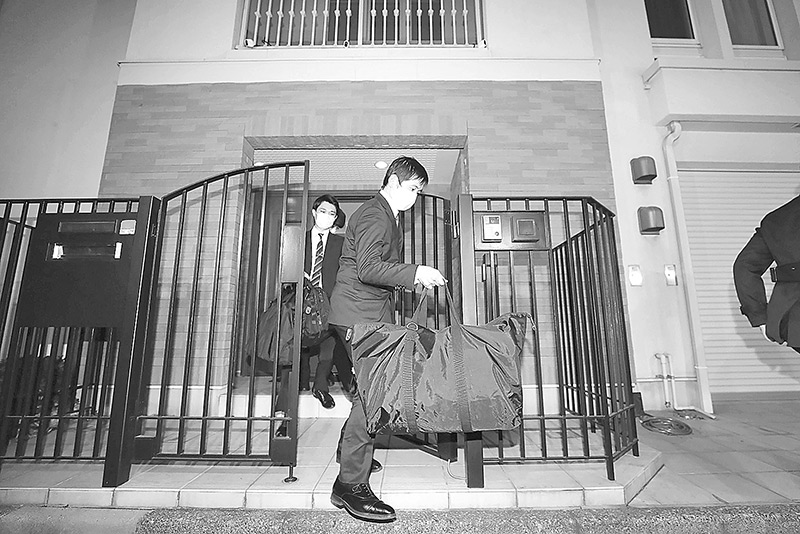
KATHMANDU, After failing to establish charges, the government is preparing to deport all 122 Chinese nationals who were arrested on December 23 from various parts of Kathmandu for their involvement in some suspicious activities. Immediately after the arrest, Nepal Police officials had said the Chinese were suspected to be involved in online gambling, financial fraud, cybercrime and violating visa norms. At least two top security officials told the Post that no charges could be established against them during the weeks-long investigation. The government is preparing to send them to China via two Chinese regular flights, the officials said. In one of the biggest arrests of foreign nationals, the Nepal Police had conducted raids simultaneously at various places in Kathmandu. Security officials had said around 800 Chinese nationals were under their watch and that they would be arrested soon. “They could have committed crime in China from here, but we could not find any record here. We are waiting for forensic reports,” said Uttam Subedi, chief of the Metropolitan Crime Division, Kathmandu. “Our job is to ascertain whether they committed crimes in our land, which we could not establish. It’s up to the government, or the Home Ministry for that matter, what to do with them.” A director at China’s Ministry of Public Security was in Kathmandu during and after the arrest, who according to security officials had told officials at the Ministry of Home Affairs that at least 1,000 Chinese nationals from China’s Fujian province are hiding in Nepal and are active in suspicious activities. “After discussions with Chinese officials in Kathmandu, our impression was that a big ring of Chinese nationals with deep pockets are active in various kind of suspicious activities in Kathmandu,” a security official told the Post on condition of anonymity. “Those 122 arrested ones are just workers.” The official, however, said investigating agencies are not saying the Chinese in question did not commit any crime in Nepal. “The agencies could not establish any charge.” “We do not have the capacity and technological know-how to ascertain the types of crime they could have committed,” said another security official. Out of 122, only 67 arrested Chinese citizens were holding passports. “For all others, we are preparing travel documents to send them back on Wednesday on China Southern and China Eastern flights,” the official told the Post. A day after the arrest, China’s Ministry of External Affairs said during a press briefing in Beijing that it was a joint operation carried out by the police of Nepal and China, raising concerns in Kathmandu over whether Nepali security agencies working at the behest of Beijing. Home Minister Ram Bahadur Thapa had even taken the issue up with Chinese Ambassador Hou Yanqi.
NATIONAL
A village in Rukum (West) takes initiative to bring road connectivity to their homes
The locals of Umakhola village are opening a motorable track using traditional tools and equipment.
- HARI GAUTAM
The villagers have already opened more than one-kilometre track. Post Photo: HARI GAUTAM
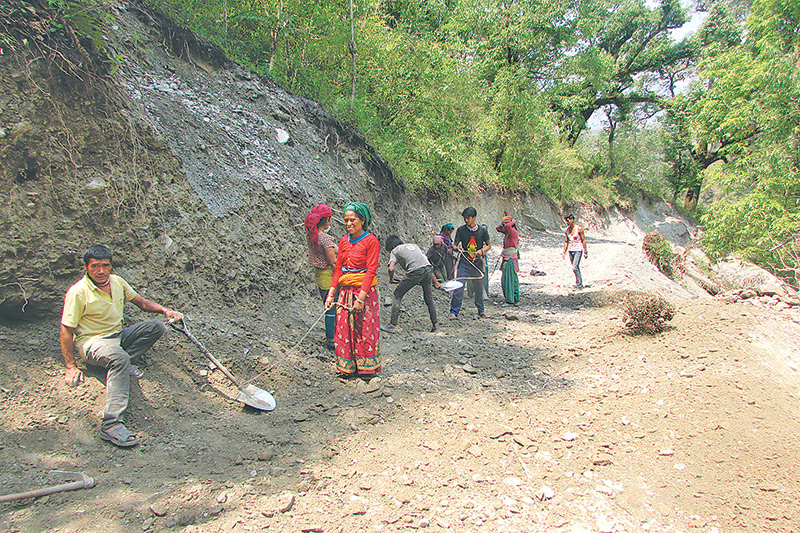
RUKUM (WEST), The village of Umakhola in Rukum (West) does not have motor road access. But that is about to change. The locals have taken up the task of connecting their village with the district’s road network. Already, they have opened more than one-kilometre track using traditional tools and equipment. The Rural Community Infrastructure Development Programme has allocated Rs 2.5 million for the project. Umakhola is a remote village located in Aathbiskot Municipality Ward No. 1, one of the two wards in the municipality without motorable roads. Dhaniram Budha, chief of the road construction committee, said the road project was initiated following the locals’ collective desire to link their village and the district headquarters with a motorable road. “We want to bring transportation facility in our village,” Budha said. Mayor Gorkha Bahadur KC said that the task undertaken by the villagers of Umakhola was not just aspirational but also worth emulating by other villages. “It is a supreme example of communal harmony. It’s quite moving to see the locals working together towards achieving a common goal,” he said. Connecting Umakhola to a road network was one of KC’s top priorities when he took the mayor’s office. The road project is expected to be completed within a year. The federal government has provided a special grant of Rs 100 million to Aathbiskot Municipality to connect its two wards with the road network.
NATIONAL
Acute shortage of environment inspectors hampers monitoring
There are only 16 environment inspectors in the country and five of them are currently on study leave.
- CHANDAN KUMAR MANDAL
Brick kilns in Kathmandu Valley belch out smoke. Post file Photo
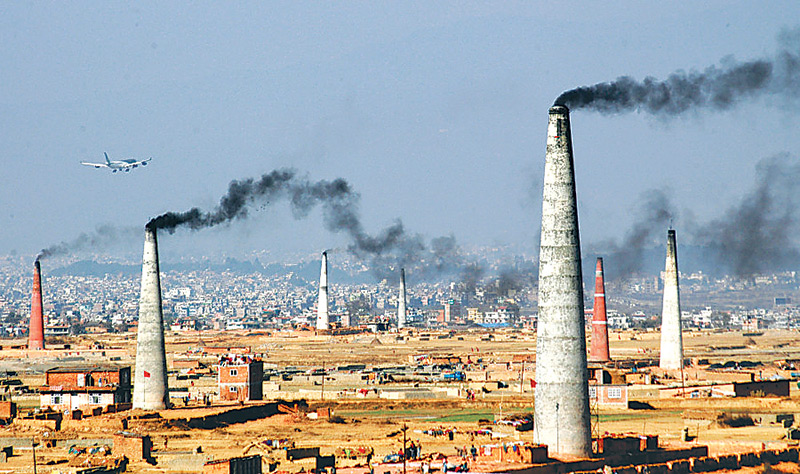
KATHMANDU, The country is acutely understaffed in terms of keeping in check environmental pollution and in ensuring strict compliance of environmental laws as only a few environment inspectors have been assigned for the countrywide job, government officials say. The Department of Environment currently has just 16 environment inspectors, whose jobs involve minimising pollution and enforcing compliance with the laws made for the protection of the environment. To make things worse, five of the inspectors are currently abroad on study leave. The limited number of inspectors has severely affected the work of the environment department. “It is difficult to carry out works with a limited number of environment inspectors,” Govinda Lamichhane, one of the environment inspectors, told the Post. The existing Environmental Protection Act, 2019 has a provision of appointing environment inspectors, whose responsibility is to inspect, examine and recommend measures to mitigate the impact of environmental pollution. Environment inspectors are authorised to inspect the premises of concerned project sites, buildings, factories, equipment, vehicles and livestock to ensure whether environmental standards are being enforced. The law also grants them the authority to examine whether development projects are being implemented as per the Environmental Impact Assessment (EIA) and how the measures suggested in the EIA reports were being applied. Sindhu Prasad Dhungana, spokesperson for the Ministry of Forest and Environment, also agrees that a small number of environment inspectors is slowing down the department’s pollution monitoring tasks. “They can only spend limited time while performing their inspection job, as there is a huge burden of work waiting for them,” Dhungana told the Post. “Even if they spend one day with one EIA report, it will take several months for them to check whether there has been compliance.” The Environment Ministry has so far approved nearly 400 EIA reports of various projects across the country. Now, the department needs to visit these project sites to check their compliance with the various environmental standards. According to Dhungana, the government should hire more environment inspectors to oversee development projects efficiently. “But the government has been saying that they want to reduce the number of staff,” said Dhungana. “If the government wants to do that, then it should cut down the administrative staff. It should not decrease the number of technical officials.” With the federal setup, even the provincial government can appoint environment inspectors for overseeing projects at their respective levels. The new amendment to the Environmental Protection Act allows provincial governments to hire environment inspectors. “We need more environment inspectors at the provincial and local levels as the environmental impact will be felt more at the local levels,” said Dhungana. “If these governments are asked to conduct IEE and EIA report examinations and they do not hire environment inspectors, then it’s a case similar to building the hospitals without doctors.” So far, some local levels have hired environment officers. However, they are not trained for the job. Instead, they have training for other disciplines such as arts and commerce, according to Dhungana. At the time of amending the Environment Protection Act, stakeholders had demanded that the qualifications of environment inspectors should be clearly mentioned in the Act. According to them, these jobs should be for those who are trained in environmental science. The government has not mentioned the qualifications in the Act, which they say will be clearly mentioned in regulations. The existing provision says that if an environment inspector is not available, any section officer can be appointed for the job. However, the bigger problem lies in the pre-decided pay and perks for environment inspectors, which might discourage newcomers from joining the service. Environment inspectors are hired as section officers with no possibility of promotion as per the civil service law which constitutes a total of 12 groups. Environment inspectors fall in the Nepal Miscellaneous Service group. According to Dhungana, environment inspectors should be included in Nepal Forest Service group, which further has six sub-groups. “There should be a provision for their promotion to other ranks as well. Likewise, their pay and perks should be regularly reviewed,” said Dhungana. According to Lamichhane, the arrival of new environment inspectors is not currently possible as there are no vacancies at any level. “There are only 16 positions at the centre, which are already occupied,” said Lamichhane. “The existing provisions can affect an appointed inspector’s performance. Some people might quit their jobs if they find a better opportunity.”
NATIONAL
Nepali from Gorkha killed in India’s Jammu and Kashmir
- HARIRAM UPRETY
GORKHA, Arjun Thapa Magar, a 25-year old Nepali, was among the two Indian Army soldiers killed in a skirmish with infiltrators at Nowshera in Rajouri district of India’s Jammu and Kashmir on Wednesday. Magar, a native of Gorkha district, was a rifleman in the Indian Army. He had returned to his duty after spending a month-long holiday at Debimaitol of Gorkha Municipality-5 in the third week of December. The settlement of 21 Magar families is around four kilometres from the main bazaar of the district headquarters. According to the victim’s relatives, Arjun was chatting with his family members over the phone on Tuesday night but left the chat after saying the firing had started. It became his last conversation with his family. “When we tried calling him later, his phone was switched off,” Magar’s sister-in-law Sanu Thapa said. The family became aware of the incident after one of Arjun’s friends texted the family, asking for their address. When the family contacted him, the man on the phone said there was bad news for them. They learnt about the incident once they contacted the Indian Army Office. “Later, the Indian Army called us and asked if we could come over there to receive Magar’s body,” said Thapa. Meanwhile, members of Magar’s family and some relatives left for Kakarbhitta, the Nepal-India border point in Jhapa district, as soon as they came to know of Magar’s death. “We are yet to know if we have to go to India or they will bring his body in Kakarbhitta,” said Thapa. “Arjun Thapa Magar was serving in the Indian Army for the past four years,” said Narjung Rana Magar, a village local. “He had got married only seven months ago.” Arjun was the only son of his parents. He had joined the Indian Army while he was studying in grade 11.
NATIONAL
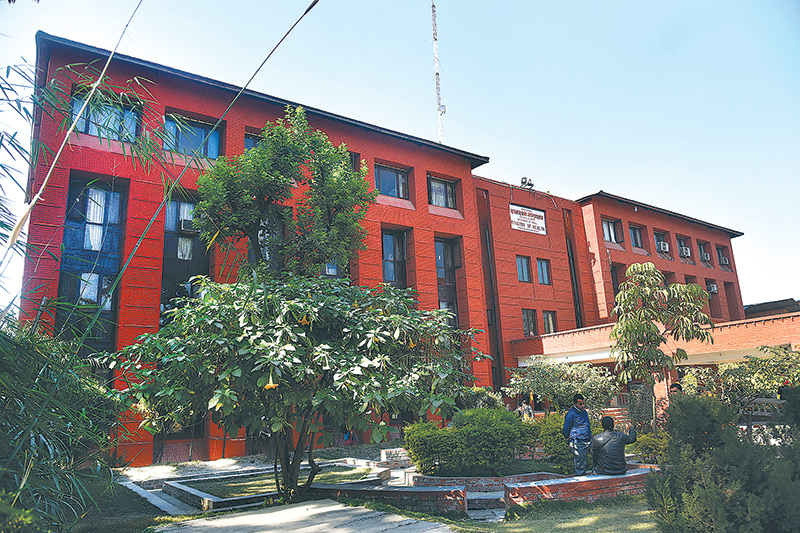
Ministry seeks World Health Organization’s help to strengthen its flu surveillance
The Ministry of Health and Population has been tracking flu viruses since 2010 through a National Influenza Centre.
- Arjun Poudel
The Ministry of Health has sought UN health agency’s expertise. Post file Photo
KATHMANDU, The Epidemiology and Disease Control Division has sought help from the World Health Organization to strengthen its drive against flu. The division’s move comes after it was found that several flu viruses have been showing unexpected patterns throughout the world. Nepal is rated among the most vulnerable countries facing flu epidemic risk. “We have sought the UN health agency for expert help to set up an effective surveillance system and to train our health workers,” Dr Bibek Kumar Lal, director at the division told the Post. “An expert who worked to set up an effective surveillance system in Nigeria, Ghana and other African countries, would come here to assist us.” The division has been carrying out flu surveillance through the hospital network under which hospitals throughout the country report flu cases and send samples to the National Influenza Centre run by the National Public Health Laboratory. The division has also held a meeting with concerned agencies under the provincial governments in all seven provinces to strengthen measures for effective flu surveillance. “We will see if the same model that was applied in the African countries will be applicable in our context or a new model is required,” said Dr Lal. “We will develop a reliable channel to report flu cases and monitor it effectively.” The Ministry of Health and Population has been tracking flu viruses since 2010 through the National Influenza Centre. Flu tracking systems have been set up in several places throughout the country. A biosafety level-3 laboratory has also been established with the WHO’s financial assistance at the National Public Health Laboratory for containment of deadly viruses. Last year, samples of bird flu virus were contained and analysed in the BSL-3 lab and were sent to the WHO’s reference laboratory in Japan for further confirmation. The reference laboratory later confirmed that the bird flu virus caused the death of a 21-year-old man. Health workers report and send samples of suspicious flu cases to the centre for further confirmation. The laboratory also deploys technical human resources to collect samples in the disease-hit areas, if a massive flu outbreak is reported. Dr Runa Jha, director at the laboratory, said that her office has regularly been carrying out flu surveillance and informing the concerned agencies under the Health Ministry about the flu patterns. Meanwhile, the division said it was in regular touch with the provincial health directorate of the Karnali Province in western Nepal after a woman died of flu-like illness at Kharpurnath Rural Municipality in Humla on Monday night. It has been reported that an outbreak of flu-like illness has gripped the entire village. “We are in close contact with all concerned agencies of the Karnali Province,” said Lal. “They told us, the situation is under control.” In April last year, 10 people of Humla district had died from influenza-like ailments.
NATIONAL
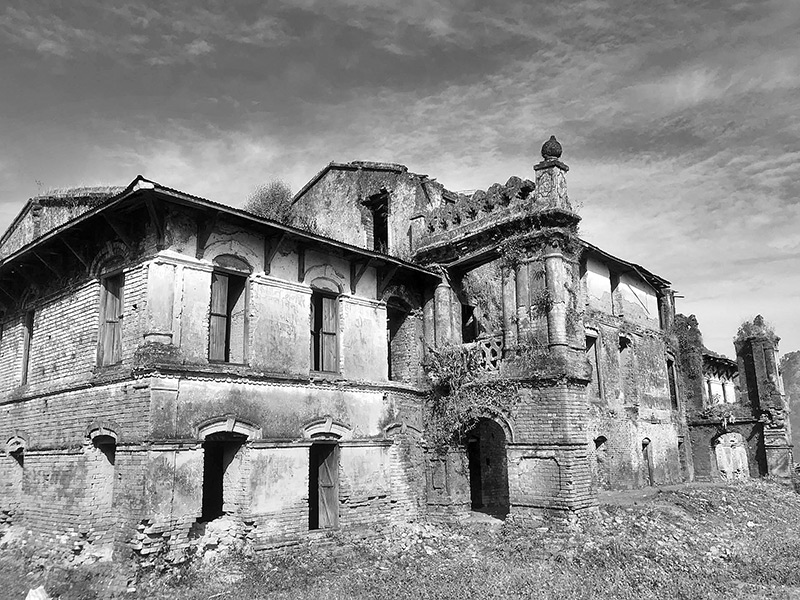
Garbha Durbar in ruins for lack of conservation efforts
The neglected palace was further damaged during the Maoist insurgency when rebels set the palace on fire.
- ARJUN SHAH
The palace at Khairala in Chure Rural Municipality Ward No. 4 was constructed around 100 years ago. Post Photo: ARJUN SHAH
CHURE (KAILALI), The Garbha Durbar in Kailali district is in a dilapidated condition and in need of immediate repair. The palace at Khairala in Chure Rural Municipality Ward No. 4 was constructed around 100 years ago by Khadga Shumsher Jung Bahadur Rana on 13 ropanis of land. It was used by the Ranas as a resting spot for when they travelled from the plains to the hills, according to locals. Built in 1927 AD, the three-storey palace has 83 windows and 53 doors. Jeewan Gurung, a local, said the palace is overgrown due to the apathy of the authorities concerned. “The walls are falling apart and the roof has collapsed due to lack of maintenance,” said Gurung. Krishna Bahadur Malla, ward chairman of Chure Rural Municipality Ward No. 4, said that the palace has been in ruins for the last 21 years. “There were artistic designs and artefacts in the palace. But they were burnt during the Maoist insurgency,” said Malla, adding that the then Maoist rebels had torched the building. The ownership of the palace was handed over to the then Village Panchayat 36 years ago. Dirgha Sodari, a member of the provincial assembly, said that they have been taking initiatives to talk with the Department of Archeology to preserve the palace—but not much has come of the plans. Surya Bahadur Thapa, the coordinator of the District Coordination Committee in Kailali, said that they are going to promote Garbha Durbar as a tourist destination. He said, “If the area could be developed as a tourist destination, economic activity in the area will boom.”
NATIONAL
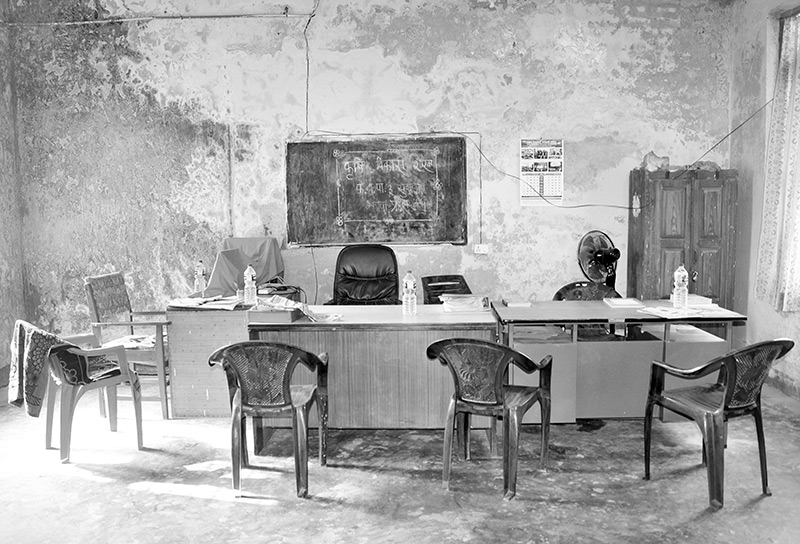
Kankai Municipality’s Department of Agriculture critically understaffed
The planned pro-agriculture projects haven’t started yet, and farmers worry this is a setback for their profession.
- Arjun Rajbanshi
Despite the department having provision for three positions, only one assistant is at work. Post Photo: ARJUN RAJBANSHI
BIRTAMOD, The Kankai Municipality has allocated Rs8 million for several projects under the heading of agriculture. But six months into the current fiscal year, none of the projects has taken off. The reason: the municipality’s agriculture department doesn’t have a single staff. In fact, the department has been vacant for the past one and a half years. Last fiscal year, the municipality failed to fully spend the allocated budget. “For the past one and a half year, we are launching the pro-agriculture programmes on our own,” said Parshuram Giri, chief of Ward No. 2. “We don’t have much technical knowledge, so we haven’t been able to launch programmes that require technical knowledge.” Giri added that many of the ward’s agricultural programmes are either stalled or ineffective due to the lack of staff. The municipality’s department is solely run by an office assistant, Lakshmi Rai. “I haven’t been able to provide any service other than simple referrals,” she said. The department has vacancies for three positions—including an agriculture officer and a technical assistant. The department’s former technical assistant, Hiralal Sah, retired in October last year, while former officer, Roshan Mehta, is on an educational leave since April last year. Chief Administration Officer Kharudev Chudal said that the department is vacant because the officials deployed according to the government’s employee adjustment programme didn’t report to their assigned jobs. “The agriculture sector of the municipality hasn’t borne any results because several key programmes could not be started,” said Chudal, adding that many farmers flocking to the office seeking solutions to their problems have to return disappointed. “In case a technician is absolutely necessary, we ask the Agriculture Knowledge Centre for help.” The municipality had allocated Rs6.2 millions for agriculture and animal husbandry in the fiscal year 2018/19. Of which, only Rs2.9 million was spent, which is less than 50 percent of the allocated budget. Kankai Municipality is considered among the most developed local units in Jhapa, with about 70 percent of arable land. Agriculture is still the most widely-adopted profession. But with the lack of projects and expenditure on agriculture, local farmers are worried. “Even the subsidies promised to us are not forthcoming,” said Shyam Rajbanshi, a local farmer.
NATIONAL
Contractors selling subsidised rice in Rukum (East) due to lack of employees in depots
Locals say the problem has persisted for years due to the government-run Food Management and Trade Company’s apathy.
- HARI GAUTAM
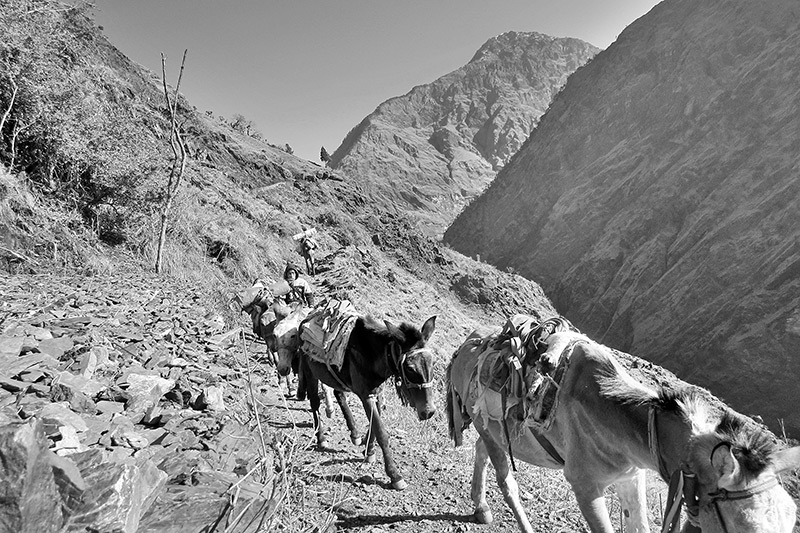
Locals of Sisne walk towards Rukumkot with their mules to purchase the subsidised rice. Post Photo: HARI GAUTAM
RUKUM (EAST), Every year, the government-run Food Management and Trade Company allocates certain quotas of subsidised rice for Rukumkot and Takasera in Rukum (East). Contractors are selected to transport this subsidised rice to remote villages. But due to the lack of employees in the depots of the Food Management and Trade Company, contractors themselves are selling the rice in the villages—and this has become a problem for the villagers. This year, the Food Management and Trade Company Ltd has allocated 500 quintals of rice for Takasera and 700 quintals of rice for Rukumkot in the first phase of the fiscal year. “The problem is that contractors stay in the villages only for a few days,” said Daribhan Budha, a local of Sisne Rural Municipality Ward No. 4. It becomes a problem for the local people because they are forced to buy the rice whenever the contractors are in their villages, irrespective of whether they can afford it or not. At the depots, Mota rice comes at Rs 3,800 per quintal and Sona Mansuli at Rs 4,600 per quintal in Rukumkot. The same quantity of rice costs around Rs 4,200 (Mota rice) and Rs 5,200 (Sona Mansuli) in the bazaar areas—the cost difference is huge for the people in these villages. In Takasera, the company sells Sona Mansuli at Rs 4,700 per quintal whereas the same quantity of rice costs around Rs 5,500 per quintal in local shops. Villagers in these remote parts of Rukumkot and Taksera say that the problem has arisen due to the ignorance of the Food Management and Trade Company. For example, there’s a depot of the company in Shobha village in Rukumkot, but it hasn’t had an employee for the last 19 years. Rapti Bahusewa Pvt Ltd is the contractor responsible to transport rice in Rukumkot, whereas MB builders is responsible to transport rice in Takasera. Rice needs to be transported from Bhairahawa to Takasera and Tulasipur (Dang) to Rukumkot. In the last fiscal year, the company has sold only 200 quintals (out of 1,500 quintals of allocated quota) in Rukumkot and 500 quintals (out of 1,000 quintals of allocated quota) in Takasera. Rukumkot and Takasera fall under Rukum (East) territory, but currently the branch of Food Management and Trade Company Ltd in Rukum (West) looks after the management and transportation of subsidised rice in Rukumkot and Takasera. Chandra Bahadur Khadka, chief at the branch office, admitted that they have been facing problems to transport rice in the depots due to lack of employees and infrastructures. He said, “Although contractors are selling rice in the remote areas themselves, they cannot deceive locals while selling rice. We have instructed them to sell rice at a fixed amount.” According to him, the subsidised rice is being transported in the presence of the District Administration Office, the District Police Office, and the Ward Office along with people’s representatives. Locals are also demanding a branch office of the Food Management and Trade Company Ltd be opened in Rukumkot, along with depots in Takasera and Ranmamaikot. “In the last fiscal year, the District Food Committee had requested the company to establish a branch office in Rukumkot and depots in Takasera and Ranmamaikot, but to no avail,” said Khadka.
NATIONAL
Jumla residents risk their lives collecting Yarshagumba to support their families
- LP Devkota
JUMLA, Every year, Rajya Bohara, a local of Patarasi Rural Municipality, spends around six months in the highlands. Around May-end, he goes to the highlands to pick Yarshagumba, the world’s most expensive herb. During winter, he goes to the highlands to collect Setak Chini (Moringa Oleifera) and Bhutle among other medicinal herbs—both fetch him good money. Bohara feeds his family of eight by selling the herbs he collects. “It’s not an easy life. It is very difficult to search for the herbs in the highlands. But I have no other option; I have a family that depends on me,” he said. Bohara is not the only person who makes a living this way. Every year, hundreds of locals of Patarasi, Guthichaur, Tila, Hima, Sinja, Kanakasundari and Tatopani go to the highlands to collect medicinal herbs. But herb collection is dangerous business. Only a few weeks ago, a herb collector died in the highlands after getting trapped in a massive snowfall. Another collector is reported to be still missing. Lal Bahadur Dhami, deputy superintendent of police, said because some herb collectors live up in the highlands for two to three months, they cannot claim the missing person is dead. “Unless we locate the missing person’s body, we cannot claim he is dead,” said Dhami. Tulu Bohara, a local of Tila Rural Municipality, said she and other 14 herb collectors, who went to the highlands to collect Setak Chini around three weeks ago, stayed inside a cave for three days because of a massive snowfall. “We almost died then. We know there are huge risks to this job, but we are compelled to go to the highlands because we have no other source of income,” she shares. Despite the risks, herbs collection is a reliable source of income for Jumla folks. Hira Budha, a local of Patarasi Rural Municipality, said that he makes around Rs 500,000 by selling medicinal herbs. According to the Division Forest Office in Jumla, more than 70 types of medicinal herbs are found in various parts of highlands in the district. Among them, the government has permitted the collection of 50 to 55 medicinal herbs. Dinesh Khatri, chief at the office, said the office has allowed harvesting of 27,300kg Setak Chini, 35,000kg of Dhupi and 31,000kg of Padamchaal this year. “In the last fiscal year, the office had generated Rs 6.8 million revenue issuing permission letters (granted to the herb collectors) and through medicinal herbs export,” said Khatri. Lakshiman Bohara, chairman of Patarasi Rural Municipality, said every year around 13,000 locals go to the highlands to harvest medicinal herbs from Patarasi alone. He said, “Out of 3,200 households in the rural municipality, 80 percent are involved in medicinal herbs business.” With the onset of the herbs picking season, hordes of herbs collectors have already rushed to the highlands. Bishnu Budha, chairman of Tila Rural Municipality, said around 12,000 locals have gone to the highlands to collect medicinal herbs this year. People from Dolpa, Mugu, and Jajarkot districts also come to Jumla to collect herbs.
NATIONAL
One held with pistol
Briefing
DANG: A 34-year-old man was arrested with a pistol in Ghorahi, Dang, on Wednesday. According to the District Police Office, Raj Kumar Damai of Paribartan Rural Municipality in Rolpa was arrested while he was found extorting money from an individual at Ghorahi Ward No. 15.
NATIONAL
Four dead, one missing in Bajura jeep accident
Briefing
DHANGADHI: A passenger jeep swerved off the road and plunged into the Karnali river near Kolti in Bajura district on Thursday, killing at least four persons. A 13-year-old girl went missing in the river while three passengers sustained serious injuries in the incident, said police. The vehicle was heading to Piluchaur of Jagannath from Dhulachaur.
NATIONAL
Sit-in organised to make Sirsiya stream free of pollution
Briefing
PARSA: Protesters part of the Sirsiya Stream Pollution Free Campaign staged a sit-in in Ghantaghar, Birgunj, on Thursday demanding authorities save the stream from pollution. The representatives of the campaign staged a sit-in from 11 am to 5 pm with an aim to make Sirsiya stream and Birgunj city free of pollution. Industrial waste from the Parsa-Bara Industrial Corridor, which houses over 3,400 factories, has become a major contributor to the pollution of the stream.
NATIONAL
Sakela Rural Municipality delivers free transportation to people with disabilities, senior citizens
Briefing
KHOTANG: Sakela Rural Municipality has started to deliver free transportation facility to people with disabilities and senior citizens. Arjun Kumar Khadka, chairman of the rural municipality, said that senior citizens and people with disabilities of all wards will receive the service free of cost. He said, “People with disabilities and senior citizens can go Rasuwa, Gaighat, Diktel and Kathmandu, among other areas, free of cost. They should have ID cards (issued by the local unit) to receive the service.”
EDITORIAL
Oily business
Refined palm and soybean oil becoming Nepal's largest exports is worrying.
Processed palm and soybean oil have now become Nepal’s largest exports. The two oils, of which Nepal does not produce a single drop, has been imported by traders in its crude state, to be refined and exported—mainly to India. While this is sure to be a profitable venture for the traders involved on both sides of the Nepal-India border, it will not benefit the economy all that much. And while such actions are not illegal, Nepal should be careful that such actions are not promoted before local manufacturing and true value addition. Palm oil is used in a variety of ways. It is used as an additive in many cosmetic and cleaning products, and also used as a frying oil. Soybean oil is also a major cooking oil. Nepal’s sudden surge in trading of palm oil is particularly worrisome; until the fiscal year 2017-18, Nepal exported no palm oil. An oil that is a major export commodity for ASEAN nations, especially Indonesia and Malaysia, Nepali traders have found an ingenious way to profit from this product. First, crude oil is imported from originating countries and refined in Nepal. Then, this oil is sent to India, with which Nepal has a free trade agreement. The Nepali traders are saved the burden of local taxes, since the product is shipped abroad. The Indian traders profit as well; with crude imports to India facing a high import duty, the refined oil from Nepal is allowed to enter the market through the free trade agreement. But there are many problems here. To begin with, the refinement of crude oil does not add much value; nor is it a labour intensive process to boost employment. The economy does not benefit much either—only a handful of traders do. Moreover, the traders are exploiting the South Asian Free Trade Agreement to export the refined oil to India. But this agreement has a clause which allows countries to put barriers to trade easily. Each member country is allowed to keep a sensitive list that allows for the protection of domestic industries. Many Nepal-made products do not get exported to India, or do so under high tariffs, because India believes those specific products are harmful towards local producers. Currently, even as these refined oils have become Nepal’s major export, it is still a small portion of India’s total palm and soybean oil market. Should these exports rise in the near future, India might catch up and block further trade. Traders then would be stuck with a lot of product. Nepali ginger producers, in recent years, have faced major issues due to Indian suspicions and barriers of entry. Further, India has already shown how heavy-handed it can be, even to its friends—the blockade of 2015 and a recent month-long restriction of Malaysian palm oil (due to Malaysian PM Mahathir’s comments criticising India’s handling of Kashmir) are examples. Relying on exporting a product to one single market is always a major risk, especially if the product is generic. India has already announced on Wednesday, January 1, that it is slashing the duties on crude and refined palm oil. This may immediately have repercussions on Nepali palm oil trade. But there are also larger lessons in this. Nepal cannot have, as its largest export product, something that it doesn’t even produce. The country’s foreign reserves will be depleted if it continues to import goods using dollars and other reserve currencies to get paid back in Indian rupees for exports. The current scenario also shows how the manufacturing sector is lagging behind. The government must pay more attention, and provide support to the industry.
OPINION
Breathing down our necks
The Information Technology Bill will asphyxiate freedom of speech and expression.
- SUSHREY NEPAL
Shutterstock
We have been ruled by dynasts, monarchs, people from all across the political spectrum, and now by communists. And throughout these different regimes presiding over our country, the norm in Nepal has perpetually been of scrutiny, and openness has always been a mere exception. In what is probably a watershed moment for online free speech in the nation, the Development and Technology Committee of Parliament passed the much controversial Information Technology Bill, only to add another toxic layer of durability to this custom of state policing. With this, the government now has absolute authority to control one’s behaviour on the internet, and what one even updates on his social media handle can subject him to five years in prison along with a fine of Rs1.5 million rupees. This prescribes for a far more draconian punishment than even for arguably graver crimes recognised by the General Offence (Code) Act 2017 (Muluki Ain). For example, even offences with the degree of causing destruction to a religious place, disrupting public peace, and acting against the public interest, safety and morality, and so forth entail a lesser degree of punishment. The chances are that you will be prosecuted for a lesser number of years in prison if you commit the same act in person than over the internet.
The joke’s on you To begin with, the definition of social media has been made broad to embrace all systems based on the internet and information technology used by a person or institution to interact, share or broadcast contents with each other. This includes all online platforms, from Facebook and Twitter to even private messaging applications such as WhatsApp and Messenger. Now, even a personal message sent by you to your friend sarcastically joking about the administration, or perhaps constructively criticising the leadership, could land you in jail because a particular someone from the government or bureaucracy was remotely offended by it. These are not just a few decorative combinations of words; it’s a piece of legislation that will be used by the establishment to persecute individuals it chooses to neutralise, which undoubtedly will have dire consequences. To put it in context, you will straightaway land in police custody for sharing something as harmless as a meme. You will be incriminated for something that would, in fact, have been laughed at. Moreover, the bill holds firm ground that all social media platforms must be registered in Nepal, and will be stopped from operating in the event they are not registered. The government wants giants like Google and Facebook to register in Nepal, seemingly to bring these titans within the tax bracket. But with the absence of a detailed plan on its implementation, lack of homework and bureaucratic hassles, the government’s ambition only seems like a farfetched dream. The arbitrariness of the state is furthered by other provisions of the Information Technology Bill. The government has the authority to dictate any software, electronic instrument and system as being illegal. While the provision does not define what ‘illegal’ is, this is a lethal weapon in the hands of the government; and it can release this guillotine discretionarily on anyone it likes under the garb of their software or platform being unlawful. The government can direct a social network operator to take down specific content from the platform without requiring approval from the court. Our constitution entrusts the judiciary to make a final decision regarding the legality of a particular act. But the government has taken it on itself to perform judicial functions as well. This means that the government could snoop and conduct surveillance on anyone’s personal data, and a citizen’s right to privacy and freedom of speech in this supposedly democratic country will become a fictitious set of ideas.
Abstract term The government has formulated this Information Technology Bill under the garb of maintaining public order and decency. But this term ‘public order’ is obscure. One can say that law and order are supreme, and public order is narrow. Mere disobedience of an unfair law does not account for disruption of public order. First, it is a miserable attempt by the government to unfunnily perceive public decency and morality through such a narrow lens. Our public order is not so fragile that it can collapse due to a meagre post on the internet. And at no times should a citizen’s fundamental rights be curtailed by frivolously advocating for breaching public decency or morality. If the government deems our public order to be so delicate, it is the government that needs to be reminded of our constitutional and societal values, not the citizens. This Information Technology Bill is a loud declaration by the government that it is coming for its citizens, and we cannot hide behind the shield of our right to privacy and freedom of speech. If a state is willing to incriminate its citizens for an internet post, one can only imagine what else it is hiding in its shadow. While Nepal passes this draconian law, it also becomes necessary, at the same time, to remember that our history—it bears testimony to the fact that this is also the very country where regimes have been toppled for viciously curtailing people’s right to freedom of speech and expression; be it in 1951, 1990 or 2006. So, it is the government that needs to be careful with what it writes, not us.
Nepal is a lawyer at Abhinawa Law Chambers, Kathmandu.
OPINION
Nepal should gamble on artificial intelligence
AI is an essential part of the fourth industrial revolution, and Nepal can still catch up.
- Prashnna K Gyawali
Although unrelated, the last decade has seen two significant events: Nepal promulgated a new constitution after decades of instability and is now aiming for prosperity. At the same time, artificial intelligence saw a resurgence through deep learning, impacting a wide variety of fields. Though unrelated, one can help the other—artificial intelligence can help Nepal in its quest for development and prosperity. Artificial intelligence (AI) was conceptualised during the 1950s, and have seen various phases. The concept caught the public’s imagination and hundreds, if not thousands, of movies and novels were created based on a similar idea—of a machine’s intelligence being on par with humans. But human intelligence is a very complex phenomenon and is diverse in its abilities like rationalisation or recognising a person’s face. Even the seemingly simple task of recognising faces, when captured at different camera angles, was considered a difficult challenge for AI as late as the first decade of this century. However, thanks to better algorithms, computation capabilities, and loads of data from the magic of the internet and social media giants, the current AI systems are now capable of performing such facial recognition tasks better than humans. Some other exciting landmarks include surpassing trained medical doctors in diagnosing diseases from X-ray images and a self-taught artificial intelligence beating professionals in the strategy board game Go. Although AI may be still far away from general human intelligence, these examples should be more than enough to start paying attention to the technology. The current leap in AI is now considered an essential ingredient for the fourth industrial revolution. The first industrial revolution, which began with the invention of the steam engine, and which started in Great Britain during the late 1700s and quickly expanded to other European countries and America, led to rapid economic prosperity. This further opened floodgates of innovation and wealth creation leading to the second and third industrial revolution. A case study of this could be the relationship between Nokia and Finland. Both of them failing miserably in economic terms in the late 1980s. But both the company and the country ‘gambled’ on GSM technology, which later went on to become the world’s dominant network standard. In a single decade that followed, Finland achieved unprecedented economic growth with Nokia accounting for more than 70 percent of Helsinki’s stock exchange market capital. This single decade transformed Finland into one of the most specialised countries in terms of information and communication despite it being under a severe economic crisis since the Second World War. The gamble involved not just the motivation to support new technology, but a substantial investment through the Finnish Funding Agency for Technology and Innovation into Nokia’s research and development projects. This funding was later returned in the form of colossal tax revenue, employment opportunities and further demand for skilled human resources. All these resulted in an ecosystem with a better educational system and entrepreneurial opportunities. Owing to the years of political turmoil and instability, Nepal missed out on these past industrial revolutions. But overlooking the current one might leave us far behind. A recent study of the global AI phenomenon has shown that developed countries have invested heavily in talent and the associated market and have already started to see a direct contribution from artificial intelligence in their economy. Some African countries are making sure that they are not being left behind, with proper investment in AI research and development. AI growth in Africa has seen applications in the area of agriculture and healthcare. Google, positioning itself to be an ‘AI-first’ company, has caught this trend in Africa and opened its first African artificial intelligence lab in Accra, Ghana. So are we too late to this party? Perhaps. But Nepal still has a chance of catching up. Instead of scattering our focus and the available resources, we now need to narrow our investments into AI and technology. It will all start with the central government beginning with a concrete plan for artificial intelligence development for the upcoming decade. Similar policies have already been released by many other countries, including our neighbours India and China. It is unfortunate to note that AI strategy from China, reported in the 19th Congress of CPC by Chinese President Xi Jinping in 2017, received close to no attention in Nepal, in comparison to the Belt and Road Initiative (BRI) strategy that was announced in 2013. An essential component of such a strategic plan should be on enhancing our academic institutions. Fortunately, any such program from the government could be facilitated by recent initiatives like Naami Nepal, a research organisation for AI or NIC Nepal, an innovation centre started by Dr Mahabir Pun. Moreover, thanks to the private sector, we have also begun to see AI-based companies like Fuse machines or Paaila Technologies that are attempting to close the gap. It has now become necessary to leverage artificial intelligence for inclusive economic growth to fulfil our dreams of prosperity.
Gyawali is a PhD student at Rochester Institute of Technology working in the field of artificial intelligence. He tweets at @pkgyawali.
OPINION
With love from Pakistan
The situation of emigrant workers and the families they leave behind continues to be a difficult one.
- RAFIA ZAKARIA
Shutterstock
In the year 2019, Pakistanis did what they have done in years past; they went abroad. According to statistics released by the Bureau of Emigration and Overseas Employment, over half a million Pakistanis went abroad to work in the past year. This number is actually a downturn from previous years, as the number of workers who went abroad in 2015 and 2016 was close to a million. The largest labour importer of workers from Pakistan was Saudi Arabia, followed by other Gulf nations. However, Pakistanis also set off for faraway destinations such as Sudan, which saw more than 500 people migrate there just last year. Despite the lower trending numbers in the last few years, the number of emigrants generally trends upwards, making it quite clear that Pakistan is evolving into a permanently labour exporting society. Sending people abroad to work is not some temporary panacea to an economy that is unable to create jobs for seekers but rather a permanent niche that is likely not simply to continue to exist but probably to increase its share of the total labour market. It is a good thing, because as recent discussions have shown, the Pakistani economy in general and foreign exchange reserves, in particular, are heavily dependent on remittances from those earning abroad and sending money to families back home. Speaking of families, now that the character of Pakistan as a labour exporting nation is unquestionable, it is necessary to take stock of how family demographics change when the main breadwinner lives and earns abroad. According to the statistical reports produced by the Bureau of Emigration and Overseas Employment, all parts of the country are sending largely male breadwinners abroad. This means that the whole country is full of families who have women or other men serving as the head of their household. As a recent report in The New York Times revealed, the inevitable consequence of this is that it forces women to accomplish tasks that are otherwise left to men. In countries like Senegal and other parts of West Africa, which are also labour exporters, women have taken to doing everything from tending cattle to undertaking household repairs and other tasks because their men are far away. A large number of Senegalese men are migrants to Italy (those that survive the perilous journey) and are simply too far away to return home on a regular basis. The consequences are in fact spurring a transformative change in gender roles in even conservative parts of the country. What is true for Senegal is also true for Pakistan. It is not simply migrant workers from the central district of Karachi (the largest labour exporting district in the country) who leave women-led households behind. It is also areas like Upper Dir; which sends a disproportionate number of unskilled labourers abroad who are also leaving behind homes where only the elderly, women and children live. It is undoubted that these changes are upending the family and tribal dynamics in this area. Despite this, little support exists for such non-traditional families within the cultural discourse and the culture at large. Often such women are left at the mercy of remaining male relatives who are only too willing and ready to exploit the situation. Pakistan has made inroads in developing an administrative framework in which to tabulate the numbers and supervise the employment of Pakistanis who seek work abroad. The Office of Emigration and Overseas Employment has developed a protectorate system where complainants can write to the protectorate appropriate for their district to seek redress. Currently, the agency licenses employment agents who must present the vacancies they are seeking to fill before being granted permission to do so. Then the agents can pursue recruits from different areas that are then taken abroad. The agencies that are looking to fill vacancies are all listed on the website. All of this is good, but the situation of the Pakistani emigrant worker continues to be a difficult one. First Pakistan’s own lower negotiating power vis-à-vis the major employing countries—such as Saudi Arabia, the United Arab Emirates, etc—means that even pleas and protocols implemented by Pakistan and brought to the attention of foreign governments do not always receive the attention that they should. Obviously, receiving governments (and employers) know this and tend to pay little attention to the grievances of workers—after all, if not from Pakistan, similar unskilled workers can be imported from Nepal, Bangladesh, India or any number of such places. Pakistani employment agents can stop hiring for the violating employer, but that cannot redress the issues of those already employed and sent back without pay and with expired visas and passports. On a larger scale, Pakistan needs to raise issues regarding the mobility of workers on an international scale. These can function as a particular panacea for a world drunk on nationalism and intent on defining citizenship in increasingly more restrictive ways. Pakistan could define citizenship in broader ways, enabling those in the diaspora to engage with and travel easily to the country that they love. Educational programmes, organised trips, humanitarian assistance are already taking place, but there is certainly room for more. With so many leaving their native soil and working abroad, the ideas of family, belonging, citizenship and celebration have already changed in Pakistan—it is now time to acknowledge that this is so.
This article was previously published in Dawn, a part of the Asia News Network.
OPINION
Why academics matter in the expansion of Garuda Indonesia
There are various potential opportunities and problems that might only be seen from the perspective of academics.
- Ridha Aditya Nugraha
Shutterstock
Many people doubt the synergy between the academic and professional worlds. When encountering a problem, there is always the possibility that academic research attempting to find a solution will be shut down with the classic remark of ‘no action, nor proven; theory only’. Meanwhile, on the opposite side of the spectrum, a trend of instant problem-solving without regard to the existing scientific order has become common. This premise seems to be applied to many sectors, including the aviation business. It’s no wonder that a wide gap has emerged between academics and professionals. Lately, the national news has been all about Garuda Indonesia. With a significant share of the domestic aviation market, the flag carrier’s status quo will potentially put at risk its domestic connectivity expansion. Soon, Garuda will appoint new management. However, academics with aviation expertise are potentially off the radar. Is there an urgency in involving them at this stage? There are some stories of academics who successfully brought their country’s aviation industries forward and positively impacted on both the economic and tourism sectors. In the 1970s, Henri A Wassenbergh, who was leading the establishment of the International Institute of Air and Space Law at Leiden University, was appointed senior vice president of KLM for external policy affairs. He was also entrusted as an advisor to the Dutch government in various air service agreement negotiations. At that time, the concept of open skies was just being introduced. However, Wassenbergh successfully analysed the positive impact of such a Pandora’s Box and took the Netherlands one step further toward seamless connectivity by signing an open skies agreement with the United States in 1992. As a result, Schiphol Airport became one of the few on mainland Europe with an abundance of passengers from all over the US. In parallel, the KLM fleet was prepared to grab the opportunities presented by the Dutch-US open skies agreement. Today, Schiphol’s presence as one of the main hubs in Europe is evidence of the success of long-term synergy between academics and professionals. Imagine how many jobs have been created. Just this year, Amsterdam is fighting back mass tourism over concerns of becoming overcrowded, even as many countries are trying hard to increase tourist arrivals. Lufthansa was seen following in KLM’s footsteps by appointing another professor, Regula Dettling-Ott, to management. She was the vice president for European Union affairs from 2010 to 2016. Her appointment reinforces the premise that the role of academics is to be increasingly taken into account in the aviation business, such as for expansion. The aviation business is about freedom of the air. Even with the strongest fleet, an airline would never win in international markets if its country does not have the right bilateral or multilateral air service agreements. Just this year, Russia finally obtained its fifth Freedom of the Air traffic rights from Japan. This means all Russian airlines are entitled to transit in Japan before reaching their final destinations. The latter gets an advantage from the increase of competition, preventing price cartels from forming in Japanese airports, which benefits passengers. From the Middle East, Wizz Air, Eastern Europe’s biggest low-cost carrier (LCC), established Wizz Air Abu Dhabi this December. The airline obviously chose the United Arab Emirates (UAE) because of its prominent bilateral and multilateral air service agreements. This will increase tourist visits to Hungary via the UAE starting 2020 and, in parallel, secure Budapest as the main hub for Eastern Europe. Meanwhile, Abu Dhabi International Airport is seeking an additional 1.4 million passengers by 2021. Meanwhile, ASEAN-China Open Skies ignited a controversy. Chinese carriers could fly from the mainland to any point in ASEAN but not vice versa. ASEAN Open Skies does not grant the seventh Freedom of the Air for the member states’ airlines. Consequently, in order to maintain code-share arrangements, Garuda Indonesia can serve Beijing or Shanghai only from Indonesia and cannot establish Bangkok-Beijing or Kuala Lumpur-Shanghai routes without having an Indonesian airport as the starting or end point. A similar situation happens with the other ASEAN national airlines. From the perspective of aviation law, this is not an equal opportunity for ASEAN airlines. Next, EU-ASEAN Open Skies is on the table. Speaking of state airport operator Angkasa Pura (AP) II’s plan to expand to Malaysia, Thailand, Ghana and Mauritius, it must be safeguarded with the knowledge of these countries’ bilateral and multilateral air service agreements. The Yamoussoukro Decision, which encourages open skies up to the fifth Freedom of the Air in Africa, still faces some obstacles. There is always a chance for reservations, like from Indonesia, which designates only five entry points pertaining to ASEAN Open Skies. Aviation law experts and air transportation economists could provide input to Garuda Indonesia in regards to its European routes. Hopefully, the chosen slots are not merely for prestige, such as landing at London Heathrow. One should consider the meaning of arriving late at night while other long-haul flights from Indonesia could provide morning arrivals for business. A synergy with code-share arrangements, which means frequency, also speaks to aviation law. Hopefully, State-Owned Enterprises Minister Erick Thohir views academics with proven track records as important as professionals. It seems unrealistic to expect academics to occupy one director seat. A special post should be considered to not leave them behind. One of the urgent matters is to conduct continuous in-house training with a national perspective and to take advice from foreign consultants with a grain of salt. There are various potential opportunities and problems that might only be seen from the perspective of academics, making a synergy between them inevitable. Their active involvement is necessary for national airlines and airport operators, especially to set up Indonesia as a prominent aviation player in this open skies era.
This article was previously published in The Jakarta Post, a part of Asia News Network.
CULTURE & ARTS
Searching for one’s existence—inside and outside Nepal
Filmmaker Kalani Gacon talks about his passion for filmmaking and his experience working in the country.
- Post Report
post photo: kabin adhikari
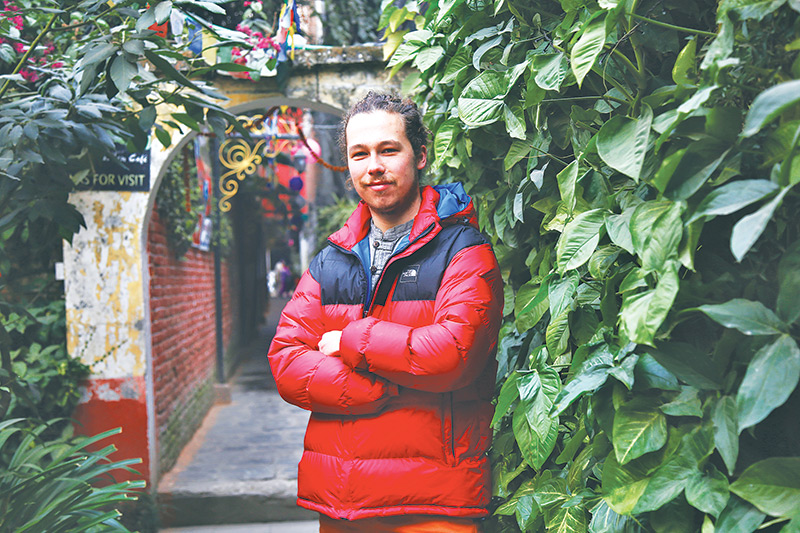
The story of how Kalani Gacon came to Nepal is an interesting one—it was an accident, he says. When he was travelling in Gorakhpur, India in 2015, he decided to take a bus to Kathmandu in a spur of a moment. Now, fast forward to four years, he has not only become a resident but has made a film about people like him, who have decided to call Nepal their home. The film, Journey to the Center of the Heart by the Australia-born 24-year-old, won the second prize in the international category of recently held 19th Kathmandu Mountain Film Festival. Gacon has also been part of a few Nepali films like Black, Lily Bily, and Intu Mintu London Ma. The Post’s Ankit Khadgi talked to Gacon about his love for filmmaking, his inspiration and his future projects. Excerpts:
How was your experience of making ‘Journey to the Center of the Heart’? I was very keen on making a movie about foreigners living in Nepal. It was also something very personal to me. It took me three years to complete the movie. When I conceived the idea, I didn’t have sufficient financial resources. With the savings I had, I rented a camera and used it to shoot my movie. There were even moments when I felt I was about to pass out while filming, but the sheer passion and desperation to tell this story kept me motivated.
What was the main inspiration behind choosing this particular issue for your film? Back then, I was in love with a Nepali woman. We were imagining our future together. But she didn’t want to settle in Nepal. In her mind, the only way to live happily was to leave Nepal and settle in another country. For me, it was deeply tragic. Similarly, I started making friends here in Nepal. But, one by one, they left Nepal and settled in Australia, Canada and other foreign countries. I was also friends with foreigners who found happiness here in Nepal. So, these two distinct inflows and outflows of people who were searching for their existence, a pursuit of either material or spiritual wealth made me realise that their stories are deeply powerful. These stories also reflect the current state of the modern world.
How difficult was it portray people’s personal lives on the big screen? I take the time to understand my subject and characters, and I’m mindful that this will take time. For my documentary, I spent a lot of time understanding and researching about my characters. I met more than 200 immigrants who have decided to settle in Nepal. After I selected the final characters for the movie, I spent as much time I could with them. It was almost like I was living with them.
What inspired you to choose filmmaking as your medium of expression? I was seven years old when I fell in love with the process of filmmaking. My grandfather used to take me around our village, where we used to film our neighbours doing their daily chores. Then, we would go back, and after watching it, we would make small edits to it. That’s how I was introduced to the process of filmmaking. I feel filmmaking makes me alive and that I am meant to do it. Filmmaking combines the element of time, with sound and visuals. It is like going through a spiritual journey. It has an immersive power that allows me to have a deeply emotional experience.
How was your experience different from working in the Nepali film industry in comparison to other countries? I have worked on multiple Nepali projects—from commercial to independent movies. The striking difference is the attitude towards time. In the west, each and every second is valuable in a movie, as it is attached to the finances. Whereas, in a Nepali movie set, the attitude towards time is slightly compromised. But the wholesome experiences gained in Nepali movie set makes up for the delayed schedules. In the west, there is so much stress to complete everything on time and arrange it systematically, which makes the whole creative process so strenuous that sometimes you lose the magic of making a movie. That’s why I would prefer working in Nepali set any day, even if they are three hours late, because I know I will have a good time.
Any future projects you are working on? The stories of Nepali immigrants are really powerful and engaging. In my film, I was unable to provide equal space to their stories, which was juxtaposed against the stories of foreigners immigrating to Nepal. But I feel both the stories require individual screen space and detailing. That’s why I am working on another documentary about seven Nepali immigrants who are living in different parts of the world. I want to portray their struggles and experiences. Apart from that, I am also working on a documentary about falling birth rates in Japan.
CULTURE & ARTS
Folk puppets keeping heritage of Egyptian satire alive
The squeaky-voiced puppet, with a wooden head, red conical hat, thin painted moustache and a bright red cloth cloak, was recognised by UNESCO in 2018.
- MENNA ZAKI
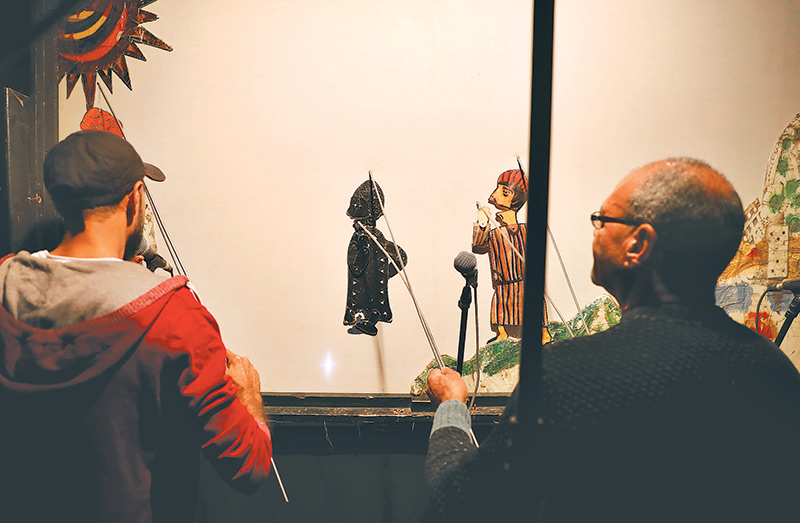
Members of Egypt’s Wamda troupe manipulate puppets during a Aragoz puppets show in Beit al-Sehemi, in Cairo’s Gamaliya district. AFP/rss
In an era of on-screen entertainment,a simple glove puppet named Aragoz still lures Egyptian audiences with comic sketches showing how wits and skill can defeat the thuggish and corrupt. Recounting stories with a thought-provoking moral in their tale, puppeteers evoke peels of laughter from spectators, mainly children, as they enact Aragoz’s exploits, some of which date back centuries to Ottoman times. “I fell in love with Aragoz as I grew up. Everyone loves it actually,” said Sabry Metawly, one of a diminishing band of veteran puppeteers still putting on performances of Egypt’s most adored folk figure. “It has clicked with the people because it represents them. It succeeds where they cannot by challenging and winning against rivals.” The squeaky-voiced puppet, with a wooden head, red conical hat, thin painted moustache and a bright red cloth cloak, was recognised by UNESCO in 2018 as part of the planet’s intangible cultural heritage. “Aragoz humorously criticises the actions of the powerful and resists the corrupt during the plays,” said Nabil Bahgat, founder of the Wamda troupe, of which Metawly is also a member. “But it does not target specific figures of current politics or leaders.” Outspoken, mocking, stubborn and often vulgar, the Aragoz character has long been viewed as a reflection of popular Egyptian society. The troupe—which comprises only six members—has been drawing weekly audiences for more than a decade at the Ottoman-era Beit al-Sehimi building in Cairo. But it has not faced any censorship despite the ongoing crackdown on freedom of expression since President Abdel Fattah al-Sisi took power in 2014. “Performers usually deal within the allowed limits of freedom,” Bahgat stressed.
Tales as old as time Like his father before him, Metawly performs from behind a portable box-like booth moving two puppets, one on each hand. He has been working as a puppeteer for more than 50 years, following in his father’s footsteps. He learned the stories—which are passed down orally—by watching his father perform in the streets and at rural festivals and Muslim celebrations. By 2003 when Bahgat formed Wamda he had managed to collect 19 plays orally and commit them to paper. All the Aragoz sketches, still performed today, are part of the country’s cultural heritage, passed down from one generation of performers to the next, without being properly documented, he said. “All plays are authorless,” Bahgat added. “Practitioners were in the habit of learning them by heart from their predecessors and passing them on to the new generations,” he said.
Verbal sparring None of the plays can be traced to a certain time or specific person, said troupe member Mahmoud Sayed. In them, Aragoz is often pitted against other puppets resembling an Ottoman-era policeman, a sheikh or a bully, and gets into comical verbal sparring matches sprinkled with clever puns. In one sketch, Aragoz argues with a bully dubbed the fetewa, a term used to describe powerful men who ran local neighbourhoods outside the law. “What do you want?” Aragoz asks after a long banter, with the bully immediately replying he wants a fight to see who is the most powerful. “Whoever wins gets the support of this audience,” says the fetewa. Aragoz immediately pounces on the bully dealing him a flurry of blows. He wins the scuffle after three rounds, and kicks his opponent off the box. “Get out!” shouts Aragoz, to huge cheers and applause.
Disappearing act Metawly always feared the art form would disappear, as veteran puppeteers dwindled in numbers and digital advancement took over entertainment. Some trace it back to the Fatimid dynasty from the 10th to 12th centuries, and others say it particularly flourished when the Ottomans took over Egypt from the 16th century. The origins of the name Aragoz is also a subject of debate. Some argue that it was inspired by the Ottoman-era shadow theatre form known as Karagoz. Others say it dates back to the Pharaohs, said Sayed. But practitioners have preserved its intrinsic features, including the puppet’s unique squeaky high-pitched voice created by a swazzle the puppeteers hold in their mouths. Over the decades, Aragoz has also become a more general insult for a clown. Pro-government media often use the term to refer to supporters of the outlawed Muslim Brotherhood group. And it was used to denounce popular Egyptian satirist and talk show host Bassem Youssef, who shot to fame for poking fun at government figures during his late night political satire show, following the popular 2011 uprising. “People nowadays diminish the term Aragoz to whatever they deem as silly or generally bad,” said Bahgat. “This just shows how little respect we have for our own culture.” In October, Egypt’s most famous veteran puppeteer Mostafa Othman died at the age of 80. “We have pushed for a long time to preserve this heritage,” said Bahgat. “We have done our part. It is now time for people to step up and preserve their culture.”
—Agence France-Presse
Food & Travel
Gosaikunda: More than just the lake
An end-of-season-trek to the holy waters of the lake brings about harsh winds, cold nights, but also arresting views.
The view of Gosaikunda lake and (above) the Lantang range.
Rasuwa, Wrapped in six layers of shirts, jumpers and jackets, sweaty and slightly shivering, holding a cup of milk tea in my hands, I let my gaze wander across lake Gosaikunda—the destination I had walked to, for the last two and a half days. The lake is of a dark, intense blue colour, lying still in its basin of grey rocks. Despite the winds, there are no waves, just a few small curls on the shores. The sky is lighter in colour than the lake but is just as flawless, without any clouds at all. I take a deep breath. When I planned this trip about a month ago, I was unsure if I would even make it to the lake. I took it as a trial for me, because I had never been on such high altitudes, and I was afraid I might get altitude sickness. Reinforcing my doubts was the timing of the trek—it was already the end of November, many had warned me that the temperature might drop below zero degrees at night. So, standing at the shore of this lake, at 4,400 metres above sea level, was a great feeling. Retrospectively, however, it’s funny how reaching the top seems secondary. A hike is not a mission, it’s a journey. And it’s journeys that have the potential to challenge and surprise us, not destinations. Hence, apart from the lake, there are many reasons why it is worth climbing to Gosaikunda. Situated in the Langtang National Park, Gosaikunda is an important pilgrimage site for Hindus. Lord Shiva is believed to have created the lake by punching a hole into the rocky landscape because he was desperate to satisfy his thirst after having been poisoned. Gosaikunda is also popular with trekkers because of its close proximity to Kathmandu, yet offer a very mountainous experience. I had booked a guide to accompany me, which is recommendable for solo travellers, who are not used to walking in high altitudes and don’t know the area. As most people do, we started the trek from Dhunche, which is a seven-hour drive from Kathmandu. We arrived in Dhunche on the back of a jeep. Feeling a bit creased and dusty, we got off the jeep and went to a hotel. I was happy to discover that there was hot water and went for a shower—the last one for the next four days. From Dhunche, the path first leads downwards for a while, to the Dhunche river. The path was littered with dry leaves and corns, which produced a cracking sound while we were walking. Following the river upstream, you eventually have to cross it and the path gets steeper. As I hadn’t been doing much physical activity for some time, the climb proved tough. We took three short breaks before we reached Deurali at around 10:30 am. At Deurali, we stopped for lunch break. We had to wait for our dal-bhat for about half an hour but I didn’t mind at all. I was happy to relax for a while and take a closer look at the surroundings. We were at a small tree-less plateau surrounded by the forest. The lodge was home to a family. Near the lodge was an old man ploughing a dry patch of land with his oxen, driving them while making funny sounds. Two kids of around two years were toddling around, their identical clothes were hanging stiffly on a washing line behind the house. The sky was grey and the peaks of the mountains in front of us were blanketed with white clouds, some of which looked like shreds of cotton wool. Looking to the southeast, I could see the valley of the Dhunche River from where we had come from. The dense forest mostly consisted of a mix of conifers and sal trees. On the way, my guide had spotted two langur monkeys brachiating through the thicket. Finally, the dal-bhat arrived. I was hungry and tucked in on the huge amount of rice the lady had served me. Right after lunch, we continued the trek but with my rice-filled stomach, the walk proved difficult. We had to climb about 700 metres to Chandanbari, our destination for the night. The path relentlessly climbed upwards again. When, after around two hours, we reached the quaint village consisting of a few lodges, a monastery and a cheese factory, I felt fine. But after a while, I got a massive headache. Chandanbari lies at 3,300 metres above sea and I was worried whether I would get any other symptoms of altitude sickness. I started drinking litres of hot water but it didn’t get any better. A short visit to the monastery and the cheese factory—both of which turned out to be closed—didn’t lift my spirits either. I was cold and extremely sleepy, and figured that only an early night would restore my energy.
Luckily, the next day, my headache was gone and I felt motivated to tackle the next leg—from Chandanbari to Laurebina. First, we walked through a forest of giant conifers. In between the dark, tall trunks, we managed to catch a brief glimpse of the snow-capped mountains of the Langtang Valley. After the stair-like path had led us out of the forest, we reached a sandy plateau from where we could see Langtang Lirung in its full majesty. We stopped there for lunch and I treated myself with a short nap on a bench inside the lodge. The sun was shining through the window, warming my face. As we continued walking, we crossed the tree line and the landscape changed to a desert-like, rocky wasteland, with dry, knee-length bushes. The higher we walked, the sparser the landscape got. The combination of the steep ascent and the low air pressure made me take heavy breaths. We had to walk slowly and take many breaks. We stopped at a Hindu shrine. Due to the lack of trees, I felt we were more exposed to the wind. The prayer flags were fluttering fast and produced a metallic noise when they banged against the pole. In the distance, I could hear the wind rushing through the forests of the Dhunche River valley. At around 2:30pm we reached Laurebina. Our lodge was built with stones and had a more alpine touch than the previous ones, all of which had a kind of a backpackers feel with Bob Marley posters and flags of different countries. But the one in Laurebina was scarcely decorated. It was much colder as well. The water in the buckets for flushing the toilet was frozen and white clouds of breath emerged out of my mouth when I yawned. When the sun was about to set, almost everybody left their warm place around the fire in the dining room and went outside to watch the sky perform its dramatic transformation from blue to black. Maybe it’s because of the lack of oxygen that I started to have these funny thoughts. Seeing people marvelling at the red stripe on the horizon, they seemed to me as if they were paying tribute to the sun, which had warmed them all day long. Maybe the reason why sunsets never fail to amaze us human beings is that there is a distant, subconscious, infantile fear that we can’t be sure whether the sun will return the next day. Why else would there always be such an awe-stricken silence when we watch a sunset, I wondered. Shortly after the spectacle, dinner was served and the fire slowly died out. The only warm place left was one’s sleeping bag. Thus, like everybody else, I turned in at around 8pm and passed out immediately. The good news: the sun did return the next morning. It brought about a bright and clear day. The bad news: well, there wasn’t any. The last few kilometres before Gosaikunda was one of the most scenic walks I ever had the chance to take. With the Annapurna range, Manaslu, Ganesh Himal, the peaks of Tibet and the Langtang Valley at our backs, we slowly climbed the last few hundred metres of difference in altitude. Eventually, the path flattened out, which led us around a rock that opened up the view of a steep, rocky slope. The sandy path was draped like a light brown cord from where we stood, guiding us to our destination. The walking became much easier and I started wondering what the lake would look like.
Text & Photos: Gina Bachmann
Food & Travel
Do-it-yourself sushi
Chef Dil Shrestha: Making sushi at home is easier than you think, and you can make it with almost anything you have in the kitchen.
- Marissa Taylor
Kathmandu, Who doesn’t like sushi? The combination of the freshness of the fish, the umagi flavours of the nori, and the savoury rice makes for a delicious, healthy meal. What makes this dish work is the simplicity of its ingredients and the complexity of the flavours. After all, good sushi is all about the artful balance of three things: the vinegared rice, the fish and the soy sauce. But Dil Shrestha, who’s been perfecting his sushi-making skills at the Sakura Restaurant in Boudha for the past 16 years, says sushi isn’t limited to fish, especially considering fresh fish is hard to come by in Nepal. Sushi has in fact evolved to be made with almost anything—from the typical seafood like tuna and crab to cucumber, carrot, even apples and papaya. For today, he’s teaching us how to make three different types of sushi anyone can make at home: an avocado sushi, a Tekka Maki and an “inside out” California roll.
Get yourself a sushi kit First things first, you need a few things to make sushi. The most important being a bamboo mat, which is available at two stores in the valley: one in Maharajgunj (Fish Japanese Food Shop) and another in Pulchowk (Smart Grocery). These stores have everything—from miso paste to nori to dashi—you’d need to make some Japanese food at home. Besides the mat, you won’t need any equipment you don’t already have at home, just a rice cooker, a bowl, a plate, some plastic wrap and a sharp knife. And if you don’t want to indulge in a mat, you could use an aluminium foil—but it won’t do the same job. In the bowl, you will also need to mix some vinegar (about a tablespoon) with water to dip your fingers into. This solution will prevent the rice from sticking to your fingers when you roll the sushi. Make the sushi riceIn Japan, becoming a sushi chef takes years of training. Typically, only after five years or so of apprenticeship is one-handed the most important task in making sushi: preparing the sushi rice. But we don’t have the time. To cook your sushi rice, first, wash it several times, then soak in cold water for at least half an hour before you place it in the cooker. After the rice is steamed, then put it onto a plate to cool. Do not use warm rice on your nori, for it will moisten the nori and you won’t be able to slice your sushi. You can get the rice at the two stores mentioned above. Regular Taichin rice will do, says the owner of Sakura, Ratna Kaji Maharjan. While your rice cools, you can make a rice solution for which you need vinegar, soy sauce, sugar and salt. For two cups of rice, add half a cup of vinegar, half a cup of soy sauce, ¼ cup of sugar and a teaspoon of salt. After the rice is cooled, carefully add this solution to the rice and mix well.
Work the mat Take your bamboo mat and cover it tightly with some plastic wrap to stop the rice from sticking to the grooves of the mat. Then, we can get the sushi rolling. For the avocado sushi, take a nori sheet and put in the rice on the sheet until you fill it midway. Then add in the avocado and roll the nori. At the end of the roll, dip your fingers in the vinegar-water mix and spread it on the nori so that the roll sticks together well. You can make this sushi with any other ingredient, like tuna—either canned or fresh. For the California roll, take a nori sheet, and following the central line running across it, cut it in half before laying half a sheet along the bottom half of the bamboo mat. Then fill the sheet with rice, let it stick for a minute, and then flip it over. Then place the crab sticks and cucumber—which should be cut at the same length of the nori sheet—and then roll.
Roll it up To roll your sushi, hold the ingredients with your index fingers and start rolling with the mat from the bottom edge, little by little. Keep rolling a few times, each time opening the mat to make sure it is tightly rolled. There should be no gaps between the rice and the filling. Then, remove the sushi from the mat and place it on a clean, dry chopping board. Cut the roll into six pieces with a sharp, wet knife, quickly and smoothly. Wipe the knife clean on a tower soaked in water with every cut to prevent the rice from sticking to the knife. Then place the cut pieces in a plate, have some soy sauce on the side if you like, and dig in!
WORLD
Baghdad embassy attack prompts Pompeo to delay Ukraine visit
- ASSOCIATED PRESS
Mike Pompeo. AP/RSS
WASHINGTON, The breach of the US Embassy compound in Baghdad has prompted Secretary of State Mike Pompeo to postpone his trip to Ukraine and four other countries. Pompeo was to arrive in Ukraine late Thursday in his first visit to the country at the center of President Donald Trump’s impeachment, then on to Belarus, Kazakhstan, Uzbekistan and Cyprus. He delayed the trip “to continue monitoring the situation in Iraq and ensure the safety and security of Americans in the Middle East,” State Department spokeswoman Morgan Ortagus said Wednesday. She said he intends to reschedule soon. In Baghdad, Iran-backed militiamen withdrew from the US Embassy compound after two days of clashes with American security forces. The US has sent hundreds of additional troops to the Middle East to increase security in the volatile aftermath of the embassy attack and as tensions with Iran rise. In Kyiv, Pompeo was to meet Ukraine’s President Volodymyr Zelenskiy, whose July 25 phone call with Trump triggered the whistleblower complaint that led to Trump’s impeachment. In that call, and through aides at other times, Trump pressed Zelenskiy to investigate potential 2020 election rival Joe Biden, his son, Hunter, and a discredited theory that Ukrainians and Democrats colluded to influence the 2016 election. Pompeo also planned to meet Ukrainian religious, civic and business leaders to discuss human rights and economic and political reform.
WORLD
Military moves in to help mass-scale evacuation from Australian bushfires
Catastrophic blazes left more than 50,000 people without power and some towns without drinking water.
- REUTERS
A fire tender team from the Australian Defence Force, HMAS Choules, motors through smoke haze off the coast of Mallacoota on Thursday. AP/RSS
MELBOURNE, Tens of thousands of holiday makers raced to evacuate popular seaside towns on Australia’s east coast on Wednesday, fleeing ahead of advancing bushfires, as military ships and helicopters planned missions to rescue thousands more trapped by the blazes. Long queues formed outside supermarkets and petrol stations near high-danger areas as both residents and tourists sought supplies to either bunker down or escape, but many shops and fuel stations had already run out of supplies. Major roads were closed due to fire risks, leaving motorists only a handful of escape routes causing lengthy traffic jams. More than 50,000 people were without power and some towns had no access to drinking water, after catastrophic fires ripped through the region on December 31 sending the sky blood red and destroying towns. Authorities have urged a mass exodus from several towns on Australia’s southeast coast, an area that is hugely popular in the current summer peak holiday season, warning that extreme heat forecast for the weekend will further stoke raging fires. “It is vital, critical,” NSW Transport Minister Andrew Constance said on Australian Broadcasting Corp television. “We need everybody to leave. We are going to face a worse day on Saturday than what we have been through.” Huge bushfires have been burning for weeks across Australia, with new blazes sparked into life almost daily by extremely hot and windy conditions in bushland left tinder dry after a three-year drought. Fuelled by searing temperatures and high winds, more than 200 fires are now burning across the southeastern states of New South Wales and Victoria, threatening several towns. Seven people have been killed in New South Wales state alone since Monday, including a volunteer firefighter, officials said, with one person still missing. The death toll for this year’s fire season is 15 in New South Wales alone. One person has died in Victoria state this week. Five military helicopters and two naval ships were en-route to the south coast to back up firefighters, bring in supplies like water and diesel and to evacuate people, the Australian Defence Force said. One ship was headed for the coastal town of Mallacoota in Victoria, where around 4,000 people have been stranded on the beach front since New Year’s Eve when they watched much of the town burn down. The navy rescue team will include 1.6 tonnes of water and paramedics, officials said. The only road in and out of Mallacoota was expected to remain blocked for several weeks. The state’s Country Fire Authority said smoke was hampering efforts to identify how many homes have been destroyed across the eastern region of the state. “We can’t even get fire trucks into some of these communities,” CFA Chief Officer Steve Warrington said. “This is not over by a long way.” Temperatures are forecast to soar above 40 degrees Celsius (104°Fahrenheit) along the south coast on Saturday, bringing the prospect of renewed firefronts to add to the around 200 current blazes. Fires this season have already destroyed nearly 1,300 homes in the state, including 381 homes destroyed on the south coast just this week, the NSW Rural Fire Service said. Bushfires are normal for Australia in the summer but this fire season has been one of the worst on record, putting pressure on Prime Minister Scott Morrison’s conservative climate change policies.
WORLD
Turkey parliament to vote on military deployment plan to Libya
- AGENCE FRANCE-PRESSE
ANKARA, Turkey’s parliament was set to pass a bill on Thursday approving a military deployment to Libya, hoping it will shore up the UN-backed government in Tripoli. The Tripoli government has been under sustained attack since April by military strongman General Khalifa Haftar, who is backed by Turkey’s regional rivals—Saudi Arabia, Egypt and the United Arab Emirates. President Recep Tayyip Erdogan’s office has confirmed that a request for military support had been received from the Tripoli-based Government of National Accord (GNA). No details have been given on the scale of the potential deployment, and Vice-President Fuat Oktay told state news agency Anadolu on Wednesday that no date had yet been set. “We are ready. Our armed forces and our defence ministry are ready,” he said, adding that parliamentary approval would be valid for a year. He described the parliament motion as a “political signal” aimed at deterring Haftar’s army. “After it passes, if the other side changes its attitude and says, ‘OK, we are withdrawing, we are abandoning our offensive,’ then what should we go there for?” A UN report in November said several countries were violating the arms embargo on Libya in place since the overthrow of its long-time dictator Moamer Kadhafi in 2011. Jordan and the UAE regularly supply Haftar’s forces, it said, while Turkey supports the GNA. Turkish and Emirati drones were spotted in Libyan skies during clashes over the summer. The Libyan conflict is expected to be a key topic of discussion when Russian President Vladimir Putin visits Turkey next Wednesday. Erdogan has repeatedly accused Russia of sending private mercenaries to support Haftar’s forces, though this has been denied by Moscow. It is expected to be a key Turkey and Russia have managed to work closely on Syria despite supporting opposing sides in that conflict. “We’re supporting the internationally recognised legitimate government in Libya. Outside powers must stop supporting illegitimate groups against the Libyan government,” Erdogan’s communications director Fahrettin Altun tweeted last week. Turkey has used its alliance with the Tripoli government to advance other interests. It signed a military cooperation agreement with the GNA during a visit by its leader, Fayez al-Sarraj, to Istanbul in November.
WORLD
French police use tear gas to end stir over pension reform
- REUTERS
PARIS, French police used tear gas to disperse protesters blockading a Paris bus depot on Thursday, the latest confrontation between the authorities and unions over plans to reform the pension system. The protests, now in their 29th day, are the longest since 1968. Video footage from a BFM television reporter published on Twitter showed police firing tear gas into a crowd at the entrance to the bus depot. Police had no immediate comment. BFM television also showed a stand-off later in the morning in central Paris, near the Opera Garnier. The hardline CGT union has called for more strikes this month after President Emmanuel Macron promised to push through his pension reforms. Macron said in a New Year’s Eve address that he expected his government to reach a compromise quickly with unions on the reforms, but without departing from principles laid out by ministers.
WORLD
Computer model beats human breast cancer diagnosis
- AGENCE FRANCE-PRESSE
Breast scans are recommended for women above 50 who exhibit no signs of cancer. AFP
PARIS, A computer programme can identify breast cancer from routine scans with greater accuracy than human experts, researchers said in what they hoped could prove a breakthrough in the fight against the global killer. Breast cancer is one of the most common cancers in women, and regular screening is vital in detecting the earliest signs of the disease in patients who show no obvious symptoms. In Britain, women over 50 are advised to get a mammogram every three years, the results of which are analysed by two independent experts. But interpreting the scans leaves room for error, and a small percentage of all mammograms either return a false positive—misdiagnosing a healthy patient as having cancer—or false negative—missing the disease as it spreads. Now researchers at Google Health have trained an artificial intelligence model to detect cancer in breast scans from thousands of women in Britain and the United States. The images had already been reviewed by doctors in real life, but unlike in a clinical setting the machine had no patient history to inform its diagnoses. The team found that their AI model could predict breast cancer from the scans with a similar accuracy level to expert radiographers. Further, the AI showed a reduction in the proportion of cases where cancer was incorrectly identified—5.7 percent in the US and 1.2 percent in Britain, respectively. It also reduced the percentage of missed diagnoses by 9.4 percent among US patients and by 2.7 percent in Britain. “The earlier you identify a breast cancer the better it is for the patient,” Dominic King, UK lead at Google Health, told AFP. “We think about this technology in a way that supports and enables an expert, or a patient ultimately, to get the best outcome from whatever diagnostics they’ve had.” In Britain all mammograms are reviewed by two radiologists, a necessary but labour-intensive process. The team at Google Health also conducted experiments comparing the computer’s decision with that of the first human scan reader. If the two diagnoses agreed, the case was marked as resolved. Only with discordant outcomes was the machine then asked to compare with the second reader’s decision. The study by King and his team, published in Nature, showed that using AI to verify the first human expert reviewer’s diagnosis could save up to 88 percent of the workload for the second clinician. “Find me a country where you can find a nurse or doctor that isn’t busy,” said King. “There’s the opportunity for this technology to support the existing excellent service of the [human] reviewers.” The team said further research was needed but they hoped that the technology could one day act as a “second opinion” for cancer diagnoses.
WORLD
Austrian coalition deal includes headscarf ban, preventive custody: Media reports
- REUTERS
Leader of Austria’s Green Party Werner Kogler and head of People’s PartySebastian Kurz shake hands after delivering a statement, in Vienna, Austria. REUTERS
VIENNA, A deal between Austria’s conservatives and Greens to form a governing coalition includes banning headscarves in school until the age of 14 and preventive custody for potentially dangerous immigrants, several Austrian media reported on Thursday. The measures are part of what conservative leader Sebastian Kurz describes as his tough stance on illegal immigration and “political Islam”, aimed at appealing to his base but also to disillusioned former supporters of the far right, whose coalition with his party collapsed in May. Kurz and Greens leader Werner Kogler said on Wednesday they have reached a deal that should make Kurz chancellor again and bring the Greens to power for the first time. They have said it includes strong measures on Kurz’s core issues and will “ecologize the tax system”. The two parties were due to publish details of their agreement at 4 p.m. (1500 GMT) on Thursday. The parties have declined to provide details of their plan before then. The deal includes raising the age until which girls are banned from wearing a headscarf in school to 14 from around 10, media including newspaper Die Presse and broadcaster ORF said. It also includes reviving a disputed plan for preventive custody of potentially dangerous individuals, even if they have not committed a crime, which was put forward by Kurz’s coalition government with the far right after a fatal stabbing apparently committed by an asylum seeker in February. “A lot of turquoise and a bit of green,” tabloid Kronen Zeitung headlined its story, referring to the parties by their colours, saying the preventive custody plan is aimed at refugees. If confirmed, such measures will be hard for many Greens supporters to swallow, and the coalition deal must still be approved by the Greens’ top decision-making body, the Federal Council, on Saturday. While few expect the Federal Council, which comprises various within the party such as its local and national lawmakers, to block the deal, immigration and security are likely to be constant sources of friction within the coalition. While Kurz has insisted on keeping his trademark hard line on immigration, the Greens have called for a fiscal overhaul to make products and services with a large carbon footprint more expensive. Fewer specifics on environmental measures leaked on Thursday. Die Presse said carbon emissions would be made more expensive but there would be no carbon tax. Tabloid Oesterreich said that move would be gradual, quoting one coalition deal negotiator as saying: “But that is only phrased very vaguely.”
WORLD
IS claims deadly attack on police in Russian Caucasus
Briefing
MOSCOW: Two men who attacked a police post this week killing at least one officer in the Russian Caucasus were fighters from the Islamic State jihadist group, the IS propaganda agency Amaq said. The perpetrators rammed a car into a traffic police post outside the city of Magas in Ingushetia region around 5:30 pm on Tuesday, after which they attacked policemen with knives, according to the regional government. The Amaq statement on Telegram posted late Wednesday said the men were “two fighters from Islamic state” who killed two officers and injured others.The Ingushetia regional government and regional investigators said one officer died from injuries. There has been no official confirmation of a second police death. (Agencies)
WORLD
Mountain lions shot in US after feeding on human remains
Briefing
LOS ANGELES: Wildlife officials in the US state of Arizona said they have shot three mountain lions which fed on human remains found near a popular hiking trail. Pima County Sheriff’s Department said Tuesday it had found human remains at Pima Canyon Trail in the hills north of Tucson. The three lions were killed overnight, Arizona Game and Fish Department said Wednesday. They were not believed to have killed anyone but human remains were found in their droppings. “We do not believe the lion attacked the individual who died there. An autopsy will tell us more. But our belief is they were eating the human remains after the fact,” Game and Fish spokesman Mark Hart told local TV station KGUN9. Feeding on human remains made the lions a danger. (Agencies)
WORLD
French citizen dead in US custody: Immigration agency
Briefing
HOUSTON: A French citizen and native of Angola has died in the custody of US immigration agents, they said on Wednesday, the latest in a number of deaths during a US crackdown on illegal immigrants. A statement from Immigration and Customs Enforcement (ICE) identified the person only as “a 40-year-old native of Angola and citizen of France.” They said the person died on Sunday at a hospital in Albuquerque, New Mexico. “An autopsy is pending to determine the official cause of death,” ICE said, adding that French consular officials have been notified and “are attempting to locate the next of kin.” (Agencies)
ASIA
Japan raid, Turkey arrests in widening Ghosn probe
A Tokyo court had allowed Ghosn to ‘keep a second French passport’ for travel inside Japan.
- AGENCE FRANCE-PRESSE
Japanese prosecutors carry bags as they leave the residence of former auto tycoon Carlos Ghosn on Thursday after Ghosn fled Japan to avoid a trial. AFP/RSS
TOKYO, Officials on Thursday raided the Tokyo residence of former Nissan boss Carlos Ghosn who fled to Lebanon to avoid a Japanese trial, while Turkey detained several people as part of a widening probe into the security lapse. Ghosn, who faced multiple charges of financial misconduct that he denies, won bail in April but with strict conditions—including a ban on overseas travel. But the disgraced executive, who has French, Brazilian and Lebanese nationalities, managed to slip out of Japan on Sunday despite having handed over his three passports to his lawyers. A court in Tokyo had allowed Ghosn to keep a second French passport as he needed one to travel inside Japan, a source close to the matter told AFP Thursday. “He had to keep this passport” to prove his short-stay status, the source said, adding: “There was permission from the court.” Ghosn was allowed this French passport so long as it was kept in a locked case with the code held by his lawyers, the source said. There is no emigration data showing Ghosn’s departure from Japan but he entered Lebanon on a French passport, public broadcaster NHK said. Colourful rumours abound regarding the exact circumstances of Ghosn’s daring escape. One claim in the Lebanese media was that the mogul was sprung from his Tokyo residence in a musical instrument case—a story a source in his entourage denied. He is thought to have taken a private jet from Kansai Airport in western Japan on December 29, heading for Istanbul. It is believed Ghosn headed from there to Beirut. Turkey’s interior ministry has opened an investigation into Ghosn’s apparent transfer between private jets at an Istanbul airport on Monday. Officials questioned seven people, including four pilots, as part of the probe, news agency DHA reported Thursday. Prosecutors, meanwhile, raided his former Tokyo residence Thursday as part of an initial investigation into his escape. Television footage showed several officers in dark suits entering the property. Authorities are expected to analyse security camera footage from his residence and other places they suspect Ghosn travelled to before he fled, NHK said. Police suspect “several” people accompanied him to help him escape “in an unlawful manner,” it added. The Japanese government has yet to issue any official statement on the case. When his defence lawyers were arguing for bail, prosecutors claimed he was a flight risk with powerful connections, but Ghosn himself said he wanted to be tried to prove his innocence. One of his lawyers also said at the time that he was such a famous face he had no chance of slipping away undetected. The Japanese government is likely to ask Lebanon to extradite Ghosn through diplomatic channels, but chances of his handover appear slim as Beiruit has no extradition accord with Tokyo. The French government said on Thursday it would not extradite Ghosn if he arrived in the country because it does not extradite its nationals.
Lebanon receives Interpol arrest notice BEIRUT: Lebanon’s judiciary has received a red notice from Interpol for the arrest of fugitive auto tycoon Carlos Ghosn, the state-run National News Agency reported on Thursday. It quoted Justice Minister Albert Sarhan as announcing that “the public prosecutor... has received what is known as a red notice from Interpol in the Carlos Ghosn case.” The French-Lebanese former Nissan boss, who had been under house arrest in Japan over several counts of financial misconduct, escaped in mysterious circumstances and arrived in Beirut on Monday. Interpol, which is headquartered in the French city of Lyon, is an international organisation that facilitates worldwide police cooperation.
ASIA
Sri Lanka orders bus operators to turn down the music
- AGENCE FRANCE-PRESSE
Colombo, Sri Lanka’s government on Thursday gave bus operators two weeks to turn down the notoriously loud music in their vehicles following complaints from passengers. Transport minister Mahinda Amaraweera has given bus operators until January 15 to voluntarily turn down the volume or he would bring in legislation, said ministry spokesman Dharma Wanninayake said. There are an estimated 20,000 private buses plying Sri Lankan roads, notorious for playing loud Sinhala, Tamil and Hindi songs, mainly from low-budget movies. Long-distance buses also frequently play high-decibel music videos. Wanninayake said there had been frequent complaints from long-suffering passengers. Many on social media have called for a complete ban on music in buses. The National Transport Commission (NTC), the private bus regulator, was also offering a playlist of 1,000 Sinhala, Tamil and Hindi songs free of charge to be played in buses -- at a reasonable level.
ASIA
UN chief Guterres ‘deeply concerned’ over North Korea weapons test threats
- REUTERS
Reuters
UNITED NATIONS/WASHINGTON, UN Secretary-General Antonio Guterres is “deeply concerned” that North Korea has indicated it could resume nuclear and missile tests, a UN spokesman said on Wednesday. “The Secretary-General very much hopes that the tests will not resume, in line with relevant Security Council resolutions. Non-proliferation remains a fundamental pillar of global nuclear security and must be preserved,” spokesman Stephane Dujarric said in a statement. North Korean leader Kim Jong-un said this week that there were no longer grounds for Pyongyang to be bound by a self-declared moratorium on intercontinental ballistic missile and nuclear bomb testing and that a “new strategic weapon” would be introduced in the near future. “Diplomatic engagement is the only pathway to sustainable peace,” Dujarric also said. US President Donald Trump - who in 2018 became the first American leader to meet with a North Korean leader - said after Kim’s remarks that the leader had signed a denuclearization contract and Trump thought Kim was a “man of his word.” Trump has repeatedly pointed to the moratorium, in place since 2017, as a sign that his policy of engagement with North Korea was working. Kim has complained the United States had continued joint military drills with South Korea, adopted cutting-edge weapons and imposed sanctions while making “gangster-like demands.” Last month, Pyongyang warned Washington of a possible “Christmas gift” after Kim gave the United States until the end of the year to propose new concessions in talks over his country’s nuclear arsenal. North Korea experts said that Kim’s remarks—made during an hours-long plenum speech - were likely directed at his party, military, and government officials in North Korea, preparing the country for another period of economic hardship as it prepares for a long stalemate with the United States. “The main points, almost certainly, were not headlines about weapons development or a possible resumption of testing,” said Robert Carlin, a North Korea expert at the Stimson Center think tank in Washington. “It means preparing the economy and the people for a long-term confrontation with the US,” he said, adding that the message was “no longer working for relief of sanctions but girding to live under them.”
ASIA
Once unloved, threatened storks given new hope in Indian zoo
- AGENCE FRANCE-PRESSE
A greater adjutant stork and its chick on an artificial platform in an enclosure at Assam State Zoo/Botanical Garden in Guwahati. AFP/RSS
GUWAHATI (India), The hatching of two storks on a bamboo platform in a remote Indian zoo has raised hopes that one of the world’s most threatened bird species can be saved, experts say. The two Greater Adjutant chicks have gone on display at Assam State Zoo weeks after they hatched in the northeast Indian state. The Greater Adjutant, standing 1.5 metres (nearly five feet) tall with a 2.5 metre (eight feet) wing-span, is on the red list of threatened species kept by the International Union for Conservation of Nature. With the gradual destruction of their forest and wetland breeding habitat, there are believed to be only about 1,000 of the storks left in India and Cambodia. “We do not have any report that this endangered bird has bred (before) in any zoo or in captivity,” said Assam zoo chief Tejas Mariswamy. “This success will lead to similar experiment elsewhere in the world and will help conserve and protect the birds,” added Bibhab Talukdar, head of the Aaranyak conservation group that worked with the zoo to help breeding. The storks, known as “hargilla” (bone swallower) in the Assamese language, were shunned before because of their smelly droppings, noisy calls and messy eating habits. But the Aaranyak project led a campaign to rehabilitate the species and its reputation in recent years. It assembled an award-winning brigade of village women conservationists to protect their nesting grounds, and set up the breeding platforms with Assam zoo in 2017. “Finally we found success on November 26, 2019 when the first chick hatched,” said Purnima Devi Barman, who leads the project. A second followed 10 days later. Two three metre (10 feet) high bamboo platforms were erected in the zoo. The platform was about metre wide, the size of the stork’s natural nest. Nesting materials used by the birds in the wild were brought in for the Greater Adjutants to find. Their food supply was also carefully prepared. “The commotion created by zoo visitors was also monitored and care was taken so that the birds did not suffer from disturbance,” said Mariswamy. The Greater Adjutant is one of the rarest of the 20 species of stork left in the world. It is one of the eight species found in India. It is now only found in a few isolated districts in Assam and Bihar in India, and Prek Toal in Cambodia. Bibhab said the loss of the tall trees where they usually nest, as well as poaching and poisoning have become major threats to the species. “Many historical breeding colonies have been lost,” he said.
ASIA
Taiwan’s military chief killed in chopper crash
- AGENCE FRANCE-PRESSE
Shen Yi-ming. AP/RSS
TAIPEI, Taiwan’s military chief was killed in a helicopter crash on Thursday, the defence ministry said, just days before the island goes to polls to elect a new president. The chief of the general staff, Shen Yi-ming, was among eight senior officers—including three major-generals—who died when their Black Hawk helicopter smashed into mountains near Taipei. The 62-year-old general and his entourage were on a routine mission to visit soldiers in northeast Yilan county for the upcoming Lunar New Year when the incident happened. Flags at all military units will fly at half-mast for three days as Shen was the highest-ranking military official to die while on official duty, the government said. Lieutenant-general Tsao Ching-ping, one of five survivors, told rescuers in footage broadcast on local TV: “I am okay... two others are injured and only I can walk.” “There is one more person who’s more seriously wounded and two or three people in the cabin ... while two more with no signs of life.” President Tsai Ing-wen’s office said that she will cancel all campaign activities for three days after the tragedy. The ruling Democratic Progressive Party will also suspend campaigning for three days. Tsai is seeking a second term against Kaohsiung city mayor Han Kuo-yu of the Kuomintang (KMT) party in the January 11 elections when Taiwan will also elect a new parliament. Han and the KMT also expressed condolences to the victims and announced that they will stop campaigning for two days. “Today is a day that we are deeply saddened because several of our most distinguished generals died while on official duty,” Tsai said at a briefing for the incident.
ASIA
Dozens of South Korean MPs indicted
Briefing
SEOUL: South Korean prosecutors on Thursday indicted almost 30 MPs and the leader of the main opposition party on assault and other charges over a two-day parliamentary stand-off. In an attempt to stop legislation being passed, members of the opposition Liberty Korea party (LKP) lay on the floor linking arms to block access to a committee room, and blockaded an MP in his office for five hours.Scuffles broke out as MPs of the governing Democratic party tried to force their way into the hall in April.Seoul prosecutors indicted the LKP leader Hwang Kyo-ahn and 23 of his MPs on charges including causing a commotion at the national assembly and illegal detention. Five Democratic party MPs were indicted on accusations of assault. (Agencies)
ASIA
Indonesia floods leave nearly 30 dead, several missing
Briefing
JAKARTA: Indonesia’s disaster agency warned Thursday of more deaths after torrential rains pounded the Jakarta region, triggering floods and landslides that killed at least 29 and left vast swaths of the megalopolis underwater. Tens of thousands fled to temporary shelters across the capital region—home to some 30 million—with scores of houses damaged in the deadliest flooding in years, after torrential rains on New Year’s Eve.Images showed waterlogged homes and cars covered in muddy floodwaters, while some people took to paddling in small rubber lifeboats or tyre inner-tubes to get around. (Agencies)
ASIA
Thai retailers ban single-use plastic bags
Briefing
BANGKOK: Thai retailers kicked off 2020 with a ban on single-use plastic bags, joining the battle against throwaway carriers in the Southeast Asian nation where citizens go through an average of eight every day. The move, taken on Wednesday by several major mall operators and the ubiquitous 7/11 convenience stores, will see customers instead paying a small fee for a reusable bag made of a cloth-like fabric. Thailand is one of the largest contributors to ocean pollution, with plastic bags recently turning up in the stomachs of dead marine mammals like dugongs and green turtles and prompting national soul-searching. (Agencies)
MONEY
Sterling sags as investors re-focus on a no-deal Brexit
- REUTERS
LONDON, The pound was weaker on Thursday as the euphoria of December’s election gave way to anxiety over the risk of a no-deal Brexit at the end of 2020. Market liquidity was thin on the year’s first day of trading, but the decline showed how worried traders were over Britain’s trade negotiations with the European Union after its expected exit from the bloc at the end of this month. The UK has a year to strike a trade deal. The deadline can be extended beyond December 2020, but Prime Minister Boris Johnson has said he will not ask for an extension, despite warnings it would be hard to agree a deal in just under a year. The final reading of the British manufacturing purchasing managers’ index contributed to the fall in sterling. It showed factory output fell in December at the fastest rate since 2012 as a tepid global economy hurt demand and businesses reduced inventories built up in case of a no-deal Brexit. “The pound was the second worst performing G10 currency overnight amid thin liquidity as markets grow nervous that the recent rally in the pound was overdone,” said Lee Hardman, currency analyst at MUFG. Sterling was last down 0.3 percent at $1.3209, off its mid-December high of $1.3516 after the Conservative victory in the general election. That briefly reassured investors Britain would finally leave the EU after postponing its exit three times. British businesses reported a fall in Brexit-related uncertainty last month, according to a Bank of England survey.
MONEY
US shale producers to tap brakes in 2020 after years of rapid growth
The decade-long oil expansion failed to boost profits, which has discouraged investors.
- REUTERS
Pump jacks operate in front of a drilling rig in an oil field in Midland, Texas US. reuters
HOUSTON, Vastly slower US oil growth this year and the prospect of a plateau for the world’s top oil producer have signaled a new and unfamiliar era of self-restraint for the go-go shale industry. Spending cuts and production declines common to shale wells mean US output growth is expected to brake from 2019’s pace that pushed domestic production past 13 million barrels per day (bpd). Some analyst forecasts for next year call for growth to slow, potentially to a rate of just 100,000 new bpd. Over the latest decade, the shale revolution turned the United States into the world’s largest crude producer and a force in energy exports. Yet the revolution did not translate to higher stock prices. The S&P 500 Energy sector only gained 6 percent for the decade, far less than the 180 percent return for the broader stock market. The decade-long oil expansion failed to boost profits, which has discouraged investors. The shale industry was squeezed by an OPEC price war that began in 2014, sending US crude prices below $30 per barrel at one point. Production temporarily slowed, but accelerated into the end of the decade as companies cut costs and grew more efficient. Now, with investor returns flagging, the industry no longer believes in drilling its way to success even at higher prices. “The drumbeat has been loud and uniform from investors,” said Parsley Energy (PE.N) Chief Executive Officer Matt Gallagher. The shale producer’s spending next year will drop about 15 percent and will not rise even if oil prices do, instead using higher returns to pay down debt, he said. “We had to be a competitive and profitable business, not just recover resource at all cost,” said Gallagher of the industry’s shift in thinking. Parsley started paying a quarterly dividend for the first time in September. Analysts currently expect US crude oil to average around $58 per barrel in 2020, which would represent a modest pullback from current levels. Yet even if oil prices were to remain above $60 a barrel next year, analysts say it will not spur another production spurt because of the pressure for returns. Despite US and international crude prices gaining 26 percent and 26 percent, respectively, the S&P 500 Energy Index [.SPNY] rose less than 8 percent in 2019. “Our view is that (rapid growth) is kind of over,” said Raoul LeBlanc, an energy analyst with consultancy IHS Markit. Because oil output from shale drops off quickly, wells require constant, costly drilling to keep production levels steady. In Texas, home of the Permian Basin shale field, the finishing touches to coax a well to produce, called completions, fell 16 percent though November, according to the state’s energy regulator. Hiring in the Permian also dropped sharply in late 2019, according to career website LinkedIn. As shale’s outlook cools, the only oil producers maintaining annual Permian growth rates near 40 percent are giants Exxon Mobil Corp and Chevron Corp and some private operators, said Artem Abramov, head of shale research at consultancy Rystad Energy. Morgan Stanley noted in early December that publicly traded shale companies’ output growth was just 460,000 bpd for the 12 months ending in September, compared with 1.3 million bpd for the 12 months before that.
MONEY
Hyundai, Kia sales drop to seven-year low
- REUTERS
SEOUL, South Korea’s Hyundai Motor and affiliate Kia Motors turned in their lowest sales in seven years in 2019 as business in China slumped, missing their target for a fifth straight time, but forecast better numbers for 2020. Weak 2019 sales underline the challenges Hyundai Motor Group has been facing, including a string of annual profit declines at Hyundai and higher costs to develop future technologies even as the global auto market stagnates. “The market environment is very uncertain and internal and external challenges will intensify,” Group heir apparent Euisun Chung said on Thursday. But he reiterated that the Group would continue to focus on profitability and technology investment. Hyundai and Kia reported a 3 percent drop in their combined global sales to 7.19 million vehicles for 2019, falling short of their target to sell 7.6 million vehicles. Their sales have slumped in China, the world’s biggest auto market, offsetting a recovery in the United States.
MONEY
Congo economic hub has the blues despite oil upturn
- AGENCE FRANCE-PRESSE
The International Monetary Fund projects that the central African state will record growth of 4.0 percent for 2019, after 1.6 percent in 2018 and two years of contraction. afp/rss
BRAZZAVILLE, If the official figures are any guide, the good times in the Republic of Congo should be returning. Five years after going into a tailspin, oil—the country’s lifeblood—is flowing at a record 350,000 barrels per day after a new field, Moho Nord, went on tap. The International Monetary Fund (IMF) projects that the central African state will record growth of 4.0 percent for 2019, after 1.6 percent in 2018 and two years of contraction in 2016 and 2017. But in Pointe-Noire, a port city that is home to around a fifth of Congo’s 4.5 million people, many say any upturn has yet to reach them. Deschagrains Ebeh, 37, is head of De-Network, one of many companies that did well out of servicing Congo’s rush for black gold. Today, Ebeh’s business card lists a dozen activities—including computing, video surveillance, training, auditing and consulting, website design and even a call centre. He had to diversify to survive and pitch his business to individuals rather than well-heeled corporations. To save money, he trimmed his payroll to 10 people, works as both managing director and technical director, and opened up part of his office space for co-working to ease the burden of his $1,120 monthly rent. With the oil crash, “we lost 50 percent of our clients and 60 percent of our customers,” said Ebeh. In the halcyon year of 2014-15, his company had a turnover of 500 million CFA francs ($850,000). “We haven’t made any profits for four years,” he said. The president of the Chamber of Commerce and Industry (CCI) in Pointe-Noire, Sylvestre Didier Mavouenzela, said the oil contraction had ricocheted down the job market. “When the crisis hit, Total, the biggest company in Pointe Noire, renegotiated lower contracts with its sub-contractors,” he said. “Fifty thousand jobs went between 2014 and 2017,” he said. Many expatriate posts were cut—which had a knock-on effect for those working as gardeners, child carers or drivers. There is little sign of any new oil wealth trickling down—state receipts are being used to scale down public debt, in line with an agreement with the IMF, which in July approved a $448 million bailout. Pointe-Noire’s port has recorded a big upturn in container traffic: 900,000 units this year after 800,000 last year. But most of the containers are in transit, rather than destined for the local economy. They head to other ports in the region—Matadi in the neighbouring Democratic Republic of Congo (DRC) and Libreville, the capital of Gabon. “We are going through the third round of job cuts in two years,” said Christophe Pujalte, regional director of the French group Bollore Transport and Logistics, one of the port’s operators. “In 2015, we had 1,100 people. By the end of year, it will be less than 700.” Other figures in the local economy have plenty of complaints about governance. They include corruption, “harassment” by the tax and customs authorities and the cost of using a highway linking the city to the capital Brazzaville—the toll is the equivalent of more than $330 per truck for the 500 kilometres (310 miles) journey. Political uncertainty is also a concern. Presidential elections are due in 2021. The last ballot, in 2016, saw the re-election of Denis Sassou Nguesso, 76, triggering unrest in Brazzaville and armed conflict in the fertile region of Pool that cut the vital rail line between the capital and Pointe-Noire.
MONEY
Chinese state firm wins bid for Kathmandu airport project
The project includes building 15 international parking bays and taxiway on the northern side of the runway.
- SANGAM PRASAIN
shutterstock
KATHMANDU, A Chinese state-owned company has won the bid to build key infrastructure at the Tribhuvan International Airport that had been left in limbo for the last three years causing severe congestion at the country’s sole international airport. According to the airport authority, China National Aero Technology International Engineering Corporation, a state-owned enterprise specializing in building airports, has emerged as the lowest bidder to construct the facility. “We will formally sign an agreement with the company soon,” said Murari Bhandari, chief of the airport upgradation project under the Civil Aviation Authority of Nepal. The company quoted Rs 6.92 billion for the project. The scope of the project includes supply of 2.1 million cubic metres of soil for filling the ravine on the northern side of the runway where 15 new international parking bays are to be constructed. The project, which would take at least three years to complete, also includes construction of around 450 metres of taxiway on the northern side. It’s the same company that completed the runway and taxiway rehabilitation of the Tribhuvan International Airport, recently, before the stipulated deadline, said Bhandari. “As the company has most of the equipment as well as the manpower, we expect that the project will begin soon,” he said. “Due to the delay in works, the cost of the project has increased,” he said, adding that the project’s increased cost is currently under evaluation. The cost increased after the previous contractor, a Spanish company—Constructora Sanjose—was fired for non-performance. Consequently, the completion date for the first phase of the Tribhuvan International Airport improvement project had to be pushed back to 2022. It was originally scheduled to be completed by March 2016. The $92-million project, jointly funded by the government ($12 million) and the Asian Development Bank ($80 million in loan and grant), and implemented on December 6, 2010, is one of the longest duration projects of the Asian Development Bank. The bank closed its funding for the first phase after the project crossed a 10-year period in December 2018. The multilateral funding agency has since been studying a fresh funding modality for 2020, according to officials at the civil aviation body. The airport improvement project, now known as Tribhuvan International Airport Air Transport Capacity Enhancement Project, was broken up into four packages in December 2016 after sending off the original contractor. The other three packages have already been contracted, the project officials said. According to figures released by the airport, 4.34 million international passengers travelled through the airport in 2018. That marked an 11.70 percent increase over 2017. The figure shows that Tribhuvan International Airport handled 11,898 international travelers daily in 2018. Similarly, domestic airlines flew 2.84 million passengers in 2018, up 19.22 percent from the 2017 figure.
MONEY
Oil starts 2020 steady amid trade optimism
- REUTERS
LONDON, Oil prices steadied after early gains on Thursday as signs of improving trade relations between the United States and China which eased demand concerns and rising tensions in the Middle East provided support. Brent crude futures rose 7 cents to $66.25 a barrel by 1259 GMT, while US West Texas Intermediate (WTI) crude was unchanged at $61.06 per barrel. The US military carried out air strikes against Iran-backed Katib Hezbollah militia group over the weekend. Angry at the air strikes, protesters stormed the US Embassy in Baghdad on Wednesday, although they withdrew after the United States deployed extra troops. “We do not see a threat to Iraq’s crude supply at the moment, other than a small wind down over the first few months of 2020 in line with its OPEC cut agreements,” consultancy JBC Energy said. “Nevertheless, heightened tensions in the region involving Iranian-backed forces may introduce a certain geopolitical risk,” they added. Oil was also boosted by optimism that trade talks between the world’s two largest economies will support demand. US President Donald Trump said on Tuesday the US-China Phase 1 trade deal would be signed on Jan. 15 at the White House. “We may need to see that economic optimism turn into better data before we see more substantial gains,” analysts at OANDA said. January also marks the scheduled start of deeper output cuts by the Organization of Petroleum Exporting Countries (OPEC) and its partners, including Russia. The group agreed to cut output by a further 500,000 barrels per day (bpd) from Jan. 1, on top of their previous cut of 1.2 million bpd. The cuts come as Russia reported record high 2019 oil and gas condensate production of 11.25 million bpd, beating the previous record of 11.16 million bpd set a year earlier, Energy Ministry data showed on Thursday. A fall in US crude inventories last week also supported prices. US crude stocks fell 7.8 million barrels in the week ended Dec. 27, compared with analysts’ expectations for a decrease of 3.2 million barrels, data from the American Petroleum Institute (API) showed on Tuesday.
MONEY
Ministry panel to resolve row between the electricity authority and industrialists
- PRAHLAD RIJAL
KATHMANDU, The Energy Ministry is preparing to form a committee to resolve a row between the Nepal Electricity Authority and industrialists over outstanding electricity bills that has been dragging on for nearly a year, officials said. The state-owned utility maintains 25 factories owe more than Rs10 billion for electricity supplied to them through dedicated feeders and trunk lines since 2015. The dispute intensified in May after the power utility presented bills to the factories for the overdue payments. The unhappy factory owners went to court accusing the Nepal Electricity Authority of charging them illegally and questioning the motive behind levying such huge amounts. They claimed that the utility had billed even those factories that had not signed any agreement to buy power at a premium. According to an official close to the situation, both the power utility and the industrialists are at fault in this case because of conflicting provisions, the power utility’s negligence in record-keeping and supplying direct electricity and the industrialist’s reluctance to pay what they genuinely owe to the state. “There is talk of giving a discount for the time difference in implementing the decision to supply regular electricity to factories at premium rates during the power crisis and after the end of load-shedding,” said the official who asked not to be named. In June 2015, a board meeting of the electricity authority had set premium charges for factories using electricity through dedicated feeders from August that year. A separate meeting of the now-dissolved Electricity Tariff Fixation Commission had decided in January 2016 to set premium charges for factories using direct electricity from dedicated feeders and trunk lines. The power utility has billed them from August 2015 and not January as per the dissolved board’s decision. And it was also found that in a bid to end load-shedding and manage the power load, around 16 factories were supplied regular power through trunk lines even though they had not applied for it and were charged premium rates. As per the provisions of the billing bylaws, any factory that wishes to receive electricity through a trunk line for 20 or more hours like a dedicated feeder system has to pay the charges applicable to dedicated feeder users. Such factories must get approval from the electricity authority board and cannot consume electricity for more hours than the outage schedule set for them. “Any industry found to have used electricity for more than the permitted hours under the load-shedding schedule will be charged under the Electricity Theft Control Act 2002, and is liable to pay regular premium rates and compensation charges for unauthorised use of electricity,” state the bylaws. After the power utility sent the bills, the industrialists filed petitions at multiple district courts and Patan High Court. The High Court rejected petitions filed by more than a dozen firms ordering them to take the matter to the power utility’s appeals committee and resolve it there, citing that the issue of electricity bills did not fall under the court’s purview. The power utility amended the provisions in its billing bylaws and said that if the firms fail to make regular payments after being allowed to pay in instalments, the utility can seek regular monthly instalments and an additional amount as fines for deferral or cut their electricity connections. After talk of cutting their electricity connections surfaced, the industrialists took the matter to Prime Minister KP Sharma Oli who called for a meeting with officials of all stakeholder agencies. “At the meeting, it was decided to seek a middle path by forming a committee through the cabinet and give a discount for around a year and a half after the end of load-shedding starting June 2018, and for the gap period between the date the power utility board issued its decision, and the date the decision of the dissolved tariff commission came into effect,” said the official. Energy Secretary Dinesh Ghimire confirmed the development and said that discussions were being held to form the proposed committee. When asked about the monies owed legally by the industrialists to the state and talk of discounting billions of rupees, Ghimire said that the issue of tariffs and discounts fell under the purview of the Electricity Regulatory Commission, declining to comment further. According to Ram Prasad Dhital, a member of the Electricity Regulatory Commission who oversees legal and external affairs, it received around 10 applications from the industrialists to prevent the power utility from cutting off their electricity, but as the cases are in court, the commission cannot go beyond its jurisdiction and make a statement on the matter. “As far as the issue of hefty charges levied on industrialists despite the end of load-shedding is concerned, the commission is working to revise the electricity tariffs in line with the application received from the power utility,” said Dhital. Earlier, the electricity authority said that 298 consumers were being supplied with electricity through dedicated feeders and trunk lines. Among them, 184 pay premium rates and around 25 factories have not paid their electricity bills since 2015. The factories had secured 315 megawatts of 24-hour electricity supplied directly through dedicated feeders and trunk lines when the rest of the country was reeling under a severe power crisis. After talk of halting payment collection from industries until the proposed committee reaches a solution surfaced, the government also faced criticism. “Why does the government want to stop the electricity authority from legally collecting the amount from industries?” said Prakash Chandra Lohani, former finance minister. “Also, this neo-feudalist government cannot do anything about industries who owe money to poor sugarcane farmers, and it wants to discount the bills of some big and near industrialists. This makes it clear whose government it really is.”
MONEY
Denmark sources record 47 percent of power from wind in 2019
- REUTERS
Middelgrunden offshore wind farm is pictured, outside Copenhagen, Denmark. REUTERS
COPENHAGEN, Denmark sourced almost half its electricity consumption from wind power last year, a new record boosted by steep cost reductions and improved offshore technology. Wind accounted for 47 percent of Denmark’s power usage in 2019, the country’s grid operator Energinet said on Thursday citing preliminary data, up from 41 percent in 2018 and topping the previous record of 43 percent in 2017. European countries are global leaders in utilising wind power but Denmark is far in front of nearest rival Ireland, which sourced 28 percent of its power from wind in 2018 according to data from industry group WindEurope. Across the European Union, wind accounted for 14 percent of consumption last year, the group says. The higher proportion of wind energy in Denmark last year was partly due to Vattenfall starting operations at the Horns Rev 3 offshore wind farm in the North Sea in August. The share of power from wind turbines at sea increased to 18 percent last year from 14 percent in 2018, Energinet said. Onshore wind accounted for 29 percent last year. The International Energy Agency (IEA) said in October that while power generated from wind turbines at sea only accounts for 0.3 percent of today’s global electricity generation, capacity is set to increase 15-fold over the next two decades. Denmark aims to reduce greenhouse gas emissions by 70 percent by 2030, with a new climate law passed late last year targeting an increase in the share of electricity sourced from renewable power to 100 percent. Denmark, home to wind turbine giant Vestas and the world’s largest developer of offshore wind Orsted, has favourable wind conditions and began investing heavily in wind power in the 1970s.
SPORTS
APF beat Saraswoti for first three points
Super-sub Ashish Lama scores brace as the departmental team post a 2-1 win over the bottom-placed side.
- Prarambha Dahal
Nepal APF Club’s Rajan Gurung (left) and Saraswoti’s Hisub Thapaliya viefor the ball during their Martyrs Memorial ‘A’ Division League match atthe ANFA Complex in Satdobato on Thursday. Post Photo: Hemanta Shrestha
Kathmandu, Nepal Armed Police Force Club registered their first victory of this season’s league campaign, beating Saraswoti Youth Club 2-1 at the ANFA Complex in Satdobato, Lalitpur on Thursday. A second-half brace from substitute Ashish Lama in the win saw the departmental side climbed up to 10th place in the standings. Saraswoti scored a consolation when Binod KC scored the team’s first goal in four matches deep into the regulation time. They remain at the bottom of the pile without a single point. After a goalless first half where both sides wasted several opportunities, Armed Police Force were more clinical when the play resumed with Lama replacing Hari Karki in the attack. In the 62nd minute, Prabin Syangtan failed to move past Saraswoti custodian Pradeep Bhandari, but the rebound fell in front of Lama who put the APF 1-0 up with a tap-in. The Koteshwor-based side went close to levelling the scores with four minutes before time, but Manish Ghale’s attempt from outside the area deflected off the bar. And the APF launched a blistering counter-attack which caught Saraswoti defenders napping. Lama, taking a pass into his stride, calmly nutmegged Bhandari to double their lead three minutes into added time. Showing urgency, Saraswoti pushed their men forward and their effort paid off when KC headed home to narrow the deficit to 2-1. The win came as a sigh of relief for APF coach Rajendra Tamang. “We were under pressure going without a win in three matches and finding ourselves in the relegation zone. We were not able to play well before today.” “Now that we have our first win, we hope to build on the momentum and display our natural game,” Tamang said. Saraswoti coach Pradeep Lama felt his side were unlucky to be denied goals despite creating several chances in both halves. “We dominated the match in terms of possession and also had a number of glorious opportunities. We were far from clinical. We’ve got to work on that front.” Despite his side being rooted at the bottom, Lama has not lost out hope yet. “The league is far from over. We still feel we can finish above the relegation zone,” he said, but quickly added, “We must have a more tenacious approach in the next matches.” New Road Team play Jawalakhel Youth Club in the opening match on Saturday, which will be followed by a clash between league leaders Manang Marshyangdi Club and their closest rivals Machhindra Club. The two sides are separated by a single point.
SPORTS
Troubled China hand reins to ex-Everton player Li Tie
- AGENCE FRANCE-PRESSE
BEIJING, Former Everton midfielder Li Tie was named as coach of China’s men’s football team on Thursday, tasked with reviving their World Cup qualifying campaign after Marcello Lippi’s abrupt departure. The Chinese Football Association said Li, who played in China’s only World Cup appearance in 2002, is an “outstanding representative of Chinese football players” and was appointed after an open process. Li is already familiar with the national coaching set-up having been in temporary charge during the East Asian championships in South Korea last month. The 42-year-old was the manager of Chinese Super League club Wuhan Zall before his appointment. “It is believed that under the leadership of the coach, the Chinese national men’s football team will work hard to train and prepare scientifically with a high sense of mission and honour,” the Chinese Football Association said in a statement. Li’s permanent appointment follows a turbulent year for Chinese football when Lippi’s resignation put another dent in the government’s hopes of making the country a superpower in the sport. The Italian 2006 World Cup-winning coach stormed out of the role in November after a 2-1 defeat to Syria left China with seven points from four games in their qualifying group for the 2022 World Cup in Qatar. The former Juventus and Italy boss reportedly earned 180 million yuan ($25 million) per year, making him one of the best-paid coaches in the world. Li is the first Chinese coach to take charge of the national team since 2016, when Gao Hongbo replaced Frenchman Alain Perrin, only to resign eight months later. The official Xinhua news agency said he was among three Chinese managers who were interviewed for the job, a change of strategy after looking to foreign coaches for much of the past decade. Li takes over after China tried to add talent to their squad by naturalising foreign players, such as the Brazilian forward Elkeson. Li joined Everton in 2002, playing 34 Premier League games over four seasons before joining Sheffield United.
SPORTS
Djokovic, Nadal lead calls for ATP Cup, Davis Cup to merge
- AGENCE FRANCE-PRESSE
BRISBANE, Superstars Novak Djokovic and Rafael Nadal said on Thursday there was little point in having two men’s team tennis competitions so close together and suggested the new ATP Cup should merge with the Davis Cup. The ATP Cup is about to kick off its inaugural edition, replacing a number of previous Australian Open warm-up tournaments. It comes six weeks after the revamped Davis Cup, which also has countries playing each other in a round-robin format, was held in Madrid. Canadian Denis Shapovalov suggested Thursday that the two events — one run by the men’s tour, the Association of Tennis Professionals, and the other by the International Tennis Federation — should combine. “It’s a really similar event and it’s literally back-to-back from the other one, so it’s a little bit of a weird sensation coming from what felt like the world championships coming to play another world championship,” Shapovalov said. “So for me I don’t see why they, the ATP and ITF can’t combine, can’t join, can’t come to some agreement and make just one, really unique and special tournament for everyone.” When asked about the Canadian’s comments, Djokovic, who heads the ATP players’ council, agreed. “We need to have one Super World Cup event, whatever you want to call it,” he said. “That’s not going to happen next year as well. But if the two sides, the ITF, the Davis Cup, and the ATP get together very quickly, it can happen possibly for 2022. I hope it will happen because it’s kind of hard to get top players to commit to play both events, the Davis Cup and the ATP Cup. And it’s six weeks apart, so they’re not really helping each other in terms of marketing, in terms of the value of the event.” Djokovic’s concerns were shared by world number one Nadal, who also questioned the timing of the events. “Yeah, is confusing to have two World Cups of tennis in one month. For me personally that’s not the ideal situation for our sport, but that’s how it works today,” he said in Perth. Asked if the two should be combined into one world championship, he replied: “I think that tennis deserves something like this.” France’s Nicolas Mahut also said having two men’s team competitions was “too much”. “Obviously, we don’t need two competitions the same way. Two team competitions is too much,” he said. Djokovic does not normally play in Australia before the year’s first Grand Slam in Melbourne, but he will use the ATP Cup to prepare for his attempt to win an eighth Australian Open crown. The Australian Open courts, Melbourne Park was always very suitable to my game, and I can’t wait to go back there,” he said. “Obviously, that’s probably my most successful court in my career.” Djokovic’s first match in ATP Cup will be against South Africa’s Kevin Anderson on Saturday, while Nadal is set to face Georgia’s Nikoloz Basilas-hvili on the same day. “For me, that is a tough start to the season,” said Nadal. “The great things, the only way to build important things is with daily work. So we (Spain) need to take care about our first tie against Georgia, and that’s the only thing that is in our mind, just try to be ready for this one.”
SPORTS
Arsenal blow away Manchester United to hand Arteta first win
Pepe and Papastathopoulos score as Arsenal beat Man United 2-0 to earn second win in 16 games. Tottenham slump to a 1-0 defeat at Southampton.
- AGENCE FRANCE-PRESSE
Arsenal’s Alexandre Lacazette (centre) in action against Manchester United during their English Premier League match at the Emirates Stadiumin London on Wednesday. AP/RSS
LONDON, Arsenal rang in the new year by giving boss Mikel Arteta his first victory as lacklustre Manchester United crashed to a 2-0 defeat, while Tottenham and Chelsea also slipped up in the Premier League’s top four race on Wednesday. Arteta had watched Arsenal take only one point from his first two matches, with last weekend’s 2-1 defeat against Chelsea especially painful after the Blues scored twice in the final minutes. But Arsenal had played well for long periods in that London derby and they produced an even more sparkling display to put United to the sword at the Emirates Stadium. The Gunners took the lead in the eighth minute when Sead Kolasinac’s cross ran through to Nicolas Pepe at the far post and the Ivory Coast winger beat David De Gea from close-range. Arsenal, who last won in the league at West Ham on December 9, got a deserved second goal in the 43rd minute when De Gea kept out Alexandre Lacazette’s flick and Sokratis reacted quickest to lash home. Arteta’s team are nine points adrift of the top four, but their second win in 16 matches in all competitions offers hope of a brighter future under the former Arsenal midfielder’s management. “It feels great, incredible. I’m so happy and proud of the players,” Arteta said. “Physically the level dropped in the second half but the commitment and desire was terrific. The performances are getting better so I was desperate for the win and we got it.” United are fifth, five points behind fourth placed Chelsea, after the latest in a long list of underwhelming performances in a troubled campaign. “We started decent the first five or six minutes, didn’t capitalise, and then they played really well,” United manager Ole Gunnar Solskjaer said. “We were too slow in the first half, but that’s credit to them. Some tired heads maybe.” Chelsea remain in pole position to secure the fourth Champions League qualification place but manager Frank Lampard will rue conceding a spectacular late equaliser in the 1-1 draw at Brighton. Those dropped points gave Jose Mourinho’s Spurs the chance to crank up the pressure on Chelsea and United, but they slipped to a 1-0 defeat at Southampton and England captain Harry Kane limped off with a hamstring injury. Tottenham fell behind to a 17th-minute Danny Ings goal and Kane injured himself as he converted Christian Eriksen’s free-kick in the second half but was flagged offside. Mourinho’s frustration boiled over as he was shown a yellow card after an altercation with the Southampton bench. “I was rude,” Mourinho said. “I clearly deserved the yellow card. I had bad words.” Elsewhere at the top of the table, second-placed Leicester cruised to a 3-0 win at Newcastle and Manchester City beat Everton 2-1 to hand Carlo Ancelotti his first defeat since taking over as manager. Leicester appear to have put a mini-slump behind them, courtesy of goals from Ayoze Perez, James Maddison and Hamza Choudhury to move to within 10 points of leaders Liverpool. City remain in third after their home win against Everton, a single point behind Leicester. Gabriel Jesus scored twice in the second half at the Etihad before Richarlison pulled a goal back for Everton but City held on despite some nervy moments. “This period is so tough. When you are far away from the first position sometimes people give up, but we never give up,” City boss Pep Guardiola said. Struggling West Ham made a flying start under Moyes, returning to the London Stadium for a second stint as manager, hammering hapless Bournemouth 4-0 and lifting themselves out of the relegation zone, with the visitors now in the bottom three. Watford continued their impressive run under new manager Nigel Pearson, holding on to beat seventh-placed Wolves 2-1. Villa beat Burnley 2-1 with first-half goals from Wesley and Jack Grealish while Norwich drew 1-1 with Crystal Palace.
SPORTS
Province 1 crush Province 5 in Manamohan Cup
Briefing
Dipesh Kandel picked six wickets for Province 1 as they registered a comfortable 68-run win over Province 5 in the opening match of the Manamohan Memorial One Day Cricket tournament in Inaruwa on Thursday. Chasing 121 runs for a win, Province 5 could only manage 52 runs in 18 overs. Birat Bhandari (28) and Bishal Bikram (12) were their only notable contributors with the bat. Earlier, Province 1 had won the toss and put on 120 runs in 31.2 overs. Firdos Ansari scored 23 while skipper Pushpa Thapa and Dipesh Kandel added 22 runs each. Bikram Bhusal was the pick of the Province 5 bowlers as he picked five wickets.
SPORTS
13th South Asian Games medalists feted in Dhankuta
Briefing
DHANKUTA: Athletes and judge of the 13th South Asian Games including Nepal Under-23 men’s football captain Sujal Shrestha have been felicitated in their home district, Dhankuta, on Thursday. Shrestha who helped Nepal defend gold in the men’s football, bronze winner wushuka Chitra Singh Thakuri and judge Khem Raj Thapa were paraded around the city as well. Shrestha was rewarded with Rs100,000 while Thakuri received Rs50,000. Shrestha appeared emotional while being felicitated on the ground where he had started playing football. Speaking at the programme, Shrestha said that the standard of Nepali football could develop further and added that he had a lot more to contribute.
SPORTS
Everest Premier League’s revised dates approved
Briefing
KATHMANDU: The national cricket governing body, the Cricket Association of Nepal, has approved the revised dates for the coming season of the Everest Premier League, a franchise T20 cricket tournament. Based on the revised schedule, the EPL will be held between March 14 to 28. “The same dates have been forwarded to the International Cricket Council (ICC) for approval,” the organisers said in a statement. The league has also announced a new ‘player trade’ rule, based on which each team can put their category ‘A’ player, as defined by the EPL committee, up for trade. “The base price of each player for trade is Rs200,000. If a player is traded at any amount above the base price, 60 percent goes to the player and the remaining goes to the franchise. Each team can sell or buy a maximum of two players.” (SB)
TIME OUT
Evergreen momos at the original Everest
Everest Momo Centre might have many copycats but the original remains true to its buff momos and jhol.
- HANTAKALI
post photos
Momos come in all shapes, sizes and colours in Nepal. There are oblong momos and round momochas; some make their packets green, stuffed with spinach; others go orange or purple and fill theirs with chocolate. There’s open momos and massive Tibetan style momos. There’s so much variety when it comes to the humble dumpling, and so many new bougie places try to deliver a taste in every possible form and every possible style—even beyond the jhol, fry, kothey and steam that we’re all accustomed to. Tandoori? Check. Sadeko? Check. Chaat? Yes. On a skewer? Apparently so. Nepalis are obsessed with momos, and for good reason. They’re packets of goodness that unite the country. From high-end hotels that cast their momos in a sheen of luxury by adding unnecessary accoutrements to platefuls drowning in a jhol at a roadside eatery, they’re hard to screw up. Momos are big business too—Bota Simply Momo claims to serve 15,000 morsels per day. But there is one style of momo that perhaps everyone who’s grown up in Kathmandu looks at with fondness. These momos are the circular kind, cooked on kerosene stoves that emit a raucous roar. The bhyar-bhyare, as it is colloquially called, is a Kathmandu staple. Kerosene stoves, colonies of momos sitting atop steam baths, and vats of achaar—it’s a romantic sight for the ruminating dumpling obsessive. During every seeming conversation that I have with people, especially those ones who harp on about momos with undying importunity, three magic words come up—Everest, momo, centre. But which one? The original, of course; the one that has so many cats copying it that it’s almost lost its own identity. The one that cooks dumplings in batches and plays bingo when people’s plates are ready. The one that serves you anything you want, so long as it’s a buff momo swimming in a lapsi jhol. The popular one that still sits inside a shoebox space in spite of its success. Narayan Dai Ko Masangali momo has several eateries, opened on the back of its triumph; but unlike Narayan’s, Everest has copycats—but mostly by name. Ducking into the small space in Naxal, you will be greeted by a didi sitting at a blackjack table-sized counter, with an ordered flush of numbered, green poker chips. Those chips are dealt out to customers and called when the batches are ready. While some places have their momo steamers on a rolling boil, where dumplings seemingly play a permanent fixture, and dolly them out faster than you can say “bhok lagyo”; at Everest, you wait for your momos.
While you wait you’ll find yourself searching for your phone, or something to do, because it’s a mostly silent place where people come to refuel and not much else. Inside that waiting room, you will find four parallel pews and on the walls, a shallow shelf for eating from. On the whole, it’s a rather clean place. Arriving sweaty, fresh from their sauna and in a cool bath of jhol, tearing open the momos’ doughy garb reveals lets even more steam out. Eat in one bite if you have a palate made of asbestos; eviscerate and douse in jhol if you’re not so keen on delivering your tongue the third degree. When the meaty globules are perforated, their cores spew turmeric lava into the jhol. Ben Day dots of the oil paddle microbially within the deep pool of jhol, splicing and separating, further painting the balls of buff. The wrappers are at-times too thick, but on the whole are enough to present the heavily masala spiced meat, spangled with sliced green onion. The momo-borne physical and spicy heat are somewhat cooled by the nutty, sour and slightly-too-salty liquor they are served in, but it’s mostly accompanied by nodules of meat and dough. The beige jhol that these momos are served in is not like many I’ve tried before, despite being rather familiar. Narayan’s has one similar, and it’s a trademark jhol of the many bhyar-bhyare places around the city. It’s certainly got the slight sting of lapsi, and it’s flecked with several different colours and spices. It’s hard to tell what exactly is in the soup, but there are certain flavours that stick out. On top of the sour lapsi, there’s a distinct nuttiness the lady at the door describes as being a chhop of til, sesame, or something like it. Black flecks in the jhol point to either black sesame or something similar—perhaps philinge (Niger seeds)? The jhol must be a draw for the crowds, as more liquid is steadfastly distributed by servers following the dealing out of plates. One thing is clear though, the flavours contrast and complete themselves—spicy, warming, bitter, sour—and the distinct oiliness of the momos. In this day and age, the single item menu is a bold move that many seem to have ditched for a please-all mentality. But, it’s obvious Everest Momo’s dedication to buff momos will remain evergreen among the crowds of people who want a satisfying plate, with relative speed and steadfast satisfaction.
What we ate Buff momo: Rs 150
Everest Momo Centre Food * * * Ambience * Value * * * Price Range: Rs 150 per person
Every week, the Post carries a review of a restaurant, rated out of five stars.