You internet speed is slow. Switch to text view mode

Switch
epaper logo
ST

Last Login:
Logout
+
Page 1
HOME PAGE

Arrest and deportation of 122 Chinese nationals raise legal and ethical questions

They were deported despite police’s failure to establish criminal charges against them—and to a country that practises capital punishment.
- ANIL GIRI

KATHMANDU,
The Department of Immigration on Wednesday deported all 122 Chinese nationals who were arrested from various parts of Kathmandu on December 23 for their involvement in “suspicious activities”.
The Chinese were fined Rs1,000 each for “indecent behaviour” and were deported after the Chinese embassy issued travel documents, according to Home Ministry officials. The deportation, which came after security agencies failed to establish any criminal charges against them, has left many questions unanswered, including why they were arrested in the first place and what will happen to them once they are in China.
Former police officials said the entire arrest-and-deportation episode is flawed.
“Why did we arrest them and on what charges?” said Hemanta Malla, a former deputy inspector general. “Why were we looking for evidence and proof after arresting them and why did we fail to establish any charges?”
Security agencies and the KP Sharma Oli administration are already facing criticism for arresting Chinese nationals at the behest of Beijing.
A day after the arrest, the Chinese foreign ministry spokesperson had said that the Chinese nationals were arrested in Kathmandu as part of a joint operation between Nepal and China. However, Nepali security agencies objected, saying that it wasn’t a joint operation and that they had only acted in coordination with Chinese authorities. Based on a Chinese tip-off, over 600 Nepal Police personnel had conducted raids on several houses in various parts of Kathmandu, arresting the 122 people, according to the Nepal Police.
Security officials had initially said that the Chinese were arrested for breaking cyber laws, breaching digital networking systems, online gambling and money laundering, among others. But the charges, if the Chinese foreign ministry spokesperson’s statement is anything to go by, were initiated by Beijing since Nepali agencies have failed to establish any concrete charges against the arrestees.
Nepal and China have not signed an extradition treaty, but during the visit of Chinese President Xi Jinping in October, the countries signed a Mutual Legal Assistance on Criminal Matters treaty. As per the pact, Nepal can deport Chinese nationals caught here.
A senior security official who has been closely following the arrest of Chinese nationals told the Post that such arrests have occurred in Malaysia and the Philippines as well, where a large number of Chinese have been detained in the last few months. In case of Malaysia, even though the Chinese were deported, Malaysian authorities thoroughly investigated them, carrying out forensic analysis of their phones and computers to ascertain if any of them had acquired any critical national data, the official said.
In case of the Philippines, in spite of close relations between Rodrigo Duterte, the country’s president, and Beijing, all the Chinese nationals arrested were meticulously investigated. Nationalist parties in the Philippines have demanded that strong rules be implemented regarding Chinese nationals entering and working in the country, with Duterte’s defence chief expressing alarm over the large Chinese presence and their involvement in illegal activities.

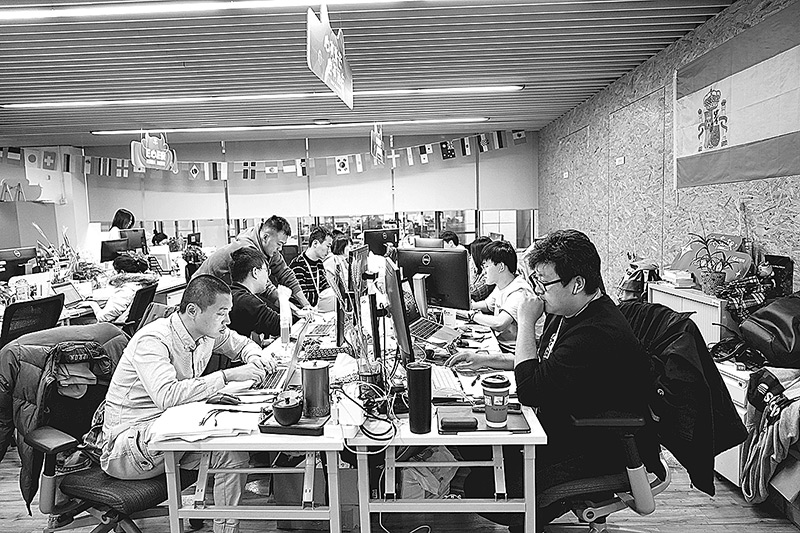
The Department of Immigration on Wednesday deported all 122 Chinese nationals who were arrested from various parts of Kathmandu for their involvement in suspicious activities. post photo: Hemanta Shrestha


“Therefore, there is a need to investigate the case by at least analysing the electronic data on the equipment held by the Chinese to rule out any possible threats to national security before deporting them,” said the security official who did not wish to be named.
There are also questions regarding the fate of the Chinese nationals once they arrive in China. As Nepal does not have the death penalty, it would be ethically wrong to deport the Chinese if there is a possibility that they could face execution.
Since the arrest, the Oli administration has maintained that the Chinese nationals will be deported as long as they were found guilty of breaching visa rules. However, the deportation took place after Home Minister Ram Bahadur Thapa held delegation-level talks with Zhao Kezhi, a Chinese state councilor and minister for public security, on Monday.
A statement issued after the meeting failed to mention the arrest of Chinese nationals in Kathmandu.
“Matters pertaining to mutual interest, including the promotion of bilateral cooperation in public security, cross-border crime, capacity building and border management were discussed during the meeting,” read the statement.
“Both the leaders agreed to enhance cooperation and communication between law enforcement agencies of the two countries for maintaining peace and security across the border.”
The Home Ministry and the Nepal Police have both failed to make public the nature of the crimes the Chinese had committed on Nepali soil or in China.
In normal practice, any Chinese national can visit Nepal on a tourist visa. Any foreign national, however, cannot be deported until and unless a criminal case is established in Nepal, said human rights defenders.
“There is no doubt that the operation was carried out at the behest of the Chinese government and now, they [the Chinese] are being handed over to China under pressure,” said Indra Aryal, chairperson of the Nepal Human Rights Organisation. “There is no guarantee that these people will not face torture in China, which has severe capital punishment provisions, including the death penalty.”
A security official, who did not wish to be named citing the sensitivity of the matter, confirmed to the Post
that there was pressure from China to deport all the arrested Chinese nationals.
Another top investigation official told the Post on condition of anonymity that Chinese officials had repeatedly told Nepali officials that the arrested Chinese had “damaged China’s image in Nepal”.
Prior to the December 23 raids, a team from the Chinese Public Security Ministry was in Kathmandu, according to top security officials.
The team stayed in Kathmandu for over a week and met with top government officials, including officials from the Home Ministry and Nepal Police chief Sarbendra Khanal.
Though security officials say they were unable to establish cases against the arrested Chinese due to a lack of technical know-how, there are concerns over whether the entire exercise was just a premise to deport them.
Chinese authorities were quick to deactivate the passports of those arrested—security officials had recovered only 67 passports—and issue travel documents.
China on Wednesday sent two chartered planes to Kathmandu to take the Chinese back.
Home Secretary Prem Kumar Rai, however, rebuffed all allegations that the entire operation had been carried out at China’s behest.
“It is not just the Chinese. We are going to launch operations against all those who are living in Nepal illegally and involved in visa fraud,” said Rai. “Those who are doing business on tourist visas will be deported.”
According to Rai, a bigger number of Chinese nationals living in Nepal and involved in suspicious activities have already left of their own volition after the December 23 operation. He did not explain how and why they left and why they were not arrested if they were involved in suspicious activities.
“Deportation is fine; it’s an international procedure. But we should at least know the charges on which these Chinese were arrested,” said Malla, the former police official. “The grounds on which they were deported should be made public. The clouds of suspicion have already thickened as various versions have appeared in the media on the arrest and deportation episode.” Rights activists too expressed concern over the deported Chinese nationals’ human rights once they are in their home country.
“The government has not been mindful of the Chinese legal system,” said Aryal. “Sending them back without establishing a case is illegal. This is against our rules, our constitution and our commitment to human rights.”

HOME PAGE

Conflict victims say their hope on Gyawali might have been misplaced

The minister, who appeared sympathetic to the cause of victims, is going about transitional justice without taking them into confidence.
- BINOD GHIMIRE

KATHMANDU,
When Pradeep Gyawali took charge of the Law Ministry after the resignation of Upendra Yadav in December, victims of the decade-long Maoist insurgency had some hope. After all, Gyawali had played a crucial role during the signing of the Comprehensive Peace Agreement in 2006 and had appeared sympathetic to their cause.
However, if recent developments are anything to go by, victims could end up disappointed once again. In an interaction with Gyawali on Sunday and Monday, victims’ representatives had asked that thorough discussions be held with victims across the country before taking the legal amendment process forward. They had asked that separate discussions be held based on the nature of the victims’ complaints.
The Law Ministry, however, has scheduled interactions in all provincial headquarters for a single day, on January 13, with inputs from all the concerned parties, including victims, human rights activists, civil society members and local leaders.
“It is clear the consultation is nothing but a formality to show the world the government talked to concerned parties before the amendment,” Bhagiram Chaudha-ri, the Conflict Victims’ Common Platform chairman, told the Post. He said that victims have lost all hope that the incumbent government and the political parties will ensure that the transitional justice process is victim-friendly.
Chaudhari further expressed concern that the transitional justice process was becoming increasingly opaque. There is less than a week remaining for the consultation but the ministry has yet to make public the questionnaire that will be given to concerned stakeholders for discussion.
Victims have sought amendment to the Enforced Disap-pearances Enquiry, Truth and Reconciliation Act-2014, as directed by the Supreme Court, before making appointments to the transitional justice commissions. According to Chaudhari, they have repeatedly demanded that appointments to the Truth and Reconciliation Commission and the Disappearance Commission be made independently.

 Pradeep Gyawali. post file photo


The victims are also against political interference as the parties consistently attempted to pick people of their choice in the commissions. The two transitional justice bodies have remained vacant since mid-April.
The top and second-rung leaderships of the Nepal Communist Party (NCP) and the Nepali Congress held a meeting on Tuesday evening to discuss names for the two commissions.
“The parties are holding regular discussions to build a common position for the entire transitional justice process,” a leader close to Prime Minister KP Sharma Oli told the Post on condition of anonymity as he was not allowed to speak to the media.
The ruling party leader said that Oli has given a free hand to Co-chair Pushpa Kamal Dahal and Nepali Congress President Sher Bahadur Deuba on the amendment process and to decide the names for the two commissions.
A recommendation committee formed to select names for the two commissions is beholden to the parties, said victims. Even officials at the Law Ministry say that the recommendation committee is waiting for consensus among the parties on the chairpersons and commission member candidates.
Gyawali might want to conclude the transtional justice process by taking victims into confidence but he is not in a position to convince the top leadership, said the ruling party leader.
Gyawali, who is also the foreign minister, is responsible for defending the country’s transitional justice process at international forums. In his address to the 40th session of the UN Human Rights Council in Geneva in March, Gyawali claimed that the Nepal government was preparing to amend the transitional justice Act in consultation with, and participation of, conflict victims.
He also assured the international community that there would be no blanket amnesty in grave cases of human rights violations committed during the insurgency. Later this year, the Nepal government will have to present its progress on transitional justice during the Universal Periodic Review on human rights conducted in November by the Office of the United Nations High Commissioner for Human Rights.
Ram Bhandari, an advisor to the Conflict Victims’ National Network, said that the government does not appear serious at all about delivering justice to victims. “I don’t see a long-term vision in the government to conclude the transitional justice process,” he told the Post.

HOME PAGE

Government is running out of duty stickers and that may halt liquor and cigarette sales

All liquor and cigarette products require an excise duty sticker, but with the procurement process halted, stickers are fast running out.
- PRITHVI MAN SHRESTHA
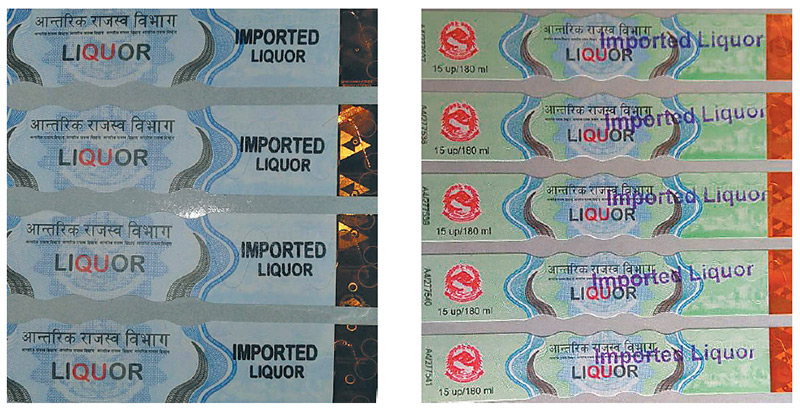
The Inland Revenue Department is using stickers meant for local liquor for imported brands. Post Photos

KATHMANDU, 
There’s plenty of liquor but Nepalis may soon have none to buy.
With the government almost out of its stock of excise duty stickers, there could be a halt on the import of foreign alcohol. Liquor and tobacco manufacturers must paste excise duty stickers on their products in order to sell them in the market, as per Excise Duty Regulations.
According to the Inland Revenue Department, the agency that implements the regulation, excise duty stickers are already in short supply. Stickers for imported liquor have already run out and the department has resorted to using stickers that are meant for local products.
Baburam Gautam, regional sales manager at Global Trading Concern, a dealer of liquor brands like Johnnie Walker and Smirnoff, said they were placing stamps that say “imported” on stickers meant for domestic products. Importers like him are worried using such stickers could lead to a flood of smuggled alcohol in the market.  
“As the stamp has to be put manually, there is a risk of unscrupulous people making duplicate stamps,” said a liquor importer who did not wish to be named. “The government must ensure that we get the stickers we have paid for.”
According to Ramesh Shrestha, president of the Nepal Beverage and Cigarette Industries Association, companies are already finding it difficult to obtain any stickers, not just for imported liquor.
“We are concerned over whether we might have to shut down the industry due to a lack of excise stickers,” Shrestha told the Post.
Tax officials said if they fail to procure new stickers in the next few months, they may either have to allow liquor producers and sellers to sell their products without exercise stickers or halt all sales.
“Other types of stickers will soon be unavailable in the next two-three months,” said Thaneshwor Gautam, deputy director-general of the department.
The department sells over 40 different stickers for various categories of liquors and cigarettes.  
“It takes around five months to sign contract agreements after a tender is announced, and additional time is needed for supply,” said Gautam. “It is not clear when the department will be able to begin the procurement process.”
The department does not have any immediate alternative, as the Supreme Court, on November 15, |had issued an interim order putting a halt to the procurement process for new stickers through an international competitive bid. The department had planned to procure around 8 billion stickers for use over the next two years.
The court had issued its order in response to a writ claiming that the tender call barred domestic printing companies from participating in the bid.
In early November, just days before the Supreme Court order, the parliamentary Public Accounts Committee had also ordered the government to immediately suspend the bid for the supply of excise duty stickers immediately, arguing that the tender process barred domestic players from participating.
Gautam, however, said the tender notice didn’t bar domestic players.
“It only opened the door for foreign players given that there is no security printer registered in Nepal,” he said.
There was also pressure from the Ministry of Communication and Information Technology on the Finance Ministry to stop the tender for stickers on the grounds that it was in negotiations to set up a dedicated security printing press in the country. On the same grounds, the Department of Passports had also cancelled the global tender for e-passports, whose stock is also depleting fast.
Officials, however, said that there’s no certainty over when, or if, the government will procure its own security printing press to print passports and excise stickers.
In the past, excise stickers used to be printed by the government’s Department of Printing.
“But in light of several problems due to weak security features, we started procuring excise duty stickers from abroad,” said Gautam of the Inland Revenue Department.
The shrinking stock of stickers could also result in a halt to cigarette sales, which require a sticker too.
Tax officials said that any halt to liquor and cigarette sales could impact revenue collection, which is already far below target, as the two products are major contributors to the treasury.
The average revenue growth rate, as of the first five months of the current fiscal year, stood at 3.71 percent against a target of around 30 percent, according to the Finance Ministry. When it comes to excise duty, the growth rate is just 0.53 percent.

Page 2
MEDLEY

Horoscope

ARIES (March 21-April 19)
***
Don’t be surprised when someone has to squirt you with a water pistol to get your attention today. You will be lost in thought throughout the day. You will be lost in your own thoughts trying to figure out where you want to go next. You need to make a few crucial decisions soon. Take your time, don’t rush it.


TAURUS (April 20-May 20)
***
You’ve been through enough change in your life to understand that whenever something ends, something else can begin. You have a powerful ability to calm distressed people right now, and you shouldn’t be afraid to offer your shoulder to weepy folks who need some support. All you have to do is listen.


GEMINI (May 21-June 21)
**
Be cautious when you enter into a new group setting. You are very community oriented and ready to collaborate, but you will only be able to do so effectively if you understand that there are real obstacles still to overcome. You need to face facts and admit to problems as early as you can. That’s the only way you can move past them.


CANCER (June 22-July 22)
****
Your creativity will really be sparkling today, and you should follow whatever urge you have to create something, no matter how inconvenient it is. Do what makes you happy. Sing, dance, and paint if you feel it’s the right thing to do. It’s all about letting the inner you out into the world in all its unique and kooky glory.


LEO (July 23-August 22)
***
You know what you’re doing, so don’t hesitate to take control and push things in the right direction. Any more time spent wandering around wondering what to do is silly. If you’re worried about getting a “bossy” image, don’t sweat it. People respond to your leadership qualities and think you should be in charge.


VIRGO (August 23-September 22)
****
If you have any air travel planned, you’ll be pleasantly surprised at how effortless and stress-free the entire process is. Moving from one place to another will also ignite your wanderlust, and you will be getting lots of new ideas about where you want to go next. You might want to go to an even exotic place than usual.


LIBRA (September 23-October 22)
**
Not everyone is perfect. There are interesting nuances that only someone with a sceptical eye can see. You might notice some beautiful imperfections in someone new that make you all the more intrigued. People are saying things they don’t mean, so if you’re getting the cold shoulder, stick around and wait things out.


SCORPIO (October 23-November 21)
**
If you want to learn something new, you have to admit that you don’t know something, which can be difficult for your self-esteem. But you have to look at the greater goal of your own education. Alert someone in the know if there’s something that you’re unfamiliar with. Chances are you aren’t the only one.


SAGITTARIUS (November 22-December 21)
***
Just because people call themselves intellectuals doesn’t mean they aren’t capable of doing something stupid once in a while. Today, when you see a smart person turn into a dumb person, you should believe what you see. Don’t mock them or make a big deal out of it. They’re only human! We all make mistakes sometimes.


CAPRICORN (December 22-January 19)
*
Are you lagging in the discipline department? A messy car or bedroom isn’t the end of the world, but when the dishes in your sink are super stinky, there might be a problem. Looking at a disorganized mess does not make you feel good, so spend some time today putting order back into your world. Get yourself sorted.


AQUARIUS (January 20-February 18)
**
The good news is that your confidence is expanding. The bad news is that some people might think it’s expanding too much! You need to decide for yourself whether you want to live your life your way or change according to people. Reputation is important, but is it worth compromising your sense of self?


PISCES (February 19-March 20)
***
You love spontaneity as much as the next person, but you also know when it’s time to buckle down and get serious. Not everyone is the same, and that could negatively affect the harmony of your day. Someone flighty could throw a wrench into your carefully laid plans. But don’t worry, you’ll be able to handle it with grace!

Page 3
NATIONAL

Local units in Dolpa operate from the district headquarters

People are forced to walk for up to seven days for services.
- HARI GAUTAM
The office of Buddha Rural Municipality based in Dunai, the district headquarters of Dolpa. Post Photo

RUKUM (WEST),
Gaun Gaun Ma Singha Durbar (Singha Durbar in Every Village) was the popular slogan during the local elections held in 2017 after the implementation of federalism in the country. Political parties and their leaders, mainly those contesting the local polls, assured people that the powers of Singha Durbar, the country’s administrative centre, would be devolved to the local bodies. However, people in Dolpa, a remote district of Karnali Province, are yet to see
this happen two and a half years after the elections.
As many as four local units in Dolpa have been carrying out their administrative and development activities from Dunai, the district headquarters. Dolpobuddha, Shey Phoksundo, Kaike and Chharkatangsong rural municipalities have their administrative centres in the respective local bodies but they mainly execute their works from their liaison offices in the district headquarters.
There are a municipality and seven rural municipalities in Dolpa.  
“The villagers have to come to Dunai even for small work. We have to spend a huge amount of money and time to come to the district headquarters. They (the people’s representatives and employees) claim of opening the liaison offices but they carry out all the works from the district headquarters,” said Pema Gurung of Dolpobuddha.
The local people of some remote northern villages in Dolpa have to walk for up to seven days to reach the district headquarters. They have no alternative to visiting Dunai to get services from the local units.
The people’s representatives, however, claimed that they set up liaison offices in Dunai to provide hassle-free services to the service seekers.
Angad Kumar Rana, chairman of Kaike Rural Municipality, said the liaison office was established in Dunai as the local unit did not have a bank. “We set up the liaison office in the district headquarters as there were not a bank and other structures
in the local unit. A bank has been recently opened its branch in the rural municipality. We will also shift our office to the village soon,” said Rana.
He further claimed the rural municipality was compelled to run its liaison office from the district headquarters as most of the locals left the settlements and stayed in Dunai and other settlements in lower altitudes due to severe cold in winter.

NATIONAL

New action plan proposes announcing air pollution health emergency

The Air Quality Index, which calculates presence of pollutants in the air, has been reaching record highs in Kathmandu Valley in recent years, crossing over the levels prescribed by the World Health Organization.
- CHANDAN KUMAR MANDAL

KATHMANDU,
The new draft of Kathmandu Valley’s Air Pollution Management Action Plan has proposed declaring a public health emergency whenever the level of Particulate Matter (PM) 2.5 crosses 300 micrograms per cubic metre
(μg/m3).
When PM2.5, the most dangerous pollutant, crosses 300 μg/m3,  it can broadly affect everyone breathing the air irrespective of their age groups.
“The government authority can announce emergency condition if the PM2.5 crosses the 300 μg/m3 mark,” said Indu Bikram Joshi, deputy director general at the Department of Environment. “So far, the pollution level in Kathmandu has not reached 300 μg/m3. Even on most polluted days, PM2.5 level stays somewhere between 200-250 μg/m3.”
According to Joshi, the government will swing into action like imposing odd-even formulae for vehicles plying the Kathmandu Valley, or even stopping vehicles in some parts and shutting down schools if required in case the public health emergency would be declared due to poor air quality.
Last November, authorities in the Indian capital of New Delhi had declared a public health emergency, asking schools to shut and residents to avoid outdoor physical activities after its air quality deteriorated into the “hazardous” category. Following the end of the festival of Diwali, the air quality in New Delhi had worsened and turned nearly ten times worse than the healthy limits.
Every year, as winter sets in, the air quality in Kathmandu Valley also gets worse, leaving its residents gasping for clean and healthy air.
The annual average PM2.5 level for Kathmandu in 2018 was 54.4 μg/m3, an increase from 45.9 μg/m3 in 2017, according to AQ AirVisual, a Swiss group that collects air quality data from around the world and ranks countries and cities based on their air quality.
The Air Quality Index (AQI), which calculates presence of pollutants in the air, has been reaching record highs in Kathmandu Valley in recent years, crossing over the levels prescribed by the World Health Organization (WHO). On Wednesday, the average hourly level of PM2.5 was recorded from a minimum of 76.32 μg/m3 to maximum 222.67μg/m3 recorded between 9-10 am.
As per the WHO air quality guidelines, PM2.5 level of 25 μg/m3 is considered safer for public health, whereas our Nepal government standards consider 40 μg/m3 of PM2.5 to be safer as well.  
At this time of the year, air quality in Kathmandu often reaches “very unhealthy” levels, which the AQI warns that even healthy people will show symptoms such as wheezing, chest pain, dry throat, headache and nausea. People with respiratory or heart diseases are affected the most.
The proposed action plan has set eight objectives to get rid of the toxic quality of air pollution the Valley is battling with.
According to the plan, it will work towards controlling air pollution emanating from the transport sector, construction sites, industries, and unhealthy means of managing solid waste. Besides, it also talks about reducing indoor air pollution, raising awareness regarding sources of air pollution, its effects and how to minimise them.
Vehicle exhaust, along with smoke coming from brick kilns and dust from construction sites, are the major sources of air pollution in Kathmandu Valley. The transport sector contributes over 30 percent of total suspended particles (TSP) or 20,072 tonnes into the air, according to the 2017 Air Quality Management Action Plan for Kathmandu Valley. The transport sector further contributes 30 percent of PM10, second only to the construction sector, which emits 53 percent of the total PM10.
“We will have to begin with improving our vehicles which contribute significantly for emissions,” said Joshi. “Conversion of fossil fuel-run vehicles into electric ones, promotion of  more electric vehicles, improving fuel quality, and stringent standards can greatly help in reducing the Valley’s air pollution.”  
Participants at the discussion on the upcoming action plan, which will be the third one in as many years, also urged the environment department to consult other agencies before implementing the action plan as air pollution is a multisectoral issue.
The department had drafted an action plan in 2017, which never came into enforcement.  “Nepal government had internationally committed to bringing down the rate of air pollution under control by 2025,” said Manjeet Dhakal, a climate change expert. “For achieving this target, the department needs to bring on board other stakeholders as well because sources of air pollution and measures to control them are overarching and requires combined efforts.”

NATIONAL

Man accused in fatal Budhanilkantha drunk-driving accident sent to jail

Kathmandu District Court orders jail for Prithvi Malla until final verdict is announced.
- SHUVAM DHUNGANA

KATHMANDU,
The man accused in the fatal drunk-driving car accident in the Capital last December has been sent to jail until a final verdict in the case is announced.     
Judge Dipak Kumar Dahal at the Kathmandu District Court issued the order against Prithvi Malla on Wednesday.
Malla, 21, was taken into police custody after killing Lila Devkota, 38, in a drunk-driving accident in Budhanilkantha on December 14.
Malla has been accused of vehicular homicide.
“After completing the investigation, we submitted our report to the District Attorney Office for further proceedings on January 5,” said Deputy Superintendent of Police Umesh Lamsal, chief of Maharajgunj police station.
The District Attorney Office had sent its chargesheet to the court on January 6.
“We have sought up to 10 years jail term for the accused for vehicular homicide,” said Chandra Kanta Khanal, joint attorney at the Kathmandu District Court.  
The case of vehicular homicide, according to Article 161 (2) of the Motor Vehicles and Transport Management Act, carries a jail term that ranges from two years to 10 years.
“Malla will remain in judicial custody in Dillibazar prison until the final verdict, as per Judge Dahal’s orders,” said Ananda Prasad Shrestha, the registrar of the Kathmandu District Court.    
Meanwhile, model Paramita Rana, after remaining silent for more than 25 days, has admitted to riding in the car driven by Malla.
On Tuesday, Rana on her Facebook account wrote about the incident. She said the accident had occurred due to drunken driving. She apologised for the accident and for being late in sharing details about the incident.

Page 4
NATIONAL

Money laundering risk high in nonprofits getting unsupervised foreign funds: Council

Council suggests freezing the bank accounts of the organisations receiving foreign funds without its knowledge.
- PRITHVI MAN SHRESTHA
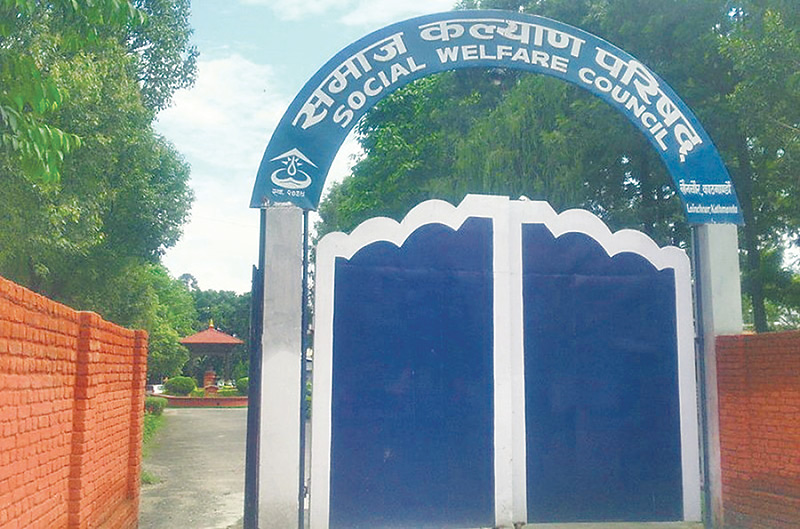
The Home Ministry last year had instructed district administration offices to seek the council’s recommendation to renew the registration of non-governmental organisations. Photo obtained by the post

KATHMANDU,
The Social Welfare Council has pointed out a number of vulnerabilities in the domestic and international non-governmental organisations that receive funds from abroad and which don’t come to the council’s notice.
In its written suggestions to the Money Laundering, Risk Evaluation Sub-Committee headed by a Home Ministry’s joint secretary, the council has said the risks come from banks opening the accounts of domestic and international non-governmental organisations without the approval of the council.
“The transfer of foreign funds meant for an NGO in the name of individuals through the money transfer agencies is another risk,” the council stated in a suggestion that the Post obtained from the Home Ministry.
The council said that it is difficult for it to track such funds if they come in the name of individuals instead of the institution. It suggested that the central bank take necessary steps to control such practices.
Ram Raj Bhattarai, deputy director at the council, said that there is a trend of sending funds in the name of individuals, although it is not a dominating trend.
“NGOs and INGOs opening many bank accounts without approval of the council have helped them remain outside the scrutiny of the council. So, there is the risk of money laundering,” said  Bhattarai.
To control such activities, the council has suggested that the commercial banks need to freeze the accounts of such NGOs which are receiving foreign funds without the council’s knowledge.
“The information about freezing should be shared with Nepal Rastra Bank and the council,” the suggestion reads.
As per the Social Welfare Act, the council is the regulatory body of domestic and international non-governmental organisations in the country. But, just over one-half of the total domestic NGOs are affiliated to it.
According to the council, commercial banks have been releasing donated funds from abroad to NGOs which are not affiliated to the council.
“Such transactions do not get noticed by the radar of the council,” said Bhattarai.
According to the 56th Annual Report of the Office of the Auditor-General, a total of 48,273 NGOs were affiliated with the council as of the fiscal year 2017-19, while the total number of registered NGOs was 106,092.
According to the council, more than 50,000 NGOs have now been affiliated to the council as of the last fiscal year.
On the request of the council, the Home Ministry in August last year had instructed district administration offices to seek the council’s recommendation to renew the registration of NGOs.
The council has said that it has received complaints that some NGOs and INGOs conducted religious activities, going against the project agreement signed with the council.
“The local administrations and local governments should increase their vigil over such activities,” the council suggested.
The council has also stressed on greater monitoring of funds meant to be spent on children’s homes, Madrasas and monasteries. According to the council, many Madrasas and monasteries receive foreign funds for their upkeep and expansion and the education of students.
According to Rajendra Kumar Poudel, member secretary of the council, various foreign individuals and institutions have been sending money in the name of  monasteries and Madrasas, but vetting of those who send money is not strong enough.
“We seek authentic documents from such donors, but we are not fully sure about their activities abroad,” he said.
The council wants to ensure that the Madrasas and monasteries’ foreign donors are genuine and registered entities.
The council also takes written commitments from NGOs, stating that foreign funds they receive are in compliance with the country’s anti-money laundering law.
In the case of the INGOs, the council has made it mandatory for them to furnish recommendation letters from the concerned foreign embassy in support of the project agreement.

Page 5
NATIONAL

Police take steps to curb opium farming in Makwanpur

The first time police discovered an opium plantation in the district was five years ago.
- PRATAP BISTA
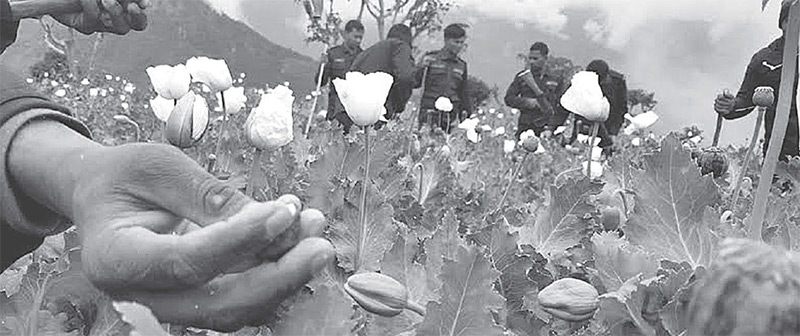
A team of police personnel—over five days—destroyed poppy plants cultivated in around 70 bighas of land in two municipalities in Hetauda.PHOTO COURTESY: HETAUDA DISTRICT POLICE OFFICE

The remote areas of Raksirang and Kailash Rural Municipalities in west-ern Makwanpur district is a breeding ground for opium farming, say police.

The District Police Office in Makwanpur has started keeping a close watch on poppy farming after many people were found to be involved in the commercial production of opium, which is processed chemically to produce heroin and other opioids.

Police believe that drug smugglers are active in these areas, luring  locals into cultivating opium. From January 1 to 5, a team of police person-nel destroyed poppy plants cultivated in around 70 bighas of land in the two municipalities, said Sushil Singh Rathour, superintendent of police at the District Police Office in Makwanpur.

“In Devitar, Pandung, Ranibang, Jyamung, Sanobhawar and Indatar, among other areas, of the Raksirang Rural Municipality, the district police found 50 bighas of land where opium was cultivated,” said Rathour.

The poppy plants are planted in the month of December, is generally har-vested in March-April.

Inspector Sujan Pathak, who was in the clean-up campaign of illegal mari-juana and opium farming, said, “We destroyed poppy and marijuana plants
for five straight days. But we failed to identify farmers as villagers refused to disclose information on the matter.”

The first time police had discovered an opium plantation in the district was five years ago. At that time, police had found that over 40 bighas of land in Makwanpur were being used to cultivate opium.

“Locals are still engaged in mari-juana and opium plantation due to the absence of security personnel in remote areas. The people who had been farming fled the scene before police arrived,” Pathak said.

According to him, the villagers did not help them identify the landown-ers, so the police could not take action against the farmers.

Preferring anonymity, one of the teachers at Athare Secondary School in Raksirang Rural Municipality Ward No. 9 said poppy farming has become a cash crop in the local unit.

“Local farmers are lured by drug smugglers to plant poppies, as they can earn a huge amount of money from it. If this continues, opium farm-ing will bypass illegal marijuana farming within a few years,” he said.

Although Raksirang and Kailash rural municipalities have prepared working guidelines to make their local units free of marijuana and opium farming, such guidelines have borne little results so far.

NATIONAL

Bill advocating good governance being tabled in Gandaki

- PRATIKSHA KAFLE

KASKI,
Seeking service in Nepali government offices is often fraught with delays and hassles. Many are compelled to spend days to have their work done. Amid this, the Gandaki provincial govern-ment will table a bill that rules that if a service seeker’s work is not addressed timely and according to the Citizens’ Charter, the office will be liable for compensation to the public. The rule is soon to go into effect in government offices across Gandaki Province.

The bill states that the Citizens’ Charter—which provides information about the right office for the right ser-vice and the time allocated for that service—should be placed in each gov-ernment office. If the service is not provided accordingly, the official responsible for the delay will be pun-ished, the bill further states. Likewise, the best performing official will be awarded.

Furthermore, the Citizens’ Charters should state the kind of service the office provides, the contact details of concerned officials, the cost of the service (if any) and documents to be presented to receive the service, among others, the bill states.

A two-day meeting of the Assembly’s legislative committee passed the ‘good governance’ bill, and it will now be tabled in the provincial assembly scheduled for January 8, according to Mohan Prasad Regmi, chief of the committee.

The Nepal Communist Party boasts a majority of 39 assembly members out of 60 in the Gandaki Province.

NATIONAL

Endangered red panda spotted along the Langtang valley trekking trail

- BALARAM GHIMIRE
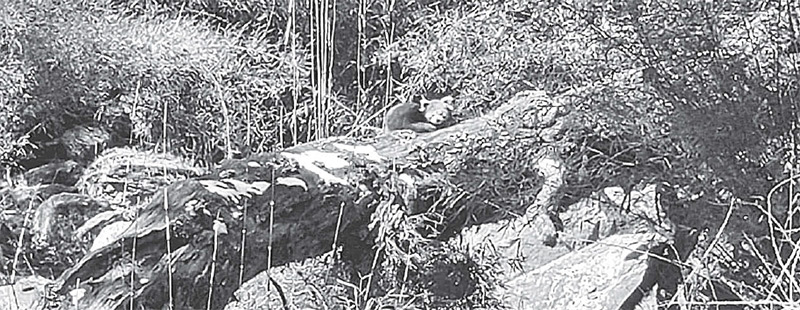
A team of Koreans and Nepalis who were hiking along the trail sighted the rare animal. POST PHOTO

RASUWA,
An endangered red panda (Ailurus fulgens) was recently spotted near Ghodatabela forest along the Langtang foot trail on Tuesday.

Suppa Lama, ward chairman at Langtang, said red pandas can be easi-ly seen in the forests of Langtang National Park these days. “A team of six Koreans and 25 Nepalis became excited upon seeing the red panda. They also took photographs of the endangered species,” said Lama.

Dhindup Tamang, a hotel entrepre-neur in Ghodatabela, said the timing could not have been more perfect for tourists to sight a red panda, with the Visit Nepal 2020 kicking off recently. “This could also boost economic and tourism activities,” said Tamang.

A few months ago, an anti-poaching patrol team from the Langtang National Park spotted five red pandas in the Polangpati area. According to the national park officials, Cholangpati, Gupche, Polangpati and Dhokachet Kharka in Gosainkunda Rural Municipality are the main habi-tats of red pandas.

Ramesh Basnet, a ranger of the national park, said the number of red pandas has increased in the park due to the effectiveness of conservation programmes. “The national park and forests have been developed as a safe habitat of the red panda,” said Basnet.

Although red pandas are being spot-ted in the national park areas during patrolling and survey, the exact num-ber of red pandas in the park is unknown. “As the creatures are highly elusive and live in inaccessible areas, it is difficult to conduct red panda census,” said Basnet.

Red pandas are also found in Ghyangphedi of Nuwakot and various parts of Sindhupalchok district.  Known as Habre in Nepali, red pandas live in temperate forests in Nepal, India, Bhutan, northern Myanmar and southwestern China.

According to the World Wildlife Fund estimates, there are less than 10,000 red pandas left in the world. Unsustainable construction of roads through red panda habitat, deforesta-tion, forest fires, poaching, excessive grazing, along with loss of major food are major challenges facing red panda conservation.

Red panda is listed as endangered on the IUCN Red List of Threatened Species and included in Appendix I of CITES. The National Parks and Wildlife Conservation Act, 1973 has also categorised red panda as a pro-tected species of Nepal. The law states that a person convicted of trading red panda and their parts can be slapped with a jail term of one to 10 years and a fine up to Rs 500,000.

NATIONAL

Electricity poles were installed in Rautahat, but the wires are yet to be fixed

- SHIVA PURI

RAUTAHAT,
Around 700 utility poles have been installed in Chandrapur, Brindaban and Gujara municipalities in the last five months. But the process of install-ing wires is yet to start. The con-cerned authority has left the work in limbo, much to the locals’ dismay.

Madan Thakur, a resident of Chandrapur, said the locals have been demanding the Chandrapur branch of the Nepal Electricity Authority to install electric wires on the poles, but have received no response so far.

“We have been frequenting the office for the last month demanding electricity supply. But the chief at the branch office sends us away citing budget shortage,” Thakur said.

Locals have also lodged a complaint at the hotline of the Nepal Electricity Authority against the chief of the branch. But Ramaayodhya Yadav, chief at the branch office, said  that his office doesn’t have sufficient budget to complete the installation process.

“The wires lie unused at the substa-tion in Chandranighapur. We don’t have enough budget to start installing
wires on the poles,” said Yadav, adding that he has notified the higher author-ity about the problem. According to him, the branch office will fix wires on the poles after the centre provides them with a budget.  

Dev Prasad Timalsina, a Nepali Congress lawmaker, said that he had talked with Kulman Ghising, the man-aging director of Nepal Electricity Authority, about the problem. Timalsina, along with the locals, recently visited the branch office to put forth their demands.

“The chief of the branch office has given us a positive response,” he said.  

According to the Energy Progress Report, electricity had reached 95.5 percent of Nepal’s population as of 2017. The report showed that only 1.3 million out of 29 million Nepalis remain to be connected to electricity. Most of these individuals are from remote locations. In 2010, only 65 per-cent of the country’s population had an electricity connection. As per the Nepal Electricity Authority’s statis-tics, only eight districts—Bajura, Humla, Jumla, Kalikot, Mugu,  Dolpa, Rukum (East) and Solukhumbu—remain to be connected to the national grid.

NATIONAL

Irrigation project faces quandary as arable land shrinks

The local unit has placed a lot of emphasis on building settlements, and little on keeping arable land intact, changing the face of Tikapur Municipality.
- Ganesh Chaudhary
The project was expected to irrigate 14,300 hectares of fields upon completion. POST PHOTO: GANESH CHAUDHARY

TIKAPUR,
The eight bigha land that Laxmi Chaudhary’s great grandfather owned at Bangaun, in Tikapur Municipality, Kailali, is divided among his seven progenies. What was once a vast ara-ble land producing yield to last his family for over a year is now ready to be sold in parcels to construct houses, said Chaudhary.

And it’s not just Chaudhary who is looking to turn his fields into  concrete spaces. “Many others are selling their land too, for construc-tion, because the market is close by and the price is good,” Chaudhary said. In just a span of two years, Chaudhary says the number of  houses in his neighbourhood has risen from 30 to 70.

These changes have caused confu-sion regarding the future development
of the Rani Jamara Kulariya Irrigation Project. In early 2018, the project’s second phase of construction started, expecting to irrigate 14,300 hectares of fields upon completion. But, a year later, much of that arable land has been turned into settlement areas, and nobody now knows wheth-er the project will now actually benefit local farmers.

“Since the project hasn’t updated  its survey, we can’t exactly say how much of the land the project will  irrigate,” said Lalbeer Chaudhary, chief of the Rani Jamara Kulariya Irrigation Project Consumers’ Committee. “But it’s certain that much of the arable land is either being turned into settlements or are in the process.”
Min Bahadur Shahi, a lecturer of Sociology at Tikapur Multiple Campus, said that the arable land is being converted into concrete because of a lack of land utilisation policy. “We’ve heard the policy is being for-mulated in Kathmandu, but we don’t know when it will take shape and when it will come here,” he said. “We hope the policy will also include provi-sions to save arable land. Neither the local unit nor the project or consum-ers’ committees are concerned to pre-serve arable land here.”

With federalism in place, a majority of local units have focussed on increasing motorable roads—often at the cost of landslide- and erosion-risk. “In Kailali, the focus is seemingly in constructing more concrete struc-tures at the cost of arable lands,” Shahi added.

Moreover, officials say what’s left of the arable land in the area is being increasingly cultivated with Lyptus trees, which is harmful to crops.

NATIONAL

Administration office running without chief for two months

Briefing
- Post Report

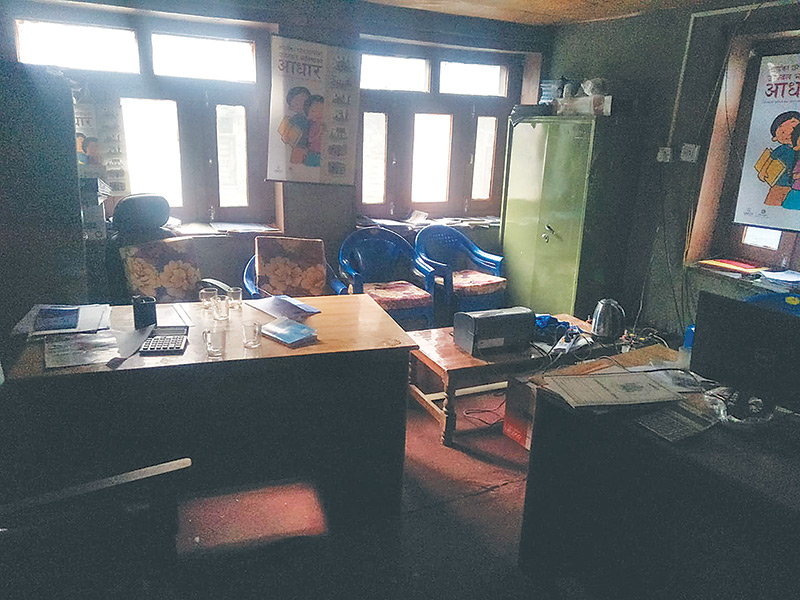
SALYAN: Daily administrative works of the Area Administration Office in Tharmare have been affected in the absence of its chief for the last two months. Service seekers say they have been compelled to travel to the district headquarters to avail of gov-ernment services. Five years ago, the office was established to provide facil-ities to the locals of Bagchaur, Darma and Kumakh.

NATIONAL

Chairman of local unit distributes clothes to students

Briefing
- Post Report

PALPA: Krishna Prasad Basyal,  chairman at the Bagnaskali Rural Municipality, distributed warm clothes (sweaters) to 57 impoverished students of Gunga Secondary School. According to Basyal, he purchased and distributed sweaters to the stu-dents on his own expenses.

NATIONAL

Gulariya section of Postal Highway left in the lurch

Briefing
- Post Report

BARDIYA: Construction of a section of the Postal Highway along the Gulariya bazaar in Bardiya has been left unattended for the past four months. The contractors, Ganapati Construction Service, have said work at the 2,200m section of the road has been left unattended for lack of budget “to resume the work accord-ing to the municipality’s revised strategy”.

NATIONAL

Fire engulfs agro farm

Briefing
- POST REPORT

LAMJUNG: A massive fire on Tuesday evening engulfed an agriculture farm at Deurali, Madhya Nepal Municipality-1, in Lamjung, destroy-ing properties worth over Rs17 mil-lion. No human casualties have been reported but the fire killed 40 goats and 170 chickens, according to DSP Rabindra Man Gurung. The farm is  owned by a local, Ramesh Poudel.

NATIONAL

Rukum local unit launches policy to regulate alcohol

Briefing
- Post Report

RUKUM (WEST): Bafikot Rural Municipality has implemented a  policy that imposes a fine to people who drink alcohol and ‘disturb  societal order’. The fine has been set at Rs5,000 for first time perpetrators; the amount increases subsequently, according to local unit officials. Meanwhile, the fine will be double  for government officials, teachers, local representatives and police, among others.

Page 6
EDITORIAL

More money for schools

The government must ensure adequate funding for education.

Education is an important aspect of any country’s strategy to develop and grow. After all, a well-educated populace is essential to create a skilled workforce, not to mention a well-informed society that can reap the benefits of democracy. It was in this spirit that the framers of Nepal’s constitution provisioned for the state to bear the burden of educating its people.
Article 30 (2) of the constitution gives every citizen the right to free, and compulsory, education up to the basic level (till grade 8) and free education up to the secondary level (grade 12) from the state. These are economically burdening provisions—tough for a least developed country to achieve. Yet, knowing how important that investment in education is for a prosperous future, the lawmakers put these legally binding provisions in place. But over four years since the promulgation of the constitution, the education sector is still lagging far behind.
Perhaps free education for all was an ambitious target that will take some more years to be implemented—even though its constitutional mandate means that it shouldn’t. However, the government has also been failing achievable goals from set-term programmes.
In a joint review meeting comprising of donors and the Education Ministry, it was found that the School Sector Development Programme has failed to meet a majority of its targets that it was set to achieve by the last fiscal year. The plan, which began in 2016 and is slated to end in 2023, is funded by the Asian Development Bank, Japan International Cooperation Agency and UNICEF, among others, and part of it is a results-based lending programme. Needless to say, not fulfilling the set targets at the halfway point will have repercussions on the implementation of the entire programme. This is unfortunate.
Among the 30 indicators from six different sectors, targets have only been met in five, an astoundingly low number met. What’s worse, most of the successful ones seem to be tied to enrollment, even as targets in quality of education and retention of students have been left unmet. Enrollment drives have become a source of easy publicity for the government. The prime minister and several ministers have been known to take the ‘guardianship’ of some children in PR campaigns during grand inaugurations. However, experts in the education sector doubt if the thousands of new students claimed to have been enrolled every year actually end up in classrooms. The review of the School Sector Development Programme just goes forward in proving this.
To improve retention and quality, the government must ensure adequate funding for the education sector. The global practice has been to allocate at least 20 percent of the national budget for education. This is especially important here, due to Nepal’s lofty goal of providing free education to all up to grade 12. Yet, despite numerous assurances and promises of allocating as much, the government has failed to do so. When the Development Programme was planned, the government had agreed to allocate at least 15 percent of the total federal budget for education. Yet, the share of the education budget has actually gone down, from 12.04 percent in the fiscal year 2016-17 to 10.69 percent in the last fiscal year.
If the government is serious about its attempt to better education, it must pledge to increase support toward the sector from the next budget onwards. A 20 percent budgetary allocation may not provide free education for all, but it will at least help to improve the quality of education, and perhaps help retain more students. The programme, in its next three years, will hopefully provide more metrics about where the government is going wrong, and where it has made encouraging improvements. The learnings of the same should be applied constructively.

OPINION

The dividend paid out by commercial banks is too good to be true

Given that Nepal has much room for growth, banks should hold back more income for investment.
- PABAN RAJ PANDEY
shutterstock

In securities markets, dividends more often than not are a signal. Payout dynamics are different for a mature electric utility to that of a young company with a lot of potential for growth. If the right balance is not struck, boards may be rewarding shareholders handsomely now at the cost of growth in the future. With a short, 26-year history of public
investing, Nepal is not a mature market and this is evident in the dividend policy of commercial banks in particular.
A company can do three things with its profit—reinvest, retain or pay a dividend.  Dividends can be in cash or bonus shares, or a combination of both. Accounting-wise, in the case of a cash dividend, the amount is deducted from retained earnings, decreasing stockholders’ equity. In a stock dividend, the amount is simply transferred from retained earnings to paid-up capital, with no change in stockholders’ equity. Importantly, a stock dividend increases the number of shares outstanding, diluting the book value per share.

 
Mature companies pay high dividends
Typically, in developed markets, because they have predictable cash flows, mature companies tend to give out a steady dividend. Take a utility or phone company, for instance.  Their business does not fluctuate much, in comparison to, say, a consumer discretionary company in retail or housing. During times of market volatility, investors tend to gravitate toward dividend payers for both income and stability. Utilities and consumer staples are even considered bond proxies; sovereign bonds are considered risk-free.
By and large, companies tend to retain profit when they are in growth mode. Microsoft was established in 1975, was profitable when it went public in 1986, but it was not until 2003 it began offering a dividend, starting at $0.08/share annually, which has now grown to $2.04.  Amazon, which last year took home $8.3 billion in net income, still does not pay a dividend. The 25-year-old company is still growing at a breakneck pace and obviously sees it fit to reinvest its profit, and it is paying off.
In Nepal, the dynamics are a little different. This is not too surprising given the fairly young history of investing. Nepal Stock Exchange (NEPSE ) only opened its trading floor in January 1994. Bonds do trade, but the market is yet to develop—be it sovereign or corporate. Equities hardly compete with fixed income. Not to draw a comparison with the US, but one of the factors helping equity bulls is that the S&P 500 large market capitalisation (large cap) index currently yields more than the 10-year Treasury yield. In Nepal, such dynamics are lacking.  It is thus hard to read too much into public companies’ dividend policy—or a lack thereof.
Yet, it is hard to get one’s arms around the aggressive payout posture shown by Class A commercial banks. To be clear, the payout ratio is also healthy among Class B, C and D financial institutions and several more in other sectors. But commercial banks enjoy a lot of heft in Nepal’s stock market, accounting for 53 percent of NEPSE’s current market capitalisation of Rs1,550 billion. There are 27 of them. Global IME Bank and Janata Bank recently completed their merger. Rastriya Banijya Bank (RBB), which is government-owned, does not trade publicly, while Agricultural Development Bank (ADB) and Nepal Bank—the other two majority-owned by the government do. The remaining 24 are private-sector banks, of which Century Commercial Bank, as of this writing, is the only one yet to announce a dividend for the fiscal year 2018-19 that ended mid-July last year. RBB has never paid a dividend in its history.
Of the 25 that have announced a dividend for the last fiscal year, NIC Asia’s 61 percent payout ratio was the lowest, while NMB Bank took the honour of being the highest, at a whopping 175 percent. Viewed another way, the 25 took home nearly Rs58 billion in profit and doled out nearly Rs46 billion in dividends, consisting of Rs21.3 billion in bonus shares (stock) and Rs24.4 billion in cash. Bonus shares will help retain cash but will negatively impact the earnings per share going forward because shares outstanding will have risen.  There is no free lunch. Post-adjustment of bonus shares, the paid-up capital of the 27 banks will have increased to Rs272 billion from Rs251 billion.
This comes at a time when the management at banks are constantly complaining about deposit growth not keeping up with loan demand, which puts upward pressure on rates. As of mid-November, these banks held Rs2,975 billion in deposits, while disbursing Rs2,643 billion in loans. In the grand scheme of things, the Rs24.4 billion doled out in cash dividends may not move the needle much but nevertheless contains an important message. In essence, every rupee that gets paid out is a rupee not reinvested to grow and generate capital gains. This is an important factor to consider given Nepal, still a least developed country, probably has decades of growth ahead before companies hit maturity.


Retain more to invest for the future
That, however, is not the message coming out of the C-suites of these banks. The payout ratio mimics that of companies with stagnant or minimal growth. Not enough is being retained. As of last fiscal year, the 27 banks held Rs50 billion in retained earnings. The boards are either not convinced of growth prospects ahead or something else is driving their decision.
In 2015, while announcing the 2015-16 Monetary Policy, Nepal Rastra Bank (NRB) gave commercial banks two years to raise their paid-up capital from Rs2 billion to Rs8 billion. Banks obliged, but by issuing rights and bonus shares, not through merger, which was NRB’s intended goal.
Viewed this way, promoters, who own at least 51 percent of these banks, arguably have an incentive to get back their investment as soon as possible, hence the generous dividends.  However, because they have the biggest stakes in these banks, the ones with a long-term horizon should remember this. An excessively high payout ratio will be hard to sustain, because not enough of the bottom line is getting retained for company growth. Here is one simple statistic. The 27 commercial banks currently operate less than 3,700 branches and offer 3,400 ATMs. It is a nation of 29 million people, with rising living standards. You reap what you sow.

 
Pandey worked in the securities industry in the US for two decades.  He tweets at @hedgopia.

OPINION

The major polluters must change their outlook

Prioritising climate change adoption will only make Nepal more dependent on donors in the long run.
- Aditya Acharya
shutterstock

In each of the annual climate change conferences of the United Nations Framework Convention on Climate Change (UNFCCC)—known as Conference of Parties (COP)—Nepal has highlighted the effects of climate change in the Himalayas and the impacts of rapidly melting snow and retreating glaciers on livelihood and tourism, among others. The delegates also say that ‘adaptation’ to climate change is the key priority, not mitigation of climate change. True Nepal’s contribution to the total global annual Green House Gas (GHG) emission is only 0.0027 percent, so it does not have considerable impact on global warming, and reducing this will also not play a considerable role in mitigation if compared with the top polluters like China or the US which emit an equivalent amount of GHGs within a few hours. Hence it seems reasonable that the key priority is adaptation, not mitigation.
Enough financing is undoubtedly one of the requirements for coping with the impacts of climate change for countries that are highly vulnerable. The delegates also lobby for easier access to climate finance from funds like the Green Climate Fund. They emphasise for easier access and more financial support to build climate-resilient infrastructures and for investment in low carbon technologies. But what is missing is that the delegates do not have any strategies to create pressure on the top emitters to curb their GHG emissions.
The delegates only lament about the impacts of climate change and ask for more financial help to cope with those impacts. Be it for adaptation or mitigation actions, the focus seems to be centred only on funding. But unless the top emitters curb their emissions, no national policies or plans will stop the ice from melting rapidly, glaciers from retreating, wetlands from drying, rainfall from getting erratic and so on. Why do Nepal’s delegates present themselves only as victims and ask for more help? It is not wrong to ask for help (financial or technological or otherwise) to cope with the burden caused mainly by other countries?
Research has shown that the impacts are very likely to increase in the coming future, even more so in the Himalayas. Some traditional and indigenous knowledge is helping to deal with the impacts until now. And to cope with the increased and more severe impacts, there will be a need for more resources. When Nepal, and other countries like it, are already suffering from the relatively mild effects of climate change, it will definitely not have the means to cope as the effects get worse. Is it not time to create more pressure on the top emitters to curb their GHG emissions rather than only asking for the financial help to cope with the changes?
On a positive note, the government has initiated a global platform for dialogue—the Sagarmatha Sambaad—to discuss and inform the world of its climate vulnerability and need for urgent action. But it is not that the polluters are not aware of the situation. They are choosing not to commit enough to reduction targets. The recent stalemate in COP 25 was a symptom of this.
But the question is not of pleading for loss and damage compensation alone. Nepal must stand strong with other developing nations to push major emitters to apply climate-conscious technology in their own countries first. We have the choice to either present ourselves again only as victims and plead for action and compensation, or to take a bold decision to make them rethink. Otherwise, in the long run, we will only have two choices—either begging for help or suffering in silence.


Acharya is an Erasmus Mundus scholar. He tweets at @AacharyaAaditya.

Page 7
OPINION

What happened to India?

India’s turn was long in the making, reflecting the impact of eight major factors on the country’s society and politics.
- SHASHI THAROOR
arindambanerjee/Shutterstock.com

It’s a question I hear increasingly these days. International news media report on repression in Kashmir, mounting Hindu chauvinism, widespread protests against new laws, assaults on women, and more. The India the world once celebrated—the world’s fastest-growing free-market liberal democracy—seems to be giving way to a violent, intolerant, illiberal autocracy.
The reports are true, and the picture they paint is not a pretty one. But India’s well-wishers should not give up on the country. The democratic opposition is fighting back, buoyed by the support of young people protesting spontaneously, and not at the behest of any political party, against the excesses of Prime Minister Narendra Modi’s Bharatiya Janata Party (BJP) government. Democracy has deep roots in India, and it will not collapse without a fight from the country’s many independent institutions and politically aware citizens.
India’s current predicament is the culmination of three decades of evolving trends in Indian politics. Eight stand out.
First, there have been the social consequences of deepening democracy. Viewed by many observers as a fragile transplant at independence in 1947, democracy has become deeply entrenched, empowering previously marginalised castes and communities. Thanks to the implementation of the Mandal Commission proposal in 1989 to provide ‘reservations,’ or quotas, in government jobs, universities, and the like to the ‘Other Backward Classes’ (such set-asides already existed for Dalits, once outcastes, and tribals, India’s aboriginal people), the former underclass has become a potent political force. Three generations of political empowerment, including of people with modest educational attainment, Hindi mother tongue, and small-town backgrounds, ended the dominance of the urban, anglophone elite that had established liberal secularism as India’s ruling ethos. A different mentality now prevails in power.
Second, there has been a backlash against cultural globalisation. India, like Turkey and the United States, has witnessed growing resentment of cosmopolitan secular elites, with their Westernised lifestyles and perception of themselves as global citizens. Indian social conservatism shuddered at the breakdown of social and sexual mores, depicted in films and television shows. Traditionalists recoiled at women going to work, dressed in jeans and other non-Indian clothing, returning home late at night after shifts in call centres attuned to Western business hours, free from the bonds and the bounds of local social custom.
Third, there has been a revolt against the political insider class. The denizens of ‘Lutyens’ Delhi,’ shorthand for the government enclave in the heart of the capital where the high and mighty lived, were seen by their challengers as corrupt, complacent, inefficient, and resistant to change. The first decade of the twenty-first century was marked by a growing rejection of all they stood for, including liberalism, secularism, political ‘insider trading,’ and sub-optimal governance. This sentiment was captured in the 2011 protests of the Gandhian leader Anna Hazare. The protesters’ demand that the country be cleansed of its corrupted ruling class contributed significantly to Modi’s victory in 2014.
Fourth, the liberalisation of the statist Indian economy from 1991 onwards, in response to global market realities, led to the empowerment of an increasingly wealthy business community that was anxious to see more obstacles removed and rent-seekers eliminated, and willing to finance political change to make it happen. Modi and the BJP benefited from this, too, not least in generous funding from the capitalist nouveaux riches.
Fifth, the worldwide phenomenon of increasing religiosity over the last quarter-century found its counterpart in Hindutva revivalism. Partly this was in reaction to the propagation of Wahhabi/Salafi theology in shiny new Saudi-financed mosques. As Indian Muslims, too, began more consciously to identify with the global Muslim umma, they began to redefine their Islam in ways that alienated them more visibly from Hindus.
In parallel, a greater Hindu consciousness was abetted by the popularity of television serialisations of the Ramayana and Mahabharata epics; concerns about ‘Muslim appeasement’ following such steps as a law overturning a Supreme Court ruling that would have awarded alimony to a divorced Muslim woman; and the popularity of a BJP-led initiative to replace a sixteenth-century mosque, the Babri Masjid, which most Hindus believed stood on one of their holiest sites, the Ram Janmabhoomi, or birthplace of the Hindu god Rama. All this helped the spread of the Rashtriya Swayamsevak Sangh or RSS, the khaki-shorts-wearing stormtroopers of Hindu chauvinism, who brought ideological clarity and organisational heft to inchoate Hindu resentment. The BJP’s growth from the mid-1980s followed on the coattails of the RSS.
Sixth, this rise in Hindu consciousness occurred at a time when Muslim Pakistan stepped up its campaign of inciting, financing, and carrying out terrorism in India. Support for militancy in Kashmir gave way to outright military aggression, such as the attempt to seize the heights of Kargil, from which Pakistani troops were repulsed after a short but bloody war in 1999. Growing hostility to Pakistan, and the repeated failure of attempts to make peace with it, intensified Hindus’ belief that they were being targeted.
Seventh, India is the world’s youngest major country, with 65 percent of the population under 35. Young Indians are impatient for change and progress, tired of the old politics (especially the messy coalitions that reigned from 1989 to 2014 and the political oscillations they embodied), and want India to be self-confident, assertive, and ready to take on the world. Modi’s strutting confidence spoke to these desires.
Finally, social media have become ubiquitous, with platforms like Twitter, Facebook, and WhatsApp serving as major influencers and recyclers of prejudice. Social media reinforce people’s worst beliefs by exposing them to prejudices they might not have dared to express in the past, but that now no longer seem rare and disreputable. Suddenly, bigotry became respectable, and animosity toward Muslims, previously concealed under a veneer of civility, became an electoral asset.
All of this came to a head when the moment found its messenger: Modi, charismatic orator of unchallengeable Hindutva credentials, tough and efficient chief minister of Gujarat, marketed by a skilled campaign manager and Svengali, Amit Shah, as a no-nonsense administrator who would preside over economic growth. India was primed to receive Modi’s message and elected the BJP in 2014 and 2019. We are living with the consequences now, but these eight factors explain how we got there.


—Project Syndicate

OPINION

#MeToo on trial

The outcome of the Weinstein trial is likely to have a tremendous bearing on the #MeToo movement.
- RAFIA ZAKARIA
Shutterstock

‘Today is a day for us to honour how far we’ve come and how much we’ve endured to get here, but it is not the end,’ so said actress Rose McGowan at the start of the trial that marks the beginning of the #MeToo Movement. On Monday, Jan 6, 2020, Hollywood power broker and financier, Harvey Weinstein, appeared in court. The day marked the start of Weinstein’s trial, a procedure that is expected to last two months.
While Weinstein is not the first person accused of sexual misconduct to be tried (Bill Cosby has already been tried and convicted), the outcome of the trial is likely to have a tremendous bearing on the #MeToo movement in the United States and worldwide. One crucial issue is whether the allegations made against various men, including Weinstein, are able to stand scrutiny in the justice system. As is well known, many of the allegations made in the #MeToo movement have been tried in the court of public opinion but not as many have translated into actual charges being brought against the perpetrators.
The Weinstein case itself is an example. A total of 80 women have accused Harvey Weinstein of sexual misconduct since the first accusations came to light in October 2017. The allegations ranged from sexual assault to rape to lesser charges. Most of the accusations, however, fell outside the statute of limitations or the period of time in which charges can be bought. The translation of accusations into charges was so difficult, in fact, that of the 80 women who have made accusations only two women’s cases are being heard at this current trial.
Weinstein faces charges of predatory sexual assault, criminal sexual assault, first-degree rape and third-degree rape. According to reports published in CNN, Weinstein insists that he is innocent of all the accusations and charges, and hence, is not sorry for any of his alleged actions.
Even before the trial got underway, Weinstein, who now complains of severe back trouble and ill health (he walks with a cane), has managed to evade justice in the large number of cases in which he was accused. Others accused as part of the #MeToo movement have been even luckier in evading justice.
Actor Kevin Spacey was accused of sexual misconduct by at least 15 people. Not only have none of these accusations resulted in actual charges being filed against the actor, but two of the accusers have also died in the past year. The actor also settled a case brought by an unnamed accuser following the latter’s death. The latest death is of author Ari Behn who committed suicide on Christmas Day 2019. Despite the concerning event, Spacey released a video on Christmas in which he slips back into the Frank Underwood character of his once hit show House of Cards.
As the testaments of the women who accused Weinstein and the recent suicide of Kevin Spacey’s accuser show, the pressure placed on individuals making complaints and calling out the behaviour of their abusers places tremendous stress on their lives. In many cases, accusers report having their lives completely ravaged and transformed because they chose to come forward against a powerful person. At the same time, the evidentiary requirements imposed by the justice system in the United States are understandably more stringent than those that indict and convict in the court of public opinion.
The chasm between the two, the demands of actual evidence and the indictments and convictions that take place within the public sphere is likely to be the next big challenge confronted by the #MeToo movement. Everywhere that cases have been brought, be it Pakistan or India or the US, plaintiffs face tremendous costs and evidentiary requirements that are difficult and in some cases impossible to meet. This has meant that a good number of the people who have been accused have not faced any actual legal consequences.
A case in point is that of US comedian Louis CK who admitted to being involved in misconduct, then proceeded to keep a low profile. His once cancelled show has since been resumed. Others who had been accused faced similar fates, the issues and the shame heaped upon them dissipating with the passage of time.
As the Weinstein trial progresses and more details come to light, similar conundrums are likely to emerge. One way to understand the phenomenon would be to think of the #MeToo movement as a moral rather than a legal effort. In this sense, the naming and shaming of perpetrators by victims can be understood not necessarily to obtain legal redress but to change the moral dynamics of society. In this sense, the aim is to draw attention to the fact that those having power over others in work settings can and do misuse this power for sexual exploitation. A wider social understanding of the fact that this happens, and it happens often, will then mean that the presumption is in favour of the weaker party being believed rather than being excoriated.
The goal of #MeToo then is a worldwide changing of norms in favour of the weaker of the two, in any interaction such that they are more likely to be believed than the more powerful. It is also the change of norms, such that the abuse of women in particular by powerful men becomes such a despicable act that those who would otherwise indulge in it would be deterred by the shame that a mere accusation would bring upon them. Understood this way, #MeToo in Pakistan or anywhere in the world aims to turn the tables and transform morality, in a way that it is women who are believed and men who are placed on the defensive, having to be mindful of their every action, utterance and movement in the way that women are, every single moment of every single day.


This article was previously published in Dawn, a part of the Asia News Network.

Page 8
Page 9
Page 10
CULTURE & ARTS

The lieutenant’s restaurant

The story behind how one retired army man built a political and literary hub during the Rana and Panchayat regimes.
- PRAWASH GAUTAM
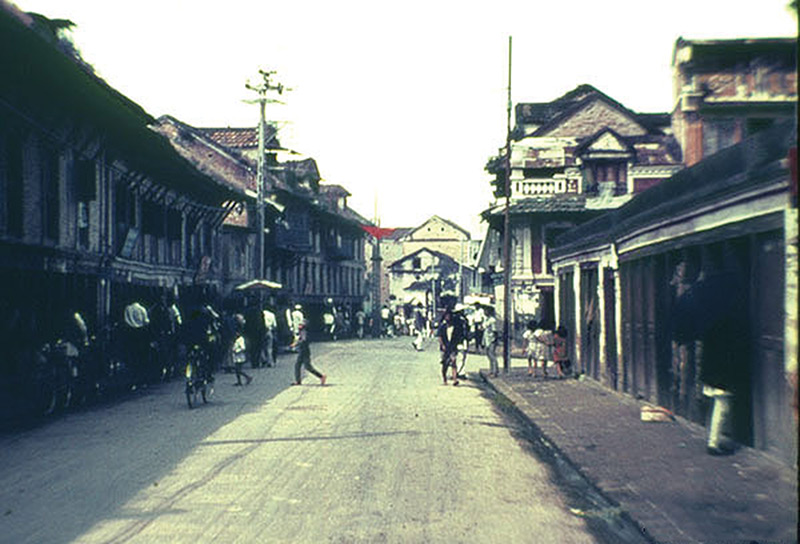
The street of Dillibazar in 1966 where Laptan ko hotel was located. (Below) Krishna Bahadur Khatri Chhetri’s grandson Bipin Paudel KC at hishome in Mid-Baneshwor. Photo Courtesy: Dr Wolf Donner/nepal-dia.de


[This is a continuation from yesterday’s piece on Gautam’s account of ‘Laptan ko hotel’, where Nepali literary and political figures frequented in the 40s.]

New locations, new politics
Laptan’s hotel showed visible signs of progress when he shifted his shop to more spacious spaces in the same locality—first near the Padma Kanya School sometime after democracy in 1951, and then a few years later, to two floors in ‘Labajung ko taharo’, the home of Labajung Thapa located at Dillibazar chowk, where the road turns towards Kalikasthan.
Krishna Bahadur Khatri Chhetri, the owner, would employ his business acumen to introduce several measures to attract more customers to these new spaces. Historian Arbind Rimal writes that more items appeared on the menu, including kebabs. And while the price of tea went up to 10 paisa per glass, the businessman made sure to keep his customers happy by paying heed to their requests to offer half a glass at 5 paisa.
According to Poet Pushkar Prasad Lohani, Chhetri cashed in on his customers by offering separate menus, focusing on tea, bread and biscuits in the mornings and vegetable curry, meat and snacks in the afternoon. But Chhetri was also generous in allowing credit, as he considered it an essential part of the business and vital to ensuring a regular flow of customers, Rimal said.
With these expanded spaces, Laptan ko hotel assumed a character more akin to “a local tea shop in Calcutta whose main function was to serve as a venue for political and social subjects,” writes Rimal.
Political and literary gatherings only increased in size and frequency.
“The ground floor had a counter and kitchen and a few benches for customers. The stairs led you to the first floor, which was large and spacious. There, you always saw groups of politicians, literary personalities and youths, seated on stools, drinking tea and engaged in heated discussions on politics and policies, society and literature,” said Lohani, recalling the heyday of the restaurant.
From these new locations, youths associated with the Nepal Communist Party planned and executed protests by showing black flags against Indian Prime Minister Jawaharlal Nehru in 1951 and the Indian parliamentary delegation in 1954 during their visit to Nepal, for what they saw as India’s undue influence on Nepal’s internal affairs.
And, after King Mahendra introduced Panchayat in 1960, “albeit in small sounds, discussions of this political accident continued happening at this hotel”.
“It is from Laptan ko hotel that youths left for Singha Durbar when Dr KI Singh led a coup in 1952 that lasted for two days,” Rimal said. “When the revolutionary peasant leader from the Far West, Bhim Dutta Panta, was killed in 1953, it was as if the gatherings at this hotel felt his blood right here and engaged in heated discussions for days. And when Tenzing Norgay scaled Mount Everest the same year, we celebrated the historic moment. No topic of national importance was spared from discussions at Laptan ko hotel.”
Tanka Prasad Acharya, Kirtinidhi Bista and Manmohan Adhikary, all of whom later became Nepal’s prime ministers, and other notable politicians including Surendra Singh KC, Yadav Prasad Pant, Singha Pratap Shah, Top Bahadur Basnet, Ramhari Sharma, Chuda Prasad Sharma, Pushpalal Shrestha, Tulsilal Amatya, Shailendra Kumar Sharma, and Shambhuram Shrestha all came to Laptan ko hotel to discuss and share their ideas.
Alongside these political personalities, writers and poets like Shankar Lamichhane, Bijaya Malla, Shyam Prasad Baisnav, Mohan Koirala, Nagendra Raj Sharma, novelist Daulat Bikram Bista, Bhawani Ghimire, Liladhawj Thapa, and Madan Mani Dixit all came to drink tea.
“Seated at this hotel, Janakavi Keshari Dharmaraj Thapa would sing his patriotic folk songs to his well-wishers” writes Rimal, while Bhupi Sherchan practiced reciting poetry “in his soft, poetic voice, the ambience and tea at this place.”
But the giant among all customers, according to Rimal, was Laxmi Prasad Devkota, who came for the chiura and goat meat, one of his favourite delicacies, and of course, the tea.
Despite his focus on his business, it was not possible for Chhetri to remain unaffected by the political and literary happenings taking place at his eatery. Recalling what he had heard from his father, Bipin Paudel KC, Chhetri’s grandson said that catering to Nepal’s political and literary scene certainly added more prestige to his grandfather’s already vaunted social status as a retired military man. His grandfather felt particular pride in being close to so many changemakers. And often, after returning home, he would recount to his family the events of the day, any notable people who had come, or anything interesting that had happened.
Most notably, Chhetri prided himself in his bond with Devkota.
“For Devkota, the eatery became something like a second home, where he stopped by every day to and from the office,” KC said. “He’d take off his overcoat, hang it beside the counter and order his favourite goat meat and chiura, and tea. Other times, he’d simply chat with grandfather. He was so regular that sometimes, his tuition students came looking for him there, and Devkota would start giving them lessons right there on the table.”
In the Laptan, Devkota found a kind ear to his small complaints and daily woes, according to KC.
“These complaints were mainly about his wife, who he called bajai,” said KC. “‘Bajai did this, she does that,’ Devkota would tell my grandfather.”
But being a popular space for political and literary figures, the eatery also invited attention of a different light, which worried Chhetri.
According to Rimal, Laptan ko hotel garnered a reputation similar to that of Lucknow Coffee House or Delhi Coffee House, which were meeting points for democratic freedom fighters during the British rule in India. At a time when even the mere gathering of people in one place aroused suspicion, the regular meeting of political figures and writers was clearly illegal and, in Rimal’s words, “These “illegal activities” came under the purview of the Rana regime’s intelligence department.”
In fact, it was because of the Rana regime’s intense surveillance that BP Koirala did not visit Laptan ko hotel, said Rimal. Rather, he disguised himself as a pundit and went to Tilauri Maila’s shop, which was lesser known for political discussions.
Indeed, it gained so much notoriety in the eyes of the rulers that during his direct rule in 1956, King Mahendra issued a decree to high-level government officials to not visit Laptan ko hotel, writes Rimal in the essay, quoting Lohani.
Whenever agents or spies had queries for Chhetri, the quick-thinking businessman always had witty replies.
“‘For me they’re all customers, I don’t know what they talk about. What I’m concerned about is my business,’” Rimal quoted Chhetri as often saying. “Given the kind of man he was, that’s what he would’ve replied to any spies or unusual persons that came to the place and they were aplenty.”

Photo Courtesy: Surendra Bajagain


Laptan’s final days
But by the time the eatery relocated to Labajung ko taharo, something other than spies and surveillance began to worry the Laptan.
Chhetri, who had been generous with giving credit, now found himself drowning in unpaid dues. Ultimately, these dues led to financial problems that in turn led to his deteriorating health.
“Dillibazar locals mostly ate or hosted their guests on credit,” Rimal writes. “Yes, credit is also a part of business. […] But conducting business requires money today. Laptan Kaji couldn’t remain unhappy from this current circumstance. Perhaps that’s why he’d be seen raising both his hands, palms turned, up to his waist, carrying a grim expression on his face.”
Rimal later learnt from Chhetri’s son that the “inability of those who ate on credit to pay took its toll on Laptan’s financial and, due to this, his physical health.”
Chhetri died in 1959 at the age of 58, effectively marking the end of Laptan ko hotel. His son, Dev Bahadur KC, attempted to run the eatery for five months but gave up and rented it out to Ram Sharan Shrestha, a local from Bahakha Bazaar in Thimi for Rs 50 a month, according to an agreement paper the two reached.
“This new man couldn’t do very well,” Lohani told me. “He dropped many items on the menu, and focused instead on jeri and tea. It might be coincidence, but fewer young people and intellectuals from political and literary scenes came to the eatery now.”
As Rimal writes, “[in Laptan ko hotel] there was no longer the attraction to drink tea or eat delicious meat and chiura. The hotel itself was taking the last breaths of its existence.”
Laptan ko hotel shuttered its doors in the late 1960s. The impact of this hotel and its owner would, however, endure, just as Rimal states in his tribute to Laptan and this place:
“When we read about other countries, we learn about how courageous works were done, and innovations were created in politics, literature, arts, science, sports by meetings in venues similar to Laptan ko hotel […] Nepalis can say without hesitation that this hotel too played a similar role.”


Gautam is a freelance journalist based in Kathmandu.

CULTURE & ARTS

South Korea’s modest metal mayhem

With trendy student areas increasingly being taken over by chic cafes and karaoke joints, Seoul’s metal subculture is largely confined to unremarkable venues.
- Ed JONES,YELIM LEE
The members of ‘post hardcore’ metal band ‘Monsters Dive’ perform duringtheir set at a venue in Seoul. Head-banging away in the shadow of a multi-billion-dollar K-pop industry, South Korea’s axe-wielding heavy metal bands shred a modest trail of destruction. AFP/rss

Head-banging away in the shadow of a multi-billion-dollar K-pop industry, South Korea’s axe-wielding heavy metal bands shred a modest trail of destruction.
And in a society where conformity is widely expected, the mosh pit masters are as clean-cut as any average Seoul citizen.
In the intimate, subterranean surroundings of a cramped basement room, the five members of Monsters Dive took part in a battle-of-the-bands before a small audience, mostly seated until frontman Chu Yeonsik ordered them to their feet.
“Are you ready?” screamed the 25-year-old nursing student, transformed into a fist-pumping alter ego leaping around the tiny stage as if he were gracing a large-scale arena. The band’s blistering set was meted out with the kind of technical precision typical of the rigorous training of the country’s intensive educational system.
“Usually I never listen to metal music,” said audience member Nam Ji-eun, 23. “But the performance was great. Even though I don’t know anything about metal, the songs were catchy and I have the tune stuck in my head now. I would like to go and see other bands too.”
But Monsters Dive founding guitarist and music producer Kim Sangwan, 35, acknowledges that the genre remains a niche subculture.
“I don’t think metal music in Korea will ever become mainstream because it’s a noisy genre with only certain followers. In Korea, it’s minor even amongst the minors,” he says.
“South Koreans tend to follow a trend and flock towards one thing; If it’s K-pop, then they only listen to K-pop. In Korea K-pop and hip hop are popular, but other than that, most other genres are being neglected.”
The slickly produced sounds and highly-choreographed dance moves of K-pop have brought it to the forefront of the “Korean Wave” that has swept Asia and beyond in the last 20 years. The industry is now estimated to be worth $5 billion, with boy band BTS its latest high-profile act.


Underground sound
With trendy student areas increasingly being taken over by chic cafes and karaoke joints, Seoul’s metal subculture is largely confined to unremarkable venues that are often literally underground.
Some musicians, appropriately enough, are moving to former metal workshops in the industrial district of Mullae and converting them into live venues and rehearsal spaces.
Chu, a recent addition to Monsters Dive with whom he has recorded one album, works part-time jobs in between his studies to sustain his hard-rocking habit.
Even their larger gigs will only bring the band around $350, which — along with proceeds from merchandise sales — they put towards rehearsal rooms, recording sessions and music video production to maintain their presence on various social media platforms.
Parental approval and support can be vital for metalheads who are in it for love, not money.
“I was once in the car with my mum, and played my CD,” recalls Chu. “She told me it was too noisy and that hearing my voice full of anger made her agitated and might make her break the speed limit.
“But she said she likes the instruments, and supports my path.”


—Agence France-Presse

Page 11
WORLD

Iran fires missiles at US bases in Iraq

The Iraqi military said it sustained no casualties in 22 missile strikes on bases housing US troops.
- AGENCE FRANCE-PRESSE

A file photo shows missiles and a portrait of Iran’s Supreme Leader Ayatollah Ali Khamenei at Baharestan Square in Tehran, Iran. AFP/RSS

BAGHDAD,
Iran fired missiles on Wednesday at Iraqi bases housing the US military, officials in Washington and Tehran said, in the first action of the Islamic republic’s promised revenge for the US killing of a top Iranian general.
Launched from Iranian territory and by Iranian forces not a proxy, the attack marked a new turn in the intensifying confrontation between the United States and Iran and sent world oil prices soaring.
There was no immediate suggestion of any link to the missile strikes but a Ukrainian airliner crashed shortly after takeoff from Tehran early Wednesday with the loss of all 176 people on board.
The Pentagon said “Iran launched more than a dozen ballistic missiles against US military and coalition forces in Iraq”.
“It is clear that these missiles were launched from Iran and targeted at least two Iraqi military bases hosting US military and coalition personnel” at Ain al-Asad and Arbil, it said.
Iran’s foreign minister appeared to suggest that the missile strikes were over for now. But the supreme leader, who has the final say in all matters of state, said it was a “slap in the face” for the United States and revenge was yet to come.
There was no immediate confirmation of any casualties. The Pentagon said the facilities had been on “high alert” after days of steadily mounting tension and exchanges of threats of war. The Iraqi military said it sustained no casualties in 22 missile strikes on bases housing US troops.
“Between 1:45 am and 2:15 am (2245 GMT and 2315 GMT) Iraq was hit by 22 missiles, 17 on the Ain al-Asad air base and ... five on the city of Arbil,” the Iraqi military command said.
“There were no victims among the Iraqi forces.”
France too said it sustained no casualties in the strikes on bases housing troops of a US-led coalition fighting the remnants of the Islamic State jihadist group. But British Foreign Secretary Dominic Raab voiced concern about “reports of casualties” in a statement condemning the strikes.
“We condemn this attack on Iraqi military bases hosting coalition—including British—forces,” Raab said.
“We are concerned by reports of casualties and use of ballistic missiles.”
Trump, who visited al-Asad with First Lady Melania Trump in December 2018, his first trip to US troops deployed in a war zone, said initial casualty assessments indicated “all is well.”
The Norwegian military said coalition troops on the ground were warned in advance through intelligence channels of an imminent attack.
The Iranian Revolutionary Guards Corps said that the Ain al-Asad base was hit with dozens of missiles, in response to Friday’s killing in a US drone strike of Iranian general Qasem Soleimani, one of the most important figures in the country’s government.
It warned any US counter-attack would be met with an even “more crushing response” and threatening to strike Israel and America’s “allied governments.”
Israeli Prime Minister Benjamin Netanyahu vowed to inflict a “resounding blow” if Iran attacked.
Iran’s supreme leader Ayatollah Ali Khamenei said a “slap in the face” had been delivered to the United States, but said revenge had yet to be exacted.
“An important incident has happened. The question of revenge is another issue,” Khamenei said in a speech broadcast live on state television. “Military actions in this form are not sufficient for that issue.
“What is important is that America’s corrupt presence must come to an end in this region.”
Iran’s Foreign Minister Mohammad Javad Zarif had seemed to indicate that the missile strikes were over for now.
“Iran took and concluded proportionate measures in self-defence” targeting a base from which a “cowardly armed attack against our citizens and senior officials” was launched, he said on Twitter.
The brazenness of the strike was highly unusual for Iran, which has tended to disguise attacks on US interests or troops through the use of proxy Shiite forces. This time, conventional, rather than guerrilla-style weapons were used and responsibility was rapidly claimed.
“It is a major escalation. Ballistic missiles openly launched from Iran onto American targets is a new phase,” said Phillip Smyth, an expert on Shiite militias.
Oil prices immediately jumped on the news, with the benchmark WTI spiking more than 4.5 percent to $65.54 a barrel before receding slightly.
The Ukraine International Airlines Boeing 737 went down just outside Tehran after taking off bound for Kiev, Iranian state media reported.
There was no immediate suggestion of any link with the Iranian missile strikes but carriers including Air France and Lufthansa announced they were suspending flying though Iranian and Iraqi airspace as
a precaution.

WORLD

Putin on surprise visit to Assad as Mideast boils

- AGENCE FRANCE-PRESSE

DAMASCUS,
Russian President Vladimir Putin met Syria’s Bashar al-Assad Tuesday during an unprecedented visit to Damascus as the prospect of war between Iran and the United States loomed over the region.
In one of the highest-profile assassinations in the troubled Middle East’s recent history, Washington killed top Iranian commander Qassem Soleimani Friday, triggering vows of bloody revenge from Tehran and its allies.
On his first visit to the capital since the start of the Syrian conflict nearly nine years ago, Putin greeted the Russian forces stationed there on the occasion of the Orthodox Christmas.
Russia’s 2015 military intervention was decisive in saving Assad’s regime and Putin hailed the latest advances made by Syrian government forces during his visit.
“In his conversation with Assad, Putin noted that we can now say with confidence that a huge distance has been travelled towards restoring Syrian statehood and the country’s territorial integrity,” Russian news agencies quoted Kremlin spokesman Dmitry Peskov as saying.
Government and allied forces barely controlled a fifth of the country before Moscow stepped in but have now clawed back most of the territory lost at the beginning of the war.
Russia has thousands of forces deployed across Syria in support of the army, while an unknown contingent of Russian private security personnel also operates on the ground.

WORLD

Ukrainian airliner crashes after take-off in Iran, killing all 176 aboard

- REUTERS

DUBAI/KIEV,
A Ukrainian airliner burst into flames shortly after take-off from Tehran on Wednesday, killing all 176 people aboard in a crash that an initial report blamed on engine failure.
Debris and smouldering engine parts were strewn across a field around 10 km (six miles) from Imam Khomeini airport as rescue workers with face masks retrieved bodies of the victims.
Ukraine’s embassy in Iran, citing preliminary information, said the Boeing 737 suffered engine failure and the crash was not caused by “terrorism”.
Carrier Ukraine International Airlines said it was doing everything possible to confirm the cause, and the investigation would also involve Boeing and Ukrainian and Iranian authorities. It was the Kiev-based airline’s first fatal accident.
Ukraine President Volodymyr Zelenskiy said all on board had died. “My sincere condolences to the relatives and friends of all passengers and crew,” he said in a statement.
“The fire is so heavy that we cannot do any rescue ... we have 22 ambulances, four bus ambulances and a helicopter at the site,” Pirhossein Koulivand, head of Iran’s emergency services, told Iranian state television.
Ukraine’s prime minister and Iranian state TV said 167 passengers and nine crew were on board. Iranian TV said 32 of those on board were foreigners.
Ukrainian Foreign Minister Vadym Prystaiko said the victims included 82 from Iran, 63 Canadians, 11 Ukrainians, 10 Swedes, three Germans and three Britons. Most passengers were in transit, the airline said.
Iranian media quoted a local aviation official as saying the pilot did not declare an emergency.
Iranian TV said the crash was due to unspecified technical problems. State broadcaster IRIB said on its website that one of the plane’s two black boxes - the flight data recorder and the cockpit voice recorder - had been found.
The plane that crashed was a three-year-old Boeing 737-800NG en route to Kiev, air tracking service FlightRadar24 said.
“The last scheduled maintenance of the aircraft took place on 06 January, 2020,” the airline said.
A spokesman for the manufacturer said it was gathering more information.
The 737-800 is one of the world’s most-flown models with a good safety record and does not have the software feature implicated in crashes of the 737 MAX. Boeing grounded its 737 MAX fleet in March after two crashes that killed 346 people.


Iran says won’t give Americans crashed plane’s black boxes
TEHRAN: Iran’s aviation authority said it would not hand over to Americans the recovered black boxes of a Boeing 737 that crashed on Wednesday.
“We will not give the black boxes to the manufacturer (Boeing) and the Americans,” Iran Civil Aviation Organisation head Ali Abedzadeh said, quoted by Mehr news agency.
“It’s not yet clear which country the black box will go to for the investigation,” he added.
Following the crash of Ukraine International Airlines flight PS752 shortly after takeoff from Tehran on Wednesday, Iran said it had recovered the Boeing 737’s two black boxes.
Abedzadeh said that based on global aviation rules, it was the right of the country where air crashes occur to carry out the investigation.

WORLD

Trial opens in Japan for grisly murder of 19 at disabled home

- AGENCE FRANCE-PRESSE

TOKYO,
The man accused of the 2016 murder of 19 disabled people at a Japanese care home goes on trial Wednesday in a case that ranks among the country’s worst mass killings.
Satoshi Uematsu, a former employee of the care centre outside Tokyo, has admitted carrying out the stabbing rampage, but his lawyer is expected to enter a plea of not guilty on grounds of diminished capacity.
Uematsu reportedly said he wanted to eradicate all disabled people in the horrifying July 26 attack at the Tsukui Yamayuri-en centre in the town of Sagamihara outside Tokyo.
The 29-year-old is accused of breaking into the facility and moving room to room, searching for victims. Nineteen people were killed and 26 injured—half of them seriously.
He turned himself in at a police station, carrying bloodied knives and admitting the attack to officers.
It emerged later that Uematsu had left his job at the home just months before the attack, and had been forcibly hospitalised after telling colleagues he intended to kill disabled people at the centre.
But he was discharged after 12 days when a doctor deemed him not a threat.
He faces six charges, including murder, and faces the death penalty if convicted on some of the counts.
Since his arrest, Uematsu has shown no remorse and continued to espouse the views that apparently motivated the attack.
In interviews with Japan’s Mainichi Shimbun daily he said those with mental disabilities “have no heart”, claiming “there’s no point in living” for them.
“I had to do it for the sake of society,” he said of the attack.
“I don’t think I’m innocent but it wasn’t something punishable by death.”
Despite his statements, his lawyers reportedly plan to enter a plea of not guilty on Uematsu’s behalf, arguing he was unable to tell right from wrong at the time of the attack because he was on drugs.
A test following his arrest reportedly showed traces of marijuana in his system.
In a recent interview with the Jiji Press agency, Uematsu said he would not deny in court having carried out the attack.
“It’s depressing,” he said. “It’s like going there to get insulted.”
And he appeared to take pride in the devastating rampage“I did my best”, he told Jiji.
Uematsu’s self-styled mission to rid the country of people with disabilities shocked Japan, with experts and activists raising questions about whether others in the country might hold similar views.

WORLD

Snipers to cull up to 10,000 camels in drought-stricken Australia

- AGENCE FRANCE-PRESSE
The five-day cull in the Anangu Pitjantjatjara Yankunytjatjara Lands is the first in the state, according to local media. afp

SYDNEY, 
Snipers took to helicopters in Australia on Wednesday to begin a mass cull of up to 10,000 camels as drought drives big herds of the feral animals to search for water closer to remote towns, endangering indigenous communities.
Local officials in South Australia state said “extremely large” herds have been encroaching on rural communities—threatening scarce food and drinking water, damaging infrastructure, and creating a dangerous hazard for drivers.
It comes after Australia experienced its hottest and driest year on record in 2019, with the severe drought causing some towns to run out of water and fuelling deadly bushfires that have devastated the country’s southeast.
The five-day cull in the Anangu Pitjantjatjara Yankunytjatjara (APY) Lands—home to about 2,300 indigenous people in the north-west of South Australia—is the first in the state, local media reported. “These (camel) groups are putting pressure on the remote Aboriginal communities in the APY Lands and the pastoral operations as the camels search for water,” the APY Lands executive committee said in a statement.
South Australia’s environment department, which is supporting the aerial cull, said the drought had also created “critical animal welfare issues” as some camels have died of thirst or trampled each other as they rush to find water. “In some cases dead animals have contaminated important water sources and cultural sites,” a spokesperson added.
Camels were first introduced to Australia in the 1840s to aid in the exploration of the continent’s vast interior, with up to 20,000 imported from India in the six decades that followed. Australia is now thought to have the largest wild camel population in the world, with official estimates suggesting more than one million are roaming the country’s inland deserts.
The animals are considered a pest, as they foul water sources and trample native flora while foraging for food over vast distances each day.
Traditional owners in the APY Lands have for years mustered and sold off feral camels but more recently they have “been unable to manage the scale and number of camels that congregate in dry conditions”, according to the environment department.
As a result, “up to 10,000 camels will be destroyed in accordance with the highest standards of animal welfare”, it added.
Public broadcaster ABC reported the animals would be killed away from communities and the carcasses burned.

WORLD

‘Millions’ go on strike across India in protest of Indian government policies

- AGENCE FRANCE-PRESSE
Protesters display placards in support of a nationwide general strike called by trade unions aligned with opposition parties to protest the Indian government’s economic policies, in Kolkata on Wednesday. AFP/RSS

NEW DELHI,
Millions went on strike throughout India on Wednesday, unions said, as workers angry at the government’s labour policies brought travel chaos across the country.
The widespread action was in opposition to what unions called the “anti-worker and anti-people policies” of right-wing Prime Minister Narendra Modi.
They highlighted the recent privatisation of public firms and natural resources and demanded a rise in the minimum wage and pensions.
Farmers and students joined some of the protests called by 10 trade unions who claim 250 million members between them. Bus and train services and state-owned banks bore the brunt of the national strike action that was staged in defiance of government warnings of “consequences” for anyone who took part.
Protesters blocked roads and railway tracks, while those at rallies also chanted slogans against the government’s new nationality law that opponents say is anti-Muslim and has sparked widespread demonstrations.
In West Bengal state, strikers targeted railways and key highways and burned tyres on a main road in the state capital of Kolkata. Protesters carried red flags at rallies in the city.
Police said there had been some “clashes” in Kolkata and other districts between supporters and opponents of the strike. The eastern states of Bihar and Odisha, Maharashtra in the west, Haryana in the north and Kerala and Karnataka in the south were also hit by the action.
Some workers at state oil and coal firms joined the strike.
The government had warned strikers that they would face “consequences” including having wages deducted and other disciplinary action if they joined the protest.
But the strike added to pressure on the Modi government already hit by widespread protests over the nationality law passed on December 11. More than 25 people have been killed in the protests. Growing unrest in universities has added to social tensions.
“The attitude of the government is that of contempt towards labour,” said the Centre of Indian Trade Unions, one of the groups organising Wednesday’s 24-hour strike.
Opposition parties have backed the strikers. Rahul Gandhi, former leader of the main opposition Congress party said the government had “created catastrophic unemployment” in a Twitter message praising the action.
A government’s move to privatise big state-run firms as it struggles to get out of a severe economic slowdown has riled the opposition and unions.
The government statistics office forecast on Tuesday that annual growth would slow to 5.0 percent in 2020, the slowest pace in 11 years.
Last month the International Monetary Fund said the Indian government must take steps quickly to reverse the slowdown.
It said declining consumption and investment, coupled with falling tax revenue, had combined to put the brakes on what was once the fastest growing of the world’s major economies.

WORLD

35 Turkish soldiers sent to Libya so far: Erdogan

Briefing

ANKARA: Turkey has deployed 35 military personnel to Libya but they will not take part in any fighting, President Recep Tayyip Erdogan said, according to local media on Wednesday. “The soldiers will not fight. Other soldiers who will be deployed later will also not enter any combat,” Erdogan told his ruling party, according to the Hurriyet daily. He said the soldiers were carrying out training and coordination tasks for Libya’s UN-recognised Government of National Accord (GNA) based in Tripoli.  (Agencies)

WORLD

Indonesia deploys fighter jets, warships to disputed waters

Briefing

JAKARTA: Indonesia has deployed fighter jets and warships to patrol islands near the disputed South China Sea, the military said on Wednesday, escalating tensions with Beijing after a diplomatic spat over “trespassing” Chinese vessels. President Joko Widodo also headed on Wednesday to the fishing-rich waters around the Natuna islands, which border the South China Sea, most of which is claimed by China despite competing claims from other Southeast Asian nations including Vietnam, the Philippines and Malaysia.  (Agencies)

WORLD

Child found dead at Paris airport in undercarriage of plane

Briefing

PARIS: A child aged around 10 was found dead Wednesday at a Paris airport in the undercarriage of a plane that had come from the Ivory Coast city of Abidjan, a source close to the inquiry said. The Air France Boeing 777 had taken off from Abidjan on Tuesday evening and landed at Paris’ Charles de Gaulle airport in the early morning.  (Agencies)

WORLD

Ghosn lawyers in Japan refuse to comply with seizure warrant

Briefing

TOKYO: Lawyers for former Nissan chief Carlos Ghosn on Wednesday refused to turn over a computer used by the auto tycoon before he jumped bail and fled the country last month. Prosecutors arrived at the offices of one of Ghosn’s Japanese lawyers with a warrant for seizure of the machine—only to be told to go away.
 (Agencies)

Page 12
MONEY

Alibaba undercuts Amazon in Europe to woo wary brands

The company is initially targeting Spain and Italy, plus Russia and Turkey.
- REUTERS
Employees work at AliExpress office at the Alibaba company’s headquarters in Hangzhou, Zhejiang province, China. REUTERS

HANGZHOU (China), 
After years of reconnaissance, China’s retail king Alibaba is finally making its move on Europe. It is undercutting Amazon sellers’ fees to attract vendors but has had mixed results, six sources with direct knowledge of the matter said.
A flood of small businesses have joined its European platform, AliExpress, in recent months but some larger brands are holding back, according to the sources.
AliExpress has approached well-known brands including Mango, Benetton and Spanish fashion group Tendam, owner of Cortefiel, to appear on the site with limited success, according to five sources involved in the approaches who declined to be named because the discussions were confidential.
Some of the brands did not feel the site, whose fashion offerings include an imitation leather miniskirt for about $18 and an acrylic batwing sweater for $14, was the right showcase for their products, sources said.
A senior executive at one large fashion company, which turned down AliExpress’s approaches in Europe, said its brand needed to be in an “aspirational environment”. Another described the AliExpress platform as “a work in progress”.
However the head of AliExpress, Wang Mingqiang, told Reuters in an interview at Alibaba’s headquarters in Hangzhou, that foreign brands needed time to understand the platform.
With space to design their own stores within the platform, brands can build their own homepage, with pictures and video, to create the feel they want, he added.
Both Benetton and Tendam declined to comment officially on whether they were approached. Neither brand sells on AliExpress but they do sell on Amazon. Mango said it did not sell on AliExpress with no further comment. It does not sell on Amazon.
An AliExpress spokeswoman did not comment on whether the company had approached these brands or others.
“We are continuously exploring opportunities to work with different partners and committed to acting as a trusted partner for both consumers and sellers,” the company said.
Alibaba has hitherto focused on selling inexpensive Chinese products overseas through its AliExpress platform, such as $3 USB cables and $2 crystal earrings, curbing its appeal to a wider audience.
But in the past six months it has started a drive to open up the platform to local vendors and brands as its seeks to replicate a highly profitable model of virtual malls that has seen it swallow more than half of online sales in China.
“Overseas sellers have a better understanding of local users, their products have better designs as they are closer to local users,” said Wang.
The company is initially targeting Spain and Italy, plus the Europe-Asia gateway nations of Russia and Turkey, among its top markets under the previous, first-phase business model launched in 2010.
Spain, a big Western country with strong local brands, is the kind of market Alibaba needs to win over if it is to meet CEO Daniel Zhang’s target to more than double its customer base to 2 billion by 2036 despite a stuttering Chinese economy.
Its progress there illustrates its strategy, and the obstacles it could encounter, as it plots global expansion.
AliExpress has waived monthly rates for sellers in Spain to attract their business while commissions for goods sold are set at 5 percent to 8 percent, according to a senior source close to the company.
By comparison, it costs 39 euros per month plus sales tax to sell on Amazon, plus a commission for every object sold of 7 percent to 15 percent, with some items like jewellery and Amazon device accessories commanding higher rates, an Amazon spokeswoman said.
Amazon declined to comment on AliExpress’s move to open its platform to local sellers. The U.S. company is the largest online shopping marketplace in its five main European markets: Britain, France, Germany, Italy and Spain, according to e-commerce analyst Marketplace Pulse.
Thousands of small businesses have signed up to register on AliExpress in Spain since it was opened up to local sellers in 2019, an AliExpress spokeswoman said.

MONEY

Mercedes-Benz, Geely launch $780 million JV to make electric smart-branded cars

- REUTERS
REUTERS

BEIJING/SHANGHAI, 
Zhejiang Geely Holding Group Co Ltd and Mercedes-Benz on Wednesday said they would each invest 2.7 billion yuan ($388.77 million) in a China-based venture to build “premium and intelligent electrified” vehicles under the smart brand.
The 50:50 venture has received regulatory approval and will be based in the Chinese coastal city of Ningbo, the Chinese and German automakers said in a statement. Like Mercedes-Benz, smart is a Daimler AG marque.
The venture will have manufacturing capacity in China and sales operations in China and Germany, the automakers said. Geely will lead in engineering the cars while Mercedes-Benz will take charge of their overall look, they said.
The partners will each have three executives on the board of directors, with Geely’s Tong Xiangbei becoming the venture’s global chief executive.
Geely has expanded rapidly through mergers and acquisitions since buying Sweden’s Volvo in 2010 from US parent Ford. In 2018, it built a stake of almost 9.7 percent in Daimler and set up a ride-hailing venture in China with the Stuttgart-based carmaker.
Its latest announcement comes just over a month after China’s Great Wall Motor Co Ltd and Germany’s BMW AG formed a venture to build electric Mini-branded cars in China, the world’s biggest market for electrified vehicles where demand for smaller EVs is on the rise.

MONEY

Samsung Electronics flags one-third drop in Q4 operating profit

- AGENCE FRANCE-PRESSE
A woman walks past a Samsung ad in Seoul. afp/rss

SEOUL,
Samsung Electronics’ operating profits fell by more than a third in the fourth quarter, the world’s biggest manufacturer of smartphones and memory chips estimated Wednesday.
Samsung was hit by a series of difficulties in 2019, with chip stockpiles bloating and prices falling, in contrast to the booming market of previous years.
The premium smartphone market has also grown fiercely competitive with buyers waiting longer before upgrading to new models.
But the figures beat expectations, analysts said, with chip demand starting to improve and strong smartphone sales.
The forecast represented a relative improvement—in each of the first three quarters of 2019 net profits fell by more than half year-on-year.
Samsung Electronics is crucial to South Korea’s economic health. It is the flagship subsidiary of the giant Samsung Group, by far the largest of the family-controlled conglomerates, known as chaebols, that dominate business in the world’s 11th-largest economy.
In an earnings guidance statement, Samsung Electronics projected operating profits in the October to December period at 7.1 trillion won ($6.1 billion), down 34.2 percent year-on-year.
Sales were forecast to be flat at 59 trillion won, it added.
For full-year 2019, it predicted operating profits of 27.7 trillion won, down 52.9 percent, on sales down 5.8 percent to 229.5 trillion won.
The company has been strained by a protracted trade dispute between China and the US, and been caught up in a diplomatic row between Seoul and Tokyo over historical disputes, with Japan imposing tough restrictions on exports crucial to South Korean tech giants in July.
In another shadow hanging over the firm, its vice chairman and de-facto leader Lee Jae-yong is on trial for the second time over the sprawling corruption scandal that led to the impeachment of South Korea’s former president Park Geun-hye. A guilty verdict and long prison sentence would deprive the firm of its top decision maker.
Lee was initially jailed for five years in 2017 on multiple convictions including bribery, then released after several of his convictions were quashed, only for the Supreme Court in August to order a retrial.
Its board chairman Lee Sang-hoon was also jailed last month for sabotaging union activities, prompting a rare apology from the firm.
Samsung Electronics shares reached an intraday one-year high in Seoul on Wednesday and closed up 1.8 percent, while the KOSPI index was down 1.1 percent following the Iranian missile attack on US forces in Iraq.
“Sales in memory chips were strongest along with good numbers in its IT and Mobile division,” said Lee Joon-min of Hana Financial Investment. Analysts expect Samsung to perform better this year on the back of a recovery in chip demand and limited supply, along with new 5G smartphone models and other innovations.
Reduced chip production at one of Japanese rival Kioxia’s plants has seen average NAND flash selling prices “start to rebound”, Avril Wu, an analyst at the Taipei-based market tracker TrendForce told AFP.
“As for DRAM, we expect prices to increase each quarter in 2020,” she said, adding: “The recovery of the DRAM and NAND market is mostly driven by the constriction of supply, but an increase in demand also contributes to this as well.”

MONEY

German industrial orders disappoint in November

- AGENCE FRANCE-PRESSE

FRANKFURT AM MAIN,
New orders for German industrial firms fell in November, official data showed Monday, continuing a run of weak data for Europe’s powerhouse.
Fresh contracts fell 1.3 percent month-on-month, federal statistics authority Destatis said in seasonally-adjusted figures, down from a 0.2-percent increase in October and short of analysts’ expectations for slight growth.
Excluding volatile large orders for items like aircraft, the picture was slightly rosier, showing a 1.0 percent increase in business.
But in a year-on-year comparison, new orders were 6.5 percent below November 2018’s level.
“In recent months, industrial orders have stabilised at a low level,” the economy ministry in Berlin said in a statement, noting that the total over October and November 2019 was little changed from the previous two months. “At the same time, business expectations in industry have picked up somewhat,” meaning “the outlook for industrial activity has improved,” it added.
US-led trade wars, especially with major German trading partner China, sapped growth and strewed uncertainty in manufacturing firms’ path over much of 2019.
But robust consumer demand at home helped the eurozone heavyweight avoid recession, and prospects of a preliminary Beijing-Washington deal later this month have brightened surveys of business leaders’ mood.
Looking in more detail at the industrial orders data, makers of producer goods saw slightly more new contracts, while demand at consumer goods firms was flat and capital goods companies’ orders fell 2.1 percent.
Meanwhile orders from both eurozone and non-eurozone countries fell by more than three percent, with domestic demand growth the only improver, adding 1.6. “Instead of a turnaround, the drought in order books and the manufacturing slump is getting worse,” said ING bank economist Carsten Brzeski.

MONEY

South Africa’s black farmers fight to enter marijuana market

- ASSOCIATED PRESS
A small-scale farmer Itumeleng Tau stands among his cannabis plants in a hothouse in Krugersdorp, South Africa. AP/RSS

HENNOPS (South Africa),
Stacks of bright green cannabis plants, freshly harvested from nearby hothouses, are expertly sorted on a lab table by workers wearing hygienic gloves and caps who snip the leaves and buds and put them in bins for further processing.
Druid’s Garden in Hennops, about 20 miles north of Johannesburg, is a licensed farm which conducts research, legally produces cannabis and other traditional medicinal products for sale in South Africa and international markets.
The farm’s founder, Cian McClelland, said one of his aims is to help smaller-scale, black farmers enter South Africa’s potentially lucrative marijuana market.
 “One of the most important aspects of this industry is for us to find ways to uplift small farmers, particularly black rural farmers,” said McClelland. “We would like to play an active role around the country, in partnership with the Heritage Trust, to help ... provide access to these markets.”
McClelland knows that rural black farmers, who have grown marijuana traditionally but illegally, are now fighting to benefit from the country’s relaxation of cannabis laws.
Following the Constitutional Court’s decision in 2018 to decriminalise the personal use and cultivation of cannabis, South Africa’s cannabis industry could be worth more than $23 billion by 2023, according to a recent report by data collection agency Prohibition Partners.
However, there are concerns on the ground that black farmers who have been working for decades in what has been an illegal industry may miss out on the potential boom.
Many smaller growers cannot afford to get the licenses needed to grow marijuana for medicinal and research purposes.
The stringent requirements include getting police clearances, registering a specified plot size, erecting high-tech security fencing, getting irrigation systems and setting up agreements with overseas buyers, among others. The cost of establishing a legal marijuana farm is estimated to be $200,000 to $350,000, according to a South African agricultural publication, Landbouweekblad.
The new marijuana industry could soon be controlled by big pharmaceutical companies, cutting out long-time growers, say agricultural experts.
Some successful black farmers like Itumeleng Tau are working to train emerging farmers to grow and process cannabis up to the standards required to obtain medicinal permits.
“If an ordinary farmer in the homelands (rural areas) is being required to have two hectares (5 acres) of land or one hectare (2.5 acres), fully fenced, while they have been farming when it was un-fenced and nobody was stealing it, it is quite impractical,” said Tau. Moleboheng Semela, a cannabis activist and general secretary of the Cannabis Development Council, is among those fighting to get licenses for those who had previously grown and sold cannabis illegally.
Her organisation helps emerging farmers to obtain permits to cultivate cannabis and produce medicinal
products.
“We have those communities that have been involved in the cannabis industry before the court ruling, but we have seen that our government is more focused on the (producers of) pharmaceuticals,” said Semela.
South Africa’s cannabis industry is growing so quickly that marijuana conventions are popping up across the country.
A recent cannabis expo held in Johannesburg’s posh Sandton Convention US attracted hundreds of marijuana activists, farmers, growers and exhibitors from across the world. The expo grew from 58 exhibitor stands last year to more than 200 stands this year, according to expo director Silas Howard.

Page 13
MONEY

Currency exchange counters deserted as demand for Indian rupees falls

Experts say an increase in the supply of Indian currency has led to reduced business for money changers.
- MADHAV DHUNGANA
A cashier displays the new 2000 Indian rupee banknotes inside a bank in Jammu, India. REUTERS

BHAIRAHAWA,
Nepal Rastra Bank’s currency exchange counter in Bhairahawa is deserted these days in sharp contrast to one and a half months ago when it used to be mobbed by people seeking Indian rupees.
There were so many people wanting Indian banknotes that the counter could not fulfil demand, and desperate India-bound travellers and shoppers often turned to the black market.
The central bank’s Bhairahawa branch now has adequate stocks of Indian currency, but there are few takers. Demand for Indian banknotes has plummeted of late, and the more than three dozen exchange counters in the city are deserted. Business has dried up for the once thriving illegal money changers too.
“Buying Indian currency has become risky,” said Chandrakant Adhikari, operator of Lumbini Money Changer. “There are no customers asking for Indian notes.”   
According to Adhikari, demand has plunged for the first time during his three decades as a money changer, and he will have to shut down his business if the trend continues.
Lumbini Money Changer used to sell Indian banknotes worth Rs10 million per day to over 200 customers. Currently, less than 15 customers walk in through the door daily; and more people come to sell, not to buy, Indian currency.
The exchange rate of the Indian rupee is Rs1.60. When demand was high, illegal changers were charging Rs1.65. Thousands of customers who hop across the Nepal-India border to Sunauli for shopping purposes reportedly even paid Rs1.67.
Illegal money changers now only give Rs1.57 for one Indian rupee. Some have even stopped exchanging Indian banknotes.
Nepal Rastra Bank’s Siddharthanagar branch also reported a drop in demand for Indian currency. It used to sell Indian currency worth Rs2 million daily. The daily turnover has now slumped to Rs300,000.
“Collection of Indian currency has increased,” said Krishna Bhattarai, chief of central bank’s Siddharthanagar branch. “The accumulation used to be marginal earlier, but the branch has witnessed a collection of IRs2.6 million till December.”
Nepal Rastra Bank only exchanges Indian banknotes of Rs100 denomination. The central bank pays for its Indian currency purchases in US dollars.
There is no official explanation for the decline in demand for Indian rupees. According to experts, the inflow of Indian currency has increased because of Indians who have acquired Nepali citizenship paying for real estate in Indian currency.
People who need Indian currency for travel, health and education purposes have been getting it through banks instead of buying it from money changers. An increase in the number of Indian gamblers at casinos based in Bhairahawa has led to more Indian currency flowing into Nepal, they say.
Smuggling of gold, pepper and betel nut from Nepal to India has also increased the supply of Indian banknotes. “The abundance of Indian notes suggests smuggling of goods from Nepal to India,” said Adhikari. “The market is seeing more Indian notes also because of an increase in the number of Indian citizens visiting Nepal’s casinos of late.”

MONEY

Nepal Airlines’ Doha service avoids Iranian airspace

- Post Report

KATHMANDU,
Nepal Airlines said its Kathmandu-Doha service have avoided Iranian airspace as tensions between Tehran and Washington escalate following the killing of Iranian General Qassem Soleimani by a US drone in Iraq.
Nepal Airlines flies daily to the Qatari capital Doha at 10:25 pm. The carrier has been using Iranian airspace since 2017 after several Arab nations barred aircraft from flying to Doha through their airspace.
“For today [Wednesday], we have decided to avoid the Iranian airspace. We are monitoring the situation closely and will make the appropriate long-term adjustments to our route to Doha after necessary discussion with Minister of Foreign Affairs,” said a Nepal Airlines official at the Operation Control Centre at Tribhuvan International Airport in Kathmandu.
Nepal Airlines officials are scheduled to hold the meeting with foreign ministry officials on Thursday regarding the route amid ongoing security fears.
Saudi Arabia, the UAE, Bahrain, Egypt and Yemen cut diplomatic ties with Qatar on June 5, 2017 accusing the gas-rich state of supporting terrorism. Nepal Airlines has been giving UAE airspace a wide berth by flying over southern Iran to reach Doha.
Nepal Airlines officials said rerouting the flight may increase the flying time by around 10 minutes only. Many air routes connecting Southeast Asia and Europe pass over Iran. For airlines, diverting flights from their normal routes could mean longer flight times and higher fuel costs.
An official at Turkish Airlines said they didn’t have any plans to reroute their services. Qatar Airways officials told the Post that they would fly the usual route.
The Federal Aviation Administra-tion of the US issued the airspace ban, which also includes the Gulf of Oman and the waters between Iran and Saudi Arabia, ‘due to heightened military activities and increased political tensions in the Middle East, which present an inadvertent risk to US civil aviation operations’.

MONEY

Foreign firms wary as China launches investment law

- AGENCE FRANCE-PRESSE

BEIJING,
Accustomed to unfulfilled promises from the Chinese government, foreign businesses are keeping a wary eye on a nascent law aimed at addressing their long-standing grievances about unfair treatment in the world’s second largest economy.
The foreign investment law, which came into force on January 1, is supposed to give local and foreign companies equal treatment in the Chinese market and improve protections of intellectual property.
But international companies, which have in the past complained about having “promise fatigue”, have not been wowed by the legislation.
“Our expectations are quite modest,” said Lester Ross, who heads the policy committee at the American Chamber of Commerce in China.
“The longest-standing issues in China do not concern an absence of legislation, but rather the lack of enforcement and the breadth of government discretion resulting in selective enforcement,” Ross said.
The legislation, which replaces three older laws, says foreign firms are no longer obligated to have a Chinese partner to start a business in the country.
It also prohibits the use of administrative means to force foreign firms to transfer technology to Chinese partners—one of the major sticking points in Beijing’s trade war with the United States.
But a survey of 249 companies, published in December by the British Chamber of Commerce in China, indicated that 38 percent of respondents believed the law would not change anything. A quarter of respondents did not know what changes to expect.
Beijing passed the law as it faces rising competition for foreign direct investment from other Asian manufacturing hubs, notably in Southeast Asia, said Rajiv Biswas, Asia-Pacific chief economist at IHS Markit.
“This reform is an important priority for the Chinese government in order to maintain an attractive business climate for foreign investment,” Biswas said.
Rising wages have reduced China’s competitiveness, with countries such as Vietnam offering manufacturers a cheaper alternative. Biswas said China has recognised that in order to attract more foreign investment, notably in high-tech, it had to provide a more level playing field and improve intellectual property protection.
But without strict on-the-ground implementation mechanisms, foreign investors are unlikely to be reassured, Ross said. Other issues remain as well.
The law does not spell out what penalties would be imposed for violating intellectual property rights.

MONEY

Boeing changes stance, recommends 737 MAX simulator training for pilots

- REUTERS

WASHINGTON, 
Boeing Co said on Tuesday it was recommending that airline pilots undergo simulator training before they resume flying the 737 MAX, a shift from its previous position that pilots only needed computer-based training.
If US and international regulators ultimately back Boeing’s proposal, it could take airlines longer to prepare their crews
to fly the 737 MAX jets that have been grounded since March after two crashes that killed 346 people.
Boeing has been working on revised pilot training and software updates for the 737 MAX to win regulatory approval for the jets to fly commercially again.
After repeated setbacks, the US Federal Aviation Administration (FAA) is not expected to give the greenlight until at least February, perhaps March or later.
Last year, the planemaker said it would propose that MAX pilots did not need to train on costly simulators, a position it originally used to market the latest version of its 737 narrowbody workhorse against competition from European rival Airbus SE.
Airlines that bought the MAX have had to cancel flights while the global fleet remains grounded. If only computer-based training were required for renewed 737 MAX commercial flying, Boeing’s largest customer Southwest Airlines Co had said it would take one to two months to prepare its more than 9,500 pilots on the updates.
Southwest had not been part of Boeing’s recent discussions on pilot training recommendations and could not provide additional cost or timing estimates before there was specific guidance, spokeswoman Brandy King said.
Southwest has three MAX simulators in various stages of FAA certification and expects three more later this year.
American Airlines Group Inc and United Airlines each have one MAX simulator.
Not many MAX simulators exist and it was unclear if training could be performed on the 737 NG simulator that 737 pilots have used until now. As of December, Toronto-based manufacturer CAE Inc (CAE.TO) had delivered 23 MAX full-flight simulators, a spokeswoman said. The FAA said on Tuesday it will consider Boeing’s recommendations during training evaluations of US and international flight crew alongside regulators from Canada, Europe and Brazil.
Canada’s Transport Minister Marc Garneau, who has leaned toward mandatory simulator training for Canadian 737 MAX operators, said in a statement that Boeing’s signalling the importance of such training was “encouraging.”
US and European aviation safety regulators are meeting with Boeing this week in an effort to complete a 737 MAX software documentation audit—an important step toward the eventual return to service.
Boeing shares closed 1 percent higher on Tuesday following unconfirmed reports that Warren Buffett’s Berkshire Hathaway is buying the company’s stock. The stock fell sharply last month on the 737 MAX production halt. Southwest and American are currently scheduling 737 MAX flights in April and United in June.

MONEY

Foodmandu Online food festival mixes technology with global cuisine

Briefing

KATHMANDU: The third edition of Foodmandu Online food festival kicked off on Monday to enthrall participants with good food, deals and offers, and online games. In its week-long festival, Foodmandu is introducing a new augmented reality feature that customers can easily enter via the mobile app. They can hunt for virtual vouchers in and around their neighbourhood and redeem them while placing an order. Nidhaan Shrestha, CEO of Foodmandu said, “Every year we include a feature to make the Online Food Festival more interactive. First, it was the online avatars and this time it is augmented reality. The voucher hunt is a precursor to what we have in store for our customers later.” Thirty restaurants from the city will be participating in the 7-day carnival offering customers a range of culinary delights. From Continental to Asian, from Indian to Nepali, cuisines from around the world will be on offer at a heavy discount. Much to everyone’s delight the Sabai Re 1 offer is making a comeback along with other popular offerings like Flash deals, that go live thrice a day, Mystery Bag (order a hamper full of surprises—food and freebies), and online games. Some new goodies are also making an appearance, like free Real juice with a minimum order of Rs400, the company said in a statement.

MONEY

Machhapuchchhre Bank launches Customer Care Centre

Briefing

KATHMANDU: Machhapuchchhre Bank has announced its ‘Machhapuchchhre Customer Care Centre’, an easy contact point of the bank aimed at delivering service excellence to its customers. Machhapuchchhre Bank has launched an international level SIP PBS based Omni-Channel Customer Service Centre with IVR banking and Audio Notice Board. Now, customers can directly contact the Machhapuchchhre Customer Service Centre through the Bank’s various social networks, the bank said in a press statement. The centre will
play a key role in expanding the bank’s quality services as well as exchanging information related to the bank to its customers in various locations. The bank said it is determined to bring new technology-based services to its customers and introduced different advanced technologies, including mobile banking services, Internet banking services, online account opening, QR code and many more.

Page 14
SPORTS

Man City outclass United, but job half done for Pep

The Spaniard tactician Guardiola takes cautious approach before the second leg. The 3-1 win gave them a third consecutive victory at Old Trafford.
- AGENCE FRANCE-PRESSE
Manchester City's Kevin De Bruyne shoots at goal during the first leg oftheir English League Cup semi-final match against Manchester United at the Old Trafford on Tuesday. REUTERS

MANCHESTER,
Pep Guardiola warned Manchester City of Manchester United’s powers of recovery after his side outclassed their city rivals 3-1 at Old Trafford to put one foot in the League Cup final.
The holders were rampant before the break as Bernardo Silva’s wonder strike, Riyad Mahrez’s cool finish and an own goal from Andreas Pereira put City well on course for a third straight final. United’s captain for the evening Marcus Rashford restored some pride for the hosts to reduce the deficit 20 minutes from time, but they face a huge task when the sides meet again for the semi-final, second leg on January 29.
However, Guardiola remains wary after Ole Gunnar Solskjaer’s men recovered from losing 2-0 at home to Paris Saint-Germain in last season’s Champions League last 16 to progress. “It’s a good result, but it is not over because it is United,” Guardiola told Sky Sports. “Last season is a good example against PSG. Hopefully in front of our fans we can make a good game and reach the final.”
United have shown their ability to win at the Etihad already this season as they tore City apart on the counter-attack to shock the Premier League champions on home soil just a month ago. But City restored their recent dominance of this fixture with a third consecutive win at Old Trafford and a fourth in five away derbies since Guardiola took charge. The Catalan responded to the problems United posed his side last time out by deploying an extra midfielder with both City strikers Sergio Aguero and Gabriel Jesus left on the bench.
Guardiola’s tactical plan worked to perfection as a fluid front four of Silva, Mahrez, Raheem Sterling and Kevin De Bruyne were too fleet of foot and thought for a United defence without the injured Harry Maguire. “I enjoyed it a lot, especially because it worked,” said Silva. “I think the first half was the perfect 45 minutes, we could even have gone to half-time winning four or five because we missed a few chances.”
The Portuguese international was back to his best and opened the floodgates by smashing a shot into the top corner from outside the box on 17 minutes. Silva turned creator for City’s second as one pass split the United defence and Mahrez rounded David de Gea to slot into an empty net. Five minutes later it was 3-0 as De Bruyne left Phil Jones flat on the ground before his powerful shot was parried by De Gea into the path of the unfortunate Pereira, who could only turn the ball into his own goal.
“After they scored we did not cope with that setback well enough,” admitted Solskjaer. Only a brilliant save from De Gea to deny Silva a second and Sterling’s miss from a inviting Kyle Walker cross prevented the scoreline from becoming even more embarrassing for United before the break. “We just did not recover from those goals until half-time when we could get into their heads a little bit and we did better second half,” added Solskjaer.
City eased up after the break and United grabbed a lifeline when they finally caught the visitors cold on the break as Mason Greenwood teed up Rashford to calmly slot into the far corner for his 17th goal of the season. There was no late rally from the Red Devils to further cut City’s advantage, leaving Solskjaer hoping for a repeat of the miracle in Paris that landed him the United job on a permanent basis last March.
“We’ve shown before we’ve been down from a home tie and turned it round,” said the Norwegian.

SPORTS

Stokes inspires England to series-levelling victory

- AGENCE FRANCE-PRESSE
Ben Stokes. AP/rss

CAPE TOWN,
Ben Stokes produced an explosive spell of bowling as England beat South Africa by 189 runs inside the last hour of the fifth day of the second Test at Newlands on Tuesday.
The win levelled the four-match World Test championship series. South Africa were bowled out for 248, with the last wicket falling when only 8.2 overs were left in the match. Stokes took the last three wickets in the space of 14 balls to clinch the victory. He finished with 3-35. South Africa defied the England bowlers for most of the day. Only three wickets fell before tea as South Africa defended grimly after starting the day on 126-2after being set an improbable 438 to win.
Opening batsman Pieter Malan, making his debut, made 84 in 369 minutes and 288 balls before he fell to Sam Curran with the second new ball. But he was the only player to be dismissed before lunch and tea. It meant England needed five wickets in the last session, with a minimum of 31 overs to be bowled. Quinton de Kock fell to a rare loose shot after he and Rassie van der Dussen had batted together for more than two hours.
De Kock, who made 50, had been troubled by Joe Denly’s leg-spinners into rough outside his off stump—but fell to a short ball which he pulled to midwicket.
Van der Dussen batted for 194 minutes and 140 balls, scoring only 17, before falling to a smart tactical move by England. He had been batting solidly against Stuart Broad when James Anderson moved to leg slip and Van Der Dussen promptly glance the next ball straight to Anderson.

SPORTS

Du Plessis disagrees on four-day Tests

- AGENCE FRANCE-PRESSE

CAPE TOWN,
South African captain Faf du Plessis said on Tuesday he did not support a move towards four-day Test matches—despite a statement by Cricket South Africa that it was official policy to support a reduced format.
“I suppose you’ve got to ask CSA what their opinion is,” said Du Plessis after a tense finish to the second Test against England, which his team lost late on the fifth afternoon. “My opinion is that I am a fan of Test cricket going five days.”
Du Plessis said there were different points of view. “I understand that a lot of money is being burnt on five-day cricket because so many Test matches are not going five days. People will sit 50-50 on it. My personal opinion is that I am still a purist of the game because I have been part of some great draws that went five days.” He said the finish on Tuesday was an example. “There would definitely not have been a result in four days on this surface.”
The statement appeared to surprise both the acting chief executive of Cricket South Africa and the chief executive of the South African Cricketers’ Association. The full statement by CSA read: “In view of an unsourced and misleading report in the media this morning please be advised that it is Cricket South Africa’s official policy to support four-day Test match cricket. We, in fact, hosted the first official four-day Test match between ourselves and Zimbabwe a couple of years ago.”
Asked to elaborate, a spokesman for CSA said he was not aware whether CSA had taken a formal decision to support a suggestion that the World Test Championship should consist of four-day matches from 2023. The proposal appears to have the support of England and Australia. England captain Joe Root said his only comment was, “I like five-day Test cricket.”
The CSA statement was made in response to an article in Britain’s Daily Mail which claimed South Africa was opposed to four-day Tests. Jacques Faul, the acting chief executive of CSA, said he believed all stake-holders needed to be consulted before an official position was taken. “I was not privy to any discussions which might have taken place on this issue before my appointment,” he said.
Andrew Breetzke, chief executive of the SA Cricketers’ Association, said SACA aligned itself with the position of the Federation of International Cricketers’ Associations (Fica). “We believe this is an issue which needs extensive research and discussion.”
CSA has been hit by controversy in recent months, with calls for the Board to resign made by SACA, at least two sponsors and two former chief executives. Three of five independent directors resigned in the wake of the withdrawal of accreditation, quickly rescinded, of five journalists who had been critical of the organisation.

SPORTS

Spain through to ATP Cup quarter-finals

- ASSOCIATED PRESS
Roberto Bautista Agut of Spain returns to Japan’s Go Soeda during their ATP Cup tennis match in Perth, Australia, on Wednesday. AP/rss

PERTH,
Spain advanced to the quarterfinals of the ATP Cup even before Rafael Nadal stepped on to the court Wednesday at the Perth Arena.
Spain, which won the Davis Cup in Madrid with a victory in the final over Canada, stayed in the hunt for its second international team victory in seven weeks when Roberto Bautista Agut beat Japan’s Go Soeda 6-2, 6-4. Japan needed to beat Spain 3-0 in order for the Nadal-led team not to advance to the Final Eight in Sydney beginning Thursday. Nadal later had a 7-6 (4), 6-4 win over world No. 72 Yoshihito Nishioka, committing 36 unforced errors.
“I always enjoy sharing important moments with friends, and we had a lot of success during our entire careers playing for our country in Davis Cup,” Nadal said. “So for us it’s a good start, to be able to be qualified for Sydney already. The conditions will be different, and a three-hour time (difference). There’s a lot of things we need to adjust to, and the period of time to make it happen is very short.”
Spain, Serbia, Australia, and Russia all enter the knockout stages unbeaten as group winners. Australia face Britain in Thursday’s opening quarterfinal at Sydney Olympic Park Tennis Centre, before Russia takes on Croatia, which progressed as Group ‘E’ winners on Wednesday without even hitting a ball. Previously winless Poland’s surprise victory over Austria eliminated world No 4 Dominic Thiem’s lineup. Hubert Hurkacz’s 3-6, 6-4, 7-6 (5) victory over Thiem sealed Austria’s fate after Kacper Zuk beat Dennis Novak 5-7, 7-6 (3), 6-3 in the opening match in Sydney.
In other matches on the final day of group play, Serbia, which had already qualified for the quarterfinals, beat Chile in Group ‘A’. Dusan Lajovic beat Nicolas Jarry 6-2, 7-6 (3) before Novak Djokovic defeated Cristian Garin 6-3, 6-3. The six group winners and two best second-place finishers advance to the finals in Sydney.
The remaining three quarter-finalists will be decided on Wednesday night, with six countries still in the running. Two of those quarterfinalists will be the best two pool runners-up. South Africa and France meet in Brisbane trying to finish second behind Serbia in Group ‘A’. Belgium and Canada, both with 2-1 round-robin records, could also qualify for the last eight teams.

Page 15
SPORTS

Sahukhala brace secures a point for Chyasal

The veteran forward becomes the first player ever to complete the 100th goal in the country’s top-tier league.
- Prarambha Dahal
Chyasal Youth Club’s Santosh Sahukhala is thrown in the air by his teammates and officials after the striker was declared the-man-of-the-match against Nepal Police Club on Wednesday. Post Photo:Hemanta Shrestha

Kathmandu,
Santosh Sahukhala scored on either side of half time to help Chyasal Youth Club salvage a point against Nepal Police Club in their Martyrs Memorial ‘A’ Division League match at the Dashrath Stadium on Wednesday. Police, despite leading twice in the match, relinquished their lead to settle for a 2-2 draw.
Nir Kumar Rai volleyed in a pass from Suman Lama to put the departmental side ahead in the fifth minute before Sahukhala equalised 13 minutes later. The strike also marked the former Nepal forward’s 100th goal in the league’s history, making him the only player to reach the feat. Sahukhala had found the back of the net three times in Chyasal’s first two matches of the league this season.
Lama reinstated Police’s lead five minutes from half time, finding the top right-hand corner with a brilliant effort. But their joy was shortlived as Sahukhala brought Chaysal on level terms yet again in the 49th minute. Taking a cross from Hemanta Thapa Magar into his stride, the Chyasal striker calmly slotted home from a close range.
Sahukhala had a few opportunities for a hat-trick but failed to do so as the two sides had to settle for a draw.
“A win for Chyasal was more important than reaching the 100th goal mark,” Sahukhala said after the match, dropping a hint that he was vying for a place in the national squad. “I will return to Nepal if I am required by the national team,” said the veteran forward, who has been living in Japan for the past four years. He last played for the national team in 2015 against India.
Chyasal’s improved performance has impressed coach Bal Gopal Sahukhala, Santosh’s elder brother. “Poor showing in the last two matches put us under pressure. Ideally, three points would have been better today. It [result] is a morale booster, nevertheless,” the coach said, underscoring the team’s objective—to finish inside the top four. “We now have to build upon this result as the tournament progresses.”
Police coach Ananta Raj Thapa, however, was left pondering after his side gave away a point after leading the match twice. “We were playing for a win. But sadly, we had to settle for a single point,” he said.
Thapa also said the players struggled for proper footing due to rain. “There were some technical issues in the way we played today, but we must also acknowledge the fact that Chyasal played well,” he said, lauding Santosh’s feat.
Chyasal Youth Club are ninth in the standings with five points from a win and two draws in five matches. Police are sixth in the table with eight points from two wins and two draws. Earlier in the day, Three Star Club had secured a 3-1 win over Brigade Boys Club. Three Star have climbed third in the standings with 10 points while Brigade are seventh with six points.
Sankata Club play the Armed Police Force at noon on Thursday, followed by the match between Tribhuvan Army Club and Saraswoti Youth Club at 3pm. Both the matches will be played at the Dashrath Stadium.

SPORTS

Mane crowned Africa’s Player of the Year

- AGENCE FRANCE-PRESSE
Senegal winger Sadio Mane reacts after winning the Player of the Year award during the 2019 CAF Awards in Hurghada
on Tuesday. AFP/rss

HURGHADA (Egypyt),
Liverpool star Sadio Mane was crowned on Tuesday as Africa’s 2019 Player of the Year for the first time at an awards gala in Egypt.
The 27-year old Senegalese striker was up against his Liverpool teammate Mohamed Salah, the Egyptian who won the award the last two years, and Algerian Riyad Mahrez of Manchester City. “I am really happy and at the same time I am really proud to win this award,” said Mane at the ceremony organised by the Confederation of African Football in the Egyptian Red Sea city of Hurghada. “It’s a big day for me.”
Mane became the second star from Senegal to be named African Player of the Year after El Hadji Diouf, who was the continent’s best player in 2001 and 2002. He scored 34 goals and produced 12 assists in 61 appearances in 2019, according to CAF statistics. Salah’s tally stood at 26 goals and 10 assists in 55 matches while Mahrez accounted for 14 goals and 18 assists in 48 games last year.
The key Senegalese player shared the 2018/19 Premier League Golden Boot award with Salah and Arsenal’s Pierre-Emerick Aubameyang from Gabon. “I would love to thank all the Senegalese people. They have been for me all the time, they push me,” said Mane, extending sincere gratitude to people from his village Bambali.
FIFA president Gianni Infantino as well as former Argentinian player Juan Sebastian Veron and Brazil’s Cafu attended Tuesday’s event. Some of Africa’s former star players including Senegal’s Diouf, Egypt’s Ahmed Hassan and Algeria’s Rabah Madjer were also at the ceremony. Neither Salah nor Mahrez, who was playing for Manchester City, were present on Tuesday.
Mane, Salah and Mahrez played for their respective countries in the 2019 Africa Cup of Nations. Salah’s Egypt crashed out of the competition shortly after it kicked off but Mane and Mahrez faced off in the final. Algeria claimed the title following a 1-0 victory over Senegal in Cairo. At the ceremony, other male awards went to Algerian coach Djamel Belmadi, Algerian Youcef Belaili for African Interclubs Player of the Year and Algeria’s national team. The award for the youth category was given to Morocco’s Achraf Hakimi of Borussia Dortmund.
Female awardees included Nigerian Asisat Oshoala, who won the African Women’s Player of the Year prize for the fourth time. South African national team boss Desiree Ellis was also voted top coach for the second consecutive year. Cameroon’s women’s team was selected as continent’s best after reaching the last 16 of the World Cup.
The Egyptian Football Association also won the Federation of the Year award. The CAF Team of the Year featured Salah, Mane and Aubameyang as well as Mahrez and Ajax duo Andre Onana and Hakim Ziyech. Paris Saint-Germain midfielder Idrissa Gueye was included alongside Senegal team-mate Kalidou Koulibaly, with Hakimi, Joel Matip and Serge Aurier also selected.

SPORTS

Australia reveals new concept for women’s tennis

- AGENCE FRANCE-PRESSE

BRISBANE, 
Australian tennis officials said they were working on a “new concept” for women’s tennis on Wednesday after top players complained they were being shunted aside to make way for the men’s ATP Cup.
Brisbane International tournament director Mark Handley said tennis in Australia was in a “transitional period” following the introduction of the ATP Cup, whose inaugural edition is being played in Brisbane, Sydney and Perth. Maria Sharapova and Sloane Stephens have strongly criticised scheduling at the WTA Brisbane International, also being played at the Queensland Tennis Centre, saying women’s players had been unfairly relegated to the outside courts.
“It feels like a little bit of a second-hand event,” said Sharapova, while fellow Major-winner Stephens fumed: “It was what the ATP (men’s tour) wanted—they got what they wanted, girls to the side, that’s kind of how it always is.”
Tournament director Handley, while not directly addressing the concerns, said Tennis Australia was looking at a new format for the women in 2021. “We are working with the tours to create an Australian summer of tennis that is an incredible global launch to the international tennis season,” Handley said. “The ATP Cup is the first step in that and now we are in great talks with the WTA about a new concept.”
Initial responses were positive, with former US Open runner-up Madison Keys saying she would welcome a women’s version of the ATP Cup. “I definitely love the idea of adding a team event into the season,” she said.
Sixteen-time Grand Slam champion Novak Djokovic also said a women’s version of the ATP Cup would work well. “Why not? I mean, I think this kind of format is something that would, I think, bring benefits as well and kind of positive outcomes for the WTA tour,” he said.
“Of course, I don’t know what are the numbers and how is that going to affect their schedule, but it would make sense, considering the fact that we have the ATP Cup also played in Australia. They’re playing the WTA tour here in Brisbane as well, in Auckland, so most of the top players from the female side are in Australia already, so I think it would make sense,” said Djokovic.

SPORTS

Nepal Police Club crush Karnali by 267 runs

Bhurtel, Dhamala shine for Police in the Manmohan Memorial one-day tournament.
- Sports Bureau
Man-of-the-match Kushal Bhurtel. photo courtesy: nsjf

Kathmandu,
An all-round display by Nepal Police Club helped them secure a mammoth 267-run win over Karnali Province in the Manmohan Memorial national one-day cricket tournament in Inaruwa on Wednesday.
Deciding to bat first, the Nepal Police Club team posted a giant total of 346 runs, being bowled out in 49.3 overs. In reply, Karnali were shot out for a paltry 79 runs in 27.1 overs. Losing wickets at regular intervals, Karnali were never really in the hunt and were reduced to 43-7 in the 20th over.
Diwan Pun (10) and Raj Shah (23) added 33 runs for the eighth wicket before Pun was clean bowled by Lalit Rajbanshi off the last ball of the 24th over. Shah returned to the pavilion on the very first ball of the next over, leaving their side languishing at 76-9. The team could add only three more runs before Anuj Chunara was stumped by Dilip Nath off the bowling of Kushal Bhurtel.
Lalit Bhandari, Manjeet Shrestha and Sagar Dhakal claimed two wickets each for the Nepal Police Club, while Dipendra Singh Airee, Pawan Sarraf, Rajbanshi and Bhurtel shared a wicket apiece.
Earlier, Nepal Police Club was off to a flying start as the opening pair of Sunil Dhamala (70) and Amit Shrestha (29) added 69 runs in less than 11 overs, before Shrestha was caught by Shah off Lalit Pyakurel. Airee made 29 runs off 31 balls before he was caught by Bipin Rawal off Shah in the 16th over, but his departure left the Police team at a relatively comfortable at 105-2, allowing others to follow, capitalise. Dhamala added 71 runs with Anil Sah (36) for the third-wicket partnership.
However, Dhamala was caught by Rawal off Singh Yunish Singh in the 31st over, but the opening batsman made his contribution count with a six and six fours during his 95-ball stay at the crease.
Following Dhamala’s departure at 196-4, Nepal Police Club then lost two quick wickets. Manjeet Shrestha (18), however, briefly supported Bhurtel who made a blistering 78 runs off 49 balls, hitting seven fours and five sixes. Bhurtel was caught by Himanshu Shahi off Rabindra Shahi in the 47th over. Dhakal was out for a duck the very next delivery and thereafter, Bhandari was clean bowled by Shah, thus becoming the last Police wicket to fall.
Shahi was the pick of the Karnali bowlers with three wickets. Shah and Singh shared two wickets each, while Pyakurel had one wicket to show against his name.
Karnali will next take on Province Number 2 in the next match of the tournament to be played on Thursday.

SPORTS

India cruise to 7-wicket win over Sri Lanka

- AGENCE FRANCE-PRESSE

INDORE, India,
Fast bowler Navdeep Saini led a disciplined Indian bowling performance to set up a seven-wicket win over Sri Lanka in the second Twenty20 international in Indore on Tuesday.
Saini returned impressive figures of 2-18 while fellow paceman Shardul Thakur claimed three wickets to help restrict Sri Lanka to 142-9, a total the hosts surpassed in 17.3 overs to take a 1-0 lead in the three-match series. The opening match was rained off. “This was a clinical performance, and that’s how we want to build on each series. We have ticked a few more boxes this time,” said skipper Virat Kohli. “Brilliant from Navdeep. He has done well in ODI cricket, and he’s bowling well in T20s, with experienced guys like Jasprit (Bumrah), Bhuvi (Bhuvneshwar Kumar) and Shardul. It’s a really good sign for the team.”
The 27-year-old Saini, who made his one-day international debut against West Indies on December 22, was adjudged man-of-the-match in his seventh T20 for India. KL Rahul, who top-scored with 45, and Shikhar Dhawan, who made 32, on his return from injury, put on 71 runs for the opening wicket to lay the platform for India’s comfortable chase.
Leg-spinner Wanindu Hasaranga sent back the two openers as he bowled Rahul with a googly and then dismissed Dhawan lbw after a successful Sri Lanka review. Shreyas Iyer, who scored 34 before falling to paceman Lahiru Kumara, and Kohli, who made an unbeaten 30 and hit the winning six, put on a 51-run stand for the third wicket. But it was the Indian bowlers who built the platform for victory after Kohli elected to field first.
Sri Lanka kept losing wickets at regular intervals despite a brisk start but it was wrist spinner Kuldeep Yadav’s two strikes including Kusal Perera, for 28, that put a lid on the islanders’ scoring. Saini, who bowled opener Danushka Gunathilaka for 20, claimed Bhanuka Rajapaksa caught behind for nine, as Sri Lanka slipped to 104 for five. Pace spearhead Jasprit Bumrah also took a wicket on his return from a four-month injury lay-off by bowling Dasun Shanaka with a slower ball.
The third and final match is on Friday in Pune.

SPORTS

Lazio fined 20,000 euros for Balotelli racist abuse

Briefing

ROME: Lazio were fined 20,000 euros on Wednesday for the racist abuse some of their fans aimed at Mario Balotelli during their 2-1 Serie A win at Brescia at the weekend. In its decision, the disciplinary committee of Italian football federation referred to “racially discriminatory” chants in the 21st and 29th minutes, and “insulting chants” on three occasions, all aimed at Balotelli. The disciplinary committee also requested further investigation saying it wanted, among other things, proof of Lazio’s “effective collaboration in identifying the individuals involved.” (AGENCIES)

SPORTS

Shanghai to stage final of 2021 Club World Cup

Briefing

SHANGHA: Shanghai will host the opening ceremony and final of the expanded 2021 Club World Cup in China, state media said. Eight Chinese cities will stage matches for the FIFA-organised tournament, which will for the first time involve 24 teams rather than the current seven. Chinese sports authorities officially launched preparations on Tuesday for the Club World Cup and 2023 AFC Asian Cup, Xinhua news agency said. FIFA awarded the inaugural edition of the revamped Club World Cup to China in October, underlining the country’s growing clout in football. The other cities staging Club World Cup matches in June and July 2021 are Tianjin, Guangzhou, Wuhan, Shenyang, Jinan, Hangzhou and Dalian. (AGENCIES)

SPORTS

Tottenham lose injured Sissoko until April

Briefing

LONDON: Tottenham suffered another injury blow on Tuesday with the news that midfielder Moussa Sissoko will be sidelined until April after undergoing knee surgery. The French international suffered medial collateral ligament damage during a 1-0 defeat at Southampton on New Year’s Day. “Following a clinical assessment and scans, Moussa Sissoko has today undergone surgery to the medial collateral ligament in his right knee,” Tottenham said in a statement. “Our medical staff will monitor Moussa’s recovery before rehabilitation with a view to returning to training in early April.” Sissoko will miss at least 10 Premier League matches. (AGENCIES)

Page 16
EXPLAINED

Why the MCC compact courted controversy in Nepal

Politicians are divided over the Millennium Challenge Corporation’s links with the US’ Indo-Pacific Strategy and provisions that say the agreement will prevail over Nepal’s laws in case of conflicts.
- BINOD GHIMIRE
The $630 million programme where Nepal chips in $130 million primarily involves a 400 km 400KV transmission line and maintenance of around 300 kilometres of road. Post file Photos

During the recently concluded Standing Committee meeting of the ruling Nepal Communist Party, leaders appeared sharply divided over whether the federal parliament should ratify the United States’ Millennium Challenge Corporation’s Nepal Compact. A section of party leaders strongly stood against parliamentary ratification of the compact, arguing that the MCC is part of Washington’s Indo-Pacific Strategy, which has military components that are aimed at countering China, a friendly neighbour. They have opposed the compact’s requirement of House approval, as the compact says that it would prevail over Nepal’s existing laws in case of conflicts.
However, another section of the ruling party, led by Prime Minister KP Sharma Oli, has lobbied in favour for the compact and wants the ongoing session of the House of Representatives to ratify it. The primary opposition Nepali Congress too has argued that the agreement be approved without any delay.
Here’s everything you need to know about the MCC and the debate surrounding it.


What is the MCC?
The US Congress, in 2004, approved legislation for the establishment of the MCC as an independent bilateral foreign aid agency. The MCC was formed following dissatisfaction with the US’ other foreign aid programmes, with an objective to reduce poverty through economic growth. Assistance under the MCC is given to low-income and lower-middle-income countries selected through competition. A report by the Congressional Research Centre says that the MCC is based on the premise that economic development cannot succeed unless it is linked to free market policies and democratic principles. Since its inception, the MCC Board has approved 37 compacts worth $13 billion for 29 countries, as of 2019.
Only countries that demonstrate commitments to good governance have positive development returns and take ownership of the programme are eligible for MCC grants. Any country willing to receive the grant must have 10 of 20 indicators, ranging from proper business conditions for start-ups and environments conducive to child health and civil liberties to the status of political rights and funding for education. The grant is allotted for agriculture and irrigation, education, anti-corruption measures, power and energy, enterprise development, health, transportation, land rights and sanitation, and water supply.


When was the MCC Nepal compact signed?
Nepal was the first country in South Asia to qualify for the compact after it met 16 out of the 20 policy indicators. Then joint-secretary Baikuntha Aryal and Jonathan Nash, acting chief executive officer of the MCC, in September 2017 signed an agreement in the presence of then-minister for finance Gyandera Bahadur Karki and US Deputy Secretary of State John J Sullivan in Washington. The US government agreed to provide $500 million in grants while Nepal would put in $130 million for the project that prioritises energy and roadways. This is the largest grant Nepal has ever received.
As per the deal, the funds will be spent on setting up a 400KV transmission line running 400 kilometres on the Lapsiphedi-Galchhi-Damauli-Sunawal power corridor. The funds will also be used to set up three substations en route to infrastructure that will connect to the cross-border transmission line with India in Rupandehi. Some $130 million under the MCC compact will go towards the maintenance of around 300 kilometres of roads on the East-West Highway.


What is the dispute all about?
Finance Minister Yubaraj Khatiwada, in July last year, registered the compact at the federal parliament for ratification. However, it was never presented before the House for approval. Though the dispute has only surfaced recently, a section of the Nepal Communist Party, including its chief whip Dev Gurung, had been lobbying former Speaker Krishna Bahadur Mahara to not prioritise the compact for ratification.
Oli and his ministers, however, claim that the compact will be ratified by the ongoing winter session of Parliament. In an interview with Kantipur daily, the Post’s sister publication, on October 19, Oli had blamed Mahara for delaying the ratification process.
There wasn’t much dispute over the compact until David J Ranz, assistant secretary for South Asia at the US State Department, during his Nepal visit in May last year said that the MCC was a crucial part of the Indo-Pacific Strategy. Dissenting leaders within the ruling party have demanded that the government clarify if the MCC is a part of the US strategy. Referring to statements from US officials, politicians have said that Foreign Minister Pradeep Gyawali lied to them when he said, on December 26, that the deal was not a part of the IPS. The Standing Committee meeting of the ruling party last month was unable to decide on ratification following sharp criticism from its members.


What is the Nepal government’s position?
Foreign Minister Gyawali has repeatedly denied that the MCC Nepal compact talks about the IPS. He said there was nothing to worry about as the implementation of projects under the MCC would be guided solely by the compact. The Nepali Congress, under whose leadership the compact was first signed, holds the same position. The Congress maintains that the government has to abide by the agreement, which doesn’t talk about the IPS, regardless of what officials, even from the US, say. The Congress has asked the government to prioritise the compact for ratification this House session, extending its cooperation in the process. Opposition leaders have even warned that it would be “suicidal” for Nepal if the House rejects the compact as it would have lasting consequences for the Nepal-US diplomatic relationship. There are several instances of the US partially or fully terminating compacts for various reasons. The compacts for Madagascar and Mali were terminated fully while those in Nicaragua and Honduras were partially withdrawn. In Mali, the termination followed the late-March military coup.


Is MCC a part of the Indo-Pacific Strategy?
The Indo-Pacific Strategy Report, published in June last year, says that the strategy broadly envisions linkages between security, governance and economics. Though it doesn’t talk about the MCC, another report that came out two months ago clearly says that support under the compact is a part of the IPS. According to an expert who has worked for the Millenium Challenge Account, the Nepal office of the MCC, Nepal should consider the MCC as an economic part of the IPS. Ratifying the MCC doesn’t necessarily mean being a part of a “military alliance”. Economists suggest that Nepal should accept any economic support and there is no harm for the country in endorsing the MCC. Even Chinese Ambassador to Nepal Hou Yanqi has said that Beijing welcomes any international assistance to Nepal if it is for economic cooperation.


Why should a foreign assistance programme require parliamentary ratification?
The MCC compact doesn’t say it needs to be ratified by Nepal’s parliament. However, the text of the agreement says that provisions in the compact will prevail over Nepal’s existing laws in case of conflicts, which requires parliamentary ratification, according to the Nepal Treaty Act. The MCC is the first grant agreement that requires parliamentary approval. However, it is also the largest grant agreement Nepal has ever signed.
As the grant assistance under the MCC has to be approved by the US Congress, the United States government looks for the same level of commitment from receiving countries. Therefore, most countries ratify the MCC compact through their parliament. However, their agreements don’t say the provisions in the compact would prevail over the domestic laws in case of contraction, according to the expert who formerly worked for the MCA.

The Millennium Challenge Corporation’s Nepal Compact was signed on September 14, 2017 in Washington, DC. mcc.gov