Conflict victims decry government’s consultations as sham
The consultations were not aimed at ensuring justice but simply at showing the world that feedback was collected, victims say.
- BINOD GHIMIRE
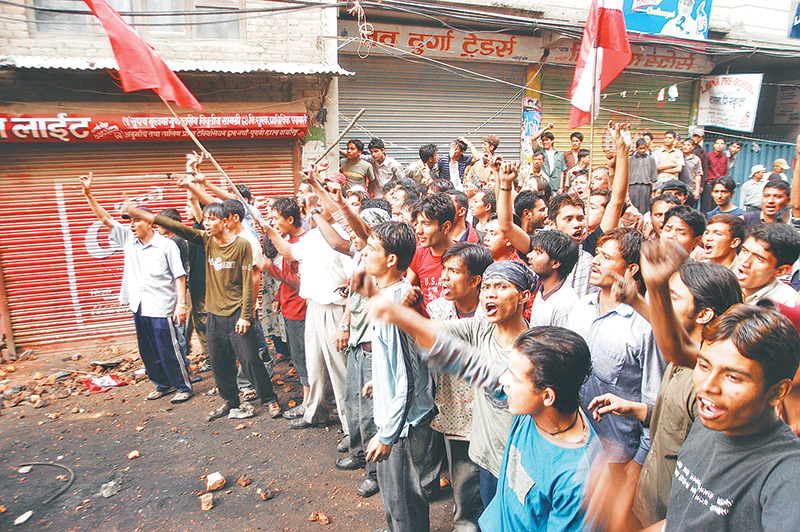
KATHMANDU, The Supreme Court in February 2015 struck down around a dozen of amnesty provisions in the Enforced Disappearances Enquiry and Truth and Reconciliation Act 2014 and directed the government to amend it after broader consultation, especially with conflict victims. But in the last five years, there has been little progress. Conflict victims, rights activists and the international community have all constantly reminded the government of its obligations. With pressure mounting to conclude the transitional justice process, as Nepal will have to showcase all it has done to uphold human rights during OHCHR’s Universal Periodic Review meeting to be held later this year, the government had decided to finally hold consultations with conflict victims. But as victims and human rights defenders had feared, the consultations held on Monday, in the headquarters of all seven provinces, were more formality than genuine efforts to listen to their grievances and concerns. According to participants, consultations were held in two sessions—three hours with victims and another three hours with human rights defenders, civil society members, security forces and the media. Conflict victims and human rights defenders described the entire process as a farce. “Some of our friends couldn’t even put forth their concerns due to time constraints,” Badri KC, a conflict victim from Baglung who was present at the consultation in Pokhara, told the Post. “Rather than listening to our voices, the discussion was aimed at showing that the government has taken our feedback to amend the Act.” The Ministry of Law and Justice, which organised the consultations, only allowed five victims from each victims’ organisation to speak. In some places, victims themselves had to demand that they be included in the process. Victims also said that three hours was not nearly adequate to collect feedback on an important issue like transitional justice. They had been demanding that consultations be conducted in every district by putting victims into different groups based on the nature of their suffering. However, discussions were only held in the provincial headquarters and many districts didn’t have representation. Victims’ organisations say that the needs and concerns of victims of rape are different from those whose family members were killed during the insurgency. Therefore, collecting suggestions from all kinds of victims at the same time is meaningless, they say. The ministry even provided victims with the questionnaire to be answered only a few hours before consultations were held, despite demands that victims and human rights organisations be provided access a lot earlier. “The discussion was just a formality,” Shree Kumari Budha, whose father was killed by the Maoists in Thawang, Rolpa and who was present at the consultation in Butwal, told the Post. “I am not at all hopeful about our concerns being incorporated in the Act.” Human rights defenders say that the government’s attempts to conclude consultations in a single day on an issue like transitional justice says a lot about its intention. Successive governments have already wasted years and have little desire to take victims into confidence, they say. But according to human rights defenders, any attempt to move the process forward without the victims is meaningless. “The consultation must be wider, more inclusive and constructive,” Nirajan Thapaliya, director of Amnesty International Nepal, told the Post. “Discussions like the ones held on Monday cannot serve the real need of victims.” Victims’ organisations said that they participated in consultations with reservations. They even resorted to demonstrations at one consultation venue. In Kathmandu, a group of victims organised a protest in Maitighar, arguing that the government’s consultations were not aimed at ensuring justice but only at showing the world that it collected feedback. Despite promises at national and international forums, including the United Nations, the govenrment has done precious little to take the transitional justice forward. The two commissions formed to look into war-era crimes—the Truth and Reconciliation Commission and Commission on Investigation on Enforced Disappeared Persons—are without officials since mid-April. A committee formed to recommend officials has failed to make any progress, as major political parties—the ruling and opposition—have been jostling to install their own men in the commissions. Officials involved in the consultation process, however, defended their efforts, describing it as the government’s genuine attempt to collect suggestions from the victims. “The victims have given important suggestions. If they (victims) still feel like giving their feedback, they can write to us,” Himal Aryal, an official at the Law Ministry who was deployed in Pokhara for consultation, told the Post. “It would be wrong to say the consultation was just a formality.”
HOME PAGE
Nepal’s passport is among the weakest in the world—weaker than North Korea’s
The dismal state of the Nepali passport can largely be attributed to Nepalis hiding out illegally in foreign countries while on temporary visas, say officials.
- ANIL GIRI
KATHMANDU, Nepal has one of the weakest passports in the world, according to numerous organisations that track passport strength. On the recently released Henley Passport Index, Nepal was ranked 101st out of 107 countries, a position it has occupied since 2018. This is on par with Palestine and below countries like North Korea, South Sudan and Kosovo. The Henley Passport Index is based on data from the International Air Transport Association and research by the Henley and Partners Research Department. Though the ranking should not come as a surprise to many Nepalis who have attempted international travel, this poor standing is a cause for concern, especially since Nepal is no longer in the midst of a conflict, has not been involved in any large-scale criminal or terrorist incident, is a democracy, and is politically stable. But officials and experts that the Post spoke to say that there are multiple factors behind the weakness of Nepal’s passport, including a propensity to violate visa regulations. But more concerning is the fact that successive governments have not taken any proactive measures to address this, they say. “Ordinary passports show the credibility of the nation,” said Nishchal Nath Pandey, executive director of the Centre for South Asian Studies. “Once, Nepalis would get visa-on-arrival in many countries but now, even countries like the UAE, Thailand, and Malaysia insist on prior visas. This is a humiliation because thousands of Nepali tourists go to these nations every year.” According to two officials from the Foreign Ministry, who did not wish to be identified as they were not authorised to speak to the media, there have been several cases over the years of the misuse of passports by either diplomats or officials. When it comes to ordinary citizens, there have been many instances of Nepalis overstaying visas or living illegally in foreign countries that they enter on tourist visas, they said.
During the conflict years of 1996-2006 and immediately after, many Nepalis also sought asylum in the West after arriving on temporary visas, which discouraged them from providing easy visas to Nepalis, according to Foreign Ministry officials. Earlier, Nepalis had easy access to several European countries, which provided on-arrival visas for three months. But all of this stopped after Nepalis started overstaying their visas and migrating illegally. Today, only 38 countries provide on-arrival visas to Nepali nationals, according to the Henley Passport Index. Among them, India does not require visas while others provide either 30, 60 or 90 days on-arrival visas. Most countries that provide on-arrival visas to Nepalis are either in Asia, like Singapore and the Philippines, or in Africa, like Egypt, Kenya and Rwanda. According to one Nepali diplomat currently serving in a European nation, the status of Nepal’s passport is largely determined by the country’s economic development and the socio-cultural status of its citizens. “It is all about the trust,” the Nepali diplomat said. “In many countries, there is an impression that Nepalis will not return. They do not see us as tourists or visitors. Either we are seen as migrant workers or illegal immigrants. Until we develop economically and address this culture of going abroad for work, we will be in the same situation.” Eric Neumayer, a geography professor at the London School of Economics, has identified a number of factors that are crucial in visa regimes, including the GDP of the country, restrictions on political freedoms, armed conflict, terrorist attacks, outbound tourists, tourism receipts, bilateral trade and cultural and ‘civilisational’ similarities. “Our passport ranking is based on visa access, and our access is low because of our economy and our expenditure capability,” said Ram Kaji Khadka, director-general of the Department of Passports. “The ranking also depends on our mobility, travel, trade and business, and level of engagements with the citizens of each country. If our people have a high mobility rate, return on time and spend well, our ranking will automatically go up.” Pandey, however, believes that the government needs to make it a priority to ensure that the Nepali passport is not among the weakest in the world. “This must be a priority for the Foreign Ministry,” he said. “Bhutanese and Indians are getting visa-on-arrival in far more countries than us. Countries like Australia, the UK and France do not even grant us visas from their embassies in Nepal; we need to apply in New Delhi, which has created a lot of hassle.” But according to officials at the Foreign Ministry, the strength of the passport is related to the country’s economic stature and it is not going to improve until Nepalis stop hiding out in developed countries while there on temporary visas.
HOME PAGE
In the criticism against the Oli administration, Nepali youth are eerily silent
Many young people fear the might of the current government as it is the strongest in decades while others have their own interests to protect, say youth activists.
- BINOD GHIMIRE
Unlike in the past, the country’s students and young people have largely remained silent on various government policies. Post file Photo
KATHMANDU, In neighbouring India, Narendra Modi’s Bharatiya Janata Party, via two back-to-back elections, has rendered the Congress party almost irrelevant. As the party in opposition, the Congress should have been at the forefront of criticism against the Modi administration’s controversial decisions on Kashmir and the new citizenship law. But India, the world’s largest democracy, suddenly discovered a new opposition—its youth. Students and young people are leading demonstrations at universities and on the streets ever since the Indian parliament, on December 11, endorsed the controversial Citizenship Amendment Act. The youths are not only questioning the Modi government’s citizenship law but also its Hindu-nationalist propaganda and its failure to deliver on various fronts. The BJP government may be unconcerned by the opposition in Parliament but it cannot ignore the youth. In Nepal, the KP Sharma Oli administration too does not face any real opposition from the Nepali Congress, which faced its biggest electoral defeat in the 2017 elections in the party’s history. With a thumping majority, Oli’s Nepal Communist Party has been emboldened, taking controversial decisions and introducing legislation that threaten civil liberties, freedom of expression and press freedom. Criticism has mounted, with the press questioning some of the most controversial bills, including the Information Technology Bill, which was passed by a House committee two weeks ago. The bill proposes a hefty fine of up to Rs 1.5 million, along with a jail term of a maximum of five years, for digital content that harasses, bullies or defames others. But unlike India, Nepali university students and youth are largely silent. Pradip Pariyar, a youth activist associated with the Samata Foundation, agrees that Nepali youths have failed to step up on political matters of late. “It’s because of various factors,” Pariyar told the Post. “A majority of youths are associated with the political parties, which only speak or protest after calculating their political gains and losses.” Large numbers of young people are also abroad, either for work or their studies, said Pariyar. According to the national census 2011, young people comprise over 40 percent of the total population of 26,494,504. Those between the ages of 16 and 40 are considered youths by the Ministry of Youth and Sports. But it hasn’t always been this way. The People’s Movements of 1990 and 2006 were both led in large part by students and young people. Colleges and universities like Tribhuvan University, Tri-Chandra College and Amrit Science Campus, were hotbeds of political activity. Many of today’s established leaders got their start in student politics. So it is slightly unnatural to see the youth not speaking out on matters that could directly affect their freedoms. According to leaders from the ruling party’s student wing, it is difficult to speak out because the current structure of the party leadership does not facilitate feedback. “There is a small circle of leaders that doesn’t allow the top party leadership to listen to our voices,” a central committee member of the Nepal Communist Party-affiliated All Nepal National Independent Student Union told Post on condition of anonymity as he feared reprisals. “The incumbent leadership both in the party and the student wing doesn’t have a culture of consultation. There wouldn’t have been much controversy if these bills were presented after proper consultations.” But youth leaders, especially from the opposition party, admit that they haven’t played the roles required of them when it comes to speaking out against unjust laws. “The youth will suffer the most when these laws are endorsed, so it should be to objecting to them,” Jit Jung Basnet, chairperson of the Tarun Dal, one of Nepali Congress’ youth wings, told the Post. “But I admit that we have failed to play a critical role.” According to Basnet, both the ruling party and the primary opposition are mired in factional infighting, which has permeated down to their sister organisations. The ruling party has yet to complete the unification of its constituent UML and Maoist parties while the Congress is locked in a rivalry among its senior leaders. “We will be on the streets once we sort out our internal differences,” said Basnet. Then, there is also the advent of social media, which has made it easier for many to go online to express their views. Young people actively rallied behind comedian Pranesh Gautam when he was arrested for a critical film review and they did the same when rapper Vten was taken into police custody for “offending” moral sensibilities. These instances, however, are rare and tend to be limited to certain socio-political classes. Pariyar said though youth activists have discussed the bills informally, they have yet to sit formally to take a position. But in the absence of a strong, organised opposition, whether from a political party or unaffiliated but politically conscious youth, the Oli administration has been pushing through one bill after another. The majority government that is currently in power is possibly the strongest government, with a comfortable majority in Parliament, ever since democracy was instituted in the country. And according to Pariyar, many young people are afraid. “The incumbent government is very powerful and many youths are afraid that it will take action against them,” said Pariyar. “They have interests and ambitions of their own and they do not want to compromise.” But scholars who studied social movements caution against dismissing the youth so early. According to Dambar Chemjong, head of the anthropology department at Tribhuvan University, young people these days are more focused on their jobs and their studies. “The youths have immense power to bring changes, but, the young people of today won’t come to the streets unless they encounter problems,” said Chemjong. “Controversial bills have yet to get approval from Parliament and it will take time for them to be implemented. Young people will be on the streets the day the government starts taking action based on those laws.”
MEDLEY
Horoscope
ARIES (March 21-April 19) ** Things will be totally black and white today. All the issues you’re looking at will be clear and easy to figure out, without any confusing gray areas. This is one of those days when quick thinking will be easy, and any argument you get involved in will be over as soon as you bring up your one killer point!
TAURUS (April 20-May 20) ** You’ve been keeping things light with a potential new date, but why? Are you feeling indecisive about them? If so, then you should let them off the hook. If you don’t know that you want to continue, then you don’t want to continue. You can’t keep someone thinking that you’re interested when you’re not.
GEMINI (May 21-June 21) *** Right when you’re in the middle of enjoying a totally flirtatious conversation, something will come between your sunny skies. You can easily choose to ignore this person and just carry on with your sassy self. Address it now or later, but don’t let it block those lovely rays of sunshine today!
CANCER (June 22-July 22) *** You are on the verge of crossing a major hurdle in a new relationship. All you need to do is say how you really feel to push things right over the edge, so now is definitely not the time to be shy! You’ll need to come out of your shell and show this person who you really are. So don’t be afraid to speak out. The time is right!
LEO (July 23-August 22) **** Socialise as much as you can, in every arena. There’s always a way to connect with other people, whether you’re sitting in a waiting room, or taking notes in an important work meeting. Exposing yourself to a lot of unfamiliar energy will feed your curiosity. There are a lot of fun conversations to be had. Go out and have them!
VIRGO (August 23-September 22) ** Are you running around in a hurry at work while no one else seems to notice that the situation requires any type of hustle? You can’t panic and abandon them. You’ll need to stay with them if you truly want to succeed. So, while you wait patiently for them to catch up to you, double-check your work thus far.
LIBRA (September 23-October 22) **** You can make a lot of progress toward reaching a goal today. The timing is right, and your energy is going to be focused. Nothing can distract you from something when you put your mind to it. You just need to put your mind to it as early in the day as you possibly can. Be aggressive. Stake your claim before someone else does.
SCORPIO (October 23-November 21) ** You’re feeling confident and ready to take a big risk right now, but before you leap right ahead, stop and think for a minute. Are you fully prepared for this gamble? What if the worst-case scenario comes true? It’s not about thinking negatively; it’s about being prepared in case things don’t go your way. Be positive!
SAGITTARIUS (November 22-December 21) *** Keep busy today, even if you have to resort to cleaning out the closets or reorganising your sock drawer! Serious boredom is a horrible thing to endure, and if you don’t have enough to do right now, you could fall into a blue funk. You have to use your creativity in order to keep your good vibes going.
CAPRICORN (December 22-January 19) **** There are just so many amazingly warm conversations in store for you. Sure, you may be attracting some unusual people, but they’re genuine folks, and they know how to tell one heck of a captivating story! Make one casual comment early on, and it might trigger an engrossing, charming conversation.
AQUARIUS (January 20-February 18) *** You have a unique power to change whatever it is that you don’t like about where you are in life right now. The only thing you have to realize is that the change you want can’t come immediately. Slow and steady wins the race. Your impatience is admirable, but it’s keeping you from seeing some viable possibilities.
PISCES (February 19-March 20) *** Today, an unexpected change or cancellation could open up your schedule and let you breathe a huge sigh of relief! You can stay busy if you want to, but did it ever occur to you that this gift of free time can be enjoyed and savoured? You can’t be ungrateful to fate, now can you?! Enjoy your free time any way you want.
NATIONAL
Anti-graft body wants anti-money laundering agency under its purview
The Department of Money Laundering Investigation is currently under the Prime Minister’s Office.
- PRITHVI MAN SHRESTHA
The anti-graft agency says corruption and money laundering are interlinked. Post file Photo
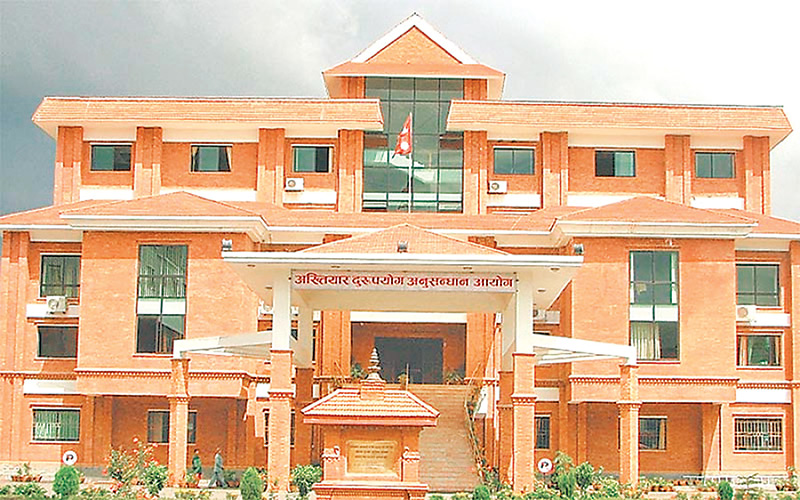
KATHMANDU, The Commission for Investigation of Abuse of Authority has suggested that the government make legal provisions to bring the Department of Money Laundering under its purview. While the commission has the mandate to investigate corruption committed by public officials, it is under the department’s scope to investigate the use of funds by anybody through criminal activities such as corruption, smuggling, and organised crimes. The department is currently under the Prime Minister’s Office. “There is a possibility of public officials connected with irregularities and corruption in private entities, cooperatives and national and international non-governmental organisations. So, the Department of Money Laundering Investigation should be brought under the commission,” states the commission’s 81-point suggestion to the government made public at a press meet on Monday. Pradeep Koirala, spokesperson for the commission, said the suggestion was aimed at bringing the private sector under the purview of the anti-graft agency as per Nepal’s commitment to the United Nations Convention against Corruption. Nepal is a signatory to this convention which calls for preventive measures and criminalisation of the most prevalent forms of corruption in the public and private sectors. “There has been sharing of information between the commission and the department as per the memorandum of understanding signed between the two last year,” said Koirala. “But we have yet to conduct any joint investigation.” According to Koirala, the department has been providing information about public officials who are potentially engaged in corrupt practices and the commission has been providing details about people from the private sector who are potentially engaged in money laundering. In order to strengthen the role of the department, the government had brought it under the Prime Minister’s Office in February 2018 from the purview of the Finance Ministry. In other suggestions, the commission has asked the government to clearly define policy decision and administrative decision of the Cabinet, as the Commission for Investigation of Abuse of Authority Act bars the commission from investigating policy decisions made by the Cabinet. Currently, there is a tradition of taking controversial issues related to public procurement to the Cabinet for a decision, which the commission believes should not be categorised as a policy decision. “There should be a clear definition of a policy decision,” the commission’s suggestion report said. “A working procedure should be formulated regarding the threshold of policy and administrative decisions of the Cabinet.” A number of reports have suggested that the government is preparing to introduce a bill on the commission that would bar the commission from investigating any Cabinet decision by revising the draft of the proposed bill. The commission had long ago sent the drafts of two bills—Bill to Amend Corruption Prevention Act and Bill to Amend Commission for Investigation of Abuse of Authority Act. Both are yet to be presented at the federal parliament. The commission has also called for new laws on the safety of witnesses, experts and informants and for controlling conflict of interests. The commission also reiterated its demand that it be reassigned the task of investigating improper conduct by public officials. Since the new constitution bars the commission from looking into “improper conduct”, there is no agency that is responsible for looking into such cases. “Improper conduct and corruption are interlinked. During corruption investigation, improper conduct can be identified and corruption can be seen during investigation into improper conduct,” said Koirala. The commission filed 351 corruption cases at the Special Court in the fiscal year 2018-19, the largest number of cases filed in a single year. Of them, 147 cases were related to graft, 88 to fake academic certificates, 39 to damage of public properties, 33 to illegal benefits, 10 to revenue misappropriation and 12 to amassing illegal property. Twenty-two cases were categorised under miscellaneous. In the last fiscal year, the success rate of corruption cases filed was 88.24 percent, up from 67.82 percent in the previous fiscal year 2017-18.
NATIONAL
State-run health facilities are distributing medicines proven substandard by lab test
Of the 285 essential drugs tested by the Department of Drug Administration, 41 were found to be of substandard quality.
- Arjun Poudel
Substandard drugs are still finding their way into the market due to a lack of monitoring. post file photo
KATHMANDU, Medicines from the list of essential drugs which were found to be substandard in laboratory tests a few months ago are still being distributed free of cost from the state-run health facilities across the country. Nepal Health Research Council, which promotes national as well as international health research, had collected 285 essential medicines from the state-run health facilities—health posts, primary health care centres, and district hospitals—and sent them for testing to the laboratory of Department of Drug Administration in the last fiscal year [2018/019]. Upon testing, the laboratory found 41 medicines, including paracetamol tablets, paracetamol paediatric oral suspension, folic acid tablets, metronidazole tablets and metformin, to be substandard. The department, which is the national regulatory body of the drug market in the country, charged a fee to the council to run the examination of the identified drugs. The department also submitted its report to the council but it did not think it necessary to recall those drugs. “Some substandard medicines are already in the market and some are still being distributed from health facilities,” an official at the council told the Post on condition of anonymity since he is not authorised to speak with the media before the report’s unveiling. The Ministry of Health and Population provides more than 70 types of essential medicines for communicable and non-communicable diseases to all district hospitals with at least 25 beds. Patients get more than 60 types of essential medicines from primary healthcare centres and 35 types of medicines from health posts. The collection and examination of the medicines are conducted independently by the department. The identification of substandard medicines is conducted on a random basis. However, even when the department directs the drug manufacturing companies about the substandard quality of their products, the drugs find their way into the market. The department, however, does not have the capacity to effectively monitor all the pharmacies operating across the country. Of over 21,000 pharmacies operating across the country, the department can barely monitor 15 percent of them. Jagat Nepali, chief of Allapot Health Post at Kageshwori Manohara Municipality in Kathmandu, said that he was unaware of the report on the quality of essential drugs being distributed from the government-run health facilities. “We aren’t aware of the quality of the medicines,” said Nepali, “We have been giving the medicines to those who come to our health facilities.” With the implementation of federalism, the responsibility of purchasing essential drugs has been transferred to the local governments. Most local governments have been purchasing medicines from local suppliers, some even from local pharmacies, without running quality checks. Nepali said that neither individuals nor the authorities concerned have come to them with regards to the quality of the medicines being distributed by the health post. “Nobody has instructed us to halt distribution or recall the medicines found be substandard,” he said. Earlier, concerned agencies under the Ministry of Health and Population used to purchase medicines in bulk through global tenders. This ensured the quality and supply of medicines to health facilities across the country. Of the seven provinces across the country, none have a laboratory to examine the quality of medicines. Every year, the government purchases essential medicines worth Rs 1.85 billion and distributes them free of cost from the state-run health facilities. Mahendra Prasad Shrestha, spokesperson at the Health Ministry, said the local governments were purchasing their own medicines and they had no mechanism in place to ensure quality. “I am unaware of the lab report but it wouldn’t be untrue to say that there have been no quality checks of medicines since the implementation of the three tiers of government,” said Shrestha.
NATIONAL
Green Climate Fund to support Nepal for achieving climate resilience
Country’s only GCF accredited entity Alternative Energy Promotion Centre has been working on various project ideas for accessing climate finance.
- CHANDAN KUMAR MANDAL
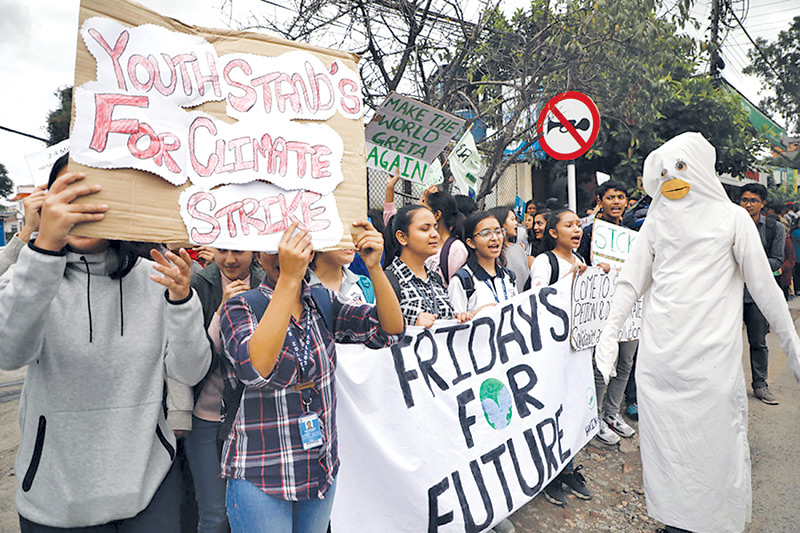
Youths take part in a Global Climate Strike rally in Kathmandu demanding action to prevent climate change. post file photo
KATHMANDU, In a major development towards accessing climate finance, the Alternative Energy Promotion Centre and the Green Climate Fund have reached an understanding, which will pave the way for Nepal, one of the most climate change vulnerable countries, to lay its claim for financial support. The Green Climate Fund (GCF), a global platform that helps countries fight climate change by investing in low-emission and climate-resilient development, and the Alternative Energy Promotion Centre (AEPC), the Nepal government entity responsible for promoting clean and renewable energy, signed the Accreditation Master Agreement last week. As per the agreement, the GCF will start allocating funds for the AEPC, which is the first and the only agency from Nepal to get the GCF accreditation, to address the country’s climate change mitigation and adaptation needs. The AEPC received the GCF accreditation in February last year. The GCF accreditation status means the AEPC becomes eligible for claiming and accessing financial support of up to $50 million as its climate action partner. Nawa Raj Dhakal, director and a spokesperson for the AEPC, described the latest development as a landmark moment in the country’s effort towards dealing with the impacts of climate change. “This is a framework agreement that allows us to propose our programmes to the GCF Secretariat for receiving the support,” Dhakal told the Post. “With the new agreement, the status of GCF accreditation is formalised now. The development is a milestone in accessing climate finance for our efforts in climate change mitigation and adaptation.” In November, the country secured its first GCF funding for a project aimed at helping the country adapt to the adverse impacts of climate change. The 24th board meeting of the GCF in Sangdo, South Korea, had approved the first funding proposal of Nepal submitted by the Food and Agriculture Organisation in partnership with the Ministry of Forest and Environment. The approved proposal for the project titled ‘Building Resilient Churia Region in Nepal’ will receive $39.3million grant for restoring the resilience of the Chure range. After getting the accreditation, agencies have to work further following a defined work plan, which is known as entity work programme preparation for GCF. The process from gaining the accreditation to receiving the fund is a three-step process. First, the recognised agencies have to prepare project ideas, followed by project concept notes and finally submitting the funding proposal. Since getting the accreditation, the centre has already been working 11 different project ideas concentrated on renewable energy and energy efficiency. All of these project ideas have been submitted to the GCF Secretariat and the Ministry of Finance. The GCF has also consented to these ideas, which are focused on climate change mitigation and adaptation, according to Dhakal. “All the projects and the progress so far with the GCF serve our longer goals of developing climate change resilience. They are also in line with all our climate change policies and obligations,” said Dhakal. For now, the AEPC has already moved ahead with two project concept notes—one of them has already been approved by the Finance Ministry and forwarded to the GCF. The first project is about promoting clean cooking energy for households in 22 TARAI districts. The proposed $40 million project will push for use of electricity and biogas as energy for cooking and switching to improved stoves, according to Dhakal. The other project, of which concept note has been prepared, is related to the promotion of solar pumping-based irrigation in places of Tarai and mid-hills with poor access to electricity and irrigation infrastructure. There are two modalities for accessing funds from the GCF. Going by the regular modality can take two-three years, whereas the other one known as Simplified Approval Process (SAP) can be completed in a year, according to Dhakal. “But the funds for the project pursued under the SAP modality can come down to $10 million,” said Dhakal. “In the meantime, we can work parallelly on other project proposals. The AEPC can also partner with other agencies working for mitigation and adaptation in the future.”
NATIONAL
Kathmandu Metropolitan City intensifies campaign to remove hoarding boards
The city office has taken down 1,142 small advertisement boards and 25 billboards so far, officials say.
- ANUP OJHA
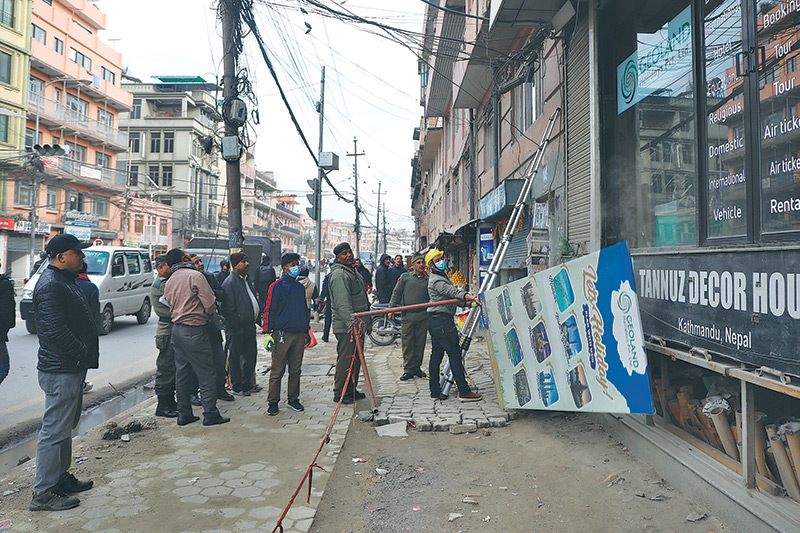
Workers from the Kathmandu Metropolitan City remove an advertisement board from a building in Kalimati, Kathmandu. Post Photo: Elite Joshi
KATHMANDU, 3 After widespread criticism in media and a contempt of court filed against the officials of Kathmandu Metropolitan City and four government ministers for the failing to enforce the 2015 Supreme Court ruling to clear illegal hoarding from the Capital, the city office has finally paid heed to the court’s order. The KMC has intensified its work to clear illegal hoarding boards and advertisements from the Capital streets. As of Sunday, the city authority had cleared 1,142 small advertisements and 25 large billboards from different road sections of Kathmandu. Knowing the city’s sluggish work in removing hoarding boards and the writ filed against it for contempt of court, Home Minister Ram Bahadur Thapa had last week instructed the concerned authorities to promptly clear all illegal hoarding boards polluting the city. However, many people suspect if the city office will continue the drive. “The area looks quite clean now. This is a good move, but earlier too the city used to remove those boards. I doubt if the city can give continuity to this drive,” said Indra Bahadur Karki, 65, a retired Nepal Army colonel and a frequent visitor of Thapathali Park Chess Club. After Padam Bahadur Shrestha, a senior advocate filed a contempt of the court against government authorities in late November for their failure to implement the court’s ruling, the city had published a notice to clear all hoarding boards across Kathmandu within a week. Shrestha had filed a writ petition in the Supreme Court in 2015, appealing to clear the visual pollutants, but none of the authorities had shown any interest. He still does not seem convinced by the city’s work. “Look at those advertisements on the utility poles. The city has not removed them.” When the Post contacted Dhanapati Sapkota, head of the city police, he blamed the Nepal Electricity Authority. “We will clean all such hoarding boards that are polluting the city within a week or two. But Nepal Electricity Authority had given the permission to advertise on the boxes of solar lamps,” said Sapkota. Even though the country inaugurated Visit Year 2020 on January 1, aiming to bring two million foreign tourists in the country this calendar year, billboard advertisements in the Capital and roads cluttered with pamphlets, movie posters and banners are an eyesore. Sapkota said the city has deployed its officials under city inspectors in four different directions to clean out the hoarding boards. “We have cleared all the hoarding boards from the airport, Tinkune and New Baneshwor. We have mobilised our city police all across the city,” said Sapkota. The city has hired Singapore trained persons to remove the big billboards from houses and roadsides. “Because it’s risky to remove them, we needed trained persons because one has to climb tall buildings to remove them,” said Prakash Pandit, a city police sub-inspector, who was involved in removing billboards in Thapathali on Sunday. Although the city has finally escalated its work to remove billboards, banners and pamphlets, it has shown indifference to the increasing number of digital displays on roads such as in Tripureshwor, Kathmandu Mall and Durbarmarg. The Kathmandu Metropolitan City’s policy of 2013 to regulate advertising materials and hoarding boards gave permission to run displays on LCD boards. “These are also city polluters. The big LCD displays can cause accidents. The city should amend its policy,” said Shrestha.
NATIONAL
Dilip Mahato was attacked before being run over by a tipper truck: Police
In his statement to police, truck driver Munindra Mahato has admitted to the crime.
- AJIT TIWARI
JANAKPUR, Dilip Mahato, a 24-year-old youth who had been protesting against illegal mining of riverbed material for two years, was dragged and killed by a tipper truck in the wee hours of Friday. Police have so far arrested four individuals in connection with the murder. The site of the incident lay 200m away from the Churiyamai Crusher Industry. Once the truck dragged and crushed Mahato to death, the driver of the truck, Munindra Mahato, drove the vehicle back to the industry site, police said. The blood from the killing smeared the trail all the way to the industry. The police have seized the tipper truck and cordoned off the spot where the truck was parked after the alleged murder. “Security has been deployed at the site of the crusher industry; the area is cordoned off,” SP Ramesh Basnet, chief of Dhanusha Police told the Post. “The investigation will get easier once we receive the results of the blood test.” Dhanusha Police on Monday sent the blood sample to Nepal Police’s Biddhi Science Lab for a forensic test. Before Dilip was crushed, he was injured with a lever of the truck, police said after recording statements from the alleged perpetrators. Police have intensified search for the truck’s conductor, who is on the run following the murder. “It’s apparent that the conductor of the tipper has a hand in planning and attacking Dilip,” SP Basnet said. “We are currently trying to locate him. Once he’s arrested, we will have more details about the incident.” Police have also said they are investigating the involvement of Shyam Babu Yadav and Roshan Yadav, two of Dilip’s friends who had left along with Dilip from his home in Sripur. “Roshan has given contradictory statements about the incident and Shyam had returned halfway to the industry site—the reasons why they are being suspected of complicity in the case,” police said. According to Inspector Ramkumar Yadav, who has been investigating the case from the beginning, the owners of the industry, Bipin and Binod Mahato, and the tipper driver were inebriated with alcohol since the preceding night. Bottles of alcohol, snacks, and used utensils have been discovered in one room of the industry’s block. “When Dilip was spotted at the site, the inebriated owners warned him saying, ‘If only you disturb us…’ and then proceeded to hit him with the lever of the truck,” inspector Yadav said. “When Dilip collapsed on the floor, Bipin incited the tipper driver to run the vehicle over Dilip’s body, offering him a bribe of Rs50,000. He even assured the driver to release him if he was jailed.” In his statement to police, the driver, Munindra Mahato, has conceded that he killed Bipin by reversing the truck. Four days after the incident, the Province 2 government has pledged compensation of Rs500,000 to the victim’s family. “A cabinet meeting held on Monday condemned the murder of Dilip Mahato, while protesting against illegal mining of riverbed materials. It also pledged to extend financial help to the victim’s family,” said Gyanendra Yadav, provincial government spokesperson and Minister of Law and Internal Affairs. On Sunday, the National Human Rights Commission released a statement calling for an impartial and effective investigation into the case.
NATIONAL
Police intervene rally demanding justice for Nirmala Pant
- BHAWANI BHATTA
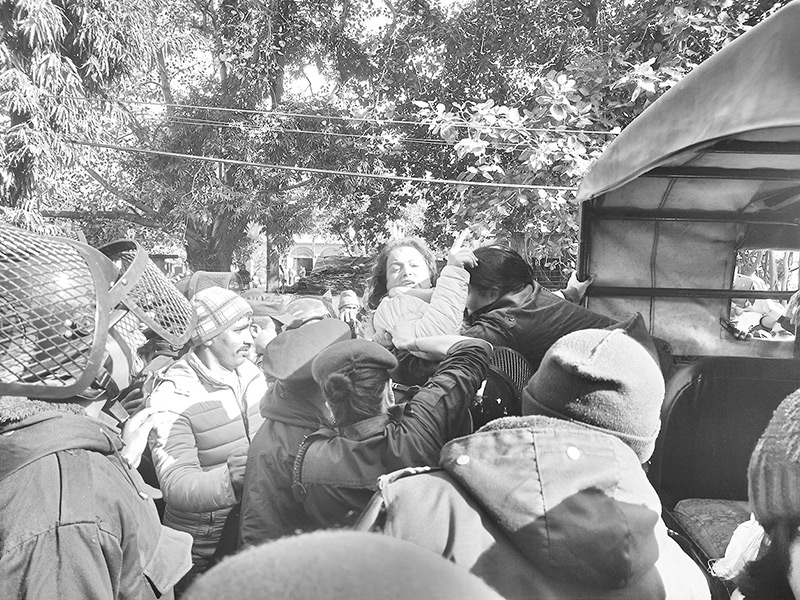
Security personnel use force on women rights activists who were protesting peacefully in front of the Kanchanpur District Court seeking justice for Nirmala Pant. Post Photo: BHAWANI BHATTA
KANCHANPUR, Security personnel intervened in a peaceful protest staged by women rights activists in front of the Kanchanpur District Court on Monday demanding justice for Nirmala Pant. Sharada Chand, a Kanchanpur-based rights activist, was injured in the alleged police excesses. She sustained injuries on her neck and abdomen in the incident. Injured Chand has been referred to Dhangadhi as her treatment was not possible in Mahakali Hospital, Mahendranagar, said Dr Saroj Acharya at the hospital. The protesters decried police excesses and demanded action against the guilty. “We were staging a peaceful sit-in in front of the court. The police personnel intervened in the protest and used force to suppress our protest. Policemen started manhandling women protesters,” said Chand. The right activists and some local women had staged the sit-in, demanding a fair investigation into the rape and subsequent murder case of Nirmala Pant. They said the peaceful protest was organised to draw the court’s attention stating that police were attempting to frame Dilip Singh Bista again. Police, however, denied using force against the protesters. “The security personnel just asked the protesters to move their protest programme to some other place as their sit-in affected the functioning of the court,” said Superintendent of Police Mukunda Marasini. Nirmala was raped and murdered on July 26 last year in Bhimdutta Municipality, Kanchanpur. Police had arrested Dilip Bista claiming that he was involved in the crime. However, he was released later as his DNA test did not match with the vaginal swab of the victim. Rights activists suspect that police are attempting to frame Dilip yet again. “It has been more than one and a half years. Police are still trying to justify that Dilip Bista was involved in the case. We demand they find the real culprit(s) involved in the heinous crime,” said Laxmi Malla, a protester. Several high-level committees have been formed to probe into the rape and murder of the 13-year-old girl but no answer has come forth. “The investigation is still going on. The culprit(s) involved in the crime is still not known,” said Marasini. Meanwhile, four injured people who sustained serious injuries during the violent protest in August last year, have been staging the sit-in in front of the district administration office for the past week. They have been demanding expenses for their treatment. A person died and around 20 others had been injured when police opened fire at protesters staging demonstration over the rape and murder of the teenager. Among them, around six are still receiving treatment.
NATIONAL
Musikot village connected to road network after 17 years of road construction
With direct motorable access to nearby markets, villagers hope for development to take off.
- HARI GAUTAM
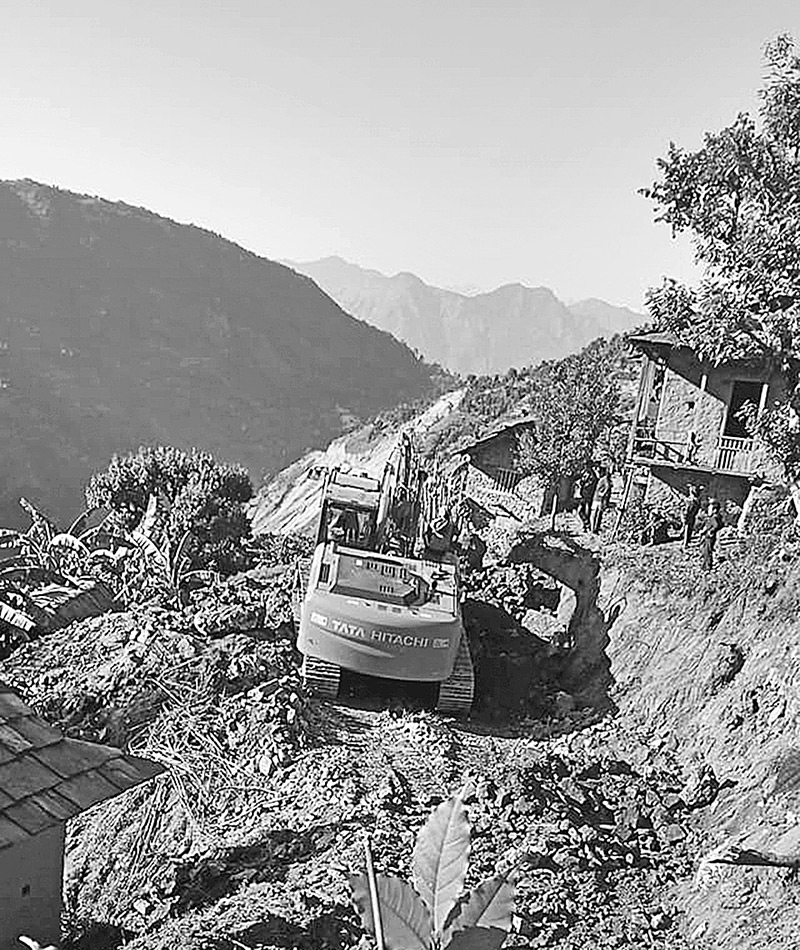
A bulldozer opens the track of the 35-km Shitalpokhari-Jhulkhet-Chunbang road section in Rukum (West). Post Photo: HARI GAUTAM
RUKUM (WEST), After 17 long years of wait, Dal Bahadur Budha, a local of Galampati, can finally see his dream come true. His remote village in Musikot Municipality has been connected to the road network. “Galampati saw no development in more than a decade mainly because it lacked access to a road network,” Budha said. The 35-km Shitalpokhari-Jhulkhet-Chunbang road was the first rural road project in the district initiated by the then-District Development Committee. But constant delays in the project’s work had hindered the completion of the project, until now. Like Budha, many villagers are hoping that the road network will change their lives for the better. With easy access to nearby markets, villagers hope for development works in their settlements to take off. “The road construction process started 17 years ago and we were expecting it to complete within the deadline, but it did not,” said Damodar Budha, a local. The construction work did not gain momentum, even when the project received the required budget every year. “The project had the required budget; I don’t know why it took so long for it to take off. Nonetheless, we are happy now that it’s finally complete,” said Budha. A year and a half ago, Musikot Municipality handed over the project’s responsibility to the Rural Road Network Reform Project. “About 11km of the road track was opened before the project was handed over to the network. Our task was to extend the road up to Galampati,” said Shankar Khatri, acting chief of the project. “Out of 35km of the road track, 18.5km is going to be blacktopped.” The two-lane road is being constructed at the cost of Rs 489.4 million. Dhan Bahadur Khadka, a ward member of Musikot Municipality Ward No. 10, said his office has been putting pressure on the contractor company to complete the road construction on time. “Around 18.5km of the road, which falls under Musikot Municipality Ward No. 4, 7, 9, and 10, should be blacktopped within five years,” said Khadka. Earlier, locals had to make their journey to nearby villages and market places through steep slopes on foot. Sakuntala Pun, a local of Galampati, recalls the times when she had to walk for miles carrying sacks of grains on her back. “We would have a good yield in our fields, but we couldn’t monetise them for lack of transport. Now with the road connectivity, we can easily take our produce to nearby markets,” she said.
NATIONAL
Tourists come to Janakpur in droves, but stay only for a day
Visitors complain of difficulty in navigation for lack of proper tourism infrastructure.
- SHYAM SUNDAR SASHI
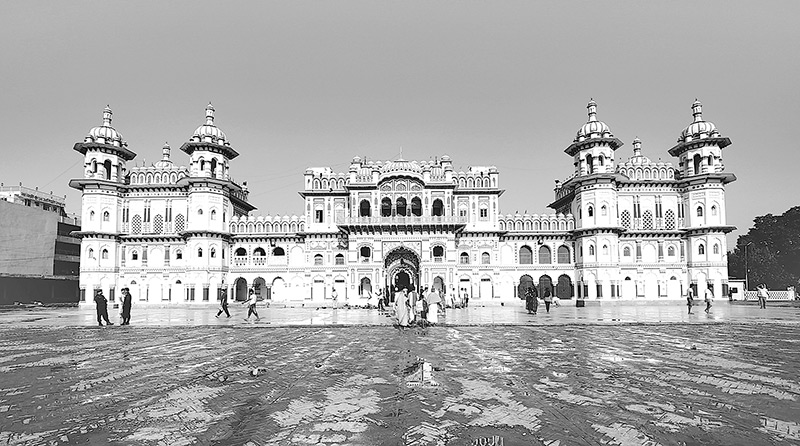
Janakpurdham is one of the most important pilgrimage sites for Hindu devotees. Post file Photo
JANAKPUR, The number of tourists has increased considerably in Janakpudham in recent months, say tourism entrepreneurs. Hotels and Dharmashalas--rest houses for pilgrims-- in the area are being fully occupied by tourists. According to hotel operators, the arrival of Indian tourists has increased four-fold in the last two months. However, a lack of proper infrastructures, such as signages, toilets and street signs, to support tourism has put a limit on tourist movement. Most tourists pay a visit to Janakpurdham after visiting popular destinations in Kathmandu and Pokhara, but they don’t spend more than a day in Janakpur, say tourism entrepreneurs. “The campaigns to promote tourism are terrible. Most tourists who come here aren’t even aware of Visit Nepal 2020,” said Jibnath Chaudhary, the operator of Sita Palace Hotel in Janakpur Sub-Metropolitan City Ward No. 8. There are no banners, signages or tourist guides to help visitors find their way around the city, leaving most perplexed for lack of clear indications as to where to go and how to get there. Many tourists complained that they have to repeatedly ask locals for the direction to reach the Janaki Temple from Gopal Dharmashala, which is not more than 300 metres away from the temple. “Our bus driver had to roam around for an hour to reach Gopal Dharmashala, as there were no street signs or clear directions,” said Radhe Shyam Mishra, who had come from Madhya Pradesh in India. “It would be very helpful for tourists if there were proper direction signages for dharmashalas, temples and other tourist destinations in the city.” Every day seven to fifteen tourist buses arrive in Gopal Dharmashala, the oldest Dharmashala in the area. Most of the tourists are from the Indian states of Bihar, Uttar Pradesh, Haryana, Delhi, Madhya Pradesh and Maharashtra. Each bus has at least 60 passengers, including the driver and bus conductor. “Our normal flow is five tourist buses per day,” said Raj Kumar Jha, the managing director of Gopal Dharmashala. “But these days, we receive around 20 buses in a day.” Many Indian pilgrims visit Janakpur between the months of December and mid- February. “The leisure from agricultural activities and the weather prompt the people from India to visit Janakpur during this time of the year,” said Jha. Most of the big hotels and lodges, including Paglababa Dharmashala, Marwadi Sewa Samiti, Rauniyaar Dharmashala and Kalwar Sewa Samiti, are fully occupied with domestic and foreign tourists during this time of the year. Highlighting the possibility of religious tourism taking off in Province 2, Lalbabu Raut, the province’s chief minister, said, “We have introduced plans and policies related to the reconstruction, beautification, and management of religious sites of Hindus, Muslims, Buddhists, Sikhs, and Jains.” In light of Raut’s commitment to promoting religious tourism in the province and given the severe lack of tourism infrastructure, Manish Jha, coordinator of the Visit Nepal 2020 campaign in Province 2, said that the committee has directed the sub-metropolis to work towards facilitating tourists. “We have requested Janakpur Sub-metropolitan City to fix street signs and direction signboards to help tourists find their way around the city,” said Jha. The Post tried to reach the mayor of the sub-metropolis, Lal Kishor Sah, but he was unavailable for comment. Janakpur is also called the city of 52 temples and 72 lakes. But most visitors are unaware of the many tourist destinations in the province, so they return home after visiting some temples in Janakpur. According to Raut, the beautification process of Janaki Temple in Janakpur, Chhinamasta Temple in Saptari, Rauja Majar in Mahottari and Gadhimai in Bara will start soon. Locals believe that the duration of a visitor’s stay can be prolonged if the process of informing tourists about tourist destinations is streamlined. Sunil Mallik, an expert in Mithila culture, said Janakpur is the place of origin of Mithila culture, and that besides temples, Mithila art and literature should also be promoted to cater to tourists who visit Janakpur. “We can attract more tourists by informing them about Mithila foods, culture, customs and traditions,” said Mallik. “But more importantly, we should focus on making the city more tourist-friendly and easy to navigate.”
NATIONAL
Ward chairman dies
Briefing
RAJBIRAJ: Mukti Karki, the chairman of Surunga Municipality Ward No.1 in Saptari district, died on Sunday night. Karki, aged 55, was elected as the ward chief from the then CPN-UML. The municipal office and its subordinate offices remained closed on Monday in mourning.
NATIONAL
Two held with a musket
Briefing
- POST REPORT
RAJBIRAJ: Police arrested two people in possession of a musket at Gorpar, the buffer zone of Koshi Tappu Wildlife Reserve, on Sunday night. According to the police, Babulal Chaudhary of Kanchanrup Municipality and Rabin Tamang of Saptakoshi Municipality were arrested by a team from the Bhardaha Security Base Camp of the Armed Police Force.
NATIONAL
Elderly woman killed in elephant attack
Briefing
- Post Report
MAKWANPUR: A 70-year-old woman was killed in a wild elephant attack at Manahari in Makwanpur district on Monday morning. The District Police Office in Makwanpur identified the deceased as Maiya Thapa, a resident of Manhari Ward No. 3. According to the police, she was killed while cutting grass in a nearby forest.
NATIONAL
Inmate convicted on abduction charge flees
Briefing
- POST REPORT
RAUTAHAT: An inmate convicted on abduction charge fled from Gaur Prison in Rautahat district on Sunday night. The prison administration said Ashok Yadav, 27, of Brindaban Municipality ran away from the jail. He had been serving his term after the Sarlahi District Court three years ago sentenced him to 15 years in jail.
NATIONAL
Free sanitary pads in District Administration Office
Briefing
- Post Report
The District Administration Office in Jumla is providing sanitary pads in its office for free. Durga Banjade, chief district officer, said the office managed the sanitary pads for service seekers and its staff.
EDITORIAL
All in the mind
Mental health services must be made a major part of healthcare.
While mental health is the most treasured aspect of our humanity, it is also something that we barely talk about. There is still an entrenched taboo that surrounds conversations regarding mental illness where talking less about it is the most prescribed. Suicide is also a big problem in the country. But many seldom talk about it too. That mentality is only doing more harm than good. Mental illnesses include many disorders such as schizophrenia, psychosis, bipolar disorder, post-traumatic stress disorder, eating disorders such as anorexia and bulimia, anxiety, depression and so on. Data from the World Health Organisation shows that mental illness accounts for 13 percent of the world’s disease burden—a figure that is estimated to rise to nearly 15 percent by 2030. Closer to home, according to the National Mental Health Survey, 2.2 million Nepalis aged between 16 and 40 years suffer from some form of mental illness. Despite mental health emerging as a health priority, the government allocated only 4.29 percent of its total budget to the ‘health and population’ category for the fiscal year 2018-19. In many countries of the world, including Nepal, there is little or no support for people with mental disorders. Nepal’s mental health policy, formulated in 1996, mentions the need to provide treatment and cures, but offers only one solution: community-based rehabilitation. This is not nearly enough to tackle the complexity and enormity of the mental health problem. The social stigma surrounding mental health, lack of mental health infrastructure, and insufficient human and material resources for mental health services are severe constraints. Approximately 30 percent of Nepalis are suffering from psychiatric problems, and over 90 percent have no access to treatment, according to the Health Research and Social Development Forum. And a paltry 2 percent of medical and nursing training is dedicated to mental health. These statistics paint a dismal picture. There is also a severe shortage of trained professionals like psychologists and psychiatrists to deal with mental health, especially in rural areas. According to estimates, there are an estimated 130 psychiatrists in the country, with less than 30 working in government hospitals. Sound mental health is a means of facilitating sustainable socio-economic development, or in other words, attaining ‘sambriddhi’. Given this, it goes without saying that mental health services must be scaled up as a fundamental component of healthcare. For starters, strengthening healthcare infrastructure like building more hospitals that deal with mental disorders and investing in psychiatrists could be done. Similarly, barriers to mental health, such as the effect of stigmatising the issue must be adequately addressed. What’s more, policymakers must intervene and prioritise this issue by leading efforts to tackle the problem head-on.
OPINION
Nepal’s future lies in leveraging its geographic location
'Unleashing the Vajra' attempts to view Nepal’s future through an alternative lens.
- SUJEEV SHAKYA
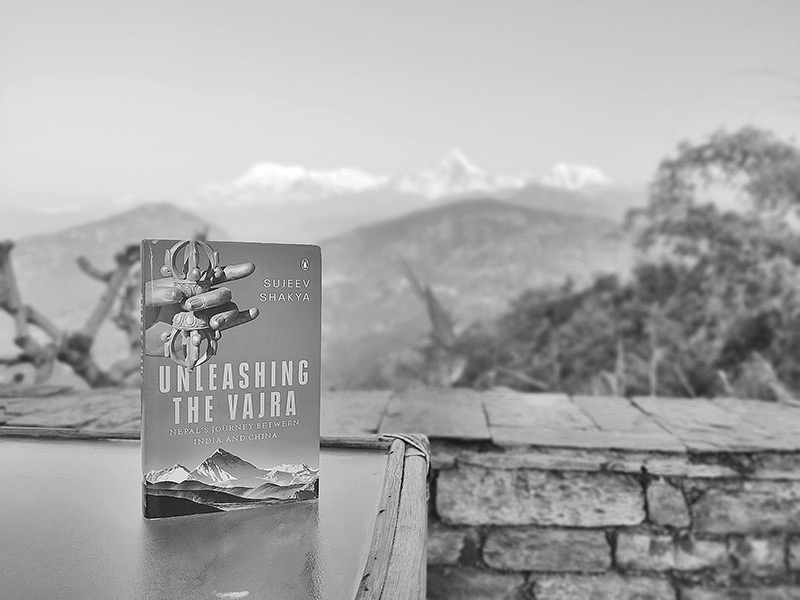
PHOto Courtesy: Sujeev Shakya
When my first book, Unleashing Nepal, was released in 2009, very few books had been written on Nepalis by Nepalis writers, especially by those who had spent their time in the corporate world. I had just started my entrepreneurial journey with beed, a management consulting and financial advisory company, after spending two decades with Soaltee Group. At the time, my work was very much about how to make investments and management core to Nepal’s transformation, because there were plenty of opportunities in the country. Heavily influenced by lessons in management from Prabhakar Rana, who owned Soaltee, I started advising private and development organisations, particularly focusing on the need for transparency and professionalism. I was fortunate to be writing with guidance from Manjushree Thapa, a successful author, with influence from Gurcharan Das, whose book India Unbound had started to shape the discourse on liberalism in India. Das also wrote the foreword to the book. A decade later, I have made an attempt to look at issues facing the country through some new lenses.
Megatrends In my new book, Unleashing the Vajra, I have tried to explore Nepal while keeping five ideas on the forefront. First, I wanted to continue the idea of unleashing its potential. As India and China are set to be the two big global powerhouses in 2040, Nepal has the same opportunities it did in the 16th and 17th centuries, when it prospered by being a link for the two countries. Second, in the past ten years, Nepalis have become more affluent and more educated, but problems like garbage, corruption and the lack of professionalism have become worse. There first has to be societal change if we are to see an economic transformation in the truest sense. Third, I did not want to talk about government and politicians. Instead, the focus was on two sectors, private and development, to understand the context of the problems we face in Nepal. Fourth, borrowing John Naisbitt’s term—megatrends—I look at the issues relating to migration and remittances that have shaped the Nepali economy in the last decade. And finally, I deal with action points that have been talked about for so long; but a sense of urgency is necessary to convert vision into action.
Lessons from Nepalis This decade has seen many books, written by Nepalis, emerge that talk about Nepal. This ensures there are enough local materials that form a part of the understanding, rather than being dependent on foreign writers and the narratives they provide. Digital platforms have given us more access to news and information. And being able to read and type in Nepali has changed how content is created and consumed. This has also helped shape stories, narratives, and lessons. Nepal, with its population reaching 30 million, has a vast number of opinions to share. Further, migration has created an enormous diaspora population that consumes and produces content in Nepali. I saw an excellent opportunity to sieve through the discourses in Nepali and put together a lesson for the audience that read in English. Travelling across many countries and interacting with Nepalis has given me a different perspective: how the people in various regions think about issues and how they also keep their interests in Nepal.
What’s in a name Many people tell me that whenever they hear the word ‘unleashing’, they think of me. Perhaps this is my contribution to the narrative on Nepal—an alternative to the existing discourse. Therefore, I have kept the issues going by using another view to everything happening around us. Take tourism, for example. I have attempted to view tourism from the lens of wealth creation rather than seeing it as a tool for poverty alleviation. High-end resorts bringing quality tourists will help create wealth for locals. In contrast, the current focus on homestays will just bring in a marginal increase in income at the cost of overcapacity, noise and environmental degradation. So, ‘unleashing’ continues to remain the keyword used to explain another perspective—to leapfrog exponentially rather than be a part of the status quo. I chose the word ‘vajra’ as a symbol of indestructibility. Something that represents the Nepali power of resilience. While ‘vajra’ can have different meanings for people of different faiths and beliefs, for me, it is a symbol that denotes potential. It represents the dreams of the many Nepalis in the country and abroad to whom I dedicate the book. I want the phrase Unleashing The Vajra to become a metaphor for the unleashing of Nepal’s potential between India and China—by hitching our wagons into the two fast-moving trains to the north and south.
OPINION
A vision for sustainable tourism
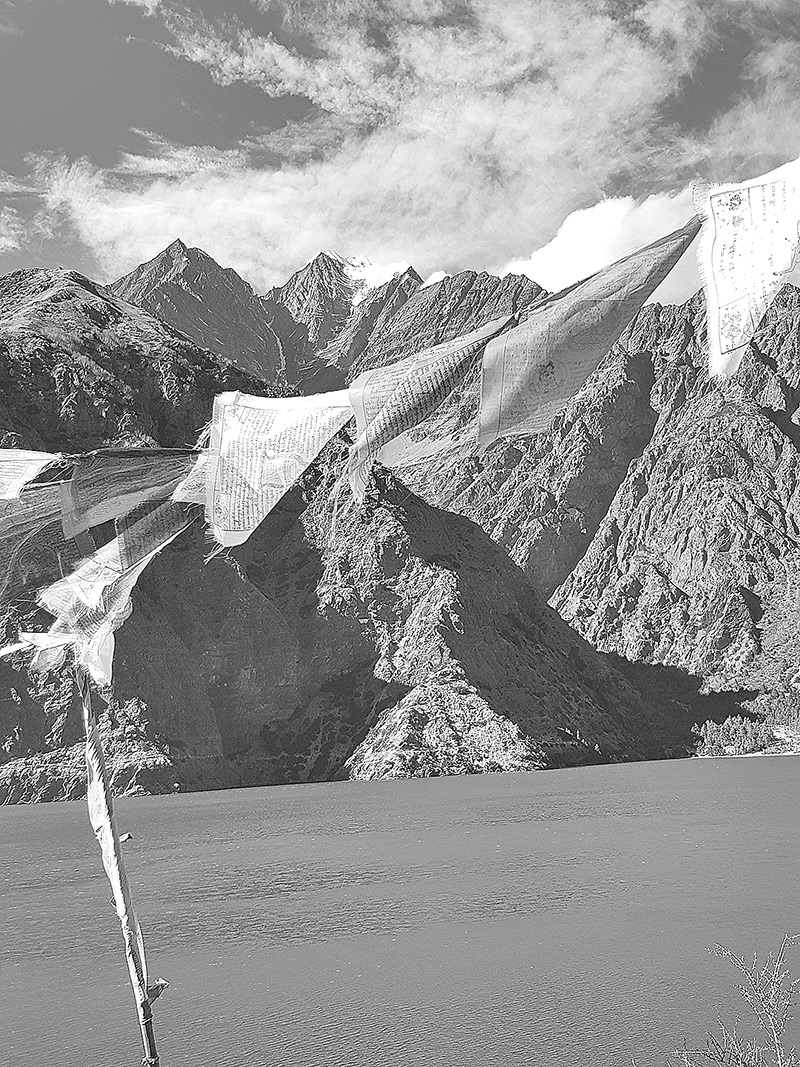
We could learn lessons from the sustainable tourism drive occurring in the Shey Phoksundo trail.
- Amir R Thapa
View of the Shey Phoksundo Lake. PHOto Courtesy: Pratirodh Shrestha
In 2019, multiple blogs and travelogues were published about the Dolpo region, with a special focus on the Shey Phoksundo trail. Social media was abuzz with numerous colourful pictures and stories by trekkers. Some were fascinated by the airport in Jufal, while others were stunned by the waterfall in the Phoksundo River that runs along the trail and eventually merges with the Bheri River in Suligadh. Some focused on the Dhaulagiri range while others discovered the unique landscape and the Bon rituals still practised by people in the region. Everyone was impressed by the majestic blue lake situated at 3,600 m that changes colour every now and then. Every visitor seemed enchanted by Shey Phoksundo, the deepest lake in the country. Statistics published by the Shey Phoksundo National Park show that the number of tourists in the region has increased impressively in the last couple of years. The increment was possible largely due to internal tourists. Internal tourism has flourished in Nepal, largely because of a new generation of adventurous young adults. Ranjit Shah from Janakpur scaled Mt Amadablam and has the ambition to climb Mt Everest, while numerous local tourists have started flocking to the Mardi Himal trekking route. This new shift towards travelling is a testament to the country’s unparalleled natural beauty. These young adults are our most important brand ambassadors when it comes to promoting tourism. One of the most remarkable examples was Nirmal Purja’s Project Possible. By climbing all fourteen peaks that are over 8000 meters within six months, Mr Purja set a new record and became a national icon. The government has launched Visit Nepal 2020 intending to usher in 2 million tourists to Nepal. A campaign of this magnitude was conceptualised to enhance the economic prosperity of the country that was ravaged by the 2015 earthquake. It is a campaign recommended by various experts working on the post-disaster scenario. There are severe criticisms of this campaign, most of which highlight the country’s poor infrastructure. The country’s only international airport is in shambles and many scenic destinations do not have proper facilities. But we all need to join hands to make this campaign successful. Nepal’s civil society needs to join hands with the private sector to support the government’s vision. I work for a social entity that has been working to enhance the experience of tourists in the Dolpo region, especially those who trek to the Shey Phoksundo Lake. Throughout its planning, the project has focused on sustainability. An Eco Lodge project, it has combined socio-cultural aspects with socioeconomics, intending to support and revive existing hotels and lodges in the region. Started in 2017, six lodges along the Juphal-Dunai-Shey Phoksundo trail have been identified. By providing basic necessities as well as aesthetics, the project intends to increase the hotel owners’ income which would, in turn, benefit the broader community. Despite severe logistical and topographic challenges, lodges in Jufal, Kagani, Dunai, Ryachi, Bagral and Rigmo have been renovated and are ready to welcome tourists. In the past, most tourists trekking to the Dolpo region brought their camping gear and food stock. But a team was sent off to Dolpo for basic assessment to develop a comprehensive programme to put Dolpo’s Shey Phoksundo trail on the global trekking map. Since then, discussions with local stakeholders have taken place, with a concerted effort to inject the idea of sustainability. One local, Rigzin Budha, was given hospitality management training in Kathmandu. Rigzin is now back in his hotel in Rigmo, coordinating with the other hotel owners to share his knowledge from the training. The community has gradually understood the value of eco-tourism and sustainability. Today, tourists visiting Dolpo and the Shey Phoksundo trekking trail can find a lot more information. They can track themselves while walking on the path as milestone posts are posted in various locations. People are aware that animals like blue sheep, snow leopard, and musk deers have their habitats within Dolpo’s National Parks. There are rooms where people can sleep comfortably now. There are toilets and bathing areas where tourists can freshen up after a long day’s trek. Integrating local culture and regional beauty to infrastructural development was the principal lesson transferred to the villagers during this project. Every house owner need not be a hotel owner. Sustainable tourism requires chicken farmers, organic farmers, cheese producers. Young people also need other skills such as plumbing and mechanical training. This project could be an example for the entire tourism sector. If this idea could be transferred throughout the country, Visit Nepal 2020 would indeed be an exemplary campaign. The Tourism Ministry, along with the Visit Nepal 2020 team, should also start thinking seriously about sustainable tourism. If we are serious about expanding Nepal’s tourism potential, training to taxi drivers and bus drivers, along with specialised training to guides and porters, could be an initial beginning for sustainable tourism development.
Thapa is senior manager at the Chaudhary Foundation.
OPINION
Yin and Yang of the Brahmaputra
In the floodplains of Bangladesh, it is when the water subsides that fates are decided.
- Naushad Ali Husein
Daily Star/Naushad Ali Husein
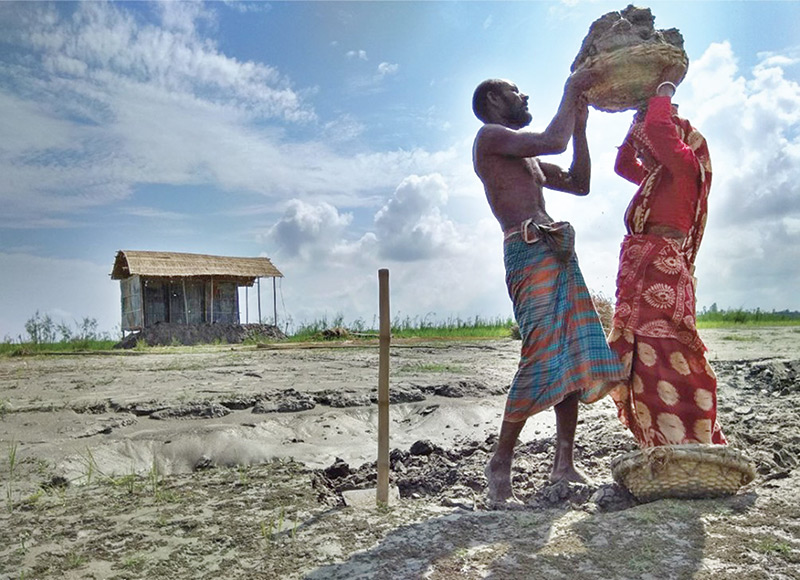
A lone structure is taking shape on a featureless, grey horizon. Two figures work under the beating sun, on an otherwise deserted landscape. One digs, the other carries loads of earth on her head. The sky is deep blue. All around there is sand. The dark grey patches where the river has left fertile alluvial deposits, and any stray seed will flourish; the stark white, devoid of nutrition yet perfect for growing, say, groundnuts. Hints of green are beginning to appear in patches: unmistakable signs of promise. When we encountered this scene, we were passing by, returning from a meeting in an adjacent island. Taking a break from their backbreaking work, Bashir and Amina (not their real names) told us their story. Years ago, this was a thriving village. Bashir and Amina lived in it with their seven children, and while it wasn’t a glorious life, they got by. In 2011, they lost their home and the only land they owned to river erosion. For those living on islands in the middle of the river, the loss of homes is almost normal. Every year, the river breaks away large swathes of land from one place, and deposits it in another. Millions in Bangladesh live on these fluid landscapes, and like the land, they are perpetual nomads. They have never had roads, electricity, or much access to government services. But Ganeshyampur, near the confluence of the Teesta and Brahmaputra rivers in northern Bangladesh, was part of the mainland. Only after 2010 did the area begin to erode. When Bashir lost his land, he was so dependent on it that afterwards, he couldn’t pay the minimal rent for a house. The family spent eight years squatting beside a highway. Deprived of their own land to farm, the two have been relying on sporadic work as daily wage labourers. Their dreams of stability have been anchored to the land they lost. ‘Every year I come back to see what the prospects are,’ says Bashir. The relationships that people have with the river are complex. In a sense, it is nothing less than a parent. It provides land, water and fertility. But the river is also a monster, because in a moment it takes away everything it gives. In July last year, floods destroyed acres of farmland, broke homes, killed livestock and even swept away children. Yet, when the water subsides, it often leaves behind the promise of rebirth. Last year’s flood left more sediments on Bashir’s land, and the water receded to a distance of three kilometres away, convincing him that it was time to start building. After five days of toiling under the beating sun, Bashir and Amina had raised a structure. Now, a few months on, several others have also settled in the vicinity. This is a community of mavericks. Being one of the first to settle the land means that they must build everything from scratch. There is no sanitation or access to clean water until somebody sinks a tube well or builds a latrine. Bashir has improvised a latrine, but for water, he must walk to a neighbour’s house almost two kilometres away. They have added two more huts to the first: a kitchen and a room to accommodate the family (three sons and a daughter, Nolok). Nolok is 30 but her parents cannot marry her off because of the stigma of her mental illness. Her mind is apparently a child’s. The exile has exacted the worst toll on Nolok. Having lived for years in poverty without any government support and without access to social services or healthcare, Nolok hasn’t had the protections that she might have under different circumstances. She has one daughter who is a toddler, and is currently pregnant with another child. Rather than joy, Bashir’s eyebrows furrow with burden at the thought of these fatherless grandchildren. Last year, river erosion affected several districts in Bangladesh that have never had this problem before. In Shariatpur, erosion has rendered some 4,000 families homeless, and caused a 2-storey health complex to crumble. In Manikganj, hundreds of homes and at least one school were swallowed by the Padma. Even smaller rivers like the Nabaganga have uprooted hundreds of families. Landscapes that are prone to erosion, especially the areas not attached to the mainland, are in a sense detached from state mechanisms. The Jamuna is the widest river in Bangladesh, 12km at its maximum. Getting from the mainland to some of the remotest islands takes upwards of four hours, assuming a boat is ready and waiting. The Bangladesh government has significant funds allocated to rehabilitate river erosion victims every year, and to check river erosion. Then there are NGOs bringing in adaptive solutions—like Friendship’s hospital ships. Perhaps Nolok’s children will not see the kind of vulnerability that she has experienced. But with some 68,000 displaced each year by river erosion, there needs to be a national strategy to respond to the question: how do we extend care, protection and opportunity to families who are vulnerable and rendered landless by these results of climate change? At least for the next few years, Nolok and her family have the security of a home. Her children will not be spending this chilly winter on the edges of a highway. The groundnuts that Bashir’s family has planted on about six decimals of land nearby are now a few weeks from harvest. They might harvest up to two maunds (75 KG), depending on their luck and skill, which would fetch about Tk15,000 in the market—a significant boost. But the sandbanks they grow on serve as a reminder that the river, though out of sight, is never far.
This article was previously published in The Daily Star, a part of the Asia News Network.
OPINION
The gender gap
Another refrain in the wake of the #MeToo movement is ‘we can’t say anything anymore.’
- Anum Malkani
Shutterstock
During a recruitment drive at a company I once worked with, my colleagues and I debated which questions are appropriate to ask in an interview. I was of the opinion that personal questions should be off-limits. For example, a female candidate should not be asked whether she is married—a common practice in job interviews in Pakistan. If she is not, the assumption is that she will be soon and resign. If she is, the assumption is that she will soon have children and resign. Either way, she is unlikely to be hired. When I made my case, some of my male colleagues let out a sigh of exasperation: ‘everything is not a women’s rights issue’. This is now a common refrain among men who are inexplicably fatigued by the women’s rights movement. They believe that feminism has run its course and women are now equal—nay, dominant. In this post-truth world, men are now victims of misandry and gender discrimination. Look up online career discussion forums and men—not just here, but all over the world —are complaining that employers favour women. They are convinced that affirmative action has gone too far and mediocre women are being hired over more deserving men. It does not matter that the facts—gender ratios and pay gaps in most workplaces are abysmal—disprove this theory. Nor does it occur to them that a woman’s skill and intellect may play a part when she is hired over a man. The myth that prevails among such men puts on stark display their unshakeable belief that they are better. This also manifests in conferences around Pakistan. Panels—or ‘manels’—are heavily male-dominated. At a recent panel on an economic issue, the sole female panellist bravely began her talk by calling out the lack of female representation. Rather than being applauded for her courageous stand, she was severely denigrated. While some belittled her—‘just another woman throwing a tantrum’—and others vehemently defended their right to hold a ‘manel’, they were all in denial of the systemic and structural issues that prevent women from participating. Some insisted that they could not find a woman with the relevant expertise (I could name several) while others said that if it had been on a subject relevant to women (as though the economy is irrelevant to 50 per cent of the population), they would have invited female panelists. But even this is not true. Even on panels on women’s issues, men are considered the authority and women are excluded, as evidenced by the initially proposed all-male panel on feminism at the Arts Council in Karachi. Another common refrain in the wake of the #MeToo movement is ‘we can’t say anything anymore’—as though women, high on their newfound power, are brazenly accusing men of sexual harassment without any grounds. This too is defeated by facts. First, the idea that women use false harassment claims as weapons against men belies reason. The weapon would be a rather impotent one, given that women rarely win such cases and often suffer serious personal, professional and reputational damage. Second, the idea that men are being silenced and cannot say anything lest they be accused of harassment is dubious. I have never found myself, while conversing with a man, uncertain about whether I am sexually harassing him. The lines are clear. If in doubt, assume there is something wrong with what you are about to say or do, and invest in sensitivity training. The reality is that, while there has been some progress, the status quo prevails, and women continue to lag behind. Professionally, women are suffering as workplace gender ratios are abysmal and get worse further up the ladder. Financially, they are disempowered with a big gender gap in financial inclusion. Health and literacy outcomes are worse for women. Violence against women remains prevalent, and the abuse spewed against women on social media is a revealing indicator of our misogynist society. Unsurprisingly, Pakistan performs miserably in UN gender indices, and the World Economic Forum estimates that, based on current trends, it will take 257 years to close the global Economic Participation and Opportunity gender gap. There is a deep nostalgia among Pakistani men for the good old days when there were no repercussions, no women’s marches, few women in workplaces and even fewer in positions of power. The idea that feminism has overachieved and women now have too many rights is a dangerous myth which only helps strengthen this status quo. The Guardian columnist Nesrine Malik refers to such myths as ‘hierarchy stabilisers’ diverting attention ‘from the fact that there is someone above you who is either exploiting you, or enjoying more unearned privileges than you’. The truth this myth obfuscates is that, with or without male allies, there are many causes to fight and a long, difficult road to travel before we can claim equality.
This article was previously published in Dawn, a part of the Asia News Network.
TECHNOPOLIS
The biggest tech flops of the decade
We celebrated many of 2019’s successes, so let’s take a look at some of the most iconic fails of the past 10 years.
- PRAJESH SJB RANA
The last decade has inspired technological advances that drastically changed the way we interact with technology. We saw electric vehicles popularise and flourish with Tesla’s Model X series, we experienced successful real-world implementation of augmented reality through Pokémon Go, and we saw online gaming ascend new heights through games like PUBG and Fortnite. But where some succeeded, others failed. While many companies experienced many technological successes over the past decade, they have also been marred by their fair share of flops. We celebrated many of the 2019’s successes in the last article, so let’s take a look at some of the most iconic fails of the past 10 years. After all, the path to success is always littered with mistakes.
Rana is a writer based in Kathmandu.
Hyperloop
Tech visionary Elon Musk’s vision of the transportation of the future came with quite the hype. The hyperloop was supposed to transport passengers across long distances at speeds of over 1000 kilometres per hour. The idea was to send passenger pods, each housing around 28 passengers each, through a vacuum tube using electromagnetic propulsion. Conceptualised by Musk in 2012, the idea of the hyperloop had permitted the imagination of Silicon Valley experts by 2013, with everyone keeping a close eye on the developments of the transport of the future. Starting at the beginning of the decade, any real-world implementation of the hyperloop still seems far-fetched. Musk has even gone far enough to comment that the concept of the hyperloop would be more feasible in Mars than California. The project turned out to be too expensive and difficult to implement, with many proposed hyperloop deals hitting the wall. In Virginia, any indication of proposed installation of hyperloop tunnels died after officials examined the test tunnel; in Colorado, Hyperloop companies went out of business before even completing a feasibility study. Arrivo, a third-party company who had plans on implementing the hyperloop technology, also shut down by 2018.
Google Plus
The search engine giant has, for many years, tried its hand at engineering its own social media platform. Google has tried before, and failed, with Google Buzz and Google Wave projects, but both died. Google Plus came along in 2011, and was touted to be the refined social media saviour. At its launch, Google Plus looked exactly like Facebook, so users didn’t have any reason to shift to Plus. It also didn’t help that Google tried bundling the service together, with other major Google services like Gmail. This led to people having to sign-up for an account, even if they didn’t want to, which inspired empty Google Plus accounts. Regardless, Google Plus did resonate with some of its users and remained alive until the end of 2018. So, while the service has been discontinued today, it played a role in the unification of all of Google’s services.
Butterfly Keyboard
Apple has made many designs and developmental errors in the past, but one that has been exceptionally troublesome to the company is their recent Butterfly keyboards. Apple wanted to redesign their keyboards to make them slimmer, to fit into their ever emaciating laptop chassis. First introduced in the 2018 MacBooks, the keyboard immediately started causing problems for its users. The keyboards didn’t feel as good as before, because they didn’t have the ‘key travel’ that Mac users had grown to love. But while users would have accepted or even adopted the keyboard, as Apple disciples often do with the company’s innovations, they didn’t. The keyboards stopped working altogether, because of their engineering. Dust that accumulated inside the keyboard would cause problems like continuous keystrokes or keys not registering anything at all. Apple started replacing malfunctioning keyboards for free and even re-engineered the keyboard with a protective dust filtering layer for their second iteration. Both fixes didn’t solve the problem in the long run, because the second version was still plagued with the same issues. Apple finally lay the butterfly keyboard to rest, and went back to its older keyboard designs.
Google’s Project Ara
The concept of modular phones piqued interest when proposed in 2013, as Phonebloks by Dave Hakkens. The phones, which would make use of different components and could be upgraded independently, aimed to lower repair costs and reduce the amount of electronic waste. Google started working on the concept along with Hakkens later that year. While considerable advancements had been made by the Project Ara team on the concept: magnetic latches, handfuls of modules and a voice-activated unlocking system, the project finally came to a close in 2016. Plagued with many issues around data latency, and collaborations with other manufacturers, the dream of a modular phone remain unfulfilled.
Samsung Galaxy Note 7
The infamous and inflammable Note 7 is one of the biggest fails of the 2010s, not only because it was an ill-engineered product but also thanks to how it affected Samsung’s overall branding. When the phone first hit markets in mid-2016, reviewers were ecstatic about how amazing the device was, reviewers applauded its great design and powerful hardware. Things were looking good for Samsung, until the phones started exploding. By September, more than 35 Note 7s were reported to have burst into flames, and even more, followed. Samsung quickly began rolling back sales and immediately recalled all devices for replacement. To make matters even worse, the replacement devices started catching on fire too, hammering the final nails into the casket the Note 7 had built for itself. Even apologies from Samsung could do little to salvage the Note 7. Samsung controlled the flaming phones by limiting all of its potential through aggressive software updates, but there was little that could be done.
TECHNOPOLIS
‘Holy Grail’ digital effects rewinding the clock for actors
It’s all possible through new digital de-aging techniques that in the past year in cinemas have shaved decades from Samuel L Jackson’s face and turned back the clock to the 1990s for Will Smith.
- MATT KEMP
Samuel L. Jackson as a younger Nick Fury (left) with Brie Larson in a scene from ‘Captain Marvel’. AP/RSS
With Martin Scorsese’s The Irishman expected to battle Once Upon a Time in… Hollywood and 1917 for the best picture Oscar in February, all eyes are on the special effects team that made the sprawling crime epic possible. The Irishman unfolds over decades, with the 76-year-old Robert De Niro and his co-stars playing their characters from their 30s into retirement age, a feat that’s made the film one of 2019’s most acclaimed movies. It’s all possible through new digital de-aging techniques that in the past year in cinemas have shaved decades from Samuel L Jackson’s face and turned back the clock to the 1990s for Will Smith. When Monday’s Academy Award nominations are announced, Captain Marvel and Gemini Man could see their names called along with The Irishman in the visual effects category. Each film has arrived at its reverse aging trick through a different technique, leading some to call 2019 a monumental year for de-aging in film. To many, The Irishman stands out from the field, thanks to its complete avoidance of “tracking markers”—dots painted onto actors faces which allow computers to mathematically replicate facial movements and manipulate them as the director sees fit. The youthful transitions of The Irishman are the work of Pablo Helman, visual effects supervisor at Industrial Light and Magic, who’s an Oscar nominee for his work on Star Wars: Episode II – Attack of the Clones and War of the Worlds. Helman says the decision to forgo tracking markers came directly from Scorsese and De Niro. “He’s not going to wear a helmet with little cameras in there,” says Helman. “He’s going to want to be in the moment with Joe Pesci and Al Pacino on set, with no markers on him. So, if you’re going to capture the performance, how are you going to do that?” Enter the “three-headed monster,” a unique camera rig that has a director camera in the centre and two “witness” cameras on either side shooting infrared footage. That allowed Helman to eliminate shadows created by on-set lighting. The shadows could potentially interfere with the geometric facial shapes constructed by de-aging software. “You’re not interrupting the director’s thread of thinking,” explains Helman. “You’re not changing the light on set, but the computer can see in a different spectrum.” While the team at Industrial Light and Magic was working on “The Irishman,” another group of technical wizards were experimenting with de-aging at Weta Digital (part of director Peter Jackson’s Weta Workshop in New Zealand), creating an entirely digital, 23-year-old version of Smith for the action movie Gemini Man. “Since I started visual FX 25 years ago it’s been the Holy Grail,” says Bill Westenhofer, one of the film’s VFX supervisors. “You have that many years of expertise of looking at a human face and knowing what’s wrong. So, to try and get all the different things together and get it to pull off right, that’s been the challenge.” To create the character of Junior—a younger clone of Smith’s assassin Henry Brogan—the superstar wore the traditional gray tracksuit, complimented by a head rig with two cameras capturing his facial expressions via tracking markers. “We decided (on) a ground up approach to build everything from scratch—from the skull all the way to the skin pores, all the way to the animation and the final kind of oil in the eyes was really the best approach we could take,” says Stu Adcock, head of facial motion at Weta. Before filming commenced on both Gemini Man and The Irishman, the teams at ILM and Weta drew up test footage to show the films’ directors that what they were suggesting was possible. For “Gemini Man” it was a clip from the 1995 movie “Bad Boys” into which they inserted two shots of their new, digital Will Smith and asked Ang Lee to spot the “fake.” For The Irishman, De Niro also returned to the 1990s, performing the Pink Cadillac scene from Goodfellas before being de-aged in post-production—convincing an initially sceptical Scorsese that he could bring the long-gestating project to life. Helman and his team then spent two years looking through old movies and cataloging the targeted ages that De Niro, Pacino and Pesci would appear in The Irishman. They created a program—similar to that used to create online “deepfake” videos where one actor’s face is swapped for another’s—which would check their work on the movie was heading in the right direction, with the system “spewing out” hundreds of images for cross-referencing. Creating Junior required Smith to spend time in a photogrammetry booth where multiple cameras captured his likeness as numerous lights fired in different sequences, giving a base scan of the actor and analysing the structure of his face from a skin pore level. Ironically, considering Scorsese’s vocal criticism of Marvel movies as “not cinema,” a similar system was used to de-age Jackson in Captain Marvel. A young Nick Fury was created by comparing footage from old Jackson movies with the work the actor did on set—again, using tracking markers. “I looked at that face as, you know, maybe The Negotiator face,” says Jackson, referring to his 1998 movie of the same name, “Fortunately for them and for me, I had enough stuff from that period in my life that they could use a bunch of different facial expressions and films to put that face together that made sense to people who knew me from that time.” Darren Hendler, director of the Digital Human Group at Digital Domain and the man responsible for turning Josh Brolin into Avengers supervillain Thanos, was impressed by Jackson’s appearance in the movie. “That’s more of a 2D-image based approach where they’re taking the actor’s performance and then they’re painting and tracking certain frames. They’re still using some of the actor’s performance directly, but they’re modifying it. It was very believable. It may not have been exactly what the young Samuel Jackson looked like, but it definitely looked de-aged.” “The de-aging of Samuel L. Jackson is absolutely fantastic,” agrees Weta’s Guy Williams, adding, “different approaches suit different requirements. It’s not a one-size-fits-all kind of situation.” That’s a sentiment echoed by Helman, who believes that 2019 was a watershed year for VFX. “It’s not by chance that we have several movies that have motion capture performance, facial performance, in three or four different ways. That shows that we’re all thinking about digital humans. “I mean, we all stand on each other’s shoulders,” Helman says. “I can’t wait for somebody to pick this up and do something else with it, you know?”
—Associated Press
CULTURE & ARTS
The fate of completed artworks
Artists put a lot of effort into conceptualising and bringing life to their artworks. But what happens to them after they are exhibited?
- SRIZU BAJRACHARYA
Artist Manish Lal Shrestha’s Gallery Mcube has a room full of his old works. (Below) Artist Hari Prasad Sharma exhibition of historical paintings. post photo: srizu bajracharya
Kathmandu, When artist Manish Lal Shrestha opens the door to his studio at the Gallery Mcube in Chakupat, a number of his works are on display, some of them are battered and have traces of dust on them. On the sofa, an array of cushions show emulation of Shrestha’s popular visual installation, ‘Project 1336’, which is still travelling the world. On first glance, it looks like Shrestha has built a band of his completed artworks. These artworks have finished their fundamental purpose and are ageing with time. They now represent a fragment of time, of when the artist manifested an art to make people think. “Art is not meant to be permanent, everything has a temporary space,” says Shrestha. Over the years, Kathmandu has seen many art exhibitions from various artists, and during their brief shows, their artworks have evoked people’s thought processes. They have inspired and enthralled people and even pushed them to question their beliefs. But little is known of what happens to artworks once they are taken down from public exhibitions; where do they go, what purpose do they serve? What is the fate of these artworks? According to Sharareh Bajracharya, an arts educator and curator, most works after exhibitions travel back to the artist’s studio, where they are stored and preserved. “For some artworks, their lives continue in other curatorial works, wherein they travel and remain in the public viewership,” she says. “Otherwise, they are stored by the artists, some in proper ways and others unmindfully.” At Shrestha’s office, he has framed most of his cherished works. One of which shows his work from 2004, a huge colourful tapestry of 26 metres titled, ‘I know to love life, I know to live life, I know to love life…,’ which was showcased at the Shiva temple in Bhaktapur. The idea of the installation was to create a collaborative experience with the locals of the old town. “Clothes are our second skin, but by patching together different coloured clothes, I was trying to show the communal living,” he says. “I had placed the artwork on the staircase of the temple to make it seem like a pathway to the higher being.” The installation was put up at the venue for 10 days. But even today, Shrestha’s concept of the artwork continues to evolve. The lines and colours of fabric continue to manifest in all of his artworks. It is almost like he is recycling the contents of that installation to create new artworks. His 2017 art installation ‘Project 1336’, a 1336-metre long knitted woollen rope resembles in many ways with the idea of his 2004 installation, where he tried to show the diversity of communal living. The project too, was created with the help of various communities. Shrestha also travelled to Busan to create a 108-metre long tapestry with the locals for the Sea Art Festival 2019 Busan Biennale. And through the years, his artworks have brought together many diverse communities to work cohesively, making his art more powerful. “I think the afterlife of my artworks can be seen in how my initial idea has continued in all of my new artworks in different ways,” says Shrestha.
Another artist, Sheelasha Rajbhandari, believes the life of art begins even before its initiation. “I believe artworks have a life beyond the exhibitions. Their lives begin right from the start of its concept and research—in the process itself. And as the concept evolves, their journey continues,” she says. In 2017, Kathmandu Triennale also showcased her artwork titled, ‘I still see that same old house of ours in my dreams,’ which was based on Rajbhandari’s maternal grandmother. Her art installation showed old wooden sanduks (trunks) filled with her grandmother’s memories of kitchen and household utensils, puja thalis and a bed. In Rajbhandari’s work, they also stood as metaphors to how women’s lives were described in the old days. The wooden trunks also showed various photographs of Rajbhandari’s grandmother at the hospital. “I had always wanted to document my grandmother’s narrative, but I didn’t know where to start and how,” she says. “It was her life experiences, compared and contrasted against the lives of modern women that made me realise how the narratives of women have been dominated by male experience throughout history.” But while she was working on the artwork, her grandmother was hospitalised and soon passed away. This, according to Rajbhandari, even though was devastating to her, made her realise that a lot of what she wants to express remains unfinished. “I still have a lot to say,” she says. “So, the idea of it is still unfurling in my other works.” The concept that came to her even before the Triennale series has evolved with time and comes across in many of her recent works. Another one of her art installations, ‘My great-great-grandmother’s shawl,’ shows photographs of her great-great-grandmother, her grandmother and herself wearing a Damber Kumari Shawl in three different portraits. Her metaphors incite the culture of mass-production in contemporary times and mark the disappearing diverse textile cultures. This piece is now being displayed at the Samdani Art Foundation, in Dhaka. “When we talk about the afterlife of artworks, I think we also have to see how the artworks live in the experiences of people,” she says. “I don’t want people to believe that art lives only in the objects they are portrayed in.” And perhaps, therefore, Rajbhandari’s work still remains fresh in people’s minds; for Rajbhandari, the fate of her artwork remains in what people will remember of her work. But both Shrestha and Rajbhandari affirm that Nepal lacks a space where important artworks can be put up for public display. “There is of course a need for an art space to preserve artworks,” says Rajbhandari. “But I also think such a space needs to adhere to the cultural art practices of the country. It needs to be contextual to our society, instead of being a copy of the Western museums.” A physical space for art is also important to document and trace the history of art, says Bajracharya, the arts educator. “An art museum can help trace the history of art and its trends. The space can also allow better discourses around art and can create a better art ecosystem,” says Bajracharya. Today many senior artists in the country, with the help of their family and friends, have created their own private galleries to preserve their works. Veteran artist Hari Prasad Sharma’s son Bishnu Prasad Sharma has also been working on setting up a physical space at their home to safeguard his father’s monumental art pieces. Eighty-two-year-old Sharma’s paintings document various timelines of Nepal’s history. His paintings are intricate in their detailing and contain multiple layers about Nepal’s important historical records. And while many of his paintings have already been bought by art collectors, in recent years, Sharma’s son has refrained from selling his works even though many have shown interest in purchasing them. He believes his father’s work in time have become a heritage of its own. “We would love to have his works displayed in a public art museum, however, there is no space in Nepal that take cares of artworks,” says Bishnu Prasad Sharma. His father still visits his old works and spends time cleaning them. “He doesn’t paint anymore because of his age. But sometimes he himself is in awe, about the work he did in the past and tells me, ‘I don’t know how I was able to paint them’,” says Sharma. “I want my father’s work to live on, but there is no appropriate space for that yet in the city.” But as conversations around art gain more momentum, the life of art itself is also an important discussion that needs to happen say artists and curators. “Artists have been preserving their work with their personal effort,” says Bajracharya. “But, yes, for more discourses around art, we need to question on the art’s longevity and its afterlife.”
CULTURE & ARTS
Once more onto the bridge: Captain Picard returns to ‘Star Trek’
Having bid farewell to the character that brought him international fame, the actor was tempted back into the Trekkie universe by a whole new take on Picard.
- Frédéric Pouchot,FIACHRA GIBBONS
The cast of “Star Trek: Picard” speak during the CBS All Access segment of the 2020 Winter TCA Tour in California. AFP/rss
He vowed never to return but Patrick Stewart is back in spandex for another intergalactic adventure as Captain Jean-Luc Picard in a new series of Star Trek next week. Having bid farewell to the character that brought him international fame, the English Shakespearean actor, who turns 80 later this year, was tempted back into the Trekkie universe by a whole new take on Picard. “It has been 17 years since I said ‘au revoir’ to Jean-Luc,” Stewart told AFP during a visit to Paris, and a quarter of a century since the last series of Star Trek: The Next Generation ended. “It was my absolute intention not only never to go back to that world, but to assume that everything that could be said had been said—that there was nothing more to say,” he added. That is until Stewart began talking to Alex Kurtzman, the creator of Star Trek: Picard and screenwriter Michael Chabon, who wanted to take the commander to places he has never been before. Chabon brings a certain cachet to the project as a Pulitzer prize-winning novelist—but he is also a longtime Star Trek fan. “I found that they had ideas that were unexpected and that we were in a different world from the one that The Next Generation created,” said Yorkshire-born Stewart, who was knighted in 2010.
Shaken and stirred “It feels like a new beginning because Picard is in a completely different situation from the one we saw in him for four movies and the 178 previous episodes” of the cult television series in which he appeared. For one, the retired starship admiral, who once exuded such calmness and authority, will be genuinely rattled in the new series, which goes out from January 23 on CBS and Amazon Prime. The ageing Picard has lost his bearings, rocked by the death of his android Data, who was such a talisman for the Starfleet’s officers. “There are one or two characters who have a history with ‘Star Trek’ (in the new series) but the world around them is transformed — it is not the same world,” said Stewart, who last appeared on the Starship Enterprise in the 2002 movie Nemesis. But he is galvanised back into action to help Dahj, a young woman in distress. The new series also sees Picard going back to his Gallic roots as French civilisation seemingly teeters on the brink of extinction. With some scenes shot in a vineyard, Picard even gets to speak his native tongue on screen. “We tried to create as French a world as possible,” Stewart told AFP.
Parallels with the present Picard is backed up in the new series by Raffi Musiker, a peerless hacking genius and investigator played by Michelle Hurd who is tormented by her demons and rather complicated past relations with the captain. “I think she represents a lot of people, hurting women who may be haunted by the choices and decisions that they’ve made,” Hurd told AFP. “She is just trying to get up in the morning and confront the day. “She’s really, really good at her job. Sometimes I think maybe her skill... is the thing that is distracting her from what is haunting her,” she added. The other major female character in the series is Dahj, played by British-born actress Isa Briones. “Dahj kind of sets everything in motion... starting Picard on a new mission,” she said. Although she wasn’t a “major fan” of the original series, Briones said she always admired it. “I like to say it’s a beautiful responsibility that we have. People care so much about this show... it has helped them find people who speak the same as them.” As often with science fiction, Briones said “the storylines reflect current events”. “We’re going to tell stories that are pertinent to this time, but you may not see it as that until the end,” said Hurd teasingly. “We are not teaching lessons but we are bringing light to human dilemmas.”
—Agence France-Presse
WORLD
Australia’s ‘megablaze’ brought under control
Firefighters say they have finally had the upper hand in the fight against the fire on Sydney’s northwestern outskirts
- AGENCE FRANCE-PRESSE
A view shows a close-up of fires at Honeysuckle Point, south of Eden, New South Wales, Australia, in this handout Maxar’s WorldView-3 satellite image taken on Sunday. REUTERS
SYDNEY, Exhausted firefighters said they had finally brought Australia’s largest “megablaze” under control Monday, as wet weather promised to deliver much-needed respite for countryside ravaged by bushfires. New South Wales firefighters said they finally had the upper hand in the fight against the vast Gospers Mountain fire on Sydney’s northwestern outskirts, which has been burning for almost three months. Visiting the area on Monday, New South Wales Rural Fire Service commissioner Shane Fitzsimmons said there was a “small area of burning still to complete” but the “containment prognosis looks promising”. The fire seared an area of national park three times the size of Greater London and lit several connected blazes totalling over 800,000 hectares. As residents and authorities continued to come to grips with the sheer scale of the devastation, the Bureau of Meteorology forecast some firegrounds areas could get up to 50 millimetres (two inches) of rain in the next week, a relief after a prolonged drought. If that forecast bears out, the New South Wales Rural Fire Service said it would be “all of our Christmas, birthday, engagement, anniversary, wedding and graduation presents rolled into one. Fingers crossed.” Dozens of other fires are yet to be controlled. The climate-change-fuelled fires have prompted an international outpouring and donations from around the world to help communities and animal populations. Australia’s unique flora and fauna has taken a catastrophic hit, with an estimated one billion animals killed, and countless trees and shrubs burned away. The country’s environment minister Sussan Ley has warned that in some areas, koalas may have to be reclassified as endangered. The government has earmarked an initial $50 million (US$35 million) to spend on helping with the wildlife recovery. “This has been an ecological disaster, a disaster that is still unfolding,” Treasurer Josh Frydenberg announcing the emergency fund. This weekend, Sydney will host a charity gig to benefit fire services, the Red Cross and animal welfare organisations. Headliners include Alice Cooper, Olivia Newton-John and Queen. The political impact of the bushfires is also coming into sharper relief. A poll released Monday showed Prime Minister Scott Morrison’s approval ratings have nosedived in the face of widespread anger over his handling of the deadly crisis. The Newspoll survey showed 59 percent of Australian voters are dissatisfied with the conservative leader’s performance overall, and only 37 percent were satisfied, an abrupt reversal since his shock election win last May. Morrison has been criticised heavily for his response to the months-long crisis -- which included going on holiday to Hawaii, making a series of gaffes and misleading statements about his government’s actions, and forcing angry victims to shake his hand. Morrison began the crisis insisting local authorities had enough resources to handle the fires and exhausted volunteers firefighters “want to be there”.
WORLD
Australian prime minister’s approval rating goes up in flames
- REUTERS
MELBOURNE, Public support for Prime Minister Scott Morrison has slumped to its lowest levels amid widespread anger over his government’s handling of Australia’s bushfire crisis, according to a survey released by Newspoll on Monday. At least 28 people have been killed in the fires that have destroyed 2,000 homes, and razed 11.2 million hectares (27.7 million acres), nearly half the area of the United Kingdom Morrison has come under attack for being slow to respond to the crisis, even taking a family holiday to Hawaii while fires were burning. He acknowledged during a television interview on Sunday that he had made some mistakes. “We have heard the message loud and clear from the Australian people,” Treasurer Josh Frydenberg said on Monday, when asked about the poll result as he announced a A$50 million ($34.56 million) wildlife protection fund. “They want to see a Federal Government adopt a very direct response to these natural and national disasters,” Frydenberg said. The Newspoll survey showed Morrison’s approval rating dropped 8 percent since the last poll on Dec 8 to stand at 37 percent, scoring lower than opposition Labor leader Anthony Albanese.
WORLD
Libya rivals in Moscow to sign ceasefire deal
- AGENCE FRANCE-PRESSE
MOSCOW, The heads of Libya’s warring sides were to meet in Moscow on Monday to sign a ceasefire deal ending nine months of heavy fighting. The meeting follows a diplomatic push by Turkey and Russia, which is keen to bolster its status as a powerbroker in the Middle East and step into a diplomatic void left by what observers see as a partial US retreat. The two sides are expected to sign an agreement on the terms of a ceasefire that took effect over the weekend, raising hopes of an end to the fighting that has wracked the oil-rich North African country since a 2011 NATO-backed uprising killed longtime dictator Moamer Kadhafi. The UN-recognised Government of National Accord (GNA) in Tripoli, headed by Fayez al-Sarraj, has been under attack since last April from forces loyal to strongman Khalifa Haftar, who is based in the east of the country. Haftar and Sarraj were to meet in Moscow for talks along with “representatives of other Libyan sides”, the Russian foreign ministry said, with Turkey and Russia’s foreign and defence ministers acting as mediators. Russian news agencies reported representatives of the two sides had arrived for talks, but it was unclear if Haftar and Sarraj would meet face-to-face. The ceasefire initiative was launched by President Vladimir Putin and Turkish counterpart Recep Tayyip Erdogan, who jointly called for a truce in Istanbul last week. German Chancellor Angela Merkel visited Putin on Saturday and he supported her drive to hold a peace conference sponsored by the United Nations. Berlin said Monday the summit was planned for later this month. French President Emmanuel Macron on Monday called for a “credible, lasting and verifiable” truce while Italian Prime Minister Giuseppe Conte was due in Turkey to discuss the situation with Erdogan. Foreign powers are keen to secure influence in Libya—home to Africa’s largest proven crude reserves. The GNA has signed agreements with Ankara assigning Turkey rights over a vast area of the eastern Mediterranean, in a deal denounced by France, Greece, Egypt and Cyprus.
WORLD
Pelosi set to turn over Trump impeachment reins to McConnell
- REUTERS
Nancy Pelosi. AFP/RSS
WASHINGTON, US House Speaker Nancy Pelosi is expected to relinquish the impeachment proceedings against President Donald Trump this week by turning the process over to Mitch McConnell, the powerful Senate leader who has vowed to help acquit his fellow Republican. A month after making Trump the third president in history to be impeached by the House of Representatives, Democrats will discuss on Tuesday morning how to move forward, Pelosi said on Sunday, with the chamber possibly voting to send the articles of impeachment to the Senate that same day. The jockeying between chambers over impeachment procedure has largely focused on a still unsettled dispute about whether McConnell will allow witnesses to be called during the Senate trial. McConnell has yet to say definitively how the Senate will conduct the trial, but he has hinted he could skip witnesses and instead oversee a process that quickly dispatches with the charges. The political ramifications of witness testimony could prove to be both beneficial and detrimental for both sides in the run-up to elections in November. In the Senate, Trump is expected to face friendlier terrain than he did in the House, and ultimately the chamber is expected to vote to acquit the president even though some moderates have bristled over McConnell’s reflexive support for Trump. Democrats in the House brought the impeachment charges against Trump over his efforts to pressure Ukrainian President Volodymyr Zelenskiy to open a probe into former Vice President Joe Biden, a possible rival in this year’s presidential election, including in a July 25 phone call between the leaders. Trump appeared on Sunday to reverse his position on how the Senate should proceed. Initially, he touted a Senate trial as an opportunity for his allies to force his critics to testify under oath, a process he said would benefit him politically. But on Sunday, Trump wrote on Twitter that a full trial would give the Democrats undeserved credibility, and appeared instead to favor the Senate quickly dismissing the charges. Pelosi, for her part, has remained involved in the impeachment process longer than expected. The House voted to impeach Trump in mid-December. But instead of quickly sending the articles of impeachment to the Senate to launch a trial, she delayed the process—a move she said was done to give her leverage to try to compel the Senate to hold a “fair” trial. But after almost four weeks, Pelosi signaled she will relent and anticipates the House will finalize the process. Critics have said Pelosi failed to gain much by holding onto the impeachment articles. She has said her delay brought some benefits. “We wanted the public to see the need for witnesses, witnesses with firsthand knowledge of what happened, documentation which the president has prevented from coming to the Congress as we review this,” Pelosi said on Sunday in an interview with ABC’s “This Week.” Republicans have focused much of their response to the impeachment proceedings on Pelosi - a frequent target of criticism directed at Democrats. “I didn’t get elected to have Nancy Pelosi play games, which is all she’s doing,” US Senator Rick Scott said on Fox News on Sunday. “And she wants to spend all of her time on just trying to impeach this president because she hates Donald Trump.”
WORLD
Ex-pope Benedict warns against celibacy change
- AGENCE FRANCE-PRESSE
Former pope Benedict XVI. Reuters
ROME, Former pope Benedict XVI has publicly urged his successor Pope Francis not to open the Catholic priesthood up to married men, in a plea that Sunday stunned Vatican experts. The ex-pontiff, who retired in 2013, issued the defence of clerical celibacy in a book written with arch-conservative Cardinal Robert Sarah, extracts of which were published in exclusive by France’s Le Figaro. “I cannot keep silent!” Benedict wrote in the book, which follows an extraordinary meeting of bishops from the Amazonian at the Vatican last year that recommended the ordination of married men in certain circumstances. The pope emeritus, 92, and Sarah from Guinea weighed in on the controversial question of whether or not to allow “viri probati”—married “men of proven virtue”—to join the priesthood. Francis is currently considering allowing it in remote locations, such as the Amazon, where communities seldom have Mass due to a lack of priests, and is expected to publish his decision in the coming weeks. The pair asked the whole Church not to be “swayed” by “bad pleas, theatrics, diabolical lies, fashionable errors that want to devalue priestly celibacy”. “It is urgent, necessary, that everyone, bishops, priests and laity, let themselves be guided once more by faith as they look upon the Church and on priestly celibacy that protects her mystery,” they wrote. They warned of priests “confused by the incessant questioning of their consecrated celibacy”. “The conjugal state concerns man in his totality, and since the service of the Lord also requires the total gift of man, it does not seem possible to realise the two vocations simultaneously,” Benedict wrote. Sarah insisted that while celibacy can be “a trial” it is also “a liberation”. Benedict, who was the first pontiff to resign in almost 600 years, at first withdrew to a life of quiet contemplation in the Vatican, but has increasingly begun to speak out on key Catholic issues. He and Sarah insisted their plea was not a “political manoeuvre” or “power game”. But Vatican experts expressed astonishment that the retired pope would speak out on such a sensitive topic. “Benedict XVI is really not breaking his silence because he (and his entourage) never felt bound to that promise. But this is a serious breach,” Massimo Faggioli, who writes for La Croix, said on Twitter. Joshua McElwee of the National Catholic Reporter, tweeted that “a former pope speaking in public about something his successor is currently in the process of considering” was “incredible”. While Vatican expert Iacopo Scaramuzzi pointed out that “cohabitation (in the Vatican) is difficult if the emeritus pope does not respect his own promise to hide away and obey”. The idea of filling empty pulpits in remote locations by allowing married men to become priests is a divisive once, with critics warning the emotive issue could fracture the Catholic Church. Supporters say it would not be necessary to rewrite Church law; Francis could simply make an exemption to the rules—like the one already granted to married Anglican pastors who later converted to Catholicism. But the ultra-conservative wing of the Church—particularly in Europe and North America—has spoken out strongly against the idea, warning that making exceptions could pave the way to the abolition of celibacy globally.
WORLD
Macron urges ‘credible, lasting’ Libya ceasefire
- AGENCE FRANCE-PRESSE
Paris, French President Emmanuel Macron has called for a credible and lasting ceasefire in Libya, his office said on Monday, as the main players in the conflict prepare to sign a truce. “The president emphasised the necessity that the ceasefire that is to be announced is credible, lasting and verifiable,” Macron’s office said, following telephone talks between the president and Russian counterpart Vladimir Putin on Sunday. The head of Libya’s UN-recognised Government of National Accord Fayez al-Sarraj and his rival, strongman Khalifa Haftar, are due to confirm a ceasefire later on Monday in Moscow. The GNA in Tripoli had been under attack since last April from forces loyal to eastern-based Haftar, which on January 6 captured the strategic coastal city of Sirte. Over 280 civilians and about 2,000 fighters have been killed and 146,000 Libyans displaced since Haftar launched his assault, the UN said.
WORLD
Two US airmen found dead at Germany base
Briefing
FRANKFURT AM MAIN: Two US Air Force airmen were found dead last week in Germany, the base where they were stationed said in a statement on Monday, adding that an investigation into the cause is underway. The men, both aged 20, “were found unresponsive in a dorm room” in the early evening of January 9, the 52nd Fighter Wing based at Spangdahlem airbase in western Germany said in a statement. Efforts to revive them failed and medics pronounced them dead around 20 minutes after the bodies were discovered. “It is always very difficult to lose valued members of our team,” 52nd Fighter Wing commander Colonel David Epperson said, offering “sincerest and heartfelt condolences” to the soldiers’ families. (Agencies)
WORLD
Exiled Morales says will create Bolivia militias if he returns
Briefing
LA PAZ: Exiled former Bolivia president Evo Morales says he will call for the introduction of popular local militias similar to those in Venezuela if he returns home. In a recording played Sunday on a Bolivia’s Radio Kawsachum Coca (RKC)—owned by the coca planters union to which he belongs—Morales repeated his belief that he had been the victim of “a coup”. The first indigenous leader of Bolivia, Morales resigned in November under pressure from opposition demonstrators who deemed his re-election to be fraudulent. He first took refuge in Mexico, but is now in Argentina. (Agencies)
WORLD
Explosion rocks Stockholm residential building
Briefing
STOCKHOLM: An explosion damaged a residential building in central Stockholm on Monday, police said, and while no injuries were reported it follows a wave of criminal bombings in the country. Images published by Swedish media showed damage to the building’s facade, the front door demolished and broken glass and debris scattered on the ground. Several nearby cars were also damaged by the blast, the cause of which was not known, in the affluent neighbourhood of Ostermalm. “At this time it’s not possible to say whether the explosion occurred in or outside the building,” a police spokeswoman told newspaper Aftonbladet. (Agencies)
ASIA
Pakistan court annuls Musharaff’s death sentence: Prosecutor
- AGENCE FRANCE-PRESSE
LAHORE, A Pakistan court Monday annulled the death sentence handed to former military ruler Pervez Musharraf, ruling that the special court which had found him guilty of treason last year was unconstitutional, a government prosecutor told AFP. The original ruling had marked the first time a former leader of the armed forces had faced such a sentence for treason in Pakistan, where the military maintains strong influence and senior officers are often considered immune from prosecution. It caused a wave of controversy, with Musharraf—exiled in Dubai—slamming it as a “vendetta” and the military expressing its disappointment. A High Court in the eastern city of Lahore ruled it “illegal” on Monday. “The filing of the complaint, the constitution of the court, the selection of the prosecution team are illegal, declared to be illegal... And at the end of the day the full judgment has been set aside,” the prosecutor representing the government, Ishtiaq A. Khan, told AFP. “Yes, he is a free man. Right now there is no judgment against him any longer,” Khan added. The prosecution now has the option to file a new case against Musharraf with the approval of the federal Cabinet. The treason trial—which began in 2013 and is just one of several involving Musharraf—centred on his decision to suspend the constitution and impose emergency rule in 2007. The case went on for years amid repeated delays until the surprise announcement last year. The imposition of emergency had sparked widespread protests against Musharraf, ultimately leading to his resignation in the face of impeachment proceedings. Musharraf first took power after ousting prime minister Nawaz Sharif in a bloodless coup in 1999. A cigar-smoking, whisky-drinking moderate, the general became a key US ally in the “war on terror” after the September 11 attacks and escaped at least three Al-Qaeda assassination attempts during his nine years in office.
ASIA
Iranian security forces shoot at those protesting Ukrainian plane shootdown
Anti-riot police officers and other security forces were also seen on the streets of Tehran on Monday.
- ASSOCIATED PRESS
Anti-government demonstrators wave an Iraqi national flag during a demonstration in Tahrir square in Baghdad, against the breach of Iraqi sovereignty by the US and Iran. AFP/RSS
DUBAI (UAE), Iranian security forces fired both live ammunition and tear gas to disperse demonstrators protesting against the Islamic Republic’s initial denial that it shot down a Ukrainian jetliner, online videos purported to show on Monday. Videos sent to the New York-based Center for Human Rights in Iran and later verified by The Associated Press show a crowd of demonstrators near Azadi, or Freedom, Square fleeing as a tear gas canister landed among them. People cough and sputter while trying to escape the fumes, with one woman calling out in Farsi: “They fired tear gas at people! Azadi Square. Death to the dictator!” Another video shows a woman being carried away in the aftermath as a blood trail can be seen on the ground. Those around her cry out that she has been shot by live ammunition in the leg. “Oh my God, she’s bleeding nonstop!” one person shouts. Another shouts: “Bandage it!” Photos and video after the incident show pools of blood on the sidewalk. Tehran’s police chief, Gen. Hossein Rahimi, later denied his officers opened fire though the semiofficial Fars news agency said police “shot tear gas in some areas.” “Police treated people who had gathered with patience and tolerance,” Iranian media quoted Rahimi as saying. “Police did not shoot in the gatherings since broad-mindedness and restraint has been agenda of the police forces of the capital.” However, uniformed police officers were just one arm of Iran’s security forces who were out in force for the demonstrations. Riot police in black uniforms and helmets gathered earlier Sunday in Vali-e Asr Square, at Tehran University and other landmarks. Revolutionary Guard members patrolled the city on motorbikes, and plainclothes security men were also out in force. People looked down as they walked briskly past police, apparently trying not to draw attention to themselves. The Guard previously has been accused of opening fire on demonstrators during protests over government-set gasoline prices rising in November, violence that reportedly saw over 300 people killed. Other videos from Fars showed demonstrators chanting: “We are children of war. Fight with us, we will fight back.” Ebrahim Raisi, the head of Iran’s judiciary, warned protesters and alleged, without providing evidence, that “the agents of America and agents of foreign countries” wanted to use anger over the plane shootdown to “compromise” Iran’s security. Anti-riot police officers and other security forces could be seen on the streets of Tehran on Monday as well. The crash of the Ukraine International Airline early on Wednesday killed all 176 people on board, mostly Iranians and Iranian-Canadians. After pointing to a technical failure and insisting for three days that the Iranian armed forces were not to blame, authorities on Saturday admitted accidentally shooting it down in the face of mounting evidence and accusations by Western leaders. Iran downed the flight as it braced for possible American retaliation after firing ballistic missiles at two bases in Iraq housing U.S. forces earlier on Wednesday. The missile attack, which caused no casualties, was a response to the killing of Gen. Qassem Soleimani, Iran’s top general, in a U.S. airstrike in Baghdad. But no retaliation came. Iranians have expressed anger over the downing of the plane and the misleading explanations from senior officials in the wake of the tragedy. They are also mourning the dead, which included many young people who were studying abroad.
Iran police ordered to show ‘restraint’ at air disaster demos TEHRAN: Police in Tehran have been ordered to show “restraint” at demonstrations that erupted after the accidental shooting down of a Ukrainian passenger jet, the Iranian capital’s police chief said Monday. “The police treated the people who had gathered with patience and tolerance” in a second night of demonstrations in Tehran on Sunday, said General Hossein Rahimi. “The police did not shoot at the gatherings at all because a restraint order (had been issued) for police in the capital,” he said in a statement published by state television. (AFP)
ASIA
China defends barring Human Rights Watch head from Hong Kong
- AGENCE FRANCE-PRESSE
BEIJING, China on Monday defended barring the head of Human Rights Watch from entering Hong Kong, saying non-governmental organisations were responsible for political unrest in the city and should “pay the proper price”. Kenneth Roth was supposed to give a press conference in Hong Kong this week to unveil the New York-based rights group’s latest global survey, which accuses China of prosecuting “an intensive attack” on international human rights agencies. The long-time executive director said on Sunday that he was turned back by authorities at the city’s airport. China last month announced sanctions on American NGOs, including HRW, in retaliation for the passage of a US bill backing Hong Kong’s pro-democracy movement. “Allowing or not allowing someone’s entry is China’s sovereign right,” foreign ministry spokesman Geng Shuang said at a regular press briefing. “Plenty of facts and evidence show that the relevant NGO has through various means supported anti-China radicals, encouraged them to engage in extremist, violent and criminal activity, and incited Hong Kong independence separatist activities,” Geng said. “They bear major responsibility for the current chaos in Hong Kong. These organisations should be punished, and should pay the proper price.” Hong Kong has been battered by nearly seven months of occasionally violent protests, its biggest political crisis in decades. Millions have turned out on the streets of the semi-autonomous financial hub to demand greater democratic freedoms. Roth joins a growing list of openly critical academics, researchers, politicians and activists who have been refused entry in recent years. Financial Times journalist Victor Mallet was denied a visa renewal without reason in 2018 after he hosted a talk with the leader of a small and now banned independence party at the city’s press club. Last September, an American academic was barred from entering after he testified in a Congressional hearing alongside prominent Hong Kong democracy activists. “I had hoped to spotlight Beijing’s deepening assault on international efforts to uphold human rights,” Roth said. “The refusal to let me enter Hong Kong vividly illustrates the problem.” Phil Robertson, deputy director of Human Rights Watch’s Asia division, said that when Roth asked why he was prevented from entering Hong Kong, he was only told that it was “immigration reasons”. “What we believe is that he was stopped because the Chinese government is afraid to have the world know what they are doing to the people of Hong Kong and the people of China,” Robertson told AFP in Bangkok.
ASIA
Musicians ‘play Ghosn’ by squeezing into instrument cases in web craze
- AGENCE FRANCE-PRESSE
Former Renault-Nissan boss Carlos Ghosn gestures as he addresses journalists on his reasons for dodging trial in Japan, at the Lebanese Press Syndicate in Beirut on January 8. AFP/RSS
TOKYO, Yamaha has warned musicians in Japan against stuffing themselves into their instrument cases to mimic the escape technique allegedly used by fugitive ex-tycoon Carlos Ghosn. Ghosn, who faces financial misconduct charges in Japan, managed to slip past authorities at the end of December reportedly by smuggling himself on board a plane inside an audio equipment box. The 65-year-old has refused to shed light on how he ghosted out of Japan to Lebanon, but that has not stopped a string of internet users “playing Ghosn” by posing in cases usually meant to protect big instruments. In one picture posted to Twitter, a young woman curled up inside a padded green harp case, while another post appeared to show somebody standing in a double bass gig bag. The stunts have not chimed with Japanese instrument manufacturer Yamaha, however, who sounded a note of caution warning people against the trend. “There have been a large number of tweets showing people climbing into large instrument cases,” tweeted Yamaha Wind Stream, the company’s account for information on wind instruments. “To avoid the possibility of a tragic accident, please do not do this... Musical instrument and audio equipment cases are designed to hold musical instruments and audio equipment. Please use them correctly.” Ghosn, arrested on financial misconduct charges in 2018, jumped bail and fled in mysterious circumstances to Lebanon, where he gave a rambling press conference last week. The Wall Street Journal reported that he was snuck on to a private jet in Osaka in a large case for audio equipment, which was later found at the back of the cabin. The newspaper cited unnamed sources close to the investigation in Turkey as saying that holes had been drilled into the container to ensure the businessman could breathe. The report was accompanied by a picture of a large black case which The Wall Street Journal claimed was the one used by Ghosn.
ASIA
India’s ruling party lawmaker threatens to shoot protesters
- ASSOCIATED PRESS
NEW DELHI, The head of Indian Prime Minister Narendra Modi’s Hindu nationalist Bharatiya Janata Party in the state of West Bengal has threatened to shoot and jail people who protest a new citizenship law that has triggered a month of nationwide demonstrations. Dilip Ghosh, a member of India’s Parliament and the president of the BJP in West Bengal, made the comments to party members on Sunday in a district of the state that borders Bangladesh. Cabinet Union Minister Babul Supriyo distanced the BJP from Ghosh’s comments, calling them “very irresponsible” on Twitter on Monday. The citizenship law provides a path to naturalization for people from Bangladesh, Afghanistan and Pakistan, unless they’re Muslim. Many Indians worry the law will be used in conjunction with a National Register of Citizens that could require all Indians to produce documents proving their origins, a challenge in a country where many people lack official records including birth certificates. Ghosh called out West Bengal’s chief minister, Mamata Banerjee of the opposition All India Trinamool Congress party, comparing her government’s treatment of protesters to BJP-controlled governments in other Indian states. Banerjee, one of several state chief ministers from opposition parties who have pledged not to comply with the citizenship law, has led massive street marches to protest it. “Look at Assam, Uttar Pradesh and Karnataka, our government has shot these demons like dogs,” Ghosh said. “You will come here, eat our food, stay here and then damage property? We will beat you with (batons), shoot you and put you in jail,” he said, referring to demonstrators in West Bengal. Twenty-three people have been killed nationwide since the citizenship law was passed Dec. 11. Massive protests erupted across the country, with Uttar Pradesh, Karnataka and Assam states the hardest hit. Police in Assam have acknowledged fatally shooting five people, and Karnataka authorities offered compensation to the families of two men killed by police during protests. Sixteen Muslims were killed in Uttar Pradesh on a single day after the BJP chief minister, Yogi Adityanath, promised to take “revenge” against protesters. Uttar Pradesh authorities have denied any responsibility for the deaths.
ASIA
Israel’s left-wing parties unite ahead of elections
Briefing
JERUSALEM: Israel’s left-wing Meretz and Labor-Gesher parties said Monday they had joined forces ahead of March 2 elections, to boost their chances against Prime Minister Benjamin Netanyahu’s right-wing base. Israel’s political scene is in turmoil ahead of the third national vote in less than a year after neither Netanyahu nor his centrist rival Benny Gantz were able to form a coalition following September polls. With Israel’s two major political blocs almost neck-and-neck, smaller parties and coalitions could emerge as potential kingmakers after the upcoming elections. The new left-wing joint list called “Emet”—“truth” in Hebrew—was agreed by Labor-Gesher leader Amir Peretz and Meretz head Nitzan Horowitz, who want to combine forces against the prime minister’s Likud party. (Reuters)
ASIA
King of Jordan warns Islamic State on rise again
Briefing
PARIS: King Abdullah of Jordan on Monday warned that the Islamic State group was regrouping and was once again on the rise in the Middle East. Months after the ousting of IS last year from their last Syrian holdout, Abdullah said his “major concern is that we have seen over the past year the re-establishment and rise of Isis, not only in southern eastern Syria but also in western Iraq. “We have to deal with the reemergence of Isis,” the king added in an interview with TV channel France 24 ahead of talks this week in Brussels, Strasbourg and Paris. He also said many foreign fighters from Syria were now in Libya. (Reuters)
ASIA
Thai royal motorcades will no longer shut down Bangkok
Briefing
BANGKOK: Royal motorcades will no longer completely shut down Bangkok’s roads, a rare concession by the unassailable Thai king to public opinion. King Maha Vajiralongkorn, 67, sits at the apex of Thai power and—alongside senior royals—is protected by a draconian defamation law, which makes public scrutiny of the family near impossible inside the kingdom. Police routinely close down major roads when the royal family passes, adding serious delay on the congested streets of Bangkok and heaping frustration onto commuters. Thais in recent months have taken to Twitter and Facebook to air their irritation over road closures believed to be linked to the royal family’s travels. (Reuters)
MONEY
Australia’s bushfire crisis turns off tourists
Images of the unprecedented scale of this summer’s blazes have evoked global shock and an outpouring of sympathy.
- AGENCE FRANCE-PRESSE
Accommodation blocks at the Gold Rush Colony in Mogo, a tourist attraction dedicated to Mogo’s 1850s gold rush—where a recent bushfire reduced it to twisted metal and ash. AFP/rss
MOGO (AUSTRALIA), Families grieving for lost homes and loved ones, burned koalas rescued from charred forests: The devastation of Australia’s bushfire crisis has tainted the country’s reputation as a safe and alluring holiday destination. Images of the unprecedented scale of this summer’s blazes have evoked global shock and an outpouring of sympathy. Thousands of tourists have been evacuated from coastal towns, international visitors have cancelled flights, and the US Department of State upgraded its security advice for Australia, warning travellers to “exercise increased caution”. Tourism Australia was forced to suspend an upbeat advertising campaign featuring pop star Kylie Minogue that was launched in the middle of the crisis after the ad was met with incredulity about what many saw as poor timing. “We’ve been selling Australia on clean air, clear skies, bright shiny beaches, hopping animals. Unfortunately, what people have been seeing (are) singed koalas and kangaroos,” said University of Technology Sydney lecturer David Beirman. More than nine million overseas tourists visited Down Under in the 12 months to June 2019, adding almost Aus$45 billion ($31 billion) to the economy, while Australians holidaying across the vast continent country spent another Aus$100 billion. Tourism Australia managing director Phillipa Harrison said it was “too early to quantify the full impact of the bushfires”. But Beirman, who specialises in tourism risk and crisis management, estimates the losses have already run into “billions”, with the fires hitting during the peak summer holiday period and emptying whole regions of vacationers. In tourism-reliant towns such as Mogo in New South Wales—where a bushfire reduced homes and businesses to twisted metal and ash—the impact has been felt immediately. Ten days after the blaze roared through, most remaining shops were shuttered, unable to open until electricity was restored, while the handful that had re-opened were running on generators. “It’s deserted,” gift shop owner Linda Pawley told AFP. “Usually there’s hundreds and thousands of people coming through each day.” Pawley described herself as “one of the lucky ones”—her shop is still standing—but the future is uncertain. “If the people don’t come back, a lot of the businesses will probably fade out,” she said. “I don’t know who’s going to keep their head above water and who’s not.” Maureen Nathan, a retired pharmacist, spent 20 years building up a tourist attraction dedicated to Mogo’s 1850s gold rush—only for it to go up in flames on New Year’s Eve. “That fire was hot enough to melt brass scales,” she said, telling AFP a pair of antique scales was found melted down to a small nugget in the rubble. “That is the ferocity (of the fire) that came through at incredible speed in the little village of Mogo.” The pain of losing more than a dozen buildings that contained irreplaceable historical artefacts was still too “raw” for her to be able to decide on the site’s future. “And we’re not alone—it’s not one little pocket of a community, it’s the entire (region),” Nathan said. “It’s pretty well the entire eastern seaboard.” As the bushfire threat has eased in recent days, Australian politicians have exhorted visitors to return to fire-ravaged areas and also not ignore destinations untouched by the disaster. Tourism Minister Simon Birmingham emphasised the country was “still very much open for business”. “There is much misinformation circulating online and in some media that exaggerates the geographical reach of these tragic bushfires,” he said in a statement to AFP. “I urge people with a booking or considering travel to ensure they have the facts and don’t compound the harm to tourism operators by unnecessarily staying away.” It is expected to take months or even years to rebuild Mogo and other devastated towns—raising fears some residents will leave to find employment elsewhere. “It’s a critical issue because you don’t want to lose that workforce out of the tourist towns, and so there’s going to have to be some really strategic thinking and programmes in place to retain those people in communities,” Griffith Institute for Tourism director Sarah Gardiner told AFP. But some are optimistic the country’s tourism industry can weather the crisis. “Many countries have gone through natural disasters on the sort of scale we’re seeing with the Australian bushfires now and have bounced back pretty effectively—when they’ve got their strategies right,” tourism expert Beirman said, pointing to Japan’s recovery in the wake of the 2011 tsunami and nuclear disaster.
MONEY
British regional airline Flybe in financing talks to survive
- REUTERS
LONDON, Flybe, the regional British airline, is fighting for survival and the British government is being called upon to help prevent a second airline failure in less than six months, according to media reports. Flybe, whose flights were operating as usual on Monday, said it did not comment on rumour and speculation, while the government’s Department for Transport said it did not comment on the financial affairs of private companies. Sky News reported that Flybe bosses held rescue talks with the government on Sunday as its fragile finances were hit by a higher fuel price during the winter months when demand is lower as fewer people fly. Accountancy firm EY is on standby to handle the possible administration of Flybe, added Sky. EY did not immediately respond to requests for comment. Should Flybe collapse, it would be the second high-profile failure in Britain’s travel industry in less than six months after Thomas Cook went into liquidation last September, stranding thousands of passengers. Flybe has 68 aircraft and about 2,000 staff and was already struggling when it was bought by Connect Airways, a consortium created by Virgin Atlantic, Stobart Group and investment adviser Cyrus Capital for $2.8 mln last year. The new owners’ turnaround plan involved providing a 20 million pound ($25.97 million) bridging loan facility and up to 80 million pounds of funding, but reports said more investment was needed, pushing Flybe to the brink. Flybe’s fleet of small aircraft includes the Bombardier Dash-8 Q400 which seats 77 passengers and connects regional airports such as Exeter, where it is based, Birmingham and Aberdeen to other British and European cities, as well as operating flights from Europe’s busiest airport Heathrow. While demand for flights from airports such as Heathrow was healthy, Flybe struggled to compete against road and rail options on some regional flights, said analysts. Ben Bradshaw, lawmaker for the opposition Labour party who represents Exeter, said Flybe was important for British connectivity.
MONEY
Asian markets up as focus moves to China-US pact
- AGENCE FRANCE-PRESSE
HONG KONG, Asian markets mostly rose on Monday as investor attention turned from the Middle East to the global economic outlook and this week’s planned signing of the China-US trade pact. While the optimism that characterised the end of 2019 is returning to trading floors, dealers were left a little disappointed by a below-par jobs report out of Washington, which also showed a slower pace of wage growth. All three main indexes on Wall Street ended in negative territory following the reading, having hit new highs, with profit-taking also playing a role. However, analysts pointed out that while the data missed expectations, it did suggest that the Federal Reserve will likely maintain interest rates at low levels for some time to come, with some tipping the next move could be another cut. Hong Kong rallied more than one percent and Shanghai ended up 0.8 percent, while Seoul jumped one percent, Mumbai put on 0.6 percent and Bangkok gained 0.3 percent. Taipei rose 0.7 percent after Tsai Ing-wen won a landslide victory at the weekend and was returned as the island’s president for a second term, with investors cheering the removal of uncertainty caused by the election. The Taiex is sitting at its highest levels in three decades, while the Taiwan dollar is also at an 18-month peak, boosted by government moves to attract foreign cash and encourage local firms to invest at home. Among other bourses, Sydney shed 0.4 percent, Singapore eased 0.2 percent and Wellington slipped 0.1 percent. Tokyo was closed for a holiday. Focus this week is on Washington, where China and the United States will finally put pen to paper on their much-vaunted “phase one” trade deal, which has lowered tensions between the economic superpowers and boosted hopes for the global economy. While there are not expected to be any major announcements at the signing, investors will be looking for signs of progress on the next part of negotiations for a wider agreement. “Provided the deal inks a commitment from China to increase agricultural products and outlines a dependable enforcement mechanism, the market will go merrily along the way,” said AxiTrader’s Stephen Innes. “Traders are probably not too concerned about a currency pact as China should hold the line on any weakness in the yuan as we roll forward to negotiating phase two.” On foreign exchanges, the dollar was down against most high-yielding, riskier units as confidence returns to markets after the volatile start to the year, with the Indonesian rupiah rallying 0.7 percent and the South Korean won rising 0.5 percent. Oil prices were slightly up but remain under pressure on waning concerns about Middle East supplies, rising US shale production and following a pick-up in output from non-OPEC countries such as Norway. In early European trade, London and Paris each rose 0.2 percent, while Frankfurt added 0.3 percent.
MONEY
Auto industry cautious as China forecasts decline
- REUTERS
A Mercedes-Maybach GLS sports utility vehicle (SUV) is seen at a launch event ahead of Guangzhou auto show in Guangzhou, Guangdong province, China. REUTERS
BEIJING/SHANGHAI, Automakers in China need to get used to a new normal of “low speed growth” in the world’s largest car market, the country’s top auto body said on Monday, as it reiterated predictions that sales will likely shrink for the third consecutive year in 2020. The China Association of Automobile Manufacturers (CAAM) expects a 2 percent fall in vehicle sales. That would compare with an 8.2 percent drop last year, when sales were pressured by new emission standards in a shrinking economy also contending with tit-for-tat import tariffs with the United States. CAAM, affirming its forecast announced last month, also said auto sales declined for the 18th consecutive month in December. Annual sales started falling in 2018, by 2.8 percent, halting a growth march that had started in the 1990s. Industry watchers, though, are hoping a sales recovery in lower-tier cities, and an easing of trade tensions between China and the United States, can help ease the decline. “We have moved away from the high-speed development stage. We have to accept the reality of low-speed development,” Shi Jianhua, a senior official at CAAM, told a news briefing. “We had high-speed growth for a consecutive 28 years, which was really not bad, so I hope everyone can calmly look at the market.” Sales of new energy vehicles (NEV) sank 27.4 percent in December, resulting in an overall 4 percent decline to 1.24 million units in 2019. China’s NEV sales jumped 62 percent in 2018 but a subsidy cut hurt sales last year. When asked if the industry could sell 2 million NEVs this year, a target originally set by China’s industry ministry in 2017, CAAM’s assistant secretary general, Xu Haidong, said this was “not possible”. NEV sales for 2020 would likely “stay at the same level or slightly increase” versus last year, Xu said. Global automakers have been cautious with their predictions after cutting production, shutting factories and firing staff last year. Executives at automakers such as Geely and Ford Motor Co partner Chongqing Changan Automobile Co Ltd have said they expect fiercer competition to weed out weaker players. On Monday, Ford said its China auto sales slumped more than a quarter in 2019 for a third year of decline. The latest fall, however, was slower than the 37 percent weathered in 2018, and the automaker said it saw its market share stabilise in the high-to-premium segment.
MONEY
High anxiety: Proposed US hemp rules worry industry
- ASSOCIATED PRESS
A hemp plant is pollinated at the Unique Botanicals facility in Springfield, Ore. Draft rules released by the US Department of Agriculture for a new and booming agricultural hemp industry have alarmed farmers, processors and retailers across the country. AP/rss
PORTLAND (OREGON), Hemp growers and entrepreneurs who were joyous a year ago after US lawmakers reclassified the plant as a legal agricultural crop now are worried their businesses could be crippled if federal policymakers move ahead with draft regulations. Licenses for hemp cultivation topped a half-million acres (200,000 hectares) last year, more than 450 percent above 2018 levels, so there’s intense interest in the rules the US government is creating. Critical comments on the draft have poured in from hemp farmers, processors, retailers and state governments. Growers are concerned the government wants to use a heavy hand that could result in many crops failing required tests and being destroyed. The US Department of Agriculture, the agency writing the rules, estimates 20 percent of hemp lots would fail under the draft regulations. “Their business is to support farmers—and not punish farmers—and the rules as they’re written right now punish farmers,” said Dove Oldham, who last year grew an acre (0.40 hectares) of hemp on her family farm in Grants Pass, Oregon. “There’s just a lot of confusion, and people are just looking for leadership.” The USDA did not respond to the criticism but has taken the unusual step of extending the public comment period by a month, until Jan. 29. The agency told The Associated Press it will analyze information from this year’s growing season before releasing its final rules, which would take effect in 2021. Agricultural officials in states that run pilot hemp cultivation programs under an earlier federal provision are weighing in with formal letters to the USDA. “There are 46 states where hemp is legal, and I’m going to say that every single state has raised concerns to us about something within the rule. They might be coming from different perspectives, but every state has raised concerns,” said Aline DeLucia, director of public policy for the National Association of State Departments of Agriculture. Most of the anxiety involves how the federal government plans to test for THC, the high-inducing compound found in marijuana and hemp, both cannabis plants. The federal government and most states consider plants with tiny amounts—0.3 percent or less—to be hemp. Anything above that is marijuana and illegal under federal law. Yet another cannabis compound has fueled the explosion in hemp cultivation. Cannabidiol, or CBD, is marketed as a health and wellness aid and infused in everything from food and drinks to lotions, toothpaste and pet treats. Many have credited CBD with helping ease pain, increase sleep and reduce anxiety. But scientists caution not enough is known about its health effects, and the US Food and Drug Administration last year targeted nearly two dozen companies for making CBD health claims. Still, the CBD market is increasing at a triple-digit rate and could have $20 billion in sales by 2024, according to a recent study by BDS Analytics, a marketing analysis firm that tracks cannabis industry trends. About 80 percent of the 18,000 farmers licensed for hemp cultivation are in the CBD market, said Eric Steenstra, president of the advocacy group Vote Hemp. The remaining 20 percent grow hemp for its fiber, used in everything from fabric to construction materials, or its grain, which is added to health foods. But hemp is a notoriously fickle crop. Conditions such as sunlight, moisture and soil composition determine its ratio of THC to CBD. Choosing the right harvesting window is critical to ensuring it stays within acceptable THC levels. Under the draft USDA rules, farmers have no wiggle room. They must harvest within 15 days of testing their crop for THC, and the samples must be sent to a lab certified by the US Drug Enforcement Administration. Samples must be from the top of the plant, where THC levels are highest, and the final measurement must include not just THC, but also THCA, a nonpsychoactive component.
MONEY
Five mountaineers to attempt extreme winter ascent of Mount Everest
Two German and three Spanish climbers will try to scale the world’s tallest peak without oxygen.
- SANGAM PRASAIN
shutterstock
KATHMANDU, Five mountaineers are on a daring mission to make a rare and extreme winter ascent of Everest without oxygen for the first time in nearly three decades. Krzysztof Wielicki of Poland first climbed the world’s tallest peak in the dead of winter on February 17, 1980. Ang Rita Sherpa, known by the epithet of Snow Leopard, has climbed Everest 10 times without using supplemental oxygen, and one of his ascents was in the winter of 1987-88. Everest has never been climbed in winter since 1993. During the 2019 autumn climbing season which lasts from September-November, two planned attempts on Everest, the first after a decade, failed due to poor weather conditions. Among the five aspirants, two Germans—Jost Kobusch and Hug Daniel—are currently acclimatising on the slopes of Everest, said Rishi Bhandari, managing director of Satori Adventures which is handling the group. “On Monday, they moved down to base camp at 5,380 metres after reaching up to Camp II (6,400 metres) as part of their acclimatisation.” The German climbers are not using climbing aids like ropes or ladders. According to Bhandari, the two Germans are exploring a new route, and they are climbing without oxygen. “The climbers will use the south-west ridge which has never been climbed in winter before,” he said, adding that it would be an extreme mission because of three factors—winter, without supplementary oxygen and an unfamiliar route. In winter, the days are shorter and the nights longer with cold nights. “It’s difficult. If they fail to reach the summit, they will make further attempts in the following years,” said Bhandari. The winter climbing permit lasts up to February-end. The government charges $2,500 per person for climbing Everest using other routes. During the spring and autumn, the other route costs $10,000 and $5,000 respectively. The other team attempting a winter attempt consists of three Spanish climbers—Oscar Cardo Briones, Jonatan Garcia Villa and the leader Alex Txikon. “They reached Namche Bazaar in the Khumbu region on Monday, and are scheduled to reach base camp on January 16. They will climb Ama Dablam (6,812 metres) first by January-end and launch the Everest mission after that,” said Mingma Sherpa, managing director of Seven Summit Treks. The Spaniard Everest expedition will be handled by Outware Treks and Expedition. Sherpa said that the trio had targeted reaching the summit of Everest by February-end. Pemba Sherpa, managing director of Outware Treks and Expedition, told the Post that three high-altitude Sherpa guides and an icefall doctor had been preparing the route at the Khumbu Icefall for the climbers. “They will not use oxygen but will take the normal route to reach the summit.” According to him, this will be their third winter attempt after the failed missions in 2016 and 2017. In 2017, they reached up to Camp IV (8,000 metres) but had to return due to bad weather. The last winter ascent, according to Tourism Department records, was made by Shinsuke Ezuka of Japan on December 20, 1993. The department had issued permits to 10 climbers—four American, four Polish, one British and one Spanish—to make a bid to scale Everest in the autumn season. They had to drop their plans as the post-monsoon extended for nearly two weeks, causing disturbances in the weather pattern. The world’s highest peak normally sees the highest number of climbers during the spring season. Very few have climbed it during the autumn and winter seasons. In the 1980s, climbing in the autumn and winter was more popular than in the spring. After the advent of democracy in 1990 in Nepal, the government adopted a liberal economic policy in 1992 and Everest was also opened to everyone and during any season. As a result, climbers started to avoid the autumn and winter climbing seasons due to the risk and extreme cold.
Everest height measurement team processing data KATHMANDU: Nepal’s Department of Survey, which is measuring the height of Everest, said it would take another two months to complete the process. The department had planned to announce the height of Everest by January, to end the nearly two-centuries-long controversy and declare, once and for all, the altitude—both snow and rock height—of the world’s tallest mountain. “We have completed all the measurements and surveys, and have been processing the data,” said Susheel Dangol, chief survey officer of the Everest Height Measurement Secretariat under the Department of Survey. “We expect to announce the definitive height of Everest after two months.”
MONEY
UK economic growth weakest since 2012 in November
- REUTERS
LONDON, Britain’s economy grew at its weakest annual pace in more than seven years in November, raising expectations that the Bank of England will cut interest rates later this month. Monday’s official figures showed the economy in November—before last month’s decisive election win for Prime MinisterBoris Johnson—was just 0.6 percent larger than a year before, the weakest expansion since June 2012. The November figure represented a slowdown from annual growth of 1.0 percent in October, after that month’s growth pace was revised up from previously reported data. Output in November alone shrank by 0.3 percent, the biggest drop since April. Economists polled by Reuters had expected unchanged output for the month. The weak data, reflected the uncertainty of last autumn about Brexit and the election, said John Hawksworth, chief economist for accountants PwC. “It is too early to say for sure if economic momentum will pick up in the new year now the political situation is clearer, but our latest survey of the financial services sector with the CBI does suggest some boost to optimism since the election,” he said. Sterling fell and government bond yields headed lower as financial markets priced in a 50 percent chance the Bank of England will cut interest rates on Jan 30, after its next meeting. The BoE predicted in November that the economy would eke out limited growth in the fourth quarter, before recovering in 2020. That forecast assumes progress towards a post-Brexit trade deal and a reduction in US-China trade tensions. In the past week, BoE Governor Mark Carney—who steps down in March—and two other rate-setters, Silvana Tenreyro and Gertjan Vlieghe, said a rate cut could be needed if those assumptions prove over-optimistic. Two more policymakers, Michael Saunders and Jonathan Haskel, already support a rate cut. However, there have been some signs that business confidence has revived since Johnson’s Conservatives won an unexpectedly large majority in the Dec 12 election. That victory put Britain on course to leave the European Union on Jan. 31 with a transition deal. However, Johnson has only given himself 11 months to reach a long-term trade deal with the EU, and some businesses fear they could face tariffs and other obstacles to trade with the EU from 2021. Looking at the three months to November, which smoothes out some volatility, the economy grew by 0.1 percent versus poll forecasts for a 0.1 percent fall, due to unexpected upward revisions to September and October output, which the ONS said reflected late survey returns. “Overall, the economy grew slightly in the latest three months, with growth in construction pulled back by weakening services and another lacklustre performance from manufacturing,” ONS statistician Rob Kent-Smith said.
MONEY
WeWork debacle has unicorn investors seeking cover
- REUTERS
The logo of SoftBank Group Corp is displayed at SoftBank World 2017 conference in Tokyo. REUTERS
BANGALORE/SAN FRANCISCO, In the months since office-sharing startup WeWork’s botched public debut, mid- and late-stage investors in big start-ups have been pushing for more safeguards in case their firms fail to go public or sell shares at a lower valuation than pre-IPO financing rounds. Fundraising terms are rarely made public, but more than a dozen Silicon Valley-based lawyers, entrepreneurs and venture-capital investors told Reuters that since WeWork’s canceled public offering and other ill-fated IPOs, investors have been securing protections of their original investments in “unicorns”—private companies valued at $1 billion or more. Tougher terms are the price to pay for ensuring late-stage funding and sustaining the pipeline of initial public offerings, but also can be detrimental for founders, employees and early-stage investors, which in turn could make M&A deals challenging. A quarterly survey by law firm Fenwick & West, which tracks deal terms of startup clients, showed a sharp rise in those with senior liquidation preferences for later stage funding rounds in the third quarter, the time when WeWork’s IPO plan unraveled. Safeguards include a higher minimum price on shares in an IPO, “ratchets” that give investors more shares if the shares are priced below what they paid, guarantees of a certain return on investments, and rights to block the IPO. “Because many of these unicorn valuations are super high relative to historical IPO values, growth investors are putting in more structure around IPOs,” said Ivan Gaviria, a partner at Gunderson Dettmer, a Silicon Valley law firm that works with venture-backed companies and investors. WeWork’s lofty $47 billion valuation tumbled to less than $8 billion after it scrapped its IPO in September amid a public shareholder-founder dispute that led to the founder-CEO’s ousting and a bailout by SoftBank. The Japanese technology conglomerate, which has invested in several high-profile tech start-ups including Uber Technologies , has been among late-stage investors especially forceful in demanding more safeguards in the event of a failed IPO. Over the past four months, every SoftBank-led funding discussion for mid-to-late stage Internet startups has involved tougher terms for founders and employees, especially for commitments of $200 million to $300 million or more, according to a person familiar with the discussions. For instance, in December when SoftBank was in relatively advanced talks to invest in pharmaceutical delivery startup Alto Pharmacy, the investment partners from its Vision Fund sought price protection clauses, as well as stronger corporate governance processes at the company, that person said. SoftBank and Alto Pharmacy, which was previously known as ScriptDash, declined to comment. An investor with a liquidation preference would get paid first when the company folds or is sold. To be sure, some experts note that the push for greater safeguards preceded the WeWork debacle, but most lawyers and investors Reuters has interviewed said it has intensified after the WeWork flame-out. Some investors are even asking to get back even more money than they put in, said Ed Zimmerman, partner at law firm Lowenstein Sandler, who represents tech companies and investors. Sandy Miller, general partner at IVP, a later stage venture capital firm which is an investor in Uber, said many firms, including IVP, still prefer “clean term sheets” that put founders and all investors on equal footing. However, an investor may want extra protection if founders push for higher valuations at a time when the market is levelling off. “You may say, well, we can agree to a bit higher valuation, but we’re going to need some terms around it.” Shawn Carolan, partner at Menlo Ventures, said investors have also been pushing for more say on certain matters. “It’s mostly about compensation, indebtedness, major capital purchases or commitments, and major business agreements,” said Carolan, who is the investment lead on Uber, among others.
MONEY
Indonesia, UAE sign $23 billion investment deals: Officials
- AGENCE FRANCE-PRESSE
JAKARTA, Indonesia and the United Arab Emirates have struck nearly $23 billion in business deals, including agreements in the energy sector and on infrastructure projects, the Southeast Asian nation said on Monday. The investments will be made through a new Indonesian sovereign wealth fund set to also involve Japan’s Softbank and US International Development Finance Corporation, Jakarta said, without elaborating. The figure includes nearly a dozen deals signed after a meeting between Indonesian President Joko Widodo and Crown Prince Sheikh Mohammed Bin Zayed in Abu Dhabi over the weekend, Widodo said on social media. About $12.6 billion was linked to an agreement between Indonesia’s state energy firm Pertamina and Abu Dhabi National Oil Company to develop a petrochemical plant in West Java, according to Indonesia’s foreign ministry. Other investments include deals in ports, renewable energy and agriculture. Indonesia’s leader has said he will focus his second term on luring more foreign investment to Southeast Asia’s biggest economy and keep up a multi-billion-dollar infrastructure drive. Jakarta said the agreements could include investment in Indonesia’s planned new capital on the island of Borneo as it moves away from congested Jakarta—one of the fastest sinking cities on Earth. Zayed was asked to be an advisor for the development of the new capital, said Coordinating Minister for Maritime Affairs and Investment Luhut Pandjaitan.
SPORTS
Real beat Atletico on penalties in Madrid derby to claim 11th Spanish Super Cup
Courtois proves to be the hero for the Galacticos as the tournament delivered on pitch despite controversy off the field.
- AGENCE FRANCE-PRESSE
Real Madrid’s goalkeeper Thibaut Courtois catches the ball during their Spanish Super Cup final against Atletico Madrid at King Abdullah stadiumin Jeddah, Saudi Arabia, on Sunday. AP/RSS
JEDDAH, Thibaut Courtois proved the hero on Sunday as Real Madrid beat city rivals Atletico Madrid in a penalty shoot-out in Saudi Arabia to win their 11th Spanish Super Cup. Courtois and Jan Oblak were both imperious during a goalless final in Jeddah but the Belgian came up trumps, saving Thomas Partey’s penalty after Saul Niguez had already hit the post. Sergio Ramos tucked away the winning spot-kick to ensure Real Madrid clinched their first trophy of the season, with La Liga and the Champions League next in their sights. “I went through their takers on the bench,” said Courtois. “Saul’s surprised me but Thomas’ I read, and he’s got a very hard shot.” Atletico might have won it in extra-time when Alvaro Morata went through one-on-one but Real’s Federico Valverde took a red card in exchange for cynically fouling the striker from behind. “It was something you shouldn’t do and I apologised to Alvaro but it was the only option I had left,” said Valverde. “It was the most important moment of the match,” added Atletico coach Diego Simeone. “If he had gone through it was a goal but I told him that anyone would have done the same in his position.” Victory maintains Zinedine Zidane’s spotless record as a coach in finals. He has now led Madrid to success three times in the Champions League, and two each in the Club World Cup, UEFA Super Cup and now Spanish Super Cup. “I have won many things as a player and now as a coach,” said Zidane. “But I congratulate the players. You can achieve anything if you work hard enough.” The focus before the tournament was more on the decision of the Spanish Football Federation (RFEF) to move this year’s Super Cup — a four-team competition rather than a straight final — away from Spain and to Saudi Arabia, despite the country’s long-criticised treatment of women and record on human rights. Before the final, RFEF president Luis Rubiales said he was “very happy” with how the format had panned out. “We have to improve things because it is a country that has just started organising these sorts of events,” he added. For all the controversy off the pitch, on the pitch, the tournament has delivered. Real Madrid played brilliantly to beat Valencia on Wednesday while a pulsating 3-2 win for Atletico on Thursday has put Barcelona coach Ernesto Valverde on the brink of the sack. And although the final lacked goals and quality finishing, there was drama until the end and joy on the faces of Real Madrid’s players as Ramos hoisted another trophy under the fireworks. Ramos had been guilty of sloppiness early on and Atletico should have capitalised. The defender played a pass straight to Joao Felix on the edge of the area but Felix dragged wide and then Ferland Mendy gave the ball away, only for Morata to look for contact from Courtois and a penalty when there was neither. Both teams had good chances to win it late on, with Luka Jovic’s deflected cross finding Valverde free five yards out but the midfielder’s header hit his own knee before drifting harmlessly over. Then Atletico might have nicked it as Kieran Trippier clipped an excellent pass over the top for Morata, who opted for accuracy rather than power and Courtois was able to push away. Into extra-time and, with 105 minutes on the clock, Courtois did well to flash out a leg and block Morata’s acrobatic effort while Oblak twice denied Real, first a curling shot from Luka Modric and then a follow-up from Mariano Diaz. Yet the most dramatic moment was still to come as Saul sent Morata clean through, with only Courtois to beat, before the chasing Valverde scythed him down from behind. The red card was inevitable but Atletico only had a free-kick and, for four minutes, a one-man advantage. Trippier hit the free-kick into the wall and Real held on for penalties. Carvajal found the corner but Saul struck the post, despite sending Courtois the wrong way. Rodrygo put Real two ahead and Thomas missed, this time Courtois diving right and palming clear. Modric swept into the corner before Trippier did the same. It was left to Ramos to hit the winning shot.
SPORTS
Bravo recalled by Windies after three-year T20 exile
- AGENCE FRANCE-PRESSE
Dwayne Bravo. icc-cricket.com
ST GEORGE’S, Dwayne Bravo was recalled to the West Indies squad on Sunday, more than three years after his last appearance as the Caribbean side build up to the defence of their World Twenty20 title. The 36-year-old all-rounder, a two-time World T20 winner, was named in a 13-man squad for a three-match series against Ireland this month. However, the West Indies are thinking long-term with the next World Cup in the game’s shortest format taking place in Australia in October and November. Bravo last played for the T20 side against Pakistan in September 2016 before he quit to concentrate on franchise cricket. “Dwayne Bravo was recalled with the specific intention of bolstering our ‘death’ bowling which was identified as an area that really needs improving,” said West Indies chief selector Roger Harper. “His record in this department speaks for itself. He will also be able to act as a mentor to the other ‘death’ bowlers and lend his experience wherever needed.” Bravo has played 66 T20 internationals for West Indies, taking 52 wickets and scoring 1,142 runs. However, his career has often been controversial.
West Indies Squad Kieron Pollard (captain), Dwayne Bravo, Sheldon Cottrell, Shimron Hetmyer, Brandon King, Evin Lewis, Khary Pierre, Nicholas Pooran, Rovman Powell, Sherfane Rutherford, Lendl Simmons, Hayden Walsh, Kesrick Williams
SPORTS
Bencic advances as De Minaur exits Adelaide
- AGENCE FRANCE-PRESSE
Belinda Bencic. wtatennis.com
ADELAIDE, World number seven Belinda Bencic won her first match of the season Monday, but there was agony for Alex de Minaur as the men’s top seed pulled out of the Adelaide International In Australia. The Swiss 22-year-old, a wildcard entry who lost her opening match of the year last week in Shenzhen, beat good friend Daria Kasatkina of Russia 6-4, 6-4. Three-time Grand Slam champion Angelique Kerber, promoted to ninth seed when Petra Kvitova withdrew, dominated China’s Wang Qiang 6-1, 6-3. Kerber, a former number one who took a long three-month off season, won the tournament in 2018 when it was played in Sydney, defeating Ashleigh Barty in the final.. “In the first set I was playing well, but the second was really tight,” the 18th-ranked Kerber said. “This is my first win of the year, I’m happy about that. I hope I can play like today in the next rounds.” the 2016 Australian Open champion added. Bencic, who lost her last two matches against the qualifier, overcame hot conditions at Memorial Drive as she makes final preparations for next week’s Australian Open. She survived a first set against Kasatkina featuring five breaks of serve and secured her second-round place with a break in the final game of the second. “It was very difficult, but I like the heat and I’m happy to be here for the first time,” said Bencic, who soared up the rankings last year and won two titles, in Moscow and Dubai, on her way to a career-best 49 main-draw match wins. “Her game is really tough, it doesn’t match up with mine.” Russia’s Anastasia Pavlyuchenkova, American Danielle Collins and Croat Donna Vekic were among other women to clear the first hurdle. A devastated De Minaur withdrew due to an abdominal injury, casting doubt over his fitness for the first major of the season. He was the second seed to pull out of the ATP-WTA event after Novak Djokovic opted to head instead to Melbourne to prepare for his title defence at the opening Grand Slam of the year after leading Serbia to the ATP Cup title in Sydney. “It’s devastating. Adelaide has been part of my schedule for a long time,” said De Minaur, who had an intense week leading Australia at the ATP Cup teams event. De Minaur did not mention the Open, which starts on January 20, but gave every indication that he was facing a race to be ready. “My sole focus is making sure I recover for the next one,” added the 18th-ranked player, who helped Australia to the semi-finals at the ATP Cup, winning two of his four singles and pushing world number one Rafael Nadal hard over three sets. In the men’s draw Britain’s Dan Evans beat Argentinian Juan Ignacio Londero 6-2, 6-4 while Jeremy Chardy overcame fellow Frenchman Gilles Simon 6-3, 7-5. Australian wild card James Duckworth lined up a match with second seed Felix Auger-Aliassime after defeating Federico Delbonis 6-4, 6-4. “He’s a great young talent, one of the future stars of our game,” the Australian said. “I’m going to have to come out and serve well again.”
SPORTS
India’s Kohli open to day-night Test in Australia
- AGENCE FRANCE-PRESSE
A file photo shows India’s skipper Virat Kohli celebrating after winningtheir first Test match against England in Birmingham in 2018. Reuters
MUMBAI, India skipper Virat Kohli said on Monday that his side are ready to play a day-night Test at Australia’s formidable Gabba ground or in Perth when they tour Down Under later this year. Kohli’s men played their first day-night Test in Kolkata last year, thrashing Bangladesh in just over two days, and are set to take on Australia in a three-match one-day series starting Tuesday in Mumbai. Australia have pushed for more day-night Tests and face the hosts again later in the year, with a four-match series starting at the Gabba in Brisbane. India had knocked back overtures to play the format in Adelaide at the end of 2018, but Kohli now appears more at ease with pink ball cricket. “We played the day-night Test here and were pretty happy with how it went. It’s become a very exciting feature of any Test series, so we are absolutely open to play a day-night Test,” Kohli told reporters in Mumbai. “We are ready and up for the challenge. Whether it’s Gabba or Perth, doesn’t matter to us. We do have the skill sets as a team now to compete against anyone in the world anywhere. In any format of the game, whether it’s white ball, red ball, pink ball.” India are looking to sharpen their act ahead of the T20 World Cup in October, and the three ODI matches at home will be a key part of the preparation. Aaron Finch-led Australia edged out hosts India 3-2 last year after losing the opening two games and Kohli believes a new close-fought battle will be fought this week. “It is always 3-2, 2-1 kind of series,” Kohli said on the eve of the opening game. “Having played a lot against each other, we know the strengths and weaknesses of either side. So it’s always good and a tough challenge playing Australia purely because of the skill set and mindset they bring on to the field.” And he warned: “The way they are playing their cricket now after Steve (Smith) and David (Warner) — after ball-tampering bans — have come back, it’s pretty intense. They are challenging every team, they are dominating a few teams as well. So I think, we along with Australia are probably the top two sides in the world as far as balance is concerned.” Kohli said India will need a top performance in every game. “As players we are excited to play a full strength Australia in our conditions, also to test ourselves against the best. In the year of the World Cup as many games as we play together as a team, it’s going to benefit us, especially the white-ball cricket,” he said. Kohli also said he is open to playing three opening batsmen — KL Rahul, Shikhar Dhawan and Rohit Sharma — in the same team, even if it means dropping himself down the batting order.
SPORTS
Pressure on Pepe and Lacazette: Arteta
- AGENCE FRANCE-PRESSE
LONDON, The pressure is on record signing Nicolas Pepe and Alexandre Lacazette to score goals with Arsenal’s leading scorer Pierre-Emerick Aubameyang suspended for three matches, according to manager Mikel Arteta. Aubameyang took his tally to 16 goals in all competitions this season in the 1-1 draw with Crystal Palace on Saturday but was also sent off, earning the suspension at a critical time for the Premier League side. The dropped points leave the Gunners 11 points adrift of a Champions League spot next season and only seven points clear of the relegation places. Hence Arteta’s call for both Pepe and Lacazette especially to be more clinical in front of goal for the three matches which will not feature Aubameyang. They host sixth-placed Sheffield United next weekend and also have a tricky league match with Chelsea as well as an FA Cup fourth round tie away at out of form Bournemouth.
Darshan Gurung scored the solitary goal as Police were far from their usual self. The third draw puts Chyasal on 10th place, one spot ahead of APF.
- Prarambha Dahal
Bhola Silwal (left) of Nepal Police Club in action with Darshan Gurung of New Road Team during their Martyrs Memorial ‘A’ Division League matchat the Dashrath Stadium on Monday. photo courtesy: ANFA
Kathmandu, A second-half strike from Darshan Gurung gave New Road Team a 1-0 win over Nepal Police Club in their Martyrs Memorial ‘A’ Division League match at the Dashrath Stadium on Monday. There were very few memorable moments for the spectators in the match with neither side showing clear attacking intent. However, NRT made the most of their rare opportunity against the departmental side which trains round the year. Apart from the departmental sides, few clubs have their own training grounds and dedicated facilities. After a forgetful first half, Police came close to scoring early in the second half through Man Bahadur Pariyar. However, NRT midfielder Arik Bista was positioned at the right place at the right time to deny their opponents a lead through a goal-line clearance. Gurung then comfortably collected a pass from Rajesh Pariyar before making no mistake to put the ball past Police custodian Shatrughan Chaudhary in the 76th minute. The departmental side had an opportunity to equalise late into added time. However, a long-range effort from Anjan Rai ricocheted off the bar. The defeat saw them drop to seventh with eight points, a place below NRT on goal difference. Police coach Ananta Raj Thapa did not hold anything back in criticising his ‘key’ players. “I cannot believe that we lost today! Our star players were invisible in the match, this is simply unacceptable,” he said. “We have to review this [match] over and over again. I was thinking of winning the title before this disastrous performance. But now, such absence of zeal might even find us in the relegation zone,” Thapa said. “It was a must-win match for us, but I found it to be our worst performance this season.” Despite enjoying better possession in the match, Police were found wanting in the completion of passes and shooting accuracy. NRT coach Raju Kaji Shakya was content with the hard-fought win. “We did not play well, but we are happy with the three points,” said the former Nepal captain and coach. “We have not been able to perform to the level we expect.” With the win, NRT have jumped three places to sixth in the standings with eight points. NRT, who have won three matches and drawn one in their six matches, were docked two points for finishing at the bottom in the league last season which did not have a provision of relegation. The second match of the day between Chyasal Youth Club and Armed Police Force ended in a goalless draw. Tribhuvan Army Club could go atop the table on Tuesday if they secure a win over Sankata Club at the Dashrath Stadium. The match kicks off at 3pm.
SPORTS
Malaysia Selection XI salvage some pride with 192-run win over Gandaki
The visitors shine with both bat and ball in the Group ‘D’ dead-rubber match.
- Sports Bureau
Virandeep Singh of Malaysia Selection XI celebrates his half-century against Gandaki Province during their Manmohan Memorial One-Day cricket tournament match in Inaruwa on Monday. Photo Courtesy: nsjf
Kathmandu, The visiting Malaysia Selection XI ended their Manmohan Memorial National One-Day cricket tournament journey with a mammoth 192-run win against Gandaki Province in the dead-rubber clash of Group ‘D’ in Inaruwa on Monday. Visitors Malaysian side won the toss and elected to bat where they posted 298-8 in the match reduced to 47 overs per innings. Gandaki kept losing wickets at regular intervals in their big chase and were bundled out for 106 in 27.2 overs. Bipin Khatri was their only standout contributor with the bat. Khatri scored 42 runs from 37 balls clubbing three sixes and hitting two fours. Khatri, however, was the lone fighter as he did not receive any support from the non-striker end. Suharril Fetri was the pick of the Malaysia Selection XI bowlers with four wickets. Fetri, who bowled two maidens, was stingy giving away only 29 runs in his 7.2 overs. He was well supported by Anwar Rahman and Vijay Unni who shared three scalps each. Earlier, Malaysia made a sound beginning to their innings. Gandaki bowlers struggled hard for 11.3 overs for the first wicket. When Bhushan Save was out, they had 78 runs on the board. Save completed his half-century before being trapped leg before by Khatri. His innings included eight fours and a six. Another opener Ainool Haqqiem and skipper Ahmed Faiz (31) then added 76 runs for the second wicket. Govinda Pradhan caught Faiz off his own bowling in the 28th over. Haqqiem missed his century by 11 runs as he was clean bowled by Katri in the 39th over. Before making his long way back to the pavilion, Haqqiem had scored 89 runs from 111 balls with 11 fours. When he left the crease, Malaysia Selection XI were comfortable at 234-3 in 38.3 overs. However, they then lost their next five wickets for 64 runs as their innings ended at 298-8 in 47 overs. Khatri picked three wickets for Gandaki while Chandra Paudel grabbed two with Pradhan claiming one. The large margin win was not adequate for the visitors as they had previously lost to Sudurpaschim Province by eight wickets. Sudurpaschim had progressed to the semifinals as winners of Group ‘D’.
SPORTS
Aguero makes history as Man City thump Villa
- AGENCE FRANCE-PRESSE
Manchester City’s Sergio Aguero (left) scores to complete his hat-trick against Aston Villa during their Premier League match at the Villa Park in Birmingham on Sunday. Reuters
BIRMINGHAM, Pep Guardiola said Sergio Aguero’s legendary status had grown again after becoming the Premier League’s top scoring foreign player with a hat-trick as Manchester City thrashed Aston Villa 6-1 on Sunday. It may be too late to salvage City’s defence of the Premier League title as they remain 14 points behind runaway leaders Liverpool, who also have a game in hand, but led by Aguero the champions moved ahead of Leicester into second to show they will not give up the chase. Aguero eclipsed Thierry Henry’s record as the top scoring non-English player in the Premier League by taking his tally to 177 goals and also surpassed Alan Shearer’s league record for hat-tricks with his 12th since joining City from Atletico Madrid in 2011. “He was a legend and the legend rises tonight,” said Guardiola. “He is one of the most incredible players I’ve seen in this league.” Guardiola could afford the luxury of recalling Aguero among six changes to the side that also outclassed Manchester United in midweek to put one foot in the League Cup final. Villa could be their opponents at Wembley on March 1 as they held Leicester 1-1 in the first leg of their semi-final on Wednesday, but on this evidence they would be powerless to stop City lifting the trophy for a third straight season. The injury-hit hosts were without a recognised striker and first-choice goalkeeper after Wesley and Tom Heaton were ruled out for the rest of the season. Orjan Nyland was beaten at his near post as Riyad Mahrez was allowed to cut onto his favoured left foot to open the floodgates on 18 minutes. The Algerian’s old Leicester teammate Danny Drinkwater was making his Villa debut after troubled spells at Chelsea and Burnley since leaving the Foxes. His lack of match practice was exposed for City’s second as Drinkwater was caught in possession inside his own box by Gabriel Jesus and the ball broke kindly for Mahrez to drill home his ninth goal of the season. Aguero then thumped home a third, although Nyland could have got a stronger hand to the Argentine’s effort. All that was missing from a complete City performance was a moment of inspiration from Kevin De Bruyne and the Belgian duly delivered with a wonderful curling cross to set the fourth on a plate for Jesus in first-half stoppage time. City did not let up after the break and could have made it many more than six as David Silva picked out Aguero to calmly slot home his record-breaking goal. His hat-trick arrived eight minutes from time as he demonstrated his array of finishes by this time blasting his past the helpless Nyland. “I’m so happy for the record. It is thanks to my teammates, they help me in these nine years,” said Aguero. Anwar El Ghazi scored from the penalty spot in stoppage time, but it was little consolation for Villa, who dropped into the relegation zone after Watford’s win at Bournemouth earlier in the day.
SPORTS
Ronaldo continues scoring streak to put Juve at Serie A apex
- AGENCE FRANCE-PRESSE
MILAN, Cristiano Ronaldo stretched his goal-scoring streak to six consecutive league games as Juventus took top spot in Serie A on Sunday with a 2-1 win at Roma, whose defeat was made worse by the cruciate ligament injury of rising star Nicolo Zaniolo. Juventus move two points ahead of Inter Milan, who were held 1-1 by Atalanta at the San Siro on Saturday, after going two goals up in just 10 minutes in Rome. “We were very good for 60 minutes. Then, if you play against Roma, it is almost inevitable to suffer in the end,” said Juventus coach Maurizio Sarri. Turkish defender Merih Demiral found a way through after three minutes when he connected with a Paulo Dybala free-kick. Minutes later Argentine Dybala was hauled down in the box, and Ronaldo stepped up to convert from the spot to make it nine goals in six league games. “It’s tough playing against a team like Juventus and we gave away two early goals,” said Roma coach Paulo Fonseca. “We put in a good performance after that, against a great side. But once you go two goals down, it’s difficult.” Both sides had casualties in the first half with Demiral limping off with a knee injury not long after scoring his first Juventus goal. And Zaniolo was stretchered off in tears eight minutes before the break after falling victim to what Roma later confirmed was a ruptured anterior cruciate ligament in his right knee while trying to dribble past Matthijs De Ligt and Adrien Rabiot. Earlier, Alejandro Berenguer struck the only goal as Torino beat Bologna to climb to seventh. Spaniard Berenguer finished off a cross from captain Andrea Belotti on 11 minutes as Torino move two points off sixth-placed Cagliari, who are in the last Europa League place. Hellas Verona are two points behind Torino in eighth after snatching a 2-1 win over Genoa in a game which was delayed for 15 minutes in order to redo the uneven lines of the two penalty areas. A pitch inspection at Verona’s Stadio Bentegodi before the the home side’s win — which also left Genoa in the relegation zone — found that the lines marking the penalty box were visibly not straight. Genoa’s local rivals Sampdoria moved five points clear of the drop zone with veteran striker Fabio Quagliarella scoring a brace in their thumping 5-1 win over Brescia.
SPORTS
Zaniolo’s season at risk after rupturing ACL
Briefing
MILAN: Rising star Nicolo Zaniolo has suffered a cruciate ligament injury which could rule the Italy international out for the rest of the season, his club Roma announced on Sunday. “Zaniolo underwent medical assessments that confirmed the rupture of the ACL (anterior cruciate ligament) in his right knee, along with some damage to the meniscus,” Roma said in a statement, adding that he will “undergo surgery on Monday”. The 20-year-old was stretchered off the pitch in tears in the 36th minute of Sunday’s 2-1 defeat to Serie A leaders Juventus, after suffering the injury while trying to dribble past Matthijs De Ligt and Adrien Rabiot. He has also scored six goals in 23 competitive games this season for Roma. (AGENCIES)
SPORTS
Sri Lanka to play two Test matches in Zimbabwe
Briefing
Sri Lanka’s cricket team will leave for Zimbabwe on Thursday to play a two-match Test series — the first since the African host nation’s suspension was lifted by the ICC. Both Tests will be held in Harare, the first from Sunday and the second starting on January 27th, Sri Lanka’s cricket board said. The board is yet to announce Sri Lanka’s Test squad for the two matches. Zimbabwe last played a Test match in November 2018 when they toured Bangladesh. The country was barred from ICC events in July last year because of political interference but was readmitted by the International Cricket Council three months later. (AGENCIES)
SPORTS
Sandgren off to winning start in Auckland Classic
Briefing
WELLINGTON: Defending champion Tennys Sandgren cruised through to the second round of the ATP Auckland Classic on Monday, but there will be no repeat of last year’s final after Cameron Norrie made an early exit. Sandgren, unseeded this year, beat doubles specialist and local hope Michael Venus 6-4, 6-3, serving up 15 aces along the way. It put him through to a second round match-up with fellow American and tournament fourth seed John Isner, who arrived in New Zealand after a disappointing week at the ATP Cup in Perth where he lost all three matches. (AGENCIES)