Ten days since deal, sugarcane farmers are unsure of payment
Farmers should have got half their dues by now but mills still owe them Rs 800 million.
- KRISHANA PRASAIN
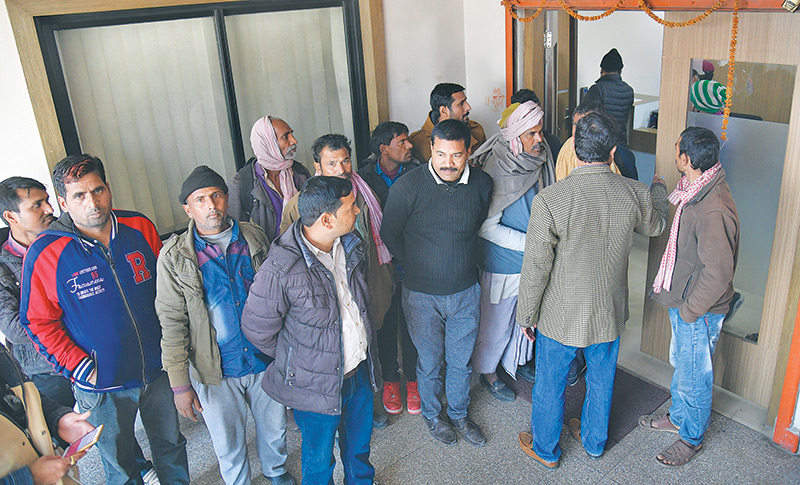
Sugarcane farmers from Sarlahi protest at the Kathmandu office of Annapurna Sugar Mill. Post file Photo
KATHMANDU, Babu Lal Ray is in deep trouble. He has received a foreclosure notice from his bank saying he could lose his land if he does not repay a loan he took three years ago for his daughter’s wedding. But Ray is broke because the sugar mill that owes him money hasn’t paid him. Ray, a sugarcane farmer from Ramnagar in Sarlahi, had planned on paying off his Rs900,000 loan with the money that he received from Annapurna Sugar Mill for his crops. He has repaid Rs500,000 so far but the mill still owes him Rs275,000. Ray does not expect to be paid anytime soon. “If I do not pay back the loan, the bank will seize 12 katthas of my land,” 67-year-old Ray told the Post. Like Ray, many sugarcane farmers in Sarlahi have either received only small amounts or nothing at all from sugar mills. The farmers should have received more than half of their dues by now, as per the five-point agreement reached on January 4 between sugarcane farmers and the Ministry of Industry, Commerce and Supplies. The ministry had assured the farmers that the sugar mills would be made to pay all outstanding dues by January 21. A week remains for the deadline and farmers have little hope that the mills will abide by the agreement or that the government will be able to compel the mills to pay farmers. Rajesh Yadav, who came to Kathmandu in late December to protest non-payment of dues, said he had only received a small amount. Annapurna Sugar Mill owes Yadav Rs1.2 million, but he has received just Rs158,000. He is owed money by Annapurna and Mahalaxmi Sugar mills. As per the agreement, the mills would have to clear 80 percent of dues by January 9, but this has not happened. “I have no hopes that the mill owner will make their payment by the deadline,” said Yadav. “We have not received the subsidy provided by the government either. We will come to Kathmandu again if we do not receive payment and things do not go according to the agreement.” According to Kapil Muni Mainali, president of the Nepal Sugarcane Producers Federation, farmers have yet to receive around Rs800 million out of the more than Rs1 billion that the mills owe them. Mainali said that Annapurna Sugar Mill has only paid Rs200 million out of Rs500 million. Annapurna Sugar Mill and Indira Sugar Mill are both owned by Rakesh Agrawal, who, last year, had colluded with the payment committee to take Rs 40 million in subsidies that were meant for farmers, said Mainali. Both Annapurna and Indira are currently out of operation citing a lack of funds. Shree Ram Sugar Mills is not in operation either while Lumbini Sugar Mills, whose owner recently died, has not made any payments yet, but the factory is in operation, Mainali said. “We have no hopes that Annapurna, Shree Ram and Indira Sugar Mill will make their payments by the deadline,” Mainali said. Mahalaxmi Sugar Mill, which owes Rs50 million to farmers, has come into operation after reaching an agreement with farmers to clear the dues. There are three sugar mills in Sarlahi with 15,000 to 16,000 commercial sugarcane farmers. Around 4,000 sugarcane farmers are engaged by Annapurna Sugar Mill. Yadav also said that sugar mills have been exploiting farmers by reducing the price of sugarcane by 15 percent. Binod Khadka, information officer at the Department of Industry, said they have not received any written communication regarding the payments made by the sugar mills. “We have only received verbal updates from sugar mills on their payment status,” he said. According to Dinesh Bhattarai, secretary at the Ministry of Industry, Commerce and Supplies, the ministry will initiate “administrative processes” if sugar mill owners fail to pay their dues by the deadline. “However, we have not yet decided what these processes will be,” said Bhattarai. Given the ordeals that they have had to go through just to receive the money that is their rightful due, farmers in Sarlahi say they are not keen on growing sugarcane any longer. “We’ve opted for other cash crops,” said farmer Raudi Mahato.
HOME PAGE
New Indian envoy to Nepal brings experience working with Modi, China, SAARC
Vinay Mohan Kwatra served in Beijing as deputy chief of mission and at SAARC Secretariat in Kathmandu.
- ANIL GIRI
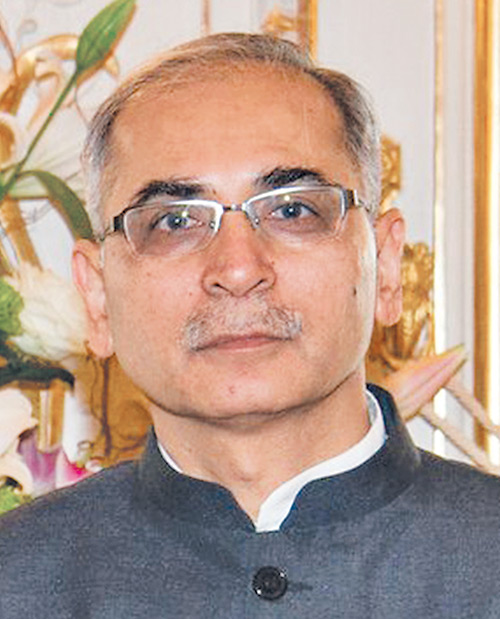
Vinay Mohan Kwatra
KATHMANDU, Fifteen days after the departure of Manjeev Singh Puri, New Delhi has named Vinay Mohan Kwatra as the new Indian ambassador to Nepal. Kwatra, a seasoned diplomat who has served across the world, is currently serving as India’s ambassador to France. A senior Foreign Ministry official confirmed to the Post the receipt of an agreemo from the Government of India for the appointment of Additional Secretary Kwatra as the next Indian ambassador to Nepal. “We will review his agreemo and communicate to the Government of India soon,” the official said. Kwatra is still in Paris and once his agreemo is approved from Kathmandu, he will return to New Delhi, where he will be briefed by various Indian government agencies on Nepal affairs before taking up his new assignment in Kathmandu, possibly next month. Kwatra’s experience at the SAARC Secretariat in Kathmandu means that he is familiar with Nepal affairs, which could be one reason why Indian Prime Minister Narendra Modi picked him for the embassy in Kathmandu, surmised one Nepali leader who did not wish to be identified. In New Delhi’s political circle, Kwatra was known as the first choice of the Bharatiya Janata Party for the Nepal assignment. Kwatra was seen as someone who will be able to handle crucial issues, including the rising geopolitical competition between China, India and the United States over Nepal, one Nepali diplomat told the Post. Outgoing Indian Ambassador Puri came to Kathmandu when Nepal-India ties were at a historic low. Nepal was still reeling from the Indian blockade of 2015 and Puri faced the uphill task of restoring ties. Now, as Kwatra comes in, Nepal-India relations might not be at 2015 levels but India’s inclusion of Kalapani, which Nepal claims, inside its borders on a new political map has caused new tensions. Kwatra, who brings 32 years of experience in the Indian Foreign Service, first served in Geneva. Since then, he has handled numerous portfolios across the world, including South Africa, Washington and China. He worked at the Indian Prime Minister’s Office from 2015 to 2017 before taking up the assignment in France. He is a 1988 graduate of the Indian Foreign Service with a master’s in science and a diploma in international relations. During the first term of the Modi government, Kwatra worked as Officer on Special Duty for more than two years at the Prime Minister’s Office, serving as a liaison between the Ministry of External Affairs and various other Indian ministries. Dipak Adhikari, the Nepali ambassador in Paris, who has met Kwatra several times, said that he recalled his stay in Kathmandu fondly and called it a “prize” posting. “I found him very positive towards Nepal. He would tell me that he enjoyed his stay in Kathmandu a lot,” said Adhikari. In Paris, Kwatra was an able diplomat, adept at handling Indian interests with France, which today is one of India’s closest partners, said an Indian diplomat on condition of anonymity. “From the Security Council where France supports India to areas such as space, climate change and nuclear energy, the cooperation has been extensive,” said the Indian diplomat. “The role of the ambassador was critical and Kwatra’s performance showcases his ability to deliver on the government’s requirements.” A number of Nepali diplomats and political leaders who know Kwatra from his time at the SAARC Secretariat told the Post that he appeared to enjoy his stay in Kathmandu. From 2006 to 2010, Kwatra represented India at the SAARC Secretariat in Nepal as head of the Trade, Economy and Finance Bureau. “We met several times in Kathmandu when he was with SAARC,” said Nepali Congress leader Udaya Shumsher Rana. “He is academically sound, soft-spoken and knows several aspects of Nepal.” Kwatra has worked with UN organisations like the International Labour Organization and the World Health Organization. He served at the Indian consulate in Durban, South Africa, where he was responsible for commercial and economic tasks. Later, he was posted in China as deputy chief of mission, again handling trade and commerce. In May 2010, he moved to Washington, DC, where he was the head of the commerce wing at the Embassy of India.
HOME PAGE
Widows in Nepal still need to fight for their property right
Despite legal provisions that ensure widows’ rights to the property of their husbands, implementation has been impeded by societal norms and customs.
- ELISHA SHRESTHA
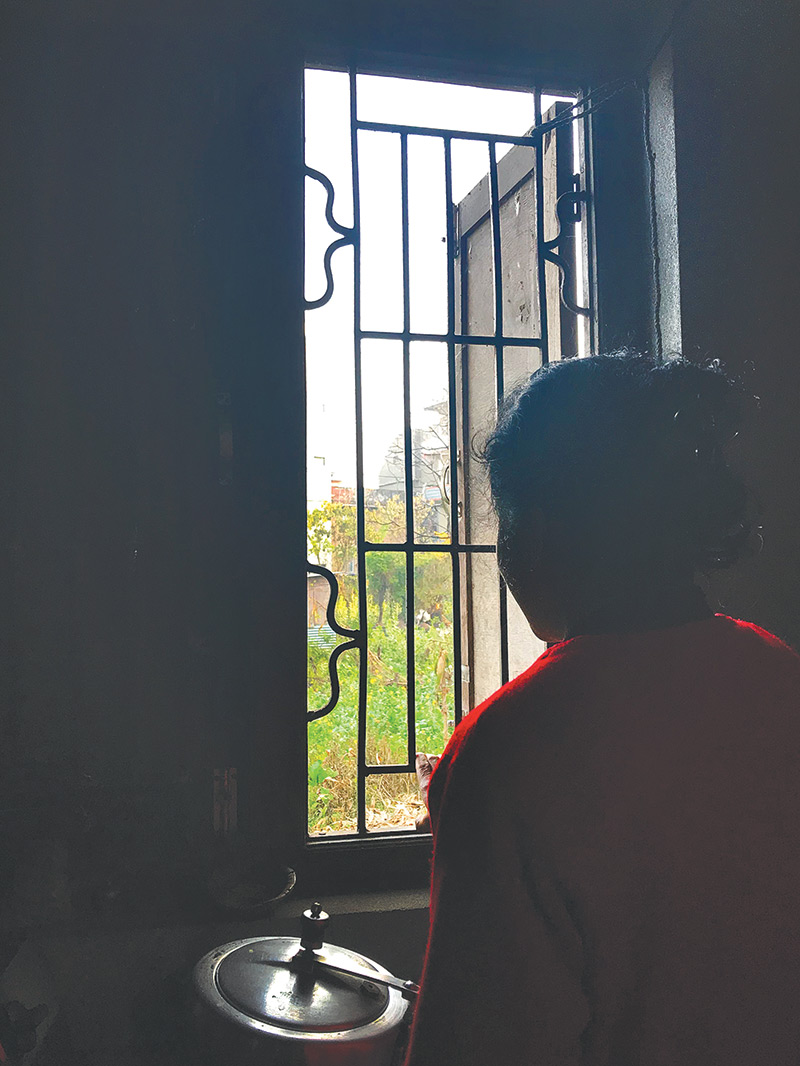
A single woman works in kitchen. Post Photo: elisha Shrestha
LALITPUR, Deepa was just 30 when her husband died of blood cancer. They had been married three years and had a 13-month toddler. When the earthquakes of 2015 struck, the house where she was living with her daughter and mother-in-law was destroyed. Deepa knew that her husband had some land so she attempted to get a loan to rebuild her home with that land as collateral. That was when she realised how difficult things can be for a widow. “My two brothers-in-law and their wives refused to give me the deeds to the land and his citizenship,” said Deepa, who is now 42 and lives in Lubhu, Lalitpur. “I was told that I didn’t have the right to my husband’s property.” Deepa, who asked that she only be identified by her first name, knew that wives are legally entitled to their husband’s property after death, but she didn’t know whom to turn to and how to go about ensuring her right. With little recourse, she and her daughter ended up at her brother-in-law’s house for two years, doing all the household chores while being physically and verbally abused, she said. The 2011 census estimates that there are 498,606 widows in Nepal. According to records maintained by Women for Human Rights, an organisation that advocates the rights of single women in Nepal, around 100,000 widows from across the country have registered as members. Before the 11th amendment to the Muluki Ain, widows had few rights to property, with exceptions under special circumstances. However, after legislative changes, widows’ rights to inheritance have been addressed to a certain extent. According to the 12th amendment to the Muluki Ain in 2007, wives, along with children, are entitled to a share of the property of the husband, even if the husband dies before the property has been partitioned. The 2015 constitution and the new civil code both address widows’ property rights and set penalties for a failure to transfer property to widows. Despite these legal provisions, implementation continues to be problematic. According to women’s rights activists, this is because inheritance is still beholden to societal customs and religion. According to Lily Thapa, founding chairperson of Women for Human Rights, all too often, progressive laws are not implemented because they go against established customs and practices. “Inheritance rights are mostly governed by personal beliefs, influenced by personal interests, religion and traditional culture. As a result, widows in patriarchal societies are often deprived of their rights to property,” said Thapa. In most cases, widows are deprived of their inheritance rights and benefits because their in-laws prevent them from accessing their husband’s documents, said Thapa. And in the earthquakes of 2015, along with their homes, many lost important legal documents such as citizenship and property deeds. After the earthquakes, numerous widows filed complaints through Women for Human Rights regarding property disputes as they had lost their original documents. Around 50 percent of them said that their in-laws weren’t cooperative enough, said Thapa. Amisha Tamang, coordinator at Chhahari, a rehabilitation centre operated by Women for Human Rights for widows who have been victims of abuse, said that in some cases, widows themselves choose not to claim property or benefits because they think that family members or society will look poorly upon them. “These self-imposed barriers are the results of a lack of knowledge that their rights exist,” said Tamang. “In other cases, some widows are simply not in an empowered position to fight for their rights.” Deepa too was afraid that her demands for property could pose a threat to the family’s integrity. “At that time, my brother-in-law was a secretary of the ward that we live in. He was a powerful person,” she said. “I didn’t want to go to court, knowing that if I take legal action, I would make enemies with my family and society. I have to live in this society, and I was scared.” A lack of property can leave widows vulnerable to different forms of violence, say activists. “Widows are poorly treated minorities in Nepali society. They are often held responsible for their husbands’ deaths and they become more vulnerable to physical, sexual and psychological abuse when they aren’t financially empowered,” Thapa said. According to her, 80 percent of the widows who come to the organisation to seek their right to property, have been victims of physical, sexual or psychological violence. She estimates that around 80 percent of widows have been deprived of their inheritance rights while only around 11 percent of the women have a home in their name and 20 percent have land in their name. A lack of access to property ownership and inheritance can result in women’s inability to access credit from banks. To increase the number of female landowners in the country, the government has discounted land registration fees for women by 25 percent in urban areas and 30 percent in rural Nepal. Thapa further said that single women and widows are eligible for a 5 percent tax deduction on registration fees. Although the new civil code also addresses widows’ property rights, there are still loopholes that prevent widows from exercising their rights. “The new civil code states that the widows who remarry have to return the property that they inherited from their deceased husband,” said Thapa. “We are fighting that and have already submitted a memorandum to the concerned committee. If it doesn’t get corrected soon, we will go to the Supreme Court.” As for Deepa, she has managed to trick her sister-in-law into providing her with her husband’s land documents. “I worked in my brother-in-law’s home as a maid, doing all the chores. My goal was to win my sister-in-law’s trust,” said Deepa. “I asked her if she could give me the documents so that I could get a loan from the bank to build a home and that once I get the loan, I would return the document to her. I haven’t returned it and I won’t. I need to think about my daughter’s education too.”
MEDLEY
Horoscope
ARIES (March 21-April 19) *** If there’s a party coming up, make sure that you’re one of the first people to arrive. You need to boost your energy into high gear, and dancing the night away is the perfect way to do it. Even if you feel the need to hibernate at home, it would be wise for you to get out into the world tonight.
TAURUS (April 20-May 20) ** Some days are sprints, other days are marathons, and today could fall into either category. It all depends on your energy level. Things are uncertain right now, so if you’re feeling tentative, you’ll be in for a glacial pace. Small energy bursts might pop up here and there, but overall it could be snoozy. Endurance will be key!
GEMINI (May 21-June 21) *** Working in a group today requires you to budget your time and energy. Otherwise, you could run out of gas before you reach your destination. Make sure everyone understands what needs to happen upfront before things move into high gear. Unless you draw up a road map, some people could get lost, and quite a few tempers could blow.
CANCER (June 22-July 22) **** You’re feeling extremely good today. Your intense positive energy is amplifying your sex appeal. You’re getting noticed in a way you may have never have been noticed before. Expect double-takes and slack jaws wherever you go. Whatever physical change you’ve recently made for yourself is working wonders.
LEO (July 23-August 22) *** You have excellent self-control right now. Resisting temptation is a good way to use this strength you have, but subjugating your emotions is not. Controlled anger is still anger, make no mistake about it. You have got to let your emotions out today. Step right up to that person you’ve been avoiding.
VIRGO (August 23-September 22) ***** Your friends are adding a lot of positivity to your life right now. Observe their successes and gain inspiration for making some magic of your own. They have excellent ideas that can help you start some wonderful things, so pick their brains. Now is a good time to expand your ways of thinking about who, and how, you love.
LIBRA (September 23-October 22) *** If you suddenly have an urge to take your coffee or tea a different way this morning, go for it! Getting caught up in a routine can be a comforting thing, and having things your way makes this crazy world feel more manageable. But a routine can come dangerously close to creating too much monotony in your life.
SCORPIO (October 23-November 21) **** A friend may have a project for you that could be lots of fun. Pitch in and give them some of your time today. Your involvement guarantees some positive energy, and they understand that. Their gratitude will tighten your friendship, and you could be the key to their ultimate success.
SAGITTARIUS (November 22-December 21) ** Your fiery enthusiasm for what you believe in is powerful. You can always make things happen with your emotional conviction, but today, rein in that power and keep it to yourself. Controversial conversations could be filled with traps. If you jump into things headfirst, you may end up getting burned.
CAPRICORN (December 22-January 19) ** Listening to other people is a lot easier than listening to yourself right now. There’s a lot of internal chatter going on in your brain, and it might not be making too much sense to you. This is your subconscious working through issues that you might not even be consciously aware of.
AQUARIUS (January 20-February 18) ** If you have a regular physical exercise routine, try to mix it up a bit today. Doing the same thing over and over again is boring for you, and it’s boring for your body. And if you don’t have any physical routine, you definitely need to start one. It will make a big difference in your energy level and your attitude today.
PISCES (February 19-March 20) *** Thinking ahead can be daunting. There’s no such thing as a crystal ball, and sometimes when you plan too narrowly, you end up making dangerous assumptions. To avoid the pitfalls of forecasting your life, don’t get too tied up in time frames. Just think about what you want in your life and go about getting it.
NATIONAL
Corruption thriving at local level, recent surveys by anti-graft body show
Elected representatives are allegedly engaged in corruption to recoup their electoral expenses.
- PRITHVI MAN SHRESTHA
The anti-graft body had surveyed 3,000 people in 15 districts. Post file Photo
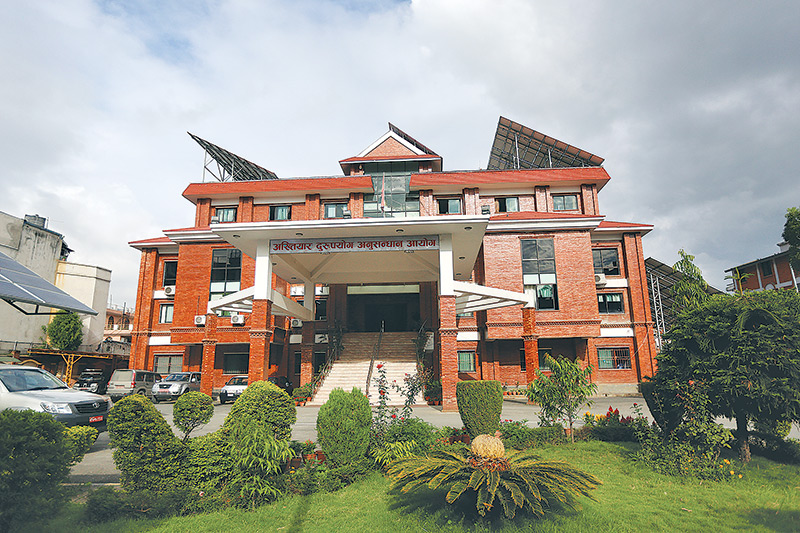
KATHMANDU, Two recent survey reports about the status of corruption and complaints received by the Commission for Investigation of Abuse of Authority suggest that corruption is thriving at the local level. It was thought that the country would get accountable governments at the local level after the elected representatives took charge of the governing affairs. But the surveys conducted by the anti-graft body suggest that having elected leadership alone does not guarantee good governance. A report on Study on Corruption at the Local Level, unveiled by the CIAA on Monday, showed that more than 50 percent of the survey respondents said that corruption at the local level either remained as it was in the past or thriving. As many as 27.3 percent of the respondents said that corruption at the local level had increased after the local elections. Similarly, another 28 percent of the respondents said that corruption continued to exist like in the past. Among the respondents, 14.9 percent said they were forced to pay bribes to receive services from their local units. The anti-graft body had surveyed 3,000 people in 15 districts. Both quantitative and qualitative methods were used for the survey. Another study conducted last year also showed that local governments were one of the most corrupt institutions in people’s perception. The survey report, “Study on Corruption and Good-Governance in Nepal-2075”, released in January last year showed that municipalities and rural municipalities were the second most corrupt entities after land revenue offices. The highest number of respondents (55 percent) termed land revenue offices as the most corrupt while 41.6 percent said they had to pay extra money to receive services from municipalities and rural municipalities. Khem Raj Regmi, president of Transparency International Nepal, an anti-corruption watchdog, said that one of the main reasons behind thriving corruption at the local level was that politicians in Nepal see politics as a profit-making career. “The politicians see politics as an easy way to accumulating property,” he said. Many reports suggest that elected representatives at the local level increased their own facilities—purchasing expensive vehicles and fixing high salary for themselves—instead of serving the public. With large resources going to local governments, the office-bearers in many local units have been found to have increased their own facilities. In October last year, the Supreme Court had annulled six provincial laws that allowed office-bearers of local units to draw monthly salaries. Another reason behind flourishing corruption at the local level is the high cost the office-bearers has to bear to win elections. When election becomes expensive, either a rich person should become a candidate, or one might have to depend on businessmen and contractors. “Once they get elected, they return the favour by providing contractors with projects and introducing policies to profit the businessmen,” Regmi said. The estimated poll spending by both—government and the candidates, in local elections stood at Rs69.42 billion while that for the federal and parliamentary elections amounted to Rs62.21 billion, according to a study conducted by the Election Observation Committee, Nepal. The latest survey of the CIAA also showed that 36.8 percent respondent remarked that corruption flourished at the local level as the elected representatives sought to recoup their election expenditure. “Currently, local governments are distributing new licences to D class contractors and most of them are relatives of elected representatives or party cadres,” said Rabi Singh, president of the Federation of Contractors’ Association of Nepal. “Such licences are being distributed without setting any criteria. Inexperienced people who are close to the elected representatives have received D class licences. Meanwhile, experienced sub-contractors are not getting their licences,” said Singh. He added that some elected representatives, who once worked as contractors, were transferring the ownership of their firms to their relatives so that they could award the project contracts to their own firms without raising suspicion. As per the Good Governance Act, public officials should not engage in works which invite conflict of interest. But this provision is not being implemented, according to Regmi. Although the CIAA has been taking action against government employees at the local level, hardly any elected representatives have faced action. “As elected representatives don’t sign documents by themselves, they usually succeed in avoiding implication. It is similar to the trend seen in the federal government,” Regmi said. “Active intervention from the main opposition parties could help prevent major corruption cases from the government. But in the case of Nepal, there is a tendency of several parties colluding to commit corruption.” In 2011, the anti-graft commission had scrapped all-party mechanisms formed at the local level in the absence of elected bodies due to many complaints about irregularities through political consensus. The number of complaints about corruption and irregularities at the local level has risen significantly in recent years, according to the CIAA. In the last fiscal year 2018-19, the highest percentage of complaints received by the anti-graft body were related to the Ministry of Federal Affairs and General Administration--the line ministry of local units. According to the commission, of the 24,085 complaints received in the last fiscal year, 26.87 percent complaints were related to the ministry. “Most of the complaints are related to irregularities and corruption at the local level,” Pradeep Koirala, spokesperson at the CIAA, said at a press meet on Monday. As per the disaggregated data of the previous fiscal years, complaints about the irregularities at the local level are on the rise. The percentage of complaints about irregularities at the local level was 14.6 percent in the fiscal year 2013-14, which climbed to 18.02 percent in the fiscal year 2017-18.
NATIONAL
81 percent of health facilities lack WHO approved refrigerators to store vaccines: Study
Experts say the quality of vaccines could be compromised if they are not stored in pre-qualified refrigerators.
- Arjun Poudel
Experts say live vaccines do not work if proper temperature is not maintained. Post Photo
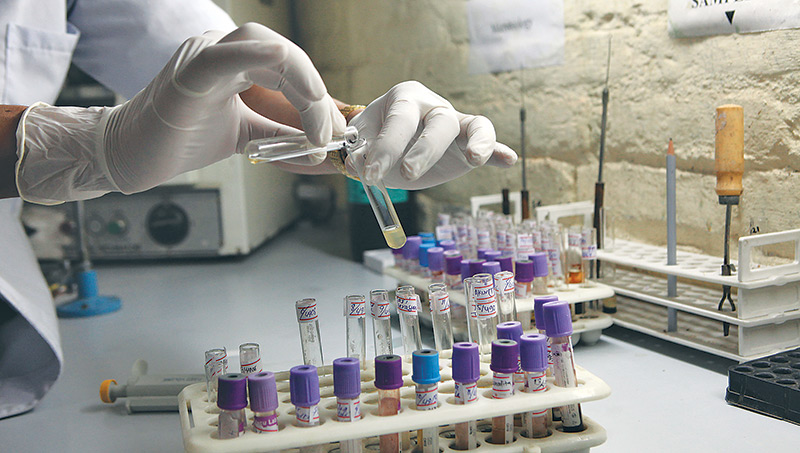
KATHMANDU, Around 81 percent of the private health facilities providing immunisation services are not using the World Health Organization recommended refrigerators to store vaccines, a report published by the Ministry of Health and Population shows. The study, “Assessment of Immunisation Services in the Private Sector in Kathmandu Valley”, carried out by a consortium of Atlanta’s Center for Disease Control and Prevention, Johns Hopkins University, John Snow Institute and the Health Ministry shows that these health facilities have been storing crucial vaccines in normal refrigerators, which cannot ensure the quality of vaccines. As per the recommendations of the UN health agency, pre-qualified refrigerators should be used to store vaccines to ensure performance, quality and safety. “The perception over the service quality of private health facilities may not be true in the cases of immunisation,” Dr Shyam Raj Upreti, who led the study, told the Post. “Even the renowned private hospitals like the Grande International Hospital is not storing the vaccines in the WHO-recommended refrigerator.” Lal Devi Maharjan, nursing director at the hospital, said that her hospital did not know that specific WHO pre-qualified refrigerator is needed to store vaccines. “It is not a big deal to have a WHO-recommended refrigerator for a hospital like ours,” said Maharjan. “We use the normal refrigerator, as we did not know about the requirements and have kept in contact with the concerned government officials about the matters.” She claimed her hospital had been regularly monitoring the temperatures of vaccines stored in their refrigerators. Of the 1,445 private health facilities operating in the Kathmandu Valley, 52 health facilities are providing immunisation services. Dr Upreti said that the quality of vaccines could be compromised if not stored in the WHO recommended refrigerators. Likewise, 67 percent of the private health facilities, which have been offering immunisation services, have been found to be not monitoring the temperature of the refrigerators. The immunisation service providers need to monitor the temperature of their refrigerators twice a day and keep their records. Experts say live vaccines do not work if the proper temperature is not maintained. Similarly, most of the private healthcare facilities offering immunisation services are not providing all vaccines on the government’s regular immunisation list, which increases the chances of children missing out on crucial vaccines. The study showed that 50.6 percent of people having the upper middle income (annual household income of $ 3956-$12,235), 38.8 percent people having lower middle income (annual household income $1,000-$3,955) and 10.6 percent people having the higher income (annual household income of more than $12,235) were receiving immunisations service from private centres. Among them, 70 percent chose private healthcare facilities since they were located close to their homes; 37.5 percent perceived a better quality of service in private health facilities; 17.5 percent said they went to private health facilities because of convenient timings; and 6.2 percent said the private health facilities were close to their workplace. “Our studies show chances of missing the regular vaccines are very high in private centres,” said Upreti. “Some health facilities are providing vaccines not included in regular immunisation list for which they could charge a fee.” Similarly, more than 69 percent of health facilities do not have a defaulter tracing system for drop-out children (children who do not receive all vaccines on the regular immunisation list). The study also shows that patients are being charged for free vaccines taken from the concerned agencies under the Health Ministry. Additionally, private healthcare facilities were found to be using normal syringes instead of auto-disable syringes.
NATIONAL
Reconstruction authority is building unified settlements in Makwanpur
- PRATAP BISTA
The National Reconstruction Authority has enlisted 34,319 households as housing aid beneficiaries in Makwanpur. Post Photo: Subash bidari
MAKWANPUR, Makwanpur district project implementation unit of the National Reconstruction Authority is constructing two integrated settlements at Jogital in Manhari Rural Municipality-5 and Baramtar in Kailash Rural Municipality Ward No. 10, in the district. The preliminary work for the project has already started, said Rabin Pathak, an engineer at the unit. The settlements would benefit the slum dwellers in Raksirang and Kailash rural municipalities. The land needed for the project has already been acquired, according to Pathak. The beneficiaries of the project will contribute labour. The National Reconstruction Authority has allocated Rs4 million for the settlements and Rs15 million for the renovation of infrastructure at Chitlang in Thaha Municipality. Chitlang is noted for ancient monuments, including Ashoka Chaitya. According to Pathak, the unit has plans to construct two unified settlements and renovate infrastructure in three other settlements. “The projects will be completed by this fiscal year,” said Pathak. Nearly five years since the earthquakes, about 41 percent of the victims have rebuilt their houses in Makwanpur, according to the implementation unit. A total of 34,319 households have been enlisted as beneficiaries in Makwanpur district. Among them, according to the project implementation unit, 29,505 families signed an agreement for the housing reconstruction aid. The government provides Rs300,000 to each household to build a new house. The beneficiary gets Rs50,000 in the first tranche, followed by Rs150,000 and Rs100,000 in the second and third instalments respectively. A beneficiary receives Rs100,000 to retrofit the earthquake-ravaged house.
NATIONAL
Province 5 trains community school teachers, students to improve SEE results
The province has introduced reformative education measures following poor performance by students in science and maths exams.
- Amrita Anmol
A lack of practical assignments has been blamed for students’ poor results in science. Post Photo: AMRITA ANMOL
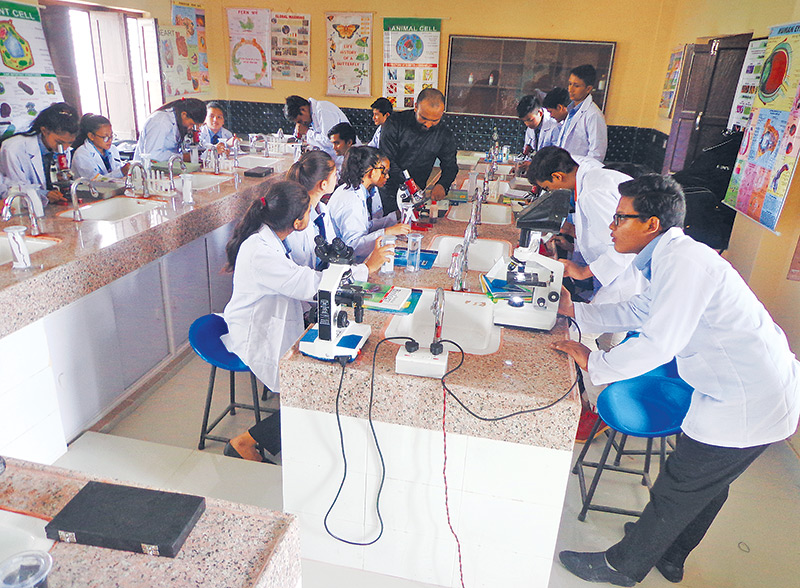
BUTWAL, In a bid to improve students’ performance in the Secondary Education Examinations, the Province 5 government has begun training community school teachers and running special classes for students. The programme, launched by the Ministry of Social Development in the province, aims to improve students’ performance in subjects like mathematics and science. According to the ministry’s statistics, of the 75,834 students who appeared in the SEE from the province last year, 43,878 students secured D and E grades in mathematics while 25,494 students secured similar grades in science. The performance of community school students was poorer compared to their private school counterparts, with around 70 percent of the students scoring below D grade, which is poorer than the SEE results of 2016. Social Development Minister Sudarshan Baral said that the provincial government came up with the programme to improve students’ grades. He believes the programme will open opportunities for students to pursue higher studies, including technical education, engineering and medical sciences. “We have begun the reform programme because if this trend continues, we will not have enough students and the targeted students will not get an opportunity to pursue technical education,” said Baral. The reformative move comes following a study conducted by the ministry following poor SEE results last year. The study had found that students’ learning progress was decreasing due to weak teaching methods, insufficient teaching time and a lack of practical assignments for subjects like science and maths. A committee has been formed under Baral to monitor and assess the improvement of SEE results. The committee also includes the secretary at the ministry, the director of the Education and Social Development, Education Training Centre, the head of the Higher Education Division and the head of the Educational Planning and Research Division. Results Improvement Monitoring Assessment Committees have also been formed at the district level under the chiefs of the concerned District Coordination Committee. According to Tika Ram Aryal, undersecretary at the Educational Development and Research Division, the provincial government has allocated Rs 50 million for the programme, with each school receiving Rs 20,000 to Rs54,000 depending on the number of students. “This year, we will operate special classes targeting grade 10 students and introduce reformative teaching methods for teachers,” said Thaneshwor Gyawali, undersecretary at the Educational Development and Research Division. “We will gradually introduce these measures in lower classes.” This, according to Gyawali, will remove the fear and generate confidence among the students regarding subjects like mathematics and science. This year, the province will run special classes in 742 secondary schools for science and 888 secondary schools for mathematics. The ministry has selected those schools with over 20 students in grade 10 who performed poorly in last year’s SEE. A 90-minute class will be run for 52 days for each subject by the respective teachers. If there aren’t any specific subject-related teachers, the province will seek volunteers to teach the respective subjects. “All the teachers, permanent and volunteers, have been trained by experts,” said Gyawali. “The teachers have been trained to incorporate practical and experiment-based teaching methods while conducting classes.” The programme is also aimed at discouraging students from taking extra tuition and coaching classes. As per the government data, over 90 percent SEE students opt for private tuition and coaching classes to improve their grades. Under the new teaching method, the students will be taught in a practical manner as opposed to the earlier theory-oriented classes. Nepal Mathematics Association Chairman Chetraj Bhatta said that the quality of teaching and learning methods for subjects like science and maths was declining as there were no practical and experiment-based teaching methods. “Students must not only be taught to parrot the formulae so as to pass the exams,” said Bhatta. “The results will see improvements only when students are taught to solve the problems in a practical manner from the primary level.”
(Madhab Aryal contributed to reporting.)
NATIONAL
Young girls in Kalikot taking one step at a time to fight menstrual banishment
Anti-Chhaupadi drives in Palata Rural Municipality are showing some positive results because of the involvement of young girls, say social activists.
- Tularam Pandey
Many girls and women in the district have stopped going to Chhau sheds during their periods. Post Photo: TULARAM PANDEY
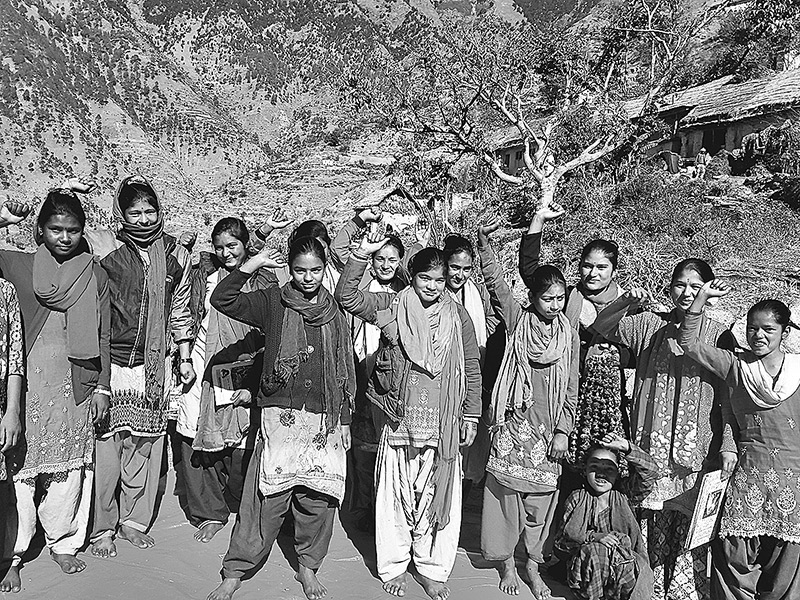
KALIKOT, Suchana Bhandari of Pulaha in Kalikot got her first period three years ago, at the age of 14. She informed her parents, who in turn told her that she must live in a ‘period hut’ outside the house for the duration of her period. Since then, staying in a period hut once a month became a part of Bhandari’s life. She saw the same story play out across the lives of many young girls around her. “We were suffering. None of us condoned this ill practice; we knew it was wrong. But it was an uphill task to make other people, including our parents, understand the futility of this practice,” said Bhandari. In the last three years, Bhandari and her friends have been seeking ways to fight against menstrual banishment practised in Nepal, mostly in the hilly regions of the country. Twenty young girls like Bhandari formed a group named Rupantaran Kishori Samuha to raise awareness on the negative impacts of Chhaupadi on women. “We know that it is a deep-rooted practice and will take time to put an end to it,” said Bhandari. “We have to be patient.” However, the practice firmly remains in place. Although Bhandari has not stayed in a period hut in the past year, she says that she still has a long way to go. “My parents had forced me to stay in a Chhaupadi shed fearing social stigma. I refused and we met halfway. They now let me stay in the house, although my movements are restricted during my period,” said Bhandari, recalling the time her parents did not speak to her for two days for refusing to stay in a shed. Women and girls in several settlements of Palata Rural Municipality are taking firm steps to abolish the practice of Chhaupadi. But they all believe that a lot of work remains to be done to achieve their goal. Many girls and women in the district have begun to stay in their houses during their period, but they still face discrimination. “We cannot enter the kitchen, puja room and are barred from eating certain food items. The discrimination continues,” said Nanda Kala Neupane of Khada. “Efforts are underway to end the age-long practice, but menstruating women and girls continue to face discrimination inside their house.” Although the complete eradication of the practice is a long way to go, various anti-Chhaupadi campaigns launched by teenage girls and young women have paved a way to fight against the practice. In Palata alone, there are a total of 27 such groups working relentlessly to put an end to Chhaupadi. “We have launched a campaign named ‘shed to home’. The village women do not go to Chhau sheds anymore,” said Yashoda Bhandari, the secretary of an anti-Chhaupadi group in Tallogaun. “This campaign may not bring marked changes in the current situation of women, but it sure is a step forward.” Anti-Chhaupadi drives in the municipality are showing some positive results because of the involvement of young girls, says Manalal Jaisi, a social activist. “It’s imperative to have young girls at the forefront of these campaigns. These girls have been educating other girls and women on menstruation and how it’s a biological process and nothing to be ashamed of,” Jaisi said. Meanwhile, the campaign against Chhaupadi has also helped minimise absenteeism in the municipality’s schools. “Earlier, many girls remained absent when they were on their periods. But now, with the heightened awareness on menstruation among young girls, they do not feel the need to skip school,” said Krishna Bahadur Bam, a teacher at Saraswoti Secondary School in Dhaulagoha.
NATIONAL
Drinking water project offers hope to Chaurjahari locals
The project is expected to source water from Bheri River and supply it to more than 1,000 households in the municipality.
- HARI GAUTAM
RUKUM (WEST), A new drinking water project has raised the hopes of Chaurjahari residents in Rukum (West) of being free of the drinking water crisis they have been reeling under for the past few decades. Chaurjahari Municipality residents have to wait for hours in communal drinking water facilities to fill their jars. “We have to face a lot of hardships because of a lack of water supply in our homes. With the new project reaching completion, we hope to be relieved of this problem,” said Bhadrulal Jaisi, a local. The drinking water project will source water from the Bheri river using water-lifting methods and supply water to 1,645 households of the municipality. A 1,050-metre-long pipeline and a reserve tank have been installed to facilitate the supply of water. The federal government’s plan to carry out a drinking water project in the municipality came about after the ward numbers 1, 2, 3 and 4 of the municipality were threatened by an impending drought. Bijayashwori-Chaurjahari Drinking Water and Sanitation Consumers Organisation started the project’s construction work in July 2018. Only five percent work of the drinking water project remains to be completed, said the organisation’s officials. “The project will be completed soon. We will have enough water to supply to each household in the municipality,” said Tej Bahadur Batala, chairman of the organisation. According to Batala, each household that is to receive the water facility will be asked to contribute Rs 5,000 for the project, install a tap and donate labour for the maintenance of the facility. The federal government had awarded the project’s contract to CAB Construction Company at Rs 160 million. “We are planning to hand over the project in mid-April, around four months before the set deadline. Around 95 percent of the work has already been completed,” said Prabir Dangi, a representative of the contractor company.
NATIONAL
Indigenous crops disappearing in the hills of Sudurpaschim
Government has not done enough to preserve and promote indigenous crops.
- Basanta Pratap Singh
Local farmers are no longer interested in growing indigenous crops. Post Photo: BASANTA PRATAP SINGH
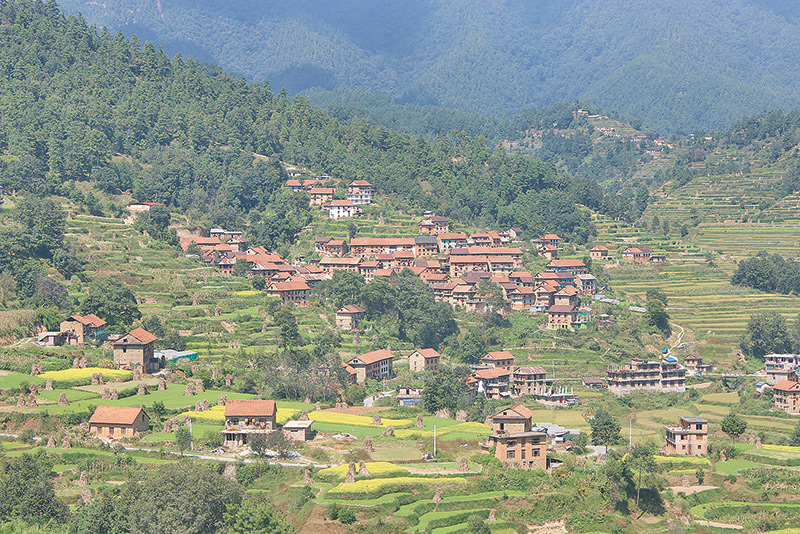
BAJHANG, Until about eight years ago, Ramesh Bista used to harvest up to 10 quintals of barley annually. The harvest not only filled his granary, but he would earn up to Rs 25,000 selling surplus produce. These days the annual barley harvest at Bista’s farm hardly reaches 50 kg. “Barley chapatis were a staple in every kitchen in the area in the past, but these days the eating habits of the locals have changed drastically leaving no demand for the crop,” says the farmer from Kailash village in Bajhang district. Bista has moved to other crops. He grows barley only to feed his cattle. Deepa Baduwal, another farmer at Tirkhadeni in the district, has also adopted new crops which are not indigenous to the region. “We used to cultivate plenty of barley, corn, and millet. But there is no demand for such indigenous crops anymore,” she said. Like Bista and Baduwal, the majority of farmers in the northern region of Bajhang, including in Surma, Dauli Chaur, Kanda, Dahabagar, Rilu, Masta, Dantola, Melbisauni and Dangaji villages, have stopped growing indigenous crops like buckwheat, Uwa, Chino and Kaguno. The production of Jumaro, Junelo, Marsya, and Teguno, among other indigenous crops, are also declining rapidly. They are being replaced with other cash crops. “Our younger generation doesn’t even know what these crops are or what they taste like,” said 84-year-old Pramanada Joshi, of Malumela. Before Nepal Food Corporation established its office in Bajhang, the farmers in the district used to grow indigenous crops. With the advent of rice cultivation, indigenous crops are disappearing in the district. A similar farming trend is taking over Baitadi and other hill districts of Sudurpaschim Province. Uddhav Singh Markand, a local of Khalanga, Baitadi, said: “Millet, corn, and barley have been struck out off our menu at home. If this trend continues, our future generation might not recognise millet and barley.” According to the data of the District Agriculture Knowledge Centre in Baitadi, production of millet is limited to 300 hectares now. Three years ago, farmers used to cultivate millet in around 500 hectares of land. Karna Bahadur Chand, acting chief at the District Agriculture Knowledge Centre, said farmers were no longer interested in growing corn and wheat. In Bajhang, until four years ago, barley was grown in around 2,000 hectares of land. The crop production is limited to just 600 hectares of land these days, said Dil Bahadur Singh, chief at the District Agriculture Knowledge Centre in Bajhang. According to him, cultivation of buckwheat and Kaguno is also declining in the upper hill region of the district. “Millet, barley and buckwheat are things of the past,” said Jhilke Khadka, a local of Kailash village in Bajhang. “Everybody eats rice these days. Easy availability of rice in the region has diminished the need to grow other crops.” The growing popularity of packaged food items has also pushed nutritional indigenous crops to the brink. And this is already causing adverse effect on the physical health of the local population. Dr Sandeep Okheda, medical superintendent of Bajhang District Hospital, said the rate of malnutrition is high in the district. “This is mainly due to high consumption of packaged food,” said Okheda, informing that even most of the food grains transported to Chainpur, the district headquarters, and other areas in the district are low in nutrition. “It is crucial to include indigenous crops in one’s diet,” he said. Krishna Chaudhary, a health worker of Sharmali Health Post in Baitadi, said dishes made from millet, barley, corn, and wheat have more nutritional values than any other food crops or processed food that are widely available. She said: “Malnourishment can be eradicated if these food crops find their way back into the diet of the locals.” Stressing the important role indigenous crops on one’s health, Ramlal Joshi, an agriculture technician, said that most of the indigenous crops cultivated in the high hills carry medicinal value. “Hybrid seeds can generate more production but indigenous crops help people adapt in high hills like Baitadi,” said Joshi. Agriculture experts said that the government had not played any role in the preservation and promotion of indigenous crops. Ram Prasad Joshi, chairman of District Agriculture Group, said: “There’s no subsidy in cultivation and preservation of indigenous crops. Besides, none of the authorities has taken initiatives to preserve these crops.” According to him, if this continues, indigenous crops will soon go extinct. “It is necessary to declare a special conservation area and take initiatives for the preservation of the indigenous seeds immediately.” (Tripti Shahi in Baitadi contributed reporting.)
NATIONAL
Senior citizens get warm clothes in Chhatreshwari
Briefing
- Post Report
SALYAN: The ward office of Chhatreshwari Rural Municipality-2 in Salyan recently distributed warm clothes to senior citizens. According to Ward Chairman Prem Bahadur Khadka, 34 elderly people were provided with warm clothes, including jacket, cap, trousers, socks and gloves, as temperatures in the area plummeted following recent rainfalls.
NATIONAL
Explosives planted in stone quarry defused
Briefing
- Post Report
PALPA: A bomb disposal team from the Nepal Army defused an Improvised Explosive Device (IED) recovered in a limestone quarry in Siddeshwori on Tuesday. The owner of the stone quarry, upon seeing suspicious objects in an excavator, informed the police of the situation.
NATIONAL
Ultimatum to remove hotels, eateries near no man’s land
Briefing
- Post Report
SIRAHA: The local administration has given a one-month ultimatum to hotel operators near the no man’s land in Bhagwanpur to move away from the area citing a rise in security challenges. The administration has restricted people from operating hotels and eateries within a kilometre from the no man’s land. There are more than 18 hotels and eateries operating within 50 metres of the no man’s land.
NATIONAL
Province 5 Assembly meeting to decide name and capital
Briefing
- Post Report
RUPANDEHI: The ruling Nepal Communist Party (NCP) has claimed that the winter session of Province 5 Assembly will name the province and designate its headquarters. NCP Chief Whip Bhumishwor Dhakal claimed the upcoming provincial assembly meeting slated for January 19 would resolve the issue of the name and capital of the province.
NATIONAL
Visit Madhes campaign launched across 22 districts
Briefing
- Post Report
BARA: While the Visit Nepal 2020 campaign is ongoing across the country, 22 districts in Tarai have launched the ‘Visit Madhes’ campaign, seeking to promote the region’s destinations, Om Prakash Sarraf, coordinator of the campaign, said. “Visit Madhes campaign seeks to promote tourist destinations in the Madhes independently,” Sarraf said. The campaign is being launched in coordination with local units from the 22 districts.
EDITORIAL
Bad medicine
Medicines are a matter of life and death, the concerned should ensure their quality.
The Department of Drug Administration, the national regulatory body for medicines, found as many as 41 samples, from 285 essential medicines, to be of substandard quality in the last fiscal year. The medicines were sampled from state-run health facilities throughout the country. Yet, six months into the new fiscal year, neither has the report of the laboratory tests been publicised nor has there been any effort from the concerned to ban and pull these inferior drugs from the market. The continued use of these medicines means that a large part of the population may have had their health adversely affected; many probably still continue to consume these drugs without any knowledge. This can lead to serious consequences—more so since the drugs were also being distributed through state-run facilities to the unwary. The fact that the drugs were allowed untested into the market shows how ill-prepared the health sector is to move forward with the federal system, as none of the provinces has laboratories equipped to test for quality. Moreover, the national regulator’s inaction further shows the inability of the government to deal with such quality failures. The shoddy medicines were only found after the Nepal Health Research Council, the federal government’s premier research and policy framing body for the health sector, sent the samples to the Department of Drug Administration for tests. The initiative did not come from the regulatory body itself. And the medications that were found to be substandard were all from the government’s essential drugs list. For example, samples of folic acid—an essential supplement that pregnant women take which helps in embryo development—were found to be inferior. This can have serious consequences on the brain and spine development of babies. Similarly, a crucial drug that helps patients with type 2 diabetes regulate blood sugar levels, metformin, was among the samples found to be of low quality. Metformin dosages are calculated to ensure that diabetes patients’ sugar levels do not reach a fatal point, and the provision of poor quality drugs can severely hamper their ability to survive. That such crucial drugs were allowed into the market, and into government-sanctioned distributive programmes, without testing is extremely worrying. This is a direct failure on the state’s part to ensure quality healthcare for its citizens. It also points to a failure of proper implementation of the federal health system. While the task of purchasing essential drugs has been handed over to the provincial governments, they still do not yet have the capability to conduct tests to ensure quality delivery. The problem here is that transition has occurred in an ad hoc, unsystematic manner. The process has failed to handle even the simplest of problems, such as transferring staff and defining the role of district health offices. But with the role medicines, from essential supplements to life-saving drugs, have in ensuring the health and wellbeing of generations of Nepalis, the provinces should have been provided more planning and funding support to set up regulatory agencies and laboratories before the transition to a federal system began. Still, the issue in this particular case goes deeper than a failure of transition or capacity. As soon as the Department of Drug Administration knew about the substandard drugs, it should have, in its capacity as a regulatory body, immediately moved to recall the inferior brands. It still can make amends—the public’s health depends on the concerned springing into action.
OPINION
Peace minus justice
The promises made under the Comprehensive Peace Accord have been thrown to the winds.
- DAMAN NATH DHUNGANA
Shutterstock
Some issues concerning Nepal’s peace process have drawn serious public attention. Prominent among them are tendencies such as going back on the promises made under the Comprehensive Peace Accord and evading immediate obligations, particularly concerning different aspects of transitional justice. The then prime minister the late Girija Prasad Koirala and Maoist leader Prachanda signed the pact in November 2006 with the sole objective of bringing a decade-long war (1996-2006) to an end and fostering a conducive environment for national reconciliation. The accord encompasses a very wide area of national reconstruction and humanitarian services. It covers vast areas of activity beginning from relief, repatriation and rehabilitation of victims to the composition of conflict managing tools, like commissions, to look into war-time human rights abuses. The pact also prescribes socio-economic transformation under state restructuring schemes including replacing feudal land ownership with a scientific land reform programme.
Rampant corruption The accord, seriously taking note of the menace of rampant corruption in the country, calls the political parties to adopt a policy of severe punishment against those acquiring unjust wealth while holding government office. Above all, the accord directs the entire state machinery to refrain from encouraging impunity in all walks of life. It is an entirely different matter to what extent our political parties have enabled themselves to combat corruption and other social evils with missionary zeal. Among the treaty provisions, disarming and demobbing the Maoist combatants was relatively best handled and finished, more and less, on time. More than 1,400 of the rebel fighters were ultimately integrated into the national army. This helped wind up the longstanding debate over whether the Maoist combatants should get a berth in the national army or not. It also raised questions like to what extent it was justified to let loose personnel skilled in the use of arms without a job guarantee. Besides the achievement in disarming and demobbing the rebels, sufficient power-sharing and active participation of the Maoists in the constitution-making process was well observed. So it is a big surprise why transitional justice alone was left unattended, overlooked and even neglected, from the very beginning, by the negotiating parties. This has given adequate grounds to the human rights community to call this behaviour and inexcusable delay an act suggesting ‘deliberate denial of the rights of war victims, encouragement to unaccountability and human rights violations’. While observing some key provisions and the extent of serious non-compliance with the promises, specifically with reference to Sections 5.2.3 and 5.2.5 of the Comprehensive Peace Accord, no sensible person would accept that kind of criticism as ‘baseless and biased’. It is so also because the pact directs the concerned parties in clear-cut words to immediately start conducting urgent tasks within a specified time: Make public the information about the real name, surname and address of the people who were disappeared by both sides and who were killed during the war and to inform also the family about it within 60 days from the date on which the accord has been signed; and investigate truth about those who have seriously violated human rights and those who were involved in crimes against humanity in course of the war and to create an environment for reconciliation in the society. In light of the above directives, one can imagine the magnitude of the act of negligence that has been committed. Instead of the 60 days’ time given by the accord, the concerned parties have already and unjustifiably taken time, as long as 13 years, that is about 25 times more than the originally fixed time. This stands as a perfect proof of the fact to what extent the parties in charge of the said responsibilities continue to be least interested and serious in or about the most urgent and topmost humanitarian task, such as transitional justice. It indicates, on the other hand, to what extent they are bent on keeping the task of constituting the commission hanging for an indefinite period of time in order to see evidences untraced and war victims fatigued.
Absence of fairness Further, looking back, there is clearly no dearth of instances substantiating the absence of fairness, from the beginning, on the part of the parties responsible for appointing the commissions and disposing cases concerning different aspects of transitional justice within a reasonable time period. To begin with, the very draft of Reconciliation Bill was unreasonably delayed, it was not in tune with international standards even while it was passed by Parliament, the concerned commissions were constituted only after about seven years of the signing of the peace pact. Therein also the political parties were managing the results to appoint the members on the basis of loyalty to their party, thus obviously killing the very spirit of independence of the commissions from the outset. Furthermore, the commission, even if constituted soon now, would not be able to expedite its work for the simple reason that successive governments have been turning a deaf ear to amending the concerned act despite the Supreme Court’s mandate to do so some seven years ago.
Dhungana is a former speaker of Parliament and peace facilitator during negotiations between the government and the Maoists.
OPINION
A foul sense of entitlement
Saving India’s democracy requires a focused strategy to funnel the already unleashed energy.
- JAWED NAQVI
The road-block protest is at the forefront of a rising challenge to Narendra Modi. AFP
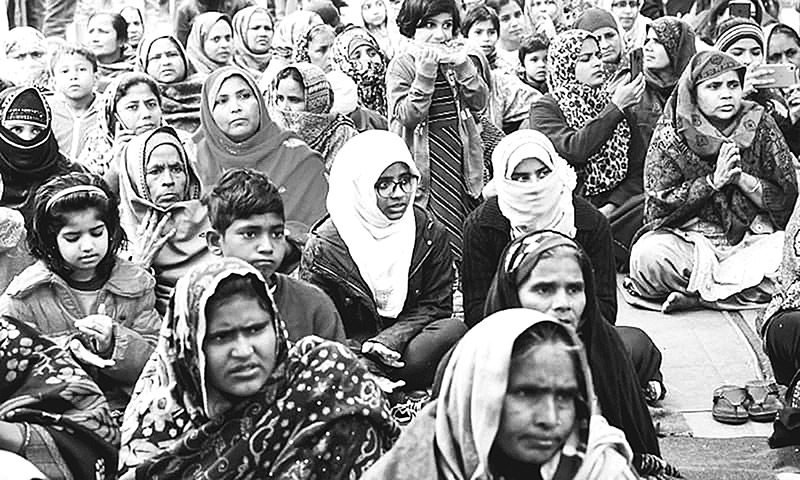
Now watch Narendra Modi smiling. Or is he laughing, chortling gleefully maybe? Let’s say he appears to be vicariously pleased, for good reasons, perhaps. Look. Women, some in their 80s, many Muslim but a lot many of different beliefs and non-beliefs too, are braving Delhi’s freezing cold. They are holding daily vigil come night or day at Shaheen Bagh, standing up for the constitution, speaking up for the young and old killed in different parts of the country in protests against a draconian and communal citizenship law. They are intensely hurt by injustices inflicted on Kashmiris. They keep their eyes peeled as others sleep, against stealthy encroachments by the rulers on their dream of a syncretic India, which Gandhi and Nehru raised them to dream about. They seem ready to make the sacrifices that outraged students across the country are prepared to make, as they once did in the Freedom Movement. They believe they are winning, and they are indeed an inspiration for the honest fight at hand. And what are the opposition parties doing? The headlines should warm the cockles of Prime Minister Modi’s heart. ‘Mayawati accuses the Congress of betrayal and says the party had poached her MLAs in Rajasthan on two occasions.’ Aishe Ghosh, brave student leader of JNU, meanwhile, got a few stitches on her bloodied head when fascist goons raided the Jawaharlal Nehru University. What is the opposition doing? Not long ago, Rohit Vemula died in Hyderabad after being hounded by the same goons who were backed by the same right-wing establishment. What did the opposition do? So what has changed since the fractious parties were roundly defeated in May last year for the second time in a row? The Dalit Bahujan Samaj Party, Trinamool Congress of West Bengal Chief Minister Mamata Banerjee, and Aam Aadmi Party will not be attending the opposition meet convened by the Congress to decide on a joint strategy on the Citizenship Amendment Act and the proposed nationwide National Register of Citizens. That’s what the news item says. Shiv Sena, the Congress ally in Maharashtra, has also said it wouldn’t take part in the meet. There are two elephants in the room—the left and the Congress. The left can live with Udhav Thackeray—sending the Shiv Sena a whole list of democratic ideas to pursue—but it cannot tolerate Mamata Banerjee. Visit any Marxist library and figure out the bizarre logic. Ironically, no one knows the history of Nazi Germany better than the left. The Congress cannot live without seeing itself as the leader of the opposition. P. Chidambaram was barely out from jail when he spelt out the caveat. The opposition should unite, but the Congress must lead. If not? Suffer fascism? The Congress might remember that the man who led them to freedom never sought office or power. The left might do what it does best—write a common minimum plan to involve the lowest common denominator. The Congress could push from behind if that is the only way the opposition cart can move. It needs to allay Mayawati’s fears, and help Arvind Kejriwal critically defeat the BJP in Delhi next month. The battle to save India’s democracy from being shredded requires a focused strategy to funnel the already unleashed energy. It has to tap into every ounce of courage on offer. Without a coordinated plan the mighty courage and furious energy on display in different parts of the country could add up to a pitiable defeat regardless of Priyanka Gandhi’s heroic scooter ride through police barricades. Old examples of grit are too old. The anti-Vietnam war campaign is cited. True, the students’ uprising in America and Europe did shore it up. But it would perhaps not have fetched victory or any peace against the mighty American military but for a couple of intrepid journalists who demolished Richard Nixon, meanwhile, in another theatre of battle, with the Watergate episode. Even the committed Daniel Ellsberg with The Pentagon Papers exposé got protected by the Watergate demise of Nixon. Julian Assange in comparison has had to struggle, as has Edward Snowden. When did we last hear of Mordechai Vanunu, blindsided by the harsh Israeli state for his heroic revelations of Israel’s nuclear arsenal? The steel frame of the Tudeh Party whose cadres had penetrated the deep state of the Shah and its extensive machinery of coercion overthrew the invincible emperor of Iran. For this, the party cadres marshalled their resources with care and preferred to keep things couched in quiet confidence. They harnessed the energies of the mullahs who were otherwise a chaotic lot with scant sense of organisation though they provided the emotional content to the ghettoised masses. The Tudeh overthrew the Shah but failed to carry the clergy and suffered complete decimation. India’s right-wing Hindus have absorbed this lesson from Iran after failing to capture total power by infiltrating the JP movement. Pakistan’s democracy needed a dictator’s air crash to survive. What is India’s opposition counting on? Prime Minister Modi may have hit the doldrums in his march to absolute power for now. But he firmly controls the critical levers of state power. He has the nation’s president from his party, and all the governors of states owing allegiance personally to him, enough to keep opposition-ruled states on their toes. The Supreme Court hasn’t shown excessive hurry to stall the travesty of justice erupting across the country, from Kashmir to Karnataka. Both houses of parliament have elected speakers handpicked by Modi. Theoretically, therefore, he can do as he pleases with the hollowed democratic order. The Nazis kindled the Reichstag fire and secured the Enabling Act in parliament that made Hitler the Fuhrer, while the fractious opposition obsessed over its doomed sense of entitlement. Indian democracy can yet be shielded from a similar denouement with only a spoonful of unadulterated selflessness. The women in Shaheen Bagh believe so.
This article was previously published in Dawn, a part of the Asia News Network.
OPINION
Achieving zero hunger in Nepal
Revitalising local food systems and transforming nutrition behaviour must be interconnected.
Shutterstock
A time could come in the future when you can take a food capsule a day to keep hunger away. But until such an invention arises, we have to keep cultivating and harvesting to eat—and eat healthy too. This means our farms have to remain productive, our farmers engaged and interested in farming, and our crops diverse and plentiful. But achieving that warrants a coordinated, innovative and institutional approach to ensure that no one is left behind when it comes to eating healthy food. Nepal is one of the 193 United Nations member states that have committed to achieving the 17 Sustainable Development Goals (SDGs) by 2030. SDG 2 concerns ending hunger, achieving food security, improving nutrition, and making agriculture sustainable. With 10 years to achieve these targets, Nepal’s National Planning Commission and several international institutions joined hands to discuss this agenda in December 2019. The consensus during this meeting was that achieving zero hunger and malnutrition requires interventions in issues beyond agriculture and health. Also, several underlying causes and drivers such as poverty, migration, market and trade, rural-urban development, environmental conservation, energy, resource management, and climate change have to be tackled simultaneously. Poverty and underdeveloped food systems pose enormous challenges to ensuring food and nutrition security. The increasing migration of labour (approximately 1,500–1,600 people every day) to foreign countries for gainful employment leaves our agricultural lands either fallow or transformed for non-farm use. Agricultural production naturally decreases given this outflow of labour, and so does the sector’s contribution to the national gross domestic product. In a country where the majority of the population is rural and dependent on agriculture for livelihoods, this is alarming. Sustainable agriculture must involve farmers as entrepreneurs. However, the idea of making agriculture economically viable is usually bound to the notion of cultivating more cash crops rather than diversified crops, commodities, and cuisines. The result is deteriorated local food systems and dietary diversity, along with the concomitant increase in malnutrition and micronutrient deficiency. About 8 percent of Nepal’s population remains undernourished. It is estimated that only 36 percent of children (6–23 months) receive the minimum acceptable diet, and 18 percent of women are undernourished while 41 percent are anaemic. A balanced, healthy diet must be available throughout the year. However, in remote villages, especially in the high mountains of Nepal, the availability of year-round nutritious food is impacted by the seasonality of agriculture, food shortages, and inefficient food imports owing to geophysical isolation. In urban areas, the consumption of year-round nutritious food is challenged by unhealthy dietary habits involving a higher intake of processed and energy-dense fast foods, leading to increasing cases of obesity and diabetes. The government believes that improving nutritional intake for all citizens is possible if the right policies and legislation, institutional arrangements, partnerships, and investments are in place. This is indeed possible, but the solutions have to be transformative, integrated, and innovative. The country’s Multi-Sector Nutrition Plan (MSNP-II) (2018–2022) is one such well-devised, integrated plan. It carefully analyses multidisciplinary challenges impacting food and nutrition security in Nepal; frames the objective of zero hunger and malnutrition within global development imperatives; and outlines plans for improved nutrition-sensitive education, health and population management, and agriculture. Such plans require a touch of programmatic balance and transformative leadership on the part of both citizens and the state. For transformative leadership, the key is having an interdisciplinary institution at all levels. The federal governance structure provides an excellent vertical (local, provincial and federal) and horizontal (between different ministries and departments) institutional connect to implement MSNP-II effectively. Advisory institutions at the federal level can set up overarching legal frameworks and policies, harmonising the plan’s targets with the SDGs. Provinces can have technical and steering institutions to prepare province-specific programmatic interventions and resource allocation plans. Local-level governments can coordinate and communicate responsive extension services. For citizens, the federal system provides an opportunity to exercise their fundamental right to food, nutrition, and health by vocalising responsible and educated consumer demand directly to the local-level government. To achieve the food and nutrition goal in 10 years, four interconnected actions, revitalising local food systems, transforming nutrition behaviour, strengthening extension and delivery services, and enhancing social learning must be reinforced. But nutrition challenges are not uniform; they vary with geography, agro-ecological potential, education, wealth, and the urban-rural setup. Government and external development partners thus have to prudently pitch sectoral programmes on agriculture, livestock, food, forest, environment, education, health, sanitation, water, energy, rural development, enterprise, finance, and technology, as per the demand from the ground. An information technology-based robust monitoring, evaluation, learning, and decision-support system would be a transformative innovation that could help connect citizens’ differential demands for food and nutrition security with the state’s targeted interventions. It would help the state to channelise resources and streamline programmatic interventions and investments.
Shakya specialises in mountain agriculture and sustainability science. She can be reached at [email protected]
OPINION
Why count birds?
Natural calamities, wars and exploitation worldwide have left the natural order of things under deep, lasting threat.
- Abida Rahman Chowdhury
Shutterstock
On a half-wooden, half-iron boat, a team of men and women in heavy winter gear and heavy-duty binoculars set sail on a very, very cold winter morning on January 5. Their destination was the sandbars and shallow water lagoons of the mighty Padma River. The team comprising conservationists, bird watchers, and foresters were conducting a census, the first of its kind in Rajshahi division. While this was the first time that the Bangladesh Forest Department and other official bodies were involved in a census of this kind in Rajshahi division, it wasn’t the first census per se in the area. In fact, bird censuses are now commonplace in the country—well, by commonplace, I mean carried out by a niche group of scientists, conservationists, ornithologists, and birdwatching enthusiasts/experts. From the high seas beyond Sandwip to the sandbars of Sonadia, from the shrublands of Tetulia to even tea gardens in Srimangal, the country has seen a surge in citizen science revolving around birdwatching and census in the last few years. While travelling, I chanced upon something enchanting. A barren mudflat that stretched for miles ahead; grey and steely, reflecting the mirage of the horizon, yet a land brimming with life. I saw ruddy turnstones appear fleetingly, only to be lost right back into the landscape strewn with red and brown pebbles on a bed of grey mud. Through a spotting scope, we would scan the land and conservationist Sayam U Chowdhury would erupt in squeals as he spotted a spoon-billed sandpiper, busily feeding in the mudflats. That was the identification trait for the tiny bird, of which less than a few hundred remained back then. The critically endangered bird had this nervous energy—it was tiny, tinier than a house-sparrow and it fed on the soft mud like a supersonic beast. It blended into the landscape and had flown all the way from Russia to spend its winter here. It is data such as this, and rare sightings and the ongoing biodiversity decline worldwide, that prompt conservationists to continue their work. Bird censuses are a way to monitor environmental trends in our local area, identify potential problems, and create a wealth of data. In the research carried out in Rajshahi that I mentioned earlier, one day of census counted a total of 4,025 birds of 37 species of waterbirds in the chars of Padma. Of them, 27 were migratory bird species and the rest were resident birds. Even the highest and second highest count of individuals—1,100 were of gadwall and 330 of Temnick’s stint species—are both migratory bird species. This is important because Rajshahi division falls under the Central Asian Flyway, which means that migratory birds fly over these areas to reach their wintering grounds and often stop here for rest and replenishment. The Padma and Brahmaputra river chars have been hotspots for birdwatchers and ornithologists. The somewhat untouched grasslands host many different species of birds, so much so that a rare sighting of Baikal teal, majestic and glorious in gait, was also seen during the census at Padma. Ornithologists under the Wildbird Monitoring Program, which was established last year, have also been tagging wild ducks with GPS-enabled satellite tags to understand the flight details of birds. The satellite tags and the wealth of data they provide to the conservationists is a long-term scientific endeavour. Flight patterns will reveal where and how the birds interact with their habitats, and their stopovers will show which places require long term conservation plans, among other things. In Rajshahi, for this season, conservationists have satellite-tagged two species of wild ducks. They tagged a common teal, weighing in at 310 gms and clocking in nearly 10 kms on the first day, and another 13.5 kms on day two. ‘We observed that the bird, especially during the nights, travelled to paddy fields to feed on small insects and vegetation in the soil. It is natural that they also leave bird droppings in the field which in turn enhances the soil fertility,’ says ABM Sarowar Alam, highlighting some of the ecosystem services of avian fauna on their surrounding landscape. In addition to enhancing soil quality, birds are also ecological indicators, and maintaining a database of their populations and habitat preferences can even help shape policies. Sayam U Chowdhury, conservationist working on endangered species in Bangladesh, says, ‘Scientists and conservationists need such data at their disposal because this can deter development projects on sensitive habitats or help in declaring protected areas.’ According to the National Audubon Society, birds are the ‘canary in the coal mine’ for our environment. Their health, abundance, and distribution can signal trends in the health of the larger environment. They are basically like the warning bells of nature—when the birds leave, it means the habitat is not doing well, it is suffering. Here in Bangladesh, citizen science too is starting to pick up pace. eBird, an app run by Cornell Lab of Ornithology, is being fed by data from local bird photographers and birdwatchers and has gained immense popularity. Natural calamities, wars, and exploitation worldwide have left the natural order of things under deep, lasting threat. As climate crisis becomes the new reality, it is up to us to continue the scientific work in the backdrop to guide policies and decisions.
This article was previously published in The Daily Star, a part of the Asia News Network.
CULTURE & ARTS
‘Joker’ leads Oscar nods with 11 as women, minorities miss out
In an industry criticised for its lack of diversity, the Oscars picked only one non-white acting nominee.
- Andrew Marzal
Nominated Director Todd Phillips (left) and Joaquin Phoenix on the set of “Joker.” Photos: AP/rss
Dark comic book tale Joker topped the Oscar nominations Monday, picking up 11 nods including best picture and best director, as women and ethnic minorities were largely shut out once again. The pre-dawn Academy Award announcement capped months of ceaseless campaigning by A-listers and studios, revealing which stars and movies have a shot at Hollywood’s ultimate prize next month. Todd Phillips’s Joker a bleak, arthouse origin story about Batman’s nemesis starring Joaquin Phoenix, was just ahead of three films. Quentin Tarantino’s 1960s Tinseltown homage Once Upon a Time... in Hollywood Sam Mendes’s World War I odyssey 1917 and Martin Scorsese’s The Irishman each earned 10 nominations, including best picture and director. South Korean class satire Parasite from Bong Joon-ho, secured the final best director slot, meaning once again no women made the shortlist. Much of the focus so far this award season has been on the lack of female and ethnic minority filmmakers honoured. The acclaimed Little Women was acknowledged in several of the major categories, including best picture, but Greta Gerwig was snubbed for best director, in a repeat of her disappointing omission from the Golden Globes. “Unfortunately there are just five nominees” for best director in an “incredibly strong year,” one Academy voter who asked not to be named told AFP. “I don’t think it’s a vote against female directors,” he added. In the history of the Oscars, only five women have been nominated for best director—including Gerwig, for 2017’s Lady Bird.
‘#OscarsSoWhite Part 2’ Little Women acting nominee Florence Pugh told Variety she was “happy that everybody is upset” over Gerwig’s snub. “Congratulations to those men,” actress and writer Issa Rae, co-host of the official Oscars nominations announcement, said pointedly as she presented the Academy’s picks. In an industry criticised for its lack of diversity, the Oscars picked only one non-white acting nominee—British star Cynthia Erivo, who plays US anti-slavery icon Harriet Tubman in Harriet. “This is more than a dream come true,” said Erivo, who was also nominated for performing the movie’s rousing anthem “Stand Up.” Notable snubs included Eddie Murphy for blaxploitation biopic Dolemite Is My Name, Jennifer Lopez for Hustlers, Awkwafina for The Farewell and Lupita Nyong’o for Us. Industry website Deadline Hollywood called Monday’s nominations “basically #OscarsSoWhite Part 2: #OscarsSoWhiter AndWithMoreMen,” referring to a hashtag begun in 2015 in response to the lack of diverse nominees. Last year, three of the four acting Oscars went to non-white performers. But in a possible sign of the Academy of Motion Picture Arts and Sciences’ increasingly international outlook, Parasite became just the sixth non-English language movie nominated for both best international feature and best picture. And the Academy pointed to a record number of female nominees overall, at 62. The figure includes movie producers, documentary makers and technical categories such as best musical score, where Icelandic maestro Hildur Gudnadottir became the ninth woman nominated.
Obamas ‘so thrilled’ Robert De Niro was the biggest star overlooked in the best actor category for The Irishman, although Scorsese’s nod makes him the most-nominated living director at the Oscars, with nine nods. The Irishman helped Netflix to 24 nominations—the first time it has ever topped the studio count. Adam Sandler shrugged off his omission for playing a compulsive New York jeweller, joking that he would no longer have to campaign for the acclaimed Uncut Gems. “Bad news: Sandman gets no love from the Academy,” he tweeted. “Good news: Sandman can stop wearing suits.” Acting frontrunners Renee Zellweger and Phoenix headed the Oscar shortlists for their star turns in Judy Garland drama Judy and Joker respectively. Documentary American Factory—which follows a US Rust Belt factory reopened by a Chinese billionaire—picked up a nomination for its well-known producers. “It’s the kind of story we don’t see often enough and it’s exactly what Michelle and I hope to achieve,” tweeted former US president Barack Obama, adding he was “glad” to see the nomination. “So thrilled,” wrote Michelle Obama. Some 9,000 Academy members vote for the Oscars. Voting for winners begins January 30, closing five days later. The Oscars will be handed out in Hollywood on February 9.
—Agence France-Presse
CULTURE & ARTS
‘Parasite’ director Bong says ‘language barrier’ broken after Oscar nominations
- Sangmi Cha
Parasite director Bong Joon-ho said he was surprised and overjoyed when the film won six Oscar nominations on Monday, a historic first for South Korea’s film industry and a sign that language is no longer a barrier to global success. Parasite, a dark comedy about the vast gap between the rich and poor in South Korea, snagged a coveted best picture nomination, best director for Bong, and best screenplay in addition to its best international feature nomination. “Every time they announced the new nominations, it was so thrilling, because we didn’t really anticipate any of this,” Bong told Reuters Television in an interview in California. Bong had previously discussed the challenges of international films breaking the “language barrier” around the world, but said the nominations suggest those barriers may now be falling. “We can say that thanks to the internet, social media and these streaming services, the entire society is experiencing less of these language barriers and perhaps Parasite benefited from that global trend,” he said. In a video shared online by film distributor NEON, one of the show’s stars, Song Kang-ho, manages to not spill a cup of coffee as he and others in the room excitedly celebrate. “The sign you’re a global superstar: You don’t spill your coffee when your film is nominated for Best Picture,” the company said. Kwak Shin-ae, the CEO of the production company, Barunson E&A, said she was delighted by the first Oscar best picture nomination for a South Korean film but disappointed Song did not get a nod for an acting category despite the crucial role he played in the film. “Being nominated for more than just the foreign language film category is meaningful because it means the film transcended language and nationally to communicate in the universal language of cinema,” she said. South Koreans, many of whom have watched the movie more than once, were also proud to share the honour. “I was so happy to hear that in the morning Parasite was nominated in many categories for the Academy Awards and I hope the film will make good results,” said Bae Young-sil, 62, who was with friends to watch another movie. A high school student, Kang Jin-gu, 18, said: “It plainly reflected the dark side of our society,” referring to the movie’s portrayal of the social disparity that has pitted the rich and the poor in Asia’s fourth largest economy.
–Reuters
CULTURE & ARTS
ScarJo, Erivo go for awards doubles
A look at some of the historic achievements and trivial tidbits from Monday’s nominations for the 92nd Academy Awards.
- Andrew Dalton
AP/RSS
A record 62 women, representing nearly a third of nominees, were nominated for Academy Awards this year, but none for best director. Scarlett Johansson is nominated in two acting categories, for best actress in Marriage Story and best supporting actress in Jojo Rabbit. This is the 12th time an actor has pulled off the feat. Cate Blanchett did it in 2008 for Elizabeth: The Golden Age, and I’m Not There, Jamie Foxx did it in 2005 for Ray and Collateral, and in 1994 there were two actresses nominated in two categories: Holly Hunter for The Piano and The Firm, and Emma Thompson for The Remains of the Day and In the Name of the Father. Another double nominee this year is Cynthia Erivo, who’s up for best actress and best original song for Harriet. She’s the third person to get acting and songwriting nominations, and all were recent. Mary J Blige did it in 2018 for Mudbound and Lady Gaga did it for A Star Is Born. Martin Scorsese, up for best director for The Irishman, is the most nominated living director with nine. The late William Wyler was nominated for best director 12 times. Antonio Banderas, 59, and Jonathan Pryce, 72, have both had long and illustrious careers, but both got their first Oscar nominations Monday. Both are up for best actor, Banderas for Pain and Glory and Pryce for The Two Popes. Despite being much younger, the category’s other three nominees, Adam Driver, Leonardo DiCaprio and Joaquin Phoenix, all have multiple Oscar nominations. “It makes me feel very, very very young,” Banderas said in an interview. With her best actress nod for Little Women, Saiorse Ronan has been nominated for four Oscars despite being just 25. The youngest to be nominated for the fourth time was Jennifer Lawrence at 24 in 2015. Parasite, from South Korea, is the sixth film to be nominated for best international film—before this year known as best foreign language film—and for best picture in the same year. Five of those, most recently Roma last year, won the foreign film Oscar but not best picture. Honeyland, a documentary about a keeper of wild bees in North Macedonia, achieved the rare double of being nominated for best international film and best documentary feature. Thomas Newman, nominated for best original score for his work on 1917, is part of an extended family film-scoring dynasty with nearly 100 nominations between them. His father, Alfred Newman, won nine Oscars in 43 nominations. His uncle, Lionel Newman, is an Oscar winner and his brother David Newman is an Oscar nominee. And cousin Randy Newman is nominated for both original score and original song this year. Alfred Newman’s 43 Oscar nominations is somehow not a record. John Williams got his 52nd on Monday morning—47 for music scoring and five for original song. Both fall short of Walt Disney, however, who had 59. Tom Hanks, nominated for best supporting actor for A Beautiful Day in the Neighborhood, has been nominated for six Oscars, winning twice, but this is the first time he’s been nominated in the supporting category. There really is an Oscar season. Of the nine best picture nominees, only one was released before October. Once Upon a Time ... in Hollywood came out July 25.
—Associated Press
CULTURE & ARTS
Famed Nyatapola receives post-earthquake facelift
The reconstruction of the early 18th-century temple marks the continuation of local participation in rebuilding heritage monuments.
- Shashwat Pant
The budget for the restoration of Nyatapola temple in Bhaktapur is Rs 6.3 million, but is anticipated to cost less. Post Photo: Keshav Thapa
Bhaktapur, On a cold winter morning, a group of men are gathered at the base of Nyatapola temple in Taumadi Square, Bhaktapur. They are waiting for another delivery of bamboo, which they have been using to build scaffolding around the famed temple. Five years after 2015’s deadly earthquake, the reconstruction has just begun. “We feel we owe it to the goddess,” says Ram Krishna Kiju, a resident of Suryabinak in Bhaktapur, who is taking part in the restoration of the temple. “The sooner we rebuild her home, the better our lives will become.” Bhaktapur has been commended for using local resources, both financial and labour, to build the toppled monuments around the Durbar Square area. Even when foreign donors offered help, especially the German government, the municipality declined. In all Durbar Square areas around the Valley, the main contention between the local communities and the government has been participation. Although the municipality aimed to complete all reconstruction work by the end of 2019, the reconstruction of Nyatapola temple could only begin at the onset of 2020. But like all other monuments in Bhaktapur, this one is being built by a user’s committee. “We feel that giving it to user groups is a more effective way to do heritage reconstruction,” says Sunil Prajapati, mayor of Bhaktapur. “The groups are made up of locals who will connect more with the monument than contractors.” The reconstruction will be ready by the end of April 2020, according to the mayor. He also attributes the success of all the earlier reconstruction projects to the locals’ participation. The heritage sites are intrinsically connected to the religious and cultural aspects of the locals, and their participation in its construction were seen as their way to take ownership. But unlike for other monuments, Nyatapola doesn’t require full reconstruction. In 2009, the temple went through restoration, which Keshav Tamakhu, the user committee’s president, says prevented the quakes from destroying the temple entirely, unlike other monuments, which lay as shadows of their former selves. According to Tamakhu, the temple mostly needs work on the top two floors. He says the top floor had tilted significantly to the east, while the floor below had also slightly tipped in the same direction. “The plan as of now is to demolish the top two floors and rebuild, because they’re in a poor state. We have consulted a lot of experts who have also told us to do so,” says Tamakhu. The budget for the restoration has been set at Rs6.3 million, but Tamakhu believes the project will be completed for less. “We don’t have to do much because part of the temple was strengthened in 2009, where a lot of old wood was replaced,” says Tamakhu. “It has significantly reduced the cost of the project.” The main concern now for the restoration committee is to get pahelo mato, a form of mud which was used for heritage construction in ancient times. It’s sticky and helps cement the bricks together, and is also quite rare. Since the committee is looking to rebuild the temple in the traditional way, they also want to incorporate this specific type of mud. But according to Tamakhu, due to urbanisation, it has been difficult to find pahelo mato, which used to be easily available. Even though the restoration work has just started, the study for the monument’s restoration began at the end of 2015, says Rajani Joshi, deputy mayor of Bhaktapur Municipality. In order to ensure the restoration projects went smoothly, the municipality also hosted two conferences, which brought together international engineers and architects, to discuss how to take the reconstruction forward. “Those conferences helped a lot. Our own people gained a lot of exposure, and we learnt a lot about what to do and what not to do,” says Joshi, who is also an architect. She also says most of the work done in the municipality came from architects of two colleges--Khowpa Engineering College and Khowpa College of Engineering, which also offers earthquake-related courses. Joshi says while the restoration blueprint has yet to be finalised, all the other studies have been completed. “The damage assessment has been done, along with various other surveys,” she says. “The report, which will soon be available to the public, will show how we worked with both local and foreign experts--architects, engineers, historians and archaeologists. These people now work with the committee and the locals restore heritage monuments.” The holistic approach to reconstruction in Bhaktapur is the primary reason the work on heritage sites is almost complete in the municipality. The 18th-century temple also holds a lot of cultural significance in the city. Apart from being the tallest pagoda-style temple in Nepal, it is also home to Siddhi Laxmi, the Mallas kul-deuta (ancestral god). There is also evidence the construction of the temple, from its foundation to installing its pinnacle, was completed within a period of six months. “It seems unbelievable but there is proof. Dr Janak Lal Vaidya has mentioned in his works how then-King Bhupatendra Malla kept records of the construction of the temple in 1701. It has every detail and is available at the National Archives,” says Dr Prushotam Lochan Shrestha, professor of history and culture at Tribhuvan University. Vaidya has translated the “Siddhagni Kotyahuti Devala Pratistha” manuscript, which has also since been translated into English. The reconstruction committee has also followed the translated works of Vaidya, in order to understand the historical background of the construction of the temple, and have an accurate blueprint as much as possible. Although the earthquake destroyed many historical monuments, Shrestha says the silver lining has been people’s renewed interest in their culture. This is the reason younger generations have been vigilant about heritage reconstruction and demand participation. “It’s a cultural rejuvenation of sorts. The locals, including children, are now more aware of their heritage than history books could have ever taught them,” he says. “I think the municipality should also be given a lot of credit for this. The local representatives have moved beyond their political agendas, and have worked to preserve culture through local participation.”
CULTURE & ARTS
Spike Lee to be first black head of Cannes film festival jury
Only one Asian, the Hong Kong auteur Wong Kar-wai, has ever led the Cannes jury in its 73-year history.
- FIACHRA GIBBONS
Acclaimed director Spike Lee rose to fame with films “Malcom X” and “Do the Right Thing”. afp/rss
American director Spike Lee was named president of this year’s Cannes film festival jury on Tuesday, becoming the first black head of the panel. The maker of Malcolm X and Do the Right Thing is the first person of black African descent to preside at the world’s biggest film festival, which is held in May on the French Riviera. Lee, 62, said he was “shocked, happy, surprised and proud all at the same time” to make history. The Cannes veteran has premiered seven of his films at the festival, with his debut movie She’s Gotta Have It causing a sensation in 1986 when it won the youth prize at Directors’ Fortnight. His appointment comes as activists criticised the Oscars on Monday for ignoring actors and directors of colour, with no nominations for the acclaimed performances of Awkwafina in the Chinese-American drama The Farewell and Lupita Nyong’o in the horror movie Us. Lee—who showed his last film BlacKkKlansman at Cannes two years ago—said “my biggest blessings... have happened out of nowhere. “I’m honoured to be the first person of the African diaspora (USA) to be named president of the Cannes jury and of a main film festival.” Lee will also be awarded a Palme d’Or, the festival’s top award, for lifetime achievement. In a written statement from his home in “Da People’s Republic Of Brooklyn, New York”, Lee said Cannes had changed his life. “To me the Cannes film festival (besides being the most important film festival in the world—no disrespect to anybody) has had a great impact on my film career. “You could easily say Cannes changed the trajectory of who I became in world cinema,” he added.
Lack of diversity Lee also thanked “the great people of France who have supported my film career throughout four decades. I will always treasure this special relationship.” Only one Asian, the Hong Kong auteur Wong Kar-wai, has ever led the Cannes jury in its 73-year history. French actress Isabelle Adjani, whose father was Algerian, became the first person of African descent to lead the jury in 1997. The world’s top film festivals have faced fierce criticism for their lack of diversity in recent years. Cannes and its rival Venice have faced growing scrutiny, particularly for the lack of female directors in their main competitions, even as they have chosen gender-balanced juries. More than 80 actresses and woman filmmakers led by then jury president Cate Blanchett staged a red carpet protest at Cannes for equality in the film industry in 2018. Lee was vocal in his support for the women at the time. “Spike Lee’s perspective is more valuable than ever,” festival director Thierry Fremaux said. “Cannes is a natural homeland and a global sounding board for those who awaken minds and question our stances and fixed ideas. “Lee’s flamboyant personality is sure to shake things up,” he added. Last year the jury was led by Babel and The Revenant director Alejandro Gonzalez Inarritu, the first Mexican and only the second Latin American to preside over the festival. The winning film, Korean Bong Joon-ho’s Parasite, has since become a runaway hit, winning the Golden Globe for best foreign film and six Oscar nominations.
--Agence France-Presse
WORLD
Idea to dismiss articles of impeachment cools in Senate
Speaker Nancy Pelosi has not set the timing for the House vote that will launch the Senate action.
- ASSOCIATED PRESS
The US Capitol dome in Washington. AP/RSS
WASHINGTON, Senate Republicans signaled they would reject the idea of simply voting to dismiss the articles of impeachment against President Donald Trump as the House prepares to send the charges to the chamber for the historic trial. “I think our members, generally are not interested in the motion to dismiss. They think both sides need to be heard,” Sen. Roy Blunt, R-Mo., who is part of GOP leadership, said Monday. It will be only the third presidential impeachment trial in American history, a serious and dramatic endeavor coming amid the backdrop of a politically divided nation and the start of an election year. Speaker Nancy Pelosi has not set the timing for the House vote that will launch the Senate action. Trump was impeached by the Democratic-led House last month on charges of abuse of power over pushing Ukraine to investigate Democratic rival Joe Biden and obstruction of Congress in the probe. Democrats said the vote could be Wednesday. With the impeachment trial starting in a matter of days, senators are still debating the rules of the proceedings. GOP senators are conferring privately about whether to allow a motion to dismiss the charges against the president or to call additional witnesses for testimony. Trump suggested over the weekend he might prefer simply dismissing the charges rather than giving legitimacy to charges from the House, which he considers a “hoax.” It was an extraordinary suggestion, but one being proposed by Trump allies with support from some GOP senators, including Majority Leader Mitch McConnell. But it is clear McConnell does not have the votes needed from his GOP majority to do that. One key Republican, Sen. Susan Collins of Maine, said she, too, would oppose a motion to dismiss the charges. Collins is leading an effort among some Republicans, including Sens. Mitt Romney of Utah and Lisa Murkowski of Alaska, to ensure the ground rules include plans to eventually consider voting to call witnesses. “My position is that there should be a vote on whether or not witnesses should be called,” Collins said. Romney said he wants to hear from John Bolton, the former national security adviser at the White House, who others have said raised alarms about the alternative foreign policy toward Ukraine being run led by Trump’s personal lawyer Rudy Giuliani. “I’ve said I’d like to hear from John Bolton,” Romney told reporters Monday. “I expect that barring some kind of surprise, I’ll be voting in favor of hearing from witnesses after those opening arguments.” Democrats have been pushing Republicans, who have the majority in the Senate, to consider new testimony, arguing that fresh information has emerged during Pelosi’s monthlong delay in transmitting the charges. McConnell is drafting an organizing resolution that will outline the steps ahead. Approving it will be among the first votes senators take after they are sworn as jurors by Supreme Court Chief Justice John Roberts for the Court of Impeachment. Republicans control the chamber, 53-47, and are all but certain to acquit Trump. McConnell is hesitant to call new witnesses who would prolong the trial. He prefers to model Trump’s trial partly on the process used for then-President Bill Clinton’s trial in 1999. It takes just 51 votes during the impeachment trial to approve rules or call witnesses. Just four GOP senators could form a majority with Democrats to insist on new testimony. It also would take only 51 senators to vote to dismiss the charges against Trump. Most Republicans appear willing to go along with McConnell’s plan to start the trial first then consider witnesses later, rather than upfront, as Democrats want. Collins is pushing to have at least the promise of witness votes included in the organizing resolution. She and the others appear to be gathering support. “I’ve been working to make sure that we will have a process that we can take a vote on whether or not we need additional information, and yes, that would include witnesses,” Murkowski told reporters. McConnell is expected to huddle privately with senators at their weekly lunch Tuesday. House Majority Leader Steny Hoyer told reporters the House vote might come Wednesday. “Could be,” he said.
WORLD
Rain offers hope in Australian bushfire fight
- AGENCE FRANCE-PRESSE
SYDNEY, Forecasts of heavy rain offered hope Tuesday in the months-long battle to contain Australia’s unprecedented bushfires, but smoke lifted pollution levels in the nation’s second biggest city to among the worst in the world. Cool weather over recent days has already given some respite for exhausted firefighters spread out across vast swathes of the country, with some of the biggest blazes now brought under control. Optimism was further boosted on Tuesday with heavy rain forecast for some of the hotspots in the most populated eastern states of New South Wales and Victoria. “It’s some pretty good news,” New South Wales Rural Fire Service commissioner Shane Fitzsimmons said. “We’ve been talking about it for months now, that January might see the first fall of decent rain, and that looks like what’s coming along over the next few days.” However, dozens of fires remained out of control and, with many weeks of hot weather still expected throughout Australia’s summer, there was no suggestion the crisis would end soon. Toxic smoke from the blazes also blew overnight into the Victorian capital of Melbourne, which is due to stage the Australian Open tennis tournament next week. Pollution in Melbourne, which is normally ranked as among the world’s most liveable cities, was rated “hazardous”, with health authorities warning people to stay indoors. Practice sessions for world number one Rafael Nadal and some of the other big names in tennis were suspended on Tuesday. Qualifying rounds for the Australian Open were also delayed for a couple of hours, and the organisers’ decision to resume play late on Tuesday morning caused confusion and concern for some players. Mandy Minella, the world number 140 from Luxembourg, voiced her opposition on Twitter. “Shocked to see that qualifying matches have started @Australian Open, What about the health of all the people that have to work out there, especially the ballkids?” she tweeted.
WORLD
Libya’s Haftar leaves Moscow without signing peace deal
- AGENCE FRANCE-PRESSE
Russian Foreign Minister Sergei Lavrov (right) and his Turkish counterpart Mevlut Cavusoglu hold a joint press conference following thetalks on a ceasefire deal between the warring sides in Libya, in Moscowon Monday. AFP/RSS
MOSCOW, Libyan strongman Khalifa Haftar left Moscow on Tuesday without signing a ceasefire agreement aimed at ending nine months of fighting, leaving the future of a fragile truce uncertain. The commander’s abrupt departure in the early hours of Tuesday was a setback for an international diplomatic push in recent days, though Moscow insisted it would continue mediation efforts. Turkish President Recep Tayyip Erdogan—who first brokered the Libya truce deal with President Vladimir Putin of Russia last week—warned he would “teach a lesson” to Haftar if his forces resumed fighting. Haftar and his allies were in Moscow on Monday for talks with the UN-recognised government headed by Fayez al-Sarraj that is based in Tripoli. Sarraj’s government has been under attack since last April from forces loyal to Haftar, who is based in the east of the oil-rich North African country with his own loyalist politicians. The two sides had agreed to the ceasefire that took effect at the weekend and were in Moscow to sign a long-term agreement. The talks raised hopes of an end to the latest fighting to wrack Libya since a 2011 NATO-backed uprising killed longtime dictator Moamer Kadhafi. after seven hours of negotiations, only Sarraj had signed on to the agreement and Russian officials confirmed to AFP that Haftar’s delegation had left without inking the deal. “We will pursue our efforts in this direction. For now, a definitive result has not been achieved,” Russian Foreign Minister Sergei Lavrov said at a press conference in Sri Lanka. Russia, European powers and Libya’s neighbours “are working in the same vein and motivating all Libyan sides to agree rather than continue sorting things out by force”, Lavrov said. Russian state news agency RIA Novosti quoted a source in Haftar’s stronghold Benghazi as saying he did not sign because the agreement did not spell out a timeline for disbanding groups allied with Sarraj’s Government of National Accord. Erdogan reacted angrily, saying in a televised Ankara speech: “We will not hesitate to teach a deserved lesson to the putschist Haftar if he continues his attacks on the country’s legitimate administration and our brothers in Libya”. Erdogan said the issue would now be discussed at talks in Berlin on Sunday to be attended by European, North African and Middle Eastern countries as well as the UN, EU, Africa Union and Arab League. “The putschist Haftar did not sign the ceasefire. He first said yes, but later unfortunately he left Moscow, he fled Moscow,” Erdogan said. “Despite this, we find the talks in Moscow were positive as they showed the true face of the putschist Haftar to the international community.” Western powers are keen to stabilise Libya—home to Africa’s largest proven crude reserves—following years of turbulence since the 2011 killing of Kadhafi. Since the start of the offensive against Tripoli, more than 280 civilians and about 2,000 fighters have been killed and 146,000 Libyans displaced, according to the United Nations. Putin and Erdogan made a joint call for a ceasefire, which started early Sunday and was welcomed by the United Nations. The leaders of Turkey and France on Monday called for a more permanent truce which would pave the way for a political process, while Germany was preparing its summit on Libya. Putin late on Monday discussed the talks in Moscow with German Chancellor Angela Merkel, the Kremlin said, following her visit to the Russian capital on Saturday. Turkey and Russia’s diplomatic initiative came despite the countries being seen as supporting opposing sides. Ankara dispatched troops—in a training capacity, it said—to support the GNA in January in a move criticised by European powers and US President Donald Trump. The GNA has signed agreements with Ankara assigning Turkey rights over a vast area of the gas-rich eastern Mediterranean, in a deal denounced by France, Greece, Egypt and Cyprus.
WORLD
US denounces citizen death in Egypt custody
- AGENCE FRANCE-PRESSE
WASHINGTON, An American citizen whose case was raised by top US leaders died Monday after more than six years in custody in Egypt, his representatives said, drawing criticism by Washington of its authoritarian ally. Mustafa Kassem, a New York taxi driver originally from Egypt who was arrested on a home visit in 2013, had been on a liquid-only hunger strike since last fall and four days ago ceased drinking fluids. The Egyptian interior ministry said he was transferred to the prison medic wing for treatment for his diabetes. “His condition deteriorated...and he died on January 13,” it said in a statement. The top US diplomat for the Middle East, David Schenker, described Kassem’s death in custody as “needless, tragic and avoidable” and offered his “sincere condolences” to his family. “I’ll continue to raise our serious concerns about human rights and Americans detained in Egypt at every opportunity, as will the entire team at the Department of State,” he said. Schenker, however, did not specify any repercussions for Egypt, where President Abdel Fattah al-Sisi has closely aligned himself with US President Donald Trump in their opposition to Islamists. Secretary of State Mike Pompeo had raised Kassem’s case last month in a meeting in Washington with Egypt’s foreign minister, and Vice President Mike Pence said he raised his case directly with Sisi on a 2018 visit to Cairo. The 64-year-old father of two, who most recently ran an auto-parts business on Long Island, New York was detained as part of a major crackdown in 2013 on protests against Sisi, who had seized power in a coup. Kassem denied he had joined the protests, saying that he had gone out to exchange money and had shown his US passport to police. He was nonetheless sentenced in 2018 in a mass trial with hundreds of defendants to 15 years in prison on charges of trying to overthrow the government, according to his lawyers. “No individualized evidence was ever presented against him,” Pretrial Rights International and The Freedom Initiative, which represented him, said in a statement.
WORLD
UK’s queen agrees grandson Harry, wife Meghan can exit senior royal role
A final decision on the future of the couple, officially the Duke and Duchess of Sussex, is expected in days.
- REUTERS
A file photo shows Britain’s Prince William, Duke of Cambridge (right) and Britain’s Prince Harry, Duke of Sussex. AFP/RSS
SANDRINGHAM (England), Queen Elizabeth has reluctantly agreed to her grandson Prince Harry and his wife Meghan’s wish for a more independent future after the British royal family held crisis talks on Monday to resolve a widening rift among the Windsors. Harry and his American actress wife will now begin a “period of transition” that will see them split their time between Britain and Canada as they also seek a lifestyle less encumbered by royal duties and to end their reliance on public funding. It comes after what the 93-year-old queen described as “very constructive discussions” between herself, Harry, his elder brother Prince William and his father and heir to the British throne, Prince Charles, at the monarch’s rural Sandringham estate in eastern England. A final decision on the future of the couple, officially the Duke and Duchess of Sussex, will be determined in days, she said in a statement. “My family and I are entirely supportive of Harry and Meghan’s desire to create a new life as a young family,” Elizabeth said. “Although we would have preferred them to remain full-time working members of the Royal Family, we respect and understand their wish to live a more independent life as a family while remaining a valued part of my family.” The statement was highly unusual both in its informal tone and its personal nature, addressing the couple by name rather than by their titles. Meghan, who is currently in Canada with their infant son Archie, had been expected to join Monday’s discussion by telephone. The royal crisis was triggered when Harry, 35, and Meghan, 38, publicly announced last week that they wished to step back from royal duties and spend more time in North America. Although there had been initial discussions about their future, neither the queen nor Charles were consulted beforehand, a step seen as hurtful and premature by a family whose roots go back through a thousand years of European history It also exposed suspected divisions in the Windsor family and prompted soul-searching over what it means to be royal in the 21st century. Harry and Meghan say they want a “progressive” new role for themselves and financial independence. As one of the world’s most glamorous couples, they have also made clear that they were struggling with the intense media scrutiny. Last year, they announced legal action against a British tabloid, and Harry said papers had been bullying his wife in a way reminiscent of the hounding his mother Princess Diana had suffered before her death in a Paris car crash in 1997. But it is unclear how they will pull off a partial pullback from royal roles —which some media have dubbed “Megxit” in a play on Britain’s tortuous Brexit departure from the European Union - or who will pay for a transatlantic lifestyle. Currently, they are mainly funded by money from Prince Charles’s Duchy of Cornwall estate as their royal roles have precluded them seeking personal incomes. “These are complex matters for my family to resolve, and there is some more work to be done, but I have asked for final decisions to be reached in the coming days,” the queen said in her statement. The breakdown in royal relations has dominated the British media for days, with newspapers running a host of stories, based on quotes from unidentified royal insiders, about a split between Harry and William, the Duke of Cambridge, and anger at the top of the family amid suspicion of leaks and ostracism. In a sign of the tensions, Harry and William issued a rare public statement on Monday to denounce a report by the Times newspaper based on an unnamed source which said Harry and Meghan had been pushed away by “a bullying attitude” from William who had not been welcoming to Meghan. “Despite clear denials, a false story ran in a UK newspaper today speculating about the relationship between The Duke of Sussex and The Duke of Cambridge,” the statement said. “For brothers who care so deeply about the issues surrounding mental health, the use of inflammatory language in this way is offensive and potentially harmful.” The furore over the couple, who married in May 2018 in a glittering ceremony watched by millions round the world, comes after a tough 2019 for the royal family. Prince Andrew’s friendship with convicted sex offender Jeffrey Epstein came under uncomfortable scrutiny while the queen’s husband, Prince Philip, 98, received a police warning over a car crash.
WORLD
Irish PM Varadkar to call Feb 8 national election: Reports
Briefing
DUBLIN: Irish Prime Minister Leo Varadkar will ask President Michael D Higgins to dissolve parliament on Tuesday in order to call a parliamentary election on Feb. 8, local media reported. Varadkar said on Sunday he had made a decision on the timing of a general election but would meet his cabinet on Tuesday first and speak to the leader of the main opposition party before ending the uncertainty. Varadkar told his ministers that he would travel to the president’s residence to get his approval to formally start the campaign and hold the poll on Feb. 8, the Irish Times and national broadcaster RTE reported. Children’s Minister Katherine Zappone, an independent lawmaker, said on her way into the cabinet meeting that she expected it to be the last time her colleagues met ahead of a February poll. (agencies)
WORLD
Sailor kidnappings surge off West Africa: Watchdog
Briefing
KUALA LUMPUR: The number of sailors kidnapped off West Africa surged by more than 50 percent last year, a maritime watchdog said on Tuesday, urging greater international cooperation to reduce piracy. The abductions took place in the Gulf of Guinea, waters stretching thousands of kilometres (miles) from Angola in the south to Senegal in the north, which are considered among the world’s most dangerous for piracy. The number of crew snatched there jumped from 78 in 2018 to 121 last year—amounting to over 90 percent of kidnappings reported at sea worldwide, the International Maritime Bureau (IMB) said in its annual piracy report. (agencies)
WORLD
German police raid Chechen ‘Islamists’ over attack plot
Briefing
FRANKFURT AM MAIN: German police carried out raids on suspected Islamist militants across the country early on Tuesday over allegations they were plotting an attack, Berlin officials said. German authorities are on high alert for Islamist threats to Europe’s most populous country, which has in recent years suffered several attacks. The alleged militants of Chechen origin are aged between 23 and 28 and “suspected of having scouted locations for a possible Islamist attack”, Berlin police said in a statement. The suspicions were prompted by pictures found on the mobile phone of one of the suspects during a routine police check, it added. (agencies)
ASIA
Iran makes arrests over Ukrainian airliner disaster as protests rage on
Students keep up pressure of daily protests; European powers trigger pact dispute mechanism
- REUTERS
General view of the debris of the Ukraine International Airlines, flightPS752, Boeing 737-800 plane that crashed after take-off from Iran’s Imam Khomeini airport, on the outskirts of Tehran, Iran on January 8. Reuters
DUBAI, Iran said on Tuesday it had arrested people accused of a role in shooting down a Ukrainian airliner and had also detained 30 people involved in protests that have swept the nation since the military belatedly admitted its error. Wednesday’s shooting down of Ukraine International Airlines flight 752, killing all 176 people aboard, has led to one of the biggest public challenges to Iran’s clerical rulers since they took power in the 1979 Islamic revolution. In a step that would increase diplomatic pressure, Britain, France and Germany launched a dispute mechanism to challenge Iran for breaching limits on its nuclear programme under an agreement which Washington abandoned in 2018. In the 10 days since the United States killed Iran’s most powerful military commander in a drone strike, Tehran has faced escalating confrontation with the West and unrest at home, both reaching levels with little precedent in its modern history. It shot down the airliner on Wednesday during a period of high alert, hours after it had fired missiles at US targets in Iraq. After days of denying a role in the crash, it admitted it on Saturday, calling it a tragic mistake. Protesters, many of them students, have since held daily demonstrations chanting “Clerics get lost!” and called for the removal of Supreme Leader Ayatollah Ali Khamenei, in power for more than 30 years. Police have responded to some protests with a violent crackdown, video posts on social media showed. Footage showed police beating protesters with batons, wounded people being carried, pools of blood on the streets and the sound of gunfire. Iran’s police denied firing at protesters. The judiciary said 30 people had been detained in the unrest but said the authorities would show tolerance towards “legal protests”. The full extent of the unrest is difficult to assess because of limits on independent reporting. President Hassan Rouhani promised a thorough investigation into the “unforgivable error” of shooting down the plane, in a television address on Tuesday, the latest in a series of apologies from a leadership that rarely admits mistakes. Judiciary spokesman Gholamhossein Esmaili said some of those accused of having a role in the plane disaster had been arrested, although he did not say how many or identify them. Most of those on board the flight were Iranians or dual nationals. Canada, Ukraine, Britain and other nations who had citizens on the plane have scheduled a meeting on Thursday in London to consider legal action against Tehran. The disaster and subsequent unrest comes amid one of the biggest escalations between Tehran and Washington since 1979. Missiles launched at a US base in Iraq killed an American contractor in December, an attack Washington blamed on an Iran-backed group. Confrontation eventually led to the US drone strike on Jan. 3 that killed Qassem Soleimani, architect of Iran’s regional network of proxy militias. Iran’s government was already reeling from the reimposition of sanctions by the United States, which quit an agreement with world powers under which Tehran would secure sanctions relief in return for scaling back its nuclear programme. Since Washington withdrew, Tehran has stepped back from its nuclear commitments, culminating this month with an announcement that Iran would no longer recognise limits on its production of enriched uranium. After months of threatening to act, European signatories to the deal, France, Britain and Germany, activited the agreement’s dispute mechanism on Tuesday. Iran’s leaders face a powerful combination of pressure both at home and abroad. Just two months ago, Iran’s authorities put down anti-government protests, killing hundreds of demonstrators in what is believed to be the most violent crackdown on unrest since the 1979 revolution. Elsewhere in the Middle East, where Iran has wielded influence through a network of allied movements and proxies. Governments that include powerful Iran-sponsored armed factions have faced months of hostile demonstrations in Lebanon and Iraq. The latest video posts on social media showed protesters in Tehran and other cities. Some tore down or burned posters of Soleimani, a man portrayed for years as a national hero. Iran’s president said in his address that those responsible for shooting down the plane would be punished, describing the military’s admission of its mistake “a good first step.” Rouhani also said the government would be accountable to Iranians and those nations who lost citizens. Ukrainian Foreign Minister Vadym Prystaiko said five of the nations whose citizens were killed in the plane disaster would meet in London on Thursday “to discuss the ways, including legal, (for) how we are following this up.” Iranian state television said aviation officials from Canada, which had 57 citizens on the doomed flight, as well as from Iran and Ukraine met in Tehran on Tuesday to discuss the investigation.
ASIA
More than 130 dead as severe weather hits Pakistan, Afghanistan
- AGENCE FRANCE-PRESSE
ISLAMABAD, Avalanches, flooding and harsh winter weather has killed more than 130 people across Pakistan and Afghanistan in recent days, officials said Tuesday, as authorities struggled to reach people stranded by heavy snowfall. At least 93 people died and 76 were injured across Pakistan—with several still missing—while a further 39 were killed in Afghanistan, according to officials in both countries. Forecasts suggest more harsh weather is on the way. Pakistani Kashmir was the worst-hit area, with 62 people killed and 10 others missing, the State Disaster Management Authority said in a statement. In the picturesque but conflict-riven Neelum Valley in Kashmir, heavy snowfall triggered several avalanches, including one that killed at least 19 people. “An avalanche hit their village, 10 people are still missing,” the SDMA said. Frequent avalanches and landslides occur in Kashmir during the winter, often blocking roads and leaving communities isolated. Authorities have shuttered schools, while several highways and roads were closed across the country’s northern mountainous areas, according to officials. “The severe snowfalls and landslides in AJK have caused misery & deaths,” tweeted Pakistan Prime Minister Imran Khan, referring to the part of Kashmir controlled by Islamabad. To the southeast, in Balochistan province, at least 31 people had been killed in separate weather-related incidents. “Most of those who died were women and children,” said Mohammad Younus, an official with the provincial disaster management authority, adding that hundreds remained stranded. Across the border in Afghanistan, more than 300 houses were either destroyed or partially damaged throughout the country, said Ahmad Tamim Azimi a spokesman for the Natural Disaster Management Authority. “A cold snap, heavy snowfall and rains that started two weeks ago have caused damage,” he said, adding that most casualties were caused after roofs collapsed under thick snow. Hardest hit were southern Kandahar, Helmand, Zabul and western Herat provinces. In Herat, seven people—all members of the same family and including children—died when their roof caved in, Azimi added. Harsh winters often take a heavy toll in mountainous Afghanistan, and the country remains poor despite billions of dollars in aid from the international community.
ASIA
Time running out for US-North Korea deal: South’s Moon
- AGENCE FRANCE-PRESSE
Officials of North Korea’s State Commission of Science and Technology demonstrate a Taekwon-Do exercise at Kim Il Sung Square in Pyongyang on the first sports day of the new year. AFP/RSS
SEOUL, Time is running out for Washington and Pyongyang to reach a deal on North Korea’s nuclear weapons, the South’s President Moon Jae-in—who brokered their talks—warned on Tuesday. Moon has long championed engagement with Pyongyang and used the South’s 2018 Winter Olympics to build a diplomatic rapprochement that climaxed with a landmark summit between Kim Jong-un and US President Donald Trump in Singapore. But negotiations have been deadlocked since a second summit collapsed in Hanoi last year over sanctions relief and what the North would be willing to give up in return. Pyongyang has since ended its moratorium on nuclear and intercontinental ballistic missile tests and says it will not return to talks unless Washington first meets all its demands in full. It has also suspended virtually all inter-Korean cooperation and said it has nothing to talk about with Seoul. “It is clear there is a lull in talks,” Moon acknowledged in his annual New Year press conference. “Since a prolonged lull in dialogue can set back the situation, it is not desirable.” The two sides do not have “much time to spare”, he added. “Once a full-scale presidential race begins, it may not be easy for the US to make time for talks with North Korea.” Despite the stand-off, he insisted further discussions were still possible, saying the North is “leaving the door to dialogue open”. “We can’t be optimistic about talks between the North and South and between the North and the US, but I don’t think we are at a stage where we have to be pessimistic,” he said. Pyongyang has repeatedly excoriated Seoul and Moon in recent months, only last weekend dismissing the South’s relaying of birthday greetings from Trump to Kim as “frivolous” and “somewhat presumptuous”. But Moon doubled down on his dovish approach at Tuesday’s press conference, insisting Pyongyang had never said no to talks on cross-border cooperation. “There has not yet been any message refusing talks between the North and South to discuss the improvement of inter-Korean ties or inter-Korean cooperation,” he added. He raised the prospect of re-starting Southern tourist visits to the North and pushing for sanctions exemptions if necessary, while reiterating his call for talks with Pyongyang on forming unified teams to march together and compete at the Tokyo Olympics in July. This year’s Games could reprise their role as “a venue to promote peace on our Korean peninsula”, he said. But Moon’s suggestion comes with sporting ties in a deep freeze—North Korea gave up any prospect of its women’s football team playing in Tokyo rather than take part in a qualifying competition in the South next month. “Further attempts to court the North without being in touch with reality would only invite more mockery from Pyongyang,” the Korea Herald newspaper said in an editorial on Tuesday.
ASIA
Tiger footage spurs hope for Thai big cat population
- AGENCE FRANCE-PRESSE
BANGKOK, A male tiger noses the bloodied carcass of its latest kill in a Thai national park, extraordinary footage conservationists are hailing as a rare spot of good news for the endangered big cats. The species has teetered on the brink of extinction across the Mekong region due to deforestation and demand for its striking pelts and body parts in traditional medicine. But a pocket of forest split between Thailand and Myanmar—known as the Dawna Tenasserim—has become a holdout for the big cat. Sightings of wild tigers are rare, but Thailand remains “one of the last strongholds” for them in Southeast Asia, WWF said on Monday. Camera traps placed in Thailand’s Mae Wong National Park in western Kamphaeng Phet province captured in late December a tiger circling a dead wild gaur, known to be the world’s largest bovine. “Even for tigers, killing a gaur is not an easy task,” WWF-Thailand’s Rungnapa Phoonjampa said, explaining the existence of large forest prey is a good sign for the health and survival of the area’s tigers. WWF has been tracking the tiger—named “MKM8”—since 2014. Over the course of two weeks, the tiger returned to the gaur to feed. The national park is a part of Thailand’s tiger recovery plan, which includes trying to increase the population of large prey like gaur and sambar. The park sits within the 18 million-hectare Dawna Tenasserim, which WWF says houses about eight different cat species that range from vulnerable to critically endangered. Other rare species recorded there include the Asiatic golden cat and the leopard cat. WWF estimates about 180-220 tigers survive in Dawna Tenasserim, considered a sizable population with less than 4,000 remaining in the wild globally.
ASIA
Iran floods kill at least three: Reports
Briefing
TEHRAN: Flooding in southern Iran has killed at least three people and left hundreds of villages cut off following days of heavy rainfall, official media reported on Tuesday. “So far three people have been confirmed dead and one has been reported missing,” Press TV, the English-language service of state television, reported on its website. Rescue teams used boats and helicopters to provide relief after floodwaters cut off road access to urban areas of Hormozgan, Kerman and Sistan-Baluchistan provinces, state news agency IRNA said. They have so far been unable to reach the town of Qasr-e Qand and 40 surrounding villages in Sistan-Baluchistan, said governor Rahimbaksh Pakandish, cited by IRNA. (Agencies)
ASIA
Four detained over Kyrgyz journalist beating
Briefing
BISHKEK (Kyrgyzstan): Police in Kyrgyzstan said they were holding four suspects on Tuesday over the beating of a journalist known for investigating corruption, an incident that triggered international condemnation. Bolot Temirov, 40, was attacked outside his media outlet’s office in the capital Bishkek last Thursday and had his telephone stolen. The interior ministry said it was holding four residents of the southern Jalal-Abad region over the attack, which was condemned by the United States and the Organization for Security and Cooperation in Europe (OSCE). (Agencies)
ASIA
Japanese emperor to make state visit to United Kingdom
Briefing
LONDON: Japanese Emperor Naruhito and Empress Masako have accepted an invitation from Queen Elizabeth to make a state visit to Britain in early 2020, in what will be their first overseas visit since Naruhito acceded to the throne in May last year. “Their Majesties the Emperor and Empress will stay at Windsor Castle,” said a statement from Buckingham Palace. The visit is planned for Spring 2020, the statement said. It will be a rare overseas trip by Masako, who did not go on many visits with Naruhito while crown princess due to her recovery from a stress-induced illness. (Agencies)
MONEY
China to ramp up US car, aircraft, energy purchases worth $80 billion in trade deal
The Phase 1 agreement calls for Chinese purchases of US agricultural goods to increase by $32 billion over two years.
- REUTERS
A cargo ship loaded with containers berths at a port in Qingdao in China’s eastern Shandong province on Tuesday. afp/rss
WASHINGTON, China has pledged to buy almost $80 billion of additional manufactured goods from the United States over the next two years as part of a trade war truce, according to a source, likely giving a much-needed boost for planemaker Boeing. Under the terms of the trade deal to be signed on Wednesday in Washington, China would also buy over $50 billion more in energy supplies, and boost purchases of US services by about $35 billion over the same two-year period, the source told Reuters on Monday. The Phase 1 agreement calls for Chinese purchases of US agricultural goods to increase by some $32 billion over two years, or roughly $16 billion a year, said the source, who was briefed on the deal. When combined with the $24 billion US agricultural export baseline in 2017, the total gets close to the $40 billion annual goal touted by US President Donald Trump. The numbers, expected to be announced on Wednesday at a White House signing ceremony between Trump and Chinese Vice Premier Liu He, represent a staggering increase over recent Chinese imports of US manufactured goods, raising some skepticism over how it would be achieved. Two other sources familiar with the Phase 1 trade deal agreed with the rough breakdown of the purchases, without providing specific numbers. A spokesman for the US Trade Representative’s office could not immediately be reached for comment. Lighthizer on Monday called the deal a “huge step forward” for US-China trade relations and “a really, really good deal for the United States.” He told Fox Business Network that Beijing’s compliance would be monitored closely. “We expect them to live up to the letter of the law. We’ll bring cases, we’ll bring actions against them if they don’t,” Lighthizer said. When the Phase 1 trade deal was struck on Dec. 13, US officials said China had agreed to buy $200 billion in additional US farm products, manufactured goods, energy and services over the next two years, compared to the baseline of 2017. They said they would publish targets for the four broad areas, but would keep details of specific products classified to avoid market distortions. The $32 billion agriculture increase over 2017 was confirmed by Myron Brilliant, the US Chamber of Commerce’s head of international affairs, who spoke to reporters on Monday in Beijing. While seeing room for China to boost purchases of wheat, soybeans, sorghum, dried sistillers grains and some corn, analysts and traders doubted whether it could absorb such a big increase. Relying on the United States so heavily could expose China to price and supply risks, they said. Trump had mainly touted the increased farm exports, which would benefit a major political constituency that has been battered by Chinese retaliatory tariffs during his 18-month trade war with Beijing. Company executives have been waiting eagerly for details of what other US goods China would be buying more of, aside from farm products, after 18 months of tit-for-tat tariffs that have stalled US business investment. The $80 billion increase for manufactured goods includes significant purchases of autos, auto parts, aircraft, agricultural machinery, medical devices and semiconductors, said one of the sources, without giving the names of any specific suppliers. The aircraft would likely be built by Boeing Co, the No. 1 US exporter, whose new sales to China have ground to a halt over the past two years. That would be a welcome shot-in-the-arm for the aerospace giant, which has seen shares and earnings plummet as its best-selling 737 MAX aircraft remains grounded due to two fatal crashes in 2018 and 2019. The source providing the purchase figures expressed skepticism about manufactured goods pledges by Beijing since the US-China trade deal does not address any of the non-tariff barriers that have kept these US goods out of the Chinese market for decades, including procurement rules, product standards and subsidies to Chinese state-owned firms. With Chinese car sales flagging and excess domestic assembly capacity on the rise, it’s difficult to see the need for China to purchase significantly more US-built cars. Among the most popular US-built vehicles sold in China are BMW and Mercedes-Benz sport-utility vehicles. China also has major industrial policy goals to dominate the very manufacturing sectors in which it has pledged to pump up purchases of US goods, further fueling skepticism. Many economists and experts are dubious that the Phase 1 trade agreement will be implemented as written, despite what US officials describe as an important enforcement clause in the deal. That enforcement mechanism allows grievances to be aired through escalating consultations that would reach Chinese Vice Premier Liu He and US Trade Representative Robert Lighthizer. If a US claim of Chinese non-compliance cannot be resolved, Washington would have the right to reimpose tariffs on Chinese goods in proportion to the economic damage alleged. But nothing would preclude China from retaliating, returning the two sides to the current status quo, people familiar with the deal said. Oil traders and analysts were also doubtful whether China would be able to purchase an extra $50 billion of energy products, including crude oil, liquefied natural gas (LNG) and imports of petrochemical raw materials such as ethane and liquefied petroleum gas (LPG). Beijing-based SIA Energy analyst Seng Yick Tee said the target was “too aggressive and unlikely to be achieved”.
MONEY
New Boeing chief executive: Planemaker can be ‘much better’
- REUTERS
Boeing’s new CEO David Calhoun. reuters
WASHINGTON, Boeing Co’s new chief executive, David Calhoun, assumed the job on Monday as the US planemaker battles to recover from two fatal crashes of 737 MAX planes that killed 346 people in five months and led to the model’s worldwide grounding in March. Calhoun, 62, a longtime Boeing director named chairman in October after the board stripped Dennis Muilenburg of the title, was named chief executive on Dec. 23 following the firing of Muilenburg amid growing concerns about the company’s relationship with regulators and its handling of the MAX. Boeing has estimated costs of the MAX grounding at more than $9 billion to date and is expected to disclose significant additional costs during its fourth-quarter earnings release on Jan. 29. Boeing faces rising costs from halting production of the MAX this month, compensating airlines for lost flights and assisting its supply chain.The company, which is due to report fourth-quarter earnings on Jan. 29, is also considering raising more debt and could announce its plans as early as this month, a source told Reuters. Moody’s on Monday said it had placed Boeing’s A3 senior unsecured credit rating under review for a possible downgrade. Recent developments, including layoffs at key supplier Spirit AeroSystems Holdings Inc and the release of damaging messages between Boeing employees suggested a more costly and protracted recovery for the manufacturer to restore market confidence, Moody’s said. Calhoun, a former executive at Blackstone private equity group and experienced corporate crisis manager, is already working to repair the company’s relationships with regulators, airlines and lawmakers. He previously headed a General Electric Co division that included airplane engines. Calhoun told employees in an email on Monday he sees “opportunities to be better. Much better. That includes engaging one another and our stakeholders with greater transparency, holding ourselves accountable to the highest standards of safety and quality, and incorporating outside-in perspective on what we do and how we do it.” Last week, the board and its interim CEO reversed course and recommended regulators require simulator training for pilots before they resume flying the MAX. Directors also authorised the release of more than 100 pages of damaging internal messages that disclosed company efforts to avoid costly simulator training for the MAX amid troubling questions about its culture. In one email, an employee said the 737 MAX was “designed by clowns who in turn are supervised by monkeys.”A source close to Calhoun said on Sunday it was important employees saw the emails, which Boeing last week described as “completely unacceptable.” Calhoun wants to “get rid of the culture of arrogance” at Boeing that led to the messages written by a small number of employees, the source said. US Representative Peter DeFazio, who chairs the House Transportation and Infrastructure Committee, told reporters on Friday he advised Calhoun in a conversation he needs “to do something to relieve the pressure from Wall Street on your organisation, which ultimately drove all this.”
MONEY
Softbank-funded hotel firm Oyo lays off 10 percent of India staff
- AGENCE FRANCE-PRESSE
An employee sits next to the logo of OYO, India’s largest and fastest-growing hotel chain, at the reception of a hotel in New Delhi, India. reuters
MUMBAI, Indian hotel giant Oyo said Tuesday it is cutting 1,000 employees, or 10 percent of its local staff, as it battles multiple allegations including bribery and pressure from Japanese backer SoftBank to cut costs. An Indian newspaper said 2,400 jobs would go in total and that the firm, which has expanded aggressively in Asia and the Middle East under its 26-year-old founder, had offloaded around a quarter of its unprofitable properties. SoftBank has backed a slew of start-ups but problems with some of the companies it has invested in including office-sharing firm WeWork and ride-hailing operator Uber had led to it pressuring others to slash costs. A source at Oyo said it was “letting go” the 1,000 employees in India, a tenth of its total strength. Bloomberg News reported last month that it has also laid off five percent of its 12,000 staff in China. In a letter sent to employees and investors and seen by AFP, Oyo founder Ritesh Agarwal said the company was reorganising its teams, a process that would result in some jobs becoming “redundant”. “This has not been an easy decision for us. We are doing everything we can to ensure that our outgoing colleagues receive as much assistance and support as possible through this transition,” Agarwal said. Oyo has also offloaded about 25 percent of its unprofitable properties in India, the Economic Times daily quoted an unnamed senior company executive as saying. In his letter, Agarwal also addressed “questionable” claims made in recent media reports, saying the behaviour described was against the company’s code of conduct. “We take all the allegations very seriously and are looking into each and every one,” he said. A New York Times report published earlier this month said Oyo bribed government officials and resorted to unfair practices including fraudulent listings. Founded in 2013, Oyo, now valued at $10 billion after a recent share buyback, is one of the world’s biggest hotel chains. Oyo allows users to book rooms through its app and also runs a franchise business rebranding budget hotels and offering them to tourists looking for cheap but clean accommodation. The firm is also facing a backlash in India over its customer service record and alleged non-payment of outstanding dues to property owners. Last October, Indian regulators opened antitrust investigations into Oyo and hotel-booking platform MakeMyTrip after hospitality firms and industry bodies complained the two companies were stifling competition.
MONEY
Nissan denies reported plans to split with Renault
- AGENCE FRANCE-PRESSE
A file photo shows then-president and CEO of Japanese autogiant Nissan, Carlos Ghosn, gesturing during a press conference at the headquarters inYokohama, Japan. afp/rss
TOKYO, Nissan is “in no way” planning to end its partnership with Renault, the Japanese auto giant insisted on Tuesday after a report suggested a divorce was possible in the wake of the Carlos Ghosn scandal. Britain’s Financial Times, citing “several people with knowledge of the matter”, said on Monday that senior executives at the scandal-hit firm were speeding up work on secret plans for a potential parting of ways with France’s Renault. But in a statement, Nissan firmly denied the claims. “Nissan is in no way considering dissolving the alliance,” the statement said. “The alliance is the source of Nissan’s competitiveness,” the firm said, adding that it will look to continue delivering “win-win results for all member companies”. The partnership, which also includes Japan’s Mitsubishi Motors, has been troubled since the shock arrest of its former chief Ghosn on charges of financial misconduct. Ghosn, who last month jumped bail in Japan and fled to Lebanon, claims the charges against him were cooked up by disgruntled Nissan executives hoping to block his plans to more closely integrate the automaker with Renault. In a news conference in Lebanon, he claimed the alliance was now on the rocks and directionless. The alliance’s new chief, Jean-Dominique Senard, earlier hit back at the reports of a planned split, telling Belgian daily L’Echo the claims had “no connection to the current situation of the alliance”. “The Renault-Nissan alliance is not dead! Soon we will show you why,” he said in an interview published Tuesday. “I ask myself, where does this sort of information come from? I am not sure it comes from a place of goodwill.” Meanwhile in Paris, French Economy Minister Bruno Le Maire dismissed the report as “malicious information” in an interview on the French TV station CNEWS. He said it aimed to “destabilise the group, cause trouble at a moment when, on the contrary, we are in the process of rehabilitating the alliance between Renault and Nissan, which had indeed gone through a rough patch”. The 20-year partnership between Nissan and Renault, whose alliance is based on cross-shareholdings without a joint structure, has been badly shaken by the Ghosn scandal. At the close on the Tokyo market, Nissan dropped 2.96 percent to 618 yen despite the firm company denial. Shares in Renault slumped 2.82 percent on Monday, but were stable in Tuesday morning trading. Senard said the alliance was “nowhere near” the point of collapse and insisted its leaders were busy “recreating its original spirit” and planning future investments. A source close to Nissan told AFP that the leaks probably came from “a few disgruntled souls” inside the company who wanted to “vent their frustration”, adding that rebuilding trust between the two firms “will take time”.
MONEY
Volkswagen hits record sales in bid to top auto industry
- ASSOCIATED PRESS
FRANKFURT (Germany), Volkswagen has announced record annual sales that could determine whether it keeps its crown as the world’s largest automaker. The company based in Wolfsburg, Germany, said Tuesday that it delivered 10.97 million vehicles in 2019. That compares with 10.83 million in 2018, when Volkswagen edged out the Renault-Nissan-Mitsubishi alliance and Toyota, although the alliance was slightly ahead when trucks are removed from the totals. The alliance and Toyota will report their figures in coming weeks. Toyota in December estimated its 2019 total would be 10.72 million, which would leave it behind Volkswagen. General Motors held the title for more than seven decades before losing it to Toyota in 2008 and no longer has a shot at the top spot after selling its European business and closing other money-losing operations. Volkswagen was able to increase sales despite shrinking global auto markets. Sales were boosted by strong results in its home market in Germany, the US and in Brazil.
MONEY
Chinese firm loses substation contract after being no-show
The substations are part of a project to bring electricity from Marsyangdi to Kathmandu.
- PRAHLAD RIJAL
Electricity transformers lay beside an abandoned substation facility at Markichok in Tanahu. POST FILE PHOTO
KATHMANDU, Chinese firm Shenzhen Farad Electric Company lost a $16 million contract it held to build two substations at Matatirtha, Kathmandu and Markichok, Tanahu for being a no-show. The high capacity substations are part of a $56 million Marsyangdi-Kathmandu transmission line project to bring electricity from the Marsyangdi basin to Kathmandu to meet its ever-rising energy demand. Shenzhen Farad received the contract in December 2017. “The contractor deserted the project sites one month ago, and we sent a letter asking it to resume work. But it did not show up despite a pledge to do so leading to the termination of the contract,” said Tara Pradhan, project chief. “We are determining the amount to be seized from the contractor in performance guarantee.” Shenzhen Farad is expected to forfeit its performance guarantee worth about Rs500 million. According to the Nepal Electricity Authority, the objective of the project is to increase the power transfer capacity from the Marshyangdi corridor which has a high concentration of power schemes to the Kathmandu Valley to reinforce the power system and improve transmission reliability. The termination of the contract will put a dent in the state-owned utility’s plan to execute the already overdue project and increase power flow into the valley. In recent days, scores of business and households from all over the valley have been troubled by frequent electricity cuts and voltage fluctuations as a surge in power demand has revealed the cracks in its faltering decades-old distribution infrastructure. According to Pradhan, officials are holding technical discussions to decide their next step. They will probably open a second bid for the construction of the substations. The transmission line project, funded by the Asian Development Bank and the Norwegian and Nepal governments, envisages setting up an 80-kilometre-long power line. Both transmission and substation components of the project are behind schedule. Authorities had planned to commission the crucial 220 kV transmission infrastructure by July 2019. According to an official close to the situation, the Chinese contractor had won the bid by quoting a very low price and was not able to finish the job due to cost overruns. “Although all the equipment had been hauled to the project sites in Kathmandu and Tanahu, the contractor abandoned the project hinting that it had run into money problems,” said the official. The Nepal Electricity Authority has acquired 179 ropanis of land to build the substations. It gave the contract to build the transmission lines to Indian firm Tata Projects in 2016, and the contract to build the substations to Shenzhen Farad in 2017. According to the Asian Development Bank, the power line project is a component of the expansion scheme which will build more than 200 kilometres of power lines and substations along the Kali Gandaki corridor in the Himalaya and from Marsyangdi to Kathmandu. “The limited power transmission and distribution network is a bottleneck both for meeting domestic power demand and for potentially trading power with neighbouring countries,” said the multilateral lending agency.
MONEY
Asian shares rise on optimism about US-China trade deal
- ASSOCIATED PRESS
A Chinese investor rests as he monitors stock prices at a brokerage house in Beijing. AP/rss
TOKYO, Asian shares followed Wall Street higher on Tuesday amid optimism that a trade deal between the US and China will be a boon for the regional economy. Japan’s benchmark Nikkei 225 rose 0.7 percent in morning trading to 24,026.10, while Australia’s S&P/ASX 200 added 0.6 percent to 6,946.80. South Korea’s Kospi gained 0.8 percent to 2,246.88. Hong Kong’s Hang Seng edged up 0.1 percent to 28,990.45, while the Shanghai Composite was up nearly 0.2 percent at 3,120.72. Monday’s rally on Wall Street added to gains from last week driven by an easing of tension between the US and Iran. Investors are now looking ahead to the signing of an initial trade deal between Washington and Beijing and the potential for future talks. The world’s largest economies are expected to sign a so-called “Phase 1” trade agreement on Wednesday. It is being viewed as an opening to future negotiations that will deal with more complicated trade issues. Investors’ “unquenchable appetite for stocks is in hyperdrive” thanks to the thawing tensions between the US and both China and Iran, Stephen Innes, chief Asia market strategist at AxiTrader, said in a report. Even a partial deal between Washington and Beijing should remove much of the uncertainty that has weighed on companies and investors, at least until after the US presidential election in November, said Scott Ladner, chief investment officer for Horizon Investments in Charlotte. “We don’t think the tariff overhang is going to be very relevant over the next nine months,” Ladner said. “Acting tough with China and imposing tariffs two years before an election is a very different story than doing it two months before an election.” The S&P 500 index rose 22.78 points, or 0.7 percent, to 3,288.13 on Monday. The Nasdaq composite, which is heavily weighted with technology stocks, climbed 95.07 points, or 1 percent, to 9,273.93. The Dow Jones Industrial Average gained 83.28 points, or 0.3 percent, to 28,907.05. The Russell 2000 index of smaller company stocks picked up 11.96 points, or 0.7 percent, to 1,669.61. Across markets, worries about a recession have faded since last year as central banks cut interest rates and pumped stimulus into the global economy.
MONEY
Musk nears $346 million payday as Tesla market value soars
- REUTERS
A file photo shows Tesla Inc CEO Elon Musk dancing onstage during a delivery event for Tesla China-made Model 3 cars in Shanghai, China. REUTERS
SAN FRANCISCO, Tesla Inc Chief Executive Elon Musk is coming close to earning the first $346 million tranche of options in a record-breaking pay package, after the electric vehicle maker’s stock more than doubled in the last three months. Shares of Tesla surged 9 percent to a record high on Monday. They need to rise another 6 percent to put Tesla’s stock market value at $100 billion and then be sustained at that level for both a one-month and six-month average in order to trigger the vesting of the first of 12 tranches of options granted to Musk to buy Tesla stock. Musk has already hit an operational target that is also necessary for the options to vest. For Musk’s subsequent tranches to vest under the terms of the 2018 package, the company’s market cap would have to continue to sustainably rise by $50 billion increments over the agreement’s 10-year period, with the billionaire earning the full package if Tesla’s market capitalization reaches $650 billion and the electric car maker achieves several revenue and profit targets. A full payoff for Musk, who is also the majority owner and CEO of the SpaceX rocket maker, would surpass anything previously granted to US executives, according Institutional Shareholder Services, a proxy advisor that recommended investors reject the pay package deal at the time. Musk receives no salary or cash bonus, only options that vest based on Tesla’s market cap and milestones for growth. “This is the very definition of pay for performance,” said Ian Keas, senior director at Longnecker & Associates, an executive compensation consulting firm. “But is he the only individual that could serve in that seat as CEO and deliver that value to shareholders? That’s the billion dollar question.” Musk’s potential payout compares to the $638 million received by Snap Inc founder Evan Spiegel in 2017 after the social network company’s initial public offering. In 2018, Walt Disney CEO Robert Iger earned stock grants worth as much as $149.6 million, including awards related to Disney’s purchase of film and television assets from Twenty-First Century Fox. Musk has transformed Tesla from a niche car maker with production problems into the global leader in electric vehicles, with US and Chinese factories. So far it has stayed ahead of more established rivals including BMW and Volkswagen. Last week, Tesla’s stock market value hit nearly $89 billion, eclipsing the sum of General Motors’ and Ford’s for the first time, fuelled by a surprise third-quarter profit, progress at a new factory in China and better-than-expected car deliveries in the fourth quarter. Many investors remain sceptical that Tesla can consistently deliver profit, cash flow and growth, however. More Wall Street analysts rate Tesla “sell” than “buy,” and the company’s stock has been one of the most shorted on Wall Street. Tesla was valued at about $53 billion when shareholders approved the pay package in January 2018 and faced a cash crunch, production delays and increasing competition from rivals. It was viewed as massively ambitious because it implied the company’s value could grow as much as ten-fold in 10 years. Last year, Musk hit two operational milestones, pulling in revenue above $20 billion and adjusted earnings before interest, tax, depreciation and amortisation of $1.5 billion over four straight quarters. Tesla’s “adjusted” EBITDA excludes stock-based compensation, which in the first nine months of 2019 reached $617 million. Musk currently owns about 34 million Tesla shares, equivalent to 19 percent of the company. His compensation package would let him buy another 20.3 million shares if all of his options vest. When Tesla first unveiled Musk’s package in 2018, it said Musk could in theory reap as much as $55.8 billion if no new shares were issued. Tesla has since awarded stock to employees and last year sold $2.7 billion in shares and convertible bonds.
MONEY
Standard Chartered Nepal holds ESRM session
Briefing
- POST REPORT
KATHAMNDU: Standard Chartered Nepal organised an interaction session on Sustainable Finance, Environment and Social Risk Management (ESRM) on Monday. The session was presided by Nepal Rastra Bank Governor Chiranjibi Nepal. CEOs and representatives of all major Class ‘A’ commercial banks, Nepal Bankers’ Association and representatives from Independent Power Producers Association of Nepal (IPPAN) attended the session. The session facilitated by Heath Gibson, Director of Environment and Social Risk Management, Standard Chartered UK primarily focused on the changing landscape of Sustainability in international financing. The agenda also encompassed an overview of Environment and Social requirements when seeking international financing, sustainability bonds, Nepal Environment and Social Risks and sharing of local examples. Emphasising on the importance of the topic, Anirban Ghosh Dastidar, CEO Standard Chartered said, “ESRM is vital for international financing and can act as a signalling agent when seeking international financing. Improved practices will help mitigate risk effectively aligning the business processes of Financial Institutions with the sustainable development agenda for the country.”
MONEY
Nepal Investment Bank announces dividend for shareholders
Briefing
- POST REPORT
KATHMANDU: The 33rd Annual General Meeting of Nepal Investment Bank has announced to distribute 19 percent dividend, 10.5 percent stock dividend (bonus shares) and 8.5 percent cash dividend, to its shareholders. The bank said in a press statement that it earned operating profit of Rs 4.13 billion. The net profit of the bank for fiscal year 2018-19 stood at Rs 3.32 billion with paid-up capital reaching Rs 14.22 billion after the issuance of 10.5 percent bonus shares for the same year. In the fiscal year 2018-19, the bank deposits have increased by 8.4 percent reaching Rs 152 billion. Similarly, the total lending has increased by 5.23 percent reaching Rs 127 billion. The NPA ratio of the bank is at 2.78 percent. The bank has more than one million customers with 82 branches, 16 extension counters, 10 revenue collection counters and 57 branchless banking outlets across the country. The bank has a network of 124 ATMs and leads a consortium of 15 Visa Associate banks and 4 NPN member banks.
SPORTS
Warner, Finch hit tons to crush India
Warner hit 128 and Finch made 110 as Australia chased down 256-run target in 37.4 overs to thump hosts by 10 wickets.
- REUTERS
Australia’s David Warner celebrates after scoring a century during theirfirst One-Day cricket match in Mumbai, India on Tuesday. AP/RSS
MUMBAI, Australia openers David Warner and Aaron Finch both hit centuries to complement their bowlers’ inspired display as the touring side handed out a 10-wicket thrashing to India in the opening one-day international on Tuesday. India, ranked second in ODIs in the world, suffered a mid-innings collapse to be bundled out for 255 in the 50th over of their innings after Australia captain Finch won the toss and opted to field in the first of the three-match series. Warner and Finch then smashed the Indian bowlers to all corners of the ground, picking up boundaries at will to chase down the target with more than 12 overs to spare at the Wankhede Stadium, which overlooks the Arabian Sea. Left-handed Warner successfully used the decision review system twice to overturn the umpire’s decision on his way to his 18th ODI century, hitting 17 fours and three sixes in his unbeaten knock of 128. Finch completed his 16th century in the format, his innings of unbeaten 110 studded with 13 fours and two sixes. Earlier, left-arm fast bowler Mitchell Starc, who made his ODI debut in India 10 years ago, picked up three wickets to set up Australia’s victory. Starc struck the first blow for Australia with the new ball when he sent back Rohit Sharma for 10. India managed to recover from that early loss through a second-wicket stand of 121 between opener Shikhar Dhawan, who top-scored for the hosts with 74, and KL Rahul. Left-arm spinner Ashton Agar broke the stand by dismissing Rahul for 47 before pace spearhead Pat Cummins sent Dhawan back in the next over. India needed a solid innings from captain Virat Kohli, who batted a position lower than his usual number three spot to accommodate Rahul, to get them out of trouble but he did not last long. Kohli hit leg-spinner Adam Zampa for a six before offering a return catch to the bowler on the very next delivery to be out for 16. Starc then returned to remove Shreyas Iyer cheaply as India lost four wickets for 30 runs to be reduced to 164-5. Cummins and fast bowler Kane Richardson picked up two wickets each for Australia. To compound India’s woes, wicketkeeper Rishabh Pant suffered a concussion after being hit on his helmet by a short-pitched delivery from Cummins. The Indian cricket board said Pant, who did not come out to keep wickets, was under observation. The two sides will meet in Rajkot for the second ODI on Friday.
SPORTS
Mourinho doubts over injured Kane’s Euro 2020 hopes
- AGENCE FRANCE-PRESSE
Harry Kane. REUTERS
LONDON, Tottenham manager Jose Mourinho has dropped an unexpected hint that England captain Harry Kane is not certain to be fit in time for Euro 2020. Kane needed surgery on his left hamstring after suffering a ruptured tendon against Southampton on New Year’s Day. Tottenham have said they expect Kane to be back in training in April, with no exact date set for the striker’s return to first-team action. Mourinho was questioned about Kane at a press conference on Monday and his answer suggested there could be some doubt over the 26-year-old’s participation at the European Championship in June and July. Mourinho even appeared to admit Kane is not guaranteed to play again before next season, which would be a nightmare scenario for the Tottenham boss and England manager Gareth Southgate. “News on Harry we don’t have and if you ask me every time we come here the answer will be the same,” Mourinho told reporters. “We expect him to be out until, I don’t know, mid-April, end of April, May, next season I don’t know. I have no updates to give on Harry.” Kane tweeted from his hospital bed that his operation at the weekend had been a success and that he was keen to get on with his recovery. He has a history of recovering quickly from the numerous ankle injuries that have cost him playing time in recent seasons. Kane was the leading scorer in Euro 2020 qualifying with 12 goals and will hope to be ready in time for England’s first game of the tournament against Croatia on June 14.
SPORTS
Barty survives scare to stay alive in Adelaide
- AGENCE FRANCE-PRESSE
Ashleigh Barty of Australia hits a return to Anastasia Pavlyuchenkova ofRussia during their women’s singles match at the Adelaide Internationaltennis tournament on Tuesday. AFP/RSS
ADELAIDE, World number one Ashleigh Barty survived a scare Tuesday before battling through her opening match at the Adelaide International to beat Anastasia Pavlyuchenkova in three tough sets. The top seed, who had a bye in the first round at Memorial Drive, faced a struggle to get past her experienced Russian opponent 4-6, 6-3, 7-5 and book a place in the quarter-finals. “I was able to play my style and control a bit more in the third set,” Australia’s Barty said. “But she hung around and got more aggressive. I was happy to come through and get the chance to play another match here. It was a very close one — but all of ours are. She controlled the match with me trying to do the best I could.” The 23-year-old lost her opening match last week in Brisbane and is looking for crucial court time before the Australian Open starts next Monday in Melbourne. She went up a double break of serve up in the deciding third set, but lost the edge as Pavlyuchenkova levelled at 5-all. But the 31st-ranked Russian, who now stands 3-3 in their head-to-head, lost her own serve on a forehand wide as Barty took a 6-5 lead and closed out the win a game later after two hours, 10 minutes. The Australian, who won the French Open last year, said she was taking nothing for granted while holding the top WTA ranking. “It’s been an incredible journey for me and my team,” she said. “It was a whirlwind year, but I’m back competing and doing what I love.” Former US Open champion Sloane Stephens didn’t fare as well, crashing 6-2, 6-2 to 201st-ranked Australian qualifier Arina Rodionova. The American, whose last match was a second-round ouster in Beijing on October 1, exited in 72 minutes, dropping serve four times. Rodionova worked her way through qualifying rounds, defeating a pair of top 100 opponents to earn her spot in the draw. “This is my third big win of the week, so I’m not counting anymore,” the winner said. “Hopefully I manage to continue. It’s always great to get such amazing wins against the top players. I feel pretty good about myself right now.” Elsewhere, Maria Sakkari of Greece made quick work of Vitalia Diatchenko of Russia 7-5, 6-2. Last year’s French Open finalist, Czech Marketa Vondrosova, played her first match since picking up an arm injury at last year’s Wimbledon, defeating Tatiana Maria in Adelaide 6-3, 6-0. In the men’s draw, Britain’s Dan Evans reached the quarters with a 7-5, 6-2 defeat of Alexander Bublik. American qualifier Tommy Paul beat Aljaz Bedene 6-4, 6-4.
SPORTS
Japan’s Miura, 52, renews contract
- AGENCE FRANCE-PRESSE
TOKYO, Former Japan striker Kazuyoshi Miura, who turns 53 next month, has renewed his contract with Yokohama FC to extend his record as the world’s oldest professional footballer. The veteran player, admiringly nicknamed “King Kazu” for his spirited onfield style, will kick off his 35th career season this year, the club announced over the weekend. Miura, who has played for Yokohama FC since 2005, has said he won’t hang up his boots until he turns 60. He played for the club three times last season but did not find the net. In 2017, Miura surpassed football’s previous professional longevity record and became the oldest player to score a competitive goal in a professional match. Both records were previously held by English legend Stanley Matthews. He made his Japan debut in 1990 and pushed for the country’s first ever World Cup appearance in 1998 but failed to make the final squad for France, despite scoring 55 goals in 89 games for the national side.
SPORTS
Setien replaces sacked Valverde at Barcelona
- AGENCE FRANCE-PRESSE
Quique Setien. AFP/RSS
MADRID, Quique Setien began his first session as Barcelona coach on Tuesday morning just as the sacked Ernesto Valverde drove out of the training ground for the last time. Valverde had said goodbye to the players, collected his things and left, closing the page on a brutal few days that had finally seen him sacked on Monday night. After Barca’s public pursuit of Xavi Hernandez ended in failure, they have turned to Setien, the 61-year-old who has dedicated his coaching career to a belief in exciting, possession-based football. Barcelona confirmed Setien’s appointment following a board meeting that lasted more than four hours at the Camp Nou on Monday afternoon. His contract, which runs until June 2022, appears also to be a show of faith. Valverde is the first coach to be sacked by Barca mid-season since Louis van Gaal in 2003 and if that points to chaos, Setien inherits a team in a healthy position too. Barcelona sit top of La Liga, albeit level on points with Real Madrid, and face a winnable tie against Napoli next month in the last 16 of the Champions League. Off the pitch, the club came top of Deloitte’s annual Football Money League table on Monday, after posting record earnings of 840.8 million euros ($937 million) for 2018/19. Some of that income might have to be channelled into signing a new striker this month, with Setien taking over a squad that will be without Luis Suarez for four months due to a knee injury. “Having the ball makes you a football player, not running after it,” Setien said last year. He once commented he would have cut off his little finger to play under Johan Cruyff. After Valverde’s more functional approach, Barca will believe Setien’s philosophy chimes better with the principles they see as part of their DNA. “Setien is one of the most experienced coaches in Spanish football,” a club statement read on Monday night. “Throughout his career he has been a proponent of possession based, attacking football that has been attractive to the fans.” His first game in charge will be at home to Granada on Sunday and a tricky first six weeks will include away games at Valencia, Real Betis and then Real Madrid at the start of March. A former player at Atletico Madrid and Racing Santander who won three caps for Spain, Setien led Betis to a sixth-place finish in 2018 and qualification for the Europa League but, despite overseeing a thrilling 4-3 victory at the Camp Nou early the following season, results tailed off. Betis finished 10th and the club and coach parted ways, even if there was recognition for what had been achieved. Setien had presided over the team winning twice in a row at the Santiago Bernabeu and beating Atletico. After seeing off Barcelona — Valverde’s only home defeat — Sergio Busquets presented Setien with a signed shirt. “For Quique,” read the message. “With appreciation and admiration for the way you see football.” Previously, Setien had helped Lugo secure promotion to the second tier in 2012 and, in 2016, steered Las Palmas clear of relegation from La Liga. He has also coached Racing, Poli Ejido, Logrones and, for one game, Equatorial Guinea. His primary task will be to hold off a resurgent Real Madrid in a neck-and-neck title race after Valverde managed to sustain the domestic dominance. enjoyed by Barcelona over the last decade. He won two La Liga titles, as well as the Copa del Rey in 2018, but doubts were underpinned by two disastrous exits from the Champions League due to collapses against Roma and Liverpool. Familiar frailties were exposed this season in a series of underwhelming performances and a 3-2 defeat by Atletico Madrid in the Spanish Super Cup last Thursday, in which Barca conceded two late goals, finally persuaded the board to act.
SPORTS
Sankata hold Army 1-1, deny top spot
Army go level on 13 points with leaders Machhindra but are second in the standings on goal difference.
- Sports Bureau
Nawayug Shrestha (right) of Tribhuvan Army Club and Bishnu Sunar of Sankata Club vie for the ball during their Martyrs Memorial ‘A’ DivisionLeague match at Dashrath Stadium on Tuesday. POST PHOTO: KESHAV THAPA
KATHMANDU, Sankata Club staged a second-half fightback to hold contenders Tribhuvan Army Club for a 1-1 draw on Tuesday and deny the 10-man departmental team a chance for the outright lead in the Martyrs Memorial ‘A’ Division League standings. In the match held at the Dashrath Stadium, star forward Nawayug Shrestha put Army ahead in the first half, but Amit Tamang equalised for Sankata in the 55th minute. Army were forced to play almost the entire second half with 10 men. The result has put Army level on 13 points with leaders Machhindra Club from six matches. But Machhindra occupy the top place in the table on better goal difference. Sankata remain in eighth place with as many points. In the 28th minute, Nepali international Shrestha broke the deadlock for the departmental team with a diving header on a Dinesh Henjan cross. In the 52nd minute, Army were reduced to 10 men when defender Yuddha Shahi was sent off after collecting a second yellow card for bringing down Laxman Ruchal. Taking advantage of their numerical advantage, Sankata were awarded a penalty in the 55th minute after Suman Aryal handled the ball inside the area. Tamang made no mistake from the spot to bring Sankata back at level terms. Army coach Nabin Neupane, who was also yellow along with manager Chun Bahadur Thapa, blamed immature referee decision for the defeat. “We exactly played in the way we should have in modern football. But poor refereeing decision let us down. Those referees who were supposed to officiate ‘A’ Division matches have been to Bangladesh for Bangabandhu Cup,” indicating to referees Sudhish Pandey and Rojen Shrestha who left for Bangladesh on Tuesday. “We played with a man down due to wrong decision of the referee who only qualifies to officiate ‘B’ and ‘C’ division leagues. But despite playing with a man down, we managed a draw.” Army forward Bharat Khawas, who replaced goalscorer Shrestha in the 81st minute, was stretchered off the field in the 89th minute. Khawas, a part of the Army wall, was knocked unconscious after being struck by Ruchal’s freekick on the head. He, however, regained consciousness after first aid treatment. Sankata coach Bijay Maharjan expressed satisfaction with the outcome.
SPORTS
Barcelona open record gap over Real in revenue
- AGENCE FRANCE-PRESSE
LONDON, La Liga leaders Barcelona have chalked up a victory over rivals Real Madrid after establishing a record gap between first and second place in the latest Deloitte Football Money League. Barcelona topped the 2018/2019 earnings table with 840.8 million euros ($937 million), a record 83.5 million euros ahead of Real (757.3 million euros), while Manchester United, the highest-placed British club in third, earned 711.5 million euros (£627.1 million) for 2018-19. Reigning German champions Bayern Munich were fourth on 660.1 million euros. Consulting firm Deloitte suggest United’s grip on the number one status among English clubs is under serious threat next year from Premier League champions Manchester City and Champions League holders Liverpool. Barcelona leading the pack is down to bringing merchandising and licensing activities in-house, according to Deloitte. “Barca are a clear example of a club adapting to changing market conditions, reducing the reliance on broadcast revenue and focusing on growing revenues within its control,” Dan Jones, partner in the Sports Business Group at Deloitte, said. “The club’s commercial operation generated 383.5m euros of revenue, which is more than the total revenue of the 12th-placed club in this year’s Money League.” United’s place as number one English club — a position they have held since the first Money League survey in 1996-97 — is in peril because they are forecasting reduced revenues of between £560-580 million for 2019-20, partly because they failed to qualify for this season’s Champions League. City, who are sixth in the list while Liverpool are seventh, trail United by just under 101 million euros. An indication of how much ground Abu Dhabi-backed City have made up is that they were £200 million adrift of United 10 years ago. However, they were overtaken in the latest study by Qatari-owned Paris Saint-Germain, who moved into fifth place. In all there are eight Premier League clubs in the Money League top 20, more than any other country, and all the clubs hail from Europe’s big five leagues of England, France, Germany, Italy and Spain.
SPORTS
South Africa looking for change of fortune
- AGENCE FRANCE-PRESSE
A file photo shows South Africa captain Faf Du Plessis batting against England during their Test matc at the Newlands Cricket Stadium in Cape Town. AP/RSS
PORT ELIZABETH, South African captain Faf du Plessis returns to one of his most productive venues, seeking a change of form and fortune in the third Test against England, starting at St George’s Park on Thursday. In six Tests at the ground where South Africa played their first Test match, against England in 1888/89, Du Plessis has scored 509 runs at an average of 72.71, including two of his nine career Test centuries. With the four-match World Test Championship series tied at 1-1, runs will be handy for the South African captain after a highest score of 29 in his most recent seven Test innings - as will some luck with the toss. “That’s a record-breaking five (losses) in a row,” Du Plessis wryly noted when England’s Joe Root called correctly before the second Test in Cape Town last week. Root went into the second Test under some pressure but England squared the series with a 189-run win and he had a good match as batsman, scoring 35 and 61, and as captain. Now there is pressure on Du Plessis, albeit primarily from the public through social media. His place as captain and batsman is under no serious threat but his recent performances have been compared to those of Temba Bavuma, who was dropped after averaging below 20 in 2019 - even though Du Plessis was the country’s second-highest run-scorer behind Quinton de Kock last year. What is beyond dispute is that South Africa need better performances from Zubayr Hamza and Du Plessis in the key number three and four batting positions. Hamza has scored 66 runs in four innings and Du Plessis 69. Du Plessis will also want to shore up his ratio of wins against losses as captain. When South Africa completed a series win against Australia two years ago they had won 15 and lost five of 23 Tests under his leadership. Since then, several leading players have left the stage and the Proteas have just three wins to set against eight defeats. Five of those losses were in Sri Lanka and India, on each occasion after Du Plessis lost the toss in countries where the toss is usually more important than in South Africa. Arguably the team’s worst loss, though, was at St George’s Park last February when they were beaten by Sri Lanka inside three days - after Du Plessis won the toss. The captain scored 25 and 50 not out in what was largely a dismal batting performance against modest opposition. England will be riding on a wave of confidence after Newlands, but hopes that first choice slow bowler Jack Leach would be rejoining the party have been dashed. Leach has not played in a match in South Africa because of illness and tour management said Tuesday that he would be heading home. It was revealed that Leach, 27, who will leave the tour Thursday, suffered from Sepsis during the previous series in New Zealand when he had to be hospitalised. He also suffered bouts of flu and gastroenteritis which swept the England camp last month. Without Leach, off-spinner Dom Bess is seen as certain to hold his place after bowling steadily at Newlands. There remains a selection dilemma, however, following a tour-ending injury to James Anderson, who took seven wickets in Cape Town. England have to choose between the reliability of Chris Woakes and the pace of Jofra Archer or Mark Wood, who have both recovered from injury.
SPORTS
Diack’s corruption trial linked to Russian doping delayed until June
- AGENCE FRANCE-PRESSE
PARIS, The Paris trial of Lamine Diack, the former head of athletics’ world governing body who is accused of accepting millions of dollars to cover up positive Russian doping tests, was adjourned Monday until at least June. The presiding magistrate in the trial of the 86-year-old Senegalese said more time was needed to examine newly-released testimony from his son and co-accused, Papa Massata Diack, a former marketing consultant for the then-International Association of Athletics Federations (now World Athletics). Diack senior is facing a potential 10-year prison sentence for accepting millions of dollars to cover up tests showing Russian doping. Formerly president of the IAAF between 1999-2015, Diack is charged with “giving and receiving bribes”, “breach of trust” and “organised money laundering”, and attended court in the French capital. The prosecution alleges that Diack obtained $1.5 million of Russian funds to help fund Macky Sall’s campaign for the 2012 Senegal presidential election — which he won — in exchange for the IAAF’s anti-doping arm covering up offenses or prosecution of 23 Russians. The aim was to allow the Russians to compete in the 2012 London Olympics and the 2013 World Athletics Championships in Moscow, prosecutors allege. Key to those accusations is Papa Massata Diack, who handled lucrative contracts for the IAAF, and was implicated through a payment of 450,000 euros from Russian runner Liliya Shobukhova, allegedly to have her blood passport case delayed in order to compete in the 2012 Olympic marathon, as revealed by German TV station ARD in 2014. Diack junior is accused of playing a “central role” in the network of corruption and is charged with “money laundering”, “giving bribes” and “aiding the receiving of bribes”. Diack junior was, however, questioned in Dakar in November over accusations against him and his father as part of a separate Senegalese investigation. Prosecutor Arnaud de Laguiche said they had only on Monday morning received Diack’s testimony and had had time neither to study nor share it with other parties. The trial, following a four-year investigation by the French Financial Prosecutor’s Office, will now likely run from June 3-22.
SPORTS
Hazardous bushfire smoke hits Australian Open build-up
- AGENCE FRANCE-PRESSE
Maria Sharapova returns to Laura Siegemond in their singles match which was abandoned due to the smoke from Australia’s bushfires in Melbourne on Tuesday. AFP/RSS
MELBOURNE, Toxic smoke from raging bushfires hit the Australian Open build up Tuesday as a qualifier retired with breathing difficulties and Eugenie Bouchard needed medical attention, while other players struggled in soaring pollution. Air quality in Melbourne, habitually ranked as one of the world’s most liveable cities, was among the worst on the planet and described as “hazardous” by city authorities. Qualifying for the first Grand Slam of the year started late due to the conditions and Slovenian Dalila Jakupovic did not cope well, bringing an early end to her match against Switzerland’s Stefanie Voegele after a coughing fit. “I was really scared that I would collapse. That’s why I went onto the floor because I couldn’t walk anymore,” she later told reporters, with searing heat not helping. “It’s not healthy for us,” she added. “I was surprised, I thought we would not be playing today but we don’t have much choice.” Former Australian Open semi-finalist Bouchard also had problems and needed a medical time-out after reportedly complaining of a sore chest. She recovered to win the third set and the match. Elsewhere in Melbourne, Maria Sharapova took to the court as scheduled against Germany’s Laura Siegemund at the Kooyong Classic exhibition tournament. Both players agreed to call an early halt to the high-intensity contest at 7-6 (7/4), 5-5 in the German’s favour after more than two hours, with the Russian star saying she could feel “a bit of a cough coming out through the end of the second set”. The deterioration in conditions followed months of deadly bushfires that have engulfed huge swathes of the Australian countryside, leaving at least 27 people dead and more than 2,000 homes destroyed. Melbourne’s city government urged residents to “stay indoors, keep windows and doors shut, and keep pets inside” on Twitter. Tennis officials have said there is little chance of the Australian Open being delayed, but that air quality is being monitored and umpires can halt matches to protect players’ health. Practice on outside courts was suspended but big-name players including world number one Rafael Nadal were not affected, with their hit-outs going ahead on Rod Laver Arena with the roof closed. Australia’s weather bureau said there was widespread smoke across central and eastern Victoria state, including Melbourne, which was expected to clear by Wednesday afternoon. World number five Elina Svitolina tweeted: “Why do we need to wait for something bad to happen to do an action,” alongside a chart describing air quality in the city as “very unhealthy”. Tennis Australia chief Craig Tiley rejected the criticism and said that “everyone was sent an email”.”It’s unfortunate he missed that announcement for a variety of reasons,” he said, adding that all decisions were made on expert advice. Tiley said last week it was unlikely that the Grand Slam would be delayed, regardless of the conditions, after world number two Novak Djokovic suggested the option should be on the table. He noted that Melbourne Park has three roofed stadiums and eight other indoor courts, while meteorological and air-quality experts will be on site to monitor conditions. Any smoke hazards will be treated in a similar way to extreme heat and rain, with umpires able to stop play if it is considered too dangerous to continue. Several sports events have fallen victim to thick smoke since the fires first ignited, including last month’s SOLAS Big Boat Challenge in Sydney and a Big Bash cricket match in Canberra. But dozens of other fixtures have gone ahead. Leading tennis players and other sports stars have been quick to respond to the crisis, pledging money to relief efforts.
SPORTS
Parma close in on European places with Lecce win
Briefing
MILAN: Parma closed in on the Europa League berths with a 2-0 win over Lecce that lifted the former UEFA Cup winners to seventh in Serie A on Monday. Defender Simone Iacoponi nodded in a Hernani corner just before the hour mark with Andreas Cornelius adding a second just after coming off the bench on 72 minutes. Gervinho was denied a third late by Brazilian keeper Gabriel following an impressive run through the Lecce defence. Parma overtake Torino and are now just one point behind sixth-placed Cagliari, who occupy the final Europa League spot. Lecce, from the heel of Italy, fell to their the fourth consecutive defeat and are just one point off the relegation zone. (AGENCIES)
SPORTS
Bournemouth keeper Begovic replaces Reina at AC Milan
Briefing
MILAN: AC Milan have signed Bournemouth goalkeeper Asmir Begovic to replace Spaniard Pepe Reina who completed a six-month loan deal to Premier League club Aston Villa on Monday. The 32-year-old Bosnian international has just returned to the Premier League after spending the first half of the season on a temporary deal in Azerbaijan with FK Qarabag. Begovic, who won the Premier League title with Chelsea in 2016-2017 despite playing just two league games, has agreed a six-month contract until June 30, AC Milan said in a statement. “Begovic will join his new teammates tomorrow (Tuesday),” the Italian outfit added. (AGENCIES)
SPORTS
Zaniolo undergoes successful surgery on ruptured ACL
Briefing
MILAN: Rising star Nicolo Zaniolo has undergone successful surgery on a cruciate ligament injury which could rule the Italy international out of Euro 2020, his club Roma announced on Monday. “Zaniolo underwent reconstruction of the anterior cruciate ligament in his right knee, along with repairs to the external meniscus,” Roma said in a statement. It added “the surgery... was successful and Zaniolo will begin his recovery on Tuesday”. Recovery for such an injury takes between four and six months, and Zaniolo could miss Euro 2020. He has also scored six goals in 23 competitive games this season for Roma. (AGENCIES)
SPORTS
Spaciously compact Suzuki S-Presso
Maruti Suzuki has managed a decent space with a car of this size.
- Post Report
Photos: autolifeW
Named after a coffee that tasted bitter and is certainly an acquired taste, the S-Presso from Maruti Suzuki is marketed as a mini SUV with outstanding ground clearance and a price that will keep your bank balance happy. But will it be an acquired taste or an easy-going family car for potential buyers? That question is yet to be answered. With a small footprint and big ground clearance, will the mini SUV from Maruti Suzuki satisfy all the requirements of a perfect family car? Here’s our take on it.
Exterior With its bulky bonnet, tall stance, and a small footprint, there is no escaping the fact that the S-presso feels like a bulked-up baby of an Alto and Wagon-R. But does it justify its title of a mini-SUV? We had mixed feelings. Yes, it does have the ground clearance of 180mm and a tall stance standing 1564mm that an SUV demands, but with width and wheelbase of just 1520mm and 2380mm, the S-Presso feels narrow and a bit out of proportions for the tag of an SUV. But then again, there’s no fixed definition of an SUV, is there? Also, the car lacks alloy wheels and LED elements that most cars today offer. The car looks bland and is devoid of spunk that we expect from a modern-day city slicker.
Interior Once inside, you’ll forget about the exterior though and be impressed to see how Maruti Suzuki has managed a decent space with a car of this size. It can easily fit in five people including the driver. And, with a boot-space of 270-litre, the S-Presso is more than happy to hold all of your luggage. The quality of the interior feels acceptable and is definitely an upgrade from the Alto K10. Another impressive feature is the centrally-mounted digital speedometer and information console. The information displayed is quite standard with two trip meters, fuel efficiency, and distance to empty. The console looks neat and futuristic with its circular design and orange backlit display. The car also comes equipped with a 7-inch infotainment system with Bluetooth connectivity. However, we felt that the S-Presso could be slightly better equipped. Powered ORVMs and a height adjustable seat or a tilt adjust for the steering wheel would have been a nice addition to the car.
Engine and Performance The S-Presso offers Maruti Suzuki’s proven and reliable engine, the 1.0 litre, 3-cylinder that is also used in the Alto K10 and Wagon-R. The engine produces a power of 68PS and a torque of 90Nm, which remains unchanged but the engine is now BS6 compliant, courtesy of stricter emission norms. The engine feels peppy and staying in second gear through stop and go traffic is not a problem at all. The vibrations are close to non-existent and the vehicle easily cruises at a speed of 80 km/hr in third and fourth gear on highways. The fifth gear lacks acceleration and we recommend it to be used solely while cruising. Talking about the gears, the gear ratio felt perfect for a city car, but we felt that the transmission could have been a little bit smoother. Though, an AMT variant has been announced by Suzuki, it has not made its way to Nepal as of yet.
Comfort and Handling With a formula of light car, skinny tyres and tall height, the guys at Maruti Suzuki have done a stellar job of producing a city car that is effortless to drive. As of any car of this size, the S-Presso feels a bit bumpy on potholes, but it is nothing to be concerned of. On the open roads, the S-Presso feels well composed and planted to the road at highway speeds. However, with its high centre of gravity and lightweight, swerving at high speeds could be fatal. Talking about the back, there is decent knee room even when the front seats are pushed back, but the lack of electric windows could be a bit annoying when the back passenger forgets to close the window. The seats are comfortable with ample cushioning but an adjustable headrest would have been a nice addition.
Verdict We’ll be very blunt and say that the S-Presso is not much of a looker. But what it lacks on the outside, it makes up for in the inside. It has a spacious cabin with well-equipped features, the engine feels peppy and refined, and the performance is pretty good combined with the promise of an excellent fuel economy making it a complete family car. But, the question stands. Is it a mini SUV? In some ways, it is, in other ways, it isn’t. It solely depends on what you think an SUV is. For us, it is a perfect and capable family car.
This review was co-published with AutoLife, a magazine on all things automobile.