Speaker post has become a matter of prestige for co-chairs, party insiders say
With both NCP chairs not giving up on their candidates for Speaker of the House, party leaders are afraid the issue could snowball.
- TIKA R PRADHAN
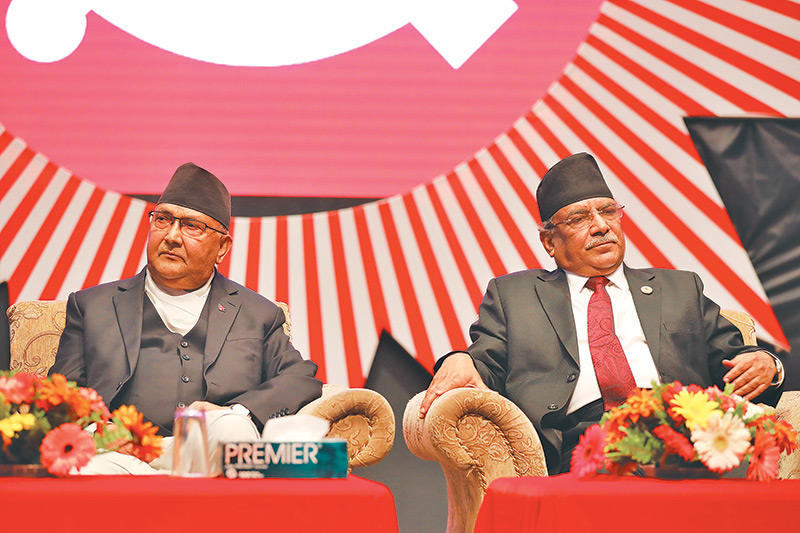
Oli (left) and Dahal have failed to see eye to eye on the Speaker candidate. Post file Photo
KATHMANDU, As indecision in the ruling Nepal Communist Party over the candidate for the House Speaker continues, insiders say party leaders have now come to terms with the fact that the issue has become a matter of prestige for the two co-chairs. The past week saw an uncanny silence between KP Sharma Oli and Pushpa Kamal Dahal—there was no dialogue at all, even though it had become a norm for Dahal to consult Oli on almost every issue. Oli and Dahal only met on Thursday. But pressure on the ruling party is mounting, as it has to find an acceptable candidate for the post of Speaker. The next House meeting is scheduled for Monday, and yet another postponement, if no agreement is reached, will be the fourth since the winter session commenced on December 20. According to insiders, the leadership is concerned that yet another deferral of the House meeting will reflect badly on the party, which is already facing criticism for holding Parliament hostage. The ongoing conflict could snowball, if it is not addressed at the earliest, said a ruling party leader. “After the party secretariat officially decided to make Dahal the executive chairman, it looked like the bond between him and Oli was growing stronger, and there were expectations that the remaining tasks related to unification could be completed soon,” Hemraj Bhandari, a central committee member, told the Post. “But this row over the Speaker shows that there was no growing bond.” Though a January 11 secretariat meeting had decided to ask Deputy Speaker Shiva Maya Tumbahangphe to resign to pave the way for the party to pick its Speaker candidate, Tumbahangphe refused and staked her own claim to the post. According to party leaders, Oli was not present at the January 11 meeting of the nine-member secretariat, where Dahal has managed to create a majority on his side. While Tumbahangphe has the backing of President Bidya Devi Bhandari, leaders believe Oli is now also throwing his weight behind her—to counter Dahal. Former Maoist leaders believe that Tumbahangphe refused to abide by the secretariat’s order because Oli had her back. Surendra Pandey, a Standing Committee member who represents the former CPN-UML, said the conflict between the two chairmen has reached a tipping point. “The two leaders have made it into a big prestige issue and now no one wants to be the one to make concessions,” said Pandey. Dahal, who had earlier maintained a flexible position on the Speaker, has hardened his stance since former Maoist leaders convinced him that losing the post to the former UML could reduce their leverage in the party. Oli has stood in favour for Subas Nembang for Speaker while the former Maoists could agree on either Agni Sapkota or Pampha Bhusal. The dispute could have been resolved amicably had the President not appeared on the scene, said party leaders. President Bhandari’s intervention prompted Dahal to hold a meeting on January 8 at Bamdev Gautam’s house in Bhaisepati where Dahal managed to bring Madhav Nepal, Jhala Nath Khanal and Narayan Kaji Shrestha into his fold, relegating Oli to a minority in the nine-member secretariat. Secretariat member Ram Bahadur Thapa was out of the country at the time. “If the conflict over the Speaker continues, it could even lead to a split in the party,” said Mani Thapa, a Standing Committee member. “Since many leaders close to Nepal are also with Dahal, Oli is feeling the heat.”
HOME PAGE
Oli insistent on passing MCC pact via House’s winter session
The resistance to MCC’s Nepal compact is coming not from a dissenting faction or opposition, but ruling party’s top leadership.
- ANIL GIRI
KATHMANDU, After failing to quell the ongoing dispute within the Nepal Communist Party regarding the Millenium Challenge Corporation’s Nepal compact, party Co-chair Prime Minister KP Sharma Oli has issued a strongly worded directive to his Cabinet members to refrain from making any negative comments regarding the US-led project. “I have heard that some senior party leaders and even ministers are speaking out against the MCC,” Oli said, according to a minister who was present at the Monday meeting. “If someone needs to speak, try to read the Nepal compact carefully before making any statements.” The ruling party is sharply divided over the MCC and whether it should be passed by the House. Although the MCC is being pushed by the Oli administration, most dissent is largely internal, as even the primary opposition Nepali Congress is in favour of the MCC. Top ruling party leaders, including Pushpa Kamal Dahal, Madhav Kumar Nepal, Jhala Nath Khanal, Narayan Kaji Shrestha, Bhim Rawal and Dev Gurung have visibly opposed the MCC. The dissenting faction has argued that the MCC is part of Washington’s Indo-Pacific Strategy, which has military components that are aimed at countering China, a friendly neighbour. They have also opposed the compact’s requirement of parliamentary approval, as the pact says that it will prevail over Nepal’s existing laws in case of conflict. The government, on the other hand, has continued to insist that the MCC will ultimately be passed via this winter session of the federal parliament. “Once the House resumes, the MCC proposal will take the due course. It will be discussed there and if it needs to be corrected, it will be presented in the House,” Oli said, according to the minister. “Let there be no misconception—it will be approved.” According to the minister, Oli’s instructions were akin to a party whip, directing its members not to speak against the MCC. After a heated debate within the party, a Standing Committee meeting, which concluded last month, had forwarded the issue to the nine-member secretariat. Discussions among members, however, have yet to take place. Oli appeared visibly distressed at the Cabinet meeting and expressed dismay at the manner in which some party leaders had expressed their reservations, said the minister. Oli has now decided to take the issue to the Parliamentary Party, which is likely to meet soon, according to Gokul Baskota, the minister for communication and information technology. The MCC has divided the ruling Nepal Communist Party (NCP), but not necessarily along factional lines. Even former UML leaders like Nepal and Khanal have expressed reservations over the MCC. But it is the former Maoists, who were once very wary of “imperialistic” tendencies of the great powers, who have been especially vocal. Bhim Rawal, one of the most stringent opponents of the MCC, even accused Oli’s press advisor Surya Thapa of threatening him for propping up the issue of “nationality” against the party’s ideology and principle. Baskota, during a regular press briefing on Thursday, denied that Thapa had issued any such threat. During the Cabinet meeting, Oli also said that the MCC was an old agreement and that his government only wished to give it continuity. The MCC agreement was first agreed to when Krishna Bahadur Mahara was finance minister and the government was led by Pushpa Kamal Dahal, said Oli. The MCC’s Nepal compact was ultimately signed in 2017, during the prime ministership of the Nepali Congress’ Sher Bahadur Deuba. Oli is even mulling over issuing a white paper to clear the air. A white paper is generally issued in cases of national debate in order to concisely state the government’ position. However, Thapa, Oli’s press advisor, does not believe that will be necessary. “The MCC agreement itself is white so the government does not need to issue a white paper,” said Thapa. “But as there are differences among the top leadership, the government is thinking of holding a discussion at the Parliamentary Party meeting.”
HOME PAGE
Police’s intelligence continues to fail them as Chand party claims explosion
Despite the government designating the Chand party a criminal outfit, Wednesday’s explosion shows that security agencies are still unaware of their activities.
- SHUVAM DHUNGANA
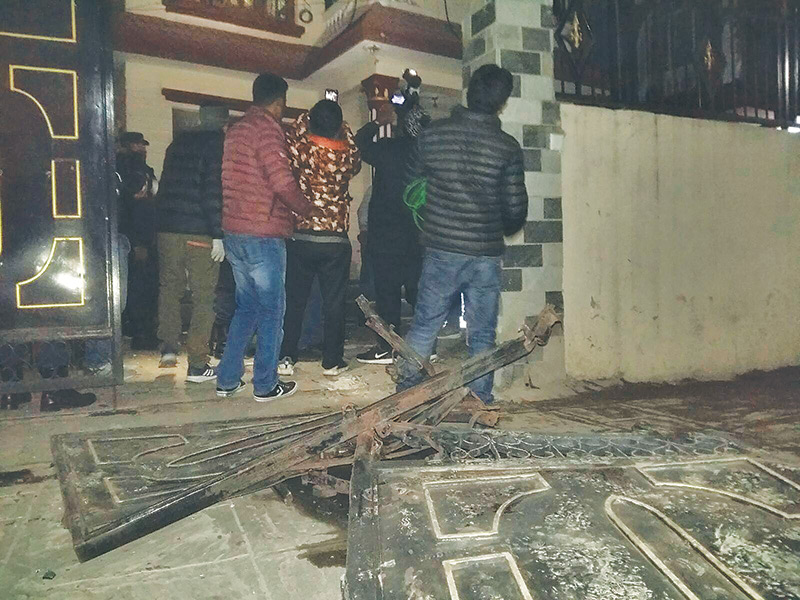
The blast at Sano Bharyang targeted the house of Shova Kanta Dhakal. Post Photo
KATHMANDU, On Wednesday evening, an improvised explosive device went off at Sano Bharyang in Kathmandu. The explosion, which was targeted at the house of Shova Kanta Dhakal, allegedly a key person in the Lalita Niwas land scam, was quickly claimed by the Netra Bikram Chand-led Communist Party of Nepal. More IEDs were discovered in the Baluwatar area, where the prime minister and the chief justice’s residences, and Nepal Rastra Bank are located. The Nepal Army managed to defuse the explosives and there were no casualties. The larger question here, however, concerns the role of the security and intelligence agencies and their consistent failure to prevent the Chand party from carrying out terrorist activities. A senior police official who spoke on condition of anonymity told the Post that Nepal Police’s special anti-terrorism bureau has not been able to play an effective role, largely due to the mobility of people in the Capital. “Kathmandu’s population is huge and thousands of people move in and out of the Capital every day,” said the official. “It is difficult to keep track of every individual.” The government in March last year declared the Chand party a criminal outfit and banned all its activities. The decision followed an explosion in February last year in front of the Ncell headquarters in Nakkhu, Lalitpur. One person died and another was injured. Chand’s party, an offshoot of the Maoist party that once waged a decade-long insurgency, has been targeting foreign companies with Ncell as one of its major targets. The party has attacked several telephone towers of the private sector mobile giant across the country. This time, in a statement, the Chand outfit claimed responsibility for the explosion at Dhakal’s house. Dhakal has been described as part of the “land mafia” in a report prepared by a government secretary for seizing the Baluwatar land illegally. The party said that it wanted to “sabotage” Dhakal because the KP Sharma Oli administration had failed to take action against people who were looting national property. Though the government has said it is ready to hold talks with the Communist Party of Nepal, Chand has so far refused to come to the negotiating table, putting forth three preconditions—an official invitation for dialogue, unconditional release of all its cadres who have been arrested, and a lifting of the ban on its activities. Since the signing of the peace deal, the government over the years has made overtures to several dissenting groups, including armed outfits, to join peaceful politics. The government in March last year signed a deal with a group led by CK Raut, who was campaigning for a ‘free Madhes’. The only group that the government considers a security threat is Chand’s party and police have arrested hundreds of its cadres. On Thursday, during the weekly press briefing in Singha Durbar, Minister for Communication and Information Technology Gokul Baskota said the government will not tolerate the Chand party’ activities. “We have been urging the Chand group to join the political process,” said Baskota. Analysts have long said that the government should make an all-out effort to bring any dissenting groups, even if they are armed, into mainstream politics and that any move to suppress them with force could be counterproductive. Chand had formed his own party, accusing the Maoist leaders, including Pushpa Kamal Dahal, of abandoning the People’s War halfway. Chand wants to launch what he calls a “unified revolution” and has been vying to create his own military. Months after the deadly blast in Nakkhu, Kathmandu witnessed a series of explosions in May where at least four people were killed. All four were Chand party members who were trying to rig gas cylinders into explosives when the cylinders went off. One explosion occurred in the Ghattekulo area, a stone’s throw away from Singha Durbar, the government seat. Security experts had told the Post then that such blasts in the Capital indicated a serious intelligence failure. Given Wednesday’s explosion, this failure has not been addressed. Police officials themselves say that such incidents are a cause for concern, especially because several countries across the world still consider Nepal risky. Countries like the United States, the United Kingdom and Australia in their travel advisories have warned their citizens of demonstrations in Nepal often turning violent and describing small blasts as the order of the day. This, officials say, is also a concern as the government wants to attract more foreign tourists as part of the Visit Nepal 2020. Security officials responded that they were committed to controlling Chand’s activities and described Wednesday’s explosion as a one-off event. “The Nepal Police is committed to stopping such criminal activities by the Chand group,” Deputy Inspector General Shailesh Thapa Chettri, spokesperson for the force, told the Post on Thursday. “We have arrested 1,359 members of the Chand party to date.” Police said they have confiscated around 1,323 weapons, including guns, pistols, hand grenades, and bullets, from members of the Chand outfit since March. “We have put 24x7 security checks in place at major entry points to Kathmandu,” said Chettri. “We are deploying more security personnel in plain clothes. But it is difficult to maintain surveillance on some lesser-known entry points.”
MEDLEY
Horoscope
ARIES (March 21-April 19) **** If you’re looking to add some romance to your life, look no further than your current social circle. You have a lot in common with someone who has a lot of interest in you. It’s time to consider giving them a try. You might be afraid that you might lose friendship, but there is a strong foundation there.
TAURUS (April 20-May 20) *** Watch yourself around influential people in your life today. You definitely want to appear confident and capable, but there is a fine line between having a healthy ego and having an inflated ego. Don’t be pompous about your achievements. People are aware of the magic so there’s no need to remind them of it again.
GEMINI (May 21-June 21) ** It’s very possible that your opinionated side could make you a few enemies today, but it’s much likelier that it will earn you quite a few fans! People like someone who’s ready to speak their mind, because not everyone has the ability to do so. Get used to the fact that you speak for a lot of people when you speak out.
CANCER (June 22-July 22) *** Following your impulses is a very risky strategy today. It could pay off big, or it could lead you down a negative path. You’re usually smart to trust your gut on things, but right now there are several unknown factors at work behind the scenes. Don’t base your decisions or judgments solely on what you know today.
LEO (July 23-August 22) ** In need of an ego boost? Then today, whatever you do, you should avoid the world of celebrities and fashion magazines. The messages they give you are not empowering or positive! Instead, get together with one or two of your closest friends who always remind you that you’re a special person!
VIRGO (August 23-September 22) *** If you want to volunteer your time, do it for the right reasons. Don’t do it because someone important asked. You can’t brag about being selfless if you’re doing it to look good or impress someone. Besides, there’s no point in helping others if your true goal is to help yourself. Make sure you’re honest about your motivations.
LIBRA (September 23-October 22) ** Despite the drama going on at work, you should keep on chatting with your friends and enjoying life. You don’t have to get involved in this latest kerfuffle. Other people’s problems are other people’s problems. They got themselves into this mess, and if you try to help them out of it, you’ll only end up getting dirty yourself.
SCORPIO (October 23-November 21) *** Even if you’re feeling underappreciated at work, don’t ask for a raise right now. There is a big reorganization going on behind the scenes that you don’t know about and probably never will ever know These changes could put you right where you want to be soon enough, so just wait things out a little while longer.
SAGITTARIUS (November 22-December 21) *** An upcoming trip is going to go very well, thanks to your ability to plan things in advance and organize everything you need. Could there be an upgrade in your future? Well, the universe thinks that you’re due for some good news from behind the ticket counter (for a change), so luck is looking very possible!
CAPRICORN (December 22-January 19) *** You have no business trying to fix other people’s problems, so feel free to bow out of the drama today. They might think it’s your job to make their lives happy and complete, but they need to find out sooner that they’re in charge of their own happiness. There’s no need to feel as though you’re putting them in a rough spot.
AQUARIUS (January 20-February 18) ** Whether you like it or not, you’ll have to make a big compromise today. They want chocolate, but you want vanilla, so why not opt for fudge ripple? They have a crush on the same person you have a crush on, so why don’t both of you just be friends with that person and see how it goes?
PISCES (February 19-March 20) *** Your mind may be wandering all over the place when just starting out your day, but hang on for an hour or so! Don’t waste time trying to figure out how to focus. Proceed with your normal routine and everything will fall into place, including your concentration. Leverage the focus you have and move some mountains.
NATIONAL
Civil society members express concern over Parliament impasse
- Post Report
KATHMANDU, A group of civil society members has expressed serious concern over the ongoing Parliament impasse over Speaker’s election. Issuing a statement on Thursday, 17 signatories from different fields said the continuous postponement of House meetings through notices is against the parliamentary practice and indicates to the public a lack of accountability. “We strongly believe that such practice and behaviour should be discontinued in future and that the meeting of the House of Representatives called for January 20 must be held as scheduled,” read the statement. The statement has been signed by Surya Prasad Shrestha, former chief election commissioner; Gaurishanker Lal Das, former member of the National Human Rights Commission; Prof Ganesh Man Gurung, a former Constituent Assembly member; and constitutionalists Surya Dhungel, Purnaman Shakya Bipin Adhikari Tikaram Bhattarai and Dinesh Tripathi Social scientists Sumitra Manandhar Gurung and Dambar Chemjong, medical doctor Saroj Dhital and littérateur Sulochana Manandhar have also signed the statement. The other signatories are journalists Dharmendra Jha and Kanak Mani Dixit and lawyers Sunil Ranjan Singh and Phurpa Tamang as well as Tika Dhakal, a writer and political analyst. “The position of Speaker should be filled by a capable Member of Parliament who has high moral standing, is trusted by the public and eligible under existing laws, as well as someone who does not have cases pending in the courts and who is able to provide able parliamentary leadership,” read the statement. The civil society members have expressed concerns about the Nepal Communist Party leadership asking Deputy Speaker Shiva Maya Tumbahangphe to step down. They have also strongly objected to the discussion within the ruling party to amend the constitution to allow a member of the Upper House to become the prime minister of the country. Bamdev Gautam, who lost 2017 parliamentary elections, has been demanding an amendment to the constitution to pave the way for a National Assembly member, to become the prime minister.
NATIONAL
Arrest warrant issued against Durga Prasai
Shri Krishna Giri, vice-chair of Medical Education Commission, has filed a defamation complaint against the executive director of B&C Medical College.
- SHUVAM DHUNGANA
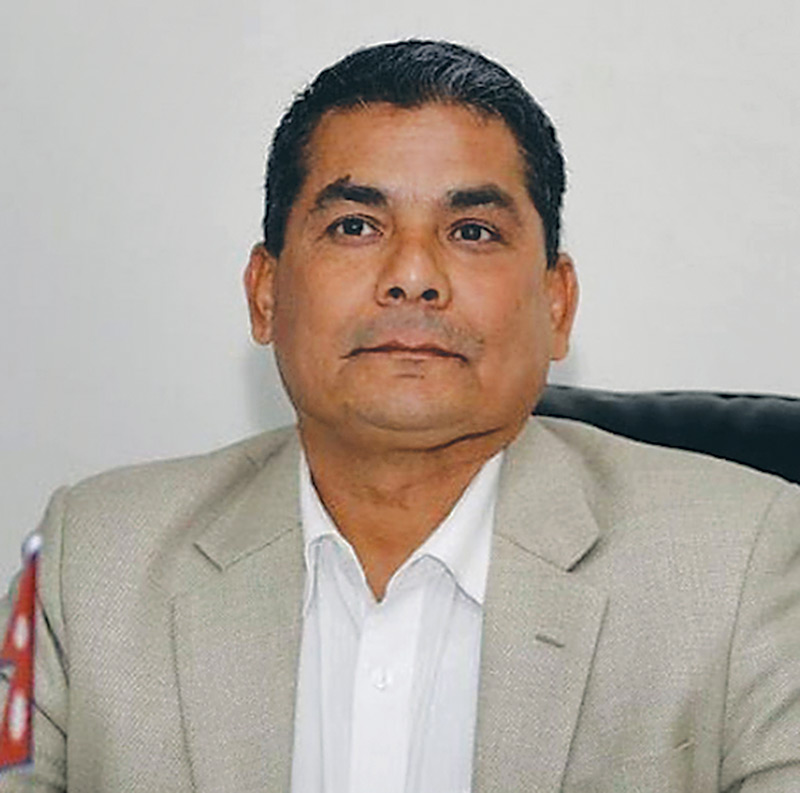
Durga Prasai. photo: bnc hospital website
KATHMANDU, Bhaktapur police said Thursday that it has launched a search operation to find Durga Prasai, executive director of the Jhapa-based B&C Medical College. Earlier on Thursday, responding to a complaint filed by Shri Krishna Giri, vice-chairman of Medical Education Commission, the District Administration Office, Bhaktapur, had issued an arrest warrant against Prasai. Giri on Tuesday filed a slander and defamation complaint against Prasai. “We have received a warrant for his [Prasai’s] arrest,” Sabin Pradhan, chief of the Metropolitan Police Range, Bhaktapur, told the Post. “We have also communicated to Jhapa police. But he was not found in Jhapa, and the search is on.” Prasai and Giri last week had resorted to accusation and counter-accusation over the affiliation of B&C Medical College. Calling a press conference, Prasai had accused Giri of demanding Rs200 million to facilitate B&C Medical College’s affiliation. Hours later, Giri had organised a press meet where he rebuffed the charges levelled by Prasai against him as baseless. A day after Giri filed a complaint against Prasai, the latter lodged a case against Giri at the Commission for Investigation of Abuse of Authority and the Department of Money Laundering Investigation. Earlier last year, in July, a slander charge was filed against Prasai at the National Human Rights Commission for publicly suggesting that female Nepali medical students in Bangladesh were sleeping with their professors to get medical degrees. Prasai’s rise as a rich businessman from a humble background over recent years has drawn enough media attention because of his connections with high-profile politicians. Last year, Prasai, who was trying to use his political connections to get affiliation for his medical college in Jhapa, hosted a lunch for Prime Minister KP Sharma Oli and ruling Nepal Communist Party Co-chair Pushpa Kamal Dahal. A photo of the trio posted on social media had gone viral and earned ridicule. And the particular variety of rice, called marsi, which they were said to have savoured, had entered Nepali lexicon as a synonym for dishonesty. In recent years, medical colleges in Nepal have emerged as a business for those with political connections to make a quick buck. Dr Govinda KC, who retired recently from the Tribhuvan University Teaching Hospital where he served as an orthopaedic surgeon, had held a series of hunger strikes demanding reforms in the medical sector. The Medical Education Commission is the outcome of Dr KC’s several hunger strikes. But as politicisation has corrupted other agencies in Nepal, the commission, too, has run into controversy since its establishment. Giri was appointed vice-chairman of the commission in the interest of Education Minister Giriraj Mani Pokhrel, according to officials who are familiar with the developments. Prasai, during his press conference, said Giri demanded Rs 200 million, as it was not easy to grant affiliation to B&C Medical College without sharing the spoils with some influential leaders. In June 2017, while warning of yet another hunger strike, Dr KC had alleged that Dahal had invested in B&C Medical College. Dahal was a guest at the inauguration of the college.
NATIONAL
Hospitals still burning, burying and disposing of hazardous waste with municipal garbage: Study
Health facilities’ reluctance to abide by the rules is putting public health at risk and polluting environment, experts say.
- Arjun Poudel
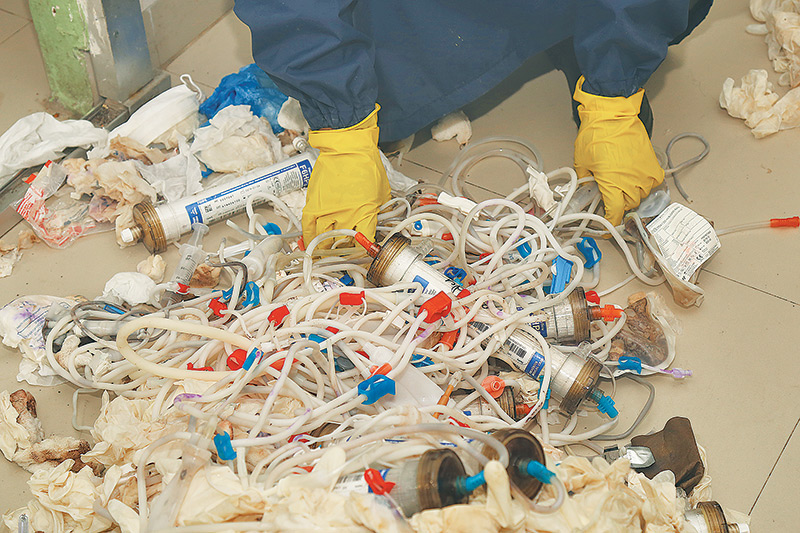
A worker at the Tribhuvan University Teaching Hospital segregates medical waste. Post file photo
KATHMANDU, The practice of burning, burying and disposing of hazardous immunisation waste mixing up it with the municipal waste by private hospitals has continued unabated, a report published by the Ministry of Health and Population shows. The study, “Assessment of Immunisation Services in the Private Sector in Kathmandu Valley”, carried out by a consortium of Atlanta’s Center for Disease Control and Prevention, Johns Hopkins University, John Snow Institute and the Health Ministry, shows that health facilities in Kathmandu Valley have been jeopardising environment as well as public health by defying the rules that prohibit burning, burying and disposing of hazardous immunisation waste with the municipal waste. “Burning and burying as well as disposing of hazardous immunisation waste together with the municipal waste are all prohibited by law, as the practice not only pollutes the environment but also puts public health at risk,” Dr Shyam Raj Upreti, who led the study, told the Post. “Only 7.7 percent of private health facilities are found practising disinfection and recycle method, which is the best practice.” According to the study, 19.2 percent of private health facilities were found burning the immunisation waste, 15.4 percent were found disposing of hazardous immunisation waste together with the municipal waste and 2 percent of health facilities were found burying hazardous needles. Hospital waste management is an essential but neglected issue in Kathmandu. The World Health Organization says hazardous waste poses many health risks such as the potential to inflict physical injury [stabs from sharps such as needles], chemical burns, toxic exposure to pharmaceuticals, radiation exposure, and exposure to infectious and disease-causing microorganisms. As per the Solid Waste Management Act 2011, health facilities should segregate all kinds of waste, including infectious biomedical, at the source, and dump them separately. Hospitals should treat their waste by autoclaving or chemical sterilisation before dispatching it out of their premises. Article 18 of the Environment Protection Act 1997 says individuals and facilities that put public health at risk can be slapped with a fine up to Rs2.5 million. Upreti said that most of the private hospitals, where the study was carried out, are not following the waste management rules. “Disinfected hospital waste poses a serious risk of spread of deadly diseases such as HIV, Hepatitis B, Hepatitis C, tuberculosis, tetanus and many others in the community,” said Upreti. “Concerned agencies should strictly prohibit such waste disposal practices.” A separate study carried out by the Ministry of Health and Population in the past shows most of the private hospitals housed in rented residential buildings and lacked proper hazardous waste management systems. Due to the apathy of the concerned authorities to prohibit the practices of burning, burying and disposing of hazardous immunisation waste along with the municipal waste, cleaning staff working under the environment department of the metropolitan city have been risking their health and sometimes their lives at their jobs. The Environment Department under the Kathmandu Metropolitan City said that it has been regularly penalising the private, community and state-run health facilities for discarding hazardous hospital waste on the roads and mixing them with the metropolis waste. “Even the state-run health facilities have been throwing hazardous waste on the roads,” Hari Kumar Shrestha, chief of the department, told the Post. “We have fined some hospitals and warned them against repeating the mistake in future.” According to data provided by the department, the metropolis fined Rs 293,500 to various private, community and state-run hospitals since the beginning of the ongoing fiscal year 2019/20. The department, however, refused to divulge further details, as to which hospitals were penalised, raising suspicions about the agency effectively carrying out the monitoring. Last year, too, the department had penalised several hospitals, including Paropakar Maternity and Women’s Hospital in Thapathali, Sukraraj Tropical and Infectious Disease Hospital in Teku, Nepal Army Hospital and TB Hospital in Kalimati, for discarding waste in metropolis waste. There are 1,445 private health facilities—hospitals, nursing homes, polyclinics and laboratories—in the Kathmandu Valley. Megnath Dhimal, chief researcher at Nepal Health Research Council, said that burning of medical waste is the worst idea as it can produce dioxin, furan and other hazardous chemicals, which can even cause cancer. He said that pathological waste contains harmful microorganisms— bacteria and virus—which can be easily spread in public, if not managed properly. “It’s not that the country lacks laws, rules and regulation,” said Dhimal. “The problem is in their strict enforcement.” According to Dhimal, all concerned government agencies need to make concerted efforts to make all the health facilities abide by the laws. “Private health facilities in Nepal may have made service delivery their priority, which is commendable, but waste management is also an equally important aspect of overall healthcare services,” said Dhimal. “Unless hospital waste is properly managed, the public is always at a risk of contracting diseases.”
NATIONAL
Awareness drive launched for jaywalkers, but people complain of faded zebra crossings
- ANUP OJHA
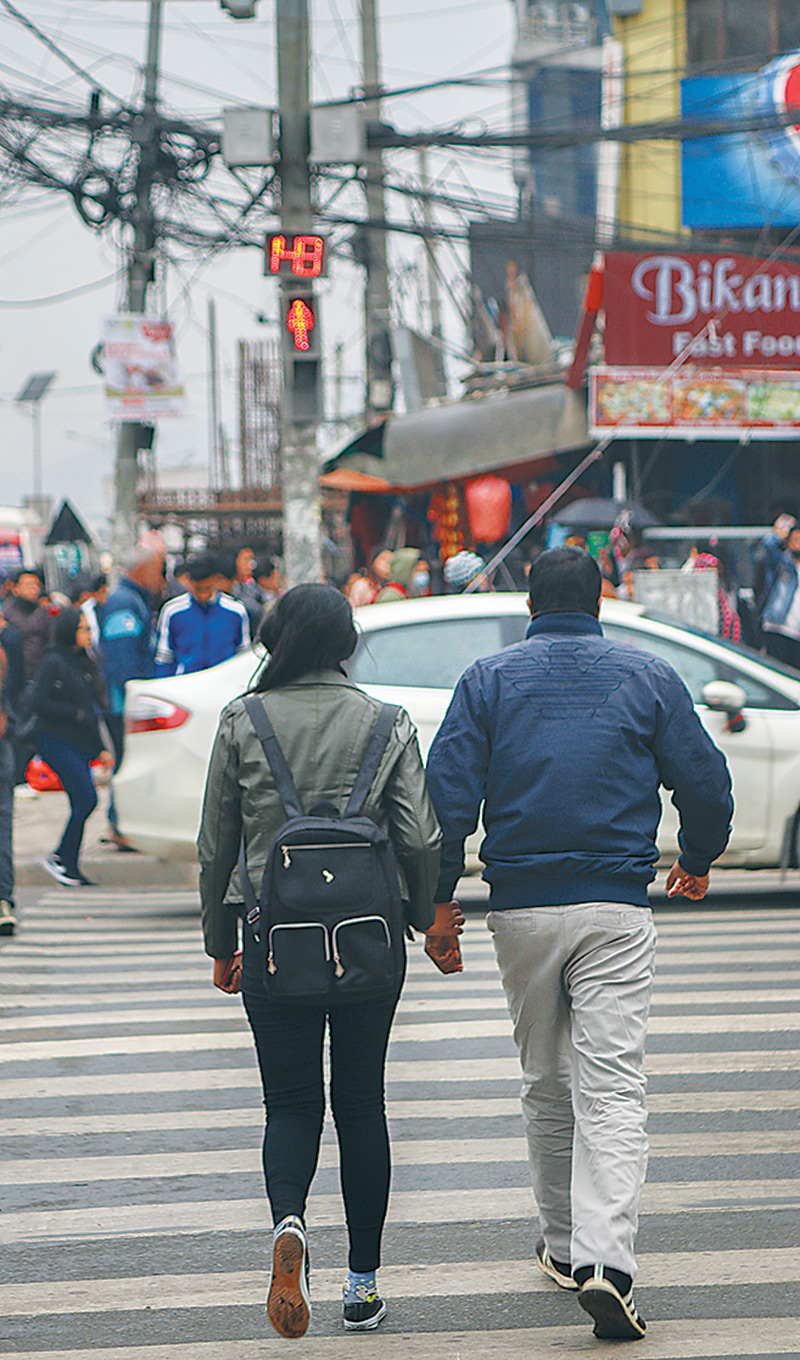
Pedestrians violate traffic signal at a zebra crossing in Kathmandu on Thursday. Post Photo: Pratham BIsta
KATHMANDU, Last Tuesday, about half a dozen traffic police personnel were deployed to nab jaywalkers. The violators were let off after compulsorily being given a 20-minute road safety class. A group of people crossed the road from Rani Pokhari. Among them was French citizen Catherine Dauban, 50. For Nepali jaywalkers, a police constable briefed them on a handheld microphone, but for Dauban who would not understand Nepali, Inspector Pradip Thapa briefed in English. “I didn’t have the intention to cross the road from here, but I saw half a dozen people crossing the road, and I followed them,” said Dauban, regretting her move. She had arrived in Nepal a week ago with the intent of trekking. “I was scared when the police called me, but it was tough to figure out the zebra crossing,” said the French women. Over the past three days, the division office has given classes to some 1,943 traffic rule violators. On Tuesday, the second day of the campaign, the traffic police held awareness classes for 610 jaywalkers and 333 on the third day. On Monday, the classes were held in Ratnapark and in front of Bir Hospital. This is not the first time the traffic police are holding road safety classes. In 2017, the traffic police had come up with a move to punish jaywalkers fining the violators Rs200 each, But after criticism, the then Home Minister Janardan Sharma directed traffic police to withdraw the move. The same drive was implemented in 2018 but without fine. That didn’t work. “There were no zebra crossings, and even the overhead bridges are inadequate,” lamented Anjana, a student, who did not want to share her surname. When the Post contacted Senior Superintendent Bhim Prasad Dhakal, chief of the Metropolitan Traffic Police Division, he said they have reached out to the Department of Roads for repainting the faded zebra crossings. “We have not fined the jaywalkers, we are just trying to make them aware. More than 60 percent of zebra crossings have faded on the roads,” said Dhakal. Shibahara Sapkota, spokesperson at the Roads Department, blamed trucks and the level of dust for the fading of zebra crossings. “Because of the ongoing construction work, the trucks ride through the roads and get sand on their wheels, which wipe away the zebra crossings,” he said. The division has deployed 21 traffic police personnel to control jaywalking in the capital city. Around 40 percent of road accidents happen due to the poor state of road crossings, the traffic police data shows.
NATIONAL
Computer class ineffective in Jhapa community schools
Schools lack computers and qualified teachers to run computer science classes.
- Arjun Rajbanshi
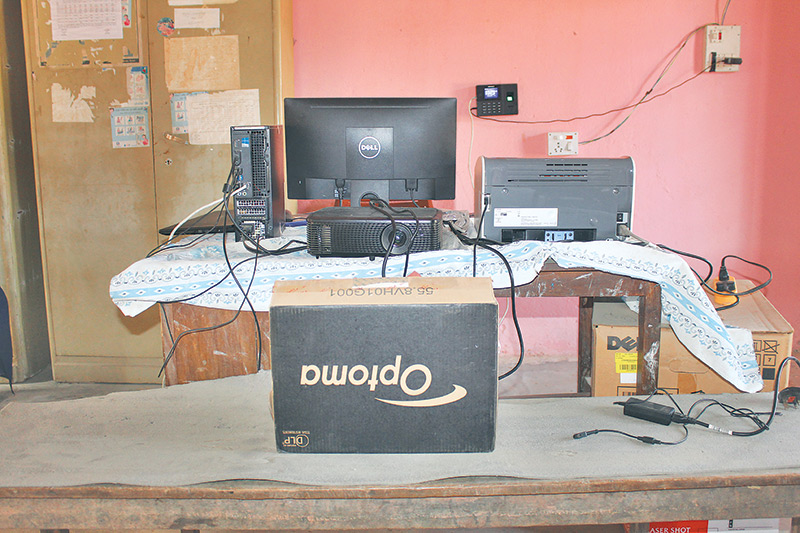
Singha Devi Basic School in Jhapa has only one computer for both office and teaching purposes. Post Photo: ARJUN RAJBANSHI
BIRTAMOD, Aashik Majhi, a seventh-grader in Maheshpur Basic School, a community school in Jhapa, has been studying computer science for the past three years. He sits for formal examinations for the subject since it has been included in the school curriculum. Computer science is a localised subject carrying 100 marks under the school curriculum. Majhi, however, does not know how to use a computer. Having taken computer science classes for three years and sat for theory examinations several times, Majhi got to see a computer for the first time about four months ago. “Since then, I have seen a computer three times,” he said. Majhi and his classmates have learnt only to turn a computer on and off. Maheshpur Basic School is one of many community schools in Bhadrapur that included computer science as a ‘local subject’ after the local level elections in 2017. The school has been ‘teaching’ the subject to grade three students and upwards. However, the institution does not have the machines or qualified teachers. “The municipality provided a computer in August for official use. We have been using the same computer to teach the students whenever we can manage,” said Narad Pyakurel, the headmaster of Maheshpur Basic School. All 15 local units in Jhapa included computer science according to the existing legal provisions. Schedule 8 of the Constitution of Nepal gives the local government explicit authority to manage school education. This means the local governments are free to hire and fire teachers, develop curriculum and hold examinations till grade 12. Yogendra Paudel, an officer at the education unit of Bhadrapur Municipality, said that none of the community schools in the district has created a post for computer science teacher. Most of the schools assign teachers with workable skills in using the machine to teach the subject. “We have distributed at least one computer in each community school. But the machines lie unused for a lack of qualified teachers to teach the subject,” There are altogether 32 community schools in Bhadrapur Municipality. Some of the community schools in the district have bought computers for teaching purposes out of their internal budget. They, however, lack skilled human resources to use the machines to teach the students. Meanwhile, Amrit Secondary School in Bahradashi Rural Municipality has a laptop and 30 computers. The school has a separate “computer room” with internet connectivity and other essential infrastructure required to run the classes. But it does not have qualified teachers. “We haven’t been able to run computer science classes regularly due to the lack of qualified teachers,” said headmaster Ram Bahadur Budhathoki. “The rural municipality has assigned one qualified teacher who visits the school once a week to teach students.” Bahradashi Rural Municipality appointed three teachers to teach computer science in 16 community schools in the municipality. “There are three “mobile” teachers. They teach 16 schools but haven’t been able to give full time to any one of them. We haven’t been able to appoint a computer science teacher in every school because we don’t have enough budget,” said Gyan Bahadur Paudel, chief of the education unit at the rural municipality. Almost all the local bodies in the district introduced computer as a local subject without proper homework. As such it’s the responsibility of the local unit to hire the particular subject’s teachers at community schools. “Technical education is essential for students. So we decided to include computer science as a local subject,” said Jiban Kumar Shrestha, mayor of Badrapur Municipality. “But we have received reports that highlight the futility of this exercise. Computer science classes were introduced to make every student computer literate; a skill that’s necessary in today’s time but a lack of the subject’s teachers have rendered our move useless.”
NATIONAL
Rong Rural Municipality locals impound four tractors used for riverbed excavation
Stone smugglers from Mechinagar in Jhapa have been extracting stones from the Chure region for a long time, say locals.
- PARBAT PORTEL
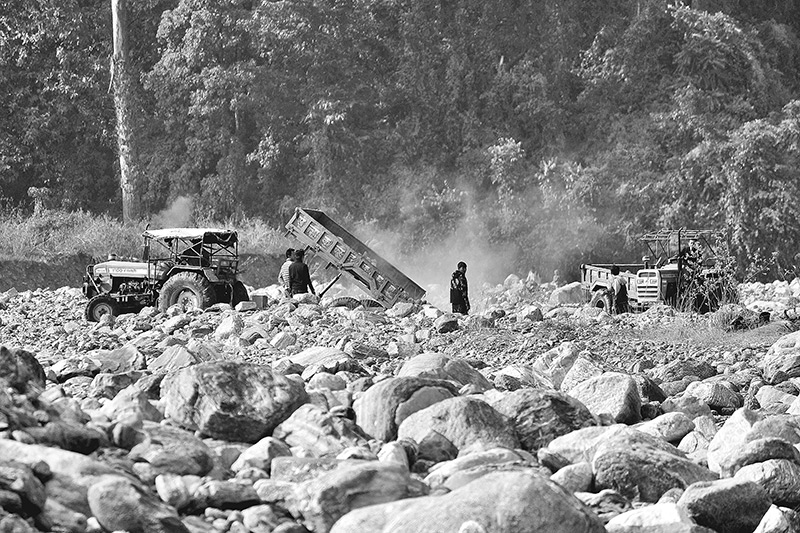
The rural municipal office slapped a fine of Rs 10,000 each on the tractor operators for illegal excavation of riverbed materials. Post Photo: PARBAT PORTEL
BAHUNDANGI (JHAPA), A team led by Mani Kumar Syanbo, ward chairman of Rong Rural Municipality in Ilam, impounded four tractors used in the extraction of riverbed materials (stones, sand and pebbles) from Chure area (Mechi river) and handed them over to the Salakpur Police Post on Tuesday. The rural municipal office slapped a fine of Rs 10,000 each on the tractor operators for illegal excavation of riverbed materials. According to Syangbo, the Chure area (where excavation was ongoing) falls under Rong Rural Municipality near Ilam-Jhapa border; therefore, the municipality decided to take matters into its own hands. As a part of their protest, the villagers had blocked water flowing into Mechinagar canal from Siddhinahar on Monday. “Locals had to resort to blocking water flow to resist the illegal extraction of stones downstream. They will only let water flow into the canal if the local representatives of both the local units in Jhapa and Ilam agree to stop illegal excavation of riverbed materials.” Stone smugglers from Mechinagar in Jhapa have been extracting stones from the Chure area for a long time, allege locals. “More than a dozentractors transport riverbed materials from this area on a daily basis. Because of this, the sustainability of Mechi river is in danger. Forests are being destroyed; water sources are drying up,” said Luwang Tamang, a local, who was involved in the inspection team. Although the representatives of Rong have been requesting the representatives of Mechinagar Municipality to put a stop to illegal extraction time and again, the latter hasn’t been responsive towards their request, said Syanbo. “This is why the locals had to take this stern measure of cutting off the water flow.” The riverbed materials excavated from Chure area are being stored at Tiring area in Mechinagar Ward No. 1. Around 7,000 cubic metres of stones extracted from June to August are being stored at the banks of Tiring stream. Tikaram Mangrati, an executive member and also coordinator of Forest and Environment Committee of Mechinagar Municipality, said they have only permitted the excavation of riverbed materials in around 300 metres of Tiring stream bank (in Mechinagar Ward No. 1) and 700 metres in the southern part of Mechi river. “No one can extract riverbed materials beyond that,” said Mangrati. According to President Chure-Terai-Madhesh Conservation Development Board, around 19,124 hectares of land in Mechinagar Ward No. 1 falls under the Chure conservation area. The government has imposed a ban on excavating riverbed materials from this area but the excavation continues. The federal government had declared Chure area as an Environment Conservation Area on June 16, 2014. Of late, conservation of the Chure region has garnered serious attention from environmentalists and locals alike. In 2019, the board had consulted on the modality of handing over the responsibility of conserving the Chure region to the Nepal Army. Deputy Prime Minister and Defence Minister Ishwor Pokharel had also reviewed that Nepal Army could play a vital role in protecting the Chure region. The government has also developed the sensitive areas along the downstream of the Chure range as protected areas (or protected forests) with an aim to conserve biodiversity, manage biological corridors and protect watersheds. But the use of heavy equipment such as excavators and dozers to excavate sand, boulders and stones in Chure areas has threatened the already fragile ecosystem of the region. Chure, which covers around 13 percent of the total area of the country, is prone to natural hazards such as floods, landslides, and erosion because of the excessive extraction of riverbed materials.
NATIONAL
With no latrines, Bajhang locals relieve themselves out in the open
- Basanta Pratap Singh
BAJHANG, On September 30 last year, Prime Minister KP Sharma Oli declared Nepal as an ‘Open Defecation Free’ nation amid a function at the City Hall in Kathmandu. But the reality on the ground is different, as one can see on the banks of rivers in Bajhang. The problem is rife in the district headquarters, Chainpur, which lacks public toilets. The district was declared ‘open defecation free’ five years before the national declaration. Dhirendra Khadka, in-charge of Dangaji Health Post in Thalara, said that many rivers in Bajhang serve as ‘open toilets’ as well as sources of drinking water. Because of this, many people have been suffering from water-borne diseases. “The health post sees about seven patients daily who suffer from water-borne diseases like diarrhoea, cholera and typhoid,” Khadka said. “It’s because they drink water from the same river where people defecate.” Locals say open defecation is most prevalent in Bauligad and Seti rivers that lie near Chainpur, and in waterways near semi-urban places such as Bhadebagar, Tamail, Mauribagar, Jhanana, Bhyagutegaad and Jhota, among others. “People are relieving themselves out in the open because there are no public toilets in the town,” said Sagar Oli, a Jhota-based retailer. None of the mushrooming towns along highways has public toilets, said Bhanubhakta Joshi, a local of Chainpur. “Open defecation is a compulsion,” he said. “But the local units haven’t paid much attention to the lack of public toilets.” Amid this, locals from Deura Bazaar have been making efforts to curb the problem of open defecation. They have been requesting the local units to construct public toilets in the town area, said Jeewan Bhandari, chief of Deura Bazaar Management Committee. “During an inspection, we found that over 40 shops across the town didn’t have a toilet,” Bhandari said. “We have provided the landowners with a week’s time to start constructing toilets and have requested local units to construct public toilets.”
NATIONAL
None of the local units in Parbat has conducted public hearings this fiscal year
The local government operational guideline requires public hearing for transparency and to ensure good governance.
- AGANDHAR TIWARI
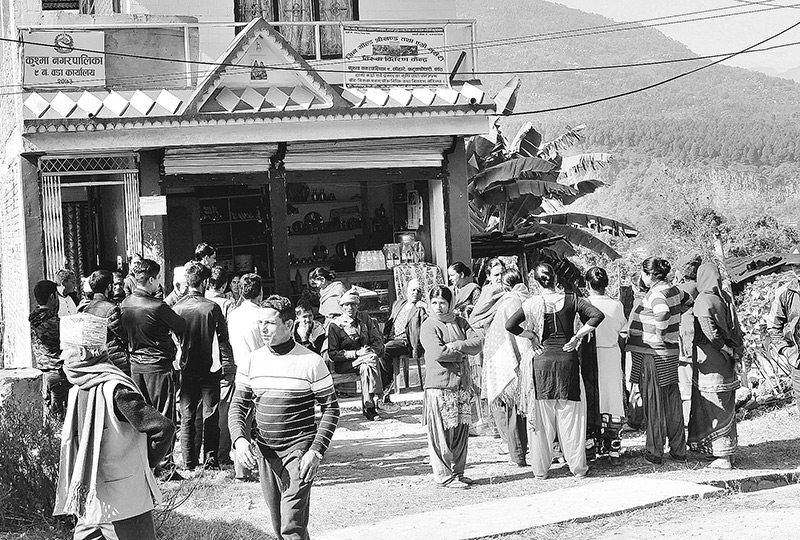
Locals gather in front of the ward office of Kushma Municipality demanding transparency in budget allocation. post Photo: AGANDHAR TIWARI
PARBAT, According to local government operational guideline, local units are supposed to hold public hearings every four months. The hearings are held to maintain financial transparency and to keep track of development projects. But in Parbat district, a majority of local units have not held public hearings this fiscal year. People in various local units have started raising suspicion over financial transparency in their respective local units. “The public wants the administration to be accountable. We seek transparency in budget allocation, and it’s our right to be informed of the progress made by our local units in development projects,” said Ram Parajuli, a local of Bihadi Rural Municipality. “The people’s representatives aren’t showing any urgency to hold the public hearings. We don’t know what they are doing.” According to Parajuli and other locals, most elected representatives are prioritising their personal concerns and working in collusion with project contractors to fulfil their own vested interests. The local government operational guideline also works as a check and balance mechanism, which helps gauge the local units’ performance. If this mechanism is removed from the equation, it compromises transparency. “The people’s representatives lack of interest in holding public hearings is a clear indication that they don’t think that they should be accountable to the public,” said Rajendra Pahadi, a lecturer at Shibalaya Multiple Campus in Kushma. “The local governments in the district have failed to maintain good governance in the financial sector. Their hesitancy in being transparent with the finances of their respective local units points to financial irregularities.” There are seven local units in Parbat. Some of the local units have claimed on paper that they conducted public hearings regularly, whereas others convened the crucial gathering only once last fiscal year. Kamal Prasad Bhusal, chairman of Bihadi Rural Municipality, accepted that they haven’t been able to conduct public hearings on time. “We held only one public hearing last fiscal year. In the running fiscal year, we haven’t allocated budget to hold public hearings,” said Bhusal. Paiyun Rural Municipality has allocated Rs 700,000 to conduct public hearings in the current fiscal year. Jeet Bahadur Rana, chief administrative officer of the rural municipality, said they were unable to conduct public hearings last fiscal year despite allocating a budget for the purpose. “We had the budget but we did not hold any public hearing since we were busy in various development works,” said Rana. “This year we will conduct a public hearing by mid-February.” According to Motiram Sapkota, chief administrative officer of Phalebas Municipality, it’s not mandatory to conduct public hearings. Making public the income and expenditure of the local unit should suffice, he said. “Every four months, we put up the total income and expenditure of the local unit on the notice board of our office for everybody to see. We don’t necessarily have to call a meeting.” However, locals said that they would be able to trust their people’s representatives better if the public hearings were held regularly. “We don’t even know what the local government’s focus of work is, or what’s on their agenda. If the elected officials take the initiative to hold public hearings, we could ask questions about the ongoing development activities.”
NATIONAL
Poor roads the main reason for accidents in Salyan, police say
According to data, road accidents in the district have risen by three-fold in three years.
- BIPLAV MAHARJAN
SALYAN, Eighteen people lost their lives in 101 recorded road accidents in Salyan, the mid-western district in Karnali Province, last year. The accidents injured one hundred and eighty-one people, 25 critically. Six months into the current Nepali year, there have been 40 road accidents in the district with 18 people killed and 160 injured, according to the District Traffic Police Office in Sitalpati. Among the primary reasons for accidents are poor roads, many of which, especially in the rural areas, are constructed without “proper technical estimate”, according to police. Other reasons include driving under the influence, a disregard for traffic rules among drivers and driving without obtaining a route permit. The number of road accidents in the district has risen in recent years, according to police data. In the fiscal year 2015/16, 15 people were killed in 37 accidents; in 2016/17, there were 12 casualties in 46 accidents; and in 2017/18, 20 people lost their lives in 37 accidents. Chief of District Police DSP Dhakendra Khatiwada said the rise in the number of accidents is primarily due to poor road conditions. “Most roads across the district are not blacktopped; they are narrow and ridden with potholes,” Khatiwada said. “This is why the number of accidents is on the rise.” Besides poor road condition, many accidents are also caused due to overspeeding, drivers’ negligence and mechanical failure, Khatiwada said. The traffic police had collected Rs5 million fines for traffic rule violations last year and over Rs2 million in the first six months of this fiscal year, he added. Police have booked 2,390 vehicles for traffic rule violations in six months. In an attempt to minimise the number of accidents, the District Traffic Police has been launching awareness programmes across the district, said Assistant Inspector Samdi BK. “When people drive on roads that are in poor conditions, they need to be more careful and aware of their surroundings,” BK said. “But drivers and transportation entrepreneurs are bent on increasing their revenue by filling their vehicles beyond capacity.” BK said that the traffic police’s awareness drive and training programmes are for drivers, conductors and passengers. “Moreover, we are also reaching out to students in schools and deploying them in the traffic rule implementation drive,” he said.
NATIONAL
Two men sentenced to 39 years for murdering journalist
Briefing
- POST REPORT
HETAUDA: The Makwanpur District Court has sentenced two people to 39 years imprisonment on the charge of murdering media person Manohar Dhakal. The single bench of Judge Dilliratna Shrestha on Thursday issued the verdict against Anmol Pudasaini of Hetauda-11 and Prabin Waiwa of Hetauda-12. The convicts had robbed and murdered Dhakal in Bhairabdanda last year. The court slapped 25 years imprisonment for murder and 14 for robbery.
NATIONAL
Robber caught red-handed
Briefing
- Post Report
SARLAHI: Police arrested a looter red-handed while he was snatching a mobile and cash from a local in Kabilashi Municipality Ward No. 5 on Wednesday. Rohit Kumar Sah, 19, of Basbariya was arrested at Raniya, police said. There were six looters in the group. Among them, five are at large.
NATIONAL
Two child marriages stopped
Briefing
- Post Report
HETAUDA: Authorities have prevented two child marriages in Bakaiya Rural Municipality of Makwanpur district on Wednesday. Police, people’s representatives, a child rights organisation and the local people foiled the underage wedding of two couples. The girls and boys were aged 15 to 17. As per the existing legal provision, both the boy and the girl should be at least 20 years of age for marriage.
NATIONAL
200 families provided blankets
Briefing
- Post Report
BARDIYA: Around 200 poor families were provided blankets in Gulariya, the district headquarters of Bardiya. Chief District Officer, people’s representatives and heads of security agencies distributed the blankets to the needy people on Thursday. Social worker Moti Yadav donated Rs 200,000 for the blanket distribution.
NATIONAL
Local unit to install solar plants
Briefing
- Post Report
KALIKOT: The council meeting of Naraharinath Rural Municipality, Kalikot, has decided to install solar power plant in each household in the local body in the current fiscal year. Under the plan, the local body will provide Rs 10,000 to each household. Naraharinath, with 4,200 households, does not have electricity facility yet.
EDITORIAL
Preventative measures
The lackadaisical approach to public health is extremely troubling.
Recently, a tourist from Wuhan in China was hospitalised in Thailand, after the visitor was found to carry a new strain of the deadly coronavirus. Following the incident, the World Health Organisation released a notice to all member countries to be aware of the potential rapid spread of the virus due to air travel. Such guidelines and alerts from the WHO are routine. It is the nature of the modern globalised world, with travel and tourism creating wealth for many states and yet also bringing the risk of a global pandemic. For now, this strain seems to have been fairly well contained. Apart from an outbreak in Wuhan itself, there have been only two reported cases outside China—the one in Thailand and another in Japan, and both affected tourists were from Wuhan itself. So, for the moment, while risks of a spread remain, a potential global outbreak seems to have been handled well. Yet, the most worrisome aspect of this whole incident seems to be Nepal’s approach to preventative measures in public health. With the country attempting to attract 2 million tourists this year, and over 350,000 from China alone, one of the first things the government should have planned for is proper health posts at all points of entry and exit. Yet, reports suggest that the Health Ministry deployed ‘a medical doctor and paramedics’ to cover the health desk at Tribhuvan International Airport only after the notice from WHO came forth. Meaning, were it not for the WHO notice, the health desk at the airport would have been left empty—ahead of a massive planned surge in tourists from all over the world. In fact, the health desk had been unmanned for the longest time, citing inefficient staff transfers due to the federal system as the cause. This lackadaisical approach to public health, especially during Visit Nepal Year, is extremely troubling. As a signatory to the International Health Regulations, Nepal is legally bound to set up health desks and strengthen them with equipment and trained human resources. Nepal’s not fulfilling its duties to prevent the spread of a potential global pandemic, even as it calls for more tourists, is a serious concern. What’s more, the spread of diseases into the country will only make it more expensive and troubling for the country in the long run.a It is suspected that such an ad hoc response to dengue in the 2000s brought the virus into the country through tourist carriers. Since then, the government has been struggling to keep a check on the virus every year. In 2019 itself, dengue fever became an epidemic—claiming more than six lives and getting as many as 8,000 people across 56 districts hospitalised. Last year’s dengue case shows how ill-equipped Nepal is at handling communicable and deadly diseases once they are prevalent in the country. It is not a great ask for the government to prepare for prevention, diagnosis and quarantine measures so that disease transmission is stemmed at the entry points. The Ministry of Culture, Tourism and Civil Aviation spent over Rs53 million to inaugurate the tourism campaign, yet it seems surprising that it could not support the Health Ministry to plan and hire enough staff for the health desk at the airport, along with other transit points such as the border. The government should know that it’ll be a national embarrassment if Nepal is the weak link that starts a global disease outbreak. Moreover, it should only look at the bill from dengue, rotavirus and influenza strains from the past to know how expensive and troublesome the spread of communicable diseases within the country is. As the old proverb goes, prevention is better than cure.
OPINION
Eroded farms: impediment for growth
Soil conservation should be a top priority for an agricultural country, but our priorities are misplaced.
- MADHUKAR UPADHYA
Shutterstock
Five years ago, the General Assembly of the UN declared December 5 as World Soil Day. The purpose was to raise awareness on the importance of soil for healthy ecosystems and human wellbeing. Consequently, the theme of World Soil Day 2019 was ‘stop soil erosion, save our future.’ Little else makes more sense than linking human wellbeing to soil erosion. As the youngest and most fragile mountains, the Himalayas are bombarded by heavy monsoon downpours every year, this has led to catastrophic soil erosion from farms, riverbanks, and steep hill slopes. Nearly half of Nepal’s population lives in these erosion-prone mountains, which make up more than 80 percent of the country. There are two significant points to note here. First, the UN has emphasised the need to recheck soil erosion after more than 45 years. The first environment conference held in Stockholm in 1972 had focused on the degrading environment across the globe, which helped shape global and country-specific environmental policies. Discussions regarding floods, landslides, and soil erosion dominated policy circles then. Second, this recognition has come after observing the International Decade of Natural Disaster Reduction in the 1990s. While disasters and biodiversity continued to be prioritised in the environmental sector, an issue as important as soil erosion gradually fizzled out from our planners’ memory.
Neglected farm soils The official efforts of checking soil erosion in Nepal began in 1974. The government established its Soil Conservation Department to take the idea forward in selected areas. This initiative, over the following decades, spread throughout the country, and we saw an increased emphasis on curbing soil erosion. Organisations were interested in research and studies. Tree plantation was prescribed as a solution to combat erosion. But all these efforts did not adequately address the erosion of agricultural lands, which was rampant and directly affecting production and, subsequently, the livelihoods of millions. In addition, the methods used in stabilising landslides and gullies were either expensive or required a long time to be effective. Hence, the techniques prescribed never became farmer-friendly. Many communities that remained out of the government’s reach remained at the mercy of mother nature for soil conservation. A lot has changed over the decades: understanding of natural science has improved substantially; emphasis on biodiversity, clean air and climate change is at the centre stage; access to information has never been so easy. However, the way we address the problem of erosion has not changed. Soil conservation is carried out using expensive physical structures; we never developed less costly ways that could be more accessible to farmers. We could not create champions to highlight the need to conserve soil beyond the scope of time-bound projects. When the projects ended, so did the enthusiasm of the experts. The fact that the only data available regarding the state of erosion is about four decades old demonstrates just how much the country has prioritised the issue. The return on investment in soil conservation isn’t as visible and immediate as the investment in plantation or infrastructure. As a result, soil conservation gradually slid to the bottom of our list of development priorities. Awareness on its importance did not grow as expected among our policymakers. Consequently, when the state was being restructured into the federal system of governance, the Soil Conservation Department was merged with another department, further limiting the scope for enhancing soil conservation.
Why does it matter? Perhaps no other words capture the value of soil so articulately and succinctly as the words of David Montgomery, the author of Dirt: The Erosion of Civilizations. Montgomery describes dirt as something which ‘we try to keep out of sight, out of mind, and outside. We spit on it, denigrate it, and kick it off of our shoes. But in the end, what’s more important? Everything comes from it, and everything returns to it. If that doesn’t earn dirt a little respect, consider how profoundly soil fertility and soil erosion shaped the course of history.’ From the Fertile Crescent to the Indus Valley, our very first civilisations were born of a prosperous marriage between abundant water and fertile soil. Everything comes from this delicate layer of the earth—the food we eat, the clothes we wear, even the very paper this is printed on. Furthermore, even when large swaths of our youth have gone to foreign labour markets, nearly two-thirds of the population is still engaged in agriculture, contributing to a third of the national GDP. Unlike the plains, where the soil is replenished during the floods, the soil in mountain farms is difficult to keep in situ without additional efforts. Mountain farms are inherently vulnerable to erosion. However, these issues are often lost when discussing the mountain environment, which is often described as being majestic, rich in biodiversity and culture and tradition. Drowning within these contradictions are the farmers who have always suffered from loss of food production capacity due to erosion. There is growing concern that the meagre, further-declining return from the farms is no longer able to meet the skyrocketing cost of living and rising aspirations. Unfortunately, our policies have failed to act upon this realisation.
Building soil health The impact of soil erosion on agriculture is well known and obvious. Soil loses its capacity to hold moisture, loses nutrients, organic matter, and, eventually, its productivity. Soil health is, therefore, the foundation of any profitable agricultural pursuit. Agriculture policies have always focused on improved seeds, fertilisers, and pesticides, but never has it considered soil loss as an impediment to agricultural growth. Unless we focus on building soil health, there’s no way to improve the state of agriculture itself, even with higher inputs. Unfortunately, the rampant road construction across the hills without proper planning has made our erosion problem worse. No one can deny the need for improved access, but not with the high cost of lasting consequences. One must reiterate that any improvement in soil conditions of the mountain farms would not only boost the income of many people, but also help reduce dependency upon imported food and save the environment for a long time. Perhaps the UN’s declaration of a World Soil Day reminds us, yet again, of the value of soil for our own future. It’s time to revisit our own history of soil conservation and reorient our strategy for soil conservation in agriculture.
OPINION
Dangers of antimicrobial resistance
Selling antibiotics in an irrational and unethical way for the sake of money has become common.
- DR MUKESH POUDEL
Shutterstock
Human beings have suffered from diseases from the beginning of history, while their causes remained unknown. The establishment of the germ theory brought a great revolution in the prevention of infectious diseases. After germs were identified as the cause, attempts to isolate them became successful; and different preparations were applied to kill these microorganisms. So far, many germs have been identified, and mankind has also been building armamentaria—medicines, equipment, and techniques—to fight these illnesses and germs. The preparations used against microbes and biological organisms are commonly called antibiotics or antimicrobials. Their discovery was one of the great milestones in the fight against outbreaks and epidemics of infectious diseases. But we are not the only living organisms fighting for survival. These microorganisms are also going through numerous processes of genetic mutation and evolution to survive, which can be perfectly related to the re-emergence of diseases like malaria and tuberculosis that were thought to be have been on the path to being eliminated. A study conducted at Harvard Medical School showed that it takes only 11 days for microorganisms to develop resistance to a drug a thousand times stronger when it evolves through exposure to similar medicines at lower doses. Antimicrobial resistance can be understood as the ability of a microorganism to stop an antibiotic from working against it. Although Nepal has been one of the forerunners on the Indian subcontinent in recognising the dangers of antimicrobial resistance, it has had a bumpy journey in putting together a comprehensive response to address it. Growing interest in earning money and opportunities to make immense profits in health and education in a country like ours with poor political commitment towards health may have given rise to an increasing number of polyclinics and education centres. Unethical and irrational use of drugs, with commercial interests in mind, has become a common practice in developing countries like Nepal. To avoid long waiting lists, overcrowding and unsatisfactory care in large hospitals, patients are flocking to small clinics and pharmacies. The little knowledge of health and disease control and preventive measures the business operator obtains through a short course needed to validate their pharmaceutical business is posing a danger towards increasing antimicrobial resistance. In today’s scenario, the pharmaceutical sector is currently one of the most profitable. Any individual may fall sick at any time, and there is always a demand for healthcare. Pharmaceutical companies are always looking to increase sales, hence selling antibiotics in an irrational and unethical way for the sake of money has become common. Antibiotics have become so readily available that they can be bought everywhere without any prescription. It is not only the producer and seller whom we should blame, but also the consumers who come up with self-medication techniques by looking up dubious sources on the internet or through previous experiences of antibiotic use. Developed countries have already acknowledged the issue of antibiotic resistance, and are working to combat it in various ways. Raising a problem without a solution is only criticism. Potential solutions could be: Providing health education about rational and proper use of antibiotics and the hazards of unnecessary use; providing motivation to go for checkups and consultation before using antibiotics; passing legislation against sales of drugs without a prescription, along with providing limited, broad-spectrum antibiotics in unreachable cases; stratifying the use of potent drugs as per the level of health workers; and minimising the irrational prescription of antibiotics for veterinary purposes.
Dr Poudel is a consultant doctor, Ministry of Social Development, Province 3.
OPINION
2020: A year full of danger
The climate crisis and persistent inequality tell us the world is well behind meeting SDG deadlines.
- FARHANA HAQUE RAHMAN
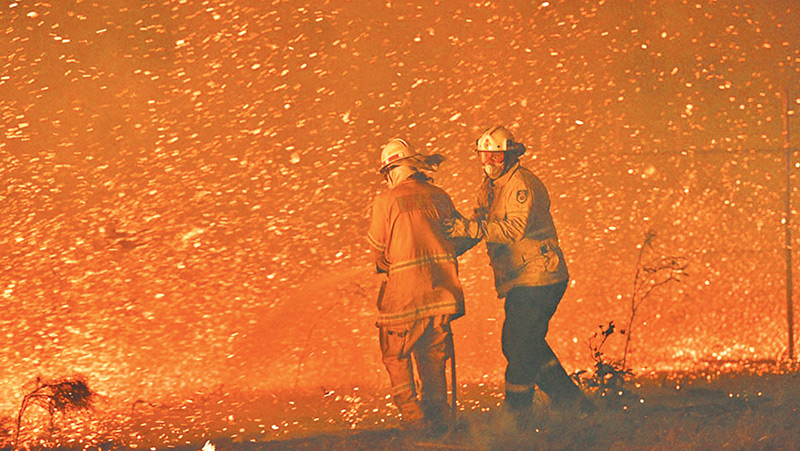
Firefighters struggling against the strong wind to secure nearby houses from bushfires near the town of Nowra in the Australian state of New South Wales. AFP/RSS
Let’s face what lies ahead with open eyes: 2020 is going to be a very tough year for the world, and developing countries in particular. The infant decade has already begun with thousands fleeing to beaches in Australia from raging bushfires, and the Middle East bracing for more conflict after a US airstrike in Baghdad killed Iran’s top general. But even as the world needs a concerted and decisive response to its challenges, we risk more of the backsliding and indifference towards humanity that in 2019 characterised the behaviour of many powerful governments, from Australia to the United States, from Brazil to China. UN Secretary-General Antonio Guterres has cited wars, the climate crisis, gender-based violence and persistent inequality in warning that the world is well behind meeting the deadlines of its 2030 Agenda for Sustainable Development. The 2019 SDG report showed momentum for positive change, but also identified several areas that need urgent collective action: the climate crisis, human suffering, quality education, and gender discrimination. Many countries and stakeholders have indeed responded with pledges of ‘SDG Acceleration Actions’. But we need to be brutally honest about the gulf between past promises and action. Warning that the world will still have 500 million people in extreme poverty in 2030, Mr Guterres has called for this to be a Decade of Action. But surely he didn’t envisage what President Donald Trump had in mind with the drone strike he ordered that killed Iranian military commander Qassem Soleimani in Baghdad on January 3. Iran quickly pledged ‘tough revenge’ and ‘World War III’ was trending on Twitter. Even without further conflict in the region, the proxy war fought in Yemen between Iran and Saudi Arabia is expected by the UN to continue as ‘the world’s worst humanitarian crisis’ in 2020 after nearly five years of fighting. An estimated 24 million people, or 80 percent of Yemen’s population, will remain in need of aid. Worldwide 168 million people will need humanitarian aid and protection in crises across more than 50 countries in 2020, according to the UN’s emergency relief coordinator. The UN humanitarian affairs coordination office (OCHA) launched its Global Humanitarian Overview 2020 with an appeal for nearly USD 29 billion in aid from donors. ‘It is the highest figure in decades,’ Mark Lowcock, head of OCHA, said, blaming climatic shocks, large infectious disease outbreaks and intensifying, protracted conflicts for an increase of some 22 million people in need last year. Armed conflicts are already killing and maiming a record number of children, with women and girls at higher risk of sexual and gender-based violence than before. The UN Children’s Fund UNICEF has called for USD 4.2 billion for its 2020 emergency appeal to reach 59 million children with life-saving support in 64 countries. This is more than triple the funds requested in 2010. ‘Around the world today, we’re seeing the largest number of children in need of emergency assistance since we began record-keeping. One in four children lives in a country affected by conflict or disaster,’ said Unicef Executive Director Henrietta Fore. UN risk assessments were blown off course by worse than expected climate crisis-related events, such as drought, flooding and tropical cyclones. But the world’s efforts to deal with the climate emergency have been dealt a most severe blow by the policies of Brazil’s President Jair Bolsonaro. Deforestation of the Amazon, the world’s largest tropical rainforest, soared in 2019 to levels not seen in a decade. Protected areas have been opened to mining and agricultural conversion, and murders of environmentalists have increased. Commenting on the global picture, Rhett Butler, founder of the Mongabay non-profit environment website, said: ‘After a decade of increased deforestation, broken commitments, and hundreds of murders of rainforest defenders, the 2020s open as a dark moment for the world’s rainforests.’ Agronomists such as Carlos Nobre and Thomas Lovejoy warn that the Amazon is reaching a critical tipping point as it shows signs of shifting from the humid tropical forest towards degraded wooded savanna which would result in the release of massive amounts of carbon into the atmosphere. It is urgent that Brazil move away from unsustainable agribusiness monocultures of cattle, soy and sugarcane, and launch a major reforestation project on already degraded lands. But Mr Bolsonaro is also joined by Mr Trump, who will seek re-election this year, in abandoning climate leadership and damaging global conservation efforts. The latest mantra for climate scientists and UN envoys seeking to broker global agreements is that ‘2020 is the last best chance’ to turn the tide of the climate emergency. Under the 2015 Paris Agreement countries pledged to review and, hopefully, ramp up their efforts to cut greenhouse gases by this year, meaning that a lot of effort is needed ahead of the crucial UN climate conference, COP26, to be held in Glasgow in November. As noted by climate news site Carbon Brief, with key emitters such as the US, Australia and Brazil hostile towards international climate action, a lot now hangs on China and the EU acting as one to maintain the Paris Agreement’s momentum. But China, along with Brazil and India, have been called out by the Association of Small Island States as actively blocking ambitious outcomes in discussions on carbon credit. Last month’s COP (Conference of the Parties) in Madrid was widely viewed by climate activists as a flop. Protestors outside the conference hall, including Swedish teenager Greta Thunberg, demonstrated the yawning gulf between their aspirations and of those inside procrastinating governments. The diplomatic Mr Guterres said he was ‘disappointed’ at the outcome and added the major emitters of greenhouse gases need to ‘do much more’ in 2020. Indeed. Much, much more.
This article was previously published in The Daily Star, a part of the Asia News Network.
OPINION
The real consequences of fake medicines
Tough criminal legislation to combat the proliferation of substandard and fake drugs deserves international support.
- David Richmond
Shutterstock
Niger’s government is sounding the alarm about bogus meningitis vaccines—and it is not the first time. Five years ago, hundreds of Nigerien people died after receiving fake vaccines. The problem, of course, is not vaccines. It is the widespread distribution of substandard and falsified medical products. And it is a problem that disproportionately affects Africa. The global market for medicines that are substandard (failing to meet quality specifications) or falsified (with the composition, identity, or source deliberately misrepresented) is estimated to be worth up to $200 billion, or 10-15 percent of the total pharmaceutical market. But it could be much bigger: according to the World Health Organisation, which relies largely on voluntary reporting by health-care professionals, we may know about ‘just a small fraction’ of all cases. What we do know is that the problem is particularly acute in Africa. In 2013-2017, 42 percent of substandard and falsified medicines found were on the continent. This is undermining Africa’s hard-won progress on health, not least by eroding trust in nascent health-care systems. Needless to say, the use of substandard or falsified medicines—which range from ineffective to poisonous—can have devastating consequences, with the poorest and most vulnerable being hit the hardest. After all, it is those with limited funds and poor access to medical professionals and quality health care who are most likely to buy discounted medicines on the streets, where there is no guarantee that they are real, let alone of high quality. Ultimately, this can result in much higher costs for victims, who must pay more to treat the original illness once it has progressed further, as well as for any side effects from the fake medication, if they survive at all. A 2015 study estimated that, in Sub-Saharan Africa, 122,000 children under the age of five had died in just one year as a result of substandard or falsified antimalarial medications. Moreover, since people don’t know what they are taking, let alone the proper dose, falsified and substandard medicines contribute to rising antimicrobial resistance—a trend that doesn’t discriminate between rich and poor. Yet fake-medicine traffickers have little incentive to stop. It is estimated that every $1,000 traffickers ‘invest’ in counterfeit medicines can yield as much as $450,000 in profit. That margin is 10-25 times larger than that enjoyed by sellers of illicit narcotics. And those massive rewards are not counterbalanced by significant risk. Even when caught, fake-medicine traffickers often avoid prison time. They merely pay a fine and get back to business. Like narcotics trafficking, however, it is a business that depends on—and reinforces— broader criminal activity, including that of terrorist groups. In fact, fake medicines are trafficked through the same organised-crime networks as illicit drugs and weapons. These networks destabilise communities and countries, particularly in already-fragile regions like the Sahel. Fortunately, seven African countries—The Gambia, Ghana, Niger, the Republic of Congo, Senegal, Togo, and Uganda—are set to take action to address the scourge of fake medicine. This month, the Brazzaville Foundation, of which I am Chief Executive, will bring together the heads of these states in Lomé, Togo, to sign a political declaration and a legally binding agreement committing them to introduce legislation to this end. The agreement will include a clear timetable, and demand tough new criminal penalties. Furthermore, recognising the critical importance of rigorous enforcement, it will include provisions on capacity building, including community engagement, and on coordination among government agencies. As such, it will lay the groundwork for a broader campaign to ensure that all citizens have access to quality health care, including safe and effective medicines. The Lomé Initiative represents a historic opportunity to step up the fight against the trade in substandard and fake medicines. But to subdue this deadly business, which claims hundreds of thousands of African lives every year, more of the continent’s leaders must join the fight. And the international community must support them. Some international actors have embraced this imperative. Beyond the WHO, the Council of Europe has created the MEDICRIME Convention, the first international treaty against counterfeit medical products and similar crimes involving threats to public health. And the United Nations Office on Drugs and Crime has produced a guide to good legislative practices for combating falsified medical product-related crime. But more must be done, and the Lomé Initiative can go a long way toward ensuring that it is. To minimise the risks that fake medicines pose to us all, the world must offer its support.
—Project Syndicate
Food & Travel
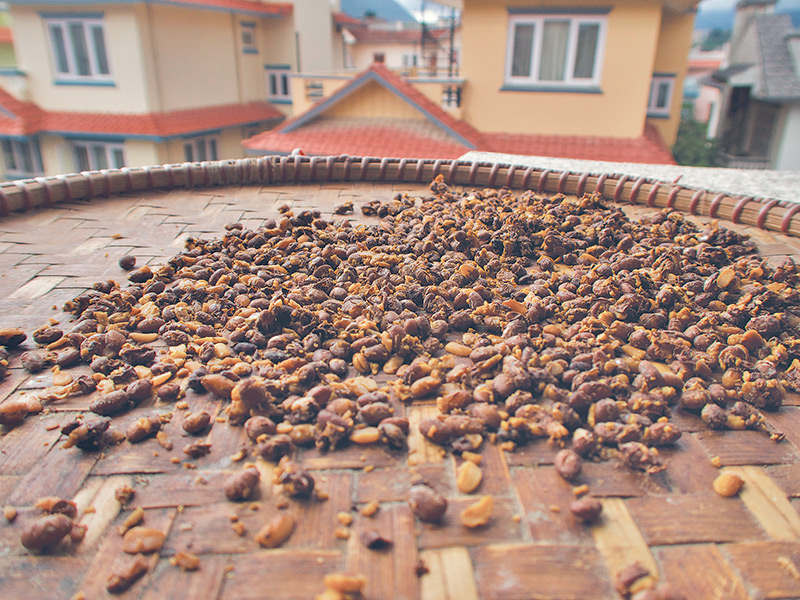
Kinema—fermented flavours of Kirats and its history
For Limbus, there is no other food that is more quintessential and defining than kinema.
- PRASHANTA KHANAL
Photos courtesy: Prashanta Khanal
The smell of kinema is strong—so strong that neighbours notice when you’re cooking it. Kinema, made by fermenting cooked soybeans, is a much-loved ethnic food of the Kirat community, chiefly Limbu and Rai, who inhabit the eastern hilly regions of Nepal. Strong flavours such as kinema’s are ingrained in their culture. A friend belonging to the community corrected me as soon as I noted its smell: “ganhauncha nabhannu na, baas auncha” (“It isn’t stinky; it has an aroma.”). Some may find it very unusual or even offensive, but for people growing up eating kinema, its smell and flavour is one that evokes nostalgia. For Limbus, there is no other food that is more quintessential and defining than kinema. I knew about Japan’s natto and miso, and have enjoyed eating Indonesia’s tempeh, another style of fermented soybeans, before becoming aware of Nepal’s soy fermentation culture. It seems not many Nepalis are aware of it either. Soybeans, or bhatmas, are considered one of the oldest crops and fermenting them is one of the oldest food cultures of eastern Nepal. In the book History, Culture and Customs of Sikkim, Kirat historian Jash Raj Subba wrote that black soybeans were the first crop cultivated by Kirats (Limbus) according to Mundhum, an oral legends of Kirats. This centuries-old fermentation practice is largely contained within the community, and not yet acquired by other communities, as with some other Nepali foods. Kinema comes from Limbu dialect ‘kinambaa’, in which ‘ki’ means ‘fermentation’ and ‘nambaa’ means ‘flavour’. It’s not exactly known when or how the fermentation method was introduced to eastern Nepal, but it seems likely to be a more-than 1,500-year-old tradition. Indian microbiologist Jyoti Prakash Tamang suggests kinema might have originated in eastern Nepal somewhere between 600 BC-100 AD, during the Kirat dynasty, and introduced by Limbus. Historical narrative mentioned that the Shan Mokwan people, originally from South China’s Yunnan region came to eastern Nepal, and established their own kingdom by 7th century and named themselves Yakthumba or Limbu. The culture of soybean fermentation could have been brought to Nepal by these people, and then spread to other communities and disseminated further east. By the 3rd or 4th century, fermenting foods had become mainstream in the region, with the introduction of Buddhism leading to growing adoption of vegetarian food habits. Tamang proposed a hypothetical ‘KNT (Kinema-Natto-Thua Nao) triangle’, an extension of ‘Natto triangle,’ by Japanese ethnologist Sasuke Nakao, which suggests that the sticky, stringy and non-salted soybean fermentation culture exists largely within the triangle covering Eastern Nepal, Northeastern India, Southern Bhutan, Northern Myanmar, South China, Japan, Laos, Cambodia and Thailand. Nakao in his book The Origin of Foods suggested non-salted fermented soybean might have originated from Yunnan, which also appears to be at the centre of hypothetical KNT triangle. Kinema is also known by different names—chembihik, hokuma—by different Kirat communities. Along with their different names, there is slight regional variance in the process of making Kinema as well, but the process starts with soaking dried soybeans overnight, and boiling them over firewood until well-cooked. The cooked beans are drained and pounded to split them, and put in a bamboo basket lined and wrapped with a few layers of ferns, banana leaves, and/or other leaves. In some communities, they are pounded until they become a coarse paste. The idea is to increase the surface area for microbial activity. Some also sprinkle firewood ash over the cooked soybeans to make them more alkaline which makes for a more conducive environment for the fermentation. Then, the beaten soybeans are placed in a basket and kept in a warm place, usually near a wood oven, to help ferment the product.
The beans are then left to ferment for a day or two, by which time the beans turn into a stringy-sticky mass with a pungent ammoniacal smell. They are then generally sun-dried and stored for later use. Food technologist Huma Bokkhim, who belongs to the community and has grown up eating kinema, explains that the white powdery stuff on the inside of a banana peel and fern leaves have rich microbiota that help in the fermentation process. “Unlike the controlled Japanese modern natto culture, the process of making kinema still is mixed-culture fermentation,” Bokkhim says. Bacillus subtilis is a dominant species in the fermentation process, but as mixed-culture has other microbes and yeasts, the fermentation of kinema is not as straightforward as pure or controlled culture, and that is what lends the complex flavour and pungent aroma in kinema. The sticky viscous material developed by Bacillus contains glutamic acid, a type of amino acid that is responsible for giving the kinema its umami and meaty flavours. Thanks to the bacillus species for their generous effort in converting a bland soybean into flavourful kinema. The more viscous the kinema, the more flavourful it is. Kinema is also great in curry form. Usha Thangden, a friends’ mother, grew up in Tehrathum and now lives in Jhapa. She uses black soybeans instead of brown soybeans for making her kinema curry. She roasts the soybeans first before boiling them, which is very unique to her and different than the one taught by her mother. And everyone from her neighborhood to her relatives adore her kinema. It is usually cooked as a curry unlike in many regions where fermented soybeans are mainly used as a flavouring ingredient. For making curry, she soaks the dried kinema in warm water first. A little vegetable oil is heated in a pan, and green chilies, garlic paste, finely chopped onions and turmeric powder are added. Soaked kinema is then added and fried, which coaxes out the kinema’s pungency. Salt is then sprinkled, according to taste, then tomatoes are added, and finally water. Thangden uses the water she used to soak the kinema, so as to retain the flavour. This also reduces loss of water soluble nutrients. Then the kinema is cooked until it becomes tender. She recommends to add dill leaves or coriander leaves in the curry to add extra flavour. A dry achaar of kinema is also a favourite in her house. To make dry achaar, she suggests to simply pound dried kinema with garlic, chilies and salt. Rekha Limbu (Rai), owner of Dharan Koseli Ghar, makes kinema to sell in the market and also occasionally supplies to Kathmandu. She learnt the skill from her aunt some seven-eight years ago. “I didn’t really like kinema when young, but as I grew up, I started missing its flavour. That nostalgia made me learn the process of making kinema,” she says. “I am sure that the culture of kinema won’t go away soon. I have been cooking for my children. They are not going to forget the taste and will be looking for it as I did.” This culture of making kinema has lasted for centuries but it is a known fact that now fewer and fewer people are making it. Because there is a certain lapse in the transfer of knowledge from generation to generation, there is a chance that the tradition and idiosyncratic form of cuisine could be lost, which would not only be a tragedy for taste buds, but for Nepali and Kirat cultural diversity in general.
Khanal is co-founder of Patan restaurant Raithaane and blogs about food for his website thegundruk.com
Food & Travel
Nepal’s hospitality haven: A connoisseur’s top picks
- Sarad Pradhan
In the last two and a half decades that I have been associated with the travel industry, I have had the opportunity to stay at hotels—big or small—across the country and abroad. Here, I have come up with five hotels that offer great experience and exceptional service.
Gokarna Forest Resort, Kathmandu
If you want to spend a couple of nights amidst the wilderness but do not want to venture too far from the fringes of the Kathmandu valley, Gokarna Forest Resort is the perfect place. Located in a protected jungle that’s inhabited by deer and other wild animals, the resort is the ideal place to escape the urban chaos. I have stayed at the property several times over the years, and I have loved each stay—especially the very personalised service. Another factor that makes a stay at the resort special is their spacious rooms, which come laden with all the modern amenities. Even the food is excellent. If guests find themselves at the resort on a Saturday, they should not miss out on trying the resort’s Saturday Brunch. The brunch spread is lavish to say the least. After a good brunch, guests can head out to the golf courses. For those who like golfing, the resort has one of the best golf courses in Asia.
Rates start from $150 (during high season) and $130 (during low season) per night.
Barahi Jungle Lodge, Chitwan
Barahi Jungle Lodge offers guests the best alternative to lodges that once operated inside the Chitwan National Park. The lodge is located on the banks of the Rapti River, and the rooms are housed in thatched cottages designed using the materials that Tharus, an indigenous tribe of the region, use in building their traditional huts. Each room comes with a private veranda/balcony and offers uninterrupted views of the national park and the river. The service at the lodge is very personalised. The staff are well trained and courteous and ensure that the needs of the guests are met. Last year, I spent two days at the lodge with bloggers from India. They were fascinated with the level of service the staff at the lodge provided. Apart from the service, they also loved the lodge’s jungle safari. The lodge offers a host of other fun activities—from riding a canoe in the river, to riding a bullock cart to a nearby village. But the most remarkable feature of the lodge has to be its sundown rendezvous. The activity starts with a canoe ride from the lodge to the confluence of two rivers: Rapti and Narayani. There, guests are treated with drinks and barbecue. Barahi Jungle Lodge truly is a blend of luxury and nature.
Rates start from $365 per night.
Shangri-La Village Resort, Pokhara
Shangri-La Village Resort is one of Pokhara’s first high-end resorts. The resort started operations in 1997, and my first stay at the resort was in 1998. And over the years, I have stayed there several times. My most recent stay there was last September. Located in a quiet corner in Pokhara, away from the hustle and bustle of Lakeside, the resort gives guests the feeling of staying in a village. The mountain views from the resort are spectacular. Every time I stay there, I make sure that I have my breakfast at the poolside and enjoy the mountain views. The resort’s rooms are also very well-appointed, and each has a private themed balcony. Though Shangri-La Village Resort might be a bit far from Lakeside, the resort’s ambience and solitude it offers makes a stay worthwhile.
Rates start from $ 220 per night.
Himalayan Front Hotel, Pokhara
In 1976, PATA International made a blueprint of developing Pokhara as a premier tourist destination. The plan envisaged luxury resorts on the ridges overlooking the Pokhara valley. It took several decades for that aspect of the blueprint to materialise, but the ridges of the lake city now boasts several high-end resorts. Sarangkot, one of the most popular hilltops overlooking the city of Pokhara, is home to several high-end resorts. One of them is the Himalayan Front Hotel. I have visited the hotel several times, and every time I have been amazed by the views that the rooms come with. Guests at the hotel can see spectacular views of the Annapurna massif and Sarangkot’s famed sunrise right from the comfort of their rooms. Another highlight is the hotel's swimming pool. The reflection of the mountains on the hotel’s infinity pool is something that we seldom see anywhere in the world. As a flagship of KGH Group of Hotels, Himalayan Front Hotel makes you feel like you are living above the clouds. To relax and refresh, Himalayan Front Hotel is the best option in Pokhara.
Rates start from $110 per night.
Hotel Pawan Palace, Lumbini
Lumbini is one of Nepal’s top tourist destinations. To cater to the growing number of high-end travellers visiting the holy Buddhist site, a string of new high-end hotels have opened up in the city. Hotel Pawan Palace—a five-star hotel—opened last year in Lumbini, making it one of the latest luxury hotels in the city. The hotel is located very close to the main road that leads to Lumbini. The hotel is for guests who don’t like to compromise on luxury while making the most of Lumbini’s spiritual side. I checked in at the hotel last year and was pleasantly surprised with the level of attention to detail and luxury. Rooms are fully equipped with all the modern amenities, and the bathroom is designed to cater to luxury travelers. Even the service was at par with some of the country’s leading luxury hotels. For affluent Buddhist pilgrims who enjoy to eat, pray and love in luxury, Hotel Pawan Palace will cater to their every need.
Rates start from $80 (for Nepalese) and $150 (for foreigners) per night.
Pradhan is the Head of Business Development and Communication at Xceltrip Nepal, an online travel aggregator.
Food & Travel
Strong acting but poor production lets down a timeless classic
Shailee Theatre’s ‘Bibhaha ko Prastab’ plays on an interesting, and centuries old, narrative about marriage.
- Shashwat Pant
Neighbour Ivan Vassiliyitch (left), played by Shashank Bohora, and Stepan Stepanovitch Chubokov, played by Subash Subedi, both shone as strong characters in the play.
Kathmandu, Stepan Stepanovitch Chubukov is worried his daughter Nataliya Stepanovna is still single, and it’s a thought that keeps him up at night. To fix her wedding, Stephanovitch calls his friends (and enemies) to ask for suggestions, but nothing goes as planned. Things get even more interesting when Stepanovitch’s neighbour Ivan Vassiliyitch Lomov enters the fray, asking for Nayaliya’s hand. But, once again, things don’t go as planned. Directed by Navaraj Budathoki and produced by Shailee Theatre, in association with the Russian Culture Centre, Bibhaha ko Prastab is a one-act play adapted from Russian writer Anton Chekhov’s 1889 work A Marriage Proposal. In the play, Chekov has satirised marriage conventions of land-owning aristocrats of Russia in the 19th century. Budathoki’s Nepali version is a loyal adaption of the original, following the same narrative of showcasing how people have misplaced ideas when it comes to courtship. Rather than for love or partnership, people are drawn towards the idea of marriage to improve their financial status or social standing. Although Chekov wrote the play two centuries ago, this idea of marriage is still relevant in Nepali society. But in their bid to stay loyal to the original play, the director kept the Russian names of the characters rather than translating them to Nepali monikers—something typically done to help the audience relate to the characters. The director’s choice to keep the Russian names is debatable, given the actors have done everything to bring life to Chekov’s characters. Perhaps changing the names could have helped the protagonists be more relatable to the audience. Subash Subedi, who plays the role of Stepanovitch, has nailed his part. Everything from his look to delivery of dialogue is spot on. Playing the role of a worried father, Subedi holds the play together. Shashank Bohora, as Ivan Vassiliyitch, is equally good with what was offered to him. His expressions are quite unique, and leaves the audience engaged. From his introduction, he manages to grab the audience’s attention—given that his part is that of a nervous, timid suitor. That leaves the audience dumbstruck when he actually starts to speak. That said, there are parts where he overdoes it, but that might not be just on him but also on the director and his vision. But his chemistry with both Subedi and Sneha Poudel, who plays the role of Nataliya, is worth applauding.
Poudel is flawless. Her acting is natural and to the point. Her delivery is commanding, especially during arguments with Ivan Vassiliyitch—a major part of the play itself. The fact that they seemed like an actual couple fighting was what makes the actors’ commitment more palpable. In one scene, where she stuffs an apple into Vassiliyitch’s mouth to stop him from talking is funny yet relatable. All the actors in the play, except for some of those playing smaller roles, who were clearly overacting, did a fair job. The director definitely had a line up of deft actors, but in the end, the production let him and the actors down. The set design, including the lighting, is mediocre at best. The light engineer seems to have tried to set the tone, but he seems to lack both experience and equipment. Same is the case with sound—it seems disjointed as well as out of sync with the actors at times. The wider team, however, did put in a lot of effort and hard work. This can be exemplified by the props, the most notable being the use of masks. They effortlessly signified the two-faced nature of the characters, adding depth to the possibilities of how each protagonist can act or react in certain situations. But at the same time, it is baffling to see that the production team didn’t put the same amount of work when it comes to the actors’ appearance. The makeup and costume of the cast was inconsistent to say the least. Apart from Subedi, who sports a beard and brown hair, and wears an overcoat, no one looks Russian—if that was what they were aiming for, which isn’t clear either. The men are wearing suits like they’re attending a wedding while Poudel, who says she came from the fields, doesn’t look like it at all. The length of the play also does not seem to be in its favour. Some scenes between Poudel and Bohora could have been a bit shorter, or other topics could have been incorporated, to make it a bit relevant to the Nepali context. Overall, the play is entertaining. It makes you laugh, it makes you emotional, and it leaves you wondering if marriage is worth it at all. The flaws of the play can be ignored, as the theatre is quite new, but only with hope it improves in the future. That said, the work of the actors cannot be undermined.
The play is being staged at Shailee Theatre, Ratopul, until January 24 at 4:50 pm every day except Wednesdays.
WORLD
Democrats deliver impeachment articles to Senate paving way for trial of Trump
Senate Majority Leader Mitch McConnell says Democrats will have to repeat the delivery.
- REUTERS
US Speaker of the House Nancy Pelosi (D-CA) signs the articles of impeachment against President Donald Trump during an engrossment ceremony in the Rayburn Room at the US Capitol in Washington, DC, on Wednesday. AFP/RSS
WASHINGTON, After weeks of rhetorical fire and fury, a handful of US House members walked quietly across a hushed Capitol on Wednesday to deliver articles of impeachment to the Senate, paving the way for the trial of President Donald Trump. Led by the House of Representatives’ sergeant at arms and the House clerk carrying the documents on a tray, seven House managers walked through a nearly empty Statuary Hall and the soaring Capitol rotunda. More than a dozen Senate Democrats sat silently at their desks when the group arrived at the Senate. They were joined by two Republicans, Majority Leader Mitch McConnell and Senator Kevin Cramer. A third Republican, Chuck Grassley, presided from the dais. The House members were politely ushered to a bench at the rear of the Senate chamber, where they sat in silence as the House clerk announced the impeachment resolution had passed, and Grassley responded: “The message will be received.” The procession took place four weeks after the Democratic-led House voted to impeach the Republican president on charges of abuse of power for asking Ukraine to investigate political rival Joe Biden and obstruction of Congress for blocking information sought by investigators. Democratic House Speaker Nancy Pelosi and McConnell have since feuded over how to conduct the trial. Pelosi delayed signing the impeachment articles while she waited for word from McConnell about the trial’s scope. During the delay, Democrats and Republicans squabbled over Trump’s status because he had been impeached, but had not had his trial. Pelosi used a few dozen pens to sign, at a desk bearing a placard reading #DefendOurDemocracy. Afterward, she handed pens to the impeachment managers and committee chairs involved in the investigation. “It makes a funny signature,” she said. Reflecting the deep partisan divide, the House vote to impeach Trump was nearly along party lines. Many of his fellow Republicans in the Senate have made clear they view the impeachment as a political stunt by Democrats as Trump seeks re-election in the November election. The dispute did not end when the articles were handed over. Senate Republicans said Democrats would have to repeat the delivery on Thursday. McConnell said he had invited the House managers to exhibit the articles at noon before US Chief Justice John Roberts swears in the senators. “We will pledge to rise above petty factionalism and do justice for our institutions, for our states, and for the nation,” McConnell said in a statement. The trial starts on Tuesday after a holiday weekend.
Giuliani associate: Trump had knowledge of Ukraine pressure WASHINGTON: A close associate of President Donald Trump’s personal lawyer says he delivered an ultimatum in May to the incoming president of Ukraine that no senior U.S. officials would attend his inauguration and all American aid to the war-torn country would be withheld if an investigation into Joe Biden wasn’t announced. Lev Parnas, an associate of Rudy Giuliani, made several potentially explosive claims in a televised interview Wednesday night with MSNBC’s Rachel Maddow. The day after Parnas said he delivered the message, the State Department announced that Vice President Mike Pence would no longer be attending the inauguration of Ukrainian President Volodymir Zelenskiy. Parnas alleged that Trump ordered Pence to stay away at the behest of Giuliani to send a clear message to the incoming Ukrainian administration that they needed to take seriously the demand for an investigation into Biden, a Democratic presidential candidate seen as a potential threat to Trump’s 2020 reelection. Parnas said every communication he had with Zelenskiy’s team was at the direction of Giuliani, whom he regularly overheard briefing Trump about their progress by phone. “President Trump knew exactly what was going on,” said Parnas, a Soviet-born Florida businessman facing a raft of criminal charges related to campaign finance violations. “He was aware of all my movements. I wouldn’t do anything without the consent of Rudy Giuliani, or the President.”
WORLD
Australia firefighters save world’s only rare dinosaur trees
- ASSOCIATED PRESS
A Wollemi pine tree sapling grows on the forest floor in the Wollemi National Park, New South Wales, Australia. Specialist firefighters have saved the world’s last remaining wild stand of a prehistoric tree from wildfires that razed forests west of Sydney. AP/RSS
CANBERRA, Specialist firefighters have saved the world’s last remaining wild stand of a prehistoric tree from wildfires that razed forests west of Sydney, officials said on Thursday. Firefighters winched from helicopters to reach the cluster of fewer than 200 Wollemi Pines in a remote gorge in the Blue Mountains a week before a massive wildlife bore down, National Parks and Wildlife Service Director David Crust said. The firefighters set up an irrigation system to keep the so-called dinosaur trees moist and pumped water daily from the gorge as the blaze that had burned out of control for more than two months edged closer. Firefighting planes strategically bombed the fire front with fire retardant to slow its progress. “That helped just to slow the intensity of the fire as it approached the site,” Crust told Australian Broadcasting Corp. “The Wollemi Pine is a particularly important species and the fact that this is the only place in the world where they exist and they exist in such small numbers is really significant,” he added. New South Wales state Environment Minister Matt Kean said the operation had saved the stand, although some plants had been singed. “These pines outlived the dinosaurs, so when we saw the fire approaching we realised we had to do everything we could to save them,” Kean said. The Wollemi Pine had only been seen in its fossilised form and was thought long extinct before the stand was found in 1994. The fire that threatened it was brought under control this week after razing more than 510,000 hectares. The fire also destroyed 90 percent of the 5,000-hectare Wollemi National Park, where the rare trees grow, Crust said. The exact location of the stand remains a closely guarded secret to help authorities protect the trees. The Wollemi’s survival is one of the few positive stories to emerge from the unprecedented wildlife crisis in southeast Australia. The fires have claimed at least 28 lives since September, destroyed more than 2,600 homes and razed more than 10.3 million hectares, mostly in New South Wales state. But the fire danger has been diminished by rain this week in several areas. The first green buds of regrowth have already emerged in some blacked forests following rain.
WORLD
Erdogan says Turkey starting troop deployment to Libya
- REUTERS
Tayyip Erdogan. Reuters
ANKARA, Turkey is beginning to send troops into Libya in support of the internationally recognised government in Tripoli, President Tayyip Erdogan said on Thursday, days before a summit in Berlin which will address the Libyan conflict. Last week, Turkey and Russia urged Libya’s warring parties to declare a ceasefire. However, despite talks in Moscow aimed at halting Khalifa Haftar’s months-long campaign to seize the Libyan capital, the two sides were unable to reach an agreement when Haftar failed to sign a binding truce on Monday. Turkey, which backs Fayez al-Serraj’s Government of National Accord (GNA), has previously said that it sent a training and cooperation team which is now active in Libya. On Thursday, Erdogan said Turkey was starting the deployment of its troops to Libya and that it would use all its diplomatic and military means to ensure stability to its south. “In order for the legitimate government in Libya to remain standing and for stability to be established, we are now sending our soldiers to this country,” Erdogan told an event in Ankara. Erdogan warned on Tuesday that Turkey will not refrain from “teaching a lesson” to Haftar’s eastern Libyan forces if their attacks against the GNA continue. The talks in Moscow were the latest attempt to stabilise Libya, which has been beset by turmoil since Muammer Gaddafi was toppled in 2011. On Sunday, Germany will host a summit on Libya involving the rival camps, their main foreign backers and representatives from the United Nations, the United States, Russia, Britain, France, China, Turkey and Italy. Haftar and Serraj have also been invited, but it is unclear if they will attend. Turkey and Libya signed two agreements in November, one on military cooperation and another on maritime boundaries in the eastern Mediterranean. Erdogan said on Thursday that Turkey will quickly start granting licenses for exploration and drilling in the region. “In the areas that remain between Turkey and Libya, it is now legally impossible for there to be exploration and drilling activities or a pipeline without the approval of both sides,” he said. “After these licensing efforts, our Oruc Reis seismic exploration ship will begin its seismic research operations in the region,” he added. Greece, Cyprus and other regional actors have opposed this accord, calling it illegal. Turkey has rejected the accusations.
WORLD
What is Putin up to with surprise political shake-up?
- AGENCE FRANCE-PRESSE
Russian President Vladimir Putin (left) and his nominee Mikhail Mishustin for the post of prime minister. AFP/RSS
MOSCOW, With the shock replacement of his government and plans for a constitutional overhaul, President Vladimir Putin has set in motion sweeping changes to Russia’s political order. But what is the longtime Russian leader really up to? And—with Putin facing the end in 2024 of what is supposed to be his final term—what does it mean for his hold on power? Analysts, Kremlin critics and opinion-makers seem to agree: the 67-year-old leader is shaking up a system that has been losing public confidence, while laying the groundwork for his own political future.
What future for Putin? In his state of the nation address on Wednesday, Putin laid out constitutional changes that would reduce the power of the president and boost the authority of parliament, with lawmakers choosing the prime minister and cabinet. Experts said his plans to limit the post’s powers is a clear sign that Putin is preparing to leave the presidency and take on a new role. “Putin will remain the main figure in Russia, as he has been for 20 years,” said Russian political analyst Maria Lipman. Some have suggested that Putin could create a system similar to the one put in place by the longtime leader of Kazakhstan, Nursultan Nazarbayev, who last year resigned as president but remained as chief of the ruling party and “national leader” with wide-ranging powers. Putin could stay on after 2024 as head of the State Council, an advisory body made up of regional governors and political appointees, as well as chief of the powerful Security Council. On Wednesday he proposed expanding the State Council’s role and enshrining its status in the constitution. “We are seeing some pieces of the puzzle, there are some we can’t see, and some we will never see. But in the end only Putin knows the plan,” Lipman said.
Why now? While his approval ratings still hover around 70 percent, Putin seems to have understood that many Russians are displeased. A few hours after the president said Wednesday that there was “a clear demand for change”, Prime Minister Dmitry Medvedev had already announced the government’s resignation. Putin was re-elected with a sweeping majority in 2018, but his approval ratings dropped after an unpopular pension reform. Russians’ incomes have also been falling as the economy stagnates, under pressure from a drop in oil prices and Western sanctions over the 2014 annexation of Crimea. Growing discontent saw thousands take to the streets of Moscow last summer against the exclusion of opposition candidates from local elections, in the biggest anti-government protests since Putin returned to the presidency in 2012 after a stint as prime minister. Parliamentary elections are due in 2021 and polls show the ruling United Russia party with the support of only 33 percent of Russians. The party is so unpopular that many of its candidates chose to run as independents in the September regional and municipal votes.
What role for the new PM? Medvedev, who is one of Putin’s oldest allies and served as president from 2008 to 2012, had become a scapegoat and a liability, with approval ratings of between 30 and 38 percent. It was time for a fresh start. Putin’s nominee to replace him, longtime federal tax chief Mikhail Mishustin, is a relatively obscure figure but has solid credentials. The 53-year-old is considered an efficient administrator who was able to transform Russia’s sclerotic and corrupt tax service into a modern and respected institution. An unlikely successor to Putin, Mishustin can focus on making changes that will boost the government’s popularity. “Mishustin’s elevation to Russia’s PM is designed to get more competent leadership in cabinet which will have to focus on (the) all-important domestic agenda,” Dmitry Trenin, the director of the Carnegie Moscow Center, said on Twitter. He will have his work cut out for him—more than half of Russians said in a recent poll that they believe the “worst is yet to come” for the economy. Putin has put forward a slew of plans to reboot the economy and improve living standards, including vast infrastructure projects, increased payouts to families and improvements to health and education. “Mishustin must implement Putin’s programme—projects costing up to 26 trillion rubles ($421 billion/378 billion euros). By 2024,” business daily Vedomosti wrote on Thursday. “The delay in implementation and weak economic growth were at the heart of criticisms of Medvedev.”
WORLD
Four children killed in Romania house fire
Briefing
BUCHAREST: Four young children left alone at home have been killed in a house fire in western Romania, authorities said on Thursday. Firefighters found the bodies of the children at the scene in the city of Timisoara, according to Romania’s General Inspectorate for Emergency Situations (IGSU). The oldest was six years old and the youngest just four months. Their 14-year-old brother was also in the house and was taken to hospital to be treated for smoke inhalation but was otherwise unharmed. A wood-burning stove is thought to have caused the fire during the night of Wednesday to Thursday, according to IGSU. (Agencies)
WORLD
Judge orders Rio 2016 Olympic Games venues shut
Briefing
BRASÍLIA: A Brazilian court on Wednesday ordered that the 2016 Rio Olympic Games facilities be closed to the public over safety concerns. The Rio Games—the first to be held in South America—were heavily criticized for their extreme costs, estimated around $12.5 billion, and corruption scandals that surrounded the construction sites. A Rio de Janeiro judge ruled in favor of closing the grounds after a request from the Rio prosecutor’s office asking for a ban on all major events at the facilities until authorities had seen certificates demonstrating their safety. The judge said the decision was to “preserve the security of the population,” noting that thousands of people regularly went to the venues for concerts or exhibitions.(Agencies)
WORLD
Children of foreign IS jihadists must be repatriated: UN
Briefing
GENEVA: UN investigators on Thursday called for thousands of children of jihadists who fought for the Islamic State group to be repatriated from Syria. The UN Commission of Inquiry on Syria said in a report that the children were in a “particularly precarious” situation since they often lacked official papers. “This, in turn, jeopardises their rights to a nationality, hinders family reunification processes and puts them at a higher risk of exploitation and abuse,” the report said. The UN says around 28,000 children of foreign fighters are living in Syrian camps—20,000 of them from Iraq. (Agencies)
ASIA
Iran’s president says ‘no limit’ to nuclear enrichment
Tehran abided by the agreement until last summer.
- ASSOCIATED PRESS
Iranian President Hassan Rouhani. AP/RSS
TEHRAN (Iran), Iran’s president said on Thursday that there is “no limit” to the country’s enrichment of uranium following its decision to abandon its commitments under the 2015 nuclear deal in response to the killing of its top general in a US airstrike. In a speech before the heads of banks, Rouhani said the nuclear program is in a “better situation” than it was before the nuclear agreement with world powers. President Donald Trump withdrew from the nuclear agreement in May 2018, in part because it did not address Iran’s support for armed groups across the region and its ballistic missile program. The US has since imposed “maximum” sanctions on Iran’s economy. Iran continued to abide by the agreement until last summer, when it began openly breaching some of its limits, saying it would not be bound by the deal if it saw none of its promised economic benefits. After the January 3 airstrike that killed Gen. Qassem Soleimani, the architect of Iran’s regional military operations, it said it would abandon all restrictions in the nuclear deal. Thus far, however, it has only modestly increased its nuclear activity. In recent months it has boosted its enrichment of uranium to 4.5 percent—higher than the 3.67 percent limit set by the agreement but far from the 20 percent enrichment it was engaged in before the deal. Uranium must be enriched to 90 percent to be used in a nuclear weapon. Britain, France and Germany have spent months trying to salvage the deal, but have not found a way to continue trading with Iran amid the tightened US sanctions. Earlier this week, they triggered a dispute mechanism in the nuclear deal to try to bring Iran back into compliance. That process could lead to the snapback of international sanctions. Under the nuclear deal, Iran was promised relief from international sanctions and re-integration with the world economy in exchange for curbing its nuclear activities. Instead, the renewed US sanctions have cratered its economy. The value of the local currency has plunged, wiping out many people’s life savings, and prices have steadily risen. Protests erupted in November over an increase in gasoline prices, with more than 300 people reportedly killed. Iranian authorities have not released an official death toll. The Institute of International Finance published a report estimating that Iran’s economy will contract this fiscal year year ending in March by more 7 percent, mostly because of the drop in crude oil exports due to sanctions. That’s a stark contrast to 2016, when Iran’s economy grew some 12.5 percent after sanctions relief. The report found that as a result, Iran’s reserves are expected to dip to $73 billion by March, totalling nearly $40 billion in losses over two years. In his speech before the bankers, Rouhani acknowledged that the sanctions had caused economic pain. But he said economic considerations could not be separate from foreign policy and national security, indicating that Iran will not give in to sweeping demands by the United States. He also acknowledged the steadily rising tensions with the United States. “A single bullet can cause a war, and not shooting a single bullet can lead to peace,” he said, adding that his administration is seeking greater security.
ASIA
Pakistan says Taliban willing to reduce Afghan violence
- AGENCE FRANCE-PRESSE
ISLAMABAD, Pakistan’s foreign minister on Thursday said the Taliban has shown “a willingness” to reduce violence in war-torn Afghanistan after more than 18 years fighting the US, sparking speculation that a potential breakthrough in talks with the Americans may be near. Negotiations between the Taliban and the US have repeatedly stalled, with Washington calling on the insurgent group to reduce violence before they can resume. “Today, positive progress has been made, the Taliban have shown their willingness to reduce the violence, which was a demand... it’s a step towards the peace agreement,” said Pakistani foreign minister Shah Mehmood Qureshi in a video statement. He gave no further details. Zabihullah Mujahid, the official Taliban spokesman, told AFP the Taliban was looking into the comments. The Taliban and the US were on the brink of announcing a withdrawal deal in September last year when President Donald Trump abruptly declared the process “dead”, citing Taliban violence. Talks were later restarted between the two sides in December in Qatar, but were paused following an attack near the Bagram military base in Afghanistan. Islamabad has helped facilitate the talks between the militants and Washington in Qatar over the past year, seeking an agreement that would pave the way for a US troop withdrawal from Afghanistan in return for various security promises from the insurgents. Pakistan was one of only three countries to recognise the Taliban regime, and its shadowy military establishment—particularly the Inter-Services Intelligence (ISI)—is widely believed to back the bloody insurgency in Afghanistan. Islamabad denies the accusation. Any agreement with the Taliban is expected to have two main pillars—an American withdrawal from Afghanistan and a commitment by the insurgents not to offer sanctuary to jihadists. The Taliban’s relationship with Al-Qaeda was the main reason cited for the US invasion nearly 18 years ago. The Taliban have until now refused to negotiate with the Afghan government, which they consider an illegitimate regime, raising fears that fighting will continue regardless of any deal ironed out with the Americans.
ASIA
Bangladesh eyes deal with Malaysia to protect migrant workers from abuse
- REUTERS
A file photo shows workers from Bangladesh waiting at an immigration depot in Sepang. Reuters
DHAKA, Cutting recruitment fees for Bangladeshi migrants who move to Malaysia for work under a new deal could curb human trafficking, according to officials, yet activists said Bangladesh’s migration system must be revamped in order to protect workers. Malaysia last week said it was considering a zero-cost recruitment agreement with Bangladesh - having banned its migrant workers in September 2018 over concerns that they were being charged excessive fees by labour agencies and brokers. Bangladesh’s current informal recruitment system involves unofficial middlemen - who despite bringing recruiters and rural workers together - often give false promises about jobs and then charge exorbitant fees that trap many workers in debt bondage. Ahmed Munirus Saleheen, a senior official at Bangladesh’s Ministry of Expatriates’ Welfare and Overseas Employment, said that removing or even largely reducing recruitment costs would help prevent migrant workers from being exploited in Malaysia. “There should be no instance of trafficking under the garb of labour migration,” he told the Thomson Reuters Foundation. “We feel that any effort to bring down the cost of migration ... will contribute to the prevention of human trafficking,” he added. “Both sides should work on this.” More than 250,000 Bangladeshi migrants moved to Malaysia for work between 2016 and 2018 under a previous migration agreement that saw workers charged an official fee of $1,900—although middlemen were said to have widely demanded far larger sums. It is unclear whether the new arrangement would see the cost for workers—which covers expenses from airfare and visa fees to health check-ups—removed entirely or substantially lowered. Bangladesh and Malaysia are both on a watchlist in the U.S. State Department’s Trafficking in Persons (TIP) report, that ranks nations on their anti-trafficking efforts, and are seeking to avoid a downgrade this year that could trigger sanctions. From factories to construction sites and plantations, Malaysia is home to an estimated 4.8 million migrant workers and relies heavily on foreigners for jobs usually shunned by locals. Malaysia struck a deal with Nepal in 2018 to ensure Nepali migrant workers would not pay any fees - after Nepal temporarily suspended sending workers due to concerns about their treatment. Reducing or removing fees for workers will not protect them from abuse overseas, said Marina Sultana of the Refugee and Migratory Movements Research Unit - a migrants rights group. “Migrants always pay more,” she said. “No matter what the fee, the government needs to improve its monitoring system.” “The middlemen should be made official so that they can be made accountable for what they do. Labourers should also be made more aware and skilled so that they know about their rights.” More than 7.5 million Bangladeshis work outside the country, which is one of the world’s most expensive for migrants with some paying up to $8,500 to go abroad, the United Nations says. Shakirul Islam, head of the migrant rights charity Ovibashi Karmi Unnayan Program, said Bangladesh should digitise its system so that recruiters can directly contact workers online. “Workers should also be able to pay money through banks and not middlemen for transparency,” he said. Saleheen, the Bangladeshi official, said the government was seeking to improve the way it manages its migrant workers. “Reducing the fee ... won’t solve all the problems,” he said. “We need a holistic approach and we are working on that.” Securing a job at a Malaysian plastic factory cost Mohammad Shujon $4,500 when he moved from Bangladesh’s capital in 2016. Yet Shujon was duped by the labour broker and ended up at a furniture company where he was not legally permitted to work. After two years of working illegally, he was caught and jailed for two months before returning to Dhaka last year. He now works in a shop and is still trying to pay off his debts. “The money I earn now is barely enough to feed my family,” the 33-year-old said. “I don’t know how I will clear my debts.”
ASIA
Qatar eases restrictions on migrant workers’ exit
- REUTERS
DUBAI, Qatar said on Thursday it had scrapped restrictions on leaving the country for nearly all migrant workers as part of reforms answering accusations of exploitation especially in the run-up to the 2022 World Cup. The measure removes exit visas for hundreds of thousands of domestic workers left out of earlier reforms - mainly from Asian nations like Nepal, India and the Philippines—whom rights groups said were left open to abuse by being excluded. Unions and activists have documented labour exploitation, dangerous conditions and deaths of workers building stadiums and infrastructure for both the 2018 World Cup in Russia and the upcoming event in Qatar. The Gulf state, which hopes the 2022 World Cup will boost its economy and development, is eager to show it is creating a modern system that protects all expatriate workers. “The removal of exit permits is an important milestone in the government’s labour reform agenda,” said Houtan Homayounpour, head of the International Organization for Labour office in Qatar, which welcomed the move. Qatar in 2018 eliminated exit visas for many foreign migrant workers. But the reform did not apply to domestic workers, government and public institution staff, the oil and gas sector, and workers employed at sea and in agriculture. Under the new system, exit permit requirements will remain in place for members of the armed forces and for a limited number of workers in key company posts. “Employers have the right to identify a maximum of 5 percent of their workforce whose exit from Qatar will continue to require prior approval,” a government statement said. A “kafala” sponsorship system for workers is common in Gulf states with large foreign communities. In gas-rich Qatar, it requires workers to obtain employers’ consent before changing jobs, which activists say fosters exploitation. Qatar has only 300,000 citizens of its own. In 2017 the ILO, a United Nations’ body, dropped a case against Doha over its treatment of foreign workers after it committed to far-reaching reforms. Qatar has imposed a minimum wage and established dispute resolution committees to fast-track complaints of unpaid salaries. It also says work is underway to enable workers to change employers more easily.
ASIA
Hong Kong protest medic arrested on China mainland, fellow students say
- AGENCE FRANCE-PRESSE
HONG KONG, A Hong Kong student who helped found a network of volunteer medics to aid the city’s pro-democracy protests has been arrested on the mainland, fellow students briefed by his university have told AFP. Classmates say Kwok Chun-fung has been detained on charges of “soliciting prostitutes” in Guangzhou, the capital of the Chinese mainland province that borders Hong Kong. The same allegation was brought against Simon Cheng, a Hong Kong employee of the British consulate who was detained during a trip to the mainland in August last year. After his release, Cheng said he had been forced to confess before fleeing overseas. Kwok, who is in his early twenties and studies in Guangzhou, co-founded a volunteer group that helped wounded protesters and those affected by police tear gas during the seven months of unrest that has engulfed Hong Kong. His disappearance was first made public on 10 January by a co-founder of the group and his mother, who said he had gone missing in the city two days earlier. The fellow volunteer—who uses the pseudonym “Small Cow”—said he was talking to Kwok when the line suddenly went dead. “We were chatting on the phone and he said he had to get up and open the door. Then I heard him walking, opening a door and the phone was dropped, the call cut,” he told reporters. This week Kwok’s university—the Guangzhou University of Chinese Medicine—briefed non-mainland students on his disappearance, according to two students who attended the meetings. University officials told them Kwok had been arrested late at night on 8 January “soliciting prostitutes” in a hotel, an offence punishable by up to 15 days in administrative detention. “During the briefing, the teacher told us to cherish our chance to study here as we will be graduating in half a year,” one of the two students told AFP, requesting anonymity. A second student who attended a separate meeting reported being told the same information. A member of staff at the university’s propaganda office said Kwok had “indeed violated some laws and was subject to detention” but refused to provide more details.
ASIA
Pakistan says Facebook to help in fight against polio
Briefing
ISLAMABAD: Pakistan says Facebook will help the country in its fight against polio after authorities blamed anti-vaccine content posted last year on the social network site for a leap in the number of cases. Pakistan is one of only three countries where polio has not been eradicated, but a years-long effort began to show fruit with a major drop in cases from 2016. By 2018 just 12 cases had been recorded, but to the dismay of Pakistani authorities and the World Health Organization, that number soared to 136 last year. Pakistani officials quickly tied the surge to a slew of fake news reports and videos claiming many children had been killed by the vaccine that garnered thousands of views and shares on social media. (Agencies)
ASIA
Indian bakers make world’s ‘longest’ cake
Briefing
THRISSUR: It was a record-baking effort. Hundreds of bakers and chefs in southern India came together Wednesday to create what they said is the world’s longest cake—about 6.5 kilometres. They spread chocolate ganache on the serpentine dessert stretched out on thousands of tables and desks at a festival ground and adjoining roads in the coastal state of Kerala’s Thrissur city. The vanilla cake, four inches wide and thick, weighed in at about 27,000 kilograms. About 1,500 bakers and chefs, wearing traditional whites and toque blanche caps, spent nearly four hours to put it together using 12,000 kilograms of sugar and flour. Large crowds watched the event organised by Bakers Association Kerala (BAKE). (Agencies)
ASIA
Death toll rises to at least 100 after Pakistan snow, avalanches
Briefing
MUZAFFARABAD (Pakistan): Search teams have found the bodies of 14 people buried by avalanches and heavy snowfall in Pakistani-administered Kashmir, with harsh weather hampering rescuers as they race to find any survivors, officials said. The death toll from days of bad weather now stands at 76 in Kashmir, and at least 100 across the country, according to a statement from the National Disaster Management Authority (NDMA). Most were killed in Kashmir’s picturesque Neelum Valley, which had been hard hit by avalanches earlier in the week, said operations director of the Kashmiri disaster management authority Saeed ur Rehamn Qureshi. (Agencies)
MONEY
China, US sign initial trade pact but doubts and tariffs linger
Some analysts question China’s ability to replace imports from other trading partners with more shipments from the United States.
- REUTERS
Chinese Vice Premier Liu He (left) and US President Donald Trump shake hands after signing ‘phase one’ of the US-China trade agreement during aceremony in the East Room of the White House in Washington, US on Wednesday. reuters
BEIJING/WASHINGTON, China will boost purchases of US goods and services by $200 billion over two years in exchange for the rolling back of some tariffs under an initial trade deal signed by the world’s two largest economies, defusing an 18-month row that has hit global growth. Key world stock market indexes climbed to record highs after the deal was signed on Wednesday in Washington, but later stalled on concerns it may not ease trade tensions for long, with numerous thorny issues still unresolved. While acknowledging the need for further negotiations with China to solve a host of other problems, President Donald Trump hailed the agreement as a win for the US economy and his administration’s trade policies. “Together, we are righting the wrongs of the past and delivering a future of economic justice and security for American workers, farmers and families,” Trump said in rambling remarks at the White House alongside US and Chinese officials on Wednesday. Chinese Vice Premier Liu He read a letter from President Xi Jinping in which the Chinese leader praised the deal as a sign the two countries could resolve their differences with dialogue. “While markets seemed to take this deal as a risk-on signal, we should all be aware that headlines about trade, particularly US China trade, are going to be a constant feature of 2020,” said Hannah Anderson, Global Markets Strategist, J.P. Morgan Asset Management in Hong Kong. The centerpiece of the deal is a pledge by China to purchase at least an additional $200 billion worth of US farm products and other goods and services over two years, above a baseline of $186 billion in purchases in 2017, the White House said. Commitments include $54 billion in additional energy purchases, $78 billion in additional manufacturing purchases, $32 billion more in farm products, and $38 billion in services, according to deal documents released by the White House and China’s Finance Ministry. Liu said Chinese companies would buy $40 billion in US agricultural products annually over the next two years “based on market conditions” which may dictate timing of purchases in any given year. Beijing had balked at committing to buy set amounts of US farm goods earlier, and has inked new soybean contracts with Brazil since the trade war started. Liu later said the deal would not affect “third parties’ interests”, apparently in reference to deals made with other suppliers of farm goods. Chinese companies will import US agricultural goods according to consumers’ need, and demand and supply in the market, Liu told reporters, according to CCTV. Although the deal could be a boost to US farmers, automakers and heavy equipment manufacturers, some analysts question China’s ability to replace imports from other trading partners with more shipments from the United States. The deal does not end retaliatory tariffs on American farm exports, makes farmers “increasingly reliant” on Chinese state-controlled purchases, and does not address “big structural changes,” Michelle Erickson-Jones, a wheat farmer and spokeswoman for Farmers for Free Trade, said in a statement. Oil prices rose, helped by expectations of more Chinese purchases of US oil and gas. Trump, who has embraced an “America First” policy aimed at rebalancing global trade in favour of US companies and workers, said China had pledged action to confront the problem of pirated or counterfeited goods and said the deal included strong protection of intellectual property rights. Washington’s insistence on enforcement mechanisms “with real teeth” could tear the deal apart if any tariffs are re-imposed for non-compliance. US Speaker of the House of Representative Nancy Pelosi said Trump’s China strategy had “inflicted deep, long-term damage to American agriculture and rattled our economy in exchange for more of the promises that Beijing has been breaking for years,” in a statement. Earlier, top White House economic adviser Larry Kudlow told Fox News the agreement would add 0.5 percentage point to US gross domestic product growth in both 2020 and 2021. Aviation industry sources said Boeing Co was expected to win a major order for wide-body jets from China, including its 787 or 777-9 models, or a mixture of both. The deal touted new wins for US companies looking to access China’s $40 trillion financial sector, but many of the changes were already in the works with Beijing stepping up the pace of opening up in the past year. China’s central bank said Chinese financial institutions are completely capable of coping with foreign competition and it will strengthen financial supervisions as the sector is freed up. The Phase 1 deal cancelled planned US tariffs on Chinese-made cellphones, toys and laptop computers and halved the tariff rate to 7.5 percent on about $120 billion worth of other Chinese goods, including flat-panel televisions, Bluetooth headphones and footwear. But it will leave in place 25 percent tariffs on a $250-billion array of Chinese industrial goods and components used by US manufacturers, and China’s retaliatory tariffs on over $100 billion in US goods. Market turmoil and reduced investment tied to the trade war would likely cut global growth in 2019 to its lowest rate since the 2008-2009 financial crisis, the International Monetary Fund said in October. Trump, who has been touting the Phase 1 deal as a pillar of his 2020 re-election campaign, said he would agree to remove the remaining tariffs once the two sides had negotiated a “Phase 2” agreement. “We’ve already begun discussions on a Phase 2 deal,” Vice President Mike Pence said in a Fox Business Network interview.
MONEY
Lack of transparency in China’s Belt and Road projects: EU firms
- AGENCE FRANCE-PRESSE
A file photo shows Chinese President Xi Jinping during a news conferenceat the end of the Belt and Road Forum in Beijing, China. reuters
BEIJING, A lack of information and transparency are top barriers for European companies seeking involvement in China’s Belt and Road Initiative, according to a survey published Thursday by the European Union Chamber of Commerce in China. Only 20 out of 132 firms polled said they have bid for projects related to the BRI, a massive global network of ports, railways, roads and industrial parks spanning Asia, Africa, the Middle East and Europe. The BRI—Chinese President Xi Jinping’s signature foreign policy initiative—has also faced criticism for swaddling poor nations with crippling debt and for being too opaque. A lack of information on deals and “non-transparent” procurement systems were the biggest barriers identified by European firms in the survey. Of the companies that bid to participate in BRI projects, only 10 percent got wind of the project through publicly available information. “The vast majority were informed either by a partner company or by the Chinese government, meaning that they were essentially hand-picked to participate,” the EU Chamber said in the report. Chamber President Joerg Wuttke said the survey showed that for businesses, gains from the BRI have been “quite insignificant”, with European firms tending to fill only niche roles. More than half of the companies that won bids said it was because they had goods or services no Chinese firm could provide, and the most represented industries overall were financial services, machinery, and logistics or transportation. Asked about the survey at a regular press briefing on Thursday, Chinese foreign ministry spokesman Geng Shuang said that under the BRI framework, Chinese and foreign enterprises participate in cooperation projects in “an open and transparent manner, in accordance with market rules and fair principles”. Whether or not firms win the bidding process depends on their competitiveness, he added. Wuttke said the BRI appears to have a “spoke and hub model” with China at its centre. The report noted that Chinese companies often provide everything for a project, from the materials to construction services and financing. Such an approach may enable projects to be completed swiftly but it is “profoundly disconcerting” to the European business community as it removes meaningful competition, it said. The lack of transparency and fair procurement mechanism also contributed to low levels of participation from development banks like the World Bank and the Asian Infrastructure Investment Bank, which have strict criteria for investment, said the report. While about a quarter of respondents said the BRI—which was launched in 2013—is improving in transparency, quality and fairness, this trend is less evident when it comes to access to projects. The EU Chamber urged China to take on an open and transparent procurement system for BRI-related projects as well as perform feasibility and environmental impact studies for them, in line with international standards. It also recommended that the EU prioritise its “connectivity strategy”—which aims to improve transport, digital and energy links between Europe and Asia while promoting environmental and labour standards—to complement and offer a credible alternative to the BRI.
MONEY
Hyundai and Kia bet on London startup for electric cars
- AGENCE FRANCE-PRESSE
LONDON, South Korea’s Hyundai and its Kia affiliate announced plans Thursday for a major investment in London-based startup Arrival to produce next-generation electric vehicles that cost less than standard-engine models. The 100-million-euro ($110 million) bet on the five-year-old technology firm comes as some manufacturers abandon Britain because of uncertainties about how it will trade with EU nations once it leaves the bloc this month. Arrival is focused on designing and producing so-called Generation 2 electric vehicles, which are environmentally friendly cars made from scratch rather than being retrofitted, standard-engine production models. “Generation 2 vehicles are assembled using small footprint micro-factories, located in areas of demand and profitable at thousands of units,” the three companies said in a joint statement. Hyundai and Kia have a shared ownership structure but target slightly different markets and demographics. “The eco-friendly vehicle market in Europe is expected to grow rapidly due to reinforcement of environmental regulations,” Hyundai’s research and development department head Albert Biermann said. “This strategic partnership will empower our companies to scale Generation 2 electric vehicles globally.”
MONEY
Australian tourism industry seeks urgent help as cost of bushfires grows
- REUTERS
The haze from bushfires obscures the sun setting above the Sydney Opera House in Sydney. australia
MELBOURNE, Australia’s peak tourism body estimated the country’s bushfire crisis has so far cost the industry almost A$1 billion ($690 million) and called for urgent help from the government to lure back visitors. Industry bosses were due to meet with Tourism Minister Simon Birmingham later on Thursday as storms and heavy rain brought some respite from months of fierce bushfires across Australia’s east coast. The fires, which have killed 29 people and razed bushland across an area the size of Bulgaria, have hit several coastal towns at the height of the profitable summer season. “People have basically stopped travel,” Simon Westaway, executive director of Australian Tourism Industry Council (ATIC), told Reuters. “And that’s absolutely understandable: human nature kicks in.” Even though recent cooler conditions have led some tourist destinations to reopen after they were evacuated because of the fires, people remain wary of visiting. Images of burnt-out towns, people huddled on beaches to escape huge flames, dead wildlife and thick smoke hanging over major cities have been beamed around the world. The qualifying rounds of Australian Open in Melbourne this week, the first tennis Grand Slam of the year, have been blighted by complaints from players about the pollution. “The imagery of the fires in the global marketplace is very bad for our country,” Westaway said. “We are worried about the contagion that that may have.” Tourism accounts for more than 3% of Australia’s A$1.95 trillion economy, with 9 million foreigners visiting the country annually and domestic tourism growing. Accommodation booking cancellations in non-fire zones have reached upwards of 60%, while in fire-affected areas there were no tourists at all, Westaway said. Many destinations rely heavily on domestic tourism, as well as international visitors. This week’s wet weather brought some temporary respite for fire-hit areas, but also came with the warning of potential flash floods and lightning that could ignite new fires. Prime Minister Scott Morrison earlier this week welcomed a US move to downgrade a travel warning and has stressed that Australia is open for business. Birmingham said he would seek firsthand feedback from tourism bosses at Thursday’s meeting and devise a strategy to reassure visitors that many tourism destinations are untainted by fires.
MONEY
Janakpur-Jayanagar rail service to resume operations by March
The first set of coaches christened Janaki Rail have been dispatched from Chennai, India.
- KRISHANA PRASAIN
Former Physical Infrastructure and Transport Minister Raghubir Mahaseth (right) during a test run of the Janakpur-Jayanagar railway track. Post file Photo
KATHMANDU, Nepal’s only surviving train service will resume operations by March after a five-year break, the Railways Department said. The rail line links the holy town of Janakpur in the southeastern plains with Jayanagar across the border in the Indian state of Bihar. The track is being extended from Janakpur and will eventually link Bardibas. Balram Mishra, director general of the Department of Railways, said that the first set of rail coaches christened Janaki Rail will arrive in Janakpur by the first week of February from Chennai, India where they were manufactured. “Commercial operations will begin by early March after completing a trial run.” According to Indian media reports, the first set of five coaches was dispatched from Chennai on Wednesday, and is expected to reach Janakpur within 15 days. Mishra though said he was not aware of the entire development, his department is expecting to receive the first consignment by early February. The Janakpur-Jayanagar track was built nearly 85 years ago during the British rule in India with the objective of transporting timber from the forests of Mahottari to India. The old line spanned 52 km from Bijulpura in Mahottari, Nepal to Jayanagar in Bihar, India. The Janakpur-Jayanagar railway service was suspended five years ago. In May 2018, the Railways Department signed an agreement with the Indian coach manufacturer Integral Coach Factory of Chennai to supply two diesel-electric multiple unit train sets for passenger service from Kurtha, Janakpur to Jayanagar, India. The 69-km Jayanagar-Janakpur-Bardibas railway is being built at a cost of Rs10 billion with support from the Indian government. Indian Railway Construction Company built the line in three phases--Jayanagar to Kurtha, Kurtha to Bhangaha and Bhangaha to Bardibas. The India section of the line is 3 km long. Construction started in 2010. In October last year, a test run was completed successfully when a freight train laden with 5,500 tonnes of ballast reached Janakpur smoothly from Jharkhand, India. According to the department, rail service will be operated on the 35-km Jayanagar-Janakpur stretch in the first phase. Janaki Rail with five coaches can carry 1,000 sitting and standing passengers, Aman Chitrakar, senior divisional engineer at the department, said. He added that the government had procured two sets of coaches at a cost of Rs850 million. The train has a speed of 110 km per hour, said the department. Last year, monsoon floods swept away 71 metres of track near Inarwa station on the Khajuri-Jayanagar section. Ircon International, formerly Indian Railway Construction Company, is doing the repairs, and work has reached the final stage, Chitrakar said. Chitrakar said that the department would outsource key manpower like engine drivers. The railway service in Nepal will require an estimated 200 employees. Mishra said that necessary laws for the operation of railways had already been prepared. The National Assembly recently approved the Railway Bill. According to the department, the railway track is being built in three phases. The 35-km-long first section of the rail line links Jayanagar and Kurtha in Mahottari district. The 17-km-long second section will link Kurtha and Bhangaha while the third phase is 17 km long and will extend from Bhangaha to Bardibas.
MONEY
Renault, Nissan share ‘real desire’ to make alliance work: Chairman
- REUTERS
Renault Chairman Jean-Dominique Senard. reuters
PARIS, Renault Chairman Jean-Dominique Senard said on Thursday there was a “real desire” at the helm of the carmaker’s alliance with Nissan to make it a success, dismissing suggestions the two decade partnership might be on the rocks. The Franco-Japanese alliance, long dogged by internal rivalries, was thrown into turmoil by the November 2018 arrest in Tokyo of its architect and long-time boss Carlos Ghosn on charges of financial crimes, which he denies. Attempts to restore calm have recently been thwarted by Ghosn’s dramatic flight from Japanese justice and a series of no-holds-barred allegations he has made from his refuge in Lebanon, including that he was the victim of a plot to oust him and that the alliance is now a “masquerade”. Nissan has vigorously denied any suggestion of a plot, while both the Japanese firm and Renault have rubbished suggestions their 20-year-old partnership is falling apart. “We have a board overseeing the alliance which is made up of people who are all extremely in favour of the alliance,” Senard told a briefing with reporters, defending the changes he has made since joining Renault after Ghosn’s arrest. “There is a common desire to associate our strategic plans and a real desire to make this alliance a success,” he added, describing reports that Nissan was working on scenarios for a possible future outside of the alliance as “fake news.” The 66-year-old repeatedly declined to comment on anything related to Ghosn, adding: “I only think about the future.” Senard, who used to run tyre maker Michelin, has become the de facto senior figure in the alliance, though without the commander-in-chief aura Ghosn had, which had helped hold the partnership together. While that is partly deliberate—as both parties are keen to avoid another Ghosn-style strongman and created a four-member operating board to oversee the alliance for example—Senard will have to deliver on launching joint new projects. Senard said the alliance’s board would meet by the end of January to decide on industrial initiatives, which are moving into focus as a management revamp moves toward completion. A new CEO started at Nissan in December, and Renault is in the midst of seeking a new CEO after ousting Ghosn-ally Thierry Bollore in October. Luca de Meo, who recently stepped down as the head of Volkswagen’s Seat brand, is seen as the frontrunner, although a non-compete clause in his contract is proving a problem, sources close to the matter have told Reuters. Interim CEO Clotilde Delbos is also in the frame. Senard said Renault’s board would likely meet soon to discuss the appointment, but added there was no urgency as the interim arrangements were working well. Analysts view Renault-Nissan’s cost-saving alliance as vital to both companies’ fortunes as the car industry battles a slowdown in demand and huge investments in cleaner vehicles and automated driving, particularly as rivals PSA and Fiat Chrysler are merging to help meet these challenges. Renault held unsuccessful talks with Fiat Chrysler last year, causing some ructions within Nissan. Ghosn described the failure to secure a deal as a huge missed opportunity. Senard, who chairs the alliance’s operating board, said that once the partnership had been stabilised, it could become attractive to other potential partners. Asked whether the shareholding structure of the partnership could change, Senard said it was not necessarily set in stone, but was also not a major priority.
MONEY
Airlines operators’ members offloaded from civil aviation board
- SANGAM PRASAIN
A view of the Civil Aviation Authority of Nepal office. Post file Photo
KATHMANDU, The government has decided to remove representatives of airlines operators from the board of directors of Nepal’s civil aviation body to end the conflict of interest between the operators and the regulator. The Cabinet on Thursday approved the Tourism Ministry proposal to this effect. The draft of the Civil Aviation Bill, which envisages splitting the authority into regulator and service provider, has also proposed that the board of the civil aviation regulator should not include representatives airlines. The draft bill, which is currently being discussed at the Cabinet’s legislation committee, however, has recommended including airlines representatives on the board of another organization that will function as a service provider. Currently, the eight-member board of the Civil Aviation Authority of Nepal consists of two representatives from airlines, one from the tourism industry and an aviation expert. The board chaired by tourism minister has two joint-secretaries from the Finance and Tourism ministries as ex-officio members and the director-general of the Civil Aviation Authority of Nepal is the member secretary of the board. “The government will now appoint two representatives ‘possessing special qualifications on the aviation sector’ as the board members. The board should have at least one female member,” said government spokesperson and Minister for Communications and Information Technology Gokul Baskota at the weekly press briefing on Thursday. “We all know that Nepal’s aviation safety has been questioned,” he told the press meet. The concerned authority has raised the issues that monitoring agency [regulator] and service provider cannot perform from the same office, he said, adding that the government is in the process of separating the civil aviation body into two entities to end the conflict of interest. “It’s an initial preparation of the reform of the country’s civil aviation body. Offloading representatives of airlines operators from the regulator’s board is a kind of message we want to share that we are on the track of institutional reform,” said Rajan Pokhrel, director-general of the Civil Aviation Authority of Nepal. “If this issue can be resolved immediately, why should we wait until the law is enacted,” he said, adding that the new provision will end the conflict of interest between the operators and the regulator. The government has been working on the proposed legislation for the last 10 years, but it has been plagued by bureaucracy at every step. Following pressure from several global aviation watchdogs, the Cabinet gave the go-ahead to the Tourism Ministry last July to draft two separate aviation bills to break up the Civil Aviation Authority of Nepal. Due to the delay in passing the legislation, several international aviation safety agencies have even slammed Nepal’s poor progress in ensuring air safety. The legislation envisages integrating previous acts to eliminate conflicts and contradictions at the Civil Aviation Authority of Nepal, which is currently functioning as both regulator and service provider from the same office, and there is no clear demarcation between its duties and organisational structure. The proposed law is expected to replace two existing acts, the Civil Aviation Act 1959 and the Nepal Civil Aviation Authority Act 1996.
MONEY
Tension but no shock on oil market: IEA
- AGENCE FRANCE-PRESSE
PARIS, The brief spike in Middle East tensions as the US and Iran faced off has served as a reminder of the havoc disruptions in supply from the key oil producing region could wreak on the global economy, the IEA said Thursday. But it said ample stocks and production elsewhere mean the world is relatively well placed to react to a crisis. Washington and Tehran are currently in a standoff after tit-for-tat military actions over the past two weeks that had sparked fears of a large-scale confrontation that could choke off the Strait of Hormuz through which 20 percent of global oil supplies flow. “We cannot know how the geopolitical situation will play out over time, but for now the risk of a major threat to oil supplies appears to have receded,” the International Energy Agency said in its latest monthly report on oil markets. It noted that oil prices have receded after jumping $4 per barrel, much as they did in September when a series of attacks on Saudi oil facilities briefly knocked out part of the production of the key exporter. “Today’s market where non-OPEC production is rising strongly and OECD stocks are 9 million barrels above the five-year average, provides a solid base from which to react to any escalation in geopolitical tension,” said the Paris-based organisation, which advises industrial nations that are members of the Organisation for Economic Co-operation and Development on energy policy. “As a back-up resource, the value of strategic stocks has once again been confirmed.” The IEA was created in the wake of the 1973 oil shock provoked by an embargo imposed by the OPEC cartel and IEA members now hold strategic reserves worth three months of net imports. The oil market has been driven in recent years by a surge of non-OPEC production that has outstripped demand, with OPEC and its allies moving to restrain production to support prices.
SPORTS
Rashford injury shadows Man United win
Solskjaer’s side progress to the fourth round of the FA Cup after sealing a 1-0 victory against Wolves in the replay.
- AGENCE FRANCE-PRESSE
Manchester United’s Anthony Martial (centre) in action during their English FA Cup third round replay match against Wolverhampton Wanderers at the Old Trafford in Manchester on Wednesday. AP/rss
MANCHESTER, Manchester United manager Ole Gunnar Solskjaer admitted his decision to risk Marcus Rashford as a second half substitute “backfired” despite seeing his side progress to the fourth round of the FA Cup with a 1-0 win over Wolves on Wednesday. Rashford lasted less than 15 minutes on the field due to a back injury and is now a doubt for the trip to runaway leaders Liverpool in the Premier League on Sunday. The brief cameo from United’s top goalscorer coincided with the only goal of the game as Juan Mata’s clinical finish ensured United will travel to either Watford or Tranmere on January 26th. “That backfired, but you’ve got to go for them,” Solskjaer told BT Sport. “He’s got a knock and couldn’t run. Let’s test him for Sunday and see how he goes. He’s had a few knocks with his back lately and he got another one.” Wolves put United out of the FA Cup last season and were unbeaten in five previous meetings between the sides since returning to the top flight in 2018. “We are delighted to finally beat Wolves,” added Solskjaer. “We have had a few goes.” Nuno Espirito Santo signalled his intent by making just one change from his side’s Premier League clash with Newcastle at the weekend as John Ruddy replaced Rui Patricio in goal and Wolves looked likely to inflict more pain on the Red Devils in the first half. Pedro Neto’s strike was ruled out after a VAR review for handball against Raul Jimenez before Matt Doherty hit the post for the visitors. “It’s a frustration knowing we performed well, but we did not go to the next round,” said Nuno. At the other end, Ruddy made a fine save to deny Daniel James before the Welsh international then fired just wide of the far post early in the second half. Rashford had come off on Saturday after scoring twice in a 4-0 thrashing of Norwich, with Solskjaer admitting the England international is carrying “quite a few knocks.” The Norwegian still ran the risk of introducing his star striker 25 minutes from time and within three minutes United led. A rare moment of defensive disorganisation from Wolves allowed Anthony Martial to play Mata through on goal and the Spaniard coolly dinked the ball over the advancing Ruddy. Rashford then went down holding his back and was replaced by Jesse Lingard. His absence could be a huge blow to United’s fight for a top-four finish in the Premier League and in three cup competitions with Solskjaer’s side also still in the League Cup and Europa League. Cardiff set up a fourth-round visit to Reading by edging a seven-goal thriller against fourth-tier Carlisle United 4-3.
SPORTS
Pakistan recall Hafeez and Malik for Bangladesh Twenty20 series
- AGENCE FRANCE-PRESSE
KARACHI, Pakistan recalled veterans Mohammad Hafeez and Shoaib Malik, but surprisingly dropped pacemen Mohammad Amir and Wahab Riaz from the 15-man squad for the three-match Twenty20 series against Bangladesh starting next week. The squad announced by chief selector and head coach Misbah-ul-Haq is a total revamp to the team which lost 3-0 to Sri Lanka in October last year, and then 2-0 to Australia in November. It comes as Pakistan hopes to hang on to its world number one rankings in the shorter format as well as prepare for the Twenty20 World Cup in Australia in nine months. Eight players who were part of the squad in the Australia Twenty20 series—opener Fakhar Zaman and Imam-ul-Haq, paceman Mohammad Irfan, Amir and Riaz, batsmen Asif Ali and Haris Sohail—have been dropped. Misbah admitted the “alarming” recent losses had forced the changes. “How to return to winning ways was the basis of our selection,” he said during the squad announcement. The three matches are scheduled in Lahore on January 24, 25 and 27. Bangladesh will also play a one-day international and two Tests on two separate visits to Pakistan. Hafeez, 39, played the last of his 89 Twenty20s against New Zealand in November 2018, while Malik’s last of 111 Twenty20 matches was in South Africa last year. Some exciting uncapped youngsters have been included in the squad, such as 26-year-old paceman Haris Rauf, allrounder Amad Butt, 24, and opener Ahsan Ali, 26. Rauf was discovered during a talent hunt program by the Pakistan Super League franchise Lahore Qalandars. His 16 wickets in seven matches of the ongoing Big Bash Twenty20 league in Australia opened his way on to the team.
SPORTS
No contract for Dhoni amid retirement talks
- REUTERS
Former India captain Mahendra Singh Dhoni was in grade A in the previous list of contracts. Reuters
NEW DELHI, The Indian cricket board signalled it is ready for life without Mahendra Singh Dhoni after dropping the long-serving wicketkeeper from its list of centrally contracted players on Thursday. The former captain quit test cricket in 2014 and has not played for India since taking a break after the team’s semi-finals exit at the 50-overs World Cup in England last year. Coach Ravi Shastri said earlier this month that Dhoni, who will turn 39 in July, could be considered for this year’s Twenty20 World Cup in Australia. The Board of Control for Cricket in India (BCCI), however, seemed to have made up its mind and Dhoni, who has stonewalled retirement talks in his rare media interactions, was conspicuous by his absence in the 27-player list. In the new list, captain Virat Kohli, opener Rohit Sharma and pace spearhead Jasprit Bumrah have retained their place in the A+ grade, worth 70 million Indian rupees ($986,923) a year. The 11 players grouped in the A grade with retainers of 50 million rupees include Rishabh Pant, who is seen as Dhoni’s successor in limited-overs cricket. Test wicketkeeper Wriddhiman Saha was promoted to grade B where he joins opener Mayank Agarwal and three others who will earn 30 million rupees each. The final group comprises eight players with retainers of 10 million rupees for the period from October 2019 to September 2020. Dhoni, who was in grade A in the previous list, remains India’s most successful limited-overs captain who led the team to World Cup victories both in the 20-overs (2007) and 50-overs (2011) formats. Dinesh Karthik, Khaleel Ahmed and Ambati Rayudu also missed out on a contract.
Juventus score ‘goal of rare beauty’ in Italian Cup
- AGENCE FRANCE-PRESSE
MILAN, Cristiano Ronaldo was too ill to play, while Zlatan Ibrahimovic spent the evening resting on the bench, but even without their biggest stars, Juventus and AC Milan cruised into the last eight of the Italian Cup on Wednesday. Juventus beat visiting Udinese 4-0 in the late game, after Milan had dispatched SPAL, 3-0. In the first game of the evening, 10-man Fiorentina beat Atalanta 2-1. Ronaldo was sidelined after suffering an attack of sinusitis in the afternoon, but he is not the only ace in the Juventus pack. After 16 minutes, Paulo Dybala carved through Udinese with a series of quick one-twos, finishing with a couple of exchanges with centre forward Gonzalo Higuain. When his Argentine compatriot played a pass one little behind him, Dybala spun and floated the ball onto Higuain’s chest and he strode forward and scored. “That was a goal of rare beauty, to see three or four exchanges like that at high speed. It was worth the price of the ticket,” said Juve coach Maurizio Sarri. “I love to see goals like that with fast passing, but they can only work with players of great technical quality.” Ten minutes after the opener, Udinese goalkeeper Nicolas tripped Federico Bernardeschi and Dybala converted the penalty. Dybala scored a in the 58th minute, clipping the ball over Nicolas from the right edge of the box. Two minutes later Douglas Costa converted Juve’s second penalty after Bram Nuytinck handled. In Milan, Krzysztof Piatek, who is reportedly on the verge of a move to Tottenham Hotspur, outpaced the sluggish SPAL offside trap to give the home team the lead after 20 minutes. Samuel Castillejo curled a precise left-foot shot inside the far post just before half time. Fullback Theo Hernandez added a third in the 66th minute, surging upfield and smashing home a left-foot shot from just outside the penalty area. In Tuscany, Spaniard Pol Lirola collected Erik Pulgar’s long pass before charging towards goal and slotting home his first Fiorentina goal six minutes from time, winning the tie for the hosts despite German Pezzella’s sending off 14 minutes earlier. Patrick Cutrone also scored his first goal for the club when he put Fiorentina ahead in the 11th minute of his first start since arriving on loan from Wolverhampton Wanderers last week. The away side scored a deserved leveller when former Fiorentina man Ilicic turned in a superb Ruslan Malinovskiy cross. But Lirola won the tie to set up a tough match with Serie A title chasers Inter Milan. The winner of that clash face either Lazio or Napoli in the semifinals. On Tuesday, Inter thumped Cagliari 4-1 with Romelu Lukaku scoring twice. Holders Lazio, who are on a club-record run of 10 straight wins in Serie A, made short work of Cremonese in their 4-0 victory in Rome. Troubled Napoli eased into the quarters with a 2-0 win over Perugia thanks to two Lorenzo Insigne penalties. In the last eight, AC Milan will face Torino who beat Genoa on penalties last week. Juventus will play the winner of the last tie of the round, Roma at Parma on Thursday.
SPORTS
Police and Army to cross swords in Manmohan Memorial final
A five-wicket haul from spinner Sagar Dhakal helps Nepal Police Club crush Sudurpaschim Province by 99 runs in the tournament’s second semi-final.
- Sports Bureau
Sagar Dhakal of Nepal Police Club bowls against Sudurpaschim in the semi-final of the Manmohan Memorial National one-day cricket tournament in Inaruwa on Thursday. Photo Courtesy: NSJF
Kathmandu, Sagar Dhakal picked up five wickets as Nepal Police Club crushed Sudurpaschim Province by 99 runs in the second semi-final of the Manmohan Memorial National one-day cricket tournament in Inaruwa on Thursday. Police won the toss and elected to bat first. They were all out for 229 runs in 49 overs. Chasing a modest target of 230 runs, Sudurpaschim were bundled out for just 130 runs in 33.4 overs. The provincial team lost wickets at regular intervals and found themselves struggling at 73-7 in 19.5 overs. Kiran Thagunna and Akash Chand (23*) then added 32 runs for the eighth wicket partnership, which helped save Sudurpaschim the blushes. However, Thagunna, who was the provincial side’s top scorer with 39 runs from 46 balls became their eighth wicket to fall. At the time, his team required 125 runs from 143 balls. Thereafter, there was little resistance from the lower order batsmen and the next two wickets fell adding just 25 runs, handing a comprehensive win the to Police. Sagar Dhakal was the pick of the Police bowlers with five wickets in his 6.4 overs. He gave away only nine runs. Lalit Rajbanshi picked up three wickets, while Lalit Bhandari and Yogendra Singh Karki shared a wicket apiece. Earlier, Police themselves did not have an ideal start to the innings. They lost Sunil Dhamala (1) in the third over with just one run on the board. Amit Shrestha (8) and Dipendra Singh Airee then added 56 runs for the second wicket before Shrestha was caught by Khadak Bohara off Binod Lama in the 14th over. Airee then found an able partner in Anil Sah (31) and the pair added 61 runs before Sah was caught by Aakash Chand off Lama in the 25th over. Airee himself was trapped leg before wicket by Lama, two overs later. Airee scored 68 runs from 76 balls. His innings was studded with six fours and a six. Thereon, Police continued to add quick runs to their scorecard, helped by Lalit Bhandari played a brilliant innings, scoring a-run-a-ball 40, hitting four sixes and two fours. Sher Malla, Lama and Chand took three wickets each for Sudurpaschim while Santosh Bhatta accounted for one. Police will now play Tribhuvan Army Club in the tournament final on Saturday. Both the teams have secured their final berths without losing a single match in the 50 overs a side tournament.
SPORTS
UEFA report lays bare growing wealth gap in European football
Seventy-five percent of all revenues were generated by big five leagues of England, Spain, Italy, Germany and France.
- AGENCE FRANCE-PRESSE
PARIS, Europe’s top-division clubs generated a combined profit for the second successive year in 2018, but the gap between the wealthiest sides and the rest continues to grow, according to a new report published by UEFA. The annual “benchmarking” report from European football’s governing body calculates that the combined profit of the 700 top-tier clubs across the continent was 140 million euros ($156 million) with total revenues up to 21 billion euros, an increase of one billion euros. However, 75 percent of all revenues were generated by the so-called “Big Five” leagues of England, Spain, Italy, Germany and France. In addition, more than half of all top-division revenues for 2019 will be generated by just the top 30 clubs, according to preliminary reporting for the year. That underlines the power wielded by the continent’s very biggest sides, notably England’s so-called “Big Six” and the likes of Real Madrid, Barcelona, Juventus, Bayern Munich and Paris Saint-Germain. However, UEFA also highlight concerns about growing polarisation, both between the biggest leagues and the rest and between leading clubs in smaller leagues and those below them. “Despite a general improvement over time, TV distributions within many leagues are heavily skewed in favour of the biggest/most successful clubs, thereby widening the revenue gap between the big clubs and the others,” the report says. UEFA president Aleksander Ceferin said in the foreword to the report: “The report highlights a number of threats to continued European football stability and success. These include the risks of globalisation-fuelled revenue polarisation, of a fragmenting media landscape, and of cases of over-dependence on transfer activity revenue.” The latest Deloitte Football Money League, published this week, ranked Barcelona the top club for 2018/19, ahead of Madrid, becoming the first to break the 800 million-euro barrier in revenue. However, Deloitte’s report also showed that the Spanish champions generate almost six times the revenue of the fifth-biggest earning La Liga club, thanks to the success of their commercial operations. Even within the “Big Five” leagues, the Premier League is far ahead of the rest—it’s combined revenue of 5.4 billion euros in 2018 compares with 3.2 billion euros in the second-ranked German Bundesliga. France’s Ligue 1 is fifth with 1.7 billion euros of combined revenue in 2018, but champions PSG’s income alone reached almost a third of that figure. The report comes following a year in which radical changes to the format of the UEFA Champions League have been proposed by the European Club Association, and less than two months after Real president Florentino Perez became president of the new World Club Football Association. It has been reported that the WCFA has held talks with private equity partners over the formation of a global league. However, Ceferin added: “The report also shows that European club football is strong, united and resilient, and I am certain that European football can and will overcome these challenges and others just as successfully as it dealt with the threat of spiralling losses in the recent past.” The increased profits contrast with 2011, before UEFA’s introduction of the current Financial Fair Play system, when clubs reported an overall loss of 1.7 billion euros.
SPORTS
Halep knocked out in Adelaide quarter-finals
- AGENCE FRANCE-PRESSE
Simona Halep of Romania hits a return to Aryna Sabalenka of Belarus during their women’s singles quarter-final match at the Adelaide International tennis tournament on Thursday. AFP/RSS
ADELAIDE, Two-time Grand Slam winner Simona Halep will head into the Australian Open with room for improvement after being upset 6-4, 6-2 by Aryna Sabalenka on Thursday at the ATP-WTA Adelaide International. The reigning Wimbledon champion and former world number one dropped serve five times and was flattened in the second set by her opponent from Belarus. The 71-minute rout leaves Halep standing 1-1 for the season with the first Grand Slam of the year starting on Monday in Melbourne. Sabalenka will battle Dayana Yastremska on Friday for a place in the final after the Ukrainian 19-year-old beat a second top 20 opponent this week when she put out Croat Donna Vekic 6-4, 6-3. Sabalenka, ranked 12th to Halep’s fourth, won her first match after two losses to the Romanian, coached by Australian Darren Cahill. “It feels great, we had a tough match and she played well,” Sabalenka said. “I tried to stay focused on each point. I don’t care about the Grand Slam, I’m just playing each match. I didn’t care about the past, I stayed in the moment, that helped me to win.” In the first set, Halep twice lost break advantages, with Sabalenka coming through with a third break of serve in the final game on a double-fault from the seed. In the second, the Belarussian ran away with it—Halep drew applause and raised her arms in mock triumph as she finally won a game while trailing 5-0, but the youngster fired a winning return to seal match point. Yastremska, ranked 24th, was thrilled to get past Vekic. “It’s nice to be in the semi-finals just in the beginning of the year,” she said. “I’m not playing my best game, but it’s still nice. I’m just getting my form. I have a big goal for Australia, but I’m going to try to stay really realistic and play match by match. That’s all I can think about.” Last year’s 2019 Australian Open semi-finalist Danielle Collins crushed fourth seed Belinda Bencic, sending the Swiss out in barely an hour with four breaks of serve. The 27th-ranked American will play either Australian top seed Ashleigh Barty or Marketa Vondrousova next. In men’s play, South African Lloyd Harris beat Spanish fourth seed Pablo Carreno Busta 6-3, 6-3 to book a semi-final berth. He will play a fellow qualifier after Tommy Paul advanced over Spain’s Albert Ramos-Vinolas 6-3, 6-4. Russian third seed Andrey Rublev won his sixth match of season, with last weekend’s Doha champion defeating Britain’s Dan Evans 6-4, 3-6, 6-3.
SPORTS
Comfortable Australian Open starts for Nadal, Williams
- AGENCE FRANCE-PRESSE
MELBOURNE, World number one Rafael Nadal will take on Bolivian Hugo Dellien in the Australian Open first round next week while Serena Williams faces Anastasia Potapova in her quest for a 24th Grand Slam title. The Spaniard is attempting to match Roger Federer’s record 20 Grand Slam singles titles on his least favourite surface, having won in Melbourne just once, back in 2009. Australian Nick Kyrgios could be waiting for him in the fourth round, the draw revealed Thursday. Defending champion Novak Djokovic will start his bid to lift a record eighth Australian Open title against Jan-Lennard Struff. The Serb had a fine 2019, winning five titles including at Melbourne Park and Wimbledon on the way to ending the year as number two, behind only Nadal. Fresh from helping his country win the ATP Cup, he will start his drive to extend his incredible Melbourne run—he holds a 68-8 record—against a German who crashed at the first hurdle last year. Djokovic could meet Greek young gun Stefanos Tsitsipas in the last eight. The ageless Federer, 38, is up against American Steve Johnson in the third quarter of the men’s draw as he targets a seventh Australian Open title, winning his last in 2018. Williams, who is seeking to match Australian Margaret Court’s record 24 major singles titles, gets underway against 90th ranked Russian Potapova with a potential quarter-final against holder Naomi Osaka. Seeded eight, she heads into the tournament on the back of ending a three-year title drought by winning the Auckland Classic. She is gunning for an eighth Australian crown and her first Slam win since Melbourne in 2017. Her sister Venus has a blockbuster first round clash against exciting young American Coco Gauff, with the winner potentially facing Osaka in the third round. Third seed Osaka starts her title defence against Marie Bouzkova. World number one Ashleigh Barty opens against Ukraine’s Lesia Tsurenko, with the French Open champion on a collision course with last year’s finalist Petra Kvitova in the last eight. Fourth seed Simona Halep has a tough opening task against Jennifer Brady, who beat Barty and Maria Sharapova at the Brisbane International. Second seed Karolina Pliskova takes on Kristina Mladenovic.
SPORTS
Mbappe returns to haunt Monaco, hits 20th goal of season for PSG
The 21-year-old scores twice as the defending champions PSG go eight points clear at top.
- AGENCE FRANCE-PRESSE
Paris Saint-Germain’s Kylian Mbappe shoots as he is tackled by Monaco’s Kamil Glik during their French League One match at the Louis II stadium in Monaco, France on Wednesday. AP/RSS
PARIS, Kylian Mbappe scored twice to take his season tally to 20 as the French World Cup winner shone in Paris Saint-Germain’s 4-1 rout of his former club Monaco on Wednesday. The victory kept PSG eight points clear at the top. They also registered their 50th goal of the league campaign from 20 matches. Monaco came away from PSG with a point in a thrilling 3-3 draw in the capital last weekend but they posed no similar threat just three days later. Mbappe was on target in the 24th and 90th minutes with Neymar tucking away a penalty in first-half stoppage time. Pablo Sarabia added another in the 73rd minute, just seconds after coming on as a substitute. Ibrahima Bakayoko grabbed a late consolation for Monaco, beating the impressive Kaylor Navas in goal. “In every area, we were better than Sunday,” said PSG coach Thomas Tuchel. “It’s a deserved victory, we had lots of possession.” Tuchel fielded his ‘Fab Four’ attacking stars in Mbappe, Neymar, Mauro Icardi and Angel Di Maria. It was a decision which paid dividends when Di Maria floated over a cross for Mbappe to score the opener. Monaco goalkeeper Benjamin Lecomte denied Mbappe on two further occasions in the first half. Neymar made it 2-0 from the penalty spot in injury-time after Kamil Glik had fouled Layvin Kurzawa. Sarabia’s goal was set-up by fellow substitute Marco Verratti before Mbappe completed the rout of the club he had joined in 2015. “With our four attackers, we can carry out our plan,” added Tuchel. “For Icardi, it wasn’t a negative game. It’s a good mix. Kylian and Neymar carry the ball a lot, Mauro is used to working with us, for the team, to open spaces. He hasn’t scored in two matches, but he works. There are no doubts over him.” He added: “The objective was to win the game, take the three points to improve our position. We have the best players but I also want to have the best team in each match.” For Monaco coach Robert Moreno, the defeat was a sobering experience coming after Sunday’s encouraging draw in the French capital. “I am very happy and proud of my team,” said Moreno after his first home game in charge saw Monaco’s six-match win streak at Stade Louis II end. “It’s a different result to Sunday but tonight we conceded three goals on the counter-attack and a penalty. At 3-1, we took risks but had we scored a second then the mental situation would have changed and the last few minutes would have been interesting.” Rennes are third in the table, five points behind Marseille and 13 off PSG after a 1-0 win over Nimes. Adrien Hunou scored the winner in the 64th minute to ensure a sixth win in the last seven games. Nimes are second bottom, three points behind Amiens who drew 1-1 at home to Reims.
SPORTS
Marseille President Eyraud receives death threat
Briefing
MARSEILLE: The president of French football giants Marseille, Jacques-Henri Eyraud, said on Wednesday that he would start police proceedings over a death threat on social media. “I’m going to lodge a complaint tomorrow,” Eyraud told AFP after an explicit message appeared on social media giving his address in Marseille. “Unfortunately that’s the way it is.” Eyraud is often whistled at the Velodrome and insulted on social media by Marseille fans. The latest threat came after coach Andre Villas-Boas, who is popular with fans, gave a press conference on Wednesday afternoon in which he repeated that he did not want the club sell any players in the winter transfer window. (AGENCIES)
SPORTS
Scottish FA set to ban children from heading in training
Briefing
LONDON: Children in Scotland could be banned from heading the ball in training due to links between football and dementia, reports said on Thursday. BBC Scotland said the Scottish Football Association was set to announce the ban for under-12s later this month. The United States has had a similar ban in place since 2015 but Scotland would become the first European country to impose such a restriction. The decision follows the release of a report by the University of Glasgow in October that discovered former footballers were three-and-a-half times more likely to die from a degenerative brain disease than the general population. A spokesman for the SFA said proposals would be finalised shortly. (AGENCIES)
SPORTS
Barty edge Vondrousova to enter Adelaide semi-finals
Briefing
ADELAIDE: Ashleigh Barty won a re-match of last year’s French Open final Thursday as the Australian reached the semi-finals of the ATP-WTA Adelaide International. The top seed dominated Czech tournament number eight Marketa Vondrousova 6-3, 6-3, to thrill home fans at Memorial Drive in the inaugural edition of the event. Vondrousova was playing her first tournament in six months after injuring her left wrist. Barty advanced to a Friday semi against American Danielle Collins, a 6-3, 6-1 winner over Swiss fourth seed Belinda Bencic. (AGENCIES)
TIME OUT
A real taste of home
It’s refreshingly humble and human at Mama’s Curries, and the flavour is familiar.
- HANTAKALI
Cooking with love seems a rather odd concept. It’s preposterous to consider it an ingredient. It’s the only intangible substance that people somehow seem to be able to taste, and it’s an ingredient that mothers around the world are famed for stirring into their dishes. It’s not salty, spicy or sweet, sour, bitter or rich—it’s not one of the five flavours, but it’s there. It’s unfussy, it’s humble—and it’s real. Those three words are likely the best way to describe Mama’s Curries in Jhamsikhel, tucked down a lane, where it’s hidden from the frillier and stuffier places on the neighbourhood’s namesake road. Inside the restaurant, one will find newspaper clippings proudly displayed and a collection of plants sitting on a pseudo bar. Behind that bar, one might see the heads of staff bobbing side to side as they fuss over the food in the scrupulously clean kitchen. When we arrive, there’s a single head bobbing along. The tables are utilitarian, with benches for seats. We plop ourselves down and out pops a server. Both encouraging and informative, she rattles off ingredients to dishes when asked about the more enticing items on the menu. Each dish’s heritage is firmly within the South Asian realm. In a mechanised restaurant industry, with prescribed uniform menus and grumpy or imperious servers, this humility is a welcome change. There are no momos on the menu, just curries and Mama’s famed biryani.
Just looking at the various clippings framed on the walls exemplifies the fact Mama’s Curries cemented its place in Kathmandu’s dining scene a rather long time ago. There’s a clipping of a short interview with Julie James, the bonafide mother of this establishment’s curries. It shed a little light on how the restaurant works, and what its values are—homecooking, with family recipes, passed down from her very own mama. While curries constitute the brunt of the menu, the first thing I savour is the veg potato chop. Cracking into the not-too-crunchy skin of the discs, one will find rice-like shredded potato that has a delightfully gluey clag to contrast its crisp skin. Within that somewhat salty mix are green ball bearings of peas and rings of scallion, which add a minor dose of virtue to a nicely decadent mix. They’re rather solid in their execution, and the sauces provided hurt in their own ways—there’s a numbing tingle from one, and a peppery green chili hit from another. Both contrast the hot pucks of potato with their scoville-based trills. The other non-curry that graces the table is the famed chicken biryani—shouldn’t it be Mama’s Biryanis, if it’s so good? Taste the dish, and one will see why it seems to be a crowdpleaser. It’s nothing fancy—it’s not Pollacked with coriander, crispy onion or garlic, rather two halves of a boil-fried egg look up at you from its red and orange rice-based face. A little excavating and you’ll find your chunks of chicken. The flavours are all so familiar, and certainly unsurprising, but so much of the Capital’s biryani is a gamble, even at the best of times—so, it’s a good thing. The egg’s fine, but certainly doesn’t seem to be the best of the dish; the chicken isn’t super-spiced either. It’s the rice that sings, glistening with masala and just the appropriate amount of meat fat. The only real letdown is the raita. The cucumber seems to not have been squeezed, so it seems to have wept uncontrollably into the raita. It does its job of refreshment, but any creaminess or yoghurty funk has been lost. That doesn’t stop the table from demolishing as much as humanly possible.
But room must be kept for the accompanying curries that Mama has on offer. The table has opted for two—brinjal and potato, and mutton shahi korma—and received its complimentary livery of rotis and rice. The first taste of the korma is rather arresting. While this eater knows a korma is a rather sweet dish, the sheer saccharine kick is surprising. Braced for the following spoonful, the flavour grows on the tongue. The sweetness seems to come almost completely from the sweated onions that form the gravy’s base, and carbonised pieces seem to offset the sweetness. That treacly quality seems to come from a yoghurty origin, but only Mama can know that for sure. The meat, sitting in its gloop, is of goat origin. All semblance of strength in the flesh has been lost over what seems to have been a slow-cook, despite the curry being prepared fresh. The brinjal and potato curry is a tomato-based delight that a Frenchman might compare to his ratatouille; an Italian might cry caponata, a Spaniard might say pisto. Nonetheless, this dish is spiced five times in true Nepali style. It’s a warming, soulful dish, typecast to shine during winter’s gray. The brinjal, or eggplant as some might say, is cooked to melting point but not over. It’s melty and soul-coddling, and a dish you would expect from a curry mama. The truth is that Mama’s Curries is not likely to blow your mind. It’s not going to innovate nor is it going to refine or deconstruct. But, it might inspire. It will inspire memories of yesteryear, when you were knee-high to a grasshopper, bouncing about the house and pouncing on the old favourites you now pine for as an adult. It might inspire memories seared into your gastronomic subconscious, that can only be mustered by a bonafide mama. Even to non-South Asians, this place inspires some semblance of memory. It’s hard to know what the secret ingredient really is. It’s solid fare, and it’s fair to say its simple. But, there is beauty in simplicity. Perhaps the matriarch is the secret ingredient, and has that intangible touch when it comes to cooking. The result is something not many restaurants have: an unadulterated and authentic taste of home.