You internet speed is slow. Switch to text view mode

Switch
epaper logo
ST

Last Login:
Logout
+
Page 1
HOME PAGE

How a radical North Korean ideology is steering Bhaktapur
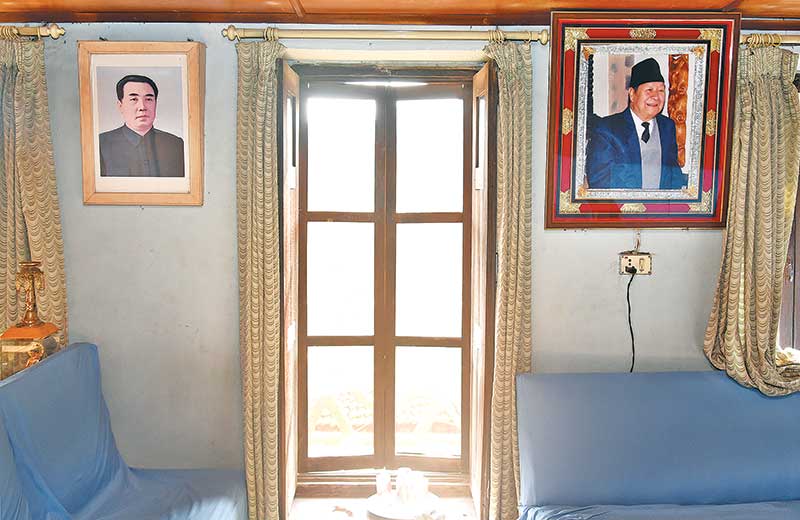
The city of Bhaktapur, ruled for over three decades by Narayan Man Bijukchhe, has long stressed self-reliance over everything, and everyone else.
- ANUP OJHA,TIKA R PRADHAN

Bhaktapur is pristine, especially when compared to the other cities of the Kathmandu valley. While Lalitpur and Kathmandu are metropolitan cities teeming with people and seemingly always in the midst of a building spree, Bhaktapur is quiet, almost as if it were frozen in the 70s. There is little garbage on the streets, which are well-paved and well-maintained. The glass-concrete monstrosities that offend the Kathmandu-Lalitpur skyline have yet to make inroads into Bhaktapur.
In the historic inner city, brick roads lead to a durbar square where all that was demolished during the 2015 earthquakes is already up and running, even as Kathmandu, and to a lesser extent Lalitpur, still struggle to get their ancient monuments rebuilt.
Behind Bhaktapur’s enviable state is one political party—the Nepal Majdoor Kisan Party, or Nepal Workers and Peasants Party—which has ruled the city for nearly three decades. Presiding over that party is one man who has shaped Bhaktapur with an iron hand—Narayan
Man Bijukchhe. And behind Bijukchhe is a radical ideology imported from a hermit state in a peninsula thousands of kilometres away—juche.
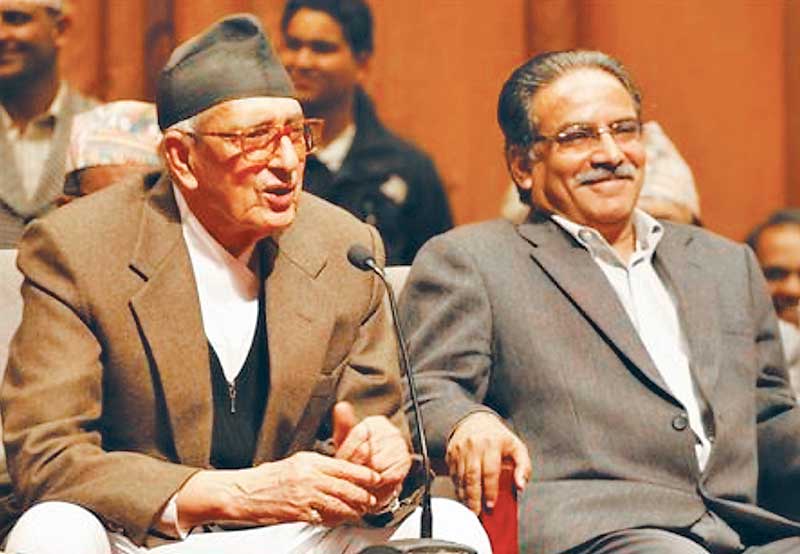
Entering party headquarters in Bhaktapur can feel incongruous. Amidst stacks of books and ancient steel almirahs are framed portraits of the Kim dynasty.
A portrait of a young Bijukchhe sits alongside one of a young Kim Jong-il, father to current dictator Kim Jong-un. Another portrait of an older Bijukchhe sits to the right of a framed painting of Kim Il-sung, the North Korean patriarch.
“I only went to North Korea after I became a Member of Parliament,” Bijukchhe told the Post. “There, everything is directed by the central government but here, everything is done by the people.”
But he collects himself and adds, “But juche, it is also focused on the people.”
In North Korea, juche, or self-reliance, is radically opposed to sadae, or a reliance on great powers. Juche, as Kim Il-sung, the founder of the Kim dynasty, expounded in a 1954 speech ‘On socialist construction in the Democratic People’s Republic of Korea and the South Korean revolution,’ chiefly concerns three characteristics—political independence, economic self-sustenance and defensive self-
reliance. Bijukchhe’s NeMaKiPa, as his party is colloquially known, has made political independence and economic self-sustenance
cornerstones of its model ofdevelopment.
“We have practiced becoming self-sustained since the very beginning by utilising our own resources. We never sought anything from Singha Durbar,” said Surendra Raj Gosai, a central committee member and member of the Bagmati Provincial Assembly.
In his nearly 30 years ruling over Bhaktapur Municipality, Bijukchhe has adapted juche to the Nepali context, bringing a homegrown model of development to the city that is not reliant on ‘outside’ interests but is wholly owned by locals and caters to locals.

But Bijukchhe’s strongman rule of the city has not come without its drawbacks. Critics point to an authoritarian style of governance that does not take democratic principles and values into account, and also a knee-jerk dislike of ‘outsiders’, including non-Newars and foreigners.

A history of self-reliance
Bijukchhe, or comrade ‘Rohit’, has never lost any of the elections that he’s contested. Since the reestablishment of democracy in 1990, Bijukchhe has won all five parliamentary polls in Bhaktapur-1. In the 2017 general elections, he chose not to run, fielding the party’s Prem Suwal from the constituency instead. As expected, Suwal won a landslide victory,
with 33,076 votes to 17,818 by the
closest opponent.
NeMaKiPa has always been adept at instrumentalising elections, even during the partyless Panchayat regime, said Rajendra Maharjan, a political commentator.
“The party has a strong hold among peasants and traditional organisations like guthis, which is unlike the country’s other communist parties,” said Maharjan. “Other communist parties expanded through their sister organisations but NeMaKiPa worked closely with traditional organisations.”
It is no surprise that NeMaKiPa remains the most popular party in the city of Bhaktapur. After all, under the party’s stewardship,
the city has established a number of institutions that have won plaudits from across the country. The
municipality currently runs seven educational institutions—Khwopa College, Khwopa Engineering College, Khwopa College of Engineering, Sarada Campus (for Bachelor level students), Khwopa Polytechnic Institute, Sarada Campus Secondary School (for 10+2 students) and Khwopa Secondary School. According to Roopak Joshi, principal of Khwopa College, about 6,000 students are currently getting
a quality education in his college
at affordable fees.
For Sunita Garu, a 42-year-old
resident of Hanuman Ghat in Bhaktapur, whose eldest daughter Lisha recently completed her Bachelor of Engineering Science from Khwopa College, the institution has been a godsend.
“My son studies in class 9 in a boarding school in Kathmandu and I need to spend at least Rs 100,000 annually for his education, but my daughter completed her Bachelors from Khwopa College for just Rs50,000 with a scholarship for two years,” said Garu.
According to Bhaktapur mayor Sunil Prajapati, who is also from the NeMaKiPa, there is a quota system in place for Engineering and Bachelor of Business Management—35 percent of seats are reserved for residents of the town, 15 percent for nearby municipalities, 5 percent for remote areas and the remaining 45 percent for open competition.
For Tejeswar Babu Gonga, a litterateur who grew up in Bhaktapur, all of this can be attributed to Bijukchhe.
“Though I’m not a party member, I believe in acknowledging anyone’s good work,” Gonga told the Post. If the Bhaktapur government had been allowed to run MBBS programmes, many students from poor families would have been to graduate, Gonga believes.
“But the Oli government is fearful of NeMaKiPa’s popularity,” he said. “Even the municipality’s proposal to develop a Khwopa University was dropped due to political interests.”
The vision of Bijukchhe, and by extension NeMaKiPa, is for the municipality to stand out in terms of education, health, sanitation and overall development. The schools and colleges are a step towards that lofty goal, but Bhaktapur has also employed a number of other novel methods.
The municipality, for the last two years, has been bringing healthcare to the doorstep of its residents. Every day, 10 staff nurses, accompanied by female community health volunteers, patrol the city’s 10 wards, checking up on locals and following up on patients with pre-existing conditions. The municipality is also building a health record of all its citizens, so it knows who needs what treatment and when.


post Photos: post Photo: Angad Dhakal

Narayan Man Bijukchhe sits below portraits of Marx, Engels, Lenin, Stalin and Mao at his party office in Bhaktapur.
The municipality has even established 14 open gyms across the city as part of its ‘Healthy Bhaktapur’ initiative.
“This party has given good education to our children and now, good health check-up facilities to everyone,” said 71-year-old Ram Bhakta Bijyu, a resident of Degamana in Bhaktapur. “Bijukchhe is a true leader, a real hero.”
Tourism is Bhaktapur’s largest source of income and the city has made certain to capitalise on its ancient heritage. Last fiscal year, the municipality raised Rs 240 million from tourism, while its internal income was only Rs 90 million.
Unlike Kathmandu and Lalitpur, out of 134 historical monuments damaged during the 2015 earthquakes, the city has already completed the reconstruction and renovation of 91 monuments, including 19 temples, 36 patis, six sattals and other shrines such as stone spouts and ponds.
Bhaktapur has so far spent Rs 254.9 million of its own money on reconstruction, according to data from the municipality. Again, unlike Kathmandu and Lalitpur, all reconstruction work is being carried out by the city, with no aid or assistance from foreign countries.
“We are well aware that foreign countries tend to impose their ideas on our culture and that ruins our identity,” said mayor Prajapati.
Under the NeMaKiPa, all non-governmental organisations must work through the municipality. The city authorities channel their work into specific areas depending on the expertise and background of these organisations, said Prajapati.
Purushottam Lochan Shrestha, a professor of history and culture from Bhaktapur, said even their political rivals laud the work that NeMaKiPa has done in the city, especially its preservation of cultural heritage and its insistence on financial transparency.
“NeMaKiPa seeks input from cultural experts before taking any decisions regarding heritage,” Shrestha told the Post. “Only when you understand historical developments and cultural context can you take decisions that ensure the future.”

Narayan Man and North Korea
In all of these works, the NeMaKiPa has pursued a sense of self-reliance. Whether it is prioritising education for the community or not accepting any foreign aid to rebuild its monuments, the party has consistently maintained that it will work on its own and of its own volition. This, according to party leaders, is the clearest manifestation of the party’s embrace of juche.
“Juche is all about placing the people at the centre of all that we do,” Bijukchhe told the Post one rainy winter morning.
Bijukchhe only began speaking once two party members—Niraj Lawaju, editor of the party’s daily tabloid, and Narayan Duwal, chairman of the party’s Bhaktapur municipal committee—arrived.
Bijukchhe is a stern man, old and set in his ways. He doesn’t carry a cellphone, only answering two ancient-looking telephones that sit on his desk and never seem to stop ringing.
“My friends bring me all the information I need,” he said.
Bijukchhe has written a book on Juche, based on the writings of Kim Il-sung, called ‘Koriyali songun niti ra juche bichardhara’ or ‘Korea’s Songun policy and the Juche ideology’. He’s one of a handful of political leaders from across the world who has visited North Korea four times, generally on state invitation. He even published a book in 2000 called Korea visit. Every year, the party marks the ‘Day of the Sun’ on April 15, the birth anniversary of the founder and Eternal President of North Korea, Kim Il-sung.
“We are here to serve the people,” said Bijukchhe. “You might have heard corruption at other different municipalities of the country but you cannot find such news of Bhaktapur municipality. We have strictly forbidden all our party cadres from seeking donations from people. They complain that other parties do so but I tell that we don’t follow what others do.”
To hear Bijukchhe tell it, it seems as if juche were always a central idea behind the kind of communism that he believes in. Juche might be a philosophy rooted in North Korean geopolitics but for Bijukchhe, it might as well have been born in the back alleys of Bhaktapur.
“Even after democracy came to the country, the people living in the gallis of Bhaktapur never knew what a municipality was, and the authorities didn’t bother to tell the people,” he said. “When we first won, we constructed a proper sewage system with donations from the public. The peasants who had no money contributed their labour. That’s how we kept our city clean.”
Bijukchhe has gotten a lot of press over the years for his admiration of North Korea’s Great Helmsman, which is probably why he is quick to downplay the direct influence of juche. We have learned from everywhere, he says.
He hasn’t just learned from North Korea—China too is a model, he says. He attributes the prohibition of all vehicles from Bhaktapur Durbar Square to what he saw at Beijing’s Tiananmen Square, which is also a pedestrian-only square.
“We study different systems from different countries and follow what suits us here,” he said.
In his office, Bijukchhe has the same portraits that used to hang on the walls of Nepal’s Maoist party—Marx, Engels, Lenin, Mao and Stalin. But Bijukchhe has two more portraits—Kim Il-sung and his son, Kim Jong-il. A portrait of the North Korea’s current leader, the rotund Kim Jong-un, has yet to go up.


Left: NeMaKiPa's party offices in Bhaktapur.Centre: The nondescript building that houses NeMaKiPa's office.Right: Portraits of a young Narayan Man Bijukchhe (left) and Kim Jong-il (right).

“Just as the Korean people are dominated by the American and Japanese ruling class, India is doing the same to Nepal and the Nepalis,” Bijukchhe told the Nepali Times in 2016. “There are similarities between Korea and Nepal.”
But at 80, Bijukchhe is old and he is considering handing over power to the next generation of leaders. By refusing to run in the 2017 elections, he’s already so much as anointed his successor—Prem Suwal, the current Member of Parliament from Bhaktapur.
Suwal is young, at just 34 years of age, but he is just as seeped in the party’s dominant ideology as Bijukchhe is.
“Kim Il-sung is one of the great teachers for Nepal together with Ho Chi Minh, Fidel Castro, Rosa Luxembourg to learn communism lessons,” he too had told Nepali Times in 2016. “The Juche idea is a directional ideology of our party, we read and study a lot of literature from North Korea.”

But speaking to the Post, both Suwal and Bijukchhe were more circumspect in their embrace of North Korea. Despite prodding, both refrained from openly endorsing the Kims and Juche, but Suwal sees nothing wrong with the North Korean ideology.
“Just as China is practicing Socialism with Chinese characteristics, Korean socialism is based on the juche ideology,” Suwal told the Post. “The central idea behind juche is to stand on one’s own feet. But we don’t just follow the ideology of others. We study them all and apply them in our own unique way.”
Suwal might be young but he shares the same distrust of the foreign forces that is common to North Korea and to Bijukchhe—which all of Nepal’s political parties, including the UML and Maoists, have professed at one point or the other in their careers. Just like Juche argues that Korea is under the yoke of the United States, NeMaKiPa argues that India is Nepal’s biggest hegemon. Bijukchhe even distrusts the Indian communist parties.
“We never so much as drank a cup of tea with the Indian communist parties,” he said.
Suwal agrees.
“In Nepal, we introduced multi-party democracy and a republican set-up with Indian support,” he said. “We are bearing the brunt of it now. If we go for a revolution, we must do it by standing on our own feet.”
A large part of the party’s self-reliance rhetoric is based on this distrust of foreigners, whether it be India or any other foreign country. It is also why the party refused all foreign aid for reconstruction. This insular xenophobia is also behind the party’s enduring popularity. NeMaKiPa has always received a large share of its support from Newars, which accounts for its
continued presence in Bhaktapur.
In contrast to the rest of the Kathmandu Valley, Bhaktapur remains a Newar stronghold, with over 90 percent of its population belonging to the Newar ethnicity, according to the municipality.

Bhaktapur is a model to many when it comes to development and cultural preservation.post Photo: Angad Dhakal

Winds of change
Things, however, are changing for the NeMaKiPa. The party’s traditional stronghold has been Constituency-1 of Bhaktapur district, which includes Bhaktapur municipality and Changunarayan municipality. Suwal was elected in 2017 from this constituency. But in Constituency-2, NeMaKiPa has been fast losing ground.
According to Ramesh Giri, a journalist based in Bhaktapur and associated with the Rastriya Samachar Samiti, the national news agency, Bijukchhe’s grasp has long been limited to the Newar community. The changes in Constituency-2 can largely be attributed to changing demographics, where more and more migrants are settling in to Suryabinayak and Madhyapur Thimi, the two municipalities that constitute Bhaktapur’s Constituency-2.
Data from the Department of National ID and Civil Registration shows that, from March 2017 till date, only 270 people migrated to the Bhaktapur municipality. The largest migration was 3,339 in Suryabinayak Municipality, followed by 2,734 in Madhyapur Thimi. And these numbers only account for those who’ve registered their move.
Giri acknowledged that the effects of migration could be one reason the party is losing its hold, but others believe that the party’s ideology is outdated and it has not been able to keep up with the times.
“The party’s ideology is scientific socialism, but society is gripped by capitalism,” said Niraj Lawaju, former president of NeMaKiPa’s Nepal Revolutionary Student Union and its candidate for the November 30 Provincial Assembly by-election. “The party’s inability to take its ideology to the broader public is the reason behind its recent defeats.”
The Nepal Communist Party, in particular, has made significant inroads into the district. In the 2017 polls, Mahesh Basnet of the former UML won a landslide victory in Constituency-2, with 36,412 votes to the NeMaKiPa’s Anuradha Thapa Magar’s 5,471 votes. Even popular leaders from the party, like Binod Bikram Shah and Keshav Badal, have abandoned NeMaKiPa for the Nepal Communist Party.
According to political commentator Maharjan, while there is no space to question the NeMaKiPa’s development works, including sanitation and preservation of culture, questions can be raised about whether the party leadership is actually following democratic processes.


A nurse and two volunteers patrol Bhaktapur's streets offering healthcare at home.post Photo: KESHAV THAPA

“There is ample space to question whether Bijukchhe has turned into a benevolent dictator,” said Maharjan. “Being a model in development activities alone is not enough for a political party, its leadership needs to ensure that there is an internal democratic decision-making system.”
The party also interferes in private lives, said Maharjan, by mediating divorce cases and the partition of families and their property. Maharjan said that many of his friends in the leadership were forced to abandon the party because of its chairman’s autocratic tendencies.
“Second-rung leaders cannot stand up to the chairman,” he told the Post. “Even in the decisions made by the municipality, it is not clear how much influence the party chair has.”
Bijukchhe, however, remains firm.
“Other parties use money and muscle to win the polls but we never do. This is class struggle so we don’t bow down,” he said. “Whatever votes we’ve received are from our true voters.”
But for many locals from the municipalities surrounding Bhaktapur city, it’s a different story. They’ve long chafed under the iron thumb of the NeMaKiPa, which has consistently prioritised the core city.
“Bhaktapur Municipality is the oldest municipality in the district and it is resourceful, but it never cooperates with other municipalities,” said Kiran Thapa, chairperson of Ward-8 in Suryabinayak Municipality, which connects with Bhaktapur’s southern border. “It has a great source of income through tourism and infrastructure and we admire its model of development. Still, the peasant party is indifferent towards us.”
Thapa is a member of the Nepal Communist Party and he believes that since he does not share in NeMaKiPa’s ideology, it is unwilling to work with him.
Local representatives from Changunarayan Municipality echoed Thapa.
“Municipalities from Sankuwasabha and Ramechhap come to interact with us, but I have never seen our neighbours coming and sharing their ideas,” said Som Prasad Mishra, mayor of Changunarayan Municipality and a member of Nepal Communist Party. “We call them but they do not come.”


One of Bhaktapur's popular initiatives has been free open-air gyms for the public. post Photo: Angad Dhakal 

This is a complaint that is echoed throughout the district. Most of the elected representatives that the Post spoke to had the same refrain—we admire what they do but they do not want to work with us. They go so far as to accuse NeMaKiPa of prioritising their own party and their own residents—at the cost of others.
“Education facilities and health check-ups are easily available for party cadre but it’s hard for people living on the outskirts of the municipality,” said Narayan Nepal, a resident of Changunarayan Ward-8 and an active member of the Nepali Congress. “It is the same in all the neighbouring municipalities of Bhaktapur-Changunarayan, Suryabinayak, and Madhyapur Thimi. None of the citizens get priority. This is not a leadership quality.”
Though the municipality itself is seen as a model for development, with its clean roads and well-maintained infrastructure, its neighbouring areas continue to suffer from dust, smoke and dirt.
“If you go to Byashi, Sallaghari, Jagate and Kamal Binayak, these places are neglected,” said Rajindra Chawla, a taxi driver who lives in Bansgopal in Bhaktapur Municipality. “There aren’t public toilets and the place is full of dust and mud.”
According to Mishra, the Changunarayan mayor, Bhaktapur is like a separate state that does not want to keep in touch with any of its neighbouring municipalities.


Bhaktapur's model of healthcare has won it many admirers in the city and beyond. post Photo: KESHAV THAPA

Bijukchhe and Suwal both brushed off these criticisms, saying that they are working for the people and it is up to parties like the Nepal Communist Party and the Nepali Congress to do the same.
In a rare moment, Bijukcche appeared to deflate and he admits that things are getting tougher.
“Young people refuse to contest the elections on our ticket as they say they won’t be able to build a house or buy a car when representatives from all other parties earn plenty of money,” he said.
But he composed himself quickly, as if coming to his senses.
“We joined politics knowing it would be difficult,” he said. “What is easy in this world anyway?”

HOME PAGE

Dahal says he’ll take responsibility for insurgency deaths but his actions don’t match his words

Victims say he is delaying the justice process.
- BINOD GHIMIRE

Dahal (right) is one of the two signatories of the Comprehensive Peace Accord.reuters

KATHMANDU : For the last few months, Nepal Communist Party Co-chair Pushpa Kamal Dahal has repeatedly insisted that he is committed to transitional justice. Since September, Dahal, who was the supreme commander of the rebel Maoists during the decade-long insurgency, has, on at least three occasions, said that he is ready to take responsibility for all positive and negative implications of the ‘peoples war’.
“As the only living signatory to the peace agreement, I am committed to concluding the transitional justice process as demanded by the victims,” Dahal said on the 13th anniversary of the Comprehensive Peace Agreement, which was signed on November 21, 2006.
On Wednesday, he went a step forward, saying he would take responsibility for 5,000 deaths during the conflict. Addressing the Maghi festival of the Tharu community in the Capital, Dahal said that the state had killed 12,000 of the total 17,000 dead.
But conflict victims and human rights defenders have long stopped buying Dahal’s public statements.
In the 13 years since the peace agreement was signed, Dahal hasn’t taken any concrete steps to ensure transitional justice. Victims have long demanded transparency in appointments to the two transitional justice commissions and amendment to the existing transtional justice Act. Instead, Dahal, along with a close coterie of political leaders and the Nepal Army, has worked to slow down the process and politicise it.
“His actions don’t match his commitments,” said Suman Adhikari, whose father Muktinath Adhikari, was killed by the Maoists in 2002.
“His statements are nothing but mere rhetoric.”
Human rights defenders too say that leaders like Dahal must speak with their actions rather than making commitments with no results.
“Dahal must demonstrate accountability, which is lacking in his actions,” said Satish Mainali, an advocate who has contested cases on behalf of conflict victims.
Human rights activists say that Dahal as co-chair of the ruling party is in a position to play a constructive role in taking the transtional justice process forward.
Nearly five years since the Supreme Court directed the government to revise the Enforced Disappearances Enquiry and Truth and Reconciliation Commission Act-2014 in line with Nepal’s international obligations, successive governments have ignored the ruling to ensure transitional justice. The Commission of Investigation on Enforced Disappeared Persons and the Truth and Reconciliation Commission have both been non-functional and without office bearers since April.
According to human rights activists, all parties, including the one that Dahal leads, are prolonging the process in the hopes that they can tire out the victims.
“It is better for the parties to conclude the process through the domestic system,” said Daman Nath Dhungana, a civil society activist, at a programme organised on Friday to mark 18 years since Muktinath’s killing. “The parties must get rid of the illusion that they can tire out the victims and derail the process. The international community will not give up.”
Despite victims and human rights defenders all entreating the parties to put a stop to the politicisation of the transtional justice process, the parties have continued with their efforts to have ‘their’ people in the two commissions. Leaders from the ruling party and the Nepali Congress, the main opposition party, are in negotiations over new appointments to the two commissions.
Prime Minister KP Sharma Oli, Dahal and Nepali Congress President Sher Bahadur Deuba, along with the second-rung leaders of their parties, discussed legal amendments and appointments on Friday at Baluwatar, according to Khim Lal Devkota, a ruling party leader who was present in the meeting.
The government on January 13 held consultations with the concerned parties to collect feedback on legal amendments. But victims and the human rights community have both criticised the consultations as just a formality.

HOME PAGE

Poverty alone not a leading cause for involvement in illegal wildlife trade, new study says

Most inmates currently serving jail terms for wildlife trade knew that the activity was illegal but were unaware of the severity of the consequences, according to the study.
- CHANDAN KUMAR MANDAL

Trade in wildlife parts has threatened endangered animal species.Post file Photo

KATHMANDU : Poverty and ignorance of the law are not the driving factors behind wildlife crimes in the country, according to a new study.
The study, published recently in the journal Conservation Science and Practice, attempts to provide insight into the motivations of people who have been involved in poaching and the illegal trade in animal parts. While Nepal has been internationally lauded for its conservation model, there have been consistent concerns about the effects of this model on indigenous populations that once lived in symbiotic relationships with the forests and wildlife.
Based on a sample of 384 individuals jailed across the country for wildlife infractions, and interviews with 116 of them, the study concludes that “despite common assumptions about the links between IWT [illegal wildlife trade], poverty and organised crime, most respondents were motivated by the desire to earn extra income and by the ease of IWT compared to other employment.”
“I always wanted to learn why people pursue the illegal trade in wildlife parts and what their motives are, given that there are deterrence mechanisms like strict laws and penalties in place,” Kumar Paudel, the lead researcher of the study, told the Post over the phone from the University of Cambridge.
Beginning in 2015, the study focused on people serving jail terms for illegal wildlife trade offences in order to explore trade practices, their economic circumstances and their motivations. Although a majority of those arrested were poor (56 percent reported incomes below the World Bank poverty line) and from indigenous backgrounds (75 percent), most (90 percent) said that they knew that wildlife poaching was illegal and punishable by law.
“What we found was different from what I assumed,” said Paudel, who is also the co-founder of Greenhood Nepal, a science-driven nonprofit that focuses on the human dimensions of conservation. “I always thought that people were probably not aware that harvesting parts was illegal. But most were aware.”
However, 70 percent of respondents had no idea about the penalties and their severity, which raises questions about the awareness campaigns of the government and non-governmental agencies, according to experts in the field. The respondents were largely unaware of the scale of punishment and the consequences on their personal and social life, according to findings.
Raju Acharya, a wildlife conservationist, agrees with the research
findings.
“People know that carrying
out trade in wildlife parts is illegal, but they have no idea about the
extent of the penalties and what
they could to their lives,” said Acharya, who is also the executive director of Friends of Nature
Nepal, a youth-led organisation
working in the field of environment and wildlife conservation. “Awareness campaigns of the government and other agencies have remained
ineffective in informing the public about the consequences.”
According to Paudel, conservation agencies have failed to inform
potential offenders about the extent of the sanctions and their associated costs. Social costs of criminalisation can include divorce, an inability
to find jobs once released, and
compulsions for them and their
family members to migrate abroad for employment, to sell their property or close businesses, stigma and loss of prestige.
While the respondents reached
out for the study were overwhelmingly male (115 of 116), the vast majority (75 percent) were janajatis, including largely marginalised indigenous
communities like Tamang, Chaudhary and Chepang/Praja.
These groups live near forests and the outskirts of protected areas and have traditionally depended on
forests for their livelihoods. Their continued reliance on forest resources is reflected in the number of inmates around the protected areas.
In the prison in Chitwan, the
district where the Chitwan National Park is located, wildlife trade
constitutes 21.1 percent of prisoners, followed by 9.6 in Bardiya and 6.4 in Rasuwa.
Illegal trade and poaching of wild animals, which surged during the decade-long armed conflict ending in 2006, pose a challenge for the country’s conservation efforts. The IUCN Regional Red List Series-2011 recorded 212 mammal species in Nepal. Of them, 49 were nationally threatened, 9 critically endangered, 26 endangered, 14 vulnerable, one regionally extinct, and 7 near threatened.
Nepal has been spending millions of rupees on wildlife conservation. In order to protect animals, the country’s protected areas are heavily guarded by security forces and there are strict laws in place.
Nearly 7,000 Nepal Army military personnel are deployed inside protected areas and a series of operations are being conducted by the Central Investigation Bureau and Wildlife Crime Control Bureaus to prevent the illegal wildlife trade.
However, between 2009 and 2014, the number of wildlife seizures increased ten-fold, and wildlife crime-related arrests increased by 8.6-fold, according to Paudel.
“We have been calling our conservation a community-based model but we have heavily mobilised security forces in various parks. The enforcement-based approach comes with a social cost,” said Paudel. “We have used the military to deter people, but arrests are on the rise. We should be informing them not to participate in such crimes because it comes with other personal and social losses. Behavioural change should be the focus.”
The study found that many people never saw poaching and trading in wildlife parts as a risky profession
nor thought that they could even be arrested for such crimes.
The Department of National Park and Wildlife Conservation, the
government body responsible for the management of protected areas,
conducts awareness campaigns
at the ground level in coordination with buffer zone communities and with the bureau to inform the
public about existing rules and
regulations, according to Bishnu Prasad Shrestha, a spokesperson for the department.
“Illegal trade in wildlife has come largely under control,” said Shrestha. “Except for species like pangolin and red panda, crimes involving big
animals like tigers and rhinos have gone down.”
But wildlife experts point to flaws with such models of awareness.
“At times, when we talk about
how threatened a particular species
is, we tend to provide the monetary value of their parts in the domestic and international markets,” said Acharya. “In that case, such campaigns can backfire. People start
comparing the maximum penalty and the jail term with the potential profit they could make from the trade.”
The study also made another major finding, which has been often touted as the leading factor behind wildlife-related crimes.
“There is a general conception that poverty is the major factor behind an individual pursuing illegal poaching of wildlife and its trade,” said Paudel. “But what is the definition and level of poverty? Are they even struggling for food? We wanted to know what scale of poverty pushes them into illegal trade of wildlife.”
According to the study, despite common assumptions about the links between illegal wildlife trade, poverty and organised crime, most respondents were motivated by the desire to earn extra income and by the ease of the trade compared to other forms of employment.
Although the majority of respondents self-reported themselves as poor, their motive for joining the wildlife trade varied. Only 10.3 percent of respondents considered wildlife trade as their primary occupation before arrest whereas for a large number of people it was an additional source of income.
In addition, meeting direct household needs was also not a leading motivation reported by the arrested, who came from various employment sectors including two military officials, two politicians and three secondary school students.
“What we found was that participation was guided by the desire to earn extra incomes easily,” said Paudel. “This challenges the narrative that poverty is the leading reason behind people’s involvement in the wildlife trade.”

Nepal Army plays a role in nature conservation.Post file Photo

Page 2
HOROSCOPE

HOROSCOPE

ARIES (March 21-April 19)
**
There is a growing sense inside you that your physical appearance is not an accurate reflection of your inner self. Pay attention to this feeling. Whether you want to lose some weight, gain some weight, or just change your wardrobe, make an effort to start the transformation today.


TAURUS (April 20-May 20)
**
An agreement you made with someone a long time ago is turning into a promise that you just can’t keep today. It’s up to you to talk to this person as soon as possible in order to try to renegotiate another arrangement. The worst thing you could possibly do is go against the agreement without letting them know about it.

GEMINI (May 21-June 21)
**
You can’t have any fun debating someone unless you respect them. Sure, they might have ridiculous ideas about how the world should be run, but that doesn’t change that they’re entitled to think what they want to think. If you find yourself in a conversation with someone who doesn’t agree with you, try not to get personal.

CANCER (June 22-July 22)
***
You know your own worth, but today it might feel as though no one else does. If you’re feeling overlooked or just taken for granted, take note of the friends who are treating you that way. You’re no bargain-basement friend, and if you’re being made to feel that way, it’s time to move on.

LEO (July 23-August 22)
****
Don’t let all your creativity go to waste today. Get out and start doing something with all those ideas that have been buzzing in your head. Pay a visit to an art store, museum, or even office supply store. While you’re there, something could spark a thought that leads you to another thought that leads you to true inspiration!

VIRGO (August 23-September 22)
***
Today, it will be as easy as pie to stay in rhythm with the people around you. Each of the power players you’re working with is marching to the beat of their own drum, but you can still harmonise with them beautifully. If you just try to be as flexible you’ll be singing a sweet song all day long and into the night.

LIBRA (September 23-October 22)
****
The best thing you can do for yourself today is be active, physically, mentally, or emotionally. Jog an extra block or so. Read that long article in the paper. Have that heart-to-heart conversation. You are capable of stretching further than you think, and today is a wonderful day to push your boundaries and go into new territory.


SCORPIO (October 23-November 21)
**
There are a lot of new people on the scene right now, and it might feel as though one of them is taking your place in a cherished relationship, but that’s just your fear talking! If you’re stressed that a friend is spending time with someone else put it out of your mind. You love your friends, and you need to trust them.


SAGITTARIUS (November 22-December 21)
**
You can take on a lot more risk right now in your life, but before you book a flight for a vacation in or decide to do bungee jumping, listen up: The universe wants you to avoid anything that involves too much physical or fiscal risk. The only risk you should be investigating is emotionally oriented.


CAPRICORN (December 22-January 19)
**
There’s a crazy mix-up going on within your social circle right now. People seem to be switching personalities and behaving in some unexpected ways. The flaky ones are suddenly showing up on time, and the reliable folks are missing in action. Are you altering your behavior? Try not to.


AQUARIUS (January 20-February 18)
***
As much as someone’s ego trips might be bothering you, you can’t fall into their games. Their boastfulness is their feeble way of hiding their insecurity, and it’s also their way of pushing your buttons. It’s a waste of time to get involved in power struggles. You’re better than they are in so many ways, and they totally know it.


PISCES (February 19-March 20)
***
Old habits can easily grow to be like an old pair of faded jeans. They are something that gives you comfort even though they might not be appropriate for every occasion. Today, take a look at the things you do in your life without really thinking about them, and ask yourself whether or not they’re necessary.

Page 3
NATIONAL

House meeting nears but there’s still no candidate for Speaker

Oli has become more flexible on the candidate for Speaker and has agreed to Dahal’s choice, party insiders say.
- TIKA R PRADHAN

KATHMANDU : With just two days remaining for the meeting of the House of Representatives, there are fears of another postponement due to an inability to reach consensus on a candidate for Speaker. But the ruling party leaders say that Prime Minister KP Sharma Oli has recently become much more flexible in his choice of candidate and is willing to compromise on someone acceptable to all party leaders.
According to party insiders, Oli is willing to hand over the leadership of the House to the Maoists on the condition that the new Speaker “defend his government”.
Oli, who had hardened his position after being sidelined in a secretariat meeting on January 8, softened his stance after speaking with former UML leaders and has agreed to accept Dahal’s candidate, said a minister and Standing Committee member. In the January 8 meeting, Dahal had managed to get most leaders, including senior leaders Madhav Kumar Nepal and Jhala Nath Khanal, on his side, leaving Oli in a minority position.
“Dahal has told Oli that he will propose a candidate for Speaker and Oli has agreed,” said the Standing Committee member.
Following a nearly three-hour one-on-one meeting with Oli, Dahal had told leaders from his faction that the prime minister has become more flexible.
According to Devendra Poudel, also a standing committee member, Oli has asked Dahal to propose a candidate but has also said that he will provide some suggestions of his own.
“I think things will unfold on Saturday,” said Poudel.
Dahal, who has so far been in favour of Agni Sapkota for Speaker, is now considering other candidates, given the reservations expressed by many former UML leaders. Sapkota also has a murder case against him sub judice in the Supreme Court. But as a close confidante of Dahal, Sapkota remains his first choice.
In case the UML faction demands a female candidate, Dahal is willing to consider Standing Committee member Pampha Bhusal. But Bhusal represents a faction led by Home Minister Ram Bahadur Thapa and many leaders from that faction, including Chief Whip Dev Gurung, have publicly opposed the United States-led Millennium Challenge Corporation’s Nepal Compact.
UML leaders fear that Bhusal could be a repeat of Krishna Bahadur Mahara, the former Speaker who Oli has accused of holding up the MCC. If not Bhusal or Sapkota, Dahal could also propose long-time confidante Haribol Gajurel.
“Earlier, I had told Dahal that I would rather continue with active politics when he asked for my opinion,” Gajurel told the Post. “But I will be ready if the party decides so.”
Party spokesperson Narayan Kaji Shrestha, however, cautioned against making any rash judgements, saying all lawmakers were eligible for the post of Speaker. “Why don’t you wait for some time to see how things will unfold,” Shrestha told the Post.

NATIONAL

Fresh westerly disturbance leaves country cold and wet

Weather to start improving from today but will remain mostly cloudy, according to the weather office.
- CHANDAN KUMAR MANDAL

KATHMANDU : The latest westerly disturbance has brought adverse weather conditions, in the form of rainfall and snowfall, across the country.
The fresh westerlies, which originate in the Mediterranean region, entered Nepal on Wednesday evening through western Nepal and have since affected weather across the country, including the Kathmandu Valley.
According to the Meteorological Forecasting Division, the effect of the westerly disturbance has resulted in cloudy conditions throughout the country. The weather office also predicted light-to-moderate rain in many places across the country from Thursday evening onwards.
“The poor weather the country is experiencing is the effect of the westerly disturbance, which has now spread all across the country,” Ganga Nagarkoti, a meteorologist with the weather office, told the Post. “This is quite a strong westerly disturbance. On some occasions, it can pass the higher mountainous region without causing a serious effect.”
The westerly disturbance is an extra-tropical storm that originates in the Mediterranean and is known to bring winter rain and snow to the northwestern parts of the Indian subcontinent, in countries like India, Pakistan and Nepal.
Several places in the high mountains received light-to-moderate snowfall while a few places in the central and western high mountains witnessed heavy snowfall on Friday.
Weather conditions also deteriorated in the Kathmandu Valley, where rainfall started late Thursday evening.
Cloudy conditions, coupled with rainfall, snowfall and a drop in maximum temperature, have disrupted life across the country.
“Cloudy conditions have been there for the last two-three days. With
the arrival of the westerly disturbance, it has only worsened. Even higher districts in the hilly region might receive snowfall,” said Nagarkoti. “Remote areas in the hilly and mountainous regions, which still depend on solar energy, might face disturbances in communication due to adverse weather.”
A few domestic flights were also affected on Friday morning because of the rainfall that continued throughout the day in Kathmandu.
Winter rain contributes nearly four percent to the rainfall the country receives in a year. However, this winter rain is significant for agriculture, according to meteorologists.
“This rain is crucial for winter crops. The first rain of the winter season provides much-needed water to crops in places with poor irrigation facilities,” said Nagarkoti.
The three-day forecast from the weather office has said that the weather will start to improve from Saturday.
“But it won’t improve completely. The mountainous region may still experience light-to-moderate snowfall,” said Nagarkoti. “But one never knows when the next disturbance might enter and cause rain and snowfall again.”
The Tarai region, which regularly experiences extended periods of dense fog in the winter season, is at present clear of fog and cold wave. However, once the westerly disturbance retracts, the region will once again see a drop in temperature and strong fog.
“Once the rainfall is over, the Tarai districts will again come under the grip of fog in the next few days,” said Nagarkoti.

Page 4
NATIONAL

How a photo has come to symbolise long wait for justice

Muktinath Adhikari, a teacher and member of Amnesty International Nepal, was killed in Lamjung 18 years ago by the Maoists.
- Post Report
photo courtesy of himal magazine

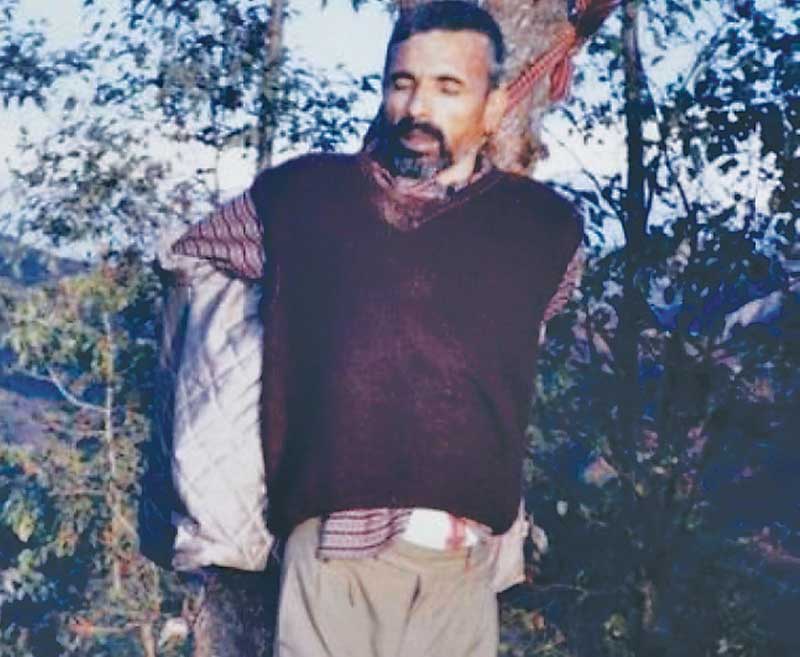
KATHMANDU : On Friday, a stream of people started sharing a horrifying photo from nearly two decades ago: the lifeless body of a middle-aged man tied to a tree.
The man was Muktinath Adhikari, the headmaster of Parini Sanskrit School in Lamjung and then coordinator of Group 79, Lamjung of Amnesty International Nepal. On January 16, 2002, he was in the middle of teaching a ninth-grade science class when a group of Maoist combatants came to take him away. Despite protests from his students, the Maoists did not relent, according to Suman Adhikari, Muktinath’s eldest son.
The Maoists had demanded a share of every teacher’s salary to fund their insurgency—a practice that Muktinath had opposed, according to Suman.
Muktinath’s legs were tied with a rope and he was dragged half-an-hour uphill. He was then tied to a tree with his own muffler, stabbed repeatedly in the chest and then shot in the head. His body left hanging by the neck, with a warning to all villagers that the body was not to be moved.
The photo of Muktinath’s body, taken by Ajaya Anuragi and later published on the cover of Himal magazine, came to symbolise the brutality of the 10-year-long insurgency, where non-combatants like Muktinath were caught in the crossfire. And in the years since the conflict ended, the photo has taken on additional meaning, symbolising the long wait for transitional justice for victims and their families.
During the insurgency, there were numerous cases of torture, extrajudicial killing and disappearance, both by the state and the
rebel Maoists. When the Comprehensive Peace Agreement was signed between the two sides in 2006, effectively ending the war, both sides had committed to ensuring justice for victims. But 13 years later, families and victims continue to await justice from a process that has been largely co-opted by political interests.
It took nine years for two transitional justice bodies—the Truth and Reconciliation Commission and the Commission of Investigation on Enforced Disappeared Persons—to even come into being. Since their formation, the terms of the commissions were extended twice, but they have failed to achieve anything substantial, largely due to a lack of resources and the government’s failure to amend the transitional justice Act in line with a 2015 Supreme Court ruling and international obligations.
The government has, at home and internationally, promised to amend the law, but no steps have been taken to that end so far, much to the disappointment of conflict victims.
The transitional justice process has dragged on for far too long, during which time, victims have been alienated and marginalised. Political leaders, both from the Maoists and the state, have instead been making controversial remarks. In one recent speech, Pushpa
Kamal Dahal, the supreme leader of the Maoists during the insurgency and current co-chair of the ruling Nepal Communist Party (NCP), said that he was ready to take responsibility for 5,000 deaths during the insurgency in which around 17,000 people lost their lives.
In an interview with Baahrakhari, an online publication, on Friday, Suman said that the intention of the state and the major political parties has been to delay justice as much as possible so that the families forget the atrocities committed.

Page 5
NATIONAL

A municipality in Khotang has two bus parks but they are never occupied

Haphazard parking in the market area has increased the risk of accidents because of congestion, say locals.
- DAMBAR SINGH RAI

KHOTANG : Diktel Rupakoti Majuwagadi Municipality in Khotang has two
bus parks with the capacity of holding around 150 buses at a time. But buses do not park there. Instead, they wait for passengers on roadsides.
This has led to unprecedented traffic congestion.
The bus parks, located at Acharya Gaun in Ward No. 1, and Solma Danda Gaun in Ward No. 2, are not serving their purpose, say locals.
Repeated requests by the mayor’s office to the local bus operators to use the two bus parks have gone unheeded, said Kamal Dhakal, an advisor to the municipality mayor.
“The municipality has repeatedly warned against parking vehicles in no-parking zones, but the drivers don’t pay heed to the warnings,” Dhakal said. “Even the traffic police, who should take action against illegal parking, has done nothing.”
Haphazard parking in the market area has increased the risk of accidents. Deputy Superintendent of Police Bamdev Gautam said
managing illegal parking was the job of the municipality.
“Traffic rules and regulations are outside our jurisdiction,” said Gautam. “The mayor’s office must use its authority to resolve this issue.”
The land plots where the two bus parks are located were donated by locals. “We all decided to give land for the development of the village. We thought it would be good for the municipality to have designated parking spots for public vehicles,” said Devi Prasad Acharya, a resident of Acharya Gaun who had donated land for the bus park in the area.
Surya Bahadur Rai of Dada Gaun said it was a matter of concern that the bus park had gone unused.
“The infrastructure of the bus park was built with millions of investment. But they haven’t been built well,” Rai said. Aside from questioning the quality of the infrastructure of the two bus parks, local transport operators say using the bus parks
on a daily basis is not feasible.
“The municipality hasn’t made any security arrangement at the bus parks. Who will guarantee the safety of the vehicles?,” said Dhani Ram Rai, who works at a ticket counter of Khotang Transport Private Limited. “There are also no hotels nearby for bus drivers.”
According to Parsuram Acharya, chairman of the Bus Park Cons-truction Consumers’ Committee, around Rs 20 million has been spent so far on Acharya Gaun bus park.
“In the last fiscal year, the Province 1 government had allocated Rs 5 million via the office of Urban Development and Building Construction for the project,” said Acharya. The fund is being used to construct a 91-metre long supporting wall, 150-metre long sewage, two eight-metre wide bridges in a small canal, a garden and a drinking water well. Locals say that the concerned authorities have not paid heed to their concerns even after repeated complaints about the congestion in the market areas and the poor construction work of the bus parks.
Over the years, five consumer committees were formed to lead the bus park projects. “The materials used in the construction of the bus parks are of low quality. There are many glaring technical errors in the construction work,” said Radhika Acharaya, a local. “So many consumer committees were formed to keep a check on the construction work, but none of them did a good job.”

NATIONAL

Jayaprithvi Municipality pays off loans of Badi people

The municipality also plans to run various income-generating programmes to make them financially independent.
- Basanta Pratap Singh

BAJHANG : Jayaprithvi Municipality in Bajhang district has paid off the debts of 15 Badi families.
The municipal office on Thursday paid a total of Rs 840,000 that the Badi families owed to the local money lenders. Birendra Bahadur Khadka, mayor of the municipality, said the municipality decided to pay off the debts of the Badi families living in Chainpur considering their poor economic conditions. “Most of them don’t have any source of income. We hope that they will start some income-generating enterprises and live a debt-free life,” said Khadka.
According to him, the municipality also plans to run various income-generating programmes targetting the Badi people to make them financially independent.
The municipality paid off the loans of the Badi families on a condition that they would not seek further loans.
Six months ago, the government had also constructed houses and handed them over to impoverished Badi families under the People’s Housing Programme.
Dal Bahadur Bista, the chairman of Jayaprithvi Municipality Ward No. 10, said some Badi families have moved into a model settlement built in the municipality.
Ramesh Badi said the money lenders had started harassing his family for not paying up the loan.
“We were not in a condition to pay the money back. Some money lenders even padlocked our houses. That’s why we requested the local unit for help,” he said.
According to the 2011 census, there are 38,603 Badis living across the country. Badi settlements are spread across the midwestern districts, primarily in Kailali, Bardia, Surkhet, Bajhang, Salyan and Dang.
On January 7, 2009, the Cabinet decided to rehabilitate the Badi community by giving them land and training them with income-generating skills.

NATIONAL

US embassy attempts to clear the air on MCC

Issuing a 10-point clarification, the embassy insisted that there is no military component to the MCC.
- ANIL GIRI

KATHMANDU : As the controversy over the United States’ Millennium Challenge Corporation’s Nepal Compact continues, the US embassy in Kathmandu on Friday issued a 10-point clarification and urged
interested parties to read the full text of the agreement.
The press release was in response to a large number of queries from Nepali citizens, politicians, and members of the media about the MCC, according to the embassy. The release clearly states that every Nepali government since 2012 has been in favour of the MCC and that there is no military component to the compact.
“The MCC does not include any military components,” reads the
clarification, issued in Nepal. “In fact, US law prohibits the inclusion of military components in any MCC compact.”
The embassy’s clarification should serve as a respite to Prime Minister KP Sharma Oli who has been attempting to pass the MCC Nepal compact via Parliament while convincing naysayers that the grant is beneficial to Nepal. Those who are opposing the MCC, which include leaders from Oli’s own party, have claimed that the US grant, as part of Washington’s larger Indo-Pacific Strategy, has strong military components aimed at countering China in the region.
The US embassy’s press release does not mention whether the MCC is a part of the Indo-Pacific Strategy. However, several visiting
US officials have said that the MCC is definitely a part of the IPS, as is everything that the US does in Nepal or the Indo-Pacific Region.
The IPS is not solely a military strategy, they said.
The ruling Nepal Communist Party is sharply divided over the MCC’s Nepal compact. A section of the party, led by Oli, has vowed to pass the compact via the Parliament’s ongoing winter session while another section, led by party co-chair Pushpa Kamal Dahal, has opposed the compact.
Signed in 2017, the MCC’s Nepal compact is a $500 million grant that will go towards two infrastructure projects.
“At the request of Nepal’s leaders, the US government began working with Nepal in 2012 toward the development of an MCC compact,” read the embassy’s clarification. “Each government and every Nepali political party, when in power, expressed a desire to conclude the MCC Compact for Nepal’s economic development.”
The MCC is focused purely on economic development by helping to build power lines and improve roads and Nepal does not need to “join” or “sign up” for anything in order to participate in the MCC, the clarification further reads. The $500 million is a grant with no strings attached, no interest rates, and no hidden clauses, said the embassy.
“All Nepal has to do is commit to spending the money, transparently, for the projects that have been agreed upon,” it stated.
Nepal government has also put in Rs 16 million of its own into the MCC compact. Prime Minister Oli, earlier this week, instructed his Cabinet not to speak against the MCC and insisted that the US grant would be approved from the winter session of Parliament.
Similarly, the main opposition Nepali Congress also issued a statement on Friday demanding early ratification of the MCC.
The US embassy said that Nepal had proposed and decided on the projects that the MCC will fund, based on its own priorities, and that the MCC model requires Nepal to hire Nepalis to lead the implementation of the projects.
“MCC project tenders are open, transparent, and available to everyone,” the embassy said. “In Nepal, as in every country where MCC works, parliamentary ratification is required and provides transparency and an opportunity for Nepalis to understand the project.”

NATIONAL

Two held with brown sugar in Birtamod

Briefing
- Post Report

BIRTAMOD: The Area Police Office in Birtamod arrested two people in possession of brown sugar from Surunga bazaar in Kankai Municipality on Friday. Acting on a tip-off, police arrested motorcycle-borne Niten Karki and Rajendra Prasad Upreti of Birtamod with 35 grams of brown sugar, police said.


NATIONAL

Solar water project benefits villagers in Rukum West

Briefing
- Post Report

RUKUM WEST: A solar powerlifting drinking water project has
benefited 74 families of Tribeni Rural Municipality Ward No. 9 and 40 families of Chaurjahari Municipality in Rukum (West). Prior to this, the villagers had to spend several hours fetching water from sources. The total cost of the project is around Rs 13.1 million.


NATIONAL

Livestock lab remains unused in Parasi

Briefing
- Post Report

PARASI: A livestock laboratory in Parasi (Nawalparasi West) has remained unused due to a lack of technical manpower. The provincial government had bought equipment worth millions of rupees for the laboratory, but they are currently sitting idle.


NATIONAL

Avalanche blocks Larke-Samagaun foot trail

Briefing
- Post Report

POKHARA: The Larke-Samagaun foot trail has been blocked due to an avalanche at Namrung in Chumanubri Rural Municipality Ward No. 4 on Friday, police said. Superintendent of Police Om Adhikari said the avalanche has swept away 25 meters of the Larkepass trekking route.


NATIONAL

Three schools in Doti are now ‘smart’

Briefing
- Post Report

DOTI: Three schools in Dipayal Silgadhi Municipality—Sunadevi Secondary, Mastamandau, and Chaukhan—have become ‘smart’ schools. The school’s chalks and blackboards have been replaced with projectors, in an effort to make students more engaged. The audio-visual teaching has students more interested in classes, according to Raj Bahadur Badaila, principal of Mastamanday School. The effort was spearheaded by the Community Development Centre, which is under the District Education Office.

Page 6
MONEY

Renault expects slight 2020 car market decline

- REUTERS

PARIS : Renault said on Friday it expected a slight decline in the car market in Europe, Russia and China this year after the French carmaker reported a 3.4 percent fall of worldwide sales in 2019 as China and Iran weighed.
Sales grew by 1.3 percent to 1.94 million units in Europe but fell 17.2 percent in China. Sales also fell by 19.3 percent in Africa, Middle East, India and the Pacific region, Renault said in a statement.
Renault has suffered since August 2018 from the closure of the Iranian market where the company sold had around 101,000 vehicles, which it was not able to do last year.
In 2019, sales were also down 44.5 percent in Argentina and -26.5 percent in Turkey.
Renault’s Executive VP sales Olivier Murguet said at a press conference that the automotive market would slightly decline in Europe, Russia and China in 2020.
The company also expects growth in the market in Brazil and an upturn in Turkey this year.
“For the group, 2020 will mark a new stage in its electric offensive with the launch of Twingo Z.E. and the deployment of its new E-Tech hybrid and plug-in hybrid offer,” Renault said.
Murguet said the company was targeting 70 percent growth in its electric cars sales in 2020.
French rival PSA on Thursday reported a 10 percent fall in 2019 global sales to 3.49 million units, down from a record 3.88 million, hurt by falls in China, the Middle East and Africa.

MONEY

China’s 2019 economic growth weakens amid trade war

Auto sales fell for second year in 2019, tumbling 9.6 percent.
- ASSOCIATED PRESS

Workers make sneakers in a factory in Jinjiang city in southeastern China’s Fujian province. AP/RSS 

BEIJING : China’s economic growth sank to a new multi-decade low in 2019 as Beijing fought a tariff war with Washington, but forecasters said a US-Chinese trade truce might help to revive consumer and business activity.
The world’s second-largest economy grew by 6.1 percent, down from 2018’s 6.6 percent, already the lowest since 1990, government data showed Friday. Growth in the three months ending in December held steady at the previous quarter’s level of 6 percent over a year earlier.
Business sentiment received a boost from Wednesday’s signing of an interim deal in the costly war over Beijing’s technology ambitions and trade surplus. The Trump administration agreed to cancel planned tariff hikes on additional Chinese imports and Beijing promised to buy more American farm goods, though punitive duties already imposed by both sides stayed in place.
The Chinese downturn might not have bottomed out yet, but improved activity in December suggested the cooling of tensions might be encouraging companies and consumers to spend and invest, private sector economists said.
The agreement “is a signal that the situation is unlikely to deteriorate,” said Chaoping Zhu of J.P. Morgan Asset Management in a report.
“Corporate confidence keeps improving,” said Zhu. That might help to “provide strong support” to economic growth.
Chinese exporters have been battered by President Donald Trump’s tariff hikes, but a bigger blow to the economy came from weakness in consumption.
Households, spooked by the trade war and job losses, put off big purchases. Auto sales fell for second year in 2019, tumbling 9.6 percent. Growth in retail spending decelerated to 8 percent over a year earlier, down from 8.2 percent in the first nine months of the year.
The economy faces “downward pressure” and “instability sources and risk points” abroad are increasing, the government said in a statement.
The trade war adds to pressure on Chinese leaders who also are struggling to shore up growth and rein in surging food costs following a disease outbreak that slashed supplies of pork, the country’s staple meat, and sent prices soaring.
The cost of pork spiked 42.5 percent in 2019, propelling food price inflation to 7 percent, more than double the ruling party’s 3 percent target.
Chinese exports ended 2019 up 0.5 percent despite the tariff war and weaker global demand.
Manufacturers stepped up efforts to sell to other markets, recording double-digit gains in exports to France, Canada and other economies.
“Sluggish global growth will continue to challenge the external outlook, but we expect the phase one deal with the US to have a favourable impact on exports and support domestic sentiment and confidence,” said Louis Kuijs of Oxford Economics in a report.
2019 economic growth came in at the low end of the ruling party’s official target of 6 percent to 6.5 percent.
The International Monetary Fund and private sector forecasters expect this year’s growth to decline further to as low as 5.8 percent.
That would be barely one-third of 2007’s record 14.2 percent expansion but still would be among the world’s strongest.
The party is trying to steer China to slower, more manageable growth, but an abrupt downturn in activity and the clash with Washington forced the ruling party to step up government spending and take other measures to support growth.
The central bank has tried to lower borrowing costs and channel credit to entrepreneurs who generate China’s new wealth and jobs. But Beijing has avoided a large-scale stimulus that might reignite a rise in debt that already is so high that rating agencies have cut its credit rating for government borrowing.
Factory output rose 5.7 percent over 2018, down from 6 percent for the first six months of the year.
“The outlook for 2020 is for continued resilient growth, boosted by the Phase One trade deal with the US and the continued positive impact” of government stimulus, said Rajiv Biswas of IHS Markit in a report.

MONEY

European Central Bank sees a few upbeat signs in eurozone

- ASSOCIATED PRESS

FRANKFURT (Germany) : Top officials at the European Central Bank say economic growth remains weak though they see a few upbeat signs after the US and China moved toward lowering trade tensions.
Recent data point to “a stabilisation in euro area growth,” according to an account of the Dec. 12 policy meeting released Thursday. It was the first policy meeting under new ECB head Christine Lagarde, who succeeded Mario Draghi on Nov. 1.
But members of the 25-person governing council still see “continued weak euro area growth dynamics.”
The big concerns remain developments outside the 19 countries that use the euro. The eurozone depends heavily on trade and manufacturers in the region have been hard hit by uncertainty over the outcome of US-China trade negotiations.
The possibility of new tariffs, or import taxes, has cast a shadow over investment plans and the fate of the intertwined supply chains in the global economy. The US and China signed a deal resolving some issues on Wednesday but global tensions over trade remain largely unresolved.
The ECB foresees modest growth of 1.1 percent for the eurozone this year. Service companies and construction activities have helped support growth while manufacturing of goods such as autos and industrial machinery remains in a recession.
Carsten Brzeski, chief economist at ING Germany, said the minutes reflected the subtle improvement in the outlook expressed by Lagarde at her first news conference the day of the meeting.
“In general, the ECB is sticking to its view of a moderate recovery later on, while the growth outlook remains muted in the near term,” Brzeski said.
Lagarde has left untouched stimulus efforts put in place under Draghi. Those include a 0.5 percent negative interest rate on some deposits left at the ECB by commercial banks, a penalty that aims to push the banks to lend and support business activity.

MONEY

Australia to lose billions as bushfires deter tourists

- AGENCE FRANCE-PRESSE

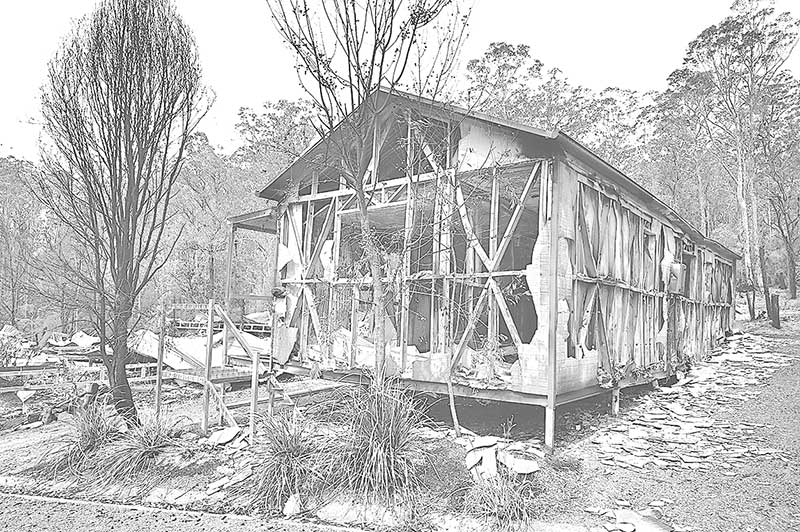
A view of accommodation blocks at the Gold Rush Colony in Mogo where a recent bushfire reduced it to twisted metal and ash. afp/rss 

SYDNEY : Australia will lose billions of dollars in tourism revenue as international visitors cancel trips in droves due to bushfires raging across the country, an industry body forecast Friday.
The number of travellers booking visits to Australia has fallen 10-20
percent since the fires began in September and the slump will
cost the economy an estimated AUS$4.5 billion ($3 billion) this year, the Australian Tourism Export Council (ATEC) said.
“International visitors are cancelling because of fears around air
quality, safety and the impact fires have had on our tourism offering as well as a lack of certainty on how long it will take for us to recover,” ATEC Managing Director Peter Shelley said.
Global media have given extensive coverage to the wildfires, which have killed at least 28 people, burned an area larger than Portugal and blanketed the key tourist cities of Sydney and Melbourne in toxic smoke.
ATEC said the disaster had hit travel from the US, UK and Europe the hardest, coinciding with the December-February period which
traditionally sees 50 percent of the annual tourist bookings from those markets.
Shelley said the industry and government need to urgently get the message out that many key tourism destinations are largely unaffected by the fires.
“There is no doubt our industry will take a hit,” he said. “The sooner we can communicate a strong, positive message, the better.”
Australia’s conservative government, which has come under intense criticism for its response to the fires and to the global warming which scientists say has been a major contributing factor to the crisis, has announced an AUS$2 billion “bushfire recovery plan”.
Prime Minister Scott Morrison said Friday that this would include a significant boost for the tourism industry, with details to be unveiled next week.
Tourism Australia was forced to suspend an upbeat advertising campaign launched in the middle of the crisis featuring pop star Kylie Minogue after the ad was met with incredulity about what many saw as poor timing.

MONEY

Troubled UK airline Flybe says seeking govt loan

- AGENCE FRANCE-PRESSE

LONDON : Struggling UK airline Flybe said Friday it is seeking a state loan
and has been granted a tax holiday, after this week’s rescue which has sparked anger from rival carriers.
Flybe managing director Mark Anderson said in a message to
staff that the regional airline, which narrowly avoided collapse on Tuesday, is in talks over the loan.
“We are in conversation with the government around a financial loan—a loan, not a bailout—a commercial loan, but that is the same as
any loan we’d take from any bank,” Anderson said in a message that was initially reported by the BBC and confirmed to AFP.
Flybe added in a separate statement that it has agreed a payment plan to defer tax payments of less than $13 million with Her Majesty’s Revenue and Customs (HMRC)—which is Britain’s tax authority.

MONEY

South African central bank surprises with rate cut

- REUTERS

PRETORIA : South Africa’s central bank unexpectedly cut its main lending rate by 25 basis points to 6.25 percent on Thursday, providing a stimulus to the flagging economy as it lowered its inflation forecasts significantly.
The rate cut was a unanimous decision and the first drop since July last year.
The majority of analysts polled by Reuters had expected no change in rates because of risks associated with a February budget speech and a scheduled review of the country’s last investment-grade credit rating by Moody’s in March.
South Africa’s public finances are under severe strain after repeated bailouts to ailing state firms like power utility Eskom and a steep run-up in public debt.
The South African Reserve Bank (SARB) painted a grim picture on the outlook for economic growth, lowering its predictions for this year and next to 1.2 percent and 1.6 percent respectively.
It called Africa’s most industrialised economy “weak” and “vulnerable” and said electricity supply constraints would probably keep activity muted in the near term.
Weak growth was a major reason why inflation remained under control last year, with consumer price growth hitting a nine-year low in November.
The bank now sees inflation at 4.7 percent in 2020 and 4.6 percent in 2021, versus forecasts for 5.1 percent and 4.7 percent previously.
“The lower inflation forecast and improved risk profile opens some space to provide further policy accommodation to the economy,” SARB Governor Lesetja Kganyago told a news conference.
The rand’s response to the rate cut was muted. It briefly weakened when Kganyago announced the decision before recovering to trade flat on the day. Some analysts were doubtful that Thursday’s policy easing would do much to lift the growth rate, pointing to the need for meaningful economic reform.
“This cut is positive but one or even two cuts will not change things significantly for the outlook for the economy,” said Magdalena Polan, global emerging markets economist at Legal & General Investment Management.
President Cyril Ramaphosa has tried to revive investor confidence since taking office in February 2018.

Page 7
MONEY

Government moves ahead with Nijgadh airport project

Investment Board of Nepal says other processes should not be stopped despite interim orders from the apex court not to cut trees.
- SANGAM PRASAIN

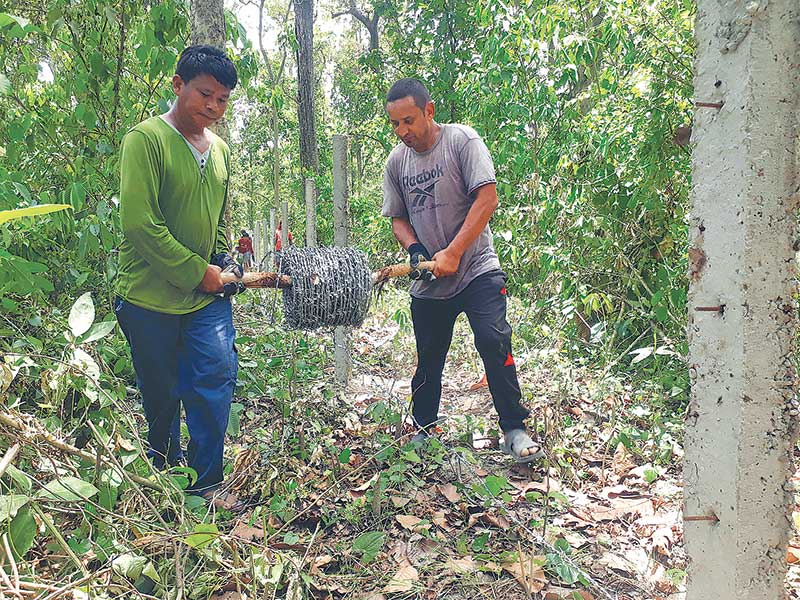
In the southern part, a wire fence around 14 kilometres long has been installed.Post file photo

KATHMANDU : Nepal’s troubled $3.45 billion airport project in Nijgadh, Bara is moving ahead despite interim orders issued by the country’s apex court to stop felling trees at the construction site.
On Friday, the Investment Board of Nepal formally asked Zurich Airport International AG, Switzerland to submit its business proposal for the development of the airport project in the country’s southern Tarai plain.
In September last year, the government had shortlisted the Swiss firm as the sole company to work in a public-private partnership model for the construction of the country’s fourth international airport.
Under the public-private-partnership modality, the Swiss company will fully fund the project. The cost for the first phase of the project has been estimated at $1.2 billion.
The airport, about 175km from the Capital, is expected to serve as an alternative to congestion and winter fog at Kathmandu’s Tribhuvan International Airport, the country’s sole aerial gateway.
The board, which is a high-level government body to facilitate investors in investing in the potential sectors in Nepal, said it issued a notice on Friday asking the Swiss company to download the request for proposal documents from the board’s website and submit a bid. The board has given the company 45 days, or a March 1 deadline to submit its bid.
A pre-bid conference is scheduled on February 16 to clear any confusion during the proposal drafting process.
On December 6, a single bench of Supreme Court Justice Tanka Bahadur Moktan issued a stay order asking the government to put the construction on hold. Again on December 22, a double bench of Chief Justice Cholendra Shamsher Rana and Justice Kumar Regmi continued its interim order issued on December 6.
Maha Prasad Adhikari, chief executive officer at the Investment Board of Nepal, told the Post that they held multiple rounds of meetings with the Tourism Ministry before issuing the bid notice.
“We are clear that the apex court has directed the government to immediately stop felling trees at the construction site. But this doesn’t mean that all work should be stopped,” he said. “The court has ordered the government authority not to allow unauthorised felling of trees.”
Adhikari said that the Swiss company will fully fund the project and there is no provision of viability gap funding by the government if the project falls short of finances.
The project modality is ‘build, operate and transfer’ under the public-private-partnership arrangement and in the case of a big infrastructure project like this, it is common for the project operation to be several decades.
“The Swiss firm will propose in its document on how long it will operate the project. This will be finalised during the signing of the project development agreement,” said Adhikari.
The government had decided to develop Nijgadh International Airport, one of the most ambitious projects, in 1995. The timeline for the new airport was pushed back on multiple occasions amid concerns about financing and legal issues over its environmental impact.
According to an environmental and social impact assessment carried out by the Tourism Ministry in February 2017, more than 2.4 million small and large trees will have to be felled to build the international airport in three phases.
In the first phase, the project will be developed on 2,500 hectares of the total proposed area. For this, 769,691 trees will have to be cut down. This environmental degradation of the area has drawn criticisms from various quarters.
But the Civil Aviation Authority of Nepal, the project executing agency, said they have reviewed the earlier plan to reduce the environmental impact.
“As per our internal review, the project will use 1,900 hectares in the first phase. It will require cutting down 500,000 trees [135,000 big trees] now,” said Rajan Pokhrel, director general at the civil aviation body.
He said that the airport construction site has been reviewed [in the southern side of Nijgadh jungle] as the trees are sparse in the area and the land is also being encroached rapidly.
The drawing and design of the project after the internal review has been sent to the Ministry of Forests and Environment through the Tourism Ministry, he said.
The forest ministry will conduct a review and after assessing the number of trees that are required to cut down as per our assessment, it will table the proposal at the Cabinet seeking approval to cut trees, said Pokhrel.
“We have also identified sites for the compensatory tree planting in Bara,” he said.
The Nijgadh international airport is planned to be the largest in South Asia in terms of area, covering 8,045.79 hectares when completed. The airport will be developed in three phases. The first phase of work is expected to take 10 years to complete.
Post completion, the airport will be able to handle 15 million passengers annually and accommodate Airbus A380 super jumbo.
By the end of the third phase, the facility will have a parallel runway enabling it to handle 60 million passengers annually. A 76-km Kathmandu-Tarai expressway will link the Capital with Nijgadh.

MONEY

EU warns of WTO challenge if China-US deal creates ‘distortions’

- AGENCE FRANCE-PRESSE

BEIJING : The European Union will challenge the China-US trade agreement at the World Trade Organization if it creates “distortions” in the market that harm EU companies, the bloc’s envoy to Beijing said Friday.
Ambassador Nicolas Chapuis told reporters the 28-nation EU “will monitor the implementation” of the “phase one” deal that was signed on Wednesday by President Donald Trump and Chinese Vice Premier
Liu He.
“In our opinion, quantitative targets are not WTO-compatible if they lead to trade distortions,” Chapuis said. “If it were to be the case, we will go to the WTO to settle this matter.”
He said that during a meeting at the Chinese foreign ministry, he was given “formal assurances that in absolutely no way would European businesses be affected by the US-China deal”.
The WTO’s principle of most-favoured-nation treatment says countries cannot discriminate between trading partners.
Under the deal, China agreed to import an additional $200 billion in US products over two years—above the levels purchased in 2017—including an extra $32 billion in agricultural goods.
Beijing also pledged to improve protections of US intellectual property.
The US said it would slash in half tariffs of 15 percent that were imposed on about $120 billion worth of Chinese consumer goods such as clothing in September. But punitive border taxes will remain on two-thirds of more than $500 billion in imports from China. When questioned on the matter, Chinese foreign ministry spokesman Geng Shuang said that the deal “is in line with WTO rules and market
principles”.
Paul Tan of Rajah & Tann law firm in Singapore, who specialises in international dispute resolution, told AFP the deal “may not violate WTO rules because the type of goods being bought from the US could be different from other countries’, or even unavailable”.
“I don’t think the trade deal reversed the increase in tariffs on US goods after the trade war broke out, for example, so I doubt this could be read as more preferential treatment,” he said.
China’s agreement to buy more from the US in effect cushions some of the impact from increased tariffs over the past two years, Tan added.

MONEY

World shares gain as China data fuels bets on growth

- REUTERS

LONDON : World shares rose to record highs on Friday, buoyed by Chinese growth figures that suggested the world’s second-biggest economy was stabilising.
Riskier assets were in demand worldwide as the Chinese growth data, along with easing trade tensions with the United States, sent the MSCI world equity index up 0.2 percent and further into record territory.
China’s economy grew 6 percent between October and December last year. Anaemic domestic demand and the trade war with the United States led to growth of 6.1 percent in 2019, the slowest in 29 years.
But the data reinforced recent signs of an improvement in Chinese business confidence as trade tensions eased after Beijing and Washington signed an initial deal on Wednesday to defuse their tariff war.
Investors were turning their attention to what many see as improved prospects for growth across the world. European shares gained 0.9 percent by late morning, with Frankfurt and Paris up around 0.7 percent.
Shares in London, sensitive to currency moves, gained 0.9 percent after sterling slipped on signs of economic weakening that could prompt the Bank of England to cut interest rates this month.
Wall Street futures were also pointing up.
The Chinese data fuelled a rise in the Chinese yuan, which touch a six-month high of 6.8660 to the dollar.
“Investors that were last year buying risky assets rather defensively - not really removing their hedging - right now are deploying cash,” said Olivier Marciot, a portfolio manager at Unigestion.
“A number of investors that were sitting on big piles of cash are starting reallocating. People are unloading cash positions into financial assets.”
In France, however, protests against planned pension reforms started to hit major retailers. Supermarket Casino slumped as much as 12 percent after slashing its forecast for 2019 operating profit growth because of the damage from transport strikes in the fourth quarter.
Asian markets also rose after the Chinese data, with MSCI’s broadest index of Asia-Pacific shares outside Japan gaining 0.3 percent.
China’s own blue-chip index ended 0.1 percent higher, down from an earlier rise of as much as 0.7 percent. The index has rallied more than 8.5 percent since the beginning of December, fuelled by hopes for improved trade relations with the United States.
Shares in Australia and South Korea both rose, with Japan’s Nikkei climbing to a 15-month high.
“This is all good news and positive for the China story,” said Daniel Gerard, senior multi-asset strategist at State Street Global Markets in
Hong Kong.
Still, analysts say global equities may find it difficult to maintain momentum as optimism over the trade truce gives way to uncertainty over the next steps in trade talks.
While the Phase 1 deal signed on Wednesday may defuse the 18-month trade row, analysts said it was unlikely to ease broader friction between the two countries.
Most of the tariffs imposed during the dispute remain in place and a number of issues that sparked the conflict are still unresolved.
“The challenge from here is how long we can maintain these improvements,” said Steven Daghlian, market analyst at CommSec in Sydney.

MONEY

Which company just hit $1 trillion? Google it.

- REUTERS

The brand logo of Alphabet Inc’s Google is seen outside its office in Beijing, China. REUTERS

NEW YORK : As Google-parent Alphabet Inc became on Thursday the fourth US company to top a market value of more than $1 trillion, some funds holding its shares are wondering whether now is the time to cash in on the stock’s extraordinary gains.
Shares of the Internet search giant are up nearly 17 percent over the last three months, outpacing a broader rally in the S&P 500 index over the same period by 6 percentage points.
Short interest in the stock, a measure of how many investors are betting on a price decline, is at 1 percent, near a 52-week high for the company and higher than competitors such as Microsoft and Facebook, according to Refinitv data.
Alphabet joins Apple, Amazon.com and Microsoft as the only US companies to hit $1 trillion in market value.
“Google is a stock that won’t get you fired,” said Kevin Landis, a portfolio manager at Firsthand Funds who hasn’t added to his current Alphabet position since the first quarter of 2019. “Will I be able to double my money in this stock from here? I’m not sure about that.”
Alphabet’s shares are among a small group of stocks found in the top holdings of both mutual funds and hedge funds, two types of institutions whose investing styles tend to be markedly different, a Goldman Sachs analysis showed. That could leave it exposed to volatile price swings if sentiment suddenly changes.
Despite those concerns, many investors are finding it hard to say goodbye. The 28 percent climb in Alphabet and the performance of other technology and tech-related stocks helped money managers post big gains in 2019, making it difficult for many to justify cutting their exposure even as they fret over the implications of its run-up.
Ernesto Ramos, portfolio manager of the BMO Large-Cap Growth Fund, has held onto his shares, betting that Alphabet’s exposure to online advertising will eventually justify its above-average valuation. Alphabet trades at 26.6 times future earnings, compared with 18.5 for the S&P 500.
Scott Goginsky, a portfolio manager of the Biondo Focus fund, has held off adding to a longstanding position over the last year, concerned that the company’s costs are likely to increase due to its efforts to pre-empt any additional regulatory measures from Washington. That could cut into the margins of businesses like YouTube if it needs to hire additional workers to vet user-posted content, he said.
Alphabet is scheduled to report fourth-quarter earnings on Feb. 3. In its latest report, the company missed analysts’ estimates for third-quarter profit by about $1.7 billion, though it beat revenue expectations. That news did little to dent investors’ bullishness on the company: Alphabet’s stock retreated briefly on the report, only to resume its climb several days later.
Bearish investors, however, can point to Amazon.com, which saw its market value fall below $1 trillion after its streak of record profits ended in July. Shares of the company are down nearly 7 percent over the last six months, compared with a 10 percent gain in the S&P 500 overall.

Page 8
Page 9
Page 10
CULTURE & ARTS

A crash course in Indian nationalist history from professor Devgn

Tanhaji is a historical epic that shoehorns religion into its tale of a battle between two macho males.
- ABHIMANYU DIXIT

Remember history classes in school, or social studies classes? History, as most South Asians know it, is a peculiar brand of study where objective facts and happenings seem to originate out of folklore and religious scripture and where certain deeds and certain individuals are glorified. This is often an attempt to instil moral value or evoke a sense of patriotism. They’re even designed in a specific way, so as to not hurt any cultural or popular sentiments, and thus, to not create any controversy.
These are not the only problems with history in South Asia, because it can be dreadfully boring, with one-dimensional, non-human characters. Ajay Devgn’s new film Tanhaji: The unsung warrior continues in that same tradition.
Tanhaji Malusare (Devgn) was a real-life general in the court of 17th century Maratha emperor Chhatrapati Sivaji Maharaj (Sharad Kelkar). He is sort of like the Kalu Pandey to Prithivi Narayan Shah, and in the same way that Nepali textbooks describe Pandey, the film presents Tanhaji—the brave and good guy who battles against the odds. He is a religious devotee, a selfless warrior, a master of disguise, a loving husband, an honest patriot and skilled in guerrilla warfare. He is also a dear friend to the Maratha emperor.
Elsewhere, the Mughal Emperor Aurangzeb (Luke Kenny) rules over North India. Aurangzeb is portrayed here as evil, and that’s pretty much his only identity. He is so demented that he plays chess with actual humans, who must fight to the death. This evil emperor wants to expand his empire to South India and, to further his plans, he seizes a hilltop-fortress called Kondhana in Maratha territory.
Aurangzeb now sends his mightiest warrior, the sadistic Udaybhan Singh Rathore (Saif Ali Khan) to protect Kondhana. And if you thought Aurangzeb was bad, Udaybhan is worse. He takes pleasure in taunting and torturing prisoners, mercilessly beats his enemies with blunt objects, scalds people to death, roasts endangered species, and kidnaps a widow to watch her bathe. Basically, he’s supposed to be the stark opposite of all that Tanhaji is.


News travels fast to the Marathas that Udaybhan is travelling to Kondhana. He’s travelling with Naagin, the mightiest cannon in existence (read: a huge phallic object). If the cannon fires from Kondhana, the Maratha emperor and all his people will be obliterated. Sivaji now has to reconquer Kondhana at all costs, and the only man for the job is Tanhaji Malusare.
In terms of story, that’s all there is to it. We follow a battle of strategy and physical prowess between the good Tanhaji and the bad Udaybhan. The film is told through the Maratha perspective, equipped with extreme nationalism and all the cliché tropes of the genre. Does the hero’s best friend, or an important character, die a glorious death (usually in slow motion)? Yes. Does the strongest keep on fighting even as he is riddled with arrows? Obviously. And, before all the fighting, can you expect a rousing speech on the importance of motherland, sacrifice for the common good, one’s people, culture, and sovereignty? Take a guess.
The film is written by Prakash Kapadia and Om Raut, who is also the director. And the filmmakers insist on inserting religious politics into their film. In hindsight, this seems rather unnecessary because the film is about territory. Once the Muslim enemy is defeated, the film cuts to a temple with a celebratory bell ringing. They even use Hindu gods as a war cry. There are only two songs in the film, ‘Maai Vabhawani’ and ‘Shankara’ and both are about Hindu deities.
This film predominantly portrays Hindu-nationalist attitudes. Honestly, I don’t expect the Nepali audience to care much about any of it. The fate of the Maratha Hindus or the Mughal Muslims doesn’t really resonate with the contemporary Nepali audience. Perhaps we’d be interested and invested if this was about Prithivi Narayan Shah and Kalu Pandey. So why watch this film? For its entertainment value, of course.
If you disregard content—the one-dimensional storytelling, the nationalistic tone, and forced religious angle—you’ll find a proficient technical team. The film’s visuals, sound design, costumes, and location visual effects are masterful. They’re as good as any international historical epic, like 300, Game of Thrones or even Baahubali. I watched the film in 3D, and I was startled twice as I attempted to duck as arrows flew my way. I was especially impressed with the background score that amplifies the action, right from the opening sequence.
Cinematographer Keiko Nakahara’s clean framing allows you to follow everything without questioning anything. Nakahara especially chooses to stay wide often and employs long takes during fight scenes. This allows you to notice the intricate choreography and marvel at the lengths the actors have gone taken.
But ultimately, the film is all about the machismo of two male characters. This is Devgn’s hundredth film and he’s done similar roles before (remember Bhagat Singh?). Even though he’s also a producer in this film, don’t expect anything different.
Saif Ali Khan, however, has a playful approach to his Udaybhan, and is clearly the better performer. At times, he’ll make you feel guilty watching him taunt people for no reason. He can act psychotic, devastating and disgusting in the same shot. He’ll even make you laugh while he executes people.
But those are the male characters. The females play supporting roles. Neha Sharma plays Kamala Devi, a widow kidnapped by Udaybhan, and she’s only there to look pretty to sate Udaybhan’s lust. She’s quite forgettable too, especially since we never actually learn what happens to her. She just vanishes mid-way into the film’s climax. Kajol gets more screen time, and deservingly so. She plays Tanhaji’s wife, Savitri, and it’s hard to take your eyes off her. She shines in scenes with Devgn, her real-life husband. In one instance, the husband and wife look into a handheld mirror and smile—an obvious selfie joke. She also gets a solo song sequence during the end-credit, even though Indian cinema audiences don’t really sit for the end credits.
Overall, the good news is technology has finally caught up to historic epics in India. I’m certain that the expertise and equipment will arrive here too, soon. In that regard, films like Tanhaji are a perfect reference for what to do in terms of technicalities, and what not to do in terms of storytelling. Nepal has a rich history, we have a plethora of interesting historical characters to choose from. If some of our social studies classes make it to the big screen, let’s hope the filmmakers focus more on designing three-dimensional characters.

CULTURE & ARTS

‘Parasite’ raises hope of breakthrough for world cinema in US

The English language’s global dominance has been a perennial challenge for filmmakers working in other tongues, and doubly so in the world’s biggest cinema market.
- AGENCE FRANCE-PRESSE

The Oscar nominations for South Korean black comedy Parasite are the latest illustration of its success in the United States, but a widespread aversion to subtitles still stands between Korean cinema and a breakthrough into English-language markets.
Whether Bong Joon-ho’s Golden Globe-winning dark thriller will turn out to be the vanguard of a new Korean wave—after the global advance of K-pop and the popularity of K-drama—will only become clear in many years’ time, say critics.
The global dominance of the English language has been a perennial challenge for filmmakers working in other tongues, and doubly so in the world’s biggest cinema market.
The highest-grossing foreign-language film in the US remains Taiwanese-born director Ang Lee’s 2000 martial arts saga Crouching Tiger, Hidden Dragon, which took US$128 million at the American box office—only about half the amount of How the Grinch Stole Christmas, that year’s chart-topper.
No non-English production has ever won the Academy Award for Best Picture.
While South Korean cinema has a long history—it marked its 100th anniversary last year and is critically acclaimed in Europe—the Oscar nods for Parasite are the first for South Koreans.
The 50-year-old Bong previously described the Oscars as “very local”, but his vicious satire about the widening gap between rich and poor has been shortlisted for six awards next month, including Best Picture and Best Director as well as Best International Feature Film.
It has already become the South’s first movie to win the top prize at Cannes and the first to take the Golden Globe for best foreign language film.
Bong called out American moviegoers’ aversions at the Golden Globes, telling his Hollywood audience in his acceptance speech: “Once you overcome the one-inch-tall barrier of subtitles, you will be introduced to so many more amazing films.”

‘Slow and painful’
Most American film fans have never developed the habit of reading subtitles given the ubiquitousness of English-language content, said José Sarmiento Hinojosa, a Lima-based film critic.
“If cinema is seen as entertainment, the mindset is that nobody wants to pay to read subtitles, nobody wants to make that effort,” he told AFP.
But he said the success of Parasite was playing out against a backdrop of the rise of streaming services such as Netflix, which offer a variety of foreign-language content, giving monolingual viewers greater exposure to subtitles.
The process, though, will be a long one, he said.
“I don’t think the decades-long habit of watching dubbed films or ‘American remakes’ will change just now. But it’s part of a slow and painful process which has to happen eventually.”
In the case of K-pop, Psy’s 2012 global mega-hit “Gangnam Style” did not immediately lead to the kind of sustained worldwide popularity now enjoyed by boy band BTS.
But CedarBough Saeji, a visiting professor at Indiana University Bloomington in the US who researches Korean contemporary culture, said consumer appetites were developing more quickly.
“Conventional wisdom has long held that people won’t go to watch a subtitled movie, and big theatre companies have felt it’s a waste of money to tie up a screen in a theatre with a foreign language film,” she said.
“I honestly think the audience is ready now.”

Landmark moment
Parasite has grossed more than $25 million at the US box office in less than four months. Jason Bechervaise, a professor at Korea Soongsil Cyber University in Seoul, said it was “eating away” at viewers’ linguistic prejudices.
But he warned that while Crouching Tiger, Hidden Dragon was a “groundbreaking moment” and had led to the success of similar films, it did not cause an “explosion of interest in world cinema as a whole”.
And Nancy Wang Yuen, a sociologist who researches race and cinema in the US, pointed out that directors with Best Picture Oscar nominations for foreign-language films often first made Hollywood hits.
Mexico’s Alfonso Cuarón—whose 2018 subtitled feature Roma received 10 Oscar nominations and won three, including Best Director—collaborated with Sandra Bullock and George Clooney for his 2013 thriller Gravity.
Ang Lee worked with Kate Winslet for his 1995 period drama Sense and Sensibility, and Bong teamed up with Tilda Swinton, among others, for Okja and Snowpiercer.
For those who have not made crossover films, Yuen told AFP, “the recognition factor and biases against films made not in the English language will continue to be a barrier”.

Page 11
AS IT IS

Let the bougainvillea vines grow

It takes an appreciation of the little things to prepare for a journey to mindfulness.
- Asmita Manandhar

It sounded urgent, the way Ma called me. I rushed out of my room and followed her voice. She was squatting beside one of her many planters in the front-facing balcony, with a mysterious but gleaming smile on her face. There was a leaf sitting on one of her palms. But when she stretched out that palm towards eight-year-old me, I squealed in horror and ran back to my room.
It was a green caterpillar-like insect, perfectly camouflaged with the leaf. My Ma must have found her friend when she was carrying on with her daily routine of picking dead leaves from her extensive collection of plants.
The whole neighbourhood knew my Ma was a plant lady. The magenta inflorescence of bougainvillea vines that ran from the front porch to the second-floor terrace made our house some sort of a landmark in the area.
But unlike what our neighbours believed, her fondness wasn’t for colourful flowers. Her soul lay in the process—of choosing pots, filling them with soil, watching the plants grow, blossom into flowers, and then wither back into that same dirt. She lived many lives in her many plants. And so, when visitors would arrive, like the day she found the green insect, she wouldn’t hesitate to make their acquaintance.
That day, I remember she had asked me to come back and take a closer look at it. She was clearly in awe of the insect. “Look how beautiful it is,” she had said. “It’s a wonder how nature works.” But regardless of how long Ma would marvel at the ‘beauty’, I knew it had to go. The insect wasn’t going back into her pots. She was and still is fiercely protective of her plants.
Unlike insects, which were carried down to the fields, humans weren’t offered the same courtesy. My mother used to yell from our first-floor window if she caught anyone trying to steal her flowers. I cannot explain how embarrassed I used to be when she did that.
As I grew up, I thought I understood her annoyance. I saw her hard work, dedication and love for her plants. So, I started supporting her when she forbade people from plucking her flowers. She chose the plants, bought them, put days of work into them, she owned them, and how can someone just reap the benefits of her sweat—it was indeed unfair. But then I didn’t know, I was terribly wrong. Two decades after the green insect’s visit, we no longer lived in the house covered in bougainvillaea vines. So instead of a huge structure for a house and hundreds of pots on the terrace, we instead have a small home and a huge garden. One winter morning, while both my Ma and I were in our garden, I heard her jovially exclaim, “Oh! A new blossom.”
I had suffered from insomnia the night before and had dragged myself out of bed to prepare myself for work. The lack of sleeplessness and inability to fix an appointment with my therapist was lingering like a dark cloud over my head. But the delight on Ma’s voice caught my attention.
“It wasn’t there till yesterday evening,” she said to me, pointing at a plant, and smiling like a child.
Her happiness was infectious, but at that moment, I just couldn’t understand. It made me wonder, after all these years, how could she still celebrate such little joys in life, while I, her blood and flesh, am on pills to get over daily doses of hopelessness and anxiety. It was a question I asked myself and quickly realised, was an answer in itself.
Flesh and blood, all that is there, is the gift of the soil. What I had believed years ago didn’t justify my Ma’s love for the plants. It wasn’t just love either—it was her sincere gratitude of life. Her fondness for flora and fauna stems from her devotion towards the power of the soil to offer life. She wasn’t protective of her plants because she owned them, but it was because she respected them and asked the same from others. She wanted to let everything run its natural course. She had seen many lives blossom as much as deaths—that is how she found the balance between optimism and morbidity. Her glee hinged upon nothing but herself; and here I was, fiddling over the tiniest of glitches, brought upon by no one but myself. But the crux of the matter is how I didn’t choose her eyes or jaw, I cannot own her mindfulness either.
It was then I understood the gravity of her statement, “It’s a wonder how nature works.”
It’s no less than nature’s wonders that my Ma’s heart sits still even after all the struggles she has undergone in her life. From a girl who grew up in the centre of the city, yet on the edge of poverty, to a woman of patience and determination, now I understand her courage comes from her sincerity to not hold back from getting her hands dirty. But most importantly, she allows things to unravel in the way bougainvillea vines grow.

Manandhar is a writer and poet. She Instagrams at @framesandlaces.

AS IT IS

An unsolicited experience

I didn’t realise how it had affected me so much, but it really forced me to think deeply about my digital presence.
- Ayusha Chalise

There was nothing extraordinary about the morning I woke up to a text on Instagram messenger. It said, “Somebody wants to send you a message.” I clicked on it without any thought and regretted it instantly.
It was a photo of a male’s private parts. I deleted the message as quickly as I could. But the whole ordeal shook me. Obviously, my morning and my mood were completely ruined. As I sat up on my bed, my anger lingered for a while, fuming at the thought—I felt violated, I did not consent to it.
The day, regardless, had to go on. And my upcoming finals meant I would rather not waste my time being miffed by a stranger’s perverted pursuit. But as I had just begun to bury my head in my books, I heard another ping on my mobile phone. It was yet another photo. I deleted that too.
It didn’t stop there. Within another few hours, I received more messages of the same nature. I was beginning to get scared. This time, I didn’t just delete them, I blocked the accounts too. Yes, they were sent from different accounts. Now I felt that this wasn’t someone’s perverted fluke, it was a planned game to make me feel scared and uncomfortable.
I began to question all the credence I had of myself and my body. My past and present insecurities all came in together to shatter my confidence. As a response to the fear and unbearable embarrassment, I removed all of my Instagram pictures.
I felt like I was forced to oblige to the person or persons who were hell-bent on harassing me. I set my books aside, and thought I should report the accounts. I opened the app again and went to my block list, it was empty. The bogus accounts were already deleted. I thought to myself, should I report to a complaint with legal authorities? What would come out of it anyway? The accounts weren’t there anymore and I wasn’t physically harassed.
I didn’t realise it had affected me so much, but it really forced me to think deeply about my digital presence. Thankfully, I’ve gained back the confidence to post photos on my Instagram and I may even unarchive my old pictures.When an unsolicited picture of male genitals is sent to a woman, it may just seem like a joke or something to be easily shrugged off. But that didn’t happen to me. It bothered me how easy it was for others to invade my privacy. It was more to do with how we are being perceived, left with no choice or say to what we need to be offered. Are we supposed to be okay with anything and everything?
Online harassment can have far-reaching consequences than what I experienced. But that doesn’t discount predators. Although not all predators are male, going by the numbers, it is toxic masculinity that fuels the fire. It is just the lack of a simple term: Consent. It’s about respecting each other’s space.
It is a shame people now find it normal to force themselves upon others, or take advantage of someone else’s vulnerability, or simply don’t even think about it.
The problem of online sexual harassment can be handled with reporting and punishing each individual responsible. But will that mitigate the problem? The roots of the problem run deeper, hence we need to dig deep to find solutions. Harassers throughout history have always been cowards. The technology has made it even easier for these predators to hide their identity while acting upon their moral turpitude without the fear of consequence. The idea of dignity, consent and respect should be included in sex education in schools. If we are to face new forms of violence in the age of technology, we need to revisit gender expectations. Having said that, strong, accessible legal remedies should also be in place to report such cases. The strongest remedy is to speak and stand up in solidarity. At least now, I have learned others’ depraved pursuits shouldn’t be reason for my own embarrassment.

Chalise is a TV and radio presenter, and studies community development at KU.

Page 12
BOOKS

Dutch art sleuth finds rare stolen copy of ‘Prince of Persian poets’

- JAN HENNOP

Shams-ud-din Muhammad Hafiz one of the most famed mystical bards. AFP/rss

A stolen 15th-century book by the famed Persian poet Hafez has been recovered by a Dutch art detective after an international “race against time” that drew the alleged interest of Iran’s secret service.
The gold-leafed volume worth around one million euros ($1.1 million) was found to be missing from the collection of an Iranian antiques dealer after his death in Germany in 2007.
It sparked a decade-long search for one of the oldest surviving copies of the Divan of Hafez—the collected works of the poet who remains extremely popular in Iran and has inspired artists worldwide.
But Arthur Brand, dubbed the “Indiana Jones of the Art World” for tracing a series of lost works, finally tracked down the tome via the murky stolen arts underworld.
“This is a hugely important find for me, because this is such an important book,” Brand said as he showed AFP the recovered book at an Amsterdam apartment.
Along with Rumi, Hafez—full name Shams al-Din Muhammad Hafiz Shirazi—is one of the best known mystical bards. American essayist Ralph Waldo Emerson called him the “Prince of Persian poets”.
Hafez’s Divan can still be found in most Iranian homes where it is traditionally read out during family celebrations for the Persian New Year.

‘Scared and threatened’
The theft of the manuscript, which dates from 1462 to 1463, was discovered by the family of book dealer Djafar Ghazy after he died in an old people’s home in Munich in 2007.
While going through Ghazy’s computer, they realised the reclusive pensioner had in fact collected hundreds of ancient manuscripts—but that they were all gone.
In 2011 German police recovered 174 of them raiding the home of another Iranian pensioner who had befriended Ghazy.
“But the most important piece, one of the earliest and most accurate copies of the famous ‘Divan of Hafez’, was still missing,” said Brand.
German police announced a 50,000-euro reward and issued a flyer describing the book in 2016 but there was still no trace of it, until late 2018.
Brand then received a phone call from an Iranian dealer, asking the Dutchman to “urgently” meet him in Germany.
“The man told me he was visited by two officials who said they were ‘linked to the Iranian embassy’.” The men—alleged by the dealer to be Iranian secret agents—told him to “report any news of the missing Divan”, Brand said.
“My informant was clearly scared, felt threatened and decided to call me into the case,” Brand told AFP.
Iran had already shown an interest in the case, saying it would take “all legal means” to get back the manuscripts that were found in 2011, after Germany gave two back but decided most of the rest were legally owned by the collector, German news reports said.
“After my informant was contacted, I knew that the Iran was also looking for the missing Divan and I started a race against time to see if I could find it first, as the book belonged to Ghazy’s family,” Brand said.

‘Rare and valuable’
The Dutchman then flew to London to meet an unnamed man “who became extremely nervous” when shown the flyer of the missing book, and confessed he had seen it as a friend of his had sold it to a major buyer.
By then Iranian agents were also in London asking questions about the manuscript, Brand said.
“The buyer was shocked and furious. After all, he was sold a stolen book and now everybody including the Iranian government was looking for it,” Brand said.
By now afraid, the buyer flew to Paris to demand his money back from the original seller.
But Brand persuaded him to go back to London and finally the collector handed over the book via an intermediary in late 2019.
Brand said he will travel to Munich next Wednesday to return the Divan to German police.
“The next steps are currently being discussed together with the heirs” of Ghazy, police spokesman Ludwig Waldinger told AFP.
Experts said this edition could be of great historical and literary value for scholars and admirers of Hafez, whose works were published after his death.
The recovered book is “one of a handful still in existence,” said Dominic Parviz Brookshaw, assistant professor of Persian literature at Oxford University.
“It’s an extremely early edition—although not the earliest—which would make it very rare and valuable,” Brookshaw told AFP.
—Agence France-Presse

BOOKS

Reconstructing caste and class

While the book reads like a calming river, the question is whether its themes are really done justice.
- Bibek Adhikari

Smaran Gurung, a young man who has come to Nepal to spend some time in Pokhara, walks into an art gallery, sees paintings hanging upside down, and is jolted out of his comfort zone. But what he sees are not the works of Georg Baselitz, the famous German painter known for his upside-down art, but of struggling artist Nadin. Now, with his interest piqued, the visitor starts questioning the whereabouts of the artist—only to come up with one shocking revelation after another.
Set in a fictional village of Andheri Gaau, Bhupeen’s debut novel, Maidaro, is a story of an artist who’s been victimised by caste-based discrimination to such an extent that he is forced to choose the sweet embrace of death rather than the harsh realities of life. Told by the mouthpiece, Smaran, the novel deploys the technique of ‘frame narrative’ that is so commonplace in contemporary Nepali fiction. The introductory narrative of Smaran sets space for the more emphasised narrative of Nadin. The major reason for doing so is to inform readers about the aspects of the main story which would have been difficult to explain otherwise; however, being a sceptic I kept questioning myself—couldn’t the story stand on its own without its peripheral narrator? What if Nadin, the protagonist, just told his own story?
Nadin’s story unfolds in a non-linear way. By writing an aphoristic note that reads as—“O life, forgive me, for I’ve chosen the path of suicide!” (my translation)—he jumps off the Patebhir, but as fate would have it, he survives. Oscillating between life and death, he then mulls on his existence for the next several months (or a few years). As he keeps contemplating all things in heaven and earth, Amrit, Nadin’s younger brother, tells the tragic story to Smaran. In the succeeding chapters, we are thrust back and forth between multiple narratives. As readers, we get to know about the childhood of the protagonist, how he fell in love with an upper-class girl, and how marrying her made him a social outcast. Yet, all through this, he keeps following where his heart lies—painting. The narrative revolves around the ways in which the child protagonist grows up into a creative artist, thus making the novel a bildungsroman of sorts.
Born to a poor Sarki family, Nadin shows a deep interest in painting (as well as politics) from an early age. Even during his school life, he draws portraits, prominently that of Karl Marx. During the heyday of the Panchayat system and the on-going struggle against the feudal lords, like many of his classmates, he chooses to be a part of the students’ wing of the Communist party. His childhood sweetheart, Kala, also joins him. Together with a bunch of other students, they conduct secret meetings, and during the school assembly or annual programs, refuse to mumble the national anthem but rather they chant slogans against the government. Such activities land Nadin and his friends behind bars at one point. Despite that, the struggle against the government goes on.
Later, the protagonist travels to Kathmandu to pursue his higher education in painting and gets a BFA degree from Lalit Kala Campus. After graduation, he starts working for an art gallery where he nurtures his art of upside-down painting. His paintings show the dark underbelly of social stratification and mock the existing rift between the higher and lower classes. However, after he faces consistent death threats from some Hindu fanatics, he journeys to Pokhara and starts visiting Chhaya Art Gallery for almost a week. There, he meets Aakash, who specialises in landscape painting. Together with him, Nadin paints portraits, still life, and landscape pieces as well as keeps experimenting with his art at his rooming house.
Almost like a twin narrative, there’s another side to the story: falling in love with Kala, which for Nadin is the best thing that’s ever happened. However, the sweet story of love soon turns into a story of class struggle. Since he’s fallen in love with a girl from the so-called upper caste, marriage seems impossible. Unable and afraid to love openly in Andheri Gaau, they seek refuge in the Lake City, Pokhara. From their clandestine meetings in the village to their somewhat open rendezvous in Pokhara, their love keeps growing until one day when Nadin has to take a stand: to either run away or marry her. Like a rom-com flick, he drags Kala to the Tal Barahi Temple, hits his thumb with a rock, and smears the blood on the parting of her hair—so very reminiscent of the 90s in Bollywood.
This heroism leads to grave repercussions: Kala’s family disowns her. Also, the newlywed cannot live peacefully in the village. This disownment acts as an impetus—Kala is now deeply disappointed with her family, the society, and the deep-seated social injustice within. As a result, she joins the Maoist party and their (in)glorious People’s War. Nadin, being a soft-hearted artist at his heart, tries his best to stop her, but in vain. She is headstrong and has already decided her fate. Leaving her baby girl, she becomes a guerilla and wages war against the state. Based on the foreshadowing, any careful reader can rightly point out an unfortunate incident that could follow.
But then comes the suicide attempt of Nadin. No matter how much the writer has tried to justify the act, by either filling in fissures or giving lengthy philosophical explanations, there’s something amiss. Given the fact that Nadin seems to have a relatively happy life (for a poor Sarki boy growing up in the Panchayat era) and likes to take refuge with his canvases, why would he intentionally cause his own death? Sure, the grief that comes from losing a loved one is there; the depressing cases of social injustice triumph all the time; however, to see the things from the brighter side, Nadin has almost everything in life—good education, a deep interest in the arts, a desire to be the social change. So, why kill oneself? This question could haunt readers.
Another quibble lies in its treatment of the Janus-faced nature of Nepali society: the way the upper-class people treat the working class. For instance, one of the Bistas from the novel has an illicit affair with a married Sarki woman. As it happens, the village mostly blames the woman. But the writer didn’t really depict the woman’s fate. He broached the subject, but left it in limbo. A doubtful reader might as well question—has the writer really done caste-based discrimination justice? Or has he merely used it as a backdrop and setting to tell Nadin’s story, thereby reducing all the minor characters into cardboard cut-outs?
Written in Baglung lingo, the greatest strength of Maidaro, however, is its narrative flow. Rich in metaphors, imagery and
folklore, the novel is quite gripping. The story flows like a calm river, only sometimes meandering. Even though the writer employs two narrative points of view, they are consistent and readers can easily follow. On the whole, Maidaro is a beautiful story of an artist that touches the heart at its core. The readers might as well shed a tear or two along the way—like I did—and feel glad for having picked up the book.

Adhikari is a poet and critic based in Kathmandu. He tweets as @bibek_writes.

Page 13
WORLD

Chinese economic growth hits three-decade low

The world’s number-two economy has been hit by the US trade war and a slowdown in domestic demand
- AGENCE FRANCE-PRESSE

The latest figures follow the signing of a much-vaunted “phase one” pact that marks a US-China truce from their nearly two-year-old trade war.AFP

China’s economy grew last year at its slowest pace in three decades, hit by weak domestic demand and trade tensions, but while officials warned of further headwinds, separate figures Friday suggest the downward trend is bottoming out.
The 6.1 percent rate is a sharp drop from the 6.6 percent the year before and marks the third straight drop, though it met the government’s target and analysts said leaders were unlikely to open up the stimulus taps just yet.
The reading was also in line with AFP analyst forecasts.
And while the world’s number two economy had been gradually losing steam over the first three quarters, growth held steady at 6.0 percent in October-December—the same as the previous quarter, according to the National Bureau of Statistics.
Ning Jizhe, commissioner of the NBS, said momentum remained generally stable through the year and said the same could be expected in 2020.
“However, we should also be aware that the global economic and trade growth is slowing down,” he said at a news conference, adding that there were more sources of instability and risk, with the economy facing “mounting downward pressure”.
The figures were released days after Vice Premier Liu He and Donald Trump signed a much-vaunted “phase one” pact that marks a truce in their nearly two-year-old trade war.
The agreement will see the US slash import duties on Chinese goods worth billions of dollars, though levies remain in place on two-thirds of more than $500 billion of products.

‘New normal’
The World Bank said in a report this month that weakening exports from China had compounded the impact of a slowdown in domestic demand. Policy uncertainty and higher tariffs on exports to the US also cast a pall on manufacturing activity and investor sentiment, it added.
Other data released Friday showed while industrial production and retail sales slowed over the year, both indicators outperformed in December, with the NBS pointing to a particularly strong showing in consumer spending.
“The latest ... data provides a very positive start to the Chinese New Year for China’s economy,” Rajiv Biswas, of IHS Markit, said. “The outlook for 2020 is for continued robust growth, boosted by the phase one trade deal with the US and the continued positive impact of government monetary and fiscal policy stimulus measures.”
But analysts note that China’s slowdown is structural, as it becomes a more developed economy and faces demographic challenges such as a shrinking number of people of working age.
The NBS said China’s birthrate fell to 10.48 per 1,000 people last year—the lowest since the People’s Republic of China was founded in 1949. Faced with an ageing population, Beijing relaxed its one-child policy in 2016 to allow people to have two children, but it has not led to more births.
Still, Louis Kuijs, head of Asia economics at Oxford Economics, told AFP that Beijing considers the slowdown part of a “new normal” and that major easing is unlikely, given the improving global outlook and the US trade deal.
He noted policymakers likely want to keep their powder dry, aiming for a stabilisation rather than reigniting growth, adding: “What they don’t want to see is a too-rapid slowdown.”

Stabilisation in 2020
Analysts and officials are expecting the economy to level out this year.Kuijs noted the trade deal bodes well for exports, as well as sentiment on business investment and consumption. It also reduces the risk of escalation and “severe decoupling” in other dimensions such as restrictions on companies and finance.
But UOB economists Ho Woei Chen and Peter Chia said in a recent note that the deal is unlikely to catalyse a strong rebound in growth for China as the bulk of US tariffs remain in place.
Tommy Xie, head of Greater China Research at OCBC Bank, said more supportive state policies such as tax incentives have helped stabilise national growth.
But he noted a tailing off in the growth of infrastructure investment, which could prove problematic. With property investment slowing, the strength of China’s growth this year will depend on whether infrastructure investment is able to offset this decline, he said.
Last month, the NBS said China would revise its historical regional GDP data under a unified accounting mechanism to be introduced early 2020.
This is expected to close a discrepancy between national and regional figures and enhance the credibility of government statistics, according to state media.
Economists have long suspected that Chinese economic data is massaged upward, often noting that full-year gross domestic product hits Beijing’s targets with suspicious regularity.

WORLD

Trump’s trial begins at the start of an election year

The trial, only the third such undertaking in American history, is unfolding at the start of the election year, a time of deep political division in the nation.
- ASSOCIATED PRESS

House Speaker Nancy Pelosi signs the resolution to impeach President Donald Trump.AP/rss

WASHINGTON : The U.S. Senate opened the impeachment trial of President Donald Trump with quiet ceremony Thursday—senators standing at their desks to swear an oath of “impartial justice” as jurors, House prosecutors formally reciting the charges and Chief Justice John Roberts presiding.
The trial, only the third such undertaking in American history, is unfolding at the start of the election year, a time of deep political division in the nation. Four of the senators sitting in judgment on Trump are running for the Democratic Party’s nomination to challenge him in the fall.
“Hear ye, hear ye, hear ye!” intoned the Senate’s sergeant at arms, calling the proceedings to order just past noon.
Senators filled the chamber, an unusual sight in itself, sitting silently under strict rules that prohibit talking or cellphones, for a trial that will test not only Trump’s presidency but also the nation’s three branches of power and its system of checks and balances.
The Constitution mandates the chief justice serve as the presiding officer, and Roberts made the short trip across the street from the Supreme Court to the Capitol. He has long insisted judges are not politicians and is expected to serve as a referee for the proceedings. Senators rose quickly when he appeared in his plain black robe.
“Will all senators now stand, and remain standing, and raise their right hand,” Roberts said.
“Do you solemnly swear that in all things appertaining to the trial of the impeachment of Donald John Trump, president of the United States, now pending, you will do impartial justice according to the Constitution and laws, so help you God?”
The senators responded they would, and then they lined up to sign an oath book.
Trump faces two charges after the House voted to impeach him last month. One, that he abused his presidential power by pressuring Ukraine to investigate Democratic rival Joe Biden, using military aid to the country as leverage. Trump is also charged with obstructing Congress’ ensuing probe.
The president insists he did nothing wrong, and he dismissed the trial anew on Thursday at the White House: “It’s totally partisan. It’s a hoax.”

Eventual acquittal is expected in the Republican-controlled Senate. However, new revelations are mounting about Trump’s actions toward Ukraine.
The Government Accountability Office said Thursday that the White House violated federal law in withholding the security assistance to Ukraine, which shares a border with hostile Russia.
At the same time, an indicted associate of Trump’s personal lawyer Rudy Giuliani, Lev Parnas, has turned over to prosecutors new documents linking the president to the shadow foreign policy being run by Giuliani.
The developments applied fresh pressure to senators to call more witnesses for the trial, a main source of contention that is still to be resolved. The White House has instructed officials not to comply with subpoenas from Congress requesting witnesses or other information.
“What is the president hiding? What is he afraid of?’’ asked Senate Democratic leader Chuck Schumer.
“The gravity of these charges is self-evident,” he said. “The House of Representatives has accused the president of trying to shake down a foreign leader for personal gain.”
House Speaker Nancy Pelosi said the new information from Parnas demands an investigation, which she doesn’t expect from Trump’s attorney general. “This is an example of all of the president’s henchmen, and I hope that the senators do not become part of the president’s henchmen.”
Before the swearing-in, House Democrats prosecuting the case stood before the Senate and Rep. Adam Schiff of the Intelligence Committee formally read the articles of impeachment.
Seven lawmakers, led by Schiff and Rep. Jerrold Nadler of the Judiciary Committee, made the solemn walk across the Capitol for a second day.
All eyes were on Schiff as he stood at a lectern in the well of the chamber, a space usually reserved for senators.
“House Resolution 755 Impeaching Donald John Trump, president of the United States, for high crimes and misdemeanors,” he began, reading the nine pages.
The other House prosecutors stood in a row to his side.
Senators said later that when Roberts appeared the solemnity of the occasion took hold. Security was tight at the Capitol.
“I thought this is a historic moment, and you could have heard a pin drop,” said Republican John Cornyn of Texas. “And so I think the gravity of what are undertaking I think was sinking in for all of us.”
Republican House Majority Leader Mitch McConnell took a far different view of the charges and proceedings.
He opened the chamber decrying Pelosi’s decision to hand out “souvenir pens” on Wednesday after she signed the resolution to transmit the charges to the Senate.
“This final display neatly distilled the House’s entire partisan process into one perfect visual,” McConnell said. “It was a transparently partisan process from beginning to end.”
GOP Sen. James Inhofe was absent, home in Oklahoma for a family medical issue, but plans to take the oath when he returns as the full trial begins next week, his office said.
The Senate will issue a formal summons to the White House to appear, with the president’s legal team expected to respond by Saturday. Opening arguments will begin on Tuesday.
The president suggested recently that he would be open to a quick vote to simply dismiss the charges, but sufficient Republican support is lacking for that.
Instead, the president’s team expects a trial lasting no more than two weeks, according to senior administration officials. That would be far shorter than the trial of President Bill Clinton, in 1999, or the first one, of President Andrew Johnson, in 1868. Both were acquitted.
It would take a super-majority of senators, 67 of the 100, to convict the president. Republicans control the chamber, 53-47, but it takes just 51 votes during the trial to approve rules, call witnesses or dismiss the charges.
A group of four Republican senators is working to ensure there will be votes on the possibility of witnesses, though it’s not at all certain a majority will prevail for new testimony.
Sens. Susan Collins of Maine, Mitt Romney of Utah, Lisa Murkowski of Alaska and Lamar Alexander of Tennessee are among those involved.
“I tend to believe having additional information would be helpful,” Collins said in a statement. “It is likely that I would support a motion to call witnesses.”
Romney said he wants to hear from John Bolton, the former national security adviser at the White House, who others have said raised alarms about the alternative foreign policy toward Ukraine being run by Giuliani.
The House managers are a diverse group with legal, law enforcement and military experience, including Hakeem Jeffries of New York, Sylvia Garcia of Texas, Val Demings of Florida, Jason Crow of Colorado and Zoe Lofgren of California.
Two are freshmen—Crow a former Army Ranger who served in Iraq and Afghanistan, Garcia a former judge in Houston. Demings is the former police chief of Orlando, and Jeffries is a lawyer and member of party leadership. Lofgren has the rare credential of having worked on a congressional staff during President Richard Nixon’s impeachment—he resigned before the full House voted on the charges — and then being an elected lawmaker during Clinton’s.

Page 14
SPORTS

Man United looking to end Liverpool’s run

- AGENCE FRANCE-PRESSE

A file photo shows Manchester United players warming up before their FA Cup third round match against Wolves at the Molineux Stadium in Wolverhampton, England.AP/RSS

LONDON : Liverpool can widen the chasm between themselves and Manchester United to a staggering 30 points if they come out on top in the battle between England’s two most successful clubs at Anfield on Sunday.
Jurgen Klopp’s men look destined to end a 30-year wait to win a top-flight title, with a 14-point lead over defending champions Manchester City plus a game in hand. United are a further 13 points back, having also played a game more than their rivals, and in need of a strong end to the campaign to avoid failing to qualify for the Champions League for a second consecutive season.
Ole Gunnar Solskjaer’s men are, however, the only side to have slowed Liverpool’s relentless march towards the Premier League title. The 1-1 draw between the teams in October was the only time the European champions have dropped points this season. They have now set a record for Europe’s top five leagues, with 20 wins from their opening 21 games.
“Our team have a winning mindset. We always think about the next game, we don’t look too far ahead,” said Liverpool goalkeeper Alisson Becker, who has conceded just one goal in his past 10 games. “We focus upon what is within reach at the time and we do everything possible to make sure we leave the pitch with a win and this has contributed to the great results this season.”
The Brazilian number one will be confident of another clean sheet on Sunday, with United’s top scorer Marcus Rashford a serious doubt after lasting just 15 minutes as a second-half substitute in Wednesday’s 1-0 win over Wolves in the FA Cup. “I didn’t want to play him, but we needed the win. It has backfired,” admitted Solskjaer.
United could find themselves eight points adrift of the top four by the time they kick-off at Anfield if Chelsea win at Newcastle on Saturday. A win for the Blues on Tyneside would also put Frank Lampard’s men 12 points clear of Tottenham, unless Jose Mourinho’s men can snap Watford’s winning streak at Vicarage Road.
Only Liverpool and City have won more points in the six games since Nigel Pearson took charge of the Hornets, with 13 from their past five matches propelling them out of the relegation zone for the first time this season.
Spurs reduced a 12-point gap to Chelsea when Mourinho replaced Mauricio Pochettino in November down to three prior to their meeting a month later. But they have won just one of their past five league games, leaving their chances of reaching the Champions League for a fifth straight season hanging by a thread. “It is possible to talk about top four when you start the season on zero points, but it is hard to talk about it when you start at minus 12,” said Mourinho after last weekend’s defeat by Liverpool.
The bottom two face off at Carrow Road as Norwich host Bournemouth, realistically needing a win to maintain any hope of survival. Daniel Farke’s side have not won in their past nine league games to fall eight points adrift of safety, but have still claimed more points in the past two months than their visitors. A run of four points in 11 games has plunged Bournemouth into a relegation battle. The Cherries are struggling at both ends, conceding 22 goals and scoring just six in that run to put their five-season stay in the top flight under threat.

SPORTS

India’s oldest team Mohun Bagan forced into merger

- AGENCE FRANCE-PRESSE

NEW DELHI : India’s oldest and most successful football club merged Thursday with a rival Kolkata side after years of financial trouble, giving a shot in the arm to one of two leagues fighting for dominance in the sport.
The deal between the 130-year-old Mohun Bagan club and far younger ATK is a boost for the Indian Super League (ISL) in its battle with the rival I-League.
Bagan has been a key I-League team, but the yet-to-be-named merged side will play in the ISL from next season. The ISL, which has now grown to 10 teams, has in six years outstripped the older I-League and its 11 teams in broadcast ratings.
The All-India Football Federation wants to make the ISL the top national contest in place of the I-League.
Bagan have won four national titles and are in contention for this year’s I-League crown.
Atletico Madrid were once part owners of ATK, whose original name was Atletico de Kolkata. Set up as one of the ISL launch teams in 2014, they have won that league’s title once. Officials said the name of the merged club will have elements of each side when launched in June.
In 1911 Mohun Bagan became the first Indian-only side to win the national title in a competition that had been dominated by British colonial clubs. It still has a special place in the hearts of Indian fans, but attendances have fallen in recent years and sponsors difficult to find.
“As much as we want the romance of the maroon and green jersey and it’s 130-year-old tradition to continue, there comes a time when romance almost invariably requires a partner named practicality,” said Mohun chairman Swapan Sadhan Bose.
He said it was a “harsh” reality that modern football clubs need “bigger investments and a corporate force to take it forward”.
ATK has Indian cricket board boss and former national captain Sourav Ganguly among its owners. Already, the winners of this season’s ISL title will get direct entry into the AFC Champions League, a first for an Indian club.

SPORTS

Spanish driver Carlos Sainz wins Dakar Rally for third time

- ASSOCIATED PRESS

Spanish driver Carlos Sainz celebrates at the end of twelfth stage of the Dakar Rally between Haradth and Qiddiya, Saudi Arabia on Friday.AP/RSS

QIDDIYA : Carlos Sainz confirmed his third Dakar Rally triumph on Friday after ensuring defending champion Nasser Al-Attiyah didn’t escape in the Saudi desert.
Sainz stayed within minutes of Al-Attiyah’s dust on the 12th and last stage, a 167-kilometer route from Haradh to Qiddiya. Al-Attiyah, second overall, earned his first stage win of this Dakar but Sainz finished four minutes back in sixth to secure the car title beside his victories in 2010 and 2018. All three were in different cars but with the same co-driver, Lucas Cruz.
Sainz won by six minutes over Al-Attiyah, and 10 minutes over Mini teammate Stephane Peterhansel. The trio, who share 19 Dakar wins, had been vying for the lead among themselves since Stage 4. Sainz led from Stage 3. “I feel very happy,” Sainz said. “There’s a lot of effort behind this. A lot of training, practice, physically, with the team. ... We started winning this Dakar on day one and we have gone flat out from the beginning.”
The Spaniard’s lead was reduced to 24 seconds by Tuesday, but navigation errors by Al-Attiyah and Peterhansel on Wednesday gave Sainz an 18-minute buffer he used to cruise to the end. “We did a good job to finish second though we wanted to win,” Qatar’s Al-Attiyah said. “We made two or three mistakes and had loads of punctures, but I’m rather happy. I’m coming back to win next year.”
Peterhansel completed his 31st Dakar on the podium for the 16th time. The Frenchman has won it a record 13 times, and added four stage wins to extend that record to 80. “The four specials are a nice consolation prize, it’s always nice to win,” Peterhansel said. “It proves we’ve still got the mojo and raw speed.”
Former Formula One champion Fernando Alonso finished 13th on his first Dakar. Motorbike rider Ricky Brabec became the first American champion in Dakar history, followed soon after by compatriot Casey Currie in the SSV lightweight cars category. Brabec on a Honda ended 18 years of KTM dominance. Rather than take it easy with a comfortable lead, he went all out to win the last stage and finished second to Jose Ignacio Cornejo of Chile by 53 seconds.
Brabec won the overall from Pablo Quintanilla of Chile by 16 minutes. Defending champion Toby Price of Australia, third on the stage, was 24 minutes back in third.

SPORTS

Controversial Court’s anniversary is conundrum at Australian Open

- AGENCE FRANCE-PRESSE

MELBOURNE : Margaret Court is one of Australia’s greatest athletes, but celebrating 50 years since she won all four Grand Slam titles in a season is posing a dilemma for Australian Open organisers with her conservative views angering the tennis world.
Court’s comments, including that the devil controls the government and media, and that tennis is “full of lesbians”, threaten to impinge on a legacy that includes a record 24 Grand Slam titles. Court, who is now 77 and a church pastor, swept all four majors in 1970 — a feat matched by only four other players. But marking the 50th anniversary is not proving straightforward, even at the event where she won 11 of her 24 Grand Slam trophies and where one of the stadiums bears her name.
Court has drawn condemnation for remarks that transgender children are the result of a Nazi-style plot, and that she would boycott national airline Qantas for its CEO’s support of same-sex marriage, which Australia introduced in 2017. Her stances have enraged some of her fellow tennis greats including Billie Jean King, the founder of the Women’s Tennis Association who called for Melbourne’s Margaret Court Arena to be renamed.
“Shame on Margaret,” tweeted Martina Navratilova, after video of Court criticising transgender children and athletes surfaced last month. “We don’t need to change or rewrite history when it comes to anyone’s accomplishments but we do not need to celebrate them,” added Navratilova, a staunch supporter of gay rights. “Margaret Court is hiding behind her Bible as many have done before her and will do after her.”
The polarising Court has created an awkward predicament for Tennis Australia, which has agreed to mark her achievements at the Australian Open — but made clear it does not share her opinions. “As often stated, Tennis Australia does not agree with Margaret’s personal views, which have demeaned and hurt many in our community over a number of years,” said the statement announcing her anniversary celebration. “They do not align with our values of equality, diversity and inclusion.”
Court’s situation contrasts with that of fellow Australian great Rod Laver, who won all four Majors in a season for the second time in 1969. Laver, who remains a popular and revered figure in the sport, was warmly welcomed and feted at the Australian Open on his 50-year anniversary last January.
As a measure of Court’s achievements, her record of 24 majors — albeit largely compiled in the amateur era and with the 11 in Australia coming when foreign competitors habitually stayed away — has stood since 1973. American Serena Williams is one behind on 23.
Court’s views highlight a division in Australian society also seen when rugby star Israel Folau was sacked for posting on social media that “hell awaits” gay people. Folau, who sued Rugby Australia and settled out of court, won backing from Australian conservatives including Court, who said he was being “persecuted”.
“I understand why Israel is doing this: you want everybody to know Christ and under it all there is a great love for your nation and you want people to know what you have received,” she told The Australian newspaper. “That means drug addicts, gays, alcoholics: they all come to my church and I love them and I’m sure Israel loves them too. What he is saying about repenting is straight out of the Bible. My heart goes out to him because he’s being persecuted.”

Page 15
SPORTS

Sherpa stun Machhindra 2-0 for first win

Two first-half goals help the unsuspecting Sherpa crush giants Machhindra who slip a place to second in the league.
- Prarambha Dahal

Tridev Gurung (centre) of Himalayan Sherpa Club in action against Machhindra Club during their Martyrs Memorial ‘A’ Division League match at the ANFA Complex in Satdobato on Friday. Post Photo: Hemanta Shrestha

Kathmandu : Two first-half goals, an own goal in the first minute and a header from a set-piece situation, stunned contenders Machhindra Club in their match against Himalayan Sherpa Club at the ongoing Martyrs Memorial ‘A’ Division League held at the ANFA Complex in Satdobato on Friday.
In their first defeat of the season, Machhindra, who went to the match as league leaders fell behind in the very first minute with an own goal from Nigerian defender Peter Segun. It was the fastest goal of the league this season.
Machhindra’s goal deficit doubled 19 minutes later when Bijay
Shrestha headed in a free-kick shot from near the centre line by Niraj Basnet.
While Machhindra dominated possession throughout the play, they could not convert most of their goal opportunities.
Machhindra have now dropped a place to become second in the table with 13 points from seven matches. With equal points and a game in hand, Tribhuvan Army Club find themselves at the top of the table on goal difference.
Machhindra coach Prabesh Katuwal was not pleased with his side’s performance. “The boys were complacent today. They took the opponents too easily. Conceding early goals is always a difficult situation,” he said. “We had chances in the second half, but we failed to convert them. Suspension of the players [due to the clash after the match against Manang Marshyangdi Club] came back to haunt us today. This defeat only inspires us to do better in our upcoming matches.”
Meanwhile, Himalayan Sherpa, after securing their first win of the season, have moved to the tenth position with seven points.
“We played well today. The luck was also on our side,” the team coach Sanjib Budhathoki said after their 2-0 win over Machhindra. “Winning against the contenders has lifted our confidence. We wasted several chances in the second half.”
Budhathoki believes that his side could finish in the top-four position by the time the league is over.
The Friday’s match between Machhindra and Himalayan Sherpa was previously scheduled to be held at the Dashrath Stadium. The match venue changed to the ANFA Complex due to poor ground conditions following incessant rainfall.
Jawalakhel Youth Club play Nepal Police in the first match on Saturday followed by the clash between defending champions Manang Marshyangdi Club, the only unbeaten side at the league this season, and four-time champions Three Star Club.

SPORTS

Hafeez to retire after Twenty20 World Cup

- AGENCE FRANCE-PRESSE
Mohammad Hafeez

LAHORE : Recalled Pakistan allrounder Mohammad Hafeez Friday said he will retire from international cricket after the Twenty20 World Cup later this year, vowing to end his career on a positive note.
The 38-year-old was Thursday recalled to Pakistan’s Twenty20 series against Bangladesh starting in Lahore from January 24. Hafeez has been one of Pakistan’s key players—in all three formats, as a top order batsman and a handy off-spinner—since making his debut during an England tour in 2003. But his career was dogged by questions over the legality of his bowling action, reported on three occasions during international matches. He was also banned from bowling for 12 months in 2015.
Hafeez, dubbed the “professor” for his knowledge of the game, said he enjoyed playing for Pakistan. “It has been a privilege,” he said. “I want to play the Twenty20 World Cup and then exit from Pakistan’s international team.” Hafeez retired from Tests in December 2018 after playing 55 Tests. He was more successful in limited over formats, scoring 6,614 runs and took 139 wickets in 218 ODIs.
His last ODI was during the World Cup in England last year, and he has not been selected for that format since then. His tally in 89 Twenty20 internationals stands at 54 wickets and 1,908 runs. “I have played 17 years for Pakistan and tried my level best. At times I missed my bowling,” said Hafeez, who also captained Pakistan in 29 T20 internationals, winning 17 and losing 11 with one ending in a tie.
The Twenty20 World Cup will be held in Australia in October-November this year.

SPORTS

Rabada slammed after celebration ban

- AGENCE FRANCE-PRESSE

PORT ELIZABETH : Kagiso Rabada was criticised by former West Indies fast bowling great Michael Holding and ex-England batsman Kevin Pietersen on Friday after incurring a ban which will put him out of the fourth and final Test against England in Johannesburg next week.
Both former internationals said Rabada had let his team down by being a repeat disciplinary offender. The South Africa fast bowler pleaded guilty to a level one breach of the International Cricket Council’s code of conduct because of the way he celebrated the dismissal of England captain Joe Root during the first day of the third Test at St George’s Park on Thursday.
He was fined 15 percent of his match fee and handed one demerit point. As it was his fourth demerit point in a 24-month period he incurred an automatic one-match ban. “He has to learn,” said Holding, who was commentating for SuperSport television. “You can’t keep making the same mistakes. He has to remember he is damaging his team. South Africa without Rabada at the Wanderers - that’s a big blow.”
After bowling Root, Rabada charged down the pitch before celebrating with fists clenched almost with touching distance of the England captain. Rabada pleaded guilty to “using language, actions or gestures which disparage or could provoke an aggressive reaction from a batter upon his or her dismissal”.
Fellow commentator Pietersen said the way Rabada got close to batsmen after dismissing them was unacceptable. “He shouldn’t be celebrating in a batsman’s personal space,” he said, adding Rabada had behaved in a similar way after dismissing Zak Crawley during the second Test in Cape Town. “I feel sorry for (South African captain) Faf du Plessis and (coach) Mark Boucher,” said Pietersen. “South Africa are going to miss their strike bowler at the Wanderers.”
One of Rabada’s previous offences occurred at St George’s Park two years ago when he made shoulder contact with then-Australian captain Steve Smith. He was initially banned for two matches after being docked three demerit points but this was reduced to one on appeal, enabling him to complete the series but putting him on the threshold of a ban.

SPORTS

Paire, Humbert set up all-French final in Auckland

- AGENCE FRANCE-PRESSE

Ugo Humbert of France returns to John Isner of US in their men’s singles semi-final match of the Auckland Classic tennis tournament on Friday. AfP/RSS

AUCKLAND : Unseeded Ugo Humbert toppled big-serving John Isner on Friday to make his first ATP final and set up an all-French showdown with Benoit Paire at the ATP Auckland Classic.
Humbert attacked Isner at his strongest point, the serve, on his way to a 7-6 (7/5), 6-4 victory, while fifth-seed Paire beat Poland’s Hubert Hurkacz 6-4, 7-6 (7/1), 6-2. “I will enjoy playing Ugo in the final, it’s something special between French guys,” a relieved Paire after settling down to calmly take his deciding set after a prolonged mid-match outburst.
The often emotional Paire had broken Hurkacz at 2-2 in the second set, but when Hurkacz broke back immediately, the Frenchman began chafing at outside distraction. By the time the set reached a tie-break he was yelling at the umpire to take action about crowd noise. Amid the arguing, he was docked a point for smashing his racquet on the ground and from heading towards a two-set win he ended up losing the tie-break 7/1.
But order was restored in the deciding set as Paire, mixing his power game with delicate drop shots, broke Hurkacz three more times and then apologised for his behaviour. “I’m very sorry, I broke a racquet, I was a bit nervous playing Hubert,” he said before adding: “I have only two left so I hope I can win the final.”
The 21-year-old Humbert, who had called his quarter-final win over second seed Denis Shapovalov the biggest victory of his career, went one better to master Isner’s powerful serve. Although Isner managed 12 aces, it was down on his tournament average 17, and when he did not beat Humbert with his first serve he struggled to win the point. “It was a great match, I returned very well,” Humbert said after setting up the first set win with a point off Isner’s first serve in the tie-break, and opening up the match-defining lead when he broke Isner at the start of the second set.
Humbert had never progressed past the semi-finals before and lost to Isner the one time they had met at the New-port semi-finals six months ago. But he was not overawed by the occasion and showed no sign of nerves at 5-4 in the second set when he served out the match without dropping a point.

SPORTS

Setien’s arrival sets Barcelona against Real Madrid in clash of identities

- AGENCE FRANCE-PRESSE

MADRID : Barcelona’s appointment of Quique Setien, a fervent disciple of Johan Cruyff, came the day after Zinedine Zidane won his ninth final out of nine as coach of Real Madrid.
With both teams level on points at the top of La Liga, Spain’s closest title race in years will be as much a contest of identity and beliefs as points won and lost. Real Madrid, the club that defines itself by winning, against Barcelona, where winning is seen as the result of something more profound, a style heralded by Cruyff that has become their footballing philosophy. Atletico Madrid and Sevilla, both five points behind, are still in touch but playing catch-up.
Setien once said he would have given his little finger to play under Cruyff. Now, 34 years later, he has the chance to resuscitate those ideals after two years under Ernesto Valverde when pragmatism took a greater hold. Barca’s new coach is not well-known outside of Spain and, at 61, he may be in the twilight years of his career. “For me this is the pinnacle,” he said at his unveiling on Tuesday.
His previous clubs are not illustrious. They include Lugo, Logrones, Las Palmas, Poli Ejido, Racing Santander, Real Betis and one game in charge of Equatorial Guinea. His list of trophies begins and ends with one Spanish Super Cup in 1985 with Atletico Madrid. But his work and words up to this point could leave the impression of someone that has been preparing to coach Barcelona his entire life.
“When I was a player, coaches tried to set guidelines for me,” Setien, a former Spanish international, told Marca in 2018. “But on the field, I tried to express myself and it was only when I saw Johan Cruyff’s Barcelona play that I started to understand how things really worked. Having the ball makes you a football player, not running after it,” he said last year.
Will Real Madrid’s players feel their chances are boosted or harmed by Valverde’s removal? They are now up against a team with a coach that has never won, or even competed for, a top-flight trophy. But they might feel wary too, of the possibility Barcelona could be released by Setien’s attacking beliefs and accelerate.
Yet, as Barca reflect on their identity and style, Madrid might be comforted by the simplicity of their own DNA. The club’s lifeblood is success.
Unlike Setien, Zidane sets his tactics around his players, not the other way round. After lifting their 11th Spanish Super Cup on Sunday, Zidane was asked to explain how he has won all of the nine finals he has been in as coach.
“That’s what this club is, we always want to win,” he said. “First and foremost, we have a good team and then you have to believe. We’ve done that.”
If anything, Zidane has shown in his four years at Madrid that freedom from complicated messages, when combined with motivation and hard work, can be enough to drive a team to success.
“When you’re working with talented and experienced players, the most important thing is to keep them calm,” Zidane said in 2018, reflecting on his extraordinary record in the Champions League. “That’s what I needed when I was a player so that’s the approach that I try to adopt as coach.”
The key to how the Spanish Super Cup and Setien’s arrival might affect the trajectory of the title race could become clearer this weekend. Real Madrid, buoyed by their triumph in Saudi Arabia, play at home to Sevilla on Saturday, while Setien’s first game comes on Sunday, also at home, against Granada. Sevilla should offer the sterner test, even if one win from their last four league games suggests they may be fighting for fourth place in May rather than first.
Julen Lopetegui’s side are tied on points with Atletico Madrid, who will be more confident of rejoining the race after an impressive showing in Jeddah saw them beat Barcelona before losing out to Real Madrid on penalties. Atletico play away on Saturday at 16th-placed Eibar.

SPORTS

Pellegrini double lifts Roma past Parma in Italian Cup

Briefing

MILAN: Italy midfielder Lorenzo Pellegrini scored both goals to send Roma into the Italian Cup quarter-finals with a 2-0 win over Parma on Thursday. In a match between fifth-placed Roma and Parma, in seventh, the side from the capital prevailed to return to winning ways in the Ennio Tardini Stadium after back-to-back league defeats. Pellegrini, 23, struck the first just after the break and added the second from the penalty spot on 76 minutes after an Antonino Barilla handball in the penalty area. Roma next play Juventus at the Allianz Stadium after the record 14-time Cup winners brushed aside Udinese 4-0 on Wednesday.(AGENCIES)


SPORTS

Maguire named as new Manchester United captain

Briefing

MANCHESTER: Ole Gunnar Solskjaer has confirmed Harry Maguire as Manchester United’s new captain less than six months after his £80 million move from Leicester. Maguire will take over as skipper from Ashley Young, who is expected to complete his move to Inter Milan pending a medical on Friday. “Harry has come in and been wearing the captain’s armband and he will keep wearing it,” said Solskjaer. “He has been a leader in the group and I have not been surprised but impressed with his leadership skills.” (AGENCIES)


SPORTS

Bangladesh’s Mushfiqur declines to visit Pakistan

DHAKA: Bangladesh’s wicketkeeper-batsman Mushfiqur Rahim has declined to visit Pakistan for the forthcoming series, a team official said on Thursday. “Mushfiq(ur) rang me today to inform that he will not go to Pakistan. We are now waiting for his formal letter. Once he does that, we will leave him out of the series,” chief selector Minhajul Abedin told AFP. Bangladesh are scheduled to play three Twenty20 internationals, two Tests and one one-day international in Pakistan between January and April. Mushfiqur’s absence could be a blow for Bangladesh who are already without suspended all-rounder Shakib Al Hasan. International cricket has gradually returned to Pakistan in the last four years after it was suspended in the wake of terrorist attacks on the Sri Lankan team bus in Lahore in March 2009. (AGENCIES)

Page 16
DESTINATIONS

Gateway to heaven and beyond

Besides seeking spiritual solace at Swargadwari, visit Pyuthan for a greater travel experience.
- GIRU PRASAD BHANDARI

Swargadwari ashram with Dhaulagiri mountain range in the background.Photos: giru prasad bhandari

PYUTHAN : The literal meaning of Swargadwari is “doorway to heaven”. Legend has it that Swargadwari in Pyuthan hosted Panch Pandavas, putting the destination in the must-visit list for Hindu pilgrims all over.
Lending fame to Swargadwari is an ashram sitting atop a hill in Khal, 2,300mt above the sea level. The ashram although humble in its exterior design, is significant in what it holds inside its four walls—a Yagya Kunda (sacrificial fire altar), tracing its origins to the 1800s. The flames of the fire that was lit in 1895, to be precise, has never died out. It still burns as brightly as it did back then.
It is believed that Narayan Gautam, born in Rumtigadhi, Rolpa, had started the sacrificial fire on a full moon day of Baisakh, the first month of Nepali calendar in 1895. Gautam, who was later decorated as a yogi, was a leprosy patient when he arrived in Swargadwari. He then made Swargadwari his home and started living in the area. He meditated his way to enlightenment hence earning the title of a yogi. The yogi, an ardent Hindu, raised cows while in the ashram. Today the ashram is home to more than 300 cows, according to Dhurba Shree Mishra, a member of Ashram Management Committee. “Since cows are central figures in Hinduism, and because the ashram is home to several of them, the priests use cow milk, ghee and curd during pujas,” he said.
Locally known as Swargadwari Mahaprabhu, the yogi’s statue stands tall in the ashram, beckoning pilgrims from far and wide to offer their prayers.


Visitors make their way inside Gaumukhi cave. 

The ashram which has been open to visitors for the past six decades covers around 2,600 hectares of land and can host up to 400 pilgrims at a time. “Our visitors are mostly Indians since Swargadwari is an important part of a religious pilgrimage for Hindus. We manage the ashram and its upkeep with the offerings made by the devotees,” said Mishra.
The ashram hosts the most number of pilgrims in the months of April, September and January—months when a majority of religious Hindu festivals are observed.
“The number of pilgrims visiting the ashram has increased after the roads connecting Pyuthan and Dang districts were upgraded,” said Mishra. More than 500,000 pilgrims visit Swargadwari annually, he said.
Ram Yadav from Gonda, India, on his recent visit to Swargadwari, said, “We believe that the doors of the ashram lead to heaven. For Hindus in Uttar Pradesh, where I come from, a visit to Swargadwari once in a lifetime is important.”
The ashram sees a significant number of pilgrims from various parts of India—Maharajganj, Gorakhpur, Balrampur, Tulsipur, and Krishnanagar.


Baismul waterfall which lies on the Swargadwari-Gaumukhi trail.

The ashram also has Veda Pathshala (an educational institution that provides Sanskrit education to students), Govardhan Parvat (a molehill akin to Govardhan Parvat in India related to the life of Lord Krishna), several temples, a large Banjh tree (in the southern part) and a cave where the Mahaprabhu is believed to have meditated.
However, if religious pilgrimage is not part of your travel plan, you can still include Swargadwari in your itinerary for the place
has a little bit of everything. The hill where the ashram sits offers magnificent mountain views—from Annapurna to Dhaulagiri to Machhapuchhere, among others.
The potential of Swargadwari to become more than a religious destination has not gone unnoticed in the eyes of the locals and that of the local unit. The Swargadwari Municipality has allocated Rs 2 million for the management and sanitation of Swargadwari this fiscal year. According to Netra Bahadur Rokaya, mayor of the municipality, his office provided Rs 1.5 million to construct a guest house in the ashram’s vicinity last fiscal year. “The development of Swargadwari is in our policies and programmes. We would want visitors to come to the ashram and stay back to explore other parts of the municipality too,” said Rokaya.
So here’s what you can do besides seeking spiritual solace, when in Pyuthan.


Organic leafy greens grown in the ashram’s vegetable garden.

Go for a week-long trek along Swargadwari-Gaumukhi foot trail
A 150-km long foot trail has been developed from Swargadwari-Belbas-Jumrikada-Majhkot-Phopli-Luplung-Lung-Libang-Puja to Gaumukhi area. Trekkers have to allocate at least a week’s time to complete this trek.
Lisne Lek, Jhuleni, Dahihanna Chaur, Tamakhani, Baismul Waterfall and Jhankridhunga among other attractive destinations fall on the trail giving trekkers the variety they seek.
The trail culminates in Gaumukhi which roughly translates to “a cow’s mouth”. Gaumukhi is a natural spring whose water is believed to
have the power to wash away sins. This spring is also where Jhimruk river along the trekking trail finds its source. In the vicinity of the spring lies a cave, which is also an attraction for visitors. Mahabir Rana, a local, said, “If you are keen to take the trail, a visit to Gaumukhi and its surrounding areas is recommended.”

Visit Baismul Waterfall
Baismul waterfall, around 200 mt tall, in Lekchhahara, Arkha is also a popular destination for travellers taking the aforementioned trail. Twenty two streams and rivulets originating from the high hills feed the waterfall. Those who undertake the Swargadwari-Gaumukhi foot trail can easily spot the waterfall on their trek.
Mitra Thapa, a local in Arkha, said the waterfall is one of the main attractions among hikers and trekkers who pass along the foot trail. “It’s mostly trekkers who stop by the waterfall but of late we have seen visitors who come to Swargadwari detouring towards the waterfall.”
The waterfall is situated 13km from Thulabesi, the administrative centre of Gaumukhi Rural Municipality.

Observe Maruni Naach
The entire district of Pyuthan is popular for Maruni Naach—a dance form practised mostly in the eastern hills of the country.
Pyuthan hosts Maruni Naach with fervour during Dashain and Tihar festivals but market fairs and community gatherings in the district are incomplete without the dance being performed. This means that you can observe Maruni Naach performed by the locals any time of the year.
The dance form to be performed to its absolute potential needs around 20 to 25 people—10 to 15 singers, 5 to 7 drummers and
four shingar ras (performers). The dance routine features nine musical instruments (naumati baja) along with flutes and drums but what puts more flavour to the routine is the presence of dhatu warey (liar), a character who provides comic relief to the elaborate routine.
Lila Punmagar, a local of Tari, said, “We are proud of what we can showcase through Maruni performances. It’s embedded in our local culture and we do all we can to preserve the dance form.”
Rajendra Raut Chhetri, a local of Markabang, feels equally proud of keeping Maruni Dance very much a part of their local culture. “Maruni dance carries history and although it demands an elaborate performance, the dance form is primarily for enjoyment.”

Locals of Pyuthan performing the Maruni Naach.

A section of the 150km long foot trail from Swargadwari to Gaumukhi.