Divisions appear in Rastriya Janata Party over whether or not to join government
Four leaders from the Janata Party’s six-member presidium are in favour of joining the Oli administration while two are against, party insiders says.
- TIKA R PRADHAN
KATHMANDU, The Rastriya Janata Party Nepal, which had been backing the KP Sharma Oli government since February 2018, suddenly turned hostile to the governing Nepal Communist Party in March last year after a district court handed a life term to its lawmaker Resham Chaudhary. The party withdrew its support to the government, saying the Nepal Communist Party (NCP) had failed to uphold a deal reached between the two parties to keep Chaudhary out of jail. Chaudhary was convicted of masterminding the August 2015 Kailali violence, in which nine people were killed. The Janata Party then started demanding constitutional amendments and the withdrawal of “false cases” against its members. It was even planning to form an alliance with “like-minded forces”, including the Samajbadi Party, to launch protests for constitutional amendments. Talks were ongoing for a merger between the Janata Party and Samajbadi Party Nepal, which together have 33 seats in the lower house—16 for the Janata Party and 17 for the Samajbadi Party—of the federal parliament. The Janata Party, however, had insisted that the Samajbadi Party quit government before a merger could take place. But in the third week of December, days before the Samajbadi Party quit the government, the Janata Party forged an electoral alliance with the Nepal Communist Party for the National Assembly election, which was held on Thursday. Three days ago, when the communist party fielded Agni Sapkota for Speaker, Janata Party stood in support, which was seen as a precursor to the party’s joining the government. This has created a rift in the party. Senior vice-chair Sarbendra Nath Shukla said some of the six presidium members had held at least three meetings with the ruling party leadership to decide on candidates for the National Assembly election. He did not rule out a deal that the leaders might have reached with the ruling party on joining the government. “A large number of party leaders are against joining the Oli government, largely because the prime minister has shown no signs of addressing our demands for constitutional amendments,” Shukla told the Post. On Tuesday, five senior leaders from the Janata Party handed over a memorandum to party coordinator Mahendra Yadav, accusing the six-member praesidium of hobnobbing with the ruling party leadership in a bid to join the government. Multiple politicians that the Post spoke to said at least four leaders from the praesidium are in a bid to join the government while two are opposed. There are now concerns that the four leaders could push through a decision on joining the government. “Mahendra Yadav has insisted that the party should not join the government unless the constitution is amended,” said JP Yadav, the party general secretary. Within the ruling party too, there are two distinct lines. Oli is in favour of inducting the Janata Party into government in a bid to ensure a two-thirds majority, which he lost after the Samajbadi Party quit. But Co-chair Pushpa Kamal Dahal, who has suddenly appeared stronger since extracting the Speaker post for the Maoist faction, is not too keen on bringing in the Janata Party. In all the manoeuvrings inside the ruling party, Janata Party finds itself in a fix. Some leaders fear that by siding with the ruling party, they run the risk of their demands not getting addressed. But others believe the party could finally make Oli address their demands. The bonhomie between the Janata Party and the ruling party has also started to cause concern in the Samajbadi Party. The Janata Party and Samajbadi Party have a coalition government in Province 2, the only province where the Nepal Communist Party does not rule. All four candidates from the NCP-Janata Party alliance won from Province 2 in the National Assembly election on Thursday, a sign of the strengthening bond between the two parties. Rajendra Shrestha, co-chair of the Samajbadi Party, said that if the Janata Party decides to join the government, its leaders will lose face in the Madhes. “Then, we will also have to think of their persistent calls for forming an alliance or unite as a farce,” Shrestha told the Post. Political commentators said the issue is now far bigger than some demands and concerns--it’s about the moral compass of leaders from both Janata Party and Samajbadi Party. The two Madhes-based parties, which should have been jointly demanding constitutional amendments, are instead in a blame game and in a race of getting closer to the government. “When people elected them to the federal Parliament, the mandate was not to join the government,” said Chandrakishore, a commentator and Madhes-based journalist. “If the Janata Party joins government, it will further lose its moral capital. People voted for the party so that it could fight to ensure constitutional amendment, inclusion and meaningful federalism.”
HOME PAGE
Tourist arrivals slowed significantly in 2019, raising concerns for Visit Nepal 2020
In order to meet the target of 2 million visitors, Nepal expects 350,000 Chinese arrivals but the coronavirus outbreak means that is unlikely.
- SANGAM PRASAIN
KATHMANDU, Tourist arrivals to Nepal slowed in 2019 after three years of solid double-digit growth, raising concerns over the country’s ability to meet Visit Nepal 2020’s target of 2 million arrivals. Foreign tourist arrivals grew by a marginal 2 percent to 1.19 million last year, according to statistics released by the Department of Immigration. Among them, 995,884 arrived by air and 201,307 through different land routes, according to the department. This means there were only 24,119 more visitors than the preceding year, which puts the country a long way off from reaching the 2 million target for 2020. Nepal will have to achieve a growth rate of nearly 70 percent in order to reach that figure. Tourism entrepreneurs have largely attributed the slowdown to a lack of spillover from India ever since severe air pollution began to choke the Indian capital of New Delhi and other major cities were engulfed by protests. Tour operators tend to provide Nepal and India as part of a single package. In a recent interview with the Post, tourism entrepreneur Basanta Raj Mishra had said that the drop in tourist arrivals in November was partly due to extreme pollution levels in India that led to hundreds of trip cancellations. According to Mishra, Americans and Europeans, in particular, choose a combined tour of the region and end up in Nepal. “A certain percentage of tourists spills over from India to Nepal,” said Mishra.
The suspension of services by Indian private carrier Jet Airways, which used to operate five daily flights to Nepal, and the rehabilitation of the taxiway at Kathmandu’s Tribhuvan International Airport during peak tourist season also affected arrivals, according to industry observers. Aditya Baral, country director of travel aggregator Xcel Trip, said that a wave of protests against the Citizenship Amendment Act spread across Indian cities in December also impacted Nepal’s tourism. “Similarly, Jet Airways’ withdrawal reduced five daily flights to and from Nepal. The rehabilitation of the taxiway at Tribhuvan International Airport was another factor behind some airlines reducing their frequency that led to a drop in overall arrivals,” said Baral. Not even a month into the Visit Nepal campaign, Nepali tourism is now looking at another possible setback with a new strain of coronavirus wreaking havoc in the second largest source market, China. According to reports, the death toll from the mysterious pneumonia-like disease has climbed to 17 with more than 500 cases confirmed in China alone. With the Lunar New Year holiday arriving, authorities are concerned about the increased risk of transmission from millions of Chinese travelling. Nepal is expecting at least 350,000 tourists from China this year. The industry has high hopes that increased numbers from the northern neighbour will help bring the tally to the coveted 2 million goal. According to Baral, stronger government-to-government ties between Nepal and China to support the Visit Nepal campaign might help, but it will be a tough task to increase numbers significantly. Nepal observed a strong rebound in tourist arrivals immediately after the 2015 earthquake with arrivals jumping by 39.71 percent to 753,002 in 2016. The upward momentum continued with arrivals growing by 24.86 percent to 940,218 individuals in 2017 and 24.76 percent to 1.17 million in 2018. In terms of arrivals, India topped the list, followed by China, the United States and the United Kingdom. In terms of growth, everything was going well until October. Tourist arrivals by air fell drastically in November, the country’s peak tourist season, recording the worst decline ever in a single month. The largest drop in a single month earlier was in November 2001 due to the royal massacre in June that year. According to the Department of Immigration, tourist arrivals by air plunged 17.46 percent to just 98,548 individuals in November. That means Nepal lost 20,851 tourists in a single month, despite optimism that the 2019 South Asian Games would boost arrivals. The championships ended on December 10. The department’s statistics show that Nepal received 254,150 Indian tourists in 2019. Among them, 9,471 entered Nepal through the Rasuwagadhi transit point on the northern border. Tourism entrepreneurs said the tourists were counted twice, once when they first entered the country and again when they returned from their pilgrimage to Mansarovar in China. The year-on-year growth from India is 30.78 percent. Arrivals from China rose 10.35 percent to 169,543 individuals. Among them, 151,200 came by air. Tourism entrepreneurs said that strengthening Nepal-China ties had provided a ‘silver lining’ to Nepal tourism. “During President Xi Jinping’s state visit to Nepal last October, airlines from both countries were encouraged to operate more direct services,” said Hou Yanqi, Chinese Ambassador to Nepal, at a press meet in Kathmandu on Thursday. On Thursday, private carrier Himalaya Airlines added Chongqing, a city in southwestern China, to its network. “Following Beijing, Changsha, Guiyang and Shenzhen, direct flights from Kathmandu to Chongqing is another positive endeavour to implement the consensus by our two leaders, which will elevate cooperation in the aviation sector to new heights,” said Hou. “This will promote the Visit Nepal 2020 campaign and help attract more Chinese tourists.” At the event, Tourism Minister Yogesh Bhattarai urged Chinese airlines to also operate flights to Nepal’s new international airport—Gautam Buddha International Airport in Bhairahawa—saying that the facility would come into operation within a few months. “That will be a big boost to Nepal’s tourism sector in general and the promotion of Lumbini in particular,” said Bhattarai.
HOME PAGE
For most transgender women, sex work remains the only way to make a living
Faced with discriminatory hiring practices, most transgender individuals are unable to get jobs and resort to sex work, which comes with its own hazards.
- ELISHA SHRESTHA
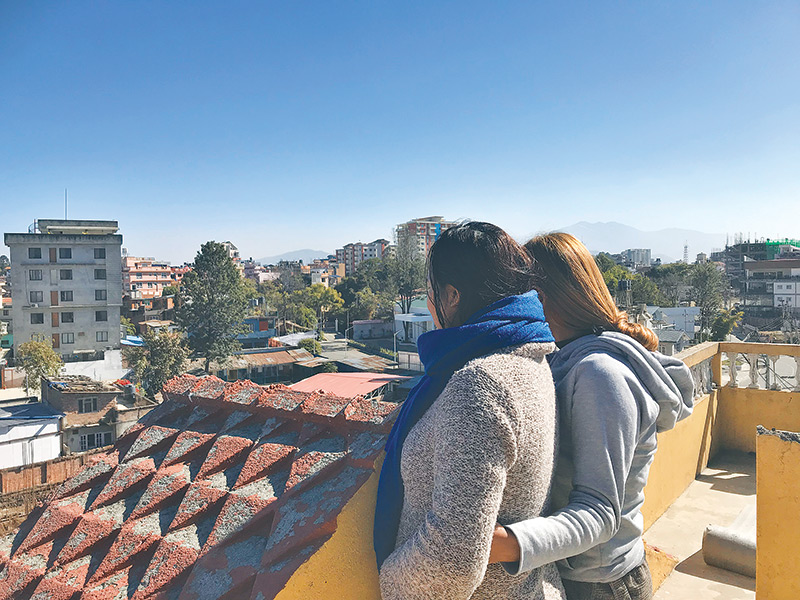
Pretty and Kripa, two transgender sex workers, look out at the city from the rooftop of the Blue Diamond Society. Post PHOTO: ELISHA SHRESTHA
KATHMANDU, Pretty was 15 when she first stood out on the streets of Chitwan looking for a customer. Bullied and teased by her teachers and classmates for her identity as a transwoman, Pretty had dropped out of school in the tenth grade to become a sex worker, earning as much as Rs15,000 to Rs20,000 a day. “I knew at an early age that I was a female trapped in the body of a man,” 27-year-old Pretty told the Post. “But I was made to feel like I was abnormal. School made things worse, as I was often humiliated and referred to as chhakka.” It was only when she met others like her that she was introduced to the LGBTIQ community. But at the same time, she was also introduced to the world of prostitution. “Many transgenders would dress up and put on makeup like women. And they would look beautiful,” said Pretty. “I saw that male clients appreciated them. I realised if I did that, I too would be appreciated and at the same time earn money and become financially independent. Prior to that, I hadn’t experienced being appreciated as a woman or felt financially empowered.” In 2007, Nepal’s Supreme Court made a ground-breaking decision on gender identity and sexual orientation by recognising equal rights for sexual minorities. The Supreme Court decision ordered the government to issue citizenship certificates and identity cards with a third gender option in the form of ‘other’. In 2015, Nepal joined a handful of countries around the world by enshrining protections for the LGBTIQ community in its constitution. Despite these progressive laws protecting the LGBTIQ community, discrimination and prejudice continue to permeate society. Transgender individuals especially are often exclused and ostracised, leaving them with few options to support themselves financially. This has led many trans individuals, especially transwomen, to engage in sex work to provide for themselves. Kripa, a 35-year-old transwoman from Chitwan, chose sex work out of desperation. “I tried searching for a job as a waiter in different restaurants multiple times, but no one would hire me,” she said. “I didn’t have any option except to engage in a profession that at least doesn’t discriminate against me just because I am a transgender woman.” Various studies from around the world show how transgender women who don’t have access to support systems face discriminatory hiring practices at workplaces and resort to sex work as the only option. However, sex work can be dangerous, all the more so because it is illegal in Nepal. The recent rape and murder of Ajita Bhujel, a trans sex worker, in Hetauda impresses how transgender individuals continue to face violence. Last year, in March, another transgender sex worker, Junu Gurung, was beaten to death. “Ajita was into sex work because she wasn’t getting any jobs despite trying her luck many times,” said Pinky Gurung, a friend of Bhujel’s and president of the Blue Diamond Society, the country’s oldest LGBTIQ rights organisation. “If Ajita was not transgender and was not involved in this kind of work, maybe she would be alive.” Although police have yet to uncover details of her death, queer rights activists are concerned that Bhujel’s murder could be a hate crime. “At the time when transgender people still face stigma and discrimination, transgender sex workers are even more vulnerable and are at high risk for a spectrum of dangerous outcomes,” said Gurung. “They are often victims of physical violence and emotional abuse.” Kripa and Pretty, both of whom asked that they not be identified by their last names, are aware of how dangerous the profession they have chosen is. “Working as a sex worker means I am consciously reducing my life expectancy,” said Pretty. Kripa agrees, especially given that there is a constant risk of getting infected with HIV and other sexually transmitted diseases. Both Kripa and Pretty have faced mistreatment and assault from their customers. “I have been gang-raped, beaten up and robbed many times,” said Kripa. Since prostitution is illegal in Nepal, they cannot seek legal recourse when they are mistreated by their customers. And often, they are humiliated and victimised by the police themselves, said Kripa. “Last year, when Blue Diamond Society organised a programme to interact with the police, many of them complained how there was an increase in the number of transgender sex workers on the streets and how it is negatively affecting society. When I asked if any police station was ready to offer transgenders job opportunities, no one answered,” said Gurung. Blue Diamond Society estimates that there are around 22,651 transgender members affiliated to the organisation from around the country. None of them are employed outside the organisation. “Although Blue Diamond Society has been providing full time and part-time jobs to around 800 transgender members, there are many who don’t have job opportunities and are relying on sex work,” said Gurung. Although there isn’t exact data, Gurung estimated that there are around 3,000 transgender people who are involved in sex work in the Kathmandu valley. According to Gurung, constitutional recognition of the rights of sexual minorities will be effective only when the LGBTIQ community gets equal opportunities. “LGBTIQ is a marginalised community and the government should provide a quota, like for other marginalised groups, so that they can secure jobs opportunities,” said Gurung. If she had gotten support from her parents and teachers, Pretty says that may not have dropped out of school and she would not have ended up as a prostitute. “We are as qualified as any other member of society,” she said. “All we need is support and opportunity.”
MEDLEY
Horoscope
ARIES (March 21-April 19) *** Things might feel light and airy at first today, but by midafternoon you should be able to sense some heavy business going on just beneath the surface. This subliminal weight doesn’t have to slow you down, however. Keep your bright outlook, and don’t join anyone else’s pity party. Let them live under a cloud if they choose to.
TAURUS (April 20-May 20) *** If you’re in the midst of planning something like a trip or party, give yourself more time. As excited as you may be, you need to give yourself more time to do some research. You need to get a better grip on the forces around you before making any commitments, especially regarding people and money.
GEMINI (May 21-June 21) ** A new focus on health and diet could come into your life today, shifting your priorities away from taking the easy way out and toward putting in the hard effort that you know will pay off. It’s time to face the facts and trim the fat, literally! Investigate new ideas on how to eat better and exercise more.
CANCER (June 22-July 22) ** Do you know the best way to deal with suspicion? Go to the source and ask them to confirm or deny. Things have gone too far for too long. If it goes on for much longer, all that frustration will cloud any chance you have for progress. It has to come to an end as soon as possible. You are emotionally strong to deal with it.
LEO (July 23-August 22) *** You thought you totally understood your feelings about a recent encounter, but confusion might swim to the surface again. Having doubts about what happened is fine, but don’t make any changes based on your doubts. If your feelings are starting to change, there’s nothing you can do but accept it and keep moving forward.
VIRGO (August 23-September 22) *** If you’re confused by a comment someone makes, pursue it until you get complete clarity. Ask them to repeat themselves and explain what they really mean. You can’t let it go for the sake of not ruffling anyone’s feathers. Don’t worry about not drawing attention to yourself. Your reputation could become affected today.
LIBRA (September 23-October 22) **** The hottest thing in your life right now isn’t the weather or your romance. All the heat that’s being generated is coming from the fresh ideas in your head. Grab some paper, pens, crayons, a video camera, whatever you feel like using to get your ideas out. Songs, stories, or any idea are all valid forms of expression right now.
SCORPIO (October 23-November 21) **** You’re the centre of the action today. Put on a sharp outfit, polish up your attitude, and practice a few one-liners. Your charm quotient is high, and it will act like a web to snare some attractive and influential people as you move throughout your day. Suddenly, folks who’ve known you for ages, will see a new you.
SAGITTARIUS (November 22-December 21) **** Getting your hands dirty would do you some good. It’s time for you to build your ideas into something solid and manifest your dreams. This could include something as simple as baking a big batch of chocolate chip cookies. The important thing is to take something from the idea phase to the realisation phase
CAPRICORN (December 22-January 19) *** There will be some drama whirling around you, but you can handle it. And who knows? You might even enjoy it, since it involves some of your favourite people. The one thing you should remember is to stay as detached, calm, and flexible. If you can bend like a reed, you’ll be able to give stormy folks the wide berth they need.
AQUARIUS (January 20-February 18) *** Your emotions are yours, and you certainly have a right to feel the way you feel, but not everyone else needs to know exactly how you feel at all times. Don’t confuse honesty with sharing. It’s more appropriate for you to keep your thoughts a bit vague. Keep your cards close to your chest, and don’t let them know what’s on your mind.
PISCES (February 19-March 20) *** Concentrate your attention on the decision makers in your life, and try to get a handle on what motivates them. They have a lot of influence over your life right now, so it’s in your best interests to understand them as completely as you can. In a new work relationship, you might need to step outside your comfort zone a lot farther.
NATIONAL
Prakash Osti runs into controversy for his nod to transitional justice nominations
Osti represents National Human Rights Commission in the panel that nominated officials at political parties’ behest.
- BINOD GHIMIRE
KATHMANDU, A National Human Rights Commission representative’s nod to the recommendation committee’s decision to recommend officials in the transitional justice commissions as decided by the political parties has been dragged into controversy. The five-member recommendation committee led by Om Prakash Mishra, former chief justice, on Saturday had unanimously selected 10 individuals for the Truth and Reconciliation Commission and the Commission of Investigation on Enforced Disappeared Persons. Prakash Osti represented the constitutional rights watchdog on the committee. Despite the rights body saying that its representative would not agree on the recommendation committee decision if it is taken as per the parties’ order, Osti decided to give his nod. Human rights defenders and the victims of the decade-long insurgency had been demanding that the commission withdraw its representative from the recommendation committee, saying it was working at the behest of the political parties. Anup Raj Sharma, the chairperson of the commission, had said he had asked Osti to return if he felt there was political intervention in the selection process. “I had clearly told him (Osti) to refrain from the recommendation process if the committee fails to make the decision independently,” Sharma told the Post. The other members of the commission also believe that Osti compromised on the stance the commission has maintained on the transitional justice issue. The commission has been saying for long that an amendment to the Enforced Disappeared Enquiry and the Truth and Reconciliation Commission Act 2014 is a must in line with the 2015 Supreme Court ruling that the transitional justice has to be victim-centric. “However, Osti compromised on the principle by endorsing the names that were selected politically,” Mohna Ansari, a member of the commission, told Post. “It is surprising that he ignored the chief commissioner’s call. Sharma had even handed him a letter, asking him to return from the committee.” According to Ansari, Sharma on November 24 had given a letter to this effect. Osti, however, said he hadn’t received any letter. “The letter was given to the Law Ministry while recommending my name to the recommendation committee. The commission has to adopt the process while withdrawing my name, which was never done,” Osti told the Post. “Just like I could not have represented the commission on my wish, I could not return from the committee.” A senior official at the commission, however, said Sharma had verbally told Osti to return from the committee if he wanted. The commission is yet to take a position on the recommendation process as its chairperson and members are currently out of Kathmandu. “I will call a meeting after all the members arrive in Kathmandu,” said Sharma. “We will also listen to what Osti has to say,” Sharma told the Post. Human rights defenders and conflict victims said the commission representative deceived them by endorsing the names that were selected without following a due process. “We had hoped Osti would stand against any political interference. But he failed to live up to our expectations,” Charan Prasai, a human rights defender, told the Post. The committee on Saturday picked Ganesh Datta Bhatta, an associate professor at Nepal Law Campus, as the chairperson of the truth commission from the Nepali Congress’s quota and Yubraj Subedi, former joint attorney, to lead disappearance commission from the Nepal Communist Party’s quota. Among the four members in the truth commission, three are from the ruling NCP while the main opposition, Congress, has three members in the disappearance commission. All the members in both commissions are advocates. The chairpersons and members of the commissions assumed office on Thursday after taking the oath.
NATIONAL
Pressure mounts on Deuba as rival faction ups the ante
Ram Chandra Poudel group wants to hold ‘decisive talks’ on general convention with party president today.
- ANIL GIRI
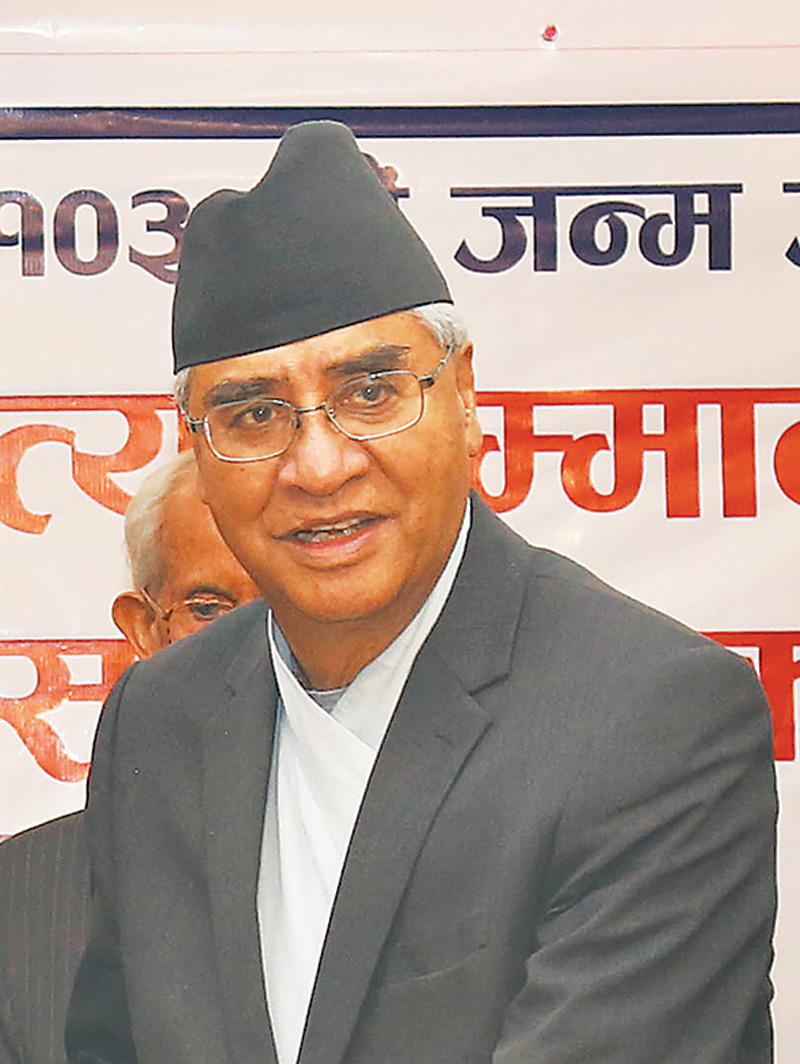
Sher Bahadur Deuba. Post file photo
KATHMANDU, Pressure is mounting on Nepali Congress President Sher Bahadur Deuba. With the party and its sister organisations fraught with internal wranglings, rival camps in the Congress are putting the heat on Deuba to settle the disputes—chief among them, deciding the date for the party’s 14th general convention. After several rounds of talks between two rival groups, led by Deuba and senior leader Ram Chandra Poudel, on Thursday failed to yield any results on the issue of general convention, the Poudel faction held a separate meeting at the residence of party General Secretary Shashank Koirala. “The meeting has decided to hold decisive talks with Deuba on Friday morning,” said senior leader Krishna Prasad Sitauala. “We hope to reach a compromise on holding the 14th general convention on the agreed date.” A Central Working Committee meeting, which was boycotted by Poudel and Sitaula factions, had decided to hold the party’s general convention in the third week of February 2021. The Poudel faction has been insisting that the party hold the 14th General Convention in December 2020 instead of the third week of February 2021. Senior party leaders including Shashank Koirala, Sitaula, Shekhar Koirala, Prakash Man Singh have thrown their weight behind Poudel. Deuba for long has been facing criticism for running the party unilaterally, ignoring the democratic principles. In recent developments, Deuba’s closeness with the ruling Nepal Communist Party too has not gone down very well with party leaders. Deuba is also under attack from party leaders for not fielding any candidate for Speaker, allowing the ruling party candidate Agni Sapkota to get elected unopposed. Two Nepali Congress youth leaders, Gagan Thapa and Pradeep Poudel, have been vocal in criticising Deuba for not fielding any candidate. They doubt the Nepali Congress will file nomination Deputy Speaker. “The party president is certainly under pressure. Removing the obstacles in the party and holding the general convention on time are his responsibility,” said Sitaula. “We have no problem whether the general convention is held on December 2020 or February 2021. We are just saying it must be trustworthy and credible.” Party Vice-President Bimalendra Nidhi said that he is hopeful that internal disputes will be managed soon. Both factions have formed a three-member task force of Nidhi, Sitaula and Singh to find an amicable solution to ongoing disputes. “The Poudel faction is laying stress on addressing disputes of the Nepal Student Union and formation of an interim structure. It is not a wise move to shift the general convention from December 2020 to February 2021 because a lot of adjustments in local party structures have to be made,” said Nidhi. “We will try to find a solution without changing the proposed date of the general convention.” On Wednesday, too, Deuba, Poudel and some other leaders held talks to find an amicable solution. Apart from holding the general convention and seeking a win-win situation for both sides on forming a new interim structure of the Nepal Student Union, they are also struggling to deal with issues like formation of various party departments and an interim structure of Nepal Tarun Dal, the party’s youth wing. Senior party leader Shekhar Koirala told the Post that party President Deuba is facing enormous pressure within and outside the party so there is no alternative to settling the disputes at the earliest. “My impression is that President Deuba is under intense pressure within the party and from the international community too,” said Koirala. “Being a democratic party, which is currently in the opposition, our party’s performance is being closely watched by the international community.” According to Koirala, the international community impression about the Nepali Congress is that it is becoming weaker by the day and has lost its effectiveness as an opposition force. “The onus is on Deuba to revive the party’s image,” he told the Post.
NATIONAL
Amid coronavirus concerns, WHO Nepal furnishes draft report on isolation facility
A team from the UN health agency has pointed out several lapses in the isolation ward set up at the Teku hospital.
- Arjun Poudel
KATHMANDU, The World Health Organization’s country office in Nepal on Wednesday furnished a draft report about the condition of the isolation facility set up at Sukraraj Tropical and Infectious Disease Hospital in Teku some 10 years ago. A team from the UN health agency had inspected the facility at the request of the Epidemiology and Disease Control Division in June last year. The WHO furnished its report to the division amid concerns regarding Nepal’s preparedness to deal with outbreaks of deadly viral diseases. “We are currently studying the draft report submitted by the WHO Nepal office,” Dr Basudev Pandey, director at the Sukraraj Tropical and Infectious Disease Hospital, told the Post. Officials at the division and the hospital had requested for the report after WHO alerted its member states about the risk of transmission of a new strain of coronavirus—nCoV—that originated in Wuhan city of China. Doctors say isolation in a hospital setting is a precaution taken to prevent further spread of infection, which if left unchecked, could jeopardise the health of other patients, hospital staff, visitors and the community at large. According to Pandey, an expert team from the UN health agency has pointed out several factors lacking in the isolation ward set up at the hospital. The team recommended fulfilling the requirements for the isolation ward to be operable. The WHO team has recommended arranging an “isolation transport” ambulance to transport suspicious cases and setting up isolation rooms at the hospital’s out-patient department and the emergency ward to limit contagion risk to other patients and health workers. Constructing a ramp to ease the movement of patients to the isolation room and installing high-efficiency particulate air (HEPA) filters are the other recommendations made by the team. Pandey said it would take millions of rupees to bring the isolation ward into operation. The ward was set up with the support of the World Bank almost a decade ago at the time of the avian flu epidemic. Since setting up the ward, not a single patient has received treatment there. “We have to go through a public procurement process for even minor upgrades,” said Pandey. “It takes months to fulfil all procedures.” Health experts say Nepal is highly vulnerable to contagious diseases—especially the new strain of coronavirus nCoV, as the inflow of Chinese tourists is high in the country. The country aims to attract two million tourists in 2020, including 350,000 Chinese tourists, under its Visit Nepal 2020 campaign. Meanwhile, a team of health workers comprising technicians from the Epidemiology and Disease Control Division visited the health desk set up at the Tribhuvan International Airport to study the possibility of setting up a thermal scanner and an air-conditioned room. The health desk was brought back to operation last week after the WHO alert about the possible coronavirus pandemic. Images of the health desk that were widely shared on Thursday, however, showed a notice board that asked passengers coming from Africa to go through screenings. The notice many believe could have been put up at a time when there was an Ebola outbreak in Africa, and authorities were oblivious to the fact that they needed to update the notice board also. “There seems to be some lapse; we will change it,” Dr Hemanta Chandra Ojha, an official at the division, told the Post. According to Ojha, the division will now also set up a thermal scanner at the health desk. “The airport authority has agreed to let us place a thermal scanner and make other safety arrangements there,” Ojha told the Post. Earlier, the airport authorities had appeared reluctant to let the division set up a thermal scanner citing security reasons. Thermal scanners tell the exact temperature of the human body in air-conditioned rooms only. The division on Thursday also imparted training to health workers serving at Teku hospital on precautionary measures to take during an outbreak of deadly viral diseases. At least 17 people have died and over 570 have been infected by Wuhan coronavirus. Chinese authorities have locked down three cities—Wuhan, Ezhou and Huanggang—in a bid to contain the spread of the virus. Air service, train, bus, ferry services in all three cities have been suspended and people have been advised to stay indoors, according to the New York Times.
NATIONAL
Experts urge priority for safe migration objectives
Nepal is a signatory to the Global Compact for Safe, Orderly and Regular Migration for the protection of migrants by formulating required policies.
- CHANDAN KUMAR MANDAL
KATHMANDU, Nepal needs to set out its priorities while implementing the Global Compact for Migration, the first-ever UN global agreement on international migration, according to government officials, labour migration activists and expert. The Global Compact for Safe, Orderly and Regular Migration, commonly known as GCM, is the first inter-governmentally negotiated agreement, which was formally adopted by 164 countries including Nepal in December in Marrakesh, Morocco. Nepali stakeholders, analysing the first year of the GCM adoption and its implementation status, have said that the country needs first to prioritise GCM’s 23 objectives—all of which are about commitments to making migration safer at local, regional and international levels. According to Jeevan Baniya, a labour migration researcher and assistant director of Centre for the Study of Labour and Mobility, a think tank, Nepal government needs to outline a plan clearly, mentioning which objectives are the most important for implementation. “All the 23 objectives are significant, but not all of them are equally important for Nepal as we might have already accomplished the mandate mentioned in a particular point,” said Baniya, during an interaction in Kathmandu on Thursday. “Our government agencies have been regularly introducing interventions which are in line with GCM objectives. Therefore, we need to check what has been done and what needs urgent attention.” Some of the primary objectives and policy recommendations of the GCM aim to gather better data on international migration; minimise factors that compel people to leave their own country; provide migrants with a proof of legal identity; and reduce vulnerabilities in migration, among others. The global pact also recognises that managing international migration is a shared responsibility of all countries, not only the country of origin and destination. Baniya also suggested that responsibilities of achieving the objectives of the GCM should be divided among the three levels of government. Sharing the status of implementation, Giri Prasad Acharya, a section officer with the Ministry of Labour, Employment and Social Security, the government was committed to achieving the objectives of the GCM. “Our commitment to the document is new but the notion it carries for managing migration is not new for Nepal,” said Acharya. “Nepal government has already introduced several measures for the protection of workers’ rights. The government has ensured that all the workers migrate under fair and ethical recruitment practices.” The Labour Ministry is also moving ahead with forming a steering committee, which will be headed by Labour Secretary and consists of officials from other ministries and experts in the field. The government is also drafting a strategy in consultation with other stakeholders for time-bound and effective implementation of the GCM. Nepal, as a leading labour source country, has a lot to do under the GCM commitments, which is non-binding, for protecting its migrant workers within and outside the country, said participants at the event, organised by the National Network for Safe Migration, an umbrella institution of the Nepali organisations working in the field of migration. “We can hope that the GCM will be fully implemented,” said Laxman Basnet, general secretary of the South Asian Regional Trade Union Council, a regional federation of national-level trade unions of South Asia. “But our workers need to be protected at all stages of migration. As most of them are not educated and remain unaware of basic rules and their own rights, empowering them should be the first task.”
NATIONAL
State to take Rs 3 billion back from Sajha
- Post Report
KATHMANDU, The government has decided to take back the Rs3billion support that it had released to Sajha Yatayat to let the cooperative buy a new set of electric buses. Minister for Com-munication and Information Technology and government spokesperson Gokul Baskota informed on Thursday that the government was taking back the amount as Sajha failed to procure electric buses for public transportation in the country. The government, through a Cabinet decision on July 9 and 14, 2019, had decided to allocate Rs3 billion to Sajha. The money was transferred to the co-operative public transport company on July 18. However, in October, the Ministry of Physical Infrastructure and Transport had asked Sajha to keep the overall process on hold “for the time being”, citing sluggish progress. Meanwhile, as per the new decision, the government has decided to provide the financial assistance of the same amount to the Ministry of Physical Infrastructure and Transport to buy electric buses.
NATIONAL
Madrasa students cannot sit for Secondary Education Examination for lack of syllabi
The federal government has yet to finalise the syllabi for madrasas from grades 6 to 10.
- Amrita Anmol
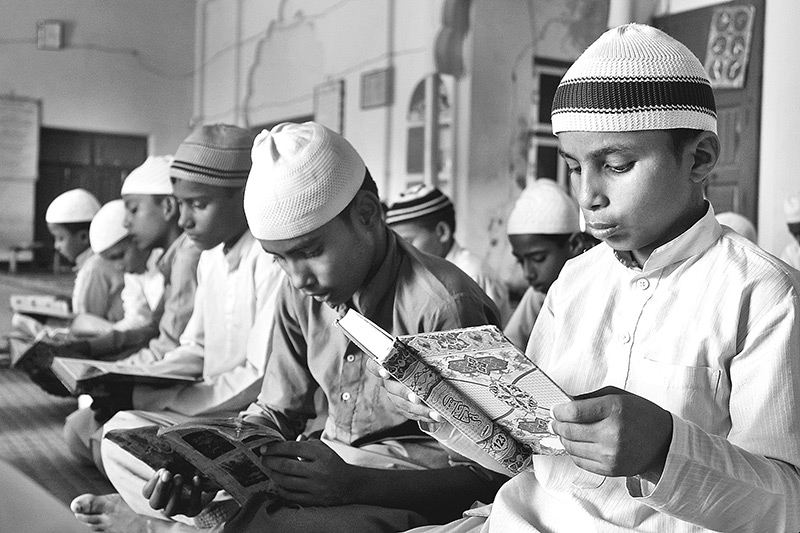
Around 700,000 Muslim children are enrolled in 4,000 madrasas across the country. Post Photo
BUTWAL, Farhan Alam is a 10th grader at Jame Sirajul Uloom Al-Safia, a madrasa (Muslim educational institute) in Kapilvastu. But Alam may not be able to appear for the Secondary Education Examination this year, as his school is yet to receive permission from the Office of the Controller of Examinations to conduct the exams. Like Alam, the fate of 60 other students hangs in the balance. Madrasas in Nepal used to be religious institutions until 2004 when the government started registering them and had them adopt the Nepali curriculum while allowing them to continue as institutions of religious learning. However, the federal government has only finalised the syllabi for grades four and five. The syllabi for grades 6 to 10 have been designed but are yet to be finalised, according to Maulana Mahasud Khan, general secretary of Rastriya Madrasa Sangh. Since the madrasas do not have syllabi, their students are not qualified to sit for board examinations conducted by the state. The madrasas have been conducting classes till grade 10, as they were given permission by local units to run classes till the secondary level. The local units, however, have not made the provision to qualify the students of madrasas to sit for Secondary Education Examination. The Office of the Controller of Examinations, which is under the federal government, decides which schools are qualified to conduct board examinations. “We have been frequenting various government agencies to seek permission to allow our students to sit for board examinations,” said Abdul Gani Alqufi, maulana of Jame Sirajul Uloom Al-Safia. “This logistic quandary has deprived the children of madrasas of further education prospects.” The madrasa, which was established a century ago, has 1,027 students. Similarly, the students of madrasa Maditul Olumaharpur in Nawalparasi (West) are also facing the same problem. Pratappur Rural Municipality had granted permission to the madrasa to conduct classes up to grade nine but the ninth graders weren’t allowed to fill the required form for Secondary Education Examination this year. Muwaraha Ahamad, a ninth grader at the madrasa, fears that he will not be able to appear for the board examination next year. “We could not fill the form this year. We don’t know whether we can appear for the boards next year or not,” he said. Nineteen students, including Ahamad, had appeared in an examination conducted by the local unit in grade 8. They had followed the syllabi of the madrasas in India. “We borrowed the syllabi from the madrasas in India and taught our students. Based on the syllabi, we prepared the tests,” said Ameer Yajumal, maulana of the madrasa. Abdul Rauf Khan, former education officer, said that the government’s lackadaisical approach to madrasa education has left hundreds of Muslim students in a lurch. “The government directed local units to upgrade madrasas to the secondary level without proper planning, including that for syllabi and textbooks,” said Khan. “They did not think it necessary to make provisions for madrasa students to sit for Secondary Education Examination.” Dadhiram Sharma, the education coordinator of Pratappur Rural Municipality, said his office had granted permission to local madrasas to operate as a secondary school. “We will seek admission for madrasa students in other schools and allow them to sit for the board examinations. The future of students cannot be ruined due to a lack of syllabi,” said Sharma. “We are in constant talks with the Education Coordination Unit to solve this problem once and for all.” Around 700,000 Muslim children are enrolled in 4,000 madrasas across the country. Out of the 4,000, the centre has granted government school status to about 1,000 madrasas, according to Zaheed Pervej, a Tribhuvan University professor who has researched extensively on Nepali madrasas. Sudarshan Baral, the minister for Social Development, who is also responsible for overseeing Province 5’s education sector, said that he will take immediate steps to coordinate with the Office of the Controller of Examinations in regards to the future of madrasa students. “I will talk to the concerned authority and try to give the same status and opportunity to Madrasas students as that of community school students,” Baral said. On Sunday, Muslim leaders met Chief Minister Shankar Pokharel and submitted a report underlining the problems of madrasas and plausible solutions. Pokharel said that he will pressurise the concerned authority to address the issue, starting with the preparation of syllabi for madrasas that would qualify their students to sit for Secondary Education Examination. “The provincial government will take initiatives to nationalise Madrasa education,” said Pokharel.
NATIONAL
Police arrest provincial assembly member Deepak Manange
- SHUVAM DHUNGANA
KATHMANDU, Kaski District Police Office on Thursday afternoon arrested Gandaki provincial assembly member Rajiv Gurung, also known as Deepak Manange, over an indecent behaviour case filed by Milan Gurung, chairman of the Kaski chapter of All Nepal Football Association. “Police arrested him after the District Administration Office issued an arrest warrant against him this afternoon,” Deputy Superintendent Raj Kumar KC, spokesperson for Kaski District Police Office, told the Post over the phone. “He was arrested from the lakeside area.” On Wednesday, Gurung had lodged a complaint with police against Manange for assaulting him. In his complaint, Gurung said Manange had slapped him during the inauguration of Gandaki Provincial Level Chief Minister Cup Football League on Tuesday. Gurung had demanded action as per Section 118 of the Criminal Code 2017, which says “no one should in a public place or at a place where entry is legally prohibited misbehave…, and anyone found guilty of this offence could face a jail term of up to one year and Rs10,000 fine.” “He has been kept at Kaski District Police Office,” said KC. “Further investigation is underway.” Manange was elected to Gandaki provincial assembly from Manang (B) as an independent candidate in the 2017 elections. He took the oath of office as a provincial member in January last year, 13 months after his election. Shortly after that, he joined the Nepal Communist Party.
NATIONAL
Mental health patients deprived of treatment in Sudurpaschim
Hospitals in most hill districts do not have psychiatric services for those who need help.
- TRIPTI SHAHI
A lack of medical facilities compels locals to take their family who suffer from mental ailments to faith healers in Dashrathchand Municipality. Post Photo: TRIPTI SHAHI
BAITADI, Premram Tiruwa’s two sons suffer from undiagnosed mental illnesses. Twenty-six-year-old Pradip and his 22-year-old brother Ramesh live with their father, Premram, at Dasharathchand Municipality in Baitadi. “Both my sons have been suffering from some kind of mental disease,” said Premram. “But we haven’t been able to identify the disease.” Both Pradip and Ramesh developed their symptoms almost a decade ago, but haven’t received a proper diagnosis for lack of a proper medical facility in the district. “I took them to the district hospital a few years ago for treatment. The hospital referred them to another hospital saying that it did not extend mental treatment services,” said the 60-year-old father. “I did not have the money to take them to a private hospital.” For years, he has been frequenting the district hospital seeking treatment for his sons, and every time he has been referred to other hospitals. “I took them to faith healers and opted for homoeopathic treatment after the hospital turned us away. But nothing worked,” said Premram. Most mental health patients in Baitadi and other hill districts of Sudurpaschim Province spend their lives battling mental illnesses, and are never properly diagnosed or treated. “Mental health patients in Baitadi and other districts in the region are deprived of treatment. The government authorities does not even have the data of the exact number of mental health patients in the district,” said Saraswati Nepali, a Baitadi-based rights activist. She said mental health patients from poor economic backgrounds have to suffer the most since they cannot afford to go outside the district for treatment. According to Dr Sandip Okheda, chief at Bajhang District Hospital, around 30 to 40 percent of patients visiting the hospital’s OPD show symptoms of mental illness. “Up to two mental health patients visit the hospital in a week,” said Okheda. The district hospital refers patients suffering from serious mental health issues to hospitals outside the district since it does not have specialists to treat these cases. “We purchase the medicines for minor mental health issues ourselves. But patients from poor economic backgrounds cannot afford them and we cannot provide it to them free of cost,” said Okheda. Until five years ago, Mental Disease Consultation Centre, a non-governmental organisation, was providing mental health services in Bajhang. The organisation had set up a desk at the district hospital. According to Dhirendra Khadka, an official at the health unit of Thalara Rural Municipality, there are 25 mental health patients in Kotbhairab settlement of the local unit alone, but the authorities do not have supporting data. “Firstly, mental health patients in the district suffer because their illness remains undiagnosed. Secondly, even if there was proper diagnosis, there is no mechanism for treatment in district hospitals,” said Khadka.
(Basanta Pratap Singh contributed reporting from Bajhang)
NATIONAL
Structures destroyed by the 2013 Mahakali floods in Darchula yet to be reconstructed
- MANOJ BADU
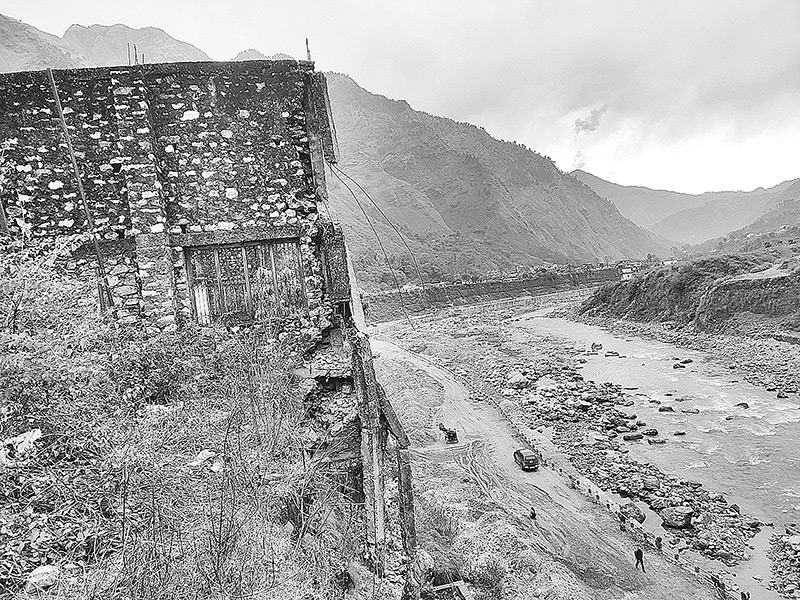
The remains of a hall on the banks of the Mahakali river. The hall was destroyed in the floods and has not been rebuilt. Post Photo: MANOJ BADU
DARCHULA, Several infrastructures in Khalanga, the district headquarters of Darchula, were destroyed by devastating floods in the Mahakali river in 2013. Till date, none of these infrastructures has been completely reconstructed. The flooded Mahakali river had swept away 12 government offices, more than 156 private houses, embankment, a covered hall, and a playground. Only the damaged embankment and two government office buildings have been reconstructed in the last seven years. “Around 70 percent area of the district hospital was swept away by the flood. We had provided health services from the open area. The hospital is now being operated out of the damaged building,” said Bir Hari Rai, a former employee at the district hospital. According to him, the government had allocated budget to build the hospital a year after the disaster hit but the budget was frozen. “The hospital could not manage land in the district headquarters to construct the building. The hospital management tried to buy a plot of land but could not find a suitable location,” said Rai. Meanwhile, in government offices, service seekers and government officials face difficulties due to reconstruction delay; most of the government offices are providing services from congested rented buildings. Khalanga Source Centre, an education office that monitors and coordinates the community schools, had been shifted to Khalanga Primary School after the flood. The office is still being operated from the same school. “We don’t have our own office which affects the office work,” said Jayaraj Panta, the office chief. Similarly, sports activities have been hugely affected after the covered hall and playground had been washed away by the floods. “We used to organise various indoor games in the covered hall. The open playground was also swept away. We could not organise any sports tournaments due to the lack of a suitable venue,” said Narayan Dahal, chairman of the district sports development committee. “We have to go to the bordering Indian town to play badminton. We have repeatedly urged the concerned authorities to construct the covered hall and playground but to no avail,” he added. Mahakali Municipality allocated Rs 2 million to build a playground in the area. However, the project was left in limbo as it could not find a suitable place for the construction of the playground. “We started construction of the playground in the public land of Dumpani a few months ago. But the locals protested; they wanted the space to be left open for the public,” said Mayor Hansha Raj Bhatta.
NATIONAL
Ward office torched
Briefing
- Post Report
JAJARKOT: An unidentified group torched an office of Ward No 3 of Kushe Rural Municipality, Jajarkot, on Wednesday night. All the documents, furniture and belongings were destroyed in the arson. An investigation is underway and the guilty will be held soon, said police.
NATIONAL
Civil servant held with bribe
Briefing
- Post Report
The Commission for the Investigation of Abuse of Authority arrested a government employee from the District Administration Office in Saptari on Thursday. Keshav Kumar Yadav, an office assistant, was nabbed red-handed with Rs 4,000 bribe amount.
NATIONAL
Students protest in Pratappur
Briefing
- Post Report
PARASI: Students of Janajagriti Secondary School in Pratappur staged a demonstration after Govinda Yadav, a resident of the area, tried to register the public land (near the school) in his name. The students staged the demonstration on Thursday after Yadav and his family thrashed Baburam Subedi, headmaster of the school. Subedi had tried to stop Yadav from registering the land in his name after he filed an application in the ward office.
NATIONAL
Three years on bridge project remains incomplete
Breifing
- Post Report
GORKHA: Only 20 percent of construction work of a motorable bridge over the Daraudi river has been completed in Gorkha Municipality Ward No 12. The project which started three years ago is supposed to be completed by the end of this fiscal year. The bridge will connect Dashkilo of Gorkha Municipality Ward No 12 with Mirkot of Palungtar Municipality Ward No 9.
NATIONAL
Public holiday in Bagmati Province on Friday
Briefing
- Post Report
HETAUDA: The Bagmati Provincial government has announced a public holiday in Bagmati Province on Friday on the occasion of Sonam Lhosar. Ministry of Internal Affairs and Law issued a public notice on Thursday regarding the public holiday. Sonam Lhosar is the main festival of the Tamang community that constitutes around 20 percent of the total population of the province.
EDITORIAL
Cycle city 2020?
Lalitpur promised to change urban mobility for the better, but implementation has been lacking.
In November 2019, the news that Lalitpur Metropolitan City was investing in cycle lanes and cycle-friendly laws had received great positive coverage. Lalitpur was supposed to set an example for all other cities and budding metropolitan areas around the country on how to curb air pollution and traffic congestion while promoting daily physical activity. But it seems that the commendations came too early. The city’s initial cycle lanes have failed to live up to the hype; and the accompanying cycle laws are a long way from being passed, let alone implemented. However, there is still time to set things right. Lalitpur still has a chance to deliver on its promises on track with the original deadline; Mayor Chiribabu Maharjan and his team must make this a priority. Air pollution is a major cause of premature death. According to David Boyd, a UN special rapporteur on human rights and environment, the silent killer ‘is responsible for the premature death of 7 million people each year, including 600,000 children’. More suffer a tough existence due to air pollution. In Nepal, a study published in early 2019 confirmed that about 12 percent of the country’s population—aged 20 years and above—has been found to be suffering from chronic obstructive pulmonary disease. The challenge is especially great in urban centres that have the added issue of vehicular emissions. But the issue is not confined to the harmful toxins and particulates released due to emissions. Ever since Baburam Bhattarai became prime minister in 2011, Nepal has adopted a flawed outlook on urban development—one particularly focused on road-building and lane expansion. But this never-ending cycle has only increased room for more fossil fuel-powered vehicles to add to the traffic nightmare. Moreover, road developments have added an unhealthy level of suspended particulate matter to the air. A push to promote private electric vehicles on a federal level—with tax breaks and charging infrastructure—might make a dent in the volume of vehicular emissions, but it will not reduce the traffic congestion. Neither will it lessen the effects of an ill-designed policy that focuses on further road expansion. A comprehensive strategy to promote public transportation, combined with the use of bicycles and pedestrian walks, is the best way forward. And this is exactly what Mayor Maharjan promised: The plan revolved around inverting the mobility pyramid that traditional urban planning models followed. With the metropolitan area in the Valley being concentrated—most people here commute less than 6 kilometres—and with the mayor consulting with urban planners and people-led modern urbanisation groups, the plan seemed destined to be successful, not to mention economically viable. Yet, over two months since the plan was launched, progress has been extremely disappointing. The cycle lanes turned out to be nothing more than painted lines on the same old roads; cars and buses regularly trample on the area prioritised for bicycles. Most of the lane markings have already started to disappear—only two months in. What’s worse, the laws governing the new mobility model seem to be bogged down in bureaucratic manoeuvrings—no concrete dates have been announced for their endorsement and implementation. But Maharjan and his government must not let the momentum be wasted. The Lalitpur government made a promise to its people to change urban mobility for the better, it cannot allow the plan to fail now. The municipal assembly must endorse the relevant laws. Moreover, the cycle lane designs must be tweaked to make them actually usable—something lacking currently.
OPINION
Dilip Mahato should have been a hero. Instead, he will be forgotten.
Dilip’s murder encapsulates several of the ills that ail this tottering republic.
- Amish Raj Mulmi
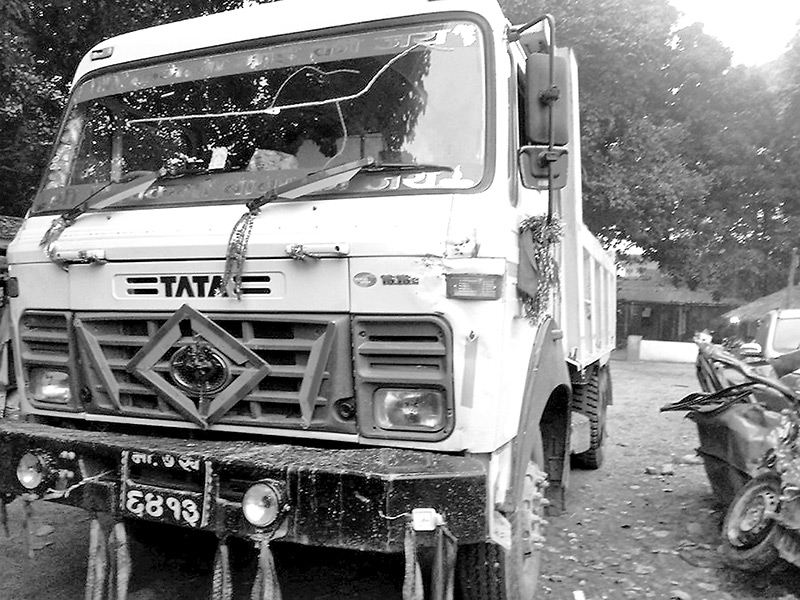
The tipper truck that was used to kill Dilip Mahato. Post file Photo
By all accounts, Om Prakash Mahato (Dilip) was the sort of person Nepal needed. He was studying Mechanical Engineering, and was in his final year at Bhopal, India. He did not want to go abroad; he wanted to return home to his village Sripur, in Mithila Municipality of Dhanusa. He resolved disputes, according to his neighbour. And he had been protesting the illegal extraction of sand and pebbles from the Aurahi river for the last two years. At a time when Nepal has surely been lacking role models one can look up to, the 24-year-old Dilip could have been a hero our republic needs. For surely, the murder of Dilip by Bipin Mahato, the owner of the Churiyamai Sand Processing Factory, and his cronies on 10 December 2019 is another reminder of the dark abyss this infant republic is headed towards. Dilip’s murder encapsulates several of the ills that plagues Nepal. There is, of course, the impunity that comes with the very cold-bloodedness of the murder: Dilip was stabbed first, then laid to rest on the river bed, before being finally crushed to death by a tipper-truck. Imagine the brazenness: just a day earlier, Bipin had threatened to run the tipper over Dilip. Only those with the belief that nothing can happen to them deliver on their threats. Then there’s the politician-bureaucrat-private sector nexus. The District Coordination Committee has blamed the police for not taking action—fuel was budgeted for monitoring illegal extraction practices, but the police allegedly did not take any. The business falls under local government units, and it is alleged several representatives’ elections were funded by such illegal industries. The mayor himself is alleged to have interests in the business. If this were a one-off incident, it could have been deemed a simple killing. But Dilip’s murder is just another symptom of the nexus that ails Nepal. Similar cases of collusion between the sand ‘mafia’ and government units have been documented in several other places, with those raising a voice against it attacked on the outskirts of the valley and in Udayapur. Then there was the excavator attack on Baitadi locals protesting haphazard road construction. This nexus is not limited to local governments. If anything, the local units have learnt from the top. Two glittering examples will suffice: the first, the extraordinary Teku bridge, built over five long years by the outstanding public works contractor Pappu Construction, and deemed unsafe for vehicular traffic (those who wish to see another shining light of civil engineering in Nepal must immediately google the Babai river bridge in Bardiya built by the same contractor). The second, the charges of collusion against the Yeti group that had been appearing in print media on a daily basis. In any functioning country of the world, such a slew of charges would have invited a thorough investigation, massive public outcry, and perhaps a rethink by multilateral institutions like the United Nations which have a formal association with the group’s airline. But Nepal being what it is, business has gone on as usual. Dilip’s murder is equally a story about the haphazard urbanisation practices Nepal is seeing. Political stability—which is often not a marker for stable governance—and rising disposable incomes post the remittance boom has provided Nepalis with the means to build new homes, or migrate to better pastures. A government more concerned with long-term goals than short-term gains would incorporate and implement urban planning at the earliest, not just because Nepal is seeing one of the fastest urbanisation rates in Asia, but because urban planning can, in the long run, generate sufficient revenues through licensing, contract works, and proper demarcation of urban settlements. But like our government, our cities will soon come to be a shining beacon of short-term thinking. All developing countries possess a hunger for natural resources, however meagre they might be. Such is the case in Nepal too—the goal is to extract as much as possible, in as little time as one can. The same lens is applied on our rivers, which is why the illegal mining industry flourishes. Again, a more sensible government would look at natural resources not just as resources, but also as intangible heritage comparable to the temples that forever populate Visit Nepal advertisements. At a time when climate change is forcing a reorientation on how we look at resource extraction, here we are, going on as if things haven’t changed, and Nepal is not one of the most affected countries by the biggest challenge for humanity. Dilip Mahato understood all of these, and more. His indomitable courage, in any other society, would have inspired thousands, maybe even millions. But in Nepal, his murder will become a tragic footnote, another ‘martyr’ (how we love that term!), of this tottering republic. ‘The usual hero adventure begins with someone from whom something has been taken, or who feels there is something lacking in the normal experience available or permitted to the members of society. The person then takes off on a series of adventures beyond the ordinary, either to recover what has been lost or to discover some life-giving elixir. It’s usually a cycle, a coming and a returning.’ Only in Dilip’s case, there will be no return. There will just be collective amnesia. Haami Yestai Ta Ho Ni Bro, as the rapper V-Ten sang. We are like this only!
OPINION
Coronavirus is a serious health threat
Controlling the coronavirus outbreak relies on prompt identification, management and isolation.
- Cesar Chelala
Shutterstock
Happy expectations for the weeklong Chinese New Year holiday have been dampened by a new viral infection spreading rapidly in China and other countries. Since late 2019, people from Wuhan had been infected with a viral form of pneumonia whose cause was yet unknown. Now, the virus has been identified as a new type of coronavirus. Two other types of coronaviruses are SARS and MERS. The new virus is rapidly spreading across many countries, raising concerns about the possibility of a new epidemic like the one involving severe acute respiratory syndrome, or SARS, which killed several hundred people in 2002 and 2003. As of now, people infected with this new virus have been found in China, Japan, Thailand and South Korea. On January 21, 2020, the first case was reported in the United States, in a man returning to the US from a trip to Wuhan. Some coronaviruses, first identified in humans in the mid-1960s, cause the common cold, while others have been found in bats, camels and other animals, and can cause severe illness leading to death. SARS emerged as a new coronavirus in 2002, infecting people in southern China. Fortunately, no new cases of SARS have been reported since 2004. The MERS (Middle Eastern respiratory syndrome) virus, which is believed to originally have been transmitted to humans from dromedary camels, seems to be passed less easily than SARS from human to human. People infected with the coronavirus originally found in Wuhan suffer from coughing, fever and severe breathing difficulties. Although some antiviral drugs may lessen the severity of the symptoms, antibiotics do not have any effect. The recovery of those affected will depend on the strength of their immune system, which is already weakened in those who are very old and already sick. The World Health Organisation (WHO) has recommended screening aggressively for the newly found virus. Chinese leaders urged public health officials to urgently take appropriate measures for controlling the spread of the infection. Both Chinese health officials and the US Centers for Disease Control and Prevention (CDC) are closely monitoring the situation, although they admitted that there is ‘much more to learn’ about how the virus is transmitted. In the meantime, China’s health commission has indicated that the government will respond with measures appropriate to manage outbreaks of the most virulent diseases, including mandatory reporting of cases. This is particularly important to be able to follow the course of the disease and to concentrate efforts in the most critical areas. Residents of Wuhan should be encouraged to cancel plans to go out to restaurants for New Year celebrations, and avoid close places like movie theatres and shopping markets. It’s not bad to wear masks while joining friends to chat or play cards. Because there is no effective vaccine to protect against this disease, controlling it relies on prompt identification, management and isolation of possible cases, personal protective measures, and the investigation of close contacts of those infected to minimise potential transmission. No effort should be spared to control this disease.
This article was previously published in China Daily, a part of the Asia News Network.
OPINION
Where will the tourists come from?
The tourism sector demands unyielding commitment and effective strategies from the government.
- Chandra Prasad Bhattarai
post file photo
There were 1.17 million international tourists in Nepal in 2018. The average annual growth rate of arrivals in the five years from 2014 to 2018 was 17 percent. The latest available data for 2019 shows that the total international visitors in the first ten months was 975,557, higher by a mere 8 percent over the same period in 2018. This suggests that the total arrival in 2019, the data yet to come, is not likely to reach even the 1.2 million mark. The scenario indicates that receiving two million visitors in 2020 is not going to be an easy task. Tourists do not visit Nepal simply because the government has campaigned for it. They have their priorities and preferences for any particular country. They plan their visits quite in advance, allocating valuable time and scarce financial resources wisely. Issues such as who inaugurated Nepal’s national campaign, how colourful was the function, how many of the high-level dignitaries were present there, how many tourism festivals will be hosted across the country this year, and so on, will not contribute significantly to increasing the number of tourists. What matters is if the message effectively reached the targeted group of people in source markets. India, China, USA, UK and Sri Lanka have been Nepal’s largest source markets over the last couple of years. In 2018, almost 50 percent of the total international visitors in Nepal were collectively from those five countries alone. As source market behaviour is directly related to the changes in the numbers, its critical analysis could be the first stepping stone towards increasing the number of tourists. Not all the tourists visit for the same purpose, nor are their spending capacities alike. In 2018, 60 percent of the total visitors in Nepal were for holiday and pleasure, 16 percent for adventure (including trekking and mountaineering), 14 percent for pilgrimage and 10 percent for other purposes. Their average spending was $44 per person a day. Visitors’ preferences for products and services differ according to their purpose of visit. While the large majority of American and British tourists love to visit Nepal for holidays, obviously expecting fun and pleasure; the majority of Sri Lankan tourists’ purpose is religious. As high as eighty-six percent of the total Sri Lankan tourists in Nepal in 2018 visited Lumbini. The majority of Indian tourists visit Nepal for pilgrimage and pay homage to Lord Pashupatinath and Muktinath. A few of them are here in transit to Mansarovar in Tibet. A small portion of Indian tourists, mostly middle class, visit Nepal for fun. China has been growing as a prominent tourism source market for the entire world. With the increase in their income in recent years, the number of outbound travellers has been growing substantially. In 2017, a total of 130 million Chinese travelled overseas. This number exceeds their 2011 figure by 85 percent. The Nepali hospitality industry also witnessed this growth; the number of Chinese guests jumped substantially from 32,272 in 2009 to 153,633 in 2018, indicating further growth potential. As for the UK market, a very insignificant portion of their total outbound tourists, 63,466 out of 72.3 million, visited Nepal in 2018. It suggests ample room for expansion if Nepali products and services are appealing to them. Even in the case of tourists from any particular country, their likes and dislikes of products differ with their age, sex, culture, educational status, financial status, etc. The timings of travellers visiting Nepal also differ quite significantly, which is an added benefit to the country. While most of the Indian tourists visit Nepal in May and June, the preferred months for guests from the West are February-March and October- November. Chinese travellers generally love to visit Nepal throughout the year. However, their number drops down slightly in May and June. The private sector, which already has developed a business relationship with those countries, obviously expects the government’s facilitating role in strengthening it to expand the market sizes. Equally crucial in increasing the number of visitors is reaching new markets effectively. As a country with minimal scope for the development of the manufacturing sector, which possesses unparalleled opportunities in tourism, Nepal can simultaneously explore potential new markets in the global landscape. The size of the global tourism market is growing every year in terms of the number of visitors, employment creation and contribution to the national economies. Informed people always would like to visit new places if they are appealing enough, and affordable. Nepal is yet to attract travellers from many geographical regions. Each of the Western European nations can be a high-spending tourism market for Nepal. Nepal can attract visitors from the Balkan countries, the Nordic states and the Gulf region as well. In-depth country-specific analyses from several perspectives—covering the outbound number of visitors, length of stay, preferences and spending behaviour—from both existing as well as potential markets, would provide useful input in designing appropriate strategies. Periodic monitoring of such trends would tremendously help with marketing and promotion. Finally, the tourism sector demands unyielding commitment and effective strategies from the government if it is serious enough in its development. The government needs to plan appropriate, country-specific marketing strategies focusing on both the kind of guests Nepal wants to have most and their exact requirements. At the same time, the authorities need to shift their priority from headcounts to increased earnings per tourist.
Bhattarai, a development economist, is the Executive Chairman of the Centre for Research in Tourism. He tweets at @Chandra43989420
OPINION
Why do we not trust the police?
We have to free the police from the clutches of extraneous forces the police accountable to people and law.
- Muhammad Nurul Huda
Shutterstock
There is no denying that the present government has taken laudable steps by fulfilling a number of long-felt demands of the mainstream police. The cynical observer would say that the status of cops has been upgraded in the eyes of the government, but their real status in society depends on their conduct and performance vis-à-vis the members of the public. In other words, the crux of the matter is whether cops will serve the establishment’s interests without venturing to check legal standings or if they will work as true public servants maintained by public money. Answers to the above queries will not be easy to come by, as policing in this part of the world, for reasons well known, is yet to be a respectable profession. That, however, has not prevented the guardians from waxing eloquent on the virtues of an impartial professional police organisation. The reality is that while their concern is admirable, remedial actions on the ground have been less than adequate. Those wishing to take a deeper look into the status question may find that the public do not trust the police, although they have to depend on them. Even if the public do trust them, the law does not. This puts the police in a unique predicament. The mistrust between the police and the public is a historical creation. Laws which govern the police were created to raise the trust of the people in the British Empire so that the colonial occupation could continue forever. When the police were organised, they were given a low status and a low salary but more fetters, so that they could not really serve the people but only the masters who were ruling the people. This background has to be understood clearly while studying the evolution of the police in our country. There is a consensus that the police have been misused and abused, leading to the decline in the rule of law and thereby increasing distrust in police performance. This factor is directly related to the status question. The laws of crime, evidence and procedure dating back to the mid-19th century and designed to serve the colonial interests of an imperial power still govern the day-to-day functioning of our police force. The question is, can a colonial police meet the needs of a free society in flux? It would not be an exaggeration to say that most efforts at reform have met with increasing resistance from the entrenched privileged classes in politics and the so-called civil service. Our society looks at and treats a policeman with revulsion and contempt, little realising that there is no such thing as ‘scientific investigation’ and ‘clean interrogation’ under a legal system where the guardians of law are not even recognised as such. The Criminal Procedure Code and the Evidence Act look upon police officers with distrust, which lowers their morale, reduces their efficiency and affects their character. The considered view is that the public cannot be expected to trust the police when the law of the land does not do so. This distrust of the police is not only widely known but also manifests itself every day in courts throughout the country. Thus, it is not unusual to see police officers resorting to padding of evidence and other dubious methods partly because what they do and what they say are invariably looked upon with suspicion. How can the police function if they are not trusted? In our country, the law maintains that statements of witnesses recorded by the police need not be signed by them. Confessions made before a police officer are not admissible as evidence. Even when the recovery of a crime weapon becomes admissible, any self-incriminating statement of the accused will render it suspect before the court and a conviction can be sustained only on independent evidence of witnesses. For example, if the police officer is the only witness in a crime like murder, rape or robbery, a conviction cannot be sustained merely on his evidence. Regarding the mistrust or distrust of police, it has to be noted that the misbehaviour and ill-treatment police officials often mete out to complainants at the police station is one of the most glaring aberrations in police behaviour. There is a tendency to discriminate between the rich and the poor, and it is the latter who become the target of the worst kind of misbehaviour from the police. Policemen often lack an expected attitude of sympathy and consideration towards those who need it the most.There is a virtual absence of a service orientation and policemen often fail to realise that the complainant at the police station is often an aggrieved person, much like a patient who goes to the doctor, and any misbehaviour with them would be construed as a gross violation of human rights. Other aberrations are verbal abuse and ill-treatment while on patrolling duty, harassment of innocent persons during arrest, ill-treatment of traffic violators, etc. It should be the binding responsibility of supervisory police officials to make a conscious endeavour towards bringing about the much needed attitudinal changes in police forces. When policing and police are elevated to a pedestal of well-deserved priority in the government’s scheme of things and the necessary training and orientation is imparted to the rank and file of police forces, these aberrations in police behaviour and the resultant mistrust can be progressively reduced. Increasing violence, changing patterns of crime, use of more sophisticated weapons in crime and the general atmosphere of insecurity demands a review of the provisions of law to empower the police to effectively deal with lawless activities. We have to (a) free the police from the clutches of extraneous forces; (b) make the police accountable to people and law; (c) improve police credibility by reposing more trust in their depositions, at least at the assistant superintendent level; (d) raise their status to make them trustworthy in the eyes of the citizen; and (e) regulate police behaviour through internal controls and external supervision through an independent agency. The above steps may appear unusual for transforming an organisation abruptly from being unreliable to being virtuous, but there is no other alternative left. The way characters, ethics and morals are being lowered; the manner in which educated people flout the law and the helpless way in which the state is witnessing the ordeal of the citizens compel us to do something drastic. When trust is reposed in police, there will also be a proper response, we hope, to honour the trust.
This article was previously published in The Daily Star, a part of the Asia News Network.
Food & Travel
Cloud cooking land: Indian housewives become gig economy chefs
New apps like Curryful, Homefoodi, and Nanighar are tapping the skills of housewives
- Vishal Manve
AFP
Rashmi Sahijwala never expected to start working at the age of 59, let alone join India’s gig economy—now she is part of an army of housewives turning their homes into “cloud kitchens” to feed time-starved millennials. Asia’s third-largest economy is battling a slowdown so sharp it is creating a drag on global growth, the International Monetary Fund said Monday, but there are some bright spots. The gig economy, aided by cheap mobile data and abundant labour, has flourished in India, opening up new markets across the vast nation. Although Indian women have long battled for access to education and employment opportunities, the biggest hurdle for many is convincing conservative families to let them leave home. But new apps like Curryful, Homefoodi, and Nanighar are tapping the skills of housewives to slice, dice and prepare meals for hungry urbanites from the comfort of their homes. The so-called cloud kitchens—restaurants that have no physical presence and a delivery-only model—are rising in popularity as there is a boom in food delivery apps such as Swiggy and Zomato. “We want to be the Uber of home-cooked food,” said Ben Mathew, who launched Curryful in 2018, convinced that housewives were a huge untapped resource. His company—which employs five people for the app’s daily operations—works with 52 women and three men, and the 31-year-old web entrepreneur hopes to get one million female chefs on-board by 2022. “We usually train them in processes of sanitisation, cooking, prep time and packaging... and then launch them on the platform,” Mathew told AFP. One of the first housewives to join Curryful in November 2018 shortly after its launch, Sahijwala was initially apprehensive, despite having four decades of experience in the kitchen. But backed by her children, including her son who gave her regular feedback about her proposed dishes, she took the plunge. Since then, she’s undergone a crash course in how to run a business, from creating weekly menus to buying supplies from wholesale markets to cut costs. The learning curve was steep and Sahijwala switched from cooking everything from scratch to preparing curries and batters for breads in advance to save time and limit leftovers. She even bought a massive freezer to store fruits and vegetables despite her husband’s reservations about the cost. “I told him that I am a professional now,” she told AFP.
‘Internet restaurants’ Kallol Banerjee, co-founder of Rebel Foods which runs 301 cloud kitchens backing up 2,200 “internet restaurants”, was among the first entrepreneurs to embrace the concept in 2012. “We could do more brands from one kitchen and cater to different customer requirements at multiple price points,” Banerjee told AFP. The chefs buy the ingredients, supply the cookware and pay the utility bills. The apps—which make their money through charging commission, such as more than 18 percent per order for Curryful—offer training and supply the chefs with containers and bags to pack the food in. Curryful chef Chand Vyas, 55, spent years trying to set up a lunch delivery business but finally gave up after failing to compete with dabbawalas, Mumbai’s famously efficient food porters. Today Vyas works seven hours a day, five days a week in her kitchen, serving up a bevy of Indian vegetarian staples, from street food favourites to lentils and rice according to the app’s weekly set menus. “I don’t understand marketing or how to run a business but I know how to cook. So, the current partnership helps me focus on just that while Curryful takes care of the rest,” Vyas told AFP. She pockets up to $150 a month after accounting for the commissions and costs, but hopes to earn more as the orders increase. In contrast, a chef at a bricks-and-mortar restaurant takes home a monthly wage of between $300 and $1,000 for working six days a week. With India’s cloud kitchen sector expected to reach $1.05 billion by 2023, according to data platform Inc42, other companies are also keen to get a slice of the action. Swiggy, for example, has invested 2.5 billion rupees ($35.3 million) in opening 1,000 cloud kitchens across the nation. Back in her Mumbai kitchen, Sahijwala is elated to have embarked on a career at an age when her contemporaries are eyeing retirement. Over the past year, she has seen her profit grow to $200 a month, but more importantly, she said, “my passion has finally found an outlet. “I am just glad life has given me this chance.”
—Agence France Presse
Food & Travel
Spirit Tourism: Britain sees spike in visits to distilleries
People are flocking to both boutique and large distilleries to get into the nitty-gritty of their favourite drinks.
- LOUISE DIXON
Distiller Sam Garbutt checks distillery controls in the East London Liquor Company in London, in 2018. Many people now like to know more about their food and drink and where it comes from, leading to a boom in so-called “spirit tourism’’ in Britain. AP/rss
Many people these days are thirsting not just for a drink but for knowledge about where it comes from. ``Spirit tourism’’ is booming across the United Kingdom, with artisanal brands and micro distilleries popping up and many global brands distilled here. Bombay Sapphire distillery, for example, produces its iconic blue bottles of gin in a former paper mill in Hampshire, England. Gin has been enjoying a renaissance, according to the Wine and Spirit Trade Association, and even well-established global brands have been trying to up their game. “When Bombay Sapphire came out 30 years ago, in 1986, there was probably a handful of different gins. Now we’re seeing about 200 new gins on the market every single year in the U.K. alone,” says spokesman Sam Carter. Over 100,000 people a year come through the distillery, he says. Along with tours, Bombay Sapphire offers cocktail master classes, botanical supper clubs, and horticultural tours through the surrounding conservation area. Bombay’s master distiller, Anne Brock, sees the rise of spirit tourism as a response to public desire to “go and meet the makers.” “People are finding their local distillery. They’re enjoying that spirit and they’re going on from there and exploring,’’ she says. The classic gin and tonic is in decline, Carter says, replaced by cocktails like the Negroni, French 75, or gin and ginger. “One of the most important things for us is to get people to come down, create cocktails themselves, feel really comfortable about making cocktails and then be able to replicate them at home,” he says. Brock hopes visitors also get a better understanding of what to look for in a gin. “You’re looking for a balance. You’re looking for an overall sort of flavour story in the mouth,’’ she says. “So, you don’t want to be left short and you don’t want to have it burning down too long, but you want to have a sort of development of flavors.’’
For a different kind of experience, visitors can travel to The Black Cow Distillery on an organic farm in West Dorset, England, where dairy farmer Jason Barber and his friend Paul “Archie” Archard started a vodka brand in 2012. Barber’s family has been making cheese for over two centuries, and the pair make vodka from what is left over from that process. “Premium brand drinks, especially, talk about the quality of their materials and where it comes from, and traditionally, spirits always were made out of what’s left over from the table,” Archie explains. He and Barber, he says, have taken something from the dairy process of “a low material value and turned it into, we think, the smoothest vodka in the world.” As well as a distillery tour, they offer cocktail-making classes, and serve fresh local food in their bar and kitchen. Barber hopes visitors to Black Cow will see we’re doing something new, we’re pushing things along a bit. We’re considering how we’re farming, considering how we’re making things ... And it’s lovely to get people to relook at the countryside and view it in a different way.” Don’t expect to see production at city speed. “From cow to bottle it’s probably a fortnight,’’ says Barber. “And if I want to take longer, I take longer, basically. But there’s no hurry. And the same when you’re drinking it.” Back in the bustling capital, East London Liquor company produces British wheat vodka, three London Dry-style gins and whisky. Based in a historic glue factory in Bow Wharf, the distillery has a bar attached where guests can enjoy a drink while watching production through a glass wall. “What beats sitting here having a martini, watching it being made?” says founder and ex-bartender Alex Wolpert. Wolpert says he founded East London Liquor several years ago to democratise booze, producing something local, independent and affordable. The company offers a whisky, a gin and a mixed distillery tour, and Wolpert says everyone leaves with a bottle. “When they’ve had that kind of sensuous, tactile involvement in the process, they’ve been behind (the scenes), they’ve picked up the juniper berries ... there’s a relationship there,’’ Wolpert says. “So, you’re kind of almost by default building advocates of what we do by having them in the production space.’’ Carter advises spirit enthusiasts to sit at the bar and talk to the bartenders. “If you can find your favourite watering holes where you can trust the bar team to recommend stuff, that’s always a great starting point,” he says. Finally, no spirit tourism trip is complete without a visit to Scotland. Dewar’s Aberfeldy Distillery in the Scottish Highlands has been producing Scotch whisky since 1898, and offers traditional whisky tastings, a luxury blenders tour, and a whisky and chocolate tasting tour. “We’re seeing people really want to get in depth. They want to get under the skin of how the whisky is produced, and they want to taste different ones,” says in-house whisky expert Simon Robinson. “I think that provenance, sustainability and telling a story behind the liquid are just becoming increasingly important,” he adds. He hopes visitors “take away an appreciation of Scotch whisky first and foremost, and ... the confidence to enjoy not just our whisky, although that is the ideal situation, but also other Scotch whisky and other things in this area.”
—Associated Press
Food & Travel
Rolling the dice on Fakhel
Curiosity piqued, and pining for adventure, this little town is a surefire cure for wanderlust.
It was curiosity that led me to Fakhel bazaar. The first time I saw Fakhel was from a window of a jeep, while travelling to Chitlang a year ago. I was intrigued by how the small bazaar just popped out of nowhere, after several kilometres of forests and fields interspersed by occasional village houses. I absorbed as much detail as I could from my fleeting encounter with the town, its white Buddhist chhortens, colourful Buddhist prayer flags and terraced fields. What I saw was enough to make me wonder and warrant an exploration. A quick Google search last week revealed just one place of accommodation in the town—Tashi Delek Lodge. Over the phone, with owner Phurba Lama, I came to learn there were a few hiking trails around the town. He also mentioned something about a park being built. It would become a major tourist attraction, he told me, but the phone connection was terrible and I couldn’t glean anymore detail. The only way to find out, then, was to roll the dice and travel there. Located in Makwanpur district, Fakhel is, according to my motorbike’s odometre, 35 kms from Balkhu. Once you cross Pharping, the landscape widens and the road narrows. Typical village houses outnumber concrete modern buildings, and most of what you see are fields, terraced on the hills. The view remains the same all the way to Fakhel. It’s a beautiful ride. When I reached Fakhel bazaar, it was way past noon. While Phurba showed me to my room, his mother prepared my lunch. Phurba suggested I hike to the proposed site of the soon-to-be-built park after lunch. “It’s on a hilltop, called Salley Malley Danda, and the park will be named Madan Bhandari Fakhel Maitri Park. It’s a 30-minute hike,” he told me. The trail to the park began at the front of the lodge and climbed uphill. The dirt track was motorable and winded uphill, each bend revealing something utterly beautiful—rolling hills, ready-to-harvest fields of spinach, plots of yellow mustard glistening under the sun, and traditional houses’ clay tile roofs baking under the warm noon sun. After hiking for nearly 15 minutes, the danda finally came into view. It was at least another hour’s hike from where I was. Phurba perhaps forgot to mention that the park site was half-an-hour’s walk for villagers used to walking these hills, not me. Nearly 30 minutes into the hike, the trail had no houses, only thick pine forest. The loud swooshing sound of wind brushing against the pines was the only sound. I was enjoying the walk and was committed to hiking to the park site, and then the trail split. I decided to explore this new trail and see where it led. The other path climbed a sloping hill gently and led me to an empty crematory. It wasn’t a place I was expecting to end up. The calm and solitude of the trail went from peaceful to scary. Suddenly, hiking all the way up alone, through thick forest didn’t feel like a wise idea. Hiking back to the bazaar, I couldn’t help but feel more like a coward and less intrepid. To make myself feel better, and perhaps to prove to myself that I am adventurous, I decided to take a different trail back to the lodge. I took a narrow walkway and passed by a few houses, which had a dog that didn’t seem happy with my presence and barked until I was no longer in its field of sight.
The trail sloped downhill until I reached a narrow ridge. On both sides were knee-length mustard fields, and in the distance, a few houses on a sloping hill and more terraced fields. The sky was deep blue without a single shred of cloud. Later in the evening, I headed to a tea/grocery shop near the lodge. As the evening deepened, more people walked in, and the shop metamorphosed into something more like a bar or pub. Glasses of pungent chyang and raksi were ordered along with black and milk teas. There was a group of three young men watching something on a smartphone; another group of men discussing a road being built in the village, and a pair of women discussed their days. I got talking to two villagers named Chandra Kumar Blon and Dawa Tsering Lama. I learned from the two that foreign employment and agriculture are the two primary sources of livelihood for the villagers. “Around three decades ago, an international organisation came to the village and trained the villagers in commercial farming and provided the villagers with the tools to do so. Before that, the villagers were all subsistence farmers. With commercial farming, that villagers’ economic standing began to improve,” Chandra told me. The next big thing the villagers are hopeful for, Dawa told me, was tourism. “Once the park is set up, it will attract tourists. Villagers are getting into homestays, and soon we will have a network of families offering them,” said Dawa. As I returned to the town’s only lodge, I could see the shop was still buzzing. Over dinner, more villagers I met talked about the park and how it was going to make the village a tourist destination. I knew I had to visit the park site. The following morning, Phurba and I headed to the park site—this time by motorcycle. It was only a 15-minute ride from the village. As we neared, the vegetal makeup started becoming a mix of pine and rhododendron. “During March and April, rhododendrons bloom and the upper section of the hill is blanketed red by the national flower. It’s a sight to behold,” Phurba towld me. As we reached the top of the hill, the views left me ecstatic. We were ringed by hills on all sides. There were hills of all shapes and height. Hills that sloped and rose smoothly; hills with odd-shaped ridges, some were shaped like wrinkled semicircles. Some hills were shaped like bows from Ramayan movies. From the northwest to the east were a long chain of mountains interrupted only in two spots, by hills taller than the one we were on. Below us was the village Kafleni—its traditional houses sloping gently with its terraced fields of mustard and spinach. “These hills were where the leaders of the communist party of the country sought refuge after escaping from Nakhu Jail in 2030 B.S. Bir Bahadur Lama, one of the escapees, was a local of a nearby village, and the villagers helped them by feeding them and not disclosing their whereabouts when the authorities came for them,” said Phurba. Phurba told me there are plans to build a watchtower at the park site, toilets (there are already a few already built) for visitors, and more resting sheds. While the park site’s historical importance many not resonate with many, the views are sure to—I say they are reason enough to travel to Fakhel bazaar for.
Where to stay Tashi Delek Lodge: Rooms for Rs 700 per night. Contact: 9861163470
Text & Photos: Tsering Ngodup Lama
Food & Travel
Hotpot in the country’s melting pot
Sichuan style hotpot has long reigned supreme in Kathmandu, but there’s more to it than spice alone.
- Post Report
post photo: anish regmi
A decade ago, restaurants serving hotpot in Kathmandu were far and few in between. The few spots that did serve hotpot only served a particular style—Tibetan hotpot, and the clientele was mainly foreigners. Fast forward to 2020, and it’s easy to see things have changed. Even though the style of hotpot is almost exclusively limited to Sichuan and Tibetan, here’s all you need to know before you dive into the world of hotpot.
Sichuan hotpot The credit for Sichuan hotpot’s popularity in Kathmandu goes to the city’s Chinese restaurants, which have seen a steady increase over the past 10 years. Since most of the Chinese restaurants here serve Sichuan cuisine, it’s no surprise the hotpot style they serve is from the very same region. “Sichuan hotpot broth comes with copious amounts of Sichuan peppercorns, dried red chillis, and thick chilli oil,” says Norbu Tsering, owner-manager of Haopin Hotpot, a four-month old Sichuan cuisine restaurant in Naxal, Kathmandu. “It’s all about the heat of the chilli and the tongue-numbing sensation courtesy of the Sichuan peppercorns swimming in the broth.” Norbu, who professes that he fell in love with Sichuan hotpot during his student years in Chengdu. The love later got him to open Haopin, one of Kathmandu’s newest Sichuan hotpot joints. Fuschia Dunlop, a food writer specialising in Chinese cuisine and the first westerner to train as a chef at the highly-regarded Sichuan Institute of Higher Cuisine in Chengdu, in a Financial Times article wrote the dish was “once a poor man’s dish, invented around the docks of the Yangtze river by labourers who would buy cheap offcuts of beef and boil them up in a potful of fat and chillies.” But, over the years, Sichuan hotpot has evolved from its humble origins and the ingredients cooked in the broth are no longer limited to just cheap meat. “Today, in towns and cities of Sichuan, hotpot ingredients range from brains, intestines and aortas of pigs, to tripe of oxen and shrimps and potato,” says Norbu. “But many of the popular ingredients there are not what a typical Nepali palate would find appetising.” Keeping that in mind, restaurants serving Sichuan hotpot in the city have kept ingredients within the realm of what Nepalis are accustomed to. “Our ingredients include spinach, thinly cut buff, chicken and sliced pork, ham, prawn, shrimp, bok choy, broccoli, mushrooms and seaweed,” says Norbu. The key to making a great Sichuan hotpot is getting the foundation right—the broth. Traditionally, the only way to make Sichuan hotpot broth was to make it from scratch, a slow and laborious process. But with broth base packets easily available, it is no longer the case. “But packet broth base comes nothing close to one made from scratch,” says Norbu. “At Haopin, our Chinese chef makes the broth from scratch. We offer three different non-vegetarian broth bases—chicken, buff, pork. These are made by simmering meat and bones for several hours in herbs and spices. We also have mushroom and vegetable broth base for vegetarians.” While in Sichuan, broth can either be ordered as spicy or non-spicy (there’s no in-between), restaurants serving hotpot in Kathmandu have had to change things slightly. “Many might find the spicy version of Sichuan hotpot too overwhelming. So, we decided to offer guests the option of ordering spicy, mildly spicy and non-spicy version. So far, the response has been great. Back in Sichuan, it’s uncommo to drink the hotpot broth, but here most of our customers drink it. This, I think, goes to show people really like our broth.”
Tibetan hotpot Tibetan hotpot, known as gyakok, is world’s apart from it’s Sichuan counterpart. Unlike steel pots, which the majority of restaurants serving Sichuan hotpot use, Tibetan hotpot is served in a copper pot with a protruding chimney in the middle. “Even the broth is different,” says Purshottam Adhikari, Executive Chef of Hotel Tibet International. “Gyakok’s broth is mild and devoid of any fiery chillis and mouth-numbing Sichuan peppercorns.” Most restaurants that serve Tibetan hotpot in Kathmandu offer diners several broth options. “We have chicken and vegetable broth options. Chicken bones are simmered for over three hours to make the chicken broth, and we boil vegetables in the same way to make our vegetable broth,” says Adhikari. But the key difference lies in how the ingredients are served. “Unlike Sichuan hotpot where diners cook meat and vegetables in the boiling broth, when it comes to Tibetan hotpot, restaurants here in Kathmandu serve pre-cooked meat and vegetables in the broth. To keep the broth warm, charcoals are put in the copper vessel’s chimney,” says Adhikari. While the ingredients for Tibetan hotpot—which has similarities with Mongolian and Beijing styles—are similar to what’s commonly served in Sichuan hotpot restaurants in the country, although the side dishes are different. Many restaurants in the Capital serve a side dish of momos, Tibetan steamed buns, noodles and rice along with Tibetan hotpot.
Cantonese Hotpot Despite Norbu and Adhikari believing there weren’t any restaurants serving Cantonese hotpot, it would have been remiss not to mention it—it is one of the distinct hotpot styles in China and is popular worldover. Perhaps one reason for it not being here in Nepal is because of the country’s lack of access to fresh seafood. Cantonese hotpot is a style especially popular in the southern region of Guangdong—its proximity to the South China Sea means the hotpot uses a lot of seafood as ingredients, such as live shrimp, oysters and squid or octopus. Seafood also plays its role as the base for the broth.
Tibetan hotpot restaurants: Hotel Tibet International, Boudha, Kathmandu: 01-4488188 Hotel Utse, Thamel, Kathmandu: 01-4228952
WORLD
Turkey, NATO still at odds over Russia arms deal: Stoltenberg
- AGENCE FRANCE-PRESSE
DAVOS, NATO and key member Turkey have failed to find common ground over Russia’s controversial delivery of a S-400 air defence system to Ankara, the military alliance’s chief Jens Stoltenberg said Thursday. The delivery of the system by Russia to Turkey, in a deal strongly backed by President Vladimir Putin and Turkish counterpart Recep Tayyip Erdogan, has deeply troubled Ankara’s NATO allies and raised the risk of US sanctions. “So far it has not been possible to reach an agreement on that,” Stoltenberg said at the World Economic Forum (WEF) in Davos at a panel discussion alongside Turkish Foreign Minister Mevlut Cavusoglu, who had delivered a staunch defence of the deal. “We will try to do whatever we can to find a way to solve these issues, as this is one of the issues that is causing problems within the alliance—there is no way to deny that,” he added. Cavusoglu however had argued in front of Stoltenberg that Turkey had no choice but to buy the S-400 due to a dwindling presence of NATO air systems on its volatile borders, including the one with Syria. “We have to ask ourselves do we need this system?—Yes, because of the threat around us. Were are able to get it from them [NATO allies]?—No, we had to buy,” he added. “We believe they are not incompatible [with NATO systems]. This is a defence system and it will not pose any threat to NATO allies,” he said. He added that Turkey was proposing a “working group” chaired by NATO to resolve the issue. Stoltenberg, who also emphasised that “we must understand the importance of Turkey as a NATO ally”, confirmed that Turkey had made such a proposal. Turkey joined NATO in 1952 with strong US backing as the West sought to prevent Ankara falling under Moscow’s influence in the Cold War.
WORLD
World Court orders Myanmar to take steps to protect Rohingya
Ruling only on protective measures, case not heard in full. Myanmar says there was no genocidal intent.
- REUTERS
Gambia’s justice minister Abubacarr Tambadou talks to the media outside the International Court of Justice, after the ruling in a case filed by Gambia against Myanmar. REUTERS
THE HAGUE, The International Court of Justice on Thursday ordered Myanmar to take urgent measures to protect its Muslim Rohingya population from persecution and atrocities, and preserve evidence of alleged crimes against them. Mostly Muslim Gambia launched a lawsuit in November at the United Nations’ highest body for disputes between states, accusing Myanmar of genocide against Rohingya in violation of a 1948 convention. Thursday’s ruling dealt only with Gambia’s request for so-called preliminary measures, the equivalent of a restraining order for states. While the court’s final decision could take years to reach, the 17 judge panel made clear in a unanimous ruling that the court believes the Rohingya are in danger now, and steps must be taken to protect them. The Rohingya remain “at serious risk of genocide,” presiding Judge Abdulqawi Yusuf said, reading a summary of the decision. Myanmar shall “take all measures within its power to prevent all acts” prohibited under the 1948 Genocide Convention, the ruling said. Myanmar must report back within four months. It ordered the government of Myanmar to exercise influence over its military and other armed groups to prevent “killing members of the group, causing serious bodily or mental harm to the members of the group, deliberately inflicting on the group conditions of life intended to bring about its physical destruction in whole or in part”. More than 730,000 Rohingya fled Myanmar after a military-led crackdown in 2017, and were forced into squalid camps across the border in Bangladesh. UN investigators concluded that the military campaign had been executed with “genocidal intent”. Moments before the court in The Hague began reading its ruling, the Financial Times published an article by Myanmar’s civilian leader Aung San Suu Kyi in which she said war crimes may have been committed against Rohingya Muslims but that refugees had exaggerated the abuses against them. During a week of hearings last month, Suu Kyi, winner of the Nobel Peace Prize in 1991, had asked the judges to drop the case. The World Court’s rulings are final and without appeal, although it has no real way of enforcing them. “The court is of the opinion that the Rohingya in Myanmar remain extremely vulnerable,” said Yusuf, the presiding judge. “Moreover, the court is of the opinion that the steps which claimed to have taken to facilitate the return of Rohingya refugees present in Bangladesh, to promote ethnic reconciliation, peace and stability in Rakhine State, and to make its military accountable for violations of international humanitarian and human rights law, do not appear sufficient.” More than 100 Myanmar civil society groups published a statement saying they hoped international justice efforts would “bring forth the truth” and end impunity. “Political and military policies have always been imposed with violent force and intimidation upon the people of Myanmar, systematically and institutionally, on the basis of their political and religious beliefs and ethnic identities and continue until the present,” the statement said.
WORLD
Firefighting plane crashes in Australia, killing 3 Americans
- ASSOCIATED PRESS
SYDNEY, Three American crew members were killed on Thursday when a C-130 Hercules aerial water tanker crashed while battling wildfires in southeastern Australia, officials said. New South Wales Premier Gladys Berejiklian confirmed the crash deaths in the state’s Snowy Monaro region, which came as Australia grapples with an unprecedented fire season that has left a large swath of destruction. Coulson Aviation in the US state of Oregon said in a statement that one of its Lockheed large air tankers was lost after it left Richmond in New South Wales with retardant for a firebombing mission. It said the accident was “extensive” but had few other details. “The only thing I have from the field reports are that the plane came down, it’s crashed and there was a large fireball associated with that crash,” said Rural Fire Service Commissioner Shane Fitzsimmons. Foreign Minister Marise Payne said she had conveyed Australia’s condolences to US Ambassador Arthur Culvahouse Jr. “Our hearts go out to their loved ones. They were helping Australia, far from their own homes, an embodiment of the deep friendship between our two countries,” she said in a statement. “Thank you to these three, and to all the brave firefighters from Australia and around the world. Your service and contribution are extraordinary. We are ever grateful,” she added. The tragedy brings the death toll from the blazes to at least 31 since September. The fires have also destroyed more than 2,600 homes and razed more than 10.4 million hectares. Coulson grounded other firefighting aircraft as a precaution pending investigation, reducing planes available to firefighters in New South Wales and neighboring Victoria state. The four-propeller Hercules drops more than 15,000 litres of fire retardant in a single pass. Australian Transport Safety Bureau, the national air crash investigator, and state police will investigate the crash site, which firefighters described as an active fire ground. “There is no indication at this stage of what’s caused the accident,” Fitzsimmons said. Berejiklian said there were more than 1,700 volunteers and personnel in the field, and five fires were being described at an “emergency warning” level—the most dangerous on a three-tier scale—across the state and on the fringes of the national capital Canberra. Also Thursday, Canberra Airport closed temporarily because of nearby wildfires, and residents south of the city were told to seek shelter. The airport reopened after several hours with Qantas operating limited services, but Virgin and Singapore Airlines canceled flights for the rest of the day. The blaze started on Wednesday but strong winds and high temperatures caused conditions in Canberra to deteriorate. A second fire near the airport that started on Thursday morning is at a “watch and act” level—the middle of the three tiers.
WORLD
Democrats urge Republican ‘courage’ at Trump impeachment trial
- AGENCE FRANCE-PRESSE
Attorney Jay Sekulow speaks to the press at the US Capitol in Washington, DC. In a sombre and hushed Senate chamber, Democrats began presenting their opening arguments in the impeachment trial of PresidentDonald Trump. AFP/rss
WASHINGTON, Democrats on Wednesday accused Donald Trump at his historic Senate impeachment trial of seeking to cheat to ensure re-election in November, and called for “courage” by the president’s fellow Republicans while considering the case against him. Adam Schiff, head of the House of Representatives’ prosecution team, took to the Senate floor to deliver hours of methodical arguments to a hushed chamber hearing only the third-ever impeachment trial of a US president. The Democratic lawmaker described how Trump solicited foreign interference in domestic elections, “abusing the powers of his office to seek help from abroad to improve his re-election prospects at home.” “And when he was caught, he used the powers of that office to obstruct the investigation into his own misconduct,” said Schiff, who headed the probe that led to Trump’s December 18 impeachment by the Democratic-controlled House. Schiff shrugged off Republican arguments that American voters, and not the Senate, should decide whether Trump remains in the White House. “The president’s misconduct cannot be decided at the ballot box for we cannot be assured that the vote will be fairly won,” Schiff said. Trump stands accused of withholding military aid from Ukraine to pressure his Ukrainian counterpart to announce an investigation into Democrat and potential election rival Joe Biden. “President Trump withheld hundreds of millions of dollars in military aid to a strategic partner at war with Russia to secure foreign help with his re-election,” Schiff said at the nationally televised proceedings. “In other words, to cheat. If this conduct is not impeachable, then nothing is.” Interspersing his remarks with video of House inquiry testimony, and clips of Trump himself, Schiff appealed to the Senate’s 100 members to put aside partisanship in deciding Trump’s fate. He encouraged them to use an open mind when evaluating the testimony of people like ambassadors Gordon Sondland and Marie Yovanovitch, and former National Security Council official Fiona Hill. “They risked everything, their careers. And yes I know what you’re asked to decide may risk yours too,” Schiff told the senators. “But if they could show the courage, so can we,” he said in concluding a nearly-nine-hour session. Republicans, who hold a 53-47 edge, have shown little inclination, however, to break ranks with a president who has a history of lashing out ferociously at his perceived enemies. “I didn’t hear anything new at all,” Republican Senator John Barrasso said during a trial break. Sixty-seven senators, a two-thirds majority, are needed to remove Trump from office and a series of votes Tuesday on the trial’s ground rules followed strict party lines. Republicans defeated repeated efforts by Democrats to introduce White House witnesses and documents at the start of the trial. Trump called the proceedings a “hoax” and said he expected the Senate to clear him “fairly quickly.” The president defended the Republicans’ rejection of Democratic efforts to force former national security advisor John Bolton and others to testify, saying of Bolton, for example, that it would present a “national security problem.” Trump then went on a Twitter tear, firing off a record number of tweets and retweets in a single day of his presidency—150 as of 10:30 pm.
WORLD
‘We need your help’: Guaido in plea to Davos
Briefing
DAVOS: Venezuelan opposition leader Juan Guaido on Thursday issued an emotional plea to political and business leaders at Davos, saying he needed their international help as he could not achieve change alone. Guaido is recognised as Venezuela’s interim president by the United States and 50 other countries but has so far failed to shift President Nicolas Maduro from power despite months of struggle and ongoing economic crisis. “We are facing an international criminal conglomerate and we need your help,” he told the World Economic Forum, adding Venezuela was experiencing an “unprecedented tragedy”. “Alone, we are not going to get there,” he added. Guaido has defied a travel ban issued by Maduro’s administration to go on an international charm offensive aimed at ensuring continued diplomatic support for his bid to oust Maduro. (Agencies)
WORLD
Sudan vets scramble to save park’s malnourished lions
Briefing
KHARTOUM: Sudanese vets scrambled to save four surviving captive lions of five that were left sick and malnourished in a Khartoum park during months of political and economic turmoil. The fifth, a lioness, died on Monday of dehydration and lack of food despite receiving intravenous fluids for several days following the launch of an online campaign for veterinary help. The animals had lost as much as two-thirds of their body weight as a result of going unfed for weeks as Sudan’s chronic cash shortage hit donations. “It’s so upsetting. These lions have been suffering for so long,” said Osman Salih, a software engineer who launched the online campaign under the hashtag #Sudananimalrescue. (Agencies)
WORLD
Bill clears final parliamentary hurdle ahead of Jan 31 Brexit
Briefing
LONDON: Britain moved a step closer to its January 31 exit from the European Union when the legislation required to ratify its deal with Brussels passed its final stage in parliament on Wednesday. The bill will officially become law when it receives Royal Assent from Queen Elizabeth, something that could happen as soon as Thursday. “At times it felt like we would never cross the Brexit finish, but we’ve done it,” PM Boris Johnson said in a statement. “Parliament has passed the Withdrawal Agreement Bill, meaning we will leave the EU on 31 January and move forwards as one United Kingdom.” (Agencies)
ASIA
China shuts down three more cities in bid to contain deadly virus
Normally bustling streets, malls, restaurants and other public spaces in the city of 11 million people were eerily quiet.
- ASSOCIATED PRESS
A militia member uses a digital thermometer to take a driver’s temperature at a checkpoint at a highway toll gate in Wuhan in central China’s Hubei Province on Thursday, AP/rss
BEIJING, China decided on Thursday to lock down three cities that are home to more than 18 million people in an unprecedented effort to try to contain a deadly new viral illness that has sickened hundreds and spread to other cities and countries in the Lunar New Year travel rush. Police, SWAT teams and paramilitary troops guarded Wuhan’s train station, where metal barriers blocked the entrances at 10 am sharp. Only travellers holding tickets for the last trains were allowed to enter, with those booked for later trains being turned away. Normally bustling streets, shopping malls, restaurants and other public spaces in the city of 11 million people were eerily quiet. In addition to the train station, airport, ferry, subway and bus services were also halted. Similar measures will take effect from Friday in the nearby cities of Huanggang and Ezhou. Theaters, internet cafes and other entertainment centers were also ordered closed, further increasing the economic costs of the response to the outbreak. “To my knowledge, trying to contain a city of 11 million people is new to science,” Gauden Galea, the World Health Organization’s representative in China, told The Associated Press in an interview at the WHO’s Beijing office. “It has not been tried before as a public health measure. We cannot at this stage say it will or it will not work.” The illnesses from a newly identified coronavirus first appeared last month in Wuhan, an industrial and transportation hub in central China’s Hubei province. The vast majority of mainland China’s 571 cases have been in the city. Other cases have been reported in the United States, Japan, South Korea and Thailand. One case was confirmed Thursday in Hong Kong after one was earlier confirmed in Macao. Most cases outside China were people from Wuhan or who had recently traveled there. A total of 17 people have died, all of them in and around Wuhan. Their average age was 73, with the oldest 89 and the youngest 48. Images obtained from inside Wuhan following the closure showed long lines and empty shelves at supermarkets, as residents stocked up for what could be weeks of relative isolation. That appeared to be an over-reaction, since no restrictions have been placed on trucks carrying supplies into the city, although many Chinese still have strong memories of shortages and privations in the years before the country’s recent economic boom. Such sweeping measures are typical of China’s authoritarian communist government, although their effectiveness in containing the outbreak remains uncertain. Local authorities in Wuhan have demanded all residents wear masks in public places and urged government staff to wear them at work and for shopkeepers to post signs for their visitors, Xinhua news agency quoted a government notice as saying. Xinhua cited the city’s anti-virus task force as saying the measures were taken in an attempt to “effectively cut off the virus spread, resolutely curb the outbreak and guarantee the people’s health and safety.” Liu Haihan left Wuhan last Friday after visiting her boyfriend there. She said everything was normal then, before human-to-human transmission of the virus was confirmed. But things have changed rapidly. “[My boyfriend] didn’t sleep much yesterday. He disinfected his house and stocked up on instant noodles,” Liu said. “He’s not really going out. If he does he wears a mask.” The significant increase in illnesses reported just this week come as millions of Chinese travel for the Lunar New Year, one of the world’s largest annual migrations of people. Chinese are expected to take an estimated 3 billion trips during the 40-day spike in travel. While state broadcaster CCTV has largely ignored the outbreak to emphasise traditional observances of the festival, reports have filtered in of events such as temple fairs being canceled in cities including Beijing. Analysts have predicted the reported cases will continue to multiply. “Even if [the number of cases] are in the thousands, this would not surprise us,” the WHO’s Galea said, adding, however, that the number of cases is not an indicator of the outbreak’s severity, so long as the mortality rate remains low. The coronavirus family includes the common cold as well as viruses that cause more serious illnesses, such as the SARS outbreak that spread from China to more than a dozen countries in 2002-2003 and killed about 800 people, and Middle Eastern respiratory syndrome, which developed from camels. China is keen to avoid repeating mistakes with its handling of SARS. For months, even after the illness had spread around the world, China parked patients in hotels and drove them around in ambulances to conceal the true number of cases and avoid WHO experts. In the current outbreak, China has been credited with sharing information rapidly, and President Xi Jinping has emphasised that as a priority. Health authorities were taking extraordinary measures to prevent additional person-to-person transmissions, placing those suspected to be infected in plastic tubes and wheeled boxes where air passed through filters. The first cases in the Wuhan outbreak were connected to people who worked at or visited a seafood market, which has since been closed for an investigation. Experts suspect the virus was first transmitted from wild animals but the virus also may be mutating. Mutations can make it deadlier or more contagious. WHO plans another meeting of scientific experts on Thursday on whether to recommend declaring the outbreak a global health emergency, which it defines as an “extraordinary event” that constitutes a risk to other countries and requires a coordinated international response. Many countries are screening travellers from China for illness, especially those arriving from Wuhan. North Korea has banned foreign tourists, a step it also took during the SARS outbreak and in recent years due to Ebola. Most foreigners going to North Korea are Chinese or travel there through neighboring China.
ASIA
Iran uses violence, politics to try to push the US out of Iraq
- ASSOCIATED PRESS
In this October 28, 2019 photo, US forces patrol Syrian oil fields, in eastern Syria. AP/rss
BEIRUT, Iran has long sought the withdrawal of American forces from neighbouring Iraq, but the US killing of an Iranian general and an Iraqi militia commander in Baghdad has added new impetus to the effort, stoking anti-American feelings that Tehran hopes to exploit to help realise the goal. The January 3 killing has led Iraq’s parliament to call for the ouster of US troops, but there are many lingering questions over whether Iran will be able to capitalise on the sentiment. An early test will be a “million-man” demonstration against the American presence, called for by influential Shiite cleric Moqtada al-Sadr and scheduled for Friday. It is not clear whether the protesters will try to recreate a New Year’s Eve attack on the US Embassy compound in Baghdad by Iran-supported militias in the wake of US airstrikes that killed 25 militiamen along the border with Syria. Iran might simply try to use the march to telegraph its intention to keep up the pressure on US troops in Iraq. But experts say Iran can be counted on to try to seize what it sees as an opportunity to push its agenda in Iraq, despite an ongoing mass uprising that is targeting government corruption as well as Iranian influence in the country. “Iran is unconstrained by considerations of Iraqi sovereignty, domestic public opinion, or legality when compared to the Western democracies,” said David Des Roches, an expert with The Arab Gulf States Institute in Washington. “This is Iran’s strategic advantage; they should be expected to press it.” A withdrawal of US troops from Iraq would be a victory for Iran, and Tehran has long pursued a two-pronged strategy of supporting anti-US militias that carry out attacks, as well as exerting politicalpressure on Iraqi lawmakers sympathetic to its cause. Despite usually trying to keep attacks at a level below what might provoke an American response, Iran-backed Kataib Hezbollah fired a barrage of rockets at a military base in Kirkuk in December, killing a US contractor and wounding several US and Iraqi troops. The US responded first with deadly airstrikes on Iran-affiliated militia bases in western Iraq and Syria, then followed with the Jan. 3 drone attack that killed Gen. Qassem Soleimani, Iran’s most powerful military officer, along with Iraqi militia commander Abu Mahdi al-Muhandis as they left Baghdad’s airport. The severity of the US response surprised Iran and others, and it had the unanticipated result of bolstering Tehran’s political approach by prompting the Iraqi parliament to pass the nonbinding resolution pushed by pro-Iran political factions calling for the expulsion of all foreign troops from the country. In response, President Donald Trump has threatened sanctions on Iraq. “What they want to do is get rid of US troops in what they see as a legitimate political manner,” said Dina Esfandiary, a London-based expert with The Century Foundation think tank. “If Iraqis themselves are voting out US troops, it looks a lot better for Iran than if Iran is a puppet master in Iraq trying to get rid of them — and on top of that it would be a more lasting decision.” The legitimacy of the resolution is a matter of dispute. Not only was the session boycotted by Kurdish lawmakers and many Sunnis, but there also are questions of whether Prime Minister Adel Abdul-Mahdi has the ability to carry it out. Abdul-Mahdi resigned in November amid mass anti-government protests but remains in a caretaker role. US Secretary of State Mike Pompeo bluntly rejected the call for the troops’ removal, instead saying Washington would “continue the conversation with the Iraqis about what the right structure is.” Abdul-Mahdi strongly supported the resolution, but since then has said it will be up to the next government to deal with the issue, and there are indications he has been working behind the scenes to help keep foreign troops in the country. After closed-door meetings with German diplomats last week, German Foreign Minister Heiko Maas said the prime minister had assured them that he had “great interest” in keeping the Bundeswehr military contingent and others part of the anti-Islamic State coalition in Iraq. The US, meantime, said it had resumed joint operations with Iraqi forces, albeit on a more limited basis than before. Trump met Iraqi President Barham Saleh on Wednesday on the sidelines of the World Economic Forum in Davos Switzerland, and said Washington and Baghdad have had “a very good relationship” and that the two countries had a “host of very difficult things to discuss.” Saleh said they have shared common interests including the fight against extremism, regional stability and an independent Iraq. Asked about the plan for US troops in Iraq, Trump said, “We’ll see what happens.”
BEIRUT, Lebanon’s new government made up of appointees nominated by the Shiite group Hezbollah and its allies got down to business Wednesday, a day after it was formed. Questions arose immediately about its ability to halt spiraling violence and economic and financial collapse. As the government headed by Hassan Diab held its first meeting, protesters briefly closed major roads in and around the capital Beirut, denouncing it as a rubber stamp Cabinet for the same political parties they blame for widespread corruption. Later, a few hundred protesters engaged in some of the most violent confrontations yet with security forces in the capital. Groups of young men rampaged through streets near Parliament and the Beirut Souks shopping mall in the capital’s commercial district. They smashed windows at luxury shops and restaurants in the shopping area and ripped tiles off buildings and broke them up to use as projectiles to throw at police. The area was the scene of fierce battles between warring factions during the country’s 15-year civil war, which ended in 1990. Thick gray smoke hung over the city center as police fired volley after volley of gas canisters that left protesters retching and gasping for breath. “We are here to say this government doesn’t represent the revolutionaries as the prime minister Hassan Diab says. ... They are the same parties, the same corrupt political elite,” said Mahmoud Shaar, a 40-year-old from the southern market town of Nabatiyeh, who was among the protesters.
ASIA
Afghan drought forces shepherds into desperate measures
- AGENCE FRANCE-PRESSE
In this photograph taken on November 28, 2019, a shepherd waits for customers at a livestock market in Mazar-i-Sharif. Over the next four decades in Afghanistan, scientists predict a decrease in rainfall and a rise in average temperatures of up to 4 degrees Celsius. AFP/rss
MAZAR-I-SHARIF, Nooruddin watched helplessly as his flock of 100 sheep began to die from hunger and thirst on the dry drought-ravaged hillsides of Balkh province. Rather than let more of the prized creatures die a slow death on the dry hillsides of Balkh province in the north, he made the decision to slaughter most of the rest. “I cut their heads off,” the 65-year-old herder said, adding that their malnourished frames meant their meat was “useless”. “We fed it to the dogs,” Nooruddin told AFP. He’s one of many whose traditional livelihoods—from farmers to carpet weavers—are under threat as changing weather patterns wreak havoc. Experts warn the situation will only get worse, with Afghanistan one of the countries most vulnerable to climate change, even though it produces just 0.1 percent of the world’s greenhouse gas emissions. For many this latest drought is the worst they can recall. “I’ve seen droughts before, but never as severe,” said livestock trader Mirza, who like many residents only uses one name. “A lot of sheep and animals died on the mountains and in the desert,” the 45-year-old added. Mohammed Aref, a 19-year-old shepherd who raises karakul sheep—famed for their curly-haired lambs’ pelts that are turned into traditional hats—said shepherds sold off their emaciated animals for pittance to butchers. “A lot of us had a big loss,” Aref told AFP from the noisy livestock market outside Mazar-i-Sharif, on a crisp, early winter morning. “Most of us can’t afford to get more [livestock] and now our life is ruined.” Aref and other Balkh residents have no notion of climate change as it is understood in places with better access to information and education, but all agreed things were changing. The last big drought they remembered was about a decade ago. Before that, there hadn’t been one for about 50 years, they said. “We had a drought 12 years ago,” recalled 68-year-old Aynoddin, another karakul sheep farmer, “but last year’s was the worst”. According to the United Nations Development Programme, about 80 percent of Afghans rely on rain-fed crop and animal farming for their incomes. Over the next four decades in Afghanistan, scientists predict a decrease in rainfall and a rise in average temperatures of up to 4 degrees Celsius compared to 1999, the UNDP said. The agency noted droughts could soon be considered the norm, unleashing further desertification and loss of arable land. Problems are only compounded when rains do eventually come. Last spring, flash floods swept entire villages and fields away. The UN said in an overview of last year’s aid operations that nearly half of all rural residents now face some level of food insecurity in Afghanistan, a country where unemployment and poverty are already major drivers of the war. While light rains in the autumn eased woes for some, the weather has since dried up again. Asked if they worried for the coming year, several farmers gave a common Afghan response. “If there is a drought, God will decide, so I don’t worry,” Aynoddin said. The Global Adaptation Initiative, run by the University of Notre Dame in the US, currently ranks Afghanistan 173 out of the 181 countries it scored in terms of a nation’s vulnerability to climate change and its ability to adapt.
ASIA
Putin upbeat on Israeli woman jailed in Russia
Briefing
JERUSALEM: Russian President Vladimir Putin on Thursday reassured the mother of an Israeli-American woman jailed in Russia on drugs charges, but stopped short of announcing her release. Putin, among dozens of world leaders in Jerusalem to mark the 75th anniversary of the liberation of Auschwitz, met Yaffa Issachar on the sideline of talks with Israeli Prime Minister Benjamin Netanyahu at his official Jerusalem residence. Putin said that he had sought to reassure the mother: “I told her, and I shall say it again: everything will be fine.” (AGENCIES)
ASIA
Ten missing after migrant boat capsizes off Indonesia
Briefing
PEKANBARU: Ten people were missing after a boat carrying 20 migrant workers capsized off the coast of Indonesia’s Sumatra island, a search and rescue official said Thursday. The wooden vessel, which was bound for Malaysia, began taking on water when it was inundated by high waves on Tuesday evening. “There were 20 people on board—10 of them were rescued while 10 others are still missing,” local search and rescue official Leni Tadika told Metro TV Thursday. The rescued workers, who wore life vests, were spotted by fishermen on Wednesday afternoon.Police said the passengers were illegal migrants. (AGENCIES)
ASIA
Missile attack on Yemen MP home kills two including child
Briefing
DUBAI: A rebel missile attack on the home of a Yemeni lawmaker killed two of his relatives, authorities said on Thursday, drawing condemnation from the UN after a recent strike in the area left 116 dead. Yemen’s internationally recognised government has been battling the Iran-allied rebels since 2014, when they overran the capital Sanaa. The attack on Wednesday night targeted the home of parliamentarian Mossad Hussein al-Sawadi in Marib province, east of the capital, killing his daughter-in-law and 16-year-old granddaughter, according to the official Saba news agency. “Sawadi was seriously injured along with three other members (of his family),” said Hussein al-Huleissi, director of the criminal investigation department in Marib. (AGENCIES)
MONEY
Malaysia to buy more Indian sugar to resolve palm oil spat
India is the world’s biggest sugar producer but is struggling with a surplus.
- REUTERS
A labourer carries a sack filled with sugar to load it onto a supply truck at a wholesale market in Kolkata, India. reuters
KUALA LUMPUR, Malaysia’s top sugar refiner said it will increase purchases of the commodity from India, which according to two sources is part of efforts to placate New Delhi amid an ongoing spat over palm oil imports. MSM Malaysia Holdings Berhad will buy 130,000 tonnes of raw sugar from India worth 200 million ringgit ($49.20 million) in the first quarter, the company told Reuters. It bought around 88,000 tonnes of raw sugar from India in 2019. MSM is the sugar refining arm of the world’s largest palm oil producer, FGV Holdings, which is an unit of Malaysian state-owned Federal Land Development Authority or Felda. The company did not cite the palm oil dispute as a reason for the increase in purchases. But the two sources, who are familiar with discussions between the company and the government on the purchase, said it was a bid to appease India, which has been urging Malaysia to reduce the trade deficit between the countries. India, the world’s largest edible oil buyer, this month effectively halted Malaysian palm oil imports apparently in retaliation to Malaysian Prime Minister Mahathir Mohamad’s comments criticising New Delhi over its policy on Kashmir. Malaysia has said it will look to other markets to sell more palm oil but that may not be easy as India has been the biggest buyer of Malaysian palm oil for the past five years, purchasing 4.4 million tonnes in 2019. Malaysia’s exports to India were worth $10.8 billion in the fiscal year that ended on March 31, while imports totalled $6.4 billion. Malaysia imported a total of 1.95 million tonnes of raw sugar in 2019, according to data from the International Sugar Organization on Refinitiv Eikon. It typically buys more from Brazil and Thailand than from India. India is the world’s biggest sugar producer but is struggling with a surplus. Its exports are expected to rise to a record 5 million tonnes for the 2019/20 season. MSM said it was expecting the arrival of three shipments of raw sugar from India between January and February. “This is very good move. It will help India in increasing sugar exports,” Praful Vithalani, president of the All India Sugar Trade Association told Reuters about MSM’s move to buy more from India. Around 50,000 tonnes of raw sugar has already been contracted by Malaysia for January shipments, said a Mumbai-based dealer with a global trading firm.
MONEY
Spain raises minimum wage, adding to 2019 hike
- AGENCE FRANCE-PRESSE
MADRID, Spain’s new Socialist government under Pedro Sanchez on Wednesday brokered an accord with unions and bosses lifting the minimum wage 5.5 percent or 598 euros to 1,108 euros ($1,230) gross a month. “We have reached agreement to lift the minimum wage this year,” said labour minister Yolanda Diaz, hailing a “very happy day for democracy in this country and for all workers.” The cabinet is due to approve the measure within days upon which the rise will take immediate effect. Sanchez’ new administration, which has the support of radical leftist party Podemos, has also announced a 0.9 percent increase in pensions and a 2.0 percent increase in wages of civil servants. While unions saluted the minimum wage rise the president of the Confederation of Employers’ Organizations, Antonio Garamendi, admitted that “we would have liked (the rise) to be a little lower,” even if the figure agreed was below an initially mooted 1,167 euros. The latest rise comes on the back of Sanchez’s pushing through of an unparalleled 22 percent hike last year. The government has pledged over the coming four years to lift the level to 60 percent of the current average salary of 1,970 euros—which would be currently 1,182 euros. Spain’s move comes weeks after Britain’s conservative government pledged to increase the minimum wage by more than four times the rate of UK inflation from next year despite a warning by the British Chambers of Commerce that above-inflation pay increases could hit business amid economic uncertainty with Brexit days away.
MONEY
ECB on the spot over economic risks and strategy rethink
- AGENCE FRANCE-PRESSE
The headquarters of the European Central Bank in Frankfurt am Main, Germany. afp/rss
FRANKFURT AM MAIN, With policy locked in easy-money mode, European Central Bank watchers will look on Thursday for hints about its strategic review and an updated assessment of risks facing the eurozone economy. President Christine Lagarde will “be able to enjoy her honeymoon period without having to worry about immediate policy decisions,” said Andrew Kenningham of Capital Economics. In her first three months in post, the former IMF chief and French finance minister has invested much energy into overcoming divisions prompted by a September decision—taken under predecessor Mario Draghi—to ease monetary policy once more. Helped by turnover in jobs on the ECB’s 25-strong governing council, Lagarde has managed to treat some of the wounds sustained before she took over. But onlookers are increasingly impatient to hear from her about a planned “strategic review” of the bank’s tools and goals. The institution’s last stock-taking in 2003 took place several years before it intervened massively in inter-bank markets amid the global financial and economic crisis. “The most important part of the review will be an assessment of the definition of price stability and how to reach it,” said economist Carsten Brzeski of ING bank. For most of its active life, the ECB has aimed for inflation “close to, but below two percent” to fulfil its mandate to keep eurozone prices stable. But over the past seven years, it has failed to achieve that goal despite unprecedented policy experiments. One option would be to simply target inflation “around” two percent. Such “symmetry” in the inflation target could mean the bank would not immediately hit the brakes once inflation approaches two percent, instead potentially allowing it to overshoot a bit. That “would allow the ECB to actually take it easy” and stick to its present negative interest rates for longer, Brzeski said. What’s more, “such a clarification of the target would be helpful... to limit disagreement in the governing council,” added Goldman Sachs chief economist Alain Durre. On top of the ECB’s headline goal, the review could also tackle issues like making decisions more consensual, side effects of policy tools like bond-buying and negative rates, and how to take climate change into consideration.
MONEY
VW in Canada ordered to pay $150 million over emissions scandal
- AGENCE FRANCE-PRESSE
TORONTO (Canada), A court in Toronto on Wednesday ordered Volkswagen to pay a fine of Can$196.5 million (US$150 million) after the automaker pleaded guilty to violating environmental laws in the emissions cheating scandal. The court accepted an agreement that the German automaker reached with the Canadian government, which in December filed a 60-count indictment against the company. This fine is in addition to nearly Can$2.4 billion that Volkswagen had agreed to pay in 2016 to compensate Canadians who bought some 130,000 cars that did not meet Canadian standards from 2009 to that year, as well as a Can$17.5 million penalty for false advertising. In December, Ottawa accused the automaker of knowingly importing cars into Canada that did not meet emission standards, after more than four years of investigation. In a statement, Volkswagen said it had taken extensive measures “to make things right in Canada” and cooperated fully with the investigation into the cheating. The money from the fine would be used “to support environmental projects” across Canada, the carmaker added. Volkswagen has 30 days to pay the new fine, Judge Enzo Rodinelli said. The amount, according to prosecutor Tom Lemon, “is 26 times the highest fine ever (imposed) for a Canadian environmental offence.” It represents Can$1,450 for each of the approximately 130,000 Volkswagen, Audi and Porsche cars imported into Canada during the period probed, as well as a total of Can$8 million for misleading consumers. Volkswagen admitted in 2015 that it had intentionally programmed software in more than 11 million cars to dupe emissions testing by activating emissions controls only during tests, while emitting up to 40 times the amount of pollution during regular driving.
MONEY
Mexico goes ghost as its oil hedge bill spirals
- REUTERS
A general view of the Centenario deep-water oil platform in the Gulf of Mexico off the coast of Veracruz, Mexico. reuters
MEXICO CITY/NEW YORK, Mexico is playing a risky game of hide and seek with the oil market. To frustrate speculators and contain an annual bill of more than $1 billion, Mexico is going to new lengths to mask its attempts to insure its revenue from oil sales against falling prices—no mean feat for a hedging programme known as Wall Street’s biggest oil trade. Getting the hedge right is crucial for Mexico as it offers stability at a time the government is planning to boost social welfare and security spending, the economy is stagnating and the country’s credit-worthiness is under intense scrutiny. Once an enigmatic agreement between a handful of finance industry officials and Wall Street banks, the hedge is now the most anticipated deal in the oil futures market, making it harder, and more costly, for Mexico to arrange. For its 2020 hedge, however, Mexico has adopted a different strategy than in previous years, according to a Wall Street source with direct knowledge of the deal. This time, an estimated two-thirds of the options Mexico bought in financial markets were indexed to the international Brent crude benchmark, shifting away from the Maya oil Mexico mainly produces, according to the source. By using such a heavily traded contract as Brent, Mexico should have been able to cut costs by getting lower quotes for its trades and to place bets more unobtrusively to avoid prices shifting ahead of its moves, market sources said. But critics say the strategy creates new risks. By using international oil contracts based on a different kind of oil, the structure of the hedge may not fully reflect Mexico’s export mix dominated by Maya, which is typically cheaper than Brent. “I would expect a divergence of prices over the long term. This pressure on Maya could move prices down faster than its hedge. This would cause a loss on the physical sale of Maya and minimal-to-possibly no benefit of the hedge,” said Ryan Dusek, director at consulting firm Opportune LLP based in Houston, who added that the trade could end up being “worthless.” The Mexican finance ministry declined to comment on the structure of the hedge. The Wall Street source said the proportion of Maya crude hedged for 2020 was significantly lower than in previous years. For the 2009 deal, for example, Barclays, Deutsche Bank, Goldman Sachs and Morgan Stanley hedged 305 million barrels of crude using Maya and only 25 million with Brent, data obtained by Reuters through a freedom of information request showed. The Wall Street source said for 2020, Mexico had bought put options on Brent on the Intercontinental Exchange (ICE) at $54-$56 a barrel and hedged Maya at $42. Brent LCOc1 is trading at around $63 a barrel while Maya’s official selling price for deliveries to the US Gulf Coast is about $55, according to S&P Global Platts pricing data. The options give Mexico the right to sell oil at the predetermined price, so if the actual market price is lower, the options pay out and make up the difference—acting effectively as an insurance policy. But if the price of Maya, a heavy sour crude, falls faster than Brent, a light sweet crude—or Maya drops and Brent rises—Mexico could miss out on oil revenues without the hedge kicking in, analysts and market sources said. Mexico has had to contend with the potential divergence in Maya and Brent crude prices before but the risk is now greater as demand for heavy crudes globally is expected to slump. Reuters was unable to determine whether Mexico has taken additional steps to bridge any gaps between Maya and Brent. Mere rumors of Mexico’s “Hacienda hedge,” which gets its name from the country’s finance ministry, can shift prices ahead of its anticipated deals and the government fears participants push up premiums when they suspect Mexico is about to trade. “Banks have become much better at accumulating information about it,” said Victor Gomez, a former Mexican finance ministry official involved in the hedge until 2018. In part due to this, the hedge’s cost has increased 10-fold in peso terms since 2001, even though the number of barrels hedged has barely changed, the data obtained from the freedom of information request showed. Mexico spent the equivalent of $212 million to hedge 200 million barrels in 2001 but in 2016, hedging 212 million barrels cost $956 million. In 2017, Mexico stopped disclosing the number of barrels it has hedged. Now, for the first time in at least 19 years, finance ministry officials have declined to reveal how much they’re spending to protect 2020 revenue, saying the information would give speculators insight into their strategy and raise costs. “What we don’t want is that they identify the moments that Mexico goes to the market, because that raises the costs of the premium,” Gabriel Yorio, one of the main architects of the hedge under President Andres Manuel Lopez Obrador, who took office a year ago, told reporters this month. The cost of the hedge has also risen because the peso has declined versus the US dollar and because options have become more expensive since many commodity-oriented funds, which were natural counterparties to the deal, have closed.
MONEY
Cruise unveils autonomous shuttle
- AGENCE FRANCE-PRESSE
WASHINGTON, Don’t bother to look for the steering wheel or pedals in the new autonomous shuttle vehicle unveiled by Cruise, the startup owned by General Motors. The vehicle is “our answer to the question about what transportation system you’d build, if you could start from scratch,” said chief executive Dan Ammann in unveiling the electric-powered Cruise Origin late Tuesday. “We removed the engine. We removed the driver—who, more often than not, is tired, distracted, frustrated, and rushed. We removed the equipment that’s there to support the driver, including the steering wheel, pedals, rearview mirrors, windshield wipers, and cramped seats.” Cruise said the Origin was a “production vehicle” designed for shared transportation, but stopped short of releasing details on availability or pricing. GM acquired Cruise in 2016 amid a race by automakers to get into autonomous vehicles which can help reshape urban environments by allowing for shared rides without owning a car. But to date, autonomous vehicles are largely limited to small-scale tests in limited areas, with former Google car division Waymo seen as one of the leading firms. Most of the autonomous cars on the road today have drivers who can take control in an emergency, and the Cruise Origin may be the first to hit the roads without that capability.
MONEY
American company firms Boeing 757 purchase deal
The company deposited $281,000 into the carrier’s account on Thursday, which is a 5 percent payment of the total aircraft cost.
- SANGAM PRASAIN
A file photo shows a Nepal Airlines Boeing 757 taking off at Suvarnabhumi Airport in Thailand. PHOTO COURTESY: PLANESPOTTERS.NET
KATHMANDU, A US-based company—CSDS Aircraft Sales and Leasing Inc—on Thursday, made a down payment and thereby confirming its purchase of the last remaining aircraft of Nepal Airlines from its vintage Boeing 757 fleet. According to Ganesh Bahadur Chand, spokesperson of Nepal Airlines, the American firm deposited $281,000 into the carrier’s account on Thursday, which is a 5 percent payment of the total aircraft cost. “We will sign the sales agreement with the American company by January. The remaining amount will come after the agreement is signed,” Chand told the Post. On December 30, Nepal Airlines awarded the jet bearing registration number 9N-ACB to the CSDS Aircraft Sales and Leasing firm after it offered $5.71 million for the plane, nearly 35 percent higher than the asking price. The negotiation was concluded on December 20. Negotiations were conducted with three international companies. Nepal Airlines had halved the price of the aircraft, engines and spare parts to $4.25 million after trying unsuccessfully to offload them for years. The jet was valued at $5.4 million out of the total sale price of $7.8 million. Nepal Airlines has been under pressure to sell its Boeing as its airworthiness will expire in February this year. Chand said that they were not aware when would the American company take the jet but it should be flown before mid-February. On June 26, the national flag carrier put the 757 named Gandaki and its spare parts up for auction. Two bidders had shown interest in buying the plane. However, one bidder was disqualified as it did not provide its name on the bid document while the rate quoted by the second bidder was below the auction price. Nepal Airlines then issued another notice on August 14. This time too, two bidders applied; but one wanted to buy only the spare parts while the other quoted a price that was way below the auction rate. The national flag carrier then issued notice by giving potential buyers November 27 deadline to submit a proposal for negotiation. The aircraft has been causing a financial burden for the corporation as it has been sitting at Tribhuvan International Airport since February-end 2019. The parking fee at the airport is $500 a day. Nepal Airlines has also been paying the insurance premium for the aircraft and passengers. The state-owned carrier also put up the plane’s spare parts for sale as it now has an all-Airbus fleet. In April 2017, Nepal Airlines had put its first Boeing 757, named Karnali and bearing registration number 9N-ACA, up for sale with a minimum price of $1.71 million. When Gandaki is finally sold and the aircraft flies off into the sunset, it will mark the end of the Boeing era in Nepal, which began nearly five decades ago and saw Nepal Airlines reach its zenith. The 9N-ACB joined the fleet of the then Royal Nepal Airlines in September 1988. This special Combi model is capable of seating passengers while also carrying two pallets of cargo. According to Nepal Airlines, Gandaki’s frame is the only pure 757 Combi built by Boeing. The 757 can hold 190 passengers.
MONEY
Tourism Secretary reinstated as chair of Nepal Airlines board
- Post Report
KATHMANDU: The Cabinet has approved the resignation of Nepal Airlines Corporation Executive Chairman Madan Kharel and has reinstated the Tourism Secretary as chairman of the corporation’s board of directors effective from Sunday. Kharel had tendered his resignation on Sunday. On September 17, 2018, the Cabinet had appointed Kharel as the executive chairman, leaving the then Managing Director, Sugat Ratna Kansakar as a ceremonial CEO with little decision-making authority. As the corporation had its managing director post occupied already, the government removed the Tourism Secretary from the Nepal Airlines board. The executive management and board decision both were entrusted to Kharel.
MONEY
Yen jumps and yuan sags on Chinese virus fears
- REUTERS
A visitor washes Japanese yen banknotes and coins in water to pray for prosperity at Koami shrine in Tokyo’s Nihonbashi business district, Japan. reuters
LONDON, The Japanese yen strengthened and China’s yuan fell to a two-week low on Thursday as investors grew more anxious about the spread of a virus in China, while the euro was calm ahead of the European Central Bank meeting. Elsewhere, Australia’s dollar rose half a percent after a surprise drop in the country’s unemployment rate. Deaths from the flu-like coronavirus stand at 17. Almost 600 people are infected and China has locked down Wuhan, a city of 11 million people, where the outbreak was believed to have originated at an animal market. The moves up in the safe-haven yen and down in the yuan were measured, suggesting investors were not yet panicking about the virus. The yen rallied 0.3 percent to 109.57 after earlier reaching 109.50 yen per dollar, its strongest since Jan. 13. The dollar gained 0.3 percent versus the offshore Chinese yuan to 6.9351 yuan, which has now lost more than 1 percent of its value since its six-month highs touched on Monday. Hao Zhou, an economist at Commerzbank, said the worry was that the virus would hurt China’s domestic demand. “To cope with this risk, monetary policy could illustrate further easing bias. For the FX market, risk-off mode is likely to dominate for the time being,” he said. Euro/dollar, trading at $1.1089, was little changed before the ECB meeting, as was the dollar against basket of currencies. The ECB introduced a stimulus programme in September and data since then have suggested some improvement in the euro zone’s economy, so analysts doubt ECB boss Christine Lagarde will announce much on Thursday. Investors will focus on her answers to questions about the ECB’s strategic review, which could see changes to its inflation target. “The ECB meeting will, in our view, have limited implications for EUR/USD. The two key points in the Bank’s message should be, in our view, that data suggests a pick-up in inflation, and the manufacturing cycle has bottomed out,” ING analysts said in a research note. The ECB rate decision is due at 1245 GMT. Its press conference starts at 1330 GMT. The Australian dollar gained 0.5 percent to as high as 0.6879 after data showed unemployment declined to a nine-month low. Sterling consolidated around $1.3040 after gaining Wednesday on dwindling expectations the Bank of England will cut interest rates next week. The euro fell to a three-year low against the Swiss franc of 1.0737 before recovering to 1.073. The franc has been strengthening since the US Treasury added Switzerland to a watchlist of currency manipulators, which led some to bet the Swiss central bank will be more willing to let the franc appreciate. The Canadian dollar dropped again, reaching a one-month low of 1.317 against the US dollar, after the Bank of Canada on Wednesday signalled a future rate cut should a recent slowdown in domestic growth persist.
MONEY
Tesla passes $100 billion, teeing up big payout for Musk
- ASSOCIATED PRESS
Elon Musk could get a stock options package worth over $371 million. ap/rss
DETROIT, The meteoric rise of Tesla shares that recently pushed the company’s value over $100 billion could turn into a supercharged payday for CEO Elon Musk. Stock in Tesla Inc. rose another 4.1 percent Wednesday, pushing the market value of the electric vehicle and solar panel maker past a critical milestone in Musk’s pay package. He could get a stock options package worth over $371 million. Tesla shares closed at $569.56 on Wednesday, giving the company a market capitalization of $102.7 billion. Shares have tripled in value since May, meaning Tesla’s market capitalization now exceeds the value of Ford and General Motors, combined. For Musk, hitting $100 billion in market value triggers an option to buy 1.69 million shares of Tesla stock for $350.02 per share. If he sells the shares, he would make just over $371 million. But for the options to vest, the market capitalisation has to average above $100 billion for the next six months, and it has to be above $100 billion for the next 30 business days, according to the compensation packages detailed in company filings with the US Securities and Exchange Commission. Musk could get more stock payouts for every additional $50 billion increase in market capitalization. By meeting ambitious market capitalisation and operational milestones, he could earn more than $50 billion over the next decade if that value hits $650 billion. In the third quarter, Tesla posted a surprising $143 million profit, raising hopes that the company, which also makes battery storage units, could finally be turning the corner to profitability. But Tesla has posted mostly losses during its first decade as a publicly held company, and it lost $1.1 billion during the first half of last year. The company reports fourth-quarter results on Jan. 29. Earlier this year the company said it delivered a record of about 112,000 vehicles in the fourth quarter and about 367,500 for the full year in 2019. Tesla, based in Palo Alto, California, had earlier projected deliveries of between 360,000 and 400,000 units worldwide.
MONEY
EU auto market set for first drop in seven years
- AGENCE FRANCE-PRESSE
Employees of German car manufacturer Porsche work on a car at the factory in Stuttgart-Zuffenhausen, Germany. REUTERS
PARIS, European new car sales are expected to fall by two percent in 2020, their first decline in seven years, the industry trade association said on Wednesday as it urged governments to aid a transition to greener vehicles. With the EU launching its “Green Deal” to make the bloc’s economy carbon neutral, the European Automobile Manufacturers’ Association (ACEA) said it hopes the plan will strengthen the industry’s ability to compete and boost the uptake of zero-emission vehicles. “This is all the more important as we are about to face a shrinking market,” said Michael Manley, who is the head of FCA Chrysler and leads the ACEA. The ACEA forecasts that, after six consecutive years of growth, EU passenger car sales will drop by two percent in 2020. “At the very time when our industry is massively stepping up investments in zero-emission vehicles, the market is set to contract—not only in the EU but also globally—so the transition to carbon neutrality needs to be very well managed by policy makers,” a statement quoted Manley as saying. The ACEA called for the construction of a dense network of charging points and re-fuelling stations suitable for cars and commercial vehicles. “This is one of the single most important enabling conditions for achieving carbon neutrality,” said the ACEA. It also called for “consistent and economically-sustainable incentive schemes for users of both cars and commercial vehicles” to ensure that higher prices for zero-emission vehicles doesn’t dampen sales. The European Commission unveiled last week a one-trillion-euro ($1.1-trillion) plan to finance its goal of making the bloc carbon neutral by 2050.
SPORTS
Three Star edge Sherpa 3-1 to climb third
Four-time champions Three Star dominate proceedings to add misery for Himalayan Sherpa Club.
- Prarambha Dahal
Fode Fofana (centre) of Jawalakhel Youth in action against Nepal Armed Police Force during their Martyrs Memorial ‘A’ Division League match at the Dashrath Stadium on Thursday. Post Photo: Hemanta Shrestha
Kathmandu, Three Star Club rose to the third spot in the Martyr’s Memorial ‘A’ Division League standings following an emphatic 3-1 win over Himalayan Sherpa Club at the Dashrath Stadium on Thursday. The four-time champions took an early lead in the sixth minute as Sushil Rai converted from inside the 18-yard box off a chip pass served by Lal Rammavra. Both the clubs then had their share of chances, but it was only in the additional time of the first half that the match saw its second goal. And it was an equaliser from Sherpa’s Stephane Samir. The Cameroonian defender put right-footed free-kick towards the top bin, leaving no chance for Three Star custodian Yves Priso. Three Star immediately restored their lead a minute later through Sanjog Rai, whose right-footed attempt from inside 18 yards beat Sherpa’s keeper Kishor Giri. Sherpa floundered from then on. They were sloppy from the start of the second half and conceded another goal in the 50th minute. Three Star’s Nigerian forward Hamzat Wasiu converted Nishan Khadka’s perfectly weighted pass that dissected Sherpa’s defence. Three Star continued to cause trouble for Sherpa’s defence but failed to score. The match ended 3-1, with Three Star taking three points. Three Star were definitely the better side, but they were still lacking in many departments. Coach Megh Raj KC was also not content with his team’s performance. “The match lacked quality, to be honest. We earned the much-needed three points. However, we made several errors,” he said. “We have not been able to perform consistently. There are a lot of aspects we have yet to improve on. We must also look at the progress being made by our opponents.” Sherpa coach Sanjib Budhathoki blasted his players for not sticking to the plan. “The boys lacked discipline today which did not help us. They were especially irresponsible in the second half and wasted several opportunities,” he said. Given his team’s lax performance, Budhathoki said that he could shake up the starting lineup for the next match. Sherpa sit 11th in the league leaderboard, with only seven points earned from the last eight matches. Meanwhile, Three Star sit at the third position with 14 points. They have a single point lead over the defending champions Manang Marshyangdi Club, who have a game in hand. In the other match of the day, Jawalakhel Youth Club, despite being reduced to 10 men, earned a 1-0 win over Armed Police Force. Even after the match referee issued marching orders to Jawalakhel goalie Tekendra Thapa for handling the ball outside his area, the departmental side failed to take advantage of the situation. APF conceded in the 71st minute as Jawalakhel’s Fode Fofana netted a wonderful first-touch goal. The Guinean forward’s goal was adequate for Jawalakhel to emerge as the winning side. After Thursday’s match, Jawalakhel are fifth in the table with 12 points while APF languish second from bottom with five points.
SPORTS
In-form Ronaldo fires Juventus into Italian Cup semi-finals
- AGENCE FRANCE-PRESSE
Cristiano Ronaldo. afp/rss
TURIN, Juventus coach Maurizio Sarri complimented Cristiano Ronaldo’s mother as the Portuguese star extended his scoring streak in a 3-1 win over Roma to advance to the Italian Cup semi-finals on Wednesday. The Portuguese star picked up a Gonzalo Higuain cross after 26 minutes, finishing off from an angle in the Allianz Stadium. It was the 34-year-old’s 12th goal in eight consecutive games in which he has played in all competitions for the Turin giants but his first in the Italian Cup. The five-time Ballon d’Or winner has also scored seven goals in four matches played in 2020. “I believe that the compliments should be made to his mother,” said Sarri of Ronaldo who has now scored in 15 different club competitions throughout his career. “He is in super form physically. In terms of explosiveness he is doing well, he takes great care of the details. It is difficult to improve on an individual level. We are talking about one of the greatest of all time and I would like to help him win a sixth Ballon d’Or. Rodrigo Bentancur added a second goal after 38 minutes with defender Leonardo Bonucci nodding in a third just before the break. Cengiz Under pulled a goal back for Roma five minutes after the break, rifling in from a distance with the ball hitting the crossbar and bouncing in off goalkeeper Gianluigi Buffon in the Juventus goal. Buffon denied Alessandro Florenzi and Aleksandar Kolorav to keep Juventus on course in the competition they have won 13 times but exited in the quarter-finals last season to Atalanta. Brazilian Danilo limped off before the break to be replaced by Juan Cuadrado, leaving Sarri with an injury worry ahead of this weekend’s trip to Napoli. Roma, fourth in the league, were struggling with injuries while Edin Dzeko was sitting out a ban, but their form was worrying just four days before their derby clash against city rivals Lazio. Juventus — who lost the Italian SuperCup last month to Lazio — will play either AC Milan or Torino in the semi-finals. Holders Lazio were eliminated in the quarter-finals on Tuesday with a 1-0 loss to Napoli. AC Milan travel to Torino next Tuesday with Inter Milan hosting Fiorientina. The final will be played on May 13 in Rome.
SPORTS
Nepal granted global qualification berth
- Sports Bureau
Kathmandu, Nepal have been granted a berth for the global qualification events of the International Cricket Council’s Men’s Twenty20 Cricket World Cup that will take place in India in 2021. According to the qualification process confirmed by the ICC on Thursday, “The bottom four teams from the ICC T20 Men’s World Cup 2020 will join the regional qualifiers in the global qualification, along with the next four best T20I ranked teams as of January 1, 2020: Zimbabwe, Nepal, UAE and Hong Kong. The two eight-team global qualifiers will take place between March and July 2021 and the distribution of the 16 teams across the two events will be confirmed following ICC Men’s T20 World Cup 2020 when all participants will be known,” ICC said in a statement. The 16-team Men’s T20 World Cup 2021, which replaces a previously scheduled eight-team ICC Champions Trophy, will see 11 regional qualification events take place across the five ICC regions: Africa, Americas, Asia, East-Asia Pacific and Europe, with eight teams progressing to one of the two global qualifying events. A total of 16 teams will compete for four T20 World Cup places in the two global qualifiers with the top two teams from each events securing their berth at the World Cup in 2021. Meanwhile, the 12 teams, who make round two of the ICC T20 World Cup in Australia will gain automatic entry into the event the following year. Chris Tetley, ICC Head of Events, said: “The decision to replace the Champions Trophy with a T20 World Cup in 2021 was driven by our commitment to global growth and use T20 as our vehicle to do that. Our regional and global qualification pathways have been established and consistently provide compelling and competitive cricket and we didn’t want to lose that despite the tight timelines available to us.” Tetley added: “We worked through a number of options together with members and we’re all strongly in favour of this approach which allows for both global and regional competitions on the pathway to the ICC Men’s T20 World Cup 2021.”
SPORTS
Man United suffer blow; Spurs boost top four bid
Chris Wood and Jay Rodriguez goals seal Burnley’s win at Old Trafford. Tottenham end four-match winless run.
- AGENCE FRANCE-PRESSE
Manchester United’s Aaron Wan-Bissaka (left) in action with Burnley’s Charlie Taylor during their Premier League match at the Old Trafford in Manchester on Tuesday. REUTERS
LONDON, Manchester United were labelled an “embarrassment” as pressure mounted on Ole Gunnar Solskjaer following Burnley’s shock 2-0 victory, while Tottenham boosted their top four prospects with a 2-1 win over Norwich on Wednesday. Solskjaer’s side suffered a third defeat in their last four Premier League games to put the United boss’s job security back under the microscope. Burnley’s first top-flight win at Old Trafford since 1962, secured by Chris Wood’s 39th minute opener and a Jay Rodriguez thunderbolt after the break, exposed the flaws in a lacklustre United side who have made their worst start to a season since 1989-90. The majority of Old Trafford was on its feet when chants of “stand up if you hate Glazers” echoed around the ground in reference to United’s owners. Executive vice-chairman Ed Woodward was also subjected to many other abusive chants, while those few fans who remained in stadium booed Solskjaer and his players at full-time. Former United defender Rio Ferdinand, a Premier League and Champions League winner with the club, slammed the performance and called for the US-based Glazer family to take action to stop the rot. “I can’t defend this,” Ferdinand told BT Sport. “These young kids now in schools around the country, they are not going to be wearing Manchester United shirts. Fans are walking out after 84 minutes! It’s an embarrassment. People at the top need to look and see this and make changes.” Fifth placed United are six points behind fourth placed Chelsea as they vie to qualify for next season’s Cham-pions League via a top four finish. Solskjaer admitted United had only themselves to blame, but he claimed the youngsters in his side deserved some patience. “The boys have given everything they’ve got. The expectations of this club as well are high, and some of them have played 10, 12 or 15 games and it’s not easy for them. Of course I’m going to back them.” Tottenham needed a late winner from Son Heung-min to snap a four-game winless streak in the league and breathe new life into their push for a top-four spot. Dele Alli’s opener had ended a three-game run without even scoring in the league for sixth placed Spurs before Teemu Pukki’s penalty 20 minutes from time for bottom-of-the-table Norwich. South Korea forward Son’s stooping header 11 minutes from time hauled Jose Mourinho’s men within six points of Chelsea. Elsewhere, Ayoze Perez scored twice as third placed Leicester ended their two-match winless league run with a 4-1 victory over West Ham that was marred by an injury to their leading scorer Jamie Vardy.
SPORTS
Kyrgios survives scare as weather challenges games
- AGENCE FRANCE-PRESSE
Australia’s Nick Kyrgios in action against France’s Gilles Simon during their Australian Open men’s singles match in Melbourne on Thursday. REUTERS
MELBOURNE, Flamboyant Nick Kyrgios suffered a fright before reaching the Australian Open third round on Thursday as the weather-disrupted tournament faced a new challenge: dirty rain, which left courts muddy and unplayable. After a day of clean-up operations and delays, Australia’s Kyrgios fought his way past Frenchman Gilles Simon in four sets, and Wimbledon champion Simona Halep stamped her class with a win over Britain’s Harriet Dart. Kyrgios, increasingly popular with home fans after spearheading fundraising efforts for Australia’s bushfire crisis, was cruising at two sets up when he dropped the third set and with it, his composure. But just when it looked like he would suffer one of his trademark implosions, he rallied for a 6-2, 6-4, 4-6, 7-5 victory. “I definitely lost my way a little bit... but I decided to refocus,” Kyrgios said of his mini-meltdown in the third set. “I could have gone to a very dark place in the fourth set but I put it away.” His victory followed a day of upheaval caused by the dirty rain, the latest weather problem at a tournament which has contended with bushfire smoke, heavy downpours and strong wind. Rain mixed with a dust storm coated the Melbourne Park facilities in a fine layer of mud, which took hours to clean and made many outside courts unusable. As action resumed Alexander Zverev, another man who has a running feud with Kyrgios, showed signs of a return to form as he downed Egor Gerasimov 7-6 (7/5), 6-4, 7-5. The German seventh seed has been practising up to seven hours a day after a winless ATP Cup and the hard work paid off as he safely reached the third round. “Definitely much better than the ATP Cup. Now in the third round, I’m very happy about that,” said the 22-year-old, who beat Italy’s Marco Cecchinato in round one. However, fifth seed Dominic Thiem had a scare as he was taken to five sets by Australia’s 140th-ranked Alex Bolt before recovering his composure to win 6-2, 5-7, 6-7 (5/7), 6-1, 6-2. “It was all of a sudden a really tight third set that shouldn’t happen. That’s why I was freaking out inside and also outside today,” said the two-time French Open finalist. A nosebleed was one of Daniil Medvedev’s biggest challenges in his win over Spanish qualifier Pedro Martinez, while Gael Monfils, who injured his racquet hand playing computer games before the tournament, downed Ivo Karlovic. In the women’s draw, Halep beat Dart 6-2, 6-4, while Belinda Bencic knocked out former French Open champion Jelena Ostapenko — who was playing despite the sudden death of her father this month. Two-time Major winner Garbine Muguruza, who scaled Mount Kilimanjaro in the off-season as she searches for a return to form, dispatched home hope Ajla Tomljanovic 6-3, 3-6, 6-3.
At Trisara’s Durbar Marg locale, there are more Instagrammers than diners.
- HANTAKALI
Walk up the stairs of Trisara’s Durbar Marg location and there is a collection of quotes on the underside. “A king can make a lord, but only God can make a gentleman—King James I,” one states. Upstairs you’ll find yourself surrounded by wood and rusted metal, in the shadow of a glaring godly motif of the Buddha. Then, you’ll run into a number of gentlemen and gentlewomen doing their best to earn themselves promotions from Instagram boyfriends and girlfriends to Insta husbands and wives. Donning their finest livery, it’s fair to say that this spot is especially social media-friendly. The space—somewhere between antique and hipster chic with a massive mural of Buddha, a token gramophone and rotary telephone—is destined to be filtered with Clarendon or Juno. The restaurant surely uses social media as its secret weapon, and likes are its ammunition. But to get a full David Attenborough view of the Instagranimals striking poses, I jumped off my high horse and settled into my seat on the mezzanine. And I could see why they love it so much: there’s bamboo roofs and walls, along with lofty brick walls. The seats are a mix between well-turned wood and lazy couches and tables. Perfectly comfortable, the staff is quick to serve up the menus and set the table. The menus are textbook in nature and size. Eleven pages for the food, eight for the soft and alcoholic drinks, and a long skinny one for hot drinks (some cold too), for good measure. Continental, nominal Pan Asian, Nepali and Indian dishes fill them, while the drinks menu is certainly aimed at the slippery nipple shooting crowd. Some of the Instagrammers are eating dal bhat—which is rather reasonable at Rs260 for veg and Rs310 for chicken—while others seem to have forgotten to eat all together. People watching is distracting enough and I hardly notice the first plate arrive. It’s a flossy version of buff sukuti—the restaurant’s special, apparently—flecked red, white and green with herbs, spices and chillies. There’s the compulsory julienned carrot and radish next to it. The floss, shredded to until almost unrecognisable, does the entire dish a service. It’s almost succulent, not maw-breakingly tough. Dosed nicely with acid and spice, the entire dish is a rather pleasing thing. It’s not a revelation, but it’s a declaration of, hopefully, what is to come. The Korean wings are the next thing to arrive, but what I see and what I expected are two very different things. If these wings are Korean, they must have flown via a few different countries, because they’re certainly a departure from my own expectations. Rather than the sweet glisten of gochujang, soy and rice vinegar, these are in a gravy. If it was served alongside rice, I would have said it was a rather nice tarkari. The only thing that seems to stay true to the Korean name is the fry before saucing, although the symbolic addition of sesame does nothing. It’s all masala, nothing else, and it’s a messy finger-licking dish that will send you to the serviettes as quickly as you can say “this ain’t Korean.”
There’s a rather long collection of wing-related products on the menu, but it would probably be safer to say the regular wings are closer to Korea than the ones we ate. But that aside, there are a few more dishes that we want to try. The third is from a little further south—Myanmar. This coconut-based Burmese soup is called Khao Soi. It’s a little hard to judge on its fidelity to the original, given that the dish is as diverse as the country it’s from, but the constitution is a little odd. The noodles, served separately, would have been better served along with the soup—serving them alone reveals their chewiness, and cooked-a-long-time-ago taste. The soup, no matter your definition, is a pleasant experience. It’s warm, coconutty, and is rather close to what Malaysians or Sinagporeans would call laksa. There’s a little acidity and fishy funk missing, along with the ever-present affinity for texture that people in Myanmar seem to love. The soup has yellow capsicum (a feat, considering the country is a green-only space), mushrooms and a good amount of chicken thigh. The table is already looking like a sty, with people pigging out on three already generous portions when arrives a plate of face-smudging, finger-sludging ribs. Four rather huge ribs are served with noodles (why?) and steamed vegetables (we’re already pigging out, don’t give us vegetables). The noodles are better than those that came with the Burmese soup given they’re freckled black and the vegetables are ones you can find in every multi-cuisine restaurant in the country. The ribs, though, are apparently “wood flavoured”. I understand what they mean, but once again I’m going to have to go Merriam-Webster on them for their delivery. Wood-flavoured? Is that because of the BBQ sauce that has some liquid smoke in it? I’m not sure either way, because it tastes like a souped up BBQ sauce with a bit of additional spice. These aren’t smoked ribs, and I never expected that, but I would have expected some smokiness. Rant aside, the ribs are meaty enough and rather soft and succulent in places; occasionally, however, they’ll require a dog-like tear. Napkins required after, if you want to leave a gentleman or woman. Finally, a muddy chocolate cake arrives. It’s dense and chocolatey, with various textures coming from each of its layers, and just as messy on the plate as the ribs. It’s good, but not worth reporting on much more than that. The key to Trisara’s success seems hinged on social media. It clearly does rest on its laurels when it comes to food but it doesn’t deliver an offensive set of flavours. The main thing about the place, and what will draw me back, is the ambience. It’s a well-considered space, but I would urge owners to consider it further: urge Instagramming yuppies to spend no more than 10 minutes taking photos post meal, because it’s actually a little off-putting.
What we ate Pork ribs: Rs 715 Burmese khao soi: Rs 695 Trisara special buff sukuti sandeko: Rs 365 Korean wings: Rs 545 Chocolate mud cake: Rs 355
Trisara Durbar Marg Food * * Ambience * * * Value * * * Price Range: Rs 260 to 1000 per person
Every week, the Post carries a review of a restaurant, rated out of five stars.