Amid plans to bring Nepalis back from China, experts stress preparedness at home
Nepali Embassy in Beijing has asked Nepalis wishing to return from the virus-hit Hubei province to get in touch.
- Arjun Poudel
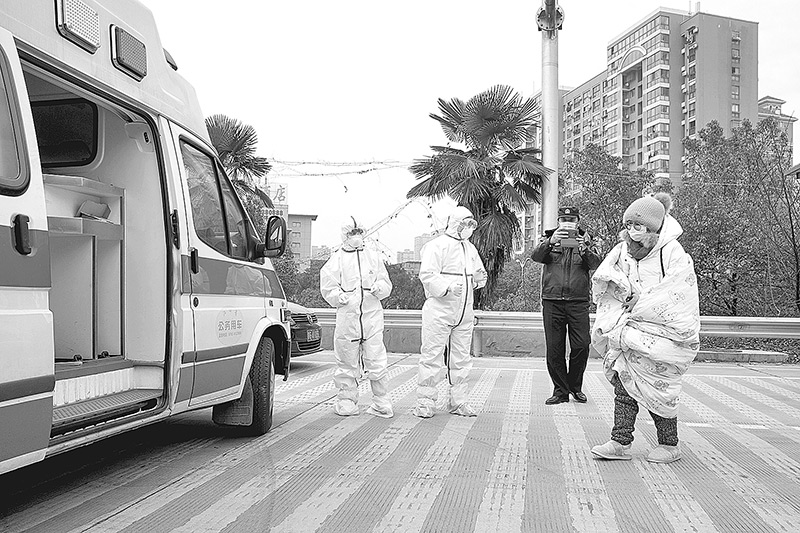
KATHMANDU, Days after ruling out the evacuation of Nepalis from China, the Ministry of Foreign Affairs said on Saturday that it is working on a plan to rescue those who are currently in Hubei, the Chinese province most affected by the coronavirus outbreak, which started from its capital city—Wuhan. The coronavirus outbreak, which now has been declared a public health emergency of international concern by the World Health Organisation, has claimed 259 lives in China and affected 11,791 globally. After several countries launched measures to evacuate their citizens, the Nepal government, too, is now planning to rescue Nepalis, especially from Hubei Province, the Ministry of Foreign Affairs said. The Foreign Ministry on Saturday held a meeting with concerned authorities to plan Nepalis’ evacuation from Hubei, Foreign Secretary Shanker Das Bairagi told the Post. Meanwhile, the Embassy of Nepal in Beijing also issued a notice, saying that the Nepal government is making an all-out effort to rescue Nepalis from Hubei. “Plans for a special chartered flight are being worked out and details will be shared as soon as they are available,” the embassy said in the notice. The government plan follows requests from Nepalis in Hubei to rescue them from the province which has been put under lockdown for weeks in the wake of the coronavirus outbreak. Experts, however, called for coordinated efforts and preparedness back at home before evacuating Nepalis from China. There are no dedicated isolation wards and there’s a lack of expertise and technology to deal with cases, according to them. “Safely handling cases is tougher than taking a political decision of bringing back the Nepalis who are stuck in the virus-hit Hubei Province,” Dr Baburam Marasini, former director of the Epidemiology and Disease Control Division, told the Post. “The deadly disease could spread to masses if not handled properly in transition—at the airport and quarantine facilities. The announcements from the Foreign Ministry and the Nepali embassy in Beijing follow a statement from the Embassy of China in Kathmandu on Saturday in which it said lives and medical care of Nepali citizens, including students, who are in Wuhan are guaranteed.
“China will continue to take proactive measures to protect their legitimate rights and interests,” reads the Chinese Embassy statement. “The Nepali side can communicate with the Chinese Embassy in Nepal or the Ministry of Foreign Affairs of China in a timely manner.” Nepal so far has reported one confirmed case of the new strain of coronavirus, but it continues to be a mystery with conflicting statements from the patient and doctors involved in his treatment. Experts said they appreciate the government’s plan to bring back Nepalis from the virus-hit Chinese city but urged prudence. Nepal’s lack of preparedness to deal with outbreaks has been exposed in the past as well, said Marasini. “Arranging a chartered flight won’t be that difficult, but we need to have proper quarantine facilities here at home,” Marasini told the Post. “We should not forget that a South Korean, who had visited the Middle East, was diagnosed with MERS coronavirus in 2015 and the first imported case had sparked an outbreak that spread through hospitals.” The virus had sickened as many as 186. “It does not mean that we should not rescue our fellow citizens, but the government needs to work on a war-footing to prepare quarantine facilities,” said Marasini. The Nepali Embassy, however, has already apprised Nepalis of its plan to evacuate them. “All Nepali nationals currently residing in Hubei Province are requested to fill a form available on the embassy website and send it to [email protected],” the embassy said in the notice. The embassy has said only those who intend to return to Nepal on the chartered flight should fill the form. “Please be advised that if you fail to fulfil this requirement, except as a result of pre-embarkment health check-up at the airport, the applicant will face consequences as per law,” reads the notice. “The particulars of the chartered flight will be arranged on the basis of submissions made by Nepali nationals willing to go back to Nepal.” The embassy has asked all those Nepalis who want to return home to submit the form no later than 9am Sunday, February 2. “Late submissions will not be entertained. Every passport holder should fill a separate form. The forms for minors should be filled by one of the parents and sent together in one package,” reads the notice. Bairagi said the government will hold consultations with all the concerned agencies first and finalise the place for setting up quarantines facilities before starting the evacuation of Nepalis. According to Health Ministry officials, as many as 177 Nepalis from Hubei Province are in touch with the Nepali Embassy in Beijing. “Those returning from China need to be kept for two weeks in incubation, and we need quarantine centres,” said Mahendra Shrestha, spokersperson for the Health Ministry. “Army barracks, police training centres and the staff college could be some options where we can keep those returning from China.” At the time of the Ebola epidemic, the Nepal Army had used its Shivapuri barracks to quarantine its personnel who had returned from the peacekeeping mission in the disease-hit countries. The Armed Police Force had used its training centre to quarantine its personnel. The Nepal Army said as of Saturday it had not received any communication or request regarding setting up quarantine centres. “Anyway, our existing isolation ward is too small, and a new one that is being built is yet to be completed,” Brigadier General Bigyan Dev Pandey, spokesperson for the Nepal Army, told the Post. The one facility that can be used to quarantine Nepalis from China is Sukraraj Tropical and Infectious Disease Hospital, said Dr Basudev Pandey, director at the hospital. “The conference hall of Ayurvedic Hospital in Kritipur and training centres of the Nepal Electricity Authority are other options. But the government needs to fix the required beds, equipment and other facilities fast,” Pandey told the Post. “Definitely, the risk will increase, but we cannot say we should not bring Nepalis back just because we lack facilities. We need to set up facilities here and evacuate Nepalis from the disease-hit country.” Nepali Embassy email: [email protected] Phone number: 1570 12857 63
Anil Giri contributed reporting.
HOME PAGE
Meeting exposes rift in ruling party but it could also be a platform to mend it
Many NCP leaders believe the merger was hastily decided, without taking a host of issues into account.
- TIKA R PRADHAN
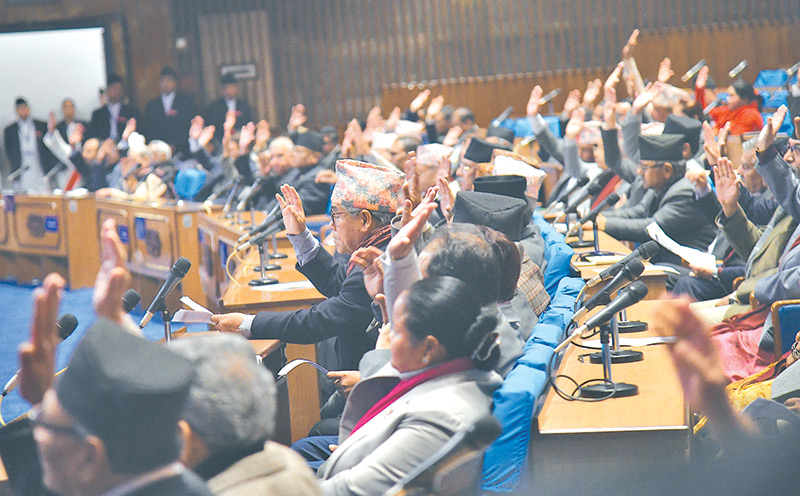
KATHMANDU, When the Nepal Communist Party first held its Central Committee meeting on May 24, 2018, its major—and only—agenda was to announce the unification of the party. After sweeping the 2017 elections, the CPN-UML and the Maoist Centre had decided to unify. The party leadership said the unification process would be completed within three months. Thereafter, there was no Central Committee meeting until last week—for almost two years. But the party is still struggling to address a host of issues related to unification. “The ongoing Central Committee meeting should have been a platform for putting all the differences to rest, but instead, more cracks have opened up,” said a Central Committee member. In the political paper presented by co-chairs KP Sharma Oli and Pushpa Kamal Dahal, both admitted that the party was yet to be united—in spirit and true sense. “Despite committing to completing the unification process within three months, the party has yet to achieve unity in a true sense,” reads the political document. “The party is yet to be institutionalised and different factions are still active. Betrayal and counter-betrayal continue to prevail.” On Saturday, Surya Thapa, a central committee member, who is also the press advisor to co-chair and Prime Minister Oli, issued a statement, pointing out how factionalism was dragging the party. Divisions were apparent during group discussions too. “During group discussions, we actually saw the real situation. At least two factions were clearly poles apart on various issues; they seem to be using each other to their benefits,” said another central committee member who also spoke on condition of anonymity. The leader, however, said it was expected because the party leadership hardly invested time to sort out the differences over the last two years. Party members say differences have existed since the unification was announced but as disagreements between the top leaders continued, they did more damage. According to Mani Thapa, a Standing Committee member, not many in both the parties were convinced about unification two years ago—both were different ideologically and had completely opposite schools of thought. It looked like a miracle when the two parties announced unification in May 2018, said Thapa. “The leadership promised to complete all issues related to the unification within three months. But it has been almost two years,” said Thapa. “Where have we reached?” According to multiple leaders, both from the UML and Maoist factions, the leadership described the fragile alliance of convenience as “unification” because it served their self-interests. Oli wanted Maoist support in the elections to get himself installed as the prime minister. For Dahal, there was no option left as he was worried about losing his political relevance. “It was definitely a decision taken in haste without giving much thought to how things would unfold,” Thapa told the Post. “Our decision to unify was taken just ahead of elections. We indeed failed to hold necessary discussions on various issues,” said Yubaraj Chaulagain, a Central Committee member. “Both the parties had different working styles, our thought processes were different. Now things have become more intricate and complex.” When the party had just united, there were two clear factions—one belonging to the UML and the other to the Maoist Centre—and they were led by Oli and Dahal. In recent months, three factions have emerged, and Madhav Kumar Nepal leads the third front. According to leaders, the three factions are aligned so precariously and that any of the two coming closer puts the third in minority. This leads to a power struggle, which could hamstrung party’s unification process. The genesis of three-way factionalism first started in August-September last year, when Dahal suddenly brought up a deal that he had signed with Oli during the merger. Dahal made public statements that as per the deal Oli and he would have to lead the government in turns. Dahal started courting former UML leaders including Madhav Nepal, who was also getting increasingly unhappy with Oli’s style of running the party and the government. Oli, however, continued to maintain a firm grip on the party and the government. But in early October, Krishna Bahadur Mahara, Dahal’s trusted man for years, was forced to step down as House Speaker following allegations of attempted rape. As the hunt for new Speaker began, Dahal upped the ante, demanding the post for one of the Maoist leaders—Agni Sapkota. Oli was in favour of Subas Nembang. After the winter session began in December, both Oli and Dahal drove a hard bargain. But in the end, Dahal won. A meeting at Bhaisepati at the residence of Bamdev Gautam, who has been proposed as vice-chair of the party, changed the dynamics, leaders say. Dahal managed to bring Gautam, Madhav Nepal and Jhala Nath Khanal into his fold, weakening the Oli group in the party. Central Committee members said the ongoing meeting will define the new power struggle. But there is no alternative to finding common ground, according to them. “Any change in the existing setting, as factionalism continues, will have a long-term impact on internal as well national politics,” said Yubaraj Chaulagain, a central committee member. However, a political analyst and former Maoist leader Bishwo Bhakta Dulal, who is usually known as Aahuti, said the fundamental problem of the Nepal Communist Party (NCP) is that it does not have an ideology. “The two parties merged because they had shared interests,” Dulal told the Post. “Both gave up on their ideologies. Now they don’t have one.” Hemraj Bhandari, also a central committee member of the ruling party, agreed that ideology is key, as it serves as a binding force, as the glue that holds everyone together. “There was no discussion on ideological issues when leaders were talking about merger,” Bhandari told the Post. “Leaders of the two parties still have completely different understandings on various issues, which are leading to conflict. Suspicion continues to persist in the party.”
HOME PAGE
House got Speaker in a month. There is no certainty about deputy Speaker
The ruling Nepal Communist Party is most likely to give the post to the Rastriya Janata Party Nepal, which itself is confused over the candidate.
- BINOD GHIMIRE
The position has been vacant since Shiva Maya Tumbahangphe resigned on January 20. Post file photo
KATHMANDU, The indecision in the ruling Nepal Communist Party on selecting the Speaker candidate held the House of Representative hostage for around a month. Now, the ruling party is in dilemma over the deputy Speaker. The constitution requires the Speaker and the deputy Speaker to represent different parties and sexes. As Agni Prasad Sapkota, a man from the ruling Nepal Communist Party, has already been elected Speaker, the position of deputy Speaker must go to other parties and the candidate must be a woman. The Lower House does not have deputy Speaker ever since Shiva Maya Tumbahangphe resigned on January 20. The ruling party doesn’t want the position to go to the main opposition Nepali Congress. With the Samajbadi Party Nepal pulling out of the government on December 24 last year, saying the government was not sincere to address its demand for constitutional amendments, the ruling party is unlikely to give it the post. The ruling party had offered the post to the Rastriya Janamorcha, but it did not accept. Durga Poudel, who won the 2017 election from Pyuthan Constituency-1, is the only member from the party in the House of Representatives. “Accepting the deputy Speaker’s post will mean ending our presence in Parliament,” Poudel told the Post. “We had no option but to reject the offer.” The Rastriya Prajatantra Party and Nepal Majdoor Kisan Party don’t have women lawmakers, hence they cannot get the post. This leaves the ruling party with no option than to offer the post to Rastriya Janata Party, Nepal. According to insiders, a deal with the Rastriya Janata Party on deputy Speaker is possible, but its leaders have their own set of demands and they are divided. “The ruling party leaders had proposed a package deal on all issues from deputy Speaker and ministerial berths at both federal and provincial governments,” said Keshav Jha, a general secretary of the party. “But Mahantha Thakur, a member of the praesidium, is not ready.” When the party forged an alliance with the ruling party for the National Assembly election, many believed it was a precursor to a future deal on deputy Speaker. The Janata Party, which withdrew its support to the government in March last year after its lawmaker Resham Chaudhary was handed down a life term by Kailali District Court for masterminding the Tikapur violence, has not given up its demand for constitutional amendments. Janata Party leaders say now there should be a larger deal on various issues, including Chaudhary, constitutional amendments, deputy Speaker and ministerial berths. When it comes to deputy Speaker also, the party, however, is divided. Thakur is in favour of Chanda Chaudhary as deputy Speaker. But Rajendra Mahato, also a member of the praesidium, is making a pitch for Amrita Agrahari. “Discussions on the candidate are ongoing assuming that our party will get the post,” said Jha. Party insiders say Thakur is for taking the deputy Speaker post but not keen on joining the government. But Mahato wants to be part of the government, provided that there is a deal on constitutional amendments. A leader who spoke on condition of anonymity said discussions now are ongoing for letting the Thakur faction take the deputy Speaker post and the Mahato faction ministerial berths. Ruling party leaders, however, said there has been no progress in deputy Speaker selection. “The party wants the Janata Party to take the deputy Speaker post, but the Janata party has yet to decide,” Rekha Sharma, a central committee member of the ruling party, told the Post. “We are waiting for the Janata Party to make up its mind first.” Officials at the Parliament Secretariat say the deputy Speaker election process will not move forward until the ruling party gives the green signal, as it holds decisive votes. “The process should have moved ahead from the January 28 meeting itself,” a senior official at the Parliament Secretariat told the Post on condition of anonymity because he was not allowed to speak to the media on the matter. The next House meeting is scheduled for Tuesday. Article 91 of the constitution says the elections of the Speaker and deputy Speaker have to be completed within 15 days since the first House meeting. It, however, is silent on the timeline for electing either the Speaker or the deputy Speaker when the posts go vacant when the House session is ongoing. The winter session of Parliament began on December 20 last year and the deputy Speaker’s position has been vacant for two weeks. Tika R Pradhan contributed reporting.
MEDLEY
Horoscope
ARIES (March 21-April 19) **** If you’re asked to help out with a big group event, it would be in your best interests to lend a hand, even if you don’t think you have the time to take on anything new. Some big opportunities could come into your life from being involved with this event or these people. Time to shine.
TAURUS (April 20-May 20) ** You’re totally right if you think that if you have problems you should be able to tell them to your friends. But you’re totally wrong if you think that if you have problems you should give them to your friends to solve. The people in your life can offer you support, but they can’t make all your problems disappear.
GEMINI (May 21-June 21) *** Your travel plans might be just about set in stone, but resist the urge to finalise your plans. There is a slight chance that things could change, and you need to stay flexible right now. The odds are good that you’ll know the real deal by the end of the day, so be patient. Good things comes to those who wait.
CANCER (June 22-July 22) *** Your visions of the future are important to foster, whether that happens through hard work or just simple hoping. You’ve been in a fog about an issue for a while. You’re not sure how to proceed, and this indecisiveness could leave you feeling stuck in a rut. Spend some time to figure things out. Clarity is important.
LEO (July 23-August 22) ** Quite a few opinionated people are going to be in your day, and they aren’t going to keep quiet about their opinions. The good news is that you know how to handle them with grace. All you need to do is listen to what they think and then totally ignore their advice. It’s the best way to keep yourself from getting angry.
VIRGO (August 23-September 22) ***
One of your closest friends may be starting a new venture, and they might need your support more than ever. You’re only too willing to give it, until you learn more about why they’re doing it. Your philosophies are in direct opposition on this thing, but you need to put that aside. Respect their opinions.
LIBRA (September 23-October 22) *** You’re doing an excellent job of not letting fear guide your life! You know how to act in a way that will get you closer to what you want. Keep that focus today when outside voices start telling you to beware. They might be correct about a potential threat, but how is it going to help you to sit and stew about it?
SCORPIO (October 23-November 21) ****
If you’re in the midst of developing a new relationship, be very careful not to get too wrapped up in the other person’s life right now. You don’t want to negative energy right now. You’ll need it to maintain a healthy dose of confidence. This is a wonderful transitional period in your life, you need to start balancing thing.
SAGITTARIUS (November 22-December 21) *** An awful lot can be communicated nonverbally, so let your eyes and body do all the talking. Instead of tossing off a flirty comment, why not just give ‘em a wink? You’ll make your point a lot faster and more creatively. But this plan shouldn’t just be put to use in romantic contexts. Try doing things differently.
CAPRICORN (December 22-January 19) **** Everyone around you will be shocked by some unexpected news, but not you! You sensed it all along thanks to your strong intuitive powers. The fact that you’ll be able to take the news in stride will help you keep your edge over any competitors, and a sweet win will be closer than ever. Keep trusting your gut.
AQUARIUS (January 20-February 18) ** You’ll probably spend most of today with adults, but it’s going to feel like you’re trapped inside of a day care centre! You can expect a lot of petty behaviour from surprising people, so get ready to be the most level-headed person in the world. Try not to get angry. Composure is key as it will help you tackle things in a better manner.
PISCES (February 19-March 20) **** It’s easy to make sure you have a fun day. All you have to do it start a new project! The universe is sending you strong, clear energy that will give you the spark you need to start a new fire. Interested in learning how to knit? Your brain is more adept at picking up new ideas than it has been in a long time.
NATIONAL
Transport ministry proposes electric vehicles for top-level government officials
A committee under the Ministry of Physical Infrastructure and Transport comes up with the plan in a bid to reduce expenses over fossil fuel-run vehicles and promote EVs in the country.
- CHANDAN KUMAR MANDAL
shutterstock
KATHMANDU, In a major move that is likely to encourage promotion of electric vehicles (EVs), the government has come up with a proposal that makes it mandatory for high-level government officials to use electric vehicles. The Ministry of Physical Infrastructure and Transport has drafted a proposal that requires the public officials—joint secretaries and secretaries—must use only electric vehicles for their daily commute. According to Mani Ram Bhusal, a joint secretary at the Transport Ministry, the recommendation for government officials to only use EVs has come from an internal committee of the ministry. “The committee has proposed that at least top government officials should commute in the green vehicles,” Bhusal, who is also a member of the five-member committee, told the Post. “The proposal would soon be forwarded to the Transport Minister for approval.” The move to introduce green vehicles for top government officials have been inspired by the annual expenses of transportation topics. According to Bhusal, the government spends around five to six billions on purchase of fossil fuel-run vehicles, their maintenance and over fuel. “The government is spending a huge budget over these vehicles every year,” said Bhusal. “Although the initial investment for buying EVs will be higher, expenses on fuel will be saved and maintenance will be cheaper. Most importantly, the message for the promotion of EVs will go out loud and clear.” The proposal will have to be approved by the Cabinet before it goes into force next fiscal year. The proposal also makes it mandatory if those government officials cannot use EVs then they have to furnish a solid reason for not being able to commute in eco-friendly vehicles. In 2017, the National Planning Commission (NPC) became the first government agency in the country to purchase an electric vehicle (EV), as a part of a bid to replace the diesel and petrol-powered cars currently used by government agencies. Last year, the President’s Office also bought an EV, in a symbolic gesture for promotion of green vehicles in the country. Promoters of the green vehicles also have applauded the proposal for it would contribute to the greater promotion of EVs across the country. “We should welcome this type of action coming from the government,” said Umesh Shrestha, president of Electric Vehicle Association of Nepal (EVAN). “This should be effectively mandatory for top government officials.” Various policies and action plans of the government has prioritised the promotion of EVs in the country, however, progress has remained mostly stunted, mainly due to lack of infrastructure required to facilitate e-mobility in the country. Lack of charging stations remains one of the leading challenges behind sluggish popularity of EVs in the country. EVs experts believe that government coming out to promote will contribute to expediting infrastructure required for the operation of these vehicles. Recently, Nepal Electricity Authority, the state power utility opened a global tender for setting up charging stations across the country. According to Shrestha, such charging stations can be established at every 100km distance along the East-West Highway, whereas a charging station can be set up at a distance of 50km in the hilly region, making it accessible for the public. “If government officials start using EVs then there will be charging stations at vehicle parking stations as well. Even the public can use such charging stations by paying some amount,” said Shrestha. “It will definitely accelerate the infrastructure development for EVs.”
NATIONAL
Indian budget slashes Nepal aid by 33 percent
- PRITHVI MAN SHRESTHA
KATHMANDU, India has substantially decreased its aid to Nepal for fiscal year 2020-21 in the budget presented by Indian Finance Minister Nirmala Sitharaman, on Saturday. According to the budget speech, the southern neighbour allocated INR8 billion (Rs12.8 billion) for Nepal. In the fiscal year 2019-20, India had allocated INR10.5 billion (Rs16.8 billion), which was later revised to INR12 billion (Rs19.2 billion). Based on the revised allocation of fiscal year 2019-20, allocation in the new fiscal year has been cut down by 33 percent. Despite a decline in the budgetary allocation for Nepal, it is still the recipient of the second largest aid allocation after Bhutan, traditionally the largest aid recipient from India. India set aside INR28.84 billion for Bhutan. Afghanistan, the Maldives, Bangladesh and Sri Lanka are the other South Asian nations that will receive Indian aid. The Southern neighbour has been allocating its second largest aid to Nepal since fiscal year 2017-18. Earlier, Afghanistan was the second largest recipient from the Indian budgetary allocation. Although India has been allocating budget for Nepal, the Nepal government does not have data about how the amount is being spent. “India provides the allocated amount as a grant for various projects. But the amount does not come through the national budgetary system of Nepal,” a senior official of the Finance Ministry told the Post on the condition of anonymity because he is not authorised to speak to the media. “Most of the amount is spent in direct payments by the Indian government to the contractors.” However, the government has made an effort to bring parts of the Indian aid in Nepal’s budgetary system. India’s Small Development Grant Project will now be disbursed to local governments after it comes under the budgetary system. The Sher Bahadur Deuba-led government in November 2017 extended the tenure of the scheme with the caveat that the funds pass through Nepal’s system with the Nepal government getting to decide which agency implements the project. The government’s decision to follow the constitutional provisions which state that any foreign assistance should be channelised through the national budget is aimed to ensure transparency. The Cabinet on December 23 last year, approved a proposal of the Finance Ministry on the implementation of the projects under the scheme. As per the proposal, the Indian grants will be brought under the budgetary system of the central government to be provided to the local governments as conditional grants. Nepal has also been receiving Indian aid through another window of the Indian government—concessional loans from the Export-Import Bank of India. The southern neighbour has agreed to provide four lines of credit to Nepal amounting to $100 million, $250 million, $550 million and $750 million, according to the Indian Embassy website. These lines of credit were signed in June 2006, September 2007 and September 2016 for execution of infrastructure development projects and post-earthquake reconstruction projects as prioritised by the Nepal government. “Approximately $1 billion out of the four lines of credit have been committed or disbursed,” the embassy said.
NATIONAL
The endless battle of Narcotics Control Bureau to stop drug smuggling in Nepal
Since a Nepal Police unit was upgraded to a bureau, more arrests have been made, but officials want more to be done.
- SHUVAM DHUNGANA
Curbing drug trafficking has been one of the most challenging tasks of police. Post file photo
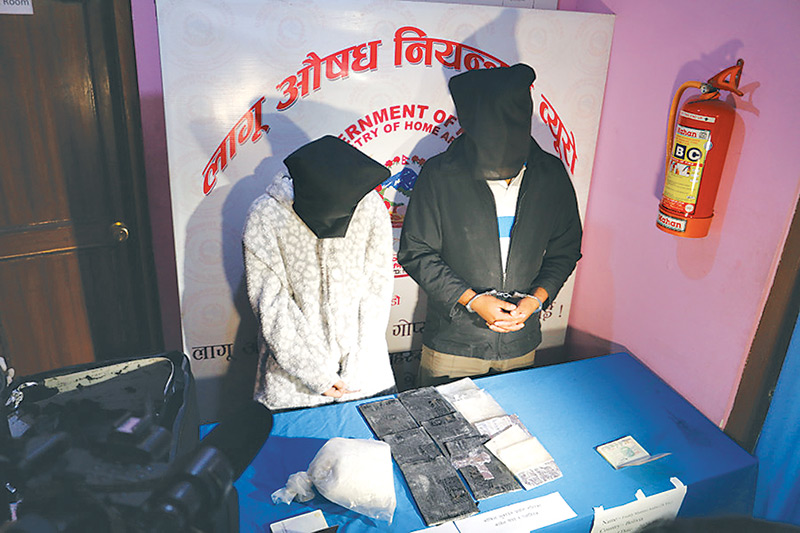
KATHMANDU, January 22. Around 8:40 pm. A special team from the Narcotics Control Bureau of Nepal Police raided Buddha Land Private Limited, a hotel in the tourist hub of Thamel, and recovered around 1.2 kg of cocaine from a Bolivian national. The arrestee was later identified as 27-year-old Solano Chavez Miguel (passport number CE51857). Miguel had hidden the cocaine in his luggage. A police official involved in the raid said the bureau had received a tip-off. “We had been tailing the suspect. But we needed to verify,” Inspector Jiwan Niraula told the Post last week. “He was not behaving like other tourists. His activities were suspicious. Then we decided to raid his room. During the search, we recovered the drugs.” Miguel will be charged under the Narcotic Drugs (Control) Act-1976, and if convicted, he could face life imprisonment. Miguel’s arrest was just the latest. The Narcotics Control Bureau has over the past year arrested 5,607 individuals, including 206 foreigners, for possessing illegal drugs. In the fiscal year 2018-2019, the bureau’s teams across the country confiscated drugs worth millions. In 2019 alone, the bureau seized over 12 kgs of cocaine, over 58 kgs of opium, over 9 kgs of heroin, over 2,622 kgs of hashish and more than 10,320 kgs of cannabis. “The seizure was possible due to the hard work by our officers who are working 24 hours in major places like the airport and border areas,” said Superintendent Birendra Bashyal, who is also the spokesperson for the bureau. Officials say smugglers are using Nepal as a transit country for supplying the contraband drugs. With a view to combating the rising drugs smuggling via Nepal, the Nepal Police in 2012 decided to form a dedicated team. Before that, a team of police officials dealt with drugs smuggling. On November 29, 2012, the Nepali Police upgraded the team as a full-fledged bureau—now known as Narcotics Control Bureau. “The bureau has divided its work. One team collects information, verifies the details and confirms after a rigorous investigation,” said an investigating officer at the bureau who spoke on the condition of anonymity. “Once information is verified, another team collects evidence. Arrests are made accordingly. All the officers are mobilised in plain clothes.” Headquartered at Koteshwor in Kathmandu, the bureau has its branches in Kakadbhitta, Biratnagar, Birgunj, Pokhara, Bhairawa, Nepalgunj, Mahendranagar and Surkhet to ensure proper screening. A little over 100 experts work round the clock, according to Constable Nawaraj Ghising. The bureau also works in close coordination with the Interpol and other drugs law enforcement agencies. “We have a team of experts who can identify smugglers by their behaviour and body language. We even use sniffer dogs,” said Bashyal. “Checking travel history at the airport is one of the major ways of keeping track of smugglers. Frequent travellers without any particular business or leisure purposes are under scanner.” In the past five months, the bureau has arrested a number of foreigners from the airport for possessing illegal drugs including cocaine. “We have increased our vigilance at the airport,” said Inspector Prem Shahi, who has been deputed at the airport. “There is a team of 20 personnel in civvies.” The bureau’s data of the last three years shows a rise in the arrest of smugglers. In the fiscal year 2016/17, police arrested 3,607 persons on drug smuggling charges. Of them, 159 were foreigners. In the fiscal year 2017/18, authorities arrested 4,754 persons, including 149 foreigners. In 2018/19, 5,558 people were arrested, including 201 foreign nationals. The increase in the number of arrests in recent years shows increased surveillance, but it is far fewer, say former officials who have worked at the bureau. “Although the police have made some significant improvement in tracking down smugglers and arresting them, drug smuggling continues to be a major challenge,” said Hemanta Malla, a former deputy inspector general who also spent several years at the bureau. According to him, the number of arrests is possibly just around 15 percent. “There is a need to make drug smuggling combating a priority,” said Malla. “The government needs to invest more to equip the bureau and train manpower.”
NATIONAL
Easy loans in Province 2 for labour migrants might lead to surge in migration
Workers will get up to Rs 150,000 at lower interest rates for funding their departures, but experts fear easily available funds will make migration first choice.
- CHANDAN KUMAR MANDAL
Around 24 percent of workers who had received labour permits from the Nepal government between fiscal years 2008/09 and 2016/17 were from Province 2. Post file Photo
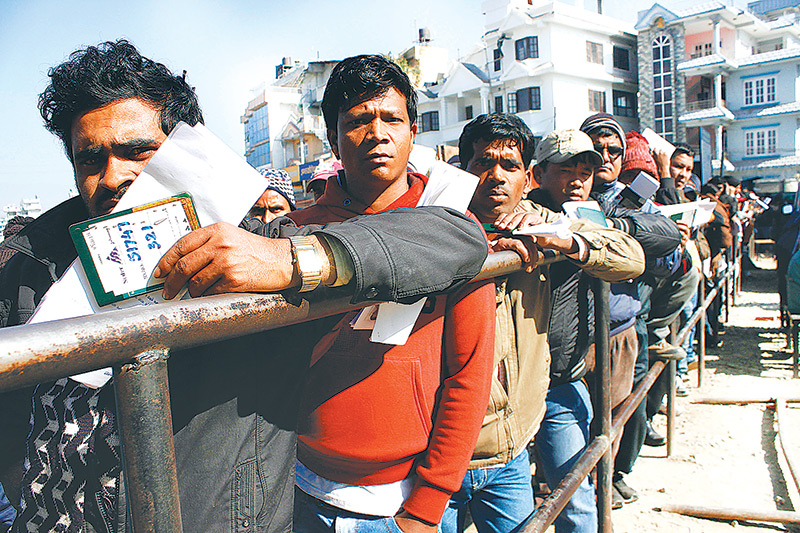
KATHMANDU, Province 2’s decision to provide subsidised loans for outbound workers has drawn mixed reactions from labour migration experts. The Province 2 government has made arrangements for issuing up to Rs150,000 in loans to migrant workers at lower interest rates via two commercial banks. As the scheme came into effect, nine aspiring migrant workers received bank loans amidst a ceremony in Janakpur on Thursday. According to Province 2 Social Development Minister Nawal Kishor Sah, the arrangements were made to provide financial relief for youths who choose to go abroad in search of better opportunities. “This is not a programme as such but an agreement reached between the Province 2 government and the banks for providing money to youths going abroad,” Sah told the Post. “This will provide much-needed relief to youths who had to borrow money from local lenders at exorbitant rates for funding their departure.” Youths from eights districts of Province 2 will be eligible for the loan. Prabhu Bank will serve outbound migrant workers from Saptari, Sarlahi, Rautahat, Bara and Parsa districts whereas Nepal SBI Bank will provide loans to youths from Siraha, Dhanusha and Mahottari. At least 10,000 youths will benefit from the scheme, according to Sah. The interest rates will vary for different categories of people. For marginalised groups like Dalits, the interest rate will be only 5 percent, and for other groups, it will be 11 percent, according to the minister. “Aspiring migrant workers had to mortgage their lands and other property and those without such assets had to take loans at 36 percent rate,” said Sah. “For accessing loans under this scheme, they do not need to keep anything as collateral.” The provincial government’s move to fund migration of youths comes as a surprise for experts in the field and has generated a mixed response from them. According to labour migration researchers, the move to provide subsidised loans will surely benefit youths from Province 2. Youths from Province 2 were compelled to take loans at higher rates for financing their foreign employment, said Swarna Kumar Jha, a labour migration researcher. “Subsidised loans will help them in getting the required money at cheaper rates.” Another labour migration researcher Arjun Kharel, who is associated with the Centre for the Study of Labour and Mobility, a think tank, also welcomes the initiative for it will provide loans at cheaper rates. “During our studies, we have found that people had taken loans at even 60 percent for going abroad,” said Kharel. “At least, these people will get loans at lower rates. This is good from the workers’ welfare point of view.” However, these experts fear that easily accessible loans might lead to a surge in labour migration from the region. The move is also significant especially because the central government has been talking about slowly controlling labour migration. Since coming to power, the KP Sharma Oli administration has repeatedly said foreign employment is not a priority and in the next five years, Nepali workers would not be compelled to migrate due to the lack of jobs at home. “The loan scheme opens the door for those people who could not go on foreign employment because of financial issues,” said Jha, who also coordinates the National Network for Safe Migration, an umbrella body of organisations working in the sector. “This can mean financial opportunities for them but will also see a rise in people migrating abroad.” These concerns from experts come from the fact that eight districts of Province 2 are among the top labour exporters in the country. Around 24 percent of workers who had received labour permits from the Nepal government between fiscal years 2008/09 and 2016/17 were from Province 2. Out of the top 10 most labour sending districts, five were from Province 2 as of the end of fiscal year 2018-19. “We cannot completely stop labour migration to foreign countries straight away,” said Sah. “For discouraging the trend, we have to first give them employment and skills. Providing skills and then work is likely to take time. Therefore, we are working on both sides—facilitating labour migration and creating jobs inside the province.” According to Minister Sah, Province 2 government has also come up with programmes to provide cost-free skills training for youths and give seed money to those who want to start their own enterprise inside the Province. The Social Development Ministry has allocated Rs80 million for providing seed money. Besides, the provincial government also launched heavy equipment training this week and has plans of training nearly 5,000 youths for three months. “We are making sure that unemployed people get work here as well. Those who still want to go abroad should receive training so that they do not suffer abroad,” said Sah. However, migration experts also reckon that providing a loan can not only see a surge in the number of individuals from Province 2 going abroad but it can also alter the whole trend of labour migration. “There are still people from Province 2 who go to India for work whereas others migrate to other parts of the country,” said Kharel. “With the funds available, even seasonal migrants will opt for long-term migration to Gulf countries and Malaysia.”
NATIONAL
Lalitpur Metropolitan City to start a new drive to remove visual pollutants
City officials say that hoarding boards and billboards placed without their permission will be removed in the drive’s first phase.
- ANUP OJHA
KATHMANDU, After the Kathmandu Metropolitan City intensified its efforts to remove illegal hoardings and billboards to avoid being hauled up for contempt of court, the neighbouring Lalitpur Metropolitan City has also proposed a major drive to clear its area of visual pollutants. “Lalitpur Metropolitan City will not get any complaints in the court regarding visual pollution,” said Raju Maharjan, the spokesperson for the City. He said the City has already removed two hoarding boards from Satdobato. Kathmandu Metropolitan City had intensified its clean-up drive in mid-January after Home Minister Ram Bahadur Thapa instructed the concerned authority to promptly clear all illegal hoarding boards following a contempt of court filed by senior advocate Padam Bahadur Shrestha against the City. In his plea, Shrestha pointed out that Kathmandu had not heeded to the Supreme Court’s ruling of 2015. Prem Prasad Bhattrai, chief administrative officer at the Lalitpur Metropolitan City, said his office will intensify its clean-up drive so that they don’t get complaints from anywhere. This is the first time the City has taken the initiative to remove visual pollutants from its area. Officials at the City said that in the drive’s first phase, they would be removing hoardings and billboards that were placed without the city’s permission and those that had not paid their taxes to the city office. “Around 80 percent of hoardings and billboards in the city were placed without the permission from the city office,” said Dilli Raj Shakya, chief of the city’s Revenue Division.
NATIONAL
Thousands of hectares of forest cover have been encroached upon in Morang over decades
In Laxmimarga alone, about 600 houses have been built on unauthorised land, according to the Dangihat Village Development Committee.
- BINOD BHANDARI
Despite the scale of decades-long encroachment, forest officials say their hands are tied when it comes to reclaiming the land. Post Photo: binod bhandari
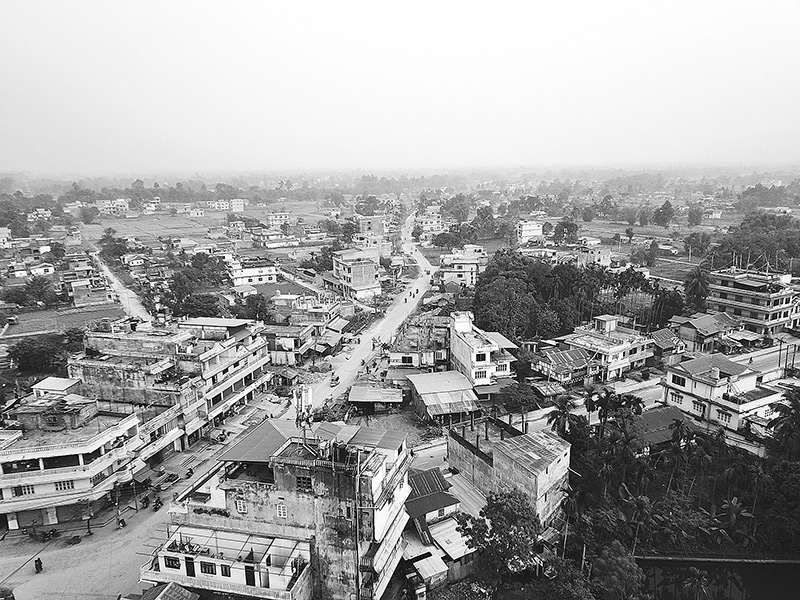
MORANG, Over the past decade, more than a dozen small towns have sprouted along the Gachhiya-Urlabari section of the East-West Highway in Morang district. Those spaces used to be part of the char kose jungle not very long ago. The towns were set up encroaching the jungle’s space, forest officials say. As a result, the forest area has shrunk by nearly 11,000 hectares, according to Bishal Ghimire, chief of the Division Forest Office in Morang. “The forest area has decreased from 55,500 to 44,540 hectares, according to a GIS survey two years ago,” Ghimire said. Shiva Prasad Dhakal, mayor of Sundar Haraicha, said urbanisation took off after 1986 when a road track was opened in the area. “Biratchowk, for instance, used to be a village of a few huts,” Dhakal said. “Now it’s a full-fledged town.” There are a few upsides of this urbanisation as well, said Dhakal. “Almost all the villages in the area are now connected to a road network.” Dhakal added that the encroachment of the jungle started before the local level elections and stopped only after it completed. However, locals claim that encroachment hasn’t stopped. The local unit has handed over 805 bighas of land to Purbanchal University, 50 bighas to provincial police and 140 bighas to Koshi Tappu. According to locals, hundreds of bighas of forestland have been encroached upon in areas such as Belbari, Laxmimarga, Kanepokhari, and Pathari bazaar where more than 1,500 buildings have been constructed. Meanwhile, locals have been constructing houses without getting land registration cards. In Laxmimarga alone, about 600 houses have been built without land ownership card, according to Ramkumar Limbu, chief of the local town management committee that keeps a record of the purchase and sale of the buildings. “The committee, however, collects revenue from those people and uses it for town management,” Limbu said. To identify the house owners, the-then Dangihat Village Development Committee had distributed card numbers to each of them, according to which the revenue is collected. But despite the scale of this decades-long encroachment, forest officials say their hands are tied when it comes to reclaiming the land. “It’s not easy for the forest office and the local unit to reclaim the land. The state itself should move ahead for the purpose,” Ghimire, chief of Division Forest Office, said.
NATIONAL
Most roads in Ramechhap district are unmotorable
Considering the poor condition of roads, all three tiers of government have prioritised upgradation work this year.
- TIKA PRASAD BHATTA
RAMECHHAP, Manthali, the district headquarters of Ramechhap, was connected to road network 20 years ago. Fast forward to 2020, the district has around 4,000 km of roads connecting its local units. The district covers an area of 1,546 square kilometres and has a population of 202,646, according to the National Census of 2011. Ram Chandra Biyogi, the coordinator of the Citizen Forum in the district, said the expansion of road networks has connected remote villages to local bazaar areas. “But the rural roads become unmotorable during the monsoon and summer, as the roads turn muddy when it rains and the summer heat raises a dust storm,” said Biyogi. Keeping in view the poor condition of rural roads, all three governments—federal, provincial and local—have prioritised road upgradation work in the current fiscal year. The Bagmati Provincial Government allocated more than Rs 1 billion to upgrade roads in Ramechhap district. Until now, only 50 km of a total of 4,000 km of road in the district has been blacktopped. “The entire budget allocated for road construction this fiscal year will be used in blacktopping and upgrading the existing roads. The local units should prioritise the upgradation and blacktopping of roads rather than opening new tracks. Meanwhile, the federal and provincial governments will focus on large-scale road projects,” said Kailash Dhungel, minister for Financial Affairs and Planning of Bagmati Province. Road upgradation works have gathered momentum in the district lately, as the government authorities adopted strong measures to hold accountable the construction companies responsible for delays. “We have instructed authorities concerned to blacklist the contractors that delay development projects and not to extend the deadlines of road projects,” he said. According to Somraj Timilsina, chief of the infrastructure development office in Ramechhap, the Sitkha-Pakarbas-Gagal road section and Manthali-Pakarbas-Galwa road section will be blacktopped in the current fiscal year. “Road upgradation works, including the construction of roadside drainage and retaining walls, are ongoing in the district. The construction should be completed soon,” said Timilsina. Sabita Ruchal, a resident of Pakarbas, says the upgradation of the Manthali-Pakarbas-Galwa road section has benefitted many in her village. “Travelling during the rainy season used to be difficult. Now, it has become much more comfortable and risk-free,” says Ruchal. According to her, during monsoons, Pakarbas would get disconnected from Manthali and other parts of Ramechhap. “In the current fiscal year, all eight rural municipalities in the district have prioritised blacktopping the existing roads,” said Ramesh Kumar Basnet, mayor of Manthali. According to Basnet, the municipality has already blacktopped Manthali Ring Road and has invited tender to blacktop other road sections. In preparation for the monsoons, Gokulganga Rural Municipality has launched a campaign to upgrade its rural roads for uninterrupted and safe transportation services. “We want to get the roads blacktopped by the monsoon,” said Khadga Bahadur Sunuwar, chairman of the municipality. The expansive road network in the district has also worked in favour of local farmers by connecting them with markets in Manthali. Tika Lama, a local farmer in Okreni, recalls the time when he had to carry produce from his fields to Manthali. But after the opening of the Okhreni-Manthali road, Lama has started growing vegetables for commercial supply. “It’s only an hour’s drive from Manthali to Okhreni. This has encouraged farmers to grow agricultural products on a larger scale,” he said. “We heard that the local government is upgrading rural roads. This will work to our benefit and hopefully, our products will go beyond Manthali,”
NATIONAL
Area Administration Office in Sorukot without a chief for last three years
- RAJ BAHADUR SHAHI
Currently, the Area Administration Office is running with only two office assistants. Post Photo: raj bahadur shahi
MUGU, Administrative works of the Area Administration Office in Sorukot, Mugu, have come to a halt in the absence of its chief for the last three years. Because of the lack of a chief, locals have been compelled to walk for two days to Gamgadhi, the district headquarters of Mugu, to make their citizenship certificate and to avail of other administrative works. The office was established in Sorukot four years ago to make government services easily available for the locals of remote Natharpu, Photu, Jima, Bihi, Dhainakot, Puru, Muru, Sip, Nerataja and Sorukot among other settlements of the district. Currently, the Area Administration Office is running with only two office assistants. “All we do is open the office in the morning and close it at the end of the day,” said Gorkha Malla, one of the office assistants, adding that they have no work to do as there are no employees in the office. The locals say that the office has become severely affected since the departure of the last chief Dil Bahadur Paudel three years ago. Since the transfer of Paudel, the Ministry of Home Affairs has not sent another official to fill the vacant post. “We have to go to Gamgadhi to obtain a citizenship certificate,” said Dhirendra Bahadur Shahi, a local of Jadepani. He adds, “Political leaders had assured us of door-to-door services to make life easier for us during local-level elections. During those days, ‘Gaun Gaun Ma Singha Durbar’ (Singha Durbar in Every Village) was a popular slogan, but that never materialised. We have to go to the district headquarters for even minor services.” Locals have been demanding the local government resume services from Sorukot or dissolve the office. Lok Bahadur Shahi, the chairperson of Soru Rural Municipality, said they have been requesting the federal government to deploy a new chief to resume the services. “If the office could distribute citizenship here, villagers wouldn’t have to travel a long distance and they could also feel the presence of local governance,” said Shahi. There are four local units in the district, and residents of all the units have to go to Gamgadhi to obtain their citizenship certificates. According to the District Administration Office, they have not been able to provide services from the Area Administration Office due to lack of employees. Jaya Kumar Ghimire, chief district officer, said there are three posts of employees (an offer, a non-gazetted first-class officer and an accountant) available in the Area Administration Office. “But we don’t have adequate human resources to fill the vacant posts,” said Ghimire, accepting that people are facing problems to receive citizenship certificates and fill-up passport forms among other services. He adds, “We have been talking with the ministry about the problem.”
NATIONAL
Nurses on contract basis complain of unequal pay
Officials of the District Hospital in Baitadi say they are looking into finding a solution.
- TRIPTI SHAHI
BAITADI, Parbati Bhatta of Bhimdatta Municipality is currently employed as a staff nurse at the District Hospital in Baitadi. Prior to this, she worked at Bharosa Hospital in Kathmandu where she used to get Rs8,000 monthly salary. The sum was barely enough to sustain life in the Capital. After all, her family had invested Rs1 million for her to become a nurse. A meagre Rs8,000 didn’t seem like a fair return to her hard work. Then, when the Baitadi hospital announced vacancy, she immediately applied and was hired. Currently, she earns Rs25,000 per month. This is significantly higher than what she used to get paid. But other staff nurses employed in the same hospital and working in the same capacity are getting paid over Rs28,000, she said. “I often get demoralised experiencing this discrepancy in pay,” she said. Jyoti Bagdas of Dashrath Chand Municipality, who is an auxiliary nurse midwife at the same hospital, has similar complaints. While others working in the same capacity get Rs26,000 or more, she gets only Rs18,000, she said. “But we have no option than to put up with it,” Bagdas said. All other nurses in the hospital who were hired on a contract basis too have similar complaints. They have to work equally, and often more than, what the permanent employees do. Some said they are working for a salary as low as Rs8,000 per month. “We want the hospital to respect the work we do and pay us accordingly,” Bagdash said. “There is a discrepancy regarding other facilities, stipends, leave days and training, too.” She added that she has had to put up with it because of “the financial status of my family” and that “something is better than nothing”. Bhatta said that they are afraid to talk about the matter with hospital administration because of the risk of being fired. The hospital’s medical superintendent, Basantaraj Joshi, said he empathises with the nurses. “It’s apparent that the pay scale is not equal among the nurses working in the same capacity,” he said. “Many are facing trouble because of a lack of training and facilities.” Madan Mahara, health coordinator at Patan Municipality in Baitadi, said that unequal pay affects the will and confidence to work among nurses. “Keeping that in mind, the local unit is trying to increase their pay scale,” he said. The nurses working on contract basis are hired by the municipality. Baitadi has 65 health posts, two primary health centres and one district hospital, where two staff nurses and five ANMs are currently employed. The hospital, however, doesn’t have data about nurses working elsewhere in the district. But it is estimated that each local unit in the district has employed about 16 individuals on average.
NATIONAL
Woman held on charge of stealing gold
Briefing
- Post Report
DOLAKHA: A woman was arrested on the charge of stealing gold ornaments in Charikot, Dolakha, on Friday. According to police, the woman, Namrata Shrestha, had stolen the ornaments—including a ring, a bracelet, a chain—from Trishuli in Nuwakot and fled to Charikot.
NATIONAL
Snowfall destroys property worth Rs 60 million in Bajhang
Briefing
- Post Report
BAJHANG: Snowfall that occurred in the last one month have destroyed properties and killed livestock worth Rs 60 million, according to initial estimation by the authorities. More than 2,000 livestock were trapped and killed in the snowfalls. Farmers said their vegetables and crops have also been destroyed due to the snowfalls.
NATIONAL
Woman dies in forest fire
Briefing
- Post Report
LAMJUNG: A 35-year-old woman died in a forest fire at Taksar of Lamjung district on Friday evening. Police identified the victim as Jyoti Pariyar of Kwholasonthar Rural Municipality-9. Pariyar sustained critical burn injuries while she was walking through the forest near Taksar settlement. The victim was rushed to the Pokhara-based Gandaki Medical College where she succumbed to her injuries.
NATIONAL
Missing tourists rescued safely after three days
Briefing
- Post Report
MYAGDI: Four domestic tourists, who went missing in a dense forest in Narchyang since Thursday, have been rescued safely on Saturday. Ankit Sah and Abhishekh of Sarlahi, Sanjit Lama of Dolakha and Suman Bhatta of Kailali lost their way amidst the forest while they were descending to Narchyang village from Khopra.
NATIONAL
Missing border pillars to be reconstructed soon
Briefing
- Post Report
BARDIYA: Security officers and a joint survey team of Nepal and India reached an agreement to reconstruct missing pillars along the border soon. The meeting held in Bahraich of the Indian state of Uttar Pradesh on Friday decided to repair the dilapidated border pillars and reconstruct the missing pillars within four months.
OPINION
Battle of the moustache
Universities should produce ideas and expand the sphere in such a way that it becomes a force to be reckoned with.
- ABHI SUBEDI
Post Photo: Anish Regmi
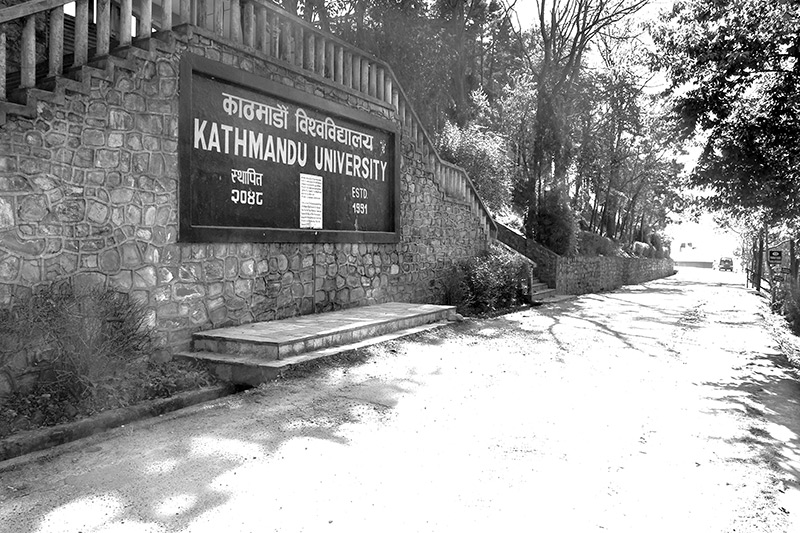
Last week, something published in the Kantipur daily struck me. It was a news that was explaining the battle of the moustache—junga ko ladaain—happening at Kathmandu University. It reported how the Kathmandu University that remained unaffected by the wave of partisan culture that was eroding trust in other universities, including the greatest and oldest Tribhuvan University, was becoming a victim, too. For the first-ever time since the university was established in 1991, the institution of higher education has been paralysed for nearly a month by protests. Political meddling has long held hostage our universities. There is a power struggle among the men in the university to hold position, wealth and decision-making privilege. Most institutions of higher education are in a lamentable state. Yet, people who want to ameliorate the condition of the educational institutions are divided, and at best, caught in a catch 22 situation. The day the news came out, one of my students was defending her preliminary PhD proposal at the Arts Faculty of Kathmandu University. But I was told some sections in the faculty were padlocked since teaching staff and employees have been demanding the formation of independent associations in the university. Needless to say, this was affecting academic work. This sorry state of affairs left me deeply pensive for Kathmandu University—where academicians were usually dedicated and sincere towards their work. I could not help but ask: Where had things gone wrong? Similarly, I am dismayed by reports of the erosion of academic work at Tribhuvan University (TU)—the country’s oldest and the most reputed institution of higher education. At TU, I meet students who are engaged in their research. Similarly, classes are running at full swing at different departments in different schools. I meet the head of the sociology department Dambar Chemjong directing people to clean the environment. I don’t agree when my contemporaries, that include some emeritus professors and others who used the university only to augment their careers elsewhere, say that Tribhuvan University has completely collapsed and has lost its sheen. Then I ask myself, what am I doing there for half a century if not academic work? What are the brilliant teachers and students doing each day with their readings and research? But what is also true is that there are problems. So what plagues Nepal’s institutions of higher learning? Freeing universities from the grips of political parties is the first corrective measure that we need to take. But doing so is difficult for two reasons. First, students have become pawns at the hands the politicians who often mobilise them to fulfil their vested interested. Students have helped them by calling general strikes, marching with torches and banners on the streets facing the wrath of police actions. Second, the most serious part of the narrative, is that the parties have hegemonised—in Gramscian sense—the students’ affiliations with their parties by creating the illusion that the students’ organisations were their party wings. The indifference of the leaders of Nepali Congress, while their cadres from the youth wing fight, is heartbreaking, to say the least. But the story of students associated with communist parties is not much different, either. As institutions and people who would take up the cudgel to free the universities from the grips of the political parties become weaker, this poses yet another problem. The uncanny growth of crony capitalism, aptly called asepase punjibaad in Nepali, has added to the difficulty. There are problems related to education, curricula and regular academic practices. But all of it is affected by the slow debilitation of active academic agencies that could be students, teachers, taxpayers, civil societies and good politicians. To take one example, Ramkumari Jhankri—currently a member of parliament and former president of All Nepal National Free Students Union—is one such name who has commendable knowledge about the process of freeing academic institutions from the grip of the political parties. In her speeches, Jhankri says though she owes it to the political party for her political rise. It is a great folly to entrap the students into a hegemonised structure of the so-called party affiliations of the students. It is a great loss that universities have become unchallenged playing grounds for political and government leaders. The lack of resistance to this kind of phenomena has worked in their favour. Quite naturally then, these leaders see power, money, clout and aggrandisement that they can exploit by influencing the academic autonomy with the authority emanating from their executive power; they hold the highest positions in the university structures as chancellors—and surrogate chancellors. The surrogate chancellors are mainly responsible for cutting contact between free academics and the university policymaking process. But there is good news, too. Highly qualified academics are working at different institutions, faculties and universities of Nepal. They have the knowledge and wisdom to decide how universities should be structured as institutions of liberating education—that includes medical and technical subjects as well as humanities and the social sciences. The greatest requirement, therefore, is to create a caucus to work openly as free academic activists, draw plans, produce ideas and expand the sphere in such a way that it becomes a force to be reckoned with, and whose voice will compel those who are hegemonising it all, to listen to them and realise that the battle of moustache is a burlesque and a sham.
OPINION
Human rights commission appointees should be independent
The commission is in danger of ending its term in disrepute, largely over its role in relation to transitional justice.
- MOHNA ANSARI
Shutterstock
The current set of National Human Rights Commission (NHRC) commissioners, of which I am one, will end their term in October 2020. Five years into our task, and with only months to go, is perhaps a good moment to reflect on what we could have done better and how to avoid repeating unnecessary mistakes. This commission is in danger of ending its term in disrepute and dispute, largely over its role in relation to transitional justice and the constitutional commissions. Arguably, many of the failings of the current NHRC can be traced back to the selection of commissioners—as was the case with all previous commissions.
Doomed from the start However good a commissioner is individually, if they are clearly placed by a political party to represent vested interests, that member will be unable to act independently without thinking twice about how their actions affect the sponsors. Public doubts about the NHRC even affect any genuinely independent commissioner trying to do a job with integrity; people assume that all are part of a politicised and corrupt system. With each compromise and compromised decision, the commission loses popular confidence, ultimately undermining its influence and impact. The National Human Rights Commission should be the beacon to guide the population on human rights issues, particularly on those issues that cause controversy. The state’s approach to protests in the Tarai would be one example where leadership was lacking. Another is the 2015 Tikapur incident which continues to cause instability, as many perceive the handling of the incident to be a miscarriage of justice. The NHRC members, myself included, have also been unable to help promote the thematic commissions, which are supposed to give a voice to the historically marginalised groups as set down by the 2015 Constitution. We have seen the delay in appointments to the constitutional commissions. The National Dalit Commission and National Women Commission, two permanent commissions that already existed before the 2015 Constitution was promulgated, have remained without office-bearers for five years. The other new commissions—to be established under Articles 252 to 264 of the Constitution—have their chairpersons, but no initiative has been taken to appoint other members. In the meantime, the limited six-year period for which they are supposed to be functioning is arguably ticking. It is common knowledge that these delays are due to political bargaining. The NHRC also has to take some responsibility in the failure to bring about these other constitutional bodies. However, the current make-up of the National Human Rights Commission possibly risks being remembered most of all for its failure to help complete the transitional justice process. The members took office just as the Supreme Court declared that the Truth and Reconciliation Act was in violation of the constitution and Nepal’s international obligations. Five years later, we may well leave office with the political forces continuing to refuse to respect that judgment, an indication of unacceptable politicisation of transitional justice. Donors, too, have to accept some responsibility for the current state of affairs. Donors have a responsibility to finance projects that will have a positive impact and to make sure that they work properly, not just sign a cheque and turn away. For many years, many organisations gave large sums of money to the NHRC—through multiple membership changes. While the donations may have looked good on the donors’ reports, very little was actually achieved with the funding. Now, the commission hardly receives any international funding.
Failure in completing the peace process The year 2019 witnessed how the process of appointment of new officeholders to the two transitional justice commissions is in shambles. The committee should have been independent and professional in its working, but the recent nominations were all party nominations, so those in office are now in debt to their political sponsors. No good can come of this; victims have already said they do not trust this setup. Sadly, the National Human Rights Commission has participated in this charade. Bodies are not piling up in our towns and villages as they did during the conflict period. But much of the details of what happened remain obscured. Moreover, we don’t know why our institutions of justice failed to prevent grave violations, failed to protect us, and at times became instruments of violence and injustice themselves. Nepal is in need of an effective transitional justice process to inform us about what needs to be done to reform our institutions to make it less likely that similar violations will occur in the future. We equally deserve an effective NHRC to ensure that the rule of law and human rights are upheld going forward. Civil liberties, gained in the 1990 and 2006 People’s Movements, are under threat by a series of authoritarian manoeuvres. Restrictions on the freedom of expression, association and assembly may not have the same dramatic impact as violence and murder, but they are precious and difficult to regain once lost. Nepal is coming up for evaluation under the Universal Periodic Review (UPR) of the UN Human Rights Council in November 2020. When one checks how Nepal has approached the reviews of other countries, interestingly, the country has made recommendations for the establishment and strengthening of national human rights commissions in line with the Paris Principles in Japan, Lesotho and Benin. The irony here is that Nepal itself is not adhering to and upholding the Paris Principles. Notably, many other states have made recommendations during Nepal’s two prior reviews to strengthen the National Human Rights Commission. In the next few months, we hope the countries that made these recommendations in the past—including India, the Republic of Korea, Portugal, Uganda and Australia— and others to lobby to ensure that the next batch of NHRC commissioners appointed will be truly independent, impartial and have human rights expertise in line with the Paris Principles. In Nepal, those who care about the rule of law and human rights have to start campaigning to ensure an effective and truly independent National Human Rights Commission is brought into being in October 2020.
Ansari is a member of the National Human Rights Commission.
OPINION
The viral connection is a two-way street
Those of us who enjoy the fruits of globalisation must also face and accept the threats.
- Andrew Sheng
Shutterstock
Coming back from London, I landed at airports that seem to be in outer space, with everyone in masks and health inspectors in what seemed like space suits. The World Health Organisation (WHO) has warned that the world must be better prepared against the spread of the Wuhan coronavirus, which has confirmed total infection of 7,816 worldwide of which 105 are reported to be outside Mainland China as of January 30, 2020. So far, 170 deaths related to the virus have been reported in China. The word virus comes from the Latin word meaning ‘poison’. Coronavirus is a family of viruses that causes illnesses from the common cold to severe symptoms as found in the Middle East Respiratory Syndrome (MERS) and the Severe Acute Respiratory Syndrome (SARS) that hit Hong Kong hard in 2003. That outbreak infected 8,098 cases in 29 countries, with 774 deaths, thought to have spread from bats to Asian palm civets to humans. This coronavirus outbreak is reported to have spread from a market in Wuhan that sold seafood and live animals. There is considerable fear and misinformation about viral pandemics because they can spread very quickly through human contact or close proximity to infected cases. Put in perspective, the current Ebola virus outbreak in West Africa has to date 3,854 cases reported, of which death rate was 66 percent, compared with 2.2 percent fatality rate so far for the coronavirus. Knowing how viruses operate may help to allay such fears. Since viruses are a life form that is lower than a cell, they replicate themselves through spreading across carriers, jumping from plants to animals and finally to human beings. There are billions of different varieties of viruses and they continually adapt to new environments and evolve, exactly like other life-forms. Like human beings, viruses are selfish in that they want to survive. If they kill all their hosts, they will die out with the hosts, hence it is a truism that over time, most viruses will become less fatal in impact, even as human beings develop their own immunities. But during the outbreak phase, it is important to control the infection by ‘breaking’ the viral connections; namely, isolation through quarantine, better sanitation or disinfection of affected areas, and injection of antiviral drugs. Since SARS in 2003, the good work of the WHO has ensured that there is much better global cooperation to exchange information on any emerging virus in terms of identification, isolation and then developing the anti-viral drug. The Chinese authorities responsibly and quickly shared the information amongst the worldwide scientific community about the coronavirus when it was first detected in December 2019. By the end of January 2020, an Australian laboratory had already isolated and successfully grown the virus in cell culture. Hopefully, a new anti-viral immunity drug can be created soon. What lessons can we take from this viral outbreak? A survey conducted by the Royal Society of Tropical Medicine and Hygiene on the global health outlook for the next 25 years suggested that the top three concerns amongst members are the climate crisis, drug resistance and emerging epidemics. All these factors are inter-related through globalisation. Because more and more people are interconnected through urbanisation and better communications, diseases can spread very quickly around the world, impacting the poor the most because they can neither afford the prevention nor the treatments. Viral connectivity means that what happens in the poorer and less well-managed places of this world will have an impact on us, whether we like it or not. We cannot shut out the world now because we are all inter-connected and inter-dependent due from globalisation. The most vulnerable places and people who will suffer most from viral outbreaks are the poorer regions of the world where there is over-population, crowding and poor hygiene. They are also likely to be suffering the most casualties because they cannot afford proper treatment facilities, nor is the public health education and practice up to global standards. Almost all the medical experts surveyed felt that the climate crisis will require better coordination and cooperation to tackle the health challenges arising from greater urbanisation, ageing demographics and rapid technology. This is why any viral pandemics will stress test not just the quality of all bureaucracies, but also the ability of the political system to deal with these outbreaks. For example, before the Wuhan outbreak, China was already suffering from the African swine flu, which is also a viral attack. Over 1.1 million pigs were culled to prevent it from spreading further. The consumer price index rose mainly because of the sharp rise in pork prices. Very quickly, Premier Li Keqiang has personally taken charge of crisis management because of its national and global ramifications. But at the personal level, there is nothing like a crisis to force us all to focus clearly on what is most important in our lives. In most cases, it must be our health, both physical and mental. Menes, like genes, are social in nature. We cannot enjoy the fruits of our development if all of us, rich or poor, young and old are mutually exposed to pandemics. We should be spending more time as family or community members together, rather than independently reading the next piece of news or entertainment on our own smartphones. The viral outbreak, therefore, unveils all the cumulative ills of inequality, bureaucratic inadequacies, globalisation and bad education on how to deal with complex crises caused by climate change. But dealing with the physical threat of viral infection is first and foremost a mental barrier on how to cooperate with each other. At a time when the world needs more empathy and greater cooperation to deal with mutual threats, we instead face more and more social polarisation. This is not the time to blame governments for responding inadequately to crisis management. We should be praising and supporting actively all the healthcare doctors, nurses and personnel who are putting their own lives at risk to make sure that the threat is contained. The viral connection is a two-way street. Those of us who enjoy the fruits of globalisation must also face and accept the threats. In short, if a pandemic crisis that threatens mutual destruction cannot bring reconciliation and cooperation in the world, does it mean that we are set on a path of mutually assured destruction? That is what everyone one of us who do not like the present situation, from protestors to leaders, have to ponder from this crisis.
Sheng is former chairman of the Hong Kong Securities and Futures Commission and an eminent economist.
OPINION
What’s at stake for women’s rights in 2020?
Achieving social change to protect marginalised groups is never an easy process of quick victories over weak opposition.
- FRANÇOISE GIRARD
Shutterstock
From US Republicans’ effort to get the Supreme Court to overturn Roe v. Wade, the 1973 ruling that established a woman’s right to an abortion, to Poland’s increased restrictions on access to emergency contraception, to Brazil’s clampdown on sexual health education, this is a difficult time for women. But if the global feminist movement has proved anything over the years, it is that it can overcome powerful resistance to defend the rights of marginalised groups. In 2020, it will do so again. The challenge is formidable. An inevitable corollary of the authoritarianism, ethno-nationalism, and xenophobia embraced by political leaders in many countries--in particular, Brazil, Hungary, India, Turkey, and the United States--is the perpetuation of regressive gender norms. According to ‘strongman’ leaders like Brazil’s Jair Bolsonaro, Hungary’s Viktor Orbán, and India’s Narendra Modi, women are born to be wives and mothers; immigrants and racial, religious, and ethnic minorities are dangerous and inferior; and LGBTQI+ persons deserve ostracism, detention, or even death. These leaders have emboldened people who share their views to engage in discrimination and violent attacks against racial or other minorities, migrants, women, and other marginalised groups. Through measures like restrictions on abortion and contraception and the removal of protections for LGBTQI+ people, these leaders have sought to control people’s bodies, sexuality, and reproduction, and punish those who defy their outdated beliefs. For example, immediately upon entering the White House, US President Donald Trump reinstated the “global gag rule,” which, by barring US aid to any international organisation that provides, refers, or advocates for abortion care, is deadly for women. Yet, as president of the International Women’s Health Coalition and a longtime women’s rights advocate, I have seen firsthand what the feminist movement can do. Consider Argentine feminists’ fight against highly restrictive abortion laws. Twenty years ago, at the United Nations, Argentinian diplomats refused even to acknowledge sexual health or reproductive rights. But in 2005, Argentine feminists launched the National Campaign for the Right to Legal, Safe, and Free Abortion, beginning a grueling uphill battle against powerful adversaries. In 2018, hundreds of thousands of activists took to the streets across the country wearing green handkerchiefs (now a global symbol of the fight for abortion rights) to demand that the Senate pass a bill legalising abortion. They lost, but only narrowly--an outcome that would have seemed impossible just a couple of decades earlier. And they kept fighting. Last month, Argentina inaugurated a president, Alberto Fernández, who has vowed to legalise abortion. Achieving social change to protect marginalised groups is never an easy process. There are no quick victories over weak opposition. But, as feminists have proved time and again, with sustained commitment, changes that once seemed impossible can later seem inevitable. In the last year alone, there have been numerous examples of such changes. The Mexican state of Oaxaca and the Australian state of New South Wales decriminalised abortion, as did Northern Ireland, while others liberalised their laws, expanding the circumstances in which women can access safe, legal abortion services. In April, South Korea’s Supreme Court struck down the country’s abortion law as unconstitutional, setting the stage for decriminalisation this year. Beyond abortion, Austria, Ecuador, Northern Ireland, and Taiwan all legalised same-sex marriage in 2019. Moreover, in a striking shift of political power, Finland elected Sanna Marin, a 34-year-old woman, as prime minister. Women now lead all five political parties comprising the country’s governing coalition, and four of them are under the age of 40. Advocates for women’s rights are committed to making 2020 at least as important a year in the global fight for equality, not only for women and girls, but for all people. In India, for example, women are leading protests against a new citizenship law that discriminates against Muslims. Particularly inspiring are the young female and non-binary activists who are leading movements for transformative change. For example, Emma González is demanding gun reform in the US; Bertha Zúñiga is defending the land rights of Honduras’ indigenous people; and Jamie Margolin and Greta Thunberg have emerged as leading climate activists. This year marks the 25th anniversary of the United Nations’ Beijing Declaration and Platform for Action, which recognised women’s rights as human rights and established gender equality’s place on the global agenda. Since the platform’s creation, activists have used it to hold governments to their commitments on a wide range of issues, including maternal mortality, child marriage, gender-based violence, political participation, and reproductive rights. Feminist activists will continue this work at the Beijing+25 Generation Equality Forum, convened by Mexico and France, in Mexico City in May and Paris in July. There, they will call for bold new commitments to address crosscutting challenges like climate change and the refugee crisis. This broader perspective is vital. In fact, feminists must strengthen their alliances with other progressive movements, especially those fighting for environmental sustainability, racial justice, and LGBTQI+ rights. Only by mobilising together and supporting one another’s agendas can we overcome white supremacist, heteronormative, patriarchal, and exploitative forces to build a more just, equitable, and sustainable world. The effects of these efforts will be shaped by decisions made by citizens and policymakers. The US presidential election in November will be particularly consequential. For better or worse, the US has an outsize impact on how the rest of the world addresses issues ranging from climate action and foreign aid to diplomacy and human rights. If Trump loses the election, the US could again set a positive example, reviving multilateral cooperation, renewing support for UN agencies working on health and human rights, and ensuring that key government and judicial posts are once more occupied by qualified individuals who support human rights and the rule of law. But, whatever happens, one thing is certain: the feminist movement and its progressive allies will not give up.
—Project Syndicate
THE BLACKBOARD
Serendipitous encounter
- Nischal Acharya
Unsplash
It was already 9 am when I hurried down the stairs. My mother screamed at me, but before she could say anything else, I was out of the house. As I was already late for my class, I rushed to the bus stop. A smoke-belching truck passed by me, leaving behind a trail of noxious black smoke. I reached out in my pocket to get my anti-pollution mask, but I realised that I had left the mask at home. I decided to cover my mouth and nose with my hands and head to the bus stop. After letting go of a few jam-packed buses, I finally got into a one with a decent standing space. As I was keeping my bag on the luggage rack, I heard a voice call my name. I looked around to see who called me out. “Samrit, over here,” the voice said. I followed the sound and who I saw left me delighted. Not even in my rarest of dreams had I thought that I would ever meet her. I went toward her, and we greeted each other. Her warmth filled my heart with bliss. The passenger sitting next to her stood up as the bus halted at the next stop. Without wasting a second, I sat there, not even thinking about getting my bag from the rack. The last time I had seen Abilasha was many years ago. As she adjusted her hair, I looked at her face to see how it had changed over the years. A song started playing in my head. It was Gulam Ali’s ‘Gajalu Ti Thula Thula Ankha’. She nudged me and got me out of my reverie. “Don’t you need your bag?” she said, with a smile. I nodded and reached for it. Abhilasha started talking and I just nodded at everything. I was barely listening because I was still awestruck. She asked me how long it had been since we hadn’t seen each other or even talked. “Nine years,” I replied. “Wow! That’s a long time ago,” she said. I just nodded. She went on to say that I haven’t changed at all. “Neither have you,” I whispered. All the memories of our school days flooded my mind. Abhilasha and I were very good friends back in school. She was the only girl in the entire class I talked to. We shared everything with each other, but I could never muster enough courage to share my feelings towards her. The entire class knew how I felt about her, but she never did. She was the first person that came up to me to break the news about her leaving school. I was devastated. I couldn’t ask her to stop neither could I express how much I liked her. Her last day in school was really tough for her as it was for me. She shed tears, but I managed to smile to make sure that everything seemed normal, but in reality, I was devastated. Fast forward nine years, we were sitting next to each other on a public bus. I wanted to know what had happened in her life in the last nine years. I wanted time to stand still. I wanted this moment to never end. As these thoughts arose in my mind, the bus came to a halt. I looked towards the window and realised I had to get off at the next stop. I rummaged through my bag for the bus fare when she asked me in a low-pitched voice, “Are you getting off?” I nodded. “When will we meet “again?” I asked anxiously. “Well, it won’t be another nine years if we call each other,” she replied. Her witty replies had always amazed me. Both of us giggled as we exchanged numbers. I didn’t want to disembark from the bus, and as I did, my heart felt heavy. Before I left the bus, she waved at me, and I waved back. As the bus moved forward, it left behind a thick cloud of black smoke. I covered my face and wondered had I worn my mask today, would she have recognised me? I wondered if this beautiful serendipitous reunion would have even taken place. My thoughts made me smile. There was a spring in my steps and newfound energy as I marched onwards.
Acharya is pursuing a bachelor’s degree in agriculture.
FICTION PARK
Unrequited love
- Rajan Thadhiya
Unsplash
He was lying on the hospital bed, showing no sign of life. His eyes had an empty look to them. Even though there were plenty of medical instrument supporting him, it seemed he had given up on life. “We have done everything we can. But he is not showing any signs of improvement. All we can now do is pray to God,” said the doctor to the patient’s mother. The doctor’s words shattered all her hopes of seeing him alive. He was her only child. She had gone through a lot to raise him and send him to a renowned medical school. I was there standing by the patient’s mother, consoling her. These things didn’t happen abruptly but insidiously. Seven years ago, I completed my undergraduate studies and aspired to work in the medical sector. I joined a famous institute in the heart of Kathmandu to prepare for my medical entrance exam. I vividly remember the first day at the institute. I entered the classroom and decided to sit at the back of the class to avoid the attention of the teacher and to indulge in some petty activities during the lecture to entertain myself. A veteran physics teacher entered the class. After the lecture, he gave us problems to solve. A loud voice somewhere from the front bench cried out the correct answer. The teacher gave us dozens of problems to solve, and he managed to answer all of them before anyone. I was surprised by how quickly he solved the questions. After the lecture was over, I scuttled to the front bench in a bid to find out who this brilliant student was. He had a very fair complexion. He appeared to be in his early 20s, but he wore clothes well above his age. At first glance, I perceived this boy came from a very strict family. “Hi, physics wizard. I’m Rajan,” I said and stretched my hand towards him. “Hi, I’m Pramod,” he replied, with a wide smile on his face, and shook my hand. It was the start of a very close friendship, which endured several ups and downs. Time passed. During our time at the institution, I made both friends with both boys and girls. But he didn’t. He was totally unaffected by the presence of girls in the class. He was very reserved, and he chose to remain absorbed in his books all the time. To understand how and why he was so focused on his studies and didn’t really bother about things that students of his age were, I would often silly questions. One day, I asked him, “What do you think love is, Pramod?” He smirked unpleasantly and replied, “Love is a waste of time. It ruins a student’s life. You should stay away from it.” I was completely taken aback by his views. Summer turned to spring, and then to winter, but Pramod remained the same, studious and reserved. On an unbearably cold winter morning, a few of us decided to head outside our classroom to sunbathe. I looked around for Pramod, and I saw something I had never seen before. Pramod was staring at a girl. I went to him and found that he was staring at a girl and talking to himself, “I have never seen someone as beautiful as the girl. Her blue eyes, they are so captivating. Man, I would love to know her better.” I was baffled. In the many months that I had known Pramod, I had never seen him show even a remote interest in a girl. But there he was, staring at one and blabbering to himself and extolling her beauty. I nudged him out of that state and asked him to come with me. I started noticing changes in Pramod after that day. He began to sit with me on the last bench. He even asked me to help him get her name. “Her beauty has captivated me. I can’t take my eyes off her. I can’t help but think of her. Rajan, you have to help me, man.” I could sense in his voice that he was genuinely smitten. He started losing interest in his studies. For the first time since I have known him, I began to worry about him. One day, I warned him that he shouldn’t distract himself too much and that he should focus on his studies. “I am worried about you. The changes I see in you don’t look good to me,” I told him. “Rajan, you are overthinking. Don’t worry about me. I know what I am doing,” he replied. One day, the girl was standing outside her class. As he saw her, he didn’t know what to do. He looked anxious. As he hadn’t dealt with many girls before, he was confused about how to approach her. After a long awkward silence and just standing in front of the girl like a fool, he walked towards me and asked me for my help. He was sweating, and his voice was shaky. It was evident he needed moral support. I asked him to act cool and introduce himself to the girl. I even opted to stand behind him, as moral support. He introduced himself to the girl. “Hi, I’m Pramod. I want to be your friend,” he said. His very shaky voice made it evident to the girl that he was terribly nervous. The girl looked at him and ignored him and awkwardly rushed back to her class. I felt sorry for Pramod. But he savoured this moment with great relish. He just seemed very happy and proud to have mustered the courage to approach her. “I talked to her. I’ll try again. She’ll be my friend. Then, I’ll tell her how I feel,” he said. I was amazed to see Pramod’s determination. He didn’t seem to be bothered at all by her rebuke. One day, he even managed to sneak into the girl’s class. He sat behind her bench. The girl was obviously very bothered by his presence. She tried her best to snub him and ignore his presence. “What’s your name? I want to be your friend,” he told her. The girl gave her a you-are-irritating-me look. “I don’t want to be your friend. I know you goons very well. You guys don’t come here to study but to hit on girls and distract them from their studies and ruin their lives. Listen, I’m not interested in you at all. Never try to follow me again” she said curtly. Her words wrenched his heart. The incident shook his pride. I told him that he shouldn’t bother her like this. To encourage him, I even said, “Forget about her. You will find somebody else.” The medical entrance examination was upon us, and I kept reminding him to focus on his studies. We both did well in our entrance examination. He got a very good scholarship, and we both joined the same medical college. That girl joined another medical college. When our classes started, he didn’t seem as interested as he was in his studies. Even after the girl’s rebuttal, he continued messaging her. He even went to the extent of going to her college, hoping to placate her. She never reciprocated his interest, and all of that began to take a severe psychological toll on him. He began to be in a depressive mood. He even failed in one of the examinations. When I came to learn about his results, I went to his room and said, “Don’t waste all these years away, man. Why are you doing this to yourself? You have everything it takes to excel in your studies, but you are wasting your life and your talent. It’s high time you get a grip on yourself and take things seriously.” He smiled, and told me that he had realised his mistake and he was going to mend his ways. Hearing this made me happy. A few days later, a friend of mine called me and asked me to come to Pramod’s house urgently. He told me that Pramod had jumped from the window of his room, which was on the third floor of the house, and had injured himself. We took him to the hospital. Later that day, when I went into his room, I saw that his laptop was still on. On the screen of the laptop was a Facebook photo of the girl with her husband. They had got married a few days ago.
Thadhiya is an MBBS student at Kathmandu Medical College
CULTURE & ARTS
A Nepali sarod maestro who needs to perform in India to make a living
In his career of more than three decades, Ustad Sudarshan Rajopadhaya has sung and composed more than 100 songs, mostly in Nepali and Nepal Bhasa, yet it’s tough for him to find an audience to perform for.
- ANKIT KHADGI
photos courtesy: Ustad Sudarshan Rajopadhaya
Lalitpur, In a quiet room at his home in Gabahal, Patan, Ustad Sudarshan Rajopadhaya swiftly starts playing the sarod—a stringed classical instrument—completely captivating the only audience around, me. He has been playing the instrument for the past 30 years, never missing his daily riyaz (practise). And it seems like he can play the instrument even when he’s blindfolded. His room is adorned with medals, certificates and other musical instruments. But the sarod is what speaks to his soul; it is his most prized possession. A music enthusiast since his childhood, Rajopadhaya, now 50, considers his father, also a classical musician, as someone who inspired him to follow the musical path. “Seeing my father playing the esraj—a stringed instrument—I was inspired to join classical music, as I understood the value of providing a spiritual experience to listeners,” says Rajopadhaya, who can also play the guitar, sitar, harmonium and tabla. For someone exposed to many musical instruments, Rajopadhaya made the decision to play the sarod at a very young age—at 15—knowing full well that choosing to play it was a huge risk. This was because there were no sarod teachers in the country, says Rajopadhyaya, and a future in it wasn’t exactly promising. And yet this was what he wanted to learn and be good at. Recalling the first time he heard the sarod, Rajopadhaya says that it was one particular performance of Ali Akbar Khan, the legendary Indian classical musician, he had listened to in a programme on All India Radio, that drew him towards the instrument. “I immediately fell in love with the sound and the mood the instrument created. I told my father to arrange a teacher for me so I could also play it,” he says. In the pursuit of his passion, Rajopadhaya went to India to learn the instrument to get formal training. And after a few years, he started writing, singing and composing songs. With time, he mastered the art of playing the sarod but there weren’t many opportunities in the country for him to perform and showcase his talent. This led him to accepting offers to perform in various cities in India, where the demand for his talent was high. His shows in India is a major source of his income, he says. “It’s like the Indian audience is responsible for my livelihood because it’s the shows I do there through which I earn,” says Rajopadhaya who is also known by the name, Ustad Yesraj. But this was not always the case. According to him, before Nepal became a republic in 2008, classical music was given special importance by the government itself.
“Radio Nepal gave air time to classical musicians to play their instruments,” he says. They also received a certain amount which was a source of living for musicians like him. But the practice soon faded away and musicians like him had to seek other sources of income. The shifting musical choices of the Nepali audience has also affected the classical music industry in Nepal. With the current generation preferring newer genres of songs, the market for classical music has become limited. Despite this shrinking of market, Rajopadhaya says those who prefer classical music will always find a way to it. “I once did a concert in Shilpee Theatre which went housefull. If the organisers show interest in organising classical shows, there will be an audience for it,” he says. The responsibility on the promotion of classical music shouldn’t solely lie in the hands of the audience, he says. Highlighting on how Nepal government has failed to award him for his contribution, Rajopadhaya believes that without strong government support, the country will fail to utilise the potential classical music talents. But he hopes that with time, things will change, and he says the interest shown by the current generations in learning to play classical instruments are positive signs of change. “I teach classical music to a bunch of students who are really passionate about it. Things can change if they get opportunities to showcase their talents,” he says. In his musical career of more than three decades, Rajopadhaya has sung and composed more than 100 songs mostly in Nepali and Nepal Bhasa. But nothing provides him immense happiness more than playing the sarod. “I can play the sarod the whole day,” says Rajopadhaya. “It’s a form of meditation for me.” He hopes with social media apps like YouTube, which allows the dissemination of contents to larger masses, his talent will find more admirers. “I think increasing my digital presence will help in creating a market, where I can thrive alongside following my passion of playing sarod,” says Rajopadhaya.
CULTURE & ARTS
On ‘Irishman,’ teaching De Niro and Pacino to act younger
The challenging task of the film was to get De Niro, Pesci and Pacino to move like they were forty.
- JAKE COYLE
Robert De Niro, kneeling centre, on the set of ‘The Irishman’ as movement coach Gary Tacon, right, looks on. AP/RSS
That was the unique position Gary Tacon, the movement coach of The Irishman, found himself in on the set of Martin Scorsese’s crime epic. On Pacino’s first day shooting, the scene called for the 79-year-old actor, playing a 40-something Jimmy Hoffa, to jump out of a chair as he screams at a television showing the election results for John F. Kennedy. In the first take, Pacino didn’t exactly leap up. Scorsese, who had waited decades to direct Pacino, wasn’t inclined to start off by telling Pacino to get younger, fast. He turned to Tacon for help. “What’s funny about that story is I hadn’t been introduced to Al yet. So, when I said to Marty that he’s supposed to be much younger, he said, ‘Well you tell him,’” Tacon recalls. “I said, ‘You gotta tell him. I haven’t met him yet. Who am I to tell him?’” Yet Tacon, a longtime stuntman and yoga instructor, was repeatedly in the ears of the stars of The Irishman, playing a small but vital role in a landmark film that’s up for 10 awards at the upcoming Oscars including best picture and supporting actor nods for Joe Pesci and Pacino. It wasn’t an easy job. When Tacon first met Robert De Niro, the actor was dubious. “You’re going to help me with my spine?” said De Niro. “Old dog, no new tricks.” The extensive “de-aging” computer-generated effects of The Irishman have been much analysed since the movie was unveiled. But the arguably more challenging task of the film may have been to get De Niro and Pesci—both 76—and Pacino to move like they were four decades younger, and to match their physicality to their digital faces. Computers could remedy their wrinkles. Tacon had to fix their walks. Actors frequently don prosthetics and makeup to age up. Aging down, though, is far less mapped territory. Tacon may be the movies’ first movement analyst tasked with shedding years off of a film’s stars. And they happened to be a few of the greatest actors alive. “For them to invite me to participate the way I did at that level, it’s like being asked to be a backup singer on an original Beatles song,” Tacon said in a recent interview at his apartment along the Hudson River in Nyack, New York. Being part of such a production, Tacon figured he would, at most, receive a small notice in the credits. He didn’t expect to become one of Scorsese and De Niro’s favourite talking points throughout the film’s march through awards season. At the film’s premiere at the New York Film Festival, Scorsese told the same story about Tacon and Pacino. Talking to Seth Meyers, De Niro said: “We had—I don’t know what you call him—a movement coach named Gary Tacon who would come behind and tap me on the shoulder and go, ‘You’re 39. Sit up straight.’” Appearing on “Jimmy Kimmel Live,” Scorsese and the host joked that Tacon was like a superhero named “Posture Man.” Tacon, 68, isn’t a superhero, nor is he even an orthopaedist. But he’s an ardent advocate for physical therapy who will in minutes have you thinking about improving your posture. “Flexibility is everything,” he says. One of his favourite tools is a patented a cushion designed to improve slouching. He urged the actors to spend five minutes every morning with the it to help straighten their spine. “After working with him, you’re a few inches taller,” said Irishman producer Jane Rosenthal. “Bob in particular spent a lot of time with him. He made everyone on Bob’s hair and makeup team work with him. It was just part of his morning routine. It was an extension of how they prepared their roles and embodied those characters.” Part of Tacon’s usefulness also came from his decades of experience on film sets. He knew when to step in and when to step aside. Tacon began as an actor. His big screen debut was in The Muppets Take Manhattan. It’s Tacon who steals Miss Piggy’s pocketbook and then takes off through Central Park. (Miss Piggy chases him down on roller skates before launching herself onto him.) After that film, Tacon fell in with famed stunt director Victor Magnotta. Without injury, he has spent 35 years doing stunt work, from Miller’s Crossing to The Bourne Ultimatum. He was Alec Baldwin’s personal stuntman for 10 years. While raising a family and renovating an old Hudson Valley carriage house, Tacon carved out a career in movies through tenacity and pluck. “In this business, you’re only as good as your last job,” he says. For The Irishman, veteran production manager Richard Baratta, an executive producer on the film, suggested Tacon. “He called me up and he said he had a director who’s losing his mind: ‘They have to de-age these characters. He doesn’t know if he has to chop their heads off or what,’” recalls Tacon. “He didn’t say their names. He said, ‘Do you think you can get them to move around like younger guys?’” At first, Tacon had to figure out how he, in an uncommon role on an imposing set, would fit in. Aside from the morning stretching sessions, the first week during production was uncertain. “I just whispered to Bob,” he says. The visual effects for The Irishman were supervised by Pablo Helman, who’s also nominated for an Academy Award along with Leandro Estebecorena, Nelson Sepulveda-Fauser, and Stephane Grabil. They used an innovated technique developed by Industrial Light & Magic to de-age the actors, technology that may pave the way for more such performances—and thus more movement coaching—in the years ahead. Most have found the results, while imperfect and sometimes slightly eerie, impressively convincing. From early on, Scorsese sought to put equal emphasis on the actors’ movements, but The Irishman also suggests a limit to just how spry 70-something men can be. Some scenes, like when De Niro’s character violently assaults his daughter’s boss on the sidewalk have a rigidity to them. But even those moments evoke an inflexible kind of menace that suits the characters. Tacon found he could do a lot with a subtle gesture of reminder to the actors or a few choice words. For a scene, later cut, in which De Niro runs down the stairs, Tacon suggested: “A little Gene Kelly, that’s all.” Citing “Raging Bull,” he calls De Niro “a genius athlete.” For a scene in which Pacino exits a car and enters a house, the actor initially performed it so hunched over that an exasperated Scorsese turned to Tacon and sputtered, “I mean, with Al?” Tacon quickly came up with a strategy to straighten Pacino up. “I had to walk up to Al and I say, ‘My name is Gary. I’m a movement analyst for the film. As you approach the house, look up at the number above the door and don’t grab the railing,’” says Tacon. “He said, ‘Oh, that’s good.’”
–Associated Press
WORLD
Trump set for midweek acquittal as Senate rebuffs Democratic calls for new witnesses
Closing arguments by Democratic prosecutors and White House lawyers on Monday and vote for acquittal on Wednesday.
- AGENCE FRANCE-PRESSE
US President Donald Trump gives a thumbs up as he boards Air Force One prior to departure from Joint Base Andrews in Maryland, on Friday as he travels to Palm Beach, Florida. AFP/RSS
WASHINGTON, The US Senate on Friday rebuffed Democratic calls for new witnesses at President Donald Trump’s impeachment trial, paving the way for his acquittal next week of charges of abuse of power and obstruction of Congress. Following the 51-49 vote, the Senate scheduled four hours of closing arguments by Democratic prosecutors and White House defence lawyers on Monday and a vote for acquittal on Wednesday. A Wednesday vote will mean the historic trial will not have concluded before Tuesday, when Trump is scheduled to give his nationally televised annual “State of the Union” speech to a joint session of Congress. Trump is all-but-assured of being acquitted by the Senate, where Republicans hold 53 seats to 47 for the Democrats and a two-thirds majority—or 67 senators—is needed to remove a president from office. Two Republican senators—Mitt Romney of Utah and Susan Collins of Maine—joined 47 Democrats in voting to introduce further witnesses into the trial. But Democrats failed to muster the four votes needed to allow testimony from Trump’s former national security advisor John Bolton, acting White House chief of staff Mick Mulvaney and others. Senate Democratic Minority Leader Chuck Schumer called it a “grand tragedy.” “America will remember this day—a day when the United States Senate did not live up to its responsibilities, turned away from truth and instead went along with a sham trial,” Schumer said. Nancy Pelosi, the Democratic speaker of the House, which impeached Trump on December 18, accused Republicans who voted against allowing witnesses of being “accomplices to the president’s cover-up.” “He is impeached forever,” Pelosi said. “There can be no acquittal without a trial. And there is no trial without witnesses, documents and evidence.” Democrats had been eager to hear from Bolton following reports that he claims in an upcoming book to have been personally told by Trump that military aid to Ukraine was tied to Kiev investigating Joe Biden, his potential Democratic rival in November’s presidential election. The charge is the crux of the case which led to Trump becoming just the third president in US history to be impeached by the House of Representatives. Republican Senate Majority Leader Mitch McConnell, a Trump ally, said House prosecutors, known as “managers,” had already presented enough evidence to make their case and there was no need for further witnesses. “A majority of the US Senate has determined that the numerous witnesses and 28,000-plus pages of documents already in evidence are sufficient to judge the House Managers’ accusations and end this impeachment trial,” he said. “There is no need for the Senate to re-open the investigation,” he said. “Never in Senate history has this body paused an impeachment trial to pursue additional witnesses.” McConnell said the Senate would resume as a court of impeachment at 11:00 am (1600 GMT) on Monday to allow House prosecutors and White House lawyers to deliver their final arguments. Each side will have two hours to speak. The Senate will then vote at 4:00 pm on Wednesday on the two articles of impeachment passed last month by Democrats in the House. With the focus shifting to the final vote, all eyes will be on whether any Democrats facing potential tough re-election battles in November will vote to acquit the president. Democratic Senator Doug Jones, for example, is facing what is shaping up to be a tough re-election fight in Alabama, a state which voted overwhelmingly for Trump in the 2016 election. Democrats had been hoping to sway enough Republicans to support the call for further witnesses but efforts collapsed when Alaska Senator Lisa Murkowski said she would vote “no” to new testimony.
WORLD
New era for divided Britain as it leaves European Union
- AGENCE FRANCE-PRESSE
A man waves Union flags from a BMW Isetta as he drives past Brexit supporters gathering in Parliament Square, in central London on Friday. AFP/RSS
LONDON, Britain on Friday ended almost half a century of European Union membership, making a historic exit after years of bitter arguments to chart its own uncertain path in the world. There were celebrations and tears across the country as the EU’s often reluctant member became the first to leave an organisation set up to forge unity among nations after the horrors of World War II. Thousands of people waving Union Jack flags packed London’s Parliament Square to mark the moment of Brexit at 11 pm (2300 GMT)—midnight in Brussels. “We are a free nation,” declared John Moss, a 44-year-old businessman who joined the crowd, which erupted into cheers as the clock ticked down. Many pro-Europeans, including many of the 3.6 million EU citizens who made their lives in Britain, marked the occasion with solemn candlelit vigils. Brexit has exposed deep divisions in British society. One Brexit supporter set fire to an EU flag in central London. Away from the celebrations, many fear the consequences of ending 47 years of ties with their nearest neighbours. It has also provoked soul-searching in the EU about its own future after losing 66 million people, a global diplomatic big-hitter and the clout of the City of London financial centre. - ‘Not an end, a beginning’ - Prime Minister Boris Johnson, a figurehead in the seismic 2016 referendum vote for Brexit, acknowledged there might be “bumps in the road ahead” but said Britain could make it a “stunning success”. As he held a party in his Downing Street office, a clock projected on the walls outside counted down the minutes until Brexit. Johnson has promised to unite the island nation in a new era of prosperity, predicting a “new era of friendly cooperation” with the EU while Britain takes a greater role on the world stage. “The most important thing to say tonight is that this is not an end but a beginning,” he said in a televised address. EU institutions earlier began removing red, white and blue Union flags in Brussels ahead of a divorce that German Chancellor Angela Merkel called a “sea-change” for the bloc. French President Emmanuel Macron described it as a “historic warning sign” that should force the EU and its remaining nations of more than 440 million people to stop and reflect. Britain’s departure was sealed in an emotional vote in the EU parliament this week that ended with MEPs singing “Auld Lang Syne”, a traditional Scottish song of farewell. But almost nothing will change straight away, because of an 11-month transition period negotiated as part of the exit deal. Britons will be able to work in and trade freely with EU nations until December 31, and vice versa, although the UK will no longer be represented in the bloc’s institutions. But legally, Britain is out. And while the divorce terms have been agreed, Britain must still strike a deal on future relations with the EU, its largest trading partner. Both will set out their negotiating positions Monday. “We want to have the best possible relationship with the United Kingdom, but it will never be as good as membership,” European Commission president Ursula von der Leyen said in Brussels. Getting this far has been a traumatic process. Britain resisted many EU projects over the years, refusing to join the single currency or the Schengen open travel area, and eurosceptics have long complained about Brussels bureaucracy. Worries about mass migration added further fuel to the Brexit campaign while for some, the 2016 vote was a chance to punish the government for years of cuts to public spending. But the result was still a huge shock. It unleashed political chaos, sparking years of toxic arguments that paralysed parliament and forced the resignations of prime ministers David Cameron and Theresa May. Johnson brought an end to the turmoil with last month’s decisive election victory which gave him the parliamentary majority he needed to ratify his Brexit deal. But Britons remain as divided as they were nearly four years ago, when 52 percent voted to leave and 48 percent voted to remain in the EU. In Scotland, where a majority voted to stay in 2016, Brexit has revived calls for independence and there were protests Friday outside parliament. “I think it’s shameful that Scotland has been pulled out against its will,” said Joe Harrow, a tourist guide in Edinburgh.
WORLD
Amended UN draft resolution calls for withdrawal of mercenaries in Libya
- AGENCE FRANCE-PRESSE
UNITED NATIONS (US), The United Kingdom sent its fellow Security Council members an amended draft resolution on Libya Friday, calling for the withdrawal of mercenaries from the country, according to the text, seen by AFP. The draft expresses the Council’s “concern over the growing involvement of mercenaries in Libya,” despite commitments made on January 19 at an international summit in Berlin, including “ceasing all support for and withdrawing all armed mercenary personnel.” The text also urged all member states “not to intervene in the conflict or take measures that exacerbate the conflict.” According to diplomats, Russia strongly opposes any mention of mercenaries in the text. No date has yet been set for a vote on the resolution. Libya has been mired in chaos since a 2011 NATO-backed uprising that killed longtime dictator Moamer Kadhafi, with two rival administrations vying for power. The conflict deepened last year when military strongman Khalifa Haftar, who controls much of the south and east of Libya, launched an assault in April to seize Tripoli, the base of the UN-recognised Government of National Accord (GNA). Haftar has the backing of Egypt, the United Arab Emirates and Russia while the GNA is supported by Qatar and Turkey. The first version of the British draft, dated January 24, contained no mention of armed foreign fighters. On Thursday, UN envoy Ghassan Salame accused “unscrupulous” foreign actors—without specifying who—of continuing to meddle in Libya’s conflict, in violation of the Berlin commitments. Russia is accused of facilitating the arrival of several thousand Russian mercenaries in Libya, while Turkey allegedly brought Syrian rebel fighters into the north African nation. For the past 10 months, the Security Council has been unable to adopt any resolution on the conflict in Libya. The amended British text “condemns the recent increase in levels of violence and demands the parties commit to a lasting ceasefire.” It also asks UN Secretary-General Antonio Guterres to “submit his views on the necessary conditions for, and proposals on effective ceasefire monitoring.” Unlike the first draft, which only mentioned the importance of the role of neighbouring countries and unidentified regional organizations in contributing to a solution, the amended version specifically mentions “the African Union, League of Arab States and European Union.”
WORLD
Immigration to US from Nigeria, five more nations curbed
- AGENCE FRANCE-PRESSE
WASHINGTON, US President Donald Trump on Friday slapped immigration restrictions on citizens of six countries including Nigeria, in addition to the list of nations already targeted by his controversial travel ban. Besides Africa’s most populous nation, the new measures also pertain to Myanmar, Eritrea, Kyrgyzstan, Sudan and Tanzania, administration officials said. “The president’s decision is the product of a comprehensive and systematic assessment that was conducted by the Department of Homeland Security, as well as in partnership with other federal agencies,” said one of the officials. The official added that the decision was the “result of these countries’ unwillingness or inability to adhere to certain baseline identity management, information sharing and national security and public safety assessment criteria that were established by the department in 2017.” Unlike the travel ban Trump unveiled in January 2017 shortly after taking office, which banned citizens of certain Muslim-majority countries from entering US territory, the latest directive, which takes effect February 22, was less sweeping. The official said it would only target certain visa categories and would focus primarily on people seeking to move to the United States rather than those simply aiming to visit. Trump had announced his intention to lengthen the list of countries last week on the sidelines of the World Economic Forum in Davos. “We have to be safe. Our country has to be safe,” he said. Trump repeatedly promised during his election campaign to implement a complete ban on Muslims entering the US, and he announced his first package of travel bans and restrictions shortly after taking office in January 2017. The move outraged critics and was struck down by a federal court that ruled the ban amounted to religious discrimination.
WORLD
Trump lifts US restrictions on anti-personnel landmines
Briefing
WASHINGTON: US President Donald Trump’s administration on Friday lifted US restrictions on landmines, saying new technology made them safer, outraging campaigners for the abolition of the explosives that maim thousands of civilians each year. In the latest reversal of a policy of his predecessor Barack Obama, Trump gave the green light to a new generation of “non-persistent” landmines that can be switched off or destroyed remotely rather than staying active in the ground forever. “The Department of Defense has determined that restrictions imposed on American forces by the Obama administration’s policy could place them at a severe disadvantage during a conflict against our adversaries,” a White House statement said. “The president is unwilling to accept this risk to our troops... President Trump is rebuilding our military.” Obama in 2014 banned the use of anti-personnel landmines with the exception of the Korean peninsula. (Agencies)
WORLD
‘Dear British friends’: Macron says to visit London in June
Briefing
PARIS: France’s Emmanuel Macron will head to London in June to present the city with his nation’s highest accolade, the Legion d’Honneur, to cement cross-Channel ties even after Britain’s exit from the EU. “Dear British friends, you are leaving the European Union but you are not leaving Europe,” the president wrote in an open letter published Saturday by The Times of London. This year marks the 80th anniversary of Charles de Gaulle’s dramatic June 18, 1940, appeal from London, where he had escaped with the remnants of France’s army, for French citizens to resist while awaiting UK and US help in fighting Nazi Germany. (Agencies)
WORLD
UN warns world may pay ‘terrible price’ if it fails Sudan
Briefing
KHARTOUM: A top UN official has warned that the international community would “pay a terrible price” if it fails to help rebuild Sudan’s economy as the African country transitions to civilian rule. “The story of Sudan in year 2020 is not the story of the previous government,” UN Development Programme’s Achim Steiner said during his visit to Sudan this week. (Agencies)
ASIA
Death toll from China virus rises to 259, border curbs disrupt more flights
Hubei province, virus epicentre, in lock-down; more flights cancelled after travel curbs ramped up.
- REUTERS
Hospital staff in protective garments pick up a leukaemia patient who arrived from the Hubei province exclusion zone at a checkpoint at the Jiujiang Yangtze River Bridge in Jiujiang, Jiangxi province, China, on Saturday. REUTERS
SHANGHAI, The number of deaths from a coronavirus epidemic in China has risen by 46 to 259, the country’s health authority said on Saturday, as the United States and other nations announced new border curbs on foreigners who have been in China. The central province of Hubei, the centre of the epidemic, is under a virtual quarantine, with roads sealed off and public transport shut down. Elsewhere in China, authorities have placed restrictions on travel and business activity in a bid to contain the spread of the virus. In its latest figures, China’s National Health Commission said there were 2,102 new confirmed infections in China on Friday, bringing the cumulative total to 11,791. Around two dozen other countries have reported confirmed cases of the virus. Amid growing international concern, Singapore and the United States announced measures on Friday to restrict entry to foreign nationals who have recently been in China. Australia followed suit, with Prime Minister Scott Morrison saying the country will deny entry to all foreign nationals travelling from mainland China from Saturday. “We’re in fact operating with an abundance of caution in these circumstances,” Morrison told reporters in Sydney. “So Australians can go about their daily lives with confidence.” However, the World Health Organization, which this week declared the outbreak a public health emergency of international concern, reiterated global trade and travel restrictions were not needed. “We would want countries to focus on the mitigation efforts of identifying the possible importation of cases and responding to any domestic outbreak,” China WHO representative Gauden Galea told Reuters on Saturday. Qantas Airways Ltd and Air New Zealand said international travel bans had forced them to suspend their direct flights to China from Feb. 9. All three major U.S. airlines said on Friday they would cancel flights to mainland China. Nearly 10,000 flights have been suspended since the outbreak of the new coronavirus, according to travel and data analytics firm Cirium, illustrating concerns about a slowdown in economic activity in China and elsewhere. Many nations have put on special charter flights to repatriate citizens from China. More than 300 South Koreans arrived home on Saturday on a second charter flight from China and have been transported to a facility where they will be isolated for two weeks, the health ministry said. Seven people on the flight exhibited symptoms and were sent to hospital. Indonesian officials said around 250 nationals being evacuated from Hubei will be quarantined on a military base on the remote Natuna Islands. Britain said it was withdrawing some staff from its embassy and consulates in China. “In the event that the situation deteriorates further, the ability of the British Embassy and Consulates to provide assistance to British nationals from within China may be limited,” the UK government said in a statement. Infections have jumped in two cities flanking Wuhan, raising concerns that new hot spots are emerging despite strict travel restrictions. In one of them, Huanggang, authorities are requiring households to designate one individual who can leave the home, a local newspaper said. The city has a population of about 7.5 million. The northern city of Tianjin, with a population of about 15 million, suspended all schools and businesses until further notice, joining other cities across China in implementing measures aimed at curbing the spread of the pathogen. A senior leadership group tasked with handling the crisis promised to take action to prevent a big surge in the number of people travelling after the extended Lunar New Year holiday. The team led by Premier Li Keqiang said they would coordinate with local governments to stagger the times when people are asked to go back to work. Although the WHO has praised China’s efforts to contain the virus, the U.S.-based China Human Rights Defenders urged Beijing to ease restrictions on movement and counter discrimination against residents of Wuhan and Hubei. “Human rights must not be a casualty of the government’s work to contain the coronavirus outbreak that has killed nearly 200 people and affected millions,” the group said. Still, efforts to contain the virus have caused major disruptions and threaten to exacerbate a slowdown in the world’s second-biggest economy. Growth had already slowed in the fourth-quarter to a 30-year low of 6 percent. But the impact of the virus prompted Capital Economics to almost halve its estimate for first-quarter growth to 3 percent from 5.7 percent. China’s central bank said the impact was temporary and economic fundamentals remained sound, but it would increase monetary and credit support, including lowering lending costs for affected companies. The United Nations has announced it has moved a key round of talks on a new biodiversity treaty originally scheduled to take place in Kunming in southwest China on Feb. 24. The talks will now take place in Rome. Several high-profile sporting events have also been moved or postponed, the latest a badminton Olympic qualifier in Hainan province. Apple Inc said on Saturday it would close all of its official stores and corporate offices in China until Feb. 9, the latest of dozens of major companies, including Sweden’s IKEA and Walmart Inc, restricting travel and operations due to the outbreak.
ASIA
Stalemate over Iraq PM pick as deadline looms
- AGENCE FRANCE-PRESSE
Iraqi protesters gesture during an anti-government demonstration in the southern city of Basra, on Friday. afp/rss
BAGHDAD, A deadline set by Iraq’s president for parliament to name a new premier was set to expire on Saturday amid renewed pressure from the street after influential cleric Moqtada Sadr called for fresh protests. Baghdad and the mainly Shiite south have been gripped by four months of anti-government rallies demanding snap elections, a politically independent prime minister and accountability for corruption and protest-related violence. Faced with pressure from the street and from the Shiite religious leadership, Prime Minister Adel Abdel Mahdi resigned in December after just over a year in office. But rival parties have failed to agree on a successor, stoking fears of a spiral into chaos as the country tries to navigate the protests and rising tensions between its two main allies, Iran and the United States. In a bid to restore some stability, President Barham Saleh sent a letter to the deeply divided parliament this week saying he would nominate a premier unilaterally if lawmakers did not do so by Saturday. The ultimatum sent parties into crisis talks but on Saturday, there was still no clear consensus. “There’s no agreement, no way to end the rivalries so far,” a top government official told AFP on condition of anonymity. “And if Saleh names someone on his own, there will be a crisis because that shouldn’t be his role.” In a normal situation, parliament’s largest bloc must nominate a prime minister within 15 days of an election, and the candidate is then tasked by the president with forming a government within one month. But Iraq is in an unprecedented situation: no premier has ever resigned and the constitution makes no provision for how to handle such a move. Since a US-led invasion toppled longtime dictator Saddam Hussein in 2003, major decisions have been made by consensus among the country’s Shiite, Sunni and Kurdish parties. Any contender for prime minister needs a green light from a dizzying array of interests—the divided political class, the Shiite religious leadership, neighbouring Iran, its rival the United States and now the protesters. One of the most influential voices in Iraqi politics in recent years has been Shiite cleric Moqtada Sadr, who led the anti-US Mehdi Army militia after the invasion and has since refashioned himself as a populist politician. He controls parliament’s largest bloc and many ministerial posts. But he backed the protests when they erupted in October and his supporters were widely recognised as the best organised demonstrators. A week ago, he appeared to rethink his support for the protest movement and his hard-core backers dismantled their tents in protest camps across the country. Within hours of Sadr’s withdrawal, riot police moved into burn or tear down protest camps and around a dozen demonstrators were killed, medics and police said. But on Friday he seemed to flip again, calling for his backers “to renew the peaceful, reformist revolution”. They were back in the streets on Saturday, setting up tents and mingling with politically unaligned protesters who had held their ground when the Sadrists pulled out. The violence dropped markedly, too. “Since the Sadrists came back, we’ve implemented a sort of ceasefire and haven’t fired tear gas at protesters,” a member of the security forces told AFP near Tahrir Square, the main protest camp in the capital. More than 480 people have died in protest-related violence since October, the great majority of them demonstrators killed by live rounds or military-grade tear gas canisters. Protesters in Tahrir Square have already publicly rejected a number of names floated for prime minister, including former communications minister Mohammed Tawfiq Allawi and current intelligence chief Mustafa Kazemi. Their portraits, marked with large “X”s over their faces, were hanging in the square along with a big blue poster calling for the United Nations to intervene in the crisis. The top UN official in Iraq Jeanine Hennis-Plasschaert has pushed throughout the week for progress, tweeting on Friday that solutions were “urgently needed” to “break the political deadlock”. And the country’s top Shiite cleric Grand Ayatollah Ali Sistani piled on the pressure on Friday, saying Iraq must “accelerate the formation of a new government”. “It is imperative to speed up holding early elections so that the people will have their say,” he said.
ASIA
Israeli Arabs fear for their future under Trump peace plan
- AGENCE FRANCE-PRESSE
Schoolgirls walk past a mural in the Arab-Israeli town of Umm al-Fahm, which lies 60km north of Tel Aviv in northern Israel. AFP/RSS
UMM AL-FAHM (Israel), In the Israeli Arab town of Umm al-Fahm residents are scared and angry over US President Donald Trump’s peace plan which sees them as part of a future Palestinian state. At the same time, the “deal of the century” would give the Jewish state a green light to annex chunks of territory in the occupied West Bank, where more than 400,000 Israelis live in settlements deemed illegal under international law. In Umm al-Fahm, a hilltop town of over 50,000 people in northern Israel, locals are aghast at a clause on page 13 of the 181-page plan, which would barter their Israeli citizenship for the interests of the settlers. As part of an “exchange” of territory, the Trump deal, entitled Peace To Prosperity, could transfer control of the Arab “triangle”—a cluster of 14 towns and villages where more than 260,000 Israeli Arabs live—from Israel to a mooted Palestinian state. “The Vision contemplates the possibility, subject to agreement of the parties that the borders of Israel will be redrawn such that the Triangle Communities become part of the State of Palestine,” reads the text published by the White House. That idea was welcomed by former defence minister Avigdor Lieberman, head of the secular nationalist Yisrael Beitenu party, who proposed such a swap in 2004. But triangle residents find it a bitter pill to swallow. “We don’t take this lightly. This situation is very serious, and it makes me very afraid,” said Rosine Zaid, sitting in an Umm al-Fahm cafe. “We’re not going to let that happen,” adds her friend Lubna Asali, between sips of coffee. A group of five teenagers, shawarma meat sandwiches and soft drinks in their hands, say they will take part in a protest against the Trump plan due to take place Saturday in Umm al-Fahm. - ‘Canton’ - “We are ready to defend our land. We are against this programme,” said 16-year-old Abdel. He supports a Palestinian state, but with its capital in Jerusalem, which the plan acknowledges as Israel’s “undivided” capital. “If they want to get us out of Israel, we want Jerusalem to follow us,” he says. The Trump proposal does not in fact advocate the physical relocation of triangle residents. Instead it would change the status of their communities, making them a Palestinian enclave, cut off from the neighbouring West Bank by an Israeli barrier erected during the bloody second Palestinian intifada in the early 2000s. They fear that as citizens of a Palestinian state they would lose the benefits of Israel’s thriving economy, its health and welfare system and the freedom to enter Israel, where many of their relatives have lived since before the creation of the Jewish state in 1948. “We are part of the Arab minority in Israel and we live on our national land,” says Yousef Jabareen, a member of the Israeli parliament and an Umm al-Fahm native. “We refuse this plan, we want to continue to exist both socially and politically. “I am Arab, I am Palestinian, and I am also a citizen of the State of Israel,” he added, saying that he feared that the triangle would become a “canton” landlocked in Israel. Jabareen, who belongs to the mainly-Arab Joint List opposition alliance, says implementing the plan would shrink the Arab population of Israel and erode its influence. Arabs currently number about 1.8 million, around 20 percent of Israel’s population. The Trump plan would take about 260,000 Arabs out of that total, leaving the remainder politically weaker, Israeli Arab NGO Adallah writes on its Website. “According to the plan, the residents of the earmarked communities would remain in their homes but Israel’s borders would simply be redrawn to leave them outside its border,” it says. If executed, it says, it would bring about a demographic shift through “racially-motivated separation.” Jabareen’s Joint List backed Prime Minister Benjamin Netanyahu’s rival Benny Gantz for prime minister in a September general election. But neither man was able to muster enough votes to form a government and a new poll is scheduled for March, the third within a year. Gantz backs the Trump plan and has said he will submit it to Israel’s parliament for its endorsement in the coming week, drawing fire from Israeli Arabs. For former MP Mohammed Barakeh, their choice at the polling booths will be clear.
ASIA
Commonwealth takes back Maldives after 40 months
Briefing
COLOMBO: Commonwealth nations on Saturday welcomed back the Maldives 40 months after it angrily quit the organisation over criticism of its human rights record under strongman president Abdulla Yameen. The move is a new step in ending the international isolation that the Indian Ocean holiday destination suffered under Yameen’s rule from 2015 to 2018. The group of mainly former British colonies said an application to return made by the Maldives had been approved after “due diligence” including a country assessment. The country has sought to repair its image after Yameen suffered a shock defeat in a 2018 election to Ibrahim Mohamed Solih. The Commonwealth said reforms underway in Maldives were in line with the group’s values and they encouraged Solih to pursue the measures. (Agencies)
ASIA
Two men, including Briton, killed in Japan avalanches
Briefing
TOKYO: Two people, including a British man, were killed separately on Saturday as two avalanches struck mountains in Japan, local officials and media said. The 34-year-old Briton was caught in an avalanche on northern Hokkaido island while skiing with two other people, a local official said. “He was sent to hospital but was later confirmed dead,” Takahiro Sumiya, a local fire department official, told AFP, adding that the remaining two—another British national and a Japanese—were unhurt.Further details, including the person’s name, were not immediately available. Separately, a man was killed after he was hit by another avalanche near a ski resort in Nagano, central Japan, local media reported. (Agencies)
ASIA
US envoy for Taliban talks back in Kabul: Official
Briefing
KABUL: The US special envoy leading negotiations with the Taliban was set to meet with the Afghan president on Saturday, an official confirmed, in an apparent renewed push for talks on an agreement with the insurgents.Washington and the Taliban are still wrangling over a possible deal that would see American troops begin to leave Afghanistan in return for security guarantees. However, in recent weeks, the US has been largely quiet on the exact status of the talks. US Special Representative for Afghanistan Reconciliation Zalmay Khalilzad was prepared to hold talks with Afghan President Ashraf Ghani in the afternoon, according to the leader’s spokesman. (Agencies)
MONEY
Eurozone economy records worst year since 2013
- ASSOCIATED PRESS
LONDON, The eurozone economy, which is made up of the 19 countries that use the euro currency, ended 2019 with a whimper and recorded its worst year of growth since it was mired in a debt crisis in 2013. In its first estimate for the quarter, statistics agency Eurostat said the eurozone grew by only 0.1 percent from the previous three-month period. That is its lowest rate since the first quarter of 2013, when the single currency bloc was fighting a debt crisis that nearly spelled ruin for the euro itself. For 2019 as a whole, the eurozone grew by only 1.2 percent—again its lowest rate since 2013, when it shrank by 0.2 percent. Though Eurostat did not provide explanations to its figures published Friday, the report confirms how the eurozone lost steam as a result of worries over a trade war between the US and China that is having knock-on effects around the world. Following the conclusion of a first round of trade talks with China, President Donald Trump is turning his gaze towards Europe and is threatening tariffs over what he considers to be the unfair treatment of American businesses by the European Union. Uncertainty related to Britain’s departure from the EU, which is officially taking place later Friday, has also hobbled business and trade. The quarterly growth recorded was lower than the 0.2 percent anticipated in the markets and was largely due to the fact that two of the eurozone’s biggest economies, France and Italy, both contracted. According to their respective statistics agencies, their economies shrank by 0.1 percent and 0.3 percent. France has endured a series of strikes over the winter that had a modest impact on household spending. The main reason why France unexpectedly shrank during the quarter was related to a draw-down of stocks by firms. That has the potential to be reversed in the first quarter of 2020, which could see France bounce back. Italy’s quarterly performance was its worst since 2013 and though a breakdown was not provided, most economists think it was due to weak domestic demand. Spain provided some counterweight as it grew by a solid quarterly rate of 0.5 percent, largely on the back of a strong export performance. Many countries, including Germany, have still to report quarterly numbers so the overall eurozone number could be revised next month. There are hopes that Europe could enjoy a spring-back this year, largely because the trade tensions between the US and China have eased following their so-called Phase 1 agreement and amid the greater Brexit certainty. “With an encouraging recent rise in sentiment indicators, we still think that the eurozone economy should see growth pick up gradually in 2020,” said Rosie Colthorpe, European economist at Oxford Economics. In a separate report, Eurostat found that the annual rate of inflation across the eurozone rose to 1.4 percent in January from 1.3 percent the previous month, largely as a result of higher energy prices.
MONEY
Oil market chilled by virus impact on China growth
As the virus has spread, the oil price has slumped in both London and New York.
- AGENCE FRANCE-PRESSE
An oil tanker is seen at a crude oil terminal in Ningbo Zhoushan port, Zhejiang province, China. reuters
LONDON, Oil prices have fallen victim to economic worries sparked by a deadly virus spreading from China, the world’s second-biggest economy and a huge consumer of crude. The novel coronavirus first emerged in early December in the Chinese industrial city of Wuhan and has since spread to dozens of other countries. China’s economy traditionally has a voracious appetite for raw materials. “The reality is that shocks to the Chinese economy always have ripple effects and the commodity markets are deeply affected by it,” said AvaTrade analyst Naeem Aslam. “In simple terms, when economic engines start to grind, the demand for fuel falls.” As the virus has spread, the oil price has slumped in both London and New York, collapsing by more than 20 percent since a January 8 spike which had been triggered by tensions between Iran and the United States. This week, the main benchmark contracts—New York’s West Texas Intermediate and London’s Brent North Sea oil—plunged to three-month lows as virus-linked demand fears intensified. On Friday, they first stabilised somewhat after the World Health Organization declared a global health emergency, sparking hopes of better international coordination to combat the disease, before resuming their downward trajectory. The price falls have however raised eyebrows at the OPEC oil exporters’ cartel, whose 13 member nations pump 40 percent of global crude and are anxious to safeguard revenues. “The dramatic price slump in recent days appears to be making OPEC nervous,” added Commerzbank analyst Carsten Fritsch. The energy minister minister of Russia—which is not an OPEC member but has been cooperating with the cartel to support crude prices—said on Friday that the organisation’s scheduled March meeting could be brought forward to discuss moves. “We can meet very quickly if necessary,” Alexander Novak said, adding that postponing the March meeting was also an option. As Beijing battles the outbreak, it has been forced to take drastic measures that have slowed the world’s second largest economy. China’s oil imports were slashed by almost two million barrels per day in the period January 15-22, compared with the average daily level for January 2019, data shows from Paris-based energy sector intelligence firm Kpler. And since the start of the year, the superpower’s oil imports are down by about three million barrels per day, according to Kpler. OANDA analyst Craig Erlam said the overall market impact would hinge on how long the epidemic lasts. “The longer it takes authorities to get a grip of the coronavirus and the more it spreads, the greater the potential economic impact and the impact on oil consumption. The reaction has been severe so far,” Erlam said. Demand was already fairly muted due to China’s Lunar New Year holidays, which have been extended into next week because of the disease. “Commodity markets, already slow over Lunar New Year, are being hit by worry over the impact of the coronavirus on Chinese demand,” said IHS Markit analyst William May. “Weak buying caused by the Lunar New Year holiday is now being matched against active selling tied to growing fears around the impact of the coronavirus on Chinese demand.” The number of confirmed cases in the new outbreak has already surpassed that of the Severe Acute Respiratory Syndrome (SARS) epidemic in 2002-2003.
MONEY
Now for the hard part: EU-UK trade talks to be complicated
- ASSOCIATED PRESS
Brexit supporters celebrate during a rally in London, on Friday. ap/rss
LONDON, If you thought the drawn-out battle over the UK’s departure from the European Union was painful, wait until you see what comes next. While Britain formally left the EU at 11 p.m. local time Friday, the hard work of building a new economic relationship between the bloc and its ex-member has just begun. There are difficult negotiations ahead as the UK goes its own way while trying to preserve links with its biggest trading partner, covering everything from tariffs and product standards to British industry’s ability to recruit foreign workers and the EU’s access to UK fishing grounds. “There’s a massive agenda to be agreed: trade in goods, trade in services, data protection, security cooperation, aviation, road haulage, fishing, you know the list is endless,’’ said Jill Rutter, a senior research fellow at UK in a Changing Europe, a think tank that studies Britain’s relations with the now 27-nation bloc. “It is unprecedented.’’ For now, little has changed. The two sides agreed on a transition period that keeps current rules and regulations in effect until Dec. 31. But that gives the UK government just 11 months to negotiate a comprehensive trade deal that could decide the prospects of British businesses for decades to come. The EU accounted for 54 percent of Britain’s imports and 43 percent of its exports in 2016, according to the Office for National Statistics. Industry groups are already lining up to protect their interests. Hotel and restaurant owners say they need to maintain the existing supply of workers from the continent to ensure rooms are cleaned and dinners are prepared. Car makers want to preserve prompt deliveries from European suppliers to avoid manufacturing delays. Banks and insurance companies are lobbying to maintain access to the lucrative European market. And fishermen want to regain control of fishing grounds they believe have been plundered by European rivals for the past four decades. If that wasn’t enough for Prime Minister Boris Johnson and his ministers, the British government also is keen to negotiate separate trade deals with individual countries now that the country has broken away from the EU. Johnson’s top trade prize outside the EU is the United States, the world’s biggest economy and the destination for 18 percent of British exports. But the Americans have already made difficult demands. Secretary of State Mike Pompeo was in London last week warning of security concerns linked to Chinese telecoms giant Huawei and pressuring British officials to overturn their decision to let the company take part in upgrading the country’s wireless network. US Ambassador Woody Johnson has been lobbying for British officials to open their doors to American goods such as chlorine-washed chicken that have been banned in the UK because of production standards the EU disagrees with. And US medical companies are pushing for access to Britain’s National Health Service. Reconciling all these demands will be difficult because any attempt to meet US demands by lowering British standards will push Britain further away from European rules. The EU has already made clear that the price of access to its markets is continued adherence to the bloc’s regulations. Trade negotiations, which are always complex, will be even more complicated because simultaneous negotiations will be taking place with both the EU and the US, think tank researcher Rutter said. “It’s like playing 3-D chess,’’ she said. Even the most difficult issue settled during the first round of negotiations between the EU and the British government—the knotty question of Northern Ireland—remains problematic. In an effort to protect the peace process in Northern Ireland and finally win approval for his EU withdrawal deal, Johnson agreed that Northern Ireland would keep the same rules as the bloc’s single market for goods after Brexit. As a result, customs checks won’t be needed on the border between Northern Ireland, which is part of the UK, and the Republic of Ireland. Instead, some checks will have to be conducted on goods that enter Northern Ireland from the rest of the UK that are destined for the EU. This essentially means that Johnson agreed to place a trade border in the Irish Sea—upsetting many of his own allies because it treats Northern Ireland differently to other parts of the United Kingdom. Unionists who want to remain part of the UK fear the deal will push Northern Ireland closer to the Irish Republic over time. As complicated as this sounds, the details of exactly how the arrangement will work haven’t been finalized. “The Withdrawal Agreement provided a high-level blueprint without setting out the exact details of how trade across the Irish border and between Great Britain and Northern Ireland will work,’’ a House of Commons report on the agreement said. ”The detail will be worked out in discussions between the EU and the UK once the UK has left and the transition period starts.’’ Johnson has also promised Northern Ireland’s farmers—the region’s biggest industry—that the new trade deal with the EU will ensure they retain unfettered access to the rest of the UK market, which accounts for 50 percent of their sales. Ivor Ferguson, president of the Ulster Farmers’ Union, wants an urgent acceleration of talks on a trade deal. Farming, he points out, is a capital-intensive business, with farmers working on low margins and taking out big loans. They need time to plan. “The heavy lifting is only beginning when we leave the EU,’’ he said. Meanwhile, Brexit is already reshaping the economy. Companies are shifting investments, creating new supply chains and stockpiling goods to mitigate any negative impacts.
MONEY
Chinese dry garlic prices more than double on loss of supplies
Outbreak of coronavirus in China has brought cross-border trade from the northern neighbour to a complete halt.
- KRISHANA PRASAIN
The country imported garlic worth Rs160 million in the first six months of the current fiscal year, as per the statistics of the Department of Customs. shutterstock
KATHMANDU, The coronavirus outbreak in China has sent dry Chinese garlic prices shooting through the roof in the Nepali retail market, with supplies from the northern neighbour coming to a complete halt. The retail prices of dry Chinese garlic have more than doubled within two weeks, according to traders. Traders say the dramatic rise in prices was triggered by a halt in supply from China due to the coronavirus outbreak, but consumer rights activists are blaming traders for using the epidemic as an excuse to jack up the prices. The China virus outbreak, which has claimed 259 lives and sickened 11,791 people, has spread to as many as 20 countries. According to Bloomberg, the global economy, which is interconnected, is feeling the heat of the new strain of coronavirus. The potential loss in growth in the coming days could be $160 billion, it said. The ban could also significantly impact the country’s economy as restaurants, hotels, and transportation and trade sectors could be hit significantly in February and March and slacken through the rest of the year even if the virus is controlled, industry insiders said. The retail price list of the Kalimati Fruits and Vegetables Market Development Board shows that dry Chinese garlic was traded at Rs245 per kilo until January 20. On Thursday, it reached a record Rs645 per kg. Binaya Shrestha, deputy director at the board, said the supplies began to fall with the start of Chinese New Year and came to a complete halt after the only operating trading point from China, in Rasuwagadhi, closed due to coronavirus fears. But Prem Lal Maharjan, president of the National Consumer Forum, rubbished traders’ claims. “They have given a false reason. The Nepal-China border point is closed every year during the Chinese New Year celebration,” said Maharjan. “Besides, traders supply essentials like dry garlic for a month or more in advance to fulfil the domestic demand, before the New Year begins.” The local garlic production is nominal. The bulbous vegetable is mostly imported from China to fulfil the domestic demand, Maharjan said. Dry garlic prices may go up further in the local market, if the epidemic emanating from China is not controlled. “We cannot predict at what level the price will reach, but the trends are not looking good. The import of fresh spices from India will take some time,” said Shrestha. “Until then, garlic is likely to be one of the most expensive spices and would be beyond the purchasing capacity of many Nepalis,” he added. Nokh Bahadur Bashyal, a spokesperson at the Department of Commerce, Supply and Consumer Protection Management, said they have not received complaints about any abnormal price hike. “We have not received complaints yet to send an inspection team to the market,” said Bashyal. According to Shrestha, the Kalimati market, the country’s largest vegetable and fruits marketplace, received 91 tonnes of garlic, in January. Due to their bigger size, the dry Chinese garlic is preferred in Nepali kitchens. The country imported garlic worth Rs160 million in the first six months of the current fiscal year, as per the statistics of the Department of Customs. Annual import amounts to Rs371 million. Nepal produces 59,500 tonnes of garlic annually. Garlic yields the highest profit margin compared to other vegetables and cereal crops, according to the Ministry of Agriculture and Livestock Development. It is 70 times more profitable than paddy and 17 times more profitable than potato. According to government officials, despite such huge profits, there is no commercial farming of garlic in the country. It is used mainly as a flavouring for food and as a health food.
MONEY
Apple takes smartphone sales crown from Samsung
- AGENCE FRANCE-PRESSE
Apple staff and a customer wearing protective facemasks are seen inside of an Apple store in Beijing on Friday. AFP/rss
SAN FRANCISCO, Apple was the top smartphone seller in the final quarter of last year, seizing the crown from Samsung, according to market trackers. Apple shipped an estimated 73.8 million iPhones during the fourth quarter, driven by the popularity of its newest models in the US and Europe and lower-priced handsets in other parts of the world, International Data Corporation reported this week. Apple, which has been below Samsung for some time, “is recovering, due to cheaper iPhone 11 pricing and healthier demand in Asia and North America,” said Neil Mawston of Strategy Analytics, whose separate survey also showed Apple on top in the past quarter. South Korean consumer electronics giant Samsung delivered some 69.4 million handsets as it slipped to the number two position, according to IDC. Chinese smartphone powerhouse Huawei remained a strong player in its home market, but saw sales of premium models take a hit in Western Europe in the wake of US sanctions, according to IDC analyst Melissa Chau. “Things will continue to look challenging for Huawei given that the trade war is still not yet resolved, while new uncertainty raised around the Wuhan coronavirus could potentially have adverse effects on not just Huawei, but all players reliant on the China smartphone supply chain,” Chau said.
MONEY
NEPSE surges to a new 2020 high on new investor capital getting pumped in
- HIMENDRA MOHAN KUMAR
KATHMANDU, Nepal Stock Exchange (NEPSE) index surged to new 2020 highs on Thursday with bullish investors pumping in fresh capital to buy shares they perceived were a value proposition. ‘All sub-indices rose, except trading, which drove the market index higher,” a broker said. Market participants say the fundamentals are currently strong and the share market may consolidate around the current levels before making another attempt at an upswing in the days ahead. Their sentiments got strengthened after the market breached the critical 1,300 level during the third week of the year. The focus of investors since the beginning of 2020 appears to have shifted to stocks that can be held over the long-term and can generate good dividends. The NEPSE index closed on Thursday at 1,325.38, up from 1,297.47 the previous week. The total turnover on Thursday rose to Rs1,966,219,749 from Rs1,384,209,412 the previous Thursday. The total number of shares traded on the market, on Thursday, stood at 4,602,101. There were 19,874 transactions in all and as many as 178 company stocks got traded. At the end of the trading last week, the total market capitalisation stood at Rs1,690,451.32 million. On Thursday, Surya Life Insurance Company Limited was the top traded stock in terms of both value and volume.
INTERVIEW
Yumiko Asakuma
The chief representative of Japan International Cooperation Agency on leadership and management.
- HIMENDRA MOHAN KUMAR
photo courtesy: jica
Yumiko Asakuma has been chief representative of the Japan International Cooperation Agency’s (JICA) Nepal office since late 2018. Before her current assignment, Asakuma worked as director-general of JICA’s Yokohama Centre. She began her career in JICA in 1993 in the social development cooperation department and diversified her work experience in various JICA departments, including the industrial and mining development study, grant aid cooperation, training group and as a representative of JICA’s India office. She also served as the chief representative of JICA’s Bhutan office from December 2012 to March 2016. Asakuma is a graduate of Osaka Prefectural University’s Department of Integrated Arts & Sciences.
What is your formula for getting things done? There is no specific formula as such, but I would say being an effective manager is necessary to get things done at the right time through the right people. Understanding the nature and identifying key points to expedite work is crucial for effective management and smooth implementation of any project. Simultaneously, proper planning is also very significant to complete the task as per the schedule.
What do you look for while hiring employees? We are an equal opportunity provider organisation; hence our hiring strategies are very fair and transparent. While hiring any new employees, besides educational background, experience and knowledge regarding the position and work, we also take a keen interest in understanding and identifying an applicant’s overall character, attitude towards work, enthusiasm, motivation for improvement, proactiveness, and their tendency of being an efficient team player.
How do you build allies, not just within your organisation, but also in the broader industry with the other leaders you compete with? There is a group, which includes all the development partners working in Nepal, and we have periodic meetings and discussions to keep ourselves updated with various activities and issues happening within and beyond our sectors. We also work together, with a continuous exchange of communication and information for effective implementation. Besides, I do attend formal and informal gatherings and social events as part of my networking outreach.
What’s the hardest decision—personal or professional—you’ve had to make? I was born, raised and educated in Osaka. However, after my graduation, I decided to move away from Osaka and live in Tokyo. I chose Tokyo as it is a hub for the corporate world, consisting of all major organisations; hence, I decided to start my career there. I consider it to be the most difficult decision I have ever made as I was living away from my family, friends and my social circle, living on my own and building my career as well. Nevertheless, it was all worth it as I am very happy where I stand today and the position I am in and am satisfied with what I have achieved so far.
How do you cope with criticism? I take it in a very positive way, as I believe constructive criticism always allows us to improve, learn and make things better. It makes us stronger as a person and enhances our knowledge, as it provides options to make corrections, which prepares us to cope with any such instances in the future. I also believe being informative and simultaneously sharing that information and describing clearly with others to overcome such criticisms is very necessary depending upon the situation.
Why do you think the public sector is better than serving in a private office? Firstly, I believe, both public and private sectors are essential to developing the society, and I think both have their respective advantages. I, initially, worked in the private sector and going by that experience, I can say that the private sector seeks immediate results which is why it appropriately defines short-term goals, which I would say is good for reaping immediate benefits and making higher profits. However, I have been working in the development sector for some time now and I can say that the public sector has a bigger vision and long-term goals, which has a longer life span. The public sector mostly works to build a future, setting the development agenda for a nation’s prosperity and betterment of all citizens, so that no one gets left behind.
SPORTS
Machhindra come from behind to reclaim top spot
Two second-half goals save Machhindra blushes against Armed Police Force; season’s first hat-trick from Rai sees Three Star humble Saraswoti 4-0.
- Prarambha Dahal
Three Star’s Sanjog Rai (right) scores his team’s third goal against Saraswoti Youth Club during their Martyrs Memorial ‘A’ Division League match at the Dashrath Stadium on Saturday. Post Photo: Hemanta Shrestha
Kathmandu, Machhindra came from behind to reclaim the top spot in the Martyrs Memorial ‘A’ Division League with a 2-1 win over Armed Police Force, while four second-half goals including the season’s first hat-trick from Sanjog Rai helped Three Star thrash bottom-placed Saraswoti 4-0 on Saturday. Armed Police Force took a lead late in the first half through a Ramesh Dangal header after hitting the bar in the 43rd minute. The departmental team, however, could not protect their lead and conceded three minutes into the second half as Bishal Rai (B) headed home a Ranjit Dhimal’s corner to bring the contenders at level terms. As a see-saw battle raged, both sides had their opportunities but Machhindra were the side to be probing more on the opposition territory. They were awarded a penalty after APF captain Top Bahadur Bista brought down Machhindra defender Peter Segun in the 76th minute. Following a brief argument between departmental team players and the referee, Dhimal’s initial effort from the spot was saved by APF ‘keeper Raju Yogi. But the Machhindra set-piece specialist made no mistake in the rebound, sending the ball to the left corner while Yogi had just dived to his right for a 2-1 win. The result means Machhindra find themselves two points clear of Tribhuvan Army (20) who have dropped to second. Defending champions Manang Marshyangdi Club are third with 19 points. Both Manang and Army have a game in hand. Rajendra Tamang, the Armed Police Force coach, lauded his team’s performance despite the defeat, “We played well in the first half, and even had the lead. We conceded early in the second half because of a defensive error.” Machhindra coach Prabesh Katuwal was elated with his team’s comeback victory. “It was a must-win match for us as we want to win the title, while APF have their own issues down in the standings,” he said. “We played to our plan in the second half and the mentality of the team shows why we deserved to win,” Katuwal said, while pondering about their next games. “All three remaining matches are going to be very difficult.” Earlier, Rai completed a hattrick after Lam Rammavra’s opener helping Three Star Club to a 4-0 win over Saraswoti that cemented their top-six position. Four-time champions Three Star wasted several opportunities in the first half before finally breaking the deadlock three minutes into the second half through Lal Rammavra. The Indian forward punished Saraswoti for a defensive error from Barsat Gurung to score past custodian Pradeep Bhandari from a close range. It was Three Star all the way thereafter as Rai scored a 14-minute hat-trick, the first of the season. Rai initially doubled Three Star’s lead in the 57th minute after converting a Susaan Shrestha assist from inside the area and extended their cushion to three goals three minutes later. After collecting a pass from Sushil Rai, he drilled his left-footed effort from 18 yards past custodian Bhandari. Rai completed his hat-trick in the 71st minute as Bhandari failed to negotiate a cross from Ashok Khawas into the area. Saraswoti coach Pradip Nepal pointed to defensive errors for his team’s crushing defeat. “Despite playing to our strategy in the first half where we were able to deny any chances to Three Star, two mistakes led to two goals which put our players under pressure,” he said. “Conceding goals in such a manner wasn’t good for the morale of the boys,” said Nepal while adding, “We have three more matches to play, they are very important for us.” Saraswoti find themselves at the bottom with four points from 10 matches. “I think the champions and the team to be relegated would be decided in the final round.” Megh Raj KC, Three Star coach, accepted that his team were under no pressure heading into the clash against Saraswoti but said they had anxious moments as they failed to convert chances in the first half. “We had seven clear goal-scoring opportunities in the opening half, but could not find the back of the net. It was beginning to bother us and the boys,” he said. “But the team came up with an improved performance in the second half and we made the most of our chances.” KC has conceded that his team is already out of the title contention. “We know that we are a young side and cannot match the top three teams this season. Our aim is to do as good as we can. If we continue to play like today, we might do better than our target”, KC added.
SPORTS
Surprise package Kenin stuns Muguruza to win Australian Open
- AGENCE FRANCE-PRESSE
Sofia Kenin of the US kisses the Daphne Akhurst Memorial Cup aloft afterdefeating Spain’s Garbine Muguruza in the women’s singles final at the Australian Open in Melbourne on Saturday. AP/RSS
MELBOURNE, America’s Sofia Kenin stunned two-time Major champion Garbine Muguruza to win the Australian Open on Saturday, completing a surprise run where she has come from nowhere to win her first Grand Slam title. Despite making her debut in a Major final Kenin, 21, showed all her trademark aggression as she fought back from a set down to win 4-6, 6-2, 6-2 in 2hrs 3mins against the shellshocked Spaniard. The 14th seed, who will now jump as high as seventh in the world and usurp Serena Williams as America’s number one, was in tears at the end and headed straight for her father Alexander, who is her coach. It was the final twist in a tournament of upsets, after Williams went out in the third round and Kenin upset Australia’s world number one Ashleigh Barty in the semi-finals. “My dream officially came true, I can’t describe this feeling,” said Moscow-born Kenin. “It’s amazing, dreams come true. If you have dreams, go for it, it’s going to come true.” Spain’s Muguruza, 26, was unseeded for the first time at a Slam since 2014 having suffered a marked loss of form in the last 18 months. She was resurgent in Melbourne over the past fortnight, but after grabbing the first-set lead, her serve failed her spectacularly. She totted up eight double-faults in all, three of them in the final game—including one on the second championship point, handing the title to her younger opponent. Muguruza drew first blood at Rod Laver Arena, where the roof was closed for rain in Melbourne, getting the first break of serve. Moscow-born Kenin, who ended the fairytale run of 15-year-old Coco Gauff on her way to the final, bounced her American stars-and-stripes racquet on the hardcourt in irritation. The 2016 French Open and 2017 Wimbledon winner Muguruza took the first set in 52 minutes when the young American planted her forehand out. But the aggressive Kenin upped the ante in the second set, breaking her more experienced opponent in the fourth game and easily holding to sprint into a 4-1 lead. Kenin, who won their only previous encounter in three sets, grabbed the second set in an emphatic 32 minutes. A rattled Muguruza was seen briefly by a physio for what appeared to be a lower-back problem. Into the deciding set and the gutsy Kenin saved three game points in a pivotal fifth game, tossing the ball back over her head by way of celebration. Kenin, who was overshadowed in the build-up to Melbourne by the likes of Williams, Osaka and Barty, adds by far the biggest title of her fast-burgeoning career to the three WTA crowns she won last year. “The past two weeks have been the best of my life,” she told Rod Laver Arena, as her father—who left the Soviet Union in 1987 to give the family a better life—filmed her victory speech on his phone. “I love you guys from the bottom of my heart, thank you so much,” she told the crowd. At 21 years and 80 days, Kenin is 22 days younger than Japan’s Naomi Osaka when she won the title last year. Kenin is the youngest Australian Open champion since Maria Sharapova—her idol—won aged 20 in 2008.
SPORTS
Leicester and Chelsea share spoils after Rudiger’s late equaliser
- AGENCE FRANCE-PRESSE
Leicester’s Youri Tielemans (left) in action with Chelsea’s Cesar Azpilicueta during their English Premier League match at the King Power Stadium in Leicester on Saturday. AP/RSS
LEICESTER, Antonio Rudiger rescued Chelsea as the German defender’s second goal of the game earned a 2-2 draw against top-four rivals Leicester on Saturday. Rudiger put Chelsea ahead early in the second half at the King Power Stadium before Harvey Barnes and Ben Chilwell scored in quick succession to give Leicester the lead. A thrilling second half climaxed when Rudiger became the first defender to score a brace for Chelsea in the Premier League since John Terry against Fulham in 2013. Third-placed Leicester could be more sanguine about the result as they sit eight points clear of fourth-placed Chelsea, who have now won just one of their last five league games. Frustrated that Chelsea failed to make any signings during the window, Blues boss Frank Lampard claims his team are now underdogs in the race to qualify for next season’s Champions League via a top-four finish. Depending on Manchester United and Tottenham’s results, Lampard’s prediction could look prescient by the conclusion of the weekend’s action. Showing his irritation with Chelsea’s spluttering form, Lampard dropped Kepa Arrizabalaga after some error-prone displays from Chelsea’s keeper, with 38-year-old Willy Caballero making his first league appearance since May. Chelsea started on the front foot and Tammy Abraham appealed for a penalty when he was challenged by Caglar Soyuncu, but referee Lee Mason and then VAR both rejected the claim. Jamie Vardy was back from injury but Leicester’s 17-goal leading scorer hadn’t netted in his last four league games and he wasted a good chance to put the hosts ahead when he burst onto Ayoze Perez’s chestdown in the penalty area, only to shoot straight at Caballero. Pedro went close with a clever chip from the edge of the area which Leicester keeper Kasper Schmeichel tipped over at full stretch. Leicester were stunned by their late League Cup semi-final defeat against Aston Villa in midweek and they looked low on confidence at times. Hamza Choudhury should have headed Leicester in front on the stroke of half-time but, befitting their scrappy showing, the midfielder couldn’t keep his close-range effort on target. Choudhury was at fault again when Chelsea snatched the lead in the 46th minute. When Mason Mount swung a corner towards the far post, Choudhury misjudged his jump and Rudiger got behind him to head in from close range. It was the perfect way for the German defender to mark his 100th Chelsea appearance as he scored only his fifth goal for the Blues. But Chelsea’s defence remains far from impregnable and Leicester hit back to equalise eight minutes later. James Maddison found Youri Tielemans and the Belgian’s pinpoint pass sent Barnes racing away down the left wing. Cutting back into the Chelsea area, Barnes tried his luck with a low strike that took a deflection off Andreas Christensen and looped over Caballero into the net for the winger’s fourth goal in his last six games. Chelsea conceded again in the 64th minute as more sloppy defending allowed Leicester to sweep through. Caballero rashly rushed off his line in a failed attempt to reach an over-hit cross and Chilwell was left unmarked in the area to fire home from Tielemans’ pass. To their credit, Chelsea didn’t throw in the towel and Rudiger equalised in the 71st minute, the centre-back rising above Chilwell to power a superb header over Schmeichel from Mount’s free-kick. Leicester should have won it but Jonny Evans headed wide from six yards before Barnes flicked past the far post from close range.
SPORTS
Shiva Maya Tumbahangphe: Patriarchy is structural—it is in every individual
The former deputy speaker talks about her fight for the position of House Speaker, women’s representation in politics, and patriarchy’s deep roots.
- PRANAYA SJB RANA
Post illustration: RABINDRA manandhar
Shiva Maya Tumbahangphe is exactly how she has appeared in public in the last several weeks—articulate, no-nonsense and stern—but also prone to moments of levity, where she is funny and sardonic. We are sitting at the Himalayan Java in Thapathali and discussing the recent controversy regarding the position of Speaker of the House of Representatives. Although she is initially hesitant to talk about what she calls a “closed chapter”, over coffee, she gradually opens up. After Krishna Bahadur Mahara resigned in October over allegations of attempted rape, the position of Speaker became vacant and Tumbahangphe had argued that she was well-qualified to take Mahara’s place. She was not just Deputy Speaker, but also a lawyer with a doctorate degree. The Nepal Communist Party refused and asked her to step down, not realising the media storm they were about to unleash. “Do you think I would’ve let them get away with it?” Tumbahangphe asks, before describing her fateful January 10 meeting with Nepal Communist Party co-chairs Pushpa Kamal Dahal and KP Sharma Oli, when they asked her to step down as Deputy Speaker. “When I went to meet the co-chairs, one of them asked me when I joined the party and what I had done,” she says. “They didn’t know anything about me. I used to be a teacher so I gave them a lesson on who I was. That’s when I presented my 12-point resume.” Tumbahangphe has long said that she was being punished for Mahara’s sins, as she had done nothing wrong. And if the House needed a Speaker, they could always have elevated the Deputy Speaker to that position. After all, the constitution says that the Speaker and Deputy Speaker need to be from different parties and of different genders. “Comrade Prachanda called me an obstacle and I took serious issue with that. I told him that word he used was not right and I did not like it. I said that I was becoming a victim of political violence,” she recalls. “They told me that according to their lawyers, I was an obstacle. I replied, your lawyers have failed and, comrade chairman, so have you.” Tumbahangphe wasn’t just demanding that she be made the Speaker. She had said that the moment the party decided on another candidate for Speaker, she would step down, which is why she was so offended by the co-chair’s use of the word ‘obstacle’. “I told them I would do exactly what the constitution says. No person or position is above the constitution,” she says. The party’s refusal to nominate Tumbahangphe for Speaker and to instead ask her to step down was met with widespread condemnation in the media and social media. I tell her about one particular comment on Twitter that basically said that Singha Durbar must be trembling at the sight of an educated, experienced, Janajati woman. She laughs and asks me to send her that comment. She also received support from women lawmakers, but that support appeared to be partisan. Leaders from the former UML spoke out in her favour, while those from the former Maoists did not say anything. “They definitely spoke out,” she says. “Dev Gurung, Narayan Kaji Shrestha, Devendra Poudel, Haribol Gajurel, they all spoke out. Whether they spoke in my favour or against me is another thing, but they did speak.” On January 19, the Nepal Communist Party secretariat decided to nominate Agni Sapkota for House Speaker, and as promised, Tumbahangphe resigned as Deputy Speaker a day later on January 21. “Let me make one thing clear, I didn’t resign because the party asked me to,” she explains. “I was not going to leave the Parliament in a vacuum so when the party decided on a Speaker, I stepped down.” Before she stepped down, at a discussion over her book ‘Nepalma mahila andolan’ (The women’s movement in Nepal) last month, she had made a telling comment that seemed to encapsulate the entire saga: “the patriarchy appears to be even stronger than the monarchy.” I press her on that statement. “That is just one sentence,” she says. “But inside that sentence lies the state of our society and the state of women.” Nepal might have discarded the Ranas, the Panchayat and the monarchy but it still hasn’t been able to rid itself of the patriarchy that is ingrained in all of Nepali society. Tumbahangphe has seen this all her life, from growing up and joining politics in Taplejung and Jhapa to becoming a central committee member in the former UML. “Forty years ago, when I was starting politics, sons and daughters were treated differently. And 40 years later, not much has changed,” she says. “I tested the patriarchy and I learned that it was as strong as ever. Patriarchy is structural and it is in every individual.” Nepal has had a female Speaker before—Onsari Gharti Magar in 2015. That was when three of the highest positions in the state were occupied by women, with Bidya Devi Bhandari as President and Sushila Karki as Chief Justice. Many have pointed to this to refute Tumbahangphe’s argument that patriarchy was holding women down. “That was in a different context and I wouldn’t like to comment on that,” she says. “But let’s just say that if I had a moustache, things would’ve gone very differently for me.” Gharti Magar had her husband Barsa Man Pun, an influential Maoist leader, lobbying for her so that could have turned the tide in her favour. Tumbahangphe all of a sudden appears almost wistful that she doesn’t have any of her relatives on the ruling party secretariat that I can’t tell if she is serious or joking. There were powerful people on Tumbahangphe’s side—President Bhandari for one, according to media reports. But Tumbahangphe rubbishes that rumour. “If I had the prime minister and the president backing me up, would I not be Speaker?” she says. “The president is the head of state and she cannot lobby on behalf of one person. It is not considered becoming of the prime minister to lobby for one person. Those institutions should not work in favour of individuals.” Her last remark is pointed. It is no secret that Oli was heavily in favour of Subhash Nembang for Speaker, even though it was ultimately Dahal’s choice of Sapkota who got the post. Both co-chairs had their own men but that is no surprise to Tumbahangphe. The ruling Nepal Communist Party technically does not meet constitutional and legal requirements to be registered as a political party. “The constitution and the Political Parties Act specifically mandates that one-third of seats at all levels of the state and the parties should be for women,” says Tumbahangphe. This is something that women leaders in the party have long been lobbying for. The Nepal Communist Party’s 45-member standing committee includes just two women—Asta Laxmi Shakya and Pampha Bhusal—while the nine-member secretariat includes no women. In December, Shakya and Bhusal had presented a proposal demanding that the secretariat, the party’s highest decision-making body, be made more inclusive. The proposal was flatly rejected. Even Oli’s new Cabinet, reshuffled in November, includes just two women out of 22 members. “At the party’s ongoing central committee meeting, we spoke about women’s representation and we said that if you’re not going to ensure representation, then you need to remove that clause from the party constitution,” says Tumbahangphe. “You cannot just talk about inclusion and representation, you have to institutionalise it.” Even the Women’s Ministry has a male minister, I say. “That’s a good thing,” she says, before asking me whether that sounds strange to me. “So far we’ve only trained women to speak about women’s issues but we need to change tracks and get men to speak about women’s issues as well,” she explains. “We talk about prosperity but if one half of the population is left behind, how can the nation prosper? We need to understand that women’s issues are everyone’s issues.” Tumbahangphe is one of the rare party members who speaks so openly against the top leadership. She recently went back to her role as a central committee member of the Nepal Communist Party and there are rumours that she might be made a minister to compensate for having to step down. She doesn’t affirm or deny if that is happening. But what if the leadership, which is not known for having thick skin when it comes to criticism, decides to punish her for her public criticism? “I’m not worried,” she says lightly. “I have many other options. In the end, it’s about working for the people and no one can stop me from doing that. But I will never stop speaking out; that’s my constitutional right.” The entire controversy over the position of Speaker was one rare instance of an outspoken women staking a rightful claim to a high-level position that has long been the province of men. But Tumbahangphe always said that she did not want the position because she is a woman; she wanted it because she was qualified and she deserved it. But in the end, she was denied the position because she is a woman. “Women cannot ask for things solely on the grounds that we are women. We have to develop our capabilities first and then demand what is rightfully ours,” she says. “We need to be able to say, ‘I am as capable as any man.’”