You internet speed is slow. Switch to text view mode

Switch
epaper logo
ST

Last Login:
Logout
+
Page 1
HOME PAGE

The Nepali film industry has lights, camera, action—but no substance
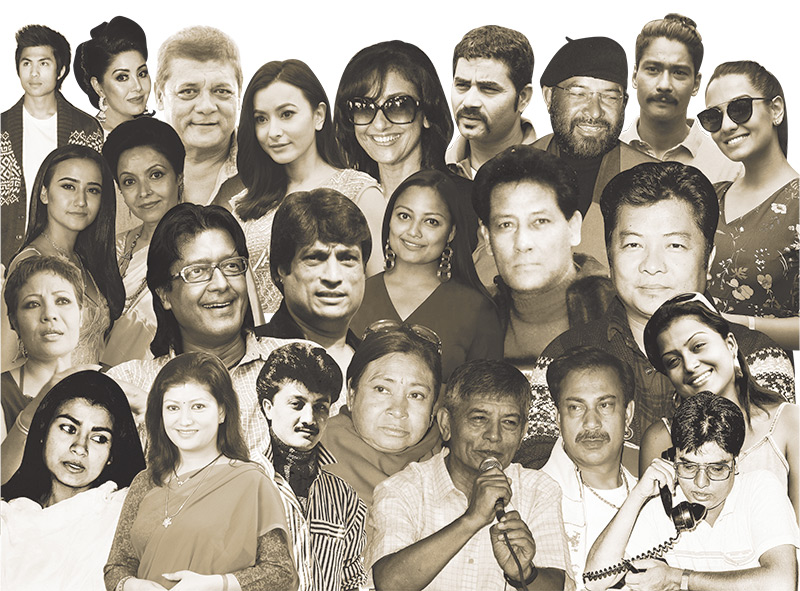
The industry is in the doldrums primarily because most films neglect the basics of filmmaking—a good script with memorable characters, cinematography, and sound design.
- Timothy Aryal
composite image from handout & post file photos

Last December, the opening show of the Nepali feature film Machha Machha at Lalit Cinemas, one of the more popular modern theatres in the Valley, ran to a virtually non-existent audience. There were just four people—this reporter and a young, nervous couple who looked like they were there for a quiet time more than anything else—in the theatre. The other man might have been a critic.
The film was the directorial debut of Sunil Gurung, a relatively unknown name in the film industry, but it featured Saugat Malla, one of the most bankable movie stars in contemporary Nepali cinema. Before the film’s premiere, the producers had released an item song featuring actress and former Miss Nepal Shristi Shrestha, which has garnered over 800,000 views on YouTube so far. The trailer for the film, projected in between shows days earlier at the same theatre, had elicited much laughter among the audience. The film was billed as the ‘crime-comedy of the year’ and had drawn comparisons to predecessors like Loot and Jatra, both of which won over audiences and critics.
All of that failed to pull in an opening-day audience. Machha Machha didn’t just bomb at the box office; it was also derided by movie critics.
“This film isn’t just misogynist, but also racist,” Abhimanyu Dixit, the Post’s film critic, wrote in his typically lacerating assessment of Machha Machha. “If only the filmmakers took their own craft a little more seriously, and worked with a little more honesty—we have hundreds of potential stories hiding in the same alleyways these money chasers use as sets.”
Machha Machha didn’t make money but neither do most Nepali films. The ones that do are derided by critics for appealing to the lowest common denominator. For a film industry that has been in place for over 50 years and produces dozens of films every year, Nepali cinema has hardly “any films that we can call our own,” said Dipendra K Khanal, who has directed 10 films so far. Almost all Nepali films, as academic Manoj Babu Pant puts it, are resigned to the “cold graveyard” of cinemas. And this is primarily because a majority of Nepali films grossly neglect the basics of a film—a good script with memorable characters, cinematography, and sound design, according to veteran director Yadav Kharel.  
Out of around a hundred films released last year, only about 25 made back their production costs, according to Govinda Shahi, who distributes Nepali films inside the Valley. Ten of them were hits while the others managed to salvage their investments, either from shows or through distribution deals and screening rights overseas, Shahi said.
In Nepal, figures about gross collections can be murky. A film critic warned me against going by the figures presented by distributors and producers, as many release misleading data seeking a boost in audience turnover. In an attempt to change this, the Film Development Board, towards the end of 2018, claimed that it had installed a central server that would collate the amount of revenue generated by a film. But due to its complicated digital procedures and cost, and with many halls outside the Valley still trading in paper tickets, it became impossible to get the server to work correctly.


A large number of films fare poorly, while some “don’t even collect enough money to fund the films’ promotional posters,” Shahi said. “These films mostly belong to newcomers who invest in movies on a whim.”
In several instances, theatre owners have had to cancel screenings altogether due to scant footfall on the opening day. But even those that do well commercially are frequently lambasted by the critics.
***
The first Nepali-language film, Satya Harishchandra, was made in 1951 in Bombay. But it wasn’t until 1964 that Nepal produced its own film. Aama, the first film to be made in Nepal, was produced by the then Shahi Nepali Chalachitra Sansthan, set up by King Mahendra, for the king was a great lover of culture and arts, according to 76-year-old Kharel, the first managing director of the Sansthan, and a renowned director and lyricist.
Directors and other technicians were brought in from Bombay for the production, but the focus was solely on promoting Mahendra’s specific brand of Nepali nationalism. The Sansthan regularly made films until 2000, when it was replaced by the Film Development Board. It was with the restoration of multi-party democracy in 1990 that Nepal saw a spike in the number of films produced. Last year, the industry produced around a 100 films, even though that number has reportedly declined this year. But the rise in the number of productions has meant little—about 70 to 80 percent of films can’t redeem their budgets, distributors and critics say.
According to Bhaskar Dhungana, director, producer and co-owner of QFX Cinemas, about 80 percent of revenue generated by all Nepali films in a year comes from less than half a dozen films.
“Nepali audiences have lost their faith in filmmakers,” said Pant, academic director at Oscar International College, Nepal’s first film school, who also writes occasionally about the film industry. “Nepali filmmakers are more concerned with emulating the commercial success of films like Loot and Chhakka Panja rather than pursuing an artistic vision.”
According to Pant, the younger audience would rather watch a film at home on the multitude of television and online options that they have rather than spending time and money going to the theatre to watch a mediocre Nepali film.
“Why would anybody want to go to the theatre to sustain two-and-a-half hours of sheer torture?” he said.
When a film fails, critically or commercially, the blame tends to rest on the director. While the director might be at the helm in other countries, in Nepal, filmmaking has a different structure, said Naresh Kumar KC, who has directed two films—Dying Candle, and Romeo and Muna. The former was a character-driven drama targeted at the festival circuit. It won Best Cinematography in a Feature at the Queens World Film Festival and the Peace Award at Cinema Verde Film Festival, among others. The latter catered to a larger audience, with popular actors and a multitude of song sequences. But both films struggled to redeem their investments, and KC believes that the fault lies as much, if not more, with the producers as the directors.
“It’s easy to point fingers at the director when a film fails,” said KC. “But contrary to what many would think, our industry doesn’t lack able directors. What our industry lacks is able producers.”
The producer is also a creative person, not just someone who manages funds, according to KC. The producer understands the story, its target audience, and its impact, and selects the script, manages funds, and breathes life into the project.
“After directing two films, I’ve learned that in Nepal, a director does not only  direct but also has to do the producer’s work while also making compromises under the producer’s pressure,” said KC. “If a director makes one compromise a day, he will have made 35 by the end of the film. The end product is thus no longer what the director had envisioned.”


Khanal, director of films like the hugely popular Pashupati Prasad, shares a similar sentiment.
“Producers are careless about their projects—they don’t care about the script or the acting, let alone the post production,” he said. “As a result the production value of the film, which includes things like lighting, cinematography, editing, sound design, background score, is poor.”
Since most Nepali films are produced by individuals who expect a return on their investment, there is constant pressure to compromise on artistic choice in order to make a film that is palatable to as broad of an audience as possible, said Khanal.
In order to diversify the kinds of films that Nepal produces, there needs to be more large production houses that won’t bet all their money on just a single film or support from the state, like in countries like France. But instead of promoting the film industry, the Nepal government often comes up with policies that undermines it, like requiring Nepali theatres to screen foreign films only for 185 days out of a year.
“The state doesn’t seem to have realised that cinema is a reservoir of culture, language and sensibility,” said Khanal.
***
Today, Nepal has about half-a-dozen film schools and institutes that teach film, the oldest being Oscar International College. Since its establishment in 2004, the college has produced hundreds of filmmakers, including Nischal Basnet, Min Bahadur Bham and Pant. But while a few like Basnet and Bham have found success, these film school graduates do not seem to have made any significant impact on the industry. That, according to Pant, is because the way his students see film and the way the industry and Nepali audiences see film is radically different.
“When novice directors fresh out of college get out onto the field, they are shocked by the matters they need to be concerned about: the taste of the audience, the finances, and distribution,” Pant said. “They have to adjust according to the norms of the industry. Many quietly move away, others choose to struggle.”
But Pant cautions against concluding that the entire Nepali film industry is lost. A handful of struggling filmmakers can change an entire industry, he says.
That almost happened in 2012, with Nischal Basnet’s Loot. Writer-director Basnet, a film school graduate with no movies to his name, made Loot on a shoestring budget. Hailed by critics and audiences alike for its memorable characters, inventive cinematography and a script with an unexpected twist ending, Loot was a runaway success. It grossed millions, becoming one of the most profitable Nepali films of all time and bringing instant stardom to its makers and profits to its financiers.
“I want[ed] to make a film that I would want to watch, a film that I would enjoy. Not a film that audiences at large automatically expect from Nepali filmmakers,” Basnet told Living magazine in 2014.
Many had expected that Loot would herald a new wave of Nepali filmmaking but that didn’t happen. Basnet transitioned as an actor but was unable to capture the triumph of Loot. His second directorial feature, Talakjung vs Tulke, was a success but not on the level of his debut. The sequel to Loot, released in 2017, bombed with critics.
Basnet’s films have been hit-or-miss, and Pant sees this as an instance of the Nepali film industry attempting to find its voice, its identity. Pant himself is a product of the film school, having graduated from the same institute he now teaches at.
“Let us take the example of Chhakka Panja 3, which grossed about Rs 200 million,” he said as we spoke at his Sukedhara office, adorned with posters of arthouse staples such as Satyajit Ray’s Pather Panchali, Andrei Tarkovsky’s Stalker and Abbas Kiarostami’s The Wind Will Carry Us. “About three percent of the total population went to see that film. The film did its business but what this indicates is that we haven’t been able to treat films as an intellectual medium.”
The success of the Chhakka Panja series, directed and produced by Deepa Shree Niroula and starring Deepak Raj Giri, reflects the television experience of its makers. Nepali television’s appeal is broad-based, which it maintains by relying on hackneyed comedy tropes, which include jokes at the expense of women, minorities, skin colour, and caste.
“They [the makers of the Chhakka Panja series] have perfected the ways of making the audience laugh,” said Pant.
But Dipendra Lama, a critic-turned-filmmaker who has directed films like Ghampani, Gopi and Chha Maya Chhapakkai (with the team from Chhakka Panja), believes that films like Chhakka Panja, despite their debatable merit, provide something new.


“Nepali audiences love things they haven’t seen in foreign films,” Lama said. “The merits of the series might be up for debate but they tell stories about our society and issues that common Nepalis deal with.”
All the films in the Chhakka Panja series have had ‘social issues’ as their primary plot device, such as the effects of foreign employment and water crisis.
The Chhakka Panja series has been hugely successful, with each iteration going to gross more than the previous one. While their success is commendable in an industry struggling to make back investments, these films shouldn’t be seen as torchbearers of our cinematic sensibility, says Pant.
“To make a film that grosses Rs200 million in a market as small as ours, and amid the hegemony of Bollywood and Hollywood, is no small thing, so we should stop chastising the series,” Pant said. “But it would be a mistake to assume that Chhakka Panja is emblematic of our industry’s sensibilities. The Chhakka Panja series engages with the audience but so does a Gaijatra show or a porn film.”
For Pant, there’s a radical difference between a film that simply engages with issues and one that has artistic depth.
“The life of the former is short but the life of a film with authentic characters and authentic emotions is long,” he said. “Our mainstream is not as bad as the South Indian film industry, for instance. But we don’t have a Pather Panchali either. What we should focus on is making a film as enduring as Pather Panchali.”
The most pressing problem for Nepali films today appears to be a lack of understanding of what films can do. Most people, even filmmakers themselves, do not seem to understand that cinema too is a medium of intellectual, creative and aesthetic expression, said Pant.
“Everything begins with how we view cinema.
Even the intelligentsia doesn’t take film seriously. They view it as something that is only for entertainment. This goes both ways because our filmmakers haven’t been able to produce films that provoke intellectually,” he said.
This state of affairs is largely because many Nepali films are poor copies of Bollywood. From the very beginning, Nepali cinema was heavily influenced by Bollywood aesthetics and Bollywood tropes. The weepy melodrama and exaggerations of a typical masala film—including four songs and fight sequences—were followed faithfully by filmmakers in the 80s and 90s. The 90s were the heydays of onscreen machismo in the form of actors like Bhuwan KC, Shiva Shrestha and Rajesh Hamal—muscular, angry young men attempting to rescue damsels in distress, much in the vein of Amitabh Bachhan from across the border.
In the late 90s, there were few attempts to break free of this mould. Tsering Rhitar Sherpa’s Mukundo:
Mask of Desire, a Kathmandu-based drama that explored the absurdities of faith healing, and Caravan (aka Himalaya), which was set in Upper Dolpo and revolved around the a caravan of villagers and yaks traversing the mountains, were early attempts to explore complex issues and veer away from the borrowed Bollywood aesthetics of Rajesh Hamal and Bhuwan KC films.
“It is the myth-like quality of Mukundo, and the universal noble element in Gita the jhankrini’s drama, that allowed me to project onto her... the dilemma of all women torn between society’s constraints and their own human sexuality,” said a review published in Nepali Times when the film premiered. “It’s a great movie. There ‘s so much in it. Is anybody going to accept Bollywood knock-offs from our Nepali filmmakers anymore?”
Caravan, helmed by French director Eric Valli, was Nepal’s official entry at the 72nd Academy Awards for Best Foreign Film. It is so far the only film made in Nepal to receive a nomination.
“Himalaya doesn’t need a traditional story line to transport the viewer into another, fascinating world,” a review in the Miami Herald noted.
In 2008, director Bhushan Dahal heralded the digital age of film with Kagbeni, featuring luscious landscapes and a cast of actors drawn from the theatre—Anup Baral, Saugat Malla and Deeya Maskey.
In 2012 came Loot, which shocked the industry out of its sleep. The film proved to be a phenomenon at the box office, grossing Rs54 million. That same year, Soongava: Dance of the Orchids brought lesbian characters to Nepali screens, one of the few attempts at telling the stories of gender minorities. The film went on to win a Special Jury Award at the Inside Out Toronto LGBT Film Festival but did little business in the domestic market.
Films like Talakjung vs Tulke (2014) and Pashupati Prasad (2016) veered from the mainstream, not so much with their aesthetics but more so with their scripts. A new generation of directors also began to explore the film festival circuit. Min Bahadur Bham and Deepak Rauniyar courted foreign investments and made films that toured the major festivals, including the Venice Film Festival. Bham’s Kalo Pothi and Rauniyar’s Seto Surya went on to win accolades. Kalo Pothi won Best Film under the International Film Critics Week at the 2015 Venice Film Festival and Seto Surya won Best Asian Feature Film at the Singapore International Film Festival. These films found few audiences in Nepal, screening for around a week each, but in any case, they weren’t targeted at commercial audiences.
In the domestic mainstream, a few films each year continued to attempt to break boundaries, whether with their storytelling or with their cinematography. But these films were few and they barely made a splash. Pratik Gurung and Safal KC’s Hari, a 2018 feature about a disenchanted youth who finds himself at odds with his mother’s conservatism, had critics raving but it failed to find a receptive audience. The film was out of theatres by the first week.
“Directors KC and Gurung belong to the new crop of Nepali filmmakers who are daring enough to introduce nuanced cinematic style in their storytelling, to subvert established narrative norms and carve out a niche that is fresh and original,” said one review. “At a time when our cinema is thriving on big budgeted romantic musicals and ensem­ble comedies at one end and pretentious experimental mis­fires at the other, the Kafkaesque ‘Hari’ is in the sweet spot of the world cinema that is both accessible and inoffensive.”
Unconventional films like Hari might not find ready audiences, but that is something that filmmakers themselves will have to cultivate, say critics. If the mainstream continues to only produce lacklustre fare then that is what the audience will come to expect. If more filmmakers are willing to take risks, the audience will follow.
The Nepali film industry has wholeheartedly embraced technology. Gone are the days of crackly film pockmarked with noise. Films these days have the crisp vibrant colour that comes from being shot on state-of-the-art digital cameras. Nearly every film has a sweeping drone shot and there are cranes, dollies, and steadicams galore. The Nepali film industry does not lack able technicians, but there is one technological advance that the industry has largely ignored—streaming.
Netflix has revolutionised the way films are watched—and made—across the world. With audience numbers dwindling, movie theatres have sounded alarm bells. And even in Nepal, film theatres are dying, as more and more young people choose to wait for their favourite films to appear online.
But Nepali productions have yet to wade into the digital realm, as most appear content with packing theatres. Most Nepali films appear on YouTube after a few months, primarily to rake in money from views.
Smaller, more independent productions, however, are taking advantage of the freedom afforded by the internet. Indie production houses like Gauthali Entertainment and KTM Art House have taken to YouTube with serialised storytelling. Even Priyanka Karki, a stalwart of the mainstream film industry, has made her foray into telling serialised television.
Digital distribution companies such as OSR Digital and Highlights Nepal buy and stream Nepali films on YouTube and some Nepali films have begun streaming on the Malaysian site Iflix. Lately, there have been reports that filmmakers are developing apps themselves where individuals can pay a small amount to watch films, according to director Khanal.
For QFX’s Dhungana, streaming won’t matter much if films stay the same quality. But if films get better, they will always find an audience. QFX Cinemas, Nepal’s biggest theatre chain, currently has no plans for a streaming site of its own.
“Producers and filmmakers are often quick to blame hall owners and Bollywood films for their film’s failure,” said Dhungana, who co-produced Kagbeni. “The technology with which our films are being made has improved, but the intellectual, aesthetic quality has not.”
HOME PAGE

Two weeks since Sapkota became Speaker, there’s still no sign of his deputy

Out of options, ruling party may offer deputy Speaker post to the Rastriya Janata Party, NCP insiders say.
- TIKA R PRADHAN

KATHMANDU,
The winter session of the House of Representatives commenced on December 20, but there was over a month-long wait before it could begin work.
At least three House meetings had to be deferred for the lack of Speaker, since Krishna Bahadur Mahara stepped down in October following allegations of attempted rape. It was only on January 26, following an agreement between Nepal Communist Party (NCP) co-chairs KP Sharma Oli and Pushpa Kamal Dahal, that Agni Sapkota was elected the new Speaker.
Five meetings of the House of Representatives have been held since Sapkota’s election, but the House still lacks the deputy Speaker. Both Janata Party and Nepal Communist Party insiders, as well as officials in the Parliament Secretariat and experts on parliamentary affairs, say the parties’ tendency to undermine the system has left the House without deputy Speaker.
In principle, it’s the Speaker, in his capacity as the leader of the House, who should show urgency in electing his deputy. But Sapkota, despite his election to the post of Speaker, which means he is above partisan politics, still appears to be looking to the ruling party to start the deputy Speaker election.
“It’s difficult to say when the process to elect the deputy Speaker will begin,” said Gopal Nath Yogi, officiating general secretary at the federal parliament. “It seems that the election for deputy Speaker could be delayed by a few more weeks.”
The schedule and agenda for the House meetings depend on the role of political parties and unless they are ready, the House cannot move ahead, said Yogi.
In the absence of deputy Speaker, the Constitutional Council cannot meet and make decisions. The council, of which the deputy Speaker is one of its six members, is the body that appoints ambassadors and members to the constitutional commissions.
But the ruling party has proposed amending the law so that the prime minister can make decisions during the first meeting of the constitutional council, even in the absence of the deputy Speaker, say party insiders. As the deputy Speaker will be from a different party, the ruling party’s say on the council will be limited further, as the leader of the primary opposition is also a member of the council.
“The delay over deputy Speaker is possibly because talks with the Rastriya Janata Party have not been finalised yet,” said Rekha Sharma, a ruling party lawmaker and former minister. “The ruling party will certainly calculate its losses and benefits while supporting the deputy Speaker because she will also be a member of the constitutional council.”
The constitution mandates that the Speaker and deputy Speaker be of different genders and from different parties, which means that the latter cannot be a man or from the ruling Nepal Communist Party.
The Rastriya Janta Party is the most likely—and only, in the given context—party in the House to get the deputy Speaker’s post. But the ruling party appears unwilling to commit to the Janata Party.
The ruling party had proposed that Durga Poudel, the only lawmaker from Rastriya Janamorcha Nepal led by Mohan Bikram Singh, be deputy Speaker. However, Poudel refused, despite being elected through an alliance with the ruling party, as she is the only lawmaker from the party. Her elevation to deputy Speaker would leave the Janamorcha with no representation in Parliament.
The Samajbadi Party recently withdrew its support to the Oli administration and the Rastriya Prajatantra Party and Nepal Majdoor Kisan Party don’t have any women lawmakers. As the ruling party will not offer the
post to the opposition Nepali
Congress, it is now left with no option than the Rastriya Janata Party, say party leaders.
Ruling party leaders have thus been urging the Rastriya Janata Party to opt for a package deal that includes the deputy Speaker, but the Janata Party is adamant that issues related to Parliament be handled separately.
“We have told the leaders of the ruling party that the deputy Speaker won’t be part of a package deal,” said Mahanta Thakur, the senior-most leader of the Janata Party’s six-member praesidium. “A package deal could be reached on other issues, including amendments to the constitution and regarding the government, but not on issues related to the Parliament.”
Article 91 of the constitution says the elections of the Speaker and deputy Speaker should be concluded within 15 days of the first House meeting. The constitution, however, says nothing regarding the time frame for electing either the Speaker or the deputy Speaker when either post is vacant during the House session.
Former deputy Speaker Shiva Maya Tumbahangphe is especially chuffed at the delay, since the ruling party had accused her of holding up the House Speaker election when she refused to step down. Tumbahangphe had laid claim to the Speaker’s post on the grounds that she was the deputy and eminently qualified.
“Earlier, I was accused of being an obstacle but now, it appears that the leaders do not feel any urgency,” Tumbahangphe told the Post.
“The Speaker should follow up for the election of deputy Speaker at the earliest.”
However, secretariat sources said that the Speaker is waiting for the parties to come up with a proposal.
“If we devise an election schedule without consulting with the parties, we will have to modify it later,” said Yogi. “The Speaker can do nothing without seeking approval from the political level.”
This is to be expected when the Speaker himself was elected on the lobby of some influential party leaders, said senior advocate Purna Man Shakya.
“Since the Speaker himself was elected with the support of some party leaders, we cannot expect him to act independently,” said Shakya.

HOME PAGE

Oli inaugurates Kantipur Conclave with focus on connectivity

Delivering keynote address, the prime minister listed the achievements of his two-year administration and outlined his plans for a prosperous Nepal.
- Post Report
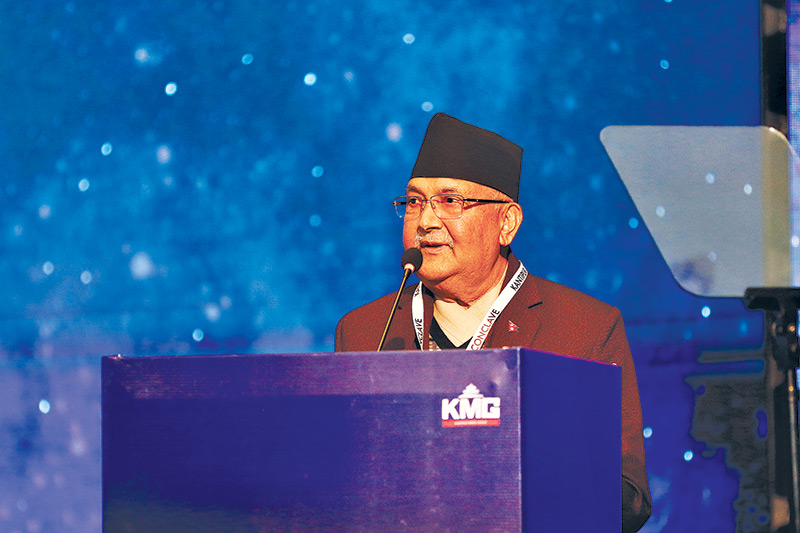
Prime Minister KP Sharma Oli. Post Photo: Keshav Thapa

KATHMANDU,
Prime Minister KP Sharma Oli on Friday listed his administration’s accomplishments over the past two years and shared his vision for the coming years to achieve the goal of a prosperous Nepal with happy Nepalis.
Delivering a keynote address at the second edition of the Kantipur Conclave, Kantipur Media Group’s flagship global event, Oli said that less than halfway through his tenure, his administration has been able to spark optimism.
After a landslide victory in the 2017 elections, Oli assumed office in February 2018, two years after his first stint as prime minister when he had attempted to diversify Nepal’s connectivity with the northern neighbour in the wake of a months-long Indian border blockade.
In 2016, he signed a slew of deals with China, aiming to enhance connectivity and transit and transport to countervail Nepal’s almost complete dependence on India.
Oli on Friday used the stage of the Kantipur Conclave, whose theme this year is ‘Reimagining Connectivity’, to stress his administration’s focus on connectivity.
“Connectivity has been the main thrust of our engagement with our neighbours,” said Oli.
“We believe that multimodal connectivity with India and Trans-Himalayan Multidimensional Connectivity Network with China offer immense opportunity for our development and prosperity.”
Enumerating connectivity-related projects that Nepal is currently implementing, Oli said that landlocked Nepal would soon become linked via waterways and that Nepal’s flag carriers would soon be sailing the country’s big rivers.
“Motorboats will not only be fun of our life [sic], but also add value to our tourism,” Oli said. “Rail links with both of our neighbours will revolutionise our transportation system, providing much-needed boost to our economy. It will make Nepal truly a land-linked country.”
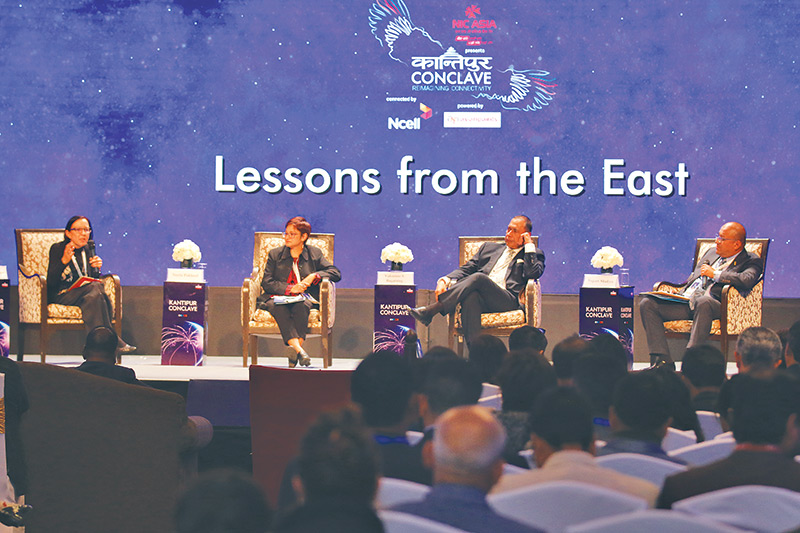
Under the broad thematic area of connectivity, the second iteration of Kantipur Conclave brings together personalities from across the world to speak on various issues of import, including lessons that Nepal can learn from East Asia, connecting global Nepalis and the #MeToo movement.
Following addresses by C Raja Mohan, director of the Institute of South Asian at the National University of Singapore; Bruno Macaes, senior fellow at the Hudson Institute; Andy Mok, senior research fellow at the Center for China and Globalization, Oli spoke broadly about the achievements of the past two years, reflecting on all that his administration had managed to get done.
The region’s first cross-border petroleum pipeline has come into operation and two international airports in Bhairahawa and Pokhara are expected to be completed soon. Oli said that his government has played a positive role in harnessing investment and creating a positive environment to bring investment for various infrastructure sectors.
“Private sector, entrepreneurs and individual innovators are the principal actors in this collective expedition. We are mindful of the government’s responsibility as a facilitator, enabler and provider of law and order and suitable, competitive atmosphere,” he said.
But Oli also called on the private sector to reciprocate the government’s actions and foster a “healthy, competitive economic environment where everyone has a fair chance to grow” and also “shun the tendency of rent-seeking and seeking short term benefits.”
Oli said that he expects the private sector to invest in productive sectors and adopt new technology to become competitive globally. Oli promised to support the private sector with legislation.
“My government is committed to easing and facilitating the entry of new players and start-ups in all productive sectors,” said Oli. “We have already started one window services for prospective investors. Company registration service is getting smoother; land acquisition is getting more simplified; cost of tax payment is reduced; and dispute settlement is reformed.”
Oli explicitly mentioned the indictment of 175 persons, including three former ministers, on corruption charges by the Commission for Investigation of Abuse of Authority as emblematic of his administration’s commitment to fighting corruption.
It was actions like these that led to Nepal’s improvement on the global corruption index, he said.
Nepal moved up 11 places from 124 to 113 on Transparency International’s Corruption Perception Index.
At the end of his statement, Oli said that Nepal is “rich in ideas and knowledge; rich in natural and cultural resources; rich in demography; and has tremendous goodwill and support of the international community” while calling for support.
“What we need is a synergetic partnership among government, private sector and civil society to harness the tremendous potentials that we are endowed with,” he said.

Page 2
MEDLEY

Horoscope

ARIES (March 21-April 19)
**
Forget about being able to communicate effectively via technology. It could be useless for the type of message you need to send to a certain someone. Don’t assume that words on a screen are going to adequately convey what you mean. They won’t.  Even if you aren’t thrilled by the idea, you need to talk this issue over face-to-face.


TAURUS (April 20-May 20)
**
If someone is just not getting the message you’re trying to send them, today it’s time for you to give up, at least for a while. They might be ready to listen soon, but you shouldn’t hold your breath. You don’t really need them, and it’s a waste of your time to keep knocking on their emotional doors.


GEMINI (May 21-June 21)
***
Generating ideas is easier than ever today thanks to your unique way of looking at things. Some people see a blank sheet of paper and get panicked about how they’re going to fill it. Today, you’ll see that same blank sheet of paper and immediately ask for another in order to have enough space to get down everything.


CANCER (June 22-July 22)
**
Be wary of a friend whose lifestyle is getting a bit extreme in your eyes. They represent a cautionary tale that you don’t need to learn. You’ve taken your educational walks on the wild side, and you may again, although right now isn’t the appropriate time to do so. You don’t need to relive anything through this person.


LEO (July 23-August 22)
**
Now more than ever it’s important to open yourself up to new ideas and new ways of doing things. Sometimes change is bad, but most of the time change is good. It demonstrates that when you’re made aware of new information, you factor it into your philosophy accordingly.


VIRGO (August 23-September 22)
**
Someone in your life is going through some demanding work issues right now. This stress could be affecting their personality. It could be leaking into your relationship and affecting it in a negative way. Let this person know that you’re concerned, but don’t rush at them with demands to “shape up or else!”


LIBRA (September 23-October 22)
***
Today, you need to explore areas that you know little or nothing about. Experience new things and you’ll become a more interesting person. If a conversation drifts into political issues or world events that you know nothing about, don’t walk away or change the subject. Keep listening. Ask questions.


SCORPIO (October 23-November 21)
**
Don’t make assumptions about that state of your financial situation right now. It could be better than you think, but then again, it could be worse. Before you go shopping, check your bank account to make sure you know where you stand. If you don’t make sure you’re flush, then you could be taking a big risk.


SAGITTARIUS (November 22-December 21)
**
Are you doubting your position in your social circle right now? You need to have a little bit more faith that you’re still loved by your friends. Sure, you should watch how you deal with other people right now, but that’s only because they have stuff going on in their lives, not because there is anything wrong with you.


CAPRICORN (December 22-January 19)
**
Try to avoid flighty people today, especially in social situations. Their unfocused energy could cause you to lose your focus, too, and that wouldn’t be good for the positive momentum you’ve been enjoying! If a friend has promised to meet you somewhere but you have a feeling they won’t show, call them up and reschedule.


AQUARIUS (January 20-February 18)
**
There is more than one way to get a connection going with someone else. Why do you insist on trying the same tactics over and over? Your style might not be the same as everyone else’s, so stop comparing yourself to others. Don’t try to mimic what they do. Intelligent people follow their own paths.


PISCES (February 19-March 20)
***
The clarity you had about your feelings for someone is dissolving a little bit today, but have no fear. This confusion you’re experiencing is a totally normal part of being in a relationship or friendship. Nobody’s perfect. Can you still accept them once you’ve seen their imperfections?

Page 3
NATIONAL

Transitional justice bodies have not taken any steps to bring victims on board

Disappearance commission is preparing its work plan without consulting with conflict victims.
- BINOD GHIMIRE

KATHMANDU,
The new office-bearers of the two transitional justice commissions, who were appointed amid reservations, have not taken any steps to bring the conflict victims on board as they move forward with their jobs.
Two weeks have passed since the two commissions got their office-bearers, who were selected by a committee led by former chief justice Om Prakash Mishra after an agreement between the ruling and the main opposition parties. In this period, there have been no attempts from them to start a dialogue with the conflict victims and the human rights activists.
The Commission of Investigation on Enforced Disappeared Persons is already in the process of preparing its work plan, and it has not consulted with the concerned parties. “We didn’t think it was necessary to talk with the concerned parties since the commission members have already spoken to them,” Sunil Ranjan Singh, a commission member.
Singh said they will finalise the work plan and report to the government within a couple of days.
The disappearance commission has already concluded that completing the investigation within the set term, which ends in February next year, is not possible.
The officials at the Truth and Reconciliation Commission said they were currently discussing ways to move ahead with their job, but had not yet decided whether they should consult the conflict victims and other concerned parties.
Ganesh Datta Bhatta, the chairperson of the commission, said they were not in a hurry. “We are aware that listening to the victims and the human rights defenders is necessary, but we have not yet decided when to start the consultation process,” he told the Post.  
The conflict victims say any work that is done by the two commissions without amending the Enforced Disappeared Enquiry and Truth and Reconciliation Commission Act 2o14 would be futile.
“We are surprised to hear that the disappearance commission has prepared its work plan without even sitting with the stakeholders once,” Gopal Shah, chairman of the Conflict Victims National Network, told the Post.
The network has been demanding that the government and the political parties proceed with the transitional justice process based on the suggestions from the victims.
Rights activists have also warned that the two commissions will reach nowhere if they ignore the conflict victims and other stakeholders.
They have long been urging the commissions to bring everyone on board before taking any crucial decision.
“There are already reservations over the appointment of office-bearers in the commissions. Hence, it is even more important for them to reach out to the major parties of the transitional justice process,” Kapil Shrestha, a former member of the National Human Rights Commission, told the Post.
The disappearance commission has around 3,000 complaints to investigate while over 63,000 cases have been registered with truth commission.
Satish Mainali, a human rights lawyer, said there was no option for the commissions than to move hand in hand with the victims to take the transitional justice process to its logical end.
“Winning the confidence of the victims and other stakeholders will make their job easier,” he said.

NATIONAL

Aftab Alam to remain in judicial custody

Janakpur High Court upholds lower court decision to keep him behind bars until verdict is passed.
- Post Report
Alam. post file photo

KATHMANDU,
Mohammad Aftab Alam, the Nepali Congress lawmaker arrested in connection with the murder of at least 18 people following a blast in Rautahat 12 years ago, will remain in custody until a verdict is passed in the case.
The Janakpur High Court, which on Friday upheld the decision of Rautahat District Court to remand Alam in custody, however, denied a request by the Birgunj Government Attorney’s Office to transfer the case from Rautahat, Alam’s home district, to the Parsa District Court.
A bench of chief judge Dilli Raj Acharya and judge Satya Mohan Joshi Tharu concluded that Alam’s request to order police to release him on general date and continue investigation couldn’t be justified.
Alam, who was elected to the federal parliament from Rautahat constituency-2 in the 2017 elections, was taken into custody on October 13 for his involvement in the bomb blast in Fradahawa, Rajpur, in Rautahat on April 9, 2008.  Alam is currently in custody in Nakkhu jail. Police transferred him to the Capital after he allegedly threatened local police.
The attorney’s office, along with Sri Narayan Singh Rajput, whose son Trilok Pratap was also allegedly killed in the bomb blast, had appealed to the court seeking the transfer of the case to Parsa stating that Alam could influence investigations in his home district. Rajput told the Birgunj High Court that witnesses of the alleged murder were abducted by Alam’s supporters and forced to change their testimony in court.
Similarly, Deepak Dhakal, the district judge of Rautahat who ordered Alam’s remand, and Khadindraraj Katwal, the district attorney who had filed the charge sheet against Alam in the case, had to leave the district on November 15 following alleged threats.
The high court, after receiving suggestions from an amicus curiae, decided it was not necessary to transfer the case as demanded by the attorney’s office. “The court has concluded that it is not necessary to transfer the case for now as there isn’t a threat for a fair trial,” read the order.

Page 4
NATIONAL

Keynote speakers discuss different facets of connectivity

China’s role in driving the agenda forward also under the spotlight.
- PRITHVI MAN SHRESTHA
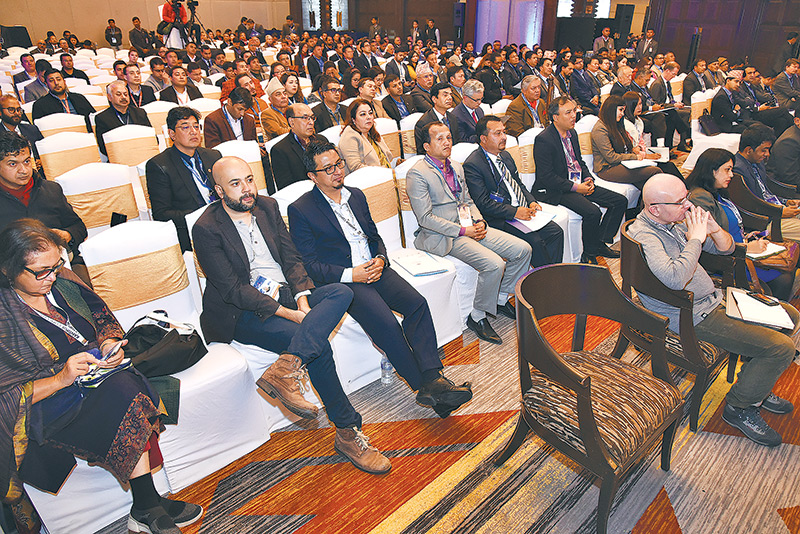
Audience at the two-day conclave that kicked off in Kathmandu on Friday.(Below) C Raja Mohan from the Institute of South Asian Studies. Post Photos: Angad Dhakal and Elite Joshi

KATHMANDU,
Keynote speakers at the Kantipur Conclave on Friday shed light on different aspects of connectivity—from its evolution and current forms to China’s role in driving it forward.
During their speeches on the inaugural day of the second Kantipur Conclave, Kantipur Media Group’s global event, C Raja Mohan, director of the Institute of South Asian Studies; Bruno Macaes, senior fellow at the Hudson Institute; and Andy Mok, senior research fellow at the Center for China and Globalization, touched upon the economic, and political facets of connectivity in the context of Nepal and the neighbourhood.
Mohan highlighted how connectivity has evolved over the centuries, and offered suggestions on how Nepal should approach connectivity projects backed by various countries.
“There is a long history where connectivity was taken up by different sets of actors. There was the ancient Silk Road which was connecting Europe and Asia by land and the sea. Goods and ideas and religious beliefs travelled across the Pacific and Indian Oceans and Eurasia through this Silk Road,” Mohan said.
“Europeans brought connectivity to this part of the world [South Asia] in the 18th and 19th centuries along with European capital’s entry here. As a result, cities like Mumbai and Madras were created.” And today, according to him, there are “connectivity offers” from countries such as China, the United States, Japan and Europe.
When there are multiple vendors offering the same product, it is the buyers’ market, he said.


“There is the Belt and Road Initiative of China, the Indo-Pacific Strategy of the United States, Partnership for Quality Infrastructure of Japan...  and the European Union has come up with a connectivity strategy of its own,” said Mohan. “So you have a large number of leading powers willing to invest in infrastructure and connectivity of other countries.”
He said that it is more important for countries such as Nepal to set their own preconditions or conditions when negotiating the terms of infrastructure development projects.
“So the difference between the 19th century, where you had no choice and someone else was taking the decisions… today you have the choice… you can pick and choose from the Belt and Road Initiative, you can pick and choose from the Indo-Pacific and you can pick and choose from Quality Infrastructure.”
Macaes, meanwhile, stressed connectivity between ideas and civilisations. “The fundamental sense of connectivity is how we bring different cultural worlds, different political models together,” he added.
Mok, in his speech, said, “We should look into the status of connectivity of a country, which country is in driving position to increase connectivity and what types of institution we need for improving [connectivity].” He added that China is in the driving position around the world when it comes to connectivity.

NATIONAL

Second edition of Kantipur Conclave kicks off

Event is part of Kantipur Media Group’s effort to hold constructive discourse among policymakers and thought leaders.
- Post Report
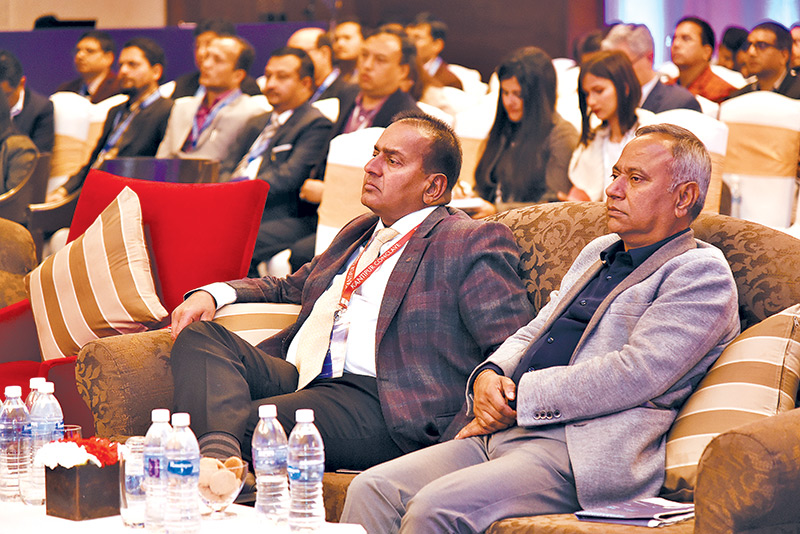
Chairman and Managing Director of Kantipur Media Group Kailash Sirohiya and Upendra Mahato are among the attendees at the event. Post Photo: Angad Dhakal

KATHMANDU,
The second edition of Kantipur Conclave kicked off on Friday at Hyatt Regency, Kathmandu.
The two-day event, part of Kantipur Media Group’s initiative to organise constructive discourse and interactions, will serve as a platform for thought leaders to share innovative ideas and present ideas to deal with problems that Nepal faces, according to the organisers.
This year’s conclave, with the theme ‘Reimagining Connectivity’, sees personalities from Nepal and across the globe discuss diverse issues facing Nepal.
“When we started the Kantipur Conclave last year, our hope was to open up a new space for public discourse. With the beginning of a new era of democracy, Nepalis have been more committed than ever before to figuring out in their own ways, a roadmap for a prosperous Nepal,” said Kailash Sirohiya, chairman and managing director of Kantipur Media Group. “The conclave is an attempt to contribute to a robust discussion and sharing of ideas that collectively take us toward that goal.”
According to the event’s schedule, eight of the nine sessions of the conclave will take place on Saturday.
“Together, as we reimagine connectivity over the next two days, we hope the ideas that emerge here will foster a healthy environment to advance our community and our country,” said Sirohiya.
“This year, we are thrilled to host distinguished panels of entrepreneurs, policymakers and thought leaders to discuss how our country can take advantage of an interconnected world, how connectivity can fuel innovations, and how we can move forward by harnessing the best of what those around us can offer.”
The event has also been designed to provide an opportunity for Nepali and global thought leaders to forge professional and personal relationships.
“This year, we are thrilled to host distinguished panels of entrepreneurs, policymakers and thought leaders to discuss how our country can take advantage of an interconnected world, how connectivity can fuel innovations, and how we can move forward by harnessing the best of what those around us can offer,” said Sirohiya.
He hoped that this year’s conclave serves as an ideal platform to begin conversations and gain fresh insights from experts to elevate the discourse in Nepal.
“For 27 years, Kantipur Media Group has strived to stir discussion and protect democratic values, and our publications have been the leaders in sharing news and stories with millions of people at home and abroad,” said Sirohiya.
“Together, our publications in print, broadcast and digital mediums have been committed to providing the right information to our vast audience, as well as our advertisers, so they can better understand the issues, the context, and the consequences facing our country.”
“We are confident your time and participation at the Kantipur Conclave this weekend will be very much worth your time,” he said.

Page 5
NATIONAL

Sarlahi court issues warrant against ‘Buddha Boy’, but police fail to track him down

Police personnel raided the ashram in Sindhuli on Friday, but Bomjan was not found.
- RAJ KUMAR KARKI
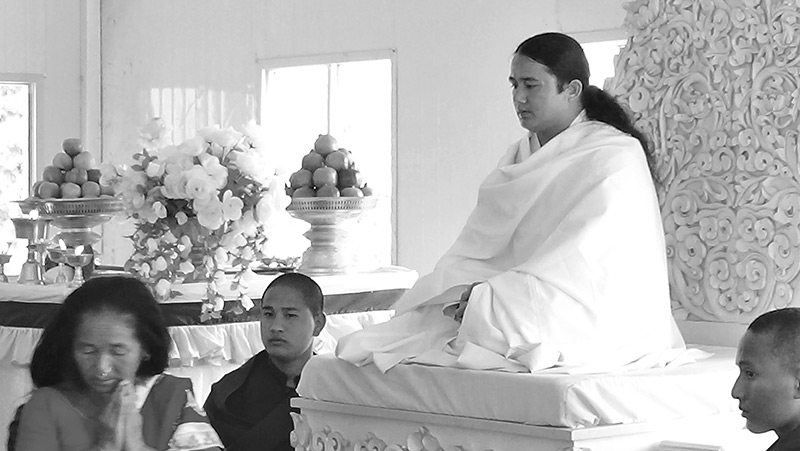
Ram Bahadur Bomjan has been accused of involvement in the disappearance of five of his followers, sexual exploitation of nuns, and violence against opponents. Post file Photo

SINDHULI,
Sindhuli District Police raided the ashram of Ram Bahadur Bomjan, also known as “Buddha Boy”, on Friday morning, but he was not found.
The raid came a day after the Sarlahi District Court issued an arrest warrant against the controversial “spiritual leader” accused of sexual violence.
“We could not find Bomjan at his ashram,” Deputy Superintendent Shyam Bahadur KC, spokesperson for Sindhuli District Police, said. However, police arrested Gyan Bahadur Bomjan, one of his disciples.
Sundar Ghising, district chairman of Bodhi Shrawan Dharma Sangh, a non-governmental organisation founded by Bomjan, confirmed that Gyan Bahadur Bomjan was arrested at the sangh’s office in Kamalamai Municipality Ward 8.
According to locals, a group from the sangh surveils the ashram and it only allows Bomjan’s followers and its members in. Sharmila Tamang, a resident of Silame, said, “The ashram has been fenced and visitors are allowed only when the sangh permits them.”
Police have decided to continue their search. “The search for Bomjan will continue until he is found,” said KC. According to him, Bomjan has been accused of involvement in the disappearance of five of his followers, sexual exploitation of nuns, and violence against opponents.
Bomjan, who started living in Paire, Kamalamai, in 2017, later built an ashram over 42 bighas (284,450.8 sq meters), of which 18 bighas (121,9078.48 sq meters) belong to Chanadevi Community Forest.
Bomjan’s former female acolytes and their families have accused the ‘ascetic’ of sexual exploitation and inflicting grave bodily harm on his followers. Bomjan allegedly used his power, influence and close aides to threaten and silence them. In 2012, Bomjan’s followers allegedly held two women hostage, one of them a Slovak national, for three months.
Chhatra Ghising, a central member of the sangh, however, said all accusations against Bomjan were baseless.

NATIONAL

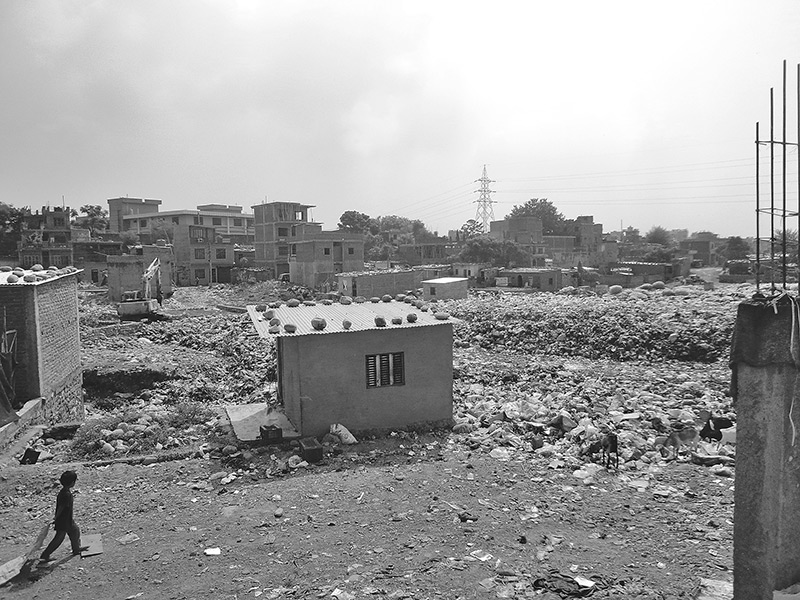
In Butwal, settlements have been built over mounds of garbage

The banks of Tinau have today turned into a haven for those who can’t afford to rent a flat in the city.
- Amrita Anmol
The settlement in Hattisudh on the banks of Tinau River. Post Photo: AMRITA ANMOL

RUPANDEHI,
For years, the Butwal Sub-metropolis has been disposing of its garbage on the banks of Tinau River for lack of a dumping site. Once a certain area of the bank is filled with garbage, it gets encroached upon, and there sprouts a settlement.
Hattisudh, in Ward No. 11 of Butwal Sub-metropolis, for instance, was a deserted area just about seven years ago, with its ground inundated by floods over the years. Then in 2015, the sub-metropolis started dumping its garbage in the area. The site is now filled with garbage with a settlement built over it.
“Wherever there’s a space covered with garbage and mud, there emerges a settlement,” said Suresh Gautam, an official with the sub-metropolis’ garbage management unit. “Currently, there’s a dearth of space to throw garbage in, as all the open spaces now have a settlement.” Five years ago, there were 20 households in Hattisudh; today, there are 135.
“We didn’t have anywhere to go, so we set up our homes here,” said Shakuntala Nepali, a local. “We used to collect recyclable wastes here, and then we made our homes.”
Nepali’s family, who hails from Pyuthan, came to Butwal in 1997.
“At first the entire area would stink,” she said. “But now we are accustomed to it.”
The banks of Tinau have today turned into a haven for those who can’t afford to rent a flat in the city.
“Since my husband is the sole breadwinner in the family, we struggle to make a living,” said Tara Sunar, another Hattisudh local who has a family of five. “The burden has eased a bit since we don’t have to pay rent these days.”
Today, the locals of Hattisudh and Pavitranagar, another settlement of 250 households established over mounds of garbage, argue the sub-metropolis should stop disposing of its waste in their burgeoning settlement. The locals of Pavitranagar have repeatedly protested against the sub-metropolis for throwing garbage in the area.
“Many settlements in Butwal were established on the banks of the river,” said Ramsingh Thapa, a Pavitranagar local. “So the sub-metropolis should refrain from throwing garbage in the settlement area.”
Meanwhile, in settlements such as Sundarnagar, the local unit has provided the residents with electricity and drinking water facilities. Sundarnagar, where only 15 labourers resided until 2005, today teems with 200 concrete houses.
Mayor Shivaraj Subedi said his office has imposed a rule that restricts the construction of new houses in Sundarnagar.
“We couldn’t stop the land encroachment until last year,” he said. “From this year on, we will not let anybody new encroach upon the public space.”
Meanwhile, Butwal today faces a crisis in garbage management. The sub-metropolis sees 53 ton of garbage per day. But protests from the locals, political wrangling, and an under-equipped local unit to deal with the problem have deepened the crisis. The construction of a permanent waste processing centre was planned 15 years ago. A five-hectare space in Shivanagar was chosen as the site for the centre. The centre was supposed to be constructed by 2015 with the aid of the Asian Development Bank. But the locals of Charange, a settlement nearby Shivanagar, protested against the centre’s construction. The locals haven’t budged, and thus, the project today is caught in a limbo. Meanwhile, the solution to Butwal’s crisis of waste management is nowhere near sight.

NATIONAL

Newly asphalted road in Jhapa develops cracks

Some sections of the six-kilometre Charpane-Narayanchowk-Jayapur road are riddled with potholes.
- ARJUN RAJBANSHI

BIRTAMOD,
The newly paved Charpane-Narayanchowk-Jayapur road in Arjundhara Municipality, Jhapa, has started to crack and locals blame the use of low-grade materials.
The newly asphalted surface did not even last for one month, said Laxmi Prasad Mainali, a local man.
“The six-kilometre road is riddled with potholes and cracks. This wouldn’t have happened if the contractor had used high-grade construction materials,” he said.
The road, which was built 58 years ago, was in a poor state due to a lack of maintenance.
According to the Infrastructure Development Office in Bhadrapur, Sah Engineering and Construction Company had won the tender to blacktop the road on July 4, 2017. According to the new deadline, the company has to complete the Rs 57.5 million project by the end of the current fiscal year.
The company had started the work only after locals piled pressure. The locals have also formed a committee to monitor the construction of the road, given the poor track record of Sah Engineering.
Pabitra Pathak, a local of Arjundhara and a member of the monitoring committee, said around 500 metres of the blacktopped road had developed cracks and potholes in the southern part of Arjundhara Dham. “The road was blacktopped at night, so we couldn’t see what kind of work the contractors did,” said Pathak.
Kundan Bhattarai, a member of Arjundhara Ward No.5 and the coordinator of the committee, said that the construction works cannot be described as “sub-standard” just yet.
“We will request the contractor company to repair the damaged road sections,” said Bhattarai.
Meanwhile, Prabin Dev, an engineer of the contractor company, claimed that some parts of the road sections were damaged due to weather conditions. “The blacktopped road has developed cracks due to cold temperature. We will maintain the quality of the road by repairing the damaged road sections,” said Dev.
The Infrastructure Development Office in Bhadrapur has also directed the Sah Engineering to repair the damaged road sections.
Ramesh Shrestha, chief at the office, said they have already directed the company to fill the cracks and potholes along the newly blacktopped road.

NATIONAL

A local unit runs nutritious food programme for new mothers

Ajirkot Rural Municipality in Gorkha launched the Maitiko Poshilo Kosheli Karyakram one and a half months ago to ensure safe pregnancy for all women.
- HARIRAM UPRETY
New mothers receive the nutritious food package that is worth nearly Rs 5,000 each in Gorkha. Photo courtesy: sumana Shrestha

GORKHA,
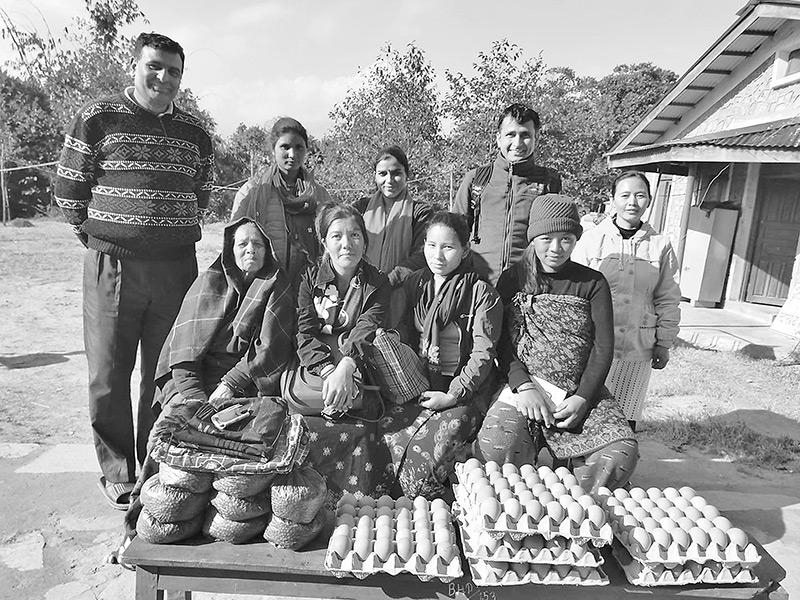
Nanuka Nepali, a resident of Gorkha, recently gave birth to her baby at Bhachchek Health Post. Earlier, the health post would conduct medical check-ups and provide counselling to postpartum mothers before they were discharged from the institution. But of late, the health post has started giving nutritious food to new mothers before they leave for their homes after delivery.
“I received one crate of eggs, a litre of cooking oil, 100 grams of thyme and 100 grams of fenugreek from the health post,” said Nepali. “The health post also gave me a Dhaka shawl.”
Ajirkot Rural Municipality launched the Maitiko Poshilo Kosheli Karyakram—a nutritious gift programme—about a month and a half back. New mothers like Nepali are happy with the municipality’s new campaign.
In the last one and a half months, 56 postpartum mothers have received the nutritious food package from various health posts in the municipality.
“The programme hadn’t started when I gave birth to my baby six months ago,” said Bhanwana Devkota of Lapisbot. “But the health post called me and gave me the nutritious food package.”
According to Devkota, the programme has encouraged pregnant women to undergo regular antenatal check-ups and give birth to their babies at health institutions.
Pregnant women who complete their third month of pregnancy and undergo antenatal check-ups at a health post in the rural municipality receive the package—which consists of a crate of eggs, one kg legumes, a nail cutter, soaps and a carry bag—worth Rs 4,500 to 5,000.  “We also provide seeds of seasonable vegetables worth Rs 100 to pregnant women when they first visit the health post,” said Sumana Shrestha, an auxiliary nurse midwife of Bhachchek Health Post.
“Pregnant women should eat plenty of green leafy vegetables. We hope this will encourage them to grow vegetables in their fields.”
According to health workers, the flow of pregnant women in the rural municipality’s health posts has increased after the programme got launched.
“This programme has benefitted women, especially those from impoverished families,” said Shrestha.
Suresh Duwadi, chief at the health section of the rural municipality, said the municipal office started the programme to prevent malnutrition in mothers and children.
“We don’t have the exact number of malnourished children in the rural municipality, but we are now collecting data for future use,” said Duwadi.
The rural municipality expects around 200 pregnant women to visit its health facilities to undergo antenatal check-ups in the current fiscal year.
“We have allocated Rs 1 million for the distribution of nutritious food for pregnant women,” said Duwadi.  
Pregnant women have to undergo antenatal checkups at certified birthing centres at Ghyachchok, Khairbot Bhachchek, Simjung Baluwa and Bhachchek in order to receive the package.
“The rural municipality will ensure safe pregnancy for all women,” said Duwadi.

NATIONAL

Post photojournalists awarded in photo competition

- Post Report

KATHMANDU,
Elite Joshi and Keshav Thapa, photojournalists of the Post,
won the second and third prize in the news category in this
year’s Nepal Photo Competition organised by Photo Journalist Club Nepal.
Joshi’s photo of a woman embracing a young boy, both united in their grief after a massive storm had blown apart their hut in Bara in March 2019, won the second prize in the news category.
Thapa won the third prize in the same category for his photo of a signature campaign demanding justice for Nirmala Pant, who was raped and murdered, in July 2018,
in Kanchanpur.
Navesh Chitrakar won Photo of the Year for his photograph of a two-year-old child suffering from hydrocephalus saying goodbye to his mother just before his death.
Chitrakar also won the first prize in two other categories and the third in another category.
Bikas Karki, chairman of the Photo Journalist Club Nepal, said he was encouraged by the overwhelming participation at the seventh edition of the competition.

NATIONAL

Rs 410 million for People’s Housing Programme

Briefing
- Post Report

HETAUDA: Bagmati Provincial Government has allocated Rs 410 million for the People’s Housing Programme in the running fiscal year. The government has separated budget to build houses for the impoverished and marginalised communities in 10 districts of the province.

NATIONAL

National biodiversity conference starts in Biratnagar

Briefing
- Post Report

MORANG: The government of Province 1 has started a two-day national biodiversity conference in Biratnagar. According to officials, the conference, which kicked off on Thursday, will discuss various integrated biodiversity conservation methods.

NATIONAL

CIAA raids Namobuddha Municipality Office

Briefing
- Post Report

KAVRE: A team of the Commission for the Investigation of Abuse of Authority raided Namobuddha Municipality Office on Friday. The team raided the office after news of irregularities of natural resources and mines surfaced on the media. According to news reports, the municipality officials had done irregularities while exporting and selling riverbed materials.

NATIONAL

Order to clear encroached land

Briefing
- Post Report

RAMECHHAP: Doramba Rural Municipality issued a public notice on Friday ordering illegal settlers to evict Manedanda within 35 days of the notice. According to Dipendra Regmi, chief administration officer of the rural municipality, locals have encroached upon the public land of Manedanda and constructed houses and huts.

NATIONAL

Girl dies in a leopard attack

Briefing
- Post Report

POKHARA: A nine-year-old girl was killed in a leopard attack at Koshegaun in Pokhara Ward No. 32 on Thursday night. Puja BK was playing with a friend outside her house when the leopard attacked her and took her to a nearby jungle. The body of the deceased was found near her house with a neck injury, said Narayan Prasad Pandit, a resident in Koshegaun.

Page 6
MONEY

Fearing Huawei curbs, Deutsche Telekom tells Nokia to shape up

The company has dropped Nokia as a provider of radio gear from all but one of its dozen markets in the region.
- REUTERS
Signal strength of Deutsche Telekom 5G is displayed on a mobile device at the IFA consumer tech fair in Berlin, Germany. reuters 

BERLIN, 
Deutsche Telekom has told supplier Nokia it must improve its products and service to win business installing the German group’s 5G wireless networks in Europe, according to internal documents and a source with direct knowledge of the matter.
Europe’s biggest telecoms operator has dropped Nokia as a provider of radio gear from all but one of its dozen markets in the region, according to the source and the documents—briefing notes for top Deutsche Telekom management reviewed by Reuters.
The documents—written by the vendor management team for internal meetings and talks with Nokia between July and November last year—also show the German group considered Nokia the worst performer among all suppliers in 5G tests and deployments.
But faced with the threat of restrictions on China’s Huawei—its dominant supplier of network equipment—Deutsche Telekom has decided to give Nokia another chance to mend their relationship, according to the documents and the source.
A briefing note for a meeting between Deutsche Telekom managers and Nokia Chairman Risto Siilasmaa in mid-November said “assurances have been received” from the Finnish company, without giving details.
The clock is ticking. Deutsche Telekom team leaders are due to present an updated strategy for sourcing network gear from vendors to the board after the Mobile World Congress, an annual telecoms industry gathering in Barcelona at the end of this month, according to the documents and the source, who was not authorised to speak to the media and so requested anonymity.
Deutsche Telekom’s willingness to give Nokia another hearing shows the difficulties mobile companies face over pressure from the United States on its allies to ban Huawei from their 5G networks. Washington alleges Huawei’s equipment can be used by Beijing for spying—a charge the Chinese firm denies.
With Deutsche Telekom foreswearing new deals with Huawei, according to the documents, it is increasingly relying on the only other big telecoms supplier, Sweden’s Ericsson, which is spreading its footprint in southeastern Europe.
The documents also provide a window into the troubles facing Nokia, which issued a profit warning last October that sent its shares down by a third. Nokia mainly blamed setbacks in sourcing new chipsets for 5G radio transmission systems.
Asked about relations with Nokia, Deutsche Telekom said it would not comment in detail about talks with vendors, but added Nokia was an important European producer of network equipment.
“As we have often said, we are pursuing a multi-vendor strategy in order not to rely on a single supplier,” the German firm said. “This is a vital element of our security philosophy.”
Asked about the criticisms in the Deutsche Telekom documents, Nokia CEO Rajeev Suri declined to comment on specifics but said its relationship with the German company was strong.
“We have a long and proud history with Deutsche Telekom—they are one of our most significant customers, both in Europe as well as the US,” he told Reuters after Nokia reported a surprise fourth-quarter profit on Thursday.
A Nokia spokesman declined further comment.
Deutsche Telekom once relied equally on Huawei and Nokia for radio access network equipment—antennas and base stations that account for most of the cost of a mobile network—in Germany.
But in 2017 Nokia was dropped entirely from that market segment when Ericsson was handed a 30 percent share of Deutsche Telekom’s spending on it, reports in the trade press said at the time. It was the first of several wins for Ericsson.
Three sources with direct knowledge of the matter said Deutsche Telekom reached an advanced stage in talks late last year to keep Huawei as its dominant supplier in Germany, with 70 percent of the investments in upgrading to super-fast 5G networks.
Ericsson would keep its 30 percent share.
Deutsche Telekom then suspended vendor talks to await the outcome of a debate in Berlin over the security of critical national networks, where senior lawmakers from Chancellor Angela Merkel’s conservative party back the US call to bar Huawei.
Were Germany and other European countries to follow Britain’s recent decision to cap Huawei’s share of network spend at 35 percent, Deutsche Telekom would face serious challenges, the source with direct knowledge said.
Despite Deutsche Telekom’s desire for multiple suppliers, however, Nokia faces a battle to win back the German group’s trust, the documents show.
In an all-day meeting last July 11 at Deutsche Telekom’s headquarters in Bonn, Nokia’s CEO was to be told that its responsiveness and performance were still lower than those of its competitors, and that it “must step up”, according to a briefing note prepared for Deutsche Telekom CEO Tim Hoettges.
Nokia’s 5G product was inferior to all other suppliers, and negotiations were complex and drawn-out for every single project, the note stated.
Presented in bullet-point format or as slides, the notes provide high-level talking points for top bosses, but do not identify specific Nokia products or services.
While they are part of the cut and thrust of negotiations between buyers and sellers, the concerns raised appear to be backed up by Deutsche Telekom’s recent dealings with Nokia.
The German group’s annual purchases from Nokia across Europe and the United States fell by half to 1.5 billion euros ($1.7 billion) between 2016 and 2018, a presentation to the executive board in mid-October shows.
Late last year, Deutsche Telekom also dropped Nokia in Croatia and Greece, the source with direct knowledge said.
That left Poland as the last European country where Nokia is present, in the network shared by the local units of Deutsche Telekom and France’s Orange, according to an undated strategic overview of the German group’s vendors.
A 5G vendor decision in Poland is pending. A spokesman for Orange, which has picked Nokia and Ericsson to build its French 5G network, said the Polish tender was still open.
Nonetheless, on Oct. 15—nine days before Nokia’s profit warning—Deutsche Telekom’s executive board backed a recommendation from team leaders to give Nokia another chance, the source with direct knowledge of the matter said.
“Deutsche Telekom needs Nokia as competition to Ericsson in case of geopolitical issues,” the team leaders wrote in their presentation, in perhaps an oblique reference to Huawei.
South Korea’s Samsung, a new entrant into the networks business, could only play a meaningful role in the medium term, they added. Samsung did not respond to requests for comment.

MONEY

Europe’s top economies falter as new virus clouds outlook

- AGENCE FRANCE-PRESSE
Cars wait to be shipped at the harbour in Bremerhaven, nothern Germany. afp/rss 

FRANKFURT AM MAIN,
Tumbling industrial production in Germany and France in December rounded off a year blighted by trade war tensions for Europe’s top economies, official data showed on Friday, while the novel coronavirus outbreak threatens hopes of a 2020 revival.
Growth in both nations sputtered in 2019, with output actually shrinking for Germany in the April-June quarter and for France in October-December.
German growth overall slowed from 1.5 percent in 2018 to just 0.6 percent in 2019, according to preliminary data, while France did better but still slipped from 1.7 to 1.2 percent.
In December, manufacturing output was down 3.5 percent month-on-month in Germany and off 2.8 percent in its western neighbour.
In Germany, “there are very few positive elements to find in the December industrial data,” ING bank economist Carsten Brzeski said, adding that the figures point to Europe’s top economy having shrunk in the fourth quarter.
In the final months of last year, there was still widespread uncertainty about whether the US and China would bury the trade hatchet, after months of tough negotiations and tit-for-tat tariffs.
Figures released Friday showed Germany’s trade surplus—the amount exports outweigh imports—shrank slightly from 228 billion euros ($250 billion) in 2018 to 224 billion euros in 2019.
The US and China last month signed a “phase one” trade pact, designed to ease the commercial tensions whose knock-on effects last year battered European manufacturers.
Meanwhile Britain’s departure from the European Union—pushing the risk of a fresh “no deal” cliff-edge back to December—also helped brighten the mood.
More positive “soft” indicators like German business sentiment surveys in Germany have prompted some analysts to see clearer skies ahead for manufacturers.
Despite December’s data, “forward-looking indicators continue to point to a modest cyclical rebound in the near term,” said Frederik Ducrozet, strategist at Pictet Wealth Management.
With Brexit and trade tensions less prominent for now, two of the main risks to growth cited by institutions like the European Central Bank have ebbed. Against that backdrop, “the coronavirus comes at a particularly bad moment,” BNP Paribas analyst William de Vijlder said.
“The global economy was showing tentative signs of a growth pick-up and, in all likelihood, this momentum will now be stopped or even reversed”.
Global efforts to contain the coronavirus will likely brake activity at companies around the world for whom China is a vital link in global supply chains—including Germany’s massive car industry.
Given that, “we doubt this will be the last of the run of negative quarters,” said analyst Andrew Kenningham of Capital Economics.

MONEY

US activist fund takes ‘substantial’ stake in Japan’s SoftBank Group

- AGENCE FRANCE-PRESSE

TOKYO,
A major US activist fund on Friday confirmed a “substantial investment” in Japan’s SoftBank Group, boosting the stock of the giant technology investor.
“Elliott’s substantial investment in SoftBank Group reflects its strong conviction that the market significantly undervalues SoftBank’s portfolio of assets,” said a spokesperson at the US fund.
“Elliott has engaged privately with SoftBank’s leadership and is working constructively on solutions to help SoftBank materially and sustainably reduce its discount to intrinsic value,” the spokesperson added.
The comment came after The Wall Street Journal reported Elliott Management had quietly built up a more than $2.5 billion stake in SoftBank.
That would account for nearly three percent of the group’s market value, which stands at $95.5 billion on Friday.
Without confirming Elliott’s investment amount, the Japanese group also said its stock price was “deeply undervalued”.
“SoftBank always maintains constructive discussions with shareholders regarding their views on the Company,” it said in a statement.
“We are in complete agreement that our shares are deeply undervalued by public investors. SoftBank welcomes feedback from fellow shareholders,” it said.
SoftBank Group shares jumped on Friday, gaining more than six percent by midday.
The news of Elliott’s investment “helped spread an evaluation (among investors) that the stock is cheap considering assets the group holds,” said Makoto Sengoku, market analyst at Tokai Tokyo Research Institute.

MONEY

Uber loses $1.1 billion investing in food delivery

- ASSOCIATED PRESS

NEW YORK,
Uber is still losing money as it expands its food delivery business and develops technology for driverless cars.
But revenue for its rides business nearly tripled in the final three months of last year as the company picked up more passengers around the world. That prompted it to say it will turn a profit earlier than it expected.
The San Francisco-based ride-hailing giant lost $1.1 billion in the fourth quarter of 2019, about 24 percent more than the same time last year. The loss amounted to 64 cents per share, which was slightly better than what analysts were expecting. Analysts polled by FactSet predicted Uber would lose $1.18 billion, or 67 cents per share, during the quarter.
Uber brought in $4.1 billion in revenue, up 37 percent from a year ago. Its revenue grew around the world, although the biggest gain was in the US and Canada, where it pulled in 41 percent more than last year.
Because of the company’s progress in 2019 and its plans this year, Uber expects to turn a profit in the fourth quarter of 2020, CEO Dara Khosrowhsahi said in a conference call with investors. That’s sooner than the projection during the last earnings call when he said the company would turn a full-year profit in 2021.
Khosrowshahi called 2019 “a transformational year for Uber.”
“We recognise that the era of growth at all costs is over,” he added.
Uber’s Eats business lost $461 million in the quarter before accounting for interest, taxes, depreciation and amortisation, down 66 percent from the same time last year as Uber poured money into growing the business in a highly competitive food delivery market.
In January, Uber sold its Eats business in India to Zomato, a popular food app, a move that its executives hope will stem some of the losses.
“Right now, the Eats business has had a tornado-like impact on profitability,” said Dan Ives, managing director of equity research at Wedbush Securities.
In the US, Uber has been focused on improving restaurant selection and has almost 400,000 restaurants on the Eats platform, up 78 percent on a year-on-year basis, Khosrowshahi said.
The fourth quarter was marked by painful disclosures at Uber. In December, it released a long-awaited report, in which its riders reported more than 3,000 sexual assaults during 2018. The same month, it agreed to pay $4.4 million to end a federal sexual harassment probe about its internal corporate culture.

MONEY

EU trade chief Hogan returns to Washington as auto tariffs loom

- REUTERS
European Trade Commissioner Phil Hogan. reuters 

BRUSSELS/WASHINGTON,
European Trade Commissioner Phil Hogan returned to Washington on Thursday for talks with US counterpart Robert Lighthizer designed to improve transatlantic ties as the threat of auto tariffs looms.
Hogan first visited the United States as EU trade chief three weeks ago, declaring at the time that the European Union’s bid to reset EU-US economic relations had got off to a good start.
However, US President Donald Trump said after meeting European Commission chief Ursula von der Leyen in Davos a week later that he would impose tariffs on imports of cars from the European Union if no trade deal were struck.
US Treasury Secretary Steven Mnuchin told Fox Business Network that reaching an agreement with the EU on agriculture and other issues was a priority for the Trump administration.
He said Trump’s policies had already led to increased European investment in the United States, another key priority.
“We’ve already seen a tremendous amount of investment by the European automakers into the US and building factories here,” he said. “That’s also part of the agenda and that is working.”
Hogan had been due to address a conference on the digital economy in Brussels on Thursday morning, but abruptly changed his plans.
A European Commission spokesman said Hogan would hold talks in Washington with a number of US administration officials, including Lighthizer.

Page 7
MONEY

Connectivity in South East Asian countries could serve lesson for South Asia

Efforts to integrate South Asia have failed to yield results due to antagonistic relations between India and Pakistan.
- PRITHVI MAN SHRESTHA
Panellists speak during a discussion on the theme ‘Lessons from the East’, at the Kantipur Conclave in Kathmandu, onFriday. Post Photo: Elite Joshi

KATHMANDU,
Massive integration and connectivity of South East Asia despite differences over the last decade should serve lessons to Nepal and South Asia, said panellists at the Kantipur Conclave on Friday.
South Asia is one of the least connected regions in the world, according to the World Bank, with intraregional trade being one of the lowest in the world and accounts for about only five percent of the region’s total trade.
“About 10 years ago, they were discussing the theme of connectivity,” said Gwen Robinson, Editor at Large of Nikkei Asia Review, a journal focused on Asian economies. “Since then, infrastructure projects related to connectivity exploded with funding from different agencies. Nepal and South Asia should look into it.”
She said that despite having their independent agenda, they went ahead of a lot of regional cooperation mechanisms. “The binding glue for them was the Association of Southeast Asian Nations,” she said during the discussion on the theme ‘Lessons from the East.’ Efforts to integrate South Asia have failed to yield results due to antagonistic relations between India and Pakistan.
So, the Saarc Summit, a meeting of top leaders of South Asian nations, planned for November 2016 in Pakistan was cancelled and has not taken place yet. “Non-cooperation is a major problem in South Asia compared to South East Asia,” said Robinson.
To increase connectivity, Southeast Asian nations have taken both regional and sub-regional approach. “Mainland Southeast Asian nations created Greater Mekong Sub-regional Group, giving rise to a lot of cross border planning and dealing in the areas of customs and duties and establishment of special economic zones in bordering regions,” said Robinson.
In South Asia too, there has been some effort to focus on sub-regional cooperation such as the informal grouping of BBIN (Bangladesh, Bhutan, India and Nepal), but even that has not bore fruit.
Despite low connectivity, speakers say there is a scope for increased connectivity in South Asia.
Sharing his experiences when the power secretaries of Nepal, Bangladesh, India and Bhutan met in 2014 to discuss establishing connectivity in the power sector, Valentino S Bagatsing, president and chief executive officer of ICCP, said that these countries could work together to connect each other with power lines.
“They can also lay fibre optics and take advantage of the digital industry,” he said.
But, panellists agreed that country to country connectivity alone is not enough to boost the economy and stressed that internal connectivity should also be increased.
“For example, there is a more decentralised drive for infrastructure development compared to South East Asia,” said Neeta Pokharel, unit head, project administration, South Asia Urban and Water Division at Asian Development Bank. “India has the capacity to be self-reliant at the local level, unlike Nepal.”
She stressed on the need for local governance reforms and incentivising them for carrying out reforms. “Let the local governments compete with each other in bringing reforms,” she said.

MONEY

Boeing’s fraying 737 MAX suppliers see capacity crunch

- REUTERS
A train transports a Boeing 737 fuselage near Bozeman, Montana, US. reuters

WASHINGTON,
Boeing Co suppliers are shedding jobs and capacity to cope with a halt in 737 MAX output, but while that staves off chaos, aerospace executives worry the industry might be unable to ramp factories quickly enough when the plane wins approval to fly again.
Boeing, struggling to restore public confidence and recover from the biggest crisis since its founding in 1916, has halted production of the once fast-selling 737 MAX, which was grounded in March following two deadly crashes.
As a result, industrial heavyweights like fuselage maker Spirit Aerosystems have already laid off workers.
Now a cluster of other crucial companies small and big that forge metal, assemble and paint 737 MAX winglets, and build data systems have followed suit with no indication that Boeing will offer a lifeline, people familiar with the matter said.
Losing payments and workers in a tight labour market heaps pressure on Boeing’s US-dominated 737 MAX supply chain, which involves hundreds of suppliers of more than half of the roughly 400,000 parts for each 737 built in the Seattle-area.
“One of the main questions is how much capacity will be lost in the supply chain by the time production resumes at significant rates,” said an industry executive with knowledge of Boeing’s industrial network.
Such concerns dominated the Pacific Northwest Aerospace Alliance conference north of Seattle this week, where some executives vented frustration over what they called Boeing’s lack of financial support.
One executive from a supplier that derives a quarter of its business from the MAX said Boeing has treated his company like “a commodity” in a “transactional” relationship. He predicted Boeing would let some suppliers fail. The executives spoke to Reuters on condition of anonymity.
Relations had already been strained following a longstanding tug of war over profits. Boeing is pushing suppliers to cut prices or give up part of the lucrative after-sales market for parts and repairs, the focus of its own competing services unit.
“We are working closely with (suppliers) to manage risk, address hardships, and ensure their ability to support a resumption of production,” Boeing spokesman Bernard Choi said.
Much depends on how quickly Boeing resumes output. Haunted by the experience of McDonnell Douglas, which it absorbed in 1997, Boeing would not want to wait too long before biting European rival Airbus SE’s heels and regaining a roughly equal share of deliveries.
But it must avoid swamping airlines and overstretching suppliers by raising output too far, too soon.
Mooted scenarios include a gradual return to the pre-grounding rate of 52 single-aisles monthly in 2022, with plans to boost production higher in 2023—a four-year delay.

MONEY

World stock markets retreat after surge on China tariff cut

- ASSOCIATED PRESS

NEW YORK,
Global stock markets retreated Friday as France and Germany reported weak factory data and the death toll from a virus outbreak in China rose further.
Germany’s DAX lost 0.3 percent to 13,533.51 while the CAC 40 in Paris was flat at 6,037.65. Britain’s FTSE 100 gave up 0.2 percent to 7,487.97. On Wall Street, the future contracts for the S&P 500 and the Dow Jones Industrial Average both fell about 0.1 percent.
Germany reported new manufacturing orders fell 2.1 percent in December and industrial production dropped 3.5 percent from a year earlier while France reported factory output fell 2.8 percent, adding to concerns over slowing growth in Europe.
Investors are looking ahead to US employment figures due out Friday.
Markets got a boost Thursday after Beijing said it will cut duties on $75 billion of US goods as part of a trade truce with Washington. Wall Street closed higher for a fourth day, propelled by gains for technology stocks and strong corporate earnings reports.
China’s tariff cut “boosted sentiment,” though “gains were tempered by continued concerns around the impact of the coronavirus outbreak,” Mizuho Bank said in a report.
Beijing is also promising tax cuts and other help to businesses in a bid to offset the economic blow from the virus outbreak that has put the world’s second-largest economy on lockdown. The extent of potential losses is unclear.
On Friday, there were 31,400 people confirmed infected by the virus worldwide. China confirmed 31,161 cases and 636 deaths as of Friday. More than 310 cases have been confirmed outside mainland China, including two deaths in Hong Kong and the Philippines.
Still, Chinese factories and offices are starting to reopen following an extended Lunar New Year holiday, but companies are forecasting big revenue declines due to the closure of stores, amusement parks, cinemas and other businesses.
Beijing’s tariffs reductions, which follow US cuts last month on Chinese goods, are part of a “Phase 1” trade agreement with Washington aimed at ending their fight over China’s technology ambitions and trade surplus. There was no indication China altered its cuts in response to the virus outbreak, but the surprise announcement helped to buoy market sentiment.
Hong Kong’s Hang Seng index fell 0.3 percent on Friday to 27,404.27, while the Shanghai Composite Index rebounded, gaining 0.3 percent to 2,875.96.

MONEY

Quality watchdog cites 13 cement and steel factories for violations

The Nepal Bureau of Standards and Metrology has released its report for the first half of the current fiscal year.
- KRISHANA PRASAIN
A worker prepares to carry a sack of cement on his back. Post file Photo

KATHMANDU,
The government’s product quality watchdog cited 13 cement, iron and steel factories for cheating consumers by producing and selling substandard products.
According to the report of the Nepal Bureau of Standards and Metrology for the first half of the current fiscal year, the products of Shree MJP Cement, Goenka Cement, Sarbottam Cement, Brij Cement, Shree Hongshi Shivam Cement, United Cement, Shalimar Cement and Reliance Supertech Cement do not meet quality standards.
Shree Bageshwari Iron and Steel, Ambe Steels, Godavari Steels, Goenka Steels and Ashok Steel were also cited for the poor quality of their products.
The quality watchdog said Shree MJP Cement and Hongshi Shivam Cement had been named during last year’s inspection too.
Hongshi Shivam Cement, Nawalparasi was named over setting time issues. According to the report, the initial setting time of concrete, the time when the cement paste starts hardening, should be 45 minutes; but its ordinary Portland cement was found to be setting in 30 minutes, the report shows. The bureau has asked the company to furnish a clarification in 15 days.
The insoluble residue level of the Portland pozzolana cement produced by Shree MJP Cement of Kapilvastu was found to be 29 percent in violation of Nepal Standard 385. The bureau has ordered the cement company to recall its entire batch produced on July 22, 2019. It has been asked to submit a clarification.
According to the report, the compressive strength of the Portland slag cement produced by Goenka Cement of Rupandehi was measured at 14 Mpa against 16 Mpa max as per Nepal Standard 384. The company has been asked to submit a clarification.
The cement produced by Brij Cement of Rupandehi was found to have a compressive strength 21 Mpa when it should be 22 Mpa. The company has been given 15 days to submit a clarification.
The compressive strength of the cement produced by Shalimar Cement of Bara was recorded at 15 Mpa when it should be 16 Mpa.
The cement had a magnesium oxide level of 6.7 percent which should be 6 percent maximum. The company
has been given 15 days to submit a clarification.
The Dunlop PSC cement of Reliance Supertech Cement, Bara was found to have a compressive strength of 14 Mpa after a sample test of three days. The company was asked to submit a clarification within 15 days.
Ambe Steels, Rupandehi has been cited for selling 7 mm steel without taking Nepal Standard approval.
The bureau said a bend test of the products of Goenka Steels, Rupandehi showed they fell short of Nepal Standard 191. The steel bars produced by Ashok Steel of Bara had elongation of 11.67 percent when it should be 12 percent.
Bishwo Babu Padasaini, director general of the Nepal Bureau of Standards and Metrology, said improvements had been seen in cement manufacturing companies compared to previous years. “We expect continuous improvement; and for that, inspection needs to be done in a strong way,” he said.
There is still lack of a well-equipped lab and manpower while the number of factories has risen; and as a result, conducting market inspections on a regular basis is difficult, he added.
Dhurba Thapa, president of the Cement Manufacturers Association of Nepal, said that having a high chemical level was not a problem, but it should not be below the specified level.

Page 10
CULTURE & ARTS

The Karma as a film is unredeemable. And Paramita could do better.

The Post’s film critic writes an open letter to actress Paramita RL Rana after watching her latest film.
- ABHIMANYU DIXIT
screengrab via youtube

Editor’s note: This review contains spoilers. Please read at your own risk.

Dear Pam,
I write film reviews and this week it was your film I was set to review. I usually watch Nepali films over the weekend, take notes whilst in the theatre, prepare multiple drafts over the following week, and submit the piece to my editors before Friday to publish on Saturday. That way, I can write a detailed review without hampering the film’s business.
While working on the second draft of my review for your new film, I realised I didn’t have a single good thing to say. And, honestly, The Karma is probably the worst film I’ve watched in recent times. Now this put me in a tight spot: what would I write? That the film is a waste of time and an insult to the audiences? Or you should only recommend this film if you want to torture someone?
The film is unredeemable. But Pam, you, I believe, can do better and hence this letter.
You see, I was introduced to your social media by my niece around five years ago. She was 16 then, and apparently you were nice to her. You followed her back on Instagram. You weren’t doing films then; you were a fashion model but steadily gaining popularity on social media.
I learned that teenagers find you beautiful and talented, and that you have this persona that makes them feel like they have a personal connection to you. Now, to be honest, back then, I didn’t really understand why someone would exhibit their daily affairs on social media and neither did I understand why someone would care to watch. But my niece taught me how you were bravely following your passion, regardless of what people like me thought of it.
Then I understood how in a society like ours, where girls are taught to follow rules and are constantly being told what they can and can’t do, you living life on your terms was empowering to young girls. With time, I learned that you had immense power to steer online conversations. I also understood that you’re working in this age of social media where you get instant love and immense hate at the same time. And you have to be strong enough in the head to deal with both. For me, this is a virtue to learn in the social media atmosphere. This virtue is exemplary, especially for your followers—young impressionable teenagers like my niece.
But then, you also do films, and somehow the characters you choose are major disappointments. I’ve watched two other films of yours: Changa Chet (2018), where you play a trophy for one of the male characters, and A man from Kathmandu (2019) from which I remember a dialogue of yours where you ask if the male character is rich. Both the roles in your previous films are utterly regressive and unfit for the kind of person your followers believe you to be. In this film, The Karma, you play Ambika Devi. Here’s how I’ve understood your film’s story and characters.
Ambika Devi is the second wife of a dead feudal lord. She likes to spend her time reading books and donating things to the villagers. She has two subordinates—Pratap, played by Buddhi Tamang, and an unnamed character played by the director, Dev Kumar Shrestha. All of them live in the same house and both men lust over Ambika. She also has a step-daughter Nisha (Sangita Napit) who is the object of desire for Bijay, played by Jay Raj Roy, also the writer and producer for the film. There are other producers in the film, but I’m going to assume he’s the most important because the screen literally pauses for longer when his name appears.
The film begins with Bachan, played by Karan Varma, who has trouble speaking Nepali and therefore very conveniently he is said to live in India. He comes to Nepal to find his missing sister, but runs into a group of women Ninja revolutionaries whose leader is played by Neeta Dhungana. The two worlds meet in the film when the Ninja women kill one of Ambika’s servants.
As convoluted as the story sounds Pam, your character is even worse. In the beginning of the film, Ambika is a victim. Violence troubles Ambika and she’s seen deeply disturbed at the sight of a murdered servant. She needs to sleep off her torture. When she lies down, Pratap stays close to her, and ogles at her bosom. This shot can also be seen in the awful trailer. In another scene, when Ambika is in her room and straightening her saree, Pratap comments on her appearance, after which she calls herself a bird trapped in a cage.
However, before the end, we learn that Ambika is actually playing the victim card. She is an evil seductress who has been working with Pratap this whole time. I was baffled, but not in a good way because we are never provided with a justification of the character flip. Multiple times Ambika is shown reading the same book.
Maybe the answers were in that book? Or maybe the makers wanted to prove to us that Ambika is a reader? Who knows. There are too many potholes and inconsistencies in the film to write in one single letter, Pam.  
To give the filmmakers some credit, I felt like I understood their intention of adhering to a certain theme in the film. The film is about the rich versus poor in a village. This is a universal theme which is also explored in the recent South Korean Oscar nominated film Parasite, by Bong Joon Ho, which I recommend you watch if you haven’t already. While Parasite uses visual metaphors, depth in screenplay and characters to convey the same theme, your film is a badly done ’80s Bollywood cliché. The screenplay is lame, convoluted, and stereotypical at the same time. As an actor, it is imperative to have script sense, Pam. And by the looks of your filmography, you desperately need a script reader who can tell you the right script from the wrong ones.
I can understand why Buddhi Tamang and Neeta Dhungana did this project. They’ve gained a reputation of doing any project offered to them. And also, I’m sure it’s a steady paycheck. And I respect the fact that this is the only thing they know how to do. But I don’t know why you chose to do this film. Why is a contemporary social media influencer, who has such inspiring and progressive messaging in her captions, in this awful film, despite all the obvious red flags?
And there are multiple red flags. During script reading: Multiple rhyming dialogues in the script. During acting workshop: The lip-sync song ‘Bazaar Lagya Cha, Jawani Ko Bazaar Lagya Cha’ which literally translates to youth is for sale here. A more obvious red flag was your co-actor Jay Raj Roy, who conceived the story and invested the money to act in a film, and everyone else participated. Another red flag should’ve been Rameshwor Karki’s cinematography where slow motion shots don’t really match with the action sequences. And Dev Kumar Shrestha’s directing should’ve been a major red flag too. His actors are either performing too loudly or really quietly. While Neeta Dhungana and Buddhi Tamang were over-performing, other co-stars, like Roy and Verma, weren’t even able to deliver dialogues. And you Pam, it felt like you played the whole role with a single expression on your face.
Why did you do this role? Was it because Ambika came from wealth and privilege and you could relate to her? Was it the lure of playing a villainous character—no matter how underdeveloped and one dimensional she was? Or was it because you got to perform a matrix flip to dodge a hurled earthen pot? Or was it because the makers gave you your own stylist? Mahima Uday Sunder has made you look the part, but dear Pam, unlike Instagram,
films are not still photos and looks are never enough to sustain a character.
Now Pam, you can either take this criticism or you can defend your actions and that’s completely your choice to make but you can’t get away with doing such dumb roles, not for long. The young audiences who come to see you are smart and through the very phone they use to like your posts on social media, they are also able to watch world cinema. Your glamorous lifestyle and photos might be freely accessible but they have to pay for the tickets and you can’t fool them.


The Karma
Starring:    Paramita RL Rana, Neeta Dhungana, Buddhi Tamang
Director:    Dev Kumar Shrestha

CULTURE & ARTS

A Nepali artist traces her cultural identity through photography

Born in Dharan and raised in the UK, this artist’s work combines contrasting themes from her childhood.
- TULSI RAUNIYAR
Sujata Gurung, the UK-based artist.

Twenty-five-year-old Sujata Gurung’s photographs exude a certain confidence. Her bold subjects, who swirl and dash every way in the pictures, evoke a sense of timelessness and ephemerality; the cool undertones conjure up a striking effect on her audience. And although each picture is unique, they are all unified, in theme and style.
Born in Dharan and raised in the UK, Gurung is a visual artist currently based in the UK, who from a young age was subject to two contradicting cultures. “I was born in Nepal but moved to the UK very young; there, I experienced an identity crisis,” she says. Her multicultural upbringing greatly influenced her, she says, and that is what brought about Pahichan, her Instagram page where she artfully displays the coming together of Western cultural motifs that are tied to the Nepali spirit—the coming together of her own two distinct cultural identities in a subtle way.  
“I always knew I wanted Nepali elements for my project. I was looking up at other diaspora artists and I wanted to infuse heritage in my work the way many others have,” she says.
Through the ensemble of less than a hundred posts, Gurung effectively displays her unique blend of western and eastern elements through fashion and photography. The photographs have subjects clad in outfits that are unconventional, which attracts viewers, but what draws you in is her compelling visual storytelling. “The works in Pahichan reflects a mix of ‘Nepali-ness’ with Western techniques in presentation,” Gurung says.

Gurung’s photographs artfully blends Western cultural motifs with a bold Nepali spirit. Photos courtes: sujata gurung


Gurung strongly believes for a visual artist to be successful in connecting with their audience, the artist’s persona needs to be reinforced through their work. That is why, she adds, her work centres around creating a parallel between the East and the West.
“Growing up, there was a part of me that wanted to dress up like the way my subjects have been. But I have always been conscious, so I used the models as a prop to how I wanted to be seen,” she says.
A graduate in fashion photography, Gurung says she isn’t yet technically adept in handling a camera. “I call myself a visual artist but I don’t only focus on cameras. I use an analogue camera, and most of the photographs are captured hand-held,” she says.
The composition and lighting of the imagery, where Gurung’s subjects appear almost as if lit by stage lights, is the result of her innate fascination with the people she photographs and how they are different from each other. “I am pulled to capture the subtle individuality within each subject and their culture,” she says.
Most of Gurung’s subjects are women in languid poses and unbound clothing. She believes such imagery embodies the exoticised multifaceted identities that exist among  women, especially Nepali women, and is a testament to how perceptions of beauty standards are misrepresented and reduced to one-dimensional tropes of women in the Nepali society. “In the Nepali fashion industry, there is a predominant scale of beauty standards. I chose to go against it,” she says.
“I get inspired by seeing people from diverse cultures. I have been blessed to travel to many different countries and every culture I have witnessed just becomes an inspiration, which is why I find myself mostly doing portraits,” she says.

Gurung’s photographs artfully blends Western cultural motifs with a bold Nepali spirit. Photo courtesy: sujata gurung


Initially, the idea behind Pahichan was strictly female identity but it evolved to include wider sphere. “I wanted to shoot people who are not afraid to be themselves. People who are bold, who stand up for themselves and are exploring their identities. That’s the message I want to give to the Nepali people—to be yourself,” says Gurung. But her art isn’t limited to cultural identity. Pahichan endorses some faces from the LGBTIQ+ community as well, and that she will be showcasing her work with them in her upcoming exhibition, which is going to be held in September, either in Nepal or the UK.
“This exhibition is going to be an opportunity for me to not only learn about ourselves, but also other norms of our society, and to appreciate other points of view,” says Gurung.

Page 11
AS IT IS

We are conversation

You always came to me for conversations. You knew that was all I ever had, to offer. And that’s exactly why you came around this time as well.
- Prateebha Tuladhar
unsplash

When we hug, your arms always come around in a loop at the small part of my back. Mine encircle your shoulders.
..............
Your shoulders haven’t changed much, but you no more hold me with the awkward confidence of a teenager. Your arms still come around in a loop at the small of my back. Mine intertwine around your shoulders.
............
Your shoulders expanded into wings and enclosed around me. And perhaps I imagined: you held me with a reluctance to let go.
That was the last time I saw you.
In the minutes that followed, my life would forever alter. And you would move on, unaffected.
You had insisted on taking the long way home. I refused. We were already much closer than I had preferred and I didn’t want to allow either of us any excuse to close in on that remaining distance.
Allowing you to give me a ride home would mean driving around town, exchanging additional sentences and glances, and then another parting hug. And who knows what such a moment might have taken out of us? It might have sucked up my entrails or crushed me to powder. What might it have done to you? It is not for me to know.
Uncertainty only knows the answer to such possibilities, since we didn’t go there. Let’s just say you didn’t insist enough on giving me a ride and I insisted just enough for you to give up, slip your hands away from the small of my back and walk away.
We didn’t have that moment/and so on/and it is the end of another possible story.
............
I have been wanting to meet you all these years, to see who you’ve become, I said. A monster, you replied. I guess there’s some truth to be found in that.
When you showed up, you were dripping with the same invisible enthusiasm you used to exude as a teenager: there but absent. You’ve always been a quiet surface, bubbling underneath with curiosity and hunger for intense and tender conversations. You moved around with a silence that muffled noisy cafes out.
In the mornings, when you walked into the tea shop, you’d often be half-stoned. After drinking two cups of strong tea, you’d stand up slowly, a cigarette between your lips. You would gradually gravitate towards where I’d be seated with my cup of over-boiled milk tea without sugar. Then we would sit and discuss irrelevant topics, until the tea-shop became deserted and we no longer had to up our volumes to compete with the other chiya-drinkers.
You always came to me for conversations. You knew that was all I ever had to offer. And that’s exactly why you came around this time as well. To converse. To find distraction. When we converse, mostly, I listen. Sometimes, we argue a little over things broken. Pause. And again, there’s banter.
Perhaps you hadn’t realised that I would disappoint in the conversation way this time. Like you, I’ve nourished my monstrosities over the years, too. So, you saw more than conversation in me, this meeting. You saw my graying hair. You saw someone who was beginning to have her own take on life. My lack of the demure left you taken aback. You saw in my inclining neck and my receding hairline, the stories from my history. You envisioned me breaking my back along the places I’ve been, groveling to touch the earth. My navel bared like an offering to the sky, you saw more than anybody else ever could have. And that seeing dispelled your faith in our conversations.
But in you, I saw it all entirely differently. I saw the stark ability in you to love your family and yourself at the same time. Everything else on your path would wither under ruthless forgetting.
For a moment, you held my hand to search for wrinkles. I couldn’t tell what you found, but you let go of my fingers. You listened, nevertheless. And continued talking. You said you wanted to go to Pokhara. What would Pokhara offer besides mountains and the lake? Aloneness. But you seemed to be steeped in aloneness already. Even with the young men and women hovering around you like oncoming rain.
So, what was it you were going to seek in your desired solitude? Perhaps your childhood? To gather and hold and protect in your own arms.
Then I wondered for a moment if there would be a time when I put up my hands to your face and touch your eyes with my fingers and see if I could drown out your sadness temporarily by pulling your eyelids shut under the warmth of my fingers. (The child with the saddest eyes, I said.) I had wondered too, if our banter would rise up to take the form of a more meaningful connection, so we could rise in spirituality together. But what do I know of spirituality?
I suppose we got entangled in the possibility of instant gratification in words and possibilities of the flesh. What can nearness bring us, but flesh to touch, lick, nibble and claw at, if need be. We stalled.
And as I stood on the pavement that January evening, tapping the nip in the air with my boots and wondering if I should head home or wander the streets like a nomad, you caught a glimpse of me. Moving out of the parking lot, you stiffened behind the wheel, told yourself not to stop and then sped away.
It would be the last time you saw me.


Tuladhar has worked as a journalist for over a decade, with affiliations to Kantipur TV and the German Press Agency.

CULTURE & ARTS

Every breath you take

Pollution season in New Delhi lasts during the winter, about three months. I thought I was prepared for it. Turns out it’s not something that you can prepare for.
- Jewel Samad
This combination of images shows tourists visiting the India Gate, in New Delhi, under heavy smog conditions (top) and on a day when the skieswere much clearer. afp/rss

I grew up in one of the most polluted cities in the world. So I thought that I would easily handle New Delhi’s winter, known as pollution season. I thought I was prepared for it. Turns out it’s not something that you can prepare for.
During my childhood in Bangladesh’s capital Dhaka, we just handled the pollution. We played outside, we went about our daily lives normally. How different could New Delhi be, I thought before moving here. As it happens, a lot.
For more than a month now, we have been in an indoor prison of sorts. When you go outside, your eyes burn, you start to cough, you get short of breath. Young children are particularly affected, so my wife and I keep our 5- and 9-year-old girls from going outside as much as possible.
We got here four months ago and the pollution season began three months later. Ever since, we’ve been living in a land of air purifiers. There are four air purifiers in my apartment. There is an air purifier in my car. There are air purifiers at work. At my kids’ school there is even an air purifying system outside, whirring next to the playground. And lucky that it is—it’s nearly the only time they get to be outdoors.
Pollution season in New Delhi lasts during the winter, about three months. There are a bunch of contributing factors. It’s just after the annual harvest and the farmers around the metropolis burn the left-over stubble.
You have a huge number of cars in the city, many of them with diesel engines.
I’m most worried about my kids. Children are at most risk, as they can develop asthma in these conditions. So they’re pretty much confined to the house. We keep a close eye on pollution levels
and whenever it clears up a bit, we take them to a park. But most of the time, they’re stuck inside the apartment.
Which of course means screens eventually. Either television or the Ipad. Which we don’t want to give them, but at some point, you just have no choice. It’s either screen time or exposing them to a health hazard. It’s hard for them. Like any normal kid, they want to go out. I can see them getting frustrated.
Luckily their school is very good about it. They make the kids understand that there is air pollution and that it can be dangerous and that they have to wear masks when they go outside. They have an air pollution metre inside the school. Green is ok, yellow it’s getting dangerous, red is bad and purple is the worst. One of my daughters loves the color purple, so this may ruin it for her.
And this year the school installed an outdoor, heavy duty, industrial air purifying system in their outside playground. So the kids can at least go outside and play. The system is quite something. A huge pipe, seven to eight feet long and almost six feet tall, installed in four corners of the playground. Allegedly it can purify the air up to three metres from the ground. So it’s like an invisible cover of clean(ish) air around the space.
My wife has a pretty hard time as well. She doesn’t work and in the US, where we lived before, her days were filled with doing errands during the time that the kids were in school and daycare. Normally, the first few months here she would be exploring, finding out the best places to shop for the things that we need, or to take the kids to when outside of school. But she hasn’t been able to do that. So she has done a lot of reading.
And this year the school installed an outdoor, heavy duty, industrial air purifying system in their outside playground. So the kids can at least go outside and play. The system is quite something. A huge pipe, seven to eight feet long and almost six feet tall, installed in four corners of the playground. Allegedly it can purify the air up to three metres from the ground. So it’s like an invisible cover of clean(ish) air around the space.
My wife has a pretty hard time as well. She doesn’t work and in the US, where we lived before, her days were filled with doing errands during the time that the kids were in school and daycare. Normally, the first few months here she would be exploring, finding out the best places to shop for the things that we need, or to take the kids to when outside of school. But she hasn’t been able to do that. So she has done a lot of reading.
It’s hard for all of us. You’re in a new country, so naturally you want to explore. That’s one of the best things about being in a foreign country—exploring a new place, a new culture. Instead we’re under house arrest, waiting for the winter to end and the pollution fog to lift.  
I’m the one who spends the most time outdoors. I have to, it’s my job to take pictures and to take pictures, you need to be outside. I don’t like wearing face masks. When I put it on, I feel like I can’t breathe. I know it sounds ridiculous but that’s how it is.
So I approach it the same way that I approach covering any disaster. You just go in, do your job and deal with it. You turn on your disaster mindset.
One day, I wanted to take pictures to illustrate the pollution and spent an hour or two just walking around, looking for good pictures. I didn’t feel it that much while I was walking around, but when I got back to the office, I got a headache, started to cough, had shortness of breath and was dizzy.
What’s amazing is how the locals approach it. They just go about their daily lives. I’ve seen people jogging, playing cricket. They’ve grown up with this, so they just go about their daily life as if nothing is happening. Some wear face masks, but most don’t. It is what it is and we just have to deal with it, they say if I ask.
I can understand their point. I don’t remember ever being confined indoors as a kid in Dhaka, even though pollution was bad. I don’t even remember the pollution, to tell you the truth. I’m sure it was there, but I just don’t remember. I left at 22, nearly twenty years ago, living in several countries in Asia before settling in the US, where I spent 11 years and where my children were born. I thought I would handle New Delhi’s with the same ease that I handled Dhaka’s. But I haven’t been. Maybe living in the US made me soft. All I know is that we can’t wait for the end of winter, so we can be outside again and begin exploring our new home...


—Agence France Presse

Page 12
BOOKS

Shashikala Manandhar: Writing is like singing; if you don’t practise, you will lose your voice

Post Photo: Srizu Bajracharya

Sixty-year-old Shashikala Manandhar is colourful and vibrant, her expressions even more joyful. “Let me know if I say things the wrong way or when I need to stop,” she says as she starts to share her journey as a writer.
In her writing den, she has carefully wrapped the books she has authored in plastic to protect them from booklouse. A rack behind her is full of files stacked with her research, for her books and of her interests. Her walls are decorated with her honours and academic certificates and her photographs, revealing her studious and energetic persona.
Manandhar is the country’s first female Nepal Bhasa novelist, and she has published over nine books. She has also written stories for children and has over the years worked in various capacities. She has even acted in movies, “but mostly as a mother,” she says. Manandhar has also voiced various communal programmes, and penned songs, and is currently an RJ with Newa FM 106.6 Mhz, since retiring as a scientific officer from the Department of Plant Resources, under the Ministry of Forests and Environment. In an interview with the Post’s Srizu Bajracharya, Manandhar talks about her journey as a writer and her motivation to write.


How did you first come to love books?
Growing up, I always loved reading. As a teenager, I enjoyed reading Pinjara ko Suga, by Kavishiromani Lekhnath Paudel, Gopal Prasad Rimal’s Paribandha and various other kinds of prose and poetry. In school, we had to read ‘gadhya katha’ and I remember looking forward to those classes. But I think back then people enjoyed reading books more than today. There were no television or YouTube, and so people emphasised free time to read.


What about writing? Did you always want to be a writer?
I never dreamed of being a writer, at least when I was young. I was just interested in writing you could say. I enjoyed writing essays that our teachers used to assign as homework. I remember being praised for writing an article about ‘Aatmanirbharta’, about why we need to be self-reliant and seek for our individuality. In those days, I also used to pen poems. And in the letters that I used to write to my friends I was told I had a literary flair, even my teachers used to notice them in my essays and they would encourage me to write more. I guess that was one reason why I felt like I could write, and then I never stopped writing for myself.
But as I grew up, there were particularly four things on my list that I always wanted to do something in: writing, acting, announcing and music.
Later in college, some students were collecting articles for Ja: magazine, a Nepal Bhasa literary magazine. I had raised my hand excitedly to share my poems with them, however, all my poems were in Nepali. Then Kesar Man Tamrakar who was my classmate translated my poems to Nepal Bhasa, which became Aakhir jiu he lahte du, a poem about the need for women to do what it takes for themselves to be self-reliant and independent.


When did you start writing professionally?
I think those experiences pushed me more into this direction. The feedback that I received motivated me to work harder. Around the same time, I also started writing in Nepal Bhasa. But my interest was slowly shifting to writing stories. I came out with my first story collection Nami in 1982. Nami in Nepal Bhasa means the red sky when the sun sets. I wrote seven short stories.
When that was published, I came to hear that there were no female Nepal Bhasa novelists; the first Nepal Bhasa novelist was Dhunswa Sayami, but even till that time there were not many women writers. For some reason, I wished on becoming that ‘first woman’, plus after writing short stories, I also felt like I could write a novel. But the one who really encouraged me was Prem Bahadur Kansakar, a prominent Nepal Bhasa writer. He was the one who taught me the difference in writing a short story and a novel.  


What was the reception of your first novel like? Was it like what you had imagined?
When Shaili came out in 1985, as I had dreamed, I was recognised as the first female Nepal Bhasa writer. I was really happy and excited. Most people said that my language flowed naturally, which made reading easy and grasping. The constructive criticism that I got was that my story was simple, but my language pulled the readers. Shaili was about a woman trying to make her identity—the character in the book wants to be a writer, and the story is about the support her family members give her to help her become one, and the struggles she goes through. A thousand copies were printed, and they were all sold. I only have two copies of the book left now.


What made you continue your journey as a writer?
Writing by that time had become a part of my life; it was a practise that I didn’t want to forget. You must understand that even writing is like singing, if you don’t practise, you will lose your voice. And for the purpose of writing, I found myself travelling more—I believe travelling helps us to be more visual and real as writers. I wrote both in Nepali and Nepal Bhasa.
During my visit to England for a one-year study programme, I wrote in my journal every day. And when I came back, I published it as a book. I also wrote about the first couple who married in Everest, Pem Dorjee and Moni Mulepati. I interviewed them for about three months before I started writing about them, which took me a year.
My latest book is Sankalpa, and it’s closest to my heart. Sankalpa is about Sadhana, the main character who promises to never leave her mother’s side and the circumstances that make her break her word.


You have published so many books, but what do you think about Nepali readership? Do you think we have a reading culture?
Sadly, I think people don’t enjoy reading books as much as they used to do. Today our language suffers, with many youngsters not being able to speak in Nepal Bhasa. But the fact is even those who can speak the language can’t read Nepal Bhasa literature. And yet I write, and it’s because I want to. I love the process of collecting and sitting down to write. I love revising my drafts; I can’t stop even if no one is reading my work anymore.
As for Nepali readership, I believe the numbers have gone down for both Nepal Bhasa and Nepali books. And it is because people today are more interested in watching videos, rather than investing time in books. The world is now fixed with multimedia rather than in books, which is why I am making short films of some of my short stories.


What do you think makes the work of women writers more difficult?
While it’s true that women have been historically oppressed, I also believe that many are not willing to cross the boundaries that society has created for them. I believe women can achieve anything if they work hard and really give in their all. One cannot always blame the way things are, we need to learn to change the difficulties around us and make them work for us. As women we need to always seek for our individuality, and prioritise it. I also understand that family ties bind women more than they bound men, but having said that, it is also up to a woman to make things work for her. As it’s only us who can change things for ourselves; our life is in our own hands.


What books would you recommend as must-reads?
There are so many to pick from. One should read Bijay Malla’s Anuradha, Hridaya Chandra’s Ek Chihan, a story collection. Laxmi Prasad Devkota’s Muna Madan, Amar Neupane’s Seto Dharti, Purna Pathik’s Apradhi, and Dhunswa Sayami’s Ganki and Girja Prasad Joshi’s poems are some works nobody should miss out on.

BOOKS

An ‘angry’, ‘bossy’ woman tells her story the way it is

What happened to Michelle Obama as she stood shoulder-to-shoulder with her super-powerful husband? This is essentially what ‘Becoming’ seeks to capture.
- Richa Bhattarai

Excelling in her studies, a young, smart African-American woman goes on to ace her way through Princeton and Harvard, eventually landing a plum job at a law firm. Her zeal to give back to her community leads her to be a much-admired advocate and leader. Married to another bright lawyer, blessed with two children she’d always wanted, her life is complete. All she looks forward to is to nurture her tiny universe, and move up meaningfully in her career.
And then, her husband decides to run for President of the United States of America. He wins, creating history as the first African-American president. As he basks in the glory and battles with the challenges that one of the most coveted posts in the world automatically brings with it, what then, of the woman? His wife, always expected to be supportive, cheerful and devoted to him and his ideals?
What happens to Michelle Obama, as she stands shoulder-to-shoulder with her super-powerful husband? A brilliant professional and devoted mother, her identity is far more and infinitely broader than the former First Lady.
This, essentially, is what her autobiography Becoming seeks to capture. In a history that’s almost always male and sterile, victorious and megalomaniac, Michelle creates a welcome respite with her down-to-earth, humane, and relatable account.
Even when it is examined as a public relations tool, the autobiography is surprisingly touching and uplifting. It is a story that deserves to be told, and listened to, and appreciated for the different voice and entirely dissimilar perspective from the norm.
The book’s tone is set from the very first page—firm, intimate, and making quite an effort to be frank. Michelle acknowledges that being “the first lady of the United States of America” is a “job that’s not officially a job.” But she does experience thoroughly the power and influence and hazards of the “non-job”, and explains them as best as possible to a curious public.
But this is not a tale of grandeur and show. Michelle’s story is filled with personal and familial triumphs and tribulations—relatable and sometimes inspiring. It is a great read for all women, that goes without saying, but especially for men, who find it easy to label women like Michelle (and many assertive go-getters) as “angry” and “bossy.” Michelle has grappled head-on with this title that women are so conveniently bestowed with, and she does it with aplomb and grace.
The book is clever, smart and strategic, just like its title and the chapter names. “Optics governed more or less everything in the political world,” says Michelle, and this observation could also be true of this book—for there is a constant striving for balance, diplomacy, and what looks “good and acceptable.”
The roots of this story are more important and revealing: the streets Michelle grew up in, the family who cherished her, the sacrifices they made for her top-notch education.
The inculcation of books and art, of the outdoors and music, of humour and sports, and most central to it all, family and lasting relationships, establish the theme that Michelle’s life revolves around.  
Anchoring her writing on the state of equality and inclusion in the United States, Michelle is clear of her stance on issues of racism, identity and body politics. This book is an excellent study on how deep and multi-pronged the roots of racism run. Not only did Michelle’s grandmother have to sue a university for refusing her accommodation and suggesting she rent with the ‘coloureds,’ she experienced the ugly realities of racism in her own life—when her brother’s bicycle was confiscated by a policeman who refused to believe he hadn’t stolen it; and a long, purposefully drawn gash appearing at the side of her father’s car when they visit a white-dominated suburb. “Politics had traditionally been used against black folks, as a means to keep us isolated and excluded, leaving us undereducated, unemployed, and underpaid,” she summarises succinctly the devastating consequences of institutionalised and internalised racism.
Along with her racial identity, Michelle constantly analyses her gender and its projection in relation to her husband. She expresses, so eloquently, the fear that grows in every other independent, married woman—as the wife of a seemingly more successful man, she says, “I was now Mrs Obama in a way that could feel diminishing, a missus defined by her mister.”
As she tries to navigate this murky territory, she also reveals the acute burden she feels as a female, the frustrations of raising children single-handedly, the rifts in her marriage, a poignant miscarriage, the rigors of couples counselling. It captures the beauty within the mundaneness of millions of other lives.
This attempt to be forthcoming while maintaining a distance is the autobiography’s strength. Its weakness? It grows too long, sometimes cumbersome, and unnecessarily detailed. The material simply does not justify a volume of 400+ pages. Its second drawback is the constant, incessant, tone-deaf hero worship of Barack Obama. While Michelle shares a sentence or two about his difficult habits, the majority of the pages are devoted to upholding the image of the ‘great, kind, one-in-a-billion president who needs to be worshipped’—which is a great thing, it’s almost a marital contract to hype your spouse, but not to a point where it gets overdone and grates on the nerves.
This, for example—almost reverentially, Michelle reveals, “Barack is the sort of a person who needs a hole, a closed-off little warren where he can read and write undisturbed.” But don’t we all? Yet which mother like Michelle, except the inordinately privileged, can reach a vacation villa and disappear into her ‘warren’, her ‘hole’, no matter how desperately she needs to write or think or merely relax? It is in these moments of trying to create the ‘perfect’ president that Michelle’s work is at its most unconvincing. An indulgence in too much diplomacy and delicacy coats the work with an artificial veneer.
What does remain extremely convincing though is the adage, repeated on and off throughout the book, that it is possible, through sheer hard work and grit, for a person to change their lives and fortunes. It is also possible, even while being wife to the President, to come up with highly creative and innovative ideas that contribute to the self and society. It strongly advocates the necessity and positivity of diversity and inclusion in every possible sector and space, with practical examples that are both touching and disturbing.
Most of all, what remains true and unchanged, something that can’t ever be feigned, is the power of love and relationships, of family and community—the universal thread that binds everyone from the president and his wife to the common public.


Becoming
Author    :    Michelle Obama
Publisher    :    Crown Publishing Group
Pages    :    426

Page 13
WORLD

Chinese whistleblowing doctor dies of coronavirus

Li Wenliang was reprimanded by Wuhan police for spreading ‘illegal and false’ information about the coronavirus.
- Se Young Lee,Brenda Goh
Li Wenliang wears a respirator mask, following the coronavirus outbreak, in Wuhan, China. REUTERS

BEIJING/SHANGHAI,
A Chinese doctor who warned against a coronavirus outbreak before it was officially recognised died of the virus on Friday, triggering a wave of public mourning and rare expressions of anger towards the government online.
The death of Li Wenliang, the opthalmologist who sounded the alarm, came as Chinese President Xi Jinping assured his US counterpart that China was doing all it could to contain the virus that has killed almost 640 people.
China was gradually achieving results and was confident it could defeat the epidemic with no long-term economic
consequences, Xi told President Donald Trump in a telephone call, according to state television.
China’s central bank vowed further support for the world’s second-biggest economy, with the outbreak expected to knock 2 percentage points, or more, off its first-quarter growth, from 6 percent, analysts say. Chinese stocks had their worst week since May, while elsewhere in Asia, financial markets slipped after several days of gains.
The death of Li, 34, sparked an outpouring of grief on social media. He was among eight people reprimanded by police in the city of Wuhan, the epicentre of the flu-like contagion in central Hubei province, for spreading “illegal and false” information about it.
Li’s social media warnings of a new “SARS-like” coronavirus—a reference to Severe Acute Respiratory Syndrome (SARS), which killed almost 800 people around the world in 2002-2003 after it originated in China—triggered the wrath of police.
China was accused of trying to cover up SARS.
Li was forced to sign a letter on Jan. 3, saying he had “severely disrupted social order”, and was threatened with charges.
“We deeply mourn the death of Wuhan doctor Li Wenliang ... After all-effort rescue, Li passed away,” the ruling Communist Party’s People’s Daily said on Twitter.
Social media users called Li a hero, accusing authorities of incompetence in initially tackling the outbreak.
“Wuhan indeed owes Li Wenliang an apology,” Hu Xijin, editor of the government-backed Global Times tabloid, said on social media. “Wuhan and Hubei officials also owe a solemn apology to the people of Hubei and this country.”
A law was needed to protect people like Li, “who have the inborn sense of right and wrong in telling faithful words to the public, and reveal the truth”, said Zhan Jiang, a journalism professor at Beijing Foreign Studies University.

 
Data watch
Some media described Li as a hero “willing to speak the truth” but there were signs that discussion of his death was being censored.
The topics “the Wuhan government owes doctor Li Wenliang an apology” and “we want free speech” briefly trended on Weibo late on Thursday, but yielded no search results on Friday.
The death toll in mainland China reached 636, with 73 more recorded by Thursday and 3,143 new confirmed infections, taking the total to 31,161 cases, the National Health Commission said.  
The 3,143 new infections were down from Wednesday’s figure of 3,694 and 3,887 on Tuesday, but experts warned it was too early to identify any trend.
The virus has spread around the world, with 320 cases in 27 countries and regions outside mainland China, a Reuters tally of official statements shows.
Two deaths have been reported outside China, in Hong Kong and the Philippines, but how deadly and contagious the virus is remains unclear, prompting countries to quarantine hundreds of people and cut travel links with China.
There were 41 new cases among about 3,700 people quarantined in a cruise ship moored off Japan, taking the total on board to 61. Hong Kong quarantined for a third day a cruise ship with 3,600 passengers and crew after three people who had been aboard proved infected.
 

Members of a multi-ministry taskforce give a news conference after raising the coronavirus outbreak alert in Singapore on Friday. REUTERS


Ghost town
Singapore said a man confirmed as Britain’s third case had attended a business conference in the city-state, after which several cases emerged, apparently linked to a person from Wuhan who was also attended.
It reported three new cases, taking its tally to 33, and warned of the risk of widespread community transmission.
China has sealed off cities, cancelled flights and closed factories, cutting supply lines to global businesses, so that Beijing resembles a ghost town, with main thoroughfares and tourist spots almost deserted.
The state planner said it was coordinating efforts to boost supplies of staples to Hubei, which has been in virtual lockdown for two weeks.
The ramifications are being widely felt.
Record low prices for liquefied natural gas were roiling the global gas market, jolting the container shipping trade
and threatening months of delays as cargoes get rerouted away from China, industry sources say.
Foreign investors are also counting the cost. Toyota Motor Corp and Honda Motor Co extended production
suspensions at Chinese plants, as automakers grapple with supply-chain disruptions. Japan’s Fast Retailing, which runs clothing chain Uniqlo, said it had temporarily closed about 370 of its 750 shops in China.


–Reuters

WORLD

India arrests top Kashmiri leaders under controversial law

Mehbooba Mufti and Omar Abdullah were arrested on fear that they could incite unrest in the region.
- ASSOCIATED PRESS
Mehbooba Mufti (pictured) and Omar Abdullah were put under arrest as their six-month-old detention ended on Thursday. ap/rss

JAMMU,
Indian authorities have arrested two former top elected officials of the disputed Himalayan region of Kashmir under a controversial law that allows authorities to imprison someone for up to two years without trial, officials said on Friday.
Mehbooba Mufti and Omar Abdullah were arrested as their six-month-old detention ended Thursday, a top civil administrator and top police officers said. They spoke on condition of anonymity as they were not authorized to talk to reporters. They were among thousands of people detained when Indian Prime Minister Narendra Modi’s Hindu nationalist-led government stripped Jammu and Kashmir of semi-autonomy and statehood, downgrading them into two federal territories last August. Since, they had been held under house arrest under a preventive custody law that allows authorities to detain people who are feared might commit offenses for up to six months.  On Thursday, Prime Minister Modi gave indication of their arrest when he said in Parliament that the two leaders had in the past made statements that could incite unrest in the region.
Modi cited Mehbooba Mufti accusing India of cheating Kashmir last summer. He said Omar Abdullah had remarked that ending Kashmir’s autonomy would cause an earthquake that would separate Kashmir from India , though there is no indication Abdullah made any such statement.
“Some people here complain some leaders have been incarcerated. Mehbooba Mufti said, ‘’Kashmir made a mistake by joining India’. Are you justifying such kind of speech?” Modi said in Parliament.
Omar Abdullah’s father, Farooq Abdullah, was the first pro-India politician arrested under the Public Safety Act, under which rights activists say more than 20,000 Kashmiris have been detained in the last two decades. They are considered pro-India as they never supported Muslim-majority Kashmir’s independence from India or its merger with Pakistan.
They are the top leaders of the National Conference, the party that has governed the Indian-controlled Kashmir for decades since India and Pakistan won independence from British colonialists in 1947 and soon began fighting over control over Kashmir, a Himalayan region spread over both countries. Farooq Abdullah, also a former top elected official of Jammu and Kashmir, is an 82-year-old member of India’s Parliament.
Mufti, 60, heads the People’s Democratic Party, which was a coalition partner of Modi’s Bharatiya Janata Party in the region for nearly two years after the 2016 state elections. Mufti headed the coalition government.
Two former state lawmakers and party leaders, Ali Mohammed Sagar of the NC and Sartaj Madani of the PDP, also were detained under the controversial Public Security Act on Wednesday.
India and Pakistan have fought two wars over control of Kashmir which is divided between the nuclear-armed rivals by a cease-fire line. Both sides claim the Himalayan region in its entirety.
Amnesty International has called the Public Safety Act a “lawless law,” and rights groups say India has used it to stifle dissent and circumvent the criminal justice system, undermining accountability, transparency and respect for human rights. On Friday, the main opposition Congress party slammed the government’s decision.
“Shocked and devastated by the cruel invocation of the Public Safety Act against Omar Abdullah, Mehbooba Mufti and others,” said P. Chidambaram, a top party leader.
“Detention without charges is the worst abomination in a democracy. When unjust laws are passed or unjust laws are invoked, what option do the people have than to protest peacefully?” Chidambaram tweeted.
Modi’s government sent thousands of additional Indian troops last August to the Kashmir Valley, already one of the world’s most militarized regions, when it revoked Article 370, the constitutional provision that had given Kashmir some measure of self-rule. It cut telephone communications, cell coverage, broadband internet and cable TV services for the valley’s 7 million people. It has been gradually restoring limited communications in the region.

WORLD

Macron says ‘Europeans cannot remain spectators’ in new arms race

France is the only nuclear power within EU borders.
- AGENCE FRANCE-PRESSE
AFP/RSS

Paris,
French President Emmanuel Macron warned Friday that European nations “cannot remain spectators” in the face of a potential nuclear arms race and urged them to push an “international arms control agenda”.
“Europeans must realise collectively that in the absence of a legal framework, they could rapidly face a new race for conventional weapons, even nuclear weapons, on their own soil,” Macron said in a speech laying out France’s post-Brexit strategy for its nuclear arsenal. He added that France had already reduced the number of its warheads to under 300, providing “the legitimacy to demand concrete moves from other nuclear powers toward global disarmament that is gradual, credible and can be verified”.
After Brexit, France is the only nuclear power within EU borders, at a time when long-standing accords on limiting the growth of nuclear stockpiles appear increasingly at risk.
The United States has suggested it will not extend New START, an arms reduction treaty signed in 2010, and both Washington and Moscow have abandoned the Intermediate-Range Nuclear Forces (INF) Treaty.
Macron said France remains convinced that Europe’s long-term security depends on a strong alliance with the US, its key partner in the NATO alliance.
“But our security also depends, inevitably, on a greater capacity for autonomous action by Europeans,” he said in the speech to military officers in Paris.
As a result, European nations should be signatories of any new deal to limit the development of new intermediate-range weapons, Macron said.
“Let us be clear: if negotiations and a more comprehensive treaty are possible... Europeans must be stakeholders and signatories, because it’s our territory that is most at risk,” he said.
Macron has already begun a costly modernisation of France’s atomic arsenal, arguing in January 2018 that “deterrence is part of our history, part of our defence strategy, and will remain so.”

Page 14
SPORTS

Three Star beat Sankata to secure top-six

Despite win against Brigade Boys, departmental team Nepal Police yet to confirm National League berth.
- Prarambha Dahal
Three Star’s Lal Rammawia (right) in action with Sankata’s Bishnu Sunar during their MartyrsMemorial ‘A’ Division League match at the ANFA Complex in Satdobato, Lalitpur, on friday. Post Photo: Hemanta Shrestha

Kathmandu,
Four-time title holders Three Star beat Sankata to secure a top-six finish in the Martyr’s Memorial ‘A’ Division league on Friday thanks to a solitary second-half strike from defender Ananta Tamang.
With the win, Three Star earned 20 points from their 11 matches to find themselves a spot ahead of defending champions Manang Marshyangdi, currently fourth with 19 points. Sankata, are fifth with 15 points.
A top-six finish in the tournament, which still has two more rounds, is a matter of prestige for the clubs as it gives them a spot in the coveted National League. “Both the teams played good football,” said Three Star coach Megh Raj KC after the match. “I am happy that we are now guaranteed a top-six finish in the league,” he said.
Sankata could have drawn first blood late in the first half, but Three Star defender Bikram Lama cleared a 42nd-minute header from Ajayi Martins from inside the box to deny them the opportunity. The match would have ended in a goalless draw if it weren’t for a clinical strike from Tamang, who also features on the national squad. In the 61st minute of the match. Tamang collected a ball deflected off a Sankata defender and converted it to a goal from close range.
Sankata coach Bijay Maharjan said that his team will still compete for a top-six finish. “The match did not go as planned. We still have two more matches to play, and if we can win both of them, we can secure a place in the top six.”
Meanwhile, a first-half goal from Bharat Shah saw Nepal Police secure a narrow 1-0 win over Brigade Boys
in the second match of the day. Brigade Boys dominated proceedings until the first half-hour into the match, but it was the policemen who found the back of the net. Skipper Bharat Shah headed home Nir Kumar Rai’s 29th-minute corner.
Despite the win, the police team are yet to secure a place in the top six. They find themselves fifth while Brigade Boys settle for 11th, only three places ahead of bottom-placed Saraswoti with eight points.


Today’s Fixtures
Himalayan Sherpa vs Chyasal 1130 NST (ANFA Complex)
Jawalakhel Youth vs Friends Club 1500 NST (ANFA Complex)
Manang vs NRT 1500 NST (APF Halchowk Stadium)

SPORTS

World Cup champs USA face Mexico for Olympic women’s football berth

- AGENCE FRANCE-PRESSE

LOS ANGELES,
The United States and Mexico will duel for a trip to the Tokyo Olympics when they meet Friday in the semi-finals of the CONCACAF women’s football qualifier. The reigning World Cup champion United States sailed through the group stage of qualifying, winning all three of their matches with 18 goals scored and no goals allowed. Eight players have scored for the Americans, Lindsey Horan leading the way with five goals.
The United States were ousted by eventual runners-up Sweden on penalties in the quarter-finals of the 2016 Rio Games.
It was the United States’ earliest exit from the Games, but since
then they’ve basked in a dominant World Cup triumph in France.
History is on their side as they try to qualify for a seventh straight Olympic Games. The United States have won the last four editions of the regional qualifier.
Mexico, meanwhile, will be trying to get back to the Olympics for the first time since 2004 when they take on the mighty Americans at Dignity Sports Park in Carson, California. They produced a strong group-stage performance with two wins and one defeat, with three goals from Renae Cuellar.
Mexico’s lone defeat in the tournament was to Canada, which like the United States swept their group matches without allowing a goal.
Canada will battle for one of the two Olympic berths from the region when they take on Costa Rica in the other semi-final.
The Canadians are riding high after out-scoring opponents 22-0 in the group stage. Jordyn Huitema with six goals and Adriana Leon with four led the way.

SPORTS

Barcelona and Real Madrid crash out

Two sensational upsets add another layer of excitement to eventful Copa del Rey.
- AGENCE FRANCE-PRESSE

MADRID,
Barcelona and Real Madrid both crashed out of the Copa del Rey on Thursday night as Athletic Bilbao and Real Sociedad pulled off a shock Basque double to reach the last four.
Barca were beaten 1-0 by Bilbao at San Mames, where Inaki Williams headed in a dramatic 93rd-minute winner, after La Real had seen off Madrid 4-3 in a seven-goal thriller at the Santiago Bernabeu.
Two sensational upsets added another layer of excitement to a competition that has been full of surprises this season, with Bilbao and Real Sociedad joining Granada and second division Mirandes in an unfamiliar line-up for the draw on Friday. “There have been some surprise results,” said Williams.
For Barca, defeat was particularly painful, coming at the end of a turbulent week that saw Lionel Messi engage in a public spat with the club’s sporting director Eric Abidal and Ousmane Dembele ruled out, probably for the rest of the season, with another hamstring tear. To make matters worse, Gerard Pique hobbled off with his own injury problem in the second half against Bilbao and looks doubtful to face Real Betis in La Liga on Sunday.
Messi’s riposte that “everyone should take responsibility for their own decisions” after Abidal suggested Ernesto Valverde was sacked because of the players, means Barcelona are in political turmoil off the pitch. And the fear is Messi could even leave in the summer by activating a clause in his contract that allows him to walk away from the club for free.
Defeat in the Copa del Rey, a distant third in Barca’s list of priorities this season, will not dictate Messi’s thinking but another setback certainly adds to the sense of a club currently in a state of crisis. Quique Setien has lost two of his opening six games in charge, with a Champions League tie against Napoli fast-approaching. The fall-out from another failure in Europe would prove longer-lasting. “We deserved to go through,” said Barca president Josep Maria Bartomeu. “But the ambition and attitude I saw on the field encourages me for the league and the Champions League. Success can come.”
For a rotated Madrid side, who sit top of La Liga, the loss against Real Sociedad was perhaps less damaging, even if they conceded as many goals in 69 minutes as they had in their last 11 matches put together.
Martin Odegaard, on loan at la Real but allowed to face his parent club, found the opener before Alexander Isak hit two to give Real Sociedad a remarkable 3-0 lead. Marcelo and Rodrygo both scored late in the second half and while Mikel Merino added a fourth for the visitors, a Nacho Fernandez header set up a wild final three minutes, in which Andoni Gorosabel was also sent off. Ten-man Real Sociedad held on for a win to progress to the semis while Madrid’s run without success in Spain’s domestic cup extends to six years.
“It hurts, we have to be honest, nobody likes a defeat,” said Madrid coach Zinedine Zidane. One consolation might have been the display of the 21-year-old Odegaard, who is beginning to live up to the hype after signing for Madrid aged 15.

SPORTS

Shaheen helps Pakistan bowl Bangladesh for 233

- AGENCE FRANCE-PRESSE
Pakistan pacer Shaheen Shah Afridi bowls during the first day of their first Test match against Bangladesh at Rawalpindi cricket stadium in Rawalpindion Friday. AP/RSS

RAWALPINDI,
Lanky paceman Shaheen Shah Afridi took four wickets to help Pakistan dismiss Bangladesh for a paltry 233 on the opening day of the first Test in Rawalpindi on Friday. Shaheen recorded figures of 4-53 in 21.5 overs and was ably assisted by fellow pacer Mohammad Abbas (2-19) and spinner Haris Sohail (2-11) to justify Pakistan’s decision to send Bangladesh in to bat on a greenish-yellow Rawalpindi stadium pitch.
Pakistan were due to bat for five overs but bad light forced umpires to call it a day.
Bangladesh could have been bowled out for inside 200 had it not been for a defiant display of batting from Mohammad Mithun who top-scored with 63 including seven fours and a six in his 193-minute stand. Bangladesh were reeling against pace at 161-6 when Mithun added an invaluable 53 run stand for the seventh wicket with Taijul Islam who made a resolute 24.
It was Sohail who had Islam caught by Yasir Shah before Pakistan wiped off the tail with the second new ball as 16-year-old Naseem Shah ended Mithun’s resistance, getting him caught behind. Just before tea, Sohail broke a defiant 54-run stand for the sixth wicket between Liton Das (33) and Mithun as the two led Bangladesh’s fightback after the total dominance of the Pakistan bowlers in the first session.
Sohail had dropped Mithun off a luckless Yasir at wide second slip when the batsman was on 22 but compensated for the lapse with two wickets. Yasir failed to get a wicket in 22 overs, conceding 83 runs.
Earlier, the extended two-and-a-half hour first session due to Friday prayers truly belonged to Pakistan as they kept Bangladesh down to 95-3 by lunch. Shaheen, 19, removed debutant Saif Hassan (nought) off the third ball of the match and then had skipper Mominul Haque (30) to get vital breakthroughs for Pakistan.
Abbas trapped opener Tamim Iqbal with the 10th ball of the match for three to leave Bangladesh tottering at 3-2. Iqbal, who last Sunday smashed Bangladesh’s highest first-class score with 334 not out in a domestic match, tried to play across but missed the ball. Umpire Nigel Llong of England had rejected the appeal but Pakistan wisely had it reviewed and the replay showed the ball hitting the stumps.
Haque and Najmul Hossain Shanto (44) revived the innings during their third wicket stand of 59 before Haque miscued a drive and was caught behind by wicketkeeper Rizwan off Shaheen. Haque smashed five crisp boundaries during his confident knock.
Shanto, whose previous best of 18 was against New Zealand in 2017, fell soon after lunch when he edged one from Abbas to Rizwan. He hit six boundaries. Mahmudullah, who was shaping well with four boundaries in his 25, played a rash shot off Shaheen and was caught brilliantly at gulley by a leaping Asad Shafiq.

SPORTS

BCCI’s push for ‘Super Series’ gives ICC tough time

- REUTERS
Sourav Ganguly. afp/rss

NEW DELHI,
Sourav Ganguly has roused India’s mighty cricket board from a three-year slumber and its push for an exclusive new tournament to be included on the international
calendar is set to give the game’s governing body and other
stakeholders sleepless nights.
The Board of Control for Cricket in India (BCCI), which has been revitalised under Ganguly’s leadership, says it generates 75% of the game’s total revenue and wants commensurate clout when it comes to deciding how it is run. One demand is for a tournament involving the ‘Big Three’ of India, Australia and England plus another country to be slotted into an already bursting schedule, putting it on course for a clash with the International Cricket Council, which has enjoyed a period of calm in recent years at its Dubai headquarters.
India’s ‘Super Series’ proposal is a concern to many in the game, including the executive chairman of the Federation of International Cricketers’ Associations (FICA), Tony Irish. “We want what is best for the global game,” he said. “Ultimately what is best for the global game will also be best for each individual country, even for the ‘Big Three’. FICA won’t be supporting proposals around scheduling, governance, or economic models which only benefit a few of the wealthier countries to the future detriment of the entire game.”
FICA is also concerned that the ICC is pressing ahead with plans for a new international tournament of its own in the 2023-31 cycle without consulting the players. While some question why the ICC wants to add a new event to a calendar featuring a growing number of Twenty20 tournaments, the ICC is keen to introduce a new Champions Trophy-style tournament to improve its finances.
If it comes down to a battle of wills between Dubai and Mumbai over which new tournament gets the green light, the ICC is likely to find Ganguly a formidable adversary. The BCCI’s last serious attempt to assert its clout with the ICC came with the ‘Big Three’ revenue model, which in 2014 effectively put India, England and Australia in control of the game’s finances and administration. That model collapsed in 2017 and the board was subsequently run by a Supreme Court-appointed panel in an administration that ran until Ganguly was elected in October last year.
India’s feisty former captain has made it clear he will make sure the BCCI gets its fair share of the pie. India coach Ravi Shastri summed up the BCCI’s position in a recent interview. “Why should you be a tame little duck? You have to demand your pound of flesh,” Shastri said. “That’s the revenue you bring. If I bring that to the table, what do I get in return?”
Ganguly and his colleagues have carried out behind-the-scenes talks with their English and Australian counterparts to garner support for the ‘Super Series’. The England and Wales Cricket Board has said it is “open” to discussing the proposal while Cricket Australia (CA) Chief Executive Kevin Roberts found the idea “innovative”. “There have been some formal and informal meetings, the content of which I am not in a position to share,” a CA spokesman said.
The ICC is not sitting idle and has sent out its top brass to canvass for its proposed tournament. ICC Chief Executive Manu Sawhney and commercial general manager Campbell Jamieson met Bangladesh Cricket Board (BCB) officials in Dhaka last month. “They have met Malaysia’s prime minister, visited Australia and New Zealand, and they are going to America as well,” BCB chief Nazmul Hassan said. “Those who are interested in hosting ICC events, they are visiting those countries and it will certainly raise the income of the member countries.”

SPORTS

Torunarigha lodges police complaint

- AGENCE FRANCE-PRESSE

BERLIN,
Jordan Torunarigha has lodged a complaint with police after the Germany Under-21 defender was allegedly subjected to racist abuse during a German Cup game at Schalke, his club Hertha Berlin confirmed Friday. The visibly upset Torunarigha was sent off for a second yellow card during extra time in Hertha’s 3-2 extra-time defeat on Tuesday after allegedly hearing monkey chants and other racist abuse.
Hertha confirmed on Friday that the 22-year-old has now lodged a complaint with Gelsenkirchen police. The Bundesliga club say he has their full support. Police in Gelsenkirchen and the German Football Association (DFB) had already started investigations.
On Thursday, Torunarigha slammed the “idiots” responsible on social media. “I was born in Chemnitz and already went through all that in my youth,” he wrote on Instagram. “My parents were insulted. A situation like Schalke’s upsets me so much. You can’t choose your skin colour at birth, and it shouldn’t matter at all.”

Page 16
DESTINATIONS

Go where the winding foot trails take you

Experience the air in Helambu reverberating with Buddhist chants and the prayer flags dancing to their tunes.
- ANISH TIWARI
Aamayangri hill is a vantage point to enjoy a bird’s eye view of Helambumunicipality. The hill is worshipped as a goddess by the locals. Photos: anish tiwari

SINDHUPALCHOK,
Helambu, originally home to the Hyolmo people, has a cluster of villages perched on hilltops enclosed by mountains powdered with snow. The cold season turns the region into a winter wonderland with mountain slopes reflecting the weak sunrays off into many of the valley’s abysses. Come summer, and the landscape changes into green vast meadows, where cows spend lazy afternoons grazing to the sound of burbling streams and rivulets that wind their way into the Melamchi river.
Helambu in Sindhupalchowk is one of the 12 local units in the district. Helambu municipality is what you would call a typical hill settlement with winding streets lined with colourful prayer flags fluttering in the wind; wooden houses determined to stay upright after decades of use, cheerful locals going about their daily lives but most importantly it is a settlement resolutely trying to get back on its feet after the devastating earthquake in 2015 razed everything it held dear to the ground.
Almost every bend in the street in the municipality will take you to the doorsteps of a gompa (monastery), some standing in its original form while others flaunting a newer facade after undergoing multiple renovations structurally. The municipality was one of the worst-hit areas in the district but the “city of monasteries” is rising up again with the unified effort of the locals to breathe life back into the settlement.
Before the earthquake, most of the houses in Helambu were wooden structures typical of houses in hilly areas of the country. And, while some hasty reconstruction work has seen unassuming concrete structures serving as homes to the local population, the local government is now focussing on rebuilding the houses in their original form, this time highlighting Hyolmo culture and tradition.

Visitors prepare to paraglide from Ghopteghyang.


The local government is also encouraging the locals to rebuild their houses keeping the traditional architecture intact and to run homestays to cater to the visitors. Shermathang, Melamchigyang and Tarkeghyang villages in the municipality have successfully started homestays that are not only focussed on providing a bed and breakfast service to guests but also offer an in-depth view into the lives of the Hyolmos through their art and craft, and language and food. Phurba Dorje, a Sermathang local, who runs a homestay in his village, said, “We managed to preserve some of our belongings passed down to us by our forefathers. We had almost lost them during the earthquake but we managed to save them even during the reconstruction process,” said Dorje. “Today these objects take centre stage at my homestay.”
Sukten Late, from the US came to Helambu recently after her first visit some 20 years ago. Late remembers Helambu to be surreal in its beauty and its people. “Every time I think of Tarkheyang, gompas, prayer flags and prayer wheels come to mind. I associate this place with peace and I wasn’t disappointed on my recent visit,” said Late. “The locals are doing a wonderful job running homestays here. It gives them the financial support they need to make a living and to maintain the local cultural sites.”


Nimagyaljen Sherpa, chairman of Helambu Rural Municipality, says that the area sees 36,000 annually who come to Panchpokhari, Aamayangri and Melamchighyang, among other religious destinations.
Helambu also hosts some of the most popular treks in Nepal starting with the Helambu Circuit Trek which starts in Pathibhanjhyang and ends in Sermathang. Of late; however, alternate trekking routes have opened up such as Simisidang-Gosaikunda route recommended for those in for relaxed and easy walks through meandering rice fields and gentle slopes. Simsidang mountain and Ganesh Himal mountain range makes for good company throughout the trek, says  Raj Kumar Bhandari, a local of Helambu municipality. The trail passes through Langtang National Park which makes it possible for trekkers to come across the region’s wildlife. “The route passes through forests that are home to red pandas; the chances of spotting these endangered animals are quite high,” he said. “You’ll also see deer, himalayan monal, and maybe a leopard or two.” On the route, you’ll also come across a waterfall called Thulo Jharana. This is a good spot for weary hikers to rest and catch their breaths.
Around 35 to 40 tourists walk through these trails daily, says Sherpa.
Kiul-Sermathang-Ghopteghyang-Gosaikunda route is another popular route in the region. Kiul, a village in Helambu Ward No.2, has an array of homestays, hotels and resorts, catering to budget travellers and high-end ones alike. The route starts from this quaint little village which gives a fitting glimpse into what can be expected along the trail.

The elusive red panda spotted in a forest near Langtang National Park. file Photo

Uttam Mani Bhandari, the operator of Bhandari Trout Resort in Kiul, said that Kiul has struck a chord with tourists for it has everything a traveller looks for in a destination. “On a daily basis, we have 20 to 25 tourists here,” he said. “They seem to enjoy the weather, the food and our conversations the most!”  
There are several sites in the route that attract tourists in droves, among them the most visited are the cave of Guru Rimpoche in Tarkeghyang, Chiri Gompa in  Melamchighyang, Mahadev Paila and Aamayangri in Kiul-Sermathang route.  While on the route, trekkers can stop by a small riverside village called Bagar and try out some delicious river trout. The next stop is Aamayangri through Tarkeghyang and Melamchighyang. Aamayangri is a hill worshipped as a goddess of prosperity and good fortune by the locals. Situated 3,770 metres above the sea level, Aamayangri offers a 360-degree view of the surrounding mountains, and a bird’s eye view of the valleys and rivers below.
Close to Aamayangri is the Great Wall, which is the rural municipality’s latest initiative to beautify the area. A 60-km long wall dubbed as the ‘Great Wall’ is under construction. So far, 15-km of the wall has been completed. The wall runs parallel to a foot trail that leads to Semrangdanda via Ghopteghyang. The municipality has recently opened a paragliding institute at Ghopteghyang which has already gained popularity among the visitors.
Local authorities are also taking initiatives to upgrade Sundarijal-Kutungsang, Ghopteghyang-Melamchighyang, Timbu-Melamchighyang, Palchok-Kakani, Tingale-Kakani, Sermathan-Palchok Bhagwati, and Nindeshwori Mahakal-Aamayangri, among dozens of other foot trails in the district.
Both of the above-mentioned trails have plenty of homestays one outdoing the other in the services they provide and the food they serve. Check into any one of the homestays and you’ll be welcomed with “Chhajya”—a variety of salty tea. The interior of these homestays is done tastefully staying true to their roots. Most homes have statues of Guru Rimpoche, Arya Awalokeshwor and Shakyamuni Buddha in the kitchens.

A foot trail that leads to Semrangdanda via Ghopteghyang.


Since potatoes play an important role in the diet of the locals, they feature heavily on the dishes served to the guests. Besides potatoes, the locals prepare meals from corn, millet, soybeans, barley and other food grains grown in the region. “We offer guests Dosalla, a ceremonial scarf, and Chhajya when they arrive. This is our tradition,” said Tasi Dongba Hyolma, a local of Sermathan village, adding that Hyolmo dishes like Thongse, Hildo, Yokyo, He Dhurma (dishes made from potatoes), Chhajya and Jhyadang (salt teas), Aarak, Balu, Chhyangol, Ningu (traditional liquor made from corn, wheat and rice) are prepared for guests in homestays. “Traditional dishes like Shen, Bhakpe, Babar, Jhyero, Bre, Dur Khura and Khapse made from corn, maize, millet and rice flours are also prepared during local festivals and ceremonies. But, homestays serve these varieties upon request any time of the year,” he said.
The locals raise farm animals such as chickens, goats, cows, buffaloes, and chauris as a source of income so fresh farm produce are always on the menu, says Hyolmo.
Helambu hosts many festivals throughout the year with Sonam Lhosar being the most celebrated among the Buddhist community. Sonam Lhosar marks the advent of a new year and follows the Lunar calendar which means it falls on different dates every year of the Gregorian calendar. The festival sees coming together of families and the larger community to observe the New Year Day.
Saga Dawa is another important festival celebrated each year on the full moon day of the fourth lunar month of the Lunar calendar. On this day, Buddhists pay solemn homage to Lord Buddha, celebrating his life and enlightenment.
Pasang Gyalgen Lama, a Buddhist priest, says that Buddhist pilgrims from all over the world make their way to Helambu at least once in their lifetime. “Helambu has a lot of Buddhist holy places. Buddhism is a way of life and those of the faith come to Helambu to live that experience,” he said.

Tourists take a tour of the terraced fields in the municipality.