Baskota resigns over leaked tape where he is heard negotiating a ‘commission’
If indicted, Gokul Baskota, the communication minister and Oli’s confidante, will be liable for up to 10 years in jail.
- BINOD GHIMIRE
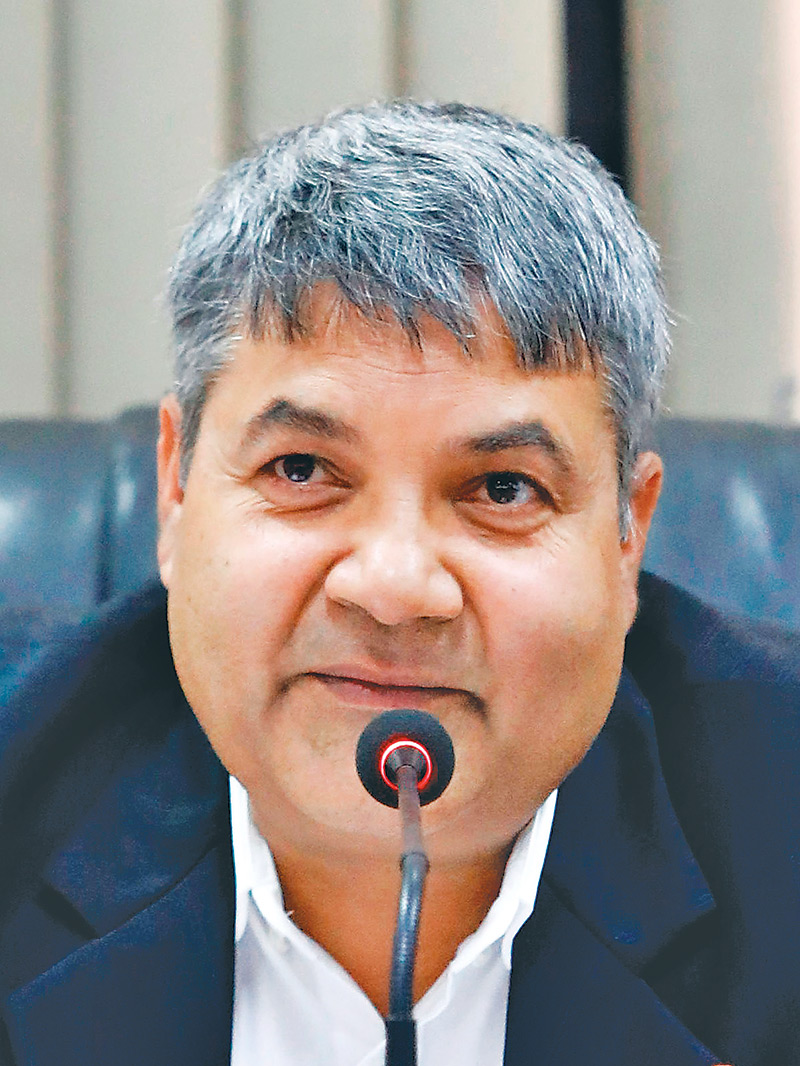
Gokul Baskota. Post file Photo
KATHMANDU, Gokul Baskota, the minister for communication and information technology, has resigned following the release of an audio recording of him allegedly negotiating a Rs700 million “commission” with the local agent for a Swiss company, initially published by the online portal hamrakura.com. In the two-and-a-half-minute audio recording, a voice purportedly belonging to Baskota can be heard negotiating with Bijaya Prakash Sharma Mishra, the local agent for a Swiss company vying for a government contract regarding the security printing of passports and other sensitive material. The Kathmandu Post could not independently verify if the voice in the recording is of Baskota. However, the minister’s failure to refute the allegations and his resignation provide enough ground to believe that the voice on the recording is his. Baskota, who was also the spokesperson for the KP Sharma Oli administration, took to social media to announce his resignation. “I have tendered my resignation before the prime minister on moral grounds as questions have been raised about me,” he wrote on Twitter. The primary opposition Nepali Congress was quick to demand the minister’s resignation and an impartial investigation into the allegations. The party first issued a press statement before going on to obstruct proceedings at both the Houses of Parliament. The 11am meeting of the National Assembly was postponed after Congress lawmakers demanded Baskota’s resignation and a clarification from Oli on the matter. Jitendra Narayan Dev, a member of the Upper House from the Nepali Congress, said that they would not allow Parliament to function unless there is an assurance from the prime minister that proper action will be taken against Baskota. “This is a very serious and condemnable issue,” said Dev. “Oli, who always says he has zero-tolerance for corruption, should prove it through his actions.” The National Assembly meeting was postponed until February 27 following the obstruction while the Lower House was postponed till Tuesday, February 25. Pushpa Bhusal, the whip of the main opposition party, said they have three conditions before they allow the House to function. “First, sack Baskota; second, a clarification from Oli to the House; and third, an assurance from the prime minister that Baskota will be booked as per existing anti-corruption laws,” said Bhusal. “Baskota’s resignation alone will not be enough.” The Prevention of Corruption Act 2002 says any public servant who accepts or agrees to accept bribes of more than Rs10 million is liable for eight to 10 years imprisonment, confiscation of property equal to the graft amount, or both. “Oli has always lauded Baskota as a very competent minister and various incidents suggest that the two have very close relations,” said Bhusal. “What can be understood from this scandal that involves one of the Oli’s closest confidantes?” The opposition has seized this opportunity to take Oli to task for his grandiose claims regarding corruption. As recently as Sunday, Oli had said that he would not be involved in corruption and he would not tolerate corruption from anyone in his administration. But Baskota is the second of Oli’s close party members to be accused of corruption. The involvement of both Nepal Communist Party General Secretary Bishnu Poudel, and his son Nabin was discovered in the Baluwatar land grab. However, the Commission for Investigation of Abuse of Authority refrained from filing a case against Poudel or his son, saying they had agreed to return two plots of land obtained illegally. After Baskota’s resignation, Oli, for his part, reiterated that he is committed to his zero-tolerance policy against corruption. “I won’t spare anyone,” he said at a book launch organised at his residence in Baluwatar. “The people’s representatives must understand that they are not elected to loot the people, but to serve them.”
HOME PAGE
Public Accounts Committee puts a halt to the security printing project
The committee was considering forming a subcommittee to suggest a way ahead but a corruption scandal involving a sitting minister has put the brakes on project.
- ANIL GIRI
KATHMANDU, The much-hyped security printing press has hit a roadblock, as the Parliamentary Accounts Committee on Thursday directed the government not to proceed with the plan. After discussing the plan with officials at the Ministry of Communication and Information Technology, committee members said they were not satisfied with the replies furnished by the officials. Minister for Communication and Information Technology Gokul Baskota was not present at the meeting. Baskota resigned as minister on Thursday afternoon after an audio recording was leaked in which he is heard negotiating a Rs700 million “commission” with the local agent of a Swiss company with regards to setting up the security printing press. The House committee has been studying documents related to the government’s plan for over a month. A committee member said that after the audiotape was released on Wednesday evening the committee had an easy decision to halt the process, at least for now. “The procurement process became more complicated after the audiotape was released,” said Dharmasheela Chapagain, a member of the Public Accounts Committee. “We were in the process of forming a subcommittee to recommend measures to the government but we did not think that this process had such a serious corruption issue.” However, officials at the Ministry of Communication and Information Technology said that they had already stopped the process of negotiating a government-to-government deal after the House panel asked them to furnish the details of correspondence between them and two international firms. “We are happy with the decision because we shared all the documents that we had,” said Dipak Subedi, secretary at the ministry. “As soon as the issue landed at the House committee, we had stopped all kinds of correspondence and negotiations with interested parties. Now we have no options left besides what the House panel directs us later,” said Subedi. According to the documents obtained by the Post, the Public Accounts Committee asked senior government officials eight questions regarding the printing press procurement process. The questions regarded Cabinet decisions and the visits of Baskota and other senior officials to France and Germany in the name of a study tour. The House panel also asked the government what prevented them from procuring the press through global competition and why they had only corresponded with two countries—Germany and France—for letters of intent. While the government had initially signed an MoU with France in March last year regarding the setting up of the press, a competing bid from Germany had complicated matters. A Swiss company, KBA-NotaSys, had also thrown its hat in the ring. These three proposals—from Germany, France and Switzerland—were forwarded by their respective embassies in Kathmandu, not their governments. The House panel voiced its concern regarding the ministry’s selective approach with French and German firms, disregarding proposals from Poland and Switzerland. On July 5, 2019, the Polish Embassy in New Delhi had written to Prime Minister KP Sharma Oli and offered a proposal to set up a security printing facility in Nepal, saying that PWPW SA, a Polish government undertaking, was interested in the project. KBA-NotaSys had sent two letters to the ministry, offering to set up the facility at a cost of 200 million euros. The ministry, however, failed to seek further details from the Polish or Swiss company. According to the parliamentary committee, Germany’s Veridos has offered to set up the printing facility for 300 million euros while France’s IN Group has quoted 295 million euros. All proposals will provide soft loans to the government but the Cabinet has decided that the Finance Ministry will come up with the funds on its own. In both French and German proposals, they have proposed soft loans guaranteed by the export credit agency and not by their respective governments. “The investment modalities should be different but the [Nepal] government did not look into it,” a committee member said. “Both French and German proposals have also failed to mention what kind of e-passports they are offering to Nepal or how many pages they will contain, or even whether they comply with and meet International Civil Aviation Organization and ISO standards.”
HOME PAGE
Fresh off the Mahara and Poudel affairs, yet another scandal engulfs the ruling party
Gokul Baskota, one of Oli’s close confidantes, negotiating a ‘commission’ on audiotape could change the existing power equation within the party, say party insiders.
- TIKA R PRADHAN
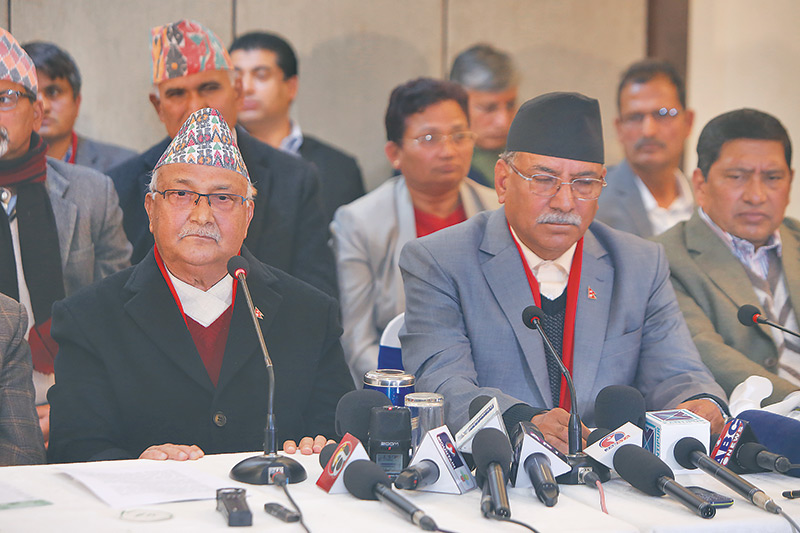
The new development could change the equation in the ruling party, observers say. Post file Photo
KATHMANDU, The KP Sharma Oli administration, which has been reeling from a series of scandals involving high-profile officials, faced yet another setback on Thursday after a sitting minister was caught on audiotape negotiating a “commission” for the planned security printing press. After facing down accusations of attempting to protect one of its senior leaders in the Baluwatar land grab and the acquittal of another senior leader on charges of attempted rape, the ruling Nepal Communist Party (NCP) now must deal with corruption allegations against Gokul Baskota, the minister for communication and information technology and a close confidante of Prime Minister KP Sharma Oli. Ruling party members, however, doubt that there is a strong condemnation of corruption from within the party. “Leaders refrain from speaking out when party members are dragged into corruption cases as they fear it will threaten the existing power equation in the party,” said Mani Thapa, a Standing Committee member. However, Standing Committee member and chairperson of the Province 3 party committee Asta Laxmi Shakya spoke out strongly against Baskota, saying he had betrayed the trust of all leaders. “Due to his shocking act, the whole party is ashamed and such persons should not have any space in the party,” Shakya told the Post. “This is not a minor issue. I am shocked to hear this about a leader who has been continuously speaking against corruption. All those involved in the Rs700 million scandal must be revealed.” The allegations against Baskota come at a time when Oli finds himself cornered, especially since the other party chair, Pushpa Kamal Dahal, has managed to extract the Speaker’s post for one of his lieutenants—Agni Sapkota. With Dahal holding a majority in the nine-member secretariat, now that he’s managed to rope in some senior former UML leaders, allegations against Baskota could further weaken Oli’s position in the party. For the Oli camp, which has made “zero tolerance for corruption” its refrain, the new development could prove to be a litmus test. According to a ruling party leader, who did not wish to be named, Oli will come under direct pressure, not only from the public but also from party members, especially from the Maoist faction. Just last week, while addressing the House of Representatives on the completion of his two years in office, Oli said that the battle against corruption is a priority for his government. He had also listed how his government had been successful in holding the corrupt to account. But the case involving Baskota, whom Oli has long favoured, will prove Oli’s commitment to controlling corruption, say leaders. Amid calls for resignation, including from the main opposition Nepali Congress, Baskota stepped down on Thursday. But given how past cases of corruption involving high-profile politicians have gone, Baskota’s case too could be swept under the carpet, say anti-corruption campaigners. Baskota is just the most recent case; the rot has already set in, they say. “If you ask me what the process should be for Baskota, the anti-graft body must take him into custody and launch a probe,” said Gauri Bahadur Karki, former chairman of the Special Court, the first court to look into corruption cases. “What more evidence do you need when you have the audio record for attempted corruption.” The Post could not independently verify if the voice purportedly of Baskota is indeed his. But Baskota has not refuted any claims and has stepped down. While resigning, Baskota said on Twitter that he had tendered his resignation to the prime minister as “questions have been raised about me”. “By stepping down, he has already admitted that it was him in the audio recording,” said Karki. Some anti-corruption campaigners, however, said that the case likely goes beyond Baskota and up to the prime minister, given the rapport the two have. “It’s now the turn of the prime minister to resign, but it depends on how strongly Dahal raises the issue,” said a former judge who has heard corruption cases. “It was the prime minister who cancelled the tender process and started looking for a government-to-government deal to set up a security printing press.” Party leaders also said that if media reports were anything to go by, the prime minister was aware of the audio recording about a month ago. “The prime minister, who has said time and again that he does not desire anything for his personal benefit, must be pitiless when it comes to leaders who do wrong,” said Lekhnath Neupane, a central committee member and avid critic of the government and the top leadership. “People will start pointing fingers at the prime minister if proper action is not initiated against Baskota as the media has already claimed that he knew about developments a month ago.” The ruling party has yet to come up with an official position on the issue. Amrit Bohara, chair of the ruling party’s discipline commission, which is entrusted with looking into party members’ involvement in corruption, refused to comment on the matter. “My commission has yet to get full shape,” Bohara told the Post. During the recently concluded Central Committee meeting, party members had strongly questioned how leaders had amassed disproportionate property and why there was no probe into them. Bohara said that the discipline commission will soon start looking into leaders’ properties and that if corruption complaints are filed, those too will be investigated. Anti-graft campaigners say that corruption has been so normalised that politicians, irrespective of the party they belong to, never raise questions about their morality and image. According to them, in most of the cases, politicians employ legal loopholes to get off scot-free. The last time a politician was caught on tape soliciting bribes was in September 2010. In a leaked audiotape, former Speaker Krishna Bahadur Mahara, who was cleared of attempted rape charges last week, could be heard seeking Rs500 million from a Chinese person “to buy lawmakers”. But that case too failed to get traction and soon died down. Mahara, on the other hand, rose through the party ranks. Almost a decade later, he became the House Speaker, only to be forced to resign after a woman accused him of attempted rape. Shree Hari Aryal, former president of Transparency International Nepal, said that parties need to start a clean-up campaign from within. “Parties have their discipline committees and they must be empowered but that requires the will of the top leadership,” Aryal told the Post. Ultimately, as leader of the government, the prime minister is also responsible for the actions of his minister, said Aryal. “In our existing governance system, a minister cannot do anything without the consent of the prime minister,” Aryal told the Post. “The prime minister had signed a performance contract with ministers and Baskota was one of the best performers. This shows what kind of ministers he has appointed.”
MEDLEY
Horoscope
ARIES (March 21-April 19) *** You always have time to learn new things, so even if your day is jam-packed, you should reserve at least a minute or two to explore! Check out that new restaurant, go for a drive in a different part of town, or pick up a book about something or someone you’ve never heard of before.
TAURUS (April 20-May 20) ** If you’re about to come to a crossroads in your life, you should take the road that your mind, not your emotions, tells you is the right one. Right now, your feelings are a bit too confused to be good indicators. Your financial worries could soon be a thing of the past, thanks to the generosity of someone close to you.
GEMINI (May 21-June 21) ** Your usual partners in crime might not be as ready to move on to the next social escapade as you are, so what are your options? You can sit on your hands and wait for them to catch up to you, or you can go ahead and take action by yourself. This might be a good time to try things on your own for a while.
CANCER (June 22-July 22) *** People will be falling all over each other to be of service to you today, so much so that you might start feeling like royalty! Will you be a kind ruler or a ruthless one? But keep in mind that you might not always be the one sitting on the throne. Be generous with your praise and never take a helping hand for granted.
LEO (July 23-August 22) **** The noise in your romantic life is going to be amplified today, which means that there is a lot of fun in store for you! Delightful coincidences could make you feel more alive than ever before, and that apple of your eye is feeling frisky. A gift or two is in the cards for you, and it will likely come from your friends.
VIRGO (August 23-September 22) ** The road ahead of you is in a state of unrest. There is a lot that needs to be decided, and those choices have to be made by other people. If you rush forward and just hope for the best, you might be adding chaos to your life than necessary. Wait until the uncertainty fades and you have a clearer picture of where you need to go.
LIBRA (September 23-October 22) *** It’s a good thing that you’re still exploring all your options, because you have to be patient with the learning curve. New facts and details are still dribbling out, so don’t get discouraged if you aren’t getting the answers you want right now. The success of your latest endeavour depends on how hardworking you can be.
SCORPIO (October 23-November 21) **** Today, the conditions are absolutely perfect for you to make a bold romantic move, or take a risky leap. Hesitation and fear are things of the past, the distant past. Unless you act decisively today, you could run the risk of missing out on building something special. It takes guts to take the leap, but you’ve got courage in spades!
SAGITTARIUS (November 22-December 21) ** There is turmoil in one of your friendships, but don’t worry too much about it. This person is going through a lot of uncertainty in their life, and there isn’t anything you can do to help. The fact that their problems are affecting your relationship is something you should make them aware of, but don’t blame them for it.
CAPRICORN (December 22-January 19) ** Have you been contemplating taking on the role of matchmaker? You should. Two people in your life need to get together, and you might be just the person to help make it happen! You can’t worry about getting in the middle of anything. You’re already in the middle! See what you can do to be the mediator between them.
AQUARIUS (January 20-February 18) *** If you’re feeling a little more outgoing than usual today, it’s going to definitely work in your favor. It’s an expansive day, when an open mind and free attitude will treat you to many possibilities and positive attention. Things you never noticed before are suddenly popping up in front of you. Grab the opportunity.
PISCES (February 19-March 20) ** Try to adopt a “keep it to yourself” attitude about controversies today. Play it safe, because it’s quite likely that your boss will have different opinions than you do. It’s best to just button your lip and bite your tongue. This person isn’t interested in starting a debate about what whether you’re right or they’re right.
NATIONAL
Better record-keeping needed to prevent outbreaks: Experts
- Arjun Poudel
KATHMANDU, Nepali authorities do not maintain records of people coming to Nepal from China through various routes, despite the country’s proximity to the epicentre of the covid-19 outbreak, which has killed at least 2,118 and infected over 75,000 people. With the direct flight from China reduced to one a week due to the outbreak, travelers are using Malaysia, Vietnam, Singapore and other routes to come to Nepal from China. But staffers manning the health desk at the Tribhuvan International Airport have stopped screening passengers from countries other than China. “During high-level meetings, officials at the Health Ministry concede that we understand the need of record-keeping and active surveillance systems. But we are unable to implement it,” Dr Bibek Kumar Lal, director at the Epidemiology and Disease Control Division, the agency responsible for containing epidemics in the country, said. “The health desk at TIA doesn’t even have records of contact details of people returning from China,” added Dr Lal. Hundreds of Nepalis have been returning to the country every day from China using different routes. Moreover, Chinese tourists are coming to Nepal in large numbers as authorities plan to welcome 350,000 Chinese tourists in 2020. Mahendra Prasad Shrestha, spokesperson for the Ministry of Health also said the government does not have information on passengers coming from China. “We keep passengers from China, who have influenza-like symptoms, under observation at the hospital,” Shrestha said. “But we are not in a position to maintain detailed records of all passengers who have been to China recently.” The Epidemiology and Disease Control Division has sought help from the World Health Organization to maintain records of passengers at international health desks in Nepal and to implement surveillance in an effective manner, said Lal. Despite stringent screenings at airports around the world, the UN health agency has not asked member countries to make screening mandatory. Filling out health-related forms at the airport in Nepal is still voluntary, except for passengers coming from China. “We only have one flight from China every week on Thursday,” said Dr Nishant Thakur, chief of the health desk at TIA. “We only screen passengers coming to Nepal on that flight as we cannot screen passengers all passengers.” The government’s handling of the coronavirus outbreak is different from the way it acted during the 2014 Ebola outbreak in West Africa, a former official said. Back then, the Epidemiology and Disease Control Division set up international health desks at the Tribhuvan International Airport as well as at eight land crossings across the country. Officials at the international health desks were assigned to maintain detailed records of all passengers who had been to Africa. “Even people serving UN agencies had to provide their details and go through the health desk,” Dr Baburam Marasini, a former director at the division told the Post. “They used to complain a lot about it, but we told them the measures were taken for the safety of our people.” Marasini said that authorities need to effectively implement record-keeping systems at the health desks. Another senior doctor said that just because only one case of the virus has been recorded, in Nepal so far, it doesn’t mean the risk of an outbreak has been minimised. “We are always at risk,” Dr Anup Bastola, Spokesperson for the Sukraraj Tropical and Infectious Disease Hospital, told the Post. “During every meeting, we draw the attention of officials concerned about the risk of possible transmission of the deadly disease from the people returning from China and visiting different parts of the country,” he said.
NATIONAL
Regulate sale of acid, rights activists and attack survivors urge government
Eight years of jail time does not compare with suffering caused by the crime, say women living with burns.
- ELISHA SHRESTHA
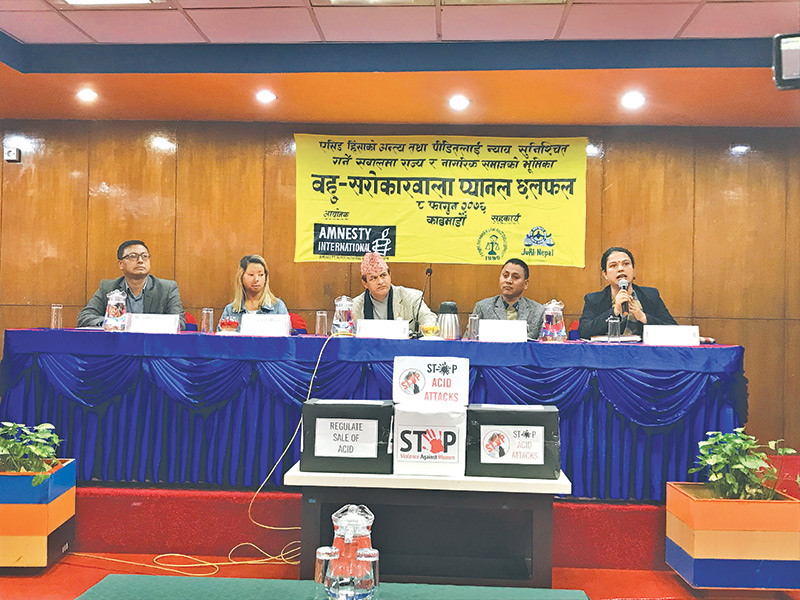
Sixteen people, 13 of them women, have been attacked with acid since 2015/2016, according to a report. Post Photo
KATHMANDU, The government needs to immediately formulate laws to regulate the sale of acid to prevent attacks on women, survivors and rights activists said. Legal provisions also need to be amended to introduce more stringent punishments for perpetrators of acid attacks, victims said at a panel discussion on the state’s obligation towards combating violence against women. “We are worried that the government is not taking the issue of regulating the sale of acid seriously, although it has been almost three years since the Supreme Court urged the it to introduce a plan,” said Bikram Dhukuchhu, chair of Amnesty International Nepal. According to a report presented during the discussion, 16 people, 13 of them women, have been attacked with acid since 2015/2016. Yet acid is readily available for just Rs 25. The panel discussion, convened by Amnesty International Nepal as part of its campaign against acid violence, featured Sangita Magar, survivor and activist; Kedarnath Sharma, joint secretary at the Ministry of Home Affairs; Deputy Superintendent Krishna Chand, from the metropolitan police range, and advocate Sashi Basnet. “Provisions should be in place to allow only authorised outlets to sell acid—that too when the buyer produces a proper proof of identity,” said Sabin Shrestha, suggesting ways to regulate the sale of acid. Joint Secretary Kedarnath Sharma, meanwhile, admitted that the Ministry of Home Affairs doesn’t have plans to formulate laws to regulate the sale of acid. “Since the issue is related to law, we are waiting for the law ministry to take the first step,” said Sharma. Sharma further said that since acid is imported for use in different sectors, other government authorities could regulate its sale. “It is unfair to blame the Ministry of Home Affairs for not regulating the sale of acid,” said Sharma. Panellists Sashi Basnet and Sangita Magar pointed out that along with the regulation of the sale of acid, the government should also introduce more stringent punishments for perpetrators. “Jiwan BK, who threw acid on my face, will be out of prison in a year or two. I am scared as he has been sending me a series of letters from jail, threatening to kill me and my family,” said Magar, an attack survivor. According to Section 193 of the Criminal Code 2017, a perpetrator can be jailed for five to eight years and fined up to Rs 500,000 if the victim’s face is injured in a chemical attack. Similarly, the offender faces three to five years of prison and a fine of Rs 300,00 if the victim sustains injuries on other parts of the body. “Five to eight years jail time is very little punishment compared to the suffering and scrutiny we [the survivors] have to face for the rest of our lives. These culprits should be handed life imprisonment so that others don’t dare to commit such hideous crime,” said Jenny Khadha, another acid attack survivor.
NATIONAL
Sanjeev Satgainya new editor of The Kathmandu Post
Satgainya succeeds Anup Kaphle, who resigned as editor-in-chief of the paper after a year–and–a–half.
- Post Report
KATHMANDU, Sanjeev Satgainya has been appointed editor of The Kathmandu Post. Kantipur Media Group Chairman and Managing Director Kailash Sirohiya announced Satgainya’s appointment as the Post editor on Thursday. Satgainya, 45, succeeds Anup Kaphle who resigned as the editor-in-chief of the paper after serving for a little more than a year-and-a-half. Satgainya, who started his journalism career in 2002 from The Himalayan Times, was working at the Post as Head of News. He has worked as a desk editor and as a reporter covering politics, social affairs, human rights and entertainment. “A meeting of the Kantipur Media Group management approved the resignation of Anup Kaphle as editor-in-chief and appointed Sanjeev Satgainya as the new editor of the Post,” said Sirohiya. Sirohiya said that he is confident that the paper will continue to do good journalism under the new leadership in the days to come. Outgoing editor-in-chief Kaphle thanked the Kantipur Media Group management, and Sirohiya in particular, for providing him with all the necessary support during his tenure to turn the paper around. Kaphle said that he was grateful to the entire Post team and hoped that they would continue to do fearless journalism.
NATIONAL
One million people set to visit Pashupati on Mahashivaratri
Police publish plans to facilitate traffic around the temple area.
- ANUP OJHA
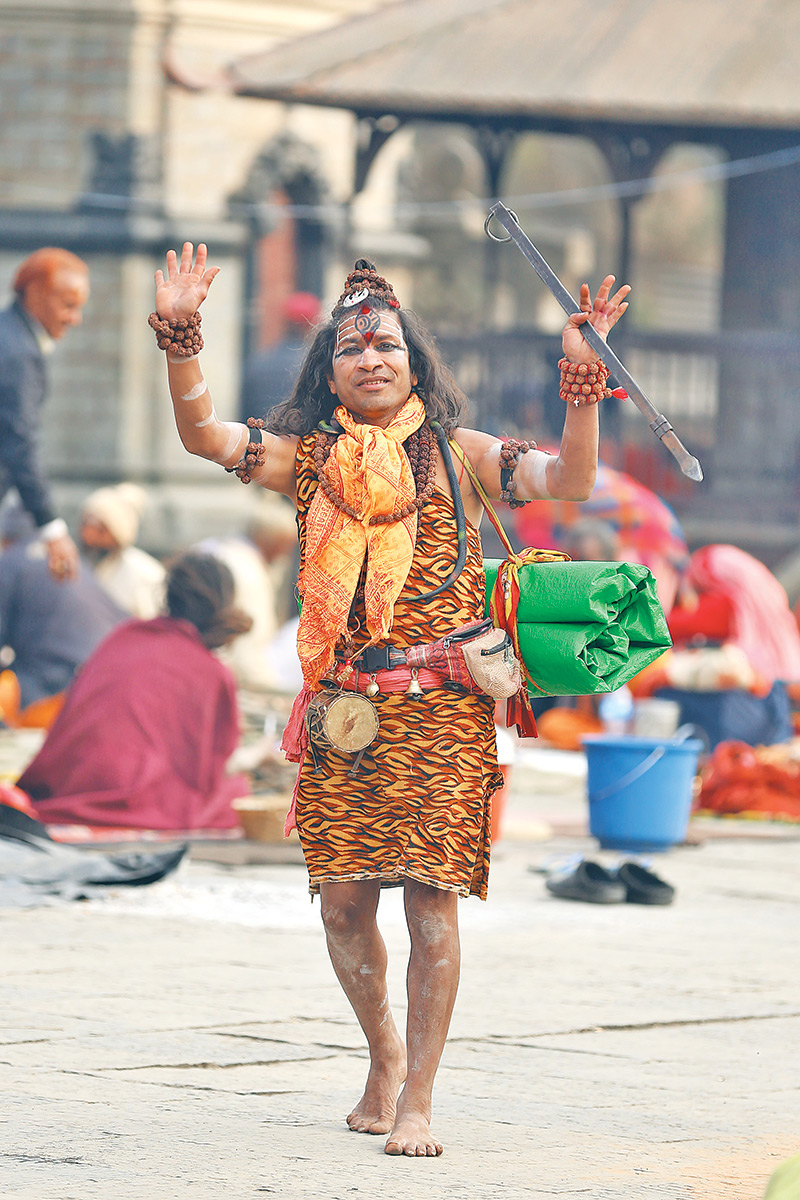
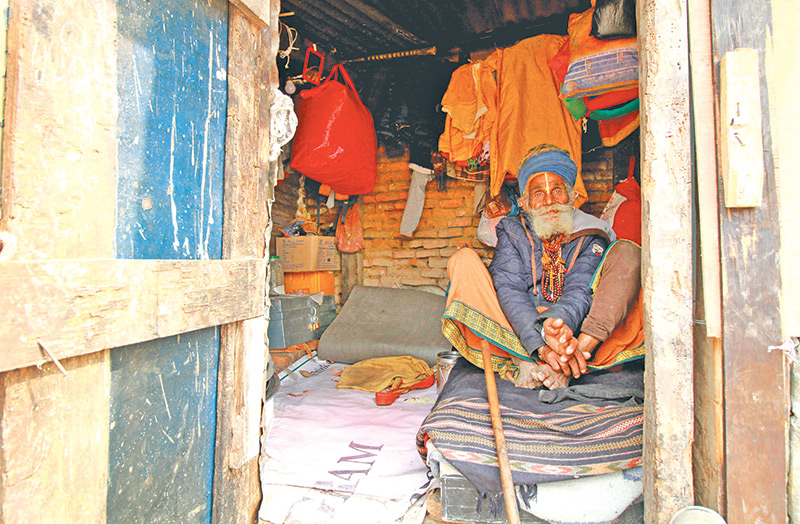
A sadhu dressed as Lord Shiva gestures at the Pashupatinath temple in Kathmandu. post PHOTO: SANJOG MANANDHAR
KATHMANDU, The Pashupati Area Development Trust has completed all preparations to welcome around one million people to the annual Mahashivaratri festival on Friday. Trust authorities, who plan to open the gates of the temple at 3 am, have made provisions for four queues—one in each direction—for pilgrims to get into the main temple. A total of Rs7.2 million has been allocated for managing the festival this year, said Pradeep Dhakal, member secretary of the trust. The trust will feed sadhus, provide them accommodation, firewood and an allowance, he said. Over 5,000 sadhus from around the country and various parts of India have already arrived at Pashupatinath. The Pashupati trust expects to welcome around 1 million people this year, said Dhakal. “This year, we have also decorated the temple premises to give the visitors a better feel,” added Dhakal. Around Rs 5.2 million had been allocated for the festival last year, when 1.1 million people visited the area. Meanwhile, 30 organisations have set up health stations on the temple premises. According to Metropolitan Police Range, Kathmandu, as many as 4,500 personnel in uniform and others in civvies will be mobilised to secure the temple premises. A few personnel from the Nepal army will also be deployed, according to Dhakal. Meanwhile, Metropolitan Traffic Police Division has released its plan to facilitate the movement of people on Mahashivaratri from Tinkune to Gaushala and Chabahil areas. According to police, live updates on the traffic situation in Kathmandu will be available on Metro FM 95.5. Members of the public can dial 103 to enquire about the situation. Senior Superintendent Bhim Prasad Dhakal said a total of 449 traffic police personnel will be mobilised in the area to ease vehicular movement from 3 am. The office has announced that vehicles will not be allowed to head towards Gaushala from Chabahil. Similarly, the Gyaneshwor-Maitidevi and Ratopul stretch and the Sifal Chowk-Jaya Bageshwori section have been deemed no-go zones. “Decisions on traffic diversions and no-entry zones will be taken after assessing the flow of visitors in the area,” said Dhakal. The office has designated a separate parking area for foreign visitors in Tilganga. Parking facilities shall also be provided at Sifal and Guheshwori corridor. This time, traffic police have also banned roadside businesses in the Pashupati area.
NATIONAL
Madi ward chief on hunger strike against national park law
Park and wildlife conservation law has denied Madi access to development, say locals.
- RAMESH KUMAR PAUDEL
CHITWAN, A municipal ward chief in Chitwan is on a hunger strike demanding amendments to the provisions in the National Parks and Wildlife Conservation Act (1973), which he says have been barring development works and public facilities in his area. Krishna Prasad Paudel, the chairman of Madi Municipality Ward 1, began his protest at the ward office in Baruwa Bazaar on Wednesday evening to press the government into amending the Act that prohibits Madi residents from enjoying facilities like roads and round-the-clock vehicle service. Madi is surrounded on three sides by Chitwan National Park, which means the local government cannot launch big infrastructure development projects in the area in order not to disturb the protected wildlife and their habitat. Paudel said the Act must be amended as it restricted the local government from addressing the concerns of Madi residents. Besides the lack of public facilities, the Madi residents have also been suffering from the problems of wildlife attacks on humans, predation of crops and livestock, and land encroachment. “I am protesting for the people of Madi who have long been demanding the government to amend the Act,” Paudel said. Madi is among the worst affected areas in Chitwan in terms of human-wildlife conflict. According to the national park’s data, at least 157 people have been killed in wildlife attacks in the park’s buffer zone areas in the past 20 years, and a third of them were from Madi. Meanwhile, Thakur Dhakal, the mayor of Madi Municipality, has postponed his hunger strike plan for the same demand. On Saturday, Mayor of Madi Municipality Thakur Dhakal had announced to launch a hunger strike from Wednesday, coinciding with the Democracy Day. He, however, postponed the scheduled strike allegedly under political pressure. Dhakal, who was elected from the ruling Nepal Communist Party, said he decided to postpone his planned hunger strike after Prime Minister KP Sharma Oli assured to address the concerns of Madi locals.
MONEY
Hatcheries agree to lower their prices from Sunday
Poultry entrepreneurs had submitted a petition to the government on Tuesday.
- KRISHANA PRASAIN
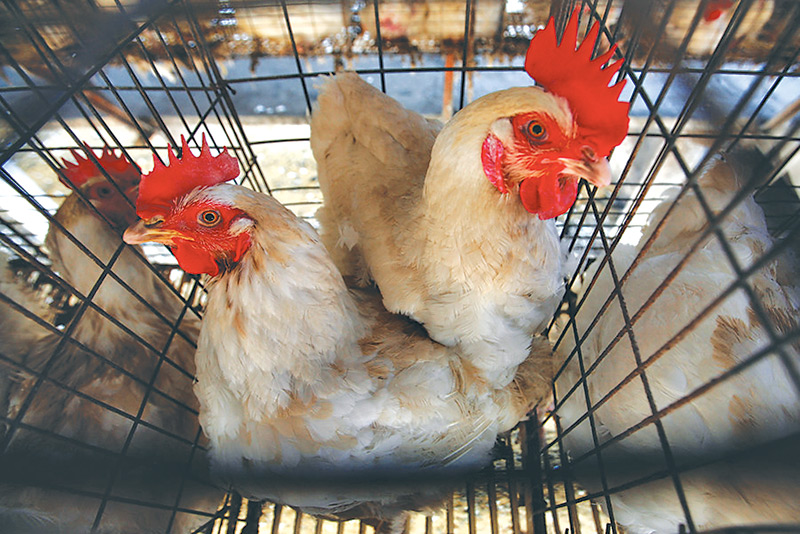
The price of chicken meat had jumped from Rs 280 per kg to Rs 400-420 over a week at the beginning of the month. Post file Photo
KATHMANDU, Hatcheries and feed factories have agreed to lower prices from Sunday after the Department of Commerce, Supply and Consumer Protection Management convinced them that the prices had been hiked steeply, and that they must come down during a meeting held at the department’s office on Wednesday. President of the Nepal Hatchery Association Tikaram Pokhrel said that the organisation has no hand in fixing the prices, and it is the hatchery owners who do so. He said that chicks were being sold at Rs70 per bird, and poultry farmers get a commission of Rs10. “No commission will be paid from Sunday, so the chicks will cost Rs60 per bird,” he said. The National Poultry Entrepreneur Struggle Committee on Tuesday submitted a petition to the department detailing the problems faced by small poultry entrepreneurs and possible solutions to them. Netra Prasad Subedi, director general of the department, said that the petition had an aggressive tone and lacked logic regarding prices, problems and solutions. Pokhrel said, “It costs around Rs55 to produce a chick, and hatchery owners have to sell them for Rs60 per bird which gives them a small profit.” But poultry entrepreneurs have been claiming that it does not cost more than Rs35 to produce a chick. According to chicken raisers, hatcheries and feed factories control the market by creating varied associations. Farmers do not fix the price of chickens, and the feed available in the market is not of good quality, they said. The difficulty of selling chickens is another problem for poultry raisers. The price and the ingredients used to make the feed are not stated on the packaging. Prices of vaccines, medicines and vitamins are raised arbitrarily, they said. Subedi said that the high prices of chicks and a drop in the price of chicken meat had dealt a double whammy to poultry farmers. The price of chicken meat had jumped from Rs280 per kg to Rs400-420 over a week at the beginning of the month. The price dropped to Rs380-385 per kg last week after authorities threatened to take action against the chicken meat sellers for overcharging consumers. The Commerce Department and the Livestock Service Department have formed a joint three-member team to conduct a study of the cost of producing chicks and feed, said Subedi. The panel will start work on Monday and the price of chicks will be slashed somehow, he added. The team includes an expert from the related sector. Banshi Sharma, director general of the Livestock Department, said that the price of chicks should be affordable to poultry entrepreneurs. Saying that Rs70 per bird was too high, he said that the department was ready to cooperate with the Commerce Department and provide an expert to carry out the survey. It has been nearly a month since the price of chicks started to rise, and poultry entrepreneurs have had to suffer huge losses because the government was slow to act, a chicken raiser said. “We are compelled to buy chicks at a high price and sell our chickens cheaply,” said Karna Bogati, a poultry farmer at Chunikhel. Bogati returned from foreign employment three years, and established a poultry farm with his savings. But he is discouraged by the small returns from his enterprise. The Nepal Hatchery Association killed more than 6 million chicks and halted production for 10 days in the name of a ‘chicks holiday’ in a bid to pressure the government to increase egg and chicken prices.
MONEY
EU leaders to face off in ‘very tough’ budget summit
- AGENCE FRANCE-PRESSE
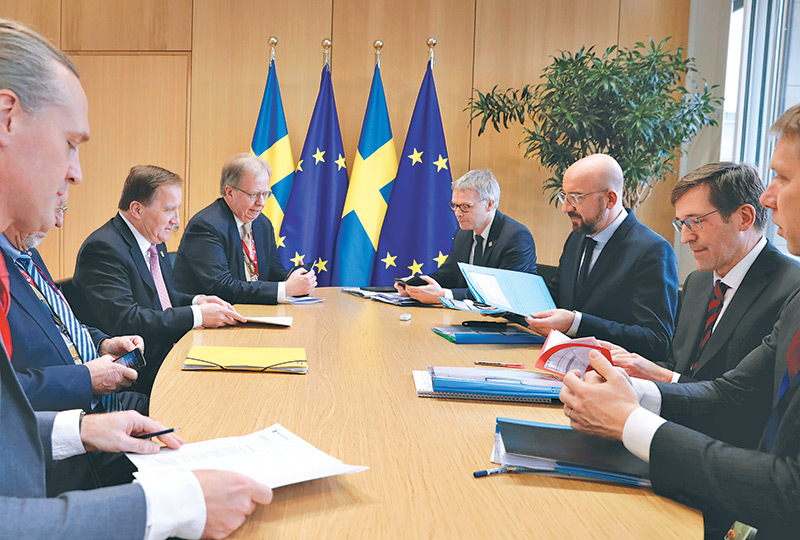
Delegates meet on the sidelines of an EU summit in Brussels, Belgium, on Thursday. REUTERS
BRUSSELS, EU leaders gathered on Thursday for a stormy summit to decide the bloc’s seven-year budget, with bitter divisions between parsimonious rich nations, poorer ones wanting to preserve spending and others wanting to fund grand global ambitions. The tussle for money, hard-fought at the best of times, is especially problematic this time around because of Britain’s departure from the EU. The “Brexit gap” caused by the loss of the UK’s contribution is 75 billion euros ($81 billion) over the 2021-2027 period. On the eve of the summit, German Chancellor Angela Merkel had predicted “very tough and difficult negotiations”, with some officials bracing for talks to drag into the weekend. Summit host Charles Michel, the EU Council president, kicked off the day with one-on-one meetings with leaders of the 27 states starting with Sweden, one of the so-called “frugal four” opposed to big budget increases. “I am convinced that it will be possible to make progress in the next hours or in the next days,” Michel told reporters. “The last steps to finding a compromise are always the most difficult, but I think everything is on the table to let us take a decision.” But not everyone shares Michel’s optimism, with some EU sources suggesting differences are so great the summit could end quickly and the can kicked down the road to another summit—or two—in the coming months. An analyst at the European Policy Centre, Marta Pilati, agreed, saying: “There likely won’t be agreement at this summit. All the member states aren’t showing much willingness to compromise.” The minimum spending in the multi-annual financial framework (MFF), as the long-term budget is called, is just over one trillion euros. The discord is over how much this budget should increase by, how spending might be shifted between priorities and how much each member state should pay as a percentage of its gross domestic product (GDP). Another touchy issue is whether budget rebates pocketed by a few wealthier countries should still exist. The last MFF came in at 1.08 trillion euros (in 2018 prices). The “frugal four”—Austria, Denmark, the Netherlands and Sweden—want to rein in the budget and make up only some of the ground of the Brexit gap. They also want to keep their rebates, as does Germany. Austrian Chancellor Sebastian Kurz struck a tough note on Twitter at the start of the day, insisting Vienna’s budget contributions must not “grow immeasurably” and rejecting a compromise proposed by Michel. At the high end of spending demands is the European Parliament, which wants the MFF expanded to 1.32 trillion euros to pay for costly goals such as turning the European Union into a carbon-neutral economy within three decades. The legislature, which has to sign off on the final MFF, believes more money can be raised from EU-wide taxes on plastics and on the carbon emissions trading scheme. A “friends of cohesion” group of mostly eastern and southern EU nations wants to ringfence money it gets to help bring infrastructure and society up to the level of wealthier counterparts. Agriculturally sensitive countries such as France, Spain and Poland are also looking to preserve farmers’ subsidies. France would like to also see extra money for common security and defence and the “unfair” rebates scrapped. The European Commission, which aims for a “geopolitical” mantle under President Ursula von der Leyen, is trying for a target of 1.13 trillion euros. Ahead of the summit Michel proposed an MFF of 1.09 trillion euros, making cuts to cohesion funds and farm subsidies to finance other priority areas. A senior EU official said Michel’s plan would re-allocate “about eight billion euros from richer to poorer member states”. His plan, though, has little support. The European Parliament has rejected it as too little. Germany says it is a “step backwards” and Spain has criticised it for “not recognising the role of agriculture” in EU cohesion.
MONEY
Thai retail giant launches record-breaking IPO
- AGENCE FRANCE-PRESSE
BANGKOK, Thai conglomerate Central Retail launched the country’s biggest ever IPO on Thursday, giving it a market cap of around $8.1 billion in a punt on a sputtering economy now hampered by the new coronavirus. Most Thais visit a shop each day owned by Central, a family-run empire which has hundreds of malls, electronics, grocery and 24-hour convenience stores across the country. Shares in Central Retail Corporation (CRC) were offered at 42 baht on Thursday morning, but made only a modest quarter baht gain in early trading, with the company eying fundraising of just over 71 billion baht ($2.26 billion). “CRC is very proud” to become “the country’s largest IPO ever,” chief executive Yol Phokasub said. The money raised will pay for “business expansion and stores’ renovation”, he added. Super rich and well connected, the firm, founded by the Sino-Thai Chirathivat family after the Second World War, has been on an ambitious overseas spending spree—acquiring or partnering with luxury shopping brands in Italy, Germany and Switzerland. The Stock Exchange of Thailand said the initial public offering puts CRC among Thailand’s 12 largest listed companies. Central already dominates Thailand’s streets but is desperate to make serious inroads into the booming online sales market. The group received a royal endorsement in 2005, recognition by Thailand’s unassailable palace reserved only for the biggest conglomerates. Thailand’s big firms are run by Sino-Thai families, with deep connections, deeper pockets and a nose for navigating the choppy political waters of a country defined by coups and short-lived civilian governments. They control businesses in a country which was once the leading economy of Southeast Asia, but is one of Asia’s least equal as it atrophies under a military-run government. Drought, high household debt, the strong baht and now the impact of the deadly new coronavirus have also clouded the economic outlook. The Bank of Thailand has said it is likely next month to revise its GDP growth outlook to under two percent, with tourism hammered by a slump in Chinese visitors.
EDITORIAL
Rotten to the core
Gokul Baskota must be thoroughly investigated, and so should the facilitator of the alleged bribe.
Minister for Communication and Information Technology Gokul Baskota has resigned. And a good thing, too, since his ability to remain in power after the recent leak of audio recording had made his position untenable. In the recording, which is a conversation about security printing contracts, the voice attributed to the minister is clearly heard making a number of compromising plans. Not least is the negotiation of a Rs700 million personal ‘commission’. Crucially, the recording also points to how much respect members of the executive have for the bureaucracy, the minister is heard communicating his displeasure of administrative officials by using a foul and derogatory term, repeatedly. But what this recording really shows is how systemic corruption is in government. Baskota’s is not the first major case of graft to have been exposed. Unfortunately, it may not be the last, given how corruption has become an open secret. But it cannot remain so. Baskota’s early resignation, within hours of the leak, provides an opportunity for the concerned to carry out an unbiased investigation. The government, the Commission for the Investigation of Abuse of Authority, and all concerned must pursue this investigation without favour. Further, since Baskota is one of Prime Minister KP Oli’s closest confidants, there may be a push for distractions to subdue the investigation. This cannot be allowed to happen. The printing press debacle has been one of the major failings in planning and procurement for the Oli government. Stemming from Oli’s obsession with setting up a security printing facility domestically to handle all of Nepal’s needs, the idea was to set up such a facility in Nepal to handle the printing of excise stickers, passports, and eventually banknotes. This would reduce the country’s reliance on services abroad. After a muddle of agreements and disagreements surrounding German and French bidders, the government signed a memorandum of understanding with the French government-owned IN Groupe in March 2019. But with such a facility costing over $300 million, without the ability to print money, there were doubts whether there was enough business for secure documents, certificates and stickers to make the deal worth it. Cue in the entrance of middlemen into the parliamentary Public Accounts Committee hearings, where some were found to be lobbying for or against the set up of a printing press. Bijaya Mishra, the representative of a Swiss firm vying for Nepal’s business abroad, in lieu of setting up an in-house facility, was found to be one of the ‘experts’ brought in to argue against a domestic security printing press. Incidentally, this is the same Mishra whose voice has been allegedly caught in the recording with Baskota’s. The seepage of corruption to a point where businesspersons with vested interests are brought into Parliament as experts, to a point where they are found to be discussing commissions with sitting cabinet members, is alarming. It further raises questions of the level of corruption in other projects, such as the purchase of Airbus aircraft by Nepal Airlines Corporation. Airbus itself has admitted to paying off Nepali officials, who remain unnamed. With the controversy surrounding the handling of the Airbus deal, and with the bias in the charging of those involved in the Lalita Niwas scandal, the concerned have been handed one more opportunity to prove to the people that the fight against corruption exists—and that it truly works. Baskota must be thoroughly investigated. But all too often, it is found that the prosecutors—if they ever bring charges at all—are focused on the receivers of graft. There has not been a single case brought against the facilitators of such corruption—this must change. The concerned must also thoroughly investigate Mishra for his part.
OPINION
The state in the time of an epidemic
China’s handling of the Wuhan outbreak provides a road map for countries with centralising tendencies.
- Amish Raj Mulmi
People wearing protective masks, sitting in a subway car in Shanghai, China in January, 2020. Robert Wei/Shutterstock.com
Like other epidemics in the recent past—SARS, Ebola, H1N1—Covid-19 has had its fair share of rumours, conspiracies and misinformation floating around the internet. A news outlet has identified nearly 25 different false updates about the virus. This is excluding the conspiracy that the virus was man-made either in a Wuhan lab itself or by the Americans, depending on where you lived. Some of the misinformation campaigns have been openly racist and have generalised the Chinese people, suggesting that tribalism will always remain a fallback option in human nature. What’s interesting, however, about this particular epidemic are a few points that reveal some dynamics about China and our world today. The first is, the epidemic notwithstanding, the control of the popular narrative about Covid-19 is itself an extension of the Sino-US strategic contest. The second, that the Communist Party of China’s (CCP) management of the epidemic—not the medical part, but political, administrative and the media-based—is a lesson in governance for political systems with centralising tendencies like ours. The opening salvo came with the Chinese foreign ministry saying most countries had appreciated China’s efforts in fighting the virus, but the US has ‘inappropriately overreacted… The US government hasn’t provided any substantive assistance to us, but it was the first to evacuate personnel from its consulate in Wuhan, the first to suggest partial withdrawal of its embassy staff, and the first to impose a travel ban on Chinese travelers. What it has done could only create and spread fear, which is a very bad example.’ The next day, China said it was ‘deeply touched’ by Japan (historical ties between the two have been bitter) and the other countries who had shown it support and understanding. Although Donald Trump that weekend tweeted that Xi Jinping was ‘powerfully focused on leading the counterattack on the Coronavirus’, China’s patience seems to have been tested. When an international team of World Health Organisation specialists reached China last week to study the Chinese public health response to the disease, the Americans were not invited. The fact that the Wall Street Journal, perhaps the most influential business daily in the world, had published an op-ed with a clickbait of a headline titled ‘China is the sick man of Asia’ probably didn’t help matters either. China on Wednesday revoked the press credentials of three WSJ journalists over the ‘racist headline’. But it could be equally peeved at five of its media wings being designated as foreign missions in the US. While the contours of a new world order are yet to be etched in more permanent ink, China’s scathing response tells us the neo-cold war with the US will equally be a contest of narrative. Beijing, now more than at any other time, wants the world (especially its allies) to know it is perfectly capable of handling the epidemic on its own, and that the global media should follow its version of the truth. The Nepali tourism minister certainly agrees. In turn, provocative generalisations like the WSJ headline that harken back to China’s ‘century of humiliation’ will further allow the CCP to galvanise its citizens (and well-wishers) under the nationalism umbrella. The second is a lesson in governance. The Caixin daily, perhaps one of China’s finest news outlets, revealed the Wuhan local government’s month-long cover-up which enabled the spread of the disease. After the death of Dr Li Wenliang, a whistleblower who’d tried to warn other doctors of the new disease and was reprimanded for ‘spreading online rumours’ and asked to sign a letter by the Wuhan police, from Covid-19, there was an extraordinary turn of events in the aftermath of the public outrage at Li’s death. In what was a first, the onus of Li’s death was put squarely on the Wuhan local authorities, and even the state media wrote ‘many have criticised formalism and excessive bureaucracy in local governance’. Such direct criticism of government authorities is rare in China, and even rarer when public outrage contrary to government expectations is acknowledged. Further, several analysts noted that the permissibility of outrage on Chinese social media sites like Sina Weibo and traditional media is unprecedented. ‘While usually quick to remove any significant criticism of governmental entities, Internet censors have allowed an unusually large, and often unusually harsh, volume of criticism to remain highly visible, both on social media and in the press… There seems to be a general recognition across the state apparatus that aggressive suppression of public criticism will lead to a potentially unmanageable backlash—in other words, that public unhappiness has already reached such a critical level that the only truly viable response is appeasement.’ Reading too much into the outrage is futile; however, for countries with centralising tendencies like ours, it provides a roadmap towards political management in the future. The central leadership of the party has been shielded from the botched response. The Hubei (where Wuhan is located) party leadership has been replaced by officials close to the president, signalling local units will be held far more accountable than the central leadership, and that they can be thrown under the bus if push comes to shove. And finally, pointing the finger at local units also shields the centre—in this case, the CCP—from citizens who want to question its legitimacy to rule. The response to dissent has followed a similar pattern. While Dr Li has been hailed as a hero, scholar Xu Zhangrun, who critiqued Xi Jinping’s handling of the crisis in an essay titled ‘When fury overcomes fear’, has been placed under house arrest, while two other Wuhan citizen-journalists have gone missing. What’s common between all three (and the article which this newspaper reprinted to earn the ire of the Chinese embassy) is their pointed criticism of the CCP leadership and questioning the party’s legitimacy to rule China. This brings us to another lesson to be drawn from the response to Covid-19: the epidemic is ‘a major test of China’s system and capacity for governance’ according to Xi Jinping himself, and the massive disruption of lives, cities and transportation systems are equally a display of Chinese state power, as an analyst has argued. Chinese state authority and power has grown tremendously since the days of SARS; however, ‘what is not yet so clear is whether the Chinese state is getting better at deploying that power in service of the public interest.’
OPINION
Is Pakistan’s press freedom under threat?
New regulations restricting social media reflects frustration in government.
- JAMES M DORSEY
Shutterstock
Sweeping new regulations restricting social media in Pakistan put freedom of expression and the media at the heart of the struggle to counter both civilisationalist and authoritarian aspects of emerging new world order. The regulations, adopted without public debate, position US social media companies like Facebook and Twitter at the forefront of the struggle and raise the spectre of China’s walled-off internet with its own state-controlled social media platforms becoming the model for a host of illiberal, authoritarians and autocrats. The regulations, which take effect immediately, embrace aspects of a civilisational state that defines its legal reach, if not its borders, in terms of a civilisation rather than a nation-state with clearly outlined, internationally recognised borders that determine the reach of its law and that is defined by its population and language. The regulations could force social media companies to globally suppress criticism of the more onerous aspects of Pakistani law, including constitutionally enshrined discrimination of some minorities like Ahmadis, a sect widely viewed as heretic by mainstream Islam, and the imposition of a mandatory death sentence for blasphemy. The new rules force social media companies to ‘remove, suspend or disable access’ to content posted in Pakistan or by Pakistani nationals abroad that the government deems as failing to ‘take due cognisance of the religious, cultural, ethnic and national security sensitivities of Pakistan’. The government can also demand the removal of encryption. Social media companies are required to establish offices in Pakistan in the next three months and install data servers by February 2021. The government justified the rules with the need to combat hate speech, blasphemy, alleged fake news and online harassment of women. The Asia Internet Coalition, a technology and internet industry association that includes Facebook and Twitter, warned that the regulations ‘jeopardise the personal safety and privacy of citizens and undermine free expression’ and would be ‘detrimental to Pakistan’s ambitions for a digital economy’. The introduction of the regulations reflects frustration in government as well as Pakistan’s powerful military with social media companies’ frequent refusal to honour requests to take down content. Pakistan ranked among the top countries requesting Facebook and Twitter to remove postings. On the assumption that Facebook, Twitter and others, which are already banned in China, will risk being debarred in Pakistan by refusing to comply with the new regulations, Pakistan could become a prime country that adopts not only aspects of China’s 21st-century Orwellian surveillance state but also its tightly controlled media. The basis for potential Pakistani adoption of the Chinese system was created in 2017 in plans for the China Pakistan Economic Corridor (CPEC), a crown jewel of the Belt and Road worth over $60 billion, an infrastructure, telecommunications and energy-driven initiative to tie Eurasia to China. The 2017 plan identifies as risks to CPEC ‘Pakistani politics, such as competing parties, religion, tribes, terrorists, and Western intervention’ as well as security. The plan appears to question the vibrancy of a system in which competition between parties and interest groups is the name of the game. It envisions a full system of monitoring and surveillance to ensure law and order in Pakistani cities. The system would involve the deployment of explosive detectors and scanners to ‘cover major roads, case-prone areas and crowded places…in urban areas to conduct real-time monitoring and 24-hour video recording’. A national fibre optic backbone would be built for internet traffic as well as the terrestrial distribution of broadcast media that would cooperate with their Chinese counterparts in the ‘dissemination of Chinese culture’. The plan described the backbone as a ‘cultural transmission carrier’ that would serve to ‘further enhance mutual understanding between the two peoples and the traditional friendship between the two countries’. Critics in China and elsewhere assert that repression of freedom of expression contributed to China’s delayed response to the coronavirus. China rejects the criticism with President Xi Jinping calling for even greater control. Pakistan’s newly promulgated regulations echo Mr Xi’s assertion during the Communist party’s January 7 Politburo Standing Committee meeting that ‘we must strengthen public opinion tracking and judgment, take the initiative to voice, provide positive guidance, strengthen integration, communication and interaction so that positive energy will always fill the Internet space... We must control the overall public opinion and strive to create a good public opinion environment. It is necessary to strengthen the management and control of online media’.
This article was previously published in The Daily Star, a part of the Asia News Network.
OPINION
What onions and garlic tell us about our food system
Numerous examples seen in the recent past serve as an alarming reminder of just how food insecure we are.
- MADHUKAR UPADHYA
Shutterstock
If the food system of a country—as a measure of how vulnerable it is to external shocks—is anything to go by, Nepal provides a chilling example. For an agrarian country, with two-thirds of its population engaged in farming, Nepal’s food system should have been based on local production and our domestic market. Unfortunately, degraded land, low productivity, lack of workforce and rising weather uncertainties have made agriculture, which is largely subsistence in nature, less rewarding. Consequently, the food system is being increasingly shaped by imports from across the globe. Nepal’s reliance on foreign markets for food has been steadily rising and stands at about 17 percent of our import bill. There is nothing wrong with relying on the globalised food system to maintain one’s food security. But the globalised food system, a norm for industrialised or middle-income countries, won’t be sustainable and can’t be justified for a remittance-based, poor economy. Numerous examples seen in the recent past serve as an alarming reminder of just how our food security hinges upon an incredibly vulnerable food system. Garlic prices in the retail market doubled in just a week after the northern border, the source of a bulk of garlic imports, was closed as a precaution to stop the spread of the novel coronavirus. As a result, people stopped buying the cooking staple due to the price hikes. Earlier in October, onion prices increased four-fold when India banned its export, following the loss of onion crops due to continued rain until late September, a situation linked to climate change. Previously, when India banned the export of rice in 2008 due to a global price rise, it hit our markets severely. The then Nepali prime minister, when visiting India in October of that year, had to request the Indian government to lift the ban on exports. If a country endowed with land and ecological diversity, which allows growing multiple crops across its landscape, has to import food worth hundreds of billions of rupees a year, something is staggeringly wrong with its economic policies. Garlic, for example, not only grows across Nepal, from the lowland of Tarai to the Trans-Himalayan dry land of Mustang, it’s also an essential ingredient of Nepali cuisine. One could easily picture garlic growing in the backyard of every family with a small kitchen garden, and yet a large amount is imported. Market-driven food systems like the one we have unwittingly slipped into, always favour people in proportion to their purchasing power. Food goes to those who can pay the price, and in turn, it hurts the poorest and most marginalised sections of the society. Urban-dwellers who rely completely on the market for food are forced to make the choice between what to eat and what to avoid based on the cost. Onions disappeared from many kitchens when the price skyrocketed, but it was still available in the market for those who could pay for it. The same is true with garlic. There were ample amounts of onions being smuggled and sold at exorbitant prices. People with a vested interest, and often backed by power centres on both sides of the border, benefited from the illegal trade. There are those who suggest foregoing onions and garlic till prices lower; they assert that this is a trivial matter and such uproar is unjustified. It is entirely possible that they are correct; if it is only for a few months and for a particular item, people could learn to compromise. However, the question isn’t if we can do without them, the question is to what extent do we forgo commodities when there is a problem in imports. Onions and garlic represent the larger, fundamental problems in our food system. Given the existing situation, the list could easily expand to an unprecedented scale, which defies the very notion of food as a human right as stipulated in our Constitution. Agriculture is full of risks—heavy rains, long droughts, hailstorms, floods or diseases and insects damage crops. And then, if one is lucky to have a good harvest, that doesn’t always guarantee a good return. Farmers in Dhankuta lost millions of rupees in 2017 when they failed to export vegetables after parts of the road were damaged by landslides. The cardamom price collapse hit farmers who aspired to graduate from subsistence farming. Sugarcane farmers have been waiting to receive the money for their crops sold years ago. Cabbage, a few years ago, had to be buried in the farms when prices dropped sharply. These deterrents to farming give way to higher imports. But a glaring flaw with a globalised market-based food system is that it makes society less resilient to respond to problems of agriculture. Even worse, it will hinder society from effectively addressing environmental problems. We don’t know the full implications of climate impacts yet and how it’ll impact Nepal’s agriculture, what we know for sure is that it’s affected the water sector, which is at the core of food production and is depleting rapidly across the country. Planners remain complacent about restoring water sources since we can import food from elsewhere, which, in the long run, only makes us weaker in addressing the problem effectively. Nor will it bother us consumers as much as it should as long as we can buy the food of our choice any time of the year. Sadly, we’re only reminded of our vulnerability when there is a problem with our imports. Whether it is due to a global price rise or heavy rains or disease outbreaks, when there’s a problem somewhere, our food system suffers. The state hasn’t been able to address even our regular problems such as stabilising food prices during difficult times, much less the unexpected jolts. In the face of climate change, we need to prepare ourselves for many unexpected shocks, including the recent outbreak of locusts in Africa and parts of Pakistan that destroyed crops over hundreds of thousands of hectares of farms raising global concerns. Tens of millions of people in the region are already facing food shortages due to rains, insecurity, and now the locust infestation. The outbreak is already making food security in those areas even worse. The bad news is that the insects could increase 500-fold by June, which might easily impact us. Hence, isn’t it time to truly consider why we haven’t been able to recognise the vulnerability of our import-based food system? Time is running out for us to begin efforts on re-localising our food system.
OPINION
Give them work and wages
The unemployment situation has acquired some extremely weird features.
- IA Rehman
Shutterstock
There are valid and weighty reasons for reviewing the strategy for helping people survive the high inflation rate, prohibitive food prices and unemployment. It is also necessary to rationally assess the impact of populist measures on the beneficiaries, society and the national economy. The government effort to control the runaway surge in food prices by fixing and enforcing market rates is not likely to be as effective as assumed by the establishment. The 14 federal and provincial price control laws have been as ineffective over the past many decades as the laws against food adulteration. In addition, price controls often give birth to a black market. So long as traders and speculators are free to raise prices, there is no black market, as black-market prices are accepted as normal prices. But when price controls are introduced, goods start disappearing from shops and can only be had at concealed counters run by traders with the connivance of greedy officials. Thus poorly enforced prices may increase the cost of essential items. Besides, after relying for decades on the deregulation mantra, we are reviving regulatory mechanisms without breaking from capitalist management (or mismanagement) of the economy. How will this policy be viewed by our international mai-baaps? The IMF certificates of success in mid-term tests need not be taken seriously as any critical appraisal will not redound to the bank’s credit. Much faith is being put in the capacity of the Utility Stores Corporation (USC) to supply essential food items and some other household needs at cheaper than market rates. The bosses of the corporation must be laughing at the happy turn in their fortunes, for in the first flush of success, the present government was reported to have decided to wind up the corporation because its house experts did not think it was the government’s job to sell wheat flour and vegetable ghee. By reducing the high-profit margins maintained by wholesalers and retailers, and with a certain level of efficiency in supplying goods to its chain of stores, the USC can offer the consumers considerable relief. The reality on the ground may not be as rosy as it seems. What proportion of the population can be served by the 5,900 or so utility stores across the country? Since the stores are largely concentrated in major cities, where most troublemakers are found, the officials may have reason to be happy at the prospect of eliminating urban unrest. However, do the urban agitators have the cash resources to be able to benefit from the services of the utility stores? As many rights activists still not prevented from voicing the people’s concerns have pointed out, the unemployment situation has acquired some extremely weird features. The situation today is that a large number of people are searching for jobs that are not there. A very large number of employees in both the public and private sectors are not being paid their wages even at heavily slashed rates. The ordeal of workers employed at RO plants in Tharparkar is worth reporting. As against the minimum wage for unskilled workers, Rs17,500, they are considered entitled to Rs16,500 per month, but the contractor (who in most cases is in league with the local officials) offers them only Rs10,920 per month. Even this amount is not paid for up to six months. And these wretches have been employed on an ad hoc basis for six to 12 years. This brings us to the most vexatious issue in the debate on the country’s economic woes—a huge part of the population does not have the resources needed to benefit from the sale of necessities at controlled prices. The government is banking on several measures aimed at supplementing the incomes of the disadvantaged sections of society. These are highly popular activities and yield rich political dividends. But the amounts provided to indigent families fall much below the benefits yielded by social security and cannot be a substitute for a family’s main source of livelihood. In other words, there are no family resources worth the name that the dole money might supplement. All dole schemes need to be reviewed to avoid the growth of parasitism and loss of hands that are needed for productive work. Parasites, in any case, are a curse our nation cannot afford to sustain. They are a destabilising factor. As an Arabic proverb says: the head of an idle man is the devil’s workshop. Even otherwise, a dole system violates the inherent dignity of a human being. In any state that will be accepted as civilised by virtue of its respect for basic human rights, the citizens’ right to earn their livelihood by the sweat of their labour enjoys high priority. In periods of economic recession, states are advised to launch labour-intensive projects. If nothing else, idle workers may be paid good wages for digging holes in the ground and filling them up, as Keynes once said. Are there no public projects where the unemployed masses could be put to work? Why has the Khyber Pakhtunkhwa government banned the construction of new schools in the public sector? Does it not need, like other provinces, many new schools to meet the requirements of Article 25-A of the Constitution (the children’s right to education). Why can idle labour not be mobilised to clean the canals or heaps of garbage in principal urban centres, or meet the rural areas’ infrastructural needs? Much can be done by putting the unemployed to work and regularly paying them a fair wage instead of humiliating them with inadequate dole money. One of the keys to overcoming an economic crisis is reduction in state expenditures, especially the non-productive ones. Several leading economists who are not on the state payroll have pointed out that the state could find resources by reducing the size of the unnecessarily large administration and improving the efficiency of services by slashing their extra fat. The state is manifestly short on wisdom and should rush to grab it wherever it is available.
This article was previously published in Dawn, a part of the Asia News Network.
WORLD
Democrats bare fangs at Bloomberg
Candidates from Bernie Sanders to former vice president Joe Biden impugned the US media magnate in Las Vegas.
- AGENCE FRANCE-PRESSE
Democratic presidential hopefuls former New York mayor Mike Bloomberg (left), Massachusetts Senator Elizabeth Warren (centre) and Vermont Senator Bernie Sanders participate in the ninth Democratic primary debate of the 2020 presidential campaign in Las Vegas, Nevada, on Wednesday. AFP/RSS
LAS VEGAS, Former New York mayor Michael Bloomberg endured a punishing assault in his debut Democratic presidential debate on Wednesday from rivals who savaged him for parachuting in late and throwing astronomical amounts of money at the race. The Las Vegas showdown came at a tense time in the party’s nomination race, with leftist firebrand Bernie Sanders coalescing as the frontrunner and some challengers fighting for survival. US media magnate Bloomberg found himself targeted from the start, as candidates from Sanders to former vice president Joe Biden impugned the man whose sudden prominence in polling has scrambled the race to defeat President Donald Trump. “Understand this: Democrats take a huge risk if we just substitute one arrogant billionaire for another,” Senator Elizabeth Warren said in a fiery attack on Bloomberg. “Democrats are not going to win if we have a nominee who has a history of hiding his tax returns, of harassing women, and of supporting racist policies,” she added. Sanders hit Bloomberg hard on his vast wealth at a time of “grotesque” income inequality in America. “Mike Bloomberg owns more wealth than the bottom 125 million Americans,” Sanders said in one of the night’s many abrasive moments. “That’s immoral.” All eyes were on Bloomberg’s first appearance on the debate stage after spending hundreds of millions of dollars on campaign advertising. He endured a very public vetting and struggled to highlight his roles as problem solver, businessman, city manager and philanthropist. He found himself on the defensive when pressed to explain sexual harassment claims against him and employees, his delay in releasing his taxes and more. Political analyst Aaron Kall of the University of Michigan said Bloomberg proved “really weak” in the face of the onslaught. “It’ll be interesting to see... whether that’s disqualifying for a lot of people that have recently gone on his side,” Kall said. Bloomberg at one point managed to push back forcefully against Sanders, saying if the self-declared democratic socialist is the nominee, “we will have Donald Trump for another four years.” But Trump himself was dismissive of Bloomberg’s performance onstage. “He was stumbling, bumbling and grossly incompetent. If this doesn’t knock him out of the race, nothing will,” the president tweeted. Sanders has been buoyed by a strong showing in Iowa, a New Hampshire victory and a surge in polling, with the next nominating contest in Nevada just three days away. But establishment Democrats have begun public hand-wringing about the prospects of Sanders taking the reins of a party seeking to make Trump a one-term president. Pete Buttigieg, the moderate young former mayor of South Bend, Indiana who scored a surprise narrow victory in Iowa, levelled a hit on both Sanders and Bloomberg with a withering critique. “We shouldn’t have to choose between one candidate who wants to burn this party down and another candidate who wants to buy this party out,” Buttigieg said. A Washington Post-ABC News poll out Wednesday showed Sanders with a commanding double-digit lead nationally, at 32 percent. Sagging former frontrunner Biden was second at 16 percent, followed by Bloomberg at 14 and Warren at 12. Biden’s poor showing in the first two states placed him under enormous pressure to do well in Nevada and then South Carolina, which votes on February 29. He spoke evocatively on climate change, and criticized Sanders over immigration policy and gun reform, but it remained to be seen whether it will help him in Nevada and beyond. While Sanders and other White House hopefuls have spent months barnstorming early states, billionaire Bloomberg jumped late into the Democratic contest. He is going all in on so-called Super Tuesday on March 3, when 14 states including California and Texas vote on choosing a Democratic nominee. “I have no doubt that Michael Bloomberg is reaching in his pocket right now and spending another $100 million to try to erase every American’s memory about what happened on the debate stage,” Warren told reporters late Wednesday. While Sanders leads, Bloomberg is surging on the national stage. Two separate polls released Tuesday show him leapfrogging rivals to claim second spot behind Sanders, with Biden third. For Warren and fellow candidate Senator Amy Klobuchar, the debate was a critical chance to convince voters that they belong in the race as it goes national. As Democrats trained fire on one another, Klobuchar reminded candidates that their real opponent was the White House occupant. “We have not been talking enough about Donald Trump,” she said.
WORLD
At least nine killed in Germany shisha bar shootings
- AGENCE FRANCE-PRESSE
HANAU (Germany), At least nine people were killed in shootings targeting shisha bars in Germany that sparked a huge manhunt overnight before the suspected gunman was found dead in his home early Thursday. The attacks occurred at two bars in Hanau, about 20 kilometres (12 miles) from Frankfurt, where armed police quickly fanned out and police helicopters roamed the sky looking for those responsible for the bloodshed. Police in the central state of Hesse said the likely perpetrator had been found at his home in Hanau after they located a getaway vehicle seen by witnesses. Another body was also discovered at the property. “The suspected perpetrator has been found dead,” police in the central state of Hesse said, adding: “There is currently no indication that there are additional perpetrators.” The mass-circulation Bild said that those killed in the first bar were of Kurdish origin. The first attack occurred at the “Midnight” bar in the centre of the city around 10pm (2100 GMT), reports said. Three people were killed in front of the building, local media said, with witnesses reporting hearing a dozen shots. The attacker, or attackers, fled the scene by car, according to police. There was then a second shooting at the “Arena Bar”. A gunman reportedly rang the doorbell and shot people who were in the smoking section, killing five people including a woman, Bild said. “The victims are people we have known for years,” said the bar manager’s son, quoted by DPA news agency. Two employees were among the victims, according to the man, who was not at the bar during the shooting. “It is a shock for everyone”. Police said one of those injured in the attack had also died. Earlier reports said five people had been seriously wounded. An AFP journalist at the scene saw around 30 police cars leaving Hanau police station. Witnesses said heavily armed police officers were deployed in the city. A silver Mercedes-Benz covered by what looked like a survival blanket could be seen behind a police cordon and surrounded by officers in front of the “Arena Bar”, with shattered glass on the floor. “The search for suspects is going at top speed. There is no clear information yet as to a motive,” authorities said. The mayor of Hanau, Claus Kaminsky, told Bild that it had been “a terrible night”. “You could not imagine a worse night. It will of course keep us busy for a long, long time and remain a sad memory.” “I am deeply moved. Just the fact that eight people have lost their lives has shaken me up. But I ask all citizens not to speculate. “The police must have the chance to clear up the situation and investigate—until then, we should wait with prudence, no matter how hard this may be.” Katja Leikert, the MP for the region, said it was “a real horror scenario”.
WORLD
China sees drop in new virus cases, two Japan cruise passengers die
- AGENCE FRANCE-PRESSE
BEIJING, China reported a big drop in new coronavirus cases on Thursday, fuelling hopes the epidemic is nearing its peak, but Japan faced a growing crisis as two passengers from a quarantined cruise ship died. The death toll in China hit 2,118 as 114 more people died, but health officials reported the lowest number of new cases there in nearly a month, including in the hardest-hit province, Hubei. More than 74,000 people have been infected in China and hundreds more in some 25 countries, with Iran reporting two deaths, the first fatalities in the Middle East. In Japan, a man and a woman in their 80s who had been aboard the Diamond Princess have died, local media reported, citing a government source. A World Health Organization official noted the progress in China but warned it had not reached a turning point just yet. Chinese officials said this week that their drastic containment efforts, including quarantining tens of millions of people in Hubei and restricting movements in other cities nationwide, have started to pay off. “After arduous efforts, the situation is changing for the better,” Foreign Minister Wang Yi said at a meeting with Southeast Asian counterparts in Laos late Wednesday, according to the official Xinhua news agency. Hubei and its capital Wuhan—where the virus is believed to have emerged in December—are still “severely affected” by the epidemic, Wang said. “But the situation is under effective control, while other regions are embracing comforting news,” he said. More than 600 new infections were reported in Wuhan—the lowest daily tally since late January, and well down from the 1,749 new cases the day before. The national figure has now fallen for three days in a row. Chinese authorities placed Wuhan, a city of 11 million people, under quarantine on January 23 and quickly locked down the rest of Hubei in the days that followed. Cities far from the epicentre have limited the number of people who can leave their houses for groceries, while villages have sealed themselves off from outsiders. Richard Brennan, regional emergency director at the World Health Organization, said China was making “tremendous progress in a short period of time” but cautioned that it was not over just yet. “Trends are very encouraging but we are not at a turning point yet,” Brennan told a press conference in Cairo. While China touts progress in its fight against the COVID-19 epidemic, Japan’s government faces criticism over quarantine measures on the Diamond Prince cruise ship. The huge vessel moored in Yokohama is easily the biggest coronavirus cluster outside the Chinese epicentre, with 621 positive cases confirmed among the passengers and crew—one sixth of the total.
WORLD
Trump ‘offered pardon’ to Assange if he denied Russia leak
- AGENCE FRANCE-PRESSE
LONDON, US President Donald Trump promised to pardon WikiLeaks founder Julian Assange if he denied Russia leaked emails of his 2016 election rival’s campaign, a London court was told on Wednesday. Assange’s lawyer Jennifer Robinson said in a document that Trump relayed the offer through former US Congressman Dana Rohrabacher, the UK’s domestic Press Association news agency reported. The White House quickly issued a denial that Trump had dangled a pardon in exchange for help in the Russia controversy, which has cast a shadow over his first term in office. “The president barely knows Dana Rohrabacher other than he’s an ex-congressman. He’s never spoken to him on this subject or almost any subject. It is a complete fabrication and a total lie,” Trump press secretary Stephanie Grisham said in a statement.“This is probably another never-ending hoax and total lie” by the Democratic Party, she said, a day after Trump controversially pardoned or issued other forms of clemency to 11 people including a former governor jailed for corruption, and other high-profile white-collar criminals. The revelation came at a case management hearing at Westminster Magistrates’ Court before Monday’s formal start of Washington’s extradition request for him to face espionage charges. If found guilty in the United States, he could be jailed for 175 years. Assange’s defence cited a statement from Robinson in which she said that Rohrabacher had been to see Assange and said “on instructions from the president, he was offering a pardon or some other way out, if Mr Assange... said Russia had nothing to do with the DNC leaks”. District Judge Vanessa Baraitser said the evidence was admissable. Robinson did not respond to emailed and telephone requests from AFP for comment. Rohrabacher on Tuesday evening denied the allegations that he had offered Assange a deal.
WORLD
What makes dogs so special? Science says love
- AGENCE FRANCE-PRESSE
The idea that animals can experience love was once anathema to the psychologists who studied them, seen as a case of putting sentimentalitybefore scientific rigour. AFP/RSS
WASHINGTON, The idea that animals can experience love was once anathema to the psychologists who studied them, seen as a case of putting sentimentality before scientific rigor. But a new book argues that, when it comes to dogs, the word is necessary to understanding what has made the relationship between humans and our best friends one of the most significant interspecies partnerships in history. Clive Wynne, founder the Canine Science Collaboratory at Arizona State University, makes the case in “Dog is Love: Why and How Your Dog Loves You.” The animal psychologist, 59, began studying dogs in the early 2000s, and, like his peers, believed that to ascribe complex emotions to them was to commit the sin of anthropomorphism—until he was swayed by a body evidence that was growing too big to ignore. “I think there comes a point when it’s worth being skeptical of your skepticism,” the Englishman said in an interview with AFP. Canine science has enjoyed a resurgence in the past two decades, much of it extolling dogs’ smarts. Titles like “The Genius of Dogs” by Brian Hare have advanced the idea that dogs have an innate and exceptional intelligence. Wynne, however plays spoilsport, arguing that Fido is just not that brilliant. Pigeons can identify different kinds of objects in 2D images; dolphins have shown they understand grammar; honeybees signal the location of food sources to each other through dance; all feats that no dogs have ever been known to accomplish. Even wolves, dogs’ ancestor species known for their ferocity and lack of interest in people, have shown the ability to follow human cues—including, in a recent Swedish study, by playing fetch. Wynne proposes a paradigm shift, synthesizing cross-disciplinary research to posit that it is dogs’ “hypersociability” or “extreme gregariousness” that sets them apart. One of the most striking advances comes from studies regarding oxytocin, a brain chemical that cements emotional bonds between people, but which is, according to new evidence, also responsible for interspecies relationships between dogs and humans. Recent research led by Takefumi Kikusui at Japan’s Azabu University has shown that levels of the chemical spike when humans and their dogs gaze into each others’ eyes, mirroring an effect observed between mothers and babies. In genetics, UCLA geneticist Bridgett vonHoldt made a surprising discovery in 2009: Dogs have a mutation in the gene responsible for Williams syndrome in humans—a condition characterized by intellectual limitations and exceptional gregariousness. “The essential thing about dogs, as for people with Williams syndrome, is a desire to form close connections, to have warm personal relationships—to love and be loved,” writes Wynne. Numerous insights have also been gleaned through new behavior tests—many devised by Wynne himself and easy to replicate at home with the help of treats and cups. One involved researchers using a rope to pull open the front door of a dog’s home and placing a bowl of food at an equal distance to its owner, finding that the animals overwhelmingly went to their human first. Magnetic resonance imaging has drilled down on the neuroscience, showing that dogs’ brains respond to praise as much or even more than food. But although dogs have an innate predisposition for affection, it requires early life nurturing to take effect. Nor is the love affair exclusive to humans: A farmer who raised pups among a penguin colony on a tiny Australian island was able to save the birds from maurading foxes, in an experiment that was the basis for a 2015 film. For Wynne, the next frontiers of dog science may come through genetics, which will help unravel the mysterious process by which domestication took place at least 14,000 years ago. Wynne is an advocate for the trash heap theory, which holds that the precursors to ancient dogs congregated around human dumping grounds, slowly ingratiating themselves with people before the enduring partnership we know today was established through joint hunting expeditions. It’s far less romantic than the popular notion of hunters who captured wolf pups and then trained them, which Wynne derides as a “completely unsupportable point of view” given the ferocity of adult wolves who would turn on their human counterparts. New advances in the sequencing of ancient DNA will allow scientists to discover when the crucial mutation to the gene that controls Williams syndrome occurred. Wynne guesses this happened 8,000 - 10,000 years ago, at the end of the last Ice Age, when humans began regularly hunting with dogs. What makes these findings important, beyond advancing science, is their implications for dogs’ welfare, he argues. That means rejecting brutal, pain-based training methods like choke collars based on debunked understandings of “dominance” popularized by celebrity trainers who demand dog owners become “pack leaders.” “All your dog wants is for you to show them the way,” says Wynne, through compassionate leadership and positive reinforcement. It also means carving out time to meet their social needs instead of leaving them isolated for most of the day. “Our dogs give us so much, and in return they don’t ask for much,” he says. “You don’t need to be buying all these fancy expensive toys and treats and goodness knows what that are available.
WORLD
Bus-truck collision on Indian highway kills at least 19
Briefing
NEW DELHI: A bus collided head-on with a truck in southern India on early Thursday, killing at least 19 people and injuring 23 others, police said. The accident occurred near Avanashi, a town in Tamil Nadu state, the Press Trust of India news agency said. The state-run bus was on its way to Thiruvananthapuram, the capital of Kerala state, from Bangalore in Karnataka state. More than 110,000 people are killed every year in road accidents across India, according to police. Most crashes are blamed on reckless driving, poorly maintained roads and aging vehicles. (AGENCIES)
WORLD
Australia launches national inquiry into bushfires
Briefing
Australia set up a national inquiry Thursday into its month-long bushfire crisis that affected three in four Australians and prompted widespread criticism of the government for its sluggish response to the blazes.Prime Minister Scott Morrison said the vast scale of the fires—which killed more than 30 people and destroyed thousands of homes—required a new response from the bushfire-prone nation. The Royal Commission inquiry will be tasked with finding ways to improve Australia’s preparedness, resilience and response to natural disasters, but has been criticised as an effort to put off tackling the problem. (AGENCIES)
WORLD
Lassa fever hits Lagos as Nigeria deaths top 100
Briefing
LAGOS: An outbreak of Lassa in Nigeria has killed 103 people this year, health authorities said, as the first confirmed case was reported in the economic hub Lagos. “Cumulatively from week 1 to week 07, 2020, 103 deaths have been reported with a case fatality rate of 17.6%,” said the Nigeria Centre for Disease Control (NCDC) in its latest statistics on the virus released on Wednesday. The overall number of confirmed cases rose by 115 last week to a total of 586 across the country. Separately, health authorities in Lagos, Nigeria’s most populous city with 20 million inhabitants, said an infected person was diagnosed there on February 17 and being treated in isolation in hospital. (AGENCIES)
SPORTS
Mourinho predicts tough days without Son and Kane
The Portuguese manager’s Tottenham lose 1-0 to Leipzig. Timo Werner scores the only goal from penalty spot.
- AGENCE FRANCE-PRESSE
Leipzig’s Timo Werner scores a goal from the penalty spot against Tottenham Hotspur during their Champions League match at the Tottenham Hotspur Stadium in London on Wednesday. Reuters
London, Jose Mourinho fears his side’s season is running out of gas after an injury-hit Spurs slumped to a 1-0 defeat at home to RB Leipzig in the first leg of their Champions League last 16 tie. Spurs could be without the talismanic duo of Harry Kane and Son Heung-min for the rest of the season through injury and looked toothless against the Bundesliga contenders. “We are in a very difficult situation,” said Mourinho. “What worries me is this is going to be the situation until the end of the season.” Tottenham captain Hugo Lloris kept his side in the tie with a string of important saves, but he could not prevent Timo Werner from the penalty spot as the German international’s 26th goal of the season gave Leipzig a lead to defend on home soil on March 10. “Over the 90 minutes we deserved the win and could have won by more,” said Leipzig boss Julian Nagelsmann. “It’s only the first game today. You have to perform at the same level in both games.” Tottenham upset the odds to progress past Manchester City and Ajax to reach last season’s final. But it was Leipzig who looked the seasoned Champions League team in their first ever knockout tie in the competition. After receiving the news that Son would be sidelined by a fractured right arm on the eve of the game, Mourinho compared his side’s prospects for the rest of the season to hanging from a fourth-floor building by the balcony. The hosts could easily have fallen flat on their face inside the first 90 seconds as Leipzig amazingly passed up four chances to open the scoring through Patrik Schick, Angelino and Werner. “In the first five minutes we should have taken the lead,” added Nagelsmann. “Young teams can become impatient thinking they have to score an away goal in the first leg, but they weren’t like that.” Werner could be a more frequent foe for Spurs next season with speculation linking him to Liverpool. However, his profligacy ensured the hosts went in level at the break as he fired too close to Lloris with just the French number one to beat. Leipzig could have regretted not making the most of their supremacy during the first 45 minutes as Peter Gulacsi saved well from Lucas Moura and Steven Bergwijn fired the rebound wide early in the second period. However, after grinding out wins over Manchester City, Norwich, Southampton and Aston Villa in recent weeks despite conceding plenty of chances, Spurs’ luck ran out. An ill-timed lunge from Ben Davies chopped down Konrad Laimer inside the area just before the hour mark and Werner confidently converted the resulting penalty. Moments later only a fine save by Lloris denied Schick a second at the end of a flowing move involving Christopher Nkunku, Angelino and a delightful dummy from Werner to tee up his strike partner. “If I could, I would move immediately to the first of July with Kane, (Moussa) Sissoko, Son, Lucas, (Erik) Lamela, Bergwijn (all fit),” added Mourinho. “But we are on the 19th of February so we have to fight until the end. One thing I can guarantee is that even with I don’t know who is playing in attack, we are going there to attack until our limits.” The introduction of Lamela and club record signing Tanguy Ndombele from the bench gave Tottenham a much-needed injection of creativity for the final 25 minutes. However, their best effort came from a set-piece when Giovani lo Celso’s powerful free-kick was turned onto the post by Gulacsi.
SPORTS
Atalanta thump Valencia to close in on quarter-finals
- AGENCE FRANCE-PRESSE
MILAN, Atalanta coach Gian Piero Gasperini hailed a performance his club will “remember forever” after the Italian side crushed Valencia 4-1 on Wednesday to take a giant step closer to reaching the Champions League quarter-finals for the first time. Dutch wing-back Hans Hateboer scored twice on 16 and 62 minutes, sandwiching goals from Josip Ilicic and Remo Freuler. “This is an evening that we’ll remember forever,” said Gasperini. “It’s an amazing result, full of emotion.” It was an extraordinary night for the side from Bergamo who travelled to the San Siro with over 40,000 of their fans as their home stadium 55km away does not meet UEFA regulations. Denis Cheryshev pulled one back for Valencia in the first leg of the last-16 tie at the San Siro, the same stadium where the Spanish side lost the 2001 final to Bayern Munich on penalties. Valencia, seventh in La Liga, had finished top of their group after away wins over Ajax and Chelsea but were missing several key players through injury and suspension. “It certainly complicates things a bit, it’s a pretty overwhelming result, this 4-1,” said Valencia coach Albert Celades. “In the end it doesn’t reflect much what we saw on the pitch.” Atalanta’s run comes despite losing their opening three Champions League group games, before finishing second behind Manchester City. “Three goals ahead is a nice reward,” added Gasperini. “But there were a lot of dangerous situations, these are things we’ll need to improve in Valencia. Yesterday I would have signed to go to Valencia in the return game with a three-goal lead.” “We had opportunities and we didn’t finish them,” said Celades.The result is clear enough today, but it’s not impossible (to turn around). Let’s see what happens at Mestalla.”
SPORTS
Swiss indict PSG boss and former FIFA official Valke
- AGENCE FRANCE-PRESSE
GENEVA, Paris Saint-Germain chief Nasser Al-Khelaifi and FIFA’s disgraced former secretary general Jerome Valcke have been indicted in Switzerland for alleged corruption in the attribution of football broadcasting rights. The Swiss attorney general’s office said in a statement on Thursday that the two had been charged “in connection with media rights to various World Cup and FIFA Confederations Cup tournaments.” A third, unnamed suspect in the case—described by Swiss prosecutors as “a businessman in sports rights sector”—was also indicted, the statement said. Al-Khelaifi, who is also the boss of television channel BeIN Sports, is suspected of giving inappropriate gifts to Valcke—including rent-free access to a luxury property—in order to secure broadcast rights to events, including the World Cup. Valcke, formerly ex-FIFA boss Sepp Blatter’s right-hand man, is suspected of awarding those rights in exchange for bribes.
SPORTS
Messi surprised after social media row
- AGENCE FRANCE-PRESSE
MADRID, Lionel Messi said Wednesday it was “strange” to see Barcelona locked in a row over a company accused of criticising current and former players, including himself, on social media. Barcelona president Josep Maria Bartomeu said on Tuesday the club had terminated its contract with PR company, I3 Ventures, who had been hired to improve the image of Bartomeu and the club’s board online. According to Spanish radio station Cadena Ser Catalunya, the company oversaw “dozens” of accounts attacking the likes of Messi, Gerard Pique, Xavi Hernandez, Pep Guardiola and Carles Puyol on Facebook and Twitter. Among the messages the report cited is one expressing anger towards Messi for his delay in signing a new contract and another questioning Pique’s involvement in tennis’ Davis Cup. “The truth is that I find it strange that something like this happens,” Messi said in an interview to be published on Thursday by Catalan newspaper Mundo Deportivo. “But they also said that there would be evidence. We will have to wait to see if it is true or not. We cannot say much and wait to see what happens with all this. It seems a strange issue,” added the Barcelona captain. Bartomeu has met with senior players, including Messi, to explain the case. “The president told us the same thing he said publicly, the same thing he said at the press conference. What was the situation, what had happened. I can’t say much more,” Messi said. In a statement on Monday, Barcelona denied that it was behind the messages and Bartomeu reiterated that stance on Tuesday. “Barca has never hired a service to discredit anyone,” he said. “Not a player, not a former player, nor any politician, manager, president or former president.” Bartomeu added: “That is flatly false. We will defend ourselves where necessary on this issue, by all means.” The controversy increases the pressure on Bartomeu and the Barcelona board ahead of presidential elections due next year, and following a period of political turmoil at the club.
SPORTS
Win over West Ham lift Manchester City spirits after European ban
- AGENCE FRANCE-PRESSE
MANCHESTER, Manchester City cruised to a 2-0 win over West Ham on Wednesday as Pep Guardiola’s side returned to action for the first time following the club’s shock two-year ban from European competitions. Goals from Rodri and Kevin De Bruyne lifted City’s spirits as they cemented their hold on second place in the Premier League. The Champions League and Europa League suspension for alleged financial fair-play regulations drew a furious response over the weekend from City supporters who have long believed UEFA hold an agenda against their Abu Dhabi-owned club. Yet the attendance at the Etihad Stadium for the visit of David Moyes’ struggling side was disappointing, with approximately 10,000 empty seats greeting the two sets of players before kick-off. That may have been due, in part, to the fact the fixture was rescheduled from its original date 10 days earlier due to storms. Live TV coverage and gridlocked early evening Manchester traffic also did not help supporters arrive in good time for a fixture in which their team was seeking to close the 25-point gap to leaders Liverpool. It was a curiously subdued atmosphere, therefore, rather than the expected frenzied demonstration of anti-UEFA rhetoric. There were a couple of home-made banners proclaiming “UEFA Cartel” and “UEFA Mafia”, as well as chants of adulation praising City owner Sheikh Mansour and boss Guardiola. There were also taunts to UEFA that “we’ll see you in court” and crude songs aimed at the governing body. But not until Rodri headed City into a 29th minute lead did City fans become truly animated as their team maintained their complete dominance against the visitors. It is fair to say, however, that there will be a very different atmosphere when City next play at the Etihad in the Champions League, with Real Madrid the visitors on March 17 in the last-16 second leg. City’s chief executive Ferran Soriano was clearly in combative mood when discussing the approach to their latest confrontation with UEFA. “The fans can be sure of two things. The first one is that the allegations are false,” said Soriano, who confirmed the club will take the matter to the Court of Arbitration for Sport. “And the second is that we will do everything that can be done to prove so.” Guardiola was equally defiant, vowing to stay at the club and backing their decision to fight the ban. “It’s not finished. The club believes it’s unfair so we are going to appeal. We are going to fight like we have fought every single game,” Guardiola told Sky Sports after the match. “We are optimistic that at the end the truth will prevail and next season we will be in the Champions League. No matter what happens I will be here next season.” A second-half goal from De Bruyne ensured that City returned from the winter break, and five days of controversy, with the minimum of fuss.
SPORTS
Pakistan’s Akmal suspended under anti-corruption code
Briefing
KARACHI: Pakistan’s perennial problem-maker Umar Akmal was suspended Thursday under an anti-corruption rule, cricket officials announced, sidelining him from the Pakistan Super League pending an inquiry. The 29-year-old has received numerous fines and suspensions in his 11-year career, and was arrested in 2014 after violating traffic rules in his native Lahore. Without giving details about the latest case, the Pakistan Cricket Board (PCB) said Umar had been suspended and would not play in the Pakistan Super League (PSL), which starts Thursday in Karachi. “He cannot take part in any cricket-related activity pending the investigation being carried out by PCB’s anti-corruption unit,” the board said in a statement. “As this is an ongoing investigation, the PCB will not make any further comments.” (AGENCIES)
SPORTS
Federer has knee surgery, will miss French Open
Briefing
PARIS: Roger Federer has undergone surgery to resolve a longstanding knee problem and said Thursday he would be out of action until after the French Open. The 20-times grand slam winner revealed on his Facebook account that he underwent surgery in Switzerland on Wednesday and would miss a string of tournaments including the May 24-June 7 French Open. “As a result, I will miss Dubai, India Wells, Bogota, Miami and the French Open,” he said. The 38-year-old explained that he had intended to avoid surgery but the knee problem refused to go away. (AGENCIES)
SPORTS
Australia suffer blow ahead of World T20, lose Vlaeminck
Briefing
Defending champions Australia suffered a blow on the eve of the women’s Twenty20 World Cup Thursday with young pace spearhead Tayla Vlaeminck ruled out of the tournament with a foot injury. The fast bowler, 21, reported pain in her foot this week and scans revealed a stress fracture just a day ahead of Australia facing India in the opening game of the 10-team event. Head coach Matthew Mott said the squad was disappointed to lose one of the quickest bowlers in the game, as the hosts bid to win a fifth World Cup title. Off-spinner Molly Strano was drafted as her replacement. (AGENCIES)
CULTURE & ARTS
On the banks of Bagmati, being one with Shiva
The akhadas along the river have for long been home to thousands of sadhus every Maha Shivaratri.
- Shashwat Pant
The sadhus who come to the akhadas in Tripureshwor—from across Nepal andparts of India—have not much to live in except a few temporary tin houses. Post Photo: beeju maharjan
Kathmandu, Mahanta Pushpa Raj Das of the Shree Ram Udasi Akhada is ready for Maha Shivaratri. The temporary shelters at the akhada have been cleaned and a new gate has been put at the entrance. The kitchen is stocked with food supplies and firewood is chopped and ready to be put to use. There is excitement in the air. Like every year, over a hundred sadhus are expected to arrive at the akhada, a place of practice for sadhus with facilities for boarding, lodging and training, from all across Nepal and India to celebrate Maha Shivaratri. “This year, the sadhus have come from Janakpur, Nepalgunj, Banaras, Uttarakhand, Dehradun and many other places from Nepal and India,” says Das. “More are coming. They have been doing so for a long time.” Despite the place holding so much reverence for sadhus from Nepal and India, over the years, as a result of political upheavals, the akhadas have witnessed many changes. The state support is currently negligible and the earthquakes of 2015 destroyed much of the infrastructure, which is still in ruins. The only things that are standing in the akhadas in Tripureshwor, over a sea of rubble, are a few blocks of walls and temporary tin-sheet houses. The Shree Ram Udasi Akhada is one of four akhadas located along the banks of the Bagmati river near Thapathali bridge. Raj Kumar Singh, another ascetic, arrived at one of them on Tuesday from Banaras. He has been coming to the same place for the past 15 years. “I first came with my guru in 2005. My guru has been coming here since the 1960s. This is always our home during Maha Shivaratri,” says Singh, who is lying down under a temporary tin covering. The akhada according to Das, who has lived here since 1984, was established by Jung Bahadur Rana, the first prime minister of the Rana regime. Das says that his teachers told him that Rana, during his visit to India observed the Kumbh Mela, the famous festival celebrated every 12 years, where he saw akhadas being set up for the sages. “Jung Bahadur was so impressed with the way the akhadas were run that he decided to start one here in Thapathali next to his palace. He saw how the sadhus were revered and felt that if he respected them, they would bless him and his reign would go smoothly,” says Das. Since then, the akhadas have been home to thousands of sadhus every Maha Shivaratri, when at least 500 sadhus take refuge in these four akhadas. Das says it has been a place of learning, worship and refuge to those who have given up worldly pleasures. But because there isn’t much government support and the akhadas are lying in a dilapidated condition, Das and the other sadhus are having a difficult time catering to the sadhus who come to Kathmandu to observe the festival. “During the Rana regime and the monarchy, we were treated differently. Every year during this time of the year, our needs would be fulfilled,” says Das. The operation of the akhada used to be under the stewardship of the Sadhu Samaj which was looked after by the government. But after the monarchy was overthrown, Das says the akhada fell into the hands of the Guthi Sansthan. And while initially there weren’t many problems with that, gradually things started to fall out. “People started encroaching guthi land. Which meant the guthi couldn’t support us much,” says Das. That is why the akhada is now handled by the local committees of ward number 11 and devotees. The area is also finally being reconstructed with an aid of Rs 300 million—thanks to Asian Development Bank and different government agencies including the Guthi Sansthan and the National Reconstruction Authority. New quarters are being constructed and there are even plans of establishing a library and a museum. The work, however, will take at least two more years to complete. Despite how uncertain things look for now, the sadhus celebrate Maha Shivaratri with as much fervour as they can muster. As the light of the day leaves the sky, they light up a huge fire, huddle beside it and smoke chillum filled with marijuana under the night sky to reach a state of ecstatic intoxication. “On this night, the northern hemisphere of the planet is positioned in such a way that there is a natural upsurge of energy in a human being. This is a day when nature is pushing one towards one’s spiritual peak,” says Das. Then, tater into the night, or the morning after, the sadhus walk all the way to Pashupatinath temple, a sacred Shiva temple. “It’s all about channelling the energy of Shiva. To try to be one with him, even if it is only for a night,” says Das.
CULTURE & ARTS
Sonic the Hedgehog speeds to $57m debut
The film came in well above expectations, especially for one that just months ago was a laughing stock.
- JAKE COYLE
ap/rss
NEW YORK, The redesigned Sonic the Hedgehog showed plenty of teeth at the box office, speeding to a $57 million debut, according to studio estimates Sunday, while Parasite saw one of the largest post-Oscars bumps in years following its best picture win. Paramount Pictures’ Sonic the Hedgehog came in well above expectations, especially for a movie that just months ago was a laughing stock. After its first trailer was greeted with ridicule on social media last year, Sonic was postponed three months to give its title character a design overhaul—including fixing Sonic’s eerily human teeth. The makeover worked and audiences responded by making Sonic the Hedgehog the weekend’s top film and the highest-grossing opening for a video game adaptation, not accounting for inflation. For Paramount, it’s a welcome success following misfires such as Gemini Man and Terminator: Dark Fate. The studio estimates Sonic will gross $68 million over the four-day holiday weekend. “If you don’t listen to your customer, and this goes for any business, then you’re going to fail,” said Chris Aronson, distribution chief for Paramount. “We retooled Sonic in a way that was obviously very satisfying for the fans and they were very forgiving. Now that they’ve seen the movie, they love the movie. It all worked out.” The Sega video game adaptation, directed by Jeff Fowler, drew decent reviews (63 percent fresh on Rotten Tomatoes) and an A CinemaScore from movie-goers. The $87 million production co-stars Jim Carrey as Dr Robotnik with Ben Schwartz supplying Sonic’s voice. Bong Joon Ho’s Parasite had its biggest weekend in its 19th week of release. Neon put Parasite into its widest release yet (2,001 theaters) following its historic win at the Oscars. (Parasite was the first non-English-language film to win best picture in the 92-year history of the Academy Awards.) And despite the film already being available for weeks on digital platforms and on DVD, its $5.5 million weekend is the largest Oscars bump for a best-picture winner since Gladiator in 2001. Last week’s opening of Birds of Prey followed up its limp debut by sliding to second with $17.1 million. Following its disappointing opening, some theaters retitled the movie Harley Quinn: Birds of Prey, instead of Birds of Prey (and the Fantabulous Emancipation of One Harley Quinn). It was a busy weekend in theaters, with a handful of other new releases—The Photograph, Fantasy Island, Downhill—seeking to capitalise on both Valentine’s Day on Friday and Presidents Day on Monday. Fantasy Island, the Blumhouse horror remake of the ‘70s TV show, fared the best, collecting $12.4 million in ticket sales despite terrible reviews. Sony Pictures handled the release of the low-budget, PG-13 film, which earned just a 9 percent fresh score on Rotten Tomatoes. Universal Pictures The Photograph, a romance starring Issa Rae and Lakeith Stanfield and produced by Will Packer (Girls Trip, Ride Along), opened with $12.2 million. The film, written and directed by Stella Meghie, cost $15 million to make. Downhill, from Disney’s Fox Searchlight Pictures, debuted with $4.7 million, a modest start for a film starring Julia Louis-Dreyfus and Will Ferrell. A remake of the acclaimed Swedish film Force Majeure by Ruben Östlund, Downhill didn’t do great with critics but fared even worse with audiences. They gave it a D CinemaScore. Neon followed up its Parasite Oscar win with the Valentine’s Day release of Portrait of a Lady on Fire, one of 2019’s most acclaimed films. Following a one-week qualifying run in December, Celine Sciamma’s French period romance opened in 22 theaters with a strong per-theater average of about $20,000.
— Associated Press
CULTURE & ARTS
Omprakash Sarraf: The best way to understand a culture and people is to travel to where they live
- Post Report
Omprakash Sarraf talks about how the Tarai could contribute to adding another dimension to Nepal’s tourism. Post Photo: Hritik Shrestha
For decades, mountaineering and trekking have been the major pull factors for tourists travelling to Nepal. This has allowed tourism to grow and expand in two regions of the country: the mid-hills and the Himalayas. But for decades, tourism has remained relatively unexplored in a large part of the country’s Tarai region, which occupies more than 20 percent of the country’s landscape. Hoping to attract more international and domestic tourists to Tarai, a group of people from the region started the initiative VisitMadhesh in 2018. The group has since been working to promote the region’s tourism attractions in and outside Nepal. The Post’s Tsering Ngodup Lama talked to Omprakash Sarraf, VisitMadhesh’s chief operating officer, about the initiative and how they plan to make the initiative a success and the challenges in doing that. Excerpts:
How did the idea for the VisitMadhesh initiative come about? We came up with the concept in 2018 and started working on it from thereon. We felt the need to start this initiative because Nepal’s tourism is very limited to the mountains and hills of the country. Since all of us come from Tarai, we were aware of the region’s tourism potential and how the region could contribute to adding another dimension to Nepal’s tourism.
What has the initiative done so far to meet its goals? In 2018, one of the first things we did was travel to all the districts in the Tarai region, from Jhapa in the east to Kanchanpur in the west. The reason behind doing so was to collect as much information as we could on different attractions—from religious, cultural to natural—that could be of interest to tourists. Based on our findings, we came up with a 98-page document, which we submitted to the Nepal Tourism Board. We then created a team in each and every district so that we could plan and coordinate our activities in the region. We have been mobilising the teams to conduct clean-up campaigns in historical and religious sites in the respective areas, and have also conducted tourism awareness campaigns. We have found the latter very important because the tourism industry is non-existent in many areas of the region. Getting the local governments and citizens and convincing them of the important role tourism plays in socio-economic development has been one of our core focuses. Apart from that, we also set up teams in 12 countries to help promote the region and to connect expats from the region living in those countries with our work, and how they could contribute to making the region realise its tourism potential.
What are the main challenges you have seen so far? Even though the region has what it takes to attract a lot of tourists from all over the country and abroad, what it lacks is tourism-related infrastructure. Most of the hotels in the region are congregated in destinations that are already popular among tourists, for example Janakpur, Lumbini, Bardiya and Nepalgunj. But many of the hotels aren’t standardised. If we are to attract more people, we will have to improve on that. We are already in talks with various government and non-government institutions we could collaborate with to provide hospitality training to hotel staff in the region. There’s also a lack of tourist guides. We are also working on how to provide guide training. But one of the major challenges we have observed has been convincing the government officials to look beyond the country’s traditional tourism approach of focusing only on mountains and hills.
How will a flourishing tourism industry in Tarai contribute to the region’s growth? A flourishing tourism industry across the region will help create jobs, help preserve age-old traditions, convince the local communities the importance of conserving and protecting important cultural and historical sites. Tourism will also help create a market for local products and handicrafts. One of our key focuses is getting more domestic tourists from mountains and hills. We believe that the best way to understand a culture and people is to travel to where they live. So, if we get more tourists from other regions of the country, I think it will help dispel a lot of negative notions about the region that exist. This is important to strengthen the bond among us Nepalis and help us understand and empathise with each other.
Destinations in the region you think has the potential but lacks promotion. Oh, there are too many. Linga in Kanchanpur is a very important religious site that is very popular among locals but is relatively unknown to the rest of the country. Similarly, there’s Kailali’s Ghodadhodi Tal and Tikapur Park; Bardiya’s Krishnasar; Kapil-vastu’s Jagdishpur Reservoir; Makwanpur’s Sahid Smarak Park is the biggest park dedicated to the country’s martyrs; Sarlahi’s Nadi Tal, are among some of the attractions of the Tarai.
TIME OUT
All about the pork
For a restaurant that is apparently for sale, Noyoz delivers decent eastern Nepal-style food at a reasonable price point.
- HANTAKALI
The first thing you see when you enter Noyoz is the writing on the wall—a sheet of paper that says ‘Restaurant on sale’. Accordingly, there’s an unshakeable feeling of abandonment. Paint has peeled from some sections of the walls, and except for a few bottles of vodka and whisky, the liquor rack at the bar is desolate. The feeling of neglect is further buttressed by the fact that, except for our table, the restaurant is all but empty. Having dined at this Baluwatar-based restaurant for the first time in early 2017, followed by a few visits in quick succession, Noyoz’s interior has never been impressive. But it sure didn’t look this dejected. Back then, the establishment had earned itself quite a reputation for its pork dishes. With a pig on its logo, the restaurant has always made its meat leanings quite apparent. I remember leaving the restaurant after each visit quite satisfied with the experience. But does the fact that the restaurant is now on the verge of closure mean that my experience would be different this time around? We spend some time mulling over whether we should go somewhere else, but in the end, we decide against it.
As we sit down in the empty restaurant and scan the menu, it’s evident that not much has changed—the menu still fits on an A4 page and the prices continue to be quite reasonable. We place an order for sargemba and the server is quick to inform us they don’t have it. We move on and order other dishes—almost all of them pork. If this is the last time I’m going to have a meal at Noyoz, I wanted to go out stuffed with pork. The first dish, smoked pork, takes forever to come. But when it arrives, it comes accompanied by a wafting, irresistibly smoky aroma. The pork pieces are decent-sized chunks glazed in oil and sauce. Sitting side by side are pallid boiled vegetables, represented by unseasoned potatoes that crumble at the slightest press of a spoon, carrots, and French beans. The dreary vegetables only make the pork appear more appetising, but alas, the meat has an unpleasant acridness that is off-putting. Perhaps the chef smoked the pork a tad too long, which has led the meat to become chewy and dry. By the time our table finishes the smoked pork, guests start trickling in. A young couple and two women walk in, one of whom proceeds to rave about how good the smoked pork at the restaurant is, managing to convince her friend to order it. The restaurant is suddenly stripped off its desolate feel. Then, the pork leg curry arrives. There’s a choice of rice or roti and we’ve gone with the former. Popularly known as pork khutti, the curry is a gelatinous mix of almost three fist-sized dollops of different parts of porcine leg in a thick gravy. The khutti looks akin to similar offerings from numerous restaurants serving eastern Nepal-influenced cuisine. But what is completely unfamiliar is the mild seasoning, which ends up making the dish rather bland. Even though the meat is cooked to perfection and pulls off the bone, and the fat leaves a comforting coating inside the mouth, it is the lack of flavour that sticks out, leaving this table wanting more seasoning. After two not-so-remarkable dishes, I begin to wonder if I was too naive to hope for a glorious meal at a restaurant on the verge of being sold. Even though we are only two dishes, out of five, down, I am already feeling a bit of a fool.
When the pork dameko arrives, it puts all my fears at rest. The server attending to our table tells us that the pork is first steamed and then fried. Unlike the smoked pork, which had large chunks, the pork dameko has thinly sliced meat freckled with spices. They also give you coins of carrot to go along with the dish. But let’s get back to the pork. The skin is slightly burnt, which gives it a crispy texture, and the fat and the meat are both juicy. Ask for the restaurant’s red chilli paste to dip the pork into. The combination is perfect and I wouldn’t mind coming back to the restaurant (if it remains open) just for this dish. Another dish that hits all the right notes is the aloo dum. It not only looks enticing, with the potatoes clothed in a thick gravy and topped with fresh coriander leaves and speckled with deep-fried fenugreek seeds, but smells inviting too. At the base of the plate is a tiny pool of oil. The potatoes are cooked to perfection and the fenugreek seeds add a crackle of bitterness that is enough to tease the palate. The gravy is comforting and goes excellently with the chapati-style roti served alongside. The last dish to arrive is the pork momo. The momo wrappers are thin and the meat is mildly spiced and juicy. It’s not one of the best eastern-style momos, but it is definitely not the worst. As we leave Noyoz, I remember the same feeling I had when I first dined here almost two years ago. Are there better restaurants in the city that serve similar fare? Yes, but they are also more expensive. Reasonable prices, generous portions, a location in an upscale neighbourhood—midway between Baluwatar and Bhatbhateni—and decent food are Noyoz’s specialities. But, if the writing is truly on the wall for this restaurant, those who have been here will certainly miss it.
What we ate Pork dameko : Rs 290 Alu dum and roti : Rs 210 Pork leg curry with rice : Rs 275 Smoked pork : Rs 330 Chicken momo : Rs 200
Noyoz Food * * Ambience * * Value * * * Rs 140 to Rs 350 per person
Every week, the Post carries a review of a restaurant, rated out of five stars.
WEEKENDER
He tugs at your heartstrings
Among the host of new Nepali musicians, Bikki Gurung is someone who gives you the rush of discovering a new crowd favourite before the pack does.
- Pooja Lakhey
Post Photo: royal raj Manandhar
Talented new artistes are not easy to find, and even when found very few blow your mind away like Bikki Gurung does. On a cold December evening, when Bikki took centre stage in a music festival—a first for him, that too in his home city—some in the audience sensed his nervousness, while the rest sang along to his hit song Mari Jau. “I knew I had fans in Nepal, but I didn’t know there were so many,” said the 25-year-old, remembering the evening of the music festival when he was swarmed by the audience. The minute he sits down for the interview, his nervousness sets in yet again. “This is one of my first interviews,” he said. But the moment he picks up his guitar, you could see him loosen up, his fingers deftly picking the strings looking for the right ‘twang’. Bikki has a certain melancholy about him, which lends a familiarity to the fresh strangeness of his music to his on-the-fence audience—those who are yet to make up their minds about joining his ‘fandom’. The singer until the tail end of 2019 was unaware of what was in store for him as a musician. “I was a Business Analyst at Wells Fargo in New York. I never thought I would make music someday and that that day was about to come.” But the young man from Kathmandu was musically-attuned from a young age. “I’d always have my guitar on me, playing something or the other, but I wasn’t sure if I had it in me to make music.” His talent might have gone undiscovered if not for his friends who nudged him to explore what was buzzing under the surface. Karma Wangyal Gurung, a close friend, knew early on that Bikki could make music. “Our get-togethers would be incomplete without Bikki singing. He knew the lyrics to almost every song. He would never disappoint,” said Karma. “I enjoyed playing for my friends also because they’d tell me exactly what they thought about my music. Five years ago, a friend of mine took me to a recording studio in New York. I instantly fell in love with the process of making and producing music,” he said. This experience was also what propelled him to songwriting. “When I first started writing songs, I wasn’t sure I wanted to put them out there for everyone to listen to,” he said. “But I got used to songwriting and it became the only way I could express myself.” With most of his songs about heartbreaks and tragedy, the assumption that he has had his fair share of heartbreaks is guaranteed. But he’s quick to wave the assumption away. “I am an emotional guy and I live through my emotions. I tend to connect to people quickly. So, even though those outside my close circle assume that most of my songs are about my experiences, they are not. They are about emotions in general.” He said, “I don’t box my songs into categories; they are open to interpretations. For instance, Mari Jau could be a sad or happy song. Someone who’s going through a breakup can relate to it so can someone who has just found a new love.” To create music like any other art form requires time and undivided attention from the artiste. And, both are luxuries only a few can afford to give to their craft. It’s all the more important for a new artist to make it his life’s ambition to create anew every day. But does Bikki have what it takes? Is he willing to go all out? “All the artistes I know in New York have a full-time job and they also have their music. They are doing great at both,” he said. “They are good at time management; that’s what New York City teaches you. I may also get there but for now, I’m going to focus on my music.” He has new projects lined up for 2020; projects that now seem more important since his listeners are waiting for his next album release. “I didn’t know I had so many fans here. It’s overwhelming. The love I’ve received can only be repaid with good music. That’s what my fans deserve,” he said. Along with releasing singles almost every other month on his YouTube channel, he has had shows in Melbourne and Sydney this past January. “I’m yet to get used to it. Everywhere I’ve performed, the audience sings back to me, especially my song Mari Jau,” he shared. For Bikki, the process of creating music involves two phases: In the first phase he seeks to achieve “aesthetic resonance” in which lyrics and music are brought into sync. In the second phase, he puts his creation out there, open to criticisms or admiration. “If you’re writing and composing, you’re creating something from scratch and the end product is your own, whether it’s good or bad,” he said, “that’s why I prefer to write, compose, sing and produce my own songs.” However, he does want to explore more and write songs for other singers too. “I’ll soon be collaborating with other Nepali singers. I am based out of New York, but now that I am dedicating my time to music alone, I’ll be in Nepal more often,” he said. He’s been working on collaborations with a few artistes like Trishala Gurung, Rohit Shakya, Brijesh Shrestha, and Sushant KC. “It’s been great working with them,” he said. Armed with freshness, boundless talent and charm that tugs at one’s heartstrings, Bikki will give his on-the-fence audience a solid reason to jump off and join his squad.
WEEKENDER
Thrift en vogue
Get the most fashionable looks at the most reasonable prices.
- Aayushma Wagle
Post photos: hritik shrestha
Simran Giri just got herself a pair of Nike Air Force 1 Mid 07 Leather from dohoran.nepal at Rs 1,500. Kylie Jenner owns a similar pair, says Giri. Simran intends to match hers with the H&M Black Knitted Sweater she got from goldenhournp and her Adidas tights from thrift_mandu. Before Simran knew about thrift shopping and online stores such as dohoran.nepal, goldenhournp and thrift_mandu, things were quite different for her. She would spend a chunk of her salary buying trendy clothes and be miserable for the rest of the month. “Shop, wait, repeat! That’s what my life was about,” she said. Most of us are like her—we shop extravagantly without realising there are better, cheaper and sustainable alternatives. “The idea of thrift shopping is an ingrained part of pop culture in the Western countries, but in Nepal fashionistas are just beginning to accept the idea of wearing second-hand clothes,” said Jyoti Shrestha, owner of The Nutral Thrift Store in Artist Residency House in Patan. Jyoti opened Nutral Thrift Store with her friend, Prajwal Bhattarai. The store which came into operation last July, sells clothes, shoes and accessories for both men and women. Jyoti started her thrift store because of her ambition to make fashion fluid and sustainable. “Many of our customers are artistes, filmmakers, photographers and they look for products that will satisfy their artistic taste and also work in favour of the environment,” said Jyoti. “I believe that when we start thrift shopping, we play a part in contributing to the welfare of the environment in our own unique ways.” At Jyoti’s store, one can find clothes with popular brand names, and also those without. “We filter our clothes and look at the quality before we accept the items,” she said. “It’s usually foreigners who come to us and sell their clothes. We don’t have many locals doing that.” For Richene Singh and Samriddhi Limbu, the owners of thrift.thrift.baby, opening the store was akin to opening a new way of dressing up youngsters. “We want young people to understand that it’s okay to consume second-hand products. So for this idea to germinate in young people, it was necessary for us to be able to connect with our consumer base. And what better way to connect with them than through fashion,” said Samriddhi. “All our price tags are affordable for college students and young professionals. This was a conscious decision because we wanted to attract them to the idea of thrifting.” Bipana Gurung, who loves to shop, and is equally enthusiastic about experimenting with her looks, says these thrift stores have given her exactly what she had been looking for. “I love thrifting, it’s such an amazing way to look fashionable all the time without going over your budget. Shopping in Kathmandu is expensive and I’m glad I don’t have to spend a lot to quench my shopaholic thirst,” she said. However, there are only a few shoppers who are aware of the existence of thrift stores in Kathmandu. Silvina Pradhan, who runs dohoran.nepal, said, “We don’t see a lot of demand and that’s because not many young fashionistas know about us. However, I hope to see a change soon where youngsters will not only shop with us but also at other thrift stores in town.” Thrift stores offer young fashionistas what expensive brands don’t—a way to look fashionable without worrying about the price tag and more importantly, an opportunity to make fashion sustainable, a hard feat to achieve.
WEEKENDER
Get your creative on with GoPro’s Hero 8 Black
With the latest version, GoPro took some risks. Some of these risks pay off, while others will make you a bit nervous
- Post Report
The GoPro Hero 7 Black was a major return to form for the action cam king, making it a tough act to follow. With few glaring omissions on that model, GoPro has avoided making any drastic changes for its Hero 8 Black update, instead boosting its physical design through some new external accessories called ‘Mods’. That doesn’t mean the Hero 8 Black hasn’t made some improvements in the meantime. It has a long list of hardware and software tweaks that adds up to a significantly better user experience overall. So with the new Hero 8 Black, GoPro took some risks. Some of these risks pay off, while others will make you a bit nervous. Let’s start with the body. Since the Hero 5, GoPro cameras have been waterproof up to 33 feet without the need of additional housing, but in order to attach it to anything, you needed to put the camera in a plastic frame. The frame provided the two little loops at the bottom, which you’d put a screw through and attach it to any number of bracket-type things. No more! The Hero 8 is designed to be frameless. It has its own built-in loops at the bottom of the camera that folds in and out. This is one of its very convenient features. The caveat is that you do need to tighten the screw down a bit harder than normal or you may get some wiggle with the camera. The redesign makes the Hero 8 slightly thinner than the naked Hero 7 front to back (28.4mm vs. 33mm), but it’s also slightly wider and taller (66.3mm by 48.6mm vs. 62.3mm by 44.9mm, respectively). It’s smaller than the Hero 7 when it’s in a frame, though, and considering you need the frame to do pretty much anything, the net result is that the Hero 8 is a lot more pocketable. One of the ways it achieved this was by making the lens slightly lower-profile, but the trade-off is that the front lens element is no longer removable. The new front lens element is thicker and made with Gorilla Glass, and GoPro claims that it is twice as impact-resistant.
With the new lens on the Hero 8, GoPro elected to redesign its auto white balance and colour tuning. This is especially evident in skin tones, the reds in the dirt, the blues in the sky, and greens in leaves. Overall, the default GoPro colour has a punchier, more dramatic look. Skin and dirt are both warmed significantly, while skies remain super vibrant. Detail is excellent overall. But at the same time, the contrast is pushed a bit high. Highlights are nearly blown out, while shadows are significantly darker than they were with the Hero 7. Last year, with the Hero 7, GoPro introduced its new electronic image stabilisation which it called HyperSmooth. GoPro claimed it gave ‘gimbal-like’ stabilisation but compared to an actual gimbal it isn’t that good. Amazingly, HyperSmooth 2.0 in Hero 8 actually is approaching gimbal level. GoPro’s interval photography feature, TimeWarp, has also been updated with the new stabilisation software to make it look even better in time-lapse clips where the camera is moving. This is an excellent effect if you want to show off an event’s entire sequence within a short period of time without needing a heap of editing. The updated feature has a new auto interval detection that uses an in-built accelerometer to add more frames when there is a lot going on and spread them out during lulls.
The other major physical difference is that there is now just one big door on the side of the camera that covers your battery, microSD card, and USB-C port. The Hero 8 Black also uses a new type of battery. It’s the exact same size and shape as before, and it packs the same amount of power (1,220mAh). Aside from the blue bottom, it isn’t immediately obvious what has changed. The difference is that the new battery allows for a higher discharge rate. That higher discharge rate helps enable HyperSmooth 2.0 in all resolutions and frame rates. The Hero 8 Black battery is, however, backwards compatible with cameras back to the Hero 5 Black. And likewise, batteries from Hero 5 to Hero 7 are compatible with Hero 8 Black, but the user will get a warning that certain features will not be enabled. So, that’s kind of a bummer for those who have collected a bunch of batteries from the last few generations.
WEEKENDER
Locally brewed magic potions
Put aside your whiskeys, wines and champagnes, and go on a mini adventure fuelled with some homebrews.
- Prija Koirala
Post photos: royal raj manandhar
By this point in February, your liver may well be considering taking out a restraining order on the rest of you for all the rums and whiskeys you downed in the name of ‘warding off winter’. But if you’re anything like most alcohol connoisseurs, you’ll always find new excuses to explore the world of magic potions. This time, perhaps go local and give your palates a taste of homemade alcohol to understand the art of brewing and drinking because it is basically a way of celebration.
Tongba Tongba is a millet-based indigenous drink of Limbu people of eastern Nepal. It gets its name from the vessel which holds the fermented millet beverage, a beverage named mandokpenaa thee. Mandokpenaa thee is prepared by cooking and fermenting whole grain millets with khesung (source of mold, bacteria and yeast). The process of preparing tongba may be similar to that of other drinks but its way of consumption is quite unique. In search of a perfectly fermented tongba, we reached Helambu Restaurant in Swoyambhu. The patrons at the bar addressed the owner as ‘Maya Didi’ and so did we. Her name is Hari Maya Tamang, we later came to know. After a while, Maya didi is ready to give us a verbal tour of her Tongba making process. “Tongba is nothing but fermented millet grains. Traditionally, it should be stored for about six months but I keep mine for about three months.”
Maya didi showed us just how to prepare our drink. First, pour steaming boiled water into the vessel that holds the fermented millet; let it stew for about a minute. Insert a bamboo straw blinded at the end, but perforated on the side (acting as a filter). “Take a tasteful sip and then some more,” she said. Once the liquid touches the bottom of the vessel, refill. You can refill the vessel as many times as you want or until the sips start becoming weaker.
Chhyang
Chhyang may have taken a leap of faith from our homes to being sold in fancy bottles, but this alcoholic beverage will forever be everyone’s favourite local drink. Also known as rice beer, chhyang is milky off-white, carries a bit of texture lent by the rice and tastes sour and sweet, much like a mild cider. It is usually served in a brass bowl but also served piping hot in a water glass at local bhattis. Chhyang can be made with millet, corn or other grains but the most commonly available is white chhyang made with rice. The trifecta of affordability, palatable taste and availability makes it the most preferred drink here in Nepal. This drink is packed with a good punch and goes well with Newari food. With a round of search on local alcoholic beverages, we came across a small restaurant in Patan which served ethnic Newari food. The aroma of local beverages and Newari food filled the air when we entered the cosy local place. With no hesitation, Hastaman, the owner himself, served us plates and plates of Newari food. Then came the trickling white thon: (chhyang). With a taste that resonates the homely environment of the restaurant, the locally-brewed drink left us wanting for more.
Aila Aila is one of the most influential local alcoholic beverages found in Nepal. The alcoholic content in this drink is immediately revealed by the unmistakable odour escaping off the drink. It is brewed from millet and then distilled until required. Served in a small clay bowl, Aila is poured from antee, a traditional pitcher made from brass. The graceful style of pouring the aila from the antee onto to bowl is believed to amplify the experience of drinking aila. To give our taste-buds a new pinch, we headed to Kritipur. A hub for all things Newari, we ended up at Sa:Sa. Our drinking adventure began and we indulged in what seemed to be a never-ending rounds of Aila shots. People come here to try thon:, but when they hear about Aila (or get a whiff of the pungent aroma of aila), they leave with the satisfaction of having drunk the tastiest aila in town. So, instead of tequila, try Aila when in Kathmandu; give your throat and intestines a mini adventure.
WEEKENDER
Chhyang: A recipe away
Brewing chhyang is not as complex as you think; the recipe is, in fact, quite simple compared to that of other local liquors.
- Prija Koirala
Post photos: royal raj manandhar
Nepal is quite famous for its exotic taste of food culture and unrestricted combination of eating and drinking. There are no hard and fast rules for preparing them because it has been passed down from generations and don’t necessarily come from a cookbook. Nepalis are amazing homebrewers too. The art of making wines, beers and different alcohols may differ from region to region, but their taste will always make us feel at home. The convivial use of alcohol and drinks demonstrates their socio-cultural significance for people, which in turn showcases a clear view of their culture and society. Chhyang is one such beverage that has taken over the world of liquor with its strong and unmistakable aroma and unique yet amplified essence of alcohol. Since Chhyang is equally important for religious purposes and as refreshment for guests in ceremonial functions, families in Kathmandu are known to brew it at home in small amount whenever needed. It is not as complex as we think; rather it is quite simple to make compared to other local beverages. The last time we visited Patan to taste the milky white rice beer, we sat down with Hastaman, owner of the small eatery where we spent all afternoon gulping down freshly prepared chhyang. He led us to his backyard and let us observe him and his wife prepare the drink that even the Gods are fans of. Not just that, he even gave away their ‘secret recipe’, which he wishes the young generation would learn.
Ingredients 1. Five cups white rice (any white rice is okay except basmati, which would not work very well). 2. The normal amount of water you would use to cook your rice. 3. One full tablespoon of dry yeast (marcha/mannapu)
Instructions 1. Soak the rice for a few hours and then steam it (until the rice is semi-cooked). 2. Spread the semi-cooked rice grains on a clean flat surface for some of its moisture to dry. You want to sort of loosen and fluff the rice up—you don’t want it packy or clumpy at all. Work through the rice when it is cool enough to touch, loosening up any clumpy bits. 3. Grind enough marcha for one full tablespoon to a fine powder. 4. You want to cool the rice down so that there is just a little bit of warmth left. If the rice is too hot when you add the yeast, you will get sour chhyang. If the rice is too cold, it will take longer to ferment, which is okay, if you have time. 5. Sprinkle the ground up marcha over the rice, then mix it in very well with your hands (clean hands!). 6. Pour the rice mixture in your prepared container. 7. Cover it with a lid and swaddle it like a baby in a couple of warm blankets.
The mixture is then kept in a vessel, undisturbed. It is tightly sealed and put away for 2-3 days until a sweet smell of ponka starts to fill the room. The mixture is stirred once or twice a day for about two to three weeks. Once your chhyang is done, you will want to transfer it to another clean container and add about three cups of water. You can add as much or little water as you like, to make your chhyang stronger or milder.
WEEKENDER
A sweet escape
Asmi Shrestha bakes her boyfriend a healthy vegan cake.
- Jeebesh Rayamajhi
Post photos: royal raj manandhar
Out of all the food in the world, cakes are closest to happiness. I was pretty sure it was momo but after spending a day baking a cake with Asmi Shrestha, I most definitely am #teamcake. The slow process of measuring, sifting, and stirring; waiting as the dough rises in the oven while the kitchen fills with buttery aroma is what heaven must smell like, believes Asmi. The Post decided to join Asmi to get the hands dirty, to help her bake her favourite vegan cake. The former Miss Nepal, who went down the vegan road two years ago, was visibly excited to bake for her boyfriend, Sanam Puri.
Vegan lifestyle A vegan for a while now, Asmi says she has always strived to live a “clean” life. “I believe we don’t have to harm other organisms for our own subsistence,” she said. She; however, often wondered how to completely get off non-vegetarian food since it’s a difficult habit to break especially for a meat-loving Newar. “Then in January 2018, my boyfriend and I spent a week trying vegan food in restaurants across the valley. There were hardly any compromises in taste and with a number of healthy vegan options restaurants in Kathmandu serve, the choice became increasingly easy,” she said. “It took time, of course, to adopt a vegan lifestyle; to live with the understanding that there are food options that leave smaller carbon footprints than harming or killing animals for consumption.”
Ready to bake We had reached Sa.Ra Bakes Vegan’s kitchen in Gongabu quite early in the morning. The bakery had already prepared the ingredients, dry and wet. They were laid out on a table that was to be our work station for the day. The first step was to put wheat flour and granulated sugar in a large mixing bowl, followed by other dry ingredients—cocoa powder, baking soda, baking powder and salt—simultaneously. Then she went to work, mixing the ingredients deftly with a spatula. “You have to mix them well and mix them fast to avoid clumps,” she said. After she was done mixing, she added the wet ingredients—vanilla essence, flaxseed paste, oil—except for apple cider. Then in went soymilk, before she began mixing the batter. “Now we add apple cider to the batter,” she said. Her cake batter was ready to be poured into a baking pan. “Don’t forget to grease the inside of the pan to avoid sticking,” she said. Meanwhile, the oven was preheated for 30 minutes at 180 degrees. The cake was ready to be baked.
The final countdown 45 minutes later she removed the cake from the oven. She inserted a skewer to check if it was done. “Voila! The skewer’s come out clean which means the cake’s done,” she said. She kept the cake aside to cool before slicing. Use a cake cutter or a knife to cut the cake into slices or whatever shape catches your fancy, she says. “I’m using a heart-shaped cutter because this cake is for Sanam, I’ll decorate the cake with strawberries,” she said. “I’ll use non-dairy soy and red sprinkles for the icing.” Asmi replaced dairy products with soymilk and soy cream and used flaxseed paste instead of eggs. The rest of the recipe is the same as any other chocolate cake. “Since the time we’ve turned vegan, Sanam and I don’t really get to eat confectionaries. So I’m sort of learning to bake my own cake. The one I baked today is something anyone can bake easily at home. The ingredients are easily available and the method is simple,” she said.
Dry ingredients - Wheat flour - Cocoa powder - Granulated sugar - Baking powder - Baking soda - Salt
Drinks, Dinner and Dessert Venue: Fairfield by Marriott Date: February 21-22, 2020
Enjoy a lovely dinner with unlimited beer at Fairfield by Marriott every Friday and Saturday. Don’t miss their exclusive offer from 7 pm-10 pm starting at Rs 1,999 nett. For reservations: 01 4217999 Location: Thamel
Play for Shiva on his night Venue: Attic Bar Date: February 21, 2020
Head to Attic Bar to celebrate Shivaratri with Rohit John Chhetri. The event starts from 6 pm. The evening will guarantee you unlimited fun with great company. Location: Gyaneshwor For info: 01-4417843
The Basics of Drawing Venue: Square Studio Date: February 21, 2020
Join Ettore Montesi (Rino), a visiting artist from Italy for a two-day illustration workshop. The workshop is for drawing enthusiasts, aspiring artists, beginners and illustrators. For info: 9802025808 Location: Jwagal, Patan
Pind da Swad at Spice Room Venue: Spice Room, Hotel Yak & Yeti Date: February 19- 29, 2020
Celebrate the best of Indian cuisine at the ‘Pind da Swad’ festival at Hotel Yak and Yeti’s new restaurant, Spice Room. Location: Durbarmarg For info: 01-4240520
Shivaratri with Peace Joint Venue: Moksh Date: February 21, 2020
Jam to Japanese reggae band Peace Joint’s music at Moksh. The band will be joined by the popular Joint Family Internationale. The event will kick off at 7pm. Location: Jhamsikhel For info: 01-5528362
February Garage Sale Venue: Cafe & Restaurant U Date: February 23, 2020
Cafe & Restaurant U is hosting a garage sale from 11am to 2 pm. Whether you want to sell or buy second-hand clothes, goods or accessories, it’s the place to be! Location: Bakhundole For info: 01-5555750
Join Women with Vision Venue: Aloft Kathmandu Date: February 21, 2020
Women with Vision is here with their third installment to honour Top 100 Women of Nepal. Get a chance to network with women from different walks of life. Location: Thamel For info: 9840200230.
The Instagram Workshop Venue: Sattya Media Arts Collective Date: February 27-28, 2020
Attend a two-day Instagram workshop to learn about the basics of ‘gramming’. Up your game on the platform for more double clicks! Location: Ekantakuna For info: 01-5521812
Hang In Balance Venue: Beers N’ Cheers Date: February 22, 2020
Daniel Waples and Flavio Lopez, along with the band TREES will be performing at Beers N’ Cheers. Daniel Waples, one of the world’s best known handpan players, will blow your mind away. Location: Jhamsikhel For info: 01-5524860