You internet speed is slow. Switch to text view mode

Switch
epaper logo
ST

Last Login:
Logout
+
Page 1
HOME PAGE

Athletes spend the best years of their lives playing sports, but are often left with little to retire on

Things have gotten better with the establishment of domestic leagues, but a majority of players are still working second jobs in order to make a living.
- Prarambha Dahal
Bipendra Maharjan, who captained the Nepali basketball team for over a decade, received only a certificate of appreciation and Rs 5,000 when heretired. composite image/Post file photo

In the 90s, Uttam Karmacharya was a stalwart of Nepali cricket. At a time when the sport had barely a fraction of the following it does now, Karmacharya was the first captain of the men’s cricket team. Despite institutional shortcomings and a lack of infrastructure, Karmacharya led the Nepali cricket team to the 1996 ACC Trophy, where Nepal crashed out in the group stage.
Despite the decades that Karmacharya contributed to the foundations of a sport that has now taken over the country, he is no longer involved with Nepali cricket. Karmacharya currently operates a grocery store in Satdobato with his friends.
“When we played cricket, it was not for financial benefit,” Karmacharya told the Post. “We were barely paid Rs 500 per match.”
Karmacharya reiterates what most Nepali athletes will profess—that they play for their love for the sport and
for the country, not for the money. It’s a noble sentiment, but the fact is that there hasn’t been much money in sports. Most sports teams, whether it is cricket, football, basketball, do not pay year-round salaries. It is only in recent years, with domestic leagues in place, that Nepali football and cricket clubs began paying salaries to their players. But even then, only a few clubs pay year-round salaries. Most clubs only pay their players a salary during the three-month league.
For most national players, having given most of their best years to sports, they are left with nothing when they retire. In other countries, even neighbouring India, former players turn to commentary or coaching or endorsement deals to make a living in their twilight years, but in Nepal, even the star athletes of yesteryear end
up with little to show. While the scenario is slowly changing, it is no thanks to the state.
When Bipendra Maharjan, who captained the Nepali basketball team for over a decade, retired, all he received from the Nepal Basketball Association was a certificate of appreciation and Rs 5,000 cash. Maharjan now coaches privately but that is a privilege not many former sportspersons have.
“It certainly does not feel good when the state does not give the athletes the respect they deserve,” Maharjan told the Post.
Maharjan’s sentiments are echoed by a wide range of athletes. There is a prevailing belief that neither the state
nor society values sports.
Beginning with the family, sports is not seen as something to pursue as a career. Many of today’s top sportspersons report being discouraged by their parents from pursuing sports full time, as it did not provide a stable income.
“Our parents often scolded us for running around with ‘wooden sticks’,” recalled Karmacharya. “It was actually funny how they did not understand the sport despite our attempts to introduce it to them.”
But for athletes like Karmacharya, sports was about passion and their families’ disapproval was not going to stand in their way.
“We used to play with seniors who had returned from India and we picked up the sport from them,” he said. “There was never any financial reason for pursuing cricket.”
But ultimately, their families were right. Up until very recently, sports was not a lucrative profession. Sportspersons often had to juggle their day jobs with their sporting careers if they were to make a living.

Team owners bid for players at an auction organised for the second edition of the Dhangadhi Premiere League. Post file Photos


“It wasn’t money that kept us in football as it wouldn’t be wrong to say that we were paid peanuts back then,” said Salyan Khadgi, who started with the Sankata Football Club 19 years ago when it was in the ‘B’ division. “We were simply very passionate about the ‘beautiful game’, as Pele called it. Our attachment to the game was unconditional. We were patient and getting minutes on the field was the most important thing.”
Families are much more open now, especially ones where even the parents play sports. One such family is Nepal women’s basketball captain Sadina Shrestha’s, who started playing basketball around 14 years ago during her school days. She recently led Nepal to a silver medal in the women’s basketball tournament at the 13th South Asian Games.
“For Nepali athletes to succeed, family support plays an instrumental role,” said the 30-year-old power forward. “As it is very challenging for basketball players to generate revenue from the game, the role of families is even more significant.”
Sportspersons too need to make a living and provide for their families, which is increasingly difficult if they are giving most of their time to sports and not getting back anything in return.
For long, Nepal did not have any domestic leagues for any sport and those who played for the national team had to train on their own, while working other jobs. The entrance of departmental teams from the Nepal Army, Nepal Police and Armed Police Force made things slightly easier, as these institutions had the funds and the organisational and institutional wherewithal to support their players. In the last decade or so, things have improved markedly, with the establishment of a number of privately run domestic leagues and the private clubs that now pay their athletes a decent salary.
“These days, we have a lot of tournaments that help the players financially,” said Karmacharya. “Leagues are now being organised in districts that previously remained detached from cricket like Arghakhachi as well.”
According to Khadgi, players these days make up to six figures monthly depending on their performance and consistency. Star players like former Nepali cricket team captain Paras Khadka have received cars as rewards for their performance. Players can also enter into lucrative endorsement deals with private companies.
But even for a player like Khadka, after the 2014 ICC World T20, Suraj Vaidya, a prominent industrialist, had announced a car for Khadka as a prize for leading Nepal into its first World Cup. But six years later, that car has yet to materialise.

In the last decade or so, things have improved markedly with the establishment of a number of privately run domestic leagues that now pay their athletes a decent salary.


“The scenario has obviously become better than during our playing days,” said Khadgi, who coached the Sankata Football Club to a second-place finish at the Martyrs’ Memorial ‘A’ Division League in the previous season. “There are more tournaments these days with higher cash rewards and awards for individual categories. This is promising, as such recognitions and returns for players help them sustain their families.”
In the Martyr’s Memorial ‘A’ Division League, the average salary is Rs 30,000 a month for Nepali players, but the highest earning national players, like Nepali internationals Three Star defender Ananta Tamang and Manang Marshyangdi winger Anjan Bista, earn around Rs 90,000, which is a decent salary for Nepal, especially when it comes to sports. The footballers and cricketers who get opportunities to play abroad for foreign clubs are able to make much more.
But athletes are circumspect. While these salaries may help sustain them when they are able to play, they do not ensure that athletes will have enough to retire on. And having given the best years of their lives to sports, it is often too late for them to learn a new skill or a new profession.
“Only players involved in clubs have a regular source of income, but even that does not ensure their financial stability,” said Aruna Shahi, captain of the Nepal women’s volleyball team. “While such an income may be good enough for now, there is no security in the long run.”
But in contrast to football and cricket, where the private sector invests relatively heavily, other sports, like basketball and volleyball, remain under-appreciated.

Aruna Shahi, captain of the Nepal women’s volleyball team, led her team to win the Asian Volleyball Confederation Central Zone Senior Women’s Volleyball tournament.


“Basketball won medals in all four events at the recent South Asian Games, but the private sector has yet to show any interest in the sport,” said Shrestha, captain of the women’s basketball team. “What was more disappointing was that the National Sports Council officials went to watch football and cricket events but they were not even in attendance for most of our matches.”
Shrestha and a majority of the sportspersons that the Post spoke to expressed disappointment with the way the state manages the development of sports in the country. For many, the state is a hindrance, rather than a facilitator. Political interference in sporting bodies and corruption has long been rife.
In 2014, 18 Cricket Association of Nepal officials were indicted by the Commission for the Investigation of Abuse of Authority on corruption charges. In 2015, Ganesh Thapa, who led the All Nepal Football Association, for more than two decades, was banned by FIFA from all football-related events and associations, both national and international. And in 2016, the Cricket Association of Nepal was suspended by the International Cricket Council for “breach of ICC regulations that prohibit government interference.” The suspension was only lifted in 2019, although the national team was allowed to compete internationally in the interval.
These are only representative incidents that illustrate the widespread pattern of interference and corruption within the bodies that lead Nepali sports. While politically appointed officials attempt to use these bodies as a means to make a quick buck or go on lavish state-sponsored trips abroad, sportspersons lament the lack of any real support, from proper training, infrastructure to opportunities to play abroad, from the state.

National team forward Bimal Gharti Magar recently returned from the Maldives after playing Dhivehi Premier League from TC Sports.


“We do not have a dedicated covered hall for volleyball, even in the Capital, which leaves us desperate at times,” said Shahi, who led the nation to historic successes—first by winning the Asian Volleyball Confederation Central Zone Senior Women’s Volleyball tournament without dropping a set followed by a silver medal finish at the 13th South Asian Games.
Volleyball, which is Nepal’s national game, does not receive half the attention that the more popular sports like cricket and football do, said Shahi.
“It would be nice if the government gave a bit more priority to the national sport by allocating an adequate budget for its growth and development,” said Shahi. “There is no meaning in calling volleyball ‘the national game’ if it is going to remain in the shadows.”  
Attention from the state doesn’t just mean training and infrastructure but a means for national-level sportspersons to make a living. Currently, national team players are not allowed to take part in college-level tournaments, which means they cannot play for the winnings, which are often quite lucrative.
“This not just denies us the opportunity to make some earnings, but also limits playing opportunities for us. Our presence in such tournaments could actually help lift the standard of the other players as well,” said Shrestha.
However, there are arguments to be made for the exclusion of national players from college tournaments as players of such skill could overshadow younger players and completely dominate what is meant to be a platform for new players to emerge.  
Shrestha meanwhile has called for the inclusion of up to three national players in each team playing in domestic tournaments, which, she says, would create a ‘win-win’ situation for everyone.
“We have to wait for national games or international tournaments to play, which does not help us improve our game as we are often rusty,” she said.

Sadina Shrestha, Nepal senior women’s basketball captain, says for Nepali athletes to succeed, family support plays an instrumental role.


One of most visible snubs to team sports came at the recently held 13th South Asian Games. Prime Minister KP Sharma Oli announced a Rs 900,000 prize for gold medal winners in individual sports but winners in the team events would receive Rs 500,000 each.
“What left us even more frustrated was the fact that despite the repeated assurances of a ‘special package’ for medal winners at the Games, the prime minister did not even have a plan in place for runners up and third-place finishers,” said Shrestha.
Without the finances to tide them over during their careers or after they’ve retired, former players often turn to coaching. Khadgi, Maharjan and Shrestha all hold coaching certificates.
This is a natural progression for players but not an avenue that is open to everyone.
Khadgi, however, believes that all former players should at least make the attempt to get into coaching or management, especially since there is a plethora of private clubs now.
“It is imperative for senior and former players to get into coaching and management,” he said. “Our experiences will help shape the career of young players and they need proper guidance and inspiration to save their talent from going to waste.”
Shahi, the volleyball team captain, wishes to contribute to the development of the national game as a coach after her retirement.
But ultimately, athletes believe that the state must shoulder the majority of the responsibility.
“The Nepal Basketball Association and National Sports Council have lately begun to show interest in the development of sports,” said Shrestha. “But there is a lot more to be done to create a conducive environment where young people start seeing a career in sports.”

 Sandeep Lamichhane, who has played for the Twenty20 franchise across the world, is currently one of the highest-earning Nepali athletes.

HOME PAGE

Transitional justice could be an issue for Nepal at Human Rights Council meeting

Questions will likely not be too critical, but during Universal Periodic Review in November, government is certain to face serious queries, say activists.
- ANIL GIRI

KATHMANDU,
At the upcoming 43rd session of the United Nations Human Rights Council, Foreign Minister Pradeep Gyawali is certain to face a series of difficult questions, especially regarding the lack of progress on Nepal’s transitional justice process.
Gyawali will address the high-level segment of Human Rights Council on February 25, according to the Foreign Ministry.
Though officials are confident that Nepal can respond to any critical query at the annual human rights meeting, at least five international organisations are likely to take up the issue of transitional justice with the Nepali delegation, say rights activists.
International Court of Jurists, Amnesty International, Interna-tional Center for Peace and Integration, Human Rights Watch, and Trial International will raise the issue of Nepal’s failure to hold a wide range of consultations with victims and stakeholders while preparing laws related to transitional justice and constituting the two transitional justice commissions, two activists following developments in Geneva told the Post on condition of anonymity.
“This time, the issue of Nepal’s sluggish transitional justice process will be raised in a mild manner. But in November, if Nepal can’t move it forward in a credible way, it will face serious questions,” said one human rights activist.
In November, Nepali officials will join Human Rights Council’s Universal Periodic Review, under which nearly 200 organisations are working on a report on the country’s overall rights conditions and issues related to transitional justice, said the activist.
Informal Service Center (INSEC), a Kathmandu-based human rights organisation leads the reporting process.
Government officials, however, are confident that the issue of transitional justice will not figure in the council meeting. “We are in very good order so I do not foresee transitional justice coming up in the council meeting,” said Bharat Raj Poudyal, the foreign ministry’s spokesperson accompanying the minister to Geneva.
“The situation we had in 2005-2006 is over. The council is not paying any attention to us. Some may ask us what we are doing, but that is quite usual. But no discussion will take place on Nepal’s transitional justice issue.”
Sushil Pyakurel, a former member of the National Human Rights Commission and a co-founder of INSEC, said there will be fewer concerns from the international community this time around, but some members may raise issues related to Nepal’s human rights record.
“What I see is more specifically and strongly, the overall human rights record and transitional justice process will be raised during the November meeting,” said Pyakurel.
Gyawali is expected to make the case for Nepal’s improved human rights situation, focusing on its progress in law-making processes related to human rights and transitional justice, and the formation of two commissions related to transitional justice. The government is taking the Council meeting as an opportunity to try to convince the international community that Nepal is capable of handling the transitional justice process on its own.
“I do not have a detailed idea on who will raise the issue but there are chances that some member states could raise our human rights record and the delayed transitional justice process,” said Mohna Ansari, a member of the National Human Rights Commission who is also attending the council’s meeting.
There have been significant concerns from several international organisations time and again regarding the slow transitional justice process and the failure to ensure that the process takes conflict victims on board.
The government recently reformed the Truth and Reconciliation Commission and the Commission of Investigation on Enforced Disappeared Persons, but the process to select commissioners has been widely decried by victims and human rights organisations for being politically motivated.
The mandate for the two transitional justice bodies—formed in 2015—had expired last year without much to show. The government only began the process to reform the two commissions after protests from victims demanding that the commissions be allowed to do their work free of political influence.
On February 13, conflict victims refused to cooperate with the disappearance commission’s consultation programme until the transitional justice law is amended in line with a 2015 Supreme Court ruling. The Supreme Court has ordered the government to ensure that there is no amnesty for perpetrators of serious human rights abuses during the conflict. The amendment has yet to be made but the law ministry has begun work, again without taking the concerns of victims into account.
Nepal is a member of the Human Rights Council and Kathmandu has already announced its candidacy for another term (2020-22).

HOME PAGE

Party members and anti-corruption campaigners say Oli should shoulder responsibility for Baskota

The prime minister finds himself in a tenuous position, given that Gokul Baskota is a close aide and many believe that he couldn’t have acted without Oli’s approval.
- TIKA R PRADHAN

KATHMANDU,
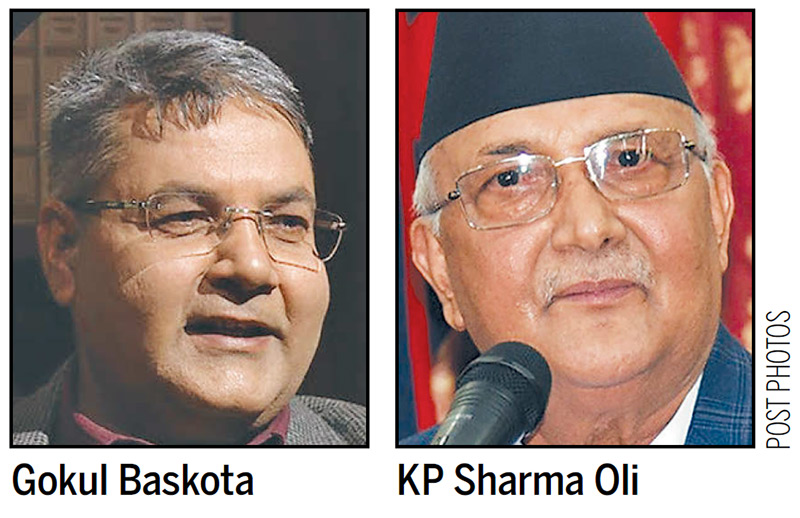
Gokul Baskota might have resigned as minister for communication and information technology over a leaked audio record of him seeking kickbacks in public procurement, but there are many who say that it is Prime Minister KP Sharma Oli who is ultimately responsible.
Baskota resigned after being caught on audiotape negotiating a Rs 700 million “commission” with the local agent of a Swiss company over the planned security printing press. But Baskota is one of Oli’s closest confidantes and there are voices from both within the Nepal Communist Party (NCP) and without who believe that Oli must have been aware of Baskota’s solicitation.
Although she refrained from naming the prime minister, Asta Laxmi Shakya, a Standing Committee member of the ruling party, demanded that all those involved in the scandal be identified and prosecuted.
“Baskota alone cannot make a deal on such an unimaginable amount of money,” Shakya told the Post. “There must be other actors behind the scene and they must be revealed.”
This suspicion has only been bolstered by the account of Bijaya Prakash Mishra, the local agent in question.
Speaking to Kantipur daily, the Post’s sister publication, on Friday, Mishra said that he had provided Oli with the audiotape two months ago.
“But he did not take any initiative to take action against Baskota,” Mishra told Kantipur.
Oli has long favoured Baskota, elevating him from a junior minister in his Cabinet to full minister and the government’s spokesperson.
In the last Cabinet reshuffle, despite much criticism about Baskota’s abrasive style and the plethora of bills his ministry was aiming to introduce, Baskota kept his ministerial berth.
Given the close connection that Oli and Baskota have, party leaders believe that Oli should take moral responsibility for the actions of a trusted Cabinet member.
“Even though I believe that the prime minister should take moral responsibility for Baskota’s action, the mentality of leaders appears to be to protect those who are close to them,” said Ganesh Sah, a Standing Committee member of the ruling party and a former minister.
Public criticism about the scandal has been immediate, with many calling for Baskota’s expulsion from the Cabinet and an investigation into the allegations. Baskota stepped down on his own but there is now an expectation that investigation and prosecution will follow.
“Any failure to take further action, as expected by the people, will certainly take him, the party and the nation to a very difficult situation,” said Yubaraj Chaulagain, a Central Committee member. “This comes as a huge blow to the prime minister.”
But given past experiences, there is not much optimism regarding the due process. In 2010, Krishna Bahadur Mahara, the former House Speaker who was recently acquitted of attempted rape charges, was similarly caught on audiotape asking a Chinese person for Rs500 million to “buy lawmakers”.
For anti-corruption campaigners, an investigation into Baskota would be welcome, as there has long been a tendency for Nepali leaders to ‘sacrifice’ lower-ranking officials in order to save ‘bigger fishes’.
“In Nepal, it’s only the common people who have to undergo legal procedures,” said Shree Hari Aryal, former president of Transparency International’s Nepal chapter. “The anti-graft body tends to save those leaders who can influence the prime minister.”
Aryal was referring to the Baluwatar land grab, known colloquially as the Lalita Niwas scam, where the Commission for Investigation of Abuse of Authority refrained from indicting Nepal Communist Party General Secretary Bishnu Poudel, despite his involvement in the scam. Poudel too is from the Oli camp in the ruling party.
But pressure is mounting on Oli from all sides. The opposition Nepali Congress has seized the opportunity to take the Nepal Communist Party to task while the public mood is foul. Even within the party, Oli finds himself surrounded. Party Chairman Pushpa Kamal Dahal, who has recently acquired a majority on the party’s nine-member secretariat, will likely use this occasion to press Oli further.
“It appears that leaders are becoming more corrupt,” Dahal said at a programme organised in Bhaktapur on Friday morning. “We must commit to correct our mistakes and take action against the wrongdoers to strengthen and purify the party.”  
Baskota’s resignation will not just weaken Oli’s position within the party but has damaged his image, especially given his pronouncements on controlling corruption. “Everyone knows that Baskota has very close connections with Oli,” said Aryal. “I cannot believe that Baskota did this without the knowledge of the prime minister.”

Page 2
MEDLEY

Horoscope

ARIES (March 21-April 19)
***
Tell your inner critic to be extra kind when you’re evaluating other people today. It can be quite demanding sometimes, and having high expectations is not going to help you get important people on your side, and you definitely need them to be on your side right now! But keep an open mind and listen to what people are saying.


TAURUS (April 20-May 20)
***
You’ll want to be especially careful to keep all of your communication on the up-and-up right now. The more honest and open you can be with people the better. Don’t fall into the trap of thinking that if you tell someone what you think they want to hear that they’ll like you better or respect you more.


GEMINI (May 21-June 21)
**
Your interpersonal energy might feel a bit off at the moment, so don’t be surprised if some of your interactions take sudden strange turns. Just try to laugh off an awkward silence. The other person will follow your lead most likely. Think of this as a great opportunity for you to practice making lemonade out of lemons!


CANCER (June 22-July 22)
***
You’ll be getting a much more profound understanding of an issue (or a certain someone) that has been causing you to scratch your head in confusion lately. An unusual event later in the day could reveal what’s really going on and what you can do to help move things in a more positive direction.


LEO (July 23-August 22)
****
It’s time for you to realise that being self-centred isn’t always a bad thing. Sometimes it’s essential in order to keep your cool. Today, you need to concentrate on number one (that’s you!) in order to stay happy and grounded. Treat yourself right and make some big plans. Buy something you’ve had your eye on.


VIRGO (August 23-September 22)
***
If you’re still holding on to some hurt feelings or leftover issues from your past, today is the day to move past them. They’re clouding your thoughts and causing you to think things about someone in your life right now that simply aren’t true. Are you judging someone based on the actions of someone else?


LIBRA (September 23-October 22)
****
Money is probably on your mind more than just about anything else right now, and it could be distracting you too much from friends and family members. To take your mind off of finances, focus on someone else’s life. Single out a fun friend and ask them how their job or love life is going.


SCORPIO (October 23-November 21)
***
Someone in your family might not know the story about what is going on with you, but that’s probably not going to stop them from lecturing you. As much as it might annoy you to listen to what they have to say, you must. Plus listening to what they think is a good way to show them that you love them.


SAGITTARIUS (November 22-December 21)
****
Just what are you waiting for? That job, cutie, or other exciting new opportunity isn’t going to come to you. You have to go to it. It’s time to get proactive and go after what you want! So cross that room and talk to that person before someone else gets to them first. Tell your boss you’re interested in the job before anyone else does.


CAPRICORN (December 22-January 19)
*****
A little bit of solo time probably sounds good to you right now, doesn’t it? It makes sense, after all the time and energy you’ve been giving to other people lately. A little bit of rest and relaxation will revitalise your heart and your soul and remind those around you that you can’t be taken for granted.


AQUARIUS (January 20-February 18)
***
Details, details. Sure, they’re not the most exciting things in the world, but they’re important to maintainingt precious relationships. Have you forgotten someone’s birthday or neglected to congratulate someone on their diet progress? Noticing the little things will show the other people in your life that you care.


PISCES (February 19-March 20)
***
Today, some conflict could grow between the side of you that wants to take on greater responsibility and the side of you that just wants to have fun. This doesn’t have to be a tug of war, though. All you need to do is organise your day a bit better and you’ll be able to enjoy yourself without letting other people down.

Page 3
NATIONAL

Government opts for volunteers to address teacher shortfall

The selection process will begin after collecting the list of exact vacancies of Science, English and Mathematics teachers in each of the 753 local governments across the country.
- BINOD GHIMIRE
Hundreds of state-run schools lack qualified teachers for Science, English and Mathematics. Post file Photo

KATHMANDU,
As the numbers of teachers continue to fall short in public schools, the government is preparing to appoint volunteers to curb the problem. Hundreds of state-run schools lack qualified teachers for Science, English and Mathematics.
The Ministry of Education endorsed the Teaching Volunteers Mobilisation Working Procedure to manage the selection of volunteers to teach the three subjects. The volunteers will teach for a year, starting with the new academic session set to begin from mid-April.
The teaching volunteers will get a stipend between Rs 24,000 and Rs 32,000 depending on their qualifications and the level they are teaching at. They will be hired on two levels, grades 6 to 8 and grades 9 to 12, and must have a minimum qualification of the bachelor’s degree.
 The selection process will begin after collecting the list of exact vacancies in each local federal unit, reads the working procedure. The ministry has asked the respective local governments to compile the list of needed teachers and send the request to it. There are 753 local governments across the country.
The respective schools will sign a one-year contract with the selected volunteers and will pay them from the budget released by the federal government. The government has allocated Rs 1.50 billion for the programme for the current fiscal year.
A recent study by a task force led by Mahashram Sharma, a former secretary, shows 73,938 teaching positions are vacant in the state-funded schools. The numbers of public schools, also called community schools, stands are around 29,000 across the country.
The study completed in October shows among 6,501 secondary schools only 71—around one percent—have the teachers for all subjects. Similarly, only 333 public lower-secondary (grades 6 to 8) among 9,859 have all the subject teachers. “The problem of inadequate subject teachers will end once the hiring of the volunteers begins,” said Deepak Sharma, spokesperson for the ministry.
The study shows that there is a shortfall of Science teachers at the highest number of community schools, followed by Mathematics and English. As many as 5,291 secondary and 8,444 lower-secondary schools don’t have science teachers while the numbers of the schools lacking Mathematics teachers are 4,899 at the secondary and 7,798 at the lower-secondary level.
The lack of subject teachers in the three subjects is blamed for the student’s poor performance in those subjects in the Secondary Education Examinations. The different government reports suggest that the students are faring poorly in three subjects, which is reflected even in the Secondary School Examinations. Education experts say while it is good to mobilise the volunteers, the government should also look for a long-term solution to the problem.
“The youth with potential don’t see teaching as an attractive profession. Some measures should be adopted to increase respect towards teaching,” said Binay Kusiyait, a professor at Tribhuvan University who has done research on school education. He said opening of avenues for easy promotion and increasing pay and perks could be a solution to the problem.

NATIONAL

Panel recommends compulsory psychometric test for pilot hopefuls

Policy drafters proposed the test after several air crash reports blamed pilot behaviour.
- SANGAM PRASAIN
Psychometric tests gauge an individual’s personality traits and mental competence for a job. SHUTTERSTOCK

KATHMANDU,
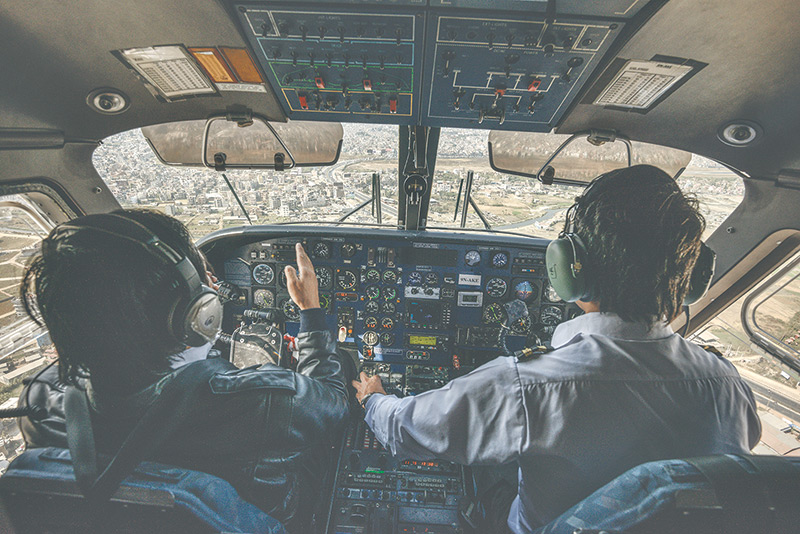
Nepal may require aspiring airline pilots to pass psychometric tests before they are allowed to join a
pilot course abroad, according to a preliminary draft of the national aviation policy which is being revised after 13 years.
Psychometrics tests gauge an individual’s personality traits, mental competence and suitability for a particular job.
A task force formed to amend the aviation policy recommended inserting the requirement in response to different air crash investigation reports that partly blamed the behavioral attitude of pilots in the face of bad weather for the disasters.
The panel handed over the draft policy to Tourism Minister Yogesh Bhattarai on Wednesday.
In view of the safety measures that Nepal has to adopt in line with its diverse topography, any Nepali wishing to become a pilot should undergo psychometric tests as per international standards, says the draft. They should be allowed to pursue the pilot course only if they pass the test, it says.
“We all know that Nepal has been seeing an increasing rate of accidents involving both fixed-wing and rotor-wing aircraft. And most of them were due to human error,” said Suman Pandey, chief executive officer of Fishtail Air, who was a member of the task force.
“These issues have prompted us to recommend mandatory psychological assessment for candidates who will become Nepal’s future commercial pilots,” he said.
Airlines in most countries have been conducting a psychological assessment of pilots before hiring them. But there are only a few countries whose flying schools conduct psychometrics tests before enrolling them, said Sanjiv Gautam, former director general of the Civil Aviation Authority of Nepal.
“It’s a good move to conduct psychometric tests. But the policy should be clear where Nepalis should undergo them,” he said, adding that in Nepal, a separate institute can be formed like a medical board to conduct the tests. “But since exercising power and nepotism in Nepal is a big problem, as it is now, to pass the test, it may not work properly .”
Another option is issuing a commercial pilot’s licence to a pilot who has passed psychometric tests from any flying school that requires candidates to take them before they can enrol in the course, he said. “But these issues need to be stated clearly in the regulations too.”
According to Gautam, human error has been the major cause behind accidents in Nepal with pilots seen making quick decisions and lacking situational awareness.
According to the Civil Aviation Authority of Nepal, 21 fatal accidents have occurred in the country in the past 10 years, including eight crashes involving helicopters. During the period of 2009-18, the highest number of accidents occurred in 2016 when there were four mishaps.
In 2018, the European Commission adopted new rules on the mental health of pilots for the first time, requiring airlines to do a psychological assessment before hiring them. The new rule followed after the Germanwings crash in which a pilot deliberately flew a jet into a mountainside in March 2015, killing all 150 people on board.
Nepali investigators have also cast a spotlight on the history of mental health of pilots in the final report on the crash of the US-Bangla plane at Kathmandu’s Tribhuvan International Airport in 2018, killing 51 people.
The investigation commission recommended that all airline pilots undergo a psychological evaluation as part of the training or before entering service.
Investigators have also found that the pilot of the Makalu Air plane that crashed in May 2018 had some issues related to his mental health.
According to Buddhi Sagar Lamichhane, the panel handed over the draft civil aviation policy on Wednesday and the government will review it before releasing it formally.
The government introduced the national aviation policy in 1993 with the view of involving the private sector in air transport service after Nepal adopted a liberal sky policy in 1992. The government made the first amendment to the policy in 1996, aiming to attract many tourists through the development of civil aviation. It was replaced by the Aviation Policy 2006.

Page 4
NATIONAL

Pashupati sees smart sadhus this Mahashivaratri

The ash-smeared ascetics see smartphones and internet as an essential part of their life these days.
- ANUP OJHA
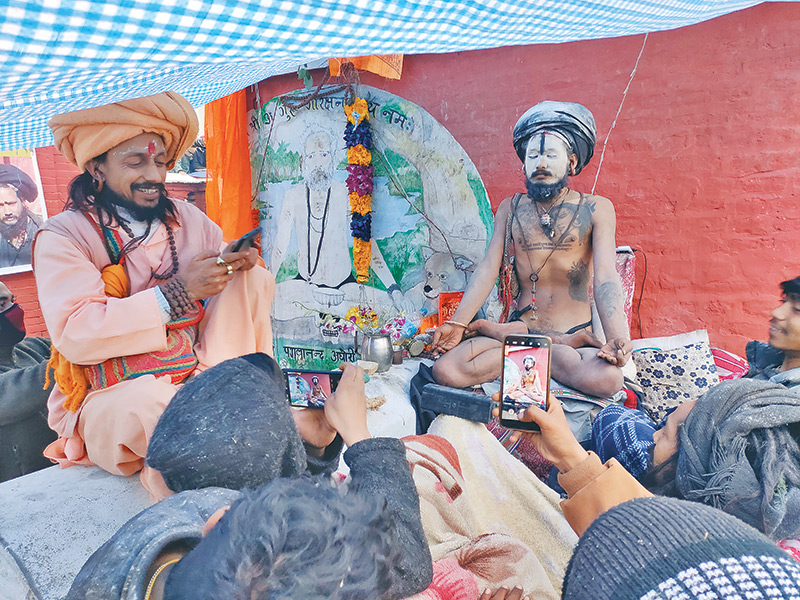
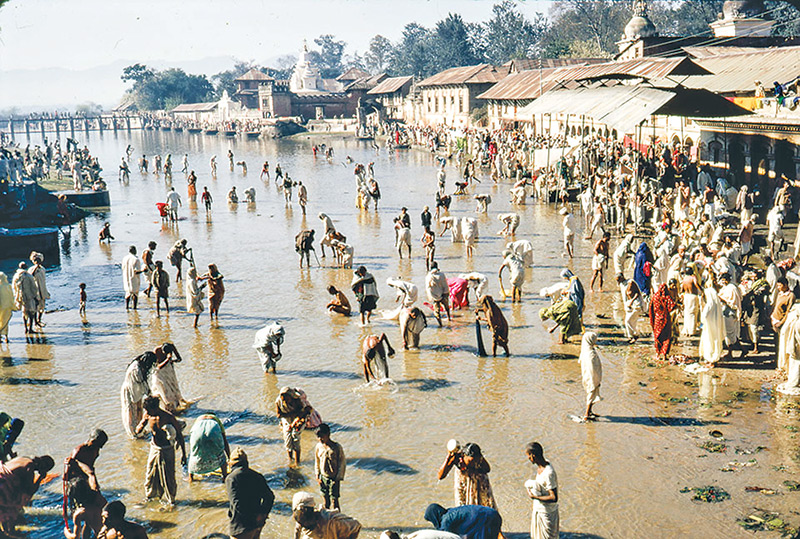
A sadhu meditates while others take photos at Pashupati in Kathmandu on Friday.  Post Photo: ANUP OJHA

KATHMANDU,
Many sadhus visiting the Pashupatinath temple for the Mahashivaratri festival this year were seen with smartphones on their hands. Some were taking photos (selfies even), some shouting directions amid noise and confusion and others listening to music.
As ironic as it may sound, these ash-painted, non-materialistic Shaivite ascetics see smartphones and internet as an essential part of their life these days.
“Cellphone has become a very good means to connect with other sadhus of our sect and our bhaktas (disciples),” said Baba Yogi Niranjan Nath. His face and body smeared with ash, the smartphone on his hand looked out of place.  “I even use WhatsApp to connect with my people,” he added proudly.
Yogi Rawinath, a sadhu camped at Ram Mandir, was miffed at the festival organiser for not organising free Wi-Fi service.
“I have been posting pictures on my Facebook using mobile data, which is very costly,” said the 40-year-old Rawinath.
While the sadhus belonging to the Naga sect camped inside the main temple complex were prohibited from carrying phones, outside the temple, there was no shortage of tech-savvy Hindu holy men, an observation made by many visitors.  
Biraj Subedi, who had brought two French tourists to show them the Mahashivaratri festival, said they were surprised at seeing so many sadhus using smartphones.
“We saw many babas holding smartphones. This was quite a surprise not just for my foreigner friends but to me as well,” said Subedi.
Not far away from where Rawinath was sitting with his fellow sadhus at Ram Mandir sat a group of ascetics in a circle, smoking marijuana chillums.
 Like many other sadhus visiting the Pashupati temple for the Mahashivaratri, they also wished for a free Wi-Fi facility. With no internet, they are enjoying music blaring out of a Bluetooth speaker.
The announcement of the Kathmandu Metropolitan City to provide free Wi-Fi service in the Pashupati area two years ago has not materialised yet.  
Until the city authority starts free Wi-Fi service, sadhus like Yogi Rawinath will have to rely on expensive mobile data to stay connected with their friends and followers.
“I wanted to live stream the festival for my Facebook friends,” said Rawinath with a hint of mild frustration in his voice.

Page 5
NATIONAL

Border dispute hits tourist area’s development

Both Doramba Rural Municipality, Ramechhap and Shailung Rural Municpality, Dolakha claim the scenic destination.
- TIKA PRASAD BHATTA
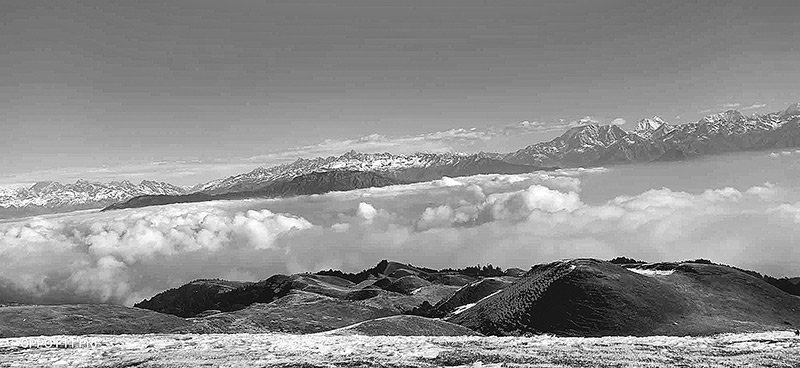
Shailung, which translates to ‘100 hills’, is an attractive tourist destination situated at an altitude of 3,147m above sea level. Post Photo: Tika Prasad BhaTTA

RAMECHHAP,
Several infrastructure projects in Shailung, a tourist destination on the border between Ramechhap and Dolakha, have been halted due to a longstanding border dispute between the two districts.
The Ministry of Financial Affairs and Planning in Bagmati Province has instructed Doramba Rural Municipality in Ramechhap and Shailung Rural Municipality in Dolakha to discontinue the ongoing construction works and to not initiate any new projects until the border dispute is resolved.
Both local units have been promoting tourism aggressively in the Shailung area by building tourism infrastructure.
“The construction of all infrastructure in Shailung area has been stopped for the time being due to the border dispute between Doramba and Shailung rural municipalities,” said Kailash Prasad Dhungel, the minister for financial affairs and planning.
The provincial ministry said it would resume infrastructure development in Shailung area after the border dispute is settled. Earlier, infrastructure development fell under the ambit of the local units. The Bagmati government allocated Rs10 million for the development of Shailung area in the current fiscal year.
“The government earlier planned to carry out development works through the local units but it is now impossible. The ministry will take charge of the development activities in the area,” said Dhungel.
Shailung, which means 100 hills in Tamang language, is an attractive tourist destination at an altitude of 3,147 metres above sea level. The local units that share a border have been building roads, foot trails, resting places and homestays on their sides with an aim to promote tourism. A gompa, roads, foot trails, homestays, Chautaras, and drinking water facilities are currently under construction in the Shailung area.
Both the local units are at loggerheads regarding the border of Shailung as they plan to bring the amount generated through tourism to their respective local units. A few months ago, Doramba Rural Municipality raised objection to Shailung Rural Municipality’s publicity campaign that claimed Shailung area lies entirely in Dolakha.
Shailung was a neglected area until a few years ago for a lack of road connectivity. “The number of tourists, both foreign and domestic, is increasing in recent years as the Nepal Tourism Board launched a publicity programme of an Adibasi/Janajati Trekking Route, including Shailung,” said Dawa Shangbu Sherpa of Doramba.
“The construction of roads on both sides of Ramechhap and Dolakha will further attract tourists to visit the area,” said Sherpa, adding that the footfall of tourists benefits both the local units. “The dispute should not affect tourism in the area.”

NATIONAL

Rural municipality upgrades health post to a 15-bed hospital

- HARI GAUTAM
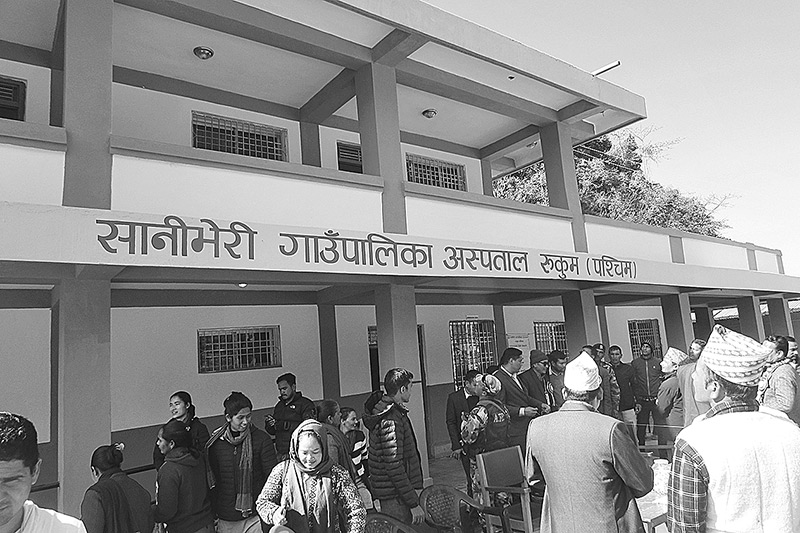
Each rural municipality has a mandate to establish a hospital with at least 15 beds. Post Photo: Hari Gautam

RUKUM (WEST),
Sanibheri Rural Municipality, one of the remote local units in Rukum (West), has started providing health services to patients from a 15-bed hospital that was upgraded from a health post on February 14.
The municipal office recently upgraded Simli Health Post in Chhotebagar of Ward 7 to a 15-bed hospital. A team of health workers led by Dr Kabin Basnet started treating patients from Sunday.
The rural municipality has appointed health workers and technical staff on a contract basis to operate the hospital.
On February 14, Janardan Sharma, a member of the House of Representatives, inaugurated the hospital.
Nara Bahadur Pun, chairman at the rural municipality, said the hospital was set up in accordance with the constitutional provision mandating each rural municipality to establish a hospital with at least 15 beds.
“The Local Government Operation Act authorises the local unit to establish and operate a fully facilitated hospital,” said Pun.
The rural municipality has also fixed the posts of health workers and other staff by implementing the Hospital Operation Working Guidelines. Chhabilal KC, the coordinator at the Health Section of the rural municipality, said they have approved the posts of 32 staff, including three MBBS doctors and a medical specialist, for gynaecology, pediatric and orthopaedic departments.
“In the first phase, we have mobilised health workers led by an MBBS doctor,” said KC, informing that specialist’s services will also start soon.
The hospital has started providing 24-hour emergency services, OPD, IPD and lab facilities, maternity and X-ray services, and minor surgery facilities.
Kamal KC, a resident of Sanibheri, said the villagers are finally feeling the presence of the local government.
“We don’t have to go out of the village to seek medical treatment now. That is a relief for us,” said KC. The hospital also has an ambulance to facilitate patients from surrounding remote areas.
Pun said his office has also established community health units in each ward. “Nepal’s constitution recognises health as a fundamental right of the people,” said Pun, adding that they have established the hospital despite limited resources. The rural municipality invested Rs 6.4 million on medical equipment and staff management in the current fiscal year.
Out of six local units in Rukum (West), Sanibheri is the second local unit to have established a hospital. Aathbiskot Municipality set up a city hospital for its residents one-and-a-half years ago.

NATIONAL

Illegal logging worries Kanchanpur locals

- BHAWANI BHATTA

KANCHANPUR,
Locals of Bramhadev in Bhimdatta Municipality have raised concerns over alleged smuggling of timber from the Siddhanath Community Forest, adjacent to the Chure region, to India.
They say that smugglers cut down sal trees in Bramhadev, Kanchanpur, dump them into the Mahakali River and collect the logs downstream in India.
“We’ve seen rapid deforestation in the area,” said Harka Bahadur Chand, chairman of Siddhanath Community Forest. “We suspect that raw timber is being smuggled across the border at night.”
Kalla Masetti is close to the Indian border town of Tanakpur across the Mahakali and around five kilometres north of Bramhadev area. Moti Mahata, a local, said they also occasionally find logs scattered on the river banks. “Khalla Masetti has developed as the main route of timber smugglers these days,” said Mahata.
Last week, security personnel and forest officials, who inspected the area, found more than two dozen tree stumps were found in the forest,” said Chand.
Ajaya Bikram Manandhar, chief divisional forest officer at Kanchanpur Divisional Forest Office, said his office has been investigating the illegal felling of trees in the community forests and Chure area in Bhimdatta municipality. “We have also sent a letter to the sub-divisional office to start an investigation into the matter,” said Manandhar.
A few days ago, Kanchanpur Division Forest Office arrested Gaja Bahadur Chand, a local resident of Khalla Masetti, on charge of smuggling timber. He was released without bail a few days later. According to Manandhar, authorities are looking for other culprits.
The Kanchanpur Divisional Forest Office has also directed the sub-divisional forest office to surveil the Chure region and control illegal logging. Two months ago, the community forest had taken action against 10 individuals, found to be involved in smuggling.

NATIONAL

Pad dispensers boost girls’ attendance in public schools

Dipayal Silgadhi Municipality, Doti forms student groups to hand out cards to access the machines.
- Mohan Shahi

DOTI,
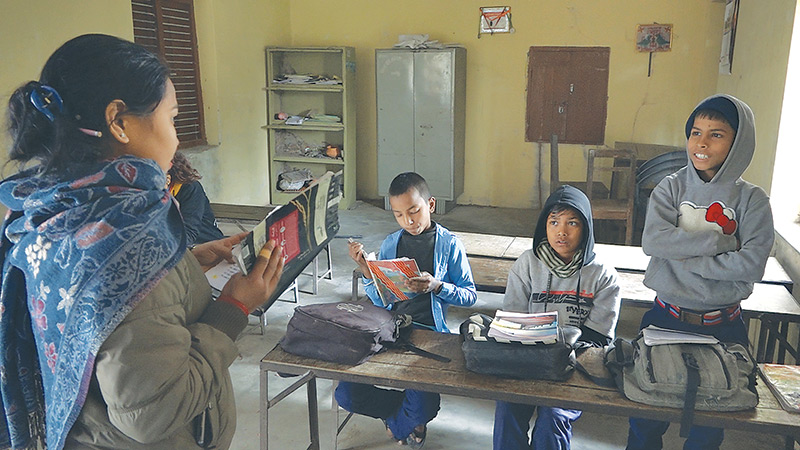
Teena Malla uses the sanitary pad vending machine installed in her school during her periods.“These days, I don’t worry if I forgot to carry sanitary pads to school,” says the tenth grader at Dilpeshwor Secondary School in Dipayal Silgadhi, the district headquarters of Doti.
The dispenser machine has saved Malla and other school girls the trouble of running to the shop to buy pads during period emergencies.Besides installing the card-operated sanitary pad vending machine, the school has also built a separate toilet and sanitation facility for girl students.
This initiative has benefitted the girl students, which reflects on their attendance rate, says Dirgha Bahadur Kathayat, the school’s headmaster.“Fewer girls are missing their classes these days. This is due to the availability of sanitary pads and separate toilet facility in our school,” he adds.
The school has 801 students and 415 of them are girls.Saraswati Kathayat, a ninth grader at the school, preferred to stay at home during her periods. She rarely misses her classes these days.
“Earlier, I felt uncomfortable going to school during periods because the boys and girls had to use the same lavatory. I have been to school regularly since the school set up the vending machine and the girl’s toilet,” says Saraswati.The sanitary vending machine was installed in Dilpeshwor Secondary School as a pilot project of the local municipal government.
According to Municipal Mayor Manju Malasi, the project is being piloted in Dilpeshwor Secondary School, Padam Public School and Sunadevi Secondary School.The municipality office has formed student groups in each school and given them the responsibility of handing out pad dispenser cards to those in need.
On May 4, 2019, President Bidya Devi Bhandari had announced that sanitary pads would be distributed to girl students of all community schools for free from the beginning of the current fiscal year.During the budget speech of 2019/20, the federal government had allocated Rs 1.37 billion for community school sanitary pad distribution project in all 753 local units across the country.
The objective of the programme was to improve the school attendance rate of girl students.A 2016 report of the UNICEF had shown that 15 to 22 percent of girl students from schools in Achham, Bajura and Parsa districts were missing a whole day of school due to menstrual discomfort, both physical and mental.

NATIONAL

Quake-damaged Dhading land office moves to new building

Briefing
- Post Report

DHADING: The District Land Revenue Office in Dhading has started offering services from its new building in Dhadingbesi. The old office building was damaged in the earthquakes of 2015.

NATIONAL

Army to build war museum

Briefing
- Post Report

SINDHULI: The Nepal Army has started the construction work for the proposed war museum in Kamalamai Municipality Ward No. 3. Barda Bahadur Battalion of Nepal Army in Sindhulimadhi has been tasked with building the museum facility. The foundation stone of the building was laid in November 2019.

NATIONAL

Kavre declared fully literate

Briefing
- Post Report

KAVRE: Kavre has been declared a fully literate district. The declaration was formally made by Education Minister Girirajmani Pokharel amid a function organised in the district on Thursday. Uddhav KC, chief of the District Coordination Committee, said the literacy rate of Kavre stands at 96.48 percent. A district with a literacy rate above 95 percent qualifies for the fully literate status.

NATIONAL

Laxman Tharu ends strike

Briefing
- Post Report

DHANGADHI: Laxman Tharu, the central coordinator of the Tharuhat/Tharuwan Rastriya Morcha, ended his hunger strike on the eighth day on Thursday. He agreed to end his fast-unto-death after political parities of Kailali district pledged to take initiatives to fulfil his demands. Tharu started his hunger strike with a 14-point demand which included the release of Resham Chaudhary.

NATIONAL

Agriculture and Forestry University to close temporarily

Briefing
- Post Report

CHITWAN: The Agriculture and Forestry University in Rampur, Chitwan, will remain closed from February 20 to February 29 due to disputes between two factions of the Nepal Communist Party—the then All Nepal National Free Students Union and the then All Nepal National Free Students Union-Revolutionary. The university on Wednesday published a notice citing that the varsity will be closed to prevent any untoward incidents.

Page 6
MONEY

China’s chicken chain comes unstuck amid chaos of virus measures

About half of China’s chickens are raised by individual farmers involved in only one or two steps of the chicken chain.
- REUTERS
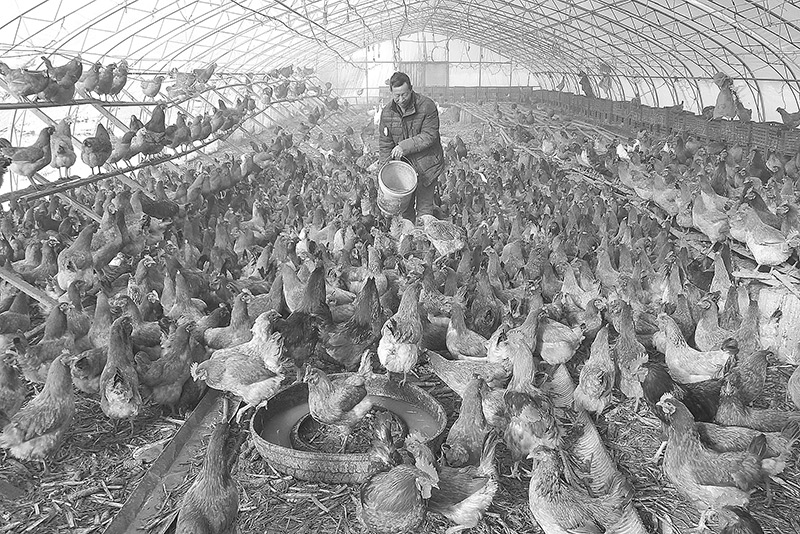
A man provides water for chickens inside a greenhouse at a farm in Heihe, Heilongjiang province, China. reuters 

BEIJING, 
China’s chicken farmers had been looking forward to a bumper year.
But an unprecedented lockdown on people and goods to curb the coronavirus outbreak has disrupted the short but intense poultry lifecycle, threatening output of meat just as the world’s most populous country faces a massive pork shortfall.
China’s poultry production expanded by 12 percent last year to 22.39 million tonnes, after farmers sought to plug the gap from the pork shortage caused by African swine fever that ravaged the domestic hog herd.
About half of China’s chickens are raised by individual farmers involved in only one or two steps of the chicken chain, rather than integrated operations.
But that has made them vulnerable to the restrictions on movement and labour shortage resulting from Beijing’s efforts to curb the spread of a new coronavirus that has killed more than 2,200 people and infected around 75,000.
Many roads to villages across the country are still blocked, despite government efforts to ease problems for vital industries like food, hampering feed deliveries and movement of birds.
Some feed mills and slaughterhouses are still shut, while others are only starting to reopen after extended holidays and operating below capacity.
That has upset the flow of a supply chain that starts with the sale of day-old chicks by hatcheries to breeding farms, continues with distribution of broiler chickens to growers, and ends in the slaughter of fattened birds, all in less than a year.
“Every step needs to work at the same pace, otherwise there will be an imbalance,” said Pan Chenjun, senior analyst at Rabobank.
Pan Xingle, who raises chickens in Yi county in Hebei province for a slaughterhouse under contract, is still waiting to slaughter 16,000 birds that are already more than 50 days old.
Broilers used for cheap meat by fast-food chains and public canteens reach their maximum weight of 2.6 kg (5.7 lb) in around 40 days.
But the slaughterhouse has only just reopened after an extended holiday and farmers are queuing to kill their chickens.
“I was told I’ll need to wait for at least another 10 days,” said Pan.
That means Pan won’t be restocking his farm with new chicks for a while longer, hurting business for some of the 45 million breeders that raise ‘parent stock’ around China.
Prices for the day-old-chicks sold by those breeders are currently below cost, ranging from 1.4 yuan to 2.5 yuan (about 20 to 35 US cents) per chick.
The average price last year was 6.8 yuan.
Zhang Yanguang, manager of breeding farm Beijing Lvyan Poultry Centre located in a village in the northwest of the capital, said even if he could sell his chicks, roads to the village are still blocked, and trucks can neither go in nor out.
Worse, most of the slaughterhouses in the northeast and northwest of China are still shut so he can’t get rid of unwanted birds either.
“The whole market is closed down,” he said, estimating slaughter capacity is currently only running at around
30 percent.
If pressure on farms like Zhang’s continues past this month, it could force some out of business, said Pan, the analyst, hitting the hatcheries further upstream that raise grandparent stock to produce the breeders.
“Then the hatcheries will have to destroy day-old chicks or eggs,” she said. With schools and many factories and restaurants still closed, lower production of chicken and eggs is not yet a problem. But once business returns, supplies could tighten, Pan said.
The effect is likely to be seen in the second and third quarters, an agriculture ministry official said earlier this week. Similar challenges are facing egg farmers who are unable to get fresh eggs to market nor replace their old hens.
“We are selling our chicks really cheap, as little as 1.5 yuan instead of 4 yuan, so we’re losing money,” said Wang Lianzeng, chairman of Huayu Agricultural Science and Technology Co Ltd, one of the country’s largest hatcheries for laying hens.
That could help farmers like Li Shunji from northern Shandong province who is selling his eggs at a loss because he no longer has access to big markets in Beijing and Tianjin.
But he still has worries. As he waited to take delivery of a new batch of baby chicks, he worried about transport disruption.
“They are so fragile at the moment. Moving them around might lead to their death, or reduce their productivity in the future. But I can’t do anything. I will just have to wait.”

MONEY

Stormy EU budget summit enters day two

- AGENCE FRANCE-PRESSE

BRUSSELS,
EU leaders clashed through the night early Friday as a stormy summit to decide the bloc’s seven-year, trillion euro budget entered a second day.
The meeting to decide the EU’s first budget since the UK left the bloc exposed bitter divisions between penny-pinching rich nations, poorer ones wanting to preserve spending and others wanting to fund grand global ambitions.
The drawn-out tussle for money is a Brussels ritual, but is especially problematic this time around because of Britain’s departure from the EU.
The “Brexit gap” caused by the loss of the UK’s contribution is 75 billion euros ($81 billion) over the 2021-2027 period, but French President Emmanuel Macron insisted this must not mean the EU should trim its ambitions by cutting spending.
German Chancellor Angela Merkel warned there were “major differences” to overcome among the 27 countries, as some officials braced for talks to drag into the weekend.
“We are not satisfied with the current situation because the balance within the net payers has not yet been properly negotiated,” Merkel said as she arrived.
Summit host Charles Michel, the EU Council president, worked late holding one-on-one meetings with leaders trying to find common ground, hoping to table a new proposal on Friday.
“I am convinced that it will be possible to make progress in the next hours or in the next days,” Michel told reporters.
The self-styled “frugal four”—the Netherlands, Sweden, Austria and Denmark—opposed the deal, adamant that the bloc curb spending.
Macron, who wants farm payments protected and more money for European defence projects, said he was ready for the long haul.
“I will take all the time that is needed to get an ambitious agreement that defends the interests I represent,” he said, insisting that with “a spirit of compromise and ambition” a deal could be found.
He added it would be “unacceptable for Europe to compensate for the British departure by reducing its means”.
But Finnish Prime Minister Sanna Marin slapped down the French leader’s call for post-Brexit largesse, saying the EU had to be “realistic” following the departure of one of its biggest net contributors.
The minimum spending in the multi-annual financial framework (MFF), as the long-term budget is called, is just over one trillion euros.
The discord is over how much this budget should increase by, how spending might be shifted between priorities and how much each member state should pay as a percentage of its gross domestic product (GDP).
Another touchy issue is whether budget rebates pocketed by a few wealthier countries should still exist.
The last MFF came in at 1.08 trillion euros (in 2018 prices).
The “frugal four” want to rein in the budget and make up only some of the ground of the Brexit gap. They also want to keep their rebates, as does Germany.
Austrian Chancellor Sebastian Kurz struck a tough note, insisting Vienna’s budget contributions must not “grow immeasurably” and rejecting a compromise proposed by Michel.
Dutch Prime Minister Mark Rutte tweeted a picture of himself and the other “frugals” insisting for lower spending, while adding that he had come to Brussels with some leisurely reading, confident that his position would not budge.
“I’ve brought the biography of Frederic Chopin along,” Rutte told reporters.
At the high end of spending demands is the European Parliament, which wants the MFF expanded to 1.32 trillion euros to pay for costly goals such as turning the European Union into a carbon-neutral economy within three decades.
A “friends of cohesion” group of mostly eastern and southern EU nations wants to ringfence money it gets to help bring infrastructure and society up to the level of wealthier counterparts.

MONEY

Asia-Pacific airlines could lose $27.8 billion to coronavirus: IATA

- AGENCE FRANCE-PRESSE

PARIS,
Airlines operating in the Asia-Pacific region stand to lose a combined $27.8 billion of revenue this year in the ongoing coronavirus crisis, the International Air Transport Association said on Thursday.
The estimate is based on projections of a 13-percent full-year decline in passenger demand, mostly in China, the trade body said.
“This will be a very tough year for airlines,” IATA CEO Alexandre de Juniac said in a statement. “Stopping the spread of the virus is the top priority.”
IATA said its estimate assumed that COVID-19 behaved like the SARS outbreak nearly two decades ago, which was “characterised by a six-month period with a sharp decline followed by an equally quick recovery”.
This will be the first time since the 2008-2009 financial crisis that demand for air travel has declined, De Juniac said.
Airlines in China’s domestic market alone are estimated to lose around $12.8 billion in revenues.
Carriers outside the Asia-Pacific region are seen suffering $1.5 billion in losses.
This brings worldwide airline revenue lost to the virus to a projected $29.3 billion, IATA said.
However, if the virus spreads more widely to Asia-Pacific markets then the impact on airlines from other regions would be larger, IATA warned.
IATA had previously estimated Asia-Pacific airlines to register growth of 4.8 percent this year, but they are now on course instead for a contraction of 8.2 percent, it said.
But there are some factors potentially softening the blow, IATA said.
“Governments will use fiscal and monetary policy to try to offset the adverse economic impacts. Some relief may be seen in lower fuel prices for some airlines, depending on how fuel costs have been hedged,” it said.
It was therefore difficult to predict by how much exactly lost revenue would weigh on profits.
But airlines are already taking “difficult decisions” to cut capacity, or even routes, IATA said.

MONEY

Argentina faces race against time to renegotiate debt

- AGENCE FRANCE-PRESSE

BUENOS AIRES,
Backed by the IMF, Argentina is looking to renegotiate its debt but it faces a race against time to secure short term relief.
Since assuming power in December, President Alberto Fernandez’s government has insisted it will not be able to pay off its creditors if its economy—in recession since mid-2018—doesn’t resume growth.
And more than $30 billion of debt repayments are due before the end of March.
Faced with unyielding creditors who won’t give an inch, Argentina found an unlikely ally when the International Monetary Fund declared that the South American country’s debt is “unsustainable” following a week long mission that ended on Wednesday.
“We were accused of being populists, irresponsible, but it turns out that we woke up today with the IMF having said we were right,” centre-left Fernandez said on Thursday.
Argentina is battling to avoid another situation like 2001 when it defaulted on $100 billion, becoming a market pariah.
The country currently owes $311 billion—more than 90 percent of its GDP.
It’s hoping to renegotiate $195 billion, including the $44 billion it owes the IMF.
“I think we have a good chance to negotiate something reasonable because the IMF wants to avoid a default,” Hector Torres, Argentina’s former representative to the world finance body, told a local radio station.
The IMF’s position “isn’t encouraging for the Argentine economy but it is for the negotiation. It’s a slap on the back for the government,” Matias Rajnerman, the chief economist at consultancy Ecolatina told AFP.
“Obviously, the IMF is an authoritative voice in the finance market, and it saying that the debt is unsustainable could make private creditors adapt their positions.”
Argentina is struggling with inflation of more than 50 percent, a major currency depreciation and a poverty level that has soared almost to 40 percent. For the IMF, Argentina needs “a definitive debt operation—yielding a meaningful contribution from private creditors ... to help restore sustainability.”
This “removes any doubt that private bondholders will need to stomach large haircuts in a restructuring,” said consultancy Capital Economics.
“But investors are unlikely to accept those anytime soon, and we think that a protracted wrangle is on the cards.”
Claudio Loser, a former IMF manager, said that right now “there’s no way of knowing the level of debt relief” that could be on the table, but estimated that it could be 30 percent of the capital.
However, he said that unless the IMF comes to a new agreement with Argentina, “its creditors won’t need to stick to it, because there’s no clear plan.”
Capital Economics expects the IMF to “lend Argentina some more money to repay the old loan—in effect extending the maturities of the obligations.”

MONEY

Renfe inks $6 billion deal to build high-speed train in US

- AGENCE FRANCE-PRESSE

MADRID,
Spanish train operator Renfe on Thursday said it had signed a $6-billion deal with US rail developer Texas Central to design, build and run a high-speed rail line in the United States.
In a statement, Spain’s transport ministry said the 5.5-billion-euro ($5.9 billion) agreement would see Renfe work alongside its US partner to develop and operate a line between Houston and Dallas that is to become operational in 2026.
The two firms have signed a preliminary agreement but it is still in draft phase, said Renfe, Spain’s national rail operator.
The Italian construction and engineering firm Salini Impregilo will be in charge of building the 386-kilometre (240-mile) line, the statement said.
For Renfe, the contract’s design and construction phase is worth about $311 million, while operating and maintaining the line from 2026 to 2042 is expected to bring in another $5.6 billion.
Described by Texas Central as the “bullet train”, the project aims to link the two cities in less than 90 minutes including a stop at Brazos Valley.
Texas Central Partners is a private company set up for the rail project, which Renfe has described as the first-ever high-speed line in the United States.
The US company Amtrak runs Acela trains between Boston and Washington however that it says can hit speeds of up to 150 miles per hour.

Page 7
MONEY

Nepal faces passport and excise sticker shortage

There is a stock of 570,000 ordinary passports, enough to last nine months, according to the Department of Passports.
- PRITHVI MAN SHRESTHA
shutterstock

KATHMANDU,
The government has backed itself into a wall over the delivery of passports as the stocks of existing machine-readable passports is fast depleting. The country is also facing a looming crisis of excise stickers.
After abruptly cancelling a global tender for the printing and supply of 5 million e-passports, the government initiated the government to government move to procure the Security Printing Press from either France or Germany.
The Security Printing Press, once set up, was also expected to print excise duty stickers and postal stickers within the country. As per Excise Duty Regulations, liquor and tobacco manufacturers and importers must paste excise duty stickers on their products to sell them in the market.
The tax officials said that the tax authority has run out of stickers meant for imported liquor and it will be without stickers for some highly saleable liquor products within a month or a month and a half.
They said that existing stocks may last until June or July but it is without the option after the Supreme Court on November 15, last year, issued an interim order putting a halt to the procurement process for new stickers through an international competitive bid. The department had planned to procure around 8 billion stickers for use over the next two years.
The next hearing on the case is scheduled for February 24. “Even if the court paved the way for procuring the stickers from abroad, there is confusion about whether to continue the existing procurement process or call fresh tender,” said Thaneshwor Gautam, deputy director-general at the Inland Revenue Department.  
The court had issued its order in response to a writ claiming that the tender barred domestic printing companies from participating in the bid. Reports suggested that there was also pressure from the Ministry of Communication and Information Technology on the Finance Ministry to stop the tender for stickers because it was in negotiations to set up a dedicated security printing press in the country. But, Gautam said he was not aware of any such pressure. “I don’t know if there was any internal pressure,” he said.
According to the Department of Passports, there is a stock of 570,000 ordinary passports which, officials said, could be enough over nine months. Likewise, there is a stock of around 1,700 official passports.
The government in November last year scrapped the tender notice for the printing, supply, delivery, installation, testing, and commissioning of equipment and personalisation of electronic machine-readable travel documents, citing the cabinet decision of procuring the security printing press and print the passport inside the country.
“We are now without options for getting new passports,” said Ram Kaji Khadka, director general at the Department of Passport. “With the current stock of passports, we may be able to sustain the demand for nine months to one year. But, it will be difficult to arrange for additional passports if demand surges suddenly.”
According to him, the department has been issuing around 50,000-60,000 passports monthly. “Sometimes, we also issue around 100,000 passports in a month,” he said.  
Khadka said that there has so far been no discussion on the scenario emerged after the parliamentary Public Accounts Committee instructed the government to halt the procurement process for Security Printing Press. “Although we are not in a crisis yet, we have to be prepared for any possibility,” said Khadka.
Minister for Communication and Information Technology Gokul Prasad Baskota was forced to resign after being caught on tape negotiating for a Rs700 million “commission” with the local agent of a Swiss company which wished to get the contract of supplying the printing machine.
The parliamentary Public Accounts Committee on Thursday instructed the government to halt the procurement process of Security Printing Press citing a possible deal for a commission in the planned procurement.
There is now uncertainty over whether this procurement process would move ahead after the latest scandal. It could have huge ramifications as the government may not be able to ensure the availability of passports for a large number of migrant workers and students who go abroad for work or study in the near future.
Experts say that a possible shortage of passports highlights the incompetence of the government which has almost a two-third majority. “What can be more incontinence than keeping the nation without the option for vital documents like passports instead of securing large commissions from middlemen?” asked Rameshwor Khanal, former Finance Secretary, also a critic on good governance.
He also said that the audiotape allegedly involving Baskota also made the government’s claims for good governance hallow. Prime Minister KP Sharma Oli has been preaching the slogan ‘Neither I commit Corruption nor allow Others to Commit Corruption’, but his government has been embroiled in several controversies related to irregularities.  
The possible passport crisis could be a huge setback for the remittance economy as it contributed 26 percent of the Gross Domestic Product as of fiscal year 2018-19, according to the Finance Ministry. Nepal sends around 750 Nepali migrants abroad for work.
In the last fiscal year 2018-19, as many as 243,868 migrant workers left the country for jobs abroad. During the first half of the current fiscal, as many as 137,400 migrant workers left the country, according to the Nepal Rastra Bank data.
Over 1.3 million Nepalis departed abroad in 2019, according to the Department of Immigration, suggesting the need passports the country requires.

MONEY

Microsoft to invest $1.1 billion in Mexico

- REUTERS

MEXICO CITY, 
Microsoft Chief Executive Satya Nadella said the technology giant will invest $1.1 billion in Mexico over the next five years, according to a promotional video released by the Mexican government on Thursday.
Nadella said the investment is “focused on expanding access to digital technology for people and organizations across the country.”
Microsoft will build a new data center to deliver “client services to help every organization to really get an advantage and drive
digital transformation,” added Nadella, who met with Mexican President Andres Manuel Lopez Obrador last year.
The US company will also invest in training labs and skills programmes, Nadella said.
Lopez Obrador, speaking during his daily morning conference, said the investment showed Mexico was an attractive investment destination, touting a strong local currency, stable inflation, and prudent debt management by the government.
The leftist president has faced criticism his government’s policies have turned off local and foreign investors, which contributed to the economy last year contracting 0.1 percent in Mexico’s first annual decline in a decade.

MONEY

Markets mostly fall on fears over spreading virus

- AGENCE FRANCE-PRESSE

LONDON,
A spike in new virus cases outside China spooked markets on Friday after Wall Street pulled back from record highs as companies warned their earnings could be hurt by the epidemic.
“Coronavirus was back at the top of the agenda on Friday, with a rising number of new cases in China and South Korea putting the fear in investors,” said Spreadex analyst Connor Campbell.
Europe’s main stock markets slumped despite upbeat manufacturing survey data, after virus-linked losses in most of Asia and overnight on Wall Street.
More than 2,200 people have died from the novel coronavirus, which has infected over 75,000 people mostly in China—and spread panic around the world.
Two more people died from the virus in Iran, infections nearly doubled in South Korea and clusters surfaced in Chinese prisons on Friday, rekindling concerns about the outbreak.
“European markets are following their Asian counterparts lower ... with a sharp rise in coronavirus cases ensuring that risk appetite remains a key concern for traders,” said IG analyst Joshua Mahony.
“The spread of coronavirus throughout two Chinese prisons provide another example of the dangers associated with controlling the spread of a virus in densely populated quarters.”
A batch of warnings from companies over the impact of the virus on bottom lines—including Danish ship operator Maersk and Air France-KLM—and weaker manufacturing data in Japan also fanned anxiety.
Initial hopes that the virus would have only a short-term impact on earnings and economic growth have given way to the reluctant realisation that it could linger.
In Asia, the stock market in Seoul fell by 1.5 percent as South Korea confirmed 48 more virus cases on Friday afternoon, adding to 52 it announced in the morning and taking the country’s total to 204.
Tokyo closed down 0.4 percent as investors took to the sidelines ahead a long weekend.
On the upside, Shanghai rose by 0.3 percent following central bank efforts to cushion the impact of the virus on the world’s second-largest economy.
In commodity markets, crude oil prices swung sharply lower once again on Chinese demand fears.
China is the world’s biggest importer and consumer of oil—and prices have been particularly sensitive to the epidemic affecting dozens of countries and territories.
At the same time, demand for haven investment gold has benefited from the spreading virus as investors reduce their risk exposure.

MONEY

Global central bankers scour shopping malls, manufacturers for coronavirus playbook

- REUTERS
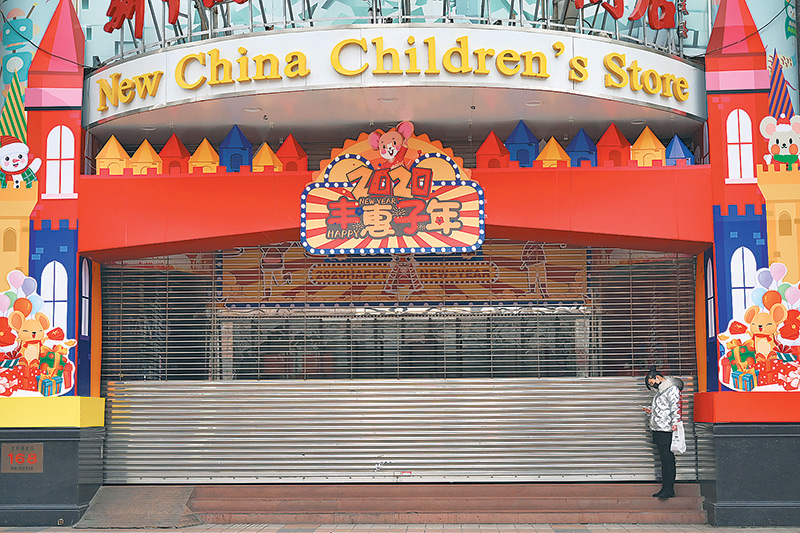
A woman wearing a face mask stands at an entrance to a closed store for children’s toys at the Wangfujing shopping street, in Beijing, China. reuters

WASHINGTON/RIYADH/FRANKFURT, 
In the days after a new virus was identified in China on Dec. 31, global central bankers fell back on past experience for a comforting early analysis.
The SARS epidemic in 2003, they noted, had come and gone with little economic impact.
Weeks later, that parallel has failed.
A disease that has sickened around 75,000 in China and ground its economy to a near halt continues to spread outside its epicentre. The latest blow to hopes for a successful containment came Thursday when confirmed cases in South Korea topped 100 and it reported its first death. The streets of that country’s fourth-largest city stood abandoned as residents holed up indoors.
Now, as global finance officials gather in Riyadh, Saudi Arabia, for the latest Group of 20 summit, they will do so having intensified both their level of concern and the breadth of their detective work to understand the economic implications of the outbreak.
That has meant watching measures of coal use and local travel in China for any independent evidence the world’s second largest economy is returning to normal. They are watching disease counts outside China as the best indicator of whether the virus has been contained.
In Japan officials are surveying the empty streets of the Ginza shopping district and tallying airline and cruise ship cancellations, and pondering if an economic rebound they had counted on for later this year will fizzle.
In the United States, Fed officials are quizzing local business contacts and hearing from entrepreneurs blindsided by vulnerabilities in their supply networks.
Businesses “have supply chains that are intimately involved in China sometimes in ways they did not know,” Richmond Federal Reserve Bank President Thomas Barkin said in an interview Wednesday, recalling a conversation with one medical manufacturer that “had a supplier who had a supplier who had a part in China.”
Given the evolving and unpredictable nature of any viral outbreak, analysts have no tried and true way to model the event.
But policymakers and analysts say this much is clear: the more they talk to people, they more they understand China’s deep role in global supply chains. That means the longer the outbreak remains uncontained, the higher the likelihood that it could become a systemic problem.
Barkin said unknowables include just how flush businesses were with parts inventories before China began quarantines and business closures to stop the spread of the virus or how flexibly companies can move to other suppliers. These are issues not captured in any particular economic model, leaving central bankers globally in a scramble to get a grip on them.
Forecasters have sketched scenarios that cluster around a limited impact, mostly a drop in China’s first-quarter growth. But they also include a possible contraction in the global economy or, in the worst case, a European and US recession as global demand falls.
That’s not the base case at the Fed, the European Central Bank or the Bank of Japan, with no push yet for policy action or rate cuts to offset an unwelcome economic shock. But policymakers acknowledge they are flying somewhat blind.
“My read is if everything gets up to speed in the next few weeks it will be a minor bump that won’t be an issue. If you are out for months then you have a more significant impact on probably 10 to 15 percent of the economy” that depends on Chinese suppliers or exports to the country, Barkin said.
Similar time-dependent assessments are offered in Europe and Japan, where that country’s close economic ties to China have officials particularly wary.
“The picture has changed completely from before the outbreak,” said a BOJ official, who was not authorised to speak publicly about the matter.
Economists typically look at events like this with a sanguine eye. They hurt the economy in the moment, but some losses are permanent: While a consumer can still buy that car a month or two later, forgone trips or restaurant meals are not necessarily made up.
But overall, an inevitable bounce back offsets the shock.
Some events, however, prove systemic. Policymakers and analysts point to how a 2011 earthquake and flooding compromised a nuclear reactor in Japan’s Fukushima province, and led global businesses to rethink supply networks to make them less dependent on any single source.
In a paper last year (here), Fed researchers studied what a “hard landing” in China—a combination of financial stress and a sharp drop in gross domestic product—would mean for the US and global economies.
The results weren’t pretty.
The research predicted “consequential spillovers to the United States and global economy through both real trade links and financial channels.” US officials as a rough rule of thumb say a 1 percentage point drop in China’s growth shaves about a 0.2 percentage point from US GDP—noticeable, but not likely to cause a recession unless the shock is massive.
From Europe’s perspective, it is not yet time to worry—but to stay watchful.
“The history of these has been that there could be a significant short-term effect of events like these, but no long-lasting effect,” ECB chief economist Philip Lane said in Berlin. “So this is the baseline. Let’s see—it depends on how quickly it is contained.”

Page 9
CULTURE & ARTS

How bad editing, cinematography, and sound can spoil a good film

Bardiya Sundari directed by Sahara Sharma and produced/written by Abhimanyu Dixit is a technical mess.
- ANKIT KHADGI
screengrab via youtube

Kathmandu,
At the third edition of the Nepal International Film Festival, a total of 80 Nepali and international films were screened. Among them was Bardiya Sundari, directed by Sahara Sharma and written and produced by Abhimanyu Dixit, the Post’s film critic.
Based in Gulariya, Bardiya, the movie revolves around the story of Parbina Chaat (Prabina Dahit), a school-going aspiring model from an indigenous community who is determined to win a beauty contest organised by a local political party. There’s also a parallel lead, Sharada (Sharada Sherpali), a female leader from the same party who also gets involved in the beauty contest.
The premise of the movie is interesting, as it tackles a number of important issues: from patriarchy-forced restrictions, like not allowing women to wear the colour red after her husband’s death to how indigenous people get trapped in the web of the majority group’s tokenism and even the practise of giving women tickets to contest elections after their husbands’ death.
Parbina is presented as a strong-headed girl, who dreams of getting into the glamour world. Her ambitions and aspirations in life are clearly presented to the audience from the very beginning of the film.
In her introductory scene, she goes to a temple where she puts out all her fashion-shoot-like photos in front of the gods and prays for a successful future career in  modelling. The scene is endearing to watch, as it shows how passionate she is about her dreams, but the movie has few moments of brilliance like this.
Poor lighting, sound and cinematography spoil what could have otherwise been a good film. The movie also has pauses, where the screen suddenly freezes for a few seconds. Is this a new form of editing when your movie freezes in order to break the conventional way of story-telling? Probably not.
When it comes to the film’s cinematography, all-too-often the picture is either too dark or too bright. If that was the intention of the cinematographer (Sahara Sharma, who is also the director) to give the movie a rustic feel by having low light shots, then I believe she’s failed. At times, it was so difficult to even make out a character’s facial expressions that I wanted to point the torchlight to see them. And the number of out-of-focus shots in the film is appalling.


The filmmakers also seem to have taken the audio too lightly, as at times, the dialogue is unclear and there is a lot of background noise.
Dixit’s writing is the only admirable aspect of the movie. Though filmed in 2015, the film’s plot remains relevant. Dixit has decided to tell a unique story of how people in power (mostly men) use women for their own selfish, ulterior motives, which should be appreciated. However, the writing lacks nuance. It is difficult to invest in Parbina’s journey of winning the pageant because the writer has failed to unravel her resoluteness in achieving her aspirations.
The gaze upon Sharada, the female party leader, is dubious as well. In the movie, Sharada is given a ticket to contest the elections just so the party can cash in on sympathy votes, as she lost her husband during the insurgency. Sharada always dresses in light colours, which represents the enforcement of patriarchal values that expects widows to dress a certain way.
The problem lies in the treatment of her character. While both Sharma and Dixit’s hearts might be in the right place—as at the end of the movie, Sharada wears what she wants to rather than what society imposes on her—but until then, she has no agency of her own. She has hardly any dialogue in the film and whenever she speaks, she is either a puppet for the party or is listening to sexist men who are lecturing her. There are no shades to her personality, and her inner aspirations aren’t reflected. Sharada is little more than a widow.
While it’s interesting to see the filmmakers opting to tell a story in a realistic setting, with the actors having no prior experience, the end product is a technical mess. The use of small cameras so the actors won’t feel self-conscious while shooting seems to have backfired as the visuals don’t do the justice to the intention of the filmmakers.
In the end, it doesn’t matter whether you are an independent filmmaker or are backed by a studio. If you fail to provide a technically sound movie, despite a good story and exceptional performances, there will be little interest in watching the film. Both Sharma and Dixit, of Gauthali Entertainment, the production company behind the movie, should take heed.


Bardiya Sundari
* *
Starring:    Prabina Dahit, Sharada Sherpali, Sahayog Raj Adhikari
Director:    Sahara Sharma
Writer and Producer:    Abhimanyu Dixit

CULTURE & ARTS

Culture war rages amid the glitter in Rio

In a Brazil deeply polarised by President Jair Bolsonaro’s far-right politics, Mangueira is planning a show with a message that has ignited inevitable controversy, offending the conservative Christian community.
- Joshua Howat Berger
The Mangueira samba school will parade Sunday in the first of two nights of flesh-flaunting, sequin-studded spectacle. afp/rss

RIO DE JANEIRO,
The sanctuary at her evangelical mega-church in Rio de Janeiro is where Eleonor Teresa Sousa comes to feel closer to God, and farther from the sin of a city gearing up for carnival.
Sousa, 75, proudly counts herself among the conservative Christians in Brazil who condemn the show planned this year by the reigning champions of Rio’s world-famous carnival, the Mangueira samba school.
Mangueira will parade Sunday in the first of two nights of flesh-flaunting, sequin-studded spectacle by 13 samba schools vying to be this year’s champions.
Worse, to the fundamentalists, is the story all those glittering bodies will tell.
In a Brazil deeply polarised by President Jair Bolsonaro’s far-right politics, Mangueira is planning a show with a message: It will depict Jesus returning to Earth in one of the city’s impoverished favelas, in the body of a black woman with indigenous roots, and preaching a message of tolerance.
That has ignited inevitable controversy in Brazil, where Bolsonaro has the fervent backing of a burgeoning conservative Christian community, and many people are talking of a “culture war” since he took office last year.
Sousa, who belongs to one of Brazil’s biggest churches, the Universal Church of the Kingdom of God, which claims eight million members in the country, said she feels “completely offended.”
“That’s not the Jesus of the Bible. It’s blasphemy,” she said after her morning prayers.
More than 100,000 people have signed an online petition accusing Mangueira of “defiling the son of God,” launched by a conservative Catholic group, the Plinio Correa de Oliveira Institute.
Revisionist versions of Jesus are already a touchy subject in Brazil. Last year, the Brazilian comedy film The First Temptation of Christ depicted Jesus as gay, causing outrage among conservative Christians when it premiered on Netflix. On Christmas Eve, masked attackers fire-bombed the production company’s offices.

 
Cry against fascism
People tend to see things differently in Mangueira, the poor favela that is home to the samba school, where the hillside shacks have a view—albeit distant—of Rio’s iconic Christ the Redeemer statue, his arms outstretched over the city.
“This (show) is a cry of freedom from Mangueira against the fascism that’s taken over our country,” said Marcus Portugal Feital, 61, a member of Mangueira’s “community wing.”
“This is the real Christ, the one who protects the vulnerable, the blacks in the ghettoes: everything Bolsonaro and company don’t do,” he added outside a recent Mangueira rehearsal, as hundreds of people danced and sweated to the thundering beat of the percussion section inside.
“If Jesus Christ came to the world today and was born poor in a favela, he would be massacred,” added fellow member Consuelo Cavalcante, 58, referring to a surge in police killings in Rio de Janeiro state since Bolsonaro took office.
The show’s central samba song features a veiled protest against Bolsonaro’s version of Christianity and his hardline policies. One lyric rejects the idea of a “Messiah with gun in hand.” “Messiah” (Messias, in Portuguese) is gun-rights advocate Bolsonaro’s middle name.


License to offend
There is a long history of tension between carnival—the last lascivious free-for-all before the 40-day asceticism of Lent—and conservative Christian values.
But in Bolsonaro’s Brazil, carnival has become particularly politicised. Mangueira won last year with a show that paid tribute to Rio councilwoman Marielle Franco, an outspoken black and lesbian activist who was murdered in 2018. Other schools have also picked politically charged themes this year, including the environment and indigenous, black and women’s rights—all issues on which Bolsonaro regularly offends his critics.
Adding to the climate of division, Rio’s current mayor, Marcelo Crivella, an evangelical pastor, has openly criticized carnival’s booze-driven escapades and eliminated the 28 million reals ($6.4 million) of annual public funding to the top samba schools.
Politics has always been part of carnival, going back to the abolition of slavery in Brazil in the late 19th century, said historian and writer Luiz Antonio Simas.
“But there are times when that’s more explicit... And this is one of those times,” he said. “The rise of a reactionary, ultra-conservative government allied with... Christian fundamentalists has naturally created a clash with the carnival community.”


—Agence France-Presse

CULTURE & ARTS

Diversity row mars Berlin film fest

Organisers announced a minute’s silence to mourn during the opening ceremony on Thursday evening.
- Aurélie Mayembo

BERLIN,
Europe’s first major film festival of 2020 opens in Berlin Thursday, with Helen Mirren and Hillary Clinton among those expected on the red carpet—even as a deadly shooting and diversity row threatened to mar festivities.
The opening of the 11-day Berlinale was overshadowed by an an attack in the central city of Hanau which left nine people dead, along with the killer and his mother.
Festival organisers announced a minute’s silence to mourn the victims during the opening ceremony on Thursday evening.
“The Berlinale stands against violence and racism,” they said in a statement, after prosecutors said the suspect had held far-right beliefs. Yet festival spokeswoman Frauke Greiner said the Berlinale had no plans to boost security measures.
Organisers were in “constant exchange with the security authorities” and “able to adapt... at short notice”, Greiner told AFP in a statement.
The festival, which will showcase some 340 films from around the world, has also been forced to defend its commitment to female film-makers.
Only six of the 18 films up for the top “Golden Bear” prize are directed by women, one fewer than last year.
One of the newly appointed heads of the film festival said last month the festival would “give room to diversity”, as debate rages over representation of women and minorities in film.  
“Six films is not 50/50, but it’s a good path to reach it,” said Carlo Chatrian, who was appointed to lead the festival for the first time this year with Mariette Rissenbeek, replacing long-serving chief Dieter Kosslick.
This year’s jury head Jeremy Irons was also embroiled in controversy over past comments about same-sex marriage, women’s rights and abortion.
The British actor addressed the melee Thursday, saying he supported the “movement to address the inequality of women’s rights and to protect them from abusive, damaging and disrespectful harassment both at home and in workplace”.
Irons has reportedly been accused of making comments suggesting abortion is sinful, downplaying sexual harassment and suggesting same-sex marriage could lead to incest.   


Nazi links
British Oscar winner Mirren will be feted at the festival with a lifetime achievement award, while former US presidential candidate Clinton will attend a screening of a five-part documentary about her life. Other A-listers expected to attend include Javier Bardem, Elle Fanning and Salma Hayek, who all appear in “The Roads Not Taken” by British director Sally Potter.
Cate Blanchett will also be there to present the Australian series “Stateless” and Sigourney Weaver will attend for the opening film “My Salinger Year”, about the 1990s New York literary scene.
Further dampening Thursday event, the festival is also reeling from revelations that its founding director, Alfred Bauer, was a high-ranking Nazi.
On Tuesday, festival organisers announced they had commissioned the Munich-based Institute for Contemporary History (IfZ) to investigate Bauer’s role in the Hitler regime.


—Agence France-Presse

Page 10
EXPRESSION

Once upon a time in Mahashivaratri

The celebration of Mahashivaratri at Pashupati Temple, in a different period in history.
Devotees take a ritual bath at Bagmati River near Pashupatinath Temple during Shivaratri in 1968.

Mahashivaratri, also known as Night of the Shiva, is observed every year on the 14th day of the waning moon in the Nepali month of Falgun. This festival is largely celebrated by Hindus.
The festival is observed to celebrate the life of Lord Shiva, one of the triumvirates of the Hindu pantheon, who, according to mythology, drank poison to save humankind
from annihilation.
Mahashivaratri is one of the four nights known as Kaalratri, Moharatri, Sukharatri and is regarded as one of the greatest festivals in the holy scriptures of the Hindus—the Puranas.
To observe the festival, sadhus and devotees flock to Pashupatinath Temple. Religious belief dictates that if one offers milk, Dhaturo (a kind of intoxicating plant) and Belpatra fruit to Lord Shiva and observes night-long fasting, he/she will receive divine blessings.
The following photos, captured in the 1960s and 70s, show people worshipping Shiva with great enthusiasm at a different period in history.

This photo essay is part of our Once Upon a Time series, featuring photographs captured by US Peace Corps
volunteers in the 1960s and 70s. To see more photos from the series, visit kathmandupost.com.


Devotees at the Pashupatinath Temple during Mahashivaratri in 1969.


A view along the Bagmati River near Pashupatinath in 1970.


People at the Pashupatinath Temple premises during Mahashivaratri in 1968.


Sadhus at Pashupatinath during the festival in 1969.


Sadhus are fed at Pashipatinath during Mahashivaratri in 1967.


Devotees near Pashupatinath Temple in 1968.


A crowd of people during the festival at Pashupatinath in 1974.


A crowd watches a trainer with his dancing bear at Pashupatinath during Mahashivaratri in 1967.


Pilgrims arriving at Pashupatinath for the festival, circa 1969-1970.


An elderly pilgrim at Pashupatinath during the festival circa 1969-1970.

Photos: Nepal History Project/ US Peace Corps

Page 11
AS IT IS

Every month, an opportunity to learn about Nepal’s contemporary art movements

If we care about raising individuals who are concerned about Nepal’s civil society, the Nepal Art History Discussion Series could prove to be a good starting point.
- Niranjan Kunwar
The session was the fifth installment of the series and focused on the chancellorship of Nepal Academy of Fine Arts since 2008. photos: nikesh shrestha

We need to participate in this revolution…,” veteran artist Kiran Manandhar reminisced as he sat down with a group on a recent February afternoon at Martin Chautari. Manandhar was referring to the 2006 people’s movement—a period marked by unprecedented potential and possibilities for change—and remembering an evening on the rooftop of Sita Bhawan in Naxal. The city was gripped by all kinds of protests then—there were demands for ethnic rights and writers had also joined the movement with their own concerns. Over the decades, the fine arts movement in Nepal had proceeded by fits and starts and during the phase after the 2006 revolution, there was once again an opportunity to do something: primarily a need to recreate a public institution devoted to artists.
Manandhar was speaking at the monthly Nepal Art History Discussion Series, initiated by Kathmandu Triennale, held at Martin Chautari, the Thapathali-based research institute. The session was the fifth installment of the series and focused on the chancellorship of Nepal Academy of Fine Arts (NAFA) since 2008.
The Triennale describes the series as “a long-form project that aims to bring to the fore the histories, work, and perspectives in Nepal, told through its artists and arts professionals” and an attempt “to fill the lack of proactive documentation and archiving of Nepali art histories and practices.” By participating in these micro-discussions, the larger Nepali audience can learn about the history of art trends in Nepal as well as forge new bonds with the artistic community. This can in turn lead to further possibilities—because the arts can provide powerful ways to inquire, critique and respond to dominant discourses and state structures.


A brief history of Nepal Academy of Fine Arts
NAFA was first established in 1965 by Birendra Shah when he was the crown prince. And even though artist Chandra Man Singh Maskey was appointed as the chairperson of the academy, almost no one in the administrative body could gauge the quality of artworks, Manandhar explained. Due to the restrictive and oppressive political climate during the Panchayat years, Birendra’s gesture was viewed as tokenistic, even though the gesture stirred the artistic imagination of the public and a momentum, albeit gradual, started. The monarch had also donated the historic Sita Bhawan to NAFA but in 1977, due to an unfortunate restructuring, NAFA came under the total control of the Royal Nepal Academy. Bureaucrats with close ties to the palace were given administrative responsibilities; artists were pushed to the fringes and NAFA became completely stagnant.
Frustrated with the situation, a group of artists established the Kalakar Samaj in 1985 and appointed Manandhar as their leader. By that point, Manandhar and a few other senior artists had studied abroad and were exposed to the international art scene. They had witnessed, firsthand, how government institutions dedicated to fine arts could support emerging artists and organise large scale exhibitions. On one hand, this kind of public institution played a crucial role to cultivate art appreciation among the public and on the other, it also created a community that critiqued and challenged various socio-political norms. Despite genuine efforts by these artists, it would take more than two decades to release NAFA from the clutches of the Royal Academy.
During the transitional period after the people’s movement, artists organised themselves with  fresh determination, walked down alleys and main streets, splashed public walls with paint, made their presence felt and voices heard. After much political lobbying, the new avatar of NAFA was born with its own administrative body. Kiran Manandhar was appointed as the first Chancellor in April, 2010, and under his leadership, NAFA started organising regular National Fine Art Exhibitions and putting together annual catalogues that compiled the work of prominent Nepali artists. In addition, NAFA also hosts exchange programmes with artists from South Asia.
During the February discussion, Manandhar was also accompanied by Ragini Upadhaya Grela who succeeded him as the Chancellor in 2014 and KK Karmacharya who took up the position in 2018. All three expressed that their work gets constantly interrupted by politics and bureaucratic hassles. For example, they have had to constantly negotiate with the government in order to protect the 22 ropanis of land owned by NAFA. And soon after Upadhyay succeeded Manandhar, Nepal was struck by the devastating earthquakes in 2015. Sita Bhawan was badly damaged by the quakes and Upadhyay had to lobby politicians in order to retrofit the building instead of getting a new one constructed, a project that would be more lucrative for developers. Upadhaya also managed to increase NAFA’s budget from 30 million  to over 50 million and organise an exchange programme with Bangladeshi artists as well as artists from other SAARC countries.


The arts and social action
What started as the Kathmandu International Art Festival (KIAF), organised by the Siddhartha Arts Foundation, in 2009 was renamed Kathmandu Triennale in 2017 with the intention of bringing together local and international artists to create exhibitions and encounters. For this year’s festival, Cosmin Costinas is the artistic director, Hitman Gurung and Sheelasha Rajbhandari are the curators while Sharareh Bajracharya is the director.
The first session of the discussion series part of the Triennale was held in October, 2019, with a retrospective look at the emergent Nepali art scene during the 1960s and 1970s. The second session, titled ‘Exhibiting Nepali Modernism: the 70s-90s’ featured veteran artists Shashi Bikram Shah, Krishna Manandhar and Batsa Gopal Vaidya from SKIB-71, regarded as the first modern art collective in Nepal. SKIB got its name from the initials of the four founding artists’ first names. Indra Pradhan, the fourth member, passed away in 1994. The final group exhibition of SKIB took place in 1995 but by that time all four artists had established themselves firmly in Kathmandu’s thriving modern art scene. At the beginning of the talk, Shah’s grandson shared his grandfather’s archive which he has been working on for the past two years and it includes old photographs from the artists’ younger days in Bombay as well as catalogues from art shows.
Representatives of various artist-led initiatives such as Kaasthamandap Artist Group, LASAANA/NexUs Culture Nepal, Gallery McCube, Bindu, and Bikalpa Art Center presented their works and answered questions during the third and fourth sessions of the series. Speaking about challenges and successes, prominent artivist Ashmina Ranjit highlighted the entry of the feminist dialogue in the Nepali art scene. She also commented on the changing perception of fine arts in the late 1990s. During a period when only painting and sculptures were regarded as art, Ranjit, in collaboration with other artists, introduced novel forms such as installations and performances. Ranjit also mentioned that all these initiatives were driven by passion.
In a society where school education is viewed merely as a means to attain “world-class” technical achievement rather than creating a community of learners, youngsters should be encouraged to attend these discussions so that they can participate in the larger dialogue related to the Nepali art scene and social change. If we care about raising individuals who are concerned about Nepal’s civil society, this series can prove to be a good starting point. In a capitalist climate driven by technological advances and material gain, when a kind of a social pathology has swept over youngsters, this kind of inquiry into social movements, historical conditions and the shaping of public institutions works powerfully against such pathologies. And as Ranjit mentioned, learning about passionate leaders from previous decades might inspire everyone to follow their own passions in order to create a vital and just society.

(The art history discussion series, part of the Kathmandu Triennale, takes place on the first Thursday of every month at 3 pm. The discussions are also available on YouTube.)

Kunwar writes about arts and education and can be reached at [email protected]

AS IT IS

Girls who could not love

One day, she wrote Titir a long letter and slipped it under her door. It didn’t occur to her that the move would only cause her to further stiffen against her.
- Prateebha Tuladhar
shutterstock

During her time at the convent school in the hill-station, she had learned to walk the corridors on nights when she could not sleep. She was very young then. A teenager. Yet, there was something about being unable to sleep that made her feel like she had become as wise as her mother, if not older. She even imitated her mother’s way of arranging and rearranging her pillow during sleeplessness, cursing the pillow like it was its fault she couldn’t fall asleep.
It was one of those nights that Chaukidar Daju saw her walking to-and-fro in the corridor and told one of the cooks the next day that he had seen a ghost who wore her hair in a Thai cut. The news spread quickly. It was carried by the cooks to the cleaning ladies and then the infirmary lady, and then  to the students who lived in the convent hostel, a rickety 19th century building.
“Did you hear that? A girl with Thai cut!” Candice whispered. With her Catholic upbringing, she was a huge believer in the Holy Ghost and the security provided by blessings.
“It means it’s time for a house blessing. It always happens around this time of the year. The headless nun, the nun at the piano, the steps on the stairway...haven’t you heard?”
“But Titir Di said they were only rats!” she protested, hoping that her friends would trust what a senior had said, more than they did the rumour. She didn’t really want to admit it had been her walking up and down the corridor, and not a ghost. She wanted the conversation to pass.
She felt it would be too embarrassing to tell her friends it was her who had been walking the corridors at night, because she hadn’t been able to sleep. That would invite a host of questions as to why she hadn’t been able to sleep. What could possibly keep a teenager awake? They weren’t even old enough to fret over boyfriends. (Well, if they had been, the convent apparatuses would have rendered the idea beyond conceivable at any rate).
So, the girls continued with the spooky story. They spoke in hushed tones about “the one with Thai cut”. There were at least five girls in the hostel with the haircut that was locally known as Thai cut; hair cropped at the nape in imitation of some Thai Airlines flight attendant, spotted in a free distribution/promotional calendar. But it hadn’t occurred to anyone that the person walking the corridor at night could be one of the students. Also, the stories kept changing.
Now, one of the girls had spotted her walking around the Oval garden. And now, someone had seen her sitting down by the grotto, with her face buried in her knees, weeping. The stories grew weirder and started to creep her out. This was her they were talking about! Or had been her to begin with, at least, although she had nothing—even remotely—to do with the latest sightings.
She had stopped walking the corridors on sleepless nights. The corridor was rather long, flanking a row of two dozen rooms. And it overlooked the hillside in its entirety, built with a long row of glass windows opening towards a view of the queen of hills, as they called it. Her room was the last in the row and had a view of the town that took its name from fog, because it was always shrouded in gloom. They said that people couldn’t see another person approaching even within a distance of ten feet in this town. Since forever, it had continued to nestle drowsily in a near perpetual fog, while the humdrum lives of its residents moved in tune with its famed, sluggish railway.
She had started to sit up on bed on sleepless nights now, looking out the window at the hillside town. Constellations formed across the town at night, when the lights came on.
“It looks like someone took a handful of stars and scattered them over the hillside,” Titir Di had once said, as they were watching the lights together from the edge of the Oval garden. It was something they did on evenings some weekends. She thought Titir had a lyrical way of speaking; always in a sing-song tone. She had wanted to compliment her, instead, smiled in acknowledgement.
“You have a very beautiful smile,” Titir had said just then. It had made her happy. Titir had then reached out for her hands, held them for a moment, then dropped them suddenly; and they had sat in silence for the rest of the evening until it was time to go back to their rooms.
In the days following that evening, she started to retreat into her shell. And here’s the reason why. Titir had stopped talking to her completely. She would ignore her on the stairs, in the hall, and would seek company of her classmates constantly, so that she didn’t catch her alone. For someone like Titir,
who spent much of her time cooped up in her room, listening to Jagjit and Chitra Singh, it was a bit over the top.
One day, she wrote Titir a long letter and slipped it under her door. It didn’t occur to her that the move would only cause her object of dedication to further stiffen against her. In it, she had asked Titir to explain what she had done to suddenly be subject to such treatment. She implored Titir to take her back. Implored! I am your chosen “soul sister”, she wrote. Had she forgotten? But it seemed like Titir had forgotten. Her pleas in the form of a letter, mournful looks, random sentences spoken louder than is necessary any time Titir was within earshot, were of no avail.
At term end, Titir was gone, never to return. And with her were gone, the stories of all the things she did in her home at the tea estate, the boy from the army club with eyes like those of a bird, who Titir liked to dance with, the soulful ghazals...all of those…Titir took them with her. And in their place emerged slow days and sleepless nights.
She would look out her window at the hillside and sometimes at the window that used to be Titir’s. It was on the other side of the yard, so it allowed her a view of just the slant of light falling on the ground from Titir’s room when the lights were on. She used to imagine her reading then. The new occupant who came to inherit the room didn’t read at night like Titir used to. And she didn’t listen to ghazals passed down by her parents. In fact, she didn’t play any music at all.
With the house blessing ritual observed, everything became quiet again. The girls’ faith in goodness was restored and fortified once more. The stories about the one with Thai cut were gradually forgotten. While she had stopped walking the corridors completely, some nights she would still sit up to stare at the fireflies in the town, her mind tracing the lights to draw imaginary constellations.
When it was her time to leave the hill station and move back to her home in the valley, she came to a new kind of awakening. There were no fireflies, but frogs that ribbited all night long through monsoon, competing with the sound of rain. Sometimes there were crickets screeching, interrupted by geckos who said out loud their own names. And by that time, she had come to realise that sleeplessness was going to be her most frequent and loyal companion for the rest of her life.


Tuladhar has worked as a journalist for over a decade, with affiliations to Kantipur TV and German Press Agency.

Page 12
BOOKS

CK Lal: Language is alive only when it is related to a marketplace

- Post Report
Post photo: Sanjog Manandhar

CK Lal is a respected name. He has been writing about society and politics for three decades now, and his work has been deemed influential and insightful by many. He is a regular columnist in many daily newspapers, including the Post, and has penned Human Rights, Democracy and Governance and To be a Nepalese.
A voracious reader, Lal is sharp and rational. And an intellectual on all grounds, his presence is quite intimidating. When asked why he loves reading and opinion writing he says, “It’s because opinion writings allow me more depth than general news writing. News usually reports about an event that has happened, but when you read an op-ed piece it gives you a sense of why it happened or what a section of the population is thinking about it and how experts are interpreting the event.” In an interview with the Post’s Srizu Bajracharya, Lal talks about his love for reading and writing. Excerpts:


Growing up, were you always surrounded by books? Did you love to read?
I was a studious pupil, and reading was always part of my childhood. When you grow up in a village, that too in the 1960s, there isn’t much to do other than read. There was no television, the short wave of radio was difficult to receive. So, the only way to pass time was to read books. Books used to be my best friend.
After the 1950s, there was also a wave of libraries being built, so in the border areas there were a lot of libraries, which made it easier for children like us to access books. We could always walk to the border town and get books, and they were quite affordable. However, they were mostly Hindi books, so I came to English books much later.


You studied engineering and worked in the same field as you started writing. How did that happen?
In my time, if you were good in studies, there were two options for you—either medicine or engineering. So, I went with engineering. But in college, I also started writing and discovered that I love writing. But I never wrote as a hardcore journalist, I started as a columnist and I still remain one.
I write for the sheer love of writing and sharing; it’s a joyful experience for me and allows me to discover things. But I also believe a certain kind of freedom is necessary to be an honest writer, and if you want to create an impact.


How do you keep yourself updated?
I am a daily newspaper reader. I buy at least seven newspapers on average, and on the web, I regularly check five portals, two from India, one each from Pakistan, Bangladesh and Sri Lanka. So you could say I read about 10 to 15 newspapers a day. I also read a lot of books. If you are to write about current events it is necessary to read about many perspectives and experiences, especially the past. It is very difficult to analyse current events by just reading about current events.
I don’t have a routine that I follow strictly. I spend my morning reading newspapers, basically scanning them. And then later with a cup of coffee, I take notes and based on them I search for podcasts and go for a walk later and then have lunch, and I usually sit down to write after three which goes on to 8 sometimes. I also give this time to people who need time from me.


What do you think of the representation of Madhesh in Nepali literature?
You can actually say there is no representation at all. Madhesh is absent from the mainstream discussion mainly because it has never been part of the Nepali imagination; it is an outside entity for most people and we don’t talk about the outside. We even talk about the marginalised and almost never about the externalised. But this has to change. Nepal has to think about this section of its people, a third of its population.


Do you think indigenous languages suffer because the state acknowledges just one language for education?
This is actually a practical difficulty. All governments prefer a single language, as it makes the work of the government easier. The market also only wants one language, because it’s easier for the advertising world, to communicate with the consumer with just one language.
It’s only in a cultural society that we talk about multiple languages, which people think are more important than the language of the state or the market. The challenge for the government then is how to marry these two diverse expectations. And that I think, in a country like ours, is still manageable if we adapt multiple languages and accept them in governance. This might get a little complicated for the government but if you acknowledge the many languages people use, they will share a loyalty with the government—and that ownership will become an impetus for the government, making governance easier.


Do you think the promotion of just one language affects indigenous readership?
The reason indigenous readership is decreasing is because our language is not related to the marketplace or employment opportunity. You have to understand that language is alive only when it is related to a marketplace otherwise it will only be limited to our homes and it will never come out. The purpose of education is not just for self-enlightenment, it is also for employment. But right now, people are ashamed of their mother tongue, and unless you remove that shame through the recognition of the state, readership in various languages will struggle.
People can get education in Maithili, but that again is still not useful because if the language is not connected with the marketplace and governance, it’s no good. You must understand that although studying a language puts some weight on it, unless there are certain rewards and returns, people will not prefer formally learning in that language.


What books do you think has influenced you the most?
The list keeps changing. I read non-fiction more than fiction, although my daughter says I am missing out on a lot by not reading more fiction. But I am not patient enough to read them, I am very driven you see. Among the books that I have read, Will Durant’s History of Philosophy, Mahabharata (Hindi translation)  in parts, Winston Churchill’s History of English Speaking People, Jawaharlal Nehru’s Discovery of India, BP Koirala’s Atmabritanta have really influenced me.


For someone who wants to read about the indigenous cultures in Nepal, what books would you
recommend?
I would recommend Marie le Comte’s Revolution in Nepal: An Anthropological and Historical Approach to the People’s War, Hindu Kingship, Ethnic Revival, and Maoist Rebellion in Nepal, David N Gellner’s Monk, Householder and Tantrik Priest: Newar Buddhism and its Hierarchy Rituals.


What books would you recommend to people who want to read about Madhesh?
For that, there are few books. There is Prashant Jha’s Battle of the New Republic, it’s a good start. And Kalpana Jha’s The Madhesi Upsurge and the Contested Idea of Nepal.

BOOKS

When fact is masqueraded as too much fiction

Tattooist of Auschwitz tells a story of love, in the most dire circumstance, but betrays history in doing so.
- Richa Bhattarai

It is 1942, and der Führer has just begun sending out shocks of terror across the world. Like thousands of others, young and happy Lale is cruelly wrenched apart from his comfortable life with a loving family in Slovakia. He is stuffed into a death train that will take him to a place soon to be reviled as one of the most notorious in history—Auschwitz.
It is in Auschwitz, the largest of the German Nazi concentration camps, that Heather Morris sets ‘The Tattooist of Auschwitz’ a novel-like narration based on a true story. The horrors begin from a tolerable stink in a stuffy carriage and escalate menacingly, within 30 pages, to people being swatted dead easier than flies.
Terrified, we peer along with Lale as naked men are herded into a bus, and a German soldier upends a canister unto it. “The bus shakes violently and muffled screams are heard. When the bus is still and quiet, the doors are opened. Dead men fall out like blocks of stone.” Holocaust literature is inevitably loaded with pain and suffering, and each new work is a shocking reminder of the depth of depravities that humans can do.  
In this hellish world Lale continues to etch numbers onto the wrists of incoming ‘prisoners’—for no other purpose save to fulfil cowardly needs to identify, mark, characterise the ‘other’, the ‘enemy’, the ‘useless’ also seen in the killing fields of Cambodia and the Rwandan genocide, and numerous other massacres. Until one day, he tattoos on the number of a girl called Gita. The duo fall in love, and begin imagining a life beyond the barbed wire… but is it possible?
In his lovelorn state, Lale spies a sole flower growing in this hellhole. He plucks it and carefully places it beside his bed, intending to gift it to his beloved Gita. The next morning, the petals have separated and lie curled up beside the black centre. “Death alone persists in this place,” muses Lale, unable to bear looking at the wilted flower, so similar to the lives of hundreds rotting inside the camps.
The desperation of the couple to savour the little time they have left, their simple yet impossible-seeming dream to “be free to make love whenever, wherever we want”, their snatches of conversations, a dangerous, tender love brewing during a deadly war—this is what tugs at the heartstrings of readers. It is the most desperate and bleak love story one can imagine, with death lurking behind every corner and approaching with each footstep.
Even in such a trying time Lale remains an optimist, not unlike everyone’s favourite character from Life is Beautiful,—“We stand in shit but let us not drown in it,” he says. Indeed, immediately after arriving at the camp, there is a confidence, even a bit of smugness in his character that is endearing. “My life is too good to end in this stinkhole,” he muses.
As food and hope wear thin and death beckons ever closer, Lale refuses to give up the last shred of hope. He takes part in a bizarre football match between the soldiers and malnourished prisoners, a farce of a game which they are forced to play, but must be careful not to win. The trophy at stake is the 1930 World Cup, that inexplicably reached the camp just like other astounding and priceless goods, and even more precious human lives.
The work will make readers constantly mull over human life—its sanctity, fragility and value. Racial diversity, ideological differences, religious beliefs—nothing is worth a human life. When every country is clamouring to display its power and strength within itself and to the outside world, the novel is an eerie and sobering reminder of how war gradually creeps up behind you, and how quickly it destroys everything. “Nations threaten other nations. They have the power, they have the military. How can a race spread out across multiple countries be considered a threat?”   
It is a sensitive subject, and there are signs that show Morris has done her best to tread delicately and portray movingly. Yet the novel falls short of its noble intentions, with insufficient research and fact-checking. For such an emotional telling, the writing is quite mediocre, bordering on the mundane at times. There is out-of-place romanticising, incongruous philosophising, and unadorned sentences that do not do justice to the emotional saga. Morris has made abundant use of dramatic license, romanticising and sensationalising. It is quite surprising to note inadequate verification of major facts.
For example, Lale’s real name is ‘Lali’, and there is no valid reason to call him by another name. The very tattoo number etched on Gita’s wrist (in the book) is wrong, as has been mentioned many times—while Morris adamantly claims that it is the correct one. The Auschwitz Memorial Research Centre has said the novel contains “numerous errors and information inconsistent with the facts, as well as exaggerations, misinterpretations and understatements.”
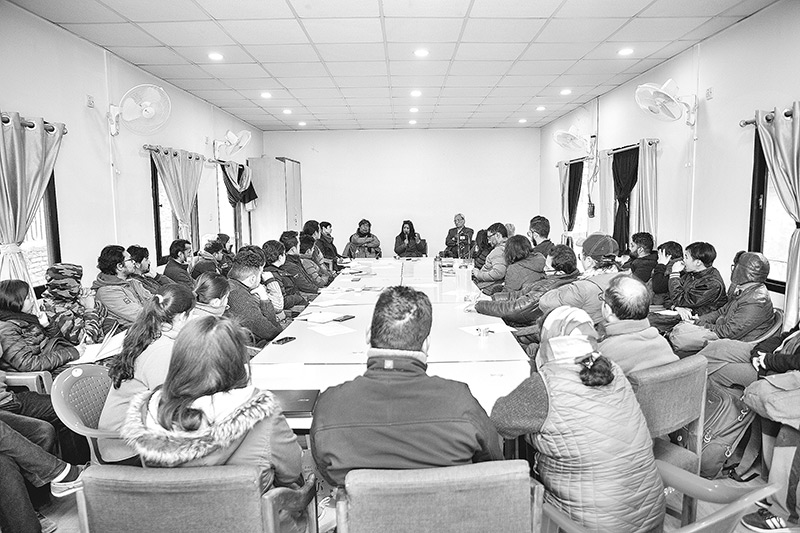
Experts have refuted the suggestion that those with even a little power at the camps also had opportunity to
misuse the power, while a relationship between a prisoner-soldier has been dismissed as untrue. While Morris
confidently mentions a bribery for penicillin, historical researchers have mentioned that it would be impossible
to get this medicine at that particular place and time. When significant details about the characters and their lives are wrong, how authentic is a story about them? And if it isn’t meant to be a historical truth, why is it advertised as a ‘true’ story?
The Tattooist of Auschwitz was a hugely successful work, rising up in bestseller charts around the world, with Morris going on to write Cilka’s Journey, which has been ridiculed for its coarse handling of the subject matter. The distorted truth is an injustice to the lives of those in the torturous camps. This novel will serve as a reminder that the lives of real people and their emotions are not to be tampered with, not even in the guise of ‘poetic license’—for it will take away the authenticity and trust from the most beloved ofbooks.  


The Tattooist of Auschwitz
Author    :    Heather Morris
Publisher    :    Zaffre Publishing
Pages    :    272
Price    :    Rs508

Page 13
WORLD

Stress, rumours, even violence: Virus fear goes viral

As the number of cases rises—more than 76,000 and counting—fear is advancing like a tsunami.
- FOSTER KLUG
Workers wearing protective gears prepare to spray disinfectant as a precaution against the coronavirus at Namdaemun Market in Seoul, South Korea. Even as cases and deaths from the new virus mount, fear is advancing like a tsunami—and not just in the areas surrounding the Chinese city of Wuhan, the center of the outbreak. AP/rss

You might have heard that the fear of a new virus from China is spreading faster than the actual virus.
From earnest officials trying to calm a building panic. From your spouse. From the know-it-all who rattles off the many much more likely ways you’re going to die: smoking, car accidents, the flu.
None of it seems to matter.
As the number of casesrises—more than 76,000 and counting—fear is advancing like a tsunami. And not just in the areas surrounding the Chinese city of Wuhan, the site of the vast majority of coronavirus infections.
Subway cars in Tokyo and Seoul look more like hospital wards, with armies of masked commuters shooting dirty looks at the slightest cough or sneeze. A restaurant owner in a South Korean Chinatown says visitors have dropped by 90 percent.
You’ve probably got a better chance of winning the lottery than buying face masks in parts of Asia. Conferences and events have been disrupted from Beijing to Barcelona to Boston. Quarrels in Japan; riots in Ukraine. Rumors that toilet paper and napkins could be used as masks emptied East Asian store shelves of paper goods.
“Fear is a very strong emotion, and the prevailing fear over the new coronavirus drives people to do things irrationally without thinking straight,” said Bernie Huang, 31, a high school teacher in Taipei, Taiwan, who resisted the city’s now-easing toilet paper buying spree.
If you take the long view, panic has marched in lockstep with pandemic for as long as history has been recorded. The plague that devastated Athens in the fifth century BC. The Black Death that eradicated much of Europe in the 14th century. And, more recently, AIDS, Ebola, SARS, MERS, swine and bird flu.
Scientists, statisticians and people well away from the line of fire may scoff, but the fear, which is spread by word of mouth and, more rapidly, through online posts, is real.
“Fear can do more harm than the virus,” Singapore Prime Minister Lee Hsien Loong said in response to panic buying of toilet paper, canned food and instant noodles after the government raised a risk alert over the new virus.
It’s perhaps most keenly felt in the places where crowds gather: churches, shopping areas, schools.
In the Philippines, nearly half of the pews were empty for recent Sunday Masses in many churches. At a Protestant church in northern Seoul, officials switched entirely to online worship after it was found that a virus patient had attended services days before he tested positive.
The huge Lotte Department Store in Seoul closed for several days for disinfection after it was found that a Chinese tourist with the virus visited. It reportedly lost about 20 billion won ($16.9 million) in revenue, based on figures by financial analysts.
A mobile trade fair in Barcelona was canceled. PlayStation maker Sony pulled out of a video game conference in Boston over “increasing concerns” related to the virus. Organizers said the event will go on next week but “with enhanced cleaning.”
At Namdaemun, Seoul’s largest traditional market, businesses saw huge drops in sales after an infected person was found to have visited the area last month.
“Merchants say their businesses are now dying,” said Chun Yong-bum, head of an association of thousands of merchants at Namdaemun.
The South Korean Education Ministry recently issued an advisory to universities to postpone the March start of the upcoming semester because of worries that thousands of Chinese students will return to schools from abroad.
South Korean President Moon Jae-in expressed worries that “excessively bloated fear” was hurting South Korea’s economy by suppressing public consumption and leisure activities.
The most eagerly-awaited gathering in Asia—the upcoming Summer Olympics in Tokyo—has been beset by fear, too.
Although he later backtracked, Tokyo Olympic CEO Toshiro Muto said recently that he was “seriously worried” the virus could disrupt the Olympics and Paralympics.
“One thing I am noticing at the moment is fear is spreading quicker than the virus, and it is important that we quell that fear,” said Craig Spence, the spokesman for the International Paralympic Committee.
In Japan, fear and the virus have intersected most visibly on a huge cruise ship in the port of Yokohama, where thousands of passengers and crew were quarantined for two weeks as hundreds of people on board tested positive for the virus.
One quarantined passenger hung a banner that read: “No information ... Stressed. Many bad rumors.”
The internet foments many of those rumors.
In Malaysia, a social media rumor that mandarin oranges carry the virus caused some initial panic until health officials debunked it.
When news broke that a journalist who reports on Japan’s leader had contact with an infected driver and was in self-quarantine, a web edition of the Weekly Post tabloid magazine declared: “Coronavirus has sent shockwaves to the prime minister’s office.”

Fear, and possibly a dark sense of humor, may also help explain some odd behaviour: images of people using orange peels as face masks; children in strollers wrapped in what looks like dry cleaning plastic.
In Taiwan, people began stocking up on toilet paper and napkins after a rumor on the internet said they could be used as masks to stop the spread of viruses, said Yang Bo-ken, deputy director of the government’s Industrial Development Bureau.
Taiwan’s Criminal Investigation Bureau recommended the prosecution of three women on allegations they used the popular LINE social media service to suggest using table napkins, sanitary napkins and toilet paper as a mask substitute, a bureau spokesperson said.
The fear has also led to lawlessness.
In Kobe, Japan, 6,000 surgical masks were reported stolen from a hospital.
Several hundred residents fearing infection in Ukraine clashed for hours with police as they blocked a road to a building where more than 70 people evacuated from China because of the virus were to be quarantined.
Two passengers on a subway in Fukuoka, Japan, quarreled after a man not wearing a mask started coughing, prompting the man next to him to press an emergency alarm, Kyodo News reported.
“Fear is spreading among passengers. We plan to promote cough etiquette, such as wearing facial masks,” a city transport official told the news agency.
In Hong Kong, where people queued up for essential goods outside shops, three people with knives allegedly robbed a deliveryman outside a supermarket of precious toilet rolls reportedly worth more than 1,000 Hong Kong dollars ($128).
Governments have not always known how to handle the situation.
Eight Samoan citizens were refused entry at the nation’s airport and sent back to Fiji reportedly because they’d transited through Singapore, which the government labels a “high risk” country, according to the Samoa Observer.
And when a Canadian teen collapsed at a building in Kuala Lumpur, Malaysia, a medical team in hazmat suits arrived. The health ministry later said it was a precautionary measure and the teen was virus free.


—Associated Press

WORLD

Russia meddling in US election to boost Trump, lawmakers told

The president erupted in anger when he learned of what went on in the session with the House Intelligence Committee.
- Shaun Tandon
President Donald Trump mocks choking while describing Democratic Presidential candidate Mike Bloomberg’s debate performance during a KeepAmerica Great rally in Colorado Springs, Colorado. AFP/rss

Russia is interfering in the 2020 campaign to try to get Donald Trump re-elected, US intelligence officials have warned lawmakers in a briefing that infuriated the president, who then replaced his intelligence chief, US media reported.
Trump erupted in anger at acting director of national intelligence (DNI) Joseph Maguire when he learned of the February 13 session with the House Intelligence Committee, The Washington Post and New York Times said Thursday.
Maguire aide Shelby Pierson reportedly told lawmakers Russia was once again meddling in the US election on Trump’s behalf.
Trump complained that the Democrats would use the information against him, the reports said.
The president was also annoyed by the presence of Adam Schiff, the Democratic head of the investigation that led to Trump being impeached for abuse of power and obstruction of Congress, according to the New York Times.
Maguire had been a favourite to be nominated for the permanent DNI post but Trump soured on the official, The Washington Post said, when he heard about the classified election security briefing.
The president berated Maguire in an Oval Office showdown last week for the “disloyalty” of his staff, the Post reported, effectively thwarting his chances of becoming a permanent hire.
Trump announced on Wednesday he was replacing Maguire with Richard Grenell, 53, the ambassador to Germany and a Trump loyalist.
The president was impeached in December over accusations that he tried to coerce ally Ukraine into helping him win the 2020 election, withholding military aid considered vital to the former Soviet republic in its war with Russia.
Democratic congressman Bennie Thompson said that by firing Maguire over the briefing “the president is not only refusing to defend against foreign interference, he’s inviting it.”
Schiff tweeted late Thursday that if Trump was interfering in the sharing of intelligence information with Congress, it appeared that he was “again jeopardizing our efforts to stop foreign meddling.”
US intelligence concluded that Russia interfered in the 2016 election, especially through manipulation of social media, to support Trump.
The real estate tycoon-turned-president has however repeatedly called it a “Russia hoax” and has instead promoted a debunked conspiracy theory that Ukraine intervened instead.


Trump defender
Trump has been at odds with much of the national security establishment since he took office and claims, without providing evidence, that a “deep state” is working against him.
Since he was acquitted by the Republican-led Senate, an emboldened Trump has been purging the Justice Department, National Security Council and Pentagon of staff he considers disloyal.
Casualties have included NSC staffer Lieutenant Colonel Alex Vindman and EU ambassador Gordon Sondland—both key witnesses in the impeachment inquiry—Vindman’s twin brother, an NSC lawyer who wasn’t involved, and Pentagon policy chief John Rood.
Democrats have voiced outrage over the appointment of Grenell, who has no relevant background or top-level
management experience for the post in which he will supervise 17 agencies, including the CIA.
“He is committed to a non-political, non-partisan approach as head of the Intelligence Community, on which our safety and security depend,” White House press secretary Stephanie Grisham said in a statement Thursday.
Grenell said on Twitter he would not serve permanently and that Trump would “soon” select someone else.


‘Unquestioning obedience’
Trump has declined to hire a permanent replacement for Dan Coats, who stepped down as DNI in August after standing firm on the intelligence community’s conclusion that Russia interfered in 2016 to back Trump over Hillary Clinton.
Grenell has previously cast doubt on the extent of Russia’s efforts, saying that Moscow’s activities were nothing new.
Senator Ron Wyden, a Democrat on the intelligence committee, accused Trump of prioritizing “unquestioning obedience over the safety of the American people.”
Grenell has cheered on the rise of right-wing populists in Europe, including hailing Austria’s ultra-conservative chancellor, Sebastian Kurz, as a “rock star.”
He has been unusually outspoken for an ambassador in criticising the country where he serves, including warning German companies over Twitter to comply with Trump’s orders not to do business in Iran.
Ned Price, a former aide to president Barack Obama, said Trump “has dropped the charade that he has any use for intelligence.”
“He has just named the most political—and abrasive—US ambassador to what it supposed to be the least political—and undoubtedly delicate—role,” he wrote on Twitter.


—Agence France-Presse

Page 14
SPORTS

Dream debut for Jamieson as rain washes out final session

The towering New Zealander claimed three wickets including that of India skipper Virat Kohli. India struggle at 122-5.
- AGENCE FRANCE-PRESSE
New Zealand’s Kyle Jamieson bowls on the first day of their first Test against India at the Basin Reserve in Wellington on Friday. AFP/rss

WELLINGTON,
The towering Kyle Jamieson had a dream Test debut for New Zealand with three wickets, including the prized scalp of Virat Kohli, winning glowing praise from India on day one of the first Test in Wellington on Friday.
India were struggling at 122-5 when rain swept in at tea to wash out the final session, after the 2.03 metre (6ft 8in) Jamieson had taken 3-38. “The way he used the new ball was fantastic,” said India opener Mayank Agarwal. “He was getting a lot of bounce, especially since the wicket was soft. He was getting extra kick as well. Credit to him that he bowled well with that height on this wicket, and the areas and the consistency he bowled with was terrific.”
Jamieson, who further repaid the selectors’ faith with an excellent catch in the deep to remove Agarwal, was called in to the New Zealand squad as cover during Neil Wagner’s paternity leave. While not as quick as Wagner, the 25-year-old used his height to extract extra bounce that troubled the Indian top order.
“It’s still trying to sink in. The last couple of weeks have been surreal,” Jamieson said of his sudden rise, which began with his maiden appearance for New Zealand in a one-dayer against India this month. He described capturing the key wicket of Kohli, the world’s top-ranked batsman for two as “massive”.
It continued a below-par tour of New Zealand for the Indian captain whose top score was 51 in the first one-day international, and five times he has failed to reach 20. Jamieson removed Cheteshwar Pujara for 11 and then outsmarted Kohli in a nine-ball burst before lunch. He kept the Indian skipper on the back foot for a few deliveries before pitching one up, wide of off stump, which drew Kohli forward and the ball was nicked to first slip where Ross Taylor clasped the catch in his fingertips.
Jamieson added to his wicket tally after lunch with another fuller delivery that Hanuma Vihari (seven) edged to wicketkeeper BJ Watling, and he showed his safe hands to catch Agarwal for 34 after the Indian opener top-edged Trent Boult to long leg.
“My role is to try and make them play and get extra bounce as well, try and bring them forward,” Jamieson said.”With my height I can afford to go a fraction fuller, especially here as well with the extra bounce. I try and make guys commit to play off the front foot then if it does swing or seam you’re a chance of bringing the edge in. As a tall guy, it (the ball) comes from a steeper angle. I’m not as quick as some of the other guys around the world but I think my short ball is a weapon from the height I can bowl it. I try and use it as much as I can as well as keeping it fuller.”
New Zealand won the toss and bowl first with a green wicket and were rewarded early when Tim Southee removed Prithvi Shaw for 16. Ajinkya Rahane was unbeaten on 38 when rain set in with Rishabh Pant on 10.

SPORTS

Barcelona use La Liga rule to sign Braithwaite

- AGENCE FRANCE-PRESSE

MADRID,
Barcelona on Thursday confirmed the signing of Danish forward Martin Braithwaite from Leganes after capitalising on a curious La Liga rule to ease their shortage of options up front.
Barca have taken advantage of the regulation that enables Spanish clubs in the top two divisions to buy from another La Liga club outside the transfer window if they lose a player to injury for more than five months. “My ambition has always been to play at this level and when you persevere and you are positive, things end up happening,” said Braithwaite after signing his contract.
With Ousmane Dembele expected to be out for the rest of the season with a hamstring tear, the Catalans signed Braithwaite after paying the Dane’s 18 million euro buy-out clause. “The player will sign a contract with the Club for the rest of the season and four more until 30 June 2024 with the buy-out clause set at 300 million euros,” Barcelona announced on their website earlier in the day.
After also selling Youssef En-Nesyri to Sevilla last month, Braithwaite’s exit is a cruel blow for struggling Leganes, who will not be able to bring in a replacement unless an exception is made by La Liga. “We believe the settlement is unfair,” said Leganes chief executive Martin Ortega. However, Barca president Josep Bartomeu insisted: “Barcelona’s attitude has been correct.” “We paid the clause in accordance with the regulations, but we think it should be revised because it is not fair that Leganes cannot therefore recruit.”
Leganes sit 19th in the table and play 17th-placed Celta Vigo on Saturday. Braithwaite was their top scorer this season with six goals. But the 28-year-old’s addition will give cover for Barcelona, who were already without Luis Suarez to a knee injury before Dembele’s extended absence was confirmed. The club applied for permission last week to make an emergency signing and were given the green light by La Liga on Monday.
Braithwaite could make his debut when Barca play Eibar at Nou Camp in the league on Saturday but the rule states he will not be allowed to play in the Champions League.

SPORTS

Halep fights back to enter semi-finals in Dubai Championships

- AGENCE FRANCE-PRESSE
Romania’s Simona Halep returns to Aryna Sabalenka of Belarus during the quarter-final of Dubai Tennis Championships on Thursday. afp/rss

DUBAI,
Top seed Simona Halep had to come from behind for a second straight day on Thursday, overhauling Aryna Sabalenka 3-6, 6-2, 6-2 to reach the Dubai Championships semi-finals.
Halep, who had saved a match point in knocking out Ons Jabeur 24 hours earlier, said she had to pick up her pace after losing the first set. “Everything was a little bit fast, too powerful. When I got the rhythm, it was much easier for me to feel the game,” said the world number two. “I played quicker in the second and third set. She didn’t have time to hit the ball. I think that was the key of the match. It’s good to have tough matches. I’m here to give everything I have to win every match I play. I’m happy with these matches.” The Romanian star will face Jennifer Brady on Friday for a place in the final.
US qualifier Brady, who beat third seed Elina Svitolina in the first round, booked her last-four spot by dispatching ninth seed Garbine Muguruza, 6-7 (5/7), 6-3, 6-4. Elena Rybakina claimed a season-leading 18th victory with a 7-6 (7/1) 6-3 win over second seed Karolina Pliskova of the Czech Republic. The Kazakh winner has been on a tear in 2020, winning the Hobart trophy and playing finals in Shenzhen and last weekend in St Petersburg.
Rybakina will Friday face Petra Martic after the Croatian eighth seed defeated Anett Kontaveit of Estonia 7-6 (7/4), 6-1. As she had on Wednesday, when playing Tunisian wildcard Jabeur, Halep had to fight her way out of a deficit after losing the opening set. The 2015 Dubai champion lifted her game to win the second set and ran off to a 4-1 lead in the final set before finishing off the night three games later.
Victory avenged the loss Halep suffered against Sabalenka last month in Adelaide. Brady, who ranks just outside the Top 50, has stunned herself with her form this week.
Brady recovered from a set down against the two-time Grand Slam winner from Spain, winning the second set by breaking her opponent’s last two serves. She finished off the upset a set later on a second match point. “I had so many opportunities, I can’t count how many I had. They didn’t go my way,” said Australian Open runner-up Muguruza. “Every time I had an opportunity, she was playing the point well, serving big, making winners.”

SPORTS

‘World cricket body open to talks on new tournaments amid India opposition’

- REUTERS

NEW DELHI, 
The International Cricket Council (ICC) is open to talks with member countries on its proposed events for the 2023-31 period, a source at the global governing body told Reuters, an approach that could head off a clash with financial powerhouse India.
Following on from a proposal tabled last year, the ICC recommended staging a Twenty20 Champions Cup in 2024 and 2028 and ODI versions in 2025 and 2029 in addition to the existing World Cups in each format. The proposal is part of the ICC’s plans to boost their finances by having at least one global event every year.
Media reports have said England and Australia are set to join India in opposing the new ICC tournaments, which would cut into the windows of opportunity for cricket’s ‘Big Three’ to hold lucrative bilateral series. The competing views are set to meet head-on at next month’s ICC Board meeting in Dubai, and while some are predicting a stormy affair the source said the governing body had adopted a more flexible approach.
“We’re looking forward to productive meetings,” the source said. “Every Board meeting provides ample opportunity for members for discussion, debate and ultimately decisions. ICC staff will execute the decisions taken by the Board ... They (members) can have further debate and change it. It has to be a collaborative process.”
The powerful Indian board is opposed to the idea of new global tournaments as they would clash with its own plans for an elite four-team competition involving England, Australia and another team. However, ICC full members outside the ‘Big Three’ are likely to back the new events proposed by the governing body as they would be of more financial benefit to them.
ICC Chief Executive Manu Sawhney and General Manager Campbell Jamieson have been touring member countries to gauge their interest in hosting future ICC tournaments, which would also bring a financial windfall. The ICC top brass visited nearly all major cricketing countries, and even some associate members, except India.
Last week Sawhney sent letters to all members seeking expressions of interest by March 15 to host ICC events in the 2023-31 period. The governing body would like to finalise the appointment of hosts by the end of this year, Sawhney said in the letter seen Reuters.

Page 15
SPORTS

Machhindra enter Jhiljhile final

The league champions beat Army 2-0 to set up their title clash against Three Star Club.
- Arjun Rajbanshi
Tribhuvan Army Club’s Tek Bahadur Budathoki (left) and Machhindra Club’sRejin Subba in action during their semi-final match of the Satashi GoldCup football tournament in Jhiljhile, Jhapa on Friday. Post Photo: Arjun Rajbanshi

BIRTAMODE,
Tribhuvan Army Club faced their second defeat in a week against Machhindra Club after they were whipped 2-0 in the semi-final of the third Satashi Gold Cup football tournament in Jhiljhile, Jhapa on Friday.
A first-half goal from Rejin Subba and an own goal in the second half from Bikash Khawas was enough for Machhindra to set up a title clash against Three Star Club, on Saturday. Machhindra had defeated Army 1-0 on Saturday in the decisive match of Martyrs Memorial League. Coincidentally, it was Army defender, Khawas who had gifted the solitary goal to Machhindra in a game where a draw would have secured the first league title for the departmental team.
Army started with an offensive approach, as skipper George Prince Karki’s first minute scorcher sailed inches above the bar. Bimal Gharti Magar replied for Machhindra in the sixth minute, forcing the Army custodian Bibash Chaudhary to punch the 25-yard strike to safety.
Subba put Machhindra in the driving seat in the 21st minute with a spectacular move dribbling past goalie Chaudhary. Army survived a scare three minutes later when Machhindra’s Nigerian forward Adelaja Somide rounded up four defenders before being denied by the goalie Chaudhary.
In the 26th minute, another Nigerian recruit Peter Segun ended up firing above the post for Machhindra. Army skipper Karki squandered a scoring chance in the 28th minute when he shot above the bar while Machhindra’s Gharti Magar also faced a similar fate in the 31st minute.
One minute into the restart, Nepali international forward Nawayug Shrestha ended up firing above the bar. Machhindra missed another scoring chance in the 69th minute when Subba delayed to fire a brilliant pass squared by Gharti Magar.
Army’s Khawas wasted a scoring opportunity in the 53rd minute and Gharti Magar’s 65th minute header for Machhindra from Dipak Rai’s pass was gripped by Army goalie Chaudhary.
Machhindra put the end result beyond any doubt in the 74th minute after being rewarded with a self goal. Khawas put the ball in his own net in a bid to clear a ball that deflected off goalie Chaudhary’s foot after a scorcher from Bishal Rai ‘B’.
Goalie Chaudhary was again called into action in the 89th minute to prevent Gharti Magar’s freekick. Machhindra yet again threatened in the stoppage time when Rai ‘B’ squandered a brilliant pass from Subba by hitting off the target.
Goal scorer Subba was declared the man-of-the-match and was rewarded with a cash prize of Rs10,000.

 
Machhindra’s ‘A’ Division League winning players rewarded
Seven members of the Martyrs Memorial ‘A’ Division League winning team who belonged to Jhapa were rewarded by the Jhapa Gold Cup organising committee.
Coach Prabesh Katuwal players Bishal Rai ‘A’ and ‘B’, Devendra Tamang, Yogesh Gurung, Rejin Subba and Biman Rai were members of the squad who were selected to be rewarded before the match. Coach Prabesh Katuwal was given Rs 25,000 while remaining six players were given Rs 15,000 each. They were all the former members of Jhapa XI.  

SPORTS

Yadav bowls India to upset win over Australia in T20 World Cup opener

- AGENCE FRANCE-PRESSE
India’s Poonam Yadav bowls against Australia in the Women’s T20 Cricket World Cup in Sydney on Friday. AP/RSS

SYDNEY,
Leg-spinner Poonam Yadav bowled India to an upset 17-run win over defending champions Australia in the opening game of the women’s Twenty20 World Cup in Sydney on Friday.
India were restricted to 132-4 off their 20 overs before a half-century from Australian opener Alyssa Healy appeared to have the home team on track for victory. But then Yadav was brought into the attack.
Voted India’s top female player last year, she bagged the crucial wickets of Healy, Rachael Haynes and Ellyse Perry, and was desperately unlucky not to grab a hat-trick in her match-winning 4-19.
“It is a great relief to win, I’m really happy for my girls,” said Indian skipper Harmanpreet Kaur. “We knew this track is something where we could do well. If we could get to 140, we thought the bowlers can do the job. A bowler like Poonam is someone who leads from the front,” she added.
It was a big win for India, with only the top two from each of the two five-team groups making the knockout phase. A dangerous New Zealand, along with Sri Lanka and Bangladesh, are also in their group.
Lanning’s team, four-time World Cup winners, were rarely tested through the second half of 2019 when they whitewashed an injury-ravaged West Indies and a developing Sri Lanka team in the short format. But they slumped to defeat against major rivals India and England this month, before rallying to win their warm-up tri-series.
Australia won the toss at a near-full Sydney Showgrounds and elected to bowl. It looked a dubious decision as exciting 16-year-old opener Shafali Verma powered India to 40 without loss after four overs. But the wheels came off with three quick wickets falling as the momentum shifted. Verma made batting look easy as she plundered four fours off the world’s top T20 bowler Megan Schutt in a single over.
But Jess Jonassen then pounced, nabbing Smriti Mandhana lbw for 10 before Perry tempted Verma into another big hit and she was caught at midwicket for 29. Kaur lasted just five balls before being stumped as India lost three wickets for six runs. Jemimah Rodrigues and the experienced Deepti Sharma steadied the ship with a 53-run stand but they could only reach 132.
Australia made a steady start, putting on 30 runs in the opening five overs before fast bowler Shikha Pandey removed Beth Mooney. Healy kept the pressure on with a flurry of boundaries.
She brought up her 10th half-century with a six off Yadav, who promptly got her out next ball. Yadav then tempted Haynes down the pitch and she was stumped before Perry was bowled for a golden duck.
Yadav was on a hat-trick and Jess Jonassen got an edge only for wicketkeeper Tanya Bhatia to fluff the catch, depriving her of glory. But she soon struck again to snare Jonassen and Australia could find no way back.

SPORTS

Chelsea and Tottenham in top four crunch, Everton face Arsenal test

- AGENCE FRANCE-PRESSE

LONDON,
All eyes will be on Stamford Bridge and the Emirates Stadium in the Premier League this weekend as the battle to qualify for next season’s Champions League heats up, while runaway leaders Liverpool can take another step towards the title.
With the league’s first winter break done and dusted, it is full steam ahead for the clubs fighting to secure the lucrative Champions League berths behind champions-elect Liverpool. Any London derby between Chelsea and Tottenham is a feisty occasion, but there is an extra spice to the rivals’ latest meeting as they are in direct competition for a European place.
Fourth placed Chelsea are just one point ahead of fifth placed Tottenham and a victory for Jose Mourinho’s men would take them above his former club. Chelsea are reeling from a lacklustre 2-0 home defeat against Manchester United on Monday, but injury-hit Tottenham were beaten 1-0 by Leipzig in the Champions League last 16 first leg on Wednesday.
Hampered by their continued failure to turn possession in tangible rewards, Chelsea have won one of their last six league games, and none of their last four, leading to reports Blues boss Frank Lampard might find his position under scrutiny if they don’t qualify for the Champions League. Lampard’s decision to drop Kepa Arrizabalaga for the last three games is said to have frustrated the Chelsea hierarchy, who made the Spaniard the world’s most expensive goalkeeper less than two years ago.
It is the kind of delicate and potentially damaging issue Mourinho had plenty of experience negotiating during his two spells as Chelsea manager. There is respect between Mourinho and Lampard from their successful time together at Chelsea, but sympathy will be in short supply this weekend given what is at stake for both men. Tottenham have won their last three league games to close the gap on Chelsea, but injuries to Harry Kane and Son Heung-min have left Mourinho without a senior striker.
Lucas Moura, Steven Bergwijn and Dele Alli are Mourinho’s alternative options and Belgian defender Toby Alderweireld is convinced Tottenham can cope. “People have to take responsibility about that,” he said. “I think we have to solve this as a team. We have people with different qualities upfront now. We have to keep the belief that people will step up for making goals.”
Arsenal and Everton, who meet in north London, are further behind in the race, but the possibility of Manchester City losing their appeal against a two-year Champions League ban means a fifth place finish could be enough to reach Europe’s elite club competition. Everton sit four points behind Tottenham after a five-game unbeaten run featuring successive wins over Watford and Crystal Palace.
Carlo Ancelotti has masterminded Everton’s revival since taking over from the sacked Marco Silva, but he has yet to secure a statement win over one of the league’s bigger clubs. Beating Arsenal on their own turf would qualify as a significant moment for Ancelotti’s side, especially as the Gunners looked in good form in their 4-0 thrashing of Newcastle last weekend.
Arsenal are unbeaten in their last six league games and lie two points adrift of Everton, with Manchester United, Sheffield United and Wolves also in the mix. Manchester City play their second game since the shock European ban when they travel to third placed Leicester, a game that will play second fiddle to next week’s Champions League tie against Real Madrid for Pep Guardiola’s side.
Liverpool’s staggering 22-point lead over City has turned the title race into a procession and Monday’s visit from struggling West Ham offers an ideal chance to bounce back from a 1-0 Champions League last 16 first leg defeat at Atletico Madrid. Jurgen Klopp’s team have dropped just two points all season and are on a run of 17 consecutive league wins. They need just five more wins from their remaining 12 games to take the title for the first time since 1990.

SPORTS

Hagi inspires Rangers fightback; Jota and Kamada score Europa League hat-tricks

- AGENCE FRANCE-PRESSE
Rangers’ Ianis Hagi (left) and Sporting Braga’s Maria Joao Palhinha vie for the ball during their Europa League match in Glasgow on Thursday. AP/RSS

PARIS,
Diogo Jota of Wolves and Daichi Kamada of Eintracht Frankfurt hit hat-tricks, but the man at the heart of the most remarkable Europa League display on Thursday night had a familiar name: Ianis Hagi, who inspired an unlikely Rangers fightback.
In the first leg of the round-of-32, Wolves beat Espanyol 4-0, Eintracht beat Salzburg 4-1 and Rangers beat Braga 3-2 at Ibrox. Arsenal won 1-0 at Olympiakos and, in early games, Manchester United drew 1-1 away to Club Brugge and Celtic’s visit to Copenhagen finished with the same score. In a battle between two European heavyweights Bayer Leverkusen held off Porto 2-1.
Jota, who hit three in the last pool game in November and had not scored since, struck the first from close range, the second from a narrow angle and the third from outside the area. Ruben Neves hit a typically spectacular volley and Wolves crushed the club struggling at the bottom of La Liga.
“We competed well and we were clinical,” said Nuno Espirito Santo, the Wolves coach. “For me, the organisation and another clean sheet is important. You know my view that everything starts from there.”
In Frankfurt, Kamada, a 23-year-old Japanese midfielder, hit the first after 12 minutes. Two minutes before the break he broke from the halfway line to score a second. He added a third with a header in the 53rd minute. He then turned provider, starting the move which ended with Filip Kostic netting Frankfurt’s fourth. Kamada has not scored in 17 Bundesliga games this season, but Thursday’s hat-trick gave him six in the Europa League, all in his last three games and scored over a span of 178 minutes.
He becomes the third highest Japanese scorer in European club competition behind Shinji Kagawa, who scored 11 for Borussia Dortmund and Manchester United, and Liverpool’s Takumi Minamino who has so far also scored 11, all for Salzburg.
In Glasgow, Braga dominated the first hour and led with goals by captain Fransergio and Abel Ruiz. Hagi started the fightback in the 67th minute, cutting in from the right and shooting in off the post. His father Gheorghe, who won the UEFA Cup, from which the Europa League evolved, with Galatasaray in 2000, celebrated in the stands. Joe Aribo then scored a remarkable second, weaving and barging through the massed Braga defence and when he finally burst clear, the Nigerian international finished with composure.
With eight minutes left, Rangers won a free-kick. Hagi stepped up. His shot hit the wall and then arced slowly into the corner of the Braga net just out of reach of goalkeeper Matheus. Rangers had saved themselves with three goals in 15 minutes. “I think we’ve rediscovered ourselves, certainly from the second-half performance,” Rangers manager Steven Gerrard told BT Sport. “We showed unbelievable character, we ran hard for each other, we were more compact, more organised, we had a better shape and we were on the front foot more in the second half.”
Arsenal also struck late in Greece. In the 81st minute, Pierre-Emerick Aubameyang chased a long ball and kept it in play before passing inside to Bukayo Saka.
The youngster hit a hard, low cross which Alexandre Lacazette turned in from close range. Olympiakos had seven strikes on target to six by the Gunners but Arsenal goalkeeper Bernd Leno stopped everything. “It’s my job to make saves,” said the German. “At the end when you have a clean sheet, I’m happy. We won this game and we have the away goal so we’re happy.”
Anthony Martial struck a crucial away goal as Manchester United came from behind against Belgian league leaders Brugge. Nigerian forward Emmanuel Dennis lobbed a stranded Sergio Romero from 30 yards to give Brugge the lead on 15 minutes at a chilly, rainswept Jan Breydelstadion. Martial though hauled United level before half-time with an excellent run and finish after pouncing on a defensive lapse from Brandon Mechele.
“It was a difficult game against a well-organised team, under difficult conditions. I don’t think it was one of the best games anyone has seen,” said United boss Ole Gunnar Solskjaer. “It was a bit sloppy in terms of concentration but conditions with the pitch and ball makes it hard. We got an away goal, we got a draw and we’re at home next week. Hopefully we can finish the job.”
Elsewhere, Celtic keeper Fraser Forster saved a late Jens Stage penalty in a 1-1 draw away to FC Copenhagen after Odsonne Edouard’s opener was negated by an effort from Senegalese striker Dame N’Doye.

SPORTS

Royal owner dethroned at struggling Malaga

Briefing

MADRID: A member of the Qatar royal family was forced out of the presidency of financially troubled Spanish football club Malaga on Thursday by the official receiver. “As soon as the administrator takes office, all the members of the board of directors will be dismissed,” a court in Andalusia said in a statement. Abdullah bin Nasser Al-Thani took over the club for an estimated 25 million euros in 2010 and led them as far as a Champions League quarterfinal in 2013. Since then Malaga has increasingly struggled financially as well as on the field. They are in the second division, five points above the relegation places. (AGENCIES)

SPORTS

China to play home leg of Olympic qualifier in Sydney

Briefing

KUALA LUMPUR: China will play the “home” second leg of their Olympic women’s football qualifier against South Korea in Sydney, the Asian Football Confederation (AFC) said Friday, after the deadly coronavirus made it impossible to hold the match in China. The game, which will decide qualification for the Tokyo Olympics, will be staged at Campbelltown Stadium on March 11, with the first leg in South Korea on March 6. “The winners of the two-legged playoff will seal their place in the Tokyo Olympics alongside hosts Japan and winners from the other play-off match, which sees Australia take on Vietnam on the same dates,” the AFC said in a statement. (AGENCIES)

SPORTS

Wilder, Fury ready for heavyweight showdown

Briefing

LAS VEGAS: The most-anticipated heavyweight showdown in nearly two decades will transfix the boxing world on Saturday when unbeaten WBC champion Deontay Wilder faces Tyson Fury in a long-awaited rematch. In what is the biggest heavyweight collision since Lennox Lewis bludgeoned Mike Tyson into submission on the banks of the Mississippi River in 2002, Wilder and Fury go head-to-head 14 months after battling to a draw in Los Angeles. Tickets for Saturday’s bout at the MGM Grand Garden Arena in Las Vegas have been changing hands for up to $11,000, while promoters predict the event could generate more than 2 million pay-per-view sales in United States alone. (AGENCIES)

Page 16
DESTINATIONS

Dolakha is a holy trinity of nature, culture and architecture

The district hosts some of the most beautiful locations in the country—Charikot, Kalinchok and Jiri.
- RAJENDRA MANANDHAR
shutterstock

DOLAKHA,
The central hill district of Dolakha is naturally and culturally
sublime. Mount Gaurishankar, based on which the Nepal Standard Time is determined, and the Rolwaling mountain range, stand tall in the north. The winding Tamakoshi River whistles down south and pours into the Koshi river. Kalinchok Bhagwati Temple, known for snowfall during the winter, is revered by the locals as the “shrine of the district”.
Charikot, the district headquarters of Dolakha, is around 133 km east of Kathmandu. Travel along the Araniko Highway until you reach Khadichaur, from where the serpentine road climbs through rural settlements and terraced farmlands. Aahaldanda in Lakuridanda welcomes you in Dolakha territory and leads to Kharidhunga which overlooks Rolwaling and Langtang mountain ranges. Kharidhunga, situated at an altitude of around 2,700 metres above sea level, is covered with powdery snow throughout winter. The rhododendron forests colour the area red as spring sets in.
The fresh waterfall of Hatti Chhahara and Charanawati welcomes visitors before they reach Charikot, a hilly town perched at 1,970 metres above the sea level. Legend has it that a Lama with divine powers had meditated in the area for a long time. A bird made its nest in the beard of the meditating Lama, so the place was named Charikot, meaning the ‘nest of the bird’.
Charikot, which many compare with Darjeeling of India, hosts a Haat Bazaar every Saturday morning where the local products—both agricultural and non-agricultural—are bought and sold. Kotihom—a sacred place set up by Kalinchok Baba who was enlightened, as the legend has it, after meditating for 12 years by consuming only water, milk and sugar candy—is a must-visit. Statue of Shankhadhar Sakhwa, the founder of Nepal Sambat, stands in one of Charikot’s chowks which is named after him.
Nearby is the Tutepani settlement, a predominantly Newar community, which many consider a living museum.
Charighyang in Charikot has well-facilitated hotels and lodges. According to Sundar Khadka, former chairman of Dolakha Chamber of Commerce and Industry, the hotels in Charikot can accommodate around 2,000 people comfortably. Charikot has a good market for shopping and enough restaurants for food.


Vantage point Kalinchok
Kalinchok is a dreamland for nature lovers and religious tourists. It is 17km from Charikot and has high altitude forests, colourful settlements, brooks and terraced farmlands. Sitting at an altitude of 3,842 metres above sea level, Kalinchok provides a good view of Rolwaling and Langtang mountain ranges. One can have spectacular sunrise and sunset views from here.
Kalinchok is an ideal location to enjoy snowfall. The area is generally crowded during weekends and when it is blanketed with thick snow. According to Sonam Sherpa, a local hotelier, there are 40 hotels in the Kalinchok area that accommodate around 5,000 tourists. The tourists have to descend as far as Charikot and Dolakha Bazaar for food and lodging if Kalinchok is packed with tourists. Besides the hotel menu, one can taste and enjoy the local dishes like dhindo, roti, local potato, Chauri’s milk, ghee and chhurpi.
One can reach Kalinchok on a regular bus service from Kathmandu. Various travel agencies have a package deal for visiting Kalinchok. They charge around Rs 17,000 per person for taking the visitors on comfortable light vehicles.


The heritage Dolakha bazaar
Dolakha Bazaar, known as Abhayapur in ancient history, is considered as the jewel of the district. Located 4km east from Charikot, Dolakha Bazaar houses a famous temple of Bhimeshwor, also known as Bhimsen Temple. A mammoth stone pillar erected on the temple premises is a wonder in itself. Many believe that there will be political change or natural disasters in case the statue of Bhimeshwor sweats.
Dolakha Bazaar is full of heritage sites dating back to Lichchhavi, Malla and Shah Dynasties featuring monuments, traditional architectures, old-style Newari settlement, their tradition, culture and language. Dolakha Bazaar also has a homestay with traditional Newari style along with around 15 hotels.


Journey to Jiri
Jiri, once the entry point of Everest region located 55km east from Charikot, is impatient to welcome tourists in its serene ambience. The local hotel association had offered a 50 percent discount in hotels and lodges to lure the visitors. Tanka Jirel, Mayor of Jiri, said the city was once a bustling town with foreign tourists heading to and from the Everest region. “Once the road network reached Solukhumbu where the world’s tallest peak is, the footfall to Jiri began to decline,” he said. “But, Jiri as a tourist city still has the potential to attract visitors.”
The climate and geography of Jiri, which is named after an indigenous community called Jirel, is compared with Zurich of Switzerland. The climate is moderate except on some winter days witnessing snowfall. The beautiful landscape, favourable climate and affable people tempt the visitors.
Buddha Park, Gurans Park, Stone Park, Buldanda, Sikri Hanumante Park are major places to visit in Jiri. According to Jirel, the municipality is planning to preserve the typical cultures and traditions of Jirel tribes to promote tourism. There are enough hotels in Jiri that charge Rs 500-2,500 for a room per night. Cost of Nepali Dal-Bhat ranges from Rs 250-350.


Shailung, a new destination
Shailung Danda probably comes only second to Kalinchok as a destination to enjoy snowfall. Tourist flow is on the rise in Shailung with road connectivity and development of basic facilities. There are innumerable hilltops on a spacious flat land.
Tourism infrastructures are not fully developed in the area, thus the visitors are deprived of food and lodging in Shailung. But a nearby Dhunge Bazaar has a good facility of food and lodging. But according to Bharat Dulal, chair of Shailung Rural Municipality, said that tourist arrival has shot up in Shailung. “We are developing infrastructure including a homestay in Kalapani, which will definitely attract more tourists,” he said. “We aim to establish Shailung as a major destination in the district.”