You internet speed is slow. Switch to text view mode

Switch
epaper logo
ST

Last Login:
Logout
+
Page 1
HOME PAGE

Letter to police reflects lawmakers’ little understanding of law and court rulings

Public Accounts Committee of Parliament breached its jurisdiction by instructing police to book two people for cybercrime, legal experts say.
- BINOD GHIMIRE

KATHMANDU,
The parliamentary Public Accounts Committee on Thursday wrote to the Cyber Crime Bureau of Nepal Police to book Bijay Prakash Mishra and Prabhat Kishor Upadhyay for cybercrime, for defaming the members of the committee.
According to the House committee, Mishra and Upadhyay had posted materials on social media and talked to different media people, which amounted to character assassination of the committee members. They were referring to an audiotape in which Mishra, an agent for a Swiss company, was caught discussing a Rs 700 million “commission” for setting up a security printing press with Gokul Prasad Baskota, who resigned as minister for communication and information technology on Thursday after the tape was leaked. If proven guilty, along with Baskota, Mishra too will face punishment for offering a bribe.
Legal experts say action against the one who offers a bribe and the potential receiver is a different legal issue. What is concerning is that a letter to the police by House committee members requesting action under cybercrime exposes lawmakers’ little understanding of the country’s laws, according to experts.
“The committee has no authority to direct the police to initiate action against individuals,” said advocate Babu Ram Aryal, who specialises in cyber law. “Such move by the committee raises suspicion over House committee members’ role in the whole episode, as claimed by Mishra.”

POST FILE PHOTO

In his interviews to some online media, Mishra has said the parliamentary committee could have some “interest’ in the security printing facility procurement. Upadhyay had shared similar posts on Facebook.
The House committee’s letter seeking action against individuals comes at a time when concerns have been raised over the government’s bid to control social media space and curtain freedom of expression.
The Information Technology Bill is pending in Parliament as it has received widespread criticism for its overarching nature which puts together cross-cutting issues related to information technology, and proposes sweeping changes on everything from social media use to surveillance, e-commerce and tech innovation. It also provisions hefty fines or jail for individuals who post “improper” content on social networking sites that the authorities deem to be discrediting individuals and affecting national security.
The committee that wrote to police asking to book the two individuals is led by Bharat Shah, a leader of the Nepali Congress, which has stood against the provisions of imprisonment in the IT Bill.
Legal experts say the House committee’s correspondence, as a blatant attack on the right to expression and freedom, is a condemnable act.
According to Aryal, the committee’s instruction to book the two individuals is also against a court ruling, which says expressing an opinion on Facebook doesn’t amount to cybercrime.
Saptari police on June 1, 2014 arrested Mohammad Abdul Rahman, a businessman, for violating the Electronic Transaction Act as he had criticised the police in his Facebook post.
“How can we say security has improved as I had to pay Rs 50,000 to bring back my stolen motorcycle?” Rahmah had written on Facebook in response to a story shared by a local journalist who claimed security had improved in Saptari. He was arrested and presented before the Kathmandu District Court. However, the court ruled that his act was permissible as freedom of expression and did not amount to a breach of the law.
According to Aryal, the letter to the police shows lawmakers consider themselves above everything, and at times, even above the law.
“The second reason for sending that letter is they don’t read laws. Nor are they updated on court rulings,” Aryal told the Post.
Nepali lawmakers’ way of functioning has long been criticised, as many say their involvement is less in lawmaking and more in other activities, including those related to development, which is the executive’s role. House meetings are often postponed just because of the lack of quorum—at least 25 percent of lawmakers must be present to start the proceedings.
“There are different instances to prove our lawmakers are less interested in doing their primary job—lawmaking,” said Mohan Acharya, an advocate who advised the Constituent Assembly.
According to legal experts, there is no substantial debate in the House by lawmakers when the government presents bills, and in most cases, lawmakers, barring a few, are not even aware of what the bills and their provisions are about.
Shah, the Public Accounts Committee chairman, however, defended the letter to the police, saying it was issued at the request of some members. “Some of the members said they found the Facebook posts demeaning,” Shah told the Post.
Lawmakers with legal backgrounds, however, said it was wrong on the part of the House committee to order the police to book certain individuals.
“I don’t think the House committee should write to the police to initiate action against individuals,” said Krishna Bhakta Pokharel, who heads the Law and Justice Committee of Parliament. “This is not a good practice.”
HOME PAGE

All-male panels are on their way out, but women’s representation remains tokenistic

Instead of acknowledging that women have valuable contributions to make, they are often limited to women-specific panels or are placed as moderators.
- ELISHA SHRESTHA
Top participants of the 2017 Nepal Investment Summit held in Kathmandu. Post file Photo

KATHMANDU,
The Nepal Investment Summit, held in March last year, had 92 speakers talking about a range of economic and business issues. The summit, organised by the Investment Board, was aimed at bringing in foreign investments to Nepal. But from the very beginning, there was a palpable sense that something was missing. Out of the 92 speakers, only 11 were women.
“Kick off  @ Nepal Investment Manference full of #Manels. I am all for #InvestInNepal but how in the world are we supposed to achieve economic development without the participation of half the population,” wrote a female participant on Facebook.
The only panel with a majority of women was the ‘Women in Business’ panel with five women and three men in conversation.
This is often the case with the numerous conferences, summits and programmes that are organised all year round in the Capital. The panels consist of majority men, with just a few women thrown in simply for representation. Instead of honestly acknowledging that women have valuable contributions to make to these events, women are often circumscribed within women-specific panels or are placed as moderators.
Manushi Yami Bhattarai, a political leader from the Samajbadi Party who has long been vocal about a host of socio-political issues, said that she is often side-lined when it comes to taking part in different public platforms to voice opinions on serious political issues.
“In the initial days of my political career, I was often asked to either distribute garlands to guests or moderate all-male panel discussions,” she said.
At the recently held Sagarmatha Sambaad too, there was a staggering difference in the number of male and female speakers. Out of a total of 23 speakers, only four were female.
The reasoning that organisers and panellists provide when questioned on the lack of women representation is that there aren’t many female experts in the fields of science, technology and politics.
Nishchal Nath Pandey, who moderated an all-male panel discussion on ‘Transformational Solutions’ at the Sagarmatha Sambaad, pointed out that there is often a problem finding female speakers in specialised fields.
“It is difficult to ensure gender representation on some topical issues since there might not be a relevant female expert,” said Pandey, who is director of the Centre for South Asian Studies.
While it is true that there are fewer women in leadership positions, that by itself is emblematic of the lack of opportunities for women to get to such top positions. So this cannot be an excuse to completely exclude or underrepresent women in public debates, says Narayani Devkota, a sociologist at Tribhuvan University.
“Women are out there, in every field. You just have to look harder,” said Devkota.
This is not just a Nepal problem; it is a fact of patriarchy all over the world. A 2013 study of TED talks found that male speakers outnumbered females by a ratio of 3-1. And according to 2018 survey by Bizzabo, an event software company, of the 60,000 speakers analysed at mostly private sector events in 23 countries over the last five years, men outnumbered women by 2-1.
In recent years, there has been a vocal outcry against all-male panels, informally called ‘manels’. People are quick to shame these manels on social media for making no effort to include any women. In response to this criticism, organisers today seem to be making more of an effort to include women on panels, but women are reluctant to embrace this wholly as they see it as a form of tokenism—something that organisers are only doing because they have to, not because they genuinely value the opinions and expertise of women.
“Once, I was approached to be a speaker on a panel simply because they needed a woman. While I am vocal against the invisibility of female speakers in public platforms, I also believe that approaching women only to tick the ‘female’ quota box is actually an insult to their potential,” said Bhattarai. “Such attempts can end up looking superficial rather than genuine.”
Pandey, however, believes that it is inappropriate to call tokenism for including one woman panellist in an attempt to end the ‘all-male’ panel. Instead of viewing women’s participation in tokenistic terms, including at least one woman panellist should be viewed as being inclusive.
“Rather than creating a fuss about it, we need to be cognizant of the fact that we are becoming more aware of gender equality,” said Pandey.
Some organisers, however, claim to be gender-blind when it comes to crafting panels for discussion.
Kumar Raj Kharel, a member of Sagarmatha Sambaad secretariat, said that the panellists at the Sambaad were selected based on their expertise, rather than their gender, which panellist Bhawani Rana, president of the Federation of Nepalese Chambers of Commerce and Industry (FNCCI), agreed with.
“With 16 years of career in the investment sector, I believe that I am as qualified as any male counterparts to contribute to political and economic discourse,” said Rana, who was the sole female member in a five-person panel at the Sambaad.
But when there is just one woman, no matter how qualified, on a male-dominated panel, they are often reduced to a token woman who represents the opinions of all women, ignoring the vast diversity among women.
In order to move away from such tokenistic displays, Devkota feels that there should be at least 33 percent representation of women in any panel discussions, which she believes is achievable. And it is important to ensure that women are represented in discussions that impact economic and political decisions, not just ‘women’s issues’.
In an attempt to put an end to men-only conference panels and promote diversity, last year, Saathi, an organisation working for gender equality, launched the ‘Say No to All Male Panel’ signature campaign.
According to Uma Shah, president of Saathi, she and her female colleagues were motivated to undertake the campaign because of their own experience of attending conferences with only male speakers.
“There is a trend of including many women speakers only on women’s issues while they are made invisible when it comes to other issues,” said Shah.
Although Shah believes that campaign is an effort to ensure that the female population is also equally represented, a better gender balance is difficult to meet without the support of male counterparts.
 “Until and unless male speakers too protest when organisers do not show a strong commitment to diversifying the makeup of their panellists, the underrepresentation of women will continue,” said Shah.

HOME PAGE

Divisions in the ruling party over MCC put government in a bind

With the panel formed to resolve the issue surrounding US aid raising more questions than providing answers, the Nepal Communist Party, now, is tied in knots.
- TIKA R PRADHAN

KATHMANDU,
With a report by a three-member taskforce formed by the ruling Nepal Communist Party suggesting the Millennium Challenge Corporation Nepal Compact cannot get parliamentary nod without amendments, the Oli administration is in a kind of fix.
Even though party Chair Prime Minister KP Sharma Oli has for long reiterated that the $500 million US programme would be ratified by the ongoing winter session of Parliament, the plan is set to hit a roadblock.
The taskforce, led by Jhala Nath Khanal, a senior leader of the party, with Pradeep Gyawali, who is also the foreign minister, and Bhim Rawal, a Standing Committee member, submitted its report to party chairs Oli and Pushpa Kamal Dahal on Friday.
Rawal of late has emerged as the most vocal critic of the Millennium Challenge Corporation (MCC), saying its ratification in the current form would infringe on Nepal’s sovereignty.
The taskforce was formed after massive opposition by members during the recently concluded Central Committee meeting of the party.
Leaders say the US programme, which has created a sharp division in the party, has put the government in a dilemma. The Oli administration cannot move its plan to get the MCC ratified from Parliament without the party’s nod, as the Central Committee had also decided that the government cannot function without consulting the party.
Leaders say the party handled the issue very badly and that the situation has now spiralled out.
“If the Secretariat had resolved the issue, things would not have been as difficult today,” said Barshaman Pun, a Standing Committee member who is also the energy minister in the Oli Cabinet.
While some leaders had started speaking against MCC ratification by Parliament a few months ago, strong voices were raised at the party’s Standing Committee last December. Chairman Dahal had tried to assuage opposing leaders’ concerns, saying the government will seek clarity on the MCC from the United States before its parliamentary ratification.
Leaders at that time had raised questions against the MCC, saying it is part of the US’ Indo-Pacific Strategy, hence it will have security components. They argued that the Indo-Pacific Strategy is Washington’s bid to expand its influence in the region and counter China.
The Standing Committee then had decided to entrust the party’s nine-member Secretariat with the task of resolving the issue.
“Had the Standing Committee come to a conclusion, the issue would not have reached the Central Committee,” Pun told the Post. “Now things are all over the place.”

When the party held its Central Committee meeting after a gap of almost two years, the MCC was not even on the agenda. But it emerged as the main agenda after Oli, while speaking on the inaugural day of the meeting in January, said, “The MCC will be endorsed from the federal parliament once it is tabled by the new Speaker.”
“It’s just because of the poor handling of such an important issue by the prime minister,” said Hemraj Bhandari, a Central Committee member. The initial opposition to the MCC for long had been from the former Maoists. Former House Speaker Krishna Bahadur Mahara’s reluctance to move it in Parliament, according to leaders, also stemmed from the fact that the Maoists were not very keen on getting it ratified. Oli had publicly expressed his displeasure at Mahara for the dilly-dallying.
Leaders said there was a possibility that the MCC could have been passed earlier had Mahara tabled it in Parliament. But in October last year, Mahara stepped down after allegations of attempted rape. The winter session commenced on December 20, but the two chairmen haggled over their choice of persons for Mahara’s successor. After the election of the new Speaker, the winter session held its first meeting only on January  28. By that time, a group of former UML leaders, led by Rawal, had already picked up the MCC at its major agenda, saying it should not be ratified.
Dahal, who appeared to be on the same page with Oli at least on the MCC, too, now is saying it will be passed, but only after some revisions. Now, Oli is also under pressure and he is not likely to rush the MCC through Parliament.
While speaking with reporters at Nawalpur on Saturday morning, Dahal said the prime minister has already told the party that there are no provisions in the MCC which cannot be revised.
According to Dahal, a US Congressional delegation, too, held discussions with Oli on the MCC. “Oli had briefed us on his discussions with the US representatives. Oli has already said that the MCC is not something that cannot have revisions,” said Dahal. “At least two provisions of the MCC have already been changed and some other provisions too could be revised before getting it endorsed from Parliament.”
The party on Saturday submitted the taskforce’s report to the Secretariat for the members to study.
“Leaders will once again discuss the MCC during the next Secretariat meeting in detail after going through the Khanal-led taskforce’s report,” said Bishnu Sapkota, press advisor to Dahal.
The MCC not only has exposed the rifts in the Nepal Communist Party (NCP), it has also put the government in trouble, as failing to ratify an already agreed upon programme could send a negative message about Nepal, according to leaders.
“I don’t think this is the time to make amendments to the agreement signed in 2017,” said Krishna Rai, a central member who has close relations with Oli. “Leaders within our own party are actually playing foul. The whole thing has been blown out of proportion.”
Leaders admit there are three distinct factions in the Nepal Communist Party and that the MCC too has been caught between those—one group is completely opposed to it, the second faction has a moderate stance, the third camp is for endorsing it at any cost.
When the three-member taskforce was formed, the leadership tried to strike a balance. “From the composition of the taskforce, you can easily understand which faction is dominant in the party,” said Bhandari, a central member who has close relations with Dahal.

Page 2
MEDLEY

Horoscope

ARIES (March 21-April 19)
***
You could be feeling highly insensitive to the problems of other people right now, which is quite a switch for you. This isn’t a comfortable feeling, but don’t beat yourself up about it. For too long you’ve been putting the needs and wishes of other people above your own. Don’t you deserve to be a bit selfish once in a while?


TAURUS (April 20-May 20)
***
It’s a day when you’ll be seeking greater depth when everybody else is just content to skim along the surface of things. No one is right and no one is wrong in their respective desires. But you won’t find the scintillating conversations you might be seeking. Take charge of getting what you want. Now is your time.


GEMINI (May 21-June 21)
**
There’s a problem that needs to be fixed, and it needs to be fixed as soon as possible, before it gets too big to attack. Be sure to have whatever tools you need to have on hand. Be ready to use them whenever and wherever they’re necessary. You need to concentrate on forward motion in your life, not on backward glances.


CANCER (June 22-July 22)
****
You could use a good, long day of self-nurturing! Why don’t you cancel that appointment that isn’t all that important, skip out on that meeting you really don’t want to go to, or call up that nice but slightly exhausting friend and postpone your lunch date? This day should be yours and yours alone.


LEO (July 23-August 22)
***
You’re going to have a really fun day, especially if you’re working on something with lots of details and complex elements. Right now is a great time for you to put all your plans into motion, because things you begin are bound to be very successful. All the right pieces are in place, and the right people are supporting you.


VIRGO (August 23-September 22)
***
Take a risk. Try your hand at something you’ve never done before. It doesn’t have to be as adventurous as skydiving or rock climbing. It can be as simple as baking a cake for the first time or trying a different style of clothing. Switch things up and you might just turn yourself on to a new favourite thing.


LIBRA (September 23-October 22)
***
It’s not always the best idea to be direct. Take today, for example. You might get a lot further by being more subtle. The people you’re dealing with are touchy folks who enjoy their privacy. They won’t take too kindly to blunt questions and forceful conversational styles. Warm them up with some observational humour.


SCORPIO (October 23-November 21)
*****
As careful as you may be right now, you don’t have to hesitate when it comes to taking risks. Luck is on your side. The bad vibes are long gone. If you have some sort of examination or test today, you’re sure to do even better than you expect. It’s also a great time to take a walk on the wild side.


SAGITTARIUS (November 22-December 21)
***
You’re pretty smart, and you know it, but you want to get even smarter when it comes to one specific thing. Find an expert you admire and pick their brain about whatever it is that’s captivating you right now. If you can’t talk to them face-to-face, shoot them an e-mail. The best way to learn is to go to the source.


CAPRICORN (December 22-January 19)
**
Add more structure to your life and you could see some amazing results. Any problem you’ve been struggling with will fade away once you get yourself disciplined and better focused. Do you have a set bedtime? If not, pick a time that will always give you at least eight hours of sleep. How are you doing with your savings account?


AQUARIUS (January 20-February 18)
***
It’s time to let your hospitable nature shine a bit more brightly. Sometimes you get so caught up in your day-to-day life that you forget to take the time to welcome new energy and new people into your life. Every day you encounter someone you’ve never seen before, savour this meeting a little bit more and smile a bit wider.


PISCES (February 19-March 20)
***
You should always think before speaking, but today you shouldn’t think for too long! There is a fine line between mulling things over and putting things off. If you don’t pounce on a hot opportunity today, it will cool off, or worse, someone else will beat you to the punch. Faster action will get you quicker rewards.

Page 3
NATIONAL

Private doctors’ consultation fees likely to be hiked

Nepal Medical Association says it will revise the fees after the government did not decide on its proposal.
- Arjun Poudel

KATHMANDU,
Visits to private hospitals and clinics across the country are likely to cost up to twice as much as they do now.
Nepal Medical Association, an organisation of medical and dental doctors, is expected to  announce a hike consultation fees at its extended conference in Pokhara, scheduled to kick off on February 28.
“We sent a proposal to the health ministry [to hike the fees], but neither the outgoing health minister nor his successor took a decision,” said Dr Prakash Budhathoky, the association’s newly elected treasurer.
Doctors with private practice have long been demanding that the government revise their fees, and place a ceiling on it to ensure fair practice. According to the association, the ministry had earlier agreed to revise the fee structure every two years, but such as revision has not taken place since 2014.
 “Now, we are going to take the decision [on the issue of fees] during our conference, and implement the new fee structure across the country,” Budhathoky told the Post.
Currently, doctors at private hospitals and clinics charge Rs 250-450 for each appointment, based on the practitioner’s degree and experience.
If the proposed fee structure is implemented, patients will have to pay Rs 775 for an appointment with consultant doctors who hold MD, MS or MDS degrees and have more than 10 years of experience.
Similarly, doctors under the same category with five years of experience will charge Rs 725 for every visit, and those with less than five years of experience can charge up to Rs 660.
Doctors with one year of training after completing their MBBS degree will be allowed to charge Rs 555 and those with an MBBS degree, but experience of less than a year, will be allowed to charge Rs 416 for each appointment.
Under the revised fee structure, hospitals and clinics can charge an additional 20 per cent to the doctors’ fees.
Last year, the health ministry formed a team of experts comprising representatives from the association, Nepal Medical Council and consumer rights groups to propose a fee ceiling for doctors.
The association prepared a proposal on the revision of fee structures based on the inflation data published by Nepal Rastra Bank, said Budhathoky. He said that the revised fee structure is implemented, authorities can
regulate the market, as some doctors already charge more than the stipulated fees.
“All concerned agencies, including the Nepal Medical Council, have endorsed the proposal, except for the health ministry,” said Budhathoky.
Dr Bhagwan Koirala, chairman of Nepal Medical Council, said that the council’s full- house meeting has already endorsed the proposal forwarded by the association. “Implementation of the fee ceiling will help regulating bodies prevent doctors from charging more than the allowed amount,” Koirala told the Post.
About a month ago, Minister for Health Bhanu Bhakta Dhakal had sought the council’s opinion on the proposal to hike doctors’ fee ceiling. Koirala said that the government should form a mechanism to regulate doctors’ fees and practices.

NATIONAL

65 detained on Shivaratri for illegal activities

- SHUVAM DHUNGANA

KATHMANDU,
Metropolitan Police Station, Gaushala detained 65 people in the last two days on Pashupatinath premises for their alleged involvement in various illegal activities such as snatching valuables, and buying and selling of marijuana.
However, majority of people detained on Wednesday and Thursday were handed over to their guardians as they had not committed serious crimes, said police.
“The security arrangement this year was very comprehensive this year as over 4,500 police personnel were deployed at Pashupatinath,” said Deputy Superintendent Hobindra Bogati, spokesperson for Kathmandu Metropolitan Police Range.
“They [the 65 people] were arrested for selling small amounts of marijuana, misbehaving, snatching valuables and also for pickpocketing,” said an inspector at the Metropolitan Police Station, Gaushala, on the condition of anonymity as he was not allowed to talk to the media. “Most of them have already been released. Only around 20 are still in custody for further investigation.”
“Around one million devotees visited Pashupatinath this year along with over 5000 sadhus from Indian and Nepal. A total of Rs 7.2 million was allocated for the festival this year,” said Pradeep Dhakal, member secretary of the Pashupati Area Development Trust.

NATIONAL

Council to develop measures to scrutinise nonprofits’ funding

The proposed measure will help Social Welfare Council comply with anti-money laundering and terrorism financing standards set by the Financial Action Task Force.
- PRITHVI MAN SHRESTHA

KATHMANDU,
The Social Welfare Council, as a part of its anti-money laundering measures, is developing new indicators to monitor the flow of funds to non-governmental organisations (NGOs).
 The indicators, being developed as of the council’s five-year strategic plan, will be applied during the project appraisal, monitoring and evaluation processes, said a paper on the new measures.
“Although the focus is on foreign non-governmental organisations, domestic institutions will also be monitored based on the new indicators,” Bhattarai said. The idea is to prevent the availability of illegal financial resources generated through tax evasion and other criminal activities, he added.
The proposed indicators are being rolled out to comply with anti-money laundering and anti-terrorism financing standards set by by the Financial Action Task Force (FATF), said Durga Prasad Bhattarai, information officer at the council.
As per Recommendation 8 of the global anti-money laundering body, countries should review the adequacy of laws and regulations that relate to non-profit organisations identified as being vulnerable to terrorist financing abuse.
According to the FATF, there is a risk that terrorist organisations may pose as legitimate entities or exploit legitimate entities as conduits for terrorist financing. Nonprofits may also face risks associated with corruption or criminality, the agency says.
The council’s decision comes as Nepal prepares for its mutual evaluation of compliance with anti-money laundering and terrorist financing standards scheduled for this year.
The FATF suggests that risk and terrorist abuse indicators be developed to monitor terror financing. It also recommends that authorities increase interaction with nonprofits organizations, take proportionate, risk-based supervision, conduct effective investigation and develop effective mechanisms for international cooperation.
Bhattarai, however, added that the council has not yet identified any domestic or foreign non-government organisations with questionable sources of funds.
Meanwhile, Jitram Lama, president of NGO Federation, an association of domestic non-government organisations, said that the federation was in favour of transparency.
“The government should be aware about how non-government organisations are being funded, irrespective of the way funds are being chanalised,” said Lama.

NATIONAL

India to screen passengers flying from Kathmandu for coronavirus

- SURESH RAJ NEUPANE
A man uses a thermographic camera to screen people for coronavirus at Kolkata airport. AFP/rss

NEW DELHI,
Indian officials will screen passengers flying to India from Kathmandu for coronavirus in their bid to minimise the risk of an outbreak, the Ministry of Health said in a statement on Saturday.
The decision follows a high-level meeting, chaired by the cabinet secretary, took stock of the situation in the wake of the global outbreak. “After a detailed review, in addition to the universal screening as per earlier advisories, universal screening at airports is now being planned for flights from Kathmandu, Indonesia, Vietnam and Malaysia,” said the statement.
India recently started screening passengers from China, Hong Kong, Thailand, South Korea, Singapore and Japan at 21 designated airports for possible exposure to the coronavirus. The meeting on Saturday also advised Indian citizens to avoid all non-essential travel to Singapore.
Various airline companies fly to New Delhi, Mumbai, Bangalore and Varanasi from Kathmandu. Indian authorities have also been screening people crossing major border points along the Nepal-India border for the last one month.  
Various authorities in India had been demanding that passengers from Nepal also be screened as the country shares a border with China, from where the outbreak started. It is said that the  government took the decision as the infection rates doubled in South Korea recently.
According to the ministry, a total of 397,152 air passengers and 9,695 passengers from the sea route have been screened as of Saturday. More than 21,805 are under surveillance.
Three people have tested positive for the novel corornavirus in India so far. They were quarantined in Kerala for 10 days.

Page 4
NATIONAL

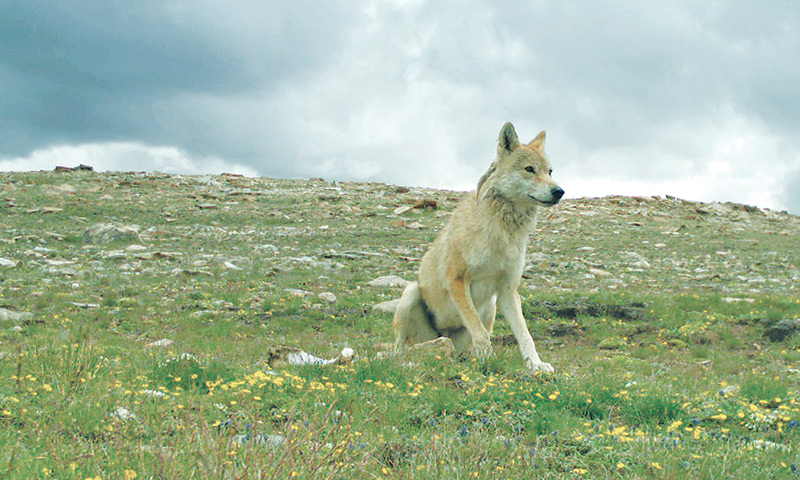
Himalayan wolf awaits special recognition as subspecies

A series of studies over the years concluded that Himalayan wolves have adapted genetically to survive in high altitudes, a quality that makes them different from other wolf species.
- CHANDAN KUMAR MANDAL
Himalayan wolves survive in high altitudes. Photo via Himalayan Wolves Project

KATHMANDU,
Himalayan wolves roaming in the high-altitude regions of Nepal and along the Tibetan plateau deserve a special classification as unique species, as they are distinct from grey wolves, according to a series of research conducted on them for over the years.
The series of research compiled and published in the Journal of Biogeography gives strong evidences that Himalayan wolves should be recognised as a subspecies of the grey wolf, if not as an entirely new species, for its unique adaptation and surviving characteristic.
According to the study, Himalayan wolves possess a unique genetic adaptation to survive in the high-altitude region with a low oxygen level—a quality unlike in any other wolf species. Riding on this high-altitude gene that helps these mountain-dwelling wolves survive lack of oxygen, the researchers are asking for the recognition of the Himalayan wolf formally as a subspecies, with its own scientific name.
“The outcome of this research is absolutely astonishing. When we started out in 2014, it was surprising how little was known about these wolves inhabiting a relatively large region of our planet,” Geraldine Werhahn, a doctorate student at Oxford University’s Wildlife Conservation Research Unit and lead author of a study, was quoted on University’s website. “At the time, the scarce data available was indicating a genetic difference, but we had no explanation for why these wolves are different from a grey wolf.
The team led by Werhahn had studied 280 wolf scat samples from western China, Kyrgyzstan and Tajikistan to find out the Himalayan wolf’s evolutionary uniqueness based on many different genetic markers. The study revealed that Himalayan wolf, which dwells above 4,000m of altitude, diverged than grey wolf which is found in large parts of North America and Eurasia.
“Now we know that these wolves are different from genetics to ecology, and we have an indication of what the reason may be: the evolutionary fitness challenge posed by the low oxygen levels in the extreme high altitudes,” said Werhahn.
The researchers have concluded that the Himalayan wolf merits taxonomic recognition and designation as an Evolutionary Significant Unit (ESU)—population of organisms that is considered distinct for purposes of conservation.  
The research team led by Werhahn, in its previous expedition in 2017, has found out that Himalayan wolves live in the mountain range as well as the Tibetan plateau. Besides, Nepal and China, these animals are also found in the Indian Himalayas and those found nearby Kyrgyzstan were mostly grey wolves.
“When we started this research we thought this wolf is found only in the Himalayas, but now we know that they are found in the entire high altitude regions of Asia comprising the habitats of the Himalayas and the Tibetan Plateau,” said Werhahn, who also leads Himalayan Wolves Project. “Much still remains to be revealed about their ecology, behaviour and population size. But the time to protect them is now!”
According to Naresh Kusi, one of the researchers, the latest findings have established Himalayan Wolf as a distinct species if not completely a new species.  
“The research has established Himalayan wolf as a distinct evolutionary unit, meaning it is diverse than the grey wolves,” said Kusi, who is also a research associate at Resources Himalaya Foundation. “We are not calling it a new species right away although it is genetically distinct from other wolves. Full genome analysis is required for establishing it as a new species and taxonomic recognition.”
The researchers have estimated that less than 100 Himalayan wolves dwell in the Himalayan region of Nepal, hence requiring conservation.   
The taxonomic recognition will pave the way for the wolf to be given conservation status by the International Union for Conservation of Nature (IUCN), to help protect the population.
The research was based in Upper Humla, upper Dolpa and Kanchhenjhunga Conservation Area, where the sighting of these animals were common. These mountain-dwelling wolves have managed to survive harsh high altitude life, however, are under threat from local communities.
According to Kusi, Himalayan wolf is under threat due to retaliatory act by local communities and negative perceptions about the animal.  
“Local communities tend to fear that these wolves would eat their cattle as they can be easily seen around. Use of their parts for unverified medicinal purpose and conservative practices also encourage others to kill wolves,” said Kusi. “In Dolpa, we found locals have set their den on fire. The animal is critically endangered and requires special conservation, which can be easier once it is recognised.”

Page 5
NATIONAL

East-West Highway expansion halted in the wake of coronavirus outbreak

Officials representing the contractor company haven’t returned to Nepal since they travelled to China last month.
- NARAYAN SHARMA
China State Construction Engineering Corporation has undertaken the job to expand the road. Post file Photo

NAWALPARASI (EAST),
Road expansion drive at the Butwal-Narayangadh section of the East-West Highway has stopped since the Chinese officials and labourers who had been to their native country to observe the Chinese New Year haven’t returned due to the coronavirus outbreak.
China State Construction Engineering Corporation has undertaken the job to expand the highway. The corporation has employed 40 Chinese nationals for the drive. Out of the 40, 15 high-ranking officials are currently stuck in China, as the country is gripped by the coronavirus outbreak.
“Since those 15 individuals make all the decisions, we cannot resume work in their absence,” said Sujan Adhikari, chief of the Gaindakot-Daunne road section. China and several other countries across the world have imposed varying degrees of travel restrictions in an attempt to prevent the outbreak from spreading.
According to Adhikari, the chief contractor of the road expansion project has corresponded with Nepali officials, saying the team’s arrival will be delayed by at least a half month more. Several works such as the felling of trees and the construction of culverts and bridges are yet to begin due to the absence of Chinese officials. The project has faced several obstacles—primarily, the locals’ concern over tree felling—since it began in early 2019.
The coronavirus outbreak, which started in Wuhan in China in late 2019, has claimed over 2,300 lives, infecting over 77,000 across the world so far.
The outbreak is expected to have long-lasting ramifications to the global economy.

NATIONAL

Industrial area plan in Dudejhari forest raises concerns

- MOHAN BUDHAAIR

DHANGADHI,
A week ago, Minister for Industry, Commerce and Supplies Lekhraj Bhatta inspected the site for a proposed industrial area in Dudejhari forest of Sudurpaschim Province.
According to Bhatta, the federal government has prepared a detailed project report to develop Dudejhari as an industrial area. The file is to be presented in the Cabinet for approval.
Conservationists fear that construction of the industrial area in Dudejhari forest in Kailali district will destroy the natural biodiversity corridor used by the wildlife.
The site belongs to Dudejhari forest and covers 1,000 bighas of the forestland. The forest is part of an important international bio-corridor which connects Chure in Karnali, Bardiya National Park and Dudhwa National Park in India.
Suman Subedi, section manager of the Terai Arc Landscape programme, a World Wildlife Fund-supported programme, said the government should understand the importance of the forest area. “It would be good if the concerned authority selected another place for the industrial area,” said Subedi.
Conservationists said that the movement of wild animals including endangered wild elephants, tigers and rhinos, among others, has increased in the Karnali bio-corridor. “Dudejhari forest is not only a bio-corridor but also an important water recharge area at the base of the Chure region,” said Subedi.
Raj Bahadur Air, a conservationist in Dhangadhi, said there is a 25-hectare grassland with sal trees in the forest. The forest faces threat also from timber traders. Air alleged that the government had proposed the Dudejhari industrial area under the influence of people dealing in timber.
Dudejhari forest connects the East-West Highway and is three kilometres west of Chisapani in Kailali.
Deep Kumar Khanal, secretary at the Ministry for Forest and Environment in Sudurpaschim Province, said it’s wiser to find another public land to establish the industrial area. “Nepal has signed the Convention on Biological Diversity. We must make efforts to preserve forests and minimise harm to the ecology,” said Khanal.

NATIONAL

Burtibang Primary Health Centre lacks ambulance, blood transfusion centre

- PRAKASH BARAL
The health facility in Baglung has been referring patients to other institutions for lack of employees and resources. Post Photo: PRAKASH BARAL

BAGLUNG,
Burtibang Primary Health Centre in Baglung receives around 200 patients daily. On average, up to three pregnant women undergo delivery and two undergo surgery every day at the health centre that is 90 kilometres west of Baglung Bazaar, the district headquarters of Baglung.
But of late, the centre has been referring patients to other health institutions for lack of employees and resources.
“The health institution does not have an ambulance or blood transfusion centre,” said Dr Milan Malla, chief at the health centre. “We have been referring patients to other health centres since we don’t have the resources to treat them here.”
With just three doctors at present, the health facility has been facing difficulties to treat patients, said Malla.
The centre, however, does provide 24-hour emergency services and OPD, X-ray, ultrasound and lab facilities, among other services.
“It’s challenging to run a health centre in the absence of resources. It’s not like running an administrative centre,” said Malla.
In the last fiscal year, Dev Kumar Nepali, mayor of Dhorpatan Municipality in Baglung, had declared that the local unit would purchase an ambulance for the health centre, but the plan has yet to come to fruition.
“I am making efforts to purchase an ambulance for the health centre from our internal budget this year,” said Nepali.
Doctors at the health centre said they have to call ambulances from Bhimgitthe and Gwalichaur during emergencies.
The residents of Dhorpatan, Nisikhola, Tamankhola and Badigad frequent the institution for health services. But with the hospital lacking resources and staff, they have to go to Palpa and Butwal for treatment, said Amrita Pun, a resident of Supurdung.
“The health centre needs to have an ambulance and a blood transfusion centre. If they had these facilities, we wouldn’t have to go elsewhere for treatment,” said Pun.
The primary health centre is a proposed 15-bed hospital. It is currently reeling under a shortage of lab assistant, medical officer, nurses, office assistant and administrative staff.
Jeet Bahadur Bhattachan, a resident of Burtibang, said that since the area is being developed as a model city, the authorities must prioritise health facilities.
“The concerned authority should take initiatives to develop the health centre to a fully facilitated hospital,” he said. 

NATIONAL

Banke Dalits discriminated against on Shivaratri festival

They were barred from offering prayers to Lord Shiva at Mankhola Shiva Mandir.
- RUPA GAHATRAJ

NEPALGUNJ,
On Friday, the Mankhola Shiva Mandir in Chisapani was surrounded by devotees marking the Shivaratri festival. The crowd, however, was composed predominantly of the so-called high-caste people, for the temple has a history of discrimination against the Dalits.
On Friday, too, the Dalits were overtly discriminated against. Like yesteryears, they were barred from offering prayers to Lord Shiva.
Laxmi Sarki, one of the devotees who were on the temple premises, said that she was denied from sitting on a mattress placed outside the temple.
“They did not allow me to help arrange the pooja too,” she said. “I feel utterly humiliated.”

Sarki said she has been humiliated like this for years.
Chandra Sunar, also a Dalit, echoes Sarki. “We are discriminated against whenever there’s a religious function,” she said. “Do the gods and goddesses really classify Dalits from non-Dalits?”
Chair of Baijanath Rural Municipality Ward. 1 Rup Bahadur Malla said that he is leading the fight to end the ostracisation of Dalits at the hands of the so-called high-caste people.
“We are fighting for people from all communities to be included in religious gatherings and social functions,” Malla said. “We are trying to dismantle conservative beliefs that discriminate against the Dalits. But we still have a long way to go.”
Malla said that the Temple Management Committee has decided to include people of all caste and creed in its functions. But the composition of the committee itself is not inclusive. The eleven-member committee does not have a single Dalit member.
However, Chair of the committee Nil Bahadur Chhetri said the committee will soon be reshuffled.
“The new committee will include people of all caste,” he said. “We will listen to all communities for the temple’s conservation and development.”
Mankhola Shiva Temple, spread out over five bighas of land, regularly hosts yagnas and other religious functions, and utilises the collected funds for the temple’s development and conservation.

NATIONAL

Dharmashala under construction in Janakpur

Briefing
- Post Report

JANAKPUR: Government authorities have been constructing a Dharmashala at Devpura Rupaitha in Dhanusha to provide accommodation to visiting pilgrims and tourists in Janakpur. Presidium member of the Rastriya Janata Party Nepal Rajendra Mahato and Mayor of Janakpur Sub-metropolis Lalkishwor Sah jointly laid the foundation stone for the Dharmashala on Saturday. The structure will be built at the cost of around Rs 2.5 million.

NATIONAL

119 houses to be built by current fiscal year

Briefing
- Post Report

PARBAT: One hundred and nineteen houses are being constructed under the People Housing Programme in Phalebas, Kushma, Bihadi, Jaljala and Mahashila in Parbat district. According to the Physical Infrastructures Development Ministry of Gandaki Province, the construction work of these houses will be completed by the end of the current fiscal year.

NATIONAL

Postpartum woman rescued

Briefing
- Post Report

DARCHULA: Kaushila Dhami, a 32-year-old postpartum woman of Lasku, has been airlifted to Nepalgunj for further treatment. Dhami’s health has been in critical condition after delivering a baby at the district hospital in Darchula at just six months. 

NATIONAL

Municipality provides Rs 10 million loans for pilot course

Briefing
- Post Report

RUKUM (WEST): Aathbiskot Municipality has helped two
local youths study pilot course.
The municipality provided Rs 10 million—Rs 5 million each—to
the beneficiaries to complete the course. According to the municipal office, the students don’t have to pay interest for the loan.

NATIONAL

Deer killed in road hit

Briefing
- Post Report

CHITWAN: A spotted deer, locally known as Chittal, was killed
after it got hit by a vehicle at Tikauli Forest along the East-West Highway in Chitwan on Saturday. According to Divisional Forest Officer Bishnu Prasad Paudel, the speeding vehicle hit the deer while it was trying to cross the road. Police seized the vehicle for investigation.

Page 6
OPINION

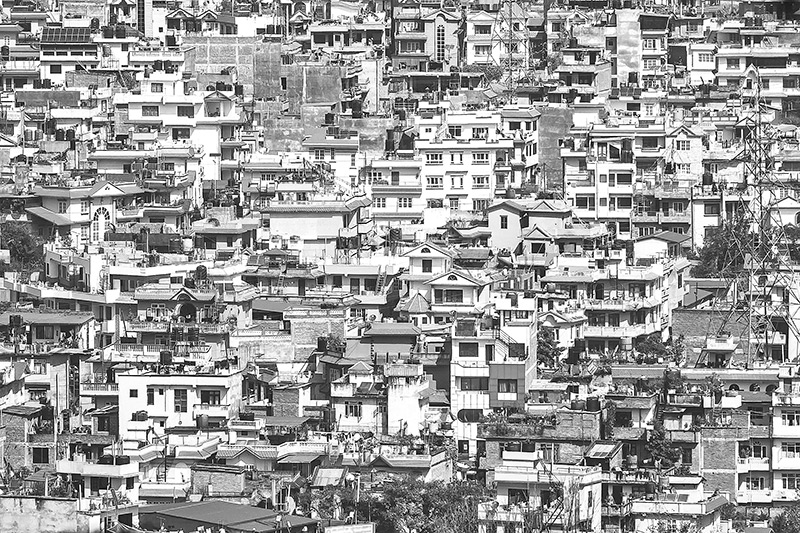
Kathmandu: A city in despair

The Valley Development Authority is largely responsible for the destruction of settlements and heritage sites.
- PRASHANTA KHANAL
Shutterstock

Locals of Khokana and Bungamati have been protesting against building the fast track highway next to their historic settlements. The Nepal Army has set up a camp, likely to check public obstruction, and started the construction of the expressway, which has changed certain aspects of the detailed project report accepted by the cabinet. Further, an outer ring road and new town developments are being planned in the fringes of the Kathmandu Valley. If these projects are implemented, the valley is also going to lose its last remaining green spaces, agriculture lands and groundwater recharge areas. Policymakers and planners are yet to realise that these projects, including road widening activities, will further accelerate urban sprawl in the valley and be a recipe for ecological disaster.
Worsening air quality, road fatalities and increasing monsoon flooding events are telltale signs that Kathmandu is already heading towards becoming an unlivable city. It is one of the fastest-growing metropolitan regions in South Asia, and the urbanisation is rapid, uncontrolled and environmentally unsustainable, according to a World Bank report published in 2013. If the urban expansion continues business as usual, Kathmandu will face unprecedented stress on land resources and also significantly increase vulnerability to disasters, including earthquakes.


Biggest land-use change
The biggest urban land-use change in the valley came after the construction of the ring road in the 1970s, which accelerated the built-up areas both inside and outside it. A 2017 study published by Ishtiaque, A; Shrestha, M; and Chhetri, N, using Landsat imageries, showed that the built-up area increased by about 120 percent between 1989 and 1999, largely along the major roads. In the last three decades, it increased by 412 percent, while agricultural land encountered a 31 percent loss. The sprawl was primarily fuelled by road development without proper urban planning including a real estate boom and migration.
The notion of development, as defined by wider roads and more cars, continued. In late 2011, the then prime minister Baburam Bhattarai started a road widening campaign supposedly to reduce worsening traffic congestion. The Japan International Cooperation Agency (JICA) funded the six-lane Koteshwor-Bhaktapur highway and eight-lane Maitighar-Tinkune highway; they were built dissecting dense urban settlements. The southern section of the ring road of about 9.5 km was also built into an eight-lane highway by the Chinese government. With its faulty unsafe design and location amid dense built-up areas, planners have labelled the road a death trap. These myopic projects have changed the urban landscape in unprecedented ways, further fuelling urban sprawl and motorisation, and making the cities unsafe to walk or cycle.
Bhattarai initially gave the task of widening the roads to the Traffic Police Division which has neither the jurisdiction nor the expertise. Houses were bulldozed, sidewalks were dismantled, heritage sites were threatened, and open spaces were encroached upon to make more room for cars.
The Kathmandu Valley Development Authority, led by chief Bhai Kaji Tiwari, is largely responsible for the haphazard expansion of the roads by destroying settlements and heritage sites. The authority was set up by Bhattarai to bypass the city governments and participatory processes to speed up its activities. Tiwari works by completely bypassing the elected representatives and mayors. In a democratic state, his way of operating by holding himself higher than the elected officials shouldn’t be entertained, and his actions should be brought under the law.
The same institution is now undertaking a multi-billion project to develop satellite cities occupying 5,000 hectares. There is hardly any information regarding the project in the public domain. Building these new cities in the vicinity of the main city is an obsolete 20th-century concept. The destruction of the last remaining green open spaces and agricultural land will be the biggest ecological disaster for the city—a suicidal one. Seen from the national perspective, investing resources and concentrating physical infrastructure and services in the capital is not just inequitable. It will put more stress on the valley and encourage migration.
Inept political leadership and bureaucracy are to be primarily blamed for what has happened with Kathmandu’s urbanisation, but development agencies are equally responsible. The JICA transport plan and their skewed math is more about moving more cars than moving people. The JICA report entitled Project on Urban Transport Improvement for Kathmandu Valley (2017) urges the government to widen the existing roads to four and six lanes, and build inner and outer ring roads. Now with the widened roads already getting gridlocked, JICA is providing technical assistance to build underpasses and flyovers, and indoctrinating bureaucrats about their need. JICA had suggested building a four-lane inner ring road over the Dhobi Khola by covering the river. Fortunately, the then transport secretary rejected the idea. In a bid to modernise, Tokyo had made the same mistake.
The Roads Department and the Kathmandu Valley Development Authority have built roads along the river corridors, some of these with funds from the Asian Development Bank. The city has been experiencing disastrous flooding in settlements adjoining river corridors for a few years now. This can largely be attributed to the construction of roads and settlements by encroaching on the river’s natural pathway. More severe flooding events and casualties are very likely in the future with extreme monsoon patterns exacerbated by climate change.
The satellite city project, if implemented, will lead to increased urban flooding and put the valley under water stress. Projects putting vehicles at the centre of transport planning will further fuel motorisation, leading to increased traffic fatalities and air pollution—two major public health concerns in the growing cities of Nepal.


Within walking distance
To make Kathmandu a sustainable and livable city, it can’t go forward in the current trajectory. Instead of building more and wider roads, it needs to focus on investing in an affordable and accessible electric bus transit or surface light rail system, and make the city more walkable and cycle-friendly. Instead of building new towns, it should put its efforts and resources on building more compact and mixed urban settlements on the existing built-up areas, preserve ecological and agricultural space, pursue transit-oriented development, and make cities inclusive.
The population of the valley is going to increase, but proper urban planning and development of other towns and cities in Nepal will help to decelerate the population growth, and contain the growth in the existing built-up areas without the need for developing new cities. It is definitely a longer and more difficult way than straightforward expansion projects, but it is a sustainable way to move forward.


Khanal works on issues related to urban transportation, air quality management and sustainable cities.

OPINION

Central admission tests: Turning the wheels too hastily?

The testing system is effectively a way of shutting down access to public-funded higher education.
- Zobaida Nasreen
Shutterstock

The idea of the proposed central admission tests in public universities has been promoted as a fairer, inexpensive alternative to the existing system of university entry. The new system promises to be the most efficient way of relieving admission-seekers and their parents of tremendous physical, mental and economic pressures that they endure due to separate university tests. This change demands a massive cultural transformation in higher education. But the way it has been put forward seems to be unnecessarily hasty and does not raise confidence that reasonable efforts have been made to implement it across a large and complex system.     
If implemented, the standardised tests are expected to be a transformative event, a life-determining one for the students. That is why, due diligence is required before the plan is set in motion. But the current situation gives one the impression that everything is happening too fast. Not even the new admission procedures have been publicised yet. The lack of visible preparatory efforts to steer and monitor the implementation of the uniform testing system, given that not enough time is left before the next admission season, is deeply worrying.
Since no pilot experiment has been conducted before taking the decision of implementing it countrywide, no one really knows how the whole system will work and what challenges it will face. While it is of utmost importance that the universities have a stake in decision-making at every step of the way, it has not been the case. So, the decision seems to have been imposed from the top.
The big question now is how it will be conducted; who will ultimately be responsible for such a massive-scale testing situation; who will develop the questions and who will evaluate the scripts. Not just the students, but teachers also have no clear idea about these issues. Perhaps it would have been more logical to take such an important decision after developing necessary strategies to counter possible challenges. For example: at a time when preventing the leakage of question papers is still an ongoing struggle and a highly sensitive and important task, a single leakage can ruin the chances of its success. Even the quality of invigilation in different places may have different standards. Also, in order for the students to make informed choices, they need a discipline-based ranking of universities. We do not know when and on what basis it will be done.
This concern is particularly important because of a problem that is inherent in our culture of educational policy making. Contemporary experience shows that major changes in our education sector occurred too quickly and without necessary preparations, resulting in failures to achieve intended outcomes. Replicating reforms and changes implemented successfully in other countries often turned out to be a recipe for disaster here. Though the multiple-choice question (MCQ) format could have been an efficient way of assessing learning outcomes, here it has been reduced to a testing method that deals with the mechanical repetition of something to be learned. This is because we have never had enough trained teachers capable of drafting multiple-choice questions that effectively test learning outcomes. The same can be said about the much-publicised introduction of the creative question method at secondary schools. On the other hand, it is hard to say if the Primary Education Completion (PEC) and Junior School Certificate (JSC) exams actually have any effect on improving the quality of education or they are just adding undue burden on the young students.
The problem we have is that almost half of the students finishing higher secondary education will not find a place at a public or government university. The testing system is not just a way of measuring competency or proficiency; more importantly, it is effectively a way of shutting down access to public-funded higher education. The proposed central tests appeal to the logic of convenience above anything else. This is important, but at what cost? What will happen to the diverse enrolment mechanisms, essential for a good number of disciplines? We are still in the dark about the whole process. Almost no discussion took place involving stakeholders at universities.
The major challenges that any unified system faces are related to ensuring equality and diversity. Our education system has become increasingly pressurised with centralised exams. The addition of another massive, centralised and annual test runs the risk of imposing additional burden on an already highly-pressurised system. If the centralised exam is the only thing considered by universities for enrolment, and there are no interviews or other admission criteria, then it will be hard to control the mushrooming of coaching centres. Due to this special characteristic, it runs the risk of increasing inequality in education by widening urban-rural gap and regional differences. If the uniform tests take place as a singular annual affair, it may put excessive strain on students by shrinking the horizons for many of them, especially those from the poor and disadvantaged backgrounds. Soon it may also turn into a dreaded and stressful exercise. That is why, implementing other such exams requires careful consideration and gradual advancement.
If we are relying only on MCQ for standardised exams, leaving out comprehensive tests and diverse admission criteria, then we’re actually going backwards, since many universities are already implementing those things to value creative and critical thinking. To ensure that students with diverse interests do not fall behind in their quest for securing the subject of their choice, holding general testing and subject-specific cluster testing can be a possible solution.
On the other hand, every test involves evaluation. While standardisation of testing has been talked about quite a lot in recent years, the issue of standardisation of evaluation has not been raised at all. If we are to see a comprehensive evaluation system for the integrated tests, it will demand massive preparations involving a huge number of teachers, not just those who are affiliated with the ruling party. I have not yet seen or heard anything about any preparation of that sort.
At this point, it is hard to imagine how the proposed central tests will be able to overcome the challenges faced by the existing system (like the difficulty in selecting innovative talents who are otherwise not very competitive, question paper leakage, and so on). A bottom-up approach to address these will be much more useful.
It is possible to address most of the concerns of the autonomous universities about the proposed system through careful planning and necessary engagement. In that case, any arrangement must uphold the autonomy of the universities. We expect that the issue of the unified system will be discussed by the academic councils, the highest body for taking any academic decision in public universities, and a decision will be taken as soon as possible. For the UGC and the government, there is no harm in recognising the central role of the universities in the whole testing and evaluation process, given that they are the leading autonomous institutions of the country. The universities should have the final say—maybe through comprehensive tests (if not included in the standardised tests) and interviews—when it comes to enrolment. The introduction of the new system, therefore, requires long and engaging discussions.


This article was previously published in The Daily Star, a part of the Asia News Network.

Page 7
OPINION

Unveiling the business of guaranteeing

The many cases of claims and disputes are a reminder that we are quick in forgetting the lessons history has taught us.
- MICHAEL SIDDHI
Shutterstock

The quote ‘Progress is cumulative in science and engineering, but cyclical in finance’ is a fantastic testimony that at any point in time there are contortions in the financial system. The increasing number of large-value bank guarantees issued against foreign banks’ counter-guarantees, and the many cases of claims and disputes are a reminder that we are quick in forgetting the lessons history has taught us. While the sun is yet to set in Melamchi, and the Nepali banks that had issued a guarantee to the Chinese contractor for the Melamchi Water Supply Project are yet to recover from the shock, the banking industry was hit by another case of a bank issuing the counter-guarantee, but being refused payment.
It was a few years ago that the Bank of Kathmandu and Himalayan Bank faced the music of Melamchi when a Chinese bank failed to make payment under its counter-guarantee. As if to prove that lightning can strike twice in the same place, the Melamchi project’s second contractor, CMC di Ravenna, held a contract to build the Tanahu hydropower plant. It allegedly abandoned the project, and Tanahu Hydropower claimed the guarantee amount from the guarantor Nepal Investment Bank. The bank then asked the Italian bank that had issued the counter-guarantee, Intesa Sanpaolo, for payment. An Italian court, Tribunale di Bologna, ruled in favour of the Italian contractor, apparently on the grounds of forgery, and directed the Italian bank not to honour the claim. This left the Nepali bank staring at the possibility of a big hole in its balance sheet.


Risks and rewards
Against this backdrop, and with a number of infrastructure projects involving foreign counterparties kicking off, it is important that all stakeholders understand the risks and rewards of the usage of bank guarantees to execute a project. Whenever there is international bidding for an infrastructure construction project, it is not atypical to see many Chinese and Indian firms, along with some third country contractors, bidding for it. To win the contract, these offshore entities are required to issue bonds to the beneficiary.
The Public Procurement Regulation 2007 mandates that any issuance of such bonds by a foreign bank has to be counter-guaranteed by a Nepali bank. The key reason why a counter-guarantee from a Nepali bank is required is that it eliminates the risk of foreign jurisdiction. It is not uncommon for a foreign court to stop payment under bank guarantees. Having the bank guarantee issued by a local bank spares the beneficiary from this risk.
The essential characteristic of a demand guarantee is that it is independent of the underlying transaction between the applicant and the beneficiary that prompted the issuance of the guarantee. Being unconditional in nature, the guarantor is required to pay the claim without contesting it. The standard rules of guarantee are governed through Uniform Rules For Demand Guarantees (URDG) 758 which came into force in July 2010. URDG 758 quickly became the standardised text for issuance of demand guarantees worldwide. One key notable change in URDG 758 is that of governing laws. Pursuant to Article 34 of URDG 758, unless otherwise provided in the guarantee, its governing law shall be that of the location of the guarantor’s branch or office that issued the guarantee.
The same rule applies, mutatis mutandis, to counter-guarantees. This opens up the possibility of different laws that apply to guarantees and counter-guarantees. This has implications which the guarantee issuing bank needs to judiciously understand. So unless mentioned, the counter-guarantee issued by a foreign bank is subject to the rules and jurisdiction of the originating country. This allows the foreign contractor to contest the claim in the courts in its country. Hence, it is important that the Nepali bank, while issuing the baby guarantee against the counter-guarantee of a foreign bank, understands which jurisdiction and laws apply in case of a conflict. In a move to ensure consistency, Nepal Rastra Bank has issued a directive stating that all guarantees issued in Nepal have to follow the rules of URDG.
When the second claim on the guarantee issued to the Melamchi Water Supply Project by Standard Chartered Bank Nepal and Nepal Investment Bank was made, both these guarantee issuing banks and the
counter-guarantee issuing foreign banks settled the payments timely, but not without leaving behind a gnashing nightmare. In the aftermath of these mini-crises, we have learnt that the business of issuing bank guarantees has its virtues; but it carries a vice that has razor-sharp teeth that could take away large chunks of flesh leaving you bleeding. The size of the sum involved in all these cases is so big that the Nepali banking industry was gripped by anxiety and the fear became palpable. Yet, bankers have repeatedly failed to learn from the past; and it is only fair that we dig some graves and unravel the perils of a banker’s hubris.

 
The enormity of risk
As is true with all humans, Nepali banks panicked when the Chinese bank refused to pay under the claim, and they became sceptical of foreign banks. But after a few seasons of good weather, most had forgotten the enormity of the risk and potential impact of issuing bank guarantees against the risk of a foreign counterparty. With a number of large infrastructure projects kicking off in the country, and most of them being undertaken by foreign contractors, it is time that project employers start appreciating the nuances of the guarantee terms and unravel the underlying structure.
The sun may set and the last rays of the orb may descend behind the hills above Melamchi, yet a quintessential question still reverberates: Are Nepali banks biting off more than they can chew when they issue a commitment of such enormity against the comfort of a foreign counterparty while remaining exposed to foreign jurisdiction and laws?


Siddhi is the head of transaction banking at Standard Chartered Bank Nepal.

OPINION

The case for global health diplomacy

The recent crisis is a reminder of why governments must regard health as an essential component of foreign policy.
- JUNAID NABI
Shutterstock

One of the hallmarks of an effective foreign policy is that it runs in the background, neither loud nor especially visible. Governments must urgently adopt such an approach to stem the growing global panic caused by the coronavirus outbreak, which has now killed more than 1,300 people and infected in excess of 63,000.
Although almost all the deaths and confirmed cases to date have been in mainland China, the virus has spread to more than two dozen countries. The World Health Organization recently declared the outbreak to be a global health emergency.
For the time being, panic reigns. Global technology firms such as Google, Apple, Facebook, and Tesla have temporarily suspended their operations in China and asked their employees to work from home. Many foreign airlines, carmakers, retail and entertainment chains, and financial institutions have taken similar measures. And in the United States, Asian-Americans and students from Asian countries are facing a surge in xenophobic comments about their food, culture, and way of life.
In addition, many countries have joined the US in temporarily refusing entry to foreign nationals who have recently travelled within China. However, prominent global health experts argue that restrictive policies such as these, which usually are reserved for life-threatening situations, are unlikely to stop the spread of what the WHO has now christened Covid-19.
Instead, such measures have fueled panic among investors. Most Chinese stocks fell sharply when trading resumed after the country’s New Year holiday, with some market indices suffering their biggest single-day declines in more than a decade. Because China is the world’s second-largest economy, these financial losses will have a global impact. Furthermore, Covid-19’s disruptive impact on labour markets, travel, and factory production will hurt the operations of global firms that depend on China’s manufacturing strength and supply chains.
The crisis is a reminder of why governments must regard health as an essential component of foreign policy. Indeed, much of the current panic could have been prevented had political leaders pursued global health diplomacy.
Governments have previously recognised the role of health as a crucial foreign-policy tool, including in the 2007 Oslo Ministerial Declaration by the foreign ministers of Brazil, France, Indonesia, Norway, Senegal, South Africa, and Thailand. But applying this idea has become increasingly difficult because of the global rise of far-right nationalism, which presents diplomats with the challenge of maintaining amicable relations with allies demonised by their own governments.
Impulsive foreign policies aimed at tackling Covid-19—such as travel bans and the suspension of economic activities—are not only unsupported by scientific evidence, but also are likely to prove harmful in the long run. By contrast, soft power, or a country’s ability to shape the preferences of others through persuasion and diplomacy,
often is much more effective. In fact, three of the strategies likely to prove most effective in tackling Covid-19 (and future epidemics) will require governments and other actors to cooperate more closely, establish deep mutual trust, and develop platforms that promote the free dissemination of evidence-based scientific data.
For starters, health should be considered a global public good. Countries with robust systems for collecting and disseminating scientific research should establish collaborative networks through which low-and middle-income countries can report and publish information on infectious outbreaks. Fortunately, leading international medical journals, including The Lancet and The New England Journal of Medicine, are collecting—and rapidly publishing—evidence-based, peer-reviewed data on Covid-19’s clinical and public-health characteristics. This is critical because the new coronavirus has not been the only epidemic to spread globally in recent weeks; there also is an epidemic of misinformation online, especially on social media platforms.
Second, countries, where potential outbreaks originate, should not be made to feel stigmatised. Governments need to create formal, confidential channels through which officials can freely share information on emerging health risks or potential outbreaks. Covid-19 has spread so widely in part because the Chinese government feared political embarrassment and initially suppressed information when doctors in Wuhan raised the alarm over infectious cases. Although countries have varying mechanisms for informing the public about health-related risks, more coordinated global health diplomacy could have mitigated the epidemic’s impact.
Third, governments should invest in building data-management systems that can track the spread of epidemics, preferably in real-time. These could resemble the innovative dashboard map created by Johns Hopkins University’s Center for Systems Science and Engineering to track the Covid-19 outbreak. This map compiles data from the WHO, the US Centers for Disease Control and Prevention and its European and Chinese counterparts, and China’s National Health Commission—all in real-time. Such data is vital in helping governments to make informed decisions about how best to tackle the virus.
In a globalised world, we cannot afford to ignore the health risks arising in other countries. Rich-country governments, in particular, should therefore not regard increased globalisation and interdependence as purely economic phenomena that enable firms to establish manufacturing and supply-chain operations in middle-and lower-income economies. Privileged countries also have a responsibility to establish support mechanisms that help others address emerging health threats.
Faced with a global epidemic such as Covid-19, political leaders should be guided by scientific evidence and compassion, not anecdotes and xenophobia. Enlightened global health diplomacy could save countless lives.


—Project Syndicate

Page 8
THE BLACKBOARD

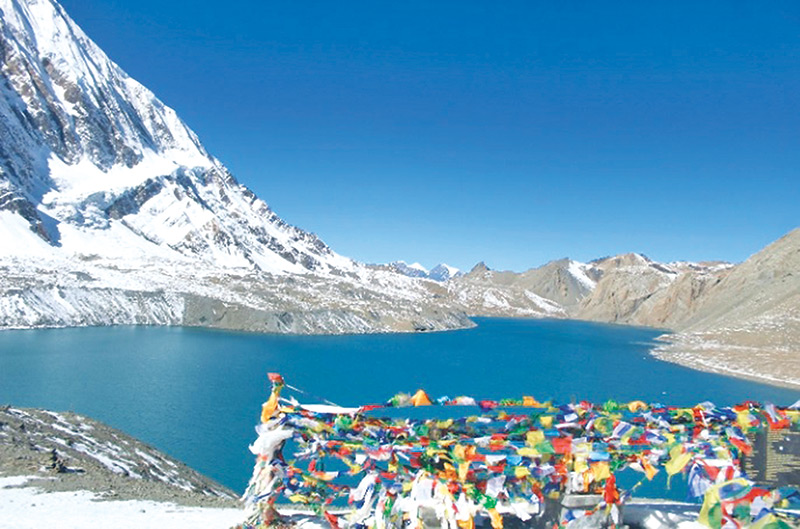
A trek to Tilicho

- Sushant Gnawali
Photo courtesy: Sushant Gnawali

My college friends and I planned a short trek to Champadevi, on a western hilltop of Kathmandu Valley, during which we talked about other routes, not around Kathmandu, as far as Tilicho Lake in Manang. That was back in 2017 and it was my first time trekking with them. I had seen various videos of Tilicho before then and had always thought it would be an amazing experience.
Fast forward to November 2019, we completed the trek to the Tilicho. It will forever be one of the most memorable events of my life as it was my first long trek.  And now that I went and did it, I feel proud of myself.  
The plan was made on a hunch. Although Abhishek, one of my classmates, was telling me from the beginning of the semester that we should visit Tilicho once our classes finished, but I never really gave it serious thought. But when our semester ended and holidays began, we finalised our plan in a single day. It’s hard to believe, but the next day, we took a bus to Besisahar.
We left Kathmandu bus park at about 8am and reached Besisahar around 4pm. It was my first time in Lamjung, the starting point for the Annapurna Circuit. My friends and I were excited for our journey. The next day we took a jeep to Manang Bazar, and took medicine because we were going to 3500 metres from 760m elevation.
The trip was wild, the roads were bumpy—it was probably the most terrifying road I’ve ever been on. I salute the daring drivers who drive it every day. Although the distance we covered was 95 kilometres, the waterfall-lined drive took us nine hours. We had dal bhat at a place called Chyamche, with a full view of water cascading down cliffs, and bought refreshing apple juice from their garden—everything was gorgeous. We reached Manang Bazar around 6pm and, to our surprise, the driver had already booked a hotel for us.
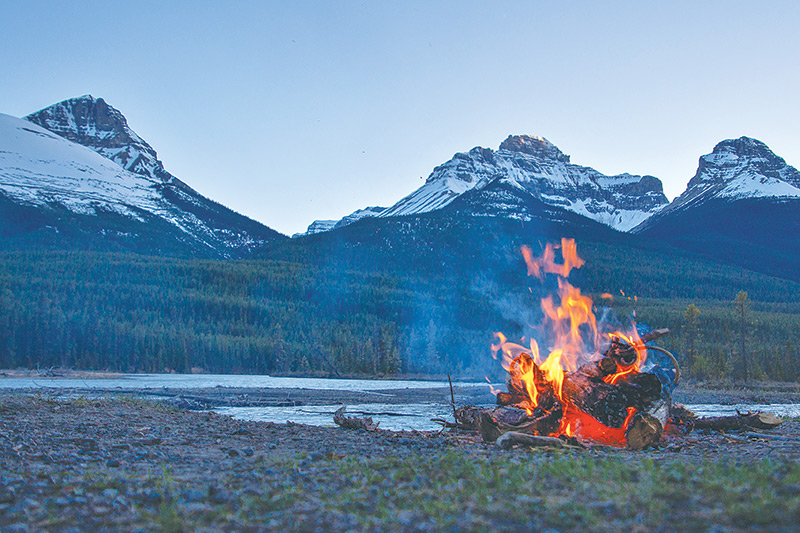
Arriving in Manang, we were struck by the change in temperature. The hotel staff and the owner were welcoming and prepared a fire place for us before making our dinner. We talked with the friendly owner, who shared stories about other travellers and how they planned their trips. He also shared a story about how one trekker died due to altitude sickness. I felt rather sad hearing that, but it was the truth.
We walked from Manang to Khangsar in two hours, and had a lunch of local mushroom curry, which was nothing short of spectacular—just like mom prepares. Within another two hours of steep uphill trekking, we reached Shree Kharka and could already feel the air getting thinner. Tilicho base camp was just two hours walk from there, so we decided to continue on the trail, which went from steep to dangerous—it was a landslide area. However, it wasn’t as dangerous as I saw in photos and videos. With every step closer, we felt the visage become even more spectacular, and we reached base camp around 5:30pm—fortunately, we got a room too. Exhausted, hungry and tired, we had dinner and we went to sleep looking forward to the following big day.
We woke around 5:30 in the morning and began our trek. The trails were steep—the trails we had trekked until then were simply a teaser. The locals said we could reach the lake within three hours but since we had no habit of walking in high elevation, it took us around six hours just to reach the top—yes, I know we took a hell of lot of time. The trek was exhausting, and we took long rests. Just six to seven steps were enough to make us feel tired again. After crossing various steep uphill, we reached the top. A signboard showed the way towards the lake and after another 20 minutes we had it in our sights. That’s where the magic happened. I put down my bag and sat down on the ground, no longer tired, no longer hungry, no longer thirsty. I simply sat and stared.
“I made it. I made it. I made it,” I thought to myself for a few minutes. I forgot almost everything and enjoyed the scene. The satisfaction I felt at that time can’t be put into words, for there is no event in my life that could equal the satisfaction I felt there. There is a popular saying: “The best view comes after the hardest climb.” It couldn’t be truer.
We took photos, videos, and had a small snack whilst enjoying the atmosphere. However, that was not the end of our journey. It was only half the journey. We had to return and that was the most difficult part of our journey. We returned to base camp and took rest. The next day we walked to Khangsar, where we had lunch. The hotel owner was able to find a vehicle for us. The vehicle took around five hours to get back. We went up to Chame that day and stayed at a hotel.
The trip was going so well until we reached the hotel. There someone from a group on their way to Tilicho fainted. At first, he convinced us he just felt asleep, but I had my doubts that anyone falls asleep while eating.  Suddenly, his friends started crying and calling his name, after he had fainted again and his eyes slid into the back of his head—he seemed dead for a time. Eventually he regained consciousness and the hotel owner called a jeep to rush him to Besisahar. The hotel owner told us it wasn’t completely unusual, and I felt lucky we were all intact. The next day we went down to Besisahar and returned to Kathmandu.
Overall it was a wonderful trip. I would recommend this trek to others, provided they don’t suffer from altitude sickness. The trails are not difficult to walk, the locals are friendly and kind and the atmosphere is good. There is no reason not to do this trek if people have time. But I think I would recommend starting the trek from Chame to help in the acclimatisation process.
As I reflect on my trek experience, I am dreaming once more. I am dreaming of trekking to Tilicho and around, maybe Thorong La pass. Manang is beautiful, I vow to visit it once again, but to explore more.


Gnawali is a student at St. Xavier’s College in Kathmandu.

FICTION PARK

The tourist

- LB THAPA
unsplash

Norbu Lama was a local trader of Marpha, Mustang, and to make a living, he would sell locally produced goods in nearby villages. One day, when he was on his way to his village from Myagdi, he was attacked by some robbers. The robbers demanded money of Norbu, but he refused. The robbers attacked Norbu mortally, leaving him bleeding to death on the ground. The robbers took all his money and clothes he had bought for his family.
Norbu had been there for a long time until some passersby spotted him lying unconscious. The locals helped admit him to a hospital in Myagdi, where he lay unconscious but stable. The doctors wanted to inform his family members, but nothing was found from Norbu that could reveal his identity. Meanwhile, some people arrived from the hillside. They had come to Myagdi to sell locally grown herbs.
Doctors asked them if they could recognise the man and they did. All of them recognised Norbu at first sight, because he was also from their village. They managed to inform his wife and later he was taken to Pokhara for better treatment. After spending several days in the hospital, Norbu was better but had difficulty walking. A major vein of his right leg was badly damaged. This made Norbu unable to walk for the rest of his life, but his family was happy he was alive.
Norbu’s financial condition plummeted because he was unable to sell local products in nearby villages, so he started livestock business. He would raise yaks and sell them locally but the business was not a big success. However, Norbu was happy as his son Dorje was going to school, and he was doing well in his studies. He would always get first position in the class and bag prizes for extracurricular activities.
There was about 10-days’ winter vacation at school, so Dorje asked his father to allow him to go for a three-day camping trip. At first Norbu hesitated but later he allowed when he came to know that he would go with two other boys from the village.
It was a fine, sunny morning. The three friends Dorje, Chhimi and Wangdel, slung their bags and walked along the rocky, barren mountains of Marpha. Their plan was to walk the whole day and set up their camp on the banks of a river. They had enough food for three days.
They walked briskly in the morning, but as the sun began rising on top of their heads, they found walking too difficult. The boys decided to take a rest beside a hillock to avoid the blistering sunlight. At 5pm they continued walking, and at 6pm they set up a camp beside the river. It was a lovely place, surrounded by tall hills—-it was more like a small valley. Several small hills and mounds spread as far as their eyes could see. The next morning, with the first ray of the sun, they wanted to climb some of those lush green hills.
Darkness fell across the valley much quicker. After setting up the tent they got down to prepare dinner. Dorje was a good cook, he had learnt from his mother. Chhimi and Wangdel knew Dorje’s cooking skill, which is perhaps the reason why Chhimi and Wangdel wanted to take Dorje with them.
It was 9pm when the dinner was ready. Dorje asked Chhimi and Wangdel to fetch water in the jar so that they could clean the utensils. Chhimi and Wangdel took a torch and walked towards the river. They filled the jar with the icy cold water and began walking back at a gentle pace. Meanwhile, Chhimi suddenly stopped. He was trying to listen to something very hard.
“Did you hear something?” said Chhimi. But Wangdel did not hear anything. They began walking again, but Chhimi stopped once again and listened. This time even Wangdel could hear a faint sound. It was like someone moaning in agony. They began walking towards the direction from where the sound was coming. They walked another 50 metres but, once again, found nothing.
They stood there for a while and then decided to return. They had hardly walked a few steps, when they heard the sound again. This time the sound seemed to be much closer to them. They began walking towards the direction when Wangdel stumbled upon something and fell to the ground. When Chhimi shone the torch on the object, his eyes stayed open in disbelief. There was a man lying on the ground. The man was severely wounded and badly bruised. Blood on his face, head and legs had already dried.  
Wasting no more time, they lifted the man up and took him to their camp where Dorje was awaiting them. Dorje was surprised to see not only water in their hands, but a wounded man in their arms—he was a foreigner. The boys examined his body and found his right leg was broken in two places. There was a deep cut in his head and his face was badly swollen.
The boys cleaned his wounds and tied his broken leg with a towel. The man was conscious but unable to communicate. Dorje made soup and fed him, they stoked the fire and provided him much-needed warmth. After dinner they decided to take the man to their home in the early morning. The man’s life depended on medical attention.
It was 4:30am when the boys carried the man on their backs. They knew it would be too difficult to walk once the sun was overhead. The wounded tourist was tall and carrying him was tough, but the boys managed it because it was a matter of life and death.
By the time the boys reached their village, they were almost half-dead themselves. Lomjeng Lama, the head of the village, informed the police and very soon, the tourist was airlifted to Kathmandu. The three boys were appreciated by the villagers for their good work.
About three months later two helicopters landed nearby the school in Marpha. All the students and teachers came out and looked in bewilderment. Over a dozen soldiers got out of the helicopters and went straight to the principal’s office and asked for Dorje, Chhimi and Wangdel. Anticipating something unexpected, the faces of the teachers had turned pale—the kids were placed before the armed soldiers. The boys felt a chill going down their spine at the thought of the unknown.
However, the next moment, in walked the tall tourist with a broad smile on his face. The three boys’ faces glistened with happiness as soon as they saw him, as he outstretched his arms and hugged them all together. The crowd was too happy to see such a dramatic change of the scene and the boys were very happy to see the tourist on his own two feet.
“I’m only alive today because of the efforts of these three boys,” the tourist said with tears in his eyes. He addressed the crowd and appreciated the efforts of those three boys. He surprised everyone when he declared he would rebuild their school with modern amenities and said he would provide free education for the three boys in England.
After spending some time with the locals, the tourist boarded the chopper and flew back to Kathmandu. Only later would people find out the man was a high-ranking British military officer. He was solo trekking when all of a sudden he fell down a 200-meter high cliff and was seriously wounded.
The whole village turned up to congratulate the boys—Dorje, Chhimi and Wangdel’s happiness knew no bound. Their good deed had not only changed their lives, but also the lives of many students. Now they would be able to get better education and a secure future.   


LB Thapa is a Pokhara based freelance writer. He is the author of ‘The Quest of a Dead Man’ and ‘The Pokhara Valley: A traveler’s guide’.

Page 9
CULTURE & ARTS

Meet the director and writer behind the most celebrated Nepali movie in recent times

With hopes for acting dashed, and years pining for a career in film, Binod Paudel has finally made his name by breaking the mould.
- ANKIT KHADGI
‘Bulbul’ writer and director Binod Paudel is hoping films like his will help develop the Nepali film industry. post Photo: Deepak kc

Kathmandu,
It was not easy for a movie like Bulbul to achieve what it has in its one year since release. A small-budget, the risk of casting an a relatively unknown lead, releasing at the same time as an awaited Bollywood flick and not following typical film conventions, Bulbul was a big risk. But for Binod Paudel, the director and writer of the movie, this was the story he always aspired to tell. Defying all odds, not only was his debut movie a success, he has also been bagging awards in both national and international festivals.
Now principal of Oscar International College, Nepal’s first film school, Paudel’s love for cinema started in his formative years. “I used to watch Hindi cinema a lot during my budding years. I was always fascinated, and wanted to be the hero,” says Paudel.
Due to some family reasons and economic conditions, like any Nepali may have felt, he also went to the Middle East for employment. But his love for cinema never died and once he found financial stability, he returned to Nepal in 2006 and joined the film school he heads, to study acting.
However, the Nepali industry was more concerned about how he looked than how he acted. “Filmmakers were mostly looking for an actor who had a good physique and did stunts. I didn’t quite fit the mould and that’s why I wasn’t able to get many opportunities to show my acting capabilities,” says Poudel.
While he was able to catch a few gigs in theatre and in some movies, the reluctance of Nepali movie makers to go beyond conventional filmmaking disappointed him. Later, in 2009, he moved to London to study an MBA. The UK had all the resources and facilities, and everything he needed, but his love for cinema didn’t wane. With his wife’s encouragement, he again felt the need to return. Instead of acting, he opted for writing and created his own film.
“I came back in 2012 and wrote my first movie, Saanghuro. Working on my own project allowed me creative freedom. Then I decided to put on the hat of writer-director then become an actor,” says 40-year-old Paudel, who went on to win a National Award for the writing of his first film.
While he was making progress in his career, the institution responsible for expanding his knowledge and skills was in crisis. Multiple protests and dissatisfaction among student splagued the institution, which led to Tribhuvan University—affiliated with the college—delivering an ultimatum, he says.
He later decided to take the role of the film school’s principal and under his leadership, Oscar International College started producing graduates who now are contributing to a new wave of Nepali cinema.
The school kept him busy, but one particular story always stuck in his head—a story he wanted to make on the wives of the Nepali immigrants. In 2017 he pulled his socks up and made a movie on it.
“Since I myself went to the Middle East and have met many women who were waiting for their husband’s return, I felt the story was powerful. I thought it could connect with people as it was a lived experience for many,” says Paudel.
After the completion of his story, he started looking for actors who could play the lead of the story—Ranakala, a tempo driver, of whom the story revolved around.
While many questioned selecting Swastima Khadka, a Nepali mainstream actor who was known for playing conventional roles, there was something he saw in her, which made him feel like this was the actor he wanted to work in his film, he says. “I saw some glimpse of Swastima’s previous movie. I felt she had a lot of potential which other makers were unable to get from her. That’s why I was clear  in casting her for the role of Ranakala,” says Paudel.
Though uncertain about whether she should do the movie or not, as it was a big risk, Swastima was on board and later the duo got into preparation mode. “We used to travel in tempos and spend time with the female drivers regularly, to get under the character’s skin.  Swastima even learnt to drive a tempo,” says Paudel, who likes to focus on character development for his stories.
When asked what the intention behind using a tempo driver as his lead, Paudel says the tempo captivated him cinematically. “The sound and the setting of tempo added a layer to the character of Ranakala. By making her a tempo driver, I wanted to show she was independent. While driving has always been a man’s world, in Nepal many women have been driving tempos and breaking the stereotype. The intention was to portray her character as someone strong,” says Paudel.
However it was not easy to make a movie with an unconventional story compared to the Nepali box office earners, even though the story was of many Nepali women . The distributors were on board, but they didn’t treat his movie with much seriousness. “Our movie was taken as a light, small film,” says Paudel.
But he doesn’t blame the distributors, as the film industry is yet to welcome women-centric narratives with open arms.
“Our film industry and even the audience grew up watching male-centric stories, where female actors had little to do in the film’s narrative. The female actors always need a man as their saviour. Plus our culture has always been male dominated, which is reflected in our art as well,” says Paudel.
Regardless of the prior struggles, his film went to be a hit commercially, critically-acclaimed and an award winner. From winning best director and best female actor in last year’s National Film Awards, to the public choice award at the South Asian Film Festival held in France and bagging six awards—which included best movie, director, screenwriter and actress—in the recently held Nepal International Film Festival, the movie has set a benchmark for the Nepali movie industry.
Paudel acknowledges the pressure the film’s success has put on him. “People have more expectations and it has put a lot of responsibility on my shoulders to not let down the audience,” says Paudel, who is pursuing two different movies, one based on the stories of the Captial’s youth and another on the resettlement of Bhutanese refugees.
While many say Nepal’s film scene is changing slowly from traditional story lines and repetitive themes to risk-taking content, for Paudel everything still seems superficial.
“We still prefer loud movies with cheap comedy,” he says. “Our cinema culture should change, and that can only happen when conscious and mature makers enter the realm.”
Paudel also stresses the need of state’s support in improving Nepali film.
“The state should value art and pave ways where good movies can flourish,” says Paudel. “Good cinema can add value to a nation.”

CULTURE & ARTS

Why wait? ‘Sonic the Hedgehog’ worth rushing to see

Sonic is sweet and funny and self-aware. He does The Floss. He farts. He wears gloves, socks and sneakers butpoints out ‘I’m not even wearing pants.’
- MARK KENNEDY
Jim Carrey, who plays baddie Dr. Robotnik, in a scene from ‘Sonic the Hedgehog .’ PHOTOS:AP/RSS

If the Hollywood mantra for making blockbusters is “faster, faster, faster,” then the creators of Sonic the Hedgehog have wisely ignored it.
The little blue alien who can sprint quicker than the speed of light has ironically benefited from slowing it down, taking a pit stop to retool and emerge this month as a total crowd-pleaser.
Respectful of the rich history of the brand and yet welcoming to newcomers, Sonic the Hedgehog (released in Nepal on February 28) is a feel-good buddy movie for both adults and their own little aliens. “Nailed it!” screams Sonic at one point and that might be a fitting summary for the film.
Director Jeff Fowler has been entrusted on his feature film debut with bringing to life the ball of super CGI energy, whose origins lie in Sega video games. But things didn’t look too good when a trailer dropped last April that portrayed Sonic as more rat-like with creepy human teeth. . An outcry led to the film being delayed for a reset, resulting in a Sonic with a sleeker design, larger eyes and fewer chompers.
While there’s no way to give a side-by-side comparison, the film that emerges portrays Sonic as a cute, naive teenager, prone to saying very 2020 things like “I am living my best life” and “I can’t with that guy.” He has fled his own planet with a warning to “never stop running” and a twist on the Spider-Man proverb: “With great power comes great power-hungry bad guys.”
In the script by Pat Casey and Josh Miller, Sonic is naturally attracted to fast things—Flash comic books and the movie Speed (Keanu Reeves is “a natural treasure,” declares our heroic blue guy, one of many lines that will go over your little ones’ heads.)
Reeves isn’t the only celebrity to get a shout-out: Vin Diesel, Will Smith and Obi-Wan Kenobi are all invoked for laughs. Amazon and Olive Garden also get some love. There’s a weird urban-versus-rural tension throughout, with the scriptwriters clearly putting their fingers on the scale against life in the big city. One great sequence ends with everyone agreeing on a common enemy: hipsters.
The plot isn’t too far from the classic ET or the more modern Bumblebee—an alien lands on Earth to hide and soon must team up with a kindly human (James Marsden, in a very Marsden groove) to escape the clutches of evil government scientists who want to dissect it.
In this case, Jim Carrey dons a Civil War mustache and a black full-length leather coat to play the baddie Dr. Robotnik as only he can—ultra-arch, absolutely unhinged and dangerously unpredictable. “You know what I love about machines? They do what they’re told,” he snarls. Carrey has his own insane dance sequence that will make you spit out your popcorn.
Sonic, voiced by Ben Schwartz, is sweet and funny and self-aware. He does The Floss. He farts. He wears gloves, socks and sneakers but points out “I’m not even wearing pants.” He discovers what a bucket list is and instantly wants to do all kinds of stuff, including start a bar fight. “You two are so cute,” a woman tells Marsden and Sonic. They protest: They’re loose cannons. (OK, very cute loose cannons).
The non-human one goes fast, to be sure. A radar gun clocks him at 300 mph but later in the film he moves so fast he stops time, zipping around while everyone is as still as a statue.
The filmmakers have also added an excellent, propulsive soundtrack, which includes X Ambassadors, Queen and the Wiz Khalifa-led ‘Speed Me Up.’ (Steal it for your workout playlist.)
There are references to the video game throughout, including a sequence in which Dr. Robotnik chases Sonic through Paris, up the Egyptian pyramids, and along the Great Wall of China. Green Hill is where the creature ends up on Earth—echoing a key level in the game—and we learn he hates mushrooms, a frequent Sonic touchstone.
So much thought has been put into the film that at the very beginning the Paramount logo substitutes its regular stars for Sonic’s golden rings. A potential sequel is set-up during the end credits—as well as the glimpse of a familiar creature that fans are sure to get excited about. The filmmakers might not have rushed making this film, but that’s no reason for you to press the brakes now.

Sonic the Hedgehog
* * * *

Starring: Ben Shwartz, James Marsden, Jim Carrey
Director: Jeff Fowler


—Associated Press

CULTURE & ARTS

Unscripted ‘Friends’ reunion special to launch with HBO Max

A reunion has been long-sought by fans of the NBC series, which ended its 236-episode run in 2004.
- ASSOCIATED PRESS
ap/rss

WarnerMedia’s new streaming service will debut with some extra Friends.
The company announced Friday that the entire original Friends cast will reunite for an unscripted special that will be available on HBO Max when the service debuts in May.
A reunion has been long-sought by fans of the NBC series, which ended its 236-episode run in 2004. HBO Max will also carry every episode of the sitcom, which has proved enduringly popular, including with young audiences who discovered the show when it was available on Netflix.
The show made Jennifer Aniston, Courteney Cox, Matthew Perry, Lisa Kudrow, Matt LeBlanc and David Schwimmer into household names and won six Emmy Awards.
“Guess you could call this the one where they all got back together—we are reuniting with David, Jennifer, Courteney, Matt, Lisa, and Matthew for an HBO Max special that will be programmed alongside the entire Friends library,” said Kevin Reilly, HBO Max’s chief content officer.
The special is being called a “celebration of the beloved show” and will be shot on the same Burbank, California, soundstage where the series filmed.
The stars posted identical Instagram posts of an old publicity photo of all them with the caption, “It’s happening.” LeBlanc’s post kept the same message but went farther back in TV history—he used a M-A-S-H cast photo instead.
The show’s stars and its co-creator, Marta Kauffman, have long fielded questions about a possible reunion. Rumblings of an unscripted reunion special picked up after the WarnerMedia announced it would launch its HBO Max service into the crowded streaming landscape.
It was also announced Friday that cable channel TBS will air the show’s entire run weekdays from 10 a.m. to 4 p.m.

Page 10
WORLD

France begins shutting down oldest nuclear plant

- AGENCE FRANCE-PRESSE

FESSENHEIM (France),
French state-owned energy giant EDF on Saturday began shutting down the country’s oldest nuclear power plant after 43 years in operation.
EDF said it had disconnected one of two reactors at Fessenheim, along the Rhine near France’s eastern border with Germany and Switzerland, at 2:00 am (0100 GMT) in the first stage of the complete closure of the plant.
The second reactor is to be taken off line on June 30 but it will be several months before the two have cooled enough and the used fuel can start to be removed.
The removal of the fuel is expected to be completed by the summer of 2023 but the plant will only be fully decommissioned by 2040 at the earliest.
Shutting down Fessenheim became a key goal of anti-nuclear campaigners after the catastrophic meltdown at Fukushima in Japan in 2011.
Experts have noted that construction and safety standards at Fessenheim, brought online in 1977, fall far short of those at Fukushima, with some warning that seismic and flooding risks in the Alsace region had been underestimated.
Despite a pledge by ex-president Francois Hollande just months after Fukushima to close the plant, it was not until 2018 that President Emmanuel Macron’s government gave the final green light.
“This marks a first step in France’s energy strategy to gradually re-balance nuclear and renewable electricity sources, while cutting carbon emissions by closing coal-fired plants by 2022,” Prime Minister Edouard Philippe said earlier this week.
France will still be left with 56 pressurised water reactors at 18 nuclear power plants—only the United States has more reactors, at 98—generating an unmatched 70 percent of its electricity needs.
The government confirmed in January that it aims to shut down 12 more reactors nearing or exceeding their original 40-year age limit by 2035, when nuclear power should represent just 50 percent of France’s energy mix.
But at the same time, EDF is racing to get its first next-generation reactor running at its Flamanville plant in 2022—10 years behind schedule—and more may be in the pipeline.

WORLD

Sanders warns Russia, Trump scoffs as new meddling charges hit US election

The comments from the Democratic frontrunner in the presidential race came moments after The Washington Post reported that US intelligence told Sanders that Russia was seeking to help his campaign.
- AGENCE FRANCE-PRESSE
Democratic presidential hopeful Vermont Senator Bernie Sanders speaks during a Get Out to Caucus Rally at Springs Preserve Amphitheater in LasVegas, Nevada, on Friday. AFP/RSS

WASHINGTON,
Bernie Sanders on Friday warned Russia not to meddle in the Democratic presidential race, as Donald Trump angrily dismissed assertions that Moscow was again seeking to boost his election chances.
Trump has come under fresh fire for removing US intelligence chief Joseph Maguire, replacing him with a loyal partisan with no direct experience in the field, days after Maguire’s staff told lawmakers that Russia was again interfering in a US election to support Trump.
Sanders, a self-described socialist who is leading the race for the Democratic nomination to challenge Trump in November, told reporters that US officials briefed him “about a month ago” of efforts to interfere in the 2020 race.
“Unlike Donald Trump, I do not consider (Russian President) Vladimir Putin a good friend. He is an autocratic thug who is attempting to destroy democracy and crush dissent in Russia,” Sanders said in a statement.
“I don’t care, frankly, who Putin wants to be president,” he added. “My message to Putin is clear: stay out of American elections, and as president I will make sure that you do.”
His comments came moments after The Washington Post reported that US intelligence told Sanders that Russia was seeking to help his campaign.
The form of assistance was unclear but Sanders has suggested that Russia could be behind belligerent online remarks by his professed supporters that have drawn condemnation from other candidates. “They’re trying to cause chaos, they’re trying to cause hatred in America,” Sanders told reporters in California.
An exhaustive report by former FBI chief Robert Mueller found that Russia backed Trump’s 2016 campaign, including by manipulating social media, but did not find that the campaign colluded with Moscow.
Trump has showed irritation at any suggestions he won because of Russia. Speaking at a rally in Las Vegas, Trump said he had heard a “rumor” that “Putin wants to make sure I get elected.”
“Wouldn’t he rather have, let’s say, Bernie?” he said.
He earlier tweeted that accounts of Russian support were a “hoax” and “misinformation campaign” by Democrats “who still have been unable to, after two weeks, count their votes in Iowa,” which held the first contest among candidates.
In Moscow, Kremlin spokesman Dmitry Peskov said the allegations were “like the usual paranoid announcements, which unfortunately will multiply as we get closer to the election.”
“Of course, they have nothing to do with the truth,” he said.
President Vladimir Putin, however, acknowledged when he met Trump in July 2018 that he supported the populist billionaire’s campaign, seeing him as friendlier to Moscow than rival Hillary Clinton.
Trump was later impeached in a separate scandal over holding back military aid to Ukraine, which is fighting Russian-backed separatists, to pressure the Kiev government to dig up dirt on a Democratic candidate.
Former CIA director John Brennan, who served under presidents Barack Obama and George W. Bush, said the United States had entered “a full-blown national security crisis.”
“By trying to prevent the flow of intelligence to Congress, Trump is abetting a Russian covert operation to keep him in office for Moscow’s interests, not America’s,” he wrote on Twitter.
Democratic presidential candidate Elizabeth Warren said the 2020 election revelations showed the “enormous” challenge.
“It should worry all of us that we now live in an America where one political party seems to think that foreign interference helps them in an election,” she said at a CNN forum with voters in Nevada.
Senator Chris Van Hollen denounced both Trump’s appointment of a “novice” new intelligence chief and the Senate’s blocking of election reform bills backed by Democrats.
“Our intel agencies say Putin is interfering in our election to help Trump,” he wrote on Twitter. “What’s the definition of treason?”
Representative Eric Swalwell, who serves on the House intelligence committee, tweeted simply: “Agent for Russia.”
Few Republican lawmakers immediately spoke out, although Trump’s allies in the past have questioned why Russia would favor him.
While Trump has spoken with admiration about Putin, his administration has provided military aid to Ukraine and pushed through sanctions that hit Moscow.
The New York Times, quoting anonymous sources, reported that Trump lashed out not at the purported Russian interference but at Maguire for allowing his staff to brief lawmakers—particularly Adam Schiff, the House intelligence chief who also led the impeachment drive.

WORLD

Trump says he is eyeing four candidates for intelligence chief

- REUTERS
Donald Trump. afp/rss

WASHINGTON,
President Donald Trump said on Friday he had four candidates under consideration to be the next US intelligence chief and that a decision would be made soon, even as one potential candidate said he was not interested in the job.
Trump abruptly dismissed acting Director of National Intelligence Joseph Maguire this week and replaced him with Richard Grenell, a controversial Trump loyalist who is also serving as the US ambassador to Germany.
But Grenell was also tapped to serve in an acting capacity, and Trump is searching for someone to nominate to be the director of national intelligence, or DNI, on a permanent basis.
“Four great candidates are under consideration at DNI,” Trump wrote on Twitter. “Decision within next few weeks!”
Trump told reporters on Thursday he was considering Republican Representative Doug Collins for the job. But Collins said on Friday he was not interested and planned to pursue a candidacy for a US Senate seat.
“I know the problems of our intelligence community, but this is not a job that is of interest to me. At this time, it’s not one that I would accept,” the Georgia congressman told Fox Business Network.
US intelligence officials told members of the House of Representatives Intelligence Committee in a classified briefing last week that Russia was interfering in the 2020 US presidential campaign to try to boost Trump’s prospects ahead of November’s election, according to a person familiar with the discussion.
When Trump fired Maguire, Democrats accused the president of trying to suppress critical intelligence information.
Russia, which has denied the US intelligence community’s assessment that it meddled in the 2016 election, said on Friday the allegations regarding its current activities were also false.
Former Republican Senator Dan Coats was Trump’s last full-time spy chief, but he resigned last July after differences with the president over the role Russia played in the 2016 election became public.
Maguire, a career intelligence officer, had served in an acting capacity since then. His deputy, Andrew Hallman, said in a statement that he was stepping down from the job on Friday.
The post of director of national intelligence, which was created after the Sept. 11, 2001, attacks on the United States, oversees the 17 US civilian and military intelligence agencies, including the CIA.

WORLD

Rome unveils tomb that may belong to wolf-suckled king

- AGENCE FRANCE-PRESSE
A general view shows the ancient Roman Forum in Rome. AFP/RSS

ROME,
An ancient tomb thought to belong to Rome’s founder Romulus has been presented to the world, after months of investigation by history sleuths.
The 6th century BC stone sarcophagus, with an accompanying circular altar, was discovered under the Forum in the heart of Italy’s capital over a century ago—but experts could not agree on whether or not it belonged to the fabled figure.
According to legend, Romulus founded the city after killing his twin brother Remus.
The brothers had been raised by a she-wolf—the symbol of Rome shows them sucking at her teats—but later fell out over where to build the new metropolis.
Historians have long been divided not only over whether the pair actually existed, but if so where Romulus’ body—which was reportedly dismembered after his death by angry senators—may have been buried.
The tomb was found in the 19th century and was known to specialists at the time but was forgotten until new digs within the past year.
The Colosseum Archaeological Park, which manages the Forum where the sarcophagus lies, said recent clues all pointed to it being the founder’s tomb, in what it labelled an “extraordinary discovery”.
Still, archaeologists called for caution, saying it was impossible to scientifically confirm—and no bones were found inside the sarcophagus.
“It’s only a suggestion based on ancient sources, all of which speak of the presence of the tomb of Romulus in this area of the Forum,” Patrizia Fortini, who was charged with the dig, told AFP.
“It’s certainly an important monument. The shape of the chest reminds us of a memorial, a place of remembrance, but what it really was, we can’t say.”
Romulus, made popular by writers such as Livy, Ovid and Plutarch, is said to have ploughed a square furrow around the Palatine Hill to demarcate the walls of the future city.
When a mocking Remus hopped over the “wall” to prove how ineffective it would be against invaders, his brother killed him.
A team of scientists carrying out a dig in the late 1980s discovered a long, deep gash marked by large stones, which they claimed was the “sacred furrow” ploughed by Romulus.
Legend has it he went on to establish the Roman senate and rule as the city’s first king for nearly 40 years, before disappearing into thin air one day while out inspecting his troops.
Some versions of the tale have him taken up to heaven by the god of war but others have him brutally murdered by jealous senators, who tore him limb from limb and scattered his body parts across the city. There may have been no body to bury.
In any case, Romulus acquired a cult following, making it more than plausible that the ancient city built a shrine to its beloved—and possibly mythical—founder.
“Whether Romulus existed or not is not important,” archaeologist Paolo Carafa told AFP.
“What matters is that this figure is considered by the ancients to mark the political birth of the city.”

WORLD

UK to start issuing post-Brexit blue passports

Briefing

LONDON: Britain will issue blue passports next month for the first time in almost three decades following its departure from the European Union, the government said on Saturday. The new blue cover passports will be issued and delivered early next month, said the interior ministry, replacing the burgundy passports that were introduced in 1988. They are ironically being made in Poland after the contract was controversially awarded to French multinational Thales. “Leaving the European Union gave us a unique opportunity to restore our national identity and forge a new path in the world,” said interior minister Priti Patel. “By returning to the iconic blue and gold design, the British passport will once again be entwined with our national identity and I cannot wait to travel on one,” she added. (Agencies)

WORLD

Number of US troops wounded in Iran attack now at 110

Briefing

WASHINGTON: The number of US troops who sustained traumatic brain injury when Iran launched missiles at their base in Iraq last month has risen to 110, the Pentagon said on Friday. The figure is one higher than the last toll, which was announced on February 10. All of the wounded were diagnosed with mild traumatic brain injury, the Pentagon said in a statement, adding that 77 had already returned to duty. Meanwhile 35 were transported to Germany for further evaluation, of whom 25 have been sent to the United States, it added.President Donald Trump had initially said that no Americans were hurt in the strike on the Ain al-Asad base in western Iraq on the night of January 7-8, although authorities later reported that nearly a dozen troops were wounded. (Agencies)

WORLD

London police charge homeless man with mosque stabbing

Briefing

LONDON: London police on Saturday charged a 29-year-old homeless man with causing grievous bodily harm and possessing an illegal knife he used to stab a mosque leader during prayers. Suspect Daniel Horton stabbed London Central Mosque’s muazzin Raafat Maglad during daily prayers on Thursday. London police quickly ruled out a terror motive. Maglad was treated at a London hospital and returned to the mosque for Friday’s evening service with his arm wrapped in a sling, “I forgive him. I feel very sorry for him,” Maglad told reporters on Friday. (Agencies)

Page 11
ASIA

Trump’s India visit focuses on ‘great optics’ amid trade strife

The US president starts his two-day visit with the western state of Gujarat tomorrow.
- AGENCE FRANCE-PRESSE
Police personnel patrol outside the historic Taj Mahal, where US President Donald Trump and first lady Melania Trump are expected to visit, in Agra, India, on Saturday. REUTERS

AHMEDABAD (India),
US President Donald Trump will open the world’s biggest cricket stadium and watch the sun set at the famed Taj Mahal during a lightning visit to India starting on Monday, but behind the spectacular optics he is expected to face a protectionist counter-punch on trade.
Trump’s blossoming bromance with Prime Minister Narendra Modi that will be on show again belies prickly relations, particularly over commerce, with both men ramping up protectionist measures.
Experts say this has hurt US efforts to make India a strategic counterweight to China, while Trump’s mediation offer in the long-running Kashmir dispute with Pakistan has annoyed New Delhi.
“We’re not treated very well by India, but I happen to like Prime Minister Modi a lot,” Trump, 73, said before his maiden official visit to the nation of 1.3 billion with First Lady Melania, daughter Ivanka and son-in-law Jared Kushner.
The US president arrives in the western state of Gujarat where Modi’s record while chief minister as a reformer and flag-bearer of Hindu nationalism catapulted him to the national stage in 2014.
Trump told a rally on Thursday that “six to 10 million people” would be along the route of his motorcade, but this appears to be a misunderstanding. Organisers said there will be tens of thousands.
A 700-metre (-yard) wall has been built, allegedly to hide a slum, while construction workers have been rushing to complete the Sardar Patel Stadium.
It will be rammed with around 100,000 people for an event dubbed “Namaste Trump”, payback for a “Howdy, Modi” rally in Houston last year in front of some of America’s vast Indian diaspora.
The Trumps will then fly to the Taj Mahal, the white marble “jewel of Muslim art” according to UNESCO, but afterwards it will be down to business in New Delhi on Tuesday.
Reports suggest Trump and Modi may agree a modest trade pact covering items including imports of Harley-Davidson motorcycles and US dairy products such as pizza cheese, as well as a number of defence and other deals.
But this will fall short of the comprehensive agreement the world’s largest economy and the planet’s biggest democracy have been seeking for years.
Tanvi Madan from the Brookings Institution said the lack of progress on trade was the “big missing deliverable”, forcing both sides to focus more on the “great optics” of the visit.
Trade relations have worsened as Trump’s “America First” strategy to reduce the US trade deficit bumps up against Modi’s “Make in India” drive as Asia’s third-largest economy flags.
Although small fry compared to his trade war with China, Trump in 2018 levelled tariffs on steel and aluminium from India—and elsewhere—and in June stripped India of its preferential trade status.
Delhi responded with hiked duties on a raft of US agricultural goods such as almonds, and restricted imports of certain medical devices. More tariffs were announced in the recent budget.
“We’re doing a very big trade deal with India,” Trump said before the visit but conceded it may not be done before US elections in November.
This was echoed on Thursday by India’s foreign ministry which said it did not want to “rush into a deal”.
And there are other sources of mutual irritation.
Trump and Modi may ink a $2.4-billion deal for US helicopters, but overall when it comes to arms, Russia remains India’s biggest supplier.
A US decision is outstanding on whether to slap sanctions on New Delhi for its planned purchase of Russia’s S-400 missile defence system.
Energy-hungry India was also irked by US pressure to stop buying Iranian oil, while Delhi’s plans to force foreign firms to store Indian consumers’ personal data inside the country has also worried US businesses.
India has bristled at criticism in Washington about its recent security and communications lockdown in Kashmir, as well as of a contentious new citizenship law seen as anti-Muslim.
But Harsh Pant from the Observer Research Foundation in Delhi said Trump coming to India sends an important signal to other countries that relations remain “close” despite these differences.
“To be fair to India, they have managed Trump much better than others including key US allies like Japan, Australia and other Western European countries,” Pant told AFP.

ASIA

Coronavirus cases more than double in a day in South Korea

- REUTERS
A woman wearing a mask to prevent contracting the coronavirus walks past a Church in Daegu, South Korea. REUTERS

SEOUL,
South Korea said on Saturday that the number of new coronavirus cases in the country had doubled to 433, and officials suggested that the tally could rise significantly as more than 1,000 people who attended a church at the centre of the outbreak reported flu-like symptoms.
Korea’s Centers for Disease Control and Prevention (KCDC) reported 142 new cases at a morning briefing and another 87 in the afternoon.
Of the new cases, most have been linked to outbreaks at a branch of the Shincheonji Church of Jesus in Daegu and a hospital in Cheongdo county.
Also among the new cases were the first reported infections in Busan, South Korea’s second-largest city, and on the Island of Jeju, a popular tourist destination.
KCDC designated both the city of Daegu, which has a population of 2.5 million people, and Cheongdo county, home to around 43,000 people, as “special care zones” on Friday. Officials sent military medical staff and other health workers, and extra resources, including hospital beds.
More than half of the national cases are linked to a 61-year-old woman known as “Patient 31” who attended religious services at a branch of the Shincheonji Church of Jesus in Daegu, the Temple of the Tabernacle of the Testimony. The woman had no recent record of overseas travel, authorities said.
KCDC said on Saturday they had obtained a list of 9,300 people who had attended church services, around 1,200 of whom had complained of flu-like symptoms.
“We are conducting investigation based on the database ... we have obtained,” KCDC Director Jeong Eun-kyeong told reporters.
The church and Cheongdo hospital outbreaks may also be linked, as several church members attended a funeral at the hospital for the brother of the founder of the church this month. President Moon Jae-in has called for officials to investigate potential links.
Cases from the hospital surged near a hundred overnight, with all but two of the new infections from the hospital’s psychiatric unit.
“We think the patients had repeated exposure given the isolated facility of the psychiatric wards, where many patients share the same room,” KCDC Director Jeong Eun-kyeong told reporters.
The hospital, which has around 600 patients and staff, has been closed and patients are being transferred to other facilities.
Two people have died in South Korea in the current outbreak; a woman in her fifties who was moved from to Busan for treatment and a 63-year-old man. Both were patients at the Cheongdo hospital.
Among the new cases confirmed on Saturday, two were in Busan, while one was on Jeju, a soldier stationed on the island who had come into contact with residents in the Daegu area. The government had banned all military personnel at a Daegu base from leaving the barracks.
In the capital of Seoul, thousands of people took to the streets on Saturday for regular weekend political rallies, despite the city’s mayor on Friday saying the gatherings would be banned as part of containment measures.
Seoul police told Reuters that they were aware of the ban but that it would be an “abuse of power” for them to intervene. Police could only begin an investigation into the rallies if the city administration sued an individual or groups, an official said.
The coronavirus originated in China before spreading to some 26 countries and territories outside mainland China.
The death toll from the outbreak in mainland China rose to 2,345 as of Friday with over 76,000 people infected.

ASIA

‘If peace comes’: Afghans dream of life after war

- AGENCE FRANCE-PRESSE
Men and boys dance as they celebrate the first day of ‘reduction in violence’ agreed between the Taliban, US and Afghan forces in Kandahar province, on Saturday. AFP/RSS

KABUL,
With a partial truce under way Saturday and a deal between the US and the Taliban likely on the horizon, Afghans are daring to dream of the war ending and their country finally opening up.
The “reduction in violence” agreed by the Taliban, the US and the Afghan security forces comes ahead of a possible deal between the insurgents and Washington which would see the US pull thousands of troops out of Afghanistan.
While the move is fraught with uncertainty, it marks a potentially historic step in the country’s more than 18-year-old war.
Afghans have been sharing their hopes for peace on social media, tagging posts with hashtags in Dari and Pashto—Afghanistan’s two main languages—that translate to #ifPeaceComes and #whenThereIsCeasefire.
“In the past 15 years, people have not been able to travel on highways safely. The Taliban stop them, kill them or kidnap them,” Ramin Mazhar, a popular poet who helped spread the hashtags, told AFP.
If the reduction in violence holds, Mazhar said he would go to Nuristan, an inaccessible province in the northeast of the country.
“I want to go to Nuristan, run, laugh, sing, dance, whistle and eat yogurt,” he said.
“I want to touch its green hills, crazy rivers and blue sky. I want to climb its trees, and know its pigeons.”
Afghanistan was once a popular destination on the “hippie trail” that saw foreigners from across Europe travel to the country by bus en route to India in the 1960s and 1970s.
Tourism was all but destroyed following the Soviet invasion in 1979 that led to over 40 years of continuous fighting and instability.
Few Afghans have been able to visit areas outside of their immediate home ever since, while millions have relocated to urban areas or moved abroad.
The desire to see more of the country is strong.
Afghanistan is home to stunning mountain ranges like the snow-capped Hindu Kush along with verdant, remote valleys and swathes of pristine desert.
However with the Taliban controlling or contesting approximately half of Afghanistan, only small pockets of the country are accessible.
Highways and roads connecting urban centres to outlying towns and villages are notoriously dangerous with travellers killed or kidnapped almost daily by insurgents or criminal gangs. Domestic flights, which are already too expensive for most Afghans, are also limited.
“I have promised to take my friends to Badakhshan... (and) will fulfil my promise only when there is a ceasefire,” Abdullah Jahid wrote on Twitter about the country’s mountainous northern province near the border with Tajikistan.
“If peace comes, I will go to the remotest villages of Afghanistan to meet with the indigenous people, eat their food, learn about their handcrafts and share my sorrows and happiness with them,” added Hamidullah Satari, another Twitter user.
The burst in enthusiasm comes as the Taliban and US are expected on February 29 to strike a deal that would see American troops withdraw from the country in exchange for security guarantees, after more than a year of gruelling talks.
Most analysts agree a subsequent agreement between the Taliban and the Kabul government would take years, but the breakthrough has spurred hopes.
People from all walks of life have been using the hashtags—outlining journeys to be taken by foot, bicycle, or road trips by car, while Afghans living abroad have vowed to return to their country and settle if the war ends.
Even the Taliban are taking to social media to share hopes for peace.
“It was easy to travel under the Taliban regime but America destroyed everything. When the invasion ends, everything will be easy again,” a Taliban supporter tweeted.
Others have said they hope any peace will provide an opportunity to help those who have suffered the most after decades of bloodshed.
Heela Najibullah—the daughter of former Afghan president Najibullah Ahmadzai who was brutally tortured and murdered by the Taliban in 1996—said she hoped to visit her father’s grave in southeastern Paktia province.
“I will walk to my father’s grave.
I will cry and pray that no other Afghan child becomes an orphan,” she tweeted.

ASIA

United Nations says it fears ‘bloodbath’ in fresh Syria fighting

- REUTERS

GENEVA/MOSCOW,
The UN warned on Friday that fighting in northwest Syria could “end in a bloodbath” and called again for a ceasefire, while Moscow denied reports of a mass flight of civilians from a Russian-led Syrian government offensive.
Syrian troops backed by Russian air power have been battling since December to eliminate the last rebel strongholds in the region in a war that has killed an estimated 400,000 Syrians, displaced millions more and left much of the country in ruins.
The latest offensive in the regions of Aleppo and Idlib has uprooted nearly 1 million people - most of them women and children - who have fled clashes to seek sanctuary further north, near the Turkish border.
The UN’s humanitarian agency OCHA said 60% of the 900,000 people trapped in a shrinking space after fleeing are children.
“We call for an immediate ceasefire to prevent further suffering and what we fear may end in a bloodbath,” said OCHA spokesman Jens Laerke.
“The front lines and relentless violence continue to move closer to these areas which are packed with displaced people, with bombardments increasingly affecting displacement sites and their vicinity.”
At a university building in the town of Azaz in northwest Syria, people fleeing Idlib have poured in every
day to shelter from the violence and bitter cold.
Souad Saleh, 58, is staying in a room with her family and dozens of other people. “We want to go back home but we can’t. We left things behind because the warplanes were above us and houses were collapsing,” she said.
The escape was exhausting. “Everyone was crying,” the grandmother recalled, bursting into tears.
Hayat al-Fayad, 50, said her village in Idlib had emptied out since her family ran from the bombing some two weeks ago. “The entire village fled,” she said.
Other families are sleeping outside by roads and in olive groves, burning garbage to stay warm. Some children have died from the cold, while some families have at least reached tent camps for displaced people.
Turkey, which currently hosts 3.7 million Syrian refugees, said it cannot handle a new influx and has warned that it will use military power to repel Syrian advances in Idlib and ease a humanitarian crisis.

ASIA

Indonesian scouts trek flood death toll rises to eight

Briefing

YOGYAKARTA (Indonesia): The death toll from a flash flood which hit a large group of students trekking along a river in Indonesia rose to eight Saturday, officials said as rescuers searched for two still missing. Two dozen students from the group of 249 scouts were injured and taken to hospital after being hit by the flood while trekking along the Sempor river near Indonesia’s cultural capital Yogyakarta on Friday. Rescuers found six bodies on Friday afternoon. “Today’s search will take place until 17:30, but it all depends on the weather conditions,” Yogyakarta search and rescue agency spokesman Pipit Eriyanto told AFP on Saturday.  (Agencies)

ASIA

Thai court dissolves key pro-democracy party

Briefing

BANGKOK: A stridently anti-military Thai party was dissolved Friday and its key members banned from politics for a decade over a $6 million loan by its billionaire founder, a withering blow to the kingdom’s pro-democracy movement. The ruling could edge the politically febrile kingdom—whose economy is shrinking—closer to the street protests that have scored much of the last 15 years of Thai history.The Future Forward Party (FFP), fronted by the charismatic auto-parts scion Thanathorn Juangroongruangkit, emerged from nowhere in March last year to become Thailand’s third biggest party in the first elections since a 2014 coup.  (Agencies)

ASIA

Hardline Guards make early gains in restricted Iran election

Briefing

Candidates affiliated with Iran’s Revolutionary Guards looked on course to win a parliamentary majority on Saturday, reportedly leading in the race in Tehran and towns and villages elsewhere, after a vote stacked in favour of the anti-American hardliners. An Interior Ministry official said a list of candidates affiliated with the Guards led in the capital. Lists linked to hardliners captured 83 seats in towns and villages across the country following Friday’s vote, according to a Reuters tally. A clean sweep for hardliners would confirm the political demise of the country’s pragmatist politicians, weakened by Washington’s decision to quit a 2015 nuclear deal.  (Agencies)

Page 12
MONEY

Let’s come together to tax tech giants, say G20 officials eying $100 billion boost

The call for unity appeared mainly directed at the United States, home to the biggest tech companies.
- REUTERS
Saudi Arabia’s central bank governor Ahmed al-Kholifey speaks at the meeting of G20 finance ministers and central bank governors in Riyadh, Saudi Arabia, on Saturday. reuters

RIYADH, 
Leading world economies must show unity in dealing with aggressive “tax optimisation” by global digital giants like Google, Amazon and Facebook, G20 officials said on Saturday.
Global rules are being developed by the Organisation for Economic Cooperation and Development (OECD) to make digital companies pay tax where they do business, rather than where they register subsidiaries. The OECD says this could boost national tax revenues by a total of $100 billion a year.
The call for unity appeared mainly directed at the United States, home to the biggest tech companies, in an attempt to head off any stalling on the rules until after the American presidential election in November.
“There is no time to wait for elections,” German Finance Minister Olaf Scholz told a tax seminar on the sidelines of a meeting of G20 finance ministers and central bankers.
“This needs leadership in certain countries,” Scholz said looking directly at US Treasury Secretary Steven Mnuchin, sitting next to him at the seminar.
The taxing of digital firms and the effect of the coronavirus outbreak on the global economy are among the hot topic for G20 financial leaders,
from the world’s 20 largest economies, during their talks in Riyadh this weekend.
The OECD wants to set a minimum effective level at which such companies would be taxed and seeks agreement by the start of July, with an endorsement by the G20 by the end of the year.
“A coordinated answer is not the better way forward, but, given the alternatives, the only way forward,” OECD head Angel Gurria told the seminar.
But the OECD efforts were stalled late last year by last-minute changes demanded by Washington, which many G20 officials view as reluctant to deal with a potentially politically tricky matter before the presidential election.
Mnuchin said OECD countries were close to an agreement on the minimum tax level, which he said would also go a long way to resolving the issue of where tax is payed.
“I think we all want to get this done by the end of the year, and that’s the objective,” Mnuchin told the seminar.
Several European countries, including France, Spain, Austria, Italy, Britain and Hungary either already have a plan for a digital tax or are working on one, creating the risk of a highly fragmented global system.
“You cannot have in a global economy different national tax systems that conflict with each other,” Mnuchin said.
Facebook Chief Executive Mark Zuckerberg said on Feb. 14 he would be ready to pay more tax in Europe and would welcome a global OECD solution that would make the levies uniform.

MONEY

EU budget summit ends with no deal

- AGENCE FRANCE-PRESSE
European Commission President Ursula von der Leyen (left) and European Council President Charles Michel attend a news conference in Brussels, Belgium. REUTERS

BRUSSELS,
An EU summit called to set the bloc’s next seven-year budget ended in impasse late Friday, riven by competing groups among the 27 member states and pressure to fill a funding gap left by Brexit.
Differences were “still too great to reach an agreement,” German Chancellor Angela Merkel told reporters at the end of the two days of talks in Brussels.
No date had yet been set for another summit to try again, but Merkel added that “we are going to have to return to the subject”.
The trillion-euro-plus budget, the multiannual financial framework, is meant to be operational from next year and run to the end of 2027.
But the summit revealed stubborn differences between a handful of wealthy “frugal” states and a larger group wanting more money to meet both big European ambitions and to fill the 75-billion-euro shortfall left by Britain’s exit from the EU last month.
“Unfortunately we have observed it was not possible to reach an agreement, we observed we need more time,” said European Council President Charles Michel, who had called the extraordinary summit and stewarded the talks.
He said, however, he was right to make the effort: “As my grandmother said, to succeed you first have to try.”
European Commission President Ursula von der Leyen, who is counting on a big enough budget to meet her executive’s “geopolitical” ambitions, said the EU discord was sign of “democracy”.
Despite Merkel and French President Emmanuel Macron teaming up to back Michel in his search for an acceptable compromise, two groups of countries dug in their heels.
One was the so-called “frugal four” made up of Austria, Denmark, the Netherlands and Sweden, which wanted the budget reined in to reflect the UK’s absence and to avoid them having to shoulder a bigger budgetary burden.
The other was the “friends of cohesion”, 16 member states including Italy, Spain, Portugal, Greece, Poland and Hungary that want to ringfence EU spending on things like infrastructure as well as farm subsidies.
“We ended up in a situation of group versus group. That’s why it failed,” a source close to the negotiations told AFP.
Germany and France stood apart from those groups but had their own interests to defend.
Merkel is determined to retain a budget rebate her country has received ever since Britain wrangled one for itself while a member. Macron, who is against the rebates, is resolute that the farm subsides—from the Common Agricultural Policy (CAP)—not be cut.
“The CAP cannot go to pay for Brexit,” Macron said as the summit broke up. The French president was to visit a national farm show in Paris on Saturday.
He has sought to push the EU to be more united and more ambitious and insisted Thursday that Britain’s departure should not clip the bloc’s wings.
Much of the summit’s haggling focused on how much of a percentage of GDP the member states would have to cough up.
The “frugals” were entrenched at paying no more than 1.0 percent.
Dutch Prime Minister Mark Rutte said that position was “reasonable”, addressing inflation and economic growth.
But, he said, the hole left by Brexit “is now a fact has to be reflected in the budget”.
Italian Prime Minister Giuseppe Conte said his rival group was working on “counter-proposition” with a vision of a “more ambitious” European Union that would require a higher GDP target.
Macron expressed frustration with the situation, saying “I don’t think it’s a good method, to try to break away in groups and to block things, to get together and form types of blocking coalitions”.

MONEY

‘Dieselgate’ recall of more Mercedes vehicles ‘likely’

- AGENCE FRANCE-PRESSE
An employee of German car manufacturer Mercedes Benz prepares the company’s logo prior to its installation at the A-class production line at the Daimler factory in Rastatt, Germany. reuters

FRANKFURT AM MAIN,
German authorities will “likely” discover software rigging the level of diesel emissions in Mercedes-Benz cars other than those already sanctioned, the Daimler group warned on Friday.
Daimler stands accused of hiding the fact that it was using illegal software in diesel cars to cheat emissions tests.
“It is likely that in the course of the ongoing and/or further investigations KBA (Federal Motor Transport Authority) will issue additional administrative orders holding that other Mercedes-Benz diesel vehicles are also equipped with impermissible defeat devices,” the manufacturer wrote in its annual report.
KBA has already ordered the recall of nearly a million Mercedes cars.
The manufacturer disputes the illegality of the “engine management functions” under the spotlight but at the end of September agreed to pay a fine of 870 million euros ($944 million) for selling non-compliant vehicles.
Faced with the threat of new recalls, the manufacturer has suspended the sale of certain models “as a precaution”.
Total charges of 5.5 billion euros from dieselgate, which began with Volkswagen in 2015, and a mass recall of vehicles fitted with faulty airbags from supplier Takata contributed to net earnings slumping by 64 percent to 2.7 billion euros ($2.9 billion) last year.
According to its annual report, the group more than doubled its provisions for “governmental and legal proceedings and measures” with 4.9 billion euros ($5.32 billion) entered on the balance sheet for 2019 against 2.1 billion at the end of 2018.
It also increased its provision for possible related costs at 8.7 billion euros, as opposed to 7 billion at the end of 2018.
“The increase relates to ongoing governmental and legal proceedings and measures taken with regard to Mercedes-Benz diesel vehicles in several regions and markets, as well as an updated risk assessment for an extended recall of Takata airbags,” wrote Daimler.
Like the entire sector, Daimler is engaged in a race to reduce the level of CO2 emissions from its cars and comply with strict standards in force this year in the EU, under penalty of heavy sanctions.
“The ambitious statutory requirements will be difficult to fulfil in some countries,” it admitted.
Daimler chairman Ola Kallenius has, on several occasions, said that the new standards were a great challenge for the manufacturer. While he is hopeful of meeting standards “in the next few years”, that is “not guaranteed” for 2020 and 2021, he said last week.
Daimler also said that the coronavirus epidemic, centred on China, may have a negative effect on sales and lead to “major disruptions in production, purchasing markets and the supply chain”.

Page 13
MONEY

Nepal placed 127th among 140 countries for internet speed by Ookla

Mobile broadband download speed was recorded at 12.43 mbps against the global average of 31.95 mbps.
- KRISHANA PRASAIN
In South Asia, Nepal is ahead of India (placed 128th), Bangladesh (131) and Afghanistan (139) and trails behind Maldives (61), Sri Lanka (87) and Pakistan (118). SHUTTERSTOCK

KATHMANDU,
Nepal has 4G coverage in all 77 districts, but it ranks way down in speed tests, placing 127th among 140 countries in the Speedtest Global Index by Ookla, a broadband speed analysis company.
The US-based company said that in January, Nepal’s average mobile broadband download speed was recorded at 12.43 mbps against the global average of 31.95 mbps. In the same month last year, Nepal was ranked in the 124th position.
In South Asia, Nepal is ahead of India (placed 128th), Bangladesh (131) and Afghanistan (139) and trails behind Maldives (61), Sri Lanka (87) and Pakistan (118).
According to the report, the upload speed in Nepal was measured at 7.21 mbps compared to the global average of 11.32 mbps.
Min Prasad Aryal, director of the Nepal Telecommunications Authority, said that 4G coverage had reached all 77 districts, which means that high speed mobile data is now available across the country.
But consumer rights activists are not convinced by the authority’s claim.
Prem Lal Maharjan, president of the National Consumer Forum said that except in core areas, consumers are not being able to feel the difference between 3G and 4G. Similarly, the data charges are also comparatively high.
According to the latest management and information system report published by the authority, there are 4.79 million 4G users in the country, including subscribers of Nepal Telecom, Ncell and Smart Telecom.  
Krishna Prasad Bhandari, deputy manager and spokesperson for state-owned Nepal Telecom, said that the company had started using advanced Long-Term Evolution (LTE) system in its recent 4G expansion programme, and had installed the technology in more than 2,000 places in four months. “It has definitely provided a better user experience compared to the old one,” he claimed.
According to the Ookla report, the United Arab Emirates is the top performing country followed by South Korea and Qatar.
Nepal was placed in the 112th position among 176 countries in fixed broadband with an average speed of 21.05 mbps. The global average is 74.32 mbps. The country moved up four places in January compared to the October 2019 ranking, the report shows.
The fixed broadband upload speed was recorded at 19.80 mbps compared to the global average of 40.83 mbps.
Aryal said that aggressive expansion of optical fibre around the country by internet service providers was the major reason behind the improving quality. Expansion of the internet in most rural areas through the utilisation of the rural telecommunication development fund has increased the number of internet users in the country, he added.
In the fixed broadband category, Nepal is ahead of Maldives (135th), Bhutan (141), Pakistan (155) and Afghanistan (161) but trails behind India (66), Sri Lanka (91) and Bangladesh (103).
The Speedtest Global Index compares the internet speed data of mobile and fixed broadband globally. The site receives data from real-time users around the world after millions of tests.
Despite claims of improved speeds, people have been complaining that the internet in Nepal is too slow. Aryal said that consumer awareness could help users find out whether or not they are getting the kind of service specified in the agreement.
Many people have taken social media to complain over service not according to the agreement or high data charge in mobile, said Maharjan. But people have not come to complain in the Forum, he added. The Forum complained regarding the services a few years back to the authority but it did not show any concern, he said.
“As it is a technical thing, we cannot complain directly regarding this but if someone complains through us
we can help in sorting the issue out,” he said.
“If the service does not improve after filing a complaint, the customer can complain to the authority which will take action against the company,” he said.
Internet penetration in Nepal has reached 71.52 percent of the population, with 15.33 percent of Nepalis using fixed broadband and 55.39 percent using mobile broadband, the authority said. Its latest report shows that a majority of the people are using the internet through mobile devices.
Similarly, the Nepal Telecommunications Authority is planning to make it compulsory for all internet service providers to provide Multi Router Traffic Grapher images showing the traffic load on a network to their customers.

MONEY

Nepal Stock Exchange index extends its bull run, jumps 90 points week-on-week

The call for unity appeared mainly directed at the United States, home to the biggest tech companies.
- HIMENDRA MOHAN KUMAR

KATHMANDU,
Nepal Stock Exchange (NEPSE) index jumped a whopping 90 points, week-on-week, on Thursday, with bulls outpacing the bears with the market showing signs of consolidation around the current levels.
“There is optimism in the market and the next critical level, 1,550, is in sight,” said one market participant.
The gains of last week were led by a buying interest in banking, hotels, non-life insurance, microfinance, and hydropower shares. A large number of investors continued buying stocks of companies they perceived as a value proposition.
The market’s consolidation phase may remain over the next few weeks before a sustained rally can push the index past 1,500, a critical support level, market participants say. The investor sentiments got strengthened after the market index breached the critical 1,300 level during the third week of the current year.
The focus of investors since the beginning of 2020 appears to have shifted to stocks that can be held over the long-term and can generate good dividends.
The NEPSE index closed on Thursday at 1,434.57, up from 1,344.59 the previous week. The total turnover on Thursday rose to Rs2,785,004,908 from Rs1,773,805,746 the previous Thursday.
The total number of shares traded on the market, on Thursday, stood at 5,829,510. There were 23,900 transactions in all and as many as 180 company stocks got traded. At the end of trading last week, the total market capitalisation stood at Rs1,831,089.24 million from Rs1,715,727.10 million, a week earlier.
On Thursday, Shivam Cements Ltd’s shares were the most traded in terms of value as well as volume.
The market sentiments in recent weeks have been buoyed by the biggest merger in Nepal’s banking sector between Global IME and Janata Bank.

MONEY

China’s central bank vows to take more steps to support virus-hit economy

- REUTERS
A woman wearing a mask walks past the headquarters of the People’s Bank of China, the central bank, in Beijing, China. REUTERS

SHANGHAI/BEIJING, 
China’s central bank will take further steps to support the virus-hit economy, including releasing more liquidity and lowering funding costs for companies, a vice governor of the bank told state media.
The People’s Bank of China (PBOC) will guide market interest rates lower, Liu Guoqiang, the bank official, told the Financial News in an interview.
“China’s monetary policy space is still very sufficient, and the toolbox is also sufficient. We are confident and able to offset the impact of the epidemic,” Liu told the newspaper.
The PBOC also will release more liquidity to some banks due to annual changes in assessments of targeted reserve requirement ratio (RRR) cuts, which will free up more funds to lend to smaller firms, Liu said.
The virus and widespread transportation lockdowns put in place to contain it have caused significant disruptions to economic activity in China, with smaller, private firms such as restaurants particularly vulnerable because they have less cash on hand to tide themselves through until business recovers.
“In the near future, there will be dynamic adjustments in targeted RRR reductions for inclusive financing. More qualified banks are expected to enjoy preferential policy support, as more liquidity will be released into the banking system,” Liu said.
In January 2019, the central bank released about 250 billion yuan ($35.58 billion) in additional cash to banks, due to changes in assessments for banks’ targeted RRR reductions announced in 2018.
The central bank will push down lending rates, especially for smaller firms, by further improving the transmission mechanism of the loan prime rate (LPR)—its new benchmark lending rate, Liu said.
But Liu reiterated that the central bank will not resort to “flood-like” stimulus.
China has cut several of its key rates in recent weeks, including the benchmark lending rate on Thursday, and has urged banks to give cheap loans and payment relief to companies which have been hardest hit by the outbreak.
Analysts widely expect further monetary and fiscal support measures in coming weeks, while stressing the key near-term policy challenge will be finding ways to keep companies afloat until demand recovers.
Benchmark deposit rates will also be adjusted at an appropriate time, Liu said. Speculation had been growing that a cut was being considered, which would lower banks’ funding costs and give them more incentive to lower rates they charge for loans.
Liu said that the epidemic’s impact on China’s economy would be limited, and that Beijing would strive to meet economic and social development targets this year.
Chen Yulu, another vice central bank governor, said the country is fully confident it beat the epidemic, state media reported on Saturday.

MONEY

Thought Leadership Interview: Mahesh Sharma Dhakal

The Senior Deputy Chief Executive Officer of Global IME Bank on leadership.
photo courtesy: Mahesh Sharma Dhakal

Late last year, Global Bank merged with Janata Bank Nepal to become Nepal’s largest commercial bank in terms of paid-up capital. The merged entity commenced integrated transactions under the Global IME Bank name, with a paid-up capital of 24 billion rupees. Global IME Bank now has more than 300 branches, 295 ATMs and 33 extension counters across Nepal. Mahesh Sharma Dhakal is the Senior Deputy Chief Executive Officer of Global IME Bank.
Himendra Mohan Kumar of The Kathmandu Post caught up with Dhakal to discuss his life and times. The following are the excerpts from a freewheeling interview with Dhakal.


What is your formula for getting things done?
To start early and engage all the resources at your disposal. Teamwork is essential for every project, which has to be target driven and result oriented. Further, there has to be continuous monitoring through structured mechanisms to ensure the final result is achieved. The process is important, but the result is most important. Hence, having team spirit, being target driven, being result-oriented, continuous monitoring and corrective measures are the basics.  


What do you look for when you’re hiring your future employees?
Positive attitude and a dependable character. A big portion of learning is on the job learning. There will be a large pool of candidates available to any big company, and they will have the required qualifications, MBA, BBA, BCOM, CA, etc. However, you will have to differentiate on attitude and character that will determine how the employee will perform in the future. I look for employees that are self-driven, initiators, creative and trustworthy.


How do you build allies, not just within your own organisation, but in the broader industry with other leaders you compete with?
We are truly in a global economy where everyone and every organisation are interconnected and interdependent. Building allies is about finding a common ground that ensures a beneficial relationship to both parties. Competition should be fair, not foul where all the players will benefit. Competition generates energy and strength as well if we go in a coordinated way. The relationship has to be of giving and taking. No alliance
will work if you only take and do not reciprocate.


What was the last experiment you did and it didn’t work?
One has to be flexible with his/her approach to others. In my earlier days, I may have tried to impose my style of work, ethics, and principles on others. However, everybody is built differently and everyone responds differently under a given set of instructions or situations. I realised later on in my career that an adaptable approach to employees and peers, without compromising my values, was the best way to motivate and drive the organisation forward. You need a consultative approach.


What’s the hardest decision—personal or professional—you’ve had to make?
This job requires a lot of dedication and hours. The higher you go, the more accountability and responsibility rests on your shoulders. Your family now expands to include all the thousands of employees that look to you for guidance and direction. All of this means that you are able to dedicate fewer and fewer hours at home. The decision to ascend is among the hardest on you in your career.
Professionally, while I was with a public sector bank in the earlier years, there was an opportunity for me to move forward in a higher management role. However, I had to make a choice between this role and a slightly lower grade role in the private sector. For various reasons, I chose the private sector after taking advice and guidance from a few of my friends and seniors. This was amongst the most difficult professional choices that I have had to face.


How do you cope with criticism?
If the criticism comes when you have done nothing wrong, then that is absolutely negative.
However, when you are engaged positively in your project and work, then it warrants differing views and reviews. Regardless of how good you are, even if you are the Lionel Messi of football, he will not do well against a large team alone. Criticism feeds your work and your projects, and an openness towards it has always improved my final delivery.


Why do you think the private sector is better than serving in public office?
I do not claim that the private sector is better than serving in public office. If you are looking at banks and financial institutions, yes there is a difference in remuneration, but that alone does not translate to being better. It is also true that the private sector has quicker decision making, makes better use of technology and is equipped for the smart future. However, the environment of fulfilment with your work is created by you, your co-workers and your peers. In this regard, wherever these conditions are met, that is a good place to be.

MONEY

Boeing finds debris in fuel tanks of many undelivered 737 MAX jets

- REUTERS
A 737 Max aircraft is pictured at the Boeing factory in Renton, Washington. REUTERS

WASHINGTON,
Boeing Co has found debris in the fuel tanks of dozens of undelivered 737 MAX jets amid ongoing inspections as the Chicago-based planemaker struggles to restore the trust of airlines and the wider public in the grounded fleet.
Boeing found debris in the fuel tanks of about 35 aircraft, a company spokesman confirmed on Friday. A person familiar with the matter told Reuters that more than 50 percent of the undelivered 737 MAX jets inspected thus far have had debris found in them.
Several more planes are still awaiting inspection.
“We are taking steps to make sure we eliminate FOD (foreign object debris) from any and all aircraft. This is unacceptable and won’t be tolerated on any Boeing aircraft when it’s delivered to the customer,” Boeing said in an emailed statement.
The Federal Aviation Administration (FAA), when asked about the debris, said it could not confirm Boeing’s numbers.
An FAA spokesman said the agency was aware that Boeing was conducting a voluntary inspection for FOD, adding that FAA had increased its surveillance based on initial inspection reports and would take further action based on the findings.
The findings of debris were first reported by the Wall Street Journal.
Boeing has come under scrutiny since two crashes of its 737 MAX aircraft, in October 2018 and March 2019, killed 346 people. The 737 MAX was grounded worldwide last March after the crashes in Indonesia and Ethiopia.
Foreign object debris, an industrial term for rags, tools, metal shavings and other materials left behind by workers during production, has been a quality-control issue for various Boeing aircraft, such as its KC-46 tankers.
This week, an internal memo seen by Reuters showed that Boeing found debris that could pose potential safety risks in the fuel tanks of several 737 MAX aircraft in storage and waiting to be delivered to airlines.
The New York Times reported on Friday that federal prosecutors investigating Boeing are examining whether the planemaker misled the FAA while it was seeking approval for the 737 MAX.

Page 14
SPORTS

Giroud, Alonso back in favour as Chelsea sink Spurs

Fringe figures under Blues boss Lampard, Giroud and Alonso scored in their 2-1 win over Tottenham. The win strengthen Chelsea’s grip on top four.
- AGENCE FRANCE-PRESSE
Chelsea’s Olivier Giroud (left) and Tottenham Hotspur’s Jan Vertonghen fight for the ball during their English Premier League match in London on Saturday. Ap/RSS

LONDON, 
Olivier Giroud and Marcos Alonso came in from the cold to inspire Chelsea’s 2-1 win against Tottenham as the Blues cemented their grip on fourth place in the Premier League on Saturday.
Giroud and Alonso had been reduced to fringe figures in Frank Lampard’s first season as Chelsea manager. But Lampard restored both veterans to the team at Stamford Bridge in a gamble that paid rich dividends. With Tammy Abraham only fit enough to make the bench, Giroud started for the first time since November and the France striker’s opened the scoring in the first half.
The 33-year-old could have joined Tottenham had Chelsea signed a forward in January, but instead he netted his first club goal since August and his first in the Premier League since April. Alonso, 29, maintained the theme of exiles getting back in favour as the left-back struck in the second half of his first league start since Chelsea’s win at Tottenham in December.
Antonio Rudiger’s own goal came too late to ruin Chelsea’s first win in five league games, moving them four points clear of fifth placed Tottenham in the race to qualify for the Champions League. Ending Tottenham’s three-game winning streak in the league was the perfect response to Monday’s home defeat against Manchester United. It was no more than they deserved after a vibrant performance that finally answered Lampard’s call for a killer instinct in the final third.
Tottenham have now won just once in their last 34 visits to Stamford Bridge, making it a painful return for their former Chelsea boss Jose Mourinho, who was beaten by Lampard for the second time this term. Mourinho had ramped up the mind games on Friday when he claimed to know Lampard was planning to use the same five-man defence that helped the Blues win at Tottenham earlier this season.
Mourinho was spot on, with Lampard making four changes in a return to the system he predicted, but he could not come up with an effective solution. Lucas Moura and Steven Bergwijn, more often used as wingers, led a makeshift Tottenham attack in absence of Harry Kane, Son Heung-min and Dele Alli, dropped after reacting angrily to his substitution in midweek defeat against Leipzig.
Chelsea, pressing hard from the start, were always on top and when Alonso’s superb pass picked out Mason Mount, the young midfielder’s shot was pushed away by Hugo Lloris. It was a warning Tottenham failed to heed and Giroud put Chelsea in front in the 15th minute. Giroud had looked impressive in his substitute appearance against United.
And his physical style and clever movement were crucial to the goal as he held off Toby Alderweireld to reach Jorginho’s pass for a shot that Lloris saved with his foot. The rebound fell to Ross Barkley but his scuffed effort in the post and cannoned back to Giroud, who lashed a blistering strike past Lloris at his near post.
Willy Caballero almost gifted Tottenham a goal out of nothing before the break. Needlessly rushing off his line, Caballero completely missed the ball and Tottenham defender Japhet Tanganga prodded just wide. Mourinho had been scribbling away in his notebook before the interval, but there was no discernable change in Tottenham’s toothless display as Alonso increased Chelsea’s lead in the 48th minute.
Giroud guided the ball into Mount’s path and he worked it to Barkley on the edge of the Tottenham area. With the visitors backing off, Barkley picked out Alonso, who blasted into the far corner from 20 yards. It could have been worse for Tottenham as Giovani Lo Celso was fortunate to escape a red card when he stamped on Cesar Azpilicueta. Chelsea should have won by more and Alonso’s free-kick hit the bar before Rudiger deflected Erik Lamela’s shot into his own net in the 89th minute.

SPORTS

Williamson, Taylor partnership lifts New Zealand in first Test

- AGENCE FRANCE-PRESSE
New Zealand’s captain Kane Williamson plays a stroke on the second day of the first Test match against India at the Basin Reserve in Wellingtonon Saturday. AFP/RSS

WELLINGTON,
Kane Williamson and Ross Taylor combined to ensure New Zealand held a first innings lead in the first Test against India in Wellington on Saturday but the advantage was not overwhelming.
India stayed in the hunt with three wickets in the final session including Williamson for 89 and Taylor for 44 and the wicket was showing early signs of taking spin. “You always want your best players to be at the crease. They (Williamson and Taylor) put on a great partnership, both looking nice for a long period of time, but if we can carry on and keep chipping away with the guys to come ... then it will set us up,” New Zealand pace bowler Tim Southee said.
Williamson and Taylor’s 93-run stand for the third wicket was enough to lift New Zealand from 73-2 to be ahead of India’s 165 before the tourists fight back. When bad light brought an early end to the day, New Zealand were 216-5, to lead by 51. Ishant Sharma, coming back from injury and struggling with jetlag after arriving in New Zealand four days ago, was the pick of the Indian bowlers with 3-31 off 15 overs.
However, with the initial green cover fading from the wicket there were early signs of spin which could impact on New Zealand batting last at the Basin Reserve. “You don’t usually see that at the Basin and that’s where the first innings becomes important,” Southee said. “If we can build those partnerships and eke out as big a lead as we possibly can that makes that second innings a little bit easier.”
Williamson, called to the middle following the early dismissal of Tom Latham and was rocked by Sharma with the first ball he faced but from there he returned to his patient, confident self. He put on 47 with Tom Blundell (30) for the second wicket before being joined by Taylor to put New Zealand in front. The New Zealanders were clearly relishing home conditions in their first Test since being thrashed 3-0 in Australia.
Taylor, New Zealand’s highest run scorer and celebrating his 100th Test, received a standing ovation when he entered the arena where he looked in fine touch as he peppered the boundaries with six fours and a six. But on 44, what was shaping as a formidable partnership with Williamson was undone by a rising Sharma delivery that ballooned off the gloves to Cheteshwar Pujara at square leg.
Williamson lasted 10 more overs before his bid for a 22nd Test century came to an unexpected end when he drove a Mohammed Shami half volley to the safe hands of substitute fielder Ravindra Jadeja at cover. Henry Nicholls faced 62 deliveries for 17 runs before he fell to the spin of Ravi Ashwin.
India had resumed the day at 122-5 but could only muster another 32 runs on the second morning as their last five wickets fell in just over 13 overs. Debutant Kyle Jamieson launched his Test career with figures of 4-39 while senior bowler Southee, who removed India’s top scorer Ajinkya Rahane for 46, finished with 4-49.

SPORTS

Halep sets up Dubai title clash with Rybakina

- AGENCE FRANCE-PRESSE
Three Star captain Bikram Lama (left) and Machhindra captain Biraj Maharjan with the Satashi Gold Cup trophy on the eve of their final match in Jhiljhile, Jhapa on Saturday. Post Photo: Arjun Rajbanshi

DUBAI,
Simona Halep pounded out a 6-2, 6-0 defeat of US qualifier Jennifer Brady on Friday to move into a second career final at the Dubai Championships.
The top seed and world number two will play for the title on Saturday against Elena Rybakina after the Kazakh defeated Petra Martic 7-6 (7/5), 7-6 (7/2) in their earlier semi-final. “It felt much better than previous matches, I played really well,” said Halep after a 62-minute win which followed having to come back from a set down in both of her previous matches. “Everything went in, I felt the ball great. I feel like I played the best match since I came here.”
Rybakina is the form player of 2020, now into her fourth final from five tournaments. The Kazakh, who has now won a WTA-leading 19 matches in 2020, took two and a quarter hours to outlast her more experienced Croatian opponent Martic who led 3-0 in the second set. Rybakina won the Hobart title last month and finished runner-up in Shenzhen and St Petersburg.
Halep retired in her only previous match with Rybakina in the Wuhan third round last September. Halep, the 2015 Dubai champion, went into the Brady match with a fitness advantage, having spent just three and a half hours on court while her opponent had more than nine hours of tennis in her legs. Brady had upset double Grand Slam winner Garbine Muguruza in the quarter-finals on Thursday.
“A final is a final,” said Halep, who will be bidding for a 20th career title on Saturday. “It’s always a nice opportunity and privilege to play the last match of the tournament. I’m playing for another trophy, so I’m relaxed. I’m focused. I really want it. Playing here in Dubai makes me happy on court, I actually feel like every day I’m improving.”
After a modest 2019 season, the 20-year-old has Rybakina has improved 150 places to 19th in the rankings. “It’s amazing,” she said. “Hopefully, I can continue to play like this and next year also. The first set, it was not easy because she plays good, with really good slices. In the second set, of course, I was 3-0 down, but I knew it was going to be easier to win that set than play a third one. In the important moments I managed to serve really good. I was fighting every point, just fighting.”
Martic, ranked 15th, reached the semis without losing a set. She has won one career title at Istanbul in 2019.

SPORTS

Napoli warm-up for Barcelona with win over Brescia

- AGENCE FRANCE-PRESSE
Fabian Ruiz. AP/RSS

MILAN, 
Napoli warmed-up for next week’s Champions League clash with Barcelona with a 2-1 comeback win over lowly Brescia on Friday.
Jhon Chancellor had put the northeners ahead after half an hour, before Lorenzo Insigne and Fabian Ruiz hit back with two goals in a five-minute spell after the break for the visitors. Napoli move up into sixth place before their Champions League last 16, first leg tie back in their San Paolo Stadium on Tuesday. The Serie A runners-up have won four of their last five league games and occupy the final Europa League berth, but are nine points adrift of a return to the Champions League next season.
Gennaro Gattuso’s side threatened early with Dries Mertens, who is just one goal off the club’s scoring record of 121 goals, missing a chance after two minutes, hitting the woodwork. But it was Brescia who broke through on their first opportunity with Chancellor getting his head to a Sandro Tonali corner to leave David Ospina without a chance in the Napoli goal. It was the his third goal since joining from Al Ahli this season.
Mario Baotelli headed just wide before the break, again off a Tonali corner. Captain Insigne pulled Napoli level four minutes after the break from the spot after a Ales Mateju handball, with Ruiz curling in a stunning winner from the edge of the box five minutes later. Balotelli had chance for the equaliser on 72 mintues off a perfect Simon Skrabb cross but the Italy international sent the ball over in front of goal.
Brescia, second last in the table, extended their winless run to nine games going back to mid-December.

Page 15
SPORTS

APF quell NRT challenge to enter Dhangadhi quarters

Ramesh Dangal and Biku Tamang lead the departmental team’s fightback for a 2-1 victory.
- MOHAN BUDHAAIR
Darshan Gurung of New Road Team and Rojan Gurung of Nepal APF Club vie for the ball during their match of Sudurpaschim Khaptad Gold Cup football tournament in Dhangadhi on Saturday. Post Photo: Keshav Thapa

DHANGADHI,
Nepal Armed Police Force (APF) staged a second-half fightback for a 2-1 win over New Road Team (NRT) to enter the quarter-finals of the Sudurpaschim Khaptad Gold Cup football tournament in Dhangadhi on Saturday.
Darshan Gurung had given a lead to NRT 39th minute before Ramesh Dangal equalised for APF at the hour-mark. Substitute Biku Tamang scored the winning goal for the departmental team five minutes later.
APF, which narrowly avoided relegation from the recently concluded top-tier league, tested NRT custodian Ajit Prajapati in the very first minute. But the custodian blocked defender Ramesh Dangal’s header.
NRT, who finished eighth among 14 teams in the league, replied through Darshan Gurung in the 11th minute calling APF goalie Raju Nagarkoti into action after being put through by Cameroonian Yanick Owone.
Two minutes on, NRT has a chance for a lead but APF ’keeper Nagarkoti denied skipper Prakash Budathoki.
In the 33rd minute, APF thought forward Asish Lama had put them ahead after beating goalie Prajapati. But the ball stuck exactly at the goal line as the six-yard had turned muddy due to overnight rain.
APF threatened yet again in the 35th with a counter-attack but NRT custodian Prajapati sprinted out of the area to clear the ball. But it was NRT who broke the deadlock in the 39th minute after Gurung converted skipper Budathoki’s pass from the area.
Defender Dangal led the departmental team’s fightback with an equaliser on the stroke of an hour. Dangal, who was unmarked inside the area, headed in a Sudip Shikhrakar’s freekick. The departmental team added another in the 65th with Tamang capitalising on a misunderstanding between NRT defenders.  
Defender Dangal was adjudged the man of the match and collected a cash prize of Rs10,000. Nawa Jana Jagriti Club of Simara will take on Madan Bhandari Sports Club on Sunday.
The tournament, featuring 12 teams from Nepal and India, carries a purse of Rs2.1 million for the winners, and Rs1 million for the runners-up. The player of the tournament will be awarded a two-wheeler.

SPORTS

Lewandowski brace puts Bayern four points clear

- AGENCE FRANCE-PRESSE
Romania’s Simona Halep returns to Jennifer Brady of the US during Dubai Tennis Championships on Friday. REUTERS

BERLIN,
Bundesliga leaders Bayern Munich squeezed past bottom side Paderborn 3-2 on Friday as Robert Lewandowski netted twice to spare goalkeeper Manuel Neuer’s blushes in their final game before facing Chelsea in the Champions League.
Lewandowski now has a league-leading tally of 25 goals in the top flight, illustrating his importance to the team ahead of Tuesday’s last 16, first-leg tie in London. Bayern twice surrendered the lead in Munich before securing the win which leaves them four points clear. With Bayern leading 1-0 thanks to Serge Gnabry’s early goal, Neuer mistimed a clearance outside his area, allowing Paderborn midfielder Dennis Srbeny to fire into an empty net just before half-time.
“I was worried about knocking into him, because that would have been a red card,” Neuer explained. “I had the feeling he would get to the ball before me. That’s why it looks that way. It’s part of my game and it happens.”
However, Lewandowski then struck in the 70th minute to make it 2-1, only for Paderborn to draw level again after poor defending allowed Sven Michel a simple tap in 15 minutes from time.
However, there was still time for Lewandowski to fire home the winner, thanks to Gnabry’s superb cross. In the build-up, Bayern coach Hansi Flick warned his team had to focus on strugglers Paderborn, but the Bavarian giants seemed to have one eye on Chelsea. “Paderborn absolutely challenged us to the very last,” admitted Flick.
Paderborn had the ball in Bayern’s net after four minutes when their striker Streli Mamba slid the ball under Neuer, but the effort was flagged offside. As expected, Bayern took an early at the Allianz Arena when Gnabry celebrated his 100th Bundesliga appearance by turning and hitting into the bottom corner on 26 minutes. Paderborn drew level after Neuer mistimed a clearance outside the box.
The Germany captain had twice previously cleared the danger by dealing with long-distance chances intended for Paderborn’s forwards. However, the tactic backfired a third time when he failed to clear a ball over the defence meant for Srbeny, who kept his cool and slotted into the empty Bayern net on 44 minutes. With the scores locked at 1-1 and time ticking down, Lewandowski restored the hosts’ lead when Gnabry set him up for a lethal shot on 70 minutes.
Paderborn, however, came back again and Michel gave them a second equaliser by tapping home a rebound after Neuer had saved a shot by replacement left-back Dennis Jastrzembski. However, it was Gnabry again who provided the assist with an inch-perfect cross which Lewandowski swept home two minutes from time to settle the matter.

SPORTS

Dong and Tshering win golf titles

- Post Report

KATHMANDU: Tashi Dong secured the top finish to clinch the first round of Carlsberg Gold Series at the Gokarna Golf Club on Saturday.
The two handicap golfer Dong, scored 44 nett points to clinch the title. He carded seven birdies against a bogey. He was also on top of the leaderboard of the gross category. But Tashi Tshering, who finished behind Dong in the gross category, received the gross winner reward due to one player-one prize rule.   
Tshering earned 41 nett points that included six birdies and one eagle. He also bagged the most birdies award. Madhav Simkhada was a distant runner-up in the gross category with 28 points.
Dawa J Sherpa was nett runner-up with 36 points, also due to one player-one prize rule, despite finishing behind Tshering in the third place. Tej Rai won the senior category aged 60 and above with 36 points. Brigadier General Dilip Rayamajhi finished runners-up with 35 points.
Aarti Rana took home the women’s title on countback after being tied with Devasri Rana on 29 points. She had scored 16 against 13 points of Devasri on countback. KC Gurung won closest to the pin award, Nirabh Koirala the longest drive and Tashi Tshering most birdies award with six birdies and one eagle.
The event was played at the stableford format with 3/4 handicap. Altogether, 88 players took part in the tournament. Two more editions of the Series will be played to decide the nett and gross champions. Players in the top 10 of the nett and top five of gross categories are awarded
points and players securing highest points after the final edition will be gross and nett champions of the Series. Despite the one-prize rule, the highest point will be allocated to the player finishing on top of each series while deciding the winner.   
Deputy Managing Director of Gorkha Brewery Surendra Silwal, Marketing Manager Rojan Amatya, Channel Marketing Manager, Sanjeev Bartaula and President of the Gokarna Golf Club Suhrid Ghimire gave away the prizes to the winners.


(This is a sponsored content).

SPORTS

Hasaranga stars as Sri Lanka clinch ODI thriller against West Indies by one wicket

- AGENCE FRANCE-PRESSE

COLOMBO,
A late cameo by Wanindu Hasaranga helped Sri Lanka pull off a thrilling chase to edge out West Indies by one wicket in the first one-day international on Saturday.
Hasaranga, known for his leg-spin bowling, hit an unbeaten 42 after coming in to bat at number eight as Sri Lanka chased down their target of 290 with five balls to spare and lead the three-match series 1-0. Hasaranga held his nerve after Sri Lanka slipped to 253-7 following the departure of Thisara Perera for 32 to register his highest ODI score.
He built crucial partnerships including a 38-run stand with Perera and then put on 27 runs with Lakshan Sandakan for the ninth wicket. With one to get off the last six ball Sandakan was run out but Keemo Paul bowled a no ball. “Of course, winning is the ultimate thing but we made couple of mistakes that we have to learn from,” skipper Dimuth Karunaratne, who top-scored with 52, said after the victory. “Both me and Avishka Fernando could have converted our fifties into bigger scores but we will look to correct that in future.”
Karunaratne and Fernando, who made 50, put on 111 runs for the opening wicket to lay the platform for what turned out to be the highest successful chase at the Sinhalese Sports Club ground.
  For the West Indies, Alzarri Joseph claimed three wickets after Shai Hope made 115 in his team’s 289-7. In response, Sri Lanka lost their way after their strong start despite wicketkeeper-batsman Kusal Perera hitting 42 coming in at number three. Leg-spinner Hayden Walsh and Paul took two wickets each to regularly dent Sri Lanka along with Joseph but Hasaranga stood firm.
    The effort trumped Hope’s ninth ODI hundred after Sri Lanka invited West Indies to bat first. Hope lost his opening partner early and was involved in the run out of Darren Bravo but laid the foundation for his team’s total. Left-arm pace bowler Isuru Udana claimed three wickets including Hope’s prized scalp but gave away 82 runs from his 10 overs. Skipper Kieron Pollard (nine) and Nicholas Pooran (11) also fell to Udana as West Indies let go of a chance to put up a bigger total.
“Normally guys like me and Pooran finish it off but it couldn’t happen today. Couple of soft dismissals in the middle really set us back,” said Pollard. “I think we bowled too many bad balls in the start, gave them too many freebies, that’s where we lost the game. Our discipline was not there.”
The second match is in Hambantota on Wednesday.

SPORTS

French international Rami joins Russia’s Sochi

Briefing

MOSCOW: French World Cup winning defender Adil Rami has joined Russia’s Sochi club, hours after being dropped by Turkey’s Fenerbahce, the Russian Premier League website said Saturday. The 34-year-old will play as Number 23 for Sochi, the Russian Premier League said, without giving details of his contract. Fenerbahce announced Friday that they were ending the contract with Rami, who had failed to make his mark since his pre-season signing. Newly-promoted Sochi, owned by billionaire Boris Rotenberg, a close friend of Russian President Vladimir Putin, are currently bottom of league, four points from the safety zone. Rami had been signed by Fenerbahce for one season. (AGENCIES)

SPORTS

Lyon clinch key win ahead of Juventus fixture

Briefing

Five days out from facing Juventus in the Champions League last 16, Lyon clinched a morale-boosting 2-0 win at Metz on Friday in French Ligue 1. A penalty from Moussa Dembele in the eighth minute of injury time at the end of the first half and a goal from Houssem Aouar after three minutes of stoppage time in the second half gave Lyon the three points. It was a first win for Lyon after two draws and two losses and moved them into sixth place in the table on 37 points. Metz, who went down to their second home defeat of the season, stay in 15th place with 28 points. (AGENCIES)

SPORTS

Dortmund fans get 2-year ban from Hoffenheim’s away games

Briefing

BERLIN: Borussia Dortmund supporters have been banned for the next two seasons from away games at Hoffenheim, the German Football Association (DFB) confirmed Friday. The DFB has acted on a suspended sentence, initially imposed in November 2018 after Dortmund fans unfurled banners insulting Hoffenheim’s wealthy backer Dietmar Hopp, because more threatening behaviour was aimed at Hopp, 79, by away fans when the teams met in December. “The activation of the suspended sentence means Dortmund will play all competitive matches in Hoffenheim next season and the one after next without away supporters,” said the DFB in a statement. (AGENCIES)

Page 16
BRUNCH WITH THE POST

Amrit Gurung: There are people who’ve never learned to live

The Nepathya frontman talks about his music and his changing philosophy on life.
- PRANAYA SJB RANA
Post illustration: RABINDRA manandhar

For those of us who grew up in the 90s, the evolution of our formative years can perhaps be traced through Nepathya songs. Our early years were romantic, idealised versions of life and love as reflected in ‘Chekyo Chekyo’, ‘Himal Chuchure’, ‘Jomsomai Bajar Ma’ and ‘Chari Maryo’. We grew up, turning inwardly poetic with ‘Resham’ and looking outward at the country we grew up in with ‘Sa Karnali’ and ‘Bheda ko Oon Jasto’. Eventually, there was disappointment, and disillusionment, vocalised in songs like ‘Ghatana’.
Here we are now. We’ve come of age. The insurgency is over, the monarchy is gone, there’s a new constitution and the people in charge say the country is headed for progress.

So why does it feel like something is missing?
I don’t ask Nepathya’s Amrit Gurung this. It’s not something I’m even thinking about at the moment, but Gurung is in a darkly reflective frame of mind.
“The world is not how we’ve imagined it to be,” he says as we sit down for Japanese food in the quiet of the Hotel Sunset View. “The world is full of hypocrites.”
I ask him to elaborate, press him on what is leading him to feel this way but he’s dismissive. He appears troubled and wants to talk about life while I want to talk about music.
“I wrote a song after two years,” he says, clad in his trademark round frame glasses and ponytail. “I had been doing music but I wrote and composed a song for the first time in two years. I was shocked at just how passive I had become.”
Gurung, the long-running frontman and the heart and soul of Nepathya, is not making much music anymore. He tours regularly, playing sold out shows wherever he goes. He’s still a stadium rocker, energetic and blessed with vocal chords every Nepali rockstar must envy. But Gurung hasn’t made new music in years.
“People don’t seem to be interested in albums anymore. They’re always asking me when the next Youtube video is going to come out,” Gurung says, a bit morosely.
Nepathya was always about thematic albums. While they weren’t concept albums per se, most songs revolved around the album’s chosen theme, the state of the country in Mero Desh or the costs of the Maoist insurgency in Ghatana.
But there haven’t been many Youtube singles either.
“I’m always doing music but the writing has stopped,” he says. “There are several reasons—my age, the company I keep and the environment.”
But at 53, Gurung is not so old that he can’t make music, and he’s always been surrounded by musicians and creative professionals. And when it comes to the environment, his dislike of cities is well-known, as Gurung prefers to spend most of his time at his farm outside of Pokhara. He is also known to go on long
walking trips across Nepal, collecting folk melodies that he then weaves into his music, a process that was captured in the film Bheda ko Oon Jasto...In search of a song.
But here too, Gurung is deflated.
“I don't walk as much as I used to anymore either and that's not because of my age,” he says. “I think I got busy. Not with work, but with family. My priority is now my home and family.”
In his over 20 years of making music and touring across the world, it was his family members who supported him and kept their patience, says Gurung. Now, it is time he gives back.
“I used to be someone who didn't care. I would leave everything and just go off on long trips,” he says. “They say that when it comes to artists, it is the family that suffers the most.”
I press on, I want to know the reason behind Gurung’s moroseness. Although this is the first time I’m meeting Gurung, he’s always seemed like a very upbeat and positive person on interviews, and even in his music. What has led him to think so poorly about the world at large ?
“I started to feel like I was in a loop, as if the same thing was happening over and over again,” he says. “I had thought that some things would last forever, but that illusion is gone now. I’ve realised that the most important thing is what is immediately around you—your environment, the clean air, the fresh water, and the
people.”
He’s tired, I decide. He’s weary of the day-in and day-out. It’s not financial woes or relationship troubles. His is an existential crisis—Gurung appears to be grappling with his own self, the path he’s chosen in life and the meaning he will ultimately create out of all that he’s done. It doesn’t matter if all of Nepal can sing along to dozens of his songs. In the end, a man needs to be happy with himself.
“All I want is to be able to wake up in the morning and bathe myself, drink clean water, breathe fresh air and listen to the birds,” he says.  
I tell him I’m surprised to hear him talk like this, that it’s not what I had expected. He apologises.
“I'm not a pessimist, I'm still hopeful,” he explains. “But I am frustrated that things haven't gone the way I imagined they would. The things I’m saying, they might be sad but they're the truth.”
I agree with Gurung. I can understand where he is coming from. But is this what is on his mind when he’s performing in front of thousands?
“No,” he says. “I forget myself when I am on stage. There's an intimacy between me and the audience. There's the sound, the lights, and I don't think about anything else. I feel blessed when I am performing.”
That then is the lone silver lining in this dark cloud. At least Gurung isn’t disillusioned with music yet, because that would be a disaster for Nepali music.
“I like many of today’s bands,” he says. “I go to their concerts on my own and listen to them. I like how dedicated they are and how much they're trying. They're also technically very gifted, not like in our time.”
I ask him for some names but he refuses, he doesn’t want to upset anyone by forgetting to mention them. Although, he does say that he sees a future for Nepali music, especially those bands that are working with folk melodies and traditional instruments. Only, there’s still a couple of things missing.
“There's a vacuum between the artists and the audience,” he says. “There are artists making original music and there is an audience for it, but somehow they're not meeting. Perhaps it’s the market, the management and the mainstream audience, which wants immediate satisfaction, like instant noodles.”
The audience of today consumes music through videos and as single. Gone are the days of the radio and the album, where you had to sit down and really listen. “I still feel like music is not something to watch, it's something to listen to,” says Gurung.
But didn't Nepathya itself have some great videos? I ask. In the 90s, some of the most memorable videos on television were Nepathya’s, like that cycle ride in Resham and the Dolpo landscapes of Sa Karnali.
A coincidence, he says.
“Those videos were about collaboration and teamwork,” he says. “I think the video for Sa Karnali is the best example of a group of contemporary artists and friends working together to create something.”
As was Bheda ko Oon Jasto, where Gurung and his friend, the writer, editor, journalist and peripatetic Narayan Wagle, go off into the hills and mountains in search of a song. Gurung is at his best in the film, inquisitive and open. That kind of collaboration is just not happening anymore, he says, and perhaps that is what has him so downhearted.
He could perhaps move on, I suggest. If he’d like to take a break from music, he could pick up one of his other passions, which include painting, photography and farming.
“I enjoy painting the most, but it’s been years since I stopped. The satisfaction that I get from playing with colours is unlike anything else,” he says. “But I got into music and everything changed. It became a high of sorts and now, I've become addicted, I can't quit.”
If he sticks with music then, will it reflect this new Amrit Gurung and his change in philosophy?
“That should reflect in my music but I am not sure,” he says. “After all, I might die tomorrow.”
Gurung apologises once again for his melancholy.
“I am moody,” he says by way of explanation. “I'm a positive man, but I'm not going to pretend and say that everything is great. I don't want to be fake.”
He comes back to something that he’s repeated multiple times throughout the nearly two hours we’ve been sitting together.
“The world is not how we think it to be. There are people who've never learned to live,” he says. “It's like that Ram Krishna Dhakal song, yo bhanne kura na ho.”