In one Nawalpur village, women are using remittance to start businesses and prevent their husbands from migrating again
Nawalpur,
Almost a year ago, when Phumisara Thapa decided to start cucumber farming, everybody was sceptical. Some even tried to dissuade her, saying farming would cost a lot of money and she didn’t have the experience to run a commercial farm. But farming wasn’t new to Thapa; it was the only other thing she did, besides her household chores.
Thapa got married at the age of 16. As a housewife, her day began early at 4am, first cleaning and cooking, before working on the family’s small plot of land. Occasionally, she made homemade liquor, which she sold in the nearby market. But this meant that she had no time or savings of her own.
“I only had Rs5,000 and I needed Rs20,000 to start farming,” said 29-year-old Thapa. “So I decided to ask my husband to invest.”
But Thapa’s husband, who was working in Malaysia at that time, refused.
“He said that he would send me more money if what he was sending for household expenses wasn’t enough,” said Thapa. “But I remained firm on my decision, and my husband, very reluctantly, decided to invest money. As it was my first business, I was terribly nervous. I kept worrying what I would do if I lost that money.”
But by the end of the three-month cucumber season, Thapa had made a profit of Rs50,000. The money that she and her husband had invested had paid off, and Thapa was in charge of a vibrant new business. That was in April 2019. Today, she’s used the profits to invest in two other ventures—a tailoring shop and a pig farm. She makes around Rs25,000 every month.
In the village of Jugepani in Hupsekot Rural Municipality, Nawalpur district, the majority of men work in Malaysia and the Gulf. According to locals, every household has at least one member working abroad. Only the women, children and elderly are left behind.
Remittance money is the single largest contributor to Nepal’s GDP. In 2018, Nepalis working abroad sent home $8.1 billion, contributing 28 percent of the country’s GDP. Numerous studies and reports have pointed out the pitfalls of remittance, primarily the fact that it is creating an unhealthy dependence and that the money sent back is not being used productively. Most reports show that remittance is used for consumption, with some even suggesting that remittance is leading Nepalis to work less.
But in Jugepani, women like Thapa are not sitting around, waiting for their husbands to send home money. What is happening here contradicts established opinion. The women from Jugepani have been using the remittance money sent by their husbands to start businesses, helping create a thriving local economy. Some of the women have even become successful enough to convince husbands to return home.

When Thapa’s husband first left for Malaysia six years ago, his monthly salary was 1,000 Malaysian Ringgit, equivalent to Rs28,000 at the then exchange rate.
“What we grew in our fields was barely enough to feed the family. For everything else, we depended on my husband’s income,” said Thapa. “But the money he sent was not enough.”
According to labour migration experts, the majority of Nepalis who travel to countries in the Gulf and to Malaysia for work do so to provide for their family’s basic needs.
“The vast majority of them come from lower-middle-class backgrounds, and their basic reason for opting for foreign labour is to provide food, clothing, and shelter to their families in Nepal,” said Ganesh Gurung, executive chairperson of the government’s Policy Research Institute, who has conducted extensive research on migration issues. “This is the reason why the majority of remittance money that flows into the country is used for consumption.”
In 2019, a survey by Sharecast Initiative Nepal, a non-profit distribution company, showed that 60 percent of remittance money was used to buy food, 42 percent for clothing, 36 percent for medical treatment, and 35 percent for children’s education.
But when a family spends all of the remittance money fulfilling basic needs, it leaves them with no savings to fall back on during hard times. Thapa realised this a few years ago when her grandmother-in-law fell ill and had to be hospitalised. To cover her medical expenses, the family had to take a loan of Rs130,000.
It was an understanding of this precarity that led Thapa to attend financial literacy classes provided by The Safer Migration Project, a bilateral initiative of the governments of Nepal and Switzerland, two years ago.
“Not only did the classes teach us the importance of saving money and keeping track of expenses, but they also served as an awakening from my economically unsustainable life,” said Thapa. “The classes made me realise how irresponsible it was of me to depend solely on my husband’s income to take care of the family’s needs.”
Remittance is upending gender roles in Nepali society to a large extent. As men leave the country in droves for destinations abroad, it is the women who now have to take up traditionally male jobs, according to Gurung,of the government’s Policy Research Institute .
After starting her cucumber farm, Thapa enrolled in a free government-run tailoring class and after two months of training, she started her own tailoring shop, which is located in a room in her parents’ house. The shop is sparsely decorated, but in one corner is her sewing machine, which she bought with the money her husband sent.
“Now, my husband is very happy and proud of all that I have managed to do. He has become very supportive,” she said. “A few months ago, my husband and I decided to buy some land in the village, and I contributed Rs50,000 of my own money.”

***
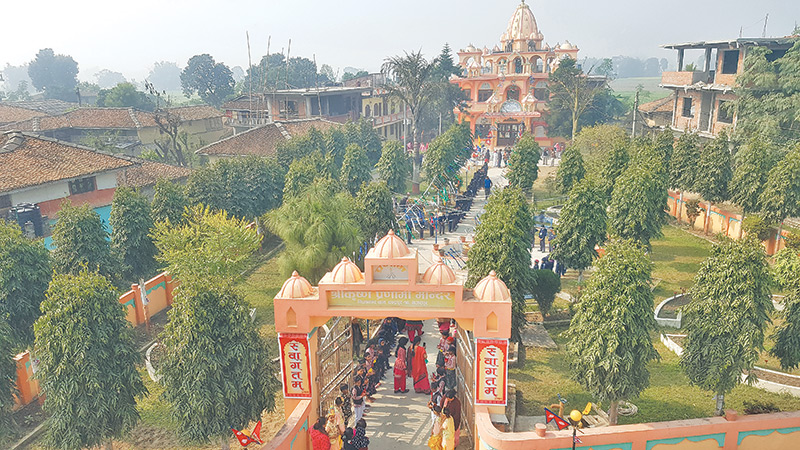
Jugepani is where Nepal’s flatlands hug the hills, giving it a unique geographical layout. To the north of the village are hills covered with sal trees. Where the hills end, the land flattens. Here, the majority of houses have been built with remittance money.
“Almost every family has at least one member working abroad,” said 41-year-old local Devi Maya Pandey.
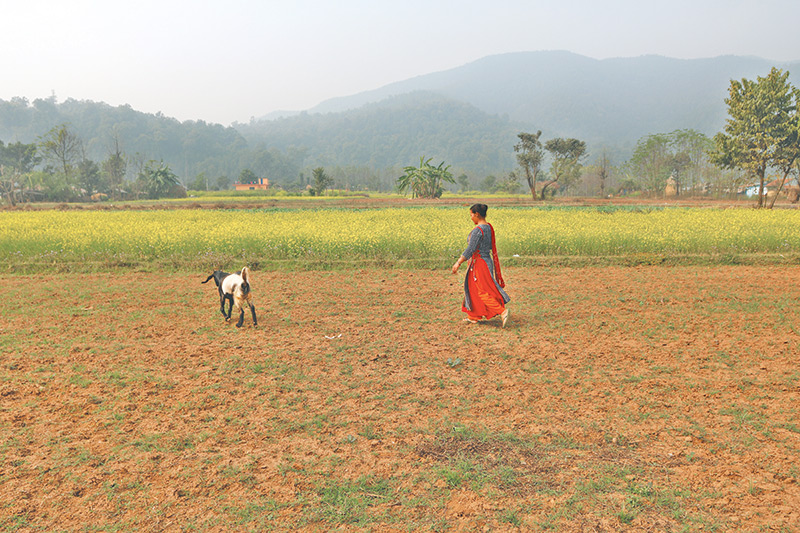
For those living in the village, the fertile lands are one of the primary means to make a living from. At this time of the year, most of the village’s fields are blanketed with bright yellow mustard flowers. The majority of those tending the fields are women and elderly men.
But in the fields that the Pandey household owns, both Devi and her 47-year-old husband Lila Nath Pandey are working. In one section of the family’s fields, there are potatoes and a few metres away are cucumbers. Under the bamboo frames built to support the cucumber creepers, the family has planted black-eyed beans. While Devi digs potatoes from the ground, Lila carefully inspects the creepers.
This time two years ago, Lila was working for an advertising merchandise retail company in Dubai. He returned to Nepal in 2018 and hasn’t left the country since.
The first time Lila left for foreign employment was in 1999. He and Devi got married the same year, and just 21 days after the wedding, he left for Bahrain.
“I had no option. I was making just Rs1,000 a month from my teaching job, and our family’s financial condition was weak,” said Lila.
The job in Bahrain came with a monthly salary of Rs14,000. Before flying to Bahrain, Lila had already incurred a loan of Rs30,000 to pay for his passport and air tickets.
While Lila was away in Bahrain, Devi started working as a teacher to supplement her husband’s income. “I didn’t want our family to be reliant on only one source of income,” said Devi. But after she gave birth to her second daughter, juggling taking care of her daughters, household work, and a full-time job proved too challenging. She had to quit her job.
“Even though Lila always made sure I had pocket money, I didn’t like that I was now completely reliant on his salary,” said Devi. “So I decided to start a small-scale commercial vegetable farm with the money Lila sent back.”
Devi’s small farm became successful, so much that she was able to purchase more land, expand the farm, and add livestock.
In 2018, when Lila returned from Dubai, Devi asked him to stay back. She had proven that the family could earn enough money from farming and livestock rearing.
“He has paid a huge price to provide for the family. Since he could only visit Nepal for two months every two years, he wasn’t there when I gave birth to all three of our children. My daughters, aged 17 and 12, grew up without a father figure. Every time he came home, they hesitated to open up to him. My heart used to break. So when he came home in 2018, I knew I should convince him to stay back,” said Devi.

The couple now works together in the family’s fields. This year, the family made a profit of Rs300,000 from growing and selling cucumbers. Devi said that the family can comfortably make Rs500,000 to 700,000 a year from farming alone.
Remittance has been crucial in alleviating poverty in the country. According to the Multidimensional Poverty Index, published by the Nepal Planning Commission in 2018, the country reduced the percentage of people termed multidimensionally poor by 50 percent between 2006 to 2014, largely due to remittance, says Gurung. The corresponding increase in people’s purchasing power also played an important role in strengthening the country’s economy.
As much remittance helps to lift people out of poverty, it just as often ends up trapping people in a cycle of migration.
“When families end up spending all their remittance money on consumption, it leaves them in a very precarious position,” said Gurung. “In such a situation, the migrant worker gets trapped in a cycle of stint-after-stint of employment abroad. It also leaves the families in a very vulnerable position. It is therefore extremely important that families save money to invest in the productive sector.”
The loans that most migrants take to fly abroad end up accumulating interest at high rates, forcing migrants to go abroad repeatedly in order to pay off the loans. This happens because interest rates are high, and also because remittance money is not nearly enough to pay back loans while also providing for daily consumption needs. According to Nepal Living Standards Survey 2011, 79 percent of remittance money that enters the country goes into consumption while 7 percent into repayment of loans.
But by investing remittance money in small-scale businesses, women like Devi are turning things around for them.
In Jugepani, Devi’s husband isn’t the only one who hasn’t had to migrate again. Around a kilometre from Devi’s house lives Chinmaya Kanung. For years, Kanung depended on her husband’s remittance money.
“The money that my husband sent from Malaysia was what helped us cover the family’s expenses. I was just a subsistence farmer, but as the cost of living got higher and higher, I felt that it was important that I start working and earn money too,” said Kanung.
After attending the same financial literacy class with Phumisara Thapa, Kanung started a tailoring training centre with just one sewing machine, which she bought by selling a pig she had reared. Two years later, the centre now has five sewing machines, and Kanung has seven students learning tailoring from her.
“Business has been good, and I have invested some of my savings into pigs,” said Kanung, who said that she makes around Rs35,000 from the tailoring centre and Rs100,000 annually from rearing pigs.
Five months ago, Kanung’s husband returned from Malaysia. He has no plans of returning soon. “My husband has taken over the responsibility of the livestock and the fields, while I focus on the tailoring centre,” said Kanung. The family recently finished building a spacious goat shed and now plans to increase the number of goats and pigs they rear.

***
Roughly 5 kms from Jugepani, in Srijanshil Tole of Kawasoti-3, the village’s women have taken it upon themselves to support each other in becoming more financially secure. Last march, 22 women aged 25 to 50 pooled together Rs15,000 each from the remittance they had received to start the Srijanshil Mahila Organic Krishak Samuha, an all-women organic agro-business.
The group now grows vegetables on five bighas of land it has leased. They have two spacious greenhouses to grow vegetables and a sizable pond, which is used to irrigate the farm.
Ganga Chuhan, leader of the group, admits that she wasn’t always an enterprising person. “I used to fit the stereotypical migrant worker’s wife who does nothing much except spend her husband’s money,” she said. “Every time my husband sent money, I would buy myself and my children new clothes, expensive things to eat, and as a result, I saved very little money.”
But again, a financial literacy class led her to realise the importance of saving money and being financially independent, she said. After attending the class, Chuhan started focusing on rearing buffaloes, goats and chicken, using the money that her husband was sending home.
“Now I make Rs20,000 a month by selling buffalo milk, and Rs80,000 to 90,000 a year by selling goats,” said Chuhan, who has also started
commercial vegetable farming. In two years time, Chuhan says her husband will be returning to the village for good. By that time, the Srijanshil Mahila Organic Krishak Samuha will be fully operational. She will focus on the women’s group while he focuses on the family’s farm and livestock.
Reinvesting remittance money into productive sectors not only has been providing supplemental income to migrant families but has also been helping buttress their financial strength over the long term.
But economists say that investing remittance money in the productive sector is easier said than done.
“The government needs to first identify the different categories of migrant workers sending remittance to Nepal. For example, those who work in countries like Singapore, Hong Kong and Brunei get paid better and hence send more money compared to those in the Gulf countries and Malaysia,” said economist Raghubir Bista. “The government will then have to make specific interventions tailored to specific categories of migrant workers.”
Gurung said that migrant workers in the Gulf countries and Malaysia start investing their money into productive sectors after almost 10 years of working abroad.
“That’s how long it usually takes to achieve some level of financial security for the majority of migrant workers,” said Gurung. Those who do invest, do so in very traditional sectors—farming, livestock rearing, and tailoring.
Experts say the government has a huge role to play to ensure remittance money is invested in productive sectors. According to Rajan Prasad Shrestha, executive director of Foreign Employment Board under the Ministry of Labour, Employment and Social Security, the government has identified 39 districts with high outward flow of labour migrants and has been providing them with different training programmes.
“These programmes are targeted at families of migrant workers to encourage them to invest in productive sectors,” said Shrestha. “In more than 30 districts, we provide counselling on how to follow proper legal processes while applying for jobs abroad and the kind of government protection they are eligible for.”
In 2019, the board also started providing free training in 19 different skills. This training programme prioritises returnee migrant workers, families of migrant workers, women, and those from socially and economically disadvantaged groups, said Shrestha.
“We also have another programme under which returnee migrant workers can receive a Rs1 million loan to start businesses, provided their business proposal is convincing,” said Shrestha.
Back in Jugepani, as Phumisara Thapa helps her parents till the fields near their house, she says that being financially independent has completely changed her life.
“I spent so many years of my married life limited within the four walls of my house, but after I started my small businesses, I began to find myself becoming more open and confident,” said Thapa. “Earlier, I had to ask for money from my husband for the smallest of things, but now, people come to me to ask for loans.”
Text & photos: Tsering Ngodup Lama