You internet speed is slow. Switch to text view mode

Switch
epaper logo
ST

Last Login:
Logout
+
Page 1
HOME PAGE

More women are in politics, but those at decision level are few and far between
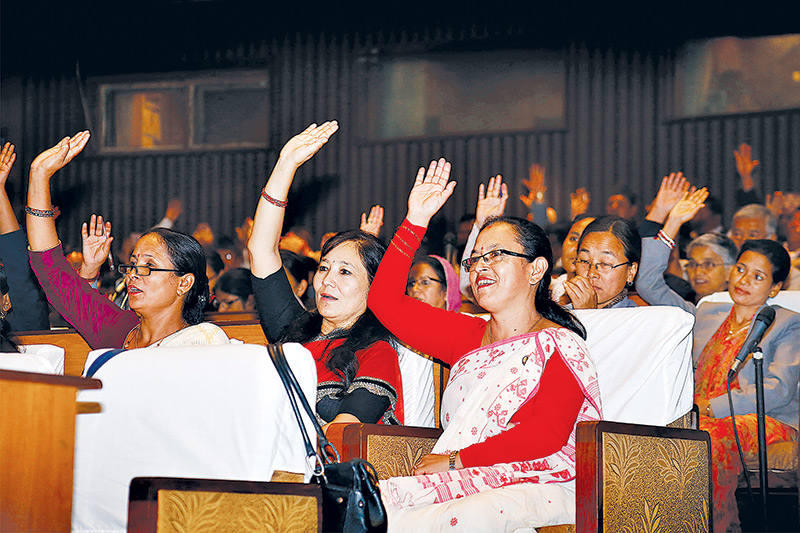
Despite inclusion refrain, there is an underrepresentation of females in Nepali political parties and state organs.
- ELISHA SHRESTHA
The Constituent Assembly was historic in ensuring women’s representation. POST FILE PHOTO

KATHMANDU,
Late last year, Prime Minister KP Sharma Oli reshuffled his Cabinet, removing six ministers and three state ministers while inducting new faces to replace them. The number of women ministers in the old Cabinet was already low. But after the reshuffle, the share of women is  less than 10 percent, just two out of 22 ministers were women.
“The appointments, the reshuffle has not been on a merit basis. As much as I agree to merit in every aspect, the co-chairs’ cannot fool its citizens saying ‘we cannot find qualified women parliamentarians to be ministers’, sorry [SIC],” wrote one user on social media, pointing out the lopsided gender ratio.
What was worse, as many pointed out, was that Tham Maya Thapa was removed from the Ministry of Women, Children and Senior Citizens to make way for Parbat Gurung, a man. Only Bina Magar, who is minister for water supply, and Padma Kumari Aryal, the minister for land management and cooperatives, are currently in the Oli Cabinet.
To the rest of the world, Nepal may seem like a beacon for women’s political representation. The country has had more women in the legislature, thanks to a provision that sets aside 33 percent seats for women in all state mechanisms—from federal to local.
In 2015, Nepal elected Bidya Devi Bhandari as its first woman president. In 2016, three of Nepal’s top state positions—president, chief justice and Speaker of the House—were held by women.
But the presence of women at the top, even in a position as symbolic as that of the President, has not translated into similar successes for female leaders in other state organs.
Despite an increased participation of women in politics over the past two decades or so, their progress in leadership positions continues to be hindered, primarily by male leaders who are unwilling to make way—or even choose—qualified women. As a result, female politicians have often been sidelined by their male counterparts from leadership and decision-making roles, a pattern that reflects just how patriarchal Nepal still is.
In 2006, as soon as Parliament was restored following the second people’s movement, deputy speaker Chitralekha Yadav was not promoted to the post of Speaker. Instead, Subas Nembang was given the post. According to Binda Pandey, a lawmaker from the Nepal Communist Party (NCP), the Nepali Congress supported Nembang’s nomination even though he was from a rival party instead of Yadav, who was a Congress member.
Again, during the 2013 Constituent Assembly election, Suprabha Ghimire of the Nepali Congress was asked to give up her candidacy from Kathmandu Constituency-4 to make way for Gagan Thapa.
“The fact that Nepali society is still reluctant to accept women as leaders is clearly reflected in Nepal’s political scenario,” said Asta Laxmi Shakya, a standing committee member of the ruling Nepal Communist Party.
Shakya herself was passed over for chief minister of Bagmati Province in favour of Dormani Poudel despite the fact that she was a senior politician.
Many women politicians believe that the parties have embraced women’s representation not because they are convinced that it is the right thing to do but because they are forced to do so by the constitutional provisions. Their rhetoric of equality and inclusion does not necessarily translate into actions, they say.
Local elections held in May, June and September in 2017 provide a good glimpse into how women were largely underrepresented. The elections were held to elect 35,041 local representatives across 753 local federal units including six metropolitan cities, 11 sub-metropolitan cities, 276 municipalities and 460 rural municipalities.
Women were mostly elected for deputy positions—91 percent of them— with just 2 percent of women getting mayoral or chair positions in 753 local units.
According to Manushi Yami Bhattarai, a central committee member of the Samajbadi Party Nepal, the majority of women are deemed fit only for secondary roles, such as for deputy positions, and that too, simply to satisfy the inclusion provision. “Thus, women’s representation is largely tokenistic,” said Bhattarai.
Even within political parties’ internal committees, women representation is low.
Article 15 (4) of the Political Parties Registration Act clearly states that women must represent at least one third of the membership in all party committees.
Even the ruling party—the Nepal Communist Party—has failed to abide by the legal inclusion provision, as it has only 75 women in its 441-member central committee. The party Secretariat, the highest decision-making body, does not have a single woman member while the 45-member Standing Committee has just two women. The Election Commission agreed to register the Nepal Communist Party only after an assurance that it will abide by the provision of 33 percent women representation through general convention. During its merger in May 2018, the party had said it would hold its convention within two years.
The underrepresentation of women is not only limited to the ruling party though.
According to Chanda Chaudhary, a lawmaker from the Rastriya Janata Party Nepal, there is 33 percent women’s representation in Parliament because of the legal provisions.

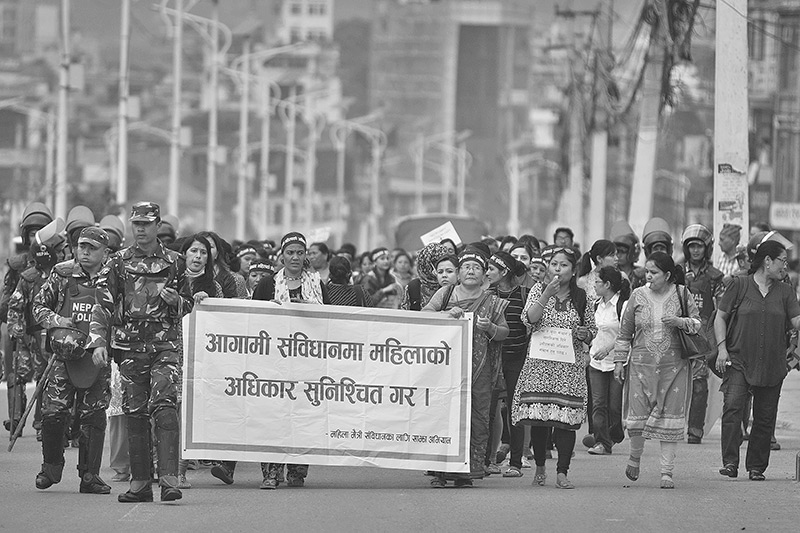
Women’s representation in leadership positions continues to be dismal. Post file Photo


The Nepali Congress has only 18 women in its 85-member Central Committee, according to Pushpa Bhusal, a Nepali Congress leader.
The Rastriya Janata Party Nepal, formed after the merger of six parties, has only around 70 women in its over 800-member Central Committee, said Chaudhary.
“We will know the exact number of members in our Central Committee after the party’s general convention. But it does not look like the party will be able to meet the 33 percent women representation criteria,” said Chaudhry.
Bhattarai from the Samajbadi Party said in the 425-member Central Committee of her party, there are only 52 women.
Prakash Adhikari, a leader from the Samajbadi Party, said the reason for underrepresentation of women in politics is simply because of the lack of qualified women for the leadership positions.
“The party has always nominated candidates on merit basis. To be a member of the Central Committee, one has to have years of political experience and academic qualification, which a majority of women politicians lack,” said Adhikari.
But female politicians say when it comes to men, both the qualifications cited by Adhikari—experience and academic degrees—are simply ignored.
They also describe the argument regarding a lack of qualified female leaders as an excuse. The trend of viewing women in the form of tokenism will be changed once qualified and deserving women themselves speak up against the discrimination they face, they say.
This was felt early this year, when Shiva Maya Tumbahangphe became the only female person in Nepali politics to publicly lay claim to the post of Speaker.
Although Tumbahangphe was forced to resign as Deputy Speaker to make way for Agni Sapkota for the position of Speaker, she was firm on her argument that she was as qualified as her male counterparts to lead the House. After her resignation, she even went on to say that patriarchy was more entrenched in the Nepali society than monarchy.
Pandey from the Nepal Communist Party, who had thrown her weight behind Tumbahangphe, said that when qualified and deserving female politicians like Tumbahangphe voice her opinion to be treated as per the qualification, it is an answer to the people who say “women aren’t qualified enough for top positions”.
“The politicians in power often favour their kin and factions, while they ignore the deserving candidates,” said Pandey. “Even when it comes to their factions, they choose weak leaders, who don’t oppose them.”
While Pandey acknowledges that it may take time for female politicians to have equal status as their male counterparts, she says that women leaders also must keep raising their voices.
“Politicians like Tumbahangphe aren’t saying ‘I deserve this because I am a woman’. They are simply confident enough to demand to be treated equally since they know that they are capable and competent,” said Pandey. “When qualified women like Tumbahangphe start being vocal about their rights, parties will start to take women’s political participation seriously.”
Both Chaudhary and Bhattarai say that ensuring 33 percent women should not be limited to Parliament. This should be ensured in every state mechanism and it must be the main agenda, as the government has still failed to do so, they say. “We are advocating 33 percent women’s representation in the Central Committee of my party,” said Chaudhary. “Hopefully, the party members will acknowledge gender inclusivity at the upcoming general convention.”

HOME PAGE

With wider visibility and legal sanctions, parents of queer people are coming around

Accepting that their child is LGBTIQ can be difficult for parents who grew up in a more conservative time, but things are slowly changing.
- MONICA KHANAL

KATHMANDU,
Samir Khanal always knew something was different about him. Ever since he was young, he was picked on for the way he walked, talked and dressed. But it wasn’t just his friends; even his parents would constantly call him out for what they saw as atypical behaviour. At 20 years of age, when he visited the Blue Diamond Society for the first time, he found a word to describe himself—gay.
“I felt jailed in my own house,” said 23-year-old Khanal. “My sexuality felt like a disease. Every day, I wished it to disappear, but it never did.”
When Khanal came out to his parents, at 21 years of age, he endured mental and emotional torture as his family refused to accept his sexual orientation.
Bhawana Khanal, Samir’s mother, admitted that she was initially confused and concerned when her son came out to her.
“I gave birth to a boy, but when he revealed his sexual orientation, I thought he had turned into a girl as he said he liked men,” Bhawana told the Post.
“I kept wondering if it was because I had dressed him in his sister’s hand-me-down skirts when he was little.”
Bhawana had never encountered a member of the LGBTIQ+ community before and she didn’t know any gay men. For months, she attempted to come to terms with her son’s sexual identity. Things started to change when she began looking up interviews with members of the LGBTIQ+ community, and met some of Khanal’s friends. Slowly, she began to empathise with him.
“As a mother, I realised how hiding his identity from us must have suffocated him,” she said.
“Seeing him happy now, I want him to disregard society’s judgments. As long as he is doing well and is independent, he does not deserve to be looked down upon simply for his sexuality.”
The Khanal family’s experience is similar to that of many other members of the LGBTIQ+ community. Despite wider visibility and a society that is slowly opening up, many young people still face difficulties coming out to their parents. And many Nepali parents, who grew up in a time when Nepali society was much more conservative, have difficulty accepting their children’s sexual identities, as it is not something they are familiar with.
According to a baseline survey conducted by Mitini Nepal, an organisation that works for the queer community, out of 200 lesbian, bisexual and transgender individuals aged between 15 and 50 years, only 20 percent had shared their gender identity or sexual orientation with their family.
For many parents, despite what they might personally think or how they feel, it is often a fear of wider society that drives their reluctance to accept their children as they are. While some individuals might be accepting of the LGBTIQ community, society at large remains closed-minded and conservative.
Nineteen-year-old Sazda, who learned she was bisexual when she was 18, has so far only come out to her immediate family members and close friends. Having a mother who she shared everything with, she did not hesitate to reveal her sexual orientation with her.
“I didn’t have much to react to because I already had my doubts and was waiting for her to come out herself,” said Sazda’s mother. “Like they say, a mother always knows.”

 Only 20 percent of 200 lesbian, bisexual and transgender individuals have shared their gender identity or sexual orientation with their family, according to a recent survey. Post file Photo


She knew about the LGBTIQ+ community through the media, had met Sazda’s friends who belonged to the community. So she understood what Sazda meant when she said she was bisexual, but as she’s not too certain about the reactions of her relatives and wider social circle, they have yet to tell everyone.  
“My brothers and sisters will take time to understand so I stay patient with them,” said Sazda’s mother. “Sometimes I wonder how many people of my generation belonged to the queer community but suppressed themselves due to the fear of society or not having the vocabulary to define their own identities.”
This is not to say that all men and women from an older generation do not understand the queer community. There are quite a few examples of parents who’ve accepted their children wholeheartedly for who they are, though they might be in the minority.
Anmol Rai and her mother Moon Dume are one such pair who’ve never really had problems with accepting Rai’s identity as a transwoman. According to Dume, Rai had always expressed many stereotypical feminine characteristics, so when she came out to Dume, she accepted Rai without any questions.
The only concerns that Dume has are with the growing violence and abuse targeted at the community, and that Rai must undergo gender reassignment surgery.
“No parent would want a needle to prick their child, let alone undergo a surgery,” said Dume. “I know that it is not only the physical pain that awaits her. The life she is born into is full of hurdles. But her family’s support will always be constant.”
While Nepal stands as a safe haven for gender minorities with relatively progressive laws, visibility and activism, not everyone from the queer community finds a comforting ear in their families. Many still struggle to come out of the closet because they fear abandonment, family pressure and social expectations. Many LGBTIQ+ individuals that the Post spoke to said that their conservative families had led to uncertainty over whether they should come out or not. Numerous individuals who haven’t come out reported stress, anxiety and fear over the reactions of their parents. This was especially pronounced in those who still rely on their parents for financial support. A number of individuals said that they would tell their parents when they are financially independent.
“I have no choice but to come out to my parents only once I am mentally and financially stable, so that even if they choose to abandon me, I can survive,” said Binay, 20, who identifies as gay.
Binay himself was in denial for four years before he accepted his sexual orientation. He has since come out to a close circle of friends but he doesn’t know when he will tell his parents.
“They’re open minded but conversative in many ways. I have heard them pass homophobic remarks in the past and I’ve seen them change the channel when there is any news regarding LGBTIQ+ issues, and that scares me,” said Binay.
In many cases, it is often something external that drives parents to become more accepting. For instance, in Khanal’s case, it was also the fact that he became financially independent and started bearing the family’s expenses that led to his parents’ approval, he said.
“Coming from a low-income family, they all relied on me for their expenses and they had no option but to accept me for who I was,” said Khanal, who works as a freelancer doing multiple jobs.
Bhawana too admitted that her financial dependence on Khanal was a major reason behind the family’s acceptance, but whatever the reason, she has come to accept her son for his identity, acknowledging that her refusal would only add to his trauma.
Sadza’s mother agrees. Parents need to adapt to new realities, especially if it means that their children will have a better life free of mental trauma and stress.
“I am happy she decided to come out because now, it has become our fight, not just her’s,” she said. “Just because we did not see it in our times does not mean it did not exist. If your children are confessing in front of you, you must give it a thought.”

HOME PAGE

Women journos bring diverse perspectives, but their presence in newsrooms is sparse

It’s time for the Nepali media to reflect on gender inequality in newsrooms and act to reverse the imbalance, women journalists say.
- SRIZU BAJRACHARYA
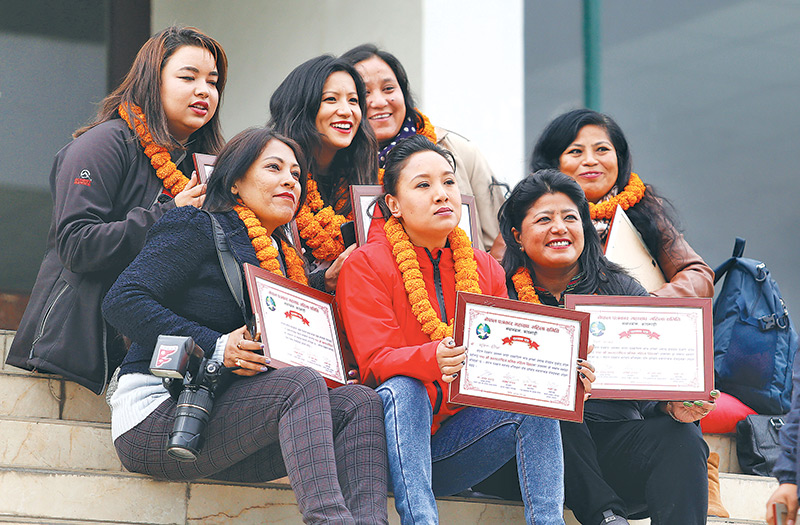
Women photojournalists and video journalists at a felicitation programme in Kathmandu. Photo courtesy: Naresh Shrestha

Kathmandu,
In October 2019, when a woman accused Krishna Bahadur Mahara of attempted rape, the news spread like wildfire. Mahara had to step down as the House Speaker. In the following weeks, there were interviews with the accuser on various online portals, where she appeared to be making conflicting statements. Many were quick to question her initial testimony. Then, Binu Subedi of Kantipur, the Post’s sister paper, interviewed her for her side of the story.
“The story mattered because no one was telling her story; everyone focused more on Mahara, questioning her character and mental status,” Subedi told the Post. Mahara was acquitted last month, but Subedi’s reporting was widely shared and talked about because it reflected on what could have changed the accuser’s statement, putting forth a voice that called  for a proper investigation.
“It’s important for women to be part of the newsroom because news articles frame people’s mind, and sometimes when we don’t present different perspectives of the events, the truth never gets a chance,” said Subedi. “Women in the newsroom bring different perspectives and make people aware of different sensitivities that they may not otherwise realise.”
This is especially important in a country like Nepal, where the presence of women in the mainstream media remains dismal. While newsrooms are dominated by men, there are also very few women in leadership.
“What you miss by not having  enough women represented in the media, and in parallel, not having enough minority and marginalised groups reflected in the media is that their stories, which are equally important stories, get missed out,” said Subina Shrestha, a journalist and filmmaker.
Shrestha says the imbalance of women’s representation in the media is a reflection of the country’s government, where women are highly underrepresented.
According to a 2017 study by the Federation of Nepali Journalists, the umbrella organisation of journalists in Nepal, of the 13,050 working journalists in the country, only 2,354 are women.
At the Post, although more women have been hired over the past two years, male reporters still dominate daily and most feature bylines. According to a survey by Freedom Forum, ‘Women in Newsroom’, between October and December 2018, the Post had more men bylines than those of women on the front page.
Newsrooms, which shine a light on the lack of representation of women in politics, Parliament and other state organs, have largely failed to pay heed to their own staff demographics.
According to Pranika Koyu, a rights activist and poet, like in any other sector in Nepal, patriarchy prevails in the newsroom as well.
“When there are too many men in leading positions, they are bound to feel entitled, as patriarchy itself is very pervasive,” said Koyu. “But by having women in the same space, it allows more inclusive and progressive coverage of stories.”
When men are dominant in the newsroom, it tends to reflect not just in the kind of stories they write or the angles they pursue but also in the sources being quoted.
“Perhaps, the lack of #metoo coverage also says a lot about women in newsrooms,” Koyu told the Post. “Women in newsrooms can certainly also shape stories like #metoo in non-sensational well framed reportage.”
For women journalists, more inclusive newsrooms enable stories to be told in better, unconsidered ways.
“We need to tell our own stories to make people understand what we go through,” said Uma Bista, deputy photo editor at the Annapurna Post, a vernacular daily. “Of course, men too can tell our stories, but when a woman is telling the story, it’s more powerful because we can relate with women’s issues in ways men are unable to.”
Bista recently did a photo story, ‘Our Songs from the Forest’, to put a spotlight on young women fighting Chhaupadi, an outlawed practice that forces women to live in sheds while they are menstruating.
Until recently, very few women had reported on instances of Chhaupadi, which despite being criminalised in 2017, continues to be practised.
In 2019, Menuka Dhungana, Kantipur’s Achham correspondent, wrote a front page story, ‘Ma euti [I am a] Chhaupadi reporter’.
The article immediately attracted attention. The story, written in a first person narrative, took readers deep into the system, explaining how Dhungana had earned the sobriquet of ‘Chhaupadi reporter’ and how she herself had been a victim of the age-old practice.
Women journalists say that it would not have been possible for a male journalist to tell the story the way Dhungana did.
“A woman’s phenomenological experience allows for a more empathetic narration,” said Koyu.
Women journalists though say things have changed in the recent past, more needs to be done to make Nepali newsrooms more inclusive.
There are women reporters and editors in newsrooms today, but they are still in the minority, according to Shrestha, who feels documentation of women stories is still sparse.And even when women are present in the newsroom, they are limited to covering ‘women’s issues’ and are rarely given the opportunity to move into other beats that are seen to be more serious, said Babita Basnet, editor of Ghatana Ra Bichar, a weekly political newspaper.
“Women in the newsrooms are rarely mentored to become leaders. They are rather put into soft beats like food and entertainment.”
Subedi is a rare exception, as she covers politics, which has long been considered the sole province of men. And Basnet too is an exception, as she might be the sole female editor of a newspaper.
“Just having a woman in the decision-making position changes the dynamics of the newsroom as well as the stories that come out,” said Koyu, the activist and poet. “They don’t necessarily need to write these stories, but women in the room can tell co-workers how the story should be treated and told.”
In Nepali newsrooms, many say, it’s not only about the number of women, but also diversity when it comes to the women themselves.
Shrestha said when she reached out to the Federation of Nepali Journalists as part of her research on representation of Dalit women journalists, she was appalled.
“The number turned out to be less than one percent,” she told the Post. “And that number reflects in the news reports on rape incidents.”
According to a report by FEDO Nepal, or Feminist Dalit Organisation, that works for Dalit women’s rights, 21 percent of girls raped are Dalits.
“Now, think about these numbers and why a more detailed investigation was not done,” said Shrestha. “Do these numbers really affect the majority of the men in newsrooms?”
According to Basnet, as the world marks International Women’s Day on Sunday with the theme ‘I am Generation Equality: Realizing Women’s Rights’, it’s time to introspect the gender inequality in newsrooms.
“It’s important to understand why we need more women in media and more women stories,” said Basnet. “We need more stories to inspire more participation of women in all sorts of works, to be enabled together and to share our knowledge with each other.”

Page 2
MEDLEY

Horoscope

ARIES (March 21-April 19)
*****
A short and sweet conversation early in the day could plant the seeds for some interesting ideas in your head. These should blossom over the course of the day. Your mind is in an especially curious phase right now, and you’ll love digging into these new options or schemes. Let creativity flow through your body.


TAURUS (April 20-May 20)
***
Someone who holds some power over you might have a vested interest in discouraging you from moving forward with your goals, but they can’t stop you, and that’s what is important. You can’t worry about how others feel. Just worry about yourself. If you act too cautiously right now, you’ll be forced to go too slowly.
Capricorn


GEMINI (May 21-June 21)
***
If you’ve been playing a flirtatious game with a certain sassy someone, be aware that it might come to a screeching halt today. You could find out that they aren’t exactly as available as you thought they were! It’s not worth your energy to chase after something you’ll never have. Turn your flirty energy toward somebody else.


CANCER (June 22-July 22)
***
If you’re going to be at a party or social get-together tonight, don’t spend all your time trying to score points with that certain cutie or influential person. If you do, you’ll be missing the entire point of the event! Parties are supposed to be places where you can relax and have fun. Have no ulterior motives.


LEO (July 23-August 22)
***
One of your friends is being indecisive right now, and it could be delaying some exciting social plans. Light a fire under them, and let them know that everyone is waiting for them to make up their mind and commit to a date, location, or some other important detail. It’s up to you to wrangle your group together as usual.


VIRGO (August 23-September 22)
****
You can change the minds of some influential people today. All you have to do is get a little bit of face time with each of them. Use your warm charm and some cold logic to enlighten these people. They don’t know all the facts of the situation, and it’s up to you to educate them. You know you got this!


LIBRA (September 23-October 22)
***
Wanting to try new things is admirable, but you should just talk about new things today. The same old topics of conversation aren’t cutting it, so it’s time for you and your conversational skills to move into newer, greener pastures. There’s someone in your life who always has something interesting to say. Reach out to them.


SCORPIO (October 23-November 21)
***
This isn’t a day to gloss over unusual minor details. If something raises a red flag, no matter how small it may be, you need to pay attention to it. Is your car making a funny sound? Don’t just turn the radio up louder. Look into it! Is a friend acting out of character? Ask them what’s wrong. Be helpful today.


SAGITTARIUS (November 22-December 21)
***
Sure, you know that you’re totally right about how to fix a problem that’s making everyone else freak out, but your ideas are going to fall on deaf ears right now. It’s not that people don’t want to solve things, it’s just that they’re a little too wrapped up in their own egos to open their minds to what you have to say.


CAPRICORN (December 22-January 19)
***
Today, an average exchange of ideas could generate a sublime experience in your life, so be open to talking to anyone at any time. During an everyday e-mail, text, or voicemail, you should try to get a little bit more creative. Add a dash or two of your special wit and you’ll inspire other people to do the same.


AQUARIUS (January 20-February 18)
*****
Today, you could be syncing up with a lot of different types of people, and they could stimulate your creativity. This means it’s a great time for you to start building a foundation for something unique and new in your life. Now is the time to take your craziest germ of an idea and bring it out into the world.


PISCES (February 19-March 20)
****
The greatest thing about the energy you feel today is that it can give you all the focus you need to take the most complicated ideas and make them simple enough for anyone to understand. That makes today a wonderful day for teaching people things or showing someone how to do something.

Page 3
NATIONAL

Revenue investigation department issues public notice to 130 firms, individuals over dubious transactions

Most of the firms were allegedly involved in the buying and selling of fake value added tax bills.
- PRITHVI MAN SHRESTHA

KATHMANDU,
The Department of Revenue Investigation has issued a notice to 130 firms and their proprietors to report to the department as it plans to file cases against them for their alleged involvement in suspicious transactions, including the buying and selling of fake bills.
The notice, published in the Gorkhapatra daily on Thursday, states that the firms have been asked to appear before the department within seven days as they didn’t respond to several notices served to them.
 “The firms must have sold fake VAT bills worth billions of rupees,” said a department official on the condition of anonymity as he is not authorised to talk to the media.  
 Officials have also raised the flag over suspects who have been operating several bank accounts in the name of different firms. “The fake VAT bill racketeers registered firms in the name of innocent villagers. They then run bank accounts of the firms by posing as employees,” the official said. “Some of the racketeers have registered firms in the name of the children of their tenants.”
For example, NBK International is a firm registered in the name of Surendra Sahani from Budiyat, Bara. But, the bank account of the firm is being operated by Saroj Kumar Misra from Godata, Sarlahi.
Likewise, Subodh Sah from Dumariya, Sarlahi has been operating the bank accounts of 10 firms registered in the name of different persons.
According to section 11 (A4) of the amended Revenue Leakage (Investigation and Control) Act, if anybody accused of revenue evasion could not be served legal notice, a public notice should be issued through radio, television or national newspapers.
Department officials said that while some of the fake VAT bill sellers have not submitted tax details to the authority, others have paid meagre amount in taxes to show they are complying with the rules.
“After the notice was issued, two persons have so far approached the department,” said Dirgha Raj Mainali, director general at the department. He however said that the cases are related to different types of revenue dodging without specifying them.
Mainali said that as the investigation was undergoing, the amount involved in the offenses could not not be confirmed.  
In March last year, the department had filed cases at the Kathmandu District Court against 24 individuals for evading Rs1.75 billion in taxes through fake VAT bills.
Later in June, cases were filed against 15 individuals charged with evading Rs 2.98 billion in taxes by producing and selling fake Value Added Tax bills.
Later, more cases were filed against the fake VAT bill sellers and purchasers. One of the most recognised names on the spotlight is Varun Beverages, the bottler of Pepsi in Nepal which also faced charges for procuring fake bills and using them in the market.  
In 2010-11, tax authorities decided to collect Rs6.69 billion from 518 firms for their involvement in fake VAT bill scandals. The incident had made national headlines due to the involvement of noted industrialists and businessmen.

NATIONAL

Poor coordination between officials confuses students

Ministry of Education tells municipalities to stick with its decision to close schools only after annual exams are over.
- BINOD GHIMIRE

KATHMANDU,
To close schools over the coronavirus scare or not? Lack of coordination between officials at different levels of government has led to confusions among students and their guardians.
Some municipalities, including the Dhangadhi Sub-Metropolitan City on Friday morning, decided to shut schools in the area under their jurisdiction, until the threat of disease subsides.  
However, within a few hours after the decision, the Ministry of Federal Affairs issued a circular to all local governments asking them not to shut schools. The ministry asked the municipalities to implement the federal government’s decision to close schools only after March 18, the day the annual exams are to conclude.
“We revoked our decision today (Saturday) following the circular,” Nirp Bahadur Odd, mayor of Dhangadhi Sub-Metropolis, told the Post. “Though we had the authority to decide on our own, we have decided to cooperate with the centre.”
Around seven million students in 36,000 schools across the country await their final annual exams. Around half-a-million are to take the Secondary Education Exam (SEE).
Odd said though the city’s decision to shut schools was right, it had to be revoked as the provincial government and other municipalities in the province didn’t stand with Dhangadhi on the decision.
Parents of schoolchildren say decisions taken by different governments without coordination has increased confusion among students. “Contradictory decisions passed by centre and local governments have led to confusion among students,” Yadav Sharma, chairperson of Nepal Guardian’s Association, told the Post.
On Thursday, the government rejected requests by school administrators and guardians to shut schools across the country in the face of the Covid-19 threat. They had suggested that the annual exams be postponed for a month.
The federal government has already decided to close schools after students complete their annual examinations. Authorities are preparing to conduct the Secondary Education Examinations from March 11.
Federal officials, meanwhile, say there was no need to shut schools immediately. “The local governments should observe if there are immediate threats to the schools,” said Tulashi Prasad Thapaliya, director general at the Centre for Education and Human Resource Development. He said it would be better if all officials at all three tiers of government adopt similar positions on the issue.
Talking to the Post on Thursday, Minister for Education, Science and Technology Giriraj Mani Pokharel said the government wants the examinations completed before the annual holidays so that the new academic year begins on time. The new academic year begins on the second day of the Nepali New Year (mid-April).

NATIONAL

Police arrest teacher who ‘forced students to cut their hands’

The teacher allegedly made 34 students cut their hands using pencil sharpener blades as punishment, said officials.
- SHUVAM DHUNGANA

KATHMANDU,
Metropolitan Police Sector, Jadibutti, on Saturday, arrested a teacher of Jagriti Academy School for her alleged involvement in forcing 34 students to cut their hands using the sharpener blades.
After the Naya Patrika on Saturday published a report about the harsh punishment by the school teacher, the local police swung into action.
The story was widely shared on social media. People were outraged when they heard about the punishment.
“Schools should be places to get knowledge. It is not a place where students have to face violence. This shows how private schools have failed in hiring  trained teachers. This is frustrating...schools hire less trained teachers and pay less,” wrote a Twitter user.
Another user wrote, “This kind of action should be strictly punished by the local authorities and strict action should be taken against the teacher.”
Sita Laxmi Karmacharya, a social science teacher who has been teaching for more than a decade in the school, was arrested following a formal complaint against her to the police by the school management.
According to the Metropolitan Police Sector, Jadibuti, as soon as they heard about the incident, they went to school to collect the details and instructed the school to file a written complaint against the errant teacher.
“Although the school authorities said they have taken action by firing the teacher, we told them to file an official complaint,” said Inspector Subhadra Waiba Lama, in-charge of the Police Sector.
‘Today, we contacted all 34 students’ parents and a medical checkup was conducted,” she said.
“After getting the complaint, we took her into custody and she is with us now,” said Lama. “We are not allowed to pursue the case so we will send her to the Metropolitan Police Circle, Baneshwor. However, we are not sure if the case will proceed as the cuts [the students have incurred] are not that deep.”
The school authorities said they had fired Karmacharya last Friday.

NATIONAL

Prices of essential medicines likely to be increased

- Arjun Poudel

KATHMANDU,
With India curbing the supply of raw materials for dozens of drugs, the prices of essential medicines are likely to increase in Nepal.
India, the global supplier of generic drugs, which
has already slapped a ban on the supply of surgical
masks, gloves and other health safety equipment in
Nepal, had decided to restrict the supply of 26 pharmaceutical ingredients, including finished products, a few days ago.
“We cannot supply some essential medicines at their current prices as the price of raw materials has increased several times,” Deepak Dahal, chairman of the Association of Pharmaceutical Producers of Nepal, told the Post.
“We have also notified the Department of Drug Administration about the problems of the manufacturing companies and their need for a price increase.”
The administration, which is also the national regulatory body of drugs, had fixed the maximum retail prices
of 96 essential medicines about 10 years ago. Drug manufacturing companies cannot increase the prices on their own. They have to notify the administration and seek its approval.
Due to the spread of coronavirus in China and the halted supply of raw materials,  India has restricted the supply of essential medicines, including paracetamol.
Antibiotics like tinidazole, erythromycin and some vitamins, besides oral rehydration solution, are the other products restricted by India. China accounted for 67.56 percent of India’s total imports of bulk drugs and drug intermediates in 2018-19, according to The Economic Times.
Dahal said that there are sufficient finished medicines for one-and-a-half months in the market and the manufacturing companies have the raw materials enough to supply drugs for the next couple of months.
“The price of US dollar was Rs62 and the prices of the raw materials ranged between $2 to $3 at the time the MRP was fixed,” Dahal added. “Now the dollar’s price has risen to Rs 117, and the prices of raw materials have risen to up to $9. We have proposed an increase of around 50 percent in the prices of essential medicines.”
Narayan Dhakal, director general at the Department of Drug Administration, said that the association of drug manufacturing companies had requested his office to increase the price of medicines.
“Drug manufacturing companies cannot raise the price of essential medicines on their own,” Dhakal told the
Post. “But that does not mean the prices of medicines will not increase. We have to consider the condition in
which the manufacturing companies could not produce essential medicines.”
The drug advisory committee under the administration, which comprised representatives of drug manufacturing companies, has endorsed the price increase, but the DDA director has not given his approval, according to the association.
Santosh Sharma, the department spokesperson, however, said that a meeting of the committee had not been
held recently. “The upcoming meeting of the committee will decide, whether or not to increase the prices of
essential medicines.”
The drug manufacturing companies have informed the department that they have sufficient raw materials for two months, said Sharma.

Page 4
NATIONAL

Unsafe disposal of used lead-acid batteries remains a concern in Myagdi

The disposal of used lead-acid batteries as regular trash has raised concerns over soil contamination and water pollution.
- GHANSHYAM KHADKA
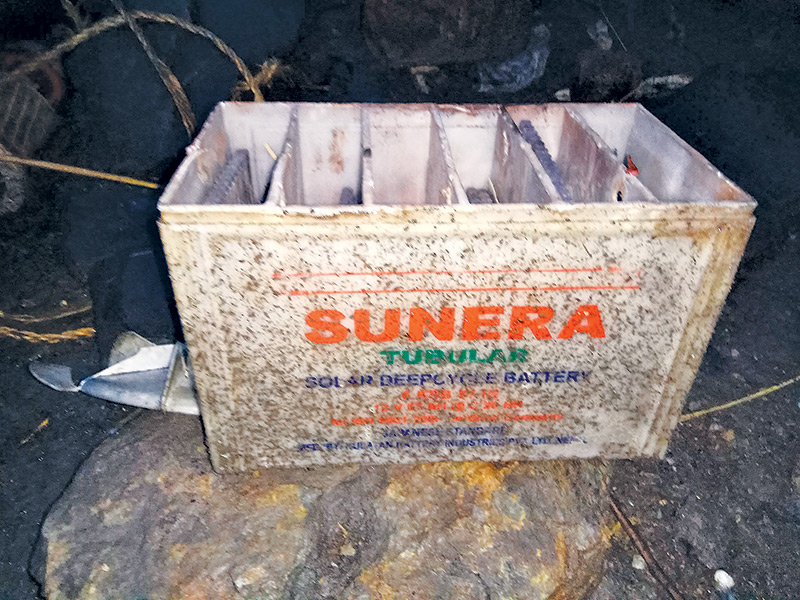
The Environment Protection Rules 1997, which stipulates the adoption of various alternative measures for avoiding the emission of waste while disposing of battery, has been overlooked. Post Photo: ghanashyam khadka

MYAGDI,
Disposal of used lead-acid batteries has become a problem in Myagdi. People in the rural parts of the district rely on lead-acid batteries to power their homes and operate machines. Once these batteries expire, their owners throw them away along with their household waste, which
has posed environmental and health hazards.  
Bhoj Bahadur Thapa, plant protection officer of the Agriculture Knowledge Centre in the district, said unsafe disposal of lead-batteries could cause harmful metals like mercury and cadmium to leak out and contaminate soil and water.
Beside posing environmental and health risks, disposed batteries are also being used to make homemade weapons by some people.
“Lead is extracted from batteries to make bullets for improvised guns used by hunters as well as criminals,” an official at the National Investigation Department said.
Chief District Officer Gyannath Dhakal said concerns regarding the disposal of batteries were unheard of in the past.
“But we have deployed policemen in the villages for surveillance and to create awareness in the communities so that disposed of batteries do not fall into the wrong hands,” Dhakal said. “We are also going to find an effective way for battery waste management.”
There’s no exact data on the number of households that use lead-acid batteries in Myagdi, but it is estimated that more than 10,000 households in Mangala, Malika and Dhaulagiri rural municipalities rely on solar energy to light up their houses and therefore use batteries.
According to Gopal Paudel, a resident of Dhaulagiri, said a 20 Ampere battery contains five litres acid and 10kg lead, 75 Ampere contains 15 litres acid and 50kg lead, and 100 Ampere of battery contains 25 litres acid and 60kg lead.
“In an average, 150,000 litres of acid is being spilt in fertile farmlands, gorges and streams every year,” he said.
Old battery acid is released in open areas before they are disposed of or sold to garbage collectors.   
“We cannot carry large batteries to Beni or Pokhara. That’s why we get rid of acid from old batteries since they are lighter and easy to carry,” said Lal Bahadur Sunachauri, a garbage collector in Dhaulagiri. “Many garbage collectors purchase used batteries from the villages and dump acid on farmlands and streams.”
The Environment Protection Rules 1997 has stated the adoption of various alternative measures for controlling pollution and avoiding the emission of waste disposal of battery. But those measures have not been implemented. Usually, solar companies charge fees to manage solar batteries. According to the rule, the companies that sell or distribute batteries are responsible for their disposal.
“The rule also directs the solar companies to take back sold batteries but none of the companies does,” said  Thapa.
Nakul Dhakal, the operator of Dhakal Solar House in Beni, said they have not kept the record of the sale of new or return of used batteries.
“I don’t know about the rules and regulations. The garbage collectors are responsible when it comes to the management of used and old batteries,” said Dhakal.
Dr Nawaraj Bastakoti of District Hospital said that acid is very dangerous to human health.
“Acid easily damages soil and also affects vegetation. Acids are also being used to harm people. That’s why the local administration should regulate and monitor the sale of acid. Only licensed companies should be allowed to sell acid after verification,” said Bastakoti.

Page 5
NATIONAL

No takers for mayor’s research fellowship programme

Each of the fellows conducting research in 10 different categories was to receive up to Rs 150,000 for their work.
- ANUP OJHA
The Mayor’s Research Fellowship Programme was instituted by Kathmandu Metropolitan City to facilitate evidence-based policy making. Post file Photo

KATHMANDU,
Kathmandu Metropolitan City’s planning commission, which instituted the Mayor’s Research Fellowship Programme to facilitate evidence-based policymaking, has not received a single application for the programme a month after it issued a call.
While the programme’s intentions are good, it couldn’t reach out to targeted professionals, and that could be the reason no one has applied yet, researchers say.
“I am also quite amazed that we haven’t received a single application till date. We hope to receive proposals before the deadline elapses in a week,” said Rabin Man Shrestha, chief secretary at the commission.
The commission, which issued a call for applications on February 5 with a 45-day deadline, shall provide each fellow up to Rs150,000 to conduct research in areas such as urban planning and design, architecture, transportation, physical infrastructure, demography, sociology, anthropology, education, social inclusion, local economic development, urban finance, entrepreneurship, human development, informal urban settlements, disaster preparedness, climate change, health and quality of life.  
According to the commission, the candidate must have two years of work or research experience in the related field.
“This is a first-of-a-kind of initiative in Nepal,” said urban planner Suman Maher Shrestha. “This is a good move; even developed countries have adopted such models,” he added. “But it’s an irony that no one has submitted a proposal till date.”
Shrestha believes that the commission may not have reached out to targeted professionals, who could have applied for the fellowship. “The commission should have reached out to universities and publicised about the fellowship on social media as well,” he added.
Environmentalist Bhushan Tuladhar, who has carried out various researches, also said lack of publicity may be the reason the commission didn’t receive any applications. “Besides, before calling for applications, the commission could have reached out to universities and orientated students on it,” he said.

NATIONAL

A village in Kalikot aims to provide safe drinking water to all households

The municipality spent about Rs 500,000 on the project, while locals paid for pipeline and construction materials.
- Tularam Pandey

KALIKOT, 
Palanta Rural Municipality in Kalikot aims to provide safe drinking water to all households.
During the first village assembly conducted in 2018, residents drafted a plan to supply water to all households within three years.
Last year, the local government received Rs100  million from the provincial government, with which the villagers designed and constructed a central water tank that would supply drinking water Ward No. 8 and 9.
About 400 houses in the two wards have already installed drinking water taps. According to the villagers, last year, 207 houses of Ward No. 9 and 915 houses of ward No. 8 had installed water taps. The municipality spent about Rs 500,000 on the project, while the locals paid for the pipeline and other construction materials.
Locals, especially women, are relieved after their houses were connected with drinking water supply. Maanadevi Bam, a local, said, “It’s usually us women who have to manage household needs like drinking water. We had to rely on rainwater or go to the river to fetch water. Around a decade ago, 11 people had died due to diarrhoea caused by impure drinking water,” Bam said. “The supply of clean drinking water will prevent such calamities in the villages.”
Devananda Dhital, Information officer at Drinking Water, Irrigation and Energy Development Office, Kalikot, said, “Every local unit in the district has prioritised to ensure drinking water and sanitation facilities to the locals. The villagers who had been suffering for years from a lack of access to safe drinking water now have drinking water taps in their homes.”
The villagers now hope that other wards in the municipality also receive the facility in the days to come.

NATIONAL

Fire lines formed to protect community forest in Saptari

- SHIVA PURI
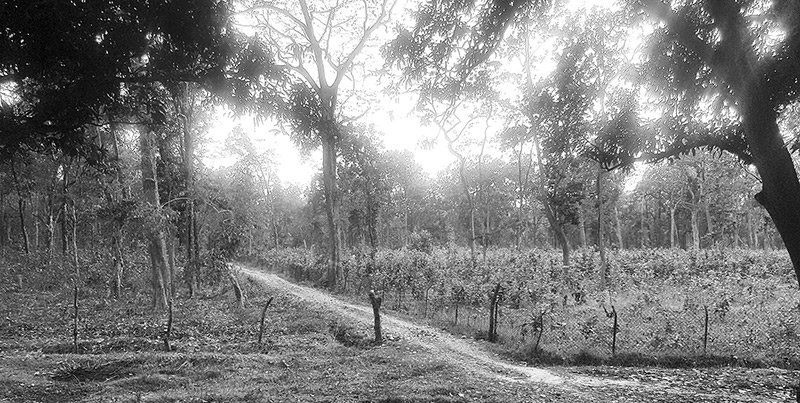
Every year during the dry season, wildfires destroy hundreds of sal trees in Hatemalo Community Forest in Saptari. Post Photo: SHIVA PURI

RAUTAHAT,
Hatemalo Community Forest Users Group in Chandrapur, Saptari, has taken initiatives to form a fire line to prevent wildfires from breaking out in the forest.  
According to locals, the community forest has sal saplings planted in 3.5 hectares of forestland in Chandrapur Municipality, and the fire line was formed to protect the sal saplings.
Every year during the dry season, wildfires destroy hundreds of sal trees in the forest. Janga Bahadur Ghalan, vice chairman of the forest users group, said the forest authorities are collaborating with people’s representatives to preserve forest resources.
“This year, we are going to form seven fire lines in the forest area to prevent wildfires from spreading,” said Ghalan. The forest has deployed 12 employees to form fire lines.
The wildfire season in Nepal begins in between November and December and continues until the onset of monsoon. Binod Singh, the division forest officer of Rautahat, said wildfires are common during the dry season from mid-February to mid-June in Tarai.
“Wildfires destroy vegetations and affect wildlife during the dry season. This is why we have brought the concept of scientific forest management,” said Singh, adding that all concerned stakeholders should work together to preserve the forest.  
Sundar Prasad Sharma, under-secretary at the Department of Forest and Soil Conservation, said that the country since 2005 has been losing some 200,000 hectares of forest area annually. According to Sharma, the forest fires in 2009 were the deadliest; forty-nine people, including 13 Nepal Army personnel, died while controlling forest fires in Ramechhap district.
In 2016, Nepal lost nearly 1.3million hectares of forest land to forest blaze that also killed 15 people, according to Sharma’s data. A study of the Food and Agriculture Organization (FAO) showed that 90 percent of forest fires are man-made.
“Most forest fires are caused due to sheer human negligence. Discarding cigarette butts without properly stubbing them is the main reason for forest fires,” Singh said. “Locals should be aware of the negative impact of forest fires. They contribute significantly to air pollution by generating haze and smog and have effects on environmental health.”
In 2010, the government introduced the Forest Fire Management Strategy for curbing forest fires. But officials and locals still lack the capacity and tools to contain such fires. The National Disaster Risk Reduction Strategic Action Plan 2018-2030 also talks in detail about controlling and preventing forest fires, but it remains far from implementation.

NATIONAL

Man dies in lightning strike

Briefing
- Post Report

HETAUDA: A 23-year-old man died and his wife sustained serious injuries after being hit by lightning at Chyaukhola in Bhimphedi Rural Municipality-9, Makwanpur, on Saturday morning. The lightning struck Bijaya Syangtan and his wife Sabita while they were asleep in their residence. Bijaya succumbed to injuries in Hetauda Hospital. 

NATIONAL

Bajhang, Darchula witness snowfall

Briefing
- Post Report

BAJHANG: The mountainous areas of Bajhang and Darchula have witnessed snowfall after incessant rains since Thursday morning. Local people’s lives have been greatly affected due to the unseasonal snowfall. According to the residents of Saipal and Surma in Bajhang, their settlements are blanketed with around a foot of snowfall.

NATIONAL

15-bed hospitals in all local units of Darchula

Briefing
- Post Report

DARCHULA: A 15-bed hospital will be constructed in each local unit of Darchula, according to a recent correspondence issued by the Federal Ministry of Health and Population. Only two of the nine local units in the district have a 15-bed hospital. Dr Dinesh Bahadur Singh, coordinator of the health department at Duhu Rural Municipality, said the existing health posts would be upgraded to full-fledged hospitals.

NATIONAL

Local unit to provide temporary land titles

Briefing
- Post Report

MAKWANPUR: Bagmati Rural Municipality is going to distribute temporary land ownership certificates to its residents. Around 80 percent of the households in the area are living without land titles. Sarkesh Ghalan, chairman of the rural municipality, said his office has appointed an Amin (land surveyor) to survey the land plots used by the locals.

NATIONAL

Computer science teachers warns of stern protests

Briefing
- Post Report

Kathmandu: Computer science teachers of grades 11 and 12 have warned of intensifying their agitation if their demands were not addressed. They had boycotted the practical exams on computer sciences grade 11 and 12 exams in protest after the subject was dropped from the new syllabus. The teachers had put forth a six-point demand, calling on the authorities to reinstate the subject in the syllabus.

Page 6
OPINION

Nepali women are unequal by law

Nepal is still lagging far behind international human rights standards concerning equal rights to citizenship.
- JESSELINA RANA
 Post Photo: Hemanta Shrestha

This International Women’s Day marks 25 years of the Beijing Declaration and Platform for Action—one of the most comprehensive documents aiming to remove systemic barriers holding women back from equal participation in both private and public life. After 25 years of activism and groundwork, what is the status of Nepali women in a country that is still very much guided by patriarchal values?
Although there are many issues concerning women’s rights in Nepal that need to be addressed, one that requires urgent attention is the discriminatory citizenship law and constitutional provision which has disenfranchised women and therefore prevented them from passing on citizenship to their children, affecting millions of people across the country.
Over 5.4 million eligible individuals in the country do not have citizenship certificates as a consequence of constitutional provisions, laws, and regulations governing citizenship discriminated by the gender of the registering parent, according to the 2018 US State Department’s country report on human rights practices. Nearly a quarter of the population above the age of 16 is stateless. These include children of unmarried women or those whose fathers are foreign nationals, who have been repeatedly denied citizenship by local officials who claim they will only be able to accept citizenship applications in the mother’s name after the passage of the Citizenship Amendment Bill. The bill which was registered at the Parliament in August 2018 is sitting at the House Committee where members have been debating on provisions for nearly two years.
Meanwhile, the children who are trying to obtain citizenship in their mothers’ names have been effectively told to put their lives on hold. Without citizenship, an individual cannot sit for national-level board exams, opt for university-level education, open a bank account or even seek formal employment. The discriminatory law has a direct impact on the equal status of women who cannot pass citizenship on to their children, as well as on issues relating to the children’s right to nationality, education and employment.
The discriminatory provision is not novel to modern-day Nepal. The first citizenship Act was enacted in 1952. The Act allowed for citizenship to be given to any person who was born in Nepal and their father or mother was a Nepali citizen at the time of their birth as well as to persons with permanent residence living with families in Nepal. This law was applicable until 1963 when the Panchayat regime was introduced, and a new constitution was promulgated. Under the 1963 Constitution, an ordinance concerning citizenship rights was enacted, repealing the Act of 1952. This ordinance later became the Nepal Citizenship Act 1964. This Act made some drastic changes in the citizenship law of Nepal. Citizenship by descent could only be acquired by persons whose fathers were Nepali citizens at the time of the child’s birth.
The present law concerning citizenship rights is embodied in part 2 of the 2015 Constitution, as well as the Citizenship Act of 2006. Although Article 10 of the constitution states that no person shall be deprived of their right to obtain citizenship, reading the provision of the constitution with that of the legislation, as well as independently of each other, results in discriminatory treatment of Nepali women in their ability to pass on their citizenship.
After much lobbying by activists and rights groups, the ‘or’ terminology was added in both the Constitution and the Act to ensure ‘equality’ amongst men and women to pass on their citizenship—thereby ensuring citizenship can be passed on to those whose mother or father was a citizen of Nepal at the time of his/her birth. However, this clause is succeeded by a provision stating that it would not be applicable to Nepali female citizens married to a foreigner. Further, while the Constitution under Article 11(5) states that a person whose mother is a Nepali citizen but the father is not identified will be provided with citizenship by descent, there is no corresponding provision in the Citizenship Act concerning this clause creating confusion for state authorities to actively implement the constitutional provision. Article 11(7) of the Constitution provides that a person whose mother is Nepali and father is a foreigner is to be provided with naturalised citizenship provided they have permanently resided in Nepal and do not hold a citizenship of another country.  
These constitutional and legal provisions are a reflection of the patriarchal and paternalistic societal order that Nepal still is; it is severely impacting the lives of Nepali women and their children. Constant arguments in favour of the Citizenship Act 2006 from elected parliamentarians citing issues of national security with paternalistic and xenophobic undertones have regularly made headlines in recent years. Government officials are still hesitant to provide citizenship to children of unmarried women despite many progressive judgements from the judiciary that recognise this right. Furthermore, naturalised citizenship to children of unmarried women whose fathers are foreigners lies at the discretion of the state.
Unlike citizenship by descent, naturalised citizenship is not a right and depends on the prerogative of the state officials handling the applications to provide it. The law puts the power to confer citizenship to children of Nepali men without reservations unlike the situation for Nepali women—thus making Nepal one of the 53 countries with discriminatory nationality laws. Among the millions affected, the lack of corresponding provisions in the legislation concerning the rights of Nepali women to pass on citizenship to children when the child’s biological father is not identified is also creating immense legal battles for children born in cases of rape, sexual exploitation or those whose biological fathers refuse to acknowledge them.
Notwithstanding the persistent advocacy by women’s rights organisations and those directly affected, Nepal is still lagging far behind international human rights standards concerning the basic right to a nationality. Despite ratification of important international human rights treaties and conventions which clearly set out the state’s obligations to ensure equality in this area, such as the Convention on the Elimination of all Forms of Discrimination Against Women and Convention on the Rights of the Child, failure to adhere to international standards as well as enact the provisions concerning equal nationality rights is a constant reminder of women’s unequal position in the Nepali society.
It is thus important for lawmakers in Nepal to show urgency to remove this discriminatory provision as it has impacted and is impacting the lives of more than half of its population. Any calls for gender equality will be hollow without ensuring equality for Nepali women in the passing of citizenship to their children.

 
Rana is the Human Rights Education Officer at Amnesty International Nepal.

OPINION

Remembering professor AJ Farida Banu

A determined Farida Banu took full advantage of her father’s belief that all children must have education and freedom.
- Saira Rahman Khan
Shutterstock

It would be an understatement to say that women in Bangladesh have always had to struggle to get anywhere. It’s the same all over the world. Gaining a foothold in all spheres of life, be it social, legal, political or cultural, has always been a challenge. Nevertheless, there are those who have succeeded in doing this and Akhtar Jahan Farida Banu was one of them.
Born on April 28, 1938, in Calcutta, she was the second of four daughters in a family of 11 children (one of whom did not survive infanthood), born to Syed Mohammad Abu Sayeed, a physician practising in Metiabruz and Begum Amatur Rasul, a homemaker, both from Birbhum, West Bengal. As a child, Farida Banu and her younger sister joined Mukul Fauz in Calcutta, one of the oldest children’s organisations in the subcontinent. There she learnt to sing, did physical training and other youth-related activities and even took up stick fighting. In 1947, when she was barely 9-years-old, the effects of Partition hit her family, and like many Muslim families in Calcutta at that time, moved to East Pakistan, where her father was posted to the Munshiganj Sadar Hospital.
In East Pakistan (now Bangladesh), Farida Banu and her sisters attended schools wherever her father was posted. This included schools in Munshiganj, Chittagong, Jessore and near the Dhaka Central Jail quarters (when her father became a doctor for the jail) and finally at Quamrunessa Girls School, from where she completed her matriculation. She started college at Eden Girl’s College and then went on to study Bangla at Dhaka University, where she was also elected as Cultural Secretary of the Women’s Hall. Her singing continued at school and college cultural programmes and even at university hall functions.
Her marriage, at the age of 20, was arranged to a young doctor, Ashequr Rahman Khan, of the first batch to graduate from Dhaka Medical College. He was also one of the young interns who took part in the Language Movement in 1952. They moved to Karachi in 1964, where Dr Ashequr Rahman Khan completed his MPhil, while Farida Banu, a young mother, took up the task of homemaker, never forget to read books and journals. They returned to Dhaka in 1966, where she took a 14-day long physical defence training course and also commenced post-graduate studies in Bangla. A determined Farida Banu was taking full advantage of her father’s belief that all children must have education and freedom. She completed her Master’s degree in Bangla at that time, from Dhaka University.
In 1967, Akhtar Jahan Farida Banu joined Dhaka College as a lecturer in Bangla. In 1970, she was promoted to assistant professor of Bangla and became an associate professor in 1984. She was also a regular artist on Dhaka Radio. After independence, she made regular appearances on Bangladesh Television and Bangladesh Betar. Her forte was Rabindra Sangeet. Respecting her decisions and supporting her choices all the way was her husband. In 1990 she joined Eden Girls College as professor and Head of its Bangla Department. She retired from government service in 1996.
As a mother, Akhtar Jahan Farida Banu never discriminated between her children when it came to education. Her son became a lawyer, one daughter became a doctor and the other holds a Master’s Degree in marketing. Her daughters followed her footsteps and joined Chhayanaut for singing lessons and appeared in Notun Kuri, a children’s show on BTV. She encouraged her children to do what they wanted, as long as it did not harm others and was for a just cause.
I came into Akhtar Jahan Farida Banu’s life in 1995, when I became her daughter-in-law. In some ways we were similar. I admit I was in awe of my mother in law. Her quiet, but powerful presence penetrated the whole house. She was always immaculately dressed, even when she was not going anywhere and when she did leave the house there was not a single hair out of place. With my English medium background, ‘western’ habits and stubbornness, I suppose I was something of an enigma to her. She was very patient with me. The first lesson I learnt from her was to talk ‘proper’ Bangla with crisp endings and no ‘common’ dialect. My sisters used to make fun of me, but my father was very pleased. I was definitely not her vision of a daughter-in-law, but she understood that if her son was happy, that was all that mattered. That was her greatness. She never spoke ill of anyone.
Till 1998, a tabla player would come to the house and my mother-in-law would practice her songs. She stopped singing on TV and the Radio sometime in 1996, saying that it was too tiring. When the tabla player came to the house, my father-in-law would be in the living room listening to his wife sing, thoroughly enjoying being the sole audience. They were inseparable. They immensely enjoyed the arts. Both were life members of the Bangla Academy and for as long as they could, attended all its programmes. They would reminisce about road trips together soon after marriage, get-togethers with friends, music and food, a particular flower or someone’s garden that caught their eye. Neither of them would talk about their experiences during the Language Movement or the Liberation War. They would not talk about all the social services they did. They were loving, humble and private people, with warm and generous hearts.
By 2015, both professor Akhtar Jahan Farida Banu and Dr Ashequr Rahman Khan were suffering from ill-health. While my father-in-law, weakened from a heart attack and then chemotherapy, began a slow and frustrating decline into dementia, my mother-in-law became dependent on a walking frame and wheelchair due to debilitating arthritis and heart problems. It was a constant visit to the hospital with both of them—sometimes together. Although my mother-in-law was bedridden by 2017, her mind was alert. She read books, continued to take interest in what her grandchildren were up to, loved to see us all dressed up in our finest and going out. She was also extremely concerned about my father-in-law, who had almost stopped eating properly by 2017. When my father-in-law passed away in his sleep in the very early hours of May 18, 2019, at home, I instructed the hospital ambulance men not to say anything in front of her and we told her we were taking him to the hospital as he had a temperature and had to stay there for observation. Her daughters broke the news to her later in the morning. I am grateful I was not there when they did. Akhtar Jahan Farida Banu and Ashequr Rahman Khan were like turtle doves. My mother in law’s health took a steady decline after her husband’s demise. No amount of physiotherapy gave her relief or comfort. On February 17, 2020, she had a massive heart attack and crossed over to where, most probably, my father-in-law was eagerly awaiting her arrival.
I am sure the story of my mother-in-law is a story similar to other women of her time. However, in the era she grew up in, families with such values were not very common. My parents-in-law had a wonderful partnership. Their life is a lesson in the mutual respect that we can all learn from.


This article was previously published in The Daily Star, a part of the Asia News Network.

Page 7
OPINION

Justice and gender equality in the age of #MeToo

It is only a matter of time before the men hiding behind their title and power are unveiled and brought to justice.
- SAKUN GAJUREL
Shutterstock

Like every year, this year, too, national and international organisations, governments and civil society are racing to showcase their commitment to gender equality and eliminating of all forms of discrimination against women. The 2020 theme is Generation Equality: Besides equal pay, health care services and equal political participation, an end to sexual harassment and violence against women and girls is one of the key pillars of this year’s theme. The task is not easy, to say the least, especially in the age of #MeToo and #TimesUp.

 
Progress and digress
For better or for worse, we live in a critical time in history in terms of our pursuit of Generation Equality. On the one hand, we are seeing the breaking of the glass ceiling, and countries like Iceland have made a legacy in combating gender inequality by declaring equal pay for men and women a law. Finland recently declared a seven-month maternity leave for each parent to ‘promote wellbeing and gender equality’, allowing both mother and father to equally participate in raising their children, an idea still foreign to us.
On the other hand, we also have places where women are stoned to death for posting pictures on Instagram or are abused, beaten and gang-raped on a night out or on their way to schools. The professional world is not any better, where women have no choice but to constantly ignore harassment at the workplace to keep their jobs.
Where do we stand between these two worlds? Closer to home, South Asia lies towards the bottom of the global gender equality index and is home to some of the most horrifying acts of violence against women and girls. The case of 18-year-old Bangladeshi student Nusrat Jahan Rafi, who was burned to death for seeking justice for sexual assault by her school principal, is still fresh in our memory. In India, about four women get raped every hour, and in Pakistan, children as young as eight years old are kidnapped, raped and murdered—making rape almost endemic in these countries. And yes, Nepal is a perfect neighbour where leaders do not hesitate to belittle the crimes committed against our girls, as is shown by our home minister’s audacity to freely voice that ‘rape is commonplace in Nepal, and that Pant’s rape and murder has been unnecessarily politicised’. More than a year of investigation into the case of 13-year-old Nirmala Pant, who was raped and murdered, led to no justice.
Nepal is failing miserably at the policy level when it comes to protecting women and children. At the rate we are moving forward, the 2030 development agenda on gender equality is beyond our reach. For instance, in 2014, the government vowed to end child marriage by 2020; but the commitment is limited to paper, and very little has changed in terms of minimising the crime. Child marriage was outlawed in the country in 1963, yet, close to 60 years and a few revolutions later, we are nowhere close to ending this shameful misdeed.
This points to a clear lack of genuine incentives from the government and law enforcement agencies to eradicate child marriage or to minimise violent crimes committed against girls. The penalty for committing the crime of child marriage is between six months to three years in prison, and a fine of Rs1,000 to Rs10,000. In a country where you get jailed for 12 years for killing a cow, the punishment for child marriage—that deprives a girl child of the basic right to education, freedom and opportunities that come with it—is close to nothing. Police accountability in investigating violent crimes against women and girls is as shameful as the number of cases that have resulted in convictions.
As a nation, we are failing miserably to protect our girls; and as a society, we show no mercy to the survivors of such crimes. Girls like Puja Bohara, who survived gang rape at the age of 14, are made to feel ashamed for being raped, and often do not report for fear of societal stigma. Even where the survivors have been strong enough to endure the societal scrutiny and filed a report, the conviction rate remains a mere 5 percent. In Bohara’s case, the police arrested the accused only after pressure from the mass media, civil society and student organisations when they should have been seeking the criminals on their own initiative, and she received justice eight years after she was raped.


Moving forward
Our legal bodies must take up the task of protecting and providing justice for violent crimes seriously. We need more women, who can relate to the seriousness of the violent crimes committed against girls, in decision-making places. In a society like ours where women’s problems often take a secondary place, men in power need to be sensitised to responding to violent crimes with extra precaution and empathy for the survivors. Similarly, the sentences must be tougher. In India, for instance, a rapist is sentenced to prison for 14 years; and in case the victim dies, the culprit is sentenced to death. Sentences in European countries vary from 15 to 30 years in prison depending on the circumstance and age of the victim.
But there is hope. With global movements like #MeToo and #TimesUp, the flame of justice will eventually engulf the global community, and Nepal will be no exception to this. It is only a matter of time before the men hiding behind their title and power are unveiled and brought to justice.

 
Gajurel is an independent consultant, development practitioner, activist and writer.

OPINION

The gender gap’s health consequences

From labour shortages to racial bias, the barriers to achieving SDG 3 are as diverse as they are high.
- TOYIN SARAKI
Shutterstock

We have a decade left to achieve the United Nations Sustainable Development Goals (SDGs), and we are nowhere near where we need to be to succeed. One crucial reason is that women remain largely excluded from decision-making processes, which leads to policies that do not provide women with the support they need to prosper—or even to survive. Nowhere is this dynamic more apparent than in the health sector.
Women comprise roughly 70 percent of the global health workforce and perform the majority of the sector’s most challenging, dangerous, and labour-intensive jobs. Yet they hold only 25 percent of the health sector’s senior roles, and are rarely represented adequately in policymaking. Instead, they are often expected to remain passive actors, quietly finding ways to do their jobs in difficult—even impossible—circumstances.
The reality for women health workers was reflected in a recent letter to the medical journal The Lancet from two Chinese nurses describing the conditions they and their colleagues face on the frontlines of the battle against the new coronavirus, Covid-19, at its source in Wuhan, China. It may be an extreme case (and the letter has now been retracted over claims that it was not a firsthand account), but the challenges described, from shortages of protective equipment to chronic overwork and exhaustion, are all too familiar to health workers everywhere.
Such conditions make essential health-sector jobs unattractive, contributing to severe labour shortages worldwide. The World Health Organisation estimates that, for all countries to achieve SDG 3—ensure healthy lives and promote well-being for all at all ages—an additional nine million nurses and midwives will be needed globally by the year 2030.
Closing this gap is a matter of life and death. For example, midwives are often the difference between safe childbirth and newborn or maternal mortality. Lack of access to them—especially for vulnerable
populations, such as poor rural dwellers—is a major reason why two-thirds of all maternal deaths occur in Sub-Saharan Africa. The WHO estimates that adequate midwifery care (including family planning) could prevent 83 percent of all maternal deaths, stillbirths, and newborn deaths.
Infant and maternal mortality are hardly limited to developing countries. In the United States, the maternal mortality rate has actually increased in recent decades, from 7.2 deaths per 100,000 live births in 1987 to 16.9 deaths per 100,000 live births in 2016. More than half of these deaths could have been prevented if the mothers had better understood the importance of—and had easier access to—quality prenatal and postpartum care.
There is a clear racial dimension to this disturbing trend. In the US, a black woman is 3-4 times more likely than a white woman to die from complications in pregnancy. In the United Kingdom, that multiple rises to five. While this discrepancy may be partly explained by health complications black women experience, racial bias also plays a role. Black women often report feeling that they are not taken seriously by medical professionals.
The health consequences of not listening to women extend further. Children born to healthy mothers are more likely to remain healthier throughout their lives. Because a woman is most likely to engage with the health sector during pregnancy, the support of a midwife or nurse can pull a woman’s entire family into the health-care system.
In a bid to recognise their vital contribution in the health sector, the WHO has designated 2020 as the Year of the Nurse and the Midwife. But beyond celebrating nurses and midwives for their hard work, we must seek to rectify structural inequities that exclude women from leadership positions in these professions. That is a key goal of the upcoming Women in Dev conference—a women-led, women-focused initiative that deserves the support of us all.
From labour shortages to racial bias, the barriers to achieving SDG 3 are as diverse as they are high. But the chances of success are significantly better if we listen to those who understand the situation on the ground, and work to enhance inclusion at all levels, taking into account varying socioeconomic conditions. This will require a fundamental shift in mindset, with publics and policymakers alike recognising that women—as nurses, midwives, and mothers—are often the gatekeepers of health.
A decade of rapid progress toward SDG 3 is possible. But women must be at the helm.


—Project Syndicate

Page 8
THE BLACKBOARD

Encounter with a Bramahkumari

shutterstock

Although the station was stuffed with every kind
of passenger,
I happened to notice her, of her attire,
She was clad cap-a-pie in white,
White blouse, white sari, white sandals and unkempt hairs,
A dress absolutely antipodes to her beauty.
Thought I, “What must have it felt, at such an early age,
to be a widow,
what a hapless beauty!”
I decided to skim her one more time,
this time on her bosom a badge I saw:
embossed with a haloed portrait of a pretty lady,
who preaches in channel Sanskar.
‘O! a hypnotised convert  
By the sermons of sister Shivani.’
I know not what attracted her to me:
My boisterous hair, my hipster pantaloons,
My Chuck Taylor sneakers or my absent eyes, but our eyes collided for several times,
Her pristine eyes ogled me like the eyes of a bar women.
On the bus, gratified I became
Reminiscing how her eyes surreptitiously searched for mine,
Bramahkumari; an unalloyed lotus,
A forever practitioner of detachment.
with crowd maintaining distance
be it of toe, but with me!
She Served herself like the flower Ketaki
Unpicked,
Unoffered
And Cursed.


Parbat Lawati
Lawati is a recent post-graduate from the Central Department of English Literature, Tribhuvan University.

THE BLACKBOARD

Cannabis: An ignored Himalayan blessing

shutterstock

Cannabis and Nepal have a long history. The great Lord Shiva, who is one of the principal deities of Hinduism, is believed to be a consumer of cannabis thereby making ganja a herb of cultural significance in Nepal. There have been many studies that have shown that the herb not only helps in economic development, but also helps cure a lot of diseases.
And considering all these factors, it’s good that our politicians are finally debating whether to legalise cannabis or not.
Many reports have shown that the ban on the herb under the Narcotic Drugs (Control) Act 1973 hugely impacted Nepal’s economy. However, despite the government’s many attempts, it has not been able to completely prohibit the use of cannabis. Youths and adults of all ages use the herb for recreational purposes illegally.
By regulating the use of cannabis in the country and making it legal, the economy of our country could potentially benefit.
Also, by providing awareness about the plant’s many medicinal benefits, the government could help break the social taboo surrounding this ancient cash crop.
There are 483 chemical compounds in cannabis, out of which at least 65 are cannabinoids. Cannabinoids are known to cause relief to chronic pain. Further research and advancement in the future could replace analgesics and can significantly reduce side effects when taken for chronic use. Cannabis is said to be highly effective to fight obesity and maintain a healthy weight owing to cannabis being linked to aiding your body in regulating insulin while managing caloric intake efficiently. With its impact on insulin, it only makes sense that cannabis can help regulate and prevent diabetes.
Research conducted by the American Alliance for Medical Cannabis (AAMC) has linked cannabis in helping stabilise blood sugar, low blood pressure and improve overall blood circulation. Depression is fairly widespread even without most people realising they have it. The endocannabinoid compounds in cannabis can help in stabilising mood swings which might ease unstable patients. Apart from these benefits, cannabis is also being linked to regulating seizures, controlling Parkinson’s and helping children with autistic disabilities.
One of the major burning issues of the current times is global warming. Cannabis can easily replace paper and plastic leading to control in deforestation (as it only takes three months to grow completely), thus help ease the pressing issue of the earth warming up.
The clothing industry is responsible for a huge amount of pollution in the world. But hemp can be used to make clothes and it is 100 percent eco-friendly. (Hemp is a plant of the Cannabaceae Family). Cannabis can also produce wood and concrete.
The cannabis plant also absorbs more carbon dioxide from the atmosphere compared to other plants. But due to the prohibition of the plant globally, only a few researches have been conducted on it—all of which have proved the benefits of this plant.
Unemployment is a major stumbling block for the economy in our country. But cannabis farming, preparation of medicines, hemp plastic, papers and clothes, marijuana trade can generate employment opportunities for our willing youth.
Nepal is a tourism-based country. And the legalisation of the plant will provide a much-needed boost in this sector. International marijuana trade will also add up to Nepal’s economy which could help stabilise the economy of our nation.
Saying this, I am not encouraging the use of cannabis for recreation purposes but to harvest nature’s gift to Nepal in a way that will help strengthen the economy of the country.
Timely intervention made by the few dozens of parliamentarians in Nepal’s national parliament on cannabis plantation and trade should be considered by the government objectively.


Aditya Pratap Singh
Singh is a grade 9 student at Vidya Sanskar School.

THE BLACKBOARD

The empty chair

We both looked at each other, and there was a spark. Looking at him felt like being hit by the first drops of monsoon.
shutterstock

My friends tell me that I have everything required to win over girls, but my hormones have a mind of their own. “My cards are not for the ladies, they are for the gents,” I often tell them. I am gay. But then my high-profile celebrity life has denied me the option to come out of the closet. Years of practice, and I have mastered the art of suppression; suppression of myself, and my innate emotions.
“Arav, that girl near the bar has the hots for you,” chimed my friend. “She is attractive,” I exclaimed loudly, and looked at her for a few seconds to keep up the straight act. Suddenly, the girl looks at me, smiles, and waves towards me. I look at her and smile. “Darling, if only you were a cute looking guy, I would have given you a chance,” I think.
“So,” my friend starts again. “Is that girl getting lucky tonight?” He looks at me and unceremoniously points towards the girl. I look at my friend, and his peevish glare at the girl irritates me. “Why do men act like pimps?’ I think.
My friend is waiting for an answer. So, I clear my throat and say. “I would love to, but then I have to prep-up for a TV interview tomorrow.”
I could sense the frustration on my friend’s face. “You should try your luck. It seems you are the one who can’t control the urge. But then, remember, everything is to do with consent,” I smile. My friend looks flabbergasted by my rejection, shakes my hands and walks out of the bar.  
I look at my watch. In half-an-hour, I will be taking the biggest leap of my life. I had found someone. A person who made me complete, the love of my life. He made me realise that my life was not only limited to the silver screen, and that I was a person with a beating heart, capable of love. I look around me. People looked at me in acknowledgement. They recognise me from my movies. I close my eyes. “Life is like a beautiful novel. The thrills and the conflict. I have survived for so long and will continue to do so. But this time, I am going to be true to myself, no fictions,” I tell myself.
I call the waiter, and order a glass of wine. I drum my fingers on the table and wait for the person who had embraced me, and my heart.


“So, here’s the script. You need to focus on these highlighted words,” he points his manicured fingers on the script, and gently highlights some lines. “Empowerment, awareness, inspire. Is there any confusion?” he asks. I lower my Louis Vuitton sunglasses and look at him. “He is cute,” opines my mind. Innocence reflects in his amber-shaped eyes.
“Is there any confusion?” he repeats again. I recollect my lust-filled thoughts and answer, “Confusion? There’s no confusion. These scripts evoke no desire for action. It’s plain and boring.” I exclaim in frustration.
My reaction surprises him. “I will smile, wave and act, and make sure these dumb words breathe,” I say. He looks at me bemused, “But sir, why will you smile and wave? This film is about Sustainable Development Goals. It doesn’t require all that jazz.” I was about to rebuttal when I realised something. This script boy was unperturbed by my name and fame. “How dare he dictate a star like me?” I mentally shout to myself. People worshipped me, but this lanky guy with his Superman t-shirt was giving me shade. “Do let me know if you have any confusion?” he states and starts collecting the script from the table.  
Suddenly, I burst out, “Do you even watch movies?”
He looks at me amused and murmurs, “Of course I watch movies … that’s why …” I cut him short and attack him, “So, you don’t know who I am?” I felt like a child. He could sense that he had bruised my ego. He looked straight in my eyes, and smiled, “Everyone in this country knows who you are, sir.” He pauses and whispers, “You are Arav, the superstar!” Suddenly his vampire white skin blushes, “I am a big fan of yours.”
I look at him dumbfounded. I am usually surrounded by fans who adore me, but this boy in front me made me realise that the world is not all praises. The world recognises humble beings. “Thank you,” I mutter. He looks at me and smiles.


The documentary shoot was finally over. The crew members were celebrating around the splendid bonfire, singing and dancing around it. I look at them with boredom and excuse myself from the celebration. “It’s a beautiful night,” I tell myself, as I walk towards the nearby woods.
“Out for a walk sir?” I halt, look back. “Oh, hello again”. It was the script boy. “Do you drink?” he asks. I nod my head. “It’s local,” he hands me a flask. I sniff and wriggle my nose. “This is strong!” He looks at me and laughs, “It’s strong, even for a strong person like you?”
I looked at him irritated. “What do you mean?” He looked at me, and his cheeks blush like spring.
“I’m Jiten, sir,” he says, breaking the awkward silence. He gives me his hand, and I give him mine. His hands are soft. “I have a request, Jiten,” I start. “Stop calling me sir. That word makes me sound like a botox session gone wrong!” He laughs out loud. His laughter was musical. I don’t know what happened next, but my fingers were caressing his hands. We both looked at each other, and there was a spark. I wanted him, and I knew that he wanted me too. This want was not sexual. It was the ultimate answer to our existence. Looking at him felt like being hit by the first drops of monsoon. It was euphoric. Jiten looks at me and smiles. “He is me, he is like me,” I think and hold his hands tight. Jiten breaks the silence, “Do you want to go out for a walk?” I look up to him and nod in obedience. Far from gazes, stares and whispers. I hold his hand once again and whisper without hesitation, “Can I kiss you?” to which he nods. That night I unfolded all my secrets, revealed the hidden emotions, and embraced the real me. Brief kisses turned into strong fierce ones, and we surrendered to each other without a second thought. For the first time in my life, I felt complete. I looked at Jiten, drew circles in his bare chest and smiled. “Heaven found us,” I say.


“Sir, can I have your autograph,” a voice startles me. I abandon the train of nostalgia. A teenage girl with light makeup and straight hair was idolising me with her gaze. “Sure, what’s your name?” I ask her.  “It’s Deena”. I quickly write, “With love to Deena, from Arav.” I hand over the paper to the girl. She quickly takes the paper from me, and looks at me with doting admiration.
“I am a huge fan of yours. I love you!” she says these lines at such speed that I was sure that she had practiced these lines a zillion times. I smile at her, and watch her dance her way out of the restaurant in excitement. “There’s so much love from people. They respect me, adore me, but will they accept me if they knew my secret,” I wonder. A chill runs down my spine, as I knew the answer.
“Being gay is acceptable now, but being a gay actor?” A thought strikes me, “As an actor I have to embody many characters. But what will happen if people stigmatise me for who I am?” My head gets bogged with newspaper headlines, “Gay actor plays Romeo—film a flop”, “King of romance is all for the guys”, “Arav is gay—and film producers aren’t happy!”
Beads of sweat forms on my forehead. My mental self-shouts at me, “What are you doing Arav? Your sexuality is your reality, but for others, the reality is what they see onscreen. Your gay declaration is your doom.”
Nausea hits me, I feel weak. “What was I doing? I can’t reveal myself; I can’t do that,” I mentally scream.
“Are you okay?” a familiar voice interrupts my thoughts. I looked startled. It was Jiten. I could sense concern in his voice. “Are you okay?”
He sits down in the chair opposite to me. He had a manila folder in his hands. He places the folder on the table and holds my hands tight. “Your hands are sweaty. Is everything okay?” he repeats.  I look at him. “Jiten, we can’t see each other again. It’s too risky for me and my career. I’m sorry I don’t think this will work,” I exclaim.
Jiten looks at me; I could sense the tension rising inside him. He closes his eyes for a moment, takes a sharp deep breath, opens his eyes and looks at me. His eyes pierce through me as he utters, “I should have realised that you are an actor and will always be one. There’s no reality for you. You’ll always embrace the illusion you have created to please the world. I cannot live in a bubble house like you, Arav. I want my love to understand reality. Unfortunately, you can’t do that.”
He stands up, smiles at me and walks out of the door. I rub my hands in frustration, and spot the manila folder that Jiten has left on the table. I open the envelope, and slowly toss the content on the table. Two rings, two tickets and one white A4 size paper with the words, “Will you marry me?”
Teary eyes, I held the rings in my hand. White gold, decorated with the words, “Heaven found us.” I could feel the guilt stab like a sharp knife on my heart. These were the words that came out of my mouth when we made love for the first time as real men. I stare at the empty chair, where only a moment ago, the love of life was sitting.  
As I collect myself and walk out of the restaurant, I hear people chant my name. “Arav, Arav.” The press goes crazy with my mere sight and flashlights blind me. Click … Click … Click. I pose, I fake a smile, and I walk towards a life of deception.


Ayush Shrestha Joshi
The writer can be reached at [email protected]

Page 9
CULTURE & ARTS

An array of trailblazing women—from one of Nepal’s first radio presenters to its first circus trainer

On the occasion of International Women’s Day, the Post talked to five pioneering women who have made strides in their respective fields.


‘My work is my power’
Indira Rana Magar


“I have never wasted my time flattering others, for me my work is my power, and I have always worked fearlessly,” says Indira Rana Magar, founder of Prisoners Assistance Nepal, one of the first non-profits established in Nepal that shelters children of people who are in prisons.
Currently, there are more than 200 children in her 11 shelter homes. She’s also taking care of the education of 300 other children outside of her shelter homes.
Magar is swift and straightforward, a no-nonsense person. She recently made it to the top three finalists of The One Rotary 3450, an international humanitarian award, but such accolades don’t mean much to her. “It’s my work that is valuable to me. But for the world outside, these certificates are validation for my credibility,” she says. “These accolades support my stance. But I also know that no matter how many awards I win, when I meet the people in prison there is a different reality of life—from which I have to protect them.”
Magar’s days are spent frequenting jails, talking with prisoners and working with them to reintegrate them back to society. Many women prisoners in the process of reintegration have abandoned their children with Magar, fleeing after getting out of prisons. Magar calls them her own now. “You can’t blame them for their choices. They don’t know how to cope with their life, let alone their children,” she says.
For the prisoners, Magar is a daughter, a didi and a mother. For the last two decades, her organisation has also been working to prevent crime and to put an end to the stigma associated with children of prisoners. But throughout her journey, people have criticised her for taking sides with offenders. “People refuse to see that it’s not about taking sides with them. It’s about helping these prisoners be better humans,” she says.


‘Life is what you make of it’
Saraswati Adhikari

post photo: kabin adhikari

Trafficked as a child to a circus in India, Saraswati Adhikari was only 15 when she gave birth to twins. When she was 17, she gave birth to her third child. By 20, she was a widow.
Her husband, who was almost double her age, was the son of the circus owner, who had bought Adhikari from a trafficker when she was 14. “I was married and having kids and performing stunts at a time when I just wanted to play around with other children at the circus,” says Adhikari, now 31.
After being rescued in 2010, Adhikari was reunited with her family after 14 years, and given a new shot at life. And she could have taken up something else but she chose to tell stories through the circus, the same artform that had changed her entire life. That was how she, along with 13 other rescued people, opened Circus Kathmandu, Nepal’s first contemporary circus.
“I had fallen in love with the circus the first time I ever saw one, back home in Hetauda. The costumes and the makeup enchanted me. I wanted to be just like the beautiful women I saw, hanging from a trapeze, performing,” says Adhikari.
“Despite all that has happened in my life, the circus is what has given me an identity. And through it, I wanted to speak about social evils and spark conversation,” she says. And that is what she did, by performing with her team across the country and around the world—to Norway, Australia, the UK, Denmark, Dubai—sharing stories of trafficking through her circus, and training young performers.
“People are always complaining about the little complications in life. But life is what you make of it, no matter what it throws at you,” she says. Right now, as a single mother, Adhikari’s biggest concern is getting citizenship for her three sons. “My husband was Indian and my children could acquire citizenship through him but they want to take citizenship through me, but as we all know that’s easier said than done,” she says. “You have to fight your way through in this man’s world.”


Surviving in a man’s world
Laxmi Bhusal

photo: m&S VMAG

For someone who’s worked in radio for over half a century, Laxmi Bhusal still talks about it with the enthusiasm of someone who just joined the industry. “This has been a part of me for 54 years. People know me because of this. I cannot stay away from it,” says Bhusal.
Bhusal started her radio journey in 1965 when she was just 14 years old. Recruited by the late Kiran Mani Dixit, she was chosen for the role of budi ama (an old woman) for Radio Nepal’s popular show Tapaiko JTA Ra Tapaiko Budi Aama.
“I was 14 when I started doing the show. It wasn’t easy because I had to act a lot more mature than my age. But looking back, it’s been a wonderful journey,” she says.
Since then, she’s hosted multiple radio shows and acted in movies too. But unlike her male counterparts, it hasn’t been an easy ride for Bhusal. She’s had her fair share of ups and downs. From getting kicked out from her home (she says she’s has had to move almost 40 times) to being belittled for working as a radio show host by society, Bhusal overcame a lot of adversities to keep doing something she loved, which, for the most part of the modern era, was dominated by men.
“It was a different time when I started out. At work things were great, but outside of work not so much. As I didn’t get support from the family, I had to go through a lot,” says Bhusal. “It hasn’t been easy, but it’s been worth it. I feel that radio is a powerful medium. If I had a chance I would do it all over again.”
But she also takes in a lot of positives. The show is still going strong and whenever she’s on a public transport, people reach out to her and tell her how she’s impacted their lives. “They tell me not to stop working. Things like these make me proud of the fact that I’ve been able to touch people with what I do,” says Bhusal.


A leader through and through
Gunja Ray

via facebook

As soon as she finished her high school, Gunja Ray stepped into the media world. Her first job was as a reporter for Radio Janakpur, in 2007. She then went on to work as a reporter for Antenna Foundation Nepal and Rastriya Samachar Samiti, covering social injustice issues.
“People would discourage me from working as a reporter. Even my own parents hid the fact from my husband when we were about to get married,” says Ray. “Reporting and travelling, they would say, was not a woman’s job.”
But despite growing up in a conservative Madhesi society, Ray’s ideals were always about fighting the establishment, particularly against social injustices and patriarchal boundaries. “Women, particularly in my community, are so accustomed to injustices that they do not even question it. But that’s not how a society will prosper, not when one steps on the other to go ahead,” says Ray.
And as she got more and more involved in social issues—of child marriage, domestic violence, women empowerment—she started stepping into advocacy and worked as a mediator with the Dhanusha District Court. That was until she was asked to resign following a Facebook post she had shared about marking a complete blackout on Constitution Day, to express solidarity with the Madhes’s resistance over the constitution. “This incident made me realise how deeply corrupt and unjust our society was, where opposing voices are always so easily silenced,” she says.
Today, she is the President of Siya Foundation, a non-profit that works for women empowerment and advocates for women’s rights working for women justice as well as social justice in Dhanusha and Mahottari. To complement her Master’s in Education degree, she is currently pursuing a Bachelor’s degree in law, as she hopes to take up advocacy full time some day.


Art as a medium of giving back
Urmila Upadhyay Garg

photo courtesy: nikesh shrestha/light Coral company/KT2020

Urmila Upadhyay Garg is a woman with many talents. An artist, a painter, an etcher and a social worker, Garg, now 81, has devoted her life to the arts.
And whenever Garg speaks about art, she does so with enthusiasm and spark. When she was nine, she was enrolled in the Gandhi Ashram of Wardha, India, in 1948. There she learned the values that she still stands by today. Garg also spent a lot of time in Paris where she learnt the art of etching under the tutelage of British painter and printmaker Stanley William Hayter.
When she painted, Garg’s works were bought by the likes of Kaiser Shumsher Jang Bahadur Rana and king Mahendra. “They loved my work,” says Garg. “This one time, king Mahendra bought around 50 paintings from one of my exhibitions. I was truly honoured when that happened.” Then, she took additional classes in tapestry-weaving and textile-dyeing, skills that were to become her medium for social work. “At the Gandhi Ashram, I learnt a lot about empathy,” she says. “As an artist, my art cannot change the lives of people, which is why I got into tapestry, textile and ceramics, to teach people these artforms so that they could make a living.”
After returning to Nepal, Garg started to work with the government to empower Nepali women. But not everyone was convinced. “When we came up with the idea to make modern designs with dhaka, we were ridiculed. They told me no one would buy it,” she says.
Her aim was to encourage people to use products available in Nepal, to empower women. And through her organisation Kalaguthi, which she established in 1977, she has been doing just that. The organisation provides training to various textile and other craft-making skills to women and youth from underprivileged communities of Nepal. “I still want to help people. That is what the Gandhi Ashram taught me, and I still live by their philosophies,” she says.

CULTURE & ARTS

Meet the women who scavenge for gold at the top of the world

In the Andes, teetering high above the ground, these women stoop and flip over rocks, their keen eyes scanning the lumps for a glimmer of gold.
- Nacho Doce,Mitra Taj
Eva Chura and another woman, who are both ‘pallaqueras’ known as gold pickers, smoke and drink anise while chewing coca leaves in La Rinconada, the Andes, Peru. REUTERS

LA RINCONADA,
Eva Chura is one of the magpies of the mountain. Living with their families in shacks in a gold shantytown in the Andes, these women make a living gleaning gold from rubble.
They are called “pallaqueras” which roughly translates as ‘gold-pickers.’
Chura came 12 years ago from her hometown of Chupa in the Puno region to La Rinconada, a settlement of around 50,000 which is believed to be the highest in the world. Five of her eight children live with her in her corrugated zinc home.
The eldest is 13-year-old Natalie. Chura is still breastfeeding the youngest, a boy called Alizon, and takes the baby with her when she goes scavenging.
It takes Chura an hour to reach the site where the women work. When they get there, they always sit down and chew coca leaves, light two cigarettes ‘for the saints’ and drink a little anise for luck. “Sometimes there’s gold, other times no. At the moment it’s very low,” she said.
The men of La Rinconada bar all women from the mines dug beneath the rock. The men say the female spirit of the mine, which is located below a glacier called La Bella Durmiente, or The Sleeping Beauty, would be jealous and angry if women were to try to steal her riches. So instead, the women take turns to scramble up onto piles of black scree that the men have dumped.
Teetering high above the ground, they stoop and flip over the rocks, their keen eyes scanning the lumps for a glimmer of gold. Anything promising they pocket, and take back to process and sell to black-market dealers whose stalls line La Rinconada’s main street.
“In a week sometimes I can get 1 gram or 2 grams of gold,” Chura said. Black market prices vary but on the London market that would fetch $50 or $100. “If I’m lucky it can sometimes be 20 grams, but that’s down to luck.”
The quantities each woman collects are tiny, but thousands of them are looking—some estimates say there are more than 15,000 pallaqueras in Peru. Noone collects garbage in La Rinconada. Women and men alike risk their lives and subsist in squalor in the mountain’s thin frigid air.
Life is hard, Chura says, but she is better off gold-picking. “I don’t count my husband, because he is no help as a father or a husband,” she said. “I’m the papa and the mama. ... We don’t want for anything. We have everything.”
She does get troubled—especially by the fact she has no support if ever anyone in the family falls sick.
“It is very sad to live with garbage and dirt, washing in the cold, with water from the mountain. But you tell yourself to get over it. The children give you strength and courage to work.”
She says those of her children who were born in La Rinconada aren’t bothered by the conditions, but when other people visit, they don’t like the smell and the garbage. “It used to be worse. The smell was stronger. Now we have grounds to play football or volleyball.”
To extract gold from the rocks the men and women use mercury, a toxin which they rinse with melted ice from the glacier. The water flows down the mountain into pools, puddles and rivers.
“The water used in mining is just dumped and all the communities downstream ...  which are strictly farming areas, receive polluted water to support their livestock and crops,” said Federico Chavarry, environmental crimes prosecutor for the region. “These same waters carry heavy metals directly to Lake Titicaca.” Titicaca is the largest lake in South America, a vital source of drinking water and fish for the surrounding population. Waste from gold-processing adds to pollution by run-off from surrounding cities and untreated sewage. In 2012 a German non-profit, the Global Nature Fund, named it the world’s most threatened lake of the year.
The fragments of gold these people produce have, at least in the past, made their way into supply chains of firms including phone makers and jewellers. In 2018 a Swiss refinery that had been taking the metal for years stopped after Peruvian prosecutors alleged the company that collected it was a front for organised crime.        
Now, Chura and others in La Rinconada say the gold supply is running out in this area. “It’s not like it used to be. That’s why so many ugly things happen,” she said. Miners have been shot dead in the tunnels; young women are trafficked into brothels; fights are common.
When police or other authorities come to town to try to enforce the law or restrict mining, they have been threatened by miners with the dynamite used to blast open the tunnels. The women join the protests too—some say the men force them to. Now there is less gold in the mountain, the men drink a lot more, she said. “They spend more time in the bars than working.” Chura’s daughter Natalie helps her. “She’s like a son,” she says. “But I’m afraid of the things that might happen to her.”


—Reuters

Page 10
WORLD

Italy reports biggest daily jump in deaths as toll from virus outbreak reaches 197

The country is currently reporting more deaths per day from the virus than any other in the world.
- REUTERS
Tourists wearing respiratory masks visit the Coliseum in Rome on Friday. AFP/RSS

ROME, 
The death toll from an outbreak of coronavirus in Italy has risen by 49 to 197, the Civil Protection Agency said on Friday, the largest daily increase in fatalities since the contagion was uncovered two weeks ago.
Italy is currently reporting more deaths per day from the virus than any other country in the world and the government this week ordered the closure of schools, universities, cinemas and theatres around the country to try to stem the infections.
The cumulative number of cases in the country, which has been the hardest hit in Europe by the epidemic, totalled 4,636 compared with 3,858 on Thursday.
China, where the outbreak began, had 80,711 confirmed cases and 3,045 cumulative cases, 30 of them reported on Friday by the World Health Organisation.
The Vatican, an independent state that sits in the heart of Rome, registered its first case on Friday.
The national health institute said the average age of those who had died so far was 81, with the vast majority suffering underlying health problems. Just 28% were women.
The fatality rate from the illness in Italy, which has one of the oldest populations in the world, is running at 4.25%, higher than in most other countries.
In a worrying sign for hard-pressed hospitals, the number of patients in intensive care rose more than 30% on Friday to 462. On a more positive note, some 523 people have fully recovered, authorities said, an increase of 26% on the previous tally.
Analysts say the crisis will push Italy’s fragile economy into its fourth recession in 12 years. Credit ratings agency Moody’s on Friday cut its growth forecast for the country to -0.5% in 2020, from a previous +0.5% estimate. Underscoring the economic concerns, the Milan stock exchange fell 3.5% on Friday and is now down 17.4% since news of the first case was announced on Feb. 21.
The tourism sector, which accounts for 13% of national output, has suffered the hardest immediate hit, with visitors shunning the country out of fear of infection.
The Czech Republic said on Friday that anyone returning from trips to Italy would have to go into quarantine for two weeks or face fines, while neighbouring Slovakia said it was banning all flights to and from Italy.
Rome has previously denounced such moves to isolate the country. There is also widespread annoyance with France, Germany and other EU allies who have imposed curbs on the export of protective medical gear to avoid shortages at home.
“So much for the European Union,” said Matteo Salvini, head of the opposition, far-right League party.
“When Italy needs help, doors are closed and wallets shut. Once the health emergency is over, it will be necessary to rethink and rebuild everything, starting from Brussels.”
Italy’s sporting world is also facing unprecedented turmoil.
The Alpine skiing World Cup finals in Italy’s Cortina d’Ampezzo were cancelled on Friday, while a Formula E race scheduled for Rome on April 4 will not now take place, the all-electric series announced on Friday.
The Milan-Sanremo one-day cycle race set for later this month has also been cancelled as well as two other cycling events in Italy.
Top flight Serie A soccer matches are due to be played this weekend, but behind closed doors.

WORLD

Migrants, police clash at Turkey-Greece border

- AGENCE FRANCE-PRESSE
Migrants walk away from the Turkey-Greece border buffer zone near Pazarkule crossing gate in Edirne, during clashes between Greek police and migrants trying to cross to the Greek side.  AFP/RSS

PAZARKULE (Turkey), 
Greek police fired tear gas in clashes with migrants at the Turkish border on Friday, as Athens said a 2016 EU-Ankara deal limiting migration to Europe was “dead”.
Thousands of people have gathered at the border since Turkish President Recep Tayyip Erdogan said last week that his country would no longer stop refugees from trying to leave.
Greece’s Prime Minister Kyriakos Mitsotakis accused Ankara of “assisting” an ongoing surge of desperate people gathering at the border.
“Right now, let’s be honest, the agreement is dead,” Mitsotakis told CNN, referring to the EU-Turkey accord.
“And it’s dead because Turkey has decided to completely violate the agreement, because of what happened in Syria,” he added.
Turkey agreed in 2016 to stop letting migrants leave in exchange for six billion euros—but Ankara says other parts of the EU deal including improved visa and trade rules were never fulfilled.
Mitsotakis said Turkey was doing “the exact opposite” of its obligation to hold back asylum-seekers.
Friday’s brief clashes occurred as migrants tried to break through the fence, according to AFP journalists at the scene, but they quickly ended the volley of rocks and instead sat peacefully chanting “freedom” and “open the gates”.
Greek forces say they have prevented nearly 39,000 people from crossing the border. Turkey claims the real number is more than three times higher.
Many migrants say they are being pushed to attempt illegal entry to Greece.
“They (the Turkish military) told us that if you don’t go to the border... you will be forced to come back to Turkey and people don’t want to come back because they don’t have any good opportunities, there isn’t anything,” Ali, an Iranian, told AFP.
The European Union’s diplomatic chief, meanwhile, made a direct appeal to the migrants not to go to the
Greek border.

WORLD

UK police review probe into Dubai ruler daughter’s abduction

- AGENCE FRANCE-PRESSE

LONDON,
British police said on Saturday they were reviewing an investigation into the disappearance of the ruler of Dubai’s daughter after a court found that she had been abducted by her father.
In a judgement, a British family court judge said that Sheikh Mohammed bin Rashid Al-Maktoum, who is vice-president and prime minister of the UAE, had ordered the abduction of two of his adult daughters and their forcible return home.
One of the women, Sheikha Shamsa, was taken from the English city of Cambridge when she was 19 in August 2000, the court found.
In light of the ruling, Cambridgeshire police said it was reviewing aspects of an investigation it carried out at the time.
“An investigation into the alleged abduction of Shamsa Mohammed Bin Rashid Al-Maktoum in 2000 was carried out by Cambridgeshire Constabulary in 2001,” a spokeswoman said.
“However, in light of the recent release of the judgement, aspects of the case will now be subject to review,” she said.
The judgement by the British court was issued in a dispute between the sheikh and his most recent ex-wife, Princess Haya Bint Al Hussein, who applied for protection for their two school age children.
Human rights groups have now called for the release of Shamsa and her sister Latifa, who was twice stopped from running away in 2002 and 2018.
“Abducting family members abroad and continuing to confine them shows the extent to which UAE rulers behave as if they are unaccountable for their actions and above the law,” said Rothna Begum, senior women’s rights researcher at Human Rights Watch.
“The UAE authorities should immediately free Sheikha Shamsa and Sheikha Latifa, allow them to leave the UAE if they wish, investigate their abduction and allegations of torture, and bring those responsible to account.”
Lynn Maalouf, Amnesty International’s Middle East director, added: “Throughout the hearing, Sheikh Mohammed has insisted these are “private family matters”.

WORLD

For French hand gel producer, an opportunity and challenge

- AGENCE FRANCE-PRESSE
A person takes from a bottle of hydroalcoholic solution on in Paris amid a spread of COVID-19. AFP/RSS

CAEN (France), 
The production lines are whirling at Gilbert, one of France’s main producers of sanitising gels, in a bid to meet the soaring demand for the bottles by people hoping to fend off infection in the face of the coronavirus outbreak.
But executives warn against seeing the boom as a win-win situation for producers, saying it is a struggle to keep up with demand for a product that is far less profitable than high-end cosmetics.
“The phones don’t stop ringing. This morning we had the schools, the town halls, the public transport
company,” said Muriel Jehanne, the telephone operator at Laboratoires Gilbert in Herouville-Saint-Clair, outside the city of Caen in northern France.
“Everyone wants gel. We are under siege,” she said.
Pharmacies and shops have reported major shortages of sanitising gel as people seek an instant and quick hand cleaner to protect themselves from the risk of contracting the virus without the need for running water.
Governments have insisted that while such alcohol-based gels are helpful, it is just as effective to properly wash hands.
This family owned business, which mainly supplies pharmacies and hospitals, produces 80,000 to 100,000 plastic bottles of gel every day at three sites in the region.
Dominique Lecomte, its deputy director, said even the surge in demand during the 2009 swine flu pandemic was nothing like the current clamour for the product.
“With the H1N1 outbreak, we had a considerable increase in production. But what we are seeing now has no comparison,” he said.
Gilbert, which says it is the second-largest producer of gels by sales in pharmacies in France, has sold 1.7 million bottles in the last six weeks compared with 800,000 for all of 2019.
But despite the ramped up production, demand at pharmacies is still exceeding production. “We have sold out since Saturday when we sold 20 bottles in a single day,” said the director of a pharmacy close to the factory.
“If there are 20,000 pharmacies in France and if 10 bottles are sold every day, you are going to need to produce 200,000 a day,” added one local pharmacist, who asked not to be identified.
Gilbert has taken on some 30 more employees for now, and also plans to keep production lines running on a Saturday.
The company expects to produce up to 4.3 million plastic bottles in the first five months of this year—five times more than for all of 2019.
Until now sanitising gels represented just a minuscule part of the company’s activities, accounting for just one percent of its annual sales of around 200 million euros. Its most successful product is a saline solution.
But on Monday it will open a new production line for gels at its plant in Plouedern, which produces 65 bottles a minute.
Lecomte would not be drawn on what kind of financial profit the company would make on the ramped-up gel production, but indicated it was not to be seen as a straightforward windfall.
“It is not the product on which we realise the best margins and we have transferred some cosmetic production to less efficient lines in order to free up production capacity,” he said.
With the government announcing it will impose a ceiling on the price of gels, Lecomte insisted that the company would not be raising prices.
“The French government announced a price ceiling of 3 euros ($3.50)for a 100 ml (3.4 fl oz) bottle  on Friday in the latest edition of its official gazette. with a ceiling of 2 euros for 50ml and 5 euros for 300ml.

WORLD

Trump names Mark Meadows his new chief of staff

- ASSOCIATED PRESS
Mark Meadows. AP/RSS

WASHINGTON, 
In the midst of one of the most daunting crises of his administration, President Donald Trump announced he had made a major staff overhaul, replacing his acting chief of staff Mick Mulvaney with Republican Rep. Mark Meadows.
While much of the country was focused on the spreading coronavirus, Trump announced the surprise reshuffle by Friday night tweet, saying Mulvaney would become the U.S. special envoy for Northern Ireland.
“I have long known and worked with Mark, and the relationship is a very good one,” he wrote, thanking Mulvaney—who never shook his “acting” title—“for having served the Administration so well.”
The long-rumored move comes as Trump has been pulling together a team of loyalists and allies ahead of what is expected to be a bitter reelection fight. But the timing—as his administration was already facing criticism over its handling of the outbreak—threatened to exacerbate concerns about the government’s ability to protect the nation from a virus that has now infected more than 100,000 people worldwide. Meadows will be Trump’s fourth chief of staff in as many years.
Mulvaney had been leading the administration’s interagency response to the virus until Trump designated Vice President Mike Pence to lead the whole-of-government effort more than a week ago.
It was just one of a long series of downgrades for Mulvaney, whose relationship with Trump began to sour not long after he was named to the position in December 2018. Indeed, Trump had been eyeing the change for many months, according to people familiar with his thinking, but wanted to wait until after the impeachment saga was over to make his move.
Meadows, the onetime leader of the House Freedom Caucus, is a longtime Trump confidant and sounding board, whose political instincts Trump respects. He announced last year that he would not be seeking reelection for his North Carolina House seat, and said he expected to join Trump’s team in some capacity, though it was not clear in what role.
He was officially offered the job Thursday, according to one of the people familiar with the matter, who, like others, spoke on condition of anonymity because they were not authorized to discuss the changes publicly. Mulvaney was informed Friday.
Some outside advisers had cautioned Trump that making such a high-profile switch during the coronavirus crisis would rattle markets craving stability, and his decision to make the announcement after Wall Street had closed Friday was partly informed by those concerns, the people said.
First elected in the post-Tea Party wave of 2012, Meadows quickly established himself as a leader of a new generation of conservative Republicans on Capitol Hill. He served as chairman of the unyielding Freedom Caucus, and his antics in the House helped spur Speaker John Boehner’s sudden retirement.
As Trump ascended in 2016, Meadows switched from his earlier backing of Texas Sen. Ted Cruz and—urged on by his wife—joined the Trump train. Since then he has proven himself an unwavering Trump ally.

WORLD

Former US Homeland Security official indicted for theft

Briefing

WASHINGTON: A former senior official in the US Department of Homeland Security (DHS) has been indicted for stealing government software and selling back a commercial version to US agencies, the Justice Department said on Friday. Charles Edwards, 59, a former acting DHS inspector general, and a former subordinate, Murali Yamazula Venkata, 54, were indicted on 16 counts by a federal grand jury in Washington, the department said in a statement. The two are accused of conspiracy to commit theft of government property, wire fraud, identity theft and other charges. According to the indictment, Edwards, Venkata and others, from October 2014 to April 2017, stole proprietary software from the DHS Office of Inspector General along with sensitive government databases containing personal identifying information of DHS and US Postal Service employees.  (Agencies)

WORLD

Russians held in Sweden for Chechen blogger attack

Briefing

Two Russian citizens have been arrested in Sweden suspected of a hammer attack last month on a blogger critical of Chechen strongman leader Ramzan Kadyrov, media reported on Saturday. A district court in the central Swedish town of Gavle on Friday ordered a Russian woman in her 30s held in custody, suspected of being an accessory to the attempted murder of Tumso Abdurakhmanov in late February. A 29-year-old Russian man was previously detained by the court for attempted murder. After the alleged attack, Abdurakhmanov posted a video showing the assailant, whom he had apparently overpowered, covered in blood.  (Agencies)

WORLD

Sacked DR Congo general died by ‘hanging’: President

Briefing

KINSHASA: DR Congo’s sacked former deputy chief of military intelligence, who was under EU sanctions, died by hanging, President Felix Tshisekedi said on Saturday. Delphin Kahimbi, 50, a close associate of former president Joseph Kabila, had died of a heart attack on February 28 at home in Kinshasa. But rumours abounded that he was killed or committed suicide. Tshisekedi ordered a probe into the death, and the findings were made public on Saturday.  (Agencies)

Page 11
ASIA

Malaysia anti-graft chief investigating state fund quits

- AGENCE FRANCE-PRESSE

KUALA LUMPUR, 
Malaysia’s anti-corruption chief, who had been investigating scandal-hit state fund 1MDB, has said she had resigned after a reformist government collapsed and a graft-tainted party took power.
The “Pact of Hope” alliance, which stormed to a historic victory in 2018 and ousted a long-ruling coalition, fell apart amid infighting last week and prime minister Mahathir Mohamad resigned.
Mahathir, 94, then sought to return as premier but unexpectedly lost to ex-interior minister Muhyiddin Yassin, who heads a coalition dominated by the multi-ethnic country’s Malay Muslim majority.
Latheefa Koya, a leading human rights activist who had been head of the anti-corruption commission since June, said she had informed Muhyiddin she was quitting earlier this week but insisted she was not pressured.
“I also briefed the prime minister about our ongoing actions and efforts for the recovery of the stolen 1MDB monies from abroad,” she said in a statement on Friday.
“He was fully supportive of these actions.”
Last week, Malaysia’s attorney general Tommy Thomas, who had brought corruption charges against ex-premier Najib Razak over the 1MDB controversy, also resigned.
Billions of dollars were stolen from Malaysia Development Berhad and spent on everything from a super-yacht to pricey artworks, in a fraud allegedly involving Najib and his cronies.
Najib’s coalition, which had governed Malaysia for six decades, was ejected from power in 2018 in large part due to the 1MDB allegations, and he is on trial for corruption.

ASIA

Kabul victims describe scenes of carnage after attack

- AGENCE FRANCE-PRESSE

Kabuk,
Kabul was reeling Saturday after Islamic State jihadists killed 32 people and wounded dozens more, with injured survivors describing scenes of terror as gunmen opened fire in the deadliest attack to hit Afghanistan since a US-Taliban deal.
The attack at a crowded gathering in the capital has raised questions about Afghanistan’s abysmal security situation and uncertain future following the February 29 agreement to pull foreign forces from the country within 14 months.
Lying in a hospital bed in a run-down Kabul neighbourhood, 15-year-old Basira said she had attended Friday’s annual commemoration ceremony for Abdul Ali Mazari—a politician from the Hazara ethnic group—for the first time, accompanied by her father and younger sister.
“We were in the middle of the ceremony when the gunfire erupted,” she told AFP in a frail voice.
“It was non-stop firing for more than an hour,” she said, describing chaotic scenes, with terrified people running for cover from the gunmen.
As shrapnel tore into her right leg, she lost consciousness and was brought to a nearby hospital, along with 28 other wounded.
Zamin Ali, who suffered a bullet wound, said hundreds of people had assembled to watch the ceremony, when the attackers began raining down gunfire.
The Sunni-extremist IS had claimed an attack on the same ceremony last year, which killed 11, and have in the past targeted Hazaras who are predominantly Shiite Muslim.
Survivors expressed anger against the government for failing to improve security, with injured teenager Basira saying: “The political elites fled with their convoys and poor and innocent people were martyred and wounded”.
Several top political officials were at the ceremony, including Afghanistan’s chief executive Abdullah Abdullah. All were safely evacuated.
The devastating attack, which came days after the Taliban decided to halt a partial truce, ended a brief reprieve for Afghans weary of violence.
Organisers of an annual gathering to commemorate the death of former vice president Mohammad Qasim Fahim said they had cancelled the event scheduled for Sunday “because of the sensitive security situation”.
The attack has cast doubt on whether the Taliban can stop groups such as IS from overrunning Afghanistan after foreign troops withdraw from the country in exchange for security guarantees and a pledge by the insurgents to hold talks with the Kabul government.
The US-Taliban accord includes a commitment to exchange 5,000 Taliban prisoners held by the Afghan government in return for 1,000 captives—something the militants have cited as a prerequisite for talks but which President Ashraf Ghani has refused to do before negotiations start.
On Saturday, Ghani said his government was willing to free Taliban prisoners if they do not return to violence, but did not reveal whether he would accede to the insurgents’ demands to release them before talks open.

ASIA

Saudi Arabia detains two senior royals, including king’s brother: Sources

The Wall Street Journal reported the detentions on Friday and said they are related to an alleged coup attempt.
- REUTERS
Saudi Arabia’s Crown Prince Mohammed bin Salman. Reuters File photo

Dubai,
Saudi Arabia has detained two senior members of the Saudi royal family - Prince Ahmed bin Abdulaziz, the younger brother of King Salman, and Mohammed bin Nayef, the king’s nephew, two sources with knowledge of the matter said.
Crown Prince Mohammed bin Salman, King Salman’s son and the de facto ruler of the world’s top oil exporter and key US ally, has moved to consolidate power since ousting his cousin, Mohammed bin Nayef, as heir to the throne in a palace coup in 2017. He arrested several royals in an anti-corruption campaign later that year.
One source said the detentions took place on Friday. Reuters could not immediately determine the reasons behind the detentions.
The Wall Street Journal reported the detentions of the two royals earlier on Friday, and said they are related to an alleged coup attempt.
Saudi officials could not be immediately reached for comment early on Saturday. The Saudi government media office did not immediately respond to a Reuters request for comment.
Prince Mohammed has fuelled resentment among some prominent branches of the ruling family by tightening his grip on power and some question his ability to lead following the 2018 murder of a prominent journalist by Saudi agents and the largest-ever attack on Saudi oil infrastructure last year, sources have said.
They said royals seeking to change the line of succession view Prince Ahmed, King Salman’s only surviving full brother, as a possible choice who would have support of family members, the security apparatus, and some Western powers.
Saudi insiders and Western diplomats say the family is unlikely to oppose the crown prince while the 84-year-old king remains alive, recognizing that the king is unlikely to turn against his favourite son.
The monarch has delegated most responsibilities of rule to his son but still presides over weekly cabinet meetings and receives foreign dignitaries.
Prince Ahmed has largely kept a low profile since returning to Riyadh in October 2018 after 2-1/2 months abroad. During the trip, he appeared to criticize the Saudi leadership while responding to protesters outside a London residence chanting for the downfall of the Al Saud dynasty.
He was one of only three people on the Allegiance Council, made up of the ruling Al Saud family’s senior members, who opposed Mohammed bin Salman becoming crown prince in 2017, sources have earlier said.
Mohammed bin Nayef’s movements have been restricted and monitored since then, sources have previously said.
The latest detentions come at a time of heightened tension with regional rival Iran and as Crown Prince Mohammed implements ambitious social and economic reforms, including an initial public offering by oil giant Saudi Aramco on the domestic bourse last December. Saudi Arabia is also the current chair for the Group of 20 major economies.
Prince Mohammed has been lauded at home for easing social restrictions in the Muslim kingdom and opening up the economy.
But he has come under international criticism over a devastating war in Yemen, the murder of journalist Jamal Khashoggi in the kingdom’s Istanbul consulate and the detention of women’s rights activists seen as part of a crackdown on dissent.

ASIA

India makes U-turn on TV ban over Delhi riot coverage

Briefing

NEW DELHI:  The Indian government backtracked Saturday after slapping a 48-hour ban on two TV channels for what officials called biased coverage of New Delhi riots. A blackout of Asianet News and MediaOne was ordered on Friday but lifted after an outcry from opposition groups and protests by the channels to the information and broadcasting ministry. Information minister Prakash Javadekar said Prime Minister Narendra Modi requested the ban be revoked on learning of it. “Our basic belief is that press freedom is essential in a democratic set-up,” Javadekar told reporters when asked about the move. A government order had accused the channels of covering last month’s deadly riots in the capital “in a manner that highlighted the attack on places of worship and siding towards a particular community”. At least 50 people were killed in Delhi’s worst sectarian violence in decades, over two-thirds of them from India’s Muslim minority, according to hospital lists. (Agencies)

ASIA

Myanmar army smashes three drug labs

Briefing

KAWANGHKA: Sacks of heroin and methamphetamine are laid out in endless rows in a remote Myanmar border zone during a rare raid in the heart of Southeast Asia’s infamous ‘Golden Triangle’. The seizure in one of the world’s biggest narcotics-producing regions put three major laboratories out of business this week and hauled in 43 million meth tablets. Record amounts of drugs continue to be churned out of the lawless forest areas by rebel groups and shadowy organised crime networks making billions of dollars each year from the trade. (Agencies)

ASIA

Chinese concerned about easing rules on residency

Briefing

BEIJING: Some Chinese people are concerned about foreigners taking their jobs and using public welfare resources, the official Xinhua reported, as China considers easing rules on granting permanent residence to foreigners. In a draft of revised rules, foreigners in certain professions could be eligible for permanent residence immediately, regardless of how long they have lived in China.Foreigners working in China who graduated from top universities,
or are internationally recognised for their achievements would also be eligible. (Agencies)

ASIA

Virus fight sparks outcry over female frontline staff

- AGENCE FRANCE-PRESSE

Beijing,
China’s fight against the coronavirus epidemic has triggered anger over the neglect of frontline female workers who have struggled to access menstrual products, battled with ill-fitting equipment and had their heads shaved.
Reports that some medical staff were given birth control pills in order to delay their periods have also prompted outrage. As the world marks International Women’s Day, women in China have rallied against measures they deem discriminatory as the government races to contain the crisis, which has disrupted the lives of tens of millions of people under lockdown in central Hubei province, the virus epicentre.
Shanghai resident Jiang Jinjing became concerned about how female medical workers were dealing with their periods, after workers spoke out about avoiding using the toilet to conserve their protective suits.
The 24-year-old asked about the issue on China’s Twitter-like Weibo platform, and received thousands of comments, including urgent anonymous appeals from women in Hubei. “Many female medical workers sent messages, saying their periods were really causing a lot of trouble,” said Jiang, who launched a donation drive of sanitary products.
“Can’t even eat or drink all day while wearing the isolation suit, let alone change sanitary napkins,” one told her.
Her efforts galvanized individuals and companies to send more than 600,000 sanitary pads and period-proof underwear, which can be worn for longer, to frontline workers.
China ordered fast-track routes for emergency supplies entering Hubei province—but sanitary products weren’t initially considered necessities.
Some hospital officials have turned the donations away, Jiang said, because they didn’t have “sufficient awareness of this issue”.
The portrayal of women fighting the virus has also prompted a rare wave of criticism in a country where online discussion is usually tightly restricted.
A Shanghai university hospital, which praised the “woman warriors” that made up 79 percent of its reinforcement team to Hubei, said it was donating 200 bottles of pills to “postpone female team members’ ‘unspeakable’ special periods.”
The hospital later defended itself, saying the women took the medication voluntarily, but the hospital was slammed by Weibo users who accused officials of depriving women of control over their bodies.

ASIA

India’s beleaguered health system braces for virus surge

- ASSOCIATED PRESS
An Indian couple wearing masks prepare to eat their lunch at Gandhi Hospital in Hyderabad. AP/rss

New Delhi,
India is bracing for a potential explosion of coronavirus cases as authorities rush to trace, test and quarantine contacts of 31 people confirmed to have the disease. It is screening international travelers at 30 airports and has already tested more than 3,500 samples. The Indian army is
preparing at least five large-scale quarantine centers.
For weeks, India watched as cases of COVID-19, the disease caused by the virus, multiplied in neighboring China and other countries as its own caseload remained static—three students evacuated from Wuhan, the disease epicenter, who were quarantined and returned to health in the southern state of Kerala.
As the virus spread globally, India began bolstering its ability to test and detect the virus. While the National Institute of Virology at Pune remains the main testing facility, the government has identified 35 additional labs for testing.
But concerns remain over India’s overstretched health infrastructure—a single state-run hospital for every 55,591 people on average and a single hospital bed for every 1,844 people. India needs about 10 times more doctors to meet the norms prescribed by the World Health Organization, a shortfall of at least 500,000 doctors.
Experts fear that an epidemic would cause other routine health care functions to suffer.
“Everything will become about COVID-19. And other routine services like immunization or taking care of maternal mortality would be affected,” said Anant Bhan, a global health and policy expert.
India spent an average of $62.72 per person on health care in 2016, according to WHO, compared to China’s $398.33.
Inequalities could make prevention even harder. In places with limited access to clean water, washing hands to prevent the spread of the virus is difficult, said Dr Gagandeep Kang, a microbiologist.
India’s health minister told Parliament that the “need of the hour” is to contain viral clusters, to prevent and break chains of transmission. But in India, with a population of 1.4 billion, that is far from easy.
Although India is the world’s primary supplier of generic drugs, it relies on China for nearly 70% of the active pharmaceutical ingredients it uses for making medicines.
India has said it has enough stocks, but the minister for chemicals and fertilizers told Parliament that there remains “an apprehension” that supplies of ingredients from China would be disrupted if the epidemic continues.

Page 12
MONEY

China trade slumps as anti-virus controls close factories

Chinese leaders are trying to limit economic damage by ordering local officials in areas deemed at low disease risk to help factories reopen.
- ASSOCIATED PRESS
Workers are seen in a garment workshop while wearing masks at a foreign trade company in Neiqiu County of Xingtai City, north China’s Hebei Province. ap/rss

BEIJING, 
China’s exports fell by double digits in January and February as anti-virus controls closed factories, while imports sank by a smaller margin.
Exports tumbled 17.2 percent from a year earlier to $292.4 billion, a sharp reverse from December’s 7.8 percent rise, customs data showed Saturday. Imports declined 4 percent to $299.5 billion, down from the previous month’s 16.3 percent gain.
Trade was poised for a boost after Beijing and Washington removed punitive tariffs on some of each other’s goods in a trade truce signed in January. But that was offset by Chinese anti-virus controls that shut down much of the world’s second-largest economy in late January.
Exports to the United States plunged 27.7 percent in January and February to $43 billion, worsening from December’s 12.5 percent decline. Imports of American goods crept up 2.5 percent to $17.6 billion, but China still recorded a $25.4 billion trade surplus with the United States.
China’s global trade balance fell to a $7.1 billion deficit for the first two months of the year.
Manufacturers that make the world’s smartphones, toys and other consumer goods are reopening but say the pace will be dictated by how quickly supply chains start functioning again. Forecasters say industries are unlikely to be back to normal production before at least April.
Until the virus outbreak, Chinese trade had been unexpectedly resilient despite Beijing’s tariff war with President Donald Trump over its technology ambitions and trade surplus. Last year’s exports rose 0.5 percent over 2018.
Beijing told exporters to pursue other markets in Asia, Europe and Africa after Trump slapped punitive duties on their goods starting in 2018. China retaliated by raising tariffs on American soybeans and other goods.
Some of those penalties were rolled back after the two sides signed a “Phase 1” agreement in January. Washington cancelled additional planned tariff hikes and Beijing promised to buy more American farm exports.
Economists warn the truce fails to address contentious US-Chinese disputes that might take years to resolve.
China’s customs agency began reporting January and February trade figures together this year to screen out the impact of the Lunar New Year holiday, which comes at different times each year during the two-month period.
Factories traditionally usually shut down for two weeks or longer while their employees visit their hometowns.
Imports usually surge after the holiday as factories restock. But this year’s rebound was postponed after the holiday was extended by at least one week—more in some places—to keep factories and offices closed as authorities tried to contain the spread of the coronavirus.
Chinese leaders are trying to limit economic damage by ordering local officials in areas deemed at low disease risk to help factories reopen. But many say they have trouble getting raw materials and employees because controls on travel still are in place in many areas.
The Chinese shutdown sent shockwaves through Asian economies that supply components and raw materials to Chinese factories that assemble the world’s smartphones, toys, home appliances and other consumer goods.
Shopping malls, restaurants and other retail businesses also were closed. Demand for online grocery vendors surged but sales of other goods slumped.

MONEY

India’s Tata Motors warns of JLR profit hit due to coronavirus

- REUTERS
A worker walks past company logos at a Jaguar Land Rover showroom in Mumbai. reuters

NEW DELHI,
Indian automaker Tata Motors warned on Friday of lower profit at its British luxury car brand Jaguar Land Rover (JLR) for the fiscal year as the coronavirus outbreak has hit sales in China.
The outbreak, which started in China and is spreading globally, has hurt sales in the world’s biggest auto market. The spread of the virus to South Korea, Japan, and Northern Italy is creating similar issues, Tata said in a statement.
“Recognizing the present situation is highly uncertain and could change, the reduction in China sales resulting from the coronavirus presently is estimated to reduce Jaguar Land Rover’s full year EBIT margin by about 1 percent,” it said.
China is also a major hub for vehicle parts production and a prolonged shutdown at plants has disrupted auto supply chains affecting carmakers in all parts of the world.
“Suppliers in China are resuming operations but remain below full capacity,” Tata said, adding that JLR has managed to avoid potential parts shortages by working closely with its suppliers and with some increased use of air freight.
JLR has been flying Chinese parts in suitcases as well to Britain to maintain production.
Tata Motors warned in January the coronavirus could impact its profit margin forecast of around 3 percent for the JLR unit for the fiscal year 2020 at a time when it was making progress on a turnaround plan to improve sales in China.
With some flexibility in the vehicle model mix, Tata Motors can maintain production up to mid-March but due to the uncertainties, it could lose out on volumes in the fourth quarter of the fiscal year ending March 31, the company said.
“The timeline for a complete rebalancing of supply and demand is dependent on the further developments in the coming 4-6 weeks,” Tata said.

MONEY

Lebanon on verge of debt default, barring last-minute deal

- REUTERS

BEIRUT,
Lebanon looks set to announce on Saturday it cannot make upcoming dollar bond payments and wants to restructure $31 billion of foreign currency debt, sources said, unless a last-minute deal with creditors is found to avoid a disorderly default.
Debt default would mark a new phase in a financial crisis which has hammered Lebanon’s economy since October, slicing around 40 percent off the value of the local currency and leading banks to deny savers full access to deposits.
Prime Minister Hassan Diab will announce Lebanon’s decision on the Eurobonds after government meetings on Saturday, just two days before the heavily indebted state was due to pay back holders of a $1.2 billion Eurobond due on March 9.
“Lebanon is heading tomorrow towards announcing it will halt payment, or its incapacity to pay the Eurobonds and the interest,” a senior political source involved in government discussions on the matter told Reuters.
“The Lebanese government will do all it can to reorganise its relations with its debtors and to open the door for negotiations,” the source said. “When we talk about restructuring, we are talking about all the (Eurobond) debt of $31 billion.”
Parliament Speaker Nabih Berri, one of the most influential figures in Lebanon and an ally of the powerful Hezbollah group, said on Wednesday a majority of lawmakers backed not paying back the debt.
The senior source and three others familiar with the matter told Reuters last-minute contacts continued, but all expressed doubt a breakthrough was possible. A second senior political source said these efforts had aimed to avoid a disorderly default but there was little hope of a deal.
Lebanon still has the option of invoking a seven-day grace period on the March 9 bond, which would allow more time for talks with creditors before a default.

MONEY

Canada adds ‘puzzling’ 30,000 jobs in February

- AGENCE FRANCE-PRESSE

OTTAWA,
Canada added 30,000 jobs in February despite concerns over the spreading coronavirus, while its unemployment rate rose 0.1 percentage points to 5.6 percent, according to government data released on Friday.
Statistics Canada said there were more people working in wholesale and retail trade, in manufacturing (for a second consecutive month), as well as in information, culture and recreation. At the same time, employment declined in professional, scientific and technical services and in accommodation and food services.
Economists noted a “puzzling gap” between hiring and a slowing export-driven economy, adding that this latest data would not likely factor into market decisions as it predates what are likely to be the biggest impacts of the COVID-19 outbreak.
“Canada ended the last of the pre-virus jobs reports with a flourish, as a strong month for employment and a healthy wage gain showed that everything was fine in the labour market,” said CIBC analyst Avery Shenfeld. “We won’t really see the major impacts of the coronavirus for a couple of months, so markets will look past all of these numbers,” he added.
Oxford Economics echoed this view, calling the February jobs gains “welcome news, but old news.”
“We expect weaker employment growth moving forward, as the COVID-19 outbreak weighs on confidence and spending plans,” it added.
On Wednesday the Bank of Canada cut its key lending rate for the first time since 2015, to 1.25 percent, in response to the growing economic risk posed by the epidemic.

MONEY

Plunging yields force investors and Fed to rethink strategy

- ASSOCIATED PRESS
Traders work on the floor of the New York Stock Exchange. ap/rss

WASHINGTON, 
The response in stock markets to the growing risk from the coronavirus has been swift and fierce. But a better gauge of fear on Wall Street may be the bond market, where the moves over the past few weeks have been even more breathtaking.
Interest rates on a range of US government bonds have plunged to all-time lows as investors seeking relative safety from stocks have furiously snapped them up. (As the price of a bond goes up, its interest rate, or yield, declines.)
The yield on the 10-year Treasury—a benchmark for mortgages and other consumer debt—was 1.9 percent as recently as Dec. 24. On Friday, it dipped below 0.7 percent before finishing the day at 0.79 percent.
“The bond market is already pricing in a worst-case scenario—a US and global recession,” said Scott Anderson, chief economist at Bank of the West.
The plunging yields across bond markets could hamstring the Federal Reserve’s ability to respond to a future recession. During previous economic slumps, the Fed has sought to drive down longer-term rates to try to stimulate borrowing and spending. But with those rates already nearly as low as they can go, the Fed now has less firepower at its disposal.
The shrunken bond yields will also make it harder for those who invest in them to earn much income: The return on the benchmark 10-year Treasury note is now less than half the inflation rate. After adjusting for inflation, an investor who buys a Treasury will effectively lose money over the course of the loan.
The widespread uncertainties surrounding the viral outbreak have punished stocks for the past two weeks. From the record high that the Standard & Poor’s 500 stock index set two weeks ago, it’s now shed 12 percent of its value.
The virus has cut off many needed parts and supplies from China and caused business travel restrictions, jeopardizing sales at hotels and airlines and raising the specter of job losses. Yet so far, there is little hard data to help investors determine how severe the impact will be. Because it can take four to six weeks for parts to ship from China, the impact of China’s factory shutdown hasn’t yet been fully felt by US businesses.
The scant yields aren’t stopping panicky investors from shifting more and more money into bonds. With bond yields below zero in Europe and Japan, global traders have piled into Treasurys, which, despite their diminished yields, still pay comparatively more income. That increase in demand has raised US bond prices and lowered yields.
One way of viewing the phenomenon is that investors in a very low-yielding bond are paying for the safety of the investment. Or they may hope to sell the bond at a profit—if rates go even lower, as many evidently believe they will.
On the positive side of the ledger, low or negative interest rates can make it easier for companies and consumers to borrow, stimulating economic activity.
In part, the tumbling yields reflect investor expectations that the Fed will cut its short-term benchmark rate even further in coming months, even after having announced a surprise rate cut this week. This week’s move lowered the range of the Fed’s rate to just 1 percent to 1.25 percent. Some economists say that by mid-year, the benchmark rate may be back near zero, where it stood for seven years beginning with the 2008 financial crisis. Seth Carpenter, an economist at UBS and a former Fed staffer, says investors are anticipating that if the Fed’s short-term rate does reach zero amid a sharp economic slowdown, it will remain at that level for years. The Fed could even start buying longer-term bonds again, as it did in several rounds from 2008 through 2014, to try to further reduce long-term rates.
Some investors are likely thinking, “I want to own them first, so I can sell them to the Fed later,” Carpenter said.
“Inflation’s not roaring back anytime soon,” he added, given that oil prices have also fallen as demand has slowed. Should the Fed’s key rate reach zero, it’s “probably going to be at zero for a long time.”
Also on Friday, Eric Rosengren, president of the Federal Reserve Bank of Boston, suggested that the 10-year would likely fall further if the Fed cut its rate to zero. At that point, “there would be little room for the Federal Reserve to lower rates through large purchases of long-term Treasury securities—like it did to make conditions more accommodative in and after the Great Recession,” he said.
Rosengren even floated the idea that the Fed “could buy a broader set of assets,” though he offered no specifics. Japan’s central bank has bought a chunk of that country’s stocks.
He also mentioned the possibility of the Fed cutting its short-term rate into negative territory, as the European Central Bank and Bank of Japan have done. Chairman Jerome Powell and several other Fed officials have rejected that option for now.

Page 13
MONEY

With its financial condition improving, loans overtake grants in Nepal’s foreign aid portfolio

However, government officials and experts say the country’s current debt situation is comfortable.
- PRITHVI MAN SHRESTHA
Nepal received a total of $1.79 billion foreign aid in the last fiscal year and the portion of loans stood at $944 million. shutterstock

KATHMANDU,
Nepal received more loans than grants over the last two fiscal years as major donors started discontinuing providing grants to Nepal.
While this has contributed to an increased indebtedness, there is no threat to Nepal’s economy at the moment as there is still a lot of scope for borrowing more, say government officials.
According to the Development Cooperation Report 2018-19, as much as 60 percent of the total foreign aid disbursed by donors in the fiscal year 2018-19 were loans while the portion of grants stood at 27 percent and the portion of technical assistance at 13 percent.
Nepal had received a total of $1.79 billion foreign aid in the last fiscal year and the portion of loans stood at $944 million.
In the fiscal year 2017-18, the portion of loans had crossed 50 percent for the first time in the last several years, standing at 50.5 percent.
Ever since the Finance Ministry started publishing the Development Cooperation Report in the fiscal year 2010-11, the portion of grants had remained higher than that of loans.
In fiscal 2013-14,  the portion of grant received by the country was 66 percent, which gradually decreased in the following fiscal years, the Finance Ministry’s reports over the period show.
The ministry has attributed the rise in loans to multilateral development banks such as the World Bank and Asian Development Bank increasing proportion of loans rather than grants, citing Nepal’s improved loan repayment capacity. The two multilateral donors contributed 52 percent of total aid Nepal received in last fiscal year and most of their assistance was received in the form of loans (World Bank -- 95 percent and ADB -- 89 percent).
“These multilateral donors have largely closed the grant window for Nepal,” said Narayan Dhakal, undersecretary at the international economic cooperation coordination division at the Finance Ministry, who coordinated the preparation of the report. “Even countries like Japan have been asking us to take loans instead of grants.”
He said the donors’ focus shifted to loans compared to grants after the Debt Sustainability Analysis by the International Monetary Fund concluded that Nepal is at a lower risk of debt distress.
In the debt sustainability analysis conducted by the IMF in collaboration with the World Bank in February 2019, Nepal’s risk of external debt distress remains low. All debt and debt service ratios are projected to remain below the relevant indicative threshold values.
“Stress tests suggest that the debt burden indicators are vulnerable to growth/export shocks and natural disasters. This underscores the importance of implementing sound macroeconomic policies,” the IMF-World Bank joint analysis stated.
As of the first half of the current fiscal year 2019-20, the country’s debt to gross domestic product (GDP) ratio stands at 31.9 percent (18.87 percent external and 13.02 percent internal), according to the Financial Comptroller General’s Office, a government agency that keeps records of the government’s income and expenditure.
“Nepali is in a comfortable situation in terms of debt-to-GDP ratio despite a rise in its debt portfolio compared to the grants,” said former Finance Secretary Rameshore Khanal. “As Nepal prepares to graduate to a developing country status from its current least developed country status, Nepal will no longer be able to receive grants after a few years.”
One reason behind Nepal’s progress in debt sustainability is the increased government revenue.
For example, Nepal’s revenue to GDP ratio in 2001-02 was just 11 percent. It increased to 24 percent in the fiscal year 2017-18, according to the finance ministry.
So, Nepal kept the minimum threshold of amount to be received as foreign aid, rejecting token assistance, except in emergency situations.
But, the situation was not normal in the early 2000s.
At that time, Nepal had been in a huge debt distress situation as its debt to GDP ratio had reached as high as 63.9 percent in the fiscal year 2001-02.
The government didn’t have enough money even to pay salaries and the country as the government was fighting the Maoist insurgency. International creditors like the World Bank and the IMF had urged Nepal to enter into debt relief programs under the heavily Indebted Poor Countries (HIPC) in 2005.
“At that time, we had sought support from the donors without becoming a part of HIPC,” said Khanal.
Bhanu Acharya, former Auditor General told the Post in November last year that Nepal had rejected the donors’ proposal, considering the country’s international prestige. Acharya was Finance Secretary at that time.
After Nepal’s rejection, donors like the World Bank and ADB had started providing only grants until 2012, according to Khanal.
“From 2012- 2016, we received half grant and half loan from these agencies,” he said adding that they have now decreased the grant drastically, citing Nepal’s good debt sustainability capacity.
Khanal, however, said that Nepal should not be worried about the prospects of a rise in its debt as there is a lot of scope for increasing the debt ratio.
“We have to receive more loans and utilize the loans in the best possible way by ensuring returns. The loans also forces the government to improve governance as the loan should be repaid unlike the grant.”
When it comes to loans, the government also rejects several conditions that the donors want to provide the loans.
 “We have been rejecting the conditions like the requirement of hiring foreign consultants,” said Finance Ministry’s Dhakal. “We also pay more attention to the selection of the project whether the project is productive for loan investment.”

MONEY

International tourist arrivals to drop 3 percent due to virus

- AGENCE FRANCE-PRESSE

MADRID,
The number of international tourist arrivals is expected to drop sharply this year due to the novel coronavirus, the World Tourism Organization said Friday, reversing a previous forecast for a substantial increase.
The Madrid-based United Nations body said in a statement that arrivals were now projected to fall by 1.0-3.0 percent in 2020, instead of the growth of 3.0-4.0 percent it forecast in January.
This will lead to an estimated loss of $30-50 billion (29-45 billion euros) in international tourism receipts, the Madrid-based body said.
If confirmed, this will be the first annual decline in the number of international tourist arrivals since 2009 when the global economic crisis hit the travel and tourism sector hard.
“This first assessment expects that Asia and the Pacific will be the worst affected region, with an anticipated fall in arrivals of 9.0 percent to 12.0 percent,” the statement said.
“Estimates for other world regions are currently premature in view of the rapidly evolving situation.”

The UN body said travel restrictions and flight cancellations had “significantly diminished the supply of travel services while demand continues to retract.” It advised governments against imposing travel restrictions to countries experiencing outbreaks of the deadly disease and called for “financial and political support for recovery measures aimed at tourism”.

“Small and medium-sized enterprises make up around 80 percent of the tourism sector and are particularly exposed with millions of livelihoods across the world, including within vulnerable communities, relying on tourism,” the body’s secretary general, Zurab Pololikashvili, said.

International tourism arrivals rose by 4.0 percent in 2019 to 1.5 billion, with France the world’s most visited nation, followed by Spain and the United States. They generated around $1.5 trillion in receipts.
China, the world’s top source market for international tourists, has imposed draconian quarantines and travel restrictions to keep large swathes of the population indoors to try to stop the spread of the disease.
The destinations which will be most affected by a drop in the arrival of Chinese tourists will likely be the United States, Thailand and Japan, according to the UN body.
Chinese tourists accounted for over a quarter of all international arrivals in Thailand and Japan last year and about four percent of all arrivals in the United States, it added.
Travel and tourism accounts for about 10 percent of total world employment, according to the World Travel and Tourism Council (WTTC), a top industry association.
Leisure represents almost 80 percent of that total compared with 20 percent for business travel. Many business travellers who normally fill the travel industry’s slack during the winter months are staying home since companies have suspended employee travel globally for the coming weeks and authorities have axed trade fairs.

MONEY

NEPSE index drops 197 points week-on-week to close at 1,435.70

- HIMENDRA MOHAN KUMAR

KATHMANDU,
Nepal Stock Exchange (NEPSE) index retreated 197 points, week-on-week to close at 1,435.70 on Thursday after investors booked profits by selling banking, trading, hotels and hydropower stocks.
In the week earlier, the index had closed at 1,632.17.
“The market sentiment remains upbeat. The drop in the index is a correction from where the market would take off in the coming days,” said a broker.
As matters stand, investors are lapping up stocks they view as a long-term value proposition amid what is an improvement in the market liquidity.
In 2018 and 2019, the market had been bearish, but it bottomed out when the index touched 1,100. Since the fundamentals were good at that level, the buying interest of the investors got revived and a rally started at the beginning of 2020.
Market participants say their next target level for the index is 1,700.
The NEPSE index hit an all-time high of 1,888 on July 27, 2016.
Brokers say there is going to be a phase of market consolidation before a sustained rally can push the index past 1,700. Investor sentiment strengthened after the index breached the critical 1,300 level during the third week of the current year.
The focus of investors since the beginning of 2020 appears to have shifted to stocks that can be held over the long-term and can generate good dividends.
NEPSE’s total turnover on Thursday was Rs2,457,093,463 compared to Rs4,460,536,251 the previous Thursday.
The total number of shares traded on the market, on Thursday, stood at 5,940,533.  There were 22,531 transactions in all and as many as 179 company stocks got traded. The total market capitalisation at the end of last Thursday’s trading stood at Rs1,832,855.60 million.
On Thursday, Nepal Life Insurance Company Limited’s stock  was most traded in terms of both value as well as volume.
The market sentiments this year have been buoyed by the biggest merger in Nepal’s banking sector between Global IME and Janata Bank.

MONEY

Congress blasts Boeing missteps, FAA blunders on MAX, calls for reform

- AGENCE FRANCE-PRESSE
Dozens of grounded Boeing 737 MAX aircraft are seen parked in an aerial photo at Boeing Field in Seattle, Washington, US. REUTERS

WASHINGTON,
Boeing made missteps and withheld information about the 737 MAX while federal regulators failed to provide proper oversight, leading to a “fundamentally flawed” aircraft that demands tighter rules, a US congressional committee said on Friday.
The preliminary report from the House Transportation Committee blasts Boeing management and the Federal Aviation Administration and calls for reforms.
“The fact that multiple technical design missteps or certification blunders were deemed ‘compliant’ by the FAA points to a critical need for legislative and regulatory reforms,” the report said, calling the aircraft “fundamentally flawed and unsafe.”
The Democratic committee chair plans to introduce legislation to address the failings in coming weeks, according to a statement from the committee.
Released days before the anniversary of the crash of an Ethiopian Airlines MAX, the second involving the model, the report cited a list of failings, including Boeing management brushing off concerns of engineers, and FAA officials ignoring warnings from its own experts.
The congressional investigation aimed “to better understand how the system failed so horribly,” committee Chair Peter DeFazio said in a statement.
And he said the committee intends to continue its investigation “to bring into focus the multiple factors that allowed an unairworthy airplane to be put into service, leading to the tragic and avoidable deaths of 346 people.”
The MAX has been grounded worldwide since the accident, which happened a few months after the Lion Air tragedy in Indonesia in October 2018.
“Both Boeing and the FAA gambled with the public’s safety in the aftermath of the Lion Air crash,” the report said.
Many of the flaws in design and oversight had been revealed over the months since the second crash, but the damning report lays them out one after the other.
The report describes Boeing’s “fundamentally flawed assumptions” about technology in the plane, including the flight software at the epicentre of both tragedies: the MCAS.
And the company has a “culture of concealment” that meant “it withheld crucial information” including from pilots, customers and the FAA.
Senior Boeing leadership “rebuffed concerns” of a plant supervisor about the production pressures and the impact on safety, who called for a temporary halt to the manufacturing to address the issues.
“Despite those warnings, Boeing ramped up production instead.”
Regulators, meanwhile, exercised “grossly insufficient” review and had a relationship with Boeing that created “inherent conflicts of interest that have jeopardized the safety of the flying public.”

MONEY

Thought Leadership Interview: Jean-Louis Ripoche

The general manager of the Kathmandu-based Marriott Hotel on leadership and management.
Jean-Louis Ripoche. Photo courtesy: Marriott Hotel

Jean-Louis Ripoche, 60, is the general manager of the Kathmandu-based Marriott Hotel. A veteran international hotel executive, Ripoche, a French national, has previously served in various capacities in the UAE, France, the US, Kuwait, Thailand, Indonesia, Morocco, Israel and the Maldives in a career spanning more than 38 years.
Himendra Mohan Kumar of The Kathmandu Post caught up with Ripoche to discuss his life and times. Here are the excerpts from that freewheeling interview.


What is your formula for getting things done?
With more than 30 years of experience, I can confidently say that humility and encouragement are the main focus points to getting things done. It is important to understand a person’s characteristics and hone their skills based on them. Everybody wants to be better, stronger and successful in their lives. The fabric of an organisation can only be strengthened to the next level when its inherent strings are woven delicately with care taken for each strand, which can only be done with empathy and determination. Leading by example helps other people see what lies ahead and act swiftly to counter any challenges along the way and that is the most important aspect in leadership.


What do you look for when you’re hiring your future employees?
The right attitude is important during the selection of a future employee. Place a high value on attitude, work ethic, and motivation along with the energy to never back down from challenges. In the hotelier life, a person is always faced with upheavals and the right person takes the problems and turns it around to great solutions.


How do you build allies, not just within your organisation, but in the broader industry with other leaders you compete with?
It is an essential method to always treat everyone right and the same. For me, the competition is with myself while also understanding how the market is growing because of other leaders. We should not focus on building allies but growing and inspiring each other through various sets of knowledge which we share. I like to think that, in most companies, it’s not that startling for people to want to help each other, even when they work in wholly different departments. The company is supposed to share the same values, after all, and most of us are nice people. You (and the managers who provide the corporate vision) should build a company culture in which it is expected team members will help each other out of a jam. If you develop a personal connection, empathy, and understanding with another person, they are more likely to help you, despite everything else they have on their plate.


What was the last experiment you did and it didn’t work?
I think it’s important to not focus on what doesn’t work but what did work. Because of the love received from the people of Nepal, we have been doing tremendously well. But having said that, my travel and work in different continents have taught me a lot. The best lesson was that we need to be very flexible with our outlook depending on the place we work in. For example, empathy might be ineffective in a market like the UAE or the US where professionalism and individual growth matters more than working with your heart. A country in Asia needs us to think both with our heads and our hearts. But in a nutshell, there is no growth without failure, everyone must learn from failure to get better.


What’s the hardest decision—personal or professional—you’ve had to make?
I think the most difficult decision will always be to fire someone. The person may be the best worker, but supposedly he or she goes against any rule or does something cardinally wrong, we are left with no option but to let the person go and that becomes a very hard thing to take a job away from someone even though it may be the right thing to do.


How do you cope with criticism?
I think every human being mostly copes with criticism at three levels, at first, the person questions why and is defensive towards the critic and then the person self-introspects based on rationalisation and logical reasoning and if it makes sense, makes changes towards the better or choose to ignore it. And I too, have the same outlook towards criticism.


Why do you think the private sector is better than serving in a public office?
I think it’s the freedom that helps the private sector to be better in serving than a public office. The freedom to express, create and not be in a rigid environment grows people and helps them develop in a positive environment. Even though there are challenges, the rhythm of the hierarchy is broken and a more open flow remains.

Page 14
SPORTS

Liverpool fight back to beat Bournemouth

Salah and Mane score in the runaway leaders’ 2-1 win at home. The Reds are within three wins to lift Premier League.
- AGENCE FRANCE-PRESSE
Bournemouth’s Philip Billing (left) in action with Liverpool’s Sadio Mane  during their English Premier League match at the Anfield in Liverpool on Saturday. REUTERS

LIVERPOOL,
Liverpool recovered from back-to-back defeats and conceding the opening goal on Saturday with a 2-1 win over Bournemouth to move to within three wins of ending a 30-year wait for the Premier League title.
Callum Wilson’s controversial early opener sent shockwaves around Anfield after a run of three defeats in four games in all competitions. However, the prolific duo of Mohamed Salah and Sadio Mane quickly turned the game around and a heroic goal-line clearance from James Milner in the second half secured the win to open a 25-point lead at the top of the table.
Jurgen Klopp’s decision to make seven changes for Tuesday’s 2-0 defeat at Chelsea in the FA Cup had been questioned as Liverpool lost the chance to build some momentum heading into a big week. Atletico Madrid visit fortress Anfield in the Champions League on Tuesday hoping to defend a 1-0 first leg lead and despite the enormity of that clash, Klopp only rested Andy Robertson although first-choice goalkeeper Alisson Becker was also sidelined by a hip injury.
The spread of coronavirus could have a big impact on the Reds’ title celebrations in the weeks to come with the possibility of games being played behind closed doors. But the abandonment of the normal pre-match ritual of handshakes was the only disruption to the Premier League calendar this weekend. Liverpool’s dip in form has coincided with a lack of clean sheets for Klopp’s men after a run of 10 in 11 league games between early December and mid-February.
The hosts’ backline was breached again after just nine minutes, although Klopp was rightly furious that VAR did not intervene to disallow the goal. Joe Gomez was knocked off balance by Wilson to start the move and the Bournemouth striker then had the simple task of tapping home Jefferson Lerma’s cross. Defeat leaves the Cherries still in the bottom three. They were left to rue not making even more of a bright start as stand-in goalkeeper Adrian turned over Nathan Ake’s powerful header.
Bournemouth played a large part in their own downfall and settled Liverpool’s nerves when substitute Jack Simpson gifted possession to Mane in a dangerous position. Despite a poor pass from the Senegalese, Salah steered the ball into the bottom corner to mark his 100th Premier League appearance for the club in style.
Eight minutes later, Liverpool led when Bournemouth again gave the ball away cheaply. Virgil van Dijk released Mane in behind and he kept his cool to slot into the far corner. The champions-elect still needed a brilliant clearance from Milner to secure all three points as he sprinted back to clear Ryan Fraser’s lob over the stranded Adrian on the hour. Wilson and Ake also passed up a huge chance to level in the final minute.
However, Liverpool could easily have had more goals themselves. Mane curled a long-range effort off the bar and Roberto Firmino fired over with a glorious chance for his first league goal at Anfield this season.

SPORTS

Indian Wells tennis event takes steps to combat coronavirus

- AGENCE FRANCE-PRESSE

LOS ANGELES,
Organised interaction between players and fans will be limited at the Indian Wells hardcourt tennis tournament, one of several steps event organizers are taking amid coronavirus concerns.
Fans who purchased tickets directly from the tournament but don’t want to attend during the outbreak can request a refund or a credit for the 2021 edition, organisers said in a statement released on Friday. Additional measures announced to keep players, fans and others involved safe include requiring players to manage their own towels during matches, without the help of ball kids.
A chair will be placed at the back of each court for players to place their towels on during each match. Ball kids will also wear gloves, as will food workers and volunteers taking tickets at the entrances. Main draw play begins on Wednesday at Indian Wells, an ATP Masters series and WTA premier mandatory event.
Organisers said they had devised protective measures under the guidance of Doctor David Agus, Professor of Medicine and Biomedical Engineering at the University of Southern California, and Martin Massiello, Executive Vice President & Chief Operating Officer, Eisenhower Health.
More than 250 hand sanitizing stations have been placed throughout the facility and all common areas will be cleaned daily with an antiviral application.
“Further actions are being considered and evaluated on a daily basis in order to continue to ensure the safety of everyone associated with the event,” the statement said.
The novel COVID-19 that emerged in China and has spread across the globe has wreaked havoc on sporting schedules.
The alpine skiing World Cup finals, scheduled for Cortina d’Ampezzo March 16-22, was cancelled as the number of those killed by the virus in Italy jumped to 197 on Friday, with more than 4,600 cases recorded. As of Friday, an AFP toll based on official sources put the number of deaths from the virus globally at 3,456. There have been 100,842 infections in 92 countries and territories.

SPORTS

Ecuador upset Japan to advance to Davis Cup finals, Australia triumph

- AGENCE FRANCE-PRESSE

TOKYO,
Underdogs Ecuador swept their Davis Cup qualifier against Japan Saturday in a match played behind closed doors due to the coronavirus outbreak, while elsewhere Australia beat Brazil and Kazakhstan eliminated the Dutch.
The hosts took to the court in Japan’s western Miki city without two star players—injury-hit Kei Nishikori and world number 48 Yoshihito Nishioka, who decided not to join his team to avoid a possible virus quarantine on his return to the United States. Gonzalo Escobar and Diego Hidalgo outplayed home duo Ben McLachlan and Yasutaka Uchiyama 7-6 (7-3), 6-3 in the decider to give 27th-ranked Ecuador a 3-0 victory.
Uchiyama said it was hard to concentrate while playing in a nearly empty arena, “but I don’t want to use it as an excuse.” A limited number of journalists and other spectators were permitted to enter the arena once they had their body temperature checked, with some organisers wearing facemasks.
John Millman was Australia’s hero in Adelaide with a second fighting win in the singles, wearing down Thiago Monteiro 6-7 (6/8), 7-6 (7/3), 7-6 (7-3) in three hours and five minutes to give the home side a winning 3-1 lead. The victory echoed his earlier come-from-behind three-set win over Thiago Seyboth Wild in Friday’s singles.
Team skipper Lleyton Hewitt said it would be a weekend for Millman to remember. “What a performance. That’s what Davis Cup tennis is all about,” Hewitt said. “Johnny had to come out and back up what he did on Friday. That’s going to go down as one of the great weekends in his career.”
Marcelo Demoliner and Felipe Meligeni Alves earlier kept Brazil alive in the tie with a gripping three-set win in the doubles. The pair fought back to beat John Peers and James Duckworth 5-7, 7-5, 7-6 (8/6) in almost three hours to pull Brazil back to trail 2-1.
In Kazakhstan, Andrey Golubev and Aleksandr Nedovyesov crushed Dutch duo Robin Haase and Jean-Julien Rojer in the doubles 6-3, 6-3. Haase had won the opening singles on Friday and stepped back on court in Nur-Sultan to face Alexander Bublik, ranked 69 places higher at 100th. The Dutchman battled hard in the first set but subsided after losing the tiebreak, with Bublik winning 7-6 (7/4), 6-1.
The 12 winners from this weekend’s qualifiers will join the 2019 semi-finalists—Canada, Britain, Russia and Spain—as well as wildcards France and Serbia for November’s Davis Cup finals in Madrid.

SPORTS

Russell leads West Indies to T20 series win over Sri Lanka

- AGENCE FRANCE-PRESSE
Andre Russell. AP/RSS

PALLEKELE, 
Andre Russell hit six sixes in a blistering 14-ball innings as West Indies smashed their way to a seven-wicket victory over Sri Lanka and seal the two-match Twenty20 series on Friday.
West Indies’ bowlers limited Sri Lanka to 155-6 and then Brandon King struck 43 off 21 balls and Russell made 40 off just 14 balls as West Indies raced to 158-3 in 17 overs. The tourists also easily won the first game by 25 runs this week. Though West Indies are reigning World T20 champions it was their first series win in the format in more than a year.
“We are peaking at the right time, but we still have some areas to work on,” said Russell whose appearances have been limited by a series of injuries in recent months. The 31-year-old frequently rubbed his shoulder during his smash-and-grab innings in which he hit one ball out of the Pallekele ground. No batsman has hit six sixes in so few balls in a T20 international. Young opener King also sparkled with the bat, making 43 off 21 balls, including eight boundaries.
“The young man is finding his feet in international cricket. Russell finished it off and the bowlers were brilliant,” said West Indies captain Keiron Pollard who was elated at getting back to winning ways after suffering a whitewash in the three-match one-day series against Sri Lanka.
Dasun Shanaka was the pick of the Sri Lankan batsmen hitting an unbeaten 31 off 24 balls. But captain Lasith Malinga admitted his side had managed a poor total. With 12 games before going to the World T20 in Australia in October, Malinga said his team needed to “find consistency and confidence.”

SPORTS

Hosts Bangladesh crush Zimbabwe to sweep series

- AGENCE FRANCE-PRESSE
Bangladesh’s Liton Das celebrates after scoring a century against Zimbabwe during their third one day international match at the International Cricket Stadium in Sylhet on Friday. AFP/RSS

SYLHET, 
Liton Das and Tamim Iqbal became the first Bangladeshi opening pair to score a hundred each as Bangladesh crushed Zimbabwe by 123 runs in the rain-hit third one-day international to complete a clean sweep in the three-match series in Sylhet on Friday.
Liton hit 176 off 143 balls, the highest ever individual ODI score for Bangladesh, while Tamim stayed unbeaten on 128 off 109 balls as the duo put on 292 runs in Bangladesh’s highest partnership for any wicket. Tamim had scored Bangladesh’s previous highest score in the second ODI just three days ago.
Liton and Tamim guided Bangladesh to 322-3 in 43 overs before 4-41 from Mohammad Saifuddin ensured victory and gave captain Mashrafe Mortaza a fitting farewell. It was Mashrafe’s last game as Bangladesh’s ODI captain after he announced his decision to step down from the position on Thursday and his teammates rose to the occasion to dominate Zimbabwe.
As Bangladesh’s innings was interrupted by rain, Zimbabwe were set a revised target of 342 in 43 overs under the DLS method, but were bowled out for 218 in 37.2 overs, with Sikandar Raza making 61. Mashrafe, who oversaw 50 wins as skipper, began the demolition in the very first over before finishing with 1-47, while Taijul Islam (2-38), Mustafizur Rahman (1-32) were also among the wickets.
“This is a great honour. My boys have been fantastic. They have given everything for the team. I’d like to say my thanks to all the boys,” said Mashrafe, who was presented with a special memento by the Bangladesh Cricket Board after the match.
Striking 16 fours and eight sixes in his third ODI century and the second in the series, Liton broke the record of his opening partner Tamim, who scored 158 on Tuesday. The match was reduced to 43-overs-a-side when rain halted play after 32.2 overs of Bangladesh’s innings, and the opening duo, who had put on 182 at the time of the interruption, added another 110 runs before finally being separated.
Liton was reprieved on a no-ball on 107 and was also dropped on 122 and 144 respectively by Raza and Wesley Madhevere.
Carl Mumba finally dismissed Liton as Raza took a catch at long-on to end the record-breaking partnership, which surpassed Shakib Al Hasan and Mahmudullah Riyad’s 224-run stand during the 2017 Champions Trophy against New Zealand in Cardiff. Mumba later took the wicket of Mahmudullah (three) and debutant Afif Hossain (seven) to finish with 3-69 as Tamim clubbed seven fours and six sixes in his 13th ODI century.
“It has been a very disappointing series for us. Looking for the T20s now to put this in the past,” said Zimbabwe captain Sean Williams.
The two teams will next play a two-match Twenty20 international series at Dhaka’s Sher-e-Bangla National Stadium on March 9 and 11.

Page 15
SPORTS

Parki, Shrestha win Bir Ganesh Man Singh 10 km road race

Shrestha clocked 39 min 10.18 sec and Parki finished in 32 min 01.2 sec.
- Sports Bureau
Santoshi Shrestha (left) and Gopi Chandra Parki cross the finishing lineto win the Bir Ganesh Man Singh 10km Road Race in Kathmandu on Saturday. Post Photos

KATHMANDU,
South Asian Games gold medalists Gopi Chandra Parki and Santoshi Shrestha clinched the Bir Ganesh Man Singh 10km Road Race titles in Kathmandu on Saturday.
Nepal Armed Police Force Club athlete Parki, also the 5000m gold medalist at the 13 South Asian Games in December, clocked 32 minutes 01.2 seconds to secure first position in the men’s event. His colleague Khim Bahadur Khatri of the departmental team stood second clocking 34 minutes 35 seconds, while Naresh Budha of Karnali Sports finished third at 34 minutes 35.1 seconds.
Srikesh Rai, Avishek Pachokti, Nanda Nath Yogi , Nirjen Gurung, Sher Tharu, Sunil Budathoki and Parash Shahi finished in fourth to 10th positions respectively in the men’s event.
In the women’s event, Shrestha of Kathmandu clocked 39 minutes 10.18 seconds to clinch the  gold medal. She had bagged the 10,000m gold in the SAG. Shrestha came ahead of Bindra Shrestha of APF who finished the distance in 40 minutes 11.29 seconds. Her departmental teammate Fulmati Rana finished third at 40 minutes 58.11 seconds. Birsana Kumal and Rekha Bista secured the fourth and fifth place finishes.
The winners of both the categories won cash prizes of Rs60,000 each, while the runners-up and second runners-up collected Rs30,000 and Rs15,000, respectively. The fourth and fifth place finishers got Rs10,000 and Rs5,000. The event, which was organised by Roots Fashion Pvt Limited, saw the participation of around 300 runners. Nepali Congress leader, Prakash Man Singh and Roots Fashion Managing Director Sanjeev Tuladhar, distributed the prizes.

SPORTS

A family first for India’s Kaur at Women’s T20 World Cup final

- ASSOCIATED PRESS
A file photo of Australia women’s cricket team captain Meg Lanning (left) and India captain Harmanpreet Kaur with the Women’s T20 World Cuptrophy in Sydney. AP/RSS

MELBOURNE,
India captain Harmanpreet Kaur will have some added incentive in Sunday’s Women’s Twenty20 World Cup final against Australia: her mother will be in the stands at the Melbourne Cricket Ground watching her live for the first time in her decade-long career.
Her father, Harmander Singh Bhullar, who has not watched her since her school days, will also be alongside his wife in the MCG crowd. Kaur has starred for India in an international career that has included more than 200 internationals since her debut in 2009. But the India captain, who will also celebrate her 31st birthday Sunday, has always played without her parents watching her live.
They traveled to the Sydney Cricket Ground for Thursday’s washed-out semifinal against England and should finally be able to watch Kaur bat in Sunday’s decider at the Melbourne Cricket Ground, where officials are hoping for a record crowd for a women’s sporting event on International Women’s Day. Mostly sunny conditions are in the forecast.
“They wanted to watch (the semifinal) but unfortunately they didn’t get to,” Kaur said. “It’s the first time they were going to watch me playing cricket because my dad did when I was in school. But my mother (Satinda) never watched me play cricket. And she was there.”
“It means a lot because from day one I wanted them to watch me playing cricket and today I got this opportunity,” she said. “We are hoping that we should get it because everybody’s looking very positive about women’s cricket at this moment.”
There will also be some family moments on the Australian side: fast bowler Mitchell Starc has left the tour of South Africa early so he can watch his wife Alyssa Healy play for Australia. Starc left South Africa before the third and final one-day international on Saturday. Australia has already lost the series, trailing 2-0 with one game to play.
“It’s a once in a lifetime chance for Mitch to watch Alyssa in a home World Cup final and so we were happy to allow him to return home to support his wife and be part of a fantastic occasion,” Australia coach Justin Langer said.
Healy, a wicketkeeper and opening batter, is a key member of the Australia team, which is the defending champion and has won four of the six women’s T20 World Cups. She is also the niece of former Australia test wicketkeeper Ian Healy.
The Aussies, who will be playing the final without injured star Elysse Perry, sustained their only loss of their World Cup campaign in the tournament opener against India. MCG officials said 75,000 tickets had been sold as of Friday. The previous record for a women’s sporting event was the 90,185 that attended the 1999 women’s soccer World Cup final between the U.S. and China at Rose Bowl Stadium in Pasadena, California.
Singer Katy Perry is scheduled to perform on Sunday at the final, and Cricket Australia chief executive Kevin Roberts said he hopes that might put them over the top for a world record. “We are, obviously, really hopeful,” Roberts said. “If we were to end up with 85,000 cricket fans and another 10,000 Katy Perry fans, that would be a fantastic result.”

SPORTS

Kang, Hatton share halfway lead in Bay Hill

- AGENCE FRANCE-PRESSE
Sung Kang. AfP/RSS

MIAMI,
Tyrrell Hatton kept his return from wrist surgery right on course Friday, firing a three-under par 69 to share the halfway lead in the Arnold Palmer Invitational with South Korea’s Kang Sung.
England’s Hatton, playing just his second tournament since right wrist surgery in November, notched his sixth straight round in the 60s and was tied with Kang on seven-under par 137. Kang, who relished the chilly winds whipping across the Bay Hill course in Orlando, Florida, fired a four-under par 68. The leading duo were one stroke in front of New Zealand’s Danny Lee, whose four-under 67 was the round of the day.
World number one Rory McIlroy settled for a one-over 73 and headed a trio of players on 139 along with South Korean Im Sung-jae (69) and Harris English (70).
Hatton said his return tournament, the WGC Mexico Championship, was an ideal comeback event since it guaranteed him four rounds. “That was interesting to see how my wrist kind of reacted to a full week’s tournament golf, and it was absolutely fine,” said Hatton, who tied for sixth at Chapultepec. “No pain out on the golf course, which is important. And I’ve been able to practice how I want to practice before coming here, and my swing’s generally been in an all right place.”
Hatton fired five birdies in his three-under round, hitting seven of 14 fairways and 13 of 18 greens in regulation. “I hit it in some interesting spots,” he said. “It’s not easy with how strong the wind is.” Hatton, who teed off on 10, was two-under through his first nine after three birdies and a bogey, but said he “lost” his swing coming in.
“I just didn’t have a clue where it was going,” admitted Hatton, “I was struggling with hitting it quite far left. I’m just happy to get in the clubhouse with kind of no damage done,” added Hatton, who bounced back from a bogey at the third with a birdie from off the green at the fourth and a 13-foot birdie at the eighth, his penultimate hole.
Kang had six birdies and two bogeys in his four-under effort. “I drove it great and then putted really nicely,” said the South Korean, who is seeking a second US PGA Tour title to go with his victory at the 2019 Byron Nelson.
McIlroy, who was one off the first-round lead of Matt Every, was atop the leaderboard by the time he teed off thanks to the erratic American’s second-round 83. “It was a grind,” McIlroy said of a round that included three bogeys and a double bogey as well as four birdies. “I made it more of a grind than I needed to.”
McIlroy balanced an early bogey with a four-foot birdie at the par-five sixth. But after a three-putt bogey at the seventh he put up a double bogey six at the eighth—where it took him four shots to reach the green. “Conditions were tricky,” McIlroy said. “The greens are getting firm, wind was out of a different direction today so that made things a bit interesting, too.
“All in all it would have been nice to get back to even par after the double on eight. It was nice to birdie 17,” added McIlroy, who rolled in a 20-footer to gain a stroke at his penultimate hole. “I’m still right there in the golf tournament.”
Overnight leader Every certainly couldn’t say the same, and he was joined on the wrong side of the cutline by several familiar names including Justin Rose, Phil Mickelson, Adam Scott and Tommy Fleetwood. England’s Fleetwood saw his streak of 33 straight cuts made, the longest active streak on the US PGA Tour, come to an end.

SPORTS

Setien admits his assistant was at fault

- AGENCE FRANCE-PRESSE

MADRID,
Quique Setien admitted on Friday his assistant Eder Sarabia was wrong in the way he lambasted Barcelona’s players with a series of foul-mouthed rants during last weekend’s Clasico.
Spanish television programme Vamos showed Sarabia making a number of angry outbursts, in which Antoine Griezmann, Gerard Pique and Nelson Semedo were among those targetted for criticism by Setien’s assistant coach. Barca were beaten 2-0 by Real Madrid and Sarabia’s antics on the bench have caused a stir in the Spanish media.
Setien told the newspaper El Periodico on Thursday he had apologised to the players and when asked about the issue in a press conference on Friday, he added: “This topic doesn’t need too much attention, the only thing he has done wrong is the way he has expressed himself, which I don’t like and I want to make that clear.”It is normal to shout on the pitch, it is normal to warn the players, to communicate and to demonstrate your character in this way, I love that and that doesn’t worry me.”

SPORTS

Kenin powers into first semis since Melbourne triumph

Briefing

LYON: Sofia Kenin reached her first semi-final since winning her maiden Grand Slam title at the Australian Open last month by beating France’s Oceane Dodin in the Lyon last eight on Friday. The American top seed bounced back after losing a tight second set to win 6-1, 6-7 (5/7), 6-2 against the  world number 130. Kenin had ended a three-match losing streak by beating Vitalia Diatchenko in the first round before saving a match point to edge out Romanian qualifier Jacqueline Cristian on Thursday. (Agencies)

SPORTS

Valencia’s top-four bid suffers blow after Alaves draw

Briefing

MADRID: Valencia will need a momentous comeback to stay in the Champions League next week and face an uphill task to qualify for next season’s competition too after being held 1-1 by Alaves in La Liga on Friday. Albert Celades’ side will host Atalanta on Tuesday after managing just one win in seven games, with the match at Mestalla also set to be held without fans due to the coronavirus outbreak. Atalanta own a 4-1 lead from the first leg. Valencia’s ambition of  building momentum were dashed by Alaves after Edgar Mendez levelled with 17 minutes left. Dani Parejo had put Valencia in front with a brilliant free-kick in the first half. The draw leaves Valencia three points adrift of fourth-placed Getafe in the table. (Agencies)

SPORTS

Ex-Denmark footballer Kahlenberg has coronavirus

Briefing

COPENHAGEN: Former Denmark international midfielder Thomas Kahlenberg has tested positive for coronavirus and his former club Brondby said 13 members of its staff had been put into quarantine as a result. It has been reported that several members of Dutch club Ajax’s backroom staff are also in quarantine, having been in contact with 36-year-old Kahlenberg when he visited Amsterdam where he caught the virus. “On a recent trip to Amsterdam Thomas contracted coronavirus. He is now in isolation,” Copenhagen-based Brondby said in a statement. Brondby have appealed to supporters of the club who have had contact with Kahlenberg to report to health services. (Agencies)

Page 16
BRUNCH WITH THE POST

Sabitra Bhandari: No South Asian defence can keep up with me

The star striker talks about how she went from playing sock ball to becoming Nepal’s highest scoring woman footballer.
- PRANAYA SJB RANA
Post illustration: RABINDRA manandhar

She’s swift and agile, dodging defenders with an almost preternatural ability to tell where they’re going next. She weaves in and out and in one split second, a golden window, she shoots. The ball finds the back of the net and Sabitra ‘Samba’ Bhandari adds another goal to her tally.
Bhandari is an exceptional footballer, a striker with skill, speed and sight. And since joining the Nepali national women’s football team in 2014, she’s quickly gone on to become Nepal’s star striker with an uncanny knack for scoring goals. In December, at the South Asian Games, she became the highest scoring Nepali woman footballer with 38 goals, beating Anu Lama’s record of 35.
How does it feel to be the all-time leading scorer, I ask.
“I feel like I've made history,” she says.
When we meet at the De Machaan Restaurant in Bakhundole, Bhandari has just returned from India, where she plays in the Indian Women’s League for Gokulam Kerala FC. She scored 16 goals this league, becoming, once again, the highest scorer.
Her hair is cropped short in her trademark style and she’s in pants and a jacket. We sit down to talk and she orders a juice and a fruit platter. Bhandari plays for the Armed Police Force women’s club in the national league and she has training to go to in an hour. She doesn’t want coffee, but she agrees to some chicken.
I ask her to start from the beginning—how did she start playing football?
“I was always crazy about football. I think I was born to play football,” she says.
She grew up in Simpani in Lamjung, in a large family of four sisters and two brothers, and also a grandmother. Her father was a health post official and didn’t always have enough money.
“I never had proper gear or boots or even a ball. I grew up playing football with a ball made out of socks,” she says. “But it is because of the lessons that that sock ball taught me that I'm where I am today.”
Since none of the girls played football, she always ended up playing with the boys from the village. And that, of course, got everybody talking. They did what any conservative society does—go to her parents and tell them to be careful lest she bring disrespect onto them and the village.
“My father and mother tried to discourage me from playing with the boys but I managed to convince them,” says Bhandari. “They always trusted me.”
Whenever she played football with the boys, she played as rough and tumble as they did, not afraid to tackle and push. After all, she had grown up doing all the things that men traditionally did around the house. She ploughed the fields and slaughtered the chicken. At age 15, her brothers even encouraged her to slaughter a goat at Dashain, saying why that should be the sole province of men.
“At that time, I was in a school that didn’t have any sports, so I convinced my parents to send me to another school a little far away that did,” she says. “In ninth grade, I moved to Ganesh Secondary School but unfortunately, they only had volleyball.”
But being the intrepid sportsperson she is, Bhandari joined the volleyball and competed in the President’s Running Shield, a regional sports tournament organised by the Sports Ministry. She got a chance to come to Pokhara and play at the regional-level representing Lamjung.
“We didn't win but when I came back to the village, people appreciated that I had represented the district. Some of my teachers even gave me some money,” she says. “It was then I realised that you could get respect and even earn some money playing sports.”
Bhandari’s big break really came when she was 16, when she got together a motley crew of her classmates for the women’s football tournament in Ghale Gaun. There were national league players at the tournament and she really wanted to give them a show. That was also the first time that she wore boots to play football.
“I borrowed a pair from some boys but they were too big so ultimately I had to play barefoot,” she says. “I was more comfortable playing barefoot anyway.”
She scored 9 goals in that tournament, the most for any player, and caught the attention of national referee Sukra Lama. He took her number and asked if she’d like to come to Kathmandu to try out for the Armed Police Force team.
“In May 2014, after finishing up the planting season, I came to Kathmandu,” says Bhandari. “My mother had given me Rs5000 and with that, I bought a pair of boots and a pair of sports shoes.”
Those were her first pairs of sporting gear.
But Kathmandu is an expensive city and she only had Rs1,500 left. She was staying with cousins, one of whom even helped her out with a fake student ID card so she could get a discount on the bus ride from Banasthali to the APF training centre in Halchowk. It would be a Rs10 ride with the ID card but Rs10 would also buy her a banana, so she chose to walk.
The Armed Police Force team put her into training immediately, as two of their star players were out on ‘missions’ and they needed a striker.
“I had never trained before so when I went to play with senior players, I felt hopeless,” she says. “I had stamina and I could do endurance training but I was bad at ball control. But they needed a striker and I needed to make my dream come true.”   
She trained for a month and the APF signed her on a contract for Rs5,000, which would eventually be raised to Rs8,000. She was also trained and inducted into the force as a constable.
It was a relatively small investment but it paid off in a big way. In her debut match against the Nepal Army, she scored the single goal that won the match.
“They thought that we were weak because Jamuna [Gurung] and Anu [Lama] didi were both absent, but when I scored a header goal and we won the match, they took notice,” she says.
It seems everyone took notice. That same year, in 2014, she was called up to the national women’s team and debuted internationally at Third SAFF (South Asian Football Federation) Championship in Pakistan. Again, in her first international debut, she scored a goal.
“First game, first touch,” she says.
That was also when she acquired her trademarks—her nickname and her changing hairstyles.
“I always had short hair but it was only after joining the APF team that I started to style it,” she says. “I always wanted to style it but people would talk in the village.”
And it was her teammates who also started calling her Samba, as Sabitra was a little too big of a mouthful on the field.
Since then, Samba’s graph has only been rising. She’s become an integral member of the APF team and regularly scores dozens of goals every season. In 2019, she was signed by Sethu FC, a club based in Tamil Nadu. After playing one season for Sethu, she switched to Gokulam Kerala this year.
“In India, all of the teams are tough,” she says. “Here in Nepal, except for the three departmental [Nepal Police, APF and Nepal Army] teams, we don't really have to prepare for the others.”
Playing in India has only made her game better, as going head-to-head with tough teams helps to build skill. That’s what Nepali football needs, she says.
“Women's football needs more exposure, internationally and domestically,” she says. “There are not enough leagues for us to play in so a lot of players are going abroad. In India, they have state leagues and more opportunities to play throughout the year. These leagues and tournaments are opportunities to identify new players and build your game.”
It is possibly because of the state-level tournaments and the age-wise tournaments that the the Indian national team consistently beats Nepal.
“We have the ability to win but they [India] have teamwork,” says Bhandari. “We haven't been able to work effectively as a team on the field. Our team is not balanced either. Small mistakes are costing us the game.”
There’s a lot that Nepal can learn from India, not least of all is the value that they place on women’s sports. They pay their athletes well and the prize pools are significant. In Nepal, the winning pool for the men’s football league is more than Rs 10 million while it is Rs 150,000 for the women, says Bhandari.
But Bhandari also has a more personal reason for looking up to India—she wants to be like Bala Devi, an Indian national team player and a member of the Rangers, a Scottish football team.
“My dream is to play in a European league,” she says. “I have speed and I have the finishing. No South Asian defence can keep up with me.”