You internet speed is slow. Switch to text view mode

Switch
epaper logo
ST

Last Login:
Logout
+
Page 1
HOME PAGE

Despite huge blow to economy from Covid, government aims for 7 percent growth
Finance Minister Yubaraj Khatiwada’s target for the upcoming fiscal year is overly ambitious and unrealistic, say experts, especially as the full impacts of the coronavirus pandemic have yet to be felt.
- SANGAM PRASAIN

KATHMANDU,
When most global economies are
trimming their growth projections due to the economic depression caused by the Covid-19 pandemic, Nepal has bucked the trend, with Finance Minister Yubaraj Khatiwada setting a highly ambitious target of 7 percent growth.
“The economy will grow by almost
7 percent, the rate that we have achieved in the past three years, once the lockdown restrictions are lifted,” Khatiwada told a joint session of the federal parliament while presenting the budget for the upcoming fiscal year 2020-21 on Thursday.
Economists are unconvinced.
Nepal’s economy is headed for a catastrophe with no end in sight to a months-long paralysis as the lockdown keeps getting extended, they say. Even bigger threats could be looming, as the lockdown could trigger unpredictable consequences, even as forecasters struggle to figure out where exactly the country’s economy stands right now.
“The growth target for the next fiscal year is overly ambitious,” said Ram Sharan Mahat, a former finance minister from the Nepali Congress. “The consequences of the virus will continue well into the next fiscal year.”
Mahat described the budget as “full of promises and aspirations”.
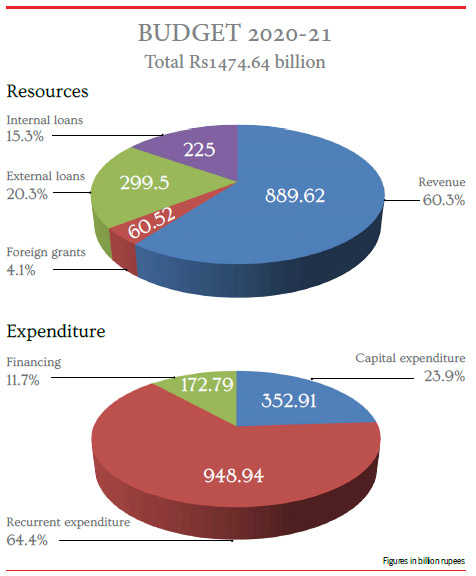
The Rs 1.47 trillion financial plan, which is around 4 percent smaller than the current budget, has earmarked Rs 948 billion for recurrent expenditure, Rs 352 billion for capital expenditure, and Rs 172 billion for financing provisions.
Khatiwada’s 7 percent growth ambitions, however, come on the heels of the Central Bureau of Statistics’ projection last month that Nepal’s economy will grow at 2.27 percent this fiscal year, ending mid-July, a massive deceleration from the government’s projected 8.5 percent target.
“The entire budget speech is focused on ‘we are doing this and we are doing that’. That’s not a budget. These are just unrealistic promises that are unimplementable,” Mahat told the Post. “The focus should have been on economic recovery rather than eyeing such an ambitious growth target.”
The budget has also failed to account for a number of critical conditionalities, including the fact that thousands of migrants are going to return home in the wake of a global recession, say economists.
According to Shankar Sharma, former vice-chairman of the National Planning Commission, the budget focuses on health and employment, seemingly forgetting that thousands of migrants are returning and feeding them all will be a problem. “There are no concrete programmes to address the food deficit,” said Sharma.
But Sharma, along with former attorney general and former finance secretary Bhanu Acharya, agreed that the 7 percent growth rate was overly optimistic, especially with the same programmes.
Acharya, however, called the reduction in the size of the budget a wise decision as it is going to be difficult to raise resources in the next fiscal year.
“It’s probably the first time in history that the budget size has been reduced,” he said. “The priorities are right in the current context but I am doubtful if the Health Ministry will be able to spend such a large amount as the spending capacity of the government mechanism has not been improved for years.”
Khatiwada has announced Rs90.69 billion for the health sector, up 32 percent from Rs68.78 billion for the current fiscal year. An increase in the budget for the health sector was largely expected, given the pandemic that has claimed five lives and infected over 1,000 in the country.
According to Acharya, there is not much to complain about when it comes to economic packages for the private sector, particularly the small and medium enterprises.
“But the finance minister could have done better by reducing corporate income tax to some extent, given that Nepal needs more investment,” he said. “India has already lowered its corporate income tax to 20 percent.”
To fund expenses for the next fiscal year, Khatiwada said that the government is planning to raise Rs 889.62 billion in tax and non-tax receipts. Rs 60.52 billion will come through foreign grants while the resulting deficit of Rs524.50 billion will be financed through foreign loans of Rs299.50 billion and domestic loans of Rs225 billion.
“Domestic loans mean that the government has to rely on Nepali banks,” said Mahat, the former finance minister. “If the banks fund the government, there will be no liquidity left for the private sector to invest.”
Analysts were cautious about welcoming the budget, pointing to its ‘populist’ nature and the lack of tangibles to support what seems like an unrealistically high goal.
Job creation is a focus for the government, as tens of thousands of Nepalis are set to return from foreign countries, especially India, Malaysia, South Korea and those in the
Persian Gulf.
“The government has envisioned creating thousands of jobs next fiscal year, but there is no proper way to document how many jobs will be created by the public sector,” said Mahat.
Khatiwada said that Rs20 billion has been allocated towards generating 600,000 jobs. The budget for the Prime Minister’s Employment Programme has been doubled to Rs11.60 billion that will provide jobs to 200,000 people, the budget statement reads.
“Rs 4.34 billion has been allocated to provide skills training for 75,000 individuals,” said Khatiwada.
The government plans to generate 150,000 jobs by mobilising seed money worth Rs19 billion from the Poverty Alleviation Fund through a cooperative model.
In light of the Covid-19 pandemic, the government has announced a financial package worth Rs150 billion, which is 4 percent of the country’s GDP, to offset the negative impacts of Covid-19 and the subsequent lockdown.
Rs500 million has been allocated to provide subsidies on interest for people starting new businesses.
“The government will charge only 2 percent of interest on loans for start-ups,” said Khatiwada.
The budget has continued with many ongoing projects while introducing few new ones. Rs12.21 billion has been allocated to upgrade the East-West Highway to an Asian highway standard.
The budget has announced the construction of the Dudhkoshi reservoir hydropower project with financial support from four donors. Khatiwada said that 1,300 MW of electricity will be added to the national grid in the next fiscal year.
The budget announces that Nepal will be producing clothes and shoes domestically for security personnel, and will become self-sufficient in food production. Consequently, the government has increased the budget for state-subsidised chemical fertiliser from Rs9 billion to Rs11 billion and announced the construction of 200 food storage facilities.
In its policies and programmes, the government had emphasised the agriculture sector.
“We will be spending big in the agriculture sector as the government plans to make farm activities a major employment generating sector,” the policies and programmes read.
But as usual, the agriculture sector remained the least priority sector with a budget allocation of just Rs 41 billion, which is less than 4 percent of the total estimate.
HOME PAGE

Budget announces tax exemptions of up to 75 percent for micro and small industries

The budget for the fiscal year 2020-21 has sought to provide remedy for industries affected by the pandemic, including tourism, agriculture and small businesses.
- PRITHVI MAN SHRESTHA
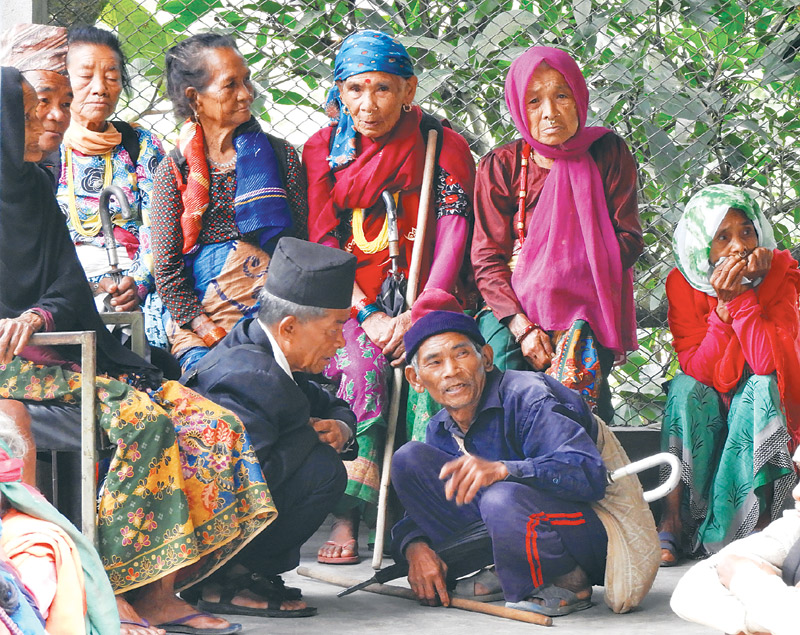
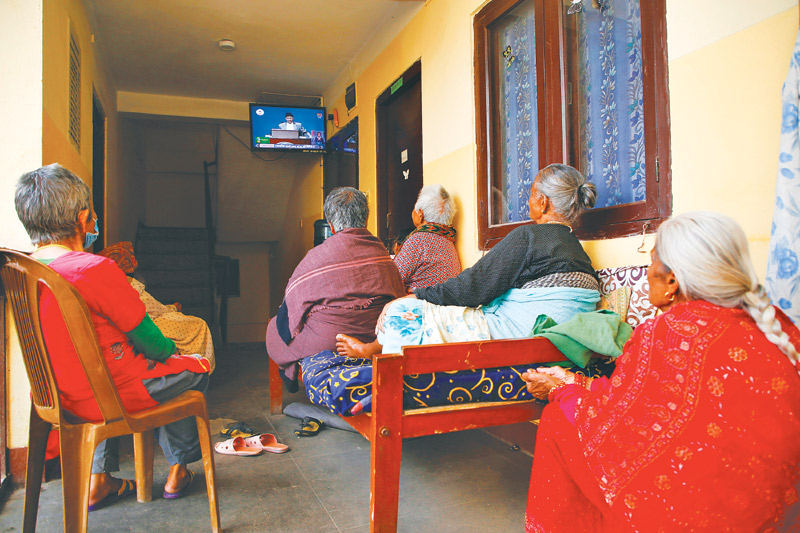
Elderly women listen to the federal government’s budget in Kathmandu on Thursday. Post Photo: Kabin Adhikari

KATHMANDU,
Finance Minister Yubaraj Khatiwada on Thursday announced massive tax exemptions for micro and small enterprises, which have been hit hardest by the Covid-19 pandemic.
Presenting the budget for the upcoming 2020-21 fiscal year at a joint session of Parliament, Khatiwada announced that these enterprises would be eligible for income tax exemptions from 25 to 75 percent.
As per the announcement, small enterprises with annual turnovers of less than Rs2 million will be eligible for a tax exemption of 75 percent while those whose turnover is between Rs2 million and Rs50 million will be eligible for 50 percent tax exemption. Enterprises with an annual turnover between Rs5 million and Rs10 million will receive an exemption of 25 percent, according to the budget.
Enterprises with fixed assets up to Rs100 million are considered micro, cottage and small industries, according to the Industrial Enterprise Act.
According to Khatiwada, the budget has adjusted tax rates and provided tax exemption to assist in the recovery of enterprises, especially those related to agriculture, industry and services.
Small entrepreneurs have welcomed the tax exemptions.
“I have not seen such a large tax exemption in decades. It is a welcome move as small enterprises have been badly affected by the coronavirus,” said Umesh Prasad Singh, acting president of the Federation of Nepal Cottage and Small Industries. “This is a good provision, although we had asked that the government announce tax exemptions for two years.”
The budget has extended income tax exemptions for new micro-enterprises from five years to seven years while women-owned small enterprises will now receive tax exemptions for 10 years, up from seven.
There are also reductions in customs duty on the import of machinery and raw materials for macro and small enterprises, and enterprises related to livestock, agriculture and masks.
Reflecting a larger focus on agriculture, the budget has also reduced customs duty on the import of seeds and primary agricultural tools. In order to support local production, the customs duty and agriculture reform fees on the import of agricultural goods have been consequently raised.
According to the budget, the tourism industry, which includes aviation, hotel, travel, trekking and transport sectors, will also receive income tax exemptions of 20 percent in the next fiscal year.
Industries set up in industrial villages will receive income tax exemptions of 50 percent for five years after the beginning of operations. Consumer committees related to drinking water and sanitation won’t be required to pay income tax while income tax accumulated until the last fiscal year 2018-19, will be waived, the finance minister announced.
Consumer committees had been lobbying hard to remove the 25 percent income tax on saved earnings that the government was asking them to pay.
Cooperatives that operate in rural municipalities will no longer have to pay income tax, according to the new budgetary announcement. However, cooperatives operating in municipalities, sub-metropolitan cities and metropolitan cities will be required to pay five, seven and 10 percent income tax, respectively.
The government announced that the domestic pharmaceutical industry will get a waiver of value-added tax (VAT) on the import of raw materials, including on ethanol for the production of sanitisers. If such materials are procured from local enterprises, the paid VAT will be reimbursed, according to the budget. The exemption from customs duty on the import of raw materials also applies to ayurvedic medicines.
The finance minister also announced the removal of excise duty on about a dozen products without specifying them, the list of which is presented in the Financial Bill, a separate document.
Health risk taxes on tobacco products, including cigarettes, gutkha, cigars, and pan masala, have increased, following the tradition of increasing taxes on products that are hazardous to health. There is no change in taxes for alcohol.
There will be increases in excise duty for imported furniture, in order to protect the domestic furniture business, and customs duty on petroleum products, although the duty will remain the same for aviation fuel and cooking gas, to account for the impact of Covid-19 on aviation and households. Customs duty on gold and jewellery has also been increased, according to the budget.

Page 2
MEDLEY

Horoscope

ARIES (March 21-April 19)
*****
Positive energy is all around you today, protecting you from any bad mojo and keeping a bright smile on your face all day long. Get ready for some unexpected flirtation and a few sweet gifts to come your way. They’re someone’s way of getting you to finally notice them and hopefully spend a little more time with them some day.


TAURUS (April 20-May 20)
***
Today’s indecisive energy could cause you to delay some plans. But the good news is that a delay might be beneficial, so don’t get too frustrated about it. It’s out of character for you to be inflexible anyway, so frustration shouldn’t be an issue. This day calls for you to act with more spontaneity than usual.


GEMINI (May 21-June 21)
*****
Interacting with people, even online, could be lots of fun today. Like it or not, you’re going to be giving off a ton of totally flirtatious energy, which will cause people to smile. Watch out for eye contact that lingers just a bit longer than it needs to! If you’re on the market, this could be a fabulous day for you.


CANCER (June 22-July 22)
***
The energy around you today could be a bit out of whack, which could create some misunderstandings. But even though harmless communication may be misinterprete, no big drama will result. The people you’re dealing with right now know you well enough to know that you don’t mean any harm.


LEO (July 23-August 22)
****
Take full advantage of the unique energy of today. You have even more confidence than usual, giving you a terrific boost. Don’t be afraid to take a risk. Success depends on your ability to be spontaneous and not worry about what other people think. Your imagination could be running wild with all the potential scenarios.


VIRGO (August 23-September 22)
**
A friend is about to take a big risk, and you’re worried. You want to keep them from making a mistake, but you don’t want them to think you don’t believe in them. Just try to do your best to help them see things more conservatively. Alert them to the downside of their idea and what could happen.


LIBRA (September 23-October 22)
****
You’ll be able to switch out some good energy for bad today. Your ability to end arguments and be the peacemaker is stronger than ever. That means it’s a great day to lead a meeting, be a part of a negotiation, or help two bickering friends come to a compromise. People will be amazed by what you can do.


SCORPIO (October 23-November 21)
***
Take one last look at the small print before you sign anything today. You can’t take anything for granted right now. It’s not that people are trying to trick you, it’s just that you need to get more proactive about evaluating what you associate yourself with. Taking shortcuts will only get you lost.


SAGITTARIUS (November 22-December 21)
***
Philosophising is fine, but unless you dig in deep and really try to see a problem from the inside out, you’re never going to make any progress. You don’t need research or planning. You need real-world experience! If you’re contemplating a change but aren’t sure which way to go, take a trial run and see how it goes.


CAPRICORN (December 22-January 19)
***
Your intellectual abilities might fail you temporarily, but it will be more amusing than embarrassing. There’s no need to worry that you’re losing your smarts. You aren’t. Okay, they might be going away for a while, but only because you could use a fresh perspective on things. You’ve been overthinking your life a bit too much.


AQUARIUS (January 20-February 18)
*****
You’re attracted to someone’s unique energy today. They have a way of looking at the world that you admire. It’s time to get to know them a little better. Admit that you just like them. They’ll be flattered, and most likely they’ll return the compliment. You two have a lot of things in common.


PISCES (February 19-March 20)
****
Despite all the fun stuff that’s going on in your life right now, you need to resist the urge to share too much. It’s best to be humble right now and play it cool. Monopolizing the conversation isn’t your style anyway, and giving out too many details could cause someone to get overwhelmed and lose interest in hearing more.

Page 3
NATIONAL

On boundary row, Delhi says open to engage with Nepal on the basis of mutual sensitivity

The statement from New Delhi comes just as the Oli government is preparing to table a constitutional amendment proposal to update the country’s map in the national emblem.
- ANIL GIRI

KATHMANDU,
In a conciliatory tone, New Delhi on Thursday responded to Kathmandu’s calls for dialogue to settle the boundary row, reiterating that India attaches great importance to its friendly relations with Nepal.
During a regular press briefing at the Ministry of External Affairs in the Indian capital, Anurag Srivastava, the Ministry of External Affairs spokesperson, said: “On the recent developments on boundary issues, we continue to monitor the situation in Nepal. We note that this matter is receiving careful consideration in Nepal, taking its seriousness into account.”
The boundary dispute between Nepal and India has escalated since the former’s release last week of a new political and administrative map depicting Kalapani, Limpiyadhura and Lipulekh, the territories that India also claims as its own, within Nepal’s borders. The map was issued in response to the Indian inauguration of a road that passes via Lipulekh to connect Kailash-Mansarovar in the Tibet Autonomous Region of China.
India’s fresh statement appears conciliatory since the May 20 response after Nepal published the revised map, when it asked the government of Nepal to refrain from such “unjustified cartographic assertion” and respect India’s sovereignty and territorial integrity.
Nepal has registered a proposal in Parliament for a constitutional amendment to update the map in the national emblem. The proposal was supposed to be tabled on Wednesday but it was not immediately moved forward.
The Indian External Affairs Ministry spokesperson stated that “India attaches great importance to the deep rooted historical, cultural and friendly relations with Nepal”.
“Even in these challenging times of Covid-19 pandemic, India has ensured unimpeded trade and supply of essentials including medicines to Nepal, besides providing assistance in terms of medical supplies and other facilitation,” read the statement.
Nepali officials said back-channel diplomacy and efforts to ease tension are at work with channels of communication open on both sides.
India wants to de-escalate tension while the Nepali side wants to put maximum pressure on New Delhi so that there are concrete results this time because the KP Sharma Oli government has already taken some strong measures including the releasing of the new map, according to officials privy to the developments.
In an interview with the Hindu newspaper, Foreign Minister Pradeep Gyawali said that India should withdraw security forces from the Kalapani region and restore the status quo.
Nepal and India have agreed that they have boundary disputes in Kalapani and Susta and have decided to resolve the issue through the foreign secretary level mechanism.
“We want India to honor the letter and spirit of the [Sugauli Treaty]. The most appropriate way of doing this would be to withdraw security forces from Kalapani and handover the above territories back to Nepal. We merely reiterated that unilateral acts like road construction in Nepal’s territory should not have been done, and the issue should be resolved through talks at the earliest,” Gyawali told The Hindu.
The recent boundary tension flared up after India’s Defence Minister Rajnath Singh inaugurated the opening of a road link in Uttarakhand’s Pithoragarh via the Lipulekh pass.
Nepal handed a diplomatic note to the Indian ambassador protesting the opening of the road via the Nepali territory. On May 9, India stated that both sides will sit for talks once two societies and governments have successfully dealt with the challenge of Covid-19 emergency.
But Nepal rejected the offer and said that it wants immediate talks with India and unilateral action in the disputed area should be halted. Later the situation turned more serious after Indian army chief MM Naravane pointed out third-party instigation and the Indian media squarely blamed China for the dispute.
Srivastava stated on Thursday that India is open to “engaging with all its neighbours on the basis of mutual sensitivity and mutual respect, in an environment of trust and confidence. This is a continuous process and requires constructive and positive efforts.”

NATIONAL

Supreme Court says lockdown days to be counted as ‘zero period’

- TIKA R PRADHAN

KATHMANDU,
A historic broader full bench of the Supreme Court has decided that all court dates could be furnished within 30 days after the ongoing nationwide shutdown is lifted, and the lockdown days will be observed as a ‘zero period’.
The  bench formed on May 18 and comprising all 19 justices presided by Chief Justice Cholendra Shumsher Rana, has decided to count the zero period from March 22, two days before the nationwide lockdown began.
“The period of lockdown beginning from March 22 until its end will be observed as a ‘zero period’ for the legal purposes, and deadlines and court dates won’t be counted for that period,” states the court decision released on Thursday.
The full bench was convened to seek a way out of the unexpected hurdles the court faces in delivering justice due to the lockdown. Lawyers said this is the first time so many judges shared the bench to discuss a case. The bench had Dipak Kumar Karki, Mira Khadka, Hari Krishna Karki, Biswombhar Prasad Shrestha, Iswor Khatiwada, Ananda Mohan Bhattarai, Anil Kumar Sinha, Prakash Singh Raut, Sapana Pradhan Malla, Tej Bahadur KC, Purushottam Bhandari, Bam Kumar Shrestha, Tanka Bahadur Moktan, Prakash Dhungana, Sushma Lata Mathema, Kumar Regmi, Hari Prasad Phuyal and Manoj Kumar Sharma.

NATIONAL

Budget fails to attach required priority to education, experts say

The government falls behind in allocating funds despite tall promises.
- BINOD GHIMIRE

KATHMANDU,
Despite the government’s tall claims to prioritise the education sector, both school and university education failed to get adequate budget for the upcoming fiscal year 2020-21.
The government’s policies and programmes, which set the priority for the new budget, had announced to expand technology-based education at the school level, promote research at the university level and restructure Tribhuvan University, the country’s oldest varsity with 85 percent student share.
However, Finance Minister Yubaraj Khatiwada wasn’t generous in allocating funds to implement the government’s policies and programmes.
The Ministry of Education, Science and Technology got Rs 171.71 billion—11.64 percent of the Rs 1,474.64 billion national budget. It, however, is a mere one percent increase from the current fiscal year. The ministry has got Rs 163.76 billion for education from pre-primary to the university level for the current fiscal year.
Though the ministry got around Rs 8 billion more than last year, the additional budget is hardly enough to implement volunteer teacher mobilisation and a mid-day meal programme in all the districts, two new programmes the government has announced.
A total of Rs 6 billion will be spent to enroll volunteer teachers for Science, Mathematics and English subjects while over Rs 1.2 billion will go to the extended mid-day meal programme.
“Where is the budget to expand Information Technology in schools and boost equality in education,” questions Mana Prasad Wagle, former dean at the Kathmandu University School of Education. He said that the government has reduced the budget for higher education against its new policy of promoting research in universities.
The university budget distributed through the University Grants Commission has been reduced to Rs 17.43 billion for the new fiscal year from Rs 17.62 billion in the ongoing fiscal year. Wagle, a noted educationist, remarked that the KP Sharma Oli government is far behind in implementing what the communist parties had promised in their election manifestos before the general elections in 2017. The left alliance of the CPN-UML and the CPN (Maoist Centre), which later merged to form the Nepal Communist Party (NCP), had announced to allocate 20 percent of the national budget for the education sector. This is the third budget from the Oli government.
It is a global principle and the Nepal government’s international pledge to allocate one fifth of the national budget to education. However, it has never reached that mark. The highest allocation the sector got in the national budget was in fiscal year 2011-12 with 17.1 percent.
The government has announced to attain total adult literacy by the fiscal year 2020-21 and bring all children to the school system. The net enrolment at the grade 1, according to the economic survey presented on Tuesday, is 97.1 percent, which means nearly 3 percent children are out of school.
Education experts say those who aren’t in the school system at present are from very poor and marginalised communities. “The government needs a special programme to bring them into the school system,” Wagle said. Education campaigners have long said that children from the poorest section of society are not coming to school unless there is some economic support to their parents. However, no attention has been paid to this aspect.
Wagle, however, lauded the proposal in the budget to get secondary level private schools to support a community school as their corporate social responsibility. “I welcome this innovative provision,” he said. “This needs to be implemented strictly. There are close to 1,500 private secondary schools across the country while state funded secondary schools stand at around 8,000.

NATIONAL

Experts doubt 700,000 jobs will cushion the unemployment blow

- CHANDAN KUMAR MANDAL
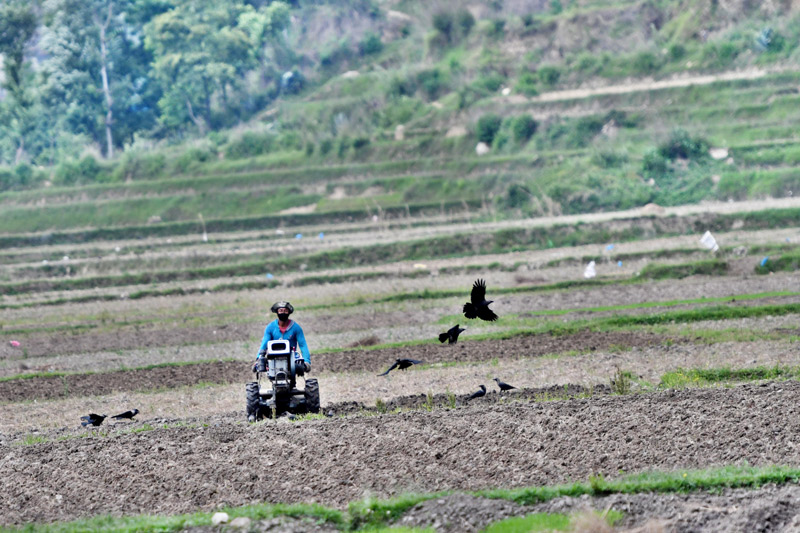
Farming is one of the areas where the government plans to create jobs. Post Photo: Deepak kc.

KATHMANDU,
The government has prioritised job creation as unemployment is expected to see a surge as an immediate impact of the Covid-19 pandemic.
Presenting the budget for the fiscal year 2020-21 on Thursday, Finance Minister Yubaraj Khatiwada announced an ambitious plan of creating more than 700,000 jobs through various programmes.
For creating jobs, the government has been heavily counting on the Prime Minister Employment Programme (PMEP). The budget allocation for the programme, which aims to provide a minimum 100-days of waged-employment to unemployment, has been doubled to Rs11.6 billion with the aim of providing 200,000 jobs in the next year. “Keeping in mind the fact that jobs of citizens within and outside the country have been affected due to Covid-19, the budget has been centred around generating additional jobs inside the country,” Finance Minister Yubaraj Khatiwada said.
“The required budget has been allocated to provide waged-employment to unemployed, those who lost their jobs due to Covid-19 and returnee migrant workers to mobilise them in development activities.”
The government’s focus on job creation, however, is neither new nor promising, given the extraordinary situation created by the pandemic, experts say.
“There are already various policies in place that aim to discourage foreign employment and create jobs in the country,” said Jeevan Baniya, a labour migration expert. “Several countries like Nepal, which has been outsourcing workers, have focused labour creation within the country. So the realisation is not new. It’s only that the Covid-19 situation has  made it stronger.”
According to Rameshwar Nepal, a labour migration researcher and South Asia Director of Equidem Research, a UK-based human rights research organisation, the government programmes should have been more progressive looking at the current situation.
“Our constitution itself guarantees the right to employment. The government has been saying for the last three years that Nepali workers will not have to go abroad for work within five years. The proposed programmes are not even adequate and exclusive for normal situations, let alone when we are confronting a pandemic.”
Experts say the expected outcomes cannot be achieved without internalising lessons from the previous years.
“We have seen the PMEP could only provide only a few days of works. People were seen doing trivial works like plucking weeds and gardening. Even for getting those jobs, there were huge administrative hassles,” said Nepal. “While the government’s plans for generating jobs in the country is a welcome one, we cannot expect different results if we don’t learn from past experiences.” The target set by the government would be enough to employ the unemployed citizens based in the country, where an estimated 500,000 workforce enter the market every year. It does not offer any support to the returnee migrant workers.
As many people who were rendered jobless due to the Covid-19 crisis are unlikely to remain unemployed for a long stretch, the government has planned to divert them in other areas by offering them various skill trainings in the fields of handicraft, plumbing and construction, among others.
The government has earmarked Rs 1 billion to organise these skill trainings for at least 50,000 people at the province and central level. Likewise, Rs4.34 billion has been allotted for strengthening organisations providing technical, vocational and skill training to employ 75,000 people, including those from the informal labour sector and returnee migrant workers.
The government has also announced a plan of employing 50,000 people in the private sector. For this, the government has announced a subsidy to private firms and businesses for hiring the state-trained workers for two years.  
Besides, the government has also set the target of offering self-employment, farming and business opportunities to 50,000 people through Youth and Small Entrepreneur Self Employment Fund and various other loan schemes. According to Baniya, proposed plans and programmes can be beneficial for immediate relief and recovery, but the sustainability of such schemes remains a challenge for they cannot provide long-term employment and decent wages.
“We have to mention who are the targeted beneficiaries clearly and also ensure decent living wages,” said Baniya, who is also the assistant director at the Centre for the Study of Labour and Mobility, a think tank. “The PMEP, despite having targeted groups, could not be effective. Lower minimum wages might fail to attract workers.”
Baniya further urged that the government also need to ensure that such opportunities need to be at the local level, or else people will once again be forced to migrate to city areas or outside the country for jobs.
Forest-based industry is another area where the government plans to create nearly 30,00 jobs. The government has also announced to mobilise Rs19billlion from the Poverty Eradication Fund to create 150,00 jobs in agriculture and micro and small industries. The government has also said soft-loans for new businesses will be provided in an easy manner.
Minister Khatiwada said the labour permit system will also be strictly enforced to ensure more jobs for Nepali workers.
Noting the failure of past government programmes to offer regular income opportunities to the people, Nepal, the labour migration researcher, said it was crucial that the job programmes are sustained and well managed this time.
“If these plans fail again like in the past, then life and livelihood of thousands of Nepali will fail,” he warned.

NATIONAL

Health sector gets 32 percent more budget in upcoming fiscal year

Experts say budget will be insufficient to deal with the pandemic and resume regular services if the number of Covid-19 cases surges.
- Arjun Poudel

KATHMANDU,
The government has allocated Rs 90.69 billion for the health sector for the upcoming fiscal year, around 32 percent more than the current fiscal when Rs 68.78 billion was set aside under the heading.
Although the health sector’s share of the pie has increased to six percent compared to 4.9 percent in the previous year, experts say the fund may not be sufficient to deal with the Covid-19 pandemic, and resume regular health services, if the number of cases continue to surge. The government has allocated Rs 6 billion for the treatment of people infected with Covid-19, and Rs 500,000 to provide insurance cover for health workers dealing with all infectious diseases.
“More budget will be needed [to fight Covid-19], if the number of cases spikes beyond the government’s estimates,” Dr Senandra Upreti, former secretary for health, told the Post.”The government should have allocate additional funds to be used in emergency situations to address the epidemic,” he added.
The main priority of the budget is to save lives and address the epidemic, said Minister Yuba Raj Khatiwada in his speech before Parliament on Thursday as he announced government plans to increase the number of hospital beds at district and zone-level  hospitals, and intensive care beds at various hospitals. Similarly, it plans to set up trauma centres in hospitals near all major highways, and quarantines and health desks at international airports and land crossings.
The government has allocated Rs 12.46 billion has for the development of infrastructure in health care. The amount will be used to set up a 300-bed infectious disease hospital in Kathmandu, and a 50-bed hospital in the capitals of all seven provinces.  Similarly, state-run hospitals in the Kathmandu Valley are to get 250 more ICU beds.  
The government also plans to provide consultant care at Karnali Academy of Health Sciences, and in Pokhara, Koshi, Narayani, Bharatpur, Bheri and Dadeldhura hospitals.  
Travel allowance of female community health volunteers have been doubled.
A sum of Rs 14.27 billion has been allocated to set up 272 health facilities at local
levels.
The government has announced plans to expand the capacity of the National Public Health Laboratory, set up high-tech laboratories in all provinces, and enhance the capacity of the Department of Drug Administration.
Experts, however, say that with the focus on the epidemic, the government has not announced its plans to resume regular health care services.  “The government has not allocated a budget to resume regular health care services, which has halted for over two months,” said  Dr Baburam Marasini, former director at the Epidemiology and Disease Control Division.
He also said that resumption of regular health services was crucial as a lot of progress made in health over the years has received setbacks due to the pandemic. “Due to the ongoing epidemic, a lot of programmes of health sectors of the ongoing fiscal year were not implemented, which have caused set back to the progress made over the years by investing huge budgets.”
Hundreds of thousands across the country have been deprived of health care services for a long time and those services cannot be resumed like in the past, he said adding that the government needs to come up with new strategies to address the problems. “But the budget speech is silent on the issue.”

Page 4
EDITORIAL

Nepal’s budget: Not quite all there

Though the government seems to have its heart in the right place, the plans and allocations announced are underwhelming.

The budget for the fiscal year 2020-21 is in. This budget is the third one under the current government—a mid-point of sorts that will mark the larger programmes that could be completed before the next elections in two years. But it is also an important indicator to gauge how the government plans to tackle the emergency currently upending the world, namely the Covid-19 crisis. Therefore, it becomes especially important to analyse the sectoral budgets and accompanying programmes announced.
To be sure, the government seems to have rightly kept the response to the pandemic at the heart of next fiscal year’s budget. In announcing his belief that Nepal will bounce back from this crisis, Finance Minister Yubaraj Khatiwada announced the intent to mobilise up to Rs1.93 trillion in internal debt to accommodate the plans announced. He also announced that economic recovery and the health sector were priorities. However, as in the past two budgets, the government has used this important platform to push through some unrealistic programmes and policies. Moreover, some fund allocations seem far fetched or suspect.
Take the crucial sector of healthcare, for example. The current fiscal budget allocated a little over Rs68 billion for the health sector. Now, that has been increased to Rs90.69 billion for the upcoming fiscal year. While the budget itself has increased by over Rs20 billion, the government has planned too many programmes but hasn’t balanced funding proportionally. Healthcare and public health were already underfunded in the country, with this government in the past failing to provide the services it had promised. Some of these unkept promises include the safe motherhood programme, telemedicine and pharmaceutical and treatment subsidies to the elderly.
Now, the budget promises the mobilisation of resources to build 200 new hospitals at all local levels, nevermind the already crumbling health facilities. Khatiwada also announced special healthcare facilities to accommodate infectious diseases, with Kathmandu getting a new centre with 250 ICU beds, while each provincial capital getting centres with 50 ICU beds each. These infrastructure projects will take at least 12.46 billion from the health budget, leaving very little left of the Rs20 billion added this year for other special projects such as double allowances for female health workers, new diagnostic and telemedicine facilities and Rs500,000 insurance for each and every health worker. In other words, there isn’t much left to strengthen the current infrastructure and programmes that needed immediate attention.
In education too, the budget is lacking. The budget for education, science and technology has only slightly increased, from just over Rs163 billion for this fiscal to just over Rs171 billion for the next. The standard global practice has been to allocate at least 20 percent of the national budget on education; like the previous two years, the allocation still falls short by a large amount. Only 26 percent of 7,553 educational institutions damaged during the earthquake have been reconstructed and only around 8,000 of over 20,000 public schools have the most basic required infrastructure. With such a paltry budgetary increase, the government’s plans to mobilise vast resources to fill the gap in teacher numbers, to construct 1,000 new computer and science laboratories, and to boost remote or community education during the current crisis fall short. How is the government, which is allocating Rs6 billion of this sectoral budget to the President’s special budget, and which has announced a quarter of the budget to be put forward for scholarships, expecting to even hold the education system together for one more year? This, without even the criticism it deserves for announcing one more university when so many active ones are failing.
The government has also failed to announce anything that will cheer up the private sector. Given the potential small businesses and start-ups have in boosting employment, the government allocated a paltry Rs500 million to fund investments in such businesses. Surprisingly, this ‘fund’ is not an equity investment but a soft loan, charged at 2 percent interest. The spending allocated for new industrial villages—over Rs2 billion—will not cheer industrial organisations currently operating which have hardly received any relief measures, even during the current economic slowdown.
Though some announcements have been disappointing, it is a welcome move that the government has at least set its sights on boosting domestic agriculture and current infrastructure projects. It has also announced a renewed focus on community cold storage and access to food. If all its policies and plans are implemented well, it would still be a welcome development. But another major issue that continues to haunt Nepal is the improper discharging of the budget itself. The federal government, and most provincial governments, failed to spend even 20 percent of their capital budget allocation for the first half of the fiscal year 2019-20. Year after year, successive governments have failed to implement effective policies in time.
As a result, most of the capital budget remains unspent until the last quarter of the fiscal year. Then, when the unspent money raises the risk of future budget shrinkages, the government in power rushes to allocate the money to new budgetary headings, essentially wasting the money on useless developments, while the original programmes allocated remain underfunded and incomplete. This year, the government cannot delay allocated expenditures. The entire economic recovery plan may hinge on proper and timely spending.

OPINION

Still untouchable

Navaraj BK and his friends died because he loved an upper-caste girl. He won’t be the last.
- Amish Raj Mulmi
Shutterstock

There are some events that shock one to the core and drag us by the collar out of our complacent privileged lives. In the past week, one such event occurred in Rukum, where Navaraj BK, a 19-year-old boy from Jajarkot, was mercilessly beaten up and then thrown into the Bheri river. Four others of a party of 19 were also killed, and one is still missing after jumping into the river to escape a mob. All this, because the Dalit boy dared to love an upper-caste 17-year-old girl from Soti village in Rukum.
The boy was an athlete; he was popular; his pictures seemed to evoke a charm that comes naturally to one with confidence. But the upper castes didn’t care. All that mattered for them was that he was a BK, a Bishwokarma, a Dalit. How dare a maker of tools hope to love a Thakuri? How dare he dream of marrying her? And how dare he try to elope with her the second time, when he had already tried a previous time and been detained? The damage to the fragile upper-caste ego was done; the Dalit had to be taught a lesson.
‘Why has this Dom (a caste slur) returned? Wasn’t he satisfied by the previous time’s beating? (translation mine)’ the girl’s mother, Prakashi Malla, allegedly said when the group arrived in Soti village. A mob of 50-60 then gathered, and began to chase them, beat up the ones they caught, and singled out Navaraj. Others in the party jumped into the river to escape the beating.
Such savagery is systemic; the wounds of this incident hadn’t even scabbed when another, equally savage, incident of upper-caste violence occurred. In Devdaha, Rupandehi, a 13-year-old Dalit girl was raped by 25-year-old Birendra Bhara, an upper-caste man. The solution: get the 13-year-old married to her rapist! But the rapist’s family refused to accept this ‘marriage’. The girl was then found hanging from a tree. The police deemed it a suicide at first and ignored it, despite the incident’s background (this is an oft-repeated model of investigation, as we shall see). It took the police four days to even register a complaint.
How does one reconcile oneself to such mockery of the law? Where does one even start? Despite the stringent criminalisation of untouchability in 2011, 18 Dalits have lost their lives to caste violence since then. And, five years ago, Nepal’s new constitution added extra protections for Dalits. Yet, rooms aren’t rented to them; Dalit women in inter-caste marriages are forced to abort; even elected Dalit representatives are given separate plates to eat from.
The outcry is natural. The government has formed a committee, as usual, to investigate. But deep down, we know this will happen again, and again. After all, it has happened before. In 2016, 18-year-old Ajit Mijar married his upper-caste girlfriend Kalpana Parajuli. Five days later, his body was found hanging. When the family arrived, they found the police had already buried Mijar without any investigation, declaring it as—what else—a suicide. Again, a government committee was formed.
In 2018, 20-year-old Maya Bishwokarma of Kailali was gang-raped by four of her co-workers, led by Ganesh Baduwal. ‘As Baduwal confessed to the police, they had raped her because she had refused to have sex with him, which he demanded as a “married man and that too from a high caste family.”’ Not satisfied with the rape, the four then murdered her. The bodies of Dalit women aren’t considered their own; in the eyes of the upper caste, they have no agency. ‘My spit from down there is acceptable, spit from my mouth is acceptable, but why isn’t food and water from my hands acceptable?’ activist Sarita Pariyar quotes a woman from the far-west.
In India, despite the Ambedkar political awakening, caste violence continues. In Nepal, without any Ambedkars to force the upper castes’ hand, we’ve built inequality into our very edifice. In 1806, a Damai had flesh cut out from his back, and salt and lemon rubbed on his wounds on charges of cow slaughter, then made to eat his own flesh before being killed. Jung Bahadur’s Muluki Ain institutionalised caste discrimination. All our ‘revolutions’, including the Maoist one—that so-called herald of progressive thought—were mostly led by upper-caste brahmin men. And our rulers today, all fed on a diet of communism that preaches no religion and no inequality, are conveniently pursuing a constitution with gender bias and sanatana dharma (read Hinduism) at its heart.
It’s difficult for Nepalis to look beyond caste because our society has perfected the art of exclusion. In an ethnically diverse society like ours, this has compounded the inequities. The Muluki Ain’s neat slotting of the caste matrix has seeped into our very being, and we simply cannot imagine a society where, say, a Dalit woman is our prime minister, or a Tharu our president. Racial stereotypes perpetuate this state. Too many times while travelling in the mountains have I heard pahadi policemen saying locals would make for terrible officials because they are lazy. Our TV shows find it funny to paint a black face and imitate a Madhesi; no wonder it is said comedy reflects society.
When inequality is normalised, the law makes little sense, for it operates differently for different people. A Tharu girl is found hanging, her clothes dishevelled, her shoe elsewhere, and it is deemed a suicide. ‘[B]etween January 2017 and February 2019, there were 30 cases where the cause of death was initially reported as a suicide, but in which other parties (usually the family of the deceased) believed it to be murder...In 25 of the 30 disputed cases, the victim was female, usually young, and in 23 of the cases, the body was found hanging.’
To those who suggest such incidents must not be ‘politicised’—that they possess the privilege to suggest so is itself an indication of where they are placed on the social ladder. Caste is political, as is the impunity of a few and the helplessness of others. There will be other Navarajs, Ajits and Pramilas as long as caste remains the foundation of our
society.

OPINION

Periods don’t pause for pandemics

Society needs to understand that menstruation is a natural process and move to tackle poor menstrual hygiene.
- SUBIDHA PARAJULI
Shutterstock

Menstrual Hygiene Day, which was observed on May 28, is a global day of advocacy which aspires to provide a bigger stage for efforts in facilitating good menstrual hygiene. The day is also marked to remind us that menstrual products cannot be luxury items, and that no one should be shunned for a process that occurs naturally.
Menstruation is not a matter of purity. Cisgender women, trans men as well as gender non-conforming people can have a womb, experience menstruation, become pregnant and give birth. The capacity to give birth to a child is a life-changing experience; indeed, organs that support this should not be considered taboo. It should not be appalling to simply let menstruators continue with their normal, regular activities. As long as general hygiene measures are followed, menstruators can perform their daily activities exactly like every other person, on any given day.


Period poverty
The ongoing pandemic has significantly impacted lives everywhere, and the situation is worsening every day in Nepal. The use of sanitary pads among adolescent urban menstruators is higher (50 percent) in comparison to those in rural areas (19 percent). Whereas, the use of old pieces of cloth was higher among rural (35 percent) than in urban (14 percent) menstruators. Covid-19 has affected the access to sanitary products for such young menstruators, as the majority of those living in rural locations used to get access to sanitary products in schools, which are now closed. Closure of schools has made it hard for menstruators who depended on schools, as they have no alternative at the moment. This has given rise to menstruators using sanitary pads longer than they should or more reverting back to unhygienic methods, which heightens the risk of reproductive tract infections (RTIs).
Earlier, things were starting to look positive for menstrual hygiene issues. Various campaigners had used a diverse range of media to help spread awareness regarding menstrual hygiene as well as to pressure the government to remove value-added tax (VAT) on sanitary items. While contraceptives are tax-free, menstrual products are still taxed as luxury goods. When one is living close to the poverty line, a 13 percent premium on an essential good becomes a major barrier.
Some of us are privileged enough to access safer alternatives, but the truth is many menstruators still strive to afford sanitary products due to poverty and lack of affordability. The sanitary pad is comparatively costly in Nepal. One packet costs around Rs60 and menstruators use at least one and a half packets in a month. The minimum monthly wage of a Nepali worker engaged in the formal sector is Rs13,450, but in the informal sector, workers can earn much lower than this. A large number of menstruators work in informal sectors like in households, contributing to self-work in agriculture and at home care services. Such informal workers do not have the luxury of spending extra on sanitary items.
Another added risk with Covid-19 is soaring unemployment. Many Nepalis, both at home and abroad, are at risk of losing their jobs. For the many that rely on domestic or foreign remittances for their livelihood, menstrual hygiene is suddenly going to take a back seat to other pressing concerns.


Taboo
Many menstruators in the rural setting are compelled to live in a period hut every month. Even though this tradition was outlawed in 2005 and criminalised in 2017, it is deeply entrenched and continues to be practised in many villages in Nepal. This is the vivid example of how stigmatisation of periods influences the day-to-day lives of menstruators.
Stories of Chhaupadi have many urbanites decry such barbaric practices. Yet, nearer home, several educated elites in urban locations too do not allow family members who’re on their period to enter the kitchen or go to the temple. This subtle practice of period shaming has been internalised. According to the 2014 Multiple Indicator Cluster Survey, conducted by Central Bureau of Statistics and UNICEF, about 50 percent of urban dwellers that menstruate dodge all social gathering invitations when they are on their period. In an article in The Kathmandu Post, many even said that they didn’t mind following these rules because they are not as outrageous as Chhaupadi. This confirms people are still haunted by these social restrictions—no matter how educated and independent they are.
Having access to menstrual products is, undoubtedly, a human right. It is time for our government to deal with the fact that menstruators, especially in marginalised groups and from rural regions, are deprived of it. Moreover, to truly elevate menstrual hygiene into social consciousness, the taboo must be broken. The rural populace, lacking internet access, need specialised attention to communicate the wrongs of this phenomenon. Only state-sponsored education can uproot such ideas from society. In the short term, as Covid-19 wreaks havoc, the government must heavily subsidise sanitary products. After all, they are an essential good.


Parajuli is an op-ed intern at the Post.

Page 5
NATIONAL

Overcrowded quarantine facilities force many individuals to pitch tents outside

Almost all local units are overwhelmed with the huge influx of returnees in the past week.
- Basanta Pratap Singh
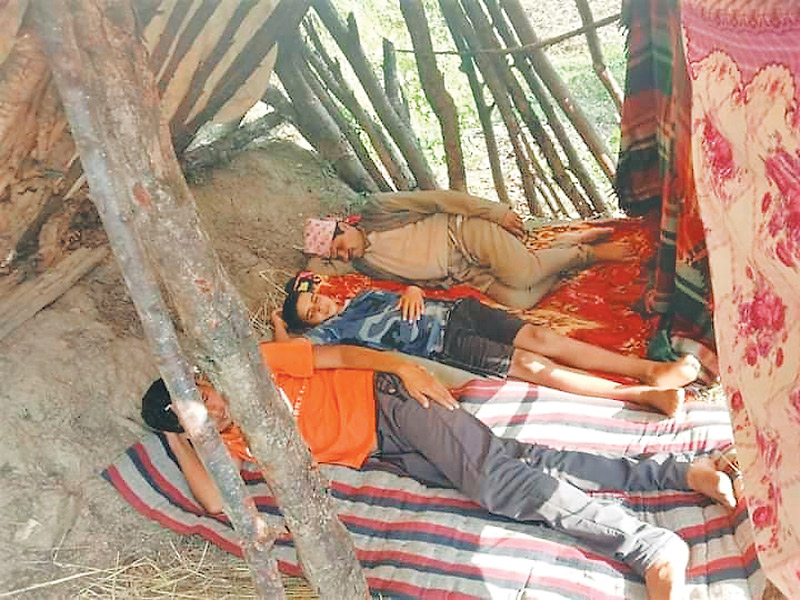
Due to a lack of space, many people have set up tents to avoid overcrowding. Post Photo: BASANTA PRATAP SINGH 

BAJHANG,
In the past week, 742 individuals, including 495 men, 133 women and 113 children,  entered Thalara Rural Municipality in Bajhang from India. All of them are currently housed in 23 quarantine facilities in the rural municipality.
The rural municipality expects the number of returnees to increase by at least a hundred by Friday, according to Padam Oli, chief administrative officer of the rural municipality.
“The quarantine facilities are filled to the brim. We don’t know where to accommodate those who are expected to reach Thalara in the next 24 hours,” said Oli.
The rural municipality has seen a steady flow of migrant workers returning from India through Gauriphanta, Banbasa, Jhulaghat, among other Nepal-India border points.
The government has instructed all local units to follow a set of standards while setting up quarantine facilities to house returnees. One of the criteria is that a quarantine facility should be built where there is easy access to roads, but given the shortage of public buildings with road access, Thalara Rural Municipality has turned school buildings in remote areas into quarantine facilities.
“We don’t have public buildings with road access so we have set up quarantine centres in the schools of remote villages. But even those are already occupied,” said Oli. “We don’t know how we will be able to accommodate more returnees.”
Given the increasing number of returnees which has overwhelmed the local unit, those staying in the facilities are bringing necessary items, such as bedding, utensils, and soaps, from their own homes. Bharat Thapa, who returned to his village last week from India, said, “Our relatives brought beddings, plates and other necessary items from home, as the local unit could not manage those items for us.”
Bhuwaneshwor Upadhyay, chairman of the rural municipality, said, “We are barely managing to feed the quarantined people; we cook seven quintals of rice on a daily basis. But if the number of people increases, we may run out of resources to feed them.”
The rest of the 11 local units in Bajhang are also scrambling to make proper arrangements for returnees in quarantine facilities.
“All our quarantine centres are filled beyond capacity,” said Barka Rokaya, chairman at Khaptad Chhanna Rural Municipality. “We are currently keeping 50 to 60 individuals in a school which was set up to accommodate a maximum of 20 individuals.”
For a lack of space at the facilities, some of the returnees at Khaptad Chhanna have pitched up tents outside their homes. “Recent returnees have started to set up tents and are staying near their houses. We can’t do anything about that right now,” Rokaya said.
The swell in the number of returnees has also affected security and health services at the quarantine facilities. Ganesh Bam, deputy superintendent of police in Bajhang, said, “Until a month ago, there were only one to two quarantine facilities in each local unit. There are now at least a dozen such facilities in each local unit. We now don’t have the resources to provide security in every facility.”
Liladhar Joshi, a local of Khaptad Chhanna who returned to his village from India on May 22, said, “Five of us have pitched tents in a field close to our homes. We did not think it safe to stay at the quarantine facility where 15 people have to share one small room.”
Since mid-May, 3,523 individuals have entered Bajhang from various parts of the country and India. Umesh  Pandey, chief district officer of Bajhang, said, “Every day, up to 400 individuals have been entering the district. We are facing difficulties to bear the pressure of the large inflow of people. I have advised the people’s representatives to put temples, sheds or any other available public buildings to use. We have no other choice.”
Province 2, which has reported the highest number of coronavirus cases in the country, is also seeing a major influx of returnees from India. Most of the districts are under-equipped to deal with such a massive influx of returnees who need to go through a mandatory quarantine period of 14 days. In Rautahat, 51 migrant workers who entered Chandrapur Municipality from India on Wednesday were compelled to spend their nights out in the open for a lack of space in the quarantine facility set up in the municipality.
“We had to stay outside the entire night. The municipality has not made any provisions to accommodate us,” said a recent returnee in Chandrapur. “We had already spent two weeks at an overcrowded quarantine facility at the Nepal-India border. I was expecting some relief when I reached Chandrapur, but was sorely disappointed.”
The District Administration Office in Rautahat had instructed all its local units to set up 500-bed quarantine facilities.
“But Ram Chandra Chaudhary, mayor of Chandrapur Municipality, did not abide by the administration’s instructions,” said Rabi Devkota, the chairman of Chandrapur Ward No. 3, adding that there’s only one quarantine facility in Chandrapur that can accommodate up to 70 individuals at a time. Chaudhary says the municipality plans to set up another quarantine facility soon.
Three thousand five hundred individuals are currently staying in various quarantine facilities in Rautahat.


Shiva Puri in Rautahat contributed reporting.

NATIONAL

One more body found in Bheri River; death toll of Soti incident reaches five

Search is on for another missing person, police say.
- HARI GAUTAM,BHIM BAHADUR SINGH
People of Chaurjahari took out a rally on Thursday, demanding action against the guilty.

RUKUM (WEST) / JAJARKOT,
A search team on Thursday recovered the body of the fifth victim of the alleged lynching incident of a Dalit man and his friends in Soti, Rukum (West).
The body of Sandip BK was recovered on the banks of Bheri River near a place called Chhedan in Jajarkot district.
The body was taken to Jajarkot District Hospital for postmortem.
Meanwhile, search parties are still looking for Gobinda Shahi.
Earlier, the search teams had retrieved the bodies of Nabaraj BK, Tikaram Sunar, Lokendra Sunar and Ganesh Budha from the river that borders the districts of Jajarkot and Rukum (West) in Karnali Province.
On May 23, the villagers of Soti in Chaurjahari Municipality, Rukum (West), had chased away Nabaraj BK and 18 of his friends after learning that the group had come to take Nabaraj’s 17-year-old girlfriend.
A day later, the bodies of Nabaraj and Tikaram were recovered in the Bheri river, leading to the reports that they were lynched and thrown into the river.
The survivors of the incident and the families of the victims have claimed that Soti villagers lynched Nabaraj and the others due to casteism.
Nabaraj came from a Dalit family and his girlfriend from the so-called upper caste. Some survivors of the incident have said that they were chased by a mob carrying household tools, knives and sticks. They have also accused the Soti villagers of hurling casteist epithets.   
Meanwhile, the people of Chaurjahari took out a rally on Thursday, demanding action against the guilty and for the deceased to be declared as martyrs.
The locals of Ward No 1, 2 and 3 joined the rally to condemn what they called “senseless murders over a caste issue”. They also demonstrated in front of the municipal office and encircled the area police office in Chaurjahari.
Gita Nepali, Tikaram’s mother, said that her son was murdered and thrown into the river. “Contrary to the rumours that he jumped into the river, my son was killed and then thrown into the river,” she said.
Police on Thursday arrested six more people in connection to the incident.
Eighteen people, including Dambar Bahadur Malla, the ward chairman of Chaurjahari-8, are currently in police custody.
DSP Thag Bahadur KC said the police have secured 10 days custodial remand against the suspects for investigation.
The families of the victims have filed a murder complaint at the District Police Office in Rukum (West) against 20 villagers of Soti.
Malla, the ward chairman, has been accused of informing the villagers about Nabaraj and his friends arriving in the village.
According to Shashiram BK, ward member of Chaurjahari-8, Malla had phoned some villagers and the local police about receiving a text message informing about the arrival of Nabaraj and his friends.
“Malla might have informed the villagers about a group of strangers arriving in the village. He could’ve been able to contain the situation if he had stopped the
villagers from attacking the youths,” said Shashiram. “The incident happened as the ward chairman who reached the incident site did not take any initiatives to stop the villagers from attacking the youths.
The police also did not do much to stop the villagers.”
The incident has gained national attention and prompted rallies in different parts of the country, calling for an impartial investigation and an end to casteism.
On Wednesday,  the National Human Rights Commission issued a statement and directed the government to conduct an in-depth and impartial investigation into the incident and take action against the guilty.
The United Nations in Nepal has also expressed its concern over the killing of the youths in Rukum (West) and has called for a fair probe.

NATIONAL

Protests at quarantine centre against police officer

- ABDHESH KUMAR JHA

RAJBIRAJ,
Tensions flared up at a quarantine facility in Tilathi Koiladi, Saptari when a Nepal Police assistant sub-inspector verbally abused those at the facility, beat them and even harassed female members.
“ASI Sanjaya Singh and others entered the quarantine building while we were asleep and misbehaved with us. They verbally abused me,” said Anu Kumari, one of the individuals at the facility.
Those in the facility had been protesting since early Wednesday morning seeking action against the police personnel. According to the individuals, Singh, under the influence of alcohol, entered the facility on Tuesday night and misbehaved with those staying there.  
“Singh and his men also trashed and chased one person from the facility. He is out of contact now,” said Shiva Mukhiya, another individual at the facility.
There are a total of 73 people, including 10 women, at the facility currently. Chairman of the local unit Satish Kumar Singh, Deputy Superintendent of Police Tilak Bharati and representatives of various political parties reached the incident site and held discussions with the quarantined people. 

NATIONAL

Police and locals clash over setting up of quarantine facility in Rautahat

Security personnel fired 12 warning shots to contain the situation.
- SHIVA PURI

RAUTAHAT,
Police fired 12 warning shots to quell a protest staged by people of Katahariya Municipality, Rautahat, against the local government’s decision to convert a local school building into a Covid-19 quarantine centre.
A clash erupted between locals and municipal officials on the issue of setting up a quarantine centre on the building of Bhasedawa Secondary School. One police officer was also injured in the affray. He was taken to a health facility in Garuda for treatment.     
People living close to the school are afraid that the coronavirus infection could spread in the community from the proposed quarantine facility.
“We don’t know what kind of precautions they will take at the facility. We are scared the virus may make its way into the local community,” said Balmiki Yadav, a local.
The situation escalated when the locals started hurling stones on municipal officials and security personnel who had reached in the area to look at the possible quarantine facility site.
Deputy Superintendent of Police Bharat Shrestha said the security personnel fired warning shots after the local people started pelting stones.
Katahariya Municipality is planning to set up a quarantine centre in Ward No 1 after the facility at Janata Secondary School in Ward No 5 reached its full capacity,  with more than 200 people currently housed there “We don’t want to put the locals at risk of any kind. Discussions are on to find a suitable place that won’t affect the locals. Many people have returned from India in the past few days and some are still on their way to Katahariya. We have to keep them in seclusion to control the possible spread of Covid-19 in the area,” said Mayor Siyaram Kushwaha.

NATIONAL

Revised regulation in Security Allowance Act hangs single helpless women out to dry

- RAMESH KUMAR PAUDEL
The new regulation will exclude single women below 60 years of age from receiving the Helpless Single Woman allowance. Post Photo: RAMESH KUMAR PAUDEL

CHITWAN, 
On March 16, the Department of National ID and Civil Registration notified all local units in the country to provide security allowance to widows/single women in accordance with the new regulation. The new regulation stipulates security allowance be given only to single women who reach 60 years of age by the end of this fiscal year as opposed to the allowance being extended to all single women with no source of income or income lower than the minimum wage stipulated by the government.
According to the notice issued by Sabitri Basnet, a section officer at the department, all local units will stop providing security allowance to single women below the age of 60 from the coming fiscal year.
The federal government distributes Rs 2,000 (every month) as security allowance to single women with no source of income or income lower than the minimum wage. The lump sum amount is distributed once every four months. In the current fiscal year, security allowances have already been distributed thrice. The next distribution is scheduled for mid-July.
Following the new regulation, the local units in Chitwan have started to notify locals about the new development. On May 14, GN Mahato, the chairman of Kalika Municipality Ward No. 5, issued a letter to notify that single women who have not reached age 60 will not receive security allowance next installment onwards.
This new development has Bishnumaya Pandey, a single mother in her 50’s in Mangalpur, Bharatpur, worried about her future.
“I used to manage expenses for medicines and children’s school supplies from the government’s allowance. I also have to pay my grocery bills at the local shops. But now they say I won’t receive the allowance; this is a difficult situation for women like me to be in,” she said.
Kunda Sharma, president of Women for Human Rights, Single Women Group, said, “We do not accept the new regulation. The government must revise it and if it doesn’t, we will protest.”
The federal government had issued the Social Security Act in 2018. In Chapter-2 under the Helpless Single Woman allowance section of the act, single women who have reached the age of sixty years shall get the helpless single woman allowance in a sum as specified by the Government of Nepal. The section further clarifies that even if a woman has not reached 60 years of age but is single, has no source of income or has an income less than minimum wage stipulated by the government, she is entitled to receive the helpless single woman allowance.
According to Sharma, the Supreme Court had ordered the government some 11 years ago to provide allowances under the above-mentioned heading to all women who are widowed or single.
“The government cannot change the court’s decision that was made 11 years ago,” said Sharma.
The data of the Department of National ID and Civil Registration showed that there are more than 800,000 widows/single women receiving the security allowance in the country at present. “Among them, around 350,000 women are under age 60,” said Jitendra Basnet, the director general of the Department of National ID and Civil Registration. “We have started the process to amend the Social Security Act in accordance with the new regulation in the present session of the parliament. Widows/single women who are currently in the security allowance list may not be excluded,” said Basnet.
According to Sharma, 86 percent of widow/single women are illiterate in the country. “The government has exploited this group. During this time of pandemic, we will be forced to stage demonstrations on the streets if the government does not revise the decision. We have started to discuss with our representatives in the province and districts,” said Sharma.

Page 6
MONEY

BUDGET VOX POP

Finance Minister Yubaraj Khatiwada on Thursday announced a Rs1.47 trillion budget estimate for the fiscal year 2020-21. The budget plans to bet on achieving the higher economic growth target of 7 percent despite economic uncertainty driven by the Covid-19 pandemic that has pushed many companies to the edge of bankruptcy this fiscal year and likely to continue in the next fiscal year as well. The Kathmandu Post spoke with economists and private sector leaders about the budget presented by the government. Excerpts:


Umesh Prasad Singh
Acting president, Federation of Nepal Cottage and Small Industries


The budget presented by the government seems to be encouraging for the cottage and small industries sector and it has addressed most of our suggestions. It must be appreciated that the government has prioritised the sector by giving different headings which generally used to get ignored in the past. The relief and other facilities that the government has announced for the sector is welcome. The implementation part as per the announcement is yet to be seen. The facilities that have been provided to micro and cottage industries and women entrepreneurs, and the announcement to issue loans at 5 percent interest, refinancing facility at 5 percent interest and loans at 2 percent interest to emerging entrepreneurs and youth entrepreneurs are laudable. I think the government has felt the importance of cottage and small industries that contribute 22.5 percent to the gross domestic product.

 
Shankar Sharma
Economist

It seems that the foreign loan component of the budget has increased. Achieving 7 percent economic growth seems to be challenging and spectacular due to the situation created by Covid-19 and the same regular programmes contained in the budget statement. The implementation part has not been satisfactory in the past, and this year it will be even harder because of the obstacles created by Covid-19. As there is a possibility of hunger occurring this year, a food package programme could have been inserted in the budget statement because the government has focused overly on the employment programme. The institutional mechanism for the employment programme is weak and needs to be strengthened. The budget is good for the health and employment sectors.
Achieving 7 percent economic growth with the usual programmes would be spectacular. Revenue estimation and priority to health and employment are the strong aspects of the budget. Risk minimisation in the economy after Covid-19 has not come out clearly, and the expenditure reduction part has also been only touched. Donors and multilateral agencies have projected a smaller economic growth rate for Nepal and South Asia, and I think the government is being optimistic with this budget. Hunger problems and a deepening poverty line have been forecast, and the government should have addressed that.


Bhawani Rana
President, Federation of Nepalese Chambers of Commerce and Industry

The budget has not come out as expected to revive the economic sector. Some of the suggestions have been addressed, and they need to be implemented as soon as possible. There are some encouraging announcements for cottage and small industries, tourism and agriculture, such as loans at 5 percent interest. I think it will not be easy to revive the economy affected by Covid-19 with the package the government has announced today. A budget to rejuvenate the economy ravaged by Covid-19 has not come.       


Shreejana Rana
President, Hotel Association Nepal

The country’s hotels were expecting to get support from the government to keep from going under as the ongoing lockdown has brought them to their knees. But the budget for the fiscal year 2020-21 has not addressed a single issue in the hospitality sector. It has not taken into consideration the current situation and the possibility of saving the tourism industry and the jobs it provides.
Development of domestic tourism, construction of conference halls, and development of infrastructure and other things like historical, cultural and artistic assets contributes to enhancing tourism. The implementation part will be challenging. Saving tourism, institutions and employees has been challenging for us, and the government failed to address all these three aspects. We will be able to prevent employee layoffs only with support from the government, investors and staff. But this did not happen, and the government did not show a sense of responsibility to look after the employees which is a very worrying matter for us.
The interest rate for big hotels was not reduced. The government has provided a 5 percent loan facility, but only for operating capital. It has addressed the issue of electricity charges, but social security is minimal. Around 3,500 hotels across Nepal which are members of the association have sought appropriate government policy to save them from bankruptcy. The association was disappointed by the government policies and programme released earlier as it did not address its grievances. The hospitality industry received a savage blow from the Covid-19 outbreak and the subsequent containment measures just as it was preparing to begin another year in an upbeat mood following a strong performance in 2019.

MONEY

Boeing says production of embattled 737 MAX has resumed

- AGENCE FRANCE-PRESSE

WASHINGTON,
Boeing has resumed production of the 737 MAX at a “low” rate following two deadly crashes that led to the aircraft’s global grounding by regulators, the company said on Wednesday.
The jet hasn’t flown commercially since March 2019 and is still a number of key steps away from being cleared for service by the US Federal Aviation Administration and other regulators.
Boeing said work on the MAX had resumed at the company’s Renton, Washington factory as it implements initiatives to enhance workplace safety and product quality.
“We’ve been on a continuous journey to evolve our production system and make it even stronger,” said Walt Odisho, vice president and general manager of the 737 programme.
The aerospace giant had shut production in January amid uncertainty over when regulators would clear the jet to fly again.
Even before the hit from the coronavirus, the MAX crisis had cost Boeing billions of dollars in compensation for airlines and production expenses, including the cost to store more than 400 planes that could not be delivered to customers.
Since that time, Boeing’s troubles have deepened as its airline customers have been thrust into a fight for survival due to plunging travel demand from coronavirus shutdowns.
Earlier Tuesday, Boeing released details on a downsizing plan to cut total headcount by 10 percent, or roughly 16,000 employees in all.
The company said it approved 5,520 US employees for voluntary layoffs and was notifying another 6,770 staff members that they would be involuntarily let go.

MONEY

Nissan sets out survival plan after first loss in 11 years

- REUTERS

TOKYO, 
Nissan Motor Co unveiled a plan to become a smaller, more cost-efficient automaker on Thursday as it looks to recover from four years of tumbling profits that culminated in its first annual loss in 11 years.
Under a new four-year plan, the Japanese carmaker will slash its production capacity and model range by about a fifth to help cut 300 billion yen ($2.8 billion) from fixed costs as it fights for survival in a market hit badly by the coronavirus pandemic.
Nissan is aiming for a 5 percent operating profit margin and global market share of 6 percent under what is its second recovery plan in less than a year. Nissan posted an annual operating loss of 40.5 billion yen for the year to March 31, its worst performance since 2008/09. Its operating profit margin was -0.4 percent.
The automaker sold 4.8 million vehicles during the period, the second decline in a row and a fall of 13 percent from last year, knocking it off its perch as Japan’s second biggest automaker to trail Toyota and Honda.
Even before the spread of the novel coronavirus, Nissan’s slumping profits had forced it to row back on an aggressive expansion plan pursued by ousted leader Carlos Ghosn. Nissan’s operating profit has tumbled for four consecutive years as its pursuit of market share, particularly in the United States, led to overcapacity at its car plants, steep discounting and a cheapened brand.
The new four-year strategy lays out a path to sustainable profitability and is the vision of Chief Executive Makoto Uchida and Chief Operating Officer Ashwani Gupta, who took over after months of internal turmoil following Ghosn’s arrest in 2018.
Under the plan, Nissan will curb its ambitions for sales growth to target annual sales of about 5 million units, Reuters reported in April, a cut from a previous goal of 6 million cars outlined in July by then-CEO Hiroto Saikawa.
Another top priority will be the preservation of cash. As of December, Nissan’s automotive operations had negative free cash flow of 670.9 billion yen, a more than six-fold increase from a year ago.

MONEY

New wave of US layoffs feared as coronavirus pain deepens

- REUTERS
A man works at a construction site in Miami, Florida, US. reuters

WASHINGTON, 
Job cuts by US state and local governments whose budgets have been crushed fighting the Covid-19 pandemic and more second-wave layoffs in the private sector likely contributed last week to a 10th straight week of more than 2 million Americans seeking unemployment benefits.
The Labour Department’s weekly jobless claims report on Thursday, the most timely data on the economy’s health, is also expected to show the number of people on jobless benefits hitting a new record high in mid-May.
The report is being watched to assess how quickly the economy rebounds after businesses shuttered in mid-March to control the spread of Covid-19 and almost ground the country to a halt. While non-essential businesses are starting to reopen, claims have stayed at astonishingly high levels.
“I am concerned that we are seeing a second round of private sector layoffs that, coupled with a rising number of public sector cut backs is driving up the number of people unemployed,” said Joel Naroff, chief economist at Naroff Economics in Holland, Pennsylvania.
“If that is the case, given the pace of reopening, we could be in for an extended period of extraordinary high unemployment. And that means the recovery will be slower and will take a lot longer.”
The number of people filing new claims for state unemployment benefits likely totalled a seasonally adjusted 2.1 million for the week ended May 23, down from 2.438 million the prior week, according to a Reuters survey of economists.
The number has fallen steadily since hitting a record 6.867 million in late March, but have not registered below 2 million since mid-March. State governors have requested $500 billion to help cover public health expenses and lost tax revenues, underscoring the devastating impact of Covid-19 on the economy.
The Commerce Department is expected to confirm in another report on Thursday that gross domestic product contracted at a 4.8 percent annualize rate in the first quarter, the deepest decline in output since the 2007-09 Great Recession.
The second wave of layoffs could grow bigger, with Boeing announcing on Wednesday it was eliminating more than 12,000 US jobs and also disclosing it planned “several thousand remaining layoffs” in the next few months.
The Federal Reserve’s Beige Book on Wednesday, comprising anecdotal information on business activity from contacts nationwide on or before May 18, was equally grim. Its depiction of the labour market said “employment continued to decrease in all districts” and “continued to fall sharply in retail and in leisure and hospitality sectors.”
In addition to the spill over to segments of the economy not initially impacted by the closure of nonessential businesses, some economists said initial claims were staying elevated also because of backlogs from the flood of applications that overwhelmed state unemployment offices.
But this was dismissed by many who argued these backlogs should have been eliminated by now.
There is also belief that state employment offices are combining filings for the federal government’s Pandemic Unemployment Assistance (PUA) programme with regular jobless claims instead of separating them as required by the Labour Department.
The PUA programme is for gig workers and many others who do not qualify for regular unemployment insurance. They, however, must first file for state benefits and be denied in order to get federal aid for coronavirus-related job and income losses.
Last week’s filings would raise the number of people who filed claims for unemployment benefits to above 40 million since March 21. Economists cautioned this figure does not represent the number of jobs lost due to the pandemic, citing technical difficulties and procedures at state unemployment offices.
The focus should be on the number of people still receiving unemployment benefits. These so-called continuing claims could shed light on the effectiveness of the government’s Paycheck Protection Program.
The PPP, part of a historic fiscal package worth nearly $3 trillion, offered businesses loans that could be partially forgiven if they were used for employee salaries.
Continuing claims, which are reported with a one-week lag, likely increased to a record 25.750 million in the week ending May 16 from 25.073 million in the prior week, according to the Reuters survey. This data will cover the period during which the government surveyed households for May’s unemployment rate.
Based on the forecast, continuing claims increased roughly by 7.7 million between the April and May survey periods, suggesting a surge in the unemployment rate from last month’s post-World War Two record of 14.7 percent.
“Now is a good time to think how many of those people who lost their jobs are going to get them back, my sense is 25 percent will not and that’s what gives us the double digit unemployment rate well into 2021,” said
Joe Brusuelas, chief economist at RSM in New York. “The bankruptcies of small and medium enterprises will result in a much higher rate of permanent layoffs.”

MONEY

PADelux sanitary pad brand launched digitally

Bizline

Kathmandu: Health & Hygiene Product Pvt Ltd made history in Nepal when it launched a new brand, PADelux, through online media on Thursday. This is for the first time in the history of marketing and advertising of Nepal that a completely new brand was launched through online media. The company introduced the brand with the objective to address the need of premium and world-class, cost effective sanitary pads in the country, states the press release issued by the company. The launch was spearheaded by Shrinkhala Khatiwada, Miss Nepal 2018, who is also known as an activist in women menstrual hygiene in Nepal. She revealed nine different variants under PADelux brand from her own home on Thursday.
‘I believe PADelux is not just another sanitary napkin. It is the brand that can be the voice in bringing change to menstrual hygiene conversations and practices prevalent in the Nepalese society,’ Khatiwada said.

Page 7
WORLD

Heat, water woes and coronavirus: India’s perfect storm

- AGENCE FRANCE-PRESSE

New Deli,
Bollywood stars and political leaders have urged Indians to wash their hands to protect against coronavirus but that’s a pipe dream for slum-dwellers like Bala Devi, now sweltering through a summer heatwave.
The 44-year-old widow and her family of eight are among tens of millions of people facing months of torrid weather while stuck at home, in lockdown, without regular access to clean water to keep cool and wash.
“It is so hot the children keep asking for water to drink. How can I give them water for washing their hands when we don’t have even enough water to drink?” Devi said at her cramped home in New Delhi.
“Every drop of water is a luxury for us. We can’t afford to spend it on bathing,” she told AFP, pinching her nose at the waft of clogged drains as unwashed children milled around her.
Outside it is around 45 degrees Celsius (113 degrees Fahrenheit) but her one-bedroom tenement house has just an improvised ceiling fan to keep its occupants cool.
There is a piped water connection but the supply is extremely erratic and a pump connected to the groundwater mostly spews air. Her family uses a common public toilet and their “bathroom” is a bucket behind a curtain. “If we can’t wash and clean and there is filth everywhere, obviously the virus will attack us, but what can we do?” asked Devi’s neighbour Anita Bisht.
“Already our children are falling sick,” she added, her half-naked toddler hanging from her arms.
Even before the coronavirus pandemic, water was in short supply for the 100 million people living in India’s urban slums.
Prime Minister Narendra Modi’s government has listed water infrastructure as a key priority, promising to reach 145 million rural households by 2024. But currently roughly a third of the country’s 1.3 billion people cut back on washing and bathing during summer as taps run dry.
Trucks deliver water to areas suffering shortfalls during the summer months but fights regularly break out in long queues to the tap.
Last year the southern city of Chennai ran out of water entirely.
Heatwaves are increasing in frequency, and this week the mercury hit 50 Celsius in western Rajasthan state. Parts of Delhi recorded their hottest May temperatures in almost 20 years.
Heat stress has killed around 3,500 people around the country since 2015, according to government figures, while farmers have killed themselves because of droughts ravaging their crops. Only around seven percent of Indian households have air conditioning, despite rising incomes making the luxury more affordable for some.
Tarun Gopalakrishnan from the Centre for Science and Environment think-tank said India must brace for frequent periods of extreme heat in the future.

WORLD

Rising caseloads in India, Russia underline reopening risks

South Korea reports its biggest jump in virus cases in more than 50 days, a setback that could erase some of the gains.
- ASSOCIATED PRESS
People suspected of being infected with the new coronavirus wait to receive tests at
a coronavirus screening station in Bucheon, South Korea, on Thursday. AP/RSS

Moscow,
India saw another record daily jump in coronavirus cases Thursday while Russia reported a steady increase in its caseload even as it moved to swiftly ease restrictions in sync with the Kremlin’s ambitious political plans.
The developments come as the United States crossed a sombre
landmark of 100,000 coronavirus fatalities, meaning that more Americans have died from the virus than were killed in the Vietnam and Korean wars combined.
India, home to more than 1.3 billion people, reported more than 6,500 new infections, another record daily surge that brought the nation’s total to more than 158,000 infections. The spike comes as the nation’s two-month-old lockdown is set to end Sunday.
Prime Minister Narendra Modi’s government is preparing a new set of guidelines to be issued this weekend, possibly extending the lockdown in worst-hit areas as it promotes economic activity. Earlier this month, the country allowed reopening of shops and manufacturing and resumption of some trains and domestic flights and vehicles’ movement.
South Korea on Thursday reported its biggest jump in coronavirus cases in more than 50 days, a setback that could erase some of the hard-won gains that have made it a model for the rest of the world. Health officials warned that the resurgence is getting harder to track and social distancing and other steps need to be taken.
And in Russia, high daily numbers of new coronavirus infections underlined the risks of reopening the economy, which has been badly battered by the outbreak.
Earlier this week, Russian President Vladimir Putin announced that Russia will hold a military parade marking the 75th anniversary of the Nazi defeat in World War II on June 24, declaring that the nation has passed the peak of the pandemic that had forced the Kremlin to postpone the celebrations.
The massive May 9 parade marking Russia’s most important holiday was intended to emphasize the nation’s key role in World War II and underline its international clout, with French President Emmanuel Macron and other world leaders set to attend. The Russian Foreign Ministry said Thursday that Moscow will now resend the invitations to Macron and others.
Russian media reported that the Kremlin now also plans to go ahead with another high-priority event on Putin’s political agenda—a plebiscite on constitutional amendments that could allow him to stay at the helm through 2036 if he chooses. The Russian president postponed the vote from April because of the outbreak.
The government’s anti-coronavirus task force reported more than 8,300 new infections Thursday, about the same as in the previous day and lower than the peak levels of more than 11,000 cases earlier this month. The total number of infections topped 379,000, the world’s third-largest caseload behind the United States and Brazil.
Russian officials reported 174 new deaths, repeating the highest daily toll recorded two days ago and bringing the nation’s total to 4,142.
Some Kremlin critics alleged that the nation’s relatively low mortality of about 1% of those infected might reflect manipulations driven by the authorities’ desire to set a positive environment for both the parade and the constitutional vote.
Russian officials have angrily rejected the allegations, charging that the low toll was a result of sweeping preventative measures, broad testing and efficient treatment.
The situation in many other countries also underscores the difficulty in reopening economies.
But despite the risks, the pressure for easing restrictions has risen across the globe as the economic pain inflicted by the pandemic has deepened.
Worldwide, the virus has infected more than 5.7 million people and killed over 355,000, with the US having the most confirmed cases and deaths, according to a tally by Johns Hopkins University. Europe has recorded about 170,000 deaths.
The true death toll from the virus is widely believed to be significantly higher, with experts saying many victims died without ever being tested.
Some nations are seeing improvements. New cases in Spain and Italy have fallen steadily for two months. China reported just two new cases on Thursday, both from abroad. New Zealand has reported no new cases for six days and has just eight active cases remaining.

WORLD

China approves plan to impose Hong Kong security law

- AGENCE FRANCE-PRESSE
China’s President Xi Jinping (centre), Premier Li Keqiang (right) and Chairman of the Chinese People’s Political Consultative Conference Wang Yang (left) applaud after the vote on a proposal to draft a Hong Kong security law during the closing session of the National People’s Congress at the Great Hall of the People in Beijing on Thursday. AFP/rss

Beijing,
China’s parliament approved plans on Thursday to impose a security law on Hong Kong that has ratcheted up tensions with the US and sparked new protests over fears the city is losing its special freedoms.
The vote by the rubber-stamp National People’s Congress (NPC) came hours after the United States revoked the special status conferred on Hong Kong, paving the way for the territory to be stripped of trading and economic privileges.
US Secretary of State Mike Pompeo said the status had been withdrawn because China was no longer honouring its handover agreement with Britain to allow Hong Kong a high level of autonomy.
“No reasonable person can assert today that Hong Kong maintains a high degree of autonomy from China, given facts on the ground,” Pompeo said. China made the security law a priority at its annual NPC session, after huge pro-democracy protests rocked the financial hub for seven months last year.
The law would punish secession, subversion of state power, terrorism and acts that endanger national security, as well as allow mainland security agencies to operate openly in Hong Kong.
On Thursday, the final day of the congress, delegates endorsed plans for the law with an almost unanimous vote and enthusiastic applause.
Li Zhanshu—the chairman of the NPC Standing Committee which will now draft the law—said the move was “in line with the fundamental interests of all Chinese people, including Hong Kong compatriots”.
Hong Kong’s embattled leader, Carrie Lam, said she welcomed the resolution being passed.
As required in the resolution, Lam said she would submit regular reports to Beijing and “step up law enforcement and public education for safeguarding national security”.
But the law has met fierce criticism.
“It’s the end of Hong Kong... they are cutting off our souls, taking away the values which we’ve always embraced, values like human rights, democracy, rule of law,” pro-democracy lawmaker Claudia Mo told AFP.
Joshua Wong, a prominent pro-democracy activist, told AFP the security law “will kill Hong Kong’s democratic movements”.
NPC Standing Committee Vice Chairman Wang Chen said last week that Hong Kong’s delays in implementing its own security law had forced the Chinese leadership to take action.
Hong Kong pro-Beijing politician Maria Tam told AFP this week that the planned law would allow mainland authorities to work with city police to investigate suspects.
Under a law passed last year by the US Congress aimed at supporting Hong Kong’s pro-democracy movement, the US administration must certify that Hong Kong still enjoys the freedoms promised by Beijing when it negotiated with Britain to take back the colony.
Washington’s decision on Wednesday that Hong Kong does not enjoy those freedoms means it could lose trading privileges—including lower tariffs than the mainland—with the world’s largest economy.
US President Donald Trump will ultimately decide which actions to take, said David Stilwell, the top State Department official for East Asia.
“The steps will be considered and they will be as targeted as possible to change behaviour,” Stilwell told reporters. He said the United States did not want to hurt the people of Hong Kong, adding: “This decision was made by the government in Beijing, and not by the US.”
China’s foreign ministry office in the financial hub said Thursday that the US revoking Hong Kong’s special status was “the most barbaric, the most unreasonable and the most shameless”.
Washington’s move came after fresh protests broke out in Hong Kong on Wednesday over another controversial proposed law that criminalises insults to the national anthem.
Police surrounded fired pepper ball rounds at protesters and arrested more than 300 people, mostly for unlawful assembly.
“It’s like a de facto curfew now,” Nathan Law, a prominent pro-democracy advocate, told AFP.
“I think the government has to understand why people are really angry.”
Under the “one country, two systems” model agreed before the city’s return from Britain to China, Hong Kong is supposed to be guaranteed certain liberties until 2047 that are denied to those on the mainland.
The mini-constitution that has governed Hong Kong’s affairs since the handover obliges the territory’s authorities to enact national security laws. But an effort to do so in 2003 was shelved after huge protests by Hong Kongers. China is motivated by fear of a younger Hong Kong generation that “does not agree with the political system of the Communist Party,” said Hua Po, an independent political commentator based in Beijing.
“If they lose control over Hong Kong, the impact on the Chinese mainland will be huge,” Hua said.

WORLD

Afghan government says ceasefire still in place even as skirmishes with Taliban resume

- REUTERS

Kabul,
Skirmishes between Taliban fighters and Afghan security forces recommenced in Afghanistan in the day since a three-day ceasefire expired, but government officials said on Thursday that the incidents were minor and the truce could still hold.
The Taliban have remained silent on government appeals for an extension of the ceasefire, which was announced for the Eid al-Fitr holiday that ends the Muslim holy fasting month of Ramadan.
“Taliban attacked checkpoints in the Syagird district of central Parwan province late Wednesday night,” a spokeswoman of the province’s governor said, adding that seven Afghan security forces personnel were killed.
Taliban spokesman Zabiullah Mujahid, meanwhile, said the government had carried out air strikes on Wednesday in the southern province of Zabul despite the group’s fighters not having carried out any attacks.
The United States has reached an agreement with the Taliban to withdraw U.S. forces after more than 18 years in Afghanistan, leaving the Afghan government to negotiate a peace deal with the Islamist insurgents to end the war.
But so far the conflict has not subsided, with the holiday ceasefire having come at a time of intensified fighting.
Since the truce formally ended on Tuesday night, senior Afghan government officials say there have been some violations from both sides, but not big enough to doom the ceasefire effort.
“The ceasefire is not over yet; there have been violations because it is a complicated technical process that requires good coordination between both sides,” said Javid Faisal, spokesman for the Afghan National Security Advisor (NSA).
The Afghan government freed 900 Taliban members from prison on Tuesday, the biggest such release yet, as part of a prisoner swap under the deal struck by the Islamist group and the United States in Qatar in February.

WORLD

Angry US protests for second night

Briefing
- AGENCIES

MINNEAPOLIS: Demonstrators clashed with police, looted stores and set fires as a man was fatally shot during a second night of protests in the US city of Minneapolis on Wednesday over the killing of a black man by a police officer. Police fired tear gas and formed a human barricade to keep protesters from climbing a fence surrounding the Third Precinct, where the officers accused of killing George Floyd worked before they were fired on Tuesday. They pushed protesters back as the crowd grew, a day after firing rubber bullets and more tear gas on thousands of demonstrators angered by the latest death of an African-American at the hands of US law enforcement.

WORLD

Cockpit voice recorder found in debris of Pakistan crash

Briefing
- AGENCIES

ISLAMABAD: Search teams on Thursday recovered the cockpit voice recorder from the wreckage of a Pakistani airliner that crashed into a city neighbourhood last week killing 97 people on board, a spokesman for the airline said. The Pakistan International Airlines Airbus A320 crashed on Friday into a residential district of the port city of Karachi. Two people on board survived. Flight PK8303, from the eastern city of Lahore to Karachi, came down about a kilometre short of the runway as it was making a second attempt to land.

WORLD

Siberian zoo sees baby boom during lockdown

Briefing
- AGENCIES

MOSCOW: A Siberian zoo that closed its doors to visitors for over two months due to the novel coronavirus says the lockdown has encouraged a baby boom among its animals. Among the zoo’s new arrivals are rare Egyptian goslings, reindeer calves, llama crias and a baby brown weeper capuchin monkey. “Judging by the baby boom, the lockdown has clearly been good for us because there are a lot of interesting and beautiful baby animals now,” said Andrei Gorban, the director of Krasnoyarsk’s Royev Ruchey Zoo. Gorban said that while the absence of visitors had encouraged mating among some residents, it had confused others and prompted changes in their behaviour.

Page 8
CULTURE & ARTS

A look inside the bahas and bahis of the Valley

Amid the lockdown, how communities living in traditional courtyard settlements are coping with a crisis that demands social distancing.
- SRIZU BAJRACHARYA
As people live in close proximity to each other in such a communal setting, many are worried about the challenges of maintaining social distancing as Covid-19 cases increase in the country. Post photo: Elite Joshi

Lalitpur,
In Patan’s bahas, mornings would usually start with the sound of ringing bells. Around 5 am, at the Hiranya Varna Mahavihar, a baha monastery that many know as the Golden Temple, a group of elders would sit down to chant the Namasangati Sutra Path, a Buddhist prayer. Others from the neighbourhood would light butter lamps. The prayers would go on all morning, with different groups coming in to read different Buddhist scriptures at different times.
On most days, around 9 am, Kiran Shakya, a local of Nakabahil, Patan, would take his daily walk around the Mahavihar. But since the lockdown, he has stopped going. Life around and inside the bahas have changed. “An eerie silence now fills the air,” he says. Nakabahil, a courtyard settlement that has about 250 houses, which was always full-of-life now is hushed. Besides the locals who live there, no strangers are allowed inside.
The Valley’s bahas and bahis have been known to house close-knit, core Newa settlements. This traditional architectural setting is built on the foundational practice and proliferation of Buddhism through sanghas, members in Viharas, and the main monasteries. These monasteries are attached to different communal courtyards, linked through narrow alleyways, called Lacchi, which leads to other courtyards like kacabaha or nani or chuka. For example, the Golden Temple in Kwa Baha, the main Buddhist monastery is attached to Nagbaha and Ikkhachhen baha.
While the Guthi system designates each family with responsibilities to uphold the tradition that has long been passed down from generation to generation, it is through the communities in these bahas and bahis that many cultural traditions continue. But as people are in close proximity to each other in this communal setting, many people are worried about the challenges of maintaining social distancing as Covid-19 cases increase in the country.
Where once homes around the bahas and bahis would have been hosting nakhatya, or gatherings, during this time of the year in Patan, courtyards now are much quieter. Neighbours now wave at each other from terraces and converse from window to window rather than meeting at the patis. Close ones meet online via video chats than in person. And while the police enforce the lockdown outside, inside the bahas, local volunteers monitor the movement of people inside the courtyards.
At Nakabahil, even as children come out to play once in a while, or even if elders sit down in the phalchas for some relaxed times, locals make sure they are maintaining a safe social distance. Many prefer to buy groceries just from the local shop inside the baha itself.
“I had not considered this before, but it’s true that there is a possible risk of rampant spread in these courtyards if people are not careful. These are houses that live with extended families and where people are likely to take a stroll around the Chaityas or the nearby temples in the courtyards,” says Mohan Pant, a resident of Bhaktapur and a teacher at Khwopa Engineering College.
“People are likely to be intimidated with the idea of social distancing when your whole life you have immersed in a social setting, moreover tempted to breach the boundary these times have enforced,” he says. Pant has also studied about the residential courtyard settlements of Patan to analyse the residential setting of the historic core of Patan.
“The physical structure of bahas encourages people to engage with the community. The open courtyard allows for social engagement: there are phalchas and patis for people to sit and talk, wells to draw water out from, temples and even the alleyways are interconnected binding lives of people together,” he says. “Many of these houses that are small in space also ask people to come out for open space itself,” says Pant.
Because of its structure, it is tough for people to stay isolated. At Te Baha, in Kathmandu, that houses the Sankata temple, the large courtyard echoes with cackles of laughter as children play badminton and basketball in the evenings. Occasionally the police come in to monitor the lockdown too, during this time, the community people stay indoors. “But in the morning and in the evening people are usually out in the big space we have; it’s hard for people not to come outside,” says Bishwo Bijaya Bajracharya, advisor of Sankata Club and a priest at the Sankata Temple.
“In a way, although the world outside of the baha is under a strict lockdown, here inside life still has a positive outlook. Some locals still move around the area but cautiously, of course” he says.
And with so much uncertainty regarding the virus, time and again, conflicts have spurred. “There was one person who had gone to Ramechaap and had come back a few weeks ago, and so many people were concerned, as they feared the person could be a carrier of the virus,” says Ujwala Shakya, chair of Thyaka Misa Pucha. Soon after the person’s arrival, the community people found themselves muddled with questions: how do you stop someone from entering their own house and what if the person is infected?
“These are tough times to be in and that is making us wary about each other especially as we live in a close-knit community and if the virus does enter the community, there is the risk of rampant spread,” she says. The person was later allowed in but was asked to remain in quarantine for a few days.
Despite the challenges of maintaining social distancing while being under lockdown, these communities are also doing their bit to give back. The community of Te Baha has also taken this time to clean and upkeep the monuments in the area. “We have been taking this time to repair things around the area. We have already done some painting around the temple and the public space,” says Bajracharya. The Sankata temple, however remains closed for the public and only the priests are allowed in for daily rituals. “We have volunteers monitoring social distance and checking people who are moving in and out,” he adds.  
Like Te Baha, many other bahas and bahis have also been coming up with their own programmes, many of which aim to be of help to the community. At Nakabahil, Thyaka Misa Puchha, in collaboration with Thyaka Sahakari with support from ward 16, organised a blood donation programme besides collecting money from the area to help families in the community that have been hit hard with the lockdown. Thyaka Sudhar Sangha, a local organisation in Patan, distributed about Rs 5,000 each to 20 families that they identified as living in a vulnerable situation during the lockdown.
Another committee, the Nakabahil Tol Bikash Samiti, has also been working to provide telemedical-counselling through doctors in their community. “The idea is to help people connect to the right medical help. It’s not for health-check up but rather to help them find the right medical attention,” says Kiran Shakya. For social and religious inter-exchange, many communities have also moved online for discussions and live prayer programmes on Facebook.
“It’s a stressful time for everyone, not just us. But I also believe it’s time for the communities to help the people who need a hand to survive this crisis,” says Shakya. “We do everything as a community,  celebrating and engaging socially and religiously; we also need communal solidarity to get through this tough time,” says Shakya.