You internet speed is slow. Switch to text view mode

Switch
epaper logo
ST

Last Login:
Logout
+
Page 1
HOME PAGE

Silence in ruling party as protests rage. But it may be the calm before storm, leaders say
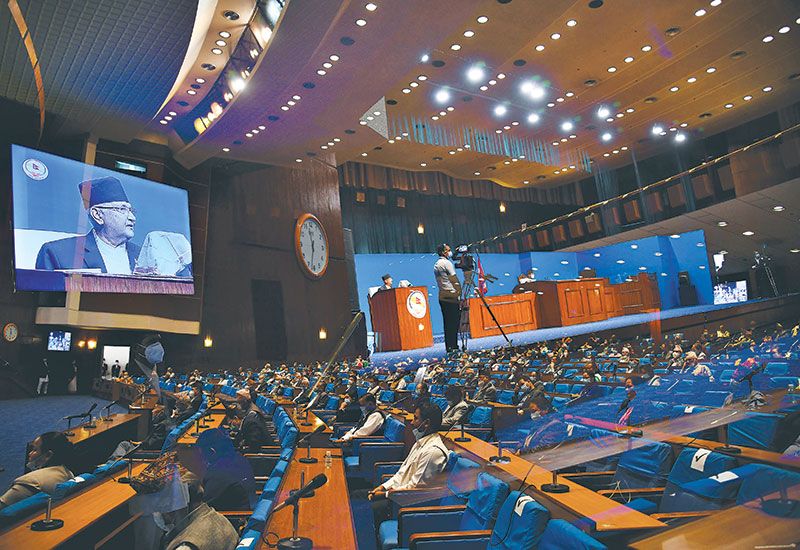
Leaders wait to up the ante against Oli saying that he is trying to run the government and the party with an iron fist.
- TIKA R PRADHAN

Parliament is set to endorse a bill, which will update Nepal’s map on the national emblem, showing Kalapani, Lipulekh and Limpiyadhura as parts of the Nepali territory.Post Photo: Deepak kc

KATHMANDU : Even as protests are flaring up, with youths across the country taking to the streets demanding accountability from the KP Sharma Oli government for its poor handling of the Covid-19 pandemic, there is an eerie silence within the ruling Nepal Communist Party.
Opposition factions in the party that had upped the ante until two months ago also have gone silent.
Instead of responding to calls to expand polymerase chain reaction tests and make public the details of the Rs10 billion it says it has spent on Covid-19 response, the government has instead warned of jailing and fining the protesters.
Insiders say that dissatisfaction is growing within the party as well but there are multiple reasons leaders are refraining from speaking up.
“Oli has created such a situation that leaders can neither speak up against the government nor support it,” said Yubaraj Chaulagain, a central committee member. “People close to the Oli faction will quickly pounce on the critics, accusing them of trying to unseat the government.”
For Oli, a boundary row with India, which started in the first week of May, has become a godsend, as it has helped him keep his detractors at bay, analysts say.
India’s move of announcing a new road link via Lipulekh on May 8 initially earned Oli criticism, as many called it his diplomatic failure. As pressure mounted on the prime minister, he decided to release a new map depicting Kalapani, Lipulekh and Limpiyadhura as parts of the Nepali territory. Accordingly, the government registered a constitutional amendment bill in Parliament to update the country’s map in the national emblem.
“I think ruling party leaders are maintaining silence fearing backlash, as they could be perceived, or branded, as anti-nationalists if they criticise Oli,” said Shyam Shrestha, a political commentator.
The Oli government’s move of releasing the new map has earned support from parties across the spectrum. On June 9, the House of Representatives unanimously approved a proposal to consider the amendment bill. Parliament is set to endorse the bill, which will pave the way for updating Nepal’s map on the national emblem, showing Kalapani, Lipulekh and Limpiyadhura, which India claims as its own, as parts of Nepal.
According to observers, amid rising criticism for his government’s failure to handle the pandemic and its indulgence in corruption, Oli managed to turn the table on his opponents by releasing the map.
A section of ruling party leaders, however, believes that Oli’s nationalistic rhetoric will soon lose its charm and the ongoing protests could make it difficult for him.
“It’s high time the Oli government took the protests as a serious wake-up call,” said Bishnu Rijal, a central committee member. “I think party leaders are waiting for the House to pass the constitutional amendment.”
Many within the party believe Oli has been showing authoritarian tendencies, controlling the government as well as the party.
“There is no party now; there is just KP Oli,” senior leader Jhala Nath Khanal, also a former prime minister, told the Post.
Khanal is among the leaders who have been calling for party committee meetings to discuss a host of issues, including the government’s performance. Secretariat meetings have been postponed at least twice in recent days at Oli’s call. A meeting of the Standing Committee, which the members have been demanding, has not been held for months.
“The prime minister has been functioning unilaterally,” Khanal told the Post. “He says whatever he likes and takes decisions unilaterally.”
Khanal, however, said Oli will start feeling pressure from party leaders sooner rather than later. “Oli has to respond to a litany of issues as prime minister and party chair.”
According to Rijal, the central committee member, it will be a mistake if Oli continues to take leaders’ current silence as their weakness. “An angry outburst from them is just a few days away,” said Rijal.
HOME PAGE

Forming of team to gather evidence on boundary runs into controversy

Experts and analysts say instead of devising a strategy for negotiations with New Delhi, Oli administration is moving a step back and putting the cart before the horse.
- ANIL GIRI

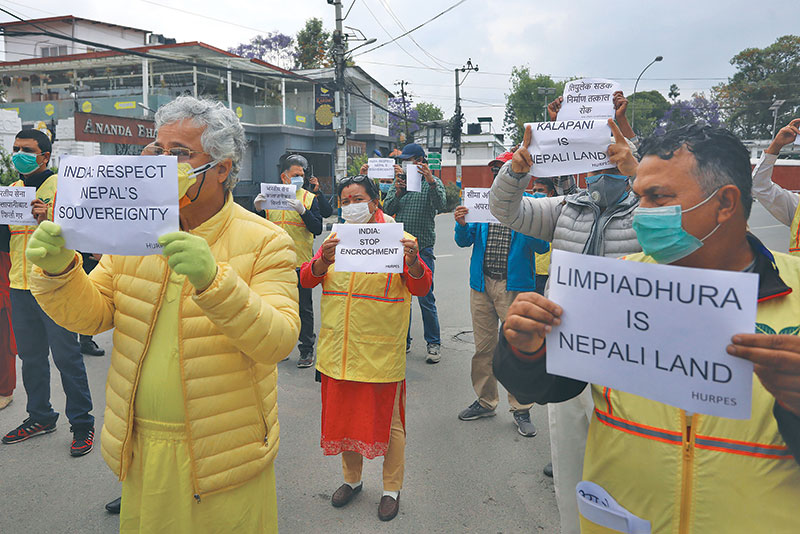
Human rights activists demonstrate in Kathmandu against Indian encroachment of the area.Post file Photo: Elite Joshi

KATHMANDU : Three weeks after releasing a new political and administrative map of Nepal depicting Kalapani, Lipulekh and Limpiyadhura as parts of the Nepali territory, the government on Wednesday formed a nine-member team of experts to collect historical facts and evidence related to the area.
Diplomats and experts, however, have questioned why the government formed the task force when the map has already been released and approved by the Cabinet. Even a constitutional amendment bill to update Nepal’s map in the national emblem is already in Parliament, which is set to endorse it on Saturday.
Acclaimed cartographer Buddhi Narayan Shrestha, who is also a former director general of the Department of Survey, wondered why the government was giving the mandate to a team of experts to collect historical facts and evidence when the map has already been released.
“We have enough documents and evidence to prove that the land currently occupied by India belongs to Nepal. If this expert team has been formed to collect evidence and proof about the disputed land, it is a wrong move,” Shrestha told the Post. “It’s actually one step back.”
Prime Minister KP Sharma Oli, Foreign Minister Pradeeep Gyawali and Minister for Land Management Padma Aryal had claimed that the new map was released based on historical facts and evidence that suggest the areas on the northwestern ridge belong to Nepal.
Accordingly, a constitutional amendment bill was registered in Parliament seeking to update the map in the national emblem. A proposal to consider the bill was unanimously endorsed by the House of Representatives on June 9.
“The move of forming a team to collect facts and evidence is like putting the cart before the horse,” Dinesh Bhattarai, a former ambassador, told the Post. “Formation of such a panel could weaken our position while negotiating with India.”
Even though the Oli government has upped the ante and ratcheted up its nationalist rhetoric, it has not ruled out talks with India to resolve the boundary row. With the government moving ahead to amend the constitution, India is also likely to harden its position.
“And Nepal setting up a team with the mandate of collecting facts and evidence may give India the upper hand during talks,” said Bhattarai. “India could ask why the Nepali side is looking for evidence after releasing the map.”
Even though India has claimed the disputed territories as its own, Nepal says it has enough evidence to prove that they belong to Nepal.
The government says until 1962, Nepal conducted census, collected land revenue and issued land registration certificates in the areas now controlled by India.
After the mandate ran into controversy, Foreign Minister Gyawali and Foreign Secretary Shanker Das Bairagi tried to clarify its objectives during the first meeting of the expert panel on Friday.
“The mandate given by the Cabinet to the team of experts and what Minister Gyawali briefed were contradictory,” a participant of the meeting told the Post on condition of anonymity. “There was a wrong briefing by Information and Communication Minister Yubraj Khatiwada on Thursday.”
According to the participant, both Gyawali and Bairagi said the core objective of the team is to provide support and inputs to the government for talks with India on boundary issues rather than collecting evidence and historical facts.
While making the Cabinet decision public on Thursday, Khatiwada did not say the mandate was to provide support to the government for talks to be held at the Foreign Secretary level.
The Cabinet decision, which the Post has seen, contains “formation of a team of experts to collect evidence in relation to the Nepal-India border”.
“This fiasco is the result of taking decisions in a hurry,” said another participant of the meeting. “The objective behind forming the team is to provide support to the government’s talk team, build antithesis and make grounds to defend Nepal’s case during bilateral talks.”
Bishnu Raj Uprety, executive director of Policy Research Institute, a government-funded think tank, is the team coordinator; with Surya Prasad Subedi, a professor at the University of Leeds in the United Kingdom; Ramesh Dhungel, historian; Bipin Adhikari, senior advocate; Jagat Bhusal, water expert; Toyanath Baral, former director general of the Department of Survey; Himalaya Thapa, a retired Nepal Army general; and Apsara Chapagain, a community forestry activist, as members. Ram Prasad Subedi, a joint-secretary at the Ministry of Foreign Affairs, has been named the member-secretary.
According to the Cabinet decision, the team is mandated to find the original or attested copies of documents related to the Nepal-India border, including the evidence regarding the northwest boundary of Limpiyadhura, Kuti, Navi, Gunji, Kalapni and Lipulekh, and Susta in the Tarai.
The team is also mandated to collect evidence and documents from public entities, organisations, persons and national and international libraries, according to the Cabinet decision. The Uprety-led team is also tasked with collecting original or attested copies of the Nepal-India treaty, agreements and memoranda, and correspondence with the then East India Company and British and Indian governments as well as maps showing Nepal-India border.
The team will also collect government reports, publications, government’s correspondence, administrative orders, court rulings and other records such as the receipts of land taxes and land ownership certificates.
The government so far has said the new map was published on the basis of the Treaty of Sugauli of 1816, which says the Kali river is the western boundary of Nepal and territories east of the river belong to Nepal.
On Tuesday, Gyawali told Parliament that Nepal has enough evidence to claim its land currently occupied by India. “As per the Treaty of Sugauli, the western border point is the origin of the Kali river,” said Gyawali. “After signing this treaty, in the last 60 years, we have noticed some changes in our southern border, but the source of the Kali river remains our western boundary point.”
Shrestha, the expert on boundary issues, said the government needs to devise a strategy on how to negotiate with India rather than forming a team of experts to collect evidence. “It won’t give us the upper hand during talks with India,” said Shrestha. “Indians will definitely ask why we are looking for evidence and documents when a map has already been published.”
Bhattarai, the former ambassador, said the hubris over this issue is wrong. “As the map has been released, such preparations should be carried out quietly and there is no need to make noise,” Bhattarai said. “This whole exercise should have been part of the government’s internal homework.”

Page 2
HOROSCOPE

HOROSCOPE

- Post Report

ARIES (March 21-April 19)
****
You might like to think that you don’t have any opportunistic tendencies, but you do--and you should embrace them! After all, they have served you well in the past. It’s time to recognise your entire set of skills, not just the ones that make people feel all warm and fuzzy inside. You are a complicated person, which means you are an interesting person!


TAURUS (April 20-May 20)
***
Today, you’ll get a taste of power when you’re thrust into a leadership position unexpectedly. While at first it might feel a little challenging, you will get the hang of it very soon--have no doubts about yourself! But if at any point you do feel a little nervous, you always have your friends standing right behind you, ready to help.


GEMINI (May 21-June 21)
****
You need to get a little bit more aggressive today, especially where business is concerned. You’ve been held back by other people for far too long, either by their negative comments or by their power plays. This drama has got to stop! Separate yourself from the bad energy people are giving off by separating yourself from them.


CANCER (June 22-July 22)
****
You are going to experience a lot more of one of your favourite things today--balance. Things are about to equalise in all aspects of your life, so get ready to enjoy a healthier period that will give you a stronger sense of security and confidence. You are feeling totally in control and it looks like someone you care about is finally ready to take another step.


LEO (July 23-August 22)
***
There is no reason for you to tolerate someone whose arrogance verges on rudeness today, no matter who they are. So if you feel you’re being taken advantage of or talked down to, do not hesitate to stand up for yourself and set this person right! Compromising your dignity is never acceptable.


VIRGO (August 23-September 22)
****
This could be the day when all your hard work finally pays off! Keep your eyes out early in the day for quiet discussions behind closed doors at work--they are talking about you, and the conversation is quite flattering! As the day goes forward, your inbox will be flooded with positive messages about a job well done.


LIBRA (September 23-October 22)
***
Today you are becoming aware of many new possibilities for your life, and you should try to explore as many of them as possible. Spend time online searching for the next great goal to pursue and see what you can find out. There is no reason to put limits on your options, either--the nuttier the notion.


SCORPIO (October 23-November 21)
****
Your day might get started off on the wrong foot, but you shouldn’t let that discourage you! Grab some of that inner strength of yours, and remind yourself that every new hour could bring new good things. Positive thinking can create real results, especially right now--the universe is looking for cues from you.


SAGITTARIUS (November 22-December 21)
***
One of the more generous people in your life is suddenly a lot more conservative with their time and money--but don’t worry, they are just feeling anxious about their financial situation. You may not be able to rely on them for extra money right now, but you can rely on them to always be there for you, emotionally speaking.


CAPRICORN (December 22-January 19)
***
Planning will be a lot of fun for you today--especially if this event you’re putting together has lots of tiny little details you need to wrangle into place! Your eye for the small stuff is extremely sharp, and it will bring you a huge amount of satisfaction to nail down the dates that have been floating around for so long.


AQUARIUS (January 20-February 18)
***
The hardest part of making changes in your life isn’t thinking up ways to change--it’s putting that change into action! You need a lot of self-discipline to get started--especially today, when your energy is going to be challenged by people’s demands. They are draining you and it might be time to get some alone time to recharge.


PISCES (February 19-March 20)
***
Handing control over to someone else, today, might not be an easy thing for you to do, but it will be an awful lot easier than trying to hold onto that control. Right now, if you want to reduce the amount of stress in your life, you have to step away from the power position. Hand things over to someone you trust.

Page 3
NATIONAL

Online classes may lead to fatigue, psychological problems, experts say

As its consequences are debated around globe, Nepal is promoting virtual classes without looking at the downside.
- BINOD GHIMIRE

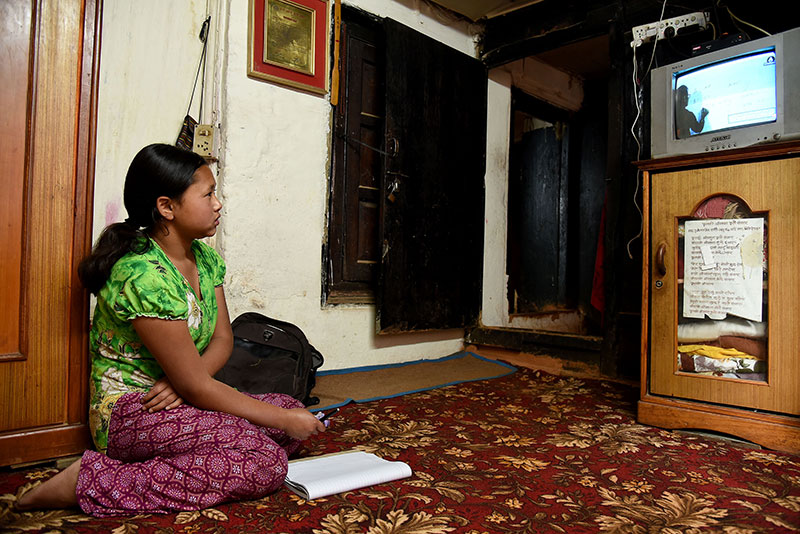
A student joins a remote class in Bhaktapur.Post file Photo

KATHMANDU : Bipana Puri’s five-year-old daughter is a first grader at a Baneshwor-based private school, which has been conducting online classes since mid-April following the lockdown imposed to contain the Covid-19 pandemic.
The toddler attends three classes—45 minutes to one hour each—every day, except during official holidays. After the classes are over, she needs to work on her homework and submit it through email. Only after the classes and homeworks are done, she gets to watch cartoons on a smartphone or TV, her favourite pastime during the lockdown.
“I know long exposure to the screen is not good for children, but I have no other option,” Puri told the Post. With no signs of schools reopening anytime soon, she is concerned that her daughter may have to rely on video-conferencing for her study for a long time.
Private schools and colleges, mainly in the cities, have been conducting online classes which last up to five hours a day. Schools say that they have no other option but to teach through video conferencing until the spread of Covid-19 subsides and it’s safe to resume classes.
After assessing that the resumption of schools and colleges is not possible in the near future, the Ministry of Education, Science and Technology came up with its guidelines for virtual classes, set to come into force from Sunday. The guideline envisages classes online, and on television and radio to promote virtual learning.
As television and radio don’t allow two-way communication between teachers and students, online classes have been seen as a more effective way of teaching.
Psychologists, however, caution that online classes also come with the potential to affect the well being of children. They said that while different countries have started debating about its negative consequences, Nepal’s government is promoting virtual classes without looking into ways to deal with its downsides.
Ganga Pathak, a professor of Psychology at Tri-Chandra College, said online classes could lead to “zoom fatigue”, mental exhaustion due to online video conferencing. It could lead to long-term psychological problems in the children. “Many schools are imposing online classes even for the five-six year-old children. This could lead to anxiety and degrade their interest towards studies in the long run,” she told the Post.
She said small children need a playful environment to learn, and that’s not possible through any virtual medium. “Even my graduate students complain about uneasiness and struggle concentrating during online classes, you can imagine the situation of the children,” she said.
Only on Thursday, the Indian State of Karnataka banned all online classes for students up to the fifth grade. According to local media reports, the decision came after the National Institute of Mental Health and Neurosciences, India, pointed out that virtual classes were not ideal for students below the age of six. It suggested that more than one hour of screen time for the children of that age group could have adverse psychological impacts.
Pathak said that many parents have been consulting her as their children have started getting irritated with online classes. “During a webinar, I had suggested to the education Secretary not to enforce virtual classes, especially on the small children. However, it was left unheard as the government came up with the guideline for it,” she said.
Private schools offering online classes have asked the government to accord formal recognition to it. In a demand paper to Deputy Prime Minister and Minister for Defence, Ishwar Pokharel, who is also the coordinator of the High-level Coordination Committee for Prevention and Control of Covid-19, six different associations of private education providers have asked the government to recognise virtual classes as formal learning.
The ministry, however, has been saying that virtual classes are just meant to keep the students engaged and cannot be recognised as formal learning. “The ministry has made it clear that virtual classes are just for keeping students engaged in learning, it cannot be taken as a replacement for formal schooling,” Education Minister Giriraj Mani Pokharel said in a webinar on Thursday.
Parents of schoolgoing children, however, say schools are treating online classes as formal learning so that they can charge them tuition fees for it. Ganga Mandal, father of a tenth grader who goes to the Jorpati-based Rims School, said the school pressed him to get a separate phone and an internet connection for his son. “My son is at home in Janakpur and now I have to get him a new smartphone and an internet connection,” he told the Post. “I need around Rs 30,000 immediately for that. It is a huge sum of money for people like me.”

NATIONAL

Making migrant workers pay for Covid-19 screening adds to their desperation

As Nepalis coming home are asked to pay for chartered flights, any testing cost will be extra burden on them.
- CHANDAN KUMAR MANDAL

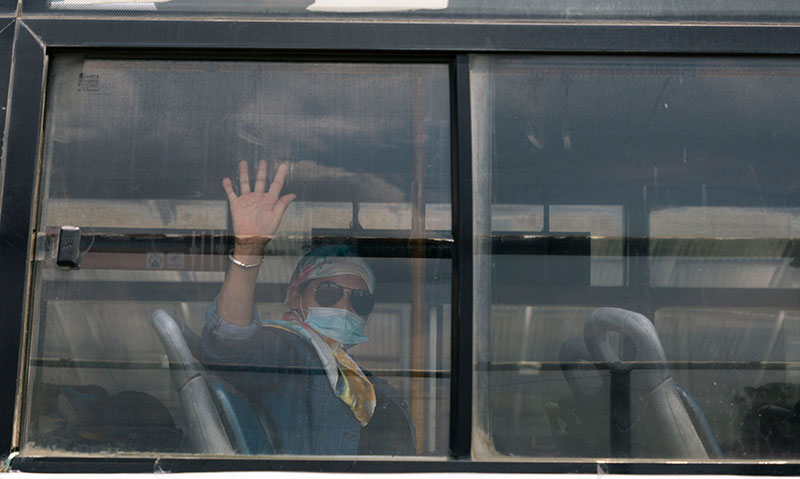
A Nepali woman who arrived from Kuwait leaves for a quarantine facility, in Kathmandu. Post Photo: Hemanta Shrestha

KATHMANDU : Around 300 Nepali migrant workers landed at the Tribhuvan International Airport on Thursday, all of them with medical certificates on coronavirus infections. They got tested for free at the Kuwait airport, along with free flight tickets home, as they had signed up for the Kuwaiti government’s general amnesty.
The Nepal government’s repatriation plan said that everyone coming to Nepal via flights must have a certificate of a medical test proving that they have not contracted the coronavirus. They should carry a physical copy of the test result, which should not be older than seven days.
However, the government’s plan did not mention who will be responsible for conducting the test—the Nepal government, Nepal embassy, host government or the workers, and this has created confusion among workers who wish to return home.
Besides, who would be bearing the expenses of these tests is a sensitive issue, as migrant rights activists have already been slamming the government for imposing repatriation costs on workers.
According to Som Luitel, a lawyer with expertise on migrant workers’ rights, such provisions have created confusion among workers and they are more likely to submit false reports without getting tested.
“The decision lacks clarity. Some workers who have money may pay for their tests, but what about others who can not bear the cost,” Luitel told the Post. “On one hand, the government has said the stranded workers would be brought home but on the other hand, the workers are asked to mandatorily produce test results and pay for their own tests. How can those stranded workers, without jobs and money, be able to pay for the test?”
During discussion last week, ambassadors from Persian Gulf countries like Qatar and Saudi Arabia, as well as Malaysia, had sought more clarity from the Nepal government regarding the repatriation plan, especially on repatriation costs and the requirement for workers to produce health examination certificates for returning home.
They said they were concerned about who would be conducting the tests and who would be paying for them. Their concerns had stemmed from the fact that host countries were hesitant to conduct medical examinations of returnee workers because of their large numbers and also because their health facilities were already overwhelmed in the wake of the pandemic.
“We had requested the Qatar government to conduct PCR or RDT tests on the returnees, but it said it would not be able to test all workers. So now, only thermal temperature screening would be possible,” Narad Nath Bhardwaj, Nepali envoy to Qatar, told journalists.
“We have written to the Foreign Ministry saying a private health facility has agreed to conduct tests at the cost of Qatari Riyal 125. If not possible, then these workers would be tested in Nepal only.”
Mahendra Prasad Singh Rajput, the Nepali ambassador to Saudi Arabia, had also said the government needs to clarify the cost and type of medical examination it wants the workers to undergo.
“We need enough time to deem our workers fit to fly,” said Rajput. “The health of our workers is of supreme significance. But there should be clarity on what kinds of tests to conduct and who pays for it.”
Now embassies have issued notices asking Nepali workers to conduct tests on their own. Nepal embassy in Malaysia has published names of clinics and hospitals authorised by the Malaysian government for Covid-19 screening and informed Nepali workers to get tested at their own expense. According to Luitel, the Nepal government should lobby for managing these tests expenses on workers’ behalf.
“Conducting Covid-19 tests is also the responsibility of the employer and the host nation. This is not something that they cannot do,” said Luitel. “Employers should pay for such tests as part of their corporate social responsibility, but the Nepal government did not give much consideration to this issue.”
Luitel urged that a diplomatic initiative can come handy in making employers pay for workers’ Covid-19 screening.
“Now there are joint committees consisting of Nepali officials and officials from labour destination countries like Malaysia and UAE. They could have met through a virtual meeting to solve this issue,”
said Luitel. “The Nepal government can tell the host governments to ask employers of workers whose tenure is still valid to pay for their
Covid-19 tests. If only our government can take the initiative, we could ensure free health screening for our workers.”

NATIONAL

With odd-even vehicle rule ineffective, experts warn against growing virus threat

- ANUP OJHA

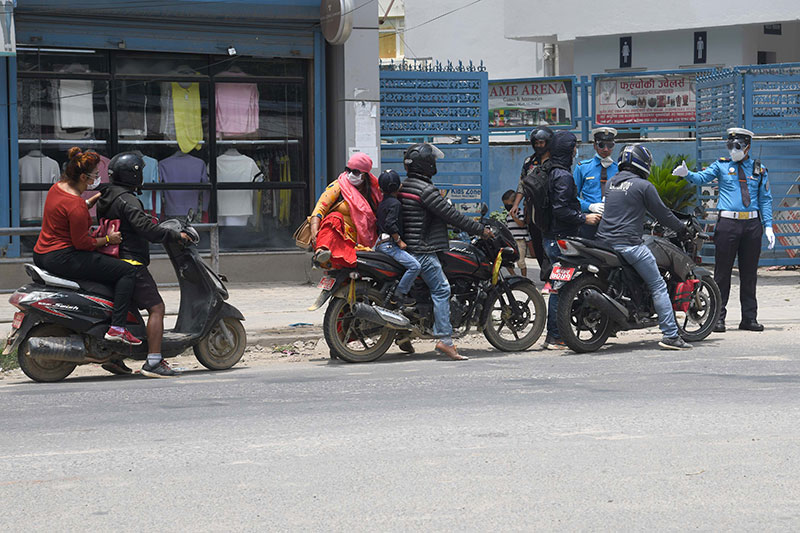
Traffic police stop motorcycles for violating the newly enforced rule.Post Photo: Deepak kc

KATHMANDU : The government’s new rule of operating private vehicles on odd and even licence number basis failed to be enforced on Friday, as hundreds of vehicles plying the road flouted the rule, leading to more traffic on the roads and streets of Kathmandu.
Virologists suggest that if increasing vehicular movement and public mobility is not controlled, there is a higher possibility of Covid-19 contagion, and the outbreak could be disastrous for the densely populated Kathmandu Valley.
“We are at a critical phase, and maintaining social distancing and taking other necessary precautions is essential,” said Dr Sher Bahadur Pun, a virologist at the Sukraraj Tropical and Infectious Disease Hospital, Teku.
“The odd-even provision should be strictly implemented so that it lessens public mobility,” he added.
Kathmandu Valley so far has reported 39 cases of Covid-19, while the national total of positive cases hit 5,062 on Friday after a record 448 new cases were confirmed on the day.
Amid widespread criticisms for curtailing movement and prolonging the nationwide lockdown without taking people’s hardships into consideration, the Cabinet on Thursday announced to ease the restrictions. Authorities announced applying an odd-even number rule based on the Nepali calendar but it was not monitored strictly on Friday.
“Even during the blanket lockdown, we noticed many people walking freely on the road without maintaining social distance. Easing the lockdown will give those people more freedom. If both the government and people are not sensible, this will create great problems,” said Pun.
The government had made an official announcement of applying the odd-even rule for private vehicles on the road, on Thursday night. It has also restricted more than two people in a private car and bars pillion riders on motorbikes.
Traffic police stopped motorbikes and forced pillion riders to get off and walk. The government move of not letting two people ride a motorbike has met with severe criticism.
“I saw vehicles plying the road randomly and not following the odd-even rule,” said Ayushma Shrestha, 27, owner of the Laxmi and Sons store in New Road, who had opened her shop for the second day after closing it for nearly three months.
“I really don’t like traffic police not letting two people ride. It’s my brother who takes me here on his bike. Now if the government won’t let me ride on the back, how would I get to my shop?” said Shrestha, who lives in Kalanki.
Asked why the government’s odd-even rule was not properly implemented, Senior Superintendent Bhim Prasad Dhakal, chief at the Metropolitan Traffic Police Division, said all the odd number vehicles belonged to office-goers and pass holders.
“We will make it more stricker from Saturday. As the information was relayed by the government quite late on Thursday,
they might not have known about it,” said Dhakal.

Page 4
NATIONAL

Local governments in Tanahun, Bajhang to buy testing machines

- SAMJHANA RASAILI,BASANT PRATAP SINGH

With the rising number of Covid-19 cases across the country and delays in laboratory processing of swab samples, local governments in Tanahun and Bajhang districts have decided to buy their own polymerase chain reaction machines to expedite testing.
The heads of all 10 local governments in Tanahun met on Thursday in Myagde Rural Municipality, and decided to purchase a PCR machine for the district.
According to Hariram Nagila, administrative officer at Myagde, the meeting decided to install the machine at the Shuklagandaki-based GP Koirala National Centre for Respiratory Diseases.
“The local governments have rescued hundreds of people returning from India and other places within the country and kept them in quarantine facilities,” said Nagila.
“But we need to wait around a week to get reports for swabs sent to Pokhara for testing,” said Nagila. “The local governments decided to purchase the machine as there is a high possibility of transmission of the virus in quarantines due to delays in test results.” He said the local governments will seek help from the Gandaki Provincial Health Directorate to deploy technicians required for the laboratory.
The local units plan to collect Rs 10 million for the machine and other necessary equipment. The meeting decided that Shuklagandaki Municipality will pay 14 percent of the cost while Byas, Bhanu and Bhimad municipalities will bear 12 percent each. Aanbukhaireni, Bandipur, Rishing, Ghiring and Myagde rural municipalities will contribute nine percent and Devaghat Rural Municipality five.
The meeting handed over the responsibility of procuring the equipment and setting them up to Shuklagandaki Municipality.

NATIONAL

Indian man dead, two others injured as Armed Police team opens fire at Nepal-India border

Authorities say the border security force was compelled to act after hundreds of people from India across the border attacked the officers.
- OM PRAKASH THAKUR

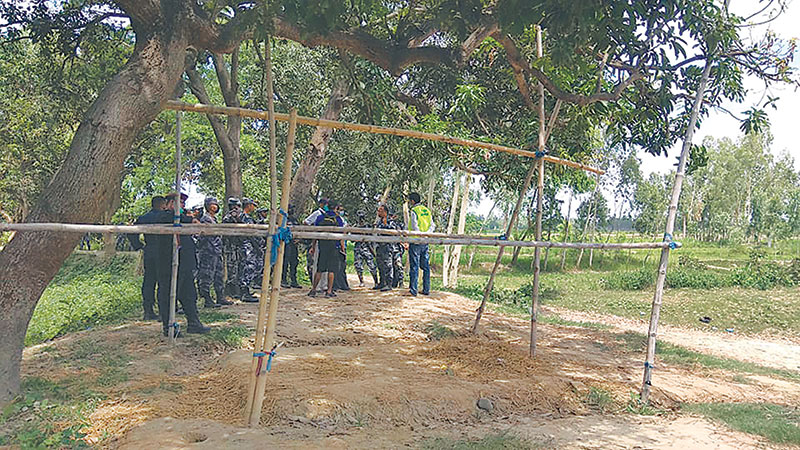
Security personnel at the incident site in Prasa Rural Municipality, Sarlahi.Post Photo: OM PRAKASH THAKUR

SARLAHI : A man was killed and two others sustained injuries when the Armed Police Force deployed for border security opened fire at a crowd that allegedly tried to attack the security personnel in Parsa Rural Municipality, Sarlahi, on Friday.
Bikesh Kumar of Sitamarhi district in the Indian state of Bihar succumbed to bullet injuries in his chest. Likewise, two other men—Uday Thakur and Umesh Rae, both from Sitamarhi—sustained bullet injuries in the incident. Also injured are three personnel from the APF, all of whom are currently undergoing treatment at the Malangawa-based District Hospital.
According to the APF, a fourth man, identified as Nawal Kishor Rae, was captured after he allegedly tried to snatch the weapons from the security personnel.
SP Gangaram Shrestha, the APF district in charge, said the incident happened after four Indian traders who were turned away by the security personnel from the border returned with hundreds of people and began protesting at the border.
“They came back with hundreds of people to protest, which soon turned violent. Our security personnel opened fire as the unruly mob started attacking them,” said Shrestha.
According to eyewitnesses, the seven-member APF team was outnumbered by the advancing protesters. Just as the security personnel were forced to retreat from their post, witnesses said the mob started to attack.
“Our officers fired 10 rounds of warning shots but the mob did not yield. They started attacking the security personnel, who in turn shot at them,” Shrestha said.
Chief District Officer Mohan Bahadur GC said the APF personnel had to shoot at the crowd because they became violent despite warning shots that were fired into the air.
“The situation at the border point is tense at the moment,” said GC.
According to Additional Inspector General of Armed Police Force Narayan Babu Thapa, the border between Nepal and India has been sealed since the lockdown came into effect on March 24.
“On Friday, the situation at the border area in Parsa Rural Municipality became tense after some Indian nationals tried to cross the border, which at the moment is closed for movement,” said Thapa. “Our personnel on the ground tried to stop them and fired 10 warning shots but the crowd pelted stones and tried to disarm and grab weapons from the personnel. That was when the APF fired at the crowd.”
The personnel fired at the crowd in self-defence, said Thapa, “since more than a 100 people were gathered at the scene.” “We have arrested the person who was trying to escape with the weapon,” he said.
The local administration has deployed additional APF and Nepal Police personnel at the incident site. The Indian Border Security Force has also mobilised its officers.
According to Thapa, this was not the first time that personnel deployed at the border have faced such a situation. A few days ago, a group of suspected Indian smugglers had tried to attack Nepali security personnel at Phenhara in Sarlahi.
“There have been several incidents in the past where angry mobs have attacked APF personnel deployed at the border,” said Thapa.

NATIONAL

Janitor who set himself on fire was amiable man happy with his job

Siddhartha Aauji sustained critical injuries after setting himself on fire in front of Bayalpata Hospital on Monday.
- MENUKA DHUNGANA

ACHHAM : Colleagues and neighbours recall Siddhartha Aauji, the man who died after setting himself on fire in Achham on Monday, remember him as an amiable person who was happy with his job.
The 24-year-old Sanphebagar resident, who returned from Mumbai six year ago, worked as a janitor at Bayalpata Hospital to feed his 10-member family. According to his friends, he was distressed after the hospital handed him his dismissal letter on May 28.
“He (Aauji) felt humiliated when he was dismissed as the hospital said it was sacking him and 32 others based on the review of their performance,” said Bishal Pandit, Aauji’s neighbour who also lost his job at the hospital.
Pandit said Aauji had urged the hospital management to not dismiss him as it was the only means of his livelihood. “He was also worried that villagers would look down on him for failing at his job,” said Pandit. “He was an emotionally stable person, it was unthinkable that he could set himself on fire.” Pandit said Aauji had urged the hospital management to not dismiss him as it was the only means of his livelihood.
Aauji had sustained critical injuries after setting himself on fire in front of the hospital on Monday morning. He was airlifted to Nepalgunj-based Bheri Hospital where he died in course of his treatment.
Neighbours say that as chairman of the ward-level youth network, he was involved in various social activities. “He was actively involved in helping the community control the spread of Covid-19. He would stitch up to 25-30 face masks everyday and distribute them among the hospital staff and the locals,” said Janak Kadayat, his friend.
He had gone to India for work at a young age, and returned home six years ago. “He had returned to Nepal as he could not earn well in Mumbai. He got a job as a cleaner at the hospital last March last while he was planning to go abroad,” said Kadayat.
According to Kadayat, Aauji was happy with his job at the hospital. “His wife, two children, parents and siblings were also happy after he got a job at the hospital. At work, he would go out of his way to help his colleagues,” he said.
But Aauji’s world came crashing down when the hospital management refused to help him retain his job. “He was in deep mental stress after the hospital management handed him his dismissal letter around ten days ago,” said Kadayat. “He had taken a loan of Rs 200,000 for his wife’s treatment and was worried about being unable to pay it off. With the pandemic, the chances of employment abroad also looked slim.”
The hospital said the employees appointed on contract basis had been removed due to the financial constraints at the health institution. The hospital did not extend the contract of 33 employees from mid-May citing serious financial problems.
The hospital chartered a helicopter to take Aauji to Nepalgunj for treatment. But he breathed his last just half an hour after he reached Bheri hospital in Nepalgunj.
SP Kalauni, the director at Bayalpata Hospital, issued a statement after Aauji’s demise. “The institution will support the bereaved family. We will coordinate with the local government about what’s to be done,” reads the statement.

Page 5
MONEY

Stores reopen as Kathmandu emerges from lockdown

Businesses will see few customers as transport restrictions are still in place, merchants say.
- KRISHANA PRASAIN

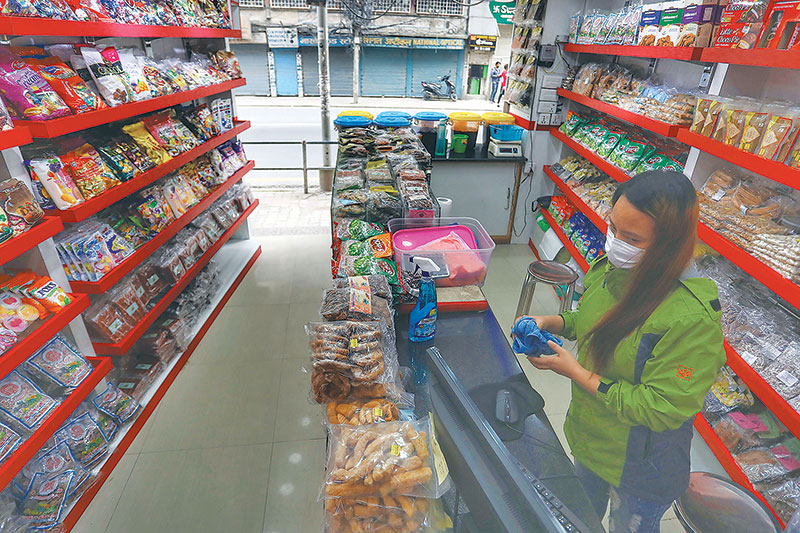
A shopkeeper waits for customers in Kathmandu after the government eased lockdown measures.post photo: Elite Joshi

KATHMANDU : Kathmandu gradually emerged from lockdown following Wednesday’s announcement relaxing the restrictions accompanied by a long list of do’s and don’ts.
Shopkeepers across the valley pulled up their shutters and dusted off their merchandise as automobiles returned to the streets in line with the odd-even licence plate number rule.
Traders are waiting for the standard operating procedure to be issued so that they can open their businesses in a full-fledged manner as the high-level corona crisis management committee is yet to approve the
protocol for opening shops and operating vehicles.
Naresh Katuwal, president of the Federation of Nepal National
Traders, said that most shops in the valley remained open the whole day on Thursday.
“There was no option left for us despite the rise in the number of infections. The government never offered us any relief plan,” he said.
Before the lockdown was partially lifted, traders had defied the restrictions and opened their shops for a certain time in the morning, increasingly impatient and hard up for cash after two and a half months of being confined to their homes.
As the government is still working on the standard operating procedure, traders reopened their shops by following social distancing and other safety measures.
Businesses will see few customers as transportation restrictions are still in place, said merchants. People will be spending their money on essential goods, so retail trade will take some time to pick up pace, Katuwal said.
“We have urged the government to simplify the operational modalities for businesses,” he said.
Doing business will be a lot different from what it used to be before the lockdown because of Covid-19. A single careless act can spread the virus, so it is important for traders to follow the safety measures properly, they said. Stores in most places including New Road, Asan, Ring Road, Baneshwor, Patan and Chabahil started operating from Thursday. Most hardware shops and stores selling construction materials in the Ring Road area were open. A readymade ladies wear shop owner at New Road said he was currently earning Rs2,000-Rs3,000 daily compared to Rs15,000-Rs20,000 before the lockdown.
Many shop owners said their goods were damaged by moisture during the prolonged lockdown.
Narendra Prasad, a textile and carpet shop owner at Tahachal, said he had not been able to earn a penny the whole day. “I would be happy if I could earn some money to pay the rent for my shop,” he said.
Dhiraj Shrestha, president of the Ranjana Trade Association, said that 25 percent of the shops selling readymade garments, shoes, bags and mobiles in the New Road area had reopened while 10 percent of the shops in Ranjana Mall were back in business.
Most of the traders were unaware about the government decision, he said, and he expected more shops to reopen from Friday. Shrestha said that shopkeepers stayed open from 9 am till 2 pm in keeping with operational guidelines for safe reopening.
“It is high time the shops were reopened as keeping them closed any longer will impact business during the Dashain and Tihar festivals,” he said.
According to him, shops were gradually beginning to receive customers in the last few days. Business is not good during the monsoon, and traders are optimistic about increased sales during the upcoming Dashain and Tihar festivals which fall in October, he added.

MONEY

UK economy shrinks 20 percent in a month to fall back to 2002 level

- ASSOCIATED PRESS

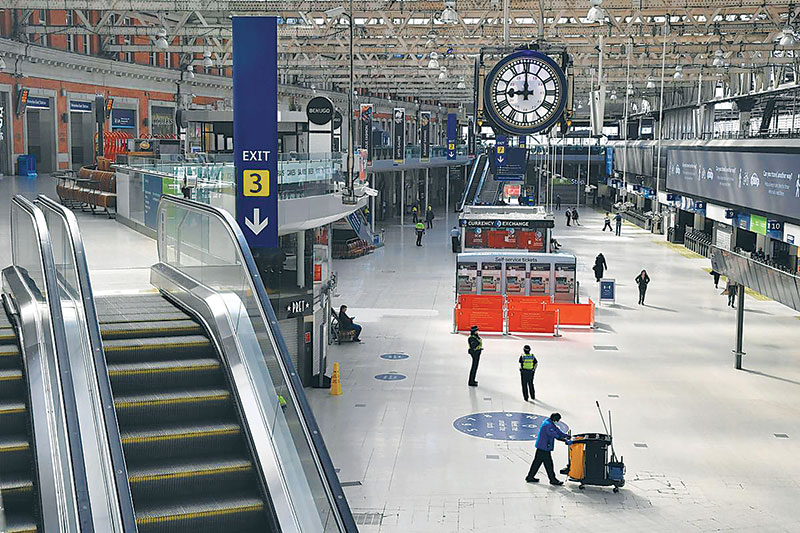
Police officers are seen in Waterloo station during the morning rush hour following the outbreak of the coronavirus disease, London, Britain. REUTERS

LONDON : The British economy has seen nearly two decades worth of growth wiped out as a result of the lockdown measures put in place during the coronavirus pandemic.
The Office for National Statistics said on Friday that the economy shrank by a colossal 20.4 percent in April, the first full month that the country was under lockdown to contain the spread of the virus. All areas of the economy were hit during the month, in particular pubs, education, health and car sales.
The monthly decline was unprecedented in scale and, adding the more modest—but still substantial—5.8 percent decline in March, means the UK economy is around 25 percent smaller than it was in February.
“This startling fall in activity takes output in April back to around its level in July 2002,” said James Smith, research director at the Resolution Foundation.
With much of the economy still mothballed in May and June, the UK is heading for one of its deepest recessions ever—the Organization for Economic Cooperation and Development has warned that the country is set to be the hardest-hit developed economy this year.
Lockdown restrictions are slowly being eased, which should see the economy to start to pick up. On Monday, for example, nonessential shops, such as department stores and electronic retailers, can reopen if they can abide by social distancing requirements.
But hopes that the bounceback in the economy will be as strong as the slide have receded given that many restrictions, such as on social contact, are set to remain in place so long as the pandemic is a threat to a public health.
The government is under pressure to relax the social distancing guidelines to help the economy. People currently have to remain 2 metres (6-1/2 feet) apart, which is more than required in most countries and above the World Health Organaization’s minimum recommendation of staying one metre apart. The government says it is following scientific advice about containing the spread of the virus but that the required distance is under constant review.
The recovery is also set to be held back by the fact that many businesses just aren’t going to make it out of the slump and millions of workers face unemployment. People are also set to remain wary about going to shops or to commute so long as the virus remains a threat. Uncertainty over the UK’s trading relationship with the European Union at the start of 2021 is another factor that could keep a lid on business sentiment and the recovery.
Frances O’Grady, general secretary of the umbrella Trades Union Congress, said targeted support for hard-hit sectors of the economy is needed, as well as a jobs guarantee to help those who lose work.
“The more people in work, the faster we will work our way out of recession,” she said.
Companies have largely held off from cutting jobs during the lockdown as a result of the Job Retention Scheme, under which the government pays up to 80 percent of the salaries of workers retained, up to 2,500 pounds ($3,125) a month.
Treasury chief Rishi Sunak has said that from August, firms will have to start making contributions to the salaries of workers that are retained but not working, and that the scheme will close two months later.

MONEY

France to hold 5G spectrum auction at end of September

- REUTERS

PARIS : France plans to hold its 5G spectrum auction at the end of September after repeated delays, the country’s telecoms watchdog Arcep said on Thursday.
The auction, first planned for January, was postponed following disagreements between the French finance ministry and the watchdog and then because of the coronavirus outbreak.
It will now take place in the last ten days of September, Arcep said in a statement.
Radio frequencies provide the raw material for wireless carriers to develop networks. Such auctions
have represented an easy money-maker for European countries, including France.
The country’s four telecoms operators—Bouygues Telecom, Iliad, Orange and Altice Europe’s SFR—submitted tender packages for some frequencies at a fixed price in February.
The government has said the overall 5G spectrum would have to yield at least 2.17 billion euros ($2.47 billion).
That represents the floor price at which the government is ready to sell 310 MHz. It has already agreed to sell a bloc of 50 MHz to each telecoms operator for 350 million euros, or 1.4 billion euros in total.
The remaining 110 MHz are to be sold during the auction, by bloc of 10 MHz and at a minimum of 70 million euros, or 770 million euros in total.
The auction date will likely disappoint Bouygues Telecom, which has called for a deferral until late 2020 or early 2021 because of uncertainties surrounding the coronavirus crisis.

MONEY

Latin America must restart air travel by July to avoid bankruptcies: Trade group

- REUTERS

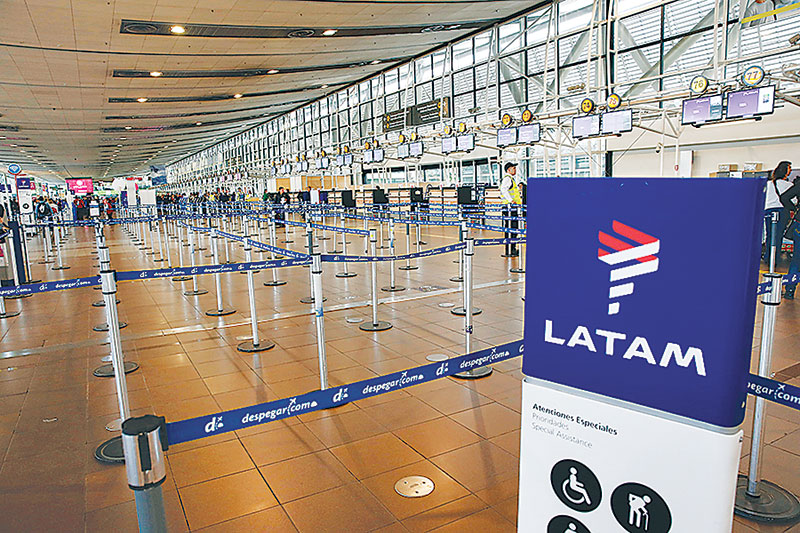
The departures area of Lan airlines is seen empty inside the international airport in Santiago, Chile.reuters

BOGOTA : Latin American countries should quicken steps for airlines to renew domestic flights no later than July before more companies are forced to declare bankruptcy or close, a high-ranking official of the International Air Transport Association (IATA) said on Thursday.
The trade group estimated losses for airlines in Latin America at
$4 billion this year, with total losses for the industry expected to reach $84 billion globally.
Latin America has imposed stricter travel restrictions than most regions to fight coronavirus. Colombia and Argentina have banned international flights through to Aug. 31, while other countries including Peru, Ecuador, El Salvador and Panama have also grounded all flights and repeatedly extended those bans as the disease
has spread.
Airline revenues from passenger transport in Latin America are expected to fall $18 billion this year. Some 93 percent of regular flights are grounded, while operations in some countries have been practically stationary for four months, said IATA’s regional vice president for the Americas, Peter Cerda.
“They can’t hold out beyond July, we have to begin planning for domestic flights in Latin America to be in the air soon and then shortly restart international flights,” Cerda during a virtual press conference.
He highlighted the urgency of restarting flights in Argentina, Colombia, Peru and Panama, and also called on governments across the region to implement processes which will allow airlines to transport passengers safely.
Cerda called on governments to financially support airlines which have already exhausted their two to three month liquidity limits.
“If we continue down this road we are going to see many more airlines declaring Chapter 11 bankruptcy as well as others who won’t be able to restart flights or will be forced to close,” he said.
Following long weeks of quarantine to halt the spread of coronavirus, LATAM Airlines and Avianca Holdings were forced to declare bankruptcy, putting Latin America in pole position as the region with airlines in financial ruin.

MONEY

Luxury food industry turns sour amid global coronavirus lockdowns

- REUTERS

A file photo shows meat from a bluefin tuna at Sushi Zanmai restaurant in Tokyo, Japan.reuters

SINGAPORE/TOKYO/PARIS : Global demand for premium foods like wagyu beef, bluefin tuna and caviar has plunged with thousands of restaurants shuttered and many economies sliding into recession amid the coronavirus pandemic.
As strict lockdown measures to contain the outbreak ravage global economic activity, the luxury food industry could be among the worst hit since it heavily relies on restaurants and top hotels for demand for deluxe items from caviar to champagne.
While some gourmet food producers are tapping consumers directly to stay afloat, others have been forced to cut output as some products have lost nearly half their value since the start of the year.
Jean-Marie Barillere, co-chairman of champagne producers’ lobby CIVC in France, said he hoped people would celebrate the easing of lockdown with a bottle of champagne, but expected a difficult end to the year.
“This is really a period that looks like a war time,” he said.
Bookings data compiled by OpenTable, an online restaurant reservation service, showed a near 80 percent year-on-year decline in seated diners at restaurants in the United States, United Kingdom, Germany, Canada, Australia, Ireland and Mexico this year.
People are also less likely to consume luxury foods when stuck at home in the middle of a health crisis and worried about their financial situation, or under clinical social distancing measures as eateries reopen.
“People will not want to taste a Chateau Petrus wine, a lobster or caviar under a bell jar,” said Michel Berthommier, managing director of Caviar Perlita in southwestern France.
“If you force people to eat in these conditions they will prefer going to fast foods.”
Premium foods was “one of the worst hit sectors worldwide”, said Ole Houe, director of advisory services at agriculture brokerage IKON Commodities in Sydney. He said he did not expect a prompt recovery given many countries were in recession.
Falling demand has already taken a toll on the prices of luxury items.
In Tokyo, the price of top quality wagyu beef cuts has fallen about 30 percent from a year earlier, bluefin tuna—considered the best in Japan—has dropped more than 40 percent over that period, while prices of the famed ‘Earl’s melons’ from Shizuoka have slumped 30 percent.
Russia’s top sturgeon breeding company—Russian Caviar House—meanwhile was offering a 30 percent discount for Beluga hybrid caviar.
“Spring and summer are always low seasons for the caviar market, but if we compare this period with previous years, the sales in Russia are down 50 percent,” said the firm’s owner Alexander Novikov.
In France, caviar prices languished near historic lows, champagne sales tumbled, while foie gras producers have had to cut output to prop up prices.
Cifog, a foie gras producers’ group, said restaurants account for 40 percent of total foie gras sales.
“Mid-March it felt like the sky had fallen on us,” said Florian Boucherie, who produces 2 tonnes of foie gras per year in France.
Oyster and razor clam fishermen from Cape Cod and other top fishing grounds have also had to curb catches as lockdowns upended global eating habits.
To plug the yawning gap left by eateries, many high-end food producers are attempting to reach consumers directly via e-commerce platforms.
Others are steering more produce onto supermarket shelves.
“We are accelerating our supply of products into some of the world’s largest supermarkets, gourmet butchers and direct to consumers online,” said Hugh Killen, chief executive of Australia’s largest listed beef producer, Australian Agricultural Company.
But some vendors say selling to supermarkets is far less profitable than selling to high-end restaurants.
In Japan, top sushi chefs pay 400,000 yen ($3,737.97) for 10kg of the best cuts of tuna compared to the 25,000 yen paid by supermarkets for 10kg of lower value cuts, said Yukitaka Yamaguchi, owner of Yamayuki tuna brokerage at Toyosu Market in Tokyo.
He said “the best part of [the] tuna” was usually sold first to high-end sushi restaurants but when these closed the “harakami had nowhere to go.” They eventually started offering high-quality tuna to fish retailers and supermarkets.
For now, Yamaguchi has had to park plans to retire as he has accumulated debt during the pandemic.
“I had planned to retire when I turn 60, but that’s no longer possible,” he said.

Page 6
WORLD

In rare appeal to Israeli public, UAE warns against annexation

- REUTERS

Jerusalem : Israel cannot expect to normalise
relations with the Arab world if it annexes land in the occupied West Bank, a United Arab Emirates
envoy wrote in Israel’s top newspaper on Friday.
Some Israeli officials have dismissed the notion that applying sovereignty to Jewish settlements and the Jordan Valley in the West Bank would slow a discreet opening between Israel and Arab countries—particularly with Gulf states who share Israeli concerns over Iran.
But, in a rare appeal to the Israeli public by an Arab official, the UAE’s ambassador to Washington, Youssef Al Otaiba, said the move would be what he called an “illegal takeover” of land Palestinians seek for a state.
“Annexation would—certainly and immediately—upend all Israeli aspirations for improved security, economic and cultural ties with the Arab world and the UAE,” he wrote in an op-ed in Israel’s best-selling daily, Yedioth Ahronoth, published in Hebrew.
Israel has no diplomatic relations with Gulf Arab countries, but common concerns over Iran’s regional influence have led to a limited thaw in ties. In May, Abu Dhabi-based Etihad made the first known flight by a UAE carrier to Israel, carrying coronavirus aid for the Palestinians.
“All the progress that you’ve seen and the attitudes that have been changing towards Israel, people becoming more accepting of Israel and less hostile to Israel, all of that could be undermined by a decision to annex,” Al Otaiba said in a separate interview with The National, an Abu Dhabi-based newspaper.
Egypt and Jordan are the only two Arab countries with which Israel has formal relations.
The Israeli government intends to begin debating annexation on July 1. While the move won support in US President Donald Trump’s Middle East plan, an Israeli minister on Thursday said there were gaps with Washington on the issue and that the two allies had yet to agree on a map of territorial lines.

WORLD

Risk of new lockdowns rises with fear of second Covid-19 wave

World Health Organization Director General Ghebreyesus says the threat of a virus resurgence remains very real.
- REUTERS

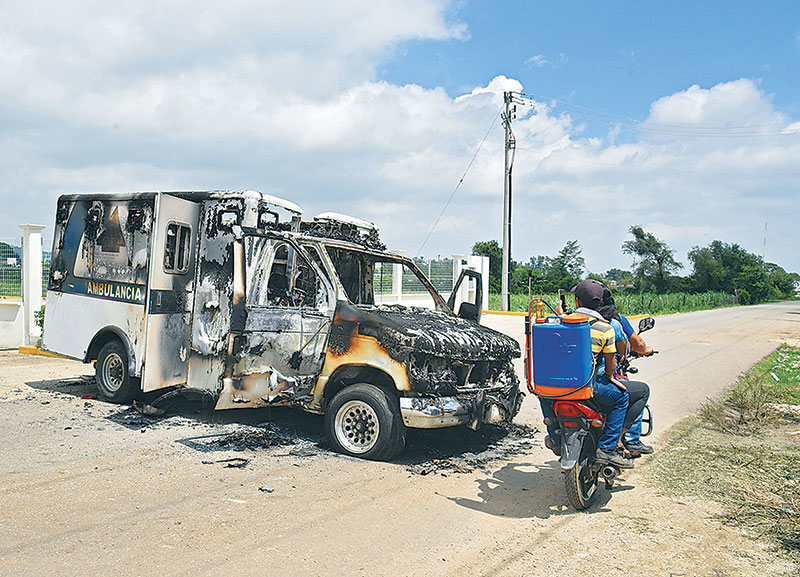
Men on a motorcycle ride past an ambulance destroyed by residents to protest alleged lack of coordination of municipal authorities to carry out sanitation operations for dengue and Covid-19 and the ban on holding a wake for a peasant who died from the new coronavirus, outside a hospital in Villa las Rosas, Chiapas state, Mexico on Thursday.AFP/RSS 

London/Brussels : Fears of a second wave of Covid-19 infections shut six major food markets in Beijing on Friday, while India, which opened up this week, recorded a record daily increase and half a dozen US states said their hospital beds were filling up fast.
Health officials worldwide have expressed concerns in recent days that some countries grappling with the devastating economic impact of lockdowns may lift restrictions too swiftly, and that the coronavirus could spread during mass anti-racism protests.
“We must be ready to roll back relaxation of measures if needed,” the European Union’s health commissioner Stella Kyriakides said after urging its 27 members to plough ahead with testing the population as they reopen schools and businesses.
In China, where the new coronavirus originated, two new cases of Covid-19, the disease it causes, were recorded in the capital. Authorities closed part or all of six big wholesale food markets which the two men had recently visited but it was not known how they had become infected.
In Turkey, the top medical association said the easing of restrictions on June 1 had come too soon, although the daily death toll as fallen in recent weeks to about 20.
“There is talk of when the second wave will hit, but we have not yet been able to overcome the first wave,” Cavit Isik Yavuz, part of the coronavirus research team at the Turkish Medics Association said.
While new infections are slowing in most of Europe, health experts see a moderate to high risk that post-lockdown rises may warrant new restrictions. The European Centre for Disease Prevention and Control (ECDC) predicted a moderate acceleration across Europe in coming weeks, which could place healthcare systems under stress if not checked rapidly. Government control measures could check and reverse upward trends within two to three weeks, it said.
Andrea Ammon, director of the ECDC, stressed the importance of maintaining physical distancing, hand hygiene and what she called “respiratory etiquette”.
Officials have expressed concern the virus could spread among the tens of thousands who have crowded together in Europe’s big cities to demonstrate against racism after the death in US police custody of George Floyd. “Mass events could be a major
route of transmission,” said Martin Seychell, a health official at the EU Commission.
World Health Organization (WHO) Director General Tedros Adhanom Ghebreyesus said late on Thursday that the threat of a resurgence remained very real.
“We must also remember that, although the situation is improving here in Europe, globally it’s getting worse ... We will continue to need global solidarity to defeat this pandemic fully,” he said. Of 5,347 new deaths recorded worldwide, 3,681 were in the Americas, the WHO said on Thursday.
In about half a dozen US states including Texas and Arizona, the number of coronavirus patients filling hospital beds is rising, fanning concerns that the reopening of the US economy may unleash a second wave of infections. Alabama, Florida, North Carolina, South Carolina, Oregon and Nebraska all had a record number of new cases on Thursday.
“I want the reopening to be successful,” Harris County Judge Lina Hidalgo, the top executive for the county that encompasses Houston, Texas, told reporters.

WORLD

Transgender couple in limbo as Hungary bans changes to identity papers

- REUTERS

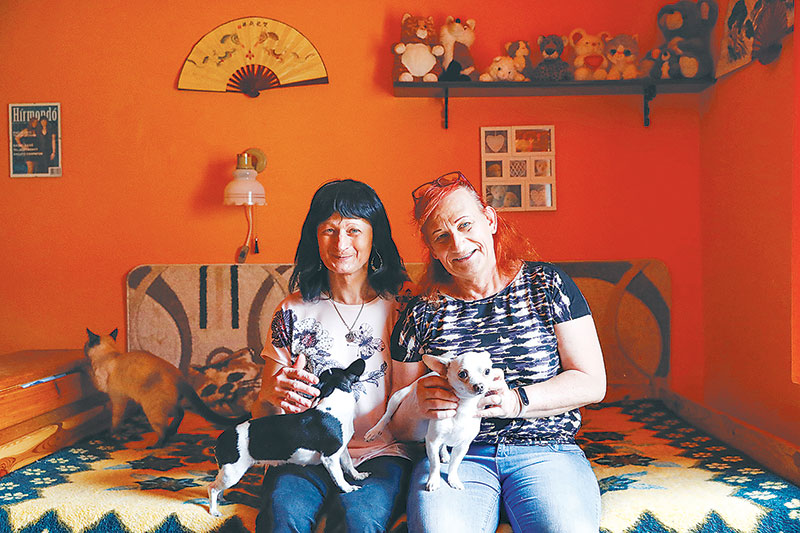
Hungarian transgender couple, Elvira Angyal and Tamara Csillag in Polgardi, Hungary. REUTERS

Polgardi (Hungary : For Hungarian transgender couple Tamara Csillag and Elvira Angyal life is on hold, their wedding postponed, and they are angry.
Hungary last month banned people from changing their gender on identity documents, in a move LGBT+ advocates said was creating panic among transgender people who feared an increase in discrimination and attacks.
Tamara, 57, filed her paperwork two years ago, days before the government temporarily banned alterations to identity documents—that ban is now permanent.
Elvira, 53, completed her paperwork years before, but Tamara is forced to write “Thomas” on official documents. The couple have put their wedding plans on hold while Tamara is forced to remain legally male.
“This slope we are on is politically conceived,” said Tamara in the house the couple share with 17 cats and four dogs. “The government created this abyss ... It makes me so angry.”
Rights groups say hostility to LGBT+ people has increased since nationalist Prime Minister Viktor Orban won a third term in 2018. The European Union has long criticised Orban’s right-wing government over its record on the rule of law and civil liberties.
According to ILGA, an international lesbian, gay, bisexual, trans and intersex advocacy group, Hungary slipped the most in Europe in terms of gay rights in 2019, although it is still ahead of nearly all eastern European countries.
ILGA says Poland, where homophobia has been part of the ruling PiS party’s ideology and election strategy, ranks last in the EU.
Hungary’s ranking was primarily due to its handling of the transgender issue, ILGA said, as well as some
hostile rhetoric from the ruling Fidesz party.
Tamas Dombos, a director of the LGBT+ rights group Hatter Society, said though gender change procedures numbered a few dozen per year in Hungary, there may be tens of thousands of trans people in the country. Most opt not to go through the process.
Gender change procedures are legal in Hungary and subsidised by the state to a small extent but are prohibitively expensive for many people. Gay marriage is not recognised, but legal partnership is.
Transgender people are the most at risk of suicidal thoughts and suicide attempts among LGBT+ groups, Dombos said. One in four attempt suicide before transition.
The new law, authored by Deputy Prime Minister Zsolt Semjen, says: “Since it is impossible to fully change biological sex, it is necessary to fix in law.”
In a statement sent to the Thomson Reuters Foundation, the charitable arm of Thomson Reuters, at the
time the law was passed in parliament, the government said it left everyone “free to exercise their identities as they wish”.
Tamara disagrees. She says harassment forced her to leave a job, the five children she raised while suppressing her true self ignore her, and now the government is targeting her, preventing her from completing her documentation.
“We have fought ... for future generations,” she said. “We will fight on. We have to persevere.”

WORLD

Four killed in blast in Kabul mosque

Briefing

KABUL: A blast in a Kabul mosque during Friday prayers killed at least four people and wounded many more, Afghanistan’s interior ministry said on Friday. “Explosives placed inside the Shir Shah-E-Suri Mosque exploded during Friday prayers,” said a Ministry of Interior statement, adding that the West Kabul mosque’s mullah was among those killed. No group immediately claimed responsibility for the attack. The United States is attempting to broker peace talks between the Afghan government and the insurgent Taliban to end 18 years of war. The Islamic State group also has a presence in the country and has carried out large-scale attacks in Kabul in recent months.(Agencies)

WORLD

UN rights office regrets Trump move against ICC

Briefing

GENEVA: The UN human rights office on Friday regretted the impact that US sanctions authorised by President Donald Trump may have on trials and investigations under way at the International Criminal Court (ICC), saying its independence must be protected. Trump on Thursday authorized US economic and travel sanctions against employees of the Hague-based tribunal involved in an investigation into whether American forces committed war crimes in Afghanistan. “The independence of the ICC and its ability to operate without interference must be guaranteed so that it can decide matters without any improper influence, inducement, pressures, threats or interference, direct or indirect, from any quarter or for any reasons,” UN human rights spokesman Rupert Colville told a UN briefing in Geneva. “Victims of gross human rights violations and serious violations of international humanitarian law and their families have the right to redress and the truth.” (Agencies)

WORLD

Lebanese shut down roadways with fires as currency collapses

Briefing

BEIRUT: Lebanese have cut roadways with burning tyres and rubbish bins across Beirut and other cities in renewed protests sparked by a rapid fall in the pound currency and mounting economic hardship. The Lebanese pound slid to about 5,000 to the dollar on Thursday and has lost 70 percent of its value since October, when Lebanon descended into a financial crisis seen as the biggest threat to stability since the 1975-90 civil war. From the northern city of Tripoli to Sidon in south, Lebanese chanted against the political elite and set fire to major roadways across the country in the most widespread unrest since a coronavirus lockdown imposed in mid-March. “We can’t afford to eat or pay rent or anything like that, so we will stay here until the dollar rate goes down and we get all our demands,” said Manal, a protester in central Beirut. Protesters in Tripoli, Lebanon’s second-biggest city, threw petrol bombs at a central bank building, setting it ablaze and prompting security forces to fire tear gas, according to witnesses. (Agencies)

Page 7
SPORTS

Bayern playing without Mueller, Lewandowski

The holders who host Gladbach are on the verge of clinching eighth straight Bundesliga title.
- AGENCE FRANCE-PRESSE

Bayern Munich’s Robert Lewandowski (red) in action with Eintracht Frankfurt’s David Abraham during German Cup semi-final match at the Allianz Arena, Munich. Reuters

BERLIN : Bayern Munich could secure an eighth straight Bundesliga title this weekend, but host Borussia Moenchengladbach on Saturday without suspended duo Thomas Mueller and Robert Lewandowski. Bayern will be confirmed champions with a win on Saturday if second-placed Borussia Dortmund lose at relegation-threatened Fortuna Duesseldorf earlier in the day.
That scenario would give Hansi Flick’s side an unassailable 10-point lead with three games remaining. But Bayern are without Lewandowski, the league’s top scorer this season with 30 goals, and Mueller, who is one short of the Bundesliga record of 21 assists in a single campaign. “It’s annoying, but we can’t do anything about it,” said Bayern coach Flick.
Thiago Alcantara is likely to replace Mueller, while winger Serge Gnabry could take Lewandowski’s place up front if he is fit after a back injury. Bayern proved they can score goals without Lewandowski by thumping Hoffenheim 6-0 in late February when the Polish striker was injured. They had a scare in Wednesday’s German Cup semi-final win over Eintracht Frankfurt, when Danny da Costa equalised for the visitors before Lewandowski sealed a 2-1 win with his 45th goal this season.
Mueller admitted Bayern were “tired”, “worn out” and scrapped their way to victory in the first of three games in six days. But they are still in the running to repeat their 2013 treble having beaten Chelsea 3-0 away in their Champions League last-16 first leg before the competition was suspended in mid-March due to the coronavirus pandemic.
Fourth-placed Gladbach pulled off a shock 2-1 victory at Borussia Park when the sides met last December. But Marco Rose’s side have been erratic of late, crushing Union Berlin 4-1 at home at the end of May before stumbling to defeat at Freiburg last weekend.
Rose hopes to include Swiss forward Breel Embolo, with the 23-year-old fit after an ankle knock.
At the foot of the table, fallen giants Werder Bremen face a crucial game at Paderborn in a battle of the bottom two. Florian Kohfeldt’s Bremen are six points from safety in 17th and three off the relegation play-off place following back-to-back home defeats. Bremen, who were in the Champions League a decade ago, have spent more seasons in the top flight than any other club, but are running out of time.
“We know how much is riding on this game,” said American forward Josh Sargent. “This club has such a long history, and no one wants to let the team or the city down.”
The Germany international Emre Can scored the winner for Dortmund in last weekend’s tense 1-0 win over Hertha Berlin despite playing as part of a back three. The 26-year-old, who usually plays in midfield, has been a reliable figure for Dortmund since joining from Juventus in January. He has shown his versatility by adding steel to a sometimes vulnerable side while still providing an attacking threat, having also marked his debut in February with a stunning long-range strike against Bayer Leverkusen.

SPORTS

Playing in empty stadiums will be IPL’s last resort: BCCI

- REUTERS

NEW DELHI : The Indian Premier League (IPL) could be played behind closed doors as last resort, if that is the only way to save this year’s Twenty20 tournament from falling victim to the coronavirus epidemic, a senior cricket board official said.
The tournament had been scheduled to begin in late March but was indefinitely postponed following the outbreak. The Indian cricket board (BCCI) stands to lose $525 million in revenue if it cannot stage the 2020 edition of the franchise-based league and BCCI president Sourav Ganguly assured members this week that they were exploring “all possible options”.
“If it can be with spectators, we’d ideally want that,” BCCI treasurer Arun Singh Dhumal told Reuters by telephone. “But if we have to stage it in empty stadiums and there’s no other choice, we might go for that. We’ll try and work out depending on the situation at that point in time. But before anything else, we have to have a window available and a clear-cut directive from the government (to go ahead).”
India on Friday reported a total of 297,535 coronavirus infections, surpassing the United Kingdom to become the fourth worst affected country in the world. The pandemic also jeopardises this year’s Twenty20 World Cup with hosts Cricket Australia conceding the tournament’s October-November schedule was under “very high risk”.
The BCCI has said it would consider slotting IPL in that window should the World Cup be postponed, but the International Cricket Council would not take a call on the fate of the flagship tournament until next month. “Whatever decision has to happen should happen well in time,” Dhumal said. “If that tournament is not happening, other boards can decide whether they want to have some bilateral tournament or something else to make up for the loss they have incurred because of the pandemic.”

SPORTS

Sevilla edge Betis as La Liga resumes

- AGENCE FRANCE-PRESSE

Sevilla’s Lucas Ocampos (right) celebrates with his teammates after scoring a goal against Real Betis during their La Liga match at the Ramon Sanchez Pizjuan in Seville.  Reuters

MADRID : Sevilla beat local rivals Real Betis 2-0 as La Liga returned after three months away on Thursday, becoming the second of Europe’s five major leagues to resume following the coronavirus pandemic.
After the Bundesliga in Germany restarted on May 16, La Liga opened its doors again to players but not supporters at the Ramon Sanchez Pizjuan, where the usually vibrant Seville derby was played in front of empty stands. The game was the first in Spain’s top flight since March 10 but 93 days later another professional fixture has been completed without incident, offering further encouragement to the Premier League in England and Serie A in Italy. Both are set to return next week. Lucas Ocampos gave Sevilla the lead from a 56th-minute penalty and Fernando Reges then added the second goal for the home side, who are third in the table. This was the first leg of a 39-day sprint to the finish in La Liga, that will see teams playing every three days for five and a half weeks and undergoing stern examinations of their fitness.
Both coaches made use of their new allocation of five substitutes and there was a drinks breaks in each half but the contest lost its fluency late on, in part because Betis never looked like staging a comeback. Victory strengthens Sevilla’s hold on third place as they move four points above Getafe and Real Sociedad below them. Betis sit 12th and face the possibility of being dragged into a relegation battle.
This was as far from a typical Seville derby as could be imagined, a pale shadow of the division’s most heated fixture and a clear demonstration of what has been sacrificed to keep the season going. “I always believed we would play again,” said La Liga president Javier Tebas, who had also indicated on Thursday that “10 or 15 per cent” of fans could attend stadiums before the season finishes on July 19. For now though, stands remain empty, the voices of the players and coaches audible and the atmosphere strange. On television, fans at home had the option to add virtual supporters taken from the computer game FIFA, as well as chanting, which ebbed and flowed according to the action. When the excellent Ocampos and Fernando scored, there was cheering, and when substitutes came and went, there was applause.
Earlier, the players had arrived wearing masks and gloves and their temperatures were taken before entering the stadium. Outside, around 200 supporters had come to greet the team buses but they dispersed shortly after, with 600 police and security personnel in attendance to prevent mass gatherings. “No fans allowed but we’re here and we can’t wait,” shouted a 60-year-old supporter in a Sevilla shirt.
There was a minute of silence held before kick-off in memory of the victims of the pandemic, with the players standing at a distance from each other around the centre circle. In the 20th minute, there was applause to pay tribute to those working on the front line. In the stands, the substitutes, still wearing masks, sat spread out in the rows behind their coaches and Sevilla’s were among the few celebrating when the goals flew in shortly after half-tiime. They were comfortable winners as Ocampos scored a penalty after Marc Bartra was adjudged to have pushed Luuk de Jong and, six minutes later, a delightful Ocampos flick at the near post allowed Fernando to head in a second.

SPORTS

Kyrgios blasts ATP for US Open drive

- AGENCE FRANCE-PRESSE

Nick Kyrgios.reuters

PARIS : Nick Kyrgios slammed the ATP as “selfish” on Thursday for pressing ahead with plans for the US Open despite the country dealing with a coronavirus pandemic and widespread anti-racism protests.
The temperamental Australian suggested it was too early for the Flushing Meadow Grand Slam, joining other players in expressing reservations, including world number one Novak Djokovic. “The ATP is trying to make the US Open go ahead. Selfish with everything going on at the moment,” Kyrgios, ranked just 40 but a showman who is popular with fans, said on Twitter. “Obviously Covid, but also with the riots. Together we need to overcome these challenges before tennis returns in my opinion.”
The tennis season has been on hold since mid-March because of the pandemic, with the French Open postponed and Wimbledon cancelled. The US Open is still scheduled to go ahead, with the main draw starting on August 31 despite New York being the epicentre of the outbreak in the US.
Authorities and organisers have drawn up a list of hygiene rules, including a 14-day quarantine period for players arriving in the United States while restricting their entourage to one person. Djokovic suggested on Wednesday that he may skip the North America swing and restart his season on clay in Europe in early September, complaining about the “very severe” measures being put in place at the US Open.
“Most of the players I’ve talked to so far have a rather negative view of the possibility of going,” said the Serb.
World number two and reigning US Open champion Rafael Nadal has expressed similar reservations, while top-ranked woman Ashleigh Barty has also voiced caution about resuming tennis too soon.

SPORTS

Karsten Warholm sets new record as athletics returns to Oslo

- AGENCE FRANCE-PRESSE

Karsten Warholm of Norway reacts after winning the men’s 300m hurdles during the Impossible Games at the Bislett Stadium in Oslo. Reuters

Oslo : Double world 400m hurdles champion Karsten Warholm put aside coronavirus-induced Lego building to smash the world record for the unorthodox 300m hurdles behind closed doors at a near-empty Bislett Stadium on Thursday.
After Oslo’s famed Diamond League meet, scheduled to be held this week, was cancelled because of the coronavirus pandemic, organisers chose to innovate as track and field returned with its first international, multi-discipline event, dubbed the ‘Impossible Games’. And home favourite Warholm did not disappoint, the Norwegian clocking 33.78 seconds in the rarely-run event, pulverising the previous record of 34.48sec set by Briton Chris Rawlinson back in 2002.
In a stadium where cardboard cutouts replaced fans, barred entry because of the Covid-19 outbreak, and socially-distanced dancers with mannequins added ambiance, Warholm’s feat was all the more impressive as he ran the race solo. Setting off in his favoured lane seven, the 24-year-old went through his normal pre-race routine before blasting off, keeping his rhythm early on before producing a blistering push for the line.
“I’ve been building a lot of Legos, yeah, and also I’ve been training almost just as much, putting in training and trying to become even better,” said Warholm of his time away from the sport. “Of course, I missed the crowd and everything but it’s awesome to be back. It’s better to do it alone than to not do it at all.”
There was more home success as a Norwegian team led by the three Ingebrigtsen brothers triumphed in a 2000 metre race over a strong Kenyan quintet led by Timothy Cheruiyot and Elijah Manangoi, world 1500m champions in 2019 and 2017 respectively. The Kenyans were running simultaneously via video link from Nairobi, where they had to contend not only with the city’s 1,795m altitude, but also wind and rain.
The Ingebrigtsens, Filip, Henrik and Jakob, maintained an early lead over the Kenyans, the latter two brothers taking up the running from the 1km mark. The victory went to Jakob Ingebrigtsen, just 19, in an European record of 4min 50.01sec that smashed the previous best of 4:51.39 set in 1985 by Britain’s Steve Cram, but remained a way off Moroccan Hicham Guerrouj’s world best of 4:44.79 set in 1999. All three Norwegian brothers finished within the 4:57 mark, while the fastest home for the Kenyan team in terrible conditions was Cheruiyot in 5:03.05.
“Cheruiyot was our main competitor. It’s not easy beating a world champion, but we did it!” said Jakob Ingebrigtsen, welcoming a return to the track. “I’ve spent so much time doing boring training sessions, it’s
the competition that counts the most, it’s fun.”
Cram, now a commentator for the BBC, said the Oslo meet had been “a special and important occasion because it’s athletics back at the highest level”. It’s been slightly different without a normal crowd, but the athletes had a platform to do their best and they certainly gave it their all.”
A men’s pole vault competition saw world record holder Armand Duplantis of Sweden up against 2012 Olympic champion Renaud Lavillenie. The Frenchman had already jumped from his own back garden—off a much-shortened runway—and his effort was broadcast in line with his Swedish counterpart’s. The pair competed last month by filming themselves at home, but Duplantis benefitted from proper track conditions to win, clearing 5.86m at the third attempt. Lavillenie failed on his three efforts at the same distance.
Duplantis had a shot at a “crowd-pleaser” of 6.01m, but did not come close. “I wanted to jump a little bit higher, but I knew I wasn’t in the best shape of my life right now. I know I’m rusty!” said Duplantis. “I’ve been missing competition for sure and even if it’s not what we are typically used to, it’s still fun to get back on the track. I’m going to sleep well tonight, I’m not going to complain. It was fun to be out there. Good day at work.”

SPORTS

Premier League player names to be replaced by ‘Black Lives Matter’

Briefing

LONDON: English Premier League players will pay tribute to worldwide anti-racism movements by wearing shirts with the words “Black Lives Matter” on the back during the opening round of fixtures at the season’s restart, British media reported on Thursday. The words will replace player surnames on the back of the shirt, while the BLM logo will be displayed on the front, reports said. The tribute comes amid worldwide protests against racial injustice following the death of George Floyd, a black man who died in police custody in Minneapolis on May 25. The Premier League will resume on June 17.(AGENCIES)

SPORTS

Liverpool thrash Blackburn in warm-up friendly

Briefing

LONDON: Liverpool cruised to a 6-0 victory over Blackburn Rovers in a friendly behind closed doors at Anfield on Thursday as Juergen Klopp’s side stepped up their preparations for the Premier League restart next week. First-team regulars Sadio Mane, Naby Keita and Joel Matip got their names on the scoresheet while forward Mohamed Salah and left back Andy Robertson were left out of the squad as a precaution. Liverpool, who are 25 points clear at the top of the standings and on the verge of
clinching their first league title in 30 years, will restart their campaign against local rivals Everton at Goodison Park on June 21.(AGENCIES)

SPORTS

Alli handed one-match suspension over virus prank

Briefing

LONDON: Tottenham Hotspur midfielder Dele Alli will miss the Premier League restart after being suspended for a match by the Football Association on Thursday, having been found guilty of misconduct after mocking the novel coronavirus outbreak. Alli, 24, was charged after posting a video on social media of himself at an airport wearing a mask and apparently mocking a man of Asian appearance. The FA said Alli was also fined 50,000 pounds and must undertake a face-to-face education course after he was found guilty by a independent regulatory commission. He will now miss Tottenham’s first match back, the visit of Champions League qualification rivals Manchester United on June 19. (AGENCIES)

Page 8
BOOKS

Women in South Korea show up, speak up

In Frances Cha’s If I Had Your Face, the truths of the country are revealed thick and fast, and reiterated through characters and tropes.
- Richa Bhattarai

You want to beautify yourself, look a little more presentable, appear hip and professional—what do you invest in? An outfit, perhaps. Accessories, a trip to the salon, a day at the spa. Would you go for permanent microblading of the eyebrows? How much would you spend;
what limit would you set? Would you consider botox, a nose job, breast enhancement?
Plastic surgery is not usually a casual conversational topic, even in an appearance-focused society. But in South Korea, it is apparently fodder for chit-chat. In the very second page of Frances Cha’s debut novel ‘If I Had Your Face’, room-salon aspirant Sujin asks beautiful Kyuri where she got her eyes done. Out pour experiences of asymmetrical eyelids and aligned jawlines. Later, Kyuri confesses, “I really don’t understand ugly people. Especially if they have money. Are they stupid? Are they perverted?” Issues camouflaged under wraps of popular culture are laid bare in Cha’s novel.
Even the title lusts for another person’s face, and this wistfulness for perfection pervades the entire work. The four women narrators, each aiming for their version of perfection or at least stability, are grappling with challenges of their own. Ara, already saddled with a poverty-stricken background, has been rendered mute after an accident, and her only solace is a K-pop star. Her roommate, Sujin, wants to make it big in a “top ten-percent room salon”, an euphemism for sex work. Their neighbour Kyuri is already deep into this service, having loaned herself out to pay for her facial reconstruction. Meanwhile, in another flat, claustrophobic Wonna is worried about having a baby while her husband has been laid off. Then we have glamorous Miho who struggles in her artistic endeavours even as her fiancé cheats on her.
As readers we slide right into the midst of the characters, learning about their pasts that are all sad in their own way, their dreams for the future, the residue of hope they cling on to. The novel takes us from the bustling city of Seoul to the placid alleys of Cheongju, tracing the backstory of three of the girls that reveals so much about the aspirations and mentality of the Korean youth. It is a pleasure to journey alongside these young women as each of them struggle to find a niche, to propel themselves forward, to rise out of ashes. It is a reminder of the sameness that exists in all humans, no matter their heritage or nationality.
Cha, who reported for CNN in South Korea for a number of years, has revealed that she is quite adept in “writing for clueless Americans”, by which she means foreigners who need every bit of context and detail. She has managed to do that very well, ensuring the essence, the Korean-ness of her characters while also making the language and connotations accessible to the most blasé of readers. Deciphering the rich tapestry of Korean terms like chaebol and yoohaksang, sunbaenim and nunchi is exciting.
Even more alluring is this chance to gauge the intricacies of the sociology of Korea, with many superlatives to its credit that the author keeps referring to: the fastest growing economy, the highest suicide rates, and the sharpest declining birth rates in the world. The novel succeeds in putting names and faces to the Korean women (and men) that merely lurk within news stories, it humanises their problems and ushers readers into a culture that is so far from the ones depicted in mainstream Korean dramas, K-pop, and 10-step skin care routines.
The truths of this country are revealed thick and fast, and reiterated through characters and tropes: the plastic surgery industry, class divide, the highly competitive and nepotistic job market decrying maternity leave, infidelity and subterfuge, sexism and misogyny—even the naivete of Korean wives who pretend their husbands aren’t the ones keeping the room salons aflush. The narrators’ relationships are critically analysed, too, to unravel a spool of lies and half-truths hidden underneath a relatively smooth exterior.
In situations that are reminiscent of the movie ‘Parasite,’ visible parallels are drawn between the lives of the wealthy and the poor. It will strike readers how the rich population in all countries are so different in their obsessions and plundering, and yet how similar the poor – when Miho mentions the ‘Adidis’ slippers in her parental home, it could so easily be a scene of Nepal or really, any other country in the world.
Cha’s command over the English language and her sharp observational skills are discernible, that comes perhaps from her chequered background leading her from the States to Hong Kong and South Korea and back to the States. Her journalistic training is also evident in the research that has gone into the plastic surgery business, from the medical to the monetary.
And yet, after an introduction to strong, diverse and interesting women and a host of issues ranging from mental health and victim blaming to personal space and infidelity, the storyline fizzles out, after only having superficially dabbled in them but not quite making an indentation. The women sometimes merge into each other, making it difficult for the reader to distinguish between them. The great friendship and empathising that is supposed to hold the story together never makes a satisfactory entrance. At the end, there is neither a fitting resolution nor a particular revelation. Perhaps this is just a reflection of the modern way of life: there is no closure. But mostly, the novel seems unable to reach the tall promises it makes when starting out.
‘If I Had a Face’ is readable, and enjoyable, and more importantly, it attempts to recreate a portion of contemporary South Korean life out of the burgeoning suicides and plummeting marriages that we read about only in pie charts and data graphs tucked away in a corner of the newspaper. For the diverse setting and freshness it brings, it deserves a chance on our bookshelves.

If I Had Your Face

Author : Frances Cha
Pages : 272
Publisher : Ballantine Books (Random House)