You internet speed is slow. Switch to text view mode

Switch
epaper logo
ST

Last Login:
Logout
+
Page 1
HOME PAGE

Ruling party’s virtual meeting with Chinese communists takes flak for its timing
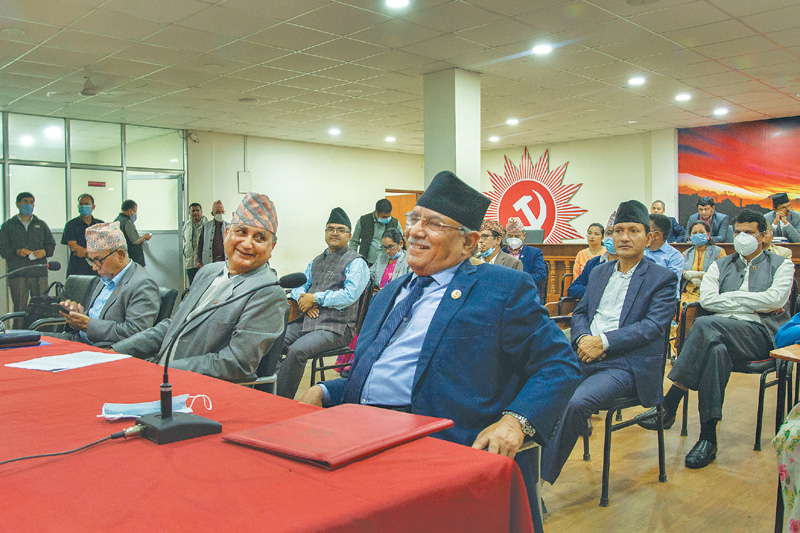
Such meetings at a time of heightened tensions between India and China will raise questions about Nepal’s commitment to non-aligned foreign policy, analysts say.
- ANIL GIRI
Nepal Communist Party chair Pushpa Kamal Dahal and Deputy Prime MinisterIshwar Pokhrel among the participants of a virtual interaction with Chinese Communist Party leaders, at the NCP head office in Dhumbarahi, Kathmandu, on Friday. POST PHOTO: PRAKASH CHANDRA TIMILSENA

KATHMANDU,
A one-day virtual workshop held between the communist parties of Nepal and China has drawn widespread criticism from both ruling and opposition leaders for coming at a time when relations between India and China are at a critical juncture after a violent clash along the disputed border in Ladakh.
The virtual meeting, organised by the Nepal Communist Party (NCP)’s School Department led by Deputy Prime Minister Ishwar Pokharel, drew even more condemnation after the party’s Foreign Affairs Department said that it was unaware of the meeting.
“The department did not know about it and this is not the right time to hold such a meeting,” Surendra Karki, deputy chief of the party’s foreign department, told the Post.
“There is tension at the India-China border but we are holding a meeting with one of the conflicting parties. We have upheld the policy of non-alignment and peaceful diplomacy, but such activities will harm our credibility.”
A large section of top party leadership skipped the meeting, including Prime Minister KP Sharma Oli, former prime ministers Madhav Kumar Nepal and Jhala Nath Khanal, party vice-chair Bamdev Gautam, party General Secretary Bishnu Poudel, and party spokesperson Narayan Kaji Shrestha. Nepal, who heads the Foreign Affairs Department, only received an invitation on Thursday evening and refused to attend, according to an aide to Nepal.
Party co-chair and former prime minister Pushpa Kamal Dahal, however, was the chief guest at the virtual workshop. At the meeting, Dahal said that Nepal will not accept any foreign assistance if there is any military or security interest attached or if any provisions contradict the constitution of Nepal.
Dahal was referring to the ongoing controversy over the $500 million Millennium Challenge Corporation Compact that some have alleged is closely linked to the US’ Indo-Pacific Strategy and its military components.
Several US officials and the US Embassy in Kathmandu have maintained that everything the US does in the region is part of the Indo-Pacific Strategy but that the strategy is a broad plan that is not directed at any particular country.
At the meeting, Dahal expressed satisfaction over Nepal’s participation in the Belt and Road Initiative, Chinese President Xi Jinping’s flagship project.   
Beduram Bhusal, deputy chief of the party’s School Department, said that the workshop had been planned long before the violent Monday clash between the Indian and Chinese troops in the Galwan Valley in eastern Ladakh. The skirmish left at least 20 Indian soldiers dead while casualties on the Chinese side are unknown.  
“We extended greetings to the Chinese side for 99 years since the establishment of the Chinese Communist Party and 65 years since the establishment of Nepal-China ties,” said Bhusal. “We ran a video message from our top leaders and they showed a video on how Tibet has developed in the last 70 years.”
Though ruling party leaders maintained that the symposium was aimed at learning from China’s ruling party—particularly on functioning and discipline—many, especially in the opposition, believe it was a poorly timed event and could send a wrong message.
Nepali Congress leader and former state minister Udaya Sumsher Rana said that bilateral relations between two nations should be conducted by the two governments.
“But in the case of Nepal and China, the two ruling communist parties seem to be dictating the governments, on similar lines as China’s relations with Cuba and North Korea,” said Rana. “Clubbing the party and the government’s policies together is unprecedented and dangerous.”
The meeting between the two ruling parties comes amidst heightened tensions between India and China and Nepal’s own boundary dispute with India in the Kalapani area, which has culminated in the release of a new political map in Nepal.
The dispute also involves China in some capacity as the most recent dispute was triggered by India’s opening of a road via Lipulekh, which Nepal claims, to Kailash Mansarovar in the Tibet Autonomous Region of China.
The meeting also comes just a day after Foreign Minister Pradeep Gyawali participated in a High-Level Video Conference on Belt and Road International Co-operation: Combating Covid-19 with Solidarity, chaired by Chinese Foreign Minister Wang Yi.
Politicians objected to the virtual meeting not just because of its timing but also as an attempt by the Nepal Communist Party to pick up on Chinese-style governance, elements of which are incompatible with Nepali democracy, they said.
Balkrishna Khand, chief whip of the Congress party, objected to what he said was the ruling party’s attempt to set up Chinese-style governance in Nepal.
“The attempts made by the Chinese Communist Party to set up its own style of governing in Nepal is against the spirit of the Constitution of Nepal,” said Khand.
Last year too, weeks before Chinese President Xi Jinping’s visit to Nepal, the ruling Nepal Communist Party had organised a two-day symposium in Kathmandu, where scores of senior Communist Party of China leaders participated.
HOME PAGE

The lockdown has put an end to all sex work and pushed sex workers into poverty

Even though the prolonged restrictions have been eased, there is no respite in sight for sex workers—already marginalised and vulnerable—who have been jobless for months.
- TSERING NGODUP LAMA
shutterstock

KATHMANDU,
A typical workday for N Pariyar starts after dark. Around 8pm every night, Pariyar, looking her attractive best, heads out of her rented one-room accommodation in Lazimpat to either Ratnapark or Naya Buspark in Gongabu. There, she stands on the side of the road and waits for clients.
On a good working night, 22-year-old Pariyar, a transgender sex worker, entertains as many as four clients. She usually takes her clients to her ‘workroom’, a term sex workers use for a room rented specifically to entertain clients.
“But some clients prefer to go to hotel rooms, so I suggest hotels that I know are safe,” said Pariyar, who asked that she only be identified by her last name.
By 4am, Pariyar is usually back in her room.
“Some nights, I make decent money and on others, I don’t even get a single client,” said Pariyar, who makes between Rs2,000 and Rs6,000 a night.
But things have never been as bad as this year. Ever since the nationwide lockdown began on March 24, Pariyar hasn’t worked a single day, making the past few months the longest period she has been out of work ever since she started serving clients four years ago. On March 11, when the World Health Organization declared Covid-19 a pandemic and health professionals started stressing the importance of maintaining physical distancing to curb the spread of the infection, the sex industry, whose main selling point is physical intimacy, was dealt a huge blow.
In Nepal too, the pandemic and the subsequent lockdown have hit the sex industry hard and left most sex workers without a job, rendering those who are already one of the most marginalised groups more vulnerable.
According to Omita Joshi, senior programme manager at the women and child rights organisation Community Action Centre-Nepal, there are between 16,000 and 18,000 sex workers in Kathmandu alone.
“When you talk about sex workers here, you have to understand that there are different levels. There are those who make enough money to live comfortably and even save enough to weather turbulent times like the ones that we are going through,” said Joshi.
“And then there are those who work on the streets and what they make is just enough to cover their expenses. They’re the ones who’ve been hit hardest by the lockdown.”
It was early March when Pariyar first started noticing a drop in clients.
“I knew it was because of Covid-19, which already had people very cautious about where and who they go out with,” said Pariyar. “I knew the infection was bad for business, but the drop in the number of clients wasn’t significant enough for me to start worrying.”
But as the virus’ spread continued unabated and the government kept extending the lockdown, Pariyar had to dig into her savings. When her small savings started depleting, she felt anxiety, fear and worry creep in.
“Even though I haven’t been able to work for nearly three months now, the rent still has to be paid,” said Pariyar.
Her monthly rent totals Rs 15,000—Rs 10,000 for her living quarters and Rs 5,000 for her ‘workroom’. She only has around Rs 5,000 in savings, she said.
According to Pinky Gurung, president of Blue Diamond Society, a sexual minority rights organisation, there are around 500 transgender individuals in Kathmandu who depend fully on commercial sex work.
“The past few months have been very tough for them,” said Gurung. “Many don’t even have enough money to buy food, refill empty gas cylinders, and pay rent. What many are not aware of is that homeowners often charge transgenders double the normal rent, and that alone has financially crippled many.”
Making matters worse, says Gurung, is that many sex workers are also the primary breadwinners in their families.
In her family of six, Pariyar too is the sole breadwinner. Her family thinks she works at a restaurant in Kathmandu. Before the lockdown, she used to send Rs 12,000 to Rs 15,000 every month to her family.
“But with no income for three months, I haven’t been able to send my family any money for two months,” she said. “I have told them that I’ll send them some money soon, but the truth is I don’t even have enough to cover my own expenses.”
Like Pariyar, Bibina Miya, a 24-year-old sex worker based in Itahari, hasn’t worked for nearly three months.
Before the lockdown, Miya, a single mother of one, made around Rs 4,000 a week. Three months before the lockdown, in her bid to diversify her income she had even started a business selling infant clothes by the roadside.
“The money I made was enough to cover household expenses and pay for my daughter’s medical bills,” said Miya.
Then the lockdown started.
“I had managed to save some money but last year, when my daughter was diagnosed with a uterine tumour, I spent all my savings on her treatment,” said Miya. “This pandemic and the subsequent lockdown couldn’t have come at a worse time.”
With no work for so many months, Miya hasn’t been able to pay her landlord her monthly rent of Rs 1,500, which she hasn’t paid in two months.
“A few weeks ago, I completely ran out of money and had to borrow rice from my landlord,” said Miya.
After almost 80 days of lockdown, the country is finally easing physical restrictions and life is crawling back to normalcy. But the pandemic remains. And in Nepal, with the number of Covid-19 cases rising rapidly, people are very likely to remain cautious for the foreseeable future. This means an uncertain future for sex workers.
“Even though the lockdown has been eased, going back to the streets will mean increasing the chance of getting infected,” said Pariyar.
But some, according to Gurung, have already gone back to work.
“People are desperate. What do you do when you don’t have the money to buy food, pay rent, refill that empty gas cylinder? You go back to the streets in the hopes that you might get a client or two even though you know that working is very risky,” said Gurung.
For transgender sex workers, the options are severely limited.
“If you are a heterosexual sex worker, you could at least take a break from sex work and make a living working odd jobs. But for people like us, we don’t have that option,” said Pariyar.
“I came to Kathmandu when I was 18, and for the next eight months or so, I worked at a hotel, a restaurant and a school, and in all three places, I had to endure humiliation and gender-based violence.”
Both Pariyar and Miya agree that a return to normalcy for sex workers is a long way off.
“I don’t see myself working for some time to come because if I get infected, I have nobody to look after my five-year-old daughter. I don’t want to take that risk,” she said. “I hope I don’t have to take that risk.”

Page 2
MEDLEY

Horoscope

ARIES (March 21-April 19)
****
Your pioneering spirit is back and it’s looking for something—or someone—new to discover! This is going to push the level of excitement in your life up a notch, which will be fun. Sure, you might have to juggle some plans around, but no one is going to mind.


TAURUS (April 20-May 20)
***
Things are right on schedule in your life, no matter how big your urge to rush around today. Kick back, relax, and take time to enjoy all of the hard-earned successes you’re having right now. Stay right where you are for a while.


GEMINI (May 21-June 21)
***
A few of your problems could be discussed in public today. And, as expected, everyone will have their share of advice regarding what you should do. You can take the advice of these people, but it would be better if you succeed or fail based on your own decisions.


CANCER (June 22-July 22)
***
You could reach an important compromise with a friendly authority figure today, no matter how much friction you’ve felt with them in the past. Whether you believe it or not, when they say that they like you, they mean it! They see a great future for you.


LEO (July 23-August 22)
****
The key to financial security right now isn’t learning how to make more money; it’s learning how to better manage what you already have. Invest in an adviser or book that can teach you what you need to know about simple money management.


VIRGO (August 23-September 22)
***
If you take your time with your money issues right now, you’ll be able to stop yourself from spending too much too quickly. When you’re face-to-face with a goodie you’ve been wanting, count to ten before you grab your wallet.


LIBRA (September 23-October 22)
***
This day could be centered around your relationships, specifically the people who have helped you the most. As for those fair-weather friends, they will show their true colors soon. Well, some friendships aren’t meant to last, and that’s okay.


SCORPIO (October 23-November 21)
***
Emotional conversations could be very distracting for you today, so try to avoid conflict or pushing anyone’s buttons. If you have to tell people what they want to hear in order to keep them happy, then do it. This isn’t the day to pick any fights.


SAGITTARIUS (November 22-December 21)
****
Your road to romance could take a little bit of a detour today, but it will be a fun one! Just roll with these changes and keep a positive attitude. You’re in for some interesting surprises and delightful adventures.


CAPRICORN (December 22-January 19)
***
A friend you used to see with some regularity seems to have dropped off the face of the earth, and you miss them. If your messages have gone unanswered, don’t take it personally. They have a lot of stuff going on right now, and they might just need some breathing room.


AQUARIUS (January 20-February 18)
****
You could be starting to detect some patterns in a friend’s behaviour that worry you. Before you jump to any conclusions, get some time alone with this person today. See if you can get to the bottom of what’s going on with them.


PISCES (February 19-March 20)
***
Your instincts are strong right now, so your guesses will be much more accurate than they typically are. Hunches could lead you to great discoveries. You’ll have a knack for gaining insights into what people are really saying.

Page 3
NATIONAL

With schools grading their SEE students this year, there is a concern about test score inflation

Looking at the past trends of internal evaluation, educationists say schools are unlikely to grade their students impartially.
- BINOD GHIMIRE

KATHMANDU,
With no prospect to hold the Secondary Education Examination due to Covid-19 pandemic, the government on June 10 decided to cancel the test for this year and issue test certificates to the students based on internal evaluations of their respective schools.
As per the plan, the schools will send their evaluation scores to the Education Development and Coordination Unit at the district level and the National Examination Board will authenticate them and issue the grade sheets accordingly.
As many as 482,219 students had registered for this year’s SEE.
The decision to scrap the examination was taken following  growing calls from various sectors, as there was an uncertainty about the test taking place due to the lockdown.
The decision, however, has raised the question over the fairness in the evaluation process, as schools, mainly private ones, have a tendency to inflate the obtained marks, education experts say.
Out of eight subjects with 800 full marks, schools so far have been marking the students’ performance for two practical subjects worth 25 marks each.
Officials at the broad say they have many examples where students obtaining five marks in theory with 75 marks as total weightage have obtained full marks in practical.
The broad conducts the test for theory while the schools decide the scores for practical tests.
Chandra Mani Poudel, chairperson of the board, said they have been witnessing that the students with below average performance in written theory tests have obtained full marks in practical.
The trend is not limited to SEE alone. Similar practice is prevalent in grade 11 and 12 finals as well.
For instance, among 90,364 students who took the test of Population Education in grade 11 last year, only one student had obtained A+ in a written theory, the test conducted by the board. However, those getting the highest grade in practical were 40,571.
Similarly, no students among 104,000 who took the theory test on the subject of Health managed to secure an A + grade in theory. However, 31,000 students got A +, and 50,000 got A in their practical tests.
“As schools have free hands now, we are sure the marks will be inflated by many schools,” Poudel told the Post. “But, we are not in a position to verify the scores.”  
The Cabinet meeting on June 10 decided to allow schools to rate the score of their students through internal evaluation, but there is no monitoring mechanism to ensure that the students are genuinely rated.
Poudel said they are preparing a format that schools will have to follow to dispatch the marks ledger of their students. The board will convert them to the grade sheets and publish the results accordingly. The process is expected to take at least a month.
The education experts also say looking at the past trends, it is hard to believe the gradings conducted by schools would be genuine.
They say the tendency among the schools to boast themselves based on the results of SEE, Grade 11 and Grade 12 has created an unhealthy competition.
“I doubt the marks provided by the schools would portray the true learning achievement of their students. The government must have formed a mechanism to monitor the evaluation process,” Binay Kusiyait, a professor at Tribhuvan University who has conducted several research on school education, told the Post.
He said as the constitution provides local governments to manage the school education, the Cabinet should have decided to form a monitoring mechanism at the local level to oversee the evaluation process. Each local government has an education committee led by the chairperson.
The schools operators, meanwhile, say while it cannot rule out some schools taking advantage of the internal evaluation system and inflating the scores of their students, most schools will grade their students impartially.
“If schools care about their students, they would not engage in such malpractice. The SEE results give students an opportunity to evaluate themselves where they stand and plan for the future accordingly,” Ritu Raj Sapkota, chairperson of National Private and Boarding Schools’ Association Nepal, told the Post. “Students shouldn’t be fed an illusion, least of all by their own schools, by inflating their test scores.”

NATIONAL

House committee says health minister, adviser sealed controversial Omni deal

Adviser had no legal authority to negotiate the deal, prices were too high, says preliminary report.
- TIKA R PRADHAN

KATHMANDU,
Minister for Health Minister Bhanubhakta Dhakal decided to award a controversial medical equipment procurement contract to a private company upon the advice of his chief adviser Dr Khem Karki, a parliamentary committee investigating the deal said in its preliminary report.
The report by members of the Public Accounts Committee (PAC) who studied official documents related to the case states that Karki didn’t have the legal authority to recommend Omni Group to procure medical equipment from China. It also says that due process wasn’t followed in the procurement and equipment and medicines were bought at rates higher than that of the market.
“An adviser to the minister doesn’t have legal authority [to recommend procurement deals]. But he was authorised to negotiate the procurement,” said Bharat Kumar Shah, chairperson of the Public Accounts Committee.
The government on March 25 had assigned Omni Business Corporate International to
purchase medical equipment from China after the first cases of coronavirus were reported in the country.
Omni brought in its first cache of supplies on March 29, but the Health Service Department cancelled the agreement on April 1 after the deal courted controversy.
By going through the documents provided by officials involved in the procurement, the committee pointed out a number of weaknesses in the deal.
“For example, due process was not followed and equipment and medicines were purchased at rates higher than that of the market. We need to study the details of the deal properly,” Shah told the Post adding that the committee hasn’t prepared its final report yet.
According to the preliminary report, the Ministry of Health, after discussing with potential suppliers, formed a team led by Karki to negotiate a deal with potential suppliers.
Six companies submitted their quotations for the procurement and after negotiations were held, Karki’s panel recommended Omni for the deal.  The decision was approved by the health minister, and necessary documents were sent to Omni and its bank the same night.
The report also pointed out that the deal was awarded to Omni even when it had no experience of importing medical goods; it didn’t even have documents to show it was tax compliant.
The Ministry of Health is yet to furnish the reason why an adviser, who is nominated by the minister, was involved in the procurement process while a statutory evaluation committee that was supposed to do the job was not consulted.
However, Karki claimed that he was only involved in negotiations after Omni had been selected for the job. “I was there just to lower the price of the medical supplies and I had managed to do so by 0.5 percent,” said Karki. “If it was a crime to do that, I’m ready to be punished. ”
According to the report, Omni bought N95 masks at Rs 828.67 per piece though the market rate was only Rs 462.50. It also bought thermometers (non-contact) at Rs 7,500, but the market rate was only Rs 4,000 until a month earlier.
The parliamentary committee has invited the director general of the Department of Health Service and the secretary of the health ministry to discuss issues related to the deal
on Monday.
Dr Rojnath Pande, secretary of the House committee also involved in preparing the draft report for the lawmakers, said, “The report shows that authority has been abused in the case,” said, secretary of the committee. “It depends on how the committee will take the issue ahead. It could either be investigated further or forwarded to the anti-graft body.”
Health secretary Yadav Koirala and director general of  Department of Health Services Mahendra Shrestha have already been transferred from their work stations.

NATIONAL

Bus operators want officials to resume public transport service

- ANUP OJHA

KATHMANDU,
Som Bahadur Tamang, 35, a microbus driver, is a father of two children. He had never thought that someone in his profession in which people spend months on end on the road would have to stay home for a long time.
Tamang says he’s now checking the news constantly to see if the government has decided to allow him to hit the road nearly three months after the Covid-19 lockdown.
However, the government does not seem to open the operation of public vehicles, and there has not been any homework from the government’s side to open public vehicles to operate on the road.  
“I haven’t received my salary for three months salary,” said Tamang. “I have been sustaining my family using relief materials provided by the owner of the bus,” said Tamang, who came from Ramachhap a decade ago. “My company owner has bank loans to repay, but business is nil,” said Tamang, who works under Saptakoshi Yatayat Pvt Ltd. The company operates 100 microbuses and 26  buses, all of which have not left the garage since the government announced the lockdown on March 24.  
Tamang is one of the thousands of bus drivers and labourers who have been forced to stay off the road since the lockdown. According to the Federation of Nepalese National Transport Entrepreneurs, over 400,000 public vehicles are in the garage for the past three months. Millions more depend on the transportation sector as a number of other businesses rely on it. Officials say that coronavirus infection rates could spike if public transport resumes.   
But the government doesn’t have any plans to reopen the crucial sector amid fears of a surge in coronavirus infections. “We are not sure when we can resume public vehicles as the number of Covid-19 cases has increased rapidly,” said Gogan Bahadur Hamal, director general at the Department of Transport Management. “Doctors suggest that social distancing is crucial during this Covid-19 pandemic. That’s not possible to do inside a public vehicle.”
The government’s reluctance to resume public transport, meanwhile, costs operators dearly.. “We have been unable to pay the salary of our 300 staffers, but we have been providing them relief food, so that their family will not die of starvation,” said Narayan Bhandari, manager of Saptakoshi Yatayat.
“We are under pressure from the banks to service loans because all these vehicles are bought with bank loans, but we don’t have any earning now.”
It’s not just big transport companies that are facing challenges. Smaller ones are also in trouble.
Leknath Paudel, 46, from Chitwan who bought a deluxe bus with a bank loan three years ago is worried about repaying the bank loan on the one hand and sustaining his family on the other. “I had taken a Rs 6.2 million loan. But for three months now, my bus stands still on the roadside,” said Paudel.
Paudel fears  that his bus could sustain damages as it is parked in the open—his driver has gone home, and there’s no one to look after the bus.
Entrepreneurs say that they are pressing the government to come up with a plan to reopen public transport, but the government hasn’t got any.
“The government is not concerned about opening public transportation because only the lower middle class and poor people depend on public transport. The government is least bothered,”  said Saroj Sitaula, general secretary at the Federation.  
“I can’t imagine the country’s economy rebounding without public transportation,” said Sitaula. Although the government has announced plans to ease the lockdown, people aren’t moving around, and due to this, shops don’t have buyers. The banning of public transportation has not only impacted drivers and owners, hundreds of hotels and restaurants, vehicle maintenance workshops and other businesses have also been affected. “Nearly 80 percent of public transport vehicle owners have loans to pay for banks and finances, but they are not earning, the situation is very difficult for them but the government is too indifferent to their problem” said Sitaula.
 Director-general Hamal, however, is not sure when the government will allow public vehicles to resume services.  “The Department can’t do anything in this regard, because the Corona Crisis Management Centre should decide on the resumption,” said Hamal.
Until then Tamang has no option but to stay home and reminisce about his days behind the wheel on the BP highway. “But now my microbus is in the garage and I am in my rented room in Banasthali.”

NATIONAL

Officials seek support from non-profits to manage dispatch and quarantine centres

- PRITHVI MAN SHRESTHA
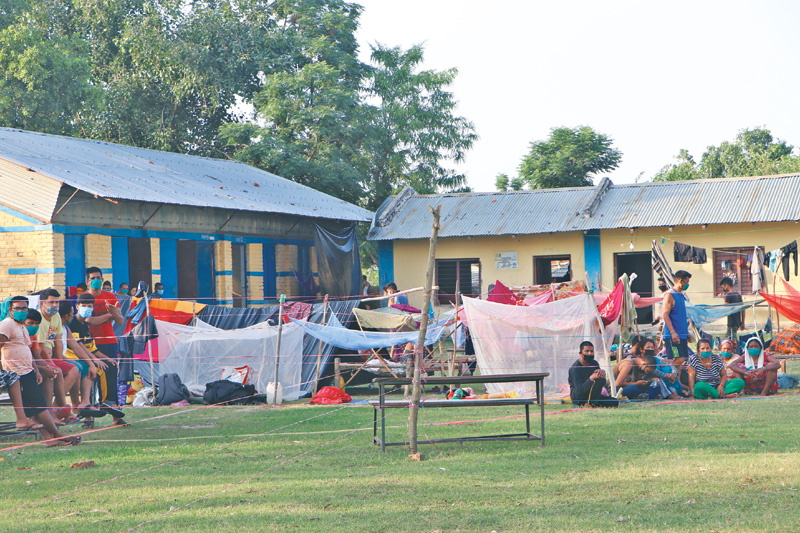
A quarantine centre set up at Bhumiraj Basic School in Baitadi district. Post Photo: TRIPTI SHAHI

KATHMANDU,
The Social Welfare Council has urged national and foreign non-governmental organisations to come up with the plan to invest their financial resources in the management of dispatch (holding) and quarantine centres and isolation wards in view of the Covid-19 pandemic.
The call comes amid growing criticism of the government for its poor management of quarantine centres, many of which have turned into coronavirus “incubation centres”.
“Given the rising number of Covid-19 cases, additional resources are needed for the management of these facilities [quarantine and holding centres],” states a notice issued by  the regulator for non-governmental organisations asking NGOs to submit a working plan to mobilise their resources in the management of holding centres, quarantine centres and isolation wards in coordination with local governments.
Durga Prasad Bhattarai, information officer at the council, said that the council was conducting a need assessment for quarantine centres.
“After the completion of this process, the council will come up with its own strategy on how domestic and foreign non-governmental organisations can contribute towards the operation of quarantine centres, said Bhattarai. Local governments will quarantine returnees from abroad before they are released from the dispatch centres, he said.
On the other hand, the council has already completed a need assessment for the dispatch centres. The government has already set up seven dispatch centres on the outskirts of Kathmandu Valley to serve as a dispatch centre for Nepalis returning home from abroad after they land at Tribhuvan International Airport.  “As per our plan, non-government organizations will be responsible for arranging food, sanitizers and water when returnees are at the holding centres and on the way until they reach their respective quarantine centres,” said Bhattarai. The council expects this operation to come with a price tag of Rs 15 million.
Bhattarai said that the council was also conducting a need assessment for managing quarantine centres to generate support from non-government organisations.
Mismanagement of quarantine centres has been making national headlines in the recent days as most of the confirmed Covid-19 cases in the recent past have appeared in such centres.
Earlier this month, the Ministry of Women, Children and Senior Citizens organised a meeting with domestic and foreign non-governmental organisations.  During the consultation, the ministry had sought cooperation from the  NGOs in two areas. “Firstly, the government sought support to make provisions for facilities such as food, hand washing, temporary toilets and awareness campaigns inside quarantine centres,”  Achyut Luitel, president of the Association of  International NGOs in Nepal, the grouping of foreign NGOs. “It also sought support regulating the entry of people from India through the designated 20 entry points.”
The government sought support from the non-government sector after it planned to bring Nepalis languishing abroad in trouble. Earlier this month, the government had issued an order regarding the facilitation of evacuation of Nepalis abroad.
Although the government allowed the domestic and foreign NGOs to divert 20 percent of their programme budget towards fighting Covid-19 in April, it has not specified where the amount could be spent. The council has been approving programmes submitted by the various non-government organisations to fight the epidemic.
“Most of the NGOs have spent their money on medical equipment and goods,” said Bhattarai of the council. “Now, the most pressing issue is that of the management of quarantine centres.”
“We will now seek programmes from non-government organisations to help improve quarantine centres,” said Bhattarai.

Page 4
NATIONAL

Police arrest in-laws over death of Hetauda woman

Investigators and family of the deceased suspect she may have been murdered.
- SHUVAM DHUNGANA
The death of KC, 26, remains a mystery. Photo courtesy: neelam aryal

KATHMANDU,
Police have arrested a man and his daughter in connection with the gruesome death of a woman in Hetauda on Tuesday.
The death of Susmita KC, 26, which has triggered discussions on social media, could be a case of murder, investigators and kin of the woman say while the in-laws of the deceased say she might have killed herself.
“KC’s father-in-law Prakash Thapa, 58, and sister-in-law Sita Thapa, 23,  were arrested on Friday in connection with KC’s death for further  investigation,” said  Deputy Superintendent Indra Bahadur Rana, information officer at Makwanpur District Police Office.
At 7 am on Tuesday, police had found the body of the 26-year-old on the kitchen floor of her husband’s house at Hetauda-4, Makwanpur.
“KC’s neighbours suspected something was wrong at her home and informed police,” said an investigative officer on the condition of anonymity as he wasn’t allowed to talk with the media.
“When we reached the incident site, the kitchen door was closed from inside, and when we broke in, we saw that the body was on the floor and it had several injuries, including a big one on the back of the head,” the officials said.
Soon after the incident came out on social media, many have been demanding a fair investigation. The Post reached out to family members of the deceased and talked to some of her relatives.
“As she was her parents’ only daughter, she was close to them, especially to her mother Laxmi.
Her parents and her younger brother have been traumatised  by the incident,” said her cousin sister Ekta Karki.
Although investigators are yet to ascertain weather Karki killed herself or someone murdered her, the KCs believe that it was a case of premeditated murder orchestrated by her in-laws.
After completion of her bachelor’s degree in hotel management from Rawal Institute of management, Delhi, Karki, who hails from Badanga Municipality-8, Kapilvastu, had returned to Nepal, where she tied the knot with Rupendra Thapa, in April last year.
However, in September last year, Rupendra succumbed to his injuries after his bike collided with a truck. “Everything was going good for her before her husband’s death. She was devastated, so we planned to bring her back home,” said Neelam Aryal, another cousin.
“But her in-laws didn’t allow us to do that. She was tortured and forced to continue living with the family.  However, after two months we brought her home,” said Aryal. “We were not planning to end all ties with her in-laws, we wanted to bring her back as she was not close to any of her in-laws and her husband’s death had made her even more lonely.”
Aryal said that her cousin was young and wanted to achieve something in life. That’s why she wanted to return to Delhi and work.
“After her parents gave her the permission to do so, she had been working in Delhi. However, just before the lockdown she returned to her parents’,” said Aryal.
Nearly after two weeks after she returned to Nepal, her in-laws asked her to return to Hetauda for a while as she had to complete some rituals for her husband, she said. “But during a phone call when I asked Susmita about the rituals, she said she had not participated in any ritual, and was only doing regular house chores, added Aryal.
“As the government imposed the lockdown on March 24, she couldn’t return home,” said her cousin Ekta Karki. “Just a day before the incident, she had talked to her mother asking her to bring her back home. But she couldn’t make it.”
Sushmita’s in-laws, however, claim that she could have killed herself, said Aryal. The Thapas haven’t commented on the case as KC’s father-in-law and sister-in-law are in police custody.

NATIONAL

Government bars movement of people and vehicles from 10pm to 5am

Security agencies and local administrations have been directed to strictly monitor that the directives are followed at workplace and in public areas.
- MATRIKA DAHAL
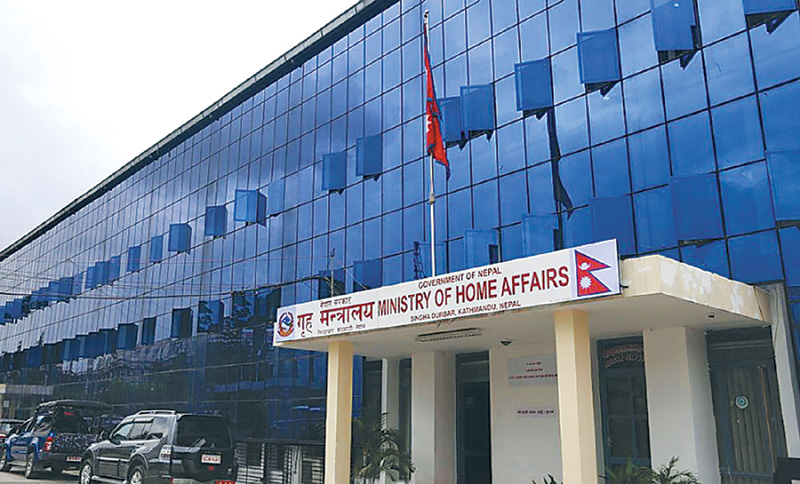
The Home Ministry was tasked with preparing a security modality to manage the lockdown after a Cabinet meeting on June 10 decided to ease the restrictions. Post file Photo

KATHMANDU,
The government has issued a series of directives, including restricting the movement of people and vehicles from 10 pm to 5 am, as part of its strategy to ease the lockdown in different stages.
The directives come four days after the government decided to gradually ease the lockdown from June 15, and following the issuance of Lockdown Security Standards-2020 on Friday.
The Home Ministry has directed the security agencies and the district administration offices in all 77 districts to strictly implement the directive. The ministry has also instructed the concerned agencies to fully implement the ‘Health Protocol” issued by the Health Ministry while enforcing the rule.
The Home Ministry was tasked with preparing a security modality to manage the lockdown after a Cabinet meeting on June 10 decided to ease the lockdown.
As per the new modality of lockdown relaxation, private vehicles can operate under the odd-even number system in 73 districts, except Sarlahi, Rautahat, Kapilvastu and Dailekh districts, from five in the morning till ten at night.
Likewise, security agencies have also been directed to strictly conduct security checks as people have been skirting the security checks and transporting people from one district to the other during nights.
The ministry has also directed the authorities to take action against those who violate the rule under the existing laws, including Essential Services Operation Act, 1957, Infectious Disease Act, 1964, National Criminal Procedure (Code) Act, 2017, and Local Administration Act, 1971.
The government has also barred participation of more than 15 people in religious and cultural gatherings, including marriages and funerals.
The security agencies and local administrations have also been directed to strictly monitor if the precautionary measures against Covid-19, including physical distancing rule of at least 2 metres between two persons, are being followed in workplace and public places.
The directive has also limited the number of people in goods carrying vehicles to only two.
For factories and industries, the government has limited the number of workers to only 10 at a given time.

NATIONAL

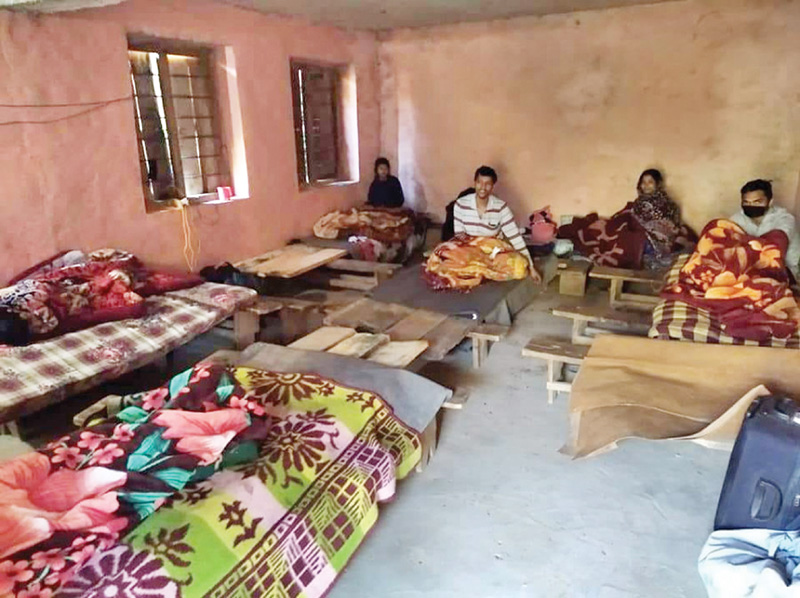
Individuals at quarantine facilities in Banke living with fear of snakebites

Most refuse to stay in these facilities since snake sightings have increased with the rise in temperatures.
- MADHU SHAHI,RUPA GAHATRAJ
Some individuals staying in quarantine have brought beds and mosquito nets from home to protect themselves from snakes. Post Photo: MADHU SHAHI

BANKE,
Last week, Sundarlal Kadu was bitten by a snake while he was sleeping at a quarantine facility in Janaki Rural Municipality, Banke.
Kadu spent the entire night in agony and without treatment since the ward office could not manage an ambulance at night. Mohammad Raja Rai, the ward chairman, said he tried to get an ambulance to take Kadu to a hospital but none was available.
“I made several phone calls but there was no ambulance available to take the patient to a hospital,” he said.
It was only at 8am the next day that Kadu was admitted to Bheri Hospital. He is now out of danger, said Rai.
Snake sightings in the rural municipality are not uncommon but this year, the locals are more exposed to the threat of snake bites since most of them are housed at poorly managed quarantine facilities. According to Rai, ever since he was quarantined, he has on several occasions seen snakes inside the facility but never had the means to protect himself.
“There are no beds in the facility and no ambulance in the isolation centre. The snakes slither into the facility at night and we don’t know how to stop them,” he said.
The ward office on June 9 had agreed to send 19 quarantined individuals to their homes after they refused to stay in the facility for fear of snakes. Currently, there are 14 individuals at the facility.
The situation is the same in quarantine centres across Narainapur, the hotspot of coronavirus spread in Province 5. There are currently 130 individuals staying at three quarantine facilities in Narainapur. All three facilities are dimly lit and do not have enough beds, which make it difficult for the quarantined to avoid snakes.
“We can’t sleep at night for fear of getting bitten. It’s also hot indoors so we spend our nights outside but that leaves us exposed to snakes,” said Jahid Ali Sekh, who’s staying at a quarantine facility in Ward No.4.
Sekh had returned home from Maharashtra in India almost two weeks ago.
Istiyak Ahamad Shah, chairman at the rural municipality, admitted that his office does not have the funds to properly manage quarantine facilities in the local unit.
“We don’t have the funds to purchase beds or secure the facilities from snakes,” he said.
In Bardiya, people staying in quarantine facilities face the same reality.
Last week, a man was bitten by a snake at Sadashiva Multiple Campus quarantine in Barbardiya Municipality. A few weeks prior to that incident, locals in Gulariya also reported spotting snakes inside the quarantine facility at Bagalamukhi Radhakrishna Tharu Secondary School.
The data of Bheri Hospital showed that eight out of 150 snakebite victims died while undergoing treatment in the last fiscal year.
“The hot and humid weather brings snakes out of their shelters, which makes their confrontation with humans unavoidable. The only way to save oneself from snake bites is by using beds and mosquito nets,” Dr Paras Pandey, a snakebite specialist in Banke, said. According to him, kraits and cobras are the most commonly found snake species in Banke and Bardiya.
Meanwhile, some individuals staying at a quarantine facility in Banke’s Khajura Rural Municipality have brought their own beds and mosquito nets from home to protect themselves from snakes. But for others, taking such measures is not possible.
“I get covered with mosquitoes and other insects while sleeping at night, and I worry that I might get bitten by snakes. But I can’t afford a bed or a mosquito net,” said Budhisara Magar, a resident of Simalghari staying at a quarantine facility in the local unit.
There are 88 individuals, including seven women, in the quarantine facility set up at Janakalyan Secondary School of Khajura.
“We have asked newcomers to sleep outdoors since all rooms are packed. We have also asked them to bring their own beds and mosquito nets, as we have run out of resources to make such arrangements for them,” said Eka Maya BK, vice chairperson at the rural municipality. There are currently 279 individuals staying at 24 quarantine facilities in Khajura Rural Municipality.

Page 5
MONEY

Telecom Authority directs ISPs to make provisions for customers to monitor internet connection

The number of complaints regarding slow internet spiked during the lockdown.
- KRISHANA PRASAIN
SHUTTERSTOCK

KATHMANDU,
Nepal Telecommunications Authority has directed internet service providers to make provisions to let customers know whether they are getting the proper internet service and speeds as per the agreement.
The move comes amid criticism from users who are promised a reliable high-speed internet service in the agreement, but internet service providers (ISPs) fail to deliver.
The Internet Service Providers’ Association said that providing such service will take time as it needs to install technical devices.  
With the number of complaints regarding slow internet service rising, the authority directed internet service providers to make provisions so that customers can check
if they are getting the proper service and speeds they signed up for, said Min Prasad Aryal, director at the authority.
Bhoj Raj Bhatta, president of Internet Service Providers’ Association of Nepal said that due to the lockdown, it will take time for ISPs to implement such provisions. He added that ISPs have already started discussions regarding the matter.
ISPs have already rolled out the service for corporate houses while residential customers are still waiting for the feature.  
Bhatta said that 70 percent of the problems occur between the router and connected device due to several factors such as incorrect placement of the router, resetting the device time and again, quality of router and connecting more devices. In case of issues, internet service providers can provide the information of service used, he said.
Though information on real-time bandwidth can be obtained, internet utilisation is another thing, with no system in place to access it.
Except for a few apps, customers do not have the option to check the speed and information regarding their internet connection. If customers find that their internet speed is not according to the agreement, they can complain to their service provider.
Meanwhile, the global speed test report of Ookla in May ranked Nepal 119th, down one position compared to March in fixed broadband, with a download speed of 18.58 mbps against the global average speed of 76.94 mbps. Nepal’s upload speed was measured at 17.80 mbps compared to the global average speed of 41.09 mbps.  
Since the government imposed a nationwide lockdown, internet utilisation across the country has jumped 25 percent. With more people staying and working from home, ISPs ran out of bandwidth quickly, resulting in slow internet and a spike in complaints.
According to the association, internet companies have started bolstering their networks by adding additional international bandwidth capacity. Internet utilisation after the lockdown has reached 500 gigabytes, an increase of 30-40 percent.
Internet service providers who used to manage their network load by dividing it during peak hours and working hours are struggling to provide stable internet during the lockdown as users are using the internet 24 hours, with greater usage during the daytime

MONEY

China moves vast trade fair online, but few buyers follow

- ASSOCIATED PRESS
The website of the Canton Fair which delivers live streaming from vendors is seen on a
computer screen in Beijing on Friday. AP/RSS

BEIJING, 
Standing in front of shelves laden with colorful backpacks, a saleswoman promoted bags on the Canton Trade Fair’s website without knowing whether anyone was watching as the world’s biggest sales event opened in cyberspace to avoid the coronavirus pandemic.
The twice-a-year fair usually draws more than 180,000 foreign buyers and 60,000 Chinese vendors to the southern city of Guangzhou. But with most foreign visitors barred from China, the event has transformed itself into an e-commerce platform with mini-shopping channels for nearly 8,000 vendors.
The saleswoman for Honeyong Enterprise Co.,Ltd. showed off backpacks for children. Shark fins jutted out of a model for boys. A hot pink model for girls had lace flaring out from the bottom like a ballerina’s tutu.
“It will look like dancing girls when your little girl wears it,” said the saleswoman, who gave her name as Sophia. “If you want more choices, please contact me right now,” Sophia said, pointing to an instant message link on the screen, “or send me an email.”
The fair, founded in 1957, was for decades Chinese exporters’ main link to foreign buyers. It faces growing competition from companies such as Hong Kong’s Global Sources and China’s Alibaba Group that connect buyers and exporters online.
But the fair still is popular with retailers and other customers who want to meet new suppliers and try out products.
Orders at last year’s spring session, which attracted 195,000 buyers, totalled 199.5 billion yuan ($29.6 billion), organizers say. Last November’s autumn session produced an additional 207 billion yuan ($29.4 billion) in deals. This year, it isn’t clear yet how many buyers have followed vendors to the website.
“Not many foreign customers visit us online,” said Honeyong’s sales manager, Clare Wan. “Maybe if they want to check out new products, they still want to see them in person.”
To manage its online bazaar, the Chinese government turned to tech giant Tencent, operator of the popular WeChat messaging service.
The video platform includes technology that produces a three-dimensional digital image of a product that potential buyers can turn around and see from different angles, according to Tencent. Instant messaging and interpretation features are intended to allow customers in other countries to talk directly to sellers.
Tencent and Alibaba are working with trade shows in China and abroad to put events online in hopes of reaching more customers.
Last year, Alibaba set up a video channel for Chinese vendors to show products to visitors at the Consumer Electronics Show in Las Vegas, the industry’s biggest annual sales event.
The coronavirus pandemic “means we have to pioneer the 21st-century trade show,” said John Caplan, Alibaba’s president for North America and Europe.
Still, the internet is no substitute for meeting vendors in person, said Chris Sillitoe, who owns a sourcing company in Britain that buys tools and other hardware for retailers. Sillitoe has visited every Canton Fair in the last two decades.
“That’s absolutely what it’s all about,” said Sillitoe. “The virtual fair isn’t a replacement for being on the ground in China.”

MONEY

Japan’s deflation gathers momentum as prices extend declines

- REUTERS
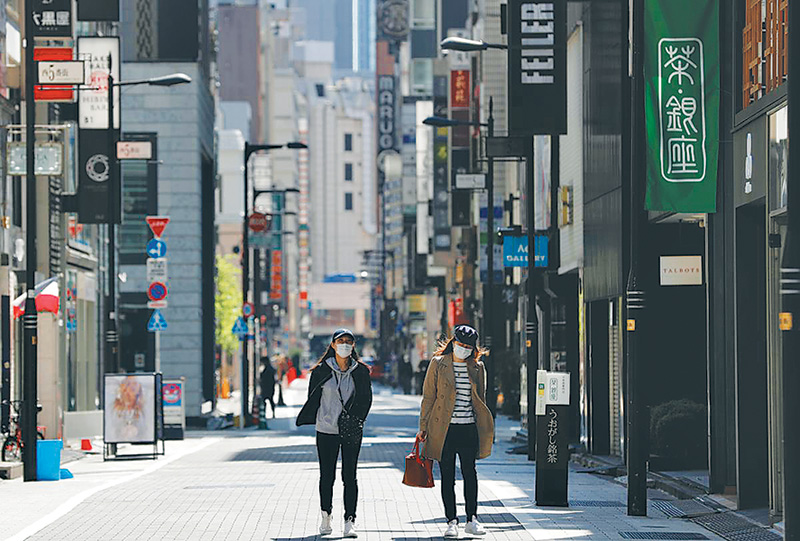
Women wearing face masks walk in a deserted shopping district in Tokyo. reuters

TOKYO, 
Japan’s core consumer prices fell for a second straight month in May, reinforcing deflation expectations and raising the challenge for policymakers battling to revive an economy reeling from the coronavirus pandemic.
The data will likely complicate the Bank of Japan’s job of restoring growth and inflation, with a raft of recent indicators suggesting the nation is in the grip of its worst postwar economic slump.
Several BOJ board members warned that stronger monetary support and closer policy coordination with the government were needed to prevent Japan from returning to deflation, minutes of the bank’s April meeting showed.
“With the pandemic hurting the economy, there’s a good chance Japan may slide into deflation. Downward pressure on prices will likely persist throughout this year,” said Yoshiki Shinke, chief economist at Dai-ichi Life Research Institute.
The nationwide core consumer price index (CPI), which includes oil but excludes volatile fresh food prices, fell 0.2 percent in May from a year earlier, government data showed on Friday.
That compared with market forecasts of a 0.1 percent fall and followed a 0.2 percent drop in April, which was the first year-on-year decline since December 2016.
The BOJ kept policy steady this week after expanding stimulus in March and April. But governor Haruhiko Kuroda conceded that inflation would remain well short of its 2 percent target for years to come.
The downturn in growth is also likely to have been exacerbated by Japan’s state of emergency in April through late May, which prompted people to stay home and businesses
to close.
As businesses re-open after the lifting of lockdown measures, the government raised its economic assessment in June for the first time since 2018.
Japan also lifted all coronavirus-related curbs on domestic travel on Friday, with Prime Minister Shinzo Abe calling on people to go sightseeing or attend events to help the nation’s economy bounce back.
But analysts doubt Japan’s economy can rebound strongly from an expected contraction of more than 20 percent in the current quarter.
Some BOJ policymakers were concerned that bolder steps are needed to prevent the country from slipping back to sustained period of damaging price declines, the April minutes showed.
“Japan is now facing the risk of deflation, so it’s possible to further enhance coordination between fiscal and monetary policies,” one BOJ board member was quoted as saying.

MONEY

Europe threatens digital taxes without global deal, after US quits talks

- REUTERS

PARIS/BRUSSELS, 
The European Union said on Thursday it could impose taxes on digital giants such as Google, Amazon and Facebook even without a global
agreement by the year-end, after Washington quit talks and stoked fears of a new trade war.
The latest transatlantic row was ignited when the United States said on Wednesday it was withdrawing from negotiations with European countries over new international tax rules on digital firms, saying talks had made no progress.
Nearly 140 countries are involved in the talks organised by the Organisation for Economic Cooperation and Development (OECD) on the first major rewrite of global tax rules in a generation to bring them up to date for the digital era.
“A trade war, especially at this point in time, where the world economy is going through a historical downturn, would hurt the economy, jobs and confidence even further,” OECD Secretary General Angel Gurria said, urging all sides to reach a deal.
The talks aim to reach agreement by the end of 2020, but that deadline is now slipping out of reach with Washington’s latest move and the US presidential election in November.

MONEY

Asia’s rising gasoline demand spells end for floating storage trend

- REUTERS
A tanker used as a floating storage vessel is pictured off Johor, Malaysia. reuters

SINGAPORE/JAKARTA, 
A second and final trio of ships used as floating storage tanks for gasoline is en route to unload cargoes in Indonesia, Sri Lanka and Malaysia, according to industry sources and shipping data, showing fuel demand is growing across Asia.
More than 280,000 tonnes (about 2.4 million barrels) of gasoline were stored onboard six ships floating off Singapore and Malaysia last month after demand slumped as countries imposed lockdown measures on business and travel to curb the spread of the coronavirus.
Half of those volumes, contained in a first trio of vessels, were discharged between late May and early June.
Refinitiv Eikon data showed Indonesia’s Pertamina is now set to discharge gasoline from the BW Zambesi now at Merak, its third such delivery this month. The largest gasoline importer in Asia had previously stocked up on the fuel to cash in on low oil prices.
Two other ships -- Georg Jacob and Energy Centurion -- chartered by trader Trafigura are currently at Tanjung Langsat, Malaysia, and Galle, Sri Lanka, respectively, the data showed. All three ships are Panamax vessels—named after their suitability for transiting the Panama canal—capable of transporting about 50,000 tonnes of fuel each.
“As compared to the storage volumes seen in mid-May, the current offshore storage for gasoline around Singapore/Malaysia/Indonesia has fallen significantly,” said Sandy Kwa of energy consultancy FGE. “This is reflective of the region’s resurgence in driving demand.”
Pertamina was not immediately available for comment, while Trafigura declined to comment.
Gasoline prices and refiners’ margins have rebounded from lows in April and May amid rising fuel demand.
Asia’s benchmark 92-octane gasoline prices have averaged at $41 a barrel between June 1 and June 18, up 33 percent and 111 percent from the full-month averages in May and April, respectively.
Similarly, Asia’s gasoline refining margin was at a premium of $1.57 a barrel to Brent crude on average so far in June, a sharp improvement from monthly average discounts of $7 in April and $1.57 for May.

Page 6
WORLD

India reports record rise in coronavirus cases as Chennai locks down

- REUTERS
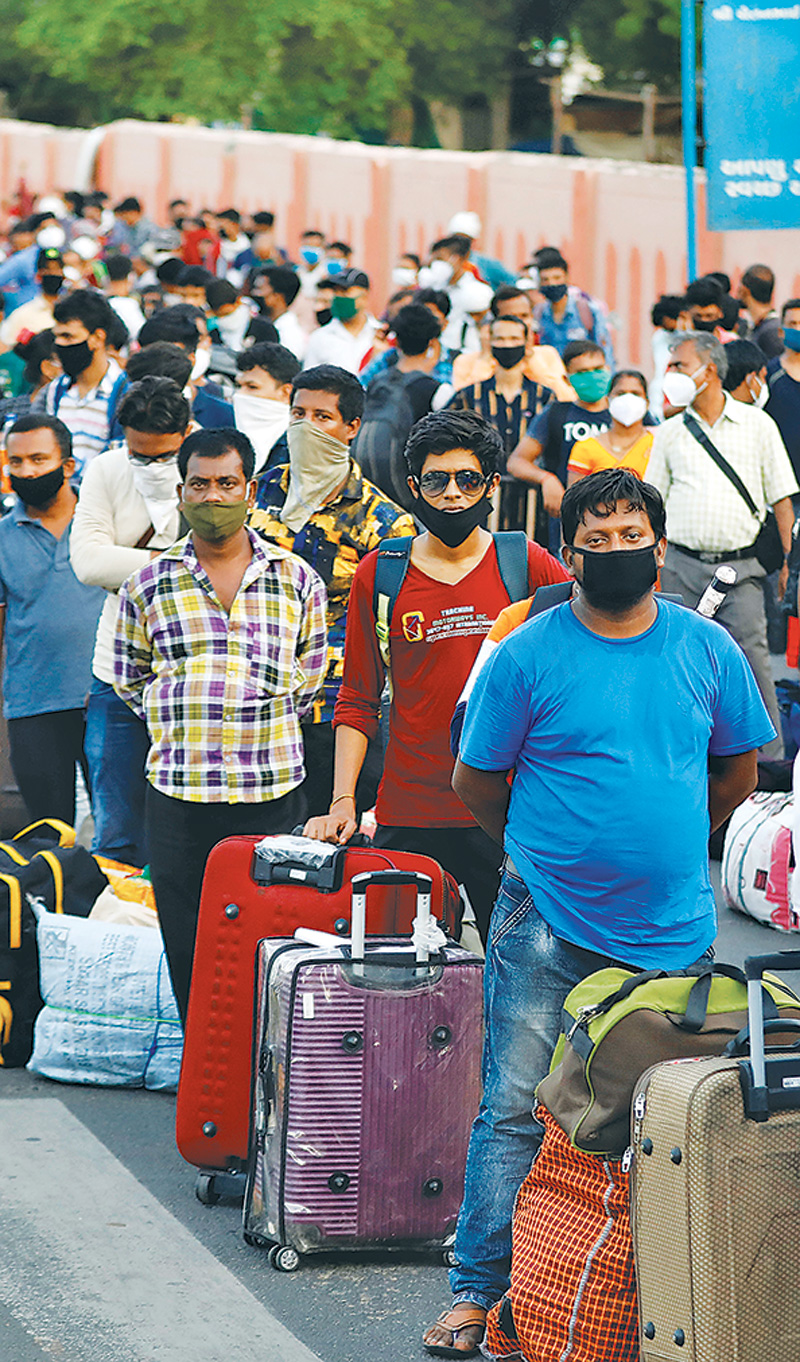
Workers and families wait outside a railway station to board a train to West Bengal, after lockdown was eased in Ahmedabad, India. Reuters

Chennai/ New Delhi,
India reported a record daily jump in the number of novel coronavirus cases on Friday as Chennai locked down following fresh outbreaks there.
Given India’s high population density, experts have long worried that a sustained Covid-19 outbreak would lead to pressure on its stretched healthcare system.
Prime Minister Narendra Modi lifted most restrictions that were part of a nearly three-month nationwide lockdown on June 8, despite the continuing rise in cases.
Data from India’s federal health ministry on Friday showed an additional 13,500 cases over the previous 24 hours, with over 300 deaths.
India now lags only the United States, Brazil and Russia in total number of infections and has
 reported four times more than China, which has a similar size population and is where the virus originated late last year.
On Friday Tamil Nadu imposed a lockdown with tough restrictions in Chennai and surrounding districts until June 30.
Roads in Chennai, known as “India’s Detroit” for its large car-making industry, were largely empty on Friday and most shops were closed amid heavy police patrolling to ensure adherence to the rules.
“Police officers and medical professionals are fighting for you. Please cooperate and be hopeful,” Tamil Nadu state Health Minister C Vijayabaskar said in a tweet on Friday.
“Let’s follow social distancing, stay aware and win this battle against this pandemic.”
Tamil Nadu has tested over 800,000 people for Covid-19—the highest number in the country—and its mortality rate is nearly a third of the national average. But it has been facing criticism over delayed reporting of deaths, and the number of cases and casualties have been rising steeply in recent days, mainly in and around Chennai.
Restrictions elsewhere in India, where states have their own powers to set health rules, have largely been eased.
Roads and businesses in the capital New Delhi, where several politicians including the state health minister have tested positive for the virus, were largely open on Friday.

WORLD

EU seeks post-virus recovery plan as China battles new outbreak

Europe remains the hardest-hit continent with over 190,000 deaths from almost 2.5 million cases.
- AGENCE FRANCE-PRESSE
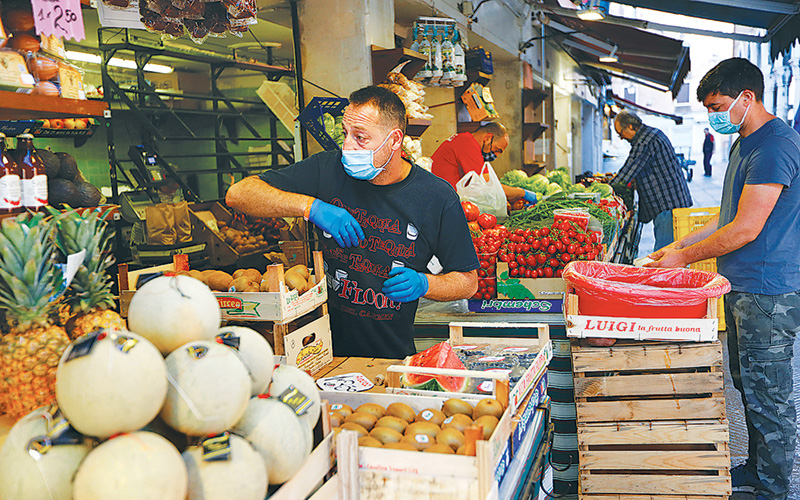
Greengrocers wear face masks at Rialto market, amid the coronavirus disease outbreak,
in Venice, Italy on Friday.  Reuters

Brussels,
Deeply divided EU leaders on Friday started negotiating a post-coronavirus economic recovery plan, as the death toll from the pandemic soared past 450,000 and China raced to prevent a second wave.
China released genome data for the coronavirus found in a fresh outbreak in the capital, which state experts suggest share similarities with European strains.
Tens of thousands of people in Beijing are being tested for the virus while neighbourhoods have been locked down and schools closed as authorities seek to contain a cluster linked to a food market.
Another 25 cases were confirmed in Beijing, taking the total number of infections since last week to 183.
The resurgence came after China had largely brought the virus under control and eased restrictions on movement inside the country, where the illness was first detected in the city of Wuhan.
Europe remains the hardest-hit continent with over 190,000 deaths from almost 2.5 million cases.
Many European countries began reopening this month after painful lockdowns that have saved lives but wearied confined populations—and devastated economies.
The EU faces the biggest recession in its 63-year history, and states are under pressure to look beyond their own borders and to find ways to lift the whole continent. On the table at Friday’s virtual EU summit is a proposal from European Commission chief Ursula von der Leyen for a 750 billion euro ($840 billion) rescue fund that, if accepted, would mark a historic milestone for EU unity.
But opposition is fierce from countries known as the “frugal four”—The Netherlands, Sweden, Denmark and Austria—who have promised to fight to rein in the spending.
“It is clear that we expect no essential agreements at this summit,” said a German government official.
A French source called it a “warm-up round” that would “take the temperature” before leaders land a compromise in late July.
Lined up against the frugals are EU countries such as Italy and Spain that were the first and hardest hit by the pandemic, and quickly asked for help from their better-off partners.
Crippled with overstretched finances, these countries lack the ability to fight the recession with a wave of extra spending and are looking for a highly visible act of solidarity.
The United States still leads the world in the number of confirmed infections and in deaths, with the fatality toll approaching 120,000.
But the leading US government expert Anthony Fauci said in an interview with AFP that the country does not need more widespread lockdowns to bring the outbreak under control.
Rather, he said, “I think we’re going to be talking about trying to better control those areas of the country that seem to be having a surge of cases.”
And he said he was optimistic the world would soon have a vaccine that would end the pandemic, calling early trial results “encouraging”.
Many within the scientific community have described the development of a vaccine for the Sars-CoV-2 virus as a “Moonshot” given there has never been a successful vaccine for any human coronavirus.
“The reason I have more confidence with coronavirus is that we know the majority of people recover from Covid-19 because their immune system clears the virus,” Fauci said.
Chinese authorities said studies of genome data suggest the new coronavirus outbreak in Beijing “came from Europe”, but is different from what is currently spreading there.
“It is older than the virus currently circulating in Europe,” Zhang Yong of the Chinese Center for Disease Control and Prevention (CDC) said in a report published by the Communist Party’s anti-corruption watchdog. Zhang raised the possibility of the virus lurking in imported frozen food or in the wholesale market itself, resulting in similarities to older strains.
In Italy, a study by the national health institute said the coronavirus was present in two cities in the north in December, over two months before the first case was discovered there.

WORLD

Satellite images suggest Chinese activity at Himalayan border

- REUTERS
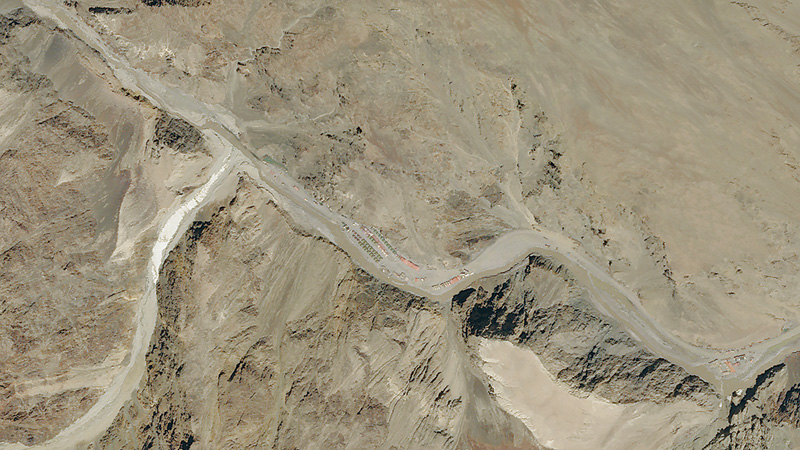
In this June 9, 2020 photo, a satellite image of Galwan Valley in Ladakh, India. Planet Labs Inc via REUTERS

Singapore/ New Delhi,
In the days leading up to the most violent border clash between India and China in decades, China brought in pieces of machinery, cut a trail into a Himalayan mountainside and may have even dammed a river, satellite pictures suggest.
The images, shot on Tuesday, a day after soldiers engaged in hand-to-hand combat in the freezing Galwan Valley, show an increase in activity from a week earlier.
India said 20 soldiers were killed in a premeditated attack by Chinese troops on Monday night at a time when top commanders had agreed to defuse tensions on the Line of Actual Control (LAC), or the disputed and poorly defined border between the nuclear-armed neighbours.
China rejected the allegations and blamed frontline Indian soldiers for provoking the conflict which took place at the freezing height of 14,000 feet in the western Himalayas.
The 4,056-km border between India and China runs through glaciers, snow deserts and rivers in the west to thickly forested mountains in the east.
The Galwan Valley is an arid, inhospitable area, where some soldiers are deployed on steep ridges. It is considered important because it leads to the Aksai Chin, a disputed plateau claimed by India but controlled by China.
The satellite pictures, taken by Earth-imaging company Planet Labs and obtained by Reuters, show signs of altering the landscape of the valley through widening tracks, moving earth and making river crossings, one expert said.
The images shows machinery along the bald mountains and in the Galwan River.
“Looking at it in Planet, it looks like China is constructing roads in the valley and possibly damming the river,” Jeffrey Lewis, director of the East Asia Nonproliferation Program at California’s Middlebury Institute of International Studies.
“There are a ton of vehicles on both sides [of the LAC]—although there appear to be vastly more on the Chinese side. I count 30-40 Indian vehicles and well over 100 vehicles on the Chinese side.”
Chinese Foreign Ministry spokesman Zhao Lijian said he was unaware of the specifics on the ground but reiterated that the Indian army had crossed into Chinese territory in several places in recent days and that they should withdraw.
The clash was the most serious since 1967. Since early May, soldiers have faced off on the border where India says Chinese troops had intruded and set up temporary structures. The confrontation turned into a deadly brawl on Monday.
The fighting was triggered by a row over two Chinese tents and observation towers that India said had been built on its side of the LAC, Indian government sources in New Delhi and on the Indian side of the border in the Ladakh region said.
China had sought to erect a “structure” in the Galwan Valley on India’s side of the LAC even after military officials had reached an agreement on June 6 to de-escalate, Indian Foreign Minister Subrahmanyam Jaishankar told China’s senior diplomat, Wang Yi, in a phone call on Wednesday, the Indian Foreign Ministry said. It was not immediately clear to what structure he was referring.
The problem arose when an Indian patrol visited the area near a ridge to verify a Chinese assertion that its troops had moved back from the LAC, the two government sources aware of the military situation said.
The Chinese troops had thinned out and left behind the two tents and small observation posts. The Indian party demolished the towers and burnt the tents, the sources said.
The satellite images show possible debris from the observation posts on Tuesday morning on a ridge on India’s side of the LAC. There was no such structure in the image taken a week earlier. A large group of Chinese soldiers arrived and confronted the Indian troops, led by Colonel Santosh Babu. They were lightly armed in line with the rules of engagement at the LAC, one of the sources said.
India and China have not exchanged gunfire at the border since 1967, despite occasional flare-ups. Soldiers are under instructions to keep their rifles slung at their backs.
It was not clear what happened next, but the two sides soon clashed, with the Chinese using iron rods and batons with spikes, one of the sources said.

WORLD

South Asian Covid patients in UK hospitals 20 percent more likely to die: Study

- REUTERS

London,
Hospitalised Covid-19 patients of South Asian ethnicity in Britain are 20 percent more likely to die from the disease than white people, a large-scale study said on Friday, the latest evidence that minority groups are disproportionately hit by the virus.
The preliminary results showed that hospitalised South Asians were 12 years younger on average and generally had fewer pre-existing conditions.
Although patients in the group were more likely to have diabetes, four-fifths of the increase in mortality was unexplained.
“South Asians have 20 percent increased risk of death. Part of that risk is explained by diabetes, but part of it is not,” said Ewen Harrison, Professor of Surgery and Data Science at University of Edinburgh.
Explanations could be that more South Asians work in jobs where they would face a higher viral load, such as health and care, or genetic differences which made the group biologically more susceptible to the disease, but more work needed to be done, he told reporters.
Data from the Office for National Statistics on Friday supported the idea that ethnic minorities are more at risk from Covid-19, although
whether it is because certain groups are more likely to contract it to start with, or are more susceptible to it, is still unclear.
Harrison said other ethnic minority groups did not have statistically significant higher chance of dying among patients in hospital in the study.
“We see higher rates of intensive care admission and have the need to go into ventilator in black and Asian and other minority ethnic groups, but that’s not translated into an increased risk of death,” he said.
He added that the study did not consider whether groups were more likely to catch the coronavirus to start with, which could explain higher death rates from Covid-19 among other minority groups.
The study used data from 260 hospitals and enrolled 34,986 patients, although the preliminary findings had not been peer-reviewed.

WORLD

Hong Kong law must protect basic freedoms: UN rights chief

Briefing
- AGENCIES

GENEVA:  Any new national security laws imposed on Hong Kong “must fully comply with China’s human rights obligations” and international treaties protecting civil and political freedoms, the top UN human rights official said on Friday. The draft legislation specifies the definition of four crimes and sets out punishments: separatist activity, state subversion, terrorist activity, and collusion with foreign forces, Xinhua reported on Thursday. Michelle Bachelet, UN High Commissioner for Human Rights, stated: “Any law on national security should be clear in scope and definition, and only permit restrictions to human rights that are strictly necessary and proportionate.”

WORLD

Venezuela presidents to battle over gold in London vaults

Briefing
- AGENCIES

CARACAS: In the vaults of the Bank of England, where foreign nations stash parts of their gold reserves, lie $1.9 billion of disputed gold bars. Venezuelan President Nicolas Maduro says they belong to his administration’s central bank. His rival, opposition leader Juan Guaido, who the British government recognises as Venezuela’s rightful leader, say the bars are his to control. A British commercial court will begin deciding whose claim is just, after the Venezuelan central bank sued the Bank of England to gain access.

WORLD

Coordinated blasts kill four in Pakistan, including soldiers

Briefing
- AGENCIES

KARACHI: Three consecutive explosions claimed by a little-known separatist group killed four people including two soldiers in Pakistan’s southern province of Sindh on Friday, officials said. At least a dozen people were also injured. Shadowy secessionist organization the Sindhudesh Revolutionary Army, which wants the province to break from the Pakistani federation, said it carried out the attacks. One of the blasts was in Karachi, Pakistan’s largest city and the capital of Sindh, where a civilian died and eight others including a paramilitary soldier were injured. That explosion was outside a centre for distribution of government cash handouts, and police believe the target was a vehicle of the Sindh Rangers paramilitary force parked outside.

Page 7
SPORTS

Benzema stunning volley fires Madrid past Valencia

The French forward scores twice and Asensio adds another in Real’s 3-0 win. They are two points behind champions Barcelona.
- AGENCE FRANCE-PRESSE
Real Madrid’s Karim Benzema (centre) in action with Valencia’s Hugo Guillamon (right) during their La Liga match at the Alfredo Di Stefano Stadium in Madrid on Thursday. Reuters

MADRID,
Karim Benzema’s volley could well be La Liga’s goal of the season and Marco Asensio’s was his first touch in over a year as Real Madrid stormed past Valencia 3-0 on Thursday.
Two brilliant strikes helped Madrid to a convincing win at the empty Alfredo di Stefano Stadium, where Benzema continued his excellent form with a brace after putting his team in front thanks to another combination with Eden Hazard.
Valencia had been the better side in the first half when Rodrigo Moreno hit the post and then had a goal controversially ruled out after referee Jose Sanchez consulted VAR.
Yet Madrid found a different gear after the break to carve out an impressive victory that reduces their deficit to two points behind Barcelona, who play away at Sevilla on Friday. Benzema’s stunning second goal that saw him take the ball out of the air with one foot and then volley home with the other was a breathtaking moment that came shortly after a dramatic one for Asensio too.
Asensio has not played since June 10 last year after suffering an anterior cruciate ligament injury but the 24-year-old announced his return in style, volleying in with his first touch, 31 seconds after coming on. “It’s been many months of hard work and I’m very happy to play again and to score,” he said afterwards. “I feel a lot of emotion, satisfaction. A lot of work has gone into this.”
“It means a lot to him,” said coach Zinedine Zidane. “We’re just happy to see him on the pitch again.” But with nine games to go in the title race, Benzema appears key, particularly as his partnership with the resurgent Hazard continues to flourish. This was his 243rd goal for Real Madrid in all competitions, putting him above Ferenc Puskas into fifth in the club’s all-time list.
“Benzema’s goal was truly an amazing,” Zidane said. “The volley, the way the ball fell, with his left foot...I’m happy for him.”
In fact, he twice looked for Hazard in the first half too keenly, the first time on the break when he played back inside with Fede Valverde was free outside him. After a strong start, Madrid faded and Valencia came on strong. They hit the post when Maxi Rodriguez’s pass sent Rodrigo clear, his shot was diverted by the fingertips of Thibaut Courtois.
Valencia then thought they had scored as Carlos Soler’s pass to the back post beat both Maxi and his marker Raphael Varane to find Rodrigo, who tapped in. But VAR persuaded Sanchez that Maxi’s heel was offside and also that the ball had feathered his foot on its way through. Rodrigo opened the palms of his hands in disbelief.
Benzema tried to nod down for Hazard when he would have been better going for goal but Madrid had lost their purpose and were grateful for half-time. They were better in the second half, with more control. Kevin Gameiro came on for Valencia and his first touch was a costly one, a loose pass to Hazard setting Madrid away. Hazard played a one-two with Luka Modric and pushed the ball across for Benzema to finish.
Asensio came on in the 74th minute after a hug and a smile with Zidane. His first touch was a glorious one as Ferland Mendy beat Daniel Wass to the line and chipped a pass back to his teammate, who punched a superb volley into the net with his left foot. An incredible moment could only be surpassed by something special, which Benzema delivered. Asensio crossed and Benzema lifted the ball in the air over Hugo Gillamon with his right foot and then with his left, banged it into the top corner.
Valencia were dead and buried and Lee Kang-In was sent off after three frustrated hacks on Sergio Ramos. He departed with one minute left.

SPORTS

Werder Bremen braced for relegation final in Bundesliga

- AGENCE FRANCE-PRESSE

BERLIN,
Struggling Bundesliga giants Werder Bremen have just two matches to avoid relegation, but can take a significant step towards survival at Mainz on Saturday.
Bayern Munich were confirmed Bundesliga champions for the eighth straight season in midweek, but the fight to stay up is still raging. Bremen are second-bottom and in danger of losing their status as the club with the most years spent in Germany’s top flight. They sit one point behind Fortuna Duesseldorf, who occupy the relegation play-off spot, but six behind 15th-placed Mainz after their surprise win at Borussia Dortmund on Wednesday.
Four-time champions Bremen have been in the Bundesliga every season bar one since its introduction in 1963. They were relegated in 1980, but came straight back up. Bremen visit Mainz in one of nine games at 1330 GMT on Saturday and host Cologne on the final day of the season on June 27. “We have two ‘finals’, which we must win to stay up,” said midfielder Maximilian Eggestein. Werder’s American midfielder Josh Sargent said: “No one wants to let the team or the city down.”
Bottom side Paderborn have already been relegated. Duesseldorf host Augsburg on Saturday and visit Union Berlin on the final day, while Mainz can secure safety by beating Bremen before their last match at Champions League-chasing Bayer Leverkusen. Mainz coach Achim Beierlorzer has billed the game as a “relegation final”.
Meanwhile, second-placed Borussia Dortmund are looking to bounce back from Wednesday’s shock defeat by Mainz at RB Leipzig, who are third but yet to secure a Champions League spot. Leipzig striker Timo Werner, who has scored 32 goals in all competitions this season, has confirmed he is moving to Chelsea from July 1, but can play in Leipzig’s last two Bundesliga games of the campaign. Werner scored in Leipzig’s 2-2 draw with Duesseldorf on Wednesday, but they threw away a two-goal lead and still need another win to secure Champions League qualification.
“Now we have to deliver on Saturday,” said coach Julian Nagelsmann, whose side would also leapfrog Dortmund into second with victory. “Coming second in the league doesn’t mean anything. It’s about getting into the Champions League and we’ve got enough to do there.”
There will be no coronation for Bayern after Saturday’s final home game of the season against Freiburg. The league said they must wait to receive the Bundesliga trophy until after their final match, next weekend at Wolfsburg, due to coronavirus restrictions. Bayern are without the suspended Alphonso Davies, who was sent off in midweek, and Lucas Hernandez is expected to take over at left-back as the Bavarians chase a 15th straight win all competitions.
The Bremen striker Claudio Pizarro is 42 in October, four years younger than coach Florian Kohfeldt, but has shaken off a thigh injury and could play a role at Mainz. As he did in Tuesday’s 1-0 home loss to Bayern, Pizarro could come off the bench and add to his 488 Bundesliga appearances, with 197 goals.
“I am proud that they call me a legend,” said Pizarro, who won the Bundesliga six times with former club Bayern and the German Cup on six occasions, five with Bayern and once, in 2008/09, with Bremen. Pizarro also has the distinction of scoring in 21 consecutive calendar years during spells in Europe with Bremen, Chelsea, Bayern and Cologne, but is yet to find the net in 2020.

SPORTS

Juventus supremacy under threat at Serie A

- AGENCE FRANCE-PRESSE
Juventus’ Cristiano Ronaldo (right) outruns Napoli’s Kalidou Koulibaly during their Italian Cup final match at the Olympic Stadium in Rome on Wednesday. AFP/RSS

MILAN,
Juventus’s Serie A supremacy faces a stiff test with the champions just one point ahead of Lazio as the Italian league kicks off again this weekend following a three-month shutdown.
A return had looked unthinkable back in April as Italy counted their daily coronavirus deaths in the hundreds for nearly 35,000 victims in the country. But the situation has improved with strict health protocols in place and all matches being played behind closed doors. Four postponed games will take place first this weekend involving teams at the epicentre of the Covid-19 outbreak.
Atalanta host Sassuolo in Bergamo on Sunday, and Inter Milan are at home against Sampdoria. On Saturday, Torino host Parma and Cagliari travel to Hellas Verona. Next week all teams will have 12 games left to play with Juventus at Bologna on Monday, and Lazio travelling to Atalanta on Wednesday.
Maurizio Sarri’s Juventus fell in the Italian Cup final to Napoli on penalties midweek, having also lost the Italian SuperCup to Lazio in December.
“Ronaldo, (Paulo) Dybala and our great soloists lack that little bit of brilliance, but I consider it quite normal in this period,” said Sarri. “I didn’t say anything to the players, we were all very angry and disappointed and I think it’s better to be silent right now.”
Sarri’s woes have been compounded with Brazilian defender Alex Sandro tearing a knee ligament against Napoli and Sami Khedira picking up a potentially serious tendon problem. Argentine forward Gonzalo Higuain and captain Giorgio Chiellini are also not yet at full fitness. Juventus will be counting on their top scorer Cristiano Ronaldo to react after suffering two defeats in a final for the first time in his career, and missing a penalty in the Italian Cup semi-final.
Lazio’s Ciro Immobile has scored 27 goals this season, six more than Ronaldo, as the in-form Romans target their third Scudetto and first in two decades. Simone Inzaghi’s side have already beaten Juventus twice this season, in the Italian SuperCup final and 3-1 in the Stadio Olimpico in Rome. The top two teams will meet in Turin on July 20. Inter Milan are third, nine points behind Juventus. Inter lost to Lazio (2-1) and Juventus (2-0) just before the suspension.
“If I have to find a positive part of this crisis, it’s that I’ve had time to focus and try to find different areas in which the team can improve,” said coach Antonio Conte. Atalanta occupy the final Champions League berth, three points ahead of Roma, with Napoli sixth a further six points back.
While the championship resumes the question remains of what happens in the case of another suspension. Plan B provides for play-offs, the format of which remains to be defined. A final decision could open the way to use a complicated algorithm devised by the federation to establish the final ranking. Who would qualify for the Champions League or the Europa League? Who would go to Serie B?
Very simple: PF = PT + (MPc x NPc) + (MPt x NPt)! This formula means that the total points will be calculated taking into account those obtained at the time of the interruption, plus a simulation based on the average points taken at home and away multiplied by the number of matches still to play. It was even considered at one point to take into account the number of goals scored home and away, for an even more intimidating formula: PF = PT + 0,90 x [(MPc x NPc ) + (MPt x NPt)] + 0,10 x (iag x ?r).
“This is madness. We are at the ‘Normale’ of Pisa,” said FIGC president Gabriele Gravina, referring to the prestigious Tuscan university, which has given Italy three Nobel Prize winners and two Presidents. But one sticking point was cleared up Thursday with the Italian government agreeing to ease quarantine restrictions in the case of a positive test with only the infected person isolated. The squad and staff will be closely monitored and a quick test performed on the whole team on match day, boosting hopes that the championship will be concluded.

SPORTS

India’s pace attack is the best in history, says Shami

- AGENCE FRANCE-PRESSE
Mohammed Shami. afp

NEW DELHI,
India fast bowler Mohammed Shami has claimed they may have the best pace attack in Test history, brushing aside the feared West Indies quicks of the 1970s and 1980s.
Shami, Ishant Sharma, Jasprit Bumrah, Umesh Yadav and Bhuvneshwar Kumar have over become leaders of the Indian attack, which has traditionally relied on spinners. “You and everyone else in the world will agree to this — that no team has ever had five fast bowlers together as a package,” Shami said in an online chat for ESPNcricinfo. “Not just now, in the history of cricket, this might be the best fast-bowling unit in the world,” he added. When reminded of the West Indies pace packs of the 1970s and 1980s, Shami said India still has fast bowlers waiting on the sidelines to take over. “We have a bowler on the bench who can work up speeds of 145-48 kph (over 90mph),” said Shami, who has 180 wickets from 49 Tests.
The 29-year-old, who has come back a more potent bowler from a career-threatening knee injury, said there was no rivalry for the new ball between the Indian bowlers. “We surround Virat Kohli and ask him to make the decision,” Shami said of the support for the Indian captain. “But he normally says, ‘Don’t get me involved in all this; you decide among yourselves, I don’t have an issue’.
Shami said he is normally happy to let two other bowlers start with the new ball. “We support each other whether we’re getting wickets or not,” he said. Shami battled weight issues, injury and a legal quarrel with his estranged wife before making a comeback in the Indian team that reached the 2019 World Cup semi-finals. He took 14 wickets in four games at the World Cup, including a match-winning hat-trick. Shami also took 13 wickets during India’s 3-0 home Test sweep over South Africa last year.

Page 8
AS IT IS

Anonymous

Because the “other” is also always the “me”. The “other” is a reflection of who you are.
- Prateebha Tuladhar
shutterstock

I’ve never known how to write this one. So, this shall toggle between first person and third person narratives. Me and the other. Because the “other” is also always the “me”. The “other” is a reflection of who you are.
***
I’m in my mid-twenties. I’m returning to a particular city in northern England, from Cambridge. I call up my aunt to let her know I’ve arrived. I step off the bus with my luggage. I’m carrying one of those small suitcases; one you would use as cabin baggage. I walk out of the bus station, with my luggage rolling at my heels. The parking lot where my aunt is supposed to meet me is around seven minutes’ walk away. I stand at the crossing for a bit to wait for vehicles to slow down. Then I press the Pedestrians’ Right button, so I can request a chance to pass. And this is when I hear voices behind me. A group of teenagers, laughing and joking among themselves, it seems to me, about something I do not catch. I’ve never been one to decipher accents, but I can tell they’re speaking in a strong northern accent, representative of their city.
When the traffic pauses to let us pass, I start walking across the street. The group is now pretty close behind me, also crossing the street. When we’re all on the other side, I notice something like a thud on my little suitcase. I tug at it and turn around to see if it hit a snag. And that’s when I see one of the teenagers kicking at it. I don’t know what to make of it at first. I think it must be a mistake, or mischief? A group of young people, after all.
Then I try to drag it slightly faster and it jerks sideways and attempts to topple. Another kick. “Paki! Get out of here!” And then more voices saying, “Paki! Get out!” followed by a sting of slurs. I’m almost running now towards the parking lot, when an orange traffic cone comes flying at me. It’s a near miss. The cone is much bigger than the ones I’ve seen in Nepal. Only about a foot shorter than my height, and much heavier. I’m terrified and so I start running, until my aunt comes into sight. She’s locking her car and my running catches her unawares, but she immediately yells.
“Hey!” She first shouts at them. Then she yells, “Help!”
Then it’s the turn of the five teenagers to run. They make a dash for the Sainsbury’s store and disappear into it.
I’m panting. My aunt’s hair is flying in the cold wind. Her face is arrested in something between anger and fear. Mine reads only terror. She helps me dump my baggage in the trunk and then we get in the car and she starts driving. She’s seething and won’t talk for a while. She asks me what happened and I explain. She tells me I should yell for help any time something like that happens. We’re not welcome here, she explains. She says “Paki” is a term used sometimes for all brown immigrants.
I want to ask my aunt if she’s had similar experiences, but I remain quiet.
***
I’m in the newsroom. My colleagues are engaged in a conversation about scheduling duty. Then one of my male colleagues makes a suggestion. To justify it, he says that since my colleague comes from the family of Brahmins, she is expected to demonstrate better conduct and must go home earlier.
I feel like telling him my Newa father gets pretty mad about me staying out late, too, but I let it go because I’m busy following the five boxes a week for late night shifts, my name is being typed into.
***
This is during a conversation about the house being rebuilt after the earthquakes. My colleague says that most beneficiaries who were handed out cash for rebuilding their homes have spent their money drinking, because “that’s what Tamangs do. Communities, in which women also drink always have these problems. They spend all their money drinking.” I remind him that I also come from a community where women drink, and I can tell him that consumption of alcohol by women has nothing to do with whether or not people are able to build their homes; building homes is about access to resources.
“I didn’t mean Newars. I meant the Matwalis,” he tries to break into a smile.
“I am a Matwali,” I say. I am everything he wants to use that term as a definition of a people.
***
The boy says to the girl, “I would never marry a girl with a small nose. I’d marry someone with a perfect nose, even if she has a sharp tongue.”
Even. If.
Other.
***
The boy extends his hand and offers her his cigarette. She says, “No, thank you. I don’t”.
The boy lets out a short laugh. “You don’t smoke, you don’t drink. Such a shame! I thought women from your jaat were cool.”
***
It’s Mohni. Dashain.
Mother: You need to go to your Great uncle house for your Mohni sinhaa.
Child: Okay, I’ll go with cousin.
Mother: No, cousin can’t go. They won’t let her enter the shrine there.
Child: Why?
Mother: Because cousin’s mother married someone from a different caste. They cannot enter our sacred spaces.
Child: What does that mean? What do you mean by caste?
Mother: It means we belong to different families. Never mind. I’ll explain later. Go on your own. Without cousin.
Child: Cousin is my sister. It’s no fun without her. Not going.
***
“Where do you come from?” the cab driver asks.
“Why don’t you tell me? Where do you think I come from?”
“Singapore?”
“No.”
“Hong Kong?”
“No.”
“Japan?”
“No,” she laughs a little.
“Korea?”
“No.”
“It should be China.”
“Close… but I’m not from China.”
“Okay, but are you from a rice-eating country?”
“Sorry?”
“A country that wakes up to eat rice for breakfast”.
“I guess you could say that,” the girl smiles, watching the trees fly past her.
“That’s good. You can trust Asians who eat rice. You can’t really trust the others—the ones who don’t.”
And she looks away from the trees she’s been staring at.
***
Girl: Namaste, Auntie!
Auntie: You haven’t visited us for so long.
Girl: I know, Auntie. I kept thinking I would, but just got busy.
Auntie: Are you ashamed of visiting us because we are Madhesis?
Girl doesn’t know how to respond. She stares at Auntie for a while and then leans in and gives her a hug, clinging to her.
***
Another conversation in the newsroom:
The boy named after the beautiful neon object in the sky, picks a cookie and starts to munch.
“How’s the day going for you?” he asks.
“Need to file this soon. No time for lunch today, therefore…,” she says, pointing at the cookies.
“I got the story,” the boy whose name means the reflection of the beautiful bright object in the sky, rushes in shouting. “I’m starving,” he says and picks a cookie from her desk, smiles, and makes his way to his.
She picks a cookie, stuffs it into her mouth while still tap-dancing on her keyboard.
“Want another?” she turns to the boy named after the beautiful neon object in the sky.
“No, thanks,” he says. “I can’t eat this after he touched it. My mother will make me take a sun-pani bath”.
She stops typing. Turns around to look at him. Pops another cookie into her mouth. Sips from her mug and goes back to typing. The coffee is bitter in her mouth.