You internet speed is slow. Switch to text view mode

Switch
epaper logo
ST

Last Login:
Logout
+
Page 1
HOME PAGE

Oli government’s foreign policy lacks coherence, experts and politicians say

Foreign policy analysts see the dip in ties with India as emblematic of the regime’s diplomatic failure.
- ANIL GIRI

KATHMANDU,
Recent developments in the conduct of Nepal’s foreign policy, especially the precipitous fall in its relations with India, have led opposition politicians and policy analysts to characterise the ruling party’s foreign policy as disoriented and in disarray.
A meeting of the opposition parties on Tuesday concluded that the KP Sharma Oli government has pursued an imbalanced and irresponsible foreign policy, which is hampering Nepal’s relations with its neighbours.
“The meeting concluded that Nepal is facing difficulties while maintaining good relations with its neighbours due to the government’s immature foreign policy,” said Bimalendra Nidhi, the Nepali Congress vice-president.
Leaders from the opposition Nepali Congress and the Janata Samajbadi Party said the Oli government is exercising double standards when it comes to the conduct of its foreign policy, leading to the deterioration of Nepal’s standing in the international sphere.
“Our credibility in the international arena has eroded and the fundamentals of our foreign policy have weakened,” said Nidhi. “This is not just happening with India but also China, the US, the European Union and international organisations.”
The two opposition parties held an informal meeting to discuss three primary issues—Nepal’s weakening foreign policy, prorogation of the House without consulting the opposition; and the Oli government’s poor response to the Covid-19 crisis.
In the meeting, the opposition politicians pointed to specific incidents involving Nepal’s two neighbours--India and China. While relations with India are at a historic low due to Nepal’s release of a new political map that includes territories disputed with India, China is seen making inroads into Nepal, said one opposition party leader.
Nepal held a virtual meeting with the Chinese Communist Party on June 19, at the heights of tensions with India, and more recently, the Chinese ambassador to Nepal has been making the rounds with senior politicians at a time of crisis within the ruling party.
“The Oli government should be mindful while tilting towards one side,” one opposition party leader said. “If we keep siding with one power in this multi-polar world, this kind of imbalanced foreign policy will discredit us in the long run.”
Opposition leaders accused the government of prioritising one neighbour over the other, leading to a breakdown in ties. While all the parties, including the opposition, had stood behind Prime Minister Oli during the release of the new map, many had criticised the statements he made then, including making light of the Indian national emblem. More recently, on June 29, he accused New Delhi of fomenting a plot to unseat him through its embassy in Kathmandu.
“This government has created a distance with India, which is not good,” Upendra Yadav, a former deputy prime minister and foreign minister from the Janata Samajbadi Party, told the Post. Top leaders from the Congress and Janata Samajbadi Party had gathered at Congress President Sher Bahadur Deuba’s residence in Budhanilkantha on Tuesday to discuss a wide range of issues.
The opposition parties took exception to the Oli government’s sudden decision to prorogue the House at a time when dozens of bills were awaiting parliamentary endorsement.
As pressure mounted from his own party leaders to resign, Oli on Thursday decided to prorogue the federal parliament. The prorogation means that his opponents cannot bring a vote of no confidence against him. It also provides Oli with ground to introduce an ordinance if he wants to split the party.
Oli has increasingly come under pressure from his own party members to resign as both prime minister and party chair.
“The prime minister prorogued the House to save his post. This is unfortunate,”  Rajendra Mahato, a Janata Samajbadi Party leader, told the Post. “We are deeply concerned over the sudden prorogation of the House which was the only avenue for the opposition parties to raise
the people’s voice.”
In the meeting, according to the opposition party leaders, contemporary foreign policy issues like the government’s failure to initiate talks with India to resolve the boundary dispute, the discord over the $500 million US-led Millennium Challenge Corporation grant to Nepal, and recent meetings between senior Nepal Communist Party (NCP) leaders and Chinese Ambassador Hou Yanqi, were in focus.
Nepal has repeatedly asked India, since November last year, to sit for talks in order to resolve the boundary dispute in northwestern Nepal, but India has yet to respond conclusively, only saying that talks will be held once the Covid-19 crisis is over.
Foreign policy analysts agree with the opposition’s assessment of the Oli government’s handling of its foreign policy.
“The government appears confused in the conduct of its foreign policy,” former ambassador Dinesh Bhattarai told the Post. “The government used to say that Nepal is now seen and heard on the global stage but it rather seems like even our neighbours have stopped listening to us.”
According to Bhattarai, the broad contours of Nepal’s foreign policy have been laid out in the constitution. Nepal pursues a policy of “equidistance” between its neighbours, although age-old familial, cultural and religious ties have meant that the country has long tilted towards the south.
Nepal, since the 60s, tilts towards India or China for the survival of its political class, said former ambassador Pradhumna Bikram Shah.
“The foreign ministry never became a core instrument to channel our foreign policy so our international relations never became pro-people,” said Shah. “The current state of confusion [in the ruling party] is a political gimmick. It will finally settle in a compromise or reconciliation, probably mediated by the foreign powers.”
But according to Bhattarai, it is long past time that Nepal understands the gravity of its foreign policy.
“We need to understand just how sensitive our geopolitical location is,” said Bhattarai. “For any foreign policy, trust, credibility and coherence are of utmost importance. But we have been exercising a double standard, which effectively means we have no standard.”
HOME PAGE

Oli, Dahal agreeing to resume party meeting is a step towards ending dispute, insiders say

There are indications that both sides are slowly edging towards a solution to the party crisis with the Dahal faction tempering its demands and Oli agreeing to the Standing Committee.
- TIKA R PRADHAN
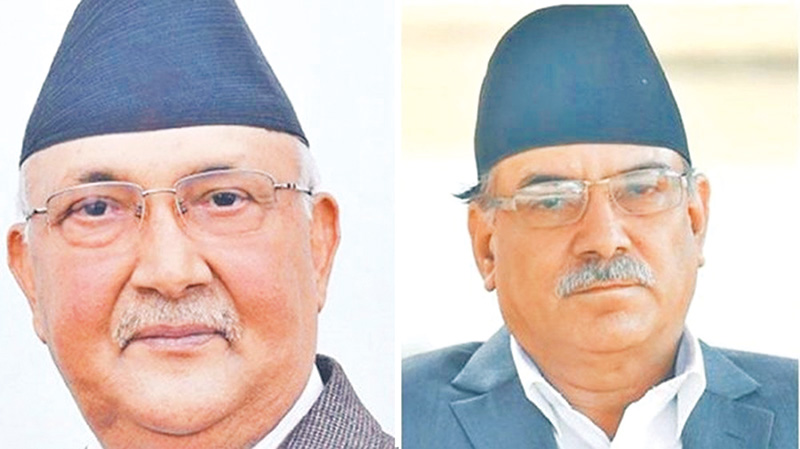
KP Sharma Oli and Pushpa Kamal Dahal. Post file Photos

KATHMANDU,
As the exercise continues to try to find a solution to the crisis within the ruling Nepal Communist Party, the two party chairs have decided to resume the ongoing Standing Committee, a positive step towards a compromise, say party insiders.
Oli and Dahal met on Tuesday for around two hours at Baluwatar in the afternoon. This was their second one-on-one meeting since Dahal called for Oli’s resignation, precipitating the crisis.
“Though the two leaders agreed to continue one-to-one talks, no progress has been made yet. However, they have agreed to continue with the Standing Committee meeting scheduled for Wednesday,” said Bishnu Sapkota, Dahal’s press adviser.
After Dahal and a number of senior leaders demanded Oli’s resignation on June 30 as both party chair and prime minister, Oli, on July 2, prorogued the House, sparking fears of a party split. The ongoing Standing Committee meeting, which was where the call for resignation was made, was subsequently stalled. Second-rung leaders had urged the top leadership to only call a Standing Committee meeting after issues were resolved between the two chairs.
“Agreeing to hold the Standing Committee indicates that Oli is perhaps ready to face the meeting,” said Mani Thapa, a Standing Committee member who is close to Dahal.
But insiders say that the Oli faction could use the Standing Committee to launch their own attack on the opposing factions. As of now, around 30 of the Standing Committee’s 44 members have called for Oli’s resignation.
Although details are scant about what occurred in Tuesday’s closed-door meeting, leaders from the Dahal camp believe that he is working to prevent a party split.
“It is not clear what transpired during today’s meeting but it is clear that the party won’t split now,” said Haribol Gajurel, a Standing Committee member who is close to Dahal.
According to Gajurel, a potential offer on the table is the creation of a ‘mechanism’ within the party to work alongside the government and guide its actions. One of the primary complaints from the Dahal and Madhav Nepal factions in the ruling party has been that Oli acts unilaterally, without consulting with the party he represents.
The mechanism would include Madhav Kumar Nepal and perhaps also Jhala Nath Khanal and Bamdev Gautam—all senior leaders who’ve allied with Dahal. This would go some ways towards assuaging their concerns of having been sidelined and not listened to, say party leaders.
“Managing the respectable positions for Dahal and Nepal is the only way to patch up the differences in the party, at least for sometime,” said Shyam Shrestha, a political analyst.
But leaders from the Dahal-Nepal faction have also tempered their demands and are now saying that they will accept the resignation from just one post.
“Our demand was that Oli should resign as both party chair and prime minister but things have become more difficult now,” said Raghuji Pant, a Standing Committee member from the Nepal faction. “Our bottom line now is that he must quit as prime minister.”
The change in stance comes after proposals going back and forth between the opposing factions mentioned giving continuity to a November 19 deal between Oli and Dahal during a previous bout of party tensions. The deal was that Dahal would become
executive chair and exercise more authority in the party while Oli would continue for the full five-year term as prime minister. That deal never really came into implementation, as Oli refused to cede power in either sphere to Dahal.
According to Shrestha, Oli has refused the suggestions of his own people that he should step down as prime minister rather than party chair as he could lose his grip on the party. But party leaders had told the Post on Monday that while Oli is adamant on not resigning from either post, he could consider taking a more “ceremonial” role in the party, as per the November 19 agreement.  
“I think Oli could have agreed to relinquish one of the two positions if the Dahal-Nepal faction had raised the issue properly,” said Thapa, the Standing Committee member.
“But now, he seems to have strengthened his position by proroguing the House.”
Party leaders from the Nepal and Dahal camp say that Oli’s autocratic streak has caused more problems than resolved them but there are some who also believe that this is not the right time for an internal party crisis, especially given the Covid-19 pandemic. Many second-rung
leaders have now started to push for reconciliation.
“We have been demanding that the top leaders reconcile,” said Energy Minister Barshaman Pun, also a Standing Committee member. “We [second-rung leaders] have been meeting regularly to discuss ways to support the two chairs in their bid to find an amicable solution to this crisis.”

HOME PAGE

More anxiety for Nepali students in the US with decision to send home those enrolled only in online classes

Many universities, including Harvard, have decided to go online for the next academic year, meaning foreign students will not be legally allowed to remain in the United States.
- ELISHA SHRESTHA
Foreign students in the US have concerns about having to pay tuition fees or charges for apartments in full, and the support for earning their degrees when they head home. AP

LALITPUR,
When Mohamed’s university in the US state of Texas abruptly moved all classes online in the middle of February because of the Covid-19 pandemic, he felt that it was a good initiative. Mohamed, who is in his final year of his bachelor’s degree, believed that going digital would help protect students and staff from getting infected with the coronavirus.
“Right now, I am taking 3 credit courses online from the safe space of my apartment, due to which I felt less anxious about the whole situation,” said 23-year-old Mohamed, who asked that he only be identified by his last name as he doesn’t want to jeopardise his visa status.
However, news on Monday shattered all of Mohamed’s peace of mind. The US’ Immigration and Customs Enforcement (ICE) agency announced that all active international students would not be allowed to stay in the country if they were only attending classes online.
“Nonimmigrant F-1 and M-1 students attending schools operating entirely online may not take a full online course load and remain in the United States,” said the agency in a release. “Active students currently in the United States enrolled in such programs must depart the country or take other measures, such as transferring to a school with in-person instruction to remain in lawful status.”
Students who fail to comply “may face immigration consequences including, but not limited to, the initiation of removal proceedings,” said ICE.
An F-1 visa is required for international students to attend high school and university in the United States whereas an M-1 visa is for vocational programmes.
For international students like Mohamed, who migrated four years ago to Texas from Butwal to pursue a computer science degree, this decision only adds more complications to their already desperate situation. Mohamed did not receive much financial aid and, like the majority of Nepali students in the US, had been supporting his studies by working a part-time job as a cashier in a department store.
“When the country went into the lockdown, I lost my job for more than two months. I am struggling to cobble together tuition fees of around $4,500 for the fall semester and now, the government’s decision is creating more problems,” said Mohamed, who is on an F-1 visa.
Although his university has yet to inform the students about the new ICE guidelines, Mohamed said he will not consider returning to Nepal, even if his college sticks by its decision to continue with online classes.
“Even if I return to Nepal till my college moves back to conducting in-person classes, I still have to pay the semester fee and since I don’t come from a wealthy family, I will have to work here,” said Mohamed, who works around 40 to 45 hours per week to sustain himself and his studies.
Like Mohamed, 23-year-old Bishal Thapa, an undergraduate student at the University of Idaho, also feels that for most self-financing students, returning home in the middle of a study programme is not a practical solution, given that most Nepali students rely on part-time jobs to survive.
“I would be more than happy to return to Nepal since it will be an opportunity to see my parents after all these years, but it is financially impractical,” said Thapa, who is also in the final year of his study. “I live in a rented room, which has a contract for a year. If I have to return to Nepal, I still need to pay for my room, apart from having to pay my semester fee.”
Foreign students in the US during the pandemic are already suffering in ways untold. Locked down in dorms and rented rooms thousands of kilometres away from family and unable to return home, many foreign students had just gotten through a difficult time when the ICE regulations were revealed.
Even if students do return home, many of them will be in vastly different time zones and many might not have access to reliable internet connections.
“There are also online websites and reading materials, which we will not be able to access if we return to Nepal,” said Thapa. The ICE announcement came hours after some colleges and universities, including Harvard University on Monday, said that they plan to offer only online courses for the 2020-2021 school years as the US is still struggling to get the Covid-19 pandemic under control.
In the wake of the ICE announcement, many, including Thapa, are hoping that their universities will opt for a hybrid model of teaching, offering both in-person and online classes, so that international students like him will be able to remain in the US.
According to the US’ Department of Homeland Security, more than 1.1 million foreign students currently hold active student visas. Nepal ranks 12th in number among both undergraduate and graduate students in the US, according to a 2019 study by the Institute of International Education.
There are thousands of Nepali students in the US, most of whom are pursuing undergraduate degrees. Most Nepalis go to study with little-to-no financial aid and hope to pay off their college fees by working long hours, often illegally.
According to Santosh Pyakurel, coordinator of the National Educational Consultancies Association, one of five umbrella bodies of education consultancies in the country, the ICE guidelines are impractical, stating that even if students decide to return home, Nepal’s international borders are still closed.
The Nepal government recently allowed in a few hundred Nepalis, mostly students, from the US, but bringing back the thousands of graduate and undergraduate students currently in the US would be a massive operation, especially during a pandemic, said Pyakurel.

Page 2
MEDLEY

Horoscope

ARIES (March 21-April 19)
****
Music, art, and culture make for an excellent escape, so keep these pastimes in mind when someone or something starts bugging you today. When you want to get away from stress, listen to your favourite music and let it take you away. Or take a virtual tour through an art museum and enjoy the beautiful images.


TAURUS (April 20-May 20)
****
Your friendly demeanor has been a huge asset for you, but today it may give someone the impression that you’re not going to put up a fight if you get pushed. Keep your fight-or-flight impulses in check. You may have to step into a defensive position that requires a great deal of finesse.


GEMINI (May 21-June 21)
****
Becoming closer to someone else is a very rewarding sensation for you right now, but it could also negatively affect your sense of independence. This is a natural dilemma you should be aware of, not a problem you should run away from. You are going through a wonderful transition in your life.


CANCER (June 22-July 22)
***
Your unselfish nature has gotten you further in life than you might realise. While all the attention-grabbing go-getters make headlines with their successes, your quiet determination and honest efforts haven’t earned you as much of the spotlight, but they may have earned you more respect.


LEO (July 23-August 22)
****
Right now, your life could be like an opera, so why aren’t you belting out that aria? Living out loud is a great way to show people who you are right away. And right now, the sooner people get what you’ve got to give the better. This is a very fruitful time for you, but you have to be the one to make the first move.


VIRGO (August 23-September 22)
***
If you focus on the foundation of the circumstances today, you’ll gain key insight for crafting a healthier, happier life. Think about what’s behind the recent actions of the people you care about. Any strange behavior may begin to make a lot more sense. A long-lost friend could reappear on the scene.


LIBRA (September 23-October 22)
****
Don’t be surprised if in the middle of a conversation your mind starts to wander today. At first, you might think you’re just entering an introverted phase. But in reality, you might just be bored with the discourse. Getting ideas across by explaining them with words is so uncreative!


SCORPIO (October 23-November 21)
**
Everyone doesn’t have to be your favourite person, but right now you should get to know a difficult personality a little bit better. Observe their actions closely and you may notice that this person is much more complicated than you initially thought. Their odd behaviour has some reasonable explanations.


SAGITTARIUS (November 22-December 21)
****
Nonverbal communication is speaking louder than words today, so avoid e-mail and the phone. Try to keep all conversations face-to-face in person or online. Open your eyes and you will see messages that others do not. This could give you a big advantage over the next few days.


CAPRICORN (December 22-January 19)
***
Are you lagging in the discipline department? A messy car or house isn’t the end of the world, but when the dishes in the sink are taller than you are, there might be a problem. Looking at a disorganized mess does not feed your ego, so spend some time today putting order back into your world.


AQUARIUS (January 20-February 18)
***
Though it feels like too much is happening, you’ll still be able to savour every single drop of the goodwill coming your way. Friends and family members are heaping love on you, causing you to blush and smile. When they extend their gratitude or compliments to you, you need to give your positive emotions right back.


PISCES (February 19-March 20)
*****
You will be so deeply in sync with other people today that you might think you can read each other’s thoughts! Have some fun by finishing each other’s sentences. This synergy will be an incredibly useful tool for keeping everyone in good spirits and headed in the right direction. It will also make the day go by much more quickly.

Page 3
NATIONAL

Patients seeking treatment in non-Covid hospitals are testing positive for the virus

Officials who said asymptomatic patients don’t spread virus, now believe there’s a high risk of community transmission.
- Arjun Poudel
After some patients tested positive for the coranavirus, Shahid GangalalNational Heart Centre, Bansbari, has halted all services from Tuesday. Post file Photo: Elite Joshi

KATHMANDU,
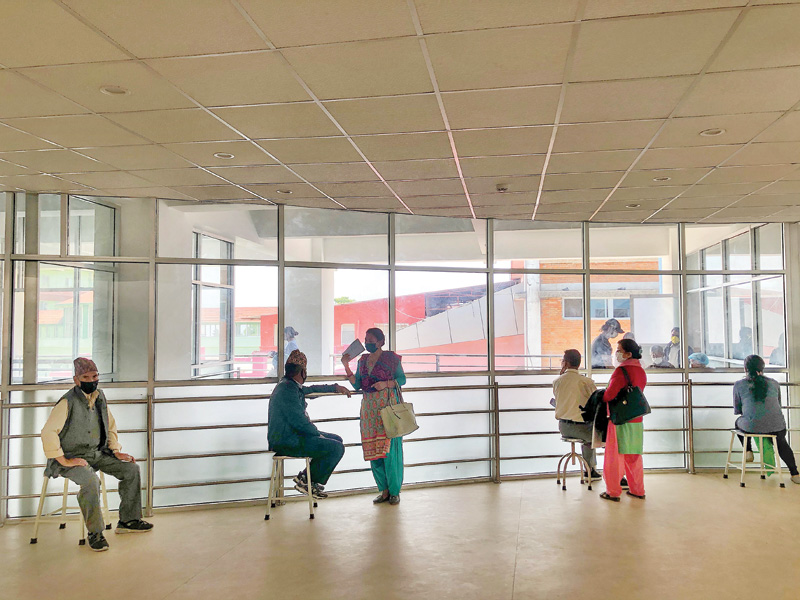
Shahid Gangalal National Heart Centre in Bansbari, Kathmandu, has halted all services except emergency for an indefinite period from Tuesday following the detection of coronavirus infection in some patients.
Specimens—nasal and throat swabs—of 20 patients seeking surgery at the hospital were sent for polymerase chain reaction tests and seven of the test results had come positive for the coronavirus which causes Covid-19.
The patients whose tests came positive were asymptomatic, meaning they had not exhibited any symptoms associated with the coronavirus infection.
“A lot of hospital staff including doctors and nurses were exposed to these infected patients,” an official at the Health Ministry told the Post on condition of anonymity. “The health workers will be tested first and the in-door patients will be managed before the hospital is allowed to resume its services.”
The hospital’s officials declined to comment, saying that the Health Ministry officials had warned them against talking with the media.
Along with Shahid Gangalal Hospital, several other hospitals, including Tribhuvan University Teaching  Hospital, Kathmandu Medical College, Nepal Medical College, Bir Hospital, Patan Hospital, Alka Hospital, Vayodha Hospital, Star Hospital, Grande International Hospital and Hams Hospitals, have also reported coronavirus infection among their patients.
The detection of coronavirus infection in these hospitals had prompted partial or complete shutdown of the health care services.
According to the Health Ministry, scores of patients in over 40 hospitals, both state-run and private across the country, have tested positive for coronavirus infection as of Tuesday.
Over 112 health workers including doctors and nurses working in the front line have also contracted the virus.
The Health Ministry officials so far have been maintaining that the country does not have community transmission of the coronavirus. However, there have been several cases of infection in people who did not have any history of travelling to the infection zones or coming in contact with infected individuals.
The ministry officials have even gone so far to claim that the coronavirus does not spread from asymptomatic patients and directed health facilities not to perform the coronavirus tests on asymptomatic patients before surgery.   
“Gangalal sent samples of about 20 asymptomatic patients  ignoring the government’s direction for not to perform tests of asymptomatic patients. But seven of them tested positive. This is an example of what the government has been doing and how much the disease has spread in the community,” Dr Ramesh Koirala of the Shahid Gangalal Hospital tweeted.
Public health experts have long been asking the government for active surveillance, community testing  and regulation of public movement to prevent mass outbreaks.
Despite their warnings, the government authorities released thousands of people from makeshift quarantines set up throughout the country without testing them, saying that they had no symptoms and asymptomatic patients do not spread the virus.
“If the disease has reached the community, it is an alarming situation,” Anup Bastola, spokesperson for Sukraraj Tropical and Infectious Disease Hospital in Teku, Kathmandu, told the Post. “People from the community, who do not have a travel history or have not come in close contact with the positive cases, means asymptomatic cases are rising more than expected.”
Dr Bikash Devkota, chief of Quality Standard and Regulation Division at the Health Ministry admitted that the infection risk has increased to the point of community transmission.
“We are planning to test all asymptomatic patients. Those admitted in intensive care units and those awaiting surgeries,” said Devkota. “We will also collect random samples from communities and focus on health facilities to prevent the outbreak.”
Devkota also conceded that the ministry committed a blunder by claiming that asymptomatic patients do not spread the coronavirus and by sending quarantined people home untested. Meanwhile, the Epidemiology and Disease Control Division under the Health Ministry, has said that it has started collecting samples from health facilities—both state-run and private— to study if the disease has spread in the community.
“As more people admitted in non-Covid hospitals have started to test positive, we have decided to perform tests on the samples of those hospital staff, “ Dr Basudev Pandey, director at division, said. “We have also deployed officials for collecting samples from several communities, where cases have been seen.”

NATIONAL

Pandemic could affect school retention and enrolment rates

- BINOD GHIMIRE

KATHMANDU,
The Covid-19 pandemic, which has already affected various sectors such as health and economy, could increase the number of children who stay out of the school system, various reports and experts say.
As the pandemic triggers a spike in poverty rates in the country, it is expected to hit the education sector hard, they say.
“In a country where 18.7 percent of the total population is living below the poverty line, the impact of the current pandemic will be enduring,” reads the conclusion of a report on Rapid Assessment of Socio-Economic Impact of Covid-19 in Nepal prepared by UNDP. “Halt in businesses, unpaid hiatus, pay cuts and job losses increase the probability of falling back into poverty,” the report added.
Enrolment and retention numbers, which were already low before the pandemic, are expected to go down further. “My experience tells me that poverty has a direct bearing on high dropout rates and out-of-school rates among children,” said Babu Ram Poudel, former director-general at the Centre for Education and Human Resource Development.
Since 2018, the government has been running an annual campaign to bring all the school-age children to the school system. But in the two years, hardly a one percent increment in the number of children going to school has been recorded.
“I am certain that the drop-out will increase in the aftermath of Covid-19 if the government does not intervene,” Poudel told the Post.
The government’s economic survey, made public in May, shows that three percent of school-going children are not enrolled in schools despite the enrolment drive.
School dropout rates paint a gloomier picture. Every year thousands of students disappear from the school system. The same survey report shows that 21 percent of students abandon their studies by the time they reach grade eight and the number doubles when they reach grade 10.
Various reports say that poverty, which is expected to engulf more people due to the pandemic, is the main reason why many children are out of the schools and those studying in higher grades are dropping out.
A projection by the World Bank shows the low and middle-income countries like Nepal will see a setback in the education sector due to the Covi. It claims the learning will decline and dropouts will increase, especially among the most disadvantaged. “The crisis will also increase the risk of drop out,” according to the report. “We know from other crises that the longer marginalized children are out of school, the less likely they are to return.”
 A projection by UNICEF suggests an additional 120 million children from the South Asian region could be pushed into poverty and food insecurity, and the number of out-of-school children could increase.
 Education experts say the government should come up with a financial package to support marginalised communities so that children can go to school. “The government shouldn’t lake education in isolation, it must be linked with the economy mainly for the people from below poverty and marginalised communities,” Poudel told the Post.
For a long time experts have been lobbying for providing money equivalent to the opportunity cost of children going to school. As children from extremely poor communities lend a valuable hand for household chores, sending them to school causes economic losses for the family.
 “We have been raising the issue of opportunity cost, but successive governments haven’t listened to me,” said Basudev Kafle, a professor at Tribhuvan University who has carried out research on school education.
Kafle said the lack of proper infrastructure in schools too could leave a number of students out of the education system in the post Covid-19 situation. Hundreds of public schools, mainly those running the primary education, are so congested and social distancing is not possible.
“Parents won’t risk sending kids to schools if there’s no space to maintain distance between students,” he said.

NATIONAL

Lalitpur local administration orders Rato Machhindranath Jatra postponed, again

The organisers had decided to go ahead with the festival after the lockdown was eased.
- ANUP OJHA

LALITPUR,
Lalitpur District Administration Office has directed Jyapu Samaj Yala, a local Guthi, and the locals involved in the annual Rato Machhindranath Jatra to postpone this year’s festival until the Covid-19 is pandemic is over.
The festival, whose main attraction is a chariot procession, was due to start from Wednesday from Pulchowk. The festival organisers had decided to organise the festival after the government eased the lockdown in mid-June.
The festival is the longest chariot festival in Nepal which starts just before the beginning of monsoon, to appease the rain and grain god Rato Machhindranath.
The local administration of Lalitpur directed the Guthi to postpone the festival, arguing that it is against the government’s decision. A Cabinet meeting on June 10 had announced to ease the lockdown, but it has restricted all kinds of social and cultural activities.
“The government has already announced a ban on big gatherings. And with the cases of Covid-19 rapidly rising in Kathmandu Valley, the festival has to be postponed until the pandemic is over,” Chief District Officer Narayan Prasad Bhatta said.
As of Tuesday, Kathmandu Valley has reported 264 cases of cornavirus infection—174 in Kathmandu, 48 in Lalitpur and 42 in Bhaktapur.  
This is the second time the annual festival of Rato Machhindranath festival is being postponed within a year. Earlier, the festival was called of on April 10, as the country was still under a lockdown. The festival was rescheduled after the lockdown was relaxed.
Padma Rajan Bhuju, chief of the Guthi that organises the festival, said there is still uncertainty regarding the resumption of the festival.
“If the cases had not increased this way in the Valley, we would have started the chariot procession. The festival would have given hope to people who are already in trouble due to the lockdown,” said Bhuju.
The annual chariot festival, which draws thousands of people, culminates in Jawalakhel in the form of Bhoto Jatra, another popular festival.
People of eight localities in Lalitpur—Natol, Gabahal, Mekhabahal, Kusunti, Kayanni, Walmaya, Dhaugol and Sachhi
Chhe—usually lead the Machhindranath chariot procession. The postponement of the festival has saddened the faithful.   
“We still have great faith in Machindranath. The lockdown that has been going on for nearly four months has troubled us,” said Kumar Baharai, who is also the lead chariot maker.  “This is such an unfortunate situation that we can’t pray to the rain god for better food and grains at this difficult time.”
The festival of Rato  Machhindranath was started by Lichhavi King Narendra Dev. Historians say the king had commissioned the festival to appease the rain deity.
Besides the Rato Machhindranath festival in Lalitpur, several other festivals in Kathmandu Valley, including Bisket Jatra, the tongue piercing festival of Bhaktapur and Seto Machhindranath Jatra, have also been postponed this year due to the pandemic.

NATIONAL

Police bust gang involved in a string of jewellery shop heists in Kathmandu Valley

- SHUVAM DHUNGANA

KATHMANDU,
The Metropolitan Crime Division has busted a gang involved in burglarising various jewellery shops in Kathmandu Valley.
A team from the division has arrested three of the five members involved in a string of jewellery shop heists in the last two days.
The gang had been breaking into jewellery shops in various parts of Valley for some months now.  
On March 21, they struck a jewellery shop in Lazimpat and made off with more than 1 kg gold, over 8kg silver and cash.
The division had mobilised a special team to capture this notorious band of jewel thieves. Three of the five gang members were arrested in the last two days. They have been identified as Buddha Bahadur Majhi, 45 of Mahottari while Ganga Bahadur Tamang, 37  and Janga Bahadur Majhi 49 of Udayapur.  
Ganga Bahadur and Buddha Bahadur were arrested from Morang on Sunday while  Janga Bahadur was captured from Durbarmarg, Kathmandu, on Monday.
“The gang used to visit the burglary site in the day posing as scrap collectors to survey the area. They mostly broke into shops located in areas with little to no mobility of people at night,” said SP Ishwar Karki of the division.
Preliminary investigation has revealed that the five men had met one another in prison and concocted the plan of robbing jewellery shops in the Valley. Two other suspects are at large.  
“During interrogation, it was revealed that the gang leader has already fled to India and sold off the stolen gold and silver items,” said Karki. “We are after the other two suspects. Investigation is also underway to find out if the gang was involved in other incidents of robbery.”
According to the data provided by the Metropolitan Police Office, during the three months of lockdown, between March 14 to July 15, there had been 64 cases related to theft.
However, the number of theft and robbery cases during the lockdown have declined compared to the three months preceding the lockdown. A total of 205 cases were recorded three months before the lockdown.
SSP Sushil Kumar Yadav, spokesperson for the Metropolitan Police Office Ranipokhari, said the same groups and persons previously jailed for burglaries tend to commit the crime again.
“A majority of the burglars turn out to be repeat offenders. They usually fall back to their crime due to lenient punishment,” said Yadav.

Page 4
EDITORIAL

Help the distressed

We need to build a robust support system to prevent incidents of suicide.

As the Covid-19 pandemic continues to take lives and destabilise the economy worldwide, health professionals predict a sharp rise in cases of depression, substance abuse, post-traumatic stress disorder and suicide. In Nepal, too, the pandemic and the resultant lockdown seem to have increased the number of suicides slightly as the daily average rose to 16.5 cases a day in the first 74 days of the lockdown as against 15.8 in the previous year.
A few incidents of suicide in recent weeks have also highlighted a new modus operandi catching up in Nepal. On July 2, a 23-year-old woman from Tulsipur, Dang killed herself on Facebook livestream before the police could reach her. Similarly, on July 4, a 19-year-old woman from Bharatpur, Chitwan committed suicide on Facebook livestream. The incidents, part of a new disturbing trend of livestreaming suicide in the age of social media have left their audiences traumatised as well.
While the victims face posthumous castigation for ‘seeking attention’, several issues call for actual attention when it comes to speaking about mental health and preventing suicides. Suicidal people often struggle with hopelessness and social disconnection for long before taking the drastic step. Psychologists say that in many cases, the victims livestream their suicide attempts to memorialise themselves but also to see if the viewers can make one final attempt to save them. So, rather than passing judgement on the victims, their acts should be taken as a public call for attention to the problem itself.
The very fact that an individual would go to the extent of taking his or her life is, in fact, an indictment of society for failing to protect them. Therefore, efforts must be made towards understanding the causes that underlie the problem and addressing them so as to prevent such incidents.
Furthermore, the lack of social responsibility among social media corporations means that their algorithms work well for advertisements and not for the prevention of suicides and other criminal activities. Facebook does have a system that analyses the suicidal tendencies of its users and sends notifications to the user’s close friends and the local administration. But its algorithms do not always work due to language issues and the local administration’s inability to respond swiftly. By the time the authorities act on the information provided, the victim would have committed suicide already.
According to the World Health Organisation, more than 800,000 people commit suicide every year. And for each suicide, there are more than 20 attempts. Most such cases are preventable if concerted efforts are made towards creating support systems to help those struggling with the problems that lead to suicide. Greater focus should be put on training community and family to identify suicidal tendencies among their fellow members. They should also be trained in creating an environment of care for the distressed, keeping lethal objects away from them, and helping them seek medical treatment and psychological counselling, among others. A collaborative care mechanism is a must to bring suicide rates down significantly.

OPINION

Development partners’ dilemma

History is unlikely to look kindly upon donors that helped an exclusionary regime survive internal challenges.
- CK LAL
Shutterstock

Supremo KP Sharma Oli is an enigmatic person. First, he stealthily digs himself into a political hole, such as the one he had done in amending the Political Party Act through a hasty issuance of ordinances. Then he shouts that he has been pushed into the pit by his opponents acting in cahoots with foreign forces. Once he has been pulled out from the ditch with an external lifeline, he pats himself on the back for having saved the country.
The Supremo’s time-tested tricks no longer distract from his failures on every front of governance. The Covid-19 pandemic is almost out of control. The economy is in shambles. The country is getting increasingly isolated on the diplomatic front as the ruling regime goes on putting all its eggs in the Chinese basket.
To be sure, Nepal has always preferred to have a single patron in the international arena. Up until the fall of their regime in 1951, rulers of the Rana family remained steadfast accomplices of the British Empire. For a brief period in the early-1950s, the newly independent India had a significant say in the internal affairs of the country.
With the opening of the American Embassy at Kathmandu in 1959, the Shah monarchy swiftly shifted its loyalty from London to Washington and accepted the role of a pawn on the Cold War chessboard. A career diplomat had once confided that there used to be a standing order from the secretariat of the Narayanhiti Palace till the late 1990s to consult the closest US mission for guidance if a clear instruction from the Foreign Ministry in Kathmandu was late in coming.
It seems that the leadership of the then Communist Party of Nepal (Unified Marxist-Leninist) began to get feelers from the Communist Party of China (CPC) as soon as President Xi Jinping assumed all authority in 2013 and began to implement his peripheral diplomacy framework with Beijing at the centre of the neighbourhood.
Once Oli was elected the Chairperson of the CPN-UML in 2014, he began the groundwork for a closer relationship with CPC in earnest. In the confusion of the Gorkha earthquakes in 2015, the Chinese connection helped Supremo Oli emerge as the chief designer and main beneficiary of the 16-point conspiracy. The rest, as the cliché goes, is history. Despite his lacklustre leadership and a record of monumental mismanagement, the ethnonational chieftain continues to be hyped as a symbol of political stability.
With Xi Jinping Thought as the guiding principle and Beijing as the guarantor of the Nepal Communist Party regime, Nepal had little hesitation in letting the June 30 deadline for the parliamentary ratification of the Millennium Challenge Corporation (MCC) Compact pass.
It’s possible that the MCC impasse wasn’t mentioned when US Secretary of State Michael R Pompeo called Foreign Minister Pradeep Gyawali to share lessons of handling the Covid-19 pandemic. But it seems that Kathmandu’s diplomatic turn from the Washington Consensus towards the Beijing Consensus is now irreversible; Nepal better begin to brace itself for the diplomatic fallout of the prime minister’s preferences.

 
Aid trap
It’s an axiom of international relations that foreign aid isn’t charity. In the 1950s, the US aid was aimed at preventing the overflow of Maoism from across the Himalayas. President Dwight Eisenhower bankrolled king Mahendra’s authoritarian rule for the same purpose even as it helped the monarch clear charkose jhadi to resettle his loyalists from the mid-mountains in the southern plains.
With Henry Kissinger’s secret trip to Beijing in 1971, the US interest shifted from countering Maoism to mobilising China in its geopolitical contestations with the Soviets. Nepal went into the tighter embrace of Beijing as Americans abandoned the Khampa Rebellion in Tibet in the
early 1970s. Kathmandu remained one of the favourite sites of US-China bonhomie until the implosion of the Soviet Union.
From 1991 onwards, the US establishment in Kathmandu has concentrated its efforts upon winning friends in political parties and influencing people of the media and intelligentsia. With the Soviet Union no longer on the scene and China still under Washington’s grip, Europeans had a free rein on the diplomatic front throughout the 1990s. All that changed with the intensification of the Maoist insurgency, the Narayanhiti Massacre and emergence of China as a credible challenger to the hegemony of the Washington Consensus in the wake of the financial crisis of 2008-09.
An overview of the US aid regime between 1960-2000 in Nepal corroborates findings of scholars elsewhere in the world. The political economy of development aid does primarily benefit the ruling elite. In Nepal, it created what BP Koirala had once called bhuiphutta barga meaning a comprador bourgeoisie sans conscience. Once such a class acquires critical mass, institutionalisation of plutocracy gains momentum.
It would be hasty to conclude that aid doesn’t work. The entire East-West Highway owes its existence to donors’ largesse with neither the US nor China being one of them. In addition to remittances, foreign aid has been a significant contributor to the marginal gain in the human development index of countries such as Bangladesh and Nepal.
Humanitarian assistance saves lives and improves the life chances of people on the margin. It’s just that most aid programmes fail to spur economic growth. Investments require that the system of governance function in a dependable manner. With their strategic interests triumphing over local needs, donors end up eroding the governing capacity of the receiver.
Fungibility of funds allows recipient regimes to invest lavishly in populist projects. For example, if the World Bank is ready to finance the reconstruction of bridges damaged in the Gorkha earthquakes, Supremo Oli has the freedom of transferring money from transportation projects towards erecting view towers in his constituency. A bigger risk is what economist William Easterly calls the popularity of dictator worship in the name of political stability.

 
Debilitating debt
According to popular lore in management circles, one of the gurus of the profession, Peter Drucker, once quipped that culture ate strategy for breakfast. Among several factors that social scientist Dor Bahadur Bista identified as causes of continued underdevelopment of Nepal, fatalism topped the list. In addition to an irrational belief in the inevitability of events, fatalism also implies a firm faith in the existing social order.
In the imperial traditions of the Chinese, Bista’s list of cultural traits such as chakari (an extreme form of sycophancy) and afno manchhe (patronage of loyalists) are as important in the bastion of bahunbad that is Nepal. China understands that the ruling regimes in its client countries need to continually grease their support bases with adequate incentives. That is perhaps one of the reasons Beijing allows its largesse to be used for technically grand but economically unviable projects.
Perhaps donors and debtors alike need to realise that the post-conflict formulation of the political economy in Nepal is erroneous. Their beneficence will not be considered an expression of altruism but is likely to be construed as complicity with the ethnonational regime. Presidents for life and prime ministers forever may be the flavour of the season of unreason holding sway for now, but the inevitable democratic revival is unlikely to look kindly upon donors that helped the exclusionary regime survive internal challenges.

OPINION

Is age discrimination acceptable?

The justification for ageism does not extend to forms of discrimination that are not life-saving.
- Peter Singer
Shutterstock

Should we value all human lives equally? This question arose in an acute form in March, when the coronavirus overwhelmed Italy’s health-care system. Envisaging a situation in which there would not be enough ventilators for all patients needing one, a working group of the Italian Society of Anesthesia, Analgesia, Resuscitation, and Intensive Care reluctantly supported rationing by age, while also taking into account frailty and the severity of any other health problems. The group’s aim was to support those with the greatest chance of survival and likely to have the most years of life ahead of them.
Proposals for age-based rationing were discussed in many countries, and often met with opposition. In the United Kingdom, for example, Catherine Foot, director of evidence at the Centre for Ageing Better, said that such proposals show ‘a dangerous kneejerk ageism, where the older we get, the less value we have and the less important our lives are to save’.
The issue is much broader than the current pandemic. In 2003, the United States Environmental Protection Agency (EPA) had to decide what costs it would impose on industry in order to limit air pollution. Doing that involved putting an upper limit on the cost of saving a life. The EPA proposed setting the limit for the life of a person younger than 70 at $3.7 million, and at $2.3 million for the life of a person older than 70.
When the media reported this, organisations advocating for the elderly labelled it ‘the senior death discount’ and accused the agency of not caring about older Americans. Eventually, the negative publicity forced the EPA to take the policy off the table.
But the EPA is not alone in making such calculations. For the past 30 years, the World Health Organisation has set its priorities by assessing the impact of illnesses on what it calls ‘the global burden of disease’. The idea is to learn which diseases cause the most harm, and target them, where that is feasible and cost-effective.
While some diseases are more likely to kill children, others, like Covid-19, pose the greatest risk to older people, and still others are equally likely to kill people at any age. The WHO uses a tool called the ‘disability-adjusted life year’ (DALY) to measure the years of life lost by premature death and the years of life lived in less than full health. The more DALYs a disease causes to be lost, the greater its global burden.
The DALY is an imprecise tool. How one arrives at the right trade-off between the number of life-years lost and the years lived in any of the various possible states of ‘less than full health’ is a controversial question. To object to taking into account the number of life-years lost, however, seems perverse. We should not be misled by talk of ‘saving lives’. What medical treatment does, if successful, is prolong lives. Successfully treating a disease that kills children and young adults is, other things being equal, likely to lead to a greater prolongation, and thus do more good, than successfully treating a disease that kills people in their 70s, 80s, and 90s.
If this is ‘ageism’, is it wrong? The WHO metrics count every DALY equally, whether it is a DALY in the life of a healthy teenager or a DALY in the life of a healthy 90-year-old. Saving the life of the teenager counts for more not because the teenager is younger, but because saving a younger person is likely to mean enabling the person saved to live more years of life.
To see why some forms of ageism are justifiable, imagine that you have just become a parent and are being consulted on an issue that will affect your newborn child, whose interests, naturally, are close to your heart. You are informed that at some stage in your child’s life, she is likely to be infected with a dangerous virus. Her chances of being infected are the same in any year of her life, and so is the risk of her dying from the virus, unless she receives a specially designed drug.
Researchers have discovered, however, that the design of the drug must vary with the patient’s age. Drug A is effective on those under 40, and drug B on those over 40, but the production process is so costly that the national health service cannot afford to pay for both drugs to be produced. It must choose one of them. You can vote on which.
Given this choice, and assuming that you believe your child’s life will be valuable, it is clearly contrary to her interests to vote for drug B. That would increase your child’s risk of dying before her 40th birthday. To improve her chances of living a longer life, you should vote for drug A.
As this example shows, discriminating on the basis of age is very different from discriminating on the basis of, say, race. Everyone who is old was once young. No one who is black was ever white. And there is no impartial, race-neutral perspective from which we can all see that it is in everyone’s interests to save the lives of white people rather than black people.
But the justification for ageism is limited. It does not extend to forms of age-based discrimination that are not life-saving, such as giving preference in employment to younger people when older people can do the job as well or better.


Singer is Professor of Bioethics at Princeton University and founder of the charity The Life You Can Save.
—Project Syndicate

Page 5
NATIONAL

Campaigners sign 12-point agreement with ministry, call off hunger strike

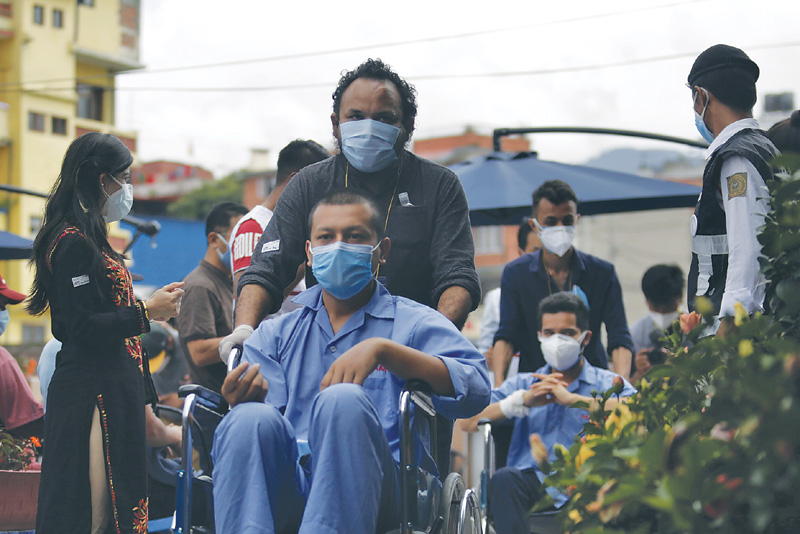
Enough is Enough asked for better quarantine conditions, more PCR testing and transparency of Covid-19 spending.
- ADITI ARYAL
The campaigners have warned of another hunger strike if the demands are not met in a week. Post Photo: Elite Joshi

KATHMANDU,
On Tuesday morning, the youth-led campaign Enough is Enough called off its hunger strike following a 12-point agreement with the health ministry on Monday evening. The campaign, that began with protests on June 9, has been ongoing in its quest to place pressure on the government to derive a better management strategy for the Covid-19 pandemic.
The first round of negotiations with the Health Ministry on Thursday had proved inconclusive, leading two protesters, Iih and Pukar Bam, to continue their hunger strike from HAMS Hospital, where they were brought on the same day owing to their deteriorating health.
More attempts to come to an amicable conclusion were made last week with several rounds of meetings on Friday but the exercise proved futile.
“We do not want to succumb to the government’s pressure until we get what we have been demanding all along,” Nayantara Gurung Kakshapati, one of the organisers of the campaign, told the Post last week.
However, until Monday, there were no further meetings between the parties. A member of the campaign told the Post that despite their efforts to communicate with the government, there was no response, despite Prime Minister KP Sharma Oli visiting the protesters on Thursday at the hospital and promising to address their demands.
“During his visit to the hospital, the PM asked the protesters to break their hunger strike and promised to ensure that the demands of the campaign would be met,” a campaign member told the Post on condition of anonymity. “But despite instructing the Home Ministry to look into our demands, we were continually ignored.”
On Monday evening, the Health Ministry and the protesters were finally able to come to an agreement. The government has agreed to the demands of the campaign, such as placing people entering the country from abroad in mandatory quarantine for five days and allowing them to self quarantine only after testing. The guidelines for self quarantine will be finalised within a week, according to the agreement.
The government has agreed to discontinue the use of rapid diagnostic tests and increase polymerase chain reaction testing to detect the presence of the coronavirus on symptomatic as well as asymptomatic carriers, including healthcare workers and essential workers, migrant returnees, and contacts of people who have tested positive for Covid-19, while also ensuring the protection of dignity and prevention of violence against them. The government has also agreed to make public its spending on the pandemic.
According to a statement released by Enough is Enough, had these demands been agreed upon a month ago, when there were 173,500 individuals living in quarantine, an estimated 57 percent of infections in people who were released into the communities could have been avoided. It is estimated that, in just the past month, 50 percent of the 19,463 people who have shown symptoms of Covid-19 after reaching home, left quarantine with the ability to further spread the infection.
According to Dr Baburam Marasini, former director of the Epidemiology and Disease Control Division, the protesters’ demands are legitimate.
“Rapid diagnostic tests only create havoc among the general population as they do not correctly determine whether a person is a carrier of the virus despite testing positive. The test is best used for research purposes—to study the percentage of the population that has been infected,” Marasini told the Post. “The government should rely more on polymerase chain reaction tests, isolate people who test positive for the virus, and treat them. This way, the number of infections will subsequently reduce.”
However,  given the government’s actions with regard to pandemic control, especially confusion regarding compatibility of testing kits and alleged corruption during procurement, activists believe that there is room for scepticism. Marasini, however, believes that the government has the capacity to implement the agreement and should act on it very soon.
“Despite the government signing many agreements with Dr Govinda KC to end his hunger strike, they were not implemented,” Bam, a protester, told the Post over the phone from HAMS Hospital. “We do not trust the government fully.”
His statement was echoed by Iih, who thinks the government listened to their demands a bit too late.
“Had this agreement been done a month earlier, it would have brought a substantial difference. Now things are worsening and it will be difficult to implement this agreement,” he said.
The campaigners have called off the hunger strike for now, but the campaign is still ongoing to ensure effective implementation of the agreement, said protesters. Iih has warned of another hunger strike if the demands are not met in a week.

NATIONAL

Pokhara’s bus operators hand over the keys to their vehicles to banks

- DEEPAK PARIYAR
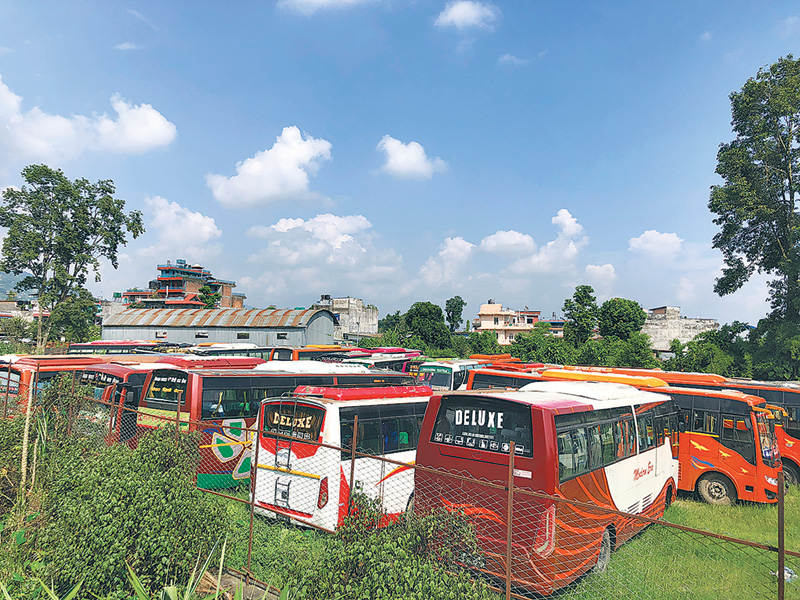
Banks have been asking the bus operators to pay vehicle loan instalments. Post Photo: DEEPAK PARIYAR

POKHARA,
On July 1, Prithvi Highway Bus Operators’ Company organised a press meet in Pokhara to brief about the trouble faced by the bus service operators due to the Covid-19 lockdown.
Yogendra Bahadur KC, chairman of the company, said that a total of 1,400 vehicles under the company were parked since the lockdown, and the bus operators were planning to take out protests as the lockdown had kept them from earning their livelihood, many of whom had vehicle loans to pay.
“Without any income, there’s no way we can pay the instalments for our vehicles,” KC had said. “If the banks continue to nag us asking for instalment payments, we are prepared to hand over the keys to our vehicles to the banks.”
The bus operators had demanded that the banks allow them at least six months’ time to pay the instalments. The banks have not agreed to their  demand.
On Monday, the bus operators affiliated with the company handed over the keys to their vehicles to the banks. Keys to 90 vehicles were handed over to the banks—30 to NMB Bank, 17 to Garima Development Bank, 18 to Prime Bank, and 25 to Muktinath Development Bank.
“The repeated notices to pay the instalments were causing us mental torture,” KC said after Monday’s move. “We were left with no option but to turn in our keys.”
In Kaski, 70 percent of the investment in public vehicles comes from bank loans. With no way to pay back the loan instalments due to the lockdown, the local bus operators had asked for concessions so that they could pay back the loan installments at later dates.
Bank officials said that while the bus operators’ demand is valid, they can only do so much.
“We need to run our institutions as well,” said Govinda Dhakal, CEO of Garima Development Bank. “It is the central bank that needs to come up with a solution to the existing crisis.”
Public bus operators have said they cannot pay the loan instalments for some time. They said the lockdown has further added financial burden on them, as their vehicles were idled for months and need to be repaired.
Bus operators across the country have been calling on the government to resume the public transport service. While the officials at the Department of Transport Management have been saying that they are preparing a set of guidelines to resume the public transport service, there has been no clear plan on the matter yet.
Public health experts have warned that allowing public vehicles to operate would further increase the risk of coronavirus transmission.
Meanwhile, KC, the chairman of Prithvi Highway Bus Operators’ Company, said bus operators will continue to hand over the keys to their vehicles if their demand is not addressed.
“We will be handing over the keys to at least 200 vehicles by Wednesday,” he said.

NATIONAL

Local unit in Bajura rushes to send people home from quarantine

- Basanta Pratap Singh
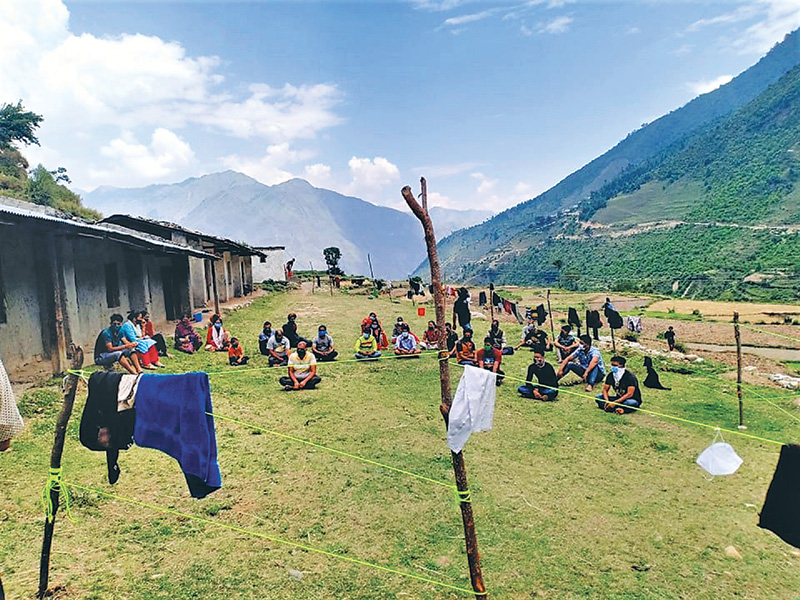
Fourteen of the 51 people sent home from quarantine three days ago have tested positive. Post Photo: BASANTA PRATAP SINGH

BAJHANG,
On June 4, a farewell programme was organised on the premises of Ghatal Basic School, Budhinanda Municipality, Bajura to send 51 returnees from India home.
They put tika on each other’s foreheads and the ward chairman signed a document asking them to stay in home quarantine for a week.
But the same evening, test results for 14 of the 51, who had stayed at Ghatal Basic School, came positive.
Two brothers from Samal village were among those who had returned home. Unaware of the test results, the brothers visited their relatives and neighbours and also shared meals with them. In the evening, Tara Luhar, one of the brothers, received a phone call informing him that his brother had tested positive.
“Since we didn’t have any symptoms while in quarantine, we met with relatives and neighbours after returning home. But we hadn’t received the test result when we went to visit our relatives,” said Luhar. “Although we were asked to stay in home quarantine, we went out because we had returned to our village after several years.” Ward chairman Ashok Dani said they sent the quarantined individuals home before their test results came because most of them were impatient and wanted to leave. “They had been pressuring us to send them home and we weren’t sure when the results would come in,” said Dani. “That’s why we sent them home with specific instructions to stay home for a week.”
“They had signed documents and assured us they would stay in quarantine at home. But, most of them violated the rule and met their relatives and neighbours. The situation is out of control and we can’t monitor everyone.”
Contradicting the ward chairman’s claim, one of the infected individuals in Budhinanda, said, “We had told the chairman that we were ready to stay in quarantine for 15 more days. But the chairman suggested we go home as the result was going to be delayed.”
On Sunday, 16 individuals who were staying in quarantine at Nandeshowri Secondary School were also sent home. One of the infected individuals there said, “We were told that we don’t have any symptoms of the virus. Though we requested the ward chairman to keep us for 14 days more in quarantine, he sent us home.”
Until now, of the 366 samples tested, 43 have tested positive for coronavirus in Budhiganga. All of these individuals have been sent home. According to the municipality, all isolation and quarantine facilities are now vacant.
Jasi Luhar, health coordinator at the municipality, said, “We have told municipal officials not to send infected people home time and again. But, they did not listen to us citing budget shortages.” Meanwhile, Shristi Regmi, deputy mayor of the municipality, issued a statement on Monday and accused the mayor of negligence. “Many individuals were sent home even without completing 14 days in quarantines. Now, it is time to keep all infected and their family members in isolation and start contact-tracing immediately,” said Regmi.
However, Mayor Padam Giri denied the accusations saying that the municipality was compelled to send individuals home after they pressed local authorities to do so.
“They did not maintain social distancing in quarantines and had started to misbehave with the people’s representatives. This is why we allowed them to go home on condition that they stay home for a week,” said Giri.
Bajura recorded 54 cases on Tuesday, the highest so far for a single day.

Page 6
MONEY

Nepali ginger farmers face plunging prices as virus hits export trade

Nepal is the world’s third largest producer of the highly prized spice after China and India.
- Pradeep Menyangbo
India is the main export market for Nepali ginger. post file photo

SUNSARI,
The government’s decision to relax lockdown restrictions in the farming sector was expected to get agriculture moving again, but it brought little cheer to ginger farmers like Padam Rai in Dharan who are facing plunging prices.
Ginger is a high value crop, and farmers engaged in growing it have higher incomes than those cultivating cereals and vegetables due to high demand overseas.
But this year, demand is down, and ginger farmers in the eastern region like Rai are worried because prices are sliding due to trade restrictions, and continue to do so.
The price of this highly prized spice has plunged by more than 60 percent. “We are worried that ginger prices will hit rock bottom,” said Rai of Bishnupaduka, Dharan.
Nepal grows around 300,000 tonnes of ginger annually, making it the world’s third largest producer after China and India.  
One-third of this annual harvest comes from the eastern region. Traders said that 90 percent of the ginger produced in Nepal is exported to the Indian market. But export orders from India are not coming even though harvest time is approaching.
Last year, the price of ginger had soared to more than Rs200 per kg. The price is satisfactory in the local market so far, said Rai. “But the peak harvest season will begin soon, and we will not be able to sell our crops due to the border restrictions.”
According to Rai, many farmers have invested in ginger cultivation encouraged by last year’s returns. “I heard that transportation has eased, but we are not certain whether buyers will be coming this year.”
Last year, around 10,000 tonnes of ginger worth Rs2.5 billion was sold from the agricultural marketplace in Dharan. At that time, the wholesale price ranged from Rs200-250 per kg.
This year, prices have fallen due to the economic turmoil caused by Covid-19 and low overseas demand. The wholesale price of ginger was Rs90 per kg on Sunday.
Laxman Bhattarai, manager of the agricultural marketplace in Dharan, said that even though prices have come down steeply, they have not fallen to the historic lows of two years ago.
“Farmers have to be satisfied with low prices this year,” he said, adding that Covid-19 and the lockdown had become the worst enemy of farmers.
The ginger grown in Sunsari, Morang, the northern region of Udaipur and the hilly districts of Koshi including Sindhuli, Khotang and Panchthar is brought to the market here. It is then exported to New Delhi, India directly through the eastern border point of Kakarbhitta. Some of the ginger is also shipped from Jogbani and Bhairahawa border points.
Bhattarai said that around 5,200 tonnes of ginger worth Rs415 million has been exported to the Indian market as of June. The crop was sold at an average price of Rs80 per kg. Normally, freshly harvested ginger is exported to India starting in mid-May.
“Farmers are in big trouble,” said ginger trader Binod Rai. He exported 135 tonnes of ginger to New Delhi following the easing of border restrictions. “The ginger trade scenario is not looking good at this moment. The overseas market is also uncertain and prices may plunge further.”
India is the main export market for Nepali ginger. The southern neighbour buys close to 94 percent of Nepal’s fresh ginger and 6 percent of processed ginger.
The ginger grown in Nepal is high in oil and oleoresin, and it can be sold to large industrial buyers in India and other countries if output is increased and quality is ensured, according to a study.

MONEY

Samsung flags Q2 profit jump on solid chip demand

- REUTERS

SEOUL, 
Samsung Electronics Co Ltd flagged a 23 percent rise in second-quarter operating profit on Tuesday, beating analysts’ estimates on solid chip sales to data centres catering for a work-from-home economy during the novel coronavirus pandemic.
The sales offset weak demand for smartphones and televisions, while one-off gains from its display business, which counts Apple Inc as a customer, also boosted profits, the company said. It gave no further details.
The world’s top memory-chip and smartphone maker said operating profit was likely 8.1 trillion won ($6.8 billion) in the quarter that ended in June, far above the 6.4 trillion won analyst forecast by Refinitiv SmartEstimate. It would be the highest quarterly profit since the fourth quarter of 2018.
Revenue likely fell 7 percent to 52 trillion won from a year earlier, Samsung added, giving only
limited data in a regulatory filing ahead of its full earnings figures later this month.
Work-from-home orders and growth in online learning are underpinning chip demand amid the coronavirus pandemic and pushing up DRAM memory chip prices. US DRAM supplier Micron Technology Inc forecast strong quarterly revenue last month.
Analysts said the one-off display boost reflected a payment from Apple, with the US smartphone maker struggling to meet agreed shipment targets as iPhone sales take a hit from the pandemic.

MONEY

Thermometers in hand, Dubai opens for tourists amid pandemic

- ASSOCIATED PRESS
The front desk staff wearing masks due to the coronavirus pandemic help customers at the Rove City Centre Hotel in Dubai, on Monday. ap/rss

DUBAI,
From French soccer jerseys to slick online campaigns, Dubai is trumpeting the fact that it reopened for tourism on Tuesday—but what that
means for this sheikhdom that relies on the dollars, pounds, rupees and yuan spent by travellers remains in question.
With travel uncertain and the coronavirus still striking nations Dubai relies on for tourists, this city-state wants to begin coaxing people back to its beaches and its cavernous shopping malls. By instilling the idea that Dubai is safe, authorities likely hope to fuel interest in the sheikhdom ahead of its crucial winter months for tourism.
But all that depends on controlling a virus that the United Arab Emirates as a whole continues to fight. Armed with thermometers, mandatory face masks and hand sanitizer, Dubai is wagering it is ready.
“I think that will give people confidence—when they’re ready to travel—to come to Dubai,” said Paul Bridger, the corporate director for operations at Dubai-based Rove Hotels. “It will take time to come back. ... We are expecting to be one of the first markets to be back because of the confidence that we can give to people that are travelling.”
That Dubai is a tourist destination at all is largely thanks to its ruler, Sheikh Mohammed bin Rashid Al Maktoum, who used the state-owned long-haul carrier Emirates to put this one-time pearling post on the map. Attractions like the Burj Khalifa, the world’s tallest building, and the sail-shaped Burj Al-Arab luxury hotel draw transit passengers out of Dubai International Airport, the world’s busiest for international travel.
In 2019 alone, Dubai welcomed 16.7 million international guests, up from 15.9 million the year before, according to the Dubai Department of Tourism and Commerce Marketing. The top seven tourist-sending nations were India, Saudi Arabia, the United Kingdom, Oman, China, Russia and the US The city’s 741 hotels saw around 75 percent occupancy for the year, with visitors staying on average 3½ days.
Those travellers also fuel Dubai’s vast restaurant, bar and nightlife scene. Though drinking is illegal in the neighbouring emirate of Sharjah and the nations of Iran, Kuwait and Saudi Arabia, alcohol sales remain a crucial part of Dubai’s economy.
But even before the pandemic, lower global energy prices, a 30 percent drop in the city’s real estate market value and trade war fears have led employers to shed staff. The virus outbreak accelerated those losses, especially as Dubai has postponed its Expo 2020, or world’s fair, to next year over the pandemic.
That makes reopening for tourism that much more important, even though Dubai’s top three tourist-feeding countries remain hard-hit by the virus, said Rabia Yasmeen, a consultant at the market-research firm Euromonitor International. Even retail sales are affected by tourism, with some 35 percent of all revenue coming from tourists, she said.
“It’s good for them to go ahead and announce because there needs to be a call for the confidence to come back,” Yasmeen said.
“Someone has to take that step first to show the world.”
And Dubai has, in typical headline-baiting fashion, taken those steps. French football club Olympique Lyonnais, under a sponsorship with Emirates, wore “Dubai Is Open” jerseys at a recent match. Dubai passport controllers have begun putting stickers on foreigners’ passports reading in English and Arabic: “A warm welcome to your second home.”
But there’s a risk, particularly in allowing more travel as the virus stalks other countries. Emirates stopped flying to Pakistan over virus fears. Across the seven sheikhdoms that form the United Arab Emirates, there have been over 50,000 confirmed cases of the virus among the 9 million people living here, with some 40,000 recoveries and 321 deaths.
At Rove Hotels, a new budget chain run by state-linked firms Emaar and Meraas, thermometer-carrying staffers check the temperature of everyone coming inside.
Cleaners fog disinfectants over rooms and wipe down tables and chairs. Even a camel statue and an oversized stuffed animal wore a mask. The chain, like others in Dubai, also has sought outside certification over its cleaning routines on top of fulfilling government regulations.
“It’s kind of the icing on the cake to give people comfort that we’re following those standards,” Bridger said.
There are still risks. In order to travel, tourists must take a Covid-19 test within 96 hours of their flight and show the airline a negative result. Otherwise, they will be tested on arrival and required to isolate while awaiting the results, which travellers say typically takes a few hours.
Travellers must also have health insurance covering Covid-19 or sign a declaration agreeing to cover the costs of treatment and isolation.
“A key question comes in: Is the traveller ready to come to Dubai?” Yasmeen asked. “That’s a big question mark.”

MONEY

EU forecasts deeper economic hit from Covid-19 pandemic

- ASSOCIATED PRESS

BRUSSELS,
The European Union’s executive arm forecasts that the bloc’s economy will contract more than previously expected because of the coronavirus pandemic, which has caused lockdowns on business and public life that are only slowly being eased.
The 27-nation EU economy will contract by 8.3 percent this year, before growing 5.8 percent in 2021, according to the latest predictions released on Tuesday by the European Commission.
“The road to recovery is still paved with uncertainty,” EU Economy Commissioner Paolo Gentiloni told reporters in Brussels. “This is mostly linked to the epidemiological uncertainty.”
In the previous forecasts released in May, when most of the continent was still under lockdown, GDP was forecast to contract by about 7.5 percent this year and to bounce back by 6 percent next year.
The European Commission said the impact on economic activity in 2020 will be worse than expected because “the lifting of lockdown measures is proceeding at a more gradual pace than assumed in our Spring forecast.”
That was illustrated in separate data from Germany on Tuesday that showed industrial production rebounded in May but was far from making up for the collapse of the preceding months.
Gentiloni said that the EU’s biggest challenge in the months to come will be to find the right balance between the necessity to reopen EU economies and the protection of citizens’ health. More than 178,000 deaths related to Covid-19 have been recorded across the continent according to the latest numbers from the European Centre for Disease Prevention and Control.
The group of 19 EU nations that use the euro as their currency will see a record economic decline of 8.7 percent this year, and grow by 6.1 percent in 2021. In May it had forecast a 7.8 percent decline this year, and growth of 6.3 percent in 2021.

Page 7
WORLD

India’s coronavirus death toll hits 20,000 mark as infections surge

- REUTERS

New Delhi,
India’s death toll from the coronavirus pandemic surpassed 20,000 on Tuesday and case numbers surged as the south Asian nation pushed ahead
with relaxations to its almost two-month lockdown amid grim economic forecasts.
The rate of both new virus infections and deaths are rising at the fastest pace in three months, as officials lift a vast lockdown of India’s 1.3 billion people that has left tens of thousands without work and shuttered businesses.
The country reported 467 new deaths on Tuesday, taking the toll to 20,160.
It also recorded 22,252 new infections, increasing the total to 719,665. India on Monday overtook Russia as the third most affected country globally, behind the United States and Brazil.
But its death rate per 10,000 people is still a low 0.15, compared with 3.97 in the United States and 6.65 in the United Kingdom, according to a Reuters tally.
Health officials fear the number of deaths, which usually lag behind the detection of new infections, could rise significantly in coming weeks. India’s death toll is currently the world’s seventh highest, behind the United States, Brazil, the United Kingdom, Italy, France and Spain.
Over the first week of July, India reported an average of 450 deaths each day, compared with 250 in the first week of June, and 101 in the first week of May.
Officials on Monday withdrew a planned reopening of the Taj Mahal, citing the risk of new coronavirus infections spreading in the northern city of Agra from visitors flocking to see the 17th century monument to love.
The reopening of the Indian economy has been sporadic. While domestic travel has been
opened up, international flights remain suspended and containment zones, areas identified as most affected by the virus, remain under strict lockdown.

WORLD

WHO to travellers: Wear masks, keep yourself informed about pandemic

- REUTERS

Geneva,
The World Health Organization on Tuesday urged travellers to wear masks on planes and keep themselves informed as Covid-19 cases surge again in some countries, prompting new restrictions in places like Australia.
Spokeswoman Margaret Harris urged people not to be caught off-guard by resurgent local epidemics and quarantine measures, saying:
“If it’s anywhere, it’s everywhere and people travelling have to understand that.”
“This virus is widespread and people have to take that very, very seriously.”
The WHO said last month that it would update its travel guidelines ahead of the northern hemisphere summer holidays but they have not yet been released.
In the meantime, travellers should “remember things will change, or may well change”, Harris said at a Geneva briefing.
“We’re seeing a lot of upticks, a lot of changes in different countries, countries that had successfully shut down their first transmission are seeing second upticks,” she added, mentioning Australia and Hong Kong.
Lockdown measures were reimposed in Australia’s second biggest city on Tuesday, confining Melbourne residents to their homes unless undertaking essential business, as officials scramble to contain a coronavirus outbreak.

WORLD

Australia’s second largest city heads back into lockdown

From midnight today, everyone in Melbourne will be required to stay home.
- REUTERS
A woman looks out a window of a locked-down public housing tower in Melbourne. AP/rss

Sydney/Melbourne,  
Lockdown measures were reimposed in Australia’s second biggest city on Tuesday, confining Melbourne residents to their homes unless undertaking essential business for six weeks, as officials scramble to to contain a coronavirus outbreak.
The decision, which affects around 4.9 million people, was announced just hours before the busy border between Victoria, of which Melbourne is the capital, and New South Wales
is scheduled to close for the first time in a century.
From midnight on Wednesday, everyone in Melbourne will be required to stay home unless travelling to work, studying, shopping for food or attending medical appointments. Restaurants, cafes and bars will be able to provide takeaway service only, gyms and hair salons closed, household gatherings limited to two people and the current school vacation extended. Victoria Premier Daniel Andrews said the restrictions were onerous but necessary.
“I would, with the greatest of respect, put it to you getting this virus and dying from it is very onerous too,” he said during a televised media conference. Victoria was responsible for 191 of the 199 new cases reported nationally on Tuesday, the biggest one-day rise since early April. The spike has worried officials, even though the national total of almost 8,800 cases and 106 deaths is far below many other countries.
“We have to be clear with each other that this is not over,” Andrews said. “And pretending that it is because we all want it to be over is not the answer. It is indeed part of the problem. A very big part of the problem.”
Andrews had over the weekend reinstated strict social-distancing orders in more than 30 Melbourne suburbs and put nine public housing towers into complete lockdown because of the recent outbreak.
Hundreds of police officers and army troops were being deployed to enforce the closure of Victoria’s border with New South Wales from midnight on Tuesday.
The state line is highly porous, stretching hundreds of kilometres. It is heavily used daily by commuters, school children and road freight.
People caught crossing the border without permission via any of the 55 roads, or several river and wilderness crossings, will face penalties including a fine of A$11,000 ($7,700) and six months imprisonment.
A second region in Victoria, where recent Covid-19 cases have been detected and which is home to 44,000 people, will face lockdown restrictions similar to Melbourne.
The border closure and reintroduction of restrictions in Melbourne deal a blow to Australia’s hopes for quick economic recovery as it approaches its first recession in nearly three decades, driven by social distancing restrictions imposed in March.
Iran, meanwhile, has recorded its highest number of deaths from Covid-19 within a 24-hour period, Health Ministry figures showed on Tuesday.

WORLD

In Hong Kong security law, echoes of China’s own cyber crackdown

- REUTERS

Beijing,
Hong Kong’s new National Security Law will shake up digital surveillance in the city, with strict new company compliance measures that echo the mainland’s years-long crackdown on anti-government content.
Foreign tech companies have balked at the laws, with Facebook, Twitter and Google among those saying they would suspend requests for data pending clarification of what is required.
Experts on Chinese internet laws say the legislation hews closely to mainland policies on national security in cyberspace, giving hints as to what is in store for a city long accustomed to vast digital privacy rights.
The mainland laws, which in some cases share similar wording to Hong Kong’s, have led to sweeping restrictions since 2013 and a sharp rise in convictions for crimes in cyberspace.
“To indigenise Hong Kong cyberspace, you would have to do in a very short period of time, and in a very conflictual environment, what the Chinese government was able to do in the mainland over years,” said Rogier Creemers of Leiden University in the Netherlands, an expert on data and internet laws in China.
The Hong Kong law includes expanded powers that sidestep courts and ramp up covert surveillance funding for intelligence gathering, and allows technical personnel outside Hong Kong to be involved.
Hong Kong legal experts say the expanded local police powers over national security override an entrenched system of judicial and government supervision of covert surveillance—a regime built up over years of court challenges.
Hong Kong Chief Executive Carrie Lam said at a news conference on Tuesday that cases involving mainland agents would be “rare”.
“Ultimately, time and facts will tell that this law will not undermine human rights and freedoms,” she said In details released late on Monday, authorities may require companies to remove online content based on “reasonable grounds to suspect” it violates national security laws. Service providers that fail to comply face jail terms and a $100,000 fine.
The stipulation is reminiscent of mainland China’s 2017 cyber law, which says operators must “provide technical support and assistance” to authorities seeking to remove or review content based on national security grounds. Already, advocates for tech companies say there may be no choice but to comply.  
“If you want to be in Hong Kong, you have to comply with the National Security Law, then you have to cooperate with the Hong Kong police. Very simple, very straightforward,” said Francis Fong Po-kiu, honorary president of Hong Kong’s Information Technology Federation, a trade
association that mainly represents local companies.

WORLD

Indian, Chinese soldiers move away from site of deadly clash

- ASSOCIATED PRESS
This combination of satellite images from June 28, left, and July 6, shows the Galwan Valley along the disputed border between India and China. The July 6 image shows China and India appear to have dismantled recent construction on both sides of the contested border. AP/Rss

Srinagar,
Indian and Chinese soldiers have backed away from the site of a deadly clash last month in the Galwan Valley along the undemarcated border, Indian security officials said, a sign of the countries’ progress in disengaging from a months-long standoff.
The two sides also appeared to have dismantled recent construction along the river valley high in the Karakoram mountains, satellite images showed.
Three Indian security officials familiar with the developments said soldiers on both sides have moved back about a kilometre from the site of their clash on June 15, when military personnel fought with rocks, clubs and their fists in hand-to-hand combat that left 20 Indian soldiers dead. The officials spoke on condition of anonymity because of the sensitivity of the matter and in keeping with government regulations.
The two sides have also moved apart at two locations in the Hot Spring area, out of at least five places where Indian officials said the Chinese had crossed the Line of Actual Control, the area of the border that remains disputed following a 1962 war that ended in an uneasy truce.
They said soldiers continued to stand at close range at two other sites along the 3,380-kilometer line of control, at Depsang and Pangong Lake. At the picturesque lake, the Chinese were 8 kilometres within the disputed border area, the officials said.
Satellite images from June 28 appeared to show that the Indians had built a wall on their side of the Galwan Valley and the Chinese had expanded a camp at the end of a long road connected to Chinese military bases farther from the poorly defined border, according to experts.
But images released on Monday by Maxar, a Colorado-based satellite imagery company, showed those recent additions now gone.
“There are no structures or vehicles visible within 1.3 kilometres (0.8 mile) of the LAC in the valley,” said Nathan Ruser, an imagery analyst at the Australian Strategic Policy Institute.
However, Ruser said satellite images showed a “large tent structure” of about 900 square meters (9,687 square feet) appeared just under a mile from the Line of Actual Control. The tent did not appear in June 28 images of the same area.
The purpose of the tent and its possible contents, if any, were unclear.
The countries’ special representatives on the border issue, Indian national security adviser Ajit Doval and Chinese Foreign Minister Wang Yi, agreed in a phone call Sunday that “maintenance of peace and tranquillity in the India-China border areas was essential for the further development of our bilateral relations,” and to “complete the ongoing disengagement process along the LAC expeditiously,” India’s foreign ministry said in a statement Monday.
The phone call came after Indian Prime Minister Narendra Modi made an unannounced visit to a military base in the Indian territory of Ladakh, visiting injured soldiers and praising their bravery. The face-off began in early May, first at three places including Pangong Lake, and then escalated to two other places in Depsang and Galwan in June.
India and China have blamed each other for provoking the June 15 brawl in the Galwan Valley, the Asian giants’ most violent encounter in 45 years, and have staked fresh claims to the area where it occurred.
China’s ambassador to India, Sun Weidong, told the Press Trust of India news agency that there were “casualties between the two sides,” but Chinese officials have not detailed any deaths or injuries on their side.
The countries went to war in 1962 over their competing claims to the arid border region, with the conflict spilling over into Ladakh.
Lt Gen DS Hooda, a former head of the Indian military’s Northern Command which controls Ladakh, said the beginning of disengagement was a “good, positive step.”
“Good that some stalemate is broken but it’s going to be a long and protracted negotiation for a substantial disengagement at military level.

WORLD

US to force out foreign students taking classes fully online

Briefing
- AGENCIES

NEW YORK: Foreign students in the United States, numbering in the hundreds of thousands, will have to leave the country if their classes are all taught online this fall or if they transfer to another school with in-person instruction, a government agency said. It was not immediately clear how many student visa holders would be affected by the move, but foreign students are a key source of revenue for many US universities as they often pay full tuition. The US Immigration and Customs Enforcement (ICE) agency said it would not allow holders of student visas to remain in the country if their school was fully online for the fall. Those students must transfer or leave the country, or they potentially face deportation proceedings, according to the announcement.

WORLD

Malaysia probes documentary on migrant arrests

Briefing
- AGENCIES

KUALA LUMPUR: Malaysian police on Tuesday said they will summon reporters of news broadcaster Al Jazeera for questioning over a documentary on the country’s arrests of undocumented migrants, which authorities have accused of being an attempt to tarnish Malaysia’s image. “Locked up in Malaysia’s Lockdown”, produced by the Qatar-based station’s 101 East news programme, focused on the plight of thousands of undocumented migrants detained during raids carried out in areas under tight coronavirus lockdowns. The documentary, which aired last week, sparked an immediate backlash online while several officials decried the report as being inaccurate, misleading and unfair.

WORLD

US envoy arrives in South Korea as North rejects talks

Briefing
- AGENCIES

SEOUL: A US envoy arrived in South Korea on Tuesday in an effort to renew stalled talks with North Korea, hours after it issued a statement saying it has no intention of sitting down with the US and told South Korea to “stop meddling”. US Deputy Secretary of State Stephen Biegun landed at a US military base south of Seoul, media reported, and was due to meet South Korean officials on Wednesday and Thursday. Earlier on Tuesday, Kwon Jong Gun, director general for US affairs at North Korea’s foreign ministry, accused South Korea of misinterpreting a North Korean statement dismissing an “untimely rumour” about another summit between North Korean leader Kim Jong Un and US President Donald Trump.

Page 8
WORLD

Why plagiarism remains unreviewed and undiscussed in Nepal’s art scene

In a growing art community, understanding what plagiarism means and why it should be monitored and discouraged is crucial, art enthusiasts and artists say.
- SRIZU BAJRACHARYA
shutterstock

Lalitpur,
For years, although unsaid and unexpressed, many in the art scene have had an understanding that art plagiarism exists in the country. But rarely has anyone been called out for it. The few times the conversation around plagiarism has been raised, it has died down quickly, never gaining the attention and seriousness the topic asks for.
An Instagram page, ‘the.art.detective’, however, is hoping to keep the conversation going. “Here to start conversations about plagiarism,” reads the page’s bio. The page has so far garnered a modest 123 followers, many of whom are artists, art connoisseurs and enthusiasts.
 “What I despise is people taking advantage of their creative freedom through digital media,” says the art detective who spoke to the Post on condition of anonymity. “I initially used to think that all these artists were trying to learn from others. But the more I came across [digital art] posts the more I understood that these “artists” were not copying to get a sense on how to improve and grasp information but they were doing so just to [put up the work online] as their own for validation, to increase numbers on their social media. This is what bothered me.”
Since the page came live on May 29, it has called out three artists. The page’s intent is not to disgrace anyone, says the ‘art detective’, but to ask pertinent questions, such as an artist’s credibility and ethics and where do we draw the line between ‘drawing inspiration and influences’ and plagiarism?
Much of human beings’ creative endeavours are imitations or works of inspirations of the ideas or impressions that have stimulated the mind in some way or the other. But it’s important, particularly in a growing art scene like Nepal’s, that we understand what plagiarism means and why we should monitor and discourage it more aggressively, say art enthusiasts and artists the Post spoke to.


The trends of plagiarism in Nepal
One of the most visible ways to notice plagiarised art is through merchandised products. With the growing digital age, many artworks of artists are used unethically, without permission, as prints in merchandised products, T-shirts, and poster designs. In 2018, Bored Panda, an art, design and photography community for creative people, compiled 84 works of artists that were plagiarised by artists and companies to fit their agenda. Some similar events have also happened in the country.  
In 2018, two contemporary paubha artists Samundra Man Singh Shrestha and Raj Prakash Tuladhar had also found copies of their paintings being sold in the market without their permission. Many of these copies were printed in large canvas paper looking much like the original work, consequently devaluing the market price of the original works, wrote Sandesh Ghimire, in an article written for the Post in 2018.
“Many artists/galleries do not allow you to photograph the traditional paubha paintings because they are worried it can be copied,” says Nischal Oli, arts manager at British Council.
But besides artwork being used (without the artists’ consent) for mechanical reproduction and creation for market purpose, plagiarism practices in the country also include artists lifting concepts from international artists or using styles and themes that have already been explored by established or upcoming independent artists in exhibitions and shows.
Last December, artist Milan Rai was called out by many artists for his conceptual artwork, titled ‘Lunatic’, which drew an apparent impression from UK artist Luke Jerram’s ‘Museum of the Moon.’
Milan Rai’s gigantic moon in Patan invited a lot of attention. Even months after the event, no one has yet forgotten Rai’s moon; it remains a visceral image for many. But Rai never acceded to allegations of plagiarism, insisting his work “had a different context” and “nobody owns the moon.”
“Had he been forthright with the source, it would have been okay,” says Oli, pointing out how often artists fail to attribute sources to their works, hiding their relation with the original work which is considered unethical.
Previously, Rai  has also been questioned for his ‘White Butterfly’ movement, which resembles the work of Carlos Amorales, a mexican artist, ‘Black Cloud.’ “But Milan Rai’s work is less problematic because he does not sell copied works; he definitely earns from it, but not directly as many others in the art scene,” says Oli.
Many insiders of the art community also believe that Manish Harijan’s controversial exhibition, ‘The Rise of the Collateral’, which featured artworks of Asian religious icons with popular superheroes, has similarities with Jirapat Tatsanasomboon, a Thai artist who is known for drawing parallels between Asian symbols and pop culture characters. But the issue of the resemblance between the two works was never really discussed, as the conversation became more focused on the offensive portrayal of Hindu deities in the exhibition.
From such visual arts to contemporary craft, photography and much more, nothing has been exempt from the practice of plagiarism, says Oli. And the contentious topic is never directly approached by artists or art writers even though practices of plagiarism have been rampant in different aspects. “In the visual arts sector, many artists have fully copied works by regional or other Asian artists without any attribution,” he says. When Artist Milan Rai was alleged for plagiarism, the conversation gained traction for a while but it never evolved beyond his case.


Why does plagiarism remain undiscussed?
“I have seen even the most senior artists’ work resemble someone else’s work. But they never acknowledge or accept that they might have been influenced in some way or the other,” says Madan Chitrakar, principal of Sirjana College of Fine Arts. “I am not saying that artists copy directly, but there is a tendency for artists to believe that sourcing their influences or inspiration might make their work less enchanting. They want to be looked at as someone who has been great on their own,” says Chitrakar, who has been writing on art since 1976. But this notion could indirectly promote the idea that it’s okay to emulate works of other artists without giving them due credit.
Another reason plagiarism is not discussed enough is because criticism is not a standard practice in Nepal, says Nischal Oli. Additionally, instead of holding plagiarised acts accountable, such incidences are let go off easily, which in a way normalises the unethical act/s. “At times, the checkpoints (like curators, galleries, collectives) are also implicit in their conformity to supporting copied works,” says Oli, who was also the Kathmandu Triennale’s festival manager in 2017. “But writers who cover artists/exhibitions being more vigilant in their coverage could be a good starting point to hold copycats accountable,” he says.
In Nepal, there haven’t been much revelations in news coverage or studies around plagiarised artworks. And often many artists seem to take advantage of the uninformed audience to validate their works of art. And today this has been becoming more evident in the contemporary art practices, with many artists copying works of lesser known artists, adding their digital art inputs, and claiming the works as their own. One such work is an artwork by @Maina_Chitra. In one of the posts by the ‘art detective’, Chitra’s work is put up beside a very similar Pinterest artwork.  
And while the conversation the detective has started is commendable, and much required according to artists, the page has thus far only called out young, independent artists rather than established names, which could in a way damage the morale of young talent.
“I am aware that the people I have called out are young and independent artists, but it is crucial for the young to understand the issues of plagiarism, and this would be a great opportunity to implant the idea of plagiarism as they are just starting,” says the art detective, adding that they have been tagging the artists in question to have an open dialogue on the page. “No matter how young or how independent you are, even if you are just a beginner, you must never forget ethics. Getting paid for tracing someone else’s creative work is immoral.”