Oli-Dahal tentative deal saves ruling party from imminent split, for now
Madhav Nepal says any back-door dealings will not be accepted and that he will go to the party rank and file if the two chairmen attempted to impose totalitarianism.
- TIKA R PRADHAN
KATHMANDU, The ruling Nepal Communist Party seems to have survived the imminent danger of a split for now, as party chairs KP Sharma Oli and Pushpa Kamal Dahal are close to a deal— courtesy of President Bidya Devi Bhandari. Oli and Dahal are trying to finalise a deal on holding the party’s general convention by November/December this year, according to party insiders. As per the deal, Dahal for now has dropped the idea of Oli’s resignation, which had brought the party quite close to an implosion until a few weeks ago. Dahal, backed by senior leaders Madhav Kumar Nepal and Jhala Nath Khanal had been demanding that Oli step down as both party chair and prime minister. As many as 30 out of 44 Standing Committee members had also demanded Oli’s resignation. Friday’s Standing Committee meeting was said to be crucial, but it was once again postponed until Sunday, as both the chairmen sought more time. On Thursday, leaders agreed to take all the disputed issues to the Central Committee. The party then called a meeting of the Secretariat, which has nine members, as part of the process to decide on the Central Committee meeting. Both Oli and Dahal went to meet with the President on Saturday evening after the Secretariat meeting to “discuss the ongoing party disputes”. “During the Secretariat meeting, Oli proposed holding the general convention in four months,” said a Secretariat member who requested anonymity. But Nepal and Khanal have expressed their reservations about the proposed convention and they are concerned about any backdoor dealings between Oli and Dahal. Leaders close to Nepal said that they were not yet convinced about the deal regarding the general convention. According to a leader who is familiar with the development, Nepal had questioned during Saturday’s meeting about the general convention proposal floated by Oli. Nepal also wondered how Dahal had easily bought Oli’s idea of the convention, said the leader. “It will be a big mistake if the party is run just by two chairs,” the leader quoted Nepal as saying at Saturday’s Secretariat meeting. “Our major concern is how to run the government and the party effectively.” According to the leader, Nepal even warned of going to the party rank and file “to expose the totalitarianism imposed by the two chairs”. The Nepal Communist Party was born out of a merger between Oli’s CPN-UML and Dahal’s Maoist Centre in May 2018. The deal then was that the party’ general convention would be held within two years. But the party so far has not been able to conclude the unification process. In November 2019, Oli and Dahal had reached a deal that the former would lead the government for the full five-year term and the latter would run the party as “executive chairman”. But that could not happen, largely due to Oli’s reluctance, according to leaders. The November 2019 deal was reached after Dahal constantly brought up the May 2018 agreement which meant Oli and him would lead the government in turns—two and a half years each. The crisis in the ruling party reached a tipping point last month when Dahal, along with Madhav Nepal and Khanal, upped the ante, demanding that Oli step down both as party chair and prime minister. But Oli pulled off a coup, by suddenly proroguing Parliament on July 2, and two days later accusing the Dahal-Nepal faction of plotting to oust him and impeach the President. Since then, Oli and Dahal had been in talks to find a way out. After both the chairs agreed to hold the general convention by November/December, they, accompanied by party General Secretary Bishnu Poudel and Standing Committee member Janardan Sharma, had reached Sheetal Niwas. Insiders say the meeting dwelt on the proposed general convention and Sunday’s Standing Committee meeting. Multiple leaders the Post spoke to said they were not aware of what transpired in the meeting between Oli, Dahal and the President. They, however, said that the meeting was aimed at discussing the party’s general convention in November/December. The leaders said the deal between Oli and Dahal means the former would back the latter for chairmanship in the party at the general convention. It, however, is not clear what deal has been reached when it comes to senior leaders Nepal and Khanal, with whose support Dahal was demanding Oli’s resignation. A leader from the Nepal faction said that the general convention deal between Oli and Dahal is not convincing. “Yes, Oli has proposed the general convention in four months, but an agreement is yet to be reached officially,” said Raghuji Pant, a Standing Committee member close to Nepal. “How is it even possible without a political document in this regard? And then again there is the issue of membership for holding the general convention.”
HOME PAGE
After delayed and poor harvest, yarsagumba collectors will now have to face depletion concerns
First came the ban in harvesting the fungus due to pandemic fears and now the government has taken note of the IUCN concern of conservation needs for the ‘Himalayan viagra’.
- CHANDAN KUMAR MANDAL,Basanta Pratap Singh
People look for the caterpillar-fungus in Aunlagad, Saipal Rural Municipality. Post file Photo
Kathmandu/Bajhang, If there had been no pandemic, Tarjun Lama would have by now completed yarsagumba, the caterpillar fungus, harvest for this season. But this year, it was a long wait for Lama, a resident of Saipal Rural Municipality in Bajhang district, before he, and other harvesters, were permitted to travel north. When villagers like Lama finally managed to go to the highlands, after the lockdown was loosened they found a lot of the fungus (scientific name ophiocordyceps sinensis) but unfortunately almost all of them had rotted and therefore were of little value. “Of the 400 yarsas I collected, barely 15 were usable,” Lama said. “The prime season to harvest them had long passed.” Yarsagumba, is formed as a parasitic fungus that grows within a variety of caterpillars in the Himalayan region. It kills the caterpillar and emerges from its body as a thin stem. The fungus is harvested between May and June, right before the monsoon starts, at elevations between 3,000 and 5,000 metres. Tens of thousands of Nepali villagers flock to the Himalayan foothills in 12 mountain districts in northwestern Nepal to collect the fungus. They travel days to the highlands and live there for up to two months in makeshift tents. But, like much else in the world, the global Covid-19 pandemic has also affected the yarsa collection. For impoverished villagers, the lockdown coincided with the most economically important time of the year when they leave their homes for a ‘gold harvest’. In a good season a family of seven collects around half a kilogram of yarsagumba which can fetch up to a million rupees. There are between 2,000 and 2,500 pieces of the fungus in half a kilogram depending on the size. The size of a yarsagumba varies between 4 and 12 cm in length and 0.14 to 0.4 cm in girth. The herb is in high demand in China where it is believed to have aphrodisiacal qualities. Sange Lama, also a harvester from Saipal, said, “Last year, my fellow villagers had collected around 40 kilograms. This year, they have barely managed two.” In mid-April, during the lockdown, the district Covid-19 Crisis Management Committee in Bajhang decided to put a ban on the collection of the fungus. Chief District Officer Umesh Pandey, who heads the committee, reasoned that allowing people to collect the herb would put their health at high risk amid the pandemic. But when the ban was announced, many of the collectors had already travelled for the harvest, days away from their homes. They waited in the highlands till mid-June, expecting the ban to be lifted at any time but when it continued, the collectors began to surreptitiously collect the medicinal fungus. After all, for some villagers, yarsagumba is the only source of income, if not the main one. When news of the illegal collection reached the authorities, the Division Forest Office in Bajhang deployed police officers and even arrested a few villagers. These villagers, however, protested, arguing that yarsagumba was their only means of income and a long-lasting ban would jeopardise their livelihoods. According to a Nepal Rastra Bank estimate, the country earned about US$50 million in 2016 (the last year the figures are available for) from the sale of the fungus. The global annual production is between 83 and 183 tonnes, worth between$5 billion and $11 billion. Nepal, the world’s second largest producer, after China, exports around 3 tonnes of yarsagumba every year. If the severe loss of income was a catastrophe this year, it is unclear what will happen next year. The fungus was last week included in the IUCN Red List as a vulnerable category because of excessive harvesting. The world environment body said caterpillar fungus populations have declined by at least 30 percent over the past 15 years due to overharvesting. Besides Nepal, the fungus is found in Northern India, Bhutan and the Tibetan plateau of China. Prof Gregory Mueller, chair of the IUCN SSC Fungal Conservation Committee, said last week that implementing a sustainable harvest programme is needed both for the caterpillar fungus and for the long-term economic health of the communities that depend on it for income. In Kathmandu the government’s attention has been drawn to the inclusion of the fungus in the vulnerable category, according to Sindhu Prasad Dhungana, the spokesperson for the Ministry of Forest and Environment. “We are discussing the implications it can have for the country. The government has realised that the business as usual cannot go on,” Dhungana told the Post. “We have to find out how harvesting can be done in a sustainable manner and have to come up with some guidelines.” Uttam Babu Shrestha, a biodiversity expert, agrees. “One after another, scientific studies have said that the species is declining rapidly and disappearing due to overharvesting,” Shrestha told the Post. “The government must intervene to promote sustainable harvesting.” Shrestha’s own study among herbs collectors in 2013 concluded that all harvesters believed the availability of the caterpillar fungus in the pastures was declining and they too had accepted their practices to be unsustainable. According to Shrestha, who is also a director at the Global Institute of Interdisciplinary Studies, a research organisation based in Kathmandu, enlisting of the caterpillar fungus in the vulnerable species list does not mean local people will stop harvesting it immediately. “When other species are categorised as vulnerable categories, locals often switch to alternatives. But this is unlikely to happen in the case of yarsagumba as it fetches such a high price,” said Shrestha. Villagers could temporarily stop harvesting for one particular season if they do not get enough yarsagumba in the first 10-15 days and return to that area next year, he said. Besides, Shrestha adds, there is still not enough evidence on the best way for conservation. “There is no evidence as in the case of other species that the number is on the decline. We cannot count them one year and compare that with next year’s numbers as, for example, in the case of tigers or rhinos,” said Shrestha. “Should we implement rotational harvesting allowing harvest only for a shorter period? Or only a temporary ban so it may help in germination for the next season?” There is more research needed to find out what intervention works best for protecting this valuable fungus, he added. There is also fear that not collecting the fungus on time would mean they would rot and go to waste. This is also the government’s view. “A nationwide ban was imposed once. But the government had to relax it as the experts said that these species would rot anyway so there was no point in banning its harvest and export,” said Dhungana. Meanwhile, in Bajhang, where the yarsa output this year will slump drastically, the collectors’ worry is not over even though the season is over. Lack of unified response by the authorities has put the harvesters in a limbo. Initially local governments had allowed the harvest and the district administration office and the forest office had turned a blind eye. Later, district authorities, who report to the central government, stepped in and did not allow the selling of the fungus saying that the ban was nationwide. “We can’t legitimise the sale and export of yarsagumba collected without our authorisation,” Karna Bahadur Khati, a section officer with the Division Forest Office in Bajhang, said. “Anyone defying this will be punished. We can only allow the transactions if we receive directives from the federal government.” This has meant that people like Tarjun Lama are stuck with the miniscule harvest in their hands or opting for illegal channels to sell the Himalayan ‘viagra’.
MEDLEY
Horoscope
ARIES (March 21-April 19) *** One of your friends keeps going on and on about how they are changing and growing, but you’ve yet to see any real evidence of this transformation. Before you call them on their baloney or tell them that they are fooling themselves, think about what they really need right now: your support, not your criticism.
TAURUS (April 20-May 20) *** If you have been too self-indulgent recently, you need to try to rein it in. People are starting to wonder whether or not you have the right priorities, so cut out the excesses and get back to a simpler way of living for now. All these substitutions will make you appreciate your pampering all the more.
GEMINI (May 21-June 21) **** People may be behaving in some unexpected ways, and maybe you are as well. There is a lot of uneven energy around. But this unpredictability can add some fun to the day, too. If someone acts out of character, just go with the flow. Or try being less talkative than you usually are, and see what a normally shy person has to say.
CANCER (June 22-July 22) *** It’s been tough keeping up with all the changes that have been going on, so why not host a gathering online so everyone can get up to speed on what is going on in everyone else’s life? You are the perfect person to organise it. Relationships are living things. They continually grow and evolve, so make sure you’re encouraging them to grow.
LEO (July 23-August 22) ***** Try to open up just a little bit and let the world see a part of you that you’re sometimes afraid to reveal. Talk about that hobby you’re still trying to get the hang of or sing a few bars of the song you’ve been working on. Have pride in your imperfections and show the world that you are a work in progress.
VIRGO (August 23-September 22) ** You see problems that arise today before anyone else does, but be careful about how you alert everyone to them. If all you do is point fingers and complain about how things are not what they could be without offering any constructive ideas, you’re whining, not helping. Before you raise any red flags, think of a possible solution.
LIBRA (September 23-October 22) **** You might not have all the knowledge in the world, but you have heart, and that will count for a lot today. By using your kindness and compassion to make stronger friendships, you’ll be able to utilise their skills to get closer to what you want. Don’t think of it as using someone, because you’re not.
SCORPIO (October 23-November 21) *** Any business transactions today should have all your focus. Check your receipt at the grocery store. Reread a contract before signing on the dotted line. Go over your credit card statement. No one is necessarily trying to trick or cheat you, but you need to start protecting yourself more conscientiously.
SAGITTARIUS (November 22-December 21) *** Not even the smallest details will escape your notice today! You’re tuned in. If a friend or co-worker got a haircut, you’ll be the first to notice. If they’ve lost weight, you’ll see their progress immediately. These observational skills should serve you well in more than just assessing other people’s personal lives.
CAPRICORN (December 22-January 19) ** Thinking ahead may seem impossible. Right now, you really don’t know what’s coming. But maybe you shouldn’t get so caught up in thinking in terms of a certain time frame. Instead of figuring out what the future holds, think in bigger and less specific terms. This is a good time to indulge in fantasies. Imagine what you want your life to be like in general.
AQUARIUS (January 20-February 18) **** You could be busy today with little tasks and chores like cleaning off your desk or reorganising drawers. It might not be your ideal way to spend your day, but at least you’re not going to be bored. Hour after hour, something is going to pop up that needs your attention. But you’re likely to feel energised by the constant pace.
PISCES (February 19-March 20) **** If you’re looking for a romantic partner, you’re looking the wrong way. The flirtatious kind of romance is far too predictable for someone as unique as you. Instead, embrace romance in every incarnation. Use music, poetry as vehicles to explore your heart and discover new ways of manoeuvring through new relationships.
NATIONAL
Nepal failed to implement recommendations from Universal Periodic Review, Human Rights Watch says
- Post Report
KATHMANDU, Nepal has failed to live up to its commitments on transitional justice and to carry out other recommendations from the United Nations Periodic Review in 2015, said Human Rights Watch in its report to the UN Human Rights Council for the forthcoming review. Along with the recommendations related to the transitional justice, Nepal had accepted Nepal had accepted 152 suggestions to meaningfully address sexual and gender-based violence and caste and ethic discrimination, amend constitutional provisions that discriminate against women, and protect freedom of expression. In a statement on Thursday the global human rights organisation said the government hasn’t done any of these things, while impunity for abuses committed during and after the 1996-2006 conflict prevails. “Whether it is international pledges or the 2015 constitution, Nepal has made big promises, but the policies that followed do not indicate a commitment to ensuring justice for conflict-era abuses or to protecting human rights going forward,” Meenakshi Ganguly, South Asia director of the organisation was quoted in the statement. “During the review, member states should remind the Nepal government that it needs to do much better in upholding the civil, political, economic, and social rights of the Nepali people.” Under the universal periodic review system, the UN Human Rights Council in Geneva reviews each country’s human rights record every five years. Nepal’s review, slated for November, has been postponed until January next year due to the Covid-19 pandemic. Along with a country report by the government, various national and international non-governmental organisations and the national human rights council send separate reports to the UN body to be discussed during the review. In its review report, Human Rights Watch said that the KP Sharma Oli government has made several attempts to get several pieces of legislation through Parliament that could weaken freedom of expression if passed into law. “The government has also proposed legislation that would weaken the National Human Rights Commission, while pursuing policies that seek to constrain nongovernmental organisations and human rights defenders,” reads the statement.
NATIONAL
Lalitpur to build five flyovers in city in bid to reduce accidents
Mayor wants project report ready within his tenure.
- ANUP OJHA
LALITPUR, Lalitpur Metropolitan City has come up with an ambitious plan to construct five flyovers in the city. Four flyovers are to be built on different sections of the Ring Road, and one to connect Pulchowk with Kupondole road section, according to a report published by the civic body last week. “These will be the first flyovers in the country and projects of pride for the city,” said Mayor Chiri Babu Maharjan. “The feasibility study we commissioned has yielded positive results. We will soon work on the detailed project reports,” he added. Kathmandu Valley doesn’t have a flyover; it only has one underpass, constructed with funding from the Chinese government for the Ring Road Development Project. “The flyovers will of course decrease accidents and reduce fatalities,” said Maharjan. The feasibility report, prepared by Grid Indeco Material Test JV, states that flyovers could be constructed in Gwarko, Satdobato, Chapagaun Dobato and Ekantakuna sections of the Ring Road. It states that in Ekantakuna, the city needs to construct “loop flyovers” to accommodate the movement of the Rato Machindranath chariot to Khokana. One of the five flyovers is to be built on the Koteshwor-Kalanki road section, notorious for traffic accidents. Police reports show that over 1,500 accidents have taken place and over three dozen people have died on the stretch ever since the Chinese government-funded road came into operation two years ago. Maharjan said that before the feasibility study was commissioned, city officials met officials from the Department of Roads to consult with them about the plan. “I will soon meet the director- general of the Department of Roads to commission the DPR and finish it before my tenure comes to an end,” said Maharjan, who now has two more years to serve. When asked how the city was going to manage funds for such projects, Maharjan said the city office was quite capable of constructing the flyovers on the Ring Road. “As the road section from Pulchowk to Kupondole is a bit longer, we have to ask the central government or a donor to fund the project,” said the mayor. “Once we complete the DPR, we won’t have problems building the flyovers,” said Maharjan. Urban planner Iswar Joshi said the city’s decision to conduct the feasibility study is a good sign. “This is the first attempt by a local government to build flyovers, and it could open the door for other projects in the future if it materialises,” he added.
NATIONAL
Remote learning of around two million students hampered as government fails to decide on fees
Teachers’ association says most of the schools have not paid their employees since March.
- BINOD GHIMIRE
post photo
KATHMANDU, The indecision of the Education Ministry on resolving the tuition fee row has led to a halt to the online classes run by a majority of privately owned schools across the country, hampering the study of thousands of students. After enforcing the lockdown in March as an attempt to contain the spread of the Covid pandemic, the government asked all private schools not to charge tuition fees for the month of Chaitra (March/April). In return, it announced a soft loan for private schools. The teaching-learning activities, stopped after the enforcement of the lockdown on March 24, formally resumed from mid-June after the ministry made public the guidelines for running virtual classes. Some private schools, however, had been operating virtual classes even before the guidelines were issued. Though the ministry asked the schools to engage the students in teaching learning activities through virtual platforms, it directed them not to charge tuition because it was not part of the formal instruction. The parliamentary committee on Education and Health had asked the government to ensure that the guardians, who are already affected by the pandemic, don’t have to bear the additional burden of paying the school fees. The associations of private schools, however, on June 28 issued a statement, asking the parents to clear the fees starting March/April and get their wards enrolled for the new year. The ministry was quick to counter it, saying that private schools cannot pressurise parents over the fees and enrolment. However, after the warning of the private schools to stop online classes, the ministry sought a plan from them to resolve the issue. In their joint proposal, Private and Boarding Schools’ Organisation, Nepal (PABSON) and the National Private and Boarding Schools Association (NPABSAN), two umbrella bodies of private schools, said they would collect fees from parents who can afford and allow others to pay whenever they are comfortable. The ministry and the school representatives held several rounds of talks where the officials said they would seek a solution with the Covid-19 Crisis Management Centre. “After the centre failed to take any decision two weeks back, we were told the Cabinet would be deciding on the tuition fees. However, two successive Cabinet meetings took no decision, forcing us to stop virtual classes,” Ritu Raj Sapkota, the NPABSAN chairperson, told the Post. The private schools have stopped online classes starting Thursday. Around two million students, among a total of seven millions, study in 6,300 private schools across the country. Private school operators say since the money paid by the guardians is their only source of income, they have no option but to raise the fees. They also charge the government with not standing by its commitment to providing the promised soft loan. Sapkota said online classes do cost money, as they have to pay the teachers, run the administration and pay for the buildings rented. He agrees that they have not been able to pay the teachers because they have gone broke. The Institutional School Teachers’ Association, an association of teachers working at private schools, says most of the schools have not paid their teachers and staff since March. “Some of our friends haven’t received their salary for the last five/six months. We want the government, school operators and guardians to find a solution,” Hom Kumar Thapa, chairperson of the association, told the Post. The two school associations said in a statement on Wednesday that they have sent teachers on unpaid leave starting Thursday, as they are not in a position to pay them. Guardians’ associations say it is the duty of the Ministry of Education, as the line agency, to find a solution. Suprabhat Bhandari, chairperson of the Guardian’s Federation Nepal, said they strongly oppose the decision to stop online classes adding that the ministry had also failed to perform its duty. “The guardians are not in a position to pay the fees in full as demanded by the private schools,” he told the Post. “We want the ministry to evaluate the cost of running online classes and determine the fees accordingly. The ministry’s indecision has hampered the study of thousands of students and this situation must end.” Bhandari said the ministry also should come up with a relief package for hundreds of guardians who have lost their jobs due to the pandemic so that they can continue the study of their children.
NATIONAL
57 new Covid cases take national tally to 17,502
- Post Report
Kathmandu, Nepal on Saturday reported 57 new Covid-19 cases to take the national tally to 17,502. “Out of 3,331 PCR tests carried out at various labs across the country, samples of 57 individuals came back positive for Covid-19,” said Dr Jageshwor Gautam, spokesperson for the Health Ministry, during his daily press briefing on Saturday. Throat swabs of 13 individuals from Kailali, nine from Morang, seven from Doti, five from Dailekh, three from Rukum (West), two each from Bajhang, Dadeldhura, Gulmi, Palpa, Sarlahi and Tehrathum, and one each from Baglung, Bara, Ilam, Jhapa, Kanchanpur, Nuwakot, Parbat and Salyan districts tested positive for the virus. According to the ministry, 103 people were discharged in the last 24 hours, taking the number of total recovered cases to 11,637. As many as 311,829 PCR tests have been carried out in the country so far. Six districts—Bhojpur, Panchthar, Sankhuwasabha, Manang, Mustang and Humla—don’t have any active cases, Gautam said. The country reported 40th Covid-19 related death and 101 new cases on Friday whereas 167 new cases were confirmed on Thursday and 39th Covid-19 related death and 116 new cases on Wednesday. There were 116 cases reported on Tuesday, 144 new cases on Monday and 82 on Sunday. Three Covid-19 related deaths and 70 new cases were recorded on Saturday.
NATIONAL
Kathmandu Metropolitan City didn’t procure essential medicines last fiscal year
Officials say they need doctors to recommend medicines. But they don’t have the money to hire doctors.
- Arjun Poudel
KATHMANDU, Residents of Kathmandu Metropolitan City have been deprived of essential medicines they were to receive for free, for months, as officials did not procure the drugs during the last fiscal, which ended on Wednesday. The four million rupees budget allocated for the procurement is now frozen after authorities failed to utilise it, officials say. “We could not purchase essential medicines in the last fiscal year due to various reasons,” Narendra Bajracharya, chief of the metropolis’ health division, told the Post. “The budget we allocated for essential medicines is now frozen.” Thousands of urban poor and slum dwellers in the city seek free essential medicine from the city’s 27 urban health clinics spread across 32 wards. “Due to our inability to hire doctors who need to recommend some of the medicine, we couldn’t purchase the medicine,” said Bajracharya. “We didn’t have sufficient budget to hire doctors.” The Ministry of Health and Population provides a conditional grant to all 753 local governments, including Kathmandu Metropolitan City, to purchase more than 70 types of drugs related to communicable and non-communicable diseases. Most local governments across the country have purchased drugs without waiting for recommendations from doctors, and distributed them for free. Some local governments have even allocated budgets from their own resources to procure additional medicines and distributed them for free. Kathmandu’s Deputy Mayor Hari Prabha Khadgi conceded that the metropolis has enough resources to hire doctors and provide free services to the people, but it hasn’t done so. “We had expressed our commitment to provide better health care services to the people during our election campaign,” said Khadgi. “But I am the deputy mayor and everything does not happen as per my wishes.” Earlier, the erstwhile district public health offices and the Department of Health Services used to procure essential medicines and distribute it free of cost through state-run health facilities. There was a separate mechanism to check if the said medicines were supplied or not. Bur after the implementation of the federal setup, the responsibility was assigned to the local governments, who receive budget from the Ministry of Health. But the ministry doesn’t have a mechanism to check if a local government has purchased the medicines or not. Khadgi said patients have not approached their elected representatives to complain about the lack of free essential medicines. “Had they complained to us, the city would be under pressure to purchase the medicines,” said Khadgi. “Unless patients protest or file cases in the court, the federal government or any other agency can’t do anything to hold the local governments accountable,” said Balananda Paudel, chairman of National Natural Resources and Fiscal Commission. Paudel, who was also the chair of the Local Bodies Restructuring Commission, said that although local governments can’t misuse their conditional grants, it doesn’t ensure that they uphold the rights of the people.
OPINION
Bonds with Indian writers
Literary writers in South Asia have always created a bond of creative sharing—no matter what the politicians do.
- ABHI SUBEDI
shutterstock
Nepali and Indian literary writers have a tradition of bonding that spans centuries. But when it comes to contemporary times, we have to develop a historical and pragmatic sense to unveil it. Recently, politics and politicians have appeared to dominate the stage. But they push aside the important subject of creative, human and cultural bonding long created and fostered by writers. Stoking fires is a speciality of the politicians because through that method they create jingoistic and religious fervour. The objectives are to continue to sit in power and create confusion among the people about the relationship between the countries. Nepal and India have a unique relationship, one with significant modes. But by the same token, they can be easily made worse by establishing a culture of non-communication. Before putting my own experiences about the nature of the bonds between Nepali and Indian writers, I want to mention one important subject that has been discussed for a long time. The political history of South Asia now reveals what Shashi Tharoor calls An Era of Darkness (2016). The legacies of border conundrums, state formations and bloodshed have haunted the history of this area. But strong literary, artistic, musical, folkloristic, architectonic and cultural traditions have offered strong resistance to these forces of destruction. Despite serious challenges, they have continued to forge bonds among the writers and artists of this region. The bonds I speak of are founded upon the free spirit of creativity and freedom. It is the relationship of writers who know the power of freedom, creative values and the spread of that culture across the boundaries by using a great tradition of linguistic and artistic connectivity. They understand each other; this has a long history. Its creative power finds expression in the later poetry, both in Nepali and English, of Laxmi Prasad Devkota and in the earlier poetry of Maithil poet Vidyapati, to cite just two major poets for the reason of space. The impact of Rabindranath Tagore on the culture of promoting writers’ relations, and the bonding of the Nepali poets with the Indian Chayavadi, or romantic poets, have a historical significance. Nepali writers’ personal connections and sharing with their Indian counterparts are so strong that such connectivity can be evoked when politics and politicians are discouraging the culture of interactions. At this stage I want to recall one important experience. At the invitation of Dr Kavita Sharma, president of South Asian University in New Delhi, I participated at a colloquium with Ashok Vajpayee, a prominent Indian writer, poet, and a friend, on May 21, 2017. Ashok is also a champion of writers’ freedom. For the 25 years that I have known him, Ashok has always worked for making poetic culture as strength and power to fight with the adverse forces that work to limit freedom. To Ashok Vajpayee, poetic imaginings and freedom have a symbiotic relationship. I spoke on the theme of sharing and creativity between Nepali and Indian writers. I said, ‘a unique tradition of blending and the appeal of dialogic form is seen in art genres in South Asia today. I would like to stress today, that very element can shape the imagination to work in difficult times’. A sudden correspondence that came from prominent Indian writer and novelist Ajeet Cour shook me deeply. In this mail from June 23, 2020, she writes, ‘I am baffled! There is no one else whom I can ask the most baffling question about whatever are the latest development between Nepal and India. What will happen now?’ Her questions were answers to me. Literary writers have always created a bond of creative sharing and communication no matter what the politicians do. And there is no reason why that should change. After my mail, she wrote how it is time to turn to the wisdom of the body and ‘the guidance of the heart’ and rely on the inner capacity that generates love, peace and balance. She foresees how we will overcome the difficult times ‘and how we will be altered too’. This message and mission of this writer, who is physically frail but alert and creative, reminds me of the genesis of her endeavour to bring the writers of South Asia together. I have quoted her recollections of some quarter of a century ago about the opening of the Foundation of SAARC Writers and Literature (FOSWAL) where I too was a participant, in my article ‘The South Asian narrative’ (The Kathmandu Post, October 28, 2018). ‘When we look back, way back in 1986, the launching of a mad dream of catching that elusive golden sparrow called Peace in a rather turbulent region, through a meeting of creative and sensitive minds, seemed really mad to everybody in power … I launched my rickety boat in the turbulent sea with a Writers’ Conference in 1987, which became a milestone’. Peace, as Ajeet Cour had rightly predicted, has become an ‘elusive golden sparrow’ in what she rightly calls ‘a rather turbulent region’. But writers should share a hope that peace can be established through a ‘meeting of creative and sensitive minds’. This applies strongly in the case of the culture of non-communication that is developing among some countries in South Asia. The relationship between Nepali and Indian writers that is based on the value of democracy should be the guiding principle of relationships between the countries during turbulent times. The message of the writers is that the communication between the creative minds of the region has always transcended the restricted borders of space and time. As a witness to the meetings between writers of this region in different cities that Ajeet Cour organised in the past, and also other meetings and seminars that brought the writers of the region together, I can say with confidence that the writers of Nepal and India can open new avenues of communication and engagement that should be a model for the governments and political leaders to follow.
OPINION
Is there a China connection?
It is interesting that the other disputed area, Susta, has not been included in Nepal’s new map.
- NIHAR R NAYAK
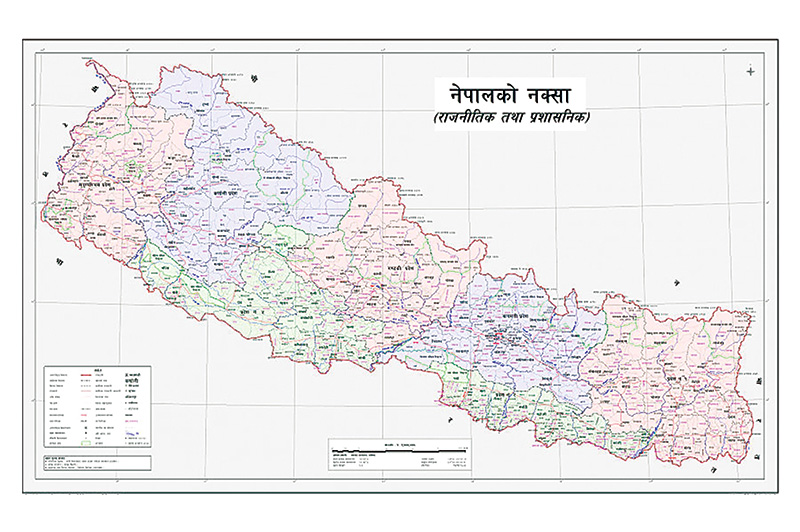
Photo Courtesy: Padma Aryal Secretariat
Any remark by Indians whether there is a China connection in the new map of Nepal, at any level, has been strongly refuted by Nepalis. They dismiss linkages between the new map and China by saying that first, such hypothesis undermines the sovereignty of Nepal, and second, the new map is based on Nepali historical claims, as per its interpretation of the 1816 Sugauli Treaty, which fixed the Kali River as the western boundary of Nepal, disregarding other historical facts that explain the Indian position. The most plausible reason advanced by some commentators in the Nepali media is that Prime Minister KP Oli, beset with internal challenges within his party, took advantage of India’s Kailash-Mansarovar road inauguration last May, and raised this issue to divert public attention away from his failure to manage governance issues in the wake of the Covid-19 pandemic, and a threat to his leadership from his peers.
Delayed response Significantly, even if the issue of Kalapani had been raised earlier, Nepal did not issue the map in response to the new map issued by India last November. If that had been the case, the street protests organised in the wake of the issue of the new map by India could have been leveraged by Prime Minister Oli to revise the maps in November itself. Interestingly, in the midst of the pandemic, Prime Minister Oli had brought in two ordinances, one of which sought to amend the existing Political Parties Act, making it easier for a party to split. This was resented by senior leaders of his own party, and the pressure was mounting on him to resign from the party co-chairmanship. Against this backdrop, the China angle comes in because of a train of events that coincided with the issue of the map. Ten days before the new map was issued, Indian Army and Chinese People’s Liberation Army personnel had clashed at the line of actual control near the Nathula sector in Sikkim, and in the eastern Ladakh sector. Although there is no demonstrable link between the India-China border disputes with the inauguration of the Kailash-Mansarovar road, and subsequent protests in Nepal, the role of China to take advantage of the long-pending Nepal-India border disputes at this juncture cannot be entirely ruled out due to the following reasons. Firstly, Chinese interest in India-Nepal bilateral territorial disputes had surfaced first in November 2008 when the then home minister of Nepal, Bamdev Gautam, had made a statement after meeting a Chinese military delegation in Kathmandu that the Kalapani border dispute could be resolved through a trilateral understating between Nepal, India and China. The visiting Chinese military delegation was led by Major General Ei Hujeng. Secondly, as per Nepali claims, the new map issued by India in November 2019 showing the three disputed territories—Kalapani, Limpiyadhura and Lipulekh—as being within Indian territory was an encroachment on Nepali territory. It was viewed as a serious cartographic exercise by India in Nepal. It was logical, therefore, to expect that Nepal would have issued a new map in November 2019 itself. Yet, a new map was only issued around the time India-China border tensions started building up in May 2020. Now, the Nepal government has justified that the new map needed to be incorporated into the national emblem through a constitutional amendment. As per the amendment, the new map showing Kalapani, Lipulekh and Limpiyadhura within Nepal became part of the constitution and the national emblem. It is interesting to note that the other ‘disputed’ area—Susta—has not been included in the new map. Can it be said that since Susta is not strategically important for China, it was not considered for portrayal in the new map? Fourthly, the construction of the Kailash-Mansarovar road began in 2008 and was scheduled to be completed in 2013. The construction got delayed due to the tough terrain, especially in the portion between Nazang to Bundi village. The Border Roads Organisation completed the 80-km stretch connecting Ghatiabgarh and Lipulekh in April 2020. Nepal had prior information about the road. This is puzzling for India as to why Nepal did not object to that particular ‘road construction’ diplomatically while the construction was going on for the last 12 years, and raised it only at a time when India-China border tensions built up. Last but not the least, while the arguments made in the previous paragraphs link China indirectly with the Nepali decision to issue the new map, some of the recent statements from the Chinese side indicate China’s new-found interest in the India-Nepal border dispute. China’s border trade agreement with India on Lipulekh in May 2015 and its statements to resolve the India-Nepal border disputes amicably, however, contradict Chinese allusion to the area as a dispute. The Chinese statements cannot be seen in isolation, given the inroads made by China during the last few years into Nepali politics. Chinese pressure tactics used against countries with which it has territorial disputes is quite well known. It has settled borders with most of its neighbours largely using such tactics. It has tried this with India, too, without any success. It is not by accident that the People’s Liberation Army transgressed into Indian territory each time senior leaders of both countries were either meeting or about to meet to discuss bilateral issues, as was the case during the Wuhan and Mamallapuram summits.
Pressure point There are two reasons for that. First, China tries to put pressure on Indian leaders during the negotiations, while it is fully aware that the elected government would come under pressure through media reporting on the border issues. Second, the People’s Liberation Army tries to signal that it is not entirely under the control of the Communist Party of China or President Xi Jinping. In the present context, it also seems natural for China to use Nepal as another pressure point for India to be able to extract some concessions from India and strengthen its relations with Nepal. Therefore, it may not be correct to argue that China does not have any role in the India-Nepal border dispute, especially since border tensions have been running high since May 2020, irrespective of its agreement with India on Lipulekh in 2015. The Nepali leadership needs to understand this and fashion its diplomatic posture vis-à-vis India in the long-term interest of equal partnership between the two countries.
Nayak is a strategic analyst with the Manohar Parrikar Institute for Defence Studies and Analyses, New Delhi.
NATIONAL
Man sustains bullet injuries in clash between APF personnel and suspected smugglers
The injured was rushed to BP Koirala Institute of Health Sciences in Dharan for treatment.
- Pradeep Menyangbo
SUNSARI, A policeman and a local youth were injured when personnel from the Armed Police Force and suspected smugglers clashed at Ghuski along the Nepal-India border in Sunsari on Friday night. Sawaj Ansari of Ward 6 in Harinagar Rural Municipality sustained critical bullet injuries in the incident. He was rushed to the BP Koirala Institute of Health Sciences in Dharan for treatment. APF constable Jibaraj Bishankhe was also injured in the clash. According to APF SP Krishna Dhakal, a group of around eight people attacked security personnel on duty when they seized smuggled goods from the group. Dhakal claimed the smugglers attacked the security personnel with batons and bricks and attempted to snatch away their weapons. “The security personnel opened fire to contain the situation and accidentally hit the man,” said Dhakal. There were 10 security personnel in the post when the incident took place at around 9pm on Friday. A reinforcement of 80 APF personnel reached the site at around 1am on Saturday. Clashes between security personnel and smugglers have been frequently reported in the border area since the nationwide lockdown came into effect. On Thursday night, Nepal Police personnel and smugglers traded fire in Dewangunj of Sunsari but no one was injured in the incident. Meanwhile, three Nepal Police personnel were injured when a group of local youths attacked them in Ritha Bazaar of Budhiganga Municipality in Bajura district on Friday night. The injured are receiving treatment at Bayalpata Hospital in neighbouring Achham district.
NATIONAL
Locals still cross Lalbakaiya River at Tikuliya Ghat by boat
A boat capsized by hitting the pillar of the under-construction bridge and killed five people two years ago but the under-construction bridge has not been completed yet.
- SHIVA PURI
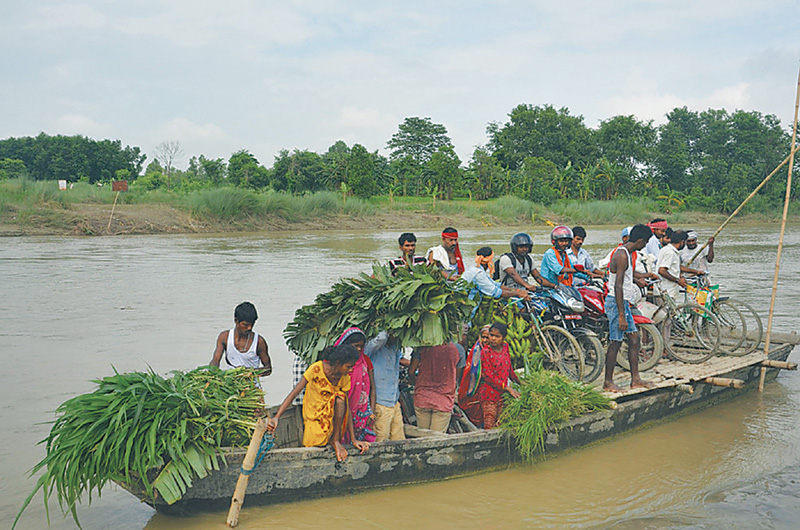
There’s only one wooden boat to take people across the river. The boat can carry up to 20 people and their belongings at a time. Post Photo: SHIVA PURI
RAUTAHAT, Two years ago, five people were killed when a boat carrying 29 people across the Lalbakaiya river capsized after hitting an under-construction bridge in Tikuliya Ghat of Gaur Municipality Ward No. 4, Rautahat. The incident occurred in the peak of monsoon season when the water level in the river was high. The under-construction bridge is still incomplete, and thousands of people are still compelled to cross the river through boats risking their lives. The bridge in Tikuliya Ghat was supposed to connect dozens of villages—including Banjaraha, Baraiya, Mathiya, Jokaha, Bairiya, Akolawa, Rampur—to Gaur, the district headquarters of Rautahat. The bridge project was handed over to the controversial Pappu Construction in July 2014. The company was supposed to complete the Rs 149.3 million project by July 2017. But the bridge could not be completed due to the contractor’s negligence. Since then, Pappu Construction has been blacklisted by the government for failing to deliver on the contracts and carrying out substandard works, among other charges. With the bridge project abandoned, many people in Gaur still take boats whenever they have to get across the Lalbakaiya river. During the monsoon season, crossing the river is fraught with risk. Many people have their fields in Banjaraha, and to reach there they have to cross the river. Suraj Sah, a resident of Tikuliya, said he gets scared whenever he has to cross the river by boat, particularly after the boat capsize incident. “I lost my relative in the incident two years ago,” said Sah. “We waited for a long time for the completion of the bridge, but that never happened. We are still compelled to take risks while crossing the river during monsoon,” Sah said. There’s only one wooden boat to take people across the river. The boat can carry up to 20 people and their belongings at a time. “Being the only boat in operation, it is always crowded,” said Sah. During the winter, when the water level in the river is low, people cross the river through a diversion. But during the monsoon, the locals have no option but to take the boat to get to the other side of the shore. Bhuvaneshwar Shahi, the ward chairman of Gaur Municipality-4, said only 65 percent of the bridge was completed in four years of construction. “People lost their lives because of the carelessness of the construction company. Yet, the authorities concerned are not serious about completing the bridge,” said Shahi. Pappu Construction had claimed that the construction of the bridge was delayed due to lack of construction materials, protests and the 2015 earthquakes, among other reasons.
NATIONAL
Police in Bardiya crack down on farmers importing fertilisers from India
- THAKUR SINGH THARU
Post file Photo
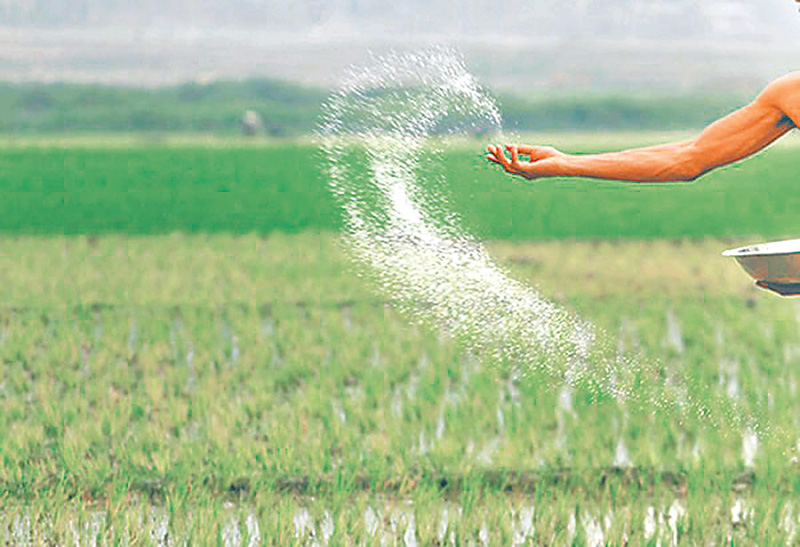
BARDIYA, For months, farmers in Banke and Bardiya have been struggling to get hold of chemical fertilisers, especially Urea, as paddy plantation season got underway. So when they started bringing in fertilisers from the bordering town of Balaigaun in India, they were relieved. But their relief was short-lived, as the Area Police Office in Motipur has started confiscating the imported fertilisers. Farmers, on the other hand, are troubled further, as many of them had taken loans to purchase the fertilisers. The farmers had resorted to the Indian town after the Nepal Government couldn’t supply them with fertilisers. For a few days, the local administrations had turned a blind eye. But now, farmers say that Nepali police has started cracking down on them. Superintendent Kedar Rajaure of Bardiya Police said that for a few days, his office had allowed the import of fertilisers from India on local representatives’ requests. Rajaure claimed that they had begun cracking down on the farmers after the fertilisers were peddled to other districts, including Banke. “The ban on the import of fertilisers was lifted for a few days, as farmers were reeling under a crisis of fertilisers, but it is not allowed to transport it to other districts,” Rajaure said. On Friday, fertilisers carried by more than a dozen farmers were confiscated and handed over to the customs office. The Indian government has subsidised fertilisers for its farmers and has restricted its export, but the Nepal police had coordinated the import for a few days. The farmers have been purchasing the fertilisers at a price ranging from Rs1,000 to Rs1,500 per sack of Urea. Ward Chair of Badhaiyatal Rural Municipality-7 Indra Luitel said that his office had temporarily opened the Mahammadpur border for farmers purchasing fertilisers. “We were compelled to ban the import of fertilisers after we found the fertilisers were sold at high price back in other districts of Nepal,” Luitel said. The border has been closed back from Friday night. Mohan Singh KC, chief of Agriculture Inputs Company Limited, Bardiya, said that while farmers are reeling under the crisis, there’s no certainty when the government would make the fertilisers available. “This is a crucial period for paddy farming,” he said. “A shortage of fertilisers would have a long-lasting impact on the produce this year.”
NATIONAL
Electric wire traps set up for wild elephants turn into death traps for locals
Although it’s illegal to set up electric fences in the fields, many have been doing that to ward off wild elephants, according to the Division Forest Office, Jhapa.
- PARBAT PORTEL
In the last fiscal year, properties worth Rs 3 million were destroyed bywild elephants in Jhapa, according to the Division Forest Office. Post Photo: PARBAT PORTEL
MAGURMADI (JHAPA), On July 13, Badri Thapaliya, 60, a resident of Magurmadi in Mechinagar Municipality Ward No. 9, Jhapa, came across a naked wire hanging by the electric wire trap set for wild elephants. Unaware that the wire still had active electricity flowing through it, Thapathaliya grabbed a hold of it and died of electrocution. The trap was set by Thapaliya himself to ward off wild elephants. But he had forgotten to cut off the power supply to the trap the night before. Although it’s illegal to construct electric fences in the fields, the residents of northern and southern belts of Jhapa fence their properties with electric wires to ward off wild elephants. Rohit Dhungana, a resident in Ward No. 9 of Mechinagar, said the villagers are compelled to install electric fences for their safety and to protect their crops from wild animals. “Wild elephants enter our farmlands almost every day and destroy our crops,” said Dhungana. “We see no other way but to install electric fences to keep the elephants from entering our fields.” In the last fiscal year, properties worth Rs 3 million were destroyed by wild elephants in Jhapa, according to the Division Forest Office. In 2019, Thapaliya had lost his older brother, Ganga Thapaliya, to a similar accident; he had fallen into an electric trap set up for elephants. “He had set up the trap himself but fell into it in a freak accident,” said Tikaram Kandel, a neighbour of the Thapaliya family. “The electric wire traps set up for wild elephants are turning into death traps for people here.” The same year, two people from Magurmadi also died after being electrocuted in a similar wire trap setting. In Ward No. 4 of Buddhashanti Rural Municipality, two other people lost their lives in a similar accident, according to the District Police Office in Jhapa. Two similar deaths were reported in 2018 and in 2017, three people had lost their lives after being electrocuted by elephant traps in Jhapa, according to the Office. Bishnulal Ghimire, chief at the Division Forest Office in Jhapa, said accidents caused by electrocution has become a major problem in the northern and southern belt of the district. “The prevailing law does not allow anyone to supply electricity to naked wires. But the locals are doing it anyway,” said Ghimire. “When our office sends teams for field inspection, the locals remove the wire trappings but install them right back when the officials leave.” Every year, the northern and southern belts in Jhapa see frequent movements of native wild elephants as well as wild elephants from India. Bahundangi, Buddhashanti, Khudunabari in Arjundhara and Bhadrapur and Daldiwari villages see herds of wild elephants entering Jhapa from West Bengal in India between the months of June and October. Between 200 and 400 migratory elephants enter Nepal from Jhapa and move all the way to central Tarai every year. But neither the forest department nor the local authorities have been able to introduce a mechanism to avoid human-wildlife conflict, leading to a number of both human and wildlife casualties over the years. According to the Division Forest Office, 39 people and 11 wild elephants have been killed in incidents of human-wildlife conflict in the last nine years
MONEY
Small entreprises happy over monetary policy as they get cash lifeline
The central bank said that as of mid-June, banks have mobilised loans worth Rs 55.54 billion to 29,157 SMEs.
- KRISHANA PRASAIN
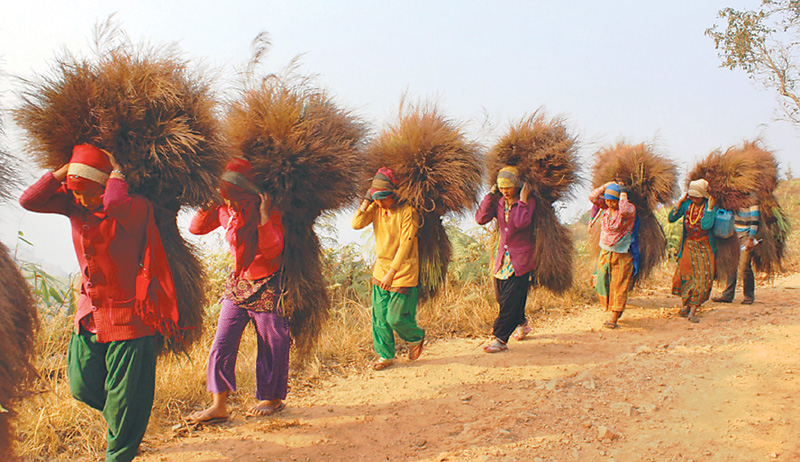
Women return after collecting broom grass in Nisdi Rural Municipality-3, Palpa. post file photo
KATHMANDU, Small and micro enterprises have expressed happiness over the latest monetary policy which finally addresses the sectors hit hard by Covid-19 but urged the government for prompt implementation of schemes. Tens of thousands of micro, small and medium enterprises (SMEs) which provide jobs to millions of people have not been able to re-open due to a lack of funds although the government has eased the lockdown. Umesh Prasad Singh, acting president of Federation of Nepalese Cottage and Small Scale Industries, said that due to the problem of liquidity, raw materials, labour, repayment period of bank loans and rental fee, only 15 to 20 percent of SMEs are able to resume operation. “Unless the SMEs get loans from the refinancing provision announced by the monetary policy, it will be difficult to reopen,” he said. “So, there is an urgent need to implement the provision.” As per the policy, export and troubled industries as well as other sectors will get special refinancing facilities at a maximum 3 percent interest rate, while micro, cottage and small industries will get credit at a maximum 5 percent interest rate. As part of providing relief, the policy has extended the deadline for paying loan instalments by six months, nine months and one year, depending on the degree of impact on the particular sector as the central bank seeks to ease the pains caused by the pandemic on businesses. The banks and financial institutions can lend Rs1.5 million per customer involved in micro, cottage and small enterprise while they can lend up to Rs50 million under special loans. The central bank and financial institutions have been lent the refinancing fund at 2 percent interest rate which they can lend at 5 percent interest rate to micro, cottage and small enterprises. Most of the suggestions provided by the sector have been addressed in the policy, Singh added. “This is probably the first time that the government has addressed the cottage and small scale industry,” he said. The government has realised the importance of the cottage and small scale industry during the lockdown period as most of the daily essential consumable items were being produced by the sector, he said. According to Nepal Rastra Bank, increasing credit flow to business operations including agriculture, cottage and small scale industry through concessional loan schemes will increase production and employment. The central bank said that as of mid-June, banks have mobilised loans worth Rs55.54 billion to 29,157 SMEs. According to the federation, there are 418,000 registered cottage and small scale industries operating in the country. The federation said that there are around 400,000-500,000 unregistered SMEs across the country. The sector provides employment to 2.6 million people directly. Similarly, there are 36 different types of industry under the cottage and small scale industry producing Dhaka textile, cotton fabric, aloo, bricks, spices, dairy, tea, rice and lentils, flour, among others. Similarly, as per the policy, development banks and financial institutions should mobilise 20 percent and 15 percent of the funds from their total credit portfolio to micro, cottage and small scale industry, respectively, for the next five years.
MONEY
Japan puts central bank digital currencies on policy roadmap
- REUTERS
TOKYO, Japan will look closer into whether to issue central bank digital currencies (CBDCs), the government said in its annual policy roadmap, a sign that Tokyo may be warming to the idea as the coronavirus heightens demand for cashless payments. In its first-ever reference to digital currency in the annual plan, the government urged the Bank of Japan (BOJ) to liaise with other countries to jointly examine its feasibility. “The BOJ will coordinate with other countries to consider CBDCs by examining and verifying technological tests,” according to the document, which serves as guidance for the government’s long-term economic and fiscal policies. Facebook’s efforts to launch its Libra cryptocurrency have forced central banks to look more seriously into issuing their own digital currencies. China has been among countries leading in the drive toward issuing CBDCs, prompting some Japanese ruling party lawmakers to urge Tokyo to catch up. However, the government and the BOJ have been cautious about moving too quickly given the legal barriers and social disruptions it may cause in a country that has the most cash-loving population in the world. Still, the pandemic may add momentum to calls for Japan to look into CBDCs more seriously, if more people avoid handling hard cash, and to move towards digital settlement, analysts say.
MONEY
Pact to aid poor cocoa farmers in peril as Covid-19 hits demand
- REUTERS
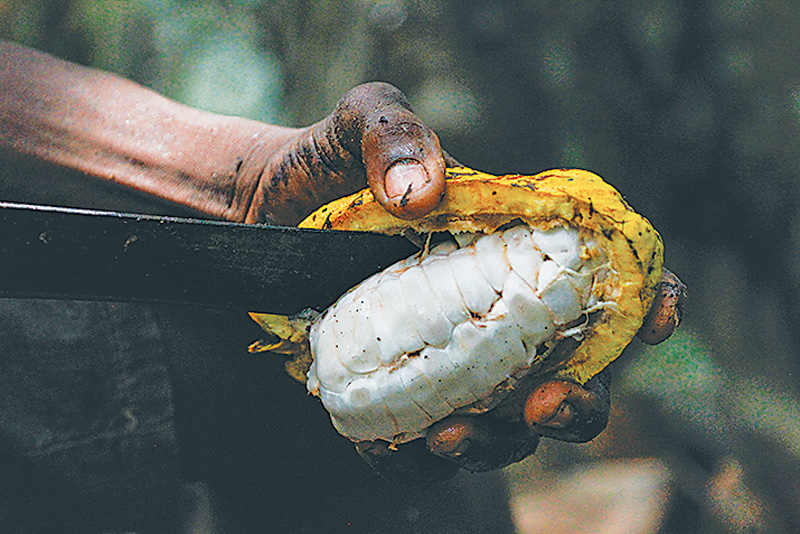
A farmer opens a cocoa pod at a cocoa farm in Azaguie, Ivory Coast. reuters
LONDON/ABIDJAN, The steepest dive in cocoa demand in a decade has thrown into jeopardy a plan by top producers Ivory Coast and Ghana to guarantee some two million farmers a living wage, sources within the countries’ regulators said. Leading chocolate-makers agreed to a proposal from the African nations last year to charge the industry a premium for cocoa beans and guarantee a minimum income to farmers who earn just $1 a day. But the scheme, set to come into effect this October, was based on expectations that international cocoa prices would stay within average ranges. Instead, the impact of the Covid-19 pandemic on demand has driven them to their lowest in nearly two years and they are expected to stay weak for at least a year, the industry says. “It is not certain we will be able to guarantee farmers the amount originally expected,” a source at Ivory Coast’s cocoa regulator the Coffee and Cocoa Council (CCC), which sets the official farmer price each season, told Reuters. The source, who declined to be named because he is not authorised to speak to the press, said the country’s cocoa sales for next season were some 30 percent below average levels for the time of year. The CCC did not respond to Reuters’ requests for comment. A spokesman for the Ghana Cocoa Board (Cocobod) said in a statement sent via WhatsApp the process of determining the price cocoa farmers will get was ongoing. He added, however, farmers would still get a better price than without any premium. Market weakness could appear a good thing for chocolate consumers offered discounts on the high street, but for farmers it could mean hunger. Already the closure of retail outlets during lockdowns to try to contain the novel coronavirus stifled impulse-buying of chocolate, significantly denting demand. Now widespread economic hardship is expected to limit sales just as the industry anticipates production will rebound when the new cocoa season starts, generating a large global surplus. A series of meetings between representatives of the cocoa industry, Ivory Coast and Ghana last year agreed a premium of $400 a tonne for all sales for the upcoming 2020-21 season, including any production sold ahead of the season’s start in October. Because the market has suffered a sustained fall with prices now below $2,000 a tonne, even with the premium added, the earnings of Ivory Coast and Ghanaian farmers will fall below the guaranteed minimum wage.
MONEY
Nepal, World Bank sign $450 million road project deal to boost post-Covid-19 recovery
- Post Report
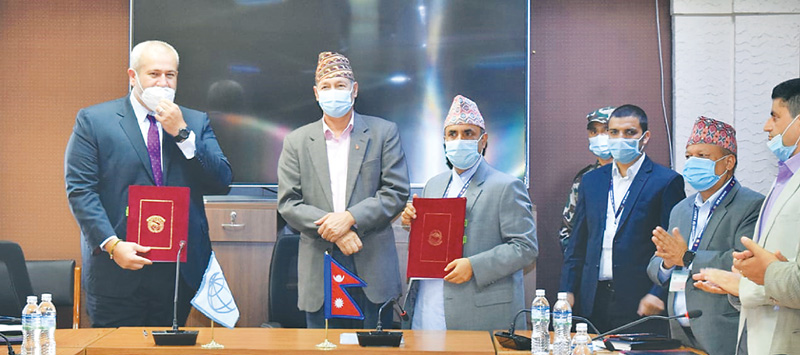
Finance Minister Yuba Raj Khatiwada (2nd left) attends the signing event in Kathmandu, on Friday. photo courtesy: Ministry of Finance
KATHMANDU, The government and the World Bank signed a $450 million financing agreement that will help Nepal improve the efficiency and safety of transport infrastructure, improve efficiency of cross-border trade, and strengthen capacity for strategic road network management. This is the single largest value project that Nepal has signed with the World Bank. The agreement was signed by Finance Secretary, Sishir Kumar Dhungana on behalf of the government and the World Bank Country Director for Maldives, Nepal and Sri Lanka, Faris Hadad-Zervos. “We thank the World Bank Group for supporting this important project which will enhance connectivity and country integration along with cross border markets to support post-Covid-19 recovery, said Finance Minister Yuba Raj Khatiwada. “Connectivity is high on the rapid and sustainable development agenda of Nepal. Sustainable transport and sustainable, inclusive and high-quality infrastructure are of cross cutting importance for accelerating economic growth, national and regional economic integration and attaining the sustainable development goals.” “The project, with its focus on reducing time and cost of moving goods via key transport corridors and border crossing points, will be key to sustain and accelerate our economic growth, especially aiding recovery in the immediate aftermath of Covid-19,” said Sishir Kumar Dhungarna, Finance Secretary. “We are also looking forward to this Project to introduce and demonstrate best practices in several key areas ranging from safety and climate resilience to road asset management and citizen engagement, and hoping to replicate them at the federal, provincial and local levels of the government.” The government is working on a 3R—Relief, Recovery and Resilience—strategy to help Nepal build back better from the impacts of the Covid-19 crisis. This project will be critical for boosting economic possibilities and enhancing trade facilitation to speed up recovery and resilience, the bank said in a press statement. The Strategic Road Connectivity and Trade Improvement Project supports Nepal’s connectivity and trade with neighboring countries including India. It will improve the Nagdhunga-Naubise-Mugling road and upgrade the Kamala-Dhalkebar-Pathlaiya road to four-lane. The project will also enhance infrastructure, facilities and sanitation at border crossing points to ease trade constraints and spur agricultural exports. Amid the Covid-19 pandemic, the project will also support better screening of goods and people at border facilities, and develop guidance for special working arrangements, such as safe distancing and remote working. “This project supports the government’s efforts to put Nepal on the path to economic recovery amid the impacts of the Covid-19 crisis. It will help facilitate regional trade and connectivity and create jobs while ensuring safety and efficiency of the strategic roads network,” said Faris Hadad-Zervos, World Bank Country Director for Maldives, Nepal and Sri Lanka. The project will also support institutional strengthening of the National Road Safety Council and the Department of Roads, and periodic maintenance of high-traffic roads within the Strategic Road Network. A contingency emergency response component is also included in the project to reallocate project funds to support emergency response and recovery, the bank said.
MONEY
End of the jumbo: British Airways retires 747 early due to coronavirus crisis
- REUTERS
A British Airways Boeing 747 is seen at the Heathrow Airport in London, Britain. reuters
LONDON, British Airways, the world’s largest operator of Boeing 747s, will retire its entire jumbo jet fleet with immediate effect after the Covid-19 pandemic sent air travel into freefall. For over 50 years, Boeing’s “Queen of the Skies” has been the world’s most easily recognised jetliner with its humped fuselage and four engines. But its days were already numbered before the pandemic struck earlier this year. British Airways (BA) had been planning to retire the aircraft in 2024, but with passenger numbers decimated this year, and experts forecasting it will be years before they recover, the airline said it was unlikely its 747s would operate commercially again. “It is with great sadness that we can confirm we are proposing to retire our entire 747 fleet with immediate effect,” BA said in a statement on Thursday. The 747 democratised global air travel in the 1970s, but fell behind modern twin-engine aircraft and now trails newer planes in fuel efficiency, making it expensive to run. The move by BA comes after Australia’s Qantas Airways said in June it would retire its remaining 747 fleet immediately, six months ahead of schedule. BA’s predecessor airline BOAC first introduced the 747 on the London-New York route in 1971 after a one-year delay caused by a dispute with pilots over the terms for flying the new jet. Hugh Dibley, a former BOAC captain and racing driver who joined the airline in 1958, said the 747’s introduction marked a new era, but was beset with teething problems with its engines. Landing and taxiing also took some getting used to, from a cockpit positioned almost 30 feet above the ground - or more when angling the nose higher just before touching the runway. “It was a delight to fly as it was so stable. The initial issue was its height from the ground. It was like landing a block of flats from the 2nd floor,” Dibley told Reuters. BA’s jumbos are the 747-400 model, the most-sold version of the jet which was introduced in 1989. After BA, only a handful of airlines including Rossiya Airlines and Air China continue to operate them, according to Cirium data. A newer version, the 747-8, was designed to refresh the brand and counter Airbus’s A380, but has mainly prospered as a freighter and Boeing is soon expected to follow Airbus in announcing a halt to production of such four-engined behemoths. The end of the runway for BA’s jumbo fleet comes as the company, owned by IAG, faces a battle for survival because of the coronavirus pandemic. Just as its introduction at BA was marred by labour uncertainty, its retirement almost five decades later comes as BA plans to cut up to 12,000 jobs, or 28 percent of its workforce, to prepare for a slump in air travel. US-based Boeing and its suppliers signalled the end of the plane when they set the final number of parts it would need for the 747 jumbo jet programme at least a year ago.
WORLD
Breathtaking virus numbers around the world show normal life still far away
In India, a surge of 34,884 new cases was reported as lockdowns are re-imposed.
- ASSOCIATED PRESS
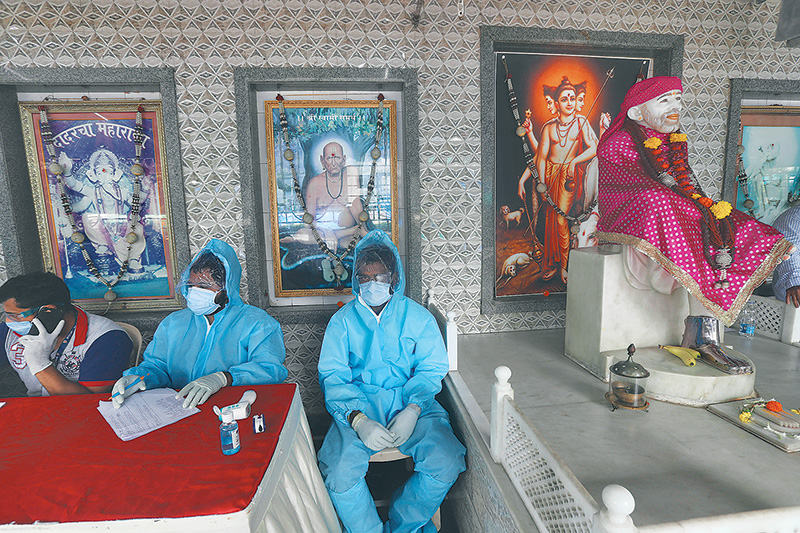
Health workers wait to screen people for Covid symptoms at a temple in Mumbai on Saturday. AP/rss
Johannesburg, South Africa was poised on Saturday to join the top five countries most affected by the coronavirus, while breathtaking numbers around the world were a reminder a return to normal life is still far from sight. Confirmed virus cases worldwide have topped 14 million and deaths have surpassed 600,000, according to Johns Hopkins University data, a day after the World Health Organization reported a single-day record of new infections at over 237,000. Death tolls in the United States is reaching new highs, and India’s infections are over 1 million. Experts believe the true numbers around the world are higher because of testing shortages. And as countries try to ease lockdowns, new ripples of cases follow. South Africa on Saturday could join the US, Brazil, India and Russia as the most badly hit countries as its cases near 350,000. Current case trends show it will surpass Peru. That comes as the world marks Mandela Day, remembering South Africa’s first Black president and his legacy of fighting inequality. The country, however, remains the world’s most unequal, and health officials have warned that the pandemic will lay that bare. “The simple fact is that many South Africans are sitting ducks because they cannot comply with World Health Organization protocols on improved hygiene and social distancing,” the foundation of former South African archbishop and fellow Nobel Peace Prize winner Desmond Tutu and his wife, Leah, said in a statement. South Africa’s new epicentre, Gauteng province, is home to one-quarter of the country’s population, with many poor people living in crowded conditions. The country’s cases make up roughly half of all on the African continent. Its struggles are a sign of trouble to come for less-resourced nations there. In India, a surge of 34,884 new cases was reported as local governments continue to re-impose focused lockdowns in several parts of the country, only allowing essential food supplies and health services. In the US, teams of military medics have been deployed in Texas and California to help hospitals deluged by coronavirus patients. The two most populous states each reported roughly 10,000 new cases and some of their highest death counts since the pandemic began. In China, the number of confirmed cases in a new Covid-19 outbreak in the far western region of Xinjiang has risen to 17. In Bangladesh, confirmed cases surpassed 200,000 but experts say the number is much higher as the country lacks adequate labs for testing. Most people in rural areas have stopped wearing masks and are thronging shopping centres ahead of the Islamic festival Eid al-Adha later this month. And in Britain, scientists are pouring cold water on Prime Minister Boris Johnson’s hope that the country may emerge from lockdown and return to normality by Christmas. Epidemiologist John Edmunds, a member of the government’s Scientific Advisory Group for Emergencies, said a return to pre-pandemic normality is “a long way off, unfortunately” without a vaccine for the virus. Britain has registered more than 45,000 Covid-19 deaths, the highest in Europe.
WORLD
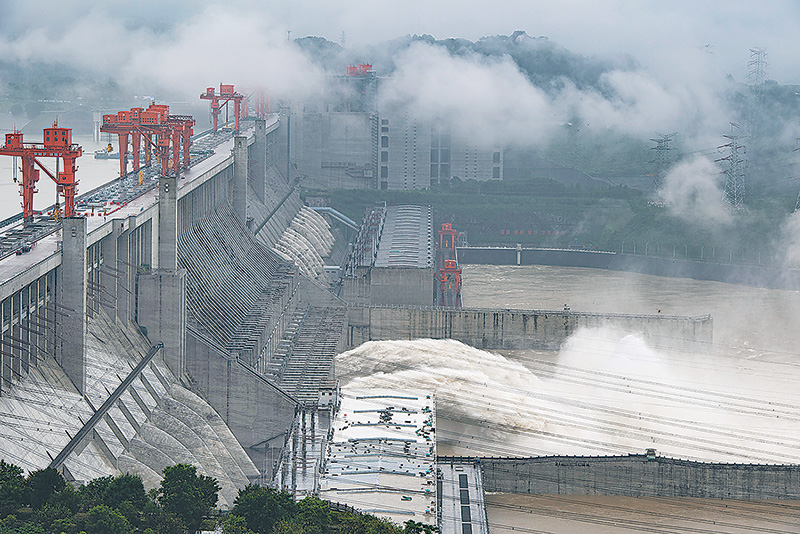
Floods kill 14 in China as water peaks at Three Gorges Dam
- ASSOCIATED PRESS
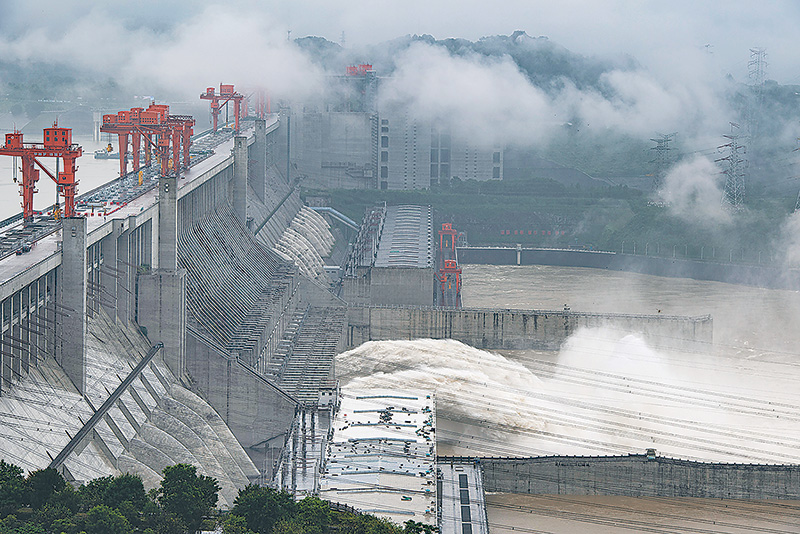
In this photo released by China’s Xinhua news agency, water flows out from sluiceways at the Three Gorges Dam on Yangtze River near Yichang incentral China’s Hubei Province, on Friday. AP/rss
Beijing, At least 14 people have died in the latest round of seasonal rains and flooding in southern China, as soldiers and workers built makeshift barriers with sandbags and rocks Saturday to keep the Yangtze River and its tributaries at bay. Three floodgates of the Three Gorges Dam that spans the Yangtze were opened as the water level behind the massive dam rose more than 15 meters (50 feet) above flood level, the official Xinhua News Agency reported. The dam was holding back about 45 percent of the water, Xinhua said, citing China Three Gorges Corp. Upstream, 11 people had been killed in Chongqing as of Saturday morning, China National Emergency Broadcasting said in an online report, citing the municipal emergency agency. More than 20,000 people had been evacuated and 1,031 homes destroyed. Three landslides in Dunhao town in a mountainous part of Chongqing left six dead, the city’s Emergency Management Bureau said. The bodies had been found by Friday evening after more than 200 people were dispatched for a search and rescue operation. Rainfall in the town of Dunhao totalled 39 centimetres, the bureau said. Three more people died in neighbouring Hubei province, the emergency management department said in a social media post. State broadcaster CCTV showed people cleaning up still wet, muddy streets and shops in the city of Enshi after severe flooding Friday. Rescue workers used inflatable rafts to rescue more than 1,900 people trapped in their homes and other buildings. Downriver, firefighters and others finished filling in a 188-meter (620-foot) break in a dike on Poyang Lake, China’s largest freshwater lake, Xinhua said. The dike gave way nine days ago, flooding 15 villages and agricultural fields in Jiangxi province, the news agency said. More than 14,000 people were evacuated. The incoming waters were expected to peak Saturday behind the Three Gorges Dam, but more water is forecast to arrive around Tuesday, Xinhua said. The hydropower dam is used to mitigate catastrophic flooding. Seasonal flooding strikes large parts of China annually, especially in its central and southern regions, but the rainfall has been unusually high this year. About 1.8 million people have been evacuated and direct losses attributed to flooding are estimated at more than 49 billion yuan ($7 billion), according to the Ministry of Emergency Management.
WORLD
Iran warns 25 m infected as restrictions return
- REUTERS
Dubai, President Hassan Rouhani said on Saturday that 25 million Iranians have been infected with the coronavirus and that another 35 million were at risk of acquiring it as Iran reimposed restrictions in the capital and elsewhere. The figures Rouhani cited in a televised speech were far higher than Saturday’s official toll of 271,606. His office said they were based on “an estimated scenario” from a report by the health ministry’s deputy minister of research. “Our estimate is that until now 25 million Iranians have been infected with this virus and about 14,000 have lost their dear lives,” Rouhani said in the speech. “There is the possibility that between 30 and 35 million other people will be at risk.” He said more than 200,000 people had been hospitalised and that the ministry expected that number to double in the coming months. Authorities on Saturday reimposed one-week restrictions in the capital Tehran including banning religious and cultural functions, closing boarding schools, cafes, indoor pools, amusement parks and zoos. The Health Ministry reported 188 deaths in the past 24 hours to take Iran’s total to 13,979. Iran, with a population of more than 80 million, has been the Middle East country hardest hit by the epidemic, with infections and deaths rising sharply since restrictions were eased beginning in mid-April. From Sunday, 22 cities and towns in the southwestern Khuzestan Province will be under a three-day lockdown, the province’s governorate announced on Saturday.
WORLD
Ten thousands march in Russian far east in support of detained governor
- REUTERS
Moscow, At least 10,000 people marched in the Russian far eastern city of Khabarovsk on Saturday, demanding the release of a popular regional governor detained last week on suspicion of murder, in the second week of protests. Sergei Furgal, a member of the Liberal Democratic Party, was the governor of the Khabarovsk region where he swept to power in 2018 after defeating a rival from the ruling United Russia party that backs President Vladimir Putin. Furgal was taken to Moscow last week, where he is now in pre-trial detention after being charged with involvement in organising the murder of multiple businessmen 15 years ago. He could face up to life in prison if found guilty of the charges, which also include involvement in attempted murder. He denies the charges. Demonstrators packed a city thoroughfare on a sweltering Saturday afternoon, carrying posters in support of Furgal, some demanding his release, others calling for an open and transparent trial, with the column of marchers stretching into the horizon. Svetlana, a middle-aged woman wearing a face mask, said residents were not put off by the accusations against Furgal. Many Russian politicians have a dark past, she said, as the final years of the Soviet Union were riddled with corruption and crime. “People came out here to defend their voting rights: We elected him, so return him to us,” she said. The protests come barely three weeks after a landslide referendum victory for the Kremlin on amendments to the constitution, allowing Putin to remain in power for another 16 years. Dozens were arrested in Moscow last week after a few hundred protested against the amendments. Last Saturday, between 10,000-12,000 people took part in an unsanctioned march in Khabarovsk, the local branch of the interior ministry said in a statement. The city is a seven-hour flight east of the capital. This Saturday, fewer than 10,000 marched, the city mayor’s office said in a statement, adding that the protest was peaceful and there were no detentions. Some local news outlets estimated the number was significantly higher.
WORLD
US divided over masks, schools as virus cases rise by over 70,000
- REUTERS
US President Donald Trump says he would not consider a national mandate requiring people to wear masks to combat the spread of the coronavirus. Reuters
Washington, Americans are debating mask mandates and the reopening of schools during the coronavirus pandemic as state and local officials imposed conflicting orders and cases rose by more than 70,000 across the nation for the second day in a row. Governor Brian Kemp sued Atlanta’s mayor to prevent her from mandating masks. Chicago Mayor Lori Lightfoot announced a plan to offer both in-person and remote instruction at the nation’s third-largest school district, over the objection of the teachers’ union, which wants remote learning only. Americans have become divided along political lines over mask orders, with conservatives more likely than liberals to call the rules a violation of their Constitutional rights. “Everybody saying that [wearing a mask] is a violation of their freedom - no, it’s not. Because a seatbelt is mandated and that’s to save your life,” said Sharon Taylor, 48, a cardiothoracic nurse in Atlanta. With school set to resume in a few weeks, local officials across the country have announced a variety of plans to resume teaching. California Governor Gavin Newsom, who until now has allowed school districts in the nation’s most populous state to set their own policies, said on Friday schools could reopen only in counties that for 14 days have stayed off a worsening trends watch list. As of Friday, 30 of the state’s 58 counties were on the list and schools there must remain closed. Among them are Los Angeles, Sacramento and San Diego counties, accounting for nearly 40 percent of the state’s population. The United States has been averaging about 60,000 cases a day in July with cases rising in 41 states on Friday, based on a Reuters analysis. Texas and Arkansas reported a record number of deaths on Friday, while Kansas, Ohio, North Dakota and Puerto Rico reported record numbers of infections. President Donald Trump has urged a return to normal, stressing the importance of reigniting the economy. The Trump administration and some health experts argue children are better off in classrooms for their development, and also to allow parents to return to work. Trump told Fox News on Friday he did not believe in implementing a national mask mandate. Dr Anthony Fauci, the nation’s top infectious disease specialist, urged political leaders to “be as forceful as possible in getting your citizenry to wear masks.” Miami Beach, Florida imposed an 8 pm curfew in its entertainment district after social media posts showed maskless revellers crammed into restaurant patios. Oklahoma City’s council voted in favour of an indoor mask requirement in the absence of a statewide face-covering mandate. In Georgia, Kemp, a Republican and Trump supporter, urged all Georgians to wear masks for at least four weeks but said mandates were unenforceable and suggested they would hobble the economy. “Brian Kemp does the bidding of President Trump,” Atlanta’s Democratic Mayor Keisha Lance Bottoms, who has tested positive for the coronavirus, told CNN on Friday. Louis Charles, 68, of Atlanta, sided with the mayor on Friday as he wore a mask, all alone, sorting through his mail outside a post office. “It’s wrong,” Charles said. “The mayor is trying to help people. This is a pandemic. How much worse does he want it?”
WORLD
Biden says Russia and China meddling in US election
Briefing
- AGENCIES
Russia and China are trying to undermine US democracy in the run-up to November’s presidential election, Joe Biden said, citing intelligence briefings he is now receiving. “The Russians are still engaged in trying to delegitimise our electoral process. Fact,” the presumptive Democratic challenger said at a fundraiser on Friday according to the Washington Post. “China and others are engaged as well in activities that are designed for us to lose confidence in the outcome,” he added. It is normal for presidential nominees of the major parties to have intelligence briefings, though it is not clear when Biden started to receive his.
WORLD
Fire destroys organ, shatters stained glass at cathedral
Briefing
- AGENCIES
NANTES: A fire in the 15-century cathedral in the western French city of Nantes blew out stained glass windows and destroyed the grand organ on Saturday, and officials said they suspected arson. Prosecutor Pierre Sennes told reporters three fires had been started at the site and authorities were treating the incident as a criminal act. He gave no other details. Officials said an investigation had been opened. The fire began in the early morning, engulfing the inside in massive flames, and dozens of firemen brought it under control after several hours. Smoke was still coming out of the Gothic structure later on Saturday morning.
WORLD
Taliban make big changes ahead of talks
Briefing
- AGENCIES
ISLAMABAD: The Taliban have put the son of the movement’s feared founder in charge of their military wing and added several powerful figures to their negotiating team, Taliban officials said. The shake-up, one of the most significant in years, comes ahead of expected talks with Kabul aimed at ending decades of war in Afghanistan. As head of a newly united military wing, 30-year-old Mullah Mohammad Yaqoob brings his father’s fiercely uncompromising reputation to the battlefield. Equally significant is the addition of four members of the insurgent group’s leadership council to the 20-member negotiating team, Taliban officials told The Associated Press.
CULTURE & ARTS
In Jhochhen, an age-old culture is slowly fading away
Even though many core Newa neighbourhoods celebrate Gathanmugah, at Jhochhen and Basantapur, the tradition has ceased to exist for years now, say locals.
- SRIZU BAJRACHARYA
Locals at Bhaktapur burn the effigy of Ghantakarna, the demon, during the celebration of Gathanmugah. post file photos
Kathmandu, For 74-year-old Kamala Bajracharya, everything in Jhochhen-Basantapur of Ward No. 23 has changed unbelievably. As she looks outside her window that faces the Nautalle Durbar and the big open Basantapur dabali, she sighs deeply remembering the old days: when Jhochhen was not filled with restaurants and coffee shops, but small pasals. A time when even smaller festivals brought people together. With Gathanmugah, a Newa festival celebrated to ward off evil in the Nepali month of Shrawan here, the change is even more distinct. “I think it’s been about 10 years that we haven’t celebrated the festival here. No one makes the big narkat, an effigy of a demon made with green reeds and straw ropes to place it at the crossroad,” she says. “Now everything has changed. Only a few familiar faces are living in the neighbourhood, and no procession follows the festival.” The festival this year falls on July 19. In the last few decades, Jhochhen and Basantapur have undergone rapid changes. In the 1970s, the place found its new name Freak Street, with the arrival of hippies, and with it, the area became more commercial. In later years, many families voluntarily moved out of the neighbourhood, renting their houses to tenants to open their own shops and offices in the place. In the last decade, Jhochhen has also seen a boom of dozens of restaurants and eateries. The commercialisation of the locality has dwindled the communal vibe, and many celebrations, like Gathanmugah, no longer see local engagement and sharing. According to Ward-23 Chairperson Macharaja Maharjan, about 40 percent of local families have moved out of the core Jhochhen and Basantapur area. And as many as 50 to 60 restaurants and hotels have sprung up in these years. “We don’t have specific data to show the numbers, but we can make out the percentage based on the elderly allowance that we give away. Many families come from Sanepa, Bhaktapur and places around the Valley,” says Maharjan. “But the change is quite visible with how things have been around here,” he says. In the age-old days, during Gathanmugah, families would clean their houses and paint the floors with earth for purification. They would bathe and make arrangements for bau, sacramental offerings to the evil force in the evening. Some locals, mainly Manandhar and Jyapoos, would bring bamboo sticks and straws early in the morning to make the evil effigy of Ghantakarna. This demon, according to long tales, made life difficult for people. After that, children would hang voodoo dolls on the effigy. Bajracharya still remembers running to the crossroad to hang the voodoo doll filled with masalas that her grandmother would make for her when she was a child. “Many children and men also used to go from house to house to ask for jagaat for the man impersonating as the demon,” she says. The man appointed as Ghantakarna would have foul words written all over him, with mostly black colour covering his skin. “The person usually used to be someone from a low caste family or an outcast, and he would carry a dahi bhegah (an earthen pot) around the locality to get money. And by the end of the evening, he would be pulled with the effigy to the Bishnumati river. It was an iteration to ward off evil,” says Maharjan. During the procession, people would shout out of their windows and doors, “Aaju jaya haaa”, which translates to “hail the protector.” “In the later years, the man impersonating the demon would run off midway as we would carry the narkat out to Bishnumati river,” says 63-year-old Prakash Shakya, another local of Jhochhen. The demon effigy used to be placed at every crossroad of Newa localities. And by the end of the evening, it used to be burnt and hurled away at the river. “But it’s been about 10 to 5 years that we haven’t had an elaborate celebration. Now everyone is busy, and there’s not much participation,” he says. Maharjan also believes the festival has seen a change because many people are now realising the discriminating side of the festival. “I think we are at an age where we realise that it’s not right to do a procession by demeaning a person or caste groups. And so, in many places, the reiteration of ghantakarna has stopped,” he says. According to an article about Gathanmugah in ‘Hamro Chadparva’ by Punyaratna Bajracharya, low caste people were called “chandaal” or evil. And so they were the ones who would be called to represent the demon. Gathanmugah, however, is one of the oldest festivals of the Valley, one which also marks the end of the ropai season and onset of a series of festivals. It’s also similar to festivals like Dumje, Tiji, Manirimdhu which are celebrated to ward off evil energy up in the mountains. Punyaratna Bajracharya also writes that the festival must have started to make people aware of maintaining proper hygiene and cleanliness in a season of breeding insects and diseases, a time when people believed in the supernatural. “It was a time when people were not educated, and the festival was a means to make them aware of humanity, and make them more civilised. It was a mechanism to give them a sense of control,” says Subarna Shakya, a cultural expert and social worker. “But when continuing such a culture one must understand why a festival came to be than just blindly following it as tradition,” he says. Twenty-five years back, Shakya along with his peers had voiced against the ritual of having a low caste person enact as the demon to set him down the river. Traditions, over time, change and should change, says Shakya who used to live in Om Bahal. “Of course we should continue our culture and tradition, but we must also be able to question our traditions,” he says. The origin of the Gathanmugah festival has many stories to it: one is of the demon who wore bells in their ears. The story goes that the beast stole children and created havoc for people, and so the frogs informed humans who killed the demon and tied him at the crossroad, later to throw the beast at the river. In later years, this was enacted to show people the victory of good over evil, to strengthen people’s spirit, says Maharjan. Most tales, however, seem to support a social structure which in the process of practising power forms a systematic arrangement of oppression. And in time they begin to look like a tradition that must continue. “But here’s the thing, myths are not history. It’s important to continue our culture and tradition but not to the extent that we don’t see the wrong in it. After all, like all things, these are meant to change with time,” says Shakya. Eighty-four-year-old Shakya believes that the end of the defamatory side to the festival in Jhochhen is a sign of a progressing society, however, to completely disown the festival would be wrong. “There were so many good parts of the festival like how the community people came together to clean the locality and feast together, but if we are to forget everything, our culture might die just like that,” he says. But at Jhochhen, the communal tradition is almost wholly discarded and rather inconspicuously. No one really knows when the tradition really stopped while many other Newa neighbourhoods still celebrate the festival. Some locals believe the festival stopped being celebrated after the 2015 earthquake while some believe it was much before that. The crossroad of Jhochhen and Basantapur has been without a figurine of the demon for years. And young children of the neighbourhood have only heard of the dolls that used to be hung on the figurine. Nor has anyone ever come to discuss why the tradition stopped. Some believe it was to get rid of the nuisance the festival brought while some think it’s because of modernisation and the busy-ness of modern life. Bajracharya too hasn’t celebrated the festival for years as she is getting old, and her family lives outside of Jhochhen. “I can’t pin the mantra paper to the door by myself, so I don’t do it anymore,” she says. “And there is no communal celebration of the locality to be a part of.” While festivals like Indra Jatra, Jana Baha Dyah Jatra and Bungo Dyah Jatra have guthis and samittees that overlook the management of the festivals, in festivals where these leading groups are absent, communal activities and traditions are slowly waning. But festivals like Gathanmugah have a larger significance because it is supposed to bring together people more organically, by doing something together as a community. “So, it’s sad that these cultures are slowly withering to the times we are living in. It would have been nice to see the community come together,” says Bajracharya.
CULTURE & ARTS
Floored by Covid-19, Cirque du Soleil eyes return to the high-wire
The company was forced to shut down productions in China, Italy and the United States, among other countries.
- Allison Lampert,Xihao Jiang
Reuters
MONTREAL/HANGZHOU, As the coronavirus pandemic ripped around the globe, Cirque du Soleil, a circus troupe formed by Quebec street performers that had become a global powerhouse, saw most of its operations grind to a halt in barely 48 hours. The company, which gained international renown for extravagant shows featuring acrobats, jugglers, fire breathers and musicians, was forced to shut down productions in China, Italy and the United States, among other countries. This month, it filed for bankruptcy protection and has concluded an asset purchase agreement with secured lenders that will be presented to a Canadian court on Friday. “I never thought in my life that I would wake up one day and basically in 48 hours we end up with no shows, no revenues,” CEO Daniel Lamarre told Reuters. “It was very tough because from hour to hour I was learning that one country was shut down and then the other country was shut down.” Lamarre, who joined Cirque in 2001 as an executive scouting for new opportunities for its high-flying acts, was left scrambling to help performers get home from closed productions abroad and find warehouses to store its 50 trucks of equipment per show. Before the pandemic, the entertainment company had 44 performances running worldwide and generated about $1 billion in annual revenues from shows that featured underwater performances and others based on Michael Jackson, Lionel Messi and The Beatles. Show cancellations led the company to permanently or temporarily lay off 95 percent of workers. “My whole Facebook feed was just sadness,” said Chris Gatti, a former high-bar performer and consultant for the company. Privately held Cirque declined to divulge ticket sales but court documents show the company had nearly $1.5 billion in liabilities. He Guowei, a performer at the company’s Land of Fantasy show in China, practiced his human body juggling specialty at home after the show shuttered in January due to the pandemic. “We feel frustrated when we know the show is suspended,” he recalled while training in Hangzhou. “And we also have fears because we have no idea how bad the epidemic is.” The coronavirus pandemic is the biggest threat to face Cirque du Soleil, which was created in the early 1980s as “The Stiltwalkers of Baie-Saint-Paul” in Quebec, before becoming a global entertainment company thanks to sold out Las Vegas shows, touring productions and acquisitions. The shows, which have no animals or star performers, helped some key troupe members become wealthy. Guy Laliberté, a performer and co-founder of the company, is on Forbes list of Canadian billionaires. While Cirque sees a potential reopening in the fall for its resident productions in Las Vegas and Orlando, Lamarre only expects the company to get back to where it was in terms of the number of shows, revenues and profits in 2023. “We think that it will take a year to 18 months before we’re back to normality which means having a vaccine or a cure that makes people feel safe in a theater. And then from there we think that within a couple of years we’ll be able to bring back the company where it was.” The Cirque is seeing some green shoots of recovery with the reopening of the Chinese production last month, and another show opening in early July in Mexico. In Hangzhou, China, He Guowei said he thinks the audience, which now wears masks, is more enthusiastic than before the pandemic. “When we stepped on the stage again, we felt almost the same (as) when we made our debut in last August,” he said. “The effort we made during this time was not in vain.”