You internet speed is slow. Switch to text view mode

Switch
epaper logo
ST

Last Login:
Logout
+
Page 1
HOME PAGE

Highest single-day Covid-19 deaths in the country as eight succumb to disease

With the rise in the number of people in intensive care, health experts reiterate the need to expand testing and contact tracing and increase isolation beds.
- Arjun Poudel

KATHMANDU,
Nepal saw its single biggest Covid-19 death toll of eight on Wednesday, taking the total to 91. A majority of these deaths have been reported since the lockdown was lifted three weeks ag0.
Of the eight new victims, two were from Dhanusha district and one each from Kathmandu, Dhading, Saptari, Morang, Kapilvastu and Bara.
According to the Ministry of Health, 51 have died since the nationwide lockdown was lifted on July 21 while there were 40 deaths during the nearly four months of lockdown that was imposed on March 24.
On Wednesday, of the 484 people who tested positive for the coronavirus, 138 were from Kathmandu Valley. With the entry points to the Valley unregulated during and after the lockdown, thousands of people have been arriving in the Valley every day.
A significant percentage of the people visiting Sukraraj Tropical and Infectious Disease Hospital for testing are from districts hard hit by the pandemic and even from India, hospital officials said.
With the number of coronavirus cases rising at an alarming rate, the government on Tuesday gave district administrations and local governments the authority to decide on restriction measures. It also pushed back the start of air travel and long-distance travel by 15 days to September 1.
Of late, there have been more symptomatic cases and the number of persons in intensive care is also increasing, according to the Health Ministry.
“Eighty-seven people are in intensive care units and two are on ventilator support,” Dr Sameer Kumar Adhikari, joint spokesperson for the Health Ministry, told the Post. “The number of patients infected with the coronavirus becoming serious and critical has been rising in recent days. The survival rate of those on ventilators is usually very low.”
Public health experts say the virus is spreading fast and the situation is getting out of control. They have also urged the public not to take risks, which would be costly for self and to the family members.
“People should maintain social distancing, wear masks and follow safety rules properly, which can save them and others from the virus,” said Arjun Karki, an expert on internal medicine and critical care. “There is no other alternative to be safe.”
Meanwhile, critics argue that the government’s efforts to control the spread have not been effective.
“It was clear to me right from the beginning that things are not being done right,” Dr Sher Bahadur Pun, chief of the Clinical Research Unit at Sukraraj Tropical and Infectious Disease Hospital, said. “Only increasing testing will not help after the infections become widespread.”
According to officials at the Epidemiology and Disease Control Division, tracing those who have come into contact has become difficult, which has further raised the risk of transmission.
Meanwhile, there are not enough isolation beds across the country and those without symptoms have been advised to stay at home, say public health experts.
Across the country there are over 10,000 isolation beds and in Kathmandu Valley about 1,000, according to data provided by the Health Ministry.
“The government has been stuck on testing,” said Dr Anup Subedee, an infectious disease expert. “But in case of a pandemic, the need is to test, treat and isolate.”
With the rise in new cases, the Health Ministry has been performing over 10,000 tests every day for the last few days. Doctors, however, said that only increasing the tests will not help in containing the spread of the coronavirus. For that, contact tracing and isolation is equally important, which is not happening.
In Birgunj, the hardest hit city recently,  two persons died on August 8 and 9 while in search of hospitals because hospital beds were in short supply, as were health workers because they had been infected.
Earlier this week, the government directed all hospitals to reserve 20 percent beds for Covid-19 patients but doctors warn this could complicate matters as infections could rise further within hospitals.
Except for emergency services, all other services at Narayani Hospital in Birgunj have been halted for an indefinite period. Over 15 percent of health workers tested positive for Covid-19 and over 40 percent others, who came in contact with infected health workers, were sent to quarantine.
As of Wednesday, 24,432 persons have been infected with the coronavirus across the country. Of them, 6,438 got infected after the lifting of the lockdown. Among the 1,450 people who have been infected in Kathmandu Valley so far, 1,068 caught the virus after the end of lockdown.
The lockdown was lifted
without proper planning and preparation in terms of increasing testing capacity and isolation facilities. As a result, there was a spike in the number of positive cases throughout the country including in Kathmandu Valley.  
“There is a lot that still needs to be done but neither the government nor the public has been doing it,” said Dr Karki. “If we do not take proper steps, there will be nothing left to be done except to regret.”

HOME PAGE

Nepal’s battered mountaineering tourism’s autumn hopes are fading fast amid rise in Covid-19 cases

Industry insiders say the fate of the upcoming climbing season rests on how the government plans to welcome tourists.
- TSERING NGODUP LAMA
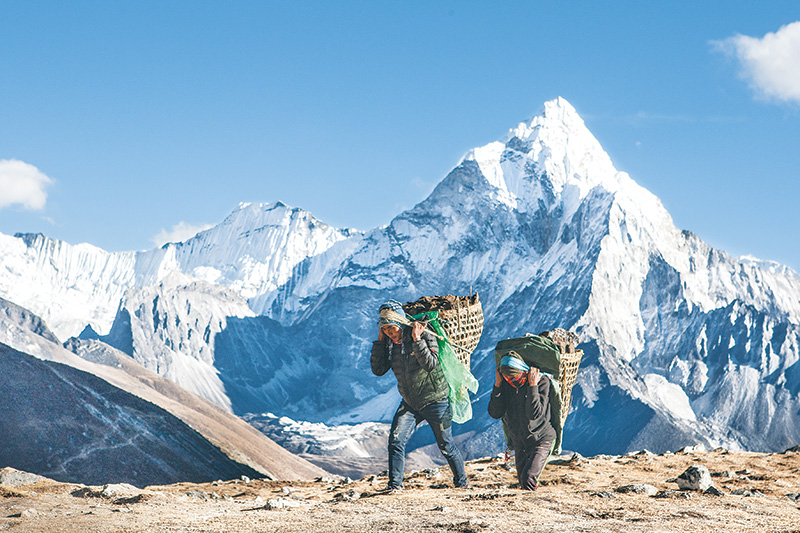
The pandemic has wiped out jobs in Nepal’s mountaineering industry. shutterstock

KATHMANDU,
On February 20, when Pasang Tendi Sherpa landed in Nepal, he had just wrapped up a two-month-long climbing expedition on Mount Aconcagua in Argentina. The next mountain on his list was Everest.
Tendi, a certified guide of the International Federation of Mountain Guides Associations, works as a mountain guide for TAG Nepal, a Kathmandu-based outdoor outfitter. Internationally certified mountain guides like Tendi are in high demand during Nepal’s spring and autumn climbing seasons, and most of them spend months in the mountains, away from their families.
For Tendi, this year was not going to be any different. Then came Covid-19.
“I have been out of work since returning from Argentina,” said Tendi.
The spring climbing season, which begins in March, this year coincided with the beginning of lockdown. On March 20, the government banned all passengers, including Nepalis, from entering the country from the European Union territories, including the United Kingdom, West Asia, Gulf countries and countries like Iran, Turkey, Malaysia, South Korea and Japan. Four days later, on March 24, the government imposed a complete lockdown.
The lockdown forced dozens of companies to cancel their expeditions booked months ago. The cancellation of mountaineering expeditions left around 20,000 tours, trekking and mountain guides out of job, according to industry insiders.
But expedition companies were hopeful for autumn, which begins in  September and lasts until November. The country’s peak tourism season, which attracts a third of the total 1.2 million tourists visiting Nepal, does not generally draw tourists for Mount Everest, but hordes of adventure seekers come to trek. Many small peaks see heavy traffic during the autumn season.
In addition to treks to the Everest Base Camp, thousands of tourists travel across the country to various remote valleys and peaks, giving a much-needed boost to the local economies while employing nearly half a million Nepalis, mostly as trekking and mountaineering guides.
On July 21, the government decided to lift the lockdown allowing hotels and restaurants, trekking and mountaineering companies to prepare for the autumn season. They were reopened on July 30. The scheduled domestic and international flights, however, were planned to open by August 17. Hope was growing strong.
But since lifting the lockdown, there has been a steady rise in coronavirus cases.
On Monday, the government said that international and domestic flights will remain suspended until August 31.
Industry stakeholders–from high-altitude workers to guides and porters to lodging and fooding companies–are now deeply worried about the future.
When Tendi returned from Argentina, his plan was to rest for two weeks before getting ready for Everest. For the spiring’s Everest expedition, his employer TAG Nepal had 32 climbers from all over the world.
“To support them, we had a team of 200 people, which included mountain guides, high-altitude sherpas, cooks, kitchen boys, porters” Tendi told the Post. “From our company’s Everest expedition alone, the lockdown meant 200 people losing their source of
livelihood.”
At big expedition agencies, the number of people who have lost their jobs is much bigger.
Seven Summit Treks, one of the leading expedition agencies in Nepal, had 250 climbers for the spring climbing season.
“We had 100 clients alone for Everest. The rest were for Kanchenjunga, Makalu, Dhaulagiri and Lhotse—all more than 8,000-metre peaks, including the 6,812-metre high Ama Dablam,” said Mingma Sherpa, chairman of Seven Summit Treks. “Had the expeditions gone ahead, we would have been able to employ 1,000 people.”
Every year, young people are eager to have a crack at a high-paying job in the Everest region.
Thirty-eight-year-old Janga Bahadur Tamang was 14 when he fled from his home in Okhaldhunga and arrived in Lukla hoping to find a job in trekking expeditions.
During his first two years in Lukla, Janga worked as a porter.
“When I was 16, I found work as a kitchen helper for a mountaineering expedition, and I have been doing this job since,” said Janga, who now works as a second cook for an expedition agency. He has the experience of working with expeditions on Everest, Mera Peak, Ama Lapcha and Makalu. When the autumn climbing season ends, Janga works as a trekking guide.
“The money I make from these two seasons is usually enough to sustain my family for a year and a half,” said Janga.
This March, he was supposed to join an Everest expedition as a cook, a job that would have employed him until the end of May.
“When the climbing season got cancelled, I was a bit worried but I had some savings to fall back on, and I thought when the autumn season resumes, I can get back to earning money and things will be better,” said Janga.
But with less than a month to begin the season, Janga says his hope of getting back to work is sinking. Like Janga, hundreds of people in the Everest region are hopeful that after a painful spring, autumn would salvage their losses.
“Lukla, the gateway to Everest, where almost everyone is dependent on tourism income, the mood is still deeply worrying,” said Janga. “My savings will probably support me for another few months only.”
Santa Bir Lama, president of Nepal Mountaineering Association, said every year, the association issues 1,200 to 1,500 climbing permits.
While the government itself issues permits to mountaineering expeditions for Himalayan peaks more than 7,000 metres high, the association has been allowed to manage 27 small peaks known as ‘trekking peaks’ which range in height from 5,587 to 6,654 metres.
“Each permit can have anywhere between 1 and 15 climbers, and each climber employs three to five people,” said Santa. “Many who depend on mountaineering have been hit hard by the cancellation of the spring climbing season, and if the autumn climbing season gets cancelled, many people will be in financial ruin.”
The mountaineering community is eagerly waiting for the government to develop health safety protocols, including quarantine measures if the autumn climbing is to happen.
Meera Acharya, director of the Department of Tourism, said they are drafting health safety protocols for the mountaineering activities.
“We are expected to unveil the safety protocols soon,” she said, without elaborating further.
Besides health safety protocols for mountaineering activities, other guidelines for foreign tourists are still awaited.
“Everything now depends on what kind of quarantine rules the government comes up with. If it declares that travellers will have to stay in quarantine for a week or more after arriving in Nepal, there’s no way we can attract climbers,” said Mingma.
While the Tourism Ministry plans to allow tourists to visit Nepal with less hassle, the Ministry of Foreign Affairs is not interested in providing on-arrival visas.
“The Health Ministry is also for regulating tourist movements,” said an official at the Tourism
Ministry who spoke on condition of anonymity because of the sensitivity of the matter.
The guidelines for tourists, which are yet to be finalised, have set a few requirements for tourists—negative polymerase chain reaction (PCR) test results no older than 72 hours on arrival; another PCR test in Nepal from government-designated hospitals and clinics; 14 days of quarantine in hotels; and Covid-19 travel insurance.
“All these documents, except for the PCR test in Nepal, should be submitted while boarding a plane,” said the official. “As per the preliminary discussions, tourists can spend seven days in quarantine in Kathmandu hotels, and another seven days in hotels outside Kathmandu.”
Travel agencies are required to take all the responsibilities of the tourists, starting from picking them up at the airport.
Many tourism stakeholders have suggested that the government set up dedicated Covid-19 testing at the airport and provide results in a few hours so that incoming travellers won’t face the hassle of staying in quarantine for days.
Mingma said that many climbers are still interested to come to Nepal for the autumn climbing season.
“We still have around 200 climbing enthusiasts who want to climb Manaslu and Lhotse during the autumn season,” said Mingma.
“Even though that number is just 20 percent of what we normally have for the season, during such a difficult time, even if we could run expeditions for these climbers, it will provide the much-needed income for many who haven’t had any work for months.”
Eagerly waiting for tourists, Janga and his family are counting on the authorities in Kathmandu to decide.
“Spring is gone, and if the autumn doesn’t happen, I’ll be in no position to pay my rent,” he said. “I have made up my mind to build a temporary shed on a plot of land not far from where I live and move my family there.”

HOME PAGE

Kantipur journalist Balram Baniya passes away

Colleagues remember him as a soft-spoken but tough journalist—fully devoted to his job.
- GHANASHYAM KHADKA,MATRIKA DAHAL
Balram Baniya. Post Photo

KATHMANDU,
Kantipur journalist Balram Baniya has passed away.
He was 50.
His body was found near the Mando Hydropower Project area in Sisneri of Makawanpur on Tuesday morning.
Baniya was associated with Kantipur daily since the paper’s initial days. After spending around 10 years as a core member of the editorial team, Baniya started his reporting stint in early 2000. He used to cover politics and parliament, but he made his name in journalism after he started doing extensive reporting on bureaucracy and governance.
Soft-spoken by nature with an unassuming personality, Baniya, according to those who have worked with him, however, was strict with fellow journalists when it came to new stories, the angle and accuracy.
Narayan Wagle, who edited the paper twice, remembered Baniya as an extraordinarily down-to-earth and honest person.
“I always felt the need of Balram in the newsroom to keep an eye on the proceedings and to raise questions,” said Wagle. “He maintained the highest level of integrity and would spare none.”
Baniya had an outstanding career of three decades, most of which with Kantipur.
He left Kantipur in 2009 to join Nagarik daily for a brief stint.
“He was an ideal journalist from all aspects,” said Gunaraj Luitel, a former news editor at Kantipur who currently edits Nagarik. “He was a man of few words but he never hesitated to speak his mind.”
Baniya returned to Kantipur about a decade ago.
Over the years, Baniya expanded his scope of reporting, covering issues related to energy, hydropower and infrastructure projects.
Hari Bahadur Thapa, former news editor of Kantipur with whom Baniya shared innumerable bylines, remembered Baniya as one of the best journalists.
“He was one of the rare journalists who was dedicated to his profession,” said Thapa. “He had a deep understanding of Nepal’s bureaucracy, governance and the system.”
Baniya’s sudden demise came as a shock not only to the Kantipur family but also to the entire media fraternity in the country.
Condolences poured in the whole day on Wednesday via social media as news came out about his death, with many expressing shock and sadness at the sudden loss of a fighter journalist who never capitulated to pressure.
Baniya had gone out of contact with his family and the office since Monday.
He had last communicated with the office on Monday to inform about an article by Nepali Congress leader Ram Chandra Poudel.
Amid Covid-19 concerns, most of the editorial staff of the paper has been working from home.
He had gone missing after he was swept away in the Bagmati river near the Balkhu bridge.
His body was found on Tuesday but the identity could not be ascertained immediately. The police could ascertain his identity on Wednesday only.
According to Senior Superintendent Deepak Thapa of the Metropolitan Crime Branch, Baniya’s body was found near the Mando Hydropower Project area in Sisneri of Makawanpur at around 11am on Tuesday. His body has been kept at Hetauda Hospital.
According to the police, Baniya was last seen at Balkhu at around 3:45 pm on Monday. A police team in Balkhu had even questioned him that afternoon, to which he had responded, saying he was going home.
According to police, he was then seen walking towards the vegetable market on the banks of Balkhu river near the Balkhu bridge.
Thapa said that Baniya had fallen into the river while walking under the bridge as his shoes got stuck in the mud. Locals had tried to rescue him but they failed, as he was swept away by the strong current of the flooded river, according to Thapa. Further investigation is underway, said police.
Born in 1970 in Mirlung of Tanahun, Baniya had been living in Subidhanagar, Tinkune. He was a former secretary of the Federation of Nepali Journalists. Baniya is survived by his wife, a daughter and a son.

Page 2
NATIONAL

Six people killed, many injured in separate road accidents

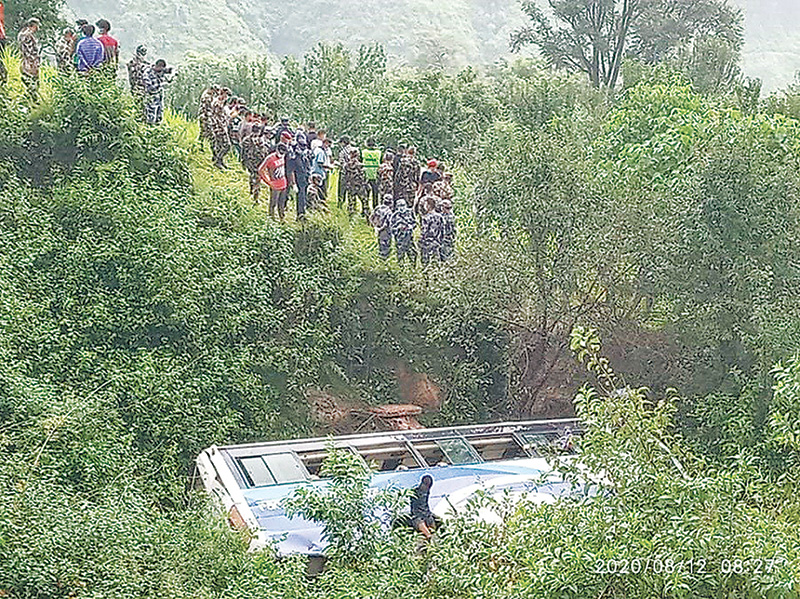
A bus en route to Achham carrying returnees from India fell off the road in Doti, killing three persons and injuring 33.
- Mohan Shahi,MADHAV ARYAL
Security personnel and locals carry out a rescue operation at the site of the accident in Doti. post Photo: Mohan Shahi 

DOTI/PALPA, 
Six people died and more than 40 others were injured in separate road accidents in Doti, Palpa and Mugu districts on Tuesday and Wednesday.
A speeding bus swerved off the road and plunged 100 feet below in Purbichauki, Doti, at around 6am on Wednesday, killing three persons and injuring 33 others. Six of the injured are reportedly in a critical condition.
According to the District Police Office in Doti, the bus en route to Achham was carrying Nepali returnees from India. The deceased were from Mangalsain-7, Bannigadh Jayagadh-3 and Chaurpati-4 in Achham district. One among the deceased was the driver’s assistant while the other two were returnees from India.
Security personnel and locals rescued the victims and rushed them to Doti Hospital. According to Dr Prakash Thakulla, six critically injured people, including a 10-month-old baby, were referred to Sudurpaschim Provincial Hospital in Dhangadhi for treatment.
“Overspeeding and foggy weather were the main causes behind the accident,” said Superintendent of Police Janakraj Pandeya.
In another road mishap, two people died and six others were injured in a jeep accident in Nisdi Rural Municipality, Palpa, on Tuesday evening.
The jeep, which was heading to Gakdha from Jyamire in Nisdi, fell around 700 metres below the road.
Police identified the deceased as residents of Nisdi-5. One of the two deceased was a three-month-old infant. The injured are receiving treatment at Lumbini Medical College in Palpa. The driver and his assistant fled the scene after the accident, said police.
Meanwhile, in Mugu, a man died and 10 others sustained injuries in a jeep accident at Nigale on Wednesday. The vehicle was heading to Tarapani from Gamgadhi, the district headquarters, when the accident took place. The injured are receiving treatment at the district hospital.

(Raj Bahadur Shahi contributed reporting from Mugu)

NATIONAL

Surveillance to protect red panda cubs begins in hill districts of Province 1

The nurturing season of red panda cubs has begun and this is the time when they are at their most vulnerable, conservationists say.
- Aananda Gautam
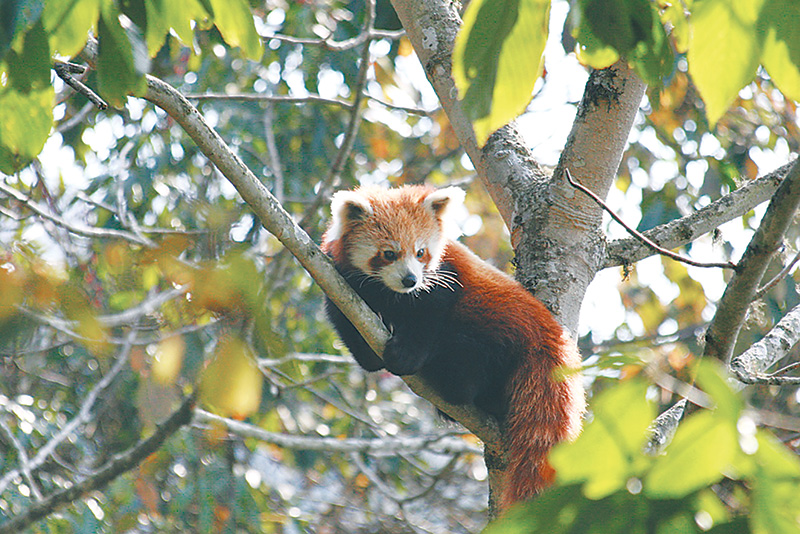
Twenty-five percent of an estimated 500 red pandas in Nepal are found inthe three eastern hill districts of Taplejung, Panchthar and Ilam. photo courtesy: Himali Conservation Forum

TAPLEJUNG, 
Cryca Sherpa, a resident of Hangdewa in Phungling Municipality Ward 9, Taplejung, used to collect fodder from the forest areas in Pathibhara. But he hasn’t been there ever since the local community group banned people from entering the woodlands.
The group came up with the move to protect the endangered red panda species and their cubs, which are especially vulnerable to any unfavourable conditions like frequent human movement in their environment.    
“For the time being, the ban has not affected us, as we have plenty of grass in our fields,” said Sherpa, who is also a member of the local community group that is working to save endangered species.
The breeding season for red pandas begins at the end of May and lasts until the end of July. However, in the following months until October, the mortality rate of red panda cubs is high. This has prompted conservationists to appeal to the public to leave the habitat of these endangered mammals undisturbed.
Consumer committees and local communities in Taplejung, Panchthar and Ilam districts, the major habitat of red pandas, have begun surveillance of red panda cubs as a part of the species’ protection drive. It is estimated that more than 134 red pandas are found in these three eastern hilly districts
Wangchu Bhutia, the programme coordinator of the Red Panda Network, said the time period in between May and October is of great significance in red panda conservation.
“If red pandas find their habitat disturbed, they tend to move to another area with their cubs. The newborns are vulnerable to this frequent change in location and could die due to unfavourable conditions in their new surroundings,” said Bhutia.
According to the study performed by Pralad B Yonzan, a conservationist, in Langtang National Park in 1989, 86 percent of red panda cubs die at an early age. The study showed that this high mortality rate of the cubs has posed a challenge in the conservation of the endangered species.
Conservationist Bhutiya said increased human activities in the forest areas—like the expansion of the Suketar-Kafle Pati road and the Suketar-Deurali-Sikaicha road—has disturbed the district’s red panda habitats.
“Red pandas get frightened by loud noises made by vehicles and humans while cutting fodder and firewood inside the forest. They need a peaceful environment while reproducing and nurturing their babies,” Bhutiya said. “If there is any kind of outside intervention, they tend to leave their birthing dens along with their offspring.”  
To prevent this from happening, the community group has prohibited vehicles from blowing horns along the Suketar-Kaflepati road and the Suketar-Thawakhola road, as loud noises disturb red panda habitats.
Red pandas are able to reproduce at around 18 months of age. They build birthing dens in a hollow tree or a tree stump and line them with leaves, grass, moss and tree branches to nest their young.
Ramesh Rai, the programme coordinator of Himali Conservation Forum, which conducts conservation programmes in various community forests in 14 wards of different municipalities of Taplejung district, said the forum has requested locals not to construct roads, cut trees, collect stones and break boulders, and collect fodder and firewood near forest areas.
According to Rai, the locals have been very cooperative in their drive to protect and conserve red panda species.
“We don’t enter forests to collect fodder and firewood in the monsoon. Grass for cattle is easily available in farmlands. So there’s no problem,” said Pasang Sherpa, a resident of Bungkulung in Phungling Ward No. 9. He said the locals are complying with the community groups’ requests to help conserve the endangered species.  
Dhanraj Tumbapo, who used to be in charge of a temporary police post in Upper Phedi, which is 22.5 kilometres from the district headquarters of Phungling, said red pandas are especially vulnerable during their breeding season and the first three months of their birth, when they are at high risk of attack by stray dogs.
“Many times, I have seen dogs attacking red pandas in Upper Phedi. The local community must come together to protect red pandas,” Tumbapo said.
Meanwhile, Pasangrita Sherpa, chairman of Pathibhara Community Forest Consumer Committee, said they have requested locals not to let their dogs roam the forest areas this season.
“The locals are aware of the red panda conservation efforts. If they disobey the rule, the community forest will take necessary action against them,” he said.
The local community groups have been preparing an annual timetable that informs locals when they can enter the forests for firewood and fodder collection.
According to the Red Panda Network, 25 percent of an estimated 500 red pandas in Nepal are found in the three eastern hill districts. The data of the network showed that the animal species is found in 23 districts in the country.
Red Panda, known as Habre in Nepali, is one of the rare animal species inhabiting the temperate forests with abundance of bamboo in Nepal, India, Bhutan, northern Myanmar and southwestern China. The estimated number of red pandas is less than 10,000 in the world.
Conservationists say construction of roads through red panda habitat, deforestation, forest fire, poaching, excessive grazing, attack from predators and loss of food sources are the major challenges facing red panda conservation. Moreover, parasitic infections found in red pandas during a recent study further worries conservationists
Khile Sherpa, a local community user in Bunkulung, said they are allowed to enter forests between mid-February to mid-April, before the start of monsoon every year.
“During that period, we collect firewood that can last for four to six months. But during monsoon, we are not allowed to enter forests in accordance with the annual plan,” Khile Sherpa said. “We know if we enter the forest areas during monsoon, our activities will disturb red panda habitat. This is why we utilise the grass and fodder available in our fields during the monsoon season.”

Page 3
NATIONAL

Pandemic leaves youngsters stressed and devastated

Study says Covid-19 has disrupted education of more than 70 percent of youths, affected them disproportionately.
- CHANDAN KUMAR MANDAL

KATHMANDU, 
If it were not for Covid-19 pandemic, Ankita Bhetwal would have been applying for her visa for Canada, and teaching her students English in Kathmandu.
“I would have been happily shopping and hanging out with friends as I would be leaving for Canada in early September to start college,” said Bhetwal, 24, who lives in Thimi, Bhaktapur.
But her plans she charted out so well a few months ago are unravelling. She now feels stranded at home due to the pandemic.
“I had to turn my plans completely upside down,” said Bhetwal, who called off her plans to move to Canada and got admitted at a college in Kathmandu. To make things worse for her, she had to attend a virtual orientation programme organised by her college where she decided to pursue her MBA. “How do we get to know our classmates through the computer screen? I don’t think the whole learning environment is going to be the same,” she said.
Bhetwal is one of the millions of youngsters around the world whose study and job prospects have taken a hit due to the global crisis. A new study by the International Labour Organisation, released on the occasion of International Youth Day, Wednesday, concludes that the Covid-19 crisis is unleashing a devastating effect on the education and training of young people around the world.
The UN agency estimates that 70 per cent of youth who study or combine study with work have been adversely affected due to the closure of schools, universities and training centres due to Covid-19.
The report titled, ‘Youth and COVID-19: Impacts on jobs, education, rights and mental well-being,’  says that a 65 per cent of young people its authors surveyed reported having learned less since the beginning of the pandemic because of the transition from the classroom to online and distance learning during the pandemic-induced lockdown.
Half of the participants believed their studies would be delayed and nine per cent thought that they might fail, says the study.
“The pandemic is inflicting multiple shocks on young people. It is not only destroying their jobs and employment prospects, but also disrupting their education and training and having a serious impact on their mental well-being,” said Guy Ryder, director-general of the agency in a statement. “We can’t let this happen.”
The report points out that the situation has been even worse for young people in lower-income countries as they have limited access to the internet, equipment and sometimes space at home, highlighting a large ‘digital divide’ between regions.
The digital divide has also been seen in Nepal where schools remain shut, and online classes for those who can afford them have become the norm. Children from families struggling to make their ends meet due to the effects of the lockdown have no option but to wait out the pandemic.
A large number of Nepali youths have lost their jobs at home and abroad as economies continue to reel under the effects of the crisis.
“The Covid-19 pandemic is a global health crisis, but more than that it is a global economic crisis. Today there are 1.8 billion people in the world between the age of 15 and 35--a quarter of the global population,” said Pradip Pariyar, a youth activist and executive director at Samata Foundation. “This is the largest generation of young people the world has ever seen. This crisis has left millions out of work and, women, the less skilled and the marginalised have been affected the most.”
A UNDP survey published in May showed that three in five employees lost their jobs due to Covid-19 and most of them were youngsters.
According to the ILO report, 38 per cent of youth are uncertain of their future career prospects, with the crisis expected to create more obstacles in the labour market and to lengthen the transition from school to work.
It said that while one in six youth reportedly had to stop work since the beginning of the pandemic, many younger workers are more likely to be employed in highly affected occupations, such as support, services and sales-related work, making them more vulnerable to the economic consequences of the pandemic, said the report. On the other hand, 42 per cent of those who are still employed faced reduced income.
Pariyar, also a former president of Association of Youth Organisations Nepal, a network of 92 youth-led organisations in the country, said, “The pandemic has triggered mental health problems among young people.”
The ILO said that 50 percent of young people it surveyed are possibly living with anxiety or depression, while a further 17 per cent are probably affected by it. An unexpected rise in suicide have also been reported in Nepal since the beginning of the epidemic in the country in March.
“I don’t see any government effort to help its people deal with this crisis,” said Pariyar. “The government should come up with innovative ideas to create jobs.”
Meanwhile, after deciding to postpone her plans to go abroad, at least for now, Bhetwal managed to land a job for which she returned to Kathmandu from Jhapa when the lockdown restrictions were eased.  “My job requires me to go to the office for work and doing that is more challenging than I thought,” she said. “Moreover, I don’t drive and I can’t risk travelling in public vehicles. So, I’m clueless about how to retain my job and not get infected.”

NATIONAL

Covid-19 erodes Nepal’s achievement in maternal health of last two decades

Report says only 7,165 institutional deliveries have taken place after the outbreak.
- Post Report

KATHMANDU,
Covid-19 is taking away the achievements Nepal made in maternal health in the last two decades, with a significant reduction in births at health facilities and an increase in neonatal deaths and stillbirths during the lockdown, a research has shown.
A new study in the Lancet Global Health, a peer reviewed medical journal, published on Tuesday said the number of births in health institutions decreased by around a half during the lockdown compared to the period before the restrictions were enforced in response to the detection of Covid-19 cases in the country.
Stillbirth, the birth of an infant that died in the womb, per 1,000 births jumped to 21 (a 50 percent increase) from 14 earlier. Institutional neonatal mortality increased threefold from 13 per 1,000 live births prior to the lockdown to 40 during the lockdown.
The research conducted for a period of five months was led by Dr Ashish KC and his team together with Uppsala University, Sweden and London School of Hygiene and Tropical Medical, United Kingdom. They studied the cases from nine hospitals of the seven provinces from January 1 to March 20 prior to the lockdown and from March 21 to May 30 during the lockdown.
In its move to contain the coronavirus spread, the government enforced a lockdown starting March 22. The annual number of births in the selected hospitals accounted for over 11 percent of the total births in the country.
The report said 13,189 women delivered babies at hospital prior to the lockdown while the number decreased to 7,165 during the lockdown. There was a significant disparity among the privileged and disadvantaged groups when it comes to accessing the health service, according to the report.
“Nepal is an example of a country that has had substantial gains in maternal and neonatal survival over the past two decades, yet these gains are at risk due to Covid-19,” said the report.
Since 2000, maternal mortality in Nepal has decreased by 76 percent, and stillbirth by 58 percent. The number of institutional births increased four times between 2001 and 2016. The positive outcome was due to social mobilisation and financial incentives, according to the report.
“Our findings indicate the need to continue communication with policy makers and programme coordinators to address such inequalities and coverage gaps so that additional deaths can be averted,” reads the report.
While the number of mothers from the Brahmin and Chhetri (Hill) communities taking the health services increased to 33.9 percent from 30.7 percent during the lockdown, those from the disadvantaged Madhesi groups fell to 17.1 percent compared to the period prior to the lockdown, which was 21.5 percent, according to the report.
The United Nations Children’s Fund (UNICEF) in May had published a similar report, claiming that an additional 670 children could lose their lives every month in Nepal as the Covid-19 pandemic continues to weaken the health system and disrupt routine services. The UN agency had said researchers estimate up to 4,000 children could die in Nepal in the next six months.
“Undoubtedly, countries face very tough choices on how to combat Covid-19. However, our findings raise questions on policies regarding strict lockdowns in low-income and middle-income countries during outbreaks,” Joy Lawn, co-senior author from the London School of Hygiene and Tropical Medicine, was quoted by a newsletter of the school.
“Collateral effects seem to be much more severe than the actual direct effects of SARS-CoV2 infection, especially so for the most vulnerable in our society, pregnant women and babies. More data are needed, but even more importantly, more action now to protect these services.”

NATIONAL

Elephants trapped between settlements and mega development projects

As Nepal’s development aspirations grow bigger, its wild elephants are losing their habitats, conservationists have warned.
- CHANDAN KUMAR MANDAL
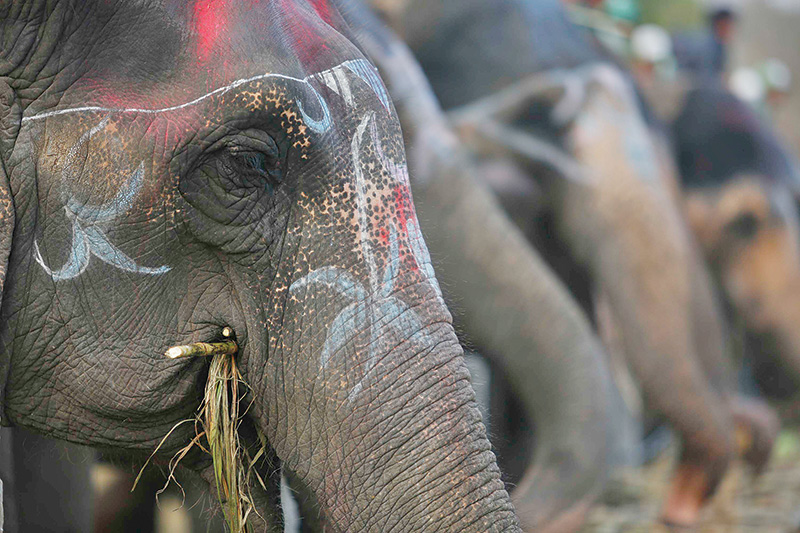
Conservationists are concerned that the upgradation of East-West Highwayand the Postal Highway Project could hinder movement of elephants alongseveral key corridors. Post file Photo: SANJOG MANANDHAR

KATHMANDU,
Ever-expanding human settlements, deforestation and development projects are undermining Nepal’s elephant conservation efforts, wildlife conservationists  have warned.
Speaking during a virtual interaction organised on the occasion of World Elephant Day on Wednesday, the participating experts suggested that the country needs to strike a fine balance between conservation and development to save valuable wildlife species like elephants, which are under threat due to human activities.
“Nepal does not have a large elephant population, but they are facing threats due to human-wildlife conflict and habitat encroachment,” said Dinesh Neupane, who has been studying elephants for more than a decade now. “Many mega development projects either traverse through their habitats or are being built along their core habitat areas, which are already narrow. There is a risk of these projects further deteriorating the core elephant habitats and hindering the animal’s movement.”
Nepal’s wild elephant population ranges between 150-200. The country also welcomes around 200 migratory elephants every year. These populations roam around mainly in four sub-populations—eastern, central, western and far-western.
However, the four sub-populations, also described by Elephant Conservation Action Plan (2008-2018), have come down to two in recent years, says Narendra Man Babu Pradhan, an elephant ecologist and the programme coordinator with IUCN Nepal.
“Problem arises after 1950 with malaria eradication programmes and new settlements in the Tarai where people did not only migrate from the Hills, but also Burma and northeast India,” said Pradhan, who had also served in a government position in the conservation sector. “They stripped down the forest areas and settled down in the low-lying Tarai plains, which used to be elephant habitats and corridors. Earlier, there used to be one long chain of elephant movement from Assam to northwest India via Nepal. This path was cut off due to massive deforestation.”    
Now wildlife conservationists worry that the mega projects like East-west railway, Tarai expressway, proposed Nijgadh airport, Postal Highway and upgradation of East-West Highway will further damage what little remains of the elephant habitats and their corridors. Elephant habitats are already under threat due to deforestation, urbanisation and various human activities.
According to Pradhan, restricted movement of elephants has become a major cause behind increasing elephant-human conflicts in recent years.
“In the last 15 years, 197 human deaths have been attributed to conflicts with elephants. There are also retaliation killings of elephants as more than 21 elephants were killed in the same period,” said Pradhan. “Forest corridors are vital for elephant movement along India and Nepal. But such corridors are facing uncertainty due to human activities. Ongoing deforestation and infrastructure development are major threats to the elephant population at the moment.”
Conservationists are concerned that the upgradation of East-West Highway into four lanes and the Postal Highway Project could hinder their movement of elephants along several corridors.
Meanwhile, Sikta Irrigation Project and Rani Jamara Irrigation Project have already disrupted the movements of elephants inside Banke National Park and Karnali Corridor, said Pradhan.
“We don’t know what East-West Railway would do to the movements of elephants, but cases from India and Sri Lanka suggest that there is a high risk of elephants colliding with moving trains,” said Pradhan.
“We also need to worry about the Tarai expressway, which will bisect Parsa National Park, and the proposed Nijgadh airport.”
At the interaction organised by the Resources Himalaya and Environmental Graduates in Himalaya to discuss human-elephant harmony in country’s development context, the participants also raised concerns about the number of development projects based around the foothill of Chure range or low-lying Tarai districts—the habitat of native and migratory elephants.
“There will be an impact on the development process on the quality of the environment. Environmental pollution, wildlife habitat destruction are the externalities of development,” said Dadhi Adhikari, director of South Asian Institute for Policy Analysis and Leadership, a think tank.  “Nepal needs development and economic prosperity as well. The lack of infrastructure is the major factor behind the country falling behind in development.”
Adhikari highlighted that as the country’s infrastructure is in poor conditions, it cannot imagine the development and growth of the country without building its infrastructure.
“We need more highways, airports and railways,” said Adhikari. “We need to have a balance between development and environmental quality.”
Construction of Nijgadh airport has long been at the centre of controversy, for it requires massive felling of trees, which conservationists say will spell ecological disaster and disturb a key corridor for elephants, tigers and other wildlife species. Economists, on the other hand, have been saying the airport could be a game-changer project for the country.
“Most of these development projects are concentrated in the Tarai because it is geographically viable but the area also has dense forest, causing conflict,” said Adhikari. “We cannot say we don’t need Nijgadh airport but cutting down nearly 2.5 million trees is also a serious issue at the same time. We need more analysis on what if, for instance, construction of Tarai expressway reduces the environmental burden of the already stressed Kathmandu Valley. Also, what is the guarantee that by not developing Nijgadh airport we will see a rise in elephant population in that particular area?”
According to Hari Bhadra Acharya, an ecologist with the Department of National Park and Wildlife Conservation, elephant habitats and corridors have been fragmented with the construction of settlements and roads.  
“They can travel as far as 800-km and often follow their traditional routes. But with construction and human settlements, their movement is disturbed,” Acharya told the Post. “Disturbance to their old routes means interaction with the public, only increasing the risk of more human conflict incidents with loss of lives and properties. Despite the low number of elephants, human-wildlife conflicts are high for elephants and leopards.”
Beside habitat fragmentation, elephants are still prone to poaching and elephants have died after being electrocuted and other reasons at alarming rates as said by conservationists when compared to other countries with large elephant populations.
Sociologist Anita Shrestha said all development activities should be conducted by keeping wildlife and humans at the centre so that they do not cause harm to each other.
Pradhan, the elephant ecologist, reiterated the need to protect elephant habitats and corridors.
“Elephants need to travel as they are nomads. They take their traditional routes,” he said. “Any disturbance will affect their population. We may not expand the areas and their population drastically, but we have to maintain the existing population.”

NATIONAL

Lockdown enforced in Butwal, Dharan

Briefing
- Post Report

TILOTTAMA/DHARAN: Butwal Sub-metropolitan City on Wednesday decided to enforce a lockdown from Thursday midnight. The lockdown will be effective till August 21 as a precaution to control the spread of the coronavirus, said Deputy Mayor Guma Devi Acharya. Meanwhile, Dharan Sub-metropolis has decided to extend its lockdown until August 19. Manoj Bhattarai, chairman of Ward 17, said the sub-metropolis took the decision as the number of Covid cases increased lately. The local unit also decided to ban the import of fruits, vegetables and milk from other districts during the lockdown.

NATIONAL

Birgunj lab sends 1,100 swabs to Kathmandu for Covid test

Briefing
- Post Report

BIRGUNJ: Narayani Hospital in Birgunj has sent around 1,100 swab samples to Kathmandu due to shortage of kits required for polymerase chain reaction tests. Dr Madan Kumar Upadhyay, medical superintendent at the hospital, said the swabs were sent to the National Public Health Laboratory in the Capital as the PCR laboratory at Narayani Hospital does not have enough kits for the tests. The Birgunj-based laboratory is overwhelmed by increasing Covid-19 positive cases in Parsa, Bara and Rautahat. Following a surge in cases, authorities had decided to increase contact tracing, and to widen the scope of polymerase chain reaction tests in Birgunj.

Page 4
EDITORIAL

Light up the stage

For Nepal’s arts scene to flourish, the government must act as a guardian and get the show going.

In early 2019, Nepali theatre marked a new milestone when Kathmandu hosted the weeklong Nepal International Theatre Festival, bringing artistes from nine countries to perform 30 plays at four theatres. It was a moment of elation for the theatre community. A movement started in 1982 by a group of discontented theatre workers had finally come of age. But the road ahead is as bumpy as it has been in the past.
Over the past two decades, Nepali theatre has made its presence felt beyond the proscenium. Tickets would sell in advance. Cast members would become celebrities and move onto the silver screen. Plays would draw rave reviews, create jobs, and most importantly, raise an audience besides entertaining them with a range of productions that cut through the Nepali psyche. But in 2009, seven years after its inception and orchestrating every move of the modern Nepali theatre, Gurukul, Nepal’s first drama school, shut down due to financial reasons. It was a black day as Sunil Pokharel, who spearheaded the movement, delivered a monologue before the final play was staged at its auditorium in Purano Baneshwor.
As the curtains came down on Gurukul, leaving a big hole in Nepali theatre, several youth-led theatre groups emerged, ushering the movement in the years to come. But the economics behind it all remains the biggest challenge and artistes have been without work, given the restrictions in the wake of the pandemic. If Gurukul has shown what it takes to build an ecosystem for performance arts, it has also shown us that without reliable sources of funding, years of efforts and sacrifices can just collapse or slow the pace of the movement. Today, each of the over dozen theatre houses and dozens of theatre groups across the country faces uncertain futures.
The pandemic has made it clear that the field of arts plays a significant role in shaping our perspectives and enriching our lives. With stay-at-home orders across the world, all of us have applied or consumed some form of arts in our daily lives to keep us sane. Art forms help us express ourselves. They make us think. They bring people together to celebrate society, to challenge dogmas. One way or the other, arts process experiences which are universal and yet diverse. They are the very essence of what makes us human. A thriving arts scene is also an indicator of a healthy nation.
Across the world, in countries with a thriving art scene, there is either state guardianship through direct funding and facilitation from national agencies or private donors, corporate houses and foundations supporting through grants and fellowships. We can also find that countries have integrated arts with academics from an early age. International practices are easy models to replicate, if intentions and selection standards are high. But we should not shy away from the economics of it all because, at the end of the day, it is all about sustainability. We have to accept the fact that we are a small market and the arts scene is limited to Kathmandu or a few other cities, but together, we have to fund the arts because they eventually shape our culture and define us as a nation.
And we needn’t look far. To this day, the country’s ancient community systems like the Guthi system in Newar society, also fund performance arts among others. The Kartik Naach, a dance drama from the Malla era, survives to this day with support from community and personal donations. This is just one instance of stewardship. To be fair to the government, it has supported several theatre groups at one time or another. However, such support often depends on the personal rapport between government officials and theatre practitioners. In such a scenario, the most deserving ones get sidelined while the undeserving continue to reap benefits. Any such support should, thus, also be distributed judiciously. For Nepal’s arts scene to flourish, the government must act like a guardian and get the show going.

OPINION

Us and them

In Nepal, divisions created by differences in caste, culture, gender, religion and vestedinterests are aplenty.
- PRAMOD MISHRA
Shutterstock

At the invitation of the Limbuwan Readers Club, on a Facebook live presentation in Nepali, on July 14 (discussing James Baldwin’s The Fire Next Time), I spoke, among others, chiefly two things: Baldwin’s advice to his namesake nephew to not internalise the white racial gaze and resist American racism by cultivating a global worldview that would include all of humankind, rather than the narrow Europe-produced, America-adopted racial perspective about blacks. I also spoke about how other African American writers like WEB Du Bois, Richard Wright and many others have done the same thing in their own ways.
The other point I raised about Baldwin’s work was his resistance to an ‘us’ versus ‘them’ division among humans that produces a feeling of negativity toward ‘them’. In this division, about race and religion in Baldwin’s case, those that belong to ‘us’ try to proselytise individuals to be part of the group blindly by asking, in Baldwin’s words, ‘Whose little boy are you’?—as Baldwin was asked by the mixed-race African American woman under whose influence Baldwin became a Pentecostal preacher and later by Elijah Muhammad who asked Baldwin, ‘What religion do you follow’?  
Even before all this, as a child, Baldwin had faced a similar question from the pimps and the prostitutes on the Harlem streets in New York who wanted Baldwin to join their trade.  And he had confronted the question of ‘us and them’, just like the white racial categorisation of the blacks, at home from his Baptist minister father for whom blacks had nothing to do with the whites and all whites were suspect; therefore, all whites were ‘them’.

A universal phenomenon
In my presentation, I emphasised that ‘us and them’ divisions exist in all societies along national, racial, caste, linguistic, ethnic, religious, denominational or tribal lines. I gave the example of the European history of religious and racial violence and wars, not just between Christianity and others but within Christianity, between Catholics and Protestants, resulting in colonialism and fascism. Any group identity that gets reified and obtains any form of power (economic, political, religious, linguistic, or nationalistic) develops antagonistic feelings towards others and designates itself as superior, better, more civilised, more advanced—in short, endows itself with all the positive virtues—and imputes all the negative attributes to ‘them’, who are different.
Baldwin saw African Americans like himself become victims of this division imposed by white supremacist history and the culture of white, majority America. But at the same time, he also found its manifestation in his father’s Black Baptist Christianity and Elijah Muhammad’s Nation of Islam. Like his father who disliked all non-Christians and looked upon all whites with suspicion, Elijah Muhammad did the same thing—presented Islam as the black people’s religion and Christianity as being for the white.
Baldwin resisted all these forms of ‘us and them’, whether created by the whites or blacks, and realised that he at least cannot be anybody’s ‘little boy’—a blind, docile follower to do their bidding. In their place, he posited the need for critical thinking; an examination and interrogation of all forms of ‘us and them’ in society.

Diversity brings complexity
How can one apply this principle to South Asia, where the chasms exist in big as well as small forms everywhere? In Nepal’s case, the Nepali state adopted multiple divisions of ‘us and them’ in the shape of Jung Bahadur Rana’s Muluki Ain (legal code) of 1854, which was itself an adaptation of Manusmriti (the laws of Manu) that remained in force for more than a hundred years as state law in Nepal, seeping in the subjugated subjects’ consciousness and became what is called sanskar in Sanskrit. But Jung Bahadur was not the original codifier in the subcontinent. The British colonial government had already formulated the Hindu laws based on Manusmriti when William Jones translated it in 1794. Even in the 14th century, Jayasthiti Malla had codified the Hindu laws along with caste divisions based on the Hindu dharmashastras. And, I’m sure, the many kingdoms of India and Nepal had their kings base their laws and rules according to the dharmashastras.
And then there is Hinduism, Buddhism and Islam—all three increasingly asserting themselves as state powers in different countries of South Asia. When a state identifies itself with a particular religion or a specific denomination of a religion, it automatically creates an ‘us and them’ division. And those who occupy state power become ‘us’ and those who are marginalised become ‘them’. All kinds of judgmental values of virtue and vice are created by attributing all the virtues to ‘us’ and vices to ‘them’. Has there ever been an example where the group that occupies and identifies with the state ever attributes admirable virtues to those whom the state designates as the other? No example comes to mind readily.
In Nepal’s case, there are, or have been, many groups of ‘them’ in contrast to the holders of power. There is ‘us and them’ within each category of Madhes, indigenous groups, Dalits, women and Muslims—even though broader categories get general recognition for purposes of understanding privilege and marginalisation in the political realm. If in terms of sharing state power, access to state institutions through appointments and career opportunities become the crux of the problem, socially speaking, it’s the marital relations that make the ‘us and them’ division astute.
How can a society grapple with the toxic consequences of such divisions created by religion, state and vested interests? How can group identity be formed only for the purposes of appreciating lives and cultures and political empowerment rather than producing marginalisation through the creation of ‘them’?  I’ll devote my next column to this problem by bringing a couple of notorious examples of historic violence produced by ‘us and them’ division, as applied to marital relations in Nepal.

OPINION

The dictator’s two dilemmas

The role of performance and culture in legitimising regimes points to a dilemma for authoritarian ones.
- Andrew J Nathan
Shutterstock

Authoritarian regimes often enjoy more public support than democratic governments do. To discover why, my colleagues and I administered the Asian Barometer Survey in four waves across 14 Asian countries between 2001 and 2016. What we found is that authoritarian regimes actually suffer from acute near- and long-term vulnerabilities.
When asked how much confidence they have in six different government institutions, respondents in China and Vietnam expressed ‘quite a lot’ or ‘a great deal’ of trust in 4.4-5.3 institutions, on average, whereas Japanese and Taiwanese respondents trusted only 2-2.6 institutions.
We then asked four questions about whether respondents thought their form of government could solve the country’s problems and thus deserved the people’s support. Japanese, Taiwanese, and South Korean citizens gave more ‘no’ than ‘yes’ answers, while citizens in Vietnam, China, Myanmar, Cambodia, and other authoritarian countries answered yes much more often than no.
The conventional wisdom is that such results reflect the effects of nationalism and access to media. That is correct. In both democratic and authoritarian systems, citizens who express pride in their country also are more likely to express support for the regime.
Likewise, greater trust in media has a positive effect on regime support. In democracies, where media options are diverse and often critical of the government, citizens who have more trust in media are more likely to feel that they understand why the government does what it does. In authoritarian systems, where the media are government-run or government-influenced, citizens who believe official sources are more likely to support the regime.
Two other sets of variables are more surprising, and point to authoritarian regimes’ vulnerabilities. First, we found that the economic welfare of the respondent’s family had little effect on his or her support for the regime. People seemed to credit or blame themselves for how well or poorly their families did, even though they attributed the overall state of the economy to the regime.
By contrast, in both democracies and autocracies, citizens gave more weight to the government’s role in ensuring ‘fairness’, defined as providing equal treatment to rich and poor, safeguarding freedom of speech and association, and guaranteeing access to basic necessities such as food, clothing, and shelter. And they gave even more weight to the government’s ‘effectiveness’, meaning its ability to fight corruption, administer the rule of law, and solve what respondents identified as the most important problem facing the country.
These findings point to a near-term threat to authoritarian legitimacy. Authoritarian regimes are more susceptible than democracies to corruption, abuses of power, and catastrophic policy mistakes due to secrecy and over-centralisation. In democracies, dissatisfied citizens can organise and vote. Under authoritarian rule, dissatisfaction tends to build up until mass demonstrations erupt, potentially jeopardising the regime’s survival.
A final reason for the differences in support between authoritarian and democratic regimes is culture. Here, the survey included a nine-item questionnaire to measure traditional social values like conflict avoidance, deference to authority, and group loyalty over individualism. It also included a seven-item battery designed to assess support for core liberal-democratic principles, such as the freedom of speech and association, judicial independence, and the separation of powers.
In all but two of the countries surveyed, those who affirm traditional values tend to accord greater legitimacy to the regime under which they live, regardless of whether it is democratic or authoritarian. Likewise, there is also a statistically significant relationship between affirming liberal-democratic values and being critical of one’s government.
The combined role of performance and culture in generating regime legitimacy points to a long-term dilemma for authoritarian regimes. To achieve high marks for performance, both democratic and authoritarian regimes will pursue policies that promote modernisation. Yet, by definition, such policies run counter to traditional values, which helps to explain why those authoritarian countries that have modernised the fastest also have the fastest spread of liberal-democratic values, especially among younger, more educated, urban citizens.
Moreover, while liberal-democratic values—and criticism of government—are baked into the politics of democracies, they pose a unique threat to authoritarian systems, because they are strongly associated with a desire for an alternative regime.
In the survey, we presented three alternative forms of authoritarian rule, and asked if respondents would approve of any of them. Perhaps not surprisingly, liberal citizens in both authoritarian and democratic regimes found all three options unattractive, implying that they see no authoritarian alternative that is superior to what they already have. But when we posed four questions about the attributes respondents prefer in government, we found a preference for liberal-democratic regime characteristics among citizens who believed in liberal-democratic values. Respondents were asked, for example, whether they believe that, ‘Government is our employee, the people should tell government what needs to be done’, or whether they believe that, ‘The government is like a parent, it should decide what is good for us’.
The fact that adherents to liberal values display a preference for regime characteristics associated with liberal democracy is not surprising. But the implications are different for different types of regimes. If these liberal citizens live in a democracy, they may be dissatisfied with what they have, but they would not prefer an alternative. In authoritarian regimes, as liberal values spread, so does a preference for democratic regime characteristics. So while democratic regimes need not worry about their liberal citizens favouring an alternative system, autocratic regimes do.
To be sure, authoritarian regimes can try to slow the erosion of democratic values, as China has done with its campaigns to revive Confucianism and promote a cult of President Xi Jinping. These efforts encourage younger and more educated citizens to feel proud of their country’s traditions and accomplishments. Yet the same cohorts are increasingly determined to assert their individuality, protect their personal and property rights, and learn more about the outside world. They want an accountable government that abides by the rule of law.
The better an authoritarian regime performs in its mission to modernise society, the more rapidly liberal-democratic values will replace traditional values, and the larger the proportion of the population dissatisfied with authoritarian rule will become. The most effective authoritarian regimes, then, are gradually digging their own graves.


Nathan is Professor of Political Science at Columbia University.
—Project Syndicate

Page 5
MONEY

Bike sellers struggle to fulfil demand amid pandemic

Valley residents are rediscovering the good old bicycle as the virus limits their transportation options.
- TSERING NGODUP LAMA
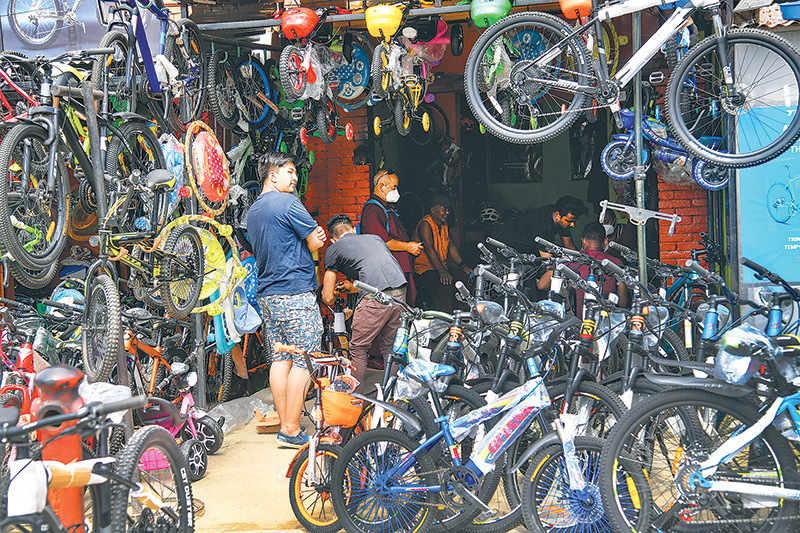
People shop for bicycles at a store in Lagankhel, Lalitpur. POST FILE PHOTO

KATHMANDU,
Demand for bikes is so high that Himalayan Single Track—a Thamel-based mountain bike company that organises mountain bike tours and also sells and services bicycles—has already run out of stock.
“In the 11 years that I have been in this business, I have never seen such demand for bikes,” said Santosh Rai, managing director of Himalayan Single Track. “Not only did we manage to sell our new bikes, but we have also sold all our old stock of around 60 bikes that had been lying around for more than five years.”
Ever since the government eased the lockdown and removed restrictions on people’s movement, demand for bikes has skyrocketed, giving bike dealers a major boost in business.
The exponential increase in demand for bikes during the pandemic is not unique to Nepal. Globally, from the United Kingdom, Germany and India to the United States, many countries have seen demand for bikes soar during the pandemic.
When Pancbike, Nepal’s oldest bike store, reopened after the lockdown, the store’s phone wouldn’t stop ringing. Tirek Manandhar, the CEO of Pancbike, spent most of his time at the store answering customer queries over the phone.
Before the stay-home order, he used to get an average of two phone inquiries a day; but after the lifting of the lockdown, he has been getting an average of 15 calls a day.
“Suddenly, everybody in Kathmandu seems to want a bike,” he said
It was during the lockdown that Deepak Limbu decided to get himself a bike. Before the lockdown, Limbu used public transportation to travel in the city. “Given that we are living in the midst of a pandemic, travelling in public vehicles is a risk I don’t want to take,” said Limbu. “After spending hours online researching different types of bikes, I finally got an idea on the type of bike that fit my requirement.”
In a way, the pandemic has provided people with all the right reasons to get into cycling. With social distancing becoming the new norm, people are avoiding public vehicles (which have been flouting safety protocols) and ride-hailing apps, both of which, by design, make social distancing almost impossible.
“For the many looking for an alternative to public transportation, bikes have proven to be a cost-effective and safe way of commuting,” said Rai. “Then there are those that have gotten into cycling for health reasons to boost their immunity to fight coronavirus infection.”
And there are a variety of bikes to choose from.
Bikes come in three large categories—normal, standard and branded. Normal bikes are mainly for city commuting, and they only have the most basic features.
Prices for these bikes range from Rs12,000 to Rs20,000. Standard bikes are mid-range bikes and they come in less advanced parts than the high-end ones, and prices range from Rs20,000 to Rs40,000. The branded ones are the advanced bikes that come with top-end features, and their prices start from Rs40,000 and go up to hundreds of thousands depending on the make and material used. According to Manandhar, the bikes that are most in demand since the lockdown ended are those that fall under the normal and standard categories.
“We only have the more expensive models in stock. The rest have all been sold out,” said Manandhar of Pancbike.
The problem Manandhar and Rai are dealing with now is restocking their inventory so they can meet the high demand.
“Ever since the pandemic took hold, the global demand for bikes has gone through the roof. There’s just so much demand that manufacturers are struggling to supply, making it extremely challenging for stores like us to restock in time,” said Manandhar.
Last month, when Limbu went to bike stores hoping to buy a bike, none of them had the type he was looking for. “Most of them had high-end models that were way beyond my budget. One of the stores told me to come back after a month’s time. So I have no option but to wait,” he said
This is not the first time that there has been such a demand for bicycles in recent memory. During the border blockade of 2015, which caused a severe shortage of fuel, demand for bikes skyrocketed with people cycling for their daily commute, according to Manandhar. During the fiscal year 2015-16, Nepal imported bikes worth Rs801.3 million, according to the Department of Customs.
“We had been very hopeful that the trend would continue in the future,” said Manandhar.
But to Manandhar’s disappointment, not everyone continued using their bicycles for their daily commute.
Sanjay Theeng was one of the many who bought a mountain bike in 2015. “During the months of fuel shortage, the bike was my primary mode of commute,” said Theeng. “Once when the blockade ended and fuel became abundantly available again, I started using my motorbike again, and except for a few times a year, I rarely took out my bicycle.”
While using bikes for daily commuting may not have taken off after 2015, biking for leisure did, and with each passing year, it continues to become more and more popular.
In 2018-19 Nepal imported bikes worth Rs1.5 billion.
“It is not surprising to see leisure biking become so popular. We are naturally blessed with trails that make leisure biking a great adventure activity,” said Rai.
Geographically, says Ratna Shrestha—president of the Nepal Cycle Society, a cycling advocacy organisation—Kathmandu is ideal for urban cycling. “It’s not a very big city, and the average person’s daily commute is around 10 km, which is easily doable on a bike,” said Shrestha. “Even weather-wise, with the city’s mild winters and summers, it’s perfect for cycling.”
But for those cycling daily in Kathmandu, the challenges are aplenty. “One of the major concerns of cyclists in Kathmandu is lack of dedicated cycling lanes, which makes cycling in the city difficult and a bit risky,” said Shrestha. The first dedicated bike lane in the Valley—a 4.7 km cycle lane from Kupondol to Mangal Bazaar—was inaugurated only last November.
Both Manandhar and Rai say that only time will tell whether the rise in demand for bikes courtesy of Covid-19 will create a fundamental shift in people’s mindset when it comes to cycling.
In May, when the government began easing restrictions on people’s movement, Theeng took out his mountain bike that had been gathering dust in his garage. “I realised that for the foreseeable future, the safest way to commute will be on my bike,” said
Theeng. “I have been riding almost everywhere—to work, for grocery shopping and I have even gone on a few weekend cycling trips. I had almost forgotten how good it actually feels to cycle. With gyms closed, it is a good workout too.”
The bicycle boom has made many like Shrestha cautiously optimistic about the future.

MONEY

India’s weak fuel demand drags on as virus crisis worsens

- REUTERS

MUMBAI,
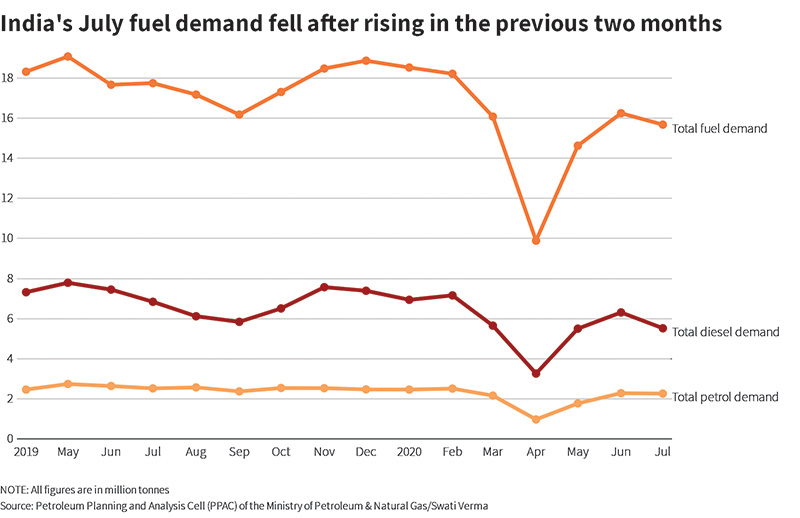
India’s fuel demand dragged lower in July, posting its fifth consecutive year-on-year decline, government data showed on Tuesday as a spike in coronavirus cases and floods in many parts of the country restricted economic activity.
Consumption of refined fuels, a proxy for oil demand, fell to 15.68 million tonnes in July, 11.7 percent lower compared with a year earlier and 3.5 percent below the prior month, data from the Petroleum Planning and Analysis Cell (PPAC) of the Ministry of Petroleum & Natural Gas showed.
Diesel consumption, which accounts for about two-fifths of India’s overall fuel usage and is widely used for transportation as well as for the country’s irrigation needs, fell to 5.52 million tonnes last month from 6.31 million tonnes in June.
On an annual basis, demand for diesel declined about 19.3 percent.
Sales of gasoline, or petrol, fell by 10.3 percent from a year earlier to 2.26 million tonnes, and were down 0.8 percent from 2.28 million tonnes in June.
Demand for fuel was also impacted as higher retail prices dented demand in the world’s third-biggest oil consumer and as virus cases continue to explode.
With over 2 million people infected with the novel coronavirus, India stands third with the most cases after the United States and Brazil.
In addition, heavy rains and floods have affected millions of people and battered industrial and construction activity in some Indian states.
India’s top refiner, Indian Oil Corp, said last month it would continue to operate its refineries below capacity in 2020/21, and that it didn’t see a recovery in demand to pre-Covid levels “in the near future.”
Fuel consumption in India nearly halved in April as a nation-wide lockdown to curb the outbreak halted economic activity and travel.P LAMA

MONEY

From carats to peanuts: How a pandemic upended the diamond industry

- REUTERS
Diamonds are seen at the diamond exchange in Antwerp, Belgium. REUTERS

JOHANNESBURG/MUMBAI,
As the coronavirus pandemic upended the global diamond industry, shuttering mines from Lesotho to Canada and disrupting supply chains, Rajen Patel swapped diamond polishing for peanut farming. Patel, who worked for a decade in India’s Surat where about 80 percent of the world’s diamonds are polished, joined the exodus of gem workers leaving the city as cases of the virus shot up. After taking up farming in his home village, he has no plans to return in the coming months.
“I won’t earn as much I was earning in Surat, but I won’t starve and there is no fear of getting infected with coronavirus,” he said.  Demand for diamonds has plummeted during the pandemic, freezing sales and squeezing prices. With temporary mine closures at risk of becoming permanent, diamond miners are seeking ways to extract more value from their stones.  The lone bright spot has been steady demand for large, high-quality diamonds from affluent investors, according to financiers and sales data.   “There are a lot more enquiries from people seeking to buy these luxury stones as a hedge,” said Chris Del Gatto, CEO of the DelGatto Diamond Finance Fund, the largest non-bank lender to the diamond, jewellery and watch industries.  Prices for high quality one-carat diamonds are rising steadily and are currently around 12 percent higher than at the start of the year, in contrast to still-depressed prices for lower-quality stones of the same size, data from trading platform RapNet shows.
“If you are in that top end, the demand is still there because the people who go for these type of goods feel the pressure of the market downturn less,” said Gus Simbanegavi, CEO of Bluerock Diamonds. But only a few miners are lucky enough to have deposits of large, high-quality diamonds, leaving some producers at risk. Covid-19 has forced miners to cancel or delay sales, with major diamond shows scrapped due to health and travel restrictions. The few sales that have taken place showed rough diamond prices down between 15 percent and 27 percent.  “What has happened in the second quarter, I have never seen in my life,” De Beers Chief Executive Bruce Cleaver told Reuters. “There was no really properly functioning rough market.”  
Indian imports of rough diamonds plunged from $1.5 billion in February to just $1 million in April, data from the Gem & Jewellery Export Promotion Council shows.
Antwerp, another diamond hub, saw rough imports drop 20 percent year-on-year in the first half, according to data from Antwerp World Diamond Centre. The city’s exports of polished diamonds fell 46 percent.
In a bid to survive, some miners are trying to change the traditional pricing game by securing a cut of onward polished diamond sales, and miners may eventually have direct tie-ups with luxury jewellery brands, RCC Diamond Consultants managing director Richard Chetwode predicts.   Australia’s Lucapa Diamond Co inked a deal with an unnamed “high-end diamantaire” to sell some of its high-value diamonds from the Mothae mine in Lesotho for $505 per carat plus a 50 percent share of the margin on the future polished diamond sale.   
Lucara Diamond Corp, which mines in Botswana, struck a deal in July with Antwerp manufacturer HB Group under which the miner’s diamonds larger than 10.8 carats are sold for a portion of the estimated polished price. “There is real opportunity within the diamond business as a whole to modernise the sales system,” said Lucara CEO Eira Thomas. Lucara has also set up an online diamond sales platform.
In the meantime, miners are hoping production cuts will help prices recover. With Rio Tinto’s massive Argyle diamond mine in Australia among those coming offstream soon, global diamond production will likely be reined in until 2025, independent analyst Paul Zimnisky forecasts.
Several diamond mines shuttered due to the pandemic have also yet to reopen, including Stornoway Diamonds’ Renard mine in Canada, Petra Diamonds’ Williamson mine in Tanzania, and Firestone Diamonds’ Liqhobong mine in Lesotho, which the company said would likely stay closed until April to preserve cash. Meanwhile, Africa-focused Petra Diamonds is in restructuring talks with creditors, while in Canada’s Northwest Territories, Rio Tinto’s Diavik mine partner has sought creditor protection, saying it cannot afford the miner’s cash calls.  
 Even De Beers is feeling the pain, saying job cuts are likely, as it remains unclear whether supply will shrink enough to meet plunging demand in the global diamond jewellery market, which Bain estimated was worth $80 billion in 2019.

Page 6
WORLD

India considers resettling Kashmiri youth who give up arms

- REUTERS

New Delhi/ Srinagar, 
India is considering offering young Kashmiri militants an escape from a life of violence by temporarily resettling them in more peaceful
parts of the country, according to the top military commander in the Kashmir Valley.
Lieutenant General BS Raju revealed the plan for a new scheme to offer a way out of militancy during a telephone interview from his
headquarters in Srinagar, Kashmir’s main city.
He told Reuters recommendations had been submitted to Prime Minister Narendra Modi’s government and that the plan, while not finalised, was in an advanced stage.
“These are young boys who need to be taken care of for a period of time,” Raju said, adding that could involve temporarily settling them outside of Muslim-majority Kashmir.
Past efforts to persuade fighters to put down their guns have had mixed success. But Raju said the military had recommended the scheme take a longer-term approach to rehabilitating ex-militants.
“The bottom-line is that it will have a structure that will help and give confidence to the people who are opting to surrender,” Raju said.
More than 50,000 people have died during more than three decades of an insurgency that New Delhi accuses neighbouring Pakistan of fuelling, by using militant groups to wage a proxy-war across the disputed border dividing the Himalayan region.
India has flooded the valley with security forces - about 200,000 military and paramilitary troops are deployed there. And Raju said militant attacks have dropped by nearly 40% compared to last year.
Last August, Prime Minister Modi changed the political landscape by taking away Jammu & Kashmir’s status as India’s only Muslim majority state, splitting it into two federally-controlled territories and removing the special privileges afforded to Kashmiris.
Promising a concerted effort to develop the region economically, Modi said the move was need to integrate Kashmir more fully with the rest of the country, but critics said it would further alienate Kashmiris.
Pakistan, which maintains a long-standing territorial claim on Kashmir though it denies accusations that it materially helps the militants, has denounced Modi’s action.
Since the start of the year, Indian security forces have killed around 135 militants, most of them recruited locally.
The military estimates that there are currently around 180 militants operating with various groups active in the valley, Raju said.

WORLD

Australian state adds 21 deaths as Singapore clears migrants’ dorms

Health authorities in New Zealand scramble to trace the source of new outbreak as largest city goes back into lockdown.
- ASSOCIATED PRESS
Relatives and bystanders, some of them wearing protective suits line up for oxygen cylinders for patients outside a hospital in Srinagar in Indian-administered Kashmir, on Wednesday. Ap/rss

Melbourne,
The Australian state of Victoria on Wednesday reported a record 21 virus deaths and 410 new cases from an outbreak in the city of Melbourne that has prompted a strict lockdown.
State Premier Daniel Andrews said 16 of the deaths were linked to aged-care facilities. The number of new cases in Victoria is down from the peak, giving authorities some hope the outbreak is waning.
Meanwhile, three Melbourne students were fined after posting social media videos showing them breaching nighttime curfews for a McDonald’s run, the Australian Broadcasting Corporation reported.
The state of New South Wales on Wednesday reported 18 new cases, including two connected with a private school cluster in Sydney.
Health authorities in New Zealand scrambled to trace the source of a new outbreak as the nation’s largest city went back into lockdown.
The four cases reported from one Auckland household are New Zealand’s first locally transmitted cases in 102 days. The 22 others were in mandatory quarantine after returning from travel abroad. Two of the infected people had visited the tourist city of Rotorua last weekend while suffering symptoms, and authorities were trying to track their movements.
India’s coronavirus caseload topped 2.3 million after adding 60,963 new cases in the last 24 hours. India also reported 834 deaths on Wednesday, bringing its death toll to 46,091. India has the third-highest caseload after the United States and Brazil, but only the fifth-highest death toll, and authorities say the fatality rate has dropped below 2 per cent for the first time.
Prime Minister Narendra Modi urged leaders of 10 states that account for about 80 per cent of India’s total cases to rigorously apply containment, surveillance and contact tracing to drive the fatality rate below 1 per cent. Modi also urged that testing be ramped up in several states.
Singapore’s government says most foreign workers can now resume work as their dormitories have been cleared of Covid-19 after months of lockdown and virus testing. People living in the crowded dormitories comprised the bulk of Singapore’s 55,353 cases. Only 27 deaths have been recorded in the tiny island-state.
The Ministry of Manpower said late Tuesday that all the dormitories have been cleared except for 17 standalone blocks which serve as quarantine facilities. It said all foreign workers living in these dormitories have either recovered or have tested virus-free, except for 22,500 workers in isolation. It said the majority are now able to return to work including 81 percent of the total 387,000 workers in the construction, marine shipyard and process industries.
South Korea reported 54 new cases of Covid-19 as health authorities scrambled to stem transmissions amid increased social and leisure activities. The figures announced by South Korea’s Centers for Disease Control and Prevention brought the total cases to 14,714, including 305 deaths. The center says 35 of the new cases were local transmissions, all but three from the Seoul area.
The other 19 cases were linked to international arrivals. Health authorities see those as less threatening to the community since people arriving from abroad face mandatory tests and two-week quarantines.
Meanwhile, China’s new domestic coronavirus cases fell into the single digits on Wednesday, while Hong Kong reported just 33 new cases. The National Health Commission said all nine new cases were found in the northwestern region of Xinjiang, whose capital Urumqi has been at the centre of China’s latest major outbreak. Another 25 cases were brought by Chinese travellers arriving from abroad. Densely populated Hong Kong also recorded another six deaths to bring its total to 58 fatalities among 4,181 cases. Authorities have ordered mask wearing in public settings, restrictions on indoor dining and other social distancing measures in a bid to stem the latest outbreak.

WORLD

Who is Kamala Harris, Biden’s running mate for US vote?

Born in 1964 to a Jamaican father and an Indian mother, the senator has often spoken of the deep bond she shared with her mother.
- ASSOCIATED PRESS
In this March 9, 2020, photo, Sen Kamala Harris speaks at a campaign rally for Democratic presidential candidate former Vice President Joe Biden at Renaissance High School in Detroit. Ap/rss

Wilmington,
Joe Biden named California Sen Kamala Harris as his running mate, making history by selecting the first Black woman to compete on a major party’s presidential ticket and acknowledging the vital role Black voters will play in his bid to defeat President Donald Trump.
In choosing Harris, Biden embraced a former rival from the Democratic primary who is familiar with the unique rigour of a national campaign. The 55-year-old first-term senator, who is also of South Asian descent, is one of the party’s most prominent figures. She quickly became a top contender for the No 2 spot after her own White House campaign ended.
She will appear with Biden for the first time as his running mate at an event Wednesday near his home in Wilmington, Delaware.
In announcing the pick Tuesday, Biden called Harris a “fearless fighter for the little guy, and one of the country’s finest public servants.” She said Biden would “unify the American people” and “build an America that lives up to our ideals.”
Harris, born in 1964 to a Jamaican father and Indian mother, spent much of her formative years in Berkeley, California. She has often spoken of the deep bond she shared with her mother, whom she has called her single biggest influence.
Harris won her first election in 2003 when she became San Francisco’s district attorney. In that post, she created a re-entry programme for low-level drug offenders and cracked down on student truancy.
She was elected California’s attorney general in 2010, the first woman and Black person to hold the job, and focused on issues including the foreclosure crisis.
She declined to defend the state’s Proposition 8, which banned same-sex marriage and was later overturned by the US Supreme Court.
After being elected to the Senate in 2016, she quickly gained attention for her assertive questioning of Trump administration officials during congressional hearings.
Harris launched her presidential campaign in early 2019 with the slogan “Kamala Harris For the People,” a reference to her courtroom work. She was one of the highest-profile contenders in a crowded Democratic primary and attracted 20,000 people to her first campaign rally in Oakland.
But the early promise of her campaign eventually faded. Her law enforcement background prompted scepticism from some progressives, and she struggled to land on a consistent message that resonated with voters. Facing fundraising problems, she abruptly withdrew from the race in December 2019, two months before the first votes of the primary were cast.
One standout moment of her presidential campaign came at the expense of Biden. During a debate, she said Biden made “very hurtful” comments about his past work with segregationist senators and slammed his opposition to busing as schools began to integrate in the 1970s.
Some Biden confidants said Harris’ debate attack did irritate the former vice president, who had a friendly relationship with her. Harris was also close with Biden’s late son, Beau, who served as Delaware attorney general while she held the same post in California.
But Biden and Harris have since returned to a warm relationship. “Joe has empathy, he has a proven track record of leadership and more than ever before we need a president of the US who understands who the people are, sees them where they are, and has a genuine desire to help and knows how to fight to get us where we need to be,” Harris said at an event.
Harris has taken a tougher stand on policing since Floyd’s killing. She co-sponsored legislation that would ban police from using chokeholds.
The list in the legislation included practices Harris did not vocally fight to reform while leading California’s Department of Justice. And while she now wants independent investigations of police shootings, she didn’t support a bill that would have required her office to take on such cases.
“We made progress, but clearly we are not at the place yet as a country where we need to be and California is no exception,” she said.
The national focus on racial injustice now, she said, shows “there’s no reason that we have to continue to wait.”

WORLD

Antibody drugs being tested to treat, prevent Covid-19

- ASSOCIATED PRESS

Washington,
With a coronavirus vaccine still months off, companies are rushing to test what may be the next best thing: drugs that deliver antibodies to fight the virus right away, without having to train the immune system to make them.
Antibodies are proteins the body makes when an infection occurs; they attach to a virus and help it be eliminated. Vaccines work by tricking the body into thinking there’s an infection so it makes antibodies and remembers how to do that if the real bug turns up.
But it can take a month or two after vaccination or infection for the most effective antibodies to form. The experimental drugs shortcut that process by giving concentrated versions of specific ones that worked best against the coronavirus in lab and animal tests.
“A vaccine takes time to work, to force the development of antibodies. But when you give an antibody, you get immediate protection,” said University of North Carolina virologist Dr Myron Cohen. “If we can generate them in large concentrations, in big vats in an antibody factory ... we can kind of bypass the immune system.”

WORLD

Three die in Bengaluru as Facebook post sparks clashes

Briefing

BENGALURU: At least three people died in clashes with police in the Indian city of Bengaluru overnight on Tuesday after a Facebook post offensive to Muslims sparked protests in which a police station was attacked, and a politician’s house and vehicles were torched. Unable to quell protesters using batons and tear gas, besieged officers opened fire as they risked being overpowered during the violent unrest in a Muslim-dominated neighbourhood, the southern city’s police chief told Reuters on Wednesday. “Despite elders of the community trying to pacify the crowd, the mob burnt vehicles on the road, they attacked the police station,” Police Commissioner Kamal Pant said. “The police had no escape and they had to resort to firing and three people died,” Pant said, adding that 110 people had been arrested for alleged vandalism and attacking the police. A police official said an emergency law prohibiting gatherings had been imposed in Bengaluru, a city of 12 million people best known as India’s Silicon Valley. Pant said the person responsible for the offensive post had been arrested. The post, which reportedly involved the Prophet Mohammed, has since been deleted. Facebook did not immediately comment on the issue.

WORLD

No human pyramids on ‘Lord Krishna’ festival

Briefing
- AGENCIES

MUMBAI: There were no human pyramids in Mumbai’s Janmashtami festival celebrating Lord Krishna on Wednesday, which normally attracts thousands onto the streets, due to a surge in coronavirus in India, with more than 60,000 cases reported in 24 hours. “This year, the celebration will be symbolic,” said Ram Kadam, a state lawmaker who organises one such celebration in Mumbai. “We will just have posters cheering on doctors and nurses, and will pray to the Lord to help us overcome this pandemic. Usually Hindus in Mumbai form human pyramids and try to break a pot of curd at the top. Folklore says Krishna formed pyramids with friends to break pots of butter or curd hung from ceilings so they could steal the contents. Kadam said there would be no public festivities in Mumbai this year.

WORLD

China denounces US health chief’s criticism ‘

Briefing
- AGENCIES

BEIJING: China said on Wednesday that US Health Secretary Alex Azar has performed the “worst in the world” in controlling the novel coronavirus, rejecting criticism of China made by Azar during a three-day trip to Taiwan this week. Azar attacked China’s response to the coronavirus pandemic on Tuesday saying that if such an outbreak had emerged in Taiwan or the United States it could have been “snuffed out easily”. Chinese foreign ministry spokesman Zhao Lijian told a regular briefing the epidemic in the United States was “out of control” and the blame lay with Azar. “He ignored millions of Americans suffering from the virus and went to Taiwan to put on a political show,” Zhao said. “His behaviour proves once again that in the eyes of US politicians, American lives mean nothing when compared with their selfish political gains,” he said.

Page 7
SPORTS

Sevilla, Shakhtar qualify for Europa League semis

Five-time competition winners Sevilla beat Wolves 1-0, face Manchester United on Sunday. Shakhtar edge Basel 4-1 to set up Inter Milan tie for Monday.
- AGENCE FRANCE-PRESSE
Sevilla’s Lucas Ocampos (third right) heads to score a goal during the Europa League match against Wolves in Duisburg, Germany, on Tuesday. AFP/RSS

PARIS,
Sevilla qualified for the semi-finals of the Europa League on Tuesday after Lucas Ocampos’ late header broke Wolverhampton Wanderers’ hearts, while Shakhtar Donetsk thumped Basel 4-1 to join the Spaniards in the last four. Five-time competition winners Sevilla face Manchester United in Cologne on Sunday thanks to a brilliant header from Argentine Ocampos with less than two minutes left on the clock which gave them a deserved 1-0 win, while Shakhtar take on Inter Milan on Monday in another intriguing tie.
Sevilla dominated their English opponents over the course of the match, as a tired-looking Wolves’ dreams of European glory ended with a whimper. “I am very proud of my players. We needed to have lots of patience against a very good team,” said Sevilla coach Julen Lopetegui, whose team are now unbeaten in 19 matches in all competitions.
Premier League outfit Wolves thought they were set to make the perfect start in the 11th minute when Adam Traore set off on a sensational surge towards goal from his own half and was chopped down in the area by Diego Carlos. However Raul Jimenez, who had scored all of his previous eight penalties for Wolves, sent a weak spot-kick towards Yassine Bounou, who could hardly believe his luck as he batted the Mexican’s tame shot aside. There were claims that Bounou had left his line while Sevilla players seemed to enter the area before the penalty was taken, but in any case that was to be Wolves’ last shot on target of the match as chances became hard to come by.
Sevilla though began to take a stranglehold on the play and force Wolves back into their own half. However they struggled to carve out many clear-cut opportunities, with Wolves’ defence managing to snuff out their opponents when they did manage to break free.
The first good chance of the second half came when Jules Kounde met Suso’s beautifully flighted cross in the 66th minute, but the Frenchman had to stretch for the ball and sent it looping over the bar. Eleven minutes later Rui Patrico did well to tip over Ever Banega’s dipping free-kick as Wolves began to rock, but the goalkeeper could do nothing to stop Sevilla’s winner with two minutes left. Banega was again at the heart of the action, whipping in a fizzing cross that Lucas Ocampos did brilliantly to guide into the bottom corner and send his team into the semis.
In Gelsenkirchen Shakhtar booked their spot in the last four with a commanding win over Basel that will give Inter Milan something to think about ahead of their semi-final clash on Monday.
“I’m feeling amazing because we have worked hard and we trust we can reach the final,” said goalscorer Junior Moraes. “If you want to test yourself, you have to play against teams at this high level.”
The Ukrainian side got off to a flyer thanks to Brazil-born Moraes, who headed home Marlos’ corner with less than two minutes on the clock, and they never looked back from that point on. Taison put Shakhtar two ahead 20 minutes later when his deflected shot flashed past Basel’s bamboozled goalkeeper Dorde Nikolic. Alan Patrick put the result beyond doubt from the penalty spot with 14 minutes left after Taison’s burst into the box was ended by a clumsy challenge from Basel defender Yannick Marchand.
Shakhtar rounded off a fine display in the 88th minute when right-back Dodo combined with Tete before smashing home a superb finish.
Ricky van Wolfswinkel’s close range strike for Basel a minute into stoppage time made no difference to a thumping defeat for the Swiss.

SPORTS

Pakistan’s SAG medalists banned

- Sports Bureau

KATHMANDU,
Three Pakistani athletes—two gold medalists and a bronze medalist of the 2019 South Asian Games—were stripped of medals and banned for four years after they failed doping tests.
According to the Nepal Olympic Committee (NOC), men’s 110m hurdles gold medalist Muhammad Naeem, 400m hurdles winner Mehboob Ali and 100m sprint bronze medalist Sami Ullah were stripped of their medals. They will be banned until December 2, 2023, which was effective from December 3, 2019.
Urine samples of the three players collected during in-competition doping control tests were found positive. “The samples were sent to the World Anti Doping Agency (WADA)-approved Anti-Doping Lab in Qatar and the test revealed that they had used the banned substances,” stated an NOC release.
All three athletes were found to have taken Anabolic Androgenic Steroids. They are now used in medicine to stimulate muscle growth and appetite. “All three tested positive in the A sample tests and were informed about it. They were also given an opportunity for B tests in the same lab. Among them, gold medalists Naeem and Ali conducted the second test as well. But they both failed the doping test,” according to NOC.
“As per the international norms of athletics, the trio will be stripped of their medals
and the athletes finishing just behind them will be given their medals,” said RK Bista, the
secretary at Nepal Athletics Association, who is also the International Technical Officer of athletics.
Testing positive in doping means the silver medalist of 110m hurdles Surendra Jayak will get the gold and bronze medalist Roshan Dhamika of Sri Lanka will bag silver while fourth placed Indian Maymon Poulose will be elevated for bronze medal.
The 400m hurdles gold and silver will go to the Indian duo of Jabir Madari Pa and Santosh Kumar while Sri Lankan Asanka Indrajit will bag the bronze medal. Ali will be replaced by
his compatriot Uzair Rehman for bronze in 100m sprint.  
The ban meant table topper India will have a total haul of 176 gold medals while Pakistan, who finished four in the standings behind Nepal and Sri Lanka, will have 30 golds. The 13th sub-continental games were held for the third time in Nepal last year from December 1 to 10.

SPORTS

Tottenham sign Southampton midfielder Hojbjerg

Briefing
- AGENCIES

LONDON: Tottenham signed Denmark midfielder Pierre-Emile Hojbjerg from Southampton in a reported £15 million ($19 million) deal on Tuesday. Hojbjerg became Tottenham’s first signing since the end of the Premier League season after agreeing a five-year contract with the north London club. “We are delighted to announce the signing of Pierre-Emile Hojbjerg from Southampton,” the club said on their Twitter account. The 25-year-old was stripped of the Saints captaincy and dropped for most of Southampton’s post-coronavirus lockdown matches after he informed them he would not be signing a new contract. Everton were also in the hunt to sign Hojbjerg, but his desire to work with Tottenham manager Jose Mourinho is believed to have helped seal his signature. In a separate move, Tottenham right-back Kyle Walker-Peters joined Southampton for £12 million after spending the second half of the season on loan at St Mary’s.

SPORTS

England’s Broad fined over use of inappropriate language

Briefing
- AGENCIES

LONDON: England paceman Stuart Broad has been sanctioned by his father Chris, a match referee, for a breach of the International Cricket Council’s code of conduct during the first Test against Pakistan. Broad was fined 15 per cent of his match fee for a level one breach and also given one demerit point for using inappropriate language when dismissing Yasir Shah in Pakistan’s second innings at Old Trafford on Saturday, hours before England completed a three-wicket win. Broad admitted the offence and accepted the sanction proposed by Chris Broad, the former England batsman who is now a member of the ICC’s elite panel of match referees. The second Test starts on Thursday at Southampton.

SPORTS

Serena sets up Venus clash

Briefing
- AGENCIES

LEXINGTON: Serena Williams made a winning return to competitive tennis on Tuesday as she rallied from a set down to beat Bernarda Pera 4-6 6-4 6-1 at the Top Seed Open in Lexington, Kentucky on Tuesday in her first match of the Covid-19 era. Williams was five points from falling to the American left-hander in the second set but suddenly showcased her fighting spirit and pulled away to set up a second-round showdown with older sister Venus, a 6-3 6-2 winner over Victoria Azarenka. Serena is also preparing for the August 31-September 13 US Open. In other action, former US Open champion Sloane Stephens was upset by Canadian Leylah Fernandez, Kazakhstan’s Yulia Putinseva beat Australia’s Ajla Tomljanovic and Coco Gauff beat fellow American Caroline Dolehide.

MEDLEY

Horoscope

ARIES (March 21-April 19) ****
Today is one of those days when the more organised you are, the more you will enjoy yourself. So do yourself a favour and start the day by evaluating what needs to be done and how you are going to go about doing it.


TAURUS (April 20-May 20) ****
Some great news could be coming your way today, but you need to play it cool! Don’t rush ahead and do anything too hastily. Let the news settle in and give everyone a chance to get used to the changes that are coming.


GEMINI (May 21-June 21) ****
You should not take any kind of financial risk today. There is too much uncertainty involved in this new venture, and you need to play things safe. Get some distance between your friendships and your financial life, too.


CANCER (June 22-July 22) ***
Be careful not to act too spontaneously today. Practice counting to ten before you blast off and tell someone what’s on your mind. And definitely make sure you give your temper time to cool off before you cause any friction with an authority figure.


LEO (July 23-August 22) ****
Your charm is obvious today, and it will enable you to have a good time doing just about anything! This kind of can-do positive energy can help you attract a lot of diverse people who will keep your life interesting and your problems small.


VIRGO (August 23-September 22) ***
It’s in your best interests to be as generous as you can right now. Set aside some free time to help a friend. If you don’t share resources, you’ll never know the feeling of pride that comes from helping someone when they really need it.


LIBRA (September 23-October 22) ***
If you want more roses, wine, and poetry from your special someone, you need to give them more roses, wine, and poetry. Show them what you expect of them with your actions. It’s as simple as that. They’re smart.


SCORPIO (October 23-November 21) *****
Creating your own happiness is easy when you get active! The physical movement of any kind will make your blood pump faster and get all your endorphins surging around your body, spreading a good mood from your head to your toes.


SAGITTARIUS (November 22-December 21) **
Someone has been playing games with you, and they haven’t been fun kind. All the phone tag, confusing conversations, and generally flaky behaviour is not something you have to put up with. Today you need to put an end to it.


CAPRICORN (December 22-January 19) ****
If you’re only acting modest because you don’t want to come off as being too cocky, then you aren’t being honest! You could get some praise today, but don’t feel guilty about enjoying it! You don’t have to worry about people thinking that you have a big head.


AQUARIUS (January 20-February 18) ****
You’re at an important fork in the road of your life that might require you to leave some important people behind. But saying goodbye to them will be surprisingly easy when you take a moment look at all you have to gain by moving on.


PISCES (February 19-March 20) **
Being in charge might make you think that you are doing everyone else a favour, but that’s an illusion. It’s much more likely that you are excluding people from having a say and feeling involved in the decision-making process.

Page 8
CULTURE & LIFESTYLE

'We are open to criticism. We have to listen'

- Shashwat Pant
Photo courtesy of National reconstruction authority

Kathmandu,
The National Recons-truction Authority (NRA) was established on December 25, 2015, with the objective of rapidly reconstructing buildings damaged by the 2015 earthquakes.
And since its formation, the authority has helped rebuild over 500,000 houses, over 10,000 schools and hospitals and over 900 heritage monuments. During this timeframe, the authority has also faced a lot of criticism when it comes to heritage reconstruction, especially when it comes to Rani Pokhari.
With the authority’s term coming to an end on December 25, the Authority’s CEO, Sushil Gyewali, spoke to the Post’s Shashwat Pant about the authority’s role in heritage restoration, the challenges it has faced and the criticism, and what the future is for heritage monuments after its term ends. Excerpts:


What works has the NRA done when it comes to heritage conservation? And why have many of the projects been delayed so much?
In total, we were assigned the restoration of around 920 heritage monuments throughout the country. Out of that, 170 were monuments in world heritage sites in the Kathmandu Valley, 404 heritage monuments within the Valley and 346 monuments were outside the Valley.
While working, we had to give first priority to private houses, schools and hospitals. But after that, our time and effort has been given to restoring damaged heritage monuments.
The reason why we put heritage restoration third on our priority list was because we wanted to ensure that the work we did was done in the right manner. We had to ensure that the right people were working in the restoration projects because working in heritage you need skilled artisans.
Another issue we had was finances. While we were getting decent donations for private houses, schools and hospitals from abroad, donations for heritage restoration were quite low. What little we had, we first started to work on world heritage sites in Kathmandu, then moved slowly towards other monuments which had been destroyed in the 2015 earthquake.
Till date, out of the 920 monuments, we have fully restored 453 monuments which includes fully restoring 105 heritage monuments which fall on the world heritage site list with only 65 now remaining to be restored.


How tough has it been to restore these monuments?
It has been tough. We were put back by multiple, unexpected issues. The first problem we had was lack of early documentation. We quickly realised that no two monuments, even though they looked similar, were the same. For example, we compared two temples built in the Malla time, and we found vast differences. And because many of the buildings were built in a different time, it was tough for us because the manner and the materials used to build the monuments were different.
The second problem we faced was lack of skilled manpower when it came to heritage restoration. These skills in earlier times would be passed on from one generation to another but that doesn’t happen anymore. That knowledge is limited, which is why we had to train a lot of people.
Another problem we face was that in some places, locals were not too compliant. For example, in the Aagan Chhe: temple in Basantapur, whose restoration has been in limbo, locals didn’t want the Japanese to enter the shrine room of the temple to restore it. This put on hold its works for a long time. Another obstacle we faced was restoring the temple in the same manner it was built, which means producing similar bricks produced over two-three centuries ago with the same quality. This takes time.
The fourth challenge was convincing the community we were going to do a fair job. Because a lot of people’s lives revolved around these heritage monuments—from early morning prayers to evening prayers—we had to take them on board from the first brick, because if we didn’t do that, a lot of problems would be created in the future.
The last problem we had was to ensure that when restoring, we make the buildings structurally strong so that they wouldn't come down when another earthquake hit Nepal. Because we don’t want unsafe structures. But that contradicted traditional techniques because back then concrete wasn’t used. So we had to come up with ways we could strengthen it using age-old techniques.


What complaints do you get from public stakeholders?
They say they want to be involved in the restoration projects because they know the monuments well. They don’t want monuments to be given to construction companies who work with concrete, as the locals say that they won’t do justice to the project. But according to the Public Procurement Act, we can only give them monuments of up to Rs 10 million.
Taking that concern into consideration, we have made special provisions and increased that amount to Rs 1 billion. Using that, locals have made user groups in projects like Kastamandap, Rani Pokhari and recently Bungamati.


Who does the NRA prefer to give projects to? User committees or contractors?
Our first priority is always giving it to user committees. But there are some projects that cannot be done by them. Some are too big that user groups don’t want to take ownership because they don’t have the ability to do so, which is why we give it to contractors.
With time, we’ve realised that the contractors have developed a capacity to build these monuments. We’ve provided training to their staff who have become decent artisans capable of restoring temples. It’s not that their work goes unmonitored. Heritage activists regularly keep a check on them and we have a team of archaeologists who monitor the work on a regular basis. There is no preference; we give projects based on the capability of the people.


Is the criticism that the NRA is getting fair?
We are open to criticism. We have to listen to them. At NRA, we want to ensure that the monuments are rebuilt in a way that ensures locals’ voices are heard too. We don’t want anyone to be unhappy and have always held dialogues with locals to ask what wrong we are doing.
If their concerns are valid, we always correct it. But if their complaints are invalid, then we sit down, talk and explain to them.
We too need to understand why they are concerned and if their demands are just. But sometimes some criticisms are politically motivated too.


Why has Rani Pokhari come under so much scrutiny?
When people came to us asking us not to use concrete, we took their advice and started from scratch. But then people started to tell us that the water in the pond came automatically from a source within the pond. We didn’t disregard that fact too. We then asked our team of archaeologists to study if that was still possible. We dug deep to see if we could find water sources but we couldn’t.
There was a system of Raj Kulo (Royal Canal) back then. Those don't exist anymore. The public too needs to understand that. We are talking to authorities of the possibility of bringing in water from different ponds as well. But nothing is fixed yet.
Right now, people are concerned about the use of tube wells, which we have asserted is only a last resort. They want us to use only rain water. And we also want to use more sustainable measures: like rain water or water from Kathmandu’s Valley Water Management Board. But we have to look at all practical solutions.
Heritage activists have been saying we have been rushing to complete projects because our term is coming to an end. But the public wants the temple to be open at least by Tihar. We are caught in between. Yes, we do want to complete our projects before the end of our term too but that’s because otherwise it'll be further caught in a limbo.


There are rumours that NRA’s contract will be extended by a year. What is the plan of action for now?
When deriving the five-year plan, when we started, we had said that restoring heritage monuments would take at least six years. We would have completed our works on time, if not for various hindrances, including Covid-19. There is a likelihood that it will be extended by a year but nothing is sure yet.
When our contract ends, we will handover everything to the Department of Archaeology, with whom we have been working in close coordination with all this while.