You internet speed is slow. Switch to text view mode

Switch
epaper logo
ST

Last Login:
Logout
+
Page 1
HOME PAGE

Virus is taking hold in community, warn public health experts

With not enough tests being done, infection sources not being traced and 70 percent of the infected in the Valley in home isolation, experts warn of an alarming situation.
- Arjun Poudel

KATHMANDU,
A 58-year-old woman from Bhotahiti was among the three people who succumbed to the coronavirus on Monday. She had been taken to Sukraraj Tropical and Infectious Disease Hospital in Teku a couple of weeks ago after she had a mild cough and a fever and difficulty breathing,
The woman was later referred to Patan Hospital for intensive care where she breathed her last.
According to a source at Patan Hospital, the woman had not visited any coronavirus hotspot. Nor had she come in close contact with an infected person. Authorities have not been able to trace the source of her infection as of Monday.
Doctors say unlike in the past days when there were sporadic cases, virus now has penetrated society, and transmission is likely to accelerate.
“People who have never visited disease-hit areas or come in close contact with infected people are not only getting infected but also starting to die,’’ Dr Anup Bastola, spokesperson for Sukraraj Tropical and Infectious Disease Hospital, told the Post. “This is evidence that the infection has now taken hold in our community. This is alarming.’’
With the latest deaths announced Monday, the number of people who have died of Covid-19 has reached 107.
According to the Epidemiology and Disease Control Division sources, 235 people tested positive in Kathmandu Valley on Monday, though Dr Jageshwor Gautam, spokesperson for the Ministry of Health, during his daily briefing on Monday put the figure at 168.
Officials at the division said that the data announced in the regular briefing was test results that came in by 2pm, which the division had sent to the Health Ministry.
Gautam said 581 new infections were reported from across the country on Monday, taking the total number of cases to 27,241.
On Sunday, 172 people from the Kathmandu Valley had tested positive for Covid-19.
“Results of the tests we are getting now are the results of the targeted tests. We don’t know the actual situation in vulnerable communities and at-risk groups,” said Bastola. “Number of new cases may be far more than what we are attributing.”
Authorities are only performing tests on those people who have come in close contact with infected persons or on those who have returned from Covid-19 hotspots.
Not all those who seek tests are being tested.
According to officials, 1,000 to 1,200 people visit Sukraraj Tropical and Infectious Disease Hospital to get tested for free, but only 300 are tested on a first come, first served basis, as it lacks human resource and equipment.
Last week Daniel Rai, who works at an IT company in Kathmandu, went for a test at the hospital. But he returned without getting one done.
“The line at the hospital was too long and social distancing was not being maintained,” said Rai. “I thought I would get infected if I stayed there any longer. So I returned.”   
With the government lifting a four-month-long lockdown on July 21, infections of new cases have started to spike throughout the country. In Kathmandu Valley alone 1,752 people have tested positive in the last 27 days. Only 382 people had tested positive until July 21, the day the decision to lift lockdown was taken, in the Valley.
Public health experts said that risk of infection has been rising alarmingly and warned that coronavirus related fatalities may spike if authorities fail to take immediate actions.
‘“We cannot fight the virus, after it is established in the society,” Dr GD Thakur, former director at the Epidemiology and Disease Control Division, told the Post. “Our health system will crash if we fail to act immediately to break the chain of the infection.’’
While there have not been enough tests, contact tracing and availability of isolation beds, the other two bulwarks against the pandemic, have much to be desired.
Kathmandu Metropolitan City did not have enough contact tracing teams till last week before the Health Ministry mandated that each team had to have three trained health workers–a public health official, a lab technician and a paramedic.
Last week the Health Ministry decided to increase the number of staff for contact tracing.
With the lack of isolation beds, people testing positive but without symptoms have been told by the ministry to stay at home.   
Officials at the Epidemiology and Disease Control Division said that around 70 percent people who tested positive for coronavirus infection are in home isolation due to the lack of isolation beds in hospitals.
“The only way to contain the spread of infection is to trace more by making contact tracing effective and isolate the patients,” said Thakur. “The public should also be made aware of the looming risks. They should not take risks.’’
With cases starting to spike, the Health Ministry has revised the projection of the total number of cases. Though official projection has not been announced publicly, a source at the Health Ministry said that the cases could cross the 90,000 mark. He did not elaborate on the timeline.
Earlier in June, the ministry had projected 20,000 cases and later revised it to 45,000.
“Cases are growing every day,” said Dr Samir Adhikari, joint spokesperson at the Health Ministry. “The public should be watchful.”
HOME PAGE

An airport in Kavre: Flight of fancy or need of the hour?

A preliminary survey estimates the airport, with a tabletop runway of 1,200 metres, will cost Rs 16 billion.
Aviation experts say an airport near Kathmandu was needed a decade ago, not now.
- SANGAM PRASAIN
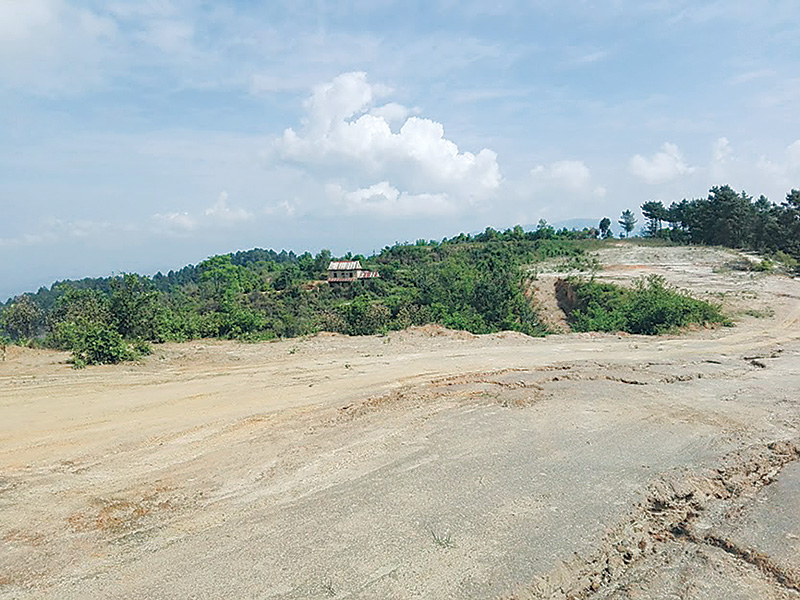
The proposed airport construction site in Nagidanda, Kavre.  Post Photo: SANGAM PRASAIN

KATHMANDU,
Nepali politicians are quite given to flights of fancy. Building airports in their constituencies, hence, is their oft-repeated promises, especially during election campaigns. As a result, most of the airports are carved out of a mountain, without any study whether it is technically or financially feasible, which eventually turns into pastures, aviation experts say.
When Gokul Prasad Baskota, a Nepal Communist Party leader, who in 2017 was contesting the parliamentary elections on the then CPN-UML ticket from Kavre constituency, among other promises, he told his voters that he would build an airport in the district.
Baskota, a trusted lieutenant of then UML chair KP Sharma Oli, won the election. Oli became prime minister and as his close aide, Baskota enjoyed significant clout in decision-making processes. Oli in June 2018 appointed Baskota minister for communication and information
technology. He was forced to resign on February 20 over a corruption scandal.
He, however, managed to secure his dream project.
Officials familiar with the development say a preliminary survey has been conducted by the Japan International Cooperation Agency (JICA) for an airport in Nagidanda of Kavre. With the cost estimated at Rs 16 billion, if constructed, it will become the most expensive domestic airport, with a 1,200-metre-long runway, in the country, according to the officials.
Aviation experts, however, are questioning if a domestic airport in Nagidanda, just 8.5 nautical miles or 16 kilometres from Kathmandu’s Tribhuvan International Airport, is indeed needed.
“A small domestic airport near Kathmandu was planned years ago to reduce the congestion at Kathmandu’s airport so that all Lukla flights
could be diverted there,” said an official at the Civil Aviation Ministry who spoke on condition of anonymity.
“But the situation is different now. The airport was needed a decade ago. Not now.”
During the peak season, swarms of trekkers and mountaineers headed for Everest keep Kathmandu’s airport constantly busy. Lukla has even witnessed as high as 200 take-offs and landings on a single day. In such a situation, if a flight were to be disrupted due to bad weather in Lukla, rescheduling it would create massive chaos at Kathmandu, hampering the operation of international flights as well.
“Now, with a second international airport in Bhairahawa set to come into operation, which will also serve as the gateway to the birthplace of Buddha, by the beginning of next year, we don’t need a domestic airport close to Kathmandu because some traffic will divert there,” said the official. “Meanwhile, another international airport in Pokhara will also be ready by the mid-2021.”
The plan to construct a new domestic airport near Kathmandu–and Kavre as the suitable location–was originally floated in view of the proposed Nepal Tourism Year 2011 by the then tourism minister Hisila Yami in 2009. Three successive tourism ministers spoke about building it, but they all eventually abandoned the scheme.
After the Oli government took office, Baskota revived the plan in 2018. He has been lobbying for building the airport in his home district for a long time, according to officials familiar with the development.
One official said that JICA conducted the survey on its own after getting the nod from the finance and civil aviation ministries. “The cost estimate as per the preliminary reports is simply outrageous,” the official told the Post.
The construction amount for the airport, which will be suitable only for short takeoff and landing (STOL) aircraft, is Rs7 billion more than the cost of the ongoing international airport project in Bhairahawa and Rs5 billion less than another international airport in Pokhara.
The Nagidanda hilltop has 84 hectares of land, 22 hectares of which is privately owned. Millions of cubic metres of soil will need to be moved to level the construction site, according to the internal survey of the Civil Aviation Authority of Nepal, which was conducted by Realpath Engineering Consultancy in 2018. At some places, 500-metre ravines need to be filled with earth by cutting away parts of nearby hills.
According to the new survey, Rs 6 billion alone would be required for soil filling works.
The airport will be on a plateau or the hilly surface which means it will have a “tabletop runway” with both ends overlooking a drop, and such airports are considered risky in the aviation industry.
On August 7, at least 18 people died in southern India after a Boeing737 of Air India Express overshot a runway at Kozhikode in Calicut, known as a “tabletop”.
Buddhisagar Lamichhane, joint secretary at the ministry, said that he has heard about the estimated costs but is yet to receive the survey report.
“It’s not financially feasible even if it is technically feasible to build the airport on the hilltop,” he said.
Raj Kumar Chhetri, spokesperson for the Civil Aviation Authority of Nepal, said that they were not aware of the JICA survey.
“But JICA has proposed the government to provide soft loans for Nagidanda airport,” Chhetri told the Post. “As we don’t deal with foreign development partners directly, it’s the government’s call.”
The airport, however, will not be suitable for aircraft like ATR-72 and other small jets like Bombardier to land.
Nepal currently has 49 airports and 33 of them are currently in operation.
According to the Civil Aviation Authority of Nepal, nine airports—six domestic and two international airports (Pokhara and Bhairahawa) are under construction with yet another international airport in the pipeline in Nijgadh.
Tourism officials admit that politicians have a tendency to promise to build airports, as they pitch it as a sign of prosperity.  
“When in power, they come under pressure to fulfil their promise,” said another official at the ministry. “And since they have to fight another election also, they put pressure to build airports wherever they want, without caring if the construction is financially and technically feasible.”
Sanjiv Gautam, former director general of the Civil Aviation Authority of Nepal, said that they had envisaged a small low-cost airport dedicated to fly to Lukla and other mountain airports when it was difficult to handle traffic congestion at the Kathmandu airport.
“If the cost is Rs16 billion it is outrageous. And we  don’t need the [Nagidanda] airport because some traffic from Kathmandu’s airport will be diverted to international airports in Pokhara and Bhairahawa,” said Gautam. “The capacity of Kathmandu’s airport has also been increased.”
Meanwhile, the civil aviation body is also investing to upgrade the Manthali airport to conduct flights to Lukla. Last year, most of the flights to Lukla were operated from Manthali. “It will be a waste of money if we construct the airport at Nagidanda,” said Gautam.
Nepal has a longstanding record of building airports under political pressure.
In 2016, former tourism secretary Dinesh Kumar Thapaliya had planned to issue a tough guideline for building new airports amid a flurry of new construction pushed by political party leaders and influential people. But he was subsequently removed from the ministry. The guideline never came.
The preliminary draft of the guideline had envisaged that new domestic airports will be constructed after making a proper assessment of their need, geographical location and population that will use the facility, regional balance, tourism prospects, rates of return and proximity to other airports.
Officials at the civil aviation authority, however, are not sure if they can resist political pressure to build the airport in Nagidanda, despite the fact that the parliamentary committee and other experts have already opposed the construction.
The parliamentary International Relations Committee has already directed the government not to construct the airport in Kavre.
In May 2018, a government technical team had studied three sites for domestic airport construction near Kathmandu. Two other sites were Thulichour at Dhulikhel and Chisapani– both in Kavre district.
The team had suggested that a rigorous study be carried out building a new domestic airport, saying it must be technically, financially and socially feasible, as well as sustainable with least conflict with Kathmandu’s airport in terms of operations..
The technical team had suggested that the east-bound traffic from Kathmandu will cross the proposed airport airspace, and will be very close to Kathmandu’s airport in case there is a missed approach.
Some experts had said that the proposed Nagidanda airport could be financially feasible only if it is built and operated by the private sector.
“It can be made a tourist airport as well, given its position and location,” said a retired official at the civil aviation body, who worked for three decades in the civil aviation and airport construction areas. “For example, a cable car can be installed to reach the hilltop which will cost less than building a five-km double-lane road to the airport.”
According to him, as traffic in Lukla will continue to grow in the future, the airport can earn more money.
“For example, the 25-minute flight from Kathmandu to Lukla is the world’s most expensive route which costs Rs18,000 per person one-way,” said the expert. “If the private sector constructs and operates the airport, it can generate income by charging higher fees.”

HOME PAGE

A badge of no honour

Garish, tacky and kitschy insignias distributed by Parliament Secretariat also showcase how machinery and agencies function in the country, lawmakers say.
- BINOD GHIMIRE
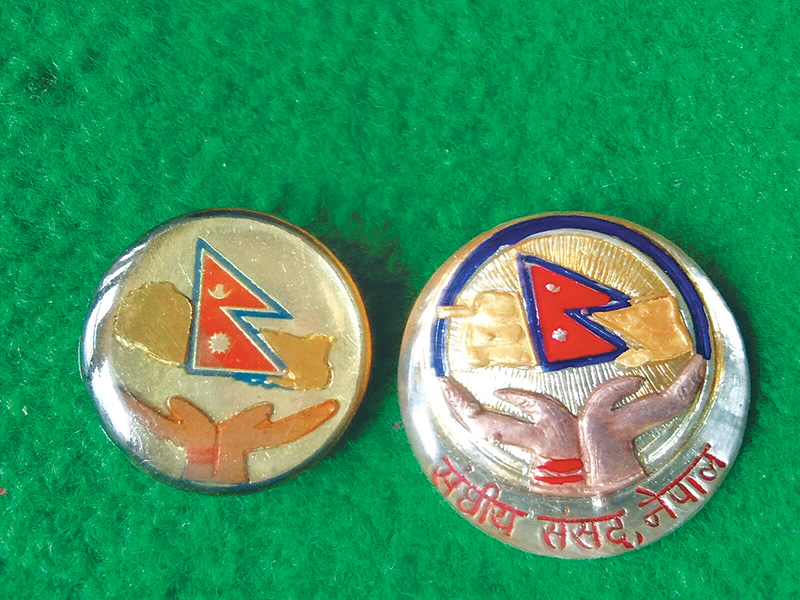
Rs 2 million was spent on the new badges. Photo: PARLIAMENT SECRETARIAT

KATHMANDU,
Lawmakers have taken umbrage at the ungracious design of the new emblem with the new Nepal map and national flag that the Parliament Secretariat distributed to them on Monday.
“I accepted it as a respect to the labour the craftsmen have put in,” Ram Kumari Jhankri, a lawmaker from the ruling Nepal Communist Party, told the Post. “This depicts the incompetence of our Parliament Secretariat.”
The new emblem has become an object of ridicule since it came into the public domain on Sunday for its multiple flaws and design.
The emblem depicts neither the map nor the national flag accurately and lacks elegance and appears to be a slapdash work by a novice craftsman. Two hands, one of a woman and another of a man, which are holding the map and the national flag look like artwork by a schoolkid–too garish and tacky.
The new emblems were made to show the new Nepal map that the Oli administration  published on May 2o. Subsequently, the map, depicting Kalapani, Lipulekh and Limpiyadhura as Nepali territories, was endorsed by the federal parliament. Nepal’s move of adopting a new map came in response to India’s inauguration of a road link via Lipulekh to Kailash Mansarovar in the Tibet Autonomous Region of China.
Parties from across the spectrum overwhelmingly supported the Oli administration’s move of publishing a new map.
According to Secretariat officials, the logo was designed by Tek Bir Mukhiya, an octogenarian artiste. After accepting the design, it asked the Cottage and Small Industries in Lalitpur to make the badges with the design.
Lawmakers described it as a piece of clumsy work.
“It is distressing to see the distorted map and national flag. The Parliament Secretariat is responsible for all this mess and it needs to correct it,” Prakash Pantha, a National Assembly member from the Nepali Congress, told the Post.
The Secretariat has spent Rs2 million on the new badges.
Each emblem has one tola (around 11.5 grams) of silver and plating of two lal (each lal is one tenth of a gram) of gold.
According to Dashrath Dhamala, information officer at the Secretariat, each emblem cost Rs5,527.86, including Rs2,500 as fee for the craftsmen.
The Cottage and Small Industries, situated within the premises of Patan Industrial Area, had delivered 350 emblems on Friday for 334 members of the House of Representatives and National Assembly.
“These are handmade items so they may lack the perfect finishing,” said Dhamala. “They might look different in photos due to camera angling. The real ones don’t really look that bad.”
Jhankri said some may describe the clunky emblems may look like a small issue, but it displays how state machineries function in the country.
“This is emblematic of a larger problem in Nepal,” said Jhankri. “There is a lack of sensitivity, effort and integrity. This tendency is not limited to Parliament; it’s the same everywhere.”
Political analysts say the graceless emblems have not only ashamed the Nepali people but also undermined the country’s rich artistic heritage and craftsmanship.
Rajendra Maharjan, a political commentator, said had officials from the Secretariat consulted some experts, including Satya Mohan Joshi for instance, they would not have made such a bungle.
“I think everyone in power here thinks they know everything,” said Maharjan. “That is not just limited to the executive head of the country. It applies to all others who head their respective agencies.”
Even though officials from the Parliament Secretariat refused to accept that the emblems were unappealing, officials at the Cottage and Small Industries admitted to the flaws.
Ganesh Raut, chief of the handicraft unit at Cottage and Small Industries, Lalitpur, said they had to engage inexperienced people in colouring and had to plastic coat it without letting the ink dry, as they were pressured to make the delivery early.
Following criticism from lawmakers and members of the public through social media, the Secretariat has started to sort out the most defective pieces.
Raut said they are ready to refine the colouring if they are asked to do so.
“It needs at least 48 hours for the paint to dry but we had just 12 hours,” Raut told the Post. “We would have delivered fine pieces only if we had more time, at least one more week until August 23.”

Page 2
NATIONAL

People from remote districts stranded in Nepalgunj Airport for want of PCR test report

PCR test reports are mandatory for all air passengers on rescue flights, but it is unclear who should bear the expense of the test.
- RUPA GAHATRAJ
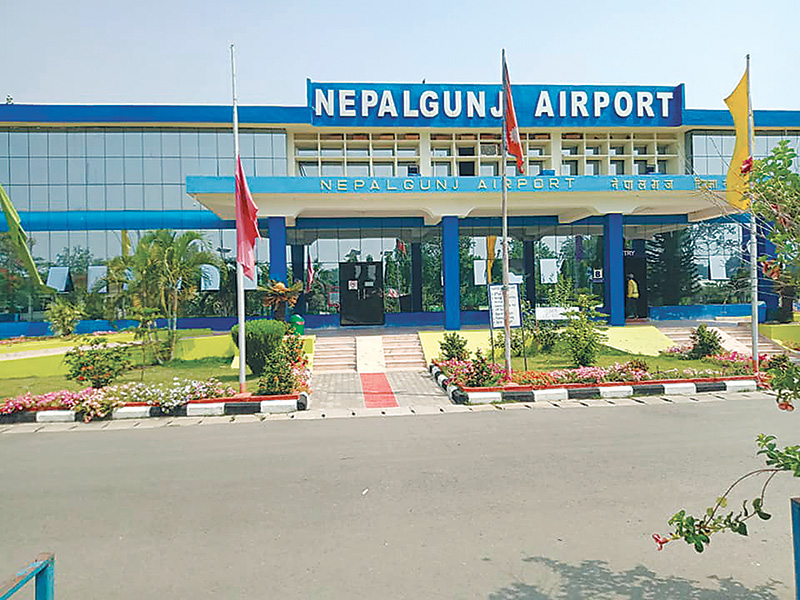
Nepalgunj Airport Office of the Civil Aviation Authority of Nepal has stopped issuing flight permits to airlines that do not implement the health and safety protocols. Post Photo: Rupa Gahatraj

NEPALGUNJ,
Lok Bahadur Shahi of Mugu, a remote district in Karnali Province, had come to Nepalgunj for his wife’s medical treatment last month. Shahi and his wife had flown to Nepaljung on a private airline and they have been stranded in the city ever since, as the government has banned airlines from flying passengers without their Polymerase Chain Reaction test reports.
Regular flights to and from Nepalgunj Airport have been halted for the past four months. However, rescue flights are in operation for the districts that are not connected with a road network.
“We were supposed to return home on Friday. We had already boarded the flight but the airline officials asked us to deboard since we did not have our PCR test results,” said Shahi. “We have spent a lot of money on my wife’s treatment and our hotel stay here.”
According to Shahi, there are around 30 people from Mugu, Humla and Jumla who are currently stranded in Nepalgunj.
Nepalgunj Airport Office of the Civil Aviation Authority of Nepal (CAAN) has stopped issuing flight permits to airlines that do not implement the health and safety protocols set by the government. As per the protocols, a passenger should have a PCR test report, should use face masks at all times and the aircraft should manage sanitiser for all passengers.
Although the authorities have made PCR test reports mandatory for passengers, there are no clear instructions on who should bear the expenses of the tests.
“The governments of the respective provinces are responsible for conducting the PCR
tests of their air passengers. We only carry out the PCR tests of seriously ill people,” said Naresh Shrestha, the focal person at the District Health Office in Banke.
Meanwhile, the Social Development Ministry of Karnali Province has decided to bar the entry of individuals to the province without a PCR test report effective from August 17. But the ministry has not taken into account the people stranded at domestic airports.
“The provincial government conducts the PCR tests of returnees who enter the province by road. The returnees are kept in quarantine centres where their PCR tests are conducted,” Dal Rawal, Social Development minister of Karnali Province, told the Post. “But we do not have any immediate provisions for conducting PCR tests of those who want to enter the province by air. They will have to conduct a PCR test at their own expense.”  
But for Manoj Aauji of Bajura, a hill district of Sudurpaschim Province, getting a PCR test is an added expense.
“I flew to Ranjha Airport in Nepalgunj for the treatment of my relative a week ago. I have been staying at a hotel since I arrived in Nepalgunj and don’t have an extra Rs 5,000 for a PCR test.”
According to him, he was allowed to fly from Bajura Airport last week without a PCR test report.
“Now the airport authority in Nepalgunj says we have to get PCR test reports to be able to fly home. I don’t know what to do,” said Aauji. He and seven other people who came to Nepalgunj together from Bajura are waiting to return home, he said.
The CAAN Nepalgunj Office on Friday cancelled the rescue flights of two private airlines that were scheduled to depart for the hill districts of Karnali and Sudurpaschim provinces, as they were not implementing the health security protocols.
“The airlines had been operating rescue flights by following health security protocols. But of late, they have been found flouting the regulations despite our repeated requests,” said Premnath Thakur, chief at the Nepalgunj Airport Office of the CAAN.
“It’s imperative for us to maintain health and safety protocols at all times,” said Thakur. “That’s why we have had to cancel scheduled flights to Sudurpaschim and Karnali in the last few days.”
According to Nepalgunj Airport, a total of 15 rescue flights were scheduled to fly to Dolpa, Humla, Mugu and Bajura districts on Sunday.
“The cancellation has obviously put passengers in a fix but we can’t be negligent about health security at a time like this,” Thakur said.
The airlines, meanwhile, expressed their dissatisfaction about the cancellations of the scheduled flights.
“Our flight, which was about to take off for Mugu, was cancelled at the eleventh hour on Friday. This has caused a lot of hassle for the passengers and for the airlines too,” said Basanta Malla, the assistant station in-charge of Summit Airlines in Nepalgunj.


(Kalendra Sejuwal contributed reporting from Surkhet)

Page 3
NATIONAL

Half of beneficiaries could be deprived of social security money

As per the social security regulation, renewal of identity cards is a must by mid-August even during pandemic.
- PRITHVI MAN SHRESTHA

KATHMANDU,
Around two dozen beneficiaries from Durga Bhagawati Rural Municipality-2, Rautahat haven’t renewed their social security allowance identity cards amid the Covid-19 pandemic.
But the deadline to do so elapsed on Sunday (August 16).
“About 20-25 benificiaries from my ward haven’t renewed their identity cards,” said Suresh Chaudhary, chairperson of the ward. He said that the lockdown imposed in the district, meant that identity cards of all the beneficiaries could not be renewed.  
It’s not just the people of Durga Bhagawati that haven’t renewed their identity cards to receive social security allowances. More than half of the beneficiaries across the country are believed to have missed the deadline.
As of last fiscal year, 3.21 million people received social security allowance from the government. But, according to Jitendra Basnet, director general at the Department of National ID and Civil Registration, only around 1.6 million beneficiaries have renewed their cards.
After the new social security regulation was introduced recently, all beneficiaries need to get their cards renewed by mid-August. For this, they need to visit the ward office personally and submit an application, according to clause 9 of the regulation.
As per the Social Security Act, senior citizens above 70, single women aged above 60, widows in helpless condition, members of the endangered community, disabled people and destitute children receive social security allowances between Rs 400 to Rs 3000 for elderly people. The government spent Rs 66.16 billion in distributing the social security allowance in the last 2019-20, according to the department.
Basnet finds two factors responsible for people’s failure to renew their identity cards: the lockdown and landslides and floods in the rainy season. “So, renewal rate in the Tarai, particularly in Province 2 is poor.” said Basnet
“Beneficiaries of many remote regions less affected by pandemic couldn’t renew their identity cards because of landslides and flooding that disrupted transport services.”
According to the Ministry of Health and Population, 7,785 were infected with the novel coronavirus  in Province 2 as of Monday—the highest for among the provinces. Likewise, 5,212 tested positive in Province 5, which has recorded second highest cases of Covid-19.
 “If the deadline for renewal is not extended, half of the beneficiaries will be deprived of the social security allowance,” said Basnet. According to him, officials can’t provide the allowance to people who haven’t renewed their card.
But, the department can’t extend  the deadline as it was fixed by the social security regulation. The Cabinet is responsible for amending the regulation. So, Basnet said that his office has recently forwarded a proposal to the Cabinet to extend the deadline until mid-November.
Even though the regulation requires the beneficiaries to renew their identity cards by mid-August, people could not travel to get their cards renewed due to suspension of transportation services during the lockdown or fear of being infected even in the place where limited transport service is available.
The government had imposed nationwide lockdown on March 24 and it came to an end only on July 21. But, the government has continued to impose strict restrictions on public transportation across the country considering the resurgence of the Covid-19 cases.
Local governments are responsible for collecting details of beneficiaries for renewal of their identity cards. Office bearers and staffers in local governments said that the beneficiaries have been unable to visit the ward office.
 Local officials said they are wary of inviting senior citizens to their offices as they are more vulnerable to Covid-19 compared to younger people. “Our staff offered door-to-door services to collect details of beneficiaries for renewal of their identity cards,”  said Jumadin Ansari, chairperson of Sakhuwa Prasauni Rural Municipality-4, Parsa.
The ward office said that it completed collecting details of beneficiaries.
But it hasn’t updated the details online as the office has remained closed for the last two weeks due the lockdown imposed to contain the spread of Covid-19.

NATIONAL

Nepal, India officials resume dialogue

Meeting of the mechanism to assess progress made in India-funded projects takes place months after the map row.
- ANIL GIRI
shutterstock

KATHMANDU,
Senior officials from Nepal and India reopened formal lines of communication on Monday, months after boundary-related issues strained ties.
A discussion on the status of India-funded projects in Nepal between the two sides via video conferencing on Monday marked the first major bilateral dialogue between the two neighbours after Kathmandu released  a new political map of Nepal incorporating some territories administered by India.
The resumption of formal talks between the two countries bodes well for bilateral ties, but it’s not sufficient to normalise relations or to resolve the boundary row that has persisted for decades, former foreign ministers and diplomats told the Post.
“The meeting is a positive step towards ending the deadlock, but this is not enough. It will take some more time—even months and years—to settle difficult issues such as that of the boundary,” said former ambassador to India, Lokraj Baral. “India and China are talking even in the midst of heightened tensions, so why should Nepal and India not talk ? A single issue can’t put the entire ties in a bind,” said Baral.
Relations between the two countries hit a low after Nepal published a new political map placing Kalapani, Lipulekh and Limpiyadhura within its borders in response to India’s announcement of a road link via Lipulekh to Kailash Mansarovar in the Tibet Autonomous Region of China. Both Kathmandu and Delhi expressed willingness to hold dialogue on the issue, but that had not materialised.
Monday’s meeting came two day after a telephone conversation between Prime Minister Oli and his Indian counterpart. Sharma Oli called Modi on Saturday to congratulate India on its 74th Independence Day and said, “Nepal looks forward to a meaningful cooperation between Nepal and India.”
The meeting and the telephone conversation signal that the two sides have reached an understanding that the entire gamut of bilateral ties should not be held hostage to a single issue, and that both sides have agreed to resume talks, two officials at Prime Minister Office and Ministry of Foreign Affairs told the Post.
If both sides avoid irritating each other, more meetings can take place, and finally foreign secretaries of the two countries can talk about the boundary dispute, the officials added.
The understanding was reached as Prime Minister Oli used “several back channels”— formal, informal, and even religious ones to talk to Indian officials on resumption of dialogue, Narayan Kaji Shrestha, former foreign minister and spokesperson for the ruling party told the Post. He said that talks on the boundary issue may not take place soon.
“ It took several attempts to break the jogjam. I don’t see ties with India returning to normal anytime soon,” said Shrestha. “Although official meetings are good gestures, I don’t think everything with our relations with India is on the right track.”
Monday’s meeting of the oversight mechanism, co-chaired by Foreign Secretary Shanker Das Bairagi and Indian Ambassador to Nepal Vinay Mohan Kwatra, underlined the need to expedite the implementation of the bilateral projects and agreed to undertake necessary measures to address their problems and obstacles.
Discussions were held on the status of ongoing projects under Nepal-India bilateral cooperation, the Ministry of Foreign Affairs said in a statement. Projects such as Tarai roads, cross-border railway, Arun-III Hydropower Project, petroleum pipeline and Pancheshwar Multipurpose Project were discussed during the video conference meeting, the ministry said.
Post-earthquake reconstruction, irrigation, power and transmission lines, construction of Nepal Police Academy, integrated check posts, the Ramayana circuit, motorable bridges over Mahakali River, agriculture and cultural heritage were also taken up,, according to the ministry.
Former Ambassador Baral said that the meeting indicates that ties will be normalised gradually, but Nepali leaders should tread cautiously. “It is the responsibility of Nepali to refrain from making unnecessary comments on bilateral ties that could further invite tensions,” he added.
Meanwhile, officials said not all India-funded projects are doing well in Nepal as projects such as the Arun III hydroelectric project have a dismal track record. Due to Covid pandemic, several projects are facing obstacles and might not meet their completion deadlines.
 According to a study carried out by Brookings India on two India-funded projects (The East-West Postal road and the Jogbani-Biratnagar cross-border railway line), they are facing a myriad of challenges, including the acquisition of land.
The study surveyed institutional impediments and expertise deficiencies that led to years of delays in the process of land acquisition. It said, “Such issues led to protracted problems, on the ground between central, local, public, and private Nepali stakeholders, to occasional tensions in bilateral government relations, and most importantly, to significant escalation in costs to India’s public exchequer.”

NATIONAL

Undocumented Nepalis in UAE can return home without facing penalties

Around 300,000 Nepalis whose visas expired before March 1 are expected to benefit from the new scheme.
- CHANDAN KUMAR MANDAL

KATHMANDU,
Hundreds of Nepali workers living illegally after violating immigration laws in the United Arab of Emirates have now been given a chance to return home without facing any punishment.
With the UAE government’s latest announcement of amnesty for foreigners, including Nepali migrants, those who have overstayed their visa get three months to return home.  
“There are many Nepali workers and visitors whose visas expired before March and have been staying illegally here in the UAE,” said Pasang Sherpa, vice-chair of Non-Resident Nepalese Association (NRNA), UAE Chapter. “This amnesty is a huge opportunity for them. They can leave the country before November 17 without having to pay any fine or face future travel bans.”
As per the decision, foreigners whose visa expired before March 1, need to return home by November  17 to avoid punishments and fines.
The three-month extension comes a day before the ongoing amnesty scheme, which had started on May 18, comes to an end on Tuesday, according to Khaleej Times, an English language newspaper published in Dubai.
The latest amnesty applies to everyone who flouted immigration rules by overstaying in the UAE. Authorities have also said such offenders will not be barred from future travel to the country if they utilise the amnesty and return to their respective countries.
According to Sherpa, more than 3,000 Nepalis, who have overstayed in the country after their visa expired, could benefit from the latest scheme.
Those willing to return home as per the latest amnesty must have a valid passport and a flight ticket, according to local authorities. Beneficiaries of the current scheme will not even have to go for a prior registration this time. They can directly report at the airport.
The UAE government’s latest amnesty is one of the several recent initiatives launched by countries in the Gulf, affected due to Covid-19 pandemic, to repatriate foreigners in the wake of safety concerns. Nearly 3,000 undocumented Nepali workers could return home after utilising a similar amnesty announced by Kuwaiti, which has even agreed to provide free air tickets.
Thousands of Nepali have been affected by the pandemic in the UAE where an estimated 275,000 Nepalis have been living and working. A large number of workers have been scrambling to return home.
With the government repatriation beginning in the second week of June, a total of 14,314, have returned from the UAE—the highest number for any country—until Saturday. Likewise, nearly 42,000 have applied with the Nepal embassy in the UAE to return home.

NATIONAL

Infection fears in overcrowded jails after man catches Covid-19 while in detention

- ANUP OJHA
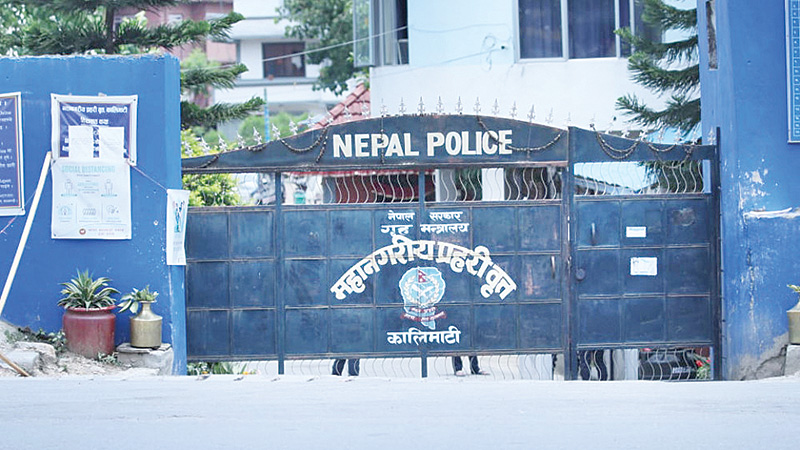
Three cases of Covid-19 have been reported at the Kalimati police station so far. Post Photo

KATHMANDU,
A detainee at the Metropolitan Police Circle in Kalimati has tested positive for the coronavirus.
The 50-year-old man, who was being investigated for his alleged involvement in an online gambling racket, was transported to Ayurveda Teaching Hospital in Kirtipur after his Covid-19 test result came positive on Monday.
This is the third case of Covid-19 at the Kalimati police station. Two police officers had tested positive on May 20, following which the station was sealed for two weeks.  
“The latest coronavirus case has caused fear among the officers and the detainees,” said DSP Rugam Kunwar, chief of the Kalimati police circle.
There are 150 officers under Kunwar’s command at the station and 13 people in investigative custody.  
“Those officers who had come in contact with the infected detainee are currently observing isolation,” said Kunwar.
The police circle is also planning to conduct polymerase chain reaction tests on its officers and the detainees.
Nepal Police Spokesperson SSP Kuber Kadayat said till the date 387 police personnel have been diagnosed with Covid-19, of which 251 have already recovered.  
Meanwhile, 160 officers who were diagnosed with Covid-19 at the Nepal Police Headquarters  are still undergoing treatment.  
Spokesperson of the Metropolitan Police Office SSP Sushil Kumar Yadav said Monday’s was the second case of Covid-19 seen in a detainee in Kathmandu district.
Earlier, a prisoner, who was transported from Sindhuli to the Central Jail in Sundhara, had tested positive for the coronavirus infection. He was admitted to the Armed Police Force Hospital.  
Coronavirus infection has also been detected in a detainee in Satdobato Police Circle in Lalitpur district. No case has been reported in Bhaktapur so far.  
Outside of the Kathmandu Valley, Covid-19 in a prison facility has been reported in Nepalgunj, Banke.
On July 16, an inmate and a security guard at the Nepalgunj prison were diagnosed with Covid-19.
The coronavirus infections seen in police stations and prison facilities have once again brought to the fore the issue of overcrowded prisons where physical distancing is impossible.
Laxmi Prasad Baskota, the prison officer at the Central Jail, said there is a high risk of coronavirus outbreaks in prison facilities if proper health and safety measures are not put in place.
“If even a single person gets infected, there is a risk of the virus spreading like a wildfire,” Baskota told the Post.
The Central Jail is currently holding 3,171 prisoners, which is more than twice its capacity of  1,400.
“There are definitely fears and concerns, but we are safe so far,” said Baskota.
The Central Jail has been admitting new prisoners only after PCR tests in recent times. However, Baskota said there is a risk of the infection spreading from the visitors.  
The jail has been receiving five new prisoners and releasing the same number of prisoners daily ever since the country imposed the nationwide lockdown on March 24, according to Baskota.
Meanwhile, things are no different at Dillibazar Prison, which is currently holding 600 inmates.  “We are currently holding twice the number of inmates than this prison can admit. There is a risk of the coronavirus spread,” said Sita Adhikari, prison in charge.  
According to the Department of Prison Management, over 24,000 people are currently serving in 74 prisons across the country.
In the wake of the Covid-19 pandemic, the Supreme Court on March 20  had ordered the government to release prisoners sentenced for up to a year for minor crimes. The decision was aimed at preventing the coronavirus spread in prions by de-crowding the prisons.   
Following the court’s order, 409 prisoners were released from across the country.

NATIONAL

Three more bodies recovered from Lidi landslide site

Briefing
- Post Report

SINDHUPALCHOK: Search team recovered three more bodies from the landslide-ravaged Lidi village in Sindhupalchok on Monday. DSP Madhav Prasad Kafle said with the recovery of three more bodies, the death toll in Friday’s landslide has reached 22. Seventeen villagers are still missing and presumed dead. The landslide had struck early Friday morning, destroying 17 houses at Lidi village in Jugal Rural Municipality Ward No. 2. Thirty-seven homes were also damaged in the incident.

NATIONAL

Thirteen people injured in Bara clash

Briefing
- Post Report

BARA: Thirteen people, including four police personnel, were injured in a clash between locals of two villages in Bara on Monday. Police said the incident took place after the locals of Bhagwanpur village in Simraungadh Municipality assaulted Madhusudan Jayaswal, the Ward-6 chairman of Kotwal Rural Municipality, over a local irrigation canal’s water outlet. After Jayaswal got attacked, the villagers from Paterwa in Kotwal Rural Municipality had clashed with the villagers of Bhagwanpur. Police fired six warning shots and several rounds of tear gas to contain the situation.

NATIONAL

Lockdown re-imposed in five places in Tanahun

Briefing
- Post Report

TANAHUN: Authorities have re-imposed lockdown in five local units of Tanahun due to the increase of coronavirus spread at community level. According to Sagar Acharya, chief district officer, lockdown orders have been issued in Byas Municipality and Bhanu Municipality, Bandipur Rural Municipality, Abukhaireni Rural Municipality and Devghat Rural Municipality. The lockdown will remain for at least one week.

Page 4
EDITORIAL

We reap what we sow

The country must come up with a comprehensive agriculture strategy.

Nepal relies heavily on food imports and agricultural inputs. Any shortage can lead to food insecurity, affect farmers and dampen economic growth. Economists say agricultural output in the country has always declined whenever there is a shortage of chemical fertiliser, a major agricultural input that determines output and productivity.
This year, Nepal is already reeling under a short supply in the wake of the pandemic. Lockdowns and trade restrictions both in Nepal and India have disrupted supply chains, and the available stock is running out. But across the country, half-submerged paddy plants have turned green after three weeks of transplantation and await top dressing. However, urea is not available for tens of thousands of farmers in the country.
Urea is an essential nutrient that prevents the yellowing of the leaves in paddy caused by a deficiency of nitrogen in the soil. While plants will stunt and even die, a delay in spreading urea on fields also affects production, translating into losses and a deficit in supply with far-reaching economic and social implications. Officials at the Ministry of Agriculture and Livestock Development blame the pandemic for the delay in announcing tenders and subsequent delays farmers are having to brave for the first top dressing. But for such a commonly used fertiliser, which costs Rs14 per kg at the government subsidised rate, the administration that always hopes for a bumper paddy production should sow what it intends to reap.
That Nepal would lose production due to shortages of agricultural inputs had been long warned as the pandemic unfolded. Both the World Food Programme and the World Bank had forecasted disruptions to domestic food supply chains and consequent shocks that could affect food production and lead to insecurity.
In 2009, Nepal and India had signed an agreement that allowed India to sell 100,000 tonnes of chemical fertiliser to Nepal annually at international parity prices to avoid a lengthy tender process, but the deal expired in December last year and has not been renewed. The government must not leave any stone unturned to renew the government-to-government deal and explore alternatives to ensure smooth supply because there is no inkling of how the Covid-19 situation will evolve given the exponential rise of cases in the country and the deteriorating situation in India.
According to the Agriculture Inputs Company Limited, Nepal requires 120,000 tonnes of urea and 50,000 tonnes of diammonium phosphate for paddy cultivation, but the state-owned fertiliser supplier and Salt Trading Corporation have only issued tenders to import 71,000 tonnes of urea and 25,000 tonnes of diammonium phosphate for this year. While officials at the ministry say there will be some respite this week and within a month, ministry figures show that there has always been a deficit in state supply while the rest of the demand relies on informal imports and contraband fertiliser for which farmers pay a hefty price. A study conducted by the Finance Ministry in 2006 also shows that the share of informal fertiliser imports stands at 71 percent of total supplies.
On paper, the government increased the budget for the distribution of subsidised chemical fertilisers from Rs5 billion to Rs9 billion this fiscal year to ensure timely and adequate supply, but diversion of funds due to the pandemic has placed additional obstacles on the availability of fertilisers. Given the ‘new normal’, fertiliser supply will certainly be affected by factory closures, limited cargo handling, transport disruptions and border restrictions. It will consequently affect agricultural output and consumer prices.
To avert a looming food crisis, the country must come up with a comprehensive agriculture strategy and engage with Delhi to ensure a smooth supply of agricultural inputs. Otherwise, with more mouths to feed than ever before, the burden on agriculture will only increase.

OPINION

The cost of the ruling party feud

This dispute is destructive because of its disconnect from the pressing issues of national interest.
- ACHYUT WAGLE
Shutterstock

The Nepali media and intelligentsia, in general, appear to be obsessively following the incessant bickering between rival factions in the Nepal Communist Party, and, for that matter, by the similar feuds in other political parties of the country, including the main opposition in the federal parliament, Nepali Congress. Even during these precarious times, when the country reels under an unfolding crisis, the national discourse seems to be hijacked by these unpredictable bouts of accords or discords between two co-chairs of the ruling party KP Oli, who is also the incumbent prime minister, and Pushpa Kamal Dahal. The cyclical nature of dialogues between the two is treated as a new scoop every time.
In a recent development, the chairmen duo has decided to form a six-member task force for dispute resolution. Since the ‘dispute’ is rooted nothing beyond their personal ego and petty vested interests to cling to or grab power, it should not have been a concern or matter of national attention. Also, it was predicted long ago that Oli’s opposition in the party, despite their high-pitched criticism, had very limited constitutional scope to actually remove him from power; the other communist leaders would be forced to settle for a cabinet reshuffle at the maximum. This reconciliatory task force, therefore, was a natural outcome.
But, unfortunately, this meaningless feud is, in essence, grabbing too much attention, which ideally should have been undividedly focused on containing the Covid-19 pandemic, saving the lives of the people from the virus and reviving the economy that is already on the verge of collapse.


What’s in a name?
Although the Nepal Communist Party appears passionate about clinging to the term ‘Communist’ in its banner, the outfit has not only ceased to adhere to the principles of outlined in the classic communist manifesto but has effectively become an edifice of mere comprador bourgeoisie (if we are to take cue from the Marxist lexicon itself). Such ideological renunciation may have been caused by several practical compulsions including globalisation and the sweeping wrath of universal capitalism. However, it is an obvious outcome of the conscious love of lucre and the voluptuous hedonism practised, promoted and protected by the top leadership.
The inherent incapacity of the government has been exposed by the absolute mayhem caused by the absence of governance—as the number of coronavirus infections has spread exponentially nationwide. It is a mystery why the government didn’t buy adequate testing and treatment equipment, set-up temporary hospitals and trained available medical personnel in the seven months since the first case of the virus was detected in Nepal. The lockdown contagion has spread to the local levels, but this has not seen a reciprocal rise in effective strategies against the novel coronavirus. After all, the lockdown is not a cure-all but rather a way to buy up some time to implement measures. That the public officials have failed to understand this will only worsen the situation.
Another equally alarming issue has been the blatant and pervasive corruption in procuring the drugs, kits and equipment related to the containment of the virus. The federal government initially did not allow the provincial and municipal governments to procure these materials, with apparent malafide intention, to pocket huge commissions out of these purchases. The state structure is rendered so systematically dysfunctional that no watchdog dares to investigate into such graft, for fear of retribution by the powerful executives. Instead, key anti-corruption agencies now have become machines to issue ‘clean chits’ by whitewashing these crimes of their political bosses. As a result, the mandarins in the federal government have become so disgustingly cynical that they would not even initiate the purchase of urgent health service materials where there is no scope of commission.
Unfortunately, none of such issues of immediate importance is part of the agenda in the ongoing dialogue within the ruling party. On the contrary, the faction outside the government seems jealous for being out of power and missing the opportunity to snatch a few golden eggs. Therefore, any shade of outcome from the power-sharing arrangement among the factions in the ruling party, or lack of it for that matter, has nothing desirable in store. Whichever way the dispute goes, it will not prove to be any less costly to the nation. Therefore, the forcibly created narrative that unity within the Nepal Communist Party is important for the national interest is a pure fallacy.


Causality and casualty
Nevertheless, it would be naive to see the current power struggle in the ruling party in isolation. It has both trend and pattern. A chronic culture of such squabbles and their pervasiveness across the political spectrum has already inflicted a telling adverse impact to the country’s dream for prosperity and welfare. One of the major causes of these feuds often sprawling out of proportion is the sheer lack of intra-party democracy in all major political forces of the country.
If viewed through major theoretical models of intra-party democracy, the operation of all notable political parties of Nepal is abhorrently undemocratic. Even the partial adherence to key components of any of these models would have made these parties responsive to their constituent members and electorates and, in the process, would have reasonably contributed to institutionalising democracy in the country. The candidate selection model relatively respects efficiency and meritocracy of the candidate and provides a sense of representation of voices from the ground in government. The direct participation model provides space through some mechanism for the party members to participate in decision-making debate (or ideally in the process) and the deliberative model ensures an exhaustive deliberation process in the formulation of the concerned party’s policies and setting priorities.
Lack of consultation, participation and deliberation are exactly the allegations Oli now faces from his opponents. If we look back to the last three decades of multi-party democracy in Nepal, every political party almost went through a comparable phase of discontent, dispute or even division.
Interestingly though, no leader or party seems to realise the importance of recompensing this structural deficit of intra-party democracy first and then betting on the formal institutional mechanism to resolve crises like the one now faced by the ruling party. The general thought process among the powerful in the parties is that when the institutionalised mechanisms are allowed to function, personal vested interest might have to be sacrificed. Country’s democracy and economic prosperity have been direct casualties of this psyche and ensuing ad hoc modus operandi of the political outfits, particularly in the ruling party.

OPINION

The economic factor in Belarus

If Lukashenko falls, Belarus will need an IMF programme as soon as a new government is installed.
- ANDERS ÅSLUND
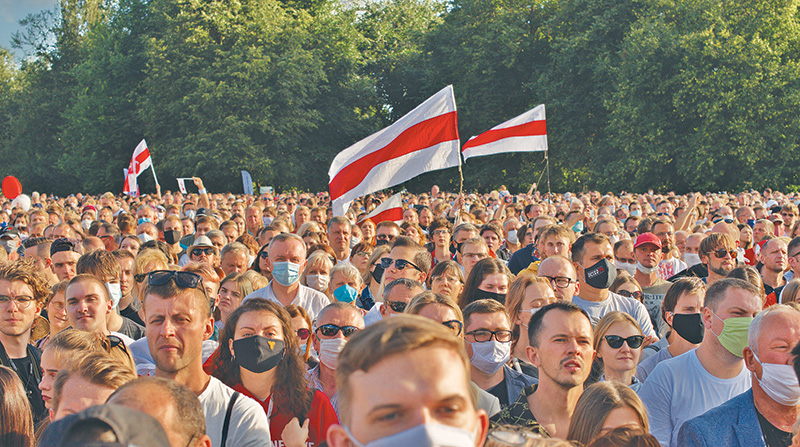
Svetlana Turchenick/Shutterstock.com

Following a fraudulent election on August 9, Belarusian President Alexander Lukashenko’s authoritarian rule may soon come to an end. Massive protests are sweeping the country, and workers from many critical sectors going on strike. And if Lukashenko falls, Belarus’s prospects for establishing a normal market economy are surprisingly strong.
Under Lukashenko, Belarus has maintained a Soviet-style, state-dominated economy that has been stagnating since 2012. Lukashenko, in power since 1994, has concerned himself with nothing other than remaining in charge and enabling his family and a close circle of cronies to enrich themselves. The public sector comprises three-quarters of the economy, which is highly dependent on heavy industry and dominated by just a few big state-owned enterprises (SOEs). The five most important enterprises—the potash company Belaruskali, the two largest oil refineries, the Minsk Tractor Works (MTZ), and the Minsk Automobile Plant (MAZ)—tend to be subsidised and inefficient, and the economy overall is heavily regulated.
Belarus’s economy has remained highly dependent on Russia. Its low-quality industrial goods are not competitive in the West, so it relies on Russia to buy them, while selling the West potash and refined oil. Until recently, Russia was subsidising the Belarusian economy by furnishing cheap energy worth some 10 percent of the latter’s GDP. But, with bilateral relations deteriorating in recent years, the Kremlin has gradually eliminated these subsidies in order to pressure Lukashenko’s regime.
Lukashenko has said that he wants all Belarusians to earn an average wage of $500 per month. But, because that is more than the economy can support, the country has suffered recurring foreign-exchange crises. In 2009-10, Belarus received a bailout from the International Monetary Fund, but the government violated the terms of the arrangement and has since received no funding. By the end of 2011, inflation had surged to 109 percent, at which point Russia came to Lukashenko’s assistance.
Since then, Lukashenko has tried unsuccessfully to appeal to both Russia and the West for financial support. For the European Union, Belarus is a delicate issue. While EU leaders want to defend democratic principles, which implies punishing Lukashenko and his cronies for their repeated violations, they want to maintain some leverage in the country, and thus have been careful not to force Lukashenko into Russian President Vladimir Putin’s arms.
After Lukashenko released all of Belarus’s political prisoners in 2016, the EU lifted its personal sanctions against him, and the IMF, the World Bank, and the European Bank for Reconstruction and Development (EBRD) started cautiously re-engaging with the country. The United States, however, has maintained its personal sanctions against Lukashenko.
The Belarusian economy cries out for liberalisation and privatisation, and it has the basic ingredients for launching such a process. The country has many assets, and it has maintained the best of the Soviet education system, offering excellent training in mathematics and natural sciences. Despite being under authoritarian rule, Belarus has become the home of a substantial software industry. And many it the large diaspora are ready to return when the time is right.
Moreover, Belarus stood out in the Soviet era as one of the best functioning of the 15 Union Republics, and that has remained true, with Lukashenko tolerating capable technocrats across all ministries. As a result, Belarus still has the best state administration of any former Soviet republic, including a competent central bank and ministry of finance. To take one recent example, while Lukashenko was dismissing the Covid-19 pandemic, the Ministry of Health was reporting data on cases meticulously to the World Health Organisation. Insofar as there is political rot in Belarus, it seems to be concentrated mostly at the very top of the system.
Not surprisingly, international investors have largely avoided Belarus (though it did manage to raise $1.25 billion in Eurobonds in late June). But precisely because Lukashenko has never been able to attract much international financing, the country’s total public debt amounts to only $18 billion—or 29 percent of GDP—according to the finance ministry.
With annual inflation under control, at about 5 percent, and with all the relevant international financial institutions already re-engaged, Belarus is well positioned to make the shift to a properly functioning market economy. Under new leadership, it should be able to attract enough international funding to maintain macroeconomic stability, and its well-educated, highly disciplined workforce would finally be able to realise its potential. Fortunately, lifting the existing price regulations on around one-fifth of Belarusian consumer goods and liberalising domestic trade should be relatively easy. Belarus’s strong macroeconomic institutions can manage the inflationary pressure.
Subsidies to SOEs will need to be curbed as well. Here, too, Belarus benefits from the fact that, unlike other post-Soviet countries, there are no oligarchs and little sign of state capture by big businessmen. Most of the complaints about corruption are concentrated within the narrow circle surrounding Lukashenko.
But these starting conditions could make privatisation more difficult, simply because there are no big private companies to serve as a model. If the bulk of inefficient SOEs are sold on the market, Belarusians fear that risk-loving Russian businessmen will swoop in to snatch them all up at fire-sale prices.
After all, the Russian potash company Uralkali has long tried to take over Belaruskali, and the Russian petrochemical giants Rosneft and Lukoil have their eyes on Belarus’s two big oil refineries. Given these risks, the best option is probably to give away most enterprises in the form of individual shares to their current employees.
Whatever is decided, the West should stay engaged. If Lukashenko falls, Belarus will need an IMF programme as soon as a new government is installed, and the World Bank and the EBRD would be needed to assist with deregulation and privatisation.
The EU will also have a role to play. It should welcome a new government by activating its Eastern Partnership programme for Belarus, and invite Belarusian students to participate in the Erasmus student-exchange programme. The importance of such civilian engagement in deterring or neutralising Russian interference must not be underestimated.


Åslund is a senior fellow at the Atlantic Council in Washington. His latest book is Russia’s Crony Capitalism: The Path from Market Economy to Kleptocracy.
—Project Syndicate

Page 5
MONEY

Landslide damage holds up Kali Gandaki transmission corridor project progress

The delay means that 19 megawatts produced by the Thapa Khola and Ghalemdi plants will go to waste.
- GHANSHYAM KHADKA

MYAGDI,
The construction of the Kali Gandaki Transmission Corridor Project has been pushed back by another three months after a landslide felled a pylon on the Dana section between Annapurna Rural Municipality and Kushma Khurkot, Parbat district.
The delay means that nearly 19 megawatts generated by Thapa Khola (13.6 megawatts) and Ghalemdi (5 megawatts) will go to waste.
The landslide brought down the tower at Jaljala Rural Municipality in Parbat. The collapse has caused a loss of Rs20 million to the project. According to project officials, it will take at least three months to build a new tower.
There are 114 towers along the 42-km-long Dana-Kusma section of the 220 kV power line. As per officials, 16 towers are located in a high risk zone.  
Before rain-triggered landslides destroyed part of the transmission line, the project was hamstrung by Covid-19 restrictions. Yadav Neupane, assistant project manager, said a survey had been done to shift the location tower that fell down.
“We have started a new tender process as there will be more problems if the endangered poles are not protected immediately,” he said. Studies are also being done to erect a new tower instead of the collapsed one, he said.
According to the project, the contractor company has submitted a proposal to replace the pole with a Lilo Line pole near Galeshwor to speed up the transmission line project.
The Lilo Line is a link line to connect the electricity produced by the 42 megawatt Rahughat Hydropower Project in Galeshwor to the 220 kV transmission line.
The project’s completion deadline expired for the fourth time on March 30. The workers and technicians who went home following the lockdown were not able to return to work, paralysing the project. The finishing work is being done with the help of around 110 workers, the contractor said.
The Beni-Jomsom road being built in the Kali Gandaki Corridor has been blocked due to obstruction by locals, the virus lockdown and landslides. The Beni office of the project has stated that 97 percent progress has been made on the economic side and 99 percent on the physical side.
The Nepal Electricity Authority had awarded a contract worth Rs2.90 billion for the construction of the Dana and Khurkot 220 kV, 132 kV, 33 kV and 11 kV Kali Gandaki corridor transmission lines and substations jointly to Tatachint joint venture, consisting of Indian company Tata and Chinese company Chint.
An agreement was signed between the project and the contractor on May 30, 2016 to complete the construction in November 2018. The project has not been able to complete the work even after the deadline was extended by a year. The Kharkut-Bardaghat section of the transmission line will be connected to the Kali Gandaki Corridor covering Mustang, Myagdi and Myagdi Khola Corridor to cover the Myagdi Khola Reservoir Area, Modi Khola Reservoir Project in Parbat and the electricity generated from various hydropower projects in Waglang.
After the construction of the Kali Gandaki Corridor transmission line, 42 megawatts from Mistri Khola, 42 megawatts from Rahughat, 14 megawatts from Upper Kaligand, 146 megawatts from Kaligand, 38 megawatts from Nilgiri, a total of 450 megawatts of Kowang-Kaligandh electricity will be connected.
Similarly, electricity produced by Upper Rahughat (48.5 megawatts), Upper Kali Gandaki (72 megawatts) and Darwar Khola (25 megawatts) is planned to be connected to the 220 kV Kali Gandaki Corridor transmission line.

MONEY

India’s power output rises for first time in five months in early August

- REUTERS

CHENNAI, 
India’s electricity generation in the first 15 days of August rose for the first time since early March, provisional government data showed, as the country opened up industries and lifted restrictions to control the spread of coronavirus.
Power generation rose 2.6 percent in the first 15 days of August compared with the same period of last year, a Reuters analysis of daily load despatch data from federal grid operator POSOCO showed, compared with a 1.8 percent fall in July.
In the second half of last month, electricity generation declined 3.1 percent.
Power use has picked up from previous months when India was under a strict lockdown, mainly because of higher demand in the northern states and rising consumption in the highly industrialized western states of Gujarat and Maharashtra.
Industry and offices account for more than half of India’s annual power use. Prime Minister Narendra Modi has been citing electricity consumption to show there are “green shoots” in the economy.
Seasonal factors including hot weather could have fuelled higher power demand.
Despite surging coronavirus cases and a rise in deaths to as many as 50,000 on Monday, most states have resumed nearly all industrial activity and removed tight restrictions on movement of people and goods.
Rajasthan, India’s largest state by area, saw a 15.7 percent growth in electricity use. Other states including Bihar, Uttar Pradesh, Chhattisgarh and Madhya Pradesh also saw an uptick in power demand.
Renewable energy generation, which fell by nearly a fifth in July, rose 2.3 percent in the first half of August. Solar-powered electricity production grew 19.3 percent, while wind-powered generation fell over 10 percent.
Power generation from coal—India’s primary source of electricity—rose 4.2 percent in the first fifteen days of August, the data showed.

MONEY

Google warns Australians could lose free access to search and YouTube

- ASSOCIATED PRESS

CANBERRA (Australia),
Google warned on Monday that the Australian government’s plans to make digital giants pay for news content threatens users’ free services in Australia and could hand users’ data to media organizations.
The US-based company’s warning, contained in what it called an “Open letter to Australians,” comes a week before public consultations close on Australian draft laws that would make both Google and Facebook pay for news siphoned from commercial media companies.
“A proposed law ... would force us to provide you with a dramatically worse Google Search and YouTube, could lead to your data being handed over to big news businesses, and would put the free services you use at risk in Australia,” Google Australia and New Zealand managing director Mel Silva wrote. Google owns YouTube, a video-sharing platform.
Both Google and Facebook have condemned the proposed legislation, which was released last month and aims to succeed where other countries have failed in making them compensate media businesses for news content. Australian competition watchdog Rod Sims, chair of the Australian Competition and Consumer Commission, which drafted the laws, said Google’s letter “contains misinformation.”
“Google will not be required to charge Australians for the use of its free services such as Google Search and YouTube, unless it chooses to do so,” Sims said in a statement.
“Google will not be required to share any additional user data with Australian news businesses unless it chooses to do so,” he added.
Australian Treasurer Josh Frydenberg, the minister responsible for the consumer watchdog, said in a statement that the draft law “remains open for consultation, providing an opportunity for media companies and digital platforms to provide feedback” until August 28. Swinburne University senior lecturer on media Belinda Barnet described the Google letter as a “cynical exercise” designed to “scare Google users.”
“I see no merit in any of the arguments,” she said.
Google has been battling the Australian consumer watchdog on two fronts. Last month, the watchdog launched court action against Google for allegedly misleading account holders about its use of their personal data.

MONEY

US to tighten restrictions on Huawei: Sources

- REUTERS

WASHINGTON, 
The Trump administration is set to announce on Monday it will further tighten restrictions on Huawei Technologies Co, aimed at cracking down on its access to commercially available chips, officials briefed on the matter said.
The US Commerce Department actions will expand restrictions announced in May aimed at
preventing the Chinese telecommunications giant from obtaining semiconductors without a special license—including chips made by
foreign firms that have been developed or produced with US software or technology.
The administration will also add 38 Huawei affiliates in 21 countries to the US government’s economic blacklist, the sources said, raising the total to 152 affiliates since Huawei was first added in May 2019.
“Huawei and its affiliates have worked through third parties to harness US technology in a manner that undermines US national security and foreign policy interests,” Commerce Secretary Wilbur Ross said in a statement to Reuters, adding: “this multi-pronged action demonstrates our continuing commitment to impede Huawei’s ability to do so.”
With US-China relations at their worst in decades, Washington is pushing governments around to world to squeeze Huawei out, arguing it would hand over data to the Chinese government for spying. Huawei denies it spies for China.
The new actions, effective immediately, should prevent Huawei’s attempts to circumvent US export controls, the sources said.

MONEY

Virus pandemic reshaping air travel as carriers struggle

- ASSOCIATED PRESS
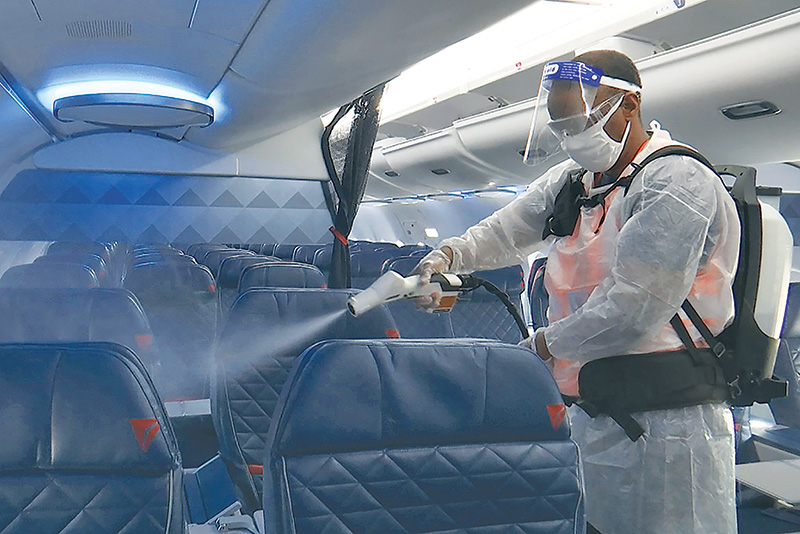
A worker uses an electrostatic sprayer to disinfect the inside of a Delta Airplane at the Ronald Reagan Washington National Airport in Arlington, Virginia.  AP/RSS

NEW YORK,
In a bid to survive, airlines are desperately trying to convince a wary public that measures like mandatory face masks and hospital-grade air filters make sitting in a plane safer than many other indoor settings during the coronavirus pandemic.
It isn’t working.
Surveys indicate that instead of growing comfortable with air travel, more people are becoming sceptical about it. In the United States, airline bookings have stalled in the past month after slowly rising—a reaction to a new surge of reported virus infections.
Globally, air travel is down more than 85 percent from a year ago, according to industry figures.
The implications for the airline industry are grave. Several leading carriers already have filed for bankruptcy protection, and if the hoped-for recovery is delayed much longer, the list will grow.
The four largest US airlines lost a combined $10 billion from April through June. Their CEOs say they will survive, but they have lowered their expectations for a rebound.
“We were all hoping that by the fall the virus might run its course,” said Southwest Airlines CEO Gary Kelly. “Obviously, that has proven to be dead wrong.”
When Consumer Reports surveyed more than 1,000 people in June about their comfort with various activities during the pandemic, 70 percent said flying was very or somewhat unsafe. They rated going to a hospital emergency room or standing in line to vote as safer.
In a survey commissioned by an airline trade group, the biggest concern of travellers was the possibility of sitting next to an infected person.
John Kontak, a schoolteacher from Phoenix, said that was his fear as soon as he stepped onto a crowded American Airlines flight this summer to visit his parents in Ohio.
“I don’t know anything about this person who is sitting a foot away from me,” Kontak said. “They took the bottom line or the dollar over the safety of passengers. Next time, I’d rather drive back to Ohio than fly—it’s safer because I can control it.”
The US Centers for Disease Control and Prevention says sitting within 6 feet (2 metres) of other passengers, often for hours, may increase the risk of getting Covid-19. But CDC also notes that most viruses and other germs don’t spread easily on flights because of how air circulates on planes.
Standard & Poor’s said this week that the industry’s prospects have gone “from bad to worse,” with global air traffic dropping by up to 70 percent this year. In May, S&P said a 55 percent drop was a worst-case scenario.
“It’s going to be a slower and more uneven recovery than one might have expected,” S&P analyst Philip Baggaley said. An airline trade group, the International Air Transport Association, predicts carriers will lose $84 billion this year, making it the worst year in the industry’s history. The group says traffic won’t fully recover until 2024.
Asia, where outbreaks were brought under control earlier, is doing better than the US and Europe. Domestic travel inside China has recovered to about two-thirds its year-ago level. In the US, traffic is less than one-third of 2019 levels. Air traffic at Europe’s more than 500 airports has tumbled, down 94 percent in June compared with the same month last year. There were about 4 million passengers, compared with 217 million a year earlier.

MONEY

Thai court extends Thai Airways bankruptcy hearings until August 25

- REUTERS

BANGKOK,
Thailand’s bankruptcy court said on Monday it had scheduled two more days of hearings to consider Thai Airways International Pcl’s request for restructuring.
The Central Bankruptcy Court said in a statement 16 creditors opposed the airline’s restructuring proposals, of which three were institutional creditors and the rest, individual creditors.
The court scheduled August 20 and August 25 for additional hearings for those opposing the plan.
Thai Airways acting  president, however, remained confident after the first hearing on Monday.
“The hearings are promising and went smoothly,” Chansin Treenuchagron said in a statement. The airline submitted its bankruptcy and restructuring petition in May, giving it a stay on debt repayment.   Minority creditors opposing the plan was not troubling because their objections were issues that Thai Airways could clarify, he said, without giving details. The court will have to approve the airline’s request for restructuring and a committee that would lay out the plan.
Thai Airways said on Monday it had nominated a committee of seven—including the company’s chairman and acting president, former President Piyasvasti Amranand, veteran banker Boontuck Wungcharoen and EY Corporate Advisory Services Company Limited—to plan the company’s restructuring.

MONEY

Khukri XXX Rum wins gold at international competition

Bizline
- Post Report

KATHMANDU: The Nepal Distilleries bagged the gold medal in the London Spirits Competition 2020 with their reputed Khukri XXX Rum. The Nepali rum garnered the ultimate seal of approval in the global spirits industry by scoring a total of 94 out of 100 points for three categories of Quality, Value and Packaging, a scale defined by expert judges of the industry amidst a highly competitive product set, states the press release issued by the company. The London Spirits Competition took place in London on July 6.

Page 6
WORLD

South Koreans urged to stay home as cases jump

China reports no new locally spread cases of coronavirus for the first time in a month, as twin outbreaks on opposite sides of the country fade.
- ASSOCIATED PRESS
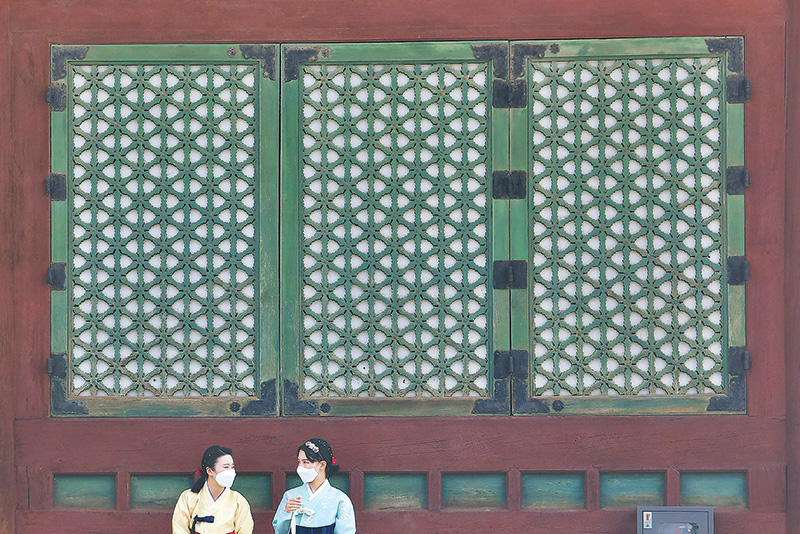
Women wearing face masks to help protect against the spread of the coronavirus talk to each other at the Gyeongbok Palace in Seoul, South Korea, on Monday. Ap/rss

Seoul,
South Korea counted its fourth straight day of triple-digit increases in new coronavirus cases Monday as the government urged people to stay home and curb travel.
The government had drawn up a special holiday on Monday with hopes of spurring domestic consumption. But as infections in the capital
region increase, Health Minister Park Neung-hoo urged people to stay home and for residents in Seoul and nearby Gyeonggi province to avoid visiting other parts of the country for two weeks.
The 197 new cases announced by South Korea’s Centers for Disease Control and Prevention brought the nation’s total to 15,515, including 305 deaths. The 279 new cases reported Sunday was South Korea’s biggest single-day jump since early May amid concerns about an outbreak in the densely populated Seoul metropolitan area.
The KCDC said 167 of the new cases came from the greater capital region, where about half of South Korea’s 51 million people live. Health workers have been struggling to track infections, but churches have emerged as a major source.
More than 300 have been linked to a northern Seoul church led by a conservative pastor who has frequently led anti-government protests against liberal President Moon Jae-in, including a rally attended by thousands of demonstrators in downtown Seoul on Saturday despite official pleas for them to stay home.
The government is pressing charges against the pastor, Jun Kwang-hun, for allegedly disrupting anti-virus efforts by falsely reporting the church’s members and discouraging followers from getting tested. Health workers have so far tested 2,000 of the church’s members and plan to test 2,000 more.
China reported no new locally spread cases of coronavirus for the first time in a month, as twin outbreaks on opposite sides of the country have faded. The National Health Commission did report 22 imported cases in the latest 24-hour period. China has seen a small uptick in the number of infected people arriving from abroad in the past eight days. Health authorities have confirmed 84,849 cases overall and 4,634 deaths since the start of the pandemic. China does not include people who test positive but do not show symptoms in its official case count.
Australia’s hard-hit Victoria state on Monday recorded its deadliest day of the pandemic with 25 coronavirus fatalities. The death toll surpasses the previous 24-hour record of 21 set last week. Victoria’s Health Department recorded 282 new cases, slightly more than 279 new infections on Sunday but maintaining a downward trend. “We just can’t allow any sense of complacency to creep in here. This is an ultra-marathon and we just have to keep pushing forward each and every day,” Victoria state Premier Daniel Andrews said.
Prime Minister Jacinda Ardern has delayed New Zealand’s elections due to the coronavirus outbreak in Auckland. They’ll now be held on October 17. The virus outbreak prompted a two-week lockdown in Auckland and halted election campaigning, and as of Monday, has infected 58 people.

WORLD

India’s corona death toll surpasses 50,000 as virus spreads beyond big cities

- REUTERS

Mumbai,
India’s Covid-19 death toll topped the 50,000 mark on Monday and the total number of recorded cases neared 2.65 million as the outbreak spread further into smaller towns and rural areas, the latest government data showed.
The world’s second-most populous country recorded 57,981 new coronavirus infections in the last 24 hours, raising the total to 2,647,663, while an additional 941 deaths raised the overall death toll to 50,921.
India is only the third country, behind Brazil and the United States, to record more than 2 million infections, but it has a relatively lower death rate of 1.9 per cent, compared to the world average of 3.5 per cent.
India conducted more than 730,000 tests for Covid-19 in the past 24 hours, the Indian Council for Medical Research, said on Monday as the country inches toward Prime Minister Narendra Modi’s stated goal of 1 million tests a day.
Experts have said India’s testing rates are far too low, and this could obscure the true extent of the coronavirus outbreak.
India has been posting at least 50,000 new cases per day since July 30 as the disease spread from major cities like Mumbai and Delhi into the impoverished hinterlands of densely populated states like Uttar Pradesh and Bihar.

WORLD

Back to the paddy fields: Covid-19 smashes Indian middle-class dreams

- REUTERS
In this July 10 photo, Ashish Kumar, 20, who used to work at a plastics factory in western India, checks his mobile phone outside his house in Dutta Nagar in Gonda district in Uttar Pradesh, India. Reuters

Dutta Nagar,
Until late March, Ashish Kumar was helping to make plastic boxes for Ferrero Rocher praline chocolates and the plastic spoons tucked inside Kinder Joy eggs to scoop out the milky sweet cream inside.
With a diploma in plastic mould technology, the 20-year-old had a foot on his chosen career ladder. His younger brother Aditya chose law, but Ashish had his sights set on plastic.
“I want to start a business of my own,” he said, explaining how he wants to recycle plastic to make day-to-day products at his own factory.
India’s coronavirus lockdown has thrown those plans into disarray. Educated but unemployed, Ashish Kumar is one of countless people across the globe whose social progress has been halted by the new coronavirus that has infected more than two million people in India alone, and thrown the economy into reverse. With it, the aspirations of millions are fading.
For years, people in rural India have been gaining prosperity and moving into what economists call a burgeoning middle class of consumers—those who earn more than $10 a day, by some definitions. This group has been a keystone of plans for economic development in the world’s second most populous country. In the Covid-19 pandemic, India’s economy is forecast to shrink by 4.5 percent this year,
according to the International Monetary Fund. At least 400 million Indian workers are at risk of falling deeper into poverty, according to the International Labour Organization (ILO).
Kumar is one of around 131,000 people who local officials estimate returned from working around India to Gonda, the district in the northern state of Uttar Pradesh that he left last June. Nationwide, about 10 million people made long, hard journeys back to rural villages they’d left.
Some have gone back to the cities, but many of those who had been sending back funds are still stuck in the countryside.
Working in a factory in Baramati in the western state of Maharashtra, Kumar was earning 13,000 rupees ($173) every month, more than twice his father’s pay from a job in a grain market near Kumar’s home village in Uttar Pradesh, a sprawling agrarian state. Of that, the young man was sending home around 9,000 rupees every month, much of which was helping to fund his younger brother’s studies.
No longer. Once a provider for his family, now he has become a financial burden.
Kumar whiles away his time back home in the village of Dutta Nagar, bantering with friends in the muddy courtyard—they jokingly call it their “office”—outside the ramshackle primary school where he studied. In Uttar Pradesh, around 60 million of the state’s population of more than 200 million lives in poverty, according to the World Bank.
Kumar, who says he has never tasted a Ferrero Rocher praline, finished his diploma in Gujarat last June, and took the train to start work as a technician at an Italian-owned factory 1,500 km away from home.
The factory that employed him is run by Dream Plast India, a subsidiary of Gruppo Sunino SpA, an Italian plastics maker with 10 plants around the world. “The factory was first class,” Kumar said. His contract included a monthly contribution from the company into a retirement fund and a bonus.
His income over the past year helped his parents build a proper four-roomed brick home, after decades of living in a tumble-down mud hut where the roof let in heavy monsoon rains. It helped pay the fees for his brother to go to law school in Bahraich, an hour and a half’s drive away from their home village.
Then Covid-19 struck.
In May, India’s state governments issued health and safety guidelines for factories as they re-opened after lockdown, which included compulsory face masks, thermal screening, social distancing and frequent sanitisation. Union leaders allege many companies did not follow all protocols and cut corners, but they have not identified Kumar’s.
Indian states including Uttar Pradesh and Gujarat said in May they were looking to relax workers’ rights, including weakening regulations on wages and working hours, to support industry. That proposal drew criticism from workers’ unions and the ILO. The amendments have only taken effect in some states.
Kumar’s factory, which reopened in early May, did not respond to a question on measures taken there, but Dream Plast India’s managing director Nitin Gupta said in an email the “company takes utmost precautions to adhere to the laws at all times.” He declined to elaborate further.
Even so, Kumar and another worker Reuters spoke to said they didn’t feel safe to return.
Ferrero SpA, the Italian confectioner, said it had audited the plant where Kumar worked in March 2020 and found no irregularities, but would further review subsequent months.
Reuters was unable to independently determine what safety measures the factory took.
By early June, Kumar’s funds had run out. Even buying food became difficult. His parents grew increasingly worried.
India’s railway network re-opened in early May. On June 3, Kumar borrowed money to pay for a 48-hour journey home by train, bus and shared taxi. Then he went into quarantine.
On June 25, Dream Plast India sent him an email asking him to report to work within four days or face termination. Instead, he resigned on July 20.
His parents are apprehensive about him leaving home again, although they said they realise that without their elder son’s earnings, his brother won’t be able to finish law school.
Kumar isn’t ready to give up on his plastics factory.
“I will do it,” he said. “No matter what it takes, I will fulfil my dream.”

WORLD

Lukashenko offers to hand over power after referendum

- REUTERS

Minsk,
Alexander Lukashenko, the leader of Belarus, said on Monday he would be willing to hand over power after a referendum, in an apparent bid to pacify mass protests and strikes that pose the biggest challenge to his 26 years in office.
He made the offer, which he insisted would not be delivered on while he was under pressure from protesters, after exiled opposition politician Sviatlana Tsikhanouskaya said she was willing to lead the country.
In a sign of Lukashenko’s growing vulnerability, he faced heckling and chants of “step down” during a speech to workers at one of the large state-run industrial plants that are the pride of his Soviet-style economic model and core support base.
Russia has told Lukashenko it is ready to provide military help to Belarus in the event of an external threat. Lukashenko faces the threat of European Union sanctions after a bloody crackdown on protests following what demonstrators say was his rigged re-election victory last week. He denies losing, citing official results that gave him just over 80% of the vote. Lukashenko told workers there would be no new presidential election, something the opposition wants, until he was killed.
He also offered to change the constitution, an apparent concession that seems unlikely to satisfy protesters.
“We’ll put the changes to a referendum, and I’ll hand over my constitutional powers. But not under pressure or because of the street,” Lukashenko said, in remarks quoted by the official Belta news agency.
“Yes, I’m not a saint. You know my harsh side. I’m not eternal. But if you drag down the first president you’ll drag down neighbouring countries and all the rest.” Speaking in a video address from Lithuania, opposition politician Tsikhanouskaya urged security and law enforcement officers to switch sides, saying they would be forgiven if they did so now.
“I am ready to take responsibility and act as a national leader during this period,” Tsikhanouskaya said.
She called for the creation of a legal mechanism to ensure that a new fair presidential election could be held.

WORLD

Facebook executive in India files police complaint

Briefing
- AGENCIES

NEW DELHI: A top Facebook executive in India has filed a police complaint in New Delhi saying she is receiving death threats following a media report that said she and the US social network company allegedly favoured Prime Minister Narendra Modi’s ruling party. Ankhi Das, Facebook’s top public-policy executive in India, in her complaint to Delhi police said some individuals online had “intentionally vilified” her due to their political affiliations and were engaging in abuse, Indian media reported. Das has said the threats followed a Wall Street Journal (WSJ) report last week that said she opposed applying Facebook’s hate-speech rules to a member of Modi’s party and some other Hindu nationalist individuals and groups flagged internally for promoting or participating in violence.

WORLD

Pakistan army chief visits Saudi Arabia

Briefing
- AGENCIES

RIYADH/ISLAMABAD: Pakistan’s army chief was visiting Saudi Arabia on Monday in an effort to ease a row between the two countries over policy towards the disputed region of Kashmir. The argument, brought on by Pakistani demands for Saudi Arabia to take a firmer line against India’s behaviour in Kashmir, has threatened Riyadh’s financial lifeline to Islamabad. General Qamar Javed Bajwa’s visit was “primarily military-affairs oriented,” the Pakistani army spokesman said. But Pakistani military and government officials told Reuters Bajwa would try to calm a situation that if not reversed could badly hurt Pakistan’s central bank foreign reserves. 

WORLD

Netanyahu says preparing for direct flights to UAE

Briefing
- AGENCIES

JERUSALEM: Prime Minister Benjamin Netanyahu said on Monday that Israel is preparing for direct flights, over Saudi Arabia, to the United Arab Emirates as part of its normalisation deal with the UAE. Israel and the UAE announced on Thursday that they will normalise diplomatic relations under a US-sponsored deal whose implementation could reshape Middle East politics from the Palestinian issue to the fight against Iran. The UAE would only be third Arab state in 70 years to establish relations with Israel.

Page 7
SPORTS

Boxing suffers as fight goes outside the ring

Association president Ram Awale’s old dispute with other officials on its running resurfaces over latest financial report.
- PRAJWAL OLI
Nepal’s Bhupendra Thapa (left) lands a punch on Manish Kaushik of India in the 64-kg category final in the 13th South Asian Games held in Kathmandu in December, 2019. Thapa won the gold medal. The current infighting will affect the development of the sport. Post file Photo: Elite Joshi

KATHMANDU,
Nepal Boxing Association’s (NBA) infighting has surfaced once again as some influential office bearers have made claims of financial irregularities and power abuse by the body’s president.
General Secretary Sabin Bhattacharya and Treasurer Gautam Sujakhu have accused President Ram Awale of acting against the spirit of the law and called him “an incapable person” to lead the body.
The fight between the two sides started in 2018 but resurfaced last week after President Awale produced a financial report during the executive committee meeting on July 30 and asked Sujakhu to sign it.
“The president wanted us (me and the treasurer) to endorse the financial report that he produced in the meeting. But we are not aware of any transactions in the NBA and we are not consulted in any affairs. So I proposed to him that he give me the details of transactions and a few days’ time so that I get time to study it before I sign,” said general secretary Bhattacharya. “But he said the majority of the executive committee had already endorsed it so why did I need to study it.”
Sujakhu not only rejected the president’s proposal but also asked him to reinstate him as the executive treasurer and produce him the details of financial transactions. The report had been endorsed by a majority of the 25-member executive committee although general secretary Bhattacharya had walked out of the meeting after he was verbally abused by the president’s supporters and was not allowed to express his discontent.
Sujakhu and Bhattacharya have complained to the National Sports Council and the Ministry of Youth and Sports appealing them not to endorse the financial report that has been submitted without the signature of treasurer and also to check into irregularities at the NBA.
The dispute between the two sides goes back to August 2018 when President Awale appointed Ram Giri, an executive committee member, as acting treasurer at NBA.
“The president had wanted me to release funds for the Nepali boxers’ training in Thailand. But the executive committee had made a decision that the funds could be released only after approval from the committee. I asked him to get the approval,” said Sujakhu.
Instead Awale appointed acting treasurer Ram Giri, a member of the executive committee.  
“There is no provision of acting treasurer, but backed by the executive committee the president took the consent of the National Sports Council leadership to one,” said Sujakhu.
The president used a provision in the statute which gives him the authority to take steps to resolve any unforeseen circumstances in the operation of the NBA and appointed an acting treasurer.
“Sujakhu refused to sign cheques despite repeated requests and at that time we were preparing for the 2018 Asian Games. I had no choice but to appoint Giri as the acting treasurer with consent from the National Sports Council,” Awale said.
The Association has not held a single annual general assembly, as mandated by its statute, in the four years since the committee was elected in June 2016.
In the last two years, 24 new district associations have been formed—14 with approval from the president
and 10 from general secretary—taking the total number of district associations to 50.
According to Bhattacharya, of the 24 new district associations, fewer than a dozen are active. But the district association was given approval for the sake of getting support from them during elections for the executive committee.
“Of the 14 district associations endorsed by the president, only four are active. In the capacity of general secretary, I have also endorsed 10 district associations and four of them are not active. If the President approves new district associations for election purposes then why can’t I?” said Bhattacharya. “I have proposed that only active district associations be given membership. I can assure you that I won’t be fighting for the presidency in the next election.”
The NBA should have held its election in June this year, as the four year tenure of present executive has expired. But the election has been postponed, owing to the global coronavirus pandemic.
The president, a businessman and a former boxer, blames Bhattacharya and Sujakhu, also former boxers, as the persons responsible for not letting the NBA conduct the annual general assembly. When asked how, he could not give a satisfactory answer.
“There are a lot of sports associations in the country which do not hold their annual general assemblies. Now I understand why they do not.
It is because a few people with wrong motives do not let it happen,” Awale said.  
Bhattacharya denies the allegations and instead blames the president for not letting the NBA conduct its general assembly.
“I had even proposed to hold a general assembly at an executive committee meeting in early 2018. But the president feared that he would face a no-confidence motion and therefore he  was uninterested,” said Bhattacharya. “The executive committee had sought clarification from him in December 2017. If the president says he could not hold a general assembly because of someone else, it raises a big question mark regarding his ability.”
With this infighting within the Nepal Boxing Association, the game suffers.
“When the commander fights, it will definitely hamper the whole team. In fact, Nepali boxers are going to suffer due to this rift within the association,” said Prachanda Sharma, former head  coach at NBA. “Under Awale’s leadership, the NBA has not organised a single tournament under its banner. It is very disappointing for Nepali boxing.”
Not only coaches but also boxing administrators are worried about the sport’s development.
“All this will have a negative impact on the development and promotion of the boxing sector,” said Deepak Gurung, a former general secretary of NBA. “It will have a direct impact on policy making, in the development of new players, organising tournaments, finding sponsors and much more.”

SPORTS

De Jong goal sends Sevilla into Europa League final

- REUTERS
Sevilla’s Luuk De Jong (left) and Manchester United’s Harry Maguire battle for the ball during their Europa League semi-final match in Cologne on Sunday. Sevilla won 2-1. Ap/RSS

COLOGNE,
Europa League thoroughbreds Sevilla reached yet another final as substitute Luuk de Jong struck in the 78th minute to earn them a gritty 2-1 victory over Manchester United on Sunday.
United, already beaten in two domestic semi-finals this season, looked on course to make it third time lucky when Bruno Fernandes scored from the penalty spot in the ninth minute. But former Liverpool player Suso levelled in the 26th minute, and the Spaniards showed all their European know-how to weather a United storm on a humid night in Cologne. Inspired goalkeeper Yassine Bono came to Sevilla’s rescue on several occasions, and when United’s energy levels dipped, De Jong stole in to snatch victory.
Sevilla will meet either Inter Milan or Shakhtar Donetsk in the final in Cologne on Friday, when they will be going for their sixth title in the competition since 2006. “I feel like I’ve been hugged by joy. We know what this side has been through, today included, and we’ve got such a resilience against such intensity,” said Sevilla coach Julen Lopetegui, whose side are now unbeaten in 20 games in all competitions.
While Sevilla have a chance to restore Spanish pride after Barcelona’s horror show in the Champions League quarter-finals on Friday, United’s defeat underlined a poor European season for English clubs, who provided all four finalists in last season’s Europa and Champions League competitions. United were the only English club to reach a continental semi-final this season after Manchester City were dumped out of the Champions League by Lyon on Saturday.
Ole Gunnar Solskjaer’s side may ask themselves how they allowed this one to slip through their fingers though. “The keeper’s had a fantastic game. Of course it’s disappointing that we don’t score. We know we have players who have the quality to score, but that’s the game,” Solskjaer said.
United made a dream start when Diego Carlos brought down Marcus Rashford in the area just after the striker fired across goal. The referee belatedly pointed to the spot, handing United their 22nd penalty of the season in all competitions, and Bruno Fernandes, who almost turned in Rashford’s shot, smashed his spot kick past Bono. Fred had a chance to make it 2-0 for United on the counter-attack but in a wildly open first half, Sevilla levelled when Suso swept in Sergio Reguilon’s low cross.
United should have led by halftime with Anthony Martial side-footing a great chance over the bar, Rashford stinging the palms of Bono, and Fernandes’s improvised volley forcing another fine save from the Moroccan. Bono made another instinctive stop from Mason Greenwood just after halftime as United laid siege to the Sevilla goal.
Martial was also denied by Bono as Sevilla’s goal led a charmed life, but they battened down the hatches and regained a foothold as United’s intensity inevitably waned. United had 20 attempts at goal compared with Sevilla’s nine, but all the spurned gilt-edged chances came back to bite them as their hopes of a first trophy since winning the Europa League under Jose Mourinho three years ago evaporated.
To make matters worse it was former Manchester City player Jesus Navas’s cross from the right that caught Victor Lindelof and Aaron Wan-Bissaka sleeping and De Jong drifted in behind the pair of them to slot home. United’s frustration was such that Lindelof and Fernandes had a heated row. “I think it’s normal (to be frustrated) when you concede a goal in the last 10 minutes. What happened between me and Victor was nothing,” Fernandes said afterwards.

MEDLEY

Horoscope

ARIES (March 21-April 19) ***
Your patience for indecisive people is running very low right now. You know what you’re doing, so how come no one else does? Well, you’ll never be able to get a satisfying answer to that question, so why even ask it? You’ll only get frustrated or angry.


TAURUS (April 20-May 20) ****
You have reached a critical point with someone you care about. You actually know how you feel, so you need to communicate it! This isn’t about having too many expectations. You just need to share what you are thinking and feeling.


GEMINI (May 21-June 21) *****
An interesting discussion today could inspire you to get moving on an exciting new project. Try to make some time to give it all the dedication it requires. A quick online search will help you find the answers you need and get you going down the right path.


CANCER (June 22-July 22) ***
Someone who lives a flashy lifestyle might be charming and exciting, but they don’t have the substance you need in your life right now. So have fun talking to the flighty folks, but don’t get sucked into their way of doing things.


LEO (July 23-August 22) ***
You should research less and brainstorm more. The facts and figures that have helped you in the past aren’t going to help you today. There’s too much emotional energy in the air for logic and reason to have any real impact. This is a day full of possibilities.


VIRGO (August 23-September 22) ***
Do your best to stay cool and calm when the drama erupts. If you stay objective about what’s going on, you’ll find it easy to turn away from it all and stay unaffected and happy in your own little world.


LIBRA (September 23-October 22) **
A friend is telling you that they’re doing one thing but doing something else. Their duplicity is probably due to their fear that if you really knew what was going on, your feelings about them would change. But this is definitely not true.


SCORPIO (October 23-November 21) ***
By spending all your free time with just one person, you’re taking a risk. You can’t ignore the other relationships in your life just because you met someone new. If you stop paying attention to them, they’ll stop paying attention to you.


SAGITTARIUS (November 22-December 21) ***
Watch out when you’re dealing with others today. They don’t have your same priorities. While you want to get things done, they just want to goof off and have fun. So be prepared to deal with interruptions from them, and there could be many.


CAPRICORN (December 22-January 19) ****
Getting more closely connected with the people you really value is easier than ever. Right now, everyone’s schedules fit together, and everyone is on the same page. This harmony is sure going to make your life sweeter for a while.


AQUARIUS (January 20-February 18) ****
If you’re looking for romance, keep in mind that not all romances start off as sizzling affairs. Many of the healthiest and longest-lasting relationships start out as friendships. So, instead of looking for lightning to strike, just keep an eye out for interesting people.


PISCES (February 19-March 20) ***
There’s been a nagging worry on your mind lately, and it’s not going away anytime soon, probably because you’ve been so busy lately that you simply haven’t had the time to think about it or process it.

Page 8
CULTURE & LIFESTYLE

Sensitising society’s approach towards harassment

Fightback, since its inception in 2013, has been teaching not only martial art techniques to students but also vocal and mental skills that would help them take power away from perpetrators.
- ELISHA SHRESTHA,ANKIT KHADGI
Students are taught easy-to-remember, hard-to-forget self-defence moves by a martial arts teacher in a Fightback session.  Photo Courtesy: Fightback

Kathmandu,
Anugya Ojha was 11 years old when she got to know about self-defence courses at her school. At that time, she took a three-day intensive safety training course initiated by Fightback, a self-defence training enterprise, just because it was part of her school’s extracurricular activities. Fourteen-year-old Ojha today realises how that ‘empowerment self-defence’ course she took three years ago has shaped her understanding about sexual violence.
“There have been times when I have faced verbal abuses, uncomfortable stares, and random guys passing comments while walking alone on the streets which is intimidating at times,” says Ojha, who enrolled herself in the training programme five months ago again and plans to join it again if she gets the opportunity. “But what I learned at the programme has taught me to feel less intimidated when I face an unwelcome situation.”
In the self-defence training classes, which go on for 6-8 hours a day, Ojha, along with 50 other girls, were not only taught basic martial art techniques to defend themselves against physical attack but were also taught vocal and mental skills that would help them take power away from perpetrators.
Starting from 2013, Fightback has been training and educating students, as well as working men, women, and vulnerable population, about how to mitigate risks of being subjected to sexual harassment and how to deal with the issue sensitively. Beyond physical tactics, the classes teach participants how to speak up, respond assertively to prevent, manage and mitigate their risk of experiencing violence, including sexual assault, as well as involve the stakeholders in making them realise the importance of respecting others’ consent.
“We use a holistic approach to self-defence, incorporating physical, vocal, and mental techniques to deal with managing and defusing potentially dangerous situations,” said Vikrant Pandey, the founder of Fightback programme.
According to Pandey, the Fightback programme is not only about teaching young girls and boys, even adults, self-defence to protect themselves from potential perpetrators, but it is only about providing physical empowerment and psychological benefits to them in a society where the onus is always laid on the survivor.
Such programmes are critically needed in a country where sexual harassment and violence is pervasive. The rape and murder of 13-year-old Nirmala Pant in July 2018, which caused an unprecedented national outcry, encapsulated just how unsafe Nepal is for women. According to Nepal Police, there has been a sharp increase in the percentage of reported rapes in the country. Ten years ago, 309 rape cases were reported to the police in a year, which increased nearly fourfold in the past decade, resulting in 1,873 rape cases in the fiscal year 2018/2019.
However, talking about sexual harassment is still considered taboo in Nepali society, and with the victim-blaming culture deeply embedded, along with no serious repercussions for the perpetrators to hold them accountable, many survivors become reluctant in coming forward with their experiences.
But according to Pandey, that’s not the only problem with Nepali society’s views on sexual harassment. They still believe that sexual harassment only happens physically, failing to acknowledge to see sexual harassment as a spectrum, he says.
And this is where his social enterprise, Fightback, is working—to make more and more people sensitive towards issues of sexual harassment and to break the conventional notions of it. “We try to improve the understanding of the people and inform them that a person can be harassed verbally, non-verbally as well in the online space,” he says
Visiting schools, both in urban and rural areas, as well as training people working in various institutions, Pandey, along with his team, prepares the design of the programme based on the nature of the institution they are visiting. While, according to Pandey, since sexual harassment is a sensitive topic and requires a nuanced understanding, the training is tailored according to the requirement of the institution and can last from a day’s training to a month’s.
The sessions themselves are divided into two parts: physical training and mental/vocal training. “In the physical training session, which is conducted by a trained martial arts teacher, we facilitate the participants by teaching them easy-to-remember, hard-to-forget self-defence moves,” says Pandey. “Likewise, in the mental/vocal training programme, we help participants identify if they or the people they know are getting harassed, and how they can tackle the situation or seek help,” says Pandey. Currently, the sessions are being held virtually.
Although the enterprise started out by focusing on providing training to girls and women, who are mostly victims of sexual harassment, since 2016, the enterprise started involving boys/men as well as parents and teachers in their programme, intending to sensitise the issue in a larger mass, says Pandey.
The other major focus of the programme is to address the issue of sexual harassment at its core, which most self-defence training programmes often miss out on. The programme ensures issues of toxic masculinity are discussed. It also addresses how our culture is plagued by notions that normalises sexual violence and instead protects perpetrators by blaming the survivors.
“Our main intention has always been to break the mindset of people who put the blame on the survivors, for the violence done by the perpetrators, and make them feel and realize that it’s never the survivor’s fault,” says Pooja Gurung, a mental/vocal trainer at Fightback.
But this is also the toughest part of their initiative, says Gurung, as many participants are still guided or enforced with the notion that it’s always the survivor’s fault, as that’s what our society believes in. “It’s difficult for us at the beginning to make the participants understand that things which society has been normalising are in fact harassment,” says Gurung.
Likewise, many participants still can’t tell whether a behaviour is problematic or not and there is also a reluctance in participants coming up and talking about sexual harassment, says Gurung. And to make participants feel that they are safe and can share their experiences, Gurung begins the session by sharing her own experiences.
“I try to make sure that the participants are comfortable, as talking about one’s personal experience as well as learning about sexual harassment can be a difficult experience for many,” says Gurung, who also focuses on making the participants realise how no person has the right to cross their boundaries and that their consent should get valued.
Until now, Fightback has trained more than 15,000 girls/women and 3,500 boys/men in almost 25 districts in Nepal. Likewise, they also frequently collaborate with various corporate houses, banks, and have also trained vulnerable populations like visually impaired women and those who are working in the entertainment sector.
A 2019 study conducted by Coffey International on the model Fightback follows and found out that this kind of training works in physically and psychologically empowering girls. The study found a 97.2  percent increase in mental safety skills, a 94 percent increase in vocal safety skills, and a 96 percent increase in self-defence skills among 1,091 schoolgirls after completing the fightback programme.
However, working in a country, that is plagued by patriarchy and normalises rape and harassment culture, comes with owns struggle.
“Although more and more people are understanding the importance to talk about sexual harassment sensitively, there is still a reluctance among people to address these issues,” says Pandey. According to him, even though many schools are inviting the enterprise to train their students, they think and treat it as a part of extracurricular activities, failing to consider it as a pertinent subject that should be compulsorily taught in the regular curriculum.
And then there are parents who don’t show eagerness in their children’s participation in self-defence courses. “We try to make parents more involved in the programme, inviting them for the meeting to discuss the issues their wards are tackling and also to have an open conversation on sexual violence and harassment. However, not many parents participate in such meetings,” says Pandey.
Similarly, the normalisation of stalking and in consideration of consent is so deeply embedded in the mindset, that it’s difficult for boys and men to make them realise that some of their behaviour is problematic at the core while having sessions with them, says Gurung.
“While conducting many sessions with many young boys, we have encountered that there’s a common understanding among them that it’s ‘cool’ to tease girls,” she says.
However, the enterprise makes sure that the boys (participants) realise that such a mindset is disrespectful through discussions, says Gurung, who has been working with the enterprise for the past four and half years.
For Ojha, Fightback was a life-changing experience that made her more confident. “Although physically tackling the person may not be possible all the time but after joining Fightback, I have learned that I can tackle the situation by seeking out help and also that it is the perpetrator’s fault, never mine,” she says.

CULTURE & LIFESTYLE

Lights, camera, not much action: Hollywood slow to restart in a pandemic

A fraction of movie and TV productions have resumed filming in Los Angeles and elsewhere in the United States.
- Lisa Richwine
Producer Christopher Acebo is interviewed on the set of the film 7th & Union in Pomona, California, US, on July 8. REUTERS

Los Angeles,
As home-bound audiences eagerly await new programming during the coronavirus pandemic, Hollywood has been slow to get cameras rolling again, even with quarantined sets and innovations such as love scenes using mannequins.
Only a fraction of movie and TV productions have resumed filming in Los Angeles and elsewhere in the United States, where coronavirus cases are rising. Actors and crew members are unsure when projects might resume, and some expect they will not return to work until 2021.
Los Angeles County, home to the biggest movie and TV studios, gave a green light in June for filming to resume with safeguards. Major unions issued a 36-page report outlining safety measures. Producers had hoped to have many sets working again in August.
The number of film permit requests in the Los Angeles area since mid-June ran about 34 percent of normal. Most of those were for commercials or still photography, according to local organization FilmLA, which said it expected scripted TV and feature film production to pick up in September.
Actor Seth Rogen, who produces TV series and movies with partner Evan Goldberg, said he is exploring international locations, including Bulgaria, for some projects.
“I am not ambitious that any filming is going to be happening in America anytime soon in a way that I’m comfortable with,” Rogen said in an interview this month. “I look to other countries who have dealt with this whole thing much better and think maybe, if they’ll let us in, maybe we can film there.”


Overseas production
A few big movie productions have resumed overseas. The next Jurassic World dinosaur adventure from Comcast Corp’s Universal Pictures restarted filming in London, and the cast of Walt Disney Co’s Avatar sequels is back at work in New Zealand.
To restart, producers must adapt the industry guidelines to their situations, which takes longer for bigger projects.
“It’s not like flipping a light switch,” said Duncan Crabtree-Ireland, chief operating officer and general counsel for actors union SAG-AFTRA.
The union has cleared more than 1,000 return-to-work plans for film and TV projects, he said, adding that the current production level was “far lower” than normal.
Lingering shutdowns will limit the supply of fresh programming that TV networks and streaming services can offer even as many viewers remain home-bound during the pandemic.
The cast of Amazon Studios series The Boys recorded a video urging fans to wear face masks to reduce coronavirus spread.
“You want a ‘Boys’ season three? They are not going to let us shoot unless we get the numbers down,” star Jack Quaid said.


Kissing mannequins
Some TV series have pushed ahead with protections including smaller crews, safety officers to monitor compliance with infection-prevention measures and inventive fixes such as using mannequins for kissing scenes.
Producer Tyler Perry created a Camp Quarantine at his Georgia studio complex to film his BET series Sistas in July. No coronavirus cases were detected during a two-week shoot, Perry said.
ViacomCBS, owner of MTV, Comedy Central and other channels, is setting up closed sets called COVID Compounds to isolate people working on series such as RuPaul’s Drag Race, said Chris McCarthy, president of entertainment and youth brands at ViacomCBS.
In the compounds, “we will control it, we’ll test, but we’ll also contain it and keep everyone as safe as possible,” McCarthy said.
A few productions have reported positive coronavirus tests to SAG-AFTRA, Crabtree-Ireland said, declining to name them. Some temporarily paused production for contact tracing and other steps, he said. Others were caught before the person had reported to set.
“In our view, it’s a sign the system is working,” he said.


—Reuters