You internet speed is slow. Switch to text view mode

Switch
epaper logo
ST

Last Login:
Logout
+
Page 1
HOME PAGE

Experts call for utilising restriction period to step up fight against virus

Stern measures declared for Valley for seven days with a ban on public mobility and vehicular movements.
- TIKA R PRADHAN

KATHMANDU,
Starting Wednesday midnight, chief district officers of Kathmandu, Lalitpur and Bhaktapur have put a ban on public mobility, unless for buying medicines and other essentials, and vehicular movements in the Valley.
These are among the restrictions on various other activities and services imposed by a meeting of the joint security committee of Kathmandu Valley in the wake of the rising numbers of coronavirus cases.
“Prohibitory orders have been issued for the Valley as part of a measure to contain the spread of the virus,” said Humkala Pande, chief district officer of Bhaktapur.
The orders will remain in force for seven days until August 26 midnight.
“But the security committee could extend the duration of the prohibitory orders after assessing the situation,” Pande told the Post.
The Valley has seen a sudden spike of Covid-19 cases over the last few days, especially after the four-month-long lockdown was lifted on July 21.
On Tuesday, the Health Ministry said that 205 persons were infected within the Valley in the last 24 hours–138 in Kathmandu, 50 in Lalitpur and 17 in Bhaktapur. This is the highest number of positive cases in the Valley in a single day.
The country’s Covid-19 tally on Tuesday rose to 28,257, with 1,016 new cases. the highest for a single day.
With seven new deaths announced on Tuesday, Covid-19 fatalities have reached 114.
According to a notice published by the authorities, people will not be allowed to go out of their homes except to buy medicines, foodstuff and other essential goods and services. All businesses except those selling essential goods and services will have to remain shut, and all private and public vehicles will have to stay off the roads.
Those transporting essential goods like medicines, foodstuff, fuel, cooking gas, vegetables, fruits and milk will be allowed to ply.
Similarly, those providing essential services like electricity, telecommunications, information and communications, garbage collection, customs, quarantine, isolation, health and funeral are allowed.
All academic institutions including tuition centres and language institutes must remain closed.
Earlier, starting August 14 midnight, the local administration offices  had imposed restrictions on various activities and services in the Valley.
Restaurants were limited to takeaways and deliveries, while all festival gatherings and public functions in open spaces had been banned.
Public health experts have long argued that more restrictive
measures, together with increased testing and tracing, are required if the chain of virus transmission is to be broken.
The new restrictive measures were announced by the chief district officers of the Valley as per the decision taken by the Cabinet on Monday.
While announcing the Cabinet decisions, Finance Minister Yubaraj Khatiwada, also the government spokesperson, said the chief district officers can invoke provisions of the Infectious Disease Act 1964 and Local Administration Act (2028).
As per the Local Administration Act, those violating the orders can be fined up to Rs 500 or sentenced to one month in jail or both directly by chief district officers. The Infectious disease Act has similar provisions except that the fine is Rs 100.   
Currently, authorities are slapping people with a fine of Rs100 for not wearing masks in public places.
After two positive cases were detected in the country, the government on March 24 had imposed a nationwide lockdown. The lockdown continued till July 21. But, by then, the virus cases had crossed the 17,000 mark.
Public health experts had criticised the government for failing to utilise the lockdown period to step up measures like setting up quarantine and isolation facilities, increasing hospital beds, providing training for health workers and expanding tests.
“These fresh restrictive measures will fail to serve the purpose if
the authorities have not learned a lesson from the past lockdown,” said  Dr Sher Bahadur Pun, chief of the Clinical Research Unit at Sukraraj Tropical and Infectious Disease Hospital. “We should take necessary measures to break the chain of transmission.”
Since the sudden rise in the number of virus cases, the authorities are struggling to conduct contact tracing in an effective manner, while health facilities are already overwhelmed, as they lack isolation beds.  
“We need to step up and make preparations if we want to save lives,” said Pun, who is a virologist.
There is a shortage of isolation beds in Kathmandu and across the country, with 2,887 persons infected with the virus living in home isolation. As many 6,752 people are in institutional quarantine, according to the Health Ministry data published on Tuesday.
Kathmandu has more than 500 active cases and is among five such districts in the country—the others being Morang, Mohattari, Parsa and Rautahat.
According to Health Ministry data, of the 118 persons in intensive care in the country, 52 are in Bagmati Province and all eight who are on ventilator support in the country are in Bagmati.
According to Pun, testing, tracing and isolation are only options that can help curb the spread of the virus.
“We should increase isolation beds and make contact tracing more effective. We need to have more human resource and buy necessary equipment to save lives,” said Pun. “Awareness among people is also key. If we cannot do these things, restrictive measures alone won’t help.”

Arjun Poudel and Binod Ghimire contributed reporting.
HOME PAGE

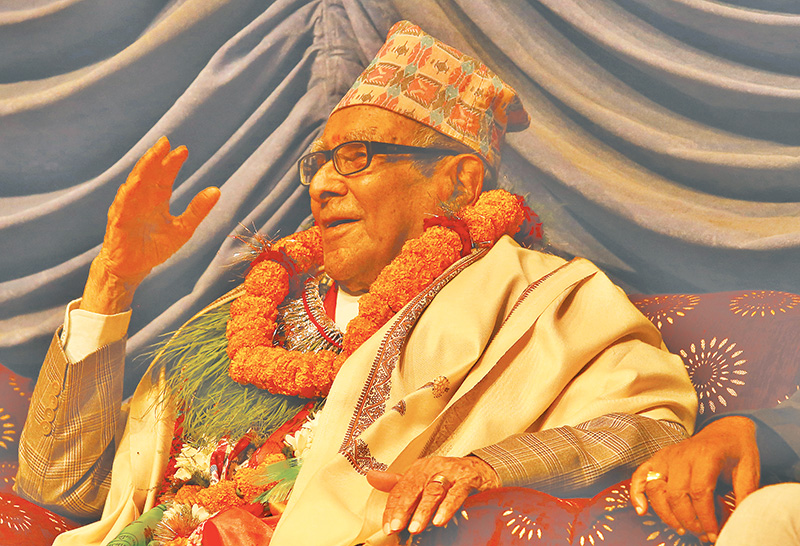
Madhav Prasad Ghimire, the Rastra Kavi, dies at 101

Known for works such as Gauri (epic), Kinnar Kinnari (lyrical anthology), Charu Charcha (essay collection) and Shakuntala (epic), the poet of late was working on Ritambhara.
- Timothy Aryal,SRIZU BAJRACHARYA
Madhav Prasad Ghimire died at his home in Kathmandu on Tuesday. Post file Photo

KATHMANDU,
Madhav Prasad Ghimire, who has died aged 101, was one of the last of the Nepali literary figures from among the older generation. Known as Rastra Kavi, or national poet, Ghimire was also a playwright and essayist.
Ghimire died at his residence in Lainchaur on Tuesday evening.
He is best known for his literary works such as Gauri (epic), Kinnar Kinnari (lyrical anthology), Charu Charcha (essay collection) and Shakuntala, yet another epic.
One of his most popular works is Malati Mangale. The musical drama was first staged in 1985 to widespread national and international acclaim and continues to get staged even today.
“He was a humble and friendly person. His poems are simple and in the meantime deep and evocative,” said Satya Mohan Joshi, the centenarian historian and cultural expert. “His poems carried emotion and values.”
Though he dabbled in plays and essays, Ghimire’s forte was chhanda poetry, a style of rhythmic poetry that has a fixed meter. Perhaps the most iconic of his works is the widely acclaimed Gauri, an epic ode on his late wife.
“He was shattered and grief-stricken when his first wife died and he wrote an eponymous elegy in her remembrance, full of pathos and emotions, which I think people will remember him for,” said Abhi Subedi, a professor of English at Tribhuvan University, poet, playwright and linguist.
Subedi, who is also a columnist for the Post, has translated Ghimire’s works into English.
Ghimire was born on September 23, 1919 at Putsun in Lamjung district. Later, he moved to Durdedada village in Bhimphedi, Makwanpur, to pursue further studies in Sanskrit. As a child, he was very studious, he’s said, and it didn’t take him long to publish his first literary work.
His first literary work, Bairagya Pushpa, was published in the Gorkhapatra daily when he was just 14.
The demise of Ghimire has created “a huge void”, said poet Viplob Pratik, who has published two anthologies of poetry.
“There are various subgenres in Nepali poetry, but the most disciplined of them is the chhanda,” Pratik told the Post. “If one grasps the rules of the chhanda, its meter, one can write a poem. But more often than not, such poems have no soul in them. In our canon, only three or four poets could infuse their chhanda poetry with soul. Ghimire certainly was one of them.”
Among his best known poems are Nepali Hami Rahaula Kaha, Gaauchha Geeta Nepali, Himal Pari Himal Wari, and Baisakh.
In their essence, the poems revolved around the themes of patriotism and the beauty of nature.
An entire generation of Nepalis grew up with the poem Gaauchha Geeta Nepali, which was included in school textbooks, where he talks about Nepal and Nepalis thus:

Gauchha geet Nepali
Jyoti ko pankha uchali
Jaya jaya jaya Nepal
Sundar shanta bishal

According to Subedi, as a poet, Ghimire came from a romantic school of thought and was a contemporary follower of Mahakavi Laxmi Prasad Devkota’s work and he wrote in the same vein as Devkota.
“He has written patriotic poems, poems about the Himalayas, about the love between a man and a woman, and poems for children,” said Subedi. “He was a great classicist of the Sanskrit school of thought and a true poet.”
Cultural expert Joshi, who turned 101 on May 12, is one of Ghimire’s contemporaries.
‘A modern romanticist’ is how Joshi described Ghimire.
“I believe his contribution is on par with the giants in Nepali literature like Bhanubhakta Acharya and Lekhnath Paudyal,” said Joshi.
Ghimire also wrote songs—some of them quite popular, including “Aajai ra raati ke dekkhe sapana mai mari gayeko” (I wonder what a dream I had in the night that I had died).
During his lifetime, Ghimire also held various public positions.
In 1946, he was appointed the editor of the state-owned Gorkhapatra daily. From 1988 to 1990, he served as the chancellor of the Royal Nepal Academy—now known as Nepal Academy.
The title of Rashtra Kavi was conferred on him by the government of Nepal in 2003.
Of late, Ghimire had been working on Ritambhara, which would be his another epic.
“I think the greatest loss for Nepali literature will be not getting to know the last mahakavya (epic poem) Ritambhara that he was working on, or maybe he has completed it,” said Joshi.
In 2018, Ghimire told the Post that he only has to get through the last two cantos of the epic.
“I write if I can, I don’t oblige, or try too hard,” he said. “There’s no point in trying too hard.”
He did not consider living long as a feat.
“If you live long, you also have to be able to give back to society,” he said. “Only then can you die in peace.”

Page 2
NATIONAL

Authorities not keeping track of Covid patients in home isolation

As of Tuesday, 11 individuals have died and 2,232 tested positive for the coronavirus in Province 1.
- DEO NARAYAN SAH
Infected individuals are compelled to stay in home isolation due to the lack of beds in hospitals and isolation centres. Post Photo: deo narayan sah

MORANG,
On August 7, a policeman deployed in Biratnagar tested positive for coronavirus. The same day, he was told by the metropolis’ employees that he would have to stay home, as all the beds in the city’s isolation facility were occupied.
“The person who telephoned me said that I will be taken to an isolation facility after the beds get vacant. But until now, no one from the metropolitan city office has come to take me,” he said.  
According to him, two days after receiving the test result, he developed breathing problems and telephoned the metropolitan city office, which in turn asked him to call another number. But nobody answered it, he said.
“I called that number several times but no one received it. The phone was switched off later on,” he said. “Then I purchased some medicine for cold and cough from a medical shop. My condition is better now.”
Likewise, an individual from Biratnagar Metropolis Ward No.5 said he tested positive for coronavirus on August 7 but nobody from the metropolis contacted him until August 11.
“Four days after I got my result, four employees from the metropolis came to my house to take me to an isolation facility. But I refused to go with them, as I wanted to self-isolate in my own house,” he said. “I was told that I’ll have to fill a form for home isolation. But until now, nobody from the metropolis has come to give me the form nor has anyone contacted me asking about my health condition.”
He added that he has been taking medicines as prescribed by some of his doctor friends.
According to the health standard set for the isolation of Covid-19 patients, health workers of the concerned local units should call or text Covid patients at least twice a day to keep record of their health condition. The health standard also states that Covid-19 patients are allowed to stay in home isolation only if their houses meet the required standard.
The officials of the metropolis should inspect the houses of Covid patients before allowing them to isolate at home. But none of the local units and Covid patients in Morang are following these rules.
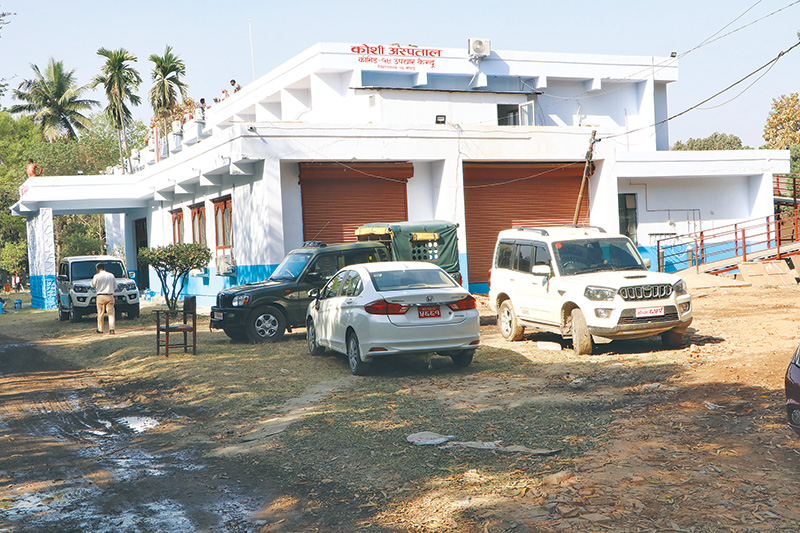
Dr Laxmi Narayan Yadav, spokesperson at Koshi Hospital, said, “The spread of coronavirus will not be contained until the authorities manage and monitor home isolation. It will take no time for the situation to go out of control if the authorities fail to do so.”
Bhim Parajuli, mayor at Biratnagar Metropolis, claimed that a seven-member team of health workers led by Dr Prajwol Khatiwada has been formed to provide health services to Covid patients in home isolation.
“This team is also providing medicines to the patients,” Parajuli said.
The number of Covid-19 cases has been on the rise in Province 1 but the infected individuals have been compelled to stay in home isolation due to lack of beds in hospitals and isolation centres.
When asked about the management of Covid patients in home isolation, Minister of Social Development Jeevan Ghimire said that it’s the responsibility of the local units to keep track of those patients who are isolating at home.
Two-hundred and seventy-five Covid-19 patients are staying in home isolation in Biratnagar Metropolis as of Monday, according to Indramani Pokharel, the chief administrative officer of the metropolis.
According to the data of the Ministry of Social Development in Province 1, 11 individuals have died and 2,232 tested positive for coronavirus in the province as of Tuesday. At present, 505 Covid-19 patients are isolating at home.

NATIONAL

Past 1,000 Covid-19 cases, Kathmandu has no plan on how to handle crisis

Deputy mayor blames mayor for failing to take a timely decision that works.
- ANUP OJHA
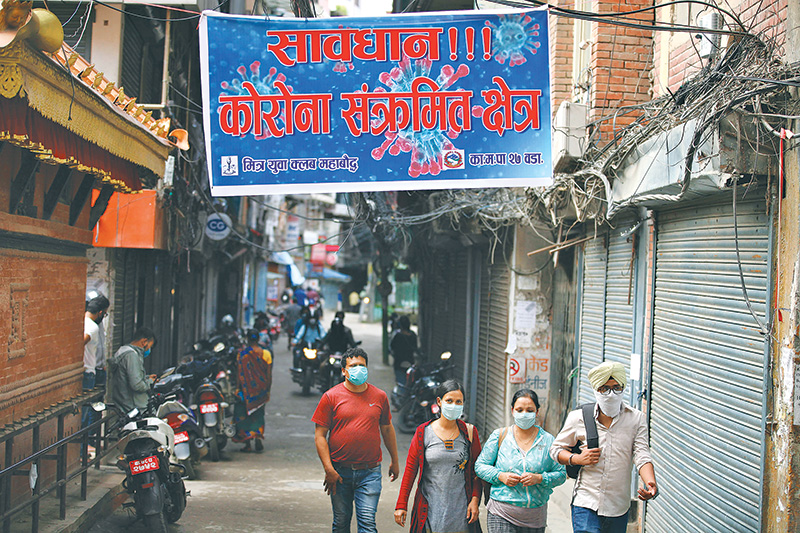
People walk through an area at high risk of coronavirus spread in Mahaboudha, Kathmandu. Post File Photo

KATHMANDU,
The Kathmandu Metropolitan City has become one of the most affected zones in terms of Covid-19 spread in Kathmandu Valley. However, the city does not have a concrete plan to protect its residents and public health workers deployed on the front line.
According to the public health department of the metropolis, the number of infected people reached 1,068 on Monday with six Covid-19 deaths, and the number is steadily rising.
“The city’s health department does not have the capacity [to contain the situation]. There is no back-up plan, but we are taking help from the ward offices,” said Rajeshwor Gyawali, administrative spokesperson for the city.
The municipal public health division has deployed 10 units of health workers, three of them in each unit, for contact tracing in all 32 wards but this is inadequate.
The city does not have a single quarantine facility, nor does it have an isolation centre. According to officials, Kathmandu has an estimated two million residents. In the densely populated Capital, most houses host more than two families and some others over a dozen. In the absence of an isolation centre, there is a high chance of the disease spreading from one infected family to another in the same household.
Kathmandu Mayor Bidya Sundar Shakya blames the movement of people from outside the Valley into the Capital as the main reason for the disease spreading fast here.
It’s not only the responsibility of the metropolis to set up isolation and quarantine facilities in the federal Capital, said Shakya.
When the Post contacted Deputy Mayor Hari Prabha Khadgi, she blamed the mayor’s lack of timely decision and “insensitivity” for the current mess.
“I’ve been telling him to set up a quarantine centre. He should have negotiated with the central government in controlling the flow of people coming from outside the Valley,” said Khadgi. She charged the mayor with staying at home switching off his phone at this critical time.
Gyan Bahadur Oli, the Covid-19 focal person at the municipal public health department, said all the 32 wards of the city have over a dozen positive cases. The situation is getting severe in each ward but there is a limited human resource to deal with it, said Oli.
All health workers from the department have been mobilised seven days a week.
“We are concerned about the possibility of these health workers catching the disease,” Oli said.
Not only public health workers, the sharp rise in infections worries ward representatives about their own chances of being infected.  
“We the ward representatives ourselves are not safe as people call all the time and we need to reach different places,” said Mukunda Risal, the ward-16 chairperson. As of Monday, 47 people were infected in the ward. Risal said the number could have been higher as there has not been adequate testing.
“The situation is bleak here. We do not know how to address this problem,” said Rijal. The city plans to hire health workers to test more people and help in contact tracing after a central meeting on Wednesday.  

NATIONAL

BP Koirala Institute of Health Sciences demands point-of-care diagnostic device for its emergency unit

Health workers deployed at the emergency department are at risk of Covid-19 infection due to a lack of a faster device to test for the virus in patients, hospital officials say.
- Pradeep Menyangbo
Around 150 patients are brought to the emergency department of the hospital daily. Post Photo: pradeep menyangbo 

SUNSARI,
Health workers at the Dharan-based BP Koirala Institute of Health Sciences have demanded for a point-of-care (POC) diagnostic device at the hospital’s emergency ward so that they could triage suspected coronavirus patients from the outset and stop the infection among other patients and staff.
The health workers say they are vulnerable to Covid-19 infections, as the hospital does not have the device that would allow them to determine potential coronavirus infection in patients visiting the hospital for emergency services.
“Patients of different ailments and victims of several accidents are brought to the emergency unit around the clock. The health workers in the emergency ward have to act swiftly to save their lives,” said Prof Dr Gyanendra Malla, the senior emergency specialist at the institute.
“But since we don’t have a Point of Care machine to conduct rapid tests of incoming patients, health workers in the emergency unit and other patients are exposed to the risk of coronavirus.”
As per the health protocol enforced by the government to contain the virus, PCR tests must be conducted on all patients brought to the hospital. The existing Polymerase Chain Reaction machine at the health institute takes at least eight hours to generate Covid-19 test results. But a POC diagnostic device takes only one to one-and-a-half hours to give results, according to health officials.  
“We keep suspected patients of coronavirus in area E of the emergency unit. We provide Personal Protective Equipment to the doctors, nurses and helpers deployed there,” said Malla. “For the health workers mobilised in areas A, B, C and D of the unit, we provide basic health safety materials like surgical masks and gloves.”
According to him, health workers take safety precautions until the PCR test results of the patients are released. “But sometimes we can’t afford to wait for test results since we have to rush critical patients to the operation theatre,” he added. “That is why we need a POC device installed at the emergency unit.”
The hospital’s emergency unit does not have a POC diagnostic device, leaving doctors and other health workers at risk of Covid-19 transmission.
In case a patient is in need of immediate surgery, the emergency unit workers collect the swab sample of the patient and rush to the Provincial Public Health Laboratory in Biratnagar, which is about 55 km away from Dharan.
“It takes around six hours to bring the PCR report from Biratnagar. We can’t wait for six hours when it comes to saving a life,” said Malla. “We had asked the higher authorities to install the device at the hospital some four months ago but we are yet to receive it.”
Around 200 health workers are on duty at the emergency unit of the hospital round the clock.
BPKIHS is a well-facilitated health institution in Province 1 which used to see around 4,000 patients on a daily basis before the lockdown. Of late, around 150 patients are brought to the emergency unit daily, according to Malla.
The OPD of the institute has been closed for the past week for an indefinite period after doctors and other health workers were infected with the coronavirus. According to the laboratory unit at the institute, as many as 15 doctors and health workers at the hospital have tested positive for the coronavirus so far.
Meanwhile, the Provincial Public Health Laboratory has three POC diagnostic devices and an advanced PCR machine recently donated by the Swiss government.
“We need these machines in the lab here as we have to conduct PCR tests of around 1,500 swab samples daily,” said Jayawendra Yadav, director at the provincial laboratory.
When asked about the demand of a POC machine by the BPKIHS, Chief Minister Sherdhan Rai said he had no knowledge about the issue.
“I haven’t been formally informed about the need for a POC machine at BPKIHS. The provincial government is ready to provide the necessary support to address the issue,” said Rai.

Page 3
NATIONAL

Pandemic exposes the country’s economic divide

Lack of adequate public health facilities means those who can’t afford to pay for tests as well as treatment have nowhere to go.
- Arjun Poudel
Every day more than 1,000 people visit Sukraraj Hospital, Teku for tests, but the hospital can test only 300 samples a day, according to officials. Post Photo: Beeju Maharjan

KATHMANDU, 
Rita Bhandari is staying at her home at Imadol, Lalitpur and she is worried. After learning that four of her colleagues tested positive for Covid-19, she, along with one of her friends, tried to get tested for five consecutive days last week. Then they gave up.
“Every day, we had to return disappointed,” said Bhandari.
The first day they were late when they got to the Sukraraj Tropical and Infectious Disease Hospital. The second day they were told to try other hospitals that  collect swabs. The third day they  went to three hospitals, including a private one which asked for a fee of Rs 6,500. On the fourth and the fifth days, they went to Sukraraj Tropical and Infectious Disease Hospital at 5 am to get tokens for tests, distributed on a first- come first-served basis.  
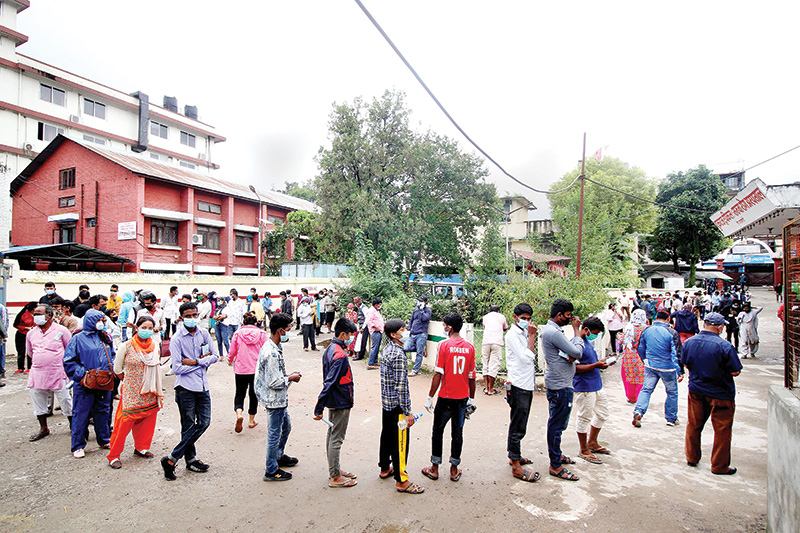
Every day over 1,000 people visit Sukraraj hospital for tests, but the hospital can test only 300 samples in a day, according to officials.
On the fourth day, Bhandari and her friend could not get tokens as others shoved their way through the queue. On the fifth day, there was a melee and police had to disperse the crowd.
“We threw our tickets in front of the doctors and the police and returned home,” Bhandari told the Post. “We would rather die at home than seek a test at the hospital,” said Bhandari.
The Ministry of Health and Population has designated 14 hospitals in Kathmandu Valley—nine public, three  private  and one community-run—for swab sample collection but most of the designated hospitals are not complying with the directives.
The two public hospitals that Bhandari and her friend visited—Paropakar Maternity Hospital and Civil Hospital—turned them back.
There are others who have similar stories to tell. Pradeep Acharya and his wife also went to Sukraraj Tropical and Infectious Disease Hospital last week seeking tests after his brother, a health worker, tested positive for coronavirus. “We turned back fearing that we would get infected at the  hospital,” said Acharya.
The Covid-19 crisis has not only exposed the fragile health care system, but also the economic divide within the society.
“Those who can afford it will pay and get tested, but the poor are being deprived of government facilities,” said Dr Bhagwan Koirala, who has advised the government on ways to tackle the pandemic. “Influential and well-off people are getting tested, which is not good. The government should take the responsibility for everyone, but it should always prioritise the poor.”
In addition to the 300 persons who stand in queue, Sukraraj Tropical and Infectious Disease Hospital has to perform tests of police personnel, employees of courts, and of those recommended by influential people, according to the hospital administration.
“Technicians at the hospitals work extra hours to perform the tests,” Dr Sagar Rajbhandari, director at the hospital told the Post.  
While it used to take five days for results of tests at Sukraraj Tropical and Infectious Disease Hospital it now gives results in a day now.
In private hospitals too they come within a day.  A doctor at a private hospital told the Post that it costs about Rs 60,000 a day to treat a Covid-19 patient and this could go up depending on the complications and the level of treatment. “This includes Rs 30,000 for personal protective equipment (PPE) for doctors and nurses who attend to the patient in three shifts,” he said.
Meanwhile, there are not enough isolation beds in Kathmandu. According to officials at the Epidemiology and Disease Control Division, around 70 percent people who tested positive for coronavirus infection are in home isolation due to lack of isolation beds in hospitals.
According to Ministry of Health, as of  Tuesday 6,752 persons are in institutional isolation while 2,887 are in home isolation across the country. A total of 182 are in intensive care units, of which 52, the highest number, are in Bagmati Province. All of the  eight persons on ventilator support are in Bagmati.
Kathmandu is among five districts with more than 500 active cases—the others being Morang, Parsa, Rautahat and Mahottari.
The government has said that all hospitals must allocate 20 percent of their beds for Covid-19 patients, but that comes with the risk of spreading the infection among health  workers, and therefore other patients in those hospitals.
“We are not in a position to treat Covid patients as chances of  spreading the virus will increase if we have Covid patients at our hospital,” said Kumar Thapa, chairman of Alka Hospital and former president of Association of Private Health Institutions of Nepal.
Private hospitals that have treated Covid-19 patients, meanwhile, say that there is immense pressure on them from influential people to treat them, although they are not authorised to do so.
“We tell the patient’s family to take them to a designated Covid-19 hospital, but they refuse to do so and we get phone calls,” said a doctor at a private hospital.
Decisions were taken to set up isolation beds, intensive care units and procure ventilators and billions of rupees were allocated. But authorities concerned have been scrambling to arrange isolation beds only after a number of cases started to spike.  
“I have been telling officials at the health ministry since the beginning that our health facilities will be overwhelmed soon and we have to be prepared for the worst case scenario,” Koirala told the Post.
It was only earlier this month, more than four months after the government imposed a nationwide lockdown, that the government allowed 14 hospitals in Kathmandu Valley to collect swabs and conduct tests.  
“This shows how serious we are about containing the spread of infection,” Dr Baburam Marasini, former director at the Epidemiology and disease Control Division, told the Post on Tuesday.
“We make an excuse and say we can’t do anything,” an official at the Health Ministry said. “But this is a very good example of the failure of the state. There is no lack of resources,  but we have not been able to arrange beds and equipment.”
Old fault lines  have reappeared and the Covid-19 pandemic has exposed the results of historic “criminal negligence” of the public health sector, experts say.  
“Improving the public health care system has never been a priority of any government including the incumbent government,” Dr Aruna Uprety, public health expert, told the Post.
“Even after the decision to arrange beds, infrastructures, and allocate money, government decisions are not implemented and no one is being held accountable for it. Only those who can afford to pay are getting treatment.”

NATIONAL

Conflict in ruling party hits governance

Ministers busy resolving internal conflicts, officials don’t want to take risks, experts say.
- TIKA R PRADHAN

KATHMANDU,
When the novel coronavirus started to spread across the globe, governments sprung into action. The World Health Organisation on January 30 declared the outbreak a health emergency.
The first case was reported in Nepal in January. It was during that time the ruling Nepal Communist Party was embroiled in a conflict over the selection of House Speaker.
Two days after the first confirmed case of Covid-19 in Nepal, Agni Sapkota was elected Speaker after weeks-long tug of war between party chairs KP Sharma Oli, also the prime minister, and Pushpa Kamal Dahal. Immediately after, the party held its Central Committee meeting, which was overshadowed by disputes over the Millenium Challenge Corporation.
On March 4, Oli underwent his second kidney transplant. A day earlier, the government formed a high-level committee to fight Covid-19. Oli got hospitalised but he did not appoint an officiating prime minister, raising concerns over how the government would respond in case of a virus spread. Oli had a successful kidney transplant. The country escaped virus spread. When infections were soaring in various countries, the government imposed a nationwide lockdown on March 24. Nepal had reported just two Covid-19 cases.
Public health experts have long argued that the government failed to utilise the lockdown period for preparations to fight the pandemic. During the lockdown, the ruling party, instead, was in the midst of a conflict over Oli’s resignation.
Minister for Labour, Employment and Social Security Rameswor Raya Yadav agreed that the government couldn’t properly focus on combating Covid-19.
“Due to the uncertain situation following the internal wrangling in the party, we could not focus on combating Covid-19 with high self-confidence,” he told the Post.
Analysts say at a time when countries across the world were employing their medical wherewithal and political will to fight the virus, in Nepal, the ruling party was engaged in infighting.
“If there is a conflict within the party that is governing the country, governance tends to get seriously affected,” said Bimal Koirala, a former chief secretary. “Bureaucrats don’t want to take risks by making decisions when the political situation is fluid.”
The lockdown was lifted on July 21–by that time the number of Covid-19 cases in the country had crossed the 17,000 mark.
 The country today has over 28,257 Covid-19 cases, with 114 deaths.
While the government had a lethargic response to the pandemic, corruption cases emerged, making matters worse. The prime minister continued to make light of the virus threat–at times saying Covid-19 is not killing people in Nepal while other times he encouraged people to drink water with turmeric.
In June-end, when the country reported a sudden spike in Covid-19 cases, a faction in the ruling party was baying for Oli’s blood, demanding his resignation.
As the Dahal faction upped the ante, Oli, along with his ministers, was busy planning ways to resist pressure to resign.  
“The Oli-led government completely lost the plot when it came to fighting the pandemic,” said Shyam Shrestha, a political analyst. “The internal conflict in the party led to knee-jerk actions rather than studied decisions.”
According to Shrestha, corruption cases with allegations that even health and defence ministers were involved exposed the Oli administration’s poor governance.
After corruption cases were reported, the Cabinet on March 29 decided to purchase medical equipment to fight the virus under a government-to-government deal.  The army was roped in. But it took months for the equipment to arrive.
Meanwhile, Nepalis in large numbers from India started to return home. Since the borders were sealed, they were stranded on the other side of the border. Desperate to enter home, many used alternate routes to enter. Quarantine facilities set up near border areas by the government were so poor that experts doubted if they could help contain the virus.
As internal conflict grew in the party, Oli on April 20 introduced two ordinances–one related to party split and registration of a new party–aiming to use it as a weapon to tackle his opponents in the party. After much criticism that the ordinances were uncalled for at a time when the government should have been fighting the pandemic, Oli decided to withdraw them within five days.
On April 29, party leaders demanded Oli’s resignation at the Secretariat meeting. In May, the Oli government’s focus shifted to border issues with India after the latter inaugurated a road link via Lipulekh to Kailash Mansarovar in the Tibet Autonomous Region of China.
As Covid-19 cases continued to rise, Oli found refuge in a new Nepali political map. The decision to publish a new map and subsequently get endorsed by Parliament drew huge support from parties across the spectrum. Parliament approved the map depicting Kalapani, Lipulekh and Limpiyadhura as Nepali territories on June 13.
The Oli government then sat on the laurels of publishing the new map, as virus cases showed no signs of abating. The conflict in the ruling party also escalated and on June 29, the party’s Standing Committee convened, with around 30 members once again demanding Oli’s resignation both as party chair and prime minister. A Cabinet minister, who represents the opposition faction in the party, conceded that the party’s internal conflict hugely affected the works of the ministries.
“It’s obvious. We all know the nature of our society, bureaucracy and culture,” the minister told the Post who spoke on condition of anonymity fearing reprisal.
The minister did not elaborate.
“Nepali bureaucrats are highly politicised,” said Koirala, the former chief secretary. “Instead of taking decisions and implementing policies they are more interested in pleasing political leaders. Even ministers can’t decide with their positions insecure.”
Many of the ministers, including Deputy Prime Minister Ishwor Pokhrel, Home Minister Ram Bahadur Thapa, Energy Minister Barshaman Pun, Foreign Minister Pradeep Gyawali, Agriculture Minister Ghanashyam Bhusal, Tourism Minister Yogesh Bhattarai, Health Minister Bhanubhakta Dhakal and Forest Minister Shakti Basnet were engaged in various meetings to manage the party conflict. All these ministers, except Dhakal, are Standing Committee members of the party.
“The internal conflict in the ruling party made the positions of the prime minister and other ministers tenuous. How could we expect them to focus on governance?” said Rajendra Maharjan, a political commentator.
“The government should have used all its might to fight the pandemic, which did not happen due to the ruling party’s misplaced priorities.”

NATIONAL

Many avoid tests due to Covid-related stigma

- SHUVAM DHUNGANA

KATHMANDU,
Global health experts and the scientific community have been strongly endorsing tests and contact tracing as vital tools to containing the coronavirus pandemic. But for many people in Nepal, it seems, coming forward for tests is far scarier than actually catching the virus that causes Covid-19. This is due to the fear of social stigma and harassment that infected individuals and their relatives face in our society, public health experts say.
On August 15, Madhyapur Thimi Municipality in Bhaktapur was sealed off for 10 days after nine people in the area tested positive for coronavirus infection.
Rajkumar, who wished to be identified only by his first name, says he does not want to get tested even though he had come in contact with one of the infected persons.  
“One of the persons who got infected was my neighbour, but I do not want to go for a test. If I tested positive, my whole family would be kept in quarantine. Moreover, my family will be boycotted by the community,” Rajkumar shared his fear with the Post.
Rajkumar says he has seen people avoiding the family of infected people in his neighbourhood and he does not want to bring upon the same situation to his family.  
“This society will shun the people even if they got tested and their results came back negative,” said Rajkumar, who so far has no symptoms associated with Covid-19.  
Like Rajkumar many people have been avoiding tests for fear of being ostracised. Sunil Prajapati, the mayor of Bhaktapur Metropolitan City, says test and contact tracing have become difficult as a result of the stigma that has been attached to Covid-19.
He recalled a recent incident where an infected individual in the city had tried to hide his condition fearing that his landlord would not allow him into the house he’d been living in.
“The person had come from outside the Valley and he was tested in Thankot. After his test result came positive, we have placed him in quarantine in Kharipati. He does not want his landlord and his neighbours to know about his condition because he fears that he would be ostracised even after he has recovered,” Prajapati told the Post.    
Public health experts working in the front line say fear of social stigma and ostracism faced by patients and their families have become a major deterrent to the fight against Covid-19.
“The primary contacts of infected individuals just do not want to get tested,” said Dr Anup Bastola, the spokesperson for Sukraraj Tropical and Infectious Disease Hospital in Teku, Kathmandu. “We also get many calls from patients about the humiliation they suffered even after recovering,” said Bastola.
So far, Kathmandu Valley has reported 2,339 Covid-19 cases; 205 cases were reported on Tuesday alone.The national Covid-19 tally has reached  28, 257 with 114 deaths.
Dr Basudev Karki, psychiatrist at Mental Hospital in Patan, says social media has also led to the environment of fear and stigma.
“Instead of taking precautions, people are pouring their hatred on infected persons and their families. They don’t seem to understand that coronavirus can infect any of us,” Karki told the Post.
“It is the job of the government and other concerned agencies to educate the people. The government needs to engage social groups and NGOs to address the problem of social stigma.”

NATIONAL

Two more bodies recovered

Briefing
- Post Report

SINDHUPALCHOK: Rescuers recovered two more bodies from the landslide debris in Lidi village in Sindhupalchok on Tuesday. With this, a total of 24 bodies have been retrieved so far while 15 villagers remain missing. Police identified the freshly recovered bodies of Shirmai Dong, 72, and Dhanalaxmi Dong, 87. The massive landslide that struck Lidi village in Jugal Rural Municipality on Friday had destroyed 17 houses and damaged 37 others. The landslide displaced 135 families in the village. Officials said search for the missing is on.

NATIONAL

Prohibitory order imposed

Briefing
- Post Report

POKHARA: The District Administration Office in Kaski has imposed a prohibitory order for five days effective from Tuesday midnight. As per the decision, transportation, financial institutions, market places will be closed until Sunday. The local administration allowed shops selling foods, fruits, vegetables, dairy products and meat to open from 5 to 8 in the morning and 5 to 7 in the evening. Similarly, the prohibitory order has been imposed in Baglung district headquarters for a week starting from Tuesday midnight. The order was imposed following a spike in the number of Covid-19 cases in the district.

NATIONAL

Lockdown for 10 days

Briefing
- Post Report

SANKHUWASABHA: The Covid-19 Crisis Management Committee in Sankhuwasabha has decided to reimpose lockdown for 10 days starting from Tuesday midnight. Jeevan Prasad Acharya, the chief district officer, said all services except essential ones have been shut down in the district. “The committee took the decision after three individuals tested positive for coronavirus on Tuesday alone,” said Acharya.

NATIONAL

Poisonous mushroom kills 2

Briefing
- Post Report

PYUTHAN: Two persons of the same family died after consuming poisonous wild mushrooms in Naubahini Rural Municipality, Pyuthan on Monday. According to the police, two brothers—aged 13 and 15— died and three other members of the family are undergoing treatment at Bijuwar-based district hospital, said DSP Narendra Kumar Karki.

Page 4
EDITORIAL

Looking through ‘iron gate’

The anxiety around SEE this year should force a rethink of Nepal’s educational evaluation system.

The Secondary Education Examination (SEE) 2020 batch deserves a big round of applause not just for having crossed the hurdle they have come to know as an ‘iron gate’ but also for having endured months of uncertainty about their futures. After all, the exams had been postponed just a day before the teenagers were to sit for them, leaving them aghast at the way the government functioned. It takes considerable grit to go back to reading the same old textbooks amid mystery and misinformation in the face of a pandemic.
When the government announced that SEE would be cancelled, and the students graded on the basis of their schools’ internal assessments, it was considered the best way out of the imbroglio. The arrangement put the onus of honesty on the teachers, who are adept at imparting moral lessons on students. So when on Monday over 9,000 students were found to have passed the SEE 2020 with a GPA of 4.0—as compared to just over a hundred students in the previous year—all eyes were on the schools and the teachers that had the metaphorical ladle and spoon in their hands.
The dramatic rise in the number of high GPA points to a possible generosity on the part of the teachers rather than a qualitative improvement on the part of the students. After all, the commercialisation of education means that schools that are the most competitive stand to achieve the most in terms of capital accumulation. If a calf disappears the night a leopard roared in the jungle nearby, the latter becomes the natural suspect.
It turns out that a fundamental mistake had been committed while leaving the entire authority of grading in the hands of the schools. The district education offices could have been brought into action as focal institutions to keep tabs on the proceedings as well as act a check-and-balance mechanism. Why the roles of the education offices had been overlooked remains a big question. But a bigger question is whether a one-off exam at the end of an academic year helps evaluate the learning of students.
This year’s SEE assessment might have been a mess, but it points to a larger problem—of considering one final exam at the end of an academic year as the arbitrary marker of the performance of a student throughout that year. SEE has become just another avatar of what it attempted to replace—the School Leaving Certificate (SLC). When SEE was introduced, and the percentage system replaced by the grading one, the idea was to downplay the reputation of the SLC exam as an iron gate. It was supposed to be a routine exam that would keep students girded to the learning process. But that was not to be.
Since the new education policy does not envision the 10th standard as a terminal degree, there is valid explanation as to why SEE still remains a matter of life and death for students. Although there is no imagining an education system without grading as yet, the grading system can at least be systematically revamped so as to adapt to the changes in the world of information, communication and education. The anxiety that gripped the students, guardians, teachers and other stakeholders for months during these abnormal times should encourage us to question the significance of SEE and force a rethink of the educational evaluation system itself.

OPINION

Pathology of an ultranationalist regime

Populism is enough to ensure stability in a country that takes pride in being an insecure nation-state.
- CK LAL
Shutterstock

On February 15, 2018, KP Sharma Oli became the first elected prime minister under the controversial constitution of Nepal. Halfway through his term, he has failed to show that he deserves the office.
When he got into Baluwatar, Supremo Oli nearly commanded the magical two-thirds majority in Parliament. A significant section of the main opposition party identified more with the ethnonational chieftain than with its own politicos. Acutely aware of the ground reality, the leader of the opposition and the president of Nepali Congress had chosen to become a collaborator rather than a challenger of the government.
The Oliar media and intelligentsia had accepted the offer of embedment with the regime and discarded its duty of telling truth to power or holding authority to account. The international community had accepted the fait accompli with neither the will nor the power to loosen the Dragon’s embrace upon the regime in Kathmandu.
Premier Girija Prasad Koirala had exercised the authority of the head of the state as well as the government in the aftermath of Rhododendron Revolution of 2006, but he had lacked the backing of the permanent establishment. The ruling elite of Kathmandu tolerated the political authority of the Koiralas from Morang, but consistently denied socio-cultural legitimacy upon the clan.
When Oli began his current term as prime minister, he was said to be the most powerful head of government since king Mahendra, who had chaired the Council of Ministers for a while after the royal-military coup in December 1960. Had he desired, he could have easily put the cart of governance on the dirt road to social justice, economic equity, political equality and diplomatic dignity. He chose instead to cultivate his constituency of ultranationalists. The inevitable outcome is for all to see.
The economy is in a tailspin. With the promised constitutional amendment in limbo, the Madhes-Pahad divide has deepened; the social discord has intensified. Politics is trapped in the quicksand of intraparty feuds of the ruling dispensation. The government has failed to handle the Covid-19 pandemic in a sensitive or sensible, let alone responsive and responsible,
manner.
Despite close adherence of the ruling regime to Xi Jinping Thought, the country has seldom been so alone in the comity of nations. Even Venezuela and North Korea are yet to formally recognise the cartographic demonstration of Nepal’s sovereignty over an area outside its political control. Failure on all fronts should have made the Supremo reflect, but he continues to confuse his detractors with diversionary tactics.
 

Democracy taking a nap
In an evaluation of the prevalent stasis, the Janata Samajbadi Party Nepal (JSP) was perhaps correct in its assessment in early August that Oli was ‘very weak, physically and mentally’. The former part of the scrutiny is a fact—the Supremo had a second kidney transplant just a few months ago. The later description about the mental condition is somewhat circumstantial but no less convincing in view of his public utterances.
Instead of using the criticism for course correction, the ruling regime unleashed its apologists in the ‘asocial’ media to mount a counter-attack from the flanks upon JSP leader Baburam Bhattarai. However, what the third biggest political group in Parliament seems to have chosen to ignore is the fact that there is a considered method in the apparent madness of the prime minister. The core constituency of the ruling regime is quite happy with a head of government that occasionally wakes up from a slumber and takes a potshot at imagined enemies.
These days, the idea of democratic deficit is all the rage among political pundits. It’s easy to reel off prominent names that have been emitting the malodorous gas of decomposing democracies—Bolsonaro, Duterte, Erdogan, Modi, Orbán and Trump are just a few notable examples. Supremo Oli is a progenitor as well as product of the ideological drift (change in the power of ideas from overuse and novel context) that swept the world after the financial crisis in 2008 and subsequent popularity of contextualised populism.
Karl Marx famously said that mode of production of material life conditioned the general process of social, political and intellectual life. Supremo Sharma Oli may not be a scholar in the academic sense of the term, but over a dozen years of prison time that he served till the 1980s has made him a keen observer of the absurdities of social reality in Nepal.
When the Marxist formulation is applied to a country where production of material life is almost entirely dependent upon subsistence agriculture and export of unskilled labour, it becomes relatively easy to identify the compulsions of the political economy. Consumers are content as long as the comprador bourgeoisie keeps the market amply supplied.
Voters want to be assuaged that their country is superior to all others in distinctive ways. Claims over the evolution of prince Siddhartha into the Buddha, sovereign control upon Mt Everest and the vacuous assertions of never having been colonised—even though the populace remained a serf of the loyal servants of its British masters for over a century—are some useful fictions when manufacturing national hubris.
Demagogic populism is enough to ensure political stability in a country that takes pride in being an insecure nation-state rather than a confident state of multiple nations. All that the practice of democracy requires then is that the periodic elections be held to produce a chieftain. The elected leader of the dominant ethnicity can then keep playing upon the fears of the majority that their primacy is in constant danger from ‘others’ inside and outside its territory.
 

Exit route
In its essence, populism entails the politics of hope that the future is going to be better than the present. This is what the Maoists practised for a while in the early noughties when they promised a republican polity. Demagoguery is plain fear-mongering—something intrinsic to the nationalist rhetoric of the lapsed Marxists-Leninists and former Panchayat supporters. Put together, demagogic populism produces a regime that’s dysfunctional due to its innate contradictions—doubt is inherent to demagoguery while hopes can’t be realised without creating trust.
Despite assurances of idealists, democracies don’t always produce responsible regimes. President Trump has been partially successful in transforming the most powerful country on the planet into a banana republic. He may ultimately lose the forthcoming polls, but he remains in the presidential race.
It will take years for the Indian economy to recover from Prime Minister Narendra Modi’s ill-thought demonetisation shock. His mishandling of the Covid-19 challenge has shaken the very core of Indian society. And yet, he commands an unprecedented 78 percent approval rating in his country. Such being the state of the state in the oldest and largest democracies of the world, it’s pointless to worry too much about the ethnonational fiefdom of Supremo Oli.
Somewhat like a drug-induced high, demagoguery is the pathology of democracy that causes an incurable addiction to the rhetoric of the leader. Treatment requires persistent effort and relapses are common. Supremo Oli is the symptom rather than the cause of the epidemic of populism.
It’s time for practitioners of alternative politics to reflect and prepare, rather than whine and despair. As Peter Seeger intones optimistically, ‘we shall overcome, someday’.

OPINION

Menstruation or period?

The taboo, stigma and restrictions associated with menstruation have been passed on to modern times.
- RADHA PAUDEL
Shutterstock

I often wonder why people these days use the word ‘period’ instead of saying ‘menstruation’ directly. Is it because of the taboo and stigma around menstruation or its meaning as a cyclical phenomenon? Various reports have claimed that menstrual blood is considered to be dirty and contaminated, thus the imposition of restrictions to maintain discipline in the community during the Greek and Roman eras. More or less the same understanding was observed during the Renaissance era where menstrual blood was thought to be embedded with toxins. The taboo, stigma and restrictions associated with menstruation have been continuously passed on to modern times.
Menstruation appeared in public discourse when Julia Ward Howe was questioned about continuing her high school due to restrictions on horse riding in 1874 during the days of the first wave of feminism.

Silent feature
The second wave of feminism emerged since the publication of the book Our Bodies, Ourselves in 1973 where the focus was on pregnancy, childbirth, abortion and contraception. But the topic of menstruation remained a silent feature until the third wave of feminism. Menstruation goes hand in hand with the discourse on pregnancy, childbirth, abortion and contraception, but nowhere is it mentioned explicitly. This is one of the key questions for sexual and reproductive health today. Under the sexual and reproductive health comprehensive package, menstrual health was not included as an independent element. It was put under adolescent health. Therefore, the essence of menstruation and it’s wider and deeper impact on society remained undiscussed.
In this connection, the use of the word period is also a kind of escape from using menstruation directly due to taboo or shyness. The nicknames vary from culture to culture or society to society though there is one commonality of taboo or stigma. Thus societies do not have the confidence to acknowledge the natural phenomenon yet.
There are other words which indirectly refer to menstruation. In many circumstances, the word sanitary pad is popular instead of menstrual pad. But the word doesn’t really fit—the menstrual pad is not used to clean blood from cuts or nose bleeds.
Neither is it used as a cleaner or sanitiser. It is sanitary, but then again so are sterilised cotton gauzes used to make bandages. Besides calling the cup which is used for managing
menstrual blood as a menstrual cup, other products also need to be associated with the term menstruation directly.
There is no point in being shy while talking about menstruation. Keeping the definition of dignified menstruation in mind, using nicknames, alternative names or other words is also playing a role to establish a state of dehumanisation. It is also a barrier to dignity during menstruation. In association with such taboos and stigmas, often restrictions are created. Shopkeepers sell menstrual pads by wrapping them in newspapers or putting them in black plastic bags. Indeed, the pharmacist is trying to respect societal norms, but in doing so is fuelling the stigma.
In the UK, a menstrual campaign called period poverty was launched, and it was appreciated globally by many menstruators. But, again, it has positive and negative connotations—taboo for menstruation and layering of people with regard to class or financial viability where their dignity is compromised in the long term and will continue from year to year for many more years.

Significant year
The year 2018 was a significant year for menstruation from the perspective of awareness through arts and entertainment. The Bollywood movie ‘Pad Man’ brought an open discourse on the societal restrictions surrounding menstruation in South Asia. ‘Period. End Of Sentence.’, an Oscar-winning documentary, also had a significant symbolic role to break the silence around menstruation. However, using the word menstruation in the title of these films would have given the public confidence to use the word without any hesitation.
Acknowledgement is very important to construct and cultivate the culture of power and shape. Menstruation is constructed by nature, and like we use the words mouth and nose to refer to these organs, we should use the direct name which helps to build an emotional attachment with the body and process and acknowledge the essence of menstruation, while respecting all menstruators (among non-menstruators). It is red menstrual blood that helps humanity move forward in time, and everyone deserves dignity during menstruation.


Paudel is founder and president of Action Works Nepal, an NGO.

Page 5
MONEY

India urges auto firms to cut royalties to foreign parents, say sources

- REUTERS

NEW DELHI, 
India’s commerce minister has asked automakers to find ways to reduce royalty payments to foreign parent companies for use of technology or brand names, two sources told Reuters, in an effort to boost local investment and reduce outflows.
In India’s competitive auto market, top-selling carmakers Maruti Suzuki and Hyundai Motor’s local unit pay millions of dollars in royalties to parent companies in Japan and South Korean for using their technology and brand to build and sell cars.
The minister, Piyush Goyal, in a meeting last week asked officials from groups representing carmakers and auto parts manufacturers to review such payments with a view to reducing them, said people with direct knowledge of the discussions.
“The concern raised during the meeting was that the outflow is high, even for old technologies, and something should be done about it,” said one of the sources.
The sources declined to be named as the talks are private. The ministry did not respond to a request for comment.
India, for years, has debated imposing stricter caps on royalty payments which spiked after 2009 when foreign investment rules were eased and restrictions on such payments were removed.
The country’s markets regulator last year suggested imposing curbs on payments exceeding 2 percent of revenue. The limit was finally set at 5 percent after complaints from some sectors and fears it may dissuade foreign firms from investing or sharing technology.
Recently however, Indian Prime Minister Narendra Modi’s government has made a renewed push to make the country a major manufacturing hub by encouraging domestic production and curbing imports. It also wants to increase local investment and reduce foreign outflows.

MONEY

Budget for interest rate subsidies remains unspent as demand for loans shrinks

Government also provides interest subsidies for credit extended under the Youth Self-Employment Programme.
- PRITHVI MAN SHRESTHA

KATHMANDU,
Only 22 percent of the funds earmarked for interest rate subsidies was spent in the last fiscal year, as there were few takers for loans with the country in the midst of the Covid-19 pandemic, Finance Ministry officials said.
The government had allocated Rs5 billion for providing subsidised loans to targeted groups in the areas of agriculture, livestock and other income generating activities in fiscal 2019-20, but only Rs1.1 billion of this amount was spent.
Under the concessional loan scheme, the government subsidy covers 5 percentage points of the interest rate charged by banks and financial institutions. The government also provides interest subsidies for credit extended to youths under the Youth Self-Employment Programme.
“Low spending of the budget for interest subsidy could be due to sluggish lending in the last fiscal year due to the Covid-19 pandemic,” said Jhakka Acharya, chief of the financial sector coordination division at the Finance Ministry. “The interest subsidy is spent based on how much credit has been extended.”
Demand for loans decreased sharply during the lockdown, according to the central bank. Credit to the private sector fell to Rs13 billion during the period mid-April to mid-May from Rs15 billion in the same period last year. Lending shrank to Rs10 billion during the period mid-May to mid-June this year from Rs24.8 billion in the same period last year.
According to Acharya, there was hardly any demand for funds for interest rate subsidies after the stay-home order was imposed on March 24, which lasted till July 21. In the early months of the last fiscal year, the working procedure for concessional loans was revised which also delayed lending in the last fiscal year, according to Acharya. The government launched the scheme in the fiscal year 2018-19.
The central bank said that Covid-19 did not have a big impact on concessional loans because they are increasing despite the lockdown. According to Nepal Rastra Bank, outstanding concessional loans as of mid-June in the last fiscal year stood at Rs51.47 billion. There are 23,318 borrowers of such loans.
“The amount is expected to reach close to Rs60 billion at the end of the last fiscal year,” said Gunakar Bhatta, spokesperson for the central bank.
Outstanding concessional credit at the end of fiscal 2018-19 was around Rs33 billion. “So the rise in such credit has remained good,” said Bhatta. “What is sure is that more loans could have been extended under this scheme if it weren’t for Covid-19.”
According to Bhatta, most of the budget allocated for interest rate subsidies might not have been spent in the last fiscal year because potential borrowers were immobilised by the pandemic.
Given the impact of the pandemic on several sectors, the central bank plans to expand the flow of credit under this scheme. To this end, the central bank has directed each commercial bank to provide at least 500 such loans while each development bank has been told to provide at least 300 loans under this scheme during the current fiscal year. Each finance company is required to issue at least 100 loans by mid-July next year.
The Finance Ministry is preparing to expand the use of concessional loans by amending the working procedure. “We have added eight to 10 sectors to the list of eligible applicants for these low-cost loans,” said Acharya. “Some of the new sectors are dairy, poultry and farm machinery.” According to Acharya, the proposal has been sent to the Law Ministry for its feedback. “After receiving the opinion of the Law Ministry, we will send the revised draft of the working procedure to the cabinet for approval,” he said.

MONEY

Covid-19 forces Malaysian palm industry to rethink reliance on foreign labour

- REUTERS

KUALA LUMPUR, 
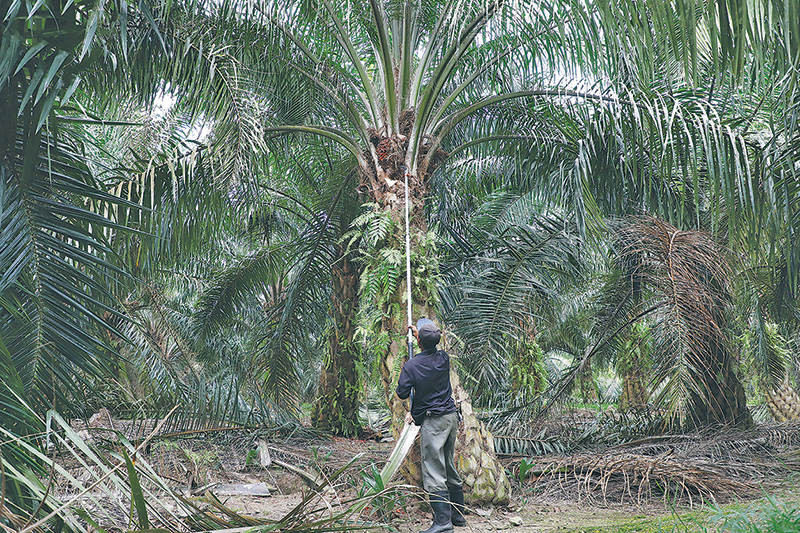
Malaysia’s palm oil producers are embarking on a rare recruitment drive to hire locals and accelerating industry mechanisation as they
grapple with a severe shortage of foreign labour due to the coronavirus pandemic.
As the September-November peak production season approaches, companies are erecting banners near plantations and posting online job advertisements boasting free housing, free water and other perks of estate life in a bid to lure workers to do everything from driving tractors to harvesting.
Already, travel and movement restrictions have left the world’s second-largest palm oil producer grappling with a shortage of 37,000 workers, nearly 10 percent of the total workforce. The Malaysian Palm Oil Association (MPOA) believes this could blow out to 70,000 workers once borders reopen.
“This is the first time we are making such a big effort to hire Malaysians, but it is also the first time we are facing Covid-19,” Imran, an estate manager with Sime Darby Plantation, told Reuters after interviewing potential applicants at a recruitment day near Kuala Lumpur. The industry fears the labour crunch will hurt palm oil production this year by delaying the harvest of perishable fruit, giving an edge to bigger rival Indonesia which has no such labour problems.
Malaysia’s average cost of production is already slightly higher at about $406-$480 a tonne, according to analysts, compared with Indonesia at $400-$450 a tonne. Countries like Indonesia and Bangladesh provide nearly 85 percent of plantation workers for palm companies such as Sime Darby, IOI Corp and United Plantations.
While employing more Malaysians could save on recruitment fees and levies needed to fly in foreign workers, planters worry that local workers, who typically shun plantation work as dirty and dangerous, won’t commit to the industry or take on the most difficult jobs.
“It’s possible that recruiting more locals could bring down the cost of production, but provided these locals are also as productive as them [migrant workers],” said MPOA chief executive Nageeb Wahab. “That is a big question mark.”
Despite a rising unemployment rate, Imran said most of the interest at the recruitment day was for general duties, such as driver or mechanic, rather than the taxing and crucial task of harvesting.

MONEY

Gold climbs back above $2,000/oz level

- REUTERS

NEW YORK,
Gold rose more than 1 percent on Tuesday to climb back above the $2,000 level breached earlier this month, as the dollar hit a more than two-year low and investors awaited details
of the US Federal Reserve’s strategy to combat a pandemic-induced economic slump.
Spot gold was up 1 percent at $2,005.04 per ounce by 1158 GMT, having earlier hit a one-week peak of $2,009.89. Gold first broke the record $2,000-level early in August, reaching an all-time high of $2,072.50.
US gold futures were up 0.8 percent at $2,014.40.
“It’s really is about the return or the perception of a return,” Michael Hewson, chief market analyst at CMC Markets UK, said. “The dollar has lost its attraction when it comes to return now relative to two years ago.”
Making gold cheaper for those holding other currencies, the dollar index hit its lowest since May 2018, pressured by low yields and bleak US economic data.
On Monday, gold jumped as much as 2.4 percent, drawing impetus from Warren Buffett’s Berkshire Hathaway buying a stake in major gold miner Barrick Gold.
This reinforced gold’s 32 percent surge this year, helped by a rush to perceived safety in the metal considered a hedge against inflation and currency debasement.
Gold, with its reputation for relative safety, is also drawing investors as the United States ratchets up pressure on China’s Huawei, CMC’s Hewson said. For further direction, investors are awaiting minutes from the Fed’s last meeting, which are due on Wednesday.
“Traders are getting the last kick at the can ahead of the FOMC minutes, where the view is for the Fed to have talked about YCC (yields curve control) or inflation-targeting, which is bad for the dollar and good for gold,” said Stephen Innes, chief market strategist at financial services firm AxiCorp.
Silver climbed 2.4 percent to $28.05 per ounce.
Platinum rose 1.1 percent to $960.06 per ounce, while palladium eased 0.2 percent to $2,195.18.

MONEY

China considers imposing tariffs on Australian wine

- ASSOCIATED PRESS
Shelves displaying wines are pictured at a supermarket in Shanghai, China. REUTERS

CANBERRA (Australia),
China on Tuesday began investigating whether Australia is dumping wine in a trade dispute that further strains relations between the countries and could shut the biggest export market for Australian wine.
The Chinese Ministry of Commerce said the anti-dumping investigation involved wine in containers of 2 litres (68 fluid ounces) or smaller imported from Australia from Tuesday.
The Australian government denied subsidizing exporters.
“We do find this deeply troubling, concerning and perplexing given Australia’s wine industry is not subsidized to export and it’s certainly not dumping product on the world market,” Trade Minister Simon Birmingham said. “Now it’s for China and Beijing to explain the rationale behind these actions and why they have moved to that stage of an investigation.”
China’s only other anti-dumping investigation of Australian products effectively closed the China market to Australian barley in May through crippling tariffs. Australia is appealing that decision. The investigation of Australian wine exports, which made 1.1 billion Australian dollars ($795 million) from the Chinese market last year, could take between a year and 18 months.
Birmingham said he hopes China will not impose interim trade measures during the investigation.
China’s decision to shut out Australian barley a week after it banned beef exports from Australia’s four largest abattoirs over labelling issues has been linked to Australian calls for an independent investigation into the source of the coronavirus as well as responses to the pandemic.
Chinese Ambassador to Australia Cheng Jingye warned in an Australian newspaper interview in April that Australian wine could be targeted in a Chinese consumer boycott if the government persisted with its call for a coronavirus inquiry. Asked if the wine investigation was a political tactic, Birmingham told reporters, “That’s really a question for China.”
“Our hope and expectation is that these matters should be considered and addressed on their merits and that means that Beijing and Chinese authorities should look at the evidence,” Birmingham said.
Graeme Shaw, owner of Shaw Wines outside Canberra, said Chinese tariffs would have a considerable effect on large Australian wine producers.
“I think the industry should have been expecting something from the comments from the Chinese ambassador,” Shaw told Nine Network television news.
Weihuan Zhou, a University of New South Wales international trade expert, suspected the wine probe was part of separate, decade-long trade dispute between the countries over anti-dumping rules, particularly over Australia’s allegations of Chinese dumping of steel products. Bilateral relations had shown improvement since the pandemic after Australia distanced itself from US security concerns over popular Chinese apps TikTok and WeChat, Zhou said.
“I don’t think it’s part of the previous political fight between Australia and China” over the coronavirus, Zhou said. “There have been positive signs of political improvement of the bilateral relationship.”
Shares in Australian wine exporter Treasury Wine Estates plunged as much as 17 percent on the Australian stock market on Tuesday on news of the Chinese investigation.
The Melbourne-based company reported to the Australian Securities Exchange in 2018 that it was one of several Australian wine exporters experiencing delays in getting wine through Chinese customs.
The company said in a statement to the exchange on Tuesday that it will “cooperate with any requests that we receive for information from Chinese or Australian authorities.”
Birmingham said Australian wine was the most expensive on the Chinese market after New Zealand wine. He said he had been unable to speak to his Chinese counterpart about the mounting trade disputes since last year.
“Australia is certainly not engaging in any type of war,” he said.
Australia has had a free-trade deal with China, its biggest export market, since 2015. Australia is regarded by some as the Western country most susceptible to Chinese economic pressure because of their close economic ties. Zhou said he had long doubted that China would target Australian wine in its diplomatic dispute with Australia because Chinese investors would be harmed.

Page 6
WORLD

Coronavirus pandemic now driven by younger adults: WHO

- REUTERS,ASSOCIATED PRESS
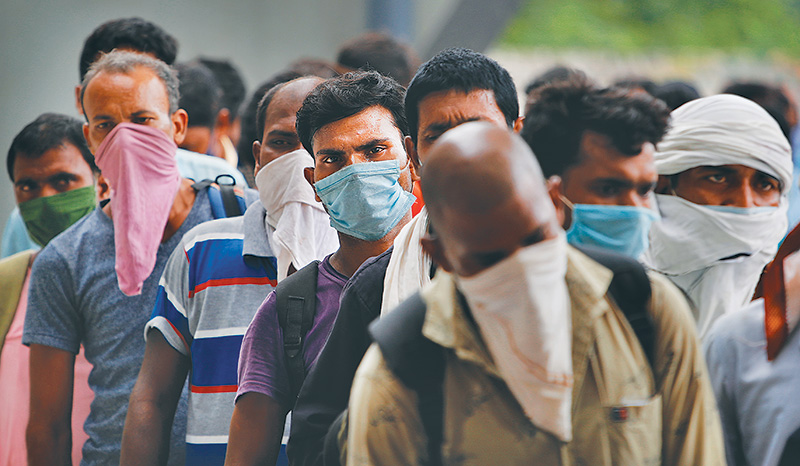
Migrant labourers returning to the city for work queue up to register for Covid-19 test in New Delhi, India, on Tuesday. Ap/rss

Manila/ London,
The World Health Organization (WHO) said on Tuesday it was concerned that the novel coronavirus spread was being driven by people in their 20s, 30s and 40s, many of whom were unaware they were infected, posing a danger to vulnerable groups.
WHO officials said this month the proportion of younger people among those infected had risen globally,
putting at risk vulnerable sectors of the population worldwide, including the elderly and sick people in densely populated areas with weak health services.
“The epidemic is changing,” WHO Western Pacific regional director, Takeshi Kasai, told a virtual briefing. “People in their 20s, 30s and 40s are increasingly driving the spread. Many are unaware they are infected.”
“This increases the risk of spillovers to the more vulnerable,” he added.
A surge in new cases has prompted some countries to re-impose curbs as companies race to find a vaccine for a virus that has battered economies, killed more than 770,000 people and infected nearly 22 million, according to a Reuters tally.
Countries putting their own interests ahead of others in trying to ensure supplies of a possible vaccine are making the pandemic worse, WHO chief Tedros Adhanom Ghebreyesus said in Geneva on Tuesday.
“[Acting] strategically and globally is actually in each country’s national interest—no one is safe until everyone is safe,” he told a virtual briefing calling for an end to “vaccine nationalism”.
Surges in infections have been reported in countries that had appeared to have the virus under control, including Vietnam, which until recently went three months without domestic transmission due to its aggressive mitigation efforts.
“What we are observing is not simply a resurgence. We believe it’s a signal that we have entered a new phase of pandemic in the Asia-Pacific,” Kasai said.
He said countries were better able to reduce disruption to lives and economies by combining early detection and response to manage infections.
While mutations had been observed, the WHO still saw the virus as “relatively stable”, Kasai said.
WHO also reminded drugmakers to follow all necessary research and development steps when creating a vaccine. Socorro Escalante, its technical officer and medicines policy adviser, said the WHO was coordinating with Russia, which this month became the first country to grant regulatory approval for a Covid-19 vaccine.
“We hope to get the response in terms of the evidence of this new vaccine,” Escalante said.
The WHO said the planet is nowhere near the amount of coronavirus immunity needed to induce herd immunity, where enough of the population would have antibodies to stop the spread.
Herd immunity is typically achieved with vaccination and most scientists estimate at least 70 percent of the population must have antibodies to prevent an outbreak. But some experts have suggested that even if half the population had immunity, there might be a protective effect.
WHO’s emergencies chief Dr Michael Ryan largely dismissed that theory at a press briefing on Tuesday, saying we should not live “in hope” of achieving herd immunity.
“As a global population, we are nowhere close to the levels of immunity required to stop this disease transmitting,” he said. “This is not a solution and not a solution we should be looking to.”

WORLD

More infectious coronavirus mutation may be ‘a good thing’, disease expert says

- REUTERS

Singapore,
An increasingly common mutation of the novel coronavirus found in Europe, North America and parts of Asia may be more infectious but appears less deadly, according to a prominent infectious diseases doctor.
Paul Tambyah, senior consultant at the National University of Singapore and president-elect of the International Society of Infectious Diseases, said evidence suggests the proliferation of the D614G mutation in some parts of the world has coincided with a drop in death rates, suggesting it is less lethal.
“Maybe that’s a good thing to have a virus that is more infectious but less deadly,” Tambyah told Reuters.
Tambyah said most viruses tend to become less virulent as they mutate.
“It is in the virus’ interest to infect more people but not to kill them because a virus depends on the host for food and for shelter,” he said.
Scientists discovered the mutation as early as February and it has circulated in Europe and the Americas, the World Health Organization said. The WHO has also said there is no evidence the mutation has led to more severe disease.
On Sunday, Malaysia’s director-general of health Noor Hisham Abdullah urged greater public vigilance after authorities detected what they believe was the D614G mutation of the coronavirus in two recent clusters.
Sebastian Maurer-Stroh of Singapore’s agency for science said the variant has also been found in the city-state but that containment measures have prevented spread.
Malaysia’s Noor Hisham said the D614G strain detected there was 10 times more infectious and that vaccines currently in development may not be effective against this mutation.

WORLD

Pyongyang to hold key party meeting amid crisis

- ASSOCIATED PRESS
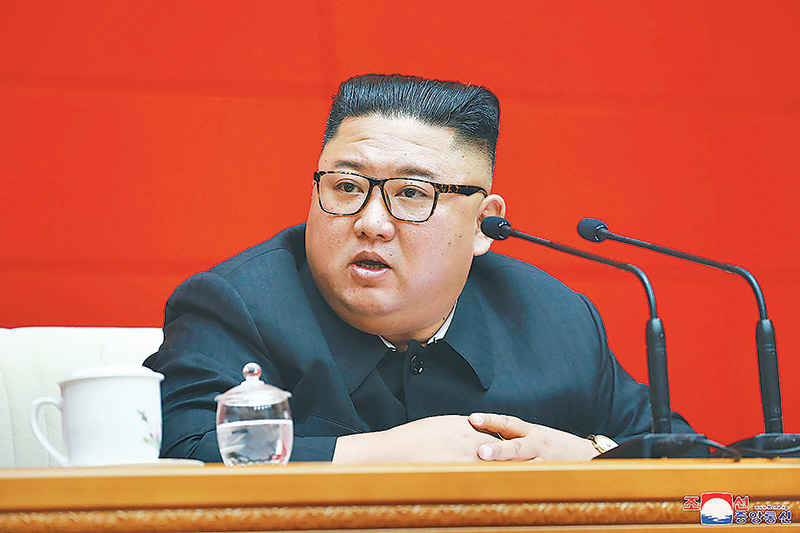
In this August 13 handout photo, Kim Jong Un attends a ruling party meeting in Pyongyang. AP/rss

Seoul,
North Korea will open a high-profile political conference on Wednesday to discuss unspecified “crucial” issues as it struggles to keep afloat a sanctions-ravaged economy hit further by its anti-virus efforts and devastating flooding.
The ruling Workers’ Party elite will determine a matter of “crucial significance in developing the Korean revolution” and increasing the party’s “fighting efficiency” during Wednesday’s plenary meeting of its Central Committee, the North’s official Korean Central News Agency said Tuesday. It didn’t provide further details, including the agenda of the meeting.
The announcement of the meeting came as the United States and South Korea began their annual summertime military exercises, which have been scaled down this year due to the coronavirus pandemic.
North Korean official media have yet to comment on this year’s drills, which mainly involve computer-simulated war scenarios. North Korea usually bristles at the allies’ combined training, which it describes as an invasion rehearsal, and has recently threatened to abandon stalled nuclear talks unless Washington discards what it perceives as “hostile” policies toward the North.
The ruling party officials also could discuss issues related to the economy and the party’s organisational reforms. It remains to be seen whether party leaders will address the stalemated nuclear negotiations with the United States.
During the last plenary meeting of the party’s Central Committee in December, North Korean leader Kim Jong Un expressed deep frustration over diplomacy with the Trump administration and vowed to bolster his nuclear deterrent in response to “gangster-like” US pressure. He also warned of unspecified “shocking” action and said his country would soon reveal a new strategic weapon to the world.
Talks between North Korea and the US faltered after the collapse of Kim’s second summit with President Donald Trump in February 2019, when the Americans rejected North Korea’s demands for major sanctions relief in exchange for a partial surrender of its nuclear capabilities.
During a meeting of the party’s political bureau last week, Kim said his country faces the dual challenge of fending off the coronavirus and repairing damage from torrential rain that lashed the country in recent weeks, destroying thousands of homes and nearly 100,000 acres of crops. Kim insisted North Korea will keep its borders shut and reject any outside help.
Also last week, Kim sacked the premier of his Cabinet following an evaluation of economic performance.

WORLD

Pro-democracy Milk Tea Alliance brews in Asia

- REUTERS
Protesters hold signs of the Hong Kong-Thailand-Taiwan network (Milk TeaAlliance) during a rally to demand the government resign, dissolve the parliament and hold new elections under a revised constitution, in Bangkok, Thailand. Reuters

Bangkok/Hong Kong,
As Hong Kong pro-democracy advocates voiced support for Thai anti-government protests at the weekend, they used the hashtag #MilkTeaAlliance.
In Bangkok, flags representing Hong Kong and independence for Taiwan appeared on a sign bearing the tag at the biggest demonstrations in years.
And in Taipei, dozens of people gathered to back the Thai protests and give weight to a nascent community of cross-border youth movements pushing for democracy at home and uneasy with China’s growing regional power.
“This is the first physical expression of the Milk Tea Alliance,” said Thai student Akrawat Siripattanachok, 27, who helped organise the show of solidarity in Taipei joined by Hong Kong activists, a Chinese dissident and Taiwan students.
“We don’t want to just talk about it online. We want a pan-Asian alliance for democracy.”
A hashtag that began in April as a backlash to Chinese nationalist attacks on a Thai celebrity for a perceived slight to China shows signs of turning into a bigger movement uniting like-minded activists.
Why milk tea? The light-hearted name represents a shared passion for sweet tea drinks in Thailand, Hong Kong and Taiwan.
“The innovative idea of Milk Tea Alliance will enhance more students to push forward global solidarity which might confront hardline crackdown,” prominent Hong Kong activist Joshua Wong told Reuters.
Wong tweeted support for the Thai protesters, while users on LIHKG, a social media forum used by Hong Kong demonstrators, also called on people to highlight the call of the Thai protesters for greater democracy and the departure of Prime Minister Prayuth Chan-ocha, a former junta leader.
“The show of solidarity between different pro-democracy groups in Asia reflects a greater intensity and camaraderie,” Parit ‘Penguin’ Chiwarak, 22, one of the Thai protest leaders, told Reuters.
Help flows both ways.
Some Thai students have shown support for Hong Kong activists as Beijing has tightened its grip and for the Taiwan’s ruling Democratic Progressive Party (DPP) in the face of increased Chinese rhetoric over what China views as a breakaway province.
“The situation in Thailand isn’t so different from Hong Kong or Taiwan, which are under pressure from the authoritarian government of China,” said Rathasat Plenwong, 24, a student protester with a Milk Tea Alliance sign. The Thai and Hong Kong governments did not immediately respond to requests for comment on the alliance of activists and whether they were concerned about its impact.
Taiwan respected the comments and positions of the Milk Tea Alliance on the development of the political situation in Thailand but it took no position itself, foreign ministry spokeswoman Joanne Ou said.
A Chinese foreign ministry spokesman, Zhao Lijian, dismissed the activists’ cooperation.
“People who are pro-Hong Kong independence or pro-Taiwan independence often collude online, this is nothing new. Their conspiracy will never succeed,” Zhao said.
While the groups’ bonds may not concern China now, they were a clear sign of the challenge facing its influence in the region, Wasana Wongsurawat, a Chinese history professor at Bangkok’s Chulalongkorn University, told Reuters.
“It’s amazing that the Hong Kong and Taiwan bond expanded into the Milk Tea Alliance with Thailand, a sovereign country that doesn’t even list Chinese as a national language,” she said. Use of the hashtag peaked in April when Chinese internet users hit back against attacks on the Thai celebrities who had appeared to suggest that Hong Kong was a state and that Taiwan was not part of China.
While a few people have promoted it almost daily since then, the Thai protests saw a big increase in its use - mostly on Twitter, but also Facebook, TikTok and other platforms.
Data from a Twitter analytic tool showed the hashtag was used in more than 100,000 tweets on Sunday alone and nearly 200,000 times over the past eight days.
There have also been shows of interest from the Philippines, because of a dispute with China over the South China Sea, and India after border skirmishes with China since May.
Singaporean blogger and activist Roy Ngerng, who was found guilty of defaming Prime Minister Lee Hsien Loong in a 2014 blog post, was also in the crowd in Taipei.

WORLD

Lockdown deaths in India ignite debate on police brutality

- ASSOCIATED PRESS

New Delhi,
For two and a half minutes the popular Indian radio DJ described in graphic detail what she said was the torture and killing of a father and son in police custody.
The father was arrested for flouting coronavirus lockdown rules by keeping his mobile phone shop in southern India open past curfew, Suchitra Ramadurai alleged in a video posted to her Instagram. The man’s son went to check on him at the police station and both were beaten so badly they were still bleeding when they appeared before a judge the next day.
Three days later, on June 23, they were both dead.
“Please share this story,” Ramadurai told her followers. “Let’s fight the system.”
The video, which was viewed 20 million times before police ordered Ramadurai to take it down, sparked an extraordinary groundswell of public outrage at the deaths with local opposition politicians marching in the streets, Bollywood stars voicing their condemnations and television stations holding hours-long debates on police brutality.
Even more rare, 10 police officers were arrested in a federal investigation and charged with murder. The case came as global attention was focused on police abuse following the death of George Floyd in custody in the United States. It has renewed calls in India for reform of what human rights advocates have described as a culture of abuse and impunity within the country’s police system.
The response to the deaths of the father and son, if not unprecedented, was far from the norm in India, where police “routinely use torture and flout arrest procedures with little or no accountability,” said Jayshree Bajoria, the author of “Bound by Brotherhood,” a 2016 report on custodial deaths in India.
“Often the entire system is complicit in shielding the police responsible for such abuses instead of ensuring accountability,” said Bajoria.
According to the New Delhi-based National Campaign Against Torture, 125 people died in police custody due to torture or other abuses in 2019.
In internal reports police typically attribute such deaths to other causes such as suicide, pre-existing illnesses or natural causes. However, in many cases documented by rights groups and government-appointed investigators, the deaths were determined to be the result of torture.
The country’s National Human Rights Commission said in its 2017 annual report that violence in custody was so rampant “that it has become almost routine,” adding that many custodial deaths were reported after a considerable delay or not reported at all.
India’s Home Ministry, which is responsible for law and order, did not respond to requests for comment on the issue.
In India, suspected criminals are often killed in what police and military officials call “encounters,” such as one last month when a suspect wanted in connection with the deaths of eight police officers was fatally shot after police said he snatched a gun while trying to flee. Activists were quick to cast doubt on that account.
Yet unlike the deaths of the father and son, that case was met with little public anger.
Because the country’s clogged judicial system is slow to ensure prosecutions and punishments, such killings are often encouraged by politicians, celebrated in popular Bollywood films, overwhelmingly supported by the public and rewarded by state officials with out-of-turn promotions and gallantry prizes to the police involved.
Last December, on a visit to the crime scene, police shot dead four men suspected in the high-profile rape and killing of a young woman whose body had been set on fire.

WORLD

India minister back in hospital

Briefing
- AGENCIES

MUMBAI/NEW DELHI: India’s interior minister Amit Shah was hospitalised again on Tuesday after complaining of fatigue and body ache, four days after he said he had recovered from Covid-19, as cases in the country surged to more than 2.7 million. Shah, a close aide of Prime Minister Narendra Modi and the virtual
number-two in his cabinet, was admitted to the government-run All India Institute for Medical Sciences in the capital New Delhi, the hospital said in a statement. “He is comfortable and continuing his work from the hospital,” it said, adding he had now tested negative for Covid-19. Shah is the highest-profile Indian
politician to have been infected with the coronavirus.

WORLD

Pakistan gives go-ahead to Phase 3 vaccine trial

Briefing
- AGENCIES

ISLAMABAD: Pakistan’s drug regulator greenlit the country’s first Phase 3 clinical trial for a potential Covid-19 vaccine, which is being developed by China’s CanSino Biologics (CanSino) and the Beijing Institute of Biotechnology. The trial is slated to begin next month, according to an official who will coordinate the exercise. Government-run National Institute of Health will be leading the trial for the candidate Ad5-nCoV along with pharmaceutical company AJM—the local representative of CanSino. China has already approved the vaccine for use by its military after early and mid-stage trials, and further late-stage trials are being lined up for Mexico and Saudi Arabia.

WORLD

Tribunal: Defendant in Hariri killing Hezbollah member

Briefing
- AGENCIES

LEIDSCHENDAM: The main defendant in the trial of four men charged with conspiracy to kill former Lebanese Prime Minister Rafik al-Hariri was a member of Hezbollah and used a cell phone critical in the attack, judges at a UN-backed tribunal said on Tuesday. As an hours-long reading of the verdict got underway, judges said they were “satisfied beyond a reasonable doubt” that the evidence showed that Salim Jamil Ayyash possessed “one of six mobiles used by the assassination team.” The judges were yet to rule on Ayyash’s guilt or innocence on charges including committing a terrorist attack.

Page 7
SPORTS

Inter crush Shakhtar to reach Europa League final

After thumping the Ukrainian champions 5-0, Antonio Conte’s side set up final date with Spanish outfit Sevilla for their first trophy in nine years.
- AGENCE FRANCE-PRESSE
Inter Milan’s Lautaro Martinez (right) and Shakhtar’s Marcos Antonio in action during their Europa League match in Duesseldorf on Monday. Afp/Rss

DuSSELDORF,
Inter Milan are destined for “great things” under Antonio Conte, according to Lautaro Martinez after the Argentine and Romelu Lukaku both scored twice to thrash Shakhtar Donetsk 5-0 in Dusseldorf and reach the Europa League final. Danilo D’Ambrosio was also on target for the Italian giants, who will face Sevilla in Friday’s final in Cologne.
Inter have endured a lean decade since winning the Champions League in 2010, but closed the gap on Juventus at the top of Serie A to just one point in Conte’s first season in charge and are now one win away from a first trophy in nine years.
Martinez and Lukaku’s prolific partnership has been the source of much of Inter’s success and they took their tally to a combined 54 for the season. “It was an incredible night, something we have been dreaming of,” said Martinez, who has been strongly linked with a move to be Luis Suarez’s successor at Barcelona. “We proved that Inter are ready for great things, we are ready for the final,” he added.
After a slow start, Martinez put Inter on course for their 10th European final as he powered home Nicolo Barella’s cross to open the scoring on 19 minutes. Shakhtar are one of European football’s great survivors as the Ukrainian champions continue to thrive despite not playing a match in their home city of Donetsk for six years due to a war in eastern Ukraine between government forces and Russian-backed separatists.
Luis Castro’s men had scored 14 goals in five Europa League games since dropping into the competition from the Champions League, but their talented array of Brazilian forwards barely laid a glove on a characteristically well-organised Conte defence. “Don’t get fooled by the result,” said Conte. “We were good not allowing them to play the way they wanted. The lads played exactly how a European game should be played.”
Shakhtar had one golden chance to level when Mykola Matviyenko’s cross picked out Junior Moraes, but the Brazilian-born Ukrainian international’s header was too close to Samir Handanovic. Two minutes later, Inter landed the killer blow when D’Ambrosio met Marcelo Brozovic’s corner with a powerful header. “When Inter scored their second goal we simply collapsed,” said Castro. “After 2-0 we made so many terrible mistakes.”
Only a brilliant save from 36-year-old Andriy Pyatov had denied Martinez classy second with a lob long range early in the second half, but he gave the veteran ‘keeper no chance to set himself with brilliant quick hit for his 21st goal of the season. Lukaku extended his run of scoring in now 10 straight Europa League game 12 minutes from time as this time Martinez played provider before his strike partner slotted low into the far corner. Five minutes later the former Manchester United striker had his 33rd goal of the campaign by accelerating away from a slow Shakhtar backline before firing through Pyatov’s legs.
“I’m a forward and I’m here to score, it’s something inside me,” said Lukaku, who showed United the predatory instincts they were lacking in a 2-1 defeat to Sevilla in the other semi-final on Sunday.
Conte is famous for his high demands of his players, but Lukaku believes the hard work Inter did before Italian football’s return from a three-month shutdown due to the coronavirus pandemic is bearing fruit. “We worked really hard in the camp,” added Lukaku. “It’s tough but you see the results of the hard work. We want to keep going.”

SPORTS

Rain-hit second Test drawn

- REUTERS

SOUTHAMPTON, 
Zak Crawley struck a half-century as England and Pakistan played out a tame draw in their rain-hit
second Test at the Rose Bowl on Monday.
Only 134.3 overs were possible in the entire match, which included a 38 over spell late on the fifth afternoon as the sun finally came out, with England finishing on 110 for four before the game was called off with no prospect of a winner.
Crawley scored 53, his third Test half-century, before he was out leg before wicket to Mohammad Abbas (2-28) having put on 91 with Dom Sibley (32) for the second wicket, both gaining valuable time at the crease ahead of the third and final Test that starts at the same venue on Friday.
Opener Rory Burns (0) and Ollie Pope (9) were the other two batsmen dismissed.
“We were excited about this week, so it’s disappointing not to get much cricket in,” England captain Joe Root said at the post-match presentation. “But I thought Zak was excellent today, that partnership (with Sibley) was high class on a very difficult surface.”
Root said the selectors will look at the full squad before making a decision on who starts the third test, with fast bowlers Jofra Archer and Mark Wood waiting in the wings.
“All the guys are now in contention for the next one, we will see where we are (physically) tomorrow. We will also take the surface into account.”
Pakistan had won the toss and elected to bat, posting 236 in their first innings, a total that their captain Azhar Ali felt was competitive. “It’s been frustrating for both teams, the game was set up quite nicely as the conditions were good for bowling throughout,” he said.
England won the first Test in Manchester by three wickets.

SPORTS

Barcelona count cost of gamble on sacked coach Setien

- REUTERS
Setien took charge of Barcelona in January. Afp/Rss

BARCELONA,
In the wake of Barcelona’s 8-2 defeat by Bayern Munich to exit the Champions League, Spanish newspaper Sport declared that coach Quique Setien could not remain at the club ‘for one more day’ after presiding over such a historic humiliation.
The newspaper got their way as Setien was sacked on Monday, the first casualty of the Bayern bloodbath. But the fact that the 61-year-old was ever handed the keys to the Camp Nou should be regarded as one of the club’s biggest ever mistakes.
In a move that seemed to sum up the club’s motto of ‘More than a Club’, last January Barca took the surprising decision to sack Ernesto Valverde, whose side were top of La Liga at the time and had swept to back-to-back Spanish titles.
Merely winning matches and trophies, the decision seemed to suggest, was no longer deemed good enough for a club that prides itself on producing top-class entertainment on the pitch. But after being rejected by Xavi Hernandez and Ronald Koeman, Barca landed on Setien, who had never won a trophy and bizarrely remarked in his presentation that he got the call to coach Barca while strolling among cows in the countryside. His previous biggest job was with Real Betis, where he presided over spectacular wins against the likes of Real Madrid, Barca and AC Milan but was ultimately sacked after a poor second season which saw him face mass protests from supporters.
An engaging and often idealistic coach, Setien was chosen due to his devotion to the coaching philosophy of Barca’s iconic Johan Cruyff but he quickly proved to be hopelessly behind the times as the club’s gamble badly backfired. His side often served up soporific football that was slow and ponderous and frequently failed to win the games that mattered most, something Valverde usually managed, even if the football was not always exciting.
Setien’s Barca lost to Valencia and Real Madrid while drawing with Atletico Madrid, Sevilla and Celta Vigo, the latter three results coming in the final stretch of the season as they meekly surrendered the title to Real. They did manage one outstanding performance in a 4-1 win over Villarreal but that was very much the exception that proved the rule, and another disappointment was just around the corner as the team lost 2-1 at home to Osasuna.
The usually softly-spoken and shy Lionel Messi let rip after that game, appearing to blame Setien for the team’s predicament as he declared: “Ever since January it has been all bad.” Messi finished his tirade by declaring Barca had no hope of winning the Champions League but surely not even he could have predicted his team would be beaten so brutally by Bayern. But perhaps Setien’s disastrous performance in the Champions League should have come as no surprise.
After all, he had never taken charge of a game in Europe’s top competition before leaving the serene countryside and grazing cows for the bear pit that is the Barca job.

SPORTS

Simona Halep to skip US Open

Briefing
- AGENCIES

PARIS: World number two Simona Halep joined a growing list of tennis stars when she said on Monday that she would skip the US Open over coronavirus fears. “After weighing up all the factors involved and with the exceptional circumstances in which we are living, I have decided that I will not travel to New York to play the @usopen,” tweeted the current Wimbledon champion. Halep joins a host of top players who are passing on playing at Flushing Meadows when the next Grand Slam tournament begins on August 31. Reigning champion Bianca Andreescu of Canada and men’s 2019 winner Rafael Nadal have also skipped the tournament. Also absent from this year’s US Open will be Australia’s top-ranked Ashleigh Barty, Ukraine’s fifth-ranked Elina Svitolina, seventh-rated Kiki Bertens, eighth-ranked Swiss Belinda Bencic and past winner Svetlana Kuznetsova of Russia.

SPORTS

Nortje to replace Woakes in IPL side Delhi Capitals

Briefing
- AGENCIES

NEW DELHI: South African fast bowler Anrich Nortje will replace Chris Woakes of England in the Delhi Capitals squad for the Indian Premier League, the franchise announced Tuesday. Woakes had pulled out of the lucrative T20 tournament in March due to family commitments after being bought by Delhi for $200,000 in the December auctions. Nortje, 26, will join fellow South African Kagiso Rabada for the 13th IPL which has been shifted to the United Arab Emirates and will start on September 19.    

MEDLEY

Horoscope

ARIES (March 21-April 19) ****
Everyone around you is full of bright energy right now, and there will be nothing heavy about this day. Their effervescence is contagious, and the longer you’re around it, the more you feel a growing sense of possibility in yourself.


TAURUS (April 20-May 20) ***
You might be put on the spot today. Try to think first before you say something. It would be out of character for you to blurt out something, but it could be risky. You need to be mindful about keeping your reputation nice and shiny.


GEMINI (May 21-June 21) *****
This could be one great day for you, but it might not be such a winner for one of the most important people in your life. Being sensitive to their moods while celebrating your good fortune is a delicate dance, but you can do it.


CANCER (June 22-July 22) ***
Choose a type of communication that’s out of the ordinary today. Not only will it get you noticed more quickly, but it will also help your message get across a lot more clearly. People pay attention to things that are new or different.


LEO (July 23-August 22) ****
Teamwork will play an important role in your success. If you can select the people on your team, make sure some of them don’t see things the same way you do. That way, you’ll be sure to cover all the bases!


VIRGO (August 23-September 22) ****
There is plenty of room for a fair compromise between what you want and what someone else wants right now, so don’t be too stubborn about getting your way. You’ll quickly see how everyone can come out of this negotiation feeling like a winner.


LIBRA (September 23-October 22) ***
Being possessive of friends is a bad habit to get into. If a pal calls you up today and needs to reschedule something, don’t bristle. If you start getting insecure about your friendships, you’ll start getting insecure about yourself.


SCORPIO (October 23-November 21) ***
Your eye for unusual details is strong and clear. You could notice things that no one else sees, which will put you in a potentially powerful position. You’ll have the answers when someone else is scratching their head.


SAGITTARIUS (November 22-December 21) ****
If you’re feeling overwhelmed now, you need to let some things go. These things could be hopes, work projects, relationships, or even goals. The fact is that you are only one person. You can only do so much.


CAPRICORN (December 22-January 19) ***
You run the risk of being called flighty if you commit to something when you know deep down inside you won’t follow through. If someone asks you to get involved in something that doesn’t really interest you, tell them so.


AQUARIUS (January 20-February 18) ***
It’s time to bring out your secret weapon: your amazing conversational skills. If someone has
you feeling flummoxed, why not talk to them about it? They aren’t going to react any way but
positively.


PISCES (February 19-March 20) ****
The big changes on the horizon are coming. Be patient! As excited as you might be about them, you can’t rush them before their time. If you do, you run the risk of getting too overwhelmed too soon and things won’t be as fun.

Page 8
CULTURE & ARTS

Blessed Wonders’ wonderful selection of underrated artists

The online exhibition, organised by Tehra, features 52 artworks of 30 artists.
- ANKIT KHADGI
Most of the artworks, especially the photographs in the exhibition, are novel, aesthetically pleasing as well as technically sound, making the exhibition a great platform for the artists to show their calibre. Photo Courtesy: Tehra

Kathmandu,
Wrinkled face, salt and pepper hair and watery eyes, the portrait of an old woman speaks so much without the use of any words or action. There are emotions of sadness, loneliness, and despair, all depicted within one frame, from where she is gazing at the camera, resting her head.
Titled ‘The Old Gaze’, the photo by Dibesh Shrestha is one among the 52 artworks that are exhibited in the online exhibition organised by Tehra, a social initiative run by young artists.
Although the works of 30 artists that are displayed in the exhibition offer a variety of art forms, it’s mostly the photographs that have gotten more space in the exhibition, allowing the viewers to be deeply immersed in reading and analysing the visuals.
One such immersive artwork is Shrestha’s, who through his photograph successfully tells a personal story that is deeply engaging and evocative at the same time. In the frame, he has captured an old woman, who’s just resting her head down. The woman is gazing at the camera, which is played at an eye-to-eye level. There’s nothing more than that in the picture, yet the image is powerful, as though through her placement, and the photo, we know so much about her and her story.
Shrestha could have just captured a close-up of the woman, with her standing or with her head held up. But instead he shows us a more vulnerable state of the subject. The placement of the camera at eye-to-eye level, which helps the readers look at those water eyes, also meticulously crafts the story of the subject. He shows us a lonely and isolated person, who just wants some love and attention, and people to talk with them.
Another equally evocative photo that emotes exactly what the subject is feeling as well as tells their story is ‘Life to Feed’, by Sulav Singh Dangol. The photo, although cannot necessarily be categorised as a portrait in terms of technicalities, acts just like a portrait, as it is
successful in efficiently conveying the mood and emotions of the subject like portraits do.
In the photo, we see a family of vegetable vendors, who are sitting outside a shop, with baskets of vegetables displayed for the customers. The man, the vegetable seller, is sitting beside the taraju, a traditional weighing machine. The woman, who’s most likely his wife, is sitting at the corner, with a basket of potatoes, on her side, while their child is in the middle, with vegetables in front of them. Shot at night, there’s nothing more than these elements in the photos, yet we know so much about the subjects, due to the placement as well as the photographer’s ability to capture their emotional state reflected on their faces.
The man has a tensed look on his face, which may be because of the responsibilities he has to fulfil, which can’t be possible to fulfil if he doesn’t sell the vegetables he has. The child in the photo looks anxious, as through their face, the audience can understand that they aren’t interested in staying at the shop. For someone their age, it’s playing that only matters, and it looks like they are just waiting for the opportunity to run and play with their friends. As for the woman, she is looking at her husband, which somehow also reflects the position of most of the women, like her in our society, who are just made to look after their husbands.
Although the placement of the basket of potato on the side of the women, maybe accidental, the placement rather serves as a motif, to reflect women’s status by comparing her to the vegetable, which although is one of the essential food items in the vegetable family still doesn’t receive it due worth.
Besides photos that depict human stories, there are some photos in the exhibition where the beauty of various landscapes and geographical places are also captured in the frame.
One such photo is of fashion photographer Aayush Shrestha, which is one of the highlights of the exhibition as well. Titled ‘Ghorepani’, Shrestha, in his photo, beautifully depicts the snow-covered trails of Ghorepani, a burgeoning trekking trail whose beauty in recent years has been drawing the attention of many visitors.  
What makes the photo stand out is that it not only looks aesthetically beautiful—as it literally looks like a painting—but is also equally sound in terms of technicalities. Although snow is of white colour, generally when it comes to a large amount of snow, particularly in shade, it appears blue. And Shrestha, through his camera, captures this beautifully. Likewise, the blue colour tone also makes the landscape look serene and creates a calming effect, increasing its impact.
Another thing that should be appreciated is also how he uses the point of interest in the composition of the photo. Although the snow already beautifies the photo, he emphasises on the porters, who are carrying the heavy loads in the trail as well, and the hues of the red colour-plastic that they have worn, which adds a splash of colour in the photo.
Another photo that stands out in the exhibition is Sushila Gurung’s ‘Together in Rain & Shine’. Although what Gurung tries to depict in her photo is not something new, as many photographers have depicted sexual intercourse of various animals in pictures, Gurung’s treatment of the subject matter is commendable. In the photo, two frogs are having sexual intercourse. It’s raining outside, but the downpour has the least effect on them. Likewise, even though the frogs are in their natural habitat, the photo is captured in such a way that it feels that there is a backdrop beside them, and they are performing in a staged manner, increasing the impact, as it gracefully depicts sex in a sensuous and dignified manner.
But there are few artworks, which fail to create any impact or evoke emotions, mostly either by being too simple or using the same old archetype or motifs in the artworks. For instance, Kripa Shakya’s ‘River of the Evening Sky’ is too simple, as there’s nothing new her photo offers to the viewers. In the photo, she has captured the sky, which in the evening slowly changes its colour, when the sun starts to set.
Likewise, Nirvita Shakya’s ‘Intimacy’ looks like an interesting piece of artwork, as she uses textiles (pieces of cloths) which are in human shape to depict the intimacy between the human beings, but it uses the same old long-established motifs of using colours to depict the gender of people and that does not really work. In the artwork, the blue colour cloth, which is slightly bigger, is used to depict the man, whereas the pink colour cloth represents the woman.
There’s no denying that her work is unique, as the placement successfully depicts what she is intending to do with her artwork—depict the affinity and warmth received because of the intimacy of another person, however using the same old colour motifs—blue to denote men, and pink to denote women, makes her artwork, a conventional one as well as layered with the sub-text of cisgender heteronormativity.
Maybe the use of other colours, or trying to depict ‘intimacy’ between people rather than making it a gender thing that exists between man and woman only would have made the art more valuable, as it would have been successful to depict the changing times, where intimacy should be looked beyond the cisgender lens.
Regardless, most of the artworks, especially the photographs in the exhibition, are novel, aesthetically pleasing as well as technically sound, making the exhibition a great platform for various artists to show their calibre.
Likewise, the curator’s decision of not including much details about the art works for this exhibition, as it’s much more interesting and engaging to draw meanings and interpretations from photos and artworks by oneself, instead of getting spoon-fed the artist’s intention every time.
This was the first-ever exhibition of the curators, and to be honest they have set the bar really high, raising expectations among art lovers that young aspiring curators/artists will make meaningful changes in the art scene of the country, which although has excelled in terms of craft, still hasn’t received enough exposure in the international market.

CULTURE & ARTS

Suffrage anniversary commemorations highlight racial divide

From exhibits inside the Arizona Capitol Museum to a gathering on the North Carolina statehouse lawn have highlighted a more nuanced history of the movement.
- Susan Haigh,Suman Naishadham
In this circa 1913 photo provided by the Library of Congress, demonstrators march in a women’s suffrage parade near the Capitol building in Washington. AP/RSS

Hartford,
As the US marks the 100th anniversary of women’s suffrage, many event organisers, mindful that the 19th Amendment originally benefited mostly white women, have been careful to present it as a commemoration, not a
celebration.
The amendment to the US Constitution was ratified on Aug 18, 1920, but many women of colour were prevented from casting ballots for decades afterward because of poll taxes, literacy tests, overt racism, intimidation, and laws that prevented the grandchildren of slaves from voting. Much of that didn’t change until the Voting Rights Act of 1965.
From exhibits inside the Arizona Capitol Museum to a gathering on the North Carolina statehouse lawn, many commemorations, including those that moved online because of the coronavirus pandemic, have highlighted a more nuanced history of the American women’s suffrage movement alongside the traditional tributes to well-known suffragists such as Susan B Anthony and Elizabeth Cady Stanton.
The 100th anniversary has arrived during a year of nationwide protests against racial inequality that have forced the United States to once again reckon with its uncomfortable history.
“Like many movements, the stories are complicated and I think it’s important, as we have an opportunity to reflect and to celebrate, that we also are honest about how we didn’t meet all of our aspirations,” said Rhode Island Secretary of State Nellie Gorbea, a Democrat born and raised in Puerto Rico who has helped to organize her state’s suffrage commemoration efforts.
“It’s important to have these conversations so we can do a better job of going forward.”
The Connecticut Historical Society last month unveiled an online exhibit  titled “The Work Must Be Done: Women of Color and the Right to Vote.” It highlights Black women from Connecticut who fought for suffrage rights as well as other issues, such as anti-discrimination, anti-lynching, labour reforms and access to education.
“We have really been wanting to make sure we talk about the complicated history of these issues in our country,” said Arizona Assistant Secretary of State Allie Bones, whose office came up with a program after working with about 60 community groups across the state, many of which were “very focused on not calling it a celebration, but ... a commemoration.”
The complicated nature of the suffrage movement came full circle last week when Democratic presidential nominee Joe Biden chose California US Sen. Kamala Harris as his running mate, making her the first Black woman on a major party ticket.
In an appearance with Biden last week, Harris said she was “mindful of all the heroic and ambitious women before me whose sacrifice, determination and resilience makes my presence here today even possible.”
While their names are not as well-known as the white suffragists, Black women played both prominent and smaller roles in the movement. Members of the Delta Sigma Theta sorority, for example, participated in the 1913 suffrage march in Washington, taking great personal risk while not being welcomed by some white suffragists who ultimately insisted the Black women march at the end of the procession, said Cheryl A Hickmon, national first vice president of Delta Sigma Theta Sorority, Inc.
“They felt that it was their obligation, if you will, even though it was unsafe to march with the other women and show their dissension and feelings,” said Hickmon, whose organization has been working with organizers of the Turning Point Suffragist Memorial that’s being constructed in southern Fairfax County, Virginia, and includes an overview of the entire movement, including Black suffragists.
The 100th anniversary marks an opportunity to “honestly examine” the relationship between white and Black women in the women’s rights movement, said Johnetta Betch Cole, a former college president and anthropologist who is currently the national chair of the National Conference of Negro Women, an organization that was founded in 1935 to advocate for women’s rights.
“There is more acknowledgement of the complexities of the strains, of the racism in the suffrage movement than ever, ever before,” Betch Cole said. “Unfortunately, one can be virtuous in one form of oppression and then turn around and victimize others on another basis.”
Doris Kelley, a former Democratic Iowa House representative who chairs the state’s 19th Amendment Centennial Commemoration, said it’s important to remember the historical context that suffragists navigated while acknowledging the movement’s complexities. The logo of Iowa’s centennial commemoration “Hard Won, Not Done,” Kelley said, is a nod to that unfinished history.
In June, protesters in Iowa demanded that Iowa State University remove the name of suffragist and alumna Carrie Chapman Catt from a building because of white supremacist and anti-immigrant statements attributed to her. Kelley said the protesters “need to understand history” and that Catt and other suffragists had to engage in the white-supremacist politics of the time.
“I think people need to stop and think that she was the one that had the winning plan in the very end,” Kelley said. “And as we all know, as a former state representative myself, there are times that you have to ... do certain things and give a little to get something done.”
In North Carolina, Janice Jones Schroeder, a member of the Lumbee Tribe of North Carolina, said she was impressed that organisers of the suffrage anniversary activities thought to include her in a commemoration event last September on the lawn of the statehouse.
“At that time, American Indians were not even considered citizens of the United States,” she said. While the Snyder Act of 1924 admitted Native Americans born in the US to full US citizenship, it was left up to the states to decide who had the right to vote, and it took more than 40 years for all 50 states to agree to grant them voting rights. Schroeder said there are still challenges today facing tribal members who want to vote. The American Bar
Associ-ation has raised concerns about the effect of voter laws, long distances to register to vote on some reservations, lack of access to mail and socioeconomic disparities.
“I look at politics now,” said Schroeder, “and I think, ‘Do we still have a voice?’”


—Associated Press