Curbs extended with some relaxations, but experts question ad-hoc decisions
Doctors say Valley authorities have failed to explain on what basis they are taking their decisions, since the restrictions of past three weeks were largely ineffective.
- TIKA R PRADHAN,Arjun Poudel
KATHMANDU, Authorities are yet to figure out a way to deal with the coronavirus spread and they are still taking decisions on an ad-hoc basis without holding serious consultations, public health experts said on Wednesday, as restrictions were extended in Kathmandu Valley until September 17. Chief district officers of the Valley–Kathmandu, Lalitpur and Bhaktapur–on Wednesday evening decided to continue prohibitory orders for another one week, with some relaxations and vehicular movements. On what basis the decisions are being taken is not known, say public health experts, as the restrictions for the past three week have been largely ineffective in controlling the virus spread. What safety measures and how strictly health protocols are enforced will be a key in the coming days, according to them. “The spread has continued at an alarming rate since the lockdown was lifted,” said Dr Sher Bahadur Pun, chief of the Clinical Research Unit at Sukraraj Tropical and Infectious Disease Hospital. “Ongoing prohibitory orders have failed to stop the infection rates. The number of cases could rise in the coming days if we fail to enforce safety measures.” On Wednesday, 464 new cases were reported in three districts of the Valley–394 in Kathmandu, 34 in Lalitpur and 36 in Bhaktapur. So far, 9,440 cases have been reported in the Valley, among which 6,942 were infected since the prohibitory orders were put in place on August 19 midnight. According to officials, shops will be allowed to open on alternate days while public vehicles will be allowed to operate under the odd-even rules. Only large public vehicles with more than 16-passenger capacity will be allowed to ply with only half of its passenger’s capacity, according to the order issued by the district administration offices. Taxis will be allowed to operate but only with two passengers a trip. Shopping malls, clothing stores and cosmetic shops will remain open on Mondays, Wednesdays and Saturdays while utensil stores and those selling kitchen items will be allowed to do businesses on Sundays, Tuesdays and Fridays. Automobile and furniture shops can open on Mondays and Wednesdays only.
The authorities have also fixed timing for opening shops and services. Malls, footpath shops, pushcarts, stationery stores, department stores and electronics shops can open till 11am in the morning and 4pm to 7pm in the evening. Automobile servicing centres will be allowed to open from 8am to 8pm. Cafes and restaurants will be allowed to provide take-away services only and online delivery services can operate from 12pm-7pm. There will be no restrictions on pharmacies, services related to medical equipment and other essentials services. Shops selling food items and daily essentials can remain open till 11am in the morning and from five to seven in the evening. Educational institutions, religious and cultural places, crowded industries, factories and businesses, cinema halls, party palaces, beauty parlours, hair salons, gyms, swimming pools, libraries, zoos, museums will remain closed. The authorities have also continued the ban on seminars and workshops. “We decided to continue the prohibitory orders for one week after holding discussions with the various stakeholders and taking feedback from them,” said Janak Raj Dahal, chief district officer of Kathmandu. The Oli administration has been under fire for letting the bureaucrats take decisions on measures to contain the virus spread. Public health experts say empowering the bureaucrats and ignoring people with expertise to make plans on ways to deal with the pandemic could cost dearly. The federal government, which faced massive criticism for its ill-thought-out plan to impose the lockdown on March 24 and then lift it on July 21, seems to be passing the buck by asking chief district officers to take decisions on its behalf, experts say. “The authorities are investing little time on planning and preparing,” said Dr Baburam Marasini, former director at the Epidemiology and Disease Control Division. “Controlling the spread of the virus highly depends on how authorities are doing preparations.” Of the total number of new cases being detected every day, over 4o percent are being reported from Kathmandu Valley. “We all know that the risk increases with increased public movements,” Marasini told the Post. “But the authorities are refusing to recognise possible challenges.” Experts are wondering what exactly the authorities did in terms of preparations for the last three weeks. The prohibitory orders in the Valley were first imposed starting August 19 midnight for a week. But citing the continuous rise in the coronavirus cases, the restrictions were extended. The current prohibitory orders were to expire on Wednesday midnight. The authorities took a decision just hours before the prohibitory orders ended. “Are authorities prepared to handle the possible rise in the number of cases?” said Marasini. “People’s movements from areas where more cases have been reported should be stopped. The number of tests need to be increased and contact tracing must be made more effective.”
HOME PAGE
Plan to replace foreign workers with Nepalis in various sectors is easier said than done
At a time when many Nepalis have lost jobs, a comprehensive strategy could ensure work for them at home, officials say.
- PRITHVI MAN SHRESTHA
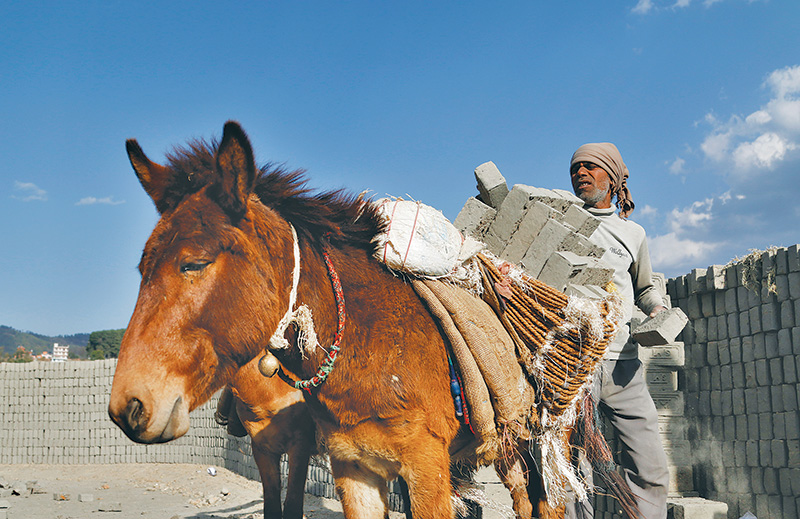
A man loads bricks on a mule at a brick factory in Lalitpur. Many brick factories in Kathmandu Valley rely on Indian workers. Post File Photo: KESHAV THAPA
KATHMANDU, Just before the lockdown began in the third week of March to contain the spread of the coronavirus, Umesh Prasad Singh had more than 400 Indian seasonal workers at his two brick factories at Tarapatti Sirsiya, Dhanusha. He had employed 300 Nepali workers as well. His brick factories have remained shut since the nationwide lockdown was imposed on March 24. Although the lockdown was lifted on July 21, his factories have failed to resume operations, as most of the workers who had returned home have not come back. “I am waiting for them to come back,” Singh said. “Most Nepalis do not want to work at a brick factory.” Singh, who is also the acting president of the Federation of Nepalese Cottage and Small Industries, employs Indian workers at his dairy and hosiery factory as well. While factories like Singh’s are falling short of hands, Nepalis in hordes are heading for India to work. Though the Nepal government has been saying it aims to have Nepalis work in enterprises deserted by foreign workers, it has not formulated any strategy yet. Bharatmani Pandey, spokesperson for the Ministry of Labour, Employment and Social Security, said there is a general policy to ensure that more Nepalis are employed instead of foreign workers but no specific strategy has been made yet. The pandemic has rendered hundreds of thousands jobless–from casual daily wage-earners to the people involved in the tourism sector to those engaged in teaching profession. According to an International Labour Organisation report, between 1.6 million to 2 million jobs are likely to be disrupted in Nepal in the current crisis either with complete job losses or reduced working hours and wages. A Nepal Rastra Bank survey showed 22.5 percent of industries cut down their employees, mainly temporary staff, while deducting wages by 18.2 percent on average. The cut-down in the tourism sector alone affected over one million employment. Then there are those Nepali migrant workers who have lost their jobs and are returning home. Outgoing Finance Minister Yubaraj Khatiwada had repeatedly said that the country could use the domestic workforce to replace Indian workers in construction and manufacturing sectors. The federal government’s budget for the current fiscal year 2020-21 has focussed on creating jobs, and it plans to generate around 700,000 new jobs. The government plans to create these jobs through various programmes and initiatives including the Prime Minister Employment Programme launched in January 2018. The Prime Minister Employment Programme to be implemented through provincial and local governments aims to provide employment for 100 days to 200,000 marginalised people across the country. The federal government also plans to create jobs under the food for work programme, small farmers credit programme, various skill training schemes, and encouraging industries to employ listed unemployed people in employment service centres and strictly implementing work permits for foreign workers. A budget of Rs11.6 billion has been set aside for this in the current fiscal year, up from Rs 5.01 billion in the last fiscal year 2019-20 when it provided employment for 60,000 people. The government’s lack of planning before Khatiwada’s call for replacing foreign workers with Nepali is also clear from the fact that there is no record of the number of foreign workers in the country. “We only have data on foreigners who are employed in the formal sector for whom we issue work permits,” said Pandey. “But there is no data on the large proportion of foreign workers, particularly Indian nationals employed in the informal sector.” According to the Department of Labour and Occupational Safety, only 77 Indians have received permits to work in Nepal since January 2017. It may not be known how many Indians work in Nepal in the non-formal sector but according to the Washington-based Pew Research Centre, Indian workers sent $2.7 billions from Nepal in 2015 making Nepal the ninth highest remittance sending countries to India. There are a number of reasons why Nepali employers give jobs to Indian nationals and they may not be easy to replace. “In large industries, skilled labourers, including machine operators, are Indians. They make up 15-20 percent of the workers in large industries in the Sunsari-Morang Industrial Corridor,” said Bhim Ghimire, president of Chambers of Industries, Morang. “Many large industries in the Sunsari-Morang Industrial Corridor employ skilled and semi-skilled Indian workers.” Former vice-chairman of National Planning Commission Shankar Sharma does not see an easy route to replace foreign workers with Nepali workers in Nepal in the manufacturing sector due to lack of proper skills with Nepali workforce. “It is because our workers are not getting quality training,” Sharma told the Post. “We need to prepare good quality trainers and employ international certifying agencies to provide certificates for the skills.” According to him, several training programmes launched so far have proven to be ineffective. Besides, it is also easier for factory owners to employ foreigners because they need not strictly follow labour laws in their case and don’t have to grant them leave for different festivals and family rituals. A large number of foreign workers are employed in the construction sector as well. According to the Federation of Contractors’ Association of Nepal, one-third of the total 1.5 million construction workers employed annually in Nepal are foreigners, including Indians, Bangladeshis and Chinese. Building contractors too, like Singh, the brick factory operator, prefer Indian workers. “Contractors would be happy to employ foreign workers, particularly Indian nationals, because they are more committed than Nepalis to work,” said Rabi Singh, president of the federation. “It is also less costly for contractors to employ Indian workers.” After the lockdown, most of the foreign workers went home as jobs dried. According to Sharma, the former vice-chair of the planning commission, the government could take certain restrictive measures to discourage employers from hiring foreign workers in the construction sector. “The contractors subcontract the task of bringing workers and they bring foreign workers to the construction site,” he said. “If the government imposes certain fees on contractors for hiring foreign workers, such tendencies will be discouraged. This is the practice many countries have adopted.” Officials, however, say drastic moves to prevent Nepali employers from bringing in foreign workers, especially those from India, can have some diplomatic issues. “Making provisions like mandatory work permits for Indians to work in Nepal could discourage them from coming to Nepal,” said Pandey, the spokesman. “But we should not forget the fact that many Nepalis are also working in India without work permits.”
NATIONAL
Case filed against police for alleged custody death of Dalit youth
Bijay Mahara’s father filed the complaint with the Office of District Attorney on Wednesday seeking investigation into his son’s death.
- SHIVA PURI
RAUTAHAT, A complaint has been filed at the Office of the District Attorney against six police personnel, including Superintendent of Police Rabiraj Khadka, for the alleged in-custody torture and death of 19-year-old Bijay Mahara. On Wednesday, Panilal Mahara, Bijay’s father, filed the complaint against SP Khadka, the then chief at the District Police Office in Rautahat, the then DSP Gyan Kumar Mahato, the then Inspector Nabin Kumar Singh, SI Birendra Yadav, and two head constables Hiroj Miya Dhuniya and Munna Singh and has sought investigation into the alleged torture of Bijay in police custody. Subash Kumar Bhattarai, the district attorney, said, “A complaint has been filed at the Office of the District Attorney. We have directed the District Police Office to take the necessary action.” Bijay and six others were arrested on August 19 in connection to the murder of Niranjan Ram, a local teenager, in Garuda Municipality. Bijay died on August 26 at the National Medical College in Birgunj. His family members have claimed that he was tortured in custody and have refused to receive his body, which was sent to Kathmandu for a post-mortem two weeks ago. The police, however, claim that Bijay died in the course of treatment for a kidney ailment. A video of Bijay, which was taken in a hospital prior to his death, shows him saying that he was indeed tortured by plainclothed police and was forced to confess to the August 16 murder of 17-year-old Niranjan. After the incident, SP Khadka was called back to the Police Headquarters in Kathmandu. SP Siddhi Bikram Shah has replaced Khadka in the District Police Office in Rautahat. DSP Mahato, who was the chief at the Area Police Office in Garuda when the incident occurred, has also been called back to the Province 2 Police Office in Janakpur. DSP Narendra Kunwar has replaced DSP Mahato in Garuda.
NATIONAL
Jumla farmers face difficulties due to transportation halt
Every year during the harvest season, traders and businessmen would reach the orchards to purchase apples but no one has come this year, say farmers.
- LP Devkota
Apple production in Jumla has lowered by 50 percent this year due to badweather conditions, according to the Agriculture Development Office. Post Photo: Lp Devkota
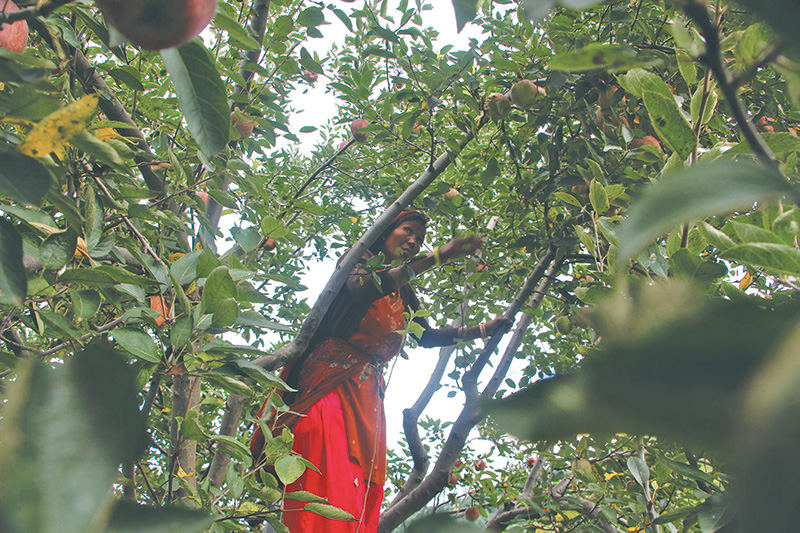
JUMLA, Ruben Bhandari, a farmer in Ward No. 2 of Chandannath Municipality, has 45 apple trees in his orchard with fully ripened apples ready to be harvested. But the apples will most likely not make their way to the markets, says Bhandari. “Vehicular movement along all roads leading to the district headquarters, Jumla Bazaar, has been stopped due to the coronavirus pandemic,” he said. “Every year during the harvest season, traders and businessmen would come to our orchards to purchase apples but no one has come this year.” For the past five months, only vehicles carrying daily essentials are allowed on the road along the Karnali Highway. Vehicles are barred from the rural roads that link villages to the district headquarters. “This year our village is empty of outsiders who would usually come to us to buy apples,” Bhandari said. It is not only the pandemic that threatens to bring Jumla apple farmers on their knees; the poor harvest this year due to bad weather conditions has also hampered their sales. “I sold apples worth Rs 60,000 last year. This year, I have apples worth only Rs 15,000 in my orchard,” said Bhandari. “But even selling those is difficult this year.” According to the District Agriculture Development Office, apple production in Jumla has lowered by 50 percent this year. Balakram Devkota, chief at the Agriculture Development Office, said, “Last year, the total production of apples was 12,000 metric tonnes whereas this year we only have an estimated 5,100 tonnes of apples. The production has lowered because of hailstones and frost.” Chaiti Bista, an apple farmer in Patarasi Rural Municipality, is also burdened with financial worries. “We experienced bad weather this year and our harvest is poor,” she said. “And to think we won’t even be able to sell at all is worrisome.” On August 13, the District Administration Office in Jumla had imposed an indefinite prohibitory order to contain the spread of coronavirus. This prolonged prohibitory order has put many apple farmers out of business. With no end to the pandemic in sight, some farmers in Jumla have started to stack apples from their orchards in bamboo baskets and take them to nearby market places. But the local markets do not offer a good price for organic apples, says Bhandari. In light of the difficulties faced by apple farmers, the District Administration Office has allowed the transportation of apples in vehicles carrying essential supplies to the district headquarters. But the farmers themselves have to make arrangements to take their apples to Jumla Bazaar. Om Prasad Devkota, the assistant chief district officer, said, “The District Administration Office has imposed a prohibitory order to contain the coronavirus. However, the office has not halted the transportation of daily essentials, including apples.” But for farmers, this is not a viable solution since the carriers charge a hefty amount to carry their apples. Bharat Bhandari, an apple farmer in Chandannath, said, “We are compelled to use carriers that transport daily essentials to carry our apples. But these carriers charge exorbitant transport fares.” A decade ago, the 15th district council had declared Jumla as an organic district. Thereafter, apple farming has taken the district by storm. Jumla’s apples are in high demand for their crunch and sweetness. Farmers in all seven rural municipalities and a municipality in the district cultivate apples, particularly the Golden, Delicious and Fuji varieties. In the current fiscal year, the Prime Minister Agriculture Modernization Project (Apple Superzone) has provided cardboard boxes to the farmers in Jumla to help them organise their supply method. “With the government’s support, apple farming has become the main source of income for local farmers in the last few years,” said Kantika Sejuwal, mayor of Chandannath Municipality in Jumla. “This year, the supply has been disrupted due to the pandemic. But the municipal office has decided to allow carriers loaded with apples to go out of the district. The District Administration Office in Jumla is positive about this decision,” said Sejuwal. Nawaraj Bhandari, chief at the Apple Superzone, said, “Since traders haven’t been able to come to Jumla to buy apples from the farms, the farmers are transporting apples out of the district on goods carriers. But it is costly and cuts into their profits.” “The administration is ready to help farmers and businessmen when needed. We have allowed local businessmen to form an ‘apple collection centre’ in various parts of the district where they can collect apples,” said Devkota, the assistant CDO. “Until now, none of the businessmen or farmers has visited our office to request for passes for apple transportation.” In Jumla, apples can be grown in 10,000 hectares of land at altitude ranging from 2,600 metres to 3,500 metres, according to agriculturists.
NATIONAL
Many elderly people in Saipal live with treatable visual impairment for lack of medical facilities
More than 80 percent of eye patients will regain their sight if authorities conduct an eye camp, say health workers.
- Basanta Pratap Singh
Most of the senior citizens in the rural municipality have not been ableto seek treatment for their cataract due to the remoteness of the villages. Post Photo: Basanta Pratap Singh
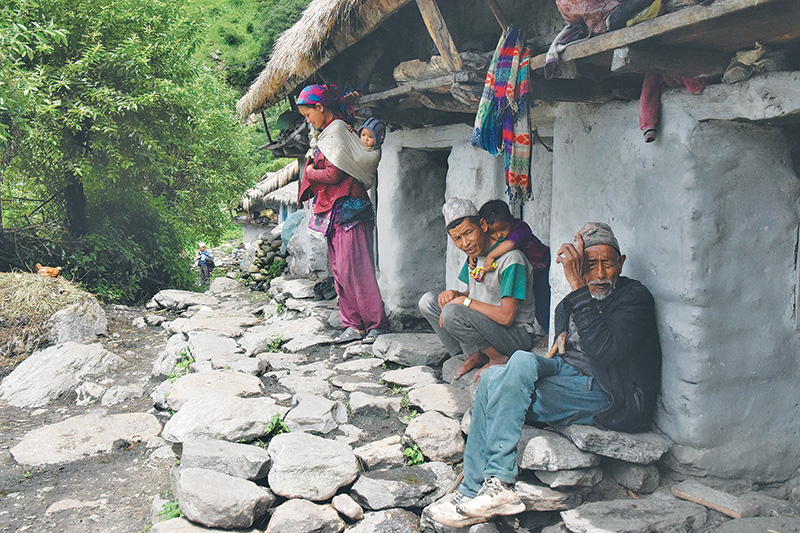
BAJHANG, Out of around 500 elderly people in Saipal Rural Municipality, 300 are visually impaired. Most of them are suffering from cataract, an opacification of the lens of the eyes which leads to partial or total blindness in a person. According to Nabin Bohara, the incharge of the Health Unit in Dhuli Village, most of the senior citizens in the rural municipality haven’t been able to seek treatment for their cataract due to the remoteness of the villages. “It’s a treatable condition. But since the villages are in remote locations, medical facilities are not easily available,” said Bohara. Parbate Bohara, 81, a local of Dhuli Village, has been partially blind for the past seven years. Over the years, he has visited the local health post several times and has been advised to go to Geta Eye Hospital in Kailali for treatment. “But it’s impossible for me to go to Kailali. We have to walk for four days to reach Chainpur, the district headquarters, from Dhuli. Then it’s a day-long journey on a bus to the eye hospital,” said Parbate. “Since Dhuli is not connected to the road network, I will have to be carried on a stretcher to Chainpur. The journey from here to Kailali is an expensive one.” According to him, he will have to employ at least 15 people to take him on a four-day journey to Chainpur and then to Kailali. “The cost of accommodation and food for the helpers will be around Rs 100,000. I will not be able to bear the cost,” he said. Parbate said he has heard about free eye camps being organised in other local units in the district but the same is yet to be organised in Saipal. “The health workers at the local health post tell me that I can regain my eyesight with one simple surgery. But our local authorities have not organised free health camps here for us,” said 55-year-old Momita Rokaya, a local of Jagera in Saipal Ward No. 4. Rokaya gradually lost her eyesight in the last six years and has been housebound for the past two years. “I feel so helpless now. I don’t know what has happened to my eyes but people tell me it’s God’s way of punishing sinners,” said Rokaya. “But I don’t remember committing sins in my lifetime.” According to the rural municipal office, every household has at least one person living with vision problems in most villages of the rural municipality. According to the health workers in Saipal, most people above the age of 50 are living with eye problems in the rural municipality. Janak Kumar Bista, a former employee at Geta Eye Hospital in Kailali, said, “More than 80 percent of eye patients in the rural villages will regain their eyesight if authorities conduct an eye camp. I had requested the concerned authorities to conduct an eye camp while I was working in Saipal but they said it would be difficult to do so given the geographical remoteness of the area.” Rajendra Dhami, chairman of the rural municipality, said he has taken initiatives to conduct eye camps in the rural villages but has not been successful. “I had requested several organisations and individuals to set up free health camps in the rural villages of Saipal. But most turned down my request since the villages are far-flung with no road network,” he said. “If any organisation or individual is willing to come to Saipal to help us set up a free health camp, the rural municipality is ready to bear the expense.” Meanwhile, Sanip Okheda, chief at the District Hospital in Bajhang, said that the hospital is planning to organise an eye camp in Saipal villages by the end of the current fiscal year. “Since there are no motorable roads in Saipal, reaching these rural villages is not easy,” he said. “But we do plan to set up a free eye camp in Saipal soon.”
NATIONAL
Covid-19 surge deprives 60 percent of malnourished kids of treatment
Lack of public transportation and conversion of rehab centres into quarters for health staffers cited as reasons.
- Arjun Poudel
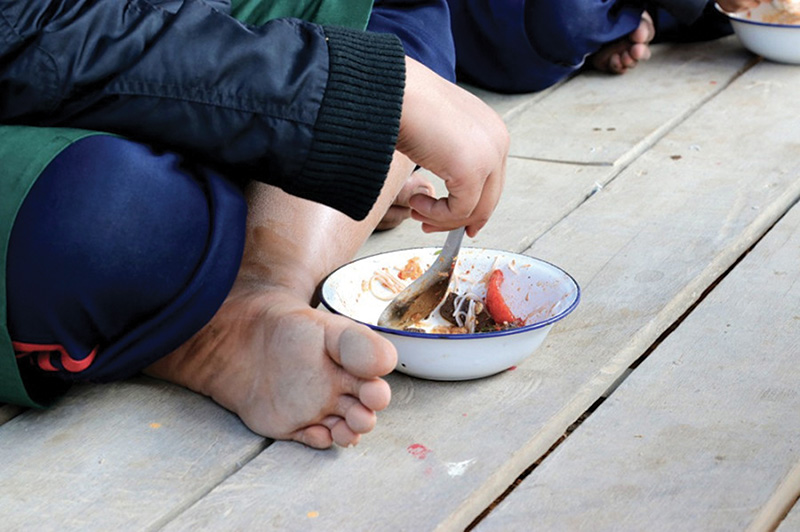
Malnutrition is considered a silent crisis in Nepal. According to Nepal Demographic Health Survey, 2016, 36 percent of children under five suffer from chronic malnutrition. Post File Photo
KATHMANDU, At a time when agencies under the Ministry of Health and Population have been focussed on containing the spread of the ongoing Covid-19 infections, thousands of severely acute malnourished children have been deprived of the treatment. According to the nutrition section of the Family Welfare Division under the Department of Health Services, over 15,000 severely acute malnourished children, who need immediate care, used to be brought to health facilities for treatment in the normal time every year. However, in the last eight and half months, only 4,000 such children reached health facilities for the treatment. “Around 60 percent severely malnourished children have been deprived of treatment during the pandemic,” Kedar Prasad Parajuli, chief of the nutrition section, told the Post. “The number of severely acute diseases has definitely gone up because of the restrictions in place during the ongoing pandemic but we do not know the extent of this.” Malnourished children are provided nutritious food and treated for any illnesses at nutrition rehabilitation homes, even for months until their condition returns to normal. Malnutrition is considered to be a silent crisis in Nepal. According to Nepal Demographic Health Survey of 2016, the latest data which is available, 36 percent of the children under the age of five years were found to be suffering from chronic malnutrition, while 1 percent from acute malnutrition. Another 27 percent of the children were found to be underweight and 1 percent overweight. Malnutrition is not only a problem of not getting enough to eat but also of lack of nutritious food, of lack of knowledge to use locally available foods and of the growing trend of giving junk foods to the children, according to Dr Aruna Uprety, a public health expert. Nutritionists as well as child health experts have warned that if not treated on time, malnutrition in children will have long-term consequences not only in the children’s physical and mental health but also in the country’s overall development. “Malnutrition not only affects the children’s physical health but also affects their cognitive development,” Dr Shyam Raj Upreti, former director of the Child Health Division, told the Post. “Malnourished children will be stunted if they do not get the treatment. Such children are also prone to be affected by multiple non-communicable diseases as well in future.” The Covid-19 pandemic is undermining nutrition across the world particularly in low-income and middle income countries, according to a Lancet report. “Strained health systems and interruptions in humanitarian response are eroding access to essential and often life-saving nutrition services,” the report said. With public transportation not available during the ongoing restrictions, hundreds of people have been denied access to treatment at health facilities. Moreover, several health facilities across the country have been converted into quarantine and isolation centers to place the infected and others suspected of being infected. Some nutrition rehabilitation centers-- there are 22 in the country--had been converted into quarters for the health workers serving Covid-19 patients, according to the nutrition section. “The nutrition rehabilitation centres are now operational,” Parajuli said. Of the total under-five mortality rate, 53 percent are considered to be due to malnutrition in Nepal, which is 8 percent higher compared to the global average of 45 percent. The pandemic has only made the situation of malnourishment worse. “We do not have a record of the deaths of children under-five years of age because of malnourishment but malnourished children might have died due to lack of treatment during the pandemic” said Parajuli of the nutrition section. Despite the health crisis that the country is under, the problem of malnourishment cannot be ignored because of its long-term consequences, according to public health experts. “Health officials should find a way out to save our children from malnutrition,” Uprety, the public health expert, told the Post. “Instead of focussing only on distributing micronutrients like Bal Vita and others, we should focus on using locally available nutrition resources.” Taking the help of thousands of female health volunteers serving throughout the country to launch an awareness drive against malnutrition is also a possibility, Uprety added.
NATIONAL
Local governments in Province 2 lag behind in annual budget presentation
Experts say political issues, lack of experience are major reasons behind the delays.
- PRITHVI MAN SHRESTHA
KATHMANDU, Chhinnamasta Rural Municipality of Saptari, has failed to present its annual budget in time for three years in a row while 50 local governments across the country are yet to present their budget for current fiscal year 2010-21. As per the Intergovernmental Fiscal Arrangement Act, all local governments should present their fiscal budgets by June 25. But, according to Surya Narayan Mandal, chairperson of Chhinnamasta, the rural municipality failed to call the village assembly to present the budget, as the chief administrative officer has not reported to work since mid-July due to family reasons as well as the Covid-19 travel restrictions. “He will attend the office in one or two days and we will make necessary preparations for holding the village assembly,” Mandal said. In the last fiscal 2019-20, Chhinnamasta Rural Municipality had presented the budget late. In the previous fiscal 2018-19, it had presented the budget in April 2019, nine months after the fiscal year began, as the elected local representatives could not agree on the budget share at the ward level. According to the Ministry of Federal Affairs and General Administration, most local governments that failed to present a budget for the current fiscal year so far are from Province 2. Of the total 50 local governments that have failed to present their budget this fiscal year, 36 are from Province 2, four each from Province1, Sudurpaschim Province and two from Gandaki Province. This is not the first time that local governments in Province 2 have failed to present their budgets in time. In the previous two fiscal years, many local governments in the province were late while presenting their budgets. While some might argue that the Covid-19 pandemic delayed the budget presentation this year, others could bring up the past records to claim that it was not the pandemic that caused the delay. “Political differences and issue of international management are basically responsible for why some local governments are failing to present the budget in time,” said Jaya Narayan Acharya, national programme director at the Provincial and Local Governance Support Programe, a government programme designed to develop capacity of sub-national governments. “As the budget is not just a fiscal document but a political one too. Differences among political forces could lead to such problems.” One particular factor, according to Acharya, could be the representation of diverse political forces at the local governments in Province 2 compared to the local governments in other provinces. Nepal Communist Party, Nepali Congress and Janata Samajbadi Party--formed after merger of Madhes-centric parties--all have representation at the local level. In other provinces, it is only the Nepal Communist Party and the Nepali Congress that lead the local governments. Last fiscal year, Bhagwanpur Rural Municipality in Siraha had struggled to present its budget for a long time due to a lack of support from the representatives of other political parties. Bechan Prasad Yadav, who was elected from the erstwhile Sanghiya Samajbadi Forum-Nepal (now Janata Samajbadi Party) as a local unit chairperson, had complained about lack of support from representatives of other parties last time. The rural municipality has already presented its budget for this fiscal year. However, Tula Narayan Sah, executive director of the Nepal Madhesh Foundation, a non-governmental organisation advocating for Madhesi issues, does not see the difference among the political parties as the main reason for the delay in budget presentation. “Some local governments have failed to present their budgets even when a single party has a majority in the local assembly,” he said. As per his observation, the lack of awareness among the Madhesi community about the process of the state affairs is one of the key reasons behind consistent delay in presenting a timely budget in Province 2. “This is because for a long time, the Madhesi community didn’t have access to the state and their representatives and they are unaware about the grammar of the state affairs,” Sah said. Most of the local governments in Province 2 that failed to present their budgets are based in the inner parts of the region highly populated by the Madhesi community, according to the federal affairs ministry. “Even after democracy was restored in 1990, the Madhesi community never got real political freedom. They could not criticise the dominant political system. When there is critical civil society, it makes a difference in the process of governance at the local level,” Sah said. “In Madhesh, people of the hill region and Madheshi elites promoted the political culture of patronisation which resulted in the lack of knowledge about state affairs among the Madhesi community.”
NATIONAL
Mental health patients deprived of drugs and counselling during pandemic
Doctors say remote counselling is not accessible to patients living in small towns and villages as regular therapy sessions and supply of medications are obstructed by lockdowns.
- Arjun Poudel
Shutterstock
KATHMANDU, Mental health specialists have said the coronavirus pandemic has discontinued the care and treatment of many patients, as the country has been under a lockdown and other restrictions since March 24. Patients living in small towns and villages have been particularly hit hard, because for many of them their regular therapy sessions and medicines have stopped with the restrictions put in place to control the virus spread. Doctors at Nepal Mental Hospital in Lalitpur say unlike the patients of other diseases, people suffering from mental illness cannot buy medicines from pharmacies without prescriptions. Discontinuation of medication or counselling could cause a patient’s condition to deteriorate, say the doctors. While some hospitals have been offering remote counselling to the patients in these times of pandemic, not every patient has access to phones and the internet to avail the service. “I recently offered remote counselling to a Nepali man based in Portugal. He was a former patient who had been suffering from anxiety and depression,” Dr Ananta Prasad Adhikari, consultant psychiatrist at the hospital, said. “It was easy for him to get in touch with me because he lives in Europe. But here in Nepal, there are thousands of people suffering from various mental disorders who do not have internet at their homes to contact the doctors.” Doctors say discontinuation of psychiatric medication could lead patients to a psychotic, manic or severely depressed state. There is also the risk of patients taking their own lives. On Monday, the Nepal Mental Hospital received a patient, a woman in her early thirties from Sindhupalchok district, with severe depression disorder. Her family had been unable to get medical help for her due to the continuous Covid-19-related restriction in the movement of public transportation for months on end. “She had tried to take her own life three times in the last five monts,” Dr Basudev Karki at the hospital, told the Post. “We have prescribed her some medicines and advised her to stay with her relatives in Kathmandu so she could get help whenever she needs it.” The data of the Non-communicable Disease and Mental Health Section of the Epidemiology and Disease Control Division show that 6,261 people took their own lives in the fiscal year 2019-20, which is at least 17 people daily. The number was 5,734 or 16 people per day in the fiscal year 2018-19. “Over 80 percent of the sucide cases are associated with depression,” Karki, the consultant psychiatric at the Nepal Mental Hospital, said. “If the patients taking psychotic medicines discontinued, it could lead to depression and suicide in extreme cases.” According to the Non-communicable Disease and Mental Health Section of the Epidemiology and Disease Control Division, the coronavirus pandemic has had a severe impact on the patients suffering from mental health disorders as they are confined in their homes, unable to reach health facilities and get their medicines. “We have received numerous complaints from doctors and hospitals regarding discontinuation of medicine regimes and counselling as a result of the pandemic,” Dr Phanindra Prasad Baral, section chief of the NCD and Mental Health Section of the division, said. “Cases of mental health problems have been increased due to the pandemic. To help the patients, we have directed the health facilities to provide medicines for a month as well as deployed over 150 counselors in various districts.”
NATIONAL
Surgery service closed in Rukum (West) hospital
Briefing
- Post Report
RUKUM (WEST): The surgery ward at the district hospital in Rukum (West) has remained closed for the past three months as the vacancies for specialist doctor and anesthesia assistant have not been filled. The two posts have been vacant since mid-June. Dr Mahesh Chaulagain, acting head administrator of the hospital, said they have recently issued vacancy notification to fill the positions.
NATIONAL
Four held on burglary charge
Briefing
- Post Report
RAJBIRAJ: Police arrested four people on charge of burglary at a general store in Rajbiraj Municipality Ward No. 7, Saptari, on Tuesday. An unidentified group had burgled the store on Sunday night and made off with cash and valuables worth around Rs 400,000. Police made public Saniya Mandal of Rajbiraj-6, his sister Jyoti Kumari, Samim Ansari of Rajbiraj-4 and Lal Mahammad Rain of Rupani-4 on Tuesday for their alleged involvement in the crime.
NATIONAL
Protest over halt in regular dialysis service
Briefing
- Post Report
CHITWAN: Kidney patients and their relatives took to the streets in Bharatpur, Chitwan, on Tuesday demanding resumption of dialysis services at Bharatpur Hospital. The hospital had issued a notice last Monday saying that only emergency dialysis services will be provided as most of the staff have contracted the coronavirus. Earlier, the hospital used to provide free dialysis service twice a week.
NATIONAL
Jitya Parba begins in Mithila
Briefing
- Post Report
JALESHWOR: Jitiya Parba, one of the most widely celebrated festivals of the Mithila region, began on Wednesday as women offered flattened rice, curd and delicacies prepared using mango juice to their families’ ancestors before going on a fast.
EDITORIAL
Bridges to hell
As defaulting contractors remain scot-free, bridges continue to pose a threat to life and property.
In Nepal, not a year passes by without news reports of a few bridges collapsing in one place or the other. It has remained a sort of an annual affair for decades now, with no substantial change in the way we deal with the menace. In May 2014, an under-construction bridge spanning 80 metres over the Trishuli River at Kabilas fell down. A motorable bridge over a stream at Dhankute Road in Dharan that connected Koshi Highway and the BP Koirala Institute of Health Sciences collapsed in September 2015. A bridge over the Baulaha River on the East-West Highway was destroyed after a truck crashed into it in December 2016. The list goes on and on. This year has not been an aberration. The Rahughat Bailey Bridge on the Beni-Jomsom road collapsed due to a landslip in the second week of July. A concrete bridge was slated to be built near the collapsed bridge, but the contractor had been on the run for over a year after the foundation had been dug. The Mauwa Bridge that joins Dhading and Chitwan on the Prithvi Highway went down with floodwater in July. While some of the bridges collapse due to natural disasters including flooding and landslides, many other such incidents are man-made disasters due to shoddy construction and lack of regular maintenance. On Wednesday, the Post reported that all five bridges on a 35-km stretch of the Mid-Hill Highway in Parbat were in a dilapidated condition due to lack of maintenance and repair work. They were built 30 years ago and designed to have a life of around 50 years, but they are in a dilapidated condition for want of regular maintenance and have turned into death-traps. As the country’s construction sector remains gripped by a few dozen influential contractors with political backing, the same construction company gets the contract for building bridges despite defaulting on several other similar projects. It is this syndicate of poor constructors and their political protectors that have largely contributed to the collapse of bridges each year. The country has been facing what may be called the ‘Pappu Construction syndrome’ of constructing bridges by violating the approved designs, disregarding quality maintenance and delaying completion of projects. Collapsing bridges also pose a great risk to humans, animals and property. We must not forget the tragedy in December 2007 when almost two dozen people died and over 90 were injured when a suspension bridge over the Bheri River in Surkhet collapsed. Even as recently as the third week of June this year, at least four people were injured when an under-construction bridge on the Mayadevi-Chhapiya road in Rupandehi collapsed. The lack of legal action against defaulting contractors means that the series of bridge collapses will continue in the years to come and even stop making news altogether. It is high time we started considering bridge collapses as cases of human rights violation and taking stakeholders to task for their actions.
OPINION
Free flow of ideas
One positive side effect of the current pandemic has been a great increase in the discussion of ideas virtually.
- PRAMOD MISHRA
Shutterstock
In my department, we have decided to devote our monthly faculty salons this academic year to readings on race, racism and anti-racism in response to protests that followed the George Floyd killing. We will begin with a selection of shorter pieces chosen for this year’s common readers for first-year students and move on to books like How to Be an Antiracist (2019) by Ibram X Kendi, who also wrote a book called Stamped from the Beginning: The Definitive History of Racist Ideas in America (2016). The goal is to continue the conversation about race, gender, sexuality, disability and other kinds of differences that produce discrimination based on social values of superiority and inferiority, normality and abnormality, or us and them. The faculty salon is an informal monthly meeting of department members to discuss various issues related to teaching and scholarship. Our goal in this series of readings is to educate ourselves first about various ways in which highly educated people like ourselves could get blindsided by our assumptions that originate from what Plato calls, while talking about education, ‘birth and becoming’. If professors themselves remain trapped in the prison-house of birth and becoming, how can they educate their students? That’s why, even as society in general remains in the grip of community ideas, moving sluggishly forward or backward, universities in America keep the flow of ideas in constant circulation. Universities in America compete with each other constantly for better students and professors, who can bring better minds and ideas to their educational institutions. For example, Kendi at age 38 has just assumed an endowed professorship at Boston University and has been given 10 million dollars by Jack Dorsey, the CEO of Twitter, to start a new institute called Center for Antiracist Research. The academy has lapped up Kendi’s ideas, his 2016 book on race received the National Book Award, and the readership in America has not only made his books New York Times bestseller but put other such books, like the recent one on caste by Isabel Wilkerson, on the bestseller list. Thus, American society moves in contradictory ways. On the one hand, it shows tremendous hunger for new ideas, new ways of thinking and doing, on the other hand, the larger society remains stubbornly trapped in old notions of race, gender and difference. In my presentation in July, hosted by the Limbuwan Readers Club, on James Baldwin’s The Fire Next Time, I couldn’t adequately answer a listener’s question about America being the source of so many egalitarian ideas while remaining a hotbed of racism and retrograde racial ideas. I did have an answer, but chose not to answer it then, highlighting only the liberational ideas. Having given this matter some thought, I can now say that, generally speaking, there has always been a gap between town and gown in America—between the college and university educated and the general public who are high school educated, or less. Statistically, only around 30 percent of Americans are said to be college-educated despite the fact that America has the largest number and probably the best-quality colleges and universities in the world. Partly for reasons of cost, partly for lack of information and partly for disinclination (disinclination because even high school education has, for the most part, guaranteed middle-class life for most Americans so far), only about one-third Americans avail themselves of university education. And in the absence of systematic higher education, where people get a chance to cultivate critical thinking, people remain in the grip of ideas imparted by the family, community and popular culture. And since individual liberty is one of the central tenets of American life, an individual remains free to either free oneself from dogma or happily remain trapped in it. And many obviously choose the latter. Nonetheless, the colossus of higher education slowly and sluggishly filters and clears old debris and helps usher in new ideas and perspectives within its own walls and spreads them out through its newly minted graduates into the larger society. And, so, despite the snail-pace of progress, society sputters forward. In a recent presentation on gender and ethnicity organised by Tarai Madhes National Council (TMNC) and in our Nepali writing in Kantipur on September 4, the flow of ideas or lack thereof remained the central focus. When Tula Narayan Shah and I travelled through the plains of Nepal from east to west last December, we saw that the villages lacked the flow of ideas. Rural women in several places said they watched Hindi television serials (soap operas) but nothing else. They didn’t even know the name of their Chief Minister, who had become known by then for his signature ‘Beti Bachao, Beti Padhao’ (Teach a Girl, Save a Girl) campaign. The situation for educated men was worse. While even the socially conscientious retired elder who had earned his Master’s in the 1960s from a prestigious Indian university didn’t read even newspapers, the young teachers of a private school we met in front of a locked library said they had never entered the library. Indeed, east to west, along the 1400 kilometres stretch of the country, we didn’t find any functioning library. That is why, I think that one of the only positive side effects of the current pandemic has been the explosion of live social media broadcast of discussion generated by any person and any organisation. How far these emergent means of idea flows will go, only time can tell. But there is no substitute for the systematic flow of ideas either through libraries or schools and universities with their emphasis on cultivating critical thinking in the young and old. Meeting people in person or virtually from South Asia and knowing their fatalistic response to the Covid-19 pandemic has made me even more of a firm believer in the flow of new and corrective ideas to challenge, dispel and replace old, moribund ideas about life, people and society.
OPINION
Trading during a pandemic
World commerce will depend on the agility of exporters and their ability to innovate.
- BIJENDRA MAN SHAKYA
Shutterstock
The Covid-19 pandemic has brought about widespread economic impacts owing to measures, like lockdown restrictions, taken by governments to control its spread. This has triggered the largest global economic shock since the Great Depression of the 1930s. Yet there is a marked difference between the two greatest economic shocks. While the Great Depression was caused solely by lack of ‘effective demand’ according to Keynesian economics, the recent recession has been attributed to both demand and supply shocks. Reduced employment and income have worsened the demand situation. Consumer demand has been concentrated on healthcare products, changing global demand patterns. Disrupted supply chains and the closure of non-essential industries have threatened employment and supply capacities everywhere.
Economic jolts These twin effects will continue to exist in all economies irrespective of their development status at least through 2020. The effect of the pandemic seemed to be rapid and intense in the advanced economies resulting in massive layoffs and a stock market crash. Although relatively low in intensity, small and feeble economies including Nepal, have started to feel the economic jolts as the lockdown and other mitigation measures have been relaxed. No sector of the economy will be spared from the impact of this catastrophe as there will be spillover effects magnifying the original shock. There is growing concern over the impact of the virus on the Nepali economy. The services sector, particularly travel and transport, have been hit the hardest. A paralysed tourism industry has led to a state of mass unemployment, and the hordes of returning migrant labourers from the Gulf countries have aggravated the problem. Studies estimate that the inflow of workers’ remittance has shrunk by about 29 percent or $2.32 billion this year, threatening the country’s external economic situation. Making conditions worse, there are signs of pessimism in the trade sector already beset with many challenges. The World Trade Organisation has anticipated a downturn in global trade by 13 to 32 percent, the wide range caused by uncertainty of the economic impacts of the pandemic and lockdown. This is a steeper fall than the global financial crisis a decade ago. It further said that almost all regions would suffer a double-digit percentage decline in trade with exports from North America and Asia suffering the most. This is, without doubt, a daunting challenge for Nepal which is already struggling with dwindling exports. Nepal has witnessed a fall in both exports and imports as a result of the stay-home order. Preliminary data illustrated a stagnant export performance between January and June 2020, representing the pre- and post-lockdown periods. There was a sharp decline in imports between the same periods, and the contraction in imports has reduced the trade deficit to some extent. Import trends can revert to normal with the relaxation of the lockdown supported by a rise in global commercial flights carrying air cargo, movement of containers and revival of export orders. However, improvements in these factors are not going to revive export transactions anytime soon. Strained by inherent weaknesses, factors like consumer behaviour and market access, and exporter ability to adapt to the changing trading environment will determine the export trend at least in the short to medium terms. Regarding demand, the implications can be assessed in two ways. First, Nepali export products are not dynamic with regard to global demand. This means international demand for Nepali products is stagnant, and global demand may actually drop. Second, a majority of the products are non-essential items in terms of consumer preference, which means the consumption of such products can be easily postponed. So pricing as a tool to induce demand will be relatively ineffective in the current situation where the demand pattern is changing. As a result, the products shipped to overseas countries which contribute hugely to Nepal’s export revenues will continue to see a steep fall. The country’s major export products such as apparels, carpets, craft items and herbal remedies are vulnerable. But exports to India will be comparatively more resilient as the products shipped to the southern neighbour are basically agricultural and consumer items, which are of an essential nature or are used as inputs for further processing. They include products like large cardamom, ginger, tea, palm oil, yarn, and iron and steel.
Protectionist sentiments In a situation like this, there is a possibility of rising protectionist sentiments prompted by a slowdown in global economic growth. A turn towards protectionism will encourage enforcement of non-tariff barriers, for example, tough health and sanitary standards citing the pandemic. This will not only obstruct global market access but also reduce trade efficiency. Furthermore, the inability of Nepali exporters to adapt to international products and marketing will probably create more uncertainties in export trade. It is expected that there will be a quick V-shaped recovery in the global economy. The World Trade Organisation has forecast that merchandise trade will rebound by 21 to 24 percent in 2021, depending on how rapidly the pandemic recedes, and how well countries coordinate their joint policy responses. Hence, trading in the pandemic will depend on the agility of exporters and their ability to innovate. Adoption of digitalisation in trading is another important factor to be considered as the outbreak has led to structural shifts, including changes in customer preference and supply chains. Thriving in the new reality will depend on the response of Nepali traders to these interrelated components, and the actions taken to resolve the deeply rooted problems in the country’s export sector.
Shakya is an associate professor of economics at Tribhuvan University.
MONEY
Malaysia palm oil producers look to prisons to solve labour crunch
- REUTERS
KUALA LUMPUR, Malaysia’s labour-reliant palm oil companies are looking to recruit recovering drug addicts and prisoners to solve a severe shortage of migrant foreign workers as the coronavirus pandemic shuts borders and hampers output of the edible oil. Planters in the world’s second-largest producer have in recent months embarked on rare recruitment drives to hire locals to do everything from harvesting to fertilising crops, but response has been lukewarm. Migrants from Indonesia and Bangladesh make up nearly 85 percent of plantation hands in an industry locals typically shun as dirty, dangerous and difficult. But travel and movement restrictions have left producers grappling with a shortage of 37,000 workers, nearly 10 percent of the total workforce. The shortage, especially during the peak production months of September-November, will hurt output by delaying the harvest of perishable fruit, giving an edge to no. 1 producer Indonesia, which has no significant labour problems. The Malaysian Palm Oil Association (MPOA) estimated the industry has lost up to 30 percent of its potential yield as the labour crunch delays harvesting, and pegged the country’s crude palm oil output to be much lower than last year’s 19.9 million tonnes. “We are even reaching out to ... the Drug Prevention Association of Malaysia, as well as the Prisons Department in search of locals,” MPOA said in a statement on Tuesday evening. Collaboration with the Prisons Department to recruit some parolees and prisoners dates back to 2016, but now more companies are interested in the programme, MPOA Chief Executive Nageeb Wahab told Reuters. Sime Darby Plantation, the world’s largest palm producer by land size, on Wednesday said it is 2,500 workers short—about 10 percent of its foreign labour force—and that companies are “desperate” to explore every opportunity for new recruits.
MONEY
Investment Board told to confirm final investment decision on Nijgadh airport
Winning bidder Zurich Airport was named concessionaire in September last year to develop the $3.45 billion airport.
- SANGAM PRASAIN
The Nijgadh international airport is planned to be the largest in South Asia in terms of area, covering 8,045.79 hectares when completed. Post File Photo
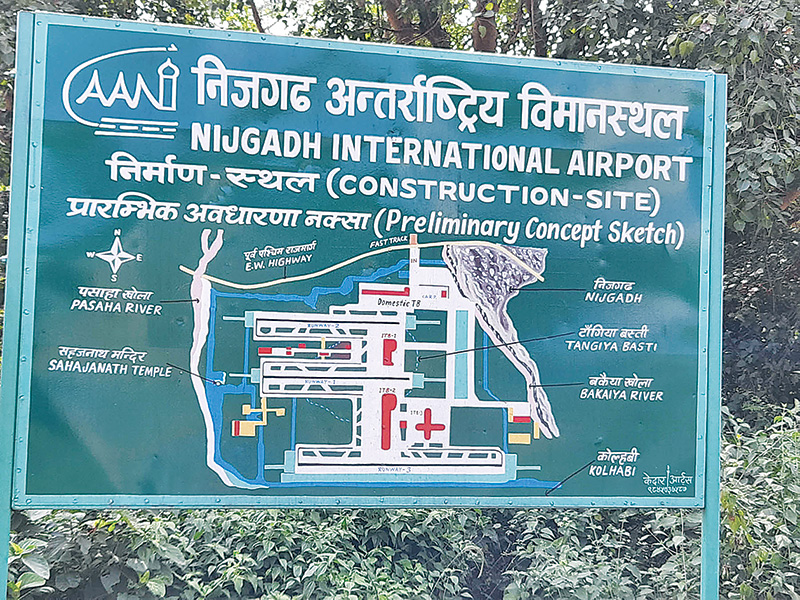
KATHMANDU, A high-level government panel has asked Investment Board Nepal to confirm the final investment decision on Nijgadh International Airport with potential builder Zurich Airport International AG. The inter-agency project coordination and facilitation committee headed by Tourism Minister Yogesh Bhattarai on Tuesday told the board to seek confirmation from the winning bidder by September-end. Zurich Airport International was named concessionaire in September last year to develop the $3.45 billion Nijgadh International Airport after the Swiss company outbid competitors, including the GMR Group, an Indian infrastructure giant. The proposed airport in Bara, slated to become the largest airport in terms of area in South Asia, has been embroiled in controversy over its environmental impacts. After the Supreme Court ordered a halt to felling trees at the construction site last December, Zurich Airport asked for an extension to its March 1 deadline to submit a business proposal. Tourism Ministry spokesperson Kamal Prasad Bhattarai told the Post that Tuesday’s meeting decided to ask Investment Board Nepal to confirm the final investment decision on the airport project by September 30. “The extension given to the Swiss company will also end by then,” he said. According to officials of the Tourism Ministry and Investment Board Nepal, the court ruling is only to stop all activities related to deforestation, and it doesn’t bar other activities. On December 6 last year, Supreme Court Justice Tanka Bahadur Moktan issued a stay order asking the government to immediately stop felling trees at the site. Again, on December 22, a division bench of Chief Justice Cholendra Shamsher Rana and Justice Kumar Regmi upheld the interim order issued on December 6. Investment Board Nepal decided to move ahead nonetheless and invited potential bidders on the grounds that the court order only mandated that trees not be cut down, and did not say that all work should come to a halt. On January 17, Investment Board Nepal formally asked Zurich Airport to submit a business proposal after it was short listed in September last year as the sole company to work in a public-private partnership model for the international airport in Nijgadh. Under the public-private partnership model, the Swiss company will fully fund the construction project. The cost of the first phase of the development alone has been estimated at $1.2 billion. The project modality is ‘build, operate and transfer’ under the public-private partnership arrangement. The Swiss firm will propose, in its business document, how long it will operate the airport before handing it over to Nepal. The planned air hub at Nijgadh, about 175 km from Kathmandu, is expected to serve as an alternative to congestion and winter fog at Tribhuvan International Airport, the country’s sole aerial gateway. The government had decided to develop Nijgadh International Airport, one of its most ambitious projects, in 1995. The timeline for the airport has been pushed back on multiple occasions amid concerns about financing and legal issues over its environmental impact. According to an environmental and social impact assessment carried out by the Tourism Ministry in February 2017, more than 2.4 million small and large trees will need to be chopped down for the airport. In the first phase alone, the project will require 769,691 trees to be cleared on 2,500 hectares. The plan has drawn criticism from various quarters. Environmentalists say that the felling of so many trees will drastically affect the biodiversity of the area. The results could be catastrophic for many animals that call the Nijgadh forests home, they say. The Civil Aviation Authority of Nepal, the project executing agency, said they had reviewed the plan to reduce the environmental impact. As per the new decision, the project will use 1,900 hectares in the first phase. Tuesday’s meeting directed the Division Forest Office, Bara to count the number of trees that will need to be cut down by mid-December. The meeting also decided to prepare a modality for the resettlement of Tangia Basti, which will be ousted by the project, and submit it to the committee in 15 days. Upon completion of the first phase of the project, the airport will be able to handle 15 million passengers annually and accommodate the Airbus A380 super jumbo. A 76-km Kathmandu-Tarai expressway will link the capital with Nijgadh.
MONEY
Oil prices reverse losses but demand concerns persist
- REUTERS
LONDON, Oil futures clawed back some of the losses they sustained in the previous session, but a rebound in Covid-19 cases in some countries undermined hopes for a steady recovery in global demand. Brent crude was up 20 cents, or 0.5 percent, at $39.98 a barrel by 1119 GMT after dropping more than 5 percent on Tuesday to fall below $40 a barrel for the first time since June. US crude was up 42 cents, or 1.1 percent, at $37.18 a barrel, having fallen nearly 8 percent in the previous session. Both major oil benchmarks are trading close to three-month lows. The global health crisis continues to flare with coronavirus cases rising in India, Great Britain, Spain and several parts of the United States. The outbreaks are threatening to slow a global economic recovery and reduce demand for fuels from aviation gas to diesel. “Short-term oil market fundamentals look soft: the demand recovery is fragile, inventories and spare capacity are high, and refining margins are low,” Morgan Stanley said. Yet, the bank raised its Brent price forecast slightly higher to $50 a barrel for the second half of 2021 with the dollar weakening and rising inflation expectations, it said. Record supply cuts by the Organization of the Petroleum Exporting Countries and allies, known as OPEC+ have helped support prices, but with grim economic figures being reported almost daily, the outlook for demand for oil remains bleak. China’s factory gate prices fell for a seventh straight month in August although at the slowest annual pace since March.
MONEY
Boeing faces setback with new problem in 787
- ASSOCIATED PRESS
WASHINGTON, Boeing has recorded its first orders of the year for the grounded 737 Max, but a new flaw has surfaced in another of its planes, compounding the company’s struggle to recover during a pandemic that has undercut demand for new jetliners. Boeing said Tuesday it is inspecting part of the tail of the two-aisle 787 after finding that pieces were clamped together too tightly, which could lead to premature fatigue of a part called the horizontal stabilizer. The company said it believes the problem affects 893 of the nearly 1,000 787s that have been built. Boeing expects the inspections of recently finished planes to affect the timing of 787 deliveries in the near term, spokesman Peter Pedraza said in a statement. The Federal Aviation Administration said it is investigating the matter. “It is too early to speculate about the nature or extent of any proposed Airworthiness Directives that might arise from the agency’s investigation,” said the spokesman, Lynn Lunsford, referring to potential safety orders that could be imposed on Boeing. Boeing disclosed last month that it found two other manufacturing flaws in the 787, which Boeing calls the Dreamliner and is built largely of carbon composite materials. The company grounded eight planes because of those issues. The company said Tuesday that during production of the tail horizontal stabilizers at a Boeing plant in Salt Lake City, some parts were clamped together with too much force, resulting in improper gaps between sections. Boeing doesn’t believe it is an immediate safety issue but could lead to premature aging of the parts, and it is delaying some 787 deliveries while determining whether repairs are needed on planes that have already been delivered. The Chicago-based company, which builds planes in Washington state and South Carolina, said it delivered 13 airliners last month, including four 787s. It is a popular plane among airlines for international routes. Cowen analyst Cai von Rumohr expected Boeing to deliver 13 787s. He said airlines are pushing back deliveries because international travel is so depressed. Boeing’s slow pace of deliveries since early 2019, when the Max was grounded, has robbed the company of much-needed cash.
MONEY
US readies bans on cotton, tomato imports from China’s Xinjiang
- REUTERS
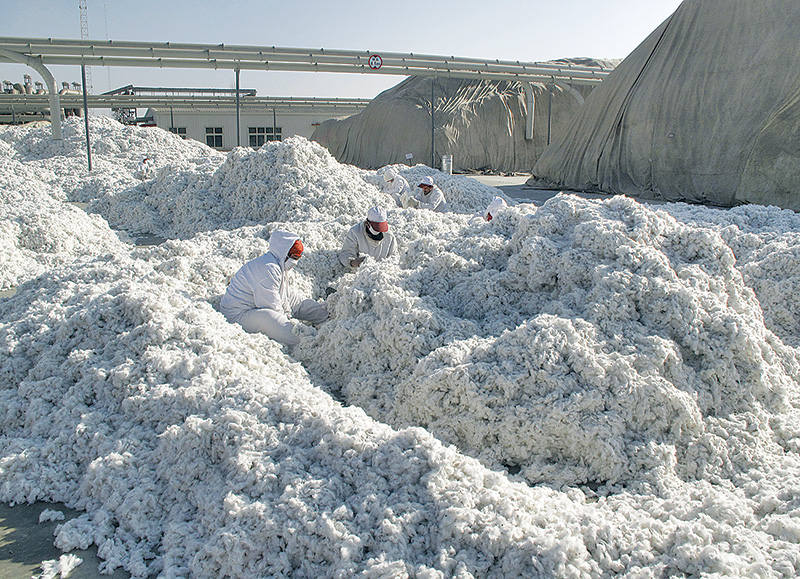
Workers look for trash in newly harvested cotton at a processing plant in Aksu, Xinjiang Uighur Autonomous Region. REUTERS
WASHINGTON, US Customs and Border Protection officials have prepared orders to block imports of cotton and tomato products from China’s western region of Xinjiang over accusations of forced labour, though a formal announcement has been delayed. A Trump administration announcement, initially expected on Tuesday, has been put off until later this week because of “scheduling issues,” an agency spokesman said. The cotton and tomato bans, and those on five other imports, over alleged Xinjiang forced-labour abuses, would be an unprecedented move by the agency, likely to stoke tension between the world’s two largest economies. The “Withhold Release Orders” let the agency detain shipments based on suspicion of forced-labour involvement under long-standing US laws to combat human trafficking, child labour and other human rights abuses. President Donald Trump’s administration is ratcheting up pressure on China over its treatment of Uighur Muslims in Xinjiang, where the United Nations cites credible reports as saying 1 million Muslims held in camps have been put to work. China denies mistreatment of the Uighurs and says the camps are vocational training centres needed to fight extremism. In Beijing on Wednesday, a foreign ministry spokesman dismissed the orders as a pretext to target Chinese firms. “I think the US cares nothing about human rights,” Zhao Lijian said in response to a query. “It is only using this as a pretext to oppress Chinese companies, destabilize Xinjiang and slander China’s Xinjiang policy,” he told a daily news briefing. China will take all necessary measures to safeguard its companies’ legitimate rights and interests, he added. CBP official Brenda Smith told Reuters the effective import bans would cover the entire supply chains for cotton, from yarn to textiles and apparel, as well as tomatoes, tomato paste and other regional exports.
MONEY
New infections dent hopes of reviving Southeast Asia’s holiday hotspots
- REUTERS
Officers wearing face masks give warning to visitors, amid the coronavirus disease outbreak in Badung, Bali Province, Indonesia. REUTERS
BALI, Indonesia/BANGKOK, A spike in coronavirus infections in Indonesia’s holiday island of Bali and Thailand’s first locally transmitted case in 100 days have dealt further blows to Southeast Asian hopes of reviving vital tourism industries. Plans to reopen Bali to foreign tourists from September have been postponed indefinitely, while Thailand’s proposal for the cautious reopening of Phuket island has come into doubt. As well as trying to encourage domestic tourism industries, some Southeast Asian countries have been considering “travel bubbles” with others as a way to get businesses restarted. Bali initially appeared to weather the health crisis better than other parts of Indonesia, which has suffered Southeast Asia’s biggest death toll by far. But coronavirus cases have spiked after it reopened its borders to domestic tourism at the end of July. “Increasing domestic tourism is one important factor for increasing cases in Bali,” said Dr Pandu Riono, an epidemiologist from the University of Indonesia. While Ketut Suarjaya, the head of Bali’s health agency, said domestic tourism was not to blame for the spike in cases, others see Bali’s experience as a warning of the dangers of reopening borders too soon. Epidemiologists and public health experts said the arrival of tourists in Bali not only made infection from other parts of Indonesia more likely, but underscored shortcomings in fighting the pandemic, namely a lack of testing and contact tracing. Public health experts also said another likely contributing factor was the arrival of the more infectious mutation of the virus, known as D614G. Bali posted a record 196 coronavirus cases on Friday, the fifth consecutive daily record. Daily cases in the holiday island almost tripled on average over the past six weeks, while the death tally doubled to 116 over that period. Bali souvenir shop owner Kamil, who goes only by one name as is common in Indonesia, said he still wasn’t doing much business but tried not to get too stressed. “I just leave it to God because we cannot predict the future,” he said. “All we can do now is run the business according to health protocols.” Indonesia’s economy had its first quarterly contraction in over two decades in the second quarter—with Bali’s economy shrinking even more than the rest of the country at nearly 11 percent. Thailand, where foreign visitor spending made up over 11 percent of GDP last year, has been even harder hit by the collapse in tourism despite better managing the pandemic—also contracting the most since the Asian financial crisis in the second quarter. The country suspended plans for a “travel bubble” agreement with select countries in August as new daily coronavirus cases rose in parts of Asia. Yuthasak Supasorn, governor of the official Tourism Authority of Thailand (TAT), said the cautious reopening of Phuket to foreign tourists would likely be delayed until after the planned start date of October 1. Yuthasak told Reuters he hoped it would still start during Europe’s winter—Thailand’s tourist high season. Vietnam’s local tourism reopening, after initially clearing itself of the virus, also took a knock when a new outbreak was discovered in the resort city of Danang in July, forcing it to go under a strict lockdown that was only lifted on Monday. Back in Indonesia, Kamil said he remained positive as long as his shop stayed open. “Maybe there will be a customer,” he said.
WORLD
AstraZeneca Covid-19 vaccine study paused after one illness
- ASSOCIATED PRESS
Washington, Late-stage studies of AstraZeneca’s Covid-19 vaccine candidate are on temporary hold while the company investigates whether a recipient’s “potentially unexplained” illness is a side effect of the shot. In a statement issued on Tuesday evening, the company said its “standard review process triggered a pause to vaccination to allow review of safety data.” AstraZeneca didn’t reveal any information about the possible side effect except to call it “a potentially unexplained illness.” The health news site STAT first reported the pause in testing, saying the possible side effect occurred in the United Kingdom. An AstraZeneca spokesperson confirmed the pause in vaccinations covers studies in the US and other countries. Late last month, AstraZeneca began recruiting 30,000 people in the US for its largest study of the vaccine. It also is testing the vaccine, developed by Oxford University, in thousands of people in Britain, and in smaller studies in Brazil and South Africa. Two other vaccines are in huge, final-stage tests in the United States, one made by Moderna Inc and the other by Pfizer and Germany’s BioNTech. Those two vaccines work differently than AstraZeneca’s, and the studies already have recruited about two-thirds of the needed volunteers. Temporary holds of large medical studies aren’t unusual, and investigating any serious or unexpected reaction is a mandatory part of safety testing. AstraZeneca pointed out that it’s possible the problem could be a coincidence; illnesses of all sorts could arise in studies of thousands of people. “We are working to expedite the review of the single event to minimize any potential impact on the trial timeline,” the company statement said. It’s likely the unexplained illness was serious enough to require hospitalisation and not a mild side effect such as fever or muscle pain, said Deborah Fuller, a University of Washington researcher who is working on a different Covid-19 vaccine that has not yet started human testing. “This is not something to be alarmed about,” Fuller said. Instead, it’s reassuring that the company is pausing the study to figure out what’s happening and carefully monitoring the health of study participants. Dr Ashish Jha of Brown University said via Twitter that the significance of the interruption was unclear but that he was “still optimistic” that an effective vaccine will be found in the coming months. “But optimism isn’t evidence,” he wrote. “Let’s let science drive this process.” Angela Rasmussen, a virologist at Columbia University in New York, tweeted that the illness may be unrelated to the vaccine, “but the important part is that this is why we do trials before rolling out a vaccine to the general public.” During the third and final stage of testing, researchers look for any signs of possible side effects that may have gone undetected in earlier patient research. Because of their large size, the studies are considered the most important study phase for picking up less common side effects and establishing safety.
Serum Institute says India trials of vaccine ongoing BENGALURU: Serum Institute of India said on Wednesday that trials of AstraZeneca Plc’s Covid-19 vaccine candidate in the country is ongoing and has not faced any issues. AstraZeneca said it has paused global trials, including large late-stage trials, of its experimental coronavirus vaccine due to an unexplained illness in a study participant. “We can’t comment much on the UK trials,” Serum Institute said in a statement, adding “as far as Indian trials are concerned, it is continuing and we have faced no issues at all.” (REUTERS)
WORLD
India adds another 89,000 cases, to reopen schools
Coronavirus deaths in the US approach 190,000 with spike in new cases in the Midwest.
- ASSOCIATED PRESS
New Delhi/Washington, India added another 89,706 coronavirus cases to the second-highest tally in the world, and the government said schools would reopen later this month for senior students after more than five months closed. India’s famed white marble Taj Mahal in the northern city of Agra will also reopen Sept 21 with access restricted to 5,000 tourists daily to prevent overcrowding. According to the Health Ministry, India’s total caseload on Wednesday reached 4.37 million. The ministry also reported 1,115 deaths in the past 24 hours, taking total fatalities up to 73,890. India has the second-most cases in the world and the third-most deaths behind the United States and Brazil. More than 1 million people have tested positive for the coronavirus in India in less than two weeks. Testing has been ramped up to more than 1 million daily, with cumulative testing exceeding 50 million. In the Indian capital New Delhi, authorities said Covid-19 testing centers can take walk-ins without a doctor’s prescription. This follows a rise in the daily tally of coronavirus cases to 2,411 from less than 1,000 last month. The Health Ministry on Tuesday announced partial reopening of schools from Sept 21 for students of 9-12th grades for taking teachers’ guidance. Online learning will still be permitted. Schools were shut after India imposed a strict nationwide lockdown on March 25. The government started easing it in May to revive economic activity. The number of new coronavirus infections in South Korea has stayed below 200 for the 7th straight day. The Korea Centers for Disease Control and Prevention said Wednesday the 156 cases added in the past 24 hours took the country’s tally to 21,588 with 344 deaths. The agency said 100 of the new cases were locally transmitted patients in the Seoul area, which has been at the center of a viral resurgence since early August. Authorities in the Seoul area have ordered the shutdown of churches, night establishments and after-school academics and curbed late restaurant services to try to curb new infections. Meanwhile, coronavirus deaths in the United States were approaching 190,000 on Wednesday along with a spike in new cases in the US Midwest, with states such as Iowa and South Dakota emerging as the new hotspots in the past few weeks. Iowa currently has one of the highest rates of infection in the nation, with 15 percent of tests last week coming back positive. Nearby South Dakota has a positive test rate of 19 percent and North Dakota is at 18 percent according to a Reuters analysis. The surge in Iowa and South Dakota is being linked to colleges reopening in Iowa and an annual motorcycle rally last month in Sturgis, South Dakota. Kansas, Idaho and Missouri are also among the top 10 states for positive test rates.
WORLD
Indian, Chinese troops man remote Himalayan outposts just hundreds of metres apart
- REUTERS
New Delhi, Indian and Chinese troops were facing off on Wednesday, barely a few hundred metres apart, in a remote Himalayan region where shots were fired for the first time in decades, Indian officials said. The nuclear-armed neighbours have accused each other of firing in the air during a fresh flare-up in the Ladakh region on Monday, violating long-standing protocols to avoid using firearms along their undemarcated borders. “The situation is tense,” an official in New Delhi said, adding that Indian and Chinese troops were squaring off in close proximity in at least four locations south of the Pangong Tso lake that both lay claim to. “Both are on their own sides of the LAC,” the official said, referring to the Line of Actual Control, the de facto border between the two countries. At a forward position near the Rezang La mountain pass, Indian and Chinese troops were only around 200 metres apart, another official in New Delhi said. Both officials declined to be named. In photographs provided by sources in New Delhi from an area south of Pangong Tso taken on Monday, around two dozen Chinese troops with assault rifles hanging off their backs can be seen holding long poles with a curved blade. Reuters could not independently verify the photographs. A 70-km long patch of desolate snow desert south of Pangong Tso has emerged as the latest flash-point between the Asian giants, with some 3,000 Indian troops strung along strategic ridges and hilltops, the first Indian official said. The confrontation erupted after New Delhi mobilised soldiers late last month to occupy key heights to deter Chinese troops, whose movements suggested they aimed to occupy a hilltop that falls within territory that India considers its own, according to Indian officials.
WORLD
‘World closer to passing 1.5C warming limit’
- ASSOCIATED PRESS
In this Sept 5 photo, an air tanker drops fire retardant on a hillside wildfire in Yucaipa, California. A hotter world is getting closer to passing a temperature limit set by global leaders five years ago and mayexceed it in the next decade or so, according to a new report released on Wednesday. AP/rss
Washington, The world is getting closer to passing a temperature limit set by global leaders five years ago and may exceed it in the next decade or so, according to a new United Nations report. In the next five years, the world has nearly a 1-in-4 chance of experiencing a year that’s hot enough to put the global temperature at 1.5 degrees Celsius above pre-industrial times, according to a new science update released on Wednesday by the UN, World Meteorological Organization and other global science groups. That 1.5 degrees Celsius is the more stringent of two limits set in 2015 by world leaders in the Paris climate change agreement. A 2018 UN science report said a world hotter than that still survives, but chances of dangerous problems increase tremendously. The report comes on the heels of a weekend of weather gone wild around the US: Scorching heat, record California wildfires and two more Atlantic storms that set records for earliest 16th and 17th named storms. Earlier this year, Death Valley hit 54.4 degrees Celsius and Siberia hit 38 degrees Celsius. The warming that has already occurred has “increased the odds of extreme events that are unprecedented in our historical experience,” Stanford University climate scientist Noah Diffenbaugh said. For example, historical global warming has increased the odds of record-setting hot extremes at more than 80% of the globe, and has “doubled or even tripled the odds over the region of California and the western U.S. that has experienced record-setting heat in recent weeks,” Diffenbaugh added. The world already has warmed nearly 2 degrees (1.1 degrees Celsius) since the late 1800s, and the last five years are hotter than the previous five years, the report said. The speed-up could be temporary, or it might not be. There’s both man-made warming and natural warming from a strong El Nino weather pattern in the past five years, said World Meteorological Organization Secretary-General Petteri Taalas. “The probability of 1.5 degrees (Celsius) is growing year by year,” Taalas told The Associated Press. “It’s very likely to happen in the next decade if we don’t change our behavior.” That’s potentially faster than what a 2018 UN report found: that the world was likely to hit 1.5 degrees sometime between 2030 and 2052. Breakthrough Institute climate scientist Zeke Hausfather, who wasn’t part of the new report, said the document was a good update of what scientists already know. It is “abundantly clear that rapid climate change is continuing and the world is far from on track” toward meeting the Paris climate goals, he said. Some countries, including the US and many in Europe, are reducing emissions of heat-trapping carbon dioxide, but Taalas said the world is on a path that will be 5.4 degrees (3 degrees Celsius) warmer compared with the late 19th century. That would be above the Paris accord’s less stringent 2-degree Celsius target. The latest report was the UN’s annual update on “climate disruption” caused by the burning of coal, oil and gas. It highlighted more than just increasing temperatures and rising sea levels. “Record heat, ice loss, wildfires, floods and droughts continue to worsen, affecting communities, nations and economies around the world,” United Nations Secretary-General Antonio Guterres wrote in a foreword. The report spotlights unprecedented wildfires in the Amazon, the Arctic and Australia. California is fighting record wildfires as the report was issued. “Drought and heat waves substantially increased the risk of wildfires,” the report said. “The three largest economic losses on record from wildfires have all occurred in the last four years.” Carbon dioxide emissions will be down 4 percent to 7 percent this year because of reduced travel and industrial activities during the coronavirus pandemic, but the heat-trapping gas stays in the air for a century so the levels in the atmosphere continue to go up, Taalas said. And, he said, so will the warming. So far, this year is the second hottest on record and has a 37 percent chance of surpassing the global record set in 2016, according to the US National Oceanic and Atmospheric Administration.
WORLD
Thai protesters plan big march next week
- REUTERS
Bangkok, Thai anti-government activists on Wednesday announced plans to hold an overnight protest and to rally up to 100,000 people to march on Government House next week, piling more pressure on the military-backed administration to step down. A march on the seat of government would mark the first time the pro-democracy movement, which started rallies in July, moved beyond speeches on stages. “We will stay overnight on university campus on Sept. 19 and march the next day,” said Panusaya Sithijirawattankul a leader of the United Front of Thammasat and Demonstration.
WORLD
Australian spy agency targeted Chinese journalists: Beijing
Briefing
- AGENCIES
SYDNEY: Beijing claimed on Wednesday that Australia’s intelligence agency questioned foreign correspondents working for Chinese state-run media, seizing computers and mobile phones in raids apparently linked to a billowing spy scandal. The accusation, the latest scrap in a diplomatic falling-out that spans security, trade and media freedoms, follows an investigation by Beijing into Australian journalists based in China. The last two foreign correspondents working for Australian media in China, Bill Birtles and Micheal Smith, fled on Monday fearing arrest, while another—Cheng Lei, who worked as an anchor for Chinese state TV—is being detained under “national security” laws.
WORLD
Lawmaker nominates Trump for Nobel Prize
Brieing
- AGENCIES
OSLO: A Norwegian lawmaker has nominated Donald Trump for the Nobel Peace Prize for 2021 for helping broker a deal between Israel and the United Arab Emirates, the second time he has put forward the US president for the honour. Thousands of people are eligible to nominate candidates for the Nobel Peace Prize, including members of parliaments and governments, university professors and past laureates. The Norwegian Nobel Committee, which decides on the award, declined to comment. “It is for his contribution for peace between Israel and the UAE. It is a unique deal,” Christian Tybring-Gjedde, a member of parliament told Reuters.
WORLD
Sri Lanka tows stricken tanker away from coast
Briefing
- AGENCIES
COLOMBO: The Sri Lankan navy towed a stricken supertanker away from the Indian Ocean island’s east coast on Wednesday, while an Indian Coast Guard plane sprayed chemical dispersants on a long oil slick that trailed in its wake. A fire broke out in the engine room of the Greek-owned New Diamond tanker last Thursday. The blaze was believed to have been doused on Sunday but reignited a day later. Laden with 2 million barrels of crude oil, there are fears that the accident could cause an environmental disaster, but so far the slicks have resulted from marine fuel oil rather than leaking crude.
SPORTS
Ronaldo reaches 100th international goal, France win
The Portugal captain scores twice as they beat Sweden 2-0 while world champions France saw off Croatia 4-2 in a repeat of the 2018 World Cup final.
- AGENCE FRANCE-PRESSE
Portugal’s Cristiano Ronaldo celebrates after scoring against Sweden during their Nations League football match in Stockholm on Tuesday. Ap/RSS
STOCKHOLM, Cristiano Ronaldo scored a stunning brace to take him to 101 international goals for Portugal in a 2-0 victory over 10-man Sweden in the Nations League on Tuesday, while France won a repeat of the 2018 World Cup final 4-2 over Croatia. Ronaldo broke the mythical 100-goal mark on the stroke of half-time, the 35-year-old Juventus attacker curling in a free-kick from 25 yards over the wall and into the far left corner beyond Sweden’s stranded goalkeeper Robin Olsen for a memorable milestone in his trophy-laden career. The bonus second goal, and his 101st, came in the 72nd minute, the former Manchester United and Real Madrid forward cutting back inside the Swedish defence and producing a deft finish into the far corner from 20 yards. “They are two important goals because it means I managed to reach this mark I’d been seeking,” Ronaldo told Portuguese public television RTP. “I’m very happy, first because the team won and of course to score the 100th and then the 101st, two great goals.” After making his first senior international appearance as an 18-year-old in 2003, Ronaldo notched up his first goal for Portugal in a 2-1 defeat by eventual winners Greece at Euro 2004. Ronaldo, capped 165 times by Portugal, is second only to Iran’s Ali Daei, on 109, in the list of top men’s international goal scorers. Incredibly for Ronaldo, just 17 of his 100 goals have come in friendly matches, and his nine hat-tricks all came in FIFA or UEFA tournaments or qualifying games. At the Stade de France north of Paris, Eduardo Camavinga became France’s youngest international in 96 years as les Bleus won a repeat of the 2018 World Cup final over Croatia. Deschamps made seven changes from Saturday’s win over Sweden in Solna with Wissam Ben Yedder and Anthony Martial leading the attack after Kylian Mbappe contracted Covid-19. Antoine Griezmann, Dayot Upamecano, Olivier Giroud as well as an own goal from the visitors’ goalkeeper Dominik Livakovic secured a repeat result from Russia two years ago after Dejan Lovren had opened the scoring for Croatia, Wolfsburg’s Josip Brekalo adding their second in the 55th minute. The result sees Didier Deschamps’ World Cup winners second on goal difference in Group A behind Portugal. FIFA’s number one ranked side Belgium, led superbly by Manchester City playmaker Kevin De Bruyne, handed Iceland a 5-1 drubbing to follow up on their 2-0 win over Denmark. The Islanders actually opened the scoring through an 11th-minute deflected shot from Holmbert Fridjonsson. But a reshuffled Red Devils outfit hit back almost immediately through Axel Witsel in the 13th minute, before a Michy Batshuayi double (17, 70) coupled with goals from Dries Mertens (50) and new cap Jeremy Doku (80) combined to put the game out of sight. Belgium’s win moves them to the top of League A Group 2 ahead of their trip next month to England, who were lucky to escape with a 0-0 draw away to Denmark in Copenhagen on Tuesday. Gareth Southgate’s preparation for the game was thrown into turmoil when Phil Foden and Mason Greenwood were sent home after breaching coronavirus protocols following Saturday’s 1-0 victory in Iceland. Southgate can use that distraction and a lack of match fitness ahead of the start to the Premier League season on Saturday as excuses for the Three Lions’ lack of sharpness going forward, in sharp contrast to their free-scoring form in qualifying for Euro 2020 prior to the coronavirus shutdown. Leeds’ Kalvin Phillips and Wolves captain Connor Coady were handed their international debuts, but clear chances were few and far between. The best opportunities to break the deadlock for both sides came in the final 10 minutes as firstly Christian Eriksen blazed over from Yussuf Poulsen’s cushioned header. At the other end, his former Tottenham teammate Harry Kane thought he had notched the winner deep in stoppage time as he rounded Kaspar Schmeichel and fired goalwards only for Mathias Jorgensen to make a brilliant goal-line clearance.
SPORTS
Osaka, Zverev through to US Open semi-finals
- AGENCE FRANCE-PRESSE
NEW YORK, Japan’s Naomi Osaka sailed into the semi-finals of the US Open on Tuesday as Alexander Zverev of Germany booked his spot in the last four of the men’s draw. Osaka, the tournament’s fourth seed, swept aside unseeded Shelby Rogers in straight sets to set up a match with Jennifer Brady for a place in Saturday’s final. The 22-year-old Osaka required just 1hr 20 min inside an empty Arthur Ashe Stadium to defeat the 27-year-old Rogers 6-3, 6-4. Osaka, the world number 9, said her victory was payback for three previous defeats to the 93rd-ranked Rogers. They included a 2017 loss on clay in Charleston that Osaka said had left “a really bad aftertaste in my mouth.” “Honestly, I just felt like she had the upper hand because I’ve never beaten her,” Osaka said. “And those memories are stuck in my head so I consider this a little bit of revenge,” she added. Osaka’s dominant service game contributed to a comfortable runout for the 2018 US Open champion. She won 83 percent of points on her first serve and 70 percent on her second. In contrast, Rogers managed only 66 percent and 33 percent respectively. Rogers hit 29 unforced errors compared to just eight committed by Osaka. Brady conquered some serious nerves to defeat Kazakhstan’s Yulia Putintseva and reach the semi-finals of a Grand Slam for the first time. The American 28th seed needed just 1hr 9 min to blow away her 23rd-seeded opponent 6-3, 6-2. The 25-year-old Brady is yet to drop a set and has lost only 24 games during her march to the semis, the fewest of anyone left in the draw. Osaka said Brady would be a formidable opponent. “I think she’s a really amazing player she has the variety that I wish I had, so I’m a bit jealous,” said the Japanese. Zverev bounced back from a shocking start to oust 27th-seeded Croatian Borna Coric in four sets. The 23-year-old German prevailed 1-6, 7-6 (7/5), 7-6 (7/1), 6-3 in 3hr 25min. He began playing more aggressively after finding himself a set down, and 4-2 behind in the second set. “I thought to myself I’m down 6-1, 4-2, I have nothing to lose at the moment,” said Zverev. The German will play Spain’s 20th seed Pablo Carreno Busta for a place in Sunday’s final. The Spaniard defeated 12th-seeded Canadian Denis Shapovalov 3-6, 7-6 (7/5), 7-6 (7/4), 0-6, 6-3 in an epic five-setter that ended in the early hours of Wednesday. The disqualification of top seed Novak Djokovic on Sunday has blown the men’s competition at Flushing Meadows wide open. His departure means the US Open will crown a first-time Grand Slam winner on Sunday. Zverev, who is in his second-consecutive Grand Slam semi-final after reaching the last four at the Australian Open this year, said he was yet to kick into fifth gear. “I feel like I can still improve a few more things and that only gives me confidence,” he told reporters.
SPORTS
Australia edge England by five wickets to retain T20 top ranking
- ASSOCIATED PRESS
SOUTHAMPTON, Australia held onto Twenty20 cricket’s top ranking with a five-wicket win Tuesday in the last game of a series that England had already clinched. Mitch Marsh finished unbeaten on 39 and hit the winning runs as Australia chased down their target of 146 with three balls to spare at the Rose Bowl. England provisionally took number 1 spot in the T20 format when they led the three-game series 2—0 but needed a sweep to retain top ranking. England will now host Australia in a three-game ODI series, the first between the countries since England won the World Cup on home soil last year. England opener Jonny Bairstow overcame a slow start to score a 44-ball 55 containing three fours and three sixes and lead the team to 145-6. That was the lowest score of the series so far, with paceman Mitchell Starc very economical by conceding just 20 runs off his four overs. Joe Denly’s late-innings 29 off 19 balls gave England’s total some respectability, but Australia went at 10 runs an over off its first seven and was seemingly easing to the win. However, the Australians slumped from 70-1 to 100-5 in six overs in their latest middle-order collapse, with Adil Rashid’s legspin accounting for the wickets of captain Aaron Finch (39), Glenn Maxwell (6) and Steve Smith (3). Marsh and Ashton Agar (16) put on a stand of 46 to see Australia home. England were missing star batsman Jos Buttler and regular captain Eoin Morgan, while Australia rested paceman Pat Cummins and opener David Warner. They should all return for the three-match ODI series starting Friday.
SPORTS
Everton sign midfielder Doucoure from Watford
Briefing
- AGENCIES
LONDON: Everton have signed midfielder Abdoulaye Doucoure from Championship side Watford on a three-year deal, the Premier League club said on Tuesday. Financial details of the deal were not disclosed but British media reported that Everton paid around 20 million pounds for the 27-year-old who had three years left on his contract with Watford, who were relegated from the Premier League last season. “I have been waiting a long time to come here and now it has happened so I am very happy,” Doucoure told the club. The Frenchman is Everton’s third major signing in the close-season following the arrival of James Rodriguez from Real Madrid and Allan from Napoli as manager Carlo Ancelotti aims to strengthen the Merseyside club’s midfield ahead of the new season.
SPORTS
Newcastle United rope in Norwich left back Lewis
Briefing
- AGENCIES
NEWCASTLE: Newcastle United have signed Northern Ireland left back Jamal Lewis from Championship (second-tier) side Norwich City on a five-year deal, the Premier League club said on Tuesday. Newcastle did not disclose the transfer fee but British media reported they paid around 15 million pounds for the 22-year-old who had three years left on his contract at Norwich, who were relegated from the Premier League last season. Lewis played 100 games in all competitions for Norwich since making his debut in 2017. Lewis’s signing follows the arrival of winger Ryan Fraser and striker Callum Wilson.
MEDLEY
Horoscope
ARIES (March 21-April 19) *** It is time for you to experience a few new things in your life. Your day-to-day routine is losing some of its excitement, and you run a slight risk of getting too complacent. If you are living on a tight budget right now, don’t worry.
TAURUS (April 20-May 20) *** Someone is going to be in a hurry and they might think that gives them the right to rush you, too. But speed could create some problems for you. You’ve been going at the right pace for your life, and it’s not wise to change that now.
GEMINI (May 21-June 21) **** The negative feelings you had for someone have improved so much that you are starting to feel like you’d join their fan club if they had one! The exciting part is that they are singing your praises just as loudly.
CANCER (June 22-July 22) *** You might have some friction with an authority figure today, but an important compromise can be reached if you can both focus on what you agree on. They need you more than you need them, so you are in a very enviable position.
LEO (July 23-August 22) *** Getting too obsessed about learning about your latest crush is not wise right now. There are other people in your life, and frankly they deserve your time and energy more. Pay attention to the time-tested relationships in your life.
VIRGO (August 23-September 22) *** The details of your day could be confusing, so it’s best to get a head start on things. Fortunately, you have a great deal of clarity and you can get organised early enough to avoid most of the headaches.
LIBRA (September 23-October 22) **** Let your selfless side come out today. It’s eager to help make the world a better place. You have the time, so all you need is the cause. Spread the word to folks that you’re up for lending them a hand doing whatever they need help with.
SCORPIO (October 23-November 21) *** You’ve been working awfully hard to avoid getting into any conflicts with someone you care about, but today it could start to feel like the effort required to keep doing that might be more than you can bear. There is no need to be afraid.
SAGITTARIUS (November 22-December 21) **** Just like children need structure in their lives to excel, adults need structure, too. The big question is do you have enough? If you don’t have a schedule or at least a loose plan, you could veer off course and get little if anything done.
CAPRICORN (December 22-January 19) *** Today, it’s advisable for you to reserve your energy for your own issues and concerns and don’t worry about other people too much. So what if folks complain that you are being selfish by not putting them first? They’re wrong.
AQUARIUS (January 20-February 18) ***** Whatever you’re feeling, you gotta let it out today! Happy or sad, jealous or proud, envious or territorial. Just let folks know what’s going on in your heart. Holding on to your feelings can cause your blood pressure to explode.
PISCES (February 19-March 20) *** Exercise your creativity as much as you can today by dancing, singing, solving riddles, whatever. Your unique way of celebrating life can turn heads and provide some entertainment to the people you really want to impress.
CULTURE & ARTS
Nepali artists collaborate with Indian record label for new album
Prasidha Yonzon and Ranzen Jha, among tens of other artists from different countries, are collaborating with Krunk Kulture to promote electronic musicians from Asia.
- Shashwat Pant
Nepali artist Prasidha Yonzon (left) and Ranzen Jha have collaborated with Krunk Kulture, a record label started by Krunk, one of India’s premier electronic live music agencies. Photos courtesy: Prasiddha Yonzon/ Spektrum/Krunk Kulture
Kathmandu, Like most of Prasidha Yonzon’s tracks, Coax stands out. Rhythmically winding, it challenges the notions of commercial electronic music production. It has breaks, it is raw, but it is not generic. The new-age indie track that is tilted to the left also has subtle glimpses of Nepali traditional notes, and it’s safe to say that it’s not for everyone. Yonzon’s latest track is part of the album Kala Khatta—Flavours from the East, an album produced by the Indian record label company Krunk Kulture that features the works of 15 indie electronic artists from Nepal, India and Japan. “I was working on a track for my second EP when I got asked if I would be interested to produce one for them,” says Yonzon, who has been producing songs under his musical alias YNZN.P for the past five years. “Krunk has always been honest in promoting the type of music I do which is why saying yes was a no brainer.” Yonzon first met people from Krunk Kulture during his India tour. Krunk Kulture is a record label started by Krunk, one of India’s premier electronic live music agencies which was established in 2009. “This album is a result of 12 years of hard work. They’ve done a great job for many music producers in India. I feel proud to be a part of it,” he says. He’s not the only Nepali producer who is part of this collaboration. Ranzen Jha, a prominent name in the independent Nepali electronic music scene, has also submitted a track to Krunk Kulture for their second compilation, which will be out in a few months. Jha’s music is influenced by Drum and Bass and breakbeat music. “I’ve known these guys for a while. When I was asked to be part of their project, I was stoked,” says Jha.
Both Jha and Yonzon are not new names to Krunk, nor is the Nepali electronic music scene. Krunk and Krunk Kulture’s founder Sohail Arora says he’s been keeping a close eye on the alternative electronic music scene in Nepal for a few years. He’s been coming to Nepal, curating shows and bringing artists since 2011 working with Nepali companies like kgarira and eleven11. “I’ve been coming to Nepal and doing shows for some time now. The thirst for a new type of independent electronic music is slowly gaining traction there and I hope this paves way for many more bedroom producers to come out,” says Arora. That is how he met with Jha and Yonzon “I’ve known Ranzen for a while now. He’s been part of our crew and has always played at our gigs,” says Arora. “His drum and bass work is very neat. He’s always stood out with his tracks and will be on the second compilation which will be released in a few months’ time.” Yonzon on the other hand had only met with Arora a few years ago during his India tour. But Arora says that he instantly became a fan of his work. “He’s a very good producer,” says Arora. “Ever since we began, we’ve always promoted the type of music YNZN.P puts out. He’s on the same level with the producers we work with.” The 15 tracks in the recently launched album have some relaxed tracks with seminal touch and every track has something Asian about it, but it’s subtle and not in your face which makes it an interesting and a diverse album. Vivid Drmz by Shillong-based producer duo adL x kly is upbeat and rhythmic, while Took a Minute by New York-based DJ, SUCHI, is more relaxed and sombre. “That’s what we’ve always been pushing to do. Put music that is not generic out there for people to listen to,” says Arora. “But through this label and the album we want to do more.” By more he meant market the Indian artists who are associated with Krunk in Nepal and other countries while also promoting talents from across Asia. He says his long-term aim is to make sure producers like Yonzon are known globally. “I know how tough it is for producers in Asia,” he says. “That is why we’re doing such collaborations.” Rishavh Shrestha from Spektrum, a musical venture dedicated to introducing different electronic music genres to Nepali ears, believes that such collaborations may pave the way for younger producers in the future. “We have a lot of bedroom producers here in Nepal and I know many don’t have the motivation to produce unique sounds because there isn’t a good platform. The little there is, it might just be the push they needed,” says Shrestha, who manages both Yonzon and Jha. “If you see a Nepali independent artists being appreciated, you’ve bound to be motivated to push yourself and create good music.” Even Yonzon feels the same way. “This is great for global exposure. These guys at Krunk have a lot of experience and know how to market things. The fact that they waited so long to start a label tells you how serious they are,” says Yonzon.
CULTURE & ARTS
Disney criticised for filming Mulan in China’s Xinjiang
- JUWON PARK
A man stands in a set promoting the Disney movie Mulan in Beijing on Wednesday. Disney is under fire for filming part of the live-action reboot in Xinjiang. AP/RSS
SEOUL, Disney is under fire for filming part of its live-action reboot Mulan in Xinjiang, the region in China where the government has been accused of human rights abuses against Uighurs and other predominantly Muslim minorities. The final credits in the film, which was released on Disney Plus last week and is being rolled out in several countries this month, thank propaganda departments in Xinjiang and the public security bureau of Turpan, a Uighur-majority city in the region. Human rights activists and some China experts have taken to social media to condemn Disney for turning a blind eye to alleged abuses in Xinjiang. They accuse the American enterprise of kowtowing to China for access to its lucrative movie market, the second-largest in the world. Amnesty International tweeted a link to a media report on the controversy and asked Disney, “Can you show us your human rights due diligence report?” A Washington Post opinion contributor called the movie a scandal, and one widely shared tweet suggested the Mulan crew would have seen “reeducation camps” for Uighurs en route to filming locations. Uighurs and other predominantly Muslim minorities in the remote Xinjiang region have been locked up in camps as part of a government assimilation campaign launched in response to decades of sometimes violent struggle against Chinese rule. Some have been subjected to forced sterilization and abortion, and in recent months, ordered to drink traditional Chinese medicines to combat the coronavirus outbreak. Chinese authorities defend the camps as job training centers, though former detainees describe them as prison-like facilities where they were humiliated, beaten and deprived of food. “There is no so-called reeducation camp in Xinjiang,” foreign ministry spokesperson Zhao Lijian said when asked about the Mulan controversy on Tuesday. “The establishment of the vocational education and training centers in Xinjiang is a positive attempt and active exploration of preventive counterterrorism and deradicalization. ... There have been no violent terrorist attacks in Xinjiang for more than three years.” In addition to Xinjiang, the Mulan team has scouted and filmed in multiple locations in China including the cities of Xi’an and Dunhuang, according to director Niki Caro’s Instagram posts. The movie has been partially filmed in New Zealand as well. Disney did not reply to a request for comment. The film, which is a remake of the popular 1998 animation, is based on the ancient Chinese tale of Hua Mulan, a young woman who takes her father’s place in the army by dressing as a man. The remake was no stranger to controversies even before its release. Last year, a boycott movement was sparked when the lead actor, Liu Yifei, a Chinese-American originally from Wuhan, publicly supported Hong Kong police when they were accused of using excessive force against Hong Kong pro-democracy protesters. Donnie Yen, a renowned Hong Kong star who plays Mulan’s regiment leader Commander Tung, also drew ire from Hong Kong protesters for his pro-China stance. Alan Horn, co-chairman and chief creative officer of The Walt Disney Studios, said in February that the company doesn’t want to be dragged into a political discussion. “I can’t speak for what Yifei says in China, we didn’t know about it, what she was going to say, and that’s up to them,” he said during a roundtable session with other entertainment executives including from Netflix and Warner Brothers. He did note the importance of the Chinese market, where Mulan opens Friday. “If ‘Mulan’ doesn’t work in China, we have a problem,” he said with a laugh. It’s a crucial time for Disney. In August, the American entertainment conglomerate said its net income fell dramatically after having to close theme parks temporarily and cancel theatrical releases because of the coronavirus pandemic. Disney has high hopes for the Mulan remake, one of its most expensive productions ever. It is pushing limited theatrical releases in some countries and putting the movie on its Disney+ streaming service for $29.99, on top of the monthly subscription. However, the film’s explicit credits to Xinjiang authorities have reignited the boycott movement. “I’m a huge fan of Disney movies and especially with a four-year-old daughter, ‘Mulan’ should be a must watch for my family,” Uighur American activist Ferkat Jawdat said. He said he won’t be watching this Disney remake. “The hypocrisy is just too amazing to fathom,” he said of filming in the same region as the camps and where the Uighur population is oppressed. The controversy has revived calls for a boycott in Hong Kong, where the film will be released next week. “Even before this became known, Hong Kongers have already been protesting for a year about Liu Yifei’s support of police brutality,” Jeffrey Ngo, a Hong Kong activist, said. Hong Kong democracy activist Joshua Wong tweeted, “Now, when you watch #Mulan, not only are you turning a blind eye to police brutality and racial injustice ... you’re also potentially complicit in the mass incarceration of Muslim Uyghurs.”
—Associated Press
CULTURE & ARTS
Oscars set inclusion standards for best picture category
- LINDSEY BAHR
In an historic move, the Oscars are raising the inclusion bar for best picture nominees starting in 2024. AP/RSS
Los Angeles, In an historic move, the Oscars are raising the inclusion bar for best picture nominees starting with the 96th Academy Awards in 2024. The Academy of Motion Picture Arts and Sciences on Tuesday laid out sweeping eligibility reforms to the best picture category intended to encourage diversity and equitable representation on screen and off, addressing gender, sexual orientation, race, ethnicity and disability. The film academy has established four broad representation categories: On screen; among the crew; at the studio; and in opportunities for training and advancement in other aspects of the film’s development and release. Each standard has detailed subcategories as well. To meet the on-screen representation standard, a film must either have at least one lead character or a significant supporting character be from an underrepresented racial or ethnic group, at least 30% of secondary roles must be from two underrepresented groups or the main storyline, theme or narrative must be focused on an underrepresented group. According to the academy, underrepresented groups include women, people of colour, people who identify as LGBTQ+ or people with disabilities The best picture award, which is handed out to the producers of a film, is the one category which every film academy member can vote for. Earlier this year, the South Korean film Parasite became the first non-English language film to win the award. All other categories will be held to their current eligibility requirements. “The aperture must widen to reflect our diverse global population in both the creation of motion pictures and in the audiences who connect with them,” said Academy President David Rubin and CEO Dawn Hudson in a written statement. “We believe these inclusion standards will be a catalyst for long-lasting, essential change in our industry.” The second category addresses the creative leadership and crew composition of a film. In order to meet the standard a film must have either at least two leadership positions or department heads be from an underrepresented group and at least one be from an underrepresented racial or ethnic group; at least six other crew be from an underrepresented racial or ethnic group; or at least 30 percent of the film’s crew be from an underrepresented group. The third category deals with paid internship and apprenticeship opportunities as well as training opportunities for below-the-line workers, and the fourth category addresses representation in marketing, publicity and distribution teams. The inclusion standards form will be confidential and will not be required for best picture hopefuls for the 94th and 95th Academy Awards. The inclusion standards were developed by a task force led by academy governors DeVon Franklin and Jim Gianopulos and in consultation with the Producers Guild of America. They also took into account diversity standards used by the British Film Institute and the British Academy of Film and Television Awards. These changes will also not affect the 93rd Academy Awards, although the academy has had to make a few alterations because of Covid-19’s effects on the movie business, including pushing the ceremony back two months to April 25, 2021, and allowing films that debuted on a streaming service to be eligible for best picture.