Is the pause in ruling party fighting the calm before the storm?
The Dahal faction of the Nepal Communist Party is preparing to employ majority votes if Oli refuses to relent and hits back.
- TIKA R PRADHAN
KATHMANDU, In the ongoing game of one-upmanship in the ruling party, the ball clearly is in the court of party chair and Prime Minister KP Sharma Oli. He has exactly a week now to plan his move. At the November 28 Secretariat meeting, he has to lay his cards on the table. But the option he is choosing for the moment, going by the latest indications, is to woo the other chair Puspha Kamal Dahal. On Friday, general secretary Bishnu Poudel and Standing Committee member Subas Nembang, both from the Oli faction in the party, had met Dahal to ask him to present a joint political document. “As of today the only strategy is to move ahead with the proposal, and a merger of documents, as demanded by Oli’s men, is not possible,” said a member of Dahal’s secretariat. The tradition in the Nepal Communist Party (NCP) is for a political document to be presented at the meeting of the 44-member Standing Committee after it is discussed at the nine-member Secretariat. The next meeting of the party’s Standing Committee is scheduled for December 3. A joint political document would mean that the two chairmen have the same strategy for taking the party forward while the separate ones would mean that there is a difference in opinion on the strategy and the one adopted by the Standing Committee and the Central Committee would prevail. The minority faction would then have to toe the line of the majority faction—or part ways with the party. But if what Oli said at Wednesday’s Secretariat meeting is anything to go by, he is likely to provide a point-wise rebuttal to Dahal’s political document. In his paper, Dahal has levelled serious charges against Oli and demanded that the latter “make a sacrifice” for the party unity. Oli may reiterate his stance that he would resign if the rival faction proves the charges or else the accuser has to step down, in a clear indication that Dahal should step down as “executive chair” if he fails to back his allegations with evidence. If Oli maintains a hard position, confrontation will escalate, say party insiders. In that case, the Dahal-Nepal faction will try to put a squeeze on Oli by ramming decisions through the party committees on the basis of majority. “The Dahal-Nepal faction is for taking decisions through majority votes,” said Devendra Poudel, a Standing Committee member. “All depends on how Oli’s document will come—whether he wants to patch up or not.” In the 445-member Central Committee, which is scheduled to meet on December 10, the Dahal-Nepal faction holds the clear majority. In the Standing Committee, however, the Dahal-Nepal faction may have to struggle to achieve a majority. Though mistrust between Oli and Dahal has reached a point from where a detente looks unlikely, insiders say both of them do not want to be seen as the cause for the party split. Second rung leaders have been pushing for saving the party unity, but their call seems to be getting lost in the din of accusations and counter-accusations between their chairs. “Now Oli will have to come up with a proposal of power sharing as the five Secreteriat members have already told him to sacrifice,” said Beduram Bhusal, a Standing Committee member close to Nepal. “If he fails, the majority of the party committees will decide what they feel appropriate and that could also be relieving him of both the positions. So it’s up to Oli to decide his fate.” According to Ghanashyam Bhusal, a Standing Committee member and a minister in the Oli Cabinet, the Dahal-Nepal faction’s issues are political but they have not been able to prove that their concerns are political. “And Oli has been trying to prove that they are upping the ante for power,” said Bhusal. “This is the crux of the problem.” Until Dahal made serious allegations against Oli, the Dahal-Nepal faction’s demands revolved around establishing the system in the party and making Oli follow the party decisions. But since the charges, things have taken a turn for worse in the ruling party. “If the conflict is for power-sharing then the fight will end with the sharing of positions,” said Minister Bhusal. “Things could go that way.” Dahal-Nepal faction leaders insist that they have had enough of Oli’s ways and will not give up on their stand. “There is no space for Dahal-Nepal to backtrack, and withdrawing the document is impossible. Therefore, they are for removing Oli from at least one position,” said Maheswor Dahal, a Central Committee member. “The document of opponents demands resignation from both the positions but it depends on how Oli responds.” According to him, if Oli is ready to sacrifice, the party will move ahead smoothly but if he comes up with more allegations, he could be asked to resign from both the positions. “Oli will have to follow what the party committees decide,” said Dahal. Voices within the party against Oli’s ways are strong. “The Dahal-Nepal faction will make Oli practically realise that he is not above the party committees,” said Khimlal Devkota, a Central Committee member. “Oli used to say he was above the party and kept on ignoring the party’s decisions. But now he will be forced to follow them.” Leaders close to Oli have been saying that taking decisions on the majority basis will mean more crises for the party. “I have suggested chairman Dahal move ahead on the basis of the latest [September 11] decisions of the Standing Committee that both chairs run the party and the government in consultation,” said Nembang, a Standing Committee member close to Oli, who had met Dahal on Friday. “If the other faction tries to take decisions through the majority, the party will then move towards a split.”
HOME PAGE
Long neglected, people of Humla see no point in cooperating to check virus spread
A week after 56 people were found to be infected, contact tracing has yet to begin. Winter brings seasonal flu, which has symptoms similar to Covid-19 and people may not be aware that they are carrying the coronavirus.
- Arjun Poudel
People of Humla have no faith in government as they lack access to even basic services. Post file Photo
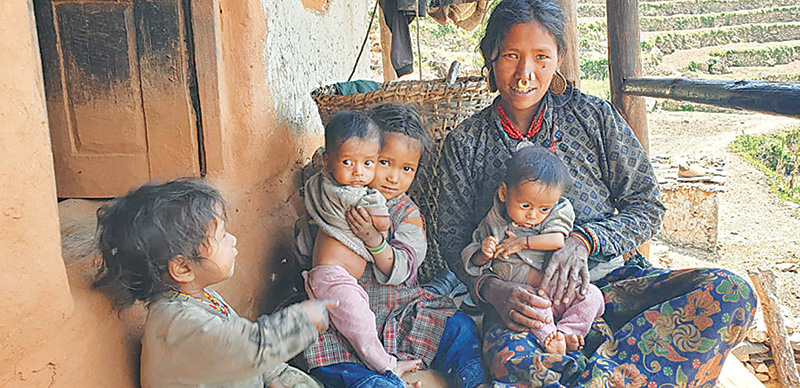
KATHMANDU, Even a week after 56 persons, mostly students in three hostels, in Humla district tested positive for the coronavirus, contact tracing of over 40 people, who had come into their close contact, is yet to begin. The people do not seem to have much faith in government efforts to improve their living conditions and have not been cooperative, according to health workers in the district. Health workers at Namkha Rural Municipality, where the cases are, say people who came in close contact with the infected have refused to undergo tests. “They instead questioned us about what they would do after knowing their infection status,” Gyachho Lama, the Covid-19 focal person for Namkha Rural Municipality, told the Post over the phone. “It is very difficult to convince the people to cooperate with health workers and undergo tests.” People in Humla are deprived of most of the basic necessities, such as drinking water, basic health care services, nutritious food, sanitation and basic education. People are dying from easily treatable and preventable diseases, such as flu, asthma and diarrhoea. According to the latest human development index report, Humla is among the most deprived districts in terms of health, education and sanitation. Life expectancy at birth in the district is only 58 years compared to the national average of 70 plus. “There was no dearth of miseries in Humla, and now coronavirus has reached here,” said Lama. “Even if the people know about their disease status, they have nowhere to go and have to stay at home even if their health condition deteriorates.” Namkha is the northernmost rural municipality of Humla, adjoining Tibet of China. According to Lama, it takes three days on foot to reach Simikot, the district headquarters, from the affected villages in the summer. Due to heavy snowfall, access to the district headquarters has at present been cut off. Even after reaching the district headquarters, it is very hard to get a hospital bed, as the district hospital has just 15 beds. Therefore, they see no benefit in knowing about their disease status, said Lama. To make matters worse, with the dip in temperatures, people have started getting sick from the seasonal flu. Every year, hundreds of people get infected and several of them succumb to it. Last year 10 people had died of seasonal flu. “We know that already this year people in every household [in Namkha Rural Municipality] are affected by the seasonal flu right now,” Motilal Jaishi, an auxiliary health health worker serving in Humla told the Post over the phone. “But we don’t know if they are affected with the seasonal flu or the coronavirus, as we have not tested them.” Most of the symptoms of seasonal flu match with those of the coronavirus. According to a recent report, Prevalence of Selected Chronic Non-communicable Diseases in Nepal carried out by the Nepal Health Research Council, 25.1 percent population of Karnali region—the highest proportion in the country—suffers from chronic obstructive pulmonary diseases. The study points at behavioural risk factors like tobacco use, and indoor pollution caused by burning firewood as the main culprits for the prevalence of the ailments in the region. Doctors say those suffering from respiratory diseases are at great risk of dying, if infected with the coronavirus and during winter people remain indoors next to the fire inviting further risk. Public health experts said that the situation has become really grim with the spread of the coronavirus to the remotest of places like Namkha in Humla. “There are neither proper health facilities nor trained human resource in Humla,” Dr Prabhat Adhikari, an infectious disease and critical care expert, told the Post. “Challenges have increased but it is also an opportunity to fix those weaknesses and therefore it is an opportunity for all three tiers of government to play their roles and fulfil their responsibilities.” Doctors had recommended measures like imposing restrictions on public movement before Dashain to lessen the risk of spillover of the coronavirus from major hotspots like Kathmandu Valley, an increase in contact tracing and testing. The government, instead, stopped free testing and treatment for all. After the Supreme Court’s ruling, the government has reversed its decision but it seems to have come too late. Given the health indicators in Humla, the spread of the virus is a double, if not triple, whammy. According to the Nepal Demographic Health Survey 2016, the under-five mortality rate in Karnali region, where Humla falls, is 58 per 1,000 children, and 55 percent of the children suffer from stunting, which is double the national average. The region is also the poorest and most food-insecure. Compared to the national average of 15 percent, there is 40 percent food insecurity in the Karnali region. “Infected people in Kathmandu Valley are deprived of intensive care unit beds and ventilators,” Dr Mingmar Gyelgen Sherpa, former director general at the Department of Health Services, told the Post. “We can only imagine the condition of Humla. And places like that are throughout the country.” Apart from new challenges spelled by the coronavirus, there are alot of existing challenges—malnutrition, respiratory problems, lack of access to roads and a dearth of skilled workers, which were created due to the neglect of successive governments. “Authorities should deploy health workers immediately in the disease hit villages and do their best to contain the further spread of infections,” said Sherpa. “As all people residing throughout the country have equal right to live, authorities should not differentiate and should be negligent in saving their lives.” Sherpa said that the government should declare if it cannot do anything and seek national as well as international help to save lives. Meanwhile, Dr Roshan Pokhrel, chief specialist at the Ministry of Health and Population, said that the ministry has requested the provincial government to deploy a team of health workers to the affected villages. “We have also asked for setting up an isolation centre with about 40 beds and treating the patients in the respective places,” said Pokhrel. “We have directed officials to send two to three portable ventilators donated by the US government.” But the reality on the ground is not as officials in Kathmandu imagine. Health workers in Namkha said that a team of medics and doctors had reached the disease-hit villages and returned to the district headquarters after two days. “People in our village generally do not seek treatment, as it is not easily available,” said a health worker from Nakha. “People here are not cooperating for tests, as they know that nothing will happen even after knowing their status. We know that death may come quickly here but not treatment.”
HOME PAGE
With just Rs1 billion in account, most of Rs50 billion fund to aid pandemic-hit sectors may be foreign loans
The government, five months after announcement to set up the economic rehabilitation fund, has made plans to use external loans that it can use at its discretion to lend to businesses at subsidised interest rates.
- PRITHVI MAN SHRESTHA
KATHMANDU, In his budget speech back in June, then finance minister Yubaraj Khatiwada had announced a Rs50 billion fund for economic rehabilitation of the pandemic-hit sectors. The source for the funds would be foreign aid, government owned entities and the government’s own resources. With the government having contributed a mere Rs1 billion to the fund, it was clear that most would come as external loans. But the government has, after five months since the announcement, finally planned how the external loans will be provisioned. “Foreign aid meant for economic recovery and not tied to any particular project can be injected to this fund,” said Shreekrishna Nepal, chief of the international economic cooperation coordination division at the Finance Ministry. The government has so far allocated a mere Rs1 billion to the fund to provide subsidised loans for the pandemic-affected cottage, small and medium industries and tourism enterprises at an interest rate of five percent to pay staff salaries and for enterprises facing shortages of working capital to continue operations amid the pandemic. The decision to use foreign aid for the rehabilitation fund comes amid shrinking revenues. During the first quarter of the fiscal year 2020-21 from mid-July to mid-October, the federal government’s revenue shrank by 9.1 percent to Rs172.36 billion, according to the Finance Ministry. As such, the government is struggling even to meet its administrative costs with the revenue. Foreign aid usually comes in two forms: for a specific purpose and for general budgetary support which the government can use in any way it wants in its prioritised sectors. The government has planned to use the latter for the rehabilitation fund. Money that has been received as policy credits can be used for the fund, said Nepal. “The government has not been looking for separate financing from donors targeting the economic rehabilitation fund.” But it is not just the funds that the government had been indecisive about. Last week, the Cabinet endorsed the Business Continuity Credit Extension Working Procedure-2020, which has provisions on extension of credit from the economic rehabilitation fund to the pandemic-hit enterprises. On Friday, the board meeting of the fund, headed by Finance Secretary Sishir Kumar Dhungana, decided that banks and financial institutions would call for credit applications from November 25. As per the working procedure, banks and financial institutions will be required to decide on extending loans within 15 days of receiving an application. “It is the government’s commitment to arrange funds up to Rs 50 billion which will happen anyhow,” said Nepal. It was not immediately clear what amount of resources will be needed to provide subsidised loans as the central bank, where the fund will be established, is yet to enforce the working procedure. As per the working procedure endorsed by the Cabinet, banks and financial institutions are required to provide credit to the targeted sectors at an interest rate of five percent in the first year and six percent in the second year. Banks and financial institutions will get reimbursement at the interest rate of two percent in the first year and three percent in the second year. An enterprise will get loans depending on the impact of the pandemic. An enterprise from the most affected sector can get up to Rs100 million while an enterprise from a sector facing medium level impact will get a maximum Rs70 million. An enterprise from a partially affected sector can get up to Rs50 million. The government plans to provide half of the total credit for the most affected sector while 30 percent will go to the sector facing medium level impact and 20 percent to partially affected sectors. The setting up of the fund will mean that loans from multilateral agencies will continue to grow. Even though the country received limited amounts in budgetary support in the past, of late the portion of such credit which the government can use in any sector of its priority has been growing. In the fiscal year 2019-20, the government received budgetary support of Rs116 billion from the donors, which is nearly 53 percent total foreign aid, according to the Finance Ministry. In the previous fiscal year 2018-19, only 15 percent was received in the form of budget support, according to the Development Cooperation Report 2018-19. This year too the government has also been signing a number of loan agreements with multilateral donors including the World Bank, the Asian Development Bank and International Monetary Fund to revive the economy battered by the pandemic. As of the first quarter of the fiscal, the government has already received foreign aid pledges of Rs85.4 billion, according to the ministry, compared to Rs219.88 billion in the whole of last fiscal year. Meanwhile, according to officials at the Finance Ministry, they are yet to calculate how much funds could be injected by the government, various government entities and donors. “We will be discussing the issue in the next few days,” said Jhakka Acharya, chief of the financial sector management and corporation coordination division at the ministry. Tourism, particularly hotels, is one of the sectors most affected by the pandemic and entrepreneurs are optimistic about getting subsidised loans under this scheme. Binayak Shah, first vice-president of Hotel Association of Nepal, said they welcomed the working procedure even though it was introduced late and now want its early implementation. He, however, said they were still concerned over the number of pre-conditions to receive the credit. “It is difficult for many hotels to put additional collateral to get the loans,” he said. “The rule for enterprises to retain the staff is also concerning because there is no hope for the tourism sector’s revival for the next one or two years.”
NATIONAL
Local units in Sindhuli decide to resume community school classes
Three local governments have already scheduled the resumption of physical classes.
- RAJ KUMAR KARKI
Hariharpurgadhi Rural Municipality has directed all schools to arrange for handwashing facilities and sanitisers and make face masks mandatory.Photo credit: Raj Kumar Karki
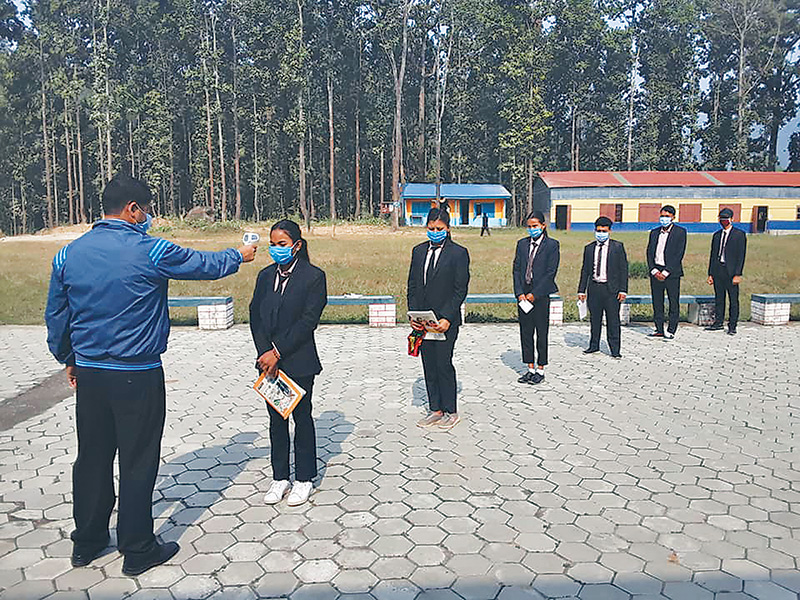
SINDHULI, Several local units in Sindhuli district have decided to run physical classes in the community schools that have remained closed for the past seven months amid fear of Covid-19 pandemic. Kamalamai Municipality has decided to operate physical classes in all the educational institutions across the local body from Sunday (November 22). Similarly, Marin and Harihrpurgadhi rural municipalities will be resuming classes from Monday. Preparations are underway to resume physical classes in six other local bodies of Sindhuli, according to the concerned authorities. “The recent meeting of the municipal education committee had decided to resume physical classes in all the education institutions by following safe health protocols set by the government. All the community schools, institutional schools and colleges will resume classes from Sunday,” said Shankar Raj Luitel, the coordinator of the education committee of Kamalamai Municipality. According to Luitel, the decision regarding the resumption of classes was taken after holding discussions with teachers, students, guardians, school management committee and other stakeholders. He said the decision was taken as per the School Resumption Working Guideline issued by the federal Ministry of Education, Science and Technology two weeks ago. The Cabinet has endorsed the guideline that allows the resumption of schools provided that they coordinate with representatives of the respective local governments, teachers’ unions and representatives from the school management committees. Following the government’s decision, the local units in Sindhuli held meetings with the concerned authorities and stakeholders for the resumption of educational institutions that have remained closed since the government enforced the nationwide lockdown since March 24. “Some local units in the district have already taken decisions to resume classes. We will shortly decide into the matter as well. There is no alternative but to resume classes now by maintaining safe health protocols,” said Pushpa Bahadur Karki, the chairman of Golanjor Rural Municipality in the district. The local units are equally concerned about following health protocols to control the spread of Covid-19. Kamalamai Municipality is preparing to run classes in different clusters. The municipality has instructed all schools to submit their school resumption modality to the municipal education committee within a week. “We have urged the school administration to run classes in different shifts by maintaining physical distance and following safe health measures,” said Luitel. In Hariharpurgadhi, the rural municipal office has directed all schools to arrange for handwashing facilities and sanitisers and make face masks mandatory. “The rural municipality will bear the expenses of managing face masks, sanitisers and soaps for all students and staff,” said Karsang Lama, the chairman of the local unit. There are a total of 563 community schools in Sindhuli with around 80,000 students enrolled, according to the Education Development and Coordination Unit in the district. The district has 68 private schools and a dozen colleges. Meanwhile, the students who have been confined at home for months due to the virus threat are excited to attend school again. “It’s boring to stay at home for a long time. We can study and meet with friends when the school reopens,” said Sabin Aachchhami, a ninth-grader at a local school in Dhungrebas. He said he could not take virtual classes conducted by the school, as there was no internet service at his house. The guardians also say that they are happy with the decision of school resumption. But some of them are worried about a possible outbreak of the virus in the school. “My son is safe now, as he stays at home. I am fearful that he might contract the disease in the school,” said Sabin’s father Prem Aachchhami. The health officials warn of possible spread of the coronavirus if the educational institutions do not follow safe health measures. “The educational institutions should be careful while running physical classes,” said Dr Laxman Khadka, medical superintendent at Sindhuli Hospital. He suggested that the school administration not run classes in mass. Sindhuli district has reported a total of 211 coronavirus cases so far with three deaths. According to Sindhuli Hospital, the district has eight active cases at present.
NATIONAL
Delay in hospital visits putting mothers and newborns at risk in Rupandehi
Home births have picked up in some parts of the district during the Covid-19 pandemic.
- SANJU PAUDEL
More women in Rupandehi are opting for home births, as they fear contracting the virus when visiting health institutions, health workers say. Post file photo
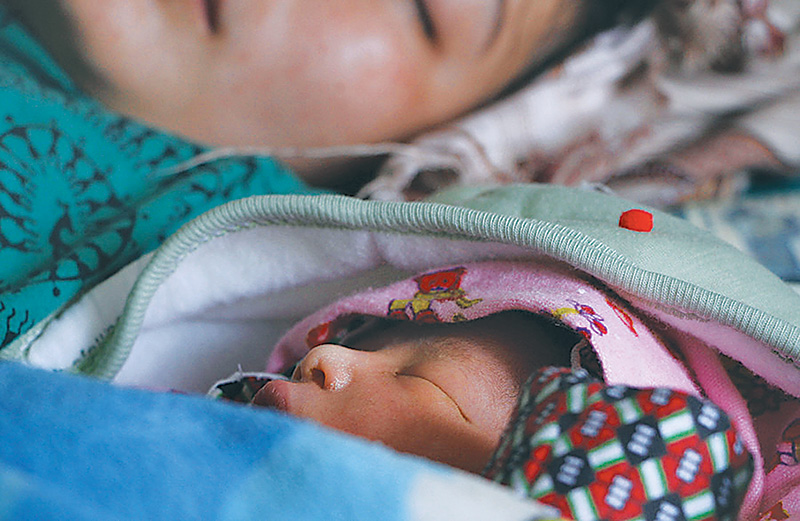
TILOTTAMA, On September 29, 20-year-old Kaushilya Yadav gave birth to her daughter at Bagaha Health Post. Yadav, a resident of Rohini Rural Municipality Ward No. 1 in Rupandehi, was taken to the health post after prolonged labour pain since her family had decided to opt for a home birth. “She delivered her child at the health post but both the mother and the child’s health deteriorated after the birth. The newborn needed supplemental oxygen so we referred them to Universal College of Medical Sciences in Bhairahawa,” said Shanta Gyawali, an auxiliary nurse midwife at the health post. The baby did not survive, according to family members. “We were making arrangements for Rs 10,000 needed for the baby’s admission to the ICU. By the time we got around to it, my baby had died,” said Yadav. Thirty-year-old Shila Yadav, a resident of Rohini Rural Municipality, gave birth to her son at home on September 2 even though the nearest health post was just five metres away from her house. “She was brought to the health post with post-birth complications,” said Gyawali. “If there was any further delay in bringing the mother and child to the hospital, we would have lost them both.” According to Gyawali, delay in bringing expecting mothers to health posts puts both the child and the mother at grave risks. The local health post has been raising awareness among locals about the importance of prenatal and postnatal care and the safety of institutional births, but it hasn’t stopped locals from opting for home births. “We also provide counselling to family members of expecting mothers. We ask them to visit the health post as often as possible but not many listen,” said Gyawali. Most pregnant women in the northern and southern parts of Rupandehi only visit health posts and hospitals when they face complications during home birth, say health officials. Rajyalaxmi Shrestha, an auxiliary nurse midwife at Dhakdhahi Primary Health Centre in Rupandehi, says, “By the time pregnant women are brought in, it’s too late for us to be able to help them. So we have to refer them to fully facilitated hospitals. If they come to us before their health gets worse, we can help them with safe delivery.” According to Dr Bishnu Gautam, an obstetrician at Lumbini Hospital, the locals’ preference for home births and postponing hospital visits put both mothers and their babies at risk. “We need to sensitise the local population and raise more awareness about safe institutional delivery,” Gautam said. “The pandemic has also affected the rate of institutional births in the district. Health posts in the northern and southern parts of Rupandehi used to receive 30 to 40 cases in a month,” said Gautam. Now, these health posts are receiving just five to 10 delivery cases, according to the data of the District Health Office in Rupandehi. Dr Arun Kharel, the medical officer at Basantapur Primary Health Centre in Omsatiya Rural Municipality Ward No. 4, says a fewer number of pregnant women are visiting health posts for deliveries since the pandemic hit. “Women have started to opt for home births, as they fear contracting Covid-19 when visiting health institutions. This stands to affect the infant mortality rate,” Kharel said. Sixty-four health posts, five primary health centres and two government hospitals have been providing birthing services in the district.
NATIONAL
Grade 12 exams to start on Tuesday despite coronavirus threat
Officials say all possible safety measures have been adopted for the largest assembly of people in the education sector since the Covid-19 pandemic hit the country.
- BINOD GHIMIRE
The number of exam centres has been more than doubled this year. Post file Photo
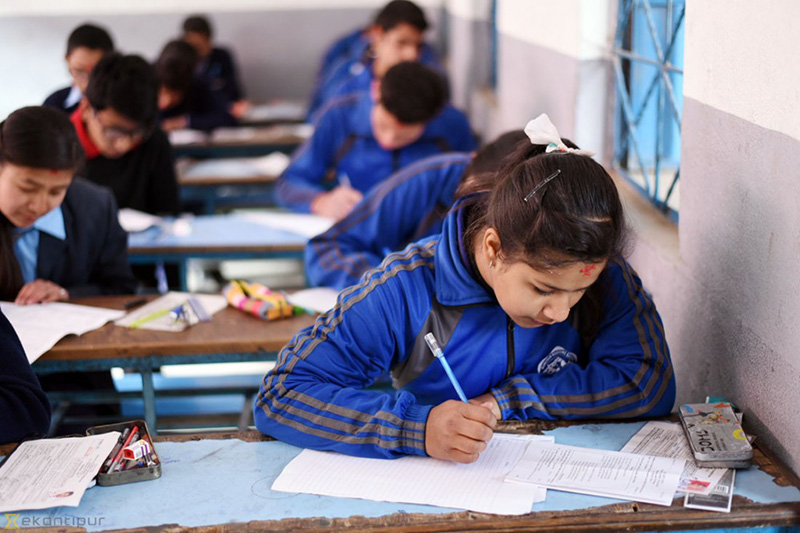
KATHMANDU, Over 430,00 students are set to sit for in-person exams for grade 12 beginning Tuesday. This will be the largest-ever gathering of people in the education sector since the Covid-19 pandemic hit the country early this year. The exams are being conducted as over 1,500 new Covid-19 cases are being reported across the country everyday. With an additional 1,674 new cases reported on Saturday, the total number of cases has reached 218,639 with 1,305 deaths. Officials at the National Examination Board say they have made all preparations to conduct the exams safely, and examinees need not worry about their safety. “Sanitiser will be provided to students at every exam centre. Everyone will be masked properly and sitting arrangements have been made with two meters of gap between examinees,”said Jung Bahadur Aryal, spokesperson for the board. “The number of exam centres has been more than doubled compared to the previous year to minimise the crowd,” Aryal told the Post. All 4,105 higher secondary schools across the country have been turned into examination centres this year. The number was 1,900 last year. This year, examinees will be allowed to sit for the exams at schools they have been enrolled in while those that have gone to their hometowns will be allowed to take the test at their nearest exam centre. Of the 433,131 examinees, over 14,000 will be taking the exams from the schools closest to them. Aryal said that around two-third of the examination centres will accommodate up to a 100 examinees. “Our focus will be on schools with more than 100 students,” he said. The board is preparing to publish the results within two months. The duration of the exams have been shortened by half to 1.5 hours as their weightage has been reduced by 60 percent. While students are to take the written exam for 40 percent of their final grades, another 40 percent will come from their grades in 11 and the remaining 20 percent from evaluation by the schools. Friday was the last day for the schools to submit the marksheet of the internal evaluations. The board normally conducts the exams in May and publishes results by October. The Cabinet on October 5 allowed all the boards, academic institutions, universities and other institutions to conduct their exams. Following the Cabinet decision, boards and universities have started conducting tests due for several months though there are no signs that the threat of the pandemic will subside soon. Along with the grade 12 exams, universities are also starting in-person tests. The Office of the Controller of the Examination at Tribhuvan University, Nepal’s oldest and largest varsity, had decided to conduct the tests in the usual format starting December 13. Pushpa Raj Joshi, examination controller, said the university is prepared to allow students to take their exams from an affiliated college nearest to them. For instance, a student enrolled in a college in Kathmandu or other cities can take his/her exams from a college in their hometown. Over 415,000 students are currently enrolled in various courses offered by the university. Joshi said they have already prepared software to register students from the districts where they are currently living. The oldest university has around 1,100 constituent and affiliated colleges, at least one in each district.
NATIONAL
Traffic police install ‘stop, look, go’ signs in city to prevent accidents
Officials say 35 percent accidents happen on link roads.
- ANUP OJHA
Traffic police stop around 3,000 motorists and pedestrians every day to make them aware of the new signboards put up across the city, Post file Photo
KATHMANDU, In a bid to curb road accidents in Kathmandu Valley, the Metropolitan Traffic Police Division has installed “stop, look and go” signboards at major entry junctions and link roads across the city. The division office on November 18 installed 380 signboards all across the Valley that are painted with red (stop), yellow (look) and go (green). It has also assigned personnel to stop vehicles and pedestrians to make them aware of the new signs. “We have assigned 380 traffic officials to stop pedestrians and motorists to make them aware of the new signboards,” said Senior Superintendent of Police Bhim Kumar Dhakal, chief at the division office. He said with the new campaign, the division office is committed to curbing road accidents that take place at junctions or link roads. Since the drive was launched on Wednesday, police have stopped 3,000 motorists and pedestrians everyday to make them aware of the new boards. The new campaign has been well appreciated by the public and pedestrians.“This is very informative and a great initiation,” said Suraj Acharya, 33, a resident of Banasthali. “I would hardly look left and right before taking a turn, now traffic police are stopping us to look at the signboard. This will help us prevent accidents.” According to the division office, 35 percent of fatal road accidents in the city take place on road junctions and link roads. “Over 35 percent deaths can be attributed due to the negligence of pedestrians or riders on link roads,” said Dhakal. Meanwhile, traffic police personnel are also strictly enforcing traffic light rules in the city. Since mid-August, major road sections of the Kathmandu Valley now have working traffic lights. The city, which didn’t have such traffic lights for a decade, now has traffic lights at Singhadurbar, Anamnagar Chowk, Padmodaya Chowk, Putalisadak, New Baneshwor, Purano Baneshwor, Subidhanagar, Gairigaun, Muni Bhairav, Kalimati, Gaushala, Mitrapark and Narayangopal Chowk. Traffic lights have also been repaired and installed in Thimi, Bhaktapur, and Mahapal, Lalitpur.
NATIONAL
Officials held on graft charge
Briefing
DANG: The Commission for Investigation of Abuse of Authority arrested two officials from the District Land Revenue Office in Dang on corruption charges. The CIAA team from Nepalgunj arrested Pushparaj Giri, a non-gazetted first class officer, and office assistant Minraj Gaire with Rs 320,000 bribe amount. According to the CIAA, the accused received the bribe for issuing a land ownership certificate.
NATIONAL
Jhulaghat border set to open
Briefing
BAITADI: The District Administration Office in Baitadi has decided to open Jhulaghat border point for five days starting from Monday. According to assistant Chief District Officer Lokendra Singh Negi, preparation is on to open the border point between two countries keeping in view the difficulties faced by the people. He said around 1,200 Indian pensioners from Baitadi couldn’t receive their pensions due to border closure.
NATIONAL
Sajha Party demands action
Briefing
BIRENDRANAGAR: Sajha Party has drawn the attention of the state government to take action against traders who sent paddy to Bhaktapur instead of Mugu. The party organised a protest in front of the Chief Minister’s Office and the Council of Ministers on Thursday. A team led by the party’s Karnali state coordinator Gehendra Prasad Dahal handed over a five-point memorandum to the chief minister and the Office of the Council of Ministers demanding that the people’s right to food be guaranteed.
NATIONAL
Rape accused sent to custody
Briefing
DOTI: Dipayal High Court has quashed the order issued by Doti District Court to grant bail to a teacher accused of raping his student. The Dipayal High Court on Tuesday ordered that the accused be kept in custody. A 19-year-old girl from KI Singh Rural Municipality- 4, Doti, had filed a complaint alleging that she was raped by her teacher.
NATIONAL
Army team defuses explosives
Briefing
SANKHUWASABHA: A Nepal Army team defused an improvised explosive device discovered at Phapung in Panchkhapan Municipality, Sankhuwasabha, on Thursday. An unidentified group had planted the explosive on a dirt road linking Phapung with Khandbari, the district headquarters of Khandbari. Local people informed police after they spotted the suspicious object.
OPINION
Why now?
Now is not the time for the NCP to question the basics, but one for it to answer through fair action.
- ABHI SUBEDI
shutterstock
A single question has been chasing me through the books, articles, plays and poems I’ve been reading through the prolonged quasi-lockdown: Why now? I ask this question whenever I confront psychologically the issues that we are facing in Nepal today. I want to put some of the inquisitions in simple terms. Though political rumination is not my cup of tea, I gravitate to that turf whenever I read cultural studies that cover politics, discrimination and hegemonised modes of the administrative and justice systems. That is why I am drawn by some important subjects that govern our lives, especially during difficult times. To begin with, I’m intrigued by the crisis that the Nepal Communist Party is going through now. The first question that emanates from my rumination about the grand ruling party—formed by merging the CPN-UML and the Maoists—is why didn’t they discuss their differences before coming together, and, again, why now? The question that intrigues me the most after reading the tirades exchanged between the leaders of the higher echelons who represent the factions is, why didn’t they discuss these issues for such a long time if they were so valid, crucial, urgent, and disastrous in content? What is this presentism that baffles those who want to take a historicist perspective of history? While discussing this subject in one seminar, I used one essay entitled ‘Presentism and persistence’ written by one scholar named Jiri Benovsky who says, ‘Typically, “presentists” are also “serious tensers” drawing an important distinction between saying that past objects once existed and future objects will exist but only current objects exist’. But the Marxists would say after Marx: History repeats, once as tragedy and again as farce. The present mode of history that the Nepali Marxists are grappling with can be a farce if they do not act with prudence. The same applies to the grand old Nepali Congress. The issues they are discussing about leadership and those of democratic socialism now may be meaningful to the political analysts. But to people like us, they should be subject to politics with a human face, with the rights of the poor farmers, workers and the marginalised as their guiding principles. And the issues they are discussing are nowhere near that. They are discussing questions of organisation, membership distribution and consciousness-raising. But why now? Why didn’t they address these questions in such a long time? It seems like we assess many issues that beguile us today by asking this question—why now? It has become a refrain of the present political narrative of Nepal. And there is no single answer to that. Leaders like BP Koirala, Manmohan Adhikari, Puspalal and others addressed the questions and their theoretical orientations in their times of leadership in writings and speeches. Those issues they discussed were the basic principles of social justice, democracy, the socialist structure of the economy and corruption-free administration managed by political leaders who always considered their duty as the service of the people. After the great political change and transformation of a feudatory system into a democratic socialist republic, the questions that need to be addressed would be those that would be progressive and forward-looking in nature. But the issues that the political parties and their leaders are addressing appear to be obscurantist, not dynamic with the forward going thrust of nature. In a long career as a teacher at the tertiary level, I saw students inspired by either communist or liberal ideologies. I listened to their ideas with respect and deep faith in their capacity to become either leaders or public intellectuals and teachers. They raised important issues about freedom, people’s rights and the actions of the governments during the Panchayat and after. Several of them aspired to be political leaders and active members of the political parties. Some of the leaders of the communist and other political parties today come from that very background. But what intrigues me today is what roles they are playing in Nepali political and social life today. What is their response to their factions asking each other questions about the so-called breach of trust, corruption, misuse of power and so on today? These questions are basic but important for the life of the country. So, why are they only asking these questions to each other today and not jointly solving them? I don’t want to theorise that here. But what seems to me is that Nepal in history has not moved in a smooth and linear order. Then again, nowhere in the world today does history appear to be moving in smooth order. When I was editing the text of BP Koirala’s earliest diary entries of a period from 1951-1956 for the BP Koirala Memorial Trust and trying to explain them in the introduction during the lockdown, I was struck by the minuscule history of Nepal that is mirrored in them. There is a picture of the recalcitrant prince Mahendra who evinced all the qualities of a future dictator, political leaders who would face the challenge of being committed to their ideals of democratic principles, the farmers in Madhes who would face hardships in their struggle—in their remarkable kisan andolans that BP encouraged and supported—and the challenges that parliamentary democracy would have to surmount in all manners. In addition to this book that is coming out anytime now, I read the Selected Writings of Puspalal (2073 BS) sent to me by NOC leader Raghuji Pant, during that period. After reading Puspalal’s analyses—especially of the people’s uprising, the monarchical system and the need of careful historical analysis—my question is, why are the big and powerful once again asking the same basic questions that were asked and raised by these pioneers of the Nepali multiparty democratic system? And why now? Now is not the time of reiterating the basics but one of answering them through fair political actions by parties and the administration. Before I hit my word limit for this article, I want to introduce one very urgent and disturbing subject that needs to be elaborated in a separate space. The people struggling with Covid-19, and running out of hope and the means to fight with it, are looking not only for help but also for psychological assurance, a sense of guardianship, and, to use the literary term, ‘compassion’ from no other than the government, which is everybody’s last hope. But, I should admit sadly, none of those questions that are being bandied about in party meetings address those needs and aspirations of the people!
OPINION
Decades and still no justice
Not a single victim has realised any form of justice or acknowledgement in the 14 years since the peace deal.
- SUMAN ADHIKARI
post file photo
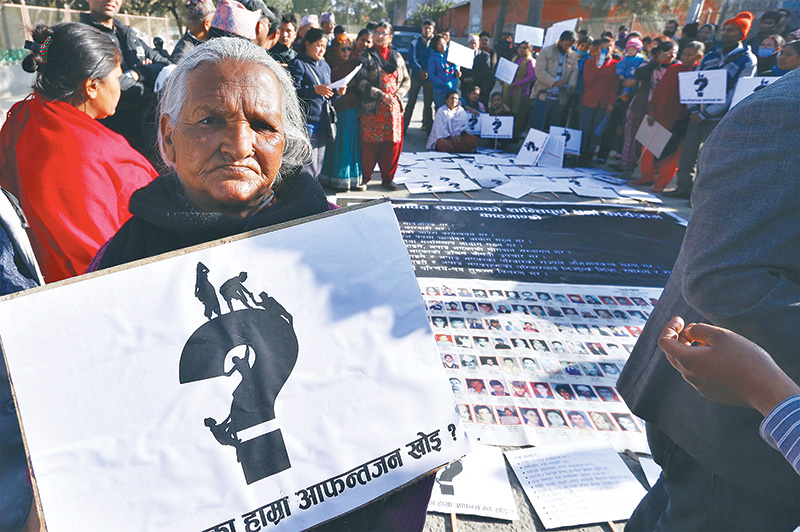
My father Muktinath Adhikari, a school teacher, was abducted and brutally killed by Maoist rebels during the decade-long conflict. After completing the death rituals, we registered a complaint with the District Police Office, Lamjung to seek justice, demanding that a thorough investigation of the killing be conducted and the perpetrators punished. Later, I also filed complaints with the National Human Rights Commission and the Truth and Reconciliation Commission, but there has been no progress towards justice even after 19 years. We, the conflict victims’ community, have been demanding an end to the victimisation of people like us. The Comprehensive Peace Agreement (CPA) was signed by the government and the Maoists on November 21, 2006. During the peace talks in 2006, we lobbied with the political parties and civil society demanding a provision to formulate a truth commission. Thus, the agreement contained commitments to address the injustice and pain of the civilians who were severely victimised due to the serious human rights violations committed by the state and the rebels.
People disappeared The CPA contained a commitment to revealing the whereabouts of people disappeared or killed during the war within 60 days of signing the pact. The CPA also contained a pledge to form a National Peace and Rehabilitation Commission to establish peace in society, carry out relief and rehabilitate people victimised and displaced by the war. The peace accord included a commitment to set up a high-level Truth and Reconciliation Commission in order to investigate the truth about serious human rights violations and crimes against humanity, and ensure the right to justice of the conflict victims, torture victims and the families of the disappeared. The CPA included a commitment to create a record of the government, public and private buildings, lands and other properties captured during the conflict and return them immediately. We were so happy to see these commitments and provisions to address the pain and rights of the victims in the peace agreement. We were truly confident that the state would acknowledge our pain, take sincere steps to heal the pain, and make us realise justice and reparation. The National Peace and Rehabilitation Commission was never formed, and the whereabouts of the disappeared have not been revealed even in the 14 years since the CPA. The pain, tears and blood of the conflict victims created this federal democratic republic. But every successive government after the CPA was signed has remained indifferent and insensitive towards that pain of the victims and their kin, and refused to bear the responsibility to provide guardianship and ensure justice to the voiceless victims. Each government followed the strategy of delaying, diluting and denying justice with the intention of providing immunity to the perpetrators. The transitional justice efforts in the last 14 years have not been sincere. They are cosmetic efforts designed to fool the international community that the commissions are working for justice and tire out the victims and make them forget. The parties imposed their interests while developing transitional justice laws and forming the Truth and Reconciliation Commission (TRC) and the Commission of Investigation on Enforced Disappeared Persons (CIEDP). They fully ignored the state’s obligations and stakeholders’ concerns and collaboration. Neither the government nor the commission has a clear-cut vision, road map and plan of action to resolve the more than 66,000 complaints. The prime minister, foreign minister and government officials have been repeatedly promising to amend the laws to comply with Supreme Court verdicts and international human rights obligations. They have promised to adopt credible process commitments at the United Nations General Assembly, United Nations Human Rights Council and a number of international and national forums. But this has not happened. The families of those killed, disappeared and displaced were provided with some relief, but the victims of sexual violence and torture have received nothing. Property seized during the conflict has not been returned. There is no legal recognition of reparation as a right. The collective and individual reparative needs of the victims have been ignored. The appointment of persons accused of committing human rights violations to high posts like the speaker of the federal parliament, minister, Member of Parliament and chief of the security agencies is an example of how calls for investigation and an end to impunity have been continuously ignored. Conflict victims have been demanding the truth, justice and reparation by adopting a credible and victim-centric process in collaboration with the stakeholders. The government issues laws and ordinances of its own interest overnight but does not take concrete steps to amend faulty provisions in the transitional justice laws and does not criminalise serious crimes. Only a few controlled consultations have been held; these were neither meaningful nor substantive in terms of addressing the issues of the conflict-affected.
Cosmetic commitments The government formed the politically controlled TRC and CIEDP in 2015 through a non-transparent process. The victims have neither confidence nor collaboration in these commissions. Valuable time, efforts and resources have been misused without any tangible result for six years. It seems the government will extend the tenure of these commissions unilaterally from February 10, 2021, without amending their faulty mandate and procedure. The commissions have been making commitments to ensure justice. But in reality, they have only received complaints and not revealed the truth of even a single violation, nor recommended reparation and prosecution. Not a single victim has realised justice in the 14 years of the CPA and the six years of the commissions. The victims are tired of the cosmetic commitments of the government and the commissions that are never implemented. Sooner or later, the government cannot escape from its responsibility to fulfil the justice rights of the conflict victims. The government has to be sensitive and sincere to address the issues of the victims, and take immediate steps to adopt a credible process to amend the laws and formulate trustworthy and independent commissions.
Adhikari is a former chairperson of Conflict Victims Common Platform.
MONEY
Driven by festive push, auto sales recovery continued into October-November
Some models of two-wheelers went out of stock due to explosive demand, dealers say.
- KRISHANA PRASAIN
Salespersons wait for customers at an auto dealership in Kantipath, Kathmandu. POST FILE PHOTO
KATHMANDU, Festive season schemes and new launches led automobile dealers to see healthy sales for October and November. After recording zero sales during the four months of lockdown, March-end to July, sales finally started to pick up in the festive season that began in October, dealers said. Amid pandemic, domestic automobile dealers said they are happy with the better-then-expected sales. Krishna Dulal, president of Nepal Automobiles Dealers Association, said that overall sales declined 25 percent this festive season as compared to last year’s festive sales. “But despite that, it was indeed a good sales record given the difficult situation,” he said. Auto sales were largely impacted due to the slowdown in the economy. A grinding four-month lockdown and continued restrictions to prevent the spread of coronavirus had shut down life and business in major cities of the countries, with millions of people losing their jobs or suffering pay cuts. Its impact was visible in the country’s automobile industry as well. The Covid-19 pandemic also forced the postponement of the country’s largest automobile fair, which used to take place ahead of Dashain and recorded sales in billions of rupees. But things are starting to look up now, say dealers. “The automobile market is now making a gradual recovery,” said Dulal. Ramesh Danekhu, marketing and communications manager at Morang Auto Works, the authorised distributor of Yamaha two-wheelers as well as Skoda cars and Jeep in Nepal, said that the company was able to log sales record of two-wheelers as equal to last year’s festive sales. “In terms of the four-wheelers segment, we were able to make 65 percent of sales in our premium segments, Jeep and Skoda,” he said. Most of the sales in the four-wheeler segment were from pending booking and enquiry before lockdown, he added. “But there were few new buyers for the luxury segment,” he added. Automobile dealers said that the Kathmandu valley already had a weak public transportation system that has been boosting the sales for private vehicles. This year, people feared to commute in public transportation because of the possibility of virus transmission and that helped sales to pick up despite the country’s crawling economic growth. The demand for two-wheelers observed aggressive sales growth, said domestic automobile dealers. Automobile dealers came up with schemes and offers in two-wheelers as soon as the lockdown was lifted which helped in rising sales and the same continuity was seen in festival time, said Danekhuw. According to automobile dealers, some models of two-wheelers even went out of stock, as dealers were not expecting that much of sales during the pandemic. “Yamaha’s FZ model bike went out of stock,” said Danekhu. However, the same cannot be said for scooters. The sales of scooters were on the rise for the last four years in two-wheelers contributing around 33 percent of sales till 2019. But this time, the growth momentum stopped, said automobile dealers. Automobile market made better sales during Dashain and Tihar compared to the post-pandemic situation, said Rupesh Sharma Bhatta, general manager of Laxmi Intercontinental, the authorised distributor of Hyundai cars in Nepal. Automobile sales were totally affected during the Nepali New Year because of the lockdown. The sales did not pick up even after the lockdown as people were waiting for right time and bumper offers. “The festive season, however, boosted the sales to some extent,” said Bhatta, adding that it would take time for the automobile sector to recover fully. “The festive discounts offers also helped the sales this year.” In terms of four-wheelers, people continued to prefer buying SUVs, said automobile dealers. According to Bhatta, Hyundai’s Creta, Venue and Grand i10 and Santro observed healthy sales during the festive season. According to the Trade and Export Promotion Center, the country imported automobiles and parts worth Rs19.82 billion in the first three months of the current fiscal year, recording a decline of 27.5 percent compared to the same period in the last fiscal year. The country imported 84,000 automobiles in the first three months of the current fiscal year. The country imported vehicles and parts worth Rs65 billion in the last fiscal year 2019-20 that ended mid-July.
MONEY
Singapore, Hong Kong travel bubble delayed
- ASSOCIATED PRESS
HONG KONG, Singapore and Hong Kong on Saturday postponed the start of an air travel bubble meant to boost tourism for both cities, amid a spike in coronavirus infections in Hong Kong. The travel bubble, originally slated to begin Sunday, will be delayed by at least two weeks, Hong Kong’s minister of commerce and economic development, Edward Yau, said at a news conference. The arrangement is meant to allow travellers between the two cities to travel without having to serve a quarantine as long as they complete coronavirus tests before and after arriving at their destinations, and fly on designated flights. Hong Kong reported 43 new coronavirus cases on Saturday, including 13 untraceable local infections. “For any scheme to be successful, they must fulfil the condition of securing public health, and also make sure that both sides would be comfortable and feel safe about the scheme,” Yau said. “In light of the situation in Hong Kong, I think it’s the responsible way to put this back for a while, and then sort of relaunch it at a suitable juncture.”
MONEY
Europe’s economies race to open for Xmas. Should they bother?
- REUTERS
LONDON, Is the Christmas economy worth salvaging? Unless you’re in retail, the answer is: Possibly not. Across Europe, governments have imposed lockdowns through November into early December in the hope they can open up their economies for seasonal festivities. But while the numbers show that retail and hospitality sectors tend to get a net boost from Christmas, the jury is out on whether it actually does the wider economy much good at all. This year the question is all the more pressing because of the risk that a premature reopening could trigger a third wave of coronavirus infections with dire consequences for both public health, economic growth and employment. Take shopping. The top five spenders on Christmas in Europe are Britain (639 euros per capita), Spain (554), Italy (549), Germany (488) and Portugal (387), a Deloitte survey last year found. That kind of spending gives a substantial one-off shot in the arm to the retail sector: in the UK, December sales are generally around 12 percent of the annual total—nearly half as much again as what the monthly average would be. Even if spending dips in January as consumers pull in their belts, economists say the net effect is invariably positive. That said, the adoption across Europe of the so-called Black Friday sales day in late-November has made the final run-up to Christmas less critical. And the growth in online shopping makes it less necessary for some stores to be physically open. Thus, German retail association HDE sees sales in November and December this year increasing 1.2 percent compared to 2019, driven by online sales, food, furniture and hardware—even if brick-and-mortar retailers of clothing, perfumes and toys will suffer. And one final thought: Even if consumers do not shop before Christmas, that does not always mean the economy loses out. “Consumption patterns also shift—not spending on drinks at a Christmas party translates into the purchase of new furniture etc,” Paul Donovan, chief economist at UBS Global Wealth Management, observed in his weekly audio blog. Last-minute shopping is the most visible aspect of the Christmas economy and the one that broadcasters tend to focus on. However, there are less tangible but equally real economic impacts too. One is productivity, which can take a dive as gift-buying, partying and the general bustle of Christmas distracts workers. While the phenomenon is hard to quantify, facilities and services group Sodexho found in a 2016 survey that 25 percent of workers reported lower motivation and productivity and a similar number admitted trying to avoid taking on new work. While some of that might be down to stress related to end-of-year targets, employer groups like the UK’s Reward & Employee Benefits Association (REBA) acknowledge a distracting effect linked to Christmas and offer tips on how to combat it.
MONEY
G20 to discuss post-pandemic world
- REUTERS
BRUSSELS, Leaders of the 20 biggest world economies (G20) will debate this weekend how to deal with the unprecedented Covid-19 pandemic that has caused a global recession and how to manage the recovery once the coronavirus is under control. High on the agenda are purchases and global distribution of vaccines, drugs and tests for low income countries that cannot afford such expenses themselves. The European Union will urge the G20 on Saturday to invest $4.5 billion to help. “The main theme will be to step up global cooperation to address the pandemic,” said a senior G20 official taking part in the preparations for the two-day summit, chaired by Saudi Arabia and held virtually because of the pandemic. To prepare for the future, the EU will propose a treaty on pandemics. “An international treaty would help us respond more quickly and in a more coordinated manner,” the chairman of EU leaders Charles Michel will tell the G20 on Sunday. While the global economy is recovering from the depths of the crisis earlier this year, momentum is slowing in countries with resurging infection rates, the recovery is uneven and the pandemic is likely to leave deep scars, the International Monetary Fund said in a report for the G20 summit. Especially vulnerable are poor and highly indebted countries in the developing world.
WORLD
South Korea mulls steps as new virus cases rise
- ASSOCIATED PRESS
A couple wearing masks stand at a street amid the coronavirus disease pandemic in Seoul, South Korea. REUTERS
Seoul, South Korea has reported 386 new cases of the coronavirus in a resurgence that could force authorities to reimpose stronger social distancing restrictions after easing them in October to spur a faltering economy. The figures released by the Korea Disease Control and Prevention Agency on Saturday raised the country’s total number of confirmed cases to 30,403, including 503 deaths. More than 270 of the new cases have come from the Seoul metropolitan area, where health workers have struggled to track transmissions in schools, private tutoring academies and religious facilities. Infections were also reported in other major cities, including Busan, Daejeon, Gwangju and Asan. South Korea has so far managed to weather the pandemic without major lockdowns, relying instead on an aggressive test-and-quarantine campaign and mask-wearing. Officials eased distancing measures to the lowest level in October, which allowed high-risk venues such as nightclubs and karaoke bars to reopen and fans to return to professional sports. But the Korean Society of Infectious Diseases said Friday that the country could be reporting more than 1,000 new infections a day in a week or two if social distancing measures aren’t effectively strengthened. “Covid-19 transmissions are occurring in large numbers simultaneously across the country, and in some regions, the pace of infections has already overwhelmed local capacities for contact tracing,” the doctors’ group said. Japan is scaling back on the government-backed “GoTo” campaign to encourage travel and dining out, as the number of confirmed coronavirus cases reached a record for the third day straight on Saturday, at 2,418. Prime Minister Yoshihide Suga announced the decision at a government panel on coronavirus pandemic measures. Stressing the need for “utmost caution,” he said the campaign’s travel discounts will no longer apply to hard-hit areas, and discounts on eating out will end temporarily. Japan has never had a total lockdown. It has had fewer than 2,000 deaths so far related to the coronavirus. But worries have been growing about a spike in infections over the three-day weekend. Monday is Labor Thanksgiving, a national holiday. India reported 46,232 new cases, with the situation particularly alarming in New Delhi. Intensive care wards and the capital’s main crematorium are near capacity, and health officials this week found the prevalence of infections in markets much higher than expected. The city has added an average of 6,700 cases each day in recent weeks. The Health Ministry on Saturday also registered 564 deaths in the past 24 hours, raising the death toll to 132,726. India hit a grim milestone Friday, passing 9 million infections, the second-most behind the US China is starting mass testing on 3 million people in a section of the northern city of Tianjin and has tested 4,015 others in a hospital in Shanghai after the discovery of a pair of cases there. The National Health Commission recorded seven new domestically transmitted cases Saturday, including five in Tianjin and two in Shanghai. Tianjin on Friday reported community transmission involving four different individuals and another case. In response, local authorities sealed off the residential community where the people lived as well as a hospital and a kindergarten. On Saturday, authorities began testing all residents in the Binhai district of Tianjin, according to the local government’s social media page. Authorities in Shanghai sealed off a hospital after a husband and wife tested positive for the virus Friday night. China’s total number of confirmed cases is now 86,414.
WORLD
Reinfection unlikely for at least six months, study finds
LONDON: People who’ve had Covid-19 are highly unlikely to contract it again for at least six months after their first infection, according to a British study of healthcare workers on the frontline of fight against the coronavirus pandemic. The findings should offer some reassurance for the more than 51 million people worldwide who have been infected with the pandemic disease, researchers at the University of Oxford said. “This is really good news, because we can be confident that, at least in the short term, most people who get Covid-19 won’t get it again,” said David Eyre, a professor at Oxford’s Nuffield Department of Population Health, who co-led the study. Isolated cases of re-infection with Covid-19, the disease caused by the SARS-CoV-2 virus, had raised concerns that immunity might be short-lived and that recovered patients may swiftly fall sick again. But the results of this study, carried out in a cohort of UK healthcare workers, who are among those at highest risk of contracting Covid-19, suggest cases of reinfection are likely to remain extremely rare. “Being infected with Covid-19 does offer protection against re-infection for most people for at least six months,” Eyre said. “We found no new symptomatic infections in any of the participants who had tested positive for antibodies.” The study, part of a major staff testing programme, covered a 30-week period between April and November 2020. Its results have not peer-reviewed by other scientists but were published before review on the MedRxiv website. During the study, 89 of 11,052 staff without antibodies developed a new infection with symptoms, while none of the 1,246 staff with antibodies developed a symptomatic infection. (Reuters)
WORLD
Europe’s Covid-19 cases surpass 15 million mark with onset of winter
- REUTERS
Brussels, The number of coronavirus cases in Europe has surpassed the 15 million mark, according to a Reuters tally, as the region sees a surge in infections with the onset of winter, reporting a million new infections about every four days. Europe has so far witnessed at least 15,046,656 reported infections and 344,401 reported deaths caused by the novel coronavirus, accounting for a quarter of global infections and deaths reported. While it took the region nearly nine months to record its first 5 million cases, the next 10 million cases were reported in less than two months, according to a Reuters analysis. With just one-tenth of the world’s population, Europe accounts for 26 percent of the global case load of 56.9 million and 25 percent of the 1.3 million deaths worldwide. Of every 100 infections last reported worldwide, about 39 were reported from countries in Europe. France surpassed Russia to become the worst-affected nation in the region, ranking only behind the United States, India and Brazil. France and Russia now account for roughly 27 percent of the total cases in Europe, according to Reuters tally. Within the region, Eastern Europe has roughly one-third of total cases in Europe and 24 percent of deaths in reported in the region. Czech Republic, Poland, Russia and Ukraine remain among the hardest-hit countries in the sub-region based on the number of cases per capita. On a weekly average, Russia is reporting more than 22,434 cases each day. Some hospitals in country are experiencing serious shortages of drugs used to treat Covid-19 and cannot restock because of panic buying, high demand and problems with a new labelling system. The governments of the United Kingdom could ease their current stringent lockdowns to allow families to gather for Christmas as there are signs the number of cases are starting to flatten.
WORLD
Pfizer seeks emergency use of Covid shots in US
- ASSOCIATED PRESS
Washington, Pfizer has formally asked US regulators to allow emergency use of its Covid-19 vaccine, starting the clock on a process that could bring limited first shots as early as next month and eventually an end to the pandemic — but not until after a long, hard winter. The action comes days after Pfizer Inc and its German partner BioNTech announced that its vaccine appears 95 percent effective at preventing mild to severe Covid-19 disease in a large, ongoing study. The companies said that protection plus a good safety record means the vaccine should qualify for emergency use authorization, something the Food and Drug Administration can grant before the final testing is fully complete. In addition to the FDA submission, they have already started “rolling” applications in Europe and the UK and intend to submit similar information soon. With the coronavirus surging around the US and the world, the pressure is on for regulators to make a speedy decision. “Help is on the way,” Dr Anthony Fauci, the top US infectious disease expert said on the eve of Pfizer’s announcement, adding that it’s too early to abandon masks and other protective measures. “We need to actually double down on the public health measures as we’re waiting for that help to come.” The filing sets off a chain of events as the FDA and its independent advisers debate if the shots are ready. If so, still another government group will have to decide how the initial limited supplies are rationed out to anxiously awaiting Americans. How much vaccine is available and when is a moving target, but initial supplies will be scarce and rationed. Globally, Pfizer has estimated it could have 50 million doses available by year’s end. About 25 million may become available for US use in December, 30 million in January and 35 million more in February.
WORLD
Pompeo’s strange farewell tour, full of symbolism and silence
- AGENCE FRANCE-PRESSE
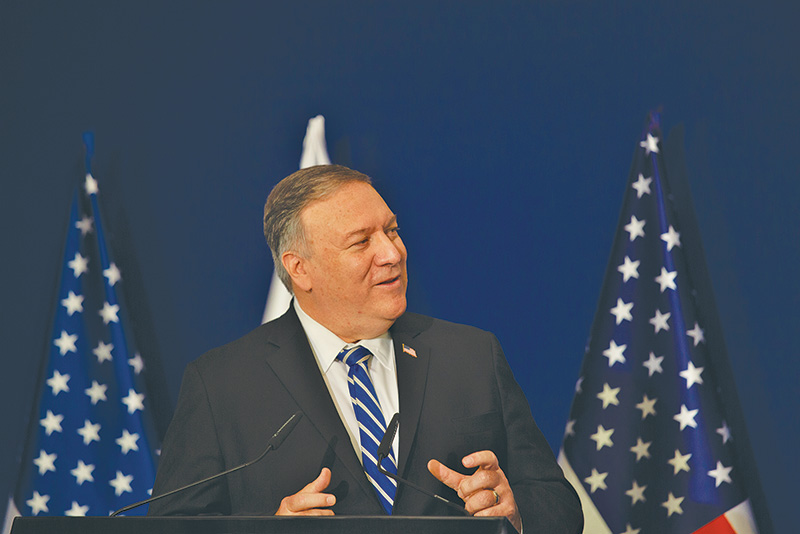
US Secretary of State Mike Pompeo speaks during a joint statement with Israeli Prime Minister Benjamin Netanyahu in Jerusalem. AP/rss
Abu Dhabi, What’s Donald Trump’s top diplomat to do when allies have turned the page and are waiting for Joe Biden but the president refuses to concede? Secretary of State Mike Pompeo is addressing the complex predicament with a most unusual 10-day trip—a farewell tour in everything but name in which he has dodged the press but forged ahead with Trump’s norm-shattering foreign policy. The trip opened with 54 hours in Paris in which he appeared for a total of one minute in public, when he laid a wreath in memory of victims of recent jihadist attacks in France. Pompeo spent the full weekend in Paris accompanied by his wife, Susan, staying at the US ambassador’s residence on what was nonetheless described as private time, with a series of meetings that were not listed on his public schedule. When Pompeo resurfaced on Monday, he paid the quick visit to the memorial before meetings with France’s President Emmanuel Macron and Foreign Minister Jean-Yves Le Drian that were closed to the press. It was Pompeo’s first bilateral visit to America’s oldest ally during his tenure. France described Pompeo’s trip as a courtesy visit and said it was fully transparent with the team of Biden, whose victory has been hailed in European capitals after four years of tensions with the unilateral-minded Trump. Pompeo headed from Paris to Istanbul at a time of high tension between France and Turkey, and agreed, in statement to the French newspaper Le Figaro, that recent actions by Ankara have been “very aggressive”. Not that he was going to mediate. Pompeo did not meet any officials on his visit to Turkey, with the State Department blaming incompatible schedules. Instead Pompeo, an evangelical Christian who has put a top priority on religious freedom, met with the leader of the Orthodox world, Patriarch Bartholomew I of Constantinople, as well as the Vatican’s American-born envoy. Turkey complained about Pompeo’s visit, saying the United States should address racism and other issues at home, and has already congratulated Biden, although President Recep Tayyip Erdogan is bracing for a tougher relationship with the Democrat who has vowed to empower Turkey’s opposition. As Trump made baseless allegations of voting fraud in closely fought states including Georgia, Pompeo headed on to another Georgia — the nation in the Caucasus. Tbilisi, eager to boost relations with the United States, is going through its own internal crisis with the opposition boycotting parliament, saying October 31 elections were rigged. Pompeo finally spoke on his fourth stop, in Jerusalem, where he pushed the Trump strategy of unstinting support for Israel and maximum pressure on Iran. For what will likely be his final visit as the top US diplomat, he broke taboos and became the first secretary of state to visit an Israeli settlement in the West Bank — more precisely, the Psagot winery. That enterprise had already rolled out a Pompeo wine label after he contested the international consensus that Israeli construction on occupied Palestinian land is illegal. Pompeo also became the first secretary of state to tour the Golan Heights, whose annexation by Israel from Syria was recognised by Trump. Ben Rhodes, a top aide to former president Barack Obama and a major critic of Pompeo, told NBC that the lame-duck secretary of state seemed focused on not just “complicating the Biden presidency but his own political interests”. He was alluding to wide speculation that Pompeo will seek the White House in 2024, a campaign in which he will likely reach out to fellow evangelical Christians who are staunchly supportive of Israel. Israeli Prime Minister Benjamin Netanyahu hailed the “tremendous friendship” of Pompeo but, mindful of the future, he spoke by phone with Biden on Tuesday, in what the premier’s office called a “warm” conversation. Pompeo highlighted a signature achievement of Trump by participating in the first-ever visit to Jerusalem by the foreign minister of Bahrain, which officially established diplomatic ties with Israel last month. He then flew to the United Arab Emirates, which has also normalised relations with the Jewish state, and is finishing his tour with stops in Qatar and Saudi Arabia. Pompeo is expected to brief the Arab allies on US deliberations on whether to label the Iranian-linked Huthi rebels in war-ravaged Yemen as a “terrorist” group. Speculation has also grown of more dramatic action against Iran, with The New York Times reporting that Trump after the election mulled a military strike over its nuclear programme, which has grown since Trump withdrew from a denuclearisation accord. Whatever his discussions, they may remain secret for now with Pompeo looking set to go through the whole trip without taking questions from the travelling press, a silent spell with little precedent in the history of the State Department.
WORLD
Twitter to hand over account to Biden on inauguration day
Briefing
- AGENCIES
WASHINGTON: Twitter will hand control of the presidential @POTUS account to Joe Biden when he is sworn in on inauguration day, even if President Donald Trump has not conceded his election loss, US media reported on Friday. The social media giant is “actively preparing to support the transition of White House institutional Twitter accounts on January 20th, 2021,” Twitter spokesperson Nick Pacilio told Politico in an email. The process is being done in consultation with the National Archives, as it was in 2017, he said. The handover will see all existing tweets on @POTUS, as well as @FLOTUS, @VP and other official accounts, archived.
WORLD
Cleric’s funeral draws crowd
Briefing
- AGENCIES
LAHORE: Tens of thousands of maskless mourners gathered in Lahore on Saturday for the funeral of hardline Pakistani cleric Khadim Hussain Rizvi, who for years terrorised the country’s religious minorities, incited riots and advocated the destruction of European nations. Vast crowds of men were seen thronging the centre of the eastern city ahead of Rizvi’s funeral, chanting in unison and for the most part flouting mask-wearing rules even with the country on the cusp of a second wave of the coronavirus outbreak. No cause of death has been announced for the 54-year-old Rizvi, who died Thursday after suffering a high fever and difficulties breathing, and no Covid-19 test or autopsy were conducted on the long-time wheelchair user.
WORLD
India summons diplomat
Briefing
- AGENCIES
NEW DELHI/ISLAMABAD: India on Saturday summoned a senior Pakistani diplomat over what New Delhi said was a foiled attack this week in the frontier territory of Jammu and Kashmir by a Pakistan-based militant group, a charge the neighbouring country denied. Indian PM Narendra Modi said on Friday that the killing of four Jaish-e-Mohammed militants in a gun battle with security forces, and the recovery of a large cache of weapons and explosives from them, indicated that they were planning to “wreak major havoc” in the region ahead of local elections there.
SPORTS
Chelsea edge Newcastle to take top Premier League spot
Chelsea take pole position in the league after September 2018 but they could lose top spot depending on the outcomes of Aston Villa and Tottenham matches.
- AGENCE FRANCE-PRESSE
English forward Tammy Abraham (left) scored his third Premier League goal for Chelsea this season against Newcastle United on Saturday. AP/RSS
Newcastle, Chelsea climbed to the top of the Premier League for the first time in over two years with a convincing 2-0 win at Newcastle on Saturday. Frank Lampard’s side moved above Leicester on goal difference thanks to Federico Fernandez’s first half own goal and Tammy Abraham’s strike after the interval. Chelsea are unbeaten in nine games in all competitions and haven’t lost in their last six league matches. With five clean-sheets in their last six matches in all competitions, Chelsea’s third successive league victory was the perfect way to start a hectic period leading up to Christmas. Maurizio Sarri was in charge the last time Chelsea were in pole position in the Premier League in September 2018. But Lampard’s squad are more formidable than his predecessor’s fragile team and a serious title challenge looks increasingly possible. Chelsea could surrender top spot before the end of the day, with both Aston Villa and Tottenham able to go above them depending on their results. The west Londoners had won only once in their previous seven visits to Newcastle, but for once St James’ Park didn’t prove a house of horrors. Lampard had complained about having to play in the Saturday early kick off when several of his players had only returned from international duty on Thursday. Thiago Silva was not even available to feature on the bench after the 36-year-old played for Brazil in a World Cup qualifier against Uruguay on Tuesday. German centre-back Antonio Rudiger came in for his first league start of the season, while Ben Chilwell at left-back started despite limping out of England’s game with Belgium due to a back injury. Chelsea’s weary stars shrugged off their fatigue to make a strong start as Timo Werner raced onto a through ball for a low strike that Karl Darlow pushed away for a corner. Darlow was at full stretch again when Abraham met Hakim Ziyech’s cross with a powerful header that the Newcastle keeper tipped over. The Blues’ pressure was rewarded in the 10th minute when a short corner caught Newcastle flat-footed. Mason Mount whipped in a low cross and Fernandez turned it into his own net under pressure from Chilwell at the far post. The fifth Premier League own goal of the hapless Fernandez’s career didn’t sate Chelsea’s appetite. With Lampard’s men monopolising possession, Werner should have doubled their lead from Mount’s pass, but the German forward scuffed his shot wide from 10 yards. Callum Wilson, who had scored six of Newcastle’s 10 league goals this season, was missing with a hamstring injury and the Magpies were toothless in attack without their top scorer. Chelsea had a golden opportunity to kill them off when Werner robbed the dawdling Fabian Schar and raced into the Newcastle area, but instead of shooting he played an awful pass that was easily cleared. Blues defender Kurt Zouma headed just wide moments later before Chelsea had a momentary wobble. Isaac Hayden blazed over from close-range as Newcastle finally had a sight of goal and Joelinton curled over from the edge of the area moment later. But Chelsea put the result beyond doubt in the 65th minute when Werner accelerated away from the Newcastle defence and slipped a pass to Abraham, who guided his shot past Darlow and in off the post. Abraham has now scored in three consecutive appearances in all competitions for the first time since September 2019. Newcastle’s Sean Longstaff hit the bar from long-range, but Chelsea’s lead was never in jeopardy.
SPORTS
Armed police’s Parki wins marathon, qualifies for Olympics
Post Photo: Prakash Chandra Timilsena Gopi Chandra Parki clocked 2 hours 18 minutes 59 seconds to qualify for Tokyo Olympics.
- Sports Bureau
NEPALGUNJ, The 13th South Asian Games (SAG) gold medalist Gopi Chandra Parki of the Armed Police Force (APF) clinched Nepalgunj Marathon while his clubmate Pushpa Bhandari secured women’s half marathon title. Parki, the 5,000m gold medalist of the SAG held in Nepal from December 1 to 10 last year, also secured a place for Tokyo Olympics to be held in 2021, according to the organisers Creative Hands. Bhandari was marathon silver medalist in SAG. The 31-year-old Parki clocked 2 hours 18 minutes 59 seconds to finish the 42.195km race ahead of 24 competitors. The timing was the best achieved by Nepali players at home course. Earlier, Bhumiraj Rai held the best home timing of 2:20:40 while veteran runner Baikuntha Manandhar holds the national and South Asian record of 2:15:03 set in 1987. The event started from BP Chowk and finished at the starting point going through Kohalpur, Chauraha, Kaushilanagar and returning from the same route. Tribhuvan Army Club’s Krishna Basnet finished runner up clocking 2:20:49 while Khagendra Bhat of the same departmental team clocked 2:27:28 to come third. Army Club’s Nawaraj Saud and Gyan Prasad Bhattarai came fourth and fifth while Mukesh Bahadur Pal of Sudurpaschim, Jagdish Giri of Kalikot and Sanam Gharti of Dang secured sixth to eighth places respectively. Winner Parki bagged a purse of Rs 75,000 while Basnet received Rs 30,000 and Bhat walked away with Rs 20,000. Players finishing to eighth place had their share in cash prizes. In the women’s half marathon, Bhandari took 1:26:54 to secure top finish among 10 runners. Manju Raut of Jumla clocked 1:30:07 and Sharmila Gharti of Dang 1:38:14 to secure second and third place finishes. Sakuntala Thagunna of Sudurpaschim, Anisha Chaudhary of Dang, Kalpana Chaudhary of Bardiya, Ankita Gurung of Banke and Lalita Lamichhane of Kaski secured fourth to eighth place finishes. Bhandari was awarded a purse of Rs 30,000 while first runner up Raut got Rs 20,000 and Gharti won Rs 10,000. Meanwhile, race director and athletics chief coach Chandra Bahadur Gurung was feted by organiser Creative Hands to acknowledge his contributions to the development of athletics. According to the organisers, the next edition of the marathon will be held on November 20 next year. National Sports Council member secretary Ramesh Kumar Silwal and Nepal Olympic Committee president Jeevan Ram Shrestha, among others, distributed prizes to the winners.
SPORTS
Monaco fight back to stun PSG 3-2
- REUTERS
PARIS, Leaders Paris St Germain wasted a two-goal halftime lead as they lost 3-2 at Monaco in Ligue 1 on Friday ahead of a crucial Champions League game against RB Leipzig. Kylian Mbappe’s double was cancelled out by two goals from Kevin Volland before Cesc Fabregas gave the hosts all three points with a penalty six minutes from time. Monaco are now second in the standings with 20 points from 11 games, four behind PSG, who host Leipzig in Group ‘H’ on Tuesday trailing the German side and Manchester United by three points. Earlier, Stade Rennais slumped to a 1-0 home defeat by Bordeaux, four days before hosting Chelsea in the Champions League. Bordeaux prevailed through a first-half goal by Hatem Ben Arfa as Rennes slipped down to fifth in standings on 18 points.
SPORTS
Reyna extends Dortmund deal
Briefing
- AGENCIES
DORTMUND: Borussia Dortmund’s teenage attacking midfielder Giovanni Reyna has signed a contract extension that will keep the United States international at the club until 2025, the Bundesliga outfit said on Friday. Reyna, who celebrated his 18th birthday last week, progressed from Dortmund’s under-19 team to link up with the senior side in January and has made 22 league appearances, scoring two goals with five assists. “Gio’s development in recent months has been incredible. He’ll definitely be an important part of Borussia Dortmund’s sporting future,” the club’s sporting director Michael Zorc said in a statement on their website. Reyna, who also has Champions league experience, said he was delighted to continue his development at Dortmund.
SPORTS
Huesca draw 1-1 at Osasuna
Briefing
- AGENCIES
PAMPLONA: Osasuna came from behind to draw with Huesca 1-1 on Friday, keeping the visitors winless since their return to the Spanish league. Huesca dominated early at El Sadar Stadium. Sandro Ramirez finished off a poor clearance by Osasuna goalkeeper Sergio Herrera to open the scoring in the fifth minute. After not creating any scoring chances in the first half, Osasuna improved with substitutes made at the restart. Defender David Garcia equalized in the 68th when he headed in a set-piece. Huesca have drawn seven and lost three games since returning to the topflight after one season in the second division.
MEDLEY
Horoscope
ARIES (March 21-April 19) **** Try talking to someone you’d never have considered talking to before. You don’t have to have a long conversation. Just saying hello is all it takes for you to open up your attitude about different cultures and different beliefs.
TAURUS (April 20-May 20) *** Putting effort into minimising your risk doesn’t always pay off. You could be paralyzing yourself by focusing so much on what could go wrong, because a million things could go wrong, and you can’t prevent all of them!
GEMINI (May 21-June 21) **** It looks like one of your more casual friendships is moving to a much deeper level. This is wonderful, but some of your older friends might be getting a bit jealous that this newer person is taking up so much of your time.
CANCER (June 22-July 22) *** Your energy flow looks nice and easy now. You’re perky when you need to be perky and mellow when cooler heads need to prevail. This is the perfect time to just relax and go with the flow because that flow can take you to some wonderful places.
LEO (July 23-August 22) *** A vibrant and good energy is coming into your world, and it could once again ignite your urge to travel. If you’re able, take the opportunity. This is a wonderful time to go out and explore new cultures, foods, and vistas.
VIRGO (August 23-September 22) **** Despite how much you love your family, you might have to let go of a family obligation today. There simply isn’t enough time in the day. They love you, so they’ll understand. But try to make sure it doesn’t happen again.
LIBRA (September 23-October 22) *** Being idealistic isn’t the same as being naive. Don’t be afraid to hope for the best and wish for more peace. When you focus on making things better, you influence other people to do the same. It’s never a waste of time to talk about what’s wrong and how to fix it.
SCORPIO (October 23-November 21) *** Today, an impulse could be your saving grace. In the midst of any action, you might have an urge to make a different choice or go another way. And if you do, you should obey that urge. Switch your lunch order if the mood hits.
SAGITTARIUS (November 22-December 21) *** Fulfill your responsibilities as early as you can and then spend the rest of your time exploring the things that interest you. Being happy should be a priority today. After all, if you aren’t happy in your life, how can you make others happy?
CAPRICORN (December 22-January 19) **** No one is perfect, and that includes you. So why are you holding yourself to such an impossibly high standard? You think that anything is possible if you just persevere, but you have to be smart enough to get help with the things you can’t do alone.
AQUARIUS (January 20-February 18) *** Despite the negative attitude of a more uptight friend, you’re loving your favourite people more than ever right now. Even that grouchy pal seems amusing to you. You love everyone’s foibles just as much as you do their charms.
PISCES (February 19-March 20) *** There is a heightened level of sensitivity around you today, which means that your words carry extra weight. Be aware of what you say. Any feedback you give could be treated like a directive, so make sure you offer constructive criticism.
THE BLACKBOARD
What’s your excuse for doing things you shouldn’t be doing?
It was only recently that I realised I was doing what I wanted but not what I needed.
- Raman Budhathoki
shutterstock
There is nothing so useless as doing efficiently what that should not be done at all.” These words by Peter Drucker hit me hard when I realised I was doing what I wanted but not what I needed. My initial reaction or an immediate justification to this realisation was: Of course, this shouldn’t be done, but I’m doing it anyway and that’s a problem. What’s your excuse for doing the things you shouldn’t be doing? James Prochaska, a professor of Clinical and Health Psychology at the University of Rhode Island, has developed a model for the six stages of change we go through before we completely work through any problem. They are: Pre-contemplation, Contemplation, Preparation, Action, Maintenance and Recycling/Relapse. I’ll be discussing these stages in detail. Pre-contemplation is the first state of change when you have accepted that there’s a problem but you aren’t thinking of its solution. If you find yourself in this state, then there may be numerous reasons behind it but the foremost one could be lack of motivation. Motivation is the will to change, a will strong enough to stimulate immediate action. We tend to associate the things we should not be doing to the feeling of comfort quite subconsciously. The feeling of comfort triggers the release of dopamine–the feel good hormone. When we essentially find the comfort within our safe zone, that is in the things we shouldn’t be doing, we crave more of it which makes it difficult for us to think about a solution early enough. If you consider yourself to be reluctant to change than maybe you need a little more motivation and some positive attitude to act because the time is ripe. The second stage is a beak in your routine or cycle: Have you ever stopped your daily meditation just because you couldn’t wake up on the fifth day? Well, if you have paused at doing something just because there has been a break for some time there’s no better time than now to press that play button and start straight away. It is normal to have a break in your daily routine, everyone fails to keep up sometimes. It doesn’t matter how hard you fail unless you stop using failure to your advantage. Then comes comparison: Doesn’t it hurt less when you know your friend has failed too than when you would know only you failed the exam? Often, we find no obligation in accepting something everyone is doing just because society accepts it regardless of it being wrong. Backing our decisions with these forms of evidence without differentiating good from the bad may keep us from change. The second stage of change is contemplation–it is when you begin to acknowledge that change is necessary. You finally realise what you’re doing is wrong and look forward to its possible solution. You could realise this and yet be alright which could get you stuck at this stage for years or you could make a decision to act which puts you at the third stage–preparation. The next stage of change is action: After you have made your decision now you take active steps to do something about your problem. The action towards the solution can vary based on the problem. In a broader sense, we must be mindful of the problem. A deeper analysis of the problem is to be done and we need to determine exactly what triggers it to occur. Even the oddest thing would have a match, so we should never be afraid of substituting something if it is a barrier to our solution. The fifth stage of change is maintenance: I’ve often heard the wise say that between life and death there’s only maintenance. The maintenance of something is as evident as something itself. During the process of change, we may come across difficulties at different stages. Here, we learn to overcome these challenges and who knows you might be doing this until your death. The last stage of change is recycling or relapse: If the results you’re getting from the change contradicts with what you were expecting, you should better go back to the earlier stages where you doubt. For some the maintenance would be the last state of change while for others, you got to go one more time. Be the change you wish to see in the world.
Budhathoki is an undergraduate student at Kathmandu University, Dhulikhel.
THE BLACKBOARD
Pain
- Rupak Dhakal
shutterstock
If someone asks you to express your pain, how would you begin? Where would you begin? Is the pain physical? Or is it emotional, or is it mental? How exactly is this feeling? Does it have any shape? Or any form? Could you ever pinpoint pain to a thing, like you pinpoint things for happiness? Which colour would represent pain for you? Could pain be art, or maybe poetry? And what would that art make you exactly feel? Would you feel happy reading about the pain? Or looking at its colour? Or would you feel more pain? Would it be meditational? Or would it be more outraging? How painful is pain after all? Does it comes swiftly making you feel bluer? Or is it like a slow death? Where pain is the only colour you know or everything that you write? Or every art you try?
Dhakal is an MBBS fourth year student at BPKIHS, Dharan.
THE BLACKBOARD
The price of friendship
He dwelled in his imagination seeking solace, truth and happiness because reality offered him none.
- Prashant Bajal
shutterstock
The window pane was still wet due to last night’s rain. It was pitch black but you could make out that far away the wet street lights were glistening. It was darker than the twilights of winter. At 3:45 in the morning, Anubhav Mishra was standing before his window with a desolate look on his face and a stream of thoughts flooding through his mind. He opened his window slightly to smell the petrichor but all Anubhav could smell were the cigarettes he had smoked last night. It wasn’t unusual for him to be awake at this time. He usually woke up at 4:30 and got his yoga and exercise done by 7 o’clock. Mishra was a man who spent most of his time, both day and night, in contemplation, pondering over his life, be it matters of substantial importance or even trivial. He dwelled in his imagination seeking solace, truth and happiness because reality offered him none. He was born with his eccentricities and his life managed to bestow him a few more. But seldom did he prefer a predawn dark morning for his deliberations. Today, the circumstances were exceptional. His solemn face manifested the madness in his mind. His wet eyes conveyed the message of his chagrined heart. His body dissuaded him from doing yoga and his lungs demanded a couple of cigarettes. “What’s wrong, brother?” asks Saugat, with his eyes half-closed due to drowsiness. Saugat is Anubhav’s cousin who had just arrived the day before from Pokhara. He works as a medicine representative in Pokhara and comes once in every three months to Kathmandu for official purposes. He is a year younger than his brother and a jovial person, unlike Anubhav. “Have you ever woken up in the dark just to ponder over your life?” Anubhav answers with a question. “What? What are you talking about?” Saugat replies in a confused manner. “Have you ever been so lonely that loneliness has become your only friend? Do you ever feel helpless, vulnerable?” Anubhav continues with his questioning. “I think I know what you mean. Don’t worry, brother. Everything will sort out.” Saugat turns his back towards Anubhav and covers his face with a blanket to get back to sleep.
***
It all started two years back when Anubhav’s best friend Pratik introduced him to Narendra, a friend of Pratik who had a shop in Kathmandu and also earned his tax-free income working as an agent, providing visas of European countries through sources considered not to be completely legal. Mishra had his doubts about such men and their illicit process of providing visas but Pratik’s persuasion set them at ease. They had been friends for eight years and he had faith in his best friend so they both applied for a working visa for Poland. Narendra demanded half a million rupees from each as advance. Pratik lived in Chitwan so he sent his money to Anubhav and told him to hand their money to Narendra by meeting in person because such shady deals should not be done through bank accounts. Anubhav did as he was told but he had his misgivings. Seven months passed with no information. Finally, Narendra called Anubhav in the first week of the eighth month to inform him about the arrival of their visa and their flight to Poland a fortnight later. But he never called again. They had been duped. The money had gone without any corroborative evidence of it being paid for such purposes. But this was not the end. Three months had passed since Narendra’s last call when one day Pratik called him to inform him that he was coming to Kathmandu soon to discuss this matter in person. Three days later, at 10:30 in the morning, just when Anubhav had finished eating his breakfast, there was a knock at his apartment door. He opened his door to find Pratik’s father and uncle. Anubhav was taken aback by his sight. Pratik had sent them instead. The gentlemen bid goodbye to Anubhav leaving him with three empty tea cups and eyes full of tears. They made him sign an affidavit to pay the five lakh rupees within a year or else face legal action. The money was sent to his bank account. He was like an insurance to them in case Narendra absconded. Mishra was left with no choice. He was intimidated. He had no evidence to defend his innocence in the court.
***
Saugat couldn’t sleep watching his brother in such a quandary. So, he turned towards him and asked, “Are you scared, brother?” “I am not ashamed to admit that there was a fear in my heart when I had signed those papers. I had acknowledged the fact that they would be leading me to my grave. The first few months were very tough for me but now it’s been almost a year and I have become inured to it. A lot of water has gone under the bridge.” “How is this matter going to end? I mean, the consequences are surely going to be dire but what are your thoughts?” “My thoughts trouble me more than the reality. I spent my days counting them. Not a single moment has passed when I haven’t thought about my debt. My imaginations have led me through all the court’s processes I will be going through. I visualise myself in handcuffs, sitting inside the blue van beside other inmates and guards heading towards the court where I will be standing on a wooden box pleading innocence before the judge. I envisage myself doing nothing but time. I wonder whether I would be able to complete my sentence and ever be a free man.” “They aren’t going to profit from your incarceration, are they?” “I don’t know. Maybe they are.” “No one has seen the future though.” “You are right, buddy. No one has seen the future but everyone has worried about it. Our past becomes more powerful when it’s a matter of vengeance. The seeds of revenge are sowed in the past for future galvanisation. Now, it has become a matter of rage and revenge. I haven’t paid a single penny all this time and I have wasted their year. All they want is revenge.” “When does the given time period expire?” “Very soon.” Today, Anubhav’s given time period expires but he has nothing to pay them. It’s 6 o’ clock and Anubhav still stands there before the window waiting for the dawn to break, waiting for a new path in his crossroads, waiting for his fate to decide, waiting.
Bajal is a BBS graduate from Public Youth Campus, Kathmandu.