You internet speed is slow. Switch to text view mode

Switch
epaper logo
ST

Last Login:
Logout
+
Page 1
HOME PAGE

All eyes on Oli as ruling party heads to its crucial Secretariat meeting

How the party chair responds through his document to Dahal’s allegations will define whether the conflict escalates or ceasefire returns, insiders say.
- TIKA R PRADHAN

KATHMANDU,
A showdown or a truce?
As the ruling Nepal Communist Party heads for its crucial Secretariat meeting on Saturday, all eyes are now on party chair KP Sharma Oli’s document, and insiders say how Oli presents himself could define the future course of the party.
Oli, also the prime minister, is set to present his political document, in response to the one presented by Pushpa Kamal Dahal, the other chair, at the Secretariat meeting scheduled for Saturday 1pm.  
According to leaders close to Oli,
he is preparing a political document which will “strongly” counter Dahal’s allegations but is likely to stop short of stoking hostility towards his opponents.
In his document, Dahal has levelled serious charges against Oli, including his failure to run the party and the government, and asked him “to make a sacrifice” for the party unity, the constitution and the system.
Dahal’s document has been owned up by leaders from his faction—Madhav Kumar Nepal, Jhala Nath Khanal, Bamdev Gautam and Narayan Kaji Shrestha.
During the November 18 Secretariat meeting, Oli sought 10 days to prepare his own document but did not miss the opportunity to issue a warning that if the accuser [Dahal] fails to prove the charges, he has to step down [as executive chair].
“If charges against me are proven, there is no point for me to continue as party chair and prime minister,” Oli had said in the meeting.
What has irked the Oli faction more is the Dahal faction’s move to take his political document to lower party committees.
Party insiders say they expect Oli’s document to come in such a way that it will try to defuse the crisis but in the meantime build pressure on the Dahal-Nepal faction for reconciliation.
The Dahal-Nepal faction, which had in June also demanded Oil’s resignation only to retreat later, this time appears firm on its stand. Leaders close to them say this time it’s a fight to finish, forcing Oli to resign from at least one post—party chair or prime minister.
“Till now, the two top leaders [Dahal and Nepal] are firm on continuing their battle with Oli,” said Matrika Yadav, a Standing Committee member close to Dahal.
“Major leaders of the Dahal-Nepal faction have made it clear that this time all the outstanding issues should be settled, once and for all.”
But if push comes to shove, Oli might not hesitate to part ways. Though a split has been looming over the party for quite some time, it has continued to drag on as neither Oli nor Dahal wants to be seen as the cause for the same.
Pradeep Gyawali, a Standing Committee member and foreign minister in the Oli Cabinet, said the chair (Oli) is committed to protecting the party unity.
“I don’t think the chairman will take any other route except the one that leads towards a resolve to save the party,” Gyawali told the Post. “He has been constantly working to ensure that the party unity remains intact.”
But Oli over the last few weeks has been so driven into a corner by the Dahal-Nepal faction that he may not choose a way that could make him look like a vanquished hero.
The Dahal-Nepal in the past few weeks has been working to use all its might against Oli. Insiders say they are also planning to use the majority vote if Oli refuses to fall in line.
The Dahal-Nepal faction currently commands the majority in all the party committees—Secretariat (nine members), Standing Committee (44 members) and Central Committee (445 members).
Oli’s rivals also appear to be confident about holding the majority in the House of Representatives where the party has 173 seats.
According to leaders close to Oli, if the Dahal-Nepal faction attempts to employ majority votes, the basis of the unity has to be dismantled.
“If we have to opt for the majority-minority path, we have to first dismantle the very foundation of our unity,” Bishnu Rimal, a Standing Committee member and close confidante of Oli told ekantipur.com in an interview. “We have to go back to May 17, 2018. The basis of our unity is consensus.”
Oli’s CPN-UML and Dahal’s CPN (Maoist Centre) had announced the merger of the two parties to form the Nepal Communist Party (NCP) on May 17, 2018.
But over the last couple of years, it has become apparent that the glue for their unity was convenience rather than conviction.
Most of the party leaders in private admit that the unification was announced in a haste and that the merger was not organic, especially because they were the products of completely different schools of thought.
But since the party has already become two and a half years old, leaders say everyone including the chairmen should make efforts at peace rather than fanning the flames of discord.
One of the ways, according to the leaders, is taking the party forward on the basis of the September 11 Standing Committee decisions.
The committee had decided that Dahal would look after the party with executive powers while Oli would focus on the government and that the government would follow the party’s guidelines. According to the decision, the party would not interfere in the daily works of the government, but important decisions related to policies and matters of national importance should be decided in close consultation among the leaders.
“The main issues at hand are running the government and the party in a smooth and proper manner and concluding the unification process to lead the united party towards the general convention,” Rimal told ekantipur.com. “The chairman’s document will revolve around these.”
Insiders believe that given the vindictive nature Oli has, he is not likely to spare his opponents but he could take a conciliatory approach in his political paper so as to throw the ball into the Dahal-Nepal faction’s court.
In a telephone interview with the Post on Friday, Ghanshaym Bhusal, a Standing Committee member and minister in the Oli Cabinet, said whether it’s a moment of truth or a turning point for the party depends on what Oli comes up with in his document.
“The party no doubt is in a crisis,” said Bhusal. “We can say whether the conflict will further escalate or the party heads towards a reconciliation only after getting to know what is in the [Oli] document.”
That said, according to Bhusal, no matter how Oli presents himself at Saturday’s meeting, it will take a while before the conflict is resolved.
“The party needs a lasting solution—not piecemeal efforts—if we are to save the unity,” said Bhusal.
The Nepal Communist Party is holding its Secretariat meeting on Saturday at a crucial time, just a
day before a high-profile visit from Beijing, which has not concealed its intentions of late to send a
message to the party that it should remain united.
Chinese Defence Minister Wei Fenghe is arriving in Nepal on Sunday. Chinese Ambassador Hou Yanqi in recent times has been openly holding talks with ruling party leaders, including Oli and Dahal.
Insiders say the leadership might try to avoid a hullabaloo just ahead of a visit from the north. Anyway, splitting the party is nobody’s goal, according to them.
“Tomorrow we will also decide whether to begin discussion [on Oli’s document] right away or later after allowing leaders to study that,” said Shrestha, Secretariat member and party spokesperson. “The future course of the party depends on how Oli responds to Dahal’s document.”
Bhusal said the Saturday meeting should try to find the path that takes the party to the general convention.
“To find the way that leads us to the general convention, we need to have a larger understanding,” said Bhusal. “If we can decide on that, which we have to do sooner or later, that will mean a big decision in itself.”
HOME PAGE

As Ratna Park gets new name and statues of two icons, many say ‘let history be history’

At the centre of Kathmandu, the City has memorialised lives of Sankhadhar Sakhwa and Padma Ratna Tuladhar but the step has sparked debate about remembering history.
- SRIZU BAJRACHARYA
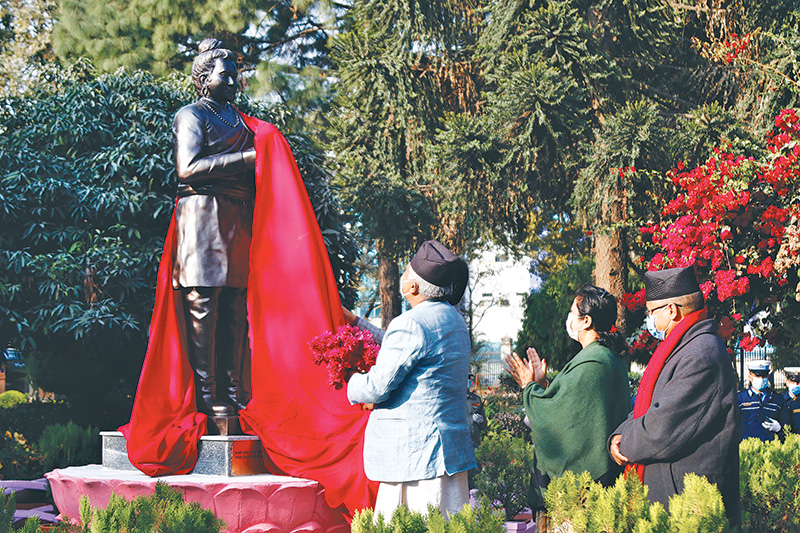
Sakhwa (pictured) and Tuladhar can be remembered without erasing history too, observers say. Post Photo: keshav Thapa

KATHMANDU,
Legend has it that Vikram Sambat, the official calendar of Nepal, is named after King Vikramaditya of Ujjain in Madhya Pradesh, India and he initiated it after having won a war.
However, the calendar that was initiated in Nepal is Nepal Sambat celebrated in November every year. It was initiated by Sankhadhar Sakhwa, a philanthropist, after he paid the debt of the people of Nepal Valley, as Kathmandu Valley was known then.
Understandably, the Newars of Kathmandu revere him.
“Sankhadhar Sakhwa represents the Nepal Valley and our native history,” said Suraj Maharjan, a Newa activist.
According to Kashinath Tamot, a 75-year-old linguist and cultural expert, there are about 36 memorials of Sankhadhar Sakhwa already within Kathmandu Valley of which the best known is the Sankhadhar Chowk in Thimi, Bhaktapur where his statue is visited by dignitaries on Nepal Sambat new year’s day. This year was a different matter, given the pandemic.
As if that was not enough, on November 21 Kathmandu Metropolitan City re-renamed a park at the heart of Kathmandu Sankadhar Udhyan, or garden after unveiling a statue of the national hero and also another of Padma Ratna Tuladhar, a leftist politician and cultural activist who died in 2018.
The move has invited widespread criticism.
“By bringing them under the shadow of the queen who is still alive, they are disrespecting everything, even the accords and transition from monarchy to a democratic republic,” said Tamot.  
The late king Mahendra established Ratna Park in 1964 and named it after his second wife, the sister of his first wife who had died, carving it from Tundikhel, or Tinkhya as the Newars of Kathmandu called the open space.
Ratna, 94, the former queen mother, is still alive and lives in Mahendra Manjil, her home within the Narayanhiti Palace Museum complex.
Her bust which stood at the entrance of the park was removed during the people’s movement of 2006 that ushered in republicanism, ending 240 years of the Shah reign in Nepal. In its place Sankhadhar Sakhwa’s statue was unveiled by Urban Development Minister Krishna Gopal Shrestha on November 21.  
“It does not make sense to change a name that is already so well known and established,” said Bijay Shrestha, coordinator of the Occupy Tundikhel movement.  “We shouldn’t be imposing a history that has already been established. Regardless of the fact that people like it or not, they represent their own chronicle.”
In the popular imagination, Ratna Park is where the Valley’s bus terminus is. Those going to the city centre get on a bus to Ratna Park.
Ratna Park also represents a political history as a mark of the monarchy that has now fallen. During the two people’s movements—in 1990 that ushered in multi-party democracy and in 2006, Ratna Park was also a space for democratic presence that spread out from the adjoining Khula Manch.
“A name sets forth everything,” said Tamot, the cultural expert. “That is perhaps why Kathmandu Metropolitan City’s action to change the name of Ratna Park has started a huge argument.”
Besides the name, people are also upset about commemorating Sankhadhar Sakhwa as a national figure together with Padma Ratna Tuladhar as their contributions to society don’t match.
“I got riled up just reading about it. Because it was not necessary at all and if they had wished to honour the legendary national figure Sankhadhar Sakhwa and the human rights activist Padma Ratna Tuladhar, they should have sought to do it in a better way than trying to rewrite the history,” said Jainendra Jeevan, a political commentator and columnist.
This is the second time that Kathmandu Metropolitan City has named the park Sankhadhar Udhyan.
In 2017, as part of the park’s redevelopment, it had given the park the new name Sankhadhar Udhyan.
“He is a national figure of the country, one that people look up to and we thought it would be okay to have him up there,” said Ishwor Man Dangol, spokesperson for the Kathmandu Metropolitan City. “We did this for the people with regard to their sentiments for Sakhwa.”
For Dangol and many in the Metropolitan City, the criticism was quite unexpected as they had been using the name Sankhadhar Udhyan for three years now. “We had also hoisted a signboard at the area as part of redeveloping Ratna Park,” he told the Post over phone.
“But we just changed the name of the park, the place is still Ratnapark,” said Dangol.
However, Dangol’s clarification in the media has not appeased many.
The Post’s efforts to get in touch with Mayor Bidya Sundar Shakya and Deputy Mayor Hari Prabha Khadgi were unsuccessful as they refused to talk.
“But almost 60 years have come to pass, and there is a whole history attached to this place, and so, in a way, this attempt seems to be erasing a marked history,” said Shrestha, the heritage activist.
But the metropolitan city has its supporters too in this regard.
Maharjan, the Newa activist, says that the new name, Sankhadhar Udhyan is good and justifiable. “For years, native names have been changed and places encroached upon. In that aspect, I see this as a part of reclaiming our lost history,” he said.
But others, including federal and provincial parliamentarians, remain unconvinced.
“I had told Krishna Gopal Shrestha [the minister] when meeting him during an event that they shouldn’t place the memorials there together because the park already has an established history,” said Bhimsen Das Pradhan, a member of parliament from Kathmandu and former defence
minister. “[This] feels wrong and shows how they have disrespected the previous agreements and the whole history.”
Jeewan Dangol, a member of the Bagmati Provincial Assembly, also shares the view.
“If they had wished to honour Sankhadhar Sakhwa and Padma Ratna Tuladhar, they should have sought a different place. This just disregards the point of why they were doing it in the first place,” she said.
One Twitter user last Saturday pointed out how there already is a Sankhadhar Sakhwa park along the Bishnumati promenade which today remains unmanaged and abandoned.
Kathmandu Metropolitan City could even have built a different park to commemorate the contributions of Sankhadhar Sakhwa and Padma Ratna Tuladhar, according to others.
“We don’t have enough open spaces, and they could have invested in a new open space or looked to accumulate the history in the open spaces that already exist in alignment with their contribution,” said Shrestha, the coordinator of Occupy Tundikhel.  
There, however, is an overwhelming consensus that the two figures have to be given their dues and their contributions commemorated.
“I think it is great that KMC wanted to acknowledge Sakhwa and Tuladhar. It is admirable no doubt but in choosing a space that already has a history, they are wrong,” said Tamot. “For a new name replaces history and the mark of a time. But they both have independent identities.”
Others see that this move by Kathmandu Metropolitan City could set a precedence for more unpleasantness and unnecessary debate.
“There are just so many names we already have attached to a certain history, and if we are to change them, this will unravel in a never-ending process; we don’t need to rewrite history. But this is now going to go on,” said Jeevan, the political commentator.

Page 2
NATIONAL

Food trading company uncertain whether to file legal case against dishonest rice supplier

The supplier was recently caught transporting subsidised rice meant for the people in Karnali Province to Bhaktapur.
- KALENDRA SEJUWAL
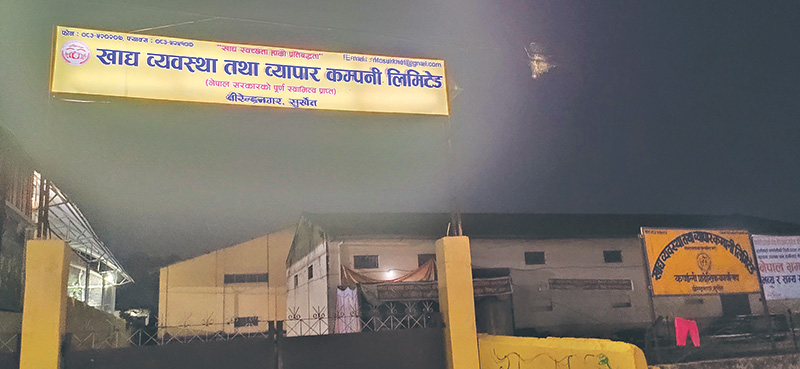
The supplier, Durga Bhagwati Enterprises and Sharma Transportation Service, had signed an agreement with the Food Management and Trading Company Ltd to transport 7,000 quintals of rice to six different places in Karnali in the current fiscal year.  Post Photo

SURKHET,
Last month, a truck loaded with rice was intercepted by police in Surkhet. The truck was carrying subsidised rice meant for Karnali Province but it was headed to Bhaktapur in Bagmati Province. An internal investigation launched by the Food Management and Trading Company Ltd found a “serious mistake” on the part of the supplier, Durga Bhagwati Enterprises and Sharma Transportation Service.
On November 3, the District Police Office in Surkhet arrested Basudev Sharma, the proprietor of the rice supplying company. Following an investigation, Sharma, his wife Sharmila and two of his aides Shivaraj Regmi and Birendra Kumar Thapa were charged with black marketeering. They were granted bail release earlier this week.
The Food Management and
Trading Company Ltd, meanwhile, has not initiated any legal process into the matter yet.
“The concerned supplier has made a serious mistake. We have prepared a report accordingly,” said Dilliram Lamsal, who led an inquiry into the case. “We have not discussed what case to file against the supplier. It might take a week to decide.”
While Lamsal agrees that the rice supplier had swindled both the company and the public, he said they can only talk about the case after consulting with legal advisers.
Sharma has already admitted to the police that the rice meant for the people of Karnali was being used to prepare alcohol in Bhaktapur.
In his recorded statement, he has said that the people in Karnali did not prefer the Japanese variety of rice they had been getting at subsidised rate and he had been supplying the rice to Bhaktapur.
“I used to send the Japanese rice to Bhaktapur to make alcohol as it was hard to sell in Karnali,” Sharma said in his statement.
Although Sharma remained tight-lipped about the quantity of such rice transported to Bhaktapur, the truck driver, Thapa, has admitted to transporting the rice to Bhaktapur at least five or six times.
Investigation has found that Sharma had been supplying the subsidised rice to Durga Bhagwati Enterprises in Bhaktapur. However, no action has been pursued against Durga Bhagwati Enterprises.       
Superintendent of Police Rajendra Bhatta, the police chief of Surkhet, said it was still unclear whether the subsidised rice was found in Bhaktapur or not.
Sharma’s company had signed an agreement with the Food Management and Trading Company Ltd to transport 7,000 quintal of rice in six different places in Karnali in the current fiscal year. The transportation service had taken 1,100 quintals of rice from the company’s godown to supply it to Kalai food distribution centre of Mugu. Two hundred and fifty quintals of rice were seized while it was being transported to Bhaktapur but the whereabouts of the rest of the grains is still unknown.   
In a letter to the Food Management and Trading Company Ltd on November 9, Sharma had informed that some of the rice had already reached the designated place while some amount of rice was on its way to their original destinations.
Madhab Mishra, provincial chief of the Food Management and Trading Company Ltd in Surkhet, said the office was yet to receive details about how much rice reached the designated places.
Police have returned the seized rice to Sharma as per the instruction of the attorney’s office in Surkhet.
District attorney Rajeshwor Aryal said Sharma and his aides could still be charged with a fraud case.

NATIONAL

Track from Byas to Khalanga yet to be built despite government assurances

The federal, provincial and local governments claim to have resumed an old horse track on the Nepal side this year but local residents say otherwise.
- MANOJ BADU
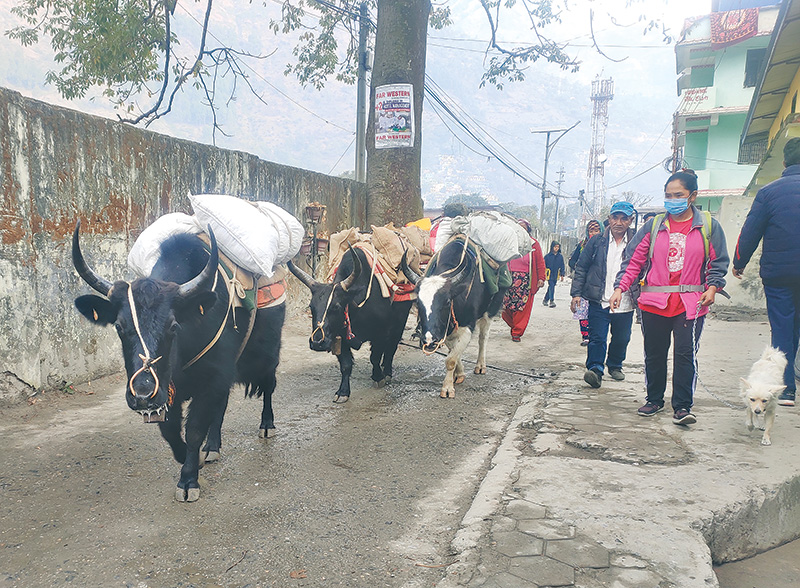
Residents of Chhangru and Tinkar along with their livestock descend to Khalanga and places in lower altitudes every winter to avoid the cold. Post Photo: Manoj Badu

DARCHULA,
A few months ago, some government officials and political party leaders reached Chhangru and Tinkar—the remote high altitude settlements in Darchula’s Byas Rural Municipality—and assured the locals that they will connect the settlements to Khalanga, the district headquarters, via a horse track this year.
“Public officials and politicians came here via helicopters and told us they would build a horse track so we wouldn’t have to travel through India to reach Khalanga,” said Jaman Tinkari of Tinkar. “But the horse track is yet to be built and we still have to travel through India to reach Khalanga. It took me and my family six days to reach Khalanga from Tinkar.”
Chhangru and Tinkar are about a 100 kilometres north from Khalanga.
The federal, provincial and local governments claim to have resumed an old horse track on the Nepal side this year. Chief Minister of Sudurpaschim Province Trilochan Bhatta had reached the Ghatibagad area in October to inaugurate the track reconstructed by Nepal Army. Addressing the function organised there, he said that the Byas residents’ dependence on Indian territory to reach Khalanga was over.
However, villagers of Chhangru and Tinkar in Ward No. 1 of Byas Rural Municipality, who descend to Khalanga and other places in the lower altitude every winter with their livestock to avoid the severe cold, say otherwise.
This year, Nepal Army constructed around 550 metres of an old horse track in the Ghatibagad area. However, some sections of the track, including Tambaku, Kalju and Dopakhe, are yet to be repaired and are not usable, locals say.
“It is risky for people to even walk through the track. How can we make the journey with our animals through such a treacherous path? We requested the Indian officials to let us use the Indian territory to reach Khalanga,” said Mohan Tinkari of Byas-1.
The locals usually start their transhumance to the lower altitude by the third week of November but this year their descent has been delayed due to the Nepal-India border closure amid Covid-19 fear.
As many as 60 families of Tinkar have already descended to Khalanga and its surrounding areas while others are on their way. According to them, Changru locals are also preparing to descend to lower altitude soon.
There are a total of 170 households in Chhangru and Tinkar.
In the 1970s, a horse track had been constructed connecting Chhangru and Tinkar with the district headquarters. But the track was closed off during the Maoist insurgency and fell into disrepair.
The province government and Byas Rural Municipality have also allocated budget to repair the old horse track. However, the track is yet to be repaired completely. The track has been disrupted by landslides in some places while the river has swept sections of it away.
Chief District Officer Sharad Kumar Pokharel said that the old horse track could not be opened this year despite the efforts from all three levels of governments.
“The local people of Ward No. 1 in Byas Municipality have started descending to the lower altitude as the temperature there plunged after snowfall. They are using Indian territory as before. And we have been coordinating with the Indian side so that they could travel easily,” he added.

Page 3
NATIONAL

Plan to run Bhairahawa international airport entirely on solar power gathers momentum

The solar plant is estimated to cost nearly $10 million, or $1 million per megawatt, and will take around six months to complete.
- SANGAM PRASAIN
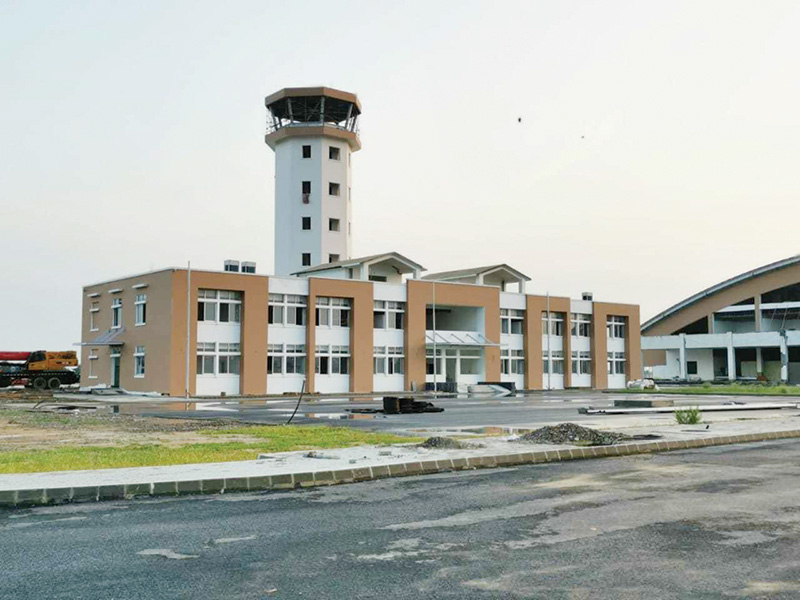
Construction of Gautam Buddha airport began in 2013, and was expected to be ready in 2017. But the
project encountered multiple hurdles that have pushed back the completion deadline several times. POST FILE PHOTO

KATHMANDU,
The plan to make the international airport in Bhairahawa a fully solar-powered facility is becoming reality after two concerned
ministers on Friday decided to address all the issues that had been derailing the project for nearly a year.
The Nepal Electricity Authority had planned to install solar panels on a vast tract of unused lands within the airport complex to produce around 10 megawatts power as part of its plan to diversify the country’s energy sources by involving the private sector.
This will enable the Gautam Buddha International Airport to run fully on power from the sun. The surplus power will be fed into the national grid.
The airport project in Bhairahawa could become the second fully solar-powered airport in the world when it opens next year after India’s Cochin International Airport which earned the distinction in 2015.
Earlier, the project had hit a snag due to the issue of rental rates for the land belonging to the Civil Aviation Authority of Nepal.
In a new development, Energy Minister Barshaman Pun and Tourism Minister Yogesh Bhattarai held a meeting on Friday and decided to resolve problems that have been holding back the project.
“Both ministers have directed the Civil Aviation Authority of Nepal and Nepal Electricity Authority to draft a suitable proposal regarding the issue of rental rates and other operation and payment modalities within the next 10 days,” said Rajan Pokhrel, director general of the Civil Aviation Authority of Nepal.
“The expert team of both sides will suggest the appropriate lease model. Then the ministers will take the proposal to the Cabinet to allow leasing the airport’s land at a reasonable rate,” he said.
According to the officials at the civil aviation body, if the project materialises, the airport will be the country’s first “power-neutral” airport—which means that the airport’s entire power requirement will be met through the solar power plant it houses.
The solar plan had also set off an argument between the Civil Aviation Authority and the Nepal Electricity Authority over sharing the income generated from energy trade.
“Still, if we buy the solar energy from the private producers, it will cost us nearly three times more than what we get from the state-owned power utility,” said Pokhrel. “Therefore, our plan is to buy electricity from the Nepal Electricity Authority instead of exchanging the power with the land we lease them or other parties.”
The power utility had also expressed concerns over expensive rental rates to lease 10 hectares, or 61 bighas, of the civil aviation body’s land. It will cost them more than Rs200 million annually which they said would not be financially feasible for the project.
“This issue will also be resolved through negotiations,” said Pokhrel.
According to the official at the civil aviation body, the project will require 10 hectares of land to install the solar plants. As per the airport service charge regulation, based on the Tribhuvan International Airport service charge regulation, the land lease fee for civil aviation or business purposes is Rs600 per square metre annually. The same fee for leasing land for agricultural purposes is Rs1,000 per ropani or 508.74 sq m per year.
On Friday, Energy Minister Pun and Tourism Minister Bhattarai agreed to resolve the rental rate issue.
“We will soon finalise a reasonable rate and negotiation will take place if the Nepal Electricity Authority agrees on the fees,” said Pokhrel. “After both parties agree on the new rates, it will be tabled in the Cabinet to get its approval. The approval will then allow both parties to sign the agreement and execute the project.”
In July last year, a team of energy and aviation officials had visited Malaysia to study the solar power system at Kuala Lumpur International Airport, which is powered by a 19-megawatt direct current system installed in 2014, and concluded that the plan to make Bhairahawa airport a fully solar-powered airport was technically viable.
The study has shown that installing a solar farm on the airport premises will not pose a risk to flight safety, handling and communications equipment.
Gautam Buddha International Airport is expected to be completed next year.
Once fully solar-powered, the entire airport operation—from air traffic control, baggage claim and runway lights to ground control rooms and passenger terminals—will run on solar energy.
Utilising airport space to install solar panels will allow electricity to be generated at the point of consumption, eliminating energy bills and the need for expensive transmission lines and supporting infrastructure.

NATIONAL

Lawmakers not trained in making laws, Speaker Sapkota complains

- BINOD GHIMIRE

KATHMANDU,
Lawmakers lack expertise in lawmaking because there is no culture of organising training and orientation among political parties, said Speaker Agni Sapkota in a programme on Friday.
The statement comes at a time when several bills presented by the government have been dragged into controversy and the lawmakers are being criticised for paying little attention to their legislative function and focusing on executive roles.
“Barring a few, the majority of our lawmakers lack both the expertise and the interest to perform their legislative role,” Mohan Lal Acharya, former constitutional advisor to the Constituent Assembly, told the Post. “Their main role is lawmaking and monitoring, but they are more interested in executive functions.”
Every year during the budget formulation period, there’s pressure on the finance minister from  lawmakers across the board to allocate more funds for Local Infrastructure Development Partnership Programme under which they can implement projects of their choice.  In Acharya’s opinion, it shows the lawmakers’ inclination towards development works even though that’s not the reason they were elected.
Every year, more budget is set aside for the programme compared to the preceding year, except in the current fiscal year. As of now, a member of the House of Representatives can decide where to spend Rs40 million in coordination with the respective local government.
Experts on law and parliamentary practice have said on several occasions that House meetings that are supposed to endorse crucial bills have been deferred due to the lack of quorum. Parliament can endorse a bill only when more than 25 percent of its total members are present.
As per Article 94 of the Constitution of Nepal, the Lower House, which has 275 members, needs at least 69 members to be present for any law to be endorsed. For instance, the meeting of the Lower House on February 20 was supposed to endorse four bills, including the one on banks and financial institutions. But the meeting had to be adjourned as there were only 58 lawmakers present when the bill was being tabled for endorsement.
Som Bahadur Thapa, former secretary at the Parliament Secretariat, said lawmakers also don’t study the bills properly and tend to endorse whatever provisions the government proposes. “On different occasions, the lawmakers don’t even know what they have endorsed,” he told the Post. “They come to know only when the law is implemented.”
The government on December 24, 2018, registered a bill in Parliament to amend some Nepal laws, which included the Nepal Trust Act.
The bill was tabled for deliberation in the House of Representatives on January 1, 2019 and endorsed on February 15. The National Assembly endorsed it on March 2 same year and was certified by President Bidya Devi Bhandari the very next day.
The Act revised Clause 5.2 (a) of the law which allowed the property of the trust to be used to conduct tourism and business ventures that benefit the nation and the trust. The other revision was to allow the prime minister to choose the minister of his choice to lead the board of Nepal Trust.
The issue came to the surface only after the government decided to extend its lease agreement with Yeti Group to continue its activities in the Gokarna forest, based on that provision.
Thapa said the executive always tries to bring laws to suit its interest and it is the responsibility of the lawmakers to keep a check on that.
During the interaction programme on Friday, Sapkota argued that the laws should be people centric and it is necessary the lawmakers, from both the federal and provincial assemblies, work for it.
“While Sapkota’s observation is right, as chair of the legislature, it is also his responsibility to train lawmakers through the parliament secretariat,” said Thapa. “He should take as much responsibility as the political parties.”

NATIONAL

Sluggish import of capital goods reflects Covid-19’s toll on domestic economy

Private sector says it can’t be expected to invest as usual, and government needs to invest in large infrastructure projects. But public capital expenditure figures are still disappointing.
- PRITHVI MAN SHRESTHA
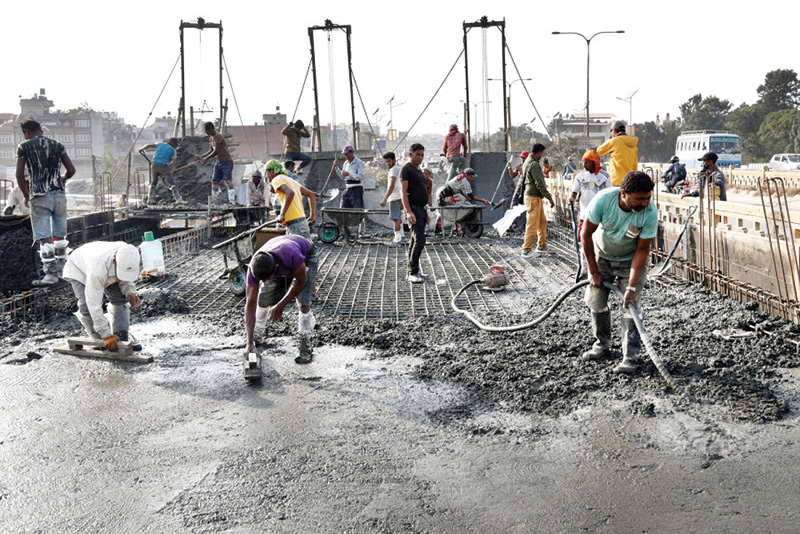
Construction activities in Nepal usually pick up pace after the festivalseason. However, this year contractors are struggling to mobilise workers due to lack of health and safety measures. Post file Photo

KATHMANDU,
While the external sectors of the economy appear to be sound due decline in imports, the internal sector continues to remain subdued due to the Covid-19 pandemic, data on import of industrial raw materials, equipment and construction materials.
Even though there has been improvement in import figures of these items in the first three months of this fiscal year, imports have not reached the level they had reached during the same period last fiscal year.
“Data on imports of industrial supplies and capital goods indicate that economic activities in the country are still moving in slow pace, but are moving in the direction of recovery,” said Gunakar Bhatta, spokesperson for the central bank.
According to the central bank, Rs100 billion worth of industrial raw materials have been imported during the first three months of this fiscal year. During the same period last year, the figure stood at Rs115.2 billion.
This according to the officials and experts is the result of continued slowdown in economic activities in the country, even months after the nearly four-months of nationwide lockdown lifted only on July 22.
Likewise, the import bill of capital goods also slumped to Rs48.4 billion in the first quarter this fiscal from Rs52 billion recorded during the same period last fiscal year.
However, compared to the period of the lockdown, imports have grown  gradually. For example, the import bill of industrial supplies increased to Rs 39.5 billion in the third month from Rs35.2 billion in the first month of this fiscal year. When it comes to capital goods, the amount spent on import of such goods soared to Rs18 billion in the third month from Rs14.2 billion in the first month of this fiscal year, according to the central bank.
Even though the government has been reporting a relatively reduced number of daily coronavirus cases in the recent weeks compared to the earlier months, the number of Covid-19 cases have been growing across the country. On Friday, the number of cases increased to 229,3343 with 1,703 new infections.
Health experts have been warning the situation could deteriorate as the northern hemisphere braces for winter. Many countries are currently seeing a second or third wave of coronavirus infections, forcing them to issue stay-at-home orders.
“Amid uncertain situations, we can’t expect the private sector to invest much,” said Bhatta. “In such a situation, public investment and spending should drive the economy. The government should speed up spending in major infrastructure projects”
But, government spending, particularly that of the capital budget has been disappointing. According to the Financial Comptroller General’s Office, which keeps records of the government’s income and expenditure, capital expenditure stood at 8.61 percent of total capital budget as of November 26. But contractors said that the government has not yet created a conducive environment for them to work on project sites.
Construction activities in Nepal usually pick up pace after the festival season. Contractors said they are struggling to mobilise workers due to the lack of health and safety measures.
Contractors are also worried about the potential shortage of construction materials after a recent decision by the Ministry of Home Affairs to prohibit aggregate mining.
In a recent interview with the Post,  Rabi Singh, president of Federation of Contractors’ Association of Nepal, a grouping of contractors, said that even after seven month of lobbying, the government failed to prepare health protocols for the construction sector.
Industrialists say that even though the demand for goods and services has grown slowly in the recent months after the lockdown was lifted, it is not enough to revive the economy, which is expected either to see low  or negative growth, according to international agencies.
According to the World Bank’s projection last month, Nepal’s economy could grow by 0.6 percent this fiscal year.
Satish Kumar More, president of Confederation of Nepalese Industries told the Post that the demand for construction materials such as cement and iron still has remained low, particularly due to the government’s failure to spend its capital budget.
“We plan to meet the finance minister early next week. We will talk about it with him,” he said.
According to him, food-related industries are operating relatively well in recent months but industries that support development activities by producing cement and steel are not operating well.
Economist Raghubir Bista said that economic activities continue to remain sluggish as there is no demand for goods and services as usual.
“The government announced several packages to create employment, but they remain unimplemented,” he said. “Employment helps to create demands and revive the economy which has not happened.”
Through the budget, the government announced the creation of 700,000 jobs. “Instead of implementing the budget, squabbling in the ruling party appears to have disoriented the government,” said Bista, associate professor at Tribhuvan University.

NATIONAL

Covid-19 hospital established

Briefing

KHOTANG: Halesi Tuwachung Municipality in Khotang has established a temporary Covid-19 hospital at Ward No. 5 of Durchhi Municipality in Khotang. According to Mayor Iwan Rai, the five-bed hospital came into operation from Thursday. “The provincial government had provided Rs 1 million to establish the hospital with X-ray and laboratory services.”

NATIONAL

Reconstruction of schools gains momentum in Kavre

Briefing

KAVRE: Reconstruction of school buildings in Mahabharat Rural Municipality, Kavre, has finally gained pace after the area was linked with a motorable road. Kanchhalal Jimba, chairman of the rural municipality, said, “Reconstruction works of schools have finally gained momentum after the road reached the rural municipality. In the past, construction materials for schools had to be transported by porters.”

NATIONAL

Bailey bridge re-installed

Briefing

KHOTANG: Gaighat-Diktel Road Office in Udayapur has started re-installation of a bailey bridge in Phoksingtar over Sunkoshi river. The bridge connects Udayapur with Khotang district. Gopal Khakurel, chief at the office, said, “The construction of the bridge will be completed within mid-December. The length of the bridge is around 50 meters.”

Page 4
WORLD

Trump says he’ll leave if Electoral College seats Biden

The president urges reporters not to let Biden take credit for pending Covid-19 vaccines.
- ASSOCIATED PRESS
President Donald Trump speaks with reporters after participating in a video teleconference call with members of the military at the White House in Washington on Thursday. AP/rss

WASHINGTON, 
President Donald Trump said Thursday that he will leave the White House if the Electoral College formalises President-Elect Joe Biden’s victory—even as he insisted such a decision would be a “mistake”—as he spent his Thanksgiving renewing baseless claims that “massive fraud” and crooked officials in battleground states caused his election defeat.
“Certainly I will. But you know that,” Trump said on Thursday when asked whether he would vacate the building, allowing a peaceful transition of power in January. But Trump—taking questions for the first time since Election Day—insisted that “a lot of things” would happen between now and then that might alter the results.
“This has a long way to go,” Trump said, even though he lost.
The fact that a sitting American president even had to address whether or not he would leave office after losing reelection underscores the extent to which Trump has smashed one convention after another over the last three weeks. While there is no evidence of the kind of widespread fraud Trump has been alleging, he and his legal team have nonetheless been working to cast doubt on the integrity of the election and trying to overturn voters’ will in an unprecedented breach of democratic norms.
Trump spoke to reporters in the White House’s ornate Diplomatic Reception Room after holding a teleconference with US military leaders stationed across the globe. He thanked them for their service and jokingly warned them not to eat too much turkey, then turned to the election after ending the call. He repeated grievances and angrily denounced officials in Georgia and Pennsylvania, two key swing states that helped give Biden the win.
Trump claimed, despite the results, that this may not be his last Thanksgiving at the White House. And he insisted there had been “massive fraud,” even though state officials and international observers have said no evidence of that exists and Trump’s campaign has repeatedly failed in court.
Trump’s administration has already given the green light for a formal transition to get underway. But Trump took issue with Biden moving forward.
“I think it’s not right that he’s trying to pick a Cabinet,” Trump said, even though officials from both teams are already working together to get Biden’s team up to speed.
And as he refused to concede, Trump announced that he will be traveling to Georgia to rally supporters ahead of two Senate runoff elections that will determine which party controls the Senate. Trump said the rally for Republican Senators David Perdue and Kelly Loeffler would likely be held Saturday. The White House later clarified he had meant December 5.
One of the reasons Republicans have stood by Trump and his baseless claims of fraud has been to keep his loyal base energised ahead of those runoffs on January 5. But Trump, in his remarks, openly questioned whether that election would be fair in a move that could dampen Republican turnout.
“I think you’re dealing with a very fraudulent system. I’m very worried about that,” he said. “People are very disappointed that we were robbed.”
As for the Electoral College, Trump made clear that he will likely never formally concede, even if he said he would leave the White House.
“It’s gonna be a very hard thing to concede. Because we know there was massive fraud,” he said, noting that, “time isn’t on our side.”
“If they do,” vote against him, Trump added, “they’ve made a mistake.”
Asked whether he would attend Biden’s inauguration, Trump said he knew the answer but didn’t want to share it yet. But there were some signs that Trump was coming to terms with his loss.
At one point he urged reporters not to allow Biden the credit for pending coronavirus vaccines. “Don’t let him take credit for the vaccines because the vaccines were me and I pushed people harder than they’ve ever been pushed before,” he said.
As for whether or not he plans to formally declare his candidacy to run again in 2024—as he has discussed with aides—Trump said he didn’t “want to talk about 2024 yet.”
All states must certify their results before the Electoral College meets on December 14, and any challenge to the results must be resolved by December 8.

WORLD

Thai protesters target would-be coup makers as rumours swirl

- REUTERS

BANGKOK,      
Thai anti-government protesters called for an end to coups in the Southeast Asian country on Friday as months of street protests fuel rumours of another military takeover.
The protesters demand the resignation of Prime Minister Prayuth Chan-ocha, a former junta leader who seized power in the last coup in 2014, but say they do not want him replaced by another general.
Organisers called Friday’s protest “Rehearsal to Oppose a Coup”. Hundreds of people joined in what was the latest of almost daily demonstrations since mid-July.
Prayuth’s putsch was the 13th successful coup since the end of absolute monarchy in 1932.
He stayed on as prime minister after an election last year and protesters say the ballot was organised to keep him in power with a constitution drawn up by his former government that gave parliament’s entire upper house to junta appointees.
“I’m only 18 but have seen two coups already. That’s not right,” said Tan, a high school student at the protest who gave only one name. “We don’t want history to repeat itself.”
Both Prayuth and Thailand’s army chief, General Narongpan Jittkaewtae, this week dismissed the possibility that another coup was imminent.
Protesters also accuse the monarchy of enabling decades of military domination and have demanded curbs to the powers of King Maha Vajiralongkorn - including his power to approve any future coups.
The Royal Palace has made no comments on the protesters although the king said recently that they were loved “all the same”.
At least seven of the most prominent protest leaders face charges of insulting the monarchy, which could carry jail terms of up to 15 years, for comments they have made at different protests.

WORLD

Ethiopia’s PM rejects dialogue in meeting with AU envoys

- ASSOCIATED PRESS
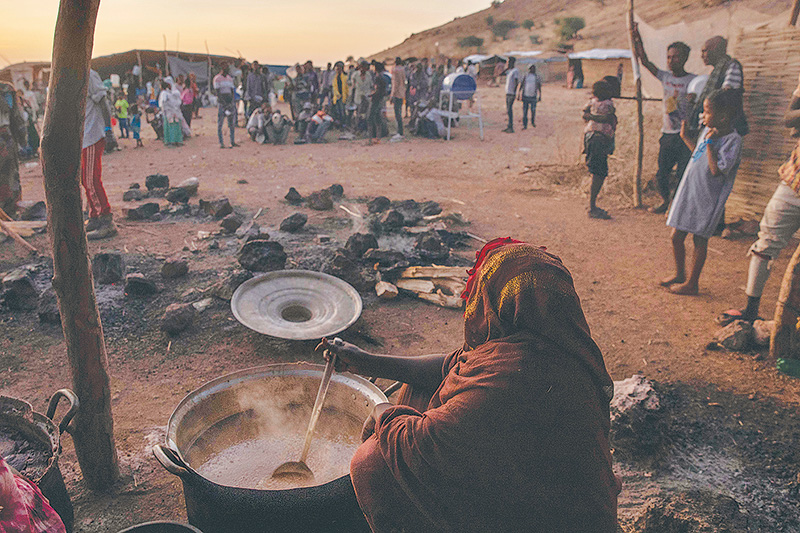
A Sudanese woman volunteer cooks for Tigray people who fled the conflictin Ethiopia’s Tigray region, at Umm Rakouba refugee camp in Qadarif, eastern Sudan, on Thursday. AP/rss

NAIROBI, KENYA, 
Ethiopian Prime Minister Abiy Ahmed again ruled out dialogue with the leaders of the defiant Tigray region on Friday but said he is willing to speak to representatives “operating legally” there during a meeting with three African Union special envoys trying to end the deadly conflict between federal troops and the region’s forces.
The meeting occurred as people fled the Tigray capital in fear of an imminent assault after Abiy said the army had been ordered to move in for the “final phase” of an offensive to arrest the leaders of the Tigray People’s Liberation Front who run the region. Abiy’s government and the regional one each consider the other illegitimate.
There was no immediate word from the three AU envoys, former Liberian President Ellen Johnson Sirleaf, former Mozambique President Joaquim Chissano and former South African President Kgalema Motlanthe. AU spokeswoman Ebba Kalondo did not say whether the envoys can meet with TPLF leaders, something Abiy’s office has rejected.
The prime minister appreciated the AU envoys’ “elderly concern” and told them his government’s failure to enforce the rule of law in Tigray would “nurture a culture of impunity with devastating cost to the survival of the country,” his office said.
Abiy, last year’s Nobel Peace Prize winner, has rejected international “interference.”
Fighting reportedly remained well outside Mekele, a densely populated city of a half-million people who had been warned by the Ethiopian government of “no mercy” if they didn’t separate themselves from the TPLF leaders in time. Abiy on Thursday told residents to stay indoors and disarm as the army, with tanks, was given the order to move in. His government has vowed to protect civilians.
With communications and transport links severed, it remains difficult to verify claims about the fighting that erupted Nov. 4 between Ethiopian forces and the heavily armed forces of the TPLF, which once dominated Ethiopia’s government but has been sidelined under Abiy’s rule.
Hundreds, perhaps thousands, of people have been killed. The fighting threatens to destabilise Ethiopia, which has been described as the linchpin of the strategic Horn of Africa, and could even destabilise its neighbours. Food and other supplies are running out in the Tigray region of 6 million people. The United Nations continues to urge immediate access for humanitarians that is neutral and impartial. Ethiopia’s government has said a “humanitarian access route” would open under the management of the country’s Ministry of Peace, with no details.
Multiple crises are growing. Some of the tens of thousands of refugees from Eritrea who are living in camps in northern Ethiopia have been in the line of fire as fighting sweeps by them.
Refugees have also told The Associated Press that Ethiopian forces near the border with Sudan are impeding people from leaving Ethiopia, while refugee crossings have largely slowed to a trickle. Ethiopia’s government has not commented on that.
More than 40,000 refugees have crossed into a remote part of Sudan where local communities and humanitarian workers struggle to provide food, shelter and care. Nearly half of the refugees are children. The spread of COVID-19 is just one concern.
“We cannot keep social distancing here in the camp,” said Mohammed Rafik Nasri, from the UN refugee agency. “It is really challenging among the several issues in need that are growing because the number is growing. Today we are receiving a convoy of 1,000 arriving in the camp. And shelter is one of the biggest challenges that we have at the moment.”
Scared, sometimes without word of loved ones left behind, the refugees continue to share horrific accounts of the fighting and plead for it to stop.
“It makes me so sad. The country has no peace. You see one tribe killing another. It is so hard,” said one, Atsbaha Gtsadik.

WORLD

Doctors warn over Delhi’s half-marathon

- AGENCE FRANCE-PRESSE

NEW DELHI,
Top doctors have warned elite runners are taking a major health risk by competing in Sunday’s New Delhi half-marathon in the midst of a major coronavirus outbreak.
Women’s marathon world record-holder Brigid Kosgei from Kenya and Ethiopia’s two-time men’s winner Andamlak Belihu are among the 49 elite athletes running the 21-kilometre race, while thousands of amateurs are taking part virtually.
Organisers say the “highest level of safety-standards, with bio-secure zones” have been laid on for the race starting at the Jawaharlal Nehru Stadium.
But with New Delhi recording more than 500,000 virus cases, and air quality in the world’s most polluted capital hovering between ‘unhealthy’ and ‘hazardous’, health experts said the athletes should think twice.
“It will be suicidal for runners to run the race this time. We have such high levels of pollution, we have the risk of coronavirus,” Arvind Kumar, founder trustee of the Lung Care Foundation, told AFP. “With the presence of this twin threat if people are still running despite knowing everything, well, I have no words to express my anguish.”
“Whether you are an international elite runner or you are a small boy from a village, the damaging potential of a damaging agent remains the same,” said the doctor.
Randeep Guleria, director of the All India Institute of Medical Sciences, the country’s top research body, told AFP that “in an ideal situation” the race should not be run.
“Because of high levels of air pollution, exercising outside in this weather sometimes can lead to aggravation of underlying lung problems,” he said.
“Even if you are an elite runner the air pollution would still affect your lung.”
Normally thousands of amateurs would also take part, but because of the coronavirus they have been told to run their chosen route between Wednesday and Sunday and chart their time on an app.
Delhi has been hit by a winter pollution crisis each year for the past decade when crop-stubble burning from nearby states, cold temperatures and car and industrial pollution produce a toxic mix.
This year, the Indian capital is also a major concern in the battle against the coronavirus. India is the world’s second worst-hit country behind the United States, with about 9.3 million cases.
The city is considering imposing a night-time curfew because of the rising number of cases, according to media reports.
Kosgei, who is visiting India for the first time, acknowledged her concerns about travelling for the race.
“We have definitely been affected by Covid-19. I had to convince my parents and family back home to allow me to visit Delhi for the half-marathon,” she said.
“The virus has affected most of the sporting events. But it is important for us to take care of ourselves.”

WORLD

Fists and pig guts fly in Taiwan parliament debate on US pork

Briefing
- AGENCIES

TAIPEI: Legislators from Taiwan’s main opposition Kuomintang (KMT) party threw pig guts and exchanged punches with other lawmakers in parliament on Friday as they tried to stop the premier taking questions, in a bitter dispute over easing US pork imports. President Tsai Ing-wen announced in August that the government would allow imports of US pork containing ractopamine, an additive that enhances leanness but is banned in the European Union and China.

WORLD

S Korea agency says N Korea executed people, shut capital

Briefing
- AGENCIES

SEOUL: North Korean leader Kim Jong Un has ordered at least two people executed, banned fishing at sea and locked down Pyongyang as part of frantic efforts to guard against the coronavirus and its economic damage, South Korea’s spy agency told lawmakers on Friday. One of the lawmakers, Ha Tae-keung, quoted the NIS as saying Kim is displaying “excessive anger” and taking “irrational measures” over the pandemic and its economic impact.

Page 5
MONEY

Traders fear they may miss winter sales season too

The northern border reopened in mid-October after being closed for several months, but only a small number of containers were allowed to pass.
- KRISHANA PRASAIN
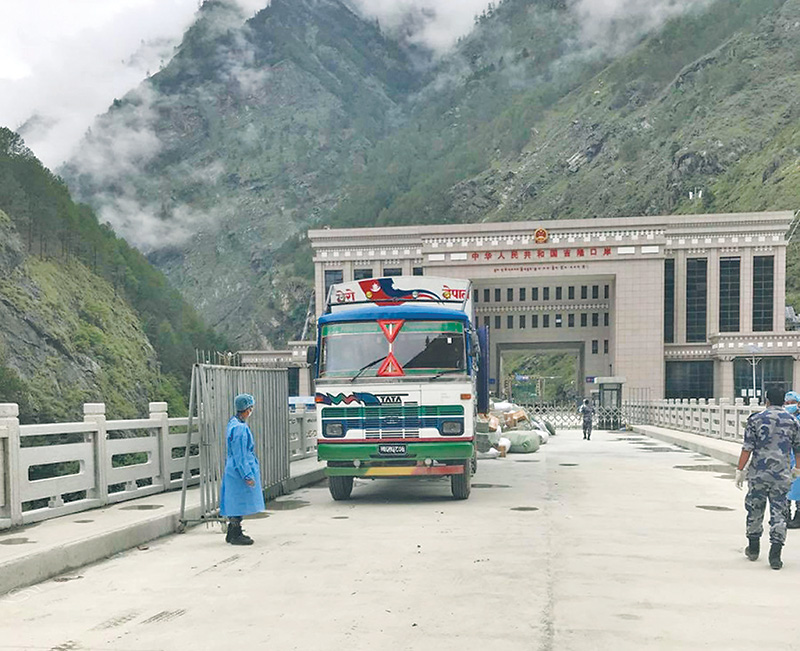
Nearly 1,100 cargo trucks were stranded at the northern transit points from January till early July as they were closed following heavy snowfall and subsequent border shutdown by the Nepal government in the wake of Covid-19.  File Photo: Courtesy of Punya Bikram Khadka

KATHMANDU,
Local traders fear they may miss the winter shopping season too, like they lost the summer and festive shopping seasons due to delayed shipments, as their goods are again being held up at the northern border points.
The northern border with China reopened before the festive season in mid-October after being closed for several months, but only a small number of containers were allowed to pass. Hundreds of container trucks have been stranded on the other side of the border for a year.
“The goods ordered for the winter season are stuck at the transit point,” said Bachhu Poudel, president of the Nepal Trans Himalayan Border Commerce Association. “Not more than four-five containers are arriving daily from the bordering crossings at Kerung and Tatopani.”
According to him, only 10 percent of the shipments have been allowed through.
The two transit points with China had been shut since January 29 to prevent the spread of the coronavirus.
The Tatopani border, which had remained closed since the April 2015 earthquake, reopened on April 8 to allow medicines and health equipment from China to pass. Rasuwagadhi reopened only in the first week of July.
The two border points were opened to one-way traffic, and only four cargo trucks or 120 tonnes of goods were allowed to enter Nepal daily due to virus restrictions as per an agreement between Nepali and Chinese authorities.
Following a rising virus caseload in Nepal, Chinese truckers have been leaving containers at the Miteri Bridge on the border from where Nepali truckers take over.
“Citing safety issues, Chinese authorities are not releasing more than five containers from the border points daily,” he said. “The delayed release of goods has added to the burden of traders due to higher shipping charges and accumulating bank interest.” Poudel said, “Except for the prime minister, we have appealed to all concerned authorities, but the problem remains the same. We went to the Chinese Embassy to discuss the issue, but they asked us to come through the concerned government channel.” The government, for its part, says that it has been discussing the trade issue with the related stakeholders, but the outcome has been zero, he said. “We don’t know whether they are making any effort or not,” he added.
Traders said that ordering goods by sea cargo was not viable for small traders as they do not deal in large quantities of merchandise.
According to Poudel, around 70 containers used to cross the border daily from the northern trade point during normal times.
A container takes up to two weeks to reach Kathmandu from the northern border point, and sea cargo takes more than a month, Poudel said. Due to the convenience, traders prefer to import goods by road rather than by ship, he added. One can order small quantities if you are transporting goods by road, but you have to import in bulk if you want them to be dispatched by sea, he said.
Summer goods that were ordered before the lockdown began are only now starting to arrive in Kathmandu.
Nearly 1,100 cargo trucks were stranded at the northern transit points from January till early July as they were closed following heavy snowfall and subsequent border shutdown by the Nepal government in the wake of Covid-19.
“The increased freight charges have pushed up the prices of goods by 25-30 percent, increasing the burden on consumers,” Poudel said. Traders had to wait for eight-nine months for their shipments to arrive from the northern border, and that added to their costs. Some merchandise also got damaged after being stuck at the border for a long time.
“The price of goods shipped through the Kerung border has risen as the Chinese agent has increased fares threefold. Transportation charges for a container truck may reach Rs1.2 million now,” Poudel said.
Naresh Katuwal, president of the Nepal National Traders’ Federation, said that shipments still do not arrive regularly from the northern border.
“More than 100 containers are stranded at the Tatopani point while it has been a year that goods have been stuck at Kerung,” he told the Post.
Neither China nor Nepal seems willing to ease the congestion in cargo transportation, he said. “Readymade garments, footwear and consumer electronic goods are the main imports from China; and when only a few cargo trucks are released daily, you can imagine how many shipments we receive, and what that does to our business,” he said. Traders are debating whether they should continue importing goods through the northern border because of this recurring transportation problem, he added. Their goods have been stranded at the border for a year now, and their bank interest is piling up, and they still don’t know when their goods will be delivered.
There is little chance that the goods on order will arrive from the northern border points in time for the winter shopping season, he said. The freight charges have risen by three times, he said. The government should have intervened but it did not happen.
“We took the issue to the Ministry of Industry, Commerce and Supplies, and they said that the problem would be solved within a few days,” Katuwal said.
Industry Minister Lekh Raj Bhatta said that the Ministry of Foreign Affairs and the ministry’s Bilateral and Regional Trade Division had held secretary-level discussions.
“With rising Covid-19 cases in the country, China is adopting a strict safety protocol. But we are
trying to have more cargo trucks released. I have talked with the secretary of the Ministry of Foreign Affairs too, and they said that they would discuss the issue again,” Bhatta told the Post.

MONEY

Global stocks mixed amid unease about vaccine development

- ASSOCIATED PRESS

BEIJING,
Global stock markets were mixed Friday as questions about the effectiveness of one possible
coronavirus vaccine weighed on investor optimism.
Markets in London and Sydney declined while Frankfurt, Shanghai and Hong Kong gained.
Investor optimism about progress in vaccine research was rattled after researchers questioned data that showed a candidate from the University of Oxford and AstraZeneca was 70 percent effective.
“Market participants showed increasing signs of nervousness as data errors were revealed,” Mizuho Bank said in a report.
In early trading, the FTSE 100 in London lost 0.6 percent to 6,323.28 while Frankfurt’s DAX added 0.1 percent to 13,301.89. The CAC 40 in Paris was up less than 0.1 percent at 5,569.48.
On Wall Street, the future for the benchmark S&P 500 index was up less than 0.1 percent while that for the Dow Jones Industrial Average was unchanged.
US markets were closed Thursday for the Thanksgiving holiday.
In Asia, the Shanghai Composite Index gained 1.1 percent to 3,408.31 and the Nikkei 225 in Tokyo added 0.4 percent to 26,644.71. The Hang Seng in Hong Kong advanced 0.3 percent to 26,894.68.
Sydney’s S&P-ASX 200 shed 0.5 percent to 6,601.10 after China announced a tariff hike on Australian wine, stepping up pressure on Australia over issues including its support for an investigation into the origins of the coronavirus. China, Australia’s biggest export market, has blocked or limited imports of beef, barley and other Australian goods.
“Markets have, until now, completely ignored China’s silent trade war with Australia,” Jeffrey Halley of Oanda said in a report. “That reality appears to be dawning on Australian equity markets.”
The Kospi in Seoul rose 0.3 percent to 2,633.45 and India’s Sensex was up less than 0.1 percent at 44,275.79. New Zealand and Southeast Asian markets advanced.
Investors are looking forward to a possible vaccine to control the pandemic that plunged the global economy into its deepest slump since the 1930s, though forecasters warn the stock market rebound might be too early to be sustained.
Those hopes were dented this week when researchers questioned how Oxford and AstraZeneca calculated the effectiveness of their vaccine. That alliance is among researchers who have reported the most progress toward a possible vaccine. The AstraZeneca CEO told Bloomberg News the company might conduct another trial.
Investors also are dismayed that US states and European governments are re-imposing controls on business and travel as infection rates surge.
The disease has killed more than 1.4 million people worldwide and there are 61 million confirmed cases, according to data gathered by Johns Hopkins University.

MONEY

Gold faces worst week in two months as vaccine optimism weighs

- REUTERS

NEW YORK,
Gold edged down on Friday, on path for its worst weekly decline in two months, as hopes for a virus vaccine and a rebound in economic growth dulled demand for the safe-haven asset.
Spot gold fell 0.1 percent to $1,808.30 per ounce by 1054 GMT, down 3.4 percent on the week so far, it’s biggest weekly loss since Sept. 25. US gold futures were little changed at $1,806.40.
“A break below $1,800 an ounce could well see further losses towards $1,760 as positive sentiment around a possible vaccine continues to weigh on demand for the traditional safe haven asset,” said Michael Hewson, chief market analyst at CMC Markets UK. The coronavirus drug by AstraZeneca was touted as a “vaccine for the world” because of its affordable cost.
However, the vaccine’s effectiveness is now under more rigorous scrutiny, which analysts claim could postpone its regulatory approval.
The dollar also weakened on improving risk aversion from Covid-19 vaccine optimism and prospects for an easier transition to a Biden administration, limiting losses in gold.
“The concern right now is that dissipated central bank buying and outflows in ETFs,” said independent analyst Ross Norman.

MONEY

Aviation bodies seek airport slots relief for much of 2021

- REUTERS
Ryanair planes are seen at Dublin Airport, Dublin, Ireland. REUTERS

PARIS, 
Global aviation heavyweights led by airline body IATA are pushing to suspend airport slot access rules until October 2021, they said on Thursday, but will give some ground to budget carriers angered by measures they deem anti-competitive.
The draft proposal, first reported by Reuters, was issued jointly by IATA, airports body ACI and slot coordinator association WWACG. It would prolong the current suspension of rules requiring airlines to use 80 percent of their take-off and landing windows or else cede some to rivals.
Rules on the allocation of airport slots have big ramifications for airline competition and market access for low-cost carriers, which were making ever deeper inroads before the pandemic. The current waiver expires on March 31.
“We oppose the extension of slot waivers into summer 2021 because this will lead to fewer flights and higher fares for consumers,” a Ryanair spokeswoman said.
“Legacy airlines at hub airports will have no incentives to operate flights,” she added. “Slot waivers distort competition by preventing low-fare airlines from expanding while legacy carriers are able to reduce capacity and raise prices.”
The issue is increasingly divisive among airlines and airports, pitting budget carriers largely absent from IATA against the organisation’s more traditional membership. In a bid to address concerns, the proposal would restore the “use-it-or-lose-it” principle during the northern summer but reduce the utilisation rate required to keep slots to 50 percent.
“All parties agree that the normal threshold (80:20) should be replaced by a lower threshold,” the draft document says. “[The] slot usage requirement threshold shall be set at 50:50.”
IATA said the plan was “essential to preserve connectivity” until air traffic recovers. “The existing slot rules were never designed to cope with a prolonged industry collapse,” it said in a statement.
The proposal would also allow incumbent carriers to sidestep the 50 percent rule on slots they return for temporary allocation to rivals by February—too late for schedule planning, competitors say.
It is unlikely to satisfy Ryanair or ultra-low cost peer Wizz Air.
“Wizz Air finds any attempt to extend the current slot waiver in full, partially or at lower thresholds totally unacceptable,” its Chief Executive Jozsef Varadi told Reuters. “Wizz Air is not party to this effort which is harmful to consumers, societies, taxpayers and the general workforce.”
But easyJet, a longer-established budget carrier present at major European airports, said it “views the IATA-led industry proposal as a good compromise.”
Governments will decide on any waiver extension and must balance competition with support for an industry brought to a near-standstill in long-haul and many regional markets.

MONEY

Billionaires Bezos and Ambani gun for India retail supremacy

- REUTERS
A woman shops inside the Big Bazaar retail store in Mumbai, India. REUTERS

MUMBAI/NEW DELHI, 
Jeff Bezos and Mukesh Ambani, two of the world’s richest men, face a turning point in a battle for preeminence in India’s booming, nearly trillion-dollar retail market.
The outcome of a legal dispute which has embroiled the billionaires’ Amazon.com and Reliance Industries Ltd empires—where a court ruling is imminent—may shape India’s retail landscape for years to come.
The winner in the fight for Future Retail Ltd, Amazon’s estranged local partner, will get pole position in the race to meet the daily needs of more than a billion people.
Accusations of insider trading and contractual breaches, as well as nationalistic cries to keep the US giant at bay, mark the high-stakes fight, which has snowballed from what began as a dispute between Amazon and Future.
If Amazon succeeds, it may slow Reliance’s plans to expand its e-commerce and brick-and-mortar operations. If Amazon loses, its hopes of expanding its interests in India’s second-largest retailer and cashing in on its key grocery supply chain will be dashed, industry insiders say.
Amazon is trying to stop Reliance’s $3.4 billion purchase of Future Group’s retail assets. The US company, which won an injunction from an arbitrator to block the Reliance-Future deal, accuses its partner of breaching some pre-existing agreements, misleading the public and insider trading. Future denies the allegations.
Amazon, Reliance and Future did not respond to requests for comment.
Bezos’s behemoth is a formidable foe, but Ambani has a history as a disrupter. He has shaken foreign telecom firms by offering dirt-cheap data. Industry executives see his e-commerce plans as a threat for Amazon and Walmart Inc’s Flipkart.
“If Reliance moves faster and faster, obviously it’ll become very difficult for anyone else to gain,” said Himanshu Bajaj, head of consulting firm Kearney’s India retail practice.
Reliance, seeking to expand its JioMart e-commerce business, this month completed a $6.4 billion fund-raising by selling a stake in its retail arm to such investors as Silver Lake Partners and KKR & Co.
India’s retail market will grow 46 percent over the next four years to an annual $1.3 trillion, reckons Forrester Research. The key battle is over groceries, expected to be worth around $740 billion a year by 2024.
Founded by Kishore Biyani, dubbed India’s retail king, Future transformed the country’s retailing in recent decades, before Covid-19 hit the business so hard this year that Biyani was forced to find a new buyer.
Around 1,300 of Future’s more than 1,700 retail outlets in 400 cities sell groceries. Its budget supermarkets cater to middle-class shoppers, while its upmarket stores offer products like imported cheese and fresh guacamole, relatively rare in India’s retail landscape.
That makes Future a prized asset for both Reliance and Amazon.
Reliance and Future dominate the market, with the next competitor, Avenue Supermarts Ltd’s DMart, having just 220 outlets in around 70 cities.
While Reliance boasts around 11,000 retail stores, just 800 of those offer food and groceries, UBS estimates. Future’s retail assets would nearly triple Reliance’s footprint in the grocery segment and boost its e-commerce plans, said Forrester analyst Satish Meena.
Amazon sees Future as a long-term play to optimise its supply chain for grocery delivery, an area where it has lagged, Meena said.

MONEY

Newly opened Ncell Centre at TIA begins operations

KATHMANDU: Ncell Axiata Limited has started providing service from its newly opened Ncell Centre in the arrival section of Tribhuwan International Airport. The new centre has taken all safety measures for operation as per the government mandated health and safety guidelines during the ongoing Covid-19 pandemic, states the press release issued by the company. Customers visiting the centre can acquire all services, ranging from general inquiry products and services to SIM subscription to internet setting to various enterprise services. Ncell believes the new service outlet will provide world-class quality service to valued travellers landing in Kathmandu from abroad. The centre provides customer service from 9am to 530pm, 7 days a week.

Page 6
SPORTS

Smith, Finch tons guide Australia to victory

The Aussies beat India by 66 runs in the first men’s international played in front of a crowd since March due to coronavirus.
- REUTERS
Australia’s Aaron Finch scored his 17th One-day International century against India at the Sydney Cricket Ground in Australia on Friday. AP/RSS

SYDNEY,
Steve Smith and Aaron Finch led the way with centuries as Australia opened their home summer with a one-day victory over India by 66 runs on Friday in the first men’s international played in front of a crowd since March.
The capacity of the Sydney Cricket Ground was reduced by 50 percent because of social distancing rules but a crowd of 17,821, mostly backing the tourists, were treated to some fireworks from the home batsmen in the afternoon sun.
Finch scored 114 in an opening stand of 156 with David Warner (69) to lay a platform before his predecessor as captain Smith smashed 105 off 66 balls to drive Australia to 374-6 — their highest total against India. India, who were forced to spend two weeks in quarantine on arrival in Australia, always looked like struggling to chase down the third highest tally they had conceded in any one-dayer.
Hardik Pandya thumped four sixes in a bright 90 to give them hope but the innings petered out after his fifth-wicket partnership of 128 with opener Shikhar Dhawan (74) was broken and India limped to 308-8 in their 50 overs.
“I’ve been searching for something for a couple of months but a few days ago something just clicked,” Smith said of his batting. “It was nice to contribute to a good win.”
The teams lined up in a “Barefoot Circle” in recognition of indigenous Australians before the match and moments of silence remembered Dean Jones, who died last month, and Phillip Hughes, who suffered a fatal injury at the ground exactly six years ago. There was another short pause early in the Australia innings when two environmental protesters ran on the field but Finch and Warner were soon back pillaging runs again.
Smith survived an early scare on 15 when he was given out lbw but he immediately reviewed and the tracker showed the ball was going a whisker above the stumps. Thereafter, Smith looked at his very best as he raced to the third fastest one-day century by an Australian in 62 balls, clubbing 10 fours and four sixes. Finch had already secured his 17th century in the format from a more pedestrian 117 deliveries before departing to make way for a vintage Glenn Maxwell cameo of 45 runs off 19 balls.
Paceman Mohammed Shami was the pick of India’s bowlers (3-59) and skittled Smith with a full toss in the final over of the innings.
Josh Hazlewood (3-55) stalled a blistering start to India’s innings by removing Mayank Agarwal and then dismissed Virat Kohli (21) and Shreyas Iyer in the 10th over. Spinner Adam Zampa (4-54) redeemed himself with ball in hand after dropping Kohli in the deep when the India captain was on one, but his was only one of a string of misfields from both sides.
India play two more one-dayers in Sydney and Canberra before a three-match Twenty20 series and four Tests around the new year.
“I think we had enough preparation so no excuses,” said Kohli.
“The key to keeping the batsmen in check is picking up wickets and we couldn’t do that.”

SPORTS

New Zealand beat West Indies by five wickets in Twenty20

- AGENCE FRANCE-PRESSE

WELLINGTON,
Paceman Lockie Ferguson unleashed a devastating five-wicket barrage as New Zealand downed the West Indies in a roller coaster Twenty20 series opener in Auckland on Friday.
The match—the first international cricket played in New Zealand for almost nine months—produced a nail-biting finale as the Black Caps reached 179-5 in the final over after being set a target of 176. Persistent showers meant the innings were reduced to 16 and many players, particularly the tourists, were rusty after only emerging from Covid-19 quarantine on Thursday. But there were outstanding individual performances on both sides, particularly man-of-the-match Ferguson and West Indies captain Kieron Pollard’s unbeaten 75 from 37 balls.
Ferguson claimed a career-best haul of 5-21 to put the brakes on a flying start from the West Indies, saying the short boundaries at Eden Park helped his cause. Pollard almost swung momentum back to the West Indies single-handedly, clubbing eight sixes and four fours to ensure his team set a competitive target.
West Indies opener Andre Fletcher smashed back-to-back sixes off debutant Kyle Jamieson, who conceded 18 from his first over in international T20. The tourists were even more brutal against Hamish Bennett, plundering 29 runs from a nightmare over for the fast bowler.
They were 58 without loss before Ferguson broke through and clean-bowled Fletcher on 34.
The West Indies then lost five wickets for a single run over the course of 11 balls, with Ferguson claiming three scalps during the spell and captain Tim Southee two. Pollard’s contribution looked like it would prove decisive when New Zealand made a shaky start and veteran opener Martin Guptill departed for five. They were soon 63 for four when Ross Taylor was run out.
The Black Caps’ South African-born debutant Devon Conway and Jimmy Neesham were looking dangerous when Pollard broke their 77-run
partnership when Conway was caught on 41. But Neesham, who scored 48 from 24 balls, steered the New Zealanders home with Mitchell Santner, who hit a six to claim victory with four balls to spare.
“It was a very strange game but nice to come out the right side,” said Southee, who is standing in as regular skipper Kane Williamson focuses on Test cricket. “It’s been a long time coming, we’re fortunate to be back out here playing in front of the crowds and hope the fans enjoyed it.”
The next fixture in the three-match series is in Mount Maunganui on Sunday.

SPORTS

Napoli honour Maradona with win, Leicester and Arsenal advance

- AGENCE FRANCE-PRESSE

NAPLES,
Napoli honoured the memory of Diego Maradona with a 2-0 win over Rijeka which allowed them to go top of Europa League Group ‘F’ in the first match since the death their Argentine icon.
Gennaro Gattuso’s side entered the field all wearing the number 10 jersey of Maradona, who won Napoli’s only Serie A titles in 1987 and 1990 as well as the 1989 UEFA Cup. “Diego is a legend and will never die,” Gattuso said after the match. “Since yesterday you could see that the city breathed a different atmosphere. We hope to dedicate something important to him and win a trophy. In this city we have talked about it for too many years.”
Napoli made sure the fans gathered outside to pay their respects to Maradona weren’t disappointed by the current team as an Armando Anastasio own goal and a simple Hirving Lozano finish sealed the points. Napoli are now two points ahead of AZ Alkmaar and Real Sociedad following their goalless draw in the Netherlands.
Fellow Italian side Roma made their way into the last 32 with a 2-0 win at Romanian side Cluj, while Hoffenheim joined them after ensuring their respective passages into the next round from L.
Earlier Jame Vardy’s last-gasp leveller in a thrilling 3-3 at Braga sent Leicester City through to the knockout rounds, where they were also joined by Arsenal thanks to their 3-0 win at Molde. Leicester looked dead and buried when Fransergio put the hosts 3-2 ahead in the first minute of added time, but Vardy stole in at the back post shortly after to tap in the goal that put the Premier League side into the last 32. Brendan Rodgers’ side are top of Group ‘G’ on 10 points, three ahead of Braga in second and seven in front of third-placed AEK Athens with two games to play after the Greeks’ 3-0 home defeat at the hands of Zorya Luhansk.
Tottenham are level on nine points with Group ‘J’ leaders Royal Antwerp after a 4-0 thumping of bottom side Ludogorets, who are yet to pick up a single point. Spur’s comfortable home win was the stage for an incredible long range strike from Harry Winks, whose launch from near the left wing put Jose Mourinho’s side three goals ahead following an earlier Carlos Vinícius brace. However Winks admitted after the match that he wasn’t aiming for the goal.
“I’d love to sit here and say that I did, but I’ve got to be honest and say no. I saw Gaz (Gareth Bale) run in,” said the England international. Lucas Moura rounded off the scoring in the 73rd minute as the Premier League high-flyers eye an intriguing London derby with Chelsea at the weekend.
Lille missed out on qualification after they could only draw 1-1 with an AC Milan side missing the injured Zlatan Ibrahimovic. The Ligue 1 outfit are top of Group ‘H’, one point ahead of Milan and with Sparta Prague lurking a further point back after dumping Celtic out of the competition with a 4-1 thrashing in the Czech Republic.

SPORTS

ANFA, municipalities join hands to promote footbal

Briefing

KATHMANDU: The All Nepal Football Association on Friday signed a Memorandum of Understanding (MoU) with the Municipal Association of Nepal (MuAN) for promoting football in the country. As per the deal, MuAN would coordinate with the football governing body to conduct inter-municipal, inter-club and inter-school football tournaments in all seven provinces of the country. The deal is valid for a two-year period. ANFA President Karma Tsering Sherpa and MuAN President Ashok Kumar Byanju Shrestha, also the mayor of Dhulikhel Municipality, inked the deal. As per the 10-point agreement, the municipalities would allocate funds to District Football Associations, contribute to the
construction of one football ground in each municipality and form a policy of honoring players in the municipality. (SB)

SPORTS

Zlatan Ibrahimovic a step closer to Sweden comeback

Briefing

STOCKHOLM: A surprise international comeback for Zlatan Ibrahimovic moved a step closer on Thursday as the country’s FA confirmed that boss Janne Andersson had met with the striker in Milan to discuss a possible return. The talismanic 39-year-old, who was crowned his nation’s best player for the 12th time this week, said in a recent interview that he missed the national team and would be open to a return, which prompted Andersson to fly to Milan to meet him. “When Zlatan opened up for playing in the national team, it felt natural and important to meet and discuss this as soon as possible. I am glad that we managed to get a meeting so quickly,” Andersson told the Swedish FA’s website. “The meeting was very good and rewarding, and we agreed to continue the dialogue going forward,” added the coach. (REUTERS)

MEDLEY

Horoscope

ARIES (March 21-April 19) ****
It’s up to you. You can choose to either sow the seeds of discord or the beginnings of a fruitful and peaceful time for you and your loved ones. Remember, forgiving someone doesn’t mean that you condone what they did.

TAURUS (April 20-May 20) ***
It’s a good idea to remember that the stars don’t always send help in the form you expect, so keep an open and flexible mind if something or someone unusual crosses your path. They might just be the answer to your prayers.

GEMINI (May 21-June 21) ****
Remember when you were a kid and you messed up at tetherball or four square and you could shout “do-over”? The cosmos has handed you a chance to do that now. In other words, your celestial equivalent of a “get out of jail free” card.

CANCER (June 22-July 22) ***
If a circumstance is intense or feelings are running high, learn to focus on the reality going on in front of you rather than running away or trying to soften it with some illusion of your own making. Trust the timing.

LEO (July 23-August 22) ***
That old saying about being careful what you wish for because you just might get it holds a lot more truth than you’d like to think. The trick when wishing, of course, is knowing the right things to ask for. Examine your secret hopes and desires.

VIRGO (August 23-September 22) ****
Little white lies are fine, sometimes even socially necessary, but it’s important to know when to draw the line. The most dangerous lies aren’t those that grease the wheels of social interaction, they’re the ones you tell yourself.  

LIBRA (September 23-October 22) ***
Don’t worry. Someone loves you just the way you are. Yes, that even includes you and all your supposed flaws. Not only is no one perfect, but if they were, they’d be boring. Cut yourself some slack, take a break, pat yourself on the back.

SCORPIO (October 23-November 21) ***
Your dreams are so powerful right now that they almost seem more vivid than real life. It’s a fertile time for you, with lots of inspiration and information coming your way via expected and unexpected pathways.

SAGITTARIUS (November 22-December 21) ***
It would be all too easy for you to forget about anything that even remotely resembles fun, recreation, or leisure, but don’t. Your sign is supposed to be the most fun-loving, lighthearted, and downright chipper in the zodiac.

CAPRICORN (December 22-January 19) ****
You’re a practical sign, but you also have a deeply spiritual and creative side that you need to pay attention to more often. During moments like these, it’s a good idea to let yourself rest, daydream, and doodle—stimulate the imagination and intuition.

AQUARIUS (January 20-February 18) ***
Where one thing ends, another begins. Of all the signs of the zodiac, you know and accept this truth better than most, and because of it you have an easier time with change than some of your heavenly cousins.

PISCES (February 19-March 20) ***
Find a way to treat yourself, no matter how small. Maybe that means buying yourself fresh flowers or taking a hot bath. Maybe that means not talking to that certain someone who makes you grit your teeth. Be kind and gentle to yourself today.

Page 7
CULTURE & LIFESTYLE

Love, loss and longing in Tehran

In contemporary times, when the meaning of love is reduced to a quick fix of sexual satisfaction and entitlement, Marjan Kamali brings forth a kind of love that stands the trials and tribulations of time and fate.
- Fathima M

“Roya’s mother had always said that our fate is written on our foreheads when we’re born. It can’t be seen, can’t be read, but it’s there in invisible ink all right, and life follows that fate. No matter what.”
The year is 1953. The country is Iran and the city is Tehran. People, in general, are optimistic about many things—democracy, freedom, a penchant for written words, and, above, all the promise of love. But all that is left at the end is longing and hopelessness because destiny had other plans.
Marjan Kamali’s novel The Stationery Shop of Tehran is a poignant story of love, loss, freedom and unfulfilled desires. In contemporary times, when the meaning of love is reduced to a quick fix of sexual satisfaction and entitlement, Kamali brings forth a kind of love that stands the trials and tribulations of time and fate. Kamali, an Iranian born in Turkey and raised in various countries, takes us to experience the life and streets of Tehran through her perceptive narrations and storytelling.
The novel tells the story of Roya, a teenager who loves reading and spending time at a bookstore. Her love for novels and Persian poetry draws her to this dusty bookstore of Mr Ali Fakhri in the city of Tehran where she finds not only books but also the love of her life. She meets Bahman Aslan, a political activist, in this bookstore and they end up being besotted with each other. But they both are deceived by the same bookstore that taught them how to love and stand the test of love. The brutal turn of fate changes the course of their lives and they find themselves in different psychological, emotional, and territorial spaces over time.
At the backdrop of the novel is a volatile political climate where supporters of Reza Shah Pahlavi, Iran’s political leader for decades, are inclined to oust Mohammad Mossaddegh, the democratically elected prime minister. The country is divided between those who support monarchy and those who want democracy and freedom from imperialistic influences. Some also want to bring Communism in the country after being influenced by the Soviet Union.
In such a scenario, Bahman, “the boy who wants to change the world”, finds himself considered a ‘traitor’ in the eyes of Shah’s supporters. But he is adamant that his country be free from imperial
power and they have control over their resources. The violent coup that overthrows the elected government unsettles everything and shatters the optimism of most people, including Bahman, who were assured that their country would soon attain freedom. But the dictatorial regime of Shah not only overthrows democracy but also the fate of many people.
The novel also sheds light on the life and culture in Iran before the Islamic revolution. The freedom people initially enjoyed while hoping for democracy in the future becomes an elusive quest, even a nightmare over time. The safe haven of ‘home’ is lost and fear lingers everywhere. Amidst this, there is a family drama in the life of Bahman who finds it hard to comprehend his mother’s mental health issue. The society, at large, is ignorant and judgemental about mental health and due to the lack of timely medical help, his mother continues to suffer. The significance of Nowruz, the Persian New Year, is central to the lives of people, whether at home or abroad. The presence of non-veiled women is a norm, and many parents, including the father of Roya and Zari, are keen to send their daughters to university with the belief that getting an education would improve the lives of the youth and hence the destiny of the country. But the annihilating forces of fascism and imperial powers deny the people the power and choice to make decisions about their lives as extra-judicial killings and gun shots become normalised over time.
Apart from devouring books, letter writing is also an important aspect during hard times in the world that this novel creates. The power of the written word can alter destinies, and Kamali depicts that very perceptively. The letters form an indispensable part of the narrative until the very end of the novel and offer both reconciliation and solace. The deceit involved in letter writing, however, also changes the course of some lives. The intersection of desire and deceit is at the crux of the novel and all the further losses aggravate the grief Roya, Bahman and his mother undergo. The irreparable loss of babies eclipses any other loss, including being jinxed in love which both Roya and Bahman’s mother suffer.
The novel also offers delightful insights into the culinary culture of Iran. There are passages devoted to the delicacies of Iranian household. The women seem to be excellent cooks but men still prefer to stay away from the kitchen. Roya, her mother, and her sister Zari are excellent cooks. They hone their culinary skills, especially Roya, even in the US and try to feel at home. There are detailed descriptions of tahdig, ghormeh sabzi, dolmehs, and many other delicacies devoured by Iranians. Tea is also an integral part of Iranian culture and it is like a religion to most people, just like the Persian rugs and Nowruz cleaning.
Despite moving to different spaces and countries, almost everyone in the novel remains tied to their past. Despite trying to get away with it, at the end, everyone realises that while life moves ahead a part of us is always tied to our past.
The shared history of Roya and Bahman unleashes the cruelty of fate and the limitations of human will power. The novel, ultimately, is about various layers of turmoil—a country in turmoil, relationships in turmoil, and life in turmoil. Everyone must strive to get by in a world where fascism and personal deceit ruins more lives than one can possibly imagine.

The Stationery Shop of Tehran
Marjan Kamali
Simon & Schuster
Price:     Rs1,420


Fathima M is a PhD candidate in English at Jawaharlal Nehru University, New Delhi.

CULTURE & LIFESTYLE

Penguin to buy Simon & Schuster, create publishing giant

Penguin Random House, already the largest American publisher, will buy the New York-based Simon & Schuster for $2.17 billion in cash.
- FRANK JORDANS,HILLEL ITALIE
This file photo shows an exterior view of the German media giant Bertelsmann in Guetersloh, Germany. AP/RSS

BERLIN,
German media giant Bertelsmann said Wednesday that its Penguin Random House division is buying rival Simon & Schuster in a megadeal that would reshape the US publishing industry.
Penguin Random House, already the largest American publisher, will buy the New York-based Simon & Schuster, whose authors include Stephen King, Hillary Clinton and John Irving, from TV and film company ViacomCBS for $2.17 billion in cash.
“Simon & Schuster strengthens Bertelsmann’s footprint globally, and (particularly) in the US, its second-largest market,” the Guetersloh, Germany-based company said in a statement.
The purchase of Simon & Schuster would reduce the so-called Big Five of American publishing—which also includes HarperCollins, Hachette Book Group and Macmillan—to four.
The companies said the deal is expected to close in 2021, subject to regulatory approval. No US publisher in modern times would approach the power of the new company. ViacomCBS said Bertelsmann will pay a termination fee if the deal fails due to regulatory reasons.
Agents and authors often worry that a concentration of power in publishing could mean less competition for book deals, and lower advances.
The Authors Guild, a writers’ organization, said Wednesday that it opposed the sale because it would hurt competition, making it more difficult for authors and agents to negotiate with publishers. It said the U.S. Department of Justice should challenge it.
The department did not immediately return a request for comment.
“As an organization of writers it’s important to us that the publishing industry [thrives], and that there be multiple, robust outlets to bring the widest variety of books to audiences,” said Suzanne Nossel, the CEO of PEN America. “To the extent that efficiencies are garnered through consolidation, it is our hope that they are a catalyst to enable greater investment in authors, books, and outreach to readers.”
Bertelsmann’s rival News Corp, which owns HarperCollins, also slammed the deal. “Bertelsmann is not just buying a book publisher, but buying market dominance as a book behemoth,” News Corp Chief Executive Robert Thomson said in a statement. “This literary leviathan would have 70% of the U.S. literary and general fiction market.”
Penguin Random House Chief Executive Markus Dohle told The Associated Press on Wednesday that Simon & Schuster would retain its editorial independence and that individual imprints within Penguin Random House and Simon & Schuster could continue to compete with each other for book deals.
Simon & Schuster’s current president and chief executive, Jonathan Karp, will continue to lead the publishing house, Bertelsmann said.
Under the new company, authors would range from John Grisham and Stephen King to Barack Obama and Bill Clinton. Every living former or current American president, from Jimmy Carter to Donald Trump, will have published a book with the new company. So will first ladies such as Barbara Bush, Hillary Clinton, Laura Bush and Michelle Obama.
Dohle declined to say whether there would be any layoffs, saying it was too soon to speculate.
The German conglomerate, which was founded in 1835 and also owns a broad portfolio of broadcast, music and online businesses, has been the sole owner of Penguin Random House since April.
ViacomCBS put up  Simon & Schuster, founded in 1924, for sale earlier this year as the entertainment company tries to sell off “non-core assets” to pay down debt, please shareholders with dividends and stock buybacks, and invest in streaming.
ViacomCBS owns cable networks Nickelodeon, MTV, BET and Comedy Central as well as broadcast network CBS and movie studio Paramount. It is trying to navigate consumers’ shift from watching live TV on a television set to streaming shows and movies on the internet.

— Associated Press

Page 8
CULTURE & LIFESTYLE

Fifteen years after release, Tsering Rhitar Sherpa’s Karma is still impactful

Recently released on YouTube, Karma is a thoughtful film made by a stellar cast and crew, depicting a heartfelt story of a nun from Mustang who goes through a spiritual transformation.
- ANKIT KHADGI
A still from Tsering Rhitar Sherpa’s film Karma. Screengrab via YouTube

Kathmandu,
“I am the guardian of these caves. I have been on guard for centuries,” says Ani Karma in jest to fellow nuns. They are out collecting manure near the sky caves in the desert land of Mustang, and while the others are busy with the chore, Ani Karma is busy teasing them, hiding in the caves.
This is the introduction scene of Tsering Rhitar Sherpa’s Karma, centred around Ani Karma (played by Tsering Dolker), which was released in 2005 and has so far been screened at various film festivals. It was recently uploaded on YouTube.
Since the film was released, a lot has changed for Nepali films—and for the country as well. Nepal has undergone massive political changes, with power shifting from the king to leaders elected by the people. Likewise, the condition of women, people’s access to technology and even Mustang itself, where the movie has been shot, aren’t the same anymore.
However, even after 15 years of its release, the movie is still relevant, which makes the film-watching experience both emotionally and intellectually stimulating.
Based on the short story written by Sherpa himself, with a screenplay written by another prolific filmmaker Kesang Tseten, the plot of the movie is simple yet impactful.
The film revolves around Ani Karma, who is nun at a gompa in Mustang. At the gompa, the revered abbess has just passed away. The senior nuns of the gompa decide to arrange a large religious ceremony to commemorate her death as well as to celebrate her rebirth, as they believe that she will be born again.
However, the gompa is short of money. It is later revealed that a trader from Jomsom, Tashi, (played by Jampa Kalsang) had taken some loan from the abbess, and so some senior nuns decide to send two nuns, Ani Karma and Ani Sonam (played by Ani Yeshi Lamo), to retrieve the loan so that they can carry out the ceremony.
But the nuns are polar opposite in nature. While Ani Karma is full of energy and is playful, Ani Sonam strictly adheres to a disciplined life. Despite their different natures, they accompany each other and walk to Jomsom from their nunnery, only to find that Tashi isn’t there and no one knows his whereabouts.
The movie then shifts to Pokhara, where the two nuns believe Tashi has gone.
And this is mostly what the film is about: the two nuns on their journey to find this man called Tashi. And while their journey is filled with challenges and uncertainty, as no one knows what he does (however some believe him to be a trafficker) and whether he will return their money or not, there’s a sense of happiness seeing the two nuns navigating their journey.
We see them teasing each other, getting amazed by films, talking about Bollywood actors, getting enchanted by an aeroplane, and even posing like the models they see on hoarding boards. The chemistry between the two characters comes across as very organic. And because of this, all of these moments help us see the two girls as girls and not only nuns.
 They are shown as real people with emotions, and this depiction helps viewers forge a real connection with them. The nuns are not only limited to being just nuns who are completely committed to their religious work, a rare depiction we see when it comes to the portrayal of nuns in cinema.  
There’s one particular scene in the movie that stands out the most: In Jomsom’s only airport, the two nuns see an aeroplane landing on the runway. Their eyes reflect their excited and amused state of heart, as it’s the first time they are seeing an aeroplane.
 After they are done watching the plane, they start walking to their destination. In the same scene, we see another plane landing on the runway. This juxtaposition not only stands out aesthetically, but it also underlies much symbolism.
 The plane, which is an expensive medium of travelling, carries rich people, who have come to enjoy the beauty of Mustang. Their journey is filled with comfort. However, it’s not the same for the locals, like the nuns, who even have to walk for hours on foot to get the basic things.
Going back to the plot: after they reach Pokhara, the two nuns come to know that Tashi isn’t there as well. There, Ani Sonam injures her leg, and as a result Ani Karma goes to find Tashi in the Capital alone, believing that he has gone there.
The movie changes its location as the plot starts thickening. And this change of locations from mountains to hills and finally to plains is captured beautifully by Ranjan Pandit, who also cleverly changes the frames, as per the location of the movie.
For instance, in the scenes when we see Ani Karma and other nuns in Mustang, the frames are wide, which depicts the vast landscape of the place. However, the frames start getting tight when Karma reaches the city, capturing the city’s congestion. Pandit also uses extreme closeup shots, creating a tense atmosphere; for instance, when the abbess is dying.
But the beauty of the movie lies in its treatment of the characters and the issues it raises in its 2 hours and 24 minutes duration.
The film also touches on many issues, like girl trafficking, caste-based discrimination, and casual racism. However, these issues aren’t on-your-face to manipulate the emotions of the viewers, rather they are dealt with sensitivity, increasing its overall impact.
For instance, there’s this scene when Ani Karma reaches a hotel, searching for Tashi, and interacts with the receptionist, who is from a dominant cultural group. Their interaction isn’t that long but it succeeds in depicting the casual racism faced by indigenous groups who are limited to a mere stereotype.
“Mustang ko syau lyaunu bho? (Did you bring apples from Mustang?).” “Dolpo.. Mustang tei ta ho (Both Dolpo and Mustang are the same).” “Tapai haru ko name Tashi, Tshering, Tenzing sabai estai ta huncha (You guys are mostly named as Tashi, Tshering, and Tenzing).” Ani Karma is greeted by such comments by the receptionist and through scenes like these, the makers also incorporate issues faced by her and the community she represents. But such comments do little to affect the strong-minded, positive Ani Karma.
Likewise, she also never fails to present her opinions in front of anyone, and tries to denounce the casteist and sexist structure of society (in one scene she drinks water from a so-called ‘low caste’ family, who have been historically discriminated; in another, we see her giving it back to intrusive men who pass lewd remarks on her.)
Ani Karma is not like the regular type of a character you will find in Nepali cinema. She’s strong, opinionated, but most importantly a human being with emotions, rather than the regular trope predominantly used in Nepali movies, when it comes to representing a female character.
The character of Ani Karma is a focal point of discussion for a feminist reading, as we rarely see female character portrayed as human beings with emotions, as they are either treated as objects or damsel in distress.
For those who are new to Sherpa’s works, he is one of the most celebrated independent filmmakers of the country. All his works in his filmography, from his debut movie, Mukundo (2000), to Uma (2013)  to even the series Singha Durbar (2015)—all of them have featured strong female characters playing the lead role in narrative and character-driven plots, making his contribution in Nepali cinema a remarkable and a significant one.
At the end of the movie, we see Ani Karma again at a cave. This circle not only completes the plot, but it also conveys a philosophical message of the film.
When we meet Ani Karma in the beginning, she is child-like, innocent, untouched by the realities of the world. Her perception of reality was shaped by her senses and what surrounded her. However, after embarking on the journey to find Tashi, her views about life change as she experiences the real world, beyond her nunnery. This motif, which aligns with Plato’s ‘Allegory of Cave’, adds a layer of depth to the movie, reflecting the character arc of its main character.
If you are an avid fan of watching realistic cinema and are in a mood to watch a good Nepali film this week, Karma might be a good option for you.


KARMA ***
Directed by: Tsering Rhitar Sherpa
Starring: Tsering Dolker, Jampa Kalsang, Ani Yeshi Lhamo

CULTURE & LIFESTYLE

The pandemic is changing Hollywood, maybe forever

Much remains uncertain about how the movie business will survive the pandemic. But it’s increasingly clear that Hollywood won’t be the same.
- JAKE COYLE
This combination photo shows Gal Gadot in a scene from Wonder Woman 1984 (left) and Yifei Liu in a scene from Disney’s Mulan. AP/RSS

NEW YORK,
‘No New Movies Till Influenza Ends’ blared a New York Times headline on October 10, 1918, while the deadly second wave of the Spanish Flu was unfolding.
A century later, during another pandemic, movies—quotes no longer necessary—are again facing a critical juncture. But it’s not because new films haven’t been coming out. By streaming service, video-on-demand, virtual theatre or actual theatre, a steady diet of films have been released under Covid-19. The Times has reviewed more than 460 new movies since mid-March.
Yet until recently—with only a few exceptions—those haven’t been the big-budget spectacles Hollywood runs on. Eight months into the pandemic, that’s changing. Last month, the Walt Disney Co experimented with the $200 million Mulan as a premium buy on its fast-growing streaming service, Disney+—where the Pixar film Soul will also go on December 25. WarnerMedia last week announced that Wonder Woman 1984—a movie that might have made $1 billion at the box office in a normal summer—will land in theatres and on HBO Max simultaneously next month.
Much remains uncertain about how the movie business will survive the pandemic. But it’s increasingly clear that Hollywood won’t be the same. Just as the Spanish Flu, which weeded out smaller companies and contributed to the formation of the studio system, Covid is remaking Hollywood, accelerating a digital makeover and potentially reordering an industry that was already in flux.
“I don’t think the genie will ever be back in the bottle,” says veteran producer Peter Guber, president of Mandalay Entertainment and former chief of Sony Pictures. “It will be a new studio system. Instead of MGM and Fox, they’re going to be Disney and Disney+, Amazon, Apple, Netflix, HBO Max and Peacock.”
Many of the pivots in 2020 can be chalked up to the unusual circumstances. But several studios are making more long-term realignments around streaming. WarnerMedia, the AT&T conglomerate that owns Warner Bros (founded in 1923), is now run by Jason Kilar, best known as the former chief executive of Hulu. Last month, Disney chief executive Bob Chapek, the Robert Iger heir, announced a reorganization to emphasize streaming and “accelerate our direct-to-consumer business.”
Universal Pictures, owned by Comcast, has pushed aggressively into video-on-demand. Its first major foray, “Trolls,” kicked up a feud with theatre owners. But as the pandemic wore on, Universal hatched unprecedented deals with AMC and Cinemark, the largest and third-largest chains, respectively, to dramatically shorten the traditional theatrical window (usually about three months) to just 17 days. After that time, Universal can move releases that don’t reach certain box-office thresholds to digital rental.
There’s widespread acknowledgement that the days of 90-day theatrical runs are over.
“Windows are clearly changing,” says Chris Aronson, distribution chief for Paramount Pictures.
“All this stuff that’s going on now in the business was going to happen, the evolution is just happening faster than it would have. What would have taken three to five years is going to be done in a year, maybe a year and a half.”
That condensed period of rapid change is happening at the same time as a land rush for streaming market share, as Disney+, HBO Max, Apple and Peacock try to wrestle for a piece of the home viewing audience dominated by Netflix and Amazon.
With theme parks struggling and worldwide box office down tens of billions, streaming is a bright spot for media companies, and the pandemic may offer a once-in-a-lifetime opportunity to lure subscribers. Wonder Woman 1984 and Soul are essentially very expensive advertisements for those streaming services.
It can be easy to cheer such moves, even if their financial performance remain cloudy (no studio has been transparent about its viewership numbers or digital grosses) and their long-term viability uncertain. Can you replicate $1 billion in box office in new subscriptions? And for how long will the one-time bounce of a new movie (unlike a series staggered over weeks or months) drive subscribers once streaming services are closer to tapping as many homes as they can?
“The whole thing is more complicated than people want it to be,” says Ira Deutchman, the veteran independent film producer and Columbia University professor.
Deutchman considers the idea that people, after a year of quarantines and lockdowns, won’t want to leave their living room “ludicrous.” But he does imagine continued mergers and acquisitions, and “a new equilibrium” for distributors and theatre owners.
“It could be about pricing,” he says. “It could be about the way film rental is split between them. There are a lot of things that are potentially on the table.”
So what could that mean on the other side of Covid-19, if moviegoers are once again comfortable sitting in packed theatres on opening weekend? It will almost certainly mean the months-long runs of films like Titanic or Get Out are a thing of the past. It could mean variable pricing on different nights. It could mean an even greater division between the franchise films of the multiplex and the boutique art house, with everything in between going straight to streaming.
Some things, though, will stay the same.
“If you’re going to be in this business, no matter what you do or where it plays, whether it’s streaming or in cinemas, you’re going to make hits and you’re going to make flops,” says Guber. “The idea is to make more hits than flops.”

—Associated Press