You internet speed is slow. Switch to text view mode

Switch
epaper logo
ST

Last Login:
Logout
+
Page 1
HOME PAGE

The why, how and who of the anti-federalism, pro-king rallies
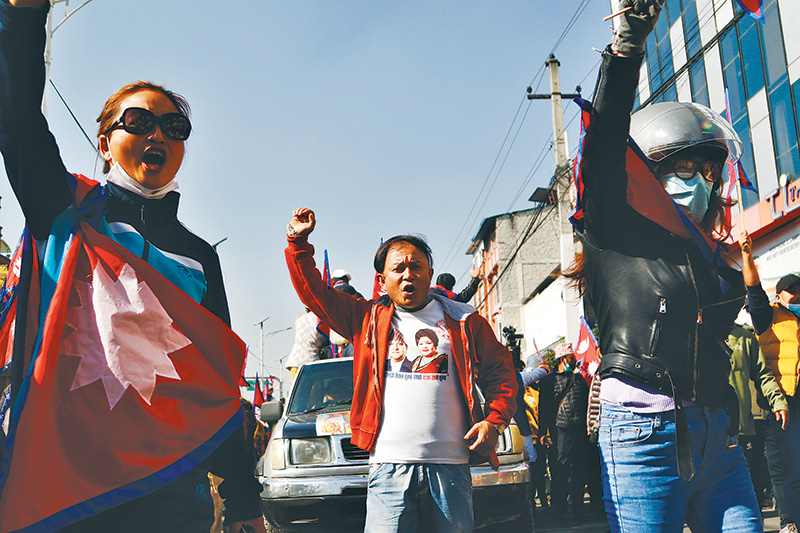
The rallies, though small, are an expression of frustration with both the government and the opposition for their failures, and should be taken as a warning, observers say.
- TIKA R PRADHAN
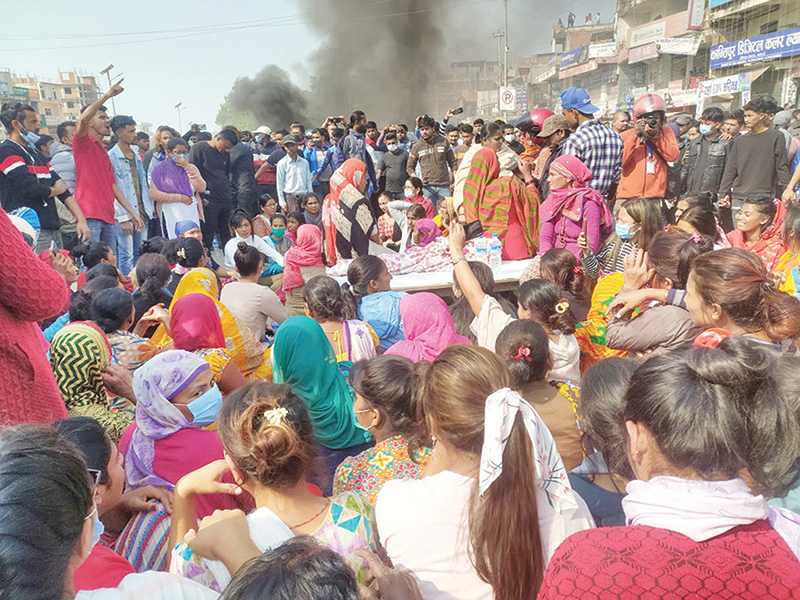
The rally in Kathmandu on Monday was held after similar ones in different parts of the country. Post Photo: keshav Thapa 

KATHMANDU,
Twelve years ago, Nepal, in what was dubbed a giant leap forward, abolished the 240 years of royal rule and transitioned into a republic. The Constituent Assembly was tasked with drawing up a new constitution.
Nepali political parties took seven years to draft the constitution. The 2017 elections gave a clear mandate to a communist alliance of then CPN-UML and the CPN (Maoist Centre), which after a merger gave birth to the Nepal Communist Party, which is currently governing the country.
KP Sharma Oli returned to power in February 2018 for a second time–this time with a strong mandate to lead the government for the full five-year term, something which had not happened in more than two and a half decades. Oli had his task cut out–implementing the constitution, strengthening federalism and ensuring good governance.
The Oli administration’s little more than last two and a half years term, however, have been mired in controversy. It faces fierce criticism for failing to deliver, promoting impunity on corruption cases and weakening institutions, with some critics even charging it with putting the hard-earned achievements and constitution at stake.
Amid this, the country of late has been seeing a new phenomenon rising.
After holding rallies in different parts of the country, pro-royalist and pro-Hindu forces on Monday marched on Kathmandu’s streets, demanding scrapping of the federal system and return of the king to what they
chanted “save the country”.
Analysts say such rallies may gain some momentary traction because of the growing public frustration against the current dispensation and political parties’ behaviour but there is no need to take them seriously yet.
“Things have not been as we had expected and the way our parties had promised,” said Rajendra Maharjan, a political commentator who also writes for Post’s sister paper Kantipur. “No doubt there is frustration among the people because of poor governance. But that does not mean the country has to revert to the old system.”
Before Kathmandu, pro-monarchy and pro-Hindu demonstrators had organised rallies in Hetauda, Butwal, Dhangadhi, Nepalgunj, Mahendranagar, Bardiya, Birgunj, Janakpur, Nawalpur, Pokhara, Rautahat and Biratnagar.
Organisations like Rastriya Shakti Nepal, Goraksha Nepal,  Bishwo Hindu Mahasangh, Rastriya Sarokar Manch, Shiva Sena Nepal, Bir Gorkhali and Matribhumi Samrakshan Nepal, among others, have been at the forefront of these rallies.
According to Keshar Bahadur Bista, chairman of Rastriya Shakti Nepal which coordinated Monday’s rally in Kathmandu, they have three major agendas–establishment of constitutional monarchy, reinstating Nepal as a Hindu nation and scrapping federalism, as “it divides people and puts the nation in danger.”
“It has become difficult for common people to survive, the country is in crisis,” said Bista. “But the leaders are plundering the state.”
These organisations, however, are little-known entities, lacking political base.
The one politically recognised party that has made constitutional monarchy and reinstatement of Nepal as a Hindu nation is Rastriya Prajatantra Party. The party is even in the federal parliament with one seat.
It, however, is not part of the recent pro-Hindu, pro-monarchy rallies, raising suspicion among many as to whether the fringe forces, which are little known, have the wherewithal to organise such programmes in different parts of the country.
Sagun Lawoti, a central executive committee member of the Rastriya Prajatantra Party, described the rallies as a natural reaction “of people” as disenchantment has been growing among the people.  Lawoti, however, said his party is not leading these rallies.
“We are in the discussion phase to officially take the lead of such events,” Lawoti told the Post. “We have our support and solidarity to all those ongoing demonstrations.”
Those carrying out such rallies say they have more plans to continue them in different parts of the country, as public support for them is growing.
“The way we are getting more and more people by every new rally, we are very encouraged that we will achieve our goal,” said Bista, a former minister during Panchayat rule, who was general secretary of the Surya Bahadur Thapa-led Rastriya Janashakti Party. He quit Rastriya Prajatantra Party after RPP (Democratic) and RPP (Nationalist) united to form RPP (Unified) in February last year.
Bista was also quick to point out how the main opposition, Nepali Congress, has failed to hold the government to account for failing to ensure good governance.
Analysts say both the ruling and opposition parties are equally to blame for the way regressive forces are raising their heads.
The major concern is, according to them, the ruling party is not committed to protecting the hard-earned achievements–the constitution and federalism–despite getting a mandate to strengthen them, and the opposition has turned into a mute spectator.
“No one knows if the opposition party is dead or alive in this country,” said Maharjan. “We get to hear about it once in a while but for all the wrong reasons–only when it is involved in bargaining.”
According to Maharjan, both the ruling and opposition parties have failed to discharge duties properly.
“The ruling party is bent on destroying the system as it is drunk on power because it has an absolute majority,” said Maharjan. “The opposition is groping in the dark, failing to put a check on the ruling party’s shenanigans.”
A few weeks ago, even reports had surfaced that Oli and Sher Bahadur Deuba, the leader of the opposition party, were in discussions for a possible power sharing deal should the ruling Nepal Communist Party split.
The Nepal Communist Party is facing a deep crisis with Oli’s bete noires led by the other chair Pushpa Kamal Dahal piling pressure on him to step down.
Oli and Dahal, who until a few weeks ago were involved in verbal war, have taken their fight one notch up–engaging in allegations and counter-allegations in writing.
Even ruling party leaders say the two chairs are responsible for the current mess.
“Our party won the majority… was given a huge electoral mandate, but we failed to make use of it,” said Surendra Pandey, a Standing Committee member of the Nepal Communist Party and former finance minister. “We failed to build a culture, there was a lack of commitment and vision. And this infighting in the party is doing no good.”
The ruling Nepal Communist Party today is a combination of two communist forces which were led by two leaders who at one point of time were poles apart.
Oli’s commitment to federalism has been questioned on more than one occasion, while Dahal is described by many as a leader who championed the federalism cause and who led a war for socio-economic transformation.
Oli’s statements of late too have been dubbed anti-federal, when he described provincial governments as “administrative units” of his government in Kathmandu.
The Oli administration’s move to empower chief district officers in the fight against pandemic too had received a lot of criticism, with experts on legal and constitutional matters saying that such a move weakened the federal set-up.
Geja Sharma Wagle, who writes extensively on political and security matters, says the ruling party’s
bungling coupled with opposition’s failure is creating a space for regressive forces.
“Due to the government’s non-performance and the opposition party’s failure to make it work, frustration among the public is on the rise,” Wagle told the Post. “In a system that we practice, people look up to the opposition when the governing party fails. If the opposition continues to fail to inspire hope, people could turn to others, including those who are crying foul at the current system.”
According to Wagle, the concern is not that a handful of people are out on the streets. “That the Oli administration has failed is just a fraction of a larger concern,” said Wagle. “The bigger concern is that the way the ruling and opposition parties are behaving could put the existing system in danger.”
When it was voted to power, the Nepal Communist Party’s constituents were not only mandated to govern for five years but also to implement the constitution over the period.
Constitution implementation entails ensuring laws for the federal system, devolution of power, strengthening of the institutions, empowering constitutional bodies and ensuring independence to institutions.
But from the very beginning, Prime Minister Oli started to display authoritative steraks, as he tried to centralise power, contrary to what the constitution envisioned.
“As the government failed, we as the opposition too failed,” admitted Gagan Thapa, a Nepali Congress lawmaker. “It’s still not too late for us to introspect. It’s the opposition that should have been seen on the streets and in parliament. Instead, it’s royalist forces that are being talked about.”
According to Thapa, current leadership, of both the ruling and opposition parties, should not make a mistake of making light of such developments.
“Our leadership cannot simply point a finger at the government and say such a phenomenon won’t last long,” said Thapa. “We will have to pay a price if we continue to ignore what is in front of us and realise the possible threat.”
Observers say what is even more worrying is that the ruling party is engaged in its own infighting at a time when forces that are calling out the parties that championed the cause of socio-political transformation are getting  the attention.
It looks like the threat to the current system, which was achieved because of the sacrifice of many people, is from the dispensation rather than external forces, according to them.
“A stable government does not necessarily usher in political stability. And I have been saying this for long,” said Lokraj Baral, a professor of political science at Tribhuvan University and former ambassador to India. “In a country like ours, where individualistic and centralised mindset prevails, legal and constitutional provisions do not work.”
According to Baral, a majority or a two-thirds majority is just a number.
“Majority is just a technical thing,” said Baral. “What matters is whether the leadership is committed to the cause… whether the leadership is really responsible to the people, the country and the system Some in the ruling party, who did not want to speak openly, even suspected if the Oli administration has a quiet backing to the current pro-monarchy and pro-Hindu demonstrations.
Their suspicion emanates from the fact that the rallies are being held without any obstruction at a time when the government has banned mass gatherings in the wake of the Covid-19 pandemic. It was not long ago the Oli administration had employed security forces when a youth-led campaign named Enough is Enough was on the streets demanding an end to corruption, good governance and polymerase chain reaction tests for all.
“It looks like two forces are working hand in glove to destroy the existing system–Oli from the current dispensation and a bunch of royalist forces from the streets,” said a Standing Committee member of the ruling Nepal Communist Party who represents the former Maoist party. “We wonder if Oli and deposed king Gyanendra are working in cahoots.”
Analysts like Maharjan, however, see little threats from the street demonstrations in favour of the monarchy and Hindu state but with caveats that the parties that brought in changes must not be complacent.
“We should not be worried about losing the system because of some demonstrations here and there. But our leaders must give a thought if they are genuinely working for the larger cause,” Maharjan told the Post.
“Over the past few years, people have made a lot of sacrifices to achieve what we have today. It’s a giant leap. But it depends on leaders to make sure that it is not a leap to nowhere.”
HOME PAGE

With free testing available only for symptomatic patients contact tracing is yet to resume

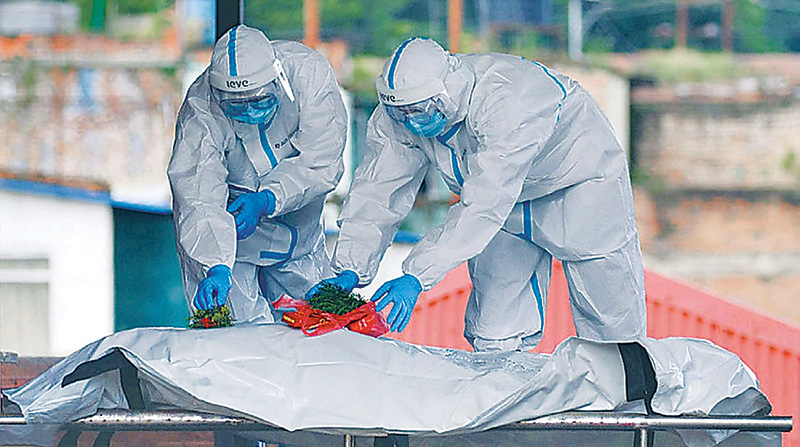
As people are left to die in their homes due to government apathy, officials say that asymptomatic cases, which make up the majority of the infected, may be superspreaders.
- Arjun Poudel
People are being rushed to hospitals only in their last stages, doctors say. Post file Photo

KATHMANDU,
As of Sunday, 233,452 people have tested positive for the coronavirus while 1,508 deaths have been reported throughout the country.  
But, by implicit admission of officials at the Health Ministry, the figures could be more as contact tracing has effectively stopped since October 17, when the ministry stopped free tests and free treatment for Covid-19 as per the decision of the Cabinet on October 5.
Although the Supreme Court has ordered the government to conduct free tests and treatment, the Health Ministry has not yet resumed contact tracing, a crucial strategy to break the chain of virus transmission.   
“How can contact tracing be resumed when the government only conducts tests of symptomatic patients,” a senior official at the Health Ministry said on condition of anonymity. “The government is not serious about containing the infection.”
The government’s October 5 decision has also killed many people who could have been saved otherwise.
Two weeks ago, a 65-year-old man from Goldhunga in Kathmandu was rushed to Tribhuvan University Teaching Hospital in a critical condition. He was admitted to the intensive care unit and later put on a ventilator support.
“The patient died after a few hours,” Dr Niraj Bam, associate professor at the Institute of Medicine, told the Post. “It was only after his death that we found that he had been infected with the coronavirus.”
Family members of the deceased man told the doctors that they rushed him to the hospital after he fainted.
Dr Jageshwor Gautam, spokesperson for the Health Ministry, had asked the general public to go to the hospital only if they feel that they are going to be unconscious and if breathing becomes difficult and complicated.
Similarly, a 62-year-old woman from Kapan in Kathmandu, who died last month in her home, tested positive for the virus only after her death.
According to Bam, her family members regretted not taking her to hospital.
“Government officials have urged the public not to go to a hospital unless it is an emergency,” Bam added. “In these cases, patients were kept at their homes until their conditions became too critical and they eventually lost their lives.”
With the government deciding not to conduct free testing and treatment, people stopped seeking medical care. Isolation centres of hospitals, which used to be full earlier, started to become vacant as the hospitals started forcing the patients to pay.
“The result of the decision to not provide free treatment and tests is before all of us,” said Bam, who is also a senior chest physician at the Tribhuvan University Teaching Hospital. “Patients started seeking services only after they became serious or unconscious. This led to the increase in the fatality rate.”
Of the 1,435 people who died from the Covid-19 until Friday, 855 were aged over 60 years. According to the Health Ministry, most of those people who died from the coronavirus had pre-existing conditions.
“When the government asks the people to go to a hospital only in emergency conditions or only after one feels that one would become unconscious, the fatality rate will rise,” said Dr Sushil Nath Pyakurel, former acting health secretary. “The people and the country have been paying the price for wrong policy decisions. Had we not been told such things, people with pre-existing conditions would have lived.”
Following the Supreme Court refusal to entertain a review petition filed by the Health Ministry over its previous ruling regarding free tests and treatment, the government was forced to resume free polymerase chain reaction testing.
But since the guideline for testing includes only ‘symptomatic’ cases, the number of tests has not increased.
Doctors say that over 70 percent of infected people remain asymptomatic but given the government guideline for testing, they cannot be tested.
According to a Health Ministry official, without testing the people who came in close contact with the infected individuals, the ongoing spread of the coronavirus cannot be contained.
“As there is no cure for the coronavirus infection, the government should treat symptomatic patients and test those who came into contact with the infected even if they are asymptomatic,” the official said, warning that there is a high risk of asymptomatic patients becoming superspreaders.
Former acting health secretary Pyakurel said that the provision of testing only symptomatic patients bars people from their constitutional rights of health care and this is sheer irresponsibility as well as contempt of the court’s order.
“One wrong policy decision always has chain effects,” he added. “The decision to halt free Covid-19 tests and care not only made people suffer but also pushed the country’s achievements in the health sector several years back.”
Instead of being sincere, it seems that the government is intent on finding loopholes in the court’s order so as not to expand testing, and this way the ongoing pandemic cannot be contained, said Pyakurel.
Public health experts had suggested multiple alternatives, including direct polymerase chain reaction tests, to lessen the cost of testing. But instead of taking the experts’ suggestions positively, the government is busy finding loopholes like testing only those who are symptomatic and not contact tracing. “This government is making a serious blunder,” Dr Dirgha Singh
Bam, former health secretary, told the Post. “We do not know how many people are infected after the government’s decision of not conducting free tests.”

Page 2
NATIONAL

Nepal-China border closure affects northern villages of Sankhuwasabha, Taplejung

Local residents living in border settlements are having a tough time managing essential commodities and finding markets for their products.
- Aananda Gautam,DIPENDRA SHAKYA
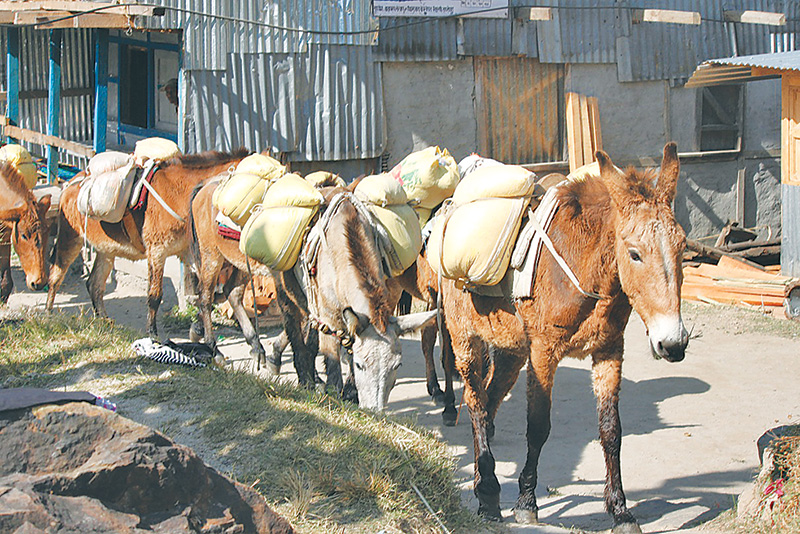
Residents of Bhotkhola use mules and porters to bring essentials to their village. Post Photo: Ananda Gautam

TAPLEJUNG / SANKHUWASABHA,
Residents of several settlements in the northern parts of Sankhuwasabha and Taplejung districts are having a tough time managing essential commodities and finding markets for their products due to the protracted closure of the Nepal-China border amid coronavirus threat.
Villagers living near the Nepal-China border are dependent on Tibet for daily essential commodities, as the area is yet to be connected with the national road network. Tibet is also the major market to sell their products that range from medicinal herbs to domesticated animals. The local residents have been greatly affected by the Nepal-China border closure since January.
“The main challenge now is to find food. The local residents used to buy daily supplies from the Tibetan markets but they have not been able to do so since the border closure,” said Phurbu Bhote, the chief administrative officer of Bhotkhola Rural Municipality in Sankhuwasabha.
The northern villages of Sankhuwasabha are hardest hit by food shortages. The residents of Bhotkhola, a remote local unit about five days walk from the district headquarters Khandbari, are greatly affected, as China sealed the Kimathanka border point on January 19 without prior notice.  
The district administration had supplied rice, cooking oil, salt and other daily essentials to Bhotkhola on a Nepal Army helicopter in February and distributed the essentials to the settlements that were reeling under food shortage.
According to Bhote, in the wake of the border closure, the residents of Bhotkhola have started
transporting rice and other commodities from Mikwakhola Rural Municipality in Taplejung, as it is nearer than Khandbari, the district headquarters.
“They transport goods up to Sanwa by vehicle. The goods are then carried to Thudam of Bhotkhola using mules and porters,” he added. “It takes three days for a mule to transport goods from Sanwa to Bhotkhola.”
The villagers are in a rush to manage food that will last them throughout the year, as the mule track from Sanwa to Thudam is often disrupted by heavy snowfall in winter.
“One cannot use the track when there’s snowfall in the area,” said Dandu Sherpa of Papung in Taplejung.
When the goods finally reach the villages, their prices get exorbitantly high. Nupu Sherpa, a mule trader of Papung, said he charges Rs120 to transport one kilogram of goods from Sanwa to Thutham.
“The work is risky and it takes a week to take the mules to Bhotkhola and back,” said Nupu.
According to Narayan Thapa, the vice-chairman of Taplejung Chamber of Commerce and Industry, a 50kg sack of Mansuli rice costs around Rs 2,300 in Phungling. The same rice costs Rs 8,700 after it is transported to Thudam.
Likewise, the local people have also been unable to find a market for their products, mainly carpets, medicinal herbs and livestock, since the border closure.
According to Tashi Sherpa, a local trader at Olangchungol in Taplejung, Tibet was the main market for the villagers to sell various medicinal herbs like Chiraito, Jatamasi, Kutki and Bikhma. The herbs used to be transported to China from Kimathanka border point in Sankhuwasabha and Olangchungola border point in Taplejung.
“The export of herbs has come to a halt since January. Carpets meant to be sold in Tibetan markets are also gathering dust and hundreds of women used in weaving the carpets have been left unemployed,” he said. “The border should be reopened at the earliest so we can resume the export business.”

Page 3
NATIONAL

Fed up of losses, Nepal Airlines comes up with four options to get rid of six Chinese aircraft

Grounded due to technical issues and lack of manpower and spares, they have made losses of over Rs2 billion, the state-owned carrier said.
- SANGAM PRASAIN
Of the six aircraft, two were received as a gift while the other four were bought with a loan from a Chinese bank. Post File Photo

KATHMANDU,
Nepal Airlines has submitted four options to the Ministry of Tourism to get rid of the six inefficient Chinese aircraft in its fleet, five months after its board of directors unanimously decided to stop flying them as they were worsening its losses.
At least two tourism ministry officials contacted by the Post said they had received the proposal from the state-owned carrier, and were studying the alternatives.
Nepal Airlines has repeatedly said that the Chinese-made planes were causing heavy losses ever since they were acquired between 2014 and 2018, and that it wants to remove them and stop further losses.
The first option, according to an unnamed ministry official, is to ask the aircraft manufacturers to buy back the planes by evaluating their existing worthiness.
In November 2012, Nepal Airlines signed a commercial agreement with Aviation Industry Corporation of China (AVIC), a Chinese government undertaking, to procure six aircraft—two 56-seater MA60s and four 17-seater Y12es.
As part of the deal, China provided one MA60 and one Y12e worth Rs2.94 billion as gifts in 2014. The other aircraft were bought for Rs3.72 billion with a soft loan provided by China’s EXIM Bank.
The 17-seater Y12e is a twin-engine turboprop utility aircraft built by Harbin Aircraft Industry Group, previously Harbin Aircraft Manufacturing Corporation. The 56-seater MA60 is a turboprop-powered airliner produced by China’s Xi’an Aircraft Industrial Corporation. Both manufacturers are subsidiaries of AVIC.
The second option presented by the flag carrier is to lease the planes to interested Nepali operators on either a long-term or a short-term basis.
The third alternative is to auction off the planes.  
The fourth option is to look for Chinese or international companies or banks interested in buying or leasing them.
“Nepal Airlines has been planning to buy other planes like the Twin Otter by selling the Chinese-built planes,” the ministry official said. “However, there isn’t an option presented that if the Chinese companies can assure regular maintenance or provide spare parts, the planes can fly smoothly.”
“It’s clear that Nepal Airlines doesn’t want to fly the Chinese planes anymore.” The flag carrier has already bid adieu to its pilots hired to fly the Chinese planes.
Buddhi Sagar Lamichhane, joint secretary of the Tourism Ministry who looks after aviation affairs, said that discussions would be held with the Finance and Foreign ministries to sort out the issue.
While Nepal Airlines is the operator of the planes, the Tourism Ministry is the owner. The Finance Ministry is the financier of the Chinese planes. As China has given two of the planes as a gift, it’s difficult for the government to sell them.
“So, there is a need for extensive discussions with all the ministries to find a solution,” said Lamichhane.
In 2014, marking the beginning of what was supposed to be a new era for Nepal Airlines after acquiring the planes, had even changed its classic red and blue stripes livery, opting for a more modern design.
In 2014, although one 17-seater Y12e aircraft and one 56-seater MA60 arrived in Kathmandu as a precursor to what the new era would be like, they never took to the air.
The delivery of the rest of the Chinese aircraft was stalled for years after issues appeared in the first batch of planes that arrived in 2014.
These issues included lack of pilots, lack of instructor pilots, lack of spare parts and lack of engineers trained to maintain them.  
The second batch of MA60 and Y12e aircraft, as part of a six-aircraft deal between Nepal and China, arrived in January 2017.
The corporation received the final two Y12e aircraft in February 2018.
The initial issues were not fully resolved.
The government corporation had raised four issues—aircraft performance, insurance premium, timely delivery of spare parts and cost of spare parts as reasons it wants to dispose of the aircraft.
As per a November 2012 agreement, China had given a seven-year grace period under which Nepal Airlines would not have to repay the loan interest and instalment. The payback period of the loan is 20 years.
The Nepal government has to pay an annual interest rate of 1.5 percent and a service charge and management expenses amounting to 0.4 percent of the overall loan amount taken by the Ministry of Finance as per the deal.
The ministry, in turn, would charge Nepal Airlines an annual interest rate of 8 percent on the disbursed loan amount.
Nepal Airlines said that the Chinese planes had already caused losses of more than Rs2 billion as of the last fiscal year that ended mid-July, and that they were mounting each passing month.

NATIONAL

Agencies involved in conducting interviews for Qatar police jobs suspended

- CHANDAN KUMAR MANDAL

KATHMANDU,
The government has taken action against three Kathmandu-based recruiting agencies found in conducting interviews with prospective candidates for jobs in Qatar police without complying with the rules.
Department of Foreign Employment, the government body that manages the labour migration sector, has suspended the operating licence of the three recruiting agencies for next six months.
Tikamani Neupane, spokesperson for the department, SOS Manpower Services Pvt Ltd, DD Human Resources Pvt Ltd and Hope International Pvt Ltd won’t be allowed to operate for the next six months after they were found to have conducted the interviews without approval from the department.
“These agencies can’t do any business for the next six months,” Neupane told the Post. “They have not been fined, but the action we have taken against them is severe as they won’t be allowed to send any workers abroad for the next six months.”
Last week, the three agencies flouted foreign employment rules and conducted interviews with candidates promising them a place in Qatar Police.
On Monday, the Department of Foreign Employment had raided SOS Manpower Services Pvt Ltd and DD Human Resources Pvt Ltd only to find its operators interviewing candidates.
The next day, officials raided Hope International. Upon inquiry, they  discovered that the agency was preparing to interview prospective workers even as the jobs they were being interviewed for were not verified.
Several hundred Nepali youths attracted by the lucrative job had come to these agencies with the hope of landing the job.
“When our team reached the scene, we seized their documents and called the agencies’ operators to the department. However, it seems these agencies were yet to collect any money from candidates,” said Neupane.
The whole incident and sighting of a vehicle belonging to the Qatar Embassy on the premises of one of the agencies has sparked a controversy and fuelled allegations that a group of recruiting agencies, in cahoots, with the Qatari embassy are trying to form a syndicate to exclusively send Nepali workers to Qatar.
The Qatari embassy in Kathmandu, however, has refuted the allegations that it was involved in the hiring process.
Sujit Kumar Shrestha, general secretary of Nepal Association of Foreign Employment Agencies (NAFEA), a grouping of 854 recruiting agencies, said action will be taken against the three agencies which had conducted interviews illegally.
“NAFEA has already demanded clarification from the three agencies for their involvement in unethical activities,” said Shrestha. “NAFEA will scrap the general membership of these agencies as well.”
The government agency, however, is still not in a position to say whether the recent malpractices seen for Qatari jobs had any links with the alleged syndicate.
Meanwhile prospective workers are concerned that the controversy will cost them the lucrative opportunity. However, the feoreign employment department said their action against the three agencies will not affect demand for Nepali workers.
“Other recruiting agencies can supply workers for Qatari Police if they complete all the procedures before conducting interviews,” said Neupane. “We hope that the agencies will still get demands for security guards as Qatar also seems interested in hiring Nepalis.”

NATIONAL

Women commission defunct as cases of violence against women continues

Since it was elevated to a constitutional body in the new constitution, it has not had full quota of commissioners, and since 2017 it hasn’t had any office bearers.
- BINOD GHIMIRE
People of Bardibas Municipality in Mahottari district protested for three days last week after the body of six-year-old Gulabasa Khatun was found stuffed inside a sack on Monday. Post File Photo

KATHMANDU,
Last week,  people of Bardibas Municipality in Mahottari district protested for three days after the body of six-year-old Gulabasa Khatun was found stuffed inside a sack on Monday, a day after she went missing.
A 40-year-old man protesting government inaction in the case lost his life in police firing while two others sustained injuries.
Her relatives and local residents claim that she had been raped.  
On September 23, a 12-year-old girl from Masta Rural Municipality in Bajhang was murdered after being raped. On September 15, a teenage rape victim took her own life in Saptari district after village elders forced her into an out-of-court settlement.
Nepal Police records show that 2,144 cases of rape and 687 cases of attempted rape were reported in the fiscal year 2019-20, an increase from 1,480 cases of rape and 727 cases of attempted rape reported in the previous fiscal year.
Rewind to September 2009. Suntali Dhami, a constable was raped by six policemen in Achham.
“It was the National Women Commission’s efforts that provided justice to Suntali Dhami,” said Mohna Ansari, then a member of the commission.
But for the past five years, since the commission became a constitutional body, it has not had the full quota of five office bearers and none since 2017.
But with no office bearers despite its legal elevation, the commission is as if non-existent.
“The lack of chairperson and members has paralysed the commission,” Meera Sherchan, spokesperson for the commission, told the Post. “We have been unable to recommend actions in criminal cases for years now.”
Currently, the commission is largely limited to administrative works.
The commission was constituted in 2002 to deal with cases of gender-based violence and provide justice to victims. It was elevated to a constitutional body by the constitution.
As per Article 253 of the constitution, the commission has an authority to formulate policies and programmes concerning the rights and interests of  women, monitoring  laws concerning rights and interests of women and whether obligations under international treaties to which Nepal is a party have been implemented.
It also has a mandate to make suggestions, accompanied by measures for their effective compliance and implementation to the government. Similarly, it can also recommend the government ways to ensure women are included in mainstream national development while having proportional representation in all organs of the state.
The commission, however, has been without a chair for the past four years, ever since the tenure of Chand Tara Kumari ended in November 2015.
Bhagwati Ghimire, a former member, had served as an acting chair until she too retired in October 2017. No members have been appointed since.  
“It seems appointments have been delayed deliberately to weaken it,” said Ansari, who after serving at the National Women Commission was also a former member of National Human Rights Commission “Constitutional bodies under the leadership of the civil servants cannot hold government entities accountable though that is their primary responsibility.”
In the past, the commission had been active against formulation of discriminatory laws against women. One such example is in the Anti-Witchcraft Act 2015.
Prior to the promulgation of the Act, the now defunct Muluki Ain had a provision for a fine between Rs 5,000 to Rs 25,000 for those accused of torturing women for practicing witchcraft.
That was hardly a deterrent and the practice was rampant across the country. This prompted the National Women Commission to lobby for a separate law with harsher punishments.
“The commission itself formulated an Anti-Witchcraft Bill in 2012,” said Ansari, “The government later owned it and it was endorsed by Parliament in 2015.”
The Act has provisions for a jail term of up to three years along with a fine of Rs30,000 for anyone found guilty of being involved in torturing women accusing them practising witchcraft.
Ansari claims that such cases of torture have somewhat decreased after the Act was promulgated.
The rape cases of Mahottari, Baitadi and Saptari are cases the commission would have looked into.
“We could have investigated the latest case in Bardibas and recommended necessary actions if we had a full quota of office-bearers at the commission,” Sherchan said.
Women rights activists say successive governments and political parties have shown indifference towards appointing office-bearers in the commission because the crime against women and girls doesn’t affect them.
“Our leaders don’t think beyond the politics,” Kumari, the former chair of the commission, who also is currently a Nepal Communist Party lawmaker, told the Post. “Their indifference is weakening the constitutional commission.”
Following pressure from the cross-party lawmakers the Cabinet on Sunday issued an ordinance increasing the penalty in the cases of rape and sexual violence. Experts, however, say the ordinance was brought just to address the concerns of the lawmakers rather than actually being empathetic towards the plight of the victims.  
They are especially riled by the provision that any person, whether a man or woman, can now be considered to have been raped after the ordinance replaced the clause “woman or girl child” in Clause 221 of the Criminal Code 2017 by “person” .
“The government hasn’t stopped promulgating discriminatory laws,” said Meera Dhungana, president of Forum for Women, Law and Development, a non-government organisation advocating for the rights of the women.
“The ordinance the government endorsed recently has changed the definition of rape which is condemnable,” she told the Post.“If there was a women’s commission, it would have objected to the law.”

NATIONAL

Road expansion work halted

Briefing

NAWALPARASI (EAST): Road expansion work along the Butwal-Narayangadh stretch of East-West Highway has been halted for the past three days due to workers’ protest. Around 250 workers have been protesting since Saturday saying that the Chinese contractor have not paid them their wages for the past one and half months. 

NATIONAL

Woman hurt in tiger attack

Briefing

BARDIYA: A 42-year-old woman was injured when a tiger attacked her at Siraute Community Forest in Madhuwan Municipality-5, Bardiya, on Saturday. According to Superintendent of Armed Police Force Nara Bahadur Raut, Lalisara Pun of Madhuwan sustained injuries in the incident. The woman had gone to the forest area to graze her goats.

NATIONAL

Ward chief among four held for settling rape case

Briefing

BAITADI: Police arrested four people, including the ward chairman of Sigas Rural Municipality-3, on charge of settling a rape case in the village. Ward chief Sher Singh Dhami and three others were detained on Saturday evening, police said. The trio had allegedly mediated a settlement between an 18-year-old rape victim and her attacker back in June, officials said.

Page 4
EDITORIAL

Murdered by caste

We have become accomplices to crimes against humanity and brought dishonour upon ourselves.

Year after year, we hear shocking accounts of murder and violence by people who are against inter-caste relationships and marriages. At the same time, distressing reports of other forms of caste discrimination continue to make headlines. In the majority of these reported incidents from across the country, women and girls continue to be the primary victims, but a number of men and boys have also been killed.
On Sunday, the police arrested six people in connection with the murder of a 17-year-old girl in Rautahat. Among the arrested are the victim’s parents, who according to the police, had paid some henchmen money to kill their teenage daughter for fear of losing the ‘family’s honour’, as his divorced daughter was in a relationship with another man in the village. The victim had allegedly been married off to a man from Sarlahi last year after her parents disapproved of her relationship with another man.
That caste-based prejudices remain deep-seated in a country that is more educated and progressive than it’s ever been, and killing or seriously damaging people’s lives beyond repair, is evident of the fact that the scale of this problem is alarming and is an epidemic of its own. Addressing any issue requires examining the root causes. What is clear from the incident reports is that caste discrimination, despite being outlawed 14 years ago, is the bane of Nepali society. It has led to killings in the name of honour, and innocent lives have been lost just because they made relationship and marital choices. If this is not oppression, what is?
Despite constitutional guarantees that protect the right of every person to equality, freedom and to live with human dignity, regardless of origin, caste, race, descent, community, occupation or business or physical condition, the ancient social constructs of the varna system continue to oppress people who are perceived as lower caste. As a consequence, discrimination, violence and killings continue unabated based on the hereditary caste system. Investigations have revealed that the perpetrators are often men and family members while the victims are usually women and girls.
We cannot continue to be bystanders to these gross violations of fundamental human rights laws and principles, which particularly curtails the autonomy of women. In doing so, we have also become an accomplice to these crimes against humanity that breach the fundamental rights of an individual, and have brought dishonour upon ourselves. We need to reroute our aspirations and level of maturity as a society and as a nation if we want to progress.
All this eventually boils down to the intent of the government, which bears the primary responsibility of formulating and enforcing legislation that ensures every citizen in this country, especially women and girls, are protected from heinous crimes against them. While legal reforms and national policies provide the necessary framework to operate, cultural norms and values entrenched in the archaic patrilineal system need advocacy and educational interventions.
Our inalienable rights enshrined in the constitution must be ingrained in the educational system if we want to rid our society of caste discrimination. Because only when people, especially men and boys, understand that men and women are equal, regardless of caste or background, will the possibilities of thwarting caste discrimination and subsequent acts of murder and violence become a reality.

OPINION

The globalisation of food

Helped by out-migration and changing food habits, Nepali cuisine is finally being recognised all over.
- SUJEEV SHAKYA

For the last fortnight, Santosh Shah, a UK based Nepali chef, has been in the news for featuring in a renowned UK reality cooking show for professionals. His progress through the show has not only made Nepalis around the world proud but has also made many introspect on the great food heritage we inherit. The growth of migration in the past three decades has also spread Nepali food to the places the diaspora resides in. One can find many Indian restaurants owned and operated by Nepalis in the US East Coast. And, even in cities like Seychelles, the number of Nepali owned and operated restaurants will surprise people. The ubiquitous momo has come to represent Nepal everywhere, even if its origin lies elsewhere. But through all strides the cuisines of Nepal have made, the rise of Nepali food can be traced to a few particular aspects.
When Nepal opened its doors to the world in the early 50s, the tourists brought with them a vibrant café culture. The members of the then royal family opened hotels and restaurants and provided other establishments with their patronage. This gave many Nepalis an opportunity to learn how to master global dishes. A Russian dish like the Chicken A La Kiev is still made to perfection in many small restaurants in Nepal, and this skill is what the people took to the world. Whenever I travel, it is amusing to meet my former colleagues at the Soaltee Hotel managing very high-end restaurants with the staff they would have taken from the workplace. In the opening of the floodgates of migration in the 1990s, the people in the food and beverage sector were the ones that got better jobs and started the first wave of migration. Many of them have now made it big like Chef Santosh Shah.
Further, when we talk about Nepali food and Nepali identity, it goes beyond the country of Nepal. In the many Indian restaurants operating in Thailand especially in Bangkok and Phuket, one will find the staff and managers chatting in Nepali, only to realise they are Burmese Nepali. Similarly, the thousands of Bhutanese refugees settled in the US are Nepalis as far as food is concerned, and they find comfort in that too. It is very difficult for third-generation Assamese Nepalis to explain their origin, the Indian citizenship that they gave up and their identity as Americans, but they are included in the larger Nepali identity whenever their kitchen or food comes into play. A Tibetan refugee from Bylakuppe or Dharamshala in India is more comfortable not to fight on the origins of the word momo in the US and do not mind calling the barbecued meat in their food menu as sekuwa. They get engulfed in the pan Himalayan Nepali identity. The spread of Buddhism in the west also pushed this Himalayan cuisine identified with Nepal more than any other country specifically.
Food has been the biggest tool of globalisation and since time immemorial the most peaceful way of overtaking cultures and communities without waging a war. When Thaksin Shinawatra took over as Prime Minister in Thailand, he called for all global cities to have Thai restaurants and every kitchen in the world to cook Thai food. This soft diplomacy strategy has been very successful; in any corner of the world, it is very difficult to find people who have not tasted Thai food.
Moreover, there has been a change in the food habits of people back home which has perhaps influenced the cuisines of Nepal in a way. Previously, there were many psychological restrictions when it came to the food habits of Nepalis. Some people, questioning the caste of the people cooking the food in highway eateries and restaurants, used to shun such establishments. Some people equated meat with wealth, which did disservice many superb vegetarian ingredients and dishes. Now, people are less bothered with caste questions when it comes to food, which translates to more Nepalis promoting Nepali food globally. Also, with the international influences of vegan food, health-conscious eating and calorie counting, a variety of Nepali legumes, vegetables and herbs have begun to be rediscovered.
Nettle and buckwheat, which were associated with poverty, now are expensive superfoods. Vegetables like the lauka (bottle gourd) and karela (bitter gourd) have become sought-after
health foods. Avocados are as popular and as expensive as meat in the Kathmandu Valley. I have continued to argue that the pictures of fruits and vegetables in an Instagram post looks much better than the pictures of a dead goat.
There will be more to write as globalisation moves from markets to kitchens.

OPINION

Kyrgyzstan’s post-revolutionary crossroads

Kyrgyz people appreciate that they have barely avoided falling into the political abyss.
- Djoomart Otorbaev
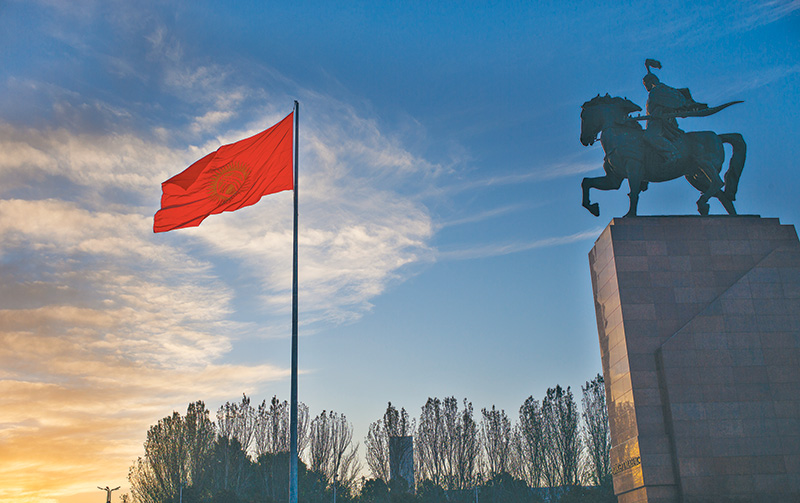
Shutterstock

After staging three revolutions in two decades, one could argue that the people of Kyrgyzstan have accumulated unique knowledge of how it’s done. Then again, because new problems have emerged each time, there are clearly limits to what experience can offer.
Kyrgyzstan’s latest revolution began in a typical fashion. Following a parliamentary election on October 4, protesters and rioters took to the streets seeking to annul the result, triggering a full-scale political crisis. By October 6, demonstrators had occupied the White House—the government building that houses the president’s office and Parliament. In the following days, a peaceful power struggle unfolded. In the end, the Central Election Commission annulled the election results, President Sooronbay Jeenbekov resigned, and Sadyr Japarov, a politician who had just been released from prison, became the acting president.
Meanwhile, as the country’s only remaining independent political body, the Parliament had continued to work throughout the protests, enacting legislation to hold a presidential election and a vote on a new constitution on January 10, 2021. This reform was initiated by Japarov himself, prompting his opponents to accuse him of attempting to usurp power and divert the country from the path of democracy.
Japarov, now 51, began his political career in 2005, when he was elected to Parliament. The government that was elected in 2010 prosecuted him, and he went into hiding abroad. When he returned, he was convicted and imprisoned. Both his parents and his son died during his incarceration, elevating his status as a political martyr in the eyes of many Kyrgyz.
Japarov’s rise to power reflects not just his vivid biography, but also the determination of his activist base of supporters and the loyal MPs who backed him. For all the criticism that he is now receiving, there is no question that he played a central role in preventing the country from sliding into chaos during the critical days of the October revolution.
Many Kyrgyz view Japarov as a political outsider who can unite a fractured country and carry out necessary reforms. He has already announced a programme to fight corruption, curb the shadow economy, and renew the political establishment with a younger generation of untainted professionals. If the upcoming vote on constitutional changes succeeds, it will be the 10th time that Kyrgyzstan has amended its constitution since it emerged from the Soviet yoke in 1991. There is a persistent myth in Kyrgyzstan that changing the constitution will make life suddenly better. But, of course, constitutional changes yield real-world results only when there is a deep public understanding and acceptance of constitutionalism.
Given the speed of events in recent weeks, the international community fears further destabilisation. But the Kyrgyz people recognise and appreciate the fact that they have barely avoided falling into the political abyss. During the revolution, law-enforcement agencies seemed paralysed, unable to ensure the security of either state institutions or private property. The only force that proved capable of maintaining a degree of legality was the self-organised ‘people’s guards’ who have cut their teeth during past periods of unrest.
The official law-enforcement agencies were hampered by their own leaders’ incompetence, corruption, and lack of professionalism. During the days of rioting, many division chiefs (those with a rank above colonel) simply vanished, no longer even answering calls from their subordinates. The whereabouts of the (former) ministers of internal affairs and national security are still unknown; it is safe to assume that they are on the run. State institutions and civil society are once again functioning completely on their own.
It is worth noting that the Kyrgyz state budget is around $2 billion—almost all of which is allocated for ‘protected items’ such as salaries and pensions—whereas annual remittances, mainly from migrant workers in Russia, exceed $3 billion, accounting for around 30 percent of GDP. The gap between private and public incomes is one of the main sources of systemic corruption in the country. Kyrgyz do not expect anything from the state, and ask only that it not take too much from them in the form of bribes and kickbacks. Indeed, the revolutionary impulse stems not from poverty and unemployment but from perceived injustice.
Since the earliest days of Kyrgyzstan’s independence, public trust in the government has been repeatedly undermined by systemic corruption, falsified election results, and the state’s reliance on informal institutions (including criminal entities and actors). Unlike in other countries with similar problems, corrupt regimes here are overthrown quickly. But the Kyrgyz people now must learn to build as well as they can destroy. Failing that, they will always be risking another plunge into political chaos, and, with it, the threat of state failure.

Otorbaev was Prime Minister of Kyrgyzstan in 2014-15.
—Project Syndicate

Page 5
MONEY

China eyes 60 GW of hydropower on Tibet’s Brahmaputra river: State media

- REUTERS

SHANGHAI,
China could build up to 60 gigawatts (GW) of hydropower capacity on a section of the Brahmaputra river, known as the Yarlung Tsangbo, which flows from Tibet into India and Bangladesh, Chinese state media reported on Monday, citing a senior executive.
Yan Zhiyong, chairman of state-owned Power Construction Corporation of China, speaking at an industry conference, said that plans to dam the river were a “historic opportunity”, and would not only help to meet the country’s clean energy plans but would also strengthen water supply security. His remarks were published by China Energy News, a sister publication of the Communist Party-run People’s Daily.
The ruling Chinese Communist Party had said it would “implement the development of hydropower resources on the lower reaches of the Yarlung Tsangbo river” in a list of 2021-2025 “five-year plan” policy recommendations published at the beginning of November.
Environmental groups and Tibetan rights activists have expressed concern about China’s hydropower ambitions in the region, saying it could affect downstream water supplies.
Yan said hydropower construction would help to develop Tibet, while the construction of power grids and roads would make cross-border cooperation with South Asian countries “more smooth.”
Anti-hydropower groups say China’s rivers are already at saturation point after a dam-building boom that included the construction of the Three Gorges Project and many other giant hydropower plants on the Yangtze and its tributaries.
Earlier this year, a US government-funded study showed that a series of new dams built by China on the Mekong river had worsened the drought affecting downstream countries. China disputed the findings.
China says its current hydropower capacity of around 350 gigawatts represents only about half of its total potential. Frank Yu, an analyst with Wood Mackenzie, said during a webinar on Monday that China would require another 250 GW of hydroelectric capacity by 2060 if it is to meet its carbon neutrality target set by Xi Jinping in September.

MONEY

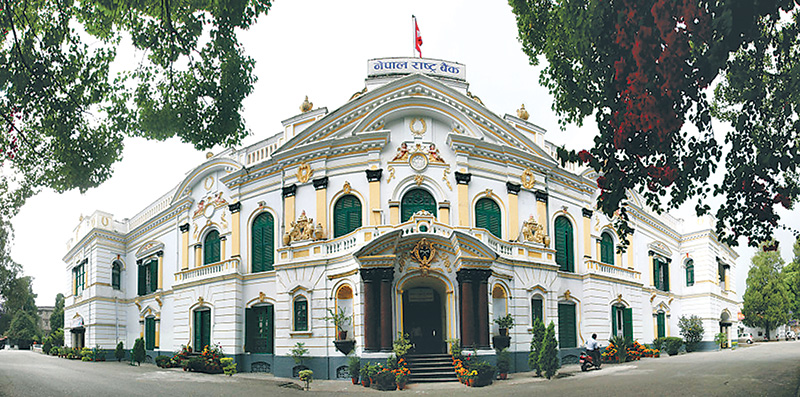
Central bank approves refinance of Rs64 billion for Covid-19 hit enterprises

With the massive demand for the low interest loan through commercial banks and other financial institutions, Nepal Rastra Bank plans to make Rs200 billion available for this facility.
- PRITHVI MAN SHRESTHA
Around 40,000 borrowers received refinance facility under the combined applications, according to the central bank. POST FILE PHOTO

KATHMANDU,
Nepal Rastra Bank has approved refinance worth a whopping Rs64 billion for enterprises hit by Covid-19, indicating that the pandemic has taken a heavy toll on businesses.
The central bank said it was preparing to invite applications for additional refinancing facility as it has promised to provide more than Rs200 billion.
After the Monetary Policy 2020-21 announced refinance facility for enterprises affected by the coronavirus, a large number of businesses applied for it so that the interest payments they owed to banks would be lowered.
Under refinance facility, the central bank subsidises interest on loans by providing funds at 1 to 3 percent interest to commercial banks equivalent to the amount of credit they have issued to targeted borrowers.
The banks are allowed to charge these borrowers a maximum interest rate of 5 percent on their existing loans.
According to Nepal Rastra Bank, sectors that have been the hardest hit or faced middle-level impact are eligible to apply for the facility.
“We have approved refinance facility of around Rs64 billion for over 40,000 borrowers,” Dev Kumar Dhakal, executive director of the central bank, told the Post.
“Of the total value of refinance approved, Rs50 billion was allocated for applications submitted collectively by A, B, and C class banks and other financial institutions, and Rs14 billion was okayed on a case-by-case basis.”
Around 40,000 borrowers received refinance facility under the combined applications, according to the central bank. “The number of borrowers who benefited from refinance provided individually totalled 60,” said Dhakal.
The collective approach is used when a bunch of applications are reviewed together unlike under a case-by-case approach.
The central bank had started to provide refinance facility to enterprises applying to get refinance on a case-by-case basis since early October. Those who applied for the facility under the collective approach were given until mid-October to do so.
Under the collective refinancing approach, the central bank refinances up to Rs50 million per borrower. Under a case-by-case basis, it provides up to Rs200 million, according to the monetary policy.
Dhakal said that the large number of borrowers seeking refinance indicates that the pandemic has affected enterprises badly. “We sought to rescue them with the refinance facility,” he said.
The total outstanding amount of refinance provided by the central bank in the last fiscal year 2019-20 stood at Rs7.49 billion, according to the central bank.
In the past, refinance facility was made available mainly to exporters and productive industries sectors, and it was approved individually.
But this year it is for pandemic-hit enterprises.
According to bankers, the collective refinance approach, as well as the flexibility adopted in the procedure targeted at benefiting Covid-19 affected sectors, played a key role in the massive rise in refinance approved this fiscal year. Until the last fiscal year, this facility was available only under a case-by-case basis.
Out of the over Rs200 billion available for refinancing in the current fiscal year, 70 percent will be provided in bulk by the central bank as per the requests for loans through commercial banks, 20 percent through a case-by-case basis and the remaining 10 percent of the bulk refinance will go to borrowers using microfinance institutions, according to the monetary policy.
According to the central bank, nearly half of the total refinance facility approved under the collective refinance mechanism has been approved for micro and small enterprises.
“As much as Rs23.5 billion has been approved for micro and small enterprises, and they have received up to Rs1.5 million each,” said Dhakal. The amount has already been released to banks and financial institutions, according to the central bank.
According to a central bank study released in August, micro and small enterprises were worse affected than larger industries during the nearly four-month-long lockdown which was lifted on July 21. Over 60 percent micro and small enterprises were fully closed enterprises while just over 40 percent medium and large industries were fully closed during the lockdown, according to a central bank study.
“The central bank has first released the amount meant for micro and small enterprises,” said Dhakal. “We are yet to release the fund for refinancing for bigger enterprises who need the provided facility between Rs1.5 million and Rs50 million.”
According to Dhakal, mostly hotels, schools and colleges, hospitals, pharmaceutical industries and other manufacturing industries are among the sectors that received refinance under the case-by-case basis.
According to bankers, they were inundated by requests for refinance facility after they called for applications. Rastriya Banijya Bank has got refinance approval for its 764 borrowers worth Rs1.87 billion.
“We got a large number of applications from small borrowers this time unlike in the past,” said Kiran Shrestha, chief executive officer of the government-owned bank. “It is probably due to the monetary policy’s focus on providing refinance to Covid-19 affected small and medium enterprises.”
Bhuvan Dahal, chief executive officer of Sanima Bank, said his bank also received many applications for refinance. “I have to see how many requests were received. But, it is massive,” Dahal, who is also the president of the Nepal Bankers’ Association, told the Post. He said that it was natural for enterprises to seek refinance as the pandemic hit the economy hard. “As this helps to lower their interest rate, it is natural to see a rise in requests,” he said.
Other bankers had also told the Post last month that they received a large number of refinance applications. According to them, many banks received requests beyond the threshold fixed by the central bank. As per the central bank directive, refinance can be extended to up to 25 percent of the core capital of a bank under the bulk refinance category.

MONEY

UK says Brexit trade talks with EU are in their ‘last week’

- ASSOCIATED PRESS

LONDON,
Britain’s foreign minister said Sunday there is only about a week left for the UK and the European Union to strike a post-Brexit trade deal, with fishing rights the major obstacle to an agreement.
As talks continued between the two sides in London, Foreign Secretary Dominic Raab said “I think we are into the last week or so of substantive negotiations.”
The UK left the EU early this year, but remained part of the 27-nation bloc’s economic embrace during an 11-month transition as the two sides tried to negotiate a new free-trade deal to take effect January 1. Talks have already slipped past the mid-November date long set as a deadline for agreement to be reached if it is to be approved by lawmakers in Britain and the EU before year’s end.
Despite the stalemate, Raab told Sky News that “there’s a deal to be done.”
He said the two sides had made progress on “level playing field” issues—the standards the UK must meet to export into the EU. The biggest hurdle appears to be fish, a small part of the economy with an outsized symbolic importance for Europe’s maritime nations. EU countries want their boats to be able to keep fishing in British waters, while the UK insists it must control access and quotas.
“On fisheries, there is a point of principle: As we leave the transition, we are an independent coastal state and we’ve got to be able to control our waters,” Raab said. EU chief negotiator Michel Barnier, who met through the weekend with UK counterpart David Frost, has said there are still “significant divergences.”
If there is no deal, New Year’s Day will bring huge disruption, with the overnight imposition of tariffs and other barriers to UK-EU trade. That will hurt both sides, but the burden will fall most heavily on Britain, which does almost half its trade with the EU.

MONEY

Europeans snap up old cars to avoid public transport

- REUTERS
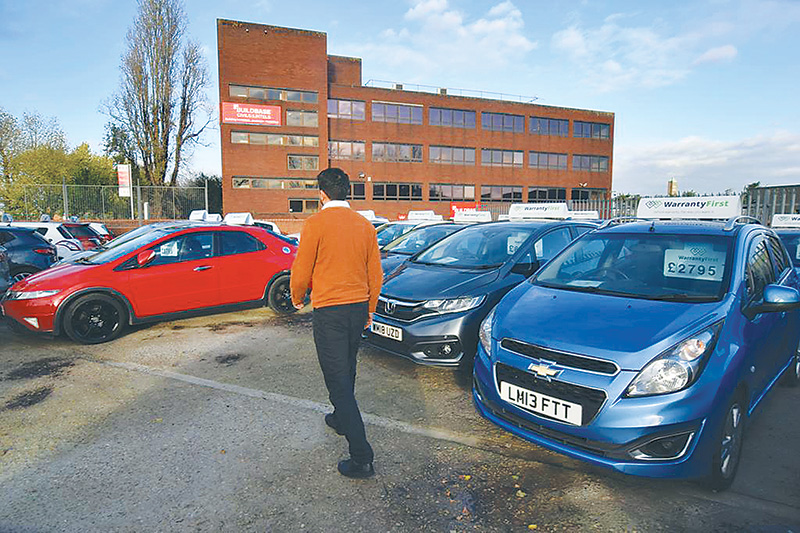
Ameen Sultani, general manager of used car dealer Nawaie Motoring, showssome of the vehicles that have been popular with customers during the pandemic, in Hayes, Britain. REUTERS

LONDON/MADRID, 
Want a cheap used car to nip around town without running the gauntlet of coronavirus on public transport? Welcome to Pandemic Motors, we have just what you need.
Across Europe, people are snapping up old bangers, clunkers, Klapperkasten, tacots and catorci, desperate to avoid buses and trains but wary of splashing out on a shiny new motor in uncertain economic times.
“Public transportation is terrific here, but with the Covid and all that, it’s better to avoid it,” said Robert Perez, who recently moved to Spain’s capital Madrid from Argentina.
On the hunt for work, Perez, a 33-year-old automotive engineer, bought a red 2001 Seat Toledo for 2,000 euros ($2,370) from OcasionPlus, a Spanish used car firm that has opened four new dealerships since the lockdown due to soaring demand.
Data provided to Reuters by research firm IHS Markit and online car market AutoScout24 showed there has been a marked upward shift in registrations of older cars across Europe, as well as a spike in internet searches for ageing vehicles.
The surge in interest in used cars is neither good news for struggling mass transit networks nor the environment as dirty old cars appear to be more in demand than new electric vehicles.
In the longer term, however, the shift away from public transport towards “individual mobility” in the pandemic era is expected to help carmakers, hit by a 27 percent slump in new vehicle sales across Europe in the first 10 months of 2020.
At Nawaie Motoring’s crammed lot in the west London suburb of Hayes, general manager Ameen Sultani points out the older cars selling for under 3,000 pounds ($3,985) that are in demand. He said prices for the cars, mostly over a decade old, have jumped by 25 percent as buyers who used to take trains and buses look for affordable alternatives.
“Anything under 3,000 pounds has sold very quickly and is very hard to replace in our inventory because everyone is chasing the same vehicles,” Sultani told Reuters. “Most of them have bought because they wanted to avoid public transport.”
Stronger than expected demand for new cars in the United States, Europe and especially China in recent months has helped major automakers recover to some extent from the financial blows pandemic lockdowns delivered in the spring.
But an analysis of car registration data in France, Germany, Italy, Spain, Switzerland and the United Kingdom conducted for Reuters by IHS Markit also shows there’s a significant shift toward older, used vehicles.
In France, for example, the IHS analysis showed used car registrations rose nearly 16 percent in the third quarter while new vehicle sales fell more than 5 percent. It also showed that in 2020 so far, vehicles over 15 years old made up a higher proportion of used car registrations than in 2019.
“It’s fair to say in the time of corona that the amount of vehicles older than 15 years has increased versus prior years,” said Bjoern Huetter, an associate product director at IHS.
There was an even bigger jump in Spain, with used car registrations up nearly 25 percent, according to the IHS analysis.

MONEY

China’s factory activity expands at fastest pace in over three years

- REUTERS

BEIJING, 
China’s factory activity expanded at the fastest pace in more than three years in November, while growth in the services sector also hit a multi-year high, as the country’s economic recovery from the coronavirus pandemic stepped up.
Upbeat data released on Monday suggests the world’s second-largest economy is on track to become the first to completely shake off the
drag from widespread industry shutdowns, with recent production data showing manufacturing now at pre-pandemic levels.
China’s official manufacturing Purchasing Manager’s Index (PMI) rose to 52.1 in November from 51.4 in October, data from the National Bureau of Statistics showed. It was the highest PMI reading since September 2017 and remained above the 50-point mark that separates growth from contraction on a monthly basis. It was also higher than the 51.5 median forecast in a Reuters poll of analysts.
“The rise in November manufacturing PMI, with broad-based improvements across the sub-indices,
suggest the recovery momentum in the industrial sector has become more certain,” Zhang Liqun, analyst at China Federation of Logistics & Purchasing. “But the results also showed inadequate demand is still a common issue facing firms.
We need to consolidate the policy support aimed to expand domestic demand.”
The robust headline PMI points to solid fourth-quarter growth, which analysts at Nomura expect to quicken to 5.7 percent year-on-year, from 4.9 percent in the third quarter, an impressive turnaround from the deep contraction earlier this year.

Page 6
WORLD

Pandemic unrest leaves six dead in Sri Lanka’s prison

For more than three weeks now, India’s single-day cases have remained below 50,000.
- ASSOCIATED PRESS
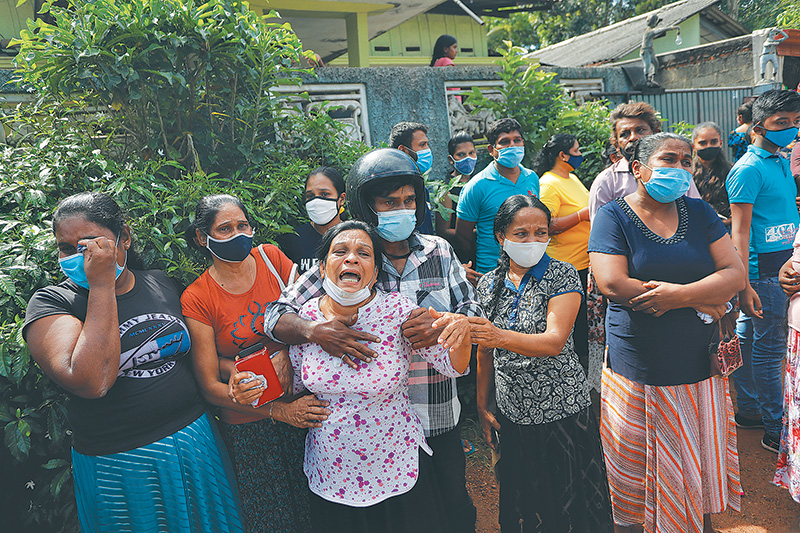
A family member of an inmate cries demanding that authorities reveal thecondition of her relative as others console her outside the prison complex following an overnight unrest in Mahara, on the outskirts of Colombo, Sri Lanka, on  Monday. AP/rss

Colombo,
Inmates unhappy about the coronavirus threat at an overcrowded prison near Sri Lanka’s capital have
clashed with guards who opened fire, leaving six prisoners dead and 35 others injured, officials said Monday. Two guards were critically injured, they said.
Pandemic-related unrest has been growing in the country’s prisons. Inmates have staged protests in recent weeks at several prisons as the
number of coronavirus cases surges in the facilities.
More than a thousand inmates in five prisons have tested positive for the coronavirus and at least two have died. About 50 prison guards have also tested positive.
Senaka Perera, a lawyer with the Committee for Protecting Rights of Prisoners, said the inmates at Mahara prison near Colombo had been frustrated because their pleas for coronavirus testing and separation of infected prisoners had been ignored by officials for more than a month.
Sri Lanka has experienced an upsurge in coronavirus cases since last month when two clusters—one centered at a garment factory and other at a fish market—emerged in Colombo and its suburbs.
Confirmed cases from the two clusters have reached 19,449. Sri Lanka has reported a total number of 22,988 coronavirus cases, including 109 fatalities.
India has recorded 38,772 new coronavirus cases in the past 24 hours, driving its overall total to 9.43 million. The health ministry on Monday also reported 443 deaths in the same period, raising the death toll to 137,139. India continues to have one of the lowest deaths per million population globally, the health ministry said in a statement. It also said that focused measures to ensure a low and manageable fatality rate have resulted in daily mortality figures of less than 500. For more than three weeks now India’s single-day cases have remained below the 50,000 mark. The capital, New Delhi, has also seen a dip in daily infections. It reported fewer than 5,000 new cases for the second consecutive day. On Sunday, it recorded 68 deaths, driving the capital’s total to 9,066. India is second behind the US in total coronavirus cases. In an effort to slow the virus’s spread, the home ministry has allowed states to impose local restrictions such as night curfews but has asked them to consult before imposing lockdowns at state, district or city levels.
Cambodia’s Education Ministry is ordering all schools to close after a rare local outbreak of the coronavirus. It says public schools will remain shut until until January 11, the start of the next school year, while private schools must close for two weeks.
Officials said over the weekend that a family of six and another man tested positive for the coronavirus.
Eight more cases were reported Monday among residents of Phnom Penh who were in contact with
the family.

WORLD

Australia demands apology from China after fake image posted on social media

- REUTERS

Sydney,
Australia demanded an apology after a senior Chinese official posted a fake image of an Australian soldier holding a knife with blood on it to the throat of an Afghan child, calling it “truly repugnant” and demanding it be taken down.
Prime Minister Scott Morrison called a media briefing to condemn the posting of the image,
marking another downturn in deteriorating relations between the two countries.
The Australian government has asked Twitter to remove the image, posted on Monday by China’s foreign ministry spokesman Zhao Lijian on his official Twitter account, Morrison said.
“It is utterly outrageous and cannot be justified on any basis,” Morrison said. “The Chinese government should be utterly ashamed of this post. It diminishes them in the world’s eyes.”
Australia has told 13 special forces soldiers they face dismissal in relation to an independent report on alleged unlawful killings in Afghanistan, the head of the country’s army said on Friday.
“It is the Australian government who should feel ashamed for their soldiers killing innocent Afghan civilians,” said Hua Chunying, China’s foreign ministry spokeswoman, when asked about Morrison’s
comments.
The image posted by her colleague shows people’s “indignation,” said Hua, speaking at a regular news conference in Beijing on Monday. Whether it will be taken down is a matter between Twitter and the Australian government, she said.
Australia’s relationship with China has deteriorated since Canberra called for an international inquiry into the origins of the coronavirus pandemic.
Earlier this month, China outlined a list of grievances about Australia’s foreign investment, national security and human rights policy, saying Canberra needed to correct its actions to restore the bilateral relationship with its largest trading partner.
Morrison said countries around the world were watching how Beijing responded to tensions in Australia’s relationship with China.
In the latest in a series of trade sanctions, China announced on Friday it will impose temporary anti-dumping tariffs of up to 212.1percent on wine imported from Australia, a move Canberra has labelled unjustified and linked to diplomatic grievances.
Zhao wrote on Twitter: “Shocked by murder of Afghan civilians & prisoners by Australian soldiers. We strongly condemn such acts, & call for holding them accountable.”
His Twitter account had posted the same message, but without the fake image of the soldier and child, on Friday.
Morrison said Australia had established a “transparent and honest” process for investigating the allegations against the accused soldiers and this “is what a free, democratic, liberal country does”.
Australia had “patiently sought” to address tensions in the relationship with China and wanted direct discussion between ministers, he said.

WORLD

Iranian TV says weapon used in scientist’s killing was made in Israel

- REUTERS

Dubai,
Iran’s English-language Press TV reported on Monday that the weapon used in the killing of prominent Iranian nuclear scientist Mohsen Fakhrizadeh last week was made in Israel, the Islamic Republic’s longtime enemy.
“The weapons collected from the site of the terrorist act (where Fakhrizadeh was assassinated) bear the logo and specifications of the Israeli military industry,” an unnamed source told Press TV.
In Jerusalem, there was no immediate reply from Israeli officials contacted for comment on the report. Iran’s semi-official Fars news agency said on Sunday that Fakhrizadeh was killed by a machine gun operated by remote control, while the Arabic language Al Alam TV reported that the weapons used in Fakhrizadeh’s killing were “controlled by satellite”.
Witnesses on Friday told state TV that there were gunmen on the ground.
Speaking before the Press TV report, Israeli intelligence minister Eli Cohen told radio station 103 FM on Monday that he did not know who was responsible.
Fakhrizadeh, who had little public profile in Iran but had been named by Israel as a prime player in what it says is Iran’s nuclear weapons quest, was killed on Friday when he was ambushed on a highway near Tehran and his car sprayed with bullets.
Iran began Fakhrizadeh’s burial in a cemetery in northern Tehran on Monday, state TV reported, as the defence minister promised that the Islamic Republic would retaliate for his killing.
Iran’s clerical and military rulers have blamed Israel, for Fakhrizadeh’s killing, raising the threat of a new confrontation with the West and Israel in the remaining weeks of Donald Trump’s presidency.
When asked about potential Iranian reprisals, Cohen told radio station 103: “We have regional intelligence supremacy, and on this matter we are prepared, we are increasing vigilance, in the places where that is required.”
Iran’s hardline Kayhan daily, whose editor-in-chief is appointed by Supreme Leader Ayatollah Ali Khamenei, in an opinion piece on Sunday called for an attack on the Israeli port city of Haifa, if an Israeli role in Fakhrizadeh’s killing is proven.
However, Iran’s rulers are aware of daunting military and political difficulties in attacking Israel. Such an attack would also complicate any effort by US President-elect Joe Biden to revive détente with Tehran after he takes office on January 20.
Tensions have increased between Tehran and Washington since 2018, when Trump exited Iran’s 2015 nuclear deal with six powers and reimposed sanctions that have crippled Iran’s economy. In retaliation, Tehran gradually breached the deal’s curbs on its nuclear programme. Biden has said he will return the United States to the deal if Iran resumes compliance.
Tehran has always denied seeking nuclear weapons.

WORLD

Uproar in France over limits on filming police

- ASSOCIATED PRESS

Paris,
French activists fear that a proposed new security law will deprive them of a potent weapon against abuse—cellphone videos of police activity—threatening their efforts to document possible cases of police brutality, especially in impoverished immigrant neighbourhoods.
French President Emmanuel Macron’s government is pushing a new security bill that makes it illegal to publish images of police officers with intent to cause them harm, amid other measures. Critics fear the new law could hurt press freedoms and make it more difficult for all citizens to report on police brutality.
“I was lucky enough to have videos that protect me,” said Michel Zecler, a Black music producer who was beaten up recently by several French police officers. Videos first published Thursday by French website Loopsider have been seen by over 14 million viewers, resulting in widespread outrage over police actions.
Two of the officers are in jail while they are investigated while two others, also under investigation, are out on bail.
The draft bill, still being debated in parliament, has prompted protests across the country called by press freedom advocates and civil rights campaigners. Tens of thousands of people marched Saturday in Paris to reject the measure, including families and friends of people killed by police.
“For decades, descendants of post-colonial immigration and residents in populous neighborhoods have denounced police brutality,” Sihame Assbague, an anti-racism activist, told The Associated Press.
Videos by the public have helped to show a wider audience that there is a “systemic problem with French police forces, who are abusing, punching, beating, mutilating, killing,” she said.
Activists say the bill may have an even greater impact on people other than journalists, especially those of immigrant origin living in neighborhoods where relationships with the police have long been tense. Images posted online have been key to denouncing cases of officers’ misconduct and racism in recent years, they argue.
Assbague expressed fears that, under the proposed law, those who post videos of police abuses online may be put on trial, where they would face up to a year in jail and a 45,000-euro fine.
“I tend to believe that a young Arab man from a poor suburb who posts a video of police brutality in his neighborhood will be more at risk of being found guilty than a journalist who did a video during a protest,” she said.
Amal Bentounsi’s brother, Amine, was shot in the back and killed by a police officer in 2012. The officer was sentenced to a five-year suspended prison sentence. Along with other families of victims, in March she launched a mobile phone app called Emergency-Police Violence to record abuses and bring cases to court.
“Some police officers already have a sense of impunity. ... The only solution now is to make videos,” she told the AP. The app has been downloaded more than 50,000 times.
“If we want to improve public confidence in the police, it does not go through hiding the truth,” she added.
The proposed law is partly a response to demands from police unions, who say it will provide greater protection for officers.
Abdoulaye Kante, a Black police officer with 20 years of experience in Paris and its suburbs, is both a supporter of the proposed law and strongly condemns police brutality and violence against officers.
“What people don’t understand is that some individuals are using videos to put the faces of our (police) colleagues on social media so that they are identified, so that they are threatened or to incite hatred,” he said.
“The law doesn’t ban journalists or citizens from filming police in action ... It bans these images from being used to harm, physically or psychologically,” he argued. “The lives of officers are important.”
A “tiny fraction of the population feeds rage and hatred” against police, Jean-Michel Fauvergue, a former head of elite police forces and a lawmaker in Macron’s party who co-authored the bill, said in the National Assembly. “We need to find a solution.”
Justice Minister Eric Dupond-Moretti has acknowledged that “the intent (to harm) is something that is difficult to define” and the government appears ready to back revamping part of the proposed law.
Activists consider the draft law one more step in a series of security measures passed by French lawmakers to extend police powers at the expense of civil liberties.
A statement signed by over 30 groups of families and friends of victims of police abuses said that since 2005, “all security laws adopted have constantly expanded the legal field allowing police impunity.”
Riots in 2005 exposed France’s long-running problems between police and youths in public housing projects with large immigrant populations.
In recent years, numerous security laws have been passed following attacks by extremists.
Critics noted a hardening of police tactics during protests or while arresting individuals. Hundreds of complaints have been filed against officers during the yellow vest movement against social injustice, which erupted in 2018 and saw weekends of violent clashes.
Interior Minister Gerald Darmanin said out of 3 million police operations per year in France, some 9,500 end up on a government website that denounces abuses, which represents 0.3 percent.

WORLD

Russia begins mass trials of second coronavirus vaccine

Briefing
- AGENCIES

MOSCOW: Russia plans to begin mass trials of its second coronavirus vaccine, EpiVacCorona, on people aged over 18 on Monday, the RIA news agency cited the consumer health watchdog Rospotrebnadzor as saying.EpiVacCorona, which is being developed by Siberia’s Vector Institute, was authorised this month to carry out trials on 150 volunteers over 60 and 3,000 volunteers over 18, the watchdog has said. The trials will be conducted in Moscow and several other cities including Kazan and Kaliningrad, the TASS news agency cited it as saying. Coronavirus cases have surged in Russia since September, but authorities have resisted imposing a touch lockdown and have said that targeted measures are enough to cope with the crisis.

WORLD

Pakistan’s lonesome elephant starts new life in Cambodia

Briefing
- AGENCIES

PHNOM PENH: Pakistan’s lonely elephant Kaavan arrived in Cambodia by cargo plane on Monday to start a new life with fellow pachyderms at a local sanctuary, the culmination of years of campaigning for his transfer by American singer Cher. Cher was on the tarmac at the airport of Cambodia’s second-biggest city Siem Reap to greet Kaavan and was photographed in sunglasses, black face mask and white jacket meeting the vets who accompanied the elephant, who made the long journey in a custom-made crate.

WORLD

Thousands flee as Indonesian volcano bursts to life

Briefing
- AGENCIES

JAKARTA: Thousands have fled the scene of a rumbling Indonesian volcano that burst to life for the first time in several years, belching a massive column of smoke and ash, the disaster agency said Monday. The evacuation of more than 4,400 residents came as Mount Ili Lewotolok erupted Sunday, spouting a thick tower of debris four kilometres into the sky, triggering a flight warning and the closure of a local airport. The crater’s last major eruption was in 2017. 

Page 7
SPORTS

Tottenham not happy despite top spot, says Mourinho

A goalless draw means Chelsea remain just two points behind their London rivals in third, with holders Liverpool trailing Spurs only on goal difference.
- AGENCE FRANCE-PRESSE
Chelsea’s Edouard Mendy saves a shot during the English Premier League match between Chelsea and Tottenham Hotspur at Stamford Bridge. AP/RSS

LONDON,
Jose Mourinho claimed his side were not happy just to settle for a point from a 0-0 draw at Chelsea that moved Tottenham back to the top of the Premier League.
Chelsea enjoyed the better of a game of few chances, but Spurs showed a resilience and steel to hold out for a fourth consecutive clean sheet that bolstered their claim to be contenders for a first league title in 60 years. “The one thing I take from the game is normally a point here is a positive thing, to stay top of the league is also a positive thing, and my dressing room is not happy,” said Mourinho. “That for me is fantastic. It’s a complete change of mentality and of personality.”
The evidence of the 90 minutes suggested Mourinho was indeed more than happy just to extend an unbeaten run in the league to nine games as cautious tactics from both saw the sides largely cancel each other out.
A share of the spoils means Chelsea remain just two points behind their London rivals in third, with Liverpool trailing Tottenham only on goal difference. Mourinho also ensured he did not lose three consecutive league meetings to the same manager for the first time in his career and to one of his former players, Frank Lampard.
Chelsea were wary not to give Tottenham any chance to counter-attack in the manner that cut open Manchester United and Manchester City in recent weeks.
“The clean sheet factor against a team we’ve seen recently are set up to counter-attack and have amazing players to counter-attack, I think that part of our game was excellent,” said Lampard. “Against Harry Kane and Son [Heung-min], we didn’t really give them a sniff.”
Only once did Spurs’ pace on the break threaten to cause Chelsea problems when Steven Bergwijn turned inside and blasted just over the bar early on. The arrival of Edouard Mendy has resulted in a huge upturn in Chelsea’s defensive record with now six clean sheets in seven league games and the Senegalese produced a smart stop to deny Serge Aurier’s strike from outside the box.
But that was the only effort on goal either side managed before the break as Chelsea controlled possession with little penetration.
Timo Werner did produce an exquisite finish to fire in off the far post, but the goal was ruled out for offside against the German international. Chelsea began to push with more purpose early in the second half as three times Tammy Abraham could not get a clean contact on inviting crosses from Reece James and Werner.
Lampard showed his intent to try and win the game by throwing on Christian Pulisic, Kai Havertz and Olivier Giroud in the final quarter, while Mourinho kept Gareth Bale in reserve for the full 90 minutes.
Hugo Lloris was finally forced into a meaningful save 10 minutes from time when the Spurs captain turned Mason Mount’s powerful strike behind. But the biggest chance to win the game came in stoppage time when Giroud pounced on a weak header from Joe Rodon, but he did not get enough on an attempted lob over Lloris and his French international teammate easily saved.
At the St Mary’s Stadium, Edinson Cavani inspired Manchester United’s thrilling 3-2 win at Southampton.
Ole Gunnar Solskjaer’s side were facing a dismal defeat after first-half goals from Jan Bednarek and James Ward-Prowse put Southampton in control. But Uruguay striker Cavani sparked United’s escape act after coming on at the interval.
Cavani set up Bruno Fernandes to reduce the deficit and the former Paris Saint-Germain star grabbed the equaliser from his team-mate’s deflected shot. The 33-year-old netted again in the final moments as his third goal since signing as a free agent in October extended United’s winning to four games in all competitions.
At the Emirates Stadium, Jimenez needed 10 minutes’ treatment following a clash of heads with Arsenal’s David Luiz.
Luiz was cleared to resume play, but Jimenez had to go to hospital, with reports claiming he was conscious and responding to treatment.
Pedro Neto put Wolves in front in the 27th minute and Gabriel Magalhaes headed Arsenal’s equaliser three minutes later. Daniel Podence’s cool finish clinched it for Wolves in the 42nd minute, leaving Arsenal languishing in 14th place after a three-match winless run.

SPORTS

Barcelona remember Maradona in winning style

- AGENCE FRANCE-PRESSE

BARCELONA,
Barcelona on Sunday followed the advice of coach Ronald Koeman and paid tribute to their former player Diego Maradona with an emphatic return to form in La Liga and a 4-0 victory over Osasuna.
Maradona, who played two seasons for Barca, died on Wednesday aged 60. Before the match, the club played ‘The Song of the Birds’ by Catalan cellist Pablo Casals as the teams stood around the centre circle where a Maradona shirt was laid on the centre spot. Lionel Messi, who has inherited Maradona’s legendary Argentina number 10 shirt, bowed his head. Flags at the Camp Nou flew at half mast, Maradona’s image was displayed on every screen and digital advertising hoardings while a club official held a framed Maradona Barcelona shirt.
The Catalans have been struggling in La Liga and started the game 14th.
On Friday, Koeman said the best tribute his team could pay Maradona was to “show what we can do on the pitch”. He recalled Messi and Frenkie de Jong, who were not in the squad for Tuesday’s 4-0 Champions League win at Dynamo Kiev, and also started Antoine Griezmann, who was on the bench in Ukraine.
Barcelona took the lead after 29 minutes through Martin Braithwaite. Messi seemed to be attempting a tribute to Maradona’s famous ‘Hand of God’ goal against England in 1986 as he leapt after the floating ball stretching his left arm toward it but the referee deemed he did not make contact.
Griezmann scored with a powerful left-foot volley from outside the box in the 42nd minute. The France World Cup winner then passed up a shooting chance in the 56th minute to roll a pass across the goal and set up a tap-in for Philippe Coutinho.
Messi got his goal in the 74th minute with a dazzling strike. He celebrated by pulling off his Barcelona shirt to reveal a vintage Newell’s Old Boys jersey from Maradona’s one season with the club in Rosario, Argentina. “It was a great moment,” said Koeman. “Leo’s goal, his gesture dedicated to Maradona. “It was something very big. We Europeans don’t realise how big Maradona is in Argentina.”
Barcelona climbed to seventh, still 10 points behind leaders Real Sociedad, who drew 1-1 at home to third-placed Villarreal.

SPORTS

England secure T20 series win

- AGENCE FRANCE-PRESSE

PAARL,
Dawid Malan returned to the town where he grew up and guided England to a series-clinching victory over South Africa in the second Twenty20 international at the Boland Park in Paarl on Sunday.
The left-handed Malan made 55 off 40 balls to anchor a tricky chase. England reached a target of 147 with four wickets and one ball to spare to take 2-0 lead in the three-match series.
Malan, 33, was born in England but grew up in Paarl and attended the local high school. He made his first-class debut for the Boland provincial team at Boland Park in February 2006 before going back to England and playing for Middlesex.  
“My cricket was learnt in the nets at the back here,” he told SuperSport television. “It was nice to come home and win a game for England.”
South Africa could only manage 146-6 after being sent in on a slow pitch, which offered help to spinners. Leg-spinner Adil Rashid took 2-23.
England struggled in reply, with left-arm wrist spinner Tabraiz Shamsi taking a career-best three for 19, dismissing England big guns Jos Buttler, Jonny Bairstow and Ben Stokes.
Malan, batting at number three, admitted that he struggled to time the ball at the start of the innings but he found his touch in a fifth-wicket stand of 51 with captain Eoin Morgan before falling to an athletic catch on the long-on boundary. Reeza Hendricks leapt to stop the ball going for six, landing over the boundary but returning to the field to complete the catch.

SPORTS

Warner out of white-ball series, uncertain for Test

Briefing
- AGENCIES

MELBOURNE: Australia batsman David Warner has been ruled out of the rest of the white-ball matches against India due to a groin injury and faces a fitness battle to be ready for the first Test at Adelaide Oval on December 17. Cricket Australia said on Monday that Warner, who suffered the injury in the field during Australia’s 51-run ODI win on Sunday, would be rested in the hope of being fit for the four-Test series against Virat Kohli’s side. Fast bowler Pat Cummins has also been withdrawn from the white-ball series to freshen up before the Tests. Opener D’Arcy Short has replaced Warner in Australia’s Twenty20 squad, but no replacement has been made for Cummins as yet. Australia’s win in Sydney sealed the three-match ODI series 2-0. The teams play the dead rubber third match in Canberra on Wednesday.

SPORTS

AC Milan win without forward Zlatan Ibrahimovic

Briefing
- AGENCIES

MILAN: AC Milan midfielder Franck Kessie converted one penalty and missed another as the Serie A leaders brushed aside Fiorentina 2-0 on Sunday, making light of the absence of Zlatan Ibrahimovic. Alessio Romagnoli put Milan ahead in the 17th minute and Kessie added a second goal from a penalty 11 minutes later following a foul on Alexis Saelemaekers. Milan, missing their 39-year-old leading scorer Ibrahimo-vic through injury as well as coach Stefano Pioli with a Covid-19 infection, were awarded another penalty before halftime, after Theo Hernan-dez collided with Martin Caceres. But Kessie saw his weak effort palmed away by Bartlomiej Dragowski. Milan, who have gone 21 Serie A games unbeaten since losing to Genoa in March, have 23 points, five clear of Inter and Sassuolo in their best start to the season since 1994-95.

SPORTS

De Gea a doubt for PSG clash

Briefing
- AGENCIES

MANCHESTER: Manchester United manager Ole Gunnar Solskjaer is unsure whether David de Gea will recover in time for Wednesday’s Champions League game against Paris St Germain after the Spanish goalkeeper suffered a knee injury. De Gea banged his knee on the goalpost in his failed attempt to keep out Southampton midfielder James Ward-Prowse’s free kick and was withdrawn at halftime in Sunday’s 3-2 win at the St Mary’s. “Let’s have a little check on (De Gea),” Solskjaer told Sky Sports. “Hopefully he will be ok for Wednesday but I’m not sure.” De Gea was replaced by Dean Henderson, who has been given few opportunities to impress since returning from his loan spell at Sheffield United.

MEDLEY

Horoscope

ARIES (March 21-April 19) ****
You can finally put whatever has been bothering you on the back burner and spend the next few days walking on air, or maybe on water. Wherever you go, others throw themselves shamelessly at your feet. The impossible seems routine to you right now.

TAURUS (April 20-May 20) ***
Look down at your plate before you go back to the buffet for a second helping. Do you still have perfectly good food in front of you? Well, don’t waste it. The same applies to certain opportunities you’re pondering.

GEMINI (May 21-June 21) ****
You’re one of the first people chosen for the team. All day long it seems that you’re somehow on the right side of the line that separates insiders from outsiders. Don’t be afraid to ask for something that you didn’t think was possible yesterday.

CANCER (June 22-July 22) ***
The best thing you can do right now is slow down. Good things definitely come to those who wait. New circumstances find you facing your own indifference. It’s difficult to make a decision when you just don’t have much invested in the outcome, isn’t it?

LEO (July 23-August 22) ***
You have the advantage no matter which way you turn. Lately, it seems as if the laws of the universe were written to benefit you, and you delight at the prospect of everything going your way. Good days are here!

VIRGO (August 23-September 22) ****
If you can’t do it yourself, maybe you shouldn’t attempt to do it at all. Support may be forthcoming, but it’s on someone else’s schedule. In the hours that it takes to wait and explain, you could probably handle matters on your own.

LIBRA (September 23-October 22) ***
There’s really no need to be in such a hurry to prove yourself. The more patient you are, the happier you’ll be when you finally get your turn. The stars urge you to win your victories one at a time, face-to-face and to be fully aware of your actions.

SCORPIO (October 23-November 21) ***
Keep one eye on the bottom line at all times. Your strength and determination won’t let you fail. When you’re finished, no one else can claim this victory but you. You need your alone time, and that’s a good thing because solitude is on the agenda.

SAGITTARIUS (November 22-December 21) ***
This is the perfect time to use body language and gestures to get your point across. Talking is highly overrated. Instead of describing your feelings, demonstrate them creatively. In a group, games like charades may be especially amusing.

CAPRICORN (December 22-January 19) ****
You might feel like keeping a low profile these days, and it’s no wonder. The stars are heating things up. Don’t be too surprised if something you did in the past catches up with you. There’s nowhere to run once it finds you, so you might as well face it.

AQUARIUS (January 20-February 18) ***
You’re a big fan of blunt honesty. If you think it, you’re likely to say it without censoring it for the audience. Luckily, you run with a crowd that has a sense of the absurd. Keep in mind that not everyone in the world appreciates your sense of humour.

PISCES (February 19-March 20) ***
What happened? You got off to such a great start, but you’re suddenly feeling tired. Don’t be surprised if your huge lead slows back down to a walking pace. Now that you’ve had your fun, another person gets a chance.

Page 8
CULTURE & LIFESTYLE

Key question in Cosby appeal: Does defendant’s past matter?

Investigators say it is crucial the jury hears the defendant’s past to show a crime pattern, but defence lawyers say it often amounts to character assassination.
- MARYCLAIRE DALE
The actor Bill Cosby has spent more than two years in prison since he was convicted of sexual assault in the first celebrity trial of the #MeToo era. Ap/rss

PHILADELPHIA,
In 2016, as Bill Cosby’s legal team prepared for trial in his stunning sexual assault case in Pennsylvania, the state Supreme Court quietly heard a death row inmate’s appeal.
Lawyers for Charles Hicks questioned whether three women who said he had beaten and choked them in Texas should have testified at his trial in a fourth woman’s death in the Pocono Mountains.
Prosecutors hoped to show a pattern of “strikingly similar” conduct, even if only one woman died. The seven Supreme Court justices issued five separate opinions on the use of the “prior bad act” testimony.
That may explain why they are hearing Cosby’s appeal of his conviction on Tuesday.
In taking the case, the justices appear eager to clear up the law on one of the murkiest questions plaguing criminal trials: When should a jury hear about someone’s past?
Investigators say it can be crucial to show a signature crime pattern, but defense lawyers say it often amounts to character assassination.
The debate has been central to the high-profile prosecutions of actor and comedian Cosby, movie mogul Harvey Weinstein and a Roman Catholic Church official in Philadelphia charged with protecting predator priests. But it also comes into play for lesser-known people like Hicks, who remains on Pennsylvania’s death row.
“The issue is really intriguing because it forces defendants to spend time fighting shadows of uncharged, sometimes unrelated accusations that never really became formal criminal charges,” said Philadelphia defense lawyer William J. Brennan, who was involved in the church trial. “It’s very distracting. You should focus on what you’re criminally charged with.”
Cosby has long complained that Montgomery County Judge Steven TO’Neill let five other accusers testify at his 2018 retrial, when he became the first celebrity convicted of sexual assault in the #MeToo era. His lawyers, and his wife, Camille, have called the women gold diggers and their testimony lies.
But District Attorney Kevin Steele believes the similarities in their accounts were no mere coincidence.
“It is unusual, to say the least, that defendant has been repeatedly ... accused of engaging in sexual conduct with unconscious or otherwise incapacitated young women,” his office wrote in a Supreme Court brief this year.
Cosby, 83, has spent more than two years in prison since he was convicted of drugging and sexually assaulting Andrea Constand, a Temple University employee he had taken under his wing, at his suburban Philadelphia estate in 2004.
By the time her case went to trial in 2017, after a judge unsealed Cosby’s long-buried testimony in her 2005 sexual battery lawsuit, dozens of women had come forward to say the star of “The Cosby Show” had mentored and then betrayed them.
O’Neill allowed just one of them to testify at the first trial, in which the jury could not reach a verdict.
But the following year, at the 2018 retrial, the judge let five other accusers take the stand to describe encounters with Cosby in the 1980s. Each believed they had been drugged and sexually assaulted.
Constand, a former professional basketball player from Toronto, said she became incapacitated after taking what she thought was an herbal remedy from Cosby. She said she could not fight back as he put his hand down her pants. Cosby described the penetration that followed as consensual.
An intermediate appeals court last year called O’Neill’s decision on the other accusers reasonable. Then the state Supreme Court jumped in when he appealed again.
The Cosby appeal could decide whether courts allow the expansive use of “prior bad act” witnesses that many judges have adopted in recent years or rein it in to preserve the presumption of innocence.
The testimony is often referred to as “404(b) evidence,” a reference to the legal rule that governs it.
“I think the Supreme Court probably wants to tighten up some of the 404(b) issues that certainly are ripe for tightening,” said Brennan, who sat through weeks of testimony from priest-abuse victims in the 2012 church trial. “It pollutes the air for the jury.”
Pennsylvania Chief Justice Thomas Saylor raised concerns that creates “mini-trials on collateral testimony” in his 2017 opinion in the Hicks case, but he still sided with the majority to uphold the conviction, if for different reasons.
The Supreme Court will also consider Tuesday whether the jury should have heard Cosby’s damaging deposition testimony from Constand’s lawsuit, when he acknowledged giving alcohol or quaaludes to some of his accusers before sexual encounters.
Defense lawyers say that Cosby, before sitting for the deposition, relied on a secret agreement from a former prosecutor that he would never be charged in Constand’s case. But O’Neill found no evidence of such a pact.
Cosby, like other defendants, does not have the right to attend the appellate arguments, which have been moved online because of the Covid-19 pandemic.
He resides at a state prison near Philadelphia, where several inmate deaths have been blamed on the coronavirus. Cosby’s friends have made public pleas for his early release, given his age and increased risk of infection, but he has not filed any formal legal petitions. And prosecutors say he doesn’t qualify as a sexually violent predator.
The Supreme Court is not expected to rule for several months.

—Associated Press

CULTURE & LIFESTYLE

Fact or fiction? UK govt says The Crown should be clear

- JILL LAWLESS
In this file photo, a man wearing a face mask walks past a billboard advertising ‘The Crown’ television series about Britain’s Queen Elizabeth II and the royal family. AP/RSS

LONDON, 
Britain’s culture minister thinks the Netflix TV series The Crown should come with a disclaimer: It’s a work of fiction.
Culture Secretary Oliver Dowden weighed in amid criticism of the historical liberties taken by the drama about the British royal family.
“It’s a beautifully produced work of fiction. So as with other TV productions, Netflix should be very clear at the beginning it is just that,” Dowden told the Mail on Sunday newspaper. “Without this, I fear a generation of viewers who did not live through these events may mistake fiction for fact.”
Dowden is expected to write to Netflix this week to express his view. Netflix did not immediately respond to a request for comment from The Associated Press.
Questions of historical fidelity were not a major issue during earlier seasons of the show, which debuted in 2016 and traces the long reign of Queen Elizabeth II, which began in 1952.
But the current fourth season is set in the 1980s, a divisive decade that many Britons remember vividly. Characters include Conservative Prime Minister Margaret Thatcher, whose 11-year tenure transformed and divided Britain, and the late Princess Diana, whose death in a car crash in 1997 traumatized the nation.
Former royal press secretary Dickie Arbiter has called the series a “hatchet job” on Prince Charles, the heir to the British throne, and his first wife Diana. The troubled relationship of the couple, played by Josh O’Connor and Emma Corrin, is a major storyline in the series.
Diana’s brother, Charles Spencer, has also said the show should carry a notice that “this isn’t true but it is based around some real events.”
“I worry people do think that this is gospel and that’s unfair,” he told broadcaster ITV.
Some Conservatives have criticized the program’s depiction of Thatcher, played by Gillian Anderson. Britain’s first female prime minister, who died in 2013, is portrayed as clashing with Olivia Colman’s Elizabeth to an extent that some say is exaggerated.
The Crown creator Peter Morgan, whose work also includes recent-history dramas The Queen and Frost/Nixon, has defended his work, saying it is thoroughly researched and true in spirit.
In a 2017 discussion of The Crown, Morgan said “you sometimes have to forsake accuracy, but you must never forsake truth.”
Steven Fielding, a professor of political history at the University of Nottingham, said the suggestion that The Crown carry a disclaimer was “reasonable and yet pointless.”
“It invariably doesn’t have an effect,” he said.
“There are studies that show that people believe fiction when it’s presented as fact—even if you tell them it’s not fact.”
Fielding said it was no surprise that Charles and his allies were annoyed with the heir to the throne’s depiction as “a bit of an idiot.” But he said making a fuss about it only amplifies the attention.
Historians are used to railing at inaccuracies in dramas such as the Academy Award-winning Darkest Hour, which included an invented scene of Winston Churchill meeting ordinary Londoners on an Underground Tube train during World War II.
“Mixing historical fact and fiction has been around since Shakespeare. This is not new to films, it’s not new to TV,” said Fielding, co-author of The Churchill Myths, which examines Britain’s wartime leader in popular culture.
“I don’t recall the culture secretary complaining about the ridiculous presentation of Winston Churchill in ‘Darkest Hour,” he said. “Because it went with the myth, with the idea of Churchill the hero, nobody complained.”
“Nobody’s bothered if fact and fiction are all mangled up, so long as it’s saying nice things,” he added.

—Associated Press

CULTURE & LIFESTYLE

Merriam-Webster’s top word of 2020 not a shocker: pandemic

- Leanne Italie
Merriam-Webster on Monday announced ‘pandemic’ as its 2020 word of the year. AP/RSS

NEW YORK,
If you were to choose a word that rose above most in 2020, which word would it be? Ding, ding, ding: Merriam-Webster on Monday announced “pandemic” as its 2020 word of the year.
“That probably isn’t a big shock,” Peter Sokolowski, editor at large for Merriam-Webster, told The Associated Press.
“Often the big news story has a technical word that’s associated with it and in this case, the word pandemic is not just technical but has become general. It’s probably the word by which we’ll refer to this period in the future,” he said.
The word took on urgent specificity in March, when the coronavirus crisis was designated a pandemic, but it started to trend up on Merriam-Webster.com as early January and again in February when the first US deaths and outbreaks on cruise ships occurred.
On March 11, when the World Health Organization declared the novel coronavirus outbreak a global pandemic, lookups on the site for pandemic spiked hugely. Site interest for the word has remained significantly high through the year, Sokolowski said.
By huge, Sokolowski means searches for pandemic on March 11 were 115,806 percent higher than lookups experienced on the same date last year.
Pandemic, with roots in Latin and Greek, is a combination of “pan,” for all, and “demos,” for people or population. The latter is the same root of “democracy,” Sokolowski noted. The word pandemic dates to the mid-1600s, used broadly for “universal” and more specifically to disease in a medical text in the 1660s, he said.
That was after the plagues of the Middle Ages, Sokolowski said.
He attributes the lookup traffic for pandemic not entirely to searchers who didn’t know what it meant but also to those on the hunt for more detail, or for inspiration or comfort.
“We see that the word love is looked up around Valentine’s Day and the word cornucopia is looked up at Thanksgiving,” Sokolowski said. “We see a word like surreal spiking when a moment of national tragedy or shock occurs. It’s the idea of dictionaries being the beginning of putting your thoughts in order.”
Merriam-Webster acted quickly in March to add and update entries on its site for words related to the pandemic. While “coronavirus” had been in the dictionary for decades, “Covid-19” was coined in February. Thirty-four days later, Merriam-Webster had it up online, along with a couple dozen other entries that were revised to reflect the health emergency.
“That’s the shortest period of time we’ve ever seen a word go from coinage to entry,” Sokolowski said. “The word had this urgency.”
Coronavirus was among runners up for word of the year as it jumped into the mainstream. Quarantine, asymptomatic, mamba, kraken, defund, antebellum, irregardless, icon, schadenfreude and malarkey were also runners up based on lookup spikes around specific events.
Particularly interesting to word nerds like Sokolowski, a lexicographer, is quarantine. With Italian roots, it was used during the Black Death of the 1300s for the period of time a new ship coming into port would have to wait outside a city to prevent disease. The “quar” in quarantine derives from 40, for the 40 days required.
Spikes for mamba occurred after the January death of Kobe Bryant, whose nickname was the Black Mamba. A mass of lookups occurred for kraken in July after Seattle’s new National Hockey League franchise chose the mythical sea monster as its name, urged along by fans.
Country group Lady Antebellum’s name change to Lady A drove dictionary interest in June, while malarkey got a boost from President-elect Joe Biden, who’s fond of using the word. Icon was front and center in headlines after the deaths of US Representative John Lewis and US Supreme Court Justice Ruth Bader Ginsberg.
The Merriam-Webster site has about 40 million unique monthly users and about 100 million monthly page views.

—Associated Press