You internet speed is slow. Switch to text view mode

Switch
epaper logo
ST

Last Login:
Logout
+
Page 1
HOME PAGE

Constitutional Bench asks for reasons for House dissolution, seeks amicus curiae

The five-member bench also asks about the time of the no-confidence motion filed against the Oli government. There are conflicting versions on when it was registered.
- BINOD GHIMIRE

KATHMANDU,
Indications are that it will be a while before the Supreme Court will give a verdict on the constitutionality of the KP Sharma Oli government’s Sunday move of dissolving the House of Representatives.
A hearing on 13 writs against President Bidya Devi Bhandari’s dissolution of the House on the recommendation of the Oli Cabinet began on Friday, but the next hearing is scheduled for January 6.
The Constitutional Bench ended Friday’s hearing after listening to opening remarks of a handful of lawyers and making four significant orders.  These include a show cause notice against the Office of the President and the government demanding a written justification for their move to dissolve the House.
It has sought clarification from them asking why the court should not issue an order as demanded by the petitioners who have sought revocation of the President’s approval to dissolve the House based on the government’s recommendation.
“If there is any legal ground not to issue a ruling as demanded by the petitioners, submit the details by January 3 through the Office of the Attorney General,” reads the order.
The five-member Constitutional Bench led by Chief Justice Cholendra Shumsher Rana also asked the government to present the original copy of its decision regarding the House dissolution. Another significant order is to produce before court the original copy that shows the exact time a no-confidence motion was registered against Prime Minister KP Sharma Oli in the Parliament Secretariat on Sunday, the day President Bhandari dissolved the House of Representatives.
“As one of the writs (077-wc-0037) mentions the registration of a no-confidence motion at the Parliament Secretariat, produce the original copy that shows when and at what time the application was registered,” reads the order.
The time of no-confidence motion registration is important as the Supreme Court in 1995 had ruled against then CPN-UML-led Manmohan Adhikari minority government’s dissolution of Parliament saying that the recommendation for dissolution was made after a no-confidence motion had been filed against it. The other reason that the court had given for its ruling was there was still the possibility of forming a government through a House vote.
However, there are conflicting versions on the exact time of the registration of the no-confidence motion.
Roj Nath Pandey, spokesperson for the Parliament Secretariat, issued a statement on Thursday, saying the motion was registered at 3:30pm—after the President had dissolved Parliament.
On the other hand, according to the secretariat of Speaker Agni Sapkota it was registered at 10:30am—before the dissolution.
The Constitutional Bench has also asked for the list of lower house members showing their party affiliation and the strength of different political parties in the House.
Given the gravity of the case, the Constitutional Bench also decided to form a seven-member amicus curiae comprising three advocates from Nepal Bar Association, two from the Supreme Court Bar and one each
from among senior advocates and advocates.
The amicus curiae is a group of experts comprising lawyers and experts on the constitution called by the Supreme Court whenever it considers that the issue it is looking into is a serious one and the view of experts would be helpful.
The apex court in November 2017 had called an amicus curiae on the writ demanding voting rights for civil servants and security forces assigned to election duty.
Similarly, it was called in December 2016 to decide on the election modality for the local level polls.
Before the start of the hearing, Rana on Friday constituted the Constitutional Bench comprising Justices Hari Krishna Karki, Bishowambhar Prasad Shrestha, Anil Kumar Sinha and Tej Bahadur KC. The chief justice leads the five-member bench.
Article 137 of the constitution has a provision for the formation of the Constitutional Bench led by the chief justice incorporating four justices as recommended by the Judicial Council.
Although the chief justice has the authority to pick four justices from the roster prepared as per the recommendation, there is a practice to constitute a Constitutional Bench from among senior most justices.
Rana, however, did not pick Deepak Kumar Karki and Meera Khadka who are the second and third senior most justices after him.
As the preliminary hearing began on Friday, senior advocate Dinesh Tripathi, one of the writ petitioners, had raised a question over the constitution of the bench.
He had particularly asked about the presence of KC who is 11th in ranking. In response, Rana said the bench is constituted from among the senior justices and, therefore, it was unnecessary to raise questions over its composition.
Among the members of Constitutional Bench Hari Krishna Karki is a former president of Nepal Bar Association who belonged to the Progressive Lawyers’ Association which is close to the left parties, particularly the erstwhile CPN-UML. He was appointed attorney general in October 2015 after Oli became prime minister for the first time. Karki, who ranks fourth among the justices of the Supreme Court, will succeed Rana as chief justice.
Shrestha, a cadre of the Judicial Service Commission, was appointed Supreme Court justice from among chief judges of the high courts together with Karki and Sinha. He ranks fifth among the justices and would have been selected for the Constitutional Bench if the bench comprised only the senior most justices. He is also in line to be the chief justice after Rana and Hari Krishna Karki.
Sinha, another member of the bench, was appointed Supreme Court justice together with Karki and Shrestha in April 2016 from the Nepali Congress quota.
According to a senior official of the judiciary, Sinha is among the few in the apex court to maintain a high level of integrity.
Lawyers and even the officials of the court were particularly surprised to see KC on the bench.
“KC is close to Rana and that may be the reason why he may have chosen him despite being ranked 11th,” a senior court official told the Post on the condition of anonymity because he is not allowed to comment on the matter.
Although Tripathi raised the question over the formation of the bench, Tulasi Simkhada, another petitioner, doesn’t see a problem with it.
“We have to believe everyone in the 14-member roster is competent to be on the bench,” he told the Post. “Friday’s ruling has proved it.”
He said he expects the court will make a decision based on constitutional provisions. In his writ, Simkhada has demanded a verdict be given within 30 days, as the country cannot afford to be in limbo for a long time.
But that is unlikely as when the hearing resumes on January 6, it will already have been 17 days since the House dissolution.
Constitutional experts said it seems it will take some time for the final verdict but that shouldn’t be taken otherwise looking at the gravity of the issue.
They, however, welcomed the ruling that there can be no extension of the time given to the Office of the President and the Cabinet to furnish their explanations behind the House dissolution.
“It’s a serious constitutional issue. Therefore, it can take some time,” Balaram KC, a former justice at the Supreme Court, told the Post. “It’s fine to take time but that has to result in a mature decision.”
HOME PAGE

Nepal Communist Party split was expected to have repercussions. There are hints already

Members of Dahal-Nepal faction in Bagmati file no-confidence motion against Chief Minister Dormani Poudel, a close ally of Prime Minister KP Sharma Oli.
- TIKA R PRADHAN
A no-confidence motion has been filed against Bagmati Chief Minister Dormani Poudel. Post Photo

KATHMANDU,
As expected, repercussions of the split in the Nepal Communist Party have now started to emerge in provinces, with Bagmati Province standing in line to be the first casualty.
As many as 45 members of the Bagmati Provincial Assembly on Friday filed a no-confidence motion against Chief Minister Dormani Poudel.
The members, belonging to the Pushpa Kamal Dahal-Madhav Nepal faction, have proposed Asta Laxmi Shakya as the new chief minister.
Poudel belongs to the faction led by KP Sharma Oli.
Prime Minister Oli’s decision to dissolve the House of Representatives on Sunday resulted in a split in the Nepal Communist Party, which was formed in May 2018 through a merger between then CPN-UML and the Maoist Centre.
Both Oli and Dahal-Nepal factions now are in a bid to wrest control of the party.
After the 2017 elections, the Nepal Communist Party had formed governments in six out of the seven provinces. Now with the party split between the Oli and Dahal-Nepal factions, equations are likely to change in provinces quickly, leaders say.
In the 110-member Bagmati Provincial Assembly, Nepal Communist Party has 80 seats, which are now divided between the Dahal-Nepal and Oli factions at 46 and 34.
Internal Affairs Minister Shalikram Jamarkattel proposed the no-confidence motion, which was seconded by Minister for Industry, Tourism, Forest and Environment Arun Prasad Nepal.
Jamarkattel is a former Maoist leader close to Dahal while Nepal is close to Madhav Nepal.
“We have proposed Ashta Laxmi Shakya as the next chief minister,” Ratna Dhakal, a member of the assembly and a central committee member, told the Post.
Both Jamarkattel and Nepal, along with Minister for Social Development Yubaraj Dulal, resigned on Friday.
The next province that is likely to be affected is Province 1 where Chief Minister Sherdhan Rai is already in the minority. Rai is one of the close confidants of Oli.
In the 93-member Provincial Assembly, Rai has only 20 seats of 67 that went to the Nepal Communist Party—51 to former UML and 16 to the  former Maoist party.
The Dahal-Nepal faction now controls 47 seats.
“I don’t think the leaders are preparing for a no-confidence motion in Province 1 but that is inevitable now,” said Hemraj Bhandari, a central member who belongs to the Dahal-Nepal faction representing Province 1. “Having a majority in the Provincial Assembly, it is unlikely that Dahal and Nepal will accept Rai as chief minister.”
Since Article 188 (4) of the constitution says one-fourth of the total number of the assembly members may table in writing a motion of no-confidence against the chief minister, the Dahal-Nepal faction can easily make a move if it wants.
“It is obvious that the long-standing contradictions in Province 1 and Bagmati Province over the selection of chief ministers will reappear after the split in the party,” said Raghuji Pant, a Standing Committee member now with the Dahal-Nepal faction.
“The incumbent chief ministers of the two provinces were appointed forcibly.”
There were disagreements when Poudel and Rai were elected chief ministers in Province 1 and Bagmati. However, Oli had managed to bulldoze his decisions.
In Bagmati, Shakya, a Standing Committee member considered to be close to Madhav Nepal, was tipped to be the chief minister, but Poudel was chosen later through an election conducted at Oli’s insistence, party leaders say.
In Province 1, Bhim Acharya and Rai, both from then UML, were in the fray for the post of provincial parliamentary party leader. Acharya was defeated by Rai by just two votes. Acharya is with the Dahal-Nepal faction now.
According to Pant, changes are likely to happen in other provinces as well.
Despite having a majority in Lumbini Province, whose Chief Minister Shankar Pokhrel is Oli’s close ally, the equation can change quite easily, insiders say.
In the 87-member assembly, the Nepal Communist Party had won 61 seats. After the split, the Daha-Nepal faction has 25 seats while the Oli faction has 36.
The Nepali Congress, Janata Samajbadi Party and Janamorcha have 19, six and one seats, respectively.
Leaders say the Dahal-Nepal faction can easily file a no-confidence motion against Pokhrel and form a government by seeking support of the Congress party in Lumbini.
The Dahal-Nepal faction controls a majority in Karnali and Sudurpaschim as well. In the 40-member Provincial Assembly in Karnali, the Dahal-Nepal faction has 20 seats and the Oli faction has 13. In Sudurpaschim, which has a 53-member assembly, the Dahal-Nepal faction controls 31 seats and the Oli faction 8.
The only province where the Oli faction appears to be strong is Gandaki.
In the 60-member assembly,  the Oli faction controls 27 seats. The Dahal-Nepal faction controls 13 seats. The Nepali Congress, Janamorcha and Janata Samajbadi Party have 15, 3 and two seats, respectively.
“We have not discussed any changes in the government yet,” said Hari Chuman, internal affairs minister of Gandaki Province who belongs to the Dahal-Nepal faction. “But it also depends on how the Oli faction behaves in the near future.”
Even if the Dahal-Nepal faction does not make any move in provinces, concerns are growing if Oli
himself will dissolve the provincial governments.
In a television interview aired on Wednesday, Oli said that he will have to take “tough steps” if no-confidence motions are brought to make provincial governments unstable.
The President has constitutional power to dissolve the provincial governments.
Article 232 (3) of the constitution which is related to relations between the federation, provinces
and local level states that if any province indulges in an act that would have a serious effect on Nepal’s sovereignty, territorial integrity or independence, autonomy, the President shall, according to the need, reprimand such a province, suspend or dissolve the Council of Ministers of the province and the provincial assembly.
But at a time when the President has already attracted a lot of criticism for swiftly endorsing Oli’s move of dissolving the House of Representatives, many say dissolutions of provincial assemblies by her are not quite likely.
The House dissolution by Oli and President has already landed in the court and the Constitutional Bench started a hearing on writs against the move on Friday.
Ram Narayan Bidari, a National Assembly member, said the constitution does allow the President to dissolve the provincial assemblies but there are conditions.
“The conditions are clear. The President can dissolve them only when there is an act having a serious effect on sovereignty, territorial integrity or independence and autonomy,” said Bidari, also an advocate, who belongs to the Dahal-Nepal faction.
“That said, who knows the provincial assemblies could also face the fate of the House of Representatives, as it was dissolved despite the constitutional provisions not allowing the prime minister to do so.”

Page 2
NATIONAL

Few Nepalis apply for Malaysia amnesty scheme for undocumented workers

Illegal workers in Malaysia can voluntarily return home without facing serious legal actions.
- CHANDAN KUMAR MANDAL
The number of undocumented Nepali workers in Malaysia is estimated to be between 10,000 and 15,000. Post File Photo

KATHMANDU,
The Malaysian government has once again rolled out an amnesty scheme targeting illegal immigrants, including undocumented Nepali workers, giving them a chance to return home.
Under the latest scheme, Nepalis living in Malaysia illegally can voluntarily return home without facing any serious legal actions.
“Nepali workers can apply to return home under this scheme,” Pratik Karki, second secretary at the Nepali Embassy in Malaysia, told the Post over the phone. “The difference between the previous amnesty scheme and the new one is that workers will be required to pay only 500 Malaysian ringgits (approximately Rs20,295) compared to RM700 in the past.”
The Malaysian government launched its Illegal Immigrant Recalibration Plan to manage illegal immigrants in the country. There are two distinct programmes under the plan—the Labour Recalibration Programme and the Return Recalibration Programme.
The Return Recalibration Programme allows illegal immigrants to return home voluntarily. In contrast, the Labour Recalibration Programme aims to allow illegal immigrants to get registered and find employment with eligible Malaysian employers.
The Nepali Embassy in Kuala Lumpur has been asking undocumented Nepali workers in the Southeast Asian country to utilise the scheme and return home without facing any legal hurdles.
Those willing to return via the Return Recalibration Programme have to take an appointment with the Malaysian Immigration Department. On the stipulated day, the worker has to be present with all the required documents and pay the fine of RM500 for receiving a checkout memo from the authority for leaving the country.
“The embassy has been facilitating interested Nepalis who want to leave the country with the application process and booking their appointment day,” said Karki.  
“Due to Covid-19 safety issues, prior appointments have to be made, and there are fewer slots which keep on filling up quickly.”
However, Nepali workers’ enthusiasm to take part in the scheme has remained lukewarm compared to that for similar schemes in the past.
“So far, some 100 plus have applied, and we have fixed their appointments. But, the response to the scheme has not looked encouraging as of now,” said Karki. “It seems people are more interested in rehiring programme.”
Under the rehiring programme of Labour Recalibration Programme, local employers engaged in four sectors—construction, manufacturing, plantation and agriculture—can submit applications for hiring workers among the illegal ones under the quota fixed by the Department of Labour. Such workers should not have any police case against them.
Workers from 15 countries (Thailand, Cambodia, Nepal, Myanmar, Laos, Vietnam, Philippines, Pakistan, Sri Lanka, Bangladesh, Turkmenistan, Uzbekistan, Kazakhstan, India, and Indonesia) are eligible under the Illegal Immigrant Recalibration Plan.
Local authorities have expected that nearly 250,000 illegal immigrants will utilise the scheme, which will continue until June 2021.  
Nepali workers have also benefited from such amnesty schemes in the past. Earlier this year, nearly 6,000 Nepali workers returned home under ‘Back for Good Programme.’ In 2018, nearly 15,000 Nepali workers had returned home under the Voluntary Deportation Programme, also called the “3-plus-1” programme.
Malaysia remains one of the most popular labour destinations for Nepali migrant workers. It is estimated that the number of undocumented Nepali workers could be between 10,000 to 15,000.
“The response to the scheme has been slow as those undocumented could be thinking of applying when the deadline nears,” said Karki. “Also, most Nepalis in Malaysia are working legally.”

NATIONAL

A Rukum (West) local unit funds tuition fees of 17 students

- HARI GAUTAM

RUKUM (WEST),
Aathbiskot Municipality in Rukum (West) has provided full scholarship to 17 students of various technical subjects this year. The municipality had also provided education loans to students taking MBBS and pilot courses two years ago.
The municipality has selected students—12 male and five female—from economically weak backgrounds for the three-year-programme. According to the municipality, of the 17 beneficiaries of the scholarship, three students are studying engineering, two are studying health, three sub engineering, two law, three IT, two agriculture and two staff nurse courses.
“The municipality will pay the tuition fees of the beneficiaries until they complete their courses but they will have to bear their own expenses for food and accommodation,” said Gorkha Bahadur KC, mayor of the municipality. “The beneficiaries were selected as per the application filed by those students who had passed the entrance examinations of their concerned subjects.” According to the municipality, five students had got scholarships in the fiscal year 2018-19 and 12 students had got scholarships in the fiscal year 2019-20.
According to KC, the municipality has been continuing this programme to help aspiring students from impoverished families. “The right to education has been categorized as a fundamental right. We have initiated the campaign to help students from poor families get education.”
The municipality has invested Rs 3.9 million to provide scholarship to 17 students. Each of the students has received a maximum of Rs 103,000 to a minimum of Rs 50,000 as scholarships.

NATIONAL

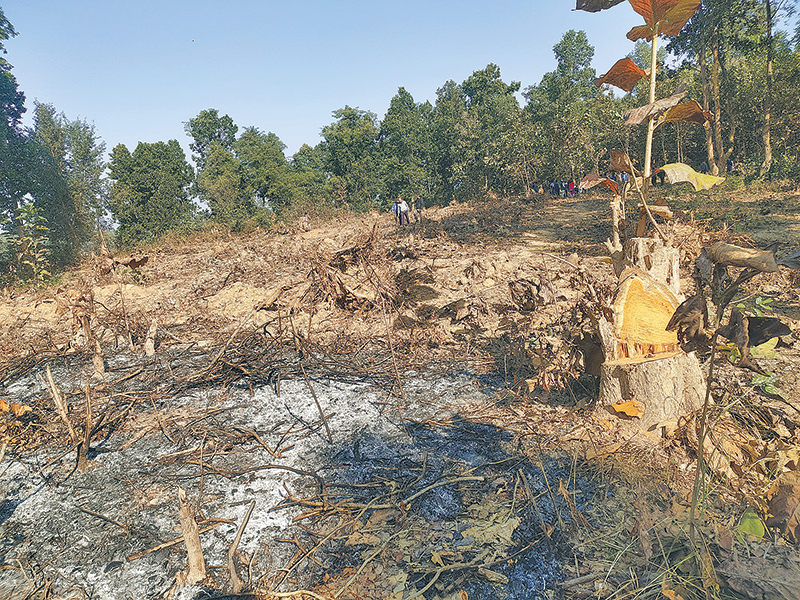
Five bighas of forest land encroached in Bardibas, Mahottari

The encroahers are working in collusion with the forest officials, forest consumer committee, and Bardibas Municipality, local residents say.
- SUNITA BARAL
More than 300 trees in the Ramtel Danda Community Forest were recently felled. Post Photo: Sunita Baral

MAHOTTARI,
People have started encroaching the forest land of Ramtel Danda Community Forest in Bardibas, Mahottari in collusion with the forest officials, forest consumer committee, and Bardibas Municipality, local residents say.  
Around five bighas of the forest land have been encroached upon so far, they say.
Recently, Lilamani Acharya and Krishna Prasad Gautam, local residents of Ward No. 1 in Bardibas, fell down more than 300 trees of the community forest and encroached forest land after their land plots were swept away by the floods of Bhapsi in the monsoon.
Ramtel Danda Community Consumers Committee, Bardibas Municipality and the Division Forest Office in Mahottari had given permission to Gautam and Acharya to cut down trees, local residents say. The duo asked for permission to cut down trees, citing that their land plots fall under the forest cover.
The Revenue Office in Bardibas has also verified the documents, saying that around five bighas of the forest land belong to Gautam and Acharya. The incident came to light after the local residents found out about the tree felling.  
Twenty-eight years ago, 21 hectares of Ramtel Danda Community Forest was handed to the community forest consumers committee.
“They had shown the recommendation of the government offices before fencing around five bighas of the forest land,” said Bijaya Pokharel, a local resident of Bardibas Ward No. 1. “The people’s representatives, forest officials and government employees are all working in collusion.”
The villagers have also filed a complaint to the Commission for the Investigation of Abuse of Authority. Fifty-one of them have signed the document and filed the complaint to the CIAA for a detailed investigation into the matter.
“Land mafias are the reason why incidents like this continue to occur. The area of Ramtel Danda Community Forest is shrinking due to human encroachment. That’s why we have filed a complaint at the CIAA for investigation,” said Dipak Karki, a local resident of Ward No. 1 in Bardibas.
According to Hemanta Prasad Sah, chief at the Division Forest Office in Mahottari, the ward office, forest consumers committee and revenue and survey offices have verified that the land belongs to Acharya and Gautam.
“This is the reason why the forest office gave permission to cut down trees,” Sah said.
Sher Bahadur  Raut, chairman of the community forest, had  provided recommendations for the tree felling, saying that the landowners have planted tree saplings in five bighas of land elsewhere.
“I provided the recommendation to cut down trees on the basis of documents prepared by the Revenue and Survey Offices,” Raut said.
Meanwhile, Chudamani Pokharel, ward chairman of Bardibas Ward No. 1, said his office provided recommendations to cut down trees after looking at the recommendations of the forest office, forest consumer committee and the survey office.
Sah, however, said that an arrest warrant has been issued in the name of Gautam and Acharya on deforestation charges. The forest office has also suspended seven employees, including an assistant forest officer, and started an investigation into the case. The Post tried to contact both Acharya and Gautam, but their mobile phones were switched off.
According to the Division Forest Office, 120 teak, 80 masala and 35 other trees in the five bighas of forest land were also cut down.
“Most of the trees were felled along with their roots. Fifty tractors were used to transport the felled trees,” said Jagendra Shrestha, a local resident of Bardibas.

Page 3
NATIONAL

Experts question if caretaker prime minister can reshuffle the Cabinet

The decision is against the spirit of constitutional and political cultures, observers argue.
- TIKA R PRADHAN,ANIL GIRI

KATHMANDU,
Constitutional affairs experts have questioned Prime Minister KP Sharma Oli’s decision to reshuffle his Cabinet to induct eight ministers, five of them former Maoist leaders, and change the portfolio of five of his
ministers.
While critics say the Oli government has been reduced to a care-taker status and the prime minister can’t reshuffle his Cabinet, supporters say he has every right to do so.
“The Oli government has been reduced to a caretaker status and a prime minister of such a government does have the moral, political and constitutional authority to reshuffle his Cabinet,” senior advocate Chandra Kanta Gyawali, an expert of constitutional affairs, told the Post.
Six days after the dissolution of the House of Representatives and the subsequent resignation of seven ministers, Prime Minister KP Sharma Oli on Friday inducted eight ministers and a minister of state into his Cabinet, changed the portfolio of six ministers and sacked a minster and a minister of state.
Senior advocate Bipin Adhikari also criticised the move. “The decision to expand the Cabinet of a caretaker government is against the spirit of the political and constitutional culture.”
The newly appointed ministers are: Top Bahadur Rayamajhi (Ministry of Energy, Water Resources and Irrigation) Mani Thapa ( Ministry of Water Supply), Prabhu Sah (Ministry of Urban Development), Gauri Shankar Chaudhary (Ministry of Labour, Employment and Social Security)
And Dawa Lama (Ministry of Youth and Sports) from among the former Maoists and  Prem Ale (Minister for Forest and Environment), Ganesh Thagunna (Minister for Federal Affairs and General Administration), Juli Kumari Mahato (Minister for Women, Children and Senior Citizens) and Bimala Biswokarma (Minister of State for Industry, Commerce and Supplies).
Oli’s trusted lieutenant and deputy parliamentary party leader Subas Chandra Nembang rejected criticism levelled against Oli for exercising his authority. “Who said the prime minister cannot reshuffle his Cabinet ?” said Nembang. “In the US, even President Trump whose government has turned into a lame-duck is taking major and important decisions.”
Oli’s picks for ministerial berths seem to be targeted at rewarding members of his party for their loyalty, after seven members of his Cabinet stepped down recently.
At a time when the ruling party has virtually split into two factions, Prime Minister Oli was under pressure to accommodate some former Maoist leaders in his camp so that he could show the people that the majority of members of the Nepal Communist Party are with him, leaders close to Oli said.
Prabhu Sah, who had earlier opposed Oli’s move to dissolve the House, had joined the Dahal-Nepal camp and participated in the group’s central working committee meeting until Wednesday. But as soon as former prime minister Madhav Nepal was elected chair of the faction, Sah had objected to it and. Both Nepal and Sah have their constituencies in Rautahat and they don’t share good relations, a central committee member said. Oli tapped into his dissatisfaction and offered him a post in his Cabinet, a ruling party leader said.
Former Maoist leaders and Standing Committee members Rayamajhi and Thapa were lobbying in favour of Prime Minister Oli since the relation between Oli and Dahal turned sour.
Minister for Sports and Youth Jagat Bishowkarma and Minister of State for Industry, Commerce and Supplies, Moti Dugar have been left out of the reshuffle.
Oli has also reshuffled the portfolios of existing ministers--Health Minister Bhanubhakta Dhakal has now been given the tourism portfolio Minister for Federal Affairs and General Administration Hridayesh Tripathi is now the new Health Minister. Similarly, Minister for Women, Children and Senior Citizens Minister Lilanath Shrestha takes charge of the Ministry of Law. Shiva Maya Tumbahangphe, the erstwhile law minister, will now oversee the Ministry of Land Management, Cooperatives and Poverty Alleviation.
Minister for Land Reforms, Cooperatives and Poverty Alleviation Minister has been given the responsibility of the Agriculture Ministry and Urban Development Minister Krishna Gopal Shrestha will now lead the Education and Science Ministry.
Meanwhile, the Cabinet meeting, which convened after the new ministers took their oath of office on Friday, recommended President Bidhya Devi Bhandari to summon the regular session of the Upper House from January 1, according to a minister.

NATIONAL

Election Commission to settle dispute over legitimacy of Nepal Communisty Party

After the Dahal-Nepal faction submitted the necessary documents claiming legitimacy, the commission will now ask the Oli faction for its response to the claim.
- PRITHVI MAN SHRESTHA
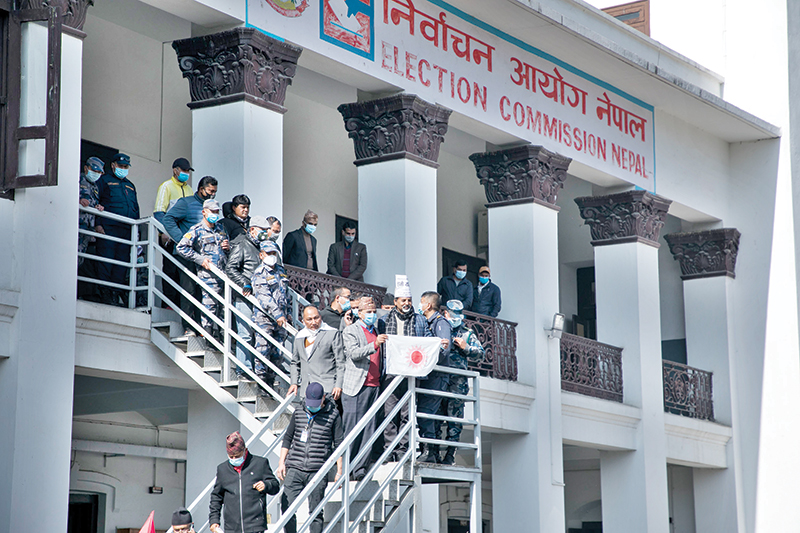
Dahal, Nepal and other senior leaders on Friday had reached the electionbody along with cadres protesting against the dissolution of the House of Representatives. Photo Photo: Hemanta Shrestha

KATHMANDU,
The faction led by Pushpa Kamal Dahal and Madhav Kumar Nepal in the Nepal Communist Party on Friday registered an application at the Election Commission claiming that it is the legitimate ruling party.  
The two factions of the ruling party—one led by Dahal and Nepal and another led by Prime Minister KP Sharma Oli which are practically split but not split yet legally, have been making claims that their factions legitimately represent the Nepal Communist Party.
Chief Election Commissioner Dinesh Kumar Thapaliya said that the faction led by Dahal and Nepal formally started the process to get recognition by registering an application at the commission.
Dahal, Nepal and other senior leaders on Friday had reached the election body along with cadres protesting against the dissolution of the House of Representatives.
As per Section 44 (1) of the Political Parties Act-2017, the faction that claims to be the legitimate faction representing the party must substantiate the claim, among other things, through the signatures of at least 40 percent members of the Central Committee within 30 days since the dispute in the party arose.
Thapaliya said that even though the two factions had earlier submitted the decision of the Central Committee held by the factions, it was the first time that the formal process was initiated by any faction as per the legal provision.
“Now, the process begins to settle the dispute regarding which faction is legitimate,” Thapaliya said. “We have told the leaders that the commission would take decisions within the period set by the law. We have to do it as early as possible even to be able to hold elections.”  
As per the Political Parties Act-2017, the commission should decide on such matters within 90 days since one faction makes formal claims about legitimacy .  
The commission will now have to seek written feedback, along with the necessary supporting documents, from the Oli faction which it will have to present within 15 days.
Officials at the commission said that the documents submitted by both factions in the recent days would also be taken into account while settling the dispute. “The Dahal-Nepal faction has been submitting documents as required by the law in the last few days,” said Raj Kumar Shrestha, spokesperson for the commission.
After receiving the feedback, the commission will invite both sides to the commission for dispute settlement and make efforts to settle the dispute through consensus, according to spokesman Shrestha.
If no consensus is reached, it will give legitimacy to one faction’s decision or the faction itself as the establishment, based on the evidence submitted. If such recognition cannot be given to one faction, the commission will recognise the faction which proves it has the majority in the Central Committee before the claims were made. The officially recognised faction is entitled to stay as the parent party while the other faction can register a new party, according to Section 44 (6) of the Political Parties Act.
The Dahal–Nepal faction has claimed that it has submitted the signature of 295 central committee members to the commission so far.  When formed in May 2018, the Nepal Communist Party (NCP) had notified the poll body that its Central Committee was 441-strong. Five members were added later.
“We have got support of more Central Committee members,” Surendra Pandey, a senior leader from the Dahal-Nepal faction told the Post.  “We told the Election Commission that we can verify the signatures with the presence of Central Committee members or without them.”
The faction led by party chair and Prime Minister KP Sharma Oli on Tuesday informed the Election Commission that its Central Committee had been expanded to make it 1,199-member with the addition of 556 members now and with the provision of adding 197 members in the future.
Satya Narayan Mandal, a close ally of Oli, who was appointed as coordinator for Province-2 by the Oli faction on Thursday,  told the Post that their faction represents Nepal Communist Party as the faction has a clear majority.
“The chair has enlarged the central committee by using the authority of being the  chair and we have a clear majority in the party,” he said.  
However, Pandey claimed that Oli faction does not have any authority to hold the Central Committee meeting as the party statute does not allow holding the meeting without fulfilling the quorum.
“In order to hold the meeting, there should be the presence of over 50 percent of Central Committee members which the Oli faction failed to do,” he said. “The other faction has also enlarged the Central Committee in large numbers which cannot be done as per the party’s statute.”
He referred to the provision in Clause 18 (E 17) of the party’s statute as per which the Central Committee can nominate a maximum 10 percent of the total Central Committee members as new members and that too only from a group that comes to merge with the party or joins the party.
Clause 60 of the party’s statute authorises the Central Committee to take decisions based on the majority vote if no consensus is reached.  
But, Mandal claimed that Dahal had also added Central Committee members in the past in the absence of Oli.
For legal experts, it will be hard for the Oli faction to get recognition as the legitimate Nepal Communist Party.
“Whichever faction has majority in the Central Committee before the dispute arose is the legitimate faction to represent the original party based on the law and practice,” said Bhimarjun Acharya, a senior advocate with expertise on constitutional law.
“The change made in the Central Committee sent after the dispute surfaced, should not be the basis for determining legitimacy as far as legal provisions and practices are concerned.”

NATIONAL

Political protests cause long traffic jams in Valley

Just 15 minutes of traffic jam in core city areas could cause at least two hours of snarl-ups in various parts of the Valley.
- ANUP OJHA
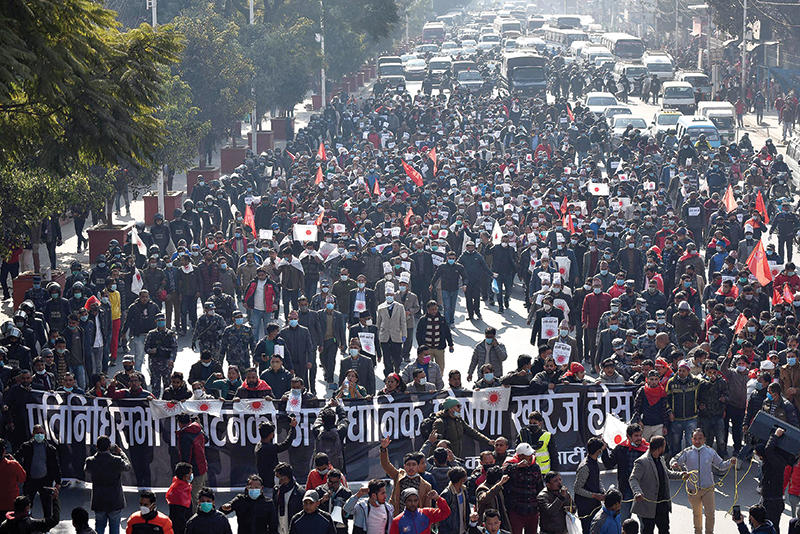
According to Metropolitan Traffic Police Division, rallies have broken out in different parts of the Valley in the last four days, obstructing traffic. Post Photo: ANGAD Dhakal

KATHMANDU,
Protests broke out in Kathmandu on Friday against the move of the KP Sharma Oli government to abruptly dissolve the lower house of Parliament and call for a fresh election.
The dissident faction in the ruling Nepal Communist Party, led by Pushpa Kamal Dahal, and the main opposition, Nepali Congress, have all condemned Oli’s action and now they are challenging his move through the streets.
Addressing a factional gathering at Babarmahal, Dahal suggested that the protest could continue in the days to come.
But with the prospect of daily protest rallies comes traffic congestion on the city streets.
“This  is going to be another blunder from our political parties. Now thousands of us have to face the protest and jam inside the Valley,” said Nilam Subedi, 26, an educational counsellor.
“Now political parties have announced a series of demonstrations, and most of them happen in between New Baneshwor and Babarmahal. This will delay my work.”
Just 15 minutes of traffic congestion in core city areas, such as Maitighar, Ratnapark or New Baneshwor, means at least two hours of snarl-ups in various parts of Kathmandu Valley, according to the city’s traffic police office.
On Friday, the protest at Maitighar not only disrupted the traffic in the area but also in different parts of the city throughout the day.
Many people were stuck in traffic jams for hours while several commuters were forced to get off from vehicles and walk to their destinations.
The series of protests announced by the disgruntled political parties have kept the Valley’s traffic police on their toes.
According to the Metropolitan Traffic Police Division, rallies have broken out in different parts of the Valley in the last four days, obstructing the traffic.  
“The traffic in the valley has come to the pre-lockdown period and it has already become problematic. The latest political situation in the country is going to make our job difficult, “said Janak Bhattrai, Senior  Superintendent of Police, also chief of the Division.
Around one million vehicles are plying the Valley roads daily ever since the government decided to discontinue the odd-even rule last week, according to an estimate of the traffic police division.
The division has deployed 1,500 traffic police officers to manage the Valley traffic.   
“It’s always the common people like us who suffer. They are protesting on the streets and we are compelled to sit in traffic jams for hours,” said Mohan Shahi, who had to walk from New Road to Lagankhel because of the protest. “The Valley’s traffic jam was already notorious, the protests have made it worse.”
Superintendent Shyam Krishna Adhikari, spokesperson of the traffic police division, said it was tougher for them to manage the Valley’s traffic now.
“Earlier we used to get notice whenever there was a protest rally. Right now we are in a situation where protests could happen anywhere and at any time,” he said.

NATIONAL

Online applications for driving licence to resume

Briefing

KATHMANDU: Online applications for new driving licences will be available from Tuesday, nine months after it was suspended over the coronavirus scare, the Department of Transport Management said on Friday. Online forms for new driving licences will be available from December 29, the department said in a statement on its website. The forms have been unavailable since March 24 when the country went into a lockdown to contain the spread of coronavirus.

NATIONAL

Two held with pistols

Briefing

SUNSARI: Police arrested two persons in possession of two country-made pistols in Bhantabari, Koshi Rural Municipality-8, Sunsari, on Thursday. Mohammad Muktar Miya, 35, and Saddam Miya, 27, of Koshi-8 were held with the weapons, said police. Security personnel also seized five bullets, two cell phones and two motorcycles from the suspects.

NATIONAL

Fire engulfs store in Janakpur

Briefing

JANAKPUR: A massive fire broke out at Mithila Department Store in Shiva Chowk, Janakpur on Thursday morning. The fire destroyed the store and other shops and a restaurant. Harikanta Mishra, owner of the store, said, “Fire was contained only after two hours. The fire was started at 10 am. But, fire engines were late to arrive at the scene. Because of this, property worth millions were destroyed in fire.”

Page 4
WORLD

Chinese coronavirus vaccines are poised to fill gap, but will they work?

For those countries that have not yet secured a vaccine, China may be the only solution.
- ASSOCIATED PRESS
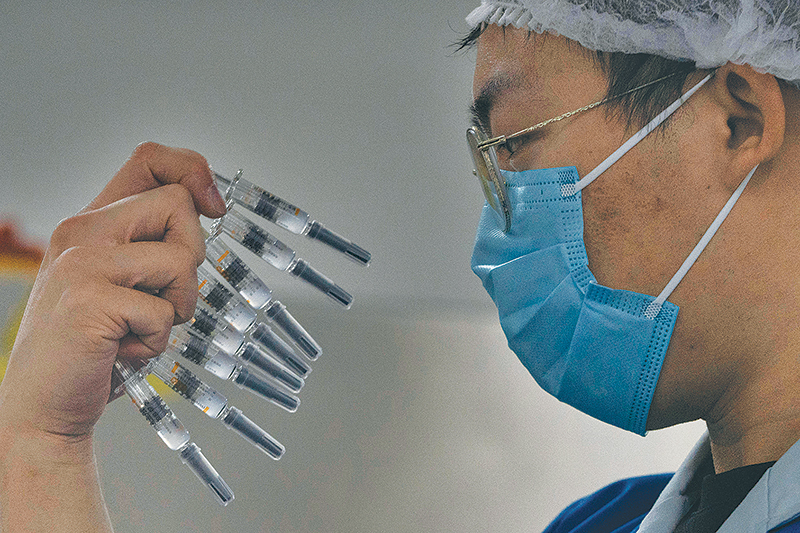
A worker inspects syringes of a vaccine for Covid-19 produced by Sinovacat its factory in Beijing on September 24. With rich countries snappingup supplies of Covid-19 vaccines, some parts of the world may have to rely on Chinese-developed shots to conquer the outbreak. AP/rss

TAIPEI,
With rich countries snapping up supplies of Covid-19 vaccines, some parts of the world may have to rely on Chinese-developed shots to try to conquer the outbreak. The question: Will they work?
There is no outward reason to believe they won’t, but China has a history of vaccine scandals, and its drugmakers have revealed little about their final human trials and the more than 1 million emergency-use inoculations they say have been carried out inside the country already.
Wealthy nations have reserved about 9 billion of the 12 billion mostly Western-developed shots expected to be produced next year, while COVAX, a global effort to ensure equal access to Covid-19 vaccines, has fallen short of its promised capacity of 2 billion doses.
For those countries that have not yet secured a vaccine, China may be the only solution.
China has six candidates in the last stage of trials and is one of the few nations that can manufacture vaccine on a large scale. Government officials have announced a capacity of 1 billion doses next year, with President Xi Jinping vowing China’s vaccines will be a boon to the world.
The potential use of its vaccine by millions of people in other countries gives China an opportunity both to repair the damage to its reputation from an outbreak that escaped its borders and to show the world it can be a major scientific player.
Yet past scandals have damaged its own citizens’ trust in its vaccines, with manufacturing and supply chain problems casting doubt on whether it can really be a saviour.
“A question mark remains over how China can ensure the delivery of reliable vaccines,” said Joy Zhang, a professor who studies the ethics of emerging science at the University of Kent in Britain. She cited China’s “non-transparency over scientific data and a troubled history with vaccine delivery.”
Bahrain last week became the second country to approve a Chinese Covid-19 vaccine, joining the United Arab Emirates. Morocco plans to use Chinese vaccines in a mass immunisation campaign slated to start this month. Chinese vaccines are also awaiting approval in Turkey, Indonesia and Brazil, while testing continues in more than a dozen countries, including Russia, Egypt and Mexico.
In some countries, Chinese vaccines are viewed with suspicion. Brazil’s President Jair Bolsonaro has repeatedly sown doubt about the effectiveness of Chinese company Sinovac’s vaccine candidate without citing any evidence, and said Brazilians won’t be used as “guinea pigs.”
Many experts praise China’s vaccine capabilities.
“The studies look to be well done,” said Jamie Triccas, head of immunology and infectious diseases at the University of Sydney’s medical school, referring to clinical trial results published in scientific journals. “I wouldn’t be overly concerned about that.”
China has been building up its immunisation programmes for more than a decade. It has produced successful vaccines on a large scale for its own population, including vaccinations for measles and hepatitis, said Jin Dong-yan, a medical professor at the University of Hong Kong.
“There are no major outbreaks in China for any of these diseases,” he said. “That means the vaccines are safe and effective.”
China has worked with the Gates Foundation and others to improve manufacturing quality in the past decade. The World Health Organization has prequalified five non-Covid-19 Chinese vaccines, which allows UN agencies to buy them for other countries.
The companies whose products won prequalification include Sinovac and state-owned Sinopharm, both leading developers of Covid-19 vaccines.

WORLD

Politics overhangs US Christmas as government shutdown nears, Covid aid uncertain

- REUTERS

WASHINGTON,
President Donald Trump will spend Christmas Day at his Palm Beach resort as millions of Americans face the risk of losing jobless benefits on Saturday and a partial government shutdown looms next week, following his threat to not sign a $2.3 trillion coronavirus aid and spending package.
Democratic President-elect Joe Biden, whose victory Trump still refuses to acknowledge nearly two months after the November 3 election, is spending the day at his Delaware home and has no public events, according to his staff.
Meanwhile, the US Congress, which normally is adjourned the last week of December, will be preparing to return to work.
On Monday, following the Christmas weekend, the House of Representatives is scheduled to vote on overriding Trump’s veto of a $740 billion bill authorising the country’s defence programmes. If the House vote succeeds, the Senate could hold its vote as early as Tuesday.
The fight over the spending and aid package comes as Americans face an unprecedented holiday season, amid a pandemic that is killing people in record numbers. Nearly 320,000 Americans have died of Covid-19 this year and the daily death toll is repeatedly well over 3,000, the highest since the pandemic began.
On Christmas Eve, Trump played golf at his course in West Palm Beach, Florida, and tweeted a series of grievances repeating his baseless claims about the election result.
Trump stunned members of both parties when he unexpectedly announced this week his dislike of the $2.3 trillion spending bill, a package that had taken the House and Senate months to negotiate. The bill provides $892 billion in coronavirus relief, and $1.4 trillion in regular government appropriations.
Trump, who was represented in the negotiations with lawmakers by Treasury Secretary Steven Mnuchin and had not objected to the terms prior to the House and Senate votes, complained that the package was too full of money for special interests and foreign aid, and said the $600 in direct payments to most Americans was too small, demanding instead that the amount be increased to $2,000.
A White House official said on Thursday that Trump’s threat to not sign the bill should not come as a surprise, noting that Trump had once signed a mammoth omnibus bill against his better judgment and said at the time that he would not do it again.
In December 2018, Trump started a 35-day government shutdown when he refused to sign a spending bill that didn’t include the funding he wanted for a border wall.
Without his signature on the coronavirus aid bill, about 14 million people will lose unemployment benefits on Saturday, and a partial government shutdown will begin on Tuesday.
It is unclear if Trump will ultimately sign the $2.3 trillion bill. Trump could also choose to take advantage of a situation known as a “pocket veto,” rather than outright vetoing the coronavirus aid package. Because the current Congress expires on January 3, Trump could let the normal 10-day period that a president has to sign or veto a bill simply run out. Bills die if they are not enacted during the Congress in which they are introduced.
If he does issue a veto, the House and Senate could try and override it next week. Congress might also have to pass a stopgap spending bill on Monday, before money that funds government operations expires at midnight.
Also on Monday, the Democratic-controlled House plans to vote on legislation providing one-time, $2,000 checks to individuals to help them during the coronavirus pandemic.

WORLD

India’s Modi calls farmer protests over contested laws politically motivated

- REUTERS

MUMBAI,     
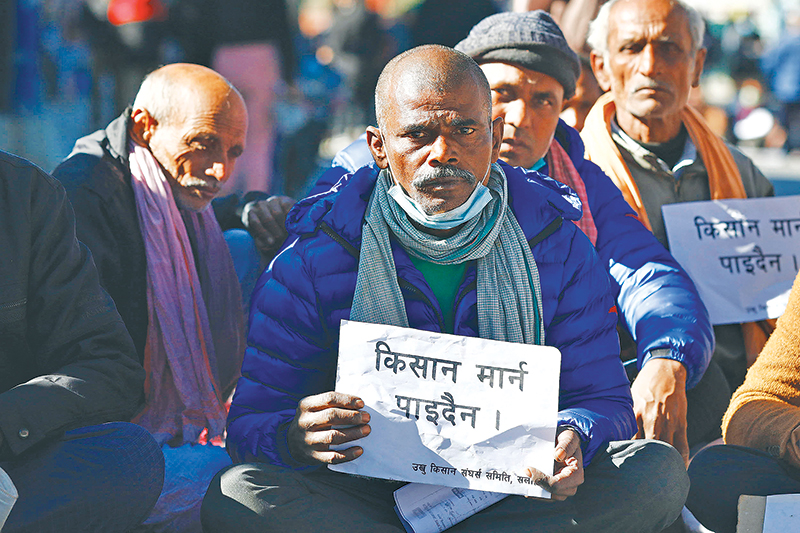
India’s Prime Minister Narendra Modi said on Friday that  protests by farmers against three laws brought by his government were politically motivated, as he touted the success of an agricultural scheme launched last year.
Thousands of farmers from several Indian states have been camped on the outskirts of New Delhi for over a month, blocking highways to demand that Modi’s government repeal the farm laws passed in September that they say threaten their livelihoods.
But Modi’s virtual public address on Friday was not focused on the laws under contention.
Instead, he spoke via video conferencing to seven farmers from different states, asking them how they had benefited from ‘PM Kisan’—a cash transfer scheme his government launched in February, 2019, under which farmers get minimum income support.
The farmers Modi spoke with on Friday praised his scheme—but none were among the thousands who have been protesting.
Modi repeatedly said “some people” were spreading lies and rumours about farmers’ troubles, and dismissed the protests as motivated by political opponents.
“All these people who are protesting in support of farmers, what did they do when they were in power?” he said, referring to opposition politicians. “Those with political motives...are firing the gun from the farmers’ shoulders.”
Modi also said he was open to discussions with farmers. “I ask even those opposing me today, that my government is ready to talk to them on farmer issues.”
At least six rounds of talks between Modi’s government and farmer leaders on the new laws have failed.
Modi used his address to also to take a dig at his political rivals, chiefly the fiery leader of the eastern state of West Bengal, Mamata Banerjee, ahead of legislative assembly elections in the state in 2021.

WORLD

In Christmas message, pope calls on nations to share vaccines

- REUTERS
Pope Francis celebrates Christmas Eve mass with only a few faithful ableto participate due to the coronavirus disease (Covid-19) regulations inorder to stop a rise in infections, in St Peter’s Basilica at the Vatican, on December 24.  REUTERS

VATICAN CITY,     
Pope Francis called in his Christmas message on Friday for nations to share Covid-19 vaccines, saying walls of nationalism could not be built to stop a pandemic that knows no borders.
In a sign of the times, Francis delivered his traditional “Urbi et Orbi” (to the city and the world) message virtually from a lectern inside the Vatican instead of from the central balcony of St Peter’s Basilica before tens of thousands.
The pandemic and its social and economic effects dominated the message, in which Francis called for
global unity and help for nations suffering from conflicts and humanitarian crises.
“At this moment in history, marked by the ecological crisis and grave economic and social imbalances only worsened by the coronavirus pandemic, it is all the more important for us to acknowledge one another as brothers and sisters,” he said.
Stressing that health is an international issue, he appeared to criticise so-called ‘vaccine nationalism’, which U.N. officials fear will worsen the pandemic if poor nations receive the vaccine last.
“May the Son of God renew in political and government leaders a spirit of international cooperation, starting with health care, so that all will be ensured access to vaccines and treatment. In the face of a challenge that knows no borders, we cannot erect walls. All of us are in the same boat,” he said.
Italians are under a nationwide lockdown for much of the Christmas and New Year holiday period. The restrictions mean people are not be able to go to St. Peter’s Square or the basilica for papal events, all of which have been moved indoors.
Christmas is above all a time to help others because Jesus himself was born a poor outcast, Francis said on Thursday night at his Christmas Eve Mass, which started two hours early so the few participants could get home in time before a 10 p.m. curfew.
“May the Child of Bethlehem help us, then, to be generous, supportive and helpful, especially towards those who are vulnerable, the sick, those unemployed or experiencing hardship due to the economic effects of the pandemic, and women who have suffered domestic violence during these months of lockdown,” he said in his Friday address.
Francis called for peace and reconciliation in Syria, Yemen, Libya, Nagorno-Karabakh, South Sudan, Nigeria and Cameroon and Iraq, which he is due to visit in early March.
He also asked to comfort those suffering from humanitarian crises or natural disasters in Burkina Fasso, Mali, Niger, the Philippines and Vietnam.

WORLD

Magnitude 6.3 earthquake strikes Philippines island

Briefing
- AGENCIES

MANILA: An earthquake of magnitude 6.3 struck the Mindoro region of the Philippines, the European Mediterranean Seismological Centre (EMSC) said on Friday. The quake occurred at a depth of 144 km (89 miles), EMSC said. The temblor, which was also felt in the capital region, also registered at magnitude 6.3 at the Philippine Institute of Volcanology and Seismology (Phivolcs). The centre was traced at Calatagan in Batangas province, according to an initial report from Phivolcs, which said it did not expect damage but warned of aftershocks. It issued no tsunami warning.

WORLD

Russia opens criminal case against ally of Navalny

Briefing
- AGENCIES

MOSCOW: Russian law enforcement agencies opened a criminal case against Lyubov Sobol, an ally of Kremlin critic Alexei Navalny, and took her in for questioning early on Friday after raiding her home, Navalny and his supporters said. There was no immediate comment from the police. Supporters of Navalny said the police action appeared to be a response to Sobol visiting the home of an alleged FSB security service agent in Moscow. Navalny had
earlier said the man took part in a botched plot to poison him in August. The FSB has dismissed Navalny’s allegations as a provocation designed to discredit it. Sobol was briefly detained on Monday after visiting the alleged agent’s flat and ringing the doorbell. She was not let into the man’s flat.

WORLD

Trial of Hong Kong people detained in China from Monday, supporters say

Briefing
- AGENCIES

HONG KONG: Ten of 12 Hong Kong people captured by China at sea as they tried to flee by boat four months ago will go on trial in the mainland city of Shenzhen on Monday, supporters said on Friday. The case has attracted great interest in Hong Kong and abroad as a rare instance of the Beijing authorities arresting people trying to leave the financial hub at a time of growing concern about the prospects for the city’s high degree of autonomy. The families had asked this week for 20 days’ notice to allow them to attend the trial, given a 14-day Covid-19 quarantine upon entering mainland China. Instead, the families of seven detainees were notified of the trial date by government-appointed lawyers, a support group said.

Page 5
MONEY

Protesting sugarcane farmers fear being elbowed out of public view

The farmers from the Tarai have been holding a sit-in to demand payment for their crops sold to sugar mills.
- KRISHANA PRASAIN
Farmers protest at Maitighar in the Capital on Friday demanding payment of their dues. POST PHOTO: KESHAV THAPA

KATHMANDU,
Sugarcane farmer Shyam Babu Sah from Sarlahi gets up early in the morning and joins the sit-in at Maitighar Mandala like he has been doing everyday for nearly two weeks. He and dozens of other farmers from the Tarai have come to the nation’s capital in desperation as sugar mills have not paid them for their sugarcane crops for years.
The farmers, used to the warm climate of the Tarai plains, have been braving the shivering cold of Kathmandu to push the government to get their money from the mill owners. Some of them are living with relatives while others are forced to sleep in the open in the bitter weather.
On Friday morning, Sah arrived at the Mandala as usual and was stunned to see three former prime ministers and a whole bunch of party workers already occupying the protest site.
The former prime ministers Pushpa Kamal Dahal, Madhav Kumar Nepal and Jhala Nath Khanal and their comrades were there to demand that they be allowed to form their own government after the ruling party split following months of wrangling.
“We fear that the unfolding political situation will overshadow our protest,” said Rakesh Mishra, patron of the Sugarcane Farmers Struggle Committee, an ad-hoc panel formed to pressurise the government to make the sugar mills clear outstanding payments to the farmers.
“Our protest is not driven by politics,” he said. “We fear the government will not pay attention to the farmers. As the Oli administration has announced that polls will be held in April and May, we doubt the government will alienate the sugar mill owners who bankroll their election campaign,” Mishra told the Post. “Now the situation is not in favour of the farmers.”
Parliament was dissolved on December 20 following a prolonged power struggle in the ruling party that has pushed the country into another political crisis. With the country going through a political upheavals, there is little hope that the demands of the farmers will be heard or met, said Mahato.
But the 42-year-old sugarcane farmer Sah is adamant. “Our protest will not be affected by changes in the political condition. We are here to get our hard-earned money. We eke our living from sugarcane farming,” he said.
According to Sah, Annapurna Sugar Mill of Sarlahi has owed him Rs588,489 for six years. He says he is not going to budge until he gets his money.
“We depend on the money we earn from growing sugarcane to pay our children’s school fees, buy farm materials, repay bank loans and buy kitchen utensils. Our sugarcane crop is our only source of income. Imagine what happens to our family when we don’t get our money for years,” said Sah.
Sah received Rs82,000 recently from the sugar mill. “But that is less than 20 percent of what the mill
has to pay me,” he said. “We are here to protest although the time for planting winter crops has already begun,” he added.
Farmers have been saying that the mill owners are not honest enough to show the actual amount that remains to be paid.
According to Ram Bilash Mahato, another sugarcane farmer, Annapurna Sugar Mill still owes him Rs50,000 to Rs60,000 even though it claims that it has paid off almost all the farmers.
“They don’t show us the account books,” he said. The sugarcane farmers have been charging that various mills owe them more than Rs900 million. But the mills say the combined outstanding amount is less than Rs550 million.
The agitating sugarcane farmers charged that the sugar mills had been trying ‘to weaken the protest’ by handing out small amounts and asking them to go home.
Ram Raya, secretary of the ad-hoc committee, said that sugar mill owners were providing accommodation to some of the farmers in a bid to break up the protest. “They are planning to disperse the farmers from the protest site by saying that they will pay all the money,” he said.  
“It’s nearly two weeks since we started the sit-in, but the government has only been inviting us
for talks instead of taking action against the mills for non-payment,” said Mishra.
“We are suffering extreme hardship sitting out in the cold, but the government is not becoming serious,” he said, adding that some of the farmers had started falling sick.
The government asked for 21 days’ time to make the mills to clear their outstanding payments. “We have agreed to that, but what if the mills fail to keep their promise?” Mishra said.
Sugar mills say that they have started depositing the money in the farmers’ accounts, but the farmers say that there has been only very small deposits
Birendra Kanodia, owner of Mahalaxmi Sugar Mill in Sarlahi, said that they had already cleared their dues. “I don’t have a single penny owed to the farmers,” he said. “And if they say that the mill still owes them money, they can file a suit.”
Mishra said, “The mill needs to pay the farmers Rs471 per quintal of sugarcane, but it has paid only Rs435,” said Mishra. The mill has not paid the government subsidy of Rs25 million, he added. But Kanodia said that the remainder is the subsidy which should be paid by the government.
“We are here to get our money. No matter what the political situation is, we will not move,” said Sah.

MONEY

EU nations start assessing post-Brexit trade deal with UK

- ASSOCIATED PRESS

BRUSSELS,
European Union ambassadors were convening on Christmas Day to start assessing the massive free-trade deal the bloc struck with Britain that should kick off next next week when the acrimonious Brexit divorce process finally comes to an end.
After the deal was announced on Thursday, EU nations already showed support for the outcome and it was expected that they would unanimously back the agreement, a prerequisite for its legal approval.
Speedily approving the deal is essential, since a transition period during which Britain continued to trade by EU rules despite its January 31 departure from the bloc runs out on New Year’s Day. Without a trade deal, it would have acerbated chaos at the border where checks on goods will have to be increased since Britain is fully out of the 27-nation bloc.
The UK parliament is expected to approve the deal in the coming days, but the agreement will have to be applied provisionally, since the EU’s legislature can only give its consent next month at the earliest. There, too, approval is expected.
The strong show of unity is testament to EU chief negotiator Michel Barnier, who has worked relentlessly to keep all EU nations and the groups within the EU parliament in the loop of developments throughout the torturous negotiations. It took more than three years of wrangling before Britain left the bloc’s political structures last January. Disentangling the two sides’ economies and reconciling Britain’s desire for independence with the EU’s aim of preserving its unity took months longer.

MONEY

Japan aims to eliminate gasoline vehicles by mid-2030s

- REUTERS

TOKYO,
Japan aims to eliminate gasoline-powered vehicles in the next 15 years, the government said on Friday in a plan to reach net zero carbon emissions and generate nearly $2 trillion a year in green growth by 2050.
The “green growth strategy,” targeting the hydrogen and auto industries, is meant as an action plan to achieve Prime Minister Yoshihide Suga’s October pledge to eliminate carbon emissions on a net basis by mid-century.
Suga has made green investment a top priority to help revive the economy hit by the Covid-19 pandemic and to bring Japan into line with the European Union, China and other economies setting ambitious emissions targets.
“The government has set up ambitious targets to achieve a carbon neutral society in 2050,” said Yukari Takamura, professor at the University of Tokyo.
“Making clear goals and policy direction in the green growth strategy will give incentives for companies to invest in future technology.”
The government will offer tax incentives and other financial support to companies, targeting 90 trillion yen ($870 billion) a year in additional economic growth through green investment and sales by 2030 and 190 trillion yen ($1.8 trillion) by 2050. A 2 trillion yen green fund will support corporate investment in green technology.
The plan seeks to replace the sale of new gasoline-powered vehicles with electric vehicles, including hybrid and fuel-cell vehicles, by the mid-2030s.

MONEY

China will conduct talks on EU investment pact ‘at its own pace’

- REUTERS

BEIJING,
China will conduct talks on an investment pact with the European Union “at its own pace”, its foreign ministry said on Friday, raising doubts about whether a deal can be sealed by year-end.
Negotiations for the EU-China Comprehensive Agreement on Investment, which would grant European companies greater access to the Chinese market, have gone on for six years.
An EU official said last week that a deal was close following a push from Germany, which holds the EU presidency until the end of the year and is the biggest European exporter to China. But the latest comments by the Chinese government suggest otherwise.
China will “conduct talks at its own pace on the premise of safeguarding its security and developmental interests”, foreign ministry spokesman Wang Wenbin told a news briefing on Friday.
His comments echoed that of the commerce ministry, which said late on Thursday that reaching an agreement required effort from both sides to “meet each other halfway”.
Wang’s latest comments were also a walk-back from a day earlier. On Thursday, Wang had denied that talks were stuck due to China making more demands on nuclear energy. “As I understand, talks are goings smoothly,” he had said.
A senior Western diplomat in Beijing told Reuters that China had asked Europe for “impossible things”, such as access to sensitive sectors such as energy, water treatment and public utilities.
Another major sticking point is China’s reluctance to ratify international laws related to labour and other aspects of sustainable development, the diplomat added.

MONEY

US retailers brace for flood of returns from online shopping

- ASSOCIATED PRESS
A customer is shown at the exchanges and return counter in a Target department store in Glendale, Colorado.  AP/RSS

NEW YORK,
A huge surge in online shopping during the pandemic has been a saviour for retailers, but it comes at a price.
Shoppers are expected to return twice as many items as they did during last year’s holiday period,
costing companies roughly $1.1 billion, according to Narvar Inc, a software and technology company that manages online returns for hundreds of brands.
Retailers don’t want the returns, but they do want shoppers who may not feel safe going to stores to be comfortable buying things they haven’t seen or tried on in person.
People have been doing so much online buying since March that carriers like UPS and FedEx were already at full capacity before the holiday shopping season. And online sales just keep soaring. From November 1 though Tuesday, they spiked 32 percent to $171.6 billion, compared with the year-ago period, according to Adobe Analytics. The massive challenges of shipping Covid-19 vaccines in the weeks and months ahead could put further pressure on the system.
That means shoppers who return items may not get refunds until two weeks after they’re sent back to the store, said Sara Skirboll, shopping expert at deals site RetailMeNot.
Many companies are offering more locations where customers can drop off returns, which cuts down shipping costs and gets refunds to shoppers more quickly.
Last year, Kohl’s began allowing Amazon returns at all of its 1,000 stores—customers drop off items for free, with no box or label needed. This year, Amazon customers can also return items at 500 Whole Foods Market stores. That’s in addition to Amazon’s deal with UPS to allow similar drop-offs at UPS stores.
Happy Returns, a Santa Monica, California-based startup that works with about 150 online retailers like Rothy’s and Revolve, has increased its number of drop-off locations to 2,600, from more than 700 last year. That includes 2,000 FedEx locations.
“It’s a great time to be in the returns business. Every day, there’s a record,” said David Sobie, CEO and co-founder of Happy Returns, noting he’s processed 50 percent more returns in December than November.
Walmart, the nation’s largest retailer, announced earlier this week it will pick up items shipped and sold by Walmart.com from customers’ homes for free through a new partnership with FedEx. The service will continue beyond the holiday shopping season.
A growing number of retailers are asking shoppers to not even bother sending back certain rejected items.
When Dick Pirozzolo wanted to return a too-small jersey he bought for $40 on a website called Online Cycling Gear, he was pleasantly surprised with the response. The site told him to keep it, discard it, or give it to a friend or charity—and it will send him the right size for an extra $10.
“I was fine with that,” said the 77-year-old cycling enthusiast from Wellesley, Massachusetts. “I did a good thing for a friend, and I got a new shirt.” The experience, he says, has given him confidence to buy more online this holiday season.
David Bassuk, global co-leader of AlixPartners’ retail practice, says stores are increasingly making it easier for shoppers to feel less guilty about returning items.
“If they’re not sure of their size, they order both sizes,” he says. “If they’re not sure which colour, they order both colours. And if they’re not sure which item, they order them all. But it’s costly to the retailers, and the retailers are not well positioned to handle all the cost.”
On average, people return 25 percent of items they buy online, compared with only 8 percent of what they buy in stores, according to Forrester Research’s online analyst Sucharita Mulpuru. For clothing it’s even higher, about 30 percent.
But not all rejected items are the same and have varying levels of depreciation, experts say. After an item is sent back to the retailer, the company must assess its condition and decide whether to resell it, send it to a liquidator or the landfill.

Page 6
SPORTS

Troubled Premier League managers look for Christmas joy

Arteta’s Arsenal are four points above the drop zone, Bruce’s Magpies are in the 12th but next face Manchester City and then Liverpool and Wilder’s Sheffield have just two points.
- AGENCE FRANCE-PRESSE
(From left) Arsenal boss Mikel Arteta, Newcastle coach Steve Bruce and Sheffield United manager Chris Wilder all are under scrutiny. Reuters

LONDON,
Slaven Bilic’s sacking by West Brom last week made him the earliest managerial departure in a Premier League season for six years after it took 18 games for Cardiff City to dismiss Neil Warnock in 2014. The next sacking may not be long in coming with several bosses having serious question marks over their futures.
Mikel Arteta’s FA Cup success last season and then victory over Liverpool in the Community Shield suggested the turbulent period for Arsenal under his predecessor Unai Emery had been laid to rest. However, heading into a tough home clash with highflying London rivals Chelsea on Saturday the bright new dawn has clouded over and the former Gunners captain’s future after just over a year in charge is in doubt. The 38-year-old Spaniard has overseen their worst start since the 1974/75 season—they have scored just 12 goals to boot—and lie just four points above the relegation zone.
It says a lot about the gloom surrounding the club the board have inserted clauses in the players contracts of a cut in pay should they be relegated for the first time since 1912/13 when they were known as Woolwich Arsenal. Areta will hope the board keep the faith and listened to the sterling defence his former boss at Manchester City Pep Guardiola mounted after the Gunners lost 4-1 to them in the League Cup on Tuesday. “It’s just a question of time and he will do well. Football changes in one week so quick,” said Guardiola.
Steve Bruce knows all about the ups and downs of football management especially after Newcastle’s disappointing League Cup quarter-final exit at the hands of second-tier Brentford. The Magpies look reasonably comfortable in 12th place in the table. However, with a trip to Manchester City on Saturday and then welcoming champions Liverpool a few days later the eight points separating them from the relegation zone could be whittled away such is the volatility of this campaign.
Bruce, 59, is believed to enjoy the support of Magpies owner Mike Ashley but there are growing rumblings of discontent from the fans who aside from seeing a chance of a trophy disappear are far from happy with the unimaginative style of play.
Bruce has not been helped by losing influential players captain Jamaal Lascelles and French star Allan Saint-Maximin who are both suffering the after-effects of Covid-19. Bruce said after the Brentford defeat he had not lost the dressing room, though it was hardly a convincing response.
“Are the players playing for me?
I think they are,” he said.
“Maybe they’re not playing well enough, but it’s not without effort and determination.”
Bilic might well scratching his head at being the first manager sacked when he compares notes with Sheffield United’s Chris Wilder. The Blades’ board have shown admirable gratitude and restraint in retaining faith with the 53-year-old Englishman despite garnering just two points this season—the worst start in Premier League history. Wilder is living off the currency he gained through guiding Sheffield United to the Premier League and then ninth spot last term. Wilder has a tough test at home to Everton on Saturday but the board’s patience may snap if he fails to secure points at Burnley on Tuesday. A 3-2 loss to Manchester United and then a draw with struggling Brighton has given hope to Wilder.
“If we don’t show that right attitude, we’re toast—we understand that, so it won’t happen,” he said. “At least there’s a little bit of light at the end of the tunnel after the last two games.”

SPORTS

Indian Premier League to add two more teams from 2022

- REUTERS

NEW DELHI,
The Indian Premier League (IPL) is set to become a 10-team affair from 2022 after the Indian cricket board on Thursday approved a proposal to add two more franchises to the world’s richest Twenty20 competition.
The eight-team league, with an estimated brand value of $6.8 billion, drew record television and digital viewership this year despite being staged in the United Arab Emirates following the Covid-19 surge in India.
“We have received an in-principle approval to add two more teams after talking to all the stakeholders,” Board of Control for Cricket in India (BCCI) treasurer Arun Singh Dhumal told Reuters after the AGM in Ahmedabad.
“Now the issue will be discussed in the IPL Governing Council - how and when to add the teams.”
Local media has reported in the past that Indian conglomerates Adani Group and RP-Sanjiv Goenka Group, which owned the now-defunct Pune franchise for two IPL seasons, have shown interest in buying new teams.
The board also discussed the possible inclusion of cricket in the 2028 Los Angeles Olympics, something the International Cricket Council (ICC) is very keen on, but did not specify its stance. “That still needs to be discussed. We need some more clarity on this issue (from ICC),” Dhumal said.
Another vexed issue that came up at the meeting was securing tax exemptions, as demanded by the ICC from host nations, for the 2021 Twenty20 World Cup and the 50-over World Cup in 2023.

SPORTS

Swimming sensation Gaurika vying for votes

- Sports Bureau
Swimmer Gaurika Singh is one among the five nominees of the Peoples’ Choice Award. Post file Photo

KATHMANDU,
“I belong to Nepal and I play for my country,” an emotional Gaurika Singh said during the 13th South Asian Games (SAG) that took place from December 1 to 10 last year. There was a reason for the teenage swimming sensation’s statement. The 18-year-old lives with her parents in London. She has been honing her swimming skills and trying to get better every other day. Despite living in a foreign country, she has not forgotten her roots and has been representing the country in major events.
The 13th edition of SAG was the biggest sports event for the country in the past year (2076 BS) and the biggest achievement at the mega event was the four gold medal haul by Singh. Apart from gold, she also claimed two silver and three bronze medals while winning the hearts of all Nepalis. Singh would definitely find her place in the history books as the most successful athlete of the country. She has been nominated in the popular category of the NSJF Pulsar Sports Award to take place on January 12 in Satdobato. Singh achieved top finishes in 100m, 200m and 400m freestyle besides podium finish in 200m backstroke.
She is one among the five nominees of the Peoples’ Choice Award along with basketball captain Sadina Shrestha, karateka Manday Kaji Shrestha, volleyball captain Aruna Shahi and football’s Sabitra Bhandari. According to the organiser of the award, the players were selected on the basis of their performance and popularity in the past Nepali calendar year. The winner among them will be decided on the basis of votes received through eSewa, Facebook likes, votes from organiser Nepal Sports Journalists Forum members and chief coaches of sports associations.


Singh is one of the best known contemporary sports personalities of the country. Apart from the 13th SAG, she bagged global fame in the Rio Olympics of 2016 when she became the youngest player at the global sports meet at 13. Before that she had made a strong presence at the regional level during the 2016 SAG held in India where she bagged one silver and three bronze medals at a tender age.
It’s no exaggeration to say that Singh is the best recognised Nepali player at the global stage and her much improved performance in last year’s SAG compared to the 2016 edition signals that the teenager has a bright future in the world of swimming.

SPORTS

ANFA to hold provincial league from mid-January

Briefing

KATHMANDU: With a view to resuming domestic football, the All Nepal Football Association (ANFA) on Friday decided to hold the provincial league from mid-January. A meeting of the football governing body’s representatives and provincial representatives had decided to hold provincial league football in Province 2, Bagmati Province and Sudurpaschim Province. According to an ANFA statement, the province will send details of the proposal to ANFA within a week. ANFA has earlier decided to start ‘B’ division league from February 23 and ‘C’ division from March 14. (SB)

SPORTS

Man City’s Jesus and Walker test positive for Covid-19

Briefing

MANCHESTER: Manchester City striker Gabriel Jesus and defender Kyle Walker have tested positive for Covid-19, the Premier League club said on Friday. Two other City staff members have also tested positive for the novel coronavirus, and all four are self-isolating. “Everyone at the club wishes our colleagues a speedy recovery over the Christmas period ahead of their return to work, training and competition,” City said in a statement.  (REUTERS)

SPORTS

Former England batsman John Edrich dies aged 83

Briefing

LONDON: Former England batsman John Edrich, who made more than 100 first-class centuries, has died at the age of 83, the England and Wales Cricket Board (ECB) said on Friday. Edrich scored more than 5,000 runs for England during a 77-match Test career, including 12 centuries. The former Surrey captain notched 103 hundreds and more than 39,000 runs in first-class cricket. “With John’s passing, we’ve lost a prolific and fearless batsman—one of the select few who have scored more than 5,000 runs for England,” ECB chief executive officer Tom Harrison said in a
statement.” Edrich made his Test debut against West Indies in 1963, ending his career at the highest
level against the same opposition in 1976. (REUTERS)

MEDLEY

Horoscope

ARIES (March 21-April 19) ****
Ever watch a cat play with a catnip mouse? They most certainly know it’s not a real mouse, but that doesn’t mean the game is any less fun. The game is the point, not the toy. Think of the game you’re playing now the same way, but be more humane.

TAURUS (April 20-May 20) ***
If anyone makes a terrific companion, it’s you. You have the endurance and tenacity of a bull. You’re game for anything, as long as you can get back in time to shower and change for work. Today is going to be fun.

GEMINI (May 21-June 21) ****
You’re usually pretty good at gauging the mood of the person you’re keeping company with, especially if you’re interested in more than just a friendship. At the moment, though, you’re not quite sure which of your usual tactics to employ.

CANCER (June 22-July 22) ***
It’s no coincidence that emotions have always been your specialty. You know how to express them no matter who happens to be watching, because it never occurs to you to hold them back. After all, aren’t feelings the best part of being human?

LEO (July 23-August 22) ***
Things are going along so well right now that you’re almost afraid to mention what’s going on—the old “waiting for the other shoe to drop” paranoia, that is. Relax. Share the good word and don’t be surprised if some friends turn up to take part in the fun.

VIRGO (August 23-September 22) ****
You want to let absolutely everyone know how happy you are and why. Start by getting permission from the other half of your joyous news. Once you get the okay, tell your friends, family, co-workers, and anyone you make pleasant eye contact with.

LIBRA (September 23-October 22) ***
You could meet someone now who really seems to like you. Still, the memory of past relationship failures could haunt you. Everyone has experienced love on many levels, and it’s difficult to judge which level a new friend is on.

SCORPIO (October 23-November 21) ***
You’re having visions right now, but they aren’t delusions; they’re visions of things you want to do. Whether you’re seeing palm trees, spas, or Broadway shows, you can start making plans. If you don’t, you’ll just be cranky and irritable.

SAGITTARIUS (November 22-December 21) ***
At this particular moment in time, intimacy is definitely what you’re after, but not in the traditional sense. It’s not a physical connection you’re looking for. You want a meeting of the minds and the souls, and you won’t stop until you get it.

CAPRICORN (December 22-January 19) ****
If anyone is good at keeping a poker face, it’s definitely you. Now, a certain person you’ve been doing your absolute best to hide your feelings from could suddenly approach you. You may be taken off guard, but keep your cool!

AQUARIUS (January 20-February 18) ***
You’re a cerebral creature who often blasts through the routine of your day with so many thoughts and simultaneously battling for attention that you forget to notice small nuances. Today, take a breather and do that.

PISCES (February 19-March 20) ***
You’re set up to have one of those priceless days. Don’t take it for granted, but don’t get too carried away being grateful either. You can enjoy it without feeling indebted to whatever person gets the show on the road for you.

Page 7
CULTURE & LIFESTYLE

In bits and pieces

When trapped in the house for months, little things in life preserve your sanity, like a flock of pigeons and their gentle cooing.
- Bibek Adhikari
UNSPLASH

A gravelled path runs from in front of the house, worn-out by many feet and hardened by the bright afternoon sun. The path takes a right-angle turn in the corner and goes all the way to the market square, a place bustling with the daily hubbub of traffic and pedestrians.
Of late, I have been missing the sights and sounds, the smell and touch of the familiar. I miss the faces, the smiles, the cafés, the sweet aroma of spices, the soft-spoken conversations, the susurrations . . . meeting the eyes of strangers, returning their nods or smiles. I even miss the overcrowded buses, the constant honking, the insipid songs blaring from the overhead speakers . . . and the people, of course.
Once an ardent supporter of Jefferson’s inhumanism—the belief that humankind is too self-centred and can do away with some “uncentering”—I now despise that theory and refuse to see any merit or glory in a person who chooses to live in a bubble. I shun the Thoreauvian idea of living in a cabin in the middle of the woods, no matter how romantic and utopian it sounds.
***
After being locked in the house for too many days, it’s not surprising that a bittersweet feeling or a tantalising revelation comes swirling out of thin air. I see it on the slow spread of the orange glow against the brick-and-mortar walls. I listen to it in the daytime lull or in the night-time melody of my drowsy neighbourhood. I taste it in the heavy air of my room, and I quiver with longing, with this feeling, this sensation of being born.
That is, tumbling out of the dark canal—trembling in trepidation—into a world full of panic and ordeal; the prospect of leaving the halcyon days of the womb, only to live in a constant miasma of chaos and catastrophe. Plath would have called it a “monumental grotesque joke” had she lived through this age, this time.
***
With my mobility being constrained within a rigid boundary, I think of the days when moving was easy. All you had to do was get out of the door, the boundary wall, into the vast world—akin to coming out of that dark, dreary tunnel, with a scintilla of hope that there would be light, flickering and welcoming, at the end. Now the light is out, and the tunnel stretches as far as the eye can discern.
There is so much that goes into the mind before one thinks of moving, raising the metaphorical legs and taking slow and steady steps. The boundaries encircle you; they cripple you. And you realise suddenly that mobility was an illusion, and turn away on the verge of tears. You give up your thoughts, your dreams, your mind . . . for the illusory comfort that is often called “home.”
***
The proverbial frog in the well, the kupamanduka, is both smug and worried. Refusing to see any further, he foolishly considers the enclosing brick walls to be the limits of his knowledge. The dark and dismal entrapment becomes his safe haven, yet he despises his abode. A glimmering mist on the opening tells him there’s more to life than the murky waters and greyish moss.
I am that frog, wallowing in the comforts of my room—standing at the window and watching the clouds float dreamily. I know there’s more to life than these brick walls, the varnished desk, the bitter taste of instant coffee, and the brightness of a cell phone’s screen. But the frog in me doesn’t know what more should a person want. And where does this wanting lead to? More wanting—and a vicious cycle of unhappiness?
***
Sometimes I think I’d be happier if I stopped thinking altogether; if I didn’t have a cranium with a thinking machine floating in the ethereal void; if I believed in the flawed comforts of home—ah, how humans crave for security, especially during troubling times. A place where you can feed and rest your body, and give your soul to people who you think care for you.
Sometimes I think just the opposite.
What, after all, is a human if not a thinking machine? Thoughts swallow up the mind, its intricacies and complexities. Thoughts consume the workings of an anatomical being, sending electric shrills down the spine. What good will be a human with no thoughts, no desire, no passion, and no pain?
***
Tired of being a kupamanduka, I seek meanings in-between boundaries, in the fluctuating liminal space, inside the bluish haze of social media. I search for a human connection, my body aching with desire. I read between the lines, acknowledge the spaces and pauses, forgo the long silences. The meaning of my life is entrenched in every word I type in the chat box—in every avoidance and rejection.
In every typewritten word, I try my best to seek assurance. No matter my inability to compose a verse or spin a yarn, I struggle to accept the setbacks with equanimity.
***
When trapped in the house for months, little things in life preserve your sanity. A flock of pigeons and their gentle cooing on the neighbour’s terrace keep me from going crazy. I owe my sanity to the house sparrows chasing each other, to the stray dogs tottering in glee, to the shadows and silhouettes of my parents moving from one room to another.
What keeps me from running into the streets, screaming for help, are the stacks of books caked in dust, a pile of spiral notebooks, a six-year-old laptop, the mildly uplifting view of box-shaped houses from the window, the sunlight that comes slanting in, the memories that never seem to fade away.
But is “sanity” such a grave topic when heinous mutant viruses assail and blitz humankind?
***
The Thoreau in me lies still. The idea of home-away-from-home, or a shack in the woods, terrifies me. Ensconced with my parents, in the oddly familiar yet bizarre surroundings, I try my best to find comfort in accepting things as they are—yet the sceptic in me dreads the frog croaking in joy from the bottom of the well.
What I want to do with this moment is to take it in my hands and wrench a piece of love and loneliness out of it—and hopefully, transform it into the beauty of the written word. Like many artists of the bygone days, I want to make art out of the hurt and sorrow and the endless entrapment.
To stop from being bored to tears by a do-nothing life or run into the risk of weeping into the pillows as the day ends, I will have to find meaning and fulfilment in smaller things. Say, for instance, the crow cawing from the telephone wire or the neighbour’s dog barking ad nauseam.
Otherwise, I might end up living through this new tragedy, barely recognising its passing; confined in a well of cold comforts—with a jaundiced and fractured sense of the world around me.


Adhikari writes poetry and fiction. He tweets as @bibek_writes.

CULTURE & LIFESTYLE

Novelist Yu Miri: Olympics not helping Fukushima rebuilding

Tokyo’s Ueno Park, where a homeless man kills himself in Miri’s award-winning story, looks very clean ahead of next summer’s Olympics. But that doesn’t help the delayed recovery of the disaster-hit Fukushima region.
- MARI YAMAGUCHI
Japanese writer Yu Miri speaks during a news conference in Tokyo. AP/RSS

TOKYO,
Yu Miri, who won this year’s National Book Award for translated literature, says Tokyo’s Ueno Park, where a homeless man kills himself in her award-winning story, looks very clean ahead of next summer’s Olympics. Still, she says, that doesn’t help to raise hope amid the coronavirus pandemic and the delayed recovery of the disaster-hit Fukushima region.
The park is a main setting of Yu’s award-winning novel, “Tokyo Ueno Station,” in which the protagonist, Kazu, a seasonal worker from Fukushima, ended up. The elderly man first came to the Japanese capital a year before the 1964 Tokyo Olympics for construction work.
Yu said at a Tokyo news conference that she visited the park recently and it was surprisingly clean, but that an area where she used to interview homeless residents for her book has largely been eliminated.
The book, first published in Japan in 2014, portrays the life of the seasonal worker without a place to go back—a theme for many of Yu’s works.
The story was based on her interviews with homeless squatters living in huts made of cardboard boxes and blue plastic tarp more than 10 years ago. She said she was also inspired by about 600 Fukushima residents she interviewed while hosting a local radio program that she started a year after the March 2011 meltdowns at the Fukushima nuclear plant.
The triple meltdowns at the plant caused massive radiation leaks to the outside, contaminated the surrounding areas and displaced as many as 160,000 people from the no-go zones and elsewhere in the prefecture. Most of those places have been reopened as the government has tried to showcase the recovery ahead of the Tokyo Games, but those who returned to their homes are largely elderly people.
Many families, especially with small children, say they don’t plan to return to their homes due to radiation concerns as well as loss of their former jobs and communities.
But their lives have significantly changed—for the worse—since Yu finished the book, with a growing sense of isolation among Fukushima residents amid preparations ahead of the Olympics, and the coronavirus pandemic that has made them more isolated, said Yu. She has since moved to Minamisoma, where she opened a book café in hopes of creating a place for locals to get reconnected after displacement due to the nuclear disaster.
“Both the nuclear accident and the coronavirus pandemic have revealed distortion and inequality in society,” Yu said.
“Many people see the situation through a lens of despair instead of a lens of hope,” she said. “Perhaps the story fit their thinking and that’s probably why the book has been widely read.”
She said disaster-hit areas have not recovered enough and preparations for the Olympics have taken away resources and jobs from the recovery projects, becoming part of the reasons delaying their reconstruction. “Organizers should have seen the level of progress of the reconstruction before deciding to host the Games,” she said.
The Olympics, initially planned for July 2020, were postponed until next summer due to the pandemic.
Many of those Yu interviewed had worked as seasonal workers in Tokyo during Japan’s post-war economic advancement. When they finally came back to have an easy retirement life back in their hometown, they lost their homes in the Fukushima disaster. “A man told me it was back luck, and the word got stuck in my chest like a thorn,” she said.
Yu remembered another thorn she has had in her chest from her past conversation with a homeless man. He told her that those who possess the roof and walls don’t understand the feelings of those who don’t.
“So I wrote the story of how the man named Kazu lived and chose death, not from the outside but his inner self, thinking that perhaps I can convey how he felt to those who have places to go back,” she said. “As a novelist, my job is to play a role as an endoscope to look inside of a person, while also showing him or her with an external camera.”
Yu, an ethnic-Korean who was born and raised in Japan, writes in Japanese and has won a number of Japanese literature awards, including the prestigious Akutagawa Prize in 1997 for “Family Cinema.”


— Associated Press

Page 8
CULTURE & LIFESTYLE

Celebrating the art in nudity

Curated by Roshan Mishra and Kapil Mani Dixit, ‘The Virtually Nude Show’ is a thoughtful virtual exhibition that tries to break away from the conventional connotations attached to nudity in art.
- Ankit Khadgi
The exhibition celebrates artistic expression in nudity by giving space to 57 heartfelt and unique artworks from artists across the globe. Photos: Screengrab via Nepalian Art

Kathmandu,
Torsos, thighs, breasts, vaginas, and phalluses. Slim, hairy, chubby, and smooth bodies. Who would have thought that the most intimate parts of our bodies, which we hide under our clothes, can be not only the subject and medium of art but art itself?
When one visits the website of Nepalian Art, they are greeted with such pieces of art, which are made with compassion, love, anger, frustration—highlighting how our bare bodies can be forms of artistic expression.
Curated by Roshan Mishra and Kapil Mani Dixit, ‘The Virtually Nude Show’ is a carefully chosen and thoughtfully organised virtual exhibition that not only tries to break away from the stereotypes that are usually associated with nude artforms but also celebrates bodies of all kinds.
One of the first artworks that meet the eyes of the visitors is a piece by Roshan Pradhan. Titled as ‘A New World’, through the artwork, Pradhan depicts a future, an apocalyptic world, where robots rule the world.
In the painting, we see a woman indulging in sexual intercourse with a robot. The woman is so lost seeking pleasure that she has closed her eyes and has submitted her body to the robot. Meanwhile, at the bottom of the painting, we see two small kids. In between them is a tiny robot.
Through these motifs, Pradhan depicts what the future could have in store for us. The woman represents the whole of humankind, and Pradhan, through the woman seeking pleasure from a robot shows how we are submitting our soul and body to robots for the sake of pleasure and excitement that isn’t going to last forever.
Meanwhile, the small tiny robot symbolises the future possibilities of the union between human beings and robots. There are other equally captivating motifs and use of colours in his artwork that succeeds in what he aspires to do—warn the people about the doomed reality of the future.
Another equally poignant work is ‘Asylum Project’, a photograph layered with a digital painting of George Strifatris, a Greek artist, which incites emotions of empathy and melancholy.
In the photograph, we see the behinds of two naked men who are walking on a stairway. One man is putting his arms around the other, who is holding a thin fabric in his right hand. The work talks about how human beings are migrants in their own land, and the world isn’t as one supposed it will be. And to overcome the nothingness, the artist believes one needs to be brave and naked and find their own refuge.
Hence the subjects of two bare naked men in the photograph successfully convey his message: that if one needs to reach the state of nakedness, the shredding of the inhibitions of the soul is necessary to find one’s sanctuary.


But not all artworks depict naked human beings. Breaking away from the idea that nude art is equal to drawings, paintings, and photos of bare-chested human beings who flaunt their body parts and embrace their sexuality, there are many artworks that embody the essence of nakedness without any skin show.
And among such artworks, Mukti Thapa’s artwork ‘Sangam’ (Confluence) stands out, both because of its simplicity and intricacy. In the artwork, Thapa depicts male and female genitals, which are surrounded by various motifs, rich in intricate detailing.
The male and female genitals are infused together in the artwork, hence the title Sangam (Confluence), signifying the coming together of the two body parts who now have become one.
Sara Koinch’s ‘Lockdown’ is another equally evocative personal artwork who through her painting of a naked woman not only depicts her sentiments but also reflects the feelings and the roller coaster of emotions, which most people went through this year.
In the painting, we see a naked figure of a woman who’s all blue, juxtaposed along a maze-like structure. The woman has her eyes closed, and in her right hand, she is carrying a hammer. Meanwhile, the facial structure is painted in such a way that it resembles a door lock.
With the help of the information provided to the viewers, we get to know that Koinch is trying to depict the frustrations she went through during the lockdown and she succeeds in doing so with the help of motifs in the painting. The blue colour used in the woman symbolises her mental state. Likewise, the maze, which is in the background, also symbolises the confused mental state of her mind. She says during the lockdown, she felt that her brain was like a door lock, meaning her brain was stuck and fixed, as she couldn’t use her mind in doing things she used to do freely.
One thing that also should be appreciated about the exhibition is the space it gives the artworks that depict the bodies of men delicately. Rarely do we get to see bare-chested chubby, thin, old and young men, embracing nudity in forms of art, as female nudity is mostly given more focus in the artforms, which too is filled with the male gaze.
However, in the exhibition, there are plenty of bare and naked men, who are embracing their sexuality, accepting their vulnerable, delicate side, and this is refreshing to see—a good break from all the macho, virile men that we have been seeing from ages in various artforms when it comes to showing the bare and nude.
One such artwork that not only draws the eyes of the visitors but will also make people retrospect about their surroundings is by Roshan Mishra, the curator of the exhibition. Titled as ‘The Scream’, the mix media artwork is a self-portrait of Mishra, where we see him screaming. While we use our eyes to watch and observe Mishra’s artwork, one’s hearing sense will equally be equally active, as it feels that he is actually screaming aloud, even when we don’t hear any noise.
In the artwork, which is a photograph printed in a negative format, he has also used acrylic colours as we see hues of reddish colour spreading around the photograph.
His artwork is simple, but it leaves an everlasting impact—a thoughtful commentary on the society and the gender norms that suffocates men, forcing them to follow a certain behaviour and carry out roles, even when they don’t want to.
The scream here both is an outcry, a release of anger and frustration towards society, and a call out to other men, who are equally disturbed by the timeworn gender roles and norms.
But there are few artworks that are either very plain or require a lot of effort to understand. For instance, ‘My Body My Home’ by Ricardo Coelho is bound to test the patience of viewers. In an eight-minute-long video, we see a group of naked men and women entering and coming out of a cage. Likewise, they also utter some words, which are difficult to understand, as it is in a different language, due to which the viewers may not understand what the artist is trying to say through the video.
Sadaf Faiz’s ‘Poor Substitute of a George Keyt Woman’ in comparison to other artworks is too plain, as her work features only the figure of a half-naked woman, making her artwork forgettable.
The curators should also have taken heed in making the exhibition more engaging, with adding features like music in the background or made it more appealing since it exhibits 57 artworks, which can be a lot for the audience, in regards to investing their full time and watching the exhibition thoroughly.
But their efforts in trying to change the orthodox concept attached with nude artworks and to provide a platform for inspiring artists who use nudity as a form of artistic expression in an unprogressive society is exemplary, opening possibilities to celebrate art in nudity in the future.
The exhibition will be held until 31st January 2021, virtually.

CULTURE & LIFESTYLE

Review: Tom Hanks is doggedly heroic in ‘News of the World’

The film is a visually stunning film with a soulful message about forgiveness and moving past trauma.
- MARK KENNEDY
Tom Hanks (left) and Helena Zengel appear in a scene from News of the World. AP/RSS

New York,
Tom Hanks rides a horse and blasts a six-shooter in his new film, “News of the World.” Some of you might be thinking this must be his first cowboy role. To those, we respond: Have you forgotten about Woody so soon?
All of Hanks—not just his voice—is employed in this second cowboy role, playing Captain Jefferson Kyle Kidd in 1870, a gentle Texan whose quiet and itinerant life is interrupted by the arrival of a girl.
Director and co-screenwriter Paul Greengrass reunites for the first time with Hanks since their 2013 outing “Captain Phillips.” This time, they’ve ditched the open water for an ambitious adventure firmly on land, based on the novel by Paulette Jiles. It’s a visually stunning film with a soulful message about forgiveness and moving past trauma.
Kidd is scarred—literally—by the Civil War and has found a life as a newsreader, a man who goes from town to town reading aloud the nation’s headlines to small-town residents or “for anyone with 10 cents and the time to hear it.”
He comes across a feral 10-year-old girl who is an orphan twice over—her settler parents are dead and the Native Americans who raised her are also gone. She speaks no English and frightens everyone. “She’s got kind of a wild look about her, doesn’t she?” someone comments. Says another: “Sure as I live, that child’s trouble.”
The girl has distant relatives hundreds of miles away and, naturally, it falls on Kidd to be the hero. “This little girl is lost. She needs to be home,” he says. So these two broken souls embark on an epic odyssey—like “The Searchers” mashed with “True Grit”—through hostile terrain and bandits, while he teaches her English along the way, like a cowboy Henry Higgins. “I guess we both have demons to face going down this road,” he notes.
This is an ugly-beautiful film. You can almost feel the grime, hear the squelch through muddy streets and choke on the smoke. It practically reeks of leather and wet cattle. It’s a setting where dogs bark incessantly, dust is everywhere and socks have holes. In this naturalistic world, Hanks sticks out, but not for the right reasons.
His character is a former Confederate soldier who is dismayed by the lynching of Black men and even kindly buries a victim of it. He notes ruefully that settlers kill Native Americans for their land and that Native Americans kill settlers for doing that, a deadly cycle that he stands outside. He feels the frustration between Southern civilians and Union troops but hopes all sides can get along. “We’re all hurting. All of us,” he says. “These are difficult times.”
All around him there is filth and violence and yet Hanks’ captain is not of it.
This is the film’s big weakness. The script tries to suggest that our patient captain is riddled with guilt for what he did as a soldier, but the Hanks we see is just too pure and noble. When someone asks him about the motives for his quest—”They paying you or are you doing it out of the goodness of your heart?”—there’s just one answer. “I want to get you away from all this pain and killing, get you clear of it,” he tells the girl.
Hank’s Kidd never shoots first, despite being pursued by murderous thugs. He tries to connect North and South by showing cattlemen in Texas what they have in common with coalminers in Pennsylvania.
Even facing off a racist mob, Kidd doesn’t back down—a champion of the poor and democracy. Here is the film’s heavy-handed message to us in (almost) 2021: “The war’s over,” he says. “We have to stop fighting.”
Greengrass’ approach is more slack here—certainly from his work on the Jason Bourne films—but he manages to add tension to virtually every scene, often with just an actor scanning the horizon.
Cinematographer Dariusz Wolski frames things like a high-art photographer with careful use of light and dark. Many of the best scenes are silent, enhanced by a wonderfully wistful score by James Newton Howard.
Anyone playing the girl faces a challenge but German actress Helena Zengel is a marvel.
She can be wild in one scene, defiant later, curious the next and emotionally shut down in another. She speaks volumes even without dialogue.
The film arrives in the same month we can see a grizzled George Clooney team up with a mute girl for a similarly dangerous quest in “The Midnight Sky.” It must be a boom time for aging Hollywood heroes showing off their fatherly sides.


— Associated Press