US Congress certifies Biden win hours after harrowing Capitol Hill assault
President Donald Trump pledges ‘orderly transition’ when Biden is sworn into office on January 20.
- REUTERS
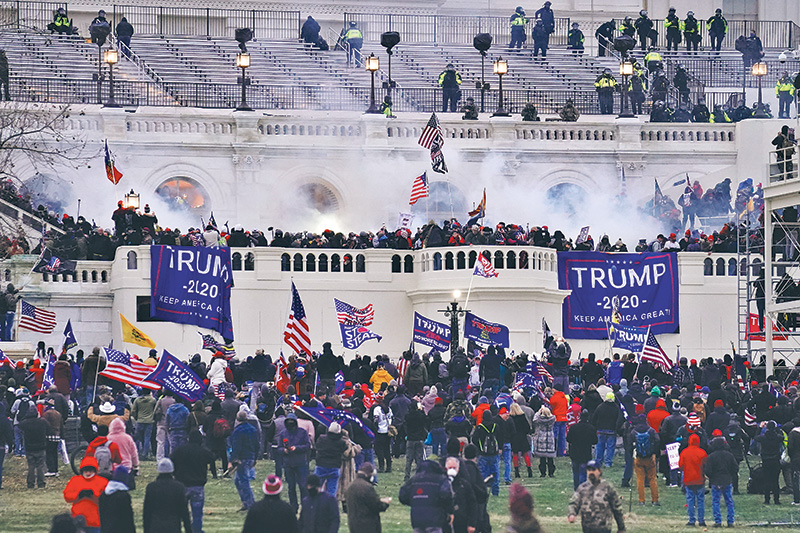
Violent protesters, loyal to President Donald Trump, storm the Capitol, in Washington, on Wednesday. AP/RSS
WASHINGTON, Hours after hundreds of President Donald Trump’s supporters stormed the US Capitol in a harrowing assault on American democracy, a shaken Congress on Thursday formally certified Democrat Joe Biden’s election victory. Immediately afterward, the White House released a statement from Trump in which he pledged an “orderly transition” when Biden is sworn into office on January 20, although he repeated his false claim that he won the November election. On Wednesday, the Republican president had seemingly encouraged his followers to swarm the Capitol. Congress resumed its work certifying Biden’s Electoral College win late in the evening after the chaotic scenes on Capitol Hill. After a debate stretching into the early hours of Thursday, the Senate and the House of Representatives rejected two objections to the tally and certified the final Electoral College vote with Biden receiving 306 votes and Trump 232 votes. Vice President Mike Pence, in declaring the final vote totals, said this “shall be deemed a sufficient declaration of the persons elected president and vice president of the United States.” Vice President-elect Kamala Harris will take office alongside Biden. The outcome of the certification proceedings had never been in doubt, but was interrupted by rioters who forced their way past metal security barricades, broke windows and scaled walls to fight their way into the Capitol. Police said four people died during the chaos—one from gunshot wounds and three from medical emergencies—and 52 people were arrested. Some besieged the House chamber while lawmakers were inside, banging on its doors and forcing suspension of the certification debate. Security officers piled furniture against the chamber’s door and drew their pistols before helping lawmakers and others escape. The assault on the Capitol was the culmination of months of divisive and escalating rhetoric around the Nov. 3 election, with Trump repeatedly making false claims that the vote was rigged and urging his supporters to help him overturn his loss. Following Thursday’s certification by Congress, he issued a statement via White House aide Dan Scavino, saying: “Even though I totally disagree with the outcome of the election, and the facts bear me out, nevertheless there will be an orderly transition on January 20th.” Wednesday’s chaos unfolded after Trump—who before the election refused to commit to a peaceful transfer of power if he lost—addressed thousands of supporters near the White House and told them to march on the Capitol to express their anger at lawmakers. He told supporters to pressure their elected officials to reject the results, urging them “to fight.”
Some prominent Republicans in Congress put the blame for the day’s violence squarely on his shoulders. “There is no question that the President formed the mob, the President incited the mob, the President addressed the mob. He lit the flame,” House Republican Conference Chairwoman Liz Cheney said on Twitter. Senate Republican leader Mitch McConnell, who had long remained silent while Trump sought to overturn the election result, called the invasion a “failed insurrection” and referred to those who had stormed the Capitol as “unhinged.” Trump had tried to get Pence and other Republicans to do what they could to block the certification of the election—the final step before Biden takes office—even though they lacked the constitutional authority to do so. After Pence made clear he would not accede to Trump’s wishes, the president ripped his longtime ally on Twitter even as the Senate, with the vice president presiding, was under siege. The shock of the assault seemed to soften the resolve of some Republicans who had supported Trump’s efforts to convince Americans of his baseless claims of fraud. Several Republican senators who had said they would mount objections to the electoral vote count changed their minds when they returned to the chamber. Two objections—to the vote tallies in Arizona and Pennsylvania—were voted down resoundingly in both the House and the Senate. Senator Lindsey Graham, one of Trump’s staunchest allies in Congress, rejected an effort by his fellow Republicans to object to election results in hopes of setting up a commission to investigate Trump’s unsubstantiated allegations of election fraud. “All I can say is count me out. Enough is enough,” Graham said on the floor of the Senate. “Joe Biden and Kamala Harris are lawfully elected and will become the president and the vice president of the United States on Jan. 20.” In a hastily arranged address in Delaware on Wednesday, Biden said the activity of the rioters “borders on sedition.” At the White House, several aides resigned in protest of the Capitol attack, according to sources and media reports, including Matt Pottinger, the deputy national security adviser, and Stephanie Grisham, chief of staff to Melania Trump and a former White House press secretary. A source familiar with the situation said there have been discussions among some Cabinet members and Trump allies about invoking the 25th Amendment, which would allow a majority of the Cabinet to declare Trump unable to perform his duties, making Pence the acting president. A second source familiar with the effort doubted it would go anywhere with Trump having just two more weeks in office. Election officials of both parties and independent observers have said there was no significant fraud in the November contest, in which Biden won 7 million more votes than Trump. Wednesday’s violence on Capitol Hill drew stunned reactions from world leaders. British Prime Minister Boris Johnson called the events in the Congress a “disgrace”, saying in a tweet the United States stood for democracy around the world and that was it was “vital” now that there should be a peaceful and orderly transfer of power.
HOME PAGE
Nepal keeps mum as world leaders condemn attack on US democracy
Foreign Ministry chose to remain silent, with officials saying they have received no orders from ‘higher political authority’—whether to say something or not say anything.
- ANIL GIRI
KATHMANDU, World leaders on Thursday sprung into action to condemn what they called an “assault on democracy” after Wednesday’s pandemonium and mayhem at the Capitol Hill carried out by the supporters of US President Donald Trump. From British Prime Minister Boris Johnson to German Chancellor Angela Merkel to Candian Prime Minister Justin Trudeau to Australian Prime Minister Scott Morison to Indian Prime Minister Narendra Modi, leaders of democracies were quick to express shock and outrage at the storming of the US Capitol in Washington by supporters of President Donald Trump. The list of those condemning the mob storming at Capitol Hill included even America’s best foes, with the likes of Venezuela, Iran and China. The Nepal government, however, until Thursday night, even hours after sanity and sense prevailed in America and the Congress certified election victory to Joe Biden, had not spoken a word. There was no official statement—neither by Prime Minister KP Sharma Oli nor by the Ministry of Foreign Affairs—on the US Capitol siege by Trump supporters that left at least four people dead. An official at the Ministry of Foreign Affairs, who spoke on condition of anonymity citing the sensitivity of the matter, said there were no immediate plans at the ministry to release any statement. “Nor is there any directive ‘from the top political authority’ to that effect,” the official told the Post, indicating at the Prime Minister’s Office. Those outside the government said that the KP Sharma Oli government has lost the moral and political ground to speak up or condemn the incident. Oli is facing massive criticism for attacking the constitution and democracy at home ever since he suddenly on December 20 dissolved the House of Representatives, the hallowed chambers which in February 2018 installed him as the prime minister. While Oli has argued that he was “forced” to dissolve the House after an intense intra-party feud which made it impossible for him to work, in America Trump incited his supporters to storm the Capitol refusing to concede his defeat in the November 3 elections. “Our House of Representatives was dissolved [by Oli] and their [Americans’] House was attacked. It does sound similar somehow,” Madhuraman Acharya, a former foreign secretary and ambassador, told the Post. “Can we really expect our government to speak up?” The Post’s repeated attempts to reach out to Foreign Minister Pradeep Gyawali went unanswered. At least two senior leaders of the governing Nepal Communist Party refused to comment, giving a nonchalant shrug. They said they had not followed the goings-on in the US seriously and that they were “busy” in their own party affairs. After Oli’s move of dissolving the House, the Nepal Communist Party has split into two, with the other faction led by Pushpa Kamal Dahal and Madhav Kumar Nepal, which has taken to the streets. While leaders of the Oli faction have been trying their best to justify the House dissolution, the Dahal-Nepal faction has described it as an attack on the constitution and democracy. Many say it’s surprising that Nepal has opted not to say a word amid concerns from the world’s big democracies as well as lecturing from some countries like Venezuela and Iran to the US on democracy. A Standing Committee member of the Nepal Communist Party (Oli faction), said that the government is like “once bitten twice shy”. “Don’t you remember the Venezuela case?” the member asked. “We don’t want to be dragged into yet another controversy,” said the member, who did not wish to be named because he was not authorised to speak to the media. He, however, was referring to an incident that happened in January 2019. Dahal, who then was the chair of the Nepal Communist Party, had issued a statement, denouncing US intervention in Venezuela and expressing solidarity with the people of Venezuela and President Nicolas Maduro. Dahal’s statement had caused a deep diplomatic crisis after the US embassy raised its concern, forcing the Oli administration to scramble for an answer. Foreign policy watchers say Nepal’s position on international matters has always remained poor and when it comes to democracy, democratic principles and even human rights, the Oli administration has simply lost the plot. World leaders on Thursday spoke with conviction about the US Capital storming. “Disgraceful scenes in US Congress,” said British Prime Minister Johnson in a tweet. “The United States stands for democracy around the world and it is now vital that there should be a peaceful and orderly transfer of power.” “Canadians are deeply disturbed and saddened by the attack on democracy in the United States, our closest ally and neighbour,” said Canadian Prime Minister Trudeau. Describing what happened in Washington as the “very distressing scenes”, Australian Prime Minister Morrison wrote: “We condemn these acts of violence and look forward to a peaceful transfer of Government to the newly elected administration in the great American democratic tradition.” “Distressed to see news about rioting and violence in Washington DC,” Indian Prime Minister Modi wrote on Twitter. “Orderly and peaceful transfer of power must continue. The democratic process cannot be allowed to be subverted through unlawful protests.” Sridhar Khatri, a professor of political science, said the Oli government’s silence on what happened in the US is understandable as it has failed to keep its own house in order. “For the Oli government to have an opinion, it has to set its house in order first,” Khatri, who has taught political science in Kathmandu and Colombo, told the Post. To him, the reason countries like India and others were quick to speak up is because they are a functional democracy. “On what basis–democracy or constitutionally–should we speak up or criticise the incident? What is our justification to speak up at a time when a hearing is going on at the Supreme Court against our government’s decision to dissolve the House, which according to our constitution is not right,” Khatri told the Post. “Do we really have a stand?” Historically, Nepal does not follow any standard rule book when it comes to what are described as “internal matters” of a particular country. A Nepali diplomat, who spoke on the condition of anonymity, said that in various cases in the past, it has always been based on which party was ruling in Kathmandu. According to the diplomat, Nepal often tends to choose to say or not to say depending on the country in the question. “So our confusion continues,” said the diplomat who has served in three different countries in the past and recently as an ambassador to a western country. “This is basically because we don’t have a strong foreign policy. We don’t have any proper understanding of the world order. And we don’t even have any idea how fast geopolitical shifts are taking place.” After the mayhem and calls for an impeachment, Trump, however, finally pledged an “orderly transition”, helping restore peace in America. Suresh Chalise, a former ambassador to the US, described the incident in Washington as America’s “internal affairs”. “The incident does show that there are some flaws in the US election process. That is also associated with American democracy so it is concerning,” said Chalise. “But for Nepal, it is purely the United States’s internal affairs. And, as a small country like Nepal, we should be mindful while speaking about internal affairs of such a big country.”
HOME PAGE
With their tactical plans, parties reluctant to join hands against Oli in upper house
Though they had agreed to jointly table a resolution motion against the ‘unconstitutional’lower house dissolution, they now seem to be taking possible polls into consideration.
- BINOD GHIMIRE
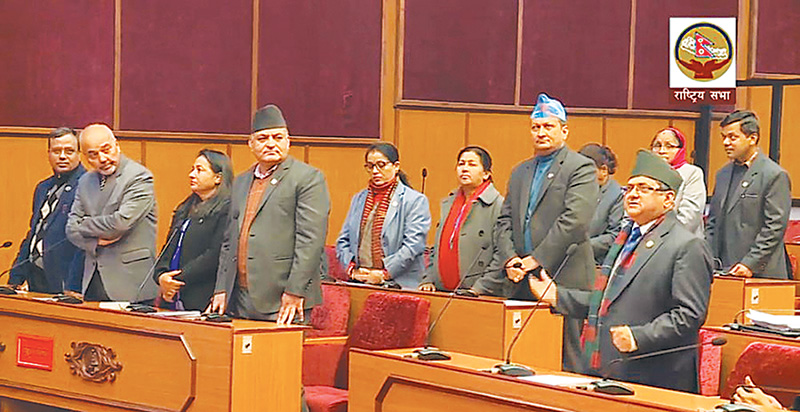
The winter session of the upper house began last week, but parties are not sure about the resolution motion. Post file Photo
KATHMANDU, When President Bidya Devi Bhandari called the winter session of the National Assembly on January 1, leaders from the Pushpa Kamal Dahal and Madhav Kumar Nepal-led faction of the Nepal Communist Party, the Nepali Congress and the Janata Samajbadi Party said they would join hands in the upper house to protest against the the dissolution of the House of Representatives. The endorsement of a resolution motion in the 59-member Assembly calling the dissolution of the House unconstitutional would mean that the permanent parliament, as the upper house is also called, has accepted that the dissolution was unconstitutional. But even a week after the winter session began, the parties are not sure about the resolution motion. “We are still holding discussions. The resolution motion will be submitted,” Anita Devkota, Nepali Congress whip in the National Assembly, told the Post. “However, I cannot say when.” She said since the issue needs to be decided by the top leadership of the party, decision on it is taking time. But the reasons why parties are reluctant to endorse such a move are more tactical, according to political analysts. They say although the parties are protesting the move of KP Sharma Oli’s Cabinet, restoration of the House of Representatives doesn’t seem to be their sole agenda. “It seems they are preparing themselves for the election simultaneously while also demanding the revocation of the dissolution. Be it Nepali Congress or Janata Samajbadi Party, they are sailing on two boats,” Puranjan Acharya, a political commentator who follows the Nepali Congress closely, told the Post. “When you aim for multiple targets, you definitely don’t focus on one.” The Nepali Congress and Janata Samajbadi Party have six and three lawmakers respectively in the National Assembly. Oli and Dahal-Nepal factions have about the same strength of the Nepal Communist Party’s 50 members. A resolution motion can get through the upper house if the three sides that have denounced the December 20 dissolution come together. “The National Assembly would ask the government to revoke its decision if the motion was endorsed. Although the endorsement doesn’t have a legal implication, it definitely has a political meaning,” Prakash Pantha, a Nepali Congress lawmaker, told the Post. “We will pressure the party leadership for it, which hasn’t felt its urgency.” But Nepali Congress President Sher Bahadur Deuba is reluctant to oppose Oli too strongly, amid reports that there is an understanding between him and Oli for an alliance of sorts if the House is restored. Geja Sharma Wagle, a columnist for Kantipur, the Post’s sister publication, said the Congress establishment faction is busy calculating the political gains of participating in the elections. “It sees the split in the Nepal Communist Party as an opportunity to fare better than in the previous elections,” said Wagle. In the 2017 general elections, the Nepali Congress, which had been in power for most of the time since the restoration of multiparty democracy in 1990, won a mere 63 seats in the 275-member House of Representatives. “This is the reason why neither street protests are as effective as they could have been, nor the opposition parties have unanimous voice in the National Assembly,” said Acharya. The protests against the dissolution too seem to be the rallies for the elections, said Acharya. Midterm polls have been set for April 30 and May 10 and will go ahead unless the Supreme Court reinstates the House. The hearing on the constitutionality of Oli’s move, which has been challenged in court, is ongoing with the next hearing set for January 13. Although political parties have been protesting the dissolution, they are not strong and united. Nepali Congress rejected the proposal of the Dahal-Nepal faction to hold joint rallies and this made the Janata Samajbadi Party too drop its earlier plan for joint protests. “Parties other than the Dahal-Nepal faction of the Nepal Communist Party are on the streets only because the civil society, professional organisations and the media are dragging them there,” said Acharya. The half-hearted street protests also reflect in the National Assembly. “The opposition parties could increase the momentum against the unconstitutional move through the National Assembly but sadly they haven’t,” said Wagle. The meeting of the National Assembly has been held twice since it was convened where the members, except those close to the Oli faction, have condemned the decision to dissolve the House. Other than putting forth their views, the upper house members haven’t followed other parliamentary processes to hold the Oli government to account. If the voice against the dissolution gets too strong, the House session could be prorogued soon, as experts have suggested. Speaking to a news agency on January 3, Ganesh Timilsina, chair of the National Assembly and an Oli ally, had hinted that the winter session might not last long. “The only way the assembly can work effectively is if the government creates a favourable environment to do so. Even if the government does bring new bills for it to become law, we need the House of Representatives,” he said. But experts feel that the opportunity to endorse a resolution motion against the dissolution should not be missed. Daman Nath Dhungana, former Speaker of the House of Representatives and a civil society leader, said the upper house should opt for the resolution motion against the dissolution. “The House, primarily, is the place to ventilate the grievances of the people,” he told the Post. “It can also demand answers from the minister and even the prime minister.” Dhungana said if the parties want to give momentum to the protests against the ‘unconstitutional’ move, they should have a united voice both in Parliament and on the streets. But parties seem to be divided on the way forward and seem to be waiting for the Supreme Court ruling. “The protest could get momentum if the Supreme Court approves the Oli government’s decision,” said Dhungana. “The protest then, however, will not be for the reinstatement of the House but to remove Oli from leading the election government.”
NATIONAL
Bajura local government seeks religious leaders’ help to stop child marriage
- Basanta Pratap Singh
BAJHANG, Budhinanda Municipality in Bajura district has started mobilising religious leaders to stop child marriages in its settlements. Child marriage is practised widely in Budhinanda Municipality, where, according to the data of the municipal office, 61 couples under the age of 20 got married in the last three years. The municipality has reached out to temple priests and astrologers to help them raise awareness among the local people about the malpractice since most couples and their families consult these religious leaders before getting married. “Astrologers, priests and other religious leaders have committed themselves to the cause,” said Shristi Regmi, deputy mayor of the municipality. “We suspect the number of child marriages has gone up during the pandemic. We don’t have the exact data.” Although Nepal abolished child marriage in 1963, the practice is still rampant, especially in rural parts of the country. According to the Civil Code, the minimum age for marriage for both women and men in Nepal is 20. But most of the residents of remote areas of Budhinanda are not following the rules. “We have seen long term health risks of child marriages and early pregnancies in both mothers and their children in our community. Traditional norms, poverty and illiteracy are contributing to the practice of child marriage here,” said Puspharaj Upadhayay, a local priest. A Human Rights Watch report published in September 2016 states that around 37 percent of girls in Nepal marry before the age of 18 and 10 percent are married by age 15. The federal government has announced a plan to eradicate child marriage by 2030.
NATIONAL
Heavy snow, frigid weather: Schools shut in Humla’s Limi, rural road project work halted
All seven local units in Humla district have witnessed snowfall this winter.
- CHHAPAL LAMA,RAJ BAHADUR SHAHI
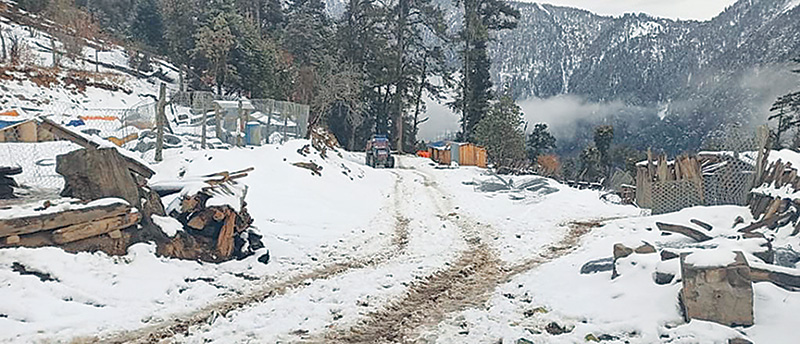
Snowfall has obstructed the construction work of Gamgadhi-Darm road which links Humla and Mugu districts. Post Photo: Raj Bahadur Shahi
Humla / Mugu, Heavy snowfall and freezing temperature have led to school closure at Limi village in Namkha Rural Municipality of Humla district. Himshikhar Primary School, Bhrikuti Primary School and Sunkhani Primary School have been closed since Sunday. “Temperature in the northern region of Humla has plummeted due to continuous snowfall. We had to shut down schools since it’s too cold for children to come out of their homes,” Tasiphunjok Tamang, a teacher at Sunkhani Primary School, told the Post over the phone. According to him, foot trails in the area have been rendered impassable due to thick snow covers. “Around four feet of snow has piled up on the school premises. It has been snowing in the area since Sunday,” said Tamang. A total of 56 students are enrolled at the school. “We are planning to run classes at a local Gumba once the snow melts,” Tamang said. There are 16 community schools in Namkha Rural Municipality. All the schools in the area, which had been closed due to the coronavirus pandemic, were reopened in mid-December. Three schools Limi, however, were closed again following a coronavirus outbreak. All seven local units in Humla have witnessed snowfall this winter. Dhan Bahadur Lama, a student preparing for the Secondary Education Examination in Simkot, the district headquarters said: “All tuition centres have been closed since Sunday. The weather is so frigid that it is difficult to even hold a pen.” In the neighbouring district of Mugu, the construction work of Gamgadhi-Darm road, which connects Mugu with Humla, has come to a halt following a massive snowfall. Around a foot high snow has covered the area between Chankheli in Mugu and Darmkhola in Humla. According to the Rural Access Programme, the road construction work has been stopped for a month due to difficult working conditions as a result of snowfall in the region. “It is difficult to use dozers in the snow. The construction work can only be resumed after the snow melts,” said Bishnuram Bista, the manager of the programme. The project has been constructing the 67-km road connecting Gamgadhi of Mugu with Darm of Humla from 2018. Under the project, Gamgadhi-Chankheli road (26km) has already been handed over to the provincial government. Works are underway to complete rest of the road section, the project officials said.
NATIONAL
Families displaced by Bheri-Babai diversion project deprived of compensation
- CHANDANI KATHAYAT
BIRENDRANAGAR, More than a hundred families living in around 16 hectares of land across Lekbesi, Bheriganga and Gurbhakot municipalities in Surkhet district are affected by the Bheri Babai Diversion Multipurpose Project. The majority of the families do not have their land ownership certificates, which has deprived them from getting compensated from the government. The Bheri Babai Diversion Multipurpose Project in western Nepal is an irrigation cum hydroelectricity project. The construction work of a dam is underway at Chiple in Bhangeri under the diversion project. The project has been compensating families whose houses are going to be inundated by the dam’s construction. JB Sunar, chairman of the Bheri-Babai Diversion Concern Committee, said around 80 families are living without land ownership certificates in the three local units which are affected by the project. “Residents of Lekbesi Municipality Ward No. 1, Bheriganga Municipality wards 8, 9 and 11 and Gurbhakot Municipality wards 13 and 14 are still to receive compensation since they do not have their land ownership certificates,” said Sunar. So far, only 53 families who have land titles have received compensation. According to Ishwori Prasad Tiwari, the senior divisional engineer of the project office, the project has distributed land compensation amount worth Rs 123.5 million. “The government has not taken any decision on families who do not have land ownership certificates. We will have to await the government’s call,” Tiwari said. The project has been providing Rs 400,000 to Rs 600,000 as compensation to land owners with land ownership certificates for a kattha of land. However, the ones who have received compensation for their land say the compensated amount is not enough and that this project is pushing them to a financial crisis. Ude Kami, a local resident of Ward No. 9 in Bheriganga, says his main source of income is farming and without his land, his future is not secure. “Rs 200,000 to Rs 400,000 is not enough money for us to begin a new life elsewhere. I think this is complete injustice for us,” he said. The local residents have already drawn the attention of government officials, says Madhu Gurung, chairman of Ward No. 13 in Gurbhakot. “There are 15 households without land ownership certificates in our ward. We have reached out to higher authorities about this issue. The federal government has only been addressing the issues of those with land ownership certificates and have not given much thought to those without one,” Gurung said.
NATIONAL
Don’t rely on one country for Covid-19 vaccines, experts say
Nepal and India are likely to sign an agreement on procurement of vaccines during Minister Predeep Gyawali’s visit to New Delhi next week.
- Arjun Poudel
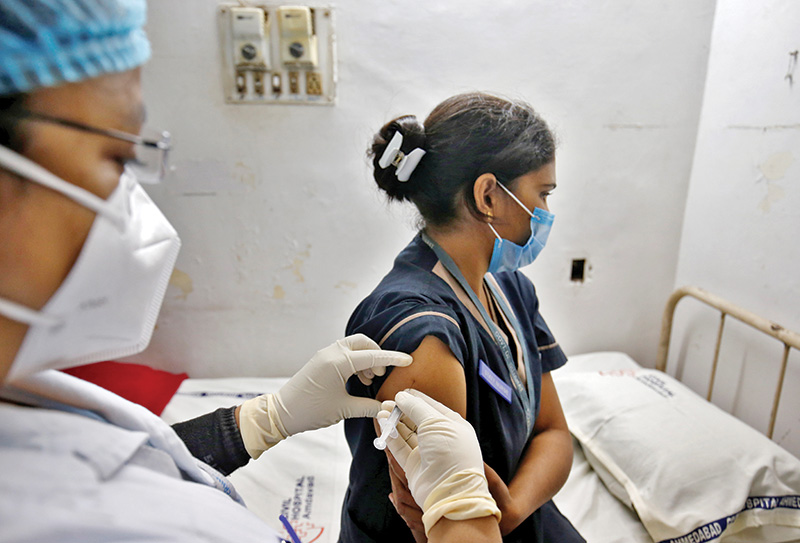
A medic administers a vaccine against Covid-19 during its trial in Ahmedabad, India. REUTERS
KATHMANDU, The government is considering plans to procure Covid-19 vaccines being manufactured in neighbouring India to vaccinate 52 percent of Nepal’s population. Experts say that Nepal should not rely just on one country for the vaccine as it would be difficult for it to provide the doses needed in Nepal all at once. Also, countries around the world where vaccines are being manufactured would want to inoculate their citizens first before allowing the jabs to be exported, they say. “No company can provide all the doses required at once, and most countries do not allow exports until they have secured enough doses for their population,” Dr Prabhat Adhikari, infectious disease and critical care expert told the Post. “We should explore the possibility of buying vaccines with proven efficacy from other countries as well,” he added. Officials at the Ministry of Health and Population say that an agreement on the procurement of vaccines could be signed between India and Nepal during the upcoming visit of the Minister for Foreign Affairs Pradeep Kumar Gyawali to New Delhi next week. The Cabinet had recently estimated that Rs 48 billion would be required to inoculate 52 percent of the population. While the World Health Organization’s COVAX programme will provide vaccines for 20 percent of the population, children under 14 years of age, who constitute 28 percent of the population can’t be immunised as vaccines haven’t been tested on them. Health Secretary Laman Aryal, a member of the high-level committee formed to procure coronavirus vaccines, said, “The Cabinet has decided something about the coronavirus vaccine.” But he refused to provide details The government is learnt to be looking at two vaccines being manufactured in India: Covishield (developed by Oxford University and drugs giant AstraZeneca) and Covaxin (developed and manufactured by Bharat Biotech). Both vaccines have received emergency use approval in India—the Oxford vaccine has also received approval in the UK. While Covishield uses the modified chimpanzee adenovirus as a vector, Covaxin is an inactivated vaccine with alum as adjuvant. As Indian authorities have barred Serum Institute from exporting the Covishield vaccine, until India has sufficient doses for its population, the government is likely negotiating with the Indian government to procure the vaccines under a G2G deal. Bharat Biotec’s Covaxin has not yet completed its phase III trials. “We have estimated that a single dose of the vaccine, which requires a two-dose regimen, will cost $10,” Dr Shyam Raj Upreti, coordinator of Covid-19 Vaccine Advisory Committee, told the Post. However, the Serum Institute of India has signed an agreement with the Indian government to supply jabs for $3 per dose. “We don’t have a clear picture yet about which vaccine will come and when they will come,” Upreti, added. “If the government buys vaccines produced in India, or we get the jabs at the price set by the Indian government, we would save $7.” Due to the uncertainty over the vaccine, agencies concerned under the Health Ministry have been unable to train health workers to conduct the inoculation once the vaccines arrive. An official at the Department of Health Services said that the vaccine procurement process is not simple as thought, as it is a multi-billion deal and there is a huge commission in it. “The government has announced snap elections and it is also going to procure vaccines by spending billions of rupees around the same time,” said the official, asking not to be named. “The situation is ripe for corruption,” said the official. “The price for each dose of vaccine has been estimated keeping in mind the Pfizer and Moderna vaccines. But the government is looking at low-cost vaccines manufactured in India,’’ the official said. “It is easy to pocket some of the money when your estimates are high, but actual costs are low.”
NATIONAL
Despite austerity rules, recurrent expenditure continues to surge
Financial Comptroller General Office warns of action against public offices not following austerity measures
- PRITHVI MAN SHRESTHA
The guidelines say that new recruitments in public offices for daily wage work should be kept on hold, except in the case of drivers and office assistants. Post file Photo
KATHMANDU, The government’s recurrent expenses have been rising even after it introduced a set of austerity standards in late November to control unnecessary spending in view of the Covid-19 pandemic. The government is struggling to generate enough resources, particularly for the health sector, due to the Covid-19 pandemic. Given this situation, the government, in November, had introduced a set of standards on austerity. But, according to the Financial Comptroller General Office, which keeps record of the government’s income and expenditure, the government’s administrative expenditure has gone up by Rs34 billion, as of January 4, compared to the same period during the last fiscal year. As of January 4, the government has spent Rs317.94 billion from the budget of the current fiscal year—a significant increment compared to the Rs283.83 billion spent during the same period last year, according to the Financial Comptroller General Office. The total budget allocated for recurrent expenditure in the current fiscal year is lower than that of last year. But expenditure under this heading has grown exponentially this fiscal year. The budget allocated for this year’s recurrent expenditure is Rs948.94 billion compared to Rs957.10 billion last fiscal year. Despite introducing the standards, the government has been taking decisions that increase the burden on the state coffers. After the introduction of the standards, President Bidya Devi Bhandari announced snap parliamentary elections on April 30 and May 10 as per the Cabinet decision after dissolving the House of Representatives. The government will have to spend billions of rupees on elections amid difficult financial situations. For the last provincial and local elections, the government had spent over Rs16 billion through the Election Commission and security agencies. The government will also have to allocate resources for people recommended for appointments in various constitutional offices if legal challenges against their recommendation do not succeed. “We cannot say the government is serious about implementing the austerity standards considering its move to increase recurrent expenditure,” said Bhanu Acharya, former auditor general. “Given that the elections have already been announced, the government will spend its budget on distributive programmes to influence voters.” As per the standards, no decision should be taken to create new financial liabilities without ensuring the availability of resources. Public officials also need to adopt austerity measures in expenses related to fuel, electricity, and office materials. Public offices need to upload their publications on their respective websites instead of printing them out on the paper if they are not required to do so by law. Any duplication in programmes among federal, provincial, and local governments should be avoided. Public entities need to organise workshops and interactions virtually and residential workshops should be avoided. Similarly, the guidelines say that new recruitments in public offices for daily wage work should be kept on hold, except in the case of drivers and office assistants. Public officials who are provided housing facilities in government-owned buildings and those who have their own home, cannot receive funds in the name of housing facility, according to the standards. An official at the the Financial Comptroller General Office said that government agencies that fail to adopt austerity measures as directed by the Finance Ministry recently, could be barred from getting extra funds depending on the degree of violation. By issuing a circular in the name of the district treasury offices, the agencies under the Financial Comptroller General Office, on Sunday, the office told them to check if any government office has violated provisions laid out in the austerity standards. “We have directed the district treasury offices to check if the government agencies have followed the austerity measures or not,” said Gyanendra Poudel, spokesperson for the office. “If any office is found to have violated the provisions of the standards, we can stop releasing their budget.” In most cases, the office would recommend the concerned offices to rectify work that violates the standards. As per the standards, office bearers and staff responsible for causing losses to the government by violating these standards are subject to compensate for the losses caused.
NATIONAL
Foreign Employment Department tells recruiting agencies not to hold passports
In a new circular, the department asks prospective workers not to submit their passports to agencies until their jobs are finalised and pay recruiters only through their bank accounts.
- CHANDAN KUMAR MANDAL
shutterstock
KATHMANDU, Last week, two men in their early 20s visited Kathmandu looking for jobs abroad. The duo from Mahottari, one of the country’s top five source districts for migrant workers, were promised jobs in Qatar. “The agent took us to a recruiting agency for an interview,” said P., who wanted to be identified by his initials fearing that revealing his identity would affect his relationship with the agent. “As soon as we reached the recruiting agency, he asked us for our passports. We refused to give him our passport, but he insisted.” Every year, tens of thousands of youths come to Kathmandu, often after being lured by sub-agents, who promise them jobs abroad through recruiting agencies. These workers end up handing over their passports to the sub-agents or recruiting agencies even if they are reluctant to do so. “Most of the time, aspiring migrant workers look for jobs with the help of sub-agents, who are either their relatives or acquaintances,” said Swarna Kumar Jha, a labour migration expert. “These workers are made to believe the passport will not be misused. They are also made to believe that job search can’t go on if without the passport.” The Department of Foreign Employment, the central government body that oversees the labour migration sector, has now come up with a circular that strictly bars recruiting agencies from hoarding passports of migrant workers until they are selected for jobs. “There is a tendency of recruiting agencies and sub-agents to collect passports from migrants who apply for jobs and hold them for a long time,” Tikamani Neupane, spokesperson for the department, told the Post. “The department is strictly going to implement this. We urge migrant workers to submit their passports only after they are selected through a job interview. Also, we ask recruiting agencies to take scanned copies of passports only.” According to Neupane, foreign employment rules do not require workers to submit their passports unless they are formally selected for the job they applied for. “If any agency or agent holds the passports of workers, this is illegal,” said Neupane. “Such practices also deprive the workers of their free choice to seek opportunities wherever they want to.” Around 90 percent of workers who wish to migrate for jobs abroad, do so through recruiting agencies in the country. Sub-agents who collect workers from villages and districts, bring them to Kathmandu and connect with Kathmandu-based foreign employment recruiting agencies. During the selection process, which can sometimes go on for several months, workers submit their passports and have no other option but to wait for the recruiting agency to find them a job. “While hoarding passports is illegal, it also works as a way to control migrant workers. The passport is like collateral. Once they hold the passports, they are in command and understand that the workers don’t have anywhere else to go,” said Jha. “The workers can’t bargain with the agency and are more likely to end up agreeing to the recruiting agencies’ terms and conditions.” In other measures for keeping workers safe from possible exploitations, the department has asked migrant workers to deposit the amount they are supposed to pay to the agencies for their services to their bank account. Likewise, recruiting agencies are also asked to accept money through the banking channel only. The move was introduced to check agencies who often overcharge migrant workers for their services. “Banking transactions can be useful in controlling fraud incidents related to collecting the hefty amount from migrant workers. The government policy is also there to make all the official transactions through the banking system,” said Neupane. “Even when the worker is charged beyond the government ceiling, and they deposit the whole amount to the bank account, it can give us strong evidence for taking action against such agencies.” Despite the government’s free visa and free ticket policy, which has fixed Rs10,000 as a service charge for recruitment agencies, there have been instances of workers paying several times more than the government ceiling. According to Jha, these new moves are welcome as they try to protect workers from exploitation at home and abroad. “The transaction through banking rule will make the whole business between migrants and recruiting agencies transparent. Workers can be safe from theft at home,” said Jha. “However, it does not ensure that workers will not be cheated as they have been receiving receipts for only Rs 10,000 while the rest of the money is collected in cash. Only if it can be implemented effectively, workers can feel respite. The two workers from Mahottari did not submit their passports to the recruiting agencies as instructed by their sub-agents. “We had barely known anything about the job. The sub-agents could not tell us about it in detail,” said D., another worker from Mahottari. “We smelled something fishy, so we returned without submitting our original passports. Let’s see when we hear back from them.”
NATIONAL
Two held on corruption charge
Briefing
SARLAHI: The Commission for Investigation of Abuse of Authority has arrested two officials from the Land Revenue Office in Hariwan, Sarlahi, with bribe amounts. A CIAA team from Bardibas caught non-gazetted first-class officer Bednidhi Baral and paralegal Ramsundar Mahato red-handed while they were receiving Rs 11,000 bribe from a service seeker. It is learnt that Baral demanded the bribe to correct the latter’s name in his land ownership certificate.
NATIONAL
Convicted rhino poacher held
Briefing
CHITWAN: A fugitive convicted on the charge of poaching a one-horned rhino has been arrested in Chitwan. A team from the Chitwan National Park detained Shanichara Mahato, 48, of Madi Municipality on Friday. Chitwan National Park had sentenced him to 15 years of imprisonment on a rhino poaching charge in 2008. The then appellate court in Hetauda had later reduced the sentence to five years.
NATIONAL
Passenger dies in accident
Briefing
BIRENDRANAGAR: A person died and another went missing in a bus accident at Garale Gauda in Gurbhakot Municipality Ward No. 9 on Thursday. According to the police, a passenger bus heading towards Sallibazaar in Salyan from Dang fell into Bheri. Rajendra Bhatta, Superintendent of Police in Surkhet, said, “The bus fell around 200 feet down the road. One of the passengers is missing.”
NATIONAL
SSB disrupts construction of bridge on postal highway
Briefing
RAJBIRAJ: The Sashastra Seema Bal (SSB), the border security force of India, has disrupted the construction of a bridge along the under construction postal highway at Kataiya in Saptari district. “The bridge construction has been halted as the SSB did not let us construct the bridge. The bridge construction site is 195 meters north of the border pillar erected along the Nepal-India border,” said Aashutosh Karna, an engineer at the postal highway project. The SSB said that they could not let the Nepali side construct the bridge unless higher authorities sent a written order.
EDITORIAL
Crumbling from within
The lessons of the drama in America may help the world—if the people and their leaders chose to listen.
Early on Thursday morning, when most of Kathmandu was asleep, the world was abruptly awakened by the antics of domestic terrorists and vile politicians in the United States. A mundane ritual that usually reaffirmed the quirky yet stable electoral process in the world’s oldest democracy was delayed—almost derailed—when some Republican lawmakers from both the House and the Senate kept up the mad charade of insisting on mass voter fraud. Conservative loyalists followed up by breaching the US Capitol building while the joint session of Congress was ongoing. Much can be said to lambast the supporters of Donald J Trump who came out in force insisting that their representatives right an imagined wrong. For one, no credible media source had hinted at the slightest chance of voter fraud in the November 2020 US elections. The one publicised—and one-off—case seemed to be that of a Trump supporter who voted twice for the outgoing president. For another, the thousands of people claiming that the election was stolen did not seem to have reviewed past speeches where President Trump claimed that the 2016 elections would similarly be taken from him by the power brokers in Washington; of course, he clearly and fairly won the electoral college votes to win the presidency back then. Neither do these zealots seem to have realised that with President Trump being in power and his penchant for rewarding loyalists with key roles in powerful positions, if anyone could have hoodwinked voters and upturned the federated election system, it would have been him. That many of the swing states during this last election were Republican-controlled but still certified votes, after numerous challenges and recounts, seems lost on this crowd. But it would be wrong to simply reprimand the extremists and not call out the ones who allowed this to happen in the first place. For, the actions that unfolded on January 6 were only the latest, and perhaps the starkest, of the symptoms that the American democratic system was diseased. But who’s to blame? After the enactors, it surely must be the ones who egged them on. Many will rightly point to President Trump’s election as being the nail on the coffin. While Trump’s America First and other conservative agendas unravelled the years of goodwill the US had earned globally over decades of ups and downs, back home it seemed to embolden a special section of the population that actually embraced his rhetoric. Based on lies and half-truths, and propped up by sensationalist talk show hosts and conspiracy theorists, many Americans (over 74 million) seem to agree with Trump’s inward-looking and sometimes discriminatory policies. In an attempt to ride on the coattails of Trump’s popularity with this massive minority (Joseph R Biden still won the popular vote, amassing over 81 million votes) many Republicans traded in their own conservative policies for Trump’s populist ones. And therein lies the problem. If Donald J Trump, even with his large and devoted following, would have been on the pulpit alone, spewing out hate and prevarications, America would perhaps have a different president four years ago. Or, even if he was still elected president, his more outrageous actions and words would have been subdued by the policy machine that is Washington. But it was clearly the support Trump’s fabrications received from highly respected Republican leaders and the widely followed but spurious media sources that brought America to where it is now—crumbling from within and a long way away from reconciliation. Perhaps this can be a lesson for the rest of the world about the dangers of populist leaders and of fake news. It could be a wake up call for world leaders not to hook their carriage onto the mad horse for short term gains.
OPINION
No permanent friends, only permanent interests
How does Oli’s dissolution of Parliament affect our neighbours and other powers like the US?
- Amish Raj Mulmi
Unsplash
In November, as Indian and Chinese officials rushed to Kathmandu and the Nepal Communist Party split began to heat up once more, former editor of the Post Akhilesh Upadhyay put forth a most pertinent query for our times: ‘The big question is how far will this domestic dynamic intersect with changing regional and global geopolitics’. Two months later, the overlap between Nepali domestic politics and international realities has never been starker. Now that the dust has settled a little, one can get a sense of how our neighbours and other powers like the US have perceived the new normal in Nepali politics. Here, one must first note that Prime Minister KP Oli’s move will, in all likelihood, spiral into an era of instability, as our politicians rush to find new alliances that suit them most (the Nepali Congress best exemplifies this).
The view from the north Guo Yezhou, the vice-minister of the international department of the Communist Party of China (CPC) who is said to have played a crucial role in the merger of the NCP, rushed to Kathmandu, met leaders across the board, and returned. Several reports highlighted Guo’s mission was first to enquire whether the split could be averted via a new power-sharing arrangement that would perhaps sideline Oli. Beijing’s next query was whether the new political developments would affect ‘stability’, or in other words, whether Nepal would now back down on the commitments it had made to China while elevating ties to a ‘strategic partnership’. Lastly, China is also said to have enquired on the status of the Millennium Challenge Corporation (MCC) Compact, with an NCP leader saying Beijing had concerns Nepal would now approve it under Oli’s executive government. The perception that China is no longer a ‘non-interfering’ neighbour seems to have disappeared; over the last year, Beijing has put its weight behind a unified NCP, viewing the communists as Nepal’s primary political force. But the events of 2020 have caught it on the backfoot; China’s role in Nepal is increasingly scrutinised at a variety of levels. The question then arises: did Beijing err by putting all its eggs in the communist basket, just as it had once done with the monarchy? One critical international development explains much of China’s nervousness with the resultant instability. In the last week of 2020, the US passed the Tibet Policy and Support Act (TPSA), a decisive piece of legislation that will dramatically upgrade American support towards Tibetan exiles. The US has said the selection of Tibetan Buddhist leaders are ‘exclusively spiritual matters’ which must be decided by ‘appropriate religious authorities’; that the current Dalai Lama’s wishes and instructions must be followed to select the next reincarnation; and that any Chinese officials interfering with the selection of the next Dalai Lama will face sanctions, including having their assets frozen and their entry into the US denied. The new Act will have two important implications in Nepal. The US has said it will ‘urge’ Kathmandu to honour the ‘gentleman’s agreement’ that allows for safe passage of Tibetan refugees to India via Nepal. Several human rights groups have alleged Nepal has not honoured the agreement in recent years. Further, the TPSA also authorises the release of $6 million each year from 2021-25 towards preserving Tibetan culture and language, and to promote the development of the next generation of leaders from Tibetan communities in India and Nepal. With Tibet back in global power focus, it is obvious China is worried any political instability in Nepal will see new activism among the Tibetan exile community, which it has successfully managed to subdue after the 2008 protests against the Beijing Olympics.
South Block’s dilemma On the other hand, India has found itself in a curious position after Oli’s move. The NCP split serves to weaken China’s authority in Kathmandu, while Oli’s dissolution also weakens the 2015 statute, a document Delhi simply ‘noted’. Further, India also has more leverage with an Oli who is cornered by his opponents. The flipside, however, is that despite India calling the dissolution an ‘internal matter’ to be resolved via ‘democratic processes’, its invitation to Foreign Minister Pradeep Gyawali to visit Delhi will be seen as a silent approval of Oli’s undemocratic move, and open it up to further queries by his opponents (and the larger Nepali society). Already, Pushpa Kamal Dahal has upped the ante by calling for India’s ‘naitik samarthan’, best translated as moral support, towards the re-establishment of Parliament. Its relative inaction, which has flummoxed Oli’s opponents, serves to bolster its recent attempts at changing the perception of interfering in Nepali affairs, but it may very well find itself on the wrong side of history, too. In a recent and revelatory piece, Shyam Saran, former Indian foreign secretary and ambassador to Nepal, wrote, ‘India’s long-term interest in this sensitive neighbouring country is best served by a stable multi-party democracy and economic prosperity for which India remains an irreplaceable partner. To extend support to Oli or to encourage an apparently “right wing coalition” to supplant the NCP, even if this means derailing Nepal’s democracy, would prove to be extremely short-sighted’. However Saran is perceived among a section of Kathmandu intelligentsia, he is right. Already there are rumours of the RSS/BJP combine encouraging a return to the Hindu state; some have even argued for the possibility of a ‘cultural monarchy’ (whatever that may mean!). Needless to say, Indian long-term policy in Nepal must distinguish itself from the ruling party’s goals.
Washington and the MCC The last piece of the puzzle lies in Washington’s silence over the dissolution, and a recent statement by its embassy spokesperson that Nepal must approve the MCC Compact soon to avail of its benefits. As with India, the US finds itself in a stronger position in Nepal after the dissolution, and it will hope that Oli, who backed the MCC, will push the Compact ahead—albeit how he can do so without Parliament’s approval remains to be seen. But combined with the aforementioned TPSA, the longer-term American goal of reducing Chinese influence will continue. But the irony is unmissable. Two of the world’s biggest democracies (and among Nepal’s primary bilateral partners) have been largely silent about an unconstitutional move that will erode a fragile republic’s democratic foundations. In 1960, after Mahendra’s coup, the US was wary at first, but soon embraced the king’s putsch ‘lest he look increasingly to the [Communist] Bloc for support’. In a long essay on the US response to the coup, historian Tom Robertson wrote, ‘Democratic values seemed less a concern than power politics… The US, once a strong voice for democracy in Nepal, now supported the king and gave up on programs such as land reform’. At that time, China and the US found themselves on the same side in Nepal, with India not too pleased with Mahendra’s dissolution of Parliament. Then in 2005, when Gyanendra declared the emergency, India and the US withdrew support to the monarchy, while China gained ground by supplying the king with military aid. Today, India and the US now find themselves benefiting from Oli’s dissolution, with China on the backfoot. As they say, there are no permanent friends or enemies in international relations, only permanent interests.
OPINION
Electrifying African transport
Transforming African transport requires no less than the elimination of GHG-emitting vehicles.
- Mohamed Hegazy
Unsplash
Many transport experts think that we are succeeding in decarbonising the sector: electric vehicles are taking off, public transport use is increasing, and cities worldwide are promoting cycling. But this sense of success is illusory. Globally, transport-related greenhouse gas (GHG) emissions are increasing faster than ever, despite technological advances and investments in decarbonisation. This is especially so in Africa. Transport investments will be crucial in determining whether Africa heads toward an inequitable, carbon-heavy development trap or a much fairer zero-carbon path. To achieve full decarbonisation, development banks and African governments should move away from capital-intensive rail and bus rapid transit (BRT) projects, and toward enabling micro-entrepreneurs to build effective, electrified public transport networks. The solution may lie in fostering impact-driven transport network companies (TNCs). Although Africa is responsible for some 3 percent of cumulative global carbon dioxide emissions, it is urbanising at lower levels of per capita GDP than any other region. As the continent’s cities continue to expand, Africans increasingly need to travel—by motorised public transport, motorcycles, or private cars—in order to attain the same level of prosperity as people elsewhere. Micro-entrepreneurs are meeting many of those transport needs by investing in vans and providing informal bus services that connect the urban dwellers with schools, hospitals, and jobs. Such operations have helped Africa’s cities to grow, generated significant employment, and will continue to dominate public transport for a long time. But the bus drivers, some of whom own their vehicles, are short of capital and rely on low-cost, low-tech, high-polluting vans. Passengers aspire to own a private car, and those who can invest in a car-centric lifestyle, mimicking a development pattern that has failed elsewhere. A development trap thus kicks in: African cities remain crowded, disconnected, and costly, reducing social mobility and entrenching economic inequality. Fortunately, a range of urban and technology interventions can lead to a radically different development pathway. The key is to re-imagine African streets and move away from the current car-focused design. We should emphasize public transport, and give micro-entrepreneur bus operators priority lanes in exchange for meeting minimum vehicle-quality standards. That implies electrifying van-buses and integrating them within multi-modal urban transport systems. Achieving this transition will require development banks and governments to focus less on capital-intensive investment projects, which, while helpful and desirable, cannot and will not solve Africa’s transport problem. Successful implementation of credit-backed metro and BRT projects in African cities is in doubt, owing to the current debt distress aggravated by the Covid-19 pandemic. These schemes are at risk of being completed too late, and thus having too little impact as urbanisation proceeds apace. In Egypt, for example, the Cairo Metro, which is majority-financed by international development agencies, receives 92 percent of national investment in public transport. This is one of two national projects, along with the Sustainable Transport Project (led by the United Nations Development Programme), designed to mitigate Egypt’s CO2 emissions and use international climate-financing schemes. But both projects combined cut annual CO2 emissions by less than is added each year as more people travel increasingly far. Capital-intensive public transport projects will neither reform nor decarbonise African transportation. Policymakers and lenders should instead focus on how venture capital-backed TNCs such as Uber (and its Middle Eastern subsidiary Careem), DiDi, and Lyft have revolutionised the traditional taxi industry with their tech-enabled mobility platforms. This transition has resulted in significant operational efficiencies and might catalyse the electrification of the entire sector. Uber recently pledged that all its rides in North American and European cities will take place in zero-tailpipe-emission vehicles by 2030, and plans to commit $800 million to help hundreds of thousands of micro-entrepreneur drivers buy battery electric vehicles (BEVs) by 2025. In Africa, home-grown venture capital-backed TNCs such as SWVL in Egypt and SafeBoda in Uganda are active in the van and motorcycle markets, respectively. But these firms offer a premium service and are not designed to scale up and become the transport providers that African cities need to prosper. These companies have exercised meaningful control over micro-entrepreneurs operating within their networks in order to guarantee minimum quality standards, including by setting base fares, dictating which routes to take, and marketing to affluent consumers. By treating their drivers as independent contractors rather than employees, they have avoided the cost of providing benefits like health insurance. A new model of private TNCs could help revolutionise informal bus services for the masses and achieve decarbonisation. Public support and regulation of private TNCs could help drivers gain more benefits and protections, making the transition beneficial for consumers, operators, and the environment alike. Development banks and governments should therefore invest in street infrastructure, including dedicated bus lanes, stops, and electric vehicle charging stations, and they should finance vehicle upgrades by covering the cost difference between low-tech vans and BEVs. TNCs would be able to channel the investments, work with public bodies to implement metropolitan-level multi-modal transport networks, and monitor and enforce quality standards using innovative, scalable technology. We need to rethink Africa’s transport infrastructure and enable a transition that makes sense for hundreds of thousands of workers, some of whom are also micro-investors. Achieving public-service goals will require governments to guide the sector, harnessing private-sector informal transport providers and TNCs while absorbing temporary risks and cost differences. Public and international capital can close the cost gap that drivers will face in making the switch to BEVs and support them through the current pandemic-induced shock, which has led to an average decrease of 40 percent in public transport use in African cities. Private capital would realise efficiencies, and distributed public micro-capital would allow many people to acquire a stake in an industry with widely shared gains. Transforming African transport will require nothing less than the elimination of GHG-emitting vehicles. Let’s aim for that, and help African cities to become better connected drivers of clean and equitable development.
Hegazy is Founder and Director of Transport for Cairo. — Project Syndicate
MONEY
With reliance on imports, prices continue to go up
Local production has been declining and fulfils only 10-15 percent of the current requirement, leading to increased reliance on imports, merchants say.
- KRISHANA PRASAIN
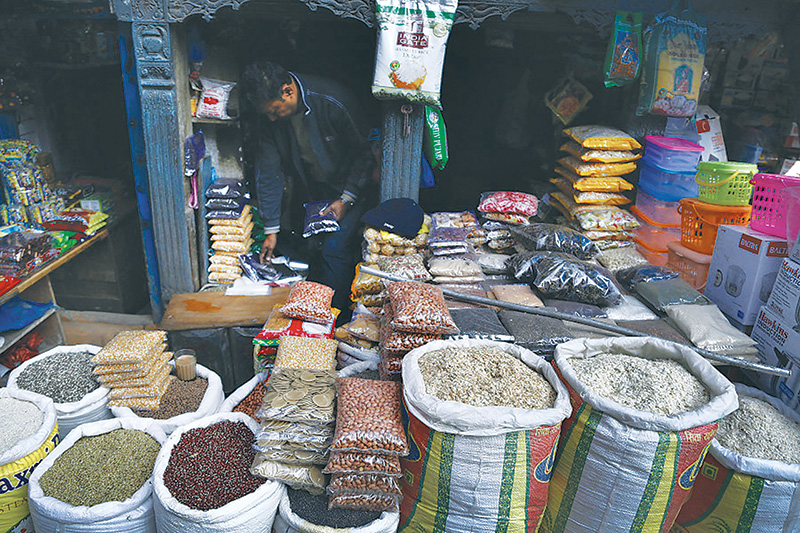
Food started becoming dearer after the Tihar festival in November, and prices continue to rise due to weak market inspection, costlier raw materials in the international market, higher transportation costs and price gouging by opportunist traders, said consumers. POST FILE PHOTO
KATHMANDU, Ramesh Gandrama Magar has a job as a driver in a private company, but he is looking for part-time work to make extra money as rising market prices have stretched his salary to the limit. “My daily expenses have soared as the cost of food and other goods and services, and the rent for my apartment has gone up,” said Magar. “I started feeling the burden of rising prices after the pandemic.” Till a year ago, the 22-year-old from Dhading was managing to make ends meet; but after the price of all goods swelled in recent months, he started looking for extra work. “I am looking for a part-time job so I can make extra money to pay the rent, then I will be able to take care of my household expenses with my regular salary,” he said. Magar earns around Rs22,000 per month out of which he has to feed his family, pay the rent for his apartment at Kalanki, and send money home to his parents in Dhading. Prices of major kitchen items like rice, edible oil, lentils and legumes have shot up. The price of edible oil has reached an all-time high, according to retailers. Food started becoming dearer after the Tihar festival in November, and prices continue to rise due to weak market inspection, costlier raw materials in the international market, higher transportation costs and price gouging by opportunist traders, said consumers. The whole supply chain has been impacted mainly because of lack of strict inspection. “The price of edible oil has gone up to an unimaginable level,” said Raj Kumar Shrestha, president of the Nepal Retailers Association. “The retail price has reached Rs210 to Rs240 per litre as it costs Rs200 wholesale,” he said. The cost of food items, especially edible oil, has skyrocketed as most of the domestic production is being exported to India where the price has jumped by Rs30 per litre in the past few weeks. “The price of edible oil is higher in India compared to Nepal, consequently domestic manufacturers are eager to sell their products there, causing shortages in the local market,” he said. It has been more than two weeks since the price started climbing from Rs185-Rs190. “The price of edible oil is expected to rise further as shipments to the Indian market have increased,” he said. The price of sunflower and soybean oils in the domestic market has risen by more than 15 percent while there has been only a slight increase in the price of mustard oil. According to Shrestha, the retail price of food items has increased by 10 percent. The price of rice has increased by Rs50 per 20-kg bag while the price of dried beans has gone up by Rs10 to Rs15 per kg. Lentils have become costlier by Rs10 to Rs15 per kg. Rice wholesalers say that the price has increased at the source. The dried beans sold in Nepal are imported from New Zealand and Australia, and the lentils from Bhutan, according to traders. “Domestic production fulfils only 10-15 percent of the current requirement, and the rest have to be imported,” he said. Local output has been declining, leading to increased reliance on imports. According to Netra Prasad Subedi, director general of the Department of Commerce, Supplies and Consumer Protection, more than 60 percent of the raw materials needed to produce edible oil are imported from third countries. With the price of raw materials rising in the international market, its direct impact is being seen in the market prices here, he said. “We came to know that the price of edible oil has increased by Rs15 per litre,” he said. It will take time to normalise the supply of raw material, and it will take time to reduce the price. He said that there was no problem with the prices of rice and lentils, as they have not increased since they were last raised after the Tihar festival. According to Subedi, the department has deployed four teams for market inspection. The department has been checking the market prices of products ranging from construction materials to food items, he added. Opportunist traders have been engaging in price gouging amid the uncertainty in the market. “So we have to check the prices from the retail level to the manufacturers and suppliers. “If anyone is found creating artificial price hikes in the supply chain, we will take action against them,” he said. Subedi added that production was down, exports were up, and it was unrealistic to expect that all imported goods can be obtained at low prices at all times. The local government needs to be active in market inspection, he said. Consumers should be aware and productive as well, he added. The prices of construction materials, especially cement and iron and steel, have also increased. Manufacturers say that raw materials have become dearer due to a rise in demand; and as a result, the prices of finished goods have also swelled. The price of cement has reached Rs700 per bag while iron and steel now cost Rs95 per kg. The price of chicken has also increased to Rs390 to Rs400 per kg due to short supply, said Bishal Shahi, proprietor of Bishal Chicken Store. Junga Bahadur BC, president of the Poultry Market Management Association, said that production had declined due to which the price had reached Rs370 per kg wholesale. “The price is not expected to fall soon,” he said, adding that bird flu would not impact prices as production was already down.
MONEY
India’s fiscal deficit likely to be over 7 percent in 2020/21
- REUTERS
NEW DELHI, India’s fiscal deficit for year ending in March is likely to be over 7 percent of gross domestic product, three sources told Reuters, as revenue collections suffered from a lockdown and restrictions to rein in the spread of Covid-19. India’s government had projected a fiscal deficit of 3.5 percent of GDP for the current year last February. It estimated government borrowing of 7.8 trillion rupees, later revised to 12 trillion rupees, to provide relief to millions of people and businesses hurt by the pandemic. A fiscal deficit of more than 7 percent would be higher than some private economists have projected. Many of them forecast an uptick in tax collections in the second half of the fiscal year. But government sources say the uptick won’t be enough to compensate for earlier losses. “The fiscal deficit will be bigger than what is estimated by some ... Our revenue collections suffered due to the complete lockdown in the first three months and that is hard to recover,” said a source with direct knowledge of budget discussions. “What we’re looking at is a 7 percent plus.” Two of the sources said the revenue shortfall from tax and divestment of state-run companies could be as much as 7 trillion rupees. A finance ministry spokesman declined to comment on the matter. The government has yet to release any revised fiscal deficit estimates. The pandemic and stringent lockdown measures imposed by India in the early stages hit India hard. Asia’s third largest economy recorded its first-ever recession with a contraction of 23.9 percent in the April-June quarter and a 7.5 percent fall in the September quarter. India is set to release its first advance estimates of GDP for the 2020/21 fiscal year later on Thursday. Another senior government source said government finances were in poor condition because of the shortfall in tax receipts, but the government has limited room to cut spending as revival of the growth remained top priority.
MONEY
World food price index rises for seventh month
- REUTERS
Wheat is seen during sunset in a field near the village of Solgon, Russia. REUTERS
ROME, World food prices rose for a seventh consecutive month in December, with all the major categories, barring sugar, posting gains last month, the United Nations food agency said on Thursday. The Food and Agriculture Organization’s food price index, which measures monthly changes for a basket of cereals, oilseeds, dairy products, meat and sugar, averaged 107.5 points last month versus 105.2 in November. The November figure was previously given as 105.0. For the whole of 2020, the benchmark index averaged 97.9 points, a three-year high and a 3.1 percent increase from 2019. It was still down more than 25 percent from its historical peak in 2011. Vegetable oil prices continued recent strong gains, jumping 4.7 percent month-on-month in December after surging more than 14.0 percent in November. For the whole of 2020, the index was up 19.1 percent on 2019. FAO said supply tightness in major palm oil producing countries had pushed prices up, while trade was also impacted by a sharp hike in export duties in Indonesia. Prices for soy oil rose partly because of prolonged strikes in Argentina. The cereal price index posted a more modest 1.1 percent rise in December from the month before. For all of 2020 the index averaged 6.6 percent above 2019 levels. Export prices for wheat, maize, sorghum and rice all rose in December, moving higher in part due to concerns over growing conditions and crop prospects in North and South America as well as Russia, the Rome-based FAO said. The dairy index climbed 3.2 percent on the month, however, over the whole of 2020, it averaged some 1.0 percent less than in 2019. In December, all components of the index rose due to strong global import demand triggered by concerns over drier and warmer conditions on Oceania’s milk production as well as high internal demand in Western Europe.
MONEY
Stocks climb, bonds fall after Democrats win Senate
- REUTERS
LONDON/SINGAPORE, Bonds licked their wounds and stocks rose on Thursday as investors bet Democrat control of the US Congress would enable President-elect Joe Biden to borrow and spend heavily, with a bruised dollar hovering near its lowest in almost three years. US Treasuries extended their steepest selloff in months after Democrat victories in two Georgia races handed them narrow control of the Senate, bolstering President-elect Joe Biden’s power to pass his agenda. Europe’s Euro STOXX 600 gained 0.3 percent, with indexes in Frankfurt and Paris up 0.4 percent and 0.6 percent respectively. Growth-linked sectors from energy to miners rallied on the prospects of more US stimulus. The MSCI world equity index, which tracks shares in almost 50 countries, rose 0.3 percent. Earlier, MSCI’s broadest index of Asia-Pacific shares outside Japan rose 0.6 percent and Japan’s Nikkei hit its highest since 1990. Even after risk sentiment was earlier knocked by images of President Donald Trump’s supporters storming Capitol Hill to attempt to overturn his election defeat, S&P 500 futures rose 0.6 percent as order was restored and Congress returned to work. It quickly became clear that objections from pro-Trump Republican lawmakers to Biden’s victory in battleground states would be rejected overwhelmingly, including by most Republicans. “For stocks it will be a net positive, for other assets classes it will be different,” said Olivier Marciot, a portfolio manager at Unigestion said of the Democrat victory. “The bond moves yesterday were something we hadn’t seen for a long time. The case is for reflation.” Wednesday’s bond selloff pushed the yield on benchmark 10-year US Treasuries, which rises when prices fall, over 1 percent for the first time since March. It rose as high as 1.0660 percent on Thursday.
MONEY
Vietnam’s economy races ahead of rivals while curbing Covid
- REUTERS
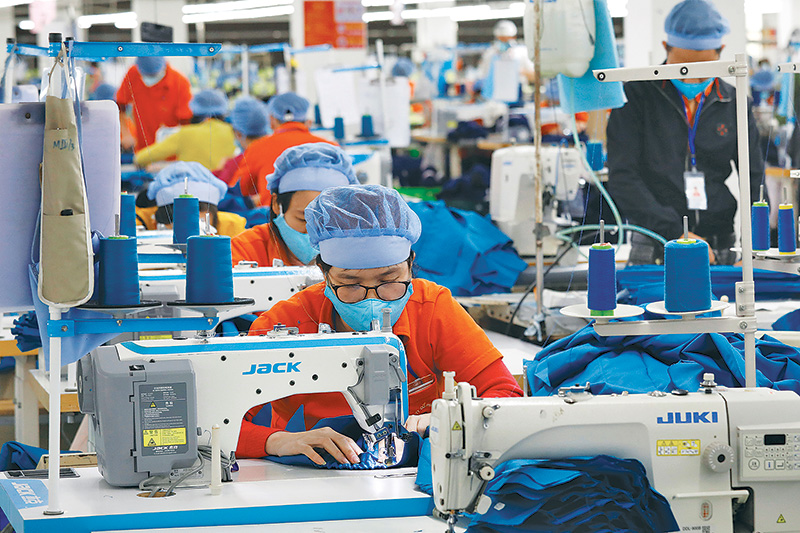
Labourers work at Hung Viet garment export factory in Hung Yen province, Vietnam. REUTERS
HANOI, Vietnam’s success in curbing the coronavirus so far, while its Southeast Asia neighbours struggle, is helping the country power ahead in economic growth and attracting funds, foreign investors, experts and analysts say. Its strength in containing the pandemic saw it build on the foundations of two free trade agreements signed in 2020, also outpacing peers in luring manufacturers moving production out of China because of the Beijing-Washington trade war. Vietnam was one of the world’s few countries to record growth last year—well down on 2019, but still a 2.9 percent expansion. Vietnam watchers expect the country to ride high as long as it keeps the virus—resurgent in many countries—at bay. Thanks to rigorously targeted testing, a centralised quarantine programme and early border closures, Vietnam’s coronavirus tally stands at just over 1,500 cases and 35 deaths to date—far fewer than any comparable country given its population of nearly 98 million. “The successful management of the pandemic to date has already enabled the country to capture a larger share of global trade and FDI (foreign direct investment) during 2020,” said Carolyn Turk, the World Bank’s country director in Vietnam. Parliament has set an economic growth target of 6 percent for this year, but Prime Minister Nguyen Xuan Phuc, looking to extend his term or rise up the Communist Party of Vietnam’s ranks, said last month that Vietnam would target 6.5 percent. At WHA Group, a Thai logistics firm which has expanded its industrial estate business in Vietnam, chairwoman Jareeporn Jarukornsakul said investors who had wanted to relocate operations to Thailand from China had not been able to do so because the coronavirus had spread in Thailand. While infrastructure and regulatory issues are worse in Vietnam than in Thailand, she said, “Costs are cheap in Vietnam and its government is very quick with investment, allowing provinces to issue their own regulations and investment incentives.”Still, there is much work to be done, even if the country does retain its prowess in handling the coronavirus: Vietnam suffers from a lack of highly-skilled labour, its dated bureaucracy is in need of digitisation and there is an over-reliance on polluting coal imports to fuel development. But the cocktail of positives flowing through the economy currently has left foreign-invested asset managers in Vietnam able to raise significant amounts, for example, with some reporting oversubscribed funds. On Monday, Ho Chi Minh City-based Mekong Capital said it had raised $246 million for its largest-ever fund—nearly 25 percent more than the original target of $200 million. Dominic Scriven, chairman of Vietnamese asset manager Dragon Capital said a combination of the country’s trade deals, more cash in the economy and political stability had underpinned better-than-expected interest across three new funds launched by his firm. “We were very pleasantly surprised by the market uptake,” said Scriven. That extra cash, along with savings accounts offering declining interest rates after three cuts in the central bank’s policy rate since March, has created a surge in local stock market investors.
MONEY
Warsteiner Golf Tournament tees off today
Bizline
KATHMANDU: Warsteiner Golf Tournament 2021 tees off at the Royal Nepal Golf Club today. About 90 amateur golfers will be taking part in the tournament to be played under 3/4 stableford format on 8th & 9th Jan 2021. The winner of the tournament will walk away with the Warsteiner Trophy and an attractive tour package, while other category winners will also get attractive trophies and prizes. Warsteiner Premium German Beer has been associated with the prestigious Royal Nepal Golf Club since the introduction of this world renowned German beer in Nepal in 2016 for the promotion of golf in Nepal.
WORLD
Virus restrictions heightened in China province
The increase in cases comes as China and the WHO are negotiating terms for a visit by WHO investigators looking into the origins of the coronavirus.
- ASSOCIATED PRESS
In this photo released by Xinhua News Agency, a medical staff in a protective suit prepares to take a swab from a child in Shijiazhuang of Hebei province, China, on Wednesday. AP/rss
BEIJING, Lockdown measures were being imposed in a northern Chinese province where coronavirus cases more than doubled in the region near Beijing that’s due to host some events in next year’s Winter Olympics. Rail, air and highway connections to the Hebei capital of Shijiazhuang, a city of at least 10 million people, have been suspended and prevention and control measured tightened over urban communities and villages in the area. Classes have been suspended and school dormitories isolated. The National Health Commission on Thursday announced 51 new cases had been confirmed in Hebei province, bringing the total to 90 since Sunday. Most have been in Shijiazhuang, although cases have also been recorded in the city of Xingtai. Hebei is adjacent to Beijing, the host city of the 2022 Games, and some of the Olympic events are scheduled to be held in Shijiazhuang. Authorities have also imposed similarly tight measures in the cities of Shenyang and Dalian in Liaoning province just to the north. Wary of a new wave of infections, China is discouraging travel over next month’s Lunar New Year holiday and beginning school holidays a week early. The increase in cases comes as China and the World Health Organization are negotiating terms for a visit by WHO investigators looking into the origins of the coronavirus, which was first detected in the central city of Wuhan in late 2019. WHO Director-General Tedros Adhanom Ghebreyesus said Tuesday he was disappointed at the lack of permission for the experts to travel to Wuhan, but Chinese Foreign Ministry spokesperson Hua Chunying said China’s disease experts were currently busy with multiple small-scale clusters and outbreaks reported in the past couple of weeks. “To ensure that the work of the global experts group in China is successful, we need to carry out the necessary procedures and relevant concrete plans. Currently both sides are still in negotiations on this,” Hua told reporters at a briefing on Wednesday. China has reported a total of 87,278 cases of Covid-19 and 4,634 deaths. In other developments in the Asia-Pacific region, Japan has declared a state of emergency for Tokyo and three nearby areas as coronavirus cases continue to surge, hitting a daily record of 2,447 in the capital. Prime Minister Yoshihide Suga issued the declaration at the government task force for the coronavirus. It kicks in on Friday until February 7, and centres around asking restaurants and bars to close at 8 pm and people to stay home and not mingle in crowds. The declaration carries no penalties but serves as a strong request. Shopping malls and schools will remain open. Movie theatres will be asked to reduce attendance. Places that defy the request will be publicised on a list, while those that comply will be eligible for aid. Thailand’s government has tightened travel restrictions in parts of the country to fight a new virus surge, as it registered 305 new cases and another death. Taweesilp Visanuyothin, a spokesperson for the Covid-19 coordinating centre, said on Thursday that 193 of the new cases were locally transmitted, 109 were migrant workers who had been isolated and three were people who were in state quarantine centres after arriving from overseas. That brings the country’s total to 9,636, including 67 deaths. Infections have surged since mid-December following months of few local cases. Most of the new cases have been migrant workers from neighbouring Myanmar who were employed in seafood markets and factories in a province next to Bangkok. Most are housed in dormitories that have been closed off to the public since the recent outbreak began. The government also announced it is extending a state of emergency by another month until February 28. The new measures announced Thursday include tightened travel restrictions and mandatory use of a tracking application in five provinces that have had the highest number of cases. The government has ordered a partial lockdown around Thailand. Schools, bars, gambling parlours and other public gathering places have been closed, although malls, department stores and restaurants remain open with curtailed hours. In South Korea, ban on incoming flights from Britain has been extended for two more weeks until January 21. Authorities said on Thursday they’ve found three additional cases of the more contagious variant of the coronavirus identified in the UK, taking the total to 14. South Korea has also found one case of a coronavirus variant detected in South Africa. All foreigners entering South Korea will be required to submit negative Covid-19 test results starting Friday. The country reported 870 new cases on Thursday. The new cases took the national caseload to 66,688 with 1,046 deaths. South Korea on Monday extended its second-highest social distancing rules, called “Tier 2.5,” in the greater Seoul area and the third-highest rules in other areas for two more weeks. Meanwhile, Australia is bringing forward its Covid-19 vaccination rollout to mid-February with plans to inoculate 15 percent of the population by late March. Prime Minister Scott Morrison said he expected the Pfizer vaccine would be delivered two weeks after the Australian regulator approved it in late January. “It is moving considerably faster than normal vaccination approval processes would occur but without skipping a step, without cutting a corner, ensuring that everything that needs to be ticked is ticked along the way,” Morrison said. That vaccine would be manufactured in Australia by Melbourne-based biopharmaceutical company CSL in partnership with British-Swedish company AstraZeneca. The vaccine produced jointly by Pfizer and BioNTech will be imported.
WORLD
Officials: Attacks around Afghanistan kill at least 23
- ASSOCIATED PRESS
KABUL, Attacks in Afghanistan left at least 23 civilians and security forces dead, officials said on Thursday, even as Afghan negotiators were in Qatar to resume talks with the Taliban aimed at finding an end to decades of conflict. In southern Uruzgan province, a suicide car bomber detonated a vehicle full of explosives early Thursday near a military base, killing six security forces, said a provincial council member who was not authorised to speak with the media. Mohammad Karim Karimi, deputy head of the provincial council in Uruzgan, confirmed the attack on the military base in Tirin Kot, the provincial capital, but couldn’t provide an exact death toll. He said the explosion was so strong it sent shock waves through the city. In southern Helmand province, at least five civilians were killed and five others wounded in a suspected airstrike late Wednesday on the outskirts of Lashkar Gah, the provincial capital, according to Attaullah Afghan, head of the provincial council. He said the casualties included children and women. No one immediately claimed responsibility for either attack. In northern Kunduz province, Taliban fighters stormed a military checkpoint killing at least 12 security personnel, said a provincial official who was not authorized to speak with the media. He said about 10 other security forces were missing and may have been taken into custody by the Taliban during the attack. The official said reinforcements were dispatched to the area outside the provincial capital Kunduz. Two military vehicles were destroyed and weapons and ammunition from the checkpoint were seized by the insurgents, he added.
WORLD
Trump summoned supporters to ‘wild’ protest, and told them to fight. They did
- REUTERS
Supporters of US President Donald Trump protest in front of the US Capitol Building. REUTERS
WASHINGTON, The chaos in the US Capitol on Wednesday unfolded after President Donald Trump spent weeks whipping up his supporters with false allegations of fraud in the November 3 election, culminating in a call to march to the building that represents US democracy. Trump, who has refused to concede his loss to Democratic President-elect Joe Biden, had urged his supporters multiple times to come to Washington for a rally on Wednesday, the day the US House of Representatives and Senate were scheduled to certify the results of the Electoral College. “Statistically impossible to have lost the 2020 Election,” Trump, a Republican, tweeted on December 20. “Big protest in DC on January 6th. Be there, will be wild!” They turned out in the thousands and heard the president urge them to march on the Capitol building to express their anger at the voting process and to pressure their elected officials to reject the results. “We’re going to walk down to the Capitol and we’re going to cheer on our brave senators and Congressmen and women,” Trump told the crowd, speaking with the White House as a backdrop. Appearing at what could be his last rally as the sitting president, Trump exhorted his supporters “to fight.” Wednesday’s events were the culmination of his efforts to thwart a peaceful transfer. About 50 minutes into the speech, some of his supporters, waving Trump flags, began heading toward Capitol Hill, where unprecedented mayhem ensued. Protesters fought through police barricades, stormed the building and entered lawmakers’ chambers. The certification process was stopped and Vice President Mike Pence and members of Congress were evacuated. One civilian was shot dead, Washington police said. Monitoring the scenes of violence on cable news television from the White House, Trump tweeted about an hour after the Capitol was put on lockdown that the protesters should “remain peaceful.” As criticism mounted that he had incited a riot, he was urged to say more by a Trump stalwart, House Republican leader Kevin McCarthy, and some of the advisers who remain for his dwindling days in office. Biden had come out forcefully on live television and said the violence was “not a protest, it’s insurrection.” He called on Trump to demand “an end to this siege.” Eventually, Trump posted a recorded video on Twitter. “I know you’re hurt. We had an election that was stolen from us. It was a landslide election,” Trump said, repeating familiar falsehoods. “But you have to go home now. We have to have peace. We have to have law and order.” He posted another message that called the mob “great patriots” who were reacting to an election victory “viciously stripped away.” Twitter later hid three tweets and locked Trump’s account. Trump’s failure to rein in his supporters stood in sharp contrast to his attitude last summer when he threatened arrests and the use of force to break up protests against racial inequality. During the Black Lives Matter protests, Trump discussed using the military in response, and an area near the White House was forcibly cleared for him to stage a photo-op in front of a church, holding a Bible.
WORLD
Beijing freezes as temperature hits five decade lows
Briefing
- AGENCIES
BEIJING: Temperatures in the Chinese capital plunged to their lowest for more than five decades on Thursday, as Beijing was hit by gale-force winds and bitter conditions. On Thursday morning the mercury dropped to minus 19.6 degrees Celsius, breaking a previous cold weather record set in 1969. The cold reading was the lowest since 1966, when temperatures in the city fell to minus 27.4 degrees Celsius. Thousands took to social media to complain about the city’s weather, with the hashtags
WORLD
Iraq issues arrest warrant for Trump over Soleimani killing
Briefing
- AGENCIES
BAGHDAD: An arrest warrant was issued Thursday for outgoing President Donald Trump in connection with the killing of an Iranian general and a powerful Iraqi militia leader last year, Iraq’s judiciary said. The warrant was issued by a judge in Baghdad’s investigative court tasked with probing the Washington-directed drone strike that killed Gen Qassim Soleimani and Abu Mahdi al-Muhandis, the court’s media office said. They were killed outside the capital’s airport last January. Al-Muhandis was the deputy leader of the state-sanctioned Popular Mobilization Forces, an umbrella group composed of an array of militias, including Iran-backed groups, formed to fight the Islamic State group.
WORLD
No diplomatic ties to Qatar yet, but trade, travel resuming,says UAE
Briefing
- AGENCIES
DUBAI: Arab states boycotting Qatar could resume travel and trade links with Doha within a week under a US-backed deal, but restoring diplomatic ties requires more time as parties work to rebuild trust, a United Arab Emirates official said on Thursday. Gulf powerhouse Saudi Arabia announced the breakthrough in ending a bitter dispute at a summit on Tuesday, with its foreign minister saying Riyadh and its allies would restore all ties with Doha severed in mid-2017. UAE Minister of State for Foreign Affairs Anwar Gargash told a virtual news conference that measures to be implemented within a week of the agreement “include practical measures of airlines, shipping and trade”.
SPORTS
Manchester City on the way to record-equalling League Cups
Pep Guardiola’s side beat Man United 2-0 to reach final, and can match Liverpool’s record between 1981 and 1984 of four consecutive titles if they defeat Tottenham on April 25.
- ASSOCIATED PRESS
Manchester City’s John Stones (right) and Fernandinho inflicted Ole Gunnar Solskjaer’s Man United their third semi-final defeat of 2020. AP/RSS
MANCHESTER, Another English League Cup final for Manchester City. Another painful semi-final loss for Manchester United. City beat fierce rivals United 2-0 at the Old Trafford on Wednesday thanks to second-half goals by John Stones and Fernandinho, setting up a meeting with Tottenham in the League Cup final at the Wembley Stadium on April 25. For City manager Pep Guardiola, that means another head-to-head with long-time coaching adversary Jose Mourinho, who is looking to end Tottenham’s 13-year trophy drought. City have no such issues. They have a chance for a fourth straight title — and a sixth in eight seasons — in a competition which the team have virtually made their own. City can match Liverpool’s record between 1981 and 1984 of winning four successive League Cups, if they beat Tottenham in the final. “We achieved something incredible,” Guardiola said. “I know the [League] Cup is not the Champions League, but four times in a row reaching the final is impressive.” An open, end-to-end match, which started with three goals getting disallowed for offside in the opening 24 minutes, was settled by goals from set-pieces. Stones bundled the ball into the net off his waist from an inswinging free kick by Phil Foden in the 50th minute to put City ahead inside an empty stadium. Fernandinho, the 35-year-old Brazilian starting ahead of Rodri in central midfield, secured the win with a volley from the edge of the area that crept inside the post following a weak headed clearance by United right back Aaron Wan-Bissaka. “City can score many great goals, and you can accept that,” said United manager Ole Gunnar Solskjaer, “but when you concede from two set plays, simple ones that we should have cleared, you’re very disappointed.” City repeated their win over United in last season’s semi-finals, which were played over two legs in contrast to this year’s one-match shootout. That was one of three semi-final defeats for Solskjaer’s team in 2020, along with the FA Cup and Europa League. “We’re getting closer,” Solskjaer said. “This is a much better version of Man United compared to a year ago in those semis. That’s positive, but it’s not enough.” City, though, were the superior team and had the better of the chances in open play, with Kevin De Bruyne hitting the post with a fierce shot from the edge of the area in the first half and Riyad Mahrez bringing a fine, tipped save over the crossbar out of United goalkeeper Dean Henderson after the break. Stones’ goal continues the impressive rebound of his City career that looked over just six months ago. Settled once again in his personal life, he has regained his place at centre back and put in an assured performance alongside the excellent Ruben Dias to repel what has been one of the Premier League’s most potent attacks in recent weeks. US goalkeeper Zak Steffen, who again started for City with Ederson out after contracting the coronavirus, tipped over a curling shot by Bruno Fernandes in the ninth minute. But late pressure from United didn’t yield any clear-cut openings as City comfortably saw the game out. After starting the season slowly, City are hitting top form, with this win over United coming three days after a 3-1 victory at Chelsea in the league and a 4-1 triumph at Arsenal in the cup just before Christmas. Guardiola has made his team harder to beat in recent months by playing two defensive-minded central midfielders to give extra protection against counterattacks, and it is paying off—that’s just three goals conceded in the team’s last 12 games in all competitions. “It’s about the consistency,” Guardiola said. “We didn’t have a proper preseason and that’s why we need a little bit of time but I think we are already there.” City’s players wore retro No 8 jerseys ahead of the game in honour of Colin Bell, the club’s midfield great who died on Tuesday aged 74.
SPORTS
Pucovski half-century lays platform for Australia in Sydney
- REUTERS
SYDNEY, Australia looked destined for their biggest score of the series against India after a half-century from debutant opener Will Pucovski helped them to 166 for two at the end of the rain-disrupted first day of the third Test on Thursday. Pucovski rode his luck for his 62 but his partnership of 100 with Marnus Labuschagne for the second wicket established a solid platform for the hosts as they look to break a 1-1 tie in the four-match series. Labuschagne notched his ninth Test half-century to finish the day on 67 not out with Steve Smith unbeaten on 31 at the other end in a potentially ominous stand between Australia’s two best batsmen. “Nice to spend a bit of time out there,” said Smith, who had scored only 10 runs in his four previous innings in the series. “Nice partnership building with Marnus and hopefully we can bat for a while tomorrow.” Australia’s previous best tally in the series was their 200 in a losing effort in the second Test in Melbourne and they overhauled their opening partnership for Sydney in an effort to improve matters. David Warner returned after missing the first two Tests with a groin injury but his stay at the crease was brief and he departed for five swatting at a Mohammed Siraj delivery that flew to Cheteshwar Pujara in the slips. The rain descended soon afterwards with only seven overs completed and it was four hours before the skies cleared and Pucovski was able to return to the crease. The 22-year-old was twice dropped behind the stumps by India wicketkeeper Rishabh Pant and survived a run-out scare but made the most of his reprieves to reach the half-century with his fourth boundary. His innings ended when he was trapped lbw to give Indian seamer Navdeep Saini his first Test wicket as he also made his debut as a replacement for the injured Umesh Yadav. Siraj said his team mates would have to be patient in absence of any help from the wicket. “It was a flat wicket, great to bat on,” said the 26-year-old who made his Test debut in the previous match in Melbourne. “Our target will be to build pressure by hitting the same area and bowling dot balls after dot balls. We saw some turns towards the end, let’s see how it pans out tomorrow.” After a second outbreak of Covid-19 in Sydney, the match was being played in front of a reduced attendance of around 10,000 fans with the wearing of masks compulsory for fans except when they are eating or drinking. The fourth Test is scheduled to start on January 15 in Brisbane but reports persist that India might refuse to head north because of the quarantine measures they will face in Queensland.
SPORTS
Juventus end AC Milan’s 27-game unbeaten run
- AGENCE FRANCE-PRESSE
MILAN, Italian champions Juventus inflicted a first league defeat of the season on Serie A leaders AC Milan, ending their 27-match unbeaten run with a 3-1 win on Wednesday. Stefano Pioli’s side maintained their one-point advantage over city rivals Inter Milan who missed a chance to go top with a 2-1 loss at Sampdoria. AC Milan had been unbeaten since before the lockdown last March, with a run of 12 matches without defeat to complete last season where they finished sixth, and 15 games this campaign. Federcio Chiesa bagged his first brace for the champions, scoring on 18 and 62 minutes at the San Siro with Weston McKennie getting a third with quarter of an hour to go. Davide Calabria had pulled a goal back before the break to level for Milan who were playing without injured star Zlatan Ibrahimovic. The hosts had been hit hours before kick-off with the news that forward Ante Rebic and midfielder Rade Krunic had tested positive for Covid-19. The absence of the pair was a blow for the side already without their top scorer Ibrahimovic for an eighth league game with Ismael Bennacer and Alexis Saelemaekers also out and Sandro Tonali suspended. Juventus pair Alex Sandro and Juan Cuadrado were also out with coronavirus. Andrea Pirlo’s side move up to fourth, seven points behind Milan but having played a game less.
SPORTS
Wolves’ Podence sidelined for few weeks due to calf problem
Briefing
- AGENCIES
WOLVERHAMPTON: Wolverhampton Wanderers winger Daniel Podence will be sidelined for a few weeks due to a calf problem sustained during their 1-0 defeat by Manchester United last week, the Premier League club has said. The 25-year-old Portugal international, who has scored three goals in all competitions this season, was ruled out of Saturday’s 3-3 draw at Brighton & Hove Albion due to the injury. “Podence had a calf injury following a tackle in the second-half of the Manchester United game. It is a muscle injury and will take a few weeks to resolve,” Wolves said.
SPORTS
Messi at the double as Barcelona beat Bilbao 3-2
Briefing
- AGENCIES
BILBAO: Lionel Messi was at the top of his game as Barcelona earned a 3-2 win at Athletic Bilbao on Wednesday to move up to third in La Liga. Athletic got off to a dream start in their first match under new coach Marcelino when forward Inaki Williams latched on to a low through ball and raced towards goal, beating one defender before firing low into the net in the third minute. Barca quickly responded, Messi delivering a superb pass to pick out Frenkie de Jong by the byline and the Dutchman volleyed the ball back across the area for 18-year-old Pedri to head home. Messi and Pedri combined to put Barca ahead, the youngster receiving a pass from the Argentine before returning it with a backheel and Messi rolled the ball into the bottom corner in the 38th minute. Messi struck again in the 62nd minute to finish off another brilliant team move and missed a couple of chances to complete his hat-trick, although Iker Muniain made for a tense finale by scoring for Athletic in the 90th.
SPORTS
Paris Saint-Germain held in Pochettino’s first game
Briefing
- AGENCIES
PARIS: Mauricio Pochettino’s first game in charge of Paris Saint-Germain ended in a tame 1-1 draw at Saint-Etienne on Wednesday as leaders Lyon moved three points clear by beating Lens 3-2 at home. Lyon made it 15 games unbeaten with Memphis Depay scoring twice, but PSG still jumped up to second place on goal difference because Lille lost 2-1 at home to Angers. “I am disappointed. We are PSG and we wanted to win,” said Pochettino, who replaced Thomas Tuchel after he was fired late last month. “This is not the result that we wanted.” Pochettino’s tenure got off to a bad start when veteran winger Romain Hamouma put Saint-Etienne ahead in the 19th minute, after PSG midfielder Idrissa Gueye lost the ball near the penalty area. Striker Moise Kean equalised soon after when he was teed up by midfielder Marco Verratti.
CULTURE & LIFESTYLE
Khashoggi doc, too explosive for streaming, debuts on-demand
The film details a plot to kill Jamal Khashoggi, a former Saudi insider turned Washington Post columnist who made pleas for his native country to embrace freedom of speech and human rights.
- JAKE COYLE
Director Bryan Fogel (left) and Hatice Cengiz pose for a portrait to promote The Dissident. AP/RSS
NEW YORK, Even before “The Dissident” made its premiere at the Sundance Film Festival, director Bryan Fogel had a sense that his explosive Jamal Khashoggi documentary was going to be a tough sell. The film, available on-demand this week, was one of the most anticipated of last January’s Sundance. Fogel’s previous film, “Icarus,” about Russian doping in the Olympics, won the Academy Award for best documentary. “The Dissident” features audio recordings of Khashoggi’s murder, the participation of Khashoggi’s fiancé, Hatice Cengiz, and details on Saudi hacking efforts, including the infiltration of the cellphone of Amazon founder Jeff Bezos. The audience at Sundance included Hillary Clinton, Alec Baldwin and Reed Hastings, the Netflix chief executive. At the screening, Fogel implored media companies not to be scared off. “In my dream of dreams, distributors will stand up to Saudi Arabia,” he said. Riding in an SUV to the film’s Sundance after-party, an upbeat Fogel said he was hopeful that Netflix, Amazon, HBO or others would step forward—anyone that could give the film a global platform for Khashoggi’s story, which plays as a lethal, real-life geopolitical thriller in “The Dissident.” But the rough road ahead for “The Dissident” had already been signaled. None of the streamers—many of whom bought up Sundance’s top films—had asked for an advance look at “The Dissident” before the festival—something that could be expected for such a high-profile documentary from a filmmaker coming off an Oscar win. “Many of the major streamers were actually there that day. Not their heads of content. Their CEOs. I would have hoped that would have led to: ‘We’re going to get behind this film.’ But it didn’t,” said Fogel, speaking by Zoom from Los Angeles last month. “We didn’t have an offer for $1 let alone $1 million—let alone the $12 million paid for ‘Boys State,’ which is a wonderful film, but it’s about 17-year-old boys playing mock politics in Texas.” “The Dissident,” set in a ruthlessly real political realm, will finally debut on-demand Friday. It was acquired last spring, in a deal announced in September, by Briarcliff Entertainment, the independent distributor founded by Tom Ortenberg, the veteran film executive who distributed “Spotlight” and “Snowden” as chief executive of Open Road Films. After a two-week run in about 200 theaters (scaled down from 800 due to the pandemic), “The Dissident” will be available for rent on places like iTunes, Amazon and Roku. But the cool reception from larger media companies to “The Dissident”—not because it wasn’t good (it has a 97 percent fresh Rotten Tomatoes rating from critics and a 99 percent rating from audiences ) or important but because it openly challenges the Saudi regime’s crackdown on free speech—raises questions about the future of political films on ever-larger and potentially increasingly risk-averse streaming services. Netflix et al have played a vital role in exponentially growing audiences for documentaries. But in hunting globally for subscriber growth, media companies have sometimes capitulated to demands that border on censorship. In 2019, Netflix removed an episode of Hasan Minhaj’s “Patriot Act” that condemned the cover-up of Khashoggi’s murder after a Saudi complaint. Last month, The New York Times reported Apple chief executive Tim Cook squashed an Apple TV+ series in development about Gawker. Negative depictions of China, for both old-line Hollywood studios and streamers, is typically off the table. “When there’s huge money at stake—business interest, shareholder accountability, what is going to make us vanilla and not cause us stress—is winning over,” Fogel says. “As these companies become bigger and bigger, we’re seeing the choices they make, including content, become less and less risky.” For Fogel, the experience of “The Dissident” mirrors the silencing of Khashoggi. The film, financed by the Human Rights Foundation, details a plot to kill Khashoggi, a former Saudi insider turned Washington Post columnist who made moderate pleas for his native country to embrace freedom of speech and human rights. When picking up paperwork for his marriage to Hatice Cengiz at the Saudi consulate in Istanbul in October 2018, he was murdered and his body sawed into pieces. Intelligence reports concluded that Saudi Crown Prince Mohammed bin Salman ordered the killing. Mohammed denied Saudi Arabia was behind the murder, then eventually granted it was carried out by agents of the Saudi government. Mohammed has claimed it wasn’t by his orders. “The Dissident” includes interviews with Cengiz, Turkish authorities and United Nations investigators who deduced that Bezos, who owns the Washington Post, was hacked by a malicious file sent from the personal WhatsApp account of Mohammed. The same hacking scheme was allegedly used on the exiled activist Omar Abdulaziz, an associate of Khashoggi’s. “The Dissident” ultimately questions why countries and companies continue to do business with a country that resorts to such methods, jailing and killing dissidents. “I hope this film will keep alive Jamal’s name and Jamal’s life and his values,” says Cengiz, speaking by phone from Istanbul. “I hope people will ask more and more and more.” President Donald Trump has declined to blame Mohammed for the murder, and is quoted in Bob Woodward’s latest book bragging that he “saved” the crown prince. President-elect Joe Biden has signaled a tougher stance with Saudi Arabia. Cengiz has called on the CIA to declassify its investigation into the killing. She has also carried on Khashoggi’s mission. “It wasn’t my choice but it’s my life,” she says. That American movie companies may have been scared away from “The Dissident,” she says, is “disappointing.” “I could not imagine that they will not buy this film because this film is talking about a very important crime in history,” Cengiz says. “This film talks about someone who fought for some very important values. That’s why they killed him. So that’s why we’re fighting.” In particular, Netflix’s shying away from “The Dissident” is “incredibly disappointing,” Fogel said. “Icarus” won Netflix its first Oscar. A spokesperson for Netflix declined to comment on the company passing on “The Dissident.” In November, the streamer inked a production deal with the Saudi studio Telfaz11 for eight movies. But Fogel is also clear-eyed about the potential dangers associated with distributing “The Dissident,” musing about the possibility of Saudi hacking or a Middle East boycott of a distributor. “Ultimately, those risk assessments took the place of whether or not their couple hundred million subscribers would like to see this film,” Fogel says. “It wasn’t just Netflix, but it was universal. What I think Hollywood learned from the Sony hack is that the risk of embarrassment is too high.” Ortenberg, on the other hand, was comfortable with any headaches “The Dissident” might bring. “The movie speaks for itself,” Ortenberg says, speaking by phone from Los Angeles. He’s putting “The Dissident” forward for awards consideration. “It’s too bad,” Ortenberg says of other studios’ apprehension. “I always saw the entertainment movie studios as leading the charge on important topics and not shying away from controversy but actually embracing challenges, and embracing the challenge of making movies about important subjects and treating them respectfully.” Fogel sees a lack of international and corporate will to respond to human rights abuses that’s only growing worse, in Hollywood and elsewhere. Last week, Saudi state security court sentenced 31-year-old Loujiain Al-Hathloul to more than five years in prison for tweets that advocated women’s right to drive and argued against male guardianship regulations. Imprisoned since May 2018, she has said she was tortured and sexually assaulted by masked men during interrogations. “I do believe that people in positions of power like that, with wealth and resources, if they’re not willing to stand up for human rights abuses like this, for what I consider the greater good of the planet, it becomes an increasingly scary place for us to live,” Fogel says. “We all become less safe.”
— Associated Press
CULTURE & LIFESTYLE
Pandemic-era Mardi Gras: No big crowds, but plenty of cake
The Mardi Gras season, which always starts on January 6 and ends on February 16, is usually marked by extravagant balls and parades but this virus has put an end to all those large events.
- REBECCA SANTANA
This year, due to the coronavirus pandemic, riders socially distanced during their ride for the festival. AP/RSS
NEW ORLEANS, A subdued Carnival season began Wednesday after the coronavirus pandemic put an end to the crowd-heavy balls and street parades that draw thousands of people to the city every year. The Mardi Gras season always starts on January 6 and ends on Fat Tuesday, which this year falls on February 16. The season is usually marked by extravagant balls and parades where costumed riders throw trinkets to the mobs of people packed along the parade routes. The coronavirus has put an end to those large events. But that has not stopped notoriously creative New Orleanians from coming up with socially distant ways to celebrate. The Krewe de Jeanne d’Arc is a club that annually pays homage to the fallen French hero with a parade through the French Quarter on the official start of the Carnival season. This year, the krewe hosted a “Tableaux de Jeanne d’Arc,” where onlookers drove by various “tableaux”—a French term for “living pictures”—that included stations of costumed revellers sparring as knights, sharpening their swords and feasting at a grand fireplace with a pig roasting in the background. “Life as usual is gone, so we had to look for different ways of doing things this year,” said Antoinette de Alteriis, one of the club’s captains. The Phunny Phorty Phellows, a group that usually gathers January 6 to mark the beginning of the season with a costumed party on a street car, also altered its plans. Usually throngs of people gather at the facility where the street car starts its journey to see the group off, but this year people were asked to disperse along the street car route and watch from there instead. But people can still eat cake—king cake that is. The sweet cakes, which are decorated with the official Carnival colours of purple, green and gold, are only to be eaten starting on January 6. In Mobile, Alabama, dozens of parades, balls and other events also have been cancelled. The city on the Gulf of Mexico calls itself the birthplace of Mardi Gras since celebrations began there a few years earlier than in New Orleans. Coastal Alabama typically begins its observances later in January than New Orleans, meaning the current coronavirus surge could be easing by the time events were set to start. But multiple organisations began announcing cancellations last month to protect the health of members and revellers.
— Associated Press
CULTURE & LIFESTYLE
Devils dance, observe virus protocols at Ecuador festival
Devils dance, observe virus protocols at Ecuador festival
- DOLORES OCHOA
People dressed as devils dance in La Diablada Pillarena amid the Covid-19 pandemic in Pillaro, Ecuador. AP/RSS
PILLARO, Talk of the devil and he is bound to appear, the saying goes. In Ecuador, that means even during the pandemic. An Andean village festival known as the Diablada, or dance of the devils, was muted Wednesday because of the health emergency. But a small group of people in demon and other costumes still danced without spectators, obeying municipal rules that no more than 30 people participate as Ecuador struggles to contain the spread of the coronavirus. The costumed fiends assembled in a designated area in Pillaro, denied the chance to strut through streets and grimace at big crowds as they previously did, though scenes of the trimmed festival circulated on social media. Thousands of tourists have travelled to past editions of the festival, which Ecuador’s culture ministry classifies as an occasion of intangible heritage” in 2009. In past years, at least 1,000 dancers, musicians and others performed in the weeklong new year’s festival, some of them spooking bystanders with papier-mache devil horns, fangs and shouts of “achachay”—said to be the sound a demon makes when feeling cold after emerging from hell. The Diablada in central Ecuador was restricted to Wednesday’s gathering and another diabolical dance-off on January 1. That was instead of daily parades during a weeklong commemoration that is also held in some other Andean regions. There is no clear record of the origin of the Diablada, according to Ecuador’s culture ministry. One theory is that men disguised themselves as devils to scare rivals in a dispute between two villages over the wooing of women. Some believe it dates to Spanish colonial rule and was a way for Indigenous people to express discontent with Roman Catholic edicts, resulting in a mix of cultural influences. On its website, the Pillaro municipality quoted local leader Carlos Velasco as saying times are tough and health is the priority. “There will be time later to fully experience this great party,” he said.