You internet speed is slow. Switch to text view mode

Switch
epaper logo
ST

Last Login:
Logout
+
Page 1
HOME PAGE

United Nations questions rights body’s autonomy after controversial appointments

Five National Human Rights Commission office bearers were appointed after the Oli government introduced an ordinance in December to amend recommendation rules.
- BINOD GHIMIRE
If questions remain over the rights watchdog’s independence, its image could be tarnished. Photo courtesy: nhrcnepal.org

KATHMANDU,
The appointment of the chair and four commissioners to the National Human Rights Commission continues to be under international scrutiny.  
The United Nations Office of the High Commissioner for Human Rights has sought clarification from the commission if its autonomy and independence, as mandated by the Paris Principles, was ensured in the appointment process.
Adopted in 1993 by the United Nations General Assembly, the Paris Principles set six criteria that national human rights institutions need to follow. These include autonomy from the government and the independence guaranteed by the constitution besides adequate competence, resources and powers to investigate as well as pluralism.
“The OHCHR has raised serious concerns over the appointments,” Bed Bhattarai, secretary at the commission, told the Post. On February 3, President Bidya Devi Bhandari administered the oath of office to the chair and the four commissioners of the Human Rights Commission along with 27 other appointees to various constitutional bodies.
The Constitutional Council, headed by Prime Minister KP Sharma Oli, had made a total of 38 recommendations on December 15 after amending the Constitutional Council (Functions, Duties, and Procedures) Act through ordinance, allowing the council to recommend names in the presence of its majority members.
Speaker of the House of Representatives Agni Sapkota and Nepali Congress President Sher Bahadur Deuba, the leader of the opposition in the House, boycotted the meeting that made the recommendations. The constitutional provision that parliamentary hearings must be conducted for the appointments was not followed as Oli went on to dissolve the House on December 20.
In the absence of hearings, the candidates could be appointed 45 days after their names were recommended to the President.
The Geneva-based United Nations human rights body has demanded clarification on the appointments after complaints from four human rights organisations that they were made against the Paris Principles without following the due process.
Advocacy Forum, Lawyers Association for Human Rights of Nepali Indigenous Peoples, Terai Human Rights Defenders Alliance and the Hong Kong-based Asian Human Rights Commission had filed complaints with the Office of the High Commissioner for Human Rights, pointing out the flawed appointment process and thus raising questions over its impartiality.
Human rights advocates say the question from the UN body reflects the degradation in the country’s human rights records.
“It is unfortunate that questions have been raised over the impartiality of the constitutional commission that has the mandate to hold the government accountable on human rights issues,” Govinda Bandi, a human rights lawyer, told the Post.
“The understanding at the international level that democratic institutions are being brought under the government’s shadow will have a long-term implication.”
The appointments had earlier been questioned by three international human rights  groups.
On March 1, the New York-based Human Rights Watch, the Geneva-based International Commission of Jurists, and the London-based Amnesty International had urged the government to immediately withdraw the appointments to the National Human Rights Commission as they undermined the independence of the constitutional human rights body as they were made without consultation or parliamentary approval.
“The back-to-back concerns from the UN and the international human rights organisations are not a good sign,” Gauri Pradhan, a former member at the commission, told the Post.
Human rights experts say the National Human Rights Commission could be downgraded by the Global Alliance of National Human Rights Institutions.
Currently, Nepal is among 84 countries whose human rights commissions are listed under the ‘A’ grade.
In the alliance’s review in January, Nepal continued to maintain the position and the next review is slated for 2023. However, the decision can be reviewed at any time before then. The United Nations Office of the High Commissioner for Human Rights is the secretariat of the alliance which has 127 members.
“There are high chances that the human rights commission could be downgraded if the appointments are not corrected,” said Bandi.
The ‘A’ grade status of the human rights commission was one of the points Nepal presented while seeking a vote to get elected to the United Nations Human Rights Council.
After serving a three-year term from 2018 to 2020, Nepal was elected for a second term from 2021 to 2023. As a member of the council, Nepal has the responsibility of monitoring human rights situations in various countries and of asking them to adhere to the universal principles of human rights.
“It will lose the moral ground to raise the issues of other countries if its own human rights records are questioned,” said Pradhan.
Fearing that the country’s image could be tarnished because of five individuals, officials at the Human Rights Commission have already asked the new appointees for their resignations.
“The image of the commission shouldn’t be kept at stake for the sake of jobs for the five people,” said a senior official at the commission on condition of anonymity. “We have already conveyed our message to them.”
But the commissioners do not seem to be keen to hear criticisms against their appointments if the rebuttal to the three international organisations’ concerns in March is anything to go by.
The commission issued a rebuttal saying it was unfortunate that the three organisations were interfering in the internal matter of a sovereign nation. But the commission’s statement was dragged into controversy as it, an independent constitutional body, was defending the actions of the government.
Their response to the United Nations body’s concern is along the same lines.
“I don’t want to comment on the matter,” said Tap Bahadur Magar, chair of the commission, when the Post reached out to him. “Please talk to our officials.”
The matter has been forwarded to the government, according to officials at the commission.
“As it was the Constitutional Council that made the appointments, we have forwarded the letter to the government for a reply,” said Bhattarai, the commission secretary. “We will forward the response from the government if it replies. Otherwise, the commission will write its own reply.”

HOME PAGE

As Nepal struggles to continue vaccine drive, India denies export restrictions

With supply halted, government has stopped the inoculation campaign.
- SURESH RAJ NEUPANE

NEW DELHI,
Amid reports that India has put a hold on exports of AstraZeneca vaccine, manufactured by the Serum Institute of India, the Ministry of External Affairs of India has said that they have not imposed restrictions as such and that New Delhi is just trying to prioritise the demand at home.   “India has not enforced any restrictions on exports of Covid-19 vaccines,”
Arindam Bagchi, spokesperson for the Ministry of External Affairs of India, said during the weekly press briefing on Friday. “We will export vaccines taking into account the domestic demand.”
India’s decision to ban exports of vaccines has created confusion whether Nepal would be able to continue its vaccination drive, which was launched on January 27 after it provided 1 million doses in grant.
The Serum Institute has yet to provide 1 million doses, of the 2 million doses for which Nepal has already paid for, given the Indian ban on exports of vaccines.
The Serum Institute had last committed to providing one million doses of vaccine by April 2, according to officials.
Officials at the Ministry of Health say the company has not sent any information about delivering the vaccines as of Friday evening.
“There is no news yet whether they will be sending the remaining doses,” an official at the Health Ministry told the Post.
“Had there been any plans to supply the remaining doses of vaccine, they would have written to us two or three days in advance.”
Nepal’s vaccination drive is currently in limbo, despite the country becoming one of the first in the world to launch the campaign.
In the first phase, the government vaccinated 438,000 people from January 27 to March 5.
The government says it currently has around 500,000 doses in stock, just enough to give the second shot to those who took the first jab in the first phase. During the second phase from March 7 to 15, Nepal inoculated a little over 1.35 million people, those over 65 years of age.
With vaccine supply coming to a halt, officials at the Health Ministry say they have no idea what they are going to do.
“The Serum Institute has assured us of supplying the remaining one million doses by the end of April,” said Dr Roshan Pokhrel, chief specialist at the Health  Ministry.
The halt to exports of the AstraZeneca vaccines by India is also going to affect the World Health Organization-backed COVAX facility, under which Nepal is expected to receive around 13 million doses so as to vaccinate around 20 percent of the 30 million population.
Nepal so far has received 348,000 doses under the COVAX facility.
The UN health agency meanwhile has said that the countries should make their “own decisions” to vaccinate people given the shortages of the vaccines in the wake of India’s decision to halt exports.
As India is reporting a surge in Covid-19 cases, concerns have also grown in Nepal, which after seeing a dramatic decline in infection numbers is witnessing a steady rise in cases. Public health experts have also warned of a possible second wave. Amid this, they say, it would be wrong to be complacent and that unless a majority of people are vaccinated, the risk remains.
As of now, Nepal has vaccinated a little over 5 percent of the total population.
With vaccine supply coming to a halt, concerns are growing over Covid-19 penetrating society again, as experts say there is no way to call the risk over until a majority of people are vaccinated.
Officials at the Nepali embassy in Delhi say they have been discussing the supply of vaccines not only with the Serum Institute but also with Niti Aayog, a policy think tank of India, and India’s Ministry of External Affairs and Ministry of Health.
According to Nepali officials, the Serum Institute has said that as a manufacturer, its job is to produce and supply the vaccines, but given the need at home, it also has to take into consideration what the government of India says in the wake of rising number of cases and the demand at home.
Apart from the 500,000 doses of AstraZeneca vaccine, the one manufactured by the Serum Institute which Nepal has been using, 800,000 doses of Sinopharm vaccine too are currently with the government. The Health Ministry has suggested using the Chinese vaccine on people between 40 and 54 years of age. There is no clarity as to when the use of the Chinese vaccine could start.
Officials at the Health Ministry say things would be back on track if the Serum first provided the remaining 1 million doses and then started taking the process to supply additional 5 million doses that Nepal wants to buy.
“No agreement has been reached yet with regard to buying the additional 5 million doses,” said Pokhrel.


(Arjun Poudel contributed reporting.)

HOME PAGE

Nepali Congress appears to be ready to get the ball rolling

The main opposition decides to seek Oli’s resignation and start process to form a government led by its president.
- ANIL GIRI

KATHMANDU,
The ongoing political deadlock seems likely to end soon.
The Nepali Congress, the main opposition party, during its Central Working Committee meeting on Friday evening, decided to seek resignation of Prime Minister KP Sharma Oli and take the lead to form a new government.
Despite pressure from within the party to take steps to unseat Oli, party President Sher Bahadur Deuba had so far been reluctant to do so.
“The meeting took precisely two decisions,” said Gagan Thapa, a party lawmaker and Central Working Committee member. “It has decided to seek the resignation of Prime Minister Oli, and we will also take initiatives to form a new government.”
After the Supreme Court on February 23 overturned his decision to dissolve the House of Representatives, Oli had been under moral pressure to resign, but he had refused to do so.
Numerically speaking, he still has the majority support in Parliament as the Communist Party of Nepal (Maoist Centre), revived together with Oli’s CPN-UML by the Supreme Court on March 7 by invalidating the 2018 merger between them, is yet to withdraw that support.
But with the Nepali Congress decision on Friday that is likely to change. The Congress has to join hands with the Maoist Centre and the Janata Samajbadi Party, the third and the fourth largest parties in Parliament respectively, if it is to offer an alternative to the Oli government.
“With our decision, the ball is in the court of Communist Party of Nepal (Maoist Centre) and the Janata Samajbadi Party,” Thapa said. “Now they also have to make decisions on a new government soon.”
With the Supreme Court on Thursday rejecting Pushpa Kamal Dahal’s plea that the March 7 decision to scrap the merger of the UML and Maoist Centre be reviewed, his options are limited.
Meanwhile, Oli has been courting the Samajbadi Party to secure its support to save his government. However, the party, with 32 seats, is divided on whether to support Oli or not.
There are two ways that Oli can be unseated. One, if the Maoist Centre withdraws the support it gave to UML when Oli became the prime minister in February 2018, then he will have to seek a fresh vote of confidence. In such a scenario if Oli cannot get the support of 136 members of the House, his government falls.
The 275-member House at present has 270 seats as two lawmakers each from Nepali Congress and the Janata Samajbadi Party have been suspended and one UML lawmaker has died.
The UML has 120 seats in Parliament, the Nepali Congress 61, Maoist Centre 53, of which four have defected to the UML, and Janata Samajbadi Party 32.
The second way that Oli can be unseated is through a no-confidence motion.
At the moment it is unclear which of the two ways Oli will be unseated.   
According to a Nepali Congress leader, senior party leaders Ram Chandra Poudel and former general secretary Krishna Prasad Sitaula asked Deuba at Friday’s meeting to prepare for registering a no-confidence motion against Oli.
The desire to unseat Oli is so strong within the Nepali Congress that both Poudel and Sitaula said at Friday’s meeting that the party does not necessarily have to lead the government but could support the Maoist Centre and the Samajbadi Party to form another government, according to a number of Congress leaders that the Post talked to.
“As the opposition, we have decided to unseat Oli,” Minendra Rijal, another Central Working Committee member and lawmaker said. “If he does not resign, we will start work on forming a new government or a coalition government.”
According to Rijal and Thapa, they had visited Deuba at his residence on Thursday to convince him of the need to take a decisive step to oust Oli.
“Since we were holding the Central Working Committee meeting in the midst of a political crisis in the country, we pressed Deuba to take a firm decision on Oli’s resignation and taking the lead to form a new government,” said Thapa. “Deuba was finally convinced and decided to take these two important decisions that millions of party leaders and cadres have been waiting for.”
Friday’s meeting of the Central Working Committee had been delayed by hours as there were differences within the party over a new government.
Deuba had been reluctant to stake his claim to the post of prime minister as he was unsure of the support of the Samajbadi Party in particular although Dahal has offered to support him.
“I will convince Rajendra Mahato to support us if you become ready to take charge,” Poudel told Deuba in the meeting on Friday evening, according to a leader who did not want to be quoted.
Ahead of the meeting, Deuba’s rival Poudel had warned of seeking an alternative to Deuba if he continued to refuse to take the lead to form a government under his leadership.
Though the Poudel faction did not specifically propose the name for Deuba’s alternative, two senior party leaders—General Secretary Shashanka Koirala and former general secretary Prakash Man Singh—have expressed their interests if Deuba refuses to take charge of a new coalition.
“As the leader of the primary opposition, Deuba should lead the new government,” a senior leader close to Poudel said. “But if he is not interested in taking charge to lead the alternative government, then he should pave the way for [other] leaders within the party.”
But for now at least there is a consensus within the main opposition that an alternative to Oli must  be found.
“Oli had to resign earlier on political and moral grounds but he did not,” party spokesperson Bishwa Prakash Sharma said. “Those who had opposed Oli’s unconstitutional and undemocratic move should come together to replace him.”

Page 2
NATIONAL

Ghorahi constructs artificial lakes, ponds to preserve ecology

The sub-metropolis aims to conserve wetlands, increase greenery, provide irrigation facilities to local farmers and maintain the habitat of various species of wildlife and birds.
- DURGALAL KC
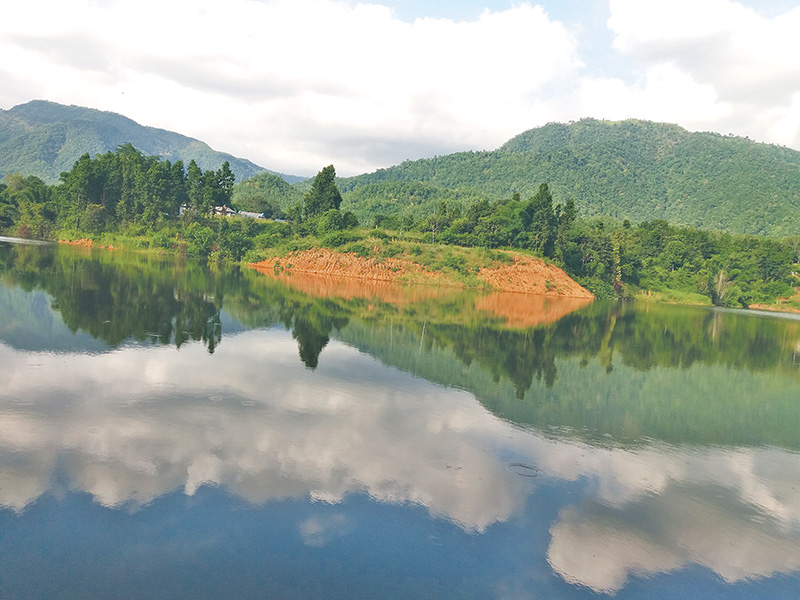
As many as 22 artificial lakes and ponds have been constructed in Ghorahi Sub-metropolitan City in the past seven years. Post Photo: Durgalal KC

DANG,
Ghorahi Sub-Metropolitan City in Dang has launched a campaign to construct artificial lakes and ponds across the local unit to preserve the local ecology.
The sub-metropolis aims to conserve wetlands, increase greenery, provide irrigation facilities to local farmers, preserve the habitat of various species of wildlife and birds and promote tourism with the construction of the water bodies.
“A total of 22 ponds have been constructed in Ghorahi Sub-Metropolitan City so far. The ponds occupy around 33 bighas of land and have a capacity to store 2.2 million cubic metres of water,” said Ramdhan Shrestha, an engineer at the sub-metropolis. According to him, 3,500 families of local farmers have benefited from the initiative.
The artificial ponds have been constructed in Chepe, Balarampur, Dundra, Thanti, Jankholi, Jyamire, Gangate, Dhikpur, Katahari, Aarogya, Dabari, Gulariya, Belghari and Githepani areas of Ghorahi. These ponds are managed by the local people, who use these water bodies for irrigation and fish farming. Boats are also operated in the ponds in Chepe and Jyamire to attract tourists.
According to the local unit, it spent more than Rs 100 million on the construction and management of such ponds. “Efforts are underway to build more artificial ponds to preserve the wetlands,” said Shrestha.
Local residents say the construction of artificial ponds is necessary since the natural water bodies in the area are gradually drying up.
“In the past, we did not even have water to feed our cattle. Now, with the construction of artificial ponds, we have enough water to irrigate our farmland as well,” said Som Prasad Subedi, a local resident of Chepe. According to him, artificial ponds have been very helpful in preserving the local ecology. He even claimed that various birds, which were hardly seen in the past, recently visited the wetland.
As many as 22 lakes and ponds have been constructed in Ghorahi Sub-Metropolitan City in the past seven years.
“Rainwater is collected in the artificial ponds and lakes. Such wetlands have helped in the conservation of various bird and animal species,” said Mayor Narulal Chaudhary.
He said the sub-metropolitan city came up with the idea to construct artificial water bodies to minimise the impact of climate change and provide irrigation facilities to local farmers.
“Such lakes and ponds have multiple benefits. They help in the conservation of ecology and promote internal tourism as well,” Chaudhary said. “They even help in replenishing underground water.”

NATIONAL

Chitwan sees rise in two-wheeler accidents

- RAMESH KUMAR PAUDEL

CHITWAN,
On March 27, a scooter carrying three individuals crashed into an oncoming bus at Pakaudi bazaar in Bharatpur Metropolis Ward No. 22, Chitwan. All three died while undergoing treatment at a Bharatpur-based hospital.
On March 19, two people died in separate bike accidents at Kalika Municipality Ward No. 8 and Bharatpur Ward No. 12.
The number of two-wheeler accidents is on a rise in Chitwan of late. In the current fiscal year, 320 road accidents were reported in the district as of March 30, according to the record of the District Traffic Police Office in Chitwan.
Out of a total of 493 vehicles involved in road accidents, 244 were two-wheelers, the data of the office showed.
According to the Provincial Traffic Police Office in Bagmati, 45 traffic police personnel have been deployed in Chitwan to curb the rising number of road accidents.
“Road users violate traffic rules in the absence of traffic police personnel. This is why we have deployed more traffic personnel in Chitwan,” said Daya Krishna Bhatta, police inspector at the District Traffic Police Office. “On the other hand, the poor condition of roads is also one of the main causes behind the rising number of road accidents.”
The roads in eastern Chitwan along the East-West Highway are in a bad condition and in need of expansion and repairs.
“The roads there have narrowed due to the expansion of the bazaar areas. This has led to traffic congestion and an increase in road accidents,” said Bhatta.
Meanwhile, Shantiraj Koirala, superintendent of police and also chief at Provincial Traffic Police Office in Bagmati Province, says one of the main reasons for the rising number of road accidents is the lack of traffic police posts and units in the district.
“We need more traffic posts in Chitwan but we don’t have the resources for it,” Koirala said. “We try to do as many traffic checks as we can but it’s not enough.”
According to Koirala, the district is reporting a rise in two-wheeler and private vehicle accidents of late.
“Drivers themselves should be alert at all times while on the road and strictly follow traffic rules and regulations to minimise the number of road accidents,” he said.
The Provincial Traffic Police Office has also started traffic awareness campaigns in schools as a measure to curb road accidents, Koirala says.

Page 3
NATIONAL

Workers with conflicting biometric details to be barred from flying abroad

The move comes as many pre-departure training centres were found not orienting the workers to their job needs.
- CHANDAN KUMAR MANDAL

KATHMANDU,
As pre-departure orientation training provider agencies are found to have been flouting the rules, the government has come up with strict measures for curbing the malpractice.
The Department of Foreign Employment decided that it will not allow the migrant workers whose biometrics details submitted at pre-departure orientation centres do not match with the database at the labour desk of the Tribhuvan International Airport to fly to foreign destinations.
In a notice, the government body that oversees the foreign employment sector has warned that workers would be barred from departure starting April 14 if their biometric details recorded during the application process don’t match during checks before flying to labour destinations.
According to Kumar Prasad Dahal, the decision was taken after many pre-departure orientation providers had not been conducting training for aspirant workers.
Many pre-departure orientation providers had been misusing the online system where they would register the names of candidates but not provide any training, said Dahal.
“They would also use biometrics, which is the thumbprint, during the application process of someone other than the real candidate. Therefore, we have decided that if workers’ thumbprints differ at the airport, they will not be allowed to depart.”
Private agencies which conduct such training have to upload the names of the candidates online on the Foreign Employment Information Management System, a day before the actual training. FEIMS is an integrated online platform where details of migrant workers and services related to foreign employment are available. It connects all major stakeholders of labour migration.
A male migrant worker pays Rs700 for the pre-departure training, whereas the Foreign Employment Board pays fees for the orientation training on behalf of female workers.
Once aspirant workers complete the 12-hour long orientation, which goes on for two days, their details are available on FEIMS. Only then do Labour Offices issue permits to applicants to work abroad. Before workers board their flight, their biometric details are verified one last time at the airport labour desk.
However, the department, which has intensified monitoring of such agencies, found that candidates were not even present in the classroom at the stipulated time.
The majority of orientation providers were found not conducting the training whereas some of the agencies did not even have proper classrooms, revealing that the biometric details were wrongly filled during the application process and workers were simply given certificates.
“They have been operating the whole office in their bags. They would carry the equipment and do the registration from elsewhere but not from their offices as the candidates do not have to be present in person for the registration process,” said Dahal.
“When we started monitoring such agencies in Kathmandu, they had started registration from outside the Valley, believing that we cannot reach there for inspection. Therefore, we have focused our action on the final exit, which is the airport, for eliminating such malpractices.”
Pre-departure orientation training is mandatory for all migrant workers. Over the two days of training, workers are given useful information about the destination countries, including their rules and regulations, traffic rules, labour laws, and local cultures and traditions. They also receive information on occupational and workplace safety, communicable diseases and information related to personal care in the labour destination.
The government recently upgraded the seven-year-old curriculum for the pre-departure orientation for making it comprehensive in protecting Nepalis working abroad. But the agencies not even conducting the training emerged as a new challenge for the authorities.
“The biometric details are used so that workers can receive re-entry work permits even online.
Also for accessing insurance and financial assistance provided by the government, workers’ details should match,” said Dahal.
“During the orientation, workers are made aware not only of their physical and mental health but also their rights at [their work station]. Not getting proper training will leave them vulnerable.
We cannot let them go without the training.”
However, stopping workers right before boarding their flights will not bring them any consequences, the department of foreign employment says. It is the erring agencies that disregard the standard procedures of providing training who will face action.
“Even when workers’ biometrics won’t match at the airport, action will not be taken against them. They are rather a victim of the malpractice even after paying the fees for the training,” said Dahal.
“The compensation to the worker and airfare will be paid from the Rs500,000 which pre-departure training providers deposit as guarantee for operating their business. Workers will not suffer any losses.”

NATIONAL

Garbage collection resumes in Kathmandu after deal with Sisdole residents

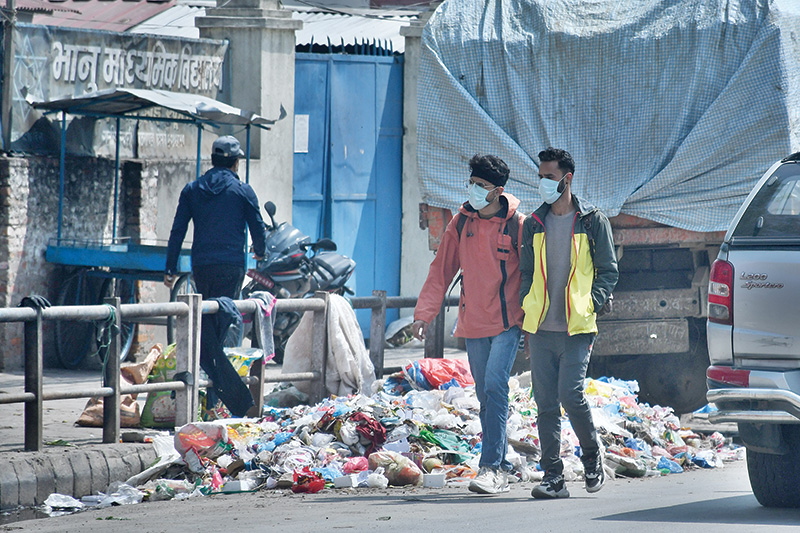
Roadsides and neighbourhoods in Kathmandu were littered with garbage heaps for the past one week.
- ANUP OJHA
The 18 municipalities in Kathmandu generate around 1,200 metric tons of solid waste daily. Post Photo: Anish Regmi

KATHMANDU,
Garbage collection in Kathmandu, which was halted for over a week,  resumed on Friday following an agreement between the Kathmandu Metropolitan City and local residents at Sisdole, Nuwakot.
Residents of Sisdole, where Kathmandu Valley’s garbage is disposed of, and the local Education Management Struggle Committee had stopped more than 150 garbage lorries from reaching the dumping site since March 26.  Roadsides and neighbourhoods in Kathmandu were littered with uncollected garbage heaps as a result.
“After an agreement on certain issues, the agitated protesters will now not be going to obstruct the roads to Sisdole,” said Hari Bahadur Shrestha, chief of the Environment Division of Kathmandu Metropolitan City.
The City has agreed to provide a grant of Rs 18.7 million to hire 31 teachers for  primary and secondary schools in wards 1, 2 and 3 of Kakane Rural Municipality and ward 1 of Dhune Beshi Municipality, according to Chandra Bahadur Balami, chair of ward 1 of Kakane Rural Municipality.
The 52nd executive meeting of Kathmandu Metropolitan City in the third week of October last year had pledged to fund the hiring of 51 seats of teachers in the most affected areas in the name of providing free education for students.  
“But the City would not act on the decision unless we protested obstructing garbage lorries,” said Balami.  
As part of the agreement, Kathmandu Metropolitan City has also assured construction of a 15-bed hospital in the area, and until then agreed to provide free health check-ups and treatment of people in landfill site area at government hospitals within Kathmandu Metropolitan City.   
Besides, the City has also agreed to allocate Rs 30 million each for wards 1,3, 4 of Dhune Beshi Municipality and wards 1, 2, 3 of Kakane Rural Municipality to construct various infrastructure and fund development projects.  It has promised to form a technical team for the land acquisition process from private landowners in the landfill sites where garbage has been dumped for years.  
“We have given a 10-day ultimatum to the City office to implement the deal,” said Balami. “If it does not address our problems within 10 days we will resume our protests and we will have no other choice than to obstruct garbage disposal in our area.”
The 18 municipalities in Kathmandu Valley generate around 1,200 metric tons of solid waste a day of which nearly 50 percent is generated by the Kathmandu Metropolitan City alone.    
Back in 2005, Kathmandu Metropolitan City had made a commitment to use the Sisdole landfill site for three years but the landfill site continues to be used 15 years later.

NATIONAL

Students at this Humla school take classes outdoors

The building of Dharmodaya Secondary School has not been rebuilt after it was destroyed by a landslide in 2019.
- JANAK BAHADUR SHAHI
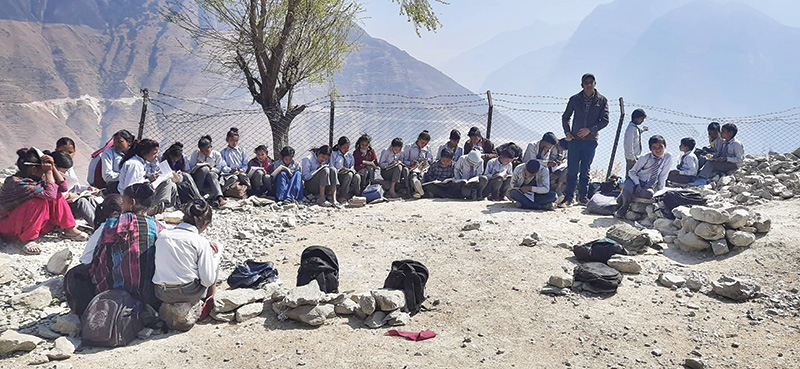
In the absence of classrooms, students and teachers say classes are hampered whenever the weather turns unfavourable. Post Photo: JANAK BAHADUR SHAHI

HUMLA,
On August 16, 2019, heavy rainstorms triggered a landslide at Chhaprela in Tajakot Rural Municipality, Humla, that swept away eight houses and displaced 150 individuals. The landslide also partially destroyed one of the oldest schools, Dharmodaya Secondary School, in the rural
municipality. More than a year since the disaster, the school building is yet to be reconstructed.
The school that runs classes from grades six to 12 has around 450 students enrolled this year. However, teaching-learning activities have been affected, as three of the six school buildings were swept away by the landslide.
“We are using only two of the remaining buildings since one is in a dilapidated condition,” said Gangadatta Jaishi, the headmaster.
The school administration has been conducting classes for grades six, seven, eleven and twelve in the open space outside the school.
“We have accommodated the students of grades eight, nine and 10 in the two remaining buildings,” said Jaishi.
The absence of classrooms has affected the academic performance of students since classes have to be cut short during unfavourable weather conditions.
“We have to leave mid-class if it starts raining or when it gets too windy to sit outside,” said Ramesh Shahi, a sixth-grader. “The school remained closed during the pandemic. Classes resumed only in February this year but we are still not able to attend regular classes.”
Tajakot Rural Municipality is around 54 kilometres from Simkot, the district headquarters of Humla. The rural municipality has already received a budget of Rs9 million from the provincial and federal governments for the construction of the school building. Geologists have recommended the school administration move the school to a safer location since the land it is built on is at risk of landslides.
But the school administration has not been able to implement the plan for a lack of suitable plot to build the school.
“We have received a budget for the construction of buildings for Dharmodaya Secondary School. However, the selection of land plots for the said infrastructure is in limbo,” said Lal Prasad Dhakal, acting chief administrative officer of Tajakot Rural Municipality.
Guardians say the current teaching-learning arrangement has discouraged their children from going to school.
“My daughter says she is no longer interested in going to the school. It’s been more than a year since the school buildings were destroyed and the authorities have not taken any concrete steps to rebuild,” Jangalal Khadka, the father of a ninth-grader at the school, told the Post.
The other closest secondary school is in Madana, around a four-hour walk from Chhaprela in Tajakot.
“We have been requesting the people’s representatives to take initiatives to reconstruct the school buildings but they have turned a blind eye to the issue,” Khadka said.

NATIONAL

Conclave to discuss media’s role in creating healthier society

- Post Report

KATHMANDU,
The Nepal Health Conclave 2021 will discuss the role of media in creating a healthier society in one of the four discussion sessions, which will take place on April 6.
Dr Jageshwor Gautam, spokesperson for the Ministry of Health and Population; Rajendra Dahal, former chairman of Nepal Press Council; Ani Choing Drolma, the singing nun who is also a social activist; and Sandip Chhetri, a popular comedian who hosts the ‘What the Flop’ show on Kantipur Television, will be the panellists for the session.
According to the organisers, discussion in the session will evaluate the critical role that mainstream media such as television and radio, and alternative media such as social media platforms and websites play in shaping the health-related behaviour of communities all over Nepal, considering how widespread technology has become in the country.
The panel is expected to identify the responsibilities of both the media and medical sectors in delivering accurate information, and discuss potential opportunities for these sectors to collaborate.
The Covid-19 pandemic revealed the dangers of misinformation, due to which the panel will also discuss how the media, as well as concerned government bodies, can combat misinformation, if and why regulations are needed, and how authorities can move forward to ensure accurate health information reaches communities.
NHC is a joint effort of Trikal Production and young health professionals from the US Embassy Youth Council.
The session will be moderated by Nitu Pandit, president of Sancharika Samuha.
Due to rising Covid-19 cases in the country, the session is planned to be an in-person event for speakers and panellists only. Participants could register to attend the event virtually and put forth their questions through the NHC’s website at www.nepalhealthconclave.com.

Page 4
WORLD

Myanmar cuts wireless internet amid protests

Myanmar’s military has forcibly disappeared hundreds of people, Human Rights Watch report says.
- ASSOCIATED PRESS
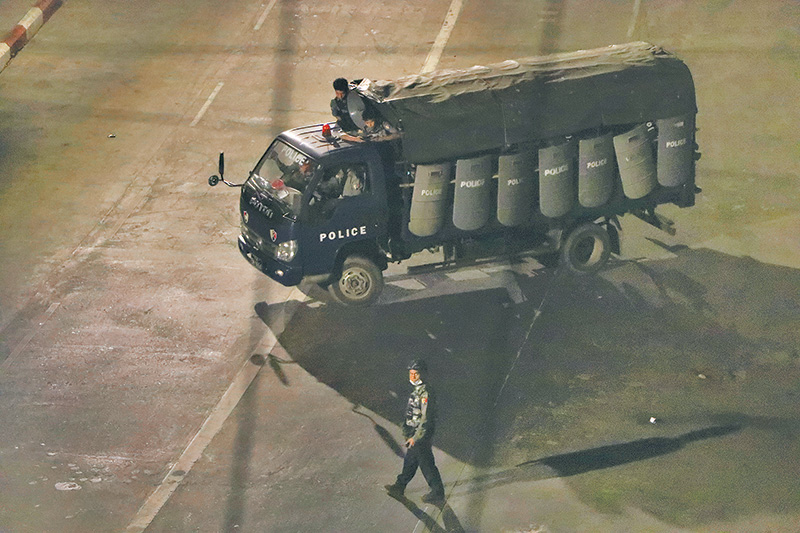
Police patrol on a truck along Hledan road at Kamaryouk township in Yangon, Myanmar. AP/rss

YANGON, 
Myanmar’s wireless broadband internet services were shut down on Friday by order of the military, local providers said, as protesters continued to defy the threat of lethal violence to oppose the junta’s takeover.
A directive from the Ministry of Transport and Communications on Thursday instructed that “all wireless broadband data services be temporarily suspended until further notice,” according to a statement posted online by local provider Ooredoo.
After weeks of overnight cutoffs of internet access, the military on Friday shut all links apart from those using fiber optic cable, whose speeds are drastically slower. Access to mobile networks and all wireless — the less costly options used by most people in the developing country — was blocked.
The Norwegian telecoms company Telenor, one of the biggest carriers in Myanmar, confirmed it could no longer offer wireless services. It was offering fiber optic service of up to 40 megabytes per second in its packages as of Friday, well below high-speed access that’s at a minimum 100 Mbps.
The government has shut down all but a handful of fully military-controlled media outlets. Some of those banned or whose operations have been suspended have continued to publish via social media or whatever methods they can find.
Facebook announced it was providing a safety feature to enable users in Myanmar to beef up security settings locking their profiles to prevent access by non-friends. That includes preventing non-friends from enlarging, sharing or downloading full-size profile and cover photos and seeing any posts on a person’s timeline.
Facebook and other major social media platforms have banned members of the Myanmar military, also known as the Tatmadaw, and are blocking ads from most military-linked commercial entities.
Also Friday, a South Korean bank said it temporary closed its branch in Yangon and was considering bringing its South Korean employees back home after security forces fatally shot one of its Myanmar employees.
Noh Ji-young, a spokesperson for Shinhan Bank, said the woman was shot in the head while commuting home from work in a company car on Wednesday and was pronounced dead on Friday.
The bank did not disclose further personal details about her. South Korea’s Foreign Ministry didn’t
immediately respond to requests for comment.
Meanwhile, German-based Giesecke+Devrient (G+D), which supplies raw materials, supplies and system components for making the kyat banknotes in Myanmar, said it was suspending all deliveries to the state-owned security printer, Security Print Works.
“This is a reaction to the ongoing violent clashes between the military and the civilian population,” the company said in a statement. It said it had previously restricted business.
With its economy contracting under pressure from mass disruptions in reaction to the coup and from the pandemic, Myanmar’s military leaders are expected to order an increase in the money supply by the central
bank. It was unclear how much of an impact the German company’s move would have.
The New York-based Human Rights Watch issued a report on Friday saying that Myanmar’s military has forcibly disappeared hundreds of people, including politicians, election officials, journalists, activists and protesters and refused to confirm their location or allow access to lawyers or family members in violation of international law.
“The military junta’s widespread use of arbitrary arrests and enforced disappearances appears designed to strike fear in the hearts of anti-coup protesters,” said Brad Adams, Human Rights Watch’s Asia director. “Concerned governments should demand the release of everyone disappeared and impose targeted economic sanctions against junta leaders to finally hold this abusive military to account.”
The crisis in the Southeast Asian nation has escalated in the past week, both in the number of protesters killed and with military airstrikes against the guerrilla forces of the Karen ethnic minority in their homeland along the border with Thailand.
In areas controlled by the Karen, more than a dozen civilians have been killed since Saturday and more than 20,000 have been displaced, a relief agency operating in the area.
About 3,000 Karen fled to Thailand, but many returned under unclear circumstances. Thai authorities said they went back voluntarily, but aid groups say they are not safe and many are hiding in the jungle and in caves on the Myanmar side of the border.
The UN Human Rights Office for Southeast Asia called on countries in the region “to protect all people fleeing violence and persecution in the country” and “ensure that refugees and undocumented migrants are not forcibly returned,” UN spokesman Stephane Dujarric told reporters in New York.
The UN Security Council on Thursday condemned the use of violence against peaceful protesters. The press statement was unanimous but weaker than a draft that would have expressed its “readiness to consider further steps,” which could include sanctions.

WORLD

Iran, world powers to hold nuclear talks in Vienna on Tuesday

- REUTERS

PARIS,
Representatives of Iran and world powers will meet next Tuesday in Vienna to discuss the troubled 2015 nuclear deal, Iranian and European officials said after holding virtual talks on Friday aimed at reviving the accord.
Iran, China, Russia, France, Germany and Britain—all parties to the 2015 deal—discussed on Friday the possible return of the United States to the agreement and how to ensure its full and effective implementation by all sides.
Iran’s Deputy Foreign Minister Abbas Araqchi, a senior negotiator in the talks, told Iranian TV that the participants had agreed to meet in person in Vienna on Tuesday after “frank and serious” talks.
Two European diplomatic sources also confirmed the meeting.
The Biden administration has been seeking to engage Iran in talks about both sides resuming compliance with the deal. Under that accord, US and other economic sanctions on Tehran were removed in return for curbs on Iran’s nuclear program to make it harder to develop a nuclear weapon—an ambition Tehran denies.
US President Joe Biden’s predecessor, Donald Trump, withdrew from the deal in 2018 and reimposed US sanctions, prompting Iran, after waiting more than a year, to violate some of the pact’s nuclear restrictions in retaliation.
The United States and Iran have yet to agree even to meet about reviving the deal and are communicating indirectly via European nations.
Russia’s ambassador to the UN atomic watchdog said that Friday’s talks had been businesslike and would continue.
“The impression is that we are on the right track but the way ahead will not be easy and will require intensive efforts. The stakeholders seem to be ready for that,” Mikhail Ulyanov said on Twitter.
The meeting will happen in the middle of an Easter lockdown in the Austrian capital aimed at easing pressure on hospitals from rising coronavirus cases.

WORLD

UK bans travel from four more nations—39 in all—over virus

- ASSOCIATED PRESS
Prime Minister Boris Johnson’s Conservative government has faced questions in recent days as to why France, which is suffering one of theworst outbreaks in Europe, is not on the list. AP/rss

LONDON,
The British government is gearing up to ban international arrivals from four more countries—Bangladesh, Kenya, Pakistan and the Philippines —amid concerns over new virus variants but opted against including France and other European nations that are facing a resurgence of the virus.
The Department for Transport said on Friday that the number of countries on its “red list” will reach 39 when the latest restrictions take effect in England beginning April 9. The other nations of the UK—Scotland, Wales and Northern Ireland—have similar lists to those that apply in England.
Under the terms of the travel bans, international visitors who have departed from or travelled through countries on the list in the preceding 10 days are refused entry into England. Countries on the list include Brazil and South Africa, where two of the most concerning virus variants have been identified.
British and Irish citizens and people who have residence rights in the UK can enter, as commercial flights are not banned. However, they must quarantine in a government-approved hotel for 10 days at their own expense and must take a Covid-19 test on days two and eight of their self-isolation.
No European nations are on the British red list, even though much of Europe is witnessing a strong resurgence of the virus that has prompted many countries to reimpose lockdown restrictions. Health experts say the surge is being driven by virus variants, including the one first found in Britain, that are sweeping the continent. The World Health Organization on Thursday bemoaned the slow pace of vaccinations in European nations other than Britain, saying they were losing the race to protect their people.
Prime Minister Boris Johnson’s Conservative government has faced questions in recent days as to why France, which is suffering one of the worst outbreaks in Europe, is not on the list. Yet putting France on the red list could have serious implications for trade flows in and out of the UK, given its reliance on traffic from cross-Channel ports.
The UK transport department said the majority of cases of the South African variant detected in England so far were linked to international travel and that very few are thought to have come from Europe.
The measures are aimed at reducing the risk posed by new virus variants into the UK, which has seen new coronavirus infections and deaths fall sharply since the winter amid a strict three-month lockdown and Britain’s rapid rollout of coronavirus vaccines. The UK has now given a first vaccine shot to 46 percent of its population. Despite the improved coronavirus backdrop, the UK has Europe’s highest Covid-related death toll.

WORLD

India reports six-month high of Covid-19 daily infections amid new curbs

BENGALURU: India reported 81,466 new Covid-19 infections on Friday, the highest daily number in six months, as several states were hit by a second wave of the coronavirus.
Health ministry data showed the total number of cases surged to 12.3 million, making India the third-most hit country from the virus after the United States and Brazil. The number of those dead rose by 469 to 163,396.
Vaccination drives have been intensified amid the recent surge of cases, and many states are considering imposing fresh curbs on movement of people.
Maharashtra, the western state that has been worst-hit so far, reported as many as 43,183 new cases on Friday. Officials in the state imposed a night curfew over the weekend but are considering stricter control measures, including shutting down religious places and restricting train travel.
India imposed one of the world’s harshest lockdowns to control the coronavirus early last year, but it was eased to salvage the economy, and cases gradually fell later in the year. The new surge this year presents a challenge to the government, which already struggled to implement last year’s lockdown.
Infection numbers were also up on Friday in the states of Chhattisgarh, Karnataka, Punjab, Kerala, Tamil Nadu, Gujarat and Madhya Pradesh. (REUTERS)

WORLD

Train crash kills 48 in Taiwan

Briefing
- AGENCIES

HUALIEN: A Taiwan express train with almost 500 aboard derailed in a tunnel on Friday, killing at least 48 passengers and injuring 66 in the island’s worst rail disaster in almost four decades. Images from the scene showed carriages in the tunnel ripped apart by the impact, with others crumpled, hindering rescuers in their efforts to reach passengers. The crash, north of the eastern city of Hualien, killed the driver of the train carrying many tourists and people heading home at the start of a long weekend traditional holiday to tend to family graves.

WORLD

Anti-India clashes erupt after troops kill three Kashmir rebels

Briefing
- AGENCIES

SRINAGAR: Anti-India clashes erupted between government forces and residents of a village in disputed Kashmir on Friday following a gunbattle in which troops killed three suspected militants, police and residents said. The gunfight
erupted shortly after scores of counterinsurgency police and soldiers launched an operation based on a tip about the presence of militants in Kakpora village in southern Pulwama district, Inspector General Vijay Kumar said. Kumar said two of the three slain militants had been involved in fatally shooting a policeman guarding the home
of a local politician from India’s ruling party in the region’s main city on Thursday.

WORLD

Niger inaugurates president in first democratic power transfer

Briefing
- AGENCIES

NIAMEY: Niger is swearing in its new president on Friday in the West African nation’s first democratic transfer of power. Newly elected President Mohamed Bazoum’s inauguration comes days after Niger’s security forces thwarted an attempted military coup at the presidential palace. Niger already faces unprecedented threats from Islamic extremists near its troubled border with Mali. Bazoum succeeds President Mahamadou Issoufou who is stepping down after serving two terms, in accordance with Niger’s constitution. Issoufou’s decision to respect the constitution has been widely hailed and paves the way for Niger’s first peaceful, democratic transfer of power.

Page 5
MONEY

Nepalis lose livelihoods after China closes border due to Covid-19

The closure has affected Nepali traders and hundreds of seasonal workers from Bajhang, Humla, Dolpa, Darchula and Mugu districts.
- Basanta Pratap Singh
Even though Nepali traders have been barred from entering Taklakot, trade activities are still going on there.  POST PHOTO: BASANTA PRATAP SINGH

BAJHANG,
If things had been normal, Karsang and her husband Anga Thapa of Talkot village in Bajhang would be busy serving guests in their hotel at this time of the year.
The couple from Sudurpaschim province in far western Nepal own a hotel in Taklakot, Tibet, 30 km across the international border.
Taklakot or Purang is the first city in Tibet travellers encounter after leaving Nepal. Located at an altitude of 4,755 metres, it is popular among Indian pilgrims going on the holy journey known as Kailash Manasarovar Yatra for acclimatising for one or two days.
It is also the time of the year when people from Humla used to hop across the border to Taklakot to work as seasonal labourers. They earned up to Rs350,000 in three months.
The Thapa couple normally travel down to Nepalgunj in March to buy pulses, rice and spices for their hotel. They would be back in Taklakot with the provisions by mid-April.
The Kailash Manasarovar Yatra season begins in May and lasts till September. The arrival of Indian pilgrims and Nepali workers would keep hoteliers like Thapa busy for months.
“I used to make a profit of around Rs1.5 million during the pilgrim season,” said Thapa. The couple saved enough to even buy a house in Surkhet. They normally return to Nepal after it starts snowing in mid-October.
“After 10 years, I was forced to shutter by hotel because of Covid-19,” said Thapa. They arrived in Nepal in mid-November 2019 and have not been able to return after Chinese authorities closed the border in January 2020 to prevent the spread of the coronavirus. It’s been nearly one and a half years since the pandemic began, and the situation has not changed. The Thapas are wondering when Taklakot will reopen.
Before Covid-19, more than 20,000 pilgrims were visiting the sacred mountain and lake during the spring season, according to tour operators.
The Nepalgunj-Simikot-Hilsa-Mansarovar route is the shortest for Indian visitors, and the itinerary is affordable and easy.
Travellers usually fly from Nepalgunj to Simikot by fixed-wing aircraft and then take a helicopter to Hilsa on the border with Tibet, China.
As Nepalgunj has become a major gateway, more than a dozen luxury hotels have sprung up to cater to Indian visitors.
After crossing Karnali, pilgrims are taken by motor vehicle to China. Due to the high altitude, pilgrims acclimatise for one to two days in Taklakot. Lake Manasarovar lies at an elevation of 4,556 metres.
The Thapas are facing a financial crisis due to the prolonged closure of their hotel. “We have admitted our three children in a boarding school in Surkhet. We have to pay Rs40,000 in school fees monthly,” Anga said.
With the hotel closed, their revenues dried up; and they were forced to mortgage their house to raise cash for household expenses and school fees. “Our income is almost zero.”
But the Nepal-China border is not reopening anytime soon. Thapa says he has paid more than Rs600,000 as rent for the hotel in Taklakot, and the landlord has been reminding him repeatedly to settle the dues. “If the border does not reopen this year too, I will be ruined.”
The closure of the border in early 2020 has affected a large number of Nepali entrepreneurs and seasonal workers from Bajhang, Humla, Dolpa, Darchula and Mugu.
High wages are the major reason why youths like to go to the Tibetan market to work. The money they make in Taklakot is enough to meet their expenses for the entire year. They earn 100 to 200 yuan (Rs1,800 to Rs3,600) per day working as a labourer.
Nepalis have been running hotels and selling Nepali products, wooden utensils, handicrafts, Nepali carpets, bamboo, reeds, leather and other handicraft items for many years in Taklakot.
Honey, ghee, hard cheese, chilli, pepper and herbs besides agricultural goods produced in Nepal are also traded. Dan Bahadur Lama, a wooden utensil trader from Namkha Rural Municipality in Humla, said they have a turnover of more than Rs2 billion annually.
People from Mugu, Humla and Bajhang have opened more than 40 shops in and around Taklakot to sell wooden utensils. “All the shops are closed and business is dead,” he said.
“We all are in trouble. Wooden utensils made last year for the Taklakot market are piled up in Surkhet and Humla,” Lama said.
Wooden utensils are considered to be auspicious items and are used during birth, death and wedding ceremonies and also in daily life.
Making utensils out of the wood found in various forests of Nepal is the main occupation of the Tamang community in Humla and Bajhang.
People here have been engaged in making wooden utensils for a long time, but it was not easy to sell them till a few years ago. Business started booming after 2015 when the Nepal government removed export duty .
Sonam Lama, a wooden utensil trader from Humla, said they spend Rs20,000 to Rs30,000 to prepare one wooden utensil. They can sell it for Rs50,000 to Rs1.5 million in Taklakot, depending on the size and quality.
“Many people have started trading wooden utensils in recent years due to the high return,” he said. Demand for wooden utensils was picking up well until Covid-19 came and ruined everything, she said.
More than 300 Nepali traders are engaged in the small markets of Tibet, including Khocher, Lukot and Lukpul.
Thoten Lama of Namkha Rural Municipality of Humla said that most of the Nepali traders went bankrupt after they lost their businesses. They are still not allowed to enter Tibet.
Hundreds of seasonal workers from Bajhang, Humla, Dolpa, Darchula and Mugu districts who used to work in construction, agriculture and other sectors in Taklakot are out of work.
Nepali workers used to harvest and thresh the crops grown in the highlands of Tibet and work in sheep and goat farms.
“Everything stopped after Covid-19,” said Kinthya Rokaya of Saipal Rural Municipality in Bajhang.
He said seasonal workers in Tibet earn from 150 to 250 Chinese yuan (Rs2,550 to 4,000) daily. Demand for workers increases during the period April to August before the winter sets in. Nepali workers normally bring home around Rs500,000 per person, after deducting their living expenses.
“Taklakot was like South Korea and Dubai for us. After working in Taklakot for four or five months, we could live on the earnings for a whole year,” Rokaya said.
The Chinese government is investing heavily in building state-of-the-art infrastructure in Taklakot, and it has become an attractive destination for Nepali job seekers.
Jayabhakta Shahi of Humla said that around 3,000 people from the border districts travel to Taklakot for seasonal employment every year. The local administration of Tibet was giving them three-month work permits and renewing them for another three months.
“Taklakot is many times better for them than the Gulf countries as they earn good money and can return home whenever they want,” said Gopi Singh of Humla, Syada. “Six months’ wages were enough to pay for the family needs for one year,” he said. “But everything is closed now,” he said.
Even though Nepali traders have been barred from entering Taklakot, trade activities are still going on there.
The Kerung and Tatopani border points have been opened, but there has been no initiative from the government to open Taklakot, Nepali traders said.
“The government has ignored this border point despite being linked to the livelihoods of many people in the five districts,” said Yogesh Bohara of Chhangru, Darchula, who has been trading curio goods in Taklakot.
He said that a diplomatic initiative should be launched to reopen the border soon. “If the border is not reopened this year too, many people will be ruined,” he said.

MONEY

India’s March gold imports surge 471 percent to a record 160 tonnes, government source says

- REUTERS

MUMBAI,
India’s gold imports in March surged 471 percent from a year earlier to a record 160 tonnes, a government source told Reuters on Thursday, as a reduction in import taxes and a correction in prices from record highs drew retail buyers and jewellers.
Higher imports by the world’s second-biggest bullion consumer could support benchmark gold prices, which have corrected nearly 17 percent from an all-time high of $2,072 in August 2020.
The surge in imports could increase India’s trade deficit and pressure the rupee.
India imported a record 321 tonnes in the March quarter, up from 124 tonnes a year ago, the source said.
The source asked to remain anonymous since he is not authorised to speak to the media.
In value terms, March imports surged to $8.4 billion from $1.23 billion a year ago, he said.
In February, India slashed import duties on gold to 10.75 percent tax from 12.5 percent to boost retail demand and curtail smuggling into the South Asian country.
“Many consumers had postponed buying due to higher prices. They rushed to buy after prices corrected sharply,” said Harshad Ajmera, the proprietor of JJ Gold House, a wholesaler in the city of Kolkata.
In March, local gold futures hit a one-year low of 43,320 rupees per 10 grams.
Jewellers were building inventories after seeing robust retail demand, said a Mumbai-based bullion dealer with a gold importing bank.
“Throughout the month gold was trading at premium because of jewellery demand,” the dealer said.
Last month dealers charged premiums of up to $6 an ounce over official domestic prices, inclusive of 10.75 percent import and 3 percent sales levies.
India’s gold imports in April could fall below 100 tonnes as jewellers fear government could impose lockdown to arrest rising coronavirus infections, the dealer said.

MONEY

Suez Canal must upgrade soon to avoid future disruption, shipping sources say

- REUTERS
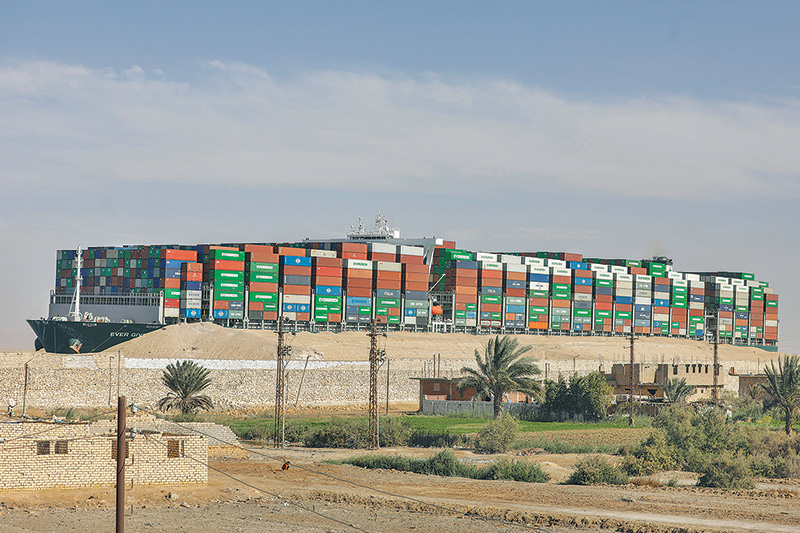
Ship Ever Given, one of the world’s largest container ships, is seen after it was fully floated in Suez Canal, Egypt.  REUTERS

CAIRO, 
Egypt’s Suez Canal must move quickly to upgrade its technical infrastructure if it is to avoid future shipping disruption, shipping industry sources said, as the major trade route tries to bounce back from a costly six-day closure.
International supply chains were thrown into disarray on March 23 when the 400-metre-long (430-yard) container ship Ever Given ran aground in the canal, with specialist rescue teams taking almost a week to free her after extensive dredging and repeated tugging operations.   Egypt will get two new tugboats, one next week and one in August, Suez Canal Authority (SCA) chairman Osama Rabie said after the ship was finally freed, as well as taking the biggest dredger in the Middle East and arranging for a further five new Chinese tugboats.
But shipping industry sources said specialist equipment and associated procedures have long struggled to keep up with the ever increasing size of commercial vessels.
“The average size of most vessels has increased exponentially over the last 15 years. The ability to salvage these bigger ships has not,” said Peter Townsend, a marine insurance industry veteran.
“The issue is getting containers off essentially a 20-storey high building at sea.”
Michael Kingston, an international shipping specialist and an adviser to the United Nation’s International Maritime Organization, flagged such problems in 2013, three years before the MSC Fabiola container ship ran aground, also blocking traffic for days.
“The obvious way to lighten a vessel ... is to take the containers off. They had no way of doing it. No equipment was readily available,” he said of the Ever Given incident.
The SCA says the canal can safely take vessels of the Ever Given’s size - with a maximum capacity of 20,000 TEU (20-foot containers) - even in rough weather.
As well as bigger tugboats, dredgers and offloaders, stricter guidelines on how ships transit the canal are needed, the industry sources said. Those could include using tugs to assist large vessels, or only permitting transit during daylight hours.
“Of course, there are many lessons learned from the [Ever Given] incident. Of course we have the capabilities,” the SCA’s Rabie said.
Visiting the canal this week, Egypt’s President Abdel Fattah al-Sisi said: “We have to give a strong message to the world that the Suez Canal ... can transport world trade at this rate or more.”It was not clear yet if the Canal would opt to extend a second channel south of the one that Egypt opened in 2015 at a cost of $8 billion along a 70-km portion of the waterway. Such an extension would allow traffic to continue flowing even if a ship were grounded.  
“An expansion for the southern section of the canal can be under consideration,” said Sisi. “It’s up to the technical people. We don’t want to take measures just due to extraordinary situations.”

MONEY

Cuba’s tourism workers reinvent themselves as lockdown lingers

- REUTERS
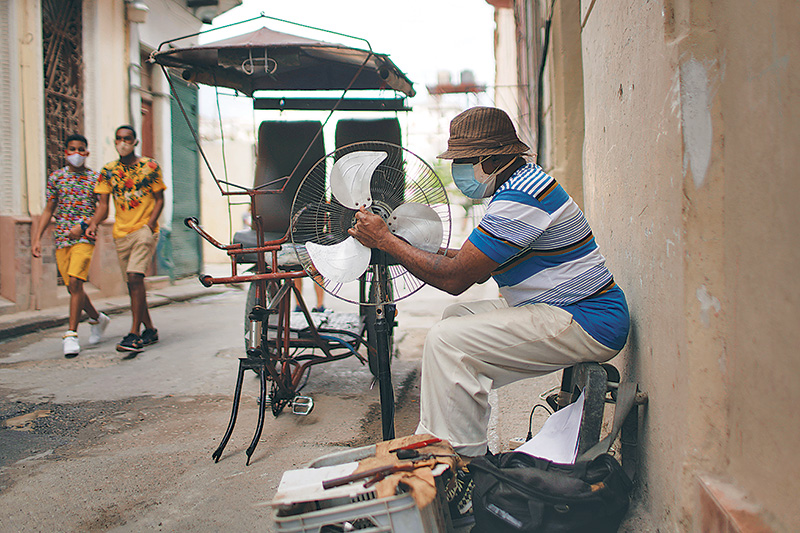
Trumpet player Carlos Sanchez fixes a fan amid the outbreak of Covid-19 in Havana, Cuba. REUTERS

HAVANA,
Trumpeter Carlos Sanchez serenaded tourists in Old Havana for 30 years, earning handsome tips - until the
coronavirus pandemic hit and Cuba closed its borders a year ago on April 1. Now the 57-year-old ekes out a living repairing fans.
The global vaccination drive is sparking hopes worldwide of a tourism rebirth this summer, yet Cubans
like Sanchez are not holding their breath as the Caribbean island goes through its worst outbreak yet and enforces tight travel and lockdown restrictions.
Instead, they are practicing the Cuban philosophy of “resolver”—finding a way to get by despite all the obstacles—used mostly in relation to the burden imposed by US sanctions and a state-run economy but also, now, the pandemic.
“I opted for a Plan B, I took my tools and now I’m here in the streets fixing fans,” said Sanchez, 57.
Cuba closed its borders a year ago to stop the spread of the coronavirus. A reopening in November led to a surge in infections, prompting authorities to reduce flights and tighten up restrictions.
While visitors are still allowed, they must provide the negative results of a coronavirus test on arrival, get tested again at the airport and then quarantine for several days.
When they are free to move, they must wear face coverings in public spaces and will encounter curfews and lockdown restrictions shuttering all but essential businesses throughout much of the island.
And should tourists get infected, they cannot self-isolate at home but must go to a state-run hospital - something Cuba says has contributed to its low mortality rate and helped reduce contagion but that has caused some consternation for visitors.
As such, Cuba’s colonial town centres and idyllic beaches are still mostly empty after a year in which the number of visitors plummeted to just around 1 million from more than 4 million arrivals in 2019.
The decline in tourism is a major blow to the country’s struggling economy, which shrank by 11 percent last year and is facing shortages of even basic goods, given that tourism represented about a 10th of its gross domestic product in 2019.
“Without tourism, we are nothing,” said a dejected Orlando Perez, 44, who used to serve drinks to sunseekers at the beaches just east of Havana but has had to take a low-paid night job as a guard at a hotel for those suspected to have Covid-19.
Some 8,200 employees from the state tourism sector have contributed to Cuba’s fight against the coronavirus, working in hospitals and isolation centres, Prime Minister Manuel Marrero was cited as saying this week.
Francisco Camps, Cuba deputy general manager for Spain’s Meliá Hotels International SA said his bet for a tourism rebirth in Cuba was on one of the country’s five experimental vaccines in development proving effective, allowing it to reach herd immunity this year.
“When I think of when we could start to have an operation returning more or less to normality, well from the last trimester of the year, coinciding with the winter [high] season,” he said.

Page 6
SPORTS

Departmental teams dominate volleyball

Army inflict New Diamond their first defeat while APF Club and Police also begin their campaign with victories.
- Sports Bureau
New Diamond Club’s Prativa Mali (left) jumps to spike the ball during the women’s volleyball match against Tribhuvan Army Club on Friday. Post Photo: Hemanta Shrestha

KATHMANDU,
Tribhuvan Army Club women defeated Hongwanji New Diamond Sports Club women in the National NVA Club League Women’s and Men’s Volleyball Championship on Friday.
In other women’s matches, Armed Police Force (APF) Club and Nepal Police Club also began their campaign with comfortable wins over Dhorpatan Sports Club and Bharatpur Metro Khelkud respectively.
It was a memorable day for Army who had to wait until the fifth set to down a tough New Diamond in an entertaining match.
Despite featuring the key national players Prativa Mali, Aruna Shahi and Salina Shrestha, Army dominated the first set before winning it 25-17.
Army, who also boast the likes of national players Sunita Khadka, Janaki Bhandari and Sofia Pun, controlled the earlier minutes of the second set. But New Diamond made a brilliant comeback, pushing the score from 8-3 to 8-8 and never looked back and soon they were leading 13-19. New Diamond went on snatch the set 25-20.
The third set was competitive at the start. However, New Diamond lost their way and were already four points behind coming towards the end before staging another fightback to tie the score 22-22, but surrendered the
set 25-23.
New Diamond showed spirit in the fourth and dominated Army to set up a decider, tying the match 2-2 after winning the set 15-25.
But it was Army who came on top in the fifth set continuing the gap from early on to beat New Diamond 15-12 and secure an important victory.
“I am not happy with today’s performance,” said a dejected New Diamond coach Kumar Rai whose side suffered their first defeat.
“We were not better in the service and block departments. Our spike was also poor,” he added. “But we still have chances to make it to the final.”
The top two finishers in the league will vie for the title.
Earlier, one of the title favourites APF overpowered their relatively weaker opponents Dhorpatan Sports Club 25-3, 25-9, 25-5 to collect their first three points in the six-team round robin tournament at the covered hall of National Sports Council.
This is the second straight loss for Dhorpatan women, who were thrashed 25-6, 25-2, 25-5 by New Diamond in the championship opener on Thursday.
The other winners, Police opened their campaign strongly and eased to a comfortable 25-4 first set victory and opted for their second-string players in the remaining two sets against Bharatpur Metro Khelkud. They won the last two sets 25-8, 25-12.
In men’s action, Tip Top Help Nepal Sports Club inflicted Nayabazar Samajik Yuwa Club their second defeat on the second day, beating them 25-14, 23-25, 25-22, 25-16. Nayabazar lost to Police in their opening match on Thursday.
Manimukunda Volleyball Club also fell to their second loss after surrendering the match to APF 25-19, 25-22, 25-20.
In the day’s late match, Bulbule RaRa Club, who lost to APF in their opening match, came from a set down to beat Army 20-25, 25-21, 25-19, 25-23.

SPORTS

Butwal Lumbini unveil overseas players for NSL

- Sports Bureau

KATHMANDU,
Butwal Lumbini FC on Friday unveiled three African players for the Nepal Super League, which is set to be held from April 24 to May 8 at the Dasharath Stadium.
The club said they have recruited Nigerian Kareem Omolaja, Ghana’s William Opoku and Chad’s Armad Beadum.
Omolaja and Opoku have both played India’s I-League while Beadum had played for Chyasal Youth Club in the past.
The club’s managing director and former national captain Raju Kaji Shakya was hopeful the foreign recruits would boost the performance of the team in NSL.
“They have the experience of playing in the I-League and Beadum has already played in Nepal,” said Shakya.
The Club’s president Rajkumar Timalsina claimed that Lumbini were one of the top title contenders.
“We have set new strategies and already enrolled 18 among the 20 players,” he said adding, “now we will enroll the remaining two local players,” said Timalsina.
The first ever franchise football tournament of the country will feature seven teams including Biratnagar City FC, Kathmandu Rayzrs FC, Lalitpur City FC, FC Chitwan, Pokhara Thunders, Butwal Lumbini FC and Dhangadhi FC.
The tournament to be organised under technical support of the All Nepal Football Association will be played in the round robin format.

SPORTS

Three Nations Cup winners to receive Rs400,000 each

- Sports Bureau

KATHMANDU,
The Nepal men’s national football team members will receive Rs400,000 each as reward for their recent success at the Three Nations Cup, the government announced on Friday.
Nepal defeated Bangladesh 2-1 on Monday in the final to clinch the Three Nations Cup. A meeting of the Council of Ministers took the decision to this effect.
The win also ended Nepal’s 37-year long wait for an international trophy at home soil.
Nepal men’s football team had won their first trophy at the Dasharath Stadium in 1984 when they had beaten the same opponents 4-2 in the first edition of the South Asian Federation (SAF) Games, now known as South Asian Games (SAG).
This was also Nepal’s fifth international trophy. Nepal’s football governing body All Nepal Football Association has already announced to honour the players with Rs100,000 each.
Champions Nepal also won a cash prize of $5,000 for winning the tournament.

SPORTS

Rebuilt Leicester threatening ‘Big Six’ again in English Premier League

- ASSOCIATED PRESS

LONDON,
The Premier League’s established elite are creaking once more, and again it’s all down to Leicester.
Stunned into a reaction by the improbable title triumph of Claudio Ranieri’s Leicester in 2016, English football’s so-called “Big Six” of Manchester City, Manchester United, Chelsea, Liverpool, Tottenham and Arsenal shook off their torpor and justified that tag over the following three seasons. They were the top six in the 2016-17, 2017-18 and 2018-19 seasons, with no other teams getting within eight points.
Order, it seemed, had been restored. But back came Leicester, refreshed and rebuilt in manager Brendan Rodgers’ first full season, for another shot at cracking—and staying in—the “Big Six.” It might now be time to call it the “Big Seven.”
Leicester have shrugged off their fifth-place finish last season—a disappointment at the time following a late collapse because of a series of injuries—and look in shape to last the course this campaign and finish in one of the four Champions League qualification spots.
Rodgers’ side are third, seven points clear of fifth-place West Ham with nine games remaining, and another meltdown is looking increasingly unlikely this time. Lessons have been learned, a new mentality seemingly installed.
So much so that Leicester have won five of their eight matches against the “Big Six.” If the seven teams were grouped together in a mini-league, Leicester would lead on a points-per-match basis, with Man City having won five from nine.
Indeed, City’s heaviest loss this season came at the hands of Leicester, a 5-2 thrashing at home in late September that sparked a change in approach by City manager Pep Guardiola to a more defensive set-up.
It has worked—City have only lost one league match since then and head to Leicester’s King Power Stadium on Saturday for the return match holding a 14-point lead over second-place Manchester United.
That big win at the Etihad showcased Rodgers at his most tactically astute, his team eschewing their usual possession-based style to play on the counterattack and prey on what at the time was City’s defensive vulnerability.
Rodgers continues to get the better of the league’s best managers and teams. In January, Leicester came from behind to beat Liverpool 3-1 at home. In the last game before the recent international break, Leicester beat Manchester United 3-1 in the FA Cup quarter-finals.
Fears that Rodgers’ team would fall away under the weight of key injuries, like last year, have proved unfounded. James Justin, a revelation at full back this season, sustained a long-term knee injury in January; winger Harvey Barnes was ruled out for six weeks with a knee injury in February; then Maddison aggravated a hip injury last month.
Since then, Leicester have been eliminated from the Europa League but, without three of their key players, are currently on a three-match winning run.
Jamie Vardy remains a vital part of the team and is again top scorer with 12 goals. His minutes are more carefully managed nowadays—he is 34, after all—and he has decided to step away from England duty to prolong his club career.
Meanwhile, Youri Tielemans and Wilfred Ndidi have become one of the best central-midfield partnerships in the league and Wesley Fofana has proved to be one of the most shrewd signings of the season.
In the absence of Barnes and Maddison, backup striker Kelechi Iheanacho has stepped up. The Nigeria international heads into the match against City, his former club, having scored seven goals in his last four games and struck up an understanding with Vardy. Maddison is returning to the squad for City clash.
In a way, Saturday’s game against the soon-to-be-crowned champions is something of a free hit for Leicester. More important is the run of four games from April 22—against lowly teams West Bromwich Albion, Crystal Palace, Southampton and Newcastle—which, if all are won, will virtually guarantee a top-four finish.

MEDLEY

Horoscope

ARIES (March 21-April 19) ****
You’re an ambitious one, Aries. Saturday’s skies find you up at and at ‘em, focusing on getting ahead with career matters. The moon climbs through capable Capricorn all day, helping you focus on your next step.

TAURUS (April 20-May 20) ***
As a Taurus, it can be difficult for you to recognise when you need to break a routine. You enjoy predictability, and there’s nothing wrong with that. Saturday’s skies simply press you to get out of your comfort zone and widen your perspectives.

GEMINI (May 21-June 21) ****
Wherever the messenger planet Mercury goes, you find yourself following, Gemini. Today your focus will move away from career and reputation matters towards friendship, community, and your long-term goals.

CANCER (June 22-July 22) ***
Cancers are ruled by the mystifying movements of the ever-changing moon. It’s an ideal day to sync back up with the stories taking place in your heart. Later, Mercury dives into feisty Aries, focusing your mind on your ambitions for weeks to come.

LEO (July 23-August 22) ***
You’re in the mood to accomplish things this weekend, Leo. Follow your urge to get your to-do list back under control. It’s a great day for starting back up with an exercise routine, eating well, and reconnecting to your physical body.

VIRGO (August 23-September 22) ****
As a Virgo, your ruling planet is the communicative, trickster planet, Mercury. The coming weeks mark a time to fearlessly remove old blockages around love and express your more vulnerable side.

LIBRA (September 23-October 22) ***
As a Libra, you thrive when you’re inhabiting a beautiful setting. Take a look around your home environment today and see where you can spruce things up to reflect that inner state of harmony you’re pining for.

SCORPIO (October 23-November 21) ***
You’ve been moving through powerful psychological realms lately, Scorpio. It helps to move that overwhelming energy around by sharing what you’re going through. Today’s skies encourage you to tell your story in some capacity.

SAGITTARIUS (November 22-December 21) ***
An important shift in your thinking arrives with Saturday’s skies, Sagittarius. After weeks of ruminating on the past, you’re ready to get focused on the future. Today you will be focused on financial realities and untapped skillsets.

CAPRICORN (December 22-January 19) ****
You rarely know when to give yourself the rest you need, Capricorn. Let Saturday’s skies gently show you the way, as the moon glides into your sign helping you reconnect to your self-expression, your physical body, and your most pressing emotional needs.

AQUARIUS (January 20-February 18) ***
Everyone thinks Aquarian people are never-tiring enjoyers of social interaction. The reality is: You need heaps of alone time to recuperate! Saturday’s skies highlight your need to slow down, catch up on rest, and take care of yourself from the ground up.

PISCES (February 19-March 20) ***
People in your circle are wanting to reconnect with you, Pisces. You can tend towards solitude without realizing you’re cutting yourself off! Don’t be afraid to reach out to the cherished friends and allies in your life.

Page 7
CULTURE & LIFESTYLE

A love story to last a lifetime

Marjan Kamali’s ‘The Stationery Shop of Tehran’ doesn’t offer anything innovative. Yet it is comforting, soothing, and welcoming, like a warm embrace.
- Richa Bhattarai

The year is 1953. The country is Iran.
Prime Minister Mossadegh’s supporters are secretly rallying for him, gathering forces and frantically striving to stop his potential ouster. Meanwhile, the monarchists are in a frenzy, sniping at anyone who dares to speak up against their beloved Shah.
Amid this chaos, 17-year-old Roya finds her respite in a stationery shop in Tehran. Her father has big dreams for her education and she is equally enthralled by the rows of translated novels and poetry by Rumi. The kindly shopkeeper Mr Fakhri indulges her and her love for all things pen and paper.
Into this simple routine of learning and ideals, there enters a hurricane named Bahman. He is, Mr Farzi says, a “boy who will change the world.” He does indeed transform Roya’s world, for she is soon in love with him. He is even more besotted with her, and the unfolding of this teenage romance is one of the sweetest, most enchanting pieces of writing we’ve witnessed in recent times.
Their love story forms the crux of the novel, and we live with it for the next 60 years. The story remains charming throughout. There are unpredictable twists of fate, family interferences, misunderstandings, societal obligations, marriages, children, deaths. Characters fly over oceans and morph their nationalities. Yet this love, which could easily have withered and disappeared, is born afresh from every challenge and obstacle.
It is the kind of love we pine for, the love we hope we will find someday. Kamali breathes life into this love, until it pulses and glows and simmers. Her prose shines when she describes the longing, heartache and passion between the two young beloveds. To make someone feel the love brimming on the pages, that is where this novel emerges a winner.
The story is tender but rarely cloying, heartfelt yet not too cliched. The story does falter when it tangles around a second love story; there are moments too dramatic and far-fetched. There are also plenty of instances when the dialogues veer towards the mundane, and the setting remains merely superficial. But the novel manages to revive itself, re-erect its fabled universe, and make us keep reading as we decipher the end to this lifelong love.
Kamali is a blessed writer, someone who has been granted the power to insert feelings into mere words. The language is nothing new, innovative, or even bedazzling. We have read and known plenty of stories like this before. Yet it is comforting, soothing, and welcoming. There is an invitation to be part of the family, and if we accept, there awaits a warm embrace. We are oriented to the country, its customs, politics, culture, history, people.
The bond of loyalty and trust, along with the characterisation of strong women, bear a slight resemblance to novels by Khaled Hossieni, Nadia Hashimi, even Kamila Shamsie. But ‘The Stationery Shop of Tehran’ frequently renders itself unique through the uniqueness of the culture and society it is spun of.
To Nepali readers, the novel has something more to offer.
Iran is a country so far away from Nepal, so dissimilar, we could say. Yet Nepali readers will definitely find striking resemblances between the two countries, which will make it dear. And perhaps to readers of many South Asian nations. Just like Nepal, after a series of coups and counter-coups, monarchy was abolished in Iran, a few decades before ours.
When they first meet, Roya asks Bahman, “You’re siasi—political—no?”
“Is there anyone in this country who isn’t?” Bahman responds.
How apt, and how similar to our country, where the vast majority is utterly “political”, though what good those inclinations ever did, we do not know.
Even more saddening is the realisation that no amount of revolutions and civil society moments is actually going to result in anything other than one more corrupt leader. In 1978, Bahman writes, “History repeats itself. To watch these young students pour into the streets again, convinced that if they rid themselves of the Shah all problems will be solved, is painful… We want democracy but never seem to get it.”
The following year, Bahman writes again, “Now the Shah is gone. All I see in the faces of us who remember 1953, who can feel under our skin that awful disappointment of having the world plummet in one day, is the return of trauma. The youth are so hopeful. They think we got it right this time.”
How many times have we thought that we have got it right, only to be shown we were terribly wrong!  
Just like our belief that the Goddess Vidhata inscribes the fate of each child on their sixth day, in Iran, too, it is believed that a person’s destiny is already written on their forehead, and nothing can change it.
And finally, the similarities in cuisine. Not the actual dishes, but the longing for recipes from home that you can never seem to replicate in a foreign country.
In a recent Clubhouse chat, I had asked, “What do you miss the most about the homeland?” Among a clamor of “bhyarra momo” and “chatpate”, a lady answered, “The strong, heady fragrance of spices as I walk along Ason.” How specific and particular our memories are, and what a common trigger of nostalgia food is.
When Roya walks into a delicatessen that sells “spices and teas and jams from the old country,” she “wanted to sweep everything on the shelves into her skirt and run off, carrying jars of every single spice that she had missed so much. A piece of her had come home.”
Truly, Kamali’s writing is as familiar as coming home, too.  
She treats her recipes with such affection, her descriptions of food are a delight. The saffron and khoresh, ghormeh sabzi and tahdig seem to cook on the pages and stain our lips with their taste.
We read the novel for its love story, and how much more it leaves us with.
 

The Stationery Shop of tehran
Author: Marjan Kamali
Pages: 312
Publisher: Simon & Schuster


Bhattarai is a writer from Kathmandu.

CULTURE & LIFESTYLE

With King Kong, a little swagger returns to the box office

Opening-day ticket sales on Wednesday for ‘Godzilla vs. Kong’ totaled $9.6 million, Warner Bros says—a single-day pandemic record.
- JAKE COYLE
This image released by Warner Bros Entertainment shows a scene from ‘Godzilla vs. Kong’. AP/RSS

NEW YORK,
Once again, mayhem and mass destruction is back at the box office. It’s almost like old times.
“Godzilla vs. Kong,” one of the few tentpoles to dare release during Covid times, is poised this weekend to set a new high in ticket sales during the pandemic. It won’t be the kind of blockbuster business such a big-budget release would typically manage, but experts forecast a launch of at least $25 million.
Opening-day ticket sales on Wednesday for “Godzilla vs. Kong” totaled $9.6 million, Warner Bros. said Thursday—a single-day pandemic record and more than most 2020-2021 opening weekend hauls. Last weekend, the monster mash pulled in an impressive $123.1 million internationally. In China, where moviegoing is close to pre-pandemic levels, the movie made about $70 million, double the debut of 2014’s “Godzilla.”
For the first time in a long time, there’s the faint hint of a hit at the box office.
“It’s a good omen that the tastes of the consumer have not shifted so much that there’s no possibility of restarting the movie business,” says Joshua Grode, chief executive of Legendary Entertainment, which produced “Godzilla vs. Kong.” “This tells everybody: the moviegoing business is here, and, yes, it may be different post-pandemic. But there is a viable industry there.”
Huge challenges remain to the revival of moviegoing. With so many cinemas shuttered for nearly an entire year, many moviegoers are out of the habit. Some are unlikely to return to sitting indoors with strangers until they’re vaccinated or the pandemic has ebbed. And even those who have been convinced of the safety of moviegoing by theaters’ health protocols, they now have only more in-home options. “Godzilla vs. Kong” is streaming simultaneously on HBO Max in North America.
But few scream big screen as much as King Kong and Godzilla. To help kickstart moviegoing and bring back a little chest-thumping swagger to theaters, the industry is counting on two of the movies’ most iconic, long-running leviathans. Laying another metropolis to waste might help movie theaters build themselves back up.
“The issue is less convincing consumers to go to the movies than it is convincing studios to open their movies,” says Rich Gelfond, IMAX’S chief executive. “There’s been a hesitancy on the part of Hollywood studios to release movies because they haven’t been convinced the demand is there. What I really hope this weekend shows is that there is a lot of demand there and it convinces them to open a lot of movies that have been sitting on the shelf.”
Since the launch of “Tenet” fizzled last August, and virus cases soared, most studios have been postponing or rerouting their biggest releases to streaming services. But as vaccinations have ramped up and restrictions have eased, more theaters have opened. About 60 percent of theaters will be open this weekend, according to data firm Comscore. On Monday, Los Angeles County will expand cinema capacity from 25 percent to 50 percent. For the first time since last winter, wide release will mean playing in more than 3,000 theaters. That’s still about 1,200 shy of typical for a title like “Godzilla vs. Kong.”
Recently, ticket sales, while still far below their usual levels, are ticking upward. The best debut of 2021 was “Tom & Jerry,” with $13.7 million in late February. The pandemic-high belongs to “Wonder Woman 1984,” which launched with $16.7 million in December. Each were Warner Bros. releases that landed simultaneously on HBO Max—a once controversial release plan  that has helped theaters stay afloat and proved an interesting test case for how viewers prefer to see, and pay for, a movie.
Nevertheless, the Walt Disney Co. recently delayed the planned summer-kickoff of “Black Widow” to July, while pushing a number of titles to its streaming platform, Disney+. Part of what’s holding blockbusters back is the need for a global release to make back their sizable production budgets and marketing spend. (“Godzilla vs. Kong” cost about $160 million to make.) While moviegoing in much of Asia is rejuvenated, rising cases in Europe and in countries like Brazil have, for now, made a full worldwide rollout impossible.
Paul Dergarabedian, senior media analyst for Comscore, believes “Godzilla vs. Kong” will be “another building block in our education in where the industry is heading.”
“The theatrical experience will prove to be viable and resilient as it always has,” says Dergarabedian. “But it’s going to be a different world, no question. I think it’s going to be a leaner, meaner business going forward.”
Some of the old standard practices that have governed blockbusters aren’t coming back. Studios like Warner Bros. and Universal Pictures have made deals to shorten exclusive theatrical windows. Warner Bros. next year will hold movies in theaters for a minimum of 45 days, or half of the traditional window, before moving releases to at-home platforms. Such new models mean a recalibrating of what movies get greenlit and how much they’re worth.
“The value of those streaming/pay-TV rights are more valuable now because you’re getting access to them much, much earlier than you did before,” says Grode. “So you kind of have to rerun your model of how the movie is going to perform over its lifetime.”
It’s also meant some tense negotiations over profit participation. When Warner Bros. surprised with its hybrid release plans for 2021, Legendary—whose highly anticipated “Dune” is to be released in the fall by Warner Bros—considered legal action before arriving at an agreement.
“We obviously didn’t like the way they announced what they were doing in 2021, and I think they would admit they didn’t handle it perfectly,” says Grode. “But when you look at the state of the world, the facts as we all knew them at the time, their decision made a lot of sense.”
“You get over that pretty quickly and you get back to business,” he added.
Helping theaters get back to business, Gelfond believes, are large-format screens “that differentiate the couch as much as they can.”
This weekend, the film will be playing on 1,170 IMAX screens worldwide. Showings in New York and Los Angeles, Gelfond said, are already sold out, albeit at lower capacity.
The box office might not quite roar again this weekend, but “Godzilla vs. Kong” may show it has a little bite left. Says Grode: “In years from now, when people write about coming back to the movies, I’m very proud that ‘Godzilla vs. Kong’ will be in that history.”

— Associated Press

Page 8
CULTURE & LIFESTYLE

‘I want to inspire people to go out there and achieve their goals’

Sheikha Asma Al Thani is set to be the first woman from Qatar to climb Mount Everest. And for her, this journey is all about challenging her limits and inspiring other women to follow their path.
Post Photo: anish regmi

Life is about making time for things you love to do, and Sheikha Asma Al Thani has been doing just that by climbing one mountain after another. And right now she is unstoppable.
Mountaineering was a goal and a dream Asma saw for herself when she was a 14-year-old and soon she will be setting her path towards Everest and is excited to be an example for people to go out there and embrace their dreams.
Already in Nepal for her Everest expedition, Asma is the director of marketing communications for the Qatar Olympic Committee. She believes she is an athlete at heart who values discipline. Asma has reached the North Pole, and already climbed Mount Aconcagua in South America and Mount Kilimanjaro in Africa. And to people around her, these feats are not surprising as they know, she is a woman of her word—Asma has always achieved what she has set out to do.
In this interview with the Post’s Srizu Bajracharya, Sheikha Asma Al Thani gets candid about mountaineering, her passion to tell her story to make a difference in the world and what it takes to achieve one’s goals. Excerpts:

How did this journey start and how has the journey been so far?
I have always loved mountaineering from a young age. And I have always loved the idea of adventure in the outdoors. I have three brothers who are quite adventurous and with them, I have been part of many adventures.
But to pinpoint, I think this journey started when at the age of 14, I wrote a bucket list of the things I wanted to achieve in life. It had hopes and dreams of things I wanted to do. I came back to that piece of paper in early 2014 and saw I wanted to see the north pole, to see the night sky and to also climb mountains. Then and there, I decided I wanted to do it all.
After that, I joined a group to climb Mt Kilimanjaro in 2014 and I became amongst the first Qatari females to do so.
And so far it’s been an amazing experience even humbling and challenging. I have learnt a lot in the mountains. And I hope to keep continuing this journey forward.

What was your motivation behind climbing one mountain after another?
For me, the motivation has been the journey itself. In every mountain, in every expedition, I meet new people and challenges and I fight through challenges that are considered impossible. And that encourages my goals even more.
Just being out in nature and enjoying what’s around me gives me a lot of inspiration.  
I also keep trying to remind myself what a person once told me in the mountains: to ‘have fun and try to enjoy every aspect of it but also be present.’ I remember in Everest Base Camp, I was mesmerised by the beauty and every once in a while, I had to stop to enjoy the beauty of nature, I was grateful to the experience and the people I met on the journey. And that motivated me to come back and experience it again.

What have been the learnings so far from your journey?
With mountaineering, for me one is determination. I think it’s always within your mind what you can do and cannot. It depends on how strong your mind is. Another lesson was humbleness: when I saw the mountains so close, I often realised how small we are but at the same time the huge impact we have on the world and so we always need to be humble.
I think the mountains also teach you gratitude. We take for granted the comforts we have in life, the pillow on our bed, the roof we have. When in the mountains, when you encounter uncomfortable situations, you realise that you have to be grateful for every moment you have and everything you have.
Besides these important learnings, I think the mountains personally remind me that if I set my mind to something, I can do it.

Climbing mountains requires a lot of training. What does your preparation look like?
For me, the training has been about the idea of balancing life—making sure I am able to achieve my professional goals, give time to my family, rest, eat right and train enough to build my strength.
There is a lot of time that I need to set. And life is always a matter of time, right? And I also think if we keep saying we don’t have time to do something, we will never be able to do it. So, I always make a schedule that I try to stick to. But I also try to be lenient when things change, because in the mountains, sometimes things don’t go our way. Life is the same; we need to find our way around things.
I have also come to understand that training is just about endurance and building strength. I usually train three hours a day, six times a week. But I make sure to listen to my body and give my body the rest it needs. But my training has also been about making sure that I can carry a heavy backpack and replicating things I will do in the mountains.

Why is achieving this feat of conquering Mount Everest important to you?
To me this path is about challenging my limits, breaking barriers within me. But at the same time, this journey is as much about inspiring people to go out and achieve their goals.
When I share my experiences of being in the mountains through my social media, a lot of people get back to me and say ‘you know we never thought this was possible; how can I do it? how do you train?’. The world has so many different possibilities, and just being able to share that idea has been important to me.

When in the mountains what usually goes through your mind?
In the mountains, I am constantly having a discussion with myself. It’s always about ‘Can I do this? Am I strong enough, will I be able to reach there?’ But I also think about my family and my home sometimes. One tends to get homesick up there sometimes. But it’s always a conversation about why I am here, where I try to remind myself about my inspiration of being in the mountains.

You said in an interview you want to demonstrate women’s empowerment in Qatar and inspire a new generation of women across the region to dream bigger. How do you see your endeavour tied to women empowerment?
There’s always this misperception about women that climbing mountains or doing things that are challenging are something we cannot do. But for me as a Qatari woman, as an Arab woman, by climbing Mt Everest what I hope to do is to inspire not just women but youth to go after their dreams and to achieve what they set their minds to. I want to share my story; I want to share my ups and downs and what I have been through. Hopefully, by doing so, I will be able to inspire not just women to climb mountains but inspire them to do what they have set their minds to.

How did you convince your family to take this journey?
I have always been an independent woman and have always been able to achieve the goals I have set for myself. And my parents have always been supportive of my dreams. But of course like any parents they were not sure about my goal to climb mountains—and it wasn’t because I am a daughter; as a parent they will be scared for their children. They did have their concerns. Plus climbing mountains and doing adventures is not something to think of lightly. You challenge yourself and you put yourself in dangerous situations.
I remember when I first told my father I am going to go climb Mount Kilimanjaro in the next couple of months, he had questioned why I wanted to do so. Isn’t it dangerous? He had asked. And at that time, in 2014, the concept of climbing mountains, whether it is safe or not, how to scale one, was something that was not much known in Doha and for me having these conversations, what it takes to climb these mountains, was not an easy conversation. But my parents have been very supportive and it has been an inspiring journey.

Nelson Mandela once said, ‘Sports has the power to transform lives.’ You had also expressed this in
your speech in 2018. But in countries like ours, sports are not given enough importance. But why do you think it is important to encourage and engage more women in sports?
Sport is a powerful tool and it does transform lives. And when women participate in sports, they get to show the world that ‘you know we can do this’. There is a way to achieve our dreams and the more people we have doing things, the more people will see it is a doable thing. Not just in sports but in every field, you will always need stories that inspire others.
Also, sports is a very big industry, and many people can participate in it in different ways and in different capacities. But the opportunities that sports give can also depend on the government’s strategy. In Qatar, sports play a very important role in the country. It has shaped the country.
And for me being in sports, being a mountaineer and doing an expedition, I also want to be able to shed light on the significance of sports and give people that opportunity to see possibilities in sports.

CULTURE & LIFESTYLE

India’s arts community fears Hindu hardliners can’t take a joke

Artists, writers and satirists are facing criminal charges and warnings of violence for touching on religious issues, leaving performers to wonder whether India is being led away from its secular roots.
- AGENCE FRANCE-PRESSE
shutterstock

NEW DELHI,
A comedian jailed for a joke he did not tell, threats against theatre directors and a religious backlash to a blockbuster TV drama have left India’s arts community fearing a rising nationalist assault on free speech.
Artists, writers and satirists are facing criminal charges and warnings of violence for touching on religious issues, leaving performers to wonder whether India is being led away from its secular roots.
Even pop idol Rihanna recently sparked a social media storm by wearing a pendant of Ganesh, one of the country’s most revered deities, in a topless photo.
Comedian Munawar Faruqui was jailed for more than a month after he was hounded at a gig in the central city of Indore.
A Hindu fringe group activist began accusing the 30-year-old of intending to insult Hindu gods just as he took the stage.
Faruqui, a Muslim, is known for hitting sensitive topics in his humour, including deadly religious riots in Gujarat state when Hindu nationalist Prime Minister Narendra Modi was chief minister there nearly two decades ago.
He defended himself by pointing to his track record of ridiculing Islam as well, and an audience member told AFP the comedian was polite throughout the encounter. But his heckler was not appeased, and instead went to fetch the police who detained Faruqui and four others.
His three bail applications were rejected—with one lower court commenting that “religious feelings had been outraged”—before the Supreme Court ordered his provisional release.
In a video he posted after he left jail, Faruqui said he had been “affected by something I didn’t do.”
Faruqui said he became a comedian to make people happy but lamented that a “sheep mindset can ruin
someone’s life”.
Religion has always been a sensitive topic in the country of 1.3 billion people—80 percent of them Hindu—but Modi’s two huge election wins since 2014 have empowered his hardcore followers.
Many believe that there should be curbs on freedom of speech to prevent religious insults.
“Don’t you feel bad if anyone offends your God?” asked Prakash Sharma, an outspoken senior member of Modi’s Bharatiya Janata Party (BJP) in Uttar Pradesh state.
“Right now society is sleeping and it is tolerating this. Their children will beat them up in their own homes if they don’t mend their ways,” he told AFP.
And while comics have backed Faruqui, they are wary of coming under the crosshairs themselves.
“You have to be sensitive about content because it’s very clear India is becoming intolerant,” comedian Samil Shah told AFP. “You can’t go about offending the majority.” Sociologist Shiv Visvanathan said the backlash against comics was strange when there had always been a strong comedy element to Indian folklore and cinema.
“Democracy is supposed to be happily quarrelsome and relaxed about the quarrel,” he told AFP.
Other members of the country’s entertainment community have found themselves in the firing line.
A theatre festival in central India was cancelled when a right-wing group threatened “aggressive protests” to stop the event, after objecting to the title of two plays.
One had committed the sin of using the words “caste” and “saint” together, which was considered an affront to the dignity of Hindu deities.
“Our posters came back to us with circles around these titles and soon phone calls followed,” said Shantanu Pandey, who was to direct a play at the festival.
Web giant Amazon’s streaming service also came under fire when its political drama, “Tandav”, was accused by
hardliners of depicting Hindu gods in a negative light.
The company soon issued an unconditional apology and edited or dropped the scenes that stirred the controversy.
Modi’s government has signalled that it will extend legal cover to the campaign against religious offence.
It has announced new rules that may force social media and digital platforms to take down content within 36 hours of a complaint being made.
Meenakshi Ganguli of Human Rights Watch said the government and its partisans had abetted a cultural clampdown that had fostered a “chilling effect on freedom of speech and expression.”
“Sadly, in many cases, the authorities have not just failed to act against violent government supporters, but have targeted peaceful critics,” she added.