You internet speed is slow. Switch to text view mode

Switch
epaper logo
ST

Last Login:
Logout
+
Page 1
HOME PAGE

Chinese Covid-19 vaccines to be administered to essential workers from Wednesday

The 800,000 doses will be given from 12 hospitals of the Valley, and elsewhere later depending on their availability.
- Arjun Poudel
Apart from those working in essential sectors, the Chinese vaccine will also be administered to businessmen and truck drivers who need to travelto China frequently. Post file Photo

KATHMANDU,
Amid a sharp rise in new cases of coronavirus infections, the Ministry of Health and Population has decided to administer vaccines gifted by China to essential workers from April 7.
“We have decided to administer the vaccine to people providing essential services from April 7,” Dr Jhalak Gautam, chief of the National Immunisation Programme, told the Post. “The vaccine will be administered only from hospitals of Kathmandu Valley for now.”
Essential workers include those working in postal and telephone services, public transportation services, water supply and distribution, tourism sector—hotels and restaurants—production, sales and distribution of medicines, electricity supply, storage and transportation of consumer goods as well as health workers who missed out in the first phase of the vaccination drive that began on January 27.
Apart from those working in essential sectors defined by the government, the Chinese vaccine will also be administered to businessmen and truck drivers who have to go to China frequently.
Nepali students pursuing higher degrees in China but stuck in Nepal due to the pandemic will also get the jabs, according to Gautam.
China recently introduced vaccination passports for travellers to prove that they are free from the coronavirus infection. It has been reported that China is resuming visa processing for foreigners if they have been inoculated against the coronavirus with Chinese vaccines.
China had given 800,000 doses of coronavirus vaccine, the BBIBP-CorV developed by Sinopharm, an affiliate of the state-backed pharmaceutical giant Sinopharm, under grant assistance and they arrived in Kathmandu last Monday.
Gautam said that essential workers between 18 and 59 years can get the vaccine in the drive.
Earlier, the Health Ministry had decided to provide the vaccine to people between 40 and 59 years.
Unlike in the first and second phases of Nepal’s immunisation campaign against the coronavirus, the Chinese vaccine will not be administered from the district hospitals and the primary health centres.
Instead, they will be administered at 12 hospitals of the Valley—nine in Kathmandu, two in Lalitpur and one in Bhaktapur.
In the first phase of the campaign, frontline health workers and others had been given the jabs from district hospitals and in the second phase, during which those above the  age of 65 had been given the jabs, the campaign had been expanded to primary health centres.
Doctors, however, say that if the immunisation service is provided from only a few hospitals, coverage of the vaccine will be narrow, as all targeted people may not be able to reach the designated hospitals.
“A lot of people in the targeted group could miss the jabs if we run only a few immunisation centres,” Dr Shyam Raj Upreti, coordinator of Covid-19 Vaccine Advisory Committee, told the Post.
But whether they will be expanded to other hospitals outside Kathmandu Valley or not will depend on how many doses remain once the campaign is completed in Kathmandu.
“We will start the campaign from April 7 and continue for several days,” Dr Tara Nath Pokhrel, who is also a member of the Covid-19 Vaccine Advisory Committee, told the Post.
“We will take another decision on launching the immunisation drive from provincial hospitals on the basis of how many doses of the vaccine remain.”
According to a report published in The Lancet, inactivated BBIBP-CorV Covid-19 vaccine is safe and well tolerated.
On December 30 last year, Sinopharm announced the vaccine’s efficacy at 79 percent, which was lower than the 86 percent efficacy announced by the United Arab Emirates on December 9.
According to recent reports in The Washington Post, the United Arab Emirates, which was among the first countries to adopt Sinopharm vaccines, BBIBP-CorV is not adequately generating antibody response after two doses.
According to the paper, Walid Zaher, chief researcher for G42 Healthcare, which distributes the Sinopharm vaccine in the United Arab Emirates, told Dubai Eye Radio that a study was underway to give some people their third doses.
G42 Healthcare also coordinated Sinopharm’s Phase 3 clinical trials in the UAE and elsewhere in the Middle East.
Nepal has so far been using Covishield, the vaccine developed by University of Oxford and pharmaceutical giant AstraZeneca, manufactured by the Serum Institute of India.
After inoculating a little over 1.7 million people in two phases until March 15, Nepal’s vaccination drive remains suspended because of lack of supply.
Nepal launched its vaccination drive with the one million doses of Covishield that India had provided under a grant assistance.
Nepal then paid for 2 million doses, but the Serum Institute has supplied only a half of the ordered amount, with no clarity on when the remaining half will arrive. Nepal’s plan to buy additional 5 million doses from the Serum Institute is also currently in limbo.
Nepal has also received 348,000 doses of Covishield under the World Health Organisation-backed COVAX programme.
The Health Ministry said that the second dose will be given to those who got the first dose in the first phase of the immunisation campaign, from the 500,000 doses of Covishield vaccines in stock, from April 20 to 24.
Meanwhile, there are fears of a second wave of coronavirus infections in the country as the number of cases has continued to rise in the past few weeks. The Health Ministry said that 176 new cases were reported in the last 24 hours. The number of active cases stands at 1,672.
Nepal has so far reported 277,944 cases of coronavirus infections and a death toll of 3,032.
HOME PAGE

The difficulty of being Madhav Nepal

The leader who steered the CPN-UML for 15 years now grapples with one question—to be or not to be with Oli.
- TIKA R PRADHAN
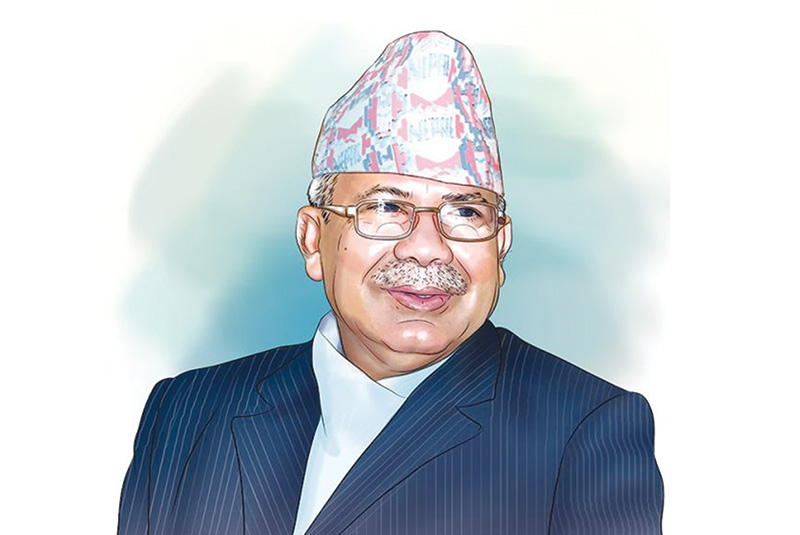
Post illustration

KATHMANDU,
Madhav Kumar Nepal may be facing the toughest time in his political career.
A former prime minister, a position he managed to hold despite losing an election in 2008, Nepal led the CPN-UML for 15 years from 1993 to 2008 as the party general secretary. The UML, however, was “dissolved” in 2018 when in May that year it merged with the Communist Party of Nepal (Maoist Centre), led by Pushpa Kamal Dahal, to form the Nepal Communist Party (NCP).
But the Supreme Court on March 7 this year scrapped the Nepal Communist Party (NCP) and resurrected the UML and the Maoist Centre. KP Sharma Oli, Nepal’s long-time adversary, now fully controls the UML.
The court decision left Nepal, who had found a great ally in Pushpa Kamal Dahal in the Nepal Communist Party (NCP), with no option than to return to the UML.
Ever since the UML was resurrected, Oli has made himself even more powerful in the party, with sweeping powers to initiate action against anyone. And on March 29, Oli decided to suspend Nepal as a general member of the party for six months.
The charges: Nepal is involved in anti-party activities and has been working against the spirit of the party unity and forming parallel committees instead of “seeking forgiveness for his mistakes”.
So far, Oli has suspended Nepal, Bhim Rawal, Surendra Pandey and Ghanashyam Bhusal. Jhala Nath Khanal, also a former prime minister and currently Nepal’s ally, however, has been spared.
Nepal is in a fix now. It’s not easy to part ways with Oli and form a new party, and remaining under the UML roof with Oli is even harder.
“We are the UML and the UML means us,” said Raghuji Pant, a Standing Committee member close to Nepal. “Much depends on how Oli behaves in coming days.”
Many say Oli currently is paying Nepal with his own nickel.
In the Nepal Communist Party (NCP), Nepal provided full backing to Dahal who was seeking to weaken—even unseat—Oli.
The Dahal-Nepal faction, which had a sizeable number of UML leaders, had managed to drive Oli into a corner.
At one point of time, Oli’s position—both as prime minister and party chair—had become untenable.
Finding himself cornered, Oli suddenly dissolved the House of Representatives, attracting widespread opprobrium. The hullabaloo was so huge, with experts on constitutional affairs, former chief justices and civil society decrying Oli’s move, that the Dahal-Nepal faction gained ground. It launched a series of protests demanding Oli’s resignation.
On February 23, when the Supreme Court overturned Oli’s House dissolution move terming it unconstitutional, Dahal and Nepal took it as “their” victory. They thought they had already won the battle against Oli. But the celebration was short-lived. The March 7 Supreme Court verdict reviving the UML and the Maoist Centre came as a bombshell for Dahal and Nepal.
The decision, in effect, broke the Dahal-Nepal faction.
Dahal now leads the Maoist Centre, the third largest force in the reinstated House, minus four seats the party had won in the 2017 elections. Four of the 53 leaders who were elected to the lower house have defected to Oli.
Nepal, on the other hand, is struggling to find how many members in the lower house and how many members in the party committees he actually commands.
“Oli won’t give space to Nepal and his faction’s leaders. Their future is bleak if they remain under Oli,” said Shyam Shrestha, a political analyst who has followed Nepal’s leftist politics for decades. “If Oli had considered some space for Nepal within the Nepal Communist Party (NCP), things wouldn’t have reached this stage. Nepal now either has to part ways with Oli to form a separate party or merge with other parties.”
Oli, 69, and Nepal, 68, have shared the same party for over four decades. However, while Nepal saw his rise in the party, Oli had his fair share of struggles. Nepal resigned as the party general secretary in 2008 after he lost the Constituent Assembly election in Kathmandu Constituency 2 and Rautahat Constituency 6 to Maoist candidates and his party became a small third force. Until then, the UML did not have the system of party chairman and the general secretary led the party.
In July 2014, Oli defeated Nepal to become the chair of the UML. He succeeded Khanal. Since then there has been no looking back for Oli.
When Oli became prime minister after the constitution promulgation in 2015, he had already become strong in the party and had started working to consolidate power.
The 2017 elections further emboldened Oli. When he decided to merge his UML with the Maoist Centre, he had already asserted that in the Nepal Communist Party (NCP) he was the No. 1 chair, superior to Dahal. In due course, Oli would not miss any opportunity to run Nepal down—he relegated Nepal to the fourth position in the party and on one occasion even refused to accept his former party leader’s good wishes before flying to Singapore for treatment.
Insiders say Oli’s highhanded behaviour pushed Nepal towards Dahal who was scheming to bring down Oli. Things were going fine and Dahal and Nepal were on course to making a good force together against Oli until the Supreme Court passed the verdict on March 7, they say.
According to Shrestha, the analyst, the more time Oli gets, the more difficult things will become for Nepal, as the latter is losing strength by the day.
“Nepal is poor at making quick decisions,” said Shrestha. “The delay in decisions could cost him dearly.”
Oli so far has taken action against just four leaders, but in doing so, he has already asserted how powerful he is in the party. Since Oli controls the government and the UML, it may not take long for him to steal a majority of leaders who are currently aligned with Nepal, insiders and analysts say.
When the Nepal Communist Party (NCP) was intact, the Nepal faction in the party was believed to control around 48 seats in the House of the 121 won by the UML and 53 by the Maoist Centre. Since the UML was revived, Nepal’s strength has been on the wane.
Those who closely know both Oli and Nepal say the latter is left with few options.
“If Nepal remains with Oli, he must surrender. And forming a new party is not easy,” said CP Mainali, a senior communist leader under whom both Oli and Nepal once worked. “For Nepal to create space of his own in the UML when Oli is there is quite impossible. If Nepal decides to form a party of his own, what party will it be?”
According to Mainali, who is the general secretary of the CPN-ML, having two UMLs with the same ideology does not work.
The CPN-ML was formed after Mainali and some leaders including Bamdev Gautam and Ghanashyam Bhusal had split from the CPN-UML in 1998. Both claimed People’s Multi-party Democracy “their” ideology. In the subsequent election in 1999, the CPN-ML failed to win even a single seat. Gautam and other leaders except Mainali returned to the UML in 2002.
Leaders from the Nepal faction agree that they are in a huge dilemma.  
“What most of our leaders fear is that Oli will end their political career if we stay with him,” said a Standing Committee member of the Nepal faction. “But a split also does not look like a good option. In that case, it will be a setback for the whole communist movement, and both parties, even the one led by Oli will suffer.”
But even if Nepal takes a risk and forms his own UML party, a profound question is what appeal will he be able to create among the masses, according to analysts.
Then there are concerns if the Election Commission would allow him to register a party with the UML name or with any other tag for that matter, as it has already faced a rap on its knuckles from the Supreme Court for giving the Nepal Communist Party (NCP) to Oli and Dahal despite a party with similar name already registered with it.
“Nepal must be able to come up with a different identity if he were to keep his politics alive,” said Rajendra Maharjan, a commentator who writes on contemporary politics and social matters for the Post’s sister paper Kantipur.
Presently, the Nepal faction has decided to continue the struggle against Oli by being in the UML. It has decided to form parallel committees at all levels, from the centre to the grassroots. But given the way Oli has been taking actions, with the sweeping powers he secured recently, he is likely to start using coercive tactics, asking all to pick a side.
“If it becomes too difficult for Nepal to remain with Oli, he may join hands with Dahal,” said Mainali. “But there also, he will have to share the leadership with Dahal and tussles could arise soon.”

Page 2
NATIONAL

Illegal extraction of aggregate goes unchecked in Narayani river

- NABIN PAUDEL

PARASI,
Illegal extraction of riverbed materials is going unchecked in the Susta area along the Narayani riverbanks in Nawalparasi (West) for the past few months.
Although extraction of riverbed materials is prohibited in Narayani river, people continue to take part in such illegal activities, with the local administration, local unit and the District Inspection Committee turning an blind eye to it.
“Smugglers have been excavating riverbed materials from Narayani river, as the local unit has put a ban on collection of sand, stones and pebbles from local streams. The riverbed materials extracted from Narayani river are being transported to India illegally,” said a resident of Susta, preferring anonymity.
Susta shares an open border with India. According to the Nepal-India agreement, it is illegal to extract riverbed materials from Narayani river. But smugglers have been collecting stones, pebbles and sand worth millions of rupees from the river and transporting the goods to India.
“Illegal extraction of riverbed materials from Narayani has affected the repair works of Gandak dam and spurs,” said Dudhnath Gupta, chairman of Gandak River Control Struggle Committee. “We have informed the concerned authority to control smuggling in the area. But they have not done anything to stop such activities.”
According to Gupta, the continuous extraction of riverbed materials can also cause the river to change its course time and again.
“The rural municipality alone cannot stop the illegal extraction. Local residents, security personnel and other concerned stakeholders should take initiatives to stop such illegal activities,” said Ram Prasad Pandey, chairman of Susta Rural Municipality. “It is impossible to stay on the lookout all the time. But we are going to inspect the area and take action if necessary.”  
This year, the rural municipality has not conducted any inspection of the river bank area. According to the local people, smugglers are extracting riverbed materials from various areas along the river bank but the concerned authorities are staying mute.
Under the Gandak agreement with India, an office has been established to coordinate various issues relating to the dam between India and Nepal.
Tara Singh Thapa, an official at the office, said that the rampant extraction of riverbed materials can cause massive floods in the Gandak dam during the monsoon.
“The Gandak dam has become old now. It can collapse anytime in case of flood,” Thapa said.
Meanwhile, Shiva Shankar Raya, chief at the District Coordination Committee in Nawalparasi (West), says that inspection is difficult since smugglers are active mostly during the night.

NATIONAL

Workers deprived of risk allowance in Baglung

The Health Ministry had announced a 50 to 100 percent allowance to Covid-19 frontline workers.
- PRAKASH BARAL

BAGLUNG,
The government had declared to provide a cent percent Covid-19 risk allowance to frontline health workers and a 50 percent risk allowance to workers in the second line. But health workers in Baglung district have been deprived of Covid-19 risk allowance since May 2020.
In Baglung, the Covid-19 infection rate has risen since mid-March. Currently, there are 18 Covid-19 patients receiving treatment in Dhaulagiri Zonal Hospital. Other Covid-19 patients are staying in home isolation, according to the hospital data.  
Due to the increase in the number of symptomatic patients, it is necessary to expand swab collection and testing. But the hospital administration says its health workers are reluctant to work in the front line because they have been deprived of risk allowance.
“How long do we have to work without getting our risk allowances?” said a doctor of Dhaulagiri Zonal Hospital.
The Health Ministry in April last year had announced a 50 to 100 percent allowance to doctors, health workers and sanitation workers deployed in the frontline in the fight against Covid-19.
A parliamentary team, including Speaker of Gandaki provincial assembly Netranath Adhikari, recently visited the hospital to inspect and take stock of the preparation and infrastructure developed to fight the Covid-19 pandemic.
“Twenty-five doctors and nurses at the hospital who worked in the front line for almost four months have yet to receive their risk allowance,” said Dr Shailendra Pokharel, medical superintendent of the hospital.
According to the data of the District Health Office in Baglung, around 200 health workers, including those working in designated hospitals for Covid-19 in various local units of Baglung, have not received any allowance until now.
“The rate of Covid-19 infection has been on a rise but the government authorities are not concerned about adding more quarantine and isolation facilities,” said Suraj Gurau, chief at the District Health Office in Baglung. “Most of the health workers do not wish to work in Covid-19 treatment and isolation wards since the government failed to provide them with the promised allowances.”
According to Gurau, he had asked the Ministry of Health and Population to provide them with risk allowances time and again but to no avail.
“Workers who were involved in the operation of quarantine facilities in various parts of the district are also left without allowances,” said Gurau.
Dev Prakash Ghimire, the focal person of Covid-19 in the District Health Office, said that more than 50 percent of the district’s frontline workers tested positive for Covid-19 last year.
“Now, they don’t want to be deployed to Covid-19 centres,” Ghimire said.
Meanwhile, Manibhadra Sharma, chief of the parliamentary team, assured frontline health workers that they will soon be getting their risk allowances and other facilities.
“The Hospital Development Committee of Dhaulagiri Zonal Hospital has also taken initiatives to provide risk allowances to frontline health workers. Risk allowance is necessary to motivate health workers in the front line,” said KB Rana Magar, chairman of the Dhaulagiri Zonal Hospital Development Committee.

NATIONAL

Massive fire destroys 120 houses in Narainapur

More than 68 families have been displaced by the fire that spread throughout the settlement of thatched-roof houses.
- RUPA GAHATRAJ
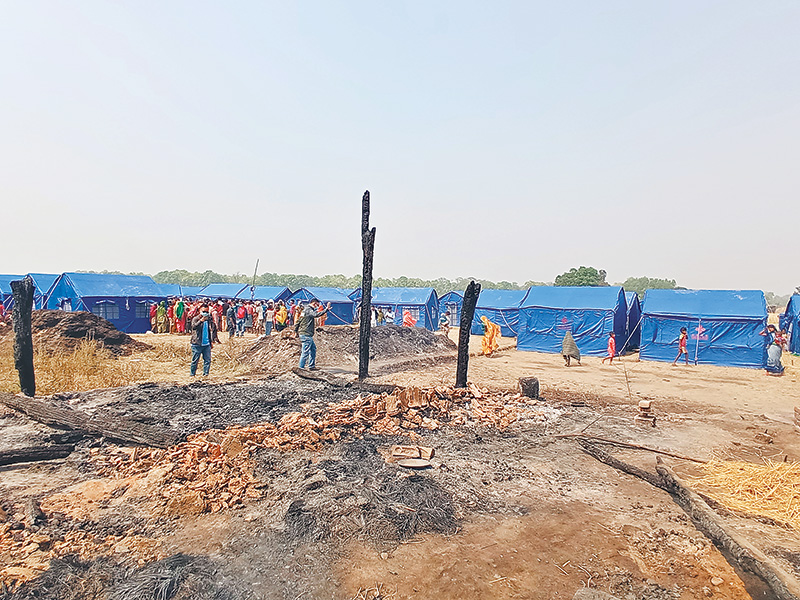
The fire victims are staying in tents installed by the rural municipality. Post Photo: RUPA GAHATRAJ

NEPALGUNJ,
As many as 68 families have been rendered homeless after a massive fire destroyed 120 houses at Khodawa settlement in Narainapur Rural Municipality-4, Banke, on Saturday.
The fire broke out from an animal shed belonging to Fakir Khan and spread throughout the settlement of mostly thatched-roof houses, leaving no time for the affected families to salvage their food grains or belongings. Four people sustained injuries while trying to contain the inferno.
“I had stored seven quintals of freshly harvested wheat in my house. All my food grains and other valuables and clothes were burnt in the fire. How do I feed my family now?” said Pramod Yadav, one of the fire victims. “I request the people’s representatives and government authorities to provide us with immediate relief and help us reconstruct our houses.”
The fire victims are taking shelter in 40 makeshift tents installed by the rural municipality but they’re not enough to accommodate all the displaced families.
“We are working to manage shelter and food for the displaced families. We have also prioritised the reconstruction of their fire-ravaged houses,” Istiyak Ahammad Sah, chairman of the local body.
The district administration has also announced to provide immediate relief to the displaced families and take initiatives for their resettlement. Chief District Officer Ram Bahadur Kurumba said that the local administration will soon distribute Rs 20,000 to each household displaced by the fire.
“Discussions are underway with the Lumbini Provincial government regarding the distribution of aid for the housing reconstruction,” Kurumba said.
Fire incidents are reported frequently in Narainapur, a remote local unit in Banke about 40 km from Nepalgunj, the district headquarters. A couple of houses and sheds had been destroyed in a fire at Narainapur-1 last month. Similarly, two separate fire incidents had ravaged eight houses at wards 4 and 8 in the past few days.
“The risk of fire is very high in Narainapur, as the settlements consist of clustered houses with thatched roofs, making it easy for a fire to spread rapidly,” said Sujita Chaudhary, secretary at Narainapur-4.
The rural municipality has allocated Rs 14 million budget for disaster management this year. However, the local unit is still unable to carry out preparedness works effectively to prevent and control disasters like fires and floods.
Meanwhile, in Jumla, a fire broke out at Dhipugaun of Tila Rural Municipality-9 on Sunday, destroying 35 houses. The fire was yet to come under control as of Saturday night. Security personnel of the Nepal Police and Armed Police Force have been sent to the incident site to douse the fire.

Page 3
NATIONAL

Four held in Thamel house robbery case

- SHUVAM DHUNGANA

KATHMANDU,
A special team mobilised by Metropolitan Police Circle, Lainchaur, has arrested four people in the last two days in connection to the house robbery incident of last Monday at Thamel.
“The suspected robbers had broken into the house of Yun Xiamen, a Chinese national at Thamel, and made off with more than Rs2 million in cash and jewelleries,” DSP Dipak Khadka, the in charge of the police circle, told the Post.
Yun has been living in Nepal with his Nepali wife at Thamel for the past five years.
The masked robbers, according to Khadka, entered the couple’s house at around 9:30pm on March 29 and subdued Yun, his wife Anjali Tamang, and his two brothers-in-law Pravesh Tamang and Pasang Tamang with duct tape before ransacking the place.
“A special team was mobilised to investigate the case and four suspects have been arrested,” Khadka said.
Police have identified the suspects as Amir Tamang, 24, Phulkaji Tamang, 28, Buddha Tamang, 28, and Roshan Lama, 28.
The team also recovered Rs792,500, RMB 6,170 and some gold jewelleries from the suspects.
Khadka said preliminary investigation has revealed that the suspects were acquaintances of Anjali, Yun’s wife.
Kathmandu District Court has remanded the fours suspects to investigative custody.  
Robbery and burglary cases have been rising across the country, according to the Nepal Police data.
In the fiscal year 2014-15, a total of 1,309 incidents of robbery and burglary were recorded throughout the country. The number of cases rose to 1,578 in the following fiscal year 2015/16.
The complaint related to robbery and burglary reached 1,627 in the fiscal year 2016/17 and 1,628 in the fiscal year 2017/18. In the fiscal year 2018/19, cases related to robbery and burglary reached 2,646.

NATIONAL

Local governments say they don’t get enough resources

The federal government needs to hand over their constitutional responsibilities as well as staff to subnational governments, experts say.
- PRITHVI MAN SHRESTHA
post illustration

KATHMANDU,
Prime Minister KP Sharma Oli on March 24 said that allocating 70 percent of the total budget of the federal government to the local governments as demanded by some of them would be impractical.
“What do you do with 70 percent of the budget?” he asked while addressing the 28th anniversary of the Municipal Association. “Will it be used to sleep on?”
Prime Minister Oli’s remark has come at a time when the government led by him is facing accusations of undermining federalism by overstepping the jurisdictions of provincial and local governments.
Both provincial and local governments have been complaining that the federal government has concentrated the resources with it despite a significant chunk of activities being handed over to them from the central government.
“Budget distribution to the local level has not been reflected in overall work that local governments are supposed to do as per the constitution and laws,” said Ashok Kumar Byanju (Shrestha), president of Municipal Association of Nepal, a grouping of the municipalities.
In the current fiscal year, the government allocated Rs362.63 billion to the provincial and local governments under four headings—fiscal equalisation, conditional, special and complementary grants. The amount is around 25 percent of the total Rs1.47 trillion budget presented by the federal government in May last year.
According to the Finance Ministry, the seven provinces received Rs99.87 billion while 754 local governments were allocated Rs262.75 billion.
It means the provincial governments were allocated 6.77 percent of the total budget while nearly 18 percent was allocated to local governments. There are seven provinces and 754 local governments in the country.
Experts on federalism say that although the budget allocated for local governments has increased substantially and there is now budget for provincial governments after the country introduced a federal set-up, whether that is enough should be calculated based on whether the sub-national governments can spend the available budget well.
“As a per a study that I prepared for the Prime Minister’s Office right after the promulgation of the constitution in 2015, as much as 60 percent work of the government was supposed to be done by provincial and local governments as per constitutional provisions,” said Khim Lal Devkota, an expert on fiscal federalism and local government.
“But the budget earmarked for them does not reflect this workload of the sub-national governments. Besides, many of the responsibilities to be carried out by the sub-national governments are yet to be handed over to them due to the lack of relevant laws.”
The federal government continues to be involved in constructing local level roads and bridges as well as other small infrastructure projects. Appendix 5 of the Constitution of Nepal says only the national highways come under the purview of the federal government. This means other smaller highways and roads and bridges are the responsibility of provincial or local governments.
The Department of Local Infrastructure, which was reconstituted from the Department of Local Infrastructure Development and Agricultural Roads (Dolidar) under the federal affairs ministry, gets involved in undertaking planning and assisting for the construction of local-level rural roads, irrigation and river control, water supply and sanitation, suspension bridge, housing and building and rural energy, among others.
The federal government continues to maintain its presence in local schools by establishing the Education Development and Coordination Unit, which has been assigned to maintain records of teachers, to conduct exams for grades 10, 11 and 12, and liaise between the federal and local governments to implement the centre’s projects.
Province 2 government has taken the federal government to the court blaming the central government for overstepping into the provincial government’s jurisdictions.
In August 2019, the Province 2 government filed a writ at the Supreme Court challenging the central government’s move to merge the Sagarnath Forest Development Project with the Timber Corporation of Nepal. In December last year, it moved the Supreme Court to annul the federal government’s decision to claim jurisdiction on groundwater resources development, calling it unconstitutional.
Byanju, who is also the mayor of Dhulikhel Municipality, said besides overstepping into sub-national governments’ jurisdictions, the federal government’s failure to introduce a number of federal laws has also obstructed the transfer of many functions to local governments.
Devkota said that the fiscal transfer for the sub-national government could be even higher than what is now if the central government handed over their constitutional functions to them.
But it is not just a matter of asking for more funds.
According to Devkota, whether a budget allocated by the federal government was enough for a sub-national government should also be judged by their ability to spend the allocated budget.
Provincial and local governments have been weaker in terms of the expenditure compared to the federal government whose own performance has continued to remain poor.
According to the Financial Comptroller General Office, the office responsible for releasing the budget and keeping records of income and expenditures of the government, the combined expenditure of the provincial governments in the fiscal year 2019-20 stood at just 67.29 percent with Karnali province being able to spend just 50 percent of its budget, the lowest among the seven provinces.
When it comes to local governments, they spent just 68.45 percent of their combined budget.
The federal government’s expenditure in the last fiscal year stood at 71.18 percent.
With the federal government collecting 80 percent of total revenue in the last fiscal year, the province and local governments heavily relied on the fiscal  transfer from the federal government. In the last fiscal year, the provincial governments contributed just 6.73 percent of total revenue while the local governments contributed 12.94 percent of total revenue collected by three layers of the government.
Devkota said that the local governments should not seek more fiscal transfer from Kathmandu alone but also try to raise their own resources as they have many avenues to raise taxes.
“The local and provincial governments should not depend on fiscal transfer from the federal government as they also have room for raising a lot of taxes,” said Devkota.
Local governments collect a number of taxes including on property, house rent, house land registration, vehicles, services, advertisements, business transactions, land, and entertainment.
Former chief secretary Somlal Subedi, who also has expertise on fiscal federalism, told the Post that he could not immediately comment on whether the fiscal transfer to provincial and local governments from the central government was enough.
“We can reach a conclusion on this only after examining the functions, financial  resources, human resources and the achievements of the provincial and local governments,” he said. “Resources, however, have increased substantially for the local governments compared after the country implemented federalism.”
But it is not just a matter of fiscal resources and functions. Human resource is another aspect of the devolution of governance.
Sub-national governments, however, complain that the federal government failing to send adequate staff, particularly technical staff, to the provincial and local governments while preventing them from recruiting new staff, contributed to the lower than expected expenditure.  
During the employees adjustment process, the federal government retained most of its employees although it had announced prioritising adjustment of staff at the local level.
“We have more functions but have limited budget and employees to implement them,” said Byanju.

NATIONAL

Women representatives in Achham are excluded from decision-making roles

Most women ward members say the inclusion policy has only served as a token gesture to fulfil gender and caste representation requirements at the local level.
- MENUKA DHUNGANA
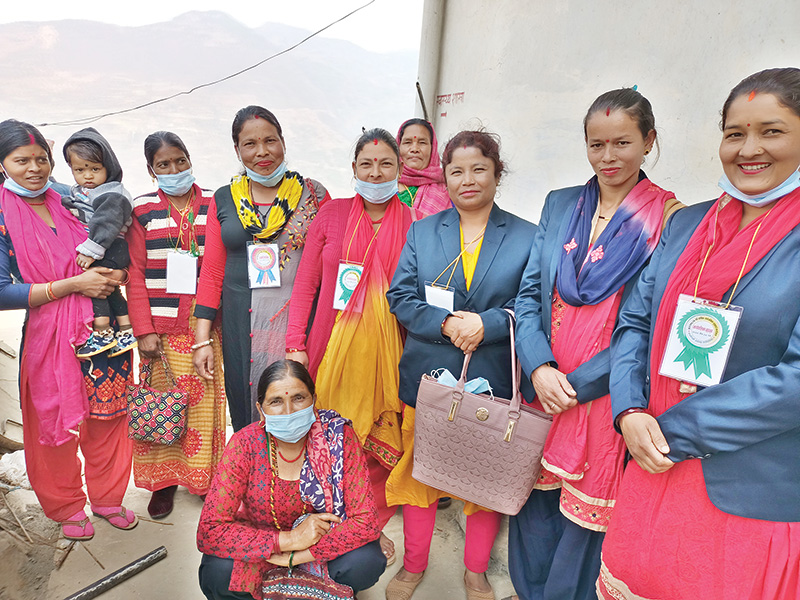
Women representatives say they are not treated by their male colleagues as equals.   Post Photo: Menuka Dhungana

ACHHAM,
Mathura Bhul, a ward member of Jayagadh Rural Municipality-3, is unaware about the local unit’s administrative works—be it budget allocation, projects or programmes. Bhul was elected as a ward member under the Dalit quota as provisioned by the law. Her four-year tenure is coming to an end in mid-July without her having shouldered any responsibility as a ward member.
According to the existing legal provisions, the municipal assembly must ensure the representation of three persons from Dalit and minority communities while the village assembly should have the representation of two from these two groups.
The Local Level Election Act 2017 has made it mandatory for local units to have the representation of two women ward members, including a Dalit woman, in each of its ward offices.
There are a total of 364 ward members from 10 different local bodies in Achham district. Most female ward members say the government policies have only served a token gesture to fulfil the gender and caste representation requirements at the local level.
“We are elected representatives only on paper and for the sake of filling quotas,” said Bhul. “We haven’t been given any responsibilities by the ward office. We haven’t even had the chance to work for those who voted us in.”
A majority of women elected representatives reiterate Bhul’s sentiments. Another Dalit representative Bhunti Dholi of Ward No. 2 in Mangalsen Municipality said, “I had reached people’s doorsteps asking for votes, promising more Dalit representation and changes at the policy-making level. But that has not happened. My term is about to end and I haven’t been able to keep my promises to my voters.”
The ward offices have failed to keep Dalit and even non-Dalit female elected representatives in the loop about administrative works.
“We have been given a place at the table but we are not treated as equals,” said Dholi. “The ward chairman does not coordinate or even consult with us before making decisions. Our voices continue to go unheard.”
At a time when voices are being raised from all corners on the importance of having women in politics, women representatives in Accham have been let down by the nature of politics practised at the local level.  
“I got involved in politics because I felt it was important that women, more so Dalit women, be in decision-making roles to be able to change the current political narrative dominated by men,” said Radhika Jaigadi, a Dalit ward member of Mangalsen-1. “I wanted to do something for our community. But in the last four years, I did not get a single chance to speak up.”
According to her, she attends local-level meetings only if the ward office calls her. “I’ve tried to speak up before but I have been sidelined by my male colleagues. Now I don’t even bother attending meetings,” she said.
Non-Dalit women ward members who were elected under the open category also complain of being excluded from decision-making.
“Development projects hold a lot of importance in rural areas. When our voters ask us about these projects, we don’t have an answer,” Ganga Thapa, who was elected as the ward member of Mangalsen-1 under the open category, told the Post. “We do not know how the development projects are selected by the ward office; we don’t know the process or when and how they are monitored. I feel like I have wasted my four years in this office.”
Dambara Devi Swar was elected a ward member of Bannigadhi Jayagadh Rural Municipality-2 four years ago but she still does not have the working knowledge of her job.
“It’s unfortunate that I couldn’t learn much about my role as a ward member. I attend meetings when the ward chairman calls me and I get allowances sometimes. But when the voters ask me about women-centric policies and programmes, I listen to them silently since I have nothing to offer them,” said Swar.
Elected women representatives in local units say that the male representatives constantly attempt to sideline women from participating in meetings and other development activities.
“There’s more investment in development activities and men have managed to keep women away from it,” said Maya Kunwar, the vice-chairperson of Chaurpati Rural Municipality.
Sarita Upadhayay, deputy mayor of Mangalsen Municipality, agrees that there are gender and caste biases at the local level.
“In meetings, male representatives do not show a positive approach to women-related issues. Matters related to gender and caste are shrugged off even in the executive meetings,” said Upadhayay. “All male representatives show a united front and leave women out of decision-making. Even I am facing problems to execute my responsibility as the deputy mayor.”

NATIONAL

Girl, 9, dies in forest fire

Briefing

PALPA: A nine-year-old girl died in a forest fire at Dhurkot Rural Municipality-7 in Gulmi district on Friday. According to the District Police Office in Gulmi, Sangita Pariyar died in a bushfire at Dharakholi Bale Salla Community Forest. She was returning home after taking a bath in a stream near her residence when the incident took place.

NATIONAL

Eight arrested in connection to Baglung Holi festival deaths

Briefing

BAGLUNG: Police on Friday made public eight individuals on the charge of killing two youths in a clash during Holi celebrations at Baldechaur in Badigad Rural Municipality, Baglung. Superintendent of Police in Baglung Krishna Bahadur Pallimagar said, “We have remanded the perpetrators into custody for further investigation.”

NATIONAL

382 school buildings reconstructed in Gorkha

Briefing

GORKHA: The reconstruction work of 382 school buildings, which were destroyed by the Great Earthquake in 2015, has been completed in the last five years. According to the District Project Implementation Unit Office of the National Reconstruction Authority, 85 school buildings are still under construction.

NATIONAL

Manang bans outsiders from collecting Yarsagumba

Briefing

LAMJUNG: Manang has barred people from outside the district from collecting Yarsagumba (Cordyceps sinensis) from its highlands this season. According to Chief District Officer Bishnu Lamichhane, an all-party meeting took the decision keeping in view the ongoing Covid-19 pandemic. The Yarsagumba picking season generally begins from mid-April.

Page 4
EDITORIAL

On the campaign trail

Oli is on an inauguration spree with an eye on elections.

No Nepali citizen perhaps needs to be lectured on how tortoise-like Nepal’s infrastructure development process is. The Melamchi water project, which took over two decades to come to fruition, is the most poignant example of the sluggishness that defines our development portfolio. Oli’s inauguration of 165 strategic road projects on a single day, thus, seems to be outlandish if not utterly ridiculous. More than strategic roads, Oli’s ribbon-cutting spree is a well-calculated political strategy, even a far-sighted electoral strategy as the prime minister already seems to be in election mode.
While a press statement issued by the prime minister’s personal secretariat claimed the road projects had been chosen after completion of the due process, officials at the Ministry of Physical Infrastructure and Department of Roads have said many of the projects have not completed their detailed project report (DPR) and environmental impact assessment (EIA) even as they were hurriedly included in the prime minister’s jumbo inaugural show on Saturday. Officials say the projects were finalised as late as Friday, and there is no chance the DPR or the EIA for those projects could have been completed as these tasks take months.
But no, Oli cannot wait until these processes are completed. In fact, they are too technical for Oli to consider, for he is not at all interested in whether those projects take off for real. Oli is not on an inauguration spree with a genuine zeal for uplifting Nepal’s infrastructure development. In fact, it exhibits his desperation to hold a snap election, as he perhaps believes that it is his only weapon to secure his political power in the days to come. His only interest at the moment is to create an aura about himself as a development man as the prospect of an early parliamentary election becomes more apparent than ever.
The prime minister seems to be of the opinion that an election is his best bet out of the current political imbroglio. That is why most of his actions and speeches in the past few weeks after the Supreme Court invalidated his unconstitutional dissolution of Parliament have focused on conducting elections at the earliest. The fact that political parties opposed to Prime Minister Oli, both within his party and outside, have failed to put up a formidable political coalition to unseat him through a no-confidence motion means that the country might have to go for fresh elections. In such a scenario, Oli, through the inauguration spree, wants to maintain his public image with the populist politics of infrastructure development.
Oli’s inaugural spree also exposes how a hurried approach towards infrastructure development leads to a slew of problems, ranging from destruction of the ecology to depletion of financial resources. It is not for no reason that dozer vikaas has become a much-loathed term in the country today. Infrastructure development projects are often begun not because of a genuine necessity of the people, but because of local leaders’ zeal to put their bulldozers and other equipment to use in those projects. This has led to a proliferation of projects that do not address the infrastructure gap in the country but rather put unnecessary environmental pressures on our fragile mountains and plains. A basketful of ill-planned development projects are, therefore, more dangerous for the country than underdevelopment, and need to be discouraged.

OPINION

Preparing for the next pandemic

Experts are set to talk about strategies that worked and policies that stuttered during this pandemic.
- PRAKRITI DHAKAL
Shutterstock

In the early days of Covid-19, as scientists around the world scrambled to decode the ‘mystery’ virus, misinformation spread faster than the disease. In WhatsApp messages, our uncles and aunts shared how Chinese labs hatched the disease or how the disease was a billionaires’ ploy to earn money. We also received news of instant cures—even when vaccine and medicine trials had not started anywhere. As people burned 5G towers across Europe, we sat with raised eyebrows. While these baseless rumours or crazy conspiracy theories should bring chuckles, they harmed people. In many areas, people drank sanitisers and tried different methods of cure that cost them their lives. In many countries, health misinformation was combined with xenophobia; minorities became convenient scapegoats for government failures.
As the upper class zoomed their way out of the intense lockdown, poor people starved everywhere, including in Nepal, affecting the marginalised communities the most. The economic lockdown eviscerated the little savings poor people had, and led to starvation afterwards. As multiple miseries piled on top of each other, worsening mental health led to terrifying suicide statistics in the country.  


More devastating
When the next highly transmissible novel disease arrives, we will run through the same iteration we ran through this pandemic: panic buying, some heavy mass measures such as lockdown, economic stagnancy, and a host of other ripple effects. Some epidemics may be deadly and uncontrollable. They will cost more lives and pigeonhole us in our rooms for years. Covid-19 has already eviscerated a year’s worth of life, and we are already forgetting part of pre-Covid life, with researchers saying how we may have developed mild cognitive impairment. The pandemic is still in its dawn, and the researchers have yet to study how the pandemic has changed us in totality. Chances are that future pandemics will be more devastating in their impact than the present one.
The current pandemic has caused broad damage. In the early days, the lockdown stunted people’s mobility, affecting those in need of medicine and treatment services. Elderly individuals in need of dialysis were not able to travel from their villages to the cities because of the lockdown and the fear of contracting the virus, exposing age-sensitive risks and revealing our system’s inequities. As limited health resources were funnelled into the treatment of the novel disease, other health projects (such as measles vaccination) received a push back. These risked people with other underlying conditions, slowing our journeys to sustainable health development goals.
This pandemic has also taught us how the disease has little regard for manmade political boundaries. As the world becomes more connected with air travel, future diseases will come to Nepal overnight by plane. The episode highlights the importance of alertness and coordination with foreign governments and global health agencies to nip diseases in the bud before their spread.
In the pandemic, the role of the media cannot be understated. Last year, traditional media houses received major blows from the pandemic, which forced many to shut down or downsize their newsrooms. Journalists were not able to report from the ground, making it difficult to understand the news in skin and bones. This prevented people from understanding the struggles of families with Covid-19, prompting people to be dismissive of the disease and flout safety measures.
During the same time, far-away social media companies and their disputable algorithms dictated what appeared on our timelines, amplifying misinformation, and in many cases, renewing xenophobia towards minorities. Some media houses, understanding their responsibilities, devoted a section to Covid-19 and tried to bust the myth with the evolving knowledge on the disease. However, the grandiosity of the pandemic also left much to be desired. Lack of enough data analysts in the media (and in the bureaucracy) ensured we did not receive the news beyond descriptive statistics, impeding the impetus towards the formulation of targeted and effective policies.
In this pandemic, countries with high GDP per capita and perceived institutional robustness failed, whereas countries with moderate and low per capita income seemed to tide over the disease. This explains that other confounding variables, besides wealth, affect health outcomes. East Asian nations with institutional memory to combat previous corona diseases and pandemics were better prepared. Because people had gone through them, they knew of the measures and took seriously the precise advice of their respective governments.  
The pandemic raises big questions. Do we have the capabilities to keep future unnamed diseases at bay, or when they arrive, deal with them without incurring much loss? Do we now have a pandemic playbook with details explaining what each institution will do when we face a highly transmissible disease? Do we have tools to combat the avalanche of misinformation that are characteristic of such times? What long-term policies and programmes can we have in place to ensure few comorbidities in our citizens? Covid-19 has forced us to reckon with these questions.


Reimagine health policies
The Nepal Health Conclave is set to raise these and many other questions on April 6. Various experts from different fields such as public health, international development, medicine, media and the government will rub shoulders and talk about strategies that worked and policies that stuttered during the Covid-19 pandemic. They will sit together to reimagine a set of health policies that are congruent with evolving international policies, practices and knowledge.
The conclave will feature four sessions—Health Literacy: Agenda for All, Covid-19 and SDGs (Sustainable Development Goals), Deconstructing Health Policies, and The Role of Mainstream Media for Healthier Nepal. In these sessions, experts will talk about various issues some of which will examine health illiteracy in the social media age, list challenges to the SDGs because of Covid-19, contribute to the ongoing debate on reforming health policies in the federal context, and discuss the role of media to strengthen the public health system.
This conclave may not produce concrete solutions at the end of the day. But what it will do, we hope, is stir much-needed conversation on the policies, roles and responsibilities of various agencies and institutions that determine the mass health of the country. We hope the added momentum will lead to meaningful policy changes at various levels. When we weather away this pandemic and await the next, I hope we will have robust institutions to fight against novel diseases.


Dhakal is the project leader of the Nepal Health Conclave.

OPINION

The global tremors of Myanmar’s coup

Given its strategic location, violent turmoil there could destabilise the entire region.
- Thitinan Pongsudhirak
Robert Bociaga Olk Bon/Shutterstock.com

Myanmar is leading Southeast Asia’s race to the political bottom. Since overthrowing a civilian government on February 1, the military has killed more than 530 unarmed civilian protesters and arrested thousands more. Now, the country is confronting a deepening humanitarian crisis and the growing possibility of a civil war—developments that would have serious regional and even global consequences.
Myanmar’s civilian government, led by Aung San Suu Kyi’s National League for Democracy, may not have been perfect, but it had the people’s support. In last November’s election, the NLD won a strong majority against the military-backed opposition. Within weeks, the military, under orders issued by Senior General Min Aung Hlaing, had arrested Suu Kyi and other NLD ministers and declared a one-year state of emergency.
Myanmar has been here before, having endured nearly a half-century of military dictatorship and international isolation following the 1962 putsch and a bloody crackdown on pro-democracy demonstrators in 1988. But there is something different about this coup: no matter how freely the military beats and shoots civilians, the protesters’ movement—built on an exigent alliance between civilian authorities and armed ethnic groupings—will not submit.
That is not unambiguously good news, because the military junta also will not give up, no matter the cost, leaving little hope of salvaging Myanmar’s political liberalisation, economic reform, and development progress during a decade of civilian rule. Instead, the country faces the imminent threat of economic collapse, state implosion, and internal strife—perhaps even full-fledged civil war.
Given Myanmar’s strategic location on the corridor linking the Indian and Pacific Oceans—sharing borders with China, Bangladesh, India, Laos, and Thailand—violent turmoil there could destabilize the entire region. Already, the crisis is shaking a pillar of regional order: the Association of Southeast Asian Nations, whose members are divided over how to respond.
In line with the principles set out in the ASEAN Charter, Indonesia, Malaysia, and Singapore have called for the immediate cessation of violence by the military in Myanmar, the release of Suu Kyi and other political detainees, and the restoration of democratic governance based on the results of November’s election. But other member states—particularly Cambodia, Laos, and Vietnam—prefer to emphasise ASEAN’s norm of non-interference in other members’ internal affairs.
It is no coincidence that ASEAN’s more democratic governments are calling for a response to Myanmar’s putsch, while its more authoritarian governments back a hands-off approach. This highlights the limits of regional integration involving different regime types.
ASEAN has historically avoided the pitfalls of ideological differences by focusing on common interests and objectives. When Indonesia, Malaysia, the Philippines, Singapore, and Thailand created the grouping in 1967, they sought a platform for mutually beneficial cooperation among countries that were united by geography, and by their eagerness for a geopolitical counterweight to their larger neighbours.
From 1984 to 1999, five members became ten, with the addition of Brunei Darussalam, Vietnam, Myanmar, Laos, and Cambodia further raising ASEAN’s profile as a means of empowering smaller states and supporting peace and prosperity. Today, ASEAN has a total population of 670 million (far exceeding the European Union) and a combined GDP of more than $3 trillion.
Alongside this growth, ASEAN sought to establish itself as a force for wider multilateral cooperation. In the 2000s, it acted as an anchor for the newly created Asia-Pacific Economic Cooperation, the ASEAN Regional Forum, and ASEAN+3 (China, Japan, and South Korea). And it has played a central role in high-profile meetings, such as the East Asia Summit, seeking to advance strategic dialogue and confidence-building goals.
Such activities helped to safeguard Southeast Asia from outside interventions like those that ravaged the region during the Cold War. The ASEAN Charter, adopted in 2007, built upon this success by providing a legal status and an institutional framework for the grouping that established a vision for shared security, increased economic prosperity, and stronger socio-cultural connections.
But, as the Myanmar crisis shows, countries with vastly different governance models will always struggle to cooperate in some areas. The same can be said of the broader international response to the coup. The United States and the EU have imposed targeted sanctions on Myanmar’s generals, though Asian democracies—such as India, Japan, and South Korea—are responding less assertively.
By contrast, China, Myanmar’s largest trade partner, has blocked a United Nations Security Council statement condemning the coup—a decision that has contributed to perceptions that it supports the junta. Pro-democracy demonstrators have burned down Chinese factories in Myanmar in retaliation. And yet, eager to avoid an all-out backlash, China has been guarded in its response.
Russia, which joined China in blocking the UN Security Council statement—seems to have even fewer qualms, perhaps at least partly because it is unlikely to suffer any geopolitical consequences from the mayhem in Myanmar. Though the Kremlin has expressed some concern about the civilian casualties, it is also a leading arms supplier to the junta. And, in a recent statement, it touted plans to deepen ‘military and military-technical cooperation in the spirit of strategic partnership.’
Ultimately, Western sanctions are likely to have only indirect effects, especially as ASEAN dithers. The fight for Myanmar’s future will have to be won at home. That is a chilling prospect, because it implies that unarmed protesters will need to face down a battle-ready army. In the short term, it is difficult to see how Myanmar will avoid much greater bloodshed.

 
Pongsudhirak is Professor and Director of the Institute of Security and International Studies at Chulalongkorn University’s Faculty of Political Science in Bangkok.
— Project Syndicate

Page 5
MONEY

Nepal Airlines to lease out grounded Chinese planes

The six aircraft were pulled out of service nearly a year ago due to mounting losses.
- SANGAM PRASAIN
The planes will be given on dry lease, which means the owner will provide the aircraft only, without crew or ground staff, according to Nepal Airlines officials. POST FILE PHOTO

KATHMANDU,
Nepal Airlines has finally decided to lease out or sell its six Chinese-made aircraft, nearly a year after grounding them because they were more trouble than they were worth.
“Out of the two options recommended by the Finance Ministry—dry lease or outright sale—Nepal Airlines will try the first one,” said Dim Prasad Poudel, managing director of Nepal Airlines.
“We have constituted a committee to determine the lease rate. The panel will submit a report within a week, and we will show it to the board for its go-ahead,” he told the Post.
After the board’s approval, Nepal Airlines will invite offers from prospective national and international bidders to lease the Chinese planes, said Poudel. “If there are no takers, we will go for the second option—sale. Both options seem difficult, but we don’t have any alternative,” said Poudel.
According to Nepal Airlines officials, the planes will be given on dry lease, which means the owner will provide the aircraft only without crew or ground staff.
Nepal Airlines has repeatedly said that the Chinese-made planes were causing heavy losses ever since they were acquired between 2014 and 2018, and that it wants to remove them to stop further losses. The Finance Ministry is the owner of the planes and Nepal Airlines is the operator.
The ministry gave the green signal to Nepal Airlines last month to lease out or sell the planes.
In July last year, the board of directors of Nepal Airlines unanimously decided to stop flying the Chinese planes as they cost more money to operate than they brought in.
Five months after the decision, in December 2020, the national flag carrier had submitted four options to its line ministry—Civil Aviation Ministry—to get rid of the six inefficient Chinese aircraft in its fleet.
The first option was to ask the aircraft manufacturers to buy back the planes by evaluating their existing worthiness.
The second option presented by the flag carrier was to lease out the planes to interested Nepali operators on either a long-term or a short-term basis. The third alternative was to auction off the planes through a global competitive bidding process.
The fourth option was to look for Chinese or international companies or banks interested in buying or leasing them.
As the planes have been grounded for a long time, Nepal Airlines officials said that they need to expedite the process to lease out or sell the planes because aircraft depreciate quickly if they are kept on the ground for a long period.
In November 2012, Nepal Airlines signed a commercial agreement with Aviation Industry Corporation
of China (AVIC), a Chinese government undertaking, to procure six aircraft—two 56-seater MA60s and four 17-seater Y12es.
As part of the deal, China provided grant and concessional loan assistance worth 408 million Chinese yuan (Rs6.67 billion) to acquire and purchase the six aircraft.
Out of the total aid money, a grant worth 180 million yuan (Rs2.94 billion) went to pay for one 56-seater MA60 and one 17-seater Y12e aircraft; and a loan worth 228 million yuan (Rs3.72 billion) was used to purchase one MA60 and three Y12e aircraft.
The 17-seater Y12e is a twin-engine turboprop utility aircraft built by Harbin Aircraft Industry Group, previously Harbin Aircraft Manufacturing Corporation.
The 56-seater MA60 is a turboprop-powered airliner produced by China’s Xi’an Aircraft Industrial Corporation. Both manufacturers are subsidiaries of AVIC.
In 2014, marking the beginning of what was supposed to be a new era for Nepal Airlines after acquiring the planes, it had even changed its classic red and blue stripes livery, opting for a more modern design.
But these planes never took to the air.
The delivery of the rest of the Chinese aircraft was stalled for years after issues appeared in the first batch of planes that arrived in 2014.
These issues included lack of pilots, lack of instructor pilots, lack of spare parts and lack of engineers trained to maintain them.
The second batch of MA60 and Y12e aircraft, as part of the six-aircraft deal between Nepal and China, arrived in January 2017.
The corporation received the final two Y12e aircraft in February 2018.

MONEY

Coronavirus costs climb as Europe’s farmers seek seasonal workers

- REUTERS

BARCELONA/LONDON, 
Fruit and vegetable harvests are underway in western Europe with seasonal workers gathering crops in top producer Spain, but costs are rising as farmers fear a third wave of Covid-19 might cause a repeat of 2020’s damaging disruptions in labour supply.
Harvests rely heavily on workers from Africa and eastern Europe, but many couldn’t travel a year ago as borders closed in the first wave of the pandemic. Shortages of key goods appeared in supermarkets while prices rose as consumers hoarded.
Coranavirus cases are surging again in Europe, raising the risk of crop losses and adding to farmers’ costs on everything from extra transport to keep workers socially distanced to buying protective gear for seasonal labourers.
In Spain’s northeastern Catalonia region, farmer Josep Cabre said he had spent about 6,000 euros ($7,000) on masks and other protective equipment for seven seasonal workers from West Africa working on his farm picking apples, pears and peaches.
“We have been lucky and, as far as we know, none of us has contracted Covid-19,” Cabre said, adding that shutting his business for 15 days could mean a 150,000 euro loss.
“A bar or shop can close for 15 days ... but if I don’t pick the fruit at its right time and I do it later it would be damaged. To stop for 15 days would be an economic disaster,” he added.
Cabre tries to give workers tasks to keep them distanced. He has stopped using a nine-seat van to take them to fields near the city of Lleida, instead using several vans and reimbursing transport costs to workers who travel alone.
Lleida saw an infection cluster last summer, partially linked to migrants seeking seasonal jobs to pick fruit.
This year, thousands of workers have arrived on chartered flights from Morocco to help gather crops in Spain for the first major harvest of strawberries in the southern Huelva province.
“Covid measures have forced us to take on more people to do the same job,” Fernando Gomez of Murcia’s Proexport growers organisation said, adding that a hike in Spain’s minimum wage also put pressure on margins.
Growers in Germany still expect to have enough workers from Poland, Romania, Bulgaria and elsewhere for the asparagus harvest. But workers face tougher health and safety checks.
“The extensive corona-regulations and hygiene measures are creating great challenges, both organisational and financial,” Daniela Rixen, spokesperson for the LKSH agricultural chamber representing farmers in the German state of Schleswig-Holstein.
Bernhard Kruesken, secretary general of German national farming association DBV, said normally about 300,000 seasonal harvest workers come to Germany every year but fewer are expected in 2021 for the second year running.
France needs about 1 million seasonal workers each year. Fruit and vegetable growers have been seeking to attract local students and jobless people to compensate for lower numbers of foreigners if new travel restrictions are imposed.
Last year, France raised a so-called “shadow army” to pick crops from furloughed workers in other sectors including hotel receptionists, restaurant waiters and hairdressers.
Non-European Union workers account for about 25 percent of seasonal workers in France. “You never know. At any moment rules can change and borders can be closed,” Jerome Volle, deputy-chairman of France’s largest farm lobby FNSEA said. Similar concerns are rising in Britain, which needs about 70,000 seasonal workers with the highest demand during the berry season in late May to June.
“There is a concern that European borders end up shutting down or that people can’t travel and that will put huge pressure on the availability of seasonal workers,” said Tom Bradshaw, vice president at Britain’s National Farmers Union.

MONEY

Russian entrepreneurs adapt to virus lockdown challenges

- ASSOCIATED PRESS

MOSCOW,
Valentina Konstantinova remembers well when Russia locked down for the coronavirus a year ago.
Her 18-room boutique hotel, called Skazka, or “Fairytale,” was full, and within a couple of days, it had only one guest left.
“I still don’t understand how people could have vanished in one day,
and where,” she recalled. The lockdown lasted six weeks, but with borders closed, her business prospects were grim.
One year later, Skazka is still open—thanks to some creative thinking by its owners—but with fewer guests than before.
Russia was never fully locked down again after last spring, and as a result, its economy and some of its businesses didn’t suffer as much as those in some countries during the pandemic. But it also has seen its mortality rates rise.
When infections surged again in the fall, the government resisted imposing restrictions that would have shut many businesses. Had there been another lockdown, “we’d be closed already,” Konstantinova said.
A six-week lockdown still damaged the weakening economy and compounded Russians’ frustrations over declining incomes and worsening living conditions. President Vladimir Putin’s approval rating fell from 69 percent in February 2020 to a historic low of 59 percent two months later before rebounding, according to the Levada Centre, Russia’s top independent pollster.
For the rest of 2020, industries and enterprises mostly stayed open. During a virus resurgence in the fall, some regions imposed restrictions that limited the hours or capacity of bars, restaurants and other businesses, but rarely were they closed altogether.
Online sales had a good year. Ozon, a major Russian e-commerce platform similar to Amazon, saw sales jump almost 2.5 times last year, the company’s communications director Maria Zaikina said.
But even without a second lockdown, some small- and medium-sized businesses needed creative ways
to stay afloat, with government support mostly limited to tax deferrals, cheap but hard-to-get loans, and relatively small direct subsidies. Many aren’t earning what they did before the pandemic.
During the first lockdown, Konstantinova still wanted to make use of her hotel, which is located in a museum and entertainment complex built in a style that mimics 17th-century Russian architecture.
Working with NGOs and aid groups, she offered free rooms to victims of domestic violence, refugees, doctors and foreigners who got stuck in Russia.
With tourists unlikely to return anytime soon, Konstantinova was looking for ways to transform her hotel. Some of her nonpaying guests were originally from India, and she decided to tap their expertise to add a restaurant serving authentic Indian cuisine. The project took off, and her business is now breaking even.
“Profit is out of the question at this point, of course, as is early repayment of loans,” she said.
“But the fact that we’re working at a break-even level is important. It means that when the market recovers, the business is likely to earn a profit.”

MONEY

Manufacturing boom set to boost China’s top flat steel producers’ profit

- REUTERS

BEIJING/SINGAPORE, 
China’s top flat steel producers are primed for profit from a post-Covid-19 recovery in global manufacturing and goods demand in 2021, as well as from an emissions-cutting drive that will likely knock out high-cost competitors, sector analysts said.
Prices for hot rolled coil (HRC)—flat steel rolled at high
temperatures for use in cars, home appliances and machinery—has climbed 50 percent in the past six months as China’s manufacturers cranked to life after coronavirus lockdowns were lifted in mid-2020.
Steel demand from manufacturing is improving significantly and the ferrous sector will have the biggest supply shortage since 2017, when supply-side reforms slashed steel mill capacities, analysts with CITIC Securities said in
a note.
“Profits earned by steel firms are likely to hit a record this year,” said CITIC Securities.
Flat steel consumption has boomed since the second half of last year as China’s mammoth manufacturing engine churned out home appliances, shipping containers, vehicles and other products in high demand across the world.
That momentum has extended into 2021, with industrial output in January-February gaining 7.3 percent from December and 35.1 percent from a year earlier, and it is expected to accelerate as more regional economies recover from 2020’s Covid-19 skid.
Shipments of metal-heavy items to overseas market have also jumped this year.
Exports of new-made containers more than doubled during January-February compared with the same months of 2020, while vehicle exports rose 85 percent.

Page 6
WORLD

Myanmar anti-coup protesters launch ‘Easter egg strike’

On Sunday, security forces opened fire on protesters in Pyinmana, killing at least one.
- ASSOCIATED PRESS
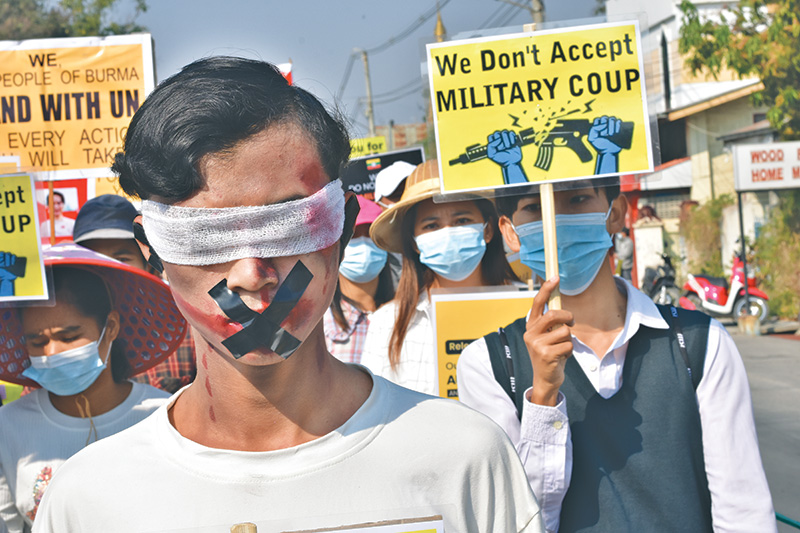
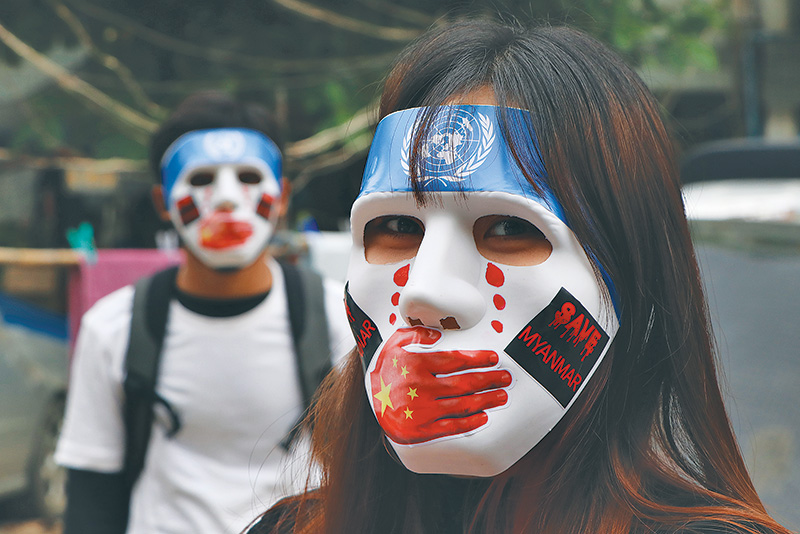
Young demonstrators participate in an anti-coup mask strike in Yangon, Myanmar, on Sunday. Threats of lethal violence and arrests have failed to suppress daily demonstrations across Myanmar demanding the military step down and reinstate the democratically elected government.  AP/rss

YANGON, 
Anti-coup demonstrators in Myanmar, adept at finding themes to tie together protests nationwide, took to the streets holding painted eggs in a nod to the Easter holiday on Sunday.
In the biggest city of Yangon, one group marched through the Insein district chanting and singing protest songs and cradling eggs bearing the slogan “Spring Revolution.” Many of the eggs also bore a drawing of the three-fingered salute, a symbol of resistance to the Feb. 1 coup.
At dawn in Mandalay, the country’s second largest city, demonstrators gathered on motorbikes to shout protests against the power grab that overthrew the democratically elected government.
Myanmar’s military has violently cracked down on protesters and others in opposition, with the latest civilian death toll since the coup at 557, according to the independent Assistance Association for Political Prisoners. More than 2,750 people have been detained or sentenced, the group said. On Sunday, security forces opened fire on a crowd of protesters in Pyinmana in central Myanmar, killing at least one person, local news outlet Khit Thit Media reported.
Pope Francis, in his Easter Sunday address at St Peter’s Basilica, prayed for the “young people of Myanmar committed to supporting democracy and making their voices heard peacefully, in the knowledge that hatred can be dispelled only by love.”
Sunday’s so-called “Easter Egg Strike” follows other themed days. They included a “Flower Strike,” in which protesters laid flowers in public places to honour those killed by security forces, and a “Silent Strike,” in which people across the country left the streets deserted.
Dr Sasa, the Myanmar special envoy to the UN who goes by one name, posted an image of painted eggs on Twitter and wrote that Myanmar’s people have a “great future in federal democracy,” reflecting hopes for the military to step down and reinstate a democratic system.
Security forces have continued to spread fear among ordinary citizens. Overnight, a resident of Yangon recorded video of a group of soldiers and police using sling shots to fire stones at the windows of homes, breaking the night’s silence. At other times, soldiers and police keep up their intimidation at night with raids on neighbourhoods, during which they shout abuse, shoot at random, make arrests and vandalize property.
On Saturday, police opened fire killing several protesters in Monywa in central Myanmar and elsewhere.
With most of the internet access cut or severely restricted by the junta, it is becoming increasingly difficult for people in Myanmar to get images of their plight to the outside world.
After weeks of overnight internet cutoffs, the military on Friday shut all links apart from those using fiberoptic cable, which was working at drastically reduced speeds. Access to mobile networks and all wireless—the less costly options used by most people in the developing country—remained blocked on Sunday.

WORLD

Maoist rebels kill 22 Indian security forces in gun battle, police say

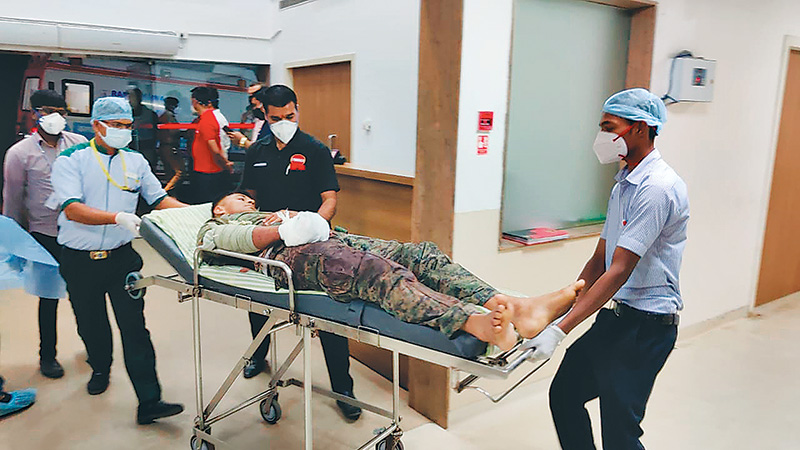
A paramilitary soldier injured in a gunbattle with Maoist rebels on Saturday is brought for treatment at a hospital in Raipur, India, on Sunday. AP/rss
- AGENCE FRANCE-PRESSE

Baijapur,
Twenty-two Indian police and paramilitary forces were killed and 30 others wounded in a gun battle with Maoist rebels in a central Indian state, police said on Sunday, in
the deadliest ambush of its kind in four years.
Some 2,000 security personnel were on the hunt for a Maoist rebel leader in Bijapur district in Chhattisgarh state on Saturday when they were ambushed, a police officer told AFP.
“So far it is confirmed that 22 security personnel were killed,” Chhattisgarh police’s Additional Director General Ashok Juneja said of the almost three-hour battle in the Maoist rebel stronghold.
“The search operation is still underway and the exact figure will be known... late Sunday evening.”
The injured personnel were admitted to two government-run hospitals in Bijapur and Chhattisgarh’s capital city Raipur.
More than a dozen others remained missing, he said, adding that an unknown number of Maoists were also killed in the encounter.
Juneja said the rebels looted weapons, ammunition, uniforms and shoes from the security forces who were killed.
The death toll could rise further, another senior police officer in Bijapur district told AFP.
Prime Minister Narendra Modi tweeted that the “sacrifices of the brave martyrs will never be forgotten”, while Home Minister Amit Shah wrote on Twitter that India would “continue our fight against these enemies of peace & progress”.
Chhattisgarh Chief Minister Bhupesh Baghel wrote on Facebook Sunday that Shah had assured him of “all the necessary help” from the national government against the militants.
The toll was the worst for Indian security forces battling the far-left guerillas since 2017, when 25 police commandos were killed in an attack.
Seventeen police from a commando patrol were killed in an attack by more than 300 armed rebels in Chhattisgarh in March last year.
Sixteen commandos were also killed in the western state of Maharashtra in the lead-up to India’s election in 2019, in a bomb attack that was blamed on the Maoists.
The militants—who say they are fighting for rural people and the poor—have battled government forces across eastern India since the 1960s.
Thousands have been killed in the fighting.

WORLD

Europe ramps up vaccinations as coronavirus haunts Easter holidays

- ASSOCIATED PRESS

PARIS,
The main stadium in the French city of Lyon opened as a mass vaccination centre during Easter weekend, and thousands of people spent the holiday lining up for injections elsewhere in France as the government tried to speed up shots amid a new rush of coronavirus cases.
But as Europe faced its second Easter in a row under the cloud of the pandemic, some French cities pushed back against President Emmanuel Macron’s insistence that “there are no weekends or days off during vaccination.”
Authorities in Strasbourg, on the German border shut down their vaccination facilities from Good Friday through Easter Monday—a public holiday in France—to allow workers “a little rest at last,” according to a city official. To ensure that residents still had access to potentially life-saving vaccines, the city expanded
vaccination hours and administered all of its weekly supply of doses between Monday and Thursday.
The city of Sarcelles north of Paris was among those where officials kept vaccine sites open Sunday amid mushrooming infections and demand.
The surrounding Val d’Oise region now has the highest coronavirus infection rate in France, and the
situation in Sarcelles symbolises how the pandemic has worsened existing inequality.
In Lyon, French first division soccer club Olympique Lyon opened its stadium and provided 200 volunteer employees to help medical personnel and firefighters with a mass vaccination drive that started Saturday. Authorities expect 3,000 vaccinations per day to be given at the stadium during the first three days.

WORLD

Restrictions imposed in Indian state that accounts for more than half of new Covid-19 cases

- REUTERS

MUMBAI: India’s richest state, Maharashtra, announced stringent Covid-19 restrictions from Monday, after a rapid rise in infections now accounting for more than half the daily new cases in India.
The state, which includes the financial capital Mumbai, will shut down malls, cinemas, bars, restaurants and places of worship from Monday evening.
Authorities will also impose a complete lockdown on weekends, Nawab Malik, a minister in the state government, told reporters after a cabinet meeting.
Malik said the government will also impose a night curfew across the state from 8 pm to 7 am from Monday, allowing only essential services to operate during those hours.
The state’s Chief Minister Uddhav Thackeray met with a group of top industrialists on Sunday before announcing the new restrictions, according to a statement from his office.
Coronavirus cases continue to rise rapidly in India with the number of new infections nearing an all-time high on Sunday, largely driven by infections in Maharashtra.

WORLD

Jordan prince says under ‘house arrest’ amid coup plot rumours

- AGENCE FRANCE-PRESSE
In this photo taken on April 17, 2012 Jordanian Prince Hamza bin al-Hussein and his wife Princess Basma attend an event in the Wadi Rum desert. AFP/rss

AMMAN,
Jordan’s official media warned Sunday that security and stability are “red line” issues after a half-brother of King Abdullah II said he was put under house arrest and others were detained amid reports of a coup plot.
Washington and Gulf allies stressed their support for the pro-Western government in Amman, which announced it was due to make an official statement later in the day.
Jordan’s former crown prince Hamzah bin Hussein, 41, who lost his title in 2004, said he had been confined to his home, speaking in a video message which the BBC said Saturday it had obtained from his lawyer.
Hamzah lashed out at Jordan’s “ruling system” and said several of his friends had been arrested, his security detail removed and his internet and phone lines cut.
He denied being part of “any conspiracy or nefarious organisation”, but said the country had “become stymied in corruption, in nepotism, and in misrule” and that nobody was allowed to criticise the authorities.
The official newspaper Al-Rai warned Sunday that Jordan’s “security and stability” were a “red line that must not be crossed or even approached”.
Official news agency Petra said an unspecified number of suspects had been arrested, among them former close aides to the royal family Bassem Awadallah, chief of the royal court in 2007-2008, and Sherif Hassan bin Zaid.
The pair were detained for “security reasons”, Petra said, quoting a security source.
Hamzah’s mother, Queen Noor, tweeted on Sunday that she was “praying that truth and justice will prevail for all the innocent victims of this wicked slander. God bless and keep them safe.”
Hamzah is the eldest son of late King Hussein and American-born Queen Noor. He has had good relations officially with Abdullah, his half-brother, and is a popular figure close to tribal leaders.
Abdullah had appointed Hamzah crown prince in 1999 in line with Hussein’s dying wishes, but in 2004 stripped him of the title and gave it to his own eldest son Hussein.
A Jordanian analyst who did not want to be named for security reasons said Hamzah had recently “stepped up his criticism of what he described as corruption within the government in front of his circle of friends”.
According to the same source, “there is certainly resentment on his part, because he has never digested losing his title of crown prince”.
The army denied Saturday that Prince Hamzah, who holds no official position, had been detained.
“What has been published about the arrest of Prince Hamzah is not true,” said Joint Chiefs of Staff head Major General Yousef Huneiti.
But the prince had been “asked to stop some activities that could be used to shake the stability and security of Jordan”, he said.
The Washington Post said the former crown prince was “placed under restriction” as part of a probe into an alleged plot to unseat the king.
“The move followed the discovery of what palace officials described as a complex and far-reaching plot,”
it said, quoting a senior Middle East intelligence official.
The alleged scheme “included at least one other Jordanian royal as well as tribal leaders and members of the country’s security establishment,” the Post added.
But Al-Raiin in a front page editorial on Sunday denied such reports.
“Some people are trying to create the illusion of an attempted coup in Jordan, and trying to implicate Prince Hamzah in their sick fantasies,” it said. “All that happened was that some of the prince’s actions were used to target Jordan’s security and stability.”
US State Department spokesman Ned Price said Washington was “closely following” the events in its close regional ally.
“King Abdullah is a key partner of the United States, and he has our full support,” he said.
The United Arab Emirates and Saudi Arabia were also quick to voice their full support for Jordan’s king and all steps taken to ensure stability.
The secretary general of the Arab League, in a statement posted on Facebook, said the organisation “expressed full solidarity” with the measures taken to maintain security and stability.
The Gulf Cooperation Council also reaffirmed support for “all decisions and measures” taken by Abdullah.

WORLD

Heavy rains trigger landslide, floods in Indonesia; 44 dead

Briefing
- AGENCIES

JAKARTA: Landslides and flash floods from torrential rains in eastern Indonesia killed at least 44 people and displaced thousands, a disaster relief agency said on Sunday. Several others were still missing. Mud tumbled down onto dozens of houses in Lamenele village from the surrounding hills shortly after midnight on Flores Island in East Nusa Tenggara province. Rescuers recovered 38 bodies and five injured, said Lenny Ola, who heads the local disaster agency. The bodies of three people were found after being swept away by flash floods in Oyang Bayang village as 40 houses were destroyed, she said. Hundreds of people fled submerged homes, some of which were carried off by the floodwaters.

WORLD

Two rockets hit near Iraq airbase hosting US soldiers

Briefing
- AGENCIES

BAGHDAD: Two rockets hit near an Iraqi airbase hosting US soldiers north of Baghdad on Sunday, three days ahead of a new “strategic dialogue” with Washington, a security source told AFP. There was no immediate claim of responsibility for the strike, which caused no casualties or property damage, but the US routinely blames Iran-linked Iraqi factions for such attacks on its troops and diplomats. Sunday’s was the 14th attack against American interests—including troops, the Baghdad embassy or Iraqi supply convoys to foreign forces—since US President Joe Biden took office in January. Two Americans and an Iraqi civilian have been killed in the attacks. An Iraqi civilian working for a firm maintaining US fighter jets for the Iraqi airforce was also wounded in one attack.

WORLD

Bulgarian PM seeking fourth term in Covid-hit vote

Briefing
- AGENCIES

SOFIA: Bulgarians voted on Sunday to elect a new parliament, with Prime Minister Boyko Borisov’s centre-right party tipped to finish first although it may struggle to find coalition partners. Turnout is predicted to be low because of the coronavirus pandemic, with Bulgaria battling a third wave of infections that has seen hospital admissions spike. Three hours after polls opened turnout stood at 7.58 percent, down from 8.44 percent at the same time during the last parliamentary elections in 2017.

Page 7
SPORTS

Army, Police maintain perfect record

The departmental teams secure their third consecutive victories and are jointly on top of women’s league standings.
- Sports Bureau
Help Nepal Sports Club defeated Bulbule RaRa Club (green) to stay jointly on top with APF Club, who are also unbeaten in men’s volleyball.Post Photo: Hemanta Shrestha

KATHMANDU,
Tribhuvan Army Club defeated Bharatpur Metro Khelkud in the straight sets to notch up their third straight victory in the women’s category of the fifth National NVA Club League Women’s and Men’s Volleyball Championship on Sunday.
The one-sided 25-9, 25-8, 25-13 win over winless Bharatpur at the NSC covered hall in Tripureshwor sent the departmental side atop the women’s standings.
They had beaten Hongwanji New Diamond Sports Club in a 3-2 set in their opening match before thrashing Dhorpatan Sports Club 3-0 to accumulate eight points.
Nepal Police Club are square with Army on eight points but lie in second due to set point difference. Police have also maintained unbeaten run in the league, romping to a 25-5, 25-9, 25-5 straight sets victory over Dhorpatan in Sunday’s other match. They had defeated Bharatpur in the straight sets in their first match and overcame Armed Police Force Club 3-2 a day later.
Dhorpatan are also winless after four games.
New Diamond have seven points from three matches while APF have four points from two matches.

SPORTS

Help Nepal top Bulbule

Kathmandu: Tip Top Help Nepal Sports Club came from behind to hand Bulbule RaRa Club their second loss in men’s volleyball of the national NVA club league championship on Sunday.
Bulbule, who had stunned Army and Police earlier, claimed the first set 25-21 but gave away the lead slumping to 19-25 in the second.
The third set was more competitive though. Help Nepal dominated from the start maintaining a gap of at least five points but Bulbule, revived after their first game loss against APF, improved from 10-16 to tie the match. However, Help Nepal forced their superiority taking the set 24-26.
Help Nepal then won the fourth set 21-25 to remain unbeaten. They have nine points and are jointly on top with APF, who also remain unconquered after three matches. Bulbule have six points from four matches.
Earlier, Police shrugged off their Saturday’s loss to Bulbule to defeat Manimukunda Volleyball Club 25-18, 25-19, 25-11 to register their second victory. They have six points.
In the day’s late action, Army saw off Nayabazar Samajik Yuwa Club 25-10, 25-14, 25-14.
Manimukunda and Nayabazar Samajik Yuwa Club are yet to collect a point.

SPORTS

African Root beat Machhindra to reach Aaha-Rara semis

- Sports Bureau

POKHARA,
African Root Association defeated ‘A’ Division outfit Machhindra Club 2-1 to advance into the semi-finals of the 19th Aaha-Rara Gold Cup on Sunday.
Moussa put the Africans in front in the 26th minute and K Yanick doubled the lead late in the second half at the Pokhara Stadium.
Abishek Rijal pulled one back in the added time converting a pass from Sunil Bal but could not fend off their exit from the tournament.
Machhindra coach Prabesh Katwal was quick to blame the midfield for their dismal performance.
“Our midfield was not at their best today,” said Katwal. “We did not have our first team either.”
The Africans join Armed Police Force (APF) Club in the last four. The APF advanced into the semis beating hosts Sahara Club 1-0 in the tournament opener on Saturday.
Sankata Club and Manang Marshyangdi Club will face each other in the other quarter-final on Monday while Three Star Club and Nepal Police Club will lock horns for the final semi-final spot on Tuesday.
A total of eight teams are participating in the tournament.

SPORTS

Pandey leads APF to second win

- Sports Bureau

KATHMANDU,
Nepal Armed Police Force (APF) Club romped to their second straight victory while Lalitpur Mayor’s XI recorded their first win in the Lalitpur Mayor Women’s Champions twenty20 cricket at the TU grounds in Kirtipur on Sunday.
APF rode on a half-century from opener Jyoti Pandey to beat Sudurpaschim Province by 37 runs, inflicting the latter their first defeat of the tournament. Batting first, APF posted 127-2 before bowling out Sudurpaschim for 90 runs in 19 overs.
Opener Pandey scored 59 runs facing 50 deliveries. She hit seven fences and played a 56-run opening wicket stand with skipper Sita Rana Magar who contributed 16 runs. The player-of-the-match Pandey was caught by Rewati Dhami in 17.1 overs. APF batter Sarita Magar remained unbeaten for 35 runs off 42 deliveries.
Sudurpaschim bowlers Sunita Luhar and Kabita Joshi pocketed one wicket each.
Sudurpaschim made a poor start to their innings losing three wickets for just 10 runs. Middle order batters Rewati Dhami contributed 12 runs. Dolly Bhatta and Sunita Luhar, who scored 16 runs and 23 runs respectively, were the other batters to score in double digit figures.
APF bowler Binu Budha grabbed three wickets while skipper Rana Magar and Suman Bist pocketed two wickets each. Budha gave away eight runs in her two-over spell.
In another match, middle order batter Suman Khatiwada cracked an unbeaten 77 runs for Lalitpur Mayor’s XI as they edged Lumbini Province by 27 runs.
Electing to bat first, Lalitpur posted a challenging total of 144-5 and bundled out Lumbini Province at 117-5. Coming to bat at number six, Khatiwada lifted the innings for Lalitpur who were tottering at 5-36. She played an unbeaten partnership of 108 runs for the sixth wicket with Asmina Karmacharya.
The player-of-the-match Khatiwada smashed nine fences and two sixes. Karmacharya was not out on 20 runs. She faced 28 balls.
Lumbini bowlers Sushmita Bhusal, Sawatika Bajgai, Kritika Marasini and Saraswati Pun claimed one wicket each.
In the Lumbini run chase, Nitu Bhandari scored 20 runs while Saraswati Ganga Magar remained unbeaten for 46 runs. Magar hit two fours in her 52-ball knock. Skipper Nary Thapa was the other major contributor with 20 runs under her belt.
Mayor’s XI bowlers Saraswati Chaudhary, Aarati Bidari and Shila Chhetri pocketed one wicket each.

SPORTS

Nepal’s newly appointed coach sets sights on SAAF, Asian Cup Qualifiers

- Sports Bureau
Abudllah Almutairi was named head coach of Nepal national men’s football team on Sunday.  Photo Courtesy: ANFA

KATHMANDU,
Newly appointed Nepal national men’s football team head coach Abudllah Almutairi on Sunday said his target would be to win the SAFF Championship and make it to the third round of the AFC Asian Cup Qualifiers 2023.
The Kuwaiti national, who also holds the pro coaching licence, said there was not a huge gap between the rankings of the South Asian teams and his ultimate target would be to win the SAFF Championship in September. He is appointed for a one-year term.
“We will play beautiful football in 4-3-3 formation. Our ambition will be to make it to the third round of the AFC Asian Cup Qualifiers 2023 and winning SAFF Championship,” said the 39-year-old, who replaces Bal Gopal Maharjan from the hot seat due to the mandatory requirement that the national team coach to lead the team in World Cup Qualifiers must hold the pro licence.
Nepal have already played five among eight matches of the joint Qualifiers of the FIFA World Cup and AFC Asian Cup. Maharjan was appointed the caretaker coach after Swedish national Johan Kalin resigned in December last year owing to travel restrictions imposed in his home country.
Nepal are currently fourth in the five-team group at the joint Qualifiers with three matches to play. They are yet to play the second round matches of the Qualifiers against Australia, Jordan and Chinese Taipei. They are likely to play the matches in May and June in Qatar. Nepal could secure a place for Qualifiers of the Asian Cup if they avoided bottom place finish in the group.
Almutairi was sent to Nepal by Qatar Football Association as part of the agreement with All Nepal Football Association. Qatar FA will be responsible for his salary while ANFA will make arrangements for his stay in the country.
“If we win, I will be responsible and same is the case with defeat. But drastic change is not possible overnight in football. It takes time,” said Almutairi, who also watched Nepali players’ performance during the recently concluded Three Nations Cup. “There are many talented players in the team and they could bring happiness to Nepali peoples’ faces.”
It will be the first senior national team assignment for Almutairi who started his coaching job in 2011.
He has earlier taken charge of different age group teams including those who have earlier taken charge of youth teams in his native Kuwait and Saudi Arabia and Kyrgyzstan U-16 team.
Of late, he was involved with Qatar’s Al-Shahania U-23 team where he claimed to have elevated the club from eight to fourth position when he took charge of the team for the last nine matches.
According to Almutairi, he got the ‘A’ coaching licence, pro licence and instructor course within 14 months, describing them as a big achievement within a short time frame.

MEDLEY

Horoscope

ARIES (March 21-April 19) ****
Monday’s skies bring levity to last night’s heavier moods, Aries. The moon meanders out of ambitious Capricorn and wanders into solution-seeking Aquarius, prompting you to focus on your long-term goals and to reconnect with your people.

TAURUS (April 20-May 20) ***
You’re ready to kick things into high gear today, Taurus. The moon departs from melancholic Capricorn and bounces into logically minded Aquarius, turning your attention towards the current state of your career trajectory.

GEMINI (May 21-June 21) ****
As a Gemini, you’d rather not spend your time dwelling on heavier emotions. Yet, this weekend had you doing just that. Monday’s skies lift you out of that headspace and refresh your mindset.

CANCER (June 22-July 22) ***
Things might be off to a slow start today, Cancer. The moon slides from serious Capricorn into solution-seeking Aquarius this morning, directing your attention to your current psychological landscape.

LEO (July 23-August 22) ***
It’s been a busy couple of days, Leo. Monday’s cosmic landscape works to re-route your attention away from work matters and towards relationship concerns.

VIRGO (August 23-September 22) ****
Monday’s skies help you be your best self, Virgo. After a playful, carefree weekend, you’re ready to straighten things up and get your workload back on track.

LIBRA (September 23-October 22) ***
This past weekend was a bit of a heavy one on the home and family front, Libra. Monday’s skies work to put you into a more positive headspace, as the moon transitions from serious Capricorn into levity-seeking Aquarius.

SCORPIO (October 23-November 21) ***
The last few days have been keeping you busy, Scorpio. It’s likely your craving for movement and interaction will fall to the wayside today, as the moon slides into level-headed Aquarius.

SAGITTARIUS (November 22-December 21) ***
Monday’s skies see you craving insight and movement, Sagittarius. The moon departs from heavy Capricorn and slides into connection-seeking Aquarius.

CAPRICORN (December 22-January 19) ****
You’re ready to start this week off strong, Capricorn. The moon departs from your sign this morning, lightening your mood and re-balancing your emotional responses.

AQUARIUS (January 20-February 18) ***
You’re breaking out of the hibernation cocoon you’ve been in all weekend, Aquarius. The moon departs from hermit-like Capricorn and slides into your sign, helping re-invigorate your self-expression.

PISCES (February 19-March 20) ***
Rest is key under Monday’s skies, Pisces. Don’t fret if you’re slow to start. You need time to restore your energy.

Page 8
CULTURE & LIFESTYLE

When great artists meet a great curator

- Ankit Khadgi
Curated by Shivangi Bansal of Danfe Arts, ‘Where Do We Go From Here’ is awell-curated exhibition displaying the fine works of four talented artists. POST PHOTOs: KESHAV THAPA

Kathmandu,
Rich or poor. Young or old. Death comes to all of us. That is an undeniable truth of life.
While the idea of death is something that we don’t like to ponder on, Sanod Maharjan’s artwork ‘Aryaghat’ takes us exactly to that reality, making us feel both sad and aware of how precious our life is.
Curated by Shivangi Bansal of Danfe Arts, Maharjan’s deep and poignant artwork is part of the ongoing exhibition ‘Where Do We Go From Here’, which is currently being held in the premises of Jalpa Coffee Club near Arun Thapa Chowk.
Based on the theme of how ephemeral and homogenous our lives are due to the uncertain nature of the world, the exhibition, besides Maharjan’s works, displays the works of other artists like Bhavika Dugar, James Khati and Madan Shrestha, whose works are equally appealing. Each artist has used different mediums to reflect their feelings, ideas, and perspectives about the ephemeral nature of time and how they seek peace and tranquillity in simple and mundane objects.
In the corner of the ground floor, a space is dedicated to Maharjan’s series, which is based on his deep affection for two rivers: the Tistung and the Bagmati.
“This series of work is a depiction of different conversations I have had with the rivers of Tistung and Bagmati,” writes Maharjan in his statement.
His words stand true because, in all of his art, it feels like he has exactly encapsulated the thoughts and feelings he had felt when he was present near the rivers.
But that’s not the only beauty of his art. Maharjan has also meticulously painted the multifaceted nature of the rivers, whose meaning and value can vary for people, and when one looks at his art, they are transported to the images he creates.
For instance, in ‘Aryaghat’, he takes the viewers to the banks of the Bagmati river, near Pashupati Temple, where dead bodies are cremated. The scene is difficult for any person to witness and when one looks at the artwork, they feel the air of melancholy surrounding them, transporting them to the real-life location.
His other artwork, ‘Thapathali I’, is equally engaging. When looking at the picture, it feels like the painting is reeking of the bad odour that one is likely to smell while they pass the Bagmati bridge near Thapathali. This reflects his calibre as an artist, as he successfully transports viewers into a different reality through his works.
Meanwhile, on the ground floor are Bhavika Dugar’s works on display. Through an intriguing medium of carborundum mezzotype and lithography, the artist expresses her deep connection to Patan, a place that she is fond of.
In her statement, which is just kept to her art series, Landmarking Kasthamandap, she mentions that just after she felt safe to go outside during the pandemic the first place she visited was Patan.
The narrow alleys, the buildings and monuments, which carry years of history, and the vibrancy and chaos of the city, is something she is fond of and in her process of admiring and getting enchanted by the beauty of the city, it can be assumed that she has found peace within and has also emerged herself with the city.
And hence in her work, along with depicting the city’s diverse architecture, she has juxtaposed various elements and motifs that represent her feelings and emotions, giving an insight to viewers about how closely attached she is with the city.


For instance in her art ‘Landmarking Kasthamandap V’ and ‘Landmarking Kasthamandap VI’, she has used the motif of birds, which according to her is a way of reflecting the unrestrained feelings she felt after the lockdown. The juxtaposition in her work hence becomes symbolic, as she not only displays the delightful experience of feeling free after the lockdown was uplifted, but she also uses the elements of real-life space, like how in real-life birds are usually flying around the temples of Patan, which in many ways, is her way of dedicating her craft for the love of the city.  
Just next to Dugar’s work, Shrestha’s series ‘Trespassing’ is displayed which were specifically made for the exhibition.
Using acrylic on canvas, Shrestha’s theme isn’t extraordinary or something we haven’t seen before. In the work, he has painted ordinary men and women. However, these men and women have their own stories and in those stories, they are the heroes, the central character. They have their own tales of struggles, hope, resilience and it’s unfair to ignore or discredit their hardship.
Observing such ordinary people through his eyes, Shrestha has painted the whole series, depicting them. We get to see paintings of women washing clothes, a sadhu resting on the road, a woman holding a ghagri (water pot) and many more images of normal people, whom we have seen many times. However, in these images, the eyes and other facial features of the subjects aren’t defined well, to assert the artist’s point that these people can be anyone.
And that’s why his art becomes poignant even though it’s something that we have seen before, as, through his craft, he succeeds in depicting the lives of regular people who are fighting their own battles but don’t get acknowledged. Similarly, since the works go perfectly with the theme of the exhibition, their presence also adds value in elevating the overall experience of the exhibition.  
Meanwhile, on the first floor, the whole space is dedicated to Khati’s work. Unlike other artists, Khati’s work is fascinating, as he has used different mediums from acrylic colours to mixed media to metal.
In his artwork ‘Play me a song (Triptych)’, Khati has painted a piano. Juxtaposed along the blue walls, there’s also a chair in front of the artwork, and when one sits there it feels like they are the one playing the keys. There’s also background music playing, which completely uplifts the experience of watching his artwork.
But it’s his mixed media artwork ‘And she soared into the teal clouds’ that is most impactful and poignant. The artwork made from metal, which resembles a paper plane, is hanging in mid-air, above a support system on the surface of the floor. Meanwhile, some letters are also pasted on different parts of the artwork.
Recreating an object, a paper plane that many have deep and lovely memories attached to itself, is emotionally appealing and to add to that the artwork is made from metal just increases the impact of the artwork.
To be honest, it’s difficult to pinpoint any flaws in the exhibition. From statements of the artists to the placement of the art, to even showcasing the process of how these creations were made, everything is taken care of, making this exhibition one of the finest of the latest times, even if it features works of a few artists.
And for the excellence of the exhibition, besides the artists, the curator, Bansal, also deserves equal praise. She has put in effort to make each artwork stand out on its own, taking care of everything, from the placement of the works to even giving credit to all those people involved in the exhibition, by displaying their names on the poster of the exhibition.
Maybe this exhibition can help both Nepali artists and curators to learn that you don’t need only good artists, you also really need a good curator to make an art exhibition impactful.


The exhibition will be held until April 10 at Jalpa Coffee Club, Jhamsikhel.