You internet speed is slow. Switch to text view mode

Switch
epaper logo
ST

Last Login:
Logout
+
Page 1
HOME PAGE

Verdict ahead of parliamentary hearing raises multiple questions
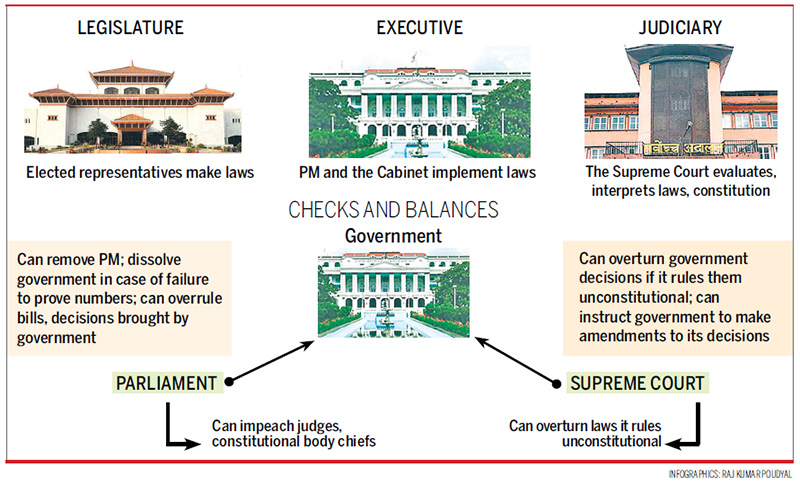
Experts say the Supreme Court saying Nahakul Subedi is qualified for the post of justice before a parliamentary hearing threatens the principle of separation of powers.
- BINOD GHIMIRE
The principle of separation of powers is increasingly under threat in Nepal, analysts say. INFOGRAPHICS: RAJ KUMAR POUDYAL

KATHMANDU,
A recent Supreme Court decision has put a spotlight, once again, on how the principle of checks and balances is facing a threat in Nepal.
The Supreme Court said on Monday that a nominee is “qualified” to become a justice at the top court, days before his appearance at the parliamentary hearing committee, which constitutionally is the rightful authority to endorse or reject the nomination made by the Judicial Council.
The Judicial Council on March 12 recommended Nahakul Subedi, along with Kumar Chudal, both High Court chief judges, for appointment as justices of the Supreme Court.
As per the constitutional provisions that require such nominees to face parliamentary hearings, they are scheduled to appear before the committee on Friday.
But advocate Surendra Bhandari on March 27 challenged the Judicial Council decision to recommend Subedi as the Supreme Court justice, saying he does not meet the qualification as prescribed by the constitution to hold the post. Bhandari also demanded that the recommendation be quashed.
Bhandari cited Article 129 (5) of the constitution, which says “a candidate for the post of Supreme Court justice needs to have either 12 years of experience of working as a first class Gazetted officer or a higher post in the judicial service for at least 12 years or five years of experience as a judge or chief judge of the High Court.”
Subedi, who took his appointment as a joint-secretary at the Judicial Council in August 2007, was
appointed a judge on January 4, 2018. When he was appointed High Court chief judge, he had the total experience of a little over 10 years. When he was nominated for Supreme Court justice on March 12, he had completed only a little over three years as a High Court judge.
Bhandari has argued in his petition that the constitution explicitly says for a person to qualify to become a Supreme Court justice, he or she must have worked for 12 years as first class officer or five years as the High Court chief. Bhandari also argued that a Chief Judge is not counted as an employee of the Nepal government, as it is a special position.
But while passing the verdict, a single bench of Justice Tej Bahadur KC said on Monday that Subedi qualifies to assume office as a Supreme Court justice as his “combined experience as gazetted first class officer and High Court chief judge” exceeds 12 years, the minimum qualification prescribed  by the constitution.
Experts and analysts say Nepal’s key state agencies, which are supposed to complement each other, are making attempts to override each other, endangering the very principle of separation of powers which is key to a functioning democracy. And the verdict on Subedi’s case also reeks of judicial activism, according to them.
“This verdict is yet another example of judicial arbitrariness,” said senior advocate Dinesh Tripathi. “The verdict is also a blatant attack on the constitution.”
According to Tripathi, the way the judiciary is passing verdicts, it looks like the agency that is the ultimate arbiter of the constitution has itself emerged as a threat to the constitution.
The Supreme Court lately has been at centre stage, especially since December 20 last year when Prime Minister KP Sharma Oli dissolved the House. Its February 23 decision to overturn Oli’s House dissolution and ask authorities to call the House session within 13 days while earned praises for him, its March 7 decision to scrap the Nepal Communist Party (NCP) and revive the CPN-UML and the Communist Party of Nepal (Maoist Centre) attracted widespread opprobrium.
Critics say by “giving” more than what the petitioner had demanded in the Nepal Communist Party (NCP) case–that scrapping the party and ordering the revival of the UML and the Maoist Centre–was a judicial overreach.
According to experts, now by passing a verdict on Subedi’s case, labelling him “qualified” for the post, long before the parliamentary hearing committee could do its job, the Supreme Court once again has overstepped the limits of its jurisdiction.
“It looks the sole motive of issuing the verdict just a few days before the parliamentary hearing is intended to influence the hearing committee,” said Mohan Lal Acharya, an advocate who has served in the past as an adviser to the Constituent Assembly. “The verdict has put the parliamentary hearing committee in a fix. Rejecting Subedi will be tantamount to going against the Supreme Court verdict.”
Nepal’s constitution has provisioned parliamentary hearing of some key nominations to vet the recommendations by the Constitutional Council, the Cabinet and the Judicial Council and reject the recommendations if the hearing committee believes the proposed individuals cannot hold the position or cannot discharge their duties effectively.
Article 292 of the Constitution of Nepal says parliamentary hearing shall be conducted as to appointments to the offices of the chief justice and justices of the Supreme Court, members of the Judicial Council, chiefs and members of constitutional bodies, who are appointed on the recommendation of the Constitutional Council under the constitution, and to the offices of ambassadors, as provided for in the federal law.
For the purpose of hearing, the constitution has envisioned a 15-member hearing committee consisting of members from the House of Representatives and the National Assembly.
Experts have also questioned the timing of the verdict on Subedi’s case. According to them, the Supreme Court’s some of the verdicts in recent months have come at such a time that they have played a crucial role in changing the entire political landscape.
The Supreme Court verdict to scrap the Nepal Communist Party (NCP) and revive the UML and the Maoist Centre came on March 7, hours before the meeting of the House after it was revived on February 23. The case against the Election Commission awarding the Nepal Communist Party (NCP) name to Oli and Pushpa Kamal Dahal had been pending for nearly three years.
Rajendra Shrestha, a member of the committee from the Janata Samajbadi Party, says committee members know Subedi doesn’t meet the qualification to become a justice but he cannot say if the committee dares to act against the Supreme Court verdict.
According to Shrestha, the judiciary’s role should be towards giving a way out to the deadlock by interpreting the constitution, but it is making things more complicated.
Days before the Supreme Court labelled Subedi as qualified to become a justice, the Supreme Court Bar too had questioned the Judicial Council’s decision to nominate Subedi as justice, saying he does not meet the qualifications prescribed by the constitution. The Supreme Court Bar said that Subedi used the position of the chief registrar as a ladder to become Supreme Court justice. It said that its serious attention had been drawn to the decision to nominate unqualified persons when there are other qualified chief judges and judges for the post.
Subedi is the first person to hold the post of chief registrar. Before him, there was no post called chief registrar at the Supreme Court. The position was created during the tenure of former chief justice Gopal Parajuli, a close relative of Subedi.
The Parajuli-led Judicial Council in January 2018 had picked Subedi as chief judge.
Justice KC in his verdict has said it was unjustified on the part of the Supreme Court Bar to raise the qualification issue.
Experts on constitutional matters disagree and they say the question is not about an individual but is about the rule of law, the principle of separation of powers and checks and balances. “The Supreme Court misinterpreted the constitution and encroached upon the jurisdiction of the legislature,” said Tripathi.
The court passed the verdict even without issuing a show cause notice, a practice which it usually follows.
The Supreme Court getting into a confrontational mode with other key agencies like the legislature is not a good sign for democracy, according to experts.
“However, I still believe the hearing committee would take an appropriate decision to correct the wrong decision of the Supreme Court,” said Tripathi. “The parliamentary committee’s jurisdiction is wide. It doesn’t
just check the constitutionality but also the appropriateness of appointments.”
The question, however, remains what if the person in question moves the court if the hearing committee rejects his nomination. The judiciary and the legislature will once again be at loggerheads.
“It looks like the country’s politics will now be defined by the judiciary, given the recent verdicts the Supreme Court has passed,” Shrestha, the hearing committee member, told the Post. “Passing a verdict on a matter which should have been constitutionally dealt with by the parliamentary hearing committee is out and out breach of the principle of separation of powers.”

HOME PAGE

Why Nepal is not on the list of invitees for climate summit called by Joe Biden

The country has failed to demonstrate its actions to mitigate impacts and make concerted efforts to show its vulnerabilities before the world despite bearing the brunt.
- CHANDAN KUMAR MANDAL,ANIL GIRI

KATHMANDU,
American President Joe Biden last month invited world leaders, including Presidents Vladimir Putin of Russia and Xi Jinping of China, to a virtual summit on climate change. At least three leaders from South Asia–Prime Minister Narendra Modi of India, Sheikh Hasina of Bangladesh and Lotay Tshering of Bhutan have also been invited. Nepal is not on the list of invitees.
It was widely expected that Nepal would be among the countries to be invited because of the climate vulnerability it faces and the brunt of the climate change it has to bear, for which its role is negligible, and the impacts the country is going to face in the future because of the climate crisis.
While some see Nepal’s exclusion as a diplomatic failure of the government, others say there is no need to make a hue and cry over the US not extending an invitation to the climate summit.
Nepal should have been able to ensure its participation as it has been leading several initiatives related to climate change in the past and the government is also planning to hold Sagarmatha Sambad, a multi-stakeholder dialogue forum committed to deliberating on the most prominent issues of global, regional and national significance including climate change, according to some former diplomats.
“There are some reasons why Nepal has been excluded,” said Durga Bhattarai, a former foreign secretary who has also served as Nepal’s permanent representative to the United Nations.
“Internationally, we are not leading any climate change related issues,” Bhattarai told the Post. “Bhutan and Bangladesh, on the other hand, have made significant and visible contributions.”
Climate change experts also say Nepal should have been able to demonstrate its vulnerability and efforts it is making to mitigate climate change impacts so as to get a seat in the Biden-called climate summit, which is scheduled for April 22-23.
According to Raju Pandit Chhetri, a climate change expert and executive director of Prakriti Resources Centre, a non-governmental organisation working for sustainable development and environmental justice in Nepal, only big emitters and major climate change partner countries have been invited to the event.
“It’s natural for us to feel that we should have been invited. That Nepal has not been invited is not a big issue though,” Chhetri, who has been involved in international climate negotiations for several years, told the Post. “What is important is that the United States is now sending a positive signal by calling such a summit on climate change, which never became the White House’s priority during Donald Trump’s four years.”
Hours after being sworn in as US president, Biden on January 20 had reinstated the US to the Paris climate agreement. The US had become the first country in the world to pull out of the Paris agreement in November last year during the fag end of the Trump presidency.
“It was unfortunate that the US had withdrawn from the Paris agreement. Now, the US, which is also one of the major emitters, taking leadership shows climate change is gaining political momentum too,” said Chhetri.
Nepal ranks fourth in terms of climate risk, according to the Global Climate Risk Index that analyses to what extent countries and regions have been affected by the impacts of weather-related events. An analysis of data on extreme weather events between 1999 and 2018 ranked Nepal ninth among the 10 countries most affected by extreme weather events. Such rankings for Nepal indicate that the country could be hit by natural calamities anytime, leaving it fending for itself.
Studies suggest millions of people could be affected due to climate change impacts vis-a-vis reductions in agricultural production, food insecurity, drying of water resources, and loss of forests and biodiversity, among others.
According to Uttam Babu Shrestha, director at the Global Institute of Interdisciplinary Studies, a think tank based in Kathmandu, when the US, which itself is a key player in global climate change issue, is organising such a summit, Nepal should have been among the invitee nations as one of the climate change vulnerable countries.
“Nepal would have had an opportunity to share its experiences before the global leaders,” said Shrestha.
Some experts, however, say the climate summit is a symbolic gesture and that Nepal should rather focus on demonstrating how it is suffering and what all it has been doing so as to seek more support to tackle the climate change-induced crisis.
According to Chhetri, Nepal has not been able to show the kind of climate actions Bangladesh, a country severely affected by the climate crisis, has done over the years.
“Bangladesh has been a champion of climate change at home, and at regional and international levels. Nepal has not shown such a response, especially on the climate adaptation part,” said Chhetri. “They are the frontrunner at home and outside. Their climate action is commendable.”
Similarly, according to Chhetri, India has been invited because it is one of the largest economies and a major emitter of greenhouse gases.
“India is a growing economy and a global economic player. Therefore, they deserved the place,” said Chhetri. “Bhutan is currently the head of LDC group so it has been invited with that status.”
The LDC Group is made up of the 47 poorest countries in the world, which contribute the least to the cause of climate change, but disproportionately suffer from its ever-increasing impacts.
Pakistan, yet another South Asian country whose vulnerability to climate change is also immense, has also not been invited to the summit, and this has caused an outrage among Pakistanis. The issue has garnered massive media coverage, asserting that it should have been invited to the event for its climate actions like plantation drive among others.
Even Pakistani Prime Minister Imran Khan expressed his surprise, saying he was puzzled over Pakistan not being invited to the climate change conference.  
That there has not been an outrage like situation in Nepal is also because of lack of awareness in the country on climate change issues, say experts. According to them, Nepal, however, must continue to make concerted efforts to draw the developed countries’ attention to the brunt it has to bear because of them.
“Bangladesh has been vocal for nearly 20-25 years about the impacts of climate change on the country and actions they have taken to address the crises,” said Manjeet Dhakal, another climate change expert.
Dhakal said he is not surprised why Nepal is not among the 40 countries invited to the climate event.
“Why not Nepal? Because it’s neither a major economy nor it can make a significant influence in negotiations,” Dhakal, who currently serves as an advisor to Least Developed Countries (LDCs) chair at the UN Climate Change, told the Post. “For now, Bhutan, which currently chairs LDC group, will speak on behalf of Nepal too.”
According to Dhakal, Japan-Brazil Dialogue, which took place in February, also did not invite Nepal as a participant. Likewise, Germany every year organises Petersburg Climate Dialogue, but Nepal was not invited to the 12th edition of the event. Nepal was not on the list of invitees of the 5th session of the Ministerial on Climate Action (MOCA), co-convened by China, the European Union and Canada.
“We need international support because we are vulnerable. However, we also need to be able to demonstrate before the world community that we are indeed doing something,” said Dhakal. “For drawing international attention and securing invitations to such events, we have to work like Bangladesh and Costa Rica and showcase our efforts. There are areas where Nepal can work in its fight against climate change.”
Chhetri agrees that Nepal, which is experiencing climate change impacts, has areas where it can collect evidence of impacts felt by the country.
“In the plains, there are floods every year. In the hilly region, we experience landslides, forest fires and droughts and in the mountains, glaciers are melting faster. These impacts are the backdrops against which Nepal can champion the cause of the climate change debate,” said Chhetri. “Every country is somehow affected by climate change. If Nepal considers it deserves to be invited, then it needs to seriously advocate for our issues and actions.”
Based on climate vulnerabilities, experts like Shrestha still argue that Nepal should have been invited to the summit for its climate change experiences that are different from other countries.
“Our climate change experience might be similar to Bhutan to some extent. However, India and Bangladesh have their unique climate change issues – different from Nepal,” said Shrestha. “If Pacific Island countries and some ASEAN countries get invited then Nepal should have also been on the list as mountainous countries experiencing climate effects.”
According to Shrestha, unlike other mountainous countries of the region invited to the summit, Nepal has more peaks above 8,000 metres and could be experiencing harsher impacts in the future.
“Nepal itself is also organising Sagarmatha Sambad to draw the attention of the international community and showcase itself as an affected mountainous country,” said Shrestha. “Besides, the US is also one of the key development partners for Nepal. Hence, an invitation to such a crucial summit would have been beneficial for Nepal.”
The US Embassy in Kathmandu said that under President Biden and Secretary of State Antony Blinken, climate change has become an essential element of Washington’s foreign policy.
“We know Nepal has been a leader on this issue and we look forward to working together to combat the climate crisis for the sake of our shared future…,” said Anna Richey-Allen, spokesperson for the US embassy, in an email response on Nepal’s exclusion from the climate summit. “We stand ready to partner with Nepal on climate issues, including our attendance at the Sagarmatha Sambad when it is organised.”

Page 2
NATIONAL

Dharan-Chatara-Sindhuli-Hetauda road nears completion

- PRATAP BISTA

HETAUDA,
The construction work of the Dharan-Chatara-Sindhuli-Hetauda road, a stretch of the proposed Madan Bhandari Highway, is in its final stage.
According to Niranjan Thapa, an engineer at the road project, around 95 percent of road construction works and 92 percent of bridge construction works have been completed so far.
“The construction of the road and all the bridges will be completed by mid-September,” Thapa said.  
The government plans to construct the Madan Bhandari Highway from Shantinagar in Jhapa to Rupal in Dadeldhura through the Chure region. The construction of the highway, which is being developed as an alternative to the East-West Highway, is to be completed in the next nine years.
The government has divided the 311-km Dharan-Chatara-Hetauda road into two sections—eastern and western—to speed up construction works. Project offices have been established in Gaighat (eastern part) and Hetauda.
According to Thapa, there are 33 major bridges and 18 minor bridges along the western section.
“The construction of 32 major bridges has been completed while a 304-metre-long bridge over the Bagmati river connecting Hariharpur Rural Municipality of Sindhuli and Bagmati Rural Municipality of Makwanpur is under construction. It will be completed within a couple of months,” said engineer Thapa. The construction of the 18 small bridges is also ongoing, he added.
The work progress in the eastern section is even better.
“More than 98 percent work of the eastern section has been completed. As many as 46 bridges have been constructed while six bridges are under construction,” said Manish Pokharel, an engineer at the eastern section.
According to him, almost all road construction works in the eastern section will be completed by mid-June. A six-km-long road from Dhura Bazaar to Khattar in Sindhuli has been halted for the past few months over a land clearance dispute. The local people have been demanding a change in the alignment of the road, as around 300 structures along the section have to be dismantled for the road project.
The Nepal Army has been given the contract to construct a 1.5 kilometre-long road at Phurkechaur in Bakaiya Rural Municipality, the western part of Makwanpur district. Likewise, Sunkoshi Marin Diversion Multipurpose Project was awarded the contract to construct 800 metres of the road in Sindhuli district.
In the current fiscal year, the government has allocated Rs 3 billion for the road project. Sixty-six kilometres of the highway fall in Sindhuli whereas 48 kilometres lie in Makwanpur.
The Dharan-Chatara-Gaighat-Sindhuli-Hetauda road is being constructed at a total cost of around Rs 22 billion. The two-lane road will benefit the residents of four inner Tarai districts—Makwanpur, Sindhuli, Udayapur and Sunsari.
“The Hetauda-Dharan road will ease transportation of essentials, including food grains, between the Tarai districts and the Capital. This road will also help enhance the economy by boosting tourism,” said Sarkesh Ghalan, chairman of Bagmati Rural Municipality in Makwanpur.  
The construction of the road was started in the fiscal year 2007/2008. Every year, the government had been allocating Rs 80 million to Rs 250 million for the road project.

NATIONAL

Bardiya becomes a tourist hotspot courtesy of Royal Bengal tigers

Around 40 percent of those visiting Bardiya National Park are successful in spotting tigers, say jungle safari guides.
- KAMAL PANTHI
As per the 2018 tiger census, there were 87 Royal Bengal tigers in the park. Post Photo: Hemanta Shrestha

BARDIYA,
Ranjan Sapkota of Samakhushi in Kathmandu visited Bardiya National Park for the first time in March. While there, Sapkota, accompanied by his six friends, went on a wildlife
jungle safari tour, where the group spotted a tiger.
“I was thrilled. It was a Royal Bengal tiger,” said Sapkota.
Sapkota and his friends couldn’t believe their luck for they had a relatively easy sighting, that too on just the second day of their tour.
“There was no limit to our happiness when we saw the tiger. We were excited,” he said. Sapkota and his friends weren’t the only lucky ones to spot a tiger at the park in recent days. Jayant Bhatta of Kailali saw a Royal Bengal tiger with her cub at Baghaura grassland in the western section of the park.
Bhatta immediately took a picture of his sighting and posted it on social media. The photo garnered much attention and soon his friends too were making plans to visit the national park to get a glimpse of a tiger.
According to tourism entrepreneurs, due to word-of-mouth recommendations and social media publicity, Thakurdwara, a village adjacent to the park which is also a tourist hotspot, has been drawing a large number of domestic tourists of late.
Most of the footfall in the area is that of tourists seeking Royal Bengal tiger sightings. The park is home to endangered animals such as the Royal Bengal tiger, wild elephant, great one-horned rhinoceros and a wide variety of near-threatened bird species.
Jungle safari guide Tilak BK says that about 40 percent of tourists who come to Bardiya are successful in spotting a tiger these days.
The number of domestic tourists has been increasing since the park reopened on October 17 last year after several months of closure due to the Covid-19 pandemic.
On Tuesday, the eve of the Nepali New Year, hotels around Bardiya were booked to their capacity mostly by tourists on the lookout for tigers.
Bardiya National Park was established in 1988 as Royal Bardiya National Park. It covers an area of 968 sq km and is the largest national park in Nepal’s Tarai, adjoining the eastern bank of the Karnali River and intersected by the Babai River in Bardiya district.
The park is home to 53 mammals, including rhinoceros, wild elephants, Royal Bengal tigers, swamp deer and the Gangetic dolphins, and 542 bird species.
The number of tigers has increased in Bardiya in the past few years due to suitable natural habitat, availability of prey and improved security, according to the park authorities.
As per the 2018 tiger census, there were 87 Royal Bengal tigers in the park.
Bishnu Bahadur Thapa, director of Sansara Safari Camp, said that domestic tourists from far east to far west are coming to the national park attracted by the prospect of sighting endangered creatures in their natural habitat.
“The New Year and days leading up to it have been good for hoteliers here. Business has been picking up after nearly a year of inaction,” said Thapa. “The arrival of tourists has raised hopes for a fast recovery.”
Dharmaraj Ghimire, manager at the Babai Resort in Thakurdwara, said there’s a steady flow of tourists courtesy of the tigers at the park.
Bishnu Prasad Shrestha, chief conservation officer of the park, says that the tiger habitat has been opened for tourists with effect from this Nepali New Year with safety standards in place.
More than 16,000 domestic and foreign tourists visited the park last year.
Since the reopening of the park in October last year, the park has received 6,942 domestic tourists. Similarly, the park has received 67 people from South Asian countries and 161 from third countries, according to park officials.
But the tigers that are drawing in a relatively good number of tourists to the park area have also become a cause of terror for those living in areas adjoining the park.
In the latest incident, a tiger from Bardiya National Park snatched a woman off a moving motorcycle while she was riding pillion with her son along the Amrani-Chisapani stretch of the East-West Highway that traverses through the park.
Six people have died from tiger attacks in and around the park area this fiscal year that started from mid-July 2020, according to the park authorities.

Page 3
Page 4
NATIONAL

Mountain blues

The government must invest in climate change research.

What do shrubs, grasses and mosses, cauliflowers and pumpkins, flies and mosquitoes, doves and house crows, Bengal tigers, clouded and common leopards, pikas and snow leopards, and diseases like malaria and dengue have in common? These plant, insect and animal species, together with infectious diseases, to name a few, have been increasingly documented at higher altitudes in Nepal as temperatures rise and weather patterns change erratically. At a time when the melting of glaciers, unusual drought or rainfall pose persistent risks, the movement of both non-native and native species into higher ecosystems has baffled the scientific community and locals while raising significant questions regarding our environment and conservation.
In the remote mountain district of Mustang, villagers no longer descend to lower elevations to escape the harsh winter, but it’s not just winters that have become considerably warmer in the last decade. Rain and snowfall patterns in the region are increasingly unpredictable, and they have triggered disastrous flash floods. At the same time, temperatures are rising during the summer, bringing with it a new set of problems—mosquito-borne diseases. The increase in malaria and dengue cases at higher elevations was never heard of, while mosquitoes had never been sighted. As many as 13 out of the 16 mountain districts have reported close to 10,000 malaria cases, according to a 2016 report; and experts fear dire consequences given the rate at which the climate continues to warm.
Disease-carrying mosquitoes or flies are not the only risks. Recent research has also shown that plants live in higher ecological zones of the Himalaya than they did 25 years ago in the highest region of the planet. Scientists who assessed satellite data from 1993 to 2018 say there has been a significant growth of subnival vegetation, which includes small and dwarf plants like grasses, shrubs and mosses. Even plants like rhododendron are moving up because of favourable temperatures.
Depending on hotter or cooler conditions, researchers say, the species are moving northward in response to climate change, and the distribution change has been faster than previously estimated. Researchers have discovered that birds, mammals, reptiles, insects, spiders, other invertebrates and plants are moving to higher elevations. A new scientific review by a global team of researchers says this complex phenomenon needs more research to give us a complete picture of how climate change impacts various species and also to guide evidence-based conservation. The data, scientists say, is urgently needed to find out which species are most vulnerable to climate-driven extinction, and understand how plants interact with soil and snow under warming and drying climate conditions.
Nepal is home to several endemic species, some of which are highly vulnerable to climate change, change in land use or invasion of non-native species. The repercussions of these pronounced changes at higher elevations, exacerbated by climate change, inadvertently affect the lives of the mountain communities and the endangered flora and fauna species. Multiple studies over the years have warned that mountain ecosystems are highly vulnerable to climate-induced shifts, and we do not know for sure what the repercussions will be. There is a lack of study and funding to assess what these changes mean. We need accurate data to make informed decisions as climate and migration trends continue, for which the government must prioritise investment in climate change research.

OPINION

Armed and unrestrained

Wrangling concessions from a pliant leadership, the army’s professionalism is compromised.
- DEEPAK THAPA
POST FILE PHOTO

Anyone even remotely interested in an area of study known as civil-military relations is almost certain to begin by paying intellectual homage to two classic texts from more than half a century ago: Samuel P Huntington’s The Soldier and the State: The Theory and Politics of Civil-Military Relations (1957) and Morris Janowitz’s The Professional Soldier: A Social and Political Portrait (1964). These books discuss the place of the military in modern society in general but only by way of dwelling at length on the situation prevailing in the United States. The two authors have different approaches but are quite certain that as far as civilian control over the armed forces go, there is little to fret over the possibility of the American soldier someday making a grab for political power. Of course, that can perhaps partly be attributed to the cosy relationship the US military has developed over time with defence contractors—characterised as the ‘military-industrial complex’ by one of their own, Dwight D Eisenhower, five-star general and the 34th US president. All in all, though, the American model was vaunted as worth emulating and the US invited people from all over to take courses on how the delicate relationship between the military and its civilian overlords has been managed to perfection.
Not so it seems, as a recent article in Foreign Affairs claims. Entitled ‘Crisis of Command’, the article by a trio of writers with strong ties to the US military makes for fascinating reading. While for those who have kept up with the news coming out of the US over time, the manner in which the authors connect the dots is compelling. There are also nuggets like how the military has used Hollywood to paint a highly positive picture of life in the services by controlling access to the hardware needed for movie shoots in return for having the final say on the script. It is their conclusion that is unexpectedly hard-hitting: ‘If Americans do not recognise the rot lurking beneath their idyllic vision of civilian control, the United States’ civil-military crisis will only get worse.’
What is unsettling is how things appeared to unspool in the US with all its checks and balances. One can only imagine how bad it could potentially get here where the line between politics and military power has never been as clearly demarcated. Any examination of the role of the Nepali Army in public life can omit the period prior to 1990 since the ground rules for civilian oversight had not been laid out then. But it helps to briefly recap its role in our modern history till that time: loyalty switched overnight from the Ranas to the Shahs; the direct role played in curtailing the brief democratic experiment of 1959-60; and reluctant acceptance of king Birendra’s capitulation to ‘people power’ in 1990.
It was in the last instance that the army leadership tried to assert itself, and set the tone for the army’s place in post-1990 Nepal. That came by way of the infamous incident where the then army chief, Satchit Shumsher Rana, paraded a roomful of generals in a blatant attempt to intimidate the Interim Prime Minister, Krishna Prasad Bhattarai. Rana and his top brass were reacting to the proposal in the constitution being drafted that the army be brought under complete civilian control since they were not too keen on severing their umbilical link with the monarchy. They succeeded partly as the king was retained as the Supreme Commander of the army and given the authority to mobilise it on the recommendation of the three-member National Defence Council. The Council included the army chief, giving the latter a say in how the army could be used, a strict no-no in armies under the effective control of the political executive.
With such a start, it was only to be expected that the army functioned somewhat extraneous to the Nepali government. The paramount influence of the palace’s military secretariat continued as in the old days and the politicians were only too happy to leave matters as they were since it was a battle not worth fighting—at least not at the time. Then came the tongue-lashing in 2001 by another army chief of then Prime Minister Girija Prasad Koirala. Facing flak for not taking on the Maoists in the fluid political atmosphere after the palace massacre, Prajjwal Shumsher Rana was reported to have blamed the politicians for the mess the country was in. ‘Was this situation brought by the Army or bad governance?’ he asked.
The new king, Gyanendra, was only too willing to side with the general; Koirala resigned in protest. The wily politician did have the last say though when four years later, he propelled the process that purged all vestiges of the royal name from the army after the 2006 people’s movement. To its credit, the army, even after having backed Gyanendra’s coup in 2005, chose to mostly abstain from suppressing the popular insurrection.
The king may have been removed from the equation vis-à-vis the army thereafter but the initial post-2006 years hardly proceeded smoothly. The chief who took over, Rookmangad Katwal, was known for his outspoken antagonism towards the Maoists which only worsened after the former rebels came to power in 2008. Repeated snubs were there for all to see, including the new Maoist defence minister prevented from entering an army compound; the summary refusal to the Maoist finance minister’s order to open the road that cut across the army headquarters to the public once again, and the challenge to the government’s prerogative not to recommend some army generals for an extended tenure.
Katwal’s sacking and subsequent reinstatement is, of course, well known since it also marked, albeit for different reasons, the beginning of the slide for the Maoists from which they are still struggling to recover. There are those who view Katwal as having stood up to the Maoists and any nefarious plans they might have had. But that does not detract from the fact that he was solely responsible for undercutting civilian authority over the military in a New Nepal, and for which he was egged on actively by Nepali Congress, the UML, and India.
The UML (i.e., KP Oli)-army-India nexus deserves a separate treatment in itself. For now, suffice it to point out that it has had the unfortunate result of the army deviating from its core competency. Oli appears to believe that he can secure loyalty by doling out contracts to an army more than willing to take on such business responsibilities. Having wrangled concessions from a pliant civilian leadership in delving into ventures such as a medical college, a hydropower project and real estate, the army’s professionalism cannot but be compromised. There are examples galore in the neighbourhood of what happens when the army develops interests beyond its primary mission. One example stands out nonetheless: Thailand. Business interests running far and wide have forced the military to expand unnaturally, including having 1600 generals on its staff. With its history of involvement in periodic coups, Thailand’s army is certainly not one that our own should consider emulating.
The Foreign Affairs article ends ominously: ‘Without robust civilian oversight of the military, the United States will not remain a democracy...for long.’ We can certainly say the same for our own army, and hence the urgent need for both our political and military leadership to re-think where we are headed in terms of our own civil-military relations beyond the platitudes we have heard so far.

OPINION

Modi’s war on the press

Freedom of the press is the mortar that binds together a free society.
- SHASHI THAROOR
Svetlana Eremina/Shutterstock.com

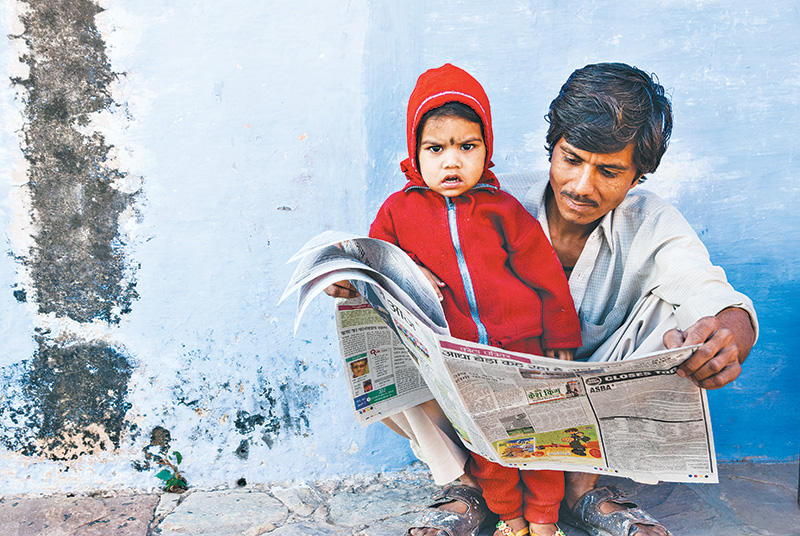
A flurry of assaults on freedom of the press in recent months has raised troubling questions about the state of India’s democracy under Prime Minister Narendra Modi. India has long had a free and often raucous press. But the situation has changed dramatically since Modi’s government came to power in 2014.
In late January, police filed criminal charges—including sedition, which carries a life sentence—against eight journalists who covered a protest in Delhi that turned violent. Their crime: reporting the claims of a dead protester’s family that he had been shot and killed by the police. I face the same charges for having tweeted their claim when it was reported.
Six journalists and I (a Congress party MP) are accused of ‘misreporting’ facts surrounding the death. We face charges in four states ruled by Modi’s Bharatiya Janata Party (BJP). The publisher, editor, and executive editor of the investigative news magazine The Caravan face ten sedition cases in five states for reporting the story, and the magazine’s Twitter account was briefly suspended by government order.
Ours is hardly an isolated case. In 2020 alone, 67 journalists were arrested, while nearly 200 were physically attacked in the 2014-19 period, including 36 in 2019, according to a study by the Free Speech Collective. A journalist arrested on his way to report on the aftermath of a gang rape in Uttar Pradesh state has been in jail for six months, being allowed out briefly only to visit his ailing mother in Kerala state, more than two thousand kilometres (1,243 miles) away.
Conversely, reporting that is sympathetic to the government proceeds unchecked, even if it is inaccurate, propagandistic, or inflammatory, particularly in retailing bigotry against minorities or discrediting the political opposition. The mainstream media, whether print or television, has been cajoled and cudgelled into cheerleading for Modi’s government.
Once dominated by government programming, India’s visual media landscape is now brimming with numerous private offerings, with over a hundred 24-hour television news channels today in multiple languages. My state of Kerala alone has 13 all-news channels in the regional language, Malayalam.
But competition has fueled a race for eyeballs and advertising revenue that has steadily eroded the quality of Indian journalism. Whereas the Fourth Estate once placed a premium on editorial standards and journalistic ethics, it has morphed into a grotesque platform driven by sensationalism and vilification. The news must be broken—and so, it seems, must the newsmaker. The government and its stalwarts are almost never the targets: the opposition, civil society, and dissenting individuals are.
As more Indians enjoy the fruits of literacy and the increasing affordability of smartphones and reduced data costs, India has witnessed a boom in print circulation as well as in social media as a news source, especially among young people. But newspapers are also conscious that they must compete in a tight media environment, where TV and digital media set the pace. They know that every morning they must reach readers who have watched TV and read WhatsApp already. So, newspapers feel the need to ‘break’ news in order to outdo their TV and social media competitors.
The result is that India’s media, in its rush to run a story, has fallen prey to predictable hazards, often becoming a willing accomplice of the motivated leak and the malicious allegation, trading integrity for access to well-placed government sources. In this environment, the BJP has undermined the free press through co-optation and intimidation, thus ensuring that much of the press produces only news that is sympathetic to the causes the ruling party holds dear, or that distracts the public’s attention from government failings.
India’s news media ought to be holding the government accountable, not kowtowing to it. The good news is that not everyone has forgotten the watchdog responsibility that free media must exercise in a democracy. The Editors Guild of India has asked Modi to revoke the Information Technology (Intermediary Guidelines and Digital Media Ethics Code) Rules, 2021, arguing that the new rules undermine press freedom.
The bad news is that such developments are a major reason for the recent decisions of democracy watchdogs Freedom House (which downgraded India from ‘free’ to ‘partly free’) and the V-Dem Institute (which now calls India an ‘electoral autocracy’) to express alarm about the health of the country’s democracy. ‘India, the world’s most populous democracy, is also sending signals that holding the government accountable is not part of the press’s responsibility,’ wrote Freedom House.
The Modi government’s weapon of choice is the colonial-era sedition law: an overwhelming majority of sedition cases have been filed in the seven years since Modi and his BJP came to power, according to data compiled by the website article14. In a criminal justice system that has changed little since the colonial era, detentions, charges, police investigations, and trials ensure that even if actual convictions are rare, the process itself is the punishment.
Freedom of the press is ultimately the best guarantee of liberty and progress. It is the mortar that binds together a free society—and it is also the open window that, in Mahatma Gandhi’s famous metaphor, allows the winds of the world to blow freely through the house. If Modi’s efforts to de-institutionalise what used to be a dynamic and independent Fourth Estate persists, public confidence in the media will steadily decline, along with confidence in Indian democracy.

 
Tharoor, a former UN under-secretary-general and former Indian Minister of State for External Affairs and Minister of State for Human Resource Development, is an MP for the Indian National Congress.
— Project Syndicate

Page 5
NATIONAL

Oli counts success of government while Covid-19 gradually grips the country

Minister for Health and Population Hridayesh Tripathi has publicly admitted that the government hasn’t succeeded in securing a deal to procure additional vaccines.
- BINOD GHIMIRE

KATHMANDU,
In his address to the nation on the first day of Nepali New Year 2078, Prime Minister KP Sharma Oli counted the achievements and works of the government. His Wednesday’s address wasn’t much different from the one on the third anniversary of his government on February 15.
In his close to one hour address, Oli claimed that last year was a success though the Covid-19 pandemic created some obstacles.
He said the right policies and approach of the government led to a minimal loss of life and to the economy. He dedicated most of his speech in presenting the lists of the infrastructure projects from roads, bridges, schools and hospitals constructed by his government.
But Oli was short of providing the government’s plan to deal with a second wave of Covid-19 infections nor did he present a recovery plan.
He did spend some time explaining about the threat of a second wave of infections requesting the public to remain alert and take precautions. But he didn’t talk about what efforts his government was making to ensure vaccines for all.
The Covid-19 vaccine is the most pressing issue at present as the second wave of the pandemic is gradually taking the country into its grip.
The government is struggling to procure the additional jabs as the Serum Institute India is reluctant for the export while the Oli administration hasn’t made any concrete approach for the import from other vaccine manufacturers.
As many as 603 new cases of the Covid-19 were reported on Wednesday alone.
Hridayesh Tripathi, the minister for Health and Population, has publicly admitted that the government hasn’t succeeded in securing a deal to procure the additional vaccines.
Other than the gift from the Indian and the Chinese governments, the Oli administration has procured two million doses of vaccines from the Serum Institute, of which half has been delivered so far.
In his interview with Kantipur Television on Monday, Tripathi said the Serum Institute will deliver the remaining one million doses soon.
He, however, said the government’s attempt to procure additional five million doses on the market price
has failed. The government had paid $4 for each dose while procuring the two million doses. The market price could reach as high as $ 7-8 per dose.
 “The middlemen posed obstruction in procuring the additional doses,” said Tripathi in the interview. “Covid-19 cases had soared in India by the time we got away from the middlemen. The Serum Institute then was reluctant to export.”
Experts say Oli’s Wednesday’s speech has only disappointed the general public. They say the people won’t believe his claim that the government made progress last year while the country’s economic growth was negative in the last fiscal. Nepal’s economy contracted by 1.9 percent in the last fiscal year.
“People fear that they would have to go through last year’s situation if the Covid-19 cases continue to rise,” Hari Roka, a political economist, told the Post. “Oli has completely failed to give a hope to the people.”
Contrary to Oli’s claim that the effective moves by the government have increased the morale of the people, Roka said his speech has only increased pessimism.
He said through the prime minister’s speech the people were looking for the government’s plan to manage effective quarantine, testing, treatment and vaccination.
Secondly, they wanted to hear what would the government do if the people lost their jobs as the cases are increasing and the situation could warrant another lockdown.
Even Oli, in his address has said as the health matters above everything else, the government could impose a lockdown as a last resort to contain the spread. Roka says Oli also failed to provide a plan to continue the teaching-learning process through the alternative means and a roadmap to boost the economy.
“Wednesday’s Oli shows how narcissist is Oli,” he said. “Someone should tell him announcing the commencement of projects is not a development.”

NATIONAL

Nearly two dozen foreign organisations leaving Nepal

Many of them are leaving Nepal citing funding crunch with some awaiting completion of post-earthquake recovery tasks.
- PRITHVI MAN SHRESTHA
A total of 23 international NGOs have applied for de-affiliation with the Social Welfare Council. Post file Photo

KATHMANDU,
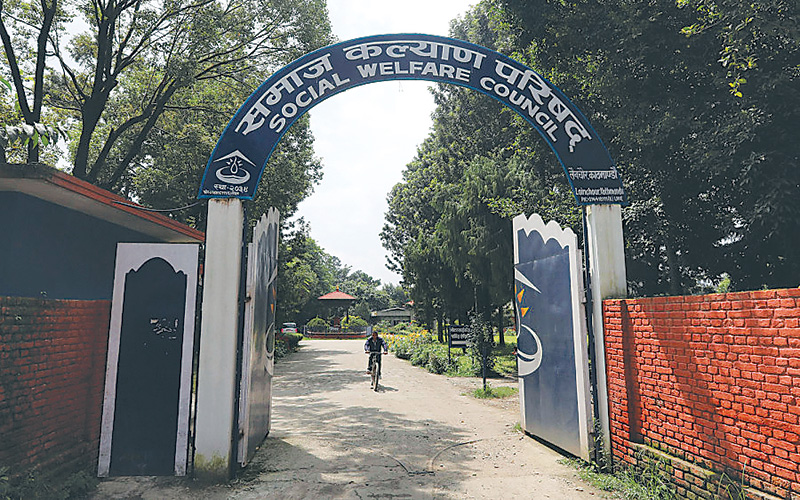
Around two dozen international non-governmental organisations are winding up their operations in Nepal, and have requested for termination of the general agreement signed with the Social Welfare Council.
The council, which regulates both domestic and international non-governmental organisations in the country, said a significant number of them have applied for termination of the general agreement with the council citing fund crunch while some of them want to exit Nepal after completing their tasks related to post-earthquake reconstruction and recovery.
According to the council, most of the foreign NGOs that had entered the country to help the post-earthquake recovery have already left.
A total of 23 international NGOs have applied for de-affiliation with the council. They include: Baptist Medical and Dental Mission International; Child Protection Centers and Services International; Americares Foundation Inc; Al-Khair Foundation; The International  Legal  Foundation; Next Generation Nepal; Medical Team international; Caritas Switzerland; Shangri-La Home; Himalayan Trust; Sustainable Environment and Ecological Development Society; Magic Bus India Foundation; Educate the children; Stichting Veldwerk Netherlands (SVN); Johanniter International; TMI Project; Jhpiego Corporation; Planate Enfants & Development; Esra Aid; WAMY; BNMT; Nepal Orphans Home and The Mountain Institute, USA.
These foreign NGOS are in the process of wrap-up evaluation whose report should be submitted to the council. Some are in the process of management of the goods and other property before departure, according to the council. These are the foreign NGOs that had applied for termination of general agreement over the last one year.
“A number of international NGOs have sought to wind up their operations in Nepal by handing over all tasks to their partner organisations so that office operation cost could be saved,” said an official at the council. “They are doing so, citing the fund crunch amid the impact of Covid-19 on their donors and reduced contribution from them.”
The official said that some are returning after completing their mission related to earthquake reconstruction and recovery. The 2015 earthquakes had killed nearly 9,000 people and damaged properties worth $7 billion, according to the Post Disaster Needs Assessment report released after the quakes. Till August 2019, a total of 32 international INGOs, mostly those related to earthquake recovery, had either left Nepal or were winding up their operations in the country, according to the Social Welfare Council.
Now, the funding  crunch has been a more urgent issue for many international NGOs. “Many foreign NGOs are renewing their existing programmes instead of bringing new programmes citing the fund crunch,” the official of the council told the Post.
Pushkar Khati, member secretary at the council also admitted that new programme approval of the international NGOs has decreased but not significantly.  
Funding  crunch reported by international NGOs can also be assessed from the fact that their funding commitment has declined by more than three times during the first eight months of the current fiscal year.
According to the Social Welfare Council, it has approved a budget of Rs3.5 billion for 230 projects of international NGOs during the first eight months of the fiscal year compared to their budget approval of Rs12.19 billion for 240 projects during the same period last fiscal year.
This is the continuation of the trend observed in the last fiscal year 2019-20 when disbursement of funds by the international NGOs in the last fiscal year declined by nearly 39 percent, according to the Development Cooperation Report 2019-20 released by the Ministry of Finance on Thursday.
Representatives of international and domestic NGOs admitted that they are experiencing the funding crunch due to the impact of the pandemic on the donor countries and institutions that affected their contribution for charitable works.
Janes Ginting, vice-chair of the Association of International NGOs in Nepal, a grouping of foreign NGOs, said Covid-19 had certainly affected funding of the international NGOs significantly due to reduction of public and private funding and reallocation of budget for Covid emergency and recovery support.
“As a consequence, many international NGOs have to reduce their size, including cutting off international expats and local positions unfortunately,” Ginting, who is also the national director for the World Vision International Nepal.
According to a report prepared by Averthur NGO Consulting, a UK-based firm, in May 2020, income of the international NGOs originating in northern Europe was already declining since 2016 and the situation is likely to worsen due to Covid-19.
According to the report, individuals contributing to international NGOs were already declining while institutional grants and contract funding increased during the period from 2008-2015.
Except, the Médecins Sans Frontières (MSF)—also known as “Doctors Without Borders”, international NGOS such as Save the Children, Action Aid, Care, Oxfam, the World Vision and Plan all were running with more institutional backing instead of individuals contributing to charity.
“The decline in institutional funding has suddenly got a lot harder with Covid,” it said. Even the local NGOs are also facing hardship to get funding from international sources as well. The local NGOs get funding from international resources as well as international NGOs having offices in Nepal as they employ local NGOs as partner organizations.
Jitram Lama, president of NGO Federation Nepal, a grouping of local NGOs, said  he has been receiving complaints from the NGOs that their funding has been decreasing both from international resources as well as  international NGOs operating in Nepal.
“This decrease is basically due to the impact of Covid-19,” said Lama. “With an United Nations Agency recommending Nepal for graduation to a developing country from the Least Developed  Country status, Nepal may not be in the priority list of international donors.”

NATIONAL

Preparations on to bring no-confidence motion against Gandaki chief minister

Briefing

POKHARA: The opposition parties in the Gandaki provincial assembly are preparing to file a no-confidence motion against Chief Minister Prithvi Subba Gurung. “Preparations are underway to file the motion against Chief Minister Gurung on Thursday. We are holding discussions with other parties as well,” said Kumar Khadka, the provincial member representing Nepali Congress. The opposition parties, including Nepali Congress, CPN (Maoist Centre) and Janata Samajbadi Party, made the decision to file the no-confidence motion after Rastriya Janamorcha decided to withdraw its support from the government. 

NATIONAL

Five dead, nine injured in Pyuthan jeep accident

Briefing

BUTWAL: Five people died and nine others were injured in a jeep accident at Swargadwari Municipality-4 in Pyuthan district on Wednesday. The jeep carrying 14 people fell off a cliff in Ward No 4 of the municipality. Two people died on the spot while the other three died in the course of treatment at Bhingri Primary Health Centre, said police. The passengers were employees of the District Administration Office in Gulmi and their family members. They were on their way to Swargadwari Ashram, a holy Hindu shrine, to celebrate the Nepali New Year.

NATIONAL

Doramba Rural Municipality renamed Doramba Shailung

Briefing

RAMECHHAP: Doramba Rural Municipality in Ramechhap has been renamed as Doramba Shailung Rural Municipality. According to Kaman Singh Moktan, the chairman of the local unit, the Cabinet meeting held on April 5 decided to rename the local body as Doramba Shailung in accordance with the recommendation of the local unit.

NATIONAL

Monitoring those in home isolation crucial, experts say

Doctors advise authorities not to be lax as the UK variant of the virus is highly infectious and possibly more lethal.
- Arjun Poudel

KATHMANDU,
Placing infected people in home isolation without monitoring them will be too risky, as the new variant of the coronavirus is highly infectious and possibly more lethal, doctors have warned.
“Infected people could pass the virus to their family members and neighbours if their movements are not monitored,” Dr Prabhat Adhikari, an infectious disease and critical care expert, told the Post. “Both infection and death rate could be exacerbated if the movements and health condition of the infected people are not monitored.”
Of 4,056 confirmed active cases throughout the country as of Wednesday, 3,599 infected people are in home isolation and no agency is monitoring their movements and health conditions.
The Health Ministry reported 603 new cases and three deaths in the last 24 hours. Of the total new cases 70 are children under 20 years of age. The country’s overall infection tally has reached 281,564.
The Epidemiology and Disease Control Division said that of the total infections, the UK variant of the coronavirus, known as B.1.1.7., might be responsible for over 60 percent of the new infections in Nepal.
According to scientists, the UK variant is 40 to 70 percent more transmissible than the one that caused the first wave of coronavirus infection. They have also said that the virus is 64 percent more deadly than the previous strains.
“Infected people tend to stay at home until they become serious,” said Adhikari.  “Many patients died soon after they were hospitalised because their health conditions were not monitored at home.”
Last year, death rates had increased after health facilities got stretched with Covid-19 patients and a lot of people could not be admitted to hospitals.
Doctors have once again warned that health facilities could be overwhelmed within the next few weeks. They say the apathy on the part of the government authorities to contain the spread of the infection is as dangerous as the coronavirus itself.
According to the data provided by the Health Ministry, 80 infected people, whose health conditions are serious are being treated in the intensive care units in different parts of the country. Twenty five others, who are critical have been placed in the ventilator support.
Doctors say that young people and children are among those admitted in the intensive care units, after they suffered from the severe type of pneumonia caused by the coronavirus.
Most of the infected people residing in rented rooms in the densely populated cities cannot afford to have separate rooms and toilets for isolations. This, doctors say, increases the risk of the virus spreading in communities.  
“There is also the risk of infected people hiding their condition lest they will be expelled from their rooms,” Dr Sher Bahadur Pun, chief of the Clinical Research Unit at the Sukraraj Tropical and Infectious Disease Hospital, told the Post.
Health experts have also decided the limited number of antigen tests the authorities have been performing along the Nepal-India border on people returning home from India, which is currently struggling to contain a second wave of infections.
The antigen tests are being performed only on those people having symptoms akin to Covid-19, despite studies showing that more than 50 percent of Covid-19 cases are asymptomatic. 

Page 6
WORLD

‘Super-spreader’ erupts as Hindus throng Indian festival

Devout Hindus believe bathing in the holy Ganges absolves people of sins, and during the Kumbh Mela, it brings salvation from the cycle of life and death.
- REUTERS
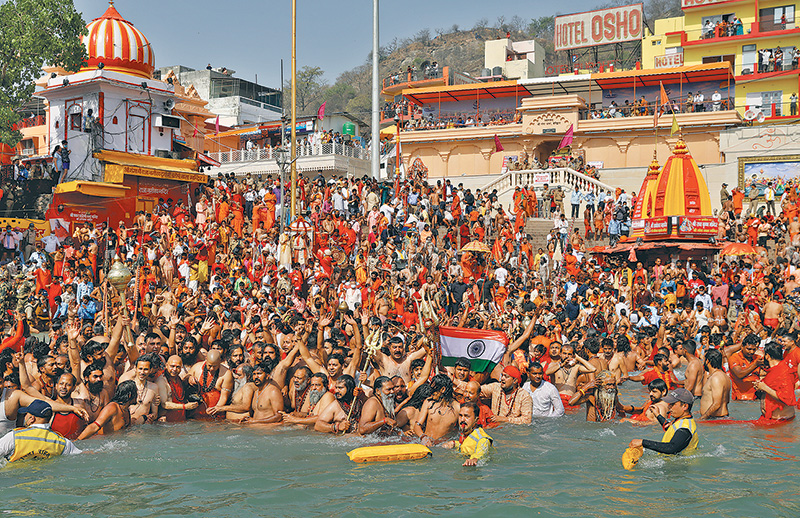
Hindu devotees take a holy dip in the Ganges River during Shahi Snan at Kumbh Mela in Haridwar, India, on Wednesday. REUTERS

HARIDWAR,     
Hundreds of thousands of ash-smeared ascetics and devout Hindus jostled to take a dip in the Ganges during a religious festival on Wednesday, hoping to wash away their sins, as India reported another record surge in coronavirus infections.
As huge crowds made their way towards the river on a special day of bathing during the weeks-long “Kumbh Mela” festival, health authorities had to pull back a Covid-19 testing crew.
“We have moved away our sampling team to avoid a stampede-like situation,” said SK Jha, chief medical officer of the northern city of Haridwar, where the event is being held.
“We do, of course, expect cases to rise when the priests and other crowd move away.”
Police said 650,000 devotees had bathed in the river since Wednesday morning and people were being fined for failing to observe social distancing in some areas.
Infections in the city have already jumped to more than 500 a day since Kumbh Mela, or the pitcher festival, officially began this month, from just 25-30 last month, Jha said. Hotels
have become isolation shelters for those found infected by a team of 300 medical staff running 40,000 random tests daily.
India’s new Covid-19 cases hit a record 184,372 in the past 24 hours, more than double the figure at the start of the month.
Prime Minister Narendra Modi’s government, however, has refused to call off the festival that is scheduled to last the whole month, possibly fearing a backlash from religious leaders in the Hindu-majority country.
“It is already a super-spreader because there is no space to test hundreds of thousands in a crammed city and the government neither has the facilities nor the manpower,” said a senior official in Uttarakhand state, where Haridwar is located.
Devout Hindus believe bathing in the holy Ganges absolves people of sins, and during the Kumbh Mela, it brings salvation from the cycle of life and death. A short distance from the river, Hotel Sachin International
had converted itself into a Covid isolation centre. All 72 rooms were packed with more than 150 patients, a hotel executive said.
“We started taking in patients on April 5, and three days ago all our rooms got filled,” the employee said, declining to be identified because of a gag order from local authorities.
The hotel did not respond to an email seeking comment. A doctor from the region said at least four other hotels have been turned into Covid wards.
“What you are seeing is not Kumbh Mela but it’s a corona atom bomb,” Tweeted Indian filmmaker Ram Gopal Varma, alongside a picture of a sea of devotees. “I wonder who will be made accountable for this viral explosion.”

WORLD

Denmark drops AstraZeneca vaccine for good

COPENHAGEN: Denmark announced on Tuesday it would stop using the AstraZeneca Covid-19 vaccine altogether, becoming the first European country to do so over suspected rare but serious side effects.
Despite recommendations from the World Health Organization and European medicines watchdog to continue using the inoculation, “Denmark’s vaccination campaign will go ahead without the AstraZeneca vaccine,” Health Authority director Soren Brostrom told a press
conference.
Denmark was the first country in Europe to suspend the use of the AstraZeneca jab in its vaccination rollout, after reports of rare but serious cases of blood clots among those that had received the vaccine.
More than a dozen countries followed suit but all but a few have since resumed the use after the European Medicines Agency (EMA) emphasised the benefits of the vaccine and deemed it “safe and effective”.
Denmark had however continued to hold off using the vaccine as it conducted investigations of its own. (AFP)

WORLD

Myanmar activists remember dead with red paint protests

- REUTERS

YANGON,
Opponents of Myanmar’s coup splashed red paint and dye on roads and signs outside government offices on Wednesday to represent the blood of people killed protesting against the junta, on the second day of the traditional new year holiday.        
The display aimed at shaming the military took place in various towns and cities, according to pictures posted by media outlets, as people answered a call by activists to join what they termed a bloody paint strike.
Some people marched with signs calling for the release of the leader of the ousted government, Nobel laureate Aung San Suu Kyi. She has been detained since the Feb. 1 coup on various charges including violating an official secrets act that could see her imprisoned for 14 years.
Her lawyers have denied the charges against her.
“Please save our leader - future - hope,” read a sign with a picture of Suu Kyi held by a young woman among several thousand people marching in the second city of Mandalay, according to a picture published by the Mizzima news service.
There were no immediate reports of violence at any of the protests on Wednesday, but information has become scarce because of junta curbs on the internet. The coup has plunged Myanmar into crisis after 10 years of tentative steps toward democracy with daily protests and various campaigns of defiance including strikes by workers in many sectors that have brought the economy to a standstill.
The five-day New Year holiday, known as Thingyan, began on Tuesday but pro-democracy activists cancelled the usual festivities to focus on their opposition to the generals who seized power. The military says the protests are petering out. Activists have planned different shows of defiance every day over the holiday, which ends on Saturday.
An activist group, the Assistance Association for Political Prisoners, says the security forces have killed 710 protesters since the ousting of Suu Kyi’s government.
The United Nations human rights office said on Tuesday it feared that the military clampdown on the protests risked escalating into a civil conflict like that seen in Syria.
The United States and other Western countries have imposed limited sanctions focused on the military. Southeast Asian neighbours have been encouraging talks between the Myanmar sides but without progress.
The U.S. ambassador to Myanmar, Thomas Vajda, said in a new year message he was aware that many people were making sacrifices and suffering for their beliefs and convictions in these “very difficult times”.
“I’m deeply impressed with your courage and your commitment,” Vajda said.
“Let me also reconfirm the commitment of my colleagues and I ... to do all we can to support the people of Myanmar in your aspirations for genuine democracy, peace, and freedom.”
The European Union’s foreign policy chief, Josep Borrell, said this week Russia and China, which have close ties with the military, were blocking a united response to the coup including attempts to impose an arms embargo.
The U.N. Security Council has called for the release of Suu Kyi and others but stopped short of condemning the coup.
Small blasts have been going off in different places over recent days with the latest two explosions in the central city of Monywa on Wednesday wounding one person, the Monywa Gazette reported.
There have been no claims of responsibility. The coup has also rekindled hostilities in old conflicts between the military and ethnic minority forces fighting for autonomy in border regions.

WORLD

Russia says troop buildup near Ukraine is a response to NATO

- ASSOCIATED PRESS

MOSCOW,  
Russia’s defence minister said on Tuesday that the country’s massive military buildup in the west was part of readiness drills amid what he described as threats from NATO.
Defence Minister Sergei Shoigu said the maneuvers in western Russia that have worried neighboring Ukraine and brought warnings from NATO would last for another two weeks. Speaking at a meeting with the top military brass, Shoigu said the ongoing exercise was a response to what he claimed were continuous efforts by the United States and its NATO allies to beef up their forces near Russia’s borders.
In the past three weeks, the Russian military has deployed two armies and three airborne formations to western regions “as a response to the alliance’s military activities threatening Russia,” the defense minister said.
“The troops have shown their full readiness to fulfill tasks to ensure the country’s security,” he said.
The US and its allies have sounded alarm about the concentration of Russian troops along the border with Ukraine and increasing violations of a cease-fire in eastern Ukraine, where Russia-baked separatists and Ukrainian forces have been locked in a conflict since Moscow’s 2014 annexation of Ukraine’s Crimean Peninsula.
More than 14,000 people have died in fighting in eastern Ukraine, and efforts to negotiate a political settlement have stalled. The chief of NATO on Tuesday called the recent Russian deployment the largest concentration of troops  near the Ukraine border since 2014.
The White House said US President Joe Biden  voiced concern over the Russian buildup and “called on Russia to de-escalate tensions,” during a phone call Tuesday with Russian President Vladimir Putin.
In separate meetings with Ukraine’s foreign minister, US Secretary of State Antony Blinken and NATO Secretary General Jens Stoltenberg strong support for Ukraine and warned Russia against pressing ahead with its troop buildup along the former Soviet republic’s eastern border.
Amid the recent tensions, the United States notified Turkey that two US warships would sail to the Black Sea on April 14 and April 15 and stay there until May 4 and May 5. The US Navy ships have made regular visits to the Black Sea in past years, vexing Moscow. Russian Deputy Foreign Minister Sergei Ryabkov denounced the latest deployment as “openly provocative,” adding that “American ships have absolutely nothing to do near our shores.”
“They are testing our strength and playing on our nerves,” Ryabkov said in remarks carried by Russian news agencies. “Seeing itself as the Queen of the Seas, the US should realize that the risks of various incidents are very high. We warn the US that it should stay away from Crimea and our Black Sea coast for their own benefit.”
NATO chief Stoltenberg expressed the Western military alliance’s “unwavering” support for Ukraine during a news conference on Tuesday with Ukraine’s foreign minister, calling the Russian movements “unjustified, unexplained and deeply concerning.”
The Kremlin has argued that Russia is free to deploy its troops wherever it wants on its territory and has repeatedly accused the Ukrainian military of “provocative actions” along the line of control in the east and of planning to retake control of the rebel regions by force.

WORLD

Biden ready to announce US withdrawal, even as peace eludes Afghanistan

- REUTERS
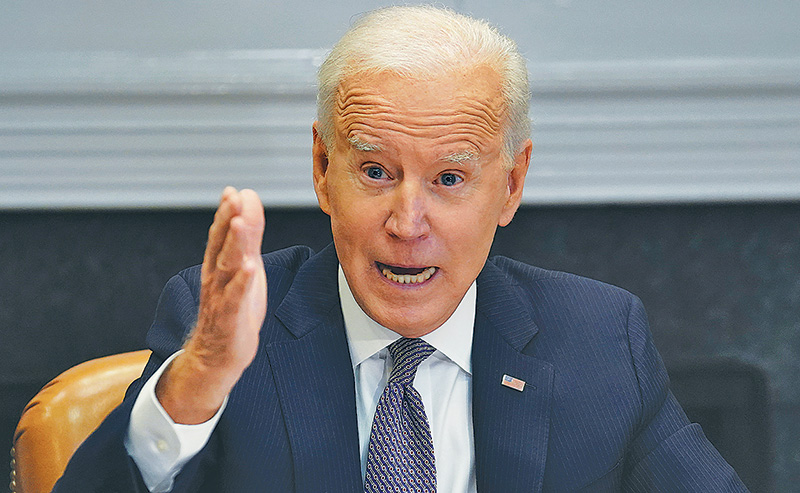
US President Joe Biden speaks as he participates in the virtual CEO Summit on Semiconductor and Supply Chain Resilience at the White House in Washington. REUTERS

WASHINGTON,    
President Joe Biden’s planned announcement on Wednesday of a complete US withdrawal from Afghanistan by Sept. 11 aims to close the book on America’s longest war, as critics warn that peace is anything but assured after two decades of fighting.
As officials disclosed Biden’s pullout plans, the US intelligence community renewed deep concerns on Tuesday about the outlook for the US-backed government in Kabul, which is clinging to an eroding stalemate.
“The Afghan government will struggle to hold the Taliban at bay if the coalition withdraws support,” said the US assessment, which was sent to Congress.
“Kabul continues to face setbacks on the battlefield, and the Taliban is confident it can achieve military victory.”
Biden plans to announce at the White House on Wednesday that all US troops in Afghanistan will be withdrawn no later than Sept. 11, senior US officials said.
Sept. 11 is a highly symbolic date, coming 20 years to the day of al Qaeda’s attacks on the United States, which prompted then-President George W. Bush to launch the conflict. The war has cost the lives of 2,400 American service members and consumed an estimated $2 trillion.
The Democratic president had faced a May 1 withdrawal deadline, set by his Republican predecessor, Donald Trump, who tried but failed to pull the troops out before he left office.
Biden’s decision will keep 2,500 troops in Afghanistan past that May 1 deadline, but officials suggested troops could fully depart before September 11. US troop numbers in Afghanistan peaked at more than 100,000 in 2011.
“There is no military solution to the problems plaguing Afghanistan, and we will focus our efforts on supporting the ongoing peace process,” a senior administration official said.
It remains unclear how Biden’s move would affect a planned 10-day summit about Afghanistan starting on April 24 in Istanbul that is due to include the United Nations and Qatar.
The Taliban, which was ousted from power in 2001 by US-led forces, said it would not take part in any summits that would make decisions about Afghanistan until all foreign forces had left the country. Critics said the departure plan appeared to surrender Afghanistan to an uncertain fate, something that experts say was perhaps inevitable.
“There is no good way that the US can withdraw from Afghanistan. It cannot claim victory, and it cannot wait indefinitely for some cosmetic form of peace,” said Anthony  Cordesman at the Center for Strategic and International Studies think tank in Washington.
Democratic Senator Jack Reed, chairman of the Senate Armed Services Committee, called it a very difficult decision for Biden.
“There is no easy answer,” Reed said.
US officials can claim to have, years ago, decimated al Qaeda’s core leadership in the region. But ties between the Taliban and al Qaeda elements persist.
By withdrawing without a clear victory, the United States opens itself to criticism that a withdrawal is a de facto admission of failure.
The war began as a search for al Qaeda leader Osama bin Laden following the Islamist militant group’s Sept. 11 attacks, when hijackers slammed airplanes into the World Trade Center in New York City and the Pentagon outside Washington, killing almost 3,000 people. Bin Laden was killed by a US team of commandoes at his Pakistan hideout in 2011.
Successive US presidents sought to extricate themselves from Afghanistan, but those hopes were confounded by concerns about Afghan security forces, endemic corruption in Afghanistan and the resiliency of a Taliban insurgency that enjoyed safe haven across the border in Pakistan.
Senate Republican leader Mitch McConnell accused Biden of planning to “turn tail and abandon the fight in Afghanistan.”
“Precipitously withdrawing US forces from Afghanistan is a grave mistake,” McConnell said, adding that effective counterterrorism operations require presence and partners on the ground.
Even Biden’s allies in Congress fretted on Tuesday about the impact a withdrawal would have on human rights, given the gains - particularly for women and girls - in Afghanistan in the past two decades.

WORLD

Iran president calls 60 percent enrichment answer to ‘evilness’

Briefing
- AGENCIES

DUBAI: Iran’s president on Wednesday called his country’s decision to dramatically increase its uranium enrichment after saboteurs attacked a nuclear site “an answer to your evilness,” saying Israel hoped to derail ongoing talks aimed at reviving Tehran’s tattered nuclear deal with world powers. This weekend’s sabotage at the Natanz nuclear facility appears to be part of an escalating shadow war between the two countries. Israeli authorities have not commented on the attack, but are widely suspected of having carried it out. Iran announced on Tuesday it would increase uranium enrichment up to 60 percent, its highest level ever, in response to the attack.

WORLD

Ex-US officials visit Taiwan amid China tensions

Briefing
- AGENCIES

TAIPEI: A former US senator and two ex-State Department officials arrived in Taiwan on Wednesday for talks with the island’s leaders at a time of tense relations with China. Chris Dodd, a Democratic senator from Connecticut from 1981 to 2011, was accompanied by two former deputy secretaries of state, James Steinberg from the Democratic Obama administration and Richard Armitage, who served under Republican President George W. Bush. The delegation will meet President Tsai Ing-wen on Thursday and exchange views with other government departments during their three-day visit, the Foreign Ministry said.

WORLD

Pakistan deploys paramilitary forces to quell Islamist protests

Briefing
- AGENCIES

ISLAMABAD/LAHORE: Paramilitary forces deployed overnight in the eastern Pakistani province of Punjab as police struggled to clear violent sit-ins by Islamists protesting against the arrest of their leader. Two police officers were killed and 125 policemen were hurt in clashes with protesters in Lahore, Punjab’s capital, the city’s police chief Ghulam Mehmood Dogar said on Wednesday during a visit to a hospital treating the injured. The protests were called by Tehrik-i-Labaik Pakistan, a hardline Islamist group which has made the denunciation of blasphemy against Islam its rallying cry. Their leader Saad Rizvi was arrested in Lahore on Monday ahead of the demonstrations.

Page 7
MONEY

Tax authorities bust fake VAT bill racket

Individuals associated with more than 170 firms charged with tax evasion amounting to Rs22 billion.
- PRITHVI MAN SHRESTHA

KATHMANDU,
The Department of Revenue Investigation has filed a flurry of fraud cases against various individuals associated with more than 170 firms, launching its biggest action against tax evasion since 2019.
The errant companies, among them multinational Varun Beverages, were charged with evading taxes to the tune of Rs22 billion. They were involved in selling and buying fake value added tax (VAT) bills, the tax watchdog said. According to the department, it has filed cases against most of the firms producing bogus VAT bills and selling them for a commission. Several firms that bought these bills have also been charged.
As of March-end, the department had filed cases against people associated with 160 firms at the district courts and high courts for dodging taxes totalling more than Rs19 billion.
Additional cases were filed against 12 firms in April for evading taxes worth Rs2.76 billion, according to the department.In the current fiscal year 2020-21, more than 40 firms have been charged with tax evasion amounting to around Rs12 billion, the department said.
“We have filed cases against 80 percent of the firms found preparing and selling fake VAT bills,” said Ram Prasad Acharya, director general of the department. “Our focus is now on investigating and filing cases against the firms that purchased fake VAT bills in order to dodge taxes.”
According to the department, it has been investigating more than 200 firms for selling fake VAT bills and around 1,500 firms for buying them. “We have filed very few cases against buyers of fake VAT bills,” said Acharya.Given the large number of firms involved in the fake bill racket, particularly those that have purchased such bills, the actual amount of tax evasion could be much higher, department officials said.
The sellers produced such bills on a large scale and sold them to various firms for a certain percentage as commission according to the value of the bills.
The buyers submitted the paperwork falsely claiming that they had paid VAT for procuring goods that were never purchased. The VAT money did not go into the government’s account.
The sellers of fake VAT bills used companies registered in the names of poor and ignorant villagers, so they were protected from legal action if things went wrong, according to department officials.Many poor farmers and illiterate people are defendants in the cases filed by the department at the district courts and high courts.
Unlike in the past, only a few large business houses have been found to be involved in the fake VAT bill scandal.Varun Beverages—bottler of Pepsi, Diet Pepsi, Seven-Up, Mirinda Orange, Mirinda Lemon and Mountain Dew—is the largest company that has been accused of evading taxes by using fake VAT bills.
“As the investigation into those procuring such bills progresses, some large business enterprise may also be pulled into this scandal,” Acharya said. He refused to divulge the names of such firms.This is the second time a large fake VAT bill racket was busted. In an infamous scandal about a decade ago, the tax authorities decided to collect Rs6.59 billion from 518 firms.
The incident made national headlines due to the involvement of noted industrialists and businessmen. The revelation of a bigger scam shows that government measures to prevent such incidents have been ineffective. Tax authorities used upgraded software to track unusual behaviour.
In December 2017, tax authorities installed a cloud-based software system that tracks transactions in real time. But, this system has not connected all points of sale.
During the probe that culminated in the latest swoop, the Department of Revenue Investigation found weaknesses in the Inland Revenue Offices and banks that prevented them from noticing ‘suspicious transactions’ conducted by the firms that were selling fake VAT bills.
“These firms were found to have conducted transactions worth millions of rupees within a month of their establishment while there were none the next month.
The Inland Revenue Offices failed to notice such unusual behaviour,” former director general of the Department of Revenue Investigation had told the Post last August.Officials at the Inland Revenue Department said that the Department of Inland Revenue basically relied on the software system of the tax authorities for uncovering the fake VAT bill scandal.
“They take information from our software to spot any deviation in the behaviour of taxpayers. But I am not sure if the Department of Revenue Investigation relied on our system alone to nail the scammers,” he said.

MONEY

EU countries move towards Covid passes to reopen summer travel

- REUTERS

BRUSSELS,
European Union countries formally agreed on Wednesday to launch Covid travel passes as a step towards reopening to tourism this summer and will negotiate details with the bloc’s lawmakers in May, two diplomatic sources said.
The certificates would allow those vaccinated, recovered from Covid-19 or with negative test results to travel more easily in the EU.
The 27 EU member states “underlined their commitment to have the framework ready by the summer of 2021,” said a document endorsed by national envoys and seen by Reuters.
The European Parliament, which must also agree to the proposal for it to take effect, is due to agree its own position later this month and final talks between the lawmakers, national envoys and the bloc’s executive are expected to start in May.
EU countries are working in parallel to ensure “that the necessary technological solutions are in place”, the EU27 decision read, so that the new digital or paper certificates can be put to use once approved.
The member states’ agreement includes provisions against discrimination towards those who cannot or do not wish to get vaccinated and allows for a range of tests to prove recovery. While member states would be obliged to recognise EU-approved vaccines, specific countries could also issue certificates covering jabs Russia’s Sputnik or China’s Sinovac vaccines that are only authorised on their territory.

MONEY

Boeing sees uptick in plane orders as travel picks up

- ASSOCIATED PRESS

WASHINGTON,
Boeing orders picked up in March, fuelled by a major deal with Southwest Airlines that helped to offset another round of cancellations for its 737 Max airliner.
Boeing said on Tuesday that it received 196 orders in March, including the previously announced 100 from Southwest, while losing 156 to cancellations. Turkish Airlines scrapped most of a commitment for 50 Max jets, replacing some with options.
The net gain of 40 orders raised Boeing’s first-quarter total to 76.
Boeing orders have plummeted over the past two years, first from the grounding of all 737 Max jets after two of them crashed, and later from a pandemic that brought global travel to a standstill and quashed airline demand for new planes.
Travel is picking up with the rollout of very effective vaccines, but it remains far below pre-pandemic levels. In the US, nearly 1.5 million people a day have gone through airport checkpoints this month, down from more than 2.3 million people per day in early April 2019.
Boeing needs sustained growth in travel to drive the market for replacement planes and, eventually, growth at its airline customers. The Chicago-based manufacturer delivered 29 commercial planes in April: 19 Maxes, three 737s outfitted for military use, and seven larger widebody planes including passenger and cargo jets.
Separately, American Airlines said on Tuesday that it reached an agreement with Boeing to defer delivery of 18 Max jets and 19 787s by up to two years.

MONEY

‘Chaotic’ monsoons threaten India’s farmers

- REUTERS
A file photo shows a man riding a motorcycle through a water-logged street during heavy rains in Mumbai, India. REUTERS

CHENNAI,
Indian monsoons are likely to become stronger and more erratic if global warming continues unchecked, threatening farming and incomes across the region, researchers said on Wednesday.
Monsoon rains will likely increase by about 5 percent for every degree Celsius of warming, found the study of more than 30 state-of-the-art climate models from around the world, published in the journal Earth System Dynamics.
“What is really on the line is the socio-economic well-being of the Indian subcontinent,” said co-author Anders Levermann, a climate scientist at Germany’s Potsdam Institute for Climate Impact Research and New York’s Columbia University.
“A more chaotic monsoon season poses a threat to the agriculture and economy in the region and should be a wake-up call for policy makers to drastically cut greenhouse gas emissions worldwide.”
Governments are lagging behind in implementing the 2015 Paris Agreement, which aims to hold the rise in average global temperatures
to “well below” 2 degrees Celsius above preindustrial levels, and preferably 1.5C.
Temperatures have already risen by more than 1C since pre-industrial times, and scientists warn further increases risk triggering tipping points that could render swathes of the globe uninhabitable, devastate farming and drown coastal cities.  
About 80 percent of the annual rainfall over India occurs between June and September, with an average of 88 centimetres of rain
over the four-month period determining yields for crops, such as rice, wheat and sugarcane, and replenishing dams.
Too much rainfall can harm plants, including rice, on which the majority of India’s population depends, as well as causing flooding and soil erosion.
Monsoon rains are critical for farm output and economic growth as about 55 percent of India’s arable land is rain-fed and the sector employs more than half of its 1.3 billion population, boosting rural spending.
India’s monsoon rains are expected to be 103 percent of the long-term average in 2021, according to the private forecasting agency Skymet, following two consecutive years of above average rains in 2020 and 2019, for the first time in six decades.

MONEY

Asian-American businesses suffer outsized pandemic toll

- REUTERS
Owner Jan-le Low (left) moves order tickets as dishes are prepared at Satay Thai Bistro and Bar, amid the coronavirus disease outbreak, in LasVegas, Nevada, US. REUTERS

LAS VEGAS,
After it shut down for two months last year, Jan-Ie Low and her family reduced the hours at their Las Vegas restaurant and converted much of their dining room into a food delivery hub.
Outdoor dining was not an option in the desert heat. Conventions, which bring in diners, were cancelled because of the coronavirus.
“If you don’t adapt, you’re going to be left behind,” said Low, whose family has owned the SATAY Thai Bistro & Bar for more than 15 years. Despite the changes made, sales dropped by about 50 percent in 2020 from the year before.
Covid-19 is hitting business owned by Asian Americans on multiple fronts.
Pandemic related closures and restrictions on indoor gatherings were particularly hard on the restaurants, stores, nail salons and other service industries in which many Asian-owned firms are concentrated.
Language barriers and a dearth of banking relationships made it difficult for some business owners to access government aid, even as they coped with an added layer of fear amid a surge in hate crimes linked to racist rhetoric that blames Asians for the coronavirus.
According to a report here released last month by the New York Federal Reserve and AARP that focused on older entrepreneurs who make up 80 percent of all small business owners, small firms owned by Asian Americans fared worse than those owned by Black Americans and Hispanic Americans - despite going into the pandemic in a stronger economic position.
Some 9 percent of firms owned by Asian Americans were financially “distressed” in 2019—far lower than the 19 percent of Black owned firms and 16 percent of Hispanic owned businesses given that rating based on their profitability, credit score, and business funding, according to New York Fed research. Among white-owned firms, the figure was 6 percent.
But businesses owned by Asian Americans took a steeper hit early on in the crisis. By the end of March, sales for Asian-American businesses were down by more than 60 percent from a year earlier, greater than the roughly 50 percent drop faced by other small businesses, according to research here from the JPMorgan Chase Institute.
Some 90 percent of small Asian-American firms in the New York Fed study lost revenue last year, greater than the 85 percent for Blacks, 81 percent for Hispanics and 77 percent for whites.
Michael Park, owner of Bobby Schorr Cleaners in Philadelphia, said the dry cleaning business his family has owned for 34 years sometimes made only about $100 a day in sales early on in the pandemic, less than a tenth of normal. Business picked up a bit over the summer as people became more comfortable venturing out, but sales are still about 25 percent of pre-pandemic levels, he said.
Park used grants and small business loans to cover basic expenses. “We’re just trying to stay afloat,” he said.

Page 8
SPORTS

PSG show their strength with biggest Champions League scalp

The French giants lose the second leg 1-0 but win the 3-3 aggregate tie on away goals.
- AGENCE FRANCE-PRESSE
PSG have beaten two of the great traditional powerhouses of European football Barcelona and Manchester United en route to the last four.  Afp/Rss

PARIS,
Paris Saint-Germain’s relationship with the Champions League over the last decade has been fraught with disappointment and littered with spectacular defeats, but an aggregate victory against holders Bayern Munich is the most significant of the Qatar era as they aim to finally get their hands on the trophy.
Against the team that Mauricio Pochettino kept insisting was the best in Europe, PSG exacted revenge for their 1-0 defeat in last season’s final in Lisbon. It was not achieved without suffering, as they followed their smash-and-grab 3-2 win in the first leg in the Munich snow last week with a 1-0 defeat in Tuesday’s return, Eric Maxim Choupo-Moting scoring Bayern’s goal against his old side.
But while in previous years PSG might have collapsed under the pressure, this time they held on to win their quarter-final tie on away goals.
Following the Qatar Sports Investments takeover of 2011, PSG spent a long time struggling to make an impact in Champions League knockout ties. They threw away first-leg leads to lose on away goals to Chelsea in the 2014 quarter-finals and to Manchester United in the last 16 in 2019. There was the humiliation of the “remontada” against Barcelona in 2017 too, when a 4-0 first-leg lead in the last 16 was obliterated in a 6-1 second-leg loss.
This time they held on, despite captain Marquinhos and playmaker Marco Verratti both missing the second leg, and despite Neymar missing a host of chances in the first half.
“This club has been growing every day, year on year,” said Presnel Kimpembe, the skipper against Bayern whose late handball was responsible for their dramatic exit against United two years ago.                
The success against the holders comes after they eliminated Barcelona in the last 16, winning 4-1 at the Camp Nou in the first leg. That was also a case of exacting revenge, with the Catalans having beaten the French side in the knockout rounds three times in the previous decade. In both of those ties PSG have shown a resilience that has been lacking before, and they have beaten two of the great traditional powerhouses of European football en route to the last four, having also beaten Manchester United away in the group phase.
“We have deserved to win these two ties, but I don’t think that makes us favourites now,” said coach Pochettino, and yet there is a significance to the teams they have knocked out.
Last year their run to the final, as impressive as it was, featured wins over Dortmund, Atalanta and RB Leipzig, none of whom were seen as contenders to win the trophy. The latter two victories came in one-off ties  in Lisbon. PSG’s European run this season comes just as their hegemony at home is under threat—after seven Ligue 1 titles in eight years, they are currently three points behind leaders Lille with six games remaining.
Nevertheless, the Champions League is really all that matters, and it is success in Europe’s elite club competition that can convince superstar duo Kylian Mbappe and Neymar to sign contract extensions. The two most expensive signings in football history when they arrived in Paris in 2017, Neymar and Mbappe are both out of contract at the end of next season. It remains Barcelona’s dream to bring Neymar back, while Mbappe has long been linked to Real Madrid.
 
Chelsea through to semis for first time since 2014
Chelsea reached the Champions League semi-finals for the first time since 2014 despite a 1-0 defeat against Porto in Tuesday’s quarter-final second leg in Seville.
Thomas Tuchel’s side produced a masterclass in game management to win 2-1 on aggregate.
They could do worse than copy Tuchel’s tactics as Chelsea smothered Porto with an intelligent defensive approach until Mehdi Taremi’s stunning bicycle kick in the last minute of stoppage-time.
That sublime strike was out of character with the rest of Porto’s display as they laboured to overturn the 2-0 first-leg deficit.

SPORTS

Army lose 5-0, crash out from Preliminary stage

- Sports Bureau

KATHMANDU,
The Tribhuvan Army Club faced a thumping 5-0 defeat against Bengaluru FC to crash out from the second round of the AFC Cup Preliminary stage at the GMC Athletic Stadium in Goa, Wednesday.
Army, the runners up of the Martyrs Memorial ‘A’ Division league, conceded all goals within 15 minutes of the second half in the one-sided match. Though the Indian Super League side Bengaluru were made to wait until the 51st minute to get on the scoresheet, they taught a harsh lesson to Army once they broke the deadlock.
Bengaluru’s  Rahul Bheke opened the floodgates when he headed Brazilian forward Cleiton’s corner from the crowded area. India and Bengaluru captain Sunil Chhetri doubled the advantage a minute later capitalising on a cross by Harmanjot Khabra.
Forward Silva made it 3-0 during the hour mark with a display of brilliance as he dribbled past two Army defenders and goalie Bishwas Chaudhary after collecting a pass from skipper Chhetri. Cleiton and Bheke both completed their brace in the 65th minute as they were both on the targets.  
Bengaluru will vie against the winners between Abahani Limited of Bangladesh and Maldivian side Eagles in the playoff final. The winners among them will secure a place for the AFC Cup group stage.  
Army, the runners-up of the Martyrs Memorial ‘A’ Division League, were representing Nepal instead of the champions Machhindra Club in the inter-country club competition as the latter failed to obtain AFC Club licence. In the first leg played at Dasharath Stadium on April 7, Army had edged Sri Lanka Police SC 5-0.

SPORTS

Kolkata will learn from Mumbai heartbreak, says Andre Russell

- REUTERS
Eoin Morgan, Shakib Al Hasan and Russell (pictured) all failed to reach double figures. Reuters

CHENNAI,
Kolkata Knight Riders all-rounder Andre Russell bemoaned the failure of their big-hitters to get the team across the line against Mumbai Indians but backed the two-time champions to bounce back in the Indian Premier League.
Kolkata, chasing 153, were cruising at 84-1 in the 11th over but Eoin Morgan’s side then paid the price for overaggression and finished on 142-7 on Tuesday.
England’s World Cup-winning captain Morgan, Bangladesh all-rounder Shakib Al Hasan and Russell all failed to reach double figures, with Kolkata falling short of the 22 runs they needed from the last three overs with half the batting line-up intact.
Franchise co-owner and Bollywood actor Shah Rukh Khan said on Twitter it had been a “disappointing performance” and apologised to the fans, and Russell said they had let themselves down.
“Unfortunately, good finishers like myself and DK (Dinesh Karthik), we didn’t get bat to balls,” he told reporters after the loss.
Russell managed nine runs before giving a return catch to Trent Boult, who bowled a tidy final over.
“As a new batter, to come in and hit from ball one is very challenging,” Russell said. “The ball was a bit up and down, so it’s not the easiest pitch to hit on.” This was Kolkata’s 10th defeat against defending champions Mumbai in the last 11 completed matches between the teams.
“We definitely feel disappointed but at the end of the day it’s not the end of the road,” Russell said.
“I’ve played hundreds of T20 games and I’ve seen games where teams cruising in the driver’s seat and then suddenly lose a few wickets, new batter coming in struggles to get away the ball and I think that’s what happened tonight. “We definitely have to learn from this. We’ll look into make sure that who is in stays in.”

SPORTS

Musa returns to Kano Pillars

Briefing
- AGENCIES

ABUJA: Nigeria captain and former Leicester attacker Ahmed Musa has rejoined former club Kano Pillars in his home country on a short-term deal, the team said on Wednesday. The Pillars said in a statement free agent Ahmed Musa has agreed a contract until the end of the Nigerian league season in June. “Ahmed Musa is our own and Kano Pillars welcome him back and will continue to support him,” the four-time Nigerian champions said. Musa, 28, first played for the Pillars in 2009 before joining Dutch club VVV Venlo. He also played for CSKA Moscow in Russia before playing 33 games for the Foxes. He then joined Al Nassr of Saudi Arabia, who terminated his contract in October 2020.

SPORTS

Kovacic out of FA Cup semis

Briefing
- AGENCIES

LONDON: Chelsea midfielder Mateo Kovacic will miss Saturday’s FA Cup semi-final against Manchester City at Wembley due to a hamstring injury, manager Thomas Tuchel said. Kovacic missed Tuesday’s 1-0 Champions League quarter-final second leg defeat by Porto, though Chelsea still reached the last four 2-1 on aggregate. “(On Monday) in training he got a muscle injury in his hamstring after 20 minutes, more or less out of nothing,” Tuchel said after Tuesday’s game. “He is for sure out for the game against City as well, which is a big loss.” Tuchel started N’Golo Kante in Kovacic’s absence, with the France international playing the full game after returning from a hamstring problem.

SPORTS

Babar Azam ends Virat Kohli’s reign as top one-day batsman

Briefing
- AGENCIES

NEW DELHI: Pakistan captain Babar Azam ended India counterpart Virat Kohli’s more than three-year reign as the top ranked one-day batsman in the latest official rankings published on Wednesday. Babar’s elegant strokemaking has often drawn comparisons with the prolific Kohli who is considered a modern batting great across formats. Babar led from the front in Pakistan’s 2-1 ODI series victory in South Africa last week and snapped Kohli’s 1,258 day stay atop the official rankings, the governing International Cricket Council (ICC) said in a statement. The 26-year-old is the third Pakistan batsman to achieve the honour following in the footsteps of Zaheer Abbas, Javed Miandad and Mohammad Yousuf. Babar and Kohli are currently the only two batsmen in the top six in all three formats. “This is another milestone in my career, which will now require even more hard work and absolute consistency with the bat in order for me to hold on to the ranking for an extended period of time...” Babar said in a statement issued by the Pakistan Cricket Board.

MEDLEY

Horoscope

ARIES (March 21-April 19) *****
As an Aries, you’re here to learn about the development of unbreakable inner courage. The cosmos reminds you that you already have all of the tools you need to follow your dreams; the final ingredient missing is faith.

TAURUS (April 20-May 20) ***
This time of year is all about cleaning out the cobwebs, Taurus. Before you can move ahead into that new career terrain you’re pining for, it’s important you deal head-on with your own self-limiting devices.

GEMINI (May 21-June 21) *****
Gemini, people are always concerned with exploring new perceptions of the world around them. New opportunities are beginning to emerge that tie the prospect of education or travel together with newly formed goals.

CANCER (June 22-July 22) *****
Thursday’s skies are working to elevate your confidence in your potential, Cancer. The sun spends the day in a supportive aspect with faith-instilling Jupiter, bringing an optimistic outlook to any career matters that involve joint collaborations.

LEO (July 23-August 22) *****
This season is all about making yourself bigger than ever before, Leo. You’re beginning to get comfortable with your newly updated outlook on life and are feeling ready to push things to the next level.

VIRGO (August 23-September 22) ****
You’ve been dealing head-on with ancient intimacy issues as of late, Virgo. While it’s not always comfortable, it’s critical for your forward movement. There will be positive opportunities on the work front.

LIBRA (September 23-October 22) ****
This time of year has you focusing on one of your core missions in this life, Libra. You’ve been dealing head-on with the blockages that stand in the way of honest connecting. Thursday’s skies offer a reward for your fearless forward motion.

SCORPIO (October 23-November 21) ***
So much is happening just beneath the surface for you, Scorpio. You have plans that you want to see come to life. But you may need to make sure you’re organised enough to follow through and make time for them.

SAGITTARIUS (November 22-December 21) ****
As a Sagittarius, you look to the larger-than-life, big-dreaming planet, Jupiter, for cosmic guidance. Thursday’s skies see Jupiter’s positive alignment with the life-giving sun, which significantly boosts moods, optimism, and energy levels.

CAPRICORN (December 22-January 19) ****
It’s important for you to explore your own depths this time of year, Capricorn. Today revisit your past, foundations, and connection to see which elements of your past are hindering your forward movement in the here and now.

AQUARIUS (January 20-February 18) *****
Thursday’s skies uplift and enliven your spirits, Aquarius. This time of year points your focus toward your mental health and ability to communicate clearly. Plus, Thursday’s skies work to give you a platform to share your voice upon. This boosts your natural charisma.

PISCES (February 19-March 20) *****
Oh, Pisces. Today’s skies see Jupiter in a positive position, as it reaches out to form a supportive connection with the life-giving sun. This aspect uplifts your mood and self-confidence, as you’re given the tools you need to make the most of your resources.

Page 9
SPORTS

Arteta wants Arsenal’s stars to deliver in Europa

Next season is likely to be the Gunners’ first without European football since the 1995-96 campaign if they don’t survive against Slavia Prague.
- AGENCE FRANCE-PRESSE
Arsenal were held to a 1-1 draw in the first leg by Slavia Prague, who have already knocked out Leicester and Rangers from the competition. Ap/Rss

LONDON,
Mikel Arteta has challenged Arsenal’s under-performing stars to save the club’s season in the Europa League quarter-final second leg against Slavia Prague on Thursday.
Arteta’s side have no margin for error after being held to a 1-1 draw by Slavia in the first leg at the Emirates Stadium. The Gunners, languishing in ninth place in the Premier League, must win the Europa League to qualify for next season’s Champions League. But Leicester and Rangers have already been knocked out of the competition by the Czech team this term.
Next season is likely to be Arsenal’s first without European football since the 1995-96 campaign if they don’t survive against Slavia.
Arsenal boss Arteta is well aware the critics are sharpening their knives after his disappointing first full season in charge. “Internally, you know what you are doing and you can have many different ways of judging that but at the end of the day, externally results are the only important thing to give the perception that we are moving forward in the right direction,” he told reporters on Wednesday.
The Spaniard would buy himself some time if Arsenal progress to the last four and for that to happen he will need big performances from a squad that has struggled for consistency.
“It’s very important for us and this is our club. There’s no individual interest, it’s all a collective interest that we want to do well in every competition,” Arteta said. “The game can put us in a position to go into the semi-final of a European competition. This is exactly where this club has to be and that’s why we have to do our best to earn that.”
Arteta knows the stakes will be high in Prague, but he is trying to keep calm.
“I don’t want to put it in my mind or transmit it to any of the players or anybody at the club,” he said when asked if he has considering the possibility of failing to qualify for Europe.
Arteta is unsure if Arsenal captain Pierre-Emerick Aubameyang and Danish midfielder Martin Odegaard will be fit for the tie. Aubameyang and Odegaard, who is on loan from Real Madrid, missed training Tuesday because of illness and an ankle injury respectively.
Arsenal were due to train Wednesday before travelling to the Czech Republic and Arteta said: “It depends how they wake up. (On Tuesday) none of them could train. Hopefully (on Wednesday) it is a sunnier day so maybe it is better.
“I don’t know, we have to see how they are. We still have a couple of other ones as well from the last few days, so we’ll have to see how everybody is and after training how they react for (Thursday’s) game.”
The Gunners, however, have been buoyed by the availability of Bukayo Saka and Emile Smith Rowe after injuries.

SPORTS

Alam, Sheikh included in final squad of Tri-Nation Series

- Sports Bureau

KATHMANDU,  
Spinner Shahab Alam and batsman Ashif Sheikh have been included in the 15-member national squad announced for
the Tri-Nation Series twenty20 cricket tournament taking place at the TU ground in Kirtipur from April 17 to 24.
The duo have made to the final cut for the first time in T20 International. Among 20 players from the closed camp, Lalit Narayan Rajbanshi, Sandip Jora, Bikram Sob, Pawan Saraf and Lokesh Bam have been released. Nepal is set to play the series involving the Netherlands and Malaysia.
The event will be played in the double round robin format and the top two teams at the end of the league will compete in the final. Nepal will take on the Netherlands in the opener on Saturday.

Nepal squad
Gyanendra Malla (captain), Dipendra Singh Airee (vice captain), Paras Khadka, Binod Bhandari, Sompal Kami, Karan KC, Sandip Lamichhane, Abhinash Bohara, Aarif Sheikh, Aasif Sheikh, Kushal Bhurtel, Kushal Malla, Shahab Alam, Kamal Singh Airee, Sushan Bhari.

SPORTS

ICC hands Heath Streak eight-year ban

- AGENCE FRANCE-PRESSE

PARIS,
Former Zimbabwe cricket captain Heath Streak was on Wednesday banned for eight years on corruption charges, the International Cricket Council announced.
“Mr. Streak chose to admit the charges and agreed the sanction with the ICC in lieu of an Anti-Corruption Tribunal hearing,” an ICC statement said.
The Zimbabwe coach from 2016 to 2018, his ban extends until March, 2029.
Streak, 47, was found guilty of breaching five rules of the ICC’s Anti-Corruption Code related to betting.
He disclosed inside information in relation to matches in the 2018 Tri-Series involving Zimbabwe, Bangladesh and Sri Lanka, the Zimbabwe v Afghanistan series in 2018, the IPL 2018 and the APL 2018, the statement revealed.
He also “facilitated or attempted to facilitate” the introduction of four players including a national captain to a third party for inside information for betting purposes.
He was also found guilty of obstructing the ICC’s investigation, and failing to declare a “gift, payment, hospitality or other benefit” from passing on inside information.
Alex Marshall, general manager of the ICC’s Integrity Unit, said: “As a former captain and coach, he held a position of trust and owed a duty to uphold the integrity of the game.”
He added: “The offences did not affect the outcomes of any relevant matches and Mr Streak has agreed to assist the ICC anti-corruption education programme for which we are grateful.
“He has also expressed his remorse and contrition and entered this agreed sanction decision to avoid the need for a full disciplinary process. The sanction reflects this cooperation.”

SPORTS

Williamson bags New Zealand player of the year for fourth time

- REUTERS
Kane Williamson heroics helped New Zealand qualify for the World Test Championship final. REUTERS

LONDON,
New Zealand skipper Kane Williamson was the recipient of the Sir Richard Hadlee medal as player of the year for the fourth time in six years at the country’s 2020-21 cricket awards on Tuesday.
Williamson, the number one Test batsman, also bagged the International Test Player of the Year award as he led from the front with New Zealand winning 17 of 20 matches across all formats played over their summer, winning all seven series.
The 30-year-old plundered Test runs which included double centuries against Pakistan and West Indies in bowler-friendly conditions.
His heroics helped New Zealand qualify for the World Test Championship final where they will take on number one ranked India in June in Southampton.
“Going into the Test summer, there was that Championship final carrot and there was a real drive there for the guys,” Williamson told fast bowling great Hadlee over the phone.
“To spend some time at the crease personally and make contributions towards that... certainly proud as a leader and a player in this side that we were able to achieve some of those things and we’re looking forward to that final.”
Amelia Kerr won the women’s Twenty20 Player of the Year for her performances in wins over Australia as well as the Super Smash Player of the Year where she averaged 51 with the bat and picked up 14 wickets in the domestic T20 competition.
Devon Conway was named the men’s one-day international (ODI) and T20 player of the year, while Amy Satterthwaite took the women’s ODI player of the year gong.

SPORTS

Inside China’s gymnastics machine: the children training for Olympic glory

- AGENCE FRANCE-PRESSE
Tokyo Olympics will be the defining moment for Chinese gymnasts who have trained relentlessly since as young as age four in the pursuit of gold.  Afp/Rss

BEIJING,
Under the twin emblems of the Chinese flag and the Olympic rings, two tiny boys dangle from the high bar in a cavernous gym—the cradle of China’s elite gymnasts.
Elsewhere, rows of children as young as four hold the splits and handstands under the watchful eye of coaches at the Li Xiaoshuang Gymnastics School in Xiantao,
west of Wuhan.
They are among the latest recruits to China’s notoriously demanding state sports system, which has attracted legions of critics but has also made it one of the most successful Olympic nations.
AFP has gained rare access to China’s gymnastics training centres over the past four years, chronicling the lives of children and young athletes who are being honed for Olympic glory.
Despite the tough nature of the drills, officials at the Li Xiaoshuang school say the focus is now on fun for the children—“happy gymnastics”—rather than the medal-obsessed ways of old.
“We are more relaxed now. In the past, we certainly hoped to produce lots of champions,” said deputy headmaster Liu Fen.
“But now society and people’s minds are changing, so our training mode is also changing.”
The delayed Tokyo Olympics, starting in July, will be the culmination of years of training for China’s latest crop of top gymnasts.
The pressure to succeed is high, after China’s gymnastics team failed to win a gold medal at Rio 2016—just eight years after they dominated at their home Games in Beijing.
At the national training centre in the capital Beijing, the Chinese flag adorns a wall along with a red banner saying: “Win the Tokyo Olympics.”
Leading gymnasts pause training only to review their performances on tablets or take sips from water bottles.
There is little room for error. They bow to their coaches in apology if they are not up to scratch, and a bad performance is punished with extra weight training at the end of a long day.
One gymnast cries, her team-mate offering a gentle pat of encouragement.
For these athletes dreaming of gold at the Tokyo Games, postponed last year over the coronavirus, this is a life they embarked upon at a young age.
The Li Xiaoshuang school, perhaps the best known facility, provides academic lessons for its boys and girls but the main focus is afternoon training in the large gym.
The children are positioned in deep stretches and handstands against gym equipment, or place their legs in a suspended bucket to practise moves for the pommel horse.
At night, they sleep in bunk beds—two sharing the top mattresses, two in the lower berths, in dormitories.
After growing resistance among parents to committing their children to this uncompromising world, there are hints of change.
“If you always follow the old training model to teach, it won’t work,” said Liu, the deputy headmaster.

SPORTS

England coach Gareth Southgate wants no issues at Euros

- AGENCE FRANCE-PRESSE
Gareth Southgate believes a trouble-free Euro 2020 could give England a shot at winning a major tournament for the first time since the 1966 World Cup. Reuters

LONDON,
Gareth Southgate has warned his England squad to behave during Euro  2020 after several of his players were involved in disciplinary issues  this season.
England boss Southgate was frustrated to have to deal with  the fall-out from Manchester United defender Harry Maguire’s arrest  following a street scuffle while on holiday in Greece. Manchester City midfielder Phil Foden and Manchester United  forward Mason Greenwood broke coronavirus protocols while on England  duty in Iceland and were subsequently sent home. With the delayed Euro 2020 less than two months away,  Southgate wants to be able to prepare for the matches without any  off-field dramas.
“We’ve had issues in the autumn. That’s always very difficult  for coaches to deal with. It puts you in really difficult positions,”  Southgate said on Tuesday. “I can only compare that with March where we came in with no  dramas coming into the camp. It’s just a much better environment to  prepare for football. We were only having to make football decisions, prepare the team, talk about football topics. That’s something I talked to the players about after the  autumn. In the autumn discipline off the pitch and on the pitch created  really the biggest issues for us.”
A host of England players including Jack Grealish, Kyle  Walker and James Maddison have also been in trouble for flouting Covid-19 regulations this term. “One of the key areas was that we didn’t have availability of  players at certain times for on and off the field misdemeanours,” added  Southgate. “Coming into the summer we’ve got to make sure we arrive into  the camp giving ourselves the best chance to focus on football and that  helps to create a calmer environment for everybody to go into the  tournament.”
If Southgate can ensure a trouble-free Euro 2020, he believes  his 2018 World Cup semi-finalists have a shot at winning a major  tournament for the first time since the 1966 World Cup. England will face Croatia, Scotland and the Czech Republic in Group D, with all those games played at Wembley Stadium.
Hoping to ride on the wave of support from home fans who are  beginning to enjoy life again after months of coronavirus lockdown,  Southgate said: “I feel as if over the last two or three years, the team  has become relevant to people again, and people are excited about the  players. One day I’ll be doing a job that nobody will be bothered  about the outcome, and that will be a pretty dull existence, whereas  here we’ve got the chance to make some history.”
“We’ve never been to a European final with England... so our  record compared to lots of nations we perceive ourselves to be bigger  than is actually not good in this competition. So if people are excited, and have hope, that’s brilliant,  and given what we’ve all been through, I don’t think we should be  dampening that,” he added.

Page 10
CULTURE & LIFESTYLE

The gonzo art of writing for ‘Borat Subsequent Moviefilm’

As Borat hurtles through the world, a team of writers trails along, endlessly writing and rewriting for every evolving scenario.
- JAKE COYLE
Sacha Baron Cohen in a scene from Borat Subsequent Moviefilm. AP

NEW YORK,
Screenplay writing, usually a fairly solitary, uneventful process, is more of a full-contact sport for a movie like “Borat Subsequent Moviefilm.”
Work for the nine Oscar-nominated writers of the “Borat” sequel began conventionally enough. Brainstorming, a draft, a table read. But as soon as shooting starts, there’s no telling what can happen, how people will react to Sacha Baron Cohen’s Kazakh alter-ego, or what strange circumstances might befall their protagonist.
As Borat hurtles through the world, a team of writers trails along, endlessly writing and rewriting for every evolving scenario. Take, for example, when Baron Cohen ended up in a five-day lockdown with two QAnon believers. Anthony Hines, a writer and producer on the film, would reach Baron Cohen by stealthily taking a ladder to Baron Cohen’s second-floor bedroom, like a Cyrano de Bergerac of comedy.
“It was quite a sort of dark and dangerous,” says Hines, a longtime collaborator of Baron Cohen’s. “It was literally a matter of climbing up that ladder and poking your head into Borat’s bedroom window at 2 am and giving him feedback and giving him some ideas.”
Like most things about “Borat Subsequent Moviefilm,” the film’s Academy Awards nomination for an adapted screenplay is unusual. Seldom are the scripts to broad comedies nominated, but both “Borat” films have been. Its nine writers are the most ever nominated in the category. (When it won at the Writer Guild Awards, Baron Cohen theorised it was because 60 percent of the guild worked on the movie.) And the film’s full title — “Borat Subsequent Moviefilm: Delivery of Prodigious Bribe to American Regime for Make Benefit Once Glorious Nation of Kazakhstan” — is the longest ever for an Oscar nominee.
“When they read out the nomination and the title of the film, I think it will essentially feel like a filibuster,” Dan Mazer said on a recent Zoom with Hines and four other of the film’s writers, Peter Baynham, Dan Swimer, Jena Friedman and Nina Pedrad.
“If we win, it’s a massive boost to the trophy manufacturing industry,” added Hines.
You can read a transcribed script of “Borat Subsequent Moviefilm,” and it does make for a unique reading experience. Descriptions include “EXT. MEL GIBSON SQUARE - DAY.” But the movie’s final form gives you only a small window into the gonzo art of writing for Borat.
There are plenty of scenes scripted straightforwardly, but screenwriting for Borat also means finding ways to manipulate the real world, guessing how people will respond, and shoehorning those guerilla encounters into a coherent narrative. That adds up to, says Hines, “an extraordinary amount of writing—far, far more than a conventional movie.”
“There are nine movies,” says Swimer.
A lot of what they do never comes near the screen, nor is it even designed to. To help lure Rudy Giuliani for the film’s infamous hotel room scene, they created a fake documentary about the coronavirus called “Keeping America Alive: How Trump Defeated COVID.” After watching the tape, Giuliani’s office OK’ed the interview under the impression it was for that film.
“That’s a writing process all of its own. It’s like scripts within scripts,” says Hines. “We shot part of that documentary with other people who were not going to be in the movie like a sizzle reel with a voiceover going something like: ‘Where Trump saw an invisible enemy, the Democrats saw an invisible friend.’”
Sometimes--especially during the run-up to the 2020 election—real-life farce could seem like their handwork, too. Giuliani’s Four Seasons Landscaping press conference, for instance.
“That was us as well,” says Baynham. “We wrote the Landscaping thing.”
Most of the writers are Borat veterans, many of them going back to “Da Ali G Show.” But on “Subsequent Moviefilm,” Baron Cohen (a credited writer, too, and a regular presence in the writing room) brought some fresh voices to Borat, including Friedman, Pedrad and Erica Rivinoja. Their input was key in mapping the journey of Borat’s daughter Tutar through American-style misogyny and Borat’s slow, strange transition to what might be called feminism.
But because “Borat Subsequent Moviefilm” was made in secret, just joining the project was disorienting.
“I didn’t really even know what the movie was,” says Pedrad (“Saturday Night Live”). “I go, locked in a room, read the script. A couple of pages in, I’m like: ‘This sounds a lot like ... no. Is it?’”
In case of leak, scripts were written in code. Borat’s name never appeared in the pages. “One minute, he was Sergio from Guatemala, then he was Apu from Armenia,” says Hines. By the end, the names were all jumbled up. Johnny the Monkey was identified as Jeremy the Horse.
Friedman, a “Daily Show” veteran, was responsible for the scene set in a “pregnancy crisis centre.” There, Pastor Jonathan Bright led to believe that Tutar is pregnant by her father, still argues against abortion.
“I can’t believe we got that scene in a major motion picture,” says Friedman. “I remember there was a discussion like, ‘Do you think we’ll really be able to get a pastor be OK with incest?’ Just knowing what I know from those places, I was like, ‘Absolutely, yes.’”
The writers will play out some scenes with actors beforehand to get a sense of likely responses to Borat. But they also encounter plenty of people who say things that couldn’t possibly be prepared for. If Borat holds up a mirror to American society, the reflection is often unpredictable and disquieting.
That includes the plastic surgeon, Dr Charles Wallace, visited by Borat and Tutar who frankly tells them that he would he would want to sleep with Tutar if Borat wasn’t there. The moment still astounds Mazer.
“It’s a really interesting dilemma we go through because the more extreme it is, the less people believe that it’s real,” he says. “You just go: How do people like that actually exist? And they do, and we find them, and it’s more common than you would imagine.”
Their plans are frequently upended. The pandemic, itself, caused a massive rewrite. Sometimes people get wind that it’s Baron Cohen in disguise. For the scene with Tutar at a Republican women’s event, Borat was removed at the last moment after producers overheard something. In the first “Borat” film, a Civil War reenactment scene was scrubbed when one of the reenactors’ sons spotted Baron Cohen.
But remarkably frequently, the writers say, Baron Cohen finds a way to make happen the ridiculous scenarios they dream up—scenes they think can’t possibly be pulled off. Sometimes they’re watching along by a live video link. Sometimes they’re hidden among a crowd, as Hines was while an overalls-clad Cohen performed as “Country Steve” at a pro-gun rally. Or they might be anxiously waiting for word in the writers’ room.
“We’ll be sitting there nervously going, ‘How many of our jokes made it in? How did the scene go?’ The number of times we’ll get a text back saying, ‘We did it. We got X to happen. We got Y to happen,’” says Mazer, shaking his head. “It’s like a bank job. It’s like a celebration. You just go, ’I can’t believe that happened. How did he get to it? I never in my wildest dreams imagined this crazy thing that we wrote ended up manifesting.’”

— Associated Press

CULTURE & LIFESTYLE

Love conquers all for Greek-Turkish couples in Athens

Diplomatic ties between the historic rival nations are once again strained over conflicting eastern Mediterranean border and energy claims
- AGENCE FRANCE-PRESSE
Greece’s Theodoros Smpiliris and Turkey’s Ayca Kolukisa at their home in Athens. AFP

ATHENS,
At the foot of the Hill of the Muses in Athens, classical music fills the apartment where Cihan Tutluoglu lives with his husband Alexandros Massavetas.
The couple’s bookshelves are lined with volumes celebrating the history and culture of both Tutluoglu’s native Turkey and Massavetas’s Greece, and paintings of Athens and Istanbul adorn the walls.
Diplomatic ties between the historic rival nations are once again strained over conflicting eastern Mediterranean border and energy claims.
But couples like 44-year-old Massavetas, who is a writer, and Tutluoglu, a 38-year-old economics journalist, are used to distancing themselves from their countries’ disputes.
“We define ourselves more as citizens of the world,” says Tutluoglu. Conservative mentalities and the pressure of influential religious factions on both sides of the border pushed the two men to live abroad for several years.
“For a long time we wanted to escape our countries,” says Massavetas, “we felt like we were suffocating.”
“I belong to a country that no longer exists,” says Tutluoglu, referring to Turkey as he left it 15 years ago.
In a mixture of French and English the couple describe interwoven ancestral pasts with forebears first Ottoman subjects then refugees, some to escape the massacres of Muslims in Greece, the others driven out of Turkey.
They say they’ve received only support from relatives since they first met in 2003, and throughout their 17 years of courtship before their marriage—even if Tutluoglu admits to sometimes walking on eggshells.
“Sometimes I have to restrain myself on social or political subjects because I’m still ‘the Turk’ here,” he says.
Ankara and Athens’s tug of war over maritime borders, natural gas deposits and the migrant crisis has intensified in recent weeks with Greek Foreign Minister Nikos Dendias travelling to Turkey on Thursday for talks on maritime border disputes.


Historical tensions
Merve Kocadal, who is 28 and works in a call centre, met her Greek boyfriend 32-year-old Yorgos Taliadorous on a dating app in 2017 when the two were in Cyprus, an island that is still a point of tension between the two countries.
Located at the outer limits of Europe in the Mediterranean, one third of Cyprus has been occupied by Turkey since 1974 after a coup aimed at uniting the island with Greece.
Kocadal says the island is “the main point of friction” between her and her beloved’s family.
“Some conversations are tense and voices can rise,” she says carefully, “but that takes nothing away from the love we have for each other.”
Aeronautics engineers Theodoros Smpiliris and Ayca Kolukisa were married in a civil ceremony in Greece in 2019 before throwing a festive celebration in Turkey.
“For my parents it doesn’t matter that Theo is Greek or Orthodox. What is important is that he is a good person,” says Kolukisa.
Smpiliris, for his part, admits to having come a long way as far as his views on Turkey.
“At school, history books created resentment. We grew up with the idea that Turkey was the enemy,” he says.


‘Listen to each other’
“But all you have to do is talk to each other and listen to each other to bring the tension down,” says Smpiliris.
The couple recently launched an Instagram profile called “Ouzo and Loukoum” in order to “show Greeks the beauty of Turkey and Turks the treasures of Greece,” says Kolukisa.
“Our family is like a bridge between the two countries,” Smpiliris says.
Researcher and Turkish native Sukru Ilicak discovered Greece in the 90s through rebetiko—a musical genre created by Greek refugees in exile. He moved to Greece permanently when he married his partner Olga Antonea, a graphic designer, in 2016.
“We share the same values and the same politics,” says the 49-year-old. “Diplomatic relations aren’t going to influence our relationship.
“If we can have a Greco-Turkish love story, why should it be any different on a larger scale between our countries?”