Lawyers continue to question composition of bench examining House dissolution
Chief Justice Rana has agreed to review his selection of justices and is expected to announce a decision today. Public faith in the judiciary is at stake, observers say.
- TIKA R PRADHAN
KATHMANDU, Questions on the composition of the Constitutional Bench were raised once again on Sunday during the hearing on the constitutionality of the dissolution of the House of Representatives on the night of May 21-22. Lawyers pleading the case of the 146 lawmakers of the dissolved House even argued that the presence of Chief Justice Cholendra Shumsher Rana on the bench raises questions about its impartiality. “There is a way out and you can stay on leave,” senior advocate Shambhu Thapa told Chief Justice Rana. On Sunday, the second day of the hearings by the Constitutional Bench, Rana had asked the lawyers arguing on behalf of the petitioners if his presence was also under scrutiny after they had questioned the inclusion of Justices Bam Kumar Shrestha and Tej Bahadur KC on the Constitutional Bench. On Friday, advocate Govinda Bandi had questioned the seating of Justice Shrestha in the five-member bench formed and led by the chief justice saying that his ‘controversial’ decision to disband the Nepal Communist Party (NCP) without the petitioner demanding it was the main reason behind the dissolution of the House for the second time. A two-member bench comprising Shrestha and Kumar Regmi had invalidated the May 2017 merger of the CPN-UML and the Communist Party of Nepal (Maoist Centre) to form the Nepal Communist Party (NCP), with (NCP) within brackets, although Rishiram Kattel had only petitioned the court not to let the new party use that name as a political party by the name of Nepal Communist Party had been registered in his name. Lawyers on Sunday also questioned the presence of Tej Bahadur KC on the bench as he had quashed the petition to review the decision of the division bench to split the ruling party. In response, Chief Justice Rana said the lawyers had no right to choose which justices should constitute the Constitutional Bench. “You don’t have the right to choose justices. Hearing is done based on facts, the law, and procedures,” said Chief Justice Rana while countering the objections of the lawyers.
But as the lawyers including senior advocates Badri Bahadur Karki, Mahadev Yadav, Mukti Pradhan, Raman Shrestha, Harihar Dahal and Thapa continued to raise questions about the presence of two justices saying they cannot continue on the bench when their presence is questioned by lawyers, as is the practice elsewhere, including in India, Chief Justice Rana agreed to take a decision on the bench’s composition on Monday. Earlier, during the hearing on Sunday, Rana had asked if the lawyers were asking him to recuse himself and allow other justices to deliver justice. “It would be better if you thought about it yourself,” senior advocate Badri Bahadur Karki told Rana in reply. Former Supreme Court justice Balaram KC welcomed the decision to review the composition of the Constitutional Bench saying that there are examples of India’s chief justice changing the composition of a bench when questions were raised and such practice would only increase the faith of people in the judiciary. Lawyers of the 146 lawmakers have been pressing the chief justice to change the composition as they doubt that the justices will express their opinions freely and independently as Rana has selected justices who would agree with decisions on the constitutionality of the dissolution of the House. “We have been pressing for a change in the composition,” one of the senior advocates pleading on behalf of the 146 lawmakers told the Post. “Even four former chief justices came out with a statement that it was a mockery of the rule of law following the selection of the justices on the Constitutional Bench.” Other lawyers point out that Rana used his discretion in picking the justices for the Constitutional Bench. “There wouldn’t have been any problem if the justices had been selected on the basis of seniority but the chief justice did not do so even though he is within his rights to pick justices,” said senior advocate Sabita Bhandari Baral, who is not involved in the writ petitions. “This is what created the present problem.” According to her, people have been questioning why the chief justice always chooses justice KC when the court is considering controversial cases. Of the five justices on the present Constitutional Bench, KC is the only one, besides Rana, who was also on the bench that reinstated the House of Representatives on February 23 following its dissolution on December 20. “He also quashed the review petition of Pushpa Kamal Dahal on the March 7 decision to revive the CPN-UML and the Maoist Centre to their pre-merger states,” she told the Post. Of the 146 lawmakers of the dissolved House who are the petitioners, 72 were affected by the decisions of justices Shrestha and KC. Therefore, it would be better if they recused themselves from the bench, senior advocate Raman Shrestha argued on Sunday. During the hearing of the December 20 House dissolution case too, the composition of the Constitutional Bench had been changed after questions were raised over the inclusion of Justice Hari Krishna Karki as he had served as the attorney general when KP Sharma Oli was prime minister in 2015. “He had recused himself though the question then was not as serious compared to the one raised today,” said Bhandari. “So it would be better if they recused themselves.” Attorney General Ramesh Badal, representing the government, objected to the call of the senior advocates saying if the three justices cannot look into this case over doubts about their impartiality, then the court cannot look into any case in which the prime minister is the defendant. Badal also argued there was no relation between the case of Rishi Kattel and the current case of House dissolution. While the decision on the composition of the Constitutional Bench is being reviewed by the chief justice, KC, the former justice, feels that the issue is also about the faith in the country’s judicial system. “There is no doubt that the chief justice is the master of the roster and has discretionary power to select justices but the important thing is that treatment can only follow after proper diagnosis of the illness,” KC told the Post. “People have already lost faith in the President and the prime minister and the only hope they have is from the judiciary. But if such questions are raised against the integrity of justices, how will our system function?” “The chief justice must not take these questions negatively because they are raised to correct the judiciary,” KC said. “The Supreme Court should call its full bench for a retrospect of today’s incident [of questions over justices] and brainstorm why public faith in the judiciary has been declining.”
HOME PAGE
Antigen kits rolled out in hundreds of thousands but daily tests remain dismal
As pandemic reaches villages which lack PCR labs, antigen tests are the alternative. Health Ministry officials blame the reluctance of local officials for the lacklustre testing.
- Arjun Poudel
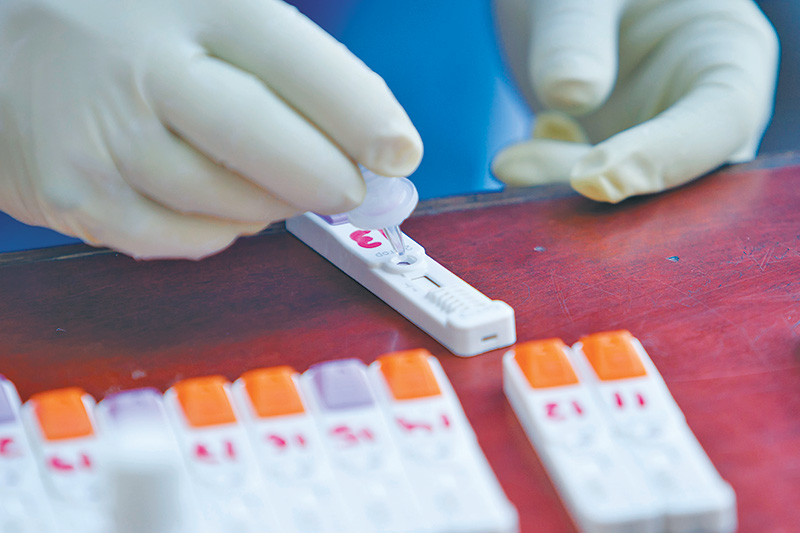
Experts say antigen tests are useful in mass screenings and for quick results. Post file Photot
KATHMANDU, Last week, Health Office Dhading (earlier known as District Public Health Office) provided over 200 rapid antigen test kits to Benighat Rorang Rural Municipality. Health workers serving in the rural municipality, however, did not show interest in the antigen-based tests. “Our priority is polymerase chain reaction tests,” Shankar Duwadi, health coordinator of the rural municipality, told the Post over the phone. “Polymerase chain reaction tests are more reliable than the antigen-based tests.” Doctors say although there is no doubt that polymerase chain reaction tests are more reliable for coronavirus screening, for large-scale testing in rural settings and for quick results, antigen-based tests are equally important. And when new cases are spreading in remote villages, such tests are even more necessary to stem further spread of the infection and minimise the loss of lives. Officials at the Health Ministry aimed to perform over 25,000 antigen tests every day along with the current number of polymerase chain reaction tests. However, antigen tests are being performed only in hundreds. “Earlier, we could not increase testing due to limited capacity for PCR tests and lack of antigen test kits,” Dr Krishna Prasad Paudel, spokesperson for the Ministry of Health and Population, told the Post. “But now we have sufficient antigen test kits and have already dispatched them to the districts but test numbers have not increased.” Officials at the Epidemiology and Disease Control Division said that the problem is not only the lack of budget and testing kits but also local officials’ mindset of not taking the risk seriously. “When we received news about the spread of infections in Barpak of Gorkha district, health workers were deployed from provincial offices and the district for tests,” an official at the division told the Post, asking not to be named. “Hundreds of antigen tests were performed which showed infections in dozens of people.” As per the national testing guideline for Covid-19, antigen-based testing is used in mass screening for urgent reports and for people living in congregate settings. On Saturday, only 746 antigen tests were performed throughout the country, of which 176 tested positive. On Sunday, 1,784 antigen tests were performed and 667 people tested positive. With the country’s daily polymerase chain reaction testing capacity of about 20,000 from 90 public and private laboratories, sufficient tests were not being performed despite new infections spreading throughout the country, especially in rural Nepal, and the positivity rate above 40 percent until last week. After the government’s requests for help, aid agencies have supplied over 1.7 million antigen test kits. On Sunday, 3,702 people tested positive throughout the country. The Health Ministry reported 109 more deaths. The dramatic decline in new cases can be considered as the result of a decline in test numbers. On Sunday, only 10,986 polymerase chain reaction tests were performed with the positivity rate at 33.7 percent. Till about a week ago, around 20,000 tests were performed every day, of which around 8,000 returned positive. According to Dr Samir Adhikari, joint spokesman for the Health Ministry, they are unaware of the reason behind the decline in test numbers. “Maybe the number of people seeking tests has declined,” he said. Public health experts say that testing is the first step to contain the contagion. They said that authorities could take containment measures only if they know where the infection is fast spreading. “Without testing, authorities do not know about the scale of virus spread in communities and cannot start contact tracing,” Dr Keshab Deuba, a public health epidemiologist, told the Post. “Neither the suspected people can be placed in quarantine nor could the infected be kept in isolation.” But in the lack of capacity, testing-based contact tracing has not been going on. Duwadi, the health coordinator of Benighat Rorang Rural Municipality, said health workers have been collecting swab samples for symptomatic cases only. As the infections have already penetrated deep into communities, testing only symptomatic people is the main reason behind the rapid spike in new cases, as the second wave of the coronavirus grips the nation, doctors say. “I am tired of urging officials to increase testing,” Dr Binjawala Shrestha, a public health expert, told the Post. “Earlier, they did not increase testing saying that they do not have testing kits but now, when aid agencies have provided sufficient kits, they are not bothered to increase testing.” Shrestha said that bureaucratic hassles and lack of seriousness on the part of authorities are the main reasons for the spike in new cases. Health Ministry officials say all they can do is urge provincial and local governments to expand testing. “We have also trained health workers and made officials of provincial and local governments aware about the need for antigen testing,” said Paudel. “We will hold meetings with them again and remind them about the need for testing.” With infections already hitting communities, massive testing is required. Antigen tests will be helpful in figuring out the hotspots and clusters, letting authorities loosen up the restrictions in green zones and continue the restrictions in hot zones, according to experts. They said that early detection and isolation of the infected is the only way to lessen the infection rate. Increased testing also helps policymakers, enabling them to assess the scale of infections and allocate resources accordingly, doctors say. “The burden of the infection may vary from place to place,” Dr Prabhat Adhikari, an infectious disease and critical care expert, told the Post. “When the authorities know the real burden, they can channel the measures and resources to the highly affected areas.” Countries that were aggressive in testing, contact tracing and isolating the infected successfully checked the virus spread. “Some local units like Kathmandu Metropolitan City and Dhulikhel Municipality have started testing and contact tracing,” Mahendra Prasad Shrestha, chief specialist at the Health Ministry, told the Post. “The local level should take initiatives to perform massive testing.” As the spread of infections has been on the wane of late, testing helps to contain the contagion, he said. “Even as the number of cases declines, cases could remain circulating within the communities if the chain of infections is not broken,” said the chief specialist at the Health Ministry. “And to break the chain of infections, we need to ramp up testing.”
NATIONAL
People found using ambulances, essential goods vehicles to smuggle drugs
- SHUVAM DHUNGANA
KATHMANDU, On Sunday, a police team from the District Police Office, Sunsari arrested a man from Koshi Rural Municipality who was allegedly smuggling a huge amount of cannabis to India. The arrested person has been identified as 40-year-old Ganesh Yadav. According to a press statement issued by the District Police Office Sunsari, Yadav was caught with 165 kg of cannabis which he was trying to smuggle to India. Similarly, on Thursday, during a regular security check, a police team from the District Police Office, Chitwan arrested an Indian national allegedly in possession of 270 kilograms of cannabis. The man was identified as 25-year-old Pintu Kumar. According to the District Police Office Chitwan, Kumar was trying to smuggle cannabis to India through the Biratnagar border in a truck bearing Indian license plate (NL 01 N 5867). Further investigation into the case is underway. Yadav and Kumar’s are among thousands of arrests police have made while people were trying to smuggle contraband in and out of the country despite the country remaining under Covid-19-induced movement restrictions for the past several months. Even now most of the districts are under prohibitory orders aimed at stemming the spread of Covid-19. According to the Nepal Police, during the first nine months of the current fiscal year they have arrested 3, 888 individuals, including 135 foreigners, for possessing illegal drugs. In the fiscal year 2020-2021, Nepal Police across the country confiscated drugs worth millions. In the last nine months alone, the Narcotics Control Bureau of Nepal Police seized over 5, 447 kg of cannabis, over 255 kgs of opium, over 8 kgs of heroin and over 455 kgs of hashish. With a view to combating the rising drugs smuggling via Nepal, the Nepal Police in 2012 had formed the bureau. Headquartered at Koteshwar in Kathmandu, the bureau has its branches in Kakarbhitta, Biratnagar, Birgunj, Pokhara, Bhairawaha, Nepalgunj, Mahendranagar and Surkhet. According to Superintendent Rishi Ram Kadel, who is also the spokesperson for the bureau, drugs like cannabis, hashish and opium are exported to India from Nepal in large quantities while pharmaceutical drugs like Diazepam, Nitrovit and Buprenorphine are smuggled into Nepal from India. “Despite the restrictions, people take risks to smuggle the contraband because drug users are willing to pay high prices for these contraband. So drivers do not hesitate to carry such illegal drugs as they can make a huge amount of money quickly,” said Kadel. “Ambulances, water tankers and other vehicles carrying essentials have permits to travel even during restrictions, so smugglers are increasingly using such vehicles.” According to Kadel, in Nepal, Indian smugglers have also been found providing opium and cannabis seeds to encourage farmers to grow these crops. Before the Covid-19 pandemic, the Kathmandu airport was also used as a transit point by smugglers to sneak out mostly cocaine. But since the start of the pandemic smuggling by air has come down and it has stopped since the suspension of international flights. According to Nepal Police data, only over 31 grams of cocaine has been confiscated during the first nine months of the current fiscal year. Nepal Police data of the last three years show there has been a decline in the arrest of smugglers. In the fiscal year 2018/19, police arrested 5, 558 persons on drug smuggling charges. Of them, 201 were foreigners. In the fiscal year 2019/20, authorities arrested 4, 546 persons, including 10 foreigners. In the first nine month of 2020/21, a total of 3, 888 people including 135 foreigners have been arrested on smuggling charges.
NATIONAL
Hospitals unprepared to screen and treat black fungus cases
Black fungus patients have to be sent to Kathmandu for treatment, as the region is unable to handle the infection.
- THAKUR SINGH THARU
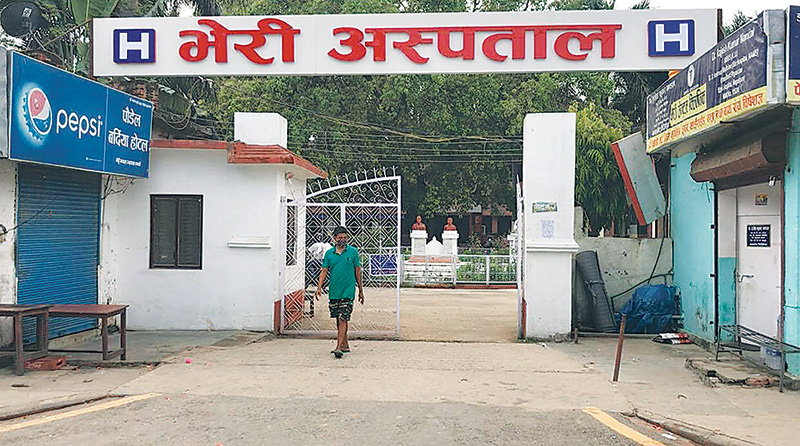
In the last two weeks, four Covid-19 patients were diagnosed with the black fungus infection at Bheri Hospital in Nepalgunj. Post Photo
BANKE, Health workers are suspecting that a 60-year-old man from Kapilvastu, who had recovered from Covid-19 earlier, recently died of black fungus at the Lumbini Provincial Hospital. The man, a patient of diabetes, had recovered from the virus at the Corona Hospital in Butwal last month. “But after he recovered and was discharged from the hospital’s ICU, he started complaining of prolonged headaches and even lost his vision. The patient died in the course of treatment at Lumbini Provincial Hospital,” said Dr Sudarshan Thapa, senior consultant physician at the hospital. “He had all the symptoms of black fungus. We did not document the patient’s condition as black fungus, but we believe that the patient died of the disease.” The “black fungus” is an infection caused by a group of fungi, which is on the rise among Covid-19 patients and survivors, doctors say. In the last two weeks, four Covid-19 patients were found with the black fungus infection at Nepalgunj-based Bheri Hospital. “Among the four patients, one died while undergoing treatment at the hospital,” said Dr Rajan Pandey, chief consultant physician at the Bheri Hospital. According to him, patients with diabetes are more vulnerable to black fungus. Black fungus is not transmissible like Covid-19, said Naresh Shrestha, the health officer in Banke. “The infections can be seen in one out of 1,000 Covid-19 patients,” he said. “We have sent some black fungus patients from Nepalgunj to Kathmandu for treatment in the last few days.” According to doctors, black fungus develops in Covid-19 patients when they are treated through supplemental oxygen and steroid medicines in the High Dependency Unit or Intensive Care Unit. “A patient’s immune system gets compromised during the treatment for Covid-19 and that is when the fungus develops in them,” said Dr Thapa. “Sometimes, eye removal surgeries are needed to stop fungal infection from reaching the brain.” So far, black fungus patients have not been reported in Kapilvastu. Dr Kishor Banjade, medical superintendent of the District Hospital in Kapilvastu, said the hospital has been alerted on the rising cases of black fungus in the country and that it will be on the lookout for the infection. Meanwhile, in Bardiya district, there’s not a single preparation going on to prevent and treat black fungus. “We have no ophthalmologist here. This is why the treatment of black fungus is not possible in the district,” said Dr Subhash Pandeya, medical superintendent of the District Hospital in Bardiya. Similarly, the health institutions in Sudurpaschim Province, which are already suffering from a poor health infrastructure, are far from prepared to handle the impending threat of black fungus. Seti Provincial Hospital in Dhangadhi, the major hospital in the province, is yet to prepare treatment services for black fungus patients. “We are yet to ascertain if there are black fungus cases in Sudurpaschim Province or not. We need to be fully prepared for the treatment of such patients, as many people in neighbouring India are suffering from the disease,” said Dr Sher Bahadur Kamar, a consultant physician at the provincial hospital. “Black fungus cases have not been reported in the hospital as of now.” Dr Hemraj Pandey, the medical superintendent at the provincial hospital, admits that the institution could have problems in providing treatment to black fungus patients in the region. “We need to think about the possible cases of black fungus and prepare accordingly,” said Pandey. “The hospital will take the necessary initiatives to handle the infection.” Mahakali Hospital in Mahendranagar, meanwhile, claims that it has started preparations to identify black fungus cases and provide treatment to the patients. “The hospital has been holding regular talks with ENT (ear, nose and throat) doctors for the diagnosis and treatment of black fungus patients. The process to buy medicines required for the treatment of black fungus is also underway,” Dr Hari Shrestha, the medical superintendent at Mahakali Hospital. “Both the Covid-19 patients and doctors should be careful about the possible contraction of the fungus.” Currently, 50 Covid-19 patients are receiving treatment at Mahakali Hospital. “The hospital has not reported any black fungus cases so far,” said Dr Gobinda Rokaya, the coronavirus focal person at the hospital.
(Sanju Paudel in Rupandehi, Manoj Paudel in Kapilvastu, Kamal Panthi in Bardiya, Arjun Shah in Dhangadhi and Bhawani Bhatta in Kanchanpur contributed reporting.)
NATIONAL
In a pandemic-hit economy, state offers little hope for creating jobs
The budget for the upcoming fiscal year aims to create around 350,000 new jobs whereas 500,000 youths enter the labour market every year, by the government’s own estimates.
- CHANDAN KUMAR MANDAL
KATHMANDU, At a time when the Covid-19 pandemic has badly affected the income prospects of the general public and disrupted employment opportunities, the government has cut down its target for jobs creation for the fiscal year 2021-22. The budget for the upcoming fiscal year, presented by Finance Minister Bishnu Prasad Paudel on Saturday, aims to create less than 350,000 new jobs in 2021-22 through its employment-related schemes and plans. Not only is the target down by half than that of the ongoing fiscal year 2020-21, it is also far below the number of young people entering the job market every year—nearly 500,000, according to government estimates. “For ensuring dignified employment to all the citizens, work and employment opportunities will be created in coordination and cooperation with the government, private, cooperative and non-governmental sectors,” said Minister Paudel reading out the budget. The government, on Saturday, presented a budget of Rs1.64 trillion through an ordinance. With some focus on fighting the Covid-19 pandemic, the financial plan of the government carries lofty promises which many said were aimed at the midterm elections, which are still uncertain. This is the reason, employment generation could not be a priority for the government, according to Jeevan Baniya, an expert on labour migration and employment. “Creating jobs does not seem to be in priority of the government because the budget revolves around distributive and populist schemes targeting the upcoming elections,” said Baniya, who is an assistant director of the Centre for the Study of Labour and Mobility at Social Science Baha, a Kathmandu-based think tank. “The government is more interested in offering tangible schemes so that it could create a favourable environment in the view of the upcoming elections.” “Studies by the government itself have shown that around 500,00o new jobs need to be created every year to absorb new entrants. And this number might be even higher now because thousands of youths have not been able to fly abroad for foreign jobs due to the pandemic,” said Baniya, adding, “The target is way below the current level of unemployment.” The budget for the current fiscal year aimed at generating more than 700,000 jobs through various programmes to provide relief to the economy hit by the first wave of the pandemic. Dipak Kafle, a joint-secretary at the Ministry of Labour, Employment and Social Security, agrees that the government has set a lower target for the new fiscal year. “It is true that the targeted job numbers for the new fiscal year appear lower,” Kafle, who is also the spokesperson for the Labour Ministry, told the Post. “But we should not forget that more job opportunities are created indirectly in other sectors. The government coordinates with the private sector and other stakeholders for creating jobs.” In the upcoming fiscal year, the government is once again pinning its hopes on the Prime Minister Employment Programme, the wage-employment scheme that aims to provide a minimum of 100-days of work to registered unemployed citizens in their respective local levels. Just like in the current fiscal year, the government plans to provide jobs to 200,000 people through the Programme and has allocated Rs12 billion—up from Rs11.6 billion in 2020-21—for it. Likewise, the government has allocated Rs400 million for providing various technical and skills training to youths joining the labour force, returning migrant workers and those who have lost their jobs at home. The government estimates this scheme will benefit nearly 100,000 people. An additional Rs1 billion has been set aside for providing on-the-job training for workers employed in the production and service sectors. This scheme will be implemented in coordination with the private sector. For this, the government has announced a subsidy equivalent to three months of minimum salary to private firms and businesses that hire state-trained workers for two years after the completion of the training. Through this scheme, the government aims to employ 25,000 people. Last year, the government had planned to employ 50,000 people in the private sector by investing Rs 1 billion. “Meeting the jobs creation target is not easy as the government alone cannot do that because the government creates fewer jobs and a substantial number of job opportunities are created by the private sector,” said Baniya. “The government should bring new policies to facilitate the private sector to create new jobs. But there hasn’t been a concerted effort by the government towards this end.” Since the first wave of the pandemic last year, Nepali workers both at home and abroad have faced adversities. Many of them lost jobs and are struggling to make their ends meet and take care of their families as the pandemic is already in its second year. Thousands of Nepali migrant workers returned home after suffering job loss abroad. Back home in Nepal, a UNDP survey published in May last year showed that three in five employees lost their jobs due to Covid-19 and most of them were youngsters. Nepali migrant workers’ prospects of taking up overseas jobs have been badly affected once again with the ongoing flights and travel restrictions. With the second wave of the pandemic causing another economic shutdown, even meeting the reduced target of jobs creation would be challenging, according to stakeholders. “The government has just presented its plans for job creation for the new fiscal year. Depending upon the situation, revisions can be made later. So it is too early to say whether the target is achievable or not,” said Kafle, the labour ministry official. “If the Covid-19 crisis worsens then achieving the target will be difficult.” The doubt over the government’s plan of job creation stems from the fact that more than half of the employment opportunities the government wants to create in the next year will be generated through the The Prime Minister Employment Programme. The track record of the much-talked and billion rupees programme, however, has been disappointing. The programme, which is in its third year, has proven to be a let-down as it has failed to provide 100-days of work even at one local unit so far. Experts have been saying the temporary jobs programme would not be enough to provide enough relief to unemployed citizens. “The programme has not achieved its target in the past years. Without clarity on how it will create employment opportunities at the local level, it cannot be effective,” said Baniya. “Local units have not been able to spend the budget provided by the central government let alone creating new employment opportunities.” In its first year of the Programme, the government had aimed to provide temporary jobs to more than 100,000 registered jobless citizens for 30-days. But at the end of the fiscal year, the Programme could only provide 13 days of work on average to a total of 175,909 applicants in 2018-19. The programme could not do any better in the last fiscal year either. Despite the programme achieving the target of providing employment opportunities to 60,000 people in the last fiscal year 2019-2020, it could only provide 16 days of work on average to 103,501 applicants. With just a month and a half remaining for the current fiscal year, when the Programme aimed to provide a minimum 100 days of work to 200,000 citizens, the reality is just over 100,000 people have received employment for 21 days on average so far. Besides regular job creation programmes, the government has also tried to promote youth entrepreneurship and self-employment by promising soft loans to youths. In the new budget, the government has announced that youths can access subsidized loans of up to Rs2.5 million against their academic certificates as collateral. Likewise, there is also a plan to provide technical and vocational skills as well as subsidized loans through the Youth and Small Entrepreneur Self Employment Fund for employing 12,000 youths in the next fiscal year. However, such schemes of providing seed money to returnee migrants and entrepreneurs have turned out to be ineffective due to red-tapism despite encouraging initial response from the target groups. “The government announces subsidized loans, but the banks which are supposed to lend the money have been creating obstacles,” said Baniya. “We saw this also during the earthquake reconstruction process when hardly anyone received the government-promised subsidised loan for rebuilding homes.” “Whether the elections are conducted or not, these targets are unlikely to be achieved anyway because of the political instability,” said Baniya.
NATIONAL
Ban on roadside vending disrupts livelihoods of Kathmandu’s poor
Over 6,000 vegetables and fruits hawkers have been robbed of their incomes.
- ANUP OJHA
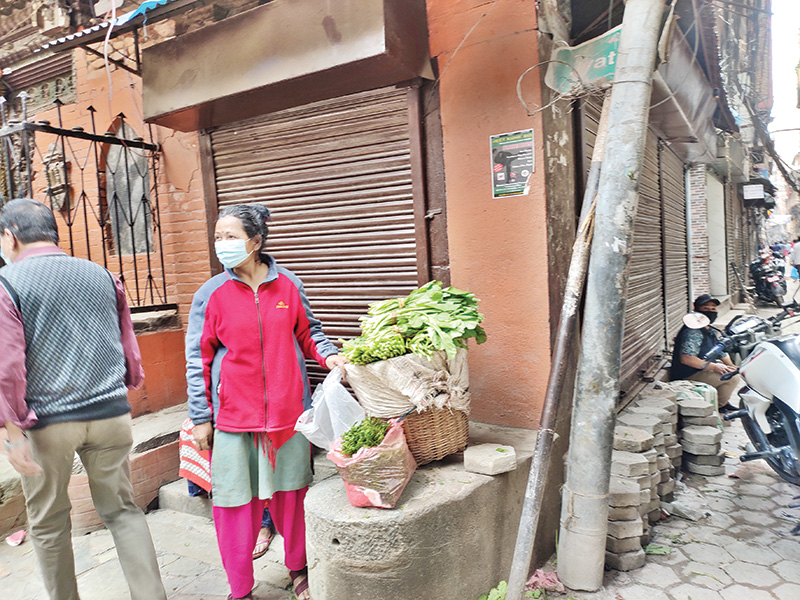
Ganga Maya Tamang waits for customers in an inner alley of Ason, Kathmandu. Post Photo
KATHMANDU, It’s half past seven on Sunday morning in an inner alley of Ason and Ganga Maya Tamang, hiding from police eyes, calls out to a few passers-by to buy green leafy vegetables from her doko basket. On Sunday, just like the past few days, the otherwise busy and crowded Ason was eerily quiet, except for the occasional shouts of the few vegetable hawkers and the sounds of police whistles at a distance. Ason, the oldest marketplace in Kathmandu, is well-known for its shops selling daily essentials, spices, kitchen utensils, clothes and other household items. But for the past three days after the government introduced stricter prohibitory orders citing the Covid-19 pandemic, all is quiet here. Only the shops selling fruits, vegetables, meat, dairy products, water and cooking gas are allowed to operate until 9 am. Roadside vending is banned. Just a few hundred yards away from her, at Ason Chowk, police have already detained over a dozen people for breaching the prohibitory orders. A few shops selling fruits and vegetables are open. “This is injustice. Those who have shops are allowed to sell vegetables, but poor vendors like us have been barred from earning our livelihoods,” says 38-year-old Tamang, a mother of two sons aged 8 and 11. “I don’t think the coronavirus would go easy on the vegetable shops and singles out the roadside vendors,” quipped Tamang. Everyday at 4am, she goes to the Kalimati vegetables market and comes to Ason to sell the vegetables. “At Kalimati, I buy mustard greens, pumpkin shoots and garden cress for Rs500 and make around Rs900 here if I am able to sell them all. But some of the vegetables go to waste because there are fewer customers and the police are always after us,” said Tamang. Her youngest son, standing in a corner, keeps watch on the police. “Many of my friends and I have been selling green leaves here for over two decades but this is the first time we have been barred from selling here. How am I going to feed my family If I am not allowed to do business here?” asked Tamang, who lives in a rented room at Chhetrapati. Her husband, a rickshaw driver, is jobless since the prohibitory orders were introduced in the Valley on April 29. According to Tamang, they need to pay Rs 15,000 for the two rooms they have rented. Another roadside vendor, Vishnumaya, 76, who was found selling candies, biscuits, noodles and tobacco products on a nanglo (a bamboo respectacle), at Makhan near the Kathmandu Durbar Square on Sunday morning, also complained of police harassment. “At my rented room, the landlord keeps asking for unpaid rent and threatens to evict me and here the police threaten to put me in jail. I am helpless,” she said. “I stay here till 10 am wearing a mask and I have covered my wares with an opaque plastic sheet so as to keep them hidden from police eyes,” said Vishnumaya. “People who come out to buy vegetables are also my customers,” she said. She lives alone in her rented room near the Bishnumati bridge on the way to Swayambhu. She says her monthly rent is Rs 5,000 and she hasn’t been able to pay the landlord for the past two months. “Since the lockdown, I haven’t been able to make more than Rs200 a day. Life has become very difficult,” she sighed. Vishnumaya had descended to the capital after her house in Charikot of Dolakha was flattened by the 2015 earthquakes. In the Kathmandu Valley, there are thousands of people like Tamang and Vishnumaya whose livelihoods have been severely disrupted by the Covid-19 restrictions. According to the Kalimati Fruits and Vegetable Market Development Board, there are over 3,000 hawkers who roam around selling vegetables in bicycles or pushcarts and around the same number of fruits vendors, but they don’t have exact records of people like Vishnumaya and Tamang. Jyoti Baniya, chairperson at the Forum for Protection of Consumer Rights Nepal, said the government decision to close the groceries and roadside vegetable shops is a “crime against humanity.” “This could have been done only after declaring a health emergency, but the government hasn’t declared such an emergency. I feel there is some vested interest in closing everything completely even as the Covid-19 infections are decreasing in the Valley,” said Baniya. On May 11, nearly three weeks ago, a total of 9,127 new coronavirus cases were reported across the country. Of them, 3,607 were recorded in Kathmandu Valley. But on Sunday, the country reported nearly three times fewer Covid-19 cases—3,702 with 109 deaths Of them 1,093 were recorded in the Kathmandu Valley. “The government announced the new restrictions fearing street protests against the dissolution of the House of Representatives,” Baniya claimed, adding, “The government is least bothered about the problems of the poor.”
NATIONAL
Bridge construction affected in Narayangadh-Muglin section
Briefing
CHITWAN: The construction work of several bridges along the Narayangadh-Muglin road section has been greatly affected due to prohibitory orders enforced by the district administration in Chitwan to contain Covid-19. According to the Narayangadh-Muglin Road Project, bridge construction and road repair works have been affected mainly due to a shortage of workers and construction materials. “Eight bridges are under construction along the road section. We need 25-30 workers at a single construction site. But many workers have gone home amid fear of the virus,” said Sabina Ranabhat, the information officer at the project.
NATIONAL
Wild tuskers wreak havoc
Briefing
SARLAHI: A herd of wild elephants has been wreaking havoc in several settlements along the East-West Highway in Sarlahi district for the past few days. On Saturday, three tuskers entered Pokharitol settlement in Lalbandi Municipality-10 and destroyed four houses and damaged crops. “We are living in terror as wild elephants have started entering the settlement at night,” said Udaya Pakhrin, a local man. Wild elephants demolished a house in Hariwon Municipality-1 on Tuesday as well.
NATIONAL
165kg marijuana seized
Briefing
SUNSARI: Police seized 165kgs of marijuana from Bhantabari in Sunsari district on Sunday. Ganesh Yadav, 40, of Koshi Rural Municipality-8 was arrested with the contraband that was hidden in a water tank. Detailed investigation into the case is underway, said police.
EDITORIAL
All bark and no bite
Reflecting on the government that announced it, Budget 2021-22 is bound to be unimplementable.
Nepal is still in the middle of a deadly second wave of the SARS-CoV-2 pandemic that continues to kill over 100 Nepalis every day. The current lockdown, initiated to cut viral transmission, has affected businesses and livelihoods. Particularly, the current extended restrictions have been criticised for forcing people into panic buying supplies while being myopic towards the needs and purchasing capacity of the poor. In spite of all this, the current caretaker government has brought out a bloated and unnecessary budget that obviously looks forward more to the planned November elections than to the task at hand--saving lives and reviving the economy. In the present context, where Parliament is dissolved, the Oli administration had no constitutional obligation to release a full budget. With a public health crisis playing out, releasing a shorter, targeted fiscal plan would have been appropriate. Some sections of the budget may turn out to be prudent policy measures. Income tax incentives to start-ups and small businesses make sense, given the restrictions affecting business. So do VAT exemptions for logistics, transport and infant formula, given their potential trickle-down effects to consumers who are also feeling the brunt of the novel coronavirus and lockdown measures. But even these will only be effective if implemented well. For the most part, though, the policies announced are populist measures meant to pull back a voter base that is increasingly rejecting KP Oli and his failing stint at the helm. For example, the government has announced salary hikes for its employees, and has mentioned increased social security and income for certain groups of teachers. But while doing so may boost consumer spending and sustain public employment, this government has done very little to boost school enrolment and better the education infrastructure. Finance Minister Bishnu Poudel announced the elimination of excise duties and reduction of custom duties on electric vehicles. A welcome reversal from Yuba Raj Khatiwada’s tenure at the treasury, this will boost mass adoption of electric vehicles in the coming years and lead to a reduction in air pollution. However, with the country facing a major economic crisis, this is again a policy measure that was not a priority, given the severe inadequacies faced by the country which needs immediate respite. In fact, the budget reflected the Oli-led government’s tenure--full of exaggerated promises and lacking delivery. Much like Khatiwada’s announcement of an unbelievably optimistic 7 percent growth rate in the last fiscal year (declared, just like this year, in the middle of a lockdown), Poudel has announced an expected year-on-year rate of 6.5 percent. The minister seems to have forgotten that Nepal experienced negative growth in 2019-20 and is on course to a misleading growth of about 4 percent in 2020-21, despite Khatiwada’s cheerful predictions. Indeed, we only need to look at the last budget’s failures to predict what will come this next fiscal. For, sensing that the pandemic in May 2020 had not shown its worst outcome, the government then had promised to build 200 new hospitals at all local levels and special healthcare facilities to accommodate infectious diseases, with Kathmandu getting a new centre with 250 ICU beds, and each provincial capital getting centres with 50 ICU beds each. One year on, all these promised beds are yet to become operational. If the government had focused on fulfilling last year’s promises, Nepal would have had more care units during this second wave, when people began desperately looking for oxygen canisters and ICU beds. Perhaps then, it could have gained voter support without resorting to populist measures.
OPINION
The country be damned
No one seems to be able to stop Oli’s whimsical actions, even if it ends up destroying the country.
- DEEPAK THAPA
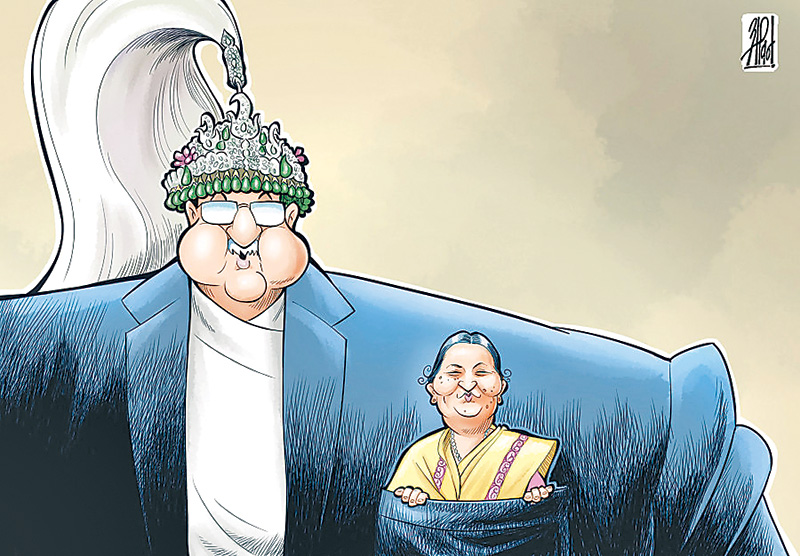
Post Illustration: Abin Shrestha
Two weeks is a really very long time in politics. My last column a little over a fortnight ago was the somewhat unfortunately titled ‘End of the Oli show’. It was published on the very day the opposition faltered in its resolve to oust KP Sharma Oli and paved the way for his comeback for a third stint as prime minister. Since the man is still on the job, and as unrepentantly defiant, I would have had to eat crow for my premature exultation but for the fact that the situation has actually turned for the worse. For now, all the political parties are on the backfoot, awaiting the Supreme Court’s verdict on the latest constitutional chicanery cooked up by the prime minister and served to the nation by the president. There is hardly a word I would have detracted from my rather harsh estimation of Oli in that said piece of mine. As if to prove my points more emphatically, the very next day he and the president enacted what can only be called a farce of an oath-taking ceremony. Oli’s refusal at the event to commit himself to do right by the country by cutting off President Bidhya Devi Bhandari to tell her that repeating the pledge she had read out was unnecessary was perhaps the most blatant show of contempt of the Nepali people. After all, as our head of state, the president represents our national sovereignty in her person. And it is on the strength of that sovereign power our president derives the authority to swear in the country’s chief executive. YouTubers have been having a field day caricaturing Oli’s assertion of ‘tyo pardaina’ while the president’s juvenile ‘tee-hee’ of a response has been widely panned. A leading constitutional lawyer even described the swearing-in as akin to a ‘playful exchange between lovers’. For some reason though, no one appears to have pointed out what the body language of the president appeared to indicate. If one looks at the video, immediately following that most unpresidential tittering is a gesture by Bhandari with her right hand that seems to say ‘There you go again’ or some such expression of helplessness. Here we were criticising Bhandari for standing ready 24/7 to approve anything thrown her way by Oli when the fact appears to be that she is completely in thrall of him; there is probably little she could have said or done to stop Oli or his ways—if she wanted to, that is. While that does not excuse her role as the principal enabler of a rogue prime minister, one cannot but feel a twinge of sympathy for the quandary she finds herself in. At the same time, it does beg the question why the prime minister found the idea of making a pledge so objectionable. The wording of the oath Bhandari was trying to get Oli to repeat has been commonly used so far for all government functionaries, consisting of the usual platitudes about working in the interests of the country, with honesty, etc, etc. It cannot be that Oli suddenly developed a conscience and realised that he had been acting against the very same pledge he had made twice earlier as prime minister—when sworn in by Bhandari in 2018 and by Ram Baran Yadav in 2015—and wanted to deceive the nation no longer. It was more of a spur-of-the-moment whim that basically seemed to demonstrate to the people he could do or say anything he wanted, and there is little anyone can do to stop him, least of all someone he had single-handedly carried into the high office of the presidency. Luckily for Oli, as it turned out, the government actually did not have a formal text for swearing people into offices of the state. And, after the Supreme Court asked him to provide an explanation for the uncalled-for awkwardness at what should have been the most solemn of ceremonies, the government crafted an ordinance on oath-taking that, true to form, was immediately signed by Bhandari. It was basically the same text as earlier but omitting the crucial words ‘I pledge’. In all fairness, reading the new text does make it seem that the earlier formulation was indeed superfluous since the office-holder was being asked to make a ‘pledge’ and then immediately afterwards ‘swear’. Good for Oli to point it out. But having himself taken the oath countless times over his political career without any drama, the middle of his own swearing-in was simply the wrong place to play language editor. The widespread condemnation sparked by that episode followed by the president’s refusal to accept the opposition leader’s claim to prime ministership has led to a free-for-all in the media such as the accompanying cartoon published in Kantipur. Sadly, while poking fun of the very unequal partnership between the president and the prime minister makes for good copy, it hardly bodes well for the country’s institutions. It could have been to repair her image that the president found herself engaged in some high-profile diplomacy. Successfully, it would appear since it resulted in a gift of 1 million doses of the Covid-19 vaccines from China. Not that she would have had anything to do with the Chinese benevolence since all of that would have been worked out in advance and, in all likelihood, the Chinese president had a chat with her simply to announce the grant. But even that had a downside, for while the Chinese may not have found it untoward that a ceremonial president should taken up executive functions, that does not seem to have been the case with the Indians. After Bhandari sought help with procuring vaccines from the Indian president, another figurehead like her, the chief of the Indian ruling party’s foreign cell paid a visit to our ambassador in New Delhi. During the meeting, the Indian functionary reportedly ticked off the ambassador for the fact that the Nepali president was becoming more active than the prime minister. He apparently even joked whether given the current political circumstances Oli was barred from taking an initiative that is squarely his responsibility. If that story is true, one indeed wonders what our government was thinking by breaking decorum in the delicate rules that guide international diplomacy. Since President Bhandari would not have been thus involved without the prime minister’s sanction, that brings us to the conundrum that Oli’s advisers must grapple with all the time: how to rein in the prime minister without appearing to do so. No one seems to actually know what is going on in his head apart from his obsession with remaining in power—apparently for the sake of it, since he really has done little with it besides using the authority of the office to spin many a yarn over the years. I cannot imagine that all of Oli’s advisers are in complete agreement with whatever steps he has taken in these recent months. Surely more than a few would have lost sleep over how to justify to the public acts of whimsy in constitutional terms, not to mention to their own selves. There must also be a few who surely recognise the damage Oli, in league with Bhandari, has been causing to our democratic institutions. The tragedy is that the allure of power is such that all they are interested in is ensuring that their chap wins—democracy, federalism, inclusion, peace, stability, and, ultimately, the country, be damned.
OPINION
The disastrous neglect of neglected tropical diseases
Increasing demands on government budgets seem poised to halt hard-won progress.
- Michael Kremer,Edward Miguel
Talukdar David/Shutterstock.com
US President Joe Biden’s decision to back the call for waiving intellectual-property protections for Covid-19 vaccines reflects the extent of global pressure for universal vaccine access. Yet the world’s poor suffer from many other preventable and treatable diseases, with dire social and economic consequences. Neglected tropical diseases—such as elephantiasis, trachoma, river blindness, and intestinal worm infections—are virtually nonexistent in advanced economies. But among people living in extreme poverty, they are the most common infections. About a billion people worldwide—including more than 750 million people living below the World Bank poverty line of $1.90 per day—suffer from NTDs every year. Their suffering can be extreme. NTDs cause severe pain and long-term disability, often leading to social stigmatisation. Among children, infection interrupts education and causes malnutrition, impairing intellectual and cognitive development and stunting growth. And by interfering with education and employment, NTDs keep people trapped in poverty. And yet, while nearly 17 million healthy years of life are lost annually to NTDs, these diseases are largely preventable, and many can be treated with a few simple pills. Ensuring broad access to these medications would not only bring obvious health and humanitarian benefits, but also pay remarkably high and sustained social and economic dividends. Consider intestinal worms, the most prevalent—and among the most treatable—NTDs. Starting in 1998, we studied a public health programme providing treatment for intestinal worms to tens of thousands of primary-school children in Kenya. Using a randomised control trial, we could reliably measure the programme’s causal impact by comparing schools where treatment was provided with otherwise identical schools where it wasn’t. In the schools that received treatment, we recorded gains in child-health measures and considerably higher school attendance. We then engaged in a two-decade effort to track a representative subsample of thousands of the same children. Roughly every five years, the research team carried out surveys to gather information on these individuals’ earnings and living standards, as well as residential choices and other life outcomes. The results from this unusual longitudinal data set are stunning. Twenty years later, individuals who had received additional deworming treatment in school—now in their late twenties and early thirties—reported 13 percent higher hourly wages and 14 percent higher spending on consumption goods than those who did not. They had also moved to large urban areas, like Nairobi, in far greater numbers, affording them better economic opportunities. Considering that an annual deworming treatment costs about $0.50 per child when delivered at scale, the rate of return on this investment in child health is astronomical and pays for itself many times over. Fortunately, governments in India, Kenya, Nigeria, Ethiopia, and Pakistan have recognised this, and are working with NGOs to implement mass deworming programmes that currently reach over 280 million children each year. But there is still much work to be done to reach the nearly 600 million children who remain at risk of parasitic worm infections. The same is true of NTDs more broadly. Over the last two decades, governments, nonprofit organisations, and bilateral and private donors have made enormous progress in the fight against these diseases, using extremely cheap, cost-effective treatments. As a result, we are closer to beating NTDs than ever. But we aren’t there yet. With the Covid-19 pandemic pushing even more of the world’s population into poverty—and increasing the risk of debilitating illness—now is the time to redouble our efforts to combat NTDs. But growing demands on government budgets and more competition for funding seem set to halt progress—and even reverse it. The British government—a global leader in innovative foreign-assistance programmes—recently announced that it would cut 90 percent of its funding for NTDs. As a result of this decision, millions of people will miss out on treatments, and many medicines that are already in-country could expire on the shelf, owing to a lack of funds to distribute them. For the world’s most vulnerable populations, the consequences will be catastrophic. That is why we urge the British government to reverse its decision, and encourage other governments to fill the gaps in funding. NTD interventions are some of the most cost-effective global health investments countries can make, especially at a time of rising poverty and proliferating disease. To end the scourge of NTDs and protect the world’s poorest people, we must neglect neglected tropical diseases no more.
Kremer, a 2019 Nobel laureate in economics, is University Professor in Economics at the University of Chicago and Director of the Development Innovation Lab. Miguel is Professor of Environmental and Resource Economics and Faculty Director of the Center for Effective Global Action at the University of California, Berkeley.
MONEY
Small business owners say they never see budget funds
Allocations are announced for cottage, small and medium entrepreneurs every year but nobody knows where the money goes, insiders say.
- KRISHANA PRASAIN
According to the Federation of Nepalese Cottage and Small Scale Industries, 25 percent of the micro, cottage, small and medium enterprises have shut down. POST FILE PHOTO
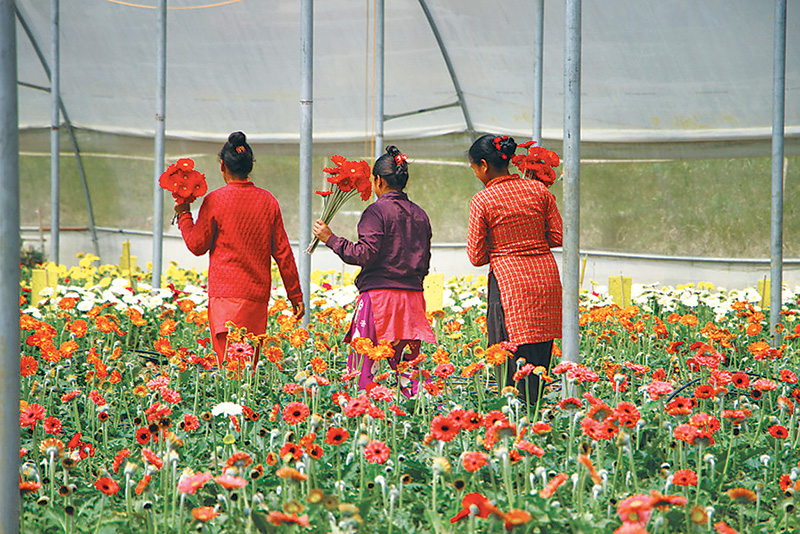
KATHMANDU, Flower grower Pandab Shrestha says the government has been allotting funds for cottage, small and medium entrepreneurs in the budget every year, but he has never seen a penny of it during his 13 years in the business. “The Prime Minister Agriculture Modernisation Project gets a good budget allocation annually, but I do not know where the money goes as it has never come to us,” Shrestha told the Post after listening to the budget statement for the fiscal year 2021-22 on Saturday. “The farmers who are doing commercial farming have never benefited from the allocated budget under the project,” said the owner of Srijana Cut Flower based in Ramkot. Cottage, small and medium entrepreneurs do not expect this year’s budget, which has been issued through the ordinance route, will be implemented, just like last year’s failed budget. And they do not expect to be able to rebuild their businesses which have been knocked out by the pandemic. Umesh Prasad Singh, acting president of the Federation of Nepalese Cottage and Small Scale Industries, said that the government did not provision any new programmes through the budget to address the sector amid the pandemic, and continued the programmes of the current fiscal year. “The implementation part of the budget for the fiscal year 2020-21 was weak,” he said. “We are sceptical regarding the implementation of the budget for the upcoming fiscal year too with the country going through political uncertainty. We do not expect much from this government either,” he said. “The budget has failed to address the overall micro, cottage, small and medium enterprises sector. The government had announced a loan waiver for small and medium enterprises in the current fiscal year, but it was not implemented,” Singh said. “Only 2-5 percent of the micro, small and cottage entrepreneurs benefited from the refinancing facility provided by the government in the current fiscal year. And they had to face tremendous paperwork hassles with commercial banks ignoring their loan applications,” he added. According to Singh, 25 percent of the micro, cottage, small and medium enterprises have shut down with 50 percent of their workforce becoming jobless. The government has earmarked Rs13 billion in the budget for the fiscal year 2021-22 to provide concessional loans at 5 percent interest to micro, small and medium enterprises, commercial agriculture, youth enterprises, women enterprises and persons returning from foreign employment. The government in the upcoming fiscal year will be expanding the limit and scope of concessional loans. “As businesses have been impacted by the coronavirus, we had asked for concessional loans at 2 percent interest, but it did not happen,” Singh said. The government had allocated Rs50 billion in the 2020-21 budget to provide loans at 5 percent interest to cottage, small and medium enterprises and Covid-19 affected tourism businesses to pay their staff salaries. The fund was operated through Nepal Rastra Bank and the money was made available by the government, public enterprises and donor agencies. Provisions were also made in the 2020-21 budget to provide refinancing facility of about Rs100 billion through Nepal Rastra Bank at a concessional interest rate of up to 5 percent to agriculture, cottage, small and medium industries, businesses, factories and tourism businesses hit by Covid-19. The budget for the upcoming fiscal year 2021-22 has provisioned a bonded warehouse facility for the private sector to establish and operate export houses to increase the export of goods produced by small and medium enterprises. The production and export of ready-made garments, pashmina, carpets, jute, silk and cotton-based export-oriented goods will also be promoted. The budget for the upcoming fiscal year has given continuity to the professional continuity fund established for the payment of wages of employees working in domestic, small, medium and large-scale industries. The production of goods based on local raw materials and labour will be increased by protecting domestic, and small and medium enterprises. Provisions will be made to organise virtual trade shows using the internet to market the products of such firms. E-commerce has been growing steadily in Nepal, but because of lack of proper linkage between e-retailers and producers, many homemade goods produced by small and medium-sized enterprises do not find a market even though they provide a livelihood for many families. Hardly 10-15 percent of homemade goods are showcased on online marketplaces, entrepreneurs said. Due to the lockdown restrictions imposed in many parts of the country, entrepreneurs are having a hard time, and only a few micro, small and cottage industries are in operation. A survey conducted of 37 businesses by the Ministry of Industry, Commerce and Supplies from November 2 to December 1 last year revealed that 75 percent of the small and micro enterprises in the country have shut down. Micro, cottage, small and medium-scale firms ran out of cash which resulted in many people losing their jobs, the report said. The report showed that 76.47 percent of the micro and cottage industry firms faced problems in accessing raw materials and labour while 88.24 percent of the firms could not market their production.
MONEY
Carmakers in ‘India’s Detroit’ allowed to remain open
- REUTERS
CHENNAI, Carmakers in the Indian automobile hub of Chennai will be allowed to keep operating, the state government said on Saturday, amid protests by workers who fear catching Covid-19 in one of the country’s hardest-hit states. Tamil Nadu’s government on Friday extended a near-total lockdown as coronavirus infections and deaths rise in the southern state, where average cases are running at more than 30,000 a day, official figures show. But a government order issued on Saturday said so-called continuous process industries, which include auto factories, would be allowed to function in accordance with measures such as social distancing to stem the virus’s spread. It also urged vehicle manufacturers to initiate immediate action to vaccinate all their employees within a month. Hundreds of workers in and around Chennai—often dubbed India’s Detroit—have fallen ill with Covid-19 and dozens have died, labour unions say. Manufacturing plants run by Ford Motor Co and Hyundai Motor Co near Chennai were shut this week after workers protested over unsafe working conditions. Renault-Nissan shut its manufacturing unit after workers threatened to boycott work, saying social distancing norms were being flouted, while Eicher Motors-owned Royal Enfield shut its three units over safety concerns. Union sources at Hyundai, Ford and Renault-Nissan said they were continuing to talk with the companies. “We’re scared about working. The company is citing government orders and asking us to report for work. The government needs to think about the welfare of workers,” a senior union leader at Hyundai said. Tamil Nadu’s government also gave permission for units near Chennai with export orders, such as construction and mining equipment maker Caterpillar Inc and Taiwan electronics manufacturer Foxconn, to operate their plants with 50 percent worker capacity. Global carmakers operating in Chennai have said they will prioritise worker safety and adherence to social-distancing protocols.
MONEY
CARE Nepal donates medical equipment to Ministry of Health and Population
KATHMANDU: CARE Nepal handed over health and medical equipment worth Rs13,515,271.75 to the Ministry of Health and Population in its ongoing efforts to support the Nepal government in the control, response and recovery of the Covid-19 pandemic. The surge of Covid cases with the second wave has deeply impacted the communities and health system of Nepal and CARE Nepal is committed to working with the communities amidst the hard times of this pandemic like it has been doing for the past 42 years, reads the press release issued by the organisation.
WORLD
World leaders call for action at Seoul climate summit
Call to make sure that poorer countries are not left out in the global initiative to go green.
- AGENCE FRANCE-PRESSE
Seoul, World leaders on Sunday called for more action and inclusion of all countries in the global drive towards a cleaner and greener planet at a climate summit hosted virtually by South Korea. Climate change is a major threat to global growth, with perils ranging from declines in crop yields, extreme weather that devastates tourist economies, disease outbreaks and other catastrophes that would sap productivity. South Korea—which recently announced plans to cut finance for international coal projects—is seeking a bigger role in the global initiative to go green. “South Korea will play a responsible role as a bridging nation between developing and advanced nations,” said President Moon Jae-in as he opened the 2021 Partnering for Green Growth and the Global Goals 2030, or P4G, summit. The two-day summit is the second of its kind following the inaugural meeting held in Copenhagen in 2018, and is focused on public-private partnerships, especially in developing countries. Advanced nations have laid out ambitious emissions-cutting goals in recent months, as well as plans to ultimately go carbon neutral by 2050. German Chancellor Angela Merkel called on the countries to phase out their dependence on fossil fuels, warning climate change is threatening people’s lives and the economy as much as the Covid-19 pandemic. Earlier this month Germany tightened its targets to reduce CO2 emissions—including a 65 percent cut in emissions by 2030—after a landmark ruling by the country’s top court declared a flagship climate protection law “insufficient”. British Prime Minister Boris Johnson said countries must now deliver on their green pledges. “It’s a great start, but let’s not pat ourselves on the back just yet because our planet and our people need more,” he said. “We need governments that will not just make promises on climate and nature but match those words with deeds.” World leaders committed under the 2015 Paris accord to keeping the global temperature increase to under two degrees Celsius—and ideally closer to 1.5C—by 2050. Yet many of the largest emitters have so far failed to keep up their commitments and countries have not even agreed on a unified rulebook governing how the Paris agreement works in practice. The UN says that emissions must fall nearly eight percent annually to keep 1.5C in play—equivalent to the emissions saved during the pandemic every single year through 2030. World leaders also stressed the importance of making sure that poorer countries are not left out in the global initiative to go green. African countries should not be “locked up” in fossil fuels and be able to advance with the rest of the world, said French President Emmanuel Macron, calling for ways to draw large-scale investments in renewable energy. “It is not a global partnership if some are left struggling to survive,” added UN Secretary General Antonio Guterres. “Tackling climate change head-on will help protect the most vulnerable people from the next crisis while sustaining a job-rich recovery from the pandemic,” he said. The World Bank estimates that between 32 million and 132 million additional people could fall into extreme poverty by 2030 due to the effects of climate change.
WORLD
Tianzhou-2 cargo spacecraft docks with China’s space station module
- REUTERS
A child stands near a screen showing images of the Tianhe space station in Beijing on April 24. REUTERS
SHENZHEN, China’s cargo spacecraft, carrying supplies, equipment and propellant, docked with the space station’s key module Tianhe on Sunday, the official news agency Xinhua reported. The Tianzhou-2, or “Heavenly Vessel” in Chinese, autonomously rendezvoused and docked with Tianhe at 5:01 am Beijing time, Xinhua said on Sunday. It blasted off via a Long March-7 Y3 rocket at 8:55 pm Beijing time on Saturday from the Wenchang Space Launch Center on the southern island of Hainan, the China Manned Space Engineering Office said. With a designed life of more than 1 year, Tianzhou-2 carried supplies for future astronauts including food for the Shenzhou-12 crew which will be launched next month for a three-month stay on the station, as well as two tons of propellant. Tianzhou-2 is the second of 11 missions needed to complete China’s first self-developed space station around 2022, and follows the launch of Tianhe, the first module, in late April. The three-module space station will rival the International Space Station, which is backed by countries including the United States, Russia and Japan. China was barred from participating in the ISS by the United States. The rocket’s launch was postponed this month due to technical reasons, state media said. The first cargo spacecraft Tianzhou-1 was sent to refuel a space lab—Tiangong-2—three times in 2017, as a test of the technologies needed to support construction of the space station. Both Tiangong-2 and an earlier space lab Tiangong-1 have been deorbited in recent years. Next year, China will launch the two other core modules—Wentian and Mengtian—using the Long March 5B, its biggest and most powerful space transport vehicle. That rocket, capable of sending 25 tonnes of payload into low Earth orbit, was a source of worry earlier in May as it re-entered the atmosphere after delivering Tianhe into orbit. Media reports warned of an uncontrolled re-entry of the rocket’s core stage, reviving memories of debris from the flight of the first Long March 5B in May 2020, which damaged buildings when it landed in Ivory Coast. Remnants from the rocket finally fell harmlessly in the Indian Ocean, but China drew criticism for not being transparent about the timing of the debris re-entry and predictions of its trajectory. From June until 2022, four manned spacecraft and four cargo spacecraft will also be launched, by the smaller Long March-7 and 2F rockets, which have a maximum low Earth payload of 14 tonnes and 8.8 tonnes.
WORLD
Hunger stalks India’s poor in pandemic double blow
- AGENCE FRANCE-PRESSE
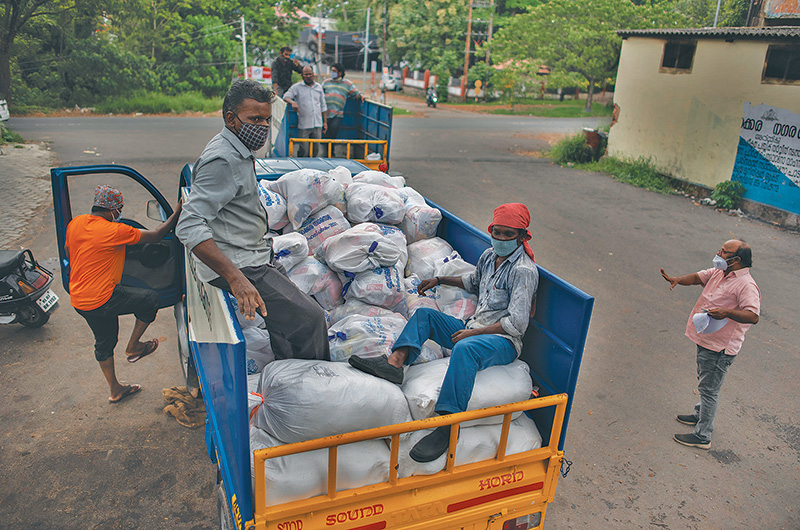
Food kits containing essential grocery items being provided by a local self-governing body are loaded on to a mini truck in Kochi, Kerala state, India on May 25. AP/rss
New Delhi, Rasheeda Jaleel lives in fear that she may not be able to feed her seven children as millions of Indian families are forced into poverty by a devastating new coronavirus wave. The 40-year-old, her husband Abdul Jaleel, 65, and the children already survive on just one meal a day. “When we are hungry and thirsty, I feel very helpless and worry, ‘How am I going to survive like this?’” Jaleel told AFP as she made roti—flatbread—for the solitary meal in their tiny New Delhi flat. “We manage with whatever my husband is able to earn. If it’s not enough, I stay hungry so I can feed my children.” The coronavirus has killed 160,000 in eight weeks, overwhelmed hospitals and shut many businesses in India. Experts warn that another crisis is looming, with rising levels of hunger among poor Indians already reeling from a first lockdown last year. “It’s a double crisis that the poor in the country are facing—there is the health crisis and there is also an income economic crisis,” Anjali Bhardwaj from the Right to Food Campaign told AFP. “We have had a huge health crisis unfolding... and many have had to spend their life savings on trying to provide medical aid to their families.” About 230 million Indians fell into poverty—defined as living on less than 375 rupees ($5) per day—in the first year of the pandemic, according to a study by Bangalore’s Azim Premji University. More than 7.3 million jobs were lost in April alone, according to the Centre for Monitoring the Indian Economy. That means more pain in a country where 90 percent of the workforce is in the informal sector with no social safety net, and where millions do not qualify for emergency government rations. “A lot of people went into poverty last year, they went into debt, and... they had to cut back on food consumption,” Associate Professor Amit Basole, one of the university study’s authors, told AFP. “So the second wave is coming on top of a very precarious, stressed situation.” Abdul Jaleel turned to peddling a rickshaw to feed his family after his construction work dried up during a fresh Delhi lockdown. Previously up to 500 rupees ($7) a day, his income is now as little as 100 rupees. “And on some days, I don’t make anything,” he said. “As parents, we will have to make ends meet somehow, whether we beg, borrow or steal. We have no choice.” In last year’s lockdown, about 100 million people lost their jobs in India. After restrictions were lifted, around 15 percent failed to find employment by the end of 2020—including 47 percent of female workers, the Azim Premji University study found. Many who returned to work had to settle for lower pay, leaving them more vulnerable when the second wave hit. Meanwhile an estimated 100 million Indians, including the Jaleels, have no ration cards to give them access to government food aid, Bhardwaj said. The Right to Food organisation has been campaigning for emergency food supplies to be given to the needy, even if they do not have ration cards. With the pandemic unravelling years of poverty reduction, experts warn that many could remain trapped in a vicious cycle of hardship even after lockdowns are lifted. “The fear is that we... get locked into a longish-term depressed economy where there is low aggregate demand because people’s jobs and incomes are not coming back. And because they are not coming back, it... perpetuates its own cycle,” Basole said. Bhupinder Singh, a micro-financier who has distributed food to the needy during the two lockdowns, has seen desperation rise among hundreds of unemployed men sleeping rough beside a busy Delhi highway. When he arrives with food packets, a cry of excitement goes up and men run to the back of his car and form a long queue. “People are stuck here out of helplessness,” Sunil Thakur, 50, who lost his job as a hotel waiter during the lockdown, told AFP. “If they come with food, we get to eat... If they don’t come, we’ll stay hungry.”
WORLD
Myanmar Covid-19 outbreak hits health system shattered after coup
- REUTERS
Naypyidaw, Breathless, fevered and without the extra oxygen that could help keep them alive, the new coronavirus patients at a hospital near Myanmar’s border with India highlight the threat to a health system near collapse since February’s coup. To help her tend the seven Covid-19 patients at Cikha hospital, day and night, chief nurse Lun Za En has a lab technician and a pharmacist’s assistant. Mostly, they offer kind words and paracetamol. “We don’t have enough oxygen, enough medical equipment, enough electricity, enough doctors or enough ambulances,” Lun Za En, 45, told Reuters from the town of just over 10,000. “We are operating with three staff instead of 11.” Myanmar’s anti-Covid campaign foundered along with the rest of the health system after the military seized power on Feb. 1 and overthrew elected leader Aung San Suu Kyi, whose government had stepped up testing, quarantine and treatment. Services at public hospitals collapsed after many doctors and nurses joined strikes in a Civil Disobedience Movement in the forefront of opposition to military rule—and sometimes on the front line of protests that have been bloodily suppressed. Thirteen medics have been killed, according to World Health Organisation data that shows 179 attacks on health workers, facilities and transport—nearly half of all such attacks recorded worldwide this year, said WHO Myanmar representative Stephan Paul Jost. Some 150 health workers have been arrested. Hundreds more doctors and nurses are wanted on incitement charges. Neither a junta spokesman nor the health ministry responded to requests for comment. The junta, which initially set fighting the pandemic as one of its priorities, has repeatedly urged medics to return to work. Few have responded. A worker at one Covid-19 quarantine centre in Myanmar’s commercial capital, Yangon, said all the specialist health workers there had joined the Civil Disobedience Movement. “Then again, we don’t receive new patients any more as Covid test centres don’t have staff to test,” said the worker, who declined to give his name for fear of retribution. In the week before the coup, Covid-19 tests nationally averaged more than 17,000 a day. That had fallen below 1,200 a day in the seven days through Wednesday. Myanmar has reported more than 3,200 Covid-19 deaths from over 140,000 cases, although the slump in testing has raised doubts over data that shows new cases and deaths have largely plateaued since the coup. Now, a health system in crisis is raising concerns about the likely impact on the country from the wave of infections with variants that is sweeping through India, Thailand and other neighbours. Patients with Covid-19 symptoms started showing up at Cikha hospital in mid-May. It is only 6 km from India, and health workers fear the illness could be the highly infectious B.1.617.2 strain—though they lack the means to test for it. “It’s very concerning that Covid-19 testing, treatment and vaccinations are extremely limited in Myanmar as more lives are at risk with new, more dangerous variants spreading,” said Luis Sfeir-Younis, Myanmar Covid-19 operations manager for the International Federation of Red Cross and Red Crescent Societies. Twenty-four cases have been identified in Cikha, said Lun Za En. Seven were so serious they needed hospitalisation—a sign of how few cases had likely been detected.
WORLD
Israeli ‘change’ bloc steps up effort to oust Netanyahu
Briefing
- AGENCIES
Jerusalem: Israeli politicians Sunday inched closer to forming a coalition that would end the era of right-wing Prime Minister Benjamin Netanyahu, the country’s longest serving leader. Politicians opposed to Netanyahu were in intense talks ahead of a Wednesday night deadline, as a ceasefire held following the latest deadly military conflict with Islamist group Hamas in the Gaza Strip.Netanyahu, 71, who faces trial on fraud, bribery and breach of trust charges which he denies, has held onto power through a period of political turmoil that saw four elections in under two years. After an inconclusive March vote in which Netanyahu’s Likud party gained the most seats but again failed to form a government, former TV anchor Yair Lapid is now trying to build a rival coalition.
WORLD
Iran confirms spying, propaganda charges against French detainee
Briefing
- AGENCIES
Tehran: Iranian prosecutors have confirmed a French man detained in the Islamic republic will be tried for espionage and “propaganda against the system”, his lawyer told AFP on Sunday. Benjamin Briere, born in 1985, was arrested in Iran in May 2020, allegedly while flying a drone and taking photographs in a prohibited area. Espionage is punishable by death in Iran, while the charge of “propaganda against the system” can incur a prison sentence of three months to one year. Lawyer Said Dehghan, who also represents another French national held in the country, told AFP the investigation had been completed and the prosecution had confirmed the charges.
WORLD
Nearly 300 rescued in Indonesia ferry accident
Briefing
- AGENCIES
Ternate: Search teams are looking for one missing person after rescuing all other passengers from a large ferry that caught fire in Indonesia, an official said on Sunday. The KM Karya Indah was heading to Sanana, a remote port in the northeast of the Indonesian archipelago when it was engulfed in flames. Shortly after departing, the ferry caught fire, forcing passengers and crew to jump into the sea to save themselves. There were no reported casualties. “There were 275 people on board, 274 had been evacuated safely,” Muhammad Arafah, the head of the local search and rescue team told Kompas TV Sunday. “One person, a 43-year-old man, is still being searched for.”
WORLD
Ethiopians protest US sanctions over Tigray war
Briefing
- AGENCIES
KAMPALA, Uganda: Thousands of Ethiopians gathered in the nation’s capital Sunday to protest outside pressure on the government over its brutal war in Tigray. Protesters at the rally in Addis Ababa carried banners that criticized the United States and others in the international community who are voicing concern over atrocities in Tigray, where Ethiopian forces are hunting down the region’s ousted and now-fugitive leaders. Troops from neighbouring Eritrea are fighting in Tigray on the side of Ethiopian government forces, in defiance of international calls for their withdrawal. But the protesters in Addis Ababa carried placards that said “Ethiopia’s young denounce the western intervention.”
SPORTS
Changed Nepali side face 6-2 defeat against Asian giants Iraq
The visitors take 2-1 lead before the half-hour mark with goals from Anjan Bista and debutant Manish Dangi but the hosts score three goals in the space of eight minutes to go into the break 2-4.
- Sports Bureau
Anjan Bista (14) and Manish Dangi (right) scored for Nepal during their friendly football match against Iraq. Photo Courtesy: NSJF
KATHMANDU, A changed Nepali national football team succumbed to a 6-2 defeat against Asian powerhouse Iraq in an international friendly match played late Saturday night at the Al Fayhaa Stadium in Basra, Iraq. Playing the match to fine-tune their preparations for the remaining matches of the joint qualifiers for the 2022 World Cup and 2023 AFC Asian Cup, underdogs Nepal exhibited fighting spirit. Unlike in the past, Nepal did not play with a complete defensive approach, the strategy Nepal usually apply playing against the stronger opponents. Iraq, the 2007 Asian Cup winners and semi-finalists of the 2015, are 103 places superior to Nepal in the latest FIFA World Rankings. While Nepal sit at 171st position in the rankings, Iraq are 68th. Playing their first official match under Kuwaiti coach Abdullah Almutairi, Nepal were leading the game 2-1 before the first half hour despite conceding the opening goal. Nepal’s captain and goalkeeper Kiran Kumar Limbu was at fault for the first goal while they conceded at least two more goals courtesy of defending errors. But the hosts almost killed the match by the half time scoring thrice in quick succession to go into the break with a 4-2 lead. “I want to say sorry to everyone in Nepal because we could not get good results. We have trained together as a team for just 11 or 12 days, we need more time and need to be patient,” said Almutairi. “I am the only person to be blamed for the defeat, not the players. We will be ready for the qualifier and we will fight. Today we came close to leading 3-1, but this is football...you miss one goal and everything changes.” Youth midfielder Manish Dangi and defender Gautam Shrestha made their debuts for the national side. Coach Almutairi deployed Anjan Bista, Nawayug Shrestha and Suman Lama upfront while Dangi, Pujan Uperkoti and Santosh Tamang played as midfielders. Nepal conceded a goal in the very seventh minute through a freekick from Alaa Abdul Zahrah as goalie Limbu failed to judge the ball sailing just above his head. The home team’s goal celebration could not last long as Nepal restored the parity a minute later with an own goal though it was awarded to Nepali winger Bista. Iraqi defender Safaa Hadi Al-Furaiji struck inside his own post while attempting to deny Bista from scoring after the 23-year old had beaten goalie Fahad Talib Rahim. Bista came closer to scoring again in the 13th when he capitalisied on a defensive error of a Iraqi defender and unleashed a scorcher from the close range with only the shot stopper standing between him and the goal but Rahim palmed the ball away. Though Iraq piled up consistent pressure, they failed to get the better of Nepali defence line-up early on. Youth midfielder Dangi made it 2-1 in the 29th against the run of play. The 20-year-old collected a defence splitting pass by Santosh Tamang and beat advancing custodian Rahim in a one-on-one situation at the outer edge of the area. Nepal’s experienced central defender Rohit Chand needed medical treatment in the 35th minute for a head injury he picked in the second minute to stop bleeding. They conceded an equaliser in the 39th minute and another a minute later. Mohammed Abdulzahra equalised heading a corner delivery. Forward Aymen Hussein netted the third goal for the home team in the 40th after he collected a weak back pass from Chand to goalie and made it 4-2 in the stoppage time of the first half. Nepal made some changes in the second half bringing midfielder Bishal Rai, Sunil Bal and forward Avishek Rijal in place of Santosh Tamang, Nawayug Shrestha and Manish Dangi. But instead, Iraq piled more pressure on Nepal and the visiting side failed to make a single threatening move after the break. Substitute Mohanad Ali netted the fifth goal for Iraq in the 67th minute again on a defensive error from Suman Aryal. Ali controlled Aryal’s weak back pass to the custodian and rounded up Limbu. Sajjad Jasim sealed the comprehensive 6-2 victory in the 75th when he unleashed an unstoppable scorcher from the area. The Nepali team left for Kuwait on Sunday to play the remaining three matches of the joint qualifiers. Nepal will take on Chinese Taipei on June 3, Jordan on June 7 and Australia on June 11. Nepal are currently second from bottom in Group ‘B’ with three points after playing five matches and do not have any chance of topping the group. Australia lead the standings with 12 points. However, if Nepal maintain their current position in the standings at the completion of the group rounds they could qualify for the next round qualifiers of the 2023 Asian Cup.
SPORTS
Tinkering Guardiola too clever for his own good
- ASSOCIATED PRESS
Chelsea beat Manchester City 1-0 in the final in Porto to win their second Champions League title on Saturday. Ap/Rss
PORTO, Imagine telling Pep Guardiola a decade ago he wouldn’t be lifting the European Cup again. The wait goes on. Three times falling short in campaigns with Bayern Munich. Now a fifth failure with Manchester City. For all his coaching genius, Guardiola can be too clever for his own good. A 10-year wait to return to a Champions League final—after the second of his Barcelona successes—is a long time to spend thinking about how to lift the cup again. And overthinking, if the strategy to take on Chelsea was anything to go by on Saturday. “I did what is the best for the game,” Guardiola said. “We struggled a little bit for the long balls they use—the second ball and after they run. In that moment you need the inspiration, the quality.” Tinkering for the biggest game in City’s history, the unfamiliar lineup sent out by Guardiola was beaten by a coach in only his 30th match in charge of Chelsea. As City await their first European title, Thomas Tuchel delivered Chelsea’s second only four months after replacing Frank Lampard. Make no mistake: City had no one to blame but themselves on a night when they had only one shot on target as Chelsea won 1-0 in Porto. Maybe little surprise then that Sheikh Mansour didn’t turn up in Portugal to attend what would have been his second known match since buying City 13 years ago. Even with all the cash City’s Abu Dhabi ownership has lavished on Guardiola to shape the squad in his own guise, there’s a brutal reality. He’s still not won the Champions League without a team containing Lionel Messi. How differently things could have been if Messi had been able to force his way out of Barcelona as planned. Time for another summer pursuit of the 33-year-old Argentine, perhaps? Prizing the unsettled Harry Kane from Tottenham could take $200 million. We’ve got used to City playing without strikers. Yet, in the desperate search for an equaliser, Gabriel Jesus and then Sergio Aguero were sent on. There would be no fairytale ending for Aguero with a repeat of the late drama that saw him clinch City’s first Premier League title in 2012. The Premier League trophy has been lifted another four times since then—three times under Guardiola including last Sunday—but the quest to win the biggest prize in European football goes on. “Today we are sad,” Guardiola said, “but when we analyse it was a successful season for us.” There was the unexpected setback of losing the playmaking ingenuity of Kevin De Bruyne over concussion fears after an hour at Estadio do Dragao. But just why did Guardiola again shackle the creativity of Ilkay Gundogan when he’s top scorer for the club this season? Instead the German was held back in a defensive midfield role while Rodri and Fernandinho started on the bench. At least one of the positional specialists have started in every game apart from one until Saturday. “Gundogan played many years in this position,” Guardiola said. “To have speed with the ball, to find the small players, the quality, the brilliant players between the lines and this was the decision.” The final big decision in a season when Guardiola will have to settle with another double of just—a frustration by City’s high expectations that didn’t exist until the 2008 takeover—the Premier League and League Cup. A first cup final defeat as City manager leaves Guardiola with the unwelcome distinction of being on a par with one of the game’s other managerial greats. Long into retirement, Alex Ferguson still speaks of the regret of only winning the Champions League twice with Manchester United. Guardiola’s wait for a third stretches into a sixth season at City. “Now I want to go home and take a break of one or two weeks,” Guardiola said. “After that I’ll start to see with the club what is best.”
MEDLEY
Horoscope
ARIES (March 21-April 19) **** Pay close attention to your dreams and inspirations Aries. Your ruling planet, self-assertive Mars, spends the day in a supportive connection with clairvoyant Neptune today. This connection provides you with powerful imaginative insights.
TAURUS (April 20-May 20) *** As a Taurus, you come equipped with fine-tuned instincts. Make sure you’re listening to them loud and clear today, as the illuminating sun merges with the North Node of fate. You have a magnetic charisma that can capture your network’s attention.
GEMINI (May 21-June 21) **** The days ahead are bound to mess with your perception of reality, Gemini. Listen to the emerging messages, but refrain from getting totally pulled out to sea. Today some events will bring illuminating insights into your sense of identity and independence.
CANCER (June 22-July 22) *** You have the power to enchant people with your self-expression today, Cancer. Self-motivated Mars forms a supportive connection to visionary Neptune, helping you put your dreams into action and attracting people to your cause.
LEO (July 23-August 22) *** Important revelations are making themselves known to the trajectory of your goals today, Leo. Dial into your intuition and listen to the emerging messages around your identity, sense of community, and long-term aspirations.
VIRGO (August 23-September 22) **** You’ve got all the support you need to make your new calling come to life, Virgo. Energetic Mars locks into a harmonious connection with dreamy Neptune today, helping you interact with your community and social network.
LIBRA (September 23-October 22) *** The path forward is beginning to emerge today, Libra. Pay close attention to the messages appearing around the big-picture vision you’re building. You will discover fresh insights around educational matters and your beliefs in life.
SCORPIO (October 23-November 21) *** As a Scorpio, you’re guided by the swift and sharp movements of the red planet, Mars. Today’s skies find Mars locked into an ethereal alignment with imaginative Neptune. This pairing allows you to act on inspiration with ease.
SAGITTARIUS (November 22-December 21) *** Tune into the stories emerging on the relationship front today, Sagittarius. The sun spends the day merged with the North Node of fate, bringing revelations or insights to your current partnership story.
CAPRICORN (December 22-January 19) **** You’re deep in the process of trying to reconnect with your work in a meaningful way, Capricorn. Let today’s cosmic landscape guide you towards the next step, as the illuminating sun merges with the north node of fate.
AQUARIUS (January 20-February 18) *** Are you listening to yourself enough, Aquarius? Monday’s skies work to bring critical revelations around romance, relationships, and creative self-expression. But today focus your energy on your workload.
PISCES (February 19-March 20) *** Look deep within today, Pisces. A light is shining upward from way down low, as the sun unites with the North Node of fate. This once-a-year pairing brings critical insights and fated occurrences concerning your living space and family connections.
CULTURE & LIFESTYLE
Egypt bets on ancient finds to pull tourism out of pandemic
As some European countries re-open to international tourists, Egypt has already been trying for months to attract them to its archaeological sites and museums.
- SAMY MAGDY
People visit the new National Museum of Egyptian Civilization in Old Cairo. Ap/rs
CAIRO, Workers dig and ferry wheelbarrows laden with sand to open a new shaft at a bustling archaeological site outside of Cairo, while a handful of Egyptian archaeologists supervise from garden chairs. The dig is at the foot of the Step Pyramid of Djoser, arguably the world’s oldest pyramid, and is one of many recent excavations that are yielding troves of ancient artefacts from the country’s largest archaeological site. As some European countries re-open to international tourists, Egypt has already been trying for months to attract them to its archaeological sites and museums. Officials are betting that the new ancient discoveries will set it apart in the mid-and post-pandemic tourism market. They need visitors to come back in force to inject cash into the tourism industry, a pillar of the economy. But like countries elsewhere, Egypt continues to battle the coronavirus and is struggling to get its people vaccinated. The country has, up until now, received only 5 million vaccines for its population of 100 million people, according to its Health Ministry. In early May, the government announced that 1 million people had been vaccinated, though that number is believed to be higher now. In the meantime, authorities have kept the publicity machine running, focused on the new discoveries.
In November, archaeologists announced the discovery of at least 100 ancient coffins dating back to the Pharaonic Late Period and Greco-Ptolemaic era, along with 40 gilded statues found 2,500 years after they were first buried. That came a month after the discovery of 57 other coffins at the same site, the necropolis of Saqqara that includes the step pyramid. “Saqqara is a treasure,” said Tourism and Antiquities Minister Khaled el-Anany while announcing the November discovery, estimating that only 1 percent of what the site contains has been unearthed so far. “Our problem now is that we don’t know how we can possibly wow the world after this,” he said. If they don’t, it certainly won’t be for lack of trying. In April, Zahi Hawass, Egypt’s best-known archaeologist, announced the discovery of a 3,000-year-old lost city in southern Luxor, complete with mud-brick houses, artefacts and tools from pharaonic times. It dates back to Amenhotep III of the 18th dynasty, whose reign (1390–1353 BC) is considered a golden era for ancient Egypt. That discovery was followed by a made-for-TV parade celebrating the transport of 22 of the country’s prized royal mummies from central Cairo to their new resting place in a massive facility farther south in the capital, the National Museum of Egyptian Civilization. The Red Sea resort of Sharm el-Sheikh is now home to an archaeological museum, as is Cairo’s International Airport, both opened in recent months. And officials have also said they still plan to open the massive new Grand Egyptian Museum next to the Giza Pyramids by January, after years of delays. Entrance fees for archaeological sites have been lowered, as has the cost of tourist visas. The government has for years played up its ancient history as a selling point, as part of a years-long effort to revive the country’s battered tourism industry. It was badly hit during and after the popular uprising that toppled longtime autocrat Hosni Mubarak and the ensuing unrest. The coronavirus dealt it a similar blow, just as it was getting back on its feet. In 2019, foreign tourism’s revenue stood at $13 billion. Egypt received some 13.1 million foreign tourists—reaching pre-2011 levels for the first time. But in 2020, it greeted only 3.5 million foreign tourists, according to minister el-Anany. At the newly opened National Museum of Egyptian Civilization, Mahmoud el-Rays, a tour guide, was leading a small group of European tourists at the hall housing the royal mummies. “2019 was a fantastic year,” he said. “But corona reversed everything. It is a massive blow.” Tourism traffic strengthened in the first months of 2021, el-Anany, the minister, told The Associated Press in a recent interview, though he did not give specific figures. He was optimistic that more would continue to come year-round. “Egypt is a perfect destination for post-Covid in that our tourism is really an open-air tourism,” he said. But it remains to be seen if the country truly has the virus under control. It has recorded a total of 14,950 deaths from the virus and is still seeing more than a thousand new cases daily. Like other countries, the real numbers are believed to be much higher. In Egypt, though, authorities have arrested doctors and silenced critics who questioned the government’s response, so there are fears that information on the true cost of the virus may have been suppressed from the beginning. Egypt also had a trying experience early on in the pandemic, when it saw a coronavirus outbreak on one of its Nile River cruise boats. It first closed its borders completely until the summer of 2020, but later welcomed tourists back, first to Red-Sea resort towns and now to the heart of the country—Cairo and the Nile River Valley that hosts most of its famous archaeological sites. Visitors still require a negative Covid-19 test result to enter the country. In a further cause for optimism, Russia said in April that it plans to resume direct flights to Egypt’s Red Sea resort towns. Moscow stopped the flights after the local Islamic State affiliate bombed a Russian airliner over the Sinai Peninsula in October 2015, killing all on board. Amanda, a 36-year-old engineer from Austria, returned to Egypt in May. It was her second visit in four years. She visited the Egyptian Museum, the National Museum of Egyptian Civilization and Islamic Cairo, in the capital’s historic centre. She had planned to come last year, but the pandemic interfered. “Once they opened, I came,” she said. “It was my dream to see the Pyramids again.” El-Rays, the tour guide, says that while he’s seeing tourists starting to come in larger numbers, he knows a full recovery will not happen overnight. “It will take some time to return to before corona,” he said.