You internet speed is slow. Switch to text view mode

Switch
epaper logo
ST

Last Login:
Logout
+
Page 1
HOME PAGE

After Deuba’s trust vote, UML seems to be unravelling

As differences between Oli and Nepal have reached the point of no return, the only question is how many will side with the latter as he appears set to quit the party, insiders say.
- ANIL GIRI

KATHMANDU,
The conflict in the CPN-UML, which was relegated to the opposition benches last week, has escalated further after as many as 22 of its lawmakers on Sunday voted for Prime Minister Sher Bahadur Deuba during his vote of confidence.
On Monday, the party’s Central Committee decided to seek clarifications from the 22 lawmakers–14 from the Madhav Nepal faction and eight from chair KP Sharma Oli’s group–for defying the party whip, in what looks like a precursor of a party split.
Bishnu Rijal, a Central Committee member of the UML, confirmed that Monday’s meeting decided to seek clarification from 22 Members of Parliament.
Those who defied the party whip have been given 24 hours to furnish their clarification.
Birodh Khatiwada, Jevan Ram Shrestha, Kalyani Khadka, Metmani Chaudhary, Bhawani Khapung, Mukunda Neupane, Parvati Bishanke, Hira KC, Krishna Kumar Shrestha and Gopal Bam had voted for Deuba. Similarly, Prem Bahadur Ale, Dhan Bahadur Budha, Bina Budhathoki, Sarala Yadav, Pushpa Kumari Karna, Laxmi Chaudhary, Nirudevi Jairu, Ram Kumari Jhakri, Kalila Khatun, Sabina Hussein and Krishna Lal Maharjan also voted for Deuba.
The UML that has been in turmoil for quite some months appeared to become more vulnerable to unravelling following Sunday’s voting on Deuba’s confidence motion.
The Oli camp has concluded that the “mutiny” by the Nepal faction is an“unforgivable crime”, while it is also trying to figure out how some lawmakers who were loyal to the establishment decided to vote for Deuba.
“Some leaders have committed an ‘unforgivable crime’ by voting for Deuba and it is not acceptable to us,” General Secretary Ishwar Pokhrel said on Monday while speaking at the party’s Central Committee meeting that decided to seek clarification from 22 lawmakers, according to UML leaders the Post talked to.      
According to insiders, during the Central Committee meeting, Oli came down heavily on the dissidents, particularly Madhav Nepal, saying there is no space for Nepal in the party now onwards.
Immediately after the Central Committee meeting, Oli called a meeting of the party’s Standing Committee.
As many as 23 lawmakers from the Nepal faction had supported the Deuba-led alliance’s petition at the Supreme Court demanding that the House, dissolved by Oli on May 21, be reinstated and Deuba be appointed prime minister.
Deuba on May 21 had presented his claim before President Bidya Bhandari with the signatures of 149 lawmakers, including 26 from the Nepal faction, that he be appointed prime minister under Article 76 (5).
But Oli, who on May 20 said that there was no scope for him to garner a majority, also laid claim to the post of prime minister, saying he had the support of 153 lawmakers.
After Bhandari rejected both claims, Oli recommended House dissolution, which President Bhandari endorsed.
But on July 12, the Supreme Court ordered the Office of the President to appoint Deuba as prime minister by 5pm of July 13. Though Deuba had until August 11 to secure a vote of confidence, he went for a floor test on Sunday, the first day of the session of the restored House and he passed it with flying colours.
Sunday’s vote ensures that Deuba will govern for the one year and a half, until periodic elections, and Oli, who once led a near two-thirds majority government, will remain the leader of the main opposition party.
Sunday’s voting pattern, according to insiders, shows the intra-party conflict has not reached the point of no return.
“Frankly speaking, our calculation was Nepal and some of the party lawmakers would not return to the party since differences between Oli and Nepal had reached a point from where they could not be fixed,” said a Standing Committee member close to Oli. “After the 22 lawmakers from our party voted for Deuba on Sunday, the situation has become even more complicated. Eight lawmakers from our faction voting for Deuba certainly comes as a setback for us.”
The Nepal faction is currently discussing multiple options. If it becomes untenable for its leaders to remain within the UML under Oli, they could either form a new party or attempt to forge a deal to form a left alliance.
One of the immediate options for the Nepal faction is joining the Deuba government.
A leader from the Nepal faction, who spoke on condition of anonymity, said that no decision has been taken yet, but discussions are ongoing on multiple options.
 “Discussions are also being held on six ministerial portfolios with one deputy prime minister, but it will take a while before we reach a decision,” the leader told the Post. “If that happens, it could be a major turning point… it will make sure that we are not going to return to the UML under Oli.”
There, however, are some leaders within the Nepal faction who are still making attempts to save the UML from splitting.
At least five leaders from the Nepal faction in the 10-member task force formed to find ways to save the party unity are not likely to let Nepal split the party.
These five members are Bhim Rawal, Ghanshyam Bhusal, Surendra Pandey, Gokarna Bista and Raghuji Pant.
Of them, Bhim Rawal on Sunday announced his resignation as a lawmaker, hours before the vote on Deuba’s confidence motion.
“Those 11 members, including Rawal, who abstained from voting on Sunday are likely to return to the establishment faction,” Bishal Bhattarai, chief whip of the UML, told the Post.  
Ghanshyam Bhusal, Surendra Pandey, Yogesh Bhattarai, Gokarna Bista, Narayan Khatiwada, Dipak Bhatta, Raj Bahadur Budha and Jhapat Rawal belonging to the Nepal faction abstained from voting on Sunday. Similarly, Yagya Bahadur Sunuwar and Som Prasad Pandey too were not present in the House during the voting.
Jhala Nath Khanal, a key leader in the Nepal faction who had on Sunday morning called for voting in favour of Deuba, also was not present in the House during the voting as he is currently in India for treatment.
Chief Whip Bhattarai said that since the Supreme Court’s verdict also made it clear that the party whip does not apply to lawmakers, the party cannot take stern action against those lawmakers who voted for Deuba.
“We have heard that the ruling coalition has given word that those who voted in favour of the prime minister would be given ministerial portfolios,” Bhattarai told the Post.
Nepal’s fight against what he calls Oli’s bid to run the party with an iron fist so far has earned him praise, but many say he needs to take a concrete decision now if he wants to uphold his promise of politics of values.
Nepal does not have the control Oli enjoys in the party yet. But some say with Oli’s fall, there are chances the party chair could make some concessions.
Political analysts, however, say the bitterness between Oli and Nepal has reached such a level that a patch-up is very unlikely.
“The UML is technically–and legally–one party, but a split has already actually occurred,” said Narayan Dhakal, a commentator and writer who was earlier a UML member. “Chances of Oli and Nepal mending fences are minimal. Nepal either has to form a new party or for a broader left alliance.”
Som Prasad Pandey, a leader close to Nepal, said that attempts for reconciliation have been ongoing.
“But things appear to have gone a bit too far,” Pandey told the Post. “Oli also does not seem to be in a compromising mood.”
According to Pandey, those second-rung leaders who were trying to bring Oli and Nepal together also could not play any constructive role, as they too had their own vested interests.
“I don’t think there could be any breakthrough in party unity, but we are still trying,” said Pandey.
Leaders from Oli’s orbit say they have by now realised that Nepal has almost made up his mind to leave the UML.
“Nepal most probably will try to forge an alliance with Maoist Centre chair Pushpa Kamal Dahal,” said the Standing Committee member close to Oli. “I don’t think Nepal will return to the UML under Oli.”
If Nepal, who led the UML for 15 years until 2008, leaves the UML, it will mark a major turning point for the country’s communist movement as well. Insiders say both Oli and Nepal should try to find a win-win deal to keep the party intact.
“But I don’t see any prospect of Oli and Nepal coming together now,” said Rijal, the Central Committee member. “Chances of party unity are slim. The only question now is how many will remain within the UML and how many will leave.”


(Tika R Pradhan contributed reporting)

HOME PAGE

To the relief of foreign job sector, single-shot J&J vaccine being given to migrant workers

Authorities earlier had decided to give them Chinese Vero Cell. Besides not being approved by many labour destinations, its double-shot regime was impractical for outbound workers.
- CHANDAN KUMAR MANDAL

KATHMANDU,
In a last minute change of plans, the Ministry of Health and Population on Monday started administering the single-shot Janssen vaccine developed by Johnson & Johnson to migrant workers. The decision comes as some relief to the foreign employment sector, which has been hard hit by the pandemic.
Kathmandu Valley residents aged 50 to 54 were also administered the single-shot vaccine from Monday with the 1,534,850 doses of the jab the United States provided in grant
assistance through the COVAX facility. The single-shot vaccine is also being given to disabled persons, refugees living in Nepal, and health officials and sanitation workers at health facilities.
According to Dr Jhalak Gautam, chief of the National Immunisation Programme, Johnson & Johnson vaccines will be given to Nepali migrants if they are departing to labour destinations that have made Covid-19 vaccination mandatory for entry.
“The Johnson & Johnson vaccine is not available to migrants going to any foreign country, but to those countries which have made Covid-19 vaccines, including the Janssen vaccine, compulsory for entry,” Gautam told the Post. “They can get vaccinated after showing their passport and visa at the vaccination centre.”
Stakeholders from the foreign employment sector have welcomed the government decision.
According to Sujit Kumar Shrestha, general secretary of the Nepal Association of Foreign Employment Agencies (NAFEA), the government decision will ease labour migration.
“Providing the Johnson & Johnson vaccine to Nepali workers will greatly help them. Comparatively, more destination countries have approved the single-shot vaccine than the Chinese one,” said Shrestha. “The single-shot vaccine will lessen hassles for our workers.”
The government had earlier decided to administer the Vero Cell vaccine, manufactured by the Chinese pharmaceutical giant Sinopharm, to migrant workers. But since the Chinese vaccine requires two doses taken at a gap of three to four weeks, it had been deemed impractical for workers ready to fly abroad.  
As labour destination countries started making Covid-19 vaccination compulsory for entry for foreigners, including Nepalis, Nepal’s labour migration sector, which had already been reeling under the impact of the pandemic, had once again faced uncertainty.
Migrant rights activists and organisations, as well as recruiting agencies, had been calling on the government to arrange vaccines for outbound migrants and inoculate them on priority.
Besides, as the Sinopharm vaccine has not been approved by a majority of labour destination countries in the Persian Gulf, stakeholders had complained that the government had failed to sufficiently address the problems in the foreign employment sector.
Saudi Arabia, Kuwait and Oman are among destination countries that have not approved the Chinese vaccine while Qatar has listed it as a conditionally approved vaccine.
Meanwhile, two labour destination countries—the United Arab Emirates and Bahrain—have not approved the single-dose Janssen vaccine.
According to Dr Samir Kumar Adhikari, joint spokesperson of the Ministry of Health, the single-shot vaccine will be given to migrant workers ready to fly to countries that have not approved the Sinopharm vaccine.
“Health workers at vaccination centres will also check if a worker’s destination country has not given approval to the Vero Cell vaccine before administering the Johnson & Johnson vaccine,” Adhikari told the Post.
But despite the decision of the Health Ministry to inoculate them with the Johnson & Johnson vaccine, there is confusion among migrant workers, according to Mahendranath Bhattarai, a spokesperson with the Department of Foreign Employment.
“Groups of migrant workers have been visiting the department’s offices and asking us to write recommendation letters for them so that they can get the vaccine,” said Bhattarai. “We don’t know what kind of letter we should write and whom to address it to.”
Another concern is that the ongoing phase of the vaccination campaign with Janssen will continue until Wednesday and stakeholders are worried that it may run out before all migrant workers ready to fly are inoculated.
According to Gautam of the National Immunisation Programme, once the stock of the Johnson & Johnson vaccine runs out, outbound migrant workers will be given Vero Cell.
“After the Johnson & Johnson vaccine runs out, Vero Cell vaccines will be made available to migrant workers,” said Gautam. “In that case, vaccination centres, where migrant workers can get the shots, will be fixed too.”
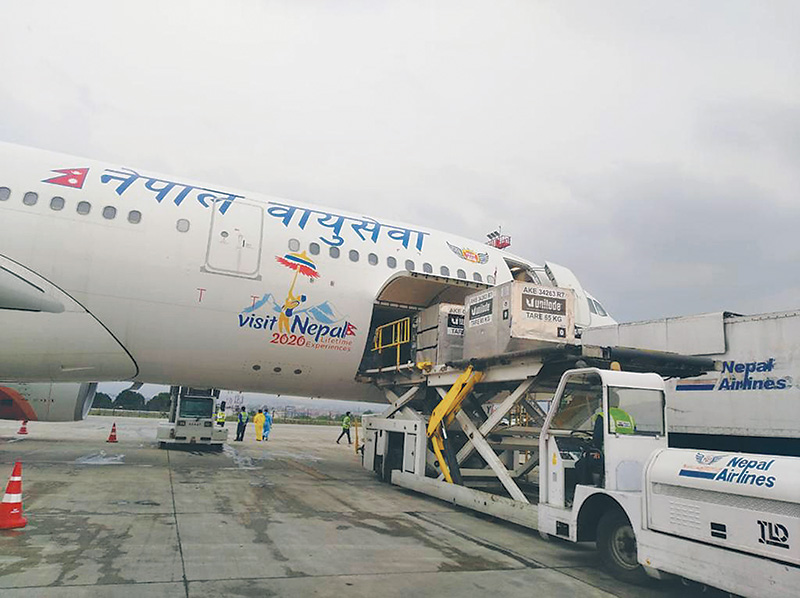
That will be later this week after more shipments of the Sinopharm vaccine arrive from Beijing. Of the 4 million doses of the vaccine Nepal bought under a non-disclosure agreement, only 800,000 doses have been delivered and three flights are scheduled for later this week to bring some 2.4 million doses.
According to Shrestha, the recruiting agencies’ representative, nearly 30,000 Nepali migrant workers have taken the final labour permit to fly for overseas jobs, whereas job demands for almost 98,000 workers have been approved.
“Arrival of more vaccines in the near future and allotting Johnson & Johnson to outbound migrants is likely to provide some hope for recovery of foreign employment sector,” said Shrestha. “Nepali workers could not leave for foreign employment lately because of the mandatory vaccine policies and expensive quarantine requirements. More people will start migrating now.”
According to the Nepal Rastra Bank data, in the first 11 months of the fiscal year 2020-21, the number of new Nepali workers taking approval for foreign employment decreased by 59.9 percent compared to the same period in the previous year. In the first 11 months of 2019-20, it had gone down by 12.4 percent compared to the same period in the fiscal year 2018-19.
Similarly, the number of Nepali workers taking approval for re-entry to labour destinations in the first 11 months of the fiscal year 2020-21 had gone down by 47.1 percent compared to the same period the previous fiscal year. The figure had also gone down during the same period in the fiscal year 2019-20 compared to the fiscal year 2018-19--by 31.1 percent.  
Remittances make a crucial contribution to Nepal’s economy.
Remittances to Nepal stood at $8.1 billion in 2020, a fall of about 2 percent compared to the previous year largely because international flights were suspended for months due to the pandemic, according to a World Bank report.
The report said the contribution of remittances to the economy is equivalent to 23.5 percent of the GDP.
The Ministry of Health and Population had been under pressure from stakeholders, including the Ministry of Labour, Employment and Social Security, to administer the single-shot Johnson & Johnson vaccine to migrant workers.
“The decision to administer the Johnson & Johnson vaccine to migrant workers was made because of its practicality,” said Adhikari, the joint spokesman of the Health Ministry.  


(Arjun Poudel contributed reporting.)

HOME PAGE

Journalists, activists among Israeli firm’s spyware targets, probe finds

The reporting bolsters accusations that not just autocratic regimes but democratic governments, including India and Mexico, have used the spyware for political ends.
- ASSOCIATED PRESS
Hatice Cengiz, the fiancee of slain Saudi journalist Jamal Khashoggi, ison the list of people whose phone was bugged with Pegasus spyware. AP/RSS

BOSTON,
An investigation by a global media consortium based on leaked targeting data provides further evidence that military-grade malware from Israel-based NSO Group, the world’s most infamous hacker-for-hire outfit, is being used to spy on journalists, human rights activists and political dissidents.
From a list of more than 50,000 cellphone numbers obtained by the Paris-based journalism nonprofit Forbidden Stories and the human rights group Amnesty International and shared with 16 news organizations, journalists were able to identify more than 1,000 individuals in 50 countries who were allegedly selected by NSO clients for potential surveillance.
They include 189 journalists, more than 600 politicians and government officials, at least 65 business executives, 85 human rights activists and several heads of state, according to The Washington Post, a consortium member. The journalists work for organizations including The Associated Press, Reuters, CNN, The Wall Street Journal, Le Monde and The Financial Times.
Amnesty also reported that its forensic researchers had determined that NSO Group’s flagship Pegasus spyware was successfully installed on the phone of Post journalist Jamal Khashoggi’s fiancee, Hatice Cengiz, just four days after he was killed in the Saudi Consulate in Istanbul in 2018.
The company had previously been implicated in other spying on Khashoggi.
NSO Group denied in an emailed response to AP questions that it has ever maintained “a list of potential, past or existing targets.” In a separate statement, it called the Forbidden Stories report “full of wrong assumptions and uncorroborated theories.”
The company reiterated its claims that it only sells to “vetted government agencies” for use against terrorists and major criminals and that it has no visibility into its customers’ data. Critics call those claims dishonest—and have provided evidence that NSO directly manages the high-tech spying. They say the repeated abuse of Pegasus spyware highlights the nearly complete lack of regulation of the private global surveillance industry.
The source of the leak—and how it was authenticated—was not disclosed. While a phone number’s presence in the data does not mean an attempt was made to hack a device, the consortium said it believed the data indicated potential targets of NSO’s government clients. The Post said it identified 37 hacked smartphones on the list. The Guardian, another consortium member, reported that Amnesty had found traces of Pegasus infections on the cellphones of 15 journalists who let their phones be examined after discovering their number was in the leaked data.
The most numbers on the list, 15,000, were for Mexican phones, with a large share in the Middle East. NSO Group’s spyware has been implicated in targeted surveillance chiefly in the Middle East and Mexico. Saudi Arabia is reported to be among NSO clients. Also on the lists were phones in countries including France, Hungary, India, Azerbaijan, Kazakhstan and Pakistan.
“The number of journalists identified as targets vividly illustrates how Pegasus is used as a tool to intimidate critical media. It is about controlling public narrative, resisting scrutiny, and suppressing any dissenting voice,” Amnesty quoted its secretary-general, Agnes Callamard, as saying. In one case highlighted by the Guardian, Mexican reporter Cecilio Pineda Birto was assassinated in 2017 a few weeks after his cell phone number appeared on the leaked list.
The consortium’s findings build on extensive work by cybersecurity researchers, primarily from the University of Toronto-based watchdog Citizen Lab. NSO targets identified by researchers beginning in 2016 include dozens of Al-Jazeera journalists and executives, New York Times Beirut bureau chief Ben Hubbard, Moroccan journalist and activist Omar Radi and prominent Mexican anti-corruption reporter Carmen Aristegui. Her phone number was on the list, the Post reported. The Times said Hubbard and its former Mexico City bureau chief, Azam Ahmed, were on the list.
Two Hungarian investigative journalists, Andras Szabo and Szabolcs Panyi, were among journalists on the list whose phones were successfully infected with Pegasus, the Guardian reported.
Among more than two dozen previously documented Mexican targets are proponents of a soda tax, opposition politicians, human rights activists investigating a mass disappearance and the widow of a slain journalist. In the Middle East, the victims have mostly been journalists and dissidents, allegedly targeted by the Saudi and United Arab Emirates governments. The consortium’s “Pegasus Project” reporting bolsters accusations that not just autocratic regimes but democratic governments, including India and Mexico, have used NSO Group’s Pegasus spyware for political ends. Its members, who include Le Monde and Sueddeutsche Zeitung of Germany, are promising a series of stories based on the leak.
Pegasus infiltrates phones to vacuum up personal and location data and surreptitiously control the smartphone’s microphones and cameras.
The programme is designed to bypass detection and mask its activity. NSO Group’s methods to infect its victims have grown so sophisticated that researchers say it can now do so without any user interaction, the so-called “zero-click” option.
In 2019, WhatsApp and its parent company Facebook sued NSO Group in US federal court in San Francisco, accusing it of exploiting a flaw in the popular encrypted messaging service to target some 1,400 users. NSO Group denies the accusations.
The Israeli company was sued the previous year in Israel and Cyprus, both countries from which it exports products. The plaintiffs include Al-Jazeera journalists, as well as other Qatari, Mexican and Saudi journalists and activists who say the company’s spyware was used to hack them.
Several of the suits draw heavily on leaked material provided to Abdullah Al-Athbah, editor of the Qatari newspaper Al-Arab and one of the alleged victims. The material appears to show officials in the United Arab Emirates discussing whether to hack into the phones of senior figures in Saudi Arabia and Qatar, including members of the Qatari royal family.
NSO Group does not disclose its clients and says it sells its technology to Israeli-approved governments to help them target terrorists and break up paedophile rings and sex- and drug-trafficking rings. It claims its software has helped save thousands of lives and denies its technology was in any way associated with Khashoggi’s murder.
NSO Group also denies involvement in elaborate undercover operations uncovered by The AP in 2019 in which shadowy operatives targeted NSO critics including a Citizen Lab researcher to try to discredit them.
Last year, an Israeli court dismissed an Amnesty International lawsuit seeking to strip NSO of its export license, citing insufficient evidence.
NSO Group is far from the only merchant of commercial spyware. But its behaviour has drawn the most attention, and critics say that is with good reason.
Last month, it published its first transparency report, in which it says it has rejected “more than $300 million in sales opportunities as a result of its human rights review processes.”
Eva Galperin, director of cybersecurity at the Electronic Frontier Foundation and a strident critic, tweeted: “If this report was printed, it would not be worth the paper it was printed on.”
A new, interactive online data platform created by the group Forensic Architecture with support from Citizen Lab and Amnesty International catalogues NSO Group’s activities by country and target. The group partnered with filmmaker Laura Poitras, best known for her 2014 documentary “Citzenfour” about NSA whistleblower Edward Snowden.
“Stop what you’re doing and read this,” Snowden tweeted Sunday, referencing the consortium’s findings. “This leak is going to be the story of the year.”

Page 2
NATIONAL

Women in remote Baglung village are sent to animal sheds to give birth

Many women die for want of treatment and maternity care in Dhiri since they do not go to hospitals for delivery.
- PRAKASH BARAL
A community health unit and a birthing centre were established in Dhiri four months ago but the number of service seekers is minimal. Post Photo: Prakash Baral

BAGLUNG,
Three years ago, Narita Gotame was forced to go to an animal shed in a forest, around a two-hour walk from her house, to give birth to her daughter. She stayed at the animal shed for a month with her newborn before she made her way home.
While in the forest, Gotame struggled for survival, as she was deprived of nutritious food and maternity care.
“I had to give birth in the animal shed during a cold winter month. It was snowing in the area,” said Narita from Dhiri in Dhorpatan Municipality-3, Baglung.
Like Narita, pregnant women at Dhiri village are taken to animal sheds when they go into labour rather than health facilities. The villagers consider childbearing as ‘impure’, so the expecting mothers are sent to remote forests, away from human settlements, to give birth.
Many women die in need of treatment and maternity care in Dhiri since they do not go for institutional birth. “I somehow survived the hardship and saved my daughter. But my sister-in-law died of delivery complications at the animal shed 10 years ago,” said Gotame.
According to her, many other families in the village follow the tradition, putting the lives of mothers and their newborns at risk
Dhiri is a remote settlement at Ward 4 of Dhorpatan Municipality in Baglung district. There are around 100 households in Dhiri and most of them are Dalits. The settlement is around a three-hour walk from Khunga, where the ward office lies. A road track was opened in Dhiri last year but it is not motorable.
The local people of Dhiri and neighbouring Phalamkhani and Lukurban villages have around 40 animal sheds near the forest of Thulokhore. The farmers stay in the sheds and rear sheep, cattle and buffalo.
According to Hira Gaire, chief at Dhiri Community Health Unit, many women die as they give birth in animal sheds instead of visiting birthing centres for safe delivery.
“We didn’t have proper knowledge about medical practices in the past. Pregnant women in Dhiri were not allowed to deliver babies in their houses and were asked to go to animal sheds for delivery,” said Gotame. “But the tradition has not changed. Women are still made to go to animal sheds to give birth.”
Lal Bahadur BK, a resident of Dhiri, said that many women have died in Dhiri and Phalamkhani due to lack of awareness.
“Women were not taken to health institutions for child delivery in the past. Sadly, the situation is still the same,” BK said.
Lal Bahadur’s wife Apsara also delivered her four babies in a shed.
“We were hesitant to go to a hospital to give birth,” she said.
According to Tilak Gharti, the ward chairman of Dhiri, the maternal mortality rate is high in the village, as some people still live in caves and are unaware of the services provided by health institutions.
A community health unit and a birthing centre were established in Dhiri around four months ago by the District Health Office in coordination with the ward office but the number of service seekers is minimal.
“A campaign has been launched to provide health consultation to pregnant women in the villages. Since the establishment of the birthing centre in Dhiri, we are trying to get as many women to give birth at the centre as possible,” said Gaire.

NATIONAL

Drinking water project benefits 176 households in Salyan

- BIPLAB MAHARJAN

SALYAN,
Forty-five-year-old Dilmaya Budha from Khanigaun in Bangadkupinde Municipality-3, Salyan used to walk for at least one-and-a-half hours to fetch a vessel of water from the nearest spring.
But these days, she gets water in her own house courtesy of a solar lift drinking water project.
Not only Budha but several families in Khetgara, Khanigaun, Melatakura and Kumtakura settlements in Bangadkupinde-3 have benefitted from the water project.
“Our difficulties have come to an end now. We used to waste so many hours a day collecting water from the spring but now, we get water on our own doorsteps,” said Gauri Pun of Bangadkupinde Municipality Ward-3. “We don’t have to face water shortage even in the dry season.”
The solar lift drinking water project has come into operation with the collaboration of the Constituency Development Fund and the provincial and local governments. JUP Private Limited was awarded the contract for the Rs 37.4 million project.
According to Indra Kumar Pun, a resident of Bangadkupinde, 176 households have benefited from the drinking water project.
“Water from Mula Khola, which is around 500 meters below the settlement, has been lifted to our settlement,” Pun said.
Local residents say the drinking water project has also come as a boon to the village’s children.
“The studies of school children had been affected, as they had to spend hours fetching water from the spring in the past. Many children in our settlement had to miss classes and homeworks,” Pun said. “But with the completion of the water project, the children won’t have to do that anymore and can instead focus more on their studies.”
The residents of Bangadkupinde Ward 3 had been demanding for the water project for the past three decades. But it was only in the last fiscal year that the authorities allocated a budget for the project.
According to Govind Kumar Pun, the mayor of Bangadkupinde Municipality, various settlements in ward 3 were suffering from an acute shortage of water in the past.
“The decades-long water crisis has come to an end now. Several drinking water projects are underway in other places of the local unit as well,” he said.

Page 3
NATIONAL

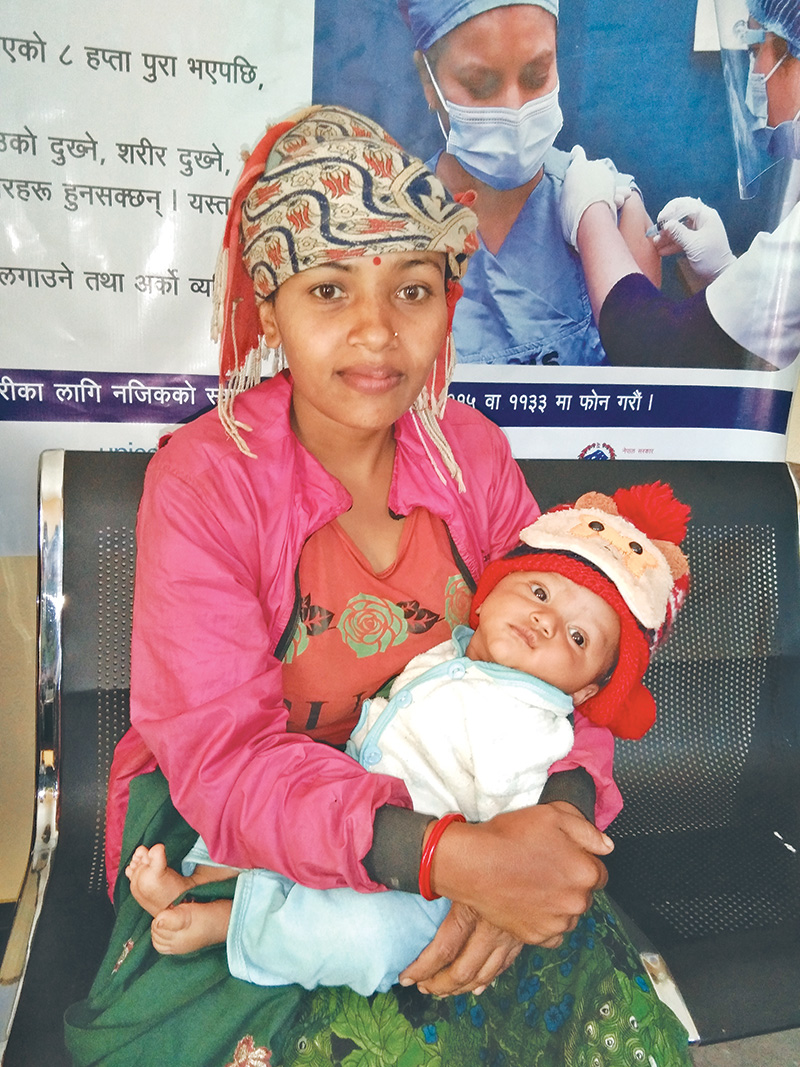
Regular vaccination programme takes hit amid Covid-19 pandemic

Doctors warn disruption in the regular immunisation programme could pose a serious risk to children’s health.
- Arjun Poudel

KATHMANDU,
Last year in May, when the number of Covid-19 cases spiked in Narainapur Rural Municipality of Banke district, the local administration enforced a strict lockdown. The restrictions not only prevented people from coming out from their homes but also deprived them from getting basic health care, including immunisation services.
The coronavirus infection had emerged as a major public health threat. It was wreaking havoc in almost all the sectors. The country’s health care system was buckling under the pressure of Covid-19 pandemic. Regular immunisation services were disrupted in many places including in Narainapur.
With the public transport halted and the fear of the virus infection among the population, hundreds of children missed their regular vaccine schedule throughout the country.
“We found that 135 children missed their regular vaccine after the infection outbreak in our rural municipality,” Nagendra Kumar Shah, health coordinator of Narainapur Rural Municipality, told the Post over the phone. “After the number of new cases started to decline, we mobilised health workers to trace their whereabouts.”
According to the World Health Organisation and UNICEF, 23 million children missed out on basic childhood vaccines through routine health services in 2020 worldwide. It is the highest number since 2009 and 3.7 million more than in 2019.
Narainapur Rural Municipality was one of the most active Covid-19 hotspots. Hundreds of infected people who had returned from India had tested positive for the disease. Local health facilities were overwhelmed and panic had spread among the local residents.
The Ministry of Health and Population said the routine immunisation programme was affected by the pandemic despite the government’s efforts to continue the services.
“Regular immunisation services were not halted for a long time but many people did not seek the services due to various reasons,” Dr Jhalak Gautam, chief of immunisation section at Family Welfare Division, told the Post. “I cannot give you the exact figure of the children who missed their routine vaccines, but the vaccine coverage has declined in our country.”
Regular immunisation of childhood diseases is one of the most successful programmes in Nepal, with a high coverage rate. The country has demonstrated remarkable progress in reducing the under-five mortality rate and the regular immunisation programme is credited for the success.
In 2019, it was estimated that the country reduced its child mortality rate to 31 per 1,000 live births or by 78 percent from the level of 1990.
Doctors warn disruption in the regular immunisation programme could pose a serious risk to children’s health and increase child mortality rate.
“Several vaccines which have to be administered to children below one-year of age cannot be administered later on,” Dr Rita Hamal, a consultant paediatrician at Om Hospital, told the Post. “The risk of infection and mortality rate could increase if the vaccines are not administered in time.”
According to the WHO, the majority of the countries last year experienced drops in childhood vaccine rate and what is concerning is that up to 17 million children likely did not receive a single vaccine during the year, widening already immense inequalities in access to vaccines.
Nepal still has a high child mortality rate and the country has to do a lot to achieve sustainable development goal targets
“A lot of children used to die from measles infection earlier. But with the authorities administering vaccines against the virus, the death rate has declined,’ said Hamal.
Childhood immunisation is the number one priority of the government, under which it provides 12 types of vaccine free of cost.
“Despite the fact that we are struggling to control the ongoing coronavirus pandemic and all energy is spent on it, we should not forget that we have several other responsibilities. The problems we had earlier have not gone anywhere,” Dr Senendra Upreti, a former health secretary, told the Post. “Achievements we made in the child health sector could backslide if we do not pay attention to fulfil the gap.”
Nepal’s current neonatal mortality rate is 21 per 1,000 live births, and infant mortality rate is 32 per 1,000 live births. The numbers have remained stagnant for the last several years.
“Even as countries clamour to get their hands on Covid-19 vaccines, we have gone backwards on other vaccinations, leaving children at risk from devastating but preventable diseases like measles, polio or meningitis,” WHO Director-General Dr Tedros Adhanom Ghebreyesus said recently. “Multiple disease outbreaks would be catastrophic for communities and health systems already battling Covid-19, making it more urgent than ever to invest in childhood vaccination and ensure every child is reached.”

NATIONAL

Shrawan crowds at Shiva shrines could further complicate pandemic, experts fear

People and businesses are flouting the Covid-19 restrictions due to lack of effective monitoring.
- SHUVAM DHUNGANA
Devotees offer prayers to Lord Shiva outside the Pashupatinath temple, which is closed due to Covid-19 restrictions, in Kathmandu on Monday.  Post Photo: Deepak kc

KATHMANDU,
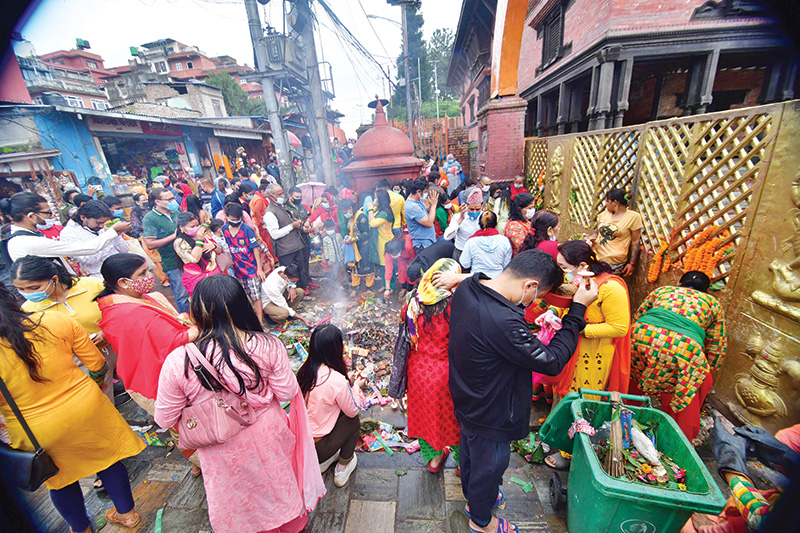
Hira Pandit of Jorpati was among hundreds of devotees who went to visit the Pashupatinath temple on Monday despite knowing that the temple is closed for worshippers due to the Covid-19 pandemic.
“I just wanted to pray from outside as I observe a fast and visit the temple on Mondays during the holy month of Shrawan every year no matter what! I have an immense faith in the lord,” said Pandit, who is in her forties.
After offering prayers at the western gates of the temple complex, she received chandan [sandalwood paste] from the priest who was at the gates. “Had I not visited the temple, my fast would have been incomplete,” said Pandit. “Now, I feel blessed.”  
Despite the huge risk of Covid-19 transmission, hundreds         of Hindu devotees thronged Pashupatinath and other major temples across the country from early Monday morning. Mondays of the Nepali month of Shrawan are considered auspicious for worshipping Lord Shiva. Devotees observe a fast and offer worship to pray for their own and family members’ good health and prosperity.
This year, however, the Pashupatinath Temple and most other shrines remain closed for worshippers due to the Covid-19 prohibitory orders.
But still hundreds of devotees, especially women, were seen crowding at major shrines. Throughout Shrawan, devout Hindu women, both married and unmarried, wear green, turn vegetarian and visit Shiva shrines.
The prohibitory orders, which were introduced in the Valley two and a half months ago, have been largely loosened over the past few weeks, but mass gatherings are still banned. But in lack of effective monitoring, people and businesses are flouting the restrictions.
Health experts, however, have been warning that the pandemic is not over yet and a third wave could hit the country soon as nearly 2,000 Covid-19 cases are being registered every day.
“Due to the negligence by the people in observing the health safety protocols, Covid cases are gradually rising again,” Dr Anup Bastola, spokesperson at the Sukraraj Tropical and Infectious Disease Hospital, told the Post. “The only way to curb the spread is to avoid forming crowds. Even vaccinated people are getting infected.”
“People need to respect the restrictions otherwise a third wave could hit the country very soon. Considering the extraordinary circumstances, people this time should offer prayers and worship at home and avoid flocking to temples or other crowded places,” said Bastola.  
On Monday, the country reported 1,642 new cases of Covid-19 with 32 fatalities. Of the total infections, Kathmandu Valley recorded 474 new cases in the past 24 hours. According to the Ministry of Health and Population, 330 cases were confirmed in Kathmandu, 56 in Lalitpur and 88 in Bhaktapur.
Chief District Officer of Kathmandu Kali Prasad Parajuli, however, said he was unaware of the crowding at temples. “I will discuss the matter with security agencies,” said Parajuli. “People themselves should act responsibly, take precautions and respect the restrictions as police cannot reach everywhere.”
However, for devotees, Shrawan is once a year opportunity to pay obeisance to the lord.
“The entire month is dedicated to Lord Shiva. We observe strict religious discipline throughout the month and observe a fast on Mondays. We avoid non-vegetarian food and garlic and onions, which are considered impure,” said Laxmi, a devotee who was offering prayers at the Shiva temple at Har Har Mahadev in Kathmandu.
According to religious belief, one’s wishes are fulfilled and Lord Shiva showers fortune on the devotees who visit his shrines on the first Monday of Shrawan.

NATIONAL

As long-route buses are garaged, small vehicles are fleecing passengers

Some unscrupulous vehicle operators are misusing travel passes meant for emergencies and charging passengers up to three times the normal fare.
- ANUP OJHA
Bus operators have been demanding that the authorities lift the ban on long-route transport service.  Post file Photo

KATHMANDU,
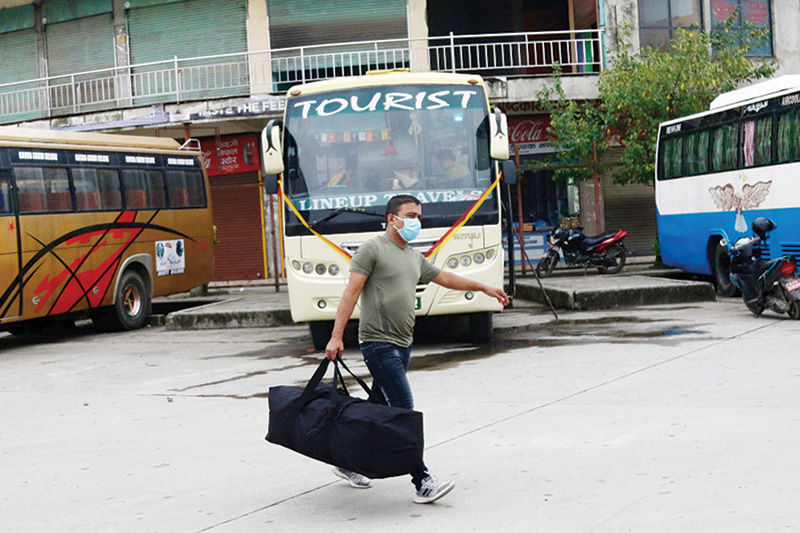
It has been nearly three months since the buses operating on long routes remain garaged owing to the Covid-19 restrictions. But after the government lifted restrictions on domestic flights and local transport a few weeks ago, transport operators have been pressuring the government to allow them to resume long-route transport services.
The Federation of Nepalese National Transport Entrepreneurs, the umbrella body of bus operators, has sent several delegations to the Department of Transport Management and the Kathmandu District Administration Office to press its demand for lifting the ban on long-route buses.
While the government has not reopened long-route public transport amid warnings by public health experts against blanket lifting of restrictions on public transport, some unscrupulous operators of small vehicles have been operating on long routes and charging passengers up to four times the normal fares.
Consumer rights activists have flayed the poor monitoring of restrictions by the government and its failure to take action against the overcharging transporters.  
“The government has banned long-route vehicles but local bodies are issuing travel passes to vehicle operators close to them. And these well-connected small vehicle operators have used the pandemic as an excuse to fleece hapless passengers,” said Jyoti Baniya, president of Forum for Protection of Consumer Rights.
“The government appears to be doing nothing to stop this daylight robbery. If the government wants, it can stop such vehicles at the various checkpoints along the highways and take action,” fumed Baniya. He claimed that some local governments have been issuing travel passes to such vehicles in exchange for bribes.    
Although long-route buses are not in operation, records at the Metropolitan Traffic Police Division show that around 5,000 people have been entering the Kathmandu Valley daily and about fifty percent of them travel on small vehicles that have travel passes issued by various district administration offices.
The division’s data show nearly 4,000 passengers leave Kathmandu every day.
Anyone visiting Kalanki, Balkhu or Koteshwor finds small vehicles with travel passes ready to leave the Valley. These vehicles have been charging passengers exorbitant fares citing the pandemic restrictions.
“If you are ready to pay two to three times the normal fare, you can travel to any district from Kathmandu,” said Anuj Bagale, a pharmacist, who was seen boarding a microbus to Lamjung from Kalanki last Friday.
“The actual microbus fare for Kathmandu to Lamjung is Rs400, but I had to pay Rs900,” said Bagale. He said he paid the fare without complaining because he was on an important business.
Last week Sesan Ghale of Pokhara, who works at a private firm in Kathmandu, paid a van Rs2,500 to visit Kathmandu. “I had no option because my office has reopened and I got a call to join the office,” said Ghale.
Ghale and Bagale are representative cases as a large number of passengers who need to travel long routes are being forced to pay exorbitant fares by transport operators.
“This is a serious crime against helpless passengers but the government has been turning a blind eye to these malpractices,” said Baniya.
Yogendra Karmacharya, chairman at the federation, admitted that a few vehicle operators who have connections with government authorities are making good money by misusing travel passes.
“Transport operators who have invested huge amounts of money in big buses and are in huge debts have been forced to leave their buses rusting in garages. But they are allowing small vehicles to fleece passengers. This is ridiculous,” said Karmacharya of the federation.
There are around 300 transport organisations under the federation from across the country. The federation oversees the operation of around 400,000 public vehicles.
When the Post contacted Kali Prasad Parajuli, the chief district officer of Kathmandu, and asked why have the authorities allowed vehicle operators to misuse travel passes, he said the passes are meant for emergency travel and should not be misused. “We had  instructed the traffic police to give travel permission only during emergencies. If vehicle operators are overcharging passengers they should be punished,” said Parajuli, adding that he would raise the issue with traffic police.
Deputy Superintendent of Police Sunil Jung Shah at the Traffic Police Division in Kathmandu said his office has increased vigilance against those misusing travel passes and said a total of 104 public vehicles both small and big (jeep, van micro and buses) have been booked for overcharging passengers in the nearly three months of the prohibitory orders period.  
“If we receive a written complaint from passengers, we charge the vehicle operators under the Black Marketing Act,” said Shah.  
“But the problem is that passengers seldom come to the police,” said Shah.

NATIONAL

Family performs last rites of Sujita Bhandari

Briefing

CHITWAN: The last rites of Sujita Bhandari, whose body was found
in Ghamile forest of Bhandara Piple on July 4, were performed on Monday. Bhandari had gone out of contact on June 25. Her family had earlier refused to receive her body demanding that her death must be investigated. They have claimed that Sujita was murdered after abduction. Raj Kumar Upreti, ward chairman of Rapti-3, said Sujita’s family agreed to perform her final rites on Saturday after the local administration assured them that it would investigate the case.

NATIONAL

Two rhinos found dead in Chitwan National Park

Briefing

CHITWAN: Two rhinos were found dead at different places in Chitwan National Park on Sunday. According to assistant conservation officer Lokendra Adhikari, an old male rhino of around 30 years and a two-month-old calf were found dead at Amaltari and Kasara respectively. Adhikari said the calf was killed by a tiger while the old pachyderm died of natural causes.

NATIONAL

Transport service resumes on Kaligandaki Corridor

Briefing

BAGLUNG: Vehicular movement along the Karnali Corridor has resumed after two weeks of obstruction. According to Chief District Officer of Baglung Shiva Kumar Karki, Maldhunga-Balewa and Jaiminighat-Gulmi road sections, which were obstructed due to multiple landslides, were opened for one-way traffic on Monday.

Page 4
EDITORIAL

The show’s over

Nepali politics has finally returned to a semblance of stability.

It takes an enormous amount of misadventures to transform a ruling party with near absolute majority into an opposition party in Parliament. But that is exactly what KP Sharma Oli accomplished during his latest stint as prime minister of Nepal even as he embroiled the country into a seemingly unending spiral of instability.
This week, though, there is finally some light at the end of the tunnel for Nepali politics. After months of the political quagmire that began with Oli’s dissolution of Parliament on December 20 last year, followed by a second dissolution on May 11 this year, Nepali politics has finally returned to a semblance of stability.
The Supreme Court played decisive roles both times while invalidating Oli’s regressive actions, giving Nepalis the assurance that the judiciary has not at all been “sold out”. Political scientists and constitutional analysts will for years from now hold debates on the merit of the top court’s unequivocal order to appoint Sher Bahadur Deuba as prime minister. But what is certain is that the order paved the way for safeguarding Nepal’s parliamentary democracy that has almost always remained a victim of the whims of political leaders.
Next came the decisive vote by the members of the House thus restored. On Sunday, 165 lawmakers from across the political spectrum expressed their confidence in Deuba as prime minister. Significantly, 22 lawmakers from the CPN-UML professed confidence in Deuba in what can be termed as a triumph of parliamentary democracy over party politics or authoritarian leadership, also reestablishing lawmakers’ individual agency and principle of conscience vote as envisioned by the constitution in Article 76 (5).
The Madhav Kumar Nepal-Jhalanath Khanal faction of the erstwhile ruling party was understandably torn, until the last hour, between standing firm to save Parliament and conceding to their own party’s decision to vote against Deuba. But ultimately, 14 lawmakers from the Nepal-Khanal faction supported Deuba while 10 abstained. Surprisingly enough, eight lawmakers from Oli’s camp also voted for Deuba, clearly exposing Oli’s dwindling popularity among his own loyalists.
Oli’s authoritative tendencies within the party as well as in governance brought us where we are today. We should never have come to this situation in the first place, because the people had given a historic mandate to the Oli-Prachanda-led Nepal Communist Party. Due to his bloated ego, Oli became a burden for Nepali politics as he shattered the people’s aspirations for a government that remains intact for a full five-year term. The party is in tatters now, and we can only expect Oli to become even more vindictive towards the dissenters.
But the storm that Oli’s misadventures brought to parliamentary politics has settled for now with the advent of Deuba. At the end of the months-long imbroglio, what is certain is that the supremacy of parliamentary democracy has been re-established and the individualistic attempts of a certain leader at becoming an elected dictator vanquished.
It is time to remember that our democracy is still at a nascent phase, and it needs continued safeguarding and nurturing. The march to democracy is pretty long and winding, and the only option we have is to pick ourselves up when we falter and move on while making sure that we do not repeat the same mistakes again.

OPINION

The economic challenges facing Deuba

The new prime minister has appointed somebody with unknown credentials as finance minister.
- ACHYUT WAGLE
Shutterstock

Sher Bahadur Deuba replaced KP Oli as prime minister last week. He has inherited a highly sluggish economy due to the bad fiscal governance of the past, and the pains exacerbated by the Covid-19 pandemic. But the new prime minister also seemed to be indifferent to recognising the immensity of the impending economic hardships and risks. He appointed Janardan Sharma, who has never made his academic credentials public, as finance minister. Sharma certainly is a close confidante of Pushpa Kamal Dahal, chairman of the Maoist Centre, the largest coalition partner in the Deuba-led government. But assigning the finance portfolio to a trained economist shouldn’t have been a political bargaining chip for Dahal during these critical times. To recollect, the economic ills caused by the Oli government was not an item on the main agenda of the five-party opposition alliance formed to dislodge him.
For at least the past 15 years, the practice of appointing a politician, often considered very close to the ruling chief but without even a reasonable level of formal education, let alone in economics, has been repeated constantly. It has taken an obvious toll on Nepal’s economic management as manifested in tardy economic growth, massive misappropriation and corruption, and a seemingly irreversible risk on the sustainability of the external sector. It is now an open secret that through the appointment of henchmen instead of professionals, party bigwigs harbour ominous intentions of using this “lucrative” ministry to mint lucre, very often in the interest of the political “godfather”. Deuba seemed to have deliberately relented here.

Deepening crisis
At the programme organised to welcome Sharma as the new minister last Thursday, central bank Governor Maha Prasad Adhikari warned that external sector stability remained precarious due to an exponential rise in the trade deficit coupled with the unavailability of means to curb it in the near future. An added challenge for the upcoming monetary policy will be to resurrect the economy ravaged by the effects of Covid-19-induced lockdowns.
The macroeconomic indicators of the past 11 months of the fiscal year that ended July 15 are gravely worrisome except for the inflow of workers’ remittances and tolerable inflation figures. Remittance increased by 10.4 percent to approximately $10.8 billion in the review period. Although the number of migrant workers leaving the country has substantially decreased, the increase in remittance may be attributed to many factors. They include increased amount of dispatches to their dependent families to support them during the pandemic, sustained income and labour security of Nepali workers due to increasingly favourable labour laws in several host countries, and the nature of the jobs taken by most Nepalis, like caregiving, that largely remained unaffected by Covid-19. The consumer price index-based inflation remained at 4.19 percent, contained mainly due to loss of many economic activities for the last one and a half years.
The most alarming figures are in international trade. The total trade deficit increased by 24.6 percent to $10.5 billion during these 11 months, taking the export-import ratio to 9:10. The total import value is more than $11.5 billion. Exports to China have fallen by 17.4 percent. The rise in exports by almost 39 percent is, as always, misleading. One, the total export value is barely $1 billion; and, two, the exact value addition on exported items produced using almost entirely imported inputs hardly leaves any real benefit to the economy. After a long time, the balance of payments also went into a deficit of Rs15 billion. This is indeed an alarm bell even though the foreign exchange reserves of $11.71 billion may look comfortable in the short run. The federal government’s capital spending amounted to only Rs143 billion during the period, barely 41 percent of the capital allocation. This is certainly a cause of concern about the economy’s absorptive capacity.
Another facet of the crisis in financial management is cropping up from the provinces due to the utter political factionalism. Four out of the seven provincial budgets have either been passed through questionable parliamentary processes or face impediments. Even after five years and as many exercises to present the annual “own fiscal bill” by the local governments, the institutionalisation of the budget process and enhancement of allocative efficiency remain critical. These hiccups in fiscal federalism have given ground for those raising questions about the very raison d’être of federalism in Nepal.

What next?
The historic court verdict on July 12 reinstating the federal Parliament dissolved by KP Oli and installing Deuba as prime minister also stated that the budget for the next fiscal year 2021-22 presented through an ordinance by the Oli government “was inappropriate and against the representative system of government”. This provides space to the new government “to correct” the “ordnance for budget practice”. An overhaul of the budget presented by the outgoing Oli government is indeed a practical necessity to drop many populist programmes and insert grossly missed priorities. However, there are a few very critical catches, too. The constitution specifically mentions that the federal annual budget must be presented on the 15th of the Nepali month of Jestha (end of May). Does that constitutional provision allow the government to present the budget afresh? And, should that provision be violated now with its potential unwanted pitfalls for the future?
Nevertheless, Minister Sharma has announced plans to issue a White Paper on the country’s economy and present the budget for the fiscal year 2021-22 in Parliament. It still lacks clarity whether he plans to present the same ordinance budget in the House for ratification or a new one.
Since the government of the day has all the leverage to amend the ordinance budget through amendment, it would only espouse a better national budget culture if the current government could refrain from two political adventurisms. First, not to disregard the importance of the constitutionally set budget date by presenting an entirely new budget since nothing would stop the government from accommodating all its programmes and priorities while passing the ordinance through Parliament. Second, while agreeing that the issuance of the economic White Paper is entirely the government’s prerogative, it, however, should not be a political rebuke aimed solely at discrediting the previous government instead of presenting the current state of the country’s economy, as did Yubaraj Khatiwada immediately after he took over as finance minister in 2018.
The upcoming monetary policy can also address issues surrounding fiscal relief packages to assist pandemic-hit areas in the economy and boost manufacturing, import substitution and, possibly, exports.

OPINION

Should central banks have a green mandate?

The UK government is abdicating its responsibility for ensuring a healthy, sustainable economy.
- ROBERT SKIDELSKY
Bank of England, London/Shutterstock

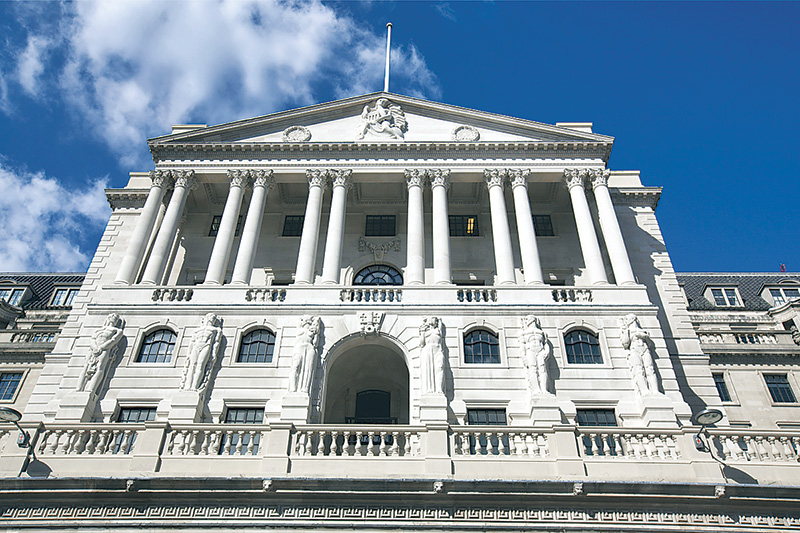
In his March budget, the United Kingdom’s chancellor of the exchequer, Rishi Sunak, enlarged the mandate of the Bank of England to include supporting the government’s target of achieving net-zero greenhouse-gas emissions by 2050. But in a June 8 letter to the Financial Times, Mervyn King, a former BOE governor, was sharply critical of the move. King warned that “an expansion of central bank mandates into political areas such as climate change […] threaten[s] to weaken de facto central bank independence, leading to a slow response to signs of higher inflation.” So, what is going on?
A little history may help. By the 1980s, a consensus had emerged among policymakers that the main macroeconomic problem was inflation. Governments’ “Keynesian” efforts to push unemployment below its “natural rate” made them unreliable guardians of the value of money.
Governments therefore outsourced inflation control to “nonpolitical” central bankers. In 1997, the UK’s new Labour government, acutely aware of the party’s reputation for profligate spending, gave the BOE a mandate to meet an inflation target of 2.5% (later lowered to 2%). The power to set the official interest rate (Bank Rate) was transferred from the Treasury to the BOE’s Monetary Policy Committee.
The expectation was that the newly empowered BOE would raise its interest rate when inflation was trending above 2%, and lower it when inflation (or the price level) fell. Moreover, the medium-term nature of the inflation target gave the BOE some wiggle room to adjust interest-rate policy to reflect economic activity. This monetary regime, adopted by most rich-country central banks, was credited with maintaining price stability during the so-called “Great Moderation” that lasted until 2008. But low commodity prices, conservative fiscal policy, and China’s integration into the global economy were almost certainly more important factors than the technocratic calibrations of independent central bankers.
In the 2008 global financial crisis, however, central banks went beyond their traditional role as lender of last resort and bailed out bankrupt commercial banks deemed to be “too big to fail.” As the banking crisis turned into a severe economic downturn, and official interest rates fell to near-zero, fulfilling the inflation mandate was thought to require additional monetary-policy tools. Enter quantitative easing (QE), or “unconventional monetary policy,” which meant flooding the economy with money to offset the effects of business contraction.
Central banks tasked with controlling inflation were thus now using monetary policy to stave off economic collapse—something for which they had no mandate. Amid the ensuing confusion about the nature of their role, monetary policymakers claimed that their massive purchases of government debt—amounting to hundreds of billions of dollars, euros, and pounds between 2009 and 2016—were intended to “raise the inflation rate to target.” But everyone knew that inflation was the last thing they had in mind as their economies plunged.
Had central banks openly proclaimed their role as rescuers of last resort, most people would have said that this was the government’s responsibility, and with good reason. As John Maynard Keynes had pointed out 80 years earlier, it is the spending, not the printing, of central-bank money that is crucial for economic activity.
Central banks never satisfactorily answered the question of how their massive monetary injections were supposed to increase real economic activity, or raise prices for that matter. As economies continued to stagnate, the best they could do was to argue that things would have been worse without QE.
Then, with recovery from the 2008-09 financial shock far from complete, the Covid-19 pandemic struck. This time, it was governments that (rightly) started spending on a huge scale to sustain societies’ purchasing power in the face of mass lockdowns. Central banks, still ostensibly pursuing their inflation targets, now financed whatever scale of public spending governments chose, without anyone bothering to change their mandate. A few intrepid spirits asked how financing an ever-growing government deficit could be consistent with hitting a 2% inflation target. But posing this question was considered bad form, since it “undermined the credibility” of the central bank’s anti-inflationary mandate.
Sunak’s new climate-change mandate, which at least has the virtue of being transparent, thus comes at a time when the waters of monetary policy are already muddied and the meaning of central-bank independence blurred. Establishing greater clarity on such questions was one of the main purposes of the recent UK House of Lords Economic Affairs Committee inquiry into monetary policy.
The committee’s report, Quantitative Easing: A Dangerous Addiction?, charts with meticulous detail the progressive deterioration in the coherence of the BOE’s mandate. It recognizes that preventing catastrophic climate change should be a central preoccupation of public policy. The issue is simply the extent to which the central bank could be drawn into political matters without undermining the credibility conferred by its independence from politics. The committee’s report concludes gingerly that because of the chancellor’s enlargement of the BOE’s mandate, “the Bank risks being forced into the political arena.”
But the important question is not the extent to which the BOE’s expanded mandate undermines its anti-inflationary credentials, but rather the degree to which it blurs the responsibilities of the government and the central bank for the conduct of economic policy. The current regime assumes that central bankers should control the quantity of money, while allocation of money (or capital) through the budget would remain in the hands of democratically elected governments.
But involving central banks in allocating money to firms or sectors on the basis of their “greening” potential—by buying the debt of hydroelectric power companies but not that of petroleum firms, for example—forces them to make political decisions for which government should be held accountable through the tax system. The UK government’s readiness to exploit the QE tool to outsource capital allocation to a non-accountable body is thus a further step in its abdication of responsibility for ensuring a healthy, sustainable economy.


Robert Skidelsky, a member of the British House of Lords, is Professor Emeritus of Political Economy at Warwick University.
— Project Syndicate

Page 5
MONEY

Import of medical equipment almost double amid pandemic

Particularly, the import from China had surged by around 104.8 percent to Rs2.9 billion in the first 11 months of fiscal 2019-20 on a year on year basis.
- PRITHVI MAN SHRESTHA
No significant import of medical equipment was recorded from India as it faced its own second wave earlier this year. POST FILE PHOTO

KATHMANDU,
The import of medical equipment doubled during the first 11 months of the fiscal year 2020-21 that ended Thursday as the country faced a devastating second wave of the Covid-19 pandemic.
According to Nepal Rastra Bank statistics, the country imported medical equipment worth Rs15.24 billion during the first 11 months up from Rs8.08 billion during the same period in the fiscal year 2019-20.
 Nepali imported these items mostly from China and countries other than India as the medical equipment became one of the country’s top import items. No significant import of medical equipment was recorded from India as it faced its own second wave earlier this year.
The country imported medical equipment worth Rs6.61 billion from China with imports by 128 percent compared to the same period in the previous year. Likewise, the import from third countries also increased by 66.4 percent to Rs8.62 billion, according to central bank statistics.
In fact, ever since the pandemic hit the country in early 2020, the import of medical equipment had started to grow.
Particularly, the import from China had surged by around 104.8 percent to Rs2.9 billion in the first 11 months of fiscal 2019-20 on a year on year basis while import from third countries had declined by 12.2 percent to Rs5.18 billion during the same period, according to the central bank.
Medical equipment suppliers say that the pandemic was mainly responsible for fuelling the import of these items in the last one and half years. Particularly the crisis the country faced in the second wave of pandemic starting from April, fuelled the import of medical equipment, suppliers said.
According to the medical goods suppliers, supply of oxygen concentrators, oxygen plants, oxygen cylinders, antigen test kits, oximeters, intensive care units and high dependency units of hospitals among others were mostly imported during the second wave of pandemic.
Besides commercial supplies of medical goods, the country received 4126 oxygen concentrators of different capacities, 6945 oxygen cylinders, 1.48 million oxygen kits, 13,820 dead body bag, 218 ventilators among others from different foreign governments and domestic and international agencies during the period from April 14 to July 4, according to the Department of Health Services.
Such was the demand that importers that did not use medical goods changed their focus.
“Not only the medical equipment distributors but also garment and footwear importers also imported the medical equipment such as oximeters, oxygen concentrators and infrared thermometers (or thermal guns) contributing to high growth in supply of these items in the country,” said Suresh Ghimire, president of the Chemical and Medical Suppliers’ Association Nepal, grouping of the medical equipment.
“Now, there is a good stock of the medical goods which may be important if the country is hit by the potential third wave of pandemic.”
Nepali health officials are suspecting that the third wave of pandemic could hit the country in the upcoming autumn season. As a part of preparation, the ministry has asked the hospitals to arrange 20 percent of beds for the people aged below 18 years who have not been vaccinated.  
Meanwhile, several federal, provincial and local government agencies and hospitals have started the procurement process to set up or improve medical facilities ahead of the end of last fiscal year. Many made efforts to procure the medical goods to spend the allocated budget in the last fiscal year.
“With the arrival of more equipment procured by these agencies, the overall import of medical equipment will be much bigger in future,” said Ghimire.
But of late, according to medical goods suppliers, the demand for medical goods has come down along with decrease in Covid-19 cases.
But, they said that available goods or more might be necessary if the country is hit by the potential third wave of pandemic.
“The government has itself announced constructing several hospitals and adding medical facilities in hospitals and demand for medical equipment will remain good even in the new fiscal year,” said Kumar Dahal, manager of Subarna Shristi Private Limited, a Kathmandu-based medical equipment importer and supplier.
Through the budget for the current fiscal year, the government has announced completing the construction of 5-15 bed hospitals in 397 local units within the next two years.  
Budget has also been allocated to build a 300-bed infectious disease hospital in Kathmandu Valley and 50-bed infectious disease hospitals in each province. The federal government has allocated Rs4 billion to procure ICU and HDU beds, ventilators, test kits among others, according to the budgetary provision.
“Even in the normal times, demand for medical equipment has remained steady and the demand will grow along with the government’s plan to increase medical infrastructure,” said Dahal.
Besides government hospitals, the private hospitals are also expected to increase demand for medical equipment. For example, the budget for the current fiscal year made it mandatory for hospitals with more than 100 beds to have their own oxygen plants.
Even though supply of the medical equipment increased in the last fiscal year, the suppliers complained about the high freight charge they have been forced to pay.
“Both airfares and the sea freight charges have become very expensive for the delivery of the medical goods,” said Dahal.
“Most of the medical equipment comes under the category of dangerous goods because of the presence of batteries inside them and they have to be transported through certain carriers who charge high. For importing goods, we have to rely on a single airline—Cathay Pacific from Hong Kong which makes things expensive.”
According to him, sea freight has also become expensive with ships charging as high as $5600 per container from just $1200 per container in the normal times.
“So, it is also vital that road transportation linkage with China is good,” he added.  
While the Tatopani customs point in Sindhupalchowk district remains closed, import through Rashuwagadi of Rasuwa district has not been smooth since the pandemic began last year.

MONEY

Risk currencies retreat on renewed reflation doubt

- REUTERS

LONDON, 
Riskier currencies such as the Australian dollar, the Canadian dollar and Britain’s pound retreated on Monday, while the dollar gained as investors expressed renewed scepticism over the potential for a strong economic rebound from the pandemic.
The dollar failed to make ground against the Japanese yen however—the dollar/yen currency pair traded below the 110 yen per dollar mark at 109.85, leaving the yen 0.2 percent higher on the day.
With England set to lift all Covid-19 social restrictions on what local media has dubbed ‘Freedom Day’, the continued spread of the highly contagious ‘delta’ variant of the coronavirus drew further doubt from investors about whether a total economic recovery to pre-pandemic levels is at all possible.
Earlier this week, British health minister Sajid Javid announced he tested positive for Covid-19 and was in self-isolation, also forcing Prime Minister Boris Johnson and finance minister Rishi Sunak into quarantine. Sterling hit a 3-month low against the dollar of $1.3712.
“Despite rising vaccination rates, a return to pre-corona normality seems questionable,” said Ulrich Leuchtmann, head of FX and commodity research at Commerzbank in a morning research note, adding that a string of recent news reports, including that of Johnson being forced to isolate suggest the world “might have permanently changed”.
If consumption and production were not to return to 2019 levels Leuchtmann said, a significant chunk of productive capacities worldwide would “not just lie idle temporarily but would become devalued on a permanent basis.”
“If we are no longer simply dealing with who will survive the corona period but about whose goods and services will remain in demand long term at all the risk perception of the markets will rise. It is hardly surprising that the FX market cannot decouple from that.”
The dollar benefited from the risk aversion, with the index that measures its strength against peer currencies hitting its highest since April 5.
The euro dipped 0.2 percent to $1.1777. Investors will look to this week’s European Central Bank meeting.
“Following the ECB strategic review and the shift in the inflation target from ‘below, but close to 2 percent’ to ‘2 percent’ with a commitment to symmetry, the new strategy can be interpreted as either a formalisation of what it has been doing over the last few years anyway or a step towards more dovishness, as 2 percent implies a more resolute effort,” ING said in a note to clients.

MONEY

South Korea poised to kick-start Asia’s monetary tightening

- REUTERS
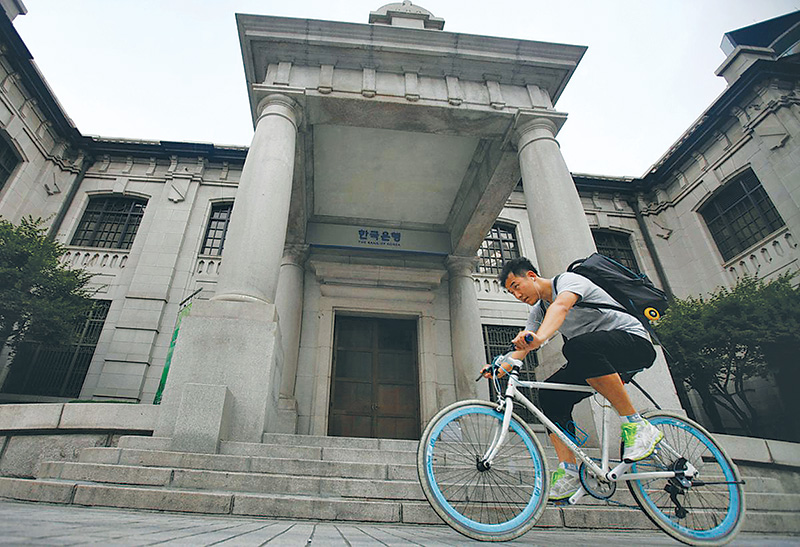
A file photo shows a man cycling in front of the Bank of Korea in Seoul. REUTERS

SEOUL, 
South Korea is set to be the first Asian economy to raise interest rates
from pandemic-era lows as its hawkish, outgoing central bank governor steps up efforts to stamp out any incipient property bubbles or household debt stress.
Bank of Korea Lee Ju-yeol surprised financial markets last week, when policy rates were kept at record lows but he signalled they could rise as early as August, at the next policy review.
Even though Asia’s fourth-largest economy has recovered rapidly and inflation is running above target, it is battling record Covid-19 cases as the more infectious Delta variant spreads, triggering strict measures and a semi-lockdown in the Seoul area.
“It’s one of those rare times where taming home prices has become more important, both politically and on economic fronts,” said Yoon Yeo-sam, an analyst at Meritz Securities.
“Nothing the government did for the past few years could stop home price surge, and time is running out both for Lee and the government.”
Lee’s term as governor ends in March 2022, just weeks before President Moon Jae-in also steps down. During his eight years at the helm, the hawkish-leaning Lee has struggled to contain debt levels in a country with a proclivity for risk-taking. The Bank of Korea (BOK) cut the policy rate by 75 basis points last year to a record low 0.5 percent to support the economy.
Those low interest rates spurred heavy borrowing by households. Household debt was up to 1,765 trillion won ($1.55 trillion) in March, of which mortgages comprised 931 trillion won.
The cheap cash has further fuelled speculation in property, stock and cryptocurrency markets. House prices have soared despite a slew of measures such as taxes and lending restrictions, prompting the BOK to warn in June that financial vulnerability of local asset and credit markets was at its highest since the global financial crisis of 2008.
Analysts now reckon interest rates are too low for an economy projected to grow 4 percent this year, its fastest since 2010. Inflation too is running well above the central bank’s 2 percent target.
“Lee clearly has his retirement timetable in mind. He doesn’t have much time left to really do what he wants, which is to bring debt growth and home prices down, that’s the legacy he wants to go home with,” said Kong Dong-rak, an economist at Daishin Securities.
“The longer he waits, the harder it would be for him to go ahead with tightening,” he said, citing the distraction of the Presidential election in March as a reason.

MONEY

China frictions steer EV makers away from rare earth magnets

- REUTERS
A cross-section of a completed battery for a Nissan Leaf car is seen inside the Envision battery manufacturing plant at Nissan’s Sunderland factory, Britain. REUTERS

LONDON, 
As tensions mount between China and the United States, automakers in the West are trying to reduce their reliance on a key driver of the electric vehicle revolution—permanent magnets, sometimes smaller than a pack of cards that power electric engines.
Most are made of rare earth metals from China.
The metals in the magnets are actually abundant, but can be dirty and difficult to produce. China has grown to dominate production, and with demand for the magnets on the rise
for all forms of renewable energy, analysts say a genuine shortage may lie ahead.
Some auto firms have been looking to replace rare earths for years.
Now manufacturers amounting to nearly half global sales say they are limiting their use, a Reuters analysis found.
Automakers in the West say they are concerned not just about securing supply, but also by huge price swings, and environmental damage in the supply chain.
This means managing the risk that scrapping the metals could shorten the distance a vehicle can travel between charges. Without a solution to that, the range anxiety that has long hampered the industry would increase, so access to the metals may become a competitive edge.
Rare earth magnets, mostly made of neodymium, are widely seen as the most efficient way to power electric vehicles (EVs). China controls 90 percent of their supply.
Prices of neodymium oxide more than doubled during a nine-month rally last year and are still up 90 percent; the US Department of Commerce said in June it is considering an investigation into the national security impact of neodymium magnet imports.
Companies trying to cut their use include Japan’s third-largest carmaker Nissan Motor Co, which told Reuters it is scrapping rare earths from the engine of its new Ariya model.
Germany’s BMW AG did the same for its iX3 electric SUV this year, and the world’s two biggest automakers Toyota Motor Corp of Japan and Volkswagen AG of Germany have told Reuters they are also cutting back on the minerals.
Rare earths are critical for the electronics, defence and renewable energy industries. Because some can generate a constant magnetic force, the magnets they make are known as permanent magnets.
Electric cars with these require less battery power than those with ordinary magnets, so vehicles can go longer distances before recharging. They were the no-brainer choice for EV motors until about 2010 when China threatened to cut rare earth supply during a dispute with Japan. Prices boomed.
Now, supply concerns are opening a divide between Chinese EV producers and their Western rivals.
While automakers in the West are cutting down, the Chinese are still churning out vehicles using the permanent magnets. A Chinese rare earths industry official told Reuters that if geopolitical risks are set aside, China’s capacity can “fully meet the needs of the world’s automotive industry.”
Altogether, based on sales data from JATO Dynamics, manufacturers accounting for 46 percent of total light vehicle sales in 2020 have said they have scrapped, plan to eliminate, or are scaling down rare earths in electric vehicles.
And new ventures are springing up to develop electric motors without the metals, or to boost recycling of the magnets used in existing vehicles.
“Companies that spend tens or hundreds of millions developing a family of products... they don’t want to put all their eggs in one basket—that’s the Chinese basket,” said Murray Edington, who runs the Electrified Powertrain department at British consultancy Drive System Design. “They want to develop alternatives.”
BMW says it has redesigned its EV technology to make up for a lack of rare earths; Renault SA has slotted its rare-earth-free Zoe model into a growing niche of small urban cars that do not need extended driving ranges.

MONEY

‘Daraz Mahabachat Bazar’ promises huge discounts

KATHMANDU: Nepal’s leading online marketplace, Daraz, is bringing Nepali customers with the ‘Daraz Mahabachat Bazar’ starting from July 18th to July 24th (Shrawan 3-9). The main focus of this campaign is to serve customers with the benefits of smart shopping with savings. Key highlights of the campaign include limited discount vouchers upto Rs4,000, discount on online pre-payment (Bank card, IME Pay wallet) upto Rs2,000, a chance to win iPhone 12 via the 1 Rupee Game, MacBook Pro 13 as the Bumper Prize, free shipping for limited hours, crazy vouchers, and many more surprises for Daraz customers, reads the press release issued by the company.

Page 6
WORLD

Indonesia’s poor miss out on Covid-19 care

Currently nowhere in the world is being hit harder than Indonesia. Experts say the scale and toll are much larger.
- REUTERS
A healthcare worker treats a patient inside a temporary tent at a hospital in Bekasi, on the outskirts of Jakarta, Indonesia on July 15.  REUTERS

JAKARTA,
In the teeming, impoverished North Jakarta neighbourhood of Muara Baru, people have made a grim joke out of the acronym for the Indonesian government’s lockdown to combat the coronavirus pandemic: PPKM.
“Pelan Pelan Kita Mati,” Herdayati, a 48-year-old mother of six and sole breadwinner for a family living in a narrow, claustrophobic alley, said, explaining the gallows humour.
It means: “Slowly, we die.”
More than half of Indonesia’s population of 270 million spend below $60 a month, the second highest level for “economically vulnerable” people in the world, economists say.
The pandemic has been a grinding descent towards poverty and hunger for many of them, the slow death encapsulated by Herdayati’s sardonic joke. A second wave of Covid-19 has overwhelmed Indonesia’s health system, as infections surged fivefold in the past month. For the past week, Indonesia has averaged 49,435 new cases a day, and more than
1,000 deaths a day.
Currently nowhere in the world is being hit harder than Indonesia, even though experts say low rates of testing means the official data vastly underestimates the scale and toll.
Two people are dying with Covid-19 symptoms each day in Muara Baru, which has a population of about 6,000, said Eny Rochayanti, coordinator of the City Poor People Network, a volunteer group.
“It’s a terrifying situation,” she said.
The government has cushioned the economic impact with a welfare package for the poor, without which the World Bank says 5 million more people could have fallen below Indonesia’s poverty line of $32.59 per month last year. The government also has plans for nearly 8,000 new hospital beds and measures to boost the number of health workers and oxygen supplies.
On Saturday, the minister leading the pandemic response, Luhut Pandjaitan, acknowledged the disproportionate impact on the poor, apologising “if it (government policy) is not optimal”.
Indonesia rapidly urbanised over the past 20 years, without creating enough formal jobs to sustain the influx to the cities, says Arief Anshory Yusuf, an economist. Meanwhile, experts say, it has under-invested in a health system that relies heavily on private hospitals the poor can’t afford.
“These people live in a compact environment where Covid spreads easily,” said Arief. “Isolation is almost impossible. They can’t access hospitals. They are very vulnerable to losing their incomes.”
The Indonesian Medical Association says the health system on Java, the most populous island in the archipelago nation, has “functionally collapsed”.
In Panggungharjo, Yogyakarta, village chief Wahyudi coordinates a team of volunteers using social media and messaging apps to hunt down coveted hospital beds, oxygen supplies and medicine.
When three members of an eight-person family living in crowded housing died within 10 days, Wahyudi and his team went all out to find treatment for the patriarch of the family, Muji.
“Whatever it takes, Pak Muji must survive,” he recalled telling the volunteers.
Turned away from six hospitals, eventually they got an assurance of a bed the next day. But before he could get there, Muji died.
“We were all devastated,” said Wahyudi. Now grappling with 500 active cases, he has set up a shelter so infected people can isolate to avoid a repeat disaster.
Those with money, connections and luck have the best hope of finding medical help, officials, social workers and victims’ families told Reuters. Even then, because it usually takes days, the search often ends in tragedy.
For Irna Nurfendiani Putri, an 32-year-old IT industry professional, the hunt for a hospital bed in Jakarta for her brother Rachmat Bosscha, 44, succeeded only after the family brought their own oxygen tanks.
“Two people passed away in a 30-minute interval,” she said. “Then my brother got moved to their bed.”
With the intensive care ward full and the hospital’s oxygen supplies continually running out, Irna had to repeatedly switch her brother over to portable oxygen tanks they had brought themselves.
“I can’t blame the hospital because supplies are scarce,” she said. “But it was pretty harrowing watching my brother struggling to breathe.”

WORLD

Pakistan bus crash kills 33 people and injures 40 others

- ASSOCIATED PRESS

MULTAN, PAKISTAN, 
A speeding bus carrying mostly labourers traveling home for a major Muslim holiday rammed into a container truck on a busy highway in central Pakistan on Monday, killing at least 33 people and injuring 40, police and rescue officials said.
The bus had left the city of Sialkot and was traveling on Taunsa Road; its destination was the city of Dera Ghazi Khan in eastern Punjab province, said senior police officer Hassan Javed. The exact cause of the accident is still under investigation, he said.
Rescuers transported the dead and injured to a nearby hospital. According to Sher Khan who was in charge of the rescue team at the site, some of the injured were in critical condition. He said the bus driver was among the 33 killed in the accident.
Khan said the passengers were traveling to their home district of Rajanpur to celebrate the upcoming Eid al-Adha feast. TV footage and photos circulating on social media showed rescuers trying to pull out bodies from the badly mangled bus. In one image, some of the injured are seen sitting near the bus, waiting for medical help.
Pakistan’s Information Minister Fawad Chaudhry expressed his condolences on Twitter and advised public transport drivers to be more careful of the lives of the people they have been entrusted with.

WORLD

Foreign missions in Afghanistan urge Taliban to halt military offensives

- REUTERS
An Afghan policeman keeps watch at the check post in Kabul, Afghanistan on July 13.  REUTERS

KABUL,
Fifteen diplomatic missions and the NATO representative in Afghanistan urged the Taliban on Monday to halt their military offensives just hours after the rival Afghan sides failed to agree on a ceasefire at a peace meeting in Doha.
A delegation of Afghan leaders met the Taliban’s political leadership in the Qatari capital over the weekend but the Taliban, in a said in a statement late on Sunday, made no mention of a halt to Afghanistan’s escalating violence.
“This Eid al-Adha, the Taliban should lay down their weapons for good and show the world their commitment to the peace process,” the 15 missions and the NATO representative said, referring to Tuesday’s Muslim holiday in Afghanistan.
The statement was supported by Australia, Canada, the Czech Republic, Denmark, the European Union delegation, Finland, France, Germany, Italy, Japan, Korea, the Netherlands, Spain, Sweden, Britain and the United States and NATO’s senior civilian representative.
Over recent Eid holidays, the Taliban have called short ceasefires, saying they wanted to let Afghans spend them in peace.
This time there has been no such announcement as the Taliban make swift territorial gains in near-unprecedented levels of fighting nationwide as US-led foreign forces complete their withdrawal after 20 years of fighting. Monday’s statement also condemned rights violations, such as efforts to shut schools and media outlets in areas recently captured by the Taliban.
The militants have previously denied such actions.
The Taliban said on Monday they had captured the Dehrawood district in Uruzgan province, southwest of Kabul, after heavy clashes with government forces the previous night. Provincial officials confirmed the Taliban advance.
In the northern province of Samangan, security forces managed to wrest Dara-e-Sof Bala district back from insurgents, the military in the area said, adding that 24 Taliban fighters, including a shadow district governor and two commanders, had been killed.
Clashes were going on there on Monday. Reuters could not independently verify the information provided by the military.
President Ashraf Ghani on Monday visited the provincial capital of Herat province in the west. The Taliban have captured all 17 of the province’s districts in recent days, barring the capital, Herat city, which is under siege.

WORLD

Some 170 still missing in flood-hit area of Germany

Briefing
- AGENCIES

BERLIN: Some 170 people are still listed as missing the area of western Germany hardest hit by deadly flooding, Koblenz deputy police chief Juergen Sues said on Monday, adding the number of victims would surely rise. Criminal police chief Stefan Heinz added that he expected many bodies were in places the police had not yet reached or where flood waters had still not receded from. “The focus of our work is on giving certainty as soon as possible,” Heinz told a news conference. “And that includes identifying the victims.”

WORLD

Russia says it successfully tested hypersonic missile

Briefing
- AGENCIES

MOSCOW: Russia said on Monday it had successfully tested a Tsirkon(Zircon) hypersonic cruise missile, a weapon President Vladimir Putin has touted as part of a new generation of missile systems without equal in the world. The defence ministry said in a statement that the missile had been fired from the Admiral Gorshkov, a warship located in the White Sea, and travelled at around seven times the speed of sound before hitting a ground target on the coastline of the Barents Sea more than 350 km away.

WORLD

Two Chinese workers found dead in flooded tunnel

Briefing
- AGENCIES

BEIJING: Two of 14 workers who have been trapped in a flooded highway tunnel for five days so far in the southern Chinese city of Zhuhai were found dead, the city government said on Monday. Early on Thursday, water suddenly leaked into the Shijingshan tunnel, which is being built under a reservoir, trapping the workers more than a kilometre from the entrance. On Monday afternoon, rescuers found the two dead workers at about 1,060 metres and 1,070 metres from the tunnel’s entrance.

Page 7
SPORTS

Japan have eyes on podium on home soil

Japan men’s football team’s first and only Olympic medal came in 1968 when they beat hosts Mexico 2-0 to win bronze.
- REUTERS
Hajime Moriyasu’s Japan will kick off their Olympic campaign against South Africa on Thursday, followed by meetings with Mexico and France. Reuters

TOKYO,
Fifty-three years since winning their first and so far only Olympic medal, Japan’s male footballers have their sights set on making history on home soil under Hajime Moriyasu.
Kunishige Kamamoto’s brace in 1968 famously earned Japan a bronze with victory over hosts Mexico, but since then there have been near misses and no medals.
Confidence, however, is growing that Moriyasu’s team could finally break Japan’s medal hoodoo after a series of impressive results since the turn of the year. A 1-1 draw with Spain on Saturday came after successes against Argentina, Ghana, Jamaica and Honduras and has many dreaming of a podium return for the country’s footballers.
“We came in with a focus on winning this game and it’s unfortunate that we didn’t,” said Moriyasu after facing Spain, highlighting his ambition against a team whose core featured in the semi-finals of Euro 2020.
The Japanese are due to kick off their campaign against South Africa on Thursday followed by meetings with Mexico and France as they seek a place in the quarter-finals.
Hopes, though, have been high before only for heartbreak to ensue.
As the Japanese prepared for their co-hosting of the World Cup, Philippe Troussier led a talented squad to Sydney in 2000, missing out on the medal rounds when they were eliminated on penalties in the quarter-finals by the United States.
Twelve years later the country went closer still, reaching the last four but falling short with a loss to eventual gold medallists Mexico before losing to neighbours South Korea in the third place playoff. That 2-0 victory for the South Koreans was the first medal won by an Asian men’s team at the Olympics since Japan’s 1968 success, and Kim Hak-bum’s team will also be hoping to make an impact in Tokyo.
While Tottenham Hotspur’s Son Heung-min was not included as one of three permitted overage players, Kim has one of the most talented young squads in Asia at his disposal. His team won the Asian Under 23 Championship last year to qualify and they are banking on a strong team ethic to help them make an impact in the group phase against New Zealand, Honduras and Romania. “We have to sacrifice for each other. Then we can compete against the best of them,” overage player Kwon Chang-hoon said. “We’re all chasing the common goal. Most of the guys will only get one chance to play in the Olympics, and I am not here just for my own good. We’re all in this together.”
Saudi Arabia and Australia will also represent Asia, with the west Asians supplementing their team with World Cup veterans Yasser Al Shahrani, Salem Al Dawsari and Salman Al Faraj as they face Brazil, Germany and Ivory Coast.
Graham Arnold’s Olyroos take on Spain, Argentina and Egypt in a challenging assignment in the country’s first appearance at the Olympics since 2008.

SPORTS

Brisbane ready to welcome 2032 Olympics with open arms

- AGENCE FRANCE-PRESSE

BRISBANE,
Recent Olympics have been wracked by controversy, cost blowouts and coronavirus chaos but the residents of Brisbane, strongly tipped to host the 2032 Games, look ready to welcome the event with open arms.
The sun-drenched Australian city appears all but certain to be anointed 2032 hosts on Wednesday when the International Olympic Committee holds a vote in Tokyo ahead of the delayed 2020 Games.
In other cities, a bid to host an event of such magnitude might prompt demonstrations, or at the very least vigorous public debate. Yet residents of Brisbane have greeted the news with enthusiasm.
Qatar had also been in the running to host the 2032 Olympics and there was a long-shot joint bid between South and North Korea. But being wealthy and sports-mad puts Australia in poll position, according to Judith Mair, a tourism and events expert at the University of Queensland.
“Australia’s in a very fortunate position of being able to afford to stage one of these big events,” she told AFP. “There are many countries around the world that might perhaps like to but actually are not in a financial position to be able to do so.”
Australia has already hosted the Olympics twice, in Melbourne in 1956 and Sydney in 2000, widely considered one of the most successful Games in recent history.
Home to about 2.3 million people and bookended by shimmering coastal sands, Brisbane is seen as more laid-back and less cosmopolitan than Australia’s sprawling southern cities. Venues would be spread across Brisbane and nearby towns in Queensland state, including the Gold Coast which hosted the 2018 Commonwealth Games.
There are hopes the Olympics would boost Brisbane’s international profile, making it more attractive to tourists who tend to use it as a jumping-off point for attractions like the Great Barrier Reef. “I travelled the world and they say, ‘Where’s Brisbane?’ And you have to get out the map and show them it’s an hour north by plane of Sydney,” said Queensland Olympic Council president Natalie Cook. “That’s going to change. And that is so exciting.”
Games organisers trialled a new dialogue-based bid system for 2032 after cities shied away from the previous competitive process, wary of soaring costs and being lumbered with white elephant stadiums. The so-called “New Norm” reforms unveiled in 2018 also allow for the use of existing venues, including smaller-capacity stadiums, as well as temporary infrastructure.
With about 85 percent of venues already built in and around Brisbane, Australia is hoping these changes will keep costs down. The city projects an operating budget of Aus$4.5 billion [US$3.4 billion]—compared to US$15.4 billion for the pandemic-delayed Tokyo Games. The IOC is chipping in Aus$2.5 billion, and with ticket sales and sponsorship expected to cover the rest, Australian Olympic Committee president John Coates has predicted the event would break even.
Millicent Kennelly, a senior lecturer in tourism and sport at Griffith University, said rosy economic projections should be “taken with a grain of salt” given the history of Olympic events failing to stay on budget.
“I think there’s a degree of risk associated with taking on an event of that scale so far in advance,” she added. “There’s been a huge amount of uncertainty globally for quite some time, financially with (issues like) Covid, climate change. So it is a gamble in that respect.”
Brisbane’s bid is being championed by centre-left Queensland state Premier Annastacia Palaszczuk and has support from across Australia’s political divide, including from the conservative federal government.
No public polling has been released but officials say community engagement has been positive, and a feasibility study by consultants KPMG estimates the event could bring Aus$17.61 billion in economic and social benefits to Australia.
Brisbane Lord Mayor Adrian Schrinner, who has travelled to Tokyo to make a final pitch to the IOC, said Wednesday’s vote marked a “crucial turning point in the city’s history”.

SPORTS

English FA forms independent probe into Euro mayhem

- AGENCE FRANCE-PRESSE

LONDON,
The English Football Association have commissioned an independent investigation after ticketless fans fought their way into Wembley before the Euro 2020 final.
It has been reported that thousands of supporters gained entry to the stadium by storming the gates prior to Italy’s win against England.
There were ugly scenes in the stands and concourses during the game as fans with tickets clashed with those who had broken in. Outside Wembley, it has been estimated that 200,000 people were in the area for a match with a 67,500 capacity, with the drunken and violent scenes marring the showpiece event.
FA chiefs on Monday said they had informed the Department for Digital, Culture, Media and Sport (DCMS) of the review over the weekend and vowed to identify those responsible for the “disgraceful scenes” both before and during the match.
“We are determined to fully understand what happened outside and then inside Wembley Stadium at the UEFA Euro 2020 Final on Sunday 11 July 2021,” the statement said.
“We informed DCMS at the weekend that an independent review led by Baroness Casey of Blackstock has been commissioned to report on the facts and circumstances involved. It will speak to all parties concerned and include external experts.
Police have since released CCTV images of some of those they want to question.
The shocking incidents have raised doubts about the chances of a successful proposed joint bid by the United Kingdom and Ireland to host the 2030 World Cup.

SPORTS

Gauff to miss Tokyo Olympics

Briefing
- AGENCIES

WASHINGTON: American teen tennis star Coco Gauff will miss the Tokyo Olympics after testing positive for Covid-19, she announced on Sunday. Gauff, coming off a run to the fourth round at Wimbledon, tweeted her sadness at missing out on “a dream come true” at age 17. “I am so disappointed to share the news that I have tested positive for Covid and won’t be able to play in the Olympic Games in Tokyo,” Gauff tweeted. “It has always been a dream of mine to represent the USA at the Olympics and I hope there will be many more chances for me to make this come true in the future.” Gauff, who reached her first Grand Slam quarter-final at this year’s French Open, became the latest tennis standout and US athlete to miss the Olympics. The Olympics tennis event in Tokyo is missing a host of big names with major winners Roger Federer, Rafael Nadal, Serena Williams, Victoria Azarenka, Angelique Kerber and Bianca Andreescu all absent. However, world number ones Novak Djokovic and Ashleigh Barty both intend to play.

SPORTS

India beat Sri Lanka in 1st ODI

Briefing
- AGENCIES

COLOMBO: Skipper Shikhar Dhawan hit an unbeaten 86 as India hammered Sri Lanka by seven wickets in the first of the three one-day internationals in Colombo on Sunday. Chasing 263 for victory, India depended on Dhawan’s 33rd ODI half-century, fellow opener Prithvi Shaw’s 24-ball 43 and an attacking 59 by debutant Ishan Kishan to achieve their target in 36.4 overs. Earlier Indian bowlers combined to restrict Sri Lanka, who elected to bat first, to 262-9 in 50 overs despite a late cameo of 43 by number eight Chamika Karunaratne. The second ODI is on Tuesday in Colombo. 

MEDLEY

Horoscope

ARIES (March 21-April 19) ****
You’re capable of making your inspired vision a reality today, Aries. The optimistic Sagittarius moon forms a sweet alignment with capable Saturn, helping you ground down and make firm plans among your network of friends and community.

TAURUS (April 20-May 20) ***
Aim to keep a low social profile, Taurus. The reflective Sagittarius moon pushes you to explore intimacy issues and seek close confidantes. Luna’s supportive connection with responsible Saturn makes it an ideal day for discussing future plans in partnerships.

GEMINI (May 21-June 21) ****
Lean into the buzz of excitement that you’re feeling, Gemini. Your ruling planet, communicative Mercury, joins forces with innovator Uranus today. This pairing brings you opportunities to find breakthroughs with your talents and finances.

CANCER (June 22-July 22) ***
As a Cancer, people tend to overlook your natural business acumen. Remind them who’s boss today, as the visionary Sagittarius moon aligns with capable Saturn. This grounded pairing offers ample room for accomplishments on the work front.

LEO (July 23-August 22) ***
Don’t let anyone dim your shine today, Leo. You’re seeking the spotlight and to share your creative prowess with the world, as the moon meanders through Sagittarius. Luna’s sweet link with Saturn makes it an ideal day to discuss the future of partnerships.

VIRGO (August 23-September 22) ****
You’re ready to charge forward into the next chapter of your life, Virgo. Use Tuesday’s skies to tap into the inspiration you need. Your ruling planet, messenger Mercury, forms a supportive connection with change-bringer Uranus.

LIBRA (September 23-October 22) ***
Tuesday’s skies help you embrace a variety of illuminating changes, Libra. Messenger Mercury aligns with surprise-bringer Uranus, bringing fresh insights to your current career path. Be open to out of the blue opportunities to come.

SCORPIO (October 23-November 21) ***
Send your attention towards your resources, Scorpio. What needs changing around your current approach to cultivating income? The Sagittarius moon pairs up with Saturn today, making it easy to come up with constructive plans for the future of your finances.

SAGITTARIUS (November 22-December 21) ***
Tune into your body today, Sagittarius. The moon’s presence in your sign offers you room to sync back up yourself. Honor your independence above all else. Luna’s grounded link with Saturn makes it easy to express yourself in a composed and capable way.

CAPRICORN (December 22-January 19) ****
Devote your energy to restorative action today, Capricorn. You don’t always know when to pump the brakes and prioritize your need to recharge. The Sagittarius moon’s sweet alignment with stable Saturn offers you room to enter “hermit mode”.

AQUARIUS (January 20-February 18) ***
As an Aquarius, you thrive off group dynamics. Let yourself reconnect with your natural social cravings today, as the moon floats through playful Sagittarius. Luna’s grounded connection with capable Saturn makes it an ideal day to compose future plans.

PISCES (February 19-March 20) ***
Don’t rest on your laurels now, Pisces! The moon’s presence in visionary Sagittarius catapults you into public visibility today, making for an ideal time to ground down and get serious about your plans.

Page 8
SPORTS

Fourth case in Tokyo Village as top sponsor scraps ads

Tokyo 2020 sponsor Toyota has dropped plans to run an Olympic-linked brand campaign in Japan as majority of Japanese doubt the Games will be safe.
- AGENCE FRANCE-PRESSE
Organisers say the Village is safe despite a Czech beach volleyball player becoming the fourth case, which follows positive tests from two South African footballers and a video analyst. Ap/Rss

TOKYO,
Tokyo’s Olympic Village was hit by a fourth coronavirus case on Monday and major sponsor Toyota said it would not run any Games-related TV ads as the event struggled for support just days before the opening ceremony.
A Czech beach volleyball player became the fourth case and the third infected athlete in the Village, where thousands of competitors are living in a biosecure “bubble”. Elsewhere, a teenage female gymnast became the first American athlete to test positive at the Games, with a teammate also isolating as a result. Neither was named.
The delayed 2020 Games will officially get under way on Friday in a near-empty Olympic Stadium, with Tokyo under a coronavirus state of emergency after a spike in cases. The latest Asahi Shimbun newspaper poll found a majority of respondents, 55 percent, were against holding the Games this summer, with 33 percent in favour. And a composer for the opening ceremony stepped down after admitting bullying disabled schoolmates, comments that caused an outcry in Japan.
It has not been a smooth final build-up for the Games, which were postponed last year, but officials will hope the tide of public opinion turns when the sports program starts.
In a sign of the current sentiment Toyota, the world’s biggest automaker, said it would not run Olympics-related TV ads, and its executives would not be present at the opening ceremony. “Toyota officials will not attend the opening ceremony, and the chief reason behind it is there will be no spectators,” Toyota spokeswoman Shiori Hashimoto told AFP.
Fewer than 1,000 Olympic officials and VIPs including sponsors will be allowed to watch the opening ceremony on Friday, according to Japanese media.
Toyota’s operating officer Jun Nagata earlier told reporters it was becoming more difficult for the Olympics to strike a positive chord with the public. “It is turning into an Olympics that cannot get understanding (from the public) in
various ways,” Nagata told Japanese media.
Organisers insisted the Village was safe despite the coronavirus diagnosis for Czech beach volleyball player Ondrej Perusic, which follows positive tests from two South African footballers and a video analyst. Twenty-one members of the South African men’s football contingent are in isolation after being named as close contacts, disrupting preparations for their opening game on Thursday against Japan.
Tokyo 2020 spokesman Masa Takaya earlier said, before the latest cases came to light, that there had been 61 positive cases connected with the Games so far—a tiny fraction of the thousands of tests carried out. “The IOC (International Olympic Committee) and Tokyo 2020 are absolutely clear that the Olympic Village is a safe place to stay,” Takaya said.
Brian McCloskey, chairman of the Independent Expert Panel advising the IOC, said a system of “filtering”—starting with athletes being tested before departure—was working. “The numbers we’re seeing are actually extremely low,” he said. “They’re probably lower than we expected, if anything.”
Athletes are tested daily at the Olympics, where they are also told to observe social distancing and wear masks unless they are competing, eating or sleeping.
When asked about the risk of a cluster in the Village, McCloskey said: “All the measures that we have in place... will reduce the risk of spreading it.”
Composer Keigo Oyamada, known as Cornelius, is the latest in a string of departures from the Tokyo Olympic set-up, including former chief Yoshiro Mori, who stepped down over sexist comments. After news of his involvement in the ceremony circulated online, interviews from the mid-1990s reemerged in which he discussed, without apparent remorse, his bullying of schoolmates with handicaps. “I have become painfully aware that accepting the offer of my musical participation in the Tokyo 2020 Olympics and Paralympics lacked consideration to a lot of people,” he said.

SPORTS

Tokyo Olympic beds are sturdy, IOC says after ‘anti-sex’ report

TOKYO: The cardboard beds at the Tokyo Olympic Village are “sturdy”, organisers reassured on Monday, after a report warned they weren’t strong enough for sex.
Irish gymnast Rhys McClenaghan filmed himself jumping repeatedly on a bed to prove the point, after the report in the New York Post claimed the beds were deliberately flimsy to promote social distancing. “The beds are meant to be anti-sex. They’re made out of cardboard, yes, but apparently they’re meant to break with sudden movements. It’s fake—fake news!” McClenaghan said in the video posted on Twitter.
The official Olympics Twitter account thanked McClenaghan for “debunking
the myth”, adding “the sustainable beds are sturdy!”
The report in the New York Post was based on a tweet, apparently tongue-in-cheek, by US distance runner Paul Chelimo who said the cardboard beds were “aimed at avoiding intimacy among athletes”. “Beds will (only) be able to withstand the weight of a single person to avoid situations beyond sports,” he tweeted.
It’s not the first time the beds, which signal a commitment to sustainability, have come into question.
In January, manufacturer Airweave said they can withstand a weight of 200 kilos (440 pounds) and have been through rigorous stress tests, after Australian basketball player Andrew Bogut queried their durability. “We’ve conducted experiments, like dropping weights on top of the beds,” a spokesperson told AFP. “As long as they stick to just two people in the bed, they should be strong enough to support the load.”
Thousands of athletes will stay at the Olympic Village during the pandemic-delayed 2020 Tokyo Games, which start on Friday.
Despite warnings to “avoid unnecessary forms of physical contact”, organisers are expected to hand out 160,000 condoms. But the organising committee told AFP: “The distributed condoms are not meant to be used at the Olympic Village.”
Instead they are supposed to be “brought back by athletes to their respective home countries and to help them support the campaign to raise awareness (about HIV/AIDS)”, it added. (AFP)

SPORTS

Prospect of making history in Tokyo outweighs empty seats for Djokovic

Serbian tennis player Novak Djokovic is seeking to win his first Olympic gold medal.
- REUTERS
Djokovic, who won a record-equalling 20th major this month, is on courseto claim a golden slam when he heads to the US Open in August. REUTERS

BELGRADE,
The prospect of winning an Olympic gold medal for Serbia outweighs the disappointment of playing in an empty venue at the Tokyo games, the men’s world tennis number one Novak Djokovic said on Monday.
Djokovic considered pulling out of the Olympics due to Covid-19-related restrictions after winning Wimbledon this month but decided to head to Japan for what he called patriotic reasons.
Brimming with confidence in a televised interview with Montenegro’s MINA news agency in the coastal republic’s resort of Herceg Novi, Djokovic said Croatia’s former Olympian Blanka Vlasic had helped persuade him not to pull out.
“It came down to patriotism and my feelings for Serbia,” Djokovic said after completing a practice session on a hardcourt surface. “I am not overjoyed about playing with no fans present or about the various coronavirus restrictions effective in Japan, but representing your country in the Olympics is indispensable.
“I came across Blanka Vlasic a few days ago and she said that people will only remember who won the medals, not what the conditions were like or whether there were any fans or not,” he said. “Her words stuck with me and I am delighted that I decided to take part in the Olympics. I am inspired to play my best tennis and confident that I can win the gold medal after a tremendous run so far this season.”
Vlasic won the silver medal in the women’s high jump at the 2008 games in Beijing and bronze in Rio de Janeiro 2016.
Djokovic, who won a record-equalling 20th major honour when he claimed this season’s Wimbledon to go level with peers Roger Federer and Rafa Nadal, is on course to claim an unprecedented golden slam in 2021 when he heads to the August 30-Septemper 12 US Open. Should he win Olympic gold too - the one title that has eluded him so far - Djokovic would become the first man ever to win all four majors in a year plus an Olympic title.
The 34-year old from Belgrade conceded it was going to be a big ask, although Federer and Nadal have both pulled out of Tokyo. “The Olympics and the US Open are obviously my biggest objectives for the remainder of the season, and it’s going to be demanding,” said Djokovic. “But I am full of confidence and motivated to represent Serbia in the best possible way. I am yearning for a medal in Tokyo, hopefully gold, and then I’ll go to New York aiming to complete it all.”

SPORTS

Hamilton subjected to racist abuse after British GP triumph

- REUTERS

LONDON, 
Lewis Hamilton was subjected to racist abuse online after winning the British Grand Prix, with social media firm Facebook saying on Monday that it had removed a number of comments on Instagram.
The seven-times world champion celebrated a record eighth British Grand Prix victory on Sunday at Silverstone after fighting back from a 10-second penalty for a first-lap collision that ended up with title rival Max Verstappen in hospital.
Hamilton, 36, was targeted online hours after the victory, with racist messages including monkey emojis sent as replies to a post by his Mercedes team on Instagram.
“The racist abuse directed at Hamilton during and after the British Grand Prix is unacceptable and we’ve removed a number of comments from Instagram,” a spokesperson for Facebook, which owns Instagram, said in a statement.
“In addition to our work to remove comments and accounts that repeatedly break our rules, there are safety features available, including comment filters and message controls, which can mean no one has to see this type of abuse.”
“No single thing will fix this challenge overnight but we’re committed to the work to keep our community safe from abuse.”
In a joint statement, Mercedes, Formula One and motor sports governing body FIA condemned the abuse of Hamilton and sought punishment for those guilty.
“These people have no place in our sport and we urge that those responsible should be held accountable for their actions,” the statement read.
“Formula One, the FIA, the drivers and teams are working to build a more diverse and inclusive sport and such unacceptable instances of online abuse must be highlighted and eliminated.”
Hamilton has been a vocal advocate for social justice and among the supporters of the ‘Black Lives Matter’ movement. He said before the race that he was inspired by the reaction of England football players to racist abuse after their penalty shootout defeat to Italy in the European Championship final.
British Prime Minister Boris Johnson met social media firms last week to ask them step up the fight against online abuse.

SPORTS

England spinners shine in series levelling T20 win

- AGENCE FRANCE-PRESSE
Leg-spinners Adil Rashid and Matt Parkinson (left) took a combined 3-55 while off-spinner Moeen Ali (right) added 2-32 as England defeated Pakistan by 45 runs in second Twenty20. REUTERS

LEEDS,
England’s spinners took centre stage during a 45-run win over Pakistan in the second Twenty20 international at Headingley on Sunday.
Victory saw England level the three-match series at 1-1 ahead of Tuesday’s finale at Old Trafford.
England broke with convention by fielding two leg-spinners in
Adil Rashid and Matt Parkinson, with off-spinner Moeen Ali also included. The hosts’ decision was vindicated by the leg-break duo taking a combined 3-55 from eight overs, with player of the match Moeen adding 2-32 to his useful 36 in England’s total of 200.
That proved more than enough for England to defend, with Pakistan finishing on 155-9.
Jos Buttler, captaining England in place of the rested Eoin Morgan, marked his return to international duty by top-scoring with 59.
Moeen praised Buttler’s faith in spin bowling by saying: “I don’t think it was a game plan, it was just Jos playing the conditions. I don’t think it was risky at all. Today it was great conditions to be a spinner.” He added: “I thought our leg-spinners bowled fantastically well, Parky and Rash complemented each other brilliantly. They’re both very different but both very skilful.”
Earlier, Liam Livingstone—fresh from scoring England’s fastest T20 hundred on Friday—launched Pakistan quick Haris Rauf for a colossal six that soared straight over the redeveloped Football Stand. “It was huge,” said Moeen. “But I’ve seen him do that a couple of times now. I played with him in (South Africa’s) Mzansi Super League and he hit one out of Johannesburg!”
Buttler fell when he drilled a catch to mid-off with Livingstone’s innings ending on 38 thanks to a needless run out.
Pakistan captain Babar Azam and Mohammad Rizwan shared an opening stand of exactly 50 before the skipper was caught at mid-off after driving at paceman Saqib Mahmood. Rashid struck on his Yorkshire home ground when he had Sohaib Maqsood stumped by Buttler before a brilliant one-handed caught and bowled accounted for Rizwan.
With the tourists falling behind the run-rate, Moeen had Mohammad Hafeez caught in the deep by Jonny Bairstow before clean bowling a charging Fakhar Zaman.
Parkinson had a deserved wicket when Azam Khan became Buttler’s second stumping of the innings before Mahmood took his figures to 3-33 by bowling tailender Rauf for a duck.
“We started well, but they got 20 or 30 runs extra,” said Azam. “We were trying to chase. After six overs, we couldn’t continue the partnership and lost wickets.”

SPORTS

AC Milan rope in Ballo-Toure

Briefing
- AGENCIES

LONDON: AC Milan have signed Senegal left back Fode Ballo-Toure from Ligue 1 side AS Monaco on a four-year contract, both clubs announced on Sunday. Ballo-Toure started his career at Paris St Germain before moving to Lille in 2017, where he made his Ligue 1 debut and played 47 times in 18 months. The 24-year-old moved to Monaco in January 2019 and featured 74 times for the club. He made eight appearances for France’s Under-21 side before switching allegiance to Senegal, making his senior debut in March and collecting four caps to date. 

SPORTS

Arsenal to sign defender White

Briefing
- AGENCIES

LONDON: Arsenal have agreed a deal in principle to sign Brighton & Hove Albion defender Ben White for 50 million pounds ($68.86 million), British media reported on Saturday. Sky Sports reported Brighton have added a sell-on clause for White, who was a late call up to Gareth Southgate’s England squad for the European Championship. White did not feature at the Euros as England lost to Italy in the final. White was one of the standout performers for Graham Potter’s Brighton last season, making 36 Premier League appearances in the heart of the defence. 

SPORTS

Bangladesh beat Zimbabwe by three wickets in second ODI

Briefing
- AGENCIES

HARARE: All-rounder Shakib Al Hasan scored an excellent unbeaten 96 as Bangladesh defeated Zimbabwe by three wickets in their second ODI at the Harare Sports Club on Sunday to take an unassailable 2-0 lead in the three-game series. Zimbabwe posted a competitive 240 for nine in their 50 overs, but the tourists chased the total down with five balls remaining. After the home side elected to bat, Wessley Madhevere (56) top scored but found little support in the lower order, as left-arm seamer Shoriful Islam (4-46) was the pick of the bowlers.Bangladesh were in trouble at 173 for seven in their reply, before Shakib and Mohammad Saifuddin (28 not out) put on an unbeaten 69 in 10.4 overs for the eighth wicket to see them to victory. The third ODI will be played at the same venue and will be followed by three Twenty20 Internationals.

Page 9
CULTURE & LIFESTYLE

Why is it difficult to prepare for therapy?

In a country where discussing mental health problems is a subject of taboo, many do not seek professional help. But getting that help can be healing.
- SRIZU BAJRACHARYA
shutterstock

KATHMANDU,
Pawan Hamal remembers that his mental health issues started five years ago when he was preparing for his grade 11 exams. Going from one day to the next had started becoming a challenge. He felt emotionally and mentally strained. Making things worse was that he couldn’t bring himself to share what he was feeling with his family and friends as he was worried that they wouldn’t understand him.
from Kalikot, Karnali, Hamal had come to Kathmandu to pursue his higher studies, an opportunity not everyone back home enjoyed. He was deeply grateful for the opportunity and he was well aware that as the eldest child in the family, he had to set examples for his siblings and make his parents proud.
“I also didn’t want to worry my family by sharing my problems. I kept trying to go on with life hoping that I would feel better,” says 21-year-old Hamal. “But no matter how hard I tried to pretend I was okay and hoped for things to get better, I didn’t feel any better. I woke up each morning stressed and feeling heavy. I was always tired.”
When Hamal started having trouble sleeping, it was the last straw and he knew coping was no longer working.
“Every night I would stare at the ceiling and dread getting out of my bed in the morning,” he says.
That feeling was what finally led Hamal to seek help from a psychiatrist. “One day I was listening to a radio programme where they were discussing mental health and were talking about some of the issues I was dealing with. At that point in time, I just wanted to fix myself and get on with life. And so, I immediately booked an appointment with a psychiatrist,” says Hamal.
For many dealing with mental health issues, seeking medical help is the last thing on their minds, and the majority who do seek help, do so only when the mental discomfort begins to translate into physical discomfort and starts impacting their daily lives.
According to Jug Maya Chaudhary, Clinical Psychologist at Rhythm Neuropsychiatry Hospital, mental health problems often aggravate because people overlook their mental well-being. In our country, mental health has always come second to physical health, she says.
“There is this misunderstanding among people that it is wrong to feel a certain way in life. More than that, if you approach help for your condition, people assume that it is something you do when you are not sane. The derogatory lens of ‘this person is mental’ follows right away when we talk about mental health. This tagging is also what people are afraid of, and it is too deeply entrenched. So in most cases, when people do come for counselling, it is only when they are really battered by their problems,” she says.
Fifty-year-old Madan (name changed) knows it all too well what it is like to delay seeking a professional’s help. Madan first sought a psychiatrist’s help 15 years ago. After battling anxiety and stress for over a year, Madan finally gave up coping on his own and decided to seek help.
At that point in his life, Madan was juggling his time between his studies and job. The hectic lifestyle had made Madan stressed and anxious.
“I had this constant fear that I would fail in life, and sometimes that fear would get so overwhelming that I would experience breathing difficulty. I wanted to talk to my family about my problems but I held back as I felt like I could be judged and misunderstood,” he says.
But the first time he visited a psychiatrist, he felt validated, he says.
“When I told my psychiatrist my problems and how challenging things were for me, he didn’t judge me and told me that there are many facing the same problems. I felt a sigh of relief. I felt like I had found a safe place to talk to someone without the fear of being judged,” says Madan.
“And I think that is also why therapy works. When people find a place to talk about their problems in an environment free of judgement, where their emotional experiences are validated and their pain established, it empowers them to solve their problems and take steps towards healing themselves. That acceptance will mean everything to them,” he adds.
Although the pandemic has helped raise awareness on mental health and well-being, when it comes to seeking help, many still hesitate to do so.
Along with the anxiety of what people might think when one starts visiting a psychologist or a psychiatrist, most people undermine their problems and try to deal with it on their own without being aware of the tools, techniques and knowledge required to do so, says the psychologists the Post spoke to.
“When we do psychological counselling, we follow different techniques of understanding the person who has come for counselling. One of the main tools is communication by which we try to track down their problems thereby helping them solve their difficulties. And it is very much a collaborative effort,” says Bharat Gautam, a clinical psychologist with Transcultural Psychosocial Organization Nepal. Gautam has also been providing online psycho-social counselling during the pandemic.
“When people think of therapy as just communication, they misunderstand the processes involved in helping people do better. Yes, we do communicate with the people who come to visit us but that’s not the only thing we do. We follow structured scientific techniques to address the underlying issues,” he says.
Another misconception people have, explains Gautam, is that many people who come for therapy also assume that the results will be immediate.
“Going to therapy is not like taking a painkiller and you start seeing results immediately. But unfortunately, that’s what most people who come for therapy expect. When they realise that it’s not the case, many decide to discontinue their therapy sessions,” says Gautam.
In recent times, despite the focus media has given to mental health and well-being, both Chaudhary and Gautam believe that seeking help for mental health continues to be a subject of taboo.
Moreover, the misconception that therapy is only for people with mental health problems continues to discourage many from seeking help.
“But you don’t have to be identified with a mental health problem to seek therapy. Therapy can be useful to anyone. Doing therapy is like learning a life skill,” says Chaudhary. “And therapy becomes especially significant because in our daily conversations we don’t talk enough about how to deal with life. Many people who have taken therapy believe doing so has given them a sense of clarity about their problems and how they can go about solving them and that therapy has allowed them to better handle their emotions.”
So, when should one consider therapy?
According to Chaudhary and Gautam, the warning signs are when you are experiencing an uneasiness that doesn’t easily wear off and you are persistently feeling vulnerable and alienated from people. For some it could be when their emotions are negatively affecting both their personal and professional lives. In some cases, the signs could be as severe as wanting to hurt yourself.
“It can be difficult to trace your signs because as humans we often portray different roles and give into situations. But if you find yourself often feeling overwhelmed and you are having difficulty doing things, you should think of therapy,” says Gautam.
In many cases, these signs can also be traced to people’s behaviour and their use of substances or an obsession over things.
“Therapy is the first step one can take to improve their mental well-being. It’s a step that is already indicative of their honest effort to heal,” says Chaudhary.
Hamal also believes that his honesty during his therapy sessions has helped him to come this far and build his capacity to tackle his problems.
“I knew from the get-go that if I wanted to help myself, I should be honest with my therapist. At first, I didn’t really feel like therapy was working for me, but as I continued, I started seeing changes in myself,” he says. “The treatment has felt expensive at times but I always knew that if I am to get better, therapy is one of the things I should go for.”
But one thing to always look out for when you are doing therapy is how comfortable your therapist makes you feel, says Chaudhary.
“If you are not feeling comfortable sharing your thoughts, and if you feel like you are being judged, then that therapist probably is not right for you. A good therapist will be able to gain your trust and make you feel secure,” she says.
In the initial days of seeking medical help, Hamal says he was not comfortable with the professionals he was seeking help from. “Some consultations lasted less than 10 minutes and I felt that many were more eager to prescribe medicines than to understand my problems,” he says.
During one period, Hamal found himself destructively dependent on the medications he was taking. There were days when he would not be able to get out of his bed and the severe headaches he experienced whenever he missed his medication made him realise that he was getting too reliant on his pills.
“I consider myself lucky that I have always been aware of my situation. I also think I have always made an effort to learn more about mental health problems. From my own experience, I have understood how good counselling can help. That is also why I am now studying psychology to help people like me. I think we still haven’t been able to understand the importance of our mental well-being,” says Hamal, who is now a first-year student of psychology.
Today, the pain Hamal feels isn’t as bad as when he was in his adolescent years, he says.
“I wouldn’t say I am completely recovered today. But I feel better than I was and the effort I have taken with my therapy has helped me do better in life. It has instilled in me some skills to cope with life,” says Hamal. “And that is one thing you need to do to prepare for therapy—you need to commit to it.”

CULTURE & LIFESTYLE

‘Space Jam’ dunks on ‘Black Widow’ to take box office No 1

Not many expected the film to pull off this win and the poorly reviewed film was pegged for an opening in the $20 million range.
- LINDSEY BAHR
This image released by Warner Bros. Entertainment shows LeBron James in a scene from ‘Space Jam: A New Legacy.’ Warner Bros Entertainment via AP

‘Black Widow’ ceded its No 1 spot to an unlikely foe in its second week in theatres: The Tune Squad.
LeBron James, Bugs Bunny and the rest of the stars of Warner Bros.’ ‘Space Jam: A New Legacy’ defied expectations and won the box office this weekend. According to studio estimates on Sunday, ‘Space Jam: A New Legacy’ grossed $31.7 million in North America, while ‘Black Widow’ took in $26.3 million.
Not many expected ‘Space Jam: A New Legacy’ to pull off this win. The poorly reviewed film was pegged for an opening in the $20 million range. But a sizable number of families and millennials who grew up with the original ‘Space Jam’ left the house and went to a theatre to see it, even though it’s currently streaming on HBO Max free for subscribers. Not only that, audiences also gave the film a promising A- CinemaScore, suggesting word of mouth could be strong.
‘Space Jam: A New Legacy’ is the largest pandemic opening for Warner Bros., which is significant since the studio in 2021 is releasing all its films simultaneously in theatres and on HBO Max.
It’s also the largest domestic opening for a family film since the beginning of the pandemic. Warner Bros. said 32 percent of the audience was under 18, which is larger than usual. Most of the major family films that have come out during the pandemic—from ‘The Boss Baby: Family Business’ to ‘Raya and the Last Dragon’—have opened well under $20 million. But audiences of all ages turned out for the new ‘Space Jam.’
“It shows that families have waited for a movie that everyone can go to and that’s this movie,” said Jeff Goldstein, Warner Bros.’ head of domestic distribution. “It’s just a fun movie for the family.”
‘Black Widow,’ meanwhile fell 67 percent in its second weekend, which, although steep, is also fairly normal for superhero films, which tend to have frontloaded audiences. Internationally, the Scarlett Johansson-led film picked up another $29.9 million, bringing its global grosses to $264 million.
Last weekend, ‘Black Widow’ became the highest-grossing film of the pandemic. Disney also surprised many in the industry by revealing its first weekend profits from the movie’s streaming rentals. Rental grosses were not provided this week, however.
This weekend also saw the launch of  ‘Escape Room: Tournament of Champions,’ a sequel to the high-concept 2019 film. Sony is projecting that the film will gross $8.8 million over the weekend, which is actually better than the first film’s debut and in line with studio expectations.
‘F9’ took fourth place with $7.6 million. The ‘Fast & Furious’ film has made $591.2 million globally to date. The fifth and sixth place spots also went to Universal films: ‘The Boss Baby: Family Business’ with $4.7 million and ‘The Forever Purge,’ with $4.1 million.
‘A Quiet Place Part II,’  which recently became available on Paramount+, is still doing good numbers into its eighth
week in theatres. It added another $2.3 million, bringing its domestic total to $155 million.
The Anthony Bourdain documentary ‘Roadrunner’ also did well this weekend, grossing around $1.9 million from 925 theatres, making it the top-grossing specialty debut of the year.

— Associated Press