Local polls more complicated now to predict with alliance politics and splits
Despite Deuba’s wish and Dahal-Nepal’s compulsion, their poll partnership did not take off well, and UML hopes gains.
- ANIL GIRI
KATHMANDU : Just six days are left for Nepal to vote in local elections, and political parties have already started crunching the numbers. Unlike in the last 2017 elections, this time local polls are going to be complicated, even for psephologists, if there are any in Nepal. The May 13 local polls are all about the ruling coalition led by the Nepali Congress versus the CPN-UML. The CPN (Maoist Centre), CPN (Unified Socialist), Janata Samajbadi Party and Rastriya Janamorcha are other partners in the ruling coalition, which is contesting the polls under an electoral alliance. Despite the five-party coalition’s utmost efforts to field candidates by dividing up seats in all 753 local units, it could not do so. The UML, which kept on repeating that it would fight the election on its own, has forged alliances with some fringe parties in several local units. According to ruling party leaders, their electoral alliance is functional in one-third of the local units as per the decision from the top level. In some local units, according to them, there are alliances between two ruling parties. The UML, however, is contesting elections in over 90 percent of local units on its own. “As per our internal assessment, we will significantly increase the number of seats from the previous elections,” said Bishnu Rimal, deputy general secretary of the party. In the last local elections of 2017, the UML won 41.5 percent of the local government seats against 32.4 percent of the Nepali Congress. The UML has now split, with its splinter Unified Socialist fighting the polls under the coalition’s alliance. But UML leaders say the split will have little impact on the party’s poll prospects. “The ruling alliance is in the doldrums,” said Rimal, who is looking after the party’s election strategy. “Our projection is that we will win more seats this time.” While the UML appears confident, ruling alliance leaders say they have not done the maths yet. A Nepali Congress leader said this time the results will be hugely guided by the alliance and new voters. As per the Election Commission, an additional 3.6 million new voters have enrolled themselves for the local polls. The total number of voters for local elections is 17,733,723 “Local elections have local dynamics. Due to the alliance and nature of the candidacies driven by local demands, we cannot say what results will come out,” said Prakash Sharan Mahat, spokesperson for the Nepali Congress. “We have not calculated how many seats we will win and what percentage of seats the alliance will win. But we can say that the alliance will win a majority of the seats. Reports are surfacing that the Unified Socialist is tying up with the UML after not getting enough election tickets. But we will try to win the majority seats.” Even some Congress leaders have forged alliances with the UML in some areas, including Dadeldhura, the home district of party President and Prime Minister Sher Bahadur Deuba. The coalition has even failed to run campaigns in many places, with its excessive focus on Bharatpur Metropolitan City. The infighting in the ruling coalition over the electoral alliance has encouraged the UML. “Out of six metropolitan cities, we are likely to win five. There, however, will be a tough competition in Biratnagar. Due to some technical reasons, we lost Lalitpur and Birgunj last time but we will win there.” Bijaya Sarawagi, who won the mayoral post in Birgunj in 2017 from Sanghiya Samajbadi Party, has joined the UML and is seeking a next term. There are at least 14 mayors who won from different parties and have joined the UML in Madhesh Province, according to party leaders. Security agencies are also watching the developments closely even though making predictions is not within their mandate. A security official who is analysing the situation said elections this time are more complicated than in 2017. “The ruling alliance seems to be on a shaky ground but the UML too will face some challenges,” said the official who spoke on condition of anonymity because he is not allowed to share information with the media. “The UML might be able to maintain the number of seats it won last time, albeit after a lot of struggle. High chances, however, are that it could lose some seats.” The official’s statement stems from the fact that even if the Unified Socialist may not win in many places, it could steal some UML votes as a splinter party, raising the odds for other parties like the Congress and the Maoist Centre. A Congress central member confessed that the party could lose some seats because of alliance politics. “Out of compulsion, we have conceded some local units to those parties which hardly have votes in hundreds,” said the member who wished not to be named. Those in the Congress opposing Deuba’s plan to fight elections under an alliance have consistently warned of a possible loss to the party. They have maintained that more than the Congress, it’s the Maoist Centre and the Unified Socialist that wanted the electoral alliance because the former is devoid of agendas and the latter lacks the vote base. Deuba, however, insisted on an alliance fearing the two communists forces could join hands with the UML. In 2017, the Congress faced a drubbing not only because of its complacency but largely because of a UML-Maoist Centre alliance. Despite Deuba’s wish and Dahal and Madhav Nepal’s compulsion, the electoral alliance plan, however, did not take off as they had wanted. Jagannath Khatiwada, spokesperson for the Unified Socialist, summed it up well. “The Nepali Congress and Maoist Centre left us out of the alliance,” Khatiwada told the Post. “Basically, the Maoists terrorised us and the Nepali Congress tried to show itself as superior during seat-sharing negotiations. Since we are a new force, we were forced to compromise with the Nepali Congress and the Maoist Centre.” He, however, painted an optimistic picture of his party’s poll prospects. “Reports we are receiving from the ground are encouraging,” said Khatiwada. “Our position is not bad compared to alliance partners or the UML.”
HOME PAGE
Arzu under fire for her remarks to stop grants where Congress loses
Analysts say her remarks reflect a lack of understanding of how the state functions.
- TIKA R PRADHAN
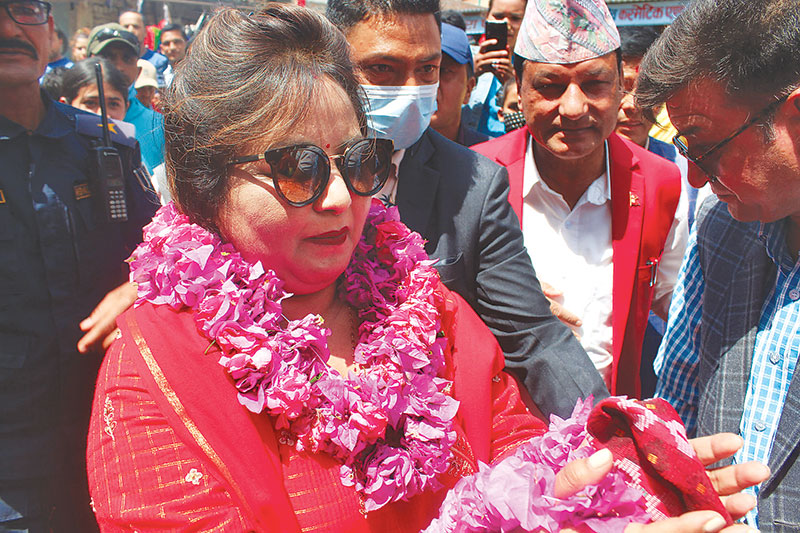
Arzu Rana Deuba during her campaign tour of the Far West for the local level elections.RSS
KATHMANDU : It’s election season and parties and their leaders are out canvassing. On Thursday, Arzu Rana Deuba, a Central Working Committee member of the ruling Nepali Congress, was in Dadeldhura campaigning for the May 13 local elections. While soliciting votes for Congress candidates, she, however, went a bit over the top. “Where there are no mayors of the Congress, why would we send money?” she said. “So, keeping this in mind, don’t vote for karuwa [a Nepali pitcher with a spout], saruwa and haruwa [loser] parties.” She was clearly asking people not to vote for Karna Bahadur Malla, the Dadeldhura district president of Nepali Congress who was expelled from the party recently for backing candidates of a fringe party named Nepali Congress (BP) in alliance with the CPN-UML. The party’s election symbol is Karuwa and it has fielded its candidates in several local units in the district. The remarks by Arzu, the wife of Prime Minister Sher Bahadur Deuba, have generated a flurry of reactions. Analysts say what Arzu said reflects a lack of basic understanding of how the state—or the government—functions and that it reeks of a feudal mindset. Arzu appears to have misunderstood the federal government as a family fief to insinuate that the administration run by her husband in Kathmandu would stop grants to local units where there are no Congress winners. “Why does the Nepali Congress deploy madam [in election campaigns] to decrease the votes [for the party]?” asked Umesh Mainali, a former bureaucrat and an expert on administrative affairs. “It’s surprising that she doesn’t understand the constitutional provision of resource distribution. If she was talking about the pork barrel, that is outright an unethical political practice.” Nepal went through some painful years as it strived to draw up a new constitution and restructure the state. After years of deliberations, the constitution adopted in 2015 turned the country into a federal republic guaranteeing three tiers of the government—federal, provincial and local. The May 13 elections are taking place to elect as many as 35,221 representatives for 753 local units. The state resources are distributed to local governments on the basis of a formula devised by the National Natural Resources and Fiscal Commission, a constitutional body led by Balananda Poudel. Experts say the federal government of the day, regardless of which party is at the helm, does not have a say in resource distribution, as it should be carried out as per the commission’s formula. Arzu’s remarks, according to experts, hence are outright objectionable and anti-constitutional and shows that she has little understanding of the federal system of governance. A longtime politician, Arzu holds a PhD on Organizational Psychology from Punjab University, India and has been active in various social activities for decades. She was a member of the Constituent Assembly—from 2008 to 2012 and 2013 to 2017. She, however, lost the last 2017 parliamentary elections. She currently does not have any defined role in the Sher Bahadur Deuba government. Earlier, in April 2017 also, she had run into controversy for her comments in Parliament demanding removal of the mandatory provision of picking a Dalit woman candidate for each ward in the local elections. Rameshore Khanal, a former finance secretary, said that the distribution of federal funds to provincial and local governments is guided by the constitution and that even the federal government cannot override it, let alone an individual politician. “Her statement reflects the mindset of most of our politicians,” said Khanal. “Even Thursday’s statement by Maoist Centre chair Pushpa Kamal Dahal in Chitwan shows his feudal mindset.” While addressing an election rally, Dahal said that the alliance candidates should be voted if the country were to be stopped from slipping into an abyss. “It’s unfortunate that Nepali politicians continue to treat people like subjects and not citizens, as if the Rana oligarchy rule still continues,” said Khanal. According to Khanal, it’s worrisome that Nepali leaders are so drunk on power that they think they can do anything they want. “There could be two reasons why she made such a statement. Firstly, her lack of understanding of the state functioning,” he said. “But it’s more because of the mindset of our leaders that they can say anything and go scot-free. Her statement reeks of arrogance.” When UML chair KP Sharma Oli was prime minister, he too used to display an overbearing and pompous attitude to the extent of behaving as though he was the state. How Oli took a dim view of the constitutionally carved out federal structures was evident from his remark in May 2019 that the provincial and local governments were not autonomous units but subordinate agencies of the federal government led by him. Poudel, the chair of the National Natural Resources and Fiscal Commission, said he was confused and equally surprised when he heard the statement by the Congress leader. “The commission I’m heading has been envisioned to ensure equitable distribution of the country’s resources so that the resources won’t change on the basis of which party has won in which local unit or the province,” Poudel told the Post. “We have, therefore, set 132 indicators and a proper criteria to divide up the resources.” According to Poudel, there could be some variations or room for manipulations when it comes to conditional grants from the federal government to the local governments based on locally prepared projects. “Such a statement has now made us wonder if the conditional grants provided to the local governments were misused,” he said. “Now, we will have to study whether we have been able to ensure our constitutional duty of equitable distribution of resources. I will launch a study to see whether the conditional grants were manipulated.” Nepal is holding local elections in a week as the local governments elected in 2017 are completing their first cycle, in a move towards strengthening federalism. Experts say a lack of understanding of the federal system and state’s functioning and resource distribution among senior politicians like Arzu does not bode well for the hard-earned achievements. Not everyone can be well-versed on all issues but politicians can at least stay away from making random statements on matters they lack the knowledge of, according to them. “She might have expertise in the non-governmental sector but actually she lacks political skills and acumen,” Mainali, who is also a former chair of the Public Service Commission, told the Post. “If people speak without even thinking, it can be counterproductive in politics.” According to him, her statement is against the constitution and even if the government is responsible for distributing resources she has no authority to say what she said. “How can politicians say they won’t take care of people who don’t vote for them?” said Mainali. Congress leaders, however, defended Arzu’s statement. “Her statement has been misconstrued. The remarks should be viewed in a holistic manner. She meant to say the Congress party will manage resources for the development of local units but the media only highlighted a small part of her speech and distorted the message,” Mahat told the Post. “It’s unfair that the media and the public are making comments without listening to the full speech while ignoring the message she was trying to convey.”
HOME PAGE
‘Namaskar, main Ravish Kumar’
A veteran Indian journalist talks about Indian media, its future, and India under Modi.
- Dinesh Kafle
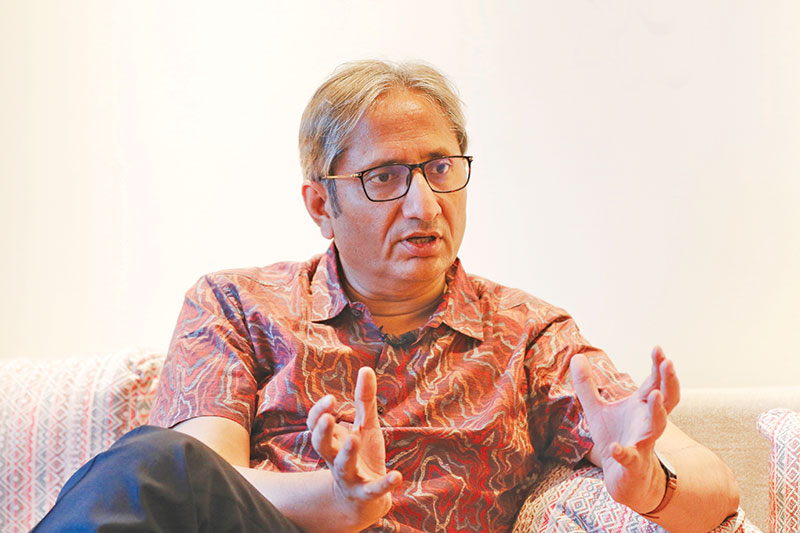
POST PHOTO: KESHAV THAPA
KATHMANDU : Ravish Kumar is among a few journalists in India who continue to receive death threats for doing what journalists are supposed to do: question the government. He started receiving death threats as early as 2015, months after Hindutva strongman Narendra Modi came to power in India. Death threats have become a regular occurrence for journalists who are critical of the government, as if it were a recognition that they are doing their job well. To be sure, his work has been recognised with the Ramon Magsaysay Award in 2019, and the Ramnath Goenka Excellence in Journalism Award 2013 and 2017. But he himself does not want to be recognised in public. “If you ask questions, it might even be dangerous to your life. In society, you cannot identify as a journalist,” Ravish told the Post on Friday as he arrived in Kathmandu. More than his own security, though, Ravish says he is worried about where Indian journalism is headed. In an interview with the Post, Ravish, who is in Kathmandu to speak at the Himal Media Mela, talked about what ails Indian journalism and why he has little hope for its future in the decades to come. “Indian journalism, as we know it, has been finished more or less,” said Ravish. For one, the profession he learnt about in his journalism school and in the field has changed beyond recognition. Media houses nowadays do not write or speak about what the people need to know, but what the government wants the people to know. Rather than act as mediators of information, journalists are now creators of perception on behalf of the government, he feels. As the world’s largest democracy slides to 150th position in the 2022 World Press Freedom Index as per the global media watchdog Reporters Without Borders, Ravish looks like one of the last few members of a tribe called journalists. He continues to make the government nervous as he presents his weekday show “Prime Time with Ravish Kumar”, where he starts with “Namaskar, main Ravish Kumar,” with a full assertion, piquing the viewer’s curiosity as to what he is going to offer. But he is aware that his tribe is getting smaller by the day, and the idea of a free voice is becoming a lost cause. “It has been accepted in the public that you cannot ask questions. Asking questions is considered a bad trait,” said Ravish. When Ravish stepped out of journalism school into the field as a reporter in the 1990s, this was not the scene. A senior executive editor of NDTV, a television channel he has stuck to for a decade and a half, Ravish is one of the rare breeds to ask questions to leaders and seek to hold to account those in power at a time when the Indian media seems to be toeing the government line. In his programmes, Ravish tells stories that India may not have heard or seen and talks to those whom the rest of the Indian media may have ignored while being busy singing paeans for the government, especially since the Bharatiya Janata Party came to power in 2014. Over the years, Ravish has emerged as someone who offers some solace to the viewers at a time when television has become a cacophony, with anchors engaging in shouting matches. But he stands alone and aloof, just to tell stories that matter to the marginalised, the downtrodden and those who rarely come to the radar of the conventional media. “The ethics we learnt as journalists, it has all changed now. The ideals and the objectives of journalism have all but gone for a toss. The kind of journalism that is happening now is all about Hindu-Muslim,” said Ravish. The very idea of what journalism is for has changed as media houses toe the line of the government and expend all their resources against the opposition, which is already too weak of its own. “This is not journalism in the classic sense. But if you look at it from the perspective of the society today, you’ll see that it considers this is what journalism is. The very idea of how journalists should function has changed,” he said. Citizens have for the past eight years been subjected to propaganda from ‘Godi Media’ and ‘WhatsApp University’—terms Ravish uses to identify media institutions or social media messaging groups that are unapologetically close to the government. Ravish seems to have coined ‘Godi Media’ rather uncannily to express how the Indian media under Modi has become a lapdog from a watchdog. ‘God [pronounced gowd] in Hindi means “lap.” And the man from Champaran in Bihar, a state bordering Nepal, refuses to be part of what he also calls “Lutyens’ Media” which is understood as left-leaning and elitist. Amid all that is going on in India, where television cacophony rules the roost, Ravish seems to be standing afar, trying to offer the real picture of India— stories that are untold, people who are unseen and politicians who are barely talked about. Ravish has a new name for the propagandist media houses–‘Hindu Media’. “For weeks now, media houses have run debates on loudspeakers being used in mosques [for ajaan]. From Godi Media, they have turned into Hindu Media. This is a golden period for this kind of media”. Communalism has become a daily affair in India today. In a country full of unmatched religious and cultural diversity, fanatics inspired by Hindutva raid streets and homes looking for traces of food items or relationships they consider unpious. Just as questioning the government, eating beef or marrying outside of religion is a crime for the fanatics who seek to ‘protect’ a deeply problematic, homogeneous idea of India. And the media has added fuel to the fire as television anchors spit venom against minorities, especially Dalits, Adivasis and Muslims, relaying the government’s narrative of “Hindu khatre mein hain”, or “Hindus are in danger”. Ravish sounds pessimistic about the future of Indian journalism. “In our society, journalism without information is increasingly being accepted as perception has become more important. There is nothing to do in this kind of journalism; you can just spit venom against people of other communities. This kind of journalism does not build a mature society.” This, however, is not a crisis of journalism only, says Ravish, adding, “It reflects a crisis in Indian society itself.” Having worked in television for more than two decades, Ravish now famously asks his viewers not to watch television, an irony in itself that he works for a television channel. Asked if he is contradicting himself while he himself uses television to earn bread and butter, Ravish quipped: “The viewers know which channels I’m imploring them not to watch.” As Nepal prepares to go for a second iteration of local elections, Ravish has an advice for journalists. “There cannot be a democracy with only one side. Democracy, rather, is a competition of ideas,” he said. “In India, the media has finished the spirit of opposition. Journalists should be careful that they do not have any competition outside of professional interest.”
In his programmes, Ravish Kumar tells stories that India may not have heard or seen.POST PHOTO: KESHAV THAPA
NATIONAL
Election hits school enrolment campaign
School enrolment campaign has not been able to make much headway since most people are either out participating in political rallies or listening to the political campaigners, say educators.
- SAMJHANA RASAILI
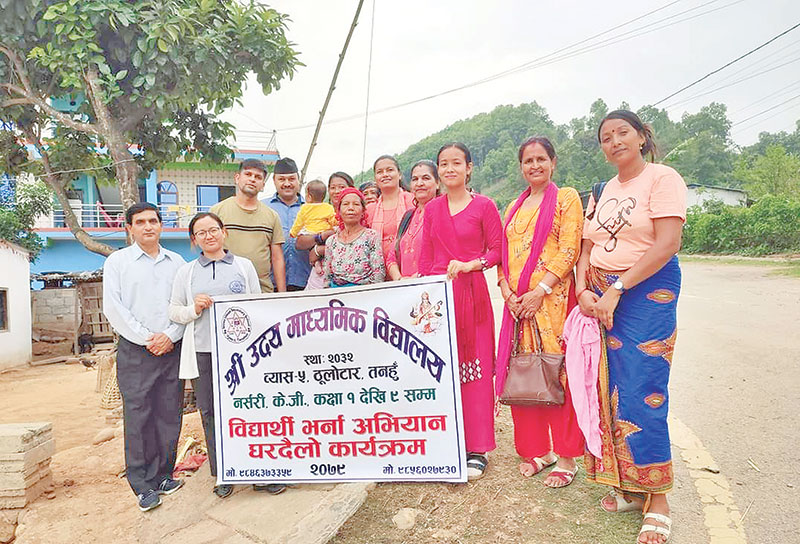
The Ministry of Education, Science and Technology launches the enrolment campaign every year with an objective to bring all children under the school system.Post Photo: SAMJHANA RASAILI
TANAHUN : The door-to-door campaign for the upcoming local elections and the school enrolment campaign for the new academic session have started simultaneously. On one hand, leaders, activists and candidates of political parties are scrambling to get voters in their favour while on the other hand, school teachers are rushing door to door to have students enrol in schools. The school enrolment campaign was greatly affected in the last two years by the Covid-19 pandemic and the restrictions that followed. This year, the frenzy for elections is affecting the enrolment campaign, educators say. Narayan Adhikari, principal of Siddheshwari Secondary School in Kamalbari of Vyas Municipality-12, said that they were already behind in the enrolment programme when the election fever took hold of the country. “Now the local level election is affecting our campaign,” he said. “With the poll campaigning going in full swing, we haven’t been able to conduct the school enrolment programme effectively.” Siddheshwari Secondary School, which has 300 students, runs classes upto grade 12. According to Adhikari, the teachers volunteering in the enrolment campaign have been unable to reach out to the students and their guardians because of the election rallies. “After seeing leaders and activists of political parties march in the election campaign with flags, the teachers in the enrolment campaign have to either return or wait for the politicians to wrap up their programmes,” he said. “Political rallies have reached every village, choking their small lanes.” For Shailendra Shah, principal of Araniko Secondary School at Thulodhunga in Bhanu Municipality-13, the upcoming elections and their campaigning have become a nuisance. The school enrolment programme is a nationwide campaign launched by the Ministry of Education, Science and Technology with an objective to bring all the children under the school system. Awareness campaigns are raised in the last week of April every year but this year, the campaign was pushed back to mid-May in several districts due to the Secondary Education Examination and local elections. Most teachers have reported that they couldn’t make much headway with the enrolment programme since adults from most of the households they visited were either out participating in political campaigns or stepping out to listen to the campaigners. “The teachers couldn’t meet the parents in our target households. Our campaign aims to convince parents to send their children to school but this time we haven’t been able to meet any parents,” said Shah. “We have hired qualified teachers, made arrangements for mid-day meal programmes in the school and have also developed communication technology to be used in the classrooms. But we haven’t got the chance to intimate this information to the parents.” Schools are now worried they might not be able to bring more children into the school system this year. Harka Bahadur Thapa, principal of Shanti Secondary School at Dubung in Rishing Rural Municipality-3, says that he is worried that the number of students may not increase in the school this year since there has been no communication between the school and the parents of school-going age children in the local unit. “In the years before Covid, teachers used to go from house to house and explain the features of the school to the parents in detail. Based on that information, the parents would send their children to school but this year because of the election madness, we haven’t been able to reach out to our potential students and their parents,” said Thapa. According to the data at the Education Development and Coordination Unit Office of the district, there are 441 community schools and 134 institutional schools in Tanahun. Around 13,437 students are enrolled in private schools and 60,994 in community schools, but among those in community schools, around 35,077 students have dropped out. Dhurba Raj Poudel, head of the education branch of Bhanu Municipality, says community schools have experienced shortages of teachers, science laboratories, ICT-friendly infrastructure, libraries and necessary educational materials. “All 10 municipalities in the district have launched the enrolment campaign with the slogan ‘Let’s send all children to school and ensure their right to education’ to attract students to schools. But we haven’t been able to run our campaign effectively to inform the parents and students about the developments made in terms of education,” said Poudel. “The municipality has collected the data of children of school-going age with the objective to have them enrolled,” he said. “But we haven’t reached several of our target households.” Puja Thapa, a local resident of Highschooltar in Vyas Municipality-1, said that in the years before Covid, the villages would be filled with teachers around this time for the enrolment campaign, but this year the village streets are filled with political party rallies instead. “Two years ago, teachers from various schools used to visit the villages but this year I haven’t seen any of them. I hardly see anyone but visiting politicians and their cadres carrying flags and pamphlets. Also, not many parents seem interested in the enrolment campaign this year,” Thapa said.
NATIONAL
Supreme Court upholds decision to remand Alam in judicial custody
Briefing
KATHMANDU: The Supreme Court has upheld the earlier rulings of the Rautahat District Court and Birgunj Bench of Janakpur High Court to remand former minister and Nepali Congress leader Mohammad Aftab Alam to judicial custody. Alam is charged with being the mastermind behind a bomb blast and the subsequent murder of more than a dozen people in Rautahat in 2008. A division bench of Justices Sushma Lata Mathema and Nahakul Subedi said that the subordinate courts had made the decision to remand Alam in judicial custody until the final verdict was valid. Alam had moved the Supreme Court challenging the decision of the subordinate courts, demanding his release on bail. The plea was rejected by the division bench.
NATIONAL
One dead in a house fire
- Post Report
PALPA: Man Bahadur Somai, 79, of Jaukharka in Rainadevi Chahara Rural Municipality-4 died in a house fire on Friday. According to the police, Somai’s house was destroyed in the fire. The cause of the fire is not yet known, police said. “Somai was alone at home during the time of the fire and could not escape,” said Deputy Superintendent of Police Birendra Thapa.
NATIONAL
Nepal reports 15 new Covid-19 cases
KATHMANDU: Nepal on Friday reported 15 new PCR confirmed coronavirus cases in the last 24 hours taking the nationwide infection tally to 978,914. All 1,003 antigen tests returned negative results, according to the Health Ministry’s daily situation report. As of Friday, 5,650,847 PCR and 1,174,418 antigen tests have been carried out across the country. A total of 2,450 PCR tests were performed in the past 24 hours, according to the Health Ministry. The country did not report any Covid-19 related death in the last 24 hours, according to the Health Ministry.
NATIONAL
Nepal seeks bids from Indian firms for 200MW wet season surplus energy
Nepal Electricity Authority has permission from India to sell up to 364 MW in the Indian market.
- PRITHVI MAN SHRESTHA
KATHMANDU : The Nepal Electricity Authority on Friday invited bids from Indian companies to sell its 200MW surplus energy in the upcoming rainy season under a long-term power purchase agreement. Even though the country is currently facing power shortages amid reduced domestic production and imports, the state-owned power utility has solicited bids for trading electricity during the wet season when Nepal will have surplus energy as all run-of-the-river power plants will be operating in their full capacities. The Nepal Electricity Authority (NEA) said in a statement that it will sell surplus energy from July 1 to November 29. All open access consumers, regulated utilities, power distribution companies and traders having valid trading licences issued by the Central Electricity Regulatory Commission of India can participate in the bidding process, according to the notice. “It is for the first time that we are selling as much as 200MW in the Indian market through competitive bidding,” said Suresh Adhikari, spokesperson for the NEA. “We have, however, already sold over 200MW to Bihar [state of India] under a fixed-rate regime.” The NEA and Bihar’s electricity authority have an agreement in place to buy and sell electricity at INR6.18 per unit as per their respective needs, according to the NEA. Nepal has received approval from India for selling 364MW of electricity at any time in the Indian market at competitive rates. In November last year, the NEA was allowed to sell 39MW of electricity from two hydropower projects—Trishuli (24MW) and Devighat (15MW). In early April this year, the Central Electricity Authority of India allowed the NEA to sell an additional 325MW generated from Kali Gandaki Hydropower Project (144MW), Middle Marsyangdi Hydropower Project (70MW), Marsyangdi Hydropower Project—all developed by the NEA, and Likhu 4 Hydropower Project (52.4MW) developed by the private sector. “We invited a tender to sell 200MW out of the approved 364MW. The company making the highest bid will be selected,” the statement quoted Kul Man Ghising, managing director of the NEA, as saying: The rest (164MW) will be sold through India Energy Exchange on a daily basis, Ghising said. NEA officials said they are not sure about the price the Indian bidders are willing to pay for its electricity. “Based on the bids, we will be able to figure out possible prices for a long-term power purchase agreement,” said Bhattarai. Given the ongoing power crisis in India, the NEA believes there is an opportunity for it to sell the electricity for a better price than last year. While the demand for electricity is high in India, supply has been constrained by the closure of coal-fired plants amid rising coal prices and its short supply globally. In early April, the Indian government capped the maximum price that bidders can quote at the power exchange market at INR12 per unit. Earlier, electricity at the power exchange market was sold at as high as INR 20 per unit. “There is a projection that power supply in the Indian market will continue to remain the same for some time. So there is an opportunity for us to sell our electricity at a higher rate in the upcoming monsoon,” Ghising told journalists at a recent press meet. Despite the opportunity to sell the electricity for as high as INR12 per unit in the power exchange market, the NEA has chosen to sell its electricity under a long-term contract and therefore the selling price is expected to be lower than that of the day-ahead market in the Indian Energy Exchange (IEX). The Day-Ahead Energy Market (day-ahead market) is a financial market where market participants purchase and sell electric energy at financially binding day-ahead prices for the following day. “The main aim is to discover the price for long-term power purchase agreement for Nepal’s electricity and also to diversify the risk because prices in the IEX are volatile,” said Adhikari. “Under long-term bilateral contracts, we can secure certain prices for a fixed period.” Last year, the NEA sold 39MW of electricity from the beginning of November to early December. “Average price over the period for our electricity was INR 3.5 per unit,” said Ghising. The NEA expects the country’s installed capacity to reach around 2300MW in the upcoming monsoon. Peak time demand is expected to reach 1900MW. But power demand will vary depending on time as the demand rises in the evening and falls substantially at midnight, according to the NEA. Spokesperson Adhikari said the NEA expects surplus energy of 600MW-800MW in the upcoming monsoon and it has made a request to the Indian authority seeking approval for selling electricity from more projects including the 456MW Upper Tamakoshi. The NEA has asked interested companies to submit their bids by May 27. But no company can submit a bid for less than 50MW, according to the NEA. The power utility body said it would sell the surplus energy through the Dhalkebar-Muzaffarpur Cross Border Transmission line.
NATIONAL
Not just UML, Congress and Maoist Centre, many unheard of parties are also contesting local polls
Some of the political parties registered for the May 13 elections have quirky and peculiar names.
- Post Report
KATHMANDU : What is in a name? Pushpa Kamal Dahal, the Maoist leader, may know it much better than anyone else. A stroke of the pen on March 7 last year led to the invalidation of the Nepal Communist Party (NCP), awarding the CPN (Maoist Centre) back to Dahal and leaving him high and dry. The reason was simple. A party with the same name had already been registered by Rishiram Kattel. Kattel moved the Supreme Court, arguing that the registration of the Nepal Communist Party (NCP) by Dahal and KP Sharma Oli, the chair of the CPN-UML, at the Election Commission, was illegal. The court agreed and returned the Nepal Communist Party to Kattel. But no one is talking about Kattel’s Nepal Communist Party as local elections are approaching. His party has been struck off by the poll commission because the issue is still sub judice. According to the Election Commission, there are 79 parties that are registered for the May 14 local elections. However, only a handful of parties have got people’s attention. The UML, Nepali Congress, CPN (Maoist Centre), CPN (Unified Socialist), Janata Samajbadi Party, Loktantrik Samajbadi Party, Rastriya Prajatantra Party, and Rastriya Prajatantra Party Nepal are some of the political forces which people have found interest in. And these are the parties which are mostly getting space in the media. While most of those registered have some common names with “communist” or “samajbadi” tags, there are some quirky ones which many may not have even heard of. Take this for an example. A party that has registered itself with the commission for local elections is called Maulik Jarokilo Party. The party is registered in the name of Sushil Gautam. It has fielded candidates in Dharan Sub-metropolitan City, Sunsari; Triyuga Municipality and Belaka Municipality in Udayapur; Chandrapur Municipality, Rautahat; Tripurasundari Rural Municipality, Dhading; Tandi Rural Municipality, Nuwakot; Kageshwari Manohara Municipality, Kathmandu; Kathmandu Metropolitan City; and Changunaryayan Municipality, Bhaktapur. Another party with a peculiar name is Aamul Pariwartan Masiha Party, Nepal. It is registered in the name of Bharat Giri. It has also fielded candidates in about a dozen local units. Some other parties whose names many may find interesting are Miteri Party, Nepal, registered in the name of Dhanendra Bahadur Basnet; Nepalbad Party of Kiran Kumar Sharma Poudel; Aadhunik Nepal Samajbadi Party of Krishna Gopal Banjara; and Rastriya Yetharthabadi Party, which is registered in the name of Bishnu Bahadur Karki. Yagya Bhattarai, a joint secretary at the Election Commission, says there are certain criteria about party names, or else it accepts any name political outfits come up with. “Parties themselves propose their names. First of all we check if any other party is registered with the same name,” said Bhattarai. “If not, we accept the proposed names unless they seem to be giving out any communal message.”
MONEY
Nepal slips in global ranking in mobile broadband speed
The median global performance of mobile broadband was measured at 29.96 Mbps download speed and 8.70 Mbps upload speed, as per Ookla.
- KRISHANA PRASAIN
The United Arab Emirates ranks first in mobile broadband speed, followed by Norway and Qatar.Shutterstock
KATHMANDU : The number of mobile internet users in Nepal has been going up, but connection speed has been going down, says the latest report by Ookla, a US-based web service that provides free analysis of internet access performance metrics. Nepal slipped to the 109th spot among 142 countries in mobile broadband speed in May, as per the Speedtest Global Index. Nepal was in the 88th position in May last year. This shows that customers, despite paying high prices for the service, are getting low mobile broadband speed. According to the Speedtest report, the median download speed in Nepal was measured at 16.45 Mbps in May, up from 15.39 Mbps in May last year, but still way below the median global performance. The upload speed was measured at 10.35 Mbps in May, compared to 10.85 Mbps in May last year. In South Asia, Maldives came out tops in internet speed. Maldives took the 38th position followed by Pakistan in the 107th spot. India came 120th, Sri Lanka 123rd, Bangladesh 129th and Afghanistan 141st. The median global performance of mobile broadband was measured at 29.96 Mbps download speed and 8.70 Mbps upload speed. Government officials say that high taxes, under different unseen headings, have made internet service expensive. The internet infrastructure sharing plan has not been implemented effectively in Nepal either, making internet connections one of the most expensive in the region. Shobhan Adhikari, spokesperson for Nepal Telecom, said that infrastructure and affordability play an important role in providing quality service. “The 4G speed has improved due to the expansion of the infrastructure. With the increase in the number of service users, base transceiver stations need to be added, and the radio network optimised accordingly,” Adhikari said. “In terms of affordability, the price of 4G has dropped by more than 35 percent since it was initiated in 2017.” The United Arab Emirates ranked in the first position in mobile broadband followed by Norway and Qatar. According to a management and information system report by the Nepal Telecommunications Authority, there are 36.99 million internet subscribers in the country. Among them, 29.33 million are mobile internet subscribers and 7.26 million are fixed internet subscribers. Of the total 126.72 percent internet subscriptions in the country, 97.42 percent are mobile broadband subscribers and 28.90 percent are fixed broadband subscribers. According to the “Connectivity in the Least Developed Countries Status Report 2021” published by the International Telecommunication Union, mobile broadband has a higher impact on economic growth than fixed broadband in the developing countries, with the main factor being that there are so few fixed broadband subscriptions. The least developed countries are far from reaching the penetration threshold to benefit from fixed broadband economic impacts, estimated to be around 10 fixed broadband subscriptions per 100 people. The slowdown in rolling out mobile broadband networks is due to a number of factors like constrained competition, perceived limited demand, spectrum constraints and lack of infrastructure sharing, the report said. Affordability is also a factor, as per the report. Mobile data prices have declined in all regions, but in the least developed countries, the cost is still seven times higher than the affordability target set by the United Nations, the report said. Nepal was using on average 2 GB data monthly in 2020, which is more than the International Telecommunication Union basket of 1.5 GB. Nepal Telecom is planning to roll out the much-awaited 5G technology for commercial purposes by the end of this fiscal year in mid-July 2022. Initially, Nepal Telecom had targeted to begin trials from mid-July 2021, but changes in government delayed the plan, officials say. Nepal currently has 4G networks which were established in January 2017. The Himalayan republic has improved in fixed broadband, rising to the 82nd position from the 95th position in the previous year. Nepal took the 82nd position in March with a median 41.29 Mbps download speed and 38.67 Mbps upload speed in fixed broadband. In May 2021, the download speed was measured at 22.17 Mbps and the upload speed was measured at 19.20 Mbps. The country’s fixed broadband internet speed showed significant improvement from December last year, rising from the 98th position in November to the 79th position. The download speed increased from 28.32 Mbps in November last year to 40.37 Mbps in December last year while the upload speed increased from 24.26 Mbps in November to 37.81 Mbps in the review period.Among South Asian countries, India is ahead in fixed broadband speed ranking in the 72nd position. Nepal is ahead of Bangladesh in the 97th position, Sri Lanka in the 118th position, Maldives in the 138th position, Bhutan in the 150th position, Pakistan in the 151st position and Afghanistan in the 182nd position in fixed broadband. The median global performance of fixed broadband was measured at 62.52 Mbps download speed and 26.98 Mbps upload speed. Singapore ranked in first position in fixed broadband followed by Chile and Thailand. According to the “Connectivity in the Least Developed Countries Status Report”, Nepal has a fixed broadband penetration of around 5 per 100 people.
MONEY
Twitter courts advertisers amid uncertain future
Elon Musk, who is buying Twitter for $44 billion, has tweeted that the platform should not have ads.
- REUTERS
NEW YORK : Twitter Inc faced a sceptical audience as it showcased its advertising opportunities on Wednesday at an event in New York City, three ad agency executives told Reuters, as the social media company’s plans under billionaire Elon Musk remain unclear. The Tesla chief executive, who is buying Twitter for $44 billion, has tweeted that the platform should not have ads so it can have more control over its content moderation policies. Twitter has told its employees in internal staff meetings and in public filings that its advertising business and other operations would continue normally until the deal closes, but the company could not speculate on changes Musk might make. “He’s like the ghost of Christmas future hanging over this whole thing,” said Mark DiMassimo, founder of ad agency DiMassimo Goldstein, referring to Twitter’s presentation to advertisers on Wednesday. “Whatever [Twitter] says, all anyone really wants to know is how this will be in the future.” The social media company earned $5 billion in revenue in 2021, the majority from selling digital advertising on its website and app. Most advertisers have not pulled back ad dollars from Twitter, but are watching closely to see how Musk could change the platform and its business, the ad executives said. “I would like [Twitter] to address and talk to it, because there’s a lot of curiosity,” said Alex Stone, senior vice president of advanced video and agency partnerships at Horizon Media. Ad agencies and brands mingled at a cavernous event space in NYC before Twitter’s presentation began. One ad buyer said attendees were speculating whether Twitter would joke about the take-private deal with Musk or address the matter more directly. The buyer didn’t have to await long for an answer. “It has been a quiet month here at Twitter,” joked JP Maheu, VP of global client solutions at Twitter at the start of the presentation. The company announced a number of content partnerships tied to the presentation. Twitter said it was expanding its partnerships with media companies Conde Nast and Essence, which will create video and audio programming on Twitter. E! News will launch a new live-streamed show on Twitter to discuss TV shows such as “The Real Housewives,” and “Stranger Things.” Advertisers will be able to purchase ad spots that run next to videos from the media companies. The social media platform said it would be the first social partner to test an integration with iSpot, the firm NBCUniversal uses to measure video viewing.
MONEY
Food prices ease slightly in April after record surge, UN agency says
Global food security remains a concern because of the difficult market conditions.
- REUTERS
A French farmer harvests his field of wheat during sunset in Thun-L’Eveque, northern France. REUTERS
ROME ; World food prices eased slightly in April after hitting a record high in March, but global food security remained a concern because of the difficult market conditions, UN food agency said on Friday. The Food and Agriculture Organisation’s (FAO) food price index, which tracks the most globally traded food commodities, averaged 158.5 points last month versus an upwardly revised 159.7 for March. The March figure was previously put at 159.3. “The small decrease in the index is a welcome relief, particularly for low-income food-deficit countries, but still food prices remain close to their recent highs, reflecting persistent market tightness and posing a challenge to global food security for the most vulnerable,” said FAO Chief Economist Maximo Torero Cullen. Although it declined month-on-month, the April index was 29.8 percent higher than a year earlier, pushed up in part by concerns over the impact of the Russian invasion of Ukraine. The agency’s cereal price index fell 0.7 percent in April after a 17 percent jump in March. While maize prices dropped 3.0 percent, wheat prices rose 0.2 percent. FAO said wheat was hit by the blockage of ports in Ukraine and worries over crop conditions in the United States, however these concerns were partially offset by larger shipments from India and higher-than-expected exports from Russia. FAO’s vegetable oil price index dropped 5.7 percent in April, as demand rationing pushed down prices for palm, sunflower and soy oils. Sugar prices increased 3.3 percent, the meat price index rose 2.2 percent and the dairy index added 0.9 percent. In separate cereal supply and demand estimates on Friday, the FAO slightly cut its projection of world wheat production in 2022 to 782 million tonnes, from 784 million last month. The forecast factored in an expected 20 percent reduction in the harvested area in Ukraine and a projected decline in output in Morocco because of a drought in the north African state. With almost all crops harvested, FAO’s world cereal production forecast for 2021 was unchanged at 2.799 billion tonnes, 0.8 percent up on 2020 levels.
MONEY
Europe’s farmers stir up biogas to offset Russian energy
- ASSOCIATED PRESS
A worker walks among pipelines that will carry gas toward the city of Rambouillet, outside the village of Sonchamp, south of Paris on Tuesday. AP/RSS
SONCHAMP (France) : In lush fields southwest of Paris, farmers are joining Europe’s fight to free itself from Russian gas. They’ll soon turn on the tap of a new facility where crops and agricultural waste are mashed up and fermented to produce “biogas.” It’s among energy solutions being promoted on the continent that wants to choke off funding for Russia’s war in Ukraine by no longer paying billions for Russian fossil fuels. Small rural gas plants that provide energy for hundreds or thousands of nearby homes aren’t—at least anytime soon—going to supplant the huge flows to Europe of Russian gas that powers economies, factories, business and homes. And critics of using crops to make gas argue that farmers should be concentrating on growing food—especially when prices are soaring amid the fallout of the war in Ukraine, one of the world’s breadbaskets. Still, biogas is part of the puzzle of how to reduce Europe’s energy dependence. The European Biogas Association says the European Union could quickly scale up the production of bio-methane, which is pumped into natural gas networks. An investment of 83 billion euros ($87.5 billion)—which, at current market prices, is less than the EU’s 27 nations pay per year to Russia for piped natural gas—would produce a tenfold increase in bio-methane production by 2030 and could replace about a fifth of what the bloc imported from Russia last year, the group says. The farmers around the Paris-region village of Sonchamp feel their new gas plant will do its bit to untie Europe from the Kremlin. “It’s not coherent to go and buy gas from those people who are waging war on our friends,” said Christophe Robin, one of the plant’s six investors, who farms wheat, rapeseed, sugar beets and chickens. “If we want to consume green [energy] and to avoid the flows and contribution of Russian gas, we don’t really have a choice. We have to find alternative solutions,” he said. Biogas is made by fermenting organic materials—generally crops and waste. Robin likened the process to food left too long in a container. “When you open it, it goes ‘Poof.’ Only here, we don’t open it. We collect the gas that comes from the fermentation,” he said. The gas from their plant could meet the needs of 2,000 homes. It will be purified into bio-methane and injected into a pipeline to the nearby town of Rambouillet, heating its hospital, swimming pool and homes. “It’s cool,” said Robin. “The kids will benefit from local gas.” Like in the rest of Europe, the production of bio-methane in France is still small. But it is booming. Almost three bio-methane production sites are going online every week in France on average and their numbers have surged from just 44 at the end of 2017 to 365 last year. The volume of gas they produced for the national network almost doubled in 2021 compared to the previous year and was enough for 362,000 homes.
MONEY
Thailand targets 5 million to 15 million foreign tourists this year
Briefing
BANGKOK: Thailand is aiming for 5 million to 15 million foreign tourist arrivals this year as the country further eases travel restrictions to support the key tourism sector, a government spokesperson said on Friday. The Southeast Asian country removed on-arrival Covid-19 tests from May 1, the latest measure aimed at reviving its battered tourism industry which generally accounts for about 12 percent of gross domestic product. Tourists are expected to spend between 630 billion baht ($18.35 billion) and 1.2 trillion baht this year, government spokesperson Thanakorn Wangboonkongchana said in a statement, citing the Tourism Authority of Thailand’s projection. (REUTERS)
MONEY
Russia’s Sovcomflot says it plans to sell part of its fleet
MOSCOW: Russia’s leading shipping company Sovcomflot plans to sell part of its fleet, it said on Friday, as it grapples with Western sanctions and seeks to repay outstanding loans. Sovcomflot has faced growing challenges in concluding charters as ports, end purchasers, marine insurers and other freight companies pull back from Russian business amid sanctions imposed in response to Moscow’s invasion of Ukraine. (REUTERS)
MONEY
Ukraine wheat harvest set to drop by third, data firm says
PARIS: Ukraine’s wheat production is likely to be down by at least a third from last year due to the Russian invasion, a data analysis firm that uses satellite imagery said on Friday. Ukraine is a major producer and exporter of wheat, but the invasion has disrupted planting, which is still underway, both due a lack of fuel for equipment and farmers having to deal bombardments and unexploded ordnance. (AFP)
WORLD
Ukraine says new Mariupol evacuation has begun, despite reports of fighting
Russia’s military promised to pause its activity for the next two days to allow civilians to leave.
- REUTERS
Smoke rises above a plant of Azovstal Iron and Steel Works in the southern port city of Mariupol, Ukraine on Thursday. REUTERS
KYIV : Ukraine said a new attempt had begun on Friday to evacuate scores of civilians trapped in a ruined steel works in the city of Mariupol, after bloody fighting with Russian forces thwarted efforts to bring them to safety the previous day. Mariupol, a strategic southern port on the Azov Sea, has endured the most destructive siege of the 10-week-old war, and the sprawling Soviet-era Azovstal steel plant is the last part of the city still in the hands of holdout Ukrainian fighters. UN-brokered evacuations of some of the hundreds of civilians who had taken shelter in the plant’s network of tunnels and bunkers began last weekend, but were halted in recent days by renewed fighting. “The next stage of rescuing our people from Azovstal is under way at the moment. Information about the results will be provided later,” said Andriy Yermak, head of the Ukrainian presidential staff. He gave no more details. Authorities in Mariupol later accused Russian forces of violating a ceasefire at the steel works and firing at a car involved in evacuation efforts, killing one Ukrainian fighter and wounding six. Russia did not immediately comment on the city council’s online statement. Russia has turned its heaviest firepower on Ukraine’s east and south, after failing to take the capital Kyiv in the early weeks following its February 24 invasion. The new front is aimed at limiting Ukraine’s access to the Black Sea, vital for its grain and metals exports, and linking Russian-controlled territory in the east to the Crimea Peninsula, seized by Moscow in 2014. Moscow calls its actions a “special military operation” to disarm Ukraine and rid it of anti-Russian nationalism fomented by the West. Ukraine and the West say Russia launched an unprovoked war of aggression. More than 5 million Ukrainians have fled abroad since the start of the invasion. Ukraine’s general staff said on Friday that Russian forces were continuing their “attempts to fully take over the Donetsk and Luhansk regions”, areas in the east partially seized by Moscow-backed separatists in 2014. Russia’s defence ministry said it had destroyed a large ammunition depot in the eastern Ukrainian city of Kramatorsk in a missile strike. It also said its air defences shot down two Ukrainian warplanes in the Luhansk region. It was not possible to independently verify either side’s statements about events on the battlefield. In Mariupol, Ukraine’s general staff said Russian efforts to overrun the Azovstal plant had resumed, with air support. A member of the self-proclaimed Donetsk People’s Republic forces, who are fighting alongside the Russian army in eastern Ukraine, told Reuters he thought Ukrainian forces had little strength left to defend Azovstal. “We’re not far. Just a little left,” said the fighter who gave his name as Alexei, speaking on Thursday as detonations resonated in the background near the plant. “It won’t last long.” He did not provide any evidence for his statement. An estimated 200 civilians remained trapped underground in the plant with little food or water. Russian President Vladimir Putin has said Moscow was prepared to provide safe passage for the civilians but reiterated calls for Ukrainian forces inside to disarm. The Kremlin denies Ukrainian allegations that Russian troops stormed the plant in recent days and said humanitarian corridors were in place. Russia’s military promised to pause its activity for the next two days to allow civilians to leave. Putin declared victory in Mariupol on April 21 and ordered his forces to seal off the plant. Ukrainian officials have said Russia might step up its offensive before May 9, when Moscow commemorates the Soviet Union’s victory over Nazi Germany in World War Two. “The time will come to mark Victory Day in Mariupol,” Kremlin spokesperson Dmitry Peskov told reporters in a briefing on Friday, when asked about plans for May 9 in territory recently seized by Russian-backed forces. The stubborn Ukrainian defence of Azovstal has underlined Russia’s failure to take major cities in a war that has united Western powers in arming Kyiv and punishing Moscow with the most severe sanctions ever imposed on a major power. Economic measures from Washington and European allies have impaired Russia’s $1.8 trillion economy and billions of dollars worth of military aid has helped Ukraine frustrate the invasion.
WORLD
Indian opposition seeks higher compensation for Covid deaths
- REUTERS
NEW DELHI : India’s main opposition Congress party on Friday demanded a hefty rise in compensation for the families of those who died of Covid-19, after the World Health Organisation estimated the country’s toll was nearly 10 times the reported figure. Prime Minister Narendra Modi’s government has rejected the WHO estimate released on Thursday that 4.7 million people died in India as a result of the pandemic until last year, when hospitals ran out of oxygen and beds due to a record wave driven by the Delta variant. India has reported only 524,002 Covid-19 deaths—the most after the United States and Brazil—with more than 43 million infections. Actual infections are believed to be in the hundreds of millions in the country of 1.35 billion people. “Science doesn’t LIE. Modi does,” Congress’s second-in-command, Rahul Gandhi, said on Twitter, citing the WHO report. “Respect families who have lost loved ones.” He asked the government to compensate the families of each person dying of Covid with 400,000 rupees ($5,213). The government currently gives 50,000 once deaths are confirmed to be from Covid. The government rejected the WHO estimates as the “validity and robustness of the models used and methodology of data collection are questionable”. An Indian government source said they would continue to engage with the WHO. The WHO said it had not yet fully examined new data provided this week by India, which issued its own mortality figures for all causes of death in 2020 on Tuesday. The UN body said it may add a disclaimer to its report highlighting ongoing conversations with India. Some Indian states, nevertheless, have agreed to compensate more families than their official tally suggests. Modi’s home state of Gujarat, for example, has recorded around 11,000 Covid fatalities since the start of the pandemic but has approved at least 87,000 compensation claims.
WORLD
Virus found in pig heart used in human transplant
- ASSOCIATED PRESS
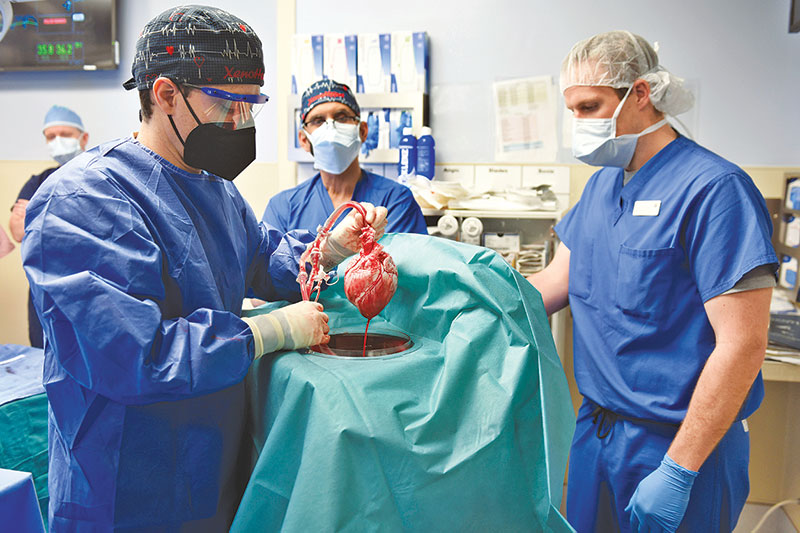
A file photo shows members of the surgical team holding the pig heart for transplant. AP/RSS
Baltimore : Researchers trying to learn what killed the first person to receive a heart transplant from a pig have discovered the organ harboured an animal virus but cannot yet say if it played any role in the man’s death. A Maryland man, 57-year-old David Bennett Sr, died in March, two months after the groundbreaking experimental transplant. University of Maryland doctors said on Thursday they found an unwelcome surprise—viral DNA inside the pig heart. They did not find signs that this bug, called porcine cytomegalovirus, was causing an active infection. But a major worry about animal-to-human transplants is the risk that it could introduce new kinds of infections to people. Because some viruses are “latent,” meaning they lurk without causing disease, “it could be a hitchhiker,” Dr Bartley Griffith, the surgeon who performed Bennett’s transplant, told The Associated Press. Still, development is under way of more sophisticated tests to “make sure that we don’t miss these kinds of viruses,” added Dr Muhammad Mohiuddin, scientific director of the university’s xenotransplant programme. The animal virus was first reported by MIT Technology Review, citing a scientific presentation Griffith gave to the American Society of Transplantation last month. The Maryland team said the donor pig was healthy, had passed testing required by the Food and Drug Administration to check for infections, and was raised in a facility designed to prevent animals from spreading infections. Revivicor, the company that provided the animal, declined to comment. Meanwhile doctors at other medical centres around the country have been experimenting with animal organs in donated human bodies and are anxious to attempt formal studies in living patients soon.
WORLD
Sri Lankan police use tear gas on protesters near Parliament
Its economic woes have brought on a political crisis.
- ASSOCIATED PRESS
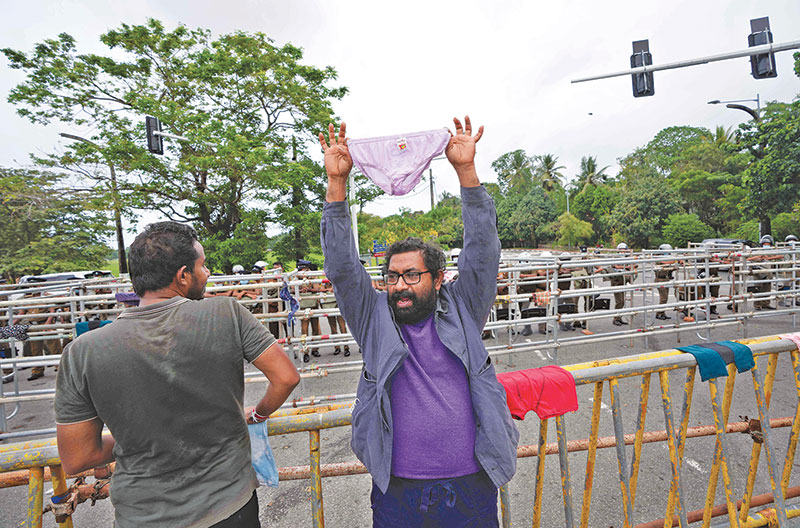
A man holds up an undergarment and shouts slogans during a protest in Colombo on Friday. AP/RSS
COLOMBO : Sri Lankan police used tear gas and a water canon on Friday to disperse student protesters who were camped outside Parliament criticising lawmakers for not ousting President Gotabaya Rajapaksa and his government over the country’s worst economic crisis in recent memory. The student-led protest began on Thursday after a government-backed deputy speaker was elected in Parliament by a comfortable margin in what was seen a key victory for the ruling coalition. Separately, protesters have been occupying the entrance to the president’s office in the capital, Colombo, for 28 days demanding Rajapaksa and his powerful ruling family quit. Shops, offices and schools closed across the country on Friday and transport came to a near standstill amid widespread demonstrations against the government. “People have been telling this government to go home for a month. They just didn’t wake up from sleep demanding it,” student leader Wasantha Mudalige said. “They have endured big problems that have led to this demand.” “There are discussions going on inside this thieves’ den called Parliament, and none of the people’s issues are discussed there. So the people’s decision is that the Parliament does not reflect their sentiments,” Mudalige added. Factories, banks and government offices were also closed, with employees demonstrating in front of them. Black flags were displayed at shops, heeding a call from trade unions and other civil organisations, and many protesters wore black T-shirts. Protesters also hung undergarments by a road leading to Parliament and chanted: “This is all we are left with!” The Indian Ocean island nation is on the brink of bankruptcy and has suspended payments on its foreign loans. Its economic woes have brought on a political crisis, with the government facing protests and a no-confidence motion in Parliament. Sri Lanka was due to pay $7 billion of its foreign debt this year out of nearly $25 billion it must pay by 2026. Its total foreign debt is $51 billion. Sri Lanka’s finance minister announced earlier this week that the country’s usable foreign reserves have plummeted below $50 million. Shortages of hard currency have also hindered imports of raw materials for manufacturing and worsened inflation, which surged to 18.7 percent in March.
WORLD
India ready with plans to mitigate heatwave impact, official says
More than two dozen people have died of suspected heat strokes since late March.
- REUTERS
NEW DELHI : Some 80 percent of Indian states are prone to heatwaves and most have plans ready to alter office and school timings as well as working hours for labourers to avoid the hottest time of day when necessary, a government official told Reuters on Friday. India suffered its hottest March in more than 100 years and April saw many places, including New Delhi, recording unusually high temperatures in excess of 40 degrees Celsius on most days. More than two dozen people have died of suspected heat strokes since late March, and power demand has hit multi-year highs. The National Disaster Management Authority (NDMA) has categorised 23 of India’s 28 states and some 100 cities and districts as being at risk of suffering extreme heat. Nineteen states have already made their own heat-action plans and some others are working on them, said NDMA’s policy and planning adviser, Kunal Satyarthi. “There were only nine a few years back but currently 23 are recognised as heatwave-prone states,” he said. “Cities have become heat islands, so a lot of them are drafting their own plans.” He said the plans include reducing people’s exposure to heat, arranging drinking water in public places and other interventions. The western state of Maharashtra, home to India’s financial capital Mumbai, has also planned to modify market hours, provide public shelters, sprinkle mist in public places and keep ice bags at public health centres, according to the NDMA website. Long-term measures include planting more trees, rainwater harvesting, providing shelter for traffic police and using green nets for shade in market areas, it adds.
WORLD
FDA restricts J&J’s Covid-19 vaccine due to blood clot risk
Briefing
WASHINGTON: US regulators on Thursday strictly limited who can receive Johnson & Johnson’s Covid-19 vaccine due to the ongoing risk of rare but serious blood clots. The Food and Drug Administration said the shot should only be given to adults who cannot receive a different vaccine or specifically request J&J’s vaccine. US authorities for months have recommended that Americans get Pfizer or Moderna shots instead of J&J’s vaccine.
WORLD
Russia will not use nuclear weapons in Ukraine, foreign ministry says
- Post Report
MOSCOW: Russia will not use nuclear weapons in Ukraine, foreign ministry spokesman Alexei Zaitsev said on Friday. Zaitsev told reporters the use of nuclear weapons by Russia—a risk that Western officials have publicly discussed—was not applicable to what Moscow calls its special military operation in Ukraine. CIA director William Burns said on April 14 that given the setbacks Russia had suffered in Ukraine, “none of us can take lightly the threat posed by a potential resort to tactical nuclear weapons or low-yield nuclear weapons.”
WORLD
Taiwan jets scramble as China air force enters air defence zone
TAIPEI: Taiwan’s air force scrambled on Friday to warn away 18 Chinese aircraft that entered its air defence zone, Taiwan’s defence ministry said, part of what is a regular pattern of incursions that has angered the government in Taipei. Taiwan has complained of repeated such missions by Chinese aircraft, which have become a common occurrence.
WORLD
Fiji seizes $300 million yacht of Russian oligarch Suleiman Kerimov on US request
WASHINGTON: Authorities in Fiji have seized a $300 million yacht of Russian oligarch Suleiman Kerimov at the request of the US, the US Justice Department said on Thursday, as Washington and its allies press Russia over its invasion of Ukraine. (agenices)
CULTURE & LIFESTYLE
A sensitive portrayal of the lives of sex workers
Rijula Das’s debut novel has all the elements of a thriller and the traditional paraphernalia of a sex worker’s love story.
- Post Report
This debut novel by Rijula Das must be remembered for the character of Lalee, who is nothing like Anna Karenina, Emma, or Lolita—all three represent the immoral women in European literature. The remarkable thing about Lalee is the defiance that surpasses both her desire to be accepted and her desire to be loved. For Lalee, living comes before love and safety before money. She wants dignity as much as she wants food and protection from the wounds of her ‘sinful’ profession. Prostitutes in Shonagachhi, a red-light district in Calcutta, and elsewhere are expected to suppress not just their desire to be loved but also anger. But Lalee displays bursts of anger whenever she feels agitated and threatened. She is also sceptical of everyone around her and understands capitalism better than anyone else does. She is aware that money is the backdrop behind every act of love and courtesy. Her distrust is easy to comprehend, but her hunger for dignity makes her an exceptional character. Some form of determination drives her anger and her desire to escape. In her mind, she despises a world that reduces her to a non-entity and confines her to this undignified life. But she creates dignity by mocking everything, every social institution, and even her relationship with Tiloo Shah, who haplessly and hopelessly falls in love with her. It is not easy to create a character like Lalee, but Das’s astute portrayal of someone desiring dignity is commendable. Lalee is the subaltern who understands the reality of her subaltern position, and this awareness becomes her power. Irrespective of what men or her lovers might tell her, she knows hers is a profane business. At one point in the novel, Lalee lets the reader know this: “It’s amazing, thought Lalee, how many synonyms one language could have devised and seemed to need for women who sell their bodies for money. We are [an expletive] a whole population of women connected only by their livelihood reduced to a single word of offence. At least we do what we do, but those who don’t aren’t spared either. At one time or another, every woman is turned into a profanity.” Lalee’s progressive thoughts reflect how she viewed herself vis-a-vis the outside world. While she is acutely aware of her downtrodden position, she does not have much respect for the outside world. Her anger at Shefali Madam and Sonia is not much different from what she feels for a common married woman. It is as if the whole world is complicit in this disgrace, yet they remain oblivious of their subordinate existence. In a country where the contradictory status of women as goddesses and as an object of desire is so deeply entrenched, this brilliant debut novel by Rijula Das takes this paradox to another level. In a patriarchal and sexist society, the lives of prostitutes are a sinful fantasy for ‘respectable’ women and occasional unholy objects for many men. Sadly, in the 21st century, people view prostitutes as profane objects, while people refuse to utter a single word of disdain for the men who visit them. This is not to romanticise prostitution as a profession but an attempt to expose the double standards that only view women as “dirty” objects. At the same time, men who visit them for occasional pleasure carry on with their ordinary lives. This debut novel wants us to laugh as much as it wants us to cry and feel anger. Just like Sarat Chandra Chatterjee’s novel ‘Devdas’ (1917), this is a social novel that unravels the lives of women living in Shonagachhi. Even though Chatterjee’s novel is usually labelled as a romance, it is undoubtedly more than a romance. It is also a concise commentary on the provocative portrayal of wives and prostitutes. Likewise, Das goes beyond the ‘marketable’ qualities of prostitutes and goes on to picture the real fears and desires that haunt the prostitutes of Shonagacchi. Like in most red-light areas, Shonagacchi is an isolated world of its sort. Everyone here desires to escape but is too helpless to find their way out. Apart from ‘sin’ and ‘pleasure’, coercion, violence, and killings are modern-day realities here. There is no question about human rights; prostitutes are just prostitutes. Amidst all this paraphernalia of a prostitute’s life, Das’s portrayal of the protagonist, Lalee, remains the most authentic and haunting. Lalee seems to be at the novel’s centre, but her persona is more remarkable and haunting than her story. She desires to find dignity in a profession that offers her nothing but indignation. It is a great relief that Das is not interested in invoking pity but acceptance of whomever Lalee is or wants to become—something the dark rooms of the red-light streets do not allow. Despite having elements of a thriller and the traditional paraphernalia of a sex worker’s love story, it will be a hurried decision to club this novel into any category. The novel is anything but genre fiction. The underlying humour is unwarranted but lightens up the grim plot that the story follows. The callous state machinery that includes the police and its complicity in the violence against women in the sex trade is hilarious but concerning. The age-old debate of whether the women want to be rescued or want rights within this profession is also spurred, and thankfully no suggestions are offered. A novel about prostitution cannot be just erotica or a rescue mission but a social novel that tackles the lived experiences of sex workers as a valid experience.
The author has a doctorate in English from Jawaharlal Nehru University, New Delhi.
- Fathima M
CULTURE & LIFESTYLE
Radio Kantipur organises National Music Awards 2078
The star-studded show had 75 nominations and 16 award categories.
- Post Report
Kumar Basnet (third left) receives Lifetime Achievement Award from Chairman and Managing Director of Kantipur Media Group Kailash Sirohiya (second left) and Director of Kantipur Media Group Swastika Sirohiya (left). Post Photo: Deepak KC
Kathmandu : After a two-year hiatus, Radio Kantipur hosted the National Music Awards (NMW) 2078 at Hotel Yak and Yeti on Friday. The award was inaugurated with performances by acclaimed singer Ram Krishna Dhakal, Yam Baral, and Lochan Bhattarai. This year’s edition of the music award had 75 nominations covering all genres of music for 15 different award categories with addition of a lifetime achievement award. Winners of NMW 2078 are Ankit Amur Shrestha bagged the new singer award for his song ‘Lazayera’, Ananda Adhikari (Best Lyricist) for ‘Maya Jadau’, Arjun Pokhrel (Best Music Director) for ‘Timro Ghrako Woripori’, Pashupati Sharma (Best Singer-Male-Folk) for ‘Hajuraile Ho’, Mechu Dhimal (Best Singer-Female-Folk) for ‘Fasayo Mitho Bolile’, Umesh Lamsal (Best National Song) for ‘Kohi Bhanchhan Mechi Mero’, Ram Krishna Dhakal (Best Playback Singer-Male) for ‘Maya Jadau’, Milan Amatya (Best Playback Singer-Female) for ‘Charile Kafal’, Kumar Basnet (Lifetime Achievement Award), Almoda Rana Upreti (Best Pop Singer-Male) for ‘Kahile Vetne’, Aastha Tamang Maskey (Best Pop Singer-Female) for ‘Saregamapa’, Karma Band (Best Band) for ‘Manko Ghanti’, Shiva Pariyar (Best Singer-Male-Adhunik) for ‘Atalinchha Mann’, Sangita Rana Pradhan (Best Singer-Feaale-Adhunik) for ‘Maya K Ko Tirsana’, Melina Rai and Bal Bahadur Rajbanshi (Best Duet Song) for ‘Jel Pani Sahula’ and lastly, Nishan Bhattarai and Eleena Chauhan (People’s Choice Award) for ‘K Maya Lagcha Ra’. Kumar Basnet, who won the Lifetime Achievement Award, has spent the seven decades researched, collected, and featured different music cultures from all across the country and has lent his voice to thousands of songs. The award function also saw performances by Trishala Gurung, Subani Moktan, Samriddhi Rai, Pashupati Sharma, Dinesh Dhakal, Dharmendra Sewan, and Abhaya Subba.
CULTURE & LIFESTYLE
Nigeria’s ‘Incredible Kids’ dance to turn their lives around
- Post Report
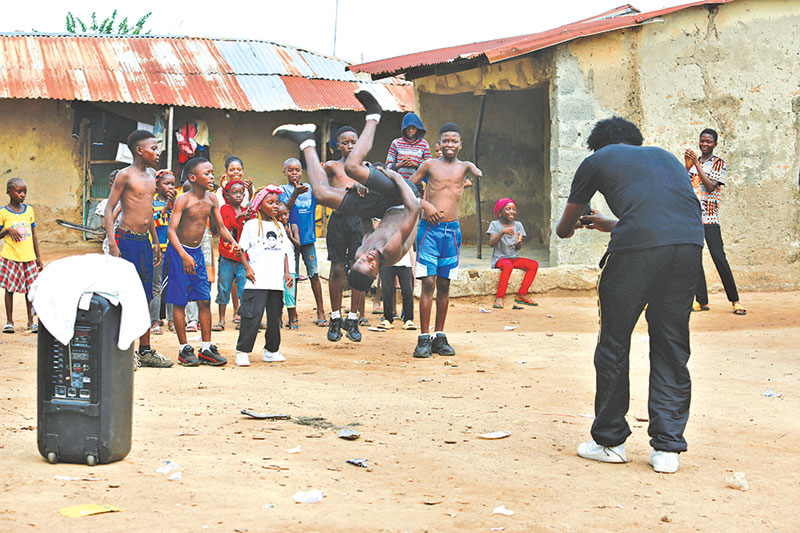
Joshua Anum, who had his left arm amputated seven years ago, reacts during a rehearsal with other members of ‘The Incredible Kids’, in Abuja, Nigeria. REUTERS
ABUJA : As a disabled child growing up in Nigeria, Joshua Anum did not see internet stardom in his future. He and his eight siblings, abandoned by their father, barely had enough to eat. Now the 15-year-old, who lost his left arm at age five after falling out of a tree, is part of a dance group called “The Incredible Kids” that has a growing Instagram following and a packed performance schedule. In one of their most popular videos, with 55,000 views, the six children dance in a yard with palm trees behind them. Led by a five-year-old girl, they do fast-paced routines to popular Nigerian songs. The children live with dancer Maliki Emmanuel, the group’s founder, on the outskirts of Nigeria’s capital Abuja. Most came from difficult family situations and found refuge with him. On a recent afternoon, the children gathered around Emmanuel as he sat in an armchair in their living room, watching music videos to get ideas for new routines. “Before I came here I used to go to parties, I used to fight anywhere I went and I was not going to school,” said Joshua. “Since coming here I have started school and I read and dance.” The group has performed in Abuja and Lagos, and as their fame grows Emmanuel said he hopes their numbers will too. “When we have created a brand ... then we can recruit more kids, kids that are on the street ... that love dance,” he said. “I can teach them then we will bring them to the crew.” The proceeds from performances cover school fees for Joshua and the other dancers. Joshua’s mother, Vera Anum, said she despaired when his arm had to be amputated but was now proud of his success. “Everybody thought ... he will not be useful in life. Our people at home said he is finished because somebody whose hand has been amputated from childhood, what can he do?” she said. “See him today, at least the whole world is seeing him, watching him how he is performing.”
- Abraham Achirga - reuters
SPORTS
Zimbabwe ‘A’ condemn Nepal to three-wicket defeat
The visitors bowl out the Rhinos for 136 runs in 31.3 overs before they manage 137-7 in 26 overs to lead the three-match One-Day series 1-0.
- Post Report
Members of the Zimbabwe team celebrate after taking a wicket of Nepal at TU ground, Kirtipur, on Friday. Post Photo: Hemanta Shrestha
KATHMANDU : Hosts Nepal failed in the batting department as they lost the first of the three-match One-Day series against Zimbabwe ‘A’ by three wickets at the TU Cricket ground in Kirtipur on Friday. Put into bat first, Nepal were bowled out for a meagre total of 136 runs before Zimbabwe managed 137-7 in 26 overs on the back of an unbeaten 48 runs by opener Innocent Kaia. All-rounder Sompal Kami contributed 30 runs, the highest of the Nepal innings, in his knock of 70 balls. Coming to bat at number six, Kami hit two boundaries and a six before he was caught by Tadiwanashe Marumani off Cephas Zhuwao. All-rounder Karan KC, opener Kushal Bhurtel and Dipendra Singh Airee were the other batters for the home team to manage double digit figures as Nepal lost other batters cheaply. KC struck 25 off 36 that included three boundaries. He was caught by Victor Nyauchi off Zhuwao. Opener Bhurtel contributed 19 runs from 10 deliveries while Airee scored 18 off 20. Airee hit four fences before he was bowled by Nyauchi. Airee, who hit three fences, was caught by wicketkeeper Clive Madande. Pacer Brad Evans was the pick of Zimbabwe bowling claiming four wickets. The player-of-the-match conceded 27 runs in his 8.3 overs bowling. Brandon Mavuta, Nyauchi and Zhuwao shared two wickets each. In the run chase, openers Kaia played ball-a-run 48 remaining not out and Zhuwao scored 32 off 29 to build the foundation for victory. Kaia smashed four boundaries and a maximum. Zhuwao hit three fences and two sixes. He was caught by KC off captain Sandeep Lamichhane. Roy Kaia, who came to bat at number four, scored 14 runs facing 17 deliveries. He hit two boundaries before he was caught by Mohammad Aadil Alam off Lamichhane. Though Zimbabwe lost four other batters in quick succession, Evans contributed unbeaten 17 runs facing 19 deliveries and finished the match with a boundary. He hit two sixes and a boundary to Sushan Bhari in the last delivery of the 26th over to guide the visitors to victory. Leg spinner Lamichhane and medium pacer KC grabbed two wickets each while Kami and Sagar Dhakal took one wicket each. Lamichhane conceded 32 runs in his 10-over spell including a maiden. KC gave away 30 runs in his five overs. The second match is scheduled for Saturday before the final match takes place on Monday. The two sides also played three-match Twenty20 series which finished in a 1-1 tie. Nepal are playing host to Zimbabwe ‘A’ for a three-match T20 and One-day series to fine tune their preparations for the upcoming Triangular Series of the ICC World Cup League 2 to be held in the USA from June 6 to 16.
SPORTS
Asian Games postponed as China battles Covid
Olympic Council of Asia says the Games were postponed considering the pandemic situation and size of the event.
- AGENCE FRANCE-PRESSE
A countdown clock showing 127 days until the opening of the 2022 Asian Games is seen in Hangzhou in China’s eastern Zhejiang province on Friday. AFP/RSS
BEIJING : The Asian Games in September in the Chinese city of Hangzhou have been postponed because of Covid with new dates to be announced “in the near future”, organisers said on Friday. The Games were scheduled to be held from September 10 to 25 but have now been delayed as China tries to stamp out a large resurgence in infections in several parts of the country. Hangzhou lies less than 200 kilometres from country’s biggest city Shanghai, which has endured a weeks-long lockdown as part of the ruling Communist Party’s zero-tolerance approach to the virus. The Olympic Council of Asia (OCA) said in a statement that the decision to postpone “was taken by all the stakeholders after carefully considering the pandemic situation and the size of the Games.” The Asian Games typically attract more than 10,000 athletes from across the region. The World University Games, scheduled to begin next month in Chengdu and already delayed from last year, have also been postponed again, until 2023. Organisers said last month that Hangzhou, a city of 12 million in eastern China, had finished constructing 56 competition venues for the Asian Games and Asian Para Games. At the time, they indicated that they planned to hold the event under a virus control plan that “learns from the successful experience” of the Beijing Winter Olympics, which were held in February in a strict Covid-secure bubble. Hangzhou was poised to become the third city in China to host the continental competition after Beijing in 1990 and Guangzhou in 2010. Some events were due to be held in other provincial cities including Ningbo, Wenzhou, Huzhou, Shaoxing and Jinhua. Taiwan’s star weightlifter Kuo Hsing-chun, a gold medallist at the Tokyo 2020 Olympics—which were pushed back to last year by the pandemic—told AFP she had already accepted the latest disruption. “With the coronavirus outbreak getting more and more serious (in some places), I was more or less mentally prepared for this,” she said But some national Olympic bodies lamented the impact the delay would have on their competitors. A delay was “not good for the athletes”, Rajiv Mehta, secretary of the Indian Olympic Association, told AFP. “The athlete will be older by a year. Your practice changes.” The OCA also said that the Asian Youth Games, scheduled to be held in December in the Chinese city of Shantou, would be cancelled having already been postponed once. Almost all international sport has ground to a halt in China since Covid emerged in the Chinese city of Wuhan in late 2019. The Beijing Olympics was an exception but it was held in a “closed loop” with everyone inside it—including athletes, staff, volunteers and media—taking daily Covid tests and not allowed to venture into the wider city or have contact with the public. China has stubbornly stuck to its zero-Covid policy, imposing strict lockdowns, quarantines and mass testings even while other countries start to reopen. Hangzhou last week beefed up virus curbs after logging a handful of cases, ordering around three-quarters of its population to get tested every 48 hours to access public spaces and transportation. Officials in the city, home to some of China’s biggest companies including technology giant Alibaba, said the moves would ensure “the virus has nowhere to hide or settle”. Beijing has touted the zero-Covid strategy as proof that it values human life above material concerns and can avert the public health crises seen in many Western countries.
SPORTS
‘Takeover has affected Chelsea performance’
- REUTERS
LONDON : The sanctions on Chelsea and the Premier League club’s takeover have had an impact on the dressing room which led to a slump in form but the situation cannot be used as an excuse for poor results, manager Thomas Tuchel said on Friday. Chelsea were put up for sale by owner Roman Abramovich following Russia’s invasion of Ukraine and before sanctions were imposed on him by the British government. Tuchel said he has been told the club has a preferred bidder but did not name them. The government also placed restrictions on Chelsea such as not allowing the club to sell tickets or renew player contracts, with Tuchel saying their plans for next season are running behind schedule. “It surely effects the team but I cannot say to which degree. Toni (Rudiger) of course leaves us during the period we are sanctioned and we cannot fight,” Tuchel told reporters ahead of Saturday’s home game against Wolverhampton Wanderers.
SPORTS
Mbappe’s mother denies he has agreed deal to stay at PSG
PARIS: Kylian Mbappe’s mother has denied a report in France that her son has agreed in principle to stay at Paris Saint-Germain for up to another three years and shun a move to Real Madrid. Le Parisien newspaper reported on Thursday that PSG’s Qatari owners had offered Mbappe a salary of 50 million euros ($53 million) a season and a loyalty bonus of 100 million euros if he stays. The report said the club had offered a two-year contract with the option of a third year. But Mbappe’s mother Fayza Lamari tweeted that the French World Cup-winning forward had not yet come to a decision. Mbappe, 23, has made no secret of his desire to play one day for Real, who this week reached the Champions League final just days after securing a 35th Spanish title.
SPORTS
Mikel Arteta signs new contract extension until 2025 at Arsenal
LONDON: Mikel Arteta said he wants to take Arsenal to the “next level” after signing a new contract that will keep him at the Premier League club until 2025. The 40-year-old, who took over at the Emirates in December 2019 following the dismissal of Unai Emery, is close to leading the Gunners back into the Champions League after a five-year absence. Arsenal are fourth in the Premier League table, two points clear of north London rivals Tottenham with just four games to go. The Spaniard said Friday he was “really happy” to have signed his new deal at the club that he captained when he was a player. “We want to take the club to the next level and to compete really with the top teams,” he said.
SPORTS
Nadal digs deep like Real Madrid to set up Alcaraz clash
MADRID: Rafa Nadal saved four match points to beat Belgian David Goffin 6-3 5-7 7-6(9) in an absorbing match on Thursday to move into the Madrid Open quarter-finals and set up a mouth-watering clash with teenaged compatriot Carlos Alcaraz. Just as his beloved Real Madrid came back from the brink to reach the Champions League football final on Wednesday, 35-year-old Nadal found extra energy in reserve to win a lengthy tiebreak. The victory was the 1,050th win of his career as he moved into a Masters 1000 quarter-final for the 99th time and he was lifted by Real’s dramatic 3-1 win over Manchester City achieved with the help of two last-gasp goals. “Yesterday was an unforgettable night. The spirit that Real Madrid had was just incredible. For me today, in some way, it was an inspiration,” Nadal said in a post-match interview with the ATP. (AGENCIES)
HOROSCOPE
HOROSCOPE
ARIES (March 21-April 19) **** The day elevates your energy levels while putting you in a confident mood. Don’t feel guilty about appreciating yourself. Use this energy as an excuse to catch up with your close ones, taking special care to reach out to them.
TAURUS (April 20-May 20) *** You’ll feel inspired to catch up on your domestic chores today. You take great pride in your space, and, the universe will ask you to meet your own standards. Go ahead and marry your love of shopping to have some fun.
GEMINI (May 21-June 21) **** Use today’s energy as an excuse to connect with your loved ones, just make sure you listen as much as you speak. A flirtatious energy will find you under today’s skies, bringing electricity to your aura and social life.
CANCER (June 22-July 22) *** Today’s vibes are great for letting your ego come out to play, as the universe encourages you to elevate your confidence. It will provide you with a sense of love and security, giving you an opportunity to let your guard down.
LEO (July 23-August 22) *** Today’s skies elevates your popularity while reviving up your engine. The cosmic alliance inspires you to only accept positive influences and content into your life, at least for the time being. Today, prioritize your own needs.
VIRGO (August 23-September 22) **** A comforting warmth will fill your soul today. Though your heart will certainly be open under this luminary placement, you may feel yourself in need of solitude. Luckily, placing boundaries shouldn’t create any rifts.
LIBRA (September 23-October 22) *** Your social life will benefit from a nice boost today. This cosmic vibe will inspire you to open your heart to those around you, giving you an opportunity to connect with your loved ones on a soul level. Release your inhibitions.
SCORPIO (October 23-November 21) *** Today’s cosmic climate will give you an opportunity to tap into your spiritual side, bringing a more reserved energy to your aura. Use this cosmic climate to handle business with the best company you could conjure.
SAGITTARIUS (November 22-December 21) *** The day will hold some sparkle for you. Lean into these good vibes by connecting with the life force within and around you. This day will bless you with a surge of gratitude and inspiration as you find peace within yourself.
CAPRICORN (December 22-January 19) **** You’ll become acutely aware of your wants and needs today. Though you’ll find yourself in a fairly good mood, your personal pride will prevent you from engaging with any people or activities that don’t appeal to your sense of joy.
AQUARIUS (January 20-February 18) *** Use today’s luminary placement as your cue to open up to those who fill you with joy. Under today’s skies, the day will help you connect on an emotional and mental level with yourself and the people you care for most.
PISCES (February 19-March 20) *** An efficient and sunny vibe will find you today. Use this luminary placement to outline and tackle a to-do list. Just be sure to reward yourself for your efforts, activating sector that governs the chart of luxury and indulgence.
CULTURE & LIFESTYLE
Neetesh Jung Kunwar version 2.0
After years of releasing some of the biggest hit songs in Nepal’s pop music scene, the musician is on a mission to reinvent himself.
- Pinki Sris Rana
In April 2021, Kunwar announced that his ‘Nepali music journey has come to [a] conclusion’Post Photos: keshav Thapa
Lalitpur : For the better part of the last five years, Neetesh Jung Kunwar has remained one of the leading names in Nepal’s music industry. The song that springboarded him to fame was his 2017 ‘Gedai jasto jindagi’, and since then, many of his songs like ‘Hamro Nepal Ma’ and ‘Flirty Maya’, both of which have surpassed 27 million views on YouTube, have gone on to become hugely popular. For an artist riding high on the wave of success, Kunwar took many surprise when he announced last year that his “Nepali music journey has come to [a] conclusion”. The social media post was widely shared and had many speculating the reasons behind this decision. By the time Kunwar made the announcement, it had already been months since he last uploaded a new song on his hugely popular YouTube channel ‘Neetesh Jung Kunwar’, which has more than 700,000 subscribers. And in January 2021, three months before the announcement, Kunwar had released a new song titled ‘Rebirth’ on his new song on his YouTube channel ‘NJK Vibe’, which now has more than 160,000 subscribers. Since then, Kunwar has already released five songs, three of which are in English, on his new YouTube channel. “Between 2017 to 2020, I experimented with my music, but all I was ever known for was ‘Flirty Maya’, ‘Gedai Jasto Jindagi’, and other similar songs. The audience liked the songs from that genre and they were good for business as well, but for someone who strongly believes in experimentation, I was getting very bothered by the fact that my music had become redundant and felt trapped by my own fame,” says Kunwar. “The year was tough for other reasons as well. That year, my father, who was someone I really looked up to, passed away. And it also didn’t help that the pandemic forced us to stay locked inside our homes most of the year. That was when I realised that it was the right time to break free from the kind of music that I was known for and start fresh.” After almost four years of releasing multiple hit songs and dealing with all the expectations that come with being one of the most renowned names in Nepali music scene, Kunwar was desperate for a major overhaul. “When I made the announcement to discontinue making the kind of songs I was known for, I stopped receiving calls for concerts and live shows, and I finally got the time I needed to heal,” says Kunwar. One of the main reasons that gave him the courage to follow his heart and give into his artistic calling was his father’s demise. “All the money I had made as an artist went into trying to save my father’s life. When he passed away, I felt like I had nothing to lose, and all I wanted to do was to explore the limits of my creativity,” says Kunwar. Born and brought up in Tripureshwor, Kathmandu, Kunwar was raised in an environment that appreciated music. Kunwar’s father had a lot of musician friends, and the senior Kunwar often took his son along whenever he hung out with his friends. “In those days, a lot of concerts happened in Tripureshwor. And being the daddy’s boy that I was, I would follow my father everywhere. That was how I got introduced to his musician friends, and that was how my interest in music started,” says Kunwar. By the age of 12, Kunwar was already singing and performing in school competitions, talent shows, and other school events that involved music. But Kunwar never imagined himself pursuing music as a profession. “Back then, choosing music as a career wasn’t considered the wise thing to do. So after I completed my Bachelor’s in Banking and Insurance, I started working in the corporate world,” says Kunwar. After 18 months of working a 9 to 5 job, Kunwar decided to call it quits and focus on music. And he began by performing at bars and pubs. In 2015, Kunwar started a YouTube channel to release original songs that “had easy words and easy music.” “Back in 2015, people said the music I was making was very childish, but deep down, I knew it would work, and it did. People are once again criticising the kind of music I have been making for the last one year, but criticisms don’t faze me anymore. People will always have something to say, so I might as well focus on being myself now,” says Kunwar. “I am very grateful for all the love I have got over the years for the kind of music that I was making, but I think the time is right for me to explore new musical genres and give something new to my audience.” Kunwar says he is now working on a new album in which each song will be different from another. “The album will feature five songs in English and two in Nepali,” says Kunwar. “The album will be released on the Noodle app, and this, I hope, will cultivate the culture of paying for music. You know, it’s hard for the artists to sustain themselves, and I want people to start valuing art.”
CULTURE & LIFESTYLE
No felony charge for man who tackled Dave Chappelle on stage
Chappelle was attacked when he was talking about how comedians have to worry more about their security.
- Andrew Dalton
Dave Chappelle appears during the Rock & Roll Hall of Fame induction ceremony on October 30, 2021, in Cleveland.Ap/rss
LOS ANGELES : The man who tackled comedian Dave Chappelle during a performance at the Hollywood Bowl will not be charged with any felonies, the district attorney’s office said Thursday. Isaiah Lee, 23, was arrested for assault with a deadly weapon, police said, after rushing the stage toward the end of Chappelle’s set in the last of a four-night stint at the outdoor amphitheatre as part of the “Netflix Is a Joke” festival. He was carrying a replica handgun with a large blade that folded out of it similar to a pocket knife, according to a photo released by police. “After reviewing the evidence, prosecutors determined that while criminal conduct occurred, the evidence as presented did not constitute felony conduct,” the Los Angeles County district attorney’s office said in a statement. The case has been referred to the Los Angeles city attorney’s office, which prosecutes misdemeanours within the city. An email seeking comment from the office was not immediately returned. Jail records showed Lee was still being held Thursday in lieu of $30,000 bail, Mendez said. It was not immediately known if he had retained a lawyer, and the motive for the attack was unclear. People standing in the wings of the stage, including actor Jamie Foxx and rapper Busta Rhymes, rushed on to the stage to try to help Chappelle. Security guards chased and overpowered Lee, who was taken away in an ambulance for treatment of an unspecified injury. “The performances by Chappelle at the Hollywood Bowl were epic and record-breaking and he refuses to allow last night’s incident to overshadow the magic of this historic moment,” Chapelle’s publicist Carla Sims said in a statement. Chappelle was attacked as he was wrapping up a routine in which he talked about how comedians have to worry more about their personal security in the wake of this year’s Academy Awards ceremony where the Oscar-winning actor slapped Chris Rock on live television in reaction to a joke about his wife. Rock was also in the wings of Chappelle’s show, He grabbed the mic and jokingly asked, “Was that Will Smith?” — Associated Press
CULTURE & LIFESTYLE
‘Doctor Strange 2’ gets weirder, scarier, messier
After ‘Infinity War’ and ‘Endgame,’ ‘Doctor Strange in the Multiverse of Madness’ feels a little bit like a wheel spinning.
- LINDSEY BAHR
(From left) Xochitl Gomez, Benedict Wong, and Benedict Cumberbatch in a scene from ‘Doctor Strange in the Multiverse of Madness.’AP/RSS
Once a superhero franchise goes multiverse, it’s hard to go back. No work of fiction ever needs permission to break the rules or push the boundaries of traditional storytelling, but the multiverse, at least as it’s been served up in recent Marvel movies, practically demands it. And for the moment that means a lot of cameo opportunities. “Spider-Man: No Way Home” opened the door to the concept, to mostly charming results, but now Benedict Cumberbatch’s master of the mystic arts is flying through the interdimensional portal with the concept in “Doctor Strange in the Multiverse of Madness.” This film is technically the sequel to “Doctor Strange,” a movie that came out six years ago. But so much has happened in Marvel land that involves Stephen Strange and his goatee—”Infinity War,” “Endgame” and, yes, the most recent “Spider-Man”—that where it falls in the “Doctor Strange” standalone film continuity is entirely beside the point. One could not simply watch “Doctor Strange” and then “Doctor Strange 2” and expect it to make sense. Not only that, understanding, or at least being invested in “Doctor Strange 2,” also requires some passing knowledge of “WandaVision,” the nine-episode Disney+ series that runs almost six hours total. This is not a surprise or a burden to Marvel fans, but it does seem like quite a lot to ask of the average moviegoer (though perhaps at this point they’re one and the same). So it’s especially interesting that Sam Raimi agreed to jump into this messy corporate multiverse at this point. His “Spider-Man” movies are still among the top of the crop of modern superhero franchises, after all. Raimi was able to put his own stamp on this endeavour, including but not limited to a Bruce Campbell cameo. There are horror elements, too, some so intense that families might think twice before bringing everyone to the multiplex, some interesting visuals not entirely dissimilar to the city-bending of “Inception” and some humour. But Raimi doesn’t take “Doctor Strange” to an entirely new tonal place, like, say Taika Waititi did with Thor. He mostly sticks to the framework established by Scott Derrickson. The main issue is that it’s a bit of a kitchen sink movie centred on an entirely new and underdeveloped character, America Chavez (Xochitl Gomez), a teen who has the power to travel the multiverse but doesn’t quite know how to control it. She’s being hunted by someone who wants her powers and Strange decides to help, possibly out of genuine altruism and possibly because it was a good excuse to literally jump off a balcony to get out of his old flame Christine’s (Rachel McAdams) wedding early. Unfortunately, he asks the wrong Avenger for help: Elizbeth Olsen’s Wanda Maximoff is the one after the power to go multiverse jumping and has been dabbling in some dark arts to make it happen. She’s motivated by the idea that she has children out there in an idyllic suburban multiverse in which she wears yoga pants and loose cotton tops and tucks her boys in at night after ice cream and movies. Soon she and Strange are having a standff in midair. The script is inventive in the way it plays around with a jumble of big sci-fi concepts, which makes sense considering screenwriter Michael Waldron is a veteran of “Rick & Morty.” But it also underwhelms when it comes to the mishmash structure and the women. Olsen still sells Wanda’s pain like the best of them, even though she’s been reduced to a stereotype of female hysteria. Christine is merely there to make Strange realise things about himself. And America, well, she never really earns our emotional investment. After “Infinity War” and “Endgame,” “Doctor Strange in the Multiverse of Madness” feels a little bit like a wheel spinning. Cumberbatch has fun with his character, but his limitless ego seems to have been a little muted here as he grapples with his own happiness. And that invites more questions, like do we ultimately care about whether or not Doctor Strange is happy? Does he? Could everyone just use some post blip therapy instead of these interdimensional bottle episodes? Perhaps the Marvel universe is finally starting to feel like a long-running comic book series. Or maybe Phase 4 just hasn’t kicked into gear just yet.
Elizabeth Olsen in a scene from ‘Doctor Strange in the Multiverse of Madness.’AP/RSS — Associated Press