Despite law, Nepal fails to achieve Dalit women representation in wards
Parties say they failed to find candidates, an argument Dalit activists do not agree with.
- TIKA R PRADHAN
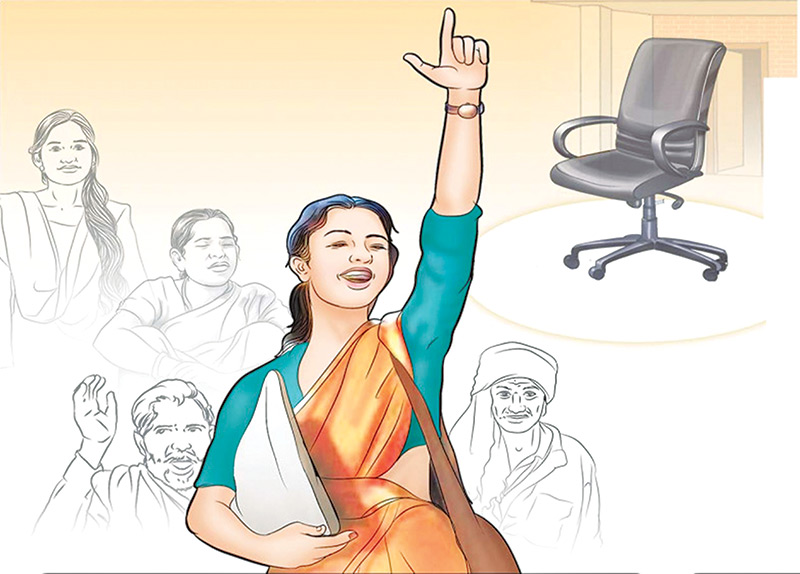
This time, as many as 123 seats in local units meant for Dalit women will remain vacant as parties say they could not find candidates. Post Illustration
KATHMANDU, When Prabha Pariyar was approached with a proposition to run for ward member, she had little idea about it. “I spoke with some senior members in the community. Then some CPN-UML leaders also reached out to me,” said Prabha, 43. “Then I thought the position could be a platform for me to raise the issues of our community.” She was fielded as a member of Ward 27 of Kathmandu Metropolitan City. Since no candidacy was filed against her, she won the position unopposed long before the elections. “I have now also taken the party membership,” said Prabha, who used to work for a non-governmental organisation. Nepal is holding local elections on May 13. The Local Level Election Act-2017 has made it mandatory that of the five persons elected in each ward, one must be a Dalit woman. That means, 6,743 Dalit women representatives must be elected in 753 local units across the country. Prabha is one of those. Despite the law, however, only 6,620 Dalit women will be elected as ward members from the upcoming elections, as there are no candidates for 123 wards. The legally-mandated number could not be achieved in the last local elections held in 2017 either. As many as 176 seats reserved for Dalit women as ward members remained vacant. Political parties have resorted to the excuse that they could not find Dalit women candidates. Dalit rights activists, however, say there are multiple factors—from discriminatory mindset among leaders to political parties’ lack of willingness—which have become barriers to electing Dalit ward members in the legally mandated number. According to Pradip Pariyar, a Dalit rights activist, patriarchal mindset prevalent among political party leaders and their discriminatory approach continue to pose an obstruction in Dalit women’s progess. “Instead of implementing the constitutional provision of inclusion they [political leaders] have the mindset to seek loopholes so that they could cut down the seats of the underprivileged communities,” said Pradip. “They seem to be least bothered to implement the constitution that they drafted.” The Pariyar-led Samata Foundation had organised province-wise campaigns before nominations were filed for the local polls. According to Pradip, political parties had committed to fielding as many Dalit candidates as possible in leadership positions of local bodies. “It is surprising that not just one political party but all political forces are reluctant to field Dalit candidates,” said Pradip. As per the census of 2011, Dalits account for 13.8 percent of the total population of Nepal. Article 42 (1) of the constitution states that the socially backward women, Dalit, indigenous people, indigenous nationalities, Madhesi, Tharu, minorities, persons with disabilities, marginalized communities, Muslims, backward classes, gender and sexual minorities, youths, farmers, labourers, oppressed or citizens from backward regions and indigent Khas Arya shall have the right to participate in the State bodies on the basis of inclusion principle. When Nepal held its first local elections in 20 years in 2017, around 41 percent of the elected representatives were women. As many as 6,567 Dalit women members were elected for 6,743 vacant positions. This was hailed as a big move forward towards womens’ participation. Although 176 ward seats reserved for Dalit women remained vacant, there were expectations that political parties would work towards electing all 6,743 Dalit women members. Durga Sob, a Dalit rights activist who has worked for decades for the uplift of the Dalit women through various social organisations, joined politics a few years ago, hoping that political platform could help her raise the voice more strongly. “But I have realised political parties are not committed to the spirit of the legal and constitutional provisions,” said Sob, a former chair of the Feminist Dalit Organisation and now a central member of the Janata Samajbadi Party. “If Dalit women were elected in the past and will be elected again, it’s because of the mandatory legal provisions, not because the political parties actually want it.” Most of Nepal’s political parties are led by men from the so-called upper caste. Article 24 of the constitution has exclusively mentioned the right against untouchability and discrimination. Its Clause 1 states that no person shall be subjected to any form of untouchability or discrimination in any private and public places on grounds of his or her origin, caste, tribe, community, profession, occupation or physical condition. Clause 5 says any act of untouchability and discrimination in any form committed in contravention of this Article shall be punishable by law as a severe social offence, and the victim of such act shall have the right to obtain compensation in accordance with law. There is also a specific law in the country—Caste-based Discrimination and Untouchability (Offense and Punishment) Act 2011—that safeguards Dalit rights. Despite the constitutional provisions and law, however, few politicians appear committed to ensuring their implementation. As a representative case, take a remark by a senior Nepali Congress leader in 2017, issued ahead of the local elections then. Addressing a meeting of the then Legislature-Parliament in April 2017, Arzu Rana Deuba had demanded that the mandatory provision of fielding Dalit women in each ward of the 753 local units should be scrapped because it won’t be possible to find Dalit woman leaders at every ward. She had also demanded the Speaker’s ruling to amend the Local Level Election Act-2017 that makes it mandatory for the parties to field a Dalit women as member in each ward. Arzu, a central member of the Congress, is also the wife of Prime Minister Sher Bahadur Deuba. According to Bhim Bishwokarma, a researcher and executive director of Jagaran Media Centre, which advocates for the elimination of caste-based discrimination and creating a more equitable, inclusive, and secular society through media mobilisation, Nepali society continues to view Dalits as second class citizens. “Dalit women are not being fielded in some wards because there is some sort of fear among the so-called upper caste people that they have to show respect to Dalits if they are elected,” said Bhim. “Caste-based discrimination continues despite the law against it. While it’s difficult for Dalit women to get space, they continue to face discrimination once they are elected.” Some of the reasons behind the lack of nomination of Dalit women ward members, according to Dalit rights activists, are that they are not affiliated to political parties, their names are not on voters’ list and the difficulty they face to get citizenship certificates. Dalit leaders in political parties admit that they failed to pay adequate attention to the issue of inclusion and Dalit women’s nominations in the numbers mandated by the law. “There were five years for the parties to learn to avoid a similar mistake after 176 Dalit women members in wards were not elected in 2017. But this time too, there won’t be 123 Dalit women members,” said Chhabilal Bishwakarma, a secretary of the UML. Rights activists say affirmative measures are a must to ensure participation of and space for the marginalised in state organs. “Despite the law, parties are not fielding candidates. Now it has become imperative to amend the constitution to mention the provision,” said Pariyar of the Samata Foundation. “I don’t think political leaders are taking the inclusion issue seriously. Hundreds of wards will continue to remain without Dalit women ward members unless it is made mandatory by the constitution.”
HOME PAGE
For people with disabilities, there are barriers galore to right to voting
Secrecy, lack of ballot papers with tactile relief, and tall tables are key infrastructural issues.
- AAKASH CHAUDHARY
According to Nepal in Data, 1.7 percent of Nepal’s total population is disabled. Post File Photo
KATHMANDU, Phanindra Poudel of Pokhara has been hearing about the local elections but he is not keen on going to the polling booth to vote. He has bitter experiences from the past. “As a blind person, the voting process is quite cumbersome for me,” said Poudel, chairman of Srijanshil Apangata Samaj. “I have voted in the past, but over the years, it doesn’t look like authorities have made any attempts to ease the voting process for people like us.” Kima Rokaya, 25, from Khaptadchana Rural Municipality, Bajhang, is paralysed from the waist down. In the 2017 elections, her family members carried her to the polling booth. This reliance on her family members to exercise her franchise led to a compromised vote from her, she says. “The polling desk was at a height and since I couldn’t stand, my relative stamped the ballot paper and dropped it into the box without even showing me,” she told the Post. “Till date, I don’t know who I ‘voted’ for.” Elections are a celebration in democratic countries as they are supposed to strengthen democracy, incorporating the inclusion principle. But in Nepal, people with different forms of disabilities feel neglected and excluded as the state and its agencies have failed to make the electoral process accessible to them, depriving them of their participation in the franchise, their fundamental right guaranteed by the country’s constitution and laws. Article 42 (1) of the Constitution of Nepal says persons with disabilities shall have the right to participate in the state bodies on the basis of the principle of inclusion. Section 11 of the Act Relating to Rights of Persons with Disabilities, 2017 says that persons with disabilities shall, on an equal basis with others, have the right to become candidates in elections in a fearless environment and to cast votes voluntarily, with or without the assistance of others. And, Article 1 of the United Nations Convention on the Rights of People with Disabilities states that persons with disabilities include those who have long-term physical, mental, intellectual or sensory impairments which in interaction with various barriers may hinder their full and effective participation in society on an equal basis with others. According to Nepal in Data, 1.7 percent of Nepal’s total population is disabled—37,285 people are completely disabled, 49,077 severely, 66,839 are moderately disabled and 46,289 mildly. The number of registered voters for the upcoming local elections stands at 17,733,723. Of them 8,741,530 are males, 8,992,010 are females and 183 are registered under the “other” category. There, however, is no separate data on the number of voters with disabilities. Shaligram Sharma Poudel, spokesperson for the Election Commission, said that the commission does not know the number of people with disabilities who have been registered as voters. “Those with disabilities can contact the respective chief election officers and get a vehicle pass along with one person who supports them,” Poudel told the Post. “Such voters will get utmost priority during the voting and they need not stand in line.” According to Poudel, the commission has instructed officials at the polling centres to provide help to the people with disabilities to vote. Poudel said that it’s incumbent upon the local governments to ensure improvements in the infrastructure so that people with disabilities can participate in the voting process. Roshan Jnawali, chief administrative officer of Mahalaxmi Municipality, Lalitpur, however, argued that the responsibility of creating disabled-friendly voting systems and ensuring inclusivity for the disabled community lies with the Election Commission or the government itself and not with the local level governments. “Everyone working in the municipality and rural municipality are government employees and we do what the government instructs us to do,” he told the Post. “Until now we have not heard anything from the government in this regard. The municipality will take steps for the betterment of the disabled people during the election if the government instructs us to do so.” Despite the laws being in place and the commission claiming to offer support, people with disabilities continue to face barriers to their election participation for a number of reasons. A report titled “Access of People with Disabilities in Nepal’s Electoral Process” by Election Access, published in July 2018 after the 2017 elections, outlined some key findings. Disabilities of different forms made it difficult for people to participate in the voting process for different reasons. For people with visual disabilities, it was difficult to identify symbols on the ballot paper and there was a lack of tactile/braille relief. People with physical disabilities found lack of space to manoeuvre and ballot-marking tables too high. For people with auditory disabilities, a lack of sign language was a major barrier. This is exactly what Shaktiprakash Lamichhane of Pokhara experienced. Lamichhane is mute. He said that staff assigned to assist voters like him were not trained. “I didn’t know how to cast my vote and no one was willing to teach me when I went to vote in 2017,” Lamichhane conveyed his experience to the Post through a sign language interpreter. “I felt humiliated at the voting booth because no one knew how to communicate with me, let alone teach me how to cast my vote.” The Election Commission this time did not run voter education campaigns for a host of reasons including a lack of budget. In such a situation, voter education exclusively for people with disabilities was out of the question. With alliance politics and complicated ballot papers, there are already concerns about the high number of invalid votes this time. According to Kamala Japarel, a blind woman from Durgathali Rural Municipality, Bajhang, voters with disabilities have to travel for two hours on foot to reach the nearest polling station. “We have to travel on rough roads. So I have to take someone with me when I go to vote but I don’t like asking for favours. I may not go to cast my vote this year,” she said. “I’m not even sure if the person helping me vote will be honest with me.” In Bajhang, there are more than 4,500 people with disabilities and more than 3,000 are registered voters, according to Bajhang Disability Security Network. According to Brahmadatta Joshi, chairman of the network, more than 800 registered disabled voters were deprived of voting freely due to various reasons in the 2017 elections. “In the remote areas, most of the polling stations are at places that are not convenient for the people with disabilities,” said Joshi. “People with serious disabilities cannot reach there and even when they do with some help from acquaintances and family members, chances of their vote going to the candidate of their choice are minimal.” He stresses the need for policy-level intervention so as to realise the state’s commitment to ensuring the participation of the people with disabilities in the electoral process. According to Samriddhi Rana, a disability and rehabilitation specialist who has been working with the disabled community for about 10 years, while there has been some effort to make voting inclusive, many people with disabilities still face challenges to fully and freely exercise their voting rights. “Polling booths are not disabled-friendly. Many cannot read the ballot papers,” she said. “If voting is to be made more inclusive for people with disabilities, gaps must be bridged.” According to her, one strategy to enable increased participation is to create better access and that could be through electronic voting methods. Gajendra S Budhathoki is a journalist and a wheelchair user who has for long been advocating for inclusivity and ensuring access to public places for people with disabilities. He says the Election Commission has failed to make any improvements from the last elections to make the electoral process inclusive. “It seems officials at the Election Commission haven’t read the constitution which guarantees disabled people’s right to vote,” Budhathoki told the Post. “This time too they have failed to make polling stations disabled-friendly. Disabled people like us should refrain from voting until the government and the commission make efforts to ensure inclusivity.” Basanta Pratap Singh from Bajhang and Deepak Pariyar from Pokhara contributed reporting.
HOME PAGE
Bhairahawa airport to open on May 16, but Modi won’t land there
Nepal’s second international airport, which has failed to market itself, would have drawn attention if the Indian prime minister landed there, officials say.
- SANGAM PRASAIN,ANIL GIRI
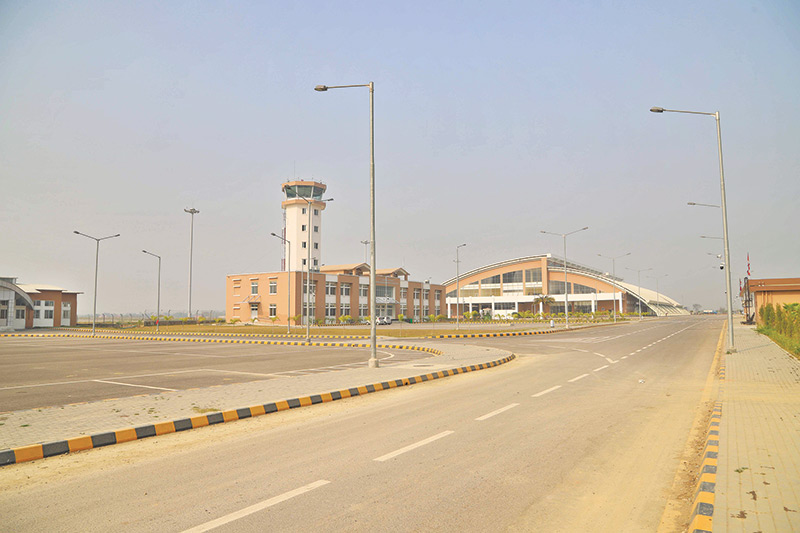
The modern facility has a 15,169 square-metre terminal building with a capacity to serve nearly a million passengers a year. Post Photo: Manoj Poudel
KATHMANDU, An Airbus A320 of Jazeera Airways of Kuwait is scheduled to touch down at Gautam Buddha International Airport in Bhairahawa on Monday morning and taxi into Nepal’s aviation history. The arrival of the direct service from Kuwait at 7am will mark the official inauguration of Nepal’s second international airport in 73 years after Kathmandu. Hundreds of high-level government officials and members of the diplomatic community will be attending the inaugural ceremony planned for the thrice-blessed day of Buddha Jayanti when the Buddha was born, attained enlightenment and passed into nirvana. The airport has been envisaged as the international gateway to Lumbini, the birthplace of the Buddha located 18 km from Bhairahawa. “Prime Minister Sher Bahadur Deuba will be inaugurating the new airport,” Govinda Prasad Dahal, general manager of Gautam Buddha International Airport, said. “We have almost completed the preparations.” At the same time as the inauguration ceremony, Indian Prime Minister Narendra Modi will overfly the new airport and land in Lumbini. Four helipads are being constructed on the premises of Lumbini, which is a World Heritage Site, for Modi’s visit. From the airport, Deuba is scheduled to travel to Lumbini to officially open the International Meditation Centre and Assembly Hall at 10am. He will meet his Indian counterpart in Lumbini and the two heads of government will participate in a special function organised by the Lumbini Development Trust. Deuba and Modi are scheduled to lay the foundation stone for a vihar to be built with Indian assistance in the Lumbini area. But there’s something. Modi will skip the airport. He will directly land in Lumbini instead. Officials said they don’t know why. “No idea,” said an official at the Civil Aviation Authority of Nepal. A former chief of the civil aviation body told the Post that it was a “diplomatic failure.” “When two separate big events are held at the same place, one event will definitely be in the shadows,” said Sanjeev Gautam, former director general of the Civil Aviation Authority of Nepal. “It’s a weakness on Nepal’s side. Nepal’s diplomacy, either economic or aviation, has always remained poor. We failed again.” Nepal’s second international airport is located 6 km from the Nepal-India border in the south. It was 10 years in the making and cost nearly Rs40 billion. Located in the plains of south-central Nepal and spread over 787 bighas (533 hectares), Gautam Buddha International Airport is a landmark, according to tourism industry insiders. The modern facility has a 15,169 square-metre terminal building with a capacity to serve nearly a million passengers a year. The airport’s 3,000-metre runway is long enough to handle the largest commercial jets. Several Nepali officials familiar with the development told the Post that the Nepal government should have urged the Indian side to have Modi’s special flight land at the newly constructed international airport. “Either Modi should have come to Kathmandu and taken a special flight to Lumbini or if he is travelling directly to Lumbini, he should have flown from Kushinagar International Airport in Uttar Pradesh to Gautam Buddha International Airport as both sites are related to the Buddha’s life,” a Nepali official told the Post. “That would have been a win-win situation. If Modi would land at the new airport and travel to Lumbini by greeting the people, that would send a very positive message to both sides.” According to the official, if Nepal did not have a dedicated airport near Lumbini, the construction of helipads on the premises of Lumbini would have made sense. “If we have an airport, we should tell and pursue the Indian side for his arrival first at the airport as that will also show acknowledgement of our development endeavours by India,” said the official. Is it because the airport was constructed with Chinese involvement? Maybe. A senior security official said that since the airport was constructed by a Chinese company--China’s Northwest Civil Aviation Airport Construction Group--the Indian side is hesitant to land at Gautam Buddha International Airport. “We are also hearing that a high-level delegation may arrive from China on that day to celebrate the completion of the airport. So, that makes the Indian side a bit hesitant to land at the newly built airport. We are quite aware of this kind of geopolitical competition,” the security official added. “Since the new airport in Bhairahawa is the first port of entry, Nepal should pursue the Indian side to land first at the airport.” A senior official at the Ministry of Culture, Tourism and Civil Aviation said that Nepal did push it with the Indians about Modi’s arrival in Lumbini via Gautam Buddha International Airport, but the Indian side replied that if he was coming by plane, he would have landed at the airport. “Since Modi decided to come by helicopter from Kushinagar, it was decided to construct helipads inside the UNESCO Heritage Site,” said the official who spoke on the condition of anonymity. Nepal and India have never been on the same page when the promotion of the Buddhist Circuit comes to the fore because of the larger geopolitical game. In November 2018, former tourism minister the late Rabindra Adhikari floated a new idea with China: Develop the Trans-Himalayan Buddhist Circuit when India had been working on an ambitious “billion dollar” plan to develop and promote the Buddhist Circuit in India with the involvement of the World Bank. According to the International Finance Corporation (IFC), a member of the World Bank Group, the Buddhist Circuit is an important pilgrimage destination for the 450 million practising Buddhists as well as travellers interested in history, culture or religion. There are about 450 to 480 million Buddhists across the world, the IFC report said. They practice different branches of Buddhism. Mahayana Buddhism, including East Asian Buddhism, has 185 million followers. This is the predominant form of Buddhism practised in China, South Korea, Japan, Taiwan, Singapore and Vietnam. Theravada Buddhism, with over 125 million followers, is the form of Buddhism predominantly practised in Cambodia, Thailand, Laos, Sri Lanka, Myanmar and India. Vajrayana Buddhism has approximately 20 million followers. This form is practised in the greater Tibetan and Mongolian regions, the Himalaya, Bhutan, parts of western China, the Russian Federation and Nepal. The report said that the rationale for investing in the Buddhist Circuit in India was to improve the experience of visiting these sites and link that to the potential of tourism to deliver sustainable and inclusive economic growth through job creation and income generation opportunities. Besides the religious and cultural aspects, Nepal and India have always remained at odds over opening new routes to facilitate the construction of new airports in Nepal. “Nepal has failed on all sides in terms of pursuing diplomacy,” said Birendra Bahadur Basnet, managing director of Buddha Air, Nepal’s largest private carrier. “The people who have been given a responsibility to fundamentally lobby for economic and other diplomacy failed to pursue their duties. It is pathetic that large denomination Indian currency notes are banned in Nepal.” According to Basnet, in terms of air connectivity, Nepal and India have always been acting indifferently. Nepal on different occasions has been requesting India to open more air entry points for more than a decade. Since Nepal decided to construct a few new international airports, it had asked India to open new cross-border air routes via Janakpur, Bhairahawa, Nepalgunj and Mahendranagar. During Modi’s visit to Kathmandu in August 2014, the issue got traction and the airspace agenda was endorsed. A joint communiqué issued by the two countries at the end of the visit said: “The cross-border direct routes will facilitate flights between regional airports in Pokhara and Bhairahawa, and this will save time and money for air travellers and also improve air connectivity between India and Nepal.” Subsequently, the prime ministers of the two countries directed the authorities concerned to meet in the next six months to resolve the issue. Based on this instruction, Nepal and India agreed to make Kathmandu-Mahendranagar-Delhi (L626) route bi-directional or two-way in 2016. But it is yet to be implemented. “If this route is implemented, it will benefit Indian airlines too,” said Basnet. “Flights from Bagdogra in West Bengal will not need to make a curve and bypass Nepali airspace if the route is implemented. It will save time and cost for Indian airlines. There has been no progress on this front.” According to senior officials of Nepal’s civil aviation body, the Indian side has been expressing reservations over the opening of the airspace in Bhairahawa and Nepalgunj due to the presence of its defence base in Gorakhpur. The defence base is spread over huge swathes of land, where fighter jet exercises are conducted regularly. They had hinted at opening some sections of the airspace over Nepalgunj. But that too failed. Nepal has been pushing the agenda of expanding cross-border air routes for over a decade, as there is only a single entry point in Simara for most of the airlines flying to the country. In contrast, there are seven exit points—Bhairahawa and Mahendranagar in the west and Simara, Biratnagar, Tumlingtar, Kakarbhitta and Janakpur in the east—for aircraft flying out of Nepal. Besides Simara, two other entry points over Mechi and Tumlingtar (Nonim which is in the east of Mt Everest) have been specially designated for planes coming from Bhutan and Lhasa, respectively. But the entry point in Simara is used by the majority of aircraft flying to Nepal and is therefore congested most of the time. Officials said that the prime ministers of both countries will again discuss the issue in Lumbini because Gautam Buddha International Airport will not be financially and technically feasible if India does not allow aircraft to enter Nepal from one of the proposed cross-border air routes in Bhairahawa, Nepalgunj or Mahendranagar. For example, if an international flight headed for Gautam Buddha International Airport in Bhairahawa from western Nepal or New Delhi is not allowed to use airspaces in Bhairahawa, Nepalgunj or Mahendranagar, it has to fly an extra 300 km in aerial distance before landing at the airport, according to Tourism Ministry documents. This means aircraft coming from western Nepal will first have to fly to Simara from above Bhairahawa before landing at the airport. Surprisingly, aircraft flying above Bhairahawa cannot land at the airport there because it would be using Indian airspace at that time and thus has to go to Simara first. This lengthy process of landing at Gautam Buddha International Airport will raise the operating costs of airlines and make flights costly. The same problem will be faced by another international airport which is coming up in Pokhara if new cross-border air routes do not come into operation soon. The airport is expected to be completed by July 10, 2022. The ministry’s documents say that Pokhara-bound international flights from western Nepal will have to cover an additional 185 km in aerial distance if the new cross-border air routes are not opened. The importance of air routes was realised when the plans of Nepali carriers to expand cross-border flights were thwarted by the absence of adequate entry points. Nepali carrier Buddha Air had to abandon its plan to operate Pokhara-Bhairahawa-Lucknow flights due to the air route problem. It had been allowed to fly from Pokhara to Lucknow; but on the return flight, it had to enter Nepal through the Simara point which made the service economically unviable. The last time Nepal opened additional air routes was on November 19, 2009, when the L626 passing over Dhangadhi was launched. The Indian government approved the L626 route as per the air service agreement signed between the two countries in September the same year.
NATIONAL
Mugu District Hospital out of medicines
With the change in seasons, the hospital is seeing an increasing number of patients daily but has not been able to provide effective services due to a lack of essential medicines and specialist doctors.
- RAJ BAHADUR SHAHI
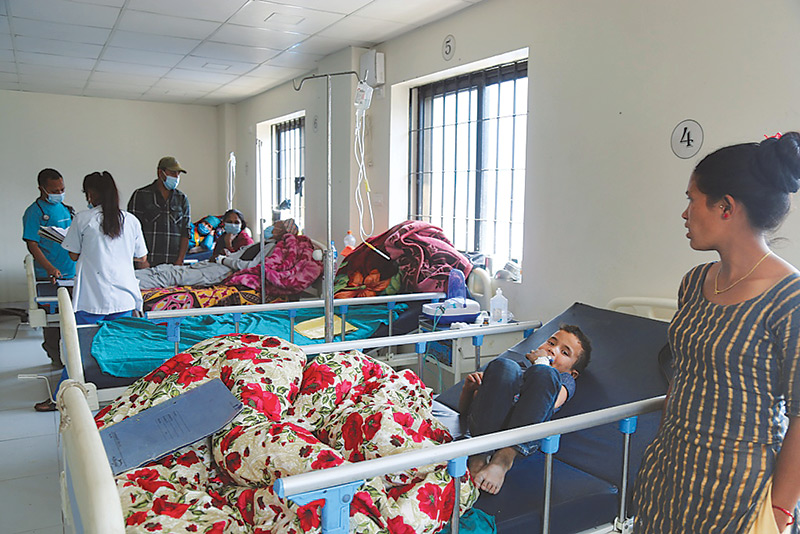
All 15 beds in the hospital are occupied at present. Post Photo: RAJ BAHADUR SHAHI
MUGU, Jana Devi Aide, a resident of Kalai in Soru Rural Municipality-9, is undergoing treatment for typhoid fever at the District Hospital in Mugu. She hasn’t been able to achieve full recovery given that the hospital does not have the necessary medicines to treat her. “The hospital does not even have paracetamol. They ask us to bring syringes and medicines from the pharmacy outside the hospital,” she said. “The doctor comes for his round and then my attendant has to go and buy medicines from the pharmacy. This has not only affected my recovery but also my finances.” The government has provisioned free medicines for patients in all government health institutions. But those visiting the 15-bed District Hospital in Mugu have to purchase medicines from private pharmacies since the hospital has run out of essential drugs. With the change in seasons, the number of patients in the district hospital in Mugu is increasing but the hospital has not been able to provide effective services for a lack of essential medicines. According to the hospital, at least 45 patients of typhoid, fever, diarrhoea and pneumonia have been admitted to the hospital in the past week. A total of 121 patients were admitted to the hospital from mid-March to mid-April. Dr Nahkul Shahi at the hospital said that all 15 beds in the hospital are occupied at present. “Around 75 percent of the patients are suffering from diarrhoea,” he said. “If the number keeps on increasing, we would have to make arrangements for extra mattresses to be laid out in the wards.” According to him, at least 10 new patients come to the hospital daily seeking treatment for seasonal illnesses. Manisha Rawal, a health assistant at the hospital, says health workers are also at their wit’s end given the increase in the number of patients amid the shortage of medicines. “The hospital receives hundreds of patients every day. All the general and emergency beds are fully occupied. We have no supply of drugs, including cetamol, aspirin, adrenaline, albendazole, tinidazole, vitamins and zinc sulphate, among others,” she said. “The district health office has allocated a budget of Rs1.8 million to the hospital to purchase medicine but no medicine has been purchased so far. Surgical services in the hospital have also been halted due to a lack of specialist doctors,” said Rawal. Patients undergoing treatment at the hospital are being referred to the Karnali Institute of Health Sciences, Jumla for general and special surgery due to a lack of specialist doctors. The lack of medicines coupled with the absence of specialist doctors at the hospital has added extra financial burden on the patients, says Umesh Gautam, health service manager at the hospital. “At least five patients are being referred to Jumla in a week. It takes at least 12 hours to reach Jumla by ambulance,” he said. “The relatives of some patients have been flying their loved ones to Nepalgunj and Surkhet. The airfare from Rara to Nepalgunj and Surkhet is Rs 8,500. Not everybody can afford to pay such high prices.” According to him, the delay in the tender process to procure medicines has led to a further delay in the supply of essential medicines to the district hospital. The Ministry of Health and Population provides more than 70 different types of medicines for communicable and non-communicable diseases to district hospitals that have at least 25 beds. Patients are entitled to receive more than 60 essential medicines at primary health centres and 35 types of medicines at health posts free of cost.
NATIONAL
Revenue collection hit by import curbs amid falling foreign exchange reserves
Sluggish capital spending and liquidity crunch also blamed.
- PRITHVI MAN SHRESTHA
KATHMANDU, The government and the central bank’s efforts at reigning in imports amid depleting foreign exchange reserves and surging balance of payment deficit have started to hit the government’s revenues. Nepal’s revenue is heavily dependent on imports with the government aiming to collect over half of the total targeted revenue from customs offices. The government plans to collect Rs1,050.82 billion in revenue this fiscal year 2021-22 with an aim to collect Rs530 billion from customs offices. But the customs offices are struggling to meet the collection target with imports slowing down in the last few months especially after the central bank announced a number of measures to discourage non-essential imports. “The collection target for Baisakh (mid-April to mid-May) for the Department of Customs is Rs44 billion,” said Punya Bikram Khadka, information officer at the department. “Till Baisakh 24 [May 7], we have been able to collect just Rs29 billion.” With the government closing international borders 72 hours before the May 13 local elections, Khadka does not think his office will be able to meet the collection target. In the first five months of the current fiscal year, the customs department had collected more than its target, according to Khadka. But with the government tightening imports especially of vehicles and non-essential goods which were major sources of revenue, the revenue collection has taken a hit. For example, in December last year, the central bank made it mandatory for importers to maintain a 100 percent cash margin for opening a letter of credit (LC) to import certain scheduled goods. As per the Nepal Rastra Bank, traders need to maintain a 100 percent cash margin to import alcoholic drinks; tobacco; silver; furniture; sugar and foods that contain sweets; glucose; mineral water; energy drinks; cosmetics; shampoo; hair oils and colours; caps; footwear; umbrellas; and construction materials such as bricks, marble, tiles and ceramics, among others. Importers of motorcycles and scooters and diesel-powered private automobiles also need to maintain a 50 percent cash margin with banks for opening letters of credit. And the central bank’s yet another directive issued on February 9 increased the number of import items requiring 100 percent cash margin to 43 while it fixed the cash margin needed for importing four types of goods at 50 percent. “These measures discouraged the import of revenue-generating items and affected the revenue collection,” Khadka said. As of May 7, the department was expected to collect revenue worth Rs431 billion. “We have collected Rs419 billion,” said Khadka. “Overall revenue target for the customs department by the end of Baishakh is Rs441 billion. “As international borders are closed ahead of the local elections, meeting the target is almost impossible.” Since mid-December last year, the monthly import figures have been falling. In the mid November-mid December period, Nepal imported goods worth Rs188.1 billion. And in the following four months, imports stood at Rs160.9 billion, Rs148.1 billion, Rs161.27 billion and Rs158 billion, respectively, according to central bank and customs department statistics. Khadka said that meeting the target for the entire fiscal year will also be a herculean task if not impossible because the impact of the complete ban on the import of 10 types of products is yet to be seen. “There will not be a large-scale deficit in revenue collection against the target though,” he added. In late April, the government imposed a complete ban on the import of all kinds of readymade liquor [excluding raw materials], readymade cigarettes and tobacco products, and snacks like Lay’s potato chips and Kurkure, a crunchy snack. The government has also banned the import of diamonds, excluding those used as industrial raw materials. The government has also banned the import of mobile phone sets costing more than $600 and colour television sets of over 32-inch screen. Imports of jeeps, cars and vans, except for ambulances and hearses, have also been banned. Likewise, the import of motorcycles above 250 cc, all kinds of toys and playing cards have also been banned. Not only revenue collection through the customs offices, tax offices responsible for collecting tax generated from internal economic activities have also reported a fall in collection against their targets. This has raised questions if internal economic activities have also slumped along with worsening indicators of the external sector of the economy. According to the Inland Revenue Department (IRD), it failed to meet the revenue collection target by over Rs32.75 billion by the third quarter of the current fiscal year that began in mid-July 2021. It collected Rs342.69 billion against the target of Rs375.44 billion as of mid-April, according to the IRD. IRD Director General Ritesh Shakya told the Post last month that two factors could be responsible for the lower revenue. “One is continued sluggish capital spending, which has affected the VAT liability,” said Shakya. “And the liquidity crunch in the banking sector has affected economic activities.”
NATIONAL
Over 3 million Pfizer and Moderna vaccine doses to be rolled out after local elections
Four million Sinovac-CoronaVac doses gifted by China to be rolled out only after all other Covid vaccine doses are used up.
- Arjun Poudel
In this file photo, a vial of the Moderna Covid-19 vaccine is seen at a local clinic in Aschaffenburg, Germany in January 2021. Reuters
KATHMANDU, The Ministry of Health and Population said that it will roll out over 3 million doses of Pfizer-BioNTech and Moderna vaccines only after the May 13 local elections. Covid vaccine uptake has declined significantly of late and the chances of vaccine doses going to waste will be high if vaccination is resumed before the local elections, officials say. “We will roll out the Pfizer-BioNTech and Moderna vaccines only after the local elections,” said Dr Surendra Chaurasia, chief of the Logistic Management Section under the Department of Health Services. “There is a high chance of doses going to waste for a lack of takers before the elections.” The Pfizer-BioNTech vaccine doses, which are being stored at minus 80 degrees Celsius in ultra cold freezers, can be stored in normal temperatures (2 to 8 degrees Celsius) for up to 31 days. If not used within 31 days of the rollout, the vaccine doses must be discarded. Likewise, the Moderna vaccine also needs to be stored at minus 20 degrees Celsius and can be stored in normal temperatures (2 to 8 degrees Celsius) for up to 31 days. If not used within 31 days of the rollout, Moderna doses too must be discarded. The Health Ministry said that there are over 3.1 million doses of Pfizer-BioNTech and Moderna vaccines in its central store in Kathmandu. The government has requested the COVAX facility to halt shipment of Pfizer-BioNTech vaccine due to storage problems. The facility, the United Nations-backed international vaccine-sharing scheme, had committed to supply 9.2 million doses of the said vaccine, supplied 1.5 million doses in March. The supply of the rest of the doses has been put on hold at the request of the Nepal government. With a decline in the coronavirus cases in the country, very few people are seeking Covid jabs. The Health Ministry had decided to administer booster shots to all people, who were administered with the second dose of Covid-19 vaccine three months ago, but there has been no significant increase in the uptake. On Monday, 38,359 people were vaccinated against Covid. So far, 19,701,003 people or 67.5 percent of the total population have been fully immunised. The Health Ministry said that so far 3,665,435 people have taken Covid booster shots as of Sunday. Currently, there are 190 active cases of coronavirus throughout the country. The Health Ministry said that there are over 10 million doses of Covid-19 vaccine in stock. Of them, four million doses are the Sinovac-CoronaVac vaccine provided by China in grant assistance. The vaccine doses were supplied in March. Officials at the Health Ministry said that the Sinovac-CoronaVac Covid-19 vaccine will be rolled out only after all the vaccine doses in stock are used up. The Sinovac-CoronaVac Covid-19 vaccine has a shelf life of two years. So far the country has received 53,381,570 doses of various vaccines—AstraZeneca, Vero Cell, Moderna, Janssen, Sinovac-CoronaVac and Pfizer-BioNTech. Meanwhile, the Health Ministry has urged the public to follow safety measures to mitigate the risk of Covid infection in light of a new surge in cases in neighbouring India. “We would like to urge everyone to get inoculated for their own safety and that of their family members” reads the press statement issued by the Health Ministry on Sunday. “Immunisation centres have been in operation and will resume operations after the election day.” India on Monday registered 3,207 new Covid infections and 29 deaths. Officials said that the risk of a new surge of the virus in Nepal has been growing given the uptick in cases in India since cross border traffic is registered in the thousands daily through various border points. Thousands of migrant workers toiling in India are believed to have returned to the country for the local elections scheduled for Friday.
EDITORIAL
Waiting for inspiration
Unless politicians realise the plight of the ordinary people, nothing fruitful can be expected.
It is hard to believe that Nepali administrators still haven’t grasped the essentials of development. The transport network is an essential element in facilitating the movement of people and products. And this is one area where Nepal needs to focus its attention. What is necessary is an integrated transport network that will connect rural areas to the cities. In other words, we need to focus on connecting rural produce to markets in the city. Doing so will likely spur economic activity, and accessibility alone will soothe many of the concerns troubling the rural belt; from unemployment and health to education, all have their fates interweaved with improved connectivity. A report in the Post highlighted one such issue related to connectivity; villagers in north Gorkha rely on mules to bring in essential commodities. While the Tarai region boasts of accessibility to an acceptable degree, towns and villages in the hills have been largely ignored despite political representatives from the hills having an overwhelming presence in both houses of Parliament. What do these representatives prioritise? After more than 30 years of unfettered democratic exercise, the politicians still haven’t prioritised development programmes wholeheartedly. We are often quick to point out the exodus of youth from the villages searching for employment not just to the towns and cities in Nepal but beyond. While the country relies on the remittances sent by migrants for foreign exchange, the politicians have forgotten their part of the bargain in ensuring sound development. If only we had concrete plans to retain the youth and employ their skills in aiding Nepal’s development; instead, people have to make do by relying on empty promises, and at the same time, make preparations for sustenance. Nobody anticipated the throttling effects the pandemic would have on the economy. And because of over-reliance on an import-based economy, policymakers have suddenly woken up to an unanticipated economic crisis which has precipitated knee-jerk reactions in tackling the dwindling foreign exchange reserves. It is arguable if the import ban will alleviate much of the economic problems; perhaps the situation would not be as grave if policymakers had focused on increasing productivity and relying on earnings through exports. But instead, what we got during the pandemic was something unimaginable. Due to unfriendly policies, local farmers’ produce went to waste as they rotted in the fields for lack of market. To add to their distress, they had to witness the passage of up to 20 produce-laden trucks a day from India heading straight to market. These aren’t complex policy issues, and Nepal doesn’t need much to turn this plightful situation around. Yet, politicians show no such initiative in making simple decisions. Unless our politicians realise the plight of the ordinary people through their suffering, perhaps nothing fruitful can be expected of them.
OPINION
Why import ban is undesirable
This policy is practically suicidal since the banned items are major sources of revenue.
- ACHYUT WAGLE
Shutterstock
The government of Nepal has imposed a ban on imports of 10 “luxury” items by issuing a notice in the Nepal Gazette with the aim of conserving the country’s rapidly depleting foreign currency reserves. The ban applies to imports of cars and vans and motorcycles with an engine capacity of more than 250 cc, all kinds of readymade liquor, mobile sets worth more than $600, colour television sets larger than 32 inches, diamond, cigarettes and tobacco products, toys and playing cards, and ready-to-eat snacks like potato chips. Also, the import ban looks like an appropriate step considering the unsustainably burgeoning trade deficit that is threatening to cross the $15 billion mark, which is equivalent to about 42 percent of Nepal’s gross domestic product (GDP) by the end of the current fiscal year. According to Nepal Rastra Bank data, gross foreign exchange reserves decreased by 18.5 percent to $9.58 billion in mid-March 2022 from $11.75 billion in mid-July 2021; only sufficient to cover merchandise and services imports of 6.5 months. The relevance of this policy rests on its ability to tangibly stop foreign currency from draining out of the national treasury. The largest high value product now banned is motor vehicles, the import value of which during the last three quarters of the current fiscal year totalled about $470 million. This is approximately 6 percent of total imports and 21.6 percent of the total depleted reserve of $2170 million. Other fringe items like liquor, playing cards and snacks account for only a few million dollars. It is, thus, apparent that the ban on imports which will remain effective till mid-July is unlikely to save any substantial amount of convertible currency in the interest of the country. It is also because, except for vehicles, everything else now banned is sure to be smuggled into Nepal across the almost 1,900-km-long open border with India.
Policy ad hocism Nevertheless, it is imperative to find ways to continuously replenish Nepal’s foreign exchange reserves which is rather urgent and beyond any question. How sensibly and creatively our policymakers can address it is a different question altogether. Instead of taking populist approaches, the structural issues that shackle the economy must be addressed first, better sooner than later. Unfortunately, this priority does not seem to be in focus. Nepal has only two major sources of foreign currency earnings; workers’ remittances and tourism services. Three other sources—exports, official development assistance and foreign direct investment—have a marginal contribution. For several years now, Nepal’s trade deficit has largely been offset by the inflow of workers’ remittances which was complemented by the earnings of the tourism industry. But during the last two consecutive years, due to the pandemic, the remitted amount drastically shrank and income from foreign tourists dropped to almost zero. Nepal’s data related to “increased” exports is false, although it is claimed that merchandise exports increased by 82.9 percent to Rs147.75 billion due to a rise in exports of palm oil, soybean oil, polyester yarn and thread, and woollen carpets. In fact, the raw materials for none of these items are produced in Nepal, thus there is lack of much required backward links to the economy. Real value addition is very limited and does not help much in net foreign currency earnings. The flow of development assistance is also unimpressive. Nepal has received only 23 percent of the Rs60 billion in grant assistance expected from its development partners for this fiscal year. Except for three major multi-year commitments, namely the $500 million Millennium Challenge Corporation for energy infrastructure and $659 million to support Nepal to graduate to a middle-income country from the United States and Rs56 billion from China, Nepal has not received major financial assistance to offset the import-led foreign exchange drain. Similar is the situation of foreign direct investment (FDI). In this fiscal year, Nepal received only Rs16 billion in FDI. Despite all the tall talk, Nepal’s average annual FDI has barely crossed 2 percent of the GDP. The much talked about single window for processing FDI has now literally turned into a rabbit hole. This amount is utterly insignificant to an economy that now stares at a Rs1,800 billion annual trade deficit.
Overdue corrections The economy must first explore avenues for the diversification of risk resulting from the monolithic reliance on workers’ remittances as the only source of foreign exchange. The remittance amount that enters into the economy lacks the policy ambience to be invested in productive objectives. It is exhausted by consumption of imported goods. Also, a very large chunk of the remittance, almost 50 percent in a rough estimate, is channelled through non-banking channels and isn’t configured in the regulatory radar. This has led to excessive property speculation, imports of huge quantities of gold and expansion of the shadow economy. This restrictive policy is practically suicidal since the banned items are major sources of revenue for the government; some well beyond 250 percent of their factory price. Import restrictions on them are bound to have a telling impact on revenue collection. More appallingly, the policy reflects yesteryears’ archaic strategy of running a controlled economy. Enforced without any realistic basis and homework, this single policy decision has landed the country in an unnecessary debate on whether Nepal is heading towards a Sri Lanka-like economic crisis. It only served to create panic which often has self-fulfilling ramifications on inflationary expectations and price distortions. The state should first put all its efforts into restoring its credibility as an open, transparent and production-oriented economy. This will have multiple desirable effects. Financial assistance from development partners may increase, and Nepali citizens abroad will start to invest in instruments like the foreign employment bonds introduced by the government. A small policy change can enable non-resident Nepalis to invest in Nepal’s capital market. Refocusing on public investment to incentivise manufacturing and agricultural production will help in import substitution. Nepal must think about the exponentially rising cost of service imports like education and health services that are already nearing Rs500 billion in the last nine months, and any realistic possibility of saving on it can only be achieved by making qualitative improvements in our educational outcome and health services delivery. Without these changes, focusing on a restrictive import policy will only prove counterproductive in the long run.
OPINION
The stories of migrant workers
They used Photovoice, an arts-based social justice tool, to present their concerns to people.
- REENA KUKREJA
Shutterstock
What happens when undocumented Bangladeshi and Pakistani men in Greece pick up their cell phones to record their lives as migrant agricultural workers? “This will let the people learn how we live our lives here,” said one of the men, referring to the photos and videos they were taking. For the workers, these serve as evidence of their migrant existence. Covid-19 and worries about food security have resulted in increased media coverage about migrant agricultural workers, with stories usually told on their behalf. Four sets of South Asian migrant men in Greece wanted to flip the script and tell their own stories. They used Photovoice, an arts-based social justice tool, to present themselves and their concerns directly to people. This eventually transformed into a travelling multi-media exhibition and a digital archive, “This is Evidence”.
Long hours, low wages Each year, thousands of young South Asian men arrive in Greece, Europe’s frontier, often driven by poverty, climate change, political unrest, or ethnic or religious violence in their home countries. Undocumented and hence “illegal,” they end up in Greece’s agrarian and urban informal economy as flexible workers. Despite 90 percent of Greek agriculture being dependent on migrant labour, they are paid low wages, face wage theft and are forced to work long hours without breaks. Since 2017, I have been conducting research with many of these men to study how their “illegality” and restrictive immigration policies shape labour outcomes and the men’s masculine aspirations. The process behind the exhibition emerged organically as the men used WhatsApp to send me images of their lives. I suggested the use of Photovoice so they could share their lives with a wider audience. Photovoice is a participant-oriented visual research strategy used to collaborate with socio-economically and politically marginalised populations. Participants take images of what they consider important and not what researchers wish to highlight. The photos are accompanied by texts that emerge through conversations among Photovoice participants. These narratives are often used to advocate for policy changes. The unique insider perspective provided by Photovoice makes it highly valuable for cultural mediation and self-representation.
Sharing their thoughts Three groups of Bangladeshi men employed in the strawberry agribusiness, and one group of Pakistani men engaged in the informal economy in Athens, formed separate WhatsApp groups, including me in each. The groups were active from mid-2018 to late-2021. They used their phones to take photos, to record video and voice messages about the precarity of life as migrant workers. They also spoke of workplace injuries, sub-standard housing and worker activism for free access to Covid-19 vaccines. The ubiquity of cell phones made it easy to do without drawing attention to themselves. Through this project, the men were able to communicate with each other and myself using WhatsApp groups as forums for discussion. So their worries about being detained from gathering in one place, combined with unpredictable work hours, did not stop them from being able to document their experiences. This resulted in greater dialogue and collective decision-making. The rules were simple: Permission had to be granted from those photographed and all shared images implied fair use for exhibitions and other methods of awareness-generation.
This is Evidence Their work resulted in a multi-media exhibition I helped curate. We worked together to select images, videos, soundscapes and plan a replica of migrant shacks from Manolada. The exhibition, “This is Evidence”, was thematic, addressing border crossings, backbreaking labour, Covid-19 and activism. Quotes were selected from their voice messages and interviews. The exhibition premiered in early April 2022 at Technopolis City of Athens. It will move on to Canada to venues such as Kingston, Ont., Toronto and Waterloo, Ont. While this project engages with a small set of migrant South Asian men in Greece, the visual articulation of their migrant experience resonates with other migrant workers across the world—including those employed under the Seasonal Agricultural Worker Programme in agrarian communities across Canada. This project challenges the stereotypes of migrant men, often vilified because of their gender identity, race and religion. It also serves to empower by allowing the experiences of “disposable” migrant agricultural workers in Greece to reach a wider audience through multi-city exhibitions and the digital archive. The men recognise that when it comes to being heard by ordinary people, policy and changemakers, many avenues are closed to them. “This is Evidence” serves as an accessible mode of communication. By disrupting their “othering,” the men seek to give voice and power back to racialised migrant workers. For them, this project is a political act of resistance. “We participate to get our voice heard. We want change in the way people view us and our plight.”
Kukreja is Assistant Professor in Global Development Studies at Queen’s University, Ontario. — The Conversation
MONEY
Indian rupee falls to new low on Fed action, inflation fears
- AGENCE FRANCE-PRESSE
MUMBAI, The Indian rupee plunged to an all-time low against the greenback on Monday, as US monetary policy tightening roiled sentiment and foreign investors continued to dump domestic stocks. Rising oil prices and a strengthening US dollar have weighed heavy on the rupee with a surprise rate hike by the Reserve Bank of India (RBI) last week doing little to stem capital outflows. The rupee fell past its previous record low of 76.98 against the US dollar in March to 77.56 on Monday. The fall came as Indian stocks on the benchmark Sensex and Nifty50 indices extended losses for a fourth day, falling more than one percent each on Monday before recovering ground later in the day. Banks, metals and oil and gas stocks declined the most, with market heavyweight, the conglomerate Reliance, losing more than 3.0 percent following its quarterly results reported late on Friday. Foreign investors have withdrawn a net 1.34 trillion rupees ($17.3 billion) from Indian equities so far this year, stock exchange data showed. The war in Ukraine and resurgence of Covid-19 restrictions in China have exacerbated outflows from emerging markets like India as foreign funds turn risk-averse. Inflation worries on the back of rising commodity prices have also soured sentiment in Asia’s third-largest economy, which imports more than 80 percent of its oil needs. Consumer price inflation in India hit a 17-month high of 6.95 percent year-on-year in March, and economists expect data to be released later this week to show that number rising beyond seven percent in April. The US Federal Reserve last week hiked the key lending rates by half a percentage point, but also held off on signalling more aggressive measures. “After an unscheduled rate hike by the Reserve Bank of India, if India’s inflation moves higher than 7.0 percent... the pressure will be on for the RBI to act again,” forex firm OANDA’s Jeffrey Halley said in a note. “That may give some strength to the rupee but is unlikely to be bullish for local equities.”
MONEY
China April exports slump as virus bites
- AGENCE FRANCE-PRESSE
BEIJING, China’s export growth slumped in April to its lowest level in almost two years, customs data showed Monday, as a Covid resurgence shuttered factories, sparked transport curbs and caused congestion at key ports. The data shows the extent of growing damage to the world’s second largest economy as millions are confined to their homes—particularly in key business hub Shanghai—to stamp out its worst Covid resurgence since the early days of the pandemic. Beijing has persisted with a strict zero-Covid policy involving lockdowns and mass testing, but the economic costs are mounting as manufacturing hubs and supply chains atrophy under gruelling restrictions. Export growth plunged to 3.9 percent on-year last month, the Customs Administration said Monday. While this was above analysts’ expectations of 2.7 percent growth according to a Bloomberg poll, it marked the lowest rate since June 2020. Import growth was flat in April, an improvement from a 0.1 percent contraction in March, as Chinese consumers remain hesitant under a welter of restrictions across the country. Customs spokesman Li Kuiwen tried to strike an upbeat note on Monday saying the economy still has room to make a turnaround and that its “positive fundamentals” remain unchanged.
MONEY
Lagarde bats back ECB staff’s inflation wage ask
Briefing
FRANKFURT: European Central Bank chief Christine Lagarde rejected union calls to peg wages to inflation at the Frankfurt-based institution as consumer prices in the eurozone soar. Indexing the wages of employees to inflation was “not desirable and not intended”, Lagarde said in an internal memo to staff on May 5, seen by AFP. In the note, first reported by Bloomberg News, Lagarde said many staff were “disappointed” by the increases they received this year under the current pay formula in light of high inflation. Consumer prices in the eurozone rose at an annual pace of 7.5 percent in April, an all-time high for the currency club and well above the ECB’s two-percent target. (AFP)
MONEY
Alstom announces 2.5 billion euro German train contract
Briefing
PARIS: Rail manufacturer Alstom announced Monday it has won an “almost 2.5 billion euro” contract to supply 130 regional trains in southwestern Germany and maintain them for 30 years. The electric double-decker trains will run on the state of Baden-Wuerttemberg’s network, the company said in a statement. “This is the largest order for Alstom in Germany to date,” the French group said, noting that the contract includes an option for an additional 100 trains. The 380-seat Coradia Stream High Capacity trains can travel at up to 200 km/h, and will offer lounges, conference rooms and family compartments as well as space for luggage and bikes, the company said. The first deliveries are expected in 2025. (AFP)
WORLD
Sri Lanka Prime Minister Mahinda Rajapaksa quits as violence kills 3
Sri Lanka has suffered months of blackouts and dire shortages of food, fuel and medicines.
- AGENCE FRANCE-PRESSE
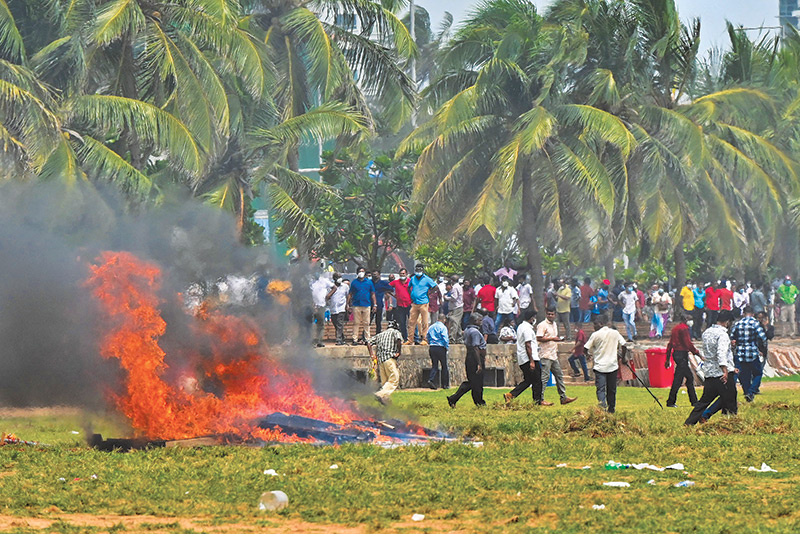
Demonstrators and government supporters clash outside the President’s office in Colombo on Monday. AFP/Rss
COLOMBO, Sri Lankan Prime Minister Mahinda Rajapaksa quit on Monday after a day of violence saw three people including an MP killed and over 150 wounded as government supporters armed with sticks and clubs attacked protestors. Lawmaker Amarakeerthi Athukorala from the ruling party shot two people—killing a 27-year-old man—and then himself after being surrounded by a mob of anti-government protestors outside the city, police said. Sri Lanka has suffered months of blackouts and dire shortages of food, fuel and medicines in its worst economic crisis since independence, sparking weeks of overwhelmingly peaceful anti-government demonstrations. On Monday scores of Rajapaksa loyalists attacked unarmed protesters camping outside the president’s office at the sea-front Galle Face promenade in downtown Colombo since April 9, AFP reporters said. The violence began after several thousand supporters of the prime minister, brought in buses from rural areas, poured out of his nearby official residence. Rajapaksa had addressed some 3,000 supporters at his house and pledged he would “protect the interests of the nation.” The supporters then initially pulled down tents of protesters in front of the prime minister’s Temple Trees residence and torched anti-government banners and placards. They then marched to the nearby promenade and began destroying other tents set up by the “Gota go home” campaign that demands the president step down. “We were hit, the media were hit, women and children were hit,” one witness told AFP, asking not to be named. Police fired tear gas and water cannon and declared an immediate curfew in Colombo which was later widened to include the entire South Asian island nation of 22 million people. Over 150 injured people were hospitalised, Colombo National Hospital spokesman Pushpa Soysa told AFP. Officials said the army riot squad was called in to reinforce police. Soldiers have been deployed throughout the crisis to protect deliveries of fuel and other essentials but until now not to prevent clashes. “Strongly condemn the violent acts taking place by those inciting & participating, irrespective of political allegiances. Violence won’t solve the current problems,” President Rajapaksa tweeted. The US ambassador to Sri Lanka said Washington condemned “the violence against peaceful protestors today, and call(s) on the government to conduct a full investigation, including the arrest & prosecution of anyone who incited violence”. “Our sympathies are with those injured today and we urge calm and restraint across the island,” Julie Chung tweeted. MP Athukorala’s car was surrounded in the town of Nittambuwa outside Colombo as he returned home from the capital after the clashes. “The MP fled the scene and took refuge at a nearby building,” a police official told AFP by telephone. “Thousands surrounded the building and he then took his own life with his revolver.” Athukorala’s bodyguard was also found dead at the scene, police said. Opposition MP Sajith Premadasa tried to move into the area after the Colombo clashes, but he came under attack from a mob and his security staff bundled him into a car and drove off. Mahinda Rajapaksa meanwhile tendered his resignation as prime minister to the president, his brother Gotabaya. “I am resigning with immediate effect so that you will be able to appoint an all-party government to guide the country out of the current economic crisis,” the prime minister said in the letter, seen by AFP. The country’s largest opposition party had said before the clashes that it would not join any government helmed by a member of the Rajapaksa clan. The resignation of the prime minister automatically means the cabinet stands dissolved. The violence was the worst since police shot dead one protestor and wounded 24 others blockading a railway line and a highway between Colombo and the central city of Kandy on April 19. On Friday, the government imposed a state of emergency granting the military sweeping powers to arrest and detain people after trade unions brought the country to a virtual standstill. The defence ministry said in a statement on Sunday that anti-government demonstrators were behaving in a “provocative and threatening manner” and disrupting essential services. President Rajapaksa has not been seen in public since tens of thousands attempted to storm his private residence in Colombo on March 31. Sri Lanka’s crisis began after the coronavirus pandemic hammered vital income from tourism and remittances, starving the country of foreign currency needed to pay off its debt and forcing the government to ban the imports of many goods. This in turn has led to severe shortages, runaway inflation and lengthy power blackouts. In April, the country announced it was defaulting on its $51 billion foreign debt.
WORLD
No end in sight for Ukraine war as Putin hails Victory Day
Putin has long bristled about NATO’s gradual creep eastward, including into former Soviet republics.
- ASSOCIATED PRESS
ZAPORIZHZHIA, Ukraine, Russian President Vladimir Putin used a major patriotic holiday Monday to again justify his war in Ukraine but did not declare even a limited victory or signal where the conflict was headed, as his forces pressed their offensive with few signs of significant progress. The Russian leader oversaw a Victory Day parade on Moscow’s Red Square, with troops marching in formation, military hardware on display, and a brass band blaring to mark the Soviet Union’s role in the 1945 defeat of Nazi Germany. But his much-anticipated speech offered no new insights into how he intended to salvage the grinding war—and instead stuck to allegations that Ukraine posed a threat to Russia, even though Moscow’s nuclear-armed forces are far superior in numbers and firepower. He steered clear of battlefield specifics—failing to mention the potentially pivotal battle for the vital port of Mariupol or even uttering the word “Ukraine.” Putin has long bristled about NATO’s gradual creep eastward, including into former Soviet republics, and sought to justify Russia’s invasion of Ukraine before an “inevitable” clash. Ukrainian leaders and their Western backers have rejected claims that Kyiv or NATO posed any threat to Russia—but tensions could rise further if Sweden and Finland decide to join the Western alliance, as support for that increases in both countries. “The danger was rising by the day,” Putin said. “Russia has given a pre-emptive response to aggression. It was forced, timely and the only correct decision.” He also sought to portray the current battle for the eastern region of the Donbas—Moscow’s focus after its early failure to sweep across Ukraine and overrun the capital—as a fight on “historic lands” of Russia, part of his wider effort to deny Ukraine’s own thousand-year history. But even in that region, where some thought Russia would finally see some decisive victories, progress has been slow going. Many analysts had suggested Putin might use his speech to declare some sort of limited victory—potentially in Mariupol—as he looks for an exit from the conflict that has unleashed punishing sanctions from the West and strained Russia’s resources. Others suggested he might order a nationwide mobilization to beef up the depleted ranks for an extended conflict. Neither was forthcoming. Critics said the speech skirted some uncomfortable realities that Putin is facing: With the campaign in Ukraine faltering, he has not asked Russians to accept sacrifices necessary to weather a squeeze of economic sanctions and diplomatic isolation. He also left unanswered the looming question of whether Russia will mobilize more forces in the face of significant losses. “Without concrete steps to build a new force, Russia can’t fight a long war, and the clock starts ticking on the failure of their army in Ukraine,” tweeted Phillips P. O’Brien, professor of strategic studies at the University of St. Andrews. As Putin laid a wreath in Moscow, air raid sirens echoed again in Kyiv, the Ukrainian capital. But Ukrainian President Volodymyr Zelenskyy declared in his own Victory Day address that his country would eventually defeat the Russians.
BEIJING, Authorities in Shanghai have again tightened anti-virus restrictions, just as the city was emerging from a month of strict lockdown due to a COVID-19 outbreak. Notices issued in several districts said residents were ordered to stay home and are barred from receiving nonessential deliveries as part of a “quiet period” lasting at least until Wednesday. The tightened measures could be extended depending on the results of mass testing, the notices said. “Thank you for your understanding and cooperation. Together we can lift the lockdown at an early date,” said one notice issued in the city’s Huangpu district and posted online. It wasn’t clear what prompted the renewed tightening, with numbers of new COVID-19 cases in the city continuing to fall. Shanghai on Monday reported 3,947 cases over the previous 24 hours, almost all of them asymptomatic, along with 11 deaths. Authorities have been gradually lifting isolation rules on the city’s 25 million residents, but the new orders appear to be returning to conditions at the early stage of the outbreak. Shanghai originally ordered mass testing along with a limited lockdown, but extended that as case numbers rose. Thousands of residents have been forced into centralized quarantine centers for showing a positive test result or merely having been in contact with an infected person. Two Shanghai residents reached through social media said they’d had no prior notice of the new restrictions, which they were told could last for up to a week. “We’re unprepared,” said Zhang Chen, a researcher with a technology company. “I packed my luggage thinking it would be my turn next” to be taken to a quarantine facility. “I don’t know what will happen in May, but after the lockdown, I think I’ll need psychological help,” Zhang said. A marketing professional in the western Pudong district said quality of life has been declining even as living expenses continue to rise under lockdown. “Every time, they say lockdown will be eased after a few days, but there seems to be no end,” said the woman, who asked that she be identified only by her surname, Lu, to avoid repercussions from authorities who have cracked down heavily on dissent.
WORLD
Philippines dictator Marcos’ son headed for presidency with huge election lead
The lead bolsters the chances of a once unthinkable return to rule of the Marcos family.
- REUTERS
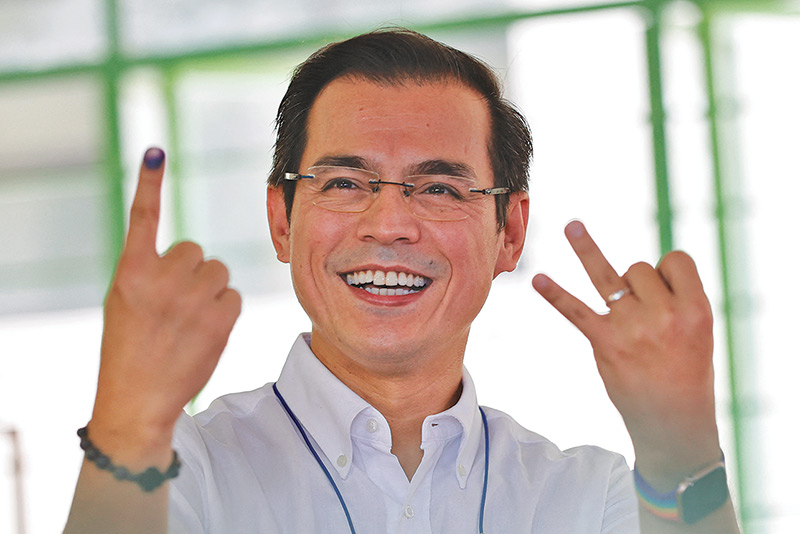
Presidential election candidate, Manila City Mayor Francisco ‘Isko Moreno’ Domagoso gestures after casting his ballot during the national elections in Tondo, Philippines. REUTERS
MANILA, Ferdinand Marcos Jr looked on course for a huge victory in the Philippines presidential election on Monday, after an unofficial tally of two thirds of the votes showed the son of the notorious late dictator surging ahead of his nearest rival. The massive lead bolsters the chances of a once unthinkable return to rule of the Marcos family, 36 years after its patriarch’s overthrow in a “people power” revolution and his family’s humiliating retreat into exile. Marcos Jr had 21.7 million votes, more than double the 10.3 million votes for Leni Robredo, the vice president, with 66.1% of the number of eligible ballots counted, according to an unofficial tally by the Commission on Elections (COMELEC) Marcos’s spokesperson, Vic Rodriguez, said Bongbong, as Marcos is popularly known, was not yet ready to talk about victory. “It’s not over until it’s over,” he told CNN Philippines. “Bongbong Marcos has never looked beyond May 9 and it’s still May 9. We are under expressed instruction from him not to lose focus and look beyond May 9.” Despite its fall from grace, the Marcos family returned from exile in the 1990s and has since been a powerful force in politics, retaining its influence with vast wealth and far-reaching connections. Marcos has served as a governor, congressman and senator, his sister, Imee, is currently a senator and mother Imelda, the influential power-broker and widow of the late dictator, served four terms in the House of Representatives. Marcos, 64, has presented no real policy platform but his presidency is expected to provide continuity from outgoing leader Rodrigo Duterte, whose ruthless, strongman approach proved popular and helped him to consolidate power rapidly. The results so far demonstrate the huge success of Marcos’s massive social media operation, which critics say has sought to discredit historical accounts of cronyism, plunder and brutality during the two-decade Marcos rule, about half of which was under martial law. The Marcos family denies siphoning off billions of dollars of state wealth during its time at the helm of what its opponents say was one of Asia’s most famous kleptocracies.
SPORTS
Hosts Nepal clinch One-Day Series 2-1
The Rhinos pull off a six-wicket victory over visiting Zimbabwe ‘A’ in the third and final match of the 50-over series.
- Sports Bureau
Paceman Kishore Mahato (third left) returned the match figures of 5-43 in his national debut at the TU cricket ground on Monday. Post Photo: Hemanta Shrestha
KATHMANDU, Opener Kushal Bhurtel and Dipendra Singh Airee scored half centuries each for hosts Nepal and Kishore Mahato grabbed five wickets as they pulled off a comfortable six-wicket victory over Zimbabwe ‘A’ to win the three-match One-Day series 2-1 at the TU cricket ground in Kirtipur on Monday. Sent into bat first, the visitors were bowled out for 213 runs with five balls to spare in the game reduced to 33 over per side because of wet outfield caused by overnight rain. Chasing the challenging target, Bhurtel scored 84 runs and Airee remained unbeaten on 60 runs as Nepal made 214-4 in 30.1 overs. Nepal made a strong start to their run chase as openers Bhurtel and Aasif Sheikh shared a 73-run stand for the first wicket. Sheikh scored 29 off 37 that included two fences and a six. He was dismissed in the first delivery of the 13th over after being caught by Jonathan Campbell off Brandon Mavuta. Bhurtel, who smashed seven fences and four maximums, departed as third wicket in the 21st over. He was caught by Roy Kaia off Mavuta. While Sunil Dhamala departed as second wicket for six runs, Rohit Paudel was out for a duck. But Airee and Binod Bhandari shared an unbeaten partnership of 84-runs for the fifth wicket. Airee clobbered four fences and three sixes in his 43-ball knock. Bhandari cracked three fences in his 28-ball knock. Zimbabwe bowler Mavuta alone grabbed three wickets conceding 46 runs in his six-over spell. Brad Evans picked another one wicket in his six-over bowling giving away 38 runs. Zimbabwe opener Tadiwanashe Marumani contributed 50 runs, the highest of the innings, in his quickfire knock of 31 balls. He smashed seven fours and two sixes before being caught by Rohit Paudel in a delivery by Dipendra Singh Airee. Kudzai Maunze and Roy Kaia were other players to make remarkable contributions with bat scoring 39 runs and 36 runs respectively. Manuza hit four boundaries and two sixes in his 34-ball knock before he was caught by Aasif Sheikh off Mahato. Kaia’s 48-ball knock included three fences and a six before he was run out by Basir Ahamad. Captain Tony Munyonga played a quickfire 12-ball 24, Cephas Zhuwao scored 18-ball 16 while Luke Jongwe hit 15-ball 19. The 22-year-old Mahato, playing his first game for the national side, was the pick of Nepal’s bowling, claiming five wickets. The pacer, also named player-of-the-match, conceded 43 runs in his seven-over spell including a maiden. Sompal Kami grabbed two wickets while Karan KC and Airee pocketed one wicket each. Kami gave away 45 runs in his seven overs bowling. Captain Sandeep Lamichhane remained wicketless in his six over bowling and conceded 56 runs. Nepal’s all-rounder Karan KC was named the player-of-the-series. Nepal had invited Zimbabwe for Twenty20 and One-Day series, both three-match each. The T20 series played earlier had finished in a 1-1 tie. Nepal had hosted the series to fine-tune the team’s preparation for the upcoming Triangular Series of the ICC World Cup League 2 to be held in the USA from June 6 to 16.
SPORTS
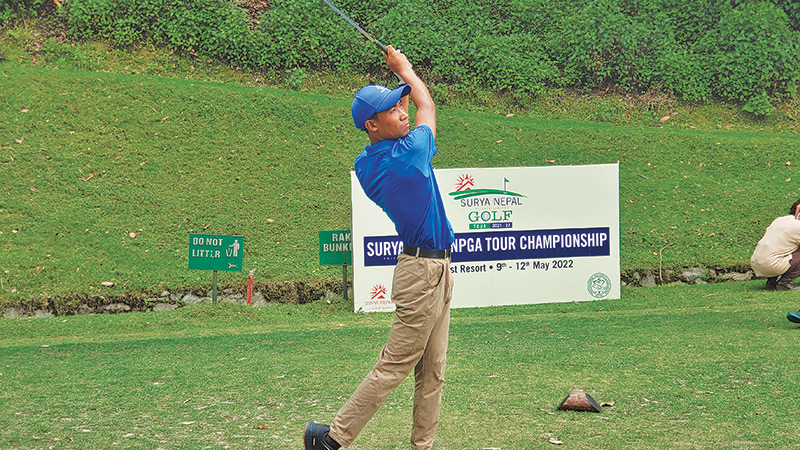
Amateur Tamang takes one-stroke lead after first round
- Sports Bureau
Subash Tamang played a bogey-free round to wrap up the first day at eight-under 64. Photo Courtesy: NPGA
KATHMANDU, Amateur Subash Tamang opened a one-stroke lead over Sukra Bahadur Rai after the first round of the Surya Nepal NPGA Tour Championship at the Gokarna Golf Club on Monday. Tamang, the double gold medallist at the 13th South Asian Games, played a bogey-free round to wrap up the first day at eight-under 64. Pro Sukra Bahadur Rai, who joined the event after competing at half a dozen of events in Indian Tour, played seven-under 65. Amateur Tashi Tsering and pro Rabi Khadka are jointly in third position at five-under 67. Nepal No 1 pro Bhuwan Nagarkoti, Dinesh Prajapati and amateur Sadbhav Acharya are tied for fifth at four-under 68. Pros Kamal Tamang, Ramesh Adhikari and Tirtha Poudel are jointly in eighth position at two-under 70, while Dhana Bahadur Thapa was next at one-under 71. Leader Tamang birdied on the third, fourth and fifth hole before an eagle on the par-five seventh hole for five-under 31 on the front nine. After taking the turn, he birdied on the 10th, 15th and 17th holes for three-under 333. Rai birdied on the third, fifth and seventh hole for three-under 33 on the front nine. He then dropped a shot on the very first hole after taking turn but amended it with an eagle in the next. He birdied on the 12th, 14th, 17th and 18th holes against a bogey on the par-three and 13th hole for four-under 32. Amateur Tsering played a card of three-under 33 on the front nine with birdies on the first, third and fifth holes. He scored two-under 34 on the back nine with birdies on the 15th and 17th holes. Khadka, tied with Tsering, opened with bogey and added another on the eight hole but he saved shots on the fourth and fifth hole for even-par 36 on the front nine. After taking the turn, Khadka birdied on 11th, 12th, 13th, 15th and 17th holes for five-under 31. The four-day event features a total of 44 golfers including 32 pros and 12 amateurs. Cut will be applied after the second round with top 21 pros and at least six amateurs making it to the last two rounds.
SPORTS
Everton, Leeds, Burnley in fight for Premier League survival
Only one point separate Lampard’s men from the Peacocks and the Clarets, but the Toffees have a game in hand with just two weeks left of the season.
- ASSOCIATED PRESS
LONDON, One is an American in his first few months in English football. Another is an interim coach thrust unexpectedly into his first experience of top-flight management. The other was not long ago an elite player vying for the biggest trophies in the game. The men leading the three clubs—Leeds, Burnley and Everton—who are engaged in a tense fight to avoid relegation from the Premier League are far from the typical managers English teams would once default to in a crisis. Like Sam Allardyce or Tony Pulis. Been-there-and-done-that managers in their 60s, with decades of top-flight experience, and a supposed ability to organise a defence and eke out enough points to keep a team up. Instead, the boardrooms of struggling Premier League teams have bucked the trend. Take Burnley, for example. Less than a month ago, the club’s American ownership fired Sean Dyche, the longest-serving manager in the league and a man whose pragmatic approach defined the team. He wasn’t replaced by someone renowned as being a survival specialist but instead Mike Jackson, who had been coaching Burnley’s under-23 team for the previous nine months and had very short stints as a manager in the lower leagues in 2014 and 2020. Jackson has changed Burnley’s style of play, with a more attacking mindset bringing three wins and a draw from five games. Then there’s Leeds, who brought in American coach Jesse Marsch in February following the tough decision to let go of a popular manager in Marcelo Bielsa, who had brought the team back into the Premier League after a 16-year absence and, like Dyche, had established a unique approach that stopped working. Marsch’s preferred style—attacking and heavy-pressing, having been embedded in the Red Bull project for the last seven years in roles at New York, Salzburg and Leipzig—didn’t seem to chime with what was needed at Leeds in a likely relegation scrap. What Marsch has actually done is tighten up at the back, even if a series of defensive mistakes contributed to a 2-1 loss at Arsenal on Sunday to drop the team into the bottom three. Everton make up the trio of relegation battlers separated by just one point with two weeks left of the season and are being led by Frank Lampard, the former England midfielder whose only experience of Premier League management was at his old club, Chelsea, where he lasted a year and a half before his limitations as a tactician led to him getting fired. Just like Jackson and Marsch, Lampard has eschewed the team’s previous style to meet their current predicament. Everton now take a defence-first approach and play on the counterattack, with three wins and a draw from their last five games—the one loss came after a hard-fought display at title-chasing Liverpool—lifting the team out of the bottom three. Meanwhile, a manager with the reputation of stopping teams from getting relegated, 74-year-old Roy Hodgson, was unable to prevent Watford from sinking back into the second-tier Championship after being hired in January. Watford’s relegation was confirmed on Saturday. Last season, Allardyce was drafted in by West Brom midway through the Premier League campaign in a desperate bid to help the team avoid the drop but he wasn’t able to. It ended Allardyce’s proud record of never having taken a team down from England’s top division in 30 years as a manager. No wonder, then, that struggling clubs are choosing to be bolder with their managerial appointments. One of Leeds, Burnley or Everton look sure to join Watford and Norwich in the Championship but whoever do can at least say their change in manager made a positive difference. Indeed, Lampard and Marsch have said they will be staying at their respective clubs whatever happens in the tension-filled days to come. Leeds looks in most danger, with games to come against Chelsea on Wednesday followed by Brighton and Brentford. Burnley are out of the relegation zone only on goal difference and still have to play Tottenham, Aston Villa and Newcastle. Everton, coming off back-to-back wins against Chelsea and Leicester, look to be in better shape, especially since they have a game in hand—at Watford on Wednesday. Brentford, Crystal Palace and Arsenal are their final three opponents.
SPORTS
Haaland close to sealing Man City transfer deal: Reports
Briefing
- AGENCIES
BERLIN: Borussia Dortmund top striker Erling Haaland is close to sealing a transfer deal with Manchester City, several German media reported on Monday. Haaland is among the hottest transfer prospects this summer with the 21-year-old having scored 61 goals in 66 league games since joining the Ruhr valley club in 2020. Sky Germany reported the player had informed the club of his wish to leave and that Man City had contacted the club over the player’s release clause. Several other media, including Bild newspaper and Kicker magazine, citing unnamed sources, also said a deal could be finalised in the coming days. The club did not comment on the matter on Monday.
SPORTS
Conway credits Dhoni for success against spin
Briefing
- AGENCIES
LONDON: Chennai Super Kings batsman Devon Conway said skipper Mahendra Singh Dhoni’s advice helped him score his third straight half-century as they thumped Delhi Capitals by 91 runs on Sunday. Conway usually plays the sweep shot against spin bowling. A chat with Dhoni prompted Conway to play more straight and he reaped the rewards “I’ve got to give credit to MS tonight,” Conway, whose 87 followed scores of 85 not out and 56, told Star Sports. Dhoni said to me, ‘I think the guys are going to try to bowl fuller to you tonight. So maybe come out and try to hit them straight.’ Chennai scored 208-6 before dismissing Delhi for 117 in 17.4 overs.
MEDLEY
Horoscope
ARIES (March 21-April 19) **** Sticking to a normal schedule will bring you a strange sense of comfort and satisfaction, so try not to deviate too much from your typical Tuesday. The cosmic alliance brings you an abundance of luck while restoring your optimism.
TAURUS (April 20-May 20) *** You’ll feel fierce and energized this morning. Use this energy as an excuse to share your ideas, as doing so can help you get ahead within your goals. Today, inspiration will strike, acting as a lightning rod for brilliant ideas.
GEMINI (May 21-June 21) **** The temptation to stay at home today will be real. If you can convince your boss to let you work remotely, you should do so since being surrounded by your own things will bring a sense of peace while elevating your productivity.
CANCER (June 22-July 22) *** Your vibe could come off as a little uptight or intense this morning. Though you’ll feel motivated to approach the day with maximum productivity, try not to expect the same level of dedication from your colleagues today.
LEO (July 23-August 22) *** A grounded yet efficient vibe will find your aura today. While you’ll be motivated to tackle your to-do list for the day, try not to feel rushed. Today, just try not to abandon your budget, and be sure to treat yourself.
VIRGO (August 23-September 22) **** Rocky vibes could find you this morning. Don’t feel bad about prioritizing your own needs, as the comic alliance gives you the cosmic green light to put yourself first. Spiritual enlightenment will find you today.
LIBRA (September 23-October 22) *** Try not to let perusal insecurities affect your love life today. This cosmic climate could dust up feelings of unworthiness. Embrace these vibes by treating your sweetie to a romantic gesture, which is sure to be reciprocated.
SCORPIO (October 23-November 21) *** You could wake up feeling a bit dazed or out of sorts today. The day helps you hold it together amongst these turbulent vibes. This day could cause your tidiness to ebb, bringing a more improved version of yourself.
SAGITTARIUS (November 22-December 21) *** You may be in charge of keeping everyone together at work today. Unfortunately, your task could feel like a tiring one. This planetary backspin is likely to bring inspiration and optimism your way over the next five months.
CAPRICORN (December 22-January 19) **** Don’t be surprised if you sleep through your alarm. This planetary backspin could create all kinds of issues with your time management, making it important that you give yourself a few extra minutes between each task.
AQUARIUS (January 20-February 18) *** You could wake up feeling a bit unlike yourself this morning. This cosmic climate could have you reevaluating everything from your voice to your artwork. It will also allow your voice to travel far, so keep your message positive.
PISCES (February 19-March 20) *** Your house may feel chaotic and messy this morning. Try to schedule some time to reorganize your space. These cosmic landscape will bring luck to your finances, though you should be mindful to cut down your spending.
CULTURE & LIFESTYLE
New ‘Doctor Who’ star is ‘Sex Education’ actor Ncuti Gatwa
The Rwanda-born, Scotland-raised Gatwa will be the first Black actor to helm the quintessential British sci-fi show.
- ASSOCIATED PRESS
Ncuti Gatwa poses for photographers upon arrival for the British Academy Television Awards in London, in 2021. AP/RSS
LONDON, Ncuti Gatwa will take the mantle from Jodie Whittaker on “Doctor Who,” the BBC announced Sunday, ending speculation over the iconic Time Lord’s next regeneration. “Sometimes talent walks through the door and it’s so bright and bold and brilliant, I just stand back in awe and thank my lucky stars,” returning showrunner Russell T Davies said in the broadcaster’s release. “Ncuti dazzled us, seized hold of the Doctor and owned those TARDIS keys in seconds.” Gatwa currently stars in Netflix’s high school comedy-drama “Sex Education” as the effervescent Eric Effiong, who is openly gay but from a highly religious family. The Rwanda-born, Scotland-raised Gatwa, 29, will be the first Black actor to helm the quintessential British sci-fi show, but he won’t be the first Black Doctor—Jo Martin has played “Fugitive Doctor” in several episodes. Whittaker became the 13th Doctor—and the first woman to play the central galaxy-hopping, extraterrestrial Time Lord who regenerates into new bodies—in 2017, when she took over from Peter Capaldi. Her last episode of “Doctor Who” is expected to air later this year. The original run of “Doctor Who” spanned 1963 to 1989. Since the show was revived in 2005, the Doctor has been played by Christopher Eccleston, David Tennant and Matt Smith, in addition to Capaldi and Whittaker. Other stars, like Karen Gillan and Billie Piper, have made their names on the show as the Doctor’s “companion.” “This role and show mean so much to so many around the world, including myself, and each one of my incredibly talented predecessors has handled that unique responsibility and privilege with the utmost care. I will endeavour my utmost to do the same,” the release quoted Gatwa—who described his emotions as “a mix of deeply honoured, beyond excited and of course a little bit scared”—as saying. In addition to seeing the start of Gatwa’s tenure, next year also marks Davies’ return to “Doctor Who” after more than a decade’s absence. “Russell T Davies is almost as iconic as the Doctor himself and being able to work with him is a dream come true,” Gatwa said. The writer and producer ran the reboot until 2009, and has worked on shows like “A Very English Scandal” and “It’s A Sin” in the interim. He promises a “spectacular” 2023. “Unlike the Doctor, I may only have one heart but I am giving it all to this show,” Gatwa added.
CULTURE & LIFESTYLE
The many lives of Kajal Naina Sherchan
Founder of internationally renowned jewellery brand Kajal Naina shares her winding life trajectory from art to dentistry to finally jewellery design.
- Pinki Sris Rana
Kajal Naina Sherchan at her store in Hong Kong. Photos Courtesy: Kajal Naina
Lalitpur, Nepalis interested in designer jewellery are most likely familiar with the name Kajal Naina, a jewellery brand out of Hong Kong and the brainchild of Kajal Naina Sherchan. The brand became very well known in Nepal after actor Priyanka Karki wore a custom-made mangalsutra from Kajal Naina for her wedding. But unbeknownst to many in Nepal at the time, Kajal Naina was already an award-winning jewellery brand. In 2018, the brand bagged two awards—Bronze A’ Design Award in Jewelry, Italy, and an Outstanding Achievement for Jewelry Design at Saul Bell Design Award for the brand’s ‘Laliguras’ (Rhododendron) series. The brand also won first place in the People’s Choice Category of the 2019 International Jewellery Stars Award. Popular among young adults for minimal yet chic design, Kajal Naina, says Sherchan, was started to create jewellery designs that suited the personality of modern women across the globe. Sherchan, who founded the brand in her late thirties, “has always had a special bond with jewellery” but never really saw herself working as a professional jewellery designer. “I grew up loving jewellery because on every special occasion of my life—be it my birthdays or a visit to someplace—my parents, especially my mom, would mark the occasion by gifting me a jewellery piece. Sometimes, the gift would be a charm bracelet or earrings. For me, jewellery has never been just ornaments but also a memento of precious memories,” says 44-year-old Sherchan. Before becoming a full-time jewellery designer/entrepreneur, Sherchan was a successful dentist. Studious in nature, Sherchan, as a little girl, always told everyone that her aim in life was to become a doctor. But by the time she graduated high school, she no longer wanted to become a doctor. “I took a gap year after high school to give myself time to think about what I wanted to do in life,” says Sherchan. Then one day, she told her parents that she wanted to join an art university and become an artist. The news, says Sherchan, came as a shock to her mother, who thought her daughter would indeed go on to become a doctor. “We have several engineers and doctors in my family, but nobody in the family ever put me under any pressure to become a doctor or an engineer. I was the one always constantly saying I would be a doctor one day,” says Sherchan. “This is why my mother was quite shocked when I told her that I wanted to become an artist.” But a visit to a dentist completely changed her plans. “The year I was to join an art university, I visited a dentist for a dental appointment, and the female dentist told me that dentistry is a combination of science and art,” says Sherchan. “That was when I decided to study dentistry and become a dentist.”
Not long after the visit to the dentist, Sherchan left for India to study BDS (Bachelor of Dental Surgery). During her second year in college, Sherchan received the news of her mother’s disappearance. Not long after her mother’s disappearance, Sherchan’s father suffered a stroke that left him bed-ridden for the rest of his life. These subsequent tragic events tore Sherchan apart, and she wanted to quit her studies and return home. “But I decided against quitting my studies because I knew that the only way to honour my mother’s memory was to finish my degree and become a dentist,” says Sherchan. After finishing her studies, Sherchan returned to Nepal and started her private clinic in Hattisar, Kathmandu, and it was frequented by many of the country’s leading names in entertainment and business. In 2009, she met her future husband. “I had to choose between my career here in Nepal or join my husband, who worked as a banker in Japan. I chose the latter. Given that I already had a successful career here in Nepal, it wasn’t an easy decision to make,” says Sherchan. In Japan, Sherchan was unable to work as a dentist because the country didn’t recognise her dentistry degree from India. She started learning Japanese to pursue a dentistry degree in the country, but then she became pregnant and that put her plans on hold. “I had to give birth to children one day or another, so we decided that the time was right for us to become parents,” says a candid Sherchan. “Both my daughters were born in Japan. Keeping our children’s future in mind, we decided to move to Singapore, where English was widely spoken.” In Singapore, Sherchan tried to get into the prestigious National University of Singapore (NUS) to pursue Master’s in Dentistry. “There were only three seats available, and I didn’t get into NUS on my first attempt,” says Sherchan. Not the one to give up on her dreams easily, Sherchan spent considerable time preparing for the entrance exam and got into NUS on her second attempt. “It was one of the happiest moments in my life,” says Sherchan. But her happiness was short-lived. During her first year at NUS, she had to quit her studies and move to Hong Kong. “We had to move to Hong Kong, and it didn’t make sense for me to continue my studies in Singapore because the degree wouldn’t be recognised in Hong Kong,” says Sherchan. “Looking back, it was all the difficult decisions that I have had to make almost all my life that shaped me into the person I am today. I have always had to make important decisions, move on with life, and focus on making the best out of the situation. I have been able to create the Kajal Naina brand because of my experiences,” reflects Sherchan. After shifting to Hong Kong in 2016, Sherchan enrolled in a jewellery design class. Surprisingly, her aim at the time was to become a carpet designer. “It was a friend of mine who saw my potential and encouraged me to get into jewellery designing,” says Sherchan. “Once I started jewellery designing, I gave my all and even took business classes to understand the financial aspect.” Regardless of all the sacrifices she has made for her family, Sherchan says she is happy with where she is today and is focused on taking Kajal Naina to greater heights. “When my parents were alive, one of their ways of showing me their love was by gifting me jewellery,” says Sherchan. “Today, I make jewellery that I know many people buy to gift to their loved ones. I couldn’t be happier with what I am doing in my life.”
CULTURE & LIFESTYLE
‘Doctor Strange 2’ conjures up biggest opening of 2022
The movie reportedly cost around $200 million to make apart from the millions spent on marketing and promotion.
- LINDSEY BAHR
Benedict Cumberbatch as Dr Stephen Strange in a scene from ‘Doctor Strange in the Multiverse of Madness.’ Ap/RSS
The summer movie season is off to a blockbuster start thanks to “Doctor Strange and the Multiverse of Madness.” The superhero extravaganza grossed an estimated $185 million in ticket sales in its first weekend in US and Canadian theatres, the Walt Disney Co. said Sunday. Not only did it more than double the opening of the first “Doctor Strange,” which opened to $85 million in 2016, it’s also the biggest opener of the year, ahead of “The Batman’s” $134 million; the second biggest of the pandemic, behind “Spider-Man: Far From Home’s” $260.1 million; and the sixth biggest of all time globally. Internationally, it’s doing even better with an estimated $265 million since opening Wednesday. Spider-Man is at least partially to thank for the massive debut. Benedict Cumberbatch’s powerful sorcerer appeared prominently in “ Spider-Man: No Way Home,” which has become the third biggest movie of all time since opening in December. “Doctor Strange 2” picks up several months after the events of “No Way Home,” and brings in Elizabeth Olsen’s Wanda Maximoff, who became even more popular thanks to the recent Disney+ series “WandaVision.” The film also has a gigantic footprint. It’s playing in 4,534 theatres in the US and Canada alone, which according to Disney is the seventh widest opening ever. Premium format screens, including IMAX and 3D, accounted for 36 percent of the overall box office. “Summer blockbuster season is off to a roaring start with ‘Doctor Strange’—an excellent sign for the phenomenal slate ahead,” Rich Gelfond, the CEO of IMAX, said in a statement. Hollywood’s summer movie season typically kicks off in early May and runs through the end of August and—aside from the last two years—regularly accounts for over $4 billion in ticket sales (or about 40 percent of the year’s grosses). Sam Raimi stepped up to direct “Doctor Strange in the Multiverse of Madness,” which reportedly cost around $200 million to make — though that number doesn’t account for the many more millions spent on marketing and promotion. Over the weekend, the film has trended on social media for everything from its many cameos to a spirited debate over its PG-13 rating and whether or not the horror elements warranted something more restrictive. “This is a total win for the industry for whom the last two summers almost didn’t exist in terms of box office,” said Paul Dergarabedian, the senior media analyst for Comscore. “Marvel has been kicking off summers for over a decade. This is a return to normalcy.” There was little left for other movies playing in theatres. Part of that is due to the fact that many multiplexes chose to pack their theatres with wall-to-wall “Doctor Strange” screenings. Film Critic Matt Singer tweeted a photo of a Manhattan AMC offering 70 screenings on Thursday alone. Universal and DreamWorks Animation’s “The Bad Guys” fell to second place in its third weekend with an estimated $9.8 million, while “Sonic the Hedgehog 2,” from Paramount, landed in third with $6.2 million. “Fantastic Beasts: The Secrets of Dumbledore” took fourth with $3.9 million, bringing its domestic total to $86 million. And in fifth place was another multiverse-themed film, “Everything Everywhere All At Once.” It had a slight dip in its seventh weekend but is still speeding along with an additional $3.3 million from 1,542 screens in its seventh weekend in theatres. The A24 film has grossed $41.6 million in total. The success of “Doctor Strange 2” only helps build momentum for the big summer movies on the way, like “Top Gun: Maverick” on May 27. “We’ve got a real summer movie season on our hands, something we couldn’t have imagined two years ago,” Dergarabedian said. Estimated ticket sales for Friday through Sunday at US and Canadian theatres, according to Comscore. Final domestic figures will be released Monday.
— Associated Press
CULTURE & LIFESTYLE
Comer, Bean, Macfadyen win at Britain’s BAFTA TV awards
Sean Bean won the leading actor prize for ‘Time’, which also scooped the award for mini-series.
- Marie-Louise Gumuchian
Presenters Anthony McPartlin and Declan Donnelly pose with their award for “Best Entertainment Programme” at the British Academy Television Awards in London, on May 8. Reuters
LONDON Actors Jodie Comer, Sean Bean, and Matthew Macfadyen were among the winners at the British Academy Television Awards in London on Sunday night. Bean won the leading actor prize for the prison drama “Time”, which also scooped the award for mini-series. Comer, who rose to fame playing an assassin in “Killing Eve”, won leading actress for “Help”, a drama set in a care home during the Covid-19 pandemic. Her co-star Cathy Tyson won supporting actress while supporting actor went to Macfadyen for “Succession”, a show about power struggles within a US family media empire. The coming-of-age story “In My Skin” won the drama series category, while the US mini-series “The Underground Railroad”, an adaptation of Colson Whitehead’s Pulitzer Prize-winning novel about a Black slave’s quest for freedom, won in the international category. Female performance in a comedy programme went to Sophie Willan for “Alma’s Not Normal” while Jamie Demetriou won male performance in the same category for “Stath Lets Flats”. Veteran comedian and actor Billy Connolly was awarded the BAFTA Fellowship, the highest accolade given by the academy. Rapper Big Zuu won two awards - entertainment performance and features for his show “Big Zuu’s Big Eats”. Several winners used their acceptance speech to voice support for publicly owned but commercially funded broadcaster Channel 4, which the British government last month announced plans to sell.