You internet speed is slow. Switch to text view mode

Switch
epaper logo
ST

Last Login:
Logout
+
Page 1
HOME PAGE

Uncertainty over plan to sell 200MW power to India after bidding confusion
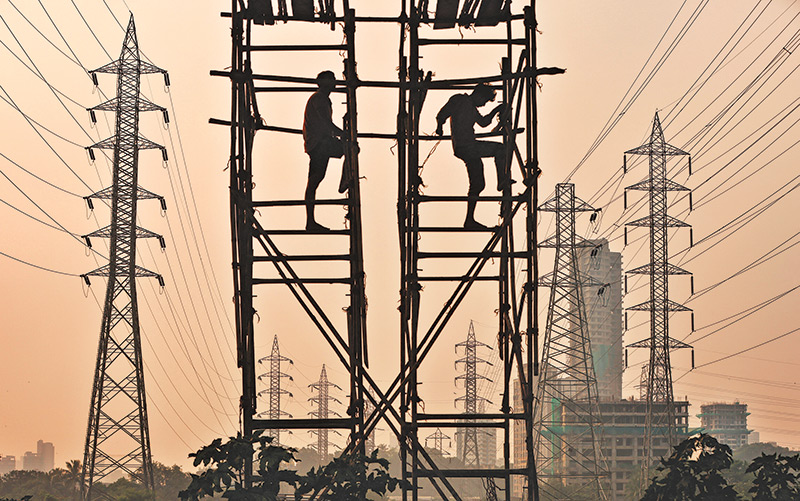
Manikaran Power has quoted the highest price only for 100MW, while quoting fifth highest for another 100MW, making it difficult for Nepal’s power utility to make a decision.
- PRITHVI MAN SHRESTHA
Coal-fired plants meet around 75 percent of total electricity demands in India.  File Photo: Reuters

KATHMANDU,
The Nepal Electricity Authority appears to be in a fix over its plan
to sell 200MW of electricity to India through a five-month-long power
purchase agreement, after one of the Indian companies made two separate bids.
Manikaran Power Limited has quoted INR4.86 (Rs7.77) per unit for 100MW,  the highest rate offered by any bidder and INR3.68 (Rs5.88) per unit, for another 100MW, the fifth highest among a total of six bids.
A senior official at the Nepal Electricity Authority (NEA) told the Post  that Manikaran quoted two separate rates at the same time which cannot not be done as per the bid document.
The second highest bidder for Nepal’s power is NTPC Vidyut Vyapar Nigam Limited, which has quoted INR4.3 (Rs6.88) per unit, according to the details received by the Post.
“Manikaran has quoted the highest price, but only for half of the energy on offer,” said the NEA official. The second highest bidder has made a bid for the entire 200MW but quoted a lower price which has created difficulty in taking the decision.”
In early May, the NEA had invited bids from Indian companies to sell a total of 200MW through a long-term power purchase agreement (PPA) as part of a strategy to diversify risks because of volatile prices in the IEX.  
Depending only on the exchange market is fraught with risks because there is no guarantee that all the power would be sold and at good prices.
The state-owned power utility body has plans to sell 200MW for five months from July 1 to November 29 under the long-term contract.
All open access consumers, regulated utilities, power distribution companies and traders having valid trading licences issued by the Central Electricity Regulatory Commission of India can participate in the bidding process, according to the notice.
Anshul Rustagi, assistant general manager of Manikaran who is currently in Kathmandu, told the Post that nowhere in the bidding document is there the provision that says one company is barred from making two separate bids.
“As per the bid document, a company can submit a bid to buy at least 50MW of electricity,” he said. “As required in the bidding document, we have offered the same prices from July to November.”
He said that Manikaran made two separate bids to fulfill the demands from two separate groups of consumers who wanted to pay different prices for the electricity.
Amid reservations over Manikaran’s bidding strategy, the NEA has not taken any decision on the matter.
Kul Man Ghising, managing director of the NEA, told the Post that a bid evaluation process is currently underway.
“The prices quoted by the bidders, however, are lower than our expectations,” he said. “So, we will take a decision on whether to sell electricity through this process or sell it through the power exchange markets of India. There is no compulsion for us to sell power under this mechanism”
According to him, the NEA would observe prices in the market for the next 10-15 days and make appropriate decisions.
He didn’t elaborate how.  
With the NEA not ruling out the possibility of not selling electricity through the five-month-long PPA, the Manikaran representative said that it may look badly upon Nepali power utility and its image if it backs out of the deal.
“This is the first time the NEA is trying to sell electricity for a longer period through competitive bidding. Scrapping of this process may raise questions about the credibility of the NEA,” Rustagi told the Post.
The state-owned power utility body has already been selling 177.7MW generated from the 144MW Kali Gandaki Hydropower Project, 24MW Trishuli, and 15MW Devighat power plants in the Indian market through the Indian Energy Exchange Limited (IEX), a power trading platform.
“The average price of energy sold through the IEX as of June 6 stood at INR 8.03 (Rs12.84) per unit, according to the NEA.
The NEA first started selling 37.7MW generated by Trishuli and Devighat from June 1 midnight and an additional 140MW generated by Kaligandaki starting from June 4 midnight.
With the rise in water levels in the rivers where most of the country’s hydropower projects are based, Nepal has started having more energy than the domestic demands, prompting the NEA to sell excess power in the Indian market.
The Indian authorities have so far allowed the NEA to sell a total of 364 megawatts in the open markets of India from electricity generated by Marsyangdi (67MW), Madhya Marsyangdi (68MW), Trishuli (22MW), Devighat (14MW), Kaligandaki A (140MW) and Likhu (51MW).
As per the details made available to the Post by a reliable source, Arunachal Power Co Limited has sought to purchase 80MW of electricity at INR 4.21  per unit, PTC Limited has quoted INR 4.14 per unit for 200MW, Tata Power Trading Co Ltd has quoted INR 3.42 per unit for 50MW, and Kreate Power Limited has quoted INR 3.91 per unit for 100MW.
The NEA, according to officials, was expecting the prices to be lower than that at the IEX in the day-ahead market as the southern neighbour is reeling under a power crisis in the wake of shortages and high prices of coals. Coal-fired power plants contribute around 75 percent of total electricity demands in India.
In the day-ahead market, prices for another day are determined one day ahead through the bidding process.
But officials at the NEA said that prices quoted by Indian companies for a five-month-period PPA are not reflective of those being offered in the IEX where rates have ranged between INR 1.49 per unit and INR 12 per unit as of Monday, according to NEA. The average price stood at INR 8.03 per unit as of Monday.
NEA is also concerned about the income from power sales if the majority (200MW) of the 364MW approved by the Indian authority is sold at lower than day-to-day market prices maintained at the IEX.
The power utility body has already faced questions for buying electricity at prices in the range of INR20 per unit from the IEX while it sold electricity at much cheaper rates.  
However, Ghising said at a press meet in late April that it was not true that NEA paid too high a price for importing electricity from India.
“The average price of imported electricity until mid-March from mid-January through the power exchange market was INR3.5 per unit including transmission costs,” Ghising told the press conference. “The average price increased to INR 4.5 per unit by mid-April and rose above INR5 per unit by mid-May because of a surge in electricity demands amid reduced supply due to the coal crisis internationally, including in India.”
According to  him, Nepal had sold its 39MW of electricity from November to early December last year at an average price of INR3.5  per month when electricity demand in the exchange market was not high and there was no Russia-Ukraine war, which has pushed up the energy prices.
“If the current power crisis continues, Nepal is bound to benefit from high energy prices in the Indian market,” Ghising had said.
HOME PAGE

A smug Dahal ignores party meetings, as he gloats over local poll wins

Insiders say there are no plans in sight to form crucial committees, and without check-and-balance mechanisms, the chair gets free hand.
- TIKA R PRADHAN
Pushpa Kamal Dahal.  Post File Photo

KATHMANDU,
CPN (Maoist Centre) chair Pushpa Kamal Dahal is clearly feeling smug. The local elections have not only given the party a new lease of life but also established it as a kingmaker as the country prepares for general elections due later this year.
An upbeat Dahal has been busy gloating over his party’s performance—and even warning that the Nepali Congress, which helped in the Maoists’ wins, could be cut to size if it behaves in an arrogant manner.
If Deuba’a assertions are anything to go by, general and provincial elections are likely by the end of November. The Maoist Centre, however, has not yet made any formal assessment of its local election performance. Nor has it called any party meetings.
The party had called a virtual meeting of the Central Committee on Friday evening, which was supposed to assess the May 13 local polls, but it was called off at the last moment. No reason has been given for the cancellation.
Then Dahal called a meeting of the former Standing Committee, which existed before the party’s eighth general convention, for Saturday. The meeting, however, was held on Sunday.
But the meeting was limited to discussing the conflict in the party’s students wing whose chair and general secretary were handpicked by Dahal. The meeting ended with the decision to collect a minimum of Rs100 from all ordinary members of the party within a month for the maintenance of the physical infrastructure of the party, according to leaders.
“The inability to hold meetings regularly is a matter of serious concern for any party,” said Ganesh Sah, a former Standing Committee member. “Our party has organisational problems due to which we have not been able to assess the local poll results and the party’s future strategy.”
He said Sunday’s meeting of the party’s former Standing Committee didn’t discuss the local polls.
From the eighth national convention held in December-January, Dahal was reelected—or he reelected himself, for that matter—party chair for yet another term.
Dahal has been leading the party for over three decades now unopposed.
The convention, however, did not elect any office bearers, new Standing Committee or the politburo. It has been more than five months since, and Dahal is the sole leader of the party.
Most of the time, Dahal invites the former Standing Committee members for consultations. Insiders, however, say the whole purpose of holding the national convention has been defeated as the chairman still consults the former Standing Committee, which the party statute does not recognise.
Dahal has been saying that party office bearers would be elected before the upcoming elections. But not many in the party believe.
According to insiders, for Dahal, picking a new general secretary is tough and the issue is unlikely to get resolved before the polls.
“I don’t think office bearers of the party will be elected before the upcoming polls as chances of an agreement on the general secretary are slim,” said Maheshwar Dahal, a Central Committee member. “A Central Committee meeting will be held after a month, but unless there is an agreement, election to office bearers will only be held after the polls.”
Dahal’s choice for general secretary is his close ally Barsha Man Pun, while Janardan Sharma, the incumbent finance minister, also has laid claim to the post.
According to Sah, the party failed to elect office bearers for two reasons—difficulty in “managing” leaders and the leadership’s reluctance to elect them at the earliest.
The eighth national convention even failed to elect all the members for the Central Committee.
“If you ask me how many members are there in our Central Committee, I don’t know exactly how many,” said Sah, the former Standing Committee member. “If we fail to elect office bearers this time, it will mean that our party is in a big crisis.”
Party leaders said earlier they could not elect the officer bearers because of the local level polls. But it has been more than three weeks since local polls were held and there has been no discussion yet on the matter.
The party has envisioned 15 office bearers—one senior vice-chair, five vice-chairs, one general secretary,
two deputy secretaries, four secretaries and a treasurer, besides the chairman.
Dahal had told party leaders that “a special convention” will be held after the local polls to elect the party’s leadership and devise the party’s ideological base. But nothing has happened to that effect also, say insiders.
According to Hem Raj Bhandari, a Central Committee member, the party may not elect its office bearers and other crucial committees like the Standing Committee and politburo before the upcoming polls.
“With no committees in place to question him, the chairman can take decisions as per his wish,” said Bhandari, who believes the electoral alliance with the Congress adversely affected the party’s performance in Province 1. “It will be difficult to continue partnership with the ruling alliance in the upcoming polls.”
He said the leadership had told the party members that a special convention will be organised to finalise the party’s leadership and ideological issues after the local polls but there is no sign of holding such a convention yet.
Dahal himself had told the recently elected people’s representatives on Wednesday that the party has been reeling from an identity crisis and that people are finding it difficult to distinguish between the Maoist Centre from other parties.
“Our party has a crisis of identity. Our activities are not different from other pro-parliamentary forces, bourgeois and opportunists,” Dahal said while addressing the new local government representatives elected from his party. “The identity of our party that it works for the people has gradually been wiped out.”  
The eighth national convention did nothing on the ideological front except ensuring Dahal’s total supremacy in the party.
Dahal’s document entitled ‘Nepal’s Road to Socialism in the 21st Century,’ which was presented at the convention, talks at length about various issues, including environment and climate change—but delegates had said that there was confusion as to how the party indeed wants to achieve socialism.
After a section of the party led by Narayan Kaji Shrestha vehemently opposed the US grant, the Millennium Challenge Corporation Compact, the party leadership had said it would organise “a special forum” to discuss the pros and cons of the compact after June 3.
“But with the postponement of the Central Committee meeting until June 29, the forum plan has also been postponed,” Shrestha told the Post. “The party will also elect office bearers from the Central Committee meeting.”
Also, the “special convention” is nowhere in sight.
“The party’s special convention won’t happen before the upcoming polls,” Shrestha said.

HOME PAGE

Nepal clears hurdles to import fertiliser from India to tide it over paddy season

To fast-track the process, the Cabinet has opened the way for a rush shipment of vital crop nutrients, officials say.
- SANGAM PRASAIN,ANIL GIRI

KATHMANDU,
Nepal is fast-tracking the import of chemical fertilisers from India through a government-to-government deal as the country faces one of its worst fertiliser crises ahead of the paddy growing season.
The Cabinet has cleared a bunch of legal hurdles to facilitate a rush shipment of urgently needed crop nutrients, allowing Agriculture Inputs Company to make full advance payment to the Indian supplier designated by New Delhi, the Agriculture Ministry said on Tuesday.
The Cabinet has also permitted the state-owned company to accept certificates of quality and other paperwork issued by the Indian government at the port of discharge where the cargo will be unloaded. Nepali officials are keenly hoping that the farm inputs will arrive by mid-July, forestalling a shortage with the paddy transplantation season already underway.
But until the consignment reaches Nepal, we should not be optimistic, they say.
While farmers in the hills have started to transplant paddy, Tarai farmers are beginning to sow the seeds as monsoon clouds entered Nepal from the east on Sunday, eight days before the usual date, according to weathermen.
“Although Nepal has signed a memorandum of understanding with India for the supply 150,000 tonnes of chemical fertiliser through a government-to-government deal, the southern neighbour will be dispatching 50,000 tonnes of urea and 30,000 tonnes of DAP as a crisis mitigating measure by mid-July,” said Prakash Kumar Sanjel, spokesperson for the Agriculture Ministry.
India has agreed to send the said amount from its stock.
“The cabinet has approved making full payment to India’s state-owned company,” said Sanjel.
Rashtriya Chemicals and Fertilisers is the designated company to supply chemical fertiliser to Nepal.
Under Nepal’s public procurement law, only 20 percent of the advance payment can be made to the seller.
The prices of fertilisers will be fixed after a commercial agreement is signed between the Indian company and the Agriculture Inputs Company.
According to Sanjel, after the amendment to the public procurement law, the Agriculture Inputs Company needs to formally place an order for the product.
“After the order has been placed, Nepal needs to send the full payment within four days,” he said, adding that looking at the current development and timetable, the fertiliser consignment will arrive by mid-July.
The ministry said delivery would be spread over several days as good transportation service and large warehouses will be required to handle the entire consignment.
The Indian company will start dispatching the goods two weeks after it receives payment, according to officials.
Nepal requires 210,000 tonnes of chemical fertilisers for the paddy planting season, and it must have 150,000-170,000 tonnes to avoid a disaster. The paddy transplantation season runs from early June to August. If the monsoon is delayed, the transplantation period extends to September.
The DAP requirement for the paddy season is 60,000 tonnes. The ministry says there is no shortage of DAP this season. But urea stocks have almost run out.
The shortage of chemical fertiliser, a political commodity, has become a headache for the government ahead of the general elections scheduled for later this year.
According to the Nepal Embassy in India, Agriculture Minister Mahendra Raya Yadav met with Mansukh Mandaviya, Minister of Chemical and Fertilisers of India, in New Delhi on Monday afternoon, and requested an early supply of fertilisers, highlighting its urgency in Nepal.
The Indian minister assured Yadav that the fertiliser shipment would be sent to Nepal as soon as possible.
Prime Minister Sher Bahadur Deuba had assured the agriculture minister of full cooperation and support from the government to import fertiliser through the government-to-government arrangement, according to Health Minister Birodh Khatiwada told the Post.
Nepal’s Ambassador to India, Shankar Sharma, who was present at the meeting, told the Post over the phone from New Delhi that Indian Minister Mandaviya has instructed officials to send to Nepal whatever stock of fertiliser they have due to the pressing situation in Nepal.
“Since we are buying the fertiliser under a government-to-government scheme, issues like mode of payment, logistics and method of transportation to Nepal remain our responsibility. The Indian minister and officials have assured us that they will provide transport through the Indian Railways,” said Sharma.
Apart from the supply expected from India, the Agriculture Ministry said that Salt Trading Corporation, which is authorised to handle 30 percent of the total fertiliser business, had purchased 20,000 tonnes of DAP.
The corporation has 22,000 tonnes of urea on order which will enter the country by mid-June.
Agriculture Inputs Company, which has a 70 percent share of the fertiliser business, will import 20,000 tonnes of urea by early July and 40,000 tonnes of DAP by mid-July, according to a statement issued by the ministry on Tuesday.
All countries globally, including India, have been struggling to secure chemical fertilisers since last year following a price hike in petroleum products. The Russia-Ukraine war has worsened fertiliser availability with prices going up nearly six times since the fighting began.
The World Bank and other global agencies have warned that poor countries may face food shortages because they can’t access expensive chemical fertilisers.
Over the coming months, a major challenge will be accessing fertilisers, which may impact food production across many crops in different regions, according to the World Bank’s May report on food security.
The Agriculture Ministry said that following massive price fluctuations, suppliers defaulted on dispatching around 222,000 tonnes of fertiliser planned for this fiscal year ending mid-July, leading to shortages.
On February 28, Nepal signed a government-to-government deal with India to procure chemical fertilisers for five years, raising hopes that the constant nightmare of shortages during the planting season would finally end for Nepali farmers.
As per the deal, Nepal can buy 150,000 tonnes of crop nutrients—100,000 tonnes of urea and 50,000 tonnes of DAP—from the southern neighbour in the first year, which means the ongoing fiscal year 2021-22.
In the second year, Nepal will be able to procure 170,000 tonnes, in the third year 195,000 tonnes, and in the fourth and fifth years, 210,000 tonnes each.
The government-to-government contract bypasses the lengthy global tendering process to avoid scarcities during the main growing season. Normally, it takes six months to import chemical fertiliser through the global tendering process.
The ministry said it takes 226 days for fertiliser to reach Nepal through the global tender process.  
The deal, however, will assure the supply of at least 30 percent of Nepal’s annual fertiliser requirement, officials said.
The Ministry of Agriculture and Livestock Development has estimated that the annual demand for fertilisers stands at around 600,000 tonnes.
According to the ministry, the price of urea in February-March, the main procurement or tendering period, had reached Rs139 per kg while the price of DAP jumped as high as Rs168 per kg.
The price of urea has dropped to Rs98 and DAP to Rs150 per kg. The government sells urea and DAP at the subsidised prices of Rs15 per kg and Rs44 per kg respectively.

Page 2
NATIONAL

Bardiya residents continue protest following death of teenager in clash with police

An 18-year-old girl died of bullet wounds on Monday when police opened fire at protesters seeking protection from wildlife attacks.
- KAMAL PANTHI
Protesters obstruct the Madhuban section of the Postal Highway in Bardiya.  Post Photo: KAMAL PANTHI

BARDIYA,
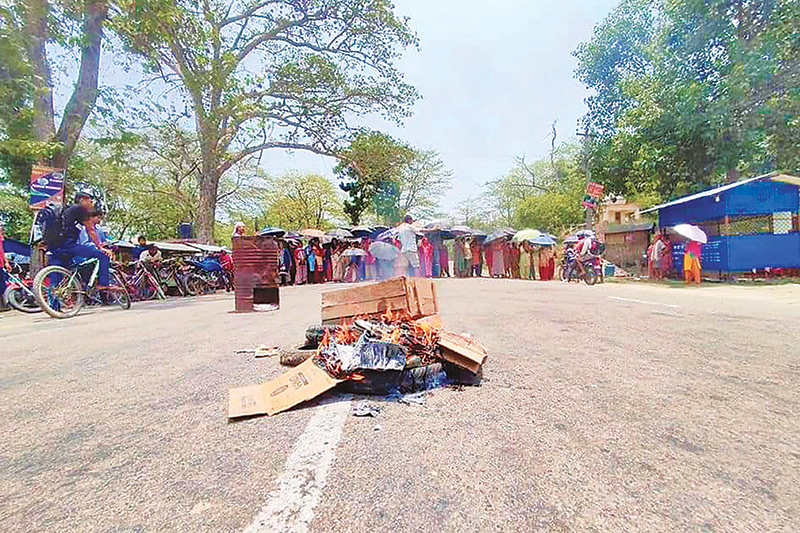
Residents of Madhuban Municipality in Bardiya continued their protest for the second consecutive day on Tuesday after an 18-year-old girl died of bullet wounds during Monday’s clash with the police.
On Monday, Madhuban locals obstructed the Gulariya-Rajapur
section of the Postal Highway demanding protection from wild animals after Asmita Tharu, 41, of Sonaha in Madhuwan-2 of the district got injured in a tiger attack while collecting firewood the same day.
During their protest on Monday, the locals demanded commitment from the forest chief and the chief district officer to control wildlife menace in the area. A clash occurred between security personnel and the local residents during the protest, following which police personnel lobbed tear gas shells and opened fire. Nabina Tharu, 18, of Madhuwan-2 got hit by a bullet and died during the course of treatment at a hospital.
As many as 20 security personnel and one civilian, Rakesh Chaudhary, were also injured in the clash. The injured are currently receiving treatment at Nepalgunj Nursing Home.  
On Tuesday, scores of people from different villages arrived at Orali Bazaar in Madhuban Municipality to protest the teenager’s death and underscore their demand for protection from wild animal attacks.
Bastola informed that security personnel were not present in the protest site on Tuesday to avoid untoward incidents.
“We, however, deployed police personnel in the neighbouring areas to maintain peace and security,” said Bastola.
Following the incident, the Home Ministry on Tuesday formed a committee to probe into the teenager’s death. According to a statement from the ministry, the committee is headed by Joint Secretary Hari Prasad Ghimire.
The Ghimire-led committee has been asked to submit its report within seven days.
Incidents of wildlife attacks along the Khata Bio-Corridor in Madhuban Municipality have been on a rise for the past few years. Tiger attacks alone have claimed the lives of nine people along the bio-corridor in the last three years.
According to local residents, 13 days prior to the attack on Asmita Tharu, Kaushika Pal, another local woman, had also sustained injuries in a tiger attack in the bio-corridor. The 49-year-old woman was grazing her goats in the Janajagriti Community Forest when the tiger attacked her.
An all-party meeting held at Madhuban Municipality on Tuesday concluded serious negligence on the part of the police administration in dealing with Monday’s protest. Participants in the meeting accused the police of blindly firing at the protesters.
CPN (Maoist Centre) leader Suresh Panth, who was at the meeting, said that action will be taken against those who gave orders to open fire at the protesters.
“We have urged the government to compensate the family of Nabina Tharu, who was killed during the protest,” said Panth, “Likewise, the government will bear all treatment costs of Chaudhary, the civilian who sustained bullet injuries in Monday’s protest.”
The meeting also decided that the government will bear the treatment cost of Asmita Tharu, who was injured in the tiger attack on Monday.
Likewise, the meeting has decided to manage the human-wildlife conflict, monitor tiger movements and secure human settlements, among other long term solutions to the crisis, by coordinating with the province, centre, national park and forest division office, among other stakeholders.

NATIONAL

Seven people arrested on gang-rape charge

Briefing

NEPALGUNJ: Police on Monday arrested seven men from Baijanath Rural Municipality-8 in Banke on the charge of raping a 16-year-old minor on Saturday night and Sunday in different locations. DSP Madhusudan Neupane said two of the suspects were arrested during a regular security check. “The security personnel on duty intercepted a motorcycle as three people were riding on it. We were suspicious as the girl was in an unconscious state,” said Neupane. Preliminary investigation shows that Hemraj Tharu, 17, of Baijanath Rural Municipality-8, who had known the girl for a year on Facebook, had invited the minor to celebrate his birthday on Saturday. She was later raped by Tharu and his friends. According to the police, the minor was raped at different places on Saturday night and Sunday—first raped by five youths in the forest of Mankhola and later by two youths in Baijanath. “Detailed investigation into the incident is underway after taking the suspects into custody,” said Neupane.

NATIONAL

One dead, five sick after eating wild mushrooms

Briefing

UDAYAPUR: In Hatuwagadi Rural Municipality, a five-year-old girl died while undergoing treatment at Ghoretar Primary Health Centre in Hatuwagadi after falling sick from eating wild mushrooms on Tuesday. Five others who fell ill after eating the mushrooms are undergoing treatment at the hospital. Ash Kumar Rai, 43, Dhan Kumari Rai, 38, Yogita Rai, 20, and two girls aged eight and three are undergoing treatment at the centre, according to the District Police Office, Bhojpur.

NATIONAL

Portable toilet installed in Pathivara

Briefing

TAPLEJUNG: Three portable toilets have been installed outside Pathivara temple premises and five more are currently being installed on the trail leading to the temple. Pathivara temple receives 300,000 tourists annually. According to Taranath Ghimire, chairman of the temple area protection and promotion committee, the toilet built earlier by the committee has been left unusable due to a lack of water.

Page 3
NATIONAL

The controversy about the new embossed number plate

Transport management office revises decision on compulsory adoption of the vehicle number plates after public outcry.
- ANUP OJHA
Service seekers are flocking to Transport Management Offices in Bagmati and Gandaki. Post Photo: Prakash Chandra Timilsena

KATHMANDU,
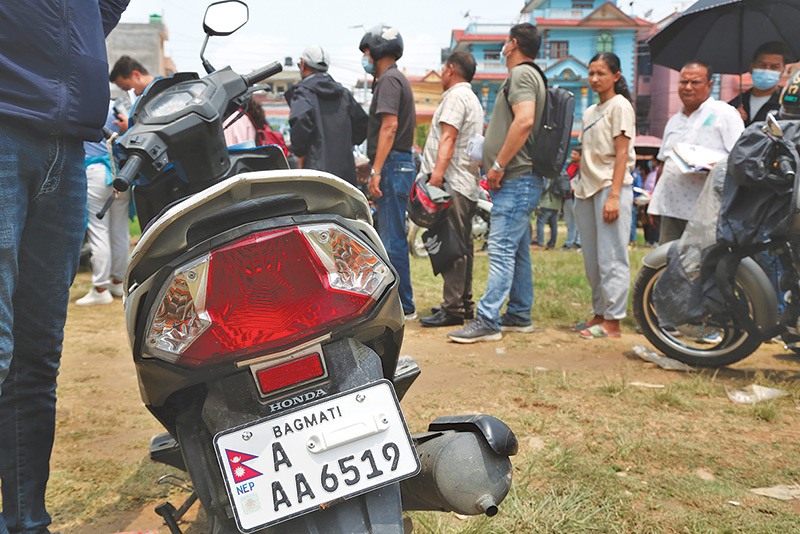
On June 3, the Department of Transport Management under the Ministry of Physical Infrastructure and Transport published a notice making embossed number plates mandatory for all vehicles operating in Bagmati and Gandaki provinces by July 17. The vehicles that do not comply with the rule will be penalised under the Motor Vehicles and Transport Management Act, 2049 (1993), the notice said.
Embossed number plates are mandated in all provinces, except Province 1 for it is yet to be named, from November 17.
In its statement on Monday, the ministry also showed its concerns about the ineffective implementation of mandated embossed number plates even though it was published in Nepal Gazette last year on November 8. It has been seven months since the government’s notice and none of the provinces—Madhesh, Bagmati, Gandaki, Lumbini, Karnali and Sudurpaschim—have initiated the process to adopt embossed number plates. The notice, however, generated widespread criticism with the public calling it impractical, hasty and
forceful.
The issue was raised in Parliament as well.
While speaking in the House, Gagan Thapa, the general secretary of the Nepali Congress, lashed out at the government, saying the government directive has caused unnecessary trouble to the citizens.
Data from the transport department show that as of now only 25,000 vehicles including government vehicles have embossed number plates. Government agencies own an estimated 40,000 vehicles. Namaraj Ghimire, director general at the department, said the department is working to install embossed number plates on all 2.5 million vehicles in the coming 15 months.

What is an embossed number plate?
An embossed number plate has camera-readable digits. It is also embedded with an RFID (radio-frequency identification) microchip.

When did the government make the plan to launch an embossed number system?
The government’s plan to launch embossed number plates dates back a decade. The plan was included in the Three-Year Interim Plan 2007–2010, but it was put on the back burner due to a number of reasons like delays in conducting a proper study to roll out the project. However, on May 30,  2016, the government began distributing embossed number plates to vehicles based on the provincial structure against the existing zonal format.
Later, on February 22, 2018, the Supreme Court issued an interim order to stop issuing embossed number plates. A single bench of then chief justice Gopal Prasad Parajuli issued the interim order in response to a petition filed by environmentalist Bharat Basnet. Basnet had demanded that the Devanagari font be used on the number plates. He had also stated that the chip on the number plates could be used for spying and called it a breach of national security.
But on December 13, 2019, the Supreme Court vacated its stay order paving the way for the resumption of embossed number plate distribution.
“Three years ago, the court already paved the way for implementing the embossed number system. Some people may protest but this is the most scientific way to regulate vehicles,” said Ghimire, the director at the transport management.
With its statement on Tuesday, the DOTM also clarified that the embossed number plate is not equipped with a GPS vehicle tracking system.

Is it the first time the government has come up with such a decision?
No. The Department of Transport Management had announced that the embossed number plates would be made mandatory for all vehicles starting from July 16 last year. In his conversation with the Post, Ghimire had said that existing vehicles would be required to install the new number plates before applying for renewal of their registrations. It meant that the existing vehicles had to wait until their respective vehicle registration renewal dates. Also, he had said that the department could not implement it strictly earlier due to the Covid-19 pandemic. However, nothing significant happened in between.  

How have transport operators taken the government’s proposed mandate for an embossed number system?
The Federation of Nepalese National Transport Entrepreneurs, along with other transport operators, has criticised the government’s decision as “impractical”, and the timetable set by the government as impossible to meet. “How can the government manage to enlist all those vehicles under the new system by July 17?” questioned Yogendra Karmacharya, chairperson of the Transport Entrepreneurs’ federation.
“Last year also, the government made a similar announcement, but that didn’t work. It’s not workable,” said Karmacharya. The federation has also expressed concerns about the language to be used on the embossed number system since many Nepalis aren’t comfortable using English in their daily lives.
Karmacharya also accused the government of trying to collect revenue from vehicle operators who faced huge losses due to the pandemic-induced restrictions until last year, and also at a time when the fuel prices have gone through the roof.

How much does it cost to get an embossed number plate for different categories of vehicles?
For an embossed number plate, the department charges two-wheelers Rs 2,500; three-wheelers (tempos) Rs 2,900; light four-wheelers including cars, jeeps, vans and tractors Rs 3,200; and heavy vehicles Rs 3,600.

What is the controversy surrounding the new number plate regime? Why is everyone criticising it?
With the government decision last week to make embossed number plates mandatory, people are panicking and the transport offices, especially in Kathmandu and Pokhara, are packed with service seekers.  After the government’s notice, many have questioned the intent of the government, given that installing embossed plates is costlier than the ones being commonly used. Critics say the government made a forceful announcement without proper technical preparations. Many have requested the government not to make it mandatory as it involves high cost. Based on the government’s May 30, 2016 agreement, the department had to install embossed number plates in 2.5 million vehicles within five years of time. In the six years span, the government could not make the system effective and it was far from meeting its expectations. So far, only 25,000 vehicles have received embossed number plates.  Even though the agreement phased out, last year again an agreement was made to meet the target within 28 months, which most people have criticised.

What do transport experts say about the embossed number regime and the present conflict?
Transportation and traffic engineers say stringent implementation of the embossed number system is the need of the hour as it helps to reduce theft of vehicles and is an easy tool to keep the record of the vehicles. However, questions have been raised about the management, especially given that the department has not been able to provide driver’s licence to a large number of applicants. “It was the government’s plan half a decade ago, but it should have been implemented strictly,” said Ashish Gajurel, a transportation and traffic engineer. “It’s a good system but I see a problem in management and distribution of the embossed number plates.”

What does the Department of Transport Management have to say on the issue?
After widespread criticism, the Transport Department on Tuesday backtracked from its earlier decision. Publishing a notice on Tuesday, the department stated that embossed numbers are not mandatory for all the public vehicles starting from July 17 and it’s not possible to provide embossed numbers within the remaining 40 days. The notice states that it was published based on a notice in the Nepal Gazette last November. At a press meet held on Tuesday, Ghimire, director at the transport department, said only three categories of vehicles will have to have embossed number plates by July 17 in Bagmati and Gandaki provinces: For those who have purchased new vehicles after November 17, those who have bought vehicles or vehicle transfer done in another name after February 13, and those who are in the process of renewing their vehicle registration certificate [known as bill book in Nepal] after May 15. Meanwhile, for other provinces, the department will start the process gradually, according to Ghimire.
According to the department, 250,000 embossed number plates have been printed for now and kept in store for distribution, and it has already taken all the necessary action to distribute new plates.

NATIONAL

Garbage disposal finally resumes with police help

Officials say 150 truckloads of garbage was dumped at the Banchare Danda landfill Tuesday.
- Post Report

KATHMANDU,
After seven weeks of disruption, disposal of Kathmandu Valley’s garbage finally resumed Tuesday at Banchare Danda landfill on the border of Nuwakot and Dhading districts, after police cleared obstruction created by locals.
Around 150 lorries carrying garbage from Kathmandu Valley have unloaded the trash at the landfill site by Tuesday evening.
Police had detained around a dozen protesting locals after they tried to stop the garbage trucks from reaching the landfill site.
“As the local people have not suspended their protests, we may have to take help from law enforcement agencies on Wednesday also,” said Sarkardip Shrestha, an official at the Kathmandu Metropolitan City.
Following an agreement between the Metropolitan City, Ministry of Urban Development, and local representatives from Sisdole and Banchare Danda on Monday evening, dozens of trucks carrying garbage from the Kathmandu Valley had reached the landfill site early in the morning on Tuesday.
But enraged locals, who were unaware about the agreement signed the previous day, barricaded the road preventing the trucks from reaching the landfill.
“Around a dozen of our friends were detained by the police in the morning,” said Chandra Bahadur Balami, a member of the Banchare Danda Waste Management Struggle Committee. “Instead of addressing the demands of the locals, the authorities prefer to take help from security agencies.”
Police said they removed the protesting locals from the vicinity of the landfill site after they attempted to vandalise the garbage trucks.
“We only removed the protesters from the landfill site,” said Gautam Mishra, Deputy Superintendent of Police at Metropolitan Police Circle, Balaju. “We have not arrested anyone.”
In the agreement signed on Monday, the ministry has agreed to allocate Rs 425 million to construct five different roads that lead to Banchare Danda while Rs17 million has been allocated for river embankment, construction of a community building, and tree plantation in the area. All of these works will be carried out in the new fiscal year 2022-23, as per the agreement.
The City has announced its plan to start the process to provide health insurance services to the residents of the affected area within a week. The beneficiaries of the insurance service will be residents of Dhunibeshi Municipality’s wards 1, 3, 4 and Kakani Rural Municipality’s wards 1, 2 and 3. Furthermore, the City has announced plans to continue providing grants for other infrastructure development work in the wards.
The City has also announced that it will segregate solid waste as biodegradable and non-biodegradable at the source itself starting June 15.
The Ministry of Urban Development has also announced plans to start a land acquisition drive in the affected area.
Locals complained that authorities concerned did not listen to their genuine demands. Along with 18 local units of the Kathmandu Valley including the Kathmandu Metropolitan City, some local units of Kavrepalanchok also dispose of trash in Banchare Danda.
“We have been living with the trash of the capital city and other local levels of the Valley for over 17 years,” said Suman Tamang, a local from Sisdole area. “But none of our demands which were agreed upon repeatedly by the authorities concerned have been fulfilled so far. Our life has become hell. And authorities opted for suppression instead of fulfilling our just demands.”
Due to the protests of the locals in the Sisdole area, door-to-door garbage collection remains stalled in the Kathmandu Valley for about two months.
“We agree that life has become difficult in the Valley due to the ongoing disruption in garbage collection, but can you imagine, how are we living here tolerating the foul smell from the landfill site for the last 17 years,” said Balami, who is also a former ward chair of Kakani Rural Municipality-1.
Relocation of the settlements near the landfill sites, development of better amenities, and preventing garbage trucks from dropping trash and lichete on the road are among the demands of the locals of the affected areas.
Despite the past commitments, the authorities concerned have not even repaired the roads to the landfill sites for years. Although an eight-kilometer section of the Pasang Lhamu Highway which was widened some eight years ago, it has not been blacktopped yet.
Locals also complained that the trucks have been carrying more garbage than their capacity and when they jolt in the pothole-ridden road, lumps of trash fall from the trucks along the road.
“We want authorities concerned to start doing what can be done immediately,” said Balami.
Experts, meanwhile, say the authorities should work seriously to find a long-term solution to the garbage problem. One immediate step is segregation of waste, at the source itself, they say.
“Until and unless we change our attitude from waste disposal to waste management, we will not reach any solution,” said Kishor Thapa, former secretary, who is also an expert on urban development. “To solve the garbage problem, we should go to its roots and segregate garbage and start management accordingly.”
 Waste management has been a perennial problem in Kathmandu Valley, which produces around 1,200 tonnes of garbage every day.
Experts say along with finding immediate solutions, authorities should not forget that disposal of all kinds of waste in landfill sites will only complicate the problem.  
“The just demands of the people of the affected areas should be addressed, agreements should be implemented sincerely, and authorities should work on long-term management of waste,” said Jaya Kumar Gurung, a senior environmentalist.

Page 4
EDITORIAL

Garbage in, garbage out

A solution is going to come only if both sides engage in a compassionate negotiation.

On Monday, after a tripartite agreement between representatives from Kathmandu Metropolitan City, the Ministry of Urban Affairs and Banchare Danda village, there was hope that the capital city’s waste management problem was getting solved, at least temporarily. Excited about the new development, Kathmandu Mayor Balen Shah took to social media to lay out the plans for instituting segregation practices at the source for effective management of household waste. But locals of Banchare Danda on Tuesday disallowed the city’s trucks from reaching the dumping site, a reminder that those who have had to endure Kathmandu’s filth for years are not going to be assuaged so easily.
Tuesday saw a confrontation between locals and the city, with the police using force to dump the garbage as the villagers obstructed the dumping. An escalation of the conflict between the two sides is only going to worsen Kathmandu’s already fragile relationship with Banchare Danda. But confrontation is never the best way to solve a longstanding problem. A permanent solution to the problem is going to come only if both sides engage in a compassionate negotiation. This does not in any way mean that locals should relent and give up their demands, which do not seem unreasonable. In any case, they have been handed out promises to fulfil their demands in the past, only to be cheated time and again.
The Kathmandu waste management problem is a legacy left by those who were in power earlier and did nothing close to finding a long-term solution. Just a few days into their tenure, Kathmandu’s local representatives have taken a multi-pronged approach to dealing with the crisis, including sending a team of experts to assess the damage caused by the filth as well as a team with chemical spray to subdue the stench. The new mayor even announced on social media that waste segregation would begin at the source beginning July 17, even cautioning Kathmandu residents that if they bring unsegregated waste, it will be returned to them. After remaining a metropolitan city for decades, it is unfathomable how Kathmandu continues to collect all kinds of waste together and throw them on the streets. Even as the leadership continues to negotiate with Banchare Danda locals towards a peaceful and permanent solution to the waste management problem, it is high time the city dwellers begin segregating waste at the source itself even before the deadline set by the mayor.
The filth on the streets of Kathmandu cannot remain unattended for ever, as it is a violence on the sensorium apart from a source of ailments. But what is at stake is the sensorium of the residents of Sisdole and Banchare Danda, who have been duped several times over the years. They have suffered enough of the filth and the disease emanating from the metropolitan city that cares little about their health and wellbeing. They need environmental justice that arises from a judicious management of the trash at the source.

OPINION

Politics of the TikTok generation

The role that the TikTok algorithm plays in a national poll will have to be watched with interest.
- CK LAL
Shutterstock

Even among the people born and living at about the same time, circumstances of birth, upbringing and education are not always similar. Family traditions often shape the cultural values of a person in the early years. Standards of behaviour are observed and absorbed from the conduct of seniors during the process of growing. Principles of life and work continue to be imbibed throughout adulthood. It will be thus audacious to associate any particular set of beliefs with an entire generation.
Some generalisation, however, is necessary to make sense of the socio-political messiness of one’s milieu. In the United States, generations have been grouped under various names. From the Lost Generation (born 1883-1900) of the past to the some yet to be born of the Generation Alpha (born 2013-25), Americans have been grouped to signify a pattern in their behaviour.
The use of terminology and the range of years sometimes vary. The last generation to be born entirely in the 20th century (1981-2000) is Generation Y, the Echo Boomers, the Millennium Generation, the Millennials, the Net Generation, the Nexters and the Digital Generation. Some researchers prefer to call the cohort born between 1981 and 1996 Millennials and put everyone born from 1997 onwards into different groups altogether.
I once came up with similar categorisations for Nepali politicos with the reckless characteristic of a know-all columnist. Born before the overthrow of Ranarchy, Prime Minister Sher Bahadur Deuba is one of the last politicos of the Veterans’ Generation, straddling the stallion of state power like a wild warrior.
The Lost Generation (born 1951-60) grew up during the period of intensification of the Cold War in South Asia and confrontations between monarchists and democrats in Nepal. High on the absurdist cocktail of Marxism-Leninism, Maoism and monarchism, politicos such as Khadga Prasad Sharma Oli, Madhav Kumar Nepal, Jhala Nath Khanal and Pushpa Kamal Dahal became some of the most successful politicos of the post-1990 order primarily due to their ideological fluidity.  
The Mahendramala Generation (born 1960-70) and the Referendum Generation (born 1970-80) grew up with daily doses of xenophobia, jingoism and chauvinism administered through school textbooks, repeated broadcasts of the state-controlled media and inciteful rants of politicos of the preceding generation.
The concerns of the Individualistic Generation or Generation I (born 1991-2000) are global such as climate change, conservation of heritage and issues of gender justice that are expressed through street protests like Save Nijgadh, Save Nepal Valley and Occupy Baluwatar. But the faith of the first digital cohort is often limited to #buddhawasborninnepal.
Generation Z, Gen Z or quite simply the Zoomers are categorised as those roughly born between 1997 and 2015. In the case of Nepal, most Zoomers—attending classes over the internet during the pandemic and making TikTok videos to express themselves—were born between 1997 and the turn of the century. Preliminary indications of their political preferences can be gauged from their craze for Balen Shah during the just concluded local elections.

Media habits
Habits are formed through constant exposure and regular practice until they become an automatic reaction to a specific situation. The veterans of Prime Minister Deuba’s generation acquired their information from books, periodicals, lectures of scholars and life lessons from illustrious predecessors. The literate ones of Sharma Oli’s generation had begun to subconsciously consume the propaganda of Cold War rivals through multicoloured publications such as Soviet Bhoomi, Cheen Sachitra and Swatantra Vishwa of the Soviets, Chinese and Americans respectively. Indian newspapers and periodicals in Hindi and English supplemented by BBC Hindi Service offered the intellectual fare. The primary source of the official version remained the morning news of Radio Nepal.
Many adults of the Mahendramala Generation grew up to be rabid ethnonationals because the cohort was made to survive on the constant diet of the monarchist propaganda disseminated through state-controlled media, several foreign-funded tabloids in the Nepali language and a plethora of jingoistic music cassettes. By the time the Referendum Generation began to consume the media, there were video cassettes of action movies in English on hire, the regular sermons of newly-established Nepal Television in full colour and the antennae on rooftops that caught and relayed satellite signals of mostly entertainment channels.
Youngsters of Generation I have grown up with cartoon channels, played video games and listened to the music of their choice on portable media players. By the time they could read newspapers, internet portals had begun to update the latest events in real time. They grew up with cellphones, grew out of emails to embrace social media platforms, and became voracious consumers of the digital fare.
A figurative use of the term echo chamber has come to imply a closed space where only the information confirms one’s biases and filters out contradictory facts. In his classic tract “Medium is the message”, Marshall McLuhan talks of “hot” and “cold” media. The snugness of social media lulls its users into believing that “post, follow and share” are forms of activism.
Pre-2017 social media users of Facebook, Twitter, Instagram, YouTube and WhatsApp were largely consumers of information and entertainment streamed to their page or timeline. Participation in production on such platforms continues to be optional. TikTok prompts its users to produce short video shots with a smartphone and enables them to aim the self-created content to a distinctive audience.

Mercurial politics
The legacy media continues to shape opinions. The data mining and manipulation of social media algorithms for the dissemination of misinformation and disinformation has helped influential politicos engineer election victories. What TikTok often succeeds in doing is changing the narrative by influencing the very thought process of its “user-generator”.
Since the mid-2010s, the manipulative use of social media platforms has helped in the emergence of demagogic populists hawking authoritarianism in the name of order and stability. TikTokers are likely to help ambitious individuals outgrow their shady past, as in the recent Philippines elections, and influence the outcome of the polls far in excess of their political weight.
Even though they didn’t encourage it, earlier social media platforms allowed users to go to the credible sources of a story through hyperlinks, podcast show notes and explanatory details in the description box. The new kid on the block—the TikTok—tells its user buddies to jump on the bandwagon of fun and games, and receive instant gratification. Alarmed by the virality of the app, the ruling party in India banned it and facilitated the launch of copycats that have failed so far to emerge as credible alternatives.
Having been a popular rapper, Balendra Shah realised the viral potential of TikTok early in his campaign trail. The newly elected mayor of Kathmandu Metropolitan City is perhaps one of the pioneering users of TikTok to come on top without having any ideological moorings, firm organisational support or an extensive election campaign.
If nothing untoward happens between now and November, the provincial and federal elections will take place within this year. The role that the TikTok algorithm—alarmingly characterised as the Weapon of the Century—plays in a national poll will have to be watched with interest. It may herald the dawn of an era of Don Quixotes espousing political homilies.

OPINION

Surviving a future of extreme heat

Unprecedentedly higher temperatures are survivable, but not unless we prepare for them.
- KRISTIE L EBI
Shutterstock

Although nearly all heat-related deaths are preventable, heatwaves kill thousands of people worldwide every year. At this very moment, an extreme heatwave in India and Pakistan, affecting about one billion people, is “testing the limits of human survivability,” warns Chandni Singh, a lead author for the Intergovernmental Panel on Climate Change’s Sixth Assessment Report. In April, the average maximum temperature for northwest and central India was the highest in 122 years.
This is not just a South Asian problem. In recent years, similarly extreme conditions occurred in the United States, Australia, Europe, Scandinavia, and Japan, resulting in thousands of hospitalisations and excess deaths. Extreme heat is also linked to increases in premature births, low birthweight babies, and stillbirths; reductions in worker productivity; higher rates of chronic kidney disease of unknown origin; and increases in suicide.
Extreme temperatures are thus an “all of society” problem. Such conditions not only harm human health; they also have detrimental effects on infrastructure, crop yields, and poultry mortality, threatening livelihoods and undermining food security. The 2021 heat dome in the Pacific Northwest and western Canada was a case in point.
It was an event that would have been virtually impossible without climate change. Temperature extremes were about 5 degrees Celsius above previous records, causing approximately 1,000 excess deaths and a 69-fold increase in heat-related hospitalisations. Yields from wheat and cherry crops plummeted, and millions of mussels, clams, and oysters were cooked in their ocean habitats, threatening food security and livelihoods for indigenous peoples and low-income communities.
Already, nearly 40 percent of heat-related deaths are attributable to climate change. And because climate change is expected to increase the frequency, intensity, and duration of heatwaves, the need for additional measures to protect people will only become more urgent. Without immediate and significant investment to enhance community and health-system resilience, the deaths associated with heat exposure will increase.
Well-communicated, evidence-based action plans are needed to keep people cool and reduce hospitalisations and deaths. In addition to early-warning and response systems, longer-term planning is needed for life on a warmer planet. That means providing more blue and green spaces, changing building materials, and focusing on ways to cool people, rather than the surrounding environment.
Early-warning and response systems require more than just a single threshold for determining the start of a heatwave. Effective systems also should include collaborative processes to ensure that interventions account for local capacities and constraints. Health ministries will need to work closely with (among others) hydrometeorological services, police and fire departments, emergency services, agencies responsible for elder care, and trusted voices for vulnerable populations (such as adults over 65) and marginalised communities.
Resources should not be a barrier. Effective early-warning systems already exist worldwide, including in low-resource settings such as Ahmedabad, India. Moreover, organisations like the Global Heat Health Information Network are collecting and sharing data on local and national experiences and best practices. The demand for additional guidance is growing rapidly, in tandem with the increasing frequency and severity of heatwaves.
But most of today’s early-warning systems do not explicitly account for the risks of a changing climate. To be more adaptive, planners should adopt timelines for reviewing changes at the beginning and end of the summer season, while also developing regional collaborations to ensure consistent messaging. There will also be a greater role for tiered early-warning systems that account for multiple thresholds, such as temperature readings combined with local knowledge of particularly vulnerable populations.
For example, initial warnings might be issued several days before the peak of a heatwave to alert at-risk groups such as older adults, young children, and pregnant women. A second set of warnings could then be issued at somewhat higher temperatures for outdoor workers and people engaged in sports or related activities, followed by a third set of warnings for the general public at the usual threshold for declaring a heatwave. These warnings would need to be paired with effective communications, so that people are properly motivated to take the appropriate measures to stay cool.
Even after these improvements, early-warning systems should then be stress-tested to determine their robustness to unprecedented heat. This could be done through desk-based exercises to identify weaknesses. Stress tests should incorporate not just heatwaves but also compound risks such as back-to-back events: a heatwave combined with a wildfire; or a heatwave coinciding with a pandemic, as the Pacific Northwest experienced in 2021. Vulnerability mapping can be an effective tool to help decision-makers determine where interventions are needed most to protect human health and well-being.
A much warmer future requires urgent and immediate investments that capitalise on best practices and lessons learned from existing heat adaptation plans. Proven models need to be scaled up to enhance resilience and sustainability. Unprecedentedly higher temperatures are survivable, but not unless we prepare for them.
 
Ebi is Professor of Global Health and Environmental and Occupational Health Sciences at the University of Washington.
—Project Syndicate

Page 5
MONEY

BBIN motor vehicles pact has a bumpy ride ahead for lack of policies, regulations

An early implementation of the motor vehicles agreement between Bangladesh, Bhutan, India and Nepal can shorten transport routes, save travel time, and lower costs.
- KRISHANA PRASAIN
The BBIN motor vehicles agreement’s objective is to enable seamless movement of passenger and cargo vehicles across borders among the neighbours.  Post File Photo

KATHMANDU,
Nepal has a long way to go when it comes to implementing the Bangladesh, Bhutan, India and Nepal (BBIN) motor vehicles agreement, which was signed seven years ago but has been a nonstarter, a new study shows.
According to the study entitled ‘Enabling Political and Economic Discourse for Multi-Model Connectivity in the BBIN Sub-region’ unveiled by Nepal Economic Forum on Tuesday, Nepal lacks adequate
policies and regulations to implement multimode connectivity in an
effective manner.
“Policies such as the Multimodal Transport of Goods Act, 2006 have not been reviewed to include changes in the trade environment,” says the report.
The BBIN motor vehicles agreement, facilitated by the Asian Development Bank, was signed in June 2015.
Its objective is to enable seamless movement of passenger and cargo vehicles across borders among the neighbours. The agreement also aimed at bringing four countries closer to aid trade and economic integration.
The four countries had also agreed on a six-month work plan from July to December 2015 to implement it.  But so far progress has been sluggish.
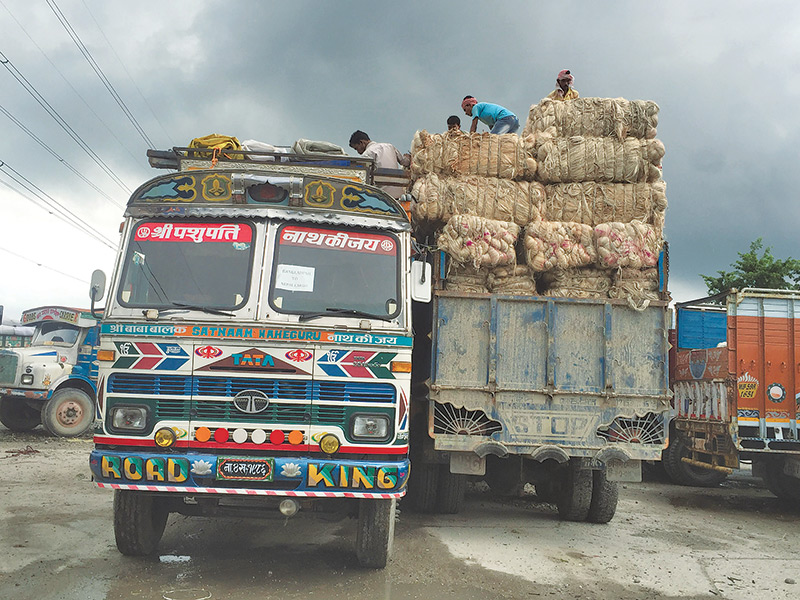
An early implementation of the BBIN motor vehicles agreement can shorten the transport routes, save travel time, and lower costs, in addition to reducing the carbon footprint, according to the World Bank. Its analysis finds that under the agreement, a truck travelling from Agartala in India’s northeast to Kolkata port will take 65 percent less time and the cost will be 68 percent cheaper.
According to a World Bank report, although trade between the BBIN countries grew six-fold between 2005 and 2019, the unexploited potential remains massive, estimated at 93 percent for Bangladesh, 50 percent for India and 76 percent for Nepal.
Nepal has yet to develop technical guidelines or standards for inland navigation, the report said.  
The insufficiency of Nepal’s infrastructure and facilities in the gateway ports of India and Bangladesh is one of the challenges it faces in connecting with the global market.
In terms of logistics and transport infrastructure, Nepal still requires adequate cold storage, warehousing, freight stations, laboratory and parking facilities.
There is a need for single-window compliance with supporting infrastructure like computers, stable internet, uninterrupted electricity and developing and upgrading of road infrastructure, according to Nepal Economic Forum report.
Transit cargo clearance is mostly handled manually, which affects transaction costs and affects cross border movements between India and Nepal.
Presently, member countries are negotiating the protocols [one for passengers and other for cargo vehicles] to implement the motor vehicles agreement.
“There is a need to make several interventions on the issues like transit, visa and currency issues,” said Raju Tuladhar, project coordinator for Nepal Economic Forum. “There was on the protocol that transit fees will be charged which is not practical for landlocked countries like Nepal and Bhutan and as also as per the international trade agreement.”
There is an issue with visas as Nepal and Bangladesh do not provide an on-arrival visa to each other, according to Tuladhar. And, there’s also a problem with currencies between the two nations.
“There is a trust issue among the four countries while Nepal lacks negotiating capacity with India,” said Tuladhar.
The report says enabling a political economy discourse is critical to facilitate multi-modal transport connectivity in BBIN sub-regions.
“The political economy discourse will require a clear understanding of ground-level challenges at the national and sub-regional level,” the report adds.
According to the report, with the implementation of the BBIN motor vehicles agreement, Indian trucks workers fear loss of jobs, particularly in loading and unloading.
While Indian trucks are freely allowed to Nepal, Nepali trucks have to pass through a lengthy procedures to enter India, according to the report.
Poor condition of roads is a serious impediment to cross-border trade, according to a report “Connecting Corridors beyond Borders-Enabling seamless connectivity in BBIN Sub-region” published in 2018 by CUTS International.
For instance, the current state of hard infrastructure at Raxaul-Birgunj land customs stations is also poor. The two-lane bridge over the Sirsiya river near the border is narrow.
The condition of the road from Mothihari to Rauxal does not allow efficient movement of trucks. The corridor for transit across India
for trade between Nepal and Bangladesh through Banglabandha-Fulbari-Kakarvitta also faces similar road infrastructure issues.
The road infrastructure from Nepal to Muglin is in significant need of investment and improvement and poses a challenge to trucks, particularly during the monsoon season.
In March 2022, member countries finalized the enabling memorandum of understanding for the implementation of BBIN motor vehicles
agreement among three countries.
A sub-committee has been formed to discuss the modality of the protocols.
The March meeting also agreed to operate the transport routes in Kakarvitta-Kolkata-Dhaka or Biratnagar-Kolkata or both in the next six months.

MONEY

EU agrees single charger standard, in blow to Apple

- AGENCE FRANCE-PRESSE

BRUSSELS,
European officials on Tuesday agreed the text of a proposed EU law imposing a standard charger for smartphones, tablets and laptops sold in the bloc, in a blow to Apple.
EU member states and MEPs believe a standard cable for all devices will cut back on electronic waste, but iPhone juggernaut Apple argues a one-size-fits-all charger would slow innovation and create more pollution.
For most portable devices the requirement for charging via a USB Type-C port will come into effect from late 2024, negotiators said, while laptops will be given more time.
The USB-C rule will also stretch to digital cameras, headphones, headsets, portable speakers and E-readers, they said.
Lawmakers agreed on the common charger based on a proposal that was made by the EU executive—the European Commission—in September, but came more than a decade after the European Parliament first pushed for it.
The decision will be formally ratified by European Parliament and among EU member states later this year before entering into effect.
“We have been able to do it in nine months, that means that we can ... move fast when there is a political will,” the EU internal market commissioner Thierry Breton said.
“We are able to say to the lobbies, ‘sorry, but here it is Europe and we’re working for our people’,” he said.
The 27-nation union is home to 450 million people, some of the world’s richest consumers, and the imposition of the USB-C as standard could affect the entire global market.
“This is a rule which will apply to everyone,” said MEP Alex Agius Saliba, who led the negotiations for the European Parliament.
“If Apple ... or anyone wants to market their product, sell their products within our internal market, they have to abide by our rules and their device has to be USB-C,” he said.
The rules will also give shoppers the option to opt out of receiving a new charging cable when purchasing an electronic device.

MONEY

Relief, caution in Beijing as city lifts Covid dine-in curbs

- AGENCE FRANCE-PRESSE
People dine at a restaurant in Beijing on Monday.  AFP/Rss

BEIJING,
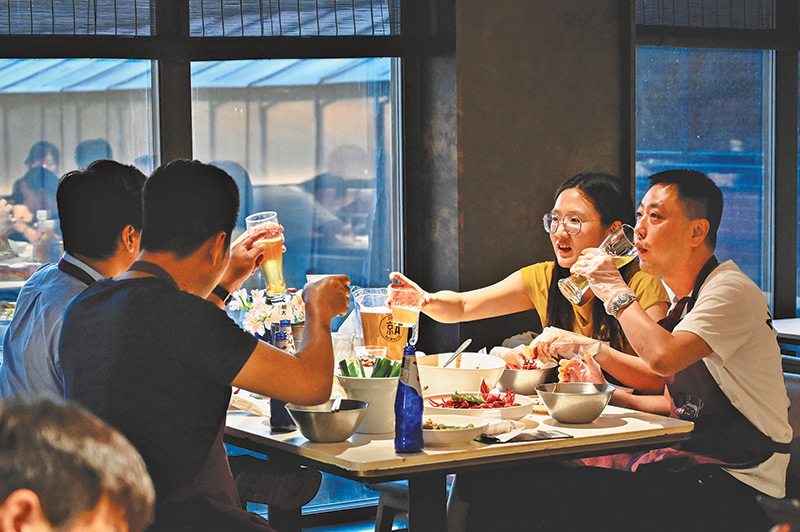
After staying home for more than a month, Chen Chunmei joined a long line of customers at a popular Beijing restaurant where diners tucked into massive bowls of crayfish following an easing of Covid restrictions in the Chinese capital.
Last month, the city of 22 million stopped people from eating out, closed gyms and sealed off dozens of subway stations to try and stamp out a coronavirus outbreak.
The curbs are now finally easing, including at restaurants.
“I’m very excited, mainly because we’d been sealed off for so long,” Chen told AFP.
“I’ve been ordering takeout or cooking every day. I really wanted to come out for meals.”
At its peak, Beijing logged just dozens of infections every day.
But authorities in China are committed to a zero-Covid strategy—using rapid lockdowns, mass testing and severe travel restrictions to eliminate even the smallest outbreaks.
Chen, 28, said her compound was initially locked down for two weeks but when she was finally allowed to leave, the nearby subway station was closed.
“Since then, I’d been staying at home,” she said. “At first I thought working from home was pretty good but after a while, I got bored.”
As Beijing’s case numbers fell—it reported just two local asymptomatic infections on Tuesday—authorities told residents they could return to work this week, while schools would reopen from June 13.
The Universal Beijing resort said it will reopen on June 15, while Chinese media reported that cinemas and gyms will run at 75 percent capacity from this week in most areas.
Dine-ins at restaurants have also mostly resumed, although two districts still have restrictions in place because of recent Covid cases.
While authorities have persisted with their zero-Covid policy, its economic costs have piled up.
Businesses in Beijing told AFP that the last month bit a large chunk out of their earnings.
“Our revenue for the month of May fell around 65 percent on-year,” said Zhang Shengtao, operations director at Beijing Huda Catering.
He added that staff income at the restaurant chain, which employs nearly 800 people, also dropped by around 30 percent last month.
Some breathed a sigh of relief on Monday as restrictions on dining-in were eased.
“I’ve been longing for the resumption,” said Wu Ziwen, a manager at restaurant chain Nanjing Dapaidang.
“There’s no doubt that we were losing money,” he told AFP, adding that the outlet has been relying on food deliveries to survive.
The dine-in resumption in Beijing is still partial, however: due to Covid controls, his restaurant can only accept up to 50 percent of regular capacity “even if customers flood in,” Wu said.
Beijing is requiring people to produce a negative test done within three days if they want to take public transport or enter office buildings.
The outbreak in the capital has also kept visitors like 33-year-old Sun Tao from returning home to Shanxi.
The dine-in relaxation gave him some respite.
“I’m nervous and alert,” said Sun, who ventured out of the hotel where he was staying with his wife on Monday evening and waited for a table at a restaurant.
“But I also wanted to feel my tastebuds again.”

MONEY

Sri Lanka seeks $6 billion to keep economy afloat

Colombo is already in talks with IMF for a bailout and has appointed international experts to help restructure its debt.
- AGENCE FRANCE-PRESSE

COLOMBO,
Cash-strapped Sri Lanka on Tuesday asked the International Monetary Fund to arrange a creditor meeting for $6 billion in loans to help keep the country afloat during its unprecedented economic crisis.
Months of daily blackouts, long queues for petrol and record inflation have made daily life a misery in the South Asian island nation of 22 million people. The government has already defaulted on its $51 billion foreign debt, and a critical shortage of foreign currency has left traders unable to import adequate supplies of food, fuel and other essential goods.
Prime Minister Ranil Wickremesinghe said the country needed $5 billion for its daily needs in the next six months, along with another billion to stabilise Sri Lanka’s rapidly depreciating rupee.
“We call on the International Monetary Fund to hold a conference to help unite our lending partners,” the premier told parliament.
He said a meeting under IMF auspices with China, Japan and India—Sri Lanka’s three biggest bilateral lenders—would be a “great strength” in helping source more loans.
Sri Lanka is already in talks with the IMF for a bailout and has appointed international experts to help restructure its debt, about half of which is in international sovereign bonds. Wickremesinghe again warned the country was heading for serious food shortages and said the United Nations had agreed to issue an urgent appeal to raise humanitarian funds.
A disastrous ban on agricultural chemical imports, introduced by President Gotabaya Rajapaksa last year, dramatically curtailed crop yields and led to protests by farmers.
The policy was reversed months later, but Sri Lanka is now out of foreign currency to import fertiliser, pesticides and other much-needed farming chemicals. Wickremesinghe became premier in May after his predecessor, Mahinda Rajapaksa, the elder brother of the president, stepped down after months of protests against the government’s economic mismanagement.

MONEY

Standard Chartered, Unilever sign supply chain financing solutions pact

Briefing

Kathmandu: Standard Chartered Bank Nepal Limited and Unilever Nepal Limited have signed an agreement to provide supply chain financing solutions to the dealers of Unilever Nepal. Under this programme, recommended dealers of Unilever Nepal can avail of trade financing solutions from the bank. The move is designed to help the SME entities (dealers) in availing efficient financing that covers their entire working capital cycle which can help the dealers ensure their financial sustainability, especially during the challenging period triggered by the pandemic and liquidity crisis, etc, the bank said in a statement. It will also help the large corporates to implement more sustainable and resilient supply chains. Following the signing ceremony, Anirvan Ghosh Dastidar, CEO of Standard Chartered Bank Nepal, said: “The bank is delighted to be able to introduce a first-of-its-kind initiative in the country for Unilever Nepal. We have come a long way in our digital journey to ensure a holistic ecosystem for our corporate clients and look forward to introducing more pioneering solutions in future.”

MONEY

World Bank slashes 2022 global growth forecast to 2.9 percent

Briefing

WASHINGTON: The World Bank slashed its growth estimate for the global economy to 2.9 percent, 1.2 percentage points below the January forecast, due to the Russian invasion of Ukraine which has caused a severe downturn. “The world economy is expected to experience its sharpest deceleration following an initial recovery from global recession in more than 80 years,” the bank said Tuesday in its Global Economic Prospects report. The slump comes after growth recovered to 5.7 percent in 2021 following the downturn caused by the Covid-19 pandemic. The Russia invasion and Western sanctions on Moscow have sent grain and oil prices soaring, and drivers around the world are facing eye-popping prices at the pump. (AFP)

Page 6
WORLD

Israel mainly to blame for conflict: UN report

Lead investigator points to the asymmetrical nature of the conflict and the reality of one state occupying the other.
- AGENCE FRANCE-PRESSE
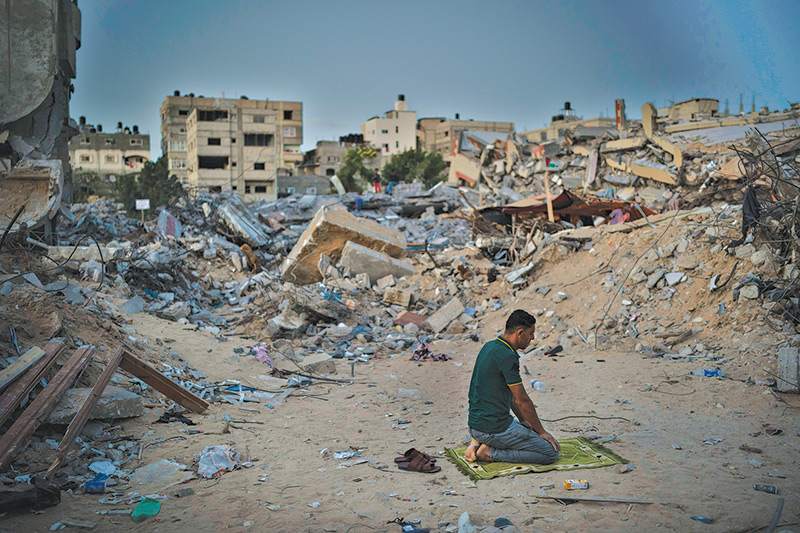
A Palestinian prays at dusk next to the rubble of his family home, destroyed by an airstrike, in Beit Lahia, northern Gaza Strip, in June last year.  Ap/Rss

GENEVA,
Israel’s occupation and discrimination against Palestinians are the
main causes of the endless cycles of violence, UN investigators said on Tuesday, prompting angry Israeli protests.
A high-level team of investigators, appointed last year by the United Nations Human Rights Council to probe “all underlying root causes” in the decades-long conflict, pointed the finger squarely at Israel.
“Ending the occupation of lands by Israel... remains essential in ending the persistent cycles of violence,” they said in a report, decrying ample evidence that Israel has “no intention” of doing so.
The 18-page report mainly focuses on evaluating a long line of past UN investigations, reports and rulings on the situation, and how and if those findings were implemented.
Recommendations in past reports were “overwhelmingly directed towards Israel,” lead investigator Navi Pillay, a former UN rights
chief from South Africa, said in a statement.
This, she said, was “an indicator of the asymmetrical nature of the conflict and the reality of one state occupying the other.”
The investigators also determined that those recommendations “have overwhelmingly not been implemented,” she said, pointing to calls to ensure accountability for Israel’s violations of international law but also “indiscriminate firing of rockets” by Palestinian armed groups into Israel.
“It is this lack of implementation coupled with a sense of impunity, clear evidence that Israel has no intention of ending the occupation, and the persistent discrimination against Palestinians that lies at the heart of the systematic recurrence of violations in both the Occupied Palestinian Territory, including East Jerusalem, and Israel.”
Israel has refused to cooperate with the Commission of Inquiry (COI) created last year following the 11-day Hamas-Israel war in May 2021, which killed 260 Palestinians and 13 people on the Israeli side.
Israel has in the past loudly criticised Pillay for “championing an anti-Israel agenda”, and on Tuesday the foreign ministry slammed the entire investigation as “a witch hunt”.
The report, it said, was “one-sided” and “tainted with hatred for the State of Israel and based on a long series of previous one-sided and biased reports.”
It had been published, it said, as “the result of the Human Rights Council’s extreme anti-Israel bias.”
Echoing that sentiment, dozens of Israeli reserve soldiers and students—some of them dressed like Palestinian Hamas militants—marched Tuesday outside the UN headquarters in Geneva in protest.
Nitsana Darshan-Leitner, who heads the Israeli NGO Shurat Hadin that organised the protest, slammed the rights council as “the most anti-Semitic body in the world.”
Israel and its allies have long accused the top UN rights body of anti-Israel bias, pointing among other things to the fact that Israel is the only country that is systematically discussed at every regular council session, with a dedicated special agenda item.
The COI, which is the highest-level investigation that can be ordered by the council, is the ninth probe it has ordered into rights violations in Palestinian territories.
It is the first, however, tasked with looking at systematic abuses committed within Israel, the first open-ended probe, and the first to examine “root causes” in the drawn-out conflict.

WORLD

UK’s wounded Johnson fights on despite Tory revolt

- AGENCE FRANCE-PRESSE

LONDON,
Britain’s embattled Prime Minister Boris Johnson vowed on Tuesday to plough on with policy priorities including the economy and Ukraine, but was urged by a Conservative predecessor to quit and save the nation from further “agonies”.
Addressing his cabinet a day after narrowly fending off a no-confidence vote from his own Conservative MPs, Johnson said: “We’re able now to draw a line under the issues that our opponents want to talk about.”
But most critics and commentators disagreed, with many characterising the margin of his win—211 votes to 148—as a “Pyrrhic” victory that left the Tory leader drained of much authority.
Johnson’s former employers at the Daily Telegraph branded it “a hollow victory that tears Tories apart”.
“Party’s over, Boris,” headlined the Daily Mirror, in a nod to a series of lockdown-busting parties held in Downing Street, which saw Johnson fined by police and drew outrage from voters.
The prime minister’s team tried to regain the offensive by pointing to a setpiece speech expected in the coming days on new economic support measures, as Britons struggle with a cost-of-living crisis.
The government is also expected to introduce new legislation to unilaterally walk away from its post-Brexit commitments on Northern Ireland, placating some right-wingers but likely infuriating the European Union.
However, a cabinet reshuffle to replenish his team of Brexit loyalists is not “currently” on the cards, Johnson’s spokesman said.
Nor is a snap general election, the prime minister said after the vote, pointing to the pressing need for government unity in the face of Russia’s invasion of Ukraine.
Britain has been at the forefront of European military support for the government of Ukrainian President Volodymyr Zelensky, who spoke by phone to Johnson in the hours before Monday’s Conservative ballot.
At an online event on Tuesday hosted by the Financial Times, Zelensky said he was “very happy” that Johnson had survived the vote.
“Boris Johnson is a true friend of Ukraine,” the president added, speaking through a translator.
But at home, many question whether Johnson can recover voters’ trust, as the party braces for two Westminster by-elections this month and an upcoming investigation by MPs into whether he lied to parliament over “Partygate”.
Even without any obvious candidate to succeed him, former Tory party leader William Hague argued that Johnson should now “look for an honourable exit”.
Comparing Monday’s margin to votes that ultimately toppled Johnson’s predecessors Margaret Thatcher and Theresa May, Hague said it showed “a greater level of rejection than any Tory leader has ever endured and survived”.
“Deep inside, he should recognise that, and turn his mind to getting out in a way that spares party and country such agonies and uncertainties,” Hague wrote in The Times.
But in his personal life, populist politics and bombastic style, Johnson is unlike previous Conservative leaders, and his camp spent Monday arguing that even a majority of one would suffice.
Johnson, 57, needed the backing of 180 of the 359 Conservatives MPs to survive the vote.
Most of Johnson’s cabinet publicly backed him in the secret ballot.
But more than 40 percent of the parliamentary party did not.
Under current Tory rules, the prime minister cannot be challenged again for a year, which leaves little time for any new leader to emerge before the next general election due by 2024.

WORLD

US, allies fly fighter jets amid N Korea tensions

- ASSOCIATED PRESS

SEOUL,
The United States and its Asian allies flew dozens of fighter jets over waters surrounding the Korean Peninsula on Tuesday in a show of force as their diplomats discussed a coordinated response to a possibly imminent North Korean nuclear test.
The flights came as US Deputy Secretary of State Wendy Sherman travelled to Seoul for discussions with South Korea and Japanese officials over the gathering North Korean threat and warned of a “swift and forceful” counterresponse if the North proceeds with a nuclear test explosion, which would be its first in five years.
If staged, the test could be another leap forward in North Korean leader Kim Jong Un’s goal of building an arsenal that can viably threaten regional US allies and the American homeland. That would escalate a pressure campaign aimed at forcing the United States to accept North Korea as a nuclear power and negotiating economic and security concessions from a position of strength.
While the Biden administration has vowed to push for more sanctions if North Korea conducts a nuclear test, prospects for punitive measures are unclear because of divisions between UN Security Council members.

WORLD

Russia claims advances in Ukraine

It’s not clear whether Russia will try to expand its offensive elsewhere in Ukraine.
- ASSOCIATED PRESS
Ukrainian troops repair a Main Battle Tank in the eastern Ukrainian region of Donbas.  AFP/Rss

KYIV,
Russia claimed on Tuesday it has occupied large swaths of eastern Ukraine after a relentless, weekslong barrage and the recent deployment of more troops.
Russian Defence Minister Sergei Shoigu said Moscow’s forces have control of 97 percent of the Luhansk region. Russia has declared that fully capturing the entire Donbas, which includes the Donetsk and Luhansk regions and where Russia-backed separatists have fought the Ukrainian government since 2014, is its main goal in the invasion of its neighbouring country which began on February 24. The region recently has been bearing the brunt of the Russian onslaught.
It’s not clear whether Russia would try to expand its offensive elsewhere in Ukraine if it takes the Donbas. Russian Foreign Minister Sergey Lavrov warned on Monday that if the West provides Ukraine with long-range rockets capable of reaching Russian territory, Moscow will respond by pressing its offensive deeper into Ukraine.
Early in the war, the Russian troops also took control of the entire Kherson region and a large part of the Zaporizhzhia region in the south. Russian officials and their local appointees have mulled plans for those regions to either declare their independence or be folded into Russia.
But while the Kremlin’s forces have superior firepower, the Ukrainians defenders—among them the country’s most well-trained forces—are entrenched and have shown the capability to counterattack.
Shoigu, the Russian defence minister, claimed that Russian forces have seized the residential quarters of Sievierodonetsk and are fighting to take control of an industrial zone on its outskirts and the nearby towns.
Sievierodonetsk, the administrative centre of Luhansk region, has recently been the focus of the Russian offensive. Sievierodonetsk and nearby Lysychansk are the only two Donbas cities holding out against the Russian invasion, which is being helped by local pro-Kremlin forces.
Shoigu added that the Russian troops were pressing their offensive toward the town of Popasna and noted that they have taken control of Lyman and Sviatohirsk and 15 other towns in the region.
Popasna is a town with a pre-war population of 20,000 located about 30 kilometres south of Sievierodonetsk.
Shoigu said 6,489 Ukrainian troops have been taken prisoner since the start of the military action in Ukraine, including 126 over the past five days.
Moscow is deploying troop reinforcements in eastern Ukraine as a Russian artillery barrage aimed to grind down Ukrainian defences, a Ukrainian official said.
Ukrainian presidential adviser Mykhailo Podolyak urged his people not to be downhearted about the battlefield reverses.
“Don’t let the news that we’ve ceded something scare you,” he said in a video address. “It is clear that tactical manoeuvres are ongoing. We cede something, we take something back.”
Luhansk governor Serhiy Haidai conceded that Russian forces control the industrial outskirts of Sievierodonetsk.
“Toughest street battles continue, with varying degrees of success,” Haidai told The Associated Press. “The situation constantly changes, but the Ukrainians are repelling attacks.”
Moscow’s strategy has suffered numerous setbacks, however, since Russia invaded Ukraine on Feb. 24, including a failed attempt to take Kyiv, the capital.
Moscow’s forces also kept up its artillery barrage of Lysychansk. Haidai said Russian troops shelled a local market, a school and a college building, destroying the latter. Three wounded people were sent to hospitals in other parts of Ukraine, he said.
“A total destruction of the city is underway, Russian shelling has intensified significantly over the past 24 hours. Russians are using scorched earth tactics,” Haidai said. In all, Ukrainian forces had repelled 10 Russian attacks over the previous 24 hours, according to Haidai. His report couldn’t be independently verified.
Ukraine is receiving weapons and ammunition from the West to help fend off relentless Russian attacks. That assistance has become a target for Russian artillery and warplanes.

WORLD

Pakistan reverts to five-day work week

- REUTERS

ISLAMABAD,
Pakistan will reduce its official work week to five days from six in a bid to reduce energy and fuel consumption as part of an energy conservation plan approved by the cabinet on Tuesday, the information minister said.
The move comes as hours-long power outages hit the South Asian country, with demand outstripping generation during the peak summer months.
Soaring global fuel prices have also increased pressure on the external account and the local currency has hit record lows against the dollar.
“We are facing a severe crisis... We desperately need to take energy conservation measures. We need to tap on every option to save on energy,” Information Minister Marriyum Aurangzeb said at a press conference.
After taking office in April, Prime Minister Shehbaz Sharif had increased the working week to six days from five, with only Sunday as a day off, saying he wanted to increase productivity. However, the enhanced work week resulted in greater electricity and fuel consumption by government offices and employees.
A 40 percent cut in the official fuel allowance given to ministers and government officials was also approved as part of the new conservation plan, Aurangzeb said.
The cabinet has also set up a committee to devise a plan for working from home on Fridays for all government and semi-government offices, and early closure of commercial markets.
Pakistan has experienced hours-long power cuts over the last month, with urban centres seeing four- to six-hour outages a day and rural areas over eight hours, as temperatures across the country soar—to 50 degrees Centigrade in some areas.

WORLD

Indonesia, Malaysia summon India envoys over ‘derogatory’ Prophet remarks

Briefing
- AGENCIES

JAKARTA: Indonesia and Malaysia have both summoned India’s envoys in their countries over “derogatory” remarks made about the Prophet Mohammed by two officials with the South Asian nation’s ruling party, their foreign ministries said on Tuesday. It comes as anger spreads across the Arab and Muslim world, with various Middle Eastern nations summoning New Delhi’s envoys and a Kuwaiti supermarket removing Indian products. Remarks by a spokeswoman for Indian Prime Minister Narendra Modi’s Bharatiya Janata Party, who has since been suspended, sparked the furore. Another official, the party’s media chief for Delhi, posted a tweet last week about the Prophet that was later deleted.

WORLD

Vietnam arrests minister, mayor over test-kit scandal

Briefing
- AGENCIES

HANOI: Vietnam’s police have arrested the health minister and Hanoi mayor following accusations they were involved in a $170 million coronavirus test-kit scandal, the public security ministry said on Tuesday. The arrests come as the Communist nation ramps up an anti-corruption drive in the wake of the Viet A scandal, in which officials were bribed to supply hospitals with vastly overpriced Covid-19 test kits. The Public Security Ministry issued an arrest warrant late Tuesday for health minister Ngoc Anh over accusations of “violating regulations on management and use of State assets, causing loss and waste” during his term as minister of science and technology, according to a statement on the public security ministry website. A warrant has also been issued for Hanoi mayor Nguyen Thanh Long for “abusing positions and powers while performing official duties”.

Page 7
SPORTS

Nepal expected to face tough fight in US

Nepal will open their US Triangular Series of the League 2 against Oman on Thursday before facing the hosts on Saturday.
- PRAJWAL OLI
Nepal national cricket team have played only 12 games, the lowest numberof games by any of the seven teams of the ICC Cricket World Cup League 2Series.  Post Photo: Hemanta Shrestha

HOUSTON (TEXAS),
Visiting Nepal are expected to face a tough fight when they vie against hosts US and leaders Oman in the upcoming US Triangular Series of the ICC World Cup League 2 beginning on Wednesday at the Moosa ground in Pearland, Texas.
Nepal will take on Oman in their first match of the Series on Thursday, a day after the US and Oman will vie in the curtain raiser. The US and Nepal will play on Saturday. Nepal will play Oman in the second leg on June 14 and the US on June 15.
Host US will have the advantage of familiar home conditions while Oman, who lead the standings, will be high on confidence coming into the tournament and playing their last Series of the League 2 cycle. Nepal arrived in Texas on May 29 and underwent a week-long training camp.
Nepal have played 12 games, the lowest number of games by any of the seven teams of the Series. Oman have already played 32 games and are on top of the table at 40 points. The tournament that began in 2019 was hard hit by Covid-19 pandemic forcing postponement of many of the fixtures resulting in an imbalance in the number of the games played between different sides. All teams are scheduled to play 36 games at the completion of the League 2 cycle.
Nepal are sixth in the standings with 12 points from as many games and the US fourth at 18 points from 20 games. Scotland are second at 28 points from 20 games, the United Arab Emirates (UAE) third at 26 points from 22 games, Namibia fifth at 14 points from as many games and PNG seventh at two points from 20 games.
The top three teams at the end of the Series will directly qualify for the 2023 World Cup Qualifiers in June and July and top five teams will retain the ODI status. The bottom four will have to go through a playoff involving six teams for a place in Qualifiers.
Nepal have a 50 percent winning record in the tournament and are aiming to make improvement on that. The hot weather, humidity and unfamiliar pitch conditions will be the major challenges for the visiting side. In case if all matches of the Series do not finish by February 2023, the ranking is likely to be determined by winning proportion.
“We just have to play our best cricket and if we play to our best, I am sure we are going to win all the games (of the US Series) and make improvements on winning record,” said Nepal’s coach Pubudu Dassanayake, who led the US team in the same capacity from 2016 to 2019.
“I am not worried about our ODI status as we can maintain that,” he added. “But moving into the right direction and securing top three positions is a major concern at the moment. It is just about which position we are going to finish the series.”
Nepal and Oman have so far played four matches in the League 2. Nepal have lost three and won one among them. In the four matches against the US, Nepal have won three and lost one.
The US meanwhile had hosted Scotland and UAE in another series from May 28 to June 4 at the Moosa ground. Among the four matches, the US had won two and lost as many. They had won and lost one game each against both opponents.

SPORTS

Nepal U-19 women’s World Cup hopes over after loss to Thailand

Skipper Kritika Marasini’s side fail to qualify for the South Africa finals in 2023 after suffering a 49-run defeat at the hands of Thailand in Bangi.
- Sports Bureau

KATHMANDU,
Nepal U-19 women’s cricket team’s hopes to qualify for the ICC Women’s T20 World Cup 2023 ended after a 49-run drubbing by Thailand on Tuesday.
Nepal’s batting crumbled again as skipper Kritika Marasini’s side, who were chasing a target of 90 runs, were all out for 40 in 19.5 overs at the UKM-YSD Cricket Oval in Bangi.
Three days after a humiliating 10-wicket defeat against the United Arab Emirates at the same venue, where Nepal were all out for just eight, Nepal’s batting woes were exposed again as none of the batters reached double-digit figures.
Opener Anjali Bishowkarma was out for three runs. Sanu Rajbanshi, who displayed a player-of-the-match performance smashing 30 runs off 32 balls in a four-wicket win over Bhutan U-19 on Monday, was out for a duck.
Ashma Pulami Magar and Maneesha Rana also departed without scoring while Bishowkarma’s opening partner Sana Praveen was caught by Phannita Maya in the ninth over.
Anu Kadayat (5), Marasini (3), Manisha Upadhyay (3), Ranju Shrestha (1) and Sneha Mahara (1) all fell cheaply as Thailand poured cold water on Nepal’s already slimming chances of qualification for South Africa finals.
Shristi Jaisi, who came at number five, top scored for Nepal with not out seven facing 21 deliveries.
Thailand’s Nanthita Boonsukhham took 3-9 that included a maiden over. Pornnapha Saehoe and Thanyalak Chumnan took a wicket each.
A second defeat in four matches puts Nepal in third in the six-team ICC U-19 Women’s T20 World Cup Asia Qualifiers standings, meaning Nepal’s chances to reach the first edition of the U-19 Women’s World Cup are all but over. Nepal play hosts Malaysia in a dead rubber match Thursday.
The win gave unbeaten Thailand eight points from four matches and they sit second in the standings due to run rate despite having equal points with the UAE.
The UAE maintained a firm grip on the top with a 10-wicket win over winless Qatar U-19 women in Kuala Lumpur earlier today. The UAE remain the top favourite and have all but qualified for the January finals. They can secure their World Cup berth with a win over Thailand on Thursday.
Earlier, sent to bat first after losing the toss, opener Nannaphat Chaihan departed early for six, bowled out by Upadhyay, but her opening partner Banthida Leephatthana anchored the innings scoring 19 runs off 22 balls as Thailand posted 89 for seven in 20 overs.
Upadhyay also took the prized scalp of Leephatthana in the eighth over but Thipatcha Putthawong steadied the ship top scoring for Thailand with 20 before Marasini had her caught by Jaisi in the 13th over.
Suwanan Khiaoto was the other contributor with 16 runs.
Malaysia also registered their second win after beating Bhutan by eight wickets. Malaysia are fourth with four points.
Bhutan are still winless.

SPORTS

Training camp for Asian Games begins today

- Sports Bureau

KATHMANDU,
The first phase of the national training camp for the postponed Asian Games 2022 will begin Wednesday, National Sports Council (NSC) said on Tuesday.
Nepal is participating in 23 events at the 19th Asiad to be held in Hangzhou, China. The Games were scheduled to be held from September 10 to 25 this year but the multi-sport event was postponed until 2023 due to the Covid-19 pandemic. The new date for the Games is yet to be finalised.
“The first phase of special training will begin on June 8 and run until July 7,” NSC Member Secretary Tanka Lal Ghising said after inaugurating the training camp at the covered hall of the Dasharath Stadium. Ghising also handed over sports materials to the concerned sports coordinators on the occasion.
A total of 514 sportspersons, including 230 male and 284 female athletes, and 66 coaches are participating in the camp, which, according to Ghising, will also aim to prepare the Nepali athletes for the international events.
During the first phase, a general physical fitness test, skill related fitness test, medical test, physical examination, psychological test, nutrition assessment and sleep assessment test will be conducted on the participants.
The second phase of the training will run from July 8 to 11, which will be followed by an international evaluation of the athletes for the next three days.
A nation-wide selection of the athletes for the camp was concluded last month. The camp will also prepare the athletes for the Ninth National Games, rescheduled for October 14 to 20, to be held in Gandaki Province.
Nepal is participating in taekwondo, karate, boxing, athletics, cycling, golf, wrestling, weightlifting, judo, swimming, triathlon, wushu, archery, basketball, fencing, shooting, table tennis, badminton, football, cricket, kabaddi, handball and volleyball at the Games. Only female players will compete in football, kabaddi, handball and volleyball while the men’s team will compete in Twenty20 cricket.
Nepal had participated in 29 events at the 18th Asian Games in Indonesia. The men’s paragliding team had won a silver medal in the 10-nation cross-country event.

SPORTS

France held by Croatia

Briefing
- AGENCIES

LONDON: A reshuffled France drew 1-1 away to Croatia in their second Nations League game on Monday, four days after an opening defeat by Denmark. The defending champions went ahead through Adrien Rabiot’s goal early in the second half but Andrej Kramaric’s late penalty gave the hosts a deserved draw. World champions France, who slumped to a 2-1 home loss to Denmark in their opening match, were without Kylian Mbappe and Karim Benzema at the start as coach Didier Deschamps made 10 changes to Friday’s team. France took the lead in the 52nd minute when Rabiot collected a through ball from Wissam Ben Yedder and found the back of the net with a low shot for his second international goal. But substitute Jonathan Clauss brought Kramaric down in the area and the striker converted the resulting penalty in the 83rd minute. France next travel Austria on Friday before hosting Croatia next Monday.

SPORTS

De Grandhomme sidelined

Briefing
- AGENCIES

LONDON: New Zealand all-rounder Colin de Grandhomme will miss the rest of their Test series against England due to a heel injury that he sustained in the opening match, the team said on Monday. De Grandhomme bowled only 3.5 overs in England’s second innings due to the heel issue, before New Zealand crashed to a five-wicket loss at Lord’s on Sunday to go 1-0 down in the three-match series. New Zealand said scans revealed a tear to De Grandhomme’s plantar fascia, with coach Gary Stead confirming that the 35-year-old would need 10 to 12 weeks to recover. De Grandhomme will be replaced by fellow all-rounder Michael Bracewell, who was with the squad for the opening Test as cover for Henry Nicholls. The second Test begins at Trent Bridge on Friday. 

MEDLEY

Horoscope

ARIES (March 21-April 19) ****
A stabilizing and productive energy will surround you. Make the most of this vibe by getting an early start at work, chipping away at your to-do list quickly and efficiently. Don’t just abandon your own needs to pursue romance.

TAURUS (April 20-May 20) ***
You should wake up feeling refreshed, motivated, clear-headed, and at peace. Use this energy as an excuse to stay in bed a little longer than usual. This luminary placement encouraging you to find balance while reorganizing your life.

GEMINI (May 21-June 21) ****
Take a few moments to recount and document your dreams when you awaken. This cosmic climate brings supportive and creative energy to your psyche. Take some time to indulge in an artistic outlet in order to find healing.

CANCER (June 22-July 22) ***
Take a moment to connect with your gratitude this morning, asking you to appreciate your romantic, professional, and personal life. This cosmic alliance will also elevate your intuition, especially when it comes to your relationships.

LEO (July 23-August 22) ***
Your mind will gravitate toward poetry and romance today, dear Virgo, as the moon makes its way into harmonious Libra. This cosmic climate can help you float away from any fears or doubts that have been weighing you down recently.

VIRGO (August 23-September 22) ****
You’ll awaken to a harmonious and airy energy this morning. Embracing fine art, high fashion, gourmet food, and luxury should be a priority for you. Just try not to abandon your financial sense in the process, especially today.

LIBRA (September 23-October 22) ***
The morning will greet you like a breath of fresh air today, elevating your popularity, energy levels, and aura. This cosmic climate could also exaggerate any issues that might be brewing within your romantic life, causing conflict.

SCORPIO (October 23-November 21) ***
Take some time to focus on your personal balance and mental health. A pressing to-do list could make it difficult for you to truly embrace the solitude you need. Elevated stress levels could also make it difficult for you to find your zen.

SAGITTARIUS (November 22-December 21) ***
Today’s cosmic landscape will activate the social butterfly that lives within you, elevating your aura with every interaction you embrace. Under today’s skies, unfortunately, these happy vibes could hit some turbulence as evening rolls in.

CAPRICORN (December 22-January 19) ****
A harmonious grace will surround you in the very early hours this morning. This cosmic landscape will bring empowering messages your way, so you might want to take a moment for quiet meditation before starting the day.

AQUARIUS (January 20-February 18) ***
While this cosmic vibe will bring out your compassionate nature. A desire for harmony could allow others to take advantage of your kind disposition. If someone begins to make you feel stressed or uncomfortable, walk away.

PISCES (February 19-March 20) ***
This day could inspire you to whisper sweet nothings into your beloved’s ear as the universe pushes you to embrace love. It will also intensify your romantic connections, making it a great time to let your guard down.

Page 8
CULTURE & LIFESTYLE

Repairing the sound of music

Born in Fuzhou city in China, 76-year-old technician Chen Gong’s love of instruments sees him travel the world to restore them to their original splendour.
- Wang Ru,Hu Meidong
Chen plays a cello in one of his museums, in May.  China Daily/Asia News Network

BEIJING
An impromptu, and, literally, customised “concert” was held at Frankfurt Airport in 1990. Chen Gong was laboriously carrying more than 30 of his instruments through the terminal. This unusual and physically demanding trek naturally attracted the attention of customs officers. Unsurprisingly, they demanded to examine his luggage. Upon seeing the various instruments, the officers had some doubts as to the veracity of his claim that they were all his. Chen was asked to play them, to ensure that no prohibited articles were concealed inside the instruments.
Upon that demand, beautiful melodies from flute, violin, oboe and horn drifted through the terminal and attracted travellers who took the opportunity to relax and enjoy the moment. The officers quickly apologised and actually helped him check in.
That was an unforgettable experience for Chen, a 76-year-old technician, who has been collecting and repairing old instruments for decades.
Born in Fuzhou, Fujian province, China, in 1946, Chen has had a strong interest in music from childhood and learned to play the piano at primary school. “There were many churches in Fuzhou. When I was young, I often bent over, putting my head on the windowsill of a church to listen to the music from inside. The singing of choirs and the solemn melody of the piano sowed a musical seed in my heart,” says Chen.
In 1967, he was enrolled into the Shanghai Conservatory of Music to learn to repair musical instruments, and in the following year, he made his first cello. He was excited to see that the instrument he made could really create melodies, and he realised “I was born for this”.
He was employed by an art school in Fuzhou in 1974, responsible for repairing more than 100 instruments. In 1990, Chen got a chance to pay academic visits to a number of countries. When he visited a village in Germany, famous for making instruments, he was impressed by the fact that some elderly people animatedly discussed aspects of an instrument. They were so excited that they seemed ready for their discussion to degenerate into a fight.
Chen found the world of instruments fascinating. He learned that, since repair and maintenance costs in foreign countries were very high, some damaged instruments were put aside without being fixed. As a result, he started to buy them, transporting them to his hometown to repair them himself.
“I buy some instruments that are still good in essence, but worn-out or damaged, and then I repair them. In this way, I can afford more instruments that I like,” says Chen.
Chen has paid frequent visits to Europe to improve his skills and search for worn-out instruments. In the 1990s, when he didn’t have much money, he often went travelling with just bags of instant noodles and a thermal jug in his luggage. He grabbed sleep on trains or in railway stations so that he didn’t need to find a hotel.
A highlight of his collection is a Heintzman piano made in 1890. He regards the piano, which is made of rosewood and features exquisite patterns on the music stand, as “a beauty from Europe”. He bought it from a priest in Northern Ireland. When he noticed the old piano in the church, and learned that the priest didn’t have much money to repair it, he pleaded to buy it. He spent four hours repairing an accordion for free for the priest, who finally agreed to sell the piano to Chen.
He also collected a damaged coin piano that was made in London about 120 years ago. Once a coin is deposited, it automatically produces music. According to Chen, it could originally play 10 pieces of music, and now he has repaired it to the extent that it can play Beethoven’s Ode to Joy.
Recently, Chen donated a Chappell piano to his alma mater Fuzhou No 1 High School. He bought the piano from an old woman in Germany in the 1990s. The piano had been with the woman for most of her life. It was so old, and in such disrepair, that when Chen bought it, none of the keys would make a sound. He dismantled it into more than 9,000 pieces and spent four months restoring it.
Chen retired from the art school in 2006, but he continued to repair instruments and has opened four museums in Fuzhou. They have on display more than 1,000 instruments he has collected and repaired over the years and are open to the public for free, with the aim of promoting the culture of the instruments.
“I am infatuated with instruments. I like them, I like repairing, playing and studying them. Now I work to spread the culture of them. I just live a life of instruments. I feel very satisfied,” says Chen.
— China Daily/Asia News Network

CULTURE & LIFESTYLE

Top 24 finalists of Miss Nepal 2022 visit KMG

The finalists, who visited KMG’s newsrooms, interacted with journalists to understand how they work on news stories and deal with fake news.
- Post Report
The crowning event of Miss Nepal 2022 is to be held on June 18.  Post Photo: Elite Joshi

KATHMANDU
The top 24 finalists of The Hidden Treasure, Miss Nepal 2022 visited the Kantipur Media Group (KMG) on Tuesday to learn how media operates and produces news stories.
During their visit, the finalists also held a round table talk with KMG officials and journalists associated with the institution. The participants, who also visited KMG newsrooms, also inquired about news operations. They interacted with journalists to understand how they work on producing news stories and deal with fake news.
“We don’t publish news without cross-verification,” said Janak Raj Sapkota, Senior-Sub Editor at Kantipur Daily, one of the mediators of the event. “When we do investigative pieces, we make sure we get all the facts and evidence right.”
Meanwhile, Mahesh Swar, assistant general manager of the KMG, highlighted the pervasiveness of fake news to the contestants. The round table talk was held in the presence of Sandesh Katwal, product head of digital marketing of The Kathmandu Post, and Neeti Basnet, corporate relations manager.
The top 24 finalists for Miss Nepal 2022 are Aakriti Shah, Aasruti Subedi, Aayushnova Dhungana, Aishwarya Shahi Thakuri, Anoushka Poudel, Anusurya Dangee, Ashmita Dhungana, Ashra Shrestha, Dilasha Dotel, Ganga Gurung, Hritul Paudel, Mamata Dhakal, Manashi Chand, Merika Banskota, Nancy Khadka, Priyanka Rani Joshi, Rose Kandel, Sareesha Shrestha, Smarika Sharma, Sophia Shrestha, Sriya Gajurel, Sriyansu Piya, Susmita Bogati, and Yashaswi Shrestha.
According to The Hidden Treasure, the organiser of the beauty contest, the crowning event is scheduled to be held at the Sunrise Auditorium, Godawari on June 18.