Crisis brewing in Unified Socialist as 10 of its lawmakers up the ante
Party chair Nepal in tight spot as those said to be his close aides pressure him over decision on recalling ministers.
- TIKA R PRADHAN
KATHMANDU : A crisis is brewing in the CPN (Unified Socialist). Four of its ministers in the Sher Bahadur Deuba Cabinet, who have defied the party decision to recall them, on Friday got the backing of six lawmakers in piling pressure on the leadership, particularly party chair Madhav Kumar Nepal. The 10 lawmakers submitted a memorandum demanding a Parliamentary Party meeting at the earliest. They have also expressed their displeasure at the party Standing Committee’s decision earlier this month to recall the four ministers. The party on June 5 decided to recall Birodh Khatiwada, Ram Kumari Jhakri, Prem Ale and Krishna Kumar Shrestha and send a new set of leaders—Jeevan Ram Shrestha, Metmani Chaudhary, Sher Bahadur Kunwar, promote state minister Bhawani Khapung as full minister for health and population, and Hira Chandra KC as minister of state for health. “We have registered a memorandum at the party headquarters to discuss the party’s decision to recall the ministers,” Health Minister Birodh Khatiwada told the Post. Along with Khatiwada, Urban Development Minister Ram Kumari Jhakri, Labour Minister Krishna Kumar Shrestha and Tourism Minister Prem Ale as well as lawmakers Krishnalal Maharjan, Nirudevi Jairu, Dhan Bahadur Budha, Pushpa Kumari Karna Kayastha, Bina Devi Budhathoki and Gopal Bahadur Bam have signed the memorandum. Submitting the letter to party chair Nepal, the lawmakers said that the decision to change ministers at a time when the discussions on the budget were ongoing was uncalled for. Demanding a meeting of the Parliamentary Party, the lawmakers have also put forth some conditions for changing the ministers, including adherence to the principle of inclusivity. Born in August last year, the Unified Socialist has 24 lawmakers in the House. With 10 lawmakers, or 40 percent, defying the party diktat, Madhav Nepal is under pressure and must be experiencing déjà vu. It was under the leadership of Nepal that some had launched a campaign against CPN-UML chair KP Sharma Oli. They also had defied party orders. However, 10 key leaders including Ghanashyam Bhusal, Bhim Rawal and Yogesh Bhattarai fighting Oli decided to remain in the UML, and others joined Nepal to form the party. While Jhakri firmly stood by Nepal, Ale and Shrestha played an instrumental role in helping him constitute the party. Insiders say Nepal is on the backfoot. Despite the Standing Committee taking the decision, he cannot force Jhakri, Ale and Shrestha to comply with it. Any pressure, he fears, could prompt them to quit the party, leaving him marooned. In the worst case scenario, he could even see an end to his political career. Otherwise, also, his nine-month-old party will be in disarray if the 10 lawmakers decide to quit. Meanwhile, Jhala Nath Khanal, a senior leader of the party, too has been saying that it’s up to the leadership [Nepal] to implement the decision taken by the party. Khanal and Nepal too appear to have drifted apart lately, with the former making a strong push for a “left alliance” on which the latter is not very keen. “As the party’s Central Committee meeting is scheduled for Saturday and Sunday, it will come up with a concrete decision regarding the ongoing mess of change in ministers,” Khanal told the Post. “I don’t think there will be any problem within the party and the party will remain intact.” The party has called its Central Committee meeting for Saturday and Sunday, and Central Council meeting for Monday and Tuesday in which 1,700 representatives will participate. At Friday’s politburo meeting, Nepal told leaders that the activities of the ministers would be an issue of discipline violation and that the party’s decision will be implemented soon. Nepal, according to politburo members, told the ministers that they would get a chance to become ministers after the polls and therefore they need not worry much. Many leaders speaking on Friday criticised the ministers saying their activities violated party discipline. However, the issue of the ministers’ eight-point memorandum was not on the agenda for the discussion and during the meeting, 40 politburo members aired their views on the organisational report presented by the party chairman. On Friday, Nepal also blamed CPN (Maoist Centre) chair Pushpa Kamal Dahal for blocking the oath of new ministers recommended by the CPN (Unified Socialist). “Dahal is also responsible for the delay in implementing our decision because he fears a reshuffle in the Cabinet will create pressure on his party,” politburo member Metmani Chaudhary quoted Nepal as saying at Friday’s politburo meeting. “At first, reshuffle was delayed due to the budget and now due to the possible problem in the coalition.” Gangalal Tuladhar, deputy general secretary of the party, said although the party leaders have been blaming leaders of the coalition partner parties and the prime minister for delaying the implementation of the party’s decision, if the letter floated in the media is the one handed over to the party chair, it is clear that it’s our own ministers who are piling pressure on the leadership. He said the leaders did not blame the ministers but pointed fingers at the prime minister for delaying the implementation of the party’s decisions. “But today’s activities have proved that the ministers were creating pressure on the prime minister and Maoist Centre chair Dahal, and now they are trying to keep the party under pressure,” he said. “This is unfortunate,” Tuladhar told the Post.
HOME PAGE
US top court overturns Roe v Wade, ending 50 years of abortion rights
Christian conservatives, many Republican officeholders wanted 1973 ruling overturned.
- Post Report
WASHINGTON : The US Supreme Court on Friday took the dramatic step of overturning the landmark 1973 Roe v Wade ruling that recognised a woman’s constitutional right to an abortion and legalised it nationwide, handing a momentous victory to Republicans and religious conservatives who want to limit or ban the procedure. The court, in a 6-3 ruling powered by its conservative majority, upheld a Republican-backed Mississippi law that bans abortion after 15 weeks. The vote was 5-4 to overturn Roe, with Chief Justice John Roberts writing separately to say he would have upheld the Mississippi law but not taken the additional step of erasing the precedent altogether. The justices held that the Roe v Wade decision that allowed abortions performed before a foetus would be viable outside the womb—between 24 and 28 weeks of pregnancy—was wrongly decided because the US Constitution makes no specific mention of abortion rights. A draft version of the ruling written by conservative Justice Samuel Alito indicating the court was likely to overturn Roe was leaked in May, igniting a political firestorm. Friday’s ruling authored by Alito largely tracked his leaked draft. “The Constitution makes no reference to abortion, and no such right is implicitly protected by any constitutional provision,” Alito wrote in the ruling. Roe v Wade recognised that the right to personal privacy under the US Constitution protects a woman’s ability to terminate her pregnancy. The Supreme Court in a 1992 ruling called Planned Parenthood of Southeastern Pennsylvania v Casey reaffirmed abortion rights and prohibited laws imposing an “undue burden” on abortion access. “Roe was egregiously wrong from the start. Its reasoning was exceptionally weak, and the decision has had damaging consequences. And far from bringing about a national settlement of the abortion issue, Roe and Casey have enflamed debate and deepened division,” Alito added. Overturning Roe v Wade has long been a goal of Christian conservatives and many Republican officeholders. By erasing abortion as a constitutional right, the ruling restores the ability of states to pass laws prohibiting it. Twenty-six states are seen as either certain or likely now to ban abortion. Mississippi is among 13 states already with so-called trigger laws designed to ban abortion if Roe v Wade were to be overturned. The court’s three liberal justices—Stephen Breyer, Sonia Sotomayor and Elena Kagan—issued a jointly authored dissent. “Whatever the exact scope of the coming laws, one result of today’s decision is certain: the curtailment of women’s rights, and of their status as free and equal citizens,” they wrote. As a result of Friday’s ruling, “from the very moment of fertilisation, a woman has no rights to speak of. A state can force her to bring a pregnancy to term, even at the steepest personal and familial costs,” the liberal justices added. Crowds of anti-abortion activists, who had gathered outside the courthouse for days, erupted in cheers as news of the ruling spread. “I’m ecstatic,” said Emma Craig, 36, of Pro Life San Francisco. “Abortion is the biggest tragedy of our generation and in 50 years we’ll look back at the 50 years we’ve been under Roe v Wade with shame.” House of Representatives Speaker Democrat Nancy Pelosi, a Democrat, denounced the decision, saying that a “Republican-controlled Supreme Court” has achieved that party’s “dark and extreme goal of ripping away women’s right to make their own reproductive health decisions.” Justice Brett Kavanaugh, in a concurring opinion, appeared to nix the idea advocated by a number of anti-abortion advocates, that the next step is for the court to declare that the Constitution outlaws abortion nationwide. “The Constitution neither outlaws abortion nor legalizes abortion,” he wrote. Kavanaugh, a potentially pivotal vote in future abortion cases, also said that the ruling does not let states bar residents from traveling to another state to obtain an abortion, or retroactively punish people for prior abortions—actions protected by other constitutional rights. Mississippi’s law had been blocked by lower courts as a violation of Supreme Court precedent on abortion rights. Abortion is likely to remain legal in liberal states. More than a dozen states currently have laws protecting abortion rights. Numerous Republican-led states have passed various abortion restrictions in defiance of the Roe precedent in recent years. Before the Roe decision, many states banned abortion, leaving women who wanted to terminate a pregnancy with few options. As a result of Friday’s ruling, women with unwanted pregnancies in large swathes of America may face the choice of traveling to another state where the procedure remains legal and available, buying abortion pills online or having a potentially dangerous illegal abortion. Republican former President Donald Trump as a candidate in 2016 promised to appoint justices to the Supreme Court who would reverse Roe. He was able to appoint three conservative justices—a third of the total—during his four years in office, moving the court rightward and building a 6-3 conservative majority. All three Trump appointees—Justices Neil Gorsuch, Brett Kavanaugh and Amy Coney Barrett—were in the majority in Friday’s ruling. Jackson Women’s Health Organization, the only abortion clinic remaining in Mississippi, challenged the 2018 law and had the support of Democratic President Joe Biden’s administration at the Supreme Court. The law allows abortions when there is a “medical emergency” or a “severe foetal abnormality” but does not have an exception for pregnancies resulting from rape or incest. A federal judge in 2018 struck the law down, citing the Roe precedent. The New Orleans-based 5th US Circuit Court of Appeals in 2019 reached the same conclusion. Roberts denounced the May 2 leak of Alito’s draft opinion in the case and announced an investigation to identify the culprit. Supreme Court leaks are extremely rare, especially concerning internal deliberations before a ruling is issued. Following the leak, Biden condemned the overturning of Roe as a “radical” step and urged Congress to pass legislation protecting abortion access nationally. Thousands of people rallied for abortion rights in Washington and other cities after the leak, including some protesters at the homes of some conservative justices. A California man armed with a handgun, ammunition, a crow bar and pepper spray was arrested near Kavanaugh’s Maryland home on June 8 and charged with attempted murder. The justices in 2016 struck down a Texas law imposing strict regulations on abortion facilities and doctors. The justices in 2020 struck down a Louisiana law that similarly placed restrictions on doctors who perform abortions. But the court has become more conservative in recent years with the addition of three appointees made by former President Donald Trump. Since 2018, the court lost two champions of abortion rights. Liberal Justice Ruth Bader Ginsburg died in 2020, being replaced by Barrett, who as an academic before joining the judiciary signalled support for overturning Roe. Justice Anthony Kennedy, a conservative who sometimes sided with the liberal justices on social issues such as abortion and LGBT rights, retired in 2018 and was replaced by Kavanaugh. Kennedy was part of the majority in the 1992 decision and voted to strike down the Texas abortion restriction in 2016. Gorsuch in 2017 replaced the late conservative Justice Antonin Scalia, who was an abortion opponent. Opinion polls show a majority of Americans support abortion rights. But overturning Roe has been a goal of anti-abortion activists and Christian conservatives for decades, with annual marches in Washington including in January of this year. The number of US abortions increased by 8 percent during the three years ending in 2020, reversing a 30-year trend of declining numbers, according to data released on June 15 by the Guttmacher Institute, a research group that supporters abortion rights. The US abortion rate peaked in 1980, seven years after the Roe ruling, at 29.3 abortions per 1,000 women of child-bearing age—15-44—and stood at 13.5 per 1,000 in 2017 before increasing to 14.4 per 1,000 women by 2020. In 2020, there were 930,160 US abortions, with 20.6 percent of pregnancies ending in abortion in 2020, up from 18.4 percent in 2017. Mississippi experienced a 40 percent increase in abortions performed from 2017 to 2020. Globally, abortion rights generally have been increasing. The UN World Health Organization said around 73 million abortions take place globally each year, including 29 percent of all pregnancies.
HOME PAGE
House committee orders fuel tax cut as Nepalis struggle with rising prices
With food and fuel prices going through the roof, the Nepali economy could encounter another setback, and poverty can be expected to rise, economists say.
- KRISHANA PRASAIN
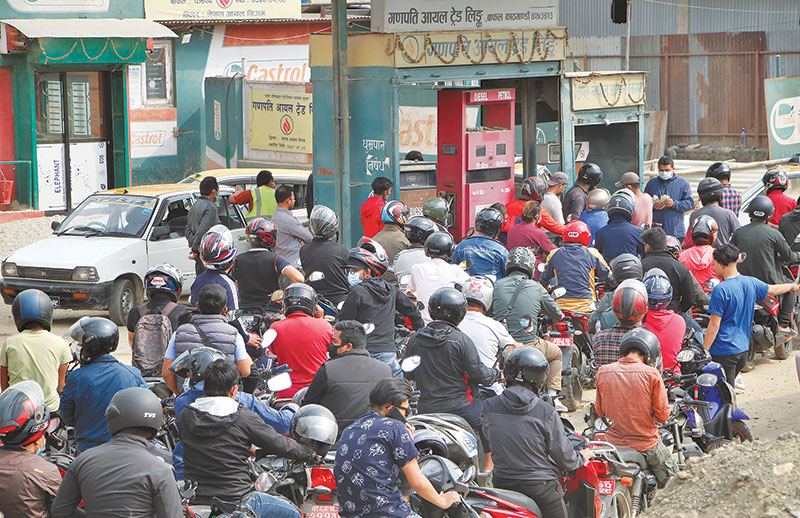
The government is reluctant to forego tax bonanza created by rising oil prices, observers say. Post file Photo
KATHMANDU : Nepalis are being hit by runaway inflation after having endured years of slow growth caused by the Covid-19 pandemic. With food and fuel prices through the roof, the Nepali economy could encounter another setback, and poverty can be expected to rise, economists say. In a move that has raised hope among the people of seeing some respite, the Industry, Commerce, Labour and Consumer Welfare Protection Committee of Parliament on Friday directed the government to slash the taxes on petroleum products by half. But experts say it’s easier said than done. Taxes on fuel imports are among the government’s most important revenue sources, and it is reluctant to forego the bonanza created by rising oil prices. In the first 11 months of the fiscal year ended mid-June, Nepal’s fuel import bill almost doubled from the previous year. Imports were valued at Rs340 billion, compared to Rs191.18 billion in the same period last year. The government earned Rs118.82 billion in various taxes levied on the fuel imports. The high taxes have drawn much criticism against the government. Sushil Bhattarai, deputy managing director of state-owned Nepal Oil Corporation, said they had discussed the issue with the House committee. “But slashing taxes is in the hands of the Finance Ministry.” On June 19, Nepal Oil Corporation increased the prices of petrol by a steep Rs21 per litre, and diesel and kerosene by Rs27 per litre, the highest increment ever made by the oil monopoly. Following the price hikes, petrol costs Rs199 per litre, diesel Rs192 per litre and kerosene Rs192 per litre. The oil monopoly also jacked up the price of aviation fuel sold to domestic airlines by Rs19 per litre to Rs185 per litre. International airlines have to shell out $1,645 per kilolitre, up $100 per kilolitre. According to Nepal Oil Corporation, the government collects Rs65.61 in taxes on every litre of petrol sold at Rs199. It collects Rs49.53 on every litre of diesel sold which now costs Rs192 per litre. The Finance Ministry said it was not aware of the parliamentary committee’s orders. “We have not received any official communication from the House committee. Once we receive the letter, we may move ahead to cut taxes,” said Dhundi Prasad Niraula, spokesperson for the Finance Ministry. “But before implementing the committee’s instructions, we need to analyse the matter properly,” Niraula said. The Russian invasion of Ukraine has pushed up inflation, and most countries have been experiencing rising prices since last year. Fuel, as measured by world oil prices, and international food prices rose throughout 2021 and the trend continued in 2022.
Many countries are making various efforts to rein in inflation. On May 21, India’s federal government decided to cut the excise duty on petrol and diesel in an attempt to control high levels of inflation. In Spain, where inflation hit a decades-high 8.7 percent in May, the government decided to cut the electricity tax by half to ease the inflation pain. On June 22, Prime Minister Pedro Sanchez announced a VAT reduction from 10 percent to 5 percent. European countries are cutting their already reduced VAT rates on domestic energy, petrol and foods. United States President Joe Biden is considering a gas tax holiday to provide relief to the American people, many of whom are having a hard time because of rising gas prices. In Nepal, transport fares went up immediately after Nepal Oil Corporation raised fuel prices. The Department of Transport Management allowed transport entrepreneurs to hike fares by 5.30 percent. For cargo carriers plying Tarai and hill routes, the fares have been hiked by 7.7 percent and 6.94 percent, respectively. On June 20, the Airlines Operators Association of Nepal increased the fuel surcharge added to airfares by Rs170 to Rs840, depending on the distance. “Rising inflation could impact economic growth as investors tend not to invest and consumers tend to cut their expenses and eat less, thus reducing the flow of money in the market,” economist Govinda Nepal told the Post in a recent interview. Economist Jagadish Chandra Pokharel said that the parliamentary committee order to cut taxes can be a relief to the people. “A tax cut for a short duration is the best way to rein in runaway inflation. But Nepal also needs to think of an alternative to fossil fuels,” Pokharel said. According to the World Bank, especially concerning are negative impacts on the poorest and most vulnerable households in urban areas, which spend a large proportion of their total income on food and other basic commodities. They are suffering the harshest effects of rising prices. To cushion the impacts of inflation on the poor, governments should ramp up support through well targeted social protection programmes, the World Bank said. According to Nepal Rastra Bank, the year-on-year consumer price inflation jumped to a staggering 7.87 percent in May, hitting a 69-month high. It was 3.65 percent in May last year.
NATIONAL
In Madhesh Province, monsoon means disaster
Several settlements in Rautahat and Saptari face yearly displacement and loss of lives and properties caused by floods and inundation.
- SHIVA PURI,ABADHESH KUMAR JHA
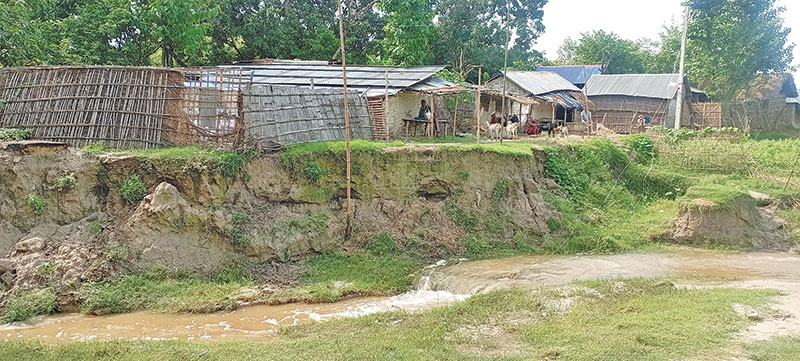
A Musahar settlement in Saptari is at high risk of floods as the Mahuli stream has started eroding the embankment.Post Photo: ABADHESH KUMAR JHA
Every year during the monsoon, floods and inundations wreak havoc in Madhesh Province which comprises eight Tarai districts. Thousands of people face displacement, loss of lives and property due to the lack of preparedness by the authorities to control such water-induced disasters. In Saptari, a Musahar settlement in Hanumannagar Kankalini Municipality-4 is at high risk of floods as the Mahuli stream has started eroding the embankment. The 10 impoverished Dalit families of the settlement, who are living on encroached land, are living in fear of displacement as the government authorities and people’s representatives have not taken any initiatives to protect the settlement from the floods. “The settlement is being eroded by the Mahuli stream in the west and a small water outlet from the east. One house was swept away recently while others are at high risk. We are encircled by floods but nobody is concerned about our plight,” said Manju Devi Sada, a resident of the Musahar settlement. On Monday night, the area received heavy rainfall and the water level in the Mahuli stream increased, trapping the villagers inside the settlement. “The erosion is increasing day by day. The settlement will turn into a sandy bank within a few days if the stream and rivulet are not controlled immediately. We have nowhere to go if the floods displace us,” said Manju Devi. She urged the concerned authorities and the local unit to protect their settlement from flooding and erosion. According to Mauli Mandal, the ward chairman of Hanumannagar Kankalini-4, the flood waters flowing from the northern side last year eroded the area near the Musahar settlement and emptied into the Mahuli stream. He admitted that the settlement is at high risk of floods this year too. “The flood already swept away a house while others are at risk. Efforts are underway to control the floods and protect the settlement by installing hume pipes,” said Birendra Majhi, the mayor of Hanumannagar Kankalini. In mid-July last year, Chandiya village in Rajdevi Municipality-3 of Rautahat was inundated following continuous rainfall. Every single house in the village was submerged. The villagers left their houses and ran. Some people were injured when their houses collapsed. Jayram Shah recalls his house collapsing while his whole family was inside. “We nearly died. All of us suffered injuries,” said Shah. Every monsoon, Chandiya residents struggle to keep afloat and save themselves and their properties from floods in the Bagmati River. The floodwaters from the river enter the village every year resulting in floods and inundation. “Nobody can understand our situation except us. We suffer every year. The government does nothing to address our problem,” said Shah. There are about 200 households in Chandiya village and all of them have been displaced by monsoon disasters. A 44 km-long dam has been constructed with the help of the Government of India to prevent loss of property due to floods in the Bagmati River. All the displaced folks from Chandiya have to take shelter in the dam area every year. The villages bordering Chandiya, including the district headquarters Gaur, are living the same fate. The floodwaters from the Lalbakaiya and Bagmati rivers inundate the settlement during the monsoon and inundate 80 percent of the land every year. Three days ago, the district administration instructed the local units in the district to start preparing for water-induced disasters this monsoon. “We spend our days and nights worrying about how to save our lives and the lives of our family during the rainy season. We have been suffering for the past 29 years and it seems like the government does not want to listen to us,” said Pramod Das of Durga Bhagawati Rural Municipality-5. There are about 300 houses built in and around the dam area in the Bagmati River and all of them are at high risk of being submerged this rainy season. According to Chief District Officer Krishna Bahadur Shahi, the main problem of Rautahat has always been floods and inundation. The office has instructed all its local units to be prepared for water-induced disasters. According to the data of the District Police Office in Rautahat, 90 people have been killed in floods and inundation in different parts of the district in the last three years. Six people, including two women, have gone missing, about 70,000 households have been affected, 20,000 families displaced and over 400 cattle killed in the floods.
NATIONAL
Lalitpur launches animal ambulance service
The City has handed over the veterinary ambulance to a non-profit animal shelter. The non-profit plans to use the ambulance to rescue street dogs and stray animals in need of urgent care.
- ANUP OJHA
The Lalitpur Metropolitan City has launched an animal veterinary ambulance service with the aim to provide immediate medical attention to street dogs and stray animals in the City. Lalitpur Mayor Chiri Babu Maharjan on Wednesday handed over the ambulance to Sneha’s Care, a non-profit organisation that has been working for the welfare of street dogs and stray animals since 2014, for operation. “We are concerned about the increasing number of stray dogs and animals abandoned on the road. We want to solve this problem,” said Maharjan, who is serving as the City’s mayor for the second time after winning the local polls held on May 13. Underscoring the City’s efforts to make Lalitpur an inclusive city, Maharjan also spoke about the disabled-friendly cab service in the City started in 2020 along with free vehicle service for elderly people to reach their respective ward offices. “The City has been providing free transport service to the disabled and the elderly. Now we have decided to focus on the welfare of the street animals,” said Maharjan, speaking at the inauguration of the veterinary ambulance on Wednesday. “There are many stray dogs and animals on the streets in need of care. Some are in need of medical treatment while others need to be rescued and rehabilitated.” Stray animals are a common sight on almost every street in Kathmandu Valley. According to Sneha’s Care, more than 10,000 street animals die every year in Nepal from illnesses, diseases and accidents. The metropolis’ latest move to help animal rescue and rehabilitation has been applauded by veterinary doctors, animal rights activists and urban planners. Sital Kaji Shrestha, president of the Nepal Veterinary Association, praised the City’s initiative. “Although the Central Veterinary Laboratory has its veterinary ambulance, it has never been used to rescue street animals,” said Shrestha. “The City’s partnership with Sneha’s Care is a commendable step. This model should be adopted by other local units as well.” Shrestha questions the effectiveness of the work of the Ministry of Agriculture and Livestock Department which he says has so far been indifferent to the plight of stray animals and has no data on urban stray animals and community animals. However, it is not only the ministry that has not kept any record of the number of strays and community animals. None of the local authorities in Kathmandu has the exact data. If a decade-old data is to go by, Kathmandu Metropolitan City has over 26,000 stray dogs. Lalitpur Metropolitan City estimates the number of community and stray dogs in the City to be 10,000. “Latitpur’s mayor is a dog lover. During the pandemic he had coordinated with us to feed the hungry stray dogs in the City,” said Sneha Shrestha, animal rights activist and founder of Sneha’s Care. Sneha’s Care has so far rescued 170 street dogs and sheltered them at Bhainsepati, Lalitpur, according to Sneha’s Care. “Of the total canines rescued, 18 were hit by vehicles and are paralysed dogs. Besides dogs we also have 19 calves that were abandoned on the streets,” she said. The new vet ambulance will provide major assistance in their rescue efforts, says the non-profit group which plans to make optimum use of the ambulance to reach out to street dogs and stray animals in need across the Valley. “We had an old rescue vehicle that needed repair every time, but now the City has trusted us and handed us an ambulance. This will help us a lot,” she said. The veterinary ambulance is equipped to rescue cows and dogs at the same time as it has two different sections to hold the animals. According to the organisation, the new veterinary ambulance will also be used to carry out anti-rabies vaccination and sterilisation drives. “We get over 50 calls from across the Valley for help on a daily basis,” she said. “I also request other local bodies to make plans to rescue and rehabilitate stray animals so that they can be free from a life of pain and torture.” According to Mayor Maharjan, the City has allocated Rs 3,000,000 for the veterinary ambulance, which can accommodate up to 20 dogs at a time.
NATIONAL
After rift with Yadav, Bhattarai renews bid to set up ‘socialist centre’
The former Maoist makes his pitch to Maoist Centre chief Dahal, but the latter is unconvinced.
- TIKA R PRADHAN
KATHMANDU : On Sunday morning earlier this week, CPN (Maoist Centre) chair Pushpa Kamal Dahal said at a function that an environment is being developed for the former Maoists to come together. Later in the same day, Dahal, reached the residence of Vice President Nanda Bahadur Pun, where he held a meeting with Baburam Bhattarai, a former Maoist leader and currently the federal council chair of the Janata Samajbadi Party, according to at least two leaders familiar with the development, Vice President Pun is also a former Maoist leader. Dahal and Bhattarai led the “people’s war” from 1996 to 2006. Both maintained a close relationship, with Dahal as the leader of the masses and Bhattarai as an ideologue. Nonetheless, they had a fair share of bitterness—on one occasion in 2004, Dahal even initiated punitive action against Bhattarai. After the end of the war, the Maoists joined mainstream politics. Immediately after the promulgation of the constitution, the two leaders drifted apart. Bhattarai launched his own party—Naya Shakti. But it failed. He merged his party with Upendra Yadav’s Sanghiya Samajbadi Forum Nepal to form the Samajbadi Party Nepal. Dahal over the years has seen many of the leaders from war days deserting the Maoist party. Whether Bhattarai and Dahal will come together again may be a matter of speculation, that both face some sort of a crisis is a fact. Dahal may have got some boost after some significant wins in the recently concluded local elections, but he is increasingly burdened by the “Maoist” tag in his party. Bhattarai, on the other hand, could not secure any win in his own constituency, Gorkha, for his party in the local elections, and appears desperate to recoup his political career. Leaders close to Dahal and Bhattarai said that the duo dwelt on the possibility of forming a “socialist centre,” a concept the latter has been floating for quite a while. Unlike Dahal’s idea of bringing all the Maoist leaders together, Bhattarai has been calling for a Socialist Centre of “like-minded” people. According to leaders close to Bhattarai, he had taken serious steps around a year ago towards the formation of such a socialist centre and after the invalidation of the Nepal Communist Party, he had said the need for a socialist centre had become even more significant. “My request to comrades of various communist parties in Nepal: why has the objective of ending all kinds of repression and discrimination against people by people taken a regressive path?” Bhattarai wrote on Twitter in August last year. “How will we reach a new destination by pursuing the same old path? Shall we march towards a new direction with new ideas.” Bhattarai had held several rounds of discussions for the formation of the socialist centre with Dahal, Madhav Nepal and Upendra Yadav before the local polls so as to give a message to the country. But since all the three leaders were part of the coalition and planning to fight local polls under an alliance, the idea failed to gain momentum. “Bhattarai is still committed to forming a socialist centre but other leaders do not seem to be ready for it,” said Bishwadeep Pande, a central committee member of the Janata Samajbadi Party, who has been a close aide to Bhattarai for many years. “I don’t think the idea of socialist centre will gain traction until the upcoming elections.” According to Pandey, new dynamics could emerge after the polls depending upon the parties’ performance. Bhattarai is currently seeking to part ways with Yadav, which will mean a vertical split in the Janata Samjabadi. Whether Bhattarai wants to lead the Janata Samajbadi by claiming a majority or wants to make a renewed pitch for a socialist centre is not quite clear though. Dahal may be not quite hesitant to shed the Maoist tag from the party, but whether his party members would agree is also a question if a socialist centre idea gets traction. Maoist members still believe the “communist” tag is still attractive when it comes to the vote base. Bhattarai, however, does not seem to have any faith in the so-called “communist movement” as he believes the world has moved ahead. Had Dahal not been able to assert himself in the party from the eighth general convention and if the Maoist party had failed in local elections, there could have been some activities towards bringing the former Maoist leaders together, insiders say. “Bhattarai’s experiment with a party that lacked a communist tag failed but Dahal somehow managed to revive his significance,” said Yubaraj Chaulagain, a central member of the Maoist Centre. “Therefore, it’s Bhattarai, who should compromise and even if the two parties decide to merge shedding the Maoist tag, Bhattarai will have to accept the communist tag.” According to Chaulagain, the degree of acceptance of Bhattarai as their leader among Maoist members is very low. “Chances of Dahal and most of the party leaders accepting Bhattarai’s proposal to shun the communist tag are slim,” he said. “Now Bhattarai has already lost his significance in Nepali politics and his popularity is fading fast.” Ever since he left the Maoist party, Bhattarai has been talking about five principles—sovereignty, inclusiveness, good governance, prosperity and remodelled socialism. He had made these the core values of his Naya Shakti Party. Bhattarai believes all the existing communist forces should come under the one umbrella of “socialist centre.” According to Bhattarai, he decided to quit the Maoist party after Dahal rejected the former’s proposal to transform the party into a socialist party. “Since then, I have been pressing him for the same at every meeting and the same discussions continued during our latest meeting on Sunday,” Bhattarai told the Post. “I have been asking him to shed the Maoist and the communist tags, but he wants me to accept the communist tag.” Bhattarai came up with the idea of setting up a socialist centre to develop a two-party system in the country—one led by Nepali Congress, a liberal democratic capitalist force, and the other a strong democratic socialist force of the existing communist parties. “Instability in Nepali politics will persist unless the so-called communists turn into socialist forces and bring clarity and consistency as well as a focussed programme,” said Bhattarai. “But both the Maoists and the UML are not ready to embrace the idea because their brands are still popular. But the two communist forces won’t last for long.” He said the existing setup will continue until the next polls leading the country to political instability for another five years, and only then will the people and the parties understand his concept. “I think the parties and the people will understand my concept only after another five years of political instability,” said Bhattarai.
NATIONAL
Kantipur-HISSAN Education fair kicks off
The four-day event provides information on colleges and courses students awaiting grades 10 and 12 results can opt for.
- POST REPORT
Students enquire about options for higher education at the fair, Friday.Post Photo: Angad Dhakal
KATHMANDU : The seventh edition of Kantipur-Higher Institutions and Secondary Schools’ Association Nepal (HISSAN) Education Fair kicked off at Bhrikutimandap Exhibition Hall, in Kathmandu, on Friday. The four-day fair was inaugurated by Minister of State Umesh Shrestha. The fair is organised targeting students who are awaiting results of grades 10 and 12 and provides information on colleges and courses they can opt for. Speaking at the inauguration, Shrestha stressed how Nepal has the potential to become a hub for higher studies and requested investors to put their money in education and become more service-oriented. A large number of students leaving the country to pursue higher studies is concerning, says Shrestha. “New universities should be set up with the vision to provide the best possible education in the country itself. These education centres need not be Kathmandu-centric and should branch out to other equally deserving cities to make world-class education available in Nepal,” said Shrestha. He further stressed the need for setting up vocational training centres so that the students can have the opportunity to receive skill-based education for immediate job prospects in the market. According to the Education Under-Secretary of No Objection Certificate (NOC), Hari Prasad Niraula, 102,873 individuals received NOC in the first 11 months of the current fiscal year ended mid-June for different countries. “If we could make a conducive environment here for students to receive better education, it will save a lot of effort and money for students,” said Shrestha, who is also a former president of HISSAN. The first edition of the education fair was held six years ago and had been on hold since 2019 due to the global pandemic and subsequent lockdowns. “We are happy that after a gap of two years, we are able to give continuity to this annual fair,” said Mahesh Swar, assistant general manager of the Kantipur Media Group. “Our children are migrating for higher education in larger numbers than ever before. So the motive of this fair is to let them choose the best colleges within the country so that they can receive quality education in Nepal itself,” he said. HISSAN President Ramesh Kumar Silwal said such events are important for students and parents who do not know their future course of action in terms of education. Seventy-five educational institutions affiliated with various universities including Tribhuvan University, Pokhara University, Purbanchal University, Mid-West University, and the Council for Technical Education and Vocational Training (CTEVT) are participating in the annual fair this year. The organisers estimate around 200,000 people including students, parents and stakeholders will visit the fair. Meanwhile, Mahashram Sharma, chairman of the National Examination Board, says it is important to dwell on the crux of the student migration issue. “We must ask ourselves as to why more and more students are leaving the country for higher education. We must start thinking where we have lagged in terms of providing good education to our children,” he said. He also stressed the importance of implementing a public-private partnership modality in the education sector and making the education system inclusive for students from remote areas of the country like Humla, Jumla, and the Terai region. “We can’t give better education to students without qualified teachers so we must train our teachers. The examination board is working towards providing training to teachers in particular areas of teaching,” said Sharma. The title sponsor of the event is ‘My Second Teacher,’ an online education platform which provides digital learning experience. The main sponsor is the Golden Gate International College. The fair starts from 10am to 5pm for the next four days. Entry is free for all.
WORLD
Ukraine forced to cede key city of Severodonetsk
The announcement came shortly after the European Union granted Ukraine candidate status in a show of support for the former Soviet republic.
- AGENCE FRANCE-PRESSE
A Ukrainian tank is in position during heavy fighting on the front line in Severodonetsk, the Luhansk region, Ukraine, on June 8.ap/rss
KYIV : Ukrainian forces prepared on Friday to retreat from the strategic city of Severodonetsk after weeks of fierce fighting, a setback that could pave the way for Russia to seize a larger swath of eastern Ukraine. The announcement came shortly after the European Union granted Ukraine candidate status in a show of support for the former Soviet republic, though there is still a long path ahead to membership. Russia has focused its offensive on the Donbas region of eastern Ukraine after being repelled from the capital Kyiv and other areas in the first weeks of the February invasion. Since then its forces have gradually made progress despite encountering fierce resistance and sustaining heavy losses. The industrial hub of Severodonetsk has been the scene of weeks of street battles as outgunned Ukrainians put up a stubborn defence. But Sergiy Gaiday, governor of the Lugansk region that includes Severodonetsk, said that Ukrainian military forces in the city had received the order to withdraw. “Remaining in positions that have been relentlessly shelled for months just doesn’t make sense,” he said on Telegram, adding that 90 percent of the city had been damaged. The head of Severodonetsk’s military administration, Roman Vlasenko, told Radio Svoboda that the Ukrainian army was still in the city and that it would “take them some time to retire”. Capturing Severodonetsk and its twin city of Lysychansk would effectively give the Russians control of Lugansk, and allow them to push further into the wider Donbas. But Ukraine’s retreat from Severodonetsk will not change the course of the war, said Ivan Klyszcz, an international relations researcher at Estonia’s University of Tartu. “The big picture—of a slow war of entrenched positions—has hardly changed. We cannot expect a massive Russian breakthrough,” he told AFP. Gaiday said Russians were now advancing on Lysychansk, which has been facing increasingly heavy bombardments. The situation for those that remain in the city is bleak. Liliya Nesterenko, who was cycling toward a friend’s house to feed her pets, said her house had no gas, water or electricity, forcing her and her mother to cook on a campfire. But the 39-year-old was upbeat about the city’s defences: “I believe in our Ukrainian army, they should [be able to] cope.” Andrei Marochko, a spokesman for the Moscow-backed army of Lugansk, said Friday on Telegram that all the villages in the neighbouring areas of Zolote and Hirske were now under the control of Russian or pro-Russian forces. In a video on Marochko’s Telegram channel, a man in military clothing could be seen replacing a Ukrainian flag featuring a Zolote coat of arms with a red hammer-and-sickle flag. Russia’s defence ministry said on Friday that up to 2,000 people were “completely blocked” near Zolote and Hirske, and that around half of Zolote was under Russian control. Russia has also intensified its offensive in the northern city of Kharkiv in the past days. An AFP team at the scene heard strong explosions in the city centre Thursday night, and in the morning saw that the Kharkiv Polytechnic Institute had been hit by missiles, breaking windows and causing its roof to partially collapse. According to an unidentified military official at the scene, the Russians “thought there might be something military in there but there was not”. In the southern Kherson region, a Moscow-appointed official was killed by an explosive device planted in his car, Russian news agencies reported. Moscow’s deputy head of Kherson, Kirill Stremousov, said the regional head of the department of family, youth and sports had died “as a result of a terrorist act”. It was the first confirmed death of a pro-Russian official during a string of attacks on pro-Kremlin officials in Ukrainian regions under Russian control. With Ukraine pleading for accelerated weapon deliveries, the United States announced it was sending another $450 million of fresh armaments, including HIMARS rocket systems, which can launch multiple missiles at extended range. Ukraine’s President Volodymyr Zelensky put in a video appearance at Britain’s famed Glastonbury music festival on Friday, urging revellers to “spread the truth about Russia’s war” and help Ukrainian refugees.
WORLD
UN chief warns of ‘catastrophe’ from global food shortage
- ASSOCIATED PRESS
BERLIN : The head of the United Nations warned on Friday that the world faces “catastrophe” because of the growing shortage of food around the globe. UN Secretary-General Antonio Guterres said the war in Ukraine has added to the disruptions caused by climate change, the coronavirus pandemic and inequality to produce an “unprecedented global hunger crisis” already affecting hundreds of millions of people. “There is a real risk that multiple famines will be declared in 2022,” he said in a video message to officials from dozens of rich and developing countries gathered in Berlin. “And 2023 could be even worse.” Guterres noted that harvests across Asia, Africa and the Americas will take a hit as farmers around the world struggle to cope with rising fertiliser and energy prices. “This year’s food access issues could become next year’s global food shortage,” he said. “No country will be immune to the social and economic repercussions of such a catastrophe.” Guterres said UN negotiators were working on a deal that would enable Ukraine to export food, including via the Black Sea, and let Russia bring food and fertiliser to world markets without restrictions. He also called for debt relief for poor countries to help keep their economies afloat and for the private sector to help stabilise global food markets. The Berlin meeting’s host, German Foreign Minister Annalena Baerbock, said Moscow’s claim that Western sanctions imposed over Russia’s invasion of Ukraine were to blame for food shortages was “completely untenable”.
WORLD
Aftershock in Afghanistan as quake toll rises to 1,150 dead
Thousands of stone and mud-brick homes crumbled in the quake, which struck at night.
- ASSOCIATED PRESS
GAYAN : An aftershock took more lives on Friday and threatened to pile even more misery on an area of eastern Afghanistan reeling from a powerful earthquake that state media said killed 1,150 people this week. Among the dead from Wednesday’s magnitude 6 quake are 121 children, but that figure is expected to climb, said Mohamed Ayoya, UNICEF’s representative in Afghanistan. He said close to 70 children were injured. That earthquake struck a remote, mountainous region already grappling with staggering poverty at a time when the country as a whole is spiralling deeper into economic crisis after many countries pulled back critical financing and development aid in the wake of the Taliban’s takeover. On Friday, Pakistan’s Meteorological Department reported a new, 4.2 magnitude quake that state-run Bakhtar News Agency reported took five more lives in hard-hit Gayan District and injured 11 people. International aid had been keeping the country afloat, and its withdrawal left millions unable to afford food and further strained already struggling medical facilities. Nearly half the population of 38 million cannot meet their basic food needs, while some civil servants, like doctors, nurses and teachers, weren’t paid for months because the Taliban government is unable to access frozen foreign reserves. Salary delays continue throughout the public sector. Afghanistan’s international isolation is also complicating relief efforts since fewer aid organisations have a presence in the country, and international sanctions on Afghan banks make it difficult to send cash into the country. Despite waivers from the US Treasury Department that allow money to be sent to aid groups, banks are hesitant to handle transactions for fear of running afoul of rules. Aid groups lament that means they have to pay local staff with bags of cash, physically carried into the the country by their staff and then distributed throughout the provinces in person. The process is expensive, incurring fees along the way for transport and security. Aid organisations like the local Red Crescent and UN agencies like the World Food Program have sent food, tents, sleeping mats and other essentials to families in Paktika province, the epicentre of the earthquake, and neighbouring Khost province. Several countries have sent cargo planes of aid. Still, residents appeared to be largely on their own to deal with the aftermath as their new Taliban-led government and the international aid community struggle to bring in help. The shoddy mountain roads leading to the affected areas were made worse by damage and rain. Thousands of stone and mud-brick homes crumbled in the quake, which struck at night, often trapping whole families in the rubble. Many of those who survived spent the first night outside in a cold rain. Since then, villagers have been burying their dead and digging through the rubble by hand in search of survivors. The Taliban director of the Bakhtar News Agency said on Friday the death toll from the first quake had risen to 1,150 people. Abdul Wahid Rayan said at least 1,600 people were injured. The United Nations Office for the Coordination of Humanitarian Affairs has put the death toll at 770 people.
WORLD
Prince Charles says Commonwealth nations free to chart own course
- AGENCE FRANCE-PRESSE
Britain’s Prince Charles speaks during the opening ceremony of the Commonwealth Heads of Government Meeting, at the Commonwealth Summit in Kigali, Rwanda on Friday.ap/rss
KIGALI : Prince Charles told Commonwealth leaders on Friday that the choice to become a republic or abandon the queen as head of state was theirs alone, and expressed “personal sorrow” at Britain’s legacy of slavery. The British heir to the throne addressed the opening of a Commonwealth Heads of Government Meeting (CHOGM) in Rwanda as the host nation faced scrutiny over its rights record and a much-criticised migrant deal with the UK. Charles is representing Queen Elizabeth II as the 54-nation club of mostly former British colonies grapples with questions over its future relevance and modern profile. Republican movements are taking root in a number of Commonwealth nations and some are seeking reparations for colonial-era injustices like slavery. Charles acknowledged the change underfoot and said the Commonwealth—which represents one-third of humanity—would always be “a free association of independent, self-governing nations”. “The Commonwealth contains within it countries that have had constitutional relationships with my family, some that continue to do so, and increasingly those that have had none,” he told an audience of presidents and prime ministers. “I want to say clearly, as I have said before, that each member’s constitutional arrangement, as republic or monarchy, is purely a matter for each member country to decide.” He also acknowledged that the roots of the Commonwealth—which includes as members nations from Europe to Africa, Asia and the Americas—”run deep into the most painful period of our history”. “I cannot describe the depths of my personal sorrow at the suffering of so many, as I continue to deepen my own understanding of slavery’s enduring impact,” he said.
WORLD
Next Covid booster shots will likely be updated for Omicron
Briefing
Reuters: Covid-19 vaccines this fall are likely to be based on the Omicron variant of the coronavirus rather than the original strain, although some experts suggest they may only offer significant benefits for older and immunocompromised people. Moderna, Pfizer and Novavax have been testing vaccines based on the first BA.1 Omicron variant that became dominant last winter, driving a surge in infections. On Wednesday, Moderna said its updated vaccine worked well against more recent Omicron subvariants, and it was moving forward with plans to ask regulators for approval. Vaccines that can bridge the gap between the original version of coronavirus and Omicron would likely be “far, far better” for the fall, according to Trevor Bedford, a biologist at the University of Washington who has closely tracked mutations of SARS-coV-2. (Agencies)
WORLD
BRICS call for Ukraine-Russia talks in declaration
BEIJING: An influential group of emerging economies said they backed talks between Moscow and Kyiv, at the end of a two-day summit held against the backdrop of Russia’s war on Ukraine.Beijing has been hosting a virtual forum of the BRICS nations—Brazil, Russia, India, China and South Africa—which account for over 40 percent of the global population and nearly a quarter of the world’s gross domestic product. Three members—China, India and South Africa—have abstained from voting on a UN resolution condemning Russia’s invasion, and President Vladimir Putin has urged them to snub countries appalled by the attack on a European neighbour. The five countries said in a declaration issued on Thursday that they “support talks between Russia and Ukraine” but did not lay out a pathway towards ending the war. The countries said they had “discussed our concerns over the humanitarian situation in and around Ukraine” and expressed support for agencies “to provide humanitarian assistance”. (Agencies)
MONEY
Germany raises gas alert level after Russia cuts supply
The country’s stores stand just under 60 percent full, above average level of previous years.
- AGENCE FRANCE-PRESSE
Germany, like a number of other European countries, is highly reliant on Russian energy.AFP
FRANKFURT : Germany moved closer to rationing natural gas on Thursday as it raised the alert level under an emergency plan after Russia slashed supplies to the country. “Gas is now a scarce commodity in Germany,” Economy Minister Robert Habeck told reporters at a press conference. Russia was using gas “as a weapon” against Germany in retaliation for the West’s support for Ukraine following Moscow’s invasion, Habeck said, with the aim of “destroying” European unity. But the Kremlin dismissed Germany’s suggestion there were political motives behind the limits to supply as “strange”. Germany, like a number of other European countries, is highly reliant on Russian energy imports to meet its needs. Triggering the “alarm” level—the second of three steps under the emergency plan—brings Germany a step closer to the final stage that could see gas rationing in Europe’s top economy. The increased level reflected a “significant deterioration of the gas supply situation”, Habeck said. “If we do nothing now, things will get worse,” Habeck said. Russian energy giant Gazprom cut supplies to Germany via the Nord Stream pipeline by 60 percent last week, blaming the new limits on delayed repairs. Germany has dismissed the technical justification provided by Gazprom, instead calling the move a “political decision”. Kremlin spokesman Dmitry Peskov said Thursday there was “no double meaning” in the supply decision. “Our German partners are well aware of the technological servicing cycles of a pipeline,” he said. “It’s strange to call it politics.” In recent weeks, Gazprom has stopped deliveries to a number of European countries, including Poland, Bulgaria, Finland and the Netherlands. Supplies of gas to Europe’s largest economy were “secure”, Habeck said, but action was still required to prepare for the winter ahead. To mitigate the risks from a supply cut, the government mandated gas storage facilities be filled to 90 percent by the beginning of December. Currently, the country’s stores stand just under 60 percent full, above the average level of previous years. In France, the government said Thursday it aimed to fill its natural gas reserves by autumn as it too braces for a drop in supply from Russia. France will also build a new floating terminal to receive more liquefied natural gas (LNG) supplies by ship, Prime Minister Elisabeth Borne announced. The terminal is to be positioned off Le Havre on France’s northern coast. “We can do without Russian gas,” French Energy Transition Minister Agnes Pannier-Runacher said later on BFM Business TV. “This assumes that the LNG tankers arrive on time and that we can comfortably fill our strategic storage,” she added. The European Bank for Reconstruction and Development (EBRD) meanwhile said it would lend 300 million euros to Moldova to for gas purchases. The German government expects supply to stop between July 11 and July 25 for annual maintenance on the Nord Stream pipeline. If deliveries do not resume after the service period, Germany could face a shortage of gas as soon as “mid-December”.
MONEY
Apple, Android phones targeted by Italian spyware, Google says
- AGENCE FRANCE-PRESSE
SAN FRANCISCO : An Italy-based firm’s hacking tools were used to spy on Apple and Android smartphones in Italy and Kazakhstan, Google said Thursday, casting a light on a “flourishing” spyware industry. Google’s threat analysis team said spyware made by RCS Lab targeted the phones using a combination of tactics including unusual “drive-by downloads” that happen without victims being aware. Concerns over spyware were fuelled by media outlets reporting last year that Israeli firm NSO’s Pegasus tools were used by governments to surveil opponents, activists and journalists. “They claim to only sell to customers with legitimate use for surveillanceware, such as intelligence and law enforcement agencies,” mobile cybersecurity specialist Lookout said of companies like NSO and RCS. “In reality, such tools have often been abused under the guise of national security to spy on business executives, human rights activists, journalists, academics and government officials,” Lookout added. Google’s report said the RCS spyware it uncovered, and which was dubbed “Hermit”, is the same one that Lookout reported on previously. Lookout researchers said that in April they found Hermit being used by the government of Kazakhstan inside its borders to spy on smartphones, just months after anti-government protests in that country were suppressed. “Like many spyware vendors, not much is known about RCS Lab and its clientele,” Lookout said. “But based on the information we do have, it has a considerable international presence.” Evidence suggests Hermit was used in a predominantly Kurdish region of Syria, the mobile security company said. Analysis of Hermit showed that it can be employed to gain control of smartphones, recording audio, redirecting calls, and collecting data such as contacts, messages, photos and location, Lookout researchers said. Google and Lookout noted the spyware spreads by getting people to click on links in messages sent to targets. “In some cases, we believe the actors worked with the target’s ISP (internet service provider) to disable the target’s mobile data connectivity,” Google said. “Once disabled, the attacker would send a malicious link via SMS asking the target to install an application to recover their data connectivity.” When not masquerading as a mobile internet service provider, the cyber spies would send links pretending to be from phone makers or messaging applications to trick people into clicking, researchers said. “Hermit tricks users by serving up the legitimate webpages of the brands it impersonates as it kickstarts malicious activities in the background,” Lookout researchers said. Google said it has warned Android users targeted by the spyware and ramped up software defenses. Apple told AFP it has taken steps to protect iPhone users. Google’s threat team is tracking more than 30 companies that sell surveillance capabilities to governments, according to the Alphabet-owned tech titan. “The commercial spyware industry is thriving and growing at a significant rate,” Google said.
MONEY
Mystery deepens over fate of Hong Kong’s Floating Restaurant
- AGENCE FRANCE-PRESSE
The company said marine engineers had been hired to inspect the floating restaurant.AFP
HONG KONG : Mystery over the fate of Hong Kong’s Jumbo Floating Restaurant deepened Friday after its owner stirred confusion over whether the financially struggling tourist attraction had actually sunk while being towed away from the city last week. On Monday Aberdeen Restaurant Enterprises released a statement saying the vessel had capsized on Sunday near the Paracel Islands in the South China Sea after it “encountered adverse conditions” and began to take on water. “The water depth at the scene is over 1,000 metres, making it extremely difficult to carry out salvage works,” it added. On Thursday night, Hong Kong’s Marine Department put out a statement saying it had only learnt of the incident from media reports, and had immediately requested a report from the company. The department said the report was delivered on Thursday, saying the restaurant had capsized but that “at present, both Jumbo and the tugboat are still in the waters off Xisha islands,” using the Chinese name for the Paracels. Hours later an AFP journalist was contacted by a spokesman representing the restaurant who said the company had always used the word “capsized” not “sank”. Asked directly if the boat had sunk, he said again the statement had said “capsized”, and did not explain why it had referred to the depth of the water when mentioning salvage. The South China Morning Post reported a similar conversation with a spokeswoman for the company, in which they insisted the boat had “capsized”, not “sank”, but refused to clarify whether it was still afloat. The newspaper said it had been told by the Marine Department that the company might have breached local regulations if it had not notified the authorities of a sinking incident within 24 hours. Widespread reporting in both local and international media at the beginning of the week that Jumbo had sunk was not contradicted by the company. AFP has requested a formal statement from Aberdeen Restaurant Enterprises on the status of Jumbo, as well as a detailed explanation of what happened. The company previously said marine engineers had been hired to inspect the floating restaurant and install hoardings on the vessel before the trip, and that “all relevant approvals” had been obtained. The tourist attraction closed in March 2020, citing the Covid-19 pandemic as the final straw after almost a decade of financial woes. Operator Melco International Development said last month the business had not been profitable since 2013 and cumulative losses had exceeded HK$100 million ($12.7 million). It was still costing millions in maintenance fees every year and around a dozen businesses and organisations had declined an invitation to take it over at no charge, Melco added. It announced last month that ahead of its licence expiration in June, Jumbo would leave Hong Kong and await a new operator at an undisclosed location. The restaurant set off shortly before noon last Tuesday from the southern Hong Kong Island typhoon shelter where it had sat for nearly half a century. Opened in 1976 by the late casino tycoon Stanley Ho, in its glory days it embodied the height of luxury, reportedly costing more than HK$30 million to build. Designed like a Chinese imperial palace and once considered a must-see landmark, the restaurant drew visitors from Queen Elizabeth II to Tom Cruise. It also featured in several films—including Steven Soderbergh’s “Contagion”, about a deadly global pandemic.
MONEY
France seeks full gas reserves as Russia cuts supplies
Briefing
PARIS: The French government said Thursday it aims to have its natural gas reserves at full capacity by autumn as European countries brace for supply cuts from major supplier Russia with the Ukraine war draging on. “We are ensuring the complete filling of our storage capacities, aiming to be close to 100 percent by early autumn,” Prime Minister Elisabeth Borne said. She added that France will also build a new floating terminal to receive more gas supplies by ship. “We can do without Russian gas,” French Energy Transition Minister Agnès Pannier-Runacher said later on BFM Business TV. (AFP)
MONEY
European stocks, oil prices rebound
LONDON: European stock markets and oil prices recovered Friday following heavy losses this week on fears that interest rate hikes aimed at cooling decades-high inflation will spark a global recession. London stocks rallied 1.3 percent around midday with investors brushing aside news of bruising defeats for Britain’s ruling Conservatives in by-elections on Thursday. The pound firmed against the dollar and euro, despite data showing a drop in UK retail sales volumes as inflation soars. Paris stocks jumped 1.8 percent in eurozone trade, while Frankfurt rose 0.8 percent with gains tempered by news of the worsening German business climate. “Stock markets are taking a breather after being beat up... as recession fears took their toll,” OANDA analyst Craig Erlam said. (AFP)
MONEY
German business mood sours amid gas crisis
FRANKFURT: The German business climate worsened in June, a key survey published Friday showed, as Europe’s largest economy faced up to a possible Russian gas stop. The closely watched index fell to 92.3 from 93 in May, after rising for the last two months, according to the Ifo think tank. Managers were “markedly more pessimistic” about the outlook for Germany, said Ifo president, Clemens Fuest. Their surveyed expectations of future economic conditions fell to 85.8 in June from 86.9 in May. “Rising energy prices and the threat of gas shortages are of great concern to German business,” Fuest said. On Thursday, Germany raised the alert level under its emergency gas plan after Russian energy giant Gazprom slowed deliveries. (AFP)
HOROSCOPE
HOROSCOPE
ARIES (March 21-April 19) **** Today’s vibes are perfect for hyping yourself up when it comes to financial and professional matters. A romantic and flirtatious energy will fill the air, so be sure to cuddle that special someone extra hard.
TAURUS (April 20-May 20) *** A mystical energy will surround you this afternoon which will lend your strength and support as your ancestors cheer you on from beyond the veil. Use this energy as an excuse to connect with your higher power.
GEMINI (May 21-June 21) **** Don’t feel guilty about flying under the radar today as this luminary placement will bring out the quiet artist that lives within you, making it a great time to reflect on your feelings while channelling them through a creative outlet.
CANCER (June 22-July 22) *** Today’s vibes are perfect for baring your soul to that special someone, but try not to be overly trusting with anyone you just met. You may begin to feel more guarded and quieter as evening rolls in.
LEO (July 23-August 22) *** Give yourself a big pat on the back today. This cosmic climate will ask you to reward yourself after surviving another workweek, as the universe gives you permission to reap the rewards of your hard work.
VIRGO (August 23-September 22) **** The universe will reward you for being bold and unique today. These vibes are great for trying a new style, experimenting with an artistic outlet, and strengthening the bonds you share with your best friends.
LIBRA (September 23-October 22) *** Major release will come your way today. These vibes will be extremely therapeutic on an emotional level, though you may need to let out some pent-up feelings in the afternoon.
SCORPIO (October 23-November 21) *** You’ll become acutely aware of how current or past romances have changed you this afternoon. Though this energy could dust up both happy and unhappy memories, it’ll be important that you acknowledge how you’ve grown.
SAGITTARIUS (November 22-December 21) *** Try not to be overly critical of yourself or the people around you today. This comic climate could bring out the inner-perfectionist within you, though putting unrealistic expectations on yourself or others could be a huge misstep.
CAPRICORN (December 22-January 19) **** Don’t hesitate to step into your personal power today. These vibes can help you evolve into the most elevated version of yourself, though you’ll need to be willing to transform into the person you visualise yourself becoming.
AQUARIUS (January 20-February 18) *** A sweet connection between Luna and Pluto can help you shake off any emotional baggage that you’ve been carrying around for too long, though you may need to indulge in some self-care and solitude.
PISCES (February 19-March 20) *** Take some time to brush up on your world news today. Though the social justice warrior that lives within will certainly have its moment, your focus will shift toward relaxation and domestic bliss this evening.
SPORTS
Nepal bow out after rain washes out semi-final match
Rubina Chhetry’s team restrict the UAE to 81 but after the second innings is abandoned due to rain, the UAE advance into the final and the T20 Asia Cup as Group ‘A’ winners.
- Post Report
Asmina Karmacharya took 10-5 to top the tournament’s bowling chart with eight wickets.Photo Courtesy: CAN
KATHMANDU : Nepal national women’s cricket team could not qualify for the ACC Women’s Twenty20 Asia Cup 2022 after their semi-final match against the United Arab Emirates was called off due to rain on Friday. The no result means the UAE qualified for the October finals in Bangladesh after progressing into the final of the ACC Women’s Twenty20 Championship as Group ‘A’ winners due to the absence of a reserve day. The final match is scheduled for Saturday. Only the two teams making it to the Championship final would book their ticket to the Asia Cup. The UAE will now face Malaysia in the final in Kuala Lumpur after Winifred Duraisingam’s side defeated Hong Kong women by 12 runs in a rain-reduced second semi-final. Fresh from demolishing Qatar by 153 runs in their last group match on Wednesday, an unbeaten UAE arrived at the Kinrara Academy Oval as favourites to advance into the final. But Nepali pace bowler Asmina Karmacharya crippled the UAE batting line up with 5-10 after sending them to bat first as Chaya Mughal’s team were skittled for just 81 in 19.5 overs. Medium pacer Indu Barma returned the match figures of 3-16. Sita Rana Magar also pocketed two wickets. Karmacharya removed opener Theertha Satish for 5 runs in the first delivery of the fourth over before taking the prized scalp of UAE’s star batter Esha Oza—who hit the tournament’s first century in her 67-ball 115 against Qatar on Wednesday—for just 15 to reduce the UAE at 24-2 in the sixth over. The casualties of the openers started a collapse as the UAE lost wickets at regular intervals. After Rana Magar trapped Kavisha Egodage (3) lbw in the next over, Khushi Sharma (12) and skipper Mughal (14) tried to steady the innings putting on 20 runs but the UAE found themselves in the hot water after Barma broke the momentum having had both caught. Samaira Dharnidharka, trapped leg before by Barma, and Priyanjali Jain, caught behind off Rana Magar, then departed cheaply for 7 and 4 runs respectively. Vaishnave Mahesh top scored for the UAE with 16 facing 11 deliveries but she too fell flat against lethal Karmacharya in the 19.2 overs. The pacer then removed Indhuja Nandakumar and Sita Gokhhale (both for nought) giving Nepal a renewed hope of reaching the final. The 82-run target would not have been a challenging total for Rubina Chhetry’s team. But persistent rain played spoilsport and washed out the second innings without a single ball being bowled, shutting the door to Nepal’s dreams of qualifying for the Asia finals for a third time despite an exceptional performance. Karmacharya took the tournament highest eight wickets. Rana Magar and Sangita Rai have seven wickets each to their name. The second semi-final was also hit by rain and was reduced to 11-over-a-side. Sent to bat first after losing the toss, opener and skipper Duraisingam scored 26 and Mas Elysa hit an unbeaten 33 to steer the hosts to 86-4. In reply, Sasha Azmi took 2-16 and Nik Nur Atiela pocketed 2-9 to turn the tables on Malaysia’s side as they restricted the Group ‘B’ winners to 74-8 to set up the UAE final. The UAE and Malaysia will join India, Pakistan, Sri Lanka, Bangladesh and Thailand in the Asia Cup.
SPORTS
Shrestha bags 1500m gold
- Post Report
Santoshi Shrestha clocked 4:42.8 to win the race at the Dasharath Stadium on Friday. Photo Courtesy: NSC
KATHMANDU : Santoshi Shrestha of Bagmati Province won gold medal in the women’s 1500 metre race at the 44th National Athletics Competition that began at the Dasharath Stadium in Tripureshwar on Friday. A gold medallist at the 13th South Asian Games, the 28-year-old middle distance runner clocked 4 minutes and 42.8 seconds to secure the first position. Shrestha had created history becoming the first female athlete to claim gold in the sub-continental sports event in 2019 when she edged Indian runner Kavita Yadav by 10 milliseconds in the 10,000m event. Shrestha also holds the national record of 1 hour 14 minutes and 14 seconds in half-marathon, set in December last year that eclipsed the previous best record of 1:18:28 set by Kanchhi Maya Koju. It is Shrestha’s tenth gold in domestic events following the SAG success. Purna Laxmi Neupane of Tribhuvan Army Club finished second, timing 4:58.2 to bag silver. APF Club’s Aagya Rawal finished third, recording 5:05.9. The men’s 1500m was dominated by the departmental teams. Army’s Mukesh Paal completed the distance in 3:56.7 to win gold. Aajit Yadav of APF, who was 2.1 seconds behind, claimed silver. Sunil Sunar of Army finished third with a time of 4:01.8. APF’s Ramita Kumari Tharu won the women’s 400m race timing 59.89 seconds. Army’s Nirmala Thapa took 1:01.06 to bag silver. Aruna Rijal of Lumbini Province took bronze finishing at 1:01.9. In men’s 400m, Army’s Som Bahadur Kumal won the gold recording 48.79 seconds. Prakash Danuwar, also from Army, secured the silver medal clocking 49.92. Nir Pratap Mahato of APF finished the race in 50.90 seconds to claim bronze. A total of 240 athletes from seven provinces and three departmental teams are competing for 31 golds in the competition.
SPORTS
O’Callaghan wins 100m freestyle
- REUTERS
BUDAPEST : Australia’s Mollie O’Callaghan stormed to victory to take the women’s 100 metres freestyle gold while Americans Lilly King and Ryan Murphy took gold in the women’s 200m breaststroke and the men’s 200m backstroke at the swimming world championships on Thursday. Zac Stubblety-Cook of Australia followed up his Olympic gold in 200m breastroke with a repeat at the Duna Arena while the United States men won the 4x200m relay. O’Callaghan was third in the final 50 but raced into the lead in the last few metres to beat favourite and world record holder Sarah Sjoestroem of Sweden, who took the silver, while American Torri Huske was third. The Australian clocked 52.67 seconds to take gold, 0.13 seconds ahead of Sjoestroem while Huske was just a quarter of a second behind. After missing the podium in the 100m breaststroke, King claimed her first world title in the 200m breaststroke with a time of 2:22.41. King led at the 50m mark yet fell back to fifth by the final turn but had saved enough for a powerful final length. Australia’s Jenna Strauch took silver and American Kate Douglass won bronze. The absence of Olympic champion Evgeny Rylov of Russia left the field open for the men’s 200m backstroke and Tokyo Olympics silver medallist Murphy took full advantage. Murphy had never won an individual gold at a world championships but had won in both 100m and 200m backstroke at the Rio Olympics in 2016.
SPORTS
Serena to face Harmony Tan in Wimbledon opener
Briefing
- Post Report
LONDON: Serena Williams has been drawn to face French debutant Harmony Tan in the first round of Wimbledon as the American star returns to singles action after a year away. Defending men’s champion Novak Djokovic begins his quest for a seventh title against South Korea’s Kwon Soon-woo. Women’s top seed Iga Swiatek was pitted against Croatian qualifier Jana Fett in Friday’s draw. Romanian 16th seed Simona Halep, who has not played at Wimbledon since winning the 2019 title, has a tough opener against Czech player Karolina Muchova. Britain’s Emma Raducanu will take on Belgium’s Alison Van Uytvanck. Second seed Nadal faces Argentina’s Francisco Cerundolo Britain’s unseeded two-time champion Andy Murray will play Australian James Duckworth. Wimbledon announced in April that it would ban players from Russia and Belarus due to the ongoing invasion of Ukraine, meaning world number one Daniil Medvedev is among those missing.(AGENCIES)
SPORTS
FIFA increases squad limit to 26 for World Cup
LONDON: Teams will be able to select up to 26 players for this year’s World Cup after global soccer’s governing body FIFA increased the maximum squad limit by three on Thursday. FIFA said the change was due to the unusual timing of the tournament as well as the impact of Covid-19 on squads. The showpiece event in Qatar will run from November 21-December 18. UEFA took a similar decision last year, allowing sides to pick three extra players for the European Championship due to the pandemic. The International Football Association Board this month gave the green light to the use of five substitutions in matches, which was initially introduced as a tweak to the rules because of Covid-19.(AGENCIES)
SPORTS
Newcastle sign keeper Pope
LONDON: Newcastle United have completed the signing of goalkeeper Nick Pope from Championship side Burnley on a four-year contract, the Premier League club said on Thursday. Newcastle reportedly paid a fee in the region of 10 million pounds ($12.23 million) for the 30-year-old, who had a year left on his contract at Turf Moor. Pope, who joined Burnley in 2016, made 36 Premier League appearances and kept nine clean sheets last season but could not prevent his side from being relegated to the second tier after finishing 18th in the table. Pope, capped eight times by England, will compete with Martin Dubravka for a place in the starting line-up. Newcastle, who were acquired by a Saudi Arabia-led consortium in October, finished 11th last season.(AGENCIES)
CULTURE & LIFESTYLE
The perils of communal strife and abusive marriage
The translation of K R Meera’s novel ‘Qabar’ comes at a time when India witnesses waves of hatred and communal conflict every other day.
K R Meera’s ‘Qabar’, translated from Malayalam by Nisha Susan, is a personal revelation of a woman fighting against patriarchal forces and a political commentary. The novella also has elements of feminism, and interestingly, the feminist aspect focuses on finding love, rejecting the misconception that femnism is anti-love or anti-men. It is hard to fit this novella into one category or genre as it tackles personal, emotional, and political dilemmas of post-independence India. The magic realism, occult, myths, and the quest for love and justice in a country becoming highly communal with each passing day are meticulously interwoven. The mockery of justice at different levels makes it a sensitive work. The novel is terrific and terrifying at the same time. The young protagonist, Bhavana Sachidanandan, is a district judge and a single mother. She is ambitious and independent, but that doesn’t make her a happy woman. She leaves an abusive marriage, longs for love and intimacy, and doesn’t shy away from it when an opportunity finally comes to her. This way, the narrative breaks away from the regular narrative around women, depicting women only needing financial independence to be happy and not needing love and companionship. While financial freedom empowers women, it doesn’t make them unfit for receiving or longing for love. At the same time, abusive marriages must not be normalised and abusive partners must be held accountable for their behaviour. The choice is not easy, but Bhavana is portrayed as an ambitious woman reiterating the stereotype that ambitious women are not fit to have a happy family or become good mothers. Despite all the advancements elsewhere, the tedious rhetoric of the inability of ambitious women to have a happy family is still widely accepted. Bhavana’s quest for love and respect leads her to divorce and her career as a district judge. The personal becomes political, and the political becomes personal. Kaakkasseri Khayaluddin Thangal is a mythical figure of an ordinary Muslim man hoping for justice in a communally charged country. As represented by Bhavana’s hallucinations of snakes, the drops of poison represent the political venom that is hellbent on destroying peace and diversity in the country. Thangal is a paradoxical character, for he is both a magician and an ordinary man with his traumas of social ostracisation and violence. The surreal romance between him and Bhavana challenges the communal propaganda propagated in the name of saving the nation. Personally, the novel’s most compelling character is Bhavana’s mother, who not only embraces feminism but lives by it. Like in most arranged marriages, she remains lonely in her life and feels affection for a street dog who greets her every day. When her husband refuses to allow her to bring home the street dog, she leaves the house where she doesn’t even have the right to bring a dog. Here lies her staunch resistance against patriarchy and lovelessness that seeps through the lives of most married women. She also resists blind belief in everything, including traditions. In one instance, she tells her daughter about the lies people tell in the name of legends, “This is what happens when you have too much pride in your traditions. You can’t talk about everything openly. Then you end up manufacturing a new legend.” Bhavana’s mother is an avid reader, and she taunts her daughter for not being able to find time to read now that she has a prestigious job. It is remarkable how reading is a rarity among women since it is hardly encouraged in most households. Having experienced this personally, many people still perceive reading as a waste of time unless it brings monetary benefits or when household chores remain unaffected. The backdrop of Ayodhya and the foundation of a temple symbolise communal propaganda and violence used to divide people and create hostility for political reasons. If only India realised that communal conflict was the tactic used by the British to control the colonised people and their resources, then probably most ordinary people would not fall for this propaganda. The deft representation of a nation’s failure to rise above divisive politics is coupled with a woman’s quest for love and a relationship where she is loved, respected, and validated. It doesn’t make sense that love is optional while the institution of marriage is revered even if the couple is not happy. Big questions about loveless and abusive marriages and social propriety must be raised. The author also directs attention to the perils of relying too much on myths or majoritarian politics without using common sense- both are bound to fail miserably. The trope of qabar, which means grave, is how Meera raises the questions of justice and the trauma of communal conflicts. The translation of the novel comes at a time when India witnesses waves of hatred and communal conflict every other day. This is similar to how despite the end of the British rule in India, the communal strife persists and has worsened over time.
-
- Fathima M
The author has a doctorate in English from Jawaharlal Nehru University,New Delhi.
CULTURE & LIFESTYLE
‘Harry Potter and the Philosopher’s Stone’ celebrates 25 magical years
The book is one of the biggest selling novels of all time after capturing the hearts and imaginations of children around the world.
- Marie-Louise Gumuchian
A person holds a rare first edition of ‘Harry Potter and the Philosopher’s Stone’ signed by British author JK Rowling in London, Britain.Reuters
LONDON : When Bloomsbury Publishing founder Nigel Newton brought home a manuscript for “Harry Potter and the Philosopher’s Stone” by a then-unknown JK Rowling, his daughter Alice described it as “possibly one of the best books an 8/9-year-old could read”. Twenty-five years later, it is one of the biggest selling novels of all time after capturing the hearts and imaginations of children around the world. “I gave it to Alice who took it upstairs... We had the chapters up to Diagon Alley at that stage,” Newton told Reuters. “She kind of floated down the stairs an hour later saying: ‘Dad, this book is better than anything you’ve shown me’.” Sunday marks 25 years since Rowling’s first book about the magical world of witches and wizards was published. Rowling had faced rejection until Bloomsbury took her work on with an advance of 2,500 pounds. Her story went on to become a massive hit around the world, spawning a whole series of books and a huge film franchise. “Did we know that it would sell over 500 million copies by the summer of 2022? No, but we did know that it was a great piece of writing,” Newton said. “It was children and not their parents who were the original adopters of this book. It was a complete grassroots phenomenon.” Those children would queue for hours in front of bookstores awaiting the latest instalments of Harry’s adventures, which culminated with 2007’s “Harry Potter and the Deathly Hallows”. For some, like Jacqueline Hulbert, now 23, it also helped them to enjoy reading. “It was just phenomenal. It was nothing like I had tried to read before because the story was gripping enough that I wanted to keep trying to read it,” Hulbert said. “Because unbeknownst to muggles (those lacking magical powers in the books) and like everyone we know there was like this hidden world in plain view, almost.” The image of Harry in front of the Hogwarts Express, the train taking him to the famed magical school, is one of the most recognisable book covers in children’s literature. It was done by author and illustrator Thomas Taylor in his first work commission. Taylor, then 23 and working in a children’s bookshop, had dropped off a sample portfolio depicting dragons at Bloomsbury. “A few days later... the phone rang and it was (publisher) Barry Cunni-ngham from Bloomsbury asking me whether I’d like to do the cover art for a new book by a new author no one had heard of,” Taylor, known for the Eerie-on-Sea children’s books, said. “And so I was pretty excited so I said yes. And of course I had no idea what it would go on to become.” – Reuters
CULTURE & LIFESTYLE
‘Nomadland’ author Jessica Bruder works on abortion book
Bruder will expand upon the reporting for her May cover story in The Atlantic about abortion.
- ASSOCIATED PRESS
NEW YORK : The author of “Nomadland,” the basis for the Oscar-winning movie of the same name, is working on a book about abortion. Jessica Bruder will expand upon the reporting for her May cover story in The Atlantic, “The Abortion Underground: Inside the Covert Network Preparing for a Post-Roe Future.” The new book is currently untitled and does not yet have a release date, according to WW & Norton & Company, which on Thursday announced the deal with Bruder. “With the Supreme Court expected to release its decision on the constitutional right to an abortion, Bruder will report from the front lines of the potential crisis, where people who have predicted for years that Roe v. Wade would fall are preparing to meet that challenge in real-time,” the announcement reads in part. Bruder said in a statement that she planned to chronicle “human rights through the lens of abortion. Like ‘Nomadland,’ the focus won’t be politics. It will be all about immersing with people--otherwise ordinary humans slipping the bonds of state control, asserting autonomy in an authoritarian age.” Bruder’s “Nomadland: Surviving America in the Twenty-First Century,” about transient older Americans, was published in 2017 and adapted into the acclaimed 2020 film starring Frances McDormand.