Oil Corporation increasingly anxious about piling debt to its Indian supplier
Near bankruptcy, public utility has outstanding payment dues worth Rs22 billion and the sum is expected to rise.
- PRITHVI MAN SHRESTHA
KATHMANDU, Nepal Oil Corporation has about Rs22 billion in outstanding dues to be paid to the Indian Oil Corporation as of June 23. With the government not implementing its own decision of compensating the state-owned oil monopoly for reduction of fuel prices so far, officials at the corporation expect the dues to rise in the days to come. Now, their fear is that the NOC may be forced to pay interest on the dues to be paid to the Indian supplier. “We had paid interest for the dues in 2014 to the IOC when it piled up after failing to make payments on time,” said Nagendra Sah, deputy managing director of the finance/administration section of the NOC. “Now, there is the possibility we may have to pay interest if dues continue to go up for failure to pay on time.” The difference this time is that the dues to be paid to IOC are much higher than in 2014. “So, the interest to be paid will also be higher which may hit the finances of the NOC further,” said Sah. He expects the dues to be paid will rise by Rs4-5 billion when he gets bills from the IOC on July 8 about petroleum products supplied in June. Officials at the NOC say that they have been making payments to IOC every week from the amount being collected from the market but the amount is not sufficient to cover the increasing liability amid rising prices of petroleum products. In March 2014, the NOC had outstanding dues of Rs4 billion to be paid to the IOC. In response, the Indian oil supplier had curtailed the supply of petroleum products by 25 percent. Due to high oil prices in the global market and the lack of automatic pricing mechanism in the country, the NOC had suffered financially for selling petroleum products at prices lower than their costs in 2014. The NOC then adopted an auto-pricing mechanism in September 2014, which has been implemented most of the time over the last several years. Amid the Russia-Ukraine war, the prices of petroleum products have skyrocketed and the government has not allowed the NOC to make automatic price adjustments in view of resulting public outrage and inflation fears. Except in kerosene and aviation fuel, NOC has been incurring losses in every other petroleum product, including petrol, diesel and cooking gas, according to the state-owned oil monopoly. Nepal oil officials said the IOC has not yet notified them about the interest that NOC is required to pay. “Usually, the IOC passes on the interest that the Indian supplier has to pay to the State Bank of India for cash credit it receives to buy oil from abroad,” said Shah. “As per my information, such interest being paid by IOC is around 7.5 percent currently but the Indian supplier has not yet notified us that it will pass on this interest to us.” Nepal Oil officials say the fact that they need to pay the interest is not a matter of if but when, and that time is running out. “Failure to pay the dues for a prolonged period also dents the image and prestige of the country,” said Sah. “It is not just a business relationship between the NOC and the IOC. We have been putting pressure on the government to help us clear the dues.” Because of ballooning losses, NOC has been failing to pay fully for the oil supplied by the IOC. NOC announced on June 19 that it is incurring monthly losses of Rs4.7 billion even after a record rise in petroleum prices the same day. The government announced reduction of diesel and petrol prices by Rs29 and Rs20 per litre on June 25, saying that the deficit would be adjusted by slashing taxes. The decision has not yet been implemented yet, forcing NOC to continue to pay the taxes. “If we are not compensated for the reduced prices, our monthly losses will reach Rs9.67 billion,” Binitmani Upadhyay, spokesperson for NOC, told the Post early this week. In recent months, the situation aggravated as oil prices surged due to the Russia-Ukraine war and sanctions imposed by the western countries on Russia over its invasion of Ukraine. On June 19, the NOC said it is expected to incur a loss of Rs50-55 billion by the end of the current fiscal year. NOC declared itself debt free in July 2016 for the first time in 14 years after paying off all loans totaling Rs36.87 billion owed to the government, banks and financial institutions, the Employee Provident Fund and the Citizen Investment Trust. But now it is on the verge of bankruptcy again. In late May, Sushil Bhattarai, deputy managing director of NOC, told the Post that the oil monopoly had already used Rs14.5 billion from the price stabilisation fund and Rs7 billion from its internal fund. NOC is now preparing to take a loan of Rs3 billion from Rastriya Banijya Bank. “The Finance Ministry has approved our proposal of getting loans from the bank,” said Upadhyay, the spokesperson for the oil company.
HOME PAGE
Left alliance has an appeal to the communists. But can they pull it off again?
Ruling coalition seems to be intact so far, but recent activities hint something is cooking with the leftist forces feeling encouraged.
- TIKA R PRADHAN,ANIL GIRI
KATHMANDU, Nepal’s left-leaning parties have always found a grand communist force a pretty appealing idea. An effort in 2017 had successfully culminated in the formation of the Nepal Communist Party (NCP) after the merger between the CPN-UML and the CPN (Maoist Centre). Though Baburam Bhattarai, a former Maoist leader, too was initially planning to be part of the grand communist alliance, he later dropped the idea. The party, however, failed to sustain. Infighting led to its implosion, formalised by the Supreme Court, despite some visible Chinese efforts to broker a deal between the top leaders of the NCP. The NCP communists are currently scattered. Two major leaders of the party lead the Maoist Centre and the CPN (Unified Socialist), after they broke up with CPN-UML led by KP Sharma Oli. The two parties are now in the ruling coalition led by the Nepali Congress. As general and provincial elections are approaching, ruling partners are making an all-out effort to maintain their electoral alliance during the federal and provincial elections. And the UML is exploring options to break the coalition. One way to break the coalition is forming a left alliance once again. Insiders say while all these communist leaders wish for such a united force, no one wants to make the first move, fearing that it could make them look inferior. Amid all this, Bamdev Gautam, a former UML leader, has launched a new party—Nepal Communist Party-Ekata Rastriya Abhiyan. Gautam is one of the leaders who have been strongly making a pitch for bringing the communist forces together. Another leader who has been vocal about the idea is Jhala Nath Khanal, currently a senior leader in the Unified Socialist. A Nepali Congress leader said they have noticed increased activities of late that appear to be aimed at breaking the current coalition and bringing communist forces together. The Congress leader said it has come to the party’s notice that in recent weeks the Maoist Centre, the Unified Socialist and the Janata Samajbadi Party have held a series of meetings in an apartment in Lalitpur. “Some external forces too seem to be trying to bring the communists together,” said the leader who requested anonymity, stopping short of clarifying who the “external forces” are. “The recent move of [Bamdev] Gautam to form a party also aims to bring communists together. So things do add up.” But one can infer that the Congress leader was hinting at the Chinese who in the past made an all-out effort to save the NCP. Recently, the head of the international liaison department of the Chinese Communist Party (CPC) held virtual talks with Maoist chair Dahal and UML chair Oli. According to a statement issued by the CPC, Liu Jianchao, the head of the party’s international department, told both Dahal and Oli that the CPC and the CPN (Maoist Centre) and the CPN-UML have similar concepts and feelings, and are willing to strengthen inter-party exchanges, promote party to party cooperation, enhance people-to-people bonds, and respect each other’s core interests and major concerns while playing a role in promoting the healthy and stable development of China-Nepal relations. Leaders from communist forces say that the left alliance is an idea no one denies but a move towards that at this time does not look feasible. “The UML’s bid to break the coalition is but natural, as a desperate move,” said Beduram Bhusal, general secretary of the Unified Socialist. “But we are currently in talks to form a left alliance without the UML. That could be between the Maoist Centre, the Unified Socialist and the Janata Samajbadi Party.” Senior leaders of the Maoist Centre, Unified Socialist and Janata Samajbadi have been regularly meeting to discuss strategies for the upcoming elections. According to Bhusal, the UML has been sending some proposals to his party, the Unified Socialist, and the Maoist Centre for a possible poll alliance, if not a grand left alliance. “But we are not in a position to forge any kind of alliance with the UML due to several reasons,” said Bhusal. UML leaders, however, deny putting out any feelers. The main opposition has been saying that it would contest general and provincial elections on its own. It, however, is currently in talks with the Loktantrik Samajbadi Party, led by Mahantha Thakur, and Janamat Party, led by CK Raut, who once led a secessionist movement. Both these parties, however, have small bases. The Congress leader said the party is well aware of the goings on. “Recent activities show that something is cooking,” he said. “Since we were busy with our own party affairs, these things have not been discussed in detail yet.” Congress President and Prime Minister Sher Bahadur Deuba is making an all-out effort to keep the coalition intact so as to go to polls under an alliance. Despite criticism from among his party members, Deuba managed to bulldoze his decision to fight the May 13 local elections under an alliance. Both the Congress and the Maoist Centre benefitted from the decision. The Unified Socialist and the Janata Samajbadi did not, and were left dejected. Deuba clearly does not want a repeat of 2017 when the communists swept elections, leaving the Congress to leak its wounds after a heavy defeat. The Janata Samajbadi is currently teetering on the edge, as differences between its chairs Yadav and Bhattarai have reached a tipping point. They are on the verge of a split. It is not clear how it could impact the coalition, but some say political dynamics could change as Bhattarai and Dahal too are in talks for a possible reunion. Though UML chair Oli has on more than one occasion said that causing a split in the ruling coalition is not difficult, he has not revealed how that can be done. He once even said that given the way the communist alliance was formed all of a sudden in 2017, a repeat cannot be ruled out. Pradeep Gyawali, a deputy general secretary in the UML, however, ruled out a left alliance citing the circumstances. “Since Dahal is comfortable with Deuba, I don’t think there is any possibility of a left alliance,” said Gyawali, who is considered close to Oli. “But seat-sharing won’t be easy for the coalition partners.” According to Gyawali, the Congress needs to contest the elections alone, not because that will make it easier for the UML but because the way it is planning elections under an alliance of coalition partners promotes unhealthy politics. Asked if his party leaders are in talks with other communist forces like the Maoist Centre and the Unified Socialist, Gyawali said there’s nothing unnatural. “It’s quite normal for [political] parties to hold dialogue,” said Gyawali. “Political rivalry may be there, but parties do engage with each other.” Shyam Shrestha, a civil society member, said there is still a fifty-fifty chance of a left alliance and it all depends on how the Nepali Congress treats the Maoist Centre when it comes to electoral seat-sharing. “I think if the Congress provides a justifiable number of seats in the upcoming polls, the Maoist Centre will remain in the existing coalition. But if the Congress tries to drive the Maoists into a corner, there could be an electoral alliance between the UML and the Maoist Centre,” Shrestha told the Post. “There are concerns in the Congress that it should not concede more seats to the leftist parties and the UML seems to be reaching out to the Maoist Centre.”
HOME PAGE
Farmers prosper after growing chillies to be free of marauding monkeys
Asparagus and chilli are in great demand in the cities. Farmers hope to earn Rs9 million from the crops this year.
- MADHAV ARYAL
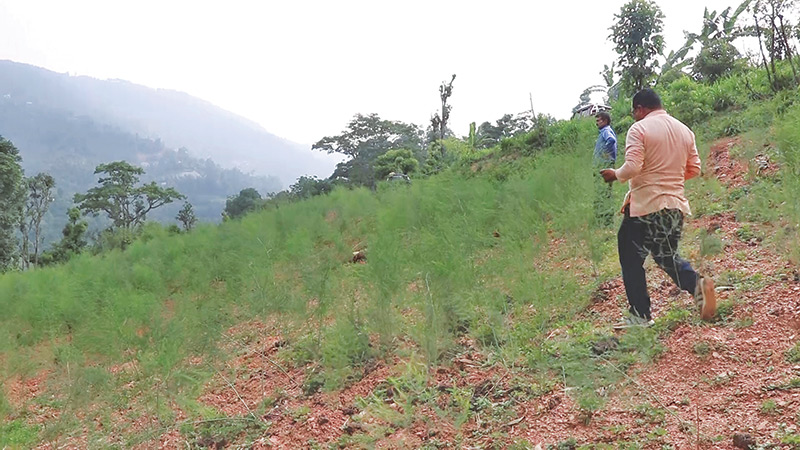
A slope in Palpa that has been turned into an asparagus plantation. Post Photo: MADHAV ARYAL
PALPA, Devka Bashyal of Bagnaskali Rural Municipality-8, Barangdi gave up growing maize on her small farm as monkeys were raiding the crops all the time. The growing monkey population in the area was becoming a serious problem after the animals began entering homes in the village in search of food. Besides monkeys, porcupines have been invading the farmers’ fields too. So the harassed villagers decided to grow something the marauding animals would not eat. For two years now, Bashyal has been growing a very potent variety of chilli known as habanero (akabare) and asparagus, which the crop raiders do not touch. “The wild animals don’t like these crops. They don’t eat them,” Bashyal said. A local cooperative named Bagnaskali Multipurpose introduced the chilli and asparagus farming programme in the village as a solution, which has brought peace of mind to the villagers. “I didn’t earn much in the first year, but this year, I made more than Rs250,000,” said Bashyal. “If I had planted maize and other crops, I could not have protected them from the wild animals.” Another farmer, Lal Prasad Bashyal, of Barangdi was surprised to see his neighbours planting asparagus and chilli instead of the usual maize and millet crops. Seeing the sense in their ways, he also switched to asparagus and chilli. “It’s easy to protect these crops from animals, and you can make good money from them too,” he said. Animals like monkeys, porcupines, deer and boars swoop down from the surrounding forests and spread out over the fields. They had been terrorising farmers for decades. Now more than 200 farmers in the rural municipality grow asparagus and chilli, which are in great demand in the cities. They expect to sell Rs9 million worth of pepper and the vegetable this year. The cooperative is helping them with market access too. The region is becoming known for its commercial chilli and asparagus farming. But it took some time to get there. “It was difficult to convince the traditional farmers in the beginning,” said Krishna Prasad Bhusal, chairman of Bagnaskali Multipurpose Cooperative. “Habanero or akabare used to be cultivated only in the eastern hill districts.” Now a majority of farmers in Palpa are attracted to commercial farming of these two high value crops. Each farmer has planted 6,000 to 15,000 chilli seedlings. Asparagus farming has also flourished, Bhusal said. The farmers have signed an agreement to supply chilli to a number of noodle companies in the southern Tarai. “But the market for asparagus is still small,” said Bhusal. “High production has led to a glut as the usual market in Tansen could not absorb the entire output. We are exploring markets for asparagus.”
Bhusal said the cooperative had assured the farmers that their harvests wouldn’t go to waste and they wouldn’t have to sell them cheaply. Deepak Bhattarai, senior agriculture development officer at the Prime Minister’s Agriculture Modernization Project Implementation Unit Office in the district, said the farmers had benefited from the land pooling programme launched by Bagnaskali Multipurpose Cooperative. “Initially, we were worried that the farmers wouldn’t agree,” Bhattarai said. Production is expected to be good this year due to timely rains. Last year, 3.9 million chilli saplings and 500,000 asparagus saplings were sold in Barangdi alone. “For the next crop cycle, we are planning to sell 9 million saplings,” Bhattarai said. Habanero sells for Rs300 per kg in the local market. Asparagus shoots are selling for Rs400 to Rs500 per kg. Bhattarai said they were getting orders from Tansen, Butwal and Bhairahawa. In the previous fiscal year, farmer Janak Acharya of Ribdikot Rural Municipality-7, Palung Mainadi, sold chillies worth Rs5 million. This year, Ribdikot Rural Municipality has provided a subsidy for distributing 1.25 million habanero saplings. “We have talked to some noodle companies for a supply contract,” said Narayan Bahadur Karki, chairman of Ribdikot Rural Municipality. “But I do not think the noodle companies would buy all the chillies. We are in talks with other traders as well to sell the red chilli.” According to Karki, the Ribdikot area alone produces 1,000 tonnes of red chilli during one crop cycle. Last year, farmers started planting habanero as a trial in Mainadi of Palung Mainadi, Rupse of Mathagadhi, Charchare of Tinau and Barangdi of Bagnaskali. More than 200 farmers have planted it. Ranjiv Kunwar, chief of the agriculture office of Ribdikot Rural Municipality in Lumbini province, said that commercial farming flourished this year due to the good yield. Chilli has been cultivated on 400 ropanis in Mathagadhi Rural Municipality-2, Rupse, this year. One farmer in Palung Mainadi has planted chilli on 190 ropanis of land. The Prime Minister’s Agriculture Modernization Project Implementation Unit, Palpa, has encouraged farmers to plant chilli through a land pooling farming programme. “This has been attracting returnee labourers,” said Kunwar. Farmers say one plant produces at least 2 kg of chillies. Tulsiram Bhusal, chairman of Madi Multipurpose Agriculture Cooperative, said that 33 farmers of Rupse planted chilli in the first year. Another 30 joined chilli farming this year. Tara Pandey, who lost her job in India due to the coronavirus pandemic and was forced to return, is making a good income by cultivating chillies commercially. She earned around Rs600,000 by growing the pepper on 4 ropanis. Krishna Bhattarai, secretary of Madi Multipurpose Agriculture Cooperative, said that the programme was launched with an aim to develop Rupse as a chilli pocket area. According to the Prime Minister’s Agriculture Modernization Project, land pooling has been done by farmers’ groups, cooperatives and private firms as well to produce chillies. Farmer Ram Chandra Nepal of Rupse said he faced no marketing problems. “We decided to cultivate chilli to be free from wild animals. We brought the plants from Ilam,” he said. Janak Acharya, director of Triput Livestock and Agriculture Multipurpose Farm in Ribdikot Rural Municipality-7, has leased land and planted red savina pepper. “I have cultivated chilli by leasing land from six households,” Acharya said.
NATIONAL
Snakebite patients in Talloswarad of Baitadi die for want of treatment
Since treatment for snakebite is not possible in the entire district, patients have to be taken to Dadeldhura or Dhangadhi. Most of the patients die on the way to hospitals.
- TRIPTI SHAHI
It takes around 7–8 hours to reach the district headquarters or neighbouring Dadeldhura from Talloswarad. Post Photo: TRIPTI SHAHI
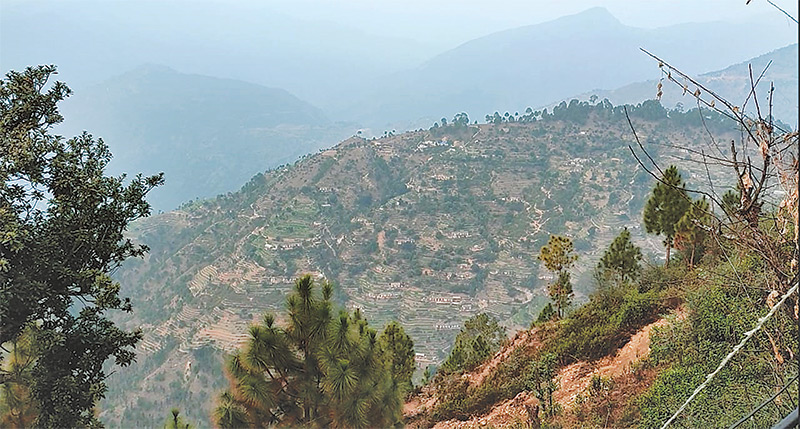
BAITADI, Fourteen-year-old Manisha Saud, a resident of Kusmaut settlement in Shivanath Rural Municipality-1, died of snakebite last Saturday. She was bitten by a snake at around 9am. “She died an hour and a half later,” said Bir Bahadur Saud, the victim’s uncle. Manisha died in lack of timely treatment. “We were in a dilemma. We didn’t know where to take her since the local health post does not have a snakebite treatment facility. If we were able to take her to the hospital immediately, she could have been saved,” said Bir Bahadur. Kusmaut is a remote village in the Talloswarad area of Baitadi, a hill district in Sudurpaschim Province in farwestern Nepal. “Our settlement is in a remote location. It takes around four hours on foot to reach the nearest road. And it takes around 7-8 hours to go to the district headquarters or neighbouring Dadeldhura district. Patients of emergency cases like snakebite die on the way even if they are rushed to the hospital,” Bir Bahadur told the Post. According to him, the locals of Talloswarad that comprises Shivanath and Pancheshwar rural municipalities generally go to Indian towns across the border for treatment. “But we cannot go to India in the rainy season as we have to risk our lives on wooden boats and tyre tubes to cross the Mahakali River. There aren’t any bridges across the Mahakali River,” he said. Many people in the villages of Talloswarad die of snakebite every year due to a lack of timely treatment. According to the local residents, around 7-8 people die of snakebite in Shivanath and Pancheshwar rural municipalities every summer. However, neither the local units nor the health institutions have any data on snakebite deaths here. Chaman Sarki of Aamchaur in Pancheshwar-4 is still haunted by last year’s incident. He lost his 11-year-old son to snakebite. “My son died as he could not get treatment. Many people lose their loved ones to snakebite every year. Many lives could be saved if treatment for snakebite was available locally,” lamented Sarki. “Despite the high death toll caused by snakebites, the government authorities and the local units do not pay much attention to the problem.” Several settlements of Shivanath and Pancheshwar lie on the banks of the Mahakali River. Summer in the region is hot, almost like in the Tarai. “Snakes are a big terror during summer,” said Mohan Bahadur Chand, a resident of Pancheshwar-2. “We are afraid of snakes because we have lost many people to snakebites. Snakebite patients are taken to shamans instead of health institutions because shamans are easily available and doctors are not.” Treatment of snakebite patients is not possible in the entire district of Baitadi so snakebite patients must be taken to Dadeldhura or Dhangadhi. “Since treatment is not possible in the district, snakebite patients generally do not visit health institutions. They try to find local cure but it doesn’t work most of the time,” said Yogesh Prasad hatta, chief at the District Health Office in Baitadi. “Yes, there is a need for a snakebite treatment centre in the district but such a centre cannot be set up without the support of the provincial and federal governments.” Incidents of snakebites that result in deaths are common in Nepal but the problem remains grossly neglected. According to the World Health Organisation, some 20,000 people are bitten by snakes in Nepal each year, resulting in over 1,000 deaths. But health researchers say the actual numbers could be much higher as suggested by several studies. A total of 90 snake species have been recorded in Nepal out of which 17 are considered highly venomous and dangerous.
OPINION
Nepali theatre of the oppressed
The choice of the theatre for creating the effect of resistance heralds a new mode of awakening.
- ABHI SUBEDI
Post Photo: Sanjog Manandhar
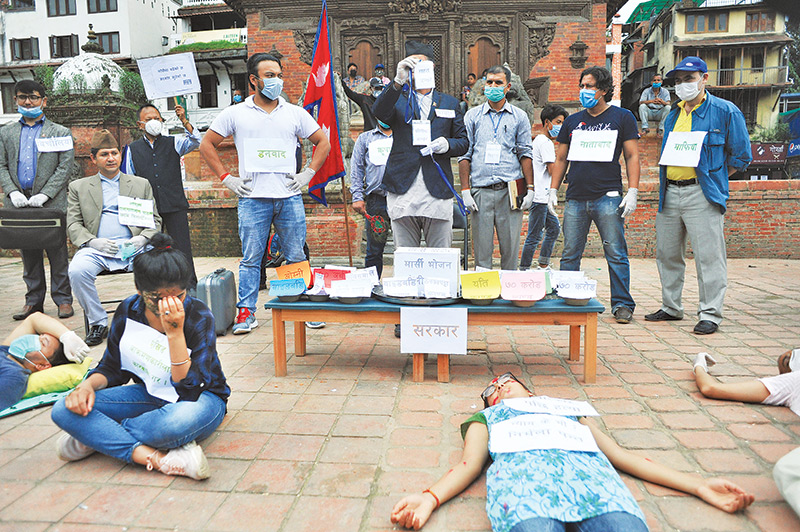
Various strands of the theatre of the oppressed, voiceless and rebels were buckled up in a story in Kantipur daily filed by Laxmi Gautam on June 10. This is the story of a campaign of the street theatre of the oppressed launched by a young lady of Phidim named Sameekshya Neupane who was only four when her 13-year-old sister Meena Neupane was raped and murdered in a jungle near her house. Sameekshya never forgot the incident. She successfully transformed her trauma into performance art and launched her campaign of the theatre of the oppressed by bringing the girl students of other schools to perform the plays she writes and directs. Sameekshya, a student of class 10 at Phidim Secondary School who launched the theatre of the oppressed from the theatre of her school, vows to continue this as the only means of alerting and awakening society to the oppression suffered everyday by women of all age groups in this country. Sameekshya’s performance is one among the many examples of street theatre in Nepal. These theatres are performed in the open, for which reason they owe a legacy to the first street theatre introduced in 1980 by Ashesh Malla of Sarwanam and his friends like Sunil Pokharel and Puskar Gurung. Younger directors like Ghimire Yubaraj and others gave continuity to this tradition. These theatres emanated in the capital and were taken to different parts of the country. Theatre groups from places like Janakpur and Dharan were also active in this form of performance art.
Educational theatre Nepali theatre leaders who are informed and educated have used the theory of the Brazilian writer Augusto Boal (1931-2009) published in his book The Theatre of the Oppressed (1985). Sunil Pokharel in his resume mentions that he and his group, mainly under the nomenclature Kachahari, did approximately 700 performances for a UNICEF programme in more then 45 districts of Nepal. That is a colossal figure. I have no way of verifying the figure, but what is true is that Kachahari theatre has been the most widely practised theatre of the oppressed in this country. But this theatre has also been named educational theatre. Sunil maintains that these performances did follow Boal’s legislative theatre of the oppressed that began with educational exposure of theatre persons to this mode of performance. I have cited in my book Nepali Theatre as I See It (2006:209) Sunil Pokharel’s experience about Forum theatre, which began when he was invited by a Danish institution called MS Nepal in 2004 to help them with the theatre for education. Later Sunil received orientation from Boal himself. Boal was not happy about the way non-governmental organisations had misused his form of theatre around the world. But his model of the theatre of the oppressed has proved to be educational and powerful. Ghimire Yubaraj, director of Shilpee Theatre, is still going strong with such forms of open theatre. He and his team must be performing such plays in some part of the country as I write this story. I have one very eloquent memory to share. Senior director Puskar Gurung of Dabali, who played an important role in the mid-1990s in training and promoting street theatre performances in remote places like Banke, Rolpa, Doti, Achham, Damak and Dharan, invited me in the early post-insurgency years to listen to the narratives of young people of the theatre who had brought harrowing stories from the areas affected by the Maoist conflict, and write short plays based on them. It was a challenging experience for them even though they visited the spots well after the end of the war in 2006. Some of those who had heard people tell their stories of suffering during the war were so traumatised that they were not able to fully narrate them. I don’t remember what Dabali did with these stories, but I could not write a single play based on them for two reasons even though that was a peaceful time and you could perform the stories of the war. First, the theatre of the oppressed should generate the performances by visiting the spot and not by writing plays based on the narrated stories. Second, the theatre of the oppressed should address a community, a group and the sufferers directly to project a message of change. But for the performance of street theatre, you should find a balance between the raw pain and sense of mission as in Sameekshya’s performance, and in the model propounded by Augusto Boal and widely practised in many places in the world today. The theatre of the oppressed has become a free form that is used more for its emotional and political rather than its theatrical value because it is an accessible and viable form for all who want to project their sense of discontent and resistance. The sense of presentism has always been the main content of such form of street theatre. But what should be noted here is that the degree of intermingling of the actors with the audience has increased more than before. For example, the actors of Sarwanam street theatre in the 1980s were open and accessible to the public, but they remained true to their assigned textual roles. But in the theatre forms of resistance, such exclusiveness is broken. Characters and the audience become part of a common movement. The essence of Boal’s theatre is that the audience should participate; the sphere of the theatre expands and changes when characters from the audience become part of the story. But he was careful about maintaining the theatrical quality of the sufferers by not giving in to the cheaper forms of propaganda. Boal saw universal features in the language of the oppressed citizens.
Principal mantra Sameekshya’s choice of the theatre of the oppressed citizens is appropriate and wise because empowerment of the communities by spreading information in a direct and visceral manner is the principal mantra of the theatre of the oppressed citizens in Nepal and elsewhere. In Nepal, the choice of the theatre for creating the effect of resistance, especially by women and the marginalised communities, heralds a new mode of awakening. Credit goes to the Nepali theatre campaigners for this methodology. All the performers of street theatre may not have been exposed to proscenium theatre, but they have understood the effectiveness of the theatre that is performed on the street and open grounds with a mission. The two most important means of the theatre of the oppressed people are body and clear language. But those who perform the theatre of the oppressed people should also be careful to save the theatre genre because it becomes effective only through its important quality as art. The practitioners of the Nepali open theatre of the oppressed people have created a tradition, and they should respect what they have established.
OPINION
The European war project
European integration will be driven by the need to win in a dangerous world, rather than by the desire to avoid conflict.
- Mark Leonard
Shutterstock
For seven decades, European integration has been driven by the quest for peace. But since Russia’s invasion of Ukraine on February 24, Europe has found itself unifying in response to war. The peace project has given way to a war project, and this fundamental shift is forcing European governments to reconsider some of their longest-held principles. Most obviously, they now must concern themselves with hard power. There has been much discussion about German rearmament, Denmark’s decision to participate in European joint defense arrangements, and Sweden and Finland’s bid for NATO membership. Taboos have been broken, with European Union member states sending heavy weapons to Ukraine and the EU’s “peace facility” pledging €2 billion ($2.1 billion) to arm that beleaguered country. Moreover, the EU has fashioned its economy into a weapon to use against Russia, and it is now planning for a war economy, where security will take priority over efficiency. A second major change is that Europeans must rethink interdependence. European integration previously reflected the belief that economic links between countries would create a foundation for political reconciliation. That was the idea behind the original European Coal and Steel Community (the precursor to the EU), which turned former enemies into friends by merging the national industries that had produced the munitions for World War II. The hope was that even if economic links between countries did not make war impossible, they would at least prevent a dangerous escalation in tensions. But Russia’s invasion made a mockery of this idea, demonstrating that interdependence can also enable one party to blackmail the other. This realization came hot on the heels of worries about “mask diplomacy” and “vaccine nationalism” during the COVID-19 pandemic, when many countries found themselves wholly reliant on others for critical supplies. It follows that Europe’s decoupling from Russian energy will also be accompanied by efforts to make Europe less dependent on China. A third question involves the concept of sovereignty. For the past few decades, Europeans were mainly focused on taming this impulse in the name of supranational cooperation. But faced with an aggressive revisionist power, they now recognise that sovereignty must be protected before it can be pooled. For its part, Russia has perverted the post-sovereigntist rhetoric used by Europeans during the Balkan wars to justify its own invasion of Ukraine, which it cynically describes as a mission to protect Russian speakers from genocide. In the 1990s, Europeans advanced the “postmodern” idea that if there were massive abuses of universal human rights (those recognised by the United Nations) taking place within a sovereign country, the international community had a duty to step in to protect the victims from their own government. The Russian variant of the “responsibility to protect” is not postmodern but pre-modern. The Kremlin believes it can decide unilaterally to intervene in other countries to protect members of a loosely defined Russian civilization. Saudi Arabia has used a similar doctrine to justify its interventions to protect Sunnis in Yemen, as has Iran with respect to Shias in Syria. And, of course, many worry that China will adopt similar reasoning to launch an invasion of Taiwan. Earlier generations of Western leaders were wrong to assume that only their countries would ever be strong enough to override others’ sovereignty. A fourth issue is the supposed universalism of the European project. In the early 2000s, I wrote a book titled Why Europe Will Run the 21st Century. I believed that the EU’s model of international cooperation would spread osmotically to all corners of the world. But the failure of the EU enlargement process in Turkey and the rise of a revanchist Russia have shown that the EU model is unlikely even to encompass all of Europe, let alone the whole planet. In discussions with leaders from Asia, Africa, and the Middle East, I have been struck by how few of them share the intense moral outrage that characterises the West’s response to Russia’s invasion. They see the conflict as a regional European conflict, rather than as a world war with which they should be concerned. Eurocentrism has not only led Europeans to misread leaders such as Russian President Vladimir Putin and Turkish President Recep Tayyip Erdogan; it also is hindering Europe’s appeals to the rest of the world. To correct course, European leaders must recognise that the EU experience is an exceptional product of a particular history and geography, and they must demonstrate enough curiosity to understand the world through others’ eyes. In a paradoxical way, decentering Europe could be the necessary first step to exercising European power in a multipolar world. A fifth principle that needs rethinking is the idea of political order. While some European leaders cling to a security framework that reflects the principles of the post-Cold War moment, the hard truth is that Europe’s unique order—based on a set of institutions and treaties – has already been destroyed. In the future, European security will look much more like that of other regions, such as Asia. The balance of power and military might will matter as much as any treaties between Europeans and Russians. The United States, of course, will remain engaged in the region. But much of the action will come from a lattice of bilateral and limited security arrangements. And even if the fighting in Ukraine ends, it will not give way to peace. The danger of cyberattacks, energy cutoffs, election interference, and Russia’s “little green men” will be permanent features of Europe’s new age of unpeace. The Ukraine war will remake Europe. This does not mean that Europeans must abandon the idealism and creativity that drove the most successful peace project in history. But they must accept that their model will never be universal, that they will increasingly find themselves responding to decisions made by others, and that peace at home may depend on their willingness to countenance war elsewhere. From now on, European integration will be driven by the need to win in a dangerous world, rather than by the desire to avoid conflict.
Mark Leonard, Director of the European Council on Foreign Relations, is the author of The Age of Unpeace: How Connectivity Causes Conflict (Bantam Press, 2021). – Project Syndicate
NATIONAL
Congress camp puts pressure on Deuba, saying he failed in governance and party
Leaders from rival faction worry he is acting more like a chief of the five-party coalition than party president.
- ANIL GIRI
Congress leaders say that Deuba has been spending more time managing the ruling coalition than his party. Post File Photo
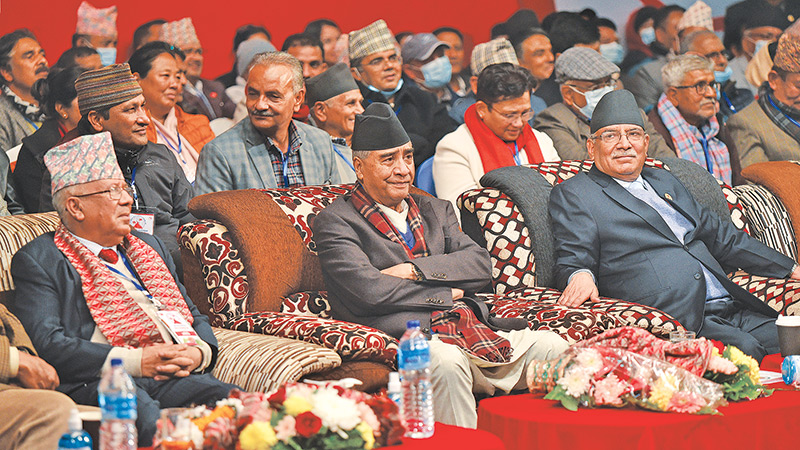
KATHMANDU, On Thursday and Friday, the Shekhar Koirala camp in the Nepali Congress held a meeting and deliberated the working style and performance of Prime Minister Sher Bahadur Deuba, who is also the party president. The meeting came at a time when Deuba is about to complete his one year in office as prime minister. He was re-elected the party president six months ago. Koirala, who lost to Deuba in the election for party president during the Congress general convention last December, represents a rival camp in the party. During two days of deliberation, the Koirala camp, whose heavyweights include party General Secretary Gagan Thapa, came down heavily against Deuba and concluded that he has failed both as prime minister and party president. According to the leaders participating in the meeting, Prime Minister Deuba has failed to fix the country’s economy and address the grievances of the people and their issues of livelihood. Deuba has been accused of promoting policy corruption and failing to lead foreign policy in a constructive manner. A Congress member said a majority of leaders were of the view that Deuba has been working like a leader of the coalition rather than the party’s president. The meeting also decided to put pressure on Deuba to listen to and address the grievances of thousands of party leaders and cadres. The Koirala camp also urged Deuba to honour the over 40 percent votes that Koirala had secured in the 14th general convention. But does Deuba take the pressure from the rival camp seriously? Or will it have any impact on him? Some Congress insiders say an internal assessment of Deuba’s performance as government and party head was necessary and the leadership needs to be held to account. According to them, the rival camp will continue to assess Deuba’s performance. Ram Chandra Poudel, a senior leader, said those who are now accusing Deuba of failure must understand that the situation has arisen because they did not seek his alternative. “Had they sought an alternative to Deuba as party president, we would not have faced this situation,” said Poudel. “So first of all, these leaders who are ganging up against Deuba should apologise that it was their mistake to create an environment for Deuba’s victory.” Poudel was one of the aspirants for the party chief role. After Koirala and Prakash Man Singh refused to back down on their stand to run for the party president, the Poudel-Koirala camp split. Poudel kept himself out of the entire election process. Koirala and Singh contested against Deuba. Poudel is now leading a political mechanism of five ruling parties formed to to assist the government. “It’s them who ensured Deuba’s victory. So how serious are they now when they are accusing him of failure?” said Poudel. “I do not think so because they do not know the exact crisis and problems inside the Congress.” Factionalism is not a new thing in the Nepali Congress. It has a long history of internal conflicts and groupism. Deuba had in September 2002 even left the party after differences with the late Girija Prasad Koirala and formed the Nepali Congress (Democratic). He, however, returned to the mother party in September, 2007. Since then, there is a 60-40 power structure in the Congress. Once dissident, Deuba now leads the establishment side in the party. Shekhar Koirala and Gagan Thapa represent the rival camp. Though the Koirala camp has not publicly stated the objective behind holding its gathering, a leader said it was aimed at ensuring an honourable seat-sharing arrangement inside the party for the upcoming federal and provincial elections. “Since Deuba paid little attention to party members while distributing tickets during the local elections, largely because he was appeasing the coalition partners, we now want to build pressure on him,” said a Congress leader requesting anonymity. “Else, Deuba is likely to leave the Koirala-Thapa camp members high and dry during the upcoming polls as well.” According to the leader, Deuba must be accommodative when it comes to party members. “We waited for six months but the party president did not make any moves to fix the issues plaguing the party,” said Gururaj Ghimire, a leader of the rival camp. Other top leaders of the party, like former vice-president Bimalendra Nidhi, who also stood against Deuba, were silent at the Koirala-Thapa camp meeting. Three former general secretaries—Shashank Koirala, Krishna Prasad Sitaula and Singh—too have not spoken about the allegations levelled by the Koirala-Thapa camp. Sitaula seems to be supportive of Deuba, but there is no clarity on Nidhi, Shashank and Singh, according to the leader. As per the party charter and using his authority as the Congress president, Deuba has to pick the party’s treasurer, give full shape to the Central Working Committee (CWC), and form various party departments. Deuba has yet to give a complete shape to the 168-strong CWC. Also, the party has not formed 28 departments. According to Section 60 of the Congress charter, all departments, committees, and other entities of the party should be formed within six months from the general convention. During the 14th general convention, the party leadership had agreed to hold a policy convention within six months, but no steps have been taken to that effect. Deuba needs to appoint 21 CWC members. On January 28, he formed a 37-member central work execution committee but it is also short of nine members. Ten sister organisations of the party are waiting to hold their general conventions. “Given the performance of the government and his failure to adhere to the party charter, Deuba’s work is not satisfactory. He never discussed with party members before making appointments to various government positions. After his election, he assured that he would accommodate all friends in the party but in practical terms, he kept on alienating us,” said Ghimire. “And if the party president fails to address our grievances and concerns, it could prove to be costly for him.” Another Congress leader who claimed to be not picking sides said if the rival camp really wants to put pressure on Deuba, it needs to rally all senior leaders against him. “Deuba is not going to pay attention to such gatherings and messages coming out of such meetings,” the leader said. “He is a master politician. He is a man who does not easily budge.” Leaders close to Deuba defended the prime minister, saying that he had assumed the position last year when the country’s situation was critical. Ramesh Lekhak said that Deuba as prime minister and party president has been successful despite taking charge of the government when the political and other situations were not good following KP Sharma Oli’s constant attacks on the constitution and the political system when the latter led the country. “To safeguard the constitution and bring national politics and the entire political system back on track, we formed the alliance. We corrected the wrongs of the Oli government,” said Lekhak. “Since the prime minister was busy in local polls and cementing the coalition, there have been delays in forming the party’s departments and giving the CWC its full shape. The pending works will be completed soon.”
NATIONAL
Conflict victims want new leaders in two commissions as their terms near end
Justice continues to elude victims of the decade-long war because of multiple reasons including a lack of will on the part of politicians.
- BINOD GHIMIRE
KATHMANDU, The Ministry of Law and Justice has completed consultations with conflict victims and civil society members in seven provinces. It will finalise the bill to amend the Enforced Disappearances Enquiry, Truth and Reconciliation Commission Act, 2014 after final consultation in Kathmandu within a week. While revising the amnesty provisions in the existing law is the major focus of the amendment bill, it is crucial to deciding the tenure of two transitional justice commissions—the Commission of Investigation on Enforced Disappeared Persons and the Truth and Reconciliation Commission. The two transitional commissions were formed in February 2015 with a two-year mandate to complete investigations into the conflict-era cases of human rights violations and recommend reparations and measures for non-repetition of such crimes after digging out the reasons of the conflict. However, the commissions couldn’t even collect the complaints during the period. The government, through a revision in the Act, extended their terms by another two years. In its four years of tenure, the commissions gathered 63,718 complaints with little progress in investigating the cases. Between 2015 and 2019, the disappearance commission received 3,223 complaints from family members saying their loved ones had disappeared during the decade-long conflict. As the truth commission led by Surya Kiran Gurung and the Lokendra Mallick-led disappearance commission failed to act effectively to investigate the complaints and provide justice, the government in January 2019 revised the Act, clearing the path to remove the teams led by them. The revision in the Act made it possible to extend the terms of the commissions by two years though the teams led by Gurung and Mallick got extension only till April 15, 2019 opening doors to appoint new leaderships. The new teams led by Ganesh Datta Bhatta and Yubraj Subedi were appointed in January 2020 to the truth and the disappearance commissions, respectively, despite reservations from the victims, civil society and international human rights commissions. As they complete more than two years, the Bhatta- and Subedi-led teams too have been blamed for following what previous committees did. “Removal of the existing teams from both the commissions and appointment of the new leadership following a transparent process is our bottom line. Our friends have given similar suggestions in all the consultations so far,” Suman Adhikari, whose father was killed by the Maoists in 2002, told the Post. “I am hopeful that the Act is amended accordingly and also gets implemented.” The tenure of the existing commission ends on July 16. The Act needs to be amended to extend the tenure of the commissions. Minister for Law and Justice Govinda Sharma Bandi has said that he was inducted to the Sher Bahadur Deuba Cabinet to conclude the transitional justice process. Talking to the Post, he said the amendment bill will be registered in Parliament before mid-July. “The amendment bill will be drafted incorporating the feedback from the consultations, the 2015 verdict of the Supreme Court and international practices,” he said. The Supreme Court in February 2015 struck down around a dozen amnesty provisions in the Act and directed the government to revise it ensuring that there would be no amnesty in serious cases of human rights violations such as rape, murder, enforced disappearances and torture. Bandi, however, said he was not sure whether the existing leadership in the two transitional justice commissions will get their term extended. “Let us first complete all the consultations. We will reach a conclusion before giving a final shape to the amendment bill,” he said. The conflict victims and civil society leaders say the government must appoint teams to both commissions with a proper consultation so that every stakeholder takes ownership of the transitional justice process. “We have no faith in the existing leadership,” Gopal Shah, chairperson of the Conflict Victims’ National Platform, told the Post. “Appointment of the new leadership is a starting point for a credible transitional justice process.” Leaders from both the commissions claim that despite the Covid pandemic, lack of legal amendment and a human resource crunch, they have made some progress with preliminary investigation into the complaints and providing reparations and relief to the victims. “We have worked relentlessly. Sorting out over 60,000 complaints is time consuming. Despite that, we have provided identity cards to hundreds of victims and recommended reparations in more than 600 cases,” Bhatta told the Post. “We are happy to leave the commission any day. Our only concern is in the name of revamping the process, we might end up losing all the achievements made so far.” As their tenure nears end, both the commissions are preparing their reports incorporating their achievements for submission to the government before they wrap up. “It is wrong to say we haven’t done anything,” Bhatta said. “The disappearance commission has completed preliminary investigation in all the cases while it is preparing for a detailed investigation. We have already started identifying the perpetrators. Even if we don’t get an extension, the new team will have an easy way ahead because we have created a good foundation for the final investigation.”
NATIONAL
Man dies in Panchthar landslip
Briefing
PANCHTHAR: A 42-year-old man died while two others went missing when a landslide, triggered by heavy monsoon rains, buried a house in Phalelung Rural Municipality-7 of Panchthar district on Friday night. According to Chief District Officer Suresh Neupane, rescuers retrieved the body of Ruplal Magar while his wife Goma, 38, and niece Alisa, 19, are still missing in the incident.
NATIONAL
Two held on extortion charge
Briefing
BIRATNAGAR: Police arrested two persons from Pathari Shanishchare Municipality-6 in Morang district on extortion charges. According to the District Police Office, Ganesh Kumar Karki and Bishal Rishidev of Pathari Shanishchare were arrested on Friday evening for investigation. The suspects allegedly demanded money from a person in Biratnagar by issuing a threat. Detailed investigation into the case is underway, said police.
NATIONAL
Man burns wife to death
Briefing
BIRATNAGAR: A 22-year-old man from Rangeli Municipality-1 in Morang burnt his wife to death following a family dispute on Friday night. According to Area Police Office, Tilak Mallik set ablaze his wife Babita, who died in the course of treatment in Koshi Hospital. The villagers rescued the victim, who was in a critical condition, after they saw the Mallik’s house in flames. Police say the suspect has confessed to the crime.
NATIONAL
44 new Covid cases in Nepal
Briefing
Kathmandu: Nepal on Saturday reported 33 new PCR confirmed coronavirus cases in the last 24 hours taking the nationwide infection tally to 979,762. Similarly, 11 people tested positive in a total of 1,266 antigen tests, according to the Health Ministry.
WORLD
Blasts rock Ukraine city as Russian missiles drive up civilian death toll
‘Stay in shelters!’ Mykolaiv mayor tells residents as Zelenskiy denounces ‘deliberately targeted Russian terror’.
- REUTERS
Rescuers evacuate a dog from a damaged residential building following a missile strike, amid Russia’s invasion on Ukraine, in Mykolaiv, Ukraine in this still image taken from a handout video on Wednesday. Courtesy of State Emergency Service of Ukraine via REUTERS
KYIV/SERHIIVKA, Explosions rocked the southern Ukrainian city of Mykolaiv on Saturday, the mayor said, at the end of a week in which Russian missiles have slammed into an apartment block and a shopping mall in other cities, killing dozens of people. Air raid sirens sounded in the Mykolaiv region, which borders the vital Black Sea port of Odesa. “There are powerful explosions in the city! Stay in shelters!” Mykolaiv mayor Oleksandr Senkevych wrote on the Telegram messaging app. The cause of the blasts was not immediately clear, although Russia said on Saturday it had hit army command posts in the area. Reuters could not independently verify the reports. Kyiv says Moscow has intensified missile attacks on targets far from the frontline and that it has deliberately hit civilian sites while Russian forces have been grinding out gains on the battlefield in the east, pummelling urban areas with artillery. Russia says it has been aiming at military sites and denies taking aim at civilians. Kremlin spokesperson Dmitry Peskov said “Russian Armed Forces do not work with civilian targets”. An apartment block was partly flattened in Odesa on Friday, which the authorities said killed at least 21 people, after Monday’s strike on a shopping mall in the central city of Kremenchuk that officials said left at least 19 dead. Ukrainian President Volodymyr Zelenskiy denounced the strikes in his nightly video address on Friday as “conscious, deliberately targeted Russian terror and not some sort of error or a coincidental missile strike”. Russia’s defence ministry said on Saturday it had destroyed Ukrainian army posts in Mykolaiv and the eastern Donbas region with high-precision weapons and hit other military-related sites in the southern Zaporizhzhia region and Kharkiv to the north, Russian news agencies reported. Thousands of civilians have been killed since Russia invaded Ukraine on February 24 in what Moscow calls a “special military operation” to root out nationalists. Ukraine and its Western allies say it is an unprovoked war of aggression. Residents in the resort village of Serhiivka near Odesa helped workers pick through the rubble of the nine-storey apartment block, part of which was destroyed in Friday’s strike. “We came here to the site, assessed the situation together with emergency workers and locals, and together helped those who survived. And those who unfortunately died. We helped to carry them away,” said Oleksandr Abramov, who lives nearby. The region will observe a day of mourning on Saturday. The Serhiivka strike came shortly after Russia withdrew from Snake Island, a strategic Black Sea outcrop about 140 km southeast of Odesa seized on the first day of the war. Russia had used Snake Island to impose a blockade on Ukraine, one of the world’s biggest grain exporters and a major producer of seed for vegetable oils. The disruptions have helped fuel a surge in global grain and food prices. Russia, also a big grain producer, denies it has caused the food crisis, blaming Western sanctions for hurting its exports. Putin met Indonesia’s president on Thursday and spoke by phone on Friday to the prime minister of India, promising both major food importers that Russia would continue supplying grain. As missiles have struck Ukrainian cities, Russian forces in the east have slowly advanced on the ground, raining down shells on Ukrainian forces battling to hold urban centres. Moscow aims to drive Ukraine out of Luhansk and Donetsk provinces, which make up the industrial region known as Donbas. Moscow has been on the verge of capturing Luhansk province since taking the city of Sievierodonetsk last week after some of the heaviest fighting of the war. Ukraine’s last bastion in Luhansk is Lysychansk, which is close to being encircled under Russian artillery barrages. “Private houses in attacked villages are burning down one by one,” Luhansk Governor Serhiy Gaidai said on Telegram, adding that shelling stopped Lysychansk residents from dousing fires.
WORLD
Rescuers recover 26 dead from mudslide in India’s northeast
- ASSOCIATED PRESS
GAUHATI, Fresh rain and falling boulders on Saturday hampered rescuers who have so far pulled out 26 bodies from the debris of a mudslide that wiped out a railroad construction site in India’s northeast, officials said. Rescue work is expected to continue for a couple of days in rugged hilly terrain with little hope of finding survivors among 37 people still missing since Wednesday night. Pankaj Kavidayal, a rescue official, said 21 of the confirmed 26 dead were members of the Territorial Army. Army personnel had been providing security for the railway officials because of a decades-old insurgency seeking a separate homeland for ethnic and tribal groups in the area. More than 250 soldiers, rescuers and police using bulldozers and other equipment were involved in the operation in Noney, a town near Imphal, the capital of Manipur state. They have been cautioned about fresh mudslides reported in the region on Saturday. Excavators were also used to search for bodies in a river. Thirteen soldiers and five civilians have been rescued from the debris of the entirely swept away railroad station, staff residential quarters and other infrastructure that was being built, Kavidayal said. Continuous rainfall over the past three weeks has wreaked havoc across India’s northeast — eight states and 45 million people — and neighboring Bangladesh. An estimated 200 people have been killed in heavy downpours and mudslides in states including Assam, Manipur, Tripura and Sikkim, while 42 have died in Bangladesh since May 17. Hundreds of thousands have been displaced. Scientists say climate change is a factor behind the erratic, early rains that triggered unprecedented floods. Monsoon rains in South Asia typically begin in June, but torrential rain lashed northeastern India and Bangladesh as early as March this year. With rising global temperatures due to climate change, experts say the monsoon season is becoming more variable, meaning that much of the rain that would typically fall throughout the season arrives in a shorter period.
WORLD
Astronaut study reveals effects of space travel on human bones
The study shows that longer space missions resulted both in more bone loss and a lower likelihood of recovering bone afterward.
- REUTERS
WASHINGTON, A study of bone loss in 17 astronauts who flew aboard the International Space Station is providing a fuller understanding of the effects of space travel on the human body and steps that can mitigate it, crucial knowledge ahead of potential ambitious future missions. The research amassed new data on bone loss in astronauts caused by the microgravity conditions of space and the degree to which bone mineral density can be regained on Earth. It involved 14 male and three female astronauts, average age 47, whose missions ranged from four to seven months in space, with an average of about 5-and-a-half months. A year after returning to Earth, the astronauts on average exhibited 2.1 percent reduced bone mineral density at the tibia—one of the bones of the lower leg—and 1.3 percent reduced bone strength. Nine did not recover bone mineral density after the space flight, experiencing permanent loss. “We know that astronauts lose bone on long-duration spaceflight. What’s novel about this study is that we followed astronauts for one year after their space travel to understand if and how bone recovers,” said University of Calgary professor Leigh Gabel, an exercise scientist who was the lead author of the research published this week in the journal Scientific Reports. “Astronauts experienced significant bone loss during six-month spaceflights—loss that we would expect to see in older adults over two decades on Earth, and they only recovered about half of that loss after one year back on Earth,” Gabel said. The bone loss occurs because bones that typically would be weight-bearing on Earth do not carry weight in space. Space agencies are going to need to improve countermeasures—exercise regimes and nutrition—to help prevent bone loss, Gabel said. “During spaceflight, fine bone structures thin, and eventually some of the bone rods disconnect from one another. Once the astronaut comes back to Earth, the remaining bone connections can thicken and strengthen, but the ones that disconnected in space can’t be rebuilt, so the astronaut’s overall bone structure permanently changes,” Gabel said. The study’s astronauts flew on the space station in the past seven years. Space travel poses various challenges to the human body—key concerns for space agencies as they plan new explorations. For instance, NASA is aiming to send astronauts back to the moon, a mission now planned for 2025 at the earliest. That could be a prelude to future astronaut missions to Mars or a longer-term presence on the lunar surface. “Microgravity affects a lot of body systems, muscle and bone being among them,” Gabel said.
WORLD
Pilgrims flock to Mecca for first post-pandemic haj
- REUTERS
Muslim pilgrims circle the Kaaba and pray at the Grand Mosque in the holy city of Mecca, Saudi Arabia on Friday. REUTERS
MECCA, Thousands of pilgrims started arriving in the holy city of Mecca in Saudi Arabia on Friday, among some one million Muslims expected to attend the 2022 haj pilgrimage season after two years of major disruption caused by the Covid pandemic. Wrapped in white robes, with some carrying umbrellas against the burning desert sun, hundreds performed the first ritual of the haj, which involves walking in a circle around the Kaaba, the sacred building at the centre of Mecca’s Grand Mosque. “Praise be God... It’s impossible to describe my feelings right now,” said Ahmed Sayed Mahmoud, an Egyptian pilgrim. “Being in the Grand Mosque and in the land of the two holy mosques makes me very happy.” Saudi Arabia, home to Islam’s holiest sites in Mecca and Medina, allowed back foreign travellers this year to perform the haj. Only a few thousand Saudi citizens and residents attended the annual pilgrimage in the last two years as Covid-19 wreaked havoc across the global economy and curtailed travel. However authorities have said only one million people can join the 2022 season, less than half of pre-pandemic levels, and access is restricted to pilgrims aged 18 to 65 who have been fully vaccinated or immunised against the virus and do not suffer from chronic diseases. Security officers mixed with pilgrims inside the mosque. A web of surveillance cameras oversaw its surroundings and checkpoints controlled access to the city to help ensure an incident-free haj, which has been marred in the past by deadly stampedes, fires and riots. Over the years, the kingdom has spent billions of dollars on making one of the world’s biggest religious gatherings more secure. Haj, a once-in-a-lifetime duty for every able-bodied Muslim who can afford it, is a major source of income for the government from worshippers’ lodging, transport, fees and gifts. In 2019, the last year before the pandemic struck, some 2.6 million people performed the haj, while around 19 million took part in the umrah, another form of pilgrimage to Mecca which—unlike the haj—can be carried out at any time of the year.
WORLD
Indian police arrest ‘masterminds’ behind execution of tailor
- REUTERS
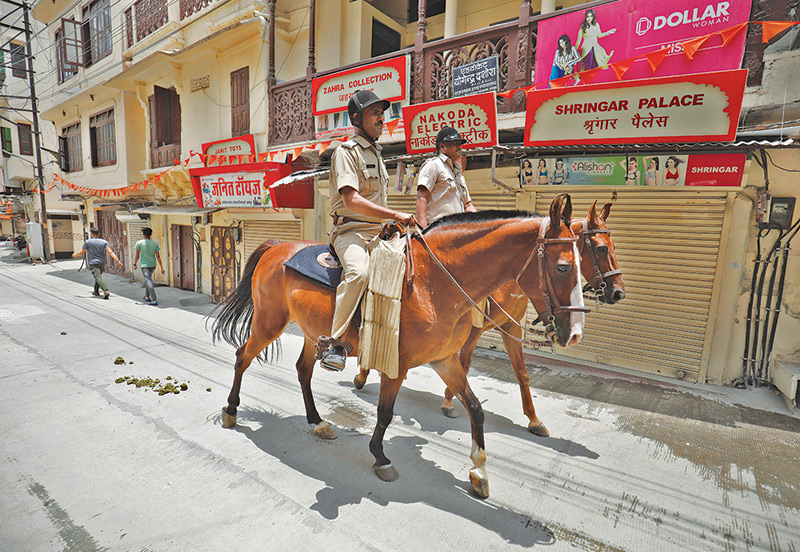
Policemen mounted on their horses patrol during restrictions in Udaipur in the northwestern state of Rajasthan, India on Friday. REUTERS
UDAIPUR/MUMBAI,2 Indian police made fresh arrests in the case of the execution of a Hindu tailor in Rajasthan, a murder that stoked unease between the Hindu majority and Muslim minority, leading to a clampdown on protests and the internet to prevent tensions escalating. Three senior police officials said on Saturday that two Muslim men based in the northwestern state were held for planning the tailor’s murder last week in his shop in Udaipur, a popular tourist destination dotted with lakes and palace hotels. “We have now arrested the two masterminds and previously we had arrested two men who committed the heinous crime,” said Prafulla Kumar, a senior police official based in Udaipur. Kumar said internet services was being gradually restored and security forces continued to be on alert following the murder, carried out by two Muslim men now under arrest who filmed the act and posted it online. The perpetrators said the act was in response to victim’s support for a politician’s derogatory remarks about the Prophet Mohammad. The victim, Kanhaiya Lal Teli, had allegedly put up a social media post supporting a former spokesperson for Prime Minister Narendra Modi’s party who made anti-Islam comments in May. On Friday judges from the Supreme Court of India stated the ex-spokesperson, Nupur Sharma, must apologise to the whole nation after the remarks intensified religious fault lines in India, angered Islamic nations and triggered diplomatic strains. In India, at least two demonstrators were killed in police fire during protests against Sharma’s comments. In Afghanistan, the militant group Islamic State last month claimed an attack on a Sikh temple that killed at least two people and injured seven was in response to insults levelled at the Prophet Mohammad in India. Police in New Delhi arrested journalist Mohammed Zubair, a vocal critic of the Modi government, who had helped draw attention to Sharma’s remarks through his fact-checking website Alt News and on social media. The National Investigative Agency (NIA)—India’s top anti-terrorism agency—said they carrying out a probe in the Hindu tailor’s killing. A senior NIA official in New Delhi said they were questioning Muslims linked with the four accused in Udaipur to identify whether they had links with militant networks. Muslims living about 3 kilometres from the tailor’s shop where the victim was killed said they felt nervous and feared a social and economic boycott by powerful Hindus residing in Udaipur. “I know what has been done is barbaric but the community should not be held responsible for the deed of two people,” said Mohammad Farukh, a medical representative living in a Muslim-dominated area of the city.
WORLD
Australians rally against US overturning of abortion ruling
Briefing
- AGENCIES
MELBOURNE/SYDNEY: Thousands of Australians joined raucous protests across the country on Saturday against the US Supreme Court’s overturning of women’s constitutional right to abortion. The Supreme Court last week overturned the landmark 1973 Roe v. Wade ruling, restoring the ability of individual states to ban abortion. In the biggest rally in Australia, around 15,000 women and men marched through Melbourne, with placards including “I borrowed this sign from my grandma,” and “Everyone deserves the right to bodily autonomy”. “We are here to stand up for women’s rights in Australia and around the world. Millions of women in the United States have had their rights stripped from them and we are angry about that,” said Liz Walsh, one of the organisers of the protest in Melbourne.
WORLD
WikiLeaks’ Assange lodges appeal against US extradition
Briefing
- AGENCIES
LONDON: WikiLeaks’ founder Julian Assange has appealed to the High Court in London to block his extradition to the United States to face criminal charges, his brother said on Friday, the latest step in his legal battle that has dragged on for more than a decade. Assange, 50, is wanted by US authorities on 18 counts, including a spying charge, relating to WikiLeaks’ release of vast troves of confidential US military records and diplomatic cables which Washington said had put lives in danger. Last month, Home Secretary Priti Patel approved his extradition, with her office saying British courts had concluded his extradition would not be incompatible with his human rights, and that he would be treated appropriately. Australian-born Assange’s legal team have lodged an appeal against that decision at the High Court, his brother Gabriel Shipton confirmed.
WORLD
Migrant caravan leaves Mexico days after Texas tragedy
Briefing
- AGENCIES
TAPACHULA: Thousands of people set off on foot from southern Mexico early Friday morning, undeterred in their efforts to reach the United States even after the deaths of at least 53 migrants in Texas this week highlighted the dangers facing many migrants. The group, mostly of young men from Central America, Venezuela and Cuba, included families walking with children and babies in strollers. “I’m fleeing Cuba with my wife and daughter because of the suffocating, criminal, assassin Castro-Canel dictatorship,” migrant Samuel Ventura said. The migrant caravan began in the city of Tapachula, near the Mexico-Guatemala border, following two others organized earlier this month with large contingents of Venezuelans.
WORLD
Over two dozen crew missing as storm Chaba hits Hong Kong
Briefing
- AGENCIES
HONG KONG: More than two dozen crew on a vessel with 30 people on board were missing after it snapped in two in waters off Hong Kong as tropical storm Chaba passed through, authorities said. Three crew members were rescued, and search and rescue operations were continuing for others about 300 km southwest of the city, the Hong Kong Government Flying Service said. Some of the crew had abandoned the vessel and harsh weather conditions were hampering rescue efforts, they said. Chaba skirted the global financial hub, bringing heavy rain and wind, restricting public transport and forcing many businesses to close. The financial hub’s weather forecaster lowered the storm warning to signal No 3 on Saturday afternoon as Chaba was set to make landfall near Zhanjiang in Guangdong province.
MONEY
Indonesia looks to raise palm oil export quota
- REUTERS
JAKARTA, Indonesia proposed raising palm oil export quotas on Friday and is considering increasing mandatory levels of biodiesel in fuel mixes to prop prices for farmers at a time when domestic palm oil inventories are high, a senior minister said on Saturday. Palm oil inventories ballooned and mills limited purchases of fresh fruit bunches (FFB) from farmers after Jakarta stopped exports of crude palm oil and some other derivatives for three weeks to May 23 in a bid to contain soaring domestic cooking oil prices. Indonesia replaced the ban with a domestic market obligation (DMO), requiring companies to supply a portion of their products to the domestic market through the government’s bulk cooking oil programme, and linked DMO volumes to companies’ export permits and quotas. DMO volumes as of the end of June were around 270,000 tonnes, the government said. The government will now allow companies that have sold palm oil domestically to export seven times the amount of their domestic sales from currently five times, senior minister Luhut Pandjaitan said. “I asked the Trade Ministry to increase the export multiplication factor to seven times starting July 1, with the main objective to increase farmer’s FFB prices significantly,” Luhut said in a statement. The government allocated 3.4 million tonnes of palm oil export quotas under a “transition period” after the export ban and export acceleration programme. However, shipments have been slow with Indonesian palm oil industry group GAPKI saying exports had been hampered by issues finding ships. The secretary general of GAPKI, Eddy Martono, on Saturday welcomed the export easing, saying a higher export ratio was better and could “speed up tank drain”. To sop up excess domestic inventory, the government will also exercise a plan to raise mandatory biodiesel mix levels to 35 percent or 40 percent, depending on crude palm oil supply and price, from 30 percent currently, Luhut said.
MONEY
South Africans struggle in the dark to cope with power cuts
- ASSOCIATED PRESS
A hairdressing salon operates on self-generated power during a power outage in a Johannesburg shopping centre on Thursday. AP/RSS
JOHANNESBURG, South Africans are struggling in the dark to cope with increased power cuts that have hit households and businesses across the country. The rolling power cuts have been experienced for years but this week the country’s state-owned power utility Eskom extended them so that some residents and businesses have gone without power for more than 9 hours a day. A strike by Eskom workers added to the utility’s woes including breakdowns of its aging coal-fired power plants, insufficient generation capacity and corruption, according to experts. The prolonged power cuts are hitting South Africans in the winter months of the Southern Hemisphere when many households rely on electricity for heat, light and cooking. Small and large businesses have had to close down for prolonged periods or spend large amounts for diesel fuel to operate generators. Anger and frustration is widespread among business owners and customers at the power cuts, which Eskom calls load shedding. The power blackouts are here to stay say experts who warn it will take years to substantially increase South Africa’s capacity to generate power. South Africa mines coal and relies heavily on coal-fired plants, which causes noticeable air pollution. The country is looking to increase power production from solar and other renewable sources. “The big picture is that we were at least expecting [heavy power cuts] this winter,” said energy expert Hilton Trollip. “Eskom told us at the end of last year that there was a chronic power shortage ... What that means is that until we have a substantial amount of extra generation on the grid, we will continue to be at the risk of load shedding at any stage. The question then is how bad will the load shedding be?” He lamented the impact of the blackouts on the economy. “The most direct economic consequence is when businesses have to stop production because they don’t have electricity ... whether you have a factory, a travel agency or you have a shop,” said Trollip. “Whenever economic activity is disrupted because there is no electricity, that is a direct cost to the economy.” The power cuts are costing South Africa well over $40 million per day and deterring investment, say economists. South Africa’s economy, Africa’s most developed, is already in recession and is suffering a 35 percent unemployment rate. Small businesses in the country’s townships, suburbs and rural areas are among the hardest hit by the effects of the rolling blackouts, said Trollip. Buhle Ndlovu, a teacher at a nursery school in Soweto, Johannesburg’s largest township, said the power cuts increased her costs to run the school. “We cater to about 40 children here. We need to feed healthy meals to them daily,” said Ndlovu. “At the rate we charge we can’t afford to take on additional costs to buy gas in order for us to cook. Loadshedding has really made it difficult for us.” She said it is a challenge to take care of children by candlelight until parents come to pick up their kids well after dark. Some shops, however, are getting new business from the power cuts, like Uri’s Power Centre which is seeing brisk sales of power generators, batteries and other backup systems. “I think people should definitely look to become less reliant on Eskom. I don’t believe that the power situation is going to resolve itself any time soon,” said owner Adam Zimmerman at his shop in the Randburg area. “We’re all aware of Eskom problems and people have various options whether to invest in a generator to run their business or home.” On Friday, Eskom chief executive Andre de Ruyter said at a press conference that the crisis was receiving serious attention and that he had personally briefed President Cyril Ramaphosa about what the company is doing to keep the lights on.
MONEY
Ukraine urges Turkey to detain Russian-flagged ship carrying ‘stolen’ grain
Ukraine has accused Russia of stealing from the territories that Russian forces have seized since its invasion.
- REUTERS
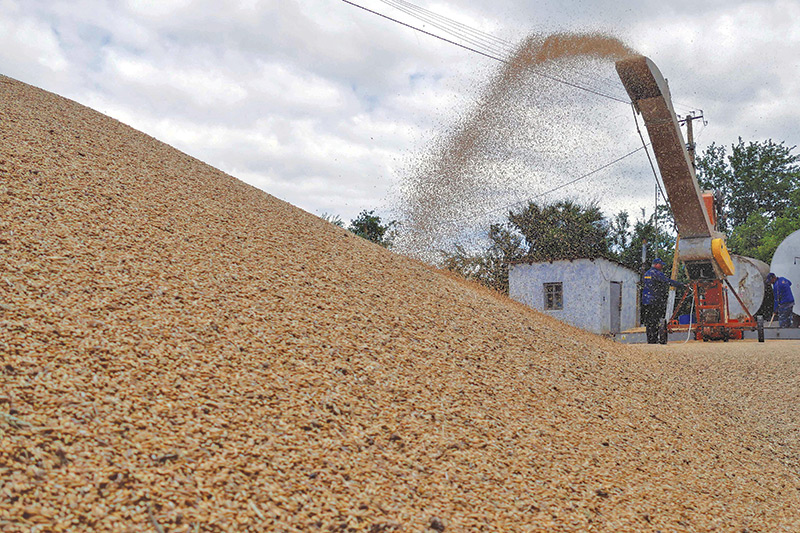
Workers storage grain at a terminal during barley harvesting in Odesa region, Ukraine. Reuters
LONDON/ISTANBUL, Ukraine has requested that Turkey detain and arrest the Russian-flagged cargo ship Zhibek Zholy carrying a cargo of Ukrainian grain taken from the Russian-occupied port of Berdyansk, according to a Ukrainian official and document seen by Reuters. The Ukrainian foreign ministry official, citing information received from the country’s maritime administration, said the 7,146 dwt Zhibek Zholy had loaded the first cargo of some 4,500 tonnes of grain from Berdyansk, which the official said belonged to Ukraine. In a letter dated June 30 to Turkey’s justice ministry, Ukraine’s prosecutor general’s office separately that the Zhibek Zholy was involved in the “illegal export of Ukrainian grain” from Berdyansk and headed to Karasu, Turkey, with 7,000 tonnes of cargo, which is a larger cargo than cited by the official. The Ukrainian prosecutor general’s office asked Turkey to “conduct an inspection of this sea vessel, seize samples of grain for forensic examination, demand information on the location of such grain”, the letter said, adding that Ukraine was ready to conduct a joint investigation with Turkish authorities. A Russian-installed official in Russian-occupied areas of Ukraine’s Zaporizhzhia region said on Thursday that after a stoppage of several months the first cargo ship had left Berdyansk port without naming the Zhibek Zholy. Kremlin officials in Moscow did not immediately respond to a request for comment on Friday. Ukraine has accused Russia of stealing grain from the territories that Russian forces have seized since its invasion began in late February. The Kremlin has previously denied that Russia has stolen any Ukrainian grain. Turkey’s foreign ministry did not immediately reply to a request for comment on the arrival of the Zhibek Zholy. Kazakh based KTZ Express confirmed to Reuters the Zhibek Zholy was owned by the company but said it was taken under a bare boat charter -- when no crew or supplies are involved in the lease -- by Russian company Green-Line, which was not designated under any sanctions. KTZ Express added that it was consulting the parties involved and would abide by all sanctions and restrictions. Green-Line could not be immediately found to request comment.
MONEY
India says Modi, Russia’s Putin discuss energy, food markets
Briefing
NEW DELHI: Indian Prime Minister Narendra Modi and Russian President Vladimir Putin spoke on the phone on Friday and discussed the state of global energy and food markets, Modi’s office said in a statement, as India keeps buying Russian crude oil. “They exchanged ideas on how bilateral trade in agricultural goods, fertilisers and pharma products could be encouraged further,” the statement said. “The leaders also discussed global issues, including the state of the international energy and food markets.” The statement said Modi urged Putin to go for dialogue and diplomacy to resolve the Ukraine crisis. (REUTERS)
MONEY
Philippines President Marcos vetoes economic zone bill championed by sister
Briefing
MANILA: In one of his first legislative acts, newly-inaugurated Philippines President Ferdinand Marcos Jr has vetoed a bill sponsored by his lawmaker sister that would have created a special economic zone north of the capital, the presidential office said on Saturday. Marcos, 64, who took office on June 30 after winning the May election by a landslide, has inherited over $200 billion in government debt driven by his predecessor’s pandemic response and the impact on the economy. “Fiscal prudence must be exercised particularly at times when resources are scarce and the needs are abundant,” Marcos said in a letter on Friday. (REUTERS)
MONEY
Striking Paris airport workers call new walkout on July 8-10
Briefing
PARIS: Striking Paris airport workers said on Saturday they would stage another walkout at the French capital’s main international hub from July 8-10 to press their pay demands, signalling further disruption for early summer travellers. Ground staff at Roissy-Charles de Gaulle airport have staged a series of strikes to demand a wage hike to cushion the pain of inflation, emboldened by booming demand for air travel and staff shortages caused in part by the Covid-19 pandemic. The current walkout, which began on Thursday, is due to continue until Sunday, though France’s civil aviation authority said less disruption was expected. Airport operator ADP had offered staff a 4 percent pay rise if they agreed to end the strike on Friday, but workers rejected the offer, a union representative told Reuters. (REUTERS)
MONEY
Indonesia and United Arab Emirates reach trade pact
Briefing
ABU DHABI: Indonesia and the United Arab Emirates on Friday signed a free trade agreement, strengthening economic ties between Southeast Asia’s largest economy and the major oil producing Gulf state. The accord, reached during a visit by Indonesian President Joko Widodo to Abu Dhabi, will remove or sharply reduce duties on most goods traded between the Muslim countries. The text of the agreement was not released and still needs to be ratified by both countries. (REUTERS)
BLACKBOARD
The art of writing
It takes a lot of effort and time to produce a work that can captivate readers.
- Sugam Gautam
Unsplash
A few weeks ago, a Facebook friend messaged me asking if I could read and comment on his recently written piece. I said yes and read his story. After reading the story, I felt he should learn the basics of writing before actually writing a story. The writing was so bad that it took me almost an hour to read just 2000 words. There were issues with grammar, sentence structure, and a whole host of other things. I was stunned because the person who sent me his work holds a master’s degree in English. It’s not just him; I’ve seen many English graduates struggle with the language. It’s understandable that non-native English writers don’t have a grasp of the language like native writers do, but it’s not excusable when someone holding a master’s degree in English makes such silly mistakes. It is not to say one must not commit mistakes. Errors are inevitable, but they can be minimised. Here are a few tips to improve writing.
Read a lot When I was a kid, I used to think that writers were genius by birth, and they write books easily with minimal effort. I was wrong in assuming that. Over the years, I have learned that writing comes from years of devotion, perseverance, and, most of all, practice. The more you practice, the better you get. And before writing, comes reading. If anyone says they don’t read much but can write well, I’ll not get convinced with them. If we look back and observe, we can see that good writers have once been good readers. When one reads voraciously, he develops the qualities required to become a writer. Unless you don’t read, you won’t be able to differentiate between good and bad writing. So, the first step toward becoming a good writer is reading as much as possible. Only when one spends considerable time around books can s/he develop a knack for playing with words. It’s easy to say that one needs to read a lot to become a writer, but in the beginning, one can find it challenging to read for an extended period. The ideal way to cultivate a reading habit is by reading a genre you like. When a person is surrounded by books he doesn’t like, there’s a high chance of him not flipping through a single page. In this tech-savvy era, every field is tied to technology in one way or another. And books are no exception. E-reading has become so common these days, and readers across the world are seen reading on digital screens. Aspiring writers must use their digital gadgets to read whatever they get their hands on, be it newspaper articles or e-books.
Work on technical aspects of writing Language is the medium to express your creative thoughts to the world, so it’s impossible to become a writer without a good language command. A sense of language comes from reading, so one must read to develop a good language. It is possible to improve your writing by reading grammar guidebooks that teach you grammar and writing fundamentals. In my childhood, I read numerous books that taught me grammar and other basic principles of writing. There are so many books available in the market that can boost your writing if appropriately used. Two books I strongly recommend are ‘The Elements of Style’ by William Strunk and ‘On Writing’ by Stephen King. I found the two books so helpful, and I think those striving to become a writer will also like them.
Write more, care less You’ll welcome more ideas and creativity when you stop caring about the result. In one of the seminars I recently attended, a writer said, “If you want to become a writer, write more and care less about how people perceive your writing.” It is not necessary for everyone to like your work. A writer must not presume things from readers’ perspectives but must write what intrigues him. Even I don’t like some books written by my favourite author. What I mean to say is writing, first of all, must make sense to the writer rather than to the general public.
Submit your writing The most common problem among those interested in becoming a writer is the fear of rejection. Due to this, many hesitate to submit their writing to online portals and newspapers just because they think their writings would not get validation from the editorial team. Young writers must understand that every famous writer in the world today has faced rejection at some point in their career. Had they not submitted their works for fear of rejection, they wouldn’t be who they are today. The benefit of submitting your writing, especially in newspapers, is that you can compare your original piece with the published piece. The newspaper editorial team revises and makes it more readable and jargon-free. You learn your limitations and weaknesses by comparing your original writing with the final draft. There will always be more room for improvement if you submit your writing to someone better than you. Writing is a tough art, and it takes a lot of effort and time to produce a work that can captivate readers. No matter how much one talks about writing, there’s a simple mantra to write well: read as much as you can and write a lot. Good writing might not be everyone’s cup of tea, but it’s achievable if one is dedicated.
Gautam is an IT student at GMMC, Pokhara.
BLACKBOARD
Vegetarianism, a step towards humanity
Slaughterhouses are the epicentre of mass animal killings.
- Soumya Shrestha
Unsplash
Vegetarianism generally refers to a broad spectrum of dietary patterns that involves an individual relying upon plant products rather than animal products as their food source. Several variations are included in vegetarianism--ovo vegetarianism, pescetarianism, lacto-vegetarianism, lacto-ovo vegetarianism, and veganism. Ovo vegetarians consume eggs; lactovegetarians consume milk and milk products; pescetarians consume seafood; lacto-ovo vegetarians consume both eggs and dairy products, and vegans do not consume eggs as well as dairy products. There are many reasons that make people choose vegetarianism. The most common reasons are socio-ethical issues, religious convictions, and environmental and health concerns. According to PETA, a popular American non-profit animal rights organisation, more than 29 million cows suffer and die in the meat and dairy industries every year. Approximately nine billion chickens are killed for meat yearly in the US alone, and 305 million hens are used for eggs. Tens of billions of fish and shellfish are slaughtered annually, making fish the most-killed animal (for meat) in the world. Places known as slaughterhouses are the epicentre of such mass killings. Animals in these slaughterhouses are artificially bred, tortured, and inhumanely killed. Every year, billions of innocent animals are slaughtered for meat in the most agonising ways. These atrocities urge certain people to stand up against them and reject any products produced by the slaughterhouses. This continues to be one of the major reasons for people choosing vegetarianism. Another reason is religion, and it has played a huge role in making people opt for vegetarianism. An estimated 40 percent of the population in India claims to be vegetarians. Hindus belonging to the Brahmin caste tend to follow a vegetarian diet. In Hinduism, vegetarianism is promoted and recommended instead of a non-vegetarian lifestyle. Hindus believe vegetarianism is said to bring positive effects to the body. Buddhism and Jainism also follow a similar concept of “Ahimsa” (nonviolence). Even though Hindu scriptures spread this concept of “Ahimsa”, we can still witness mass sacrifices of animals during major festivals such as Dashain. This depicts the hypocrisy that people can display in the name of religion. Likewise, the human body itself is said to be more suitable for a vegetarian diet. Carnivorous animals have jaws that only follow an up and down pattern while chewing. This enables them to rip the flesh apart from their prey. However, unlike carnivorous animals, humans can move their jaws up and down and from one side to another like other herbivorous animals. The digestion of fruits and vegetables happens much faster in the human body in comparison to meat products. This doesn’t denote that the human body isn’t suited for meat consumption at all; rather, it depicts that the human body is better designed for vegetarian food. Some individuals also opt to become vegetarians because of health problems. Many also have become vegetarian to lose weight. Science has repeatedly shown that it is possible to fulfil one’s nutritional needs while following a healthy vegetarian diet. Similarly, throughout history, a vegetarian diet has been praised and followed by several famous figures such as Mahatma Gandhi, Albert Einstein, Pythagoras, Nikola Tesla, and so on. Celebrities such as Billie Eilish and Joaquin Phoenix have also claimed to be vegan. Einstein even famously quoted that “Nothing will benefit human health and increase the chances for survival of life on Earth as much as the evolution to a vegetarian diet.”
Shrestha is an A-Level student at St. Xavier’s College, Maitighar, Kathmandu.
BLACKBOARD
So long, Covid
Unsplash
The last two years have been tough Our lives got turned upside down The pandemic brought normal lives to a grinding halt Many even lost their loved ones
But in the last few months The world has seen a glimmer of hope In this fight against the pandemic The pandemic finally seems to be retreating
One of the things that we have to thank for Are the scientists behind the Covid-19 vaccines The high vaccination rate has helped us reach here And medical professionals have saved so many lives
But before we let our guards down And forget our masks and hygiene protocols I think we should tread with caution And keep abiding by health and safety rules
Until we know for sure That Covid-19 is gone for good Remember that we can win this fight against the pandemic If we all act responsibly.
John Magar Magar is a recent high school graduate from Butwal.
SPORTS
Minister bats for sports tourism
- Sports Bureau
KATHMANDU, Newly appointed Minister for Culture, Tourism and Civil Aviation Jeevan Ram Shrestha on Saturday said the government will prioritise sports tourism in the country. Speaking during an interaction titled ‘Prospects of sports tourism in Nepal’ organised by Nepal Sports Journalists Forum (NSJF) to mark the World Sports Journalists Day in Kathmandu, Shrestha highlighted the possibilities of sports tourism in the country. He said he would focus his attention on the same. Shrestha is also the president of Nepal Olympic Committee. “Nepal has an abundance of possibilities in sports tourism and I am focused on developing this sector,” said Shrestha. “I have always stressed on bridging sports and tourism. The Covid-19 pandemic badly affected both tourism and sports in Nepal. Therefore, I want to take the two sectors together. I have special plans for its development by rebuilding the tourism sector,” he added. NSJF president Durga Nath Subedi pointed out the need for additional research in sports tourism and its prospects. Niranjan Rajbanshi—NSJF former president and the treasurer of Asian sports journalist governing body, AIPS Asia—said the appointment of Shrestha as minister has raised hopes that the sports tourism in the country would see a new beginning. World Sports Journalists Day is observed worldwide on July 2 to recognise the efforts of sports journalists in bringing the sporting world closer to its spectators.
SPORTS
Halep soars into fourth round
The former Wimbledon champion eases past Poland’s Magdalena Frech 6-4, 6-1.
- REUTERS
Romania’s Simona Halep (pictured) returns to Magdalena Frech during their women’s third round singles match of the Wimbledon tennis championship in London on Saturday. Ap/Rss
LONDON, Former Wimbledon champion Simona Halep soared into the fourth round of the Championships on Saturday with a commanding 6-4 6-1 victory over Poland’s Magdalena Frech. The 30-year-old Romanian, who returned to the All England Club this year for the first time since winning the grasscourt major in 2019, came into match having beaten Frech in both their previous meetings. Despite a stiff breeze blowing across Court two, Halep started in aggressive fashion to build up a 4-0 lead and although the 92nd-ranked Frech managed to get a break of serve back, it was not enough to stop her opponent from winning the first set. Playing her maiden third-round match at a major, Frech also cancelled out an early break at the start of the second set but Halep regained the lead immediately and celebrated with a clenched fist and repeated slaps on her thigh. There was no stopping the 2018 French Open winner after that as she continued to spray the court with winners and advanced to the net at every opportunity to leave Frech, who has never beaten a top-20 player, stranded. Halep broke Frech’s serve twice more and sealed the contest in 67 minutes with her 24th winner. Coco Gauff’s Wimbledon challenge came unstuck in the third round when she was beaten by familiar foe Amanda Anisimova 6-7(4) 6-2 6-1 in an all-American showdown. The two Florida-based players had made their way through the junior ranks at the same time, with Anisimova thrashing Gauff to win the US Open junior title in 2017. Anisimova will meet Serena Williams’s conqueror Harmony Tan for a place in the quarter-finals. France’s Harmony Tan continued her stellar Wimbledon debut to book her maiden fourth-round spot at a Grand Slam, crushing Briton Katie Boulter 6-1 6-1 in just 51 minutes. The 24-year-old Tan proved that her thrilling win over seven-times Wimbledon champion Serena Williams in the opening round was no fluke and she has now won In men’s action, Alex De Minaur proved rock solid as he ended British wildcard Liam Broady’s Wimbledon run in the third round, winning 6-3 6-4 7-5 to reach the last 16 for the first time. He will face Chile’s Cristian Garin next as he looks to reach his second Grand Slam quarter-final. Italian youngster Jannik Sinner beat American John Isner 6-4 7-6(4) 6-3 and sail into the fourth round. Friday’s win made the 10th-seeded Sinner the youngest Italian in the Open Era to reach the Wimbledon fourth round while setting up a mouth-watering clash of young guns against 19-year-old Spaniard Carlos Alcaraz, who was equally impressive in his 6-3 6-1 6-2 win over Oscar Otte.
SPORTS
Bhandari, Sarraf guide Nepal to victory in Canada
A late fifty from the batter and a three-wicket haul from the spinner help the Rhinos beat Ontario by 69 runs.
- Sports Bureau
KATHMANDU, Binod Bhandari hit a half-century and Pawan Sarraf took three wickets to help Nepal defeat Ontario Cricket Club by 69 runs in the practice match at King City, in Ontario, Canada on Friday. Electing to bat first after winning the toss, Nepal posted 220-8 total in the allotted fifty overs at the Maple Leaf Cricket Ground. Bhandari smashed eight boundaries in his 59-ball 57 and shared a 63-run partnership with Bashir Ahamad (24) for the seventh wicket in just 8.5 overs. Opener Aasif Sheikh scored 42 runs off 75 balls in his 50-run stand with Dev Khanal (27) for the second wicket after Aasif’s opening partner Kushal Bhurtel was out cheaply for 13, caught by Mihir Patel off Sheel Patel. After Khanal fell in the 23.1 overs, caught by Keenan Tinto off Jade Padmore, Nepal’s batting collapsed. Darshil sent Rohit Paudel for just 2 and Ammar Khalid ran out Aasif before Sheel struck twice removing Dipendra Singh Airee (19) and Aarif Sheikh (19) to limit Nepal 146-6 after the 40th over. But Bhandari held nerve late in the innings to guide Nepal to a respectable total. Adil Alam was not out for 10 runs. Sheel returned the match figures of 30-3 in his 10-over spell. In reply, Ontario were bundled for 151 in 42.5 overs after Aarif and Airee combined to wreck the top order as the hosts were 92-4 after the 31st over. Opener Jash Shah (20) fell in the 13.3 overs, caught by Khanal off Aarif, after sharing a 43-run stand with Riyazkhan Pathan (36), also caught by Mohamad Aadil Alam off Airee. Shiekh then trapped Mihir Patel (4) lbw before Airee caught and bowled Ramanvir for just 2. Naresh Bahadur Budhayer assisted 29 runs facing 48 balls that featured two fours and a six but Sarraf had him caught behind in the fifth delivery of the 35th over. Sarraf then took two more wickets quickly, eliminating Padmore (4) and then putting break to a fight back from Nicholas Manohar, who had scored 25 runs off 27 deliveries. Kishor Mahato and Khanal then polished off the tail to give Nepal a good start in their Canada tour. Nepal will next play Canada in a two-match fifty-over series on July 4 and 5, before heading to Scotland to participate in the Scotland Triangular Series of the ICC Men’s Cricket World Cup League 2, set to begin on July 11.
SPORTS
Police edge APF to clinch women’s volleyball title
- Sports Bureau
Members of Nepal Police Club pose with the trophy and medals after winning the Bagmati Province New Diamond Cup Open Women’s Volleyball Tournament in Kirtipur on Saturday. Post Photo: Keshav Thapa
KATHMANDU, Nepal Police Club clinched the Bagmati Province New Diamond Cup Open Women’s Volleyball Tournament after defeating APF Club in straight sets at the Kirtipur Multipurpose Covered Hall on Saturday. Police registered a 25-16, 27-25, 25-19 score over APF in the title battle in Kirtipur to stay unbeaten all the way to the title. It was a second straight defeat for APF in three days at the hands of the same opponents. APF had lost to Police in the last league match on Thursday. New Diamond Academy secured a third position with a comfortable 25-12, 25-14, 25-23 victory over Paropakar Girls Hostel. Winners Police walked away with a purse of Rs500,000 while runners-up APF received Rs250,000. Hosts New Diamond won Rs125,000 and Paropakar got Rs75,000. Police’s Kopila Rana was declared the most valuable player of the tournament. She won Rs25,000. New Diamond’s Sanila Budha Magar won a purse of Rs20,000 after she was named the emerging player. APF’s Reshma Bhandari and Usha Kumari Bista were adjudged the best spiker and the best blocker, respectively. Police’s Kamala Pun and New Diamond’s Anjila Pradhan won the best setter and the best libero awards. Police coach Rupesh Kumar Bista was declared the best coach. They won Rs10,000 each. The winners will need to support 20 percent of their prize money to the New Diamond Academy, who organised the event with aims to build their own volleyball court.
SPORTS
Nepal to host 2022 SAFF Women’s Championship
- Sports Bureau
KATHMANDU, Nepal will host the SAFF Women’s Championship 2022 from August 29 to September 10 after the South Asian Football Federation (SAFF) approved Nepal’s proposal to hold the regional football competition in Kathmandu, All Nepal Football Association (ANFA) said on Saturday. A delegation led by ANFA general secretary Kiran Rai had officially submitted Nepal’s bid to host the sixth edition of the championship in the country’s capital at the SAFF Ordinary Congress, being held in Dhaka, Bangladesh. “The proposal was endorsed by the SAFF executive committee meeting prior to the SAFF Ordinary Congress 2022,” ANFA said on its website. SAFF had proposed Nepal to hold the women’s championship from August 12-24 at a virtual extraordinary Congress in January this year. The decision means Nepal will be hosting the women’s competition for a second time in three years, after also hosting the last edition of the biennial event in Biratnagar in March 2019 for the first time. Nepal had lost to India 3-1 in the final. Nepal have reached the final four times but have come short each time. India have won all five editions of the championship. The first SAFF women’s championship was held in 2010 in Bangladesh. Meanwhile, the Congress elected Kazi Md Salahuddin as the president of SAFF unopposed for a second term until 2026. Salahuddin first assumed office as the SAFF president in 2009. The Congress also appointed Bhutan Football Federation general secretary Ugyen Wangchhuk as the SAFF executive committee member, and Sri Lanka Football Federation president Jaswar Umar as the AFC executive committee member representing SAFF.
MEDLEY
Horoscope
ARIES (March 21-April 19) **** The day is perfect for catching up on your errands and chores, helping you enter the workweek with a clean slate. Try not to worry so much about what’s to come by looking for ways to stay grounded and present.
TAURUS (April 20-May 20) *** Spend the day to blow off some steam before another workweek begins, even if doing so means you’ll need to put off a few of your chores or errands until tomorrow. Set a reasonable budget if you decide it’s time to go shopping.
GEMINI (May 21-June 21) **** You’ll feel inspired to tidy up and get organised at home today. The day will help bring order to your space will help you feel more in control of your life while creating a sanctuary worth retreating to at the end of each workday.
CANCER (June 22-July 22) *** The day is ideal for compiling and tackling to-do lists, especially if you’ve recently felt like a hot mess. If you need help with your endeavors, don’t be afraid to rally your friends and family for some help.
LEO (July 23-August 22) *** A stabilising vibe will come into play today. Use this energy as an excuse to disappear into nature for the day, which can help revitalise your mind, body, and soul, even with a new workweek looming around the corner.
VIRGO (August 23-September 22) **** Focusing on self-care and personal goals will feed your soul right now. If you feel called to embrace your social side, make sure to get home at a reasonable hour so you can focus on finding harmony.
LIBRA (September 23-October 22) *** Try not to be overly critical of yourself today. The day could bring you to a dark place if you let it, especially if you lose touch with compassion for yourself. But there will be also an opportunity for self-improvement.
SCORPIO (October 23-November 21) *** You’ll be in the mood to organise a gathering for your loved ones today. This cosmic climate could also inspire you to help others make connections, so don’t hold back if you feel called to make a few introductions.
SAGITTARIUS (November 22-December 21) *** Your responsible side will assume control of your typically fun-loving spirit today. Use the productive energy of this luminary placement to organise your to-do list, tackling personal tasks before the week starts.
CAPRICORN (December 22-January 19) **** A mystical energy will surround you today. The day is perfect for connecting with your higher power.. Your manifestation skills will also benefit from a huge boost, making it an ideal time for working toward your goals.
AQUARIUS (January 20-February 18) *** You’ll be called to clean house today. Use the day to push out the old to invite in the new. Whether you’re inspired to clean up your social media feeds, or finally say goodbye to that toxic friend, now is the time to do so.
PISCES (February 19-March 20) *** Love will energise you today. If you’re currently dating, these vibes are ideal for bringing you and your crush closer. Though partnership will be a priority right now, you should also take care to practice plenty of self-care.